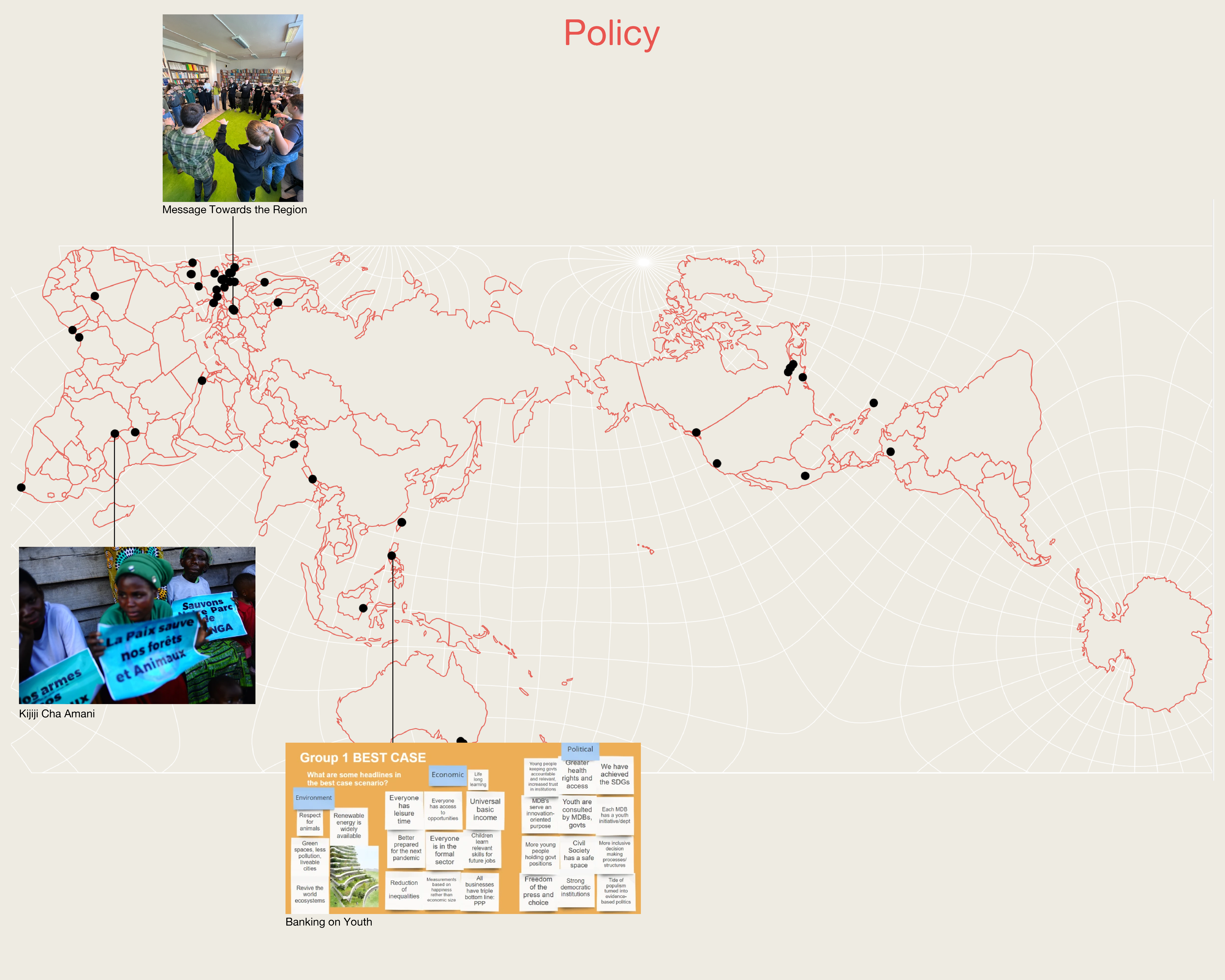
Many projects experimented with participatory democracy mechanisms involving youth, linked to local and international policymaking. They either reached out to youth-led organisations or built partnerships with organisations working with young people. For example, between 2022 and 2024, Destination Beauvais 2040 connected a formal “Council for the Future” with “future workshops” by and for citizens, including several focused on children and youths, “to engage directly with local decision-makers as equal partners.”
Similarly, La Crise dont vous êtes le héros in Nantes Métropole uses interactive climate scenario games to involve youths in municipal climate adaptation strategies, directly linking foresight to institutional resilience goals. In Slovakia, the Message Towards the Region project was “co-developed with the City of Nitra and the Council of Youth of the Nitra Region, anchoring the foresight work within local governance frameworks.” It facilitated structured dialogues with elected officials, addressing policy issues such as school curriculum reform by workshopping ideas with youths from the region. Through partnerships with municipal or regional governments, these initiatives fostered democratic dialogue with youths to help shape urban policies on themes such as climate, technology, education, and political reform.
These projects reveal a growing desire to change how policymaking and public governance recognize the value of youths’ proposals. The extent to which such proposals will be concretely implemented still remains to be seen.
Some initiatives within these public consultation contexts highlight the intersection of social justice and climate adaptation in metropolitan areas and the importance of reaching out to more vulnerable communities. Projects like Citadins, Citadines 2050 “engaged participants from both socially disadvantaged neighborhoods and local authority field agents… fostering dialogue across social divides” in order to understand how climate impacts are being perceived by communities who do not usually attend consultations in their own time. By reaching out and meeting with these communities on their own ground, it makes sure their perspectives are included into governmental climate resilience strategies. This approach supports institutional priorities for inclusive governance and equity in planning, all the while experimenting with more innovative approaches.
Youth-led initiatives connected to global climate governance are examples of more formal political channels for participation. Local Conferences of Youth (LCOY) train young advocates in policy and advocacy, enabling them to articulate and present their visions for climate justice. LCOY also links youth advocacy directly to UNFCCC (UN Climate Change) negotiations, giving young people the opportunity to both build skills and bring their demands into formal political arenas.
The Emerging Horizons foresight process similarly integrates youth-generated futures into UN climate policy frameworks. Its report presents identified policy questions tailored for further action by UN agencies and youth climate leaders. These futures serve as examples of alternative ways to approach and frame the issues at stake.
Some institutions or funds have been working with movements or organisations who are active on the ground and who mobilize citizens, youths, from different parts of the world on questions of climate, especially in areas where local governments are not necessarily supportive of these initiatives. The Fearless Mural project at COP27 Egypt inserts/situates youth activism within the official UN negotiation space, creating a “perfect time for politics to come out from working behind closed doors... to see what is happening on the ground” (A Fearless Mural for the COP27).
Several projects focus on enhancing institutional abilities to engage with youth and civil society through foresight and participatory tools and vice versa. The EU-funded Imagining Climate-Just Futures initiative trained over 3,400 citizens across 12 countries and European partners to lead participatory scenario-building, embedding youth narratives in policymaking. The project description notes it is “combining participatory foresight, youth empowerment, and creative engagement to shape inclusive climate justice narratives”.
In Canada, Net Zero and You(th) empowers young people to “learn to critically assess government plans, track local climate initiatives, and ask better-informed questions as citizens” enabling them to be more informed and to adapt their language to a political context. This is also to encourage youths to engage in local or national democratic processes such as participatory budgeting and youth panels. An important point to highlight is that within these dynamics, youths are often expected to adjust their tone and style to fit political discourse if they want to be taken seriously.
Kijiji Cha Amani in the Democratic Republic of Congo, a conflict-affected region, engages communities through participatory “parachute mapping” to visualize the links between climate change, land use, and insecurity. These locally grounded narratives inform advocacy towards regional authorities and NGOs, pushing for integrated environmental and peacebuilding policies. These types of activities demonstrate how, in fragile contexts, collaborative governance, where citizens and communities align to address a problem, can complement formal political structures, when these prove unable to respond to citizens' needs.
Grassroots activism remains a vital force applying pressure to politics and political decisions for more ambitious climate policies. The link with policymaking here becomes about applying pressure. These initiatives are drivers of bottom-up political change. In Indonesia, Enter Nusantara campaigns in many different ways, by organising mass protests targeting banks still investing in fossil fuels, with the explicit goal to ban coal. The campaign’s outreach efforts (social media), has influence on policy debates and cultural perceptions around climate justice, all the while recruiting more youths in a national pressure movement.
Le Théâtre des Négociations exemplifies an experimental approach to connecting citizens and politics by transforming the rigid format of international climate negotiations into a participatory, imaginative arena. Instead of mirroring traditional state-based delegations, the 2015 event invited 200 international students to a theatre in Nanterre (France) to a different kind of simulation: many of the students represented new kinds of (non-human) “actors” such as oceans, soil, youth, or the internet, entities usually absent from formal policy arenas but central to planetary life. By staging negotiations as a live, collective performance, it disrupted diplomatic conventions and allowed participants to test new alliances, rethink priorities, and generate bold proposals such as a legal status for climate refugees or a moratorium on Arctic mining. This experiment not only broadened the views on who and what gets represented in political decision-making, but also highlighted the potential of theatrical, creative formats to renew public imagination, foster collective agency, and bring long-term issues into the democratic sphere that need to be answered by taking in complexity.
From local, national, and international councils to citizen consultations and international climate negotiations, youths are recognized as essential political actors shaping just, inclusive, and sustainable futures. While institutions are adapting their processes to include and/or hear youth voices, and while young people themselves are demanding to be heard through activism and grassroots campaigns, it remains crucial to scrutinize how these mechanisms are implemented to ensure youths’ voices genuinely influence policy and proposals are acted upon.
For now, however, at the institutional level these initiatives often function more as knowledge pools than as drivers of concrete change, with relatively few proposals being piloted or adopted. This raises important ethical questions: how can we ensure that youths genuinely benefit from these consultations and that participation translates into meaningful impact?
→ We delve into what makes youth participation meaningful in Meaningful experience.
b:T3446,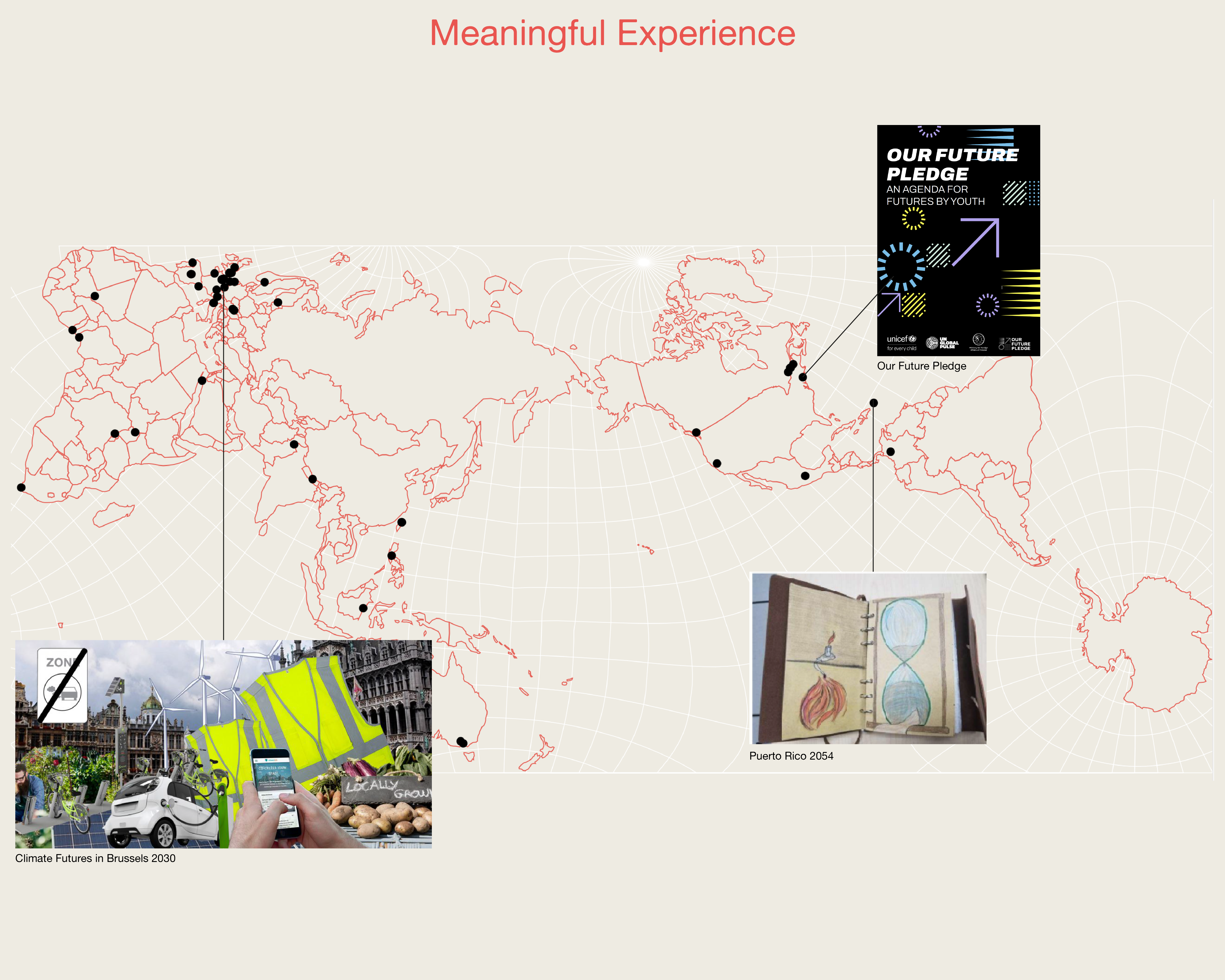
We found that projects can be meaningful experiences to young people in a gradual way:
For ClimateWorks Lab, the City Hive team following them paid special attention to the youngsters' needs, offering stipends, food, and a flexible schedule. They also focus on overcoming financial and logistical barriers
“Throughout the process, the emphasis was not on perfection or speed, but on agency, adaptability, and ongoing engagement. Meetings always included shared meals, which helped build trust and community. Youth were given financial support through stipends and transit reimbursements, lowering barriers to full participation.”
An ambitious way to meaningfully integrate young people in foresight practices is to thoroughly train them on future studies methods, then sponsor them to work on it. In 2022, UNICEF Innocenti recruited a group of young foresight practitioners from around the world to become its first cohort of “Youth Foresight Fellows”. Fellows worked with UNICEF over the course of six months as consultants to design and participate in research processes to inform UNICEF’s Global Outlook, and create tools for future youth foresight projects (Our Future Pledge).
→ Many other projects linked their work on futures with educational outcomes that will benefit the participants well beyond the project itself: you can find more about them in the relevant sections on Futures Literacy, Climate Change Literacy and Learning New Skills.
While Maria de Mater O'Neill was teaching a design class in Fajardo in 2017, Hurricane Maria hit the country. It devastated the region and disrupted local life for several weeks. That was the starting point to develop a methodology around resilience for the young designers, which became the Puerto Rico 2054 project. Here it was meaningful because it was something the students needed at this specific moment, dealing with a difficult and hurtful situation. The futuring process helped the youngsters deal with their emotions and the concrete difficulty of studying in this situation, while the projects they developed made sense in their community and had a concrete impact.
Climate Action Photovoice also has a process to make the theme emerge from the group, so that the participants’ real concerns are discussed.
→ The Youth-led projects, described in another HOW section, have an inherent tendency to be closer to the concerns of youths, with young people taking charge of the entire development of projects.
The practices of care1 at the heart of some of the projects of our corpus are also participating in making them meaningful experiences (Centre for Reworlding, A Fearless Mural for COP27, Crafting Change through Natural Dye-making). The intergenerational discussions featured in these projects, associated with indigenous ways to share knowledge, were also seen as ways to legitimate young people’s voices in the discussion.
The Eco-anxiety Africa Project (TEAP) also uses this intergenerational lever to help young people legitimate their eco-emotions and cope with them. The project is not about producing something: its goal is solely to help, to support the participants and create a space where they can express their eco-emotions, and help each other process them.
These initiatives are meaningful because they help young participants to make sense of their environment, of what they experience and feel.
Obviously, one way of making a project meaningful is for it to produce concrete effects on the ground. As an example, Message Towards the Region developed a real co-creation process involving young people and policy makers to imagine the future of the city of Nitra together.
→ More examples can be found in the Policy section.
Interacting with decision-makers, and perhaps achieving concrete results, is also a source of pride for the young participants, and can help them have a broader view of how they are able to act at the level of their environment and community.
There is also a core and great value in the sole act of creating a place of discussion between young people. That is something they value and that often comes in the feedback of the projects (see Net Zero and You(th) or Générations F). Participants find peers who share their values and do not feel alone anymore.
According to Aniela Fidler Wieruszewska (Feeling Futures Through the Stuff We Wear), it is also deeply important to just make it fun, and creative.
In the field of research, extractive participation is also a risk that needs to be thought of. The designers of the participatory methods of Youth Futures Under Construction and JustFutures had in mind a similar question: how does this research also serve the participants taking part in it? For Youth Futures Under Construction the method has been co-created with youths as co-authors and researchers. They even constituted youth advisory boards. Then young people are not objects studied in the research but real stakeholders learning something and taking credit from the experience.
During the JustFutures project, Anabela Carvalho and Maria Fernandes-Jesus, who we interviewed, worked in cooperation with different activist groups in Portugal. They initially encountered trust issues with them and had to work their way around it, reform the projects’ organisation and find common interests between their research and the activists’ goals. Despite the additional hard work, it is important for them to bridge research work with the community. This effort was necessary and enabled a lot of learning occasions on both sides.
Imagining Futures / Future Imaginings is another example of deep involvement of youngsters in the management of the process. Youth Advisory Boards were formed in each geographical district to co-design the process, guide ethical practices, and define meaningful forms of expression. It was defined and conceived from the beginning as a collaborative and horizontal project.
In their report “Meaningful Youth Engagement in the Multilateral System”, UNICEF Innocenti wrote a concise definition summarizing the issues around what they define as “Meaningful Youth Engagement” in processes set up by international institutions with the intent of involving young participants.
“Meaningful youth engagement is where children and youth are involved as equal partners; where their views and circumstances are respected; where marginalized youth also get the opportunity to participate; and where youths from all backgrounds are welcome and engaged as agents of change rather than just beneficiaries.”
Several of their recommendations (from page 28 onwards of the report) echo what we found in WTFutures:
Including both self and community care, this concept is about being attentive to the needs of oneself and others, showing support and compassion, assuming some responsibility towards it and meeting the needs when possible. It recognises that the well-being of all is the result of shared responsibility, despite the power dynamics that govern our interactions. Learn more with Mrs Roots.
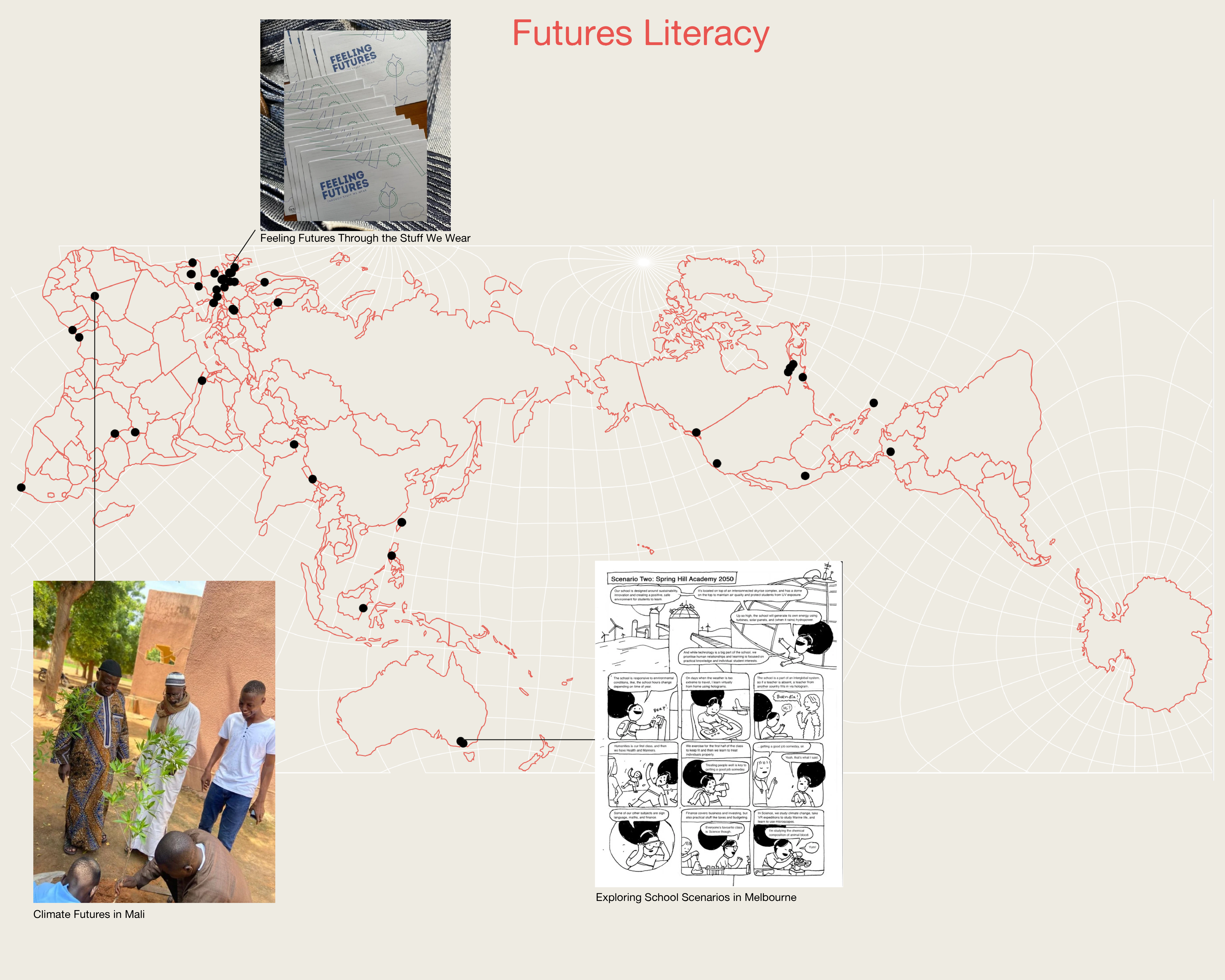
Futures Literacy, according to UNESCO, is “a capability [...] that allows people to better understand the role of the future in what they see and do. Being futures literate empowers the imagination, enhances our ability to prepare, recover and invent as changes occur. [...] It is a skill that everyone can and should acquire.”
We all anticipate, both in the short term (before crossing a street) and the long term (to make life choices), but we mostly do this unconsciously: we are generally unable to articulate the images of the future on which we base our decisions. And we are certainly not taught to do it, except in the rare Futures Studies departments of selected universities.
Futures Literacy is, above all, about turning these unconscious behaviours into conscious individual and collective practices. According to a leaflet produced by the Future Is Now project, Futures Literacy is about helping persons and collectives to:
Most of the projects identified within WTFutures, but not all, sought to develop some kind of futures literacy in their young participants. For some, it was an end in itself – futures literacy as empowerment –, while for others it was a means to help participants produce better images of the future and be more relevant on the topic at hand. Some used informal, playful, experiential methods, while others relied on more structured forms of teaching.
When is the future? The projects have chosen a great variety of time horizons for their futures. 2040 and 2050 seem to be the most frequent, with some occurrences to (nearby) 2030, 2060, one 2124, and a last project happening 200 years from now (Générations F). The “Futures Literacy Toolbox” from the Future Is Now project has this (non-scientific) recommendation: “Choose a horizon slightly longer than their age (ex. 20 years if they are 15-18 years old). It is a time period that they can relate to, but it is also just beyond their experience, therefore likely to open their minds to new ideas.” Indeed, the choice of time horizon (or even that of not setting any) strongly depends on what is expected from the work. |
|---|
Over the years, Futures Studies have produced a large amount of tools and methods, which may at times seem overwhelming. However, the projects studied by WTFutures have found a great variety to develop their own variant of Futures Literacy with their participants:
What these approaches have in common, is that they generally do not aim to train aspiring futurists, but rather to equip young people with new “soft skills” that can be used in a large variety of life situations, especially in an increasingly complex and unpredictable world. Together, they show that there is no single correct way to build up one’s futures literacy.
Some foresight techniques used in WTFutures projects (from most to least used; counting resolutely unscientific) | |
Futures wheel: a graphical exploration of direct and indirect consequences or a particular change. | Retro speculation: backcasting from a given future, recounting the likely events that lead from the present to this future. |
Futures triangle: a method to map forces of change and their interaction, categorizing them by their timeframe: the “push of the present”, the “pull of the future”, and the “weight of the past”. | Three horizons: a framework for analyzing a system’s change as an interplay between three “horizons”: the currently dominant system, the desired future, and in between, the messy space of transition. |
Horizon scanning: the detection and examination of potential threats and opportunities in the future. It often differentiates trends (recognizable, consistent, long-term patterns of change) and “weak signals” (novel and unexpected phenomena that may or may not harbor lasting and significant change). | “What if” questions: exploratory prompts used to imagine alternative futures by setting a strong, transformative hypothesis (e.g, “What if extreme weather events permanently reshape global food production zones?” ), and imagining how the future might unfold from there. |
Scenario building: a structured method for developing multiple, plausible descriptions of how the future might unfold. Scenario sets often distinguish between “business as usual” (pursuing current directions), a desirable future, and a pessimistic and/or “disruptive future”. | Time traveler game: an exercise where participants imagine themselves as travelers from the future (or past) to explore how today’s decisions, events, or trends might look in a different time context. |
Causal Layered Analysis (CLA): a method for exploring multiple layers of understanding about the future, from surface-level trends to deeper worldviews and myths, in order to reveal underlying causes and assumptions shaping issues. | Design fiction: the practice of creating speculative artifacts to explore and provoke thinking about possible futures and/or the social, ethical, or cultural implications of emerging technologies. |
Polak game: an exercise to help participants reflect on their personal and collective attitudes toward the future by asking two simple questions: “How do you feel about the future?” (optimistic vs. pessimistic), and “Do you believe you can influence it?” (powerful vs. powerless). | S-curve: a graphical representation of the life cycle of a technology, innovation, or trend, showing slow initial growth, rapid acceleration, and eventual maturity or saturation. |
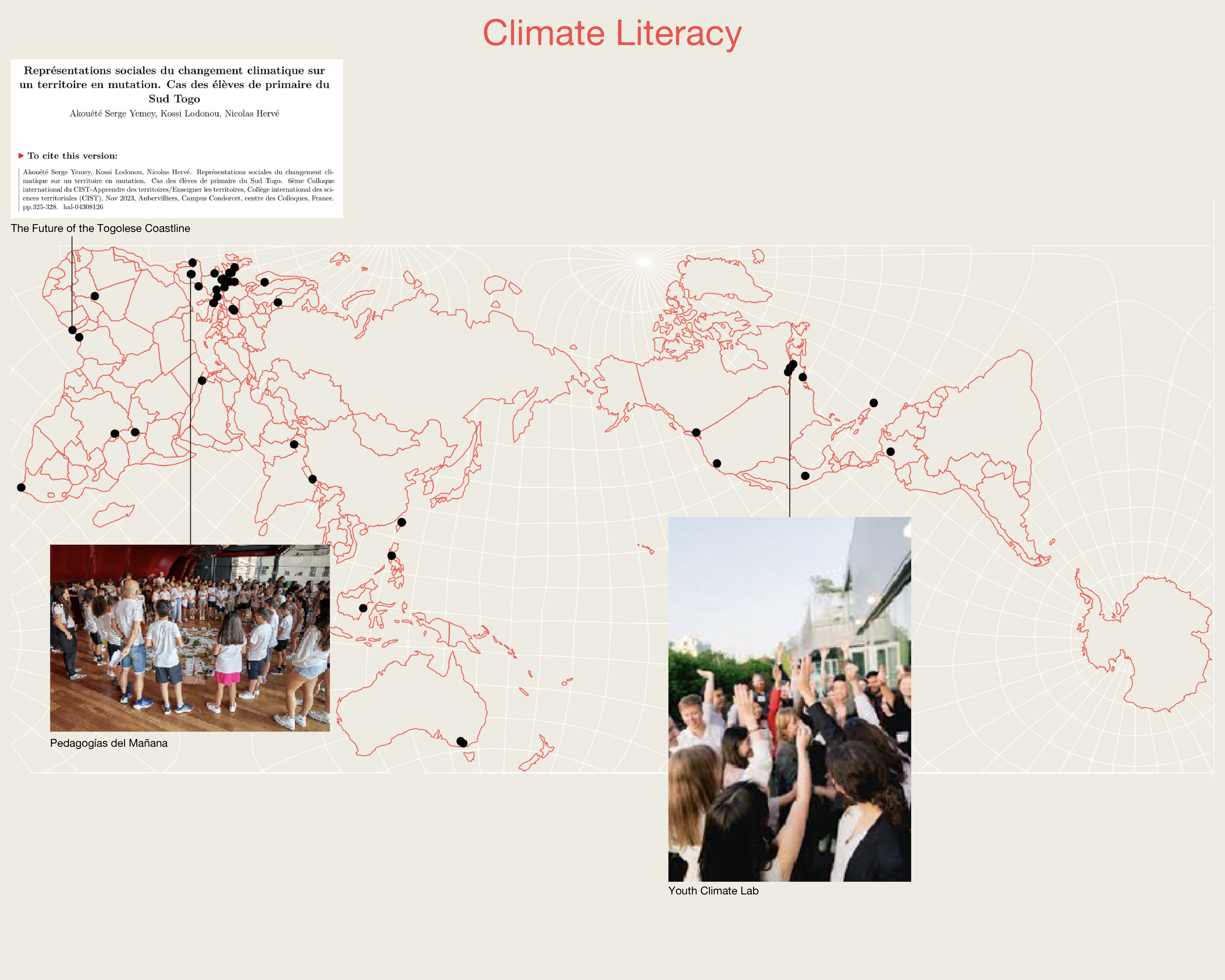
A little less than half (24 out of 54) of the projects identified within WTFutures felt it necessary to develop their participants’ basic awareness of climate change and/or to dispense knowledge of its causes and consequences (in the form, for example, of a Climate Frescoe). The others did not see this as necessary. What surveys and projects alike do seem to say is that there is no longer a strong need to develop the awareness of climate change among young people, and that its first- and second-order consequences are also generally understood.
On the other hand, a few experiences (The Future of the Togolese Coastline) alert us to a possible consequence of being “climate native1”: the ‘naturalization’ of climate change, which, having always been part of young people’s life, can appear to have no history, no specific causes.
There are, of course, plenty of knowledge gaps remaining. Some of the projects try to fill them in ways that “do not look like a class” (Feeling Futures Through the Stuff We Wear) : peer-to-peer learning, building up knowledge from experience (the tour of a sustainable denim factory in Feeling Futures, the discovery of an organic produce store and an urban garden in Pedagogías del Mañana). The goal is not to make sure that participants have a comprehensive knowledge of climate change – probably an impossible task –, rather to give them the tools, the self-confidence and the desire to go find the information they need when they need it.
There is a distinct educational element in many projects, focused not on generalities, but on more precise topics or issues:
Several projects advocate for the presence of climate literacy in standard education, however, the way to reach this goal is not often described.
Climate change is not a discipline, rather a multi-faceted phenomenon that can never be grasped as a whole (a “hyperobject”, in the words of Timothy Morton). It can only be taught across disciplines (El Futuro es Clima), probably in a collective form (so that different learners can apply different lenses on the same questions), mixing hands-on and theoretical approaches (Eduponics). For the Youth Climate Lab, Climate literacy education should also be “designed with regional specificity and culturally appropriate materials.”
Following the “Young Foresight Fellows” behind the Emerging Horizons project, we can conclude that “advancing eco-literacy is a catalyst for transformative change”, in education and beyond.
→ We dive deeper into these changes in the related "Key Learning" in the WOW! section: Rethinking learning in today’s and tomorrow’s world.
A Climate Native is a person who has grown up in a world marked by the prospect, and increasingly the reality, of anthropogenic climate change and its consequences. See Climate Natives.
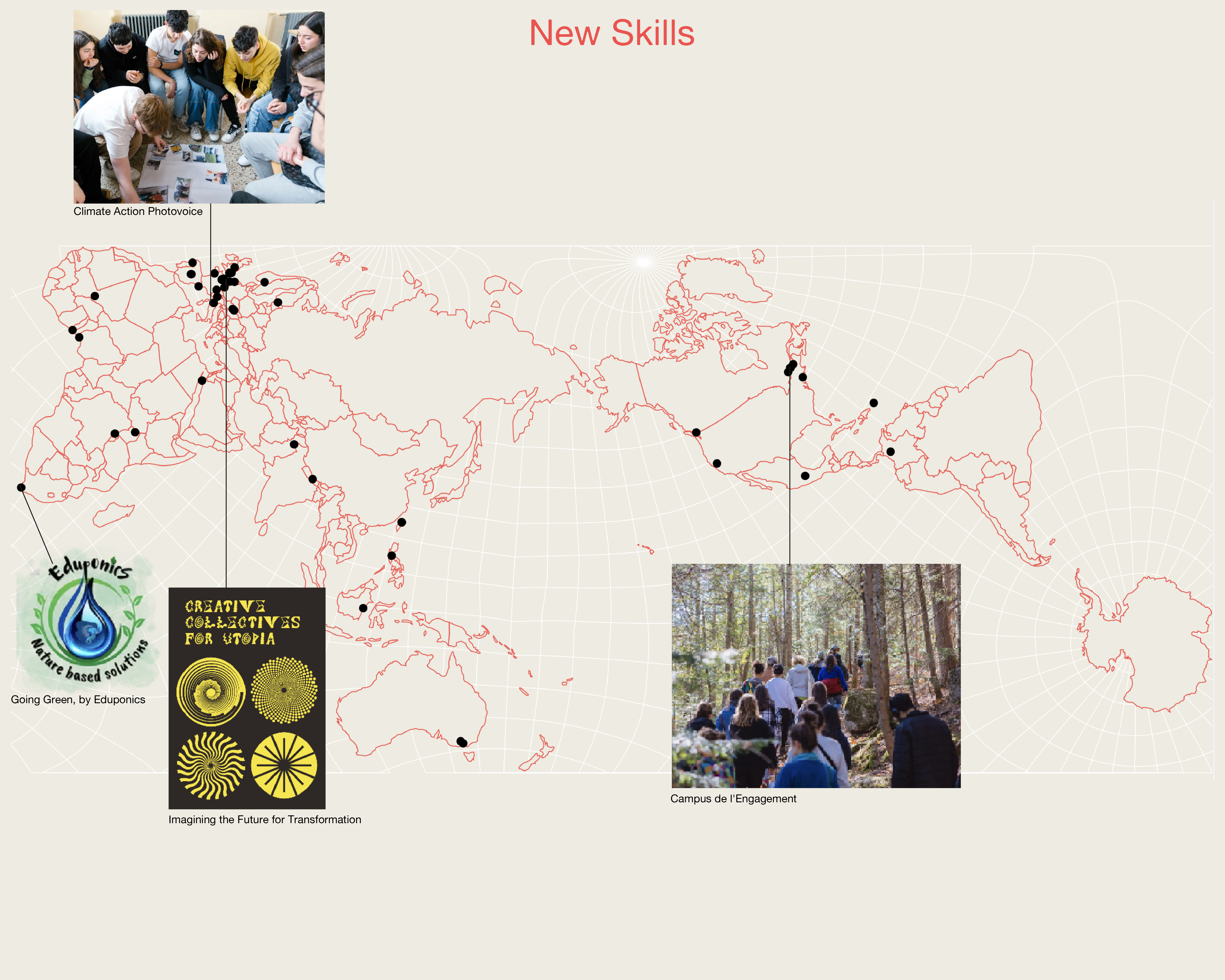
“[In] an era defined by complexity, individuals need capabilities that help them engage with uncertainty, make sense of emergent issues and opportunities, and work together –creatively, skilfully and ethically – to bring about positive societal transformations.”
Kligyte et al., Educating for sustainable and equitable futures: A transdisciplinary future-making capability framework, 2025.
In analyzing what the projects had to say about education, we found that there was a strong convergence towards connecting academic disciplines to take complexity into account, and towards learning "life skills" such as collaboration.
Numerous initiatives studied in WTFutures advocate for a transdisciplinary education approach where different domains come together to make sense of a complex world. Young people will need to learn how to combine learnings from different disciplines in order to achieve their goals, whatever they may be.
Such is the case for ClimateWorks Lab, whose mission is to support young activists in developing personal projects related to the fight against climate change. To help them in this development, they orient them towards system mapping methods to identify issues they want to work on (complexity-related skills) or towards visioning exercises to identify personal motivations (which we could describe as self-awareness, emotional or reflexive skills).
Participatory research methods combine practice, context-awareness and knowledge-building in an iterative process. Learners co-produce their own knowledge, discuss it with actors on the ground, and reflect on it so as to become able to use it elsewhere. In Climate Action Photovoice, youngsters are given tools (a camera and some principles of photographic investigation) to then go out and capture images that reflect the issues that they feel are important to discuss.
Climate Futures in Brussels 2030 also proposes to its participants to do field research in the form of street interviews, then helps them process the information by teaching them how to do thematic mapping. The students in the Imagining the Future for Transformation course work with actual projects in Europe and Africa, trying to find the right “distance” in order to be both appreciative and critical, particularly towards projects that come from a culture that they know little about.
“Young Ambassadors” are also deeply invested on the ground in Kijiji Chi Amani. They are responsible for community-based fact-checking and rumor verification. Tracking down reliable as well as fake news at the local level is both a valuable skill, and a responsibility.
More broadly, many projects intend to teach the youths how to debate in a sane manner, work in teams and listen to others (Défis Résilience, Museum of the Not-Yet-Possible, Centre for Reworlding).
Some projects sought to develop technical skills in, for example, agroecology or renewable energy production, aimed not at future professionals, but at helping communities prepare for a future where the local availability of these skills might come in handy (Enter Nusantara, Eduponics).
Aside from introducing pupils and students to aquaponics, Eduponics is also about developing project management and entrepreneurship skills and experience, by concretely running small, sustainable agricultural projects from and around their school.
Other initiatives involve young people in workshops directly connected to real professional practice. Urbanités Numériques en jeu for example enables children in a class to be involved in real-world urban planning and renovation projects. They even learn how to use some modelization tools and get precise knowledge on the use of building materials.
Several initiatives target activists (or activists in the making), recognising that activism is both a knowledge-intensive and an emotionally demanding activity, and that both these characteristics need to be nurtured. It is the case for Campus de l’Engagement, whose goal is to develop what they describe as the “skills of the future”: civic engagement, critical thinking, collective leadership, and communication.
The young adults involved in this program become capable of (or better at) creating citizen mobilization campaigns, media content, organizing events, facilitating workshops, creating and running community spaces, etc.
In the Local Conferences of Youth, capacity building as activists is also at the program’s core. They learn how to navigate a very codified institutional world, to write and discuss policies, as well as advocacy writing.
These learnings are clearly valuable outside of activism; however, what these projects also tell us is that activism can be a significant part of young people’s life itineraries, well beyond their formative years – and that, to them, it counts as a professional endeavor, not a hobby.
→ See also Lifelong Activism in the WOW! section (our key learnings).
It is also really important to mention the value for young people to learn creative and artistic practices, like scriptwriting in Climate Futures in Brussels 2030 or theatre in Générations F. These experiments are not one-offs. The young people involved in it might discover a great way to continue to express themselves and it could even inspire vocations.
Creative and artistic techniques can also introduce new ways to think about an issue and help young people deepen their understanding of the world on a daily basis.
→ We explored this issue further in Embodiment.
Across many strands of climate activism, practitioners, mostly situated on colonised land, are increasingly turning toward Indigenous forms of knowledge sharing- rituals, traditional practices, and storytelling. Young people, in particular, are showing a growing interest in these approaches, which are gaining traction worldwide (Fridays for Future MAPA - Most Affected People and Areas - movement, Indigenous Climate Action, Possible Futures, Youth for Climate Movement (Argentina), etc).
In Crafting Change through Natural Dye-making, a particular form of craftsmanship is taught to the participants: “natural dyeing and textile-making, activities chosen for their ritual, relational, and land-based qualities.” This activity takes on an additional dimension through its links with indigenous traditions, ceremonies and knowledge.
Here, discussing the future also means learning about the past, about the roots, and learning to reconnect to the land and the ecosystems.
Another project, Centre for Reworlding, also draws on indigenous knowledge, Aboriginal knowledge in particular, which is passed on to the young participants.
The Centre for Reworlding positions itself explicitly against colonial imaginaries. Reworlding, in this context, relies on intergenerational and cross-cultural learning. Their approach emphasizes unlearning and relearning. Canadian scholar Vanessa Andreotti, co-founder of Gesturing Towards Decolonial Futures, describes this idea as follows:
“[D]isarming and de-centering, dethroning and de-arrogantizing, detoxifying and decluttering, mourning, grieving and healing, digesting and metabolizing, seeing ourselves as cute and pathetic, so that the wider metabolism can breathe and move more easily within and around us”
Gesturing Towards Decolonial Futures
Moving away from education focused solely on technical solutions and instead helping people, both young and old, to face complexity is an integral part of decolonising1 practices. This approach invites us to question how we do things- the time we take, the ways we engage in dialogue, and how we inhabit learning processes.
The status of knowledge itself is shifting, being considered an heritage: “Being responsible for the knowledge shared. This is one of the reasons Indigenous people have sustained culture since time immemorial: through intergenerational learning and storytelling.” (Centre for Reworlding)
Decoloniality refers to all the currents of thought, approaches and actions that challenge the colonial legacies embedded in the very structures of our society (in economic, political, cultural, and knowledge systems) and seek to restore the oppressed, marginalized and silenced voices. Thus, decoloniality aims at a structural and epistemic transformation of our ways of living. We recommend this Oxfam document to learn more about this topic.
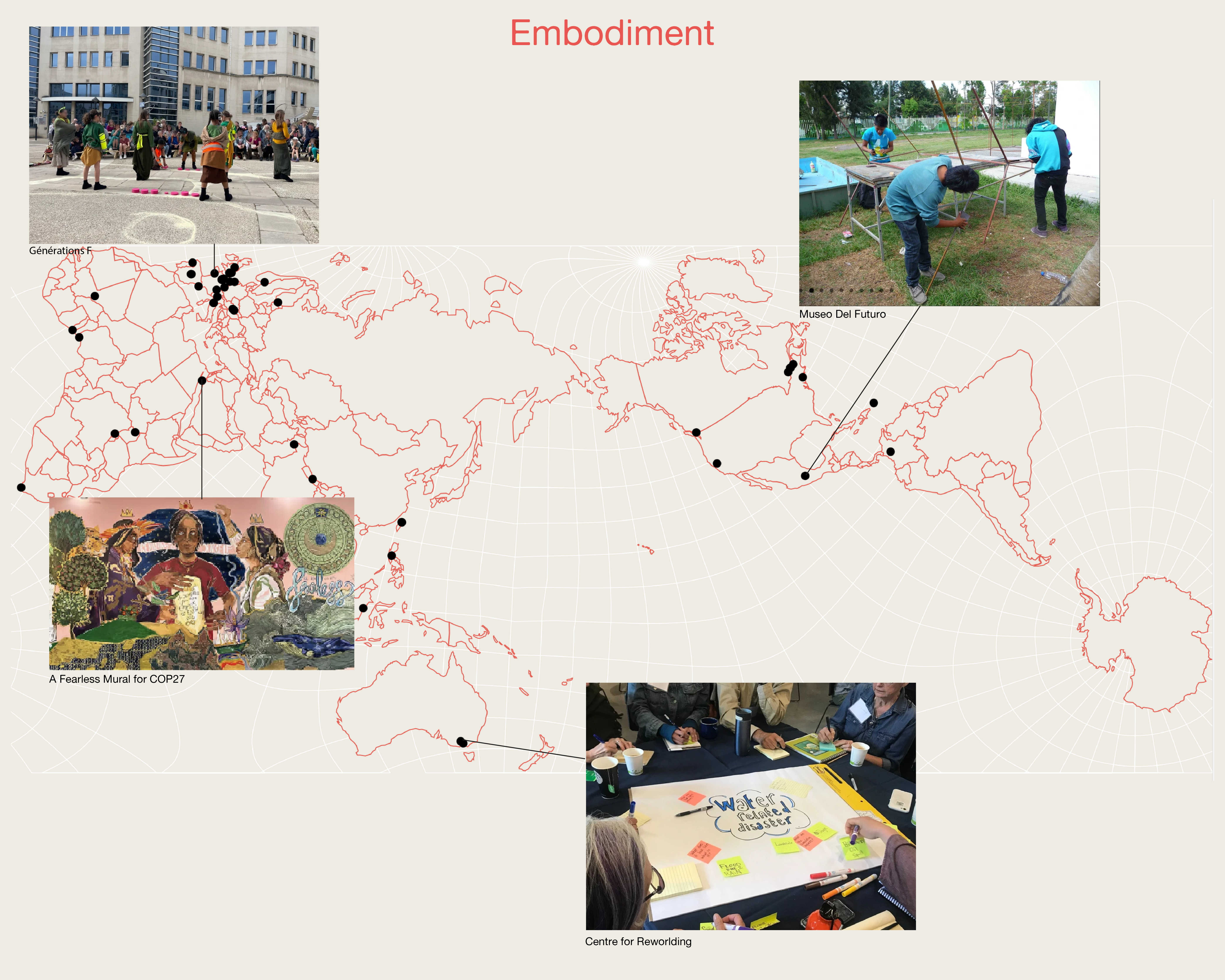
In the context of WTFutures, we call “embodiment” all the different forms of engagement of the body and the senses in the projects, in addition to analytical reflection and the use of language. A little more than half (28 out of 54) of WTFutures’s projects pursue that goal in one way or another.
Various forms of embodiment can take place at different stages of the project: by grounding the work in the lived environment in which it takes place; by using artistic techniques in order to create dialogue and/or imagine alternative futures; by prototyping and/or experimenting some of the ideas coming from the projects, etc.
In most cases, engaging their body and senses, especially thanks to creative practices, helped participants free their imagination. Sometimes it can be very difficult to see beyond the issues of the present and to put aside a certain form of realism or even pessimism. For a discussion to happen and be interesting, it is needed to open up the fields of possibilities.
That is what led the research team behind JustFutures to experiment different forms of craft with young activists: “The word “craft” took on special significance in this process – creating was like working with clay: hands-on, tactile, and a powerful vehicle for meaning-making.” Crafting was a way for participants to delve into their thoughts. Doing something with their hands can help them to go further in their reflection concerning the future they are advocating for.
“[Visual] arts approaches, such as drawing, help children feel more at ease, are engaging, and provide possibilities for children to describe and understand their emotions, and define their real opinions, desires and wishes”
Hannigan et al., Reimagining climate change futures: A review of arts-based education programs, 2025.
The subject of embodiment has been discussed during our second Agora on Eco-emotions. Both Aniela Fidler Wieruszewska (Feeling Futures Through the Stuff We Wear) and Svetlana Chigozie Onye (The Eco-anxiety Africa Project) resorted to creative practices: singing, dancing, and storytelling in Nigeria, while in London, Aniela gave her participants textile scraps on which to apply their imagination.
“I work a lot with textiles and making. There's this idea inside positive psychology called state of flow, where you feel relaxed and focus on something deeply, and your brain decompresses. In a state of flow, you can have very intense conversations. Creativity is intrinsically emotional and reflective.”
Aniela Fidler Wieruszewska
Creative practices are a way of channeling the body into an activity in order to appeal to one’s emotions, which may be blocked otherwise.
Dancing, crafting, doing something with our hands or body, works as a way to reach our inner emotions and to “feel” the future narratives.
The practices of care1 featured in some initiatives (Centre for Reworlding, Crafting Change through Natural Dye-making, A Fearless Mural for the COP27) are also a form of embodiment through different mechanisms:
A powerful example is Crafting Change through Natural Dye-making, which invited young climate activists to reconnect with artisanal and traditional practices as acts of care and resistance. The workshops were co-facilitated by Courtney Wynne (Indigenous Climate Action), an Indigenous community caretaker who shared traditions, ceremonies, and knowledge, such as smudging with sage and land acknowledgment rituals.
“The work is deeply rooted in feminist care ethics, a framework that understands care as a political and relational act involving the recognition of need, the assumption of responsibility, the taking of action, and the provision of support or healing.”
Crafting Change through Natural Dye-making
Through protocols co-designed with Indigenous collaborators, by introducing different marginalized perspectives and ontologies such as feminist and queer angles, by taking the time to learn and do things through slow crafts, storytelling, and rituals that resist the tyranny of clock, these projects create the conditions for participants to experience decolonial2 climate action and practice what it means and how it can be felt. Changing perspective is the objective, rather than rationalized solutions.
First of all, the investigation processes, often at the beginning of the projects, can operate as a form of embodiment. It is a way to experience issues on the field, as pupils in the city of Leganes and Cabuérniga did as part of the initiative Pedagogías del Mañana. Climate Action Photovoice presents a whole tool of investigation, enabling young people to seek out signs of climate change in their daily lives and personal experiences.
In some projects, embodiment is achieved thanks to meditative exercises or rituals: “With soothing background music inviting them to take deep breaths, in and out, a narration was provided to guide them through the visioning. Youths were given fifteen minutes to think about their dreams and then five minutes to draw their dreams on a piece of paper, giving them a title.” (Bagmati River Youth Project)
The women facilitating the workshops of the Fearless Foundation also give an important place to the body in the rituals through which they take their group (A Fearless Mural for the COP27). The bodies of the participants also end up on the final murals since the figures are painted after a photograph taken of them taking a pose, as they want to be represented to the world.
Different forms of embodiment through creative and artistic practices were encountered in WTFutures’ corpus.
One of the most striking examples is the use of theater to play the climate futures imagined in Générations F and Citadins Citadines 2050. These projects enabled the young participants (teenagers and young adults, respectively) to imagine and give shape to their stories by experimenting with their bodies in a fictional space. By acting, they can live and feel their imagined futures in their bodies.
Other forms of creative practices have been used in the projects, such as sculpture and dance in Museo del Futuro.
→ We dive deeper into the role of artistic practices in our key learnings, displayed in the WOW! section: Art as a connector.
Different projects of the corpus proposed ways to bring the images of the future into the material dimension of the present. These approaches are close to Design Fiction but all have their special twists.
Museo del Futuro, for example, gathered over 100 young people to create a “Time Machine” museum. The speculative artefacts created by the young participants are presented as if they were part of a curated exhibition from 2068. This process gave form to what youngsters imagined of Mexico City’s past, present, and future. Conceived as a mobile structure, the Time Machine could travel between districts and spark conversations among different youths.
Dr. Nur Anisah Abdullah made her students experiment with the Future Bazaar method to create a Museum of the Not-Yet-Possible. The Artefacts of the Not-Yet-Possible convey a whole different way to imagine how we travel, eat, adapt to climate change, etc.
The project Imagining Futures / Future Imaginings brings another proposition to make the narratives infiltrate the material dimensions of youngsters. As part of the methodology, the designers brought “material memory” objects to the workshop, such as hoes, pangas, bones, and spears. These objects act as signs from the future and from the past: “These objects from conflicted pasts were used by young people to describe ‘futures-already-in-the-making’, the steps were already in place for the futures to emerge as they would like.”
A last form of embodiment involves the public, by sharing the project's outcomes in a public space, in more or less participatory forms.
The exhibition of Museo del Futuro described above is one of the possible forms to convey the work of youngsters to other people.
Générations F developed a whole discussion process with local citizens, since the core intention of the project is to enable young people to have a voice in the public space. After five days of theatrical creation, the children involved in the workshops perform in front of an audience, who have been invited to meet a tribe coming from the future. The performance is fully interactive, the children directly answering the questions of the public, and also asking them questions about how their society (our society in the present) functions – which is not an easy exercise.
Including both self and community care, this concept is about being attentive to the needs of oneself and others, showing support and compassion, assuming some responsibility towards it and meeting the needs when possible. It recognises that the well-being of all is the result of shared responsibility, despite the power dynamics that govern our interactions. Learn more with Mrs Roots.
Decoloniality refers to all the currents of thought, approaches and actions that challenge the colonial legacies embedded in the very structures of our society (in economic, political, cultural, and knowledge systems) and seek to restore the oppressed, marginalized and silenced voices. Thus, decoloniality aims at a structural and epistemic transformation of our ways of living. We recommend this Oxfam document to learn more about this topic.
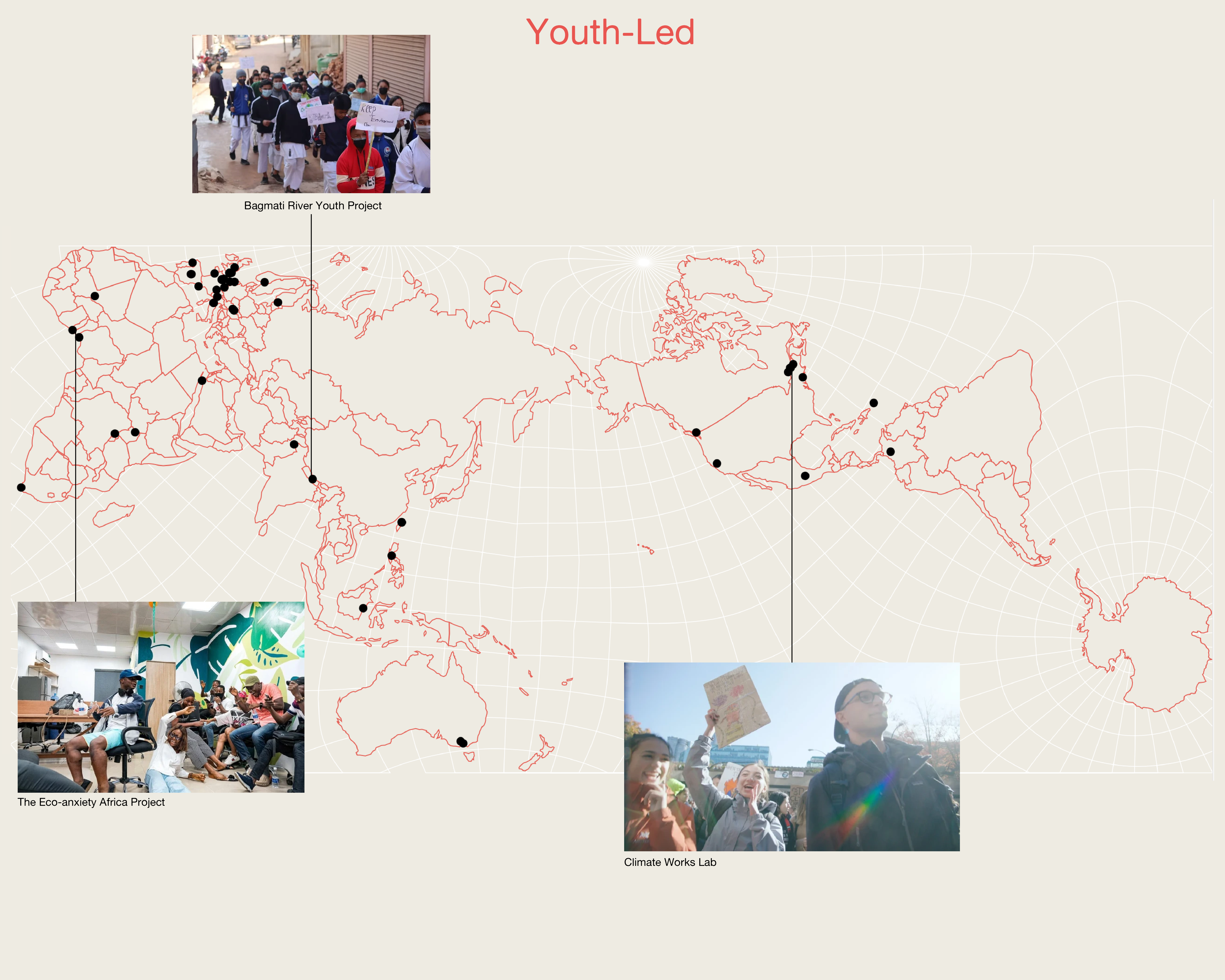
16 out of 54 projects in the WTFutures corpus explicitly define themselves as youth-led. The leadership, design, and direction of the projects are conceived and driven by young people, setting the tone for the rest of the project’s structure and outputs.
Many initiatives emerge directly from youths’ experiences, demonstrating that leadership arises from concern – whether for the Planet or for issues directly affecting them. The Eco-anxiety Africa Project (TEAP) in Nigeria was born from the observation, by young founders of a prior organization, Sustyvibes, that climate change was harming their own mental health. Enter Nusantara “was born out of a coalition of youths who recognized both the urgency of Indonesia’s climate crisis and the need for an inclusive movement.” In these projects, youths take ownership of their experience without waiting for outside support.
Projects often center youths as creators rather than passive recipients. Fearless Foundation, for instance, uses participatory art interventions where youths and community members “determine what they want the world to see from them”.
ClimateWorks Lab emphasizes participant-led agenda: “rather than prescribing a fixed curriculum, the team adapted to the group’s interests, letting conversations and project themes emerge from within”. Similarly to this bottom-up strategy that listens to participants, Éco-Motion combines foresight, therapy, and group-supported planning to allow youths to create individualized strategies for sustainable engagement, where “the starting point is always their own perception of a desirable future.”.
Youth-led initiatives are great places for engagement since young people are designing themselves their conditions of work (Enter Nusantara, Bagmati River Youth Project). They can focus on what makes sense for them and not on goals defined by others.
Youth leadership extends to tangible outputs that carry their voice and vision. Enter Nusantara produces outputs such as a podcast (Spill the Tea), Fanzines and art exhibitions, all framed through youths’ perspectives and designed to encourage other young people to participate. These serve as a communication device to engage with them. Net Zero and You(th) alumni initiate local projects including “community fridge campaigns, participatory budgeting proposals, and youth climate panels”. TEAP’s ZenCafe program trains youths to replicate safe-space gatherings across Africa through the Zen Guardians program. These outputs show that youths do not merely participate in predefined activities: they actively create and disseminate content, narratives, and interventions on platforms (online or offline) that are relevant to their peers, making the projects both successful and meaningful to them – and, who knows best which communication strategy to use in order to reach and implicate youths, than youth !
Some projects include structured mechanisms for youths to train and support one another. TEAP’s Zen Guardians model allows trained youths to establish their own ZenCafes in other countries. ClimateWorks Lab encourages participants to develop community-oriented projects and personal climate action plans, fostering leadership skills that extend beyond the initial program. The project’s young participants are also encouraged to develop relations and share meals outside of the program so as to foster more profound relationships.These practices embed peer-to-peer mentorship and informal meetings as core components of youth-led work.
Many projects emphasize that youths are current agents of change, not deferred “future leaders.” Enter Nusantara stresses that youths are “active agents of the present, capable of shaping climate policy and reimagining how sustainability, justice, and finance intersect.” Local Conferences of Youth (LCOY) trains youths to “articulate and present their visions for climate justice” within the UNFCCC (United Nations Framework Convention on Climate Change) process. Although UNFCCC is not youth-led, LCOY is reserved for youth voices, allowing them to develop recommendations that concern them. Net Zero and You(th) positions participants as translators “between generations, between policy and lived reality, and between fear and action.” TEAP similarly engages youths’ voices in challenging stigma and influencing policymakers regarding the mental health impacts of climate change in Nigeria.
Youth lived experiences and insights are critical knowledge. Éco-Motion builds upon participants’ eco-emotions and perceptions of desirable futures to guide the organisations’ strategy. Fearless Foundations and LCOYs integrate youth perspectives into public-facing advocacy, reframing institutional and global climate dialogues around their lived realities and imaginative capacities. If we take the time to look into youth-led initiatives, these projects report key insights on how politics can be done differently when integrating youths’ perspective, or by allowing youths to lead the project: in some projects, “participants moved away from debates and moralizing tones, instead using personal stories to open dialogue with those holding different views” (Net-Zero and You(th)). In models where youths have an active organizational role, leadership is often distributed, co-creative, and grounded in the lived realities of the people participating, which on political topics such as climate, can be quite a learning opportunity.
These projects position youths as today’s agents of change, engaging in civic, policy, and climate action. They embed values such as peer mentorship, collective resilience, and capacity building. By supporting youth leadership, social and ecological transformation scales faster and in real time, as strategies to foster engagement and participation are significantly more adapted, direct and relevant to their age groups. Although these projects show that young people are capable of designing, governing, executing, and communicating ambitious projects, producing ideas, policy directions, knowledge as well as action on the ground, the effect on institutional and corporate decisions has so far been frustrating.
→ How this could change is the focus of one of the WOW! sections: Involving young people in decision making.
11:T29ee,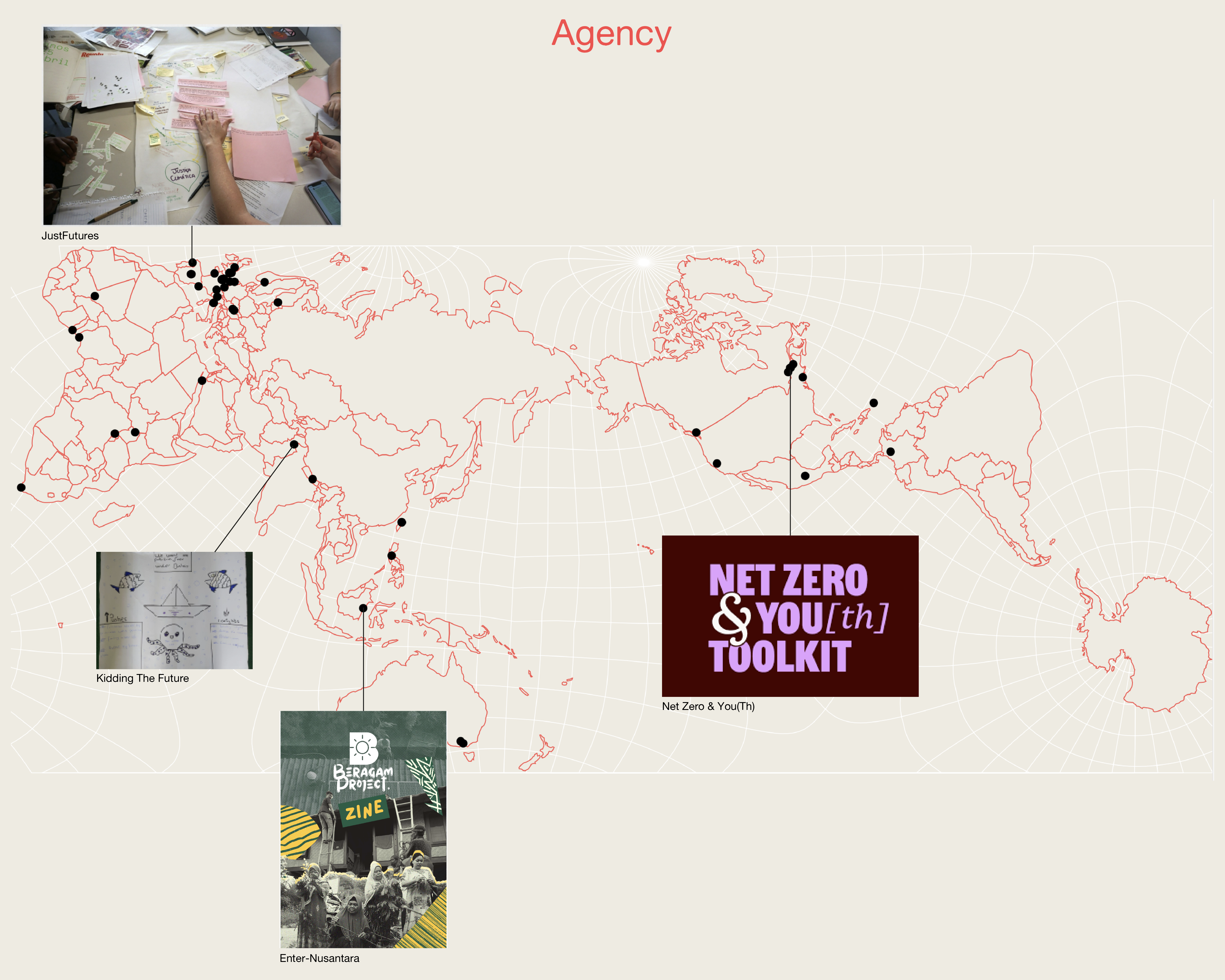
The “multifaceted and intersecting challenges faced by young people today” (Youth Futures Under Construction) can easily generate a feeling of powerlessness. The authors list “conflict, insecurity, limited government support, deep-set gender discrimination, climate change, infectious disease and a widespread lack of decent jobs.”
In a broad study across Norway, Italy, Germany, and Austria the result confirms that while young people tend to increasingly position themselves as key actors in societal transformation they don’t always understand how they can act. As a 17-year-old Norwegian student expressed, “I feel very powerless … because I don't have the opportunity to make the big differences. Therefore, I hope that we as a society have come further, so that individuals and politicians work together to stop/reduce climate change.” (Narratives of Change in Science Education)
The researchers involved in the project stress that education and educators must also work with students and go beyond scientific literacy so youths can “develop a sense of agency by understanding their place in the world and give them the tools to be active and reflexive citizens.” This includes fostering critical thinking and learning to “recognize and resist passively adopting ideological assumptions that prevent them from becoming meaningful historical actors.”
Numerous initiatives demonstrate how young people are being empowered to envision, co-create, and lead transformative climate futures. These projects reveal diverse approaches on youth agency and action, from collective imagining and participatory governance to educational empowerment and community-led environmental stewardship, demonstrating that there is a desire to act, but maybe not the space made for youth in the more institutional and organizational fields.
As the Enter Nusantara project (a youth-led initiative in Indonesia) reminds us, “Youth are not just 'the future' but active agents of the present, capable of shaping climate policy and reimagining how sustainability, justice, and finance intersect.” This perspective is an important learning from WTFutures as it is a challenge to today’s views (mainly fostered by adults) that see youths merely as future beneficiaries (in terms of political decisions), and offers to position them instead as vital participants in today’s urgent climate and social transformations.
Within the projects, we identified different paths to action, where initiatives are practicing or experimenting different tools with youths that lead to action. For example, the JustFutures initiative encapsulates this desired shift by engaging young people with varying levels of activism in collaborative projects designed to envision “a society where young people have an active role in constructing just climate futures.” The process values hands-on creativity, through solidarity-driven work: “utopian impulses and hope emerged, giving rise to ‘real’ utopias, practical visions of inclusive and negotiated future societies.” Hence framing the areas where youths could act in the direction of the future they envisioned.
Similarly, in Nepal, the Bagmati River Youth Project empowered youths to lead a six-week capacity-building project focused on local ecological restoration. The program was “not only a consultation, but a goal to transform youngsters into agents of change, able to take ownership and responsibility of their river.” With 196 participants completing the program and thousands more engaged virtually, youths conceived a “wide range of actions, from awareness raising programs to the production of vermicomposting units.” One young participant shared, “I want to share the experience when I led a few of my friends to make a group and start cleaning the jungle near our community … I realized how I can be the leader of change.”
Some young participants in the Net-Zero and You(th) project also ended up putting in place projects within their communities after participating in a series of workshops that helped them imagine and narrow down how they could be useful within their action scale.
In Climate Futures in Brussels 2030, young voices articulated a clear desire for meaningful involvement beyond traditional protest: “Young people want to engage in climate action, but on new terms. Not just protest, but co-creation. Not just demands, but governance and world-building.” This aligns with El Futuro es Clima in Spain, which convened a “Metaforum” of 40 randomly selected young participants alongside a parallel group of 20 climate experts to deliberate on how to prioritize responses to climate inaction. Young participants emphasized how their highlighted priorities often differed from experts’ technical focus. In other words, in bringing in new ways of seeing things, it gave them perspective and a sense of usefulness, as they also understood “climate action” in their own terms.
In learning how to think critically, educational projects that mobilize different future approaches are fertile ground to deepen youths’ understanding on various climate related issues by providing new skills sets and in understanding complexities. In Kidding the Future, a project taking place in Pakistan, Umar Sheraz teaches futures literacy tools that invite youths to reflect on trends, investigate historical perspectives from elders in their communities, and collaboratively explore the United Nations Sustainable Development Goals in the perspective of expected, alternative, and preferred futures.
Activities such as the “time-traveler game” where students envision a child they love 30 years into the future, and collective exercises using the “Futures Triangle1” helped youths identify forces shaping their preferred futures. This allows a deepening of perspective in subjects that can sometimes seem set in stone, and adapting some “general realities” to the realities of a context, a country. One young participant observed, “You told us that SDGs are interconnected. If we had justice in our country, the other SDGs would’ve taken care of themselves.” By learning and opening up perspectives, youths are more equipped to understand where and how their actions can have meaning in their specific context, as not all actions are relatable from one country to the next.
Cross-cultural research, that take place in countries which are already living the effects of climate change, such as the Imagining 2060 study involving Taiwanese and Australian students, demonstrate that some students from vulnerable Pacific Island nations expressed deep concerns, “My preferred future cannot happen unless we take action right away” and recognizing the existential threats their homelands is facing with rising waters or other catastrophes. Enter Nusantara powerfully asserts that youths are “active agents of the present,” defending that their meaningful participation in fighting coal mines in Indonesia is crucial today for building sustainable, just futures that reflect the complexities of lived realities right now.
Within the WTFutures project, it is clear that youths are not and wish not to be just future stakeholders, but active agents shaping the world today in which they will be living tomorrow, affected by climate and social transformation. Here, there and around the world, they are co-creating, leading and acting in projects that reflect on policy, education, governance, and in their community. By amplifying young voices, providing spaces for experimenting with these approaches and integrating futures literacy into education, we can foster the critical thinking and the agency young people already have or, sometimes need to navigate uncertainty, challenge dominant narratives, identify areas of action and lead transformative change.
The Futures Triangle is a method to map forces of change and their interaction, categorizing them by their timeframe: the “push of the present”, the “pull of the future”, and the “weight of the past”. Learn more in this article.
Many projects experimented with participatory democracy mechanisms involving youth, linked to local and international policymaking. They either reached out to youth-led organisations or built partnerships with organisations working with young people. For example, between 2022 and 2024, Destination Beauvais 2040 connected a formal “Council for the Future” with “future workshops” by and for citizens, including several focused on children and youths, “to engage directly with local decision-makers as equal partners.”
Similarly, La Crise dont vous êtes le héros in Nantes Métropole uses interactive climate scenario games to involve youths in municipal climate adaptation strategies, directly linking foresight to institutional resilience goals. In Slovakia, the Message Towards the Region project was “co-developed with the City of Nitra and the Council of Youth of the Nitra Region, anchoring the foresight work within local governance frameworks.” It facilitated structured dialogues with elected officials, addressing policy issues such as school curriculum reform by workshopping ideas with youths from the region. Through partnerships with municipal or regional governments, these initiatives fostered democratic dialogue with youths to help shape urban policies on themes such as climate, technology, education, and political reform.
These projects reveal a growing desire to change how policymaking and public governance recognize the value of youths’ proposals. The extent to which such proposals will be concretely implemented still remains to be seen.
Some initiatives within these public consultation contexts highlight the intersection of social justice and climate adaptation in metropolitan areas and the importance of reaching out to more vulnerable communities. Projects like Citadins, Citadines 2050 “engaged participants from both socially disadvantaged neighborhoods and local authority field agents… fostering dialogue across social divides” in order to understand how climate impacts are being perceived by communities who do not usually attend consultations in their own time. By reaching out and meeting with these communities on their own ground, it makes sure their perspectives are included into governmental climate resilience strategies. This approach supports institutional priorities for inclusive governance and equity in planning, all the while experimenting with more innovative approaches.
Youth-led initiatives connected to global climate governance are examples of more formal political channels for participation. Local Conferences of Youth (LCOY) train young advocates in policy and advocacy, enabling them to articulate and present their visions for climate justice. LCOY also links youth advocacy directly to UNFCCC (UN Climate Change) negotiations, giving young people the opportunity to both build skills and bring their demands into formal political arenas.
The Emerging Horizons foresight process similarly integrates youth-generated futures into UN climate policy frameworks. Its report presents identified policy questions tailored for further action by UN agencies and youth climate leaders. These futures serve as examples of alternative ways to approach and frame the issues at stake.
Some institutions or funds have been working with movements or organisations who are active on the ground and who mobilize citizens, youths, from different parts of the world on questions of climate, especially in areas where local governments are not necessarily supportive of these initiatives. The Fearless Mural project at COP27 Egypt inserts/situates youth activism within the official UN negotiation space, creating a “perfect time for politics to come out from working behind closed doors... to see what is happening on the ground” (A Fearless Mural for the COP27).
Several projects focus on enhancing institutional abilities to engage with youth and civil society through foresight and participatory tools and vice versa. The EU-funded Imagining Climate-Just Futures initiative trained over 3,400 citizens across 12 countries and European partners to lead participatory scenario-building, embedding youth narratives in policymaking. The project description notes it is “combining participatory foresight, youth empowerment, and creative engagement to shape inclusive climate justice narratives”.
In Canada, Net Zero and You(th) empowers young people to “learn to critically assess government plans, track local climate initiatives, and ask better-informed questions as citizens” enabling them to be more informed and to adapt their language to a political context. This is also to encourage youths to engage in local or national democratic processes such as participatory budgeting and youth panels. An important point to highlight is that within these dynamics, youths are often expected to adjust their tone and style to fit political discourse if they want to be taken seriously.
Kijiji Cha Amani in the Democratic Republic of Congo, a conflict-affected region, engages communities through participatory “parachute mapping” to visualize the links between climate change, land use, and insecurity. These locally grounded narratives inform advocacy towards regional authorities and NGOs, pushing for integrated environmental and peacebuilding policies. These types of activities demonstrate how, in fragile contexts, collaborative governance, where citizens and communities align to address a problem, can complement formal political structures, when these prove unable to respond to citizens' needs.
Grassroots activism remains a vital force applying pressure to politics and political decisions for more ambitious climate policies. The link with policymaking here becomes about applying pressure. These initiatives are drivers of bottom-up political change. In Indonesia, Enter Nusantara campaigns in many different ways, by organising mass protests targeting banks still investing in fossil fuels, with the explicit goal to ban coal. The campaign’s outreach efforts (social media), has influence on policy debates and cultural perceptions around climate justice, all the while recruiting more youths in a national pressure movement.
Le Théâtre des Négociations exemplifies an experimental approach to connecting citizens and politics by transforming the rigid format of international climate negotiations into a participatory, imaginative arena. Instead of mirroring traditional state-based delegations, the 2015 event invited 200 international students to a theatre in Nanterre (France) to a different kind of simulation: many of the students represented new kinds of (non-human) “actors” such as oceans, soil, youth, or the internet, entities usually absent from formal policy arenas but central to planetary life. By staging negotiations as a live, collective performance, it disrupted diplomatic conventions and allowed participants to test new alliances, rethink priorities, and generate bold proposals such as a legal status for climate refugees or a moratorium on Arctic mining. This experiment not only broadened the views on who and what gets represented in political decision-making, but also highlighted the potential of theatrical, creative formats to renew public imagination, foster collective agency, and bring long-term issues into the democratic sphere that need to be answered by taking in complexity.
From local, national, and international councils to citizen consultations and international climate negotiations, youths are recognized as essential political actors shaping just, inclusive, and sustainable futures. While institutions are adapting their processes to include and/or hear youth voices, and while young people themselves are demanding to be heard through activism and grassroots campaigns, it remains crucial to scrutinize how these mechanisms are implemented to ensure youths’ voices genuinely influence policy and proposals are acted upon.
For now, however, at the institutional level these initiatives often function more as knowledge pools than as drivers of concrete change, with relatively few proposals being piloted or adopted. This raises important ethical questions: how can we ensure that youths genuinely benefit from these consultations and that participation translates into meaningful impact?
→ We delve into what makes youth participation meaningful in Meaningful experience.
13:T3446,
We found that projects can be meaningful experiences to young people in a gradual way:
For ClimateWorks Lab, the City Hive team following them paid special attention to the youngsters' needs, offering stipends, food, and a flexible schedule. They also focus on overcoming financial and logistical barriers
“Throughout the process, the emphasis was not on perfection or speed, but on agency, adaptability, and ongoing engagement. Meetings always included shared meals, which helped build trust and community. Youth were given financial support through stipends and transit reimbursements, lowering barriers to full participation.”
An ambitious way to meaningfully integrate young people in foresight practices is to thoroughly train them on future studies methods, then sponsor them to work on it. In 2022, UNICEF Innocenti recruited a group of young foresight practitioners from around the world to become its first cohort of “Youth Foresight Fellows”. Fellows worked with UNICEF over the course of six months as consultants to design and participate in research processes to inform UNICEF’s Global Outlook, and create tools for future youth foresight projects (Our Future Pledge).
→ Many other projects linked their work on futures with educational outcomes that will benefit the participants well beyond the project itself: you can find more about them in the relevant sections on Futures Literacy, Climate Change Literacy and Learning New Skills.
While Maria de Mater O'Neill was teaching a design class in Fajardo in 2017, Hurricane Maria hit the country. It devastated the region and disrupted local life for several weeks. That was the starting point to develop a methodology around resilience for the young designers, which became the Puerto Rico 2054 project. Here it was meaningful because it was something the students needed at this specific moment, dealing with a difficult and hurtful situation. The futuring process helped the youngsters deal with their emotions and the concrete difficulty of studying in this situation, while the projects they developed made sense in their community and had a concrete impact.
Climate Action Photovoice also has a process to make the theme emerge from the group, so that the participants’ real concerns are discussed.
→ The Youth-led projects, described in another HOW section, have an inherent tendency to be closer to the concerns of youths, with young people taking charge of the entire development of projects.
The practices of care1 at the heart of some of the projects of our corpus are also participating in making them meaningful experiences (Centre for Reworlding, A Fearless Mural for COP27, Crafting Change through Natural Dye-making). The intergenerational discussions featured in these projects, associated with indigenous ways to share knowledge, were also seen as ways to legitimate young people’s voices in the discussion.
The Eco-anxiety Africa Project (TEAP) also uses this intergenerational lever to help young people legitimate their eco-emotions and cope with them. The project is not about producing something: its goal is solely to help, to support the participants and create a space where they can express their eco-emotions, and help each other process them.
These initiatives are meaningful because they help young participants to make sense of their environment, of what they experience and feel.
Obviously, one way of making a project meaningful is for it to produce concrete effects on the ground. As an example, Message Towards the Region developed a real co-creation process involving young people and policy makers to imagine the future of the city of Nitra together.
→ More examples can be found in the Policy section.
Interacting with decision-makers, and perhaps achieving concrete results, is also a source of pride for the young participants, and can help them have a broader view of how they are able to act at the level of their environment and community.
There is also a core and great value in the sole act of creating a place of discussion between young people. That is something they value and that often comes in the feedback of the projects (see Net Zero and You(th) or Générations F). Participants find peers who share their values and do not feel alone anymore.
According to Aniela Fidler Wieruszewska (Feeling Futures Through the Stuff We Wear), it is also deeply important to just make it fun, and creative.
In the field of research, extractive participation is also a risk that needs to be thought of. The designers of the participatory methods of Youth Futures Under Construction and JustFutures had in mind a similar question: how does this research also serve the participants taking part in it? For Youth Futures Under Construction the method has been co-created with youths as co-authors and researchers. They even constituted youth advisory boards. Then young people are not objects studied in the research but real stakeholders learning something and taking credit from the experience.
During the JustFutures project, Anabela Carvalho and Maria Fernandes-Jesus, who we interviewed, worked in cooperation with different activist groups in Portugal. They initially encountered trust issues with them and had to work their way around it, reform the projects’ organisation and find common interests between their research and the activists’ goals. Despite the additional hard work, it is important for them to bridge research work with the community. This effort was necessary and enabled a lot of learning occasions on both sides.
Imagining Futures / Future Imaginings is another example of deep involvement of youngsters in the management of the process. Youth Advisory Boards were formed in each geographical district to co-design the process, guide ethical practices, and define meaningful forms of expression. It was defined and conceived from the beginning as a collaborative and horizontal project.
In their report “Meaningful Youth Engagement in the Multilateral System”, UNICEF Innocenti wrote a concise definition summarizing the issues around what they define as “Meaningful Youth Engagement” in processes set up by international institutions with the intent of involving young participants.
“Meaningful youth engagement is where children and youth are involved as equal partners; where their views and circumstances are respected; where marginalized youth also get the opportunity to participate; and where youths from all backgrounds are welcome and engaged as agents of change rather than just beneficiaries.”
Several of their recommendations (from page 28 onwards of the report) echo what we found in WTFutures:
Including both self and community care, this concept is about being attentive to the needs of oneself and others, showing support and compassion, assuming some responsibility towards it and meeting the needs when possible. It recognises that the well-being of all is the result of shared responsibility, despite the power dynamics that govern our interactions. Learn more with Mrs Roots.
Futures Literacy, according to UNESCO, is “a capability [...] that allows people to better understand the role of the future in what they see and do. Being futures literate empowers the imagination, enhances our ability to prepare, recover and invent as changes occur. [...] It is a skill that everyone can and should acquire.”
We all anticipate, both in the short term (before crossing a street) and the long term (to make life choices), but we mostly do this unconsciously: we are generally unable to articulate the images of the future on which we base our decisions. And we are certainly not taught to do it, except in the rare Futures Studies departments of selected universities.
Futures Literacy is, above all, about turning these unconscious behaviours into conscious individual and collective practices. According to a leaflet produced by the Future Is Now project, Futures Literacy is about helping persons and collectives to:
Most of the projects identified within WTFutures, but not all, sought to develop some kind of futures literacy in their young participants. For some, it was an end in itself – futures literacy as empowerment –, while for others it was a means to help participants produce better images of the future and be more relevant on the topic at hand. Some used informal, playful, experiential methods, while others relied on more structured forms of teaching.
When is the future? The projects have chosen a great variety of time horizons for their futures. 2040 and 2050 seem to be the most frequent, with some occurrences to (nearby) 2030, 2060, one 2124, and a last project happening 200 years from now (Générations F). The “Futures Literacy Toolbox” from the Future Is Now project has this (non-scientific) recommendation: “Choose a horizon slightly longer than their age (ex. 20 years if they are 15-18 years old). It is a time period that they can relate to, but it is also just beyond their experience, therefore likely to open their minds to new ideas.” Indeed, the choice of time horizon (or even that of not setting any) strongly depends on what is expected from the work. |
|---|
Over the years, Futures Studies have produced a large amount of tools and methods, which may at times seem overwhelming. However, the projects studied by WTFutures have found a great variety to develop their own variant of Futures Literacy with their participants:
What these approaches have in common, is that they generally do not aim to train aspiring futurists, but rather to equip young people with new “soft skills” that can be used in a large variety of life situations, especially in an increasingly complex and unpredictable world. Together, they show that there is no single correct way to build up one’s futures literacy.
Some foresight techniques used in WTFutures projects (from most to least used; counting resolutely unscientific) | |
Futures wheel: a graphical exploration of direct and indirect consequences or a particular change. | Retro speculation: backcasting from a given future, recounting the likely events that lead from the present to this future. |
Futures triangle: a method to map forces of change and their interaction, categorizing them by their timeframe: the “push of the present”, the “pull of the future”, and the “weight of the past”. | Three horizons: a framework for analyzing a system’s change as an interplay between three “horizons”: the currently dominant system, the desired future, and in between, the messy space of transition. |
Horizon scanning: the detection and examination of potential threats and opportunities in the future. It often differentiates trends (recognizable, consistent, long-term patterns of change) and “weak signals” (novel and unexpected phenomena that may or may not harbor lasting and significant change). | “What if” questions: exploratory prompts used to imagine alternative futures by setting a strong, transformative hypothesis (e.g, “What if extreme weather events permanently reshape global food production zones?” ), and imagining how the future might unfold from there. |
Scenario building: a structured method for developing multiple, plausible descriptions of how the future might unfold. Scenario sets often distinguish between “business as usual” (pursuing current directions), a desirable future, and a pessimistic and/or “disruptive future”. | Time traveler game: an exercise where participants imagine themselves as travelers from the future (or past) to explore how today’s decisions, events, or trends might look in a different time context. |
Causal Layered Analysis (CLA): a method for exploring multiple layers of understanding about the future, from surface-level trends to deeper worldviews and myths, in order to reveal underlying causes and assumptions shaping issues. | Design fiction: the practice of creating speculative artifacts to explore and provoke thinking about possible futures and/or the social, ethical, or cultural implications of emerging technologies. |
Polak game: an exercise to help participants reflect on their personal and collective attitudes toward the future by asking two simple questions: “How do you feel about the future?” (optimistic vs. pessimistic), and “Do you believe you can influence it?” (powerful vs. powerless). | S-curve: a graphical representation of the life cycle of a technology, innovation, or trend, showing slow initial growth, rapid acceleration, and eventual maturity or saturation. |
A little less than half (24 out of 54) of the projects identified within WTFutures felt it necessary to develop their participants’ basic awareness of climate change and/or to dispense knowledge of its causes and consequences (in the form, for example, of a Climate Frescoe). The others did not see this as necessary. What surveys and projects alike do seem to say is that there is no longer a strong need to develop the awareness of climate change among young people, and that its first- and second-order consequences are also generally understood.
On the other hand, a few experiences (The Future of the Togolese Coastline) alert us to a possible consequence of being “climate native1”: the ‘naturalization’ of climate change, which, having always been part of young people’s life, can appear to have no history, no specific causes.
There are, of course, plenty of knowledge gaps remaining. Some of the projects try to fill them in ways that “do not look like a class” (Feeling Futures Through the Stuff We Wear) : peer-to-peer learning, building up knowledge from experience (the tour of a sustainable denim factory in Feeling Futures, the discovery of an organic produce store and an urban garden in Pedagogías del Mañana). The goal is not to make sure that participants have a comprehensive knowledge of climate change – probably an impossible task –, rather to give them the tools, the self-confidence and the desire to go find the information they need when they need it.
There is a distinct educational element in many projects, focused not on generalities, but on more precise topics or issues:
Several projects advocate for the presence of climate literacy in standard education, however, the way to reach this goal is not often described.
Climate change is not a discipline, rather a multi-faceted phenomenon that can never be grasped as a whole (a “hyperobject”, in the words of Timothy Morton). It can only be taught across disciplines (El Futuro es Clima), probably in a collective form (so that different learners can apply different lenses on the same questions), mixing hands-on and theoretical approaches (Eduponics). For the Youth Climate Lab, Climate literacy education should also be “designed with regional specificity and culturally appropriate materials.”
Following the “Young Foresight Fellows” behind the Emerging Horizons project, we can conclude that “advancing eco-literacy is a catalyst for transformative change”, in education and beyond.
→ We dive deeper into these changes in the related "Key Learning" in the WOW! section: Rethinking learning in today’s and tomorrow’s world.
A Climate Native is a person who has grown up in a world marked by the prospect, and increasingly the reality, of anthropogenic climate change and its consequences. See Climate Natives.
“[In] an era defined by complexity, individuals need capabilities that help them engage with uncertainty, make sense of emergent issues and opportunities, and work together –creatively, skilfully and ethically – to bring about positive societal transformations.”
Kligyte et al., Educating for sustainable and equitable futures: A transdisciplinary future-making capability framework, 2025.
In analyzing what the projects had to say about education, we found that there was a strong convergence towards connecting academic disciplines to take complexity into account, and towards learning "life skills" such as collaboration.
Numerous initiatives studied in WTFutures advocate for a transdisciplinary education approach where different domains come together to make sense of a complex world. Young people will need to learn how to combine learnings from different disciplines in order to achieve their goals, whatever they may be.
Such is the case for ClimateWorks Lab, whose mission is to support young activists in developing personal projects related to the fight against climate change. To help them in this development, they orient them towards system mapping methods to identify issues they want to work on (complexity-related skills) or towards visioning exercises to identify personal motivations (which we could describe as self-awareness, emotional or reflexive skills).
Participatory research methods combine practice, context-awareness and knowledge-building in an iterative process. Learners co-produce their own knowledge, discuss it with actors on the ground, and reflect on it so as to become able to use it elsewhere. In Climate Action Photovoice, youngsters are given tools (a camera and some principles of photographic investigation) to then go out and capture images that reflect the issues that they feel are important to discuss.
Climate Futures in Brussels 2030 also proposes to its participants to do field research in the form of street interviews, then helps them process the information by teaching them how to do thematic mapping. The students in the Imagining the Future for Transformation course work with actual projects in Europe and Africa, trying to find the right “distance” in order to be both appreciative and critical, particularly towards projects that come from a culture that they know little about.
“Young Ambassadors” are also deeply invested on the ground in Kijiji Chi Amani. They are responsible for community-based fact-checking and rumor verification. Tracking down reliable as well as fake news at the local level is both a valuable skill, and a responsibility.
More broadly, many projects intend to teach the youths how to debate in a sane manner, work in teams and listen to others (Défis Résilience, Museum of the Not-Yet-Possible, Centre for Reworlding).
Some projects sought to develop technical skills in, for example, agroecology or renewable energy production, aimed not at future professionals, but at helping communities prepare for a future where the local availability of these skills might come in handy (Enter Nusantara, Eduponics).
Aside from introducing pupils and students to aquaponics, Eduponics is also about developing project management and entrepreneurship skills and experience, by concretely running small, sustainable agricultural projects from and around their school.
Other initiatives involve young people in workshops directly connected to real professional practice. Urbanités Numériques en jeu for example enables children in a class to be involved in real-world urban planning and renovation projects. They even learn how to use some modelization tools and get precise knowledge on the use of building materials.
Several initiatives target activists (or activists in the making), recognising that activism is both a knowledge-intensive and an emotionally demanding activity, and that both these characteristics need to be nurtured. It is the case for Campus de l’Engagement, whose goal is to develop what they describe as the “skills of the future”: civic engagement, critical thinking, collective leadership, and communication.
The young adults involved in this program become capable of (or better at) creating citizen mobilization campaigns, media content, organizing events, facilitating workshops, creating and running community spaces, etc.
In the Local Conferences of Youth, capacity building as activists is also at the program’s core. They learn how to navigate a very codified institutional world, to write and discuss policies, as well as advocacy writing.
These learnings are clearly valuable outside of activism; however, what these projects also tell us is that activism can be a significant part of young people’s life itineraries, well beyond their formative years – and that, to them, it counts as a professional endeavor, not a hobby.
→ See also Lifelong Activism in the WOW! section (our key learnings).
It is also really important to mention the value for young people to learn creative and artistic practices, like scriptwriting in Climate Futures in Brussels 2030 or theatre in Générations F. These experiments are not one-offs. The young people involved in it might discover a great way to continue to express themselves and it could even inspire vocations.
Creative and artistic techniques can also introduce new ways to think about an issue and help young people deepen their understanding of the world on a daily basis.
→ We explored this issue further in Embodiment.
Across many strands of climate activism, practitioners, mostly situated on colonised land, are increasingly turning toward Indigenous forms of knowledge sharing- rituals, traditional practices, and storytelling. Young people, in particular, are showing a growing interest in these approaches, which are gaining traction worldwide (Fridays for Future MAPA - Most Affected People and Areas - movement, Indigenous Climate Action, Possible Futures, Youth for Climate Movement (Argentina), etc).
In Crafting Change through Natural Dye-making, a particular form of craftsmanship is taught to the participants: “natural dyeing and textile-making, activities chosen for their ritual, relational, and land-based qualities.” This activity takes on an additional dimension through its links with indigenous traditions, ceremonies and knowledge.
Here, discussing the future also means learning about the past, about the roots, and learning to reconnect to the land and the ecosystems.
Another project, Centre for Reworlding, also draws on indigenous knowledge, Aboriginal knowledge in particular, which is passed on to the young participants.
The Centre for Reworlding positions itself explicitly against colonial imaginaries. Reworlding, in this context, relies on intergenerational and cross-cultural learning. Their approach emphasizes unlearning and relearning. Canadian scholar Vanessa Andreotti, co-founder of Gesturing Towards Decolonial Futures, describes this idea as follows:
“[D]isarming and de-centering, dethroning and de-arrogantizing, detoxifying and decluttering, mourning, grieving and healing, digesting and metabolizing, seeing ourselves as cute and pathetic, so that the wider metabolism can breathe and move more easily within and around us”
Gesturing Towards Decolonial Futures
Moving away from education focused solely on technical solutions and instead helping people, both young and old, to face complexity is an integral part of decolonising1 practices. This approach invites us to question how we do things- the time we take, the ways we engage in dialogue, and how we inhabit learning processes.
The status of knowledge itself is shifting, being considered an heritage: “Being responsible for the knowledge shared. This is one of the reasons Indigenous people have sustained culture since time immemorial: through intergenerational learning and storytelling.” (Centre for Reworlding)
Decoloniality refers to all the currents of thought, approaches and actions that challenge the colonial legacies embedded in the very structures of our society (in economic, political, cultural, and knowledge systems) and seek to restore the oppressed, marginalized and silenced voices. Thus, decoloniality aims at a structural and epistemic transformation of our ways of living. We recommend this Oxfam document to learn more about this topic.
In the context of WTFutures, we call “embodiment” all the different forms of engagement of the body and the senses in the projects, in addition to analytical reflection and the use of language. A little more than half (28 out of 54) of WTFutures’s projects pursue that goal in one way or another.
Various forms of embodiment can take place at different stages of the project: by grounding the work in the lived environment in which it takes place; by using artistic techniques in order to create dialogue and/or imagine alternative futures; by prototyping and/or experimenting some of the ideas coming from the projects, etc.
In most cases, engaging their body and senses, especially thanks to creative practices, helped participants free their imagination. Sometimes it can be very difficult to see beyond the issues of the present and to put aside a certain form of realism or even pessimism. For a discussion to happen and be interesting, it is needed to open up the fields of possibilities.
That is what led the research team behind JustFutures to experiment different forms of craft with young activists: “The word “craft” took on special significance in this process – creating was like working with clay: hands-on, tactile, and a powerful vehicle for meaning-making.” Crafting was a way for participants to delve into their thoughts. Doing something with their hands can help them to go further in their reflection concerning the future they are advocating for.
“[Visual] arts approaches, such as drawing, help children feel more at ease, are engaging, and provide possibilities for children to describe and understand their emotions, and define their real opinions, desires and wishes”
Hannigan et al., Reimagining climate change futures: A review of arts-based education programs, 2025.
The subject of embodiment has been discussed during our second Agora on Eco-emotions. Both Aniela Fidler Wieruszewska (Feeling Futures Through the Stuff We Wear) and Svetlana Chigozie Onye (The Eco-anxiety Africa Project) resorted to creative practices: singing, dancing, and storytelling in Nigeria, while in London, Aniela gave her participants textile scraps on which to apply their imagination.
“I work a lot with textiles and making. There's this idea inside positive psychology called state of flow, where you feel relaxed and focus on something deeply, and your brain decompresses. In a state of flow, you can have very intense conversations. Creativity is intrinsically emotional and reflective.”
Aniela Fidler Wieruszewska
Creative practices are a way of channeling the body into an activity in order to appeal to one’s emotions, which may be blocked otherwise.
Dancing, crafting, doing something with our hands or body, works as a way to reach our inner emotions and to “feel” the future narratives.
The practices of care1 featured in some initiatives (Centre for Reworlding, Crafting Change through Natural Dye-making, A Fearless Mural for the COP27) are also a form of embodiment through different mechanisms:
A powerful example is Crafting Change through Natural Dye-making, which invited young climate activists to reconnect with artisanal and traditional practices as acts of care and resistance. The workshops were co-facilitated by Courtney Wynne (Indigenous Climate Action), an Indigenous community caretaker who shared traditions, ceremonies, and knowledge, such as smudging with sage and land acknowledgment rituals.
“The work is deeply rooted in feminist care ethics, a framework that understands care as a political and relational act involving the recognition of need, the assumption of responsibility, the taking of action, and the provision of support or healing.”
Crafting Change through Natural Dye-making
Through protocols co-designed with Indigenous collaborators, by introducing different marginalized perspectives and ontologies such as feminist and queer angles, by taking the time to learn and do things through slow crafts, storytelling, and rituals that resist the tyranny of clock, these projects create the conditions for participants to experience decolonial2 climate action and practice what it means and how it can be felt. Changing perspective is the objective, rather than rationalized solutions.
First of all, the investigation processes, often at the beginning of the projects, can operate as a form of embodiment. It is a way to experience issues on the field, as pupils in the city of Leganes and Cabuérniga did as part of the initiative Pedagogías del Mañana. Climate Action Photovoice presents a whole tool of investigation, enabling young people to seek out signs of climate change in their daily lives and personal experiences.
In some projects, embodiment is achieved thanks to meditative exercises or rituals: “With soothing background music inviting them to take deep breaths, in and out, a narration was provided to guide them through the visioning. Youths were given fifteen minutes to think about their dreams and then five minutes to draw their dreams on a piece of paper, giving them a title.” (Bagmati River Youth Project)
The women facilitating the workshops of the Fearless Foundation also give an important place to the body in the rituals through which they take their group (A Fearless Mural for the COP27). The bodies of the participants also end up on the final murals since the figures are painted after a photograph taken of them taking a pose, as they want to be represented to the world.
Different forms of embodiment through creative and artistic practices were encountered in WTFutures’ corpus.
One of the most striking examples is the use of theater to play the climate futures imagined in Générations F and Citadins Citadines 2050. These projects enabled the young participants (teenagers and young adults, respectively) to imagine and give shape to their stories by experimenting with their bodies in a fictional space. By acting, they can live and feel their imagined futures in their bodies.
Other forms of creative practices have been used in the projects, such as sculpture and dance in Museo del Futuro.
→ We dive deeper into the role of artistic practices in our key learnings, displayed in the WOW! section: Art as a connector.
Different projects of the corpus proposed ways to bring the images of the future into the material dimension of the present. These approaches are close to Design Fiction but all have their special twists.
Museo del Futuro, for example, gathered over 100 young people to create a “Time Machine” museum. The speculative artefacts created by the young participants are presented as if they were part of a curated exhibition from 2068. This process gave form to what youngsters imagined of Mexico City’s past, present, and future. Conceived as a mobile structure, the Time Machine could travel between districts and spark conversations among different youths.
Dr. Nur Anisah Abdullah made her students experiment with the Future Bazaar method to create a Museum of the Not-Yet-Possible. The Artefacts of the Not-Yet-Possible convey a whole different way to imagine how we travel, eat, adapt to climate change, etc.
The project Imagining Futures / Future Imaginings brings another proposition to make the narratives infiltrate the material dimensions of youngsters. As part of the methodology, the designers brought “material memory” objects to the workshop, such as hoes, pangas, bones, and spears. These objects act as signs from the future and from the past: “These objects from conflicted pasts were used by young people to describe ‘futures-already-in-the-making’, the steps were already in place for the futures to emerge as they would like.”
A last form of embodiment involves the public, by sharing the project's outcomes in a public space, in more or less participatory forms.
The exhibition of Museo del Futuro described above is one of the possible forms to convey the work of youngsters to other people.
Générations F developed a whole discussion process with local citizens, since the core intention of the project is to enable young people to have a voice in the public space. After five days of theatrical creation, the children involved in the workshops perform in front of an audience, who have been invited to meet a tribe coming from the future. The performance is fully interactive, the children directly answering the questions of the public, and also asking them questions about how their society (our society in the present) functions – which is not an easy exercise.
Including both self and community care, this concept is about being attentive to the needs of oneself and others, showing support and compassion, assuming some responsibility towards it and meeting the needs when possible. It recognises that the well-being of all is the result of shared responsibility, despite the power dynamics that govern our interactions. Learn more with Mrs Roots.
Decoloniality refers to all the currents of thought, approaches and actions that challenge the colonial legacies embedded in the very structures of our society (in economic, political, cultural, and knowledge systems) and seek to restore the oppressed, marginalized and silenced voices. Thus, decoloniality aims at a structural and epistemic transformation of our ways of living. We recommend this Oxfam document to learn more about this topic.
16 out of 54 projects in the WTFutures corpus explicitly define themselves as youth-led. The leadership, design, and direction of the projects are conceived and driven by young people, setting the tone for the rest of the project’s structure and outputs.
Many initiatives emerge directly from youths’ experiences, demonstrating that leadership arises from concern – whether for the Planet or for issues directly affecting them. The Eco-anxiety Africa Project (TEAP) in Nigeria was born from the observation, by young founders of a prior organization, Sustyvibes, that climate change was harming their own mental health. Enter Nusantara “was born out of a coalition of youths who recognized both the urgency of Indonesia’s climate crisis and the need for an inclusive movement.” In these projects, youths take ownership of their experience without waiting for outside support.
Projects often center youths as creators rather than passive recipients. Fearless Foundation, for instance, uses participatory art interventions where youths and community members “determine what they want the world to see from them”.
ClimateWorks Lab emphasizes participant-led agenda: “rather than prescribing a fixed curriculum, the team adapted to the group’s interests, letting conversations and project themes emerge from within”. Similarly to this bottom-up strategy that listens to participants, Éco-Motion combines foresight, therapy, and group-supported planning to allow youths to create individualized strategies for sustainable engagement, where “the starting point is always their own perception of a desirable future.”.
Youth-led initiatives are great places for engagement since young people are designing themselves their conditions of work (Enter Nusantara, Bagmati River Youth Project). They can focus on what makes sense for them and not on goals defined by others.
Youth leadership extends to tangible outputs that carry their voice and vision. Enter Nusantara produces outputs such as a podcast (Spill the Tea), Fanzines and art exhibitions, all framed through youths’ perspectives and designed to encourage other young people to participate. These serve as a communication device to engage with them. Net Zero and You(th) alumni initiate local projects including “community fridge campaigns, participatory budgeting proposals, and youth climate panels”. TEAP’s ZenCafe program trains youths to replicate safe-space gatherings across Africa through the Zen Guardians program. These outputs show that youths do not merely participate in predefined activities: they actively create and disseminate content, narratives, and interventions on platforms (online or offline) that are relevant to their peers, making the projects both successful and meaningful to them – and, who knows best which communication strategy to use in order to reach and implicate youths, than youth !
Some projects include structured mechanisms for youths to train and support one another. TEAP’s Zen Guardians model allows trained youths to establish their own ZenCafes in other countries. ClimateWorks Lab encourages participants to develop community-oriented projects and personal climate action plans, fostering leadership skills that extend beyond the initial program. The project’s young participants are also encouraged to develop relations and share meals outside of the program so as to foster more profound relationships.These practices embed peer-to-peer mentorship and informal meetings as core components of youth-led work.
Many projects emphasize that youths are current agents of change, not deferred “future leaders.” Enter Nusantara stresses that youths are “active agents of the present, capable of shaping climate policy and reimagining how sustainability, justice, and finance intersect.” Local Conferences of Youth (LCOY) trains youths to “articulate and present their visions for climate justice” within the UNFCCC (United Nations Framework Convention on Climate Change) process. Although UNFCCC is not youth-led, LCOY is reserved for youth voices, allowing them to develop recommendations that concern them. Net Zero and You(th) positions participants as translators “between generations, between policy and lived reality, and between fear and action.” TEAP similarly engages youths’ voices in challenging stigma and influencing policymakers regarding the mental health impacts of climate change in Nigeria.
Youth lived experiences and insights are critical knowledge. Éco-Motion builds upon participants’ eco-emotions and perceptions of desirable futures to guide the organisations’ strategy. Fearless Foundations and LCOYs integrate youth perspectives into public-facing advocacy, reframing institutional and global climate dialogues around their lived realities and imaginative capacities. If we take the time to look into youth-led initiatives, these projects report key insights on how politics can be done differently when integrating youths’ perspective, or by allowing youths to lead the project: in some projects, “participants moved away from debates and moralizing tones, instead using personal stories to open dialogue with those holding different views” (Net-Zero and You(th)). In models where youths have an active organizational role, leadership is often distributed, co-creative, and grounded in the lived realities of the people participating, which on political topics such as climate, can be quite a learning opportunity.
These projects position youths as today’s agents of change, engaging in civic, policy, and climate action. They embed values such as peer mentorship, collective resilience, and capacity building. By supporting youth leadership, social and ecological transformation scales faster and in real time, as strategies to foster engagement and participation are significantly more adapted, direct and relevant to their age groups. Although these projects show that young people are capable of designing, governing, executing, and communicating ambitious projects, producing ideas, policy directions, knowledge as well as action on the ground, the effect on institutional and corporate decisions has so far been frustrating.
→ How this could change is the focus of one of the WOW! sections: Involving young people in decision making.
19:T29ee,
The “multifaceted and intersecting challenges faced by young people today” (Youth Futures Under Construction) can easily generate a feeling of powerlessness. The authors list “conflict, insecurity, limited government support, deep-set gender discrimination, climate change, infectious disease and a widespread lack of decent jobs.”
In a broad study across Norway, Italy, Germany, and Austria the result confirms that while young people tend to increasingly position themselves as key actors in societal transformation they don’t always understand how they can act. As a 17-year-old Norwegian student expressed, “I feel very powerless … because I don't have the opportunity to make the big differences. Therefore, I hope that we as a society have come further, so that individuals and politicians work together to stop/reduce climate change.” (Narratives of Change in Science Education)
The researchers involved in the project stress that education and educators must also work with students and go beyond scientific literacy so youths can “develop a sense of agency by understanding their place in the world and give them the tools to be active and reflexive citizens.” This includes fostering critical thinking and learning to “recognize and resist passively adopting ideological assumptions that prevent them from becoming meaningful historical actors.”
Numerous initiatives demonstrate how young people are being empowered to envision, co-create, and lead transformative climate futures. These projects reveal diverse approaches on youth agency and action, from collective imagining and participatory governance to educational empowerment and community-led environmental stewardship, demonstrating that there is a desire to act, but maybe not the space made for youth in the more institutional and organizational fields.
As the Enter Nusantara project (a youth-led initiative in Indonesia) reminds us, “Youth are not just 'the future' but active agents of the present, capable of shaping climate policy and reimagining how sustainability, justice, and finance intersect.” This perspective is an important learning from WTFutures as it is a challenge to today’s views (mainly fostered by adults) that see youths merely as future beneficiaries (in terms of political decisions), and offers to position them instead as vital participants in today’s urgent climate and social transformations.
Within the projects, we identified different paths to action, where initiatives are practicing or experimenting different tools with youths that lead to action. For example, the JustFutures initiative encapsulates this desired shift by engaging young people with varying levels of activism in collaborative projects designed to envision “a society where young people have an active role in constructing just climate futures.” The process values hands-on creativity, through solidarity-driven work: “utopian impulses and hope emerged, giving rise to ‘real’ utopias, practical visions of inclusive and negotiated future societies.” Hence framing the areas where youths could act in the direction of the future they envisioned.
Similarly, in Nepal, the Bagmati River Youth Project empowered youths to lead a six-week capacity-building project focused on local ecological restoration. The program was “not only a consultation, but a goal to transform youngsters into agents of change, able to take ownership and responsibility of their river.” With 196 participants completing the program and thousands more engaged virtually, youths conceived a “wide range of actions, from awareness raising programs to the production of vermicomposting units.” One young participant shared, “I want to share the experience when I led a few of my friends to make a group and start cleaning the jungle near our community … I realized how I can be the leader of change.”
Some young participants in the Net-Zero and You(th) project also ended up putting in place projects within their communities after participating in a series of workshops that helped them imagine and narrow down how they could be useful within their action scale.
In Climate Futures in Brussels 2030, young voices articulated a clear desire for meaningful involvement beyond traditional protest: “Young people want to engage in climate action, but on new terms. Not just protest, but co-creation. Not just demands, but governance and world-building.” This aligns with El Futuro es Clima in Spain, which convened a “Metaforum” of 40 randomly selected young participants alongside a parallel group of 20 climate experts to deliberate on how to prioritize responses to climate inaction. Young participants emphasized how their highlighted priorities often differed from experts’ technical focus. In other words, in bringing in new ways of seeing things, it gave them perspective and a sense of usefulness, as they also understood “climate action” in their own terms.
In learning how to think critically, educational projects that mobilize different future approaches are fertile ground to deepen youths’ understanding on various climate related issues by providing new skills sets and in understanding complexities. In Kidding the Future, a project taking place in Pakistan, Umar Sheraz teaches futures literacy tools that invite youths to reflect on trends, investigate historical perspectives from elders in their communities, and collaboratively explore the United Nations Sustainable Development Goals in the perspective of expected, alternative, and preferred futures.
Activities such as the “time-traveler game” where students envision a child they love 30 years into the future, and collective exercises using the “Futures Triangle1” helped youths identify forces shaping their preferred futures. This allows a deepening of perspective in subjects that can sometimes seem set in stone, and adapting some “general realities” to the realities of a context, a country. One young participant observed, “You told us that SDGs are interconnected. If we had justice in our country, the other SDGs would’ve taken care of themselves.” By learning and opening up perspectives, youths are more equipped to understand where and how their actions can have meaning in their specific context, as not all actions are relatable from one country to the next.
Cross-cultural research, that take place in countries which are already living the effects of climate change, such as the Imagining 2060 study involving Taiwanese and Australian students, demonstrate that some students from vulnerable Pacific Island nations expressed deep concerns, “My preferred future cannot happen unless we take action right away” and recognizing the existential threats their homelands is facing with rising waters or other catastrophes. Enter Nusantara powerfully asserts that youths are “active agents of the present,” defending that their meaningful participation in fighting coal mines in Indonesia is crucial today for building sustainable, just futures that reflect the complexities of lived realities right now.
Within the WTFutures project, it is clear that youths are not and wish not to be just future stakeholders, but active agents shaping the world today in which they will be living tomorrow, affected by climate and social transformation. Here, there and around the world, they are co-creating, leading and acting in projects that reflect on policy, education, governance, and in their community. By amplifying young voices, providing spaces for experimenting with these approaches and integrating futures literacy into education, we can foster the critical thinking and the agency young people already have or, sometimes need to navigate uncertainty, challenge dominant narratives, identify areas of action and lead transformative change.
The Futures Triangle is a method to map forces of change and their interaction, categorizing them by their timeframe: the “push of the present”, the “pull of the future”, and the “weight of the past”. Learn more in this article.
Many projects experimented with participatory democracy mechanisms involving youth, linked to local and international policymaking. They either reached out to youth-led organisations or built partnerships with organisations working with young people. For example, between 2022 and 2024, Destination Beauvais 2040 connected a formal “Council for the Future” with “future workshops” by and for citizens, including several focused on children and youths, “to engage directly with local decision-makers as equal partners.”
Similarly, La Crise dont vous êtes le héros in Nantes Métropole uses interactive climate scenario games to involve youths in municipal climate adaptation strategies, directly linking foresight to institutional resilience goals. In Slovakia, the Message Towards the Region project was “co-developed with the City of Nitra and the Council of Youth of the Nitra Region, anchoring the foresight work within local governance frameworks.” It facilitated structured dialogues with elected officials, addressing policy issues such as school curriculum reform by workshopping ideas with youths from the region. Through partnerships with municipal or regional governments, these initiatives fostered democratic dialogue with youths to help shape urban policies on themes such as climate, technology, education, and political reform.
These projects reveal a growing desire to change how policymaking and public governance recognize the value of youths’ proposals. The extent to which such proposals will be concretely implemented still remains to be seen.
Some initiatives within these public consultation contexts highlight the intersection of social justice and climate adaptation in metropolitan areas and the importance of reaching out to more vulnerable communities. Projects like Citadins, Citadines 2050 “engaged participants from both socially disadvantaged neighborhoods and local authority field agents… fostering dialogue across social divides” in order to understand how climate impacts are being perceived by communities who do not usually attend consultations in their own time. By reaching out and meeting with these communities on their own ground, it makes sure their perspectives are included into governmental climate resilience strategies. This approach supports institutional priorities for inclusive governance and equity in planning, all the while experimenting with more innovative approaches.
Youth-led initiatives connected to global climate governance are examples of more formal political channels for participation. Local Conferences of Youth (LCOY) train young advocates in policy and advocacy, enabling them to articulate and present their visions for climate justice. LCOY also links youth advocacy directly to UNFCCC (UN Climate Change) negotiations, giving young people the opportunity to both build skills and bring their demands into formal political arenas.
The Emerging Horizons foresight process similarly integrates youth-generated futures into UN climate policy frameworks. Its report presents identified policy questions tailored for further action by UN agencies and youth climate leaders. These futures serve as examples of alternative ways to approach and frame the issues at stake.
Some institutions or funds have been working with movements or organisations who are active on the ground and who mobilize citizens, youths, from different parts of the world on questions of climate, especially in areas where local governments are not necessarily supportive of these initiatives. The Fearless Mural project at COP27 Egypt inserts/situates youth activism within the official UN negotiation space, creating a “perfect time for politics to come out from working behind closed doors... to see what is happening on the ground” (A Fearless Mural for the COP27).
Several projects focus on enhancing institutional abilities to engage with youth and civil society through foresight and participatory tools and vice versa. The EU-funded Imagining Climate-Just Futures initiative trained over 3,400 citizens across 12 countries and European partners to lead participatory scenario-building, embedding youth narratives in policymaking. The project description notes it is “combining participatory foresight, youth empowerment, and creative engagement to shape inclusive climate justice narratives”.
In Canada, Net Zero and You(th) empowers young people to “learn to critically assess government plans, track local climate initiatives, and ask better-informed questions as citizens” enabling them to be more informed and to adapt their language to a political context. This is also to encourage youths to engage in local or national democratic processes such as participatory budgeting and youth panels. An important point to highlight is that within these dynamics, youths are often expected to adjust their tone and style to fit political discourse if they want to be taken seriously.
Kijiji Cha Amani in the Democratic Republic of Congo, a conflict-affected region, engages communities through participatory “parachute mapping” to visualize the links between climate change, land use, and insecurity. These locally grounded narratives inform advocacy towards regional authorities and NGOs, pushing for integrated environmental and peacebuilding policies. These types of activities demonstrate how, in fragile contexts, collaborative governance, where citizens and communities align to address a problem, can complement formal political structures, when these prove unable to respond to citizens' needs.
Grassroots activism remains a vital force applying pressure to politics and political decisions for more ambitious climate policies. The link with policymaking here becomes about applying pressure. These initiatives are drivers of bottom-up political change. In Indonesia, Enter Nusantara campaigns in many different ways, by organising mass protests targeting banks still investing in fossil fuels, with the explicit goal to ban coal. The campaign’s outreach efforts (social media), has influence on policy debates and cultural perceptions around climate justice, all the while recruiting more youths in a national pressure movement.
Le Théâtre des Négociations exemplifies an experimental approach to connecting citizens and politics by transforming the rigid format of international climate negotiations into a participatory, imaginative arena. Instead of mirroring traditional state-based delegations, the 2015 event invited 200 international students to a theatre in Nanterre (France) to a different kind of simulation: many of the students represented new kinds of (non-human) “actors” such as oceans, soil, youth, or the internet, entities usually absent from formal policy arenas but central to planetary life. By staging negotiations as a live, collective performance, it disrupted diplomatic conventions and allowed participants to test new alliances, rethink priorities, and generate bold proposals such as a legal status for climate refugees or a moratorium on Arctic mining. This experiment not only broadened the views on who and what gets represented in political decision-making, but also highlighted the potential of theatrical, creative formats to renew public imagination, foster collective agency, and bring long-term issues into the democratic sphere that need to be answered by taking in complexity.
From local, national, and international councils to citizen consultations and international climate negotiations, youths are recognized as essential political actors shaping just, inclusive, and sustainable futures. While institutions are adapting their processes to include and/or hear youth voices, and while young people themselves are demanding to be heard through activism and grassroots campaigns, it remains crucial to scrutinize how these mechanisms are implemented to ensure youths’ voices genuinely influence policy and proposals are acted upon.
For now, however, at the institutional level these initiatives often function more as knowledge pools than as drivers of concrete change, with relatively few proposals being piloted or adopted. This raises important ethical questions: how can we ensure that youths genuinely benefit from these consultations and that participation translates into meaningful impact?
→ We delve into what makes youth participation meaningful in Meaningful experience.
1b:T3446,
We found that projects can be meaningful experiences to young people in a gradual way:
For ClimateWorks Lab, the City Hive team following them paid special attention to the youngsters' needs, offering stipends, food, and a flexible schedule. They also focus on overcoming financial and logistical barriers
“Throughout the process, the emphasis was not on perfection or speed, but on agency, adaptability, and ongoing engagement. Meetings always included shared meals, which helped build trust and community. Youth were given financial support through stipends and transit reimbursements, lowering barriers to full participation.”
An ambitious way to meaningfully integrate young people in foresight practices is to thoroughly train them on future studies methods, then sponsor them to work on it. In 2022, UNICEF Innocenti recruited a group of young foresight practitioners from around the world to become its first cohort of “Youth Foresight Fellows”. Fellows worked with UNICEF over the course of six months as consultants to design and participate in research processes to inform UNICEF’s Global Outlook, and create tools for future youth foresight projects (Our Future Pledge).
→ Many other projects linked their work on futures with educational outcomes that will benefit the participants well beyond the project itself: you can find more about them in the relevant sections on Futures Literacy, Climate Change Literacy and Learning New Skills.
While Maria de Mater O'Neill was teaching a design class in Fajardo in 2017, Hurricane Maria hit the country. It devastated the region and disrupted local life for several weeks. That was the starting point to develop a methodology around resilience for the young designers, which became the Puerto Rico 2054 project. Here it was meaningful because it was something the students needed at this specific moment, dealing with a difficult and hurtful situation. The futuring process helped the youngsters deal with their emotions and the concrete difficulty of studying in this situation, while the projects they developed made sense in their community and had a concrete impact.
Climate Action Photovoice also has a process to make the theme emerge from the group, so that the participants’ real concerns are discussed.
→ The Youth-led projects, described in another HOW section, have an inherent tendency to be closer to the concerns of youths, with young people taking charge of the entire development of projects.
The practices of care1 at the heart of some of the projects of our corpus are also participating in making them meaningful experiences (Centre for Reworlding, A Fearless Mural for COP27, Crafting Change through Natural Dye-making). The intergenerational discussions featured in these projects, associated with indigenous ways to share knowledge, were also seen as ways to legitimate young people’s voices in the discussion.
The Eco-anxiety Africa Project (TEAP) also uses this intergenerational lever to help young people legitimate their eco-emotions and cope with them. The project is not about producing something: its goal is solely to help, to support the participants and create a space where they can express their eco-emotions, and help each other process them.
These initiatives are meaningful because they help young participants to make sense of their environment, of what they experience and feel.
Obviously, one way of making a project meaningful is for it to produce concrete effects on the ground. As an example, Message Towards the Region developed a real co-creation process involving young people and policy makers to imagine the future of the city of Nitra together.
→ More examples can be found in the Policy section.
Interacting with decision-makers, and perhaps achieving concrete results, is also a source of pride for the young participants, and can help them have a broader view of how they are able to act at the level of their environment and community.
There is also a core and great value in the sole act of creating a place of discussion between young people. That is something they value and that often comes in the feedback of the projects (see Net Zero and You(th) or Générations F). Participants find peers who share their values and do not feel alone anymore.
According to Aniela Fidler Wieruszewska (Feeling Futures Through the Stuff We Wear), it is also deeply important to just make it fun, and creative.
In the field of research, extractive participation is also a risk that needs to be thought of. The designers of the participatory methods of Youth Futures Under Construction and JustFutures had in mind a similar question: how does this research also serve the participants taking part in it? For Youth Futures Under Construction the method has been co-created with youths as co-authors and researchers. They even constituted youth advisory boards. Then young people are not objects studied in the research but real stakeholders learning something and taking credit from the experience.
During the JustFutures project, Anabela Carvalho and Maria Fernandes-Jesus, who we interviewed, worked in cooperation with different activist groups in Portugal. They initially encountered trust issues with them and had to work their way around it, reform the projects’ organisation and find common interests between their research and the activists’ goals. Despite the additional hard work, it is important for them to bridge research work with the community. This effort was necessary and enabled a lot of learning occasions on both sides.
Imagining Futures / Future Imaginings is another example of deep involvement of youngsters in the management of the process. Youth Advisory Boards were formed in each geographical district to co-design the process, guide ethical practices, and define meaningful forms of expression. It was defined and conceived from the beginning as a collaborative and horizontal project.
In their report “Meaningful Youth Engagement in the Multilateral System”, UNICEF Innocenti wrote a concise definition summarizing the issues around what they define as “Meaningful Youth Engagement” in processes set up by international institutions with the intent of involving young participants.
“Meaningful youth engagement is where children and youth are involved as equal partners; where their views and circumstances are respected; where marginalized youth also get the opportunity to participate; and where youths from all backgrounds are welcome and engaged as agents of change rather than just beneficiaries.”
Several of their recommendations (from page 28 onwards of the report) echo what we found in WTFutures:
Including both self and community care, this concept is about being attentive to the needs of oneself and others, showing support and compassion, assuming some responsibility towards it and meeting the needs when possible. It recognises that the well-being of all is the result of shared responsibility, despite the power dynamics that govern our interactions. Learn more with Mrs Roots.
Futures Literacy, according to UNESCO, is “a capability [...] that allows people to better understand the role of the future in what they see and do. Being futures literate empowers the imagination, enhances our ability to prepare, recover and invent as changes occur. [...] It is a skill that everyone can and should acquire.”
We all anticipate, both in the short term (before crossing a street) and the long term (to make life choices), but we mostly do this unconsciously: we are generally unable to articulate the images of the future on which we base our decisions. And we are certainly not taught to do it, except in the rare Futures Studies departments of selected universities.
Futures Literacy is, above all, about turning these unconscious behaviours into conscious individual and collective practices. According to a leaflet produced by the Future Is Now project, Futures Literacy is about helping persons and collectives to:
Most of the projects identified within WTFutures, but not all, sought to develop some kind of futures literacy in their young participants. For some, it was an end in itself – futures literacy as empowerment –, while for others it was a means to help participants produce better images of the future and be more relevant on the topic at hand. Some used informal, playful, experiential methods, while others relied on more structured forms of teaching.
When is the future? The projects have chosen a great variety of time horizons for their futures. 2040 and 2050 seem to be the most frequent, with some occurrences to (nearby) 2030, 2060, one 2124, and a last project happening 200 years from now (Générations F). The “Futures Literacy Toolbox” from the Future Is Now project has this (non-scientific) recommendation: “Choose a horizon slightly longer than their age (ex. 20 years if they are 15-18 years old). It is a time period that they can relate to, but it is also just beyond their experience, therefore likely to open their minds to new ideas.” Indeed, the choice of time horizon (or even that of not setting any) strongly depends on what is expected from the work. |
|---|
Over the years, Futures Studies have produced a large amount of tools and methods, which may at times seem overwhelming. However, the projects studied by WTFutures have found a great variety to develop their own variant of Futures Literacy with their participants:
What these approaches have in common, is that they generally do not aim to train aspiring futurists, but rather to equip young people with new “soft skills” that can be used in a large variety of life situations, especially in an increasingly complex and unpredictable world. Together, they show that there is no single correct way to build up one’s futures literacy.
Some foresight techniques used in WTFutures projects (from most to least used; counting resolutely unscientific) | |
Futures wheel: a graphical exploration of direct and indirect consequences or a particular change. | Retro speculation: backcasting from a given future, recounting the likely events that lead from the present to this future. |
Futures triangle: a method to map forces of change and their interaction, categorizing them by their timeframe: the “push of the present”, the “pull of the future”, and the “weight of the past”. | Three horizons: a framework for analyzing a system’s change as an interplay between three “horizons”: the currently dominant system, the desired future, and in between, the messy space of transition. |
Horizon scanning: the detection and examination of potential threats and opportunities in the future. It often differentiates trends (recognizable, consistent, long-term patterns of change) and “weak signals” (novel and unexpected phenomena that may or may not harbor lasting and significant change). | “What if” questions: exploratory prompts used to imagine alternative futures by setting a strong, transformative hypothesis (e.g, “What if extreme weather events permanently reshape global food production zones?” ), and imagining how the future might unfold from there. |
Scenario building: a structured method for developing multiple, plausible descriptions of how the future might unfold. Scenario sets often distinguish between “business as usual” (pursuing current directions), a desirable future, and a pessimistic and/or “disruptive future”. | Time traveler game: an exercise where participants imagine themselves as travelers from the future (or past) to explore how today’s decisions, events, or trends might look in a different time context. |
Causal Layered Analysis (CLA): a method for exploring multiple layers of understanding about the future, from surface-level trends to deeper worldviews and myths, in order to reveal underlying causes and assumptions shaping issues. | Design fiction: the practice of creating speculative artifacts to explore and provoke thinking about possible futures and/or the social, ethical, or cultural implications of emerging technologies. |
Polak game: an exercise to help participants reflect on their personal and collective attitudes toward the future by asking two simple questions: “How do you feel about the future?” (optimistic vs. pessimistic), and “Do you believe you can influence it?” (powerful vs. powerless). | S-curve: a graphical representation of the life cycle of a technology, innovation, or trend, showing slow initial growth, rapid acceleration, and eventual maturity or saturation. |
A little less than half (24 out of 54) of the projects identified within WTFutures felt it necessary to develop their participants’ basic awareness of climate change and/or to dispense knowledge of its causes and consequences (in the form, for example, of a Climate Frescoe). The others did not see this as necessary. What surveys and projects alike do seem to say is that there is no longer a strong need to develop the awareness of climate change among young people, and that its first- and second-order consequences are also generally understood.
On the other hand, a few experiences (The Future of the Togolese Coastline) alert us to a possible consequence of being “climate native1”: the ‘naturalization’ of climate change, which, having always been part of young people’s life, can appear to have no history, no specific causes.
There are, of course, plenty of knowledge gaps remaining. Some of the projects try to fill them in ways that “do not look like a class” (Feeling Futures Through the Stuff We Wear) : peer-to-peer learning, building up knowledge from experience (the tour of a sustainable denim factory in Feeling Futures, the discovery of an organic produce store and an urban garden in Pedagogías del Mañana). The goal is not to make sure that participants have a comprehensive knowledge of climate change – probably an impossible task –, rather to give them the tools, the self-confidence and the desire to go find the information they need when they need it.
There is a distinct educational element in many projects, focused not on generalities, but on more precise topics or issues:
Several projects advocate for the presence of climate literacy in standard education, however, the way to reach this goal is not often described.
Climate change is not a discipline, rather a multi-faceted phenomenon that can never be grasped as a whole (a “hyperobject”, in the words of Timothy Morton). It can only be taught across disciplines (El Futuro es Clima), probably in a collective form (so that different learners can apply different lenses on the same questions), mixing hands-on and theoretical approaches (Eduponics). For the Youth Climate Lab, Climate literacy education should also be “designed with regional specificity and culturally appropriate materials.”
Following the “Young Foresight Fellows” behind the Emerging Horizons project, we can conclude that “advancing eco-literacy is a catalyst for transformative change”, in education and beyond.
→ We dive deeper into these changes in the related "Key Learning" in the WOW! section: Rethinking learning in today’s and tomorrow’s world.
A Climate Native is a person who has grown up in a world marked by the prospect, and increasingly the reality, of anthropogenic climate change and its consequences. See Climate Natives.
“[In] an era defined by complexity, individuals need capabilities that help them engage with uncertainty, make sense of emergent issues and opportunities, and work together –creatively, skilfully and ethically – to bring about positive societal transformations.”
Kligyte et al., Educating for sustainable and equitable futures: A transdisciplinary future-making capability framework, 2025.
In analyzing what the projects had to say about education, we found that there was a strong convergence towards connecting academic disciplines to take complexity into account, and towards learning "life skills" such as collaboration.
Numerous initiatives studied in WTFutures advocate for a transdisciplinary education approach where different domains come together to make sense of a complex world. Young people will need to learn how to combine learnings from different disciplines in order to achieve their goals, whatever they may be.
Such is the case for ClimateWorks Lab, whose mission is to support young activists in developing personal projects related to the fight against climate change. To help them in this development, they orient them towards system mapping methods to identify issues they want to work on (complexity-related skills) or towards visioning exercises to identify personal motivations (which we could describe as self-awareness, emotional or reflexive skills).
Participatory research methods combine practice, context-awareness and knowledge-building in an iterative process. Learners co-produce their own knowledge, discuss it with actors on the ground, and reflect on it so as to become able to use it elsewhere. In Climate Action Photovoice, youngsters are given tools (a camera and some principles of photographic investigation) to then go out and capture images that reflect the issues that they feel are important to discuss.
Climate Futures in Brussels 2030 also proposes to its participants to do field research in the form of street interviews, then helps them process the information by teaching them how to do thematic mapping. The students in the Imagining the Future for Transformation course work with actual projects in Europe and Africa, trying to find the right “distance” in order to be both appreciative and critical, particularly towards projects that come from a culture that they know little about.
“Young Ambassadors” are also deeply invested on the ground in Kijiji Chi Amani. They are responsible for community-based fact-checking and rumor verification. Tracking down reliable as well as fake news at the local level is both a valuable skill, and a responsibility.
More broadly, many projects intend to teach the youths how to debate in a sane manner, work in teams and listen to others (Défis Résilience, Museum of the Not-Yet-Possible, Centre for Reworlding).
Some projects sought to develop technical skills in, for example, agroecology or renewable energy production, aimed not at future professionals, but at helping communities prepare for a future where the local availability of these skills might come in handy (Enter Nusantara, Eduponics).
Aside from introducing pupils and students to aquaponics, Eduponics is also about developing project management and entrepreneurship skills and experience, by concretely running small, sustainable agricultural projects from and around their school.
Other initiatives involve young people in workshops directly connected to real professional practice. Urbanités Numériques en jeu for example enables children in a class to be involved in real-world urban planning and renovation projects. They even learn how to use some modelization tools and get precise knowledge on the use of building materials.
Several initiatives target activists (or activists in the making), recognising that activism is both a knowledge-intensive and an emotionally demanding activity, and that both these characteristics need to be nurtured. It is the case for Campus de l’Engagement, whose goal is to develop what they describe as the “skills of the future”: civic engagement, critical thinking, collective leadership, and communication.
The young adults involved in this program become capable of (or better at) creating citizen mobilization campaigns, media content, organizing events, facilitating workshops, creating and running community spaces, etc.
In the Local Conferences of Youth, capacity building as activists is also at the program’s core. They learn how to navigate a very codified institutional world, to write and discuss policies, as well as advocacy writing.
These learnings are clearly valuable outside of activism; however, what these projects also tell us is that activism can be a significant part of young people’s life itineraries, well beyond their formative years – and that, to them, it counts as a professional endeavor, not a hobby.
→ See also Lifelong Activism in the WOW! section (our key learnings).
It is also really important to mention the value for young people to learn creative and artistic practices, like scriptwriting in Climate Futures in Brussels 2030 or theatre in Générations F. These experiments are not one-offs. The young people involved in it might discover a great way to continue to express themselves and it could even inspire vocations.
Creative and artistic techniques can also introduce new ways to think about an issue and help young people deepen their understanding of the world on a daily basis.
→ We explored this issue further in Embodiment.
Across many strands of climate activism, practitioners, mostly situated on colonised land, are increasingly turning toward Indigenous forms of knowledge sharing- rituals, traditional practices, and storytelling. Young people, in particular, are showing a growing interest in these approaches, which are gaining traction worldwide (Fridays for Future MAPA - Most Affected People and Areas - movement, Indigenous Climate Action, Possible Futures, Youth for Climate Movement (Argentina), etc).
In Crafting Change through Natural Dye-making, a particular form of craftsmanship is taught to the participants: “natural dyeing and textile-making, activities chosen for their ritual, relational, and land-based qualities.” This activity takes on an additional dimension through its links with indigenous traditions, ceremonies and knowledge.
Here, discussing the future also means learning about the past, about the roots, and learning to reconnect to the land and the ecosystems.
Another project, Centre for Reworlding, also draws on indigenous knowledge, Aboriginal knowledge in particular, which is passed on to the young participants.
The Centre for Reworlding positions itself explicitly against colonial imaginaries. Reworlding, in this context, relies on intergenerational and cross-cultural learning. Their approach emphasizes unlearning and relearning. Canadian scholar Vanessa Andreotti, co-founder of Gesturing Towards Decolonial Futures, describes this idea as follows:
“[D]isarming and de-centering, dethroning and de-arrogantizing, detoxifying and decluttering, mourning, grieving and healing, digesting and metabolizing, seeing ourselves as cute and pathetic, so that the wider metabolism can breathe and move more easily within and around us”
Gesturing Towards Decolonial Futures
Moving away from education focused solely on technical solutions and instead helping people, both young and old, to face complexity is an integral part of decolonising1 practices. This approach invites us to question how we do things- the time we take, the ways we engage in dialogue, and how we inhabit learning processes.
The status of knowledge itself is shifting, being considered an heritage: “Being responsible for the knowledge shared. This is one of the reasons Indigenous people have sustained culture since time immemorial: through intergenerational learning and storytelling.” (Centre for Reworlding)
Decoloniality refers to all the currents of thought, approaches and actions that challenge the colonial legacies embedded in the very structures of our society (in economic, political, cultural, and knowledge systems) and seek to restore the oppressed, marginalized and silenced voices. Thus, decoloniality aims at a structural and epistemic transformation of our ways of living. We recommend this Oxfam document to learn more about this topic.
In the context of WTFutures, we call “embodiment” all the different forms of engagement of the body and the senses in the projects, in addition to analytical reflection and the use of language. A little more than half (28 out of 54) of WTFutures’s projects pursue that goal in one way or another.
Various forms of embodiment can take place at different stages of the project: by grounding the work in the lived environment in which it takes place; by using artistic techniques in order to create dialogue and/or imagine alternative futures; by prototyping and/or experimenting some of the ideas coming from the projects, etc.
In most cases, engaging their body and senses, especially thanks to creative practices, helped participants free their imagination. Sometimes it can be very difficult to see beyond the issues of the present and to put aside a certain form of realism or even pessimism. For a discussion to happen and be interesting, it is needed to open up the fields of possibilities.
That is what led the research team behind JustFutures to experiment different forms of craft with young activists: “The word “craft” took on special significance in this process – creating was like working with clay: hands-on, tactile, and a powerful vehicle for meaning-making.” Crafting was a way for participants to delve into their thoughts. Doing something with their hands can help them to go further in their reflection concerning the future they are advocating for.
“[Visual] arts approaches, such as drawing, help children feel more at ease, are engaging, and provide possibilities for children to describe and understand their emotions, and define their real opinions, desires and wishes”
Hannigan et al., Reimagining climate change futures: A review of arts-based education programs, 2025.
The subject of embodiment has been discussed during our second Agora on Eco-emotions. Both Aniela Fidler Wieruszewska (Feeling Futures Through the Stuff We Wear) and Svetlana Chigozie Onye (The Eco-anxiety Africa Project) resorted to creative practices: singing, dancing, and storytelling in Nigeria, while in London, Aniela gave her participants textile scraps on which to apply their imagination.
“I work a lot with textiles and making. There's this idea inside positive psychology called state of flow, where you feel relaxed and focus on something deeply, and your brain decompresses. In a state of flow, you can have very intense conversations. Creativity is intrinsically emotional and reflective.”
Aniela Fidler Wieruszewska
Creative practices are a way of channeling the body into an activity in order to appeal to one’s emotions, which may be blocked otherwise.
Dancing, crafting, doing something with our hands or body, works as a way to reach our inner emotions and to “feel” the future narratives.
The practices of care1 featured in some initiatives (Centre for Reworlding, Crafting Change through Natural Dye-making, A Fearless Mural for the COP27) are also a form of embodiment through different mechanisms:
A powerful example is Crafting Change through Natural Dye-making, which invited young climate activists to reconnect with artisanal and traditional practices as acts of care and resistance. The workshops were co-facilitated by Courtney Wynne (Indigenous Climate Action), an Indigenous community caretaker who shared traditions, ceremonies, and knowledge, such as smudging with sage and land acknowledgment rituals.
“The work is deeply rooted in feminist care ethics, a framework that understands care as a political and relational act involving the recognition of need, the assumption of responsibility, the taking of action, and the provision of support or healing.”
Crafting Change through Natural Dye-making
Through protocols co-designed with Indigenous collaborators, by introducing different marginalized perspectives and ontologies such as feminist and queer angles, by taking the time to learn and do things through slow crafts, storytelling, and rituals that resist the tyranny of clock, these projects create the conditions for participants to experience decolonial2 climate action and practice what it means and how it can be felt. Changing perspective is the objective, rather than rationalized solutions.
First of all, the investigation processes, often at the beginning of the projects, can operate as a form of embodiment. It is a way to experience issues on the field, as pupils in the city of Leganes and Cabuérniga did as part of the initiative Pedagogías del Mañana. Climate Action Photovoice presents a whole tool of investigation, enabling young people to seek out signs of climate change in their daily lives and personal experiences.
In some projects, embodiment is achieved thanks to meditative exercises or rituals: “With soothing background music inviting them to take deep breaths, in and out, a narration was provided to guide them through the visioning. Youths were given fifteen minutes to think about their dreams and then five minutes to draw their dreams on a piece of paper, giving them a title.” (Bagmati River Youth Project)
The women facilitating the workshops of the Fearless Foundation also give an important place to the body in the rituals through which they take their group (A Fearless Mural for the COP27). The bodies of the participants also end up on the final murals since the figures are painted after a photograph taken of them taking a pose, as they want to be represented to the world.
Different forms of embodiment through creative and artistic practices were encountered in WTFutures’ corpus.
One of the most striking examples is the use of theater to play the climate futures imagined in Générations F and Citadins Citadines 2050. These projects enabled the young participants (teenagers and young adults, respectively) to imagine and give shape to their stories by experimenting with their bodies in a fictional space. By acting, they can live and feel their imagined futures in their bodies.
Other forms of creative practices have been used in the projects, such as sculpture and dance in Museo del Futuro.
→ We dive deeper into the role of artistic practices in our key learnings, displayed in the WOW! section: Art as a connector.
Different projects of the corpus proposed ways to bring the images of the future into the material dimension of the present. These approaches are close to Design Fiction but all have their special twists.
Museo del Futuro, for example, gathered over 100 young people to create a “Time Machine” museum. The speculative artefacts created by the young participants are presented as if they were part of a curated exhibition from 2068. This process gave form to what youngsters imagined of Mexico City’s past, present, and future. Conceived as a mobile structure, the Time Machine could travel between districts and spark conversations among different youths.
Dr. Nur Anisah Abdullah made her students experiment with the Future Bazaar method to create a Museum of the Not-Yet-Possible. The Artefacts of the Not-Yet-Possible convey a whole different way to imagine how we travel, eat, adapt to climate change, etc.
The project Imagining Futures / Future Imaginings brings another proposition to make the narratives infiltrate the material dimensions of youngsters. As part of the methodology, the designers brought “material memory” objects to the workshop, such as hoes, pangas, bones, and spears. These objects act as signs from the future and from the past: “These objects from conflicted pasts were used by young people to describe ‘futures-already-in-the-making’, the steps were already in place for the futures to emerge as they would like.”
A last form of embodiment involves the public, by sharing the project's outcomes in a public space, in more or less participatory forms.
The exhibition of Museo del Futuro described above is one of the possible forms to convey the work of youngsters to other people.
Générations F developed a whole discussion process with local citizens, since the core intention of the project is to enable young people to have a voice in the public space. After five days of theatrical creation, the children involved in the workshops perform in front of an audience, who have been invited to meet a tribe coming from the future. The performance is fully interactive, the children directly answering the questions of the public, and also asking them questions about how their society (our society in the present) functions – which is not an easy exercise.
Including both self and community care, this concept is about being attentive to the needs of oneself and others, showing support and compassion, assuming some responsibility towards it and meeting the needs when possible. It recognises that the well-being of all is the result of shared responsibility, despite the power dynamics that govern our interactions. Learn more with Mrs Roots.
Decoloniality refers to all the currents of thought, approaches and actions that challenge the colonial legacies embedded in the very structures of our society (in economic, political, cultural, and knowledge systems) and seek to restore the oppressed, marginalized and silenced voices. Thus, decoloniality aims at a structural and epistemic transformation of our ways of living. We recommend this Oxfam document to learn more about this topic.
16 out of 54 projects in the WTFutures corpus explicitly define themselves as youth-led. The leadership, design, and direction of the projects are conceived and driven by young people, setting the tone for the rest of the project’s structure and outputs.
Many initiatives emerge directly from youths’ experiences, demonstrating that leadership arises from concern – whether for the Planet or for issues directly affecting them. The Eco-anxiety Africa Project (TEAP) in Nigeria was born from the observation, by young founders of a prior organization, Sustyvibes, that climate change was harming their own mental health. Enter Nusantara “was born out of a coalition of youths who recognized both the urgency of Indonesia’s climate crisis and the need for an inclusive movement.” In these projects, youths take ownership of their experience without waiting for outside support.
Projects often center youths as creators rather than passive recipients. Fearless Foundation, for instance, uses participatory art interventions where youths and community members “determine what they want the world to see from them”.
ClimateWorks Lab emphasizes participant-led agenda: “rather than prescribing a fixed curriculum, the team adapted to the group’s interests, letting conversations and project themes emerge from within”. Similarly to this bottom-up strategy that listens to participants, Éco-Motion combines foresight, therapy, and group-supported planning to allow youths to create individualized strategies for sustainable engagement, where “the starting point is always their own perception of a desirable future.”.
Youth-led initiatives are great places for engagement since young people are designing themselves their conditions of work (Enter Nusantara, Bagmati River Youth Project). They can focus on what makes sense for them and not on goals defined by others.
Youth leadership extends to tangible outputs that carry their voice and vision. Enter Nusantara produces outputs such as a podcast (Spill the Tea), Fanzines and art exhibitions, all framed through youths’ perspectives and designed to encourage other young people to participate. These serve as a communication device to engage with them. Net Zero and You(th) alumni initiate local projects including “community fridge campaigns, participatory budgeting proposals, and youth climate panels”. TEAP’s ZenCafe program trains youths to replicate safe-space gatherings across Africa through the Zen Guardians program. These outputs show that youths do not merely participate in predefined activities: they actively create and disseminate content, narratives, and interventions on platforms (online or offline) that are relevant to their peers, making the projects both successful and meaningful to them – and, who knows best which communication strategy to use in order to reach and implicate youths, than youth !
Some projects include structured mechanisms for youths to train and support one another. TEAP’s Zen Guardians model allows trained youths to establish their own ZenCafes in other countries. ClimateWorks Lab encourages participants to develop community-oriented projects and personal climate action plans, fostering leadership skills that extend beyond the initial program. The project’s young participants are also encouraged to develop relations and share meals outside of the program so as to foster more profound relationships.These practices embed peer-to-peer mentorship and informal meetings as core components of youth-led work.
Many projects emphasize that youths are current agents of change, not deferred “future leaders.” Enter Nusantara stresses that youths are “active agents of the present, capable of shaping climate policy and reimagining how sustainability, justice, and finance intersect.” Local Conferences of Youth (LCOY) trains youths to “articulate and present their visions for climate justice” within the UNFCCC (United Nations Framework Convention on Climate Change) process. Although UNFCCC is not youth-led, LCOY is reserved for youth voices, allowing them to develop recommendations that concern them. Net Zero and You(th) positions participants as translators “between generations, between policy and lived reality, and between fear and action.” TEAP similarly engages youths’ voices in challenging stigma and influencing policymakers regarding the mental health impacts of climate change in Nigeria.
Youth lived experiences and insights are critical knowledge. Éco-Motion builds upon participants’ eco-emotions and perceptions of desirable futures to guide the organisations’ strategy. Fearless Foundations and LCOYs integrate youth perspectives into public-facing advocacy, reframing institutional and global climate dialogues around their lived realities and imaginative capacities. If we take the time to look into youth-led initiatives, these projects report key insights on how politics can be done differently when integrating youths’ perspective, or by allowing youths to lead the project: in some projects, “participants moved away from debates and moralizing tones, instead using personal stories to open dialogue with those holding different views” (Net-Zero and You(th)). In models where youths have an active organizational role, leadership is often distributed, co-creative, and grounded in the lived realities of the people participating, which on political topics such as climate, can be quite a learning opportunity.
These projects position youths as today’s agents of change, engaging in civic, policy, and climate action. They embed values such as peer mentorship, collective resilience, and capacity building. By supporting youth leadership, social and ecological transformation scales faster and in real time, as strategies to foster engagement and participation are significantly more adapted, direct and relevant to their age groups. Although these projects show that young people are capable of designing, governing, executing, and communicating ambitious projects, producing ideas, policy directions, knowledge as well as action on the ground, the effect on institutional and corporate decisions has so far been frustrating.
→ How this could change is the focus of one of the WOW! sections: Involving young people in decision making.
21:T29ee,
The “multifaceted and intersecting challenges faced by young people today” (Youth Futures Under Construction) can easily generate a feeling of powerlessness. The authors list “conflict, insecurity, limited government support, deep-set gender discrimination, climate change, infectious disease and a widespread lack of decent jobs.”
In a broad study across Norway, Italy, Germany, and Austria the result confirms that while young people tend to increasingly position themselves as key actors in societal transformation they don’t always understand how they can act. As a 17-year-old Norwegian student expressed, “I feel very powerless … because I don't have the opportunity to make the big differences. Therefore, I hope that we as a society have come further, so that individuals and politicians work together to stop/reduce climate change.” (Narratives of Change in Science Education)
The researchers involved in the project stress that education and educators must also work with students and go beyond scientific literacy so youths can “develop a sense of agency by understanding their place in the world and give them the tools to be active and reflexive citizens.” This includes fostering critical thinking and learning to “recognize and resist passively adopting ideological assumptions that prevent them from becoming meaningful historical actors.”
Numerous initiatives demonstrate how young people are being empowered to envision, co-create, and lead transformative climate futures. These projects reveal diverse approaches on youth agency and action, from collective imagining and participatory governance to educational empowerment and community-led environmental stewardship, demonstrating that there is a desire to act, but maybe not the space made for youth in the more institutional and organizational fields.
As the Enter Nusantara project (a youth-led initiative in Indonesia) reminds us, “Youth are not just 'the future' but active agents of the present, capable of shaping climate policy and reimagining how sustainability, justice, and finance intersect.” This perspective is an important learning from WTFutures as it is a challenge to today’s views (mainly fostered by adults) that see youths merely as future beneficiaries (in terms of political decisions), and offers to position them instead as vital participants in today’s urgent climate and social transformations.
Within the projects, we identified different paths to action, where initiatives are practicing or experimenting different tools with youths that lead to action. For example, the JustFutures initiative encapsulates this desired shift by engaging young people with varying levels of activism in collaborative projects designed to envision “a society where young people have an active role in constructing just climate futures.” The process values hands-on creativity, through solidarity-driven work: “utopian impulses and hope emerged, giving rise to ‘real’ utopias, practical visions of inclusive and negotiated future societies.” Hence framing the areas where youths could act in the direction of the future they envisioned.
Similarly, in Nepal, the Bagmati River Youth Project empowered youths to lead a six-week capacity-building project focused on local ecological restoration. The program was “not only a consultation, but a goal to transform youngsters into agents of change, able to take ownership and responsibility of their river.” With 196 participants completing the program and thousands more engaged virtually, youths conceived a “wide range of actions, from awareness raising programs to the production of vermicomposting units.” One young participant shared, “I want to share the experience when I led a few of my friends to make a group and start cleaning the jungle near our community … I realized how I can be the leader of change.”
Some young participants in the Net-Zero and You(th) project also ended up putting in place projects within their communities after participating in a series of workshops that helped them imagine and narrow down how they could be useful within their action scale.
In Climate Futures in Brussels 2030, young voices articulated a clear desire for meaningful involvement beyond traditional protest: “Young people want to engage in climate action, but on new terms. Not just protest, but co-creation. Not just demands, but governance and world-building.” This aligns with El Futuro es Clima in Spain, which convened a “Metaforum” of 40 randomly selected young participants alongside a parallel group of 20 climate experts to deliberate on how to prioritize responses to climate inaction. Young participants emphasized how their highlighted priorities often differed from experts’ technical focus. In other words, in bringing in new ways of seeing things, it gave them perspective and a sense of usefulness, as they also understood “climate action” in their own terms.
In learning how to think critically, educational projects that mobilize different future approaches are fertile ground to deepen youths’ understanding on various climate related issues by providing new skills sets and in understanding complexities. In Kidding the Future, a project taking place in Pakistan, Umar Sheraz teaches futures literacy tools that invite youths to reflect on trends, investigate historical perspectives from elders in their communities, and collaboratively explore the United Nations Sustainable Development Goals in the perspective of expected, alternative, and preferred futures.
Activities such as the “time-traveler game” where students envision a child they love 30 years into the future, and collective exercises using the “Futures Triangle1” helped youths identify forces shaping their preferred futures. This allows a deepening of perspective in subjects that can sometimes seem set in stone, and adapting some “general realities” to the realities of a context, a country. One young participant observed, “You told us that SDGs are interconnected. If we had justice in our country, the other SDGs would’ve taken care of themselves.” By learning and opening up perspectives, youths are more equipped to understand where and how their actions can have meaning in their specific context, as not all actions are relatable from one country to the next.
Cross-cultural research, that take place in countries which are already living the effects of climate change, such as the Imagining 2060 study involving Taiwanese and Australian students, demonstrate that some students from vulnerable Pacific Island nations expressed deep concerns, “My preferred future cannot happen unless we take action right away” and recognizing the existential threats their homelands is facing with rising waters or other catastrophes. Enter Nusantara powerfully asserts that youths are “active agents of the present,” defending that their meaningful participation in fighting coal mines in Indonesia is crucial today for building sustainable, just futures that reflect the complexities of lived realities right now.
Within the WTFutures project, it is clear that youths are not and wish not to be just future stakeholders, but active agents shaping the world today in which they will be living tomorrow, affected by climate and social transformation. Here, there and around the world, they are co-creating, leading and acting in projects that reflect on policy, education, governance, and in their community. By amplifying young voices, providing spaces for experimenting with these approaches and integrating futures literacy into education, we can foster the critical thinking and the agency young people already have or, sometimes need to navigate uncertainty, challenge dominant narratives, identify areas of action and lead transformative change.
The Futures Triangle is a method to map forces of change and their interaction, categorizing them by their timeframe: the “push of the present”, the “pull of the future”, and the “weight of the past”. Learn more in this article.
Many projects experimented with participatory democracy mechanisms involving youth, linked to local and international policymaking. They either reached out to youth-led organisations or built partnerships with organisations working with young people. For example, between 2022 and 2024, Destination Beauvais 2040 connected a formal “Council for the Future” with “future workshops” by and for citizens, including several focused on children and youths, “to engage directly with local decision-makers as equal partners.”
Similarly, La Crise dont vous êtes le héros in Nantes Métropole uses interactive climate scenario games to involve youths in municipal climate adaptation strategies, directly linking foresight to institutional resilience goals. In Slovakia, the Message Towards the Region project was “co-developed with the City of Nitra and the Council of Youth of the Nitra Region, anchoring the foresight work within local governance frameworks.” It facilitated structured dialogues with elected officials, addressing policy issues such as school curriculum reform by workshopping ideas with youths from the region. Through partnerships with municipal or regional governments, these initiatives fostered democratic dialogue with youths to help shape urban policies on themes such as climate, technology, education, and political reform.
These projects reveal a growing desire to change how policymaking and public governance recognize the value of youths’ proposals. The extent to which such proposals will be concretely implemented still remains to be seen.
Some initiatives within these public consultation contexts highlight the intersection of social justice and climate adaptation in metropolitan areas and the importance of reaching out to more vulnerable communities. Projects like Citadins, Citadines 2050 “engaged participants from both socially disadvantaged neighborhoods and local authority field agents… fostering dialogue across social divides” in order to understand how climate impacts are being perceived by communities who do not usually attend consultations in their own time. By reaching out and meeting with these communities on their own ground, it makes sure their perspectives are included into governmental climate resilience strategies. This approach supports institutional priorities for inclusive governance and equity in planning, all the while experimenting with more innovative approaches.
Youth-led initiatives connected to global climate governance are examples of more formal political channels for participation. Local Conferences of Youth (LCOY) train young advocates in policy and advocacy, enabling them to articulate and present their visions for climate justice. LCOY also links youth advocacy directly to UNFCCC (UN Climate Change) negotiations, giving young people the opportunity to both build skills and bring their demands into formal political arenas.
The Emerging Horizons foresight process similarly integrates youth-generated futures into UN climate policy frameworks. Its report presents identified policy questions tailored for further action by UN agencies and youth climate leaders. These futures serve as examples of alternative ways to approach and frame the issues at stake.
Some institutions or funds have been working with movements or organisations who are active on the ground and who mobilize citizens, youths, from different parts of the world on questions of climate, especially in areas where local governments are not necessarily supportive of these initiatives. The Fearless Mural project at COP27 Egypt inserts/situates youth activism within the official UN negotiation space, creating a “perfect time for politics to come out from working behind closed doors... to see what is happening on the ground” (A Fearless Mural for the COP27).
Several projects focus on enhancing institutional abilities to engage with youth and civil society through foresight and participatory tools and vice versa. The EU-funded Imagining Climate-Just Futures initiative trained over 3,400 citizens across 12 countries and European partners to lead participatory scenario-building, embedding youth narratives in policymaking. The project description notes it is “combining participatory foresight, youth empowerment, and creative engagement to shape inclusive climate justice narratives”.
In Canada, Net Zero and You(th) empowers young people to “learn to critically assess government plans, track local climate initiatives, and ask better-informed questions as citizens” enabling them to be more informed and to adapt their language to a political context. This is also to encourage youths to engage in local or national democratic processes such as participatory budgeting and youth panels. An important point to highlight is that within these dynamics, youths are often expected to adjust their tone and style to fit political discourse if they want to be taken seriously.
Kijiji Cha Amani in the Democratic Republic of Congo, a conflict-affected region, engages communities through participatory “parachute mapping” to visualize the links between climate change, land use, and insecurity. These locally grounded narratives inform advocacy towards regional authorities and NGOs, pushing for integrated environmental and peacebuilding policies. These types of activities demonstrate how, in fragile contexts, collaborative governance, where citizens and communities align to address a problem, can complement formal political structures, when these prove unable to respond to citizens' needs.
Grassroots activism remains a vital force applying pressure to politics and political decisions for more ambitious climate policies. The link with policymaking here becomes about applying pressure. These initiatives are drivers of bottom-up political change. In Indonesia, Enter Nusantara campaigns in many different ways, by organising mass protests targeting banks still investing in fossil fuels, with the explicit goal to ban coal. The campaign’s outreach efforts (social media), has influence on policy debates and cultural perceptions around climate justice, all the while recruiting more youths in a national pressure movement.
Le Théâtre des Négociations exemplifies an experimental approach to connecting citizens and politics by transforming the rigid format of international climate negotiations into a participatory, imaginative arena. Instead of mirroring traditional state-based delegations, the 2015 event invited 200 international students to a theatre in Nanterre (France) to a different kind of simulation: many of the students represented new kinds of (non-human) “actors” such as oceans, soil, youth, or the internet, entities usually absent from formal policy arenas but central to planetary life. By staging negotiations as a live, collective performance, it disrupted diplomatic conventions and allowed participants to test new alliances, rethink priorities, and generate bold proposals such as a legal status for climate refugees or a moratorium on Arctic mining. This experiment not only broadened the views on who and what gets represented in political decision-making, but also highlighted the potential of theatrical, creative formats to renew public imagination, foster collective agency, and bring long-term issues into the democratic sphere that need to be answered by taking in complexity.
From local, national, and international councils to citizen consultations and international climate negotiations, youths are recognized as essential political actors shaping just, inclusive, and sustainable futures. While institutions are adapting their processes to include and/or hear youth voices, and while young people themselves are demanding to be heard through activism and grassroots campaigns, it remains crucial to scrutinize how these mechanisms are implemented to ensure youths’ voices genuinely influence policy and proposals are acted upon.
For now, however, at the institutional level these initiatives often function more as knowledge pools than as drivers of concrete change, with relatively few proposals being piloted or adopted. This raises important ethical questions: how can we ensure that youths genuinely benefit from these consultations and that participation translates into meaningful impact?
→ We delve into what makes youth participation meaningful in Meaningful experience.
23:T3446,
We found that projects can be meaningful experiences to young people in a gradual way:
For ClimateWorks Lab, the City Hive team following them paid special attention to the youngsters' needs, offering stipends, food, and a flexible schedule. They also focus on overcoming financial and logistical barriers
“Throughout the process, the emphasis was not on perfection or speed, but on agency, adaptability, and ongoing engagement. Meetings always included shared meals, which helped build trust and community. Youth were given financial support through stipends and transit reimbursements, lowering barriers to full participation.”
An ambitious way to meaningfully integrate young people in foresight practices is to thoroughly train them on future studies methods, then sponsor them to work on it. In 2022, UNICEF Innocenti recruited a group of young foresight practitioners from around the world to become its first cohort of “Youth Foresight Fellows”. Fellows worked with UNICEF over the course of six months as consultants to design and participate in research processes to inform UNICEF’s Global Outlook, and create tools for future youth foresight projects (Our Future Pledge).
→ Many other projects linked their work on futures with educational outcomes that will benefit the participants well beyond the project itself: you can find more about them in the relevant sections on Futures Literacy, Climate Change Literacy and Learning New Skills.
While Maria de Mater O'Neill was teaching a design class in Fajardo in 2017, Hurricane Maria hit the country. It devastated the region and disrupted local life for several weeks. That was the starting point to develop a methodology around resilience for the young designers, which became the Puerto Rico 2054 project. Here it was meaningful because it was something the students needed at this specific moment, dealing with a difficult and hurtful situation. The futuring process helped the youngsters deal with their emotions and the concrete difficulty of studying in this situation, while the projects they developed made sense in their community and had a concrete impact.
Climate Action Photovoice also has a process to make the theme emerge from the group, so that the participants’ real concerns are discussed.
→ The Youth-led projects, described in another HOW section, have an inherent tendency to be closer to the concerns of youths, with young people taking charge of the entire development of projects.
The practices of care1 at the heart of some of the projects of our corpus are also participating in making them meaningful experiences (Centre for Reworlding, A Fearless Mural for COP27, Crafting Change through Natural Dye-making). The intergenerational discussions featured in these projects, associated with indigenous ways to share knowledge, were also seen as ways to legitimate young people’s voices in the discussion.
The Eco-anxiety Africa Project (TEAP) also uses this intergenerational lever to help young people legitimate their eco-emotions and cope with them. The project is not about producing something: its goal is solely to help, to support the participants and create a space where they can express their eco-emotions, and help each other process them.
These initiatives are meaningful because they help young participants to make sense of their environment, of what they experience and feel.
Obviously, one way of making a project meaningful is for it to produce concrete effects on the ground. As an example, Message Towards the Region developed a real co-creation process involving young people and policy makers to imagine the future of the city of Nitra together.
→ More examples can be found in the Policy section.
Interacting with decision-makers, and perhaps achieving concrete results, is also a source of pride for the young participants, and can help them have a broader view of how they are able to act at the level of their environment and community.
There is also a core and great value in the sole act of creating a place of discussion between young people. That is something they value and that often comes in the feedback of the projects (see Net Zero and You(th) or Générations F). Participants find peers who share their values and do not feel alone anymore.
According to Aniela Fidler Wieruszewska (Feeling Futures Through the Stuff We Wear), it is also deeply important to just make it fun, and creative.
In the field of research, extractive participation is also a risk that needs to be thought of. The designers of the participatory methods of Youth Futures Under Construction and JustFutures had in mind a similar question: how does this research also serve the participants taking part in it? For Youth Futures Under Construction the method has been co-created with youths as co-authors and researchers. They even constituted youth advisory boards. Then young people are not objects studied in the research but real stakeholders learning something and taking credit from the experience.
During the JustFutures project, Anabela Carvalho and Maria Fernandes-Jesus, who we interviewed, worked in cooperation with different activist groups in Portugal. They initially encountered trust issues with them and had to work their way around it, reform the projects’ organisation and find common interests between their research and the activists’ goals. Despite the additional hard work, it is important for them to bridge research work with the community. This effort was necessary and enabled a lot of learning occasions on both sides.
Imagining Futures / Future Imaginings is another example of deep involvement of youngsters in the management of the process. Youth Advisory Boards were formed in each geographical district to co-design the process, guide ethical practices, and define meaningful forms of expression. It was defined and conceived from the beginning as a collaborative and horizontal project.
In their report “Meaningful Youth Engagement in the Multilateral System”, UNICEF Innocenti wrote a concise definition summarizing the issues around what they define as “Meaningful Youth Engagement” in processes set up by international institutions with the intent of involving young participants.
“Meaningful youth engagement is where children and youth are involved as equal partners; where their views and circumstances are respected; where marginalized youth also get the opportunity to participate; and where youths from all backgrounds are welcome and engaged as agents of change rather than just beneficiaries.”
Several of their recommendations (from page 28 onwards of the report) echo what we found in WTFutures:
Including both self and community care, this concept is about being attentive to the needs of oneself and others, showing support and compassion, assuming some responsibility towards it and meeting the needs when possible. It recognises that the well-being of all is the result of shared responsibility, despite the power dynamics that govern our interactions. Learn more with Mrs Roots.
Futures Literacy, according to UNESCO, is “a capability [...] that allows people to better understand the role of the future in what they see and do. Being futures literate empowers the imagination, enhances our ability to prepare, recover and invent as changes occur. [...] It is a skill that everyone can and should acquire.”
We all anticipate, both in the short term (before crossing a street) and the long term (to make life choices), but we mostly do this unconsciously: we are generally unable to articulate the images of the future on which we base our decisions. And we are certainly not taught to do it, except in the rare Futures Studies departments of selected universities.
Futures Literacy is, above all, about turning these unconscious behaviours into conscious individual and collective practices. According to a leaflet produced by the Future Is Now project, Futures Literacy is about helping persons and collectives to:
Most of the projects identified within WTFutures, but not all, sought to develop some kind of futures literacy in their young participants. For some, it was an end in itself – futures literacy as empowerment –, while for others it was a means to help participants produce better images of the future and be more relevant on the topic at hand. Some used informal, playful, experiential methods, while others relied on more structured forms of teaching.
When is the future? The projects have chosen a great variety of time horizons for their futures. 2040 and 2050 seem to be the most frequent, with some occurrences to (nearby) 2030, 2060, one 2124, and a last project happening 200 years from now (Générations F). The “Futures Literacy Toolbox” from the Future Is Now project has this (non-scientific) recommendation: “Choose a horizon slightly longer than their age (ex. 20 years if they are 15-18 years old). It is a time period that they can relate to, but it is also just beyond their experience, therefore likely to open their minds to new ideas.” Indeed, the choice of time horizon (or even that of not setting any) strongly depends on what is expected from the work. |
|---|
Over the years, Futures Studies have produced a large amount of tools and methods, which may at times seem overwhelming. However, the projects studied by WTFutures have found a great variety to develop their own variant of Futures Literacy with their participants:
What these approaches have in common, is that they generally do not aim to train aspiring futurists, but rather to equip young people with new “soft skills” that can be used in a large variety of life situations, especially in an increasingly complex and unpredictable world. Together, they show that there is no single correct way to build up one’s futures literacy.
Some foresight techniques used in WTFutures projects (from most to least used; counting resolutely unscientific) | |
Futures wheel: a graphical exploration of direct and indirect consequences or a particular change. | Retro speculation: backcasting from a given future, recounting the likely events that lead from the present to this future. |
Futures triangle: a method to map forces of change and their interaction, categorizing them by their timeframe: the “push of the present”, the “pull of the future”, and the “weight of the past”. | Three horizons: a framework for analyzing a system’s change as an interplay between three “horizons”: the currently dominant system, the desired future, and in between, the messy space of transition. |
Horizon scanning: the detection and examination of potential threats and opportunities in the future. It often differentiates trends (recognizable, consistent, long-term patterns of change) and “weak signals” (novel and unexpected phenomena that may or may not harbor lasting and significant change). | “What if” questions: exploratory prompts used to imagine alternative futures by setting a strong, transformative hypothesis (e.g, “What if extreme weather events permanently reshape global food production zones?” ), and imagining how the future might unfold from there. |
Scenario building: a structured method for developing multiple, plausible descriptions of how the future might unfold. Scenario sets often distinguish between “business as usual” (pursuing current directions), a desirable future, and a pessimistic and/or “disruptive future”. | Time traveler game: an exercise where participants imagine themselves as travelers from the future (or past) to explore how today’s decisions, events, or trends might look in a different time context. |
Causal Layered Analysis (CLA): a method for exploring multiple layers of understanding about the future, from surface-level trends to deeper worldviews and myths, in order to reveal underlying causes and assumptions shaping issues. | Design fiction: the practice of creating speculative artifacts to explore and provoke thinking about possible futures and/or the social, ethical, or cultural implications of emerging technologies. |
Polak game: an exercise to help participants reflect on their personal and collective attitudes toward the future by asking two simple questions: “How do you feel about the future?” (optimistic vs. pessimistic), and “Do you believe you can influence it?” (powerful vs. powerless). | S-curve: a graphical representation of the life cycle of a technology, innovation, or trend, showing slow initial growth, rapid acceleration, and eventual maturity or saturation. |
A little less than half (24 out of 54) of the projects identified within WTFutures felt it necessary to develop their participants’ basic awareness of climate change and/or to dispense knowledge of its causes and consequences (in the form, for example, of a Climate Frescoe). The others did not see this as necessary. What surveys and projects alike do seem to say is that there is no longer a strong need to develop the awareness of climate change among young people, and that its first- and second-order consequences are also generally understood.
On the other hand, a few experiences (The Future of the Togolese Coastline) alert us to a possible consequence of being “climate native1”: the ‘naturalization’ of climate change, which, having always been part of young people’s life, can appear to have no history, no specific causes.
There are, of course, plenty of knowledge gaps remaining. Some of the projects try to fill them in ways that “do not look like a class” (Feeling Futures Through the Stuff We Wear) : peer-to-peer learning, building up knowledge from experience (the tour of a sustainable denim factory in Feeling Futures, the discovery of an organic produce store and an urban garden in Pedagogías del Mañana). The goal is not to make sure that participants have a comprehensive knowledge of climate change – probably an impossible task –, rather to give them the tools, the self-confidence and the desire to go find the information they need when they need it.
There is a distinct educational element in many projects, focused not on generalities, but on more precise topics or issues:
Several projects advocate for the presence of climate literacy in standard education, however, the way to reach this goal is not often described.
Climate change is not a discipline, rather a multi-faceted phenomenon that can never be grasped as a whole (a “hyperobject”, in the words of Timothy Morton). It can only be taught across disciplines (El Futuro es Clima), probably in a collective form (so that different learners can apply different lenses on the same questions), mixing hands-on and theoretical approaches (Eduponics). For the Youth Climate Lab, Climate literacy education should also be “designed with regional specificity and culturally appropriate materials.”
Following the “Young Foresight Fellows” behind the Emerging Horizons project, we can conclude that “advancing eco-literacy is a catalyst for transformative change”, in education and beyond.
→ We dive deeper into these changes in the related "Key Learning" in the WOW! section: Rethinking learning in today’s and tomorrow’s world.
A Climate Native is a person who has grown up in a world marked by the prospect, and increasingly the reality, of anthropogenic climate change and its consequences. See Climate Natives.
“[In] an era defined by complexity, individuals need capabilities that help them engage with uncertainty, make sense of emergent issues and opportunities, and work together –creatively, skilfully and ethically – to bring about positive societal transformations.”
Kligyte et al., Educating for sustainable and equitable futures: A transdisciplinary future-making capability framework, 2025.
In analyzing what the projects had to say about education, we found that there was a strong convergence towards connecting academic disciplines to take complexity into account, and towards learning "life skills" such as collaboration.
Numerous initiatives studied in WTFutures advocate for a transdisciplinary education approach where different domains come together to make sense of a complex world. Young people will need to learn how to combine learnings from different disciplines in order to achieve their goals, whatever they may be.
Such is the case for ClimateWorks Lab, whose mission is to support young activists in developing personal projects related to the fight against climate change. To help them in this development, they orient them towards system mapping methods to identify issues they want to work on (complexity-related skills) or towards visioning exercises to identify personal motivations (which we could describe as self-awareness, emotional or reflexive skills).
Participatory research methods combine practice, context-awareness and knowledge-building in an iterative process. Learners co-produce their own knowledge, discuss it with actors on the ground, and reflect on it so as to become able to use it elsewhere. In Climate Action Photovoice, youngsters are given tools (a camera and some principles of photographic investigation) to then go out and capture images that reflect the issues that they feel are important to discuss.
Climate Futures in Brussels 2030 also proposes to its participants to do field research in the form of street interviews, then helps them process the information by teaching them how to do thematic mapping. The students in the Imagining the Future for Transformation course work with actual projects in Europe and Africa, trying to find the right “distance” in order to be both appreciative and critical, particularly towards projects that come from a culture that they know little about.
“Young Ambassadors” are also deeply invested on the ground in Kijiji Chi Amani. They are responsible for community-based fact-checking and rumor verification. Tracking down reliable as well as fake news at the local level is both a valuable skill, and a responsibility.
More broadly, many projects intend to teach the youths how to debate in a sane manner, work in teams and listen to others (Défis Résilience, Museum of the Not-Yet-Possible, Centre for Reworlding).
Some projects sought to develop technical skills in, for example, agroecology or renewable energy production, aimed not at future professionals, but at helping communities prepare for a future where the local availability of these skills might come in handy (Enter Nusantara, Eduponics).
Aside from introducing pupils and students to aquaponics, Eduponics is also about developing project management and entrepreneurship skills and experience, by concretely running small, sustainable agricultural projects from and around their school.
Other initiatives involve young people in workshops directly connected to real professional practice. Urbanités Numériques en jeu for example enables children in a class to be involved in real-world urban planning and renovation projects. They even learn how to use some modelization tools and get precise knowledge on the use of building materials.
Several initiatives target activists (or activists in the making), recognising that activism is both a knowledge-intensive and an emotionally demanding activity, and that both these characteristics need to be nurtured. It is the case for Campus de l’Engagement, whose goal is to develop what they describe as the “skills of the future”: civic engagement, critical thinking, collective leadership, and communication.
The young adults involved in this program become capable of (or better at) creating citizen mobilization campaigns, media content, organizing events, facilitating workshops, creating and running community spaces, etc.
In the Local Conferences of Youth, capacity building as activists is also at the program’s core. They learn how to navigate a very codified institutional world, to write and discuss policies, as well as advocacy writing.
These learnings are clearly valuable outside of activism; however, what these projects also tell us is that activism can be a significant part of young people’s life itineraries, well beyond their formative years – and that, to them, it counts as a professional endeavor, not a hobby.
→ See also Lifelong Activism in the WOW! section (our key learnings).
It is also really important to mention the value for young people to learn creative and artistic practices, like scriptwriting in Climate Futures in Brussels 2030 or theatre in Générations F. These experiments are not one-offs. The young people involved in it might discover a great way to continue to express themselves and it could even inspire vocations.
Creative and artistic techniques can also introduce new ways to think about an issue and help young people deepen their understanding of the world on a daily basis.
→ We explored this issue further in Embodiment.
Across many strands of climate activism, practitioners, mostly situated on colonised land, are increasingly turning toward Indigenous forms of knowledge sharing- rituals, traditional practices, and storytelling. Young people, in particular, are showing a growing interest in these approaches, which are gaining traction worldwide (Fridays for Future MAPA - Most Affected People and Areas - movement, Indigenous Climate Action, Possible Futures, Youth for Climate Movement (Argentina), etc).
In Crafting Change through Natural Dye-making, a particular form of craftsmanship is taught to the participants: “natural dyeing and textile-making, activities chosen for their ritual, relational, and land-based qualities.” This activity takes on an additional dimension through its links with indigenous traditions, ceremonies and knowledge.
Here, discussing the future also means learning about the past, about the roots, and learning to reconnect to the land and the ecosystems.
Another project, Centre for Reworlding, also draws on indigenous knowledge, Aboriginal knowledge in particular, which is passed on to the young participants.
The Centre for Reworlding positions itself explicitly against colonial imaginaries. Reworlding, in this context, relies on intergenerational and cross-cultural learning. Their approach emphasizes unlearning and relearning. Canadian scholar Vanessa Andreotti, co-founder of Gesturing Towards Decolonial Futures, describes this idea as follows:
“[D]isarming and de-centering, dethroning and de-arrogantizing, detoxifying and decluttering, mourning, grieving and healing, digesting and metabolizing, seeing ourselves as cute and pathetic, so that the wider metabolism can breathe and move more easily within and around us”
Gesturing Towards Decolonial Futures
Moving away from education focused solely on technical solutions and instead helping people, both young and old, to face complexity is an integral part of decolonising1 practices. This approach invites us to question how we do things- the time we take, the ways we engage in dialogue, and how we inhabit learning processes.
The status of knowledge itself is shifting, being considered an heritage: “Being responsible for the knowledge shared. This is one of the reasons Indigenous people have sustained culture since time immemorial: through intergenerational learning and storytelling.” (Centre for Reworlding)
Decoloniality refers to all the currents of thought, approaches and actions that challenge the colonial legacies embedded in the very structures of our society (in economic, political, cultural, and knowledge systems) and seek to restore the oppressed, marginalized and silenced voices. Thus, decoloniality aims at a structural and epistemic transformation of our ways of living. We recommend this Oxfam document to learn more about this topic.
In the context of WTFutures, we call “embodiment” all the different forms of engagement of the body and the senses in the projects, in addition to analytical reflection and the use of language. A little more than half (28 out of 54) of WTFutures’s projects pursue that goal in one way or another.
Various forms of embodiment can take place at different stages of the project: by grounding the work in the lived environment in which it takes place; by using artistic techniques in order to create dialogue and/or imagine alternative futures; by prototyping and/or experimenting some of the ideas coming from the projects, etc.
In most cases, engaging their body and senses, especially thanks to creative practices, helped participants free their imagination. Sometimes it can be very difficult to see beyond the issues of the present and to put aside a certain form of realism or even pessimism. For a discussion to happen and be interesting, it is needed to open up the fields of possibilities.
That is what led the research team behind JustFutures to experiment different forms of craft with young activists: “The word “craft” took on special significance in this process – creating was like working with clay: hands-on, tactile, and a powerful vehicle for meaning-making.” Crafting was a way for participants to delve into their thoughts. Doing something with their hands can help them to go further in their reflection concerning the future they are advocating for.
“[Visual] arts approaches, such as drawing, help children feel more at ease, are engaging, and provide possibilities for children to describe and understand their emotions, and define their real opinions, desires and wishes”
Hannigan et al., Reimagining climate change futures: A review of arts-based education programs, 2025.
The subject of embodiment has been discussed during our second Agora on Eco-emotions. Both Aniela Fidler Wieruszewska (Feeling Futures Through the Stuff We Wear) and Svetlana Chigozie Onye (The Eco-anxiety Africa Project) resorted to creative practices: singing, dancing, and storytelling in Nigeria, while in London, Aniela gave her participants textile scraps on which to apply their imagination.
“I work a lot with textiles and making. There's this idea inside positive psychology called state of flow, where you feel relaxed and focus on something deeply, and your brain decompresses. In a state of flow, you can have very intense conversations. Creativity is intrinsically emotional and reflective.”
Aniela Fidler Wieruszewska
Creative practices are a way of channeling the body into an activity in order to appeal to one’s emotions, which may be blocked otherwise.
Dancing, crafting, doing something with our hands or body, works as a way to reach our inner emotions and to “feel” the future narratives.
The practices of care1 featured in some initiatives (Centre for Reworlding, Crafting Change through Natural Dye-making, A Fearless Mural for the COP27) are also a form of embodiment through different mechanisms:
A powerful example is Crafting Change through Natural Dye-making, which invited young climate activists to reconnect with artisanal and traditional practices as acts of care and resistance. The workshops were co-facilitated by Courtney Wynne (Indigenous Climate Action), an Indigenous community caretaker who shared traditions, ceremonies, and knowledge, such as smudging with sage and land acknowledgment rituals.
“The work is deeply rooted in feminist care ethics, a framework that understands care as a political and relational act involving the recognition of need, the assumption of responsibility, the taking of action, and the provision of support or healing.”
Crafting Change through Natural Dye-making
Through protocols co-designed with Indigenous collaborators, by introducing different marginalized perspectives and ontologies such as feminist and queer angles, by taking the time to learn and do things through slow crafts, storytelling, and rituals that resist the tyranny of clock, these projects create the conditions for participants to experience decolonial2 climate action and practice what it means and how it can be felt. Changing perspective is the objective, rather than rationalized solutions.
First of all, the investigation processes, often at the beginning of the projects, can operate as a form of embodiment. It is a way to experience issues on the field, as pupils in the city of Leganes and Cabuérniga did as part of the initiative Pedagogías del Mañana. Climate Action Photovoice presents a whole tool of investigation, enabling young people to seek out signs of climate change in their daily lives and personal experiences.
In some projects, embodiment is achieved thanks to meditative exercises or rituals: “With soothing background music inviting them to take deep breaths, in and out, a narration was provided to guide them through the visioning. Youths were given fifteen minutes to think about their dreams and then five minutes to draw their dreams on a piece of paper, giving them a title.” (Bagmati River Youth Project)
The women facilitating the workshops of the Fearless Foundation also give an important place to the body in the rituals through which they take their group (A Fearless Mural for the COP27). The bodies of the participants also end up on the final murals since the figures are painted after a photograph taken of them taking a pose, as they want to be represented to the world.
Different forms of embodiment through creative and artistic practices were encountered in WTFutures’ corpus.
One of the most striking examples is the use of theater to play the climate futures imagined in Générations F and Citadins Citadines 2050. These projects enabled the young participants (teenagers and young adults, respectively) to imagine and give shape to their stories by experimenting with their bodies in a fictional space. By acting, they can live and feel their imagined futures in their bodies.
Other forms of creative practices have been used in the projects, such as sculpture and dance in Museo del Futuro.
→ We dive deeper into the role of artistic practices in our key learnings, displayed in the WOW! section: Art as a connector.
Different projects of the corpus proposed ways to bring the images of the future into the material dimension of the present. These approaches are close to Design Fiction but all have their special twists.
Museo del Futuro, for example, gathered over 100 young people to create a “Time Machine” museum. The speculative artefacts created by the young participants are presented as if they were part of a curated exhibition from 2068. This process gave form to what youngsters imagined of Mexico City’s past, present, and future. Conceived as a mobile structure, the Time Machine could travel between districts and spark conversations among different youths.
Dr. Nur Anisah Abdullah made her students experiment with the Future Bazaar method to create a Museum of the Not-Yet-Possible. The Artefacts of the Not-Yet-Possible convey a whole different way to imagine how we travel, eat, adapt to climate change, etc.
The project Imagining Futures / Future Imaginings brings another proposition to make the narratives infiltrate the material dimensions of youngsters. As part of the methodology, the designers brought “material memory” objects to the workshop, such as hoes, pangas, bones, and spears. These objects act as signs from the future and from the past: “These objects from conflicted pasts were used by young people to describe ‘futures-already-in-the-making’, the steps were already in place for the futures to emerge as they would like.”
A last form of embodiment involves the public, by sharing the project's outcomes in a public space, in more or less participatory forms.
The exhibition of Museo del Futuro described above is one of the possible forms to convey the work of youngsters to other people.
Générations F developed a whole discussion process with local citizens, since the core intention of the project is to enable young people to have a voice in the public space. After five days of theatrical creation, the children involved in the workshops perform in front of an audience, who have been invited to meet a tribe coming from the future. The performance is fully interactive, the children directly answering the questions of the public, and also asking them questions about how their society (our society in the present) functions – which is not an easy exercise.
Including both self and community care, this concept is about being attentive to the needs of oneself and others, showing support and compassion, assuming some responsibility towards it and meeting the needs when possible. It recognises that the well-being of all is the result of shared responsibility, despite the power dynamics that govern our interactions. Learn more with Mrs Roots.
Decoloniality refers to all the currents of thought, approaches and actions that challenge the colonial legacies embedded in the very structures of our society (in economic, political, cultural, and knowledge systems) and seek to restore the oppressed, marginalized and silenced voices. Thus, decoloniality aims at a structural and epistemic transformation of our ways of living. We recommend this Oxfam document to learn more about this topic.
16 out of 54 projects in the WTFutures corpus explicitly define themselves as youth-led. The leadership, design, and direction of the projects are conceived and driven by young people, setting the tone for the rest of the project’s structure and outputs.
Many initiatives emerge directly from youths’ experiences, demonstrating that leadership arises from concern – whether for the Planet or for issues directly affecting them. The Eco-anxiety Africa Project (TEAP) in Nigeria was born from the observation, by young founders of a prior organization, Sustyvibes, that climate change was harming their own mental health. Enter Nusantara “was born out of a coalition of youths who recognized both the urgency of Indonesia’s climate crisis and the need for an inclusive movement.” In these projects, youths take ownership of their experience without waiting for outside support.
Projects often center youths as creators rather than passive recipients. Fearless Foundation, for instance, uses participatory art interventions where youths and community members “determine what they want the world to see from them”.
ClimateWorks Lab emphasizes participant-led agenda: “rather than prescribing a fixed curriculum, the team adapted to the group’s interests, letting conversations and project themes emerge from within”. Similarly to this bottom-up strategy that listens to participants, Éco-Motion combines foresight, therapy, and group-supported planning to allow youths to create individualized strategies for sustainable engagement, where “the starting point is always their own perception of a desirable future.”.
Youth-led initiatives are great places for engagement since young people are designing themselves their conditions of work (Enter Nusantara, Bagmati River Youth Project). They can focus on what makes sense for them and not on goals defined by others.
Youth leadership extends to tangible outputs that carry their voice and vision. Enter Nusantara produces outputs such as a podcast (Spill the Tea), Fanzines and art exhibitions, all framed through youths’ perspectives and designed to encourage other young people to participate. These serve as a communication device to engage with them. Net Zero and You(th) alumni initiate local projects including “community fridge campaigns, participatory budgeting proposals, and youth climate panels”. TEAP’s ZenCafe program trains youths to replicate safe-space gatherings across Africa through the Zen Guardians program. These outputs show that youths do not merely participate in predefined activities: they actively create and disseminate content, narratives, and interventions on platforms (online or offline) that are relevant to their peers, making the projects both successful and meaningful to them – and, who knows best which communication strategy to use in order to reach and implicate youths, than youth !
Some projects include structured mechanisms for youths to train and support one another. TEAP’s Zen Guardians model allows trained youths to establish their own ZenCafes in other countries. ClimateWorks Lab encourages participants to develop community-oriented projects and personal climate action plans, fostering leadership skills that extend beyond the initial program. The project’s young participants are also encouraged to develop relations and share meals outside of the program so as to foster more profound relationships.These practices embed peer-to-peer mentorship and informal meetings as core components of youth-led work.
Many projects emphasize that youths are current agents of change, not deferred “future leaders.” Enter Nusantara stresses that youths are “active agents of the present, capable of shaping climate policy and reimagining how sustainability, justice, and finance intersect.” Local Conferences of Youth (LCOY) trains youths to “articulate and present their visions for climate justice” within the UNFCCC (United Nations Framework Convention on Climate Change) process. Although UNFCCC is not youth-led, LCOY is reserved for youth voices, allowing them to develop recommendations that concern them. Net Zero and You(th) positions participants as translators “between generations, between policy and lived reality, and between fear and action.” TEAP similarly engages youths’ voices in challenging stigma and influencing policymakers regarding the mental health impacts of climate change in Nigeria.
Youth lived experiences and insights are critical knowledge. Éco-Motion builds upon participants’ eco-emotions and perceptions of desirable futures to guide the organisations’ strategy. Fearless Foundations and LCOYs integrate youth perspectives into public-facing advocacy, reframing institutional and global climate dialogues around their lived realities and imaginative capacities. If we take the time to look into youth-led initiatives, these projects report key insights on how politics can be done differently when integrating youths’ perspective, or by allowing youths to lead the project: in some projects, “participants moved away from debates and moralizing tones, instead using personal stories to open dialogue with those holding different views” (Net-Zero and You(th)). In models where youths have an active organizational role, leadership is often distributed, co-creative, and grounded in the lived realities of the people participating, which on political topics such as climate, can be quite a learning opportunity.
These projects position youths as today’s agents of change, engaging in civic, policy, and climate action. They embed values such as peer mentorship, collective resilience, and capacity building. By supporting youth leadership, social and ecological transformation scales faster and in real time, as strategies to foster engagement and participation are significantly more adapted, direct and relevant to their age groups. Although these projects show that young people are capable of designing, governing, executing, and communicating ambitious projects, producing ideas, policy directions, knowledge as well as action on the ground, the effect on institutional and corporate decisions has so far been frustrating.
→ How this could change is the focus of one of the WOW! sections: Involving young people in decision making.
29:T29ee,
The “multifaceted and intersecting challenges faced by young people today” (Youth Futures Under Construction) can easily generate a feeling of powerlessness. The authors list “conflict, insecurity, limited government support, deep-set gender discrimination, climate change, infectious disease and a widespread lack of decent jobs.”
In a broad study across Norway, Italy, Germany, and Austria the result confirms that while young people tend to increasingly position themselves as key actors in societal transformation they don’t always understand how they can act. As a 17-year-old Norwegian student expressed, “I feel very powerless … because I don't have the opportunity to make the big differences. Therefore, I hope that we as a society have come further, so that individuals and politicians work together to stop/reduce climate change.” (Narratives of Change in Science Education)
The researchers involved in the project stress that education and educators must also work with students and go beyond scientific literacy so youths can “develop a sense of agency by understanding their place in the world and give them the tools to be active and reflexive citizens.” This includes fostering critical thinking and learning to “recognize and resist passively adopting ideological assumptions that prevent them from becoming meaningful historical actors.”
Numerous initiatives demonstrate how young people are being empowered to envision, co-create, and lead transformative climate futures. These projects reveal diverse approaches on youth agency and action, from collective imagining and participatory governance to educational empowerment and community-led environmental stewardship, demonstrating that there is a desire to act, but maybe not the space made for youth in the more institutional and organizational fields.
As the Enter Nusantara project (a youth-led initiative in Indonesia) reminds us, “Youth are not just 'the future' but active agents of the present, capable of shaping climate policy and reimagining how sustainability, justice, and finance intersect.” This perspective is an important learning from WTFutures as it is a challenge to today’s views (mainly fostered by adults) that see youths merely as future beneficiaries (in terms of political decisions), and offers to position them instead as vital participants in today’s urgent climate and social transformations.
Within the projects, we identified different paths to action, where initiatives are practicing or experimenting different tools with youths that lead to action. For example, the JustFutures initiative encapsulates this desired shift by engaging young people with varying levels of activism in collaborative projects designed to envision “a society where young people have an active role in constructing just climate futures.” The process values hands-on creativity, through solidarity-driven work: “utopian impulses and hope emerged, giving rise to ‘real’ utopias, practical visions of inclusive and negotiated future societies.” Hence framing the areas where youths could act in the direction of the future they envisioned.
Similarly, in Nepal, the Bagmati River Youth Project empowered youths to lead a six-week capacity-building project focused on local ecological restoration. The program was “not only a consultation, but a goal to transform youngsters into agents of change, able to take ownership and responsibility of their river.” With 196 participants completing the program and thousands more engaged virtually, youths conceived a “wide range of actions, from awareness raising programs to the production of vermicomposting units.” One young participant shared, “I want to share the experience when I led a few of my friends to make a group and start cleaning the jungle near our community … I realized how I can be the leader of change.”
Some young participants in the Net-Zero and You(th) project also ended up putting in place projects within their communities after participating in a series of workshops that helped them imagine and narrow down how they could be useful within their action scale.
In Climate Futures in Brussels 2030, young voices articulated a clear desire for meaningful involvement beyond traditional protest: “Young people want to engage in climate action, but on new terms. Not just protest, but co-creation. Not just demands, but governance and world-building.” This aligns with El Futuro es Clima in Spain, which convened a “Metaforum” of 40 randomly selected young participants alongside a parallel group of 20 climate experts to deliberate on how to prioritize responses to climate inaction. Young participants emphasized how their highlighted priorities often differed from experts’ technical focus. In other words, in bringing in new ways of seeing things, it gave them perspective and a sense of usefulness, as they also understood “climate action” in their own terms.
In learning how to think critically, educational projects that mobilize different future approaches are fertile ground to deepen youths’ understanding on various climate related issues by providing new skills sets and in understanding complexities. In Kidding the Future, a project taking place in Pakistan, Umar Sheraz teaches futures literacy tools that invite youths to reflect on trends, investigate historical perspectives from elders in their communities, and collaboratively explore the United Nations Sustainable Development Goals in the perspective of expected, alternative, and preferred futures.
Activities such as the “time-traveler game” where students envision a child they love 30 years into the future, and collective exercises using the “Futures Triangle1” helped youths identify forces shaping their preferred futures. This allows a deepening of perspective in subjects that can sometimes seem set in stone, and adapting some “general realities” to the realities of a context, a country. One young participant observed, “You told us that SDGs are interconnected. If we had justice in our country, the other SDGs would’ve taken care of themselves.” By learning and opening up perspectives, youths are more equipped to understand where and how their actions can have meaning in their specific context, as not all actions are relatable from one country to the next.
Cross-cultural research, that take place in countries which are already living the effects of climate change, such as the Imagining 2060 study involving Taiwanese and Australian students, demonstrate that some students from vulnerable Pacific Island nations expressed deep concerns, “My preferred future cannot happen unless we take action right away” and recognizing the existential threats their homelands is facing with rising waters or other catastrophes. Enter Nusantara powerfully asserts that youths are “active agents of the present,” defending that their meaningful participation in fighting coal mines in Indonesia is crucial today for building sustainable, just futures that reflect the complexities of lived realities right now.
Within the WTFutures project, it is clear that youths are not and wish not to be just future stakeholders, but active agents shaping the world today in which they will be living tomorrow, affected by climate and social transformation. Here, there and around the world, they are co-creating, leading and acting in projects that reflect on policy, education, governance, and in their community. By amplifying young voices, providing spaces for experimenting with these approaches and integrating futures literacy into education, we can foster the critical thinking and the agency young people already have or, sometimes need to navigate uncertainty, challenge dominant narratives, identify areas of action and lead transformative change.
The Futures Triangle is a method to map forces of change and their interaction, categorizing them by their timeframe: the “push of the present”, the “pull of the future”, and the “weight of the past”. Learn more in this article.
Many projects experimented with participatory democracy mechanisms involving youth, linked to local and international policymaking. They either reached out to youth-led organisations or built partnerships with organisations working with young people. For example, between 2022 and 2024, Destination Beauvais 2040 connected a formal “Council for the Future” with “future workshops” by and for citizens, including several focused on children and youths, “to engage directly with local decision-makers as equal partners.”
Similarly, La Crise dont vous êtes le héros in Nantes Métropole uses interactive climate scenario games to involve youths in municipal climate adaptation strategies, directly linking foresight to institutional resilience goals. In Slovakia, the Message Towards the Region project was “co-developed with the City of Nitra and the Council of Youth of the Nitra Region, anchoring the foresight work within local governance frameworks.” It facilitated structured dialogues with elected officials, addressing policy issues such as school curriculum reform by workshopping ideas with youths from the region. Through partnerships with municipal or regional governments, these initiatives fostered democratic dialogue with youths to help shape urban policies on themes such as climate, technology, education, and political reform.
These projects reveal a growing desire to change how policymaking and public governance recognize the value of youths’ proposals. The extent to which such proposals will be concretely implemented still remains to be seen.
Some initiatives within these public consultation contexts highlight the intersection of social justice and climate adaptation in metropolitan areas and the importance of reaching out to more vulnerable communities. Projects like Citadins, Citadines 2050 “engaged participants from both socially disadvantaged neighborhoods and local authority field agents… fostering dialogue across social divides” in order to understand how climate impacts are being perceived by communities who do not usually attend consultations in their own time. By reaching out and meeting with these communities on their own ground, it makes sure their perspectives are included into governmental climate resilience strategies. This approach supports institutional priorities for inclusive governance and equity in planning, all the while experimenting with more innovative approaches.
Youth-led initiatives connected to global climate governance are examples of more formal political channels for participation. Local Conferences of Youth (LCOY) train young advocates in policy and advocacy, enabling them to articulate and present their visions for climate justice. LCOY also links youth advocacy directly to UNFCCC (UN Climate Change) negotiations, giving young people the opportunity to both build skills and bring their demands into formal political arenas.
The Emerging Horizons foresight process similarly integrates youth-generated futures into UN climate policy frameworks. Its report presents identified policy questions tailored for further action by UN agencies and youth climate leaders. These futures serve as examples of alternative ways to approach and frame the issues at stake.
Some institutions or funds have been working with movements or organisations who are active on the ground and who mobilize citizens, youths, from different parts of the world on questions of climate, especially in areas where local governments are not necessarily supportive of these initiatives. The Fearless Mural project at COP27 Egypt inserts/situates youth activism within the official UN negotiation space, creating a “perfect time for politics to come out from working behind closed doors... to see what is happening on the ground” (A Fearless Mural for the COP27).
Several projects focus on enhancing institutional abilities to engage with youth and civil society through foresight and participatory tools and vice versa. The EU-funded Imagining Climate-Just Futures initiative trained over 3,400 citizens across 12 countries and European partners to lead participatory scenario-building, embedding youth narratives in policymaking. The project description notes it is “combining participatory foresight, youth empowerment, and creative engagement to shape inclusive climate justice narratives”.
In Canada, Net Zero and You(th) empowers young people to “learn to critically assess government plans, track local climate initiatives, and ask better-informed questions as citizens” enabling them to be more informed and to adapt their language to a political context. This is also to encourage youths to engage in local or national democratic processes such as participatory budgeting and youth panels. An important point to highlight is that within these dynamics, youths are often expected to adjust their tone and style to fit political discourse if they want to be taken seriously.
Kijiji Cha Amani in the Democratic Republic of Congo, a conflict-affected region, engages communities through participatory “parachute mapping” to visualize the links between climate change, land use, and insecurity. These locally grounded narratives inform advocacy towards regional authorities and NGOs, pushing for integrated environmental and peacebuilding policies. These types of activities demonstrate how, in fragile contexts, collaborative governance, where citizens and communities align to address a problem, can complement formal political structures, when these prove unable to respond to citizens' needs.
Grassroots activism remains a vital force applying pressure to politics and political decisions for more ambitious climate policies. The link with policymaking here becomes about applying pressure. These initiatives are drivers of bottom-up political change. In Indonesia, Enter Nusantara campaigns in many different ways, by organising mass protests targeting banks still investing in fossil fuels, with the explicit goal to ban coal. The campaign’s outreach efforts (social media), has influence on policy debates and cultural perceptions around climate justice, all the while recruiting more youths in a national pressure movement.
Le Théâtre des Négociations exemplifies an experimental approach to connecting citizens and politics by transforming the rigid format of international climate negotiations into a participatory, imaginative arena. Instead of mirroring traditional state-based delegations, the 2015 event invited 200 international students to a theatre in Nanterre (France) to a different kind of simulation: many of the students represented new kinds of (non-human) “actors” such as oceans, soil, youth, or the internet, entities usually absent from formal policy arenas but central to planetary life. By staging negotiations as a live, collective performance, it disrupted diplomatic conventions and allowed participants to test new alliances, rethink priorities, and generate bold proposals such as a legal status for climate refugees or a moratorium on Arctic mining. This experiment not only broadened the views on who and what gets represented in political decision-making, but also highlighted the potential of theatrical, creative formats to renew public imagination, foster collective agency, and bring long-term issues into the democratic sphere that need to be answered by taking in complexity.
From local, national, and international councils to citizen consultations and international climate negotiations, youths are recognized as essential political actors shaping just, inclusive, and sustainable futures. While institutions are adapting their processes to include and/or hear youth voices, and while young people themselves are demanding to be heard through activism and grassroots campaigns, it remains crucial to scrutinize how these mechanisms are implemented to ensure youths’ voices genuinely influence policy and proposals are acted upon.
For now, however, at the institutional level these initiatives often function more as knowledge pools than as drivers of concrete change, with relatively few proposals being piloted or adopted. This raises important ethical questions: how can we ensure that youths genuinely benefit from these consultations and that participation translates into meaningful impact?
→ We delve into what makes youth participation meaningful in Meaningful experience.
2b:T3446,
We found that projects can be meaningful experiences to young people in a gradual way:
For ClimateWorks Lab, the City Hive team following them paid special attention to the youngsters' needs, offering stipends, food, and a flexible schedule. They also focus on overcoming financial and logistical barriers
“Throughout the process, the emphasis was not on perfection or speed, but on agency, adaptability, and ongoing engagement. Meetings always included shared meals, which helped build trust and community. Youth were given financial support through stipends and transit reimbursements, lowering barriers to full participation.”
An ambitious way to meaningfully integrate young people in foresight practices is to thoroughly train them on future studies methods, then sponsor them to work on it. In 2022, UNICEF Innocenti recruited a group of young foresight practitioners from around the world to become its first cohort of “Youth Foresight Fellows”. Fellows worked with UNICEF over the course of six months as consultants to design and participate in research processes to inform UNICEF’s Global Outlook, and create tools for future youth foresight projects (Our Future Pledge).
→ Many other projects linked their work on futures with educational outcomes that will benefit the participants well beyond the project itself: you can find more about them in the relevant sections on Futures Literacy, Climate Change Literacy and Learning New Skills.
While Maria de Mater O'Neill was teaching a design class in Fajardo in 2017, Hurricane Maria hit the country. It devastated the region and disrupted local life for several weeks. That was the starting point to develop a methodology around resilience for the young designers, which became the Puerto Rico 2054 project. Here it was meaningful because it was something the students needed at this specific moment, dealing with a difficult and hurtful situation. The futuring process helped the youngsters deal with their emotions and the concrete difficulty of studying in this situation, while the projects they developed made sense in their community and had a concrete impact.
Climate Action Photovoice also has a process to make the theme emerge from the group, so that the participants’ real concerns are discussed.
→ The Youth-led projects, described in another HOW section, have an inherent tendency to be closer to the concerns of youths, with young people taking charge of the entire development of projects.
The practices of care1 at the heart of some of the projects of our corpus are also participating in making them meaningful experiences (Centre for Reworlding, A Fearless Mural for COP27, Crafting Change through Natural Dye-making). The intergenerational discussions featured in these projects, associated with indigenous ways to share knowledge, were also seen as ways to legitimate young people’s voices in the discussion.
The Eco-anxiety Africa Project (TEAP) also uses this intergenerational lever to help young people legitimate their eco-emotions and cope with them. The project is not about producing something: its goal is solely to help, to support the participants and create a space where they can express their eco-emotions, and help each other process them.
These initiatives are meaningful because they help young participants to make sense of their environment, of what they experience and feel.
Obviously, one way of making a project meaningful is for it to produce concrete effects on the ground. As an example, Message Towards the Region developed a real co-creation process involving young people and policy makers to imagine the future of the city of Nitra together.
→ More examples can be found in the Policy section.
Interacting with decision-makers, and perhaps achieving concrete results, is also a source of pride for the young participants, and can help them have a broader view of how they are able to act at the level of their environment and community.
There is also a core and great value in the sole act of creating a place of discussion between young people. That is something they value and that often comes in the feedback of the projects (see Net Zero and You(th) or Générations F). Participants find peers who share their values and do not feel alone anymore.
According to Aniela Fidler Wieruszewska (Feeling Futures Through the Stuff We Wear), it is also deeply important to just make it fun, and creative.
In the field of research, extractive participation is also a risk that needs to be thought of. The designers of the participatory methods of Youth Futures Under Construction and JustFutures had in mind a similar question: how does this research also serve the participants taking part in it? For Youth Futures Under Construction the method has been co-created with youths as co-authors and researchers. They even constituted youth advisory boards. Then young people are not objects studied in the research but real stakeholders learning something and taking credit from the experience.
During the JustFutures project, Anabela Carvalho and Maria Fernandes-Jesus, who we interviewed, worked in cooperation with different activist groups in Portugal. They initially encountered trust issues with them and had to work their way around it, reform the projects’ organisation and find common interests between their research and the activists’ goals. Despite the additional hard work, it is important for them to bridge research work with the community. This effort was necessary and enabled a lot of learning occasions on both sides.
Imagining Futures / Future Imaginings is another example of deep involvement of youngsters in the management of the process. Youth Advisory Boards were formed in each geographical district to co-design the process, guide ethical practices, and define meaningful forms of expression. It was defined and conceived from the beginning as a collaborative and horizontal project.
In their report “Meaningful Youth Engagement in the Multilateral System”, UNICEF Innocenti wrote a concise definition summarizing the issues around what they define as “Meaningful Youth Engagement” in processes set up by international institutions with the intent of involving young participants.
“Meaningful youth engagement is where children and youth are involved as equal partners; where their views and circumstances are respected; where marginalized youth also get the opportunity to participate; and where youths from all backgrounds are welcome and engaged as agents of change rather than just beneficiaries.”
Several of their recommendations (from page 28 onwards of the report) echo what we found in WTFutures:
Including both self and community care, this concept is about being attentive to the needs of oneself and others, showing support and compassion, assuming some responsibility towards it and meeting the needs when possible. It recognises that the well-being of all is the result of shared responsibility, despite the power dynamics that govern our interactions. Learn more with Mrs Roots.
Futures Literacy, according to UNESCO, is “a capability [...] that allows people to better understand the role of the future in what they see and do. Being futures literate empowers the imagination, enhances our ability to prepare, recover and invent as changes occur. [...] It is a skill that everyone can and should acquire.”
We all anticipate, both in the short term (before crossing a street) and the long term (to make life choices), but we mostly do this unconsciously: we are generally unable to articulate the images of the future on which we base our decisions. And we are certainly not taught to do it, except in the rare Futures Studies departments of selected universities.
Futures Literacy is, above all, about turning these unconscious behaviours into conscious individual and collective practices. According to a leaflet produced by the Future Is Now project, Futures Literacy is about helping persons and collectives to:
Most of the projects identified within WTFutures, but not all, sought to develop some kind of futures literacy in their young participants. For some, it was an end in itself – futures literacy as empowerment –, while for others it was a means to help participants produce better images of the future and be more relevant on the topic at hand. Some used informal, playful, experiential methods, while others relied on more structured forms of teaching.
When is the future? The projects have chosen a great variety of time horizons for their futures. 2040 and 2050 seem to be the most frequent, with some occurrences to (nearby) 2030, 2060, one 2124, and a last project happening 200 years from now (Générations F). The “Futures Literacy Toolbox” from the Future Is Now project has this (non-scientific) recommendation: “Choose a horizon slightly longer than their age (ex. 20 years if they are 15-18 years old). It is a time period that they can relate to, but it is also just beyond their experience, therefore likely to open their minds to new ideas.” Indeed, the choice of time horizon (or even that of not setting any) strongly depends on what is expected from the work. |
|---|
Over the years, Futures Studies have produced a large amount of tools and methods, which may at times seem overwhelming. However, the projects studied by WTFutures have found a great variety to develop their own variant of Futures Literacy with their participants:
What these approaches have in common, is that they generally do not aim to train aspiring futurists, but rather to equip young people with new “soft skills” that can be used in a large variety of life situations, especially in an increasingly complex and unpredictable world. Together, they show that there is no single correct way to build up one’s futures literacy.
Some foresight techniques used in WTFutures projects (from most to least used; counting resolutely unscientific) | |
Futures wheel: a graphical exploration of direct and indirect consequences or a particular change. | Retro speculation: backcasting from a given future, recounting the likely events that lead from the present to this future. |
Futures triangle: a method to map forces of change and their interaction, categorizing them by their timeframe: the “push of the present”, the “pull of the future”, and the “weight of the past”. | Three horizons: a framework for analyzing a system’s change as an interplay between three “horizons”: the currently dominant system, the desired future, and in between, the messy space of transition. |
Horizon scanning: the detection and examination of potential threats and opportunities in the future. It often differentiates trends (recognizable, consistent, long-term patterns of change) and “weak signals” (novel and unexpected phenomena that may or may not harbor lasting and significant change). | “What if” questions: exploratory prompts used to imagine alternative futures by setting a strong, transformative hypothesis (e.g, “What if extreme weather events permanently reshape global food production zones?” ), and imagining how the future might unfold from there. |
Scenario building: a structured method for developing multiple, plausible descriptions of how the future might unfold. Scenario sets often distinguish between “business as usual” (pursuing current directions), a desirable future, and a pessimistic and/or “disruptive future”. | Time traveler game: an exercise where participants imagine themselves as travelers from the future (or past) to explore how today’s decisions, events, or trends might look in a different time context. |
Causal Layered Analysis (CLA): a method for exploring multiple layers of understanding about the future, from surface-level trends to deeper worldviews and myths, in order to reveal underlying causes and assumptions shaping issues. | Design fiction: the practice of creating speculative artifacts to explore and provoke thinking about possible futures and/or the social, ethical, or cultural implications of emerging technologies. |
Polak game: an exercise to help participants reflect on their personal and collective attitudes toward the future by asking two simple questions: “How do you feel about the future?” (optimistic vs. pessimistic), and “Do you believe you can influence it?” (powerful vs. powerless). | S-curve: a graphical representation of the life cycle of a technology, innovation, or trend, showing slow initial growth, rapid acceleration, and eventual maturity or saturation. |
A little less than half (24 out of 54) of the projects identified within WTFutures felt it necessary to develop their participants’ basic awareness of climate change and/or to dispense knowledge of its causes and consequences (in the form, for example, of a Climate Frescoe). The others did not see this as necessary. What surveys and projects alike do seem to say is that there is no longer a strong need to develop the awareness of climate change among young people, and that its first- and second-order consequences are also generally understood.
On the other hand, a few experiences (The Future of the Togolese Coastline) alert us to a possible consequence of being “climate native1”: the ‘naturalization’ of climate change, which, having always been part of young people’s life, can appear to have no history, no specific causes.
There are, of course, plenty of knowledge gaps remaining. Some of the projects try to fill them in ways that “do not look like a class” (Feeling Futures Through the Stuff We Wear) : peer-to-peer learning, building up knowledge from experience (the tour of a sustainable denim factory in Feeling Futures, the discovery of an organic produce store and an urban garden in Pedagogías del Mañana). The goal is not to make sure that participants have a comprehensive knowledge of climate change – probably an impossible task –, rather to give them the tools, the self-confidence and the desire to go find the information they need when they need it.
There is a distinct educational element in many projects, focused not on generalities, but on more precise topics or issues:
Several projects advocate for the presence of climate literacy in standard education, however, the way to reach this goal is not often described.
Climate change is not a discipline, rather a multi-faceted phenomenon that can never be grasped as a whole (a “hyperobject”, in the words of Timothy Morton). It can only be taught across disciplines (El Futuro es Clima), probably in a collective form (so that different learners can apply different lenses on the same questions), mixing hands-on and theoretical approaches (Eduponics). For the Youth Climate Lab, Climate literacy education should also be “designed with regional specificity and culturally appropriate materials.”
Following the “Young Foresight Fellows” behind the Emerging Horizons project, we can conclude that “advancing eco-literacy is a catalyst for transformative change”, in education and beyond.
→ We dive deeper into these changes in the related "Key Learning" in the WOW! section: Rethinking learning in today’s and tomorrow’s world.
A Climate Native is a person who has grown up in a world marked by the prospect, and increasingly the reality, of anthropogenic climate change and its consequences. See Climate Natives.
“[In] an era defined by complexity, individuals need capabilities that help them engage with uncertainty, make sense of emergent issues and opportunities, and work together –creatively, skilfully and ethically – to bring about positive societal transformations.”
Kligyte et al., Educating for sustainable and equitable futures: A transdisciplinary future-making capability framework, 2025.
In analyzing what the projects had to say about education, we found that there was a strong convergence towards connecting academic disciplines to take complexity into account, and towards learning "life skills" such as collaboration.
Numerous initiatives studied in WTFutures advocate for a transdisciplinary education approach where different domains come together to make sense of a complex world. Young people will need to learn how to combine learnings from different disciplines in order to achieve their goals, whatever they may be.
Such is the case for ClimateWorks Lab, whose mission is to support young activists in developing personal projects related to the fight against climate change. To help them in this development, they orient them towards system mapping methods to identify issues they want to work on (complexity-related skills) or towards visioning exercises to identify personal motivations (which we could describe as self-awareness, emotional or reflexive skills).
Participatory research methods combine practice, context-awareness and knowledge-building in an iterative process. Learners co-produce their own knowledge, discuss it with actors on the ground, and reflect on it so as to become able to use it elsewhere. In Climate Action Photovoice, youngsters are given tools (a camera and some principles of photographic investigation) to then go out and capture images that reflect the issues that they feel are important to discuss.
Climate Futures in Brussels 2030 also proposes to its participants to do field research in the form of street interviews, then helps them process the information by teaching them how to do thematic mapping. The students in the Imagining the Future for Transformation course work with actual projects in Europe and Africa, trying to find the right “distance” in order to be both appreciative and critical, particularly towards projects that come from a culture that they know little about.
“Young Ambassadors” are also deeply invested on the ground in Kijiji Chi Amani. They are responsible for community-based fact-checking and rumor verification. Tracking down reliable as well as fake news at the local level is both a valuable skill, and a responsibility.
More broadly, many projects intend to teach the youths how to debate in a sane manner, work in teams and listen to others (Défis Résilience, Museum of the Not-Yet-Possible, Centre for Reworlding).
Some projects sought to develop technical skills in, for example, agroecology or renewable energy production, aimed not at future professionals, but at helping communities prepare for a future where the local availability of these skills might come in handy (Enter Nusantara, Eduponics).
Aside from introducing pupils and students to aquaponics, Eduponics is also about developing project management and entrepreneurship skills and experience, by concretely running small, sustainable agricultural projects from and around their school.
Other initiatives involve young people in workshops directly connected to real professional practice. Urbanités Numériques en jeu for example enables children in a class to be involved in real-world urban planning and renovation projects. They even learn how to use some modelization tools and get precise knowledge on the use of building materials.
Several initiatives target activists (or activists in the making), recognising that activism is both a knowledge-intensive and an emotionally demanding activity, and that both these characteristics need to be nurtured. It is the case for Campus de l’Engagement, whose goal is to develop what they describe as the “skills of the future”: civic engagement, critical thinking, collective leadership, and communication.
The young adults involved in this program become capable of (or better at) creating citizen mobilization campaigns, media content, organizing events, facilitating workshops, creating and running community spaces, etc.
In the Local Conferences of Youth, capacity building as activists is also at the program’s core. They learn how to navigate a very codified institutional world, to write and discuss policies, as well as advocacy writing.
These learnings are clearly valuable outside of activism; however, what these projects also tell us is that activism can be a significant part of young people’s life itineraries, well beyond their formative years – and that, to them, it counts as a professional endeavor, not a hobby.
→ See also Lifelong Activism in the WOW! section (our key learnings).
It is also really important to mention the value for young people to learn creative and artistic practices, like scriptwriting in Climate Futures in Brussels 2030 or theatre in Générations F. These experiments are not one-offs. The young people involved in it might discover a great way to continue to express themselves and it could even inspire vocations.
Creative and artistic techniques can also introduce new ways to think about an issue and help young people deepen their understanding of the world on a daily basis.
→ We explored this issue further in Embodiment.
Across many strands of climate activism, practitioners, mostly situated on colonised land, are increasingly turning toward Indigenous forms of knowledge sharing- rituals, traditional practices, and storytelling. Young people, in particular, are showing a growing interest in these approaches, which are gaining traction worldwide (Fridays for Future MAPA - Most Affected People and Areas - movement, Indigenous Climate Action, Possible Futures, Youth for Climate Movement (Argentina), etc).
In Crafting Change through Natural Dye-making, a particular form of craftsmanship is taught to the participants: “natural dyeing and textile-making, activities chosen for their ritual, relational, and land-based qualities.” This activity takes on an additional dimension through its links with indigenous traditions, ceremonies and knowledge.
Here, discussing the future also means learning about the past, about the roots, and learning to reconnect to the land and the ecosystems.
Another project, Centre for Reworlding, also draws on indigenous knowledge, Aboriginal knowledge in particular, which is passed on to the young participants.
The Centre for Reworlding positions itself explicitly against colonial imaginaries. Reworlding, in this context, relies on intergenerational and cross-cultural learning. Their approach emphasizes unlearning and relearning. Canadian scholar Vanessa Andreotti, co-founder of Gesturing Towards Decolonial Futures, describes this idea as follows:
“[D]isarming and de-centering, dethroning and de-arrogantizing, detoxifying and decluttering, mourning, grieving and healing, digesting and metabolizing, seeing ourselves as cute and pathetic, so that the wider metabolism can breathe and move more easily within and around us”
Gesturing Towards Decolonial Futures
Moving away from education focused solely on technical solutions and instead helping people, both young and old, to face complexity is an integral part of decolonising1 practices. This approach invites us to question how we do things- the time we take, the ways we engage in dialogue, and how we inhabit learning processes.
The status of knowledge itself is shifting, being considered an heritage: “Being responsible for the knowledge shared. This is one of the reasons Indigenous people have sustained culture since time immemorial: through intergenerational learning and storytelling.” (Centre for Reworlding)
Decoloniality refers to all the currents of thought, approaches and actions that challenge the colonial legacies embedded in the very structures of our society (in economic, political, cultural, and knowledge systems) and seek to restore the oppressed, marginalized and silenced voices. Thus, decoloniality aims at a structural and epistemic transformation of our ways of living. We recommend this Oxfam document to learn more about this topic.
In the context of WTFutures, we call “embodiment” all the different forms of engagement of the body and the senses in the projects, in addition to analytical reflection and the use of language. A little more than half (28 out of 54) of WTFutures’s projects pursue that goal in one way or another.
Various forms of embodiment can take place at different stages of the project: by grounding the work in the lived environment in which it takes place; by using artistic techniques in order to create dialogue and/or imagine alternative futures; by prototyping and/or experimenting some of the ideas coming from the projects, etc.
In most cases, engaging their body and senses, especially thanks to creative practices, helped participants free their imagination. Sometimes it can be very difficult to see beyond the issues of the present and to put aside a certain form of realism or even pessimism. For a discussion to happen and be interesting, it is needed to open up the fields of possibilities.
That is what led the research team behind JustFutures to experiment different forms of craft with young activists: “The word “craft” took on special significance in this process – creating was like working with clay: hands-on, tactile, and a powerful vehicle for meaning-making.” Crafting was a way for participants to delve into their thoughts. Doing something with their hands can help them to go further in their reflection concerning the future they are advocating for.
“[Visual] arts approaches, such as drawing, help children feel more at ease, are engaging, and provide possibilities for children to describe and understand their emotions, and define their real opinions, desires and wishes”
Hannigan et al., Reimagining climate change futures: A review of arts-based education programs, 2025.
The subject of embodiment has been discussed during our second Agora on Eco-emotions. Both Aniela Fidler Wieruszewska (Feeling Futures Through the Stuff We Wear) and Svetlana Chigozie Onye (The Eco-anxiety Africa Project) resorted to creative practices: singing, dancing, and storytelling in Nigeria, while in London, Aniela gave her participants textile scraps on which to apply their imagination.
“I work a lot with textiles and making. There's this idea inside positive psychology called state of flow, where you feel relaxed and focus on something deeply, and your brain decompresses. In a state of flow, you can have very intense conversations. Creativity is intrinsically emotional and reflective.”
Aniela Fidler Wieruszewska
Creative practices are a way of channeling the body into an activity in order to appeal to one’s emotions, which may be blocked otherwise.
Dancing, crafting, doing something with our hands or body, works as a way to reach our inner emotions and to “feel” the future narratives.
The practices of care1 featured in some initiatives (Centre for Reworlding, Crafting Change through Natural Dye-making, A Fearless Mural for the COP27) are also a form of embodiment through different mechanisms:
A powerful example is Crafting Change through Natural Dye-making, which invited young climate activists to reconnect with artisanal and traditional practices as acts of care and resistance. The workshops were co-facilitated by Courtney Wynne (Indigenous Climate Action), an Indigenous community caretaker who shared traditions, ceremonies, and knowledge, such as smudging with sage and land acknowledgment rituals.
“The work is deeply rooted in feminist care ethics, a framework that understands care as a political and relational act involving the recognition of need, the assumption of responsibility, the taking of action, and the provision of support or healing.”
Crafting Change through Natural Dye-making
Through protocols co-designed with Indigenous collaborators, by introducing different marginalized perspectives and ontologies such as feminist and queer angles, by taking the time to learn and do things through slow crafts, storytelling, and rituals that resist the tyranny of clock, these projects create the conditions for participants to experience decolonial2 climate action and practice what it means and how it can be felt. Changing perspective is the objective, rather than rationalized solutions.
First of all, the investigation processes, often at the beginning of the projects, can operate as a form of embodiment. It is a way to experience issues on the field, as pupils in the city of Leganes and Cabuérniga did as part of the initiative Pedagogías del Mañana. Climate Action Photovoice presents a whole tool of investigation, enabling young people to seek out signs of climate change in their daily lives and personal experiences.
In some projects, embodiment is achieved thanks to meditative exercises or rituals: “With soothing background music inviting them to take deep breaths, in and out, a narration was provided to guide them through the visioning. Youths were given fifteen minutes to think about their dreams and then five minutes to draw their dreams on a piece of paper, giving them a title.” (Bagmati River Youth Project)
The women facilitating the workshops of the Fearless Foundation also give an important place to the body in the rituals through which they take their group (A Fearless Mural for the COP27). The bodies of the participants also end up on the final murals since the figures are painted after a photograph taken of them taking a pose, as they want to be represented to the world.
Different forms of embodiment through creative and artistic practices were encountered in WTFutures’ corpus.
One of the most striking examples is the use of theater to play the climate futures imagined in Générations F and Citadins Citadines 2050. These projects enabled the young participants (teenagers and young adults, respectively) to imagine and give shape to their stories by experimenting with their bodies in a fictional space. By acting, they can live and feel their imagined futures in their bodies.
Other forms of creative practices have been used in the projects, such as sculpture and dance in Museo del Futuro.
→ We dive deeper into the role of artistic practices in our key learnings, displayed in the WOW! section: Art as a connector.
Different projects of the corpus proposed ways to bring the images of the future into the material dimension of the present. These approaches are close to Design Fiction but all have their special twists.
Museo del Futuro, for example, gathered over 100 young people to create a “Time Machine” museum. The speculative artefacts created by the young participants are presented as if they were part of a curated exhibition from 2068. This process gave form to what youngsters imagined of Mexico City’s past, present, and future. Conceived as a mobile structure, the Time Machine could travel between districts and spark conversations among different youths.
Dr. Nur Anisah Abdullah made her students experiment with the Future Bazaar method to create a Museum of the Not-Yet-Possible. The Artefacts of the Not-Yet-Possible convey a whole different way to imagine how we travel, eat, adapt to climate change, etc.
The project Imagining Futures / Future Imaginings brings another proposition to make the narratives infiltrate the material dimensions of youngsters. As part of the methodology, the designers brought “material memory” objects to the workshop, such as hoes, pangas, bones, and spears. These objects act as signs from the future and from the past: “These objects from conflicted pasts were used by young people to describe ‘futures-already-in-the-making’, the steps were already in place for the futures to emerge as they would like.”
A last form of embodiment involves the public, by sharing the project's outcomes in a public space, in more or less participatory forms.
The exhibition of Museo del Futuro described above is one of the possible forms to convey the work of youngsters to other people.
Générations F developed a whole discussion process with local citizens, since the core intention of the project is to enable young people to have a voice in the public space. After five days of theatrical creation, the children involved in the workshops perform in front of an audience, who have been invited to meet a tribe coming from the future. The performance is fully interactive, the children directly answering the questions of the public, and also asking them questions about how their society (our society in the present) functions – which is not an easy exercise.
Including both self and community care, this concept is about being attentive to the needs of oneself and others, showing support and compassion, assuming some responsibility towards it and meeting the needs when possible. It recognises that the well-being of all is the result of shared responsibility, despite the power dynamics that govern our interactions. Learn more with Mrs Roots.
Decoloniality refers to all the currents of thought, approaches and actions that challenge the colonial legacies embedded in the very structures of our society (in economic, political, cultural, and knowledge systems) and seek to restore the oppressed, marginalized and silenced voices. Thus, decoloniality aims at a structural and epistemic transformation of our ways of living. We recommend this Oxfam document to learn more about this topic.
16 out of 54 projects in the WTFutures corpus explicitly define themselves as youth-led. The leadership, design, and direction of the projects are conceived and driven by young people, setting the tone for the rest of the project’s structure and outputs.
Many initiatives emerge directly from youths’ experiences, demonstrating that leadership arises from concern – whether for the Planet or for issues directly affecting them. The Eco-anxiety Africa Project (TEAP) in Nigeria was born from the observation, by young founders of a prior organization, Sustyvibes, that climate change was harming their own mental health. Enter Nusantara “was born out of a coalition of youths who recognized both the urgency of Indonesia’s climate crisis and the need for an inclusive movement.” In these projects, youths take ownership of their experience without waiting for outside support.
Projects often center youths as creators rather than passive recipients. Fearless Foundation, for instance, uses participatory art interventions where youths and community members “determine what they want the world to see from them”.
ClimateWorks Lab emphasizes participant-led agenda: “rather than prescribing a fixed curriculum, the team adapted to the group’s interests, letting conversations and project themes emerge from within”. Similarly to this bottom-up strategy that listens to participants, Éco-Motion combines foresight, therapy, and group-supported planning to allow youths to create individualized strategies for sustainable engagement, where “the starting point is always their own perception of a desirable future.”.
Youth-led initiatives are great places for engagement since young people are designing themselves their conditions of work (Enter Nusantara, Bagmati River Youth Project). They can focus on what makes sense for them and not on goals defined by others.
Youth leadership extends to tangible outputs that carry their voice and vision. Enter Nusantara produces outputs such as a podcast (Spill the Tea), Fanzines and art exhibitions, all framed through youths’ perspectives and designed to encourage other young people to participate. These serve as a communication device to engage with them. Net Zero and You(th) alumni initiate local projects including “community fridge campaigns, participatory budgeting proposals, and youth climate panels”. TEAP’s ZenCafe program trains youths to replicate safe-space gatherings across Africa through the Zen Guardians program. These outputs show that youths do not merely participate in predefined activities: they actively create and disseminate content, narratives, and interventions on platforms (online or offline) that are relevant to their peers, making the projects both successful and meaningful to them – and, who knows best which communication strategy to use in order to reach and implicate youths, than youth !
Some projects include structured mechanisms for youths to train and support one another. TEAP’s Zen Guardians model allows trained youths to establish their own ZenCafes in other countries. ClimateWorks Lab encourages participants to develop community-oriented projects and personal climate action plans, fostering leadership skills that extend beyond the initial program. The project’s young participants are also encouraged to develop relations and share meals outside of the program so as to foster more profound relationships.These practices embed peer-to-peer mentorship and informal meetings as core components of youth-led work.
Many projects emphasize that youths are current agents of change, not deferred “future leaders.” Enter Nusantara stresses that youths are “active agents of the present, capable of shaping climate policy and reimagining how sustainability, justice, and finance intersect.” Local Conferences of Youth (LCOY) trains youths to “articulate and present their visions for climate justice” within the UNFCCC (United Nations Framework Convention on Climate Change) process. Although UNFCCC is not youth-led, LCOY is reserved for youth voices, allowing them to develop recommendations that concern them. Net Zero and You(th) positions participants as translators “between generations, between policy and lived reality, and between fear and action.” TEAP similarly engages youths’ voices in challenging stigma and influencing policymakers regarding the mental health impacts of climate change in Nigeria.
Youth lived experiences and insights are critical knowledge. Éco-Motion builds upon participants’ eco-emotions and perceptions of desirable futures to guide the organisations’ strategy. Fearless Foundations and LCOYs integrate youth perspectives into public-facing advocacy, reframing institutional and global climate dialogues around their lived realities and imaginative capacities. If we take the time to look into youth-led initiatives, these projects report key insights on how politics can be done differently when integrating youths’ perspective, or by allowing youths to lead the project: in some projects, “participants moved away from debates and moralizing tones, instead using personal stories to open dialogue with those holding different views” (Net-Zero and You(th)). In models where youths have an active organizational role, leadership is often distributed, co-creative, and grounded in the lived realities of the people participating, which on political topics such as climate, can be quite a learning opportunity.
These projects position youths as today’s agents of change, engaging in civic, policy, and climate action. They embed values such as peer mentorship, collective resilience, and capacity building. By supporting youth leadership, social and ecological transformation scales faster and in real time, as strategies to foster engagement and participation are significantly more adapted, direct and relevant to their age groups. Although these projects show that young people are capable of designing, governing, executing, and communicating ambitious projects, producing ideas, policy directions, knowledge as well as action on the ground, the effect on institutional and corporate decisions has so far been frustrating.
→ How this could change is the focus of one of the WOW! sections: Involving young people in decision making.
31:T29ee,
The “multifaceted and intersecting challenges faced by young people today” (Youth Futures Under Construction) can easily generate a feeling of powerlessness. The authors list “conflict, insecurity, limited government support, deep-set gender discrimination, climate change, infectious disease and a widespread lack of decent jobs.”
In a broad study across Norway, Italy, Germany, and Austria the result confirms that while young people tend to increasingly position themselves as key actors in societal transformation they don’t always understand how they can act. As a 17-year-old Norwegian student expressed, “I feel very powerless … because I don't have the opportunity to make the big differences. Therefore, I hope that we as a society have come further, so that individuals and politicians work together to stop/reduce climate change.” (Narratives of Change in Science Education)
The researchers involved in the project stress that education and educators must also work with students and go beyond scientific literacy so youths can “develop a sense of agency by understanding their place in the world and give them the tools to be active and reflexive citizens.” This includes fostering critical thinking and learning to “recognize and resist passively adopting ideological assumptions that prevent them from becoming meaningful historical actors.”
Numerous initiatives demonstrate how young people are being empowered to envision, co-create, and lead transformative climate futures. These projects reveal diverse approaches on youth agency and action, from collective imagining and participatory governance to educational empowerment and community-led environmental stewardship, demonstrating that there is a desire to act, but maybe not the space made for youth in the more institutional and organizational fields.
As the Enter Nusantara project (a youth-led initiative in Indonesia) reminds us, “Youth are not just 'the future' but active agents of the present, capable of shaping climate policy and reimagining how sustainability, justice, and finance intersect.” This perspective is an important learning from WTFutures as it is a challenge to today’s views (mainly fostered by adults) that see youths merely as future beneficiaries (in terms of political decisions), and offers to position them instead as vital participants in today’s urgent climate and social transformations.
Within the projects, we identified different paths to action, where initiatives are practicing or experimenting different tools with youths that lead to action. For example, the JustFutures initiative encapsulates this desired shift by engaging young people with varying levels of activism in collaborative projects designed to envision “a society where young people have an active role in constructing just climate futures.” The process values hands-on creativity, through solidarity-driven work: “utopian impulses and hope emerged, giving rise to ‘real’ utopias, practical visions of inclusive and negotiated future societies.” Hence framing the areas where youths could act in the direction of the future they envisioned.
Similarly, in Nepal, the Bagmati River Youth Project empowered youths to lead a six-week capacity-building project focused on local ecological restoration. The program was “not only a consultation, but a goal to transform youngsters into agents of change, able to take ownership and responsibility of their river.” With 196 participants completing the program and thousands more engaged virtually, youths conceived a “wide range of actions, from awareness raising programs to the production of vermicomposting units.” One young participant shared, “I want to share the experience when I led a few of my friends to make a group and start cleaning the jungle near our community … I realized how I can be the leader of change.”
Some young participants in the Net-Zero and You(th) project also ended up putting in place projects within their communities after participating in a series of workshops that helped them imagine and narrow down how they could be useful within their action scale.
In Climate Futures in Brussels 2030, young voices articulated a clear desire for meaningful involvement beyond traditional protest: “Young people want to engage in climate action, but on new terms. Not just protest, but co-creation. Not just demands, but governance and world-building.” This aligns with El Futuro es Clima in Spain, which convened a “Metaforum” of 40 randomly selected young participants alongside a parallel group of 20 climate experts to deliberate on how to prioritize responses to climate inaction. Young participants emphasized how their highlighted priorities often differed from experts’ technical focus. In other words, in bringing in new ways of seeing things, it gave them perspective and a sense of usefulness, as they also understood “climate action” in their own terms.
In learning how to think critically, educational projects that mobilize different future approaches are fertile ground to deepen youths’ understanding on various climate related issues by providing new skills sets and in understanding complexities. In Kidding the Future, a project taking place in Pakistan, Umar Sheraz teaches futures literacy tools that invite youths to reflect on trends, investigate historical perspectives from elders in their communities, and collaboratively explore the United Nations Sustainable Development Goals in the perspective of expected, alternative, and preferred futures.
Activities such as the “time-traveler game” where students envision a child they love 30 years into the future, and collective exercises using the “Futures Triangle1” helped youths identify forces shaping their preferred futures. This allows a deepening of perspective in subjects that can sometimes seem set in stone, and adapting some “general realities” to the realities of a context, a country. One young participant observed, “You told us that SDGs are interconnected. If we had justice in our country, the other SDGs would’ve taken care of themselves.” By learning and opening up perspectives, youths are more equipped to understand where and how their actions can have meaning in their specific context, as not all actions are relatable from one country to the next.
Cross-cultural research, that take place in countries which are already living the effects of climate change, such as the Imagining 2060 study involving Taiwanese and Australian students, demonstrate that some students from vulnerable Pacific Island nations expressed deep concerns, “My preferred future cannot happen unless we take action right away” and recognizing the existential threats their homelands is facing with rising waters or other catastrophes. Enter Nusantara powerfully asserts that youths are “active agents of the present,” defending that their meaningful participation in fighting coal mines in Indonesia is crucial today for building sustainable, just futures that reflect the complexities of lived realities right now.
Within the WTFutures project, it is clear that youths are not and wish not to be just future stakeholders, but active agents shaping the world today in which they will be living tomorrow, affected by climate and social transformation. Here, there and around the world, they are co-creating, leading and acting in projects that reflect on policy, education, governance, and in their community. By amplifying young voices, providing spaces for experimenting with these approaches and integrating futures literacy into education, we can foster the critical thinking and the agency young people already have or, sometimes need to navigate uncertainty, challenge dominant narratives, identify areas of action and lead transformative change.
The Futures Triangle is a method to map forces of change and their interaction, categorizing them by their timeframe: the “push of the present”, the “pull of the future”, and the “weight of the past”. Learn more in this article.
Many projects experimented with participatory democracy mechanisms involving youth, linked to local and international policymaking. They either reached out to youth-led organisations or built partnerships with organisations working with young people. For example, between 2022 and 2024, Destination Beauvais 2040 connected a formal “Council for the Future” with “future workshops” by and for citizens, including several focused on children and youths, “to engage directly with local decision-makers as equal partners.”
Similarly, La Crise dont vous êtes le héros in Nantes Métropole uses interactive climate scenario games to involve youths in municipal climate adaptation strategies, directly linking foresight to institutional resilience goals. In Slovakia, the Message Towards the Region project was “co-developed with the City of Nitra and the Council of Youth of the Nitra Region, anchoring the foresight work within local governance frameworks.” It facilitated structured dialogues with elected officials, addressing policy issues such as school curriculum reform by workshopping ideas with youths from the region. Through partnerships with municipal or regional governments, these initiatives fostered democratic dialogue with youths to help shape urban policies on themes such as climate, technology, education, and political reform.
These projects reveal a growing desire to change how policymaking and public governance recognize the value of youths’ proposals. The extent to which such proposals will be concretely implemented still remains to be seen.
Some initiatives within these public consultation contexts highlight the intersection of social justice and climate adaptation in metropolitan areas and the importance of reaching out to more vulnerable communities. Projects like Citadins, Citadines 2050 “engaged participants from both socially disadvantaged neighborhoods and local authority field agents… fostering dialogue across social divides” in order to understand how climate impacts are being perceived by communities who do not usually attend consultations in their own time. By reaching out and meeting with these communities on their own ground, it makes sure their perspectives are included into governmental climate resilience strategies. This approach supports institutional priorities for inclusive governance and equity in planning, all the while experimenting with more innovative approaches.
Youth-led initiatives connected to global climate governance are examples of more formal political channels for participation. Local Conferences of Youth (LCOY) train young advocates in policy and advocacy, enabling them to articulate and present their visions for climate justice. LCOY also links youth advocacy directly to UNFCCC (UN Climate Change) negotiations, giving young people the opportunity to both build skills and bring their demands into formal political arenas.
The Emerging Horizons foresight process similarly integrates youth-generated futures into UN climate policy frameworks. Its report presents identified policy questions tailored for further action by UN agencies and youth climate leaders. These futures serve as examples of alternative ways to approach and frame the issues at stake.
Some institutions or funds have been working with movements or organisations who are active on the ground and who mobilize citizens, youths, from different parts of the world on questions of climate, especially in areas where local governments are not necessarily supportive of these initiatives. The Fearless Mural project at COP27 Egypt inserts/situates youth activism within the official UN negotiation space, creating a “perfect time for politics to come out from working behind closed doors... to see what is happening on the ground” (A Fearless Mural for the COP27).
Several projects focus on enhancing institutional abilities to engage with youth and civil society through foresight and participatory tools and vice versa. The EU-funded Imagining Climate-Just Futures initiative trained over 3,400 citizens across 12 countries and European partners to lead participatory scenario-building, embedding youth narratives in policymaking. The project description notes it is “combining participatory foresight, youth empowerment, and creative engagement to shape inclusive climate justice narratives”.
In Canada, Net Zero and You(th) empowers young people to “learn to critically assess government plans, track local climate initiatives, and ask better-informed questions as citizens” enabling them to be more informed and to adapt their language to a political context. This is also to encourage youths to engage in local or national democratic processes such as participatory budgeting and youth panels. An important point to highlight is that within these dynamics, youths are often expected to adjust their tone and style to fit political discourse if they want to be taken seriously.
Kijiji Cha Amani in the Democratic Republic of Congo, a conflict-affected region, engages communities through participatory “parachute mapping” to visualize the links between climate change, land use, and insecurity. These locally grounded narratives inform advocacy towards regional authorities and NGOs, pushing for integrated environmental and peacebuilding policies. These types of activities demonstrate how, in fragile contexts, collaborative governance, where citizens and communities align to address a problem, can complement formal political structures, when these prove unable to respond to citizens' needs.
Grassroots activism remains a vital force applying pressure to politics and political decisions for more ambitious climate policies. The link with policymaking here becomes about applying pressure. These initiatives are drivers of bottom-up political change. In Indonesia, Enter Nusantara campaigns in many different ways, by organising mass protests targeting banks still investing in fossil fuels, with the explicit goal to ban coal. The campaign’s outreach efforts (social media), has influence on policy debates and cultural perceptions around climate justice, all the while recruiting more youths in a national pressure movement.
Le Théâtre des Négociations exemplifies an experimental approach to connecting citizens and politics by transforming the rigid format of international climate negotiations into a participatory, imaginative arena. Instead of mirroring traditional state-based delegations, the 2015 event invited 200 international students to a theatre in Nanterre (France) to a different kind of simulation: many of the students represented new kinds of (non-human) “actors” such as oceans, soil, youth, or the internet, entities usually absent from formal policy arenas but central to planetary life. By staging negotiations as a live, collective performance, it disrupted diplomatic conventions and allowed participants to test new alliances, rethink priorities, and generate bold proposals such as a legal status for climate refugees or a moratorium on Arctic mining. This experiment not only broadened the views on who and what gets represented in political decision-making, but also highlighted the potential of theatrical, creative formats to renew public imagination, foster collective agency, and bring long-term issues into the democratic sphere that need to be answered by taking in complexity.
From local, national, and international councils to citizen consultations and international climate negotiations, youths are recognized as essential political actors shaping just, inclusive, and sustainable futures. While institutions are adapting their processes to include and/or hear youth voices, and while young people themselves are demanding to be heard through activism and grassroots campaigns, it remains crucial to scrutinize how these mechanisms are implemented to ensure youths’ voices genuinely influence policy and proposals are acted upon.
For now, however, at the institutional level these initiatives often function more as knowledge pools than as drivers of concrete change, with relatively few proposals being piloted or adopted. This raises important ethical questions: how can we ensure that youths genuinely benefit from these consultations and that participation translates into meaningful impact?
→ We delve into what makes youth participation meaningful in Meaningful experience.
33:T3446,
We found that projects can be meaningful experiences to young people in a gradual way:
For ClimateWorks Lab, the City Hive team following them paid special attention to the youngsters' needs, offering stipends, food, and a flexible schedule. They also focus on overcoming financial and logistical barriers
“Throughout the process, the emphasis was not on perfection or speed, but on agency, adaptability, and ongoing engagement. Meetings always included shared meals, which helped build trust and community. Youth were given financial support through stipends and transit reimbursements, lowering barriers to full participation.”
An ambitious way to meaningfully integrate young people in foresight practices is to thoroughly train them on future studies methods, then sponsor them to work on it. In 2022, UNICEF Innocenti recruited a group of young foresight practitioners from around the world to become its first cohort of “Youth Foresight Fellows”. Fellows worked with UNICEF over the course of six months as consultants to design and participate in research processes to inform UNICEF’s Global Outlook, and create tools for future youth foresight projects (Our Future Pledge).
→ Many other projects linked their work on futures with educational outcomes that will benefit the participants well beyond the project itself: you can find more about them in the relevant sections on Futures Literacy, Climate Change Literacy and Learning New Skills.
While Maria de Mater O'Neill was teaching a design class in Fajardo in 2017, Hurricane Maria hit the country. It devastated the region and disrupted local life for several weeks. That was the starting point to develop a methodology around resilience for the young designers, which became the Puerto Rico 2054 project. Here it was meaningful because it was something the students needed at this specific moment, dealing with a difficult and hurtful situation. The futuring process helped the youngsters deal with their emotions and the concrete difficulty of studying in this situation, while the projects they developed made sense in their community and had a concrete impact.
Climate Action Photovoice also has a process to make the theme emerge from the group, so that the participants’ real concerns are discussed.
→ The Youth-led projects, described in another HOW section, have an inherent tendency to be closer to the concerns of youths, with young people taking charge of the entire development of projects.
The practices of care1 at the heart of some of the projects of our corpus are also participating in making them meaningful experiences (Centre for Reworlding, A Fearless Mural for COP27, Crafting Change through Natural Dye-making). The intergenerational discussions featured in these projects, associated with indigenous ways to share knowledge, were also seen as ways to legitimate young people’s voices in the discussion.
The Eco-anxiety Africa Project (TEAP) also uses this intergenerational lever to help young people legitimate their eco-emotions and cope with them. The project is not about producing something: its goal is solely to help, to support the participants and create a space where they can express their eco-emotions, and help each other process them.
These initiatives are meaningful because they help young participants to make sense of their environment, of what they experience and feel.
Obviously, one way of making a project meaningful is for it to produce concrete effects on the ground. As an example, Message Towards the Region developed a real co-creation process involving young people and policy makers to imagine the future of the city of Nitra together.
→ More examples can be found in the Policy section.
Interacting with decision-makers, and perhaps achieving concrete results, is also a source of pride for the young participants, and can help them have a broader view of how they are able to act at the level of their environment and community.
There is also a core and great value in the sole act of creating a place of discussion between young people. That is something they value and that often comes in the feedback of the projects (see Net Zero and You(th) or Générations F). Participants find peers who share their values and do not feel alone anymore.
According to Aniela Fidler Wieruszewska (Feeling Futures Through the Stuff We Wear), it is also deeply important to just make it fun, and creative.
In the field of research, extractive participation is also a risk that needs to be thought of. The designers of the participatory methods of Youth Futures Under Construction and JustFutures had in mind a similar question: how does this research also serve the participants taking part in it? For Youth Futures Under Construction the method has been co-created with youths as co-authors and researchers. They even constituted youth advisory boards. Then young people are not objects studied in the research but real stakeholders learning something and taking credit from the experience.
During the JustFutures project, Anabela Carvalho and Maria Fernandes-Jesus, who we interviewed, worked in cooperation with different activist groups in Portugal. They initially encountered trust issues with them and had to work their way around it, reform the projects’ organisation and find common interests between their research and the activists’ goals. Despite the additional hard work, it is important for them to bridge research work with the community. This effort was necessary and enabled a lot of learning occasions on both sides.
Imagining Futures / Future Imaginings is another example of deep involvement of youngsters in the management of the process. Youth Advisory Boards were formed in each geographical district to co-design the process, guide ethical practices, and define meaningful forms of expression. It was defined and conceived from the beginning as a collaborative and horizontal project.
In their report “Meaningful Youth Engagement in the Multilateral System”, UNICEF Innocenti wrote a concise definition summarizing the issues around what they define as “Meaningful Youth Engagement” in processes set up by international institutions with the intent of involving young participants.
“Meaningful youth engagement is where children and youth are involved as equal partners; where their views and circumstances are respected; where marginalized youth also get the opportunity to participate; and where youths from all backgrounds are welcome and engaged as agents of change rather than just beneficiaries.”
Several of their recommendations (from page 28 onwards of the report) echo what we found in WTFutures:
Including both self and community care, this concept is about being attentive to the needs of oneself and others, showing support and compassion, assuming some responsibility towards it and meeting the needs when possible. It recognises that the well-being of all is the result of shared responsibility, despite the power dynamics that govern our interactions. Learn more with Mrs Roots.
Futures Literacy, according to UNESCO, is “a capability [...] that allows people to better understand the role of the future in what they see and do. Being futures literate empowers the imagination, enhances our ability to prepare, recover and invent as changes occur. [...] It is a skill that everyone can and should acquire.”
We all anticipate, both in the short term (before crossing a street) and the long term (to make life choices), but we mostly do this unconsciously: we are generally unable to articulate the images of the future on which we base our decisions. And we are certainly not taught to do it, except in the rare Futures Studies departments of selected universities.
Futures Literacy is, above all, about turning these unconscious behaviours into conscious individual and collective practices. According to a leaflet produced by the Future Is Now project, Futures Literacy is about helping persons and collectives to:
Most of the projects identified within WTFutures, but not all, sought to develop some kind of futures literacy in their young participants. For some, it was an end in itself – futures literacy as empowerment –, while for others it was a means to help participants produce better images of the future and be more relevant on the topic at hand. Some used informal, playful, experiential methods, while others relied on more structured forms of teaching.
When is the future? The projects have chosen a great variety of time horizons for their futures. 2040 and 2050 seem to be the most frequent, with some occurrences to (nearby) 2030, 2060, one 2124, and a last project happening 200 years from now (Générations F). The “Futures Literacy Toolbox” from the Future Is Now project has this (non-scientific) recommendation: “Choose a horizon slightly longer than their age (ex. 20 years if they are 15-18 years old). It is a time period that they can relate to, but it is also just beyond their experience, therefore likely to open their minds to new ideas.” Indeed, the choice of time horizon (or even that of not setting any) strongly depends on what is expected from the work. |
|---|
Over the years, Futures Studies have produced a large amount of tools and methods, which may at times seem overwhelming. However, the projects studied by WTFutures have found a great variety to develop their own variant of Futures Literacy with their participants:
What these approaches have in common, is that they generally do not aim to train aspiring futurists, but rather to equip young people with new “soft skills” that can be used in a large variety of life situations, especially in an increasingly complex and unpredictable world. Together, they show that there is no single correct way to build up one’s futures literacy.
Some foresight techniques used in WTFutures projects (from most to least used; counting resolutely unscientific) | |
Futures wheel: a graphical exploration of direct and indirect consequences or a particular change. | Retro speculation: backcasting from a given future, recounting the likely events that lead from the present to this future. |
Futures triangle: a method to map forces of change and their interaction, categorizing them by their timeframe: the “push of the present”, the “pull of the future”, and the “weight of the past”. | Three horizons: a framework for analyzing a system’s change as an interplay between three “horizons”: the currently dominant system, the desired future, and in between, the messy space of transition. |
Horizon scanning: the detection and examination of potential threats and opportunities in the future. It often differentiates trends (recognizable, consistent, long-term patterns of change) and “weak signals” (novel and unexpected phenomena that may or may not harbor lasting and significant change). | “What if” questions: exploratory prompts used to imagine alternative futures by setting a strong, transformative hypothesis (e.g, “What if extreme weather events permanently reshape global food production zones?” ), and imagining how the future might unfold from there. |
Scenario building: a structured method for developing multiple, plausible descriptions of how the future might unfold. Scenario sets often distinguish between “business as usual” (pursuing current directions), a desirable future, and a pessimistic and/or “disruptive future”. | Time traveler game: an exercise where participants imagine themselves as travelers from the future (or past) to explore how today’s decisions, events, or trends might look in a different time context. |
Causal Layered Analysis (CLA): a method for exploring multiple layers of understanding about the future, from surface-level trends to deeper worldviews and myths, in order to reveal underlying causes and assumptions shaping issues. | Design fiction: the practice of creating speculative artifacts to explore and provoke thinking about possible futures and/or the social, ethical, or cultural implications of emerging technologies. |
Polak game: an exercise to help participants reflect on their personal and collective attitudes toward the future by asking two simple questions: “How do you feel about the future?” (optimistic vs. pessimistic), and “Do you believe you can influence it?” (powerful vs. powerless). | S-curve: a graphical representation of the life cycle of a technology, innovation, or trend, showing slow initial growth, rapid acceleration, and eventual maturity or saturation. |
A little less than half (24 out of 54) of the projects identified within WTFutures felt it necessary to develop their participants’ basic awareness of climate change and/or to dispense knowledge of its causes and consequences (in the form, for example, of a Climate Frescoe). The others did not see this as necessary. What surveys and projects alike do seem to say is that there is no longer a strong need to develop the awareness of climate change among young people, and that its first- and second-order consequences are also generally understood.
On the other hand, a few experiences (The Future of the Togolese Coastline) alert us to a possible consequence of being “climate native1”: the ‘naturalization’ of climate change, which, having always been part of young people’s life, can appear to have no history, no specific causes.
There are, of course, plenty of knowledge gaps remaining. Some of the projects try to fill them in ways that “do not look like a class” (Feeling Futures Through the Stuff We Wear) : peer-to-peer learning, building up knowledge from experience (the tour of a sustainable denim factory in Feeling Futures, the discovery of an organic produce store and an urban garden in Pedagogías del Mañana). The goal is not to make sure that participants have a comprehensive knowledge of climate change – probably an impossible task –, rather to give them the tools, the self-confidence and the desire to go find the information they need when they need it.
There is a distinct educational element in many projects, focused not on generalities, but on more precise topics or issues:
Several projects advocate for the presence of climate literacy in standard education, however, the way to reach this goal is not often described.
Climate change is not a discipline, rather a multi-faceted phenomenon that can never be grasped as a whole (a “hyperobject”, in the words of Timothy Morton). It can only be taught across disciplines (El Futuro es Clima), probably in a collective form (so that different learners can apply different lenses on the same questions), mixing hands-on and theoretical approaches (Eduponics). For the Youth Climate Lab, Climate literacy education should also be “designed with regional specificity and culturally appropriate materials.”
Following the “Young Foresight Fellows” behind the Emerging Horizons project, we can conclude that “advancing eco-literacy is a catalyst for transformative change”, in education and beyond.
→ We dive deeper into these changes in the related "Key Learning" in the WOW! section: Rethinking learning in today’s and tomorrow’s world.
A Climate Native is a person who has grown up in a world marked by the prospect, and increasingly the reality, of anthropogenic climate change and its consequences. See Climate Natives.
“[In] an era defined by complexity, individuals need capabilities that help them engage with uncertainty, make sense of emergent issues and opportunities, and work together –creatively, skilfully and ethically – to bring about positive societal transformations.”
Kligyte et al., Educating for sustainable and equitable futures: A transdisciplinary future-making capability framework, 2025.
In analyzing what the projects had to say about education, we found that there was a strong convergence towards connecting academic disciplines to take complexity into account, and towards learning "life skills" such as collaboration.
Numerous initiatives studied in WTFutures advocate for a transdisciplinary education approach where different domains come together to make sense of a complex world. Young people will need to learn how to combine learnings from different disciplines in order to achieve their goals, whatever they may be.
Such is the case for ClimateWorks Lab, whose mission is to support young activists in developing personal projects related to the fight against climate change. To help them in this development, they orient them towards system mapping methods to identify issues they want to work on (complexity-related skills) or towards visioning exercises to identify personal motivations (which we could describe as self-awareness, emotional or reflexive skills).
Participatory research methods combine practice, context-awareness and knowledge-building in an iterative process. Learners co-produce their own knowledge, discuss it with actors on the ground, and reflect on it so as to become able to use it elsewhere. In Climate Action Photovoice, youngsters are given tools (a camera and some principles of photographic investigation) to then go out and capture images that reflect the issues that they feel are important to discuss.
Climate Futures in Brussels 2030 also proposes to its participants to do field research in the form of street interviews, then helps them process the information by teaching them how to do thematic mapping. The students in the Imagining the Future for Transformation course work with actual projects in Europe and Africa, trying to find the right “distance” in order to be both appreciative and critical, particularly towards projects that come from a culture that they know little about.
“Young Ambassadors” are also deeply invested on the ground in Kijiji Chi Amani. They are responsible for community-based fact-checking and rumor verification. Tracking down reliable as well as fake news at the local level is both a valuable skill, and a responsibility.
More broadly, many projects intend to teach the youths how to debate in a sane manner, work in teams and listen to others (Défis Résilience, Museum of the Not-Yet-Possible, Centre for Reworlding).
Some projects sought to develop technical skills in, for example, agroecology or renewable energy production, aimed not at future professionals, but at helping communities prepare for a future where the local availability of these skills might come in handy (Enter Nusantara, Eduponics).
Aside from introducing pupils and students to aquaponics, Eduponics is also about developing project management and entrepreneurship skills and experience, by concretely running small, sustainable agricultural projects from and around their school.
Other initiatives involve young people in workshops directly connected to real professional practice. Urbanités Numériques en jeu for example enables children in a class to be involved in real-world urban planning and renovation projects. They even learn how to use some modelization tools and get precise knowledge on the use of building materials.
Several initiatives target activists (or activists in the making), recognising that activism is both a knowledge-intensive and an emotionally demanding activity, and that both these characteristics need to be nurtured. It is the case for Campus de l’Engagement, whose goal is to develop what they describe as the “skills of the future”: civic engagement, critical thinking, collective leadership, and communication.
The young adults involved in this program become capable of (or better at) creating citizen mobilization campaigns, media content, organizing events, facilitating workshops, creating and running community spaces, etc.
In the Local Conferences of Youth, capacity building as activists is also at the program’s core. They learn how to navigate a very codified institutional world, to write and discuss policies, as well as advocacy writing.
These learnings are clearly valuable outside of activism; however, what these projects also tell us is that activism can be a significant part of young people’s life itineraries, well beyond their formative years – and that, to them, it counts as a professional endeavor, not a hobby.
→ See also Lifelong Activism in the WOW! section (our key learnings).
It is also really important to mention the value for young people to learn creative and artistic practices, like scriptwriting in Climate Futures in Brussels 2030 or theatre in Générations F. These experiments are not one-offs. The young people involved in it might discover a great way to continue to express themselves and it could even inspire vocations.
Creative and artistic techniques can also introduce new ways to think about an issue and help young people deepen their understanding of the world on a daily basis.
→ We explored this issue further in Embodiment.
Across many strands of climate activism, practitioners, mostly situated on colonised land, are increasingly turning toward Indigenous forms of knowledge sharing- rituals, traditional practices, and storytelling. Young people, in particular, are showing a growing interest in these approaches, which are gaining traction worldwide (Fridays for Future MAPA - Most Affected People and Areas - movement, Indigenous Climate Action, Possible Futures, Youth for Climate Movement (Argentina), etc).
In Crafting Change through Natural Dye-making, a particular form of craftsmanship is taught to the participants: “natural dyeing and textile-making, activities chosen for their ritual, relational, and land-based qualities.” This activity takes on an additional dimension through its links with indigenous traditions, ceremonies and knowledge.
Here, discussing the future also means learning about the past, about the roots, and learning to reconnect to the land and the ecosystems.
Another project, Centre for Reworlding, also draws on indigenous knowledge, Aboriginal knowledge in particular, which is passed on to the young participants.
The Centre for Reworlding positions itself explicitly against colonial imaginaries. Reworlding, in this context, relies on intergenerational and cross-cultural learning. Their approach emphasizes unlearning and relearning. Canadian scholar Vanessa Andreotti, co-founder of Gesturing Towards Decolonial Futures, describes this idea as follows:
“[D]isarming and de-centering, dethroning and de-arrogantizing, detoxifying and decluttering, mourning, grieving and healing, digesting and metabolizing, seeing ourselves as cute and pathetic, so that the wider metabolism can breathe and move more easily within and around us”
Gesturing Towards Decolonial Futures
Moving away from education focused solely on technical solutions and instead helping people, both young and old, to face complexity is an integral part of decolonising1 practices. This approach invites us to question how we do things- the time we take, the ways we engage in dialogue, and how we inhabit learning processes.
The status of knowledge itself is shifting, being considered an heritage: “Being responsible for the knowledge shared. This is one of the reasons Indigenous people have sustained culture since time immemorial: through intergenerational learning and storytelling.” (Centre for Reworlding)
Decoloniality refers to all the currents of thought, approaches and actions that challenge the colonial legacies embedded in the very structures of our society (in economic, political, cultural, and knowledge systems) and seek to restore the oppressed, marginalized and silenced voices. Thus, decoloniality aims at a structural and epistemic transformation of our ways of living. We recommend this Oxfam document to learn more about this topic.
In the context of WTFutures, we call “embodiment” all the different forms of engagement of the body and the senses in the projects, in addition to analytical reflection and the use of language. A little more than half (28 out of 54) of WTFutures’s projects pursue that goal in one way or another.
Various forms of embodiment can take place at different stages of the project: by grounding the work in the lived environment in which it takes place; by using artistic techniques in order to create dialogue and/or imagine alternative futures; by prototyping and/or experimenting some of the ideas coming from the projects, etc.
In most cases, engaging their body and senses, especially thanks to creative practices, helped participants free their imagination. Sometimes it can be very difficult to see beyond the issues of the present and to put aside a certain form of realism or even pessimism. For a discussion to happen and be interesting, it is needed to open up the fields of possibilities.
That is what led the research team behind JustFutures to experiment different forms of craft with young activists: “The word “craft” took on special significance in this process – creating was like working with clay: hands-on, tactile, and a powerful vehicle for meaning-making.” Crafting was a way for participants to delve into their thoughts. Doing something with their hands can help them to go further in their reflection concerning the future they are advocating for.
“[Visual] arts approaches, such as drawing, help children feel more at ease, are engaging, and provide possibilities for children to describe and understand their emotions, and define their real opinions, desires and wishes”
Hannigan et al., Reimagining climate change futures: A review of arts-based education programs, 2025.
The subject of embodiment has been discussed during our second Agora on Eco-emotions. Both Aniela Fidler Wieruszewska (Feeling Futures Through the Stuff We Wear) and Svetlana Chigozie Onye (The Eco-anxiety Africa Project) resorted to creative practices: singing, dancing, and storytelling in Nigeria, while in London, Aniela gave her participants textile scraps on which to apply their imagination.
“I work a lot with textiles and making. There's this idea inside positive psychology called state of flow, where you feel relaxed and focus on something deeply, and your brain decompresses. In a state of flow, you can have very intense conversations. Creativity is intrinsically emotional and reflective.”
Aniela Fidler Wieruszewska
Creative practices are a way of channeling the body into an activity in order to appeal to one’s emotions, which may be blocked otherwise.
Dancing, crafting, doing something with our hands or body, works as a way to reach our inner emotions and to “feel” the future narratives.
The practices of care1 featured in some initiatives (Centre for Reworlding, Crafting Change through Natural Dye-making, A Fearless Mural for the COP27) are also a form of embodiment through different mechanisms:
A powerful example is Crafting Change through Natural Dye-making, which invited young climate activists to reconnect with artisanal and traditional practices as acts of care and resistance. The workshops were co-facilitated by Courtney Wynne (Indigenous Climate Action), an Indigenous community caretaker who shared traditions, ceremonies, and knowledge, such as smudging with sage and land acknowledgment rituals.
“The work is deeply rooted in feminist care ethics, a framework that understands care as a political and relational act involving the recognition of need, the assumption of responsibility, the taking of action, and the provision of support or healing.”
Crafting Change through Natural Dye-making
Through protocols co-designed with Indigenous collaborators, by introducing different marginalized perspectives and ontologies such as feminist and queer angles, by taking the time to learn and do things through slow crafts, storytelling, and rituals that resist the tyranny of clock, these projects create the conditions for participants to experience decolonial2 climate action and practice what it means and how it can be felt. Changing perspective is the objective, rather than rationalized solutions.
First of all, the investigation processes, often at the beginning of the projects, can operate as a form of embodiment. It is a way to experience issues on the field, as pupils in the city of Leganes and Cabuérniga did as part of the initiative Pedagogías del Mañana. Climate Action Photovoice presents a whole tool of investigation, enabling young people to seek out signs of climate change in their daily lives and personal experiences.
In some projects, embodiment is achieved thanks to meditative exercises or rituals: “With soothing background music inviting them to take deep breaths, in and out, a narration was provided to guide them through the visioning. Youths were given fifteen minutes to think about their dreams and then five minutes to draw their dreams on a piece of paper, giving them a title.” (Bagmati River Youth Project)
The women facilitating the workshops of the Fearless Foundation also give an important place to the body in the rituals through which they take their group (A Fearless Mural for the COP27). The bodies of the participants also end up on the final murals since the figures are painted after a photograph taken of them taking a pose, as they want to be represented to the world.
Different forms of embodiment through creative and artistic practices were encountered in WTFutures’ corpus.
One of the most striking examples is the use of theater to play the climate futures imagined in Générations F and Citadins Citadines 2050. These projects enabled the young participants (teenagers and young adults, respectively) to imagine and give shape to their stories by experimenting with their bodies in a fictional space. By acting, they can live and feel their imagined futures in their bodies.
Other forms of creative practices have been used in the projects, such as sculpture and dance in Museo del Futuro.
→ We dive deeper into the role of artistic practices in our key learnings, displayed in the WOW! section: Art as a connector.
Different projects of the corpus proposed ways to bring the images of the future into the material dimension of the present. These approaches are close to Design Fiction but all have their special twists.
Museo del Futuro, for example, gathered over 100 young people to create a “Time Machine” museum. The speculative artefacts created by the young participants are presented as if they were part of a curated exhibition from 2068. This process gave form to what youngsters imagined of Mexico City’s past, present, and future. Conceived as a mobile structure, the Time Machine could travel between districts and spark conversations among different youths.
Dr. Nur Anisah Abdullah made her students experiment with the Future Bazaar method to create a Museum of the Not-Yet-Possible. The Artefacts of the Not-Yet-Possible convey a whole different way to imagine how we travel, eat, adapt to climate change, etc.
The project Imagining Futures / Future Imaginings brings another proposition to make the narratives infiltrate the material dimensions of youngsters. As part of the methodology, the designers brought “material memory” objects to the workshop, such as hoes, pangas, bones, and spears. These objects act as signs from the future and from the past: “These objects from conflicted pasts were used by young people to describe ‘futures-already-in-the-making’, the steps were already in place for the futures to emerge as they would like.”
A last form of embodiment involves the public, by sharing the project's outcomes in a public space, in more or less participatory forms.
The exhibition of Museo del Futuro described above is one of the possible forms to convey the work of youngsters to other people.
Générations F developed a whole discussion process with local citizens, since the core intention of the project is to enable young people to have a voice in the public space. After five days of theatrical creation, the children involved in the workshops perform in front of an audience, who have been invited to meet a tribe coming from the future. The performance is fully interactive, the children directly answering the questions of the public, and also asking them questions about how their society (our society in the present) functions – which is not an easy exercise.
Including both self and community care, this concept is about being attentive to the needs of oneself and others, showing support and compassion, assuming some responsibility towards it and meeting the needs when possible. It recognises that the well-being of all is the result of shared responsibility, despite the power dynamics that govern our interactions. Learn more with Mrs Roots.
Decoloniality refers to all the currents of thought, approaches and actions that challenge the colonial legacies embedded in the very structures of our society (in economic, political, cultural, and knowledge systems) and seek to restore the oppressed, marginalized and silenced voices. Thus, decoloniality aims at a structural and epistemic transformation of our ways of living. We recommend this Oxfam document to learn more about this topic.
16 out of 54 projects in the WTFutures corpus explicitly define themselves as youth-led. The leadership, design, and direction of the projects are conceived and driven by young people, setting the tone for the rest of the project’s structure and outputs.
Many initiatives emerge directly from youths’ experiences, demonstrating that leadership arises from concern – whether for the Planet or for issues directly affecting them. The Eco-anxiety Africa Project (TEAP) in Nigeria was born from the observation, by young founders of a prior organization, Sustyvibes, that climate change was harming their own mental health. Enter Nusantara “was born out of a coalition of youths who recognized both the urgency of Indonesia’s climate crisis and the need for an inclusive movement.” In these projects, youths take ownership of their experience without waiting for outside support.
Projects often center youths as creators rather than passive recipients. Fearless Foundation, for instance, uses participatory art interventions where youths and community members “determine what they want the world to see from them”.
ClimateWorks Lab emphasizes participant-led agenda: “rather than prescribing a fixed curriculum, the team adapted to the group’s interests, letting conversations and project themes emerge from within”. Similarly to this bottom-up strategy that listens to participants, Éco-Motion combines foresight, therapy, and group-supported planning to allow youths to create individualized strategies for sustainable engagement, where “the starting point is always their own perception of a desirable future.”.
Youth-led initiatives are great places for engagement since young people are designing themselves their conditions of work (Enter Nusantara, Bagmati River Youth Project). They can focus on what makes sense for them and not on goals defined by others.
Youth leadership extends to tangible outputs that carry their voice and vision. Enter Nusantara produces outputs such as a podcast (Spill the Tea), Fanzines and art exhibitions, all framed through youths’ perspectives and designed to encourage other young people to participate. These serve as a communication device to engage with them. Net Zero and You(th) alumni initiate local projects including “community fridge campaigns, participatory budgeting proposals, and youth climate panels”. TEAP’s ZenCafe program trains youths to replicate safe-space gatherings across Africa through the Zen Guardians program. These outputs show that youths do not merely participate in predefined activities: they actively create and disseminate content, narratives, and interventions on platforms (online or offline) that are relevant to their peers, making the projects both successful and meaningful to them – and, who knows best which communication strategy to use in order to reach and implicate youths, than youth !
Some projects include structured mechanisms for youths to train and support one another. TEAP’s Zen Guardians model allows trained youths to establish their own ZenCafes in other countries. ClimateWorks Lab encourages participants to develop community-oriented projects and personal climate action plans, fostering leadership skills that extend beyond the initial program. The project’s young participants are also encouraged to develop relations and share meals outside of the program so as to foster more profound relationships.These practices embed peer-to-peer mentorship and informal meetings as core components of youth-led work.
Many projects emphasize that youths are current agents of change, not deferred “future leaders.” Enter Nusantara stresses that youths are “active agents of the present, capable of shaping climate policy and reimagining how sustainability, justice, and finance intersect.” Local Conferences of Youth (LCOY) trains youths to “articulate and present their visions for climate justice” within the UNFCCC (United Nations Framework Convention on Climate Change) process. Although UNFCCC is not youth-led, LCOY is reserved for youth voices, allowing them to develop recommendations that concern them. Net Zero and You(th) positions participants as translators “between generations, between policy and lived reality, and between fear and action.” TEAP similarly engages youths’ voices in challenging stigma and influencing policymakers regarding the mental health impacts of climate change in Nigeria.
Youth lived experiences and insights are critical knowledge. Éco-Motion builds upon participants’ eco-emotions and perceptions of desirable futures to guide the organisations’ strategy. Fearless Foundations and LCOYs integrate youth perspectives into public-facing advocacy, reframing institutional and global climate dialogues around their lived realities and imaginative capacities. If we take the time to look into youth-led initiatives, these projects report key insights on how politics can be done differently when integrating youths’ perspective, or by allowing youths to lead the project: in some projects, “participants moved away from debates and moralizing tones, instead using personal stories to open dialogue with those holding different views” (Net-Zero and You(th)). In models where youths have an active organizational role, leadership is often distributed, co-creative, and grounded in the lived realities of the people participating, which on political topics such as climate, can be quite a learning opportunity.
These projects position youths as today’s agents of change, engaging in civic, policy, and climate action. They embed values such as peer mentorship, collective resilience, and capacity building. By supporting youth leadership, social and ecological transformation scales faster and in real time, as strategies to foster engagement and participation are significantly more adapted, direct and relevant to their age groups. Although these projects show that young people are capable of designing, governing, executing, and communicating ambitious projects, producing ideas, policy directions, knowledge as well as action on the ground, the effect on institutional and corporate decisions has so far been frustrating.
→ How this could change is the focus of one of the WOW! sections: Involving young people in decision making.
39:T29ee,
The “multifaceted and intersecting challenges faced by young people today” (Youth Futures Under Construction) can easily generate a feeling of powerlessness. The authors list “conflict, insecurity, limited government support, deep-set gender discrimination, climate change, infectious disease and a widespread lack of decent jobs.”
In a broad study across Norway, Italy, Germany, and Austria the result confirms that while young people tend to increasingly position themselves as key actors in societal transformation they don’t always understand how they can act. As a 17-year-old Norwegian student expressed, “I feel very powerless … because I don't have the opportunity to make the big differences. Therefore, I hope that we as a society have come further, so that individuals and politicians work together to stop/reduce climate change.” (Narratives of Change in Science Education)
The researchers involved in the project stress that education and educators must also work with students and go beyond scientific literacy so youths can “develop a sense of agency by understanding their place in the world and give them the tools to be active and reflexive citizens.” This includes fostering critical thinking and learning to “recognize and resist passively adopting ideological assumptions that prevent them from becoming meaningful historical actors.”
Numerous initiatives demonstrate how young people are being empowered to envision, co-create, and lead transformative climate futures. These projects reveal diverse approaches on youth agency and action, from collective imagining and participatory governance to educational empowerment and community-led environmental stewardship, demonstrating that there is a desire to act, but maybe not the space made for youth in the more institutional and organizational fields.
As the Enter Nusantara project (a youth-led initiative in Indonesia) reminds us, “Youth are not just 'the future' but active agents of the present, capable of shaping climate policy and reimagining how sustainability, justice, and finance intersect.” This perspective is an important learning from WTFutures as it is a challenge to today’s views (mainly fostered by adults) that see youths merely as future beneficiaries (in terms of political decisions), and offers to position them instead as vital participants in today’s urgent climate and social transformations.
Within the projects, we identified different paths to action, where initiatives are practicing or experimenting different tools with youths that lead to action. For example, the JustFutures initiative encapsulates this desired shift by engaging young people with varying levels of activism in collaborative projects designed to envision “a society where young people have an active role in constructing just climate futures.” The process values hands-on creativity, through solidarity-driven work: “utopian impulses and hope emerged, giving rise to ‘real’ utopias, practical visions of inclusive and negotiated future societies.” Hence framing the areas where youths could act in the direction of the future they envisioned.
Similarly, in Nepal, the Bagmati River Youth Project empowered youths to lead a six-week capacity-building project focused on local ecological restoration. The program was “not only a consultation, but a goal to transform youngsters into agents of change, able to take ownership and responsibility of their river.” With 196 participants completing the program and thousands more engaged virtually, youths conceived a “wide range of actions, from awareness raising programs to the production of vermicomposting units.” One young participant shared, “I want to share the experience when I led a few of my friends to make a group and start cleaning the jungle near our community … I realized how I can be the leader of change.”
Some young participants in the Net-Zero and You(th) project also ended up putting in place projects within their communities after participating in a series of workshops that helped them imagine and narrow down how they could be useful within their action scale.
In Climate Futures in Brussels 2030, young voices articulated a clear desire for meaningful involvement beyond traditional protest: “Young people want to engage in climate action, but on new terms. Not just protest, but co-creation. Not just demands, but governance and world-building.” This aligns with El Futuro es Clima in Spain, which convened a “Metaforum” of 40 randomly selected young participants alongside a parallel group of 20 climate experts to deliberate on how to prioritize responses to climate inaction. Young participants emphasized how their highlighted priorities often differed from experts’ technical focus. In other words, in bringing in new ways of seeing things, it gave them perspective and a sense of usefulness, as they also understood “climate action” in their own terms.
In learning how to think critically, educational projects that mobilize different future approaches are fertile ground to deepen youths’ understanding on various climate related issues by providing new skills sets and in understanding complexities. In Kidding the Future, a project taking place in Pakistan, Umar Sheraz teaches futures literacy tools that invite youths to reflect on trends, investigate historical perspectives from elders in their communities, and collaboratively explore the United Nations Sustainable Development Goals in the perspective of expected, alternative, and preferred futures.
Activities such as the “time-traveler game” where students envision a child they love 30 years into the future, and collective exercises using the “Futures Triangle1” helped youths identify forces shaping their preferred futures. This allows a deepening of perspective in subjects that can sometimes seem set in stone, and adapting some “general realities” to the realities of a context, a country. One young participant observed, “You told us that SDGs are interconnected. If we had justice in our country, the other SDGs would’ve taken care of themselves.” By learning and opening up perspectives, youths are more equipped to understand where and how their actions can have meaning in their specific context, as not all actions are relatable from one country to the next.
Cross-cultural research, that take place in countries which are already living the effects of climate change, such as the Imagining 2060 study involving Taiwanese and Australian students, demonstrate that some students from vulnerable Pacific Island nations expressed deep concerns, “My preferred future cannot happen unless we take action right away” and recognizing the existential threats their homelands is facing with rising waters or other catastrophes. Enter Nusantara powerfully asserts that youths are “active agents of the present,” defending that their meaningful participation in fighting coal mines in Indonesia is crucial today for building sustainable, just futures that reflect the complexities of lived realities right now.
Within the WTFutures project, it is clear that youths are not and wish not to be just future stakeholders, but active agents shaping the world today in which they will be living tomorrow, affected by climate and social transformation. Here, there and around the world, they are co-creating, leading and acting in projects that reflect on policy, education, governance, and in their community. By amplifying young voices, providing spaces for experimenting with these approaches and integrating futures literacy into education, we can foster the critical thinking and the agency young people already have or, sometimes need to navigate uncertainty, challenge dominant narratives, identify areas of action and lead transformative change.
The Futures Triangle is a method to map forces of change and their interaction, categorizing them by their timeframe: the “push of the present”, the “pull of the future”, and the “weight of the past”. Learn more in this article.
Many projects experimented with participatory democracy mechanisms involving youth, linked to local and international policymaking. They either reached out to youth-led organisations or built partnerships with organisations working with young people. For example, between 2022 and 2024, Destination Beauvais 2040 connected a formal “Council for the Future” with “future workshops” by and for citizens, including several focused on children and youths, “to engage directly with local decision-makers as equal partners.”
Similarly, La Crise dont vous êtes le héros in Nantes Métropole uses interactive climate scenario games to involve youths in municipal climate adaptation strategies, directly linking foresight to institutional resilience goals. In Slovakia, the Message Towards the Region project was “co-developed with the City of Nitra and the Council of Youth of the Nitra Region, anchoring the foresight work within local governance frameworks.” It facilitated structured dialogues with elected officials, addressing policy issues such as school curriculum reform by workshopping ideas with youths from the region. Through partnerships with municipal or regional governments, these initiatives fostered democratic dialogue with youths to help shape urban policies on themes such as climate, technology, education, and political reform.
These projects reveal a growing desire to change how policymaking and public governance recognize the value of youths’ proposals. The extent to which such proposals will be concretely implemented still remains to be seen.
Some initiatives within these public consultation contexts highlight the intersection of social justice and climate adaptation in metropolitan areas and the importance of reaching out to more vulnerable communities. Projects like Citadins, Citadines 2050 “engaged participants from both socially disadvantaged neighborhoods and local authority field agents… fostering dialogue across social divides” in order to understand how climate impacts are being perceived by communities who do not usually attend consultations in their own time. By reaching out and meeting with these communities on their own ground, it makes sure their perspectives are included into governmental climate resilience strategies. This approach supports institutional priorities for inclusive governance and equity in planning, all the while experimenting with more innovative approaches.
Youth-led initiatives connected to global climate governance are examples of more formal political channels for participation. Local Conferences of Youth (LCOY) train young advocates in policy and advocacy, enabling them to articulate and present their visions for climate justice. LCOY also links youth advocacy directly to UNFCCC (UN Climate Change) negotiations, giving young people the opportunity to both build skills and bring their demands into formal political arenas.
The Emerging Horizons foresight process similarly integrates youth-generated futures into UN climate policy frameworks. Its report presents identified policy questions tailored for further action by UN agencies and youth climate leaders. These futures serve as examples of alternative ways to approach and frame the issues at stake.
Some institutions or funds have been working with movements or organisations who are active on the ground and who mobilize citizens, youths, from different parts of the world on questions of climate, especially in areas where local governments are not necessarily supportive of these initiatives. The Fearless Mural project at COP27 Egypt inserts/situates youth activism within the official UN negotiation space, creating a “perfect time for politics to come out from working behind closed doors... to see what is happening on the ground” (A Fearless Mural for the COP27).
Several projects focus on enhancing institutional abilities to engage with youth and civil society through foresight and participatory tools and vice versa. The EU-funded Imagining Climate-Just Futures initiative trained over 3,400 citizens across 12 countries and European partners to lead participatory scenario-building, embedding youth narratives in policymaking. The project description notes it is “combining participatory foresight, youth empowerment, and creative engagement to shape inclusive climate justice narratives”.
In Canada, Net Zero and You(th) empowers young people to “learn to critically assess government plans, track local climate initiatives, and ask better-informed questions as citizens” enabling them to be more informed and to adapt their language to a political context. This is also to encourage youths to engage in local or national democratic processes such as participatory budgeting and youth panels. An important point to highlight is that within these dynamics, youths are often expected to adjust their tone and style to fit political discourse if they want to be taken seriously.
Kijiji Cha Amani in the Democratic Republic of Congo, a conflict-affected region, engages communities through participatory “parachute mapping” to visualize the links between climate change, land use, and insecurity. These locally grounded narratives inform advocacy towards regional authorities and NGOs, pushing for integrated environmental and peacebuilding policies. These types of activities demonstrate how, in fragile contexts, collaborative governance, where citizens and communities align to address a problem, can complement formal political structures, when these prove unable to respond to citizens' needs.
Grassroots activism remains a vital force applying pressure to politics and political decisions for more ambitious climate policies. The link with policymaking here becomes about applying pressure. These initiatives are drivers of bottom-up political change. In Indonesia, Enter Nusantara campaigns in many different ways, by organising mass protests targeting banks still investing in fossil fuels, with the explicit goal to ban coal. The campaign’s outreach efforts (social media), has influence on policy debates and cultural perceptions around climate justice, all the while recruiting more youths in a national pressure movement.
Le Théâtre des Négociations exemplifies an experimental approach to connecting citizens and politics by transforming the rigid format of international climate negotiations into a participatory, imaginative arena. Instead of mirroring traditional state-based delegations, the 2015 event invited 200 international students to a theatre in Nanterre (France) to a different kind of simulation: many of the students represented new kinds of (non-human) “actors” such as oceans, soil, youth, or the internet, entities usually absent from formal policy arenas but central to planetary life. By staging negotiations as a live, collective performance, it disrupted diplomatic conventions and allowed participants to test new alliances, rethink priorities, and generate bold proposals such as a legal status for climate refugees or a moratorium on Arctic mining. This experiment not only broadened the views on who and what gets represented in political decision-making, but also highlighted the potential of theatrical, creative formats to renew public imagination, foster collective agency, and bring long-term issues into the democratic sphere that need to be answered by taking in complexity.
From local, national, and international councils to citizen consultations and international climate negotiations, youths are recognized as essential political actors shaping just, inclusive, and sustainable futures. While institutions are adapting their processes to include and/or hear youth voices, and while young people themselves are demanding to be heard through activism and grassroots campaigns, it remains crucial to scrutinize how these mechanisms are implemented to ensure youths’ voices genuinely influence policy and proposals are acted upon.
For now, however, at the institutional level these initiatives often function more as knowledge pools than as drivers of concrete change, with relatively few proposals being piloted or adopted. This raises important ethical questions: how can we ensure that youths genuinely benefit from these consultations and that participation translates into meaningful impact?
→ We delve into what makes youth participation meaningful in Meaningful experience.
3b:T3446,
We found that projects can be meaningful experiences to young people in a gradual way:
For ClimateWorks Lab, the City Hive team following them paid special attention to the youngsters' needs, offering stipends, food, and a flexible schedule. They also focus on overcoming financial and logistical barriers
“Throughout the process, the emphasis was not on perfection or speed, but on agency, adaptability, and ongoing engagement. Meetings always included shared meals, which helped build trust and community. Youth were given financial support through stipends and transit reimbursements, lowering barriers to full participation.”
An ambitious way to meaningfully integrate young people in foresight practices is to thoroughly train them on future studies methods, then sponsor them to work on it. In 2022, UNICEF Innocenti recruited a group of young foresight practitioners from around the world to become its first cohort of “Youth Foresight Fellows”. Fellows worked with UNICEF over the course of six months as consultants to design and participate in research processes to inform UNICEF’s Global Outlook, and create tools for future youth foresight projects (Our Future Pledge).
→ Many other projects linked their work on futures with educational outcomes that will benefit the participants well beyond the project itself: you can find more about them in the relevant sections on Futures Literacy, Climate Change Literacy and Learning New Skills.
While Maria de Mater O'Neill was teaching a design class in Fajardo in 2017, Hurricane Maria hit the country. It devastated the region and disrupted local life for several weeks. That was the starting point to develop a methodology around resilience for the young designers, which became the Puerto Rico 2054 project. Here it was meaningful because it was something the students needed at this specific moment, dealing with a difficult and hurtful situation. The futuring process helped the youngsters deal with their emotions and the concrete difficulty of studying in this situation, while the projects they developed made sense in their community and had a concrete impact.
Climate Action Photovoice also has a process to make the theme emerge from the group, so that the participants’ real concerns are discussed.
→ The Youth-led projects, described in another HOW section, have an inherent tendency to be closer to the concerns of youths, with young people taking charge of the entire development of projects.
The practices of care1 at the heart of some of the projects of our corpus are also participating in making them meaningful experiences (Centre for Reworlding, A Fearless Mural for COP27, Crafting Change through Natural Dye-making). The intergenerational discussions featured in these projects, associated with indigenous ways to share knowledge, were also seen as ways to legitimate young people’s voices in the discussion.
The Eco-anxiety Africa Project (TEAP) also uses this intergenerational lever to help young people legitimate their eco-emotions and cope with them. The project is not about producing something: its goal is solely to help, to support the participants and create a space where they can express their eco-emotions, and help each other process them.
These initiatives are meaningful because they help young participants to make sense of their environment, of what they experience and feel.
Obviously, one way of making a project meaningful is for it to produce concrete effects on the ground. As an example, Message Towards the Region developed a real co-creation process involving young people and policy makers to imagine the future of the city of Nitra together.
→ More examples can be found in the Policy section.
Interacting with decision-makers, and perhaps achieving concrete results, is also a source of pride for the young participants, and can help them have a broader view of how they are able to act at the level of their environment and community.
There is also a core and great value in the sole act of creating a place of discussion between young people. That is something they value and that often comes in the feedback of the projects (see Net Zero and You(th) or Générations F). Participants find peers who share their values and do not feel alone anymore.
According to Aniela Fidler Wieruszewska (Feeling Futures Through the Stuff We Wear), it is also deeply important to just make it fun, and creative.
In the field of research, extractive participation is also a risk that needs to be thought of. The designers of the participatory methods of Youth Futures Under Construction and JustFutures had in mind a similar question: how does this research also serve the participants taking part in it? For Youth Futures Under Construction the method has been co-created with youths as co-authors and researchers. They even constituted youth advisory boards. Then young people are not objects studied in the research but real stakeholders learning something and taking credit from the experience.
During the JustFutures project, Anabela Carvalho and Maria Fernandes-Jesus, who we interviewed, worked in cooperation with different activist groups in Portugal. They initially encountered trust issues with them and had to work their way around it, reform the projects’ organisation and find common interests between their research and the activists’ goals. Despite the additional hard work, it is important for them to bridge research work with the community. This effort was necessary and enabled a lot of learning occasions on both sides.
Imagining Futures / Future Imaginings is another example of deep involvement of youngsters in the management of the process. Youth Advisory Boards were formed in each geographical district to co-design the process, guide ethical practices, and define meaningful forms of expression. It was defined and conceived from the beginning as a collaborative and horizontal project.
In their report “Meaningful Youth Engagement in the Multilateral System”, UNICEF Innocenti wrote a concise definition summarizing the issues around what they define as “Meaningful Youth Engagement” in processes set up by international institutions with the intent of involving young participants.
“Meaningful youth engagement is where children and youth are involved as equal partners; where their views and circumstances are respected; where marginalized youth also get the opportunity to participate; and where youths from all backgrounds are welcome and engaged as agents of change rather than just beneficiaries.”
Several of their recommendations (from page 28 onwards of the report) echo what we found in WTFutures:
Including both self and community care, this concept is about being attentive to the needs of oneself and others, showing support and compassion, assuming some responsibility towards it and meeting the needs when possible. It recognises that the well-being of all is the result of shared responsibility, despite the power dynamics that govern our interactions. Learn more with Mrs Roots.
Futures Literacy, according to UNESCO, is “a capability [...] that allows people to better understand the role of the future in what they see and do. Being futures literate empowers the imagination, enhances our ability to prepare, recover and invent as changes occur. [...] It is a skill that everyone can and should acquire.”
We all anticipate, both in the short term (before crossing a street) and the long term (to make life choices), but we mostly do this unconsciously: we are generally unable to articulate the images of the future on which we base our decisions. And we are certainly not taught to do it, except in the rare Futures Studies departments of selected universities.
Futures Literacy is, above all, about turning these unconscious behaviours into conscious individual and collective practices. According to a leaflet produced by the Future Is Now project, Futures Literacy is about helping persons and collectives to:
Most of the projects identified within WTFutures, but not all, sought to develop some kind of futures literacy in their young participants. For some, it was an end in itself – futures literacy as empowerment –, while for others it was a means to help participants produce better images of the future and be more relevant on the topic at hand. Some used informal, playful, experiential methods, while others relied on more structured forms of teaching.
When is the future? The projects have chosen a great variety of time horizons for their futures. 2040 and 2050 seem to be the most frequent, with some occurrences to (nearby) 2030, 2060, one 2124, and a last project happening 200 years from now (Générations F). The “Futures Literacy Toolbox” from the Future Is Now project has this (non-scientific) recommendation: “Choose a horizon slightly longer than their age (ex. 20 years if they are 15-18 years old). It is a time period that they can relate to, but it is also just beyond their experience, therefore likely to open their minds to new ideas.” Indeed, the choice of time horizon (or even that of not setting any) strongly depends on what is expected from the work. |
|---|
Over the years, Futures Studies have produced a large amount of tools and methods, which may at times seem overwhelming. However, the projects studied by WTFutures have found a great variety to develop their own variant of Futures Literacy with their participants:
What these approaches have in common, is that they generally do not aim to train aspiring futurists, but rather to equip young people with new “soft skills” that can be used in a large variety of life situations, especially in an increasingly complex and unpredictable world. Together, they show that there is no single correct way to build up one’s futures literacy.
Some foresight techniques used in WTFutures projects (from most to least used; counting resolutely unscientific) | |
Futures wheel: a graphical exploration of direct and indirect consequences or a particular change. | Retro speculation: backcasting from a given future, recounting the likely events that lead from the present to this future. |
Futures triangle: a method to map forces of change and their interaction, categorizing them by their timeframe: the “push of the present”, the “pull of the future”, and the “weight of the past”. | Three horizons: a framework for analyzing a system’s change as an interplay between three “horizons”: the currently dominant system, the desired future, and in between, the messy space of transition. |
Horizon scanning: the detection and examination of potential threats and opportunities in the future. It often differentiates trends (recognizable, consistent, long-term patterns of change) and “weak signals” (novel and unexpected phenomena that may or may not harbor lasting and significant change). | “What if” questions: exploratory prompts used to imagine alternative futures by setting a strong, transformative hypothesis (e.g, “What if extreme weather events permanently reshape global food production zones?” ), and imagining how the future might unfold from there. |
Scenario building: a structured method for developing multiple, plausible descriptions of how the future might unfold. Scenario sets often distinguish between “business as usual” (pursuing current directions), a desirable future, and a pessimistic and/or “disruptive future”. | Time traveler game: an exercise where participants imagine themselves as travelers from the future (or past) to explore how today’s decisions, events, or trends might look in a different time context. |
Causal Layered Analysis (CLA): a method for exploring multiple layers of understanding about the future, from surface-level trends to deeper worldviews and myths, in order to reveal underlying causes and assumptions shaping issues. | Design fiction: the practice of creating speculative artifacts to explore and provoke thinking about possible futures and/or the social, ethical, or cultural implications of emerging technologies. |
Polak game: an exercise to help participants reflect on their personal and collective attitudes toward the future by asking two simple questions: “How do you feel about the future?” (optimistic vs. pessimistic), and “Do you believe you can influence it?” (powerful vs. powerless). | S-curve: a graphical representation of the life cycle of a technology, innovation, or trend, showing slow initial growth, rapid acceleration, and eventual maturity or saturation. |
A little less than half (24 out of 54) of the projects identified within WTFutures felt it necessary to develop their participants’ basic awareness of climate change and/or to dispense knowledge of its causes and consequences (in the form, for example, of a Climate Frescoe). The others did not see this as necessary. What surveys and projects alike do seem to say is that there is no longer a strong need to develop the awareness of climate change among young people, and that its first- and second-order consequences are also generally understood.
On the other hand, a few experiences (The Future of the Togolese Coastline) alert us to a possible consequence of being “climate native1”: the ‘naturalization’ of climate change, which, having always been part of young people’s life, can appear to have no history, no specific causes.
There are, of course, plenty of knowledge gaps remaining. Some of the projects try to fill them in ways that “do not look like a class” (Feeling Futures Through the Stuff We Wear) : peer-to-peer learning, building up knowledge from experience (the tour of a sustainable denim factory in Feeling Futures, the discovery of an organic produce store and an urban garden in Pedagogías del Mañana). The goal is not to make sure that participants have a comprehensive knowledge of climate change – probably an impossible task –, rather to give them the tools, the self-confidence and the desire to go find the information they need when they need it.
There is a distinct educational element in many projects, focused not on generalities, but on more precise topics or issues:
Several projects advocate for the presence of climate literacy in standard education, however, the way to reach this goal is not often described.
Climate change is not a discipline, rather a multi-faceted phenomenon that can never be grasped as a whole (a “hyperobject”, in the words of Timothy Morton). It can only be taught across disciplines (El Futuro es Clima), probably in a collective form (so that different learners can apply different lenses on the same questions), mixing hands-on and theoretical approaches (Eduponics). For the Youth Climate Lab, Climate literacy education should also be “designed with regional specificity and culturally appropriate materials.”
Following the “Young Foresight Fellows” behind the Emerging Horizons project, we can conclude that “advancing eco-literacy is a catalyst for transformative change”, in education and beyond.
→ We dive deeper into these changes in the related "Key Learning" in the WOW! section: Rethinking learning in today’s and tomorrow’s world.
A Climate Native is a person who has grown up in a world marked by the prospect, and increasingly the reality, of anthropogenic climate change and its consequences. See Climate Natives.
“[In] an era defined by complexity, individuals need capabilities that help them engage with uncertainty, make sense of emergent issues and opportunities, and work together –creatively, skilfully and ethically – to bring about positive societal transformations.”
Kligyte et al., Educating for sustainable and equitable futures: A transdisciplinary future-making capability framework, 2025.
In analyzing what the projects had to say about education, we found that there was a strong convergence towards connecting academic disciplines to take complexity into account, and towards learning "life skills" such as collaboration.
Numerous initiatives studied in WTFutures advocate for a transdisciplinary education approach where different domains come together to make sense of a complex world. Young people will need to learn how to combine learnings from different disciplines in order to achieve their goals, whatever they may be.
Such is the case for ClimateWorks Lab, whose mission is to support young activists in developing personal projects related to the fight against climate change. To help them in this development, they orient them towards system mapping methods to identify issues they want to work on (complexity-related skills) or towards visioning exercises to identify personal motivations (which we could describe as self-awareness, emotional or reflexive skills).
Participatory research methods combine practice, context-awareness and knowledge-building in an iterative process. Learners co-produce their own knowledge, discuss it with actors on the ground, and reflect on it so as to become able to use it elsewhere. In Climate Action Photovoice, youngsters are given tools (a camera and some principles of photographic investigation) to then go out and capture images that reflect the issues that they feel are important to discuss.
Climate Futures in Brussels 2030 also proposes to its participants to do field research in the form of street interviews, then helps them process the information by teaching them how to do thematic mapping. The students in the Imagining the Future for Transformation course work with actual projects in Europe and Africa, trying to find the right “distance” in order to be both appreciative and critical, particularly towards projects that come from a culture that they know little about.
“Young Ambassadors” are also deeply invested on the ground in Kijiji Chi Amani. They are responsible for community-based fact-checking and rumor verification. Tracking down reliable as well as fake news at the local level is both a valuable skill, and a responsibility.
More broadly, many projects intend to teach the youths how to debate in a sane manner, work in teams and listen to others (Défis Résilience, Museum of the Not-Yet-Possible, Centre for Reworlding).
Some projects sought to develop technical skills in, for example, agroecology or renewable energy production, aimed not at future professionals, but at helping communities prepare for a future where the local availability of these skills might come in handy (Enter Nusantara, Eduponics).
Aside from introducing pupils and students to aquaponics, Eduponics is also about developing project management and entrepreneurship skills and experience, by concretely running small, sustainable agricultural projects from and around their school.
Other initiatives involve young people in workshops directly connected to real professional practice. Urbanités Numériques en jeu for example enables children in a class to be involved in real-world urban planning and renovation projects. They even learn how to use some modelization tools and get precise knowledge on the use of building materials.
Several initiatives target activists (or activists in the making), recognising that activism is both a knowledge-intensive and an emotionally demanding activity, and that both these characteristics need to be nurtured. It is the case for Campus de l’Engagement, whose goal is to develop what they describe as the “skills of the future”: civic engagement, critical thinking, collective leadership, and communication.
The young adults involved in this program become capable of (or better at) creating citizen mobilization campaigns, media content, organizing events, facilitating workshops, creating and running community spaces, etc.
In the Local Conferences of Youth, capacity building as activists is also at the program’s core. They learn how to navigate a very codified institutional world, to write and discuss policies, as well as advocacy writing.
These learnings are clearly valuable outside of activism; however, what these projects also tell us is that activism can be a significant part of young people’s life itineraries, well beyond their formative years – and that, to them, it counts as a professional endeavor, not a hobby.
→ See also Lifelong Activism in the WOW! section (our key learnings).
It is also really important to mention the value for young people to learn creative and artistic practices, like scriptwriting in Climate Futures in Brussels 2030 or theatre in Générations F. These experiments are not one-offs. The young people involved in it might discover a great way to continue to express themselves and it could even inspire vocations.
Creative and artistic techniques can also introduce new ways to think about an issue and help young people deepen their understanding of the world on a daily basis.
→ We explored this issue further in Embodiment.
Across many strands of climate activism, practitioners, mostly situated on colonised land, are increasingly turning toward Indigenous forms of knowledge sharing- rituals, traditional practices, and storytelling. Young people, in particular, are showing a growing interest in these approaches, which are gaining traction worldwide (Fridays for Future MAPA - Most Affected People and Areas - movement, Indigenous Climate Action, Possible Futures, Youth for Climate Movement (Argentina), etc).
In Crafting Change through Natural Dye-making, a particular form of craftsmanship is taught to the participants: “natural dyeing and textile-making, activities chosen for their ritual, relational, and land-based qualities.” This activity takes on an additional dimension through its links with indigenous traditions, ceremonies and knowledge.
Here, discussing the future also means learning about the past, about the roots, and learning to reconnect to the land and the ecosystems.
Another project, Centre for Reworlding, also draws on indigenous knowledge, Aboriginal knowledge in particular, which is passed on to the young participants.
The Centre for Reworlding positions itself explicitly against colonial imaginaries. Reworlding, in this context, relies on intergenerational and cross-cultural learning. Their approach emphasizes unlearning and relearning. Canadian scholar Vanessa Andreotti, co-founder of Gesturing Towards Decolonial Futures, describes this idea as follows:
“[D]isarming and de-centering, dethroning and de-arrogantizing, detoxifying and decluttering, mourning, grieving and healing, digesting and metabolizing, seeing ourselves as cute and pathetic, so that the wider metabolism can breathe and move more easily within and around us”
Gesturing Towards Decolonial Futures
Moving away from education focused solely on technical solutions and instead helping people, both young and old, to face complexity is an integral part of decolonising1 practices. This approach invites us to question how we do things- the time we take, the ways we engage in dialogue, and how we inhabit learning processes.
The status of knowledge itself is shifting, being considered an heritage: “Being responsible for the knowledge shared. This is one of the reasons Indigenous people have sustained culture since time immemorial: through intergenerational learning and storytelling.” (Centre for Reworlding)
Decoloniality refers to all the currents of thought, approaches and actions that challenge the colonial legacies embedded in the very structures of our society (in economic, political, cultural, and knowledge systems) and seek to restore the oppressed, marginalized and silenced voices. Thus, decoloniality aims at a structural and epistemic transformation of our ways of living. We recommend this Oxfam document to learn more about this topic.
In the context of WTFutures, we call “embodiment” all the different forms of engagement of the body and the senses in the projects, in addition to analytical reflection and the use of language. A little more than half (28 out of 54) of WTFutures’s projects pursue that goal in one way or another.
Various forms of embodiment can take place at different stages of the project: by grounding the work in the lived environment in which it takes place; by using artistic techniques in order to create dialogue and/or imagine alternative futures; by prototyping and/or experimenting some of the ideas coming from the projects, etc.
In most cases, engaging their body and senses, especially thanks to creative practices, helped participants free their imagination. Sometimes it can be very difficult to see beyond the issues of the present and to put aside a certain form of realism or even pessimism. For a discussion to happen and be interesting, it is needed to open up the fields of possibilities.
That is what led the research team behind JustFutures to experiment different forms of craft with young activists: “The word “craft” took on special significance in this process – creating was like working with clay: hands-on, tactile, and a powerful vehicle for meaning-making.” Crafting was a way for participants to delve into their thoughts. Doing something with their hands can help them to go further in their reflection concerning the future they are advocating for.
“[Visual] arts approaches, such as drawing, help children feel more at ease, are engaging, and provide possibilities for children to describe and understand their emotions, and define their real opinions, desires and wishes”
Hannigan et al., Reimagining climate change futures: A review of arts-based education programs, 2025.
The subject of embodiment has been discussed during our second Agora on Eco-emotions. Both Aniela Fidler Wieruszewska (Feeling Futures Through the Stuff We Wear) and Svetlana Chigozie Onye (The Eco-anxiety Africa Project) resorted to creative practices: singing, dancing, and storytelling in Nigeria, while in London, Aniela gave her participants textile scraps on which to apply their imagination.
“I work a lot with textiles and making. There's this idea inside positive psychology called state of flow, where you feel relaxed and focus on something deeply, and your brain decompresses. In a state of flow, you can have very intense conversations. Creativity is intrinsically emotional and reflective.”
Aniela Fidler Wieruszewska
Creative practices are a way of channeling the body into an activity in order to appeal to one’s emotions, which may be blocked otherwise.
Dancing, crafting, doing something with our hands or body, works as a way to reach our inner emotions and to “feel” the future narratives.
The practices of care1 featured in some initiatives (Centre for Reworlding, Crafting Change through Natural Dye-making, A Fearless Mural for the COP27) are also a form of embodiment through different mechanisms:
A powerful example is Crafting Change through Natural Dye-making, which invited young climate activists to reconnect with artisanal and traditional practices as acts of care and resistance. The workshops were co-facilitated by Courtney Wynne (Indigenous Climate Action), an Indigenous community caretaker who shared traditions, ceremonies, and knowledge, such as smudging with sage and land acknowledgment rituals.
“The work is deeply rooted in feminist care ethics, a framework that understands care as a political and relational act involving the recognition of need, the assumption of responsibility, the taking of action, and the provision of support or healing.”
Crafting Change through Natural Dye-making
Through protocols co-designed with Indigenous collaborators, by introducing different marginalized perspectives and ontologies such as feminist and queer angles, by taking the time to learn and do things through slow crafts, storytelling, and rituals that resist the tyranny of clock, these projects create the conditions for participants to experience decolonial2 climate action and practice what it means and how it can be felt. Changing perspective is the objective, rather than rationalized solutions.
First of all, the investigation processes, often at the beginning of the projects, can operate as a form of embodiment. It is a way to experience issues on the field, as pupils in the city of Leganes and Cabuérniga did as part of the initiative Pedagogías del Mañana. Climate Action Photovoice presents a whole tool of investigation, enabling young people to seek out signs of climate change in their daily lives and personal experiences.
In some projects, embodiment is achieved thanks to meditative exercises or rituals: “With soothing background music inviting them to take deep breaths, in and out, a narration was provided to guide them through the visioning. Youths were given fifteen minutes to think about their dreams and then five minutes to draw their dreams on a piece of paper, giving them a title.” (Bagmati River Youth Project)
The women facilitating the workshops of the Fearless Foundation also give an important place to the body in the rituals through which they take their group (A Fearless Mural for the COP27). The bodies of the participants also end up on the final murals since the figures are painted after a photograph taken of them taking a pose, as they want to be represented to the world.
Different forms of embodiment through creative and artistic practices were encountered in WTFutures’ corpus.
One of the most striking examples is the use of theater to play the climate futures imagined in Générations F and Citadins Citadines 2050. These projects enabled the young participants (teenagers and young adults, respectively) to imagine and give shape to their stories by experimenting with their bodies in a fictional space. By acting, they can live and feel their imagined futures in their bodies.
Other forms of creative practices have been used in the projects, such as sculpture and dance in Museo del Futuro.
→ We dive deeper into the role of artistic practices in our key learnings, displayed in the WOW! section: Art as a connector.
Different projects of the corpus proposed ways to bring the images of the future into the material dimension of the present. These approaches are close to Design Fiction but all have their special twists.
Museo del Futuro, for example, gathered over 100 young people to create a “Time Machine” museum. The speculative artefacts created by the young participants are presented as if they were part of a curated exhibition from 2068. This process gave form to what youngsters imagined of Mexico City’s past, present, and future. Conceived as a mobile structure, the Time Machine could travel between districts and spark conversations among different youths.
Dr. Nur Anisah Abdullah made her students experiment with the Future Bazaar method to create a Museum of the Not-Yet-Possible. The Artefacts of the Not-Yet-Possible convey a whole different way to imagine how we travel, eat, adapt to climate change, etc.
The project Imagining Futures / Future Imaginings brings another proposition to make the narratives infiltrate the material dimensions of youngsters. As part of the methodology, the designers brought “material memory” objects to the workshop, such as hoes, pangas, bones, and spears. These objects act as signs from the future and from the past: “These objects from conflicted pasts were used by young people to describe ‘futures-already-in-the-making’, the steps were already in place for the futures to emerge as they would like.”
A last form of embodiment involves the public, by sharing the project's outcomes in a public space, in more or less participatory forms.
The exhibition of Museo del Futuro described above is one of the possible forms to convey the work of youngsters to other people.
Générations F developed a whole discussion process with local citizens, since the core intention of the project is to enable young people to have a voice in the public space. After five days of theatrical creation, the children involved in the workshops perform in front of an audience, who have been invited to meet a tribe coming from the future. The performance is fully interactive, the children directly answering the questions of the public, and also asking them questions about how their society (our society in the present) functions – which is not an easy exercise.
Including both self and community care, this concept is about being attentive to the needs of oneself and others, showing support and compassion, assuming some responsibility towards it and meeting the needs when possible. It recognises that the well-being of all is the result of shared responsibility, despite the power dynamics that govern our interactions. Learn more with Mrs Roots.
Decoloniality refers to all the currents of thought, approaches and actions that challenge the colonial legacies embedded in the very structures of our society (in economic, political, cultural, and knowledge systems) and seek to restore the oppressed, marginalized and silenced voices. Thus, decoloniality aims at a structural and epistemic transformation of our ways of living. We recommend this Oxfam document to learn more about this topic.
16 out of 54 projects in the WTFutures corpus explicitly define themselves as youth-led. The leadership, design, and direction of the projects are conceived and driven by young people, setting the tone for the rest of the project’s structure and outputs.
Many initiatives emerge directly from youths’ experiences, demonstrating that leadership arises from concern – whether for the Planet or for issues directly affecting them. The Eco-anxiety Africa Project (TEAP) in Nigeria was born from the observation, by young founders of a prior organization, Sustyvibes, that climate change was harming their own mental health. Enter Nusantara “was born out of a coalition of youths who recognized both the urgency of Indonesia’s climate crisis and the need for an inclusive movement.” In these projects, youths take ownership of their experience without waiting for outside support.
Projects often center youths as creators rather than passive recipients. Fearless Foundation, for instance, uses participatory art interventions where youths and community members “determine what they want the world to see from them”.
ClimateWorks Lab emphasizes participant-led agenda: “rather than prescribing a fixed curriculum, the team adapted to the group’s interests, letting conversations and project themes emerge from within”. Similarly to this bottom-up strategy that listens to participants, Éco-Motion combines foresight, therapy, and group-supported planning to allow youths to create individualized strategies for sustainable engagement, where “the starting point is always their own perception of a desirable future.”.
Youth-led initiatives are great places for engagement since young people are designing themselves their conditions of work (Enter Nusantara, Bagmati River Youth Project). They can focus on what makes sense for them and not on goals defined by others.
Youth leadership extends to tangible outputs that carry their voice and vision. Enter Nusantara produces outputs such as a podcast (Spill the Tea), Fanzines and art exhibitions, all framed through youths’ perspectives and designed to encourage other young people to participate. These serve as a communication device to engage with them. Net Zero and You(th) alumni initiate local projects including “community fridge campaigns, participatory budgeting proposals, and youth climate panels”. TEAP’s ZenCafe program trains youths to replicate safe-space gatherings across Africa through the Zen Guardians program. These outputs show that youths do not merely participate in predefined activities: they actively create and disseminate content, narratives, and interventions on platforms (online or offline) that are relevant to their peers, making the projects both successful and meaningful to them – and, who knows best which communication strategy to use in order to reach and implicate youths, than youth !
Some projects include structured mechanisms for youths to train and support one another. TEAP’s Zen Guardians model allows trained youths to establish their own ZenCafes in other countries. ClimateWorks Lab encourages participants to develop community-oriented projects and personal climate action plans, fostering leadership skills that extend beyond the initial program. The project’s young participants are also encouraged to develop relations and share meals outside of the program so as to foster more profound relationships.These practices embed peer-to-peer mentorship and informal meetings as core components of youth-led work.
Many projects emphasize that youths are current agents of change, not deferred “future leaders.” Enter Nusantara stresses that youths are “active agents of the present, capable of shaping climate policy and reimagining how sustainability, justice, and finance intersect.” Local Conferences of Youth (LCOY) trains youths to “articulate and present their visions for climate justice” within the UNFCCC (United Nations Framework Convention on Climate Change) process. Although UNFCCC is not youth-led, LCOY is reserved for youth voices, allowing them to develop recommendations that concern them. Net Zero and You(th) positions participants as translators “between generations, between policy and lived reality, and between fear and action.” TEAP similarly engages youths’ voices in challenging stigma and influencing policymakers regarding the mental health impacts of climate change in Nigeria.
Youth lived experiences and insights are critical knowledge. Éco-Motion builds upon participants’ eco-emotions and perceptions of desirable futures to guide the organisations’ strategy. Fearless Foundations and LCOYs integrate youth perspectives into public-facing advocacy, reframing institutional and global climate dialogues around their lived realities and imaginative capacities. If we take the time to look into youth-led initiatives, these projects report key insights on how politics can be done differently when integrating youths’ perspective, or by allowing youths to lead the project: in some projects, “participants moved away from debates and moralizing tones, instead using personal stories to open dialogue with those holding different views” (Net-Zero and You(th)). In models where youths have an active organizational role, leadership is often distributed, co-creative, and grounded in the lived realities of the people participating, which on political topics such as climate, can be quite a learning opportunity.
These projects position youths as today’s agents of change, engaging in civic, policy, and climate action. They embed values such as peer mentorship, collective resilience, and capacity building. By supporting youth leadership, social and ecological transformation scales faster and in real time, as strategies to foster engagement and participation are significantly more adapted, direct and relevant to their age groups. Although these projects show that young people are capable of designing, governing, executing, and communicating ambitious projects, producing ideas, policy directions, knowledge as well as action on the ground, the effect on institutional and corporate decisions has so far been frustrating.
→ How this could change is the focus of one of the WOW! sections: Involving young people in decision making.
41:T29ee,
The “multifaceted and intersecting challenges faced by young people today” (Youth Futures Under Construction) can easily generate a feeling of powerlessness. The authors list “conflict, insecurity, limited government support, deep-set gender discrimination, climate change, infectious disease and a widespread lack of decent jobs.”
In a broad study across Norway, Italy, Germany, and Austria the result confirms that while young people tend to increasingly position themselves as key actors in societal transformation they don’t always understand how they can act. As a 17-year-old Norwegian student expressed, “I feel very powerless … because I don't have the opportunity to make the big differences. Therefore, I hope that we as a society have come further, so that individuals and politicians work together to stop/reduce climate change.” (Narratives of Change in Science Education)
The researchers involved in the project stress that education and educators must also work with students and go beyond scientific literacy so youths can “develop a sense of agency by understanding their place in the world and give them the tools to be active and reflexive citizens.” This includes fostering critical thinking and learning to “recognize and resist passively adopting ideological assumptions that prevent them from becoming meaningful historical actors.”
Numerous initiatives demonstrate how young people are being empowered to envision, co-create, and lead transformative climate futures. These projects reveal diverse approaches on youth agency and action, from collective imagining and participatory governance to educational empowerment and community-led environmental stewardship, demonstrating that there is a desire to act, but maybe not the space made for youth in the more institutional and organizational fields.
As the Enter Nusantara project (a youth-led initiative in Indonesia) reminds us, “Youth are not just 'the future' but active agents of the present, capable of shaping climate policy and reimagining how sustainability, justice, and finance intersect.” This perspective is an important learning from WTFutures as it is a challenge to today’s views (mainly fostered by adults) that see youths merely as future beneficiaries (in terms of political decisions), and offers to position them instead as vital participants in today’s urgent climate and social transformations.
Within the projects, we identified different paths to action, where initiatives are practicing or experimenting different tools with youths that lead to action. For example, the JustFutures initiative encapsulates this desired shift by engaging young people with varying levels of activism in collaborative projects designed to envision “a society where young people have an active role in constructing just climate futures.” The process values hands-on creativity, through solidarity-driven work: “utopian impulses and hope emerged, giving rise to ‘real’ utopias, practical visions of inclusive and negotiated future societies.” Hence framing the areas where youths could act in the direction of the future they envisioned.
Similarly, in Nepal, the Bagmati River Youth Project empowered youths to lead a six-week capacity-building project focused on local ecological restoration. The program was “not only a consultation, but a goal to transform youngsters into agents of change, able to take ownership and responsibility of their river.” With 196 participants completing the program and thousands more engaged virtually, youths conceived a “wide range of actions, from awareness raising programs to the production of vermicomposting units.” One young participant shared, “I want to share the experience when I led a few of my friends to make a group and start cleaning the jungle near our community … I realized how I can be the leader of change.”
Some young participants in the Net-Zero and You(th) project also ended up putting in place projects within their communities after participating in a series of workshops that helped them imagine and narrow down how they could be useful within their action scale.
In Climate Futures in Brussels 2030, young voices articulated a clear desire for meaningful involvement beyond traditional protest: “Young people want to engage in climate action, but on new terms. Not just protest, but co-creation. Not just demands, but governance and world-building.” This aligns with El Futuro es Clima in Spain, which convened a “Metaforum” of 40 randomly selected young participants alongside a parallel group of 20 climate experts to deliberate on how to prioritize responses to climate inaction. Young participants emphasized how their highlighted priorities often differed from experts’ technical focus. In other words, in bringing in new ways of seeing things, it gave them perspective and a sense of usefulness, as they also understood “climate action” in their own terms.
In learning how to think critically, educational projects that mobilize different future approaches are fertile ground to deepen youths’ understanding on various climate related issues by providing new skills sets and in understanding complexities. In Kidding the Future, a project taking place in Pakistan, Umar Sheraz teaches futures literacy tools that invite youths to reflect on trends, investigate historical perspectives from elders in their communities, and collaboratively explore the United Nations Sustainable Development Goals in the perspective of expected, alternative, and preferred futures.
Activities such as the “time-traveler game” where students envision a child they love 30 years into the future, and collective exercises using the “Futures Triangle1” helped youths identify forces shaping their preferred futures. This allows a deepening of perspective in subjects that can sometimes seem set in stone, and adapting some “general realities” to the realities of a context, a country. One young participant observed, “You told us that SDGs are interconnected. If we had justice in our country, the other SDGs would’ve taken care of themselves.” By learning and opening up perspectives, youths are more equipped to understand where and how their actions can have meaning in their specific context, as not all actions are relatable from one country to the next.
Cross-cultural research, that take place in countries which are already living the effects of climate change, such as the Imagining 2060 study involving Taiwanese and Australian students, demonstrate that some students from vulnerable Pacific Island nations expressed deep concerns, “My preferred future cannot happen unless we take action right away” and recognizing the existential threats their homelands is facing with rising waters or other catastrophes. Enter Nusantara powerfully asserts that youths are “active agents of the present,” defending that their meaningful participation in fighting coal mines in Indonesia is crucial today for building sustainable, just futures that reflect the complexities of lived realities right now.
Within the WTFutures project, it is clear that youths are not and wish not to be just future stakeholders, but active agents shaping the world today in which they will be living tomorrow, affected by climate and social transformation. Here, there and around the world, they are co-creating, leading and acting in projects that reflect on policy, education, governance, and in their community. By amplifying young voices, providing spaces for experimenting with these approaches and integrating futures literacy into education, we can foster the critical thinking and the agency young people already have or, sometimes need to navigate uncertainty, challenge dominant narratives, identify areas of action and lead transformative change.
The Futures Triangle is a method to map forces of change and their interaction, categorizing them by their timeframe: the “push of the present”, the “pull of the future”, and the “weight of the past”. Learn more in this article.
Many projects experimented with participatory democracy mechanisms involving youth, linked to local and international policymaking. They either reached out to youth-led organisations or built partnerships with organisations working with young people. For example, between 2022 and 2024, Destination Beauvais 2040 connected a formal “Council for the Future” with “future workshops” by and for citizens, including several focused on children and youths, “to engage directly with local decision-makers as equal partners.”
Similarly, La Crise dont vous êtes le héros in Nantes Métropole uses interactive climate scenario games to involve youths in municipal climate adaptation strategies, directly linking foresight to institutional resilience goals. In Slovakia, the Message Towards the Region project was “co-developed with the City of Nitra and the Council of Youth of the Nitra Region, anchoring the foresight work within local governance frameworks.” It facilitated structured dialogues with elected officials, addressing policy issues such as school curriculum reform by workshopping ideas with youths from the region. Through partnerships with municipal or regional governments, these initiatives fostered democratic dialogue with youths to help shape urban policies on themes such as climate, technology, education, and political reform.
These projects reveal a growing desire to change how policymaking and public governance recognize the value of youths’ proposals. The extent to which such proposals will be concretely implemented still remains to be seen.
Some initiatives within these public consultation contexts highlight the intersection of social justice and climate adaptation in metropolitan areas and the importance of reaching out to more vulnerable communities. Projects like Citadins, Citadines 2050 “engaged participants from both socially disadvantaged neighborhoods and local authority field agents… fostering dialogue across social divides” in order to understand how climate impacts are being perceived by communities who do not usually attend consultations in their own time. By reaching out and meeting with these communities on their own ground, it makes sure their perspectives are included into governmental climate resilience strategies. This approach supports institutional priorities for inclusive governance and equity in planning, all the while experimenting with more innovative approaches.
Youth-led initiatives connected to global climate governance are examples of more formal political channels for participation. Local Conferences of Youth (LCOY) train young advocates in policy and advocacy, enabling them to articulate and present their visions for climate justice. LCOY also links youth advocacy directly to UNFCCC (UN Climate Change) negotiations, giving young people the opportunity to both build skills and bring their demands into formal political arenas.
The Emerging Horizons foresight process similarly integrates youth-generated futures into UN climate policy frameworks. Its report presents identified policy questions tailored for further action by UN agencies and youth climate leaders. These futures serve as examples of alternative ways to approach and frame the issues at stake.
Some institutions or funds have been working with movements or organisations who are active on the ground and who mobilize citizens, youths, from different parts of the world on questions of climate, especially in areas where local governments are not necessarily supportive of these initiatives. The Fearless Mural project at COP27 Egypt inserts/situates youth activism within the official UN negotiation space, creating a “perfect time for politics to come out from working behind closed doors... to see what is happening on the ground” (A Fearless Mural for the COP27).
Several projects focus on enhancing institutional abilities to engage with youth and civil society through foresight and participatory tools and vice versa. The EU-funded Imagining Climate-Just Futures initiative trained over 3,400 citizens across 12 countries and European partners to lead participatory scenario-building, embedding youth narratives in policymaking. The project description notes it is “combining participatory foresight, youth empowerment, and creative engagement to shape inclusive climate justice narratives”.
In Canada, Net Zero and You(th) empowers young people to “learn to critically assess government plans, track local climate initiatives, and ask better-informed questions as citizens” enabling them to be more informed and to adapt their language to a political context. This is also to encourage youths to engage in local or national democratic processes such as participatory budgeting and youth panels. An important point to highlight is that within these dynamics, youths are often expected to adjust their tone and style to fit political discourse if they want to be taken seriously.
Kijiji Cha Amani in the Democratic Republic of Congo, a conflict-affected region, engages communities through participatory “parachute mapping” to visualize the links between climate change, land use, and insecurity. These locally grounded narratives inform advocacy towards regional authorities and NGOs, pushing for integrated environmental and peacebuilding policies. These types of activities demonstrate how, in fragile contexts, collaborative governance, where citizens and communities align to address a problem, can complement formal political structures, when these prove unable to respond to citizens' needs.
Grassroots activism remains a vital force applying pressure to politics and political decisions for more ambitious climate policies. The link with policymaking here becomes about applying pressure. These initiatives are drivers of bottom-up political change. In Indonesia, Enter Nusantara campaigns in many different ways, by organising mass protests targeting banks still investing in fossil fuels, with the explicit goal to ban coal. The campaign’s outreach efforts (social media), has influence on policy debates and cultural perceptions around climate justice, all the while recruiting more youths in a national pressure movement.
Le Théâtre des Négociations exemplifies an experimental approach to connecting citizens and politics by transforming the rigid format of international climate negotiations into a participatory, imaginative arena. Instead of mirroring traditional state-based delegations, the 2015 event invited 200 international students to a theatre in Nanterre (France) to a different kind of simulation: many of the students represented new kinds of (non-human) “actors” such as oceans, soil, youth, or the internet, entities usually absent from formal policy arenas but central to planetary life. By staging negotiations as a live, collective performance, it disrupted diplomatic conventions and allowed participants to test new alliances, rethink priorities, and generate bold proposals such as a legal status for climate refugees or a moratorium on Arctic mining. This experiment not only broadened the views on who and what gets represented in political decision-making, but also highlighted the potential of theatrical, creative formats to renew public imagination, foster collective agency, and bring long-term issues into the democratic sphere that need to be answered by taking in complexity.
From local, national, and international councils to citizen consultations and international climate negotiations, youths are recognized as essential political actors shaping just, inclusive, and sustainable futures. While institutions are adapting their processes to include and/or hear youth voices, and while young people themselves are demanding to be heard through activism and grassroots campaigns, it remains crucial to scrutinize how these mechanisms are implemented to ensure youths’ voices genuinely influence policy and proposals are acted upon.
For now, however, at the institutional level these initiatives often function more as knowledge pools than as drivers of concrete change, with relatively few proposals being piloted or adopted. This raises important ethical questions: how can we ensure that youths genuinely benefit from these consultations and that participation translates into meaningful impact?
→ We delve into what makes youth participation meaningful in Meaningful experience.
43:T3446,
We found that projects can be meaningful experiences to young people in a gradual way:
For ClimateWorks Lab, the City Hive team following them paid special attention to the youngsters' needs, offering stipends, food, and a flexible schedule. They also focus on overcoming financial and logistical barriers
“Throughout the process, the emphasis was not on perfection or speed, but on agency, adaptability, and ongoing engagement. Meetings always included shared meals, which helped build trust and community. Youth were given financial support through stipends and transit reimbursements, lowering barriers to full participation.”
An ambitious way to meaningfully integrate young people in foresight practices is to thoroughly train them on future studies methods, then sponsor them to work on it. In 2022, UNICEF Innocenti recruited a group of young foresight practitioners from around the world to become its first cohort of “Youth Foresight Fellows”. Fellows worked with UNICEF over the course of six months as consultants to design and participate in research processes to inform UNICEF’s Global Outlook, and create tools for future youth foresight projects (Our Future Pledge).
→ Many other projects linked their work on futures with educational outcomes that will benefit the participants well beyond the project itself: you can find more about them in the relevant sections on Futures Literacy, Climate Change Literacy and Learning New Skills.
While Maria de Mater O'Neill was teaching a design class in Fajardo in 2017, Hurricane Maria hit the country. It devastated the region and disrupted local life for several weeks. That was the starting point to develop a methodology around resilience for the young designers, which became the Puerto Rico 2054 project. Here it was meaningful because it was something the students needed at this specific moment, dealing with a difficult and hurtful situation. The futuring process helped the youngsters deal with their emotions and the concrete difficulty of studying in this situation, while the projects they developed made sense in their community and had a concrete impact.
Climate Action Photovoice also has a process to make the theme emerge from the group, so that the participants’ real concerns are discussed.
→ The Youth-led projects, described in another HOW section, have an inherent tendency to be closer to the concerns of youths, with young people taking charge of the entire development of projects.
The practices of care1 at the heart of some of the projects of our corpus are also participating in making them meaningful experiences (Centre for Reworlding, A Fearless Mural for COP27, Crafting Change through Natural Dye-making). The intergenerational discussions featured in these projects, associated with indigenous ways to share knowledge, were also seen as ways to legitimate young people’s voices in the discussion.
The Eco-anxiety Africa Project (TEAP) also uses this intergenerational lever to help young people legitimate their eco-emotions and cope with them. The project is not about producing something: its goal is solely to help, to support the participants and create a space where they can express their eco-emotions, and help each other process them.
These initiatives are meaningful because they help young participants to make sense of their environment, of what they experience and feel.
Obviously, one way of making a project meaningful is for it to produce concrete effects on the ground. As an example, Message Towards the Region developed a real co-creation process involving young people and policy makers to imagine the future of the city of Nitra together.
→ More examples can be found in the Policy section.
Interacting with decision-makers, and perhaps achieving concrete results, is also a source of pride for the young participants, and can help them have a broader view of how they are able to act at the level of their environment and community.
There is also a core and great value in the sole act of creating a place of discussion between young people. That is something they value and that often comes in the feedback of the projects (see Net Zero and You(th) or Générations F). Participants find peers who share their values and do not feel alone anymore.
According to Aniela Fidler Wieruszewska (Feeling Futures Through the Stuff We Wear), it is also deeply important to just make it fun, and creative.
In the field of research, extractive participation is also a risk that needs to be thought of. The designers of the participatory methods of Youth Futures Under Construction and JustFutures had in mind a similar question: how does this research also serve the participants taking part in it? For Youth Futures Under Construction the method has been co-created with youths as co-authors and researchers. They even constituted youth advisory boards. Then young people are not objects studied in the research but real stakeholders learning something and taking credit from the experience.
During the JustFutures project, Anabela Carvalho and Maria Fernandes-Jesus, who we interviewed, worked in cooperation with different activist groups in Portugal. They initially encountered trust issues with them and had to work their way around it, reform the projects’ organisation and find common interests between their research and the activists’ goals. Despite the additional hard work, it is important for them to bridge research work with the community. This effort was necessary and enabled a lot of learning occasions on both sides.
Imagining Futures / Future Imaginings is another example of deep involvement of youngsters in the management of the process. Youth Advisory Boards were formed in each geographical district to co-design the process, guide ethical practices, and define meaningful forms of expression. It was defined and conceived from the beginning as a collaborative and horizontal project.
In their report “Meaningful Youth Engagement in the Multilateral System”, UNICEF Innocenti wrote a concise definition summarizing the issues around what they define as “Meaningful Youth Engagement” in processes set up by international institutions with the intent of involving young participants.
“Meaningful youth engagement is where children and youth are involved as equal partners; where their views and circumstances are respected; where marginalized youth also get the opportunity to participate; and where youths from all backgrounds are welcome and engaged as agents of change rather than just beneficiaries.”
Several of their recommendations (from page 28 onwards of the report) echo what we found in WTFutures:
Including both self and community care, this concept is about being attentive to the needs of oneself and others, showing support and compassion, assuming some responsibility towards it and meeting the needs when possible. It recognises that the well-being of all is the result of shared responsibility, despite the power dynamics that govern our interactions. Learn more with Mrs Roots.
Futures Literacy, according to UNESCO, is “a capability [...] that allows people to better understand the role of the future in what they see and do. Being futures literate empowers the imagination, enhances our ability to prepare, recover and invent as changes occur. [...] It is a skill that everyone can and should acquire.”
We all anticipate, both in the short term (before crossing a street) and the long term (to make life choices), but we mostly do this unconsciously: we are generally unable to articulate the images of the future on which we base our decisions. And we are certainly not taught to do it, except in the rare Futures Studies departments of selected universities.
Futures Literacy is, above all, about turning these unconscious behaviours into conscious individual and collective practices. According to a leaflet produced by the Future Is Now project, Futures Literacy is about helping persons and collectives to:
Most of the projects identified within WTFutures, but not all, sought to develop some kind of futures literacy in their young participants. For some, it was an end in itself – futures literacy as empowerment –, while for others it was a means to help participants produce better images of the future and be more relevant on the topic at hand. Some used informal, playful, experiential methods, while others relied on more structured forms of teaching.
When is the future? The projects have chosen a great variety of time horizons for their futures. 2040 and 2050 seem to be the most frequent, with some occurrences to (nearby) 2030, 2060, one 2124, and a last project happening 200 years from now (Générations F). The “Futures Literacy Toolbox” from the Future Is Now project has this (non-scientific) recommendation: “Choose a horizon slightly longer than their age (ex. 20 years if they are 15-18 years old). It is a time period that they can relate to, but it is also just beyond their experience, therefore likely to open their minds to new ideas.” Indeed, the choice of time horizon (or even that of not setting any) strongly depends on what is expected from the work. |
|---|
Over the years, Futures Studies have produced a large amount of tools and methods, which may at times seem overwhelming. However, the projects studied by WTFutures have found a great variety to develop their own variant of Futures Literacy with their participants:
What these approaches have in common, is that they generally do not aim to train aspiring futurists, but rather to equip young people with new “soft skills” that can be used in a large variety of life situations, especially in an increasingly complex and unpredictable world. Together, they show that there is no single correct way to build up one’s futures literacy.
Some foresight techniques used in WTFutures projects (from most to least used; counting resolutely unscientific) | |
Futures wheel: a graphical exploration of direct and indirect consequences or a particular change. | Retro speculation: backcasting from a given future, recounting the likely events that lead from the present to this future. |
Futures triangle: a method to map forces of change and their interaction, categorizing them by their timeframe: the “push of the present”, the “pull of the future”, and the “weight of the past”. | Three horizons: a framework for analyzing a system’s change as an interplay between three “horizons”: the currently dominant system, the desired future, and in between, the messy space of transition. |
Horizon scanning: the detection and examination of potential threats and opportunities in the future. It often differentiates trends (recognizable, consistent, long-term patterns of change) and “weak signals” (novel and unexpected phenomena that may or may not harbor lasting and significant change). | “What if” questions: exploratory prompts used to imagine alternative futures by setting a strong, transformative hypothesis (e.g, “What if extreme weather events permanently reshape global food production zones?” ), and imagining how the future might unfold from there. |
Scenario building: a structured method for developing multiple, plausible descriptions of how the future might unfold. Scenario sets often distinguish between “business as usual” (pursuing current directions), a desirable future, and a pessimistic and/or “disruptive future”. | Time traveler game: an exercise where participants imagine themselves as travelers from the future (or past) to explore how today’s decisions, events, or trends might look in a different time context. |
Causal Layered Analysis (CLA): a method for exploring multiple layers of understanding about the future, from surface-level trends to deeper worldviews and myths, in order to reveal underlying causes and assumptions shaping issues. | Design fiction: the practice of creating speculative artifacts to explore and provoke thinking about possible futures and/or the social, ethical, or cultural implications of emerging technologies. |
Polak game: an exercise to help participants reflect on their personal and collective attitudes toward the future by asking two simple questions: “How do you feel about the future?” (optimistic vs. pessimistic), and “Do you believe you can influence it?” (powerful vs. powerless). | S-curve: a graphical representation of the life cycle of a technology, innovation, or trend, showing slow initial growth, rapid acceleration, and eventual maturity or saturation. |
A little less than half (24 out of 54) of the projects identified within WTFutures felt it necessary to develop their participants’ basic awareness of climate change and/or to dispense knowledge of its causes and consequences (in the form, for example, of a Climate Frescoe). The others did not see this as necessary. What surveys and projects alike do seem to say is that there is no longer a strong need to develop the awareness of climate change among young people, and that its first- and second-order consequences are also generally understood.
On the other hand, a few experiences (The Future of the Togolese Coastline) alert us to a possible consequence of being “climate native1”: the ‘naturalization’ of climate change, which, having always been part of young people’s life, can appear to have no history, no specific causes.
There are, of course, plenty of knowledge gaps remaining. Some of the projects try to fill them in ways that “do not look like a class” (Feeling Futures Through the Stuff We Wear) : peer-to-peer learning, building up knowledge from experience (the tour of a sustainable denim factory in Feeling Futures, the discovery of an organic produce store and an urban garden in Pedagogías del Mañana). The goal is not to make sure that participants have a comprehensive knowledge of climate change – probably an impossible task –, rather to give them the tools, the self-confidence and the desire to go find the information they need when they need it.
There is a distinct educational element in many projects, focused not on generalities, but on more precise topics or issues:
Several projects advocate for the presence of climate literacy in standard education, however, the way to reach this goal is not often described.
Climate change is not a discipline, rather a multi-faceted phenomenon that can never be grasped as a whole (a “hyperobject”, in the words of Timothy Morton). It can only be taught across disciplines (El Futuro es Clima), probably in a collective form (so that different learners can apply different lenses on the same questions), mixing hands-on and theoretical approaches (Eduponics). For the Youth Climate Lab, Climate literacy education should also be “designed with regional specificity and culturally appropriate materials.”
Following the “Young Foresight Fellows” behind the Emerging Horizons project, we can conclude that “advancing eco-literacy is a catalyst for transformative change”, in education and beyond.
→ We dive deeper into these changes in the related "Key Learning" in the WOW! section: Rethinking learning in today’s and tomorrow’s world.
A Climate Native is a person who has grown up in a world marked by the prospect, and increasingly the reality, of anthropogenic climate change and its consequences. See Climate Natives.
“[In] an era defined by complexity, individuals need capabilities that help them engage with uncertainty, make sense of emergent issues and opportunities, and work together –creatively, skilfully and ethically – to bring about positive societal transformations.”
Kligyte et al., Educating for sustainable and equitable futures: A transdisciplinary future-making capability framework, 2025.
In analyzing what the projects had to say about education, we found that there was a strong convergence towards connecting academic disciplines to take complexity into account, and towards learning "life skills" such as collaboration.
Numerous initiatives studied in WTFutures advocate for a transdisciplinary education approach where different domains come together to make sense of a complex world. Young people will need to learn how to combine learnings from different disciplines in order to achieve their goals, whatever they may be.
Such is the case for ClimateWorks Lab, whose mission is to support young activists in developing personal projects related to the fight against climate change. To help them in this development, they orient them towards system mapping methods to identify issues they want to work on (complexity-related skills) or towards visioning exercises to identify personal motivations (which we could describe as self-awareness, emotional or reflexive skills).
Participatory research methods combine practice, context-awareness and knowledge-building in an iterative process. Learners co-produce their own knowledge, discuss it with actors on the ground, and reflect on it so as to become able to use it elsewhere. In Climate Action Photovoice, youngsters are given tools (a camera and some principles of photographic investigation) to then go out and capture images that reflect the issues that they feel are important to discuss.
Climate Futures in Brussels 2030 also proposes to its participants to do field research in the form of street interviews, then helps them process the information by teaching them how to do thematic mapping. The students in the Imagining the Future for Transformation course work with actual projects in Europe and Africa, trying to find the right “distance” in order to be both appreciative and critical, particularly towards projects that come from a culture that they know little about.
“Young Ambassadors” are also deeply invested on the ground in Kijiji Chi Amani. They are responsible for community-based fact-checking and rumor verification. Tracking down reliable as well as fake news at the local level is both a valuable skill, and a responsibility.
More broadly, many projects intend to teach the youths how to debate in a sane manner, work in teams and listen to others (Défis Résilience, Museum of the Not-Yet-Possible, Centre for Reworlding).
Some projects sought to develop technical skills in, for example, agroecology or renewable energy production, aimed not at future professionals, but at helping communities prepare for a future where the local availability of these skills might come in handy (Enter Nusantara, Eduponics).
Aside from introducing pupils and students to aquaponics, Eduponics is also about developing project management and entrepreneurship skills and experience, by concretely running small, sustainable agricultural projects from and around their school.
Other initiatives involve young people in workshops directly connected to real professional practice. Urbanités Numériques en jeu for example enables children in a class to be involved in real-world urban planning and renovation projects. They even learn how to use some modelization tools and get precise knowledge on the use of building materials.
Several initiatives target activists (or activists in the making), recognising that activism is both a knowledge-intensive and an emotionally demanding activity, and that both these characteristics need to be nurtured. It is the case for Campus de l’Engagement, whose goal is to develop what they describe as the “skills of the future”: civic engagement, critical thinking, collective leadership, and communication.
The young adults involved in this program become capable of (or better at) creating citizen mobilization campaigns, media content, organizing events, facilitating workshops, creating and running community spaces, etc.
In the Local Conferences of Youth, capacity building as activists is also at the program’s core. They learn how to navigate a very codified institutional world, to write and discuss policies, as well as advocacy writing.
These learnings are clearly valuable outside of activism; however, what these projects also tell us is that activism can be a significant part of young people’s life itineraries, well beyond their formative years – and that, to them, it counts as a professional endeavor, not a hobby.
→ See also Lifelong Activism in the WOW! section (our key learnings).
It is also really important to mention the value for young people to learn creative and artistic practices, like scriptwriting in Climate Futures in Brussels 2030 or theatre in Générations F. These experiments are not one-offs. The young people involved in it might discover a great way to continue to express themselves and it could even inspire vocations.
Creative and artistic techniques can also introduce new ways to think about an issue and help young people deepen their understanding of the world on a daily basis.
→ We explored this issue further in Embodiment.
Across many strands of climate activism, practitioners, mostly situated on colonised land, are increasingly turning toward Indigenous forms of knowledge sharing- rituals, traditional practices, and storytelling. Young people, in particular, are showing a growing interest in these approaches, which are gaining traction worldwide (Fridays for Future MAPA - Most Affected People and Areas - movement, Indigenous Climate Action, Possible Futures, Youth for Climate Movement (Argentina), etc).
In Crafting Change through Natural Dye-making, a particular form of craftsmanship is taught to the participants: “natural dyeing and textile-making, activities chosen for their ritual, relational, and land-based qualities.” This activity takes on an additional dimension through its links with indigenous traditions, ceremonies and knowledge.
Here, discussing the future also means learning about the past, about the roots, and learning to reconnect to the land and the ecosystems.
Another project, Centre for Reworlding, also draws on indigenous knowledge, Aboriginal knowledge in particular, which is passed on to the young participants.
The Centre for Reworlding positions itself explicitly against colonial imaginaries. Reworlding, in this context, relies on intergenerational and cross-cultural learning. Their approach emphasizes unlearning and relearning. Canadian scholar Vanessa Andreotti, co-founder of Gesturing Towards Decolonial Futures, describes this idea as follows:
“[D]isarming and de-centering, dethroning and de-arrogantizing, detoxifying and decluttering, mourning, grieving and healing, digesting and metabolizing, seeing ourselves as cute and pathetic, so that the wider metabolism can breathe and move more easily within and around us”
Gesturing Towards Decolonial Futures
Moving away from education focused solely on technical solutions and instead helping people, both young and old, to face complexity is an integral part of decolonising1 practices. This approach invites us to question how we do things- the time we take, the ways we engage in dialogue, and how we inhabit learning processes.
The status of knowledge itself is shifting, being considered an heritage: “Being responsible for the knowledge shared. This is one of the reasons Indigenous people have sustained culture since time immemorial: through intergenerational learning and storytelling.” (Centre for Reworlding)
Decoloniality refers to all the currents of thought, approaches and actions that challenge the colonial legacies embedded in the very structures of our society (in economic, political, cultural, and knowledge systems) and seek to restore the oppressed, marginalized and silenced voices. Thus, decoloniality aims at a structural and epistemic transformation of our ways of living. We recommend this Oxfam document to learn more about this topic.
In the context of WTFutures, we call “embodiment” all the different forms of engagement of the body and the senses in the projects, in addition to analytical reflection and the use of language. A little more than half (28 out of 54) of WTFutures’s projects pursue that goal in one way or another.
Various forms of embodiment can take place at different stages of the project: by grounding the work in the lived environment in which it takes place; by using artistic techniques in order to create dialogue and/or imagine alternative futures; by prototyping and/or experimenting some of the ideas coming from the projects, etc.
In most cases, engaging their body and senses, especially thanks to creative practices, helped participants free their imagination. Sometimes it can be very difficult to see beyond the issues of the present and to put aside a certain form of realism or even pessimism. For a discussion to happen and be interesting, it is needed to open up the fields of possibilities.
That is what led the research team behind JustFutures to experiment different forms of craft with young activists: “The word “craft” took on special significance in this process – creating was like working with clay: hands-on, tactile, and a powerful vehicle for meaning-making.” Crafting was a way for participants to delve into their thoughts. Doing something with their hands can help them to go further in their reflection concerning the future they are advocating for.
“[Visual] arts approaches, such as drawing, help children feel more at ease, are engaging, and provide possibilities for children to describe and understand their emotions, and define their real opinions, desires and wishes”
Hannigan et al., Reimagining climate change futures: A review of arts-based education programs, 2025.
The subject of embodiment has been discussed during our second Agora on Eco-emotions. Both Aniela Fidler Wieruszewska (Feeling Futures Through the Stuff We Wear) and Svetlana Chigozie Onye (The Eco-anxiety Africa Project) resorted to creative practices: singing, dancing, and storytelling in Nigeria, while in London, Aniela gave her participants textile scraps on which to apply their imagination.
“I work a lot with textiles and making. There's this idea inside positive psychology called state of flow, where you feel relaxed and focus on something deeply, and your brain decompresses. In a state of flow, you can have very intense conversations. Creativity is intrinsically emotional and reflective.”
Aniela Fidler Wieruszewska
Creative practices are a way of channeling the body into an activity in order to appeal to one’s emotions, which may be blocked otherwise.
Dancing, crafting, doing something with our hands or body, works as a way to reach our inner emotions and to “feel” the future narratives.
The practices of care1 featured in some initiatives (Centre for Reworlding, Crafting Change through Natural Dye-making, A Fearless Mural for the COP27) are also a form of embodiment through different mechanisms:
A powerful example is Crafting Change through Natural Dye-making, which invited young climate activists to reconnect with artisanal and traditional practices as acts of care and resistance. The workshops were co-facilitated by Courtney Wynne (Indigenous Climate Action), an Indigenous community caretaker who shared traditions, ceremonies, and knowledge, such as smudging with sage and land acknowledgment rituals.
“The work is deeply rooted in feminist care ethics, a framework that understands care as a political and relational act involving the recognition of need, the assumption of responsibility, the taking of action, and the provision of support or healing.”
Crafting Change through Natural Dye-making
Through protocols co-designed with Indigenous collaborators, by introducing different marginalized perspectives and ontologies such as feminist and queer angles, by taking the time to learn and do things through slow crafts, storytelling, and rituals that resist the tyranny of clock, these projects create the conditions for participants to experience decolonial2 climate action and practice what it means and how it can be felt. Changing perspective is the objective, rather than rationalized solutions.
First of all, the investigation processes, often at the beginning of the projects, can operate as a form of embodiment. It is a way to experience issues on the field, as pupils in the city of Leganes and Cabuérniga did as part of the initiative Pedagogías del Mañana. Climate Action Photovoice presents a whole tool of investigation, enabling young people to seek out signs of climate change in their daily lives and personal experiences.
In some projects, embodiment is achieved thanks to meditative exercises or rituals: “With soothing background music inviting them to take deep breaths, in and out, a narration was provided to guide them through the visioning. Youths were given fifteen minutes to think about their dreams and then five minutes to draw their dreams on a piece of paper, giving them a title.” (Bagmati River Youth Project)
The women facilitating the workshops of the Fearless Foundation also give an important place to the body in the rituals through which they take their group (A Fearless Mural for the COP27). The bodies of the participants also end up on the final murals since the figures are painted after a photograph taken of them taking a pose, as they want to be represented to the world.
Different forms of embodiment through creative and artistic practices were encountered in WTFutures’ corpus.
One of the most striking examples is the use of theater to play the climate futures imagined in Générations F and Citadins Citadines 2050. These projects enabled the young participants (teenagers and young adults, respectively) to imagine and give shape to their stories by experimenting with their bodies in a fictional space. By acting, they can live and feel their imagined futures in their bodies.
Other forms of creative practices have been used in the projects, such as sculpture and dance in Museo del Futuro.
→ We dive deeper into the role of artistic practices in our key learnings, displayed in the WOW! section: Art as a connector.
Different projects of the corpus proposed ways to bring the images of the future into the material dimension of the present. These approaches are close to Design Fiction but all have their special twists.
Museo del Futuro, for example, gathered over 100 young people to create a “Time Machine” museum. The speculative artefacts created by the young participants are presented as if they were part of a curated exhibition from 2068. This process gave form to what youngsters imagined of Mexico City’s past, present, and future. Conceived as a mobile structure, the Time Machine could travel between districts and spark conversations among different youths.
Dr. Nur Anisah Abdullah made her students experiment with the Future Bazaar method to create a Museum of the Not-Yet-Possible. The Artefacts of the Not-Yet-Possible convey a whole different way to imagine how we travel, eat, adapt to climate change, etc.
The project Imagining Futures / Future Imaginings brings another proposition to make the narratives infiltrate the material dimensions of youngsters. As part of the methodology, the designers brought “material memory” objects to the workshop, such as hoes, pangas, bones, and spears. These objects act as signs from the future and from the past: “These objects from conflicted pasts were used by young people to describe ‘futures-already-in-the-making’, the steps were already in place for the futures to emerge as they would like.”
A last form of embodiment involves the public, by sharing the project's outcomes in a public space, in more or less participatory forms.
The exhibition of Museo del Futuro described above is one of the possible forms to convey the work of youngsters to other people.
Générations F developed a whole discussion process with local citizens, since the core intention of the project is to enable young people to have a voice in the public space. After five days of theatrical creation, the children involved in the workshops perform in front of an audience, who have been invited to meet a tribe coming from the future. The performance is fully interactive, the children directly answering the questions of the public, and also asking them questions about how their society (our society in the present) functions – which is not an easy exercise.
Including both self and community care, this concept is about being attentive to the needs of oneself and others, showing support and compassion, assuming some responsibility towards it and meeting the needs when possible. It recognises that the well-being of all is the result of shared responsibility, despite the power dynamics that govern our interactions. Learn more with Mrs Roots.
Decoloniality refers to all the currents of thought, approaches and actions that challenge the colonial legacies embedded in the very structures of our society (in economic, political, cultural, and knowledge systems) and seek to restore the oppressed, marginalized and silenced voices. Thus, decoloniality aims at a structural and epistemic transformation of our ways of living. We recommend this Oxfam document to learn more about this topic.
16 out of 54 projects in the WTFutures corpus explicitly define themselves as youth-led. The leadership, design, and direction of the projects are conceived and driven by young people, setting the tone for the rest of the project’s structure and outputs.
Many initiatives emerge directly from youths’ experiences, demonstrating that leadership arises from concern – whether for the Planet or for issues directly affecting them. The Eco-anxiety Africa Project (TEAP) in Nigeria was born from the observation, by young founders of a prior organization, Sustyvibes, that climate change was harming their own mental health. Enter Nusantara “was born out of a coalition of youths who recognized both the urgency of Indonesia’s climate crisis and the need for an inclusive movement.” In these projects, youths take ownership of their experience without waiting for outside support.
Projects often center youths as creators rather than passive recipients. Fearless Foundation, for instance, uses participatory art interventions where youths and community members “determine what they want the world to see from them”.
ClimateWorks Lab emphasizes participant-led agenda: “rather than prescribing a fixed curriculum, the team adapted to the group’s interests, letting conversations and project themes emerge from within”. Similarly to this bottom-up strategy that listens to participants, Éco-Motion combines foresight, therapy, and group-supported planning to allow youths to create individualized strategies for sustainable engagement, where “the starting point is always their own perception of a desirable future.”.
Youth-led initiatives are great places for engagement since young people are designing themselves their conditions of work (Enter Nusantara, Bagmati River Youth Project). They can focus on what makes sense for them and not on goals defined by others.
Youth leadership extends to tangible outputs that carry their voice and vision. Enter Nusantara produces outputs such as a podcast (Spill the Tea), Fanzines and art exhibitions, all framed through youths’ perspectives and designed to encourage other young people to participate. These serve as a communication device to engage with them. Net Zero and You(th) alumni initiate local projects including “community fridge campaigns, participatory budgeting proposals, and youth climate panels”. TEAP’s ZenCafe program trains youths to replicate safe-space gatherings across Africa through the Zen Guardians program. These outputs show that youths do not merely participate in predefined activities: they actively create and disseminate content, narratives, and interventions on platforms (online or offline) that are relevant to their peers, making the projects both successful and meaningful to them – and, who knows best which communication strategy to use in order to reach and implicate youths, than youth !
Some projects include structured mechanisms for youths to train and support one another. TEAP’s Zen Guardians model allows trained youths to establish their own ZenCafes in other countries. ClimateWorks Lab encourages participants to develop community-oriented projects and personal climate action plans, fostering leadership skills that extend beyond the initial program. The project’s young participants are also encouraged to develop relations and share meals outside of the program so as to foster more profound relationships.These practices embed peer-to-peer mentorship and informal meetings as core components of youth-led work.
Many projects emphasize that youths are current agents of change, not deferred “future leaders.” Enter Nusantara stresses that youths are “active agents of the present, capable of shaping climate policy and reimagining how sustainability, justice, and finance intersect.” Local Conferences of Youth (LCOY) trains youths to “articulate and present their visions for climate justice” within the UNFCCC (United Nations Framework Convention on Climate Change) process. Although UNFCCC is not youth-led, LCOY is reserved for youth voices, allowing them to develop recommendations that concern them. Net Zero and You(th) positions participants as translators “between generations, between policy and lived reality, and between fear and action.” TEAP similarly engages youths’ voices in challenging stigma and influencing policymakers regarding the mental health impacts of climate change in Nigeria.
Youth lived experiences and insights are critical knowledge. Éco-Motion builds upon participants’ eco-emotions and perceptions of desirable futures to guide the organisations’ strategy. Fearless Foundations and LCOYs integrate youth perspectives into public-facing advocacy, reframing institutional and global climate dialogues around their lived realities and imaginative capacities. If we take the time to look into youth-led initiatives, these projects report key insights on how politics can be done differently when integrating youths’ perspective, or by allowing youths to lead the project: in some projects, “participants moved away from debates and moralizing tones, instead using personal stories to open dialogue with those holding different views” (Net-Zero and You(th)). In models where youths have an active organizational role, leadership is often distributed, co-creative, and grounded in the lived realities of the people participating, which on political topics such as climate, can be quite a learning opportunity.
These projects position youths as today’s agents of change, engaging in civic, policy, and climate action. They embed values such as peer mentorship, collective resilience, and capacity building. By supporting youth leadership, social and ecological transformation scales faster and in real time, as strategies to foster engagement and participation are significantly more adapted, direct and relevant to their age groups. Although these projects show that young people are capable of designing, governing, executing, and communicating ambitious projects, producing ideas, policy directions, knowledge as well as action on the ground, the effect on institutional and corporate decisions has so far been frustrating.
→ How this could change is the focus of one of the WOW! sections: Involving young people in decision making.
49:T29ee,
The “multifaceted and intersecting challenges faced by young people today” (Youth Futures Under Construction) can easily generate a feeling of powerlessness. The authors list “conflict, insecurity, limited government support, deep-set gender discrimination, climate change, infectious disease and a widespread lack of decent jobs.”
In a broad study across Norway, Italy, Germany, and Austria the result confirms that while young people tend to increasingly position themselves as key actors in societal transformation they don’t always understand how they can act. As a 17-year-old Norwegian student expressed, “I feel very powerless … because I don't have the opportunity to make the big differences. Therefore, I hope that we as a society have come further, so that individuals and politicians work together to stop/reduce climate change.” (Narratives of Change in Science Education)
The researchers involved in the project stress that education and educators must also work with students and go beyond scientific literacy so youths can “develop a sense of agency by understanding their place in the world and give them the tools to be active and reflexive citizens.” This includes fostering critical thinking and learning to “recognize and resist passively adopting ideological assumptions that prevent them from becoming meaningful historical actors.”
Numerous initiatives demonstrate how young people are being empowered to envision, co-create, and lead transformative climate futures. These projects reveal diverse approaches on youth agency and action, from collective imagining and participatory governance to educational empowerment and community-led environmental stewardship, demonstrating that there is a desire to act, but maybe not the space made for youth in the more institutional and organizational fields.
As the Enter Nusantara project (a youth-led initiative in Indonesia) reminds us, “Youth are not just 'the future' but active agents of the present, capable of shaping climate policy and reimagining how sustainability, justice, and finance intersect.” This perspective is an important learning from WTFutures as it is a challenge to today’s views (mainly fostered by adults) that see youths merely as future beneficiaries (in terms of political decisions), and offers to position them instead as vital participants in today’s urgent climate and social transformations.
Within the projects, we identified different paths to action, where initiatives are practicing or experimenting different tools with youths that lead to action. For example, the JustFutures initiative encapsulates this desired shift by engaging young people with varying levels of activism in collaborative projects designed to envision “a society where young people have an active role in constructing just climate futures.” The process values hands-on creativity, through solidarity-driven work: “utopian impulses and hope emerged, giving rise to ‘real’ utopias, practical visions of inclusive and negotiated future societies.” Hence framing the areas where youths could act in the direction of the future they envisioned.
Similarly, in Nepal, the Bagmati River Youth Project empowered youths to lead a six-week capacity-building project focused on local ecological restoration. The program was “not only a consultation, but a goal to transform youngsters into agents of change, able to take ownership and responsibility of their river.” With 196 participants completing the program and thousands more engaged virtually, youths conceived a “wide range of actions, from awareness raising programs to the production of vermicomposting units.” One young participant shared, “I want to share the experience when I led a few of my friends to make a group and start cleaning the jungle near our community … I realized how I can be the leader of change.”
Some young participants in the Net-Zero and You(th) project also ended up putting in place projects within their communities after participating in a series of workshops that helped them imagine and narrow down how they could be useful within their action scale.
In Climate Futures in Brussels 2030, young voices articulated a clear desire for meaningful involvement beyond traditional protest: “Young people want to engage in climate action, but on new terms. Not just protest, but co-creation. Not just demands, but governance and world-building.” This aligns with El Futuro es Clima in Spain, which convened a “Metaforum” of 40 randomly selected young participants alongside a parallel group of 20 climate experts to deliberate on how to prioritize responses to climate inaction. Young participants emphasized how their highlighted priorities often differed from experts’ technical focus. In other words, in bringing in new ways of seeing things, it gave them perspective and a sense of usefulness, as they also understood “climate action” in their own terms.
In learning how to think critically, educational projects that mobilize different future approaches are fertile ground to deepen youths’ understanding on various climate related issues by providing new skills sets and in understanding complexities. In Kidding the Future, a project taking place in Pakistan, Umar Sheraz teaches futures literacy tools that invite youths to reflect on trends, investigate historical perspectives from elders in their communities, and collaboratively explore the United Nations Sustainable Development Goals in the perspective of expected, alternative, and preferred futures.
Activities such as the “time-traveler game” where students envision a child they love 30 years into the future, and collective exercises using the “Futures Triangle1” helped youths identify forces shaping their preferred futures. This allows a deepening of perspective in subjects that can sometimes seem set in stone, and adapting some “general realities” to the realities of a context, a country. One young participant observed, “You told us that SDGs are interconnected. If we had justice in our country, the other SDGs would’ve taken care of themselves.” By learning and opening up perspectives, youths are more equipped to understand where and how their actions can have meaning in their specific context, as not all actions are relatable from one country to the next.
Cross-cultural research, that take place in countries which are already living the effects of climate change, such as the Imagining 2060 study involving Taiwanese and Australian students, demonstrate that some students from vulnerable Pacific Island nations expressed deep concerns, “My preferred future cannot happen unless we take action right away” and recognizing the existential threats their homelands is facing with rising waters or other catastrophes. Enter Nusantara powerfully asserts that youths are “active agents of the present,” defending that their meaningful participation in fighting coal mines in Indonesia is crucial today for building sustainable, just futures that reflect the complexities of lived realities right now.
Within the WTFutures project, it is clear that youths are not and wish not to be just future stakeholders, but active agents shaping the world today in which they will be living tomorrow, affected by climate and social transformation. Here, there and around the world, they are co-creating, leading and acting in projects that reflect on policy, education, governance, and in their community. By amplifying young voices, providing spaces for experimenting with these approaches and integrating futures literacy into education, we can foster the critical thinking and the agency young people already have or, sometimes need to navigate uncertainty, challenge dominant narratives, identify areas of action and lead transformative change.
The Futures Triangle is a method to map forces of change and their interaction, categorizing them by their timeframe: the “push of the present”, the “pull of the future”, and the “weight of the past”. Learn more in this article.
Many projects experimented with participatory democracy mechanisms involving youth, linked to local and international policymaking. They either reached out to youth-led organisations or built partnerships with organisations working with young people. For example, between 2022 and 2024, Destination Beauvais 2040 connected a formal “Council for the Future” with “future workshops” by and for citizens, including several focused on children and youths, “to engage directly with local decision-makers as equal partners.”
Similarly, La Crise dont vous êtes le héros in Nantes Métropole uses interactive climate scenario games to involve youths in municipal climate adaptation strategies, directly linking foresight to institutional resilience goals. In Slovakia, the Message Towards the Region project was “co-developed with the City of Nitra and the Council of Youth of the Nitra Region, anchoring the foresight work within local governance frameworks.” It facilitated structured dialogues with elected officials, addressing policy issues such as school curriculum reform by workshopping ideas with youths from the region. Through partnerships with municipal or regional governments, these initiatives fostered democratic dialogue with youths to help shape urban policies on themes such as climate, technology, education, and political reform.
These projects reveal a growing desire to change how policymaking and public governance recognize the value of youths’ proposals. The extent to which such proposals will be concretely implemented still remains to be seen.
Some initiatives within these public consultation contexts highlight the intersection of social justice and climate adaptation in metropolitan areas and the importance of reaching out to more vulnerable communities. Projects like Citadins, Citadines 2050 “engaged participants from both socially disadvantaged neighborhoods and local authority field agents… fostering dialogue across social divides” in order to understand how climate impacts are being perceived by communities who do not usually attend consultations in their own time. By reaching out and meeting with these communities on their own ground, it makes sure their perspectives are included into governmental climate resilience strategies. This approach supports institutional priorities for inclusive governance and equity in planning, all the while experimenting with more innovative approaches.
Youth-led initiatives connected to global climate governance are examples of more formal political channels for participation. Local Conferences of Youth (LCOY) train young advocates in policy and advocacy, enabling them to articulate and present their visions for climate justice. LCOY also links youth advocacy directly to UNFCCC (UN Climate Change) negotiations, giving young people the opportunity to both build skills and bring their demands into formal political arenas.
The Emerging Horizons foresight process similarly integrates youth-generated futures into UN climate policy frameworks. Its report presents identified policy questions tailored for further action by UN agencies and youth climate leaders. These futures serve as examples of alternative ways to approach and frame the issues at stake.
Some institutions or funds have been working with movements or organisations who are active on the ground and who mobilize citizens, youths, from different parts of the world on questions of climate, especially in areas where local governments are not necessarily supportive of these initiatives. The Fearless Mural project at COP27 Egypt inserts/situates youth activism within the official UN negotiation space, creating a “perfect time for politics to come out from working behind closed doors... to see what is happening on the ground” (A Fearless Mural for the COP27).
Several projects focus on enhancing institutional abilities to engage with youth and civil society through foresight and participatory tools and vice versa. The EU-funded Imagining Climate-Just Futures initiative trained over 3,400 citizens across 12 countries and European partners to lead participatory scenario-building, embedding youth narratives in policymaking. The project description notes it is “combining participatory foresight, youth empowerment, and creative engagement to shape inclusive climate justice narratives”.
In Canada, Net Zero and You(th) empowers young people to “learn to critically assess government plans, track local climate initiatives, and ask better-informed questions as citizens” enabling them to be more informed and to adapt their language to a political context. This is also to encourage youths to engage in local or national democratic processes such as participatory budgeting and youth panels. An important point to highlight is that within these dynamics, youths are often expected to adjust their tone and style to fit political discourse if they want to be taken seriously.
Kijiji Cha Amani in the Democratic Republic of Congo, a conflict-affected region, engages communities through participatory “parachute mapping” to visualize the links between climate change, land use, and insecurity. These locally grounded narratives inform advocacy towards regional authorities and NGOs, pushing for integrated environmental and peacebuilding policies. These types of activities demonstrate how, in fragile contexts, collaborative governance, where citizens and communities align to address a problem, can complement formal political structures, when these prove unable to respond to citizens' needs.
Grassroots activism remains a vital force applying pressure to politics and political decisions for more ambitious climate policies. The link with policymaking here becomes about applying pressure. These initiatives are drivers of bottom-up political change. In Indonesia, Enter Nusantara campaigns in many different ways, by organising mass protests targeting banks still investing in fossil fuels, with the explicit goal to ban coal. The campaign’s outreach efforts (social media), has influence on policy debates and cultural perceptions around climate justice, all the while recruiting more youths in a national pressure movement.
Le Théâtre des Négociations exemplifies an experimental approach to connecting citizens and politics by transforming the rigid format of international climate negotiations into a participatory, imaginative arena. Instead of mirroring traditional state-based delegations, the 2015 event invited 200 international students to a theatre in Nanterre (France) to a different kind of simulation: many of the students represented new kinds of (non-human) “actors” such as oceans, soil, youth, or the internet, entities usually absent from formal policy arenas but central to planetary life. By staging negotiations as a live, collective performance, it disrupted diplomatic conventions and allowed participants to test new alliances, rethink priorities, and generate bold proposals such as a legal status for climate refugees or a moratorium on Arctic mining. This experiment not only broadened the views on who and what gets represented in political decision-making, but also highlighted the potential of theatrical, creative formats to renew public imagination, foster collective agency, and bring long-term issues into the democratic sphere that need to be answered by taking in complexity.
From local, national, and international councils to citizen consultations and international climate negotiations, youths are recognized as essential political actors shaping just, inclusive, and sustainable futures. While institutions are adapting their processes to include and/or hear youth voices, and while young people themselves are demanding to be heard through activism and grassroots campaigns, it remains crucial to scrutinize how these mechanisms are implemented to ensure youths’ voices genuinely influence policy and proposals are acted upon.
For now, however, at the institutional level these initiatives often function more as knowledge pools than as drivers of concrete change, with relatively few proposals being piloted or adopted. This raises important ethical questions: how can we ensure that youths genuinely benefit from these consultations and that participation translates into meaningful impact?
→ We delve into what makes youth participation meaningful in Meaningful experience.
4b:T3446,
We found that projects can be meaningful experiences to young people in a gradual way:
For ClimateWorks Lab, the City Hive team following them paid special attention to the youngsters' needs, offering stipends, food, and a flexible schedule. They also focus on overcoming financial and logistical barriers
“Throughout the process, the emphasis was not on perfection or speed, but on agency, adaptability, and ongoing engagement. Meetings always included shared meals, which helped build trust and community. Youth were given financial support through stipends and transit reimbursements, lowering barriers to full participation.”
An ambitious way to meaningfully integrate young people in foresight practices is to thoroughly train them on future studies methods, then sponsor them to work on it. In 2022, UNICEF Innocenti recruited a group of young foresight practitioners from around the world to become its first cohort of “Youth Foresight Fellows”. Fellows worked with UNICEF over the course of six months as consultants to design and participate in research processes to inform UNICEF’s Global Outlook, and create tools for future youth foresight projects (Our Future Pledge).
→ Many other projects linked their work on futures with educational outcomes that will benefit the participants well beyond the project itself: you can find more about them in the relevant sections on Futures Literacy, Climate Change Literacy and Learning New Skills.
While Maria de Mater O'Neill was teaching a design class in Fajardo in 2017, Hurricane Maria hit the country. It devastated the region and disrupted local life for several weeks. That was the starting point to develop a methodology around resilience for the young designers, which became the Puerto Rico 2054 project. Here it was meaningful because it was something the students needed at this specific moment, dealing with a difficult and hurtful situation. The futuring process helped the youngsters deal with their emotions and the concrete difficulty of studying in this situation, while the projects they developed made sense in their community and had a concrete impact.
Climate Action Photovoice also has a process to make the theme emerge from the group, so that the participants’ real concerns are discussed.
→ The Youth-led projects, described in another HOW section, have an inherent tendency to be closer to the concerns of youths, with young people taking charge of the entire development of projects.
The practices of care1 at the heart of some of the projects of our corpus are also participating in making them meaningful experiences (Centre for Reworlding, A Fearless Mural for COP27, Crafting Change through Natural Dye-making). The intergenerational discussions featured in these projects, associated with indigenous ways to share knowledge, were also seen as ways to legitimate young people’s voices in the discussion.
The Eco-anxiety Africa Project (TEAP) also uses this intergenerational lever to help young people legitimate their eco-emotions and cope with them. The project is not about producing something: its goal is solely to help, to support the participants and create a space where they can express their eco-emotions, and help each other process them.
These initiatives are meaningful because they help young participants to make sense of their environment, of what they experience and feel.
Obviously, one way of making a project meaningful is for it to produce concrete effects on the ground. As an example, Message Towards the Region developed a real co-creation process involving young people and policy makers to imagine the future of the city of Nitra together.
→ More examples can be found in the Policy section.
Interacting with decision-makers, and perhaps achieving concrete results, is also a source of pride for the young participants, and can help them have a broader view of how they are able to act at the level of their environment and community.
There is also a core and great value in the sole act of creating a place of discussion between young people. That is something they value and that often comes in the feedback of the projects (see Net Zero and You(th) or Générations F). Participants find peers who share their values and do not feel alone anymore.
According to Aniela Fidler Wieruszewska (Feeling Futures Through the Stuff We Wear), it is also deeply important to just make it fun, and creative.
In the field of research, extractive participation is also a risk that needs to be thought of. The designers of the participatory methods of Youth Futures Under Construction and JustFutures had in mind a similar question: how does this research also serve the participants taking part in it? For Youth Futures Under Construction the method has been co-created with youths as co-authors and researchers. They even constituted youth advisory boards. Then young people are not objects studied in the research but real stakeholders learning something and taking credit from the experience.
During the JustFutures project, Anabela Carvalho and Maria Fernandes-Jesus, who we interviewed, worked in cooperation with different activist groups in Portugal. They initially encountered trust issues with them and had to work their way around it, reform the projects’ organisation and find common interests between their research and the activists’ goals. Despite the additional hard work, it is important for them to bridge research work with the community. This effort was necessary and enabled a lot of learning occasions on both sides.
Imagining Futures / Future Imaginings is another example of deep involvement of youngsters in the management of the process. Youth Advisory Boards were formed in each geographical district to co-design the process, guide ethical practices, and define meaningful forms of expression. It was defined and conceived from the beginning as a collaborative and horizontal project.
In their report “Meaningful Youth Engagement in the Multilateral System”, UNICEF Innocenti wrote a concise definition summarizing the issues around what they define as “Meaningful Youth Engagement” in processes set up by international institutions with the intent of involving young participants.
“Meaningful youth engagement is where children and youth are involved as equal partners; where their views and circumstances are respected; where marginalized youth also get the opportunity to participate; and where youths from all backgrounds are welcome and engaged as agents of change rather than just beneficiaries.”
Several of their recommendations (from page 28 onwards of the report) echo what we found in WTFutures:
Including both self and community care, this concept is about being attentive to the needs of oneself and others, showing support and compassion, assuming some responsibility towards it and meeting the needs when possible. It recognises that the well-being of all is the result of shared responsibility, despite the power dynamics that govern our interactions. Learn more with Mrs Roots.
Futures Literacy, according to UNESCO, is “a capability [...] that allows people to better understand the role of the future in what they see and do. Being futures literate empowers the imagination, enhances our ability to prepare, recover and invent as changes occur. [...] It is a skill that everyone can and should acquire.”
We all anticipate, both in the short term (before crossing a street) and the long term (to make life choices), but we mostly do this unconsciously: we are generally unable to articulate the images of the future on which we base our decisions. And we are certainly not taught to do it, except in the rare Futures Studies departments of selected universities.
Futures Literacy is, above all, about turning these unconscious behaviours into conscious individual and collective practices. According to a leaflet produced by the Future Is Now project, Futures Literacy is about helping persons and collectives to:
Most of the projects identified within WTFutures, but not all, sought to develop some kind of futures literacy in their young participants. For some, it was an end in itself – futures literacy as empowerment –, while for others it was a means to help participants produce better images of the future and be more relevant on the topic at hand. Some used informal, playful, experiential methods, while others relied on more structured forms of teaching.
When is the future? The projects have chosen a great variety of time horizons for their futures. 2040 and 2050 seem to be the most frequent, with some occurrences to (nearby) 2030, 2060, one 2124, and a last project happening 200 years from now (Générations F). The “Futures Literacy Toolbox” from the Future Is Now project has this (non-scientific) recommendation: “Choose a horizon slightly longer than their age (ex. 20 years if they are 15-18 years old). It is a time period that they can relate to, but it is also just beyond their experience, therefore likely to open their minds to new ideas.” Indeed, the choice of time horizon (or even that of not setting any) strongly depends on what is expected from the work. |
|---|
Over the years, Futures Studies have produced a large amount of tools and methods, which may at times seem overwhelming. However, the projects studied by WTFutures have found a great variety to develop their own variant of Futures Literacy with their participants:
What these approaches have in common, is that they generally do not aim to train aspiring futurists, but rather to equip young people with new “soft skills” that can be used in a large variety of life situations, especially in an increasingly complex and unpredictable world. Together, they show that there is no single correct way to build up one’s futures literacy.
Some foresight techniques used in WTFutures projects (from most to least used; counting resolutely unscientific) | |
Futures wheel: a graphical exploration of direct and indirect consequences or a particular change. | Retro speculation: backcasting from a given future, recounting the likely events that lead from the present to this future. |
Futures triangle: a method to map forces of change and their interaction, categorizing them by their timeframe: the “push of the present”, the “pull of the future”, and the “weight of the past”. | Three horizons: a framework for analyzing a system’s change as an interplay between three “horizons”: the currently dominant system, the desired future, and in between, the messy space of transition. |
Horizon scanning: the detection and examination of potential threats and opportunities in the future. It often differentiates trends (recognizable, consistent, long-term patterns of change) and “weak signals” (novel and unexpected phenomena that may or may not harbor lasting and significant change). | “What if” questions: exploratory prompts used to imagine alternative futures by setting a strong, transformative hypothesis (e.g, “What if extreme weather events permanently reshape global food production zones?” ), and imagining how the future might unfold from there. |
Scenario building: a structured method for developing multiple, plausible descriptions of how the future might unfold. Scenario sets often distinguish between “business as usual” (pursuing current directions), a desirable future, and a pessimistic and/or “disruptive future”. | Time traveler game: an exercise where participants imagine themselves as travelers from the future (or past) to explore how today’s decisions, events, or trends might look in a different time context. |
Causal Layered Analysis (CLA): a method for exploring multiple layers of understanding about the future, from surface-level trends to deeper worldviews and myths, in order to reveal underlying causes and assumptions shaping issues. | Design fiction: the practice of creating speculative artifacts to explore and provoke thinking about possible futures and/or the social, ethical, or cultural implications of emerging technologies. |
Polak game: an exercise to help participants reflect on their personal and collective attitudes toward the future by asking two simple questions: “How do you feel about the future?” (optimistic vs. pessimistic), and “Do you believe you can influence it?” (powerful vs. powerless). | S-curve: a graphical representation of the life cycle of a technology, innovation, or trend, showing slow initial growth, rapid acceleration, and eventual maturity or saturation. |
A little less than half (24 out of 54) of the projects identified within WTFutures felt it necessary to develop their participants’ basic awareness of climate change and/or to dispense knowledge of its causes and consequences (in the form, for example, of a Climate Frescoe). The others did not see this as necessary. What surveys and projects alike do seem to say is that there is no longer a strong need to develop the awareness of climate change among young people, and that its first- and second-order consequences are also generally understood.
On the other hand, a few experiences (The Future of the Togolese Coastline) alert us to a possible consequence of being “climate native1”: the ‘naturalization’ of climate change, which, having always been part of young people’s life, can appear to have no history, no specific causes.
There are, of course, plenty of knowledge gaps remaining. Some of the projects try to fill them in ways that “do not look like a class” (Feeling Futures Through the Stuff We Wear) : peer-to-peer learning, building up knowledge from experience (the tour of a sustainable denim factory in Feeling Futures, the discovery of an organic produce store and an urban garden in Pedagogías del Mañana). The goal is not to make sure that participants have a comprehensive knowledge of climate change – probably an impossible task –, rather to give them the tools, the self-confidence and the desire to go find the information they need when they need it.
There is a distinct educational element in many projects, focused not on generalities, but on more precise topics or issues:
Several projects advocate for the presence of climate literacy in standard education, however, the way to reach this goal is not often described.
Climate change is not a discipline, rather a multi-faceted phenomenon that can never be grasped as a whole (a “hyperobject”, in the words of Timothy Morton). It can only be taught across disciplines (El Futuro es Clima), probably in a collective form (so that different learners can apply different lenses on the same questions), mixing hands-on and theoretical approaches (Eduponics). For the Youth Climate Lab, Climate literacy education should also be “designed with regional specificity and culturally appropriate materials.”
Following the “Young Foresight Fellows” behind the Emerging Horizons project, we can conclude that “advancing eco-literacy is a catalyst for transformative change”, in education and beyond.
→ We dive deeper into these changes in the related "Key Learning" in the WOW! section: Rethinking learning in today’s and tomorrow’s world.
A Climate Native is a person who has grown up in a world marked by the prospect, and increasingly the reality, of anthropogenic climate change and its consequences. See Climate Natives.
“[In] an era defined by complexity, individuals need capabilities that help them engage with uncertainty, make sense of emergent issues and opportunities, and work together –creatively, skilfully and ethically – to bring about positive societal transformations.”
Kligyte et al., Educating for sustainable and equitable futures: A transdisciplinary future-making capability framework, 2025.
In analyzing what the projects had to say about education, we found that there was a strong convergence towards connecting academic disciplines to take complexity into account, and towards learning "life skills" such as collaboration.
Numerous initiatives studied in WTFutures advocate for a transdisciplinary education approach where different domains come together to make sense of a complex world. Young people will need to learn how to combine learnings from different disciplines in order to achieve their goals, whatever they may be.
Such is the case for ClimateWorks Lab, whose mission is to support young activists in developing personal projects related to the fight against climate change. To help them in this development, they orient them towards system mapping methods to identify issues they want to work on (complexity-related skills) or towards visioning exercises to identify personal motivations (which we could describe as self-awareness, emotional or reflexive skills).
Participatory research methods combine practice, context-awareness and knowledge-building in an iterative process. Learners co-produce their own knowledge, discuss it with actors on the ground, and reflect on it so as to become able to use it elsewhere. In Climate Action Photovoice, youngsters are given tools (a camera and some principles of photographic investigation) to then go out and capture images that reflect the issues that they feel are important to discuss.
Climate Futures in Brussels 2030 also proposes to its participants to do field research in the form of street interviews, then helps them process the information by teaching them how to do thematic mapping. The students in the Imagining the Future for Transformation course work with actual projects in Europe and Africa, trying to find the right “distance” in order to be both appreciative and critical, particularly towards projects that come from a culture that they know little about.
“Young Ambassadors” are also deeply invested on the ground in Kijiji Chi Amani. They are responsible for community-based fact-checking and rumor verification. Tracking down reliable as well as fake news at the local level is both a valuable skill, and a responsibility.
More broadly, many projects intend to teach the youths how to debate in a sane manner, work in teams and listen to others (Défis Résilience, Museum of the Not-Yet-Possible, Centre for Reworlding).
Some projects sought to develop technical skills in, for example, agroecology or renewable energy production, aimed not at future professionals, but at helping communities prepare for a future where the local availability of these skills might come in handy (Enter Nusantara, Eduponics).
Aside from introducing pupils and students to aquaponics, Eduponics is also about developing project management and entrepreneurship skills and experience, by concretely running small, sustainable agricultural projects from and around their school.
Other initiatives involve young people in workshops directly connected to real professional practice. Urbanités Numériques en jeu for example enables children in a class to be involved in real-world urban planning and renovation projects. They even learn how to use some modelization tools and get precise knowledge on the use of building materials.
Several initiatives target activists (or activists in the making), recognising that activism is both a knowledge-intensive and an emotionally demanding activity, and that both these characteristics need to be nurtured. It is the case for Campus de l’Engagement, whose goal is to develop what they describe as the “skills of the future”: civic engagement, critical thinking, collective leadership, and communication.
The young adults involved in this program become capable of (or better at) creating citizen mobilization campaigns, media content, organizing events, facilitating workshops, creating and running community spaces, etc.
In the Local Conferences of Youth, capacity building as activists is also at the program’s core. They learn how to navigate a very codified institutional world, to write and discuss policies, as well as advocacy writing.
These learnings are clearly valuable outside of activism; however, what these projects also tell us is that activism can be a significant part of young people’s life itineraries, well beyond their formative years – and that, to them, it counts as a professional endeavor, not a hobby.
→ See also Lifelong Activism in the WOW! section (our key learnings).
It is also really important to mention the value for young people to learn creative and artistic practices, like scriptwriting in Climate Futures in Brussels 2030 or theatre in Générations F. These experiments are not one-offs. The young people involved in it might discover a great way to continue to express themselves and it could even inspire vocations.
Creative and artistic techniques can also introduce new ways to think about an issue and help young people deepen their understanding of the world on a daily basis.
→ We explored this issue further in Embodiment.
Across many strands of climate activism, practitioners, mostly situated on colonised land, are increasingly turning toward Indigenous forms of knowledge sharing- rituals, traditional practices, and storytelling. Young people, in particular, are showing a growing interest in these approaches, which are gaining traction worldwide (Fridays for Future MAPA - Most Affected People and Areas - movement, Indigenous Climate Action, Possible Futures, Youth for Climate Movement (Argentina), etc).
In Crafting Change through Natural Dye-making, a particular form of craftsmanship is taught to the participants: “natural dyeing and textile-making, activities chosen for their ritual, relational, and land-based qualities.” This activity takes on an additional dimension through its links with indigenous traditions, ceremonies and knowledge.
Here, discussing the future also means learning about the past, about the roots, and learning to reconnect to the land and the ecosystems.
Another project, Centre for Reworlding, also draws on indigenous knowledge, Aboriginal knowledge in particular, which is passed on to the young participants.
The Centre for Reworlding positions itself explicitly against colonial imaginaries. Reworlding, in this context, relies on intergenerational and cross-cultural learning. Their approach emphasizes unlearning and relearning. Canadian scholar Vanessa Andreotti, co-founder of Gesturing Towards Decolonial Futures, describes this idea as follows:
“[D]isarming and de-centering, dethroning and de-arrogantizing, detoxifying and decluttering, mourning, grieving and healing, digesting and metabolizing, seeing ourselves as cute and pathetic, so that the wider metabolism can breathe and move more easily within and around us”
Gesturing Towards Decolonial Futures
Moving away from education focused solely on technical solutions and instead helping people, both young and old, to face complexity is an integral part of decolonising1 practices. This approach invites us to question how we do things- the time we take, the ways we engage in dialogue, and how we inhabit learning processes.
The status of knowledge itself is shifting, being considered an heritage: “Being responsible for the knowledge shared. This is one of the reasons Indigenous people have sustained culture since time immemorial: through intergenerational learning and storytelling.” (Centre for Reworlding)
Decoloniality refers to all the currents of thought, approaches and actions that challenge the colonial legacies embedded in the very structures of our society (in economic, political, cultural, and knowledge systems) and seek to restore the oppressed, marginalized and silenced voices. Thus, decoloniality aims at a structural and epistemic transformation of our ways of living. We recommend this Oxfam document to learn more about this topic.
In the context of WTFutures, we call “embodiment” all the different forms of engagement of the body and the senses in the projects, in addition to analytical reflection and the use of language. A little more than half (28 out of 54) of WTFutures’s projects pursue that goal in one way or another.
Various forms of embodiment can take place at different stages of the project: by grounding the work in the lived environment in which it takes place; by using artistic techniques in order to create dialogue and/or imagine alternative futures; by prototyping and/or experimenting some of the ideas coming from the projects, etc.
In most cases, engaging their body and senses, especially thanks to creative practices, helped participants free their imagination. Sometimes it can be very difficult to see beyond the issues of the present and to put aside a certain form of realism or even pessimism. For a discussion to happen and be interesting, it is needed to open up the fields of possibilities.
That is what led the research team behind JustFutures to experiment different forms of craft with young activists: “The word “craft” took on special significance in this process – creating was like working with clay: hands-on, tactile, and a powerful vehicle for meaning-making.” Crafting was a way for participants to delve into their thoughts. Doing something with their hands can help them to go further in their reflection concerning the future they are advocating for.
“[Visual] arts approaches, such as drawing, help children feel more at ease, are engaging, and provide possibilities for children to describe and understand their emotions, and define their real opinions, desires and wishes”
Hannigan et al., Reimagining climate change futures: A review of arts-based education programs, 2025.
The subject of embodiment has been discussed during our second Agora on Eco-emotions. Both Aniela Fidler Wieruszewska (Feeling Futures Through the Stuff We Wear) and Svetlana Chigozie Onye (The Eco-anxiety Africa Project) resorted to creative practices: singing, dancing, and storytelling in Nigeria, while in London, Aniela gave her participants textile scraps on which to apply their imagination.
“I work a lot with textiles and making. There's this idea inside positive psychology called state of flow, where you feel relaxed and focus on something deeply, and your brain decompresses. In a state of flow, you can have very intense conversations. Creativity is intrinsically emotional and reflective.”
Aniela Fidler Wieruszewska
Creative practices are a way of channeling the body into an activity in order to appeal to one’s emotions, which may be blocked otherwise.
Dancing, crafting, doing something with our hands or body, works as a way to reach our inner emotions and to “feel” the future narratives.
The practices of care1 featured in some initiatives (Centre for Reworlding, Crafting Change through Natural Dye-making, A Fearless Mural for the COP27) are also a form of embodiment through different mechanisms:
A powerful example is Crafting Change through Natural Dye-making, which invited young climate activists to reconnect with artisanal and traditional practices as acts of care and resistance. The workshops were co-facilitated by Courtney Wynne (Indigenous Climate Action), an Indigenous community caretaker who shared traditions, ceremonies, and knowledge, such as smudging with sage and land acknowledgment rituals.
“The work is deeply rooted in feminist care ethics, a framework that understands care as a political and relational act involving the recognition of need, the assumption of responsibility, the taking of action, and the provision of support or healing.”
Crafting Change through Natural Dye-making
Through protocols co-designed with Indigenous collaborators, by introducing different marginalized perspectives and ontologies such as feminist and queer angles, by taking the time to learn and do things through slow crafts, storytelling, and rituals that resist the tyranny of clock, these projects create the conditions for participants to experience decolonial2 climate action and practice what it means and how it can be felt. Changing perspective is the objective, rather than rationalized solutions.
First of all, the investigation processes, often at the beginning of the projects, can operate as a form of embodiment. It is a way to experience issues on the field, as pupils in the city of Leganes and Cabuérniga did as part of the initiative Pedagogías del Mañana. Climate Action Photovoice presents a whole tool of investigation, enabling young people to seek out signs of climate change in their daily lives and personal experiences.
In some projects, embodiment is achieved thanks to meditative exercises or rituals: “With soothing background music inviting them to take deep breaths, in and out, a narration was provided to guide them through the visioning. Youths were given fifteen minutes to think about their dreams and then five minutes to draw their dreams on a piece of paper, giving them a title.” (Bagmati River Youth Project)
The women facilitating the workshops of the Fearless Foundation also give an important place to the body in the rituals through which they take their group (A Fearless Mural for the COP27). The bodies of the participants also end up on the final murals since the figures are painted after a photograph taken of them taking a pose, as they want to be represented to the world.
Different forms of embodiment through creative and artistic practices were encountered in WTFutures’ corpus.
One of the most striking examples is the use of theater to play the climate futures imagined in Générations F and Citadins Citadines 2050. These projects enabled the young participants (teenagers and young adults, respectively) to imagine and give shape to their stories by experimenting with their bodies in a fictional space. By acting, they can live and feel their imagined futures in their bodies.
Other forms of creative practices have been used in the projects, such as sculpture and dance in Museo del Futuro.
→ We dive deeper into the role of artistic practices in our key learnings, displayed in the WOW! section: Art as a connector.
Different projects of the corpus proposed ways to bring the images of the future into the material dimension of the present. These approaches are close to Design Fiction but all have their special twists.
Museo del Futuro, for example, gathered over 100 young people to create a “Time Machine” museum. The speculative artefacts created by the young participants are presented as if they were part of a curated exhibition from 2068. This process gave form to what youngsters imagined of Mexico City’s past, present, and future. Conceived as a mobile structure, the Time Machine could travel between districts and spark conversations among different youths.
Dr. Nur Anisah Abdullah made her students experiment with the Future Bazaar method to create a Museum of the Not-Yet-Possible. The Artefacts of the Not-Yet-Possible convey a whole different way to imagine how we travel, eat, adapt to climate change, etc.
The project Imagining Futures / Future Imaginings brings another proposition to make the narratives infiltrate the material dimensions of youngsters. As part of the methodology, the designers brought “material memory” objects to the workshop, such as hoes, pangas, bones, and spears. These objects act as signs from the future and from the past: “These objects from conflicted pasts were used by young people to describe ‘futures-already-in-the-making’, the steps were already in place for the futures to emerge as they would like.”
A last form of embodiment involves the public, by sharing the project's outcomes in a public space, in more or less participatory forms.
The exhibition of Museo del Futuro described above is one of the possible forms to convey the work of youngsters to other people.
Générations F developed a whole discussion process with local citizens, since the core intention of the project is to enable young people to have a voice in the public space. After five days of theatrical creation, the children involved in the workshops perform in front of an audience, who have been invited to meet a tribe coming from the future. The performance is fully interactive, the children directly answering the questions of the public, and also asking them questions about how their society (our society in the present) functions – which is not an easy exercise.
Including both self and community care, this concept is about being attentive to the needs of oneself and others, showing support and compassion, assuming some responsibility towards it and meeting the needs when possible. It recognises that the well-being of all is the result of shared responsibility, despite the power dynamics that govern our interactions. Learn more with Mrs Roots.
Decoloniality refers to all the currents of thought, approaches and actions that challenge the colonial legacies embedded in the very structures of our society (in economic, political, cultural, and knowledge systems) and seek to restore the oppressed, marginalized and silenced voices. Thus, decoloniality aims at a structural and epistemic transformation of our ways of living. We recommend this Oxfam document to learn more about this topic.
16 out of 54 projects in the WTFutures corpus explicitly define themselves as youth-led. The leadership, design, and direction of the projects are conceived and driven by young people, setting the tone for the rest of the project’s structure and outputs.
Many initiatives emerge directly from youths’ experiences, demonstrating that leadership arises from concern – whether for the Planet or for issues directly affecting them. The Eco-anxiety Africa Project (TEAP) in Nigeria was born from the observation, by young founders of a prior organization, Sustyvibes, that climate change was harming their own mental health. Enter Nusantara “was born out of a coalition of youths who recognized both the urgency of Indonesia’s climate crisis and the need for an inclusive movement.” In these projects, youths take ownership of their experience without waiting for outside support.
Projects often center youths as creators rather than passive recipients. Fearless Foundation, for instance, uses participatory art interventions where youths and community members “determine what they want the world to see from them”.
ClimateWorks Lab emphasizes participant-led agenda: “rather than prescribing a fixed curriculum, the team adapted to the group’s interests, letting conversations and project themes emerge from within”. Similarly to this bottom-up strategy that listens to participants, Éco-Motion combines foresight, therapy, and group-supported planning to allow youths to create individualized strategies for sustainable engagement, where “the starting point is always their own perception of a desirable future.”.
Youth-led initiatives are great places for engagement since young people are designing themselves their conditions of work (Enter Nusantara, Bagmati River Youth Project). They can focus on what makes sense for them and not on goals defined by others.
Youth leadership extends to tangible outputs that carry their voice and vision. Enter Nusantara produces outputs such as a podcast (Spill the Tea), Fanzines and art exhibitions, all framed through youths’ perspectives and designed to encourage other young people to participate. These serve as a communication device to engage with them. Net Zero and You(th) alumni initiate local projects including “community fridge campaigns, participatory budgeting proposals, and youth climate panels”. TEAP’s ZenCafe program trains youths to replicate safe-space gatherings across Africa through the Zen Guardians program. These outputs show that youths do not merely participate in predefined activities: they actively create and disseminate content, narratives, and interventions on platforms (online or offline) that are relevant to their peers, making the projects both successful and meaningful to them – and, who knows best which communication strategy to use in order to reach and implicate youths, than youth !
Some projects include structured mechanisms for youths to train and support one another. TEAP’s Zen Guardians model allows trained youths to establish their own ZenCafes in other countries. ClimateWorks Lab encourages participants to develop community-oriented projects and personal climate action plans, fostering leadership skills that extend beyond the initial program. The project’s young participants are also encouraged to develop relations and share meals outside of the program so as to foster more profound relationships.These practices embed peer-to-peer mentorship and informal meetings as core components of youth-led work.
Many projects emphasize that youths are current agents of change, not deferred “future leaders.” Enter Nusantara stresses that youths are “active agents of the present, capable of shaping climate policy and reimagining how sustainability, justice, and finance intersect.” Local Conferences of Youth (LCOY) trains youths to “articulate and present their visions for climate justice” within the UNFCCC (United Nations Framework Convention on Climate Change) process. Although UNFCCC is not youth-led, LCOY is reserved for youth voices, allowing them to develop recommendations that concern them. Net Zero and You(th) positions participants as translators “between generations, between policy and lived reality, and between fear and action.” TEAP similarly engages youths’ voices in challenging stigma and influencing policymakers regarding the mental health impacts of climate change in Nigeria.
Youth lived experiences and insights are critical knowledge. Éco-Motion builds upon participants’ eco-emotions and perceptions of desirable futures to guide the organisations’ strategy. Fearless Foundations and LCOYs integrate youth perspectives into public-facing advocacy, reframing institutional and global climate dialogues around their lived realities and imaginative capacities. If we take the time to look into youth-led initiatives, these projects report key insights on how politics can be done differently when integrating youths’ perspective, or by allowing youths to lead the project: in some projects, “participants moved away from debates and moralizing tones, instead using personal stories to open dialogue with those holding different views” (Net-Zero and You(th)). In models where youths have an active organizational role, leadership is often distributed, co-creative, and grounded in the lived realities of the people participating, which on political topics such as climate, can be quite a learning opportunity.
These projects position youths as today’s agents of change, engaging in civic, policy, and climate action. They embed values such as peer mentorship, collective resilience, and capacity building. By supporting youth leadership, social and ecological transformation scales faster and in real time, as strategies to foster engagement and participation are significantly more adapted, direct and relevant to their age groups. Although these projects show that young people are capable of designing, governing, executing, and communicating ambitious projects, producing ideas, policy directions, knowledge as well as action on the ground, the effect on institutional and corporate decisions has so far been frustrating.
→ How this could change is the focus of one of the WOW! sections: Involving young people in decision making.
51:T29ee,
The “multifaceted and intersecting challenges faced by young people today” (Youth Futures Under Construction) can easily generate a feeling of powerlessness. The authors list “conflict, insecurity, limited government support, deep-set gender discrimination, climate change, infectious disease and a widespread lack of decent jobs.”
In a broad study across Norway, Italy, Germany, and Austria the result confirms that while young people tend to increasingly position themselves as key actors in societal transformation they don’t always understand how they can act. As a 17-year-old Norwegian student expressed, “I feel very powerless … because I don't have the opportunity to make the big differences. Therefore, I hope that we as a society have come further, so that individuals and politicians work together to stop/reduce climate change.” (Narratives of Change in Science Education)
The researchers involved in the project stress that education and educators must also work with students and go beyond scientific literacy so youths can “develop a sense of agency by understanding their place in the world and give them the tools to be active and reflexive citizens.” This includes fostering critical thinking and learning to “recognize and resist passively adopting ideological assumptions that prevent them from becoming meaningful historical actors.”
Numerous initiatives demonstrate how young people are being empowered to envision, co-create, and lead transformative climate futures. These projects reveal diverse approaches on youth agency and action, from collective imagining and participatory governance to educational empowerment and community-led environmental stewardship, demonstrating that there is a desire to act, but maybe not the space made for youth in the more institutional and organizational fields.
As the Enter Nusantara project (a youth-led initiative in Indonesia) reminds us, “Youth are not just 'the future' but active agents of the present, capable of shaping climate policy and reimagining how sustainability, justice, and finance intersect.” This perspective is an important learning from WTFutures as it is a challenge to today’s views (mainly fostered by adults) that see youths merely as future beneficiaries (in terms of political decisions), and offers to position them instead as vital participants in today’s urgent climate and social transformations.
Within the projects, we identified different paths to action, where initiatives are practicing or experimenting different tools with youths that lead to action. For example, the JustFutures initiative encapsulates this desired shift by engaging young people with varying levels of activism in collaborative projects designed to envision “a society where young people have an active role in constructing just climate futures.” The process values hands-on creativity, through solidarity-driven work: “utopian impulses and hope emerged, giving rise to ‘real’ utopias, practical visions of inclusive and negotiated future societies.” Hence framing the areas where youths could act in the direction of the future they envisioned.
Similarly, in Nepal, the Bagmati River Youth Project empowered youths to lead a six-week capacity-building project focused on local ecological restoration. The program was “not only a consultation, but a goal to transform youngsters into agents of change, able to take ownership and responsibility of their river.” With 196 participants completing the program and thousands more engaged virtually, youths conceived a “wide range of actions, from awareness raising programs to the production of vermicomposting units.” One young participant shared, “I want to share the experience when I led a few of my friends to make a group and start cleaning the jungle near our community … I realized how I can be the leader of change.”
Some young participants in the Net-Zero and You(th) project also ended up putting in place projects within their communities after participating in a series of workshops that helped them imagine and narrow down how they could be useful within their action scale.
In Climate Futures in Brussels 2030, young voices articulated a clear desire for meaningful involvement beyond traditional protest: “Young people want to engage in climate action, but on new terms. Not just protest, but co-creation. Not just demands, but governance and world-building.” This aligns with El Futuro es Clima in Spain, which convened a “Metaforum” of 40 randomly selected young participants alongside a parallel group of 20 climate experts to deliberate on how to prioritize responses to climate inaction. Young participants emphasized how their highlighted priorities often differed from experts’ technical focus. In other words, in bringing in new ways of seeing things, it gave them perspective and a sense of usefulness, as they also understood “climate action” in their own terms.
In learning how to think critically, educational projects that mobilize different future approaches are fertile ground to deepen youths’ understanding on various climate related issues by providing new skills sets and in understanding complexities. In Kidding the Future, a project taking place in Pakistan, Umar Sheraz teaches futures literacy tools that invite youths to reflect on trends, investigate historical perspectives from elders in their communities, and collaboratively explore the United Nations Sustainable Development Goals in the perspective of expected, alternative, and preferred futures.
Activities such as the “time-traveler game” where students envision a child they love 30 years into the future, and collective exercises using the “Futures Triangle1” helped youths identify forces shaping their preferred futures. This allows a deepening of perspective in subjects that can sometimes seem set in stone, and adapting some “general realities” to the realities of a context, a country. One young participant observed, “You told us that SDGs are interconnected. If we had justice in our country, the other SDGs would’ve taken care of themselves.” By learning and opening up perspectives, youths are more equipped to understand where and how their actions can have meaning in their specific context, as not all actions are relatable from one country to the next.
Cross-cultural research, that take place in countries which are already living the effects of climate change, such as the Imagining 2060 study involving Taiwanese and Australian students, demonstrate that some students from vulnerable Pacific Island nations expressed deep concerns, “My preferred future cannot happen unless we take action right away” and recognizing the existential threats their homelands is facing with rising waters or other catastrophes. Enter Nusantara powerfully asserts that youths are “active agents of the present,” defending that their meaningful participation in fighting coal mines in Indonesia is crucial today for building sustainable, just futures that reflect the complexities of lived realities right now.
Within the WTFutures project, it is clear that youths are not and wish not to be just future stakeholders, but active agents shaping the world today in which they will be living tomorrow, affected by climate and social transformation. Here, there and around the world, they are co-creating, leading and acting in projects that reflect on policy, education, governance, and in their community. By amplifying young voices, providing spaces for experimenting with these approaches and integrating futures literacy into education, we can foster the critical thinking and the agency young people already have or, sometimes need to navigate uncertainty, challenge dominant narratives, identify areas of action and lead transformative change.
The Futures Triangle is a method to map forces of change and their interaction, categorizing them by their timeframe: the “push of the present”, the “pull of the future”, and the “weight of the past”. Learn more in this article.
Many projects experimented with participatory democracy mechanisms involving youth, linked to local and international policymaking. They either reached out to youth-led organisations or built partnerships with organisations working with young people. For example, between 2022 and 2024, Destination Beauvais 2040 connected a formal “Council for the Future” with “future workshops” by and for citizens, including several focused on children and youths, “to engage directly with local decision-makers as equal partners.”
Similarly, La Crise dont vous êtes le héros in Nantes Métropole uses interactive climate scenario games to involve youths in municipal climate adaptation strategies, directly linking foresight to institutional resilience goals. In Slovakia, the Message Towards the Region project was “co-developed with the City of Nitra and the Council of Youth of the Nitra Region, anchoring the foresight work within local governance frameworks.” It facilitated structured dialogues with elected officials, addressing policy issues such as school curriculum reform by workshopping ideas with youths from the region. Through partnerships with municipal or regional governments, these initiatives fostered democratic dialogue with youths to help shape urban policies on themes such as climate, technology, education, and political reform.
These projects reveal a growing desire to change how policymaking and public governance recognize the value of youths’ proposals. The extent to which such proposals will be concretely implemented still remains to be seen.
Some initiatives within these public consultation contexts highlight the intersection of social justice and climate adaptation in metropolitan areas and the importance of reaching out to more vulnerable communities. Projects like Citadins, Citadines 2050 “engaged participants from both socially disadvantaged neighborhoods and local authority field agents… fostering dialogue across social divides” in order to understand how climate impacts are being perceived by communities who do not usually attend consultations in their own time. By reaching out and meeting with these communities on their own ground, it makes sure their perspectives are included into governmental climate resilience strategies. This approach supports institutional priorities for inclusive governance and equity in planning, all the while experimenting with more innovative approaches.
Youth-led initiatives connected to global climate governance are examples of more formal political channels for participation. Local Conferences of Youth (LCOY) train young advocates in policy and advocacy, enabling them to articulate and present their visions for climate justice. LCOY also links youth advocacy directly to UNFCCC (UN Climate Change) negotiations, giving young people the opportunity to both build skills and bring their demands into formal political arenas.
The Emerging Horizons foresight process similarly integrates youth-generated futures into UN climate policy frameworks. Its report presents identified policy questions tailored for further action by UN agencies and youth climate leaders. These futures serve as examples of alternative ways to approach and frame the issues at stake.
Some institutions or funds have been working with movements or organisations who are active on the ground and who mobilize citizens, youths, from different parts of the world on questions of climate, especially in areas where local governments are not necessarily supportive of these initiatives. The Fearless Mural project at COP27 Egypt inserts/situates youth activism within the official UN negotiation space, creating a “perfect time for politics to come out from working behind closed doors... to see what is happening on the ground” (A Fearless Mural for the COP27).
Several projects focus on enhancing institutional abilities to engage with youth and civil society through foresight and participatory tools and vice versa. The EU-funded Imagining Climate-Just Futures initiative trained over 3,400 citizens across 12 countries and European partners to lead participatory scenario-building, embedding youth narratives in policymaking. The project description notes it is “combining participatory foresight, youth empowerment, and creative engagement to shape inclusive climate justice narratives”.
In Canada, Net Zero and You(th) empowers young people to “learn to critically assess government plans, track local climate initiatives, and ask better-informed questions as citizens” enabling them to be more informed and to adapt their language to a political context. This is also to encourage youths to engage in local or national democratic processes such as participatory budgeting and youth panels. An important point to highlight is that within these dynamics, youths are often expected to adjust their tone and style to fit political discourse if they want to be taken seriously.
Kijiji Cha Amani in the Democratic Republic of Congo, a conflict-affected region, engages communities through participatory “parachute mapping” to visualize the links between climate change, land use, and insecurity. These locally grounded narratives inform advocacy towards regional authorities and NGOs, pushing for integrated environmental and peacebuilding policies. These types of activities demonstrate how, in fragile contexts, collaborative governance, where citizens and communities align to address a problem, can complement formal political structures, when these prove unable to respond to citizens' needs.
Grassroots activism remains a vital force applying pressure to politics and political decisions for more ambitious climate policies. The link with policymaking here becomes about applying pressure. These initiatives are drivers of bottom-up political change. In Indonesia, Enter Nusantara campaigns in many different ways, by organising mass protests targeting banks still investing in fossil fuels, with the explicit goal to ban coal. The campaign’s outreach efforts (social media), has influence on policy debates and cultural perceptions around climate justice, all the while recruiting more youths in a national pressure movement.
Le Théâtre des Négociations exemplifies an experimental approach to connecting citizens and politics by transforming the rigid format of international climate negotiations into a participatory, imaginative arena. Instead of mirroring traditional state-based delegations, the 2015 event invited 200 international students to a theatre in Nanterre (France) to a different kind of simulation: many of the students represented new kinds of (non-human) “actors” such as oceans, soil, youth, or the internet, entities usually absent from formal policy arenas but central to planetary life. By staging negotiations as a live, collective performance, it disrupted diplomatic conventions and allowed participants to test new alliances, rethink priorities, and generate bold proposals such as a legal status for climate refugees or a moratorium on Arctic mining. This experiment not only broadened the views on who and what gets represented in political decision-making, but also highlighted the potential of theatrical, creative formats to renew public imagination, foster collective agency, and bring long-term issues into the democratic sphere that need to be answered by taking in complexity.
From local, national, and international councils to citizen consultations and international climate negotiations, youths are recognized as essential political actors shaping just, inclusive, and sustainable futures. While institutions are adapting their processes to include and/or hear youth voices, and while young people themselves are demanding to be heard through activism and grassroots campaigns, it remains crucial to scrutinize how these mechanisms are implemented to ensure youths’ voices genuinely influence policy and proposals are acted upon.
For now, however, at the institutional level these initiatives often function more as knowledge pools than as drivers of concrete change, with relatively few proposals being piloted or adopted. This raises important ethical questions: how can we ensure that youths genuinely benefit from these consultations and that participation translates into meaningful impact?
→ We delve into what makes youth participation meaningful in Meaningful experience.
53:T3446,
We found that projects can be meaningful experiences to young people in a gradual way:
For ClimateWorks Lab, the City Hive team following them paid special attention to the youngsters' needs, offering stipends, food, and a flexible schedule. They also focus on overcoming financial and logistical barriers
“Throughout the process, the emphasis was not on perfection or speed, but on agency, adaptability, and ongoing engagement. Meetings always included shared meals, which helped build trust and community. Youth were given financial support through stipends and transit reimbursements, lowering barriers to full participation.”
An ambitious way to meaningfully integrate young people in foresight practices is to thoroughly train them on future studies methods, then sponsor them to work on it. In 2022, UNICEF Innocenti recruited a group of young foresight practitioners from around the world to become its first cohort of “Youth Foresight Fellows”. Fellows worked with UNICEF over the course of six months as consultants to design and participate in research processes to inform UNICEF’s Global Outlook, and create tools for future youth foresight projects (Our Future Pledge).
→ Many other projects linked their work on futures with educational outcomes that will benefit the participants well beyond the project itself: you can find more about them in the relevant sections on Futures Literacy, Climate Change Literacy and Learning New Skills.
While Maria de Mater O'Neill was teaching a design class in Fajardo in 2017, Hurricane Maria hit the country. It devastated the region and disrupted local life for several weeks. That was the starting point to develop a methodology around resilience for the young designers, which became the Puerto Rico 2054 project. Here it was meaningful because it was something the students needed at this specific moment, dealing with a difficult and hurtful situation. The futuring process helped the youngsters deal with their emotions and the concrete difficulty of studying in this situation, while the projects they developed made sense in their community and had a concrete impact.
Climate Action Photovoice also has a process to make the theme emerge from the group, so that the participants’ real concerns are discussed.
→ The Youth-led projects, described in another HOW section, have an inherent tendency to be closer to the concerns of youths, with young people taking charge of the entire development of projects.
The practices of care1 at the heart of some of the projects of our corpus are also participating in making them meaningful experiences (Centre for Reworlding, A Fearless Mural for COP27, Crafting Change through Natural Dye-making). The intergenerational discussions featured in these projects, associated with indigenous ways to share knowledge, were also seen as ways to legitimate young people’s voices in the discussion.
The Eco-anxiety Africa Project (TEAP) also uses this intergenerational lever to help young people legitimate their eco-emotions and cope with them. The project is not about producing something: its goal is solely to help, to support the participants and create a space where they can express their eco-emotions, and help each other process them.
These initiatives are meaningful because they help young participants to make sense of their environment, of what they experience and feel.
Obviously, one way of making a project meaningful is for it to produce concrete effects on the ground. As an example, Message Towards the Region developed a real co-creation process involving young people and policy makers to imagine the future of the city of Nitra together.
→ More examples can be found in the Policy section.
Interacting with decision-makers, and perhaps achieving concrete results, is also a source of pride for the young participants, and can help them have a broader view of how they are able to act at the level of their environment and community.
There is also a core and great value in the sole act of creating a place of discussion between young people. That is something they value and that often comes in the feedback of the projects (see Net Zero and You(th) or Générations F). Participants find peers who share their values and do not feel alone anymore.
According to Aniela Fidler Wieruszewska (Feeling Futures Through the Stuff We Wear), it is also deeply important to just make it fun, and creative.
In the field of research, extractive participation is also a risk that needs to be thought of. The designers of the participatory methods of Youth Futures Under Construction and JustFutures had in mind a similar question: how does this research also serve the participants taking part in it? For Youth Futures Under Construction the method has been co-created with youths as co-authors and researchers. They even constituted youth advisory boards. Then young people are not objects studied in the research but real stakeholders learning something and taking credit from the experience.
During the JustFutures project, Anabela Carvalho and Maria Fernandes-Jesus, who we interviewed, worked in cooperation with different activist groups in Portugal. They initially encountered trust issues with them and had to work their way around it, reform the projects’ organisation and find common interests between their research and the activists’ goals. Despite the additional hard work, it is important for them to bridge research work with the community. This effort was necessary and enabled a lot of learning occasions on both sides.
Imagining Futures / Future Imaginings is another example of deep involvement of youngsters in the management of the process. Youth Advisory Boards were formed in each geographical district to co-design the process, guide ethical practices, and define meaningful forms of expression. It was defined and conceived from the beginning as a collaborative and horizontal project.
In their report “Meaningful Youth Engagement in the Multilateral System”, UNICEF Innocenti wrote a concise definition summarizing the issues around what they define as “Meaningful Youth Engagement” in processes set up by international institutions with the intent of involving young participants.
“Meaningful youth engagement is where children and youth are involved as equal partners; where their views and circumstances are respected; where marginalized youth also get the opportunity to participate; and where youths from all backgrounds are welcome and engaged as agents of change rather than just beneficiaries.”
Several of their recommendations (from page 28 onwards of the report) echo what we found in WTFutures:
Including both self and community care, this concept is about being attentive to the needs of oneself and others, showing support and compassion, assuming some responsibility towards it and meeting the needs when possible. It recognises that the well-being of all is the result of shared responsibility, despite the power dynamics that govern our interactions. Learn more with Mrs Roots.
Futures Literacy, according to UNESCO, is “a capability [...] that allows people to better understand the role of the future in what they see and do. Being futures literate empowers the imagination, enhances our ability to prepare, recover and invent as changes occur. [...] It is a skill that everyone can and should acquire.”
We all anticipate, both in the short term (before crossing a street) and the long term (to make life choices), but we mostly do this unconsciously: we are generally unable to articulate the images of the future on which we base our decisions. And we are certainly not taught to do it, except in the rare Futures Studies departments of selected universities.
Futures Literacy is, above all, about turning these unconscious behaviours into conscious individual and collective practices. According to a leaflet produced by the Future Is Now project, Futures Literacy is about helping persons and collectives to:
Most of the projects identified within WTFutures, but not all, sought to develop some kind of futures literacy in their young participants. For some, it was an end in itself – futures literacy as empowerment –, while for others it was a means to help participants produce better images of the future and be more relevant on the topic at hand. Some used informal, playful, experiential methods, while others relied on more structured forms of teaching.
When is the future? The projects have chosen a great variety of time horizons for their futures. 2040 and 2050 seem to be the most frequent, with some occurrences to (nearby) 2030, 2060, one 2124, and a last project happening 200 years from now (Générations F). The “Futures Literacy Toolbox” from the Future Is Now project has this (non-scientific) recommendation: “Choose a horizon slightly longer than their age (ex. 20 years if they are 15-18 years old). It is a time period that they can relate to, but it is also just beyond their experience, therefore likely to open their minds to new ideas.” Indeed, the choice of time horizon (or even that of not setting any) strongly depends on what is expected from the work. |
|---|
Over the years, Futures Studies have produced a large amount of tools and methods, which may at times seem overwhelming. However, the projects studied by WTFutures have found a great variety to develop their own variant of Futures Literacy with their participants:
What these approaches have in common, is that they generally do not aim to train aspiring futurists, but rather to equip young people with new “soft skills” that can be used in a large variety of life situations, especially in an increasingly complex and unpredictable world. Together, they show that there is no single correct way to build up one’s futures literacy.
Some foresight techniques used in WTFutures projects (from most to least used; counting resolutely unscientific) | |
Futures wheel: a graphical exploration of direct and indirect consequences or a particular change. | Retro speculation: backcasting from a given future, recounting the likely events that lead from the present to this future. |
Futures triangle: a method to map forces of change and their interaction, categorizing them by their timeframe: the “push of the present”, the “pull of the future”, and the “weight of the past”. | Three horizons: a framework for analyzing a system’s change as an interplay between three “horizons”: the currently dominant system, the desired future, and in between, the messy space of transition. |
Horizon scanning: the detection and examination of potential threats and opportunities in the future. It often differentiates trends (recognizable, consistent, long-term patterns of change) and “weak signals” (novel and unexpected phenomena that may or may not harbor lasting and significant change). | “What if” questions: exploratory prompts used to imagine alternative futures by setting a strong, transformative hypothesis (e.g, “What if extreme weather events permanently reshape global food production zones?” ), and imagining how the future might unfold from there. |
Scenario building: a structured method for developing multiple, plausible descriptions of how the future might unfold. Scenario sets often distinguish between “business as usual” (pursuing current directions), a desirable future, and a pessimistic and/or “disruptive future”. | Time traveler game: an exercise where participants imagine themselves as travelers from the future (or past) to explore how today’s decisions, events, or trends might look in a different time context. |
Causal Layered Analysis (CLA): a method for exploring multiple layers of understanding about the future, from surface-level trends to deeper worldviews and myths, in order to reveal underlying causes and assumptions shaping issues. | Design fiction: the practice of creating speculative artifacts to explore and provoke thinking about possible futures and/or the social, ethical, or cultural implications of emerging technologies. |
Polak game: an exercise to help participants reflect on their personal and collective attitudes toward the future by asking two simple questions: “How do you feel about the future?” (optimistic vs. pessimistic), and “Do you believe you can influence it?” (powerful vs. powerless). | S-curve: a graphical representation of the life cycle of a technology, innovation, or trend, showing slow initial growth, rapid acceleration, and eventual maturity or saturation. |
A little less than half (24 out of 54) of the projects identified within WTFutures felt it necessary to develop their participants’ basic awareness of climate change and/or to dispense knowledge of its causes and consequences (in the form, for example, of a Climate Frescoe). The others did not see this as necessary. What surveys and projects alike do seem to say is that there is no longer a strong need to develop the awareness of climate change among young people, and that its first- and second-order consequences are also generally understood.
On the other hand, a few experiences (The Future of the Togolese Coastline) alert us to a possible consequence of being “climate native1”: the ‘naturalization’ of climate change, which, having always been part of young people’s life, can appear to have no history, no specific causes.
There are, of course, plenty of knowledge gaps remaining. Some of the projects try to fill them in ways that “do not look like a class” (Feeling Futures Through the Stuff We Wear) : peer-to-peer learning, building up knowledge from experience (the tour of a sustainable denim factory in Feeling Futures, the discovery of an organic produce store and an urban garden in Pedagogías del Mañana). The goal is not to make sure that participants have a comprehensive knowledge of climate change – probably an impossible task –, rather to give them the tools, the self-confidence and the desire to go find the information they need when they need it.
There is a distinct educational element in many projects, focused not on generalities, but on more precise topics or issues:
Several projects advocate for the presence of climate literacy in standard education, however, the way to reach this goal is not often described.
Climate change is not a discipline, rather a multi-faceted phenomenon that can never be grasped as a whole (a “hyperobject”, in the words of Timothy Morton). It can only be taught across disciplines (El Futuro es Clima), probably in a collective form (so that different learners can apply different lenses on the same questions), mixing hands-on and theoretical approaches (Eduponics). For the Youth Climate Lab, Climate literacy education should also be “designed with regional specificity and culturally appropriate materials.”
Following the “Young Foresight Fellows” behind the Emerging Horizons project, we can conclude that “advancing eco-literacy is a catalyst for transformative change”, in education and beyond.
→ We dive deeper into these changes in the related "Key Learning" in the WOW! section: Rethinking learning in today’s and tomorrow’s world.
A Climate Native is a person who has grown up in a world marked by the prospect, and increasingly the reality, of anthropogenic climate change and its consequences. See Climate Natives.
“[In] an era defined by complexity, individuals need capabilities that help them engage with uncertainty, make sense of emergent issues and opportunities, and work together –creatively, skilfully and ethically – to bring about positive societal transformations.”
Kligyte et al., Educating for sustainable and equitable futures: A transdisciplinary future-making capability framework, 2025.
In analyzing what the projects had to say about education, we found that there was a strong convergence towards connecting academic disciplines to take complexity into account, and towards learning "life skills" such as collaboration.
Numerous initiatives studied in WTFutures advocate for a transdisciplinary education approach where different domains come together to make sense of a complex world. Young people will need to learn how to combine learnings from different disciplines in order to achieve their goals, whatever they may be.
Such is the case for ClimateWorks Lab, whose mission is to support young activists in developing personal projects related to the fight against climate change. To help them in this development, they orient them towards system mapping methods to identify issues they want to work on (complexity-related skills) or towards visioning exercises to identify personal motivations (which we could describe as self-awareness, emotional or reflexive skills).
Participatory research methods combine practice, context-awareness and knowledge-building in an iterative process. Learners co-produce their own knowledge, discuss it with actors on the ground, and reflect on it so as to become able to use it elsewhere. In Climate Action Photovoice, youngsters are given tools (a camera and some principles of photographic investigation) to then go out and capture images that reflect the issues that they feel are important to discuss.
Climate Futures in Brussels 2030 also proposes to its participants to do field research in the form of street interviews, then helps them process the information by teaching them how to do thematic mapping. The students in the Imagining the Future for Transformation course work with actual projects in Europe and Africa, trying to find the right “distance” in order to be both appreciative and critical, particularly towards projects that come from a culture that they know little about.
“Young Ambassadors” are also deeply invested on the ground in Kijiji Chi Amani. They are responsible for community-based fact-checking and rumor verification. Tracking down reliable as well as fake news at the local level is both a valuable skill, and a responsibility.
More broadly, many projects intend to teach the youths how to debate in a sane manner, work in teams and listen to others (Défis Résilience, Museum of the Not-Yet-Possible, Centre for Reworlding).
Some projects sought to develop technical skills in, for example, agroecology or renewable energy production, aimed not at future professionals, but at helping communities prepare for a future where the local availability of these skills might come in handy (Enter Nusantara, Eduponics).
Aside from introducing pupils and students to aquaponics, Eduponics is also about developing project management and entrepreneurship skills and experience, by concretely running small, sustainable agricultural projects from and around their school.
Other initiatives involve young people in workshops directly connected to real professional practice. Urbanités Numériques en jeu for example enables children in a class to be involved in real-world urban planning and renovation projects. They even learn how to use some modelization tools and get precise knowledge on the use of building materials.
Several initiatives target activists (or activists in the making), recognising that activism is both a knowledge-intensive and an emotionally demanding activity, and that both these characteristics need to be nurtured. It is the case for Campus de l’Engagement, whose goal is to develop what they describe as the “skills of the future”: civic engagement, critical thinking, collective leadership, and communication.
The young adults involved in this program become capable of (or better at) creating citizen mobilization campaigns, media content, organizing events, facilitating workshops, creating and running community spaces, etc.
In the Local Conferences of Youth, capacity building as activists is also at the program’s core. They learn how to navigate a very codified institutional world, to write and discuss policies, as well as advocacy writing.
These learnings are clearly valuable outside of activism; however, what these projects also tell us is that activism can be a significant part of young people’s life itineraries, well beyond their formative years – and that, to them, it counts as a professional endeavor, not a hobby.
→ See also Lifelong Activism in the WOW! section (our key learnings).
It is also really important to mention the value for young people to learn creative and artistic practices, like scriptwriting in Climate Futures in Brussels 2030 or theatre in Générations F. These experiments are not one-offs. The young people involved in it might discover a great way to continue to express themselves and it could even inspire vocations.
Creative and artistic techniques can also introduce new ways to think about an issue and help young people deepen their understanding of the world on a daily basis.
→ We explored this issue further in Embodiment.
Across many strands of climate activism, practitioners, mostly situated on colonised land, are increasingly turning toward Indigenous forms of knowledge sharing- rituals, traditional practices, and storytelling. Young people, in particular, are showing a growing interest in these approaches, which are gaining traction worldwide (Fridays for Future MAPA - Most Affected People and Areas - movement, Indigenous Climate Action, Possible Futures, Youth for Climate Movement (Argentina), etc).
In Crafting Change through Natural Dye-making, a particular form of craftsmanship is taught to the participants: “natural dyeing and textile-making, activities chosen for their ritual, relational, and land-based qualities.” This activity takes on an additional dimension through its links with indigenous traditions, ceremonies and knowledge.
Here, discussing the future also means learning about the past, about the roots, and learning to reconnect to the land and the ecosystems.
Another project, Centre for Reworlding, also draws on indigenous knowledge, Aboriginal knowledge in particular, which is passed on to the young participants.
The Centre for Reworlding positions itself explicitly against colonial imaginaries. Reworlding, in this context, relies on intergenerational and cross-cultural learning. Their approach emphasizes unlearning and relearning. Canadian scholar Vanessa Andreotti, co-founder of Gesturing Towards Decolonial Futures, describes this idea as follows:
“[D]isarming and de-centering, dethroning and de-arrogantizing, detoxifying and decluttering, mourning, grieving and healing, digesting and metabolizing, seeing ourselves as cute and pathetic, so that the wider metabolism can breathe and move more easily within and around us”
Gesturing Towards Decolonial Futures
Moving away from education focused solely on technical solutions and instead helping people, both young and old, to face complexity is an integral part of decolonising1 practices. This approach invites us to question how we do things- the time we take, the ways we engage in dialogue, and how we inhabit learning processes.
The status of knowledge itself is shifting, being considered an heritage: “Being responsible for the knowledge shared. This is one of the reasons Indigenous people have sustained culture since time immemorial: through intergenerational learning and storytelling.” (Centre for Reworlding)
Decoloniality refers to all the currents of thought, approaches and actions that challenge the colonial legacies embedded in the very structures of our society (in economic, political, cultural, and knowledge systems) and seek to restore the oppressed, marginalized and silenced voices. Thus, decoloniality aims at a structural and epistemic transformation of our ways of living. We recommend this Oxfam document to learn more about this topic.
In the context of WTFutures, we call “embodiment” all the different forms of engagement of the body and the senses in the projects, in addition to analytical reflection and the use of language. A little more than half (28 out of 54) of WTFutures’s projects pursue that goal in one way or another.
Various forms of embodiment can take place at different stages of the project: by grounding the work in the lived environment in which it takes place; by using artistic techniques in order to create dialogue and/or imagine alternative futures; by prototyping and/or experimenting some of the ideas coming from the projects, etc.
In most cases, engaging their body and senses, especially thanks to creative practices, helped participants free their imagination. Sometimes it can be very difficult to see beyond the issues of the present and to put aside a certain form of realism or even pessimism. For a discussion to happen and be interesting, it is needed to open up the fields of possibilities.
That is what led the research team behind JustFutures to experiment different forms of craft with young activists: “The word “craft” took on special significance in this process – creating was like working with clay: hands-on, tactile, and a powerful vehicle for meaning-making.” Crafting was a way for participants to delve into their thoughts. Doing something with their hands can help them to go further in their reflection concerning the future they are advocating for.
“[Visual] arts approaches, such as drawing, help children feel more at ease, are engaging, and provide possibilities for children to describe and understand their emotions, and define their real opinions, desires and wishes”
Hannigan et al., Reimagining climate change futures: A review of arts-based education programs, 2025.
The subject of embodiment has been discussed during our second Agora on Eco-emotions. Both Aniela Fidler Wieruszewska (Feeling Futures Through the Stuff We Wear) and Svetlana Chigozie Onye (The Eco-anxiety Africa Project) resorted to creative practices: singing, dancing, and storytelling in Nigeria, while in London, Aniela gave her participants textile scraps on which to apply their imagination.
“I work a lot with textiles and making. There's this idea inside positive psychology called state of flow, where you feel relaxed and focus on something deeply, and your brain decompresses. In a state of flow, you can have very intense conversations. Creativity is intrinsically emotional and reflective.”
Aniela Fidler Wieruszewska
Creative practices are a way of channeling the body into an activity in order to appeal to one’s emotions, which may be blocked otherwise.
Dancing, crafting, doing something with our hands or body, works as a way to reach our inner emotions and to “feel” the future narratives.
The practices of care1 featured in some initiatives (Centre for Reworlding, Crafting Change through Natural Dye-making, A Fearless Mural for the COP27) are also a form of embodiment through different mechanisms:
A powerful example is Crafting Change through Natural Dye-making, which invited young climate activists to reconnect with artisanal and traditional practices as acts of care and resistance. The workshops were co-facilitated by Courtney Wynne (Indigenous Climate Action), an Indigenous community caretaker who shared traditions, ceremonies, and knowledge, such as smudging with sage and land acknowledgment rituals.
“The work is deeply rooted in feminist care ethics, a framework that understands care as a political and relational act involving the recognition of need, the assumption of responsibility, the taking of action, and the provision of support or healing.”
Crafting Change through Natural Dye-making
Through protocols co-designed with Indigenous collaborators, by introducing different marginalized perspectives and ontologies such as feminist and queer angles, by taking the time to learn and do things through slow crafts, storytelling, and rituals that resist the tyranny of clock, these projects create the conditions for participants to experience decolonial2 climate action and practice what it means and how it can be felt. Changing perspective is the objective, rather than rationalized solutions.
First of all, the investigation processes, often at the beginning of the projects, can operate as a form of embodiment. It is a way to experience issues on the field, as pupils in the city of Leganes and Cabuérniga did as part of the initiative Pedagogías del Mañana. Climate Action Photovoice presents a whole tool of investigation, enabling young people to seek out signs of climate change in their daily lives and personal experiences.
In some projects, embodiment is achieved thanks to meditative exercises or rituals: “With soothing background music inviting them to take deep breaths, in and out, a narration was provided to guide them through the visioning. Youths were given fifteen minutes to think about their dreams and then five minutes to draw their dreams on a piece of paper, giving them a title.” (Bagmati River Youth Project)
The women facilitating the workshops of the Fearless Foundation also give an important place to the body in the rituals through which they take their group (A Fearless Mural for the COP27). The bodies of the participants also end up on the final murals since the figures are painted after a photograph taken of them taking a pose, as they want to be represented to the world.
Different forms of embodiment through creative and artistic practices were encountered in WTFutures’ corpus.
One of the most striking examples is the use of theater to play the climate futures imagined in Générations F and Citadins Citadines 2050. These projects enabled the young participants (teenagers and young adults, respectively) to imagine and give shape to their stories by experimenting with their bodies in a fictional space. By acting, they can live and feel their imagined futures in their bodies.
Other forms of creative practices have been used in the projects, such as sculpture and dance in Museo del Futuro.
→ We dive deeper into the role of artistic practices in our key learnings, displayed in the WOW! section: Art as a connector.
Different projects of the corpus proposed ways to bring the images of the future into the material dimension of the present. These approaches are close to Design Fiction but all have their special twists.
Museo del Futuro, for example, gathered over 100 young people to create a “Time Machine” museum. The speculative artefacts created by the young participants are presented as if they were part of a curated exhibition from 2068. This process gave form to what youngsters imagined of Mexico City’s past, present, and future. Conceived as a mobile structure, the Time Machine could travel between districts and spark conversations among different youths.
Dr. Nur Anisah Abdullah made her students experiment with the Future Bazaar method to create a Museum of the Not-Yet-Possible. The Artefacts of the Not-Yet-Possible convey a whole different way to imagine how we travel, eat, adapt to climate change, etc.
The project Imagining Futures / Future Imaginings brings another proposition to make the narratives infiltrate the material dimensions of youngsters. As part of the methodology, the designers brought “material memory” objects to the workshop, such as hoes, pangas, bones, and spears. These objects act as signs from the future and from the past: “These objects from conflicted pasts were used by young people to describe ‘futures-already-in-the-making’, the steps were already in place for the futures to emerge as they would like.”
A last form of embodiment involves the public, by sharing the project's outcomes in a public space, in more or less participatory forms.
The exhibition of Museo del Futuro described above is one of the possible forms to convey the work of youngsters to other people.
Générations F developed a whole discussion process with local citizens, since the core intention of the project is to enable young people to have a voice in the public space. After five days of theatrical creation, the children involved in the workshops perform in front of an audience, who have been invited to meet a tribe coming from the future. The performance is fully interactive, the children directly answering the questions of the public, and also asking them questions about how their society (our society in the present) functions – which is not an easy exercise.
Including both self and community care, this concept is about being attentive to the needs of oneself and others, showing support and compassion, assuming some responsibility towards it and meeting the needs when possible. It recognises that the well-being of all is the result of shared responsibility, despite the power dynamics that govern our interactions. Learn more with Mrs Roots.
Decoloniality refers to all the currents of thought, approaches and actions that challenge the colonial legacies embedded in the very structures of our society (in economic, political, cultural, and knowledge systems) and seek to restore the oppressed, marginalized and silenced voices. Thus, decoloniality aims at a structural and epistemic transformation of our ways of living. We recommend this Oxfam document to learn more about this topic.
16 out of 54 projects in the WTFutures corpus explicitly define themselves as youth-led. The leadership, design, and direction of the projects are conceived and driven by young people, setting the tone for the rest of the project’s structure and outputs.
Many initiatives emerge directly from youths’ experiences, demonstrating that leadership arises from concern – whether for the Planet or for issues directly affecting them. The Eco-anxiety Africa Project (TEAP) in Nigeria was born from the observation, by young founders of a prior organization, Sustyvibes, that climate change was harming their own mental health. Enter Nusantara “was born out of a coalition of youths who recognized both the urgency of Indonesia’s climate crisis and the need for an inclusive movement.” In these projects, youths take ownership of their experience without waiting for outside support.
Projects often center youths as creators rather than passive recipients. Fearless Foundation, for instance, uses participatory art interventions where youths and community members “determine what they want the world to see from them”.
ClimateWorks Lab emphasizes participant-led agenda: “rather than prescribing a fixed curriculum, the team adapted to the group’s interests, letting conversations and project themes emerge from within”. Similarly to this bottom-up strategy that listens to participants, Éco-Motion combines foresight, therapy, and group-supported planning to allow youths to create individualized strategies for sustainable engagement, where “the starting point is always their own perception of a desirable future.”.
Youth-led initiatives are great places for engagement since young people are designing themselves their conditions of work (Enter Nusantara, Bagmati River Youth Project). They can focus on what makes sense for them and not on goals defined by others.
Youth leadership extends to tangible outputs that carry their voice and vision. Enter Nusantara produces outputs such as a podcast (Spill the Tea), Fanzines and art exhibitions, all framed through youths’ perspectives and designed to encourage other young people to participate. These serve as a communication device to engage with them. Net Zero and You(th) alumni initiate local projects including “community fridge campaigns, participatory budgeting proposals, and youth climate panels”. TEAP’s ZenCafe program trains youths to replicate safe-space gatherings across Africa through the Zen Guardians program. These outputs show that youths do not merely participate in predefined activities: they actively create and disseminate content, narratives, and interventions on platforms (online or offline) that are relevant to their peers, making the projects both successful and meaningful to them – and, who knows best which communication strategy to use in order to reach and implicate youths, than youth !
Some projects include structured mechanisms for youths to train and support one another. TEAP’s Zen Guardians model allows trained youths to establish their own ZenCafes in other countries. ClimateWorks Lab encourages participants to develop community-oriented projects and personal climate action plans, fostering leadership skills that extend beyond the initial program. The project’s young participants are also encouraged to develop relations and share meals outside of the program so as to foster more profound relationships.These practices embed peer-to-peer mentorship and informal meetings as core components of youth-led work.
Many projects emphasize that youths are current agents of change, not deferred “future leaders.” Enter Nusantara stresses that youths are “active agents of the present, capable of shaping climate policy and reimagining how sustainability, justice, and finance intersect.” Local Conferences of Youth (LCOY) trains youths to “articulate and present their visions for climate justice” within the UNFCCC (United Nations Framework Convention on Climate Change) process. Although UNFCCC is not youth-led, LCOY is reserved for youth voices, allowing them to develop recommendations that concern them. Net Zero and You(th) positions participants as translators “between generations, between policy and lived reality, and between fear and action.” TEAP similarly engages youths’ voices in challenging stigma and influencing policymakers regarding the mental health impacts of climate change in Nigeria.
Youth lived experiences and insights are critical knowledge. Éco-Motion builds upon participants’ eco-emotions and perceptions of desirable futures to guide the organisations’ strategy. Fearless Foundations and LCOYs integrate youth perspectives into public-facing advocacy, reframing institutional and global climate dialogues around their lived realities and imaginative capacities. If we take the time to look into youth-led initiatives, these projects report key insights on how politics can be done differently when integrating youths’ perspective, or by allowing youths to lead the project: in some projects, “participants moved away from debates and moralizing tones, instead using personal stories to open dialogue with those holding different views” (Net-Zero and You(th)). In models where youths have an active organizational role, leadership is often distributed, co-creative, and grounded in the lived realities of the people participating, which on political topics such as climate, can be quite a learning opportunity.
These projects position youths as today’s agents of change, engaging in civic, policy, and climate action. They embed values such as peer mentorship, collective resilience, and capacity building. By supporting youth leadership, social and ecological transformation scales faster and in real time, as strategies to foster engagement and participation are significantly more adapted, direct and relevant to their age groups. Although these projects show that young people are capable of designing, governing, executing, and communicating ambitious projects, producing ideas, policy directions, knowledge as well as action on the ground, the effect on institutional and corporate decisions has so far been frustrating.
→ How this could change is the focus of one of the WOW! sections: Involving young people in decision making.
59:T29ee,
The “multifaceted and intersecting challenges faced by young people today” (Youth Futures Under Construction) can easily generate a feeling of powerlessness. The authors list “conflict, insecurity, limited government support, deep-set gender discrimination, climate change, infectious disease and a widespread lack of decent jobs.”
In a broad study across Norway, Italy, Germany, and Austria the result confirms that while young people tend to increasingly position themselves as key actors in societal transformation they don’t always understand how they can act. As a 17-year-old Norwegian student expressed, “I feel very powerless … because I don't have the opportunity to make the big differences. Therefore, I hope that we as a society have come further, so that individuals and politicians work together to stop/reduce climate change.” (Narratives of Change in Science Education)
The researchers involved in the project stress that education and educators must also work with students and go beyond scientific literacy so youths can “develop a sense of agency by understanding their place in the world and give them the tools to be active and reflexive citizens.” This includes fostering critical thinking and learning to “recognize and resist passively adopting ideological assumptions that prevent them from becoming meaningful historical actors.”
Numerous initiatives demonstrate how young people are being empowered to envision, co-create, and lead transformative climate futures. These projects reveal diverse approaches on youth agency and action, from collective imagining and participatory governance to educational empowerment and community-led environmental stewardship, demonstrating that there is a desire to act, but maybe not the space made for youth in the more institutional and organizational fields.
As the Enter Nusantara project (a youth-led initiative in Indonesia) reminds us, “Youth are not just 'the future' but active agents of the present, capable of shaping climate policy and reimagining how sustainability, justice, and finance intersect.” This perspective is an important learning from WTFutures as it is a challenge to today’s views (mainly fostered by adults) that see youths merely as future beneficiaries (in terms of political decisions), and offers to position them instead as vital participants in today’s urgent climate and social transformations.
Within the projects, we identified different paths to action, where initiatives are practicing or experimenting different tools with youths that lead to action. For example, the JustFutures initiative encapsulates this desired shift by engaging young people with varying levels of activism in collaborative projects designed to envision “a society where young people have an active role in constructing just climate futures.” The process values hands-on creativity, through solidarity-driven work: “utopian impulses and hope emerged, giving rise to ‘real’ utopias, practical visions of inclusive and negotiated future societies.” Hence framing the areas where youths could act in the direction of the future they envisioned.
Similarly, in Nepal, the Bagmati River Youth Project empowered youths to lead a six-week capacity-building project focused on local ecological restoration. The program was “not only a consultation, but a goal to transform youngsters into agents of change, able to take ownership and responsibility of their river.” With 196 participants completing the program and thousands more engaged virtually, youths conceived a “wide range of actions, from awareness raising programs to the production of vermicomposting units.” One young participant shared, “I want to share the experience when I led a few of my friends to make a group and start cleaning the jungle near our community … I realized how I can be the leader of change.”
Some young participants in the Net-Zero and You(th) project also ended up putting in place projects within their communities after participating in a series of workshops that helped them imagine and narrow down how they could be useful within their action scale.
In Climate Futures in Brussels 2030, young voices articulated a clear desire for meaningful involvement beyond traditional protest: “Young people want to engage in climate action, but on new terms. Not just protest, but co-creation. Not just demands, but governance and world-building.” This aligns with El Futuro es Clima in Spain, which convened a “Metaforum” of 40 randomly selected young participants alongside a parallel group of 20 climate experts to deliberate on how to prioritize responses to climate inaction. Young participants emphasized how their highlighted priorities often differed from experts’ technical focus. In other words, in bringing in new ways of seeing things, it gave them perspective and a sense of usefulness, as they also understood “climate action” in their own terms.
In learning how to think critically, educational projects that mobilize different future approaches are fertile ground to deepen youths’ understanding on various climate related issues by providing new skills sets and in understanding complexities. In Kidding the Future, a project taking place in Pakistan, Umar Sheraz teaches futures literacy tools that invite youths to reflect on trends, investigate historical perspectives from elders in their communities, and collaboratively explore the United Nations Sustainable Development Goals in the perspective of expected, alternative, and preferred futures.
Activities such as the “time-traveler game” where students envision a child they love 30 years into the future, and collective exercises using the “Futures Triangle1” helped youths identify forces shaping their preferred futures. This allows a deepening of perspective in subjects that can sometimes seem set in stone, and adapting some “general realities” to the realities of a context, a country. One young participant observed, “You told us that SDGs are interconnected. If we had justice in our country, the other SDGs would’ve taken care of themselves.” By learning and opening up perspectives, youths are more equipped to understand where and how their actions can have meaning in their specific context, as not all actions are relatable from one country to the next.
Cross-cultural research, that take place in countries which are already living the effects of climate change, such as the Imagining 2060 study involving Taiwanese and Australian students, demonstrate that some students from vulnerable Pacific Island nations expressed deep concerns, “My preferred future cannot happen unless we take action right away” and recognizing the existential threats their homelands is facing with rising waters or other catastrophes. Enter Nusantara powerfully asserts that youths are “active agents of the present,” defending that their meaningful participation in fighting coal mines in Indonesia is crucial today for building sustainable, just futures that reflect the complexities of lived realities right now.
Within the WTFutures project, it is clear that youths are not and wish not to be just future stakeholders, but active agents shaping the world today in which they will be living tomorrow, affected by climate and social transformation. Here, there and around the world, they are co-creating, leading and acting in projects that reflect on policy, education, governance, and in their community. By amplifying young voices, providing spaces for experimenting with these approaches and integrating futures literacy into education, we can foster the critical thinking and the agency young people already have or, sometimes need to navigate uncertainty, challenge dominant narratives, identify areas of action and lead transformative change.
The Futures Triangle is a method to map forces of change and their interaction, categorizing them by their timeframe: the “push of the present”, the “pull of the future”, and the “weight of the past”. Learn more in this article.
Many projects experimented with participatory democracy mechanisms involving youth, linked to local and international policymaking. They either reached out to youth-led organisations or built partnerships with organisations working with young people. For example, between 2022 and 2024, Destination Beauvais 2040 connected a formal “Council for the Future” with “future workshops” by and for citizens, including several focused on children and youths, “to engage directly with local decision-makers as equal partners.”
Similarly, La Crise dont vous êtes le héros in Nantes Métropole uses interactive climate scenario games to involve youths in municipal climate adaptation strategies, directly linking foresight to institutional resilience goals. In Slovakia, the Message Towards the Region project was “co-developed with the City of Nitra and the Council of Youth of the Nitra Region, anchoring the foresight work within local governance frameworks.” It facilitated structured dialogues with elected officials, addressing policy issues such as school curriculum reform by workshopping ideas with youths from the region. Through partnerships with municipal or regional governments, these initiatives fostered democratic dialogue with youths to help shape urban policies on themes such as climate, technology, education, and political reform.
These projects reveal a growing desire to change how policymaking and public governance recognize the value of youths’ proposals. The extent to which such proposals will be concretely implemented still remains to be seen.
Some initiatives within these public consultation contexts highlight the intersection of social justice and climate adaptation in metropolitan areas and the importance of reaching out to more vulnerable communities. Projects like Citadins, Citadines 2050 “engaged participants from both socially disadvantaged neighborhoods and local authority field agents… fostering dialogue across social divides” in order to understand how climate impacts are being perceived by communities who do not usually attend consultations in their own time. By reaching out and meeting with these communities on their own ground, it makes sure their perspectives are included into governmental climate resilience strategies. This approach supports institutional priorities for inclusive governance and equity in planning, all the while experimenting with more innovative approaches.
Youth-led initiatives connected to global climate governance are examples of more formal political channels for participation. Local Conferences of Youth (LCOY) train young advocates in policy and advocacy, enabling them to articulate and present their visions for climate justice. LCOY also links youth advocacy directly to UNFCCC (UN Climate Change) negotiations, giving young people the opportunity to both build skills and bring their demands into formal political arenas.
The Emerging Horizons foresight process similarly integrates youth-generated futures into UN climate policy frameworks. Its report presents identified policy questions tailored for further action by UN agencies and youth climate leaders. These futures serve as examples of alternative ways to approach and frame the issues at stake.
Some institutions or funds have been working with movements or organisations who are active on the ground and who mobilize citizens, youths, from different parts of the world on questions of climate, especially in areas where local governments are not necessarily supportive of these initiatives. The Fearless Mural project at COP27 Egypt inserts/situates youth activism within the official UN negotiation space, creating a “perfect time for politics to come out from working behind closed doors... to see what is happening on the ground” (A Fearless Mural for the COP27).
Several projects focus on enhancing institutional abilities to engage with youth and civil society through foresight and participatory tools and vice versa. The EU-funded Imagining Climate-Just Futures initiative trained over 3,400 citizens across 12 countries and European partners to lead participatory scenario-building, embedding youth narratives in policymaking. The project description notes it is “combining participatory foresight, youth empowerment, and creative engagement to shape inclusive climate justice narratives”.
In Canada, Net Zero and You(th) empowers young people to “learn to critically assess government plans, track local climate initiatives, and ask better-informed questions as citizens” enabling them to be more informed and to adapt their language to a political context. This is also to encourage youths to engage in local or national democratic processes such as participatory budgeting and youth panels. An important point to highlight is that within these dynamics, youths are often expected to adjust their tone and style to fit political discourse if they want to be taken seriously.
Kijiji Cha Amani in the Democratic Republic of Congo, a conflict-affected region, engages communities through participatory “parachute mapping” to visualize the links between climate change, land use, and insecurity. These locally grounded narratives inform advocacy towards regional authorities and NGOs, pushing for integrated environmental and peacebuilding policies. These types of activities demonstrate how, in fragile contexts, collaborative governance, where citizens and communities align to address a problem, can complement formal political structures, when these prove unable to respond to citizens' needs.
Grassroots activism remains a vital force applying pressure to politics and political decisions for more ambitious climate policies. The link with policymaking here becomes about applying pressure. These initiatives are drivers of bottom-up political change. In Indonesia, Enter Nusantara campaigns in many different ways, by organising mass protests targeting banks still investing in fossil fuels, with the explicit goal to ban coal. The campaign’s outreach efforts (social media), has influence on policy debates and cultural perceptions around climate justice, all the while recruiting more youths in a national pressure movement.
Le Théâtre des Négociations exemplifies an experimental approach to connecting citizens and politics by transforming the rigid format of international climate negotiations into a participatory, imaginative arena. Instead of mirroring traditional state-based delegations, the 2015 event invited 200 international students to a theatre in Nanterre (France) to a different kind of simulation: many of the students represented new kinds of (non-human) “actors” such as oceans, soil, youth, or the internet, entities usually absent from formal policy arenas but central to planetary life. By staging negotiations as a live, collective performance, it disrupted diplomatic conventions and allowed participants to test new alliances, rethink priorities, and generate bold proposals such as a legal status for climate refugees or a moratorium on Arctic mining. This experiment not only broadened the views on who and what gets represented in political decision-making, but also highlighted the potential of theatrical, creative formats to renew public imagination, foster collective agency, and bring long-term issues into the democratic sphere that need to be answered by taking in complexity.
From local, national, and international councils to citizen consultations and international climate negotiations, youths are recognized as essential political actors shaping just, inclusive, and sustainable futures. While institutions are adapting their processes to include and/or hear youth voices, and while young people themselves are demanding to be heard through activism and grassroots campaigns, it remains crucial to scrutinize how these mechanisms are implemented to ensure youths’ voices genuinely influence policy and proposals are acted upon.
For now, however, at the institutional level these initiatives often function more as knowledge pools than as drivers of concrete change, with relatively few proposals being piloted or adopted. This raises important ethical questions: how can we ensure that youths genuinely benefit from these consultations and that participation translates into meaningful impact?
→ We delve into what makes youth participation meaningful in Meaningful experience.
5b:T3446,
We found that projects can be meaningful experiences to young people in a gradual way:
For ClimateWorks Lab, the City Hive team following them paid special attention to the youngsters' needs, offering stipends, food, and a flexible schedule. They also focus on overcoming financial and logistical barriers
“Throughout the process, the emphasis was not on perfection or speed, but on agency, adaptability, and ongoing engagement. Meetings always included shared meals, which helped build trust and community. Youth were given financial support through stipends and transit reimbursements, lowering barriers to full participation.”
An ambitious way to meaningfully integrate young people in foresight practices is to thoroughly train them on future studies methods, then sponsor them to work on it. In 2022, UNICEF Innocenti recruited a group of young foresight practitioners from around the world to become its first cohort of “Youth Foresight Fellows”. Fellows worked with UNICEF over the course of six months as consultants to design and participate in research processes to inform UNICEF’s Global Outlook, and create tools for future youth foresight projects (Our Future Pledge).
→ Many other projects linked their work on futures with educational outcomes that will benefit the participants well beyond the project itself: you can find more about them in the relevant sections on Futures Literacy, Climate Change Literacy and Learning New Skills.
While Maria de Mater O'Neill was teaching a design class in Fajardo in 2017, Hurricane Maria hit the country. It devastated the region and disrupted local life for several weeks. That was the starting point to develop a methodology around resilience for the young designers, which became the Puerto Rico 2054 project. Here it was meaningful because it was something the students needed at this specific moment, dealing with a difficult and hurtful situation. The futuring process helped the youngsters deal with their emotions and the concrete difficulty of studying in this situation, while the projects they developed made sense in their community and had a concrete impact.
Climate Action Photovoice also has a process to make the theme emerge from the group, so that the participants’ real concerns are discussed.
→ The Youth-led projects, described in another HOW section, have an inherent tendency to be closer to the concerns of youths, with young people taking charge of the entire development of projects.
The practices of care1 at the heart of some of the projects of our corpus are also participating in making them meaningful experiences (Centre for Reworlding, A Fearless Mural for COP27, Crafting Change through Natural Dye-making). The intergenerational discussions featured in these projects, associated with indigenous ways to share knowledge, were also seen as ways to legitimate young people’s voices in the discussion.
The Eco-anxiety Africa Project (TEAP) also uses this intergenerational lever to help young people legitimate their eco-emotions and cope with them. The project is not about producing something: its goal is solely to help, to support the participants and create a space where they can express their eco-emotions, and help each other process them.
These initiatives are meaningful because they help young participants to make sense of their environment, of what they experience and feel.
Obviously, one way of making a project meaningful is for it to produce concrete effects on the ground. As an example, Message Towards the Region developed a real co-creation process involving young people and policy makers to imagine the future of the city of Nitra together.
→ More examples can be found in the Policy section.
Interacting with decision-makers, and perhaps achieving concrete results, is also a source of pride for the young participants, and can help them have a broader view of how they are able to act at the level of their environment and community.
There is also a core and great value in the sole act of creating a place of discussion between young people. That is something they value and that often comes in the feedback of the projects (see Net Zero and You(th) or Générations F). Participants find peers who share their values and do not feel alone anymore.
According to Aniela Fidler Wieruszewska (Feeling Futures Through the Stuff We Wear), it is also deeply important to just make it fun, and creative.
In the field of research, extractive participation is also a risk that needs to be thought of. The designers of the participatory methods of Youth Futures Under Construction and JustFutures had in mind a similar question: how does this research also serve the participants taking part in it? For Youth Futures Under Construction the method has been co-created with youths as co-authors and researchers. They even constituted youth advisory boards. Then young people are not objects studied in the research but real stakeholders learning something and taking credit from the experience.
During the JustFutures project, Anabela Carvalho and Maria Fernandes-Jesus, who we interviewed, worked in cooperation with different activist groups in Portugal. They initially encountered trust issues with them and had to work their way around it, reform the projects’ organisation and find common interests between their research and the activists’ goals. Despite the additional hard work, it is important for them to bridge research work with the community. This effort was necessary and enabled a lot of learning occasions on both sides.
Imagining Futures / Future Imaginings is another example of deep involvement of youngsters in the management of the process. Youth Advisory Boards were formed in each geographical district to co-design the process, guide ethical practices, and define meaningful forms of expression. It was defined and conceived from the beginning as a collaborative and horizontal project.
In their report “Meaningful Youth Engagement in the Multilateral System”, UNICEF Innocenti wrote a concise definition summarizing the issues around what they define as “Meaningful Youth Engagement” in processes set up by international institutions with the intent of involving young participants.
“Meaningful youth engagement is where children and youth are involved as equal partners; where their views and circumstances are respected; where marginalized youth also get the opportunity to participate; and where youths from all backgrounds are welcome and engaged as agents of change rather than just beneficiaries.”
Several of their recommendations (from page 28 onwards of the report) echo what we found in WTFutures:
Including both self and community care, this concept is about being attentive to the needs of oneself and others, showing support and compassion, assuming some responsibility towards it and meeting the needs when possible. It recognises that the well-being of all is the result of shared responsibility, despite the power dynamics that govern our interactions. Learn more with Mrs Roots.
Futures Literacy, according to UNESCO, is “a capability [...] that allows people to better understand the role of the future in what they see and do. Being futures literate empowers the imagination, enhances our ability to prepare, recover and invent as changes occur. [...] It is a skill that everyone can and should acquire.”
We all anticipate, both in the short term (before crossing a street) and the long term (to make life choices), but we mostly do this unconsciously: we are generally unable to articulate the images of the future on which we base our decisions. And we are certainly not taught to do it, except in the rare Futures Studies departments of selected universities.
Futures Literacy is, above all, about turning these unconscious behaviours into conscious individual and collective practices. According to a leaflet produced by the Future Is Now project, Futures Literacy is about helping persons and collectives to:
Most of the projects identified within WTFutures, but not all, sought to develop some kind of futures literacy in their young participants. For some, it was an end in itself – futures literacy as empowerment –, while for others it was a means to help participants produce better images of the future and be more relevant on the topic at hand. Some used informal, playful, experiential methods, while others relied on more structured forms of teaching.
When is the future? The projects have chosen a great variety of time horizons for their futures. 2040 and 2050 seem to be the most frequent, with some occurrences to (nearby) 2030, 2060, one 2124, and a last project happening 200 years from now (Générations F). The “Futures Literacy Toolbox” from the Future Is Now project has this (non-scientific) recommendation: “Choose a horizon slightly longer than their age (ex. 20 years if they are 15-18 years old). It is a time period that they can relate to, but it is also just beyond their experience, therefore likely to open their minds to new ideas.” Indeed, the choice of time horizon (or even that of not setting any) strongly depends on what is expected from the work. |
|---|
Over the years, Futures Studies have produced a large amount of tools and methods, which may at times seem overwhelming. However, the projects studied by WTFutures have found a great variety to develop their own variant of Futures Literacy with their participants:
What these approaches have in common, is that they generally do not aim to train aspiring futurists, but rather to equip young people with new “soft skills” that can be used in a large variety of life situations, especially in an increasingly complex and unpredictable world. Together, they show that there is no single correct way to build up one’s futures literacy.
Some foresight techniques used in WTFutures projects (from most to least used; counting resolutely unscientific) | |
Futures wheel: a graphical exploration of direct and indirect consequences or a particular change. | Retro speculation: backcasting from a given future, recounting the likely events that lead from the present to this future. |
Futures triangle: a method to map forces of change and their interaction, categorizing them by their timeframe: the “push of the present”, the “pull of the future”, and the “weight of the past”. | Three horizons: a framework for analyzing a system’s change as an interplay between three “horizons”: the currently dominant system, the desired future, and in between, the messy space of transition. |
Horizon scanning: the detection and examination of potential threats and opportunities in the future. It often differentiates trends (recognizable, consistent, long-term patterns of change) and “weak signals” (novel and unexpected phenomena that may or may not harbor lasting and significant change). | “What if” questions: exploratory prompts used to imagine alternative futures by setting a strong, transformative hypothesis (e.g, “What if extreme weather events permanently reshape global food production zones?” ), and imagining how the future might unfold from there. |
Scenario building: a structured method for developing multiple, plausible descriptions of how the future might unfold. Scenario sets often distinguish between “business as usual” (pursuing current directions), a desirable future, and a pessimistic and/or “disruptive future”. | Time traveler game: an exercise where participants imagine themselves as travelers from the future (or past) to explore how today’s decisions, events, or trends might look in a different time context. |
Causal Layered Analysis (CLA): a method for exploring multiple layers of understanding about the future, from surface-level trends to deeper worldviews and myths, in order to reveal underlying causes and assumptions shaping issues. | Design fiction: the practice of creating speculative artifacts to explore and provoke thinking about possible futures and/or the social, ethical, or cultural implications of emerging technologies. |
Polak game: an exercise to help participants reflect on their personal and collective attitudes toward the future by asking two simple questions: “How do you feel about the future?” (optimistic vs. pessimistic), and “Do you believe you can influence it?” (powerful vs. powerless). | S-curve: a graphical representation of the life cycle of a technology, innovation, or trend, showing slow initial growth, rapid acceleration, and eventual maturity or saturation. |
A little less than half (24 out of 54) of the projects identified within WTFutures felt it necessary to develop their participants’ basic awareness of climate change and/or to dispense knowledge of its causes and consequences (in the form, for example, of a Climate Frescoe). The others did not see this as necessary. What surveys and projects alike do seem to say is that there is no longer a strong need to develop the awareness of climate change among young people, and that its first- and second-order consequences are also generally understood.
On the other hand, a few experiences (The Future of the Togolese Coastline) alert us to a possible consequence of being “climate native1”: the ‘naturalization’ of climate change, which, having always been part of young people’s life, can appear to have no history, no specific causes.
There are, of course, plenty of knowledge gaps remaining. Some of the projects try to fill them in ways that “do not look like a class” (Feeling Futures Through the Stuff We Wear) : peer-to-peer learning, building up knowledge from experience (the tour of a sustainable denim factory in Feeling Futures, the discovery of an organic produce store and an urban garden in Pedagogías del Mañana). The goal is not to make sure that participants have a comprehensive knowledge of climate change – probably an impossible task –, rather to give them the tools, the self-confidence and the desire to go find the information they need when they need it.
There is a distinct educational element in many projects, focused not on generalities, but on more precise topics or issues:
Several projects advocate for the presence of climate literacy in standard education, however, the way to reach this goal is not often described.
Climate change is not a discipline, rather a multi-faceted phenomenon that can never be grasped as a whole (a “hyperobject”, in the words of Timothy Morton). It can only be taught across disciplines (El Futuro es Clima), probably in a collective form (so that different learners can apply different lenses on the same questions), mixing hands-on and theoretical approaches (Eduponics). For the Youth Climate Lab, Climate literacy education should also be “designed with regional specificity and culturally appropriate materials.”
Following the “Young Foresight Fellows” behind the Emerging Horizons project, we can conclude that “advancing eco-literacy is a catalyst for transformative change”, in education and beyond.
→ We dive deeper into these changes in the related "Key Learning" in the WOW! section: Rethinking learning in today’s and tomorrow’s world.
A Climate Native is a person who has grown up in a world marked by the prospect, and increasingly the reality, of anthropogenic climate change and its consequences. See Climate Natives.
“[In] an era defined by complexity, individuals need capabilities that help them engage with uncertainty, make sense of emergent issues and opportunities, and work together –creatively, skilfully and ethically – to bring about positive societal transformations.”
Kligyte et al., Educating for sustainable and equitable futures: A transdisciplinary future-making capability framework, 2025.
In analyzing what the projects had to say about education, we found that there was a strong convergence towards connecting academic disciplines to take complexity into account, and towards learning "life skills" such as collaboration.
Numerous initiatives studied in WTFutures advocate for a transdisciplinary education approach where different domains come together to make sense of a complex world. Young people will need to learn how to combine learnings from different disciplines in order to achieve their goals, whatever they may be.
Such is the case for ClimateWorks Lab, whose mission is to support young activists in developing personal projects related to the fight against climate change. To help them in this development, they orient them towards system mapping methods to identify issues they want to work on (complexity-related skills) or towards visioning exercises to identify personal motivations (which we could describe as self-awareness, emotional or reflexive skills).
Participatory research methods combine practice, context-awareness and knowledge-building in an iterative process. Learners co-produce their own knowledge, discuss it with actors on the ground, and reflect on it so as to become able to use it elsewhere. In Climate Action Photovoice, youngsters are given tools (a camera and some principles of photographic investigation) to then go out and capture images that reflect the issues that they feel are important to discuss.
Climate Futures in Brussels 2030 also proposes to its participants to do field research in the form of street interviews, then helps them process the information by teaching them how to do thematic mapping. The students in the Imagining the Future for Transformation course work with actual projects in Europe and Africa, trying to find the right “distance” in order to be both appreciative and critical, particularly towards projects that come from a culture that they know little about.
“Young Ambassadors” are also deeply invested on the ground in Kijiji Chi Amani. They are responsible for community-based fact-checking and rumor verification. Tracking down reliable as well as fake news at the local level is both a valuable skill, and a responsibility.
More broadly, many projects intend to teach the youths how to debate in a sane manner, work in teams and listen to others (Défis Résilience, Museum of the Not-Yet-Possible, Centre for Reworlding).
Some projects sought to develop technical skills in, for example, agroecology or renewable energy production, aimed not at future professionals, but at helping communities prepare for a future where the local availability of these skills might come in handy (Enter Nusantara, Eduponics).
Aside from introducing pupils and students to aquaponics, Eduponics is also about developing project management and entrepreneurship skills and experience, by concretely running small, sustainable agricultural projects from and around their school.
Other initiatives involve young people in workshops directly connected to real professional practice. Urbanités Numériques en jeu for example enables children in a class to be involved in real-world urban planning and renovation projects. They even learn how to use some modelization tools and get precise knowledge on the use of building materials.
Several initiatives target activists (or activists in the making), recognising that activism is both a knowledge-intensive and an emotionally demanding activity, and that both these characteristics need to be nurtured. It is the case for Campus de l’Engagement, whose goal is to develop what they describe as the “skills of the future”: civic engagement, critical thinking, collective leadership, and communication.
The young adults involved in this program become capable of (or better at) creating citizen mobilization campaigns, media content, organizing events, facilitating workshops, creating and running community spaces, etc.
In the Local Conferences of Youth, capacity building as activists is also at the program’s core. They learn how to navigate a very codified institutional world, to write and discuss policies, as well as advocacy writing.
These learnings are clearly valuable outside of activism; however, what these projects also tell us is that activism can be a significant part of young people’s life itineraries, well beyond their formative years – and that, to them, it counts as a professional endeavor, not a hobby.
→ See also Lifelong Activism in the WOW! section (our key learnings).
It is also really important to mention the value for young people to learn creative and artistic practices, like scriptwriting in Climate Futures in Brussels 2030 or theatre in Générations F. These experiments are not one-offs. The young people involved in it might discover a great way to continue to express themselves and it could even inspire vocations.
Creative and artistic techniques can also introduce new ways to think about an issue and help young people deepen their understanding of the world on a daily basis.
→ We explored this issue further in Embodiment.
Across many strands of climate activism, practitioners, mostly situated on colonised land, are increasingly turning toward Indigenous forms of knowledge sharing- rituals, traditional practices, and storytelling. Young people, in particular, are showing a growing interest in these approaches, which are gaining traction worldwide (Fridays for Future MAPA - Most Affected People and Areas - movement, Indigenous Climate Action, Possible Futures, Youth for Climate Movement (Argentina), etc).
In Crafting Change through Natural Dye-making, a particular form of craftsmanship is taught to the participants: “natural dyeing and textile-making, activities chosen for their ritual, relational, and land-based qualities.” This activity takes on an additional dimension through its links with indigenous traditions, ceremonies and knowledge.
Here, discussing the future also means learning about the past, about the roots, and learning to reconnect to the land and the ecosystems.
Another project, Centre for Reworlding, also draws on indigenous knowledge, Aboriginal knowledge in particular, which is passed on to the young participants.
The Centre for Reworlding positions itself explicitly against colonial imaginaries. Reworlding, in this context, relies on intergenerational and cross-cultural learning. Their approach emphasizes unlearning and relearning. Canadian scholar Vanessa Andreotti, co-founder of Gesturing Towards Decolonial Futures, describes this idea as follows:
“[D]isarming and de-centering, dethroning and de-arrogantizing, detoxifying and decluttering, mourning, grieving and healing, digesting and metabolizing, seeing ourselves as cute and pathetic, so that the wider metabolism can breathe and move more easily within and around us”
Gesturing Towards Decolonial Futures
Moving away from education focused solely on technical solutions and instead helping people, both young and old, to face complexity is an integral part of decolonising1 practices. This approach invites us to question how we do things- the time we take, the ways we engage in dialogue, and how we inhabit learning processes.
The status of knowledge itself is shifting, being considered an heritage: “Being responsible for the knowledge shared. This is one of the reasons Indigenous people have sustained culture since time immemorial: through intergenerational learning and storytelling.” (Centre for Reworlding)
Decoloniality refers to all the currents of thought, approaches and actions that challenge the colonial legacies embedded in the very structures of our society (in economic, political, cultural, and knowledge systems) and seek to restore the oppressed, marginalized and silenced voices. Thus, decoloniality aims at a structural and epistemic transformation of our ways of living. We recommend this Oxfam document to learn more about this topic.
In the context of WTFutures, we call “embodiment” all the different forms of engagement of the body and the senses in the projects, in addition to analytical reflection and the use of language. A little more than half (28 out of 54) of WTFutures’s projects pursue that goal in one way or another.
Various forms of embodiment can take place at different stages of the project: by grounding the work in the lived environment in which it takes place; by using artistic techniques in order to create dialogue and/or imagine alternative futures; by prototyping and/or experimenting some of the ideas coming from the projects, etc.
In most cases, engaging their body and senses, especially thanks to creative practices, helped participants free their imagination. Sometimes it can be very difficult to see beyond the issues of the present and to put aside a certain form of realism or even pessimism. For a discussion to happen and be interesting, it is needed to open up the fields of possibilities.
That is what led the research team behind JustFutures to experiment different forms of craft with young activists: “The word “craft” took on special significance in this process – creating was like working with clay: hands-on, tactile, and a powerful vehicle for meaning-making.” Crafting was a way for participants to delve into their thoughts. Doing something with their hands can help them to go further in their reflection concerning the future they are advocating for.
“[Visual] arts approaches, such as drawing, help children feel more at ease, are engaging, and provide possibilities for children to describe and understand their emotions, and define their real opinions, desires and wishes”
Hannigan et al., Reimagining climate change futures: A review of arts-based education programs, 2025.
The subject of embodiment has been discussed during our second Agora on Eco-emotions. Both Aniela Fidler Wieruszewska (Feeling Futures Through the Stuff We Wear) and Svetlana Chigozie Onye (The Eco-anxiety Africa Project) resorted to creative practices: singing, dancing, and storytelling in Nigeria, while in London, Aniela gave her participants textile scraps on which to apply their imagination.
“I work a lot with textiles and making. There's this idea inside positive psychology called state of flow, where you feel relaxed and focus on something deeply, and your brain decompresses. In a state of flow, you can have very intense conversations. Creativity is intrinsically emotional and reflective.”
Aniela Fidler Wieruszewska
Creative practices are a way of channeling the body into an activity in order to appeal to one’s emotions, which may be blocked otherwise.
Dancing, crafting, doing something with our hands or body, works as a way to reach our inner emotions and to “feel” the future narratives.
The practices of care1 featured in some initiatives (Centre for Reworlding, Crafting Change through Natural Dye-making, A Fearless Mural for the COP27) are also a form of embodiment through different mechanisms:
A powerful example is Crafting Change through Natural Dye-making, which invited young climate activists to reconnect with artisanal and traditional practices as acts of care and resistance. The workshops were co-facilitated by Courtney Wynne (Indigenous Climate Action), an Indigenous community caretaker who shared traditions, ceremonies, and knowledge, such as smudging with sage and land acknowledgment rituals.
“The work is deeply rooted in feminist care ethics, a framework that understands care as a political and relational act involving the recognition of need, the assumption of responsibility, the taking of action, and the provision of support or healing.”
Crafting Change through Natural Dye-making
Through protocols co-designed with Indigenous collaborators, by introducing different marginalized perspectives and ontologies such as feminist and queer angles, by taking the time to learn and do things through slow crafts, storytelling, and rituals that resist the tyranny of clock, these projects create the conditions for participants to experience decolonial2 climate action and practice what it means and how it can be felt. Changing perspective is the objective, rather than rationalized solutions.
First of all, the investigation processes, often at the beginning of the projects, can operate as a form of embodiment. It is a way to experience issues on the field, as pupils in the city of Leganes and Cabuérniga did as part of the initiative Pedagogías del Mañana. Climate Action Photovoice presents a whole tool of investigation, enabling young people to seek out signs of climate change in their daily lives and personal experiences.
In some projects, embodiment is achieved thanks to meditative exercises or rituals: “With soothing background music inviting them to take deep breaths, in and out, a narration was provided to guide them through the visioning. Youths were given fifteen minutes to think about their dreams and then five minutes to draw their dreams on a piece of paper, giving them a title.” (Bagmati River Youth Project)
The women facilitating the workshops of the Fearless Foundation also give an important place to the body in the rituals through which they take their group (A Fearless Mural for the COP27). The bodies of the participants also end up on the final murals since the figures are painted after a photograph taken of them taking a pose, as they want to be represented to the world.
Different forms of embodiment through creative and artistic practices were encountered in WTFutures’ corpus.
One of the most striking examples is the use of theater to play the climate futures imagined in Générations F and Citadins Citadines 2050. These projects enabled the young participants (teenagers and young adults, respectively) to imagine and give shape to their stories by experimenting with their bodies in a fictional space. By acting, they can live and feel their imagined futures in their bodies.
Other forms of creative practices have been used in the projects, such as sculpture and dance in Museo del Futuro.
→ We dive deeper into the role of artistic practices in our key learnings, displayed in the WOW! section: Art as a connector.
Different projects of the corpus proposed ways to bring the images of the future into the material dimension of the present. These approaches are close to Design Fiction but all have their special twists.
Museo del Futuro, for example, gathered over 100 young people to create a “Time Machine” museum. The speculative artefacts created by the young participants are presented as if they were part of a curated exhibition from 2068. This process gave form to what youngsters imagined of Mexico City’s past, present, and future. Conceived as a mobile structure, the Time Machine could travel between districts and spark conversations among different youths.
Dr. Nur Anisah Abdullah made her students experiment with the Future Bazaar method to create a Museum of the Not-Yet-Possible. The Artefacts of the Not-Yet-Possible convey a whole different way to imagine how we travel, eat, adapt to climate change, etc.
The project Imagining Futures / Future Imaginings brings another proposition to make the narratives infiltrate the material dimensions of youngsters. As part of the methodology, the designers brought “material memory” objects to the workshop, such as hoes, pangas, bones, and spears. These objects act as signs from the future and from the past: “These objects from conflicted pasts were used by young people to describe ‘futures-already-in-the-making’, the steps were already in place for the futures to emerge as they would like.”
A last form of embodiment involves the public, by sharing the project's outcomes in a public space, in more or less participatory forms.
The exhibition of Museo del Futuro described above is one of the possible forms to convey the work of youngsters to other people.
Générations F developed a whole discussion process with local citizens, since the core intention of the project is to enable young people to have a voice in the public space. After five days of theatrical creation, the children involved in the workshops perform in front of an audience, who have been invited to meet a tribe coming from the future. The performance is fully interactive, the children directly answering the questions of the public, and also asking them questions about how their society (our society in the present) functions – which is not an easy exercise.
Including both self and community care, this concept is about being attentive to the needs of oneself and others, showing support and compassion, assuming some responsibility towards it and meeting the needs when possible. It recognises that the well-being of all is the result of shared responsibility, despite the power dynamics that govern our interactions. Learn more with Mrs Roots.
Decoloniality refers to all the currents of thought, approaches and actions that challenge the colonial legacies embedded in the very structures of our society (in economic, political, cultural, and knowledge systems) and seek to restore the oppressed, marginalized and silenced voices. Thus, decoloniality aims at a structural and epistemic transformation of our ways of living. We recommend this Oxfam document to learn more about this topic.
16 out of 54 projects in the WTFutures corpus explicitly define themselves as youth-led. The leadership, design, and direction of the projects are conceived and driven by young people, setting the tone for the rest of the project’s structure and outputs.
Many initiatives emerge directly from youths’ experiences, demonstrating that leadership arises from concern – whether for the Planet or for issues directly affecting them. The Eco-anxiety Africa Project (TEAP) in Nigeria was born from the observation, by young founders of a prior organization, Sustyvibes, that climate change was harming their own mental health. Enter Nusantara “was born out of a coalition of youths who recognized both the urgency of Indonesia’s climate crisis and the need for an inclusive movement.” In these projects, youths take ownership of their experience without waiting for outside support.
Projects often center youths as creators rather than passive recipients. Fearless Foundation, for instance, uses participatory art interventions where youths and community members “determine what they want the world to see from them”.
ClimateWorks Lab emphasizes participant-led agenda: “rather than prescribing a fixed curriculum, the team adapted to the group’s interests, letting conversations and project themes emerge from within”. Similarly to this bottom-up strategy that listens to participants, Éco-Motion combines foresight, therapy, and group-supported planning to allow youths to create individualized strategies for sustainable engagement, where “the starting point is always their own perception of a desirable future.”.
Youth-led initiatives are great places for engagement since young people are designing themselves their conditions of work (Enter Nusantara, Bagmati River Youth Project). They can focus on what makes sense for them and not on goals defined by others.
Youth leadership extends to tangible outputs that carry their voice and vision. Enter Nusantara produces outputs such as a podcast (Spill the Tea), Fanzines and art exhibitions, all framed through youths’ perspectives and designed to encourage other young people to participate. These serve as a communication device to engage with them. Net Zero and You(th) alumni initiate local projects including “community fridge campaigns, participatory budgeting proposals, and youth climate panels”. TEAP’s ZenCafe program trains youths to replicate safe-space gatherings across Africa through the Zen Guardians program. These outputs show that youths do not merely participate in predefined activities: they actively create and disseminate content, narratives, and interventions on platforms (online or offline) that are relevant to their peers, making the projects both successful and meaningful to them – and, who knows best which communication strategy to use in order to reach and implicate youths, than youth !
Some projects include structured mechanisms for youths to train and support one another. TEAP’s Zen Guardians model allows trained youths to establish their own ZenCafes in other countries. ClimateWorks Lab encourages participants to develop community-oriented projects and personal climate action plans, fostering leadership skills that extend beyond the initial program. The project’s young participants are also encouraged to develop relations and share meals outside of the program so as to foster more profound relationships.These practices embed peer-to-peer mentorship and informal meetings as core components of youth-led work.
Many projects emphasize that youths are current agents of change, not deferred “future leaders.” Enter Nusantara stresses that youths are “active agents of the present, capable of shaping climate policy and reimagining how sustainability, justice, and finance intersect.” Local Conferences of Youth (LCOY) trains youths to “articulate and present their visions for climate justice” within the UNFCCC (United Nations Framework Convention on Climate Change) process. Although UNFCCC is not youth-led, LCOY is reserved for youth voices, allowing them to develop recommendations that concern them. Net Zero and You(th) positions participants as translators “between generations, between policy and lived reality, and between fear and action.” TEAP similarly engages youths’ voices in challenging stigma and influencing policymakers regarding the mental health impacts of climate change in Nigeria.
Youth lived experiences and insights are critical knowledge. Éco-Motion builds upon participants’ eco-emotions and perceptions of desirable futures to guide the organisations’ strategy. Fearless Foundations and LCOYs integrate youth perspectives into public-facing advocacy, reframing institutional and global climate dialogues around their lived realities and imaginative capacities. If we take the time to look into youth-led initiatives, these projects report key insights on how politics can be done differently when integrating youths’ perspective, or by allowing youths to lead the project: in some projects, “participants moved away from debates and moralizing tones, instead using personal stories to open dialogue with those holding different views” (Net-Zero and You(th)). In models where youths have an active organizational role, leadership is often distributed, co-creative, and grounded in the lived realities of the people participating, which on political topics such as climate, can be quite a learning opportunity.
These projects position youths as today’s agents of change, engaging in civic, policy, and climate action. They embed values such as peer mentorship, collective resilience, and capacity building. By supporting youth leadership, social and ecological transformation scales faster and in real time, as strategies to foster engagement and participation are significantly more adapted, direct and relevant to their age groups. Although these projects show that young people are capable of designing, governing, executing, and communicating ambitious projects, producing ideas, policy directions, knowledge as well as action on the ground, the effect on institutional and corporate decisions has so far been frustrating.
→ How this could change is the focus of one of the WOW! sections: Involving young people in decision making.
61:T29ee,
The “multifaceted and intersecting challenges faced by young people today” (Youth Futures Under Construction) can easily generate a feeling of powerlessness. The authors list “conflict, insecurity, limited government support, deep-set gender discrimination, climate change, infectious disease and a widespread lack of decent jobs.”
In a broad study across Norway, Italy, Germany, and Austria the result confirms that while young people tend to increasingly position themselves as key actors in societal transformation they don’t always understand how they can act. As a 17-year-old Norwegian student expressed, “I feel very powerless … because I don't have the opportunity to make the big differences. Therefore, I hope that we as a society have come further, so that individuals and politicians work together to stop/reduce climate change.” (Narratives of Change in Science Education)
The researchers involved in the project stress that education and educators must also work with students and go beyond scientific literacy so youths can “develop a sense of agency by understanding their place in the world and give them the tools to be active and reflexive citizens.” This includes fostering critical thinking and learning to “recognize and resist passively adopting ideological assumptions that prevent them from becoming meaningful historical actors.”
Numerous initiatives demonstrate how young people are being empowered to envision, co-create, and lead transformative climate futures. These projects reveal diverse approaches on youth agency and action, from collective imagining and participatory governance to educational empowerment and community-led environmental stewardship, demonstrating that there is a desire to act, but maybe not the space made for youth in the more institutional and organizational fields.
As the Enter Nusantara project (a youth-led initiative in Indonesia) reminds us, “Youth are not just 'the future' but active agents of the present, capable of shaping climate policy and reimagining how sustainability, justice, and finance intersect.” This perspective is an important learning from WTFutures as it is a challenge to today’s views (mainly fostered by adults) that see youths merely as future beneficiaries (in terms of political decisions), and offers to position them instead as vital participants in today’s urgent climate and social transformations.
Within the projects, we identified different paths to action, where initiatives are practicing or experimenting different tools with youths that lead to action. For example, the JustFutures initiative encapsulates this desired shift by engaging young people with varying levels of activism in collaborative projects designed to envision “a society where young people have an active role in constructing just climate futures.” The process values hands-on creativity, through solidarity-driven work: “utopian impulses and hope emerged, giving rise to ‘real’ utopias, practical visions of inclusive and negotiated future societies.” Hence framing the areas where youths could act in the direction of the future they envisioned.
Similarly, in Nepal, the Bagmati River Youth Project empowered youths to lead a six-week capacity-building project focused on local ecological restoration. The program was “not only a consultation, but a goal to transform youngsters into agents of change, able to take ownership and responsibility of their river.” With 196 participants completing the program and thousands more engaged virtually, youths conceived a “wide range of actions, from awareness raising programs to the production of vermicomposting units.” One young participant shared, “I want to share the experience when I led a few of my friends to make a group and start cleaning the jungle near our community … I realized how I can be the leader of change.”
Some young participants in the Net-Zero and You(th) project also ended up putting in place projects within their communities after participating in a series of workshops that helped them imagine and narrow down how they could be useful within their action scale.
In Climate Futures in Brussels 2030, young voices articulated a clear desire for meaningful involvement beyond traditional protest: “Young people want to engage in climate action, but on new terms. Not just protest, but co-creation. Not just demands, but governance and world-building.” This aligns with El Futuro es Clima in Spain, which convened a “Metaforum” of 40 randomly selected young participants alongside a parallel group of 20 climate experts to deliberate on how to prioritize responses to climate inaction. Young participants emphasized how their highlighted priorities often differed from experts’ technical focus. In other words, in bringing in new ways of seeing things, it gave them perspective and a sense of usefulness, as they also understood “climate action” in their own terms.
In learning how to think critically, educational projects that mobilize different future approaches are fertile ground to deepen youths’ understanding on various climate related issues by providing new skills sets and in understanding complexities. In Kidding the Future, a project taking place in Pakistan, Umar Sheraz teaches futures literacy tools that invite youths to reflect on trends, investigate historical perspectives from elders in their communities, and collaboratively explore the United Nations Sustainable Development Goals in the perspective of expected, alternative, and preferred futures.
Activities such as the “time-traveler game” where students envision a child they love 30 years into the future, and collective exercises using the “Futures Triangle1” helped youths identify forces shaping their preferred futures. This allows a deepening of perspective in subjects that can sometimes seem set in stone, and adapting some “general realities” to the realities of a context, a country. One young participant observed, “You told us that SDGs are interconnected. If we had justice in our country, the other SDGs would’ve taken care of themselves.” By learning and opening up perspectives, youths are more equipped to understand where and how their actions can have meaning in their specific context, as not all actions are relatable from one country to the next.
Cross-cultural research, that take place in countries which are already living the effects of climate change, such as the Imagining 2060 study involving Taiwanese and Australian students, demonstrate that some students from vulnerable Pacific Island nations expressed deep concerns, “My preferred future cannot happen unless we take action right away” and recognizing the existential threats their homelands is facing with rising waters or other catastrophes. Enter Nusantara powerfully asserts that youths are “active agents of the present,” defending that their meaningful participation in fighting coal mines in Indonesia is crucial today for building sustainable, just futures that reflect the complexities of lived realities right now.
Within the WTFutures project, it is clear that youths are not and wish not to be just future stakeholders, but active agents shaping the world today in which they will be living tomorrow, affected by climate and social transformation. Here, there and around the world, they are co-creating, leading and acting in projects that reflect on policy, education, governance, and in their community. By amplifying young voices, providing spaces for experimenting with these approaches and integrating futures literacy into education, we can foster the critical thinking and the agency young people already have or, sometimes need to navigate uncertainty, challenge dominant narratives, identify areas of action and lead transformative change.
The Futures Triangle is a method to map forces of change and their interaction, categorizing them by their timeframe: the “push of the present”, the “pull of the future”, and the “weight of the past”. Learn more in this article.
Many projects experimented with participatory democracy mechanisms involving youth, linked to local and international policymaking. They either reached out to youth-led organisations or built partnerships with organisations working with young people. For example, between 2022 and 2024, Destination Beauvais 2040 connected a formal “Council for the Future” with “future workshops” by and for citizens, including several focused on children and youths, “to engage directly with local decision-makers as equal partners.”
Similarly, La Crise dont vous êtes le héros in Nantes Métropole uses interactive climate scenario games to involve youths in municipal climate adaptation strategies, directly linking foresight to institutional resilience goals. In Slovakia, the Message Towards the Region project was “co-developed with the City of Nitra and the Council of Youth of the Nitra Region, anchoring the foresight work within local governance frameworks.” It facilitated structured dialogues with elected officials, addressing policy issues such as school curriculum reform by workshopping ideas with youths from the region. Through partnerships with municipal or regional governments, these initiatives fostered democratic dialogue with youths to help shape urban policies on themes such as climate, technology, education, and political reform.
These projects reveal a growing desire to change how policymaking and public governance recognize the value of youths’ proposals. The extent to which such proposals will be concretely implemented still remains to be seen.
Some initiatives within these public consultation contexts highlight the intersection of social justice and climate adaptation in metropolitan areas and the importance of reaching out to more vulnerable communities. Projects like Citadins, Citadines 2050 “engaged participants from both socially disadvantaged neighborhoods and local authority field agents… fostering dialogue across social divides” in order to understand how climate impacts are being perceived by communities who do not usually attend consultations in their own time. By reaching out and meeting with these communities on their own ground, it makes sure their perspectives are included into governmental climate resilience strategies. This approach supports institutional priorities for inclusive governance and equity in planning, all the while experimenting with more innovative approaches.
Youth-led initiatives connected to global climate governance are examples of more formal political channels for participation. Local Conferences of Youth (LCOY) train young advocates in policy and advocacy, enabling them to articulate and present their visions for climate justice. LCOY also links youth advocacy directly to UNFCCC (UN Climate Change) negotiations, giving young people the opportunity to both build skills and bring their demands into formal political arenas.
The Emerging Horizons foresight process similarly integrates youth-generated futures into UN climate policy frameworks. Its report presents identified policy questions tailored for further action by UN agencies and youth climate leaders. These futures serve as examples of alternative ways to approach and frame the issues at stake.
Some institutions or funds have been working with movements or organisations who are active on the ground and who mobilize citizens, youths, from different parts of the world on questions of climate, especially in areas where local governments are not necessarily supportive of these initiatives. The Fearless Mural project at COP27 Egypt inserts/situates youth activism within the official UN negotiation space, creating a “perfect time for politics to come out from working behind closed doors... to see what is happening on the ground” (A Fearless Mural for the COP27).
Several projects focus on enhancing institutional abilities to engage with youth and civil society through foresight and participatory tools and vice versa. The EU-funded Imagining Climate-Just Futures initiative trained over 3,400 citizens across 12 countries and European partners to lead participatory scenario-building, embedding youth narratives in policymaking. The project description notes it is “combining participatory foresight, youth empowerment, and creative engagement to shape inclusive climate justice narratives”.
In Canada, Net Zero and You(th) empowers young people to “learn to critically assess government plans, track local climate initiatives, and ask better-informed questions as citizens” enabling them to be more informed and to adapt their language to a political context. This is also to encourage youths to engage in local or national democratic processes such as participatory budgeting and youth panels. An important point to highlight is that within these dynamics, youths are often expected to adjust their tone and style to fit political discourse if they want to be taken seriously.
Kijiji Cha Amani in the Democratic Republic of Congo, a conflict-affected region, engages communities through participatory “parachute mapping” to visualize the links between climate change, land use, and insecurity. These locally grounded narratives inform advocacy towards regional authorities and NGOs, pushing for integrated environmental and peacebuilding policies. These types of activities demonstrate how, in fragile contexts, collaborative governance, where citizens and communities align to address a problem, can complement formal political structures, when these prove unable to respond to citizens' needs.
Grassroots activism remains a vital force applying pressure to politics and political decisions for more ambitious climate policies. The link with policymaking here becomes about applying pressure. These initiatives are drivers of bottom-up political change. In Indonesia, Enter Nusantara campaigns in many different ways, by organising mass protests targeting banks still investing in fossil fuels, with the explicit goal to ban coal. The campaign’s outreach efforts (social media), has influence on policy debates and cultural perceptions around climate justice, all the while recruiting more youths in a national pressure movement.
Le Théâtre des Négociations exemplifies an experimental approach to connecting citizens and politics by transforming the rigid format of international climate negotiations into a participatory, imaginative arena. Instead of mirroring traditional state-based delegations, the 2015 event invited 200 international students to a theatre in Nanterre (France) to a different kind of simulation: many of the students represented new kinds of (non-human) “actors” such as oceans, soil, youth, or the internet, entities usually absent from formal policy arenas but central to planetary life. By staging negotiations as a live, collective performance, it disrupted diplomatic conventions and allowed participants to test new alliances, rethink priorities, and generate bold proposals such as a legal status for climate refugees or a moratorium on Arctic mining. This experiment not only broadened the views on who and what gets represented in political decision-making, but also highlighted the potential of theatrical, creative formats to renew public imagination, foster collective agency, and bring long-term issues into the democratic sphere that need to be answered by taking in complexity.
From local, national, and international councils to citizen consultations and international climate negotiations, youths are recognized as essential political actors shaping just, inclusive, and sustainable futures. While institutions are adapting their processes to include and/or hear youth voices, and while young people themselves are demanding to be heard through activism and grassroots campaigns, it remains crucial to scrutinize how these mechanisms are implemented to ensure youths’ voices genuinely influence policy and proposals are acted upon.
For now, however, at the institutional level these initiatives often function more as knowledge pools than as drivers of concrete change, with relatively few proposals being piloted or adopted. This raises important ethical questions: how can we ensure that youths genuinely benefit from these consultations and that participation translates into meaningful impact?
→ We delve into what makes youth participation meaningful in Meaningful experience.
63:T3446,
We found that projects can be meaningful experiences to young people in a gradual way:
For ClimateWorks Lab, the City Hive team following them paid special attention to the youngsters' needs, offering stipends, food, and a flexible schedule. They also focus on overcoming financial and logistical barriers
“Throughout the process, the emphasis was not on perfection or speed, but on agency, adaptability, and ongoing engagement. Meetings always included shared meals, which helped build trust and community. Youth were given financial support through stipends and transit reimbursements, lowering barriers to full participation.”
An ambitious way to meaningfully integrate young people in foresight practices is to thoroughly train them on future studies methods, then sponsor them to work on it. In 2022, UNICEF Innocenti recruited a group of young foresight practitioners from around the world to become its first cohort of “Youth Foresight Fellows”. Fellows worked with UNICEF over the course of six months as consultants to design and participate in research processes to inform UNICEF’s Global Outlook, and create tools for future youth foresight projects (Our Future Pledge).
→ Many other projects linked their work on futures with educational outcomes that will benefit the participants well beyond the project itself: you can find more about them in the relevant sections on Futures Literacy, Climate Change Literacy and Learning New Skills.
While Maria de Mater O'Neill was teaching a design class in Fajardo in 2017, Hurricane Maria hit the country. It devastated the region and disrupted local life for several weeks. That was the starting point to develop a methodology around resilience for the young designers, which became the Puerto Rico 2054 project. Here it was meaningful because it was something the students needed at this specific moment, dealing with a difficult and hurtful situation. The futuring process helped the youngsters deal with their emotions and the concrete difficulty of studying in this situation, while the projects they developed made sense in their community and had a concrete impact.
Climate Action Photovoice also has a process to make the theme emerge from the group, so that the participants’ real concerns are discussed.
→ The Youth-led projects, described in another HOW section, have an inherent tendency to be closer to the concerns of youths, with young people taking charge of the entire development of projects.
The practices of care1 at the heart of some of the projects of our corpus are also participating in making them meaningful experiences (Centre for Reworlding, A Fearless Mural for COP27, Crafting Change through Natural Dye-making). The intergenerational discussions featured in these projects, associated with indigenous ways to share knowledge, were also seen as ways to legitimate young people’s voices in the discussion.
The Eco-anxiety Africa Project (TEAP) also uses this intergenerational lever to help young people legitimate their eco-emotions and cope with them. The project is not about producing something: its goal is solely to help, to support the participants and create a space where they can express their eco-emotions, and help each other process them.
These initiatives are meaningful because they help young participants to make sense of their environment, of what they experience and feel.
Obviously, one way of making a project meaningful is for it to produce concrete effects on the ground. As an example, Message Towards the Region developed a real co-creation process involving young people and policy makers to imagine the future of the city of Nitra together.
→ More examples can be found in the Policy section.
Interacting with decision-makers, and perhaps achieving concrete results, is also a source of pride for the young participants, and can help them have a broader view of how they are able to act at the level of their environment and community.
There is also a core and great value in the sole act of creating a place of discussion between young people. That is something they value and that often comes in the feedback of the projects (see Net Zero and You(th) or Générations F). Participants find peers who share their values and do not feel alone anymore.
According to Aniela Fidler Wieruszewska (Feeling Futures Through the Stuff We Wear), it is also deeply important to just make it fun, and creative.
In the field of research, extractive participation is also a risk that needs to be thought of. The designers of the participatory methods of Youth Futures Under Construction and JustFutures had in mind a similar question: how does this research also serve the participants taking part in it? For Youth Futures Under Construction the method has been co-created with youths as co-authors and researchers. They even constituted youth advisory boards. Then young people are not objects studied in the research but real stakeholders learning something and taking credit from the experience.
During the JustFutures project, Anabela Carvalho and Maria Fernandes-Jesus, who we interviewed, worked in cooperation with different activist groups in Portugal. They initially encountered trust issues with them and had to work their way around it, reform the projects’ organisation and find common interests between their research and the activists’ goals. Despite the additional hard work, it is important for them to bridge research work with the community. This effort was necessary and enabled a lot of learning occasions on both sides.
Imagining Futures / Future Imaginings is another example of deep involvement of youngsters in the management of the process. Youth Advisory Boards were formed in each geographical district to co-design the process, guide ethical practices, and define meaningful forms of expression. It was defined and conceived from the beginning as a collaborative and horizontal project.
In their report “Meaningful Youth Engagement in the Multilateral System”, UNICEF Innocenti wrote a concise definition summarizing the issues around what they define as “Meaningful Youth Engagement” in processes set up by international institutions with the intent of involving young participants.
“Meaningful youth engagement is where children and youth are involved as equal partners; where their views and circumstances are respected; where marginalized youth also get the opportunity to participate; and where youths from all backgrounds are welcome and engaged as agents of change rather than just beneficiaries.”
Several of their recommendations (from page 28 onwards of the report) echo what we found in WTFutures:
Including both self and community care, this concept is about being attentive to the needs of oneself and others, showing support and compassion, assuming some responsibility towards it and meeting the needs when possible. It recognises that the well-being of all is the result of shared responsibility, despite the power dynamics that govern our interactions. Learn more with Mrs Roots.
Futures Literacy, according to UNESCO, is “a capability [...] that allows people to better understand the role of the future in what they see and do. Being futures literate empowers the imagination, enhances our ability to prepare, recover and invent as changes occur. [...] It is a skill that everyone can and should acquire.”
We all anticipate, both in the short term (before crossing a street) and the long term (to make life choices), but we mostly do this unconsciously: we are generally unable to articulate the images of the future on which we base our decisions. And we are certainly not taught to do it, except in the rare Futures Studies departments of selected universities.
Futures Literacy is, above all, about turning these unconscious behaviours into conscious individual and collective practices. According to a leaflet produced by the Future Is Now project, Futures Literacy is about helping persons and collectives to:
Most of the projects identified within WTFutures, but not all, sought to develop some kind of futures literacy in their young participants. For some, it was an end in itself – futures literacy as empowerment –, while for others it was a means to help participants produce better images of the future and be more relevant on the topic at hand. Some used informal, playful, experiential methods, while others relied on more structured forms of teaching.
When is the future? The projects have chosen a great variety of time horizons for their futures. 2040 and 2050 seem to be the most frequent, with some occurrences to (nearby) 2030, 2060, one 2124, and a last project happening 200 years from now (Générations F). The “Futures Literacy Toolbox” from the Future Is Now project has this (non-scientific) recommendation: “Choose a horizon slightly longer than their age (ex. 20 years if they are 15-18 years old). It is a time period that they can relate to, but it is also just beyond their experience, therefore likely to open their minds to new ideas.” Indeed, the choice of time horizon (or even that of not setting any) strongly depends on what is expected from the work. |
|---|
Over the years, Futures Studies have produced a large amount of tools and methods, which may at times seem overwhelming. However, the projects studied by WTFutures have found a great variety to develop their own variant of Futures Literacy with their participants:
What these approaches have in common, is that they generally do not aim to train aspiring futurists, but rather to equip young people with new “soft skills” that can be used in a large variety of life situations, especially in an increasingly complex and unpredictable world. Together, they show that there is no single correct way to build up one’s futures literacy.
Some foresight techniques used in WTFutures projects (from most to least used; counting resolutely unscientific) | |
Futures wheel: a graphical exploration of direct and indirect consequences or a particular change. | Retro speculation: backcasting from a given future, recounting the likely events that lead from the present to this future. |
Futures triangle: a method to map forces of change and their interaction, categorizing them by their timeframe: the “push of the present”, the “pull of the future”, and the “weight of the past”. | Three horizons: a framework for analyzing a system’s change as an interplay between three “horizons”: the currently dominant system, the desired future, and in between, the messy space of transition. |
Horizon scanning: the detection and examination of potential threats and opportunities in the future. It often differentiates trends (recognizable, consistent, long-term patterns of change) and “weak signals” (novel and unexpected phenomena that may or may not harbor lasting and significant change). | “What if” questions: exploratory prompts used to imagine alternative futures by setting a strong, transformative hypothesis (e.g, “What if extreme weather events permanently reshape global food production zones?” ), and imagining how the future might unfold from there. |
Scenario building: a structured method for developing multiple, plausible descriptions of how the future might unfold. Scenario sets often distinguish between “business as usual” (pursuing current directions), a desirable future, and a pessimistic and/or “disruptive future”. | Time traveler game: an exercise where participants imagine themselves as travelers from the future (or past) to explore how today’s decisions, events, or trends might look in a different time context. |
Causal Layered Analysis (CLA): a method for exploring multiple layers of understanding about the future, from surface-level trends to deeper worldviews and myths, in order to reveal underlying causes and assumptions shaping issues. | Design fiction: the practice of creating speculative artifacts to explore and provoke thinking about possible futures and/or the social, ethical, or cultural implications of emerging technologies. |
Polak game: an exercise to help participants reflect on their personal and collective attitudes toward the future by asking two simple questions: “How do you feel about the future?” (optimistic vs. pessimistic), and “Do you believe you can influence it?” (powerful vs. powerless). | S-curve: a graphical representation of the life cycle of a technology, innovation, or trend, showing slow initial growth, rapid acceleration, and eventual maturity or saturation. |
A little less than half (24 out of 54) of the projects identified within WTFutures felt it necessary to develop their participants’ basic awareness of climate change and/or to dispense knowledge of its causes and consequences (in the form, for example, of a Climate Frescoe). The others did not see this as necessary. What surveys and projects alike do seem to say is that there is no longer a strong need to develop the awareness of climate change among young people, and that its first- and second-order consequences are also generally understood.
On the other hand, a few experiences (The Future of the Togolese Coastline) alert us to a possible consequence of being “climate native1”: the ‘naturalization’ of climate change, which, having always been part of young people’s life, can appear to have no history, no specific causes.
There are, of course, plenty of knowledge gaps remaining. Some of the projects try to fill them in ways that “do not look like a class” (Feeling Futures Through the Stuff We Wear) : peer-to-peer learning, building up knowledge from experience (the tour of a sustainable denim factory in Feeling Futures, the discovery of an organic produce store and an urban garden in Pedagogías del Mañana). The goal is not to make sure that participants have a comprehensive knowledge of climate change – probably an impossible task –, rather to give them the tools, the self-confidence and the desire to go find the information they need when they need it.
There is a distinct educational element in many projects, focused not on generalities, but on more precise topics or issues:
Several projects advocate for the presence of climate literacy in standard education, however, the way to reach this goal is not often described.
Climate change is not a discipline, rather a multi-faceted phenomenon that can never be grasped as a whole (a “hyperobject”, in the words of Timothy Morton). It can only be taught across disciplines (El Futuro es Clima), probably in a collective form (so that different learners can apply different lenses on the same questions), mixing hands-on and theoretical approaches (Eduponics). For the Youth Climate Lab, Climate literacy education should also be “designed with regional specificity and culturally appropriate materials.”
Following the “Young Foresight Fellows” behind the Emerging Horizons project, we can conclude that “advancing eco-literacy is a catalyst for transformative change”, in education and beyond.
→ We dive deeper into these changes in the related "Key Learning" in the WOW! section: Rethinking learning in today’s and tomorrow’s world.
A Climate Native is a person who has grown up in a world marked by the prospect, and increasingly the reality, of anthropogenic climate change and its consequences. See Climate Natives.
“[In] an era defined by complexity, individuals need capabilities that help them engage with uncertainty, make sense of emergent issues and opportunities, and work together –creatively, skilfully and ethically – to bring about positive societal transformations.”
Kligyte et al., Educating for sustainable and equitable futures: A transdisciplinary future-making capability framework, 2025.
In analyzing what the projects had to say about education, we found that there was a strong convergence towards connecting academic disciplines to take complexity into account, and towards learning "life skills" such as collaboration.
Numerous initiatives studied in WTFutures advocate for a transdisciplinary education approach where different domains come together to make sense of a complex world. Young people will need to learn how to combine learnings from different disciplines in order to achieve their goals, whatever they may be.
Such is the case for ClimateWorks Lab, whose mission is to support young activists in developing personal projects related to the fight against climate change. To help them in this development, they orient them towards system mapping methods to identify issues they want to work on (complexity-related skills) or towards visioning exercises to identify personal motivations (which we could describe as self-awareness, emotional or reflexive skills).
Participatory research methods combine practice, context-awareness and knowledge-building in an iterative process. Learners co-produce their own knowledge, discuss it with actors on the ground, and reflect on it so as to become able to use it elsewhere. In Climate Action Photovoice, youngsters are given tools (a camera and some principles of photographic investigation) to then go out and capture images that reflect the issues that they feel are important to discuss.
Climate Futures in Brussels 2030 also proposes to its participants to do field research in the form of street interviews, then helps them process the information by teaching them how to do thematic mapping. The students in the Imagining the Future for Transformation course work with actual projects in Europe and Africa, trying to find the right “distance” in order to be both appreciative and critical, particularly towards projects that come from a culture that they know little about.
“Young Ambassadors” are also deeply invested on the ground in Kijiji Chi Amani. They are responsible for community-based fact-checking and rumor verification. Tracking down reliable as well as fake news at the local level is both a valuable skill, and a responsibility.
More broadly, many projects intend to teach the youths how to debate in a sane manner, work in teams and listen to others (Défis Résilience, Museum of the Not-Yet-Possible, Centre for Reworlding).
Some projects sought to develop technical skills in, for example, agroecology or renewable energy production, aimed not at future professionals, but at helping communities prepare for a future where the local availability of these skills might come in handy (Enter Nusantara, Eduponics).
Aside from introducing pupils and students to aquaponics, Eduponics is also about developing project management and entrepreneurship skills and experience, by concretely running small, sustainable agricultural projects from and around their school.
Other initiatives involve young people in workshops directly connected to real professional practice. Urbanités Numériques en jeu for example enables children in a class to be involved in real-world urban planning and renovation projects. They even learn how to use some modelization tools and get precise knowledge on the use of building materials.
Several initiatives target activists (or activists in the making), recognising that activism is both a knowledge-intensive and an emotionally demanding activity, and that both these characteristics need to be nurtured. It is the case for Campus de l’Engagement, whose goal is to develop what they describe as the “skills of the future”: civic engagement, critical thinking, collective leadership, and communication.
The young adults involved in this program become capable of (or better at) creating citizen mobilization campaigns, media content, organizing events, facilitating workshops, creating and running community spaces, etc.
In the Local Conferences of Youth, capacity building as activists is also at the program’s core. They learn how to navigate a very codified institutional world, to write and discuss policies, as well as advocacy writing.
These learnings are clearly valuable outside of activism; however, what these projects also tell us is that activism can be a significant part of young people’s life itineraries, well beyond their formative years – and that, to them, it counts as a professional endeavor, not a hobby.
→ See also Lifelong Activism in the WOW! section (our key learnings).
It is also really important to mention the value for young people to learn creative and artistic practices, like scriptwriting in Climate Futures in Brussels 2030 or theatre in Générations F. These experiments are not one-offs. The young people involved in it might discover a great way to continue to express themselves and it could even inspire vocations.
Creative and artistic techniques can also introduce new ways to think about an issue and help young people deepen their understanding of the world on a daily basis.
→ We explored this issue further in Embodiment.
Across many strands of climate activism, practitioners, mostly situated on colonised land, are increasingly turning toward Indigenous forms of knowledge sharing- rituals, traditional practices, and storytelling. Young people, in particular, are showing a growing interest in these approaches, which are gaining traction worldwide (Fridays for Future MAPA - Most Affected People and Areas - movement, Indigenous Climate Action, Possible Futures, Youth for Climate Movement (Argentina), etc).
In Crafting Change through Natural Dye-making, a particular form of craftsmanship is taught to the participants: “natural dyeing and textile-making, activities chosen for their ritual, relational, and land-based qualities.” This activity takes on an additional dimension through its links with indigenous traditions, ceremonies and knowledge.
Here, discussing the future also means learning about the past, about the roots, and learning to reconnect to the land and the ecosystems.
Another project, Centre for Reworlding, also draws on indigenous knowledge, Aboriginal knowledge in particular, which is passed on to the young participants.
The Centre for Reworlding positions itself explicitly against colonial imaginaries. Reworlding, in this context, relies on intergenerational and cross-cultural learning. Their approach emphasizes unlearning and relearning. Canadian scholar Vanessa Andreotti, co-founder of Gesturing Towards Decolonial Futures, describes this idea as follows:
“[D]isarming and de-centering, dethroning and de-arrogantizing, detoxifying and decluttering, mourning, grieving and healing, digesting and metabolizing, seeing ourselves as cute and pathetic, so that the wider metabolism can breathe and move more easily within and around us”
Gesturing Towards Decolonial Futures
Moving away from education focused solely on technical solutions and instead helping people, both young and old, to face complexity is an integral part of decolonising1 practices. This approach invites us to question how we do things- the time we take, the ways we engage in dialogue, and how we inhabit learning processes.
The status of knowledge itself is shifting, being considered an heritage: “Being responsible for the knowledge shared. This is one of the reasons Indigenous people have sustained culture since time immemorial: through intergenerational learning and storytelling.” (Centre for Reworlding)
Decoloniality refers to all the currents of thought, approaches and actions that challenge the colonial legacies embedded in the very structures of our society (in economic, political, cultural, and knowledge systems) and seek to restore the oppressed, marginalized and silenced voices. Thus, decoloniality aims at a structural and epistemic transformation of our ways of living. We recommend this Oxfam document to learn more about this topic.
In the context of WTFutures, we call “embodiment” all the different forms of engagement of the body and the senses in the projects, in addition to analytical reflection and the use of language. A little more than half (28 out of 54) of WTFutures’s projects pursue that goal in one way or another.
Various forms of embodiment can take place at different stages of the project: by grounding the work in the lived environment in which it takes place; by using artistic techniques in order to create dialogue and/or imagine alternative futures; by prototyping and/or experimenting some of the ideas coming from the projects, etc.
In most cases, engaging their body and senses, especially thanks to creative practices, helped participants free their imagination. Sometimes it can be very difficult to see beyond the issues of the present and to put aside a certain form of realism or even pessimism. For a discussion to happen and be interesting, it is needed to open up the fields of possibilities.
That is what led the research team behind JustFutures to experiment different forms of craft with young activists: “The word “craft” took on special significance in this process – creating was like working with clay: hands-on, tactile, and a powerful vehicle for meaning-making.” Crafting was a way for participants to delve into their thoughts. Doing something with their hands can help them to go further in their reflection concerning the future they are advocating for.
“[Visual] arts approaches, such as drawing, help children feel more at ease, are engaging, and provide possibilities for children to describe and understand their emotions, and define their real opinions, desires and wishes”
Hannigan et al., Reimagining climate change futures: A review of arts-based education programs, 2025.
The subject of embodiment has been discussed during our second Agora on Eco-emotions. Both Aniela Fidler Wieruszewska (Feeling Futures Through the Stuff We Wear) and Svetlana Chigozie Onye (The Eco-anxiety Africa Project) resorted to creative practices: singing, dancing, and storytelling in Nigeria, while in London, Aniela gave her participants textile scraps on which to apply their imagination.
“I work a lot with textiles and making. There's this idea inside positive psychology called state of flow, where you feel relaxed and focus on something deeply, and your brain decompresses. In a state of flow, you can have very intense conversations. Creativity is intrinsically emotional and reflective.”
Aniela Fidler Wieruszewska
Creative practices are a way of channeling the body into an activity in order to appeal to one’s emotions, which may be blocked otherwise.
Dancing, crafting, doing something with our hands or body, works as a way to reach our inner emotions and to “feel” the future narratives.
The practices of care1 featured in some initiatives (Centre for Reworlding, Crafting Change through Natural Dye-making, A Fearless Mural for the COP27) are also a form of embodiment through different mechanisms:
A powerful example is Crafting Change through Natural Dye-making, which invited young climate activists to reconnect with artisanal and traditional practices as acts of care and resistance. The workshops were co-facilitated by Courtney Wynne (Indigenous Climate Action), an Indigenous community caretaker who shared traditions, ceremonies, and knowledge, such as smudging with sage and land acknowledgment rituals.
“The work is deeply rooted in feminist care ethics, a framework that understands care as a political and relational act involving the recognition of need, the assumption of responsibility, the taking of action, and the provision of support or healing.”
Crafting Change through Natural Dye-making
Through protocols co-designed with Indigenous collaborators, by introducing different marginalized perspectives and ontologies such as feminist and queer angles, by taking the time to learn and do things through slow crafts, storytelling, and rituals that resist the tyranny of clock, these projects create the conditions for participants to experience decolonial2 climate action and practice what it means and how it can be felt. Changing perspective is the objective, rather than rationalized solutions.
First of all, the investigation processes, often at the beginning of the projects, can operate as a form of embodiment. It is a way to experience issues on the field, as pupils in the city of Leganes and Cabuérniga did as part of the initiative Pedagogías del Mañana. Climate Action Photovoice presents a whole tool of investigation, enabling young people to seek out signs of climate change in their daily lives and personal experiences.
In some projects, embodiment is achieved thanks to meditative exercises or rituals: “With soothing background music inviting them to take deep breaths, in and out, a narration was provided to guide them through the visioning. Youths were given fifteen minutes to think about their dreams and then five minutes to draw their dreams on a piece of paper, giving them a title.” (Bagmati River Youth Project)
The women facilitating the workshops of the Fearless Foundation also give an important place to the body in the rituals through which they take their group (A Fearless Mural for the COP27). The bodies of the participants also end up on the final murals since the figures are painted after a photograph taken of them taking a pose, as they want to be represented to the world.
Different forms of embodiment through creative and artistic practices were encountered in WTFutures’ corpus.
One of the most striking examples is the use of theater to play the climate futures imagined in Générations F and Citadins Citadines 2050. These projects enabled the young participants (teenagers and young adults, respectively) to imagine and give shape to their stories by experimenting with their bodies in a fictional space. By acting, they can live and feel their imagined futures in their bodies.
Other forms of creative practices have been used in the projects, such as sculpture and dance in Museo del Futuro.
→ We dive deeper into the role of artistic practices in our key learnings, displayed in the WOW! section: Art as a connector.
Different projects of the corpus proposed ways to bring the images of the future into the material dimension of the present. These approaches are close to Design Fiction but all have their special twists.
Museo del Futuro, for example, gathered over 100 young people to create a “Time Machine” museum. The speculative artefacts created by the young participants are presented as if they were part of a curated exhibition from 2068. This process gave form to what youngsters imagined of Mexico City’s past, present, and future. Conceived as a mobile structure, the Time Machine could travel between districts and spark conversations among different youths.
Dr. Nur Anisah Abdullah made her students experiment with the Future Bazaar method to create a Museum of the Not-Yet-Possible. The Artefacts of the Not-Yet-Possible convey a whole different way to imagine how we travel, eat, adapt to climate change, etc.
The project Imagining Futures / Future Imaginings brings another proposition to make the narratives infiltrate the material dimensions of youngsters. As part of the methodology, the designers brought “material memory” objects to the workshop, such as hoes, pangas, bones, and spears. These objects act as signs from the future and from the past: “These objects from conflicted pasts were used by young people to describe ‘futures-already-in-the-making’, the steps were already in place for the futures to emerge as they would like.”
A last form of embodiment involves the public, by sharing the project's outcomes in a public space, in more or less participatory forms.
The exhibition of Museo del Futuro described above is one of the possible forms to convey the work of youngsters to other people.
Générations F developed a whole discussion process with local citizens, since the core intention of the project is to enable young people to have a voice in the public space. After five days of theatrical creation, the children involved in the workshops perform in front of an audience, who have been invited to meet a tribe coming from the future. The performance is fully interactive, the children directly answering the questions of the public, and also asking them questions about how their society (our society in the present) functions – which is not an easy exercise.
Including both self and community care, this concept is about being attentive to the needs of oneself and others, showing support and compassion, assuming some responsibility towards it and meeting the needs when possible. It recognises that the well-being of all is the result of shared responsibility, despite the power dynamics that govern our interactions. Learn more with Mrs Roots.
Decoloniality refers to all the currents of thought, approaches and actions that challenge the colonial legacies embedded in the very structures of our society (in economic, political, cultural, and knowledge systems) and seek to restore the oppressed, marginalized and silenced voices. Thus, decoloniality aims at a structural and epistemic transformation of our ways of living. We recommend this Oxfam document to learn more about this topic.
16 out of 54 projects in the WTFutures corpus explicitly define themselves as youth-led. The leadership, design, and direction of the projects are conceived and driven by young people, setting the tone for the rest of the project’s structure and outputs.
Many initiatives emerge directly from youths’ experiences, demonstrating that leadership arises from concern – whether for the Planet or for issues directly affecting them. The Eco-anxiety Africa Project (TEAP) in Nigeria was born from the observation, by young founders of a prior organization, Sustyvibes, that climate change was harming their own mental health. Enter Nusantara “was born out of a coalition of youths who recognized both the urgency of Indonesia’s climate crisis and the need for an inclusive movement.” In these projects, youths take ownership of their experience without waiting for outside support.
Projects often center youths as creators rather than passive recipients. Fearless Foundation, for instance, uses participatory art interventions where youths and community members “determine what they want the world to see from them”.
ClimateWorks Lab emphasizes participant-led agenda: “rather than prescribing a fixed curriculum, the team adapted to the group’s interests, letting conversations and project themes emerge from within”. Similarly to this bottom-up strategy that listens to participants, Éco-Motion combines foresight, therapy, and group-supported planning to allow youths to create individualized strategies for sustainable engagement, where “the starting point is always their own perception of a desirable future.”.
Youth-led initiatives are great places for engagement since young people are designing themselves their conditions of work (Enter Nusantara, Bagmati River Youth Project). They can focus on what makes sense for them and not on goals defined by others.
Youth leadership extends to tangible outputs that carry their voice and vision. Enter Nusantara produces outputs such as a podcast (Spill the Tea), Fanzines and art exhibitions, all framed through youths’ perspectives and designed to encourage other young people to participate. These serve as a communication device to engage with them. Net Zero and You(th) alumni initiate local projects including “community fridge campaigns, participatory budgeting proposals, and youth climate panels”. TEAP’s ZenCafe program trains youths to replicate safe-space gatherings across Africa through the Zen Guardians program. These outputs show that youths do not merely participate in predefined activities: they actively create and disseminate content, narratives, and interventions on platforms (online or offline) that are relevant to their peers, making the projects both successful and meaningful to them – and, who knows best which communication strategy to use in order to reach and implicate youths, than youth !
Some projects include structured mechanisms for youths to train and support one another. TEAP’s Zen Guardians model allows trained youths to establish their own ZenCafes in other countries. ClimateWorks Lab encourages participants to develop community-oriented projects and personal climate action plans, fostering leadership skills that extend beyond the initial program. The project’s young participants are also encouraged to develop relations and share meals outside of the program so as to foster more profound relationships.These practices embed peer-to-peer mentorship and informal meetings as core components of youth-led work.
Many projects emphasize that youths are current agents of change, not deferred “future leaders.” Enter Nusantara stresses that youths are “active agents of the present, capable of shaping climate policy and reimagining how sustainability, justice, and finance intersect.” Local Conferences of Youth (LCOY) trains youths to “articulate and present their visions for climate justice” within the UNFCCC (United Nations Framework Convention on Climate Change) process. Although UNFCCC is not youth-led, LCOY is reserved for youth voices, allowing them to develop recommendations that concern them. Net Zero and You(th) positions participants as translators “between generations, between policy and lived reality, and between fear and action.” TEAP similarly engages youths’ voices in challenging stigma and influencing policymakers regarding the mental health impacts of climate change in Nigeria.
Youth lived experiences and insights are critical knowledge. Éco-Motion builds upon participants’ eco-emotions and perceptions of desirable futures to guide the organisations’ strategy. Fearless Foundations and LCOYs integrate youth perspectives into public-facing advocacy, reframing institutional and global climate dialogues around their lived realities and imaginative capacities. If we take the time to look into youth-led initiatives, these projects report key insights on how politics can be done differently when integrating youths’ perspective, or by allowing youths to lead the project: in some projects, “participants moved away from debates and moralizing tones, instead using personal stories to open dialogue with those holding different views” (Net-Zero and You(th)). In models where youths have an active organizational role, leadership is often distributed, co-creative, and grounded in the lived realities of the people participating, which on political topics such as climate, can be quite a learning opportunity.
These projects position youths as today’s agents of change, engaging in civic, policy, and climate action. They embed values such as peer mentorship, collective resilience, and capacity building. By supporting youth leadership, social and ecological transformation scales faster and in real time, as strategies to foster engagement and participation are significantly more adapted, direct and relevant to their age groups. Although these projects show that young people are capable of designing, governing, executing, and communicating ambitious projects, producing ideas, policy directions, knowledge as well as action on the ground, the effect on institutional and corporate decisions has so far been frustrating.
→ How this could change is the focus of one of the WOW! sections: Involving young people in decision making.
69:T29ee,
The “multifaceted and intersecting challenges faced by young people today” (Youth Futures Under Construction) can easily generate a feeling of powerlessness. The authors list “conflict, insecurity, limited government support, deep-set gender discrimination, climate change, infectious disease and a widespread lack of decent jobs.”
In a broad study across Norway, Italy, Germany, and Austria the result confirms that while young people tend to increasingly position themselves as key actors in societal transformation they don’t always understand how they can act. As a 17-year-old Norwegian student expressed, “I feel very powerless … because I don't have the opportunity to make the big differences. Therefore, I hope that we as a society have come further, so that individuals and politicians work together to stop/reduce climate change.” (Narratives of Change in Science Education)
The researchers involved in the project stress that education and educators must also work with students and go beyond scientific literacy so youths can “develop a sense of agency by understanding their place in the world and give them the tools to be active and reflexive citizens.” This includes fostering critical thinking and learning to “recognize and resist passively adopting ideological assumptions that prevent them from becoming meaningful historical actors.”
Numerous initiatives demonstrate how young people are being empowered to envision, co-create, and lead transformative climate futures. These projects reveal diverse approaches on youth agency and action, from collective imagining and participatory governance to educational empowerment and community-led environmental stewardship, demonstrating that there is a desire to act, but maybe not the space made for youth in the more institutional and organizational fields.
As the Enter Nusantara project (a youth-led initiative in Indonesia) reminds us, “Youth are not just 'the future' but active agents of the present, capable of shaping climate policy and reimagining how sustainability, justice, and finance intersect.” This perspective is an important learning from WTFutures as it is a challenge to today’s views (mainly fostered by adults) that see youths merely as future beneficiaries (in terms of political decisions), and offers to position them instead as vital participants in today’s urgent climate and social transformations.
Within the projects, we identified different paths to action, where initiatives are practicing or experimenting different tools with youths that lead to action. For example, the JustFutures initiative encapsulates this desired shift by engaging young people with varying levels of activism in collaborative projects designed to envision “a society where young people have an active role in constructing just climate futures.” The process values hands-on creativity, through solidarity-driven work: “utopian impulses and hope emerged, giving rise to ‘real’ utopias, practical visions of inclusive and negotiated future societies.” Hence framing the areas where youths could act in the direction of the future they envisioned.
Similarly, in Nepal, the Bagmati River Youth Project empowered youths to lead a six-week capacity-building project focused on local ecological restoration. The program was “not only a consultation, but a goal to transform youngsters into agents of change, able to take ownership and responsibility of their river.” With 196 participants completing the program and thousands more engaged virtually, youths conceived a “wide range of actions, from awareness raising programs to the production of vermicomposting units.” One young participant shared, “I want to share the experience when I led a few of my friends to make a group and start cleaning the jungle near our community … I realized how I can be the leader of change.”
Some young participants in the Net-Zero and You(th) project also ended up putting in place projects within their communities after participating in a series of workshops that helped them imagine and narrow down how they could be useful within their action scale.
In Climate Futures in Brussels 2030, young voices articulated a clear desire for meaningful involvement beyond traditional protest: “Young people want to engage in climate action, but on new terms. Not just protest, but co-creation. Not just demands, but governance and world-building.” This aligns with El Futuro es Clima in Spain, which convened a “Metaforum” of 40 randomly selected young participants alongside a parallel group of 20 climate experts to deliberate on how to prioritize responses to climate inaction. Young participants emphasized how their highlighted priorities often differed from experts’ technical focus. In other words, in bringing in new ways of seeing things, it gave them perspective and a sense of usefulness, as they also understood “climate action” in their own terms.
In learning how to think critically, educational projects that mobilize different future approaches are fertile ground to deepen youths’ understanding on various climate related issues by providing new skills sets and in understanding complexities. In Kidding the Future, a project taking place in Pakistan, Umar Sheraz teaches futures literacy tools that invite youths to reflect on trends, investigate historical perspectives from elders in their communities, and collaboratively explore the United Nations Sustainable Development Goals in the perspective of expected, alternative, and preferred futures.
Activities such as the “time-traveler game” where students envision a child they love 30 years into the future, and collective exercises using the “Futures Triangle1” helped youths identify forces shaping their preferred futures. This allows a deepening of perspective in subjects that can sometimes seem set in stone, and adapting some “general realities” to the realities of a context, a country. One young participant observed, “You told us that SDGs are interconnected. If we had justice in our country, the other SDGs would’ve taken care of themselves.” By learning and opening up perspectives, youths are more equipped to understand where and how their actions can have meaning in their specific context, as not all actions are relatable from one country to the next.
Cross-cultural research, that take place in countries which are already living the effects of climate change, such as the Imagining 2060 study involving Taiwanese and Australian students, demonstrate that some students from vulnerable Pacific Island nations expressed deep concerns, “My preferred future cannot happen unless we take action right away” and recognizing the existential threats their homelands is facing with rising waters or other catastrophes. Enter Nusantara powerfully asserts that youths are “active agents of the present,” defending that their meaningful participation in fighting coal mines in Indonesia is crucial today for building sustainable, just futures that reflect the complexities of lived realities right now.
Within the WTFutures project, it is clear that youths are not and wish not to be just future stakeholders, but active agents shaping the world today in which they will be living tomorrow, affected by climate and social transformation. Here, there and around the world, they are co-creating, leading and acting in projects that reflect on policy, education, governance, and in their community. By amplifying young voices, providing spaces for experimenting with these approaches and integrating futures literacy into education, we can foster the critical thinking and the agency young people already have or, sometimes need to navigate uncertainty, challenge dominant narratives, identify areas of action and lead transformative change.
The Futures Triangle is a method to map forces of change and their interaction, categorizing them by their timeframe: the “push of the present”, the “pull of the future”, and the “weight of the past”. Learn more in this article.
Many projects experimented with participatory democracy mechanisms involving youth, linked to local and international policymaking. They either reached out to youth-led organisations or built partnerships with organisations working with young people. For example, between 2022 and 2024, Destination Beauvais 2040 connected a formal “Council for the Future” with “future workshops” by and for citizens, including several focused on children and youths, “to engage directly with local decision-makers as equal partners.”
Similarly, La Crise dont vous êtes le héros in Nantes Métropole uses interactive climate scenario games to involve youths in municipal climate adaptation strategies, directly linking foresight to institutional resilience goals. In Slovakia, the Message Towards the Region project was “co-developed with the City of Nitra and the Council of Youth of the Nitra Region, anchoring the foresight work within local governance frameworks.” It facilitated structured dialogues with elected officials, addressing policy issues such as school curriculum reform by workshopping ideas with youths from the region. Through partnerships with municipal or regional governments, these initiatives fostered democratic dialogue with youths to help shape urban policies on themes such as climate, technology, education, and political reform.
These projects reveal a growing desire to change how policymaking and public governance recognize the value of youths’ proposals. The extent to which such proposals will be concretely implemented still remains to be seen.
Some initiatives within these public consultation contexts highlight the intersection of social justice and climate adaptation in metropolitan areas and the importance of reaching out to more vulnerable communities. Projects like Citadins, Citadines 2050 “engaged participants from both socially disadvantaged neighborhoods and local authority field agents… fostering dialogue across social divides” in order to understand how climate impacts are being perceived by communities who do not usually attend consultations in their own time. By reaching out and meeting with these communities on their own ground, it makes sure their perspectives are included into governmental climate resilience strategies. This approach supports institutional priorities for inclusive governance and equity in planning, all the while experimenting with more innovative approaches.
Youth-led initiatives connected to global climate governance are examples of more formal political channels for participation. Local Conferences of Youth (LCOY) train young advocates in policy and advocacy, enabling them to articulate and present their visions for climate justice. LCOY also links youth advocacy directly to UNFCCC (UN Climate Change) negotiations, giving young people the opportunity to both build skills and bring their demands into formal political arenas.
The Emerging Horizons foresight process similarly integrates youth-generated futures into UN climate policy frameworks. Its report presents identified policy questions tailored for further action by UN agencies and youth climate leaders. These futures serve as examples of alternative ways to approach and frame the issues at stake.
Some institutions or funds have been working with movements or organisations who are active on the ground and who mobilize citizens, youths, from different parts of the world on questions of climate, especially in areas where local governments are not necessarily supportive of these initiatives. The Fearless Mural project at COP27 Egypt inserts/situates youth activism within the official UN negotiation space, creating a “perfect time for politics to come out from working behind closed doors... to see what is happening on the ground” (A Fearless Mural for the COP27).
Several projects focus on enhancing institutional abilities to engage with youth and civil society through foresight and participatory tools and vice versa. The EU-funded Imagining Climate-Just Futures initiative trained over 3,400 citizens across 12 countries and European partners to lead participatory scenario-building, embedding youth narratives in policymaking. The project description notes it is “combining participatory foresight, youth empowerment, and creative engagement to shape inclusive climate justice narratives”.
In Canada, Net Zero and You(th) empowers young people to “learn to critically assess government plans, track local climate initiatives, and ask better-informed questions as citizens” enabling them to be more informed and to adapt their language to a political context. This is also to encourage youths to engage in local or national democratic processes such as participatory budgeting and youth panels. An important point to highlight is that within these dynamics, youths are often expected to adjust their tone and style to fit political discourse if they want to be taken seriously.
Kijiji Cha Amani in the Democratic Republic of Congo, a conflict-affected region, engages communities through participatory “parachute mapping” to visualize the links between climate change, land use, and insecurity. These locally grounded narratives inform advocacy towards regional authorities and NGOs, pushing for integrated environmental and peacebuilding policies. These types of activities demonstrate how, in fragile contexts, collaborative governance, where citizens and communities align to address a problem, can complement formal political structures, when these prove unable to respond to citizens' needs.
Grassroots activism remains a vital force applying pressure to politics and political decisions for more ambitious climate policies. The link with policymaking here becomes about applying pressure. These initiatives are drivers of bottom-up political change. In Indonesia, Enter Nusantara campaigns in many different ways, by organising mass protests targeting banks still investing in fossil fuels, with the explicit goal to ban coal. The campaign’s outreach efforts (social media), has influence on policy debates and cultural perceptions around climate justice, all the while recruiting more youths in a national pressure movement.
Le Théâtre des Négociations exemplifies an experimental approach to connecting citizens and politics by transforming the rigid format of international climate negotiations into a participatory, imaginative arena. Instead of mirroring traditional state-based delegations, the 2015 event invited 200 international students to a theatre in Nanterre (France) to a different kind of simulation: many of the students represented new kinds of (non-human) “actors” such as oceans, soil, youth, or the internet, entities usually absent from formal policy arenas but central to planetary life. By staging negotiations as a live, collective performance, it disrupted diplomatic conventions and allowed participants to test new alliances, rethink priorities, and generate bold proposals such as a legal status for climate refugees or a moratorium on Arctic mining. This experiment not only broadened the views on who and what gets represented in political decision-making, but also highlighted the potential of theatrical, creative formats to renew public imagination, foster collective agency, and bring long-term issues into the democratic sphere that need to be answered by taking in complexity.
From local, national, and international councils to citizen consultations and international climate negotiations, youths are recognized as essential political actors shaping just, inclusive, and sustainable futures. While institutions are adapting their processes to include and/or hear youth voices, and while young people themselves are demanding to be heard through activism and grassroots campaigns, it remains crucial to scrutinize how these mechanisms are implemented to ensure youths’ voices genuinely influence policy and proposals are acted upon.
For now, however, at the institutional level these initiatives often function more as knowledge pools than as drivers of concrete change, with relatively few proposals being piloted or adopted. This raises important ethical questions: how can we ensure that youths genuinely benefit from these consultations and that participation translates into meaningful impact?
→ We delve into what makes youth participation meaningful in Meaningful experience.
6b:T3446,
We found that projects can be meaningful experiences to young people in a gradual way:
For ClimateWorks Lab, the City Hive team following them paid special attention to the youngsters' needs, offering stipends, food, and a flexible schedule. They also focus on overcoming financial and logistical barriers
“Throughout the process, the emphasis was not on perfection or speed, but on agency, adaptability, and ongoing engagement. Meetings always included shared meals, which helped build trust and community. Youth were given financial support through stipends and transit reimbursements, lowering barriers to full participation.”
An ambitious way to meaningfully integrate young people in foresight practices is to thoroughly train them on future studies methods, then sponsor them to work on it. In 2022, UNICEF Innocenti recruited a group of young foresight practitioners from around the world to become its first cohort of “Youth Foresight Fellows”. Fellows worked with UNICEF over the course of six months as consultants to design and participate in research processes to inform UNICEF’s Global Outlook, and create tools for future youth foresight projects (Our Future Pledge).
→ Many other projects linked their work on futures with educational outcomes that will benefit the participants well beyond the project itself: you can find more about them in the relevant sections on Futures Literacy, Climate Change Literacy and Learning New Skills.
While Maria de Mater O'Neill was teaching a design class in Fajardo in 2017, Hurricane Maria hit the country. It devastated the region and disrupted local life for several weeks. That was the starting point to develop a methodology around resilience for the young designers, which became the Puerto Rico 2054 project. Here it was meaningful because it was something the students needed at this specific moment, dealing with a difficult and hurtful situation. The futuring process helped the youngsters deal with their emotions and the concrete difficulty of studying in this situation, while the projects they developed made sense in their community and had a concrete impact.
Climate Action Photovoice also has a process to make the theme emerge from the group, so that the participants’ real concerns are discussed.
→ The Youth-led projects, described in another HOW section, have an inherent tendency to be closer to the concerns of youths, with young people taking charge of the entire development of projects.
The practices of care1 at the heart of some of the projects of our corpus are also participating in making them meaningful experiences (Centre for Reworlding, A Fearless Mural for COP27, Crafting Change through Natural Dye-making). The intergenerational discussions featured in these projects, associated with indigenous ways to share knowledge, were also seen as ways to legitimate young people’s voices in the discussion.
The Eco-anxiety Africa Project (TEAP) also uses this intergenerational lever to help young people legitimate their eco-emotions and cope with them. The project is not about producing something: its goal is solely to help, to support the participants and create a space where they can express their eco-emotions, and help each other process them.
These initiatives are meaningful because they help young participants to make sense of their environment, of what they experience and feel.
Obviously, one way of making a project meaningful is for it to produce concrete effects on the ground. As an example, Message Towards the Region developed a real co-creation process involving young people and policy makers to imagine the future of the city of Nitra together.
→ More examples can be found in the Policy section.
Interacting with decision-makers, and perhaps achieving concrete results, is also a source of pride for the young participants, and can help them have a broader view of how they are able to act at the level of their environment and community.
There is also a core and great value in the sole act of creating a place of discussion between young people. That is something they value and that often comes in the feedback of the projects (see Net Zero and You(th) or Générations F). Participants find peers who share their values and do not feel alone anymore.
According to Aniela Fidler Wieruszewska (Feeling Futures Through the Stuff We Wear), it is also deeply important to just make it fun, and creative.
In the field of research, extractive participation is also a risk that needs to be thought of. The designers of the participatory methods of Youth Futures Under Construction and JustFutures had in mind a similar question: how does this research also serve the participants taking part in it? For Youth Futures Under Construction the method has been co-created with youths as co-authors and researchers. They even constituted youth advisory boards. Then young people are not objects studied in the research but real stakeholders learning something and taking credit from the experience.
During the JustFutures project, Anabela Carvalho and Maria Fernandes-Jesus, who we interviewed, worked in cooperation with different activist groups in Portugal. They initially encountered trust issues with them and had to work their way around it, reform the projects’ organisation and find common interests between their research and the activists’ goals. Despite the additional hard work, it is important for them to bridge research work with the community. This effort was necessary and enabled a lot of learning occasions on both sides.
Imagining Futures / Future Imaginings is another example of deep involvement of youngsters in the management of the process. Youth Advisory Boards were formed in each geographical district to co-design the process, guide ethical practices, and define meaningful forms of expression. It was defined and conceived from the beginning as a collaborative and horizontal project.
In their report “Meaningful Youth Engagement in the Multilateral System”, UNICEF Innocenti wrote a concise definition summarizing the issues around what they define as “Meaningful Youth Engagement” in processes set up by international institutions with the intent of involving young participants.
“Meaningful youth engagement is where children and youth are involved as equal partners; where their views and circumstances are respected; where marginalized youth also get the opportunity to participate; and where youths from all backgrounds are welcome and engaged as agents of change rather than just beneficiaries.”
Several of their recommendations (from page 28 onwards of the report) echo what we found in WTFutures:
Including both self and community care, this concept is about being attentive to the needs of oneself and others, showing support and compassion, assuming some responsibility towards it and meeting the needs when possible. It recognises that the well-being of all is the result of shared responsibility, despite the power dynamics that govern our interactions. Learn more with Mrs Roots.
Futures Literacy, according to UNESCO, is “a capability [...] that allows people to better understand the role of the future in what they see and do. Being futures literate empowers the imagination, enhances our ability to prepare, recover and invent as changes occur. [...] It is a skill that everyone can and should acquire.”
We all anticipate, both in the short term (before crossing a street) and the long term (to make life choices), but we mostly do this unconsciously: we are generally unable to articulate the images of the future on which we base our decisions. And we are certainly not taught to do it, except in the rare Futures Studies departments of selected universities.
Futures Literacy is, above all, about turning these unconscious behaviours into conscious individual and collective practices. According to a leaflet produced by the Future Is Now project, Futures Literacy is about helping persons and collectives to:
Most of the projects identified within WTFutures, but not all, sought to develop some kind of futures literacy in their young participants. For some, it was an end in itself – futures literacy as empowerment –, while for others it was a means to help participants produce better images of the future and be more relevant on the topic at hand. Some used informal, playful, experiential methods, while others relied on more structured forms of teaching.
When is the future? The projects have chosen a great variety of time horizons for their futures. 2040 and 2050 seem to be the most frequent, with some occurrences to (nearby) 2030, 2060, one 2124, and a last project happening 200 years from now (Générations F). The “Futures Literacy Toolbox” from the Future Is Now project has this (non-scientific) recommendation: “Choose a horizon slightly longer than their age (ex. 20 years if they are 15-18 years old). It is a time period that they can relate to, but it is also just beyond their experience, therefore likely to open their minds to new ideas.” Indeed, the choice of time horizon (or even that of not setting any) strongly depends on what is expected from the work. |
|---|
Over the years, Futures Studies have produced a large amount of tools and methods, which may at times seem overwhelming. However, the projects studied by WTFutures have found a great variety to develop their own variant of Futures Literacy with their participants:
What these approaches have in common, is that they generally do not aim to train aspiring futurists, but rather to equip young people with new “soft skills” that can be used in a large variety of life situations, especially in an increasingly complex and unpredictable world. Together, they show that there is no single correct way to build up one’s futures literacy.
Some foresight techniques used in WTFutures projects (from most to least used; counting resolutely unscientific) | |
Futures wheel: a graphical exploration of direct and indirect consequences or a particular change. | Retro speculation: backcasting from a given future, recounting the likely events that lead from the present to this future. |
Futures triangle: a method to map forces of change and their interaction, categorizing them by their timeframe: the “push of the present”, the “pull of the future”, and the “weight of the past”. | Three horizons: a framework for analyzing a system’s change as an interplay between three “horizons”: the currently dominant system, the desired future, and in between, the messy space of transition. |
Horizon scanning: the detection and examination of potential threats and opportunities in the future. It often differentiates trends (recognizable, consistent, long-term patterns of change) and “weak signals” (novel and unexpected phenomena that may or may not harbor lasting and significant change). | “What if” questions: exploratory prompts used to imagine alternative futures by setting a strong, transformative hypothesis (e.g, “What if extreme weather events permanently reshape global food production zones?” ), and imagining how the future might unfold from there. |
Scenario building: a structured method for developing multiple, plausible descriptions of how the future might unfold. Scenario sets often distinguish between “business as usual” (pursuing current directions), a desirable future, and a pessimistic and/or “disruptive future”. | Time traveler game: an exercise where participants imagine themselves as travelers from the future (or past) to explore how today’s decisions, events, or trends might look in a different time context. |
Causal Layered Analysis (CLA): a method for exploring multiple layers of understanding about the future, from surface-level trends to deeper worldviews and myths, in order to reveal underlying causes and assumptions shaping issues. | Design fiction: the practice of creating speculative artifacts to explore and provoke thinking about possible futures and/or the social, ethical, or cultural implications of emerging technologies. |
Polak game: an exercise to help participants reflect on their personal and collective attitudes toward the future by asking two simple questions: “How do you feel about the future?” (optimistic vs. pessimistic), and “Do you believe you can influence it?” (powerful vs. powerless). | S-curve: a graphical representation of the life cycle of a technology, innovation, or trend, showing slow initial growth, rapid acceleration, and eventual maturity or saturation. |
A little less than half (24 out of 54) of the projects identified within WTFutures felt it necessary to develop their participants’ basic awareness of climate change and/or to dispense knowledge of its causes and consequences (in the form, for example, of a Climate Frescoe). The others did not see this as necessary. What surveys and projects alike do seem to say is that there is no longer a strong need to develop the awareness of climate change among young people, and that its first- and second-order consequences are also generally understood.
On the other hand, a few experiences (The Future of the Togolese Coastline) alert us to a possible consequence of being “climate native1”: the ‘naturalization’ of climate change, which, having always been part of young people’s life, can appear to have no history, no specific causes.
There are, of course, plenty of knowledge gaps remaining. Some of the projects try to fill them in ways that “do not look like a class” (Feeling Futures Through the Stuff We Wear) : peer-to-peer learning, building up knowledge from experience (the tour of a sustainable denim factory in Feeling Futures, the discovery of an organic produce store and an urban garden in Pedagogías del Mañana). The goal is not to make sure that participants have a comprehensive knowledge of climate change – probably an impossible task –, rather to give them the tools, the self-confidence and the desire to go find the information they need when they need it.
There is a distinct educational element in many projects, focused not on generalities, but on more precise topics or issues:
Several projects advocate for the presence of climate literacy in standard education, however, the way to reach this goal is not often described.
Climate change is not a discipline, rather a multi-faceted phenomenon that can never be grasped as a whole (a “hyperobject”, in the words of Timothy Morton). It can only be taught across disciplines (El Futuro es Clima), probably in a collective form (so that different learners can apply different lenses on the same questions), mixing hands-on and theoretical approaches (Eduponics). For the Youth Climate Lab, Climate literacy education should also be “designed with regional specificity and culturally appropriate materials.”
Following the “Young Foresight Fellows” behind the Emerging Horizons project, we can conclude that “advancing eco-literacy is a catalyst for transformative change”, in education and beyond.
→ We dive deeper into these changes in the related "Key Learning" in the WOW! section: Rethinking learning in today’s and tomorrow’s world.
A Climate Native is a person who has grown up in a world marked by the prospect, and increasingly the reality, of anthropogenic climate change and its consequences. See Climate Natives.
“[In] an era defined by complexity, individuals need capabilities that help them engage with uncertainty, make sense of emergent issues and opportunities, and work together –creatively, skilfully and ethically – to bring about positive societal transformations.”
Kligyte et al., Educating for sustainable and equitable futures: A transdisciplinary future-making capability framework, 2025.
In analyzing what the projects had to say about education, we found that there was a strong convergence towards connecting academic disciplines to take complexity into account, and towards learning "life skills" such as collaboration.
Numerous initiatives studied in WTFutures advocate for a transdisciplinary education approach where different domains come together to make sense of a complex world. Young people will need to learn how to combine learnings from different disciplines in order to achieve their goals, whatever they may be.
Such is the case for ClimateWorks Lab, whose mission is to support young activists in developing personal projects related to the fight against climate change. To help them in this development, they orient them towards system mapping methods to identify issues they want to work on (complexity-related skills) or towards visioning exercises to identify personal motivations (which we could describe as self-awareness, emotional or reflexive skills).
Participatory research methods combine practice, context-awareness and knowledge-building in an iterative process. Learners co-produce their own knowledge, discuss it with actors on the ground, and reflect on it so as to become able to use it elsewhere. In Climate Action Photovoice, youngsters are given tools (a camera and some principles of photographic investigation) to then go out and capture images that reflect the issues that they feel are important to discuss.
Climate Futures in Brussels 2030 also proposes to its participants to do field research in the form of street interviews, then helps them process the information by teaching them how to do thematic mapping. The students in the Imagining the Future for Transformation course work with actual projects in Europe and Africa, trying to find the right “distance” in order to be both appreciative and critical, particularly towards projects that come from a culture that they know little about.
“Young Ambassadors” are also deeply invested on the ground in Kijiji Chi Amani. They are responsible for community-based fact-checking and rumor verification. Tracking down reliable as well as fake news at the local level is both a valuable skill, and a responsibility.
More broadly, many projects intend to teach the youths how to debate in a sane manner, work in teams and listen to others (Défis Résilience, Museum of the Not-Yet-Possible, Centre for Reworlding).
Some projects sought to develop technical skills in, for example, agroecology or renewable energy production, aimed not at future professionals, but at helping communities prepare for a future where the local availability of these skills might come in handy (Enter Nusantara, Eduponics).
Aside from introducing pupils and students to aquaponics, Eduponics is also about developing project management and entrepreneurship skills and experience, by concretely running small, sustainable agricultural projects from and around their school.
Other initiatives involve young people in workshops directly connected to real professional practice. Urbanités Numériques en jeu for example enables children in a class to be involved in real-world urban planning and renovation projects. They even learn how to use some modelization tools and get precise knowledge on the use of building materials.
Several initiatives target activists (or activists in the making), recognising that activism is both a knowledge-intensive and an emotionally demanding activity, and that both these characteristics need to be nurtured. It is the case for Campus de l’Engagement, whose goal is to develop what they describe as the “skills of the future”: civic engagement, critical thinking, collective leadership, and communication.
The young adults involved in this program become capable of (or better at) creating citizen mobilization campaigns, media content, organizing events, facilitating workshops, creating and running community spaces, etc.
In the Local Conferences of Youth, capacity building as activists is also at the program’s core. They learn how to navigate a very codified institutional world, to write and discuss policies, as well as advocacy writing.
These learnings are clearly valuable outside of activism; however, what these projects also tell us is that activism can be a significant part of young people’s life itineraries, well beyond their formative years – and that, to them, it counts as a professional endeavor, not a hobby.
→ See also Lifelong Activism in the WOW! section (our key learnings).
It is also really important to mention the value for young people to learn creative and artistic practices, like scriptwriting in Climate Futures in Brussels 2030 or theatre in Générations F. These experiments are not one-offs. The young people involved in it might discover a great way to continue to express themselves and it could even inspire vocations.
Creative and artistic techniques can also introduce new ways to think about an issue and help young people deepen their understanding of the world on a daily basis.
→ We explored this issue further in Embodiment.
Across many strands of climate activism, practitioners, mostly situated on colonised land, are increasingly turning toward Indigenous forms of knowledge sharing- rituals, traditional practices, and storytelling. Young people, in particular, are showing a growing interest in these approaches, which are gaining traction worldwide (Fridays for Future MAPA - Most Affected People and Areas - movement, Indigenous Climate Action, Possible Futures, Youth for Climate Movement (Argentina), etc).
In Crafting Change through Natural Dye-making, a particular form of craftsmanship is taught to the participants: “natural dyeing and textile-making, activities chosen for their ritual, relational, and land-based qualities.” This activity takes on an additional dimension through its links with indigenous traditions, ceremonies and knowledge.
Here, discussing the future also means learning about the past, about the roots, and learning to reconnect to the land and the ecosystems.
Another project, Centre for Reworlding, also draws on indigenous knowledge, Aboriginal knowledge in particular, which is passed on to the young participants.
The Centre for Reworlding positions itself explicitly against colonial imaginaries. Reworlding, in this context, relies on intergenerational and cross-cultural learning. Their approach emphasizes unlearning and relearning. Canadian scholar Vanessa Andreotti, co-founder of Gesturing Towards Decolonial Futures, describes this idea as follows:
“[D]isarming and de-centering, dethroning and de-arrogantizing, detoxifying and decluttering, mourning, grieving and healing, digesting and metabolizing, seeing ourselves as cute and pathetic, so that the wider metabolism can breathe and move more easily within and around us”
Gesturing Towards Decolonial Futures
Moving away from education focused solely on technical solutions and instead helping people, both young and old, to face complexity is an integral part of decolonising1 practices. This approach invites us to question how we do things- the time we take, the ways we engage in dialogue, and how we inhabit learning processes.
The status of knowledge itself is shifting, being considered an heritage: “Being responsible for the knowledge shared. This is one of the reasons Indigenous people have sustained culture since time immemorial: through intergenerational learning and storytelling.” (Centre for Reworlding)
Decoloniality refers to all the currents of thought, approaches and actions that challenge the colonial legacies embedded in the very structures of our society (in economic, political, cultural, and knowledge systems) and seek to restore the oppressed, marginalized and silenced voices. Thus, decoloniality aims at a structural and epistemic transformation of our ways of living. We recommend this Oxfam document to learn more about this topic.
In the context of WTFutures, we call “embodiment” all the different forms of engagement of the body and the senses in the projects, in addition to analytical reflection and the use of language. A little more than half (28 out of 54) of WTFutures’s projects pursue that goal in one way or another.
Various forms of embodiment can take place at different stages of the project: by grounding the work in the lived environment in which it takes place; by using artistic techniques in order to create dialogue and/or imagine alternative futures; by prototyping and/or experimenting some of the ideas coming from the projects, etc.
In most cases, engaging their body and senses, especially thanks to creative practices, helped participants free their imagination. Sometimes it can be very difficult to see beyond the issues of the present and to put aside a certain form of realism or even pessimism. For a discussion to happen and be interesting, it is needed to open up the fields of possibilities.
That is what led the research team behind JustFutures to experiment different forms of craft with young activists: “The word “craft” took on special significance in this process – creating was like working with clay: hands-on, tactile, and a powerful vehicle for meaning-making.” Crafting was a way for participants to delve into their thoughts. Doing something with their hands can help them to go further in their reflection concerning the future they are advocating for.
“[Visual] arts approaches, such as drawing, help children feel more at ease, are engaging, and provide possibilities for children to describe and understand their emotions, and define their real opinions, desires and wishes”
Hannigan et al., Reimagining climate change futures: A review of arts-based education programs, 2025.
The subject of embodiment has been discussed during our second Agora on Eco-emotions. Both Aniela Fidler Wieruszewska (Feeling Futures Through the Stuff We Wear) and Svetlana Chigozie Onye (The Eco-anxiety Africa Project) resorted to creative practices: singing, dancing, and storytelling in Nigeria, while in London, Aniela gave her participants textile scraps on which to apply their imagination.
“I work a lot with textiles and making. There's this idea inside positive psychology called state of flow, where you feel relaxed and focus on something deeply, and your brain decompresses. In a state of flow, you can have very intense conversations. Creativity is intrinsically emotional and reflective.”
Aniela Fidler Wieruszewska
Creative practices are a way of channeling the body into an activity in order to appeal to one’s emotions, which may be blocked otherwise.
Dancing, crafting, doing something with our hands or body, works as a way to reach our inner emotions and to “feel” the future narratives.
The practices of care1 featured in some initiatives (Centre for Reworlding, Crafting Change through Natural Dye-making, A Fearless Mural for the COP27) are also a form of embodiment through different mechanisms:
A powerful example is Crafting Change through Natural Dye-making, which invited young climate activists to reconnect with artisanal and traditional practices as acts of care and resistance. The workshops were co-facilitated by Courtney Wynne (Indigenous Climate Action), an Indigenous community caretaker who shared traditions, ceremonies, and knowledge, such as smudging with sage and land acknowledgment rituals.
“The work is deeply rooted in feminist care ethics, a framework that understands care as a political and relational act involving the recognition of need, the assumption of responsibility, the taking of action, and the provision of support or healing.”
Crafting Change through Natural Dye-making
Through protocols co-designed with Indigenous collaborators, by introducing different marginalized perspectives and ontologies such as feminist and queer angles, by taking the time to learn and do things through slow crafts, storytelling, and rituals that resist the tyranny of clock, these projects create the conditions for participants to experience decolonial2 climate action and practice what it means and how it can be felt. Changing perspective is the objective, rather than rationalized solutions.
First of all, the investigation processes, often at the beginning of the projects, can operate as a form of embodiment. It is a way to experience issues on the field, as pupils in the city of Leganes and Cabuérniga did as part of the initiative Pedagogías del Mañana. Climate Action Photovoice presents a whole tool of investigation, enabling young people to seek out signs of climate change in their daily lives and personal experiences.
In some projects, embodiment is achieved thanks to meditative exercises or rituals: “With soothing background music inviting them to take deep breaths, in and out, a narration was provided to guide them through the visioning. Youths were given fifteen minutes to think about their dreams and then five minutes to draw their dreams on a piece of paper, giving them a title.” (Bagmati River Youth Project)
The women facilitating the workshops of the Fearless Foundation also give an important place to the body in the rituals through which they take their group (A Fearless Mural for the COP27). The bodies of the participants also end up on the final murals since the figures are painted after a photograph taken of them taking a pose, as they want to be represented to the world.
Different forms of embodiment through creative and artistic practices were encountered in WTFutures’ corpus.
One of the most striking examples is the use of theater to play the climate futures imagined in Générations F and Citadins Citadines 2050. These projects enabled the young participants (teenagers and young adults, respectively) to imagine and give shape to their stories by experimenting with their bodies in a fictional space. By acting, they can live and feel their imagined futures in their bodies.
Other forms of creative practices have been used in the projects, such as sculpture and dance in Museo del Futuro.
→ We dive deeper into the role of artistic practices in our key learnings, displayed in the WOW! section: Art as a connector.
Different projects of the corpus proposed ways to bring the images of the future into the material dimension of the present. These approaches are close to Design Fiction but all have their special twists.
Museo del Futuro, for example, gathered over 100 young people to create a “Time Machine” museum. The speculative artefacts created by the young participants are presented as if they were part of a curated exhibition from 2068. This process gave form to what youngsters imagined of Mexico City’s past, present, and future. Conceived as a mobile structure, the Time Machine could travel between districts and spark conversations among different youths.
Dr. Nur Anisah Abdullah made her students experiment with the Future Bazaar method to create a Museum of the Not-Yet-Possible. The Artefacts of the Not-Yet-Possible convey a whole different way to imagine how we travel, eat, adapt to climate change, etc.
The project Imagining Futures / Future Imaginings brings another proposition to make the narratives infiltrate the material dimensions of youngsters. As part of the methodology, the designers brought “material memory” objects to the workshop, such as hoes, pangas, bones, and spears. These objects act as signs from the future and from the past: “These objects from conflicted pasts were used by young people to describe ‘futures-already-in-the-making’, the steps were already in place for the futures to emerge as they would like.”
A last form of embodiment involves the public, by sharing the project's outcomes in a public space, in more or less participatory forms.
The exhibition of Museo del Futuro described above is one of the possible forms to convey the work of youngsters to other people.
Générations F developed a whole discussion process with local citizens, since the core intention of the project is to enable young people to have a voice in the public space. After five days of theatrical creation, the children involved in the workshops perform in front of an audience, who have been invited to meet a tribe coming from the future. The performance is fully interactive, the children directly answering the questions of the public, and also asking them questions about how their society (our society in the present) functions – which is not an easy exercise.
Including both self and community care, this concept is about being attentive to the needs of oneself and others, showing support and compassion, assuming some responsibility towards it and meeting the needs when possible. It recognises that the well-being of all is the result of shared responsibility, despite the power dynamics that govern our interactions. Learn more with Mrs Roots.
Decoloniality refers to all the currents of thought, approaches and actions that challenge the colonial legacies embedded in the very structures of our society (in economic, political, cultural, and knowledge systems) and seek to restore the oppressed, marginalized and silenced voices. Thus, decoloniality aims at a structural and epistemic transformation of our ways of living. We recommend this Oxfam document to learn more about this topic.
16 out of 54 projects in the WTFutures corpus explicitly define themselves as youth-led. The leadership, design, and direction of the projects are conceived and driven by young people, setting the tone for the rest of the project’s structure and outputs.
Many initiatives emerge directly from youths’ experiences, demonstrating that leadership arises from concern – whether for the Planet or for issues directly affecting them. The Eco-anxiety Africa Project (TEAP) in Nigeria was born from the observation, by young founders of a prior organization, Sustyvibes, that climate change was harming their own mental health. Enter Nusantara “was born out of a coalition of youths who recognized both the urgency of Indonesia’s climate crisis and the need for an inclusive movement.” In these projects, youths take ownership of their experience without waiting for outside support.
Projects often center youths as creators rather than passive recipients. Fearless Foundation, for instance, uses participatory art interventions where youths and community members “determine what they want the world to see from them”.
ClimateWorks Lab emphasizes participant-led agenda: “rather than prescribing a fixed curriculum, the team adapted to the group’s interests, letting conversations and project themes emerge from within”. Similarly to this bottom-up strategy that listens to participants, Éco-Motion combines foresight, therapy, and group-supported planning to allow youths to create individualized strategies for sustainable engagement, where “the starting point is always their own perception of a desirable future.”.
Youth-led initiatives are great places for engagement since young people are designing themselves their conditions of work (Enter Nusantara, Bagmati River Youth Project). They can focus on what makes sense for them and not on goals defined by others.
Youth leadership extends to tangible outputs that carry their voice and vision. Enter Nusantara produces outputs such as a podcast (Spill the Tea), Fanzines and art exhibitions, all framed through youths’ perspectives and designed to encourage other young people to participate. These serve as a communication device to engage with them. Net Zero and You(th) alumni initiate local projects including “community fridge campaigns, participatory budgeting proposals, and youth climate panels”. TEAP’s ZenCafe program trains youths to replicate safe-space gatherings across Africa through the Zen Guardians program. These outputs show that youths do not merely participate in predefined activities: they actively create and disseminate content, narratives, and interventions on platforms (online or offline) that are relevant to their peers, making the projects both successful and meaningful to them – and, who knows best which communication strategy to use in order to reach and implicate youths, than youth !
Some projects include structured mechanisms for youths to train and support one another. TEAP’s Zen Guardians model allows trained youths to establish their own ZenCafes in other countries. ClimateWorks Lab encourages participants to develop community-oriented projects and personal climate action plans, fostering leadership skills that extend beyond the initial program. The project’s young participants are also encouraged to develop relations and share meals outside of the program so as to foster more profound relationships.These practices embed peer-to-peer mentorship and informal meetings as core components of youth-led work.
Many projects emphasize that youths are current agents of change, not deferred “future leaders.” Enter Nusantara stresses that youths are “active agents of the present, capable of shaping climate policy and reimagining how sustainability, justice, and finance intersect.” Local Conferences of Youth (LCOY) trains youths to “articulate and present their visions for climate justice” within the UNFCCC (United Nations Framework Convention on Climate Change) process. Although UNFCCC is not youth-led, LCOY is reserved for youth voices, allowing them to develop recommendations that concern them. Net Zero and You(th) positions participants as translators “between generations, between policy and lived reality, and between fear and action.” TEAP similarly engages youths’ voices in challenging stigma and influencing policymakers regarding the mental health impacts of climate change in Nigeria.
Youth lived experiences and insights are critical knowledge. Éco-Motion builds upon participants’ eco-emotions and perceptions of desirable futures to guide the organisations’ strategy. Fearless Foundations and LCOYs integrate youth perspectives into public-facing advocacy, reframing institutional and global climate dialogues around their lived realities and imaginative capacities. If we take the time to look into youth-led initiatives, these projects report key insights on how politics can be done differently when integrating youths’ perspective, or by allowing youths to lead the project: in some projects, “participants moved away from debates and moralizing tones, instead using personal stories to open dialogue with those holding different views” (Net-Zero and You(th)). In models where youths have an active organizational role, leadership is often distributed, co-creative, and grounded in the lived realities of the people participating, which on political topics such as climate, can be quite a learning opportunity.
These projects position youths as today’s agents of change, engaging in civic, policy, and climate action. They embed values such as peer mentorship, collective resilience, and capacity building. By supporting youth leadership, social and ecological transformation scales faster and in real time, as strategies to foster engagement and participation are significantly more adapted, direct and relevant to their age groups. Although these projects show that young people are capable of designing, governing, executing, and communicating ambitious projects, producing ideas, policy directions, knowledge as well as action on the ground, the effect on institutional and corporate decisions has so far been frustrating.
→ How this could change is the focus of one of the WOW! sections: Involving young people in decision making.
71:T29ee,
The “multifaceted and intersecting challenges faced by young people today” (Youth Futures Under Construction) can easily generate a feeling of powerlessness. The authors list “conflict, insecurity, limited government support, deep-set gender discrimination, climate change, infectious disease and a widespread lack of decent jobs.”
In a broad study across Norway, Italy, Germany, and Austria the result confirms that while young people tend to increasingly position themselves as key actors in societal transformation they don’t always understand how they can act. As a 17-year-old Norwegian student expressed, “I feel very powerless … because I don't have the opportunity to make the big differences. Therefore, I hope that we as a society have come further, so that individuals and politicians work together to stop/reduce climate change.” (Narratives of Change in Science Education)
The researchers involved in the project stress that education and educators must also work with students and go beyond scientific literacy so youths can “develop a sense of agency by understanding their place in the world and give them the tools to be active and reflexive citizens.” This includes fostering critical thinking and learning to “recognize and resist passively adopting ideological assumptions that prevent them from becoming meaningful historical actors.”
Numerous initiatives demonstrate how young people are being empowered to envision, co-create, and lead transformative climate futures. These projects reveal diverse approaches on youth agency and action, from collective imagining and participatory governance to educational empowerment and community-led environmental stewardship, demonstrating that there is a desire to act, but maybe not the space made for youth in the more institutional and organizational fields.
As the Enter Nusantara project (a youth-led initiative in Indonesia) reminds us, “Youth are not just 'the future' but active agents of the present, capable of shaping climate policy and reimagining how sustainability, justice, and finance intersect.” This perspective is an important learning from WTFutures as it is a challenge to today’s views (mainly fostered by adults) that see youths merely as future beneficiaries (in terms of political decisions), and offers to position them instead as vital participants in today’s urgent climate and social transformations.
Within the projects, we identified different paths to action, where initiatives are practicing or experimenting different tools with youths that lead to action. For example, the JustFutures initiative encapsulates this desired shift by engaging young people with varying levels of activism in collaborative projects designed to envision “a society where young people have an active role in constructing just climate futures.” The process values hands-on creativity, through solidarity-driven work: “utopian impulses and hope emerged, giving rise to ‘real’ utopias, practical visions of inclusive and negotiated future societies.” Hence framing the areas where youths could act in the direction of the future they envisioned.
Similarly, in Nepal, the Bagmati River Youth Project empowered youths to lead a six-week capacity-building project focused on local ecological restoration. The program was “not only a consultation, but a goal to transform youngsters into agents of change, able to take ownership and responsibility of their river.” With 196 participants completing the program and thousands more engaged virtually, youths conceived a “wide range of actions, from awareness raising programs to the production of vermicomposting units.” One young participant shared, “I want to share the experience when I led a few of my friends to make a group and start cleaning the jungle near our community … I realized how I can be the leader of change.”
Some young participants in the Net-Zero and You(th) project also ended up putting in place projects within their communities after participating in a series of workshops that helped them imagine and narrow down how they could be useful within their action scale.
In Climate Futures in Brussels 2030, young voices articulated a clear desire for meaningful involvement beyond traditional protest: “Young people want to engage in climate action, but on new terms. Not just protest, but co-creation. Not just demands, but governance and world-building.” This aligns with El Futuro es Clima in Spain, which convened a “Metaforum” of 40 randomly selected young participants alongside a parallel group of 20 climate experts to deliberate on how to prioritize responses to climate inaction. Young participants emphasized how their highlighted priorities often differed from experts’ technical focus. In other words, in bringing in new ways of seeing things, it gave them perspective and a sense of usefulness, as they also understood “climate action” in their own terms.
In learning how to think critically, educational projects that mobilize different future approaches are fertile ground to deepen youths’ understanding on various climate related issues by providing new skills sets and in understanding complexities. In Kidding the Future, a project taking place in Pakistan, Umar Sheraz teaches futures literacy tools that invite youths to reflect on trends, investigate historical perspectives from elders in their communities, and collaboratively explore the United Nations Sustainable Development Goals in the perspective of expected, alternative, and preferred futures.
Activities such as the “time-traveler game” where students envision a child they love 30 years into the future, and collective exercises using the “Futures Triangle1” helped youths identify forces shaping their preferred futures. This allows a deepening of perspective in subjects that can sometimes seem set in stone, and adapting some “general realities” to the realities of a context, a country. One young participant observed, “You told us that SDGs are interconnected. If we had justice in our country, the other SDGs would’ve taken care of themselves.” By learning and opening up perspectives, youths are more equipped to understand where and how their actions can have meaning in their specific context, as not all actions are relatable from one country to the next.
Cross-cultural research, that take place in countries which are already living the effects of climate change, such as the Imagining 2060 study involving Taiwanese and Australian students, demonstrate that some students from vulnerable Pacific Island nations expressed deep concerns, “My preferred future cannot happen unless we take action right away” and recognizing the existential threats their homelands is facing with rising waters or other catastrophes. Enter Nusantara powerfully asserts that youths are “active agents of the present,” defending that their meaningful participation in fighting coal mines in Indonesia is crucial today for building sustainable, just futures that reflect the complexities of lived realities right now.
Within the WTFutures project, it is clear that youths are not and wish not to be just future stakeholders, but active agents shaping the world today in which they will be living tomorrow, affected by climate and social transformation. Here, there and around the world, they are co-creating, leading and acting in projects that reflect on policy, education, governance, and in their community. By amplifying young voices, providing spaces for experimenting with these approaches and integrating futures literacy into education, we can foster the critical thinking and the agency young people already have or, sometimes need to navigate uncertainty, challenge dominant narratives, identify areas of action and lead transformative change.
The Futures Triangle is a method to map forces of change and their interaction, categorizing them by their timeframe: the “push of the present”, the “pull of the future”, and the “weight of the past”. Learn more in this article.
Many projects experimented with participatory democracy mechanisms involving youth, linked to local and international policymaking. They either reached out to youth-led organisations or built partnerships with organisations working with young people. For example, between 2022 and 2024, Destination Beauvais 2040 connected a formal “Council for the Future” with “future workshops” by and for citizens, including several focused on children and youths, “to engage directly with local decision-makers as equal partners.”
Similarly, La Crise dont vous êtes le héros in Nantes Métropole uses interactive climate scenario games to involve youths in municipal climate adaptation strategies, directly linking foresight to institutional resilience goals. In Slovakia, the Message Towards the Region project was “co-developed with the City of Nitra and the Council of Youth of the Nitra Region, anchoring the foresight work within local governance frameworks.” It facilitated structured dialogues with elected officials, addressing policy issues such as school curriculum reform by workshopping ideas with youths from the region. Through partnerships with municipal or regional governments, these initiatives fostered democratic dialogue with youths to help shape urban policies on themes such as climate, technology, education, and political reform.
These projects reveal a growing desire to change how policymaking and public governance recognize the value of youths’ proposals. The extent to which such proposals will be concretely implemented still remains to be seen.
Some initiatives within these public consultation contexts highlight the intersection of social justice and climate adaptation in metropolitan areas and the importance of reaching out to more vulnerable communities. Projects like Citadins, Citadines 2050 “engaged participants from both socially disadvantaged neighborhoods and local authority field agents… fostering dialogue across social divides” in order to understand how climate impacts are being perceived by communities who do not usually attend consultations in their own time. By reaching out and meeting with these communities on their own ground, it makes sure their perspectives are included into governmental climate resilience strategies. This approach supports institutional priorities for inclusive governance and equity in planning, all the while experimenting with more innovative approaches.
Youth-led initiatives connected to global climate governance are examples of more formal political channels for participation. Local Conferences of Youth (LCOY) train young advocates in policy and advocacy, enabling them to articulate and present their visions for climate justice. LCOY also links youth advocacy directly to UNFCCC (UN Climate Change) negotiations, giving young people the opportunity to both build skills and bring their demands into formal political arenas.
The Emerging Horizons foresight process similarly integrates youth-generated futures into UN climate policy frameworks. Its report presents identified policy questions tailored for further action by UN agencies and youth climate leaders. These futures serve as examples of alternative ways to approach and frame the issues at stake.
Some institutions or funds have been working with movements or organisations who are active on the ground and who mobilize citizens, youths, from different parts of the world on questions of climate, especially in areas where local governments are not necessarily supportive of these initiatives. The Fearless Mural project at COP27 Egypt inserts/situates youth activism within the official UN negotiation space, creating a “perfect time for politics to come out from working behind closed doors... to see what is happening on the ground” (A Fearless Mural for the COP27).
Several projects focus on enhancing institutional abilities to engage with youth and civil society through foresight and participatory tools and vice versa. The EU-funded Imagining Climate-Just Futures initiative trained over 3,400 citizens across 12 countries and European partners to lead participatory scenario-building, embedding youth narratives in policymaking. The project description notes it is “combining participatory foresight, youth empowerment, and creative engagement to shape inclusive climate justice narratives”.
In Canada, Net Zero and You(th) empowers young people to “learn to critically assess government plans, track local climate initiatives, and ask better-informed questions as citizens” enabling them to be more informed and to adapt their language to a political context. This is also to encourage youths to engage in local or national democratic processes such as participatory budgeting and youth panels. An important point to highlight is that within these dynamics, youths are often expected to adjust their tone and style to fit political discourse if they want to be taken seriously.
Kijiji Cha Amani in the Democratic Republic of Congo, a conflict-affected region, engages communities through participatory “parachute mapping” to visualize the links between climate change, land use, and insecurity. These locally grounded narratives inform advocacy towards regional authorities and NGOs, pushing for integrated environmental and peacebuilding policies. These types of activities demonstrate how, in fragile contexts, collaborative governance, where citizens and communities align to address a problem, can complement formal political structures, when these prove unable to respond to citizens' needs.
Grassroots activism remains a vital force applying pressure to politics and political decisions for more ambitious climate policies. The link with policymaking here becomes about applying pressure. These initiatives are drivers of bottom-up political change. In Indonesia, Enter Nusantara campaigns in many different ways, by organising mass protests targeting banks still investing in fossil fuels, with the explicit goal to ban coal. The campaign’s outreach efforts (social media), has influence on policy debates and cultural perceptions around climate justice, all the while recruiting more youths in a national pressure movement.
Le Théâtre des Négociations exemplifies an experimental approach to connecting citizens and politics by transforming the rigid format of international climate negotiations into a participatory, imaginative arena. Instead of mirroring traditional state-based delegations, the 2015 event invited 200 international students to a theatre in Nanterre (France) to a different kind of simulation: many of the students represented new kinds of (non-human) “actors” such as oceans, soil, youth, or the internet, entities usually absent from formal policy arenas but central to planetary life. By staging negotiations as a live, collective performance, it disrupted diplomatic conventions and allowed participants to test new alliances, rethink priorities, and generate bold proposals such as a legal status for climate refugees or a moratorium on Arctic mining. This experiment not only broadened the views on who and what gets represented in political decision-making, but also highlighted the potential of theatrical, creative formats to renew public imagination, foster collective agency, and bring long-term issues into the democratic sphere that need to be answered by taking in complexity.
From local, national, and international councils to citizen consultations and international climate negotiations, youths are recognized as essential political actors shaping just, inclusive, and sustainable futures. While institutions are adapting their processes to include and/or hear youth voices, and while young people themselves are demanding to be heard through activism and grassroots campaigns, it remains crucial to scrutinize how these mechanisms are implemented to ensure youths’ voices genuinely influence policy and proposals are acted upon.
For now, however, at the institutional level these initiatives often function more as knowledge pools than as drivers of concrete change, with relatively few proposals being piloted or adopted. This raises important ethical questions: how can we ensure that youths genuinely benefit from these consultations and that participation translates into meaningful impact?
→ We delve into what makes youth participation meaningful in Meaningful experience.
73:T3446,
We found that projects can be meaningful experiences to young people in a gradual way:
For ClimateWorks Lab, the City Hive team following them paid special attention to the youngsters' needs, offering stipends, food, and a flexible schedule. They also focus on overcoming financial and logistical barriers
“Throughout the process, the emphasis was not on perfection or speed, but on agency, adaptability, and ongoing engagement. Meetings always included shared meals, which helped build trust and community. Youth were given financial support through stipends and transit reimbursements, lowering barriers to full participation.”
An ambitious way to meaningfully integrate young people in foresight practices is to thoroughly train them on future studies methods, then sponsor them to work on it. In 2022, UNICEF Innocenti recruited a group of young foresight practitioners from around the world to become its first cohort of “Youth Foresight Fellows”. Fellows worked with UNICEF over the course of six months as consultants to design and participate in research processes to inform UNICEF’s Global Outlook, and create tools for future youth foresight projects (Our Future Pledge).
→ Many other projects linked their work on futures with educational outcomes that will benefit the participants well beyond the project itself: you can find more about them in the relevant sections on Futures Literacy, Climate Change Literacy and Learning New Skills.
While Maria de Mater O'Neill was teaching a design class in Fajardo in 2017, Hurricane Maria hit the country. It devastated the region and disrupted local life for several weeks. That was the starting point to develop a methodology around resilience for the young designers, which became the Puerto Rico 2054 project. Here it was meaningful because it was something the students needed at this specific moment, dealing with a difficult and hurtful situation. The futuring process helped the youngsters deal with their emotions and the concrete difficulty of studying in this situation, while the projects they developed made sense in their community and had a concrete impact.
Climate Action Photovoice also has a process to make the theme emerge from the group, so that the participants’ real concerns are discussed.
→ The Youth-led projects, described in another HOW section, have an inherent tendency to be closer to the concerns of youths, with young people taking charge of the entire development of projects.
The practices of care1 at the heart of some of the projects of our corpus are also participating in making them meaningful experiences (Centre for Reworlding, A Fearless Mural for COP27, Crafting Change through Natural Dye-making). The intergenerational discussions featured in these projects, associated with indigenous ways to share knowledge, were also seen as ways to legitimate young people’s voices in the discussion.
The Eco-anxiety Africa Project (TEAP) also uses this intergenerational lever to help young people legitimate their eco-emotions and cope with them. The project is not about producing something: its goal is solely to help, to support the participants and create a space where they can express their eco-emotions, and help each other process them.
These initiatives are meaningful because they help young participants to make sense of their environment, of what they experience and feel.
Obviously, one way of making a project meaningful is for it to produce concrete effects on the ground. As an example, Message Towards the Region developed a real co-creation process involving young people and policy makers to imagine the future of the city of Nitra together.
→ More examples can be found in the Policy section.
Interacting with decision-makers, and perhaps achieving concrete results, is also a source of pride for the young participants, and can help them have a broader view of how they are able to act at the level of their environment and community.
There is also a core and great value in the sole act of creating a place of discussion between young people. That is something they value and that often comes in the feedback of the projects (see Net Zero and You(th) or Générations F). Participants find peers who share their values and do not feel alone anymore.
According to Aniela Fidler Wieruszewska (Feeling Futures Through the Stuff We Wear), it is also deeply important to just make it fun, and creative.
In the field of research, extractive participation is also a risk that needs to be thought of. The designers of the participatory methods of Youth Futures Under Construction and JustFutures had in mind a similar question: how does this research also serve the participants taking part in it? For Youth Futures Under Construction the method has been co-created with youths as co-authors and researchers. They even constituted youth advisory boards. Then young people are not objects studied in the research but real stakeholders learning something and taking credit from the experience.
During the JustFutures project, Anabela Carvalho and Maria Fernandes-Jesus, who we interviewed, worked in cooperation with different activist groups in Portugal. They initially encountered trust issues with them and had to work their way around it, reform the projects’ organisation and find common interests between their research and the activists’ goals. Despite the additional hard work, it is important for them to bridge research work with the community. This effort was necessary and enabled a lot of learning occasions on both sides.
Imagining Futures / Future Imaginings is another example of deep involvement of youngsters in the management of the process. Youth Advisory Boards were formed in each geographical district to co-design the process, guide ethical practices, and define meaningful forms of expression. It was defined and conceived from the beginning as a collaborative and horizontal project.
In their report “Meaningful Youth Engagement in the Multilateral System”, UNICEF Innocenti wrote a concise definition summarizing the issues around what they define as “Meaningful Youth Engagement” in processes set up by international institutions with the intent of involving young participants.
“Meaningful youth engagement is where children and youth are involved as equal partners; where their views and circumstances are respected; where marginalized youth also get the opportunity to participate; and where youths from all backgrounds are welcome and engaged as agents of change rather than just beneficiaries.”
Several of their recommendations (from page 28 onwards of the report) echo what we found in WTFutures:
Including both self and community care, this concept is about being attentive to the needs of oneself and others, showing support and compassion, assuming some responsibility towards it and meeting the needs when possible. It recognises that the well-being of all is the result of shared responsibility, despite the power dynamics that govern our interactions. Learn more with Mrs Roots.
Futures Literacy, according to UNESCO, is “a capability [...] that allows people to better understand the role of the future in what they see and do. Being futures literate empowers the imagination, enhances our ability to prepare, recover and invent as changes occur. [...] It is a skill that everyone can and should acquire.”
We all anticipate, both in the short term (before crossing a street) and the long term (to make life choices), but we mostly do this unconsciously: we are generally unable to articulate the images of the future on which we base our decisions. And we are certainly not taught to do it, except in the rare Futures Studies departments of selected universities.
Futures Literacy is, above all, about turning these unconscious behaviours into conscious individual and collective practices. According to a leaflet produced by the Future Is Now project, Futures Literacy is about helping persons and collectives to:
Most of the projects identified within WTFutures, but not all, sought to develop some kind of futures literacy in their young participants. For some, it was an end in itself – futures literacy as empowerment –, while for others it was a means to help participants produce better images of the future and be more relevant on the topic at hand. Some used informal, playful, experiential methods, while others relied on more structured forms of teaching.
When is the future? The projects have chosen a great variety of time horizons for their futures. 2040 and 2050 seem to be the most frequent, with some occurrences to (nearby) 2030, 2060, one 2124, and a last project happening 200 years from now (Générations F). The “Futures Literacy Toolbox” from the Future Is Now project has this (non-scientific) recommendation: “Choose a horizon slightly longer than their age (ex. 20 years if they are 15-18 years old). It is a time period that they can relate to, but it is also just beyond their experience, therefore likely to open their minds to new ideas.” Indeed, the choice of time horizon (or even that of not setting any) strongly depends on what is expected from the work. |
|---|
Over the years, Futures Studies have produced a large amount of tools and methods, which may at times seem overwhelming. However, the projects studied by WTFutures have found a great variety to develop their own variant of Futures Literacy with their participants:
What these approaches have in common, is that they generally do not aim to train aspiring futurists, but rather to equip young people with new “soft skills” that can be used in a large variety of life situations, especially in an increasingly complex and unpredictable world. Together, they show that there is no single correct way to build up one’s futures literacy.
Some foresight techniques used in WTFutures projects (from most to least used; counting resolutely unscientific) | |
Futures wheel: a graphical exploration of direct and indirect consequences or a particular change. | Retro speculation: backcasting from a given future, recounting the likely events that lead from the present to this future. |
Futures triangle: a method to map forces of change and their interaction, categorizing them by their timeframe: the “push of the present”, the “pull of the future”, and the “weight of the past”. | Three horizons: a framework for analyzing a system’s change as an interplay between three “horizons”: the currently dominant system, the desired future, and in between, the messy space of transition. |
Horizon scanning: the detection and examination of potential threats and opportunities in the future. It often differentiates trends (recognizable, consistent, long-term patterns of change) and “weak signals” (novel and unexpected phenomena that may or may not harbor lasting and significant change). | “What if” questions: exploratory prompts used to imagine alternative futures by setting a strong, transformative hypothesis (e.g, “What if extreme weather events permanently reshape global food production zones?” ), and imagining how the future might unfold from there. |
Scenario building: a structured method for developing multiple, plausible descriptions of how the future might unfold. Scenario sets often distinguish between “business as usual” (pursuing current directions), a desirable future, and a pessimistic and/or “disruptive future”. | Time traveler game: an exercise where participants imagine themselves as travelers from the future (or past) to explore how today’s decisions, events, or trends might look in a different time context. |
Causal Layered Analysis (CLA): a method for exploring multiple layers of understanding about the future, from surface-level trends to deeper worldviews and myths, in order to reveal underlying causes and assumptions shaping issues. | Design fiction: the practice of creating speculative artifacts to explore and provoke thinking about possible futures and/or the social, ethical, or cultural implications of emerging technologies. |
Polak game: an exercise to help participants reflect on their personal and collective attitudes toward the future by asking two simple questions: “How do you feel about the future?” (optimistic vs. pessimistic), and “Do you believe you can influence it?” (powerful vs. powerless). | S-curve: a graphical representation of the life cycle of a technology, innovation, or trend, showing slow initial growth, rapid acceleration, and eventual maturity or saturation. |
A little less than half (24 out of 54) of the projects identified within WTFutures felt it necessary to develop their participants’ basic awareness of climate change and/or to dispense knowledge of its causes and consequences (in the form, for example, of a Climate Frescoe). The others did not see this as necessary. What surveys and projects alike do seem to say is that there is no longer a strong need to develop the awareness of climate change among young people, and that its first- and second-order consequences are also generally understood.
On the other hand, a few experiences (The Future of the Togolese Coastline) alert us to a possible consequence of being “climate native1”: the ‘naturalization’ of climate change, which, having always been part of young people’s life, can appear to have no history, no specific causes.
There are, of course, plenty of knowledge gaps remaining. Some of the projects try to fill them in ways that “do not look like a class” (Feeling Futures Through the Stuff We Wear) : peer-to-peer learning, building up knowledge from experience (the tour of a sustainable denim factory in Feeling Futures, the discovery of an organic produce store and an urban garden in Pedagogías del Mañana). The goal is not to make sure that participants have a comprehensive knowledge of climate change – probably an impossible task –, rather to give them the tools, the self-confidence and the desire to go find the information they need when they need it.
There is a distinct educational element in many projects, focused not on generalities, but on more precise topics or issues:
Several projects advocate for the presence of climate literacy in standard education, however, the way to reach this goal is not often described.
Climate change is not a discipline, rather a multi-faceted phenomenon that can never be grasped as a whole (a “hyperobject”, in the words of Timothy Morton). It can only be taught across disciplines (El Futuro es Clima), probably in a collective form (so that different learners can apply different lenses on the same questions), mixing hands-on and theoretical approaches (Eduponics). For the Youth Climate Lab, Climate literacy education should also be “designed with regional specificity and culturally appropriate materials.”
Following the “Young Foresight Fellows” behind the Emerging Horizons project, we can conclude that “advancing eco-literacy is a catalyst for transformative change”, in education and beyond.
→ We dive deeper into these changes in the related "Key Learning" in the WOW! section: Rethinking learning in today’s and tomorrow’s world.
A Climate Native is a person who has grown up in a world marked by the prospect, and increasingly the reality, of anthropogenic climate change and its consequences. See Climate Natives.
“[In] an era defined by complexity, individuals need capabilities that help them engage with uncertainty, make sense of emergent issues and opportunities, and work together –creatively, skilfully and ethically – to bring about positive societal transformations.”
Kligyte et al., Educating for sustainable and equitable futures: A transdisciplinary future-making capability framework, 2025.
In analyzing what the projects had to say about education, we found that there was a strong convergence towards connecting academic disciplines to take complexity into account, and towards learning "life skills" such as collaboration.
Numerous initiatives studied in WTFutures advocate for a transdisciplinary education approach where different domains come together to make sense of a complex world. Young people will need to learn how to combine learnings from different disciplines in order to achieve their goals, whatever they may be.
Such is the case for ClimateWorks Lab, whose mission is to support young activists in developing personal projects related to the fight against climate change. To help them in this development, they orient them towards system mapping methods to identify issues they want to work on (complexity-related skills) or towards visioning exercises to identify personal motivations (which we could describe as self-awareness, emotional or reflexive skills).
Participatory research methods combine practice, context-awareness and knowledge-building in an iterative process. Learners co-produce their own knowledge, discuss it with actors on the ground, and reflect on it so as to become able to use it elsewhere. In Climate Action Photovoice, youngsters are given tools (a camera and some principles of photographic investigation) to then go out and capture images that reflect the issues that they feel are important to discuss.
Climate Futures in Brussels 2030 also proposes to its participants to do field research in the form of street interviews, then helps them process the information by teaching them how to do thematic mapping. The students in the Imagining the Future for Transformation course work with actual projects in Europe and Africa, trying to find the right “distance” in order to be both appreciative and critical, particularly towards projects that come from a culture that they know little about.
“Young Ambassadors” are also deeply invested on the ground in Kijiji Chi Amani. They are responsible for community-based fact-checking and rumor verification. Tracking down reliable as well as fake news at the local level is both a valuable skill, and a responsibility.
More broadly, many projects intend to teach the youths how to debate in a sane manner, work in teams and listen to others (Défis Résilience, Museum of the Not-Yet-Possible, Centre for Reworlding).
Some projects sought to develop technical skills in, for example, agroecology or renewable energy production, aimed not at future professionals, but at helping communities prepare for a future where the local availability of these skills might come in handy (Enter Nusantara, Eduponics).
Aside from introducing pupils and students to aquaponics, Eduponics is also about developing project management and entrepreneurship skills and experience, by concretely running small, sustainable agricultural projects from and around their school.
Other initiatives involve young people in workshops directly connected to real professional practice. Urbanités Numériques en jeu for example enables children in a class to be involved in real-world urban planning and renovation projects. They even learn how to use some modelization tools and get precise knowledge on the use of building materials.
Several initiatives target activists (or activists in the making), recognising that activism is both a knowledge-intensive and an emotionally demanding activity, and that both these characteristics need to be nurtured. It is the case for Campus de l’Engagement, whose goal is to develop what they describe as the “skills of the future”: civic engagement, critical thinking, collective leadership, and communication.
The young adults involved in this program become capable of (or better at) creating citizen mobilization campaigns, media content, organizing events, facilitating workshops, creating and running community spaces, etc.
In the Local Conferences of Youth, capacity building as activists is also at the program’s core. They learn how to navigate a very codified institutional world, to write and discuss policies, as well as advocacy writing.
These learnings are clearly valuable outside of activism; however, what these projects also tell us is that activism can be a significant part of young people’s life itineraries, well beyond their formative years – and that, to them, it counts as a professional endeavor, not a hobby.
→ See also Lifelong Activism in the WOW! section (our key learnings).
It is also really important to mention the value for young people to learn creative and artistic practices, like scriptwriting in Climate Futures in Brussels 2030 or theatre in Générations F. These experiments are not one-offs. The young people involved in it might discover a great way to continue to express themselves and it could even inspire vocations.
Creative and artistic techniques can also introduce new ways to think about an issue and help young people deepen their understanding of the world on a daily basis.
→ We explored this issue further in Embodiment.
Across many strands of climate activism, practitioners, mostly situated on colonised land, are increasingly turning toward Indigenous forms of knowledge sharing- rituals, traditional practices, and storytelling. Young people, in particular, are showing a growing interest in these approaches, which are gaining traction worldwide (Fridays for Future MAPA - Most Affected People and Areas - movement, Indigenous Climate Action, Possible Futures, Youth for Climate Movement (Argentina), etc).
In Crafting Change through Natural Dye-making, a particular form of craftsmanship is taught to the participants: “natural dyeing and textile-making, activities chosen for their ritual, relational, and land-based qualities.” This activity takes on an additional dimension through its links with indigenous traditions, ceremonies and knowledge.
Here, discussing the future also means learning about the past, about the roots, and learning to reconnect to the land and the ecosystems.
Another project, Centre for Reworlding, also draws on indigenous knowledge, Aboriginal knowledge in particular, which is passed on to the young participants.
The Centre for Reworlding positions itself explicitly against colonial imaginaries. Reworlding, in this context, relies on intergenerational and cross-cultural learning. Their approach emphasizes unlearning and relearning. Canadian scholar Vanessa Andreotti, co-founder of Gesturing Towards Decolonial Futures, describes this idea as follows:
“[D]isarming and de-centering, dethroning and de-arrogantizing, detoxifying and decluttering, mourning, grieving and healing, digesting and metabolizing, seeing ourselves as cute and pathetic, so that the wider metabolism can breathe and move more easily within and around us”
Gesturing Towards Decolonial Futures
Moving away from education focused solely on technical solutions and instead helping people, both young and old, to face complexity is an integral part of decolonising1 practices. This approach invites us to question how we do things- the time we take, the ways we engage in dialogue, and how we inhabit learning processes.
The status of knowledge itself is shifting, being considered an heritage: “Being responsible for the knowledge shared. This is one of the reasons Indigenous people have sustained culture since time immemorial: through intergenerational learning and storytelling.” (Centre for Reworlding)
Decoloniality refers to all the currents of thought, approaches and actions that challenge the colonial legacies embedded in the very structures of our society (in economic, political, cultural, and knowledge systems) and seek to restore the oppressed, marginalized and silenced voices. Thus, decoloniality aims at a structural and epistemic transformation of our ways of living. We recommend this Oxfam document to learn more about this topic.
In the context of WTFutures, we call “embodiment” all the different forms of engagement of the body and the senses in the projects, in addition to analytical reflection and the use of language. A little more than half (28 out of 54) of WTFutures’s projects pursue that goal in one way or another.
Various forms of embodiment can take place at different stages of the project: by grounding the work in the lived environment in which it takes place; by using artistic techniques in order to create dialogue and/or imagine alternative futures; by prototyping and/or experimenting some of the ideas coming from the projects, etc.
In most cases, engaging their body and senses, especially thanks to creative practices, helped participants free their imagination. Sometimes it can be very difficult to see beyond the issues of the present and to put aside a certain form of realism or even pessimism. For a discussion to happen and be interesting, it is needed to open up the fields of possibilities.
That is what led the research team behind JustFutures to experiment different forms of craft with young activists: “The word “craft” took on special significance in this process – creating was like working with clay: hands-on, tactile, and a powerful vehicle for meaning-making.” Crafting was a way for participants to delve into their thoughts. Doing something with their hands can help them to go further in their reflection concerning the future they are advocating for.
“[Visual] arts approaches, such as drawing, help children feel more at ease, are engaging, and provide possibilities for children to describe and understand their emotions, and define their real opinions, desires and wishes”
Hannigan et al., Reimagining climate change futures: A review of arts-based education programs, 2025.
The subject of embodiment has been discussed during our second Agora on Eco-emotions. Both Aniela Fidler Wieruszewska (Feeling Futures Through the Stuff We Wear) and Svetlana Chigozie Onye (The Eco-anxiety Africa Project) resorted to creative practices: singing, dancing, and storytelling in Nigeria, while in London, Aniela gave her participants textile scraps on which to apply their imagination.
“I work a lot with textiles and making. There's this idea inside positive psychology called state of flow, where you feel relaxed and focus on something deeply, and your brain decompresses. In a state of flow, you can have very intense conversations. Creativity is intrinsically emotional and reflective.”
Aniela Fidler Wieruszewska
Creative practices are a way of channeling the body into an activity in order to appeal to one’s emotions, which may be blocked otherwise.
Dancing, crafting, doing something with our hands or body, works as a way to reach our inner emotions and to “feel” the future narratives.
The practices of care1 featured in some initiatives (Centre for Reworlding, Crafting Change through Natural Dye-making, A Fearless Mural for the COP27) are also a form of embodiment through different mechanisms:
A powerful example is Crafting Change through Natural Dye-making, which invited young climate activists to reconnect with artisanal and traditional practices as acts of care and resistance. The workshops were co-facilitated by Courtney Wynne (Indigenous Climate Action), an Indigenous community caretaker who shared traditions, ceremonies, and knowledge, such as smudging with sage and land acknowledgment rituals.
“The work is deeply rooted in feminist care ethics, a framework that understands care as a political and relational act involving the recognition of need, the assumption of responsibility, the taking of action, and the provision of support or healing.”
Crafting Change through Natural Dye-making
Through protocols co-designed with Indigenous collaborators, by introducing different marginalized perspectives and ontologies such as feminist and queer angles, by taking the time to learn and do things through slow crafts, storytelling, and rituals that resist the tyranny of clock, these projects create the conditions for participants to experience decolonial2 climate action and practice what it means and how it can be felt. Changing perspective is the objective, rather than rationalized solutions.
First of all, the investigation processes, often at the beginning of the projects, can operate as a form of embodiment. It is a way to experience issues on the field, as pupils in the city of Leganes and Cabuérniga did as part of the initiative Pedagogías del Mañana. Climate Action Photovoice presents a whole tool of investigation, enabling young people to seek out signs of climate change in their daily lives and personal experiences.
In some projects, embodiment is achieved thanks to meditative exercises or rituals: “With soothing background music inviting them to take deep breaths, in and out, a narration was provided to guide them through the visioning. Youths were given fifteen minutes to think about their dreams and then five minutes to draw their dreams on a piece of paper, giving them a title.” (Bagmati River Youth Project)
The women facilitating the workshops of the Fearless Foundation also give an important place to the body in the rituals through which they take their group (A Fearless Mural for the COP27). The bodies of the participants also end up on the final murals since the figures are painted after a photograph taken of them taking a pose, as they want to be represented to the world.
Different forms of embodiment through creative and artistic practices were encountered in WTFutures’ corpus.
One of the most striking examples is the use of theater to play the climate futures imagined in Générations F and Citadins Citadines 2050. These projects enabled the young participants (teenagers and young adults, respectively) to imagine and give shape to their stories by experimenting with their bodies in a fictional space. By acting, they can live and feel their imagined futures in their bodies.
Other forms of creative practices have been used in the projects, such as sculpture and dance in Museo del Futuro.
→ We dive deeper into the role of artistic practices in our key learnings, displayed in the WOW! section: Art as a connector.
Different projects of the corpus proposed ways to bring the images of the future into the material dimension of the present. These approaches are close to Design Fiction but all have their special twists.
Museo del Futuro, for example, gathered over 100 young people to create a “Time Machine” museum. The speculative artefacts created by the young participants are presented as if they were part of a curated exhibition from 2068. This process gave form to what youngsters imagined of Mexico City’s past, present, and future. Conceived as a mobile structure, the Time Machine could travel between districts and spark conversations among different youths.
Dr. Nur Anisah Abdullah made her students experiment with the Future Bazaar method to create a Museum of the Not-Yet-Possible. The Artefacts of the Not-Yet-Possible convey a whole different way to imagine how we travel, eat, adapt to climate change, etc.
The project Imagining Futures / Future Imaginings brings another proposition to make the narratives infiltrate the material dimensions of youngsters. As part of the methodology, the designers brought “material memory” objects to the workshop, such as hoes, pangas, bones, and spears. These objects act as signs from the future and from the past: “These objects from conflicted pasts were used by young people to describe ‘futures-already-in-the-making’, the steps were already in place for the futures to emerge as they would like.”
A last form of embodiment involves the public, by sharing the project's outcomes in a public space, in more or less participatory forms.
The exhibition of Museo del Futuro described above is one of the possible forms to convey the work of youngsters to other people.
Générations F developed a whole discussion process with local citizens, since the core intention of the project is to enable young people to have a voice in the public space. After five days of theatrical creation, the children involved in the workshops perform in front of an audience, who have been invited to meet a tribe coming from the future. The performance is fully interactive, the children directly answering the questions of the public, and also asking them questions about how their society (our society in the present) functions – which is not an easy exercise.
Including both self and community care, this concept is about being attentive to the needs of oneself and others, showing support and compassion, assuming some responsibility towards it and meeting the needs when possible. It recognises that the well-being of all is the result of shared responsibility, despite the power dynamics that govern our interactions. Learn more with Mrs Roots.
Decoloniality refers to all the currents of thought, approaches and actions that challenge the colonial legacies embedded in the very structures of our society (in economic, political, cultural, and knowledge systems) and seek to restore the oppressed, marginalized and silenced voices. Thus, decoloniality aims at a structural and epistemic transformation of our ways of living. We recommend this Oxfam document to learn more about this topic.
16 out of 54 projects in the WTFutures corpus explicitly define themselves as youth-led. The leadership, design, and direction of the projects are conceived and driven by young people, setting the tone for the rest of the project’s structure and outputs.
Many initiatives emerge directly from youths’ experiences, demonstrating that leadership arises from concern – whether for the Planet or for issues directly affecting them. The Eco-anxiety Africa Project (TEAP) in Nigeria was born from the observation, by young founders of a prior organization, Sustyvibes, that climate change was harming their own mental health. Enter Nusantara “was born out of a coalition of youths who recognized both the urgency of Indonesia’s climate crisis and the need for an inclusive movement.” In these projects, youths take ownership of their experience without waiting for outside support.
Projects often center youths as creators rather than passive recipients. Fearless Foundation, for instance, uses participatory art interventions where youths and community members “determine what they want the world to see from them”.
ClimateWorks Lab emphasizes participant-led agenda: “rather than prescribing a fixed curriculum, the team adapted to the group’s interests, letting conversations and project themes emerge from within”. Similarly to this bottom-up strategy that listens to participants, Éco-Motion combines foresight, therapy, and group-supported planning to allow youths to create individualized strategies for sustainable engagement, where “the starting point is always their own perception of a desirable future.”.
Youth-led initiatives are great places for engagement since young people are designing themselves their conditions of work (Enter Nusantara, Bagmati River Youth Project). They can focus on what makes sense for them and not on goals defined by others.
Youth leadership extends to tangible outputs that carry their voice and vision. Enter Nusantara produces outputs such as a podcast (Spill the Tea), Fanzines and art exhibitions, all framed through youths’ perspectives and designed to encourage other young people to participate. These serve as a communication device to engage with them. Net Zero and You(th) alumni initiate local projects including “community fridge campaigns, participatory budgeting proposals, and youth climate panels”. TEAP’s ZenCafe program trains youths to replicate safe-space gatherings across Africa through the Zen Guardians program. These outputs show that youths do not merely participate in predefined activities: they actively create and disseminate content, narratives, and interventions on platforms (online or offline) that are relevant to their peers, making the projects both successful and meaningful to them – and, who knows best which communication strategy to use in order to reach and implicate youths, than youth !
Some projects include structured mechanisms for youths to train and support one another. TEAP’s Zen Guardians model allows trained youths to establish their own ZenCafes in other countries. ClimateWorks Lab encourages participants to develop community-oriented projects and personal climate action plans, fostering leadership skills that extend beyond the initial program. The project’s young participants are also encouraged to develop relations and share meals outside of the program so as to foster more profound relationships.These practices embed peer-to-peer mentorship and informal meetings as core components of youth-led work.
Many projects emphasize that youths are current agents of change, not deferred “future leaders.” Enter Nusantara stresses that youths are “active agents of the present, capable of shaping climate policy and reimagining how sustainability, justice, and finance intersect.” Local Conferences of Youth (LCOY) trains youths to “articulate and present their visions for climate justice” within the UNFCCC (United Nations Framework Convention on Climate Change) process. Although UNFCCC is not youth-led, LCOY is reserved for youth voices, allowing them to develop recommendations that concern them. Net Zero and You(th) positions participants as translators “between generations, between policy and lived reality, and between fear and action.” TEAP similarly engages youths’ voices in challenging stigma and influencing policymakers regarding the mental health impacts of climate change in Nigeria.
Youth lived experiences and insights are critical knowledge. Éco-Motion builds upon participants’ eco-emotions and perceptions of desirable futures to guide the organisations’ strategy. Fearless Foundations and LCOYs integrate youth perspectives into public-facing advocacy, reframing institutional and global climate dialogues around their lived realities and imaginative capacities. If we take the time to look into youth-led initiatives, these projects report key insights on how politics can be done differently when integrating youths’ perspective, or by allowing youths to lead the project: in some projects, “participants moved away from debates and moralizing tones, instead using personal stories to open dialogue with those holding different views” (Net-Zero and You(th)). In models where youths have an active organizational role, leadership is often distributed, co-creative, and grounded in the lived realities of the people participating, which on political topics such as climate, can be quite a learning opportunity.
These projects position youths as today’s agents of change, engaging in civic, policy, and climate action. They embed values such as peer mentorship, collective resilience, and capacity building. By supporting youth leadership, social and ecological transformation scales faster and in real time, as strategies to foster engagement and participation are significantly more adapted, direct and relevant to their age groups. Although these projects show that young people are capable of designing, governing, executing, and communicating ambitious projects, producing ideas, policy directions, knowledge as well as action on the ground, the effect on institutional and corporate decisions has so far been frustrating.
→ How this could change is the focus of one of the WOW! sections: Involving young people in decision making.
79:T29ee,
The “multifaceted and intersecting challenges faced by young people today” (Youth Futures Under Construction) can easily generate a feeling of powerlessness. The authors list “conflict, insecurity, limited government support, deep-set gender discrimination, climate change, infectious disease and a widespread lack of decent jobs.”
In a broad study across Norway, Italy, Germany, and Austria the result confirms that while young people tend to increasingly position themselves as key actors in societal transformation they don’t always understand how they can act. As a 17-year-old Norwegian student expressed, “I feel very powerless … because I don't have the opportunity to make the big differences. Therefore, I hope that we as a society have come further, so that individuals and politicians work together to stop/reduce climate change.” (Narratives of Change in Science Education)
The researchers involved in the project stress that education and educators must also work with students and go beyond scientific literacy so youths can “develop a sense of agency by understanding their place in the world and give them the tools to be active and reflexive citizens.” This includes fostering critical thinking and learning to “recognize and resist passively adopting ideological assumptions that prevent them from becoming meaningful historical actors.”
Numerous initiatives demonstrate how young people are being empowered to envision, co-create, and lead transformative climate futures. These projects reveal diverse approaches on youth agency and action, from collective imagining and participatory governance to educational empowerment and community-led environmental stewardship, demonstrating that there is a desire to act, but maybe not the space made for youth in the more institutional and organizational fields.
As the Enter Nusantara project (a youth-led initiative in Indonesia) reminds us, “Youth are not just 'the future' but active agents of the present, capable of shaping climate policy and reimagining how sustainability, justice, and finance intersect.” This perspective is an important learning from WTFutures as it is a challenge to today’s views (mainly fostered by adults) that see youths merely as future beneficiaries (in terms of political decisions), and offers to position them instead as vital participants in today’s urgent climate and social transformations.
Within the projects, we identified different paths to action, where initiatives are practicing or experimenting different tools with youths that lead to action. For example, the JustFutures initiative encapsulates this desired shift by engaging young people with varying levels of activism in collaborative projects designed to envision “a society where young people have an active role in constructing just climate futures.” The process values hands-on creativity, through solidarity-driven work: “utopian impulses and hope emerged, giving rise to ‘real’ utopias, practical visions of inclusive and negotiated future societies.” Hence framing the areas where youths could act in the direction of the future they envisioned.
Similarly, in Nepal, the Bagmati River Youth Project empowered youths to lead a six-week capacity-building project focused on local ecological restoration. The program was “not only a consultation, but a goal to transform youngsters into agents of change, able to take ownership and responsibility of their river.” With 196 participants completing the program and thousands more engaged virtually, youths conceived a “wide range of actions, from awareness raising programs to the production of vermicomposting units.” One young participant shared, “I want to share the experience when I led a few of my friends to make a group and start cleaning the jungle near our community … I realized how I can be the leader of change.”
Some young participants in the Net-Zero and You(th) project also ended up putting in place projects within their communities after participating in a series of workshops that helped them imagine and narrow down how they could be useful within their action scale.
In Climate Futures in Brussels 2030, young voices articulated a clear desire for meaningful involvement beyond traditional protest: “Young people want to engage in climate action, but on new terms. Not just protest, but co-creation. Not just demands, but governance and world-building.” This aligns with El Futuro es Clima in Spain, which convened a “Metaforum” of 40 randomly selected young participants alongside a parallel group of 20 climate experts to deliberate on how to prioritize responses to climate inaction. Young participants emphasized how their highlighted priorities often differed from experts’ technical focus. In other words, in bringing in new ways of seeing things, it gave them perspective and a sense of usefulness, as they also understood “climate action” in their own terms.
In learning how to think critically, educational projects that mobilize different future approaches are fertile ground to deepen youths’ understanding on various climate related issues by providing new skills sets and in understanding complexities. In Kidding the Future, a project taking place in Pakistan, Umar Sheraz teaches futures literacy tools that invite youths to reflect on trends, investigate historical perspectives from elders in their communities, and collaboratively explore the United Nations Sustainable Development Goals in the perspective of expected, alternative, and preferred futures.
Activities such as the “time-traveler game” where students envision a child they love 30 years into the future, and collective exercises using the “Futures Triangle1” helped youths identify forces shaping their preferred futures. This allows a deepening of perspective in subjects that can sometimes seem set in stone, and adapting some “general realities” to the realities of a context, a country. One young participant observed, “You told us that SDGs are interconnected. If we had justice in our country, the other SDGs would’ve taken care of themselves.” By learning and opening up perspectives, youths are more equipped to understand where and how their actions can have meaning in their specific context, as not all actions are relatable from one country to the next.
Cross-cultural research, that take place in countries which are already living the effects of climate change, such as the Imagining 2060 study involving Taiwanese and Australian students, demonstrate that some students from vulnerable Pacific Island nations expressed deep concerns, “My preferred future cannot happen unless we take action right away” and recognizing the existential threats their homelands is facing with rising waters or other catastrophes. Enter Nusantara powerfully asserts that youths are “active agents of the present,” defending that their meaningful participation in fighting coal mines in Indonesia is crucial today for building sustainable, just futures that reflect the complexities of lived realities right now.
Within the WTFutures project, it is clear that youths are not and wish not to be just future stakeholders, but active agents shaping the world today in which they will be living tomorrow, affected by climate and social transformation. Here, there and around the world, they are co-creating, leading and acting in projects that reflect on policy, education, governance, and in their community. By amplifying young voices, providing spaces for experimenting with these approaches and integrating futures literacy into education, we can foster the critical thinking and the agency young people already have or, sometimes need to navigate uncertainty, challenge dominant narratives, identify areas of action and lead transformative change.
The Futures Triangle is a method to map forces of change and their interaction, categorizing them by their timeframe: the “push of the present”, the “pull of the future”, and the “weight of the past”. Learn more in this article.
Many projects experimented with participatory democracy mechanisms involving youth, linked to local and international policymaking. They either reached out to youth-led organisations or built partnerships with organisations working with young people. For example, between 2022 and 2024, Destination Beauvais 2040 connected a formal “Council for the Future” with “future workshops” by and for citizens, including several focused on children and youths, “to engage directly with local decision-makers as equal partners.”
Similarly, La Crise dont vous êtes le héros in Nantes Métropole uses interactive climate scenario games to involve youths in municipal climate adaptation strategies, directly linking foresight to institutional resilience goals. In Slovakia, the Message Towards the Region project was “co-developed with the City of Nitra and the Council of Youth of the Nitra Region, anchoring the foresight work within local governance frameworks.” It facilitated structured dialogues with elected officials, addressing policy issues such as school curriculum reform by workshopping ideas with youths from the region. Through partnerships with municipal or regional governments, these initiatives fostered democratic dialogue with youths to help shape urban policies on themes such as climate, technology, education, and political reform.
These projects reveal a growing desire to change how policymaking and public governance recognize the value of youths’ proposals. The extent to which such proposals will be concretely implemented still remains to be seen.
Some initiatives within these public consultation contexts highlight the intersection of social justice and climate adaptation in metropolitan areas and the importance of reaching out to more vulnerable communities. Projects like Citadins, Citadines 2050 “engaged participants from both socially disadvantaged neighborhoods and local authority field agents… fostering dialogue across social divides” in order to understand how climate impacts are being perceived by communities who do not usually attend consultations in their own time. By reaching out and meeting with these communities on their own ground, it makes sure their perspectives are included into governmental climate resilience strategies. This approach supports institutional priorities for inclusive governance and equity in planning, all the while experimenting with more innovative approaches.
Youth-led initiatives connected to global climate governance are examples of more formal political channels for participation. Local Conferences of Youth (LCOY) train young advocates in policy and advocacy, enabling them to articulate and present their visions for climate justice. LCOY also links youth advocacy directly to UNFCCC (UN Climate Change) negotiations, giving young people the opportunity to both build skills and bring their demands into formal political arenas.
The Emerging Horizons foresight process similarly integrates youth-generated futures into UN climate policy frameworks. Its report presents identified policy questions tailored for further action by UN agencies and youth climate leaders. These futures serve as examples of alternative ways to approach and frame the issues at stake.
Some institutions or funds have been working with movements or organisations who are active on the ground and who mobilize citizens, youths, from different parts of the world on questions of climate, especially in areas where local governments are not necessarily supportive of these initiatives. The Fearless Mural project at COP27 Egypt inserts/situates youth activism within the official UN negotiation space, creating a “perfect time for politics to come out from working behind closed doors... to see what is happening on the ground” (A Fearless Mural for the COP27).
Several projects focus on enhancing institutional abilities to engage with youth and civil society through foresight and participatory tools and vice versa. The EU-funded Imagining Climate-Just Futures initiative trained over 3,400 citizens across 12 countries and European partners to lead participatory scenario-building, embedding youth narratives in policymaking. The project description notes it is “combining participatory foresight, youth empowerment, and creative engagement to shape inclusive climate justice narratives”.
In Canada, Net Zero and You(th) empowers young people to “learn to critically assess government plans, track local climate initiatives, and ask better-informed questions as citizens” enabling them to be more informed and to adapt their language to a political context. This is also to encourage youths to engage in local or national democratic processes such as participatory budgeting and youth panels. An important point to highlight is that within these dynamics, youths are often expected to adjust their tone and style to fit political discourse if they want to be taken seriously.
Kijiji Cha Amani in the Democratic Republic of Congo, a conflict-affected region, engages communities through participatory “parachute mapping” to visualize the links between climate change, land use, and insecurity. These locally grounded narratives inform advocacy towards regional authorities and NGOs, pushing for integrated environmental and peacebuilding policies. These types of activities demonstrate how, in fragile contexts, collaborative governance, where citizens and communities align to address a problem, can complement formal political structures, when these prove unable to respond to citizens' needs.
Grassroots activism remains a vital force applying pressure to politics and political decisions for more ambitious climate policies. The link with policymaking here becomes about applying pressure. These initiatives are drivers of bottom-up political change. In Indonesia, Enter Nusantara campaigns in many different ways, by organising mass protests targeting banks still investing in fossil fuels, with the explicit goal to ban coal. The campaign’s outreach efforts (social media), has influence on policy debates and cultural perceptions around climate justice, all the while recruiting more youths in a national pressure movement.
Le Théâtre des Négociations exemplifies an experimental approach to connecting citizens and politics by transforming the rigid format of international climate negotiations into a participatory, imaginative arena. Instead of mirroring traditional state-based delegations, the 2015 event invited 200 international students to a theatre in Nanterre (France) to a different kind of simulation: many of the students represented new kinds of (non-human) “actors” such as oceans, soil, youth, or the internet, entities usually absent from formal policy arenas but central to planetary life. By staging negotiations as a live, collective performance, it disrupted diplomatic conventions and allowed participants to test new alliances, rethink priorities, and generate bold proposals such as a legal status for climate refugees or a moratorium on Arctic mining. This experiment not only broadened the views on who and what gets represented in political decision-making, but also highlighted the potential of theatrical, creative formats to renew public imagination, foster collective agency, and bring long-term issues into the democratic sphere that need to be answered by taking in complexity.
From local, national, and international councils to citizen consultations and international climate negotiations, youths are recognized as essential political actors shaping just, inclusive, and sustainable futures. While institutions are adapting their processes to include and/or hear youth voices, and while young people themselves are demanding to be heard through activism and grassroots campaigns, it remains crucial to scrutinize how these mechanisms are implemented to ensure youths’ voices genuinely influence policy and proposals are acted upon.
For now, however, at the institutional level these initiatives often function more as knowledge pools than as drivers of concrete change, with relatively few proposals being piloted or adopted. This raises important ethical questions: how can we ensure that youths genuinely benefit from these consultations and that participation translates into meaningful impact?
→ We delve into what makes youth participation meaningful in Meaningful experience.
7b:T3446,
We found that projects can be meaningful experiences to young people in a gradual way:
For ClimateWorks Lab, the City Hive team following them paid special attention to the youngsters' needs, offering stipends, food, and a flexible schedule. They also focus on overcoming financial and logistical barriers
“Throughout the process, the emphasis was not on perfection or speed, but on agency, adaptability, and ongoing engagement. Meetings always included shared meals, which helped build trust and community. Youth were given financial support through stipends and transit reimbursements, lowering barriers to full participation.”
An ambitious way to meaningfully integrate young people in foresight practices is to thoroughly train them on future studies methods, then sponsor them to work on it. In 2022, UNICEF Innocenti recruited a group of young foresight practitioners from around the world to become its first cohort of “Youth Foresight Fellows”. Fellows worked with UNICEF over the course of six months as consultants to design and participate in research processes to inform UNICEF’s Global Outlook, and create tools for future youth foresight projects (Our Future Pledge).
→ Many other projects linked their work on futures with educational outcomes that will benefit the participants well beyond the project itself: you can find more about them in the relevant sections on Futures Literacy, Climate Change Literacy and Learning New Skills.
While Maria de Mater O'Neill was teaching a design class in Fajardo in 2017, Hurricane Maria hit the country. It devastated the region and disrupted local life for several weeks. That was the starting point to develop a methodology around resilience for the young designers, which became the Puerto Rico 2054 project. Here it was meaningful because it was something the students needed at this specific moment, dealing with a difficult and hurtful situation. The futuring process helped the youngsters deal with their emotions and the concrete difficulty of studying in this situation, while the projects they developed made sense in their community and had a concrete impact.
Climate Action Photovoice also has a process to make the theme emerge from the group, so that the participants’ real concerns are discussed.
→ The Youth-led projects, described in another HOW section, have an inherent tendency to be closer to the concerns of youths, with young people taking charge of the entire development of projects.
The practices of care1 at the heart of some of the projects of our corpus are also participating in making them meaningful experiences (Centre for Reworlding, A Fearless Mural for COP27, Crafting Change through Natural Dye-making). The intergenerational discussions featured in these projects, associated with indigenous ways to share knowledge, were also seen as ways to legitimate young people’s voices in the discussion.
The Eco-anxiety Africa Project (TEAP) also uses this intergenerational lever to help young people legitimate their eco-emotions and cope with them. The project is not about producing something: its goal is solely to help, to support the participants and create a space where they can express their eco-emotions, and help each other process them.
These initiatives are meaningful because they help young participants to make sense of their environment, of what they experience and feel.
Obviously, one way of making a project meaningful is for it to produce concrete effects on the ground. As an example, Message Towards the Region developed a real co-creation process involving young people and policy makers to imagine the future of the city of Nitra together.
→ More examples can be found in the Policy section.
Interacting with decision-makers, and perhaps achieving concrete results, is also a source of pride for the young participants, and can help them have a broader view of how they are able to act at the level of their environment and community.
There is also a core and great value in the sole act of creating a place of discussion between young people. That is something they value and that often comes in the feedback of the projects (see Net Zero and You(th) or Générations F). Participants find peers who share their values and do not feel alone anymore.
According to Aniela Fidler Wieruszewska (Feeling Futures Through the Stuff We Wear), it is also deeply important to just make it fun, and creative.
In the field of research, extractive participation is also a risk that needs to be thought of. The designers of the participatory methods of Youth Futures Under Construction and JustFutures had in mind a similar question: how does this research also serve the participants taking part in it? For Youth Futures Under Construction the method has been co-created with youths as co-authors and researchers. They even constituted youth advisory boards. Then young people are not objects studied in the research but real stakeholders learning something and taking credit from the experience.
During the JustFutures project, Anabela Carvalho and Maria Fernandes-Jesus, who we interviewed, worked in cooperation with different activist groups in Portugal. They initially encountered trust issues with them and had to work their way around it, reform the projects’ organisation and find common interests between their research and the activists’ goals. Despite the additional hard work, it is important for them to bridge research work with the community. This effort was necessary and enabled a lot of learning occasions on both sides.
Imagining Futures / Future Imaginings is another example of deep involvement of youngsters in the management of the process. Youth Advisory Boards were formed in each geographical district to co-design the process, guide ethical practices, and define meaningful forms of expression. It was defined and conceived from the beginning as a collaborative and horizontal project.
In their report “Meaningful Youth Engagement in the Multilateral System”, UNICEF Innocenti wrote a concise definition summarizing the issues around what they define as “Meaningful Youth Engagement” in processes set up by international institutions with the intent of involving young participants.
“Meaningful youth engagement is where children and youth are involved as equal partners; where their views and circumstances are respected; where marginalized youth also get the opportunity to participate; and where youths from all backgrounds are welcome and engaged as agents of change rather than just beneficiaries.”
Several of their recommendations (from page 28 onwards of the report) echo what we found in WTFutures:
Including both self and community care, this concept is about being attentive to the needs of oneself and others, showing support and compassion, assuming some responsibility towards it and meeting the needs when possible. It recognises that the well-being of all is the result of shared responsibility, despite the power dynamics that govern our interactions. Learn more with Mrs Roots.
Futures Literacy, according to UNESCO, is “a capability [...] that allows people to better understand the role of the future in what they see and do. Being futures literate empowers the imagination, enhances our ability to prepare, recover and invent as changes occur. [...] It is a skill that everyone can and should acquire.”
We all anticipate, both in the short term (before crossing a street) and the long term (to make life choices), but we mostly do this unconsciously: we are generally unable to articulate the images of the future on which we base our decisions. And we are certainly not taught to do it, except in the rare Futures Studies departments of selected universities.
Futures Literacy is, above all, about turning these unconscious behaviours into conscious individual and collective practices. According to a leaflet produced by the Future Is Now project, Futures Literacy is about helping persons and collectives to:
Most of the projects identified within WTFutures, but not all, sought to develop some kind of futures literacy in their young participants. For some, it was an end in itself – futures literacy as empowerment –, while for others it was a means to help participants produce better images of the future and be more relevant on the topic at hand. Some used informal, playful, experiential methods, while others relied on more structured forms of teaching.
When is the future? The projects have chosen a great variety of time horizons for their futures. 2040 and 2050 seem to be the most frequent, with some occurrences to (nearby) 2030, 2060, one 2124, and a last project happening 200 years from now (Générations F). The “Futures Literacy Toolbox” from the Future Is Now project has this (non-scientific) recommendation: “Choose a horizon slightly longer than their age (ex. 20 years if they are 15-18 years old). It is a time period that they can relate to, but it is also just beyond their experience, therefore likely to open their minds to new ideas.” Indeed, the choice of time horizon (or even that of not setting any) strongly depends on what is expected from the work. |
|---|
Over the years, Futures Studies have produced a large amount of tools and methods, which may at times seem overwhelming. However, the projects studied by WTFutures have found a great variety to develop their own variant of Futures Literacy with their participants:
What these approaches have in common, is that they generally do not aim to train aspiring futurists, but rather to equip young people with new “soft skills” that can be used in a large variety of life situations, especially in an increasingly complex and unpredictable world. Together, they show that there is no single correct way to build up one’s futures literacy.
Some foresight techniques used in WTFutures projects (from most to least used; counting resolutely unscientific) | |
Futures wheel: a graphical exploration of direct and indirect consequences or a particular change. | Retro speculation: backcasting from a given future, recounting the likely events that lead from the present to this future. |
Futures triangle: a method to map forces of change and their interaction, categorizing them by their timeframe: the “push of the present”, the “pull of the future”, and the “weight of the past”. | Three horizons: a framework for analyzing a system’s change as an interplay between three “horizons”: the currently dominant system, the desired future, and in between, the messy space of transition. |
Horizon scanning: the detection and examination of potential threats and opportunities in the future. It often differentiates trends (recognizable, consistent, long-term patterns of change) and “weak signals” (novel and unexpected phenomena that may or may not harbor lasting and significant change). | “What if” questions: exploratory prompts used to imagine alternative futures by setting a strong, transformative hypothesis (e.g, “What if extreme weather events permanently reshape global food production zones?” ), and imagining how the future might unfold from there. |
Scenario building: a structured method for developing multiple, plausible descriptions of how the future might unfold. Scenario sets often distinguish between “business as usual” (pursuing current directions), a desirable future, and a pessimistic and/or “disruptive future”. | Time traveler game: an exercise where participants imagine themselves as travelers from the future (or past) to explore how today’s decisions, events, or trends might look in a different time context. |
Causal Layered Analysis (CLA): a method for exploring multiple layers of understanding about the future, from surface-level trends to deeper worldviews and myths, in order to reveal underlying causes and assumptions shaping issues. | Design fiction: the practice of creating speculative artifacts to explore and provoke thinking about possible futures and/or the social, ethical, or cultural implications of emerging technologies. |
Polak game: an exercise to help participants reflect on their personal and collective attitudes toward the future by asking two simple questions: “How do you feel about the future?” (optimistic vs. pessimistic), and “Do you believe you can influence it?” (powerful vs. powerless). | S-curve: a graphical representation of the life cycle of a technology, innovation, or trend, showing slow initial growth, rapid acceleration, and eventual maturity or saturation. |
A little less than half (24 out of 54) of the projects identified within WTFutures felt it necessary to develop their participants’ basic awareness of climate change and/or to dispense knowledge of its causes and consequences (in the form, for example, of a Climate Frescoe). The others did not see this as necessary. What surveys and projects alike do seem to say is that there is no longer a strong need to develop the awareness of climate change among young people, and that its first- and second-order consequences are also generally understood.
On the other hand, a few experiences (The Future of the Togolese Coastline) alert us to a possible consequence of being “climate native1”: the ‘naturalization’ of climate change, which, having always been part of young people’s life, can appear to have no history, no specific causes.
There are, of course, plenty of knowledge gaps remaining. Some of the projects try to fill them in ways that “do not look like a class” (Feeling Futures Through the Stuff We Wear) : peer-to-peer learning, building up knowledge from experience (the tour of a sustainable denim factory in Feeling Futures, the discovery of an organic produce store and an urban garden in Pedagogías del Mañana). The goal is not to make sure that participants have a comprehensive knowledge of climate change – probably an impossible task –, rather to give them the tools, the self-confidence and the desire to go find the information they need when they need it.
There is a distinct educational element in many projects, focused not on generalities, but on more precise topics or issues:
Several projects advocate for the presence of climate literacy in standard education, however, the way to reach this goal is not often described.
Climate change is not a discipline, rather a multi-faceted phenomenon that can never be grasped as a whole (a “hyperobject”, in the words of Timothy Morton). It can only be taught across disciplines (El Futuro es Clima), probably in a collective form (so that different learners can apply different lenses on the same questions), mixing hands-on and theoretical approaches (Eduponics). For the Youth Climate Lab, Climate literacy education should also be “designed with regional specificity and culturally appropriate materials.”
Following the “Young Foresight Fellows” behind the Emerging Horizons project, we can conclude that “advancing eco-literacy is a catalyst for transformative change”, in education and beyond.
→ We dive deeper into these changes in the related "Key Learning" in the WOW! section: Rethinking learning in today’s and tomorrow’s world.
A Climate Native is a person who has grown up in a world marked by the prospect, and increasingly the reality, of anthropogenic climate change and its consequences. See Climate Natives.
“[In] an era defined by complexity, individuals need capabilities that help them engage with uncertainty, make sense of emergent issues and opportunities, and work together –creatively, skilfully and ethically – to bring about positive societal transformations.”
Kligyte et al., Educating for sustainable and equitable futures: A transdisciplinary future-making capability framework, 2025.
In analyzing what the projects had to say about education, we found that there was a strong convergence towards connecting academic disciplines to take complexity into account, and towards learning "life skills" such as collaboration.
Numerous initiatives studied in WTFutures advocate for a transdisciplinary education approach where different domains come together to make sense of a complex world. Young people will need to learn how to combine learnings from different disciplines in order to achieve their goals, whatever they may be.
Such is the case for ClimateWorks Lab, whose mission is to support young activists in developing personal projects related to the fight against climate change. To help them in this development, they orient them towards system mapping methods to identify issues they want to work on (complexity-related skills) or towards visioning exercises to identify personal motivations (which we could describe as self-awareness, emotional or reflexive skills).
Participatory research methods combine practice, context-awareness and knowledge-building in an iterative process. Learners co-produce their own knowledge, discuss it with actors on the ground, and reflect on it so as to become able to use it elsewhere. In Climate Action Photovoice, youngsters are given tools (a camera and some principles of photographic investigation) to then go out and capture images that reflect the issues that they feel are important to discuss.
Climate Futures in Brussels 2030 also proposes to its participants to do field research in the form of street interviews, then helps them process the information by teaching them how to do thematic mapping. The students in the Imagining the Future for Transformation course work with actual projects in Europe and Africa, trying to find the right “distance” in order to be both appreciative and critical, particularly towards projects that come from a culture that they know little about.
“Young Ambassadors” are also deeply invested on the ground in Kijiji Chi Amani. They are responsible for community-based fact-checking and rumor verification. Tracking down reliable as well as fake news at the local level is both a valuable skill, and a responsibility.
More broadly, many projects intend to teach the youths how to debate in a sane manner, work in teams and listen to others (Défis Résilience, Museum of the Not-Yet-Possible, Centre for Reworlding).
Some projects sought to develop technical skills in, for example, agroecology or renewable energy production, aimed not at future professionals, but at helping communities prepare for a future where the local availability of these skills might come in handy (Enter Nusantara, Eduponics).
Aside from introducing pupils and students to aquaponics, Eduponics is also about developing project management and entrepreneurship skills and experience, by concretely running small, sustainable agricultural projects from and around their school.
Other initiatives involve young people in workshops directly connected to real professional practice. Urbanités Numériques en jeu for example enables children in a class to be involved in real-world urban planning and renovation projects. They even learn how to use some modelization tools and get precise knowledge on the use of building materials.
Several initiatives target activists (or activists in the making), recognising that activism is both a knowledge-intensive and an emotionally demanding activity, and that both these characteristics need to be nurtured. It is the case for Campus de l’Engagement, whose goal is to develop what they describe as the “skills of the future”: civic engagement, critical thinking, collective leadership, and communication.
The young adults involved in this program become capable of (or better at) creating citizen mobilization campaigns, media content, organizing events, facilitating workshops, creating and running community spaces, etc.
In the Local Conferences of Youth, capacity building as activists is also at the program’s core. They learn how to navigate a very codified institutional world, to write and discuss policies, as well as advocacy writing.
These learnings are clearly valuable outside of activism; however, what these projects also tell us is that activism can be a significant part of young people’s life itineraries, well beyond their formative years – and that, to them, it counts as a professional endeavor, not a hobby.
→ See also Lifelong Activism in the WOW! section (our key learnings).
It is also really important to mention the value for young people to learn creative and artistic practices, like scriptwriting in Climate Futures in Brussels 2030 or theatre in Générations F. These experiments are not one-offs. The young people involved in it might discover a great way to continue to express themselves and it could even inspire vocations.
Creative and artistic techniques can also introduce new ways to think about an issue and help young people deepen their understanding of the world on a daily basis.
→ We explored this issue further in Embodiment.
Across many strands of climate activism, practitioners, mostly situated on colonised land, are increasingly turning toward Indigenous forms of knowledge sharing- rituals, traditional practices, and storytelling. Young people, in particular, are showing a growing interest in these approaches, which are gaining traction worldwide (Fridays for Future MAPA - Most Affected People and Areas - movement, Indigenous Climate Action, Possible Futures, Youth for Climate Movement (Argentina), etc).
In Crafting Change through Natural Dye-making, a particular form of craftsmanship is taught to the participants: “natural dyeing and textile-making, activities chosen for their ritual, relational, and land-based qualities.” This activity takes on an additional dimension through its links with indigenous traditions, ceremonies and knowledge.
Here, discussing the future also means learning about the past, about the roots, and learning to reconnect to the land and the ecosystems.
Another project, Centre for Reworlding, also draws on indigenous knowledge, Aboriginal knowledge in particular, which is passed on to the young participants.
The Centre for Reworlding positions itself explicitly against colonial imaginaries. Reworlding, in this context, relies on intergenerational and cross-cultural learning. Their approach emphasizes unlearning and relearning. Canadian scholar Vanessa Andreotti, co-founder of Gesturing Towards Decolonial Futures, describes this idea as follows:
“[D]isarming and de-centering, dethroning and de-arrogantizing, detoxifying and decluttering, mourning, grieving and healing, digesting and metabolizing, seeing ourselves as cute and pathetic, so that the wider metabolism can breathe and move more easily within and around us”
Gesturing Towards Decolonial Futures
Moving away from education focused solely on technical solutions and instead helping people, both young and old, to face complexity is an integral part of decolonising1 practices. This approach invites us to question how we do things- the time we take, the ways we engage in dialogue, and how we inhabit learning processes.
The status of knowledge itself is shifting, being considered an heritage: “Being responsible for the knowledge shared. This is one of the reasons Indigenous people have sustained culture since time immemorial: through intergenerational learning and storytelling.” (Centre for Reworlding)
Decoloniality refers to all the currents of thought, approaches and actions that challenge the colonial legacies embedded in the very structures of our society (in economic, political, cultural, and knowledge systems) and seek to restore the oppressed, marginalized and silenced voices. Thus, decoloniality aims at a structural and epistemic transformation of our ways of living. We recommend this Oxfam document to learn more about this topic.
In the context of WTFutures, we call “embodiment” all the different forms of engagement of the body and the senses in the projects, in addition to analytical reflection and the use of language. A little more than half (28 out of 54) of WTFutures’s projects pursue that goal in one way or another.
Various forms of embodiment can take place at different stages of the project: by grounding the work in the lived environment in which it takes place; by using artistic techniques in order to create dialogue and/or imagine alternative futures; by prototyping and/or experimenting some of the ideas coming from the projects, etc.
In most cases, engaging their body and senses, especially thanks to creative practices, helped participants free their imagination. Sometimes it can be very difficult to see beyond the issues of the present and to put aside a certain form of realism or even pessimism. For a discussion to happen and be interesting, it is needed to open up the fields of possibilities.
That is what led the research team behind JustFutures to experiment different forms of craft with young activists: “The word “craft” took on special significance in this process – creating was like working with clay: hands-on, tactile, and a powerful vehicle for meaning-making.” Crafting was a way for participants to delve into their thoughts. Doing something with their hands can help them to go further in their reflection concerning the future they are advocating for.
“[Visual] arts approaches, such as drawing, help children feel more at ease, are engaging, and provide possibilities for children to describe and understand their emotions, and define their real opinions, desires and wishes”
Hannigan et al., Reimagining climate change futures: A review of arts-based education programs, 2025.
The subject of embodiment has been discussed during our second Agora on Eco-emotions. Both Aniela Fidler Wieruszewska (Feeling Futures Through the Stuff We Wear) and Svetlana Chigozie Onye (The Eco-anxiety Africa Project) resorted to creative practices: singing, dancing, and storytelling in Nigeria, while in London, Aniela gave her participants textile scraps on which to apply their imagination.
“I work a lot with textiles and making. There's this idea inside positive psychology called state of flow, where you feel relaxed and focus on something deeply, and your brain decompresses. In a state of flow, you can have very intense conversations. Creativity is intrinsically emotional and reflective.”
Aniela Fidler Wieruszewska
Creative practices are a way of channeling the body into an activity in order to appeal to one’s emotions, which may be blocked otherwise.
Dancing, crafting, doing something with our hands or body, works as a way to reach our inner emotions and to “feel” the future narratives.
The practices of care1 featured in some initiatives (Centre for Reworlding, Crafting Change through Natural Dye-making, A Fearless Mural for the COP27) are also a form of embodiment through different mechanisms:
A powerful example is Crafting Change through Natural Dye-making, which invited young climate activists to reconnect with artisanal and traditional practices as acts of care and resistance. The workshops were co-facilitated by Courtney Wynne (Indigenous Climate Action), an Indigenous community caretaker who shared traditions, ceremonies, and knowledge, such as smudging with sage and land acknowledgment rituals.
“The work is deeply rooted in feminist care ethics, a framework that understands care as a political and relational act involving the recognition of need, the assumption of responsibility, the taking of action, and the provision of support or healing.”
Crafting Change through Natural Dye-making
Through protocols co-designed with Indigenous collaborators, by introducing different marginalized perspectives and ontologies such as feminist and queer angles, by taking the time to learn and do things through slow crafts, storytelling, and rituals that resist the tyranny of clock, these projects create the conditions for participants to experience decolonial2 climate action and practice what it means and how it can be felt. Changing perspective is the objective, rather than rationalized solutions.
First of all, the investigation processes, often at the beginning of the projects, can operate as a form of embodiment. It is a way to experience issues on the field, as pupils in the city of Leganes and Cabuérniga did as part of the initiative Pedagogías del Mañana. Climate Action Photovoice presents a whole tool of investigation, enabling young people to seek out signs of climate change in their daily lives and personal experiences.
In some projects, embodiment is achieved thanks to meditative exercises or rituals: “With soothing background music inviting them to take deep breaths, in and out, a narration was provided to guide them through the visioning. Youths were given fifteen minutes to think about their dreams and then five minutes to draw their dreams on a piece of paper, giving them a title.” (Bagmati River Youth Project)
The women facilitating the workshops of the Fearless Foundation also give an important place to the body in the rituals through which they take their group (A Fearless Mural for the COP27). The bodies of the participants also end up on the final murals since the figures are painted after a photograph taken of them taking a pose, as they want to be represented to the world.
Different forms of embodiment through creative and artistic practices were encountered in WTFutures’ corpus.
One of the most striking examples is the use of theater to play the climate futures imagined in Générations F and Citadins Citadines 2050. These projects enabled the young participants (teenagers and young adults, respectively) to imagine and give shape to their stories by experimenting with their bodies in a fictional space. By acting, they can live and feel their imagined futures in their bodies.
Other forms of creative practices have been used in the projects, such as sculpture and dance in Museo del Futuro.
→ We dive deeper into the role of artistic practices in our key learnings, displayed in the WOW! section: Art as a connector.
Different projects of the corpus proposed ways to bring the images of the future into the material dimension of the present. These approaches are close to Design Fiction but all have their special twists.
Museo del Futuro, for example, gathered over 100 young people to create a “Time Machine” museum. The speculative artefacts created by the young participants are presented as if they were part of a curated exhibition from 2068. This process gave form to what youngsters imagined of Mexico City’s past, present, and future. Conceived as a mobile structure, the Time Machine could travel between districts and spark conversations among different youths.
Dr. Nur Anisah Abdullah made her students experiment with the Future Bazaar method to create a Museum of the Not-Yet-Possible. The Artefacts of the Not-Yet-Possible convey a whole different way to imagine how we travel, eat, adapt to climate change, etc.
The project Imagining Futures / Future Imaginings brings another proposition to make the narratives infiltrate the material dimensions of youngsters. As part of the methodology, the designers brought “material memory” objects to the workshop, such as hoes, pangas, bones, and spears. These objects act as signs from the future and from the past: “These objects from conflicted pasts were used by young people to describe ‘futures-already-in-the-making’, the steps were already in place for the futures to emerge as they would like.”
A last form of embodiment involves the public, by sharing the project's outcomes in a public space, in more or less participatory forms.
The exhibition of Museo del Futuro described above is one of the possible forms to convey the work of youngsters to other people.
Générations F developed a whole discussion process with local citizens, since the core intention of the project is to enable young people to have a voice in the public space. After five days of theatrical creation, the children involved in the workshops perform in front of an audience, who have been invited to meet a tribe coming from the future. The performance is fully interactive, the children directly answering the questions of the public, and also asking them questions about how their society (our society in the present) functions – which is not an easy exercise.
Including both self and community care, this concept is about being attentive to the needs of oneself and others, showing support and compassion, assuming some responsibility towards it and meeting the needs when possible. It recognises that the well-being of all is the result of shared responsibility, despite the power dynamics that govern our interactions. Learn more with Mrs Roots.
Decoloniality refers to all the currents of thought, approaches and actions that challenge the colonial legacies embedded in the very structures of our society (in economic, political, cultural, and knowledge systems) and seek to restore the oppressed, marginalized and silenced voices. Thus, decoloniality aims at a structural and epistemic transformation of our ways of living. We recommend this Oxfam document to learn more about this topic.
16 out of 54 projects in the WTFutures corpus explicitly define themselves as youth-led. The leadership, design, and direction of the projects are conceived and driven by young people, setting the tone for the rest of the project’s structure and outputs.
Many initiatives emerge directly from youths’ experiences, demonstrating that leadership arises from concern – whether for the Planet or for issues directly affecting them. The Eco-anxiety Africa Project (TEAP) in Nigeria was born from the observation, by young founders of a prior organization, Sustyvibes, that climate change was harming their own mental health. Enter Nusantara “was born out of a coalition of youths who recognized both the urgency of Indonesia’s climate crisis and the need for an inclusive movement.” In these projects, youths take ownership of their experience without waiting for outside support.
Projects often center youths as creators rather than passive recipients. Fearless Foundation, for instance, uses participatory art interventions where youths and community members “determine what they want the world to see from them”.
ClimateWorks Lab emphasizes participant-led agenda: “rather than prescribing a fixed curriculum, the team adapted to the group’s interests, letting conversations and project themes emerge from within”. Similarly to this bottom-up strategy that listens to participants, Éco-Motion combines foresight, therapy, and group-supported planning to allow youths to create individualized strategies for sustainable engagement, where “the starting point is always their own perception of a desirable future.”.
Youth-led initiatives are great places for engagement since young people are designing themselves their conditions of work (Enter Nusantara, Bagmati River Youth Project). They can focus on what makes sense for them and not on goals defined by others.
Youth leadership extends to tangible outputs that carry their voice and vision. Enter Nusantara produces outputs such as a podcast (Spill the Tea), Fanzines and art exhibitions, all framed through youths’ perspectives and designed to encourage other young people to participate. These serve as a communication device to engage with them. Net Zero and You(th) alumni initiate local projects including “community fridge campaigns, participatory budgeting proposals, and youth climate panels”. TEAP’s ZenCafe program trains youths to replicate safe-space gatherings across Africa through the Zen Guardians program. These outputs show that youths do not merely participate in predefined activities: they actively create and disseminate content, narratives, and interventions on platforms (online or offline) that are relevant to their peers, making the projects both successful and meaningful to them – and, who knows best which communication strategy to use in order to reach and implicate youths, than youth !
Some projects include structured mechanisms for youths to train and support one another. TEAP’s Zen Guardians model allows trained youths to establish their own ZenCafes in other countries. ClimateWorks Lab encourages participants to develop community-oriented projects and personal climate action plans, fostering leadership skills that extend beyond the initial program. The project’s young participants are also encouraged to develop relations and share meals outside of the program so as to foster more profound relationships.These practices embed peer-to-peer mentorship and informal meetings as core components of youth-led work.
Many projects emphasize that youths are current agents of change, not deferred “future leaders.” Enter Nusantara stresses that youths are “active agents of the present, capable of shaping climate policy and reimagining how sustainability, justice, and finance intersect.” Local Conferences of Youth (LCOY) trains youths to “articulate and present their visions for climate justice” within the UNFCCC (United Nations Framework Convention on Climate Change) process. Although UNFCCC is not youth-led, LCOY is reserved for youth voices, allowing them to develop recommendations that concern them. Net Zero and You(th) positions participants as translators “between generations, between policy and lived reality, and between fear and action.” TEAP similarly engages youths’ voices in challenging stigma and influencing policymakers regarding the mental health impacts of climate change in Nigeria.
Youth lived experiences and insights are critical knowledge. Éco-Motion builds upon participants’ eco-emotions and perceptions of desirable futures to guide the organisations’ strategy. Fearless Foundations and LCOYs integrate youth perspectives into public-facing advocacy, reframing institutional and global climate dialogues around their lived realities and imaginative capacities. If we take the time to look into youth-led initiatives, these projects report key insights on how politics can be done differently when integrating youths’ perspective, or by allowing youths to lead the project: in some projects, “participants moved away from debates and moralizing tones, instead using personal stories to open dialogue with those holding different views” (Net-Zero and You(th)). In models where youths have an active organizational role, leadership is often distributed, co-creative, and grounded in the lived realities of the people participating, which on political topics such as climate, can be quite a learning opportunity.
These projects position youths as today’s agents of change, engaging in civic, policy, and climate action. They embed values such as peer mentorship, collective resilience, and capacity building. By supporting youth leadership, social and ecological transformation scales faster and in real time, as strategies to foster engagement and participation are significantly more adapted, direct and relevant to their age groups. Although these projects show that young people are capable of designing, governing, executing, and communicating ambitious projects, producing ideas, policy directions, knowledge as well as action on the ground, the effect on institutional and corporate decisions has so far been frustrating.
→ How this could change is the focus of one of the WOW! sections: Involving young people in decision making.
81:T29ee,
The “multifaceted and intersecting challenges faced by young people today” (Youth Futures Under Construction) can easily generate a feeling of powerlessness. The authors list “conflict, insecurity, limited government support, deep-set gender discrimination, climate change, infectious disease and a widespread lack of decent jobs.”
In a broad study across Norway, Italy, Germany, and Austria the result confirms that while young people tend to increasingly position themselves as key actors in societal transformation they don’t always understand how they can act. As a 17-year-old Norwegian student expressed, “I feel very powerless … because I don't have the opportunity to make the big differences. Therefore, I hope that we as a society have come further, so that individuals and politicians work together to stop/reduce climate change.” (Narratives of Change in Science Education)
The researchers involved in the project stress that education and educators must also work with students and go beyond scientific literacy so youths can “develop a sense of agency by understanding their place in the world and give them the tools to be active and reflexive citizens.” This includes fostering critical thinking and learning to “recognize and resist passively adopting ideological assumptions that prevent them from becoming meaningful historical actors.”
Numerous initiatives demonstrate how young people are being empowered to envision, co-create, and lead transformative climate futures. These projects reveal diverse approaches on youth agency and action, from collective imagining and participatory governance to educational empowerment and community-led environmental stewardship, demonstrating that there is a desire to act, but maybe not the space made for youth in the more institutional and organizational fields.
As the Enter Nusantara project (a youth-led initiative in Indonesia) reminds us, “Youth are not just 'the future' but active agents of the present, capable of shaping climate policy and reimagining how sustainability, justice, and finance intersect.” This perspective is an important learning from WTFutures as it is a challenge to today’s views (mainly fostered by adults) that see youths merely as future beneficiaries (in terms of political decisions), and offers to position them instead as vital participants in today’s urgent climate and social transformations.
Within the projects, we identified different paths to action, where initiatives are practicing or experimenting different tools with youths that lead to action. For example, the JustFutures initiative encapsulates this desired shift by engaging young people with varying levels of activism in collaborative projects designed to envision “a society where young people have an active role in constructing just climate futures.” The process values hands-on creativity, through solidarity-driven work: “utopian impulses and hope emerged, giving rise to ‘real’ utopias, practical visions of inclusive and negotiated future societies.” Hence framing the areas where youths could act in the direction of the future they envisioned.
Similarly, in Nepal, the Bagmati River Youth Project empowered youths to lead a six-week capacity-building project focused on local ecological restoration. The program was “not only a consultation, but a goal to transform youngsters into agents of change, able to take ownership and responsibility of their river.” With 196 participants completing the program and thousands more engaged virtually, youths conceived a “wide range of actions, from awareness raising programs to the production of vermicomposting units.” One young participant shared, “I want to share the experience when I led a few of my friends to make a group and start cleaning the jungle near our community … I realized how I can be the leader of change.”
Some young participants in the Net-Zero and You(th) project also ended up putting in place projects within their communities after participating in a series of workshops that helped them imagine and narrow down how they could be useful within their action scale.
In Climate Futures in Brussels 2030, young voices articulated a clear desire for meaningful involvement beyond traditional protest: “Young people want to engage in climate action, but on new terms. Not just protest, but co-creation. Not just demands, but governance and world-building.” This aligns with El Futuro es Clima in Spain, which convened a “Metaforum” of 40 randomly selected young participants alongside a parallel group of 20 climate experts to deliberate on how to prioritize responses to climate inaction. Young participants emphasized how their highlighted priorities often differed from experts’ technical focus. In other words, in bringing in new ways of seeing things, it gave them perspective and a sense of usefulness, as they also understood “climate action” in their own terms.
In learning how to think critically, educational projects that mobilize different future approaches are fertile ground to deepen youths’ understanding on various climate related issues by providing new skills sets and in understanding complexities. In Kidding the Future, a project taking place in Pakistan, Umar Sheraz teaches futures literacy tools that invite youths to reflect on trends, investigate historical perspectives from elders in their communities, and collaboratively explore the United Nations Sustainable Development Goals in the perspective of expected, alternative, and preferred futures.
Activities such as the “time-traveler game” where students envision a child they love 30 years into the future, and collective exercises using the “Futures Triangle1” helped youths identify forces shaping their preferred futures. This allows a deepening of perspective in subjects that can sometimes seem set in stone, and adapting some “general realities” to the realities of a context, a country. One young participant observed, “You told us that SDGs are interconnected. If we had justice in our country, the other SDGs would’ve taken care of themselves.” By learning and opening up perspectives, youths are more equipped to understand where and how their actions can have meaning in their specific context, as not all actions are relatable from one country to the next.
Cross-cultural research, that take place in countries which are already living the effects of climate change, such as the Imagining 2060 study involving Taiwanese and Australian students, demonstrate that some students from vulnerable Pacific Island nations expressed deep concerns, “My preferred future cannot happen unless we take action right away” and recognizing the existential threats their homelands is facing with rising waters or other catastrophes. Enter Nusantara powerfully asserts that youths are “active agents of the present,” defending that their meaningful participation in fighting coal mines in Indonesia is crucial today for building sustainable, just futures that reflect the complexities of lived realities right now.
Within the WTFutures project, it is clear that youths are not and wish not to be just future stakeholders, but active agents shaping the world today in which they will be living tomorrow, affected by climate and social transformation. Here, there and around the world, they are co-creating, leading and acting in projects that reflect on policy, education, governance, and in their community. By amplifying young voices, providing spaces for experimenting with these approaches and integrating futures literacy into education, we can foster the critical thinking and the agency young people already have or, sometimes need to navigate uncertainty, challenge dominant narratives, identify areas of action and lead transformative change.
The Futures Triangle is a method to map forces of change and their interaction, categorizing them by their timeframe: the “push of the present”, the “pull of the future”, and the “weight of the past”. Learn more in this article.
Many projects experimented with participatory democracy mechanisms involving youth, linked to local and international policymaking. They either reached out to youth-led organisations or built partnerships with organisations working with young people. For example, between 2022 and 2024, Destination Beauvais 2040 connected a formal “Council for the Future” with “future workshops” by and for citizens, including several focused on children and youths, “to engage directly with local decision-makers as equal partners.”
Similarly, La Crise dont vous êtes le héros in Nantes Métropole uses interactive climate scenario games to involve youths in municipal climate adaptation strategies, directly linking foresight to institutional resilience goals. In Slovakia, the Message Towards the Region project was “co-developed with the City of Nitra and the Council of Youth of the Nitra Region, anchoring the foresight work within local governance frameworks.” It facilitated structured dialogues with elected officials, addressing policy issues such as school curriculum reform by workshopping ideas with youths from the region. Through partnerships with municipal or regional governments, these initiatives fostered democratic dialogue with youths to help shape urban policies on themes such as climate, technology, education, and political reform.
These projects reveal a growing desire to change how policymaking and public governance recognize the value of youths’ proposals. The extent to which such proposals will be concretely implemented still remains to be seen.
Some initiatives within these public consultation contexts highlight the intersection of social justice and climate adaptation in metropolitan areas and the importance of reaching out to more vulnerable communities. Projects like Citadins, Citadines 2050 “engaged participants from both socially disadvantaged neighborhoods and local authority field agents… fostering dialogue across social divides” in order to understand how climate impacts are being perceived by communities who do not usually attend consultations in their own time. By reaching out and meeting with these communities on their own ground, it makes sure their perspectives are included into governmental climate resilience strategies. This approach supports institutional priorities for inclusive governance and equity in planning, all the while experimenting with more innovative approaches.
Youth-led initiatives connected to global climate governance are examples of more formal political channels for participation. Local Conferences of Youth (LCOY) train young advocates in policy and advocacy, enabling them to articulate and present their visions for climate justice. LCOY also links youth advocacy directly to UNFCCC (UN Climate Change) negotiations, giving young people the opportunity to both build skills and bring their demands into formal political arenas.
The Emerging Horizons foresight process similarly integrates youth-generated futures into UN climate policy frameworks. Its report presents identified policy questions tailored for further action by UN agencies and youth climate leaders. These futures serve as examples of alternative ways to approach and frame the issues at stake.
Some institutions or funds have been working with movements or organisations who are active on the ground and who mobilize citizens, youths, from different parts of the world on questions of climate, especially in areas where local governments are not necessarily supportive of these initiatives. The Fearless Mural project at COP27 Egypt inserts/situates youth activism within the official UN negotiation space, creating a “perfect time for politics to come out from working behind closed doors... to see what is happening on the ground” (A Fearless Mural for the COP27).
Several projects focus on enhancing institutional abilities to engage with youth and civil society through foresight and participatory tools and vice versa. The EU-funded Imagining Climate-Just Futures initiative trained over 3,400 citizens across 12 countries and European partners to lead participatory scenario-building, embedding youth narratives in policymaking. The project description notes it is “combining participatory foresight, youth empowerment, and creative engagement to shape inclusive climate justice narratives”.
In Canada, Net Zero and You(th) empowers young people to “learn to critically assess government plans, track local climate initiatives, and ask better-informed questions as citizens” enabling them to be more informed and to adapt their language to a political context. This is also to encourage youths to engage in local or national democratic processes such as participatory budgeting and youth panels. An important point to highlight is that within these dynamics, youths are often expected to adjust their tone and style to fit political discourse if they want to be taken seriously.
Kijiji Cha Amani in the Democratic Republic of Congo, a conflict-affected region, engages communities through participatory “parachute mapping” to visualize the links between climate change, land use, and insecurity. These locally grounded narratives inform advocacy towards regional authorities and NGOs, pushing for integrated environmental and peacebuilding policies. These types of activities demonstrate how, in fragile contexts, collaborative governance, where citizens and communities align to address a problem, can complement formal political structures, when these prove unable to respond to citizens' needs.
Grassroots activism remains a vital force applying pressure to politics and political decisions for more ambitious climate policies. The link with policymaking here becomes about applying pressure. These initiatives are drivers of bottom-up political change. In Indonesia, Enter Nusantara campaigns in many different ways, by organising mass protests targeting banks still investing in fossil fuels, with the explicit goal to ban coal. The campaign’s outreach efforts (social media), has influence on policy debates and cultural perceptions around climate justice, all the while recruiting more youths in a national pressure movement.
Le Théâtre des Négociations exemplifies an experimental approach to connecting citizens and politics by transforming the rigid format of international climate negotiations into a participatory, imaginative arena. Instead of mirroring traditional state-based delegations, the 2015 event invited 200 international students to a theatre in Nanterre (France) to a different kind of simulation: many of the students represented new kinds of (non-human) “actors” such as oceans, soil, youth, or the internet, entities usually absent from formal policy arenas but central to planetary life. By staging negotiations as a live, collective performance, it disrupted diplomatic conventions and allowed participants to test new alliances, rethink priorities, and generate bold proposals such as a legal status for climate refugees or a moratorium on Arctic mining. This experiment not only broadened the views on who and what gets represented in political decision-making, but also highlighted the potential of theatrical, creative formats to renew public imagination, foster collective agency, and bring long-term issues into the democratic sphere that need to be answered by taking in complexity.
From local, national, and international councils to citizen consultations and international climate negotiations, youths are recognized as essential political actors shaping just, inclusive, and sustainable futures. While institutions are adapting their processes to include and/or hear youth voices, and while young people themselves are demanding to be heard through activism and grassroots campaigns, it remains crucial to scrutinize how these mechanisms are implemented to ensure youths’ voices genuinely influence policy and proposals are acted upon.
For now, however, at the institutional level these initiatives often function more as knowledge pools than as drivers of concrete change, with relatively few proposals being piloted or adopted. This raises important ethical questions: how can we ensure that youths genuinely benefit from these consultations and that participation translates into meaningful impact?
→ We delve into what makes youth participation meaningful in Meaningful experience.
83:T3446,
We found that projects can be meaningful experiences to young people in a gradual way:
For ClimateWorks Lab, the City Hive team following them paid special attention to the youngsters' needs, offering stipends, food, and a flexible schedule. They also focus on overcoming financial and logistical barriers
“Throughout the process, the emphasis was not on perfection or speed, but on agency, adaptability, and ongoing engagement. Meetings always included shared meals, which helped build trust and community. Youth were given financial support through stipends and transit reimbursements, lowering barriers to full participation.”
An ambitious way to meaningfully integrate young people in foresight practices is to thoroughly train them on future studies methods, then sponsor them to work on it. In 2022, UNICEF Innocenti recruited a group of young foresight practitioners from around the world to become its first cohort of “Youth Foresight Fellows”. Fellows worked with UNICEF over the course of six months as consultants to design and participate in research processes to inform UNICEF’s Global Outlook, and create tools for future youth foresight projects (Our Future Pledge).
→ Many other projects linked their work on futures with educational outcomes that will benefit the participants well beyond the project itself: you can find more about them in the relevant sections on Futures Literacy, Climate Change Literacy and Learning New Skills.
While Maria de Mater O'Neill was teaching a design class in Fajardo in 2017, Hurricane Maria hit the country. It devastated the region and disrupted local life for several weeks. That was the starting point to develop a methodology around resilience for the young designers, which became the Puerto Rico 2054 project. Here it was meaningful because it was something the students needed at this specific moment, dealing with a difficult and hurtful situation. The futuring process helped the youngsters deal with their emotions and the concrete difficulty of studying in this situation, while the projects they developed made sense in their community and had a concrete impact.
Climate Action Photovoice also has a process to make the theme emerge from the group, so that the participants’ real concerns are discussed.
→ The Youth-led projects, described in another HOW section, have an inherent tendency to be closer to the concerns of youths, with young people taking charge of the entire development of projects.
The practices of care1 at the heart of some of the projects of our corpus are also participating in making them meaningful experiences (Centre for Reworlding, A Fearless Mural for COP27, Crafting Change through Natural Dye-making). The intergenerational discussions featured in these projects, associated with indigenous ways to share knowledge, were also seen as ways to legitimate young people’s voices in the discussion.
The Eco-anxiety Africa Project (TEAP) also uses this intergenerational lever to help young people legitimate their eco-emotions and cope with them. The project is not about producing something: its goal is solely to help, to support the participants and create a space where they can express their eco-emotions, and help each other process them.
These initiatives are meaningful because they help young participants to make sense of their environment, of what they experience and feel.
Obviously, one way of making a project meaningful is for it to produce concrete effects on the ground. As an example, Message Towards the Region developed a real co-creation process involving young people and policy makers to imagine the future of the city of Nitra together.
→ More examples can be found in the Policy section.
Interacting with decision-makers, and perhaps achieving concrete results, is also a source of pride for the young participants, and can help them have a broader view of how they are able to act at the level of their environment and community.
There is also a core and great value in the sole act of creating a place of discussion between young people. That is something they value and that often comes in the feedback of the projects (see Net Zero and You(th) or Générations F). Participants find peers who share their values and do not feel alone anymore.
According to Aniela Fidler Wieruszewska (Feeling Futures Through the Stuff We Wear), it is also deeply important to just make it fun, and creative.
In the field of research, extractive participation is also a risk that needs to be thought of. The designers of the participatory methods of Youth Futures Under Construction and JustFutures had in mind a similar question: how does this research also serve the participants taking part in it? For Youth Futures Under Construction the method has been co-created with youths as co-authors and researchers. They even constituted youth advisory boards. Then young people are not objects studied in the research but real stakeholders learning something and taking credit from the experience.
During the JustFutures project, Anabela Carvalho and Maria Fernandes-Jesus, who we interviewed, worked in cooperation with different activist groups in Portugal. They initially encountered trust issues with them and had to work their way around it, reform the projects’ organisation and find common interests between their research and the activists’ goals. Despite the additional hard work, it is important for them to bridge research work with the community. This effort was necessary and enabled a lot of learning occasions on both sides.
Imagining Futures / Future Imaginings is another example of deep involvement of youngsters in the management of the process. Youth Advisory Boards were formed in each geographical district to co-design the process, guide ethical practices, and define meaningful forms of expression. It was defined and conceived from the beginning as a collaborative and horizontal project.
In their report “Meaningful Youth Engagement in the Multilateral System”, UNICEF Innocenti wrote a concise definition summarizing the issues around what they define as “Meaningful Youth Engagement” in processes set up by international institutions with the intent of involving young participants.
“Meaningful youth engagement is where children and youth are involved as equal partners; where their views and circumstances are respected; where marginalized youth also get the opportunity to participate; and where youths from all backgrounds are welcome and engaged as agents of change rather than just beneficiaries.”
Several of their recommendations (from page 28 onwards of the report) echo what we found in WTFutures:
Including both self and community care, this concept is about being attentive to the needs of oneself and others, showing support and compassion, assuming some responsibility towards it and meeting the needs when possible. It recognises that the well-being of all is the result of shared responsibility, despite the power dynamics that govern our interactions. Learn more with Mrs Roots.
Futures Literacy, according to UNESCO, is “a capability [...] that allows people to better understand the role of the future in what they see and do. Being futures literate empowers the imagination, enhances our ability to prepare, recover and invent as changes occur. [...] It is a skill that everyone can and should acquire.”
We all anticipate, both in the short term (before crossing a street) and the long term (to make life choices), but we mostly do this unconsciously: we are generally unable to articulate the images of the future on which we base our decisions. And we are certainly not taught to do it, except in the rare Futures Studies departments of selected universities.
Futures Literacy is, above all, about turning these unconscious behaviours into conscious individual and collective practices. According to a leaflet produced by the Future Is Now project, Futures Literacy is about helping persons and collectives to:
Most of the projects identified within WTFutures, but not all, sought to develop some kind of futures literacy in their young participants. For some, it was an end in itself – futures literacy as empowerment –, while for others it was a means to help participants produce better images of the future and be more relevant on the topic at hand. Some used informal, playful, experiential methods, while others relied on more structured forms of teaching.
When is the future? The projects have chosen a great variety of time horizons for their futures. 2040 and 2050 seem to be the most frequent, with some occurrences to (nearby) 2030, 2060, one 2124, and a last project happening 200 years from now (Générations F). The “Futures Literacy Toolbox” from the Future Is Now project has this (non-scientific) recommendation: “Choose a horizon slightly longer than their age (ex. 20 years if they are 15-18 years old). It is a time period that they can relate to, but it is also just beyond their experience, therefore likely to open their minds to new ideas.” Indeed, the choice of time horizon (or even that of not setting any) strongly depends on what is expected from the work. |
|---|
Over the years, Futures Studies have produced a large amount of tools and methods, which may at times seem overwhelming. However, the projects studied by WTFutures have found a great variety to develop their own variant of Futures Literacy with their participants:
What these approaches have in common, is that they generally do not aim to train aspiring futurists, but rather to equip young people with new “soft skills” that can be used in a large variety of life situations, especially in an increasingly complex and unpredictable world. Together, they show that there is no single correct way to build up one’s futures literacy.
Some foresight techniques used in WTFutures projects (from most to least used; counting resolutely unscientific) | |
Futures wheel: a graphical exploration of direct and indirect consequences or a particular change. | Retro speculation: backcasting from a given future, recounting the likely events that lead from the present to this future. |
Futures triangle: a method to map forces of change and their interaction, categorizing them by their timeframe: the “push of the present”, the “pull of the future”, and the “weight of the past”. | Three horizons: a framework for analyzing a system’s change as an interplay between three “horizons”: the currently dominant system, the desired future, and in between, the messy space of transition. |
Horizon scanning: the detection and examination of potential threats and opportunities in the future. It often differentiates trends (recognizable, consistent, long-term patterns of change) and “weak signals” (novel and unexpected phenomena that may or may not harbor lasting and significant change). | “What if” questions: exploratory prompts used to imagine alternative futures by setting a strong, transformative hypothesis (e.g, “What if extreme weather events permanently reshape global food production zones?” ), and imagining how the future might unfold from there. |
Scenario building: a structured method for developing multiple, plausible descriptions of how the future might unfold. Scenario sets often distinguish between “business as usual” (pursuing current directions), a desirable future, and a pessimistic and/or “disruptive future”. | Time traveler game: an exercise where participants imagine themselves as travelers from the future (or past) to explore how today’s decisions, events, or trends might look in a different time context. |
Causal Layered Analysis (CLA): a method for exploring multiple layers of understanding about the future, from surface-level trends to deeper worldviews and myths, in order to reveal underlying causes and assumptions shaping issues. | Design fiction: the practice of creating speculative artifacts to explore and provoke thinking about possible futures and/or the social, ethical, or cultural implications of emerging technologies. |
Polak game: an exercise to help participants reflect on their personal and collective attitudes toward the future by asking two simple questions: “How do you feel about the future?” (optimistic vs. pessimistic), and “Do you believe you can influence it?” (powerful vs. powerless). | S-curve: a graphical representation of the life cycle of a technology, innovation, or trend, showing slow initial growth, rapid acceleration, and eventual maturity or saturation. |
A little less than half (24 out of 54) of the projects identified within WTFutures felt it necessary to develop their participants’ basic awareness of climate change and/or to dispense knowledge of its causes and consequences (in the form, for example, of a Climate Frescoe). The others did not see this as necessary. What surveys and projects alike do seem to say is that there is no longer a strong need to develop the awareness of climate change among young people, and that its first- and second-order consequences are also generally understood.
On the other hand, a few experiences (The Future of the Togolese Coastline) alert us to a possible consequence of being “climate native1”: the ‘naturalization’ of climate change, which, having always been part of young people’s life, can appear to have no history, no specific causes.
There are, of course, plenty of knowledge gaps remaining. Some of the projects try to fill them in ways that “do not look like a class” (Feeling Futures Through the Stuff We Wear) : peer-to-peer learning, building up knowledge from experience (the tour of a sustainable denim factory in Feeling Futures, the discovery of an organic produce store and an urban garden in Pedagogías del Mañana). The goal is not to make sure that participants have a comprehensive knowledge of climate change – probably an impossible task –, rather to give them the tools, the self-confidence and the desire to go find the information they need when they need it.
There is a distinct educational element in many projects, focused not on generalities, but on more precise topics or issues:
Several projects advocate for the presence of climate literacy in standard education, however, the way to reach this goal is not often described.
Climate change is not a discipline, rather a multi-faceted phenomenon that can never be grasped as a whole (a “hyperobject”, in the words of Timothy Morton). It can only be taught across disciplines (El Futuro es Clima), probably in a collective form (so that different learners can apply different lenses on the same questions), mixing hands-on and theoretical approaches (Eduponics). For the Youth Climate Lab, Climate literacy education should also be “designed with regional specificity and culturally appropriate materials.”
Following the “Young Foresight Fellows” behind the Emerging Horizons project, we can conclude that “advancing eco-literacy is a catalyst for transformative change”, in education and beyond.
→ We dive deeper into these changes in the related "Key Learning" in the WOW! section: Rethinking learning in today’s and tomorrow’s world.
A Climate Native is a person who has grown up in a world marked by the prospect, and increasingly the reality, of anthropogenic climate change and its consequences. See Climate Natives.
“[In] an era defined by complexity, individuals need capabilities that help them engage with uncertainty, make sense of emergent issues and opportunities, and work together –creatively, skilfully and ethically – to bring about positive societal transformations.”
Kligyte et al., Educating for sustainable and equitable futures: A transdisciplinary future-making capability framework, 2025.
In analyzing what the projects had to say about education, we found that there was a strong convergence towards connecting academic disciplines to take complexity into account, and towards learning "life skills" such as collaboration.
Numerous initiatives studied in WTFutures advocate for a transdisciplinary education approach where different domains come together to make sense of a complex world. Young people will need to learn how to combine learnings from different disciplines in order to achieve their goals, whatever they may be.
Such is the case for ClimateWorks Lab, whose mission is to support young activists in developing personal projects related to the fight against climate change. To help them in this development, they orient them towards system mapping methods to identify issues they want to work on (complexity-related skills) or towards visioning exercises to identify personal motivations (which we could describe as self-awareness, emotional or reflexive skills).
Participatory research methods combine practice, context-awareness and knowledge-building in an iterative process. Learners co-produce their own knowledge, discuss it with actors on the ground, and reflect on it so as to become able to use it elsewhere. In Climate Action Photovoice, youngsters are given tools (a camera and some principles of photographic investigation) to then go out and capture images that reflect the issues that they feel are important to discuss.
Climate Futures in Brussels 2030 also proposes to its participants to do field research in the form of street interviews, then helps them process the information by teaching them how to do thematic mapping. The students in the Imagining the Future for Transformation course work with actual projects in Europe and Africa, trying to find the right “distance” in order to be both appreciative and critical, particularly towards projects that come from a culture that they know little about.
“Young Ambassadors” are also deeply invested on the ground in Kijiji Chi Amani. They are responsible for community-based fact-checking and rumor verification. Tracking down reliable as well as fake news at the local level is both a valuable skill, and a responsibility.
More broadly, many projects intend to teach the youths how to debate in a sane manner, work in teams and listen to others (Défis Résilience, Museum of the Not-Yet-Possible, Centre for Reworlding).
Some projects sought to develop technical skills in, for example, agroecology or renewable energy production, aimed not at future professionals, but at helping communities prepare for a future where the local availability of these skills might come in handy (Enter Nusantara, Eduponics).
Aside from introducing pupils and students to aquaponics, Eduponics is also about developing project management and entrepreneurship skills and experience, by concretely running small, sustainable agricultural projects from and around their school.
Other initiatives involve young people in workshops directly connected to real professional practice. Urbanités Numériques en jeu for example enables children in a class to be involved in real-world urban planning and renovation projects. They even learn how to use some modelization tools and get precise knowledge on the use of building materials.
Several initiatives target activists (or activists in the making), recognising that activism is both a knowledge-intensive and an emotionally demanding activity, and that both these characteristics need to be nurtured. It is the case for Campus de l’Engagement, whose goal is to develop what they describe as the “skills of the future”: civic engagement, critical thinking, collective leadership, and communication.
The young adults involved in this program become capable of (or better at) creating citizen mobilization campaigns, media content, organizing events, facilitating workshops, creating and running community spaces, etc.
In the Local Conferences of Youth, capacity building as activists is also at the program’s core. They learn how to navigate a very codified institutional world, to write and discuss policies, as well as advocacy writing.
These learnings are clearly valuable outside of activism; however, what these projects also tell us is that activism can be a significant part of young people’s life itineraries, well beyond their formative years – and that, to them, it counts as a professional endeavor, not a hobby.
→ See also Lifelong Activism in the WOW! section (our key learnings).
It is also really important to mention the value for young people to learn creative and artistic practices, like scriptwriting in Climate Futures in Brussels 2030 or theatre in Générations F. These experiments are not one-offs. The young people involved in it might discover a great way to continue to express themselves and it could even inspire vocations.
Creative and artistic techniques can also introduce new ways to think about an issue and help young people deepen their understanding of the world on a daily basis.
→ We explored this issue further in Embodiment.
Across many strands of climate activism, practitioners, mostly situated on colonised land, are increasingly turning toward Indigenous forms of knowledge sharing- rituals, traditional practices, and storytelling. Young people, in particular, are showing a growing interest in these approaches, which are gaining traction worldwide (Fridays for Future MAPA - Most Affected People and Areas - movement, Indigenous Climate Action, Possible Futures, Youth for Climate Movement (Argentina), etc).
In Crafting Change through Natural Dye-making, a particular form of craftsmanship is taught to the participants: “natural dyeing and textile-making, activities chosen for their ritual, relational, and land-based qualities.” This activity takes on an additional dimension through its links with indigenous traditions, ceremonies and knowledge.
Here, discussing the future also means learning about the past, about the roots, and learning to reconnect to the land and the ecosystems.
Another project, Centre for Reworlding, also draws on indigenous knowledge, Aboriginal knowledge in particular, which is passed on to the young participants.
The Centre for Reworlding positions itself explicitly against colonial imaginaries. Reworlding, in this context, relies on intergenerational and cross-cultural learning. Their approach emphasizes unlearning and relearning. Canadian scholar Vanessa Andreotti, co-founder of Gesturing Towards Decolonial Futures, describes this idea as follows:
“[D]isarming and de-centering, dethroning and de-arrogantizing, detoxifying and decluttering, mourning, grieving and healing, digesting and metabolizing, seeing ourselves as cute and pathetic, so that the wider metabolism can breathe and move more easily within and around us”
Gesturing Towards Decolonial Futures
Moving away from education focused solely on technical solutions and instead helping people, both young and old, to face complexity is an integral part of decolonising1 practices. This approach invites us to question how we do things- the time we take, the ways we engage in dialogue, and how we inhabit learning processes.
The status of knowledge itself is shifting, being considered an heritage: “Being responsible for the knowledge shared. This is one of the reasons Indigenous people have sustained culture since time immemorial: through intergenerational learning and storytelling.” (Centre for Reworlding)
Decoloniality refers to all the currents of thought, approaches and actions that challenge the colonial legacies embedded in the very structures of our society (in economic, political, cultural, and knowledge systems) and seek to restore the oppressed, marginalized and silenced voices. Thus, decoloniality aims at a structural and epistemic transformation of our ways of living. We recommend this Oxfam document to learn more about this topic.
In the context of WTFutures, we call “embodiment” all the different forms of engagement of the body and the senses in the projects, in addition to analytical reflection and the use of language. A little more than half (28 out of 54) of WTFutures’s projects pursue that goal in one way or another.
Various forms of embodiment can take place at different stages of the project: by grounding the work in the lived environment in which it takes place; by using artistic techniques in order to create dialogue and/or imagine alternative futures; by prototyping and/or experimenting some of the ideas coming from the projects, etc.
In most cases, engaging their body and senses, especially thanks to creative practices, helped participants free their imagination. Sometimes it can be very difficult to see beyond the issues of the present and to put aside a certain form of realism or even pessimism. For a discussion to happen and be interesting, it is needed to open up the fields of possibilities.
That is what led the research team behind JustFutures to experiment different forms of craft with young activists: “The word “craft” took on special significance in this process – creating was like working with clay: hands-on, tactile, and a powerful vehicle for meaning-making.” Crafting was a way for participants to delve into their thoughts. Doing something with their hands can help them to go further in their reflection concerning the future they are advocating for.
“[Visual] arts approaches, such as drawing, help children feel more at ease, are engaging, and provide possibilities for children to describe and understand their emotions, and define their real opinions, desires and wishes”
Hannigan et al., Reimagining climate change futures: A review of arts-based education programs, 2025.
The subject of embodiment has been discussed during our second Agora on Eco-emotions. Both Aniela Fidler Wieruszewska (Feeling Futures Through the Stuff We Wear) and Svetlana Chigozie Onye (The Eco-anxiety Africa Project) resorted to creative practices: singing, dancing, and storytelling in Nigeria, while in London, Aniela gave her participants textile scraps on which to apply their imagination.
“I work a lot with textiles and making. There's this idea inside positive psychology called state of flow, where you feel relaxed and focus on something deeply, and your brain decompresses. In a state of flow, you can have very intense conversations. Creativity is intrinsically emotional and reflective.”
Aniela Fidler Wieruszewska
Creative practices are a way of channeling the body into an activity in order to appeal to one’s emotions, which may be blocked otherwise.
Dancing, crafting, doing something with our hands or body, works as a way to reach our inner emotions and to “feel” the future narratives.
The practices of care1 featured in some initiatives (Centre for Reworlding, Crafting Change through Natural Dye-making, A Fearless Mural for the COP27) are also a form of embodiment through different mechanisms:
A powerful example is Crafting Change through Natural Dye-making, which invited young climate activists to reconnect with artisanal and traditional practices as acts of care and resistance. The workshops were co-facilitated by Courtney Wynne (Indigenous Climate Action), an Indigenous community caretaker who shared traditions, ceremonies, and knowledge, such as smudging with sage and land acknowledgment rituals.
“The work is deeply rooted in feminist care ethics, a framework that understands care as a political and relational act involving the recognition of need, the assumption of responsibility, the taking of action, and the provision of support or healing.”
Crafting Change through Natural Dye-making
Through protocols co-designed with Indigenous collaborators, by introducing different marginalized perspectives and ontologies such as feminist and queer angles, by taking the time to learn and do things through slow crafts, storytelling, and rituals that resist the tyranny of clock, these projects create the conditions for participants to experience decolonial2 climate action and practice what it means and how it can be felt. Changing perspective is the objective, rather than rationalized solutions.
First of all, the investigation processes, often at the beginning of the projects, can operate as a form of embodiment. It is a way to experience issues on the field, as pupils in the city of Leganes and Cabuérniga did as part of the initiative Pedagogías del Mañana. Climate Action Photovoice presents a whole tool of investigation, enabling young people to seek out signs of climate change in their daily lives and personal experiences.
In some projects, embodiment is achieved thanks to meditative exercises or rituals: “With soothing background music inviting them to take deep breaths, in and out, a narration was provided to guide them through the visioning. Youths were given fifteen minutes to think about their dreams and then five minutes to draw their dreams on a piece of paper, giving them a title.” (Bagmati River Youth Project)
The women facilitating the workshops of the Fearless Foundation also give an important place to the body in the rituals through which they take their group (A Fearless Mural for the COP27). The bodies of the participants also end up on the final murals since the figures are painted after a photograph taken of them taking a pose, as they want to be represented to the world.
Different forms of embodiment through creative and artistic practices were encountered in WTFutures’ corpus.
One of the most striking examples is the use of theater to play the climate futures imagined in Générations F and Citadins Citadines 2050. These projects enabled the young participants (teenagers and young adults, respectively) to imagine and give shape to their stories by experimenting with their bodies in a fictional space. By acting, they can live and feel their imagined futures in their bodies.
Other forms of creative practices have been used in the projects, such as sculpture and dance in Museo del Futuro.
→ We dive deeper into the role of artistic practices in our key learnings, displayed in the WOW! section: Art as a connector.
Different projects of the corpus proposed ways to bring the images of the future into the material dimension of the present. These approaches are close to Design Fiction but all have their special twists.
Museo del Futuro, for example, gathered over 100 young people to create a “Time Machine” museum. The speculative artefacts created by the young participants are presented as if they were part of a curated exhibition from 2068. This process gave form to what youngsters imagined of Mexico City’s past, present, and future. Conceived as a mobile structure, the Time Machine could travel between districts and spark conversations among different youths.
Dr. Nur Anisah Abdullah made her students experiment with the Future Bazaar method to create a Museum of the Not-Yet-Possible. The Artefacts of the Not-Yet-Possible convey a whole different way to imagine how we travel, eat, adapt to climate change, etc.
The project Imagining Futures / Future Imaginings brings another proposition to make the narratives infiltrate the material dimensions of youngsters. As part of the methodology, the designers brought “material memory” objects to the workshop, such as hoes, pangas, bones, and spears. These objects act as signs from the future and from the past: “These objects from conflicted pasts were used by young people to describe ‘futures-already-in-the-making’, the steps were already in place for the futures to emerge as they would like.”
A last form of embodiment involves the public, by sharing the project's outcomes in a public space, in more or less participatory forms.
The exhibition of Museo del Futuro described above is one of the possible forms to convey the work of youngsters to other people.
Générations F developed a whole discussion process with local citizens, since the core intention of the project is to enable young people to have a voice in the public space. After five days of theatrical creation, the children involved in the workshops perform in front of an audience, who have been invited to meet a tribe coming from the future. The performance is fully interactive, the children directly answering the questions of the public, and also asking them questions about how their society (our society in the present) functions – which is not an easy exercise.
Including both self and community care, this concept is about being attentive to the needs of oneself and others, showing support and compassion, assuming some responsibility towards it and meeting the needs when possible. It recognises that the well-being of all is the result of shared responsibility, despite the power dynamics that govern our interactions. Learn more with Mrs Roots.
Decoloniality refers to all the currents of thought, approaches and actions that challenge the colonial legacies embedded in the very structures of our society (in economic, political, cultural, and knowledge systems) and seek to restore the oppressed, marginalized and silenced voices. Thus, decoloniality aims at a structural and epistemic transformation of our ways of living. We recommend this Oxfam document to learn more about this topic.
16 out of 54 projects in the WTFutures corpus explicitly define themselves as youth-led. The leadership, design, and direction of the projects are conceived and driven by young people, setting the tone for the rest of the project’s structure and outputs.
Many initiatives emerge directly from youths’ experiences, demonstrating that leadership arises from concern – whether for the Planet or for issues directly affecting them. The Eco-anxiety Africa Project (TEAP) in Nigeria was born from the observation, by young founders of a prior organization, Sustyvibes, that climate change was harming their own mental health. Enter Nusantara “was born out of a coalition of youths who recognized both the urgency of Indonesia’s climate crisis and the need for an inclusive movement.” In these projects, youths take ownership of their experience without waiting for outside support.
Projects often center youths as creators rather than passive recipients. Fearless Foundation, for instance, uses participatory art interventions where youths and community members “determine what they want the world to see from them”.
ClimateWorks Lab emphasizes participant-led agenda: “rather than prescribing a fixed curriculum, the team adapted to the group’s interests, letting conversations and project themes emerge from within”. Similarly to this bottom-up strategy that listens to participants, Éco-Motion combines foresight, therapy, and group-supported planning to allow youths to create individualized strategies for sustainable engagement, where “the starting point is always their own perception of a desirable future.”.
Youth-led initiatives are great places for engagement since young people are designing themselves their conditions of work (Enter Nusantara, Bagmati River Youth Project). They can focus on what makes sense for them and not on goals defined by others.
Youth leadership extends to tangible outputs that carry their voice and vision. Enter Nusantara produces outputs such as a podcast (Spill the Tea), Fanzines and art exhibitions, all framed through youths’ perspectives and designed to encourage other young people to participate. These serve as a communication device to engage with them. Net Zero and You(th) alumni initiate local projects including “community fridge campaigns, participatory budgeting proposals, and youth climate panels”. TEAP’s ZenCafe program trains youths to replicate safe-space gatherings across Africa through the Zen Guardians program. These outputs show that youths do not merely participate in predefined activities: they actively create and disseminate content, narratives, and interventions on platforms (online or offline) that are relevant to their peers, making the projects both successful and meaningful to them – and, who knows best which communication strategy to use in order to reach and implicate youths, than youth !
Some projects include structured mechanisms for youths to train and support one another. TEAP’s Zen Guardians model allows trained youths to establish their own ZenCafes in other countries. ClimateWorks Lab encourages participants to develop community-oriented projects and personal climate action plans, fostering leadership skills that extend beyond the initial program. The project’s young participants are also encouraged to develop relations and share meals outside of the program so as to foster more profound relationships.These practices embed peer-to-peer mentorship and informal meetings as core components of youth-led work.
Many projects emphasize that youths are current agents of change, not deferred “future leaders.” Enter Nusantara stresses that youths are “active agents of the present, capable of shaping climate policy and reimagining how sustainability, justice, and finance intersect.” Local Conferences of Youth (LCOY) trains youths to “articulate and present their visions for climate justice” within the UNFCCC (United Nations Framework Convention on Climate Change) process. Although UNFCCC is not youth-led, LCOY is reserved for youth voices, allowing them to develop recommendations that concern them. Net Zero and You(th) positions participants as translators “between generations, between policy and lived reality, and between fear and action.” TEAP similarly engages youths’ voices in challenging stigma and influencing policymakers regarding the mental health impacts of climate change in Nigeria.
Youth lived experiences and insights are critical knowledge. Éco-Motion builds upon participants’ eco-emotions and perceptions of desirable futures to guide the organisations’ strategy. Fearless Foundations and LCOYs integrate youth perspectives into public-facing advocacy, reframing institutional and global climate dialogues around their lived realities and imaginative capacities. If we take the time to look into youth-led initiatives, these projects report key insights on how politics can be done differently when integrating youths’ perspective, or by allowing youths to lead the project: in some projects, “participants moved away from debates and moralizing tones, instead using personal stories to open dialogue with those holding different views” (Net-Zero and You(th)). In models where youths have an active organizational role, leadership is often distributed, co-creative, and grounded in the lived realities of the people participating, which on political topics such as climate, can be quite a learning opportunity.
These projects position youths as today’s agents of change, engaging in civic, policy, and climate action. They embed values such as peer mentorship, collective resilience, and capacity building. By supporting youth leadership, social and ecological transformation scales faster and in real time, as strategies to foster engagement and participation are significantly more adapted, direct and relevant to their age groups. Although these projects show that young people are capable of designing, governing, executing, and communicating ambitious projects, producing ideas, policy directions, knowledge as well as action on the ground, the effect on institutional and corporate decisions has so far been frustrating.
→ How this could change is the focus of one of the WOW! sections: Involving young people in decision making.
89:T29ee,
The “multifaceted and intersecting challenges faced by young people today” (Youth Futures Under Construction) can easily generate a feeling of powerlessness. The authors list “conflict, insecurity, limited government support, deep-set gender discrimination, climate change, infectious disease and a widespread lack of decent jobs.”
In a broad study across Norway, Italy, Germany, and Austria the result confirms that while young people tend to increasingly position themselves as key actors in societal transformation they don’t always understand how they can act. As a 17-year-old Norwegian student expressed, “I feel very powerless … because I don't have the opportunity to make the big differences. Therefore, I hope that we as a society have come further, so that individuals and politicians work together to stop/reduce climate change.” (Narratives of Change in Science Education)
The researchers involved in the project stress that education and educators must also work with students and go beyond scientific literacy so youths can “develop a sense of agency by understanding their place in the world and give them the tools to be active and reflexive citizens.” This includes fostering critical thinking and learning to “recognize and resist passively adopting ideological assumptions that prevent them from becoming meaningful historical actors.”
Numerous initiatives demonstrate how young people are being empowered to envision, co-create, and lead transformative climate futures. These projects reveal diverse approaches on youth agency and action, from collective imagining and participatory governance to educational empowerment and community-led environmental stewardship, demonstrating that there is a desire to act, but maybe not the space made for youth in the more institutional and organizational fields.
As the Enter Nusantara project (a youth-led initiative in Indonesia) reminds us, “Youth are not just 'the future' but active agents of the present, capable of shaping climate policy and reimagining how sustainability, justice, and finance intersect.” This perspective is an important learning from WTFutures as it is a challenge to today’s views (mainly fostered by adults) that see youths merely as future beneficiaries (in terms of political decisions), and offers to position them instead as vital participants in today’s urgent climate and social transformations.
Within the projects, we identified different paths to action, where initiatives are practicing or experimenting different tools with youths that lead to action. For example, the JustFutures initiative encapsulates this desired shift by engaging young people with varying levels of activism in collaborative projects designed to envision “a society where young people have an active role in constructing just climate futures.” The process values hands-on creativity, through solidarity-driven work: “utopian impulses and hope emerged, giving rise to ‘real’ utopias, practical visions of inclusive and negotiated future societies.” Hence framing the areas where youths could act in the direction of the future they envisioned.
Similarly, in Nepal, the Bagmati River Youth Project empowered youths to lead a six-week capacity-building project focused on local ecological restoration. The program was “not only a consultation, but a goal to transform youngsters into agents of change, able to take ownership and responsibility of their river.” With 196 participants completing the program and thousands more engaged virtually, youths conceived a “wide range of actions, from awareness raising programs to the production of vermicomposting units.” One young participant shared, “I want to share the experience when I led a few of my friends to make a group and start cleaning the jungle near our community … I realized how I can be the leader of change.”
Some young participants in the Net-Zero and You(th) project also ended up putting in place projects within their communities after participating in a series of workshops that helped them imagine and narrow down how they could be useful within their action scale.
In Climate Futures in Brussels 2030, young voices articulated a clear desire for meaningful involvement beyond traditional protest: “Young people want to engage in climate action, but on new terms. Not just protest, but co-creation. Not just demands, but governance and world-building.” This aligns with El Futuro es Clima in Spain, which convened a “Metaforum” of 40 randomly selected young participants alongside a parallel group of 20 climate experts to deliberate on how to prioritize responses to climate inaction. Young participants emphasized how their highlighted priorities often differed from experts’ technical focus. In other words, in bringing in new ways of seeing things, it gave them perspective and a sense of usefulness, as they also understood “climate action” in their own terms.
In learning how to think critically, educational projects that mobilize different future approaches are fertile ground to deepen youths’ understanding on various climate related issues by providing new skills sets and in understanding complexities. In Kidding the Future, a project taking place in Pakistan, Umar Sheraz teaches futures literacy tools that invite youths to reflect on trends, investigate historical perspectives from elders in their communities, and collaboratively explore the United Nations Sustainable Development Goals in the perspective of expected, alternative, and preferred futures.
Activities such as the “time-traveler game” where students envision a child they love 30 years into the future, and collective exercises using the “Futures Triangle1” helped youths identify forces shaping their preferred futures. This allows a deepening of perspective in subjects that can sometimes seem set in stone, and adapting some “general realities” to the realities of a context, a country. One young participant observed, “You told us that SDGs are interconnected. If we had justice in our country, the other SDGs would’ve taken care of themselves.” By learning and opening up perspectives, youths are more equipped to understand where and how their actions can have meaning in their specific context, as not all actions are relatable from one country to the next.
Cross-cultural research, that take place in countries which are already living the effects of climate change, such as the Imagining 2060 study involving Taiwanese and Australian students, demonstrate that some students from vulnerable Pacific Island nations expressed deep concerns, “My preferred future cannot happen unless we take action right away” and recognizing the existential threats their homelands is facing with rising waters or other catastrophes. Enter Nusantara powerfully asserts that youths are “active agents of the present,” defending that their meaningful participation in fighting coal mines in Indonesia is crucial today for building sustainable, just futures that reflect the complexities of lived realities right now.
Within the WTFutures project, it is clear that youths are not and wish not to be just future stakeholders, but active agents shaping the world today in which they will be living tomorrow, affected by climate and social transformation. Here, there and around the world, they are co-creating, leading and acting in projects that reflect on policy, education, governance, and in their community. By amplifying young voices, providing spaces for experimenting with these approaches and integrating futures literacy into education, we can foster the critical thinking and the agency young people already have or, sometimes need to navigate uncertainty, challenge dominant narratives, identify areas of action and lead transformative change.
The Futures Triangle is a method to map forces of change and their interaction, categorizing them by their timeframe: the “push of the present”, the “pull of the future”, and the “weight of the past”. Learn more in this article.
Many projects experimented with participatory democracy mechanisms involving youth, linked to local and international policymaking. They either reached out to youth-led organisations or built partnerships with organisations working with young people. For example, between 2022 and 2024, Destination Beauvais 2040 connected a formal “Council for the Future” with “future workshops” by and for citizens, including several focused on children and youths, “to engage directly with local decision-makers as equal partners.”
Similarly, La Crise dont vous êtes le héros in Nantes Métropole uses interactive climate scenario games to involve youths in municipal climate adaptation strategies, directly linking foresight to institutional resilience goals. In Slovakia, the Message Towards the Region project was “co-developed with the City of Nitra and the Council of Youth of the Nitra Region, anchoring the foresight work within local governance frameworks.” It facilitated structured dialogues with elected officials, addressing policy issues such as school curriculum reform by workshopping ideas with youths from the region. Through partnerships with municipal or regional governments, these initiatives fostered democratic dialogue with youths to help shape urban policies on themes such as climate, technology, education, and political reform.
These projects reveal a growing desire to change how policymaking and public governance recognize the value of youths’ proposals. The extent to which such proposals will be concretely implemented still remains to be seen.
Some initiatives within these public consultation contexts highlight the intersection of social justice and climate adaptation in metropolitan areas and the importance of reaching out to more vulnerable communities. Projects like Citadins, Citadines 2050 “engaged participants from both socially disadvantaged neighborhoods and local authority field agents… fostering dialogue across social divides” in order to understand how climate impacts are being perceived by communities who do not usually attend consultations in their own time. By reaching out and meeting with these communities on their own ground, it makes sure their perspectives are included into governmental climate resilience strategies. This approach supports institutional priorities for inclusive governance and equity in planning, all the while experimenting with more innovative approaches.
Youth-led initiatives connected to global climate governance are examples of more formal political channels for participation. Local Conferences of Youth (LCOY) train young advocates in policy and advocacy, enabling them to articulate and present their visions for climate justice. LCOY also links youth advocacy directly to UNFCCC (UN Climate Change) negotiations, giving young people the opportunity to both build skills and bring their demands into formal political arenas.
The Emerging Horizons foresight process similarly integrates youth-generated futures into UN climate policy frameworks. Its report presents identified policy questions tailored for further action by UN agencies and youth climate leaders. These futures serve as examples of alternative ways to approach and frame the issues at stake.
Some institutions or funds have been working with movements or organisations who are active on the ground and who mobilize citizens, youths, from different parts of the world on questions of climate, especially in areas where local governments are not necessarily supportive of these initiatives. The Fearless Mural project at COP27 Egypt inserts/situates youth activism within the official UN negotiation space, creating a “perfect time for politics to come out from working behind closed doors... to see what is happening on the ground” (A Fearless Mural for the COP27).
Several projects focus on enhancing institutional abilities to engage with youth and civil society through foresight and participatory tools and vice versa. The EU-funded Imagining Climate-Just Futures initiative trained over 3,400 citizens across 12 countries and European partners to lead participatory scenario-building, embedding youth narratives in policymaking. The project description notes it is “combining participatory foresight, youth empowerment, and creative engagement to shape inclusive climate justice narratives”.
In Canada, Net Zero and You(th) empowers young people to “learn to critically assess government plans, track local climate initiatives, and ask better-informed questions as citizens” enabling them to be more informed and to adapt their language to a political context. This is also to encourage youths to engage in local or national democratic processes such as participatory budgeting and youth panels. An important point to highlight is that within these dynamics, youths are often expected to adjust their tone and style to fit political discourse if they want to be taken seriously.
Kijiji Cha Amani in the Democratic Republic of Congo, a conflict-affected region, engages communities through participatory “parachute mapping” to visualize the links between climate change, land use, and insecurity. These locally grounded narratives inform advocacy towards regional authorities and NGOs, pushing for integrated environmental and peacebuilding policies. These types of activities demonstrate how, in fragile contexts, collaborative governance, where citizens and communities align to address a problem, can complement formal political structures, when these prove unable to respond to citizens' needs.
Grassroots activism remains a vital force applying pressure to politics and political decisions for more ambitious climate policies. The link with policymaking here becomes about applying pressure. These initiatives are drivers of bottom-up political change. In Indonesia, Enter Nusantara campaigns in many different ways, by organising mass protests targeting banks still investing in fossil fuels, with the explicit goal to ban coal. The campaign’s outreach efforts (social media), has influence on policy debates and cultural perceptions around climate justice, all the while recruiting more youths in a national pressure movement.
Le Théâtre des Négociations exemplifies an experimental approach to connecting citizens and politics by transforming the rigid format of international climate negotiations into a participatory, imaginative arena. Instead of mirroring traditional state-based delegations, the 2015 event invited 200 international students to a theatre in Nanterre (France) to a different kind of simulation: many of the students represented new kinds of (non-human) “actors” such as oceans, soil, youth, or the internet, entities usually absent from formal policy arenas but central to planetary life. By staging negotiations as a live, collective performance, it disrupted diplomatic conventions and allowed participants to test new alliances, rethink priorities, and generate bold proposals such as a legal status for climate refugees or a moratorium on Arctic mining. This experiment not only broadened the views on who and what gets represented in political decision-making, but also highlighted the potential of theatrical, creative formats to renew public imagination, foster collective agency, and bring long-term issues into the democratic sphere that need to be answered by taking in complexity.
From local, national, and international councils to citizen consultations and international climate negotiations, youths are recognized as essential political actors shaping just, inclusive, and sustainable futures. While institutions are adapting their processes to include and/or hear youth voices, and while young people themselves are demanding to be heard through activism and grassroots campaigns, it remains crucial to scrutinize how these mechanisms are implemented to ensure youths’ voices genuinely influence policy and proposals are acted upon.
For now, however, at the institutional level these initiatives often function more as knowledge pools than as drivers of concrete change, with relatively few proposals being piloted or adopted. This raises important ethical questions: how can we ensure that youths genuinely benefit from these consultations and that participation translates into meaningful impact?
→ We delve into what makes youth participation meaningful in Meaningful experience.
8b:T3446,
We found that projects can be meaningful experiences to young people in a gradual way:
For ClimateWorks Lab, the City Hive team following them paid special attention to the youngsters' needs, offering stipends, food, and a flexible schedule. They also focus on overcoming financial and logistical barriers
“Throughout the process, the emphasis was not on perfection or speed, but on agency, adaptability, and ongoing engagement. Meetings always included shared meals, which helped build trust and community. Youth were given financial support through stipends and transit reimbursements, lowering barriers to full participation.”
An ambitious way to meaningfully integrate young people in foresight practices is to thoroughly train them on future studies methods, then sponsor them to work on it. In 2022, UNICEF Innocenti recruited a group of young foresight practitioners from around the world to become its first cohort of “Youth Foresight Fellows”. Fellows worked with UNICEF over the course of six months as consultants to design and participate in research processes to inform UNICEF’s Global Outlook, and create tools for future youth foresight projects (Our Future Pledge).
→ Many other projects linked their work on futures with educational outcomes that will benefit the participants well beyond the project itself: you can find more about them in the relevant sections on Futures Literacy, Climate Change Literacy and Learning New Skills.
While Maria de Mater O'Neill was teaching a design class in Fajardo in 2017, Hurricane Maria hit the country. It devastated the region and disrupted local life for several weeks. That was the starting point to develop a methodology around resilience for the young designers, which became the Puerto Rico 2054 project. Here it was meaningful because it was something the students needed at this specific moment, dealing with a difficult and hurtful situation. The futuring process helped the youngsters deal with their emotions and the concrete difficulty of studying in this situation, while the projects they developed made sense in their community and had a concrete impact.
Climate Action Photovoice also has a process to make the theme emerge from the group, so that the participants’ real concerns are discussed.
→ The Youth-led projects, described in another HOW section, have an inherent tendency to be closer to the concerns of youths, with young people taking charge of the entire development of projects.
The practices of care1 at the heart of some of the projects of our corpus are also participating in making them meaningful experiences (Centre for Reworlding, A Fearless Mural for COP27, Crafting Change through Natural Dye-making). The intergenerational discussions featured in these projects, associated with indigenous ways to share knowledge, were also seen as ways to legitimate young people’s voices in the discussion.
The Eco-anxiety Africa Project (TEAP) also uses this intergenerational lever to help young people legitimate their eco-emotions and cope with them. The project is not about producing something: its goal is solely to help, to support the participants and create a space where they can express their eco-emotions, and help each other process them.
These initiatives are meaningful because they help young participants to make sense of their environment, of what they experience and feel.
Obviously, one way of making a project meaningful is for it to produce concrete effects on the ground. As an example, Message Towards the Region developed a real co-creation process involving young people and policy makers to imagine the future of the city of Nitra together.
→ More examples can be found in the Policy section.
Interacting with decision-makers, and perhaps achieving concrete results, is also a source of pride for the young participants, and can help them have a broader view of how they are able to act at the level of their environment and community.
There is also a core and great value in the sole act of creating a place of discussion between young people. That is something they value and that often comes in the feedback of the projects (see Net Zero and You(th) or Générations F). Participants find peers who share their values and do not feel alone anymore.
According to Aniela Fidler Wieruszewska (Feeling Futures Through the Stuff We Wear), it is also deeply important to just make it fun, and creative.
In the field of research, extractive participation is also a risk that needs to be thought of. The designers of the participatory methods of Youth Futures Under Construction and JustFutures had in mind a similar question: how does this research also serve the participants taking part in it? For Youth Futures Under Construction the method has been co-created with youths as co-authors and researchers. They even constituted youth advisory boards. Then young people are not objects studied in the research but real stakeholders learning something and taking credit from the experience.
During the JustFutures project, Anabela Carvalho and Maria Fernandes-Jesus, who we interviewed, worked in cooperation with different activist groups in Portugal. They initially encountered trust issues with them and had to work their way around it, reform the projects’ organisation and find common interests between their research and the activists’ goals. Despite the additional hard work, it is important for them to bridge research work with the community. This effort was necessary and enabled a lot of learning occasions on both sides.
Imagining Futures / Future Imaginings is another example of deep involvement of youngsters in the management of the process. Youth Advisory Boards were formed in each geographical district to co-design the process, guide ethical practices, and define meaningful forms of expression. It was defined and conceived from the beginning as a collaborative and horizontal project.
In their report “Meaningful Youth Engagement in the Multilateral System”, UNICEF Innocenti wrote a concise definition summarizing the issues around what they define as “Meaningful Youth Engagement” in processes set up by international institutions with the intent of involving young participants.
“Meaningful youth engagement is where children and youth are involved as equal partners; where their views and circumstances are respected; where marginalized youth also get the opportunity to participate; and where youths from all backgrounds are welcome and engaged as agents of change rather than just beneficiaries.”
Several of their recommendations (from page 28 onwards of the report) echo what we found in WTFutures:
Including both self and community care, this concept is about being attentive to the needs of oneself and others, showing support and compassion, assuming some responsibility towards it and meeting the needs when possible. It recognises that the well-being of all is the result of shared responsibility, despite the power dynamics that govern our interactions. Learn more with Mrs Roots.
Futures Literacy, according to UNESCO, is “a capability [...] that allows people to better understand the role of the future in what they see and do. Being futures literate empowers the imagination, enhances our ability to prepare, recover and invent as changes occur. [...] It is a skill that everyone can and should acquire.”
We all anticipate, both in the short term (before crossing a street) and the long term (to make life choices), but we mostly do this unconsciously: we are generally unable to articulate the images of the future on which we base our decisions. And we are certainly not taught to do it, except in the rare Futures Studies departments of selected universities.
Futures Literacy is, above all, about turning these unconscious behaviours into conscious individual and collective practices. According to a leaflet produced by the Future Is Now project, Futures Literacy is about helping persons and collectives to:
Most of the projects identified within WTFutures, but not all, sought to develop some kind of futures literacy in their young participants. For some, it was an end in itself – futures literacy as empowerment –, while for others it was a means to help participants produce better images of the future and be more relevant on the topic at hand. Some used informal, playful, experiential methods, while others relied on more structured forms of teaching.
When is the future? The projects have chosen a great variety of time horizons for their futures. 2040 and 2050 seem to be the most frequent, with some occurrences to (nearby) 2030, 2060, one 2124, and a last project happening 200 years from now (Générations F). The “Futures Literacy Toolbox” from the Future Is Now project has this (non-scientific) recommendation: “Choose a horizon slightly longer than their age (ex. 20 years if they are 15-18 years old). It is a time period that they can relate to, but it is also just beyond their experience, therefore likely to open their minds to new ideas.” Indeed, the choice of time horizon (or even that of not setting any) strongly depends on what is expected from the work. |
|---|
Over the years, Futures Studies have produced a large amount of tools and methods, which may at times seem overwhelming. However, the projects studied by WTFutures have found a great variety to develop their own variant of Futures Literacy with their participants:
What these approaches have in common, is that they generally do not aim to train aspiring futurists, but rather to equip young people with new “soft skills” that can be used in a large variety of life situations, especially in an increasingly complex and unpredictable world. Together, they show that there is no single correct way to build up one’s futures literacy.
Some foresight techniques used in WTFutures projects (from most to least used; counting resolutely unscientific) | |
Futures wheel: a graphical exploration of direct and indirect consequences or a particular change. | Retro speculation: backcasting from a given future, recounting the likely events that lead from the present to this future. |
Futures triangle: a method to map forces of change and their interaction, categorizing them by their timeframe: the “push of the present”, the “pull of the future”, and the “weight of the past”. | Three horizons: a framework for analyzing a system’s change as an interplay between three “horizons”: the currently dominant system, the desired future, and in between, the messy space of transition. |
Horizon scanning: the detection and examination of potential threats and opportunities in the future. It often differentiates trends (recognizable, consistent, long-term patterns of change) and “weak signals” (novel and unexpected phenomena that may or may not harbor lasting and significant change). | “What if” questions: exploratory prompts used to imagine alternative futures by setting a strong, transformative hypothesis (e.g, “What if extreme weather events permanently reshape global food production zones?” ), and imagining how the future might unfold from there. |
Scenario building: a structured method for developing multiple, plausible descriptions of how the future might unfold. Scenario sets often distinguish between “business as usual” (pursuing current directions), a desirable future, and a pessimistic and/or “disruptive future”. | Time traveler game: an exercise where participants imagine themselves as travelers from the future (or past) to explore how today’s decisions, events, or trends might look in a different time context. |
Causal Layered Analysis (CLA): a method for exploring multiple layers of understanding about the future, from surface-level trends to deeper worldviews and myths, in order to reveal underlying causes and assumptions shaping issues. | Design fiction: the practice of creating speculative artifacts to explore and provoke thinking about possible futures and/or the social, ethical, or cultural implications of emerging technologies. |
Polak game: an exercise to help participants reflect on their personal and collective attitudes toward the future by asking two simple questions: “How do you feel about the future?” (optimistic vs. pessimistic), and “Do you believe you can influence it?” (powerful vs. powerless). | S-curve: a graphical representation of the life cycle of a technology, innovation, or trend, showing slow initial growth, rapid acceleration, and eventual maturity or saturation. |
A little less than half (24 out of 54) of the projects identified within WTFutures felt it necessary to develop their participants’ basic awareness of climate change and/or to dispense knowledge of its causes and consequences (in the form, for example, of a Climate Frescoe). The others did not see this as necessary. What surveys and projects alike do seem to say is that there is no longer a strong need to develop the awareness of climate change among young people, and that its first- and second-order consequences are also generally understood.
On the other hand, a few experiences (The Future of the Togolese Coastline) alert us to a possible consequence of being “climate native1”: the ‘naturalization’ of climate change, which, having always been part of young people’s life, can appear to have no history, no specific causes.
There are, of course, plenty of knowledge gaps remaining. Some of the projects try to fill them in ways that “do not look like a class” (Feeling Futures Through the Stuff We Wear) : peer-to-peer learning, building up knowledge from experience (the tour of a sustainable denim factory in Feeling Futures, the discovery of an organic produce store and an urban garden in Pedagogías del Mañana). The goal is not to make sure that participants have a comprehensive knowledge of climate change – probably an impossible task –, rather to give them the tools, the self-confidence and the desire to go find the information they need when they need it.
There is a distinct educational element in many projects, focused not on generalities, but on more precise topics or issues:
Several projects advocate for the presence of climate literacy in standard education, however, the way to reach this goal is not often described.
Climate change is not a discipline, rather a multi-faceted phenomenon that can never be grasped as a whole (a “hyperobject”, in the words of Timothy Morton). It can only be taught across disciplines (El Futuro es Clima), probably in a collective form (so that different learners can apply different lenses on the same questions), mixing hands-on and theoretical approaches (Eduponics). For the Youth Climate Lab, Climate literacy education should also be “designed with regional specificity and culturally appropriate materials.”
Following the “Young Foresight Fellows” behind the Emerging Horizons project, we can conclude that “advancing eco-literacy is a catalyst for transformative change”, in education and beyond.
→ We dive deeper into these changes in the related "Key Learning" in the WOW! section: Rethinking learning in today’s and tomorrow’s world.
A Climate Native is a person who has grown up in a world marked by the prospect, and increasingly the reality, of anthropogenic climate change and its consequences. See Climate Natives.
“[In] an era defined by complexity, individuals need capabilities that help them engage with uncertainty, make sense of emergent issues and opportunities, and work together –creatively, skilfully and ethically – to bring about positive societal transformations.”
Kligyte et al., Educating for sustainable and equitable futures: A transdisciplinary future-making capability framework, 2025.
In analyzing what the projects had to say about education, we found that there was a strong convergence towards connecting academic disciplines to take complexity into account, and towards learning "life skills" such as collaboration.
Numerous initiatives studied in WTFutures advocate for a transdisciplinary education approach where different domains come together to make sense of a complex world. Young people will need to learn how to combine learnings from different disciplines in order to achieve their goals, whatever they may be.
Such is the case for ClimateWorks Lab, whose mission is to support young activists in developing personal projects related to the fight against climate change. To help them in this development, they orient them towards system mapping methods to identify issues they want to work on (complexity-related skills) or towards visioning exercises to identify personal motivations (which we could describe as self-awareness, emotional or reflexive skills).
Participatory research methods combine practice, context-awareness and knowledge-building in an iterative process. Learners co-produce their own knowledge, discuss it with actors on the ground, and reflect on it so as to become able to use it elsewhere. In Climate Action Photovoice, youngsters are given tools (a camera and some principles of photographic investigation) to then go out and capture images that reflect the issues that they feel are important to discuss.
Climate Futures in Brussels 2030 also proposes to its participants to do field research in the form of street interviews, then helps them process the information by teaching them how to do thematic mapping. The students in the Imagining the Future for Transformation course work with actual projects in Europe and Africa, trying to find the right “distance” in order to be both appreciative and critical, particularly towards projects that come from a culture that they know little about.
“Young Ambassadors” are also deeply invested on the ground in Kijiji Chi Amani. They are responsible for community-based fact-checking and rumor verification. Tracking down reliable as well as fake news at the local level is both a valuable skill, and a responsibility.
More broadly, many projects intend to teach the youths how to debate in a sane manner, work in teams and listen to others (Défis Résilience, Museum of the Not-Yet-Possible, Centre for Reworlding).
Some projects sought to develop technical skills in, for example, agroecology or renewable energy production, aimed not at future professionals, but at helping communities prepare for a future where the local availability of these skills might come in handy (Enter Nusantara, Eduponics).
Aside from introducing pupils and students to aquaponics, Eduponics is also about developing project management and entrepreneurship skills and experience, by concretely running small, sustainable agricultural projects from and around their school.
Other initiatives involve young people in workshops directly connected to real professional practice. Urbanités Numériques en jeu for example enables children in a class to be involved in real-world urban planning and renovation projects. They even learn how to use some modelization tools and get precise knowledge on the use of building materials.
Several initiatives target activists (or activists in the making), recognising that activism is both a knowledge-intensive and an emotionally demanding activity, and that both these characteristics need to be nurtured. It is the case for Campus de l’Engagement, whose goal is to develop what they describe as the “skills of the future”: civic engagement, critical thinking, collective leadership, and communication.
The young adults involved in this program become capable of (or better at) creating citizen mobilization campaigns, media content, organizing events, facilitating workshops, creating and running community spaces, etc.
In the Local Conferences of Youth, capacity building as activists is also at the program’s core. They learn how to navigate a very codified institutional world, to write and discuss policies, as well as advocacy writing.
These learnings are clearly valuable outside of activism; however, what these projects also tell us is that activism can be a significant part of young people’s life itineraries, well beyond their formative years – and that, to them, it counts as a professional endeavor, not a hobby.
→ See also Lifelong Activism in the WOW! section (our key learnings).
It is also really important to mention the value for young people to learn creative and artistic practices, like scriptwriting in Climate Futures in Brussels 2030 or theatre in Générations F. These experiments are not one-offs. The young people involved in it might discover a great way to continue to express themselves and it could even inspire vocations.
Creative and artistic techniques can also introduce new ways to think about an issue and help young people deepen their understanding of the world on a daily basis.
→ We explored this issue further in Embodiment.
Across many strands of climate activism, practitioners, mostly situated on colonised land, are increasingly turning toward Indigenous forms of knowledge sharing- rituals, traditional practices, and storytelling. Young people, in particular, are showing a growing interest in these approaches, which are gaining traction worldwide (Fridays for Future MAPA - Most Affected People and Areas - movement, Indigenous Climate Action, Possible Futures, Youth for Climate Movement (Argentina), etc).
In Crafting Change through Natural Dye-making, a particular form of craftsmanship is taught to the participants: “natural dyeing and textile-making, activities chosen for their ritual, relational, and land-based qualities.” This activity takes on an additional dimension through its links with indigenous traditions, ceremonies and knowledge.
Here, discussing the future also means learning about the past, about the roots, and learning to reconnect to the land and the ecosystems.
Another project, Centre for Reworlding, also draws on indigenous knowledge, Aboriginal knowledge in particular, which is passed on to the young participants.
The Centre for Reworlding positions itself explicitly against colonial imaginaries. Reworlding, in this context, relies on intergenerational and cross-cultural learning. Their approach emphasizes unlearning and relearning. Canadian scholar Vanessa Andreotti, co-founder of Gesturing Towards Decolonial Futures, describes this idea as follows:
“[D]isarming and de-centering, dethroning and de-arrogantizing, detoxifying and decluttering, mourning, grieving and healing, digesting and metabolizing, seeing ourselves as cute and pathetic, so that the wider metabolism can breathe and move more easily within and around us”
Gesturing Towards Decolonial Futures
Moving away from education focused solely on technical solutions and instead helping people, both young and old, to face complexity is an integral part of decolonising1 practices. This approach invites us to question how we do things- the time we take, the ways we engage in dialogue, and how we inhabit learning processes.
The status of knowledge itself is shifting, being considered an heritage: “Being responsible for the knowledge shared. This is one of the reasons Indigenous people have sustained culture since time immemorial: through intergenerational learning and storytelling.” (Centre for Reworlding)
Decoloniality refers to all the currents of thought, approaches and actions that challenge the colonial legacies embedded in the very structures of our society (in economic, political, cultural, and knowledge systems) and seek to restore the oppressed, marginalized and silenced voices. Thus, decoloniality aims at a structural and epistemic transformation of our ways of living. We recommend this Oxfam document to learn more about this topic.
In the context of WTFutures, we call “embodiment” all the different forms of engagement of the body and the senses in the projects, in addition to analytical reflection and the use of language. A little more than half (28 out of 54) of WTFutures’s projects pursue that goal in one way or another.
Various forms of embodiment can take place at different stages of the project: by grounding the work in the lived environment in which it takes place; by using artistic techniques in order to create dialogue and/or imagine alternative futures; by prototyping and/or experimenting some of the ideas coming from the projects, etc.
In most cases, engaging their body and senses, especially thanks to creative practices, helped participants free their imagination. Sometimes it can be very difficult to see beyond the issues of the present and to put aside a certain form of realism or even pessimism. For a discussion to happen and be interesting, it is needed to open up the fields of possibilities.
That is what led the research team behind JustFutures to experiment different forms of craft with young activists: “The word “craft” took on special significance in this process – creating was like working with clay: hands-on, tactile, and a powerful vehicle for meaning-making.” Crafting was a way for participants to delve into their thoughts. Doing something with their hands can help them to go further in their reflection concerning the future they are advocating for.
“[Visual] arts approaches, such as drawing, help children feel more at ease, are engaging, and provide possibilities for children to describe and understand their emotions, and define their real opinions, desires and wishes”
Hannigan et al., Reimagining climate change futures: A review of arts-based education programs, 2025.
The subject of embodiment has been discussed during our second Agora on Eco-emotions. Both Aniela Fidler Wieruszewska (Feeling Futures Through the Stuff We Wear) and Svetlana Chigozie Onye (The Eco-anxiety Africa Project) resorted to creative practices: singing, dancing, and storytelling in Nigeria, while in London, Aniela gave her participants textile scraps on which to apply their imagination.
“I work a lot with textiles and making. There's this idea inside positive psychology called state of flow, where you feel relaxed and focus on something deeply, and your brain decompresses. In a state of flow, you can have very intense conversations. Creativity is intrinsically emotional and reflective.”
Aniela Fidler Wieruszewska
Creative practices are a way of channeling the body into an activity in order to appeal to one’s emotions, which may be blocked otherwise.
Dancing, crafting, doing something with our hands or body, works as a way to reach our inner emotions and to “feel” the future narratives.
The practices of care1 featured in some initiatives (Centre for Reworlding, Crafting Change through Natural Dye-making, A Fearless Mural for the COP27) are also a form of embodiment through different mechanisms:
A powerful example is Crafting Change through Natural Dye-making, which invited young climate activists to reconnect with artisanal and traditional practices as acts of care and resistance. The workshops were co-facilitated by Courtney Wynne (Indigenous Climate Action), an Indigenous community caretaker who shared traditions, ceremonies, and knowledge, such as smudging with sage and land acknowledgment rituals.
“The work is deeply rooted in feminist care ethics, a framework that understands care as a political and relational act involving the recognition of need, the assumption of responsibility, the taking of action, and the provision of support or healing.”
Crafting Change through Natural Dye-making
Through protocols co-designed with Indigenous collaborators, by introducing different marginalized perspectives and ontologies such as feminist and queer angles, by taking the time to learn and do things through slow crafts, storytelling, and rituals that resist the tyranny of clock, these projects create the conditions for participants to experience decolonial2 climate action and practice what it means and how it can be felt. Changing perspective is the objective, rather than rationalized solutions.
First of all, the investigation processes, often at the beginning of the projects, can operate as a form of embodiment. It is a way to experience issues on the field, as pupils in the city of Leganes and Cabuérniga did as part of the initiative Pedagogías del Mañana. Climate Action Photovoice presents a whole tool of investigation, enabling young people to seek out signs of climate change in their daily lives and personal experiences.
In some projects, embodiment is achieved thanks to meditative exercises or rituals: “With soothing background music inviting them to take deep breaths, in and out, a narration was provided to guide them through the visioning. Youths were given fifteen minutes to think about their dreams and then five minutes to draw their dreams on a piece of paper, giving them a title.” (Bagmati River Youth Project)
The women facilitating the workshops of the Fearless Foundation also give an important place to the body in the rituals through which they take their group (A Fearless Mural for the COP27). The bodies of the participants also end up on the final murals since the figures are painted after a photograph taken of them taking a pose, as they want to be represented to the world.
Different forms of embodiment through creative and artistic practices were encountered in WTFutures’ corpus.
One of the most striking examples is the use of theater to play the climate futures imagined in Générations F and Citadins Citadines 2050. These projects enabled the young participants (teenagers and young adults, respectively) to imagine and give shape to their stories by experimenting with their bodies in a fictional space. By acting, they can live and feel their imagined futures in their bodies.
Other forms of creative practices have been used in the projects, such as sculpture and dance in Museo del Futuro.
→ We dive deeper into the role of artistic practices in our key learnings, displayed in the WOW! section: Art as a connector.
Different projects of the corpus proposed ways to bring the images of the future into the material dimension of the present. These approaches are close to Design Fiction but all have their special twists.
Museo del Futuro, for example, gathered over 100 young people to create a “Time Machine” museum. The speculative artefacts created by the young participants are presented as if they were part of a curated exhibition from 2068. This process gave form to what youngsters imagined of Mexico City’s past, present, and future. Conceived as a mobile structure, the Time Machine could travel between districts and spark conversations among different youths.
Dr. Nur Anisah Abdullah made her students experiment with the Future Bazaar method to create a Museum of the Not-Yet-Possible. The Artefacts of the Not-Yet-Possible convey a whole different way to imagine how we travel, eat, adapt to climate change, etc.
The project Imagining Futures / Future Imaginings brings another proposition to make the narratives infiltrate the material dimensions of youngsters. As part of the methodology, the designers brought “material memory” objects to the workshop, such as hoes, pangas, bones, and spears. These objects act as signs from the future and from the past: “These objects from conflicted pasts were used by young people to describe ‘futures-already-in-the-making’, the steps were already in place for the futures to emerge as they would like.”
A last form of embodiment involves the public, by sharing the project's outcomes in a public space, in more or less participatory forms.
The exhibition of Museo del Futuro described above is one of the possible forms to convey the work of youngsters to other people.
Générations F developed a whole discussion process with local citizens, since the core intention of the project is to enable young people to have a voice in the public space. After five days of theatrical creation, the children involved in the workshops perform in front of an audience, who have been invited to meet a tribe coming from the future. The performance is fully interactive, the children directly answering the questions of the public, and also asking them questions about how their society (our society in the present) functions – which is not an easy exercise.
Including both self and community care, this concept is about being attentive to the needs of oneself and others, showing support and compassion, assuming some responsibility towards it and meeting the needs when possible. It recognises that the well-being of all is the result of shared responsibility, despite the power dynamics that govern our interactions. Learn more with Mrs Roots.
Decoloniality refers to all the currents of thought, approaches and actions that challenge the colonial legacies embedded in the very structures of our society (in economic, political, cultural, and knowledge systems) and seek to restore the oppressed, marginalized and silenced voices. Thus, decoloniality aims at a structural and epistemic transformation of our ways of living. We recommend this Oxfam document to learn more about this topic.
16 out of 54 projects in the WTFutures corpus explicitly define themselves as youth-led. The leadership, design, and direction of the projects are conceived and driven by young people, setting the tone for the rest of the project’s structure and outputs.
Many initiatives emerge directly from youths’ experiences, demonstrating that leadership arises from concern – whether for the Planet or for issues directly affecting them. The Eco-anxiety Africa Project (TEAP) in Nigeria was born from the observation, by young founders of a prior organization, Sustyvibes, that climate change was harming their own mental health. Enter Nusantara “was born out of a coalition of youths who recognized both the urgency of Indonesia’s climate crisis and the need for an inclusive movement.” In these projects, youths take ownership of their experience without waiting for outside support.
Projects often center youths as creators rather than passive recipients. Fearless Foundation, for instance, uses participatory art interventions where youths and community members “determine what they want the world to see from them”.
ClimateWorks Lab emphasizes participant-led agenda: “rather than prescribing a fixed curriculum, the team adapted to the group’s interests, letting conversations and project themes emerge from within”. Similarly to this bottom-up strategy that listens to participants, Éco-Motion combines foresight, therapy, and group-supported planning to allow youths to create individualized strategies for sustainable engagement, where “the starting point is always their own perception of a desirable future.”.
Youth-led initiatives are great places for engagement since young people are designing themselves their conditions of work (Enter Nusantara, Bagmati River Youth Project). They can focus on what makes sense for them and not on goals defined by others.
Youth leadership extends to tangible outputs that carry their voice and vision. Enter Nusantara produces outputs such as a podcast (Spill the Tea), Fanzines and art exhibitions, all framed through youths’ perspectives and designed to encourage other young people to participate. These serve as a communication device to engage with them. Net Zero and You(th) alumni initiate local projects including “community fridge campaigns, participatory budgeting proposals, and youth climate panels”. TEAP’s ZenCafe program trains youths to replicate safe-space gatherings across Africa through the Zen Guardians program. These outputs show that youths do not merely participate in predefined activities: they actively create and disseminate content, narratives, and interventions on platforms (online or offline) that are relevant to their peers, making the projects both successful and meaningful to them – and, who knows best which communication strategy to use in order to reach and implicate youths, than youth !
Some projects include structured mechanisms for youths to train and support one another. TEAP’s Zen Guardians model allows trained youths to establish their own ZenCafes in other countries. ClimateWorks Lab encourages participants to develop community-oriented projects and personal climate action plans, fostering leadership skills that extend beyond the initial program. The project’s young participants are also encouraged to develop relations and share meals outside of the program so as to foster more profound relationships.These practices embed peer-to-peer mentorship and informal meetings as core components of youth-led work.
Many projects emphasize that youths are current agents of change, not deferred “future leaders.” Enter Nusantara stresses that youths are “active agents of the present, capable of shaping climate policy and reimagining how sustainability, justice, and finance intersect.” Local Conferences of Youth (LCOY) trains youths to “articulate and present their visions for climate justice” within the UNFCCC (United Nations Framework Convention on Climate Change) process. Although UNFCCC is not youth-led, LCOY is reserved for youth voices, allowing them to develop recommendations that concern them. Net Zero and You(th) positions participants as translators “between generations, between policy and lived reality, and between fear and action.” TEAP similarly engages youths’ voices in challenging stigma and influencing policymakers regarding the mental health impacts of climate change in Nigeria.
Youth lived experiences and insights are critical knowledge. Éco-Motion builds upon participants’ eco-emotions and perceptions of desirable futures to guide the organisations’ strategy. Fearless Foundations and LCOYs integrate youth perspectives into public-facing advocacy, reframing institutional and global climate dialogues around their lived realities and imaginative capacities. If we take the time to look into youth-led initiatives, these projects report key insights on how politics can be done differently when integrating youths’ perspective, or by allowing youths to lead the project: in some projects, “participants moved away from debates and moralizing tones, instead using personal stories to open dialogue with those holding different views” (Net-Zero and You(th)). In models where youths have an active organizational role, leadership is often distributed, co-creative, and grounded in the lived realities of the people participating, which on political topics such as climate, can be quite a learning opportunity.
These projects position youths as today’s agents of change, engaging in civic, policy, and climate action. They embed values such as peer mentorship, collective resilience, and capacity building. By supporting youth leadership, social and ecological transformation scales faster and in real time, as strategies to foster engagement and participation are significantly more adapted, direct and relevant to their age groups. Although these projects show that young people are capable of designing, governing, executing, and communicating ambitious projects, producing ideas, policy directions, knowledge as well as action on the ground, the effect on institutional and corporate decisions has so far been frustrating.
→ How this could change is the focus of one of the WOW! sections: Involving young people in decision making.
91:T29ee,
The “multifaceted and intersecting challenges faced by young people today” (Youth Futures Under Construction) can easily generate a feeling of powerlessness. The authors list “conflict, insecurity, limited government support, deep-set gender discrimination, climate change, infectious disease and a widespread lack of decent jobs.”
In a broad study across Norway, Italy, Germany, and Austria the result confirms that while young people tend to increasingly position themselves as key actors in societal transformation they don’t always understand how they can act. As a 17-year-old Norwegian student expressed, “I feel very powerless … because I don't have the opportunity to make the big differences. Therefore, I hope that we as a society have come further, so that individuals and politicians work together to stop/reduce climate change.” (Narratives of Change in Science Education)
The researchers involved in the project stress that education and educators must also work with students and go beyond scientific literacy so youths can “develop a sense of agency by understanding their place in the world and give them the tools to be active and reflexive citizens.” This includes fostering critical thinking and learning to “recognize and resist passively adopting ideological assumptions that prevent them from becoming meaningful historical actors.”
Numerous initiatives demonstrate how young people are being empowered to envision, co-create, and lead transformative climate futures. These projects reveal diverse approaches on youth agency and action, from collective imagining and participatory governance to educational empowerment and community-led environmental stewardship, demonstrating that there is a desire to act, but maybe not the space made for youth in the more institutional and organizational fields.
As the Enter Nusantara project (a youth-led initiative in Indonesia) reminds us, “Youth are not just 'the future' but active agents of the present, capable of shaping climate policy and reimagining how sustainability, justice, and finance intersect.” This perspective is an important learning from WTFutures as it is a challenge to today’s views (mainly fostered by adults) that see youths merely as future beneficiaries (in terms of political decisions), and offers to position them instead as vital participants in today’s urgent climate and social transformations.
Within the projects, we identified different paths to action, where initiatives are practicing or experimenting different tools with youths that lead to action. For example, the JustFutures initiative encapsulates this desired shift by engaging young people with varying levels of activism in collaborative projects designed to envision “a society where young people have an active role in constructing just climate futures.” The process values hands-on creativity, through solidarity-driven work: “utopian impulses and hope emerged, giving rise to ‘real’ utopias, practical visions of inclusive and negotiated future societies.” Hence framing the areas where youths could act in the direction of the future they envisioned.
Similarly, in Nepal, the Bagmati River Youth Project empowered youths to lead a six-week capacity-building project focused on local ecological restoration. The program was “not only a consultation, but a goal to transform youngsters into agents of change, able to take ownership and responsibility of their river.” With 196 participants completing the program and thousands more engaged virtually, youths conceived a “wide range of actions, from awareness raising programs to the production of vermicomposting units.” One young participant shared, “I want to share the experience when I led a few of my friends to make a group and start cleaning the jungle near our community … I realized how I can be the leader of change.”
Some young participants in the Net-Zero and You(th) project also ended up putting in place projects within their communities after participating in a series of workshops that helped them imagine and narrow down how they could be useful within their action scale.
In Climate Futures in Brussels 2030, young voices articulated a clear desire for meaningful involvement beyond traditional protest: “Young people want to engage in climate action, but on new terms. Not just protest, but co-creation. Not just demands, but governance and world-building.” This aligns with El Futuro es Clima in Spain, which convened a “Metaforum” of 40 randomly selected young participants alongside a parallel group of 20 climate experts to deliberate on how to prioritize responses to climate inaction. Young participants emphasized how their highlighted priorities often differed from experts’ technical focus. In other words, in bringing in new ways of seeing things, it gave them perspective and a sense of usefulness, as they also understood “climate action” in their own terms.
In learning how to think critically, educational projects that mobilize different future approaches are fertile ground to deepen youths’ understanding on various climate related issues by providing new skills sets and in understanding complexities. In Kidding the Future, a project taking place in Pakistan, Umar Sheraz teaches futures literacy tools that invite youths to reflect on trends, investigate historical perspectives from elders in their communities, and collaboratively explore the United Nations Sustainable Development Goals in the perspective of expected, alternative, and preferred futures.
Activities such as the “time-traveler game” where students envision a child they love 30 years into the future, and collective exercises using the “Futures Triangle1” helped youths identify forces shaping their preferred futures. This allows a deepening of perspective in subjects that can sometimes seem set in stone, and adapting some “general realities” to the realities of a context, a country. One young participant observed, “You told us that SDGs are interconnected. If we had justice in our country, the other SDGs would’ve taken care of themselves.” By learning and opening up perspectives, youths are more equipped to understand where and how their actions can have meaning in their specific context, as not all actions are relatable from one country to the next.
Cross-cultural research, that take place in countries which are already living the effects of climate change, such as the Imagining 2060 study involving Taiwanese and Australian students, demonstrate that some students from vulnerable Pacific Island nations expressed deep concerns, “My preferred future cannot happen unless we take action right away” and recognizing the existential threats their homelands is facing with rising waters or other catastrophes. Enter Nusantara powerfully asserts that youths are “active agents of the present,” defending that their meaningful participation in fighting coal mines in Indonesia is crucial today for building sustainable, just futures that reflect the complexities of lived realities right now.
Within the WTFutures project, it is clear that youths are not and wish not to be just future stakeholders, but active agents shaping the world today in which they will be living tomorrow, affected by climate and social transformation. Here, there and around the world, they are co-creating, leading and acting in projects that reflect on policy, education, governance, and in their community. By amplifying young voices, providing spaces for experimenting with these approaches and integrating futures literacy into education, we can foster the critical thinking and the agency young people already have or, sometimes need to navigate uncertainty, challenge dominant narratives, identify areas of action and lead transformative change.
The Futures Triangle is a method to map forces of change and their interaction, categorizing them by their timeframe: the “push of the present”, the “pull of the future”, and the “weight of the past”. Learn more in this article.
Many projects experimented with participatory democracy mechanisms involving youth, linked to local and international policymaking. They either reached out to youth-led organisations or built partnerships with organisations working with young people. For example, between 2022 and 2024, Destination Beauvais 2040 connected a formal “Council for the Future” with “future workshops” by and for citizens, including several focused on children and youths, “to engage directly with local decision-makers as equal partners.”
Similarly, La Crise dont vous êtes le héros in Nantes Métropole uses interactive climate scenario games to involve youths in municipal climate adaptation strategies, directly linking foresight to institutional resilience goals. In Slovakia, the Message Towards the Region project was “co-developed with the City of Nitra and the Council of Youth of the Nitra Region, anchoring the foresight work within local governance frameworks.” It facilitated structured dialogues with elected officials, addressing policy issues such as school curriculum reform by workshopping ideas with youths from the region. Through partnerships with municipal or regional governments, these initiatives fostered democratic dialogue with youths to help shape urban policies on themes such as climate, technology, education, and political reform.
These projects reveal a growing desire to change how policymaking and public governance recognize the value of youths’ proposals. The extent to which such proposals will be concretely implemented still remains to be seen.
Some initiatives within these public consultation contexts highlight the intersection of social justice and climate adaptation in metropolitan areas and the importance of reaching out to more vulnerable communities. Projects like Citadins, Citadines 2050 “engaged participants from both socially disadvantaged neighborhoods and local authority field agents… fostering dialogue across social divides” in order to understand how climate impacts are being perceived by communities who do not usually attend consultations in their own time. By reaching out and meeting with these communities on their own ground, it makes sure their perspectives are included into governmental climate resilience strategies. This approach supports institutional priorities for inclusive governance and equity in planning, all the while experimenting with more innovative approaches.
Youth-led initiatives connected to global climate governance are examples of more formal political channels for participation. Local Conferences of Youth (LCOY) train young advocates in policy and advocacy, enabling them to articulate and present their visions for climate justice. LCOY also links youth advocacy directly to UNFCCC (UN Climate Change) negotiations, giving young people the opportunity to both build skills and bring their demands into formal political arenas.
The Emerging Horizons foresight process similarly integrates youth-generated futures into UN climate policy frameworks. Its report presents identified policy questions tailored for further action by UN agencies and youth climate leaders. These futures serve as examples of alternative ways to approach and frame the issues at stake.
Some institutions or funds have been working with movements or organisations who are active on the ground and who mobilize citizens, youths, from different parts of the world on questions of climate, especially in areas where local governments are not necessarily supportive of these initiatives. The Fearless Mural project at COP27 Egypt inserts/situates youth activism within the official UN negotiation space, creating a “perfect time for politics to come out from working behind closed doors... to see what is happening on the ground” (A Fearless Mural for the COP27).
Several projects focus on enhancing institutional abilities to engage with youth and civil society through foresight and participatory tools and vice versa. The EU-funded Imagining Climate-Just Futures initiative trained over 3,400 citizens across 12 countries and European partners to lead participatory scenario-building, embedding youth narratives in policymaking. The project description notes it is “combining participatory foresight, youth empowerment, and creative engagement to shape inclusive climate justice narratives”.
In Canada, Net Zero and You(th) empowers young people to “learn to critically assess government plans, track local climate initiatives, and ask better-informed questions as citizens” enabling them to be more informed and to adapt their language to a political context. This is also to encourage youths to engage in local or national democratic processes such as participatory budgeting and youth panels. An important point to highlight is that within these dynamics, youths are often expected to adjust their tone and style to fit political discourse if they want to be taken seriously.
Kijiji Cha Amani in the Democratic Republic of Congo, a conflict-affected region, engages communities through participatory “parachute mapping” to visualize the links between climate change, land use, and insecurity. These locally grounded narratives inform advocacy towards regional authorities and NGOs, pushing for integrated environmental and peacebuilding policies. These types of activities demonstrate how, in fragile contexts, collaborative governance, where citizens and communities align to address a problem, can complement formal political structures, when these prove unable to respond to citizens' needs.
Grassroots activism remains a vital force applying pressure to politics and political decisions for more ambitious climate policies. The link with policymaking here becomes about applying pressure. These initiatives are drivers of bottom-up political change. In Indonesia, Enter Nusantara campaigns in many different ways, by organising mass protests targeting banks still investing in fossil fuels, with the explicit goal to ban coal. The campaign’s outreach efforts (social media), has influence on policy debates and cultural perceptions around climate justice, all the while recruiting more youths in a national pressure movement.
Le Théâtre des Négociations exemplifies an experimental approach to connecting citizens and politics by transforming the rigid format of international climate negotiations into a participatory, imaginative arena. Instead of mirroring traditional state-based delegations, the 2015 event invited 200 international students to a theatre in Nanterre (France) to a different kind of simulation: many of the students represented new kinds of (non-human) “actors” such as oceans, soil, youth, or the internet, entities usually absent from formal policy arenas but central to planetary life. By staging negotiations as a live, collective performance, it disrupted diplomatic conventions and allowed participants to test new alliances, rethink priorities, and generate bold proposals such as a legal status for climate refugees or a moratorium on Arctic mining. This experiment not only broadened the views on who and what gets represented in political decision-making, but also highlighted the potential of theatrical, creative formats to renew public imagination, foster collective agency, and bring long-term issues into the democratic sphere that need to be answered by taking in complexity.
From local, national, and international councils to citizen consultations and international climate negotiations, youths are recognized as essential political actors shaping just, inclusive, and sustainable futures. While institutions are adapting their processes to include and/or hear youth voices, and while young people themselves are demanding to be heard through activism and grassroots campaigns, it remains crucial to scrutinize how these mechanisms are implemented to ensure youths’ voices genuinely influence policy and proposals are acted upon.
For now, however, at the institutional level these initiatives often function more as knowledge pools than as drivers of concrete change, with relatively few proposals being piloted or adopted. This raises important ethical questions: how can we ensure that youths genuinely benefit from these consultations and that participation translates into meaningful impact?
→ We delve into what makes youth participation meaningful in Meaningful experience.
93:T3446,
We found that projects can be meaningful experiences to young people in a gradual way:
For ClimateWorks Lab, the City Hive team following them paid special attention to the youngsters' needs, offering stipends, food, and a flexible schedule. They also focus on overcoming financial and logistical barriers
“Throughout the process, the emphasis was not on perfection or speed, but on agency, adaptability, and ongoing engagement. Meetings always included shared meals, which helped build trust and community. Youth were given financial support through stipends and transit reimbursements, lowering barriers to full participation.”
An ambitious way to meaningfully integrate young people in foresight practices is to thoroughly train them on future studies methods, then sponsor them to work on it. In 2022, UNICEF Innocenti recruited a group of young foresight practitioners from around the world to become its first cohort of “Youth Foresight Fellows”. Fellows worked with UNICEF over the course of six months as consultants to design and participate in research processes to inform UNICEF’s Global Outlook, and create tools for future youth foresight projects (Our Future Pledge).
→ Many other projects linked their work on futures with educational outcomes that will benefit the participants well beyond the project itself: you can find more about them in the relevant sections on Futures Literacy, Climate Change Literacy and Learning New Skills.
While Maria de Mater O'Neill was teaching a design class in Fajardo in 2017, Hurricane Maria hit the country. It devastated the region and disrupted local life for several weeks. That was the starting point to develop a methodology around resilience for the young designers, which became the Puerto Rico 2054 project. Here it was meaningful because it was something the students needed at this specific moment, dealing with a difficult and hurtful situation. The futuring process helped the youngsters deal with their emotions and the concrete difficulty of studying in this situation, while the projects they developed made sense in their community and had a concrete impact.
Climate Action Photovoice also has a process to make the theme emerge from the group, so that the participants’ real concerns are discussed.
→ The Youth-led projects, described in another HOW section, have an inherent tendency to be closer to the concerns of youths, with young people taking charge of the entire development of projects.
The practices of care1 at the heart of some of the projects of our corpus are also participating in making them meaningful experiences (Centre for Reworlding, A Fearless Mural for COP27, Crafting Change through Natural Dye-making). The intergenerational discussions featured in these projects, associated with indigenous ways to share knowledge, were also seen as ways to legitimate young people’s voices in the discussion.
The Eco-anxiety Africa Project (TEAP) also uses this intergenerational lever to help young people legitimate their eco-emotions and cope with them. The project is not about producing something: its goal is solely to help, to support the participants and create a space where they can express their eco-emotions, and help each other process them.
These initiatives are meaningful because they help young participants to make sense of their environment, of what they experience and feel.
Obviously, one way of making a project meaningful is for it to produce concrete effects on the ground. As an example, Message Towards the Region developed a real co-creation process involving young people and policy makers to imagine the future of the city of Nitra together.
→ More examples can be found in the Policy section.
Interacting with decision-makers, and perhaps achieving concrete results, is also a source of pride for the young participants, and can help them have a broader view of how they are able to act at the level of their environment and community.
There is also a core and great value in the sole act of creating a place of discussion between young people. That is something they value and that often comes in the feedback of the projects (see Net Zero and You(th) or Générations F). Participants find peers who share their values and do not feel alone anymore.
According to Aniela Fidler Wieruszewska (Feeling Futures Through the Stuff We Wear), it is also deeply important to just make it fun, and creative.
In the field of research, extractive participation is also a risk that needs to be thought of. The designers of the participatory methods of Youth Futures Under Construction and JustFutures had in mind a similar question: how does this research also serve the participants taking part in it? For Youth Futures Under Construction the method has been co-created with youths as co-authors and researchers. They even constituted youth advisory boards. Then young people are not objects studied in the research but real stakeholders learning something and taking credit from the experience.
During the JustFutures project, Anabela Carvalho and Maria Fernandes-Jesus, who we interviewed, worked in cooperation with different activist groups in Portugal. They initially encountered trust issues with them and had to work their way around it, reform the projects’ organisation and find common interests between their research and the activists’ goals. Despite the additional hard work, it is important for them to bridge research work with the community. This effort was necessary and enabled a lot of learning occasions on both sides.
Imagining Futures / Future Imaginings is another example of deep involvement of youngsters in the management of the process. Youth Advisory Boards were formed in each geographical district to co-design the process, guide ethical practices, and define meaningful forms of expression. It was defined and conceived from the beginning as a collaborative and horizontal project.
In their report “Meaningful Youth Engagement in the Multilateral System”, UNICEF Innocenti wrote a concise definition summarizing the issues around what they define as “Meaningful Youth Engagement” in processes set up by international institutions with the intent of involving young participants.
“Meaningful youth engagement is where children and youth are involved as equal partners; where their views and circumstances are respected; where marginalized youth also get the opportunity to participate; and where youths from all backgrounds are welcome and engaged as agents of change rather than just beneficiaries.”
Several of their recommendations (from page 28 onwards of the report) echo what we found in WTFutures:
Including both self and community care, this concept is about being attentive to the needs of oneself and others, showing support and compassion, assuming some responsibility towards it and meeting the needs when possible. It recognises that the well-being of all is the result of shared responsibility, despite the power dynamics that govern our interactions. Learn more with Mrs Roots.
Futures Literacy, according to UNESCO, is “a capability [...] that allows people to better understand the role of the future in what they see and do. Being futures literate empowers the imagination, enhances our ability to prepare, recover and invent as changes occur. [...] It is a skill that everyone can and should acquire.”
We all anticipate, both in the short term (before crossing a street) and the long term (to make life choices), but we mostly do this unconsciously: we are generally unable to articulate the images of the future on which we base our decisions. And we are certainly not taught to do it, except in the rare Futures Studies departments of selected universities.
Futures Literacy is, above all, about turning these unconscious behaviours into conscious individual and collective practices. According to a leaflet produced by the Future Is Now project, Futures Literacy is about helping persons and collectives to:
Most of the projects identified within WTFutures, but not all, sought to develop some kind of futures literacy in their young participants. For some, it was an end in itself – futures literacy as empowerment –, while for others it was a means to help participants produce better images of the future and be more relevant on the topic at hand. Some used informal, playful, experiential methods, while others relied on more structured forms of teaching.
When is the future? The projects have chosen a great variety of time horizons for their futures. 2040 and 2050 seem to be the most frequent, with some occurrences to (nearby) 2030, 2060, one 2124, and a last project happening 200 years from now (Générations F). The “Futures Literacy Toolbox” from the Future Is Now project has this (non-scientific) recommendation: “Choose a horizon slightly longer than their age (ex. 20 years if they are 15-18 years old). It is a time period that they can relate to, but it is also just beyond their experience, therefore likely to open their minds to new ideas.” Indeed, the choice of time horizon (or even that of not setting any) strongly depends on what is expected from the work. |
|---|
Over the years, Futures Studies have produced a large amount of tools and methods, which may at times seem overwhelming. However, the projects studied by WTFutures have found a great variety to develop their own variant of Futures Literacy with their participants:
What these approaches have in common, is that they generally do not aim to train aspiring futurists, but rather to equip young people with new “soft skills” that can be used in a large variety of life situations, especially in an increasingly complex and unpredictable world. Together, they show that there is no single correct way to build up one’s futures literacy.
Some foresight techniques used in WTFutures projects (from most to least used; counting resolutely unscientific) | |
Futures wheel: a graphical exploration of direct and indirect consequences or a particular change. | Retro speculation: backcasting from a given future, recounting the likely events that lead from the present to this future. |
Futures triangle: a method to map forces of change and their interaction, categorizing them by their timeframe: the “push of the present”, the “pull of the future”, and the “weight of the past”. | Three horizons: a framework for analyzing a system’s change as an interplay between three “horizons”: the currently dominant system, the desired future, and in between, the messy space of transition. |
Horizon scanning: the detection and examination of potential threats and opportunities in the future. It often differentiates trends (recognizable, consistent, long-term patterns of change) and “weak signals” (novel and unexpected phenomena that may or may not harbor lasting and significant change). | “What if” questions: exploratory prompts used to imagine alternative futures by setting a strong, transformative hypothesis (e.g, “What if extreme weather events permanently reshape global food production zones?” ), and imagining how the future might unfold from there. |
Scenario building: a structured method for developing multiple, plausible descriptions of how the future might unfold. Scenario sets often distinguish between “business as usual” (pursuing current directions), a desirable future, and a pessimistic and/or “disruptive future”. | Time traveler game: an exercise where participants imagine themselves as travelers from the future (or past) to explore how today’s decisions, events, or trends might look in a different time context. |
Causal Layered Analysis (CLA): a method for exploring multiple layers of understanding about the future, from surface-level trends to deeper worldviews and myths, in order to reveal underlying causes and assumptions shaping issues. | Design fiction: the practice of creating speculative artifacts to explore and provoke thinking about possible futures and/or the social, ethical, or cultural implications of emerging technologies. |
Polak game: an exercise to help participants reflect on their personal and collective attitudes toward the future by asking two simple questions: “How do you feel about the future?” (optimistic vs. pessimistic), and “Do you believe you can influence it?” (powerful vs. powerless). | S-curve: a graphical representation of the life cycle of a technology, innovation, or trend, showing slow initial growth, rapid acceleration, and eventual maturity or saturation. |
A little less than half (24 out of 54) of the projects identified within WTFutures felt it necessary to develop their participants’ basic awareness of climate change and/or to dispense knowledge of its causes and consequences (in the form, for example, of a Climate Frescoe). The others did not see this as necessary. What surveys and projects alike do seem to say is that there is no longer a strong need to develop the awareness of climate change among young people, and that its first- and second-order consequences are also generally understood.
On the other hand, a few experiences (The Future of the Togolese Coastline) alert us to a possible consequence of being “climate native1”: the ‘naturalization’ of climate change, which, having always been part of young people’s life, can appear to have no history, no specific causes.
There are, of course, plenty of knowledge gaps remaining. Some of the projects try to fill them in ways that “do not look like a class” (Feeling Futures Through the Stuff We Wear) : peer-to-peer learning, building up knowledge from experience (the tour of a sustainable denim factory in Feeling Futures, the discovery of an organic produce store and an urban garden in Pedagogías del Mañana). The goal is not to make sure that participants have a comprehensive knowledge of climate change – probably an impossible task –, rather to give them the tools, the self-confidence and the desire to go find the information they need when they need it.
There is a distinct educational element in many projects, focused not on generalities, but on more precise topics or issues:
Several projects advocate for the presence of climate literacy in standard education, however, the way to reach this goal is not often described.
Climate change is not a discipline, rather a multi-faceted phenomenon that can never be grasped as a whole (a “hyperobject”, in the words of Timothy Morton). It can only be taught across disciplines (El Futuro es Clima), probably in a collective form (so that different learners can apply different lenses on the same questions), mixing hands-on and theoretical approaches (Eduponics). For the Youth Climate Lab, Climate literacy education should also be “designed with regional specificity and culturally appropriate materials.”
Following the “Young Foresight Fellows” behind the Emerging Horizons project, we can conclude that “advancing eco-literacy is a catalyst for transformative change”, in education and beyond.
→ We dive deeper into these changes in the related "Key Learning" in the WOW! section: Rethinking learning in today’s and tomorrow’s world.
A Climate Native is a person who has grown up in a world marked by the prospect, and increasingly the reality, of anthropogenic climate change and its consequences. See Climate Natives.
“[In] an era defined by complexity, individuals need capabilities that help them engage with uncertainty, make sense of emergent issues and opportunities, and work together –creatively, skilfully and ethically – to bring about positive societal transformations.”
Kligyte et al., Educating for sustainable and equitable futures: A transdisciplinary future-making capability framework, 2025.
In analyzing what the projects had to say about education, we found that there was a strong convergence towards connecting academic disciplines to take complexity into account, and towards learning "life skills" such as collaboration.
Numerous initiatives studied in WTFutures advocate for a transdisciplinary education approach where different domains come together to make sense of a complex world. Young people will need to learn how to combine learnings from different disciplines in order to achieve their goals, whatever they may be.
Such is the case for ClimateWorks Lab, whose mission is to support young activists in developing personal projects related to the fight against climate change. To help them in this development, they orient them towards system mapping methods to identify issues they want to work on (complexity-related skills) or towards visioning exercises to identify personal motivations (which we could describe as self-awareness, emotional or reflexive skills).
Participatory research methods combine practice, context-awareness and knowledge-building in an iterative process. Learners co-produce their own knowledge, discuss it with actors on the ground, and reflect on it so as to become able to use it elsewhere. In Climate Action Photovoice, youngsters are given tools (a camera and some principles of photographic investigation) to then go out and capture images that reflect the issues that they feel are important to discuss.
Climate Futures in Brussels 2030 also proposes to its participants to do field research in the form of street interviews, then helps them process the information by teaching them how to do thematic mapping. The students in the Imagining the Future for Transformation course work with actual projects in Europe and Africa, trying to find the right “distance” in order to be both appreciative and critical, particularly towards projects that come from a culture that they know little about.
“Young Ambassadors” are also deeply invested on the ground in Kijiji Chi Amani. They are responsible for community-based fact-checking and rumor verification. Tracking down reliable as well as fake news at the local level is both a valuable skill, and a responsibility.
More broadly, many projects intend to teach the youths how to debate in a sane manner, work in teams and listen to others (Défis Résilience, Museum of the Not-Yet-Possible, Centre for Reworlding).
Some projects sought to develop technical skills in, for example, agroecology or renewable energy production, aimed not at future professionals, but at helping communities prepare for a future where the local availability of these skills might come in handy (Enter Nusantara, Eduponics).
Aside from introducing pupils and students to aquaponics, Eduponics is also about developing project management and entrepreneurship skills and experience, by concretely running small, sustainable agricultural projects from and around their school.
Other initiatives involve young people in workshops directly connected to real professional practice. Urbanités Numériques en jeu for example enables children in a class to be involved in real-world urban planning and renovation projects. They even learn how to use some modelization tools and get precise knowledge on the use of building materials.
Several initiatives target activists (or activists in the making), recognising that activism is both a knowledge-intensive and an emotionally demanding activity, and that both these characteristics need to be nurtured. It is the case for Campus de l’Engagement, whose goal is to develop what they describe as the “skills of the future”: civic engagement, critical thinking, collective leadership, and communication.
The young adults involved in this program become capable of (or better at) creating citizen mobilization campaigns, media content, organizing events, facilitating workshops, creating and running community spaces, etc.
In the Local Conferences of Youth, capacity building as activists is also at the program’s core. They learn how to navigate a very codified institutional world, to write and discuss policies, as well as advocacy writing.
These learnings are clearly valuable outside of activism; however, what these projects also tell us is that activism can be a significant part of young people’s life itineraries, well beyond their formative years – and that, to them, it counts as a professional endeavor, not a hobby.
→ See also Lifelong Activism in the WOW! section (our key learnings).
It is also really important to mention the value for young people to learn creative and artistic practices, like scriptwriting in Climate Futures in Brussels 2030 or theatre in Générations F. These experiments are not one-offs. The young people involved in it might discover a great way to continue to express themselves and it could even inspire vocations.
Creative and artistic techniques can also introduce new ways to think about an issue and help young people deepen their understanding of the world on a daily basis.
→ We explored this issue further in Embodiment.
Across many strands of climate activism, practitioners, mostly situated on colonised land, are increasingly turning toward Indigenous forms of knowledge sharing- rituals, traditional practices, and storytelling. Young people, in particular, are showing a growing interest in these approaches, which are gaining traction worldwide (Fridays for Future MAPA - Most Affected People and Areas - movement, Indigenous Climate Action, Possible Futures, Youth for Climate Movement (Argentina), etc).
In Crafting Change through Natural Dye-making, a particular form of craftsmanship is taught to the participants: “natural dyeing and textile-making, activities chosen for their ritual, relational, and land-based qualities.” This activity takes on an additional dimension through its links with indigenous traditions, ceremonies and knowledge.
Here, discussing the future also means learning about the past, about the roots, and learning to reconnect to the land and the ecosystems.
Another project, Centre for Reworlding, also draws on indigenous knowledge, Aboriginal knowledge in particular, which is passed on to the young participants.
The Centre for Reworlding positions itself explicitly against colonial imaginaries. Reworlding, in this context, relies on intergenerational and cross-cultural learning. Their approach emphasizes unlearning and relearning. Canadian scholar Vanessa Andreotti, co-founder of Gesturing Towards Decolonial Futures, describes this idea as follows:
“[D]isarming and de-centering, dethroning and de-arrogantizing, detoxifying and decluttering, mourning, grieving and healing, digesting and metabolizing, seeing ourselves as cute and pathetic, so that the wider metabolism can breathe and move more easily within and around us”
Gesturing Towards Decolonial Futures
Moving away from education focused solely on technical solutions and instead helping people, both young and old, to face complexity is an integral part of decolonising1 practices. This approach invites us to question how we do things- the time we take, the ways we engage in dialogue, and how we inhabit learning processes.
The status of knowledge itself is shifting, being considered an heritage: “Being responsible for the knowledge shared. This is one of the reasons Indigenous people have sustained culture since time immemorial: through intergenerational learning and storytelling.” (Centre for Reworlding)
Decoloniality refers to all the currents of thought, approaches and actions that challenge the colonial legacies embedded in the very structures of our society (in economic, political, cultural, and knowledge systems) and seek to restore the oppressed, marginalized and silenced voices. Thus, decoloniality aims at a structural and epistemic transformation of our ways of living. We recommend this Oxfam document to learn more about this topic.
In the context of WTFutures, we call “embodiment” all the different forms of engagement of the body and the senses in the projects, in addition to analytical reflection and the use of language. A little more than half (28 out of 54) of WTFutures’s projects pursue that goal in one way or another.
Various forms of embodiment can take place at different stages of the project: by grounding the work in the lived environment in which it takes place; by using artistic techniques in order to create dialogue and/or imagine alternative futures; by prototyping and/or experimenting some of the ideas coming from the projects, etc.
In most cases, engaging their body and senses, especially thanks to creative practices, helped participants free their imagination. Sometimes it can be very difficult to see beyond the issues of the present and to put aside a certain form of realism or even pessimism. For a discussion to happen and be interesting, it is needed to open up the fields of possibilities.
That is what led the research team behind JustFutures to experiment different forms of craft with young activists: “The word “craft” took on special significance in this process – creating was like working with clay: hands-on, tactile, and a powerful vehicle for meaning-making.” Crafting was a way for participants to delve into their thoughts. Doing something with their hands can help them to go further in their reflection concerning the future they are advocating for.
“[Visual] arts approaches, such as drawing, help children feel more at ease, are engaging, and provide possibilities for children to describe and understand their emotions, and define their real opinions, desires and wishes”
Hannigan et al., Reimagining climate change futures: A review of arts-based education programs, 2025.
The subject of embodiment has been discussed during our second Agora on Eco-emotions. Both Aniela Fidler Wieruszewska (Feeling Futures Through the Stuff We Wear) and Svetlana Chigozie Onye (The Eco-anxiety Africa Project) resorted to creative practices: singing, dancing, and storytelling in Nigeria, while in London, Aniela gave her participants textile scraps on which to apply their imagination.
“I work a lot with textiles and making. There's this idea inside positive psychology called state of flow, where you feel relaxed and focus on something deeply, and your brain decompresses. In a state of flow, you can have very intense conversations. Creativity is intrinsically emotional and reflective.”
Aniela Fidler Wieruszewska
Creative practices are a way of channeling the body into an activity in order to appeal to one’s emotions, which may be blocked otherwise.
Dancing, crafting, doing something with our hands or body, works as a way to reach our inner emotions and to “feel” the future narratives.
The practices of care1 featured in some initiatives (Centre for Reworlding, Crafting Change through Natural Dye-making, A Fearless Mural for the COP27) are also a form of embodiment through different mechanisms:
A powerful example is Crafting Change through Natural Dye-making, which invited young climate activists to reconnect with artisanal and traditional practices as acts of care and resistance. The workshops were co-facilitated by Courtney Wynne (Indigenous Climate Action), an Indigenous community caretaker who shared traditions, ceremonies, and knowledge, such as smudging with sage and land acknowledgment rituals.
“The work is deeply rooted in feminist care ethics, a framework that understands care as a political and relational act involving the recognition of need, the assumption of responsibility, the taking of action, and the provision of support or healing.”
Crafting Change through Natural Dye-making
Through protocols co-designed with Indigenous collaborators, by introducing different marginalized perspectives and ontologies such as feminist and queer angles, by taking the time to learn and do things through slow crafts, storytelling, and rituals that resist the tyranny of clock, these projects create the conditions for participants to experience decolonial2 climate action and practice what it means and how it can be felt. Changing perspective is the objective, rather than rationalized solutions.
First of all, the investigation processes, often at the beginning of the projects, can operate as a form of embodiment. It is a way to experience issues on the field, as pupils in the city of Leganes and Cabuérniga did as part of the initiative Pedagogías del Mañana. Climate Action Photovoice presents a whole tool of investigation, enabling young people to seek out signs of climate change in their daily lives and personal experiences.
In some projects, embodiment is achieved thanks to meditative exercises or rituals: “With soothing background music inviting them to take deep breaths, in and out, a narration was provided to guide them through the visioning. Youths were given fifteen minutes to think about their dreams and then five minutes to draw their dreams on a piece of paper, giving them a title.” (Bagmati River Youth Project)
The women facilitating the workshops of the Fearless Foundation also give an important place to the body in the rituals through which they take their group (A Fearless Mural for the COP27). The bodies of the participants also end up on the final murals since the figures are painted after a photograph taken of them taking a pose, as they want to be represented to the world.
Different forms of embodiment through creative and artistic practices were encountered in WTFutures’ corpus.
One of the most striking examples is the use of theater to play the climate futures imagined in Générations F and Citadins Citadines 2050. These projects enabled the young participants (teenagers and young adults, respectively) to imagine and give shape to their stories by experimenting with their bodies in a fictional space. By acting, they can live and feel their imagined futures in their bodies.
Other forms of creative practices have been used in the projects, such as sculpture and dance in Museo del Futuro.
→ We dive deeper into the role of artistic practices in our key learnings, displayed in the WOW! section: Art as a connector.
Different projects of the corpus proposed ways to bring the images of the future into the material dimension of the present. These approaches are close to Design Fiction but all have their special twists.
Museo del Futuro, for example, gathered over 100 young people to create a “Time Machine” museum. The speculative artefacts created by the young participants are presented as if they were part of a curated exhibition from 2068. This process gave form to what youngsters imagined of Mexico City’s past, present, and future. Conceived as a mobile structure, the Time Machine could travel between districts and spark conversations among different youths.
Dr. Nur Anisah Abdullah made her students experiment with the Future Bazaar method to create a Museum of the Not-Yet-Possible. The Artefacts of the Not-Yet-Possible convey a whole different way to imagine how we travel, eat, adapt to climate change, etc.
The project Imagining Futures / Future Imaginings brings another proposition to make the narratives infiltrate the material dimensions of youngsters. As part of the methodology, the designers brought “material memory” objects to the workshop, such as hoes, pangas, bones, and spears. These objects act as signs from the future and from the past: “These objects from conflicted pasts were used by young people to describe ‘futures-already-in-the-making’, the steps were already in place for the futures to emerge as they would like.”
A last form of embodiment involves the public, by sharing the project's outcomes in a public space, in more or less participatory forms.
The exhibition of Museo del Futuro described above is one of the possible forms to convey the work of youngsters to other people.
Générations F developed a whole discussion process with local citizens, since the core intention of the project is to enable young people to have a voice in the public space. After five days of theatrical creation, the children involved in the workshops perform in front of an audience, who have been invited to meet a tribe coming from the future. The performance is fully interactive, the children directly answering the questions of the public, and also asking them questions about how their society (our society in the present) functions – which is not an easy exercise.
Including both self and community care, this concept is about being attentive to the needs of oneself and others, showing support and compassion, assuming some responsibility towards it and meeting the needs when possible. It recognises that the well-being of all is the result of shared responsibility, despite the power dynamics that govern our interactions. Learn more with Mrs Roots.
Decoloniality refers to all the currents of thought, approaches and actions that challenge the colonial legacies embedded in the very structures of our society (in economic, political, cultural, and knowledge systems) and seek to restore the oppressed, marginalized and silenced voices. Thus, decoloniality aims at a structural and epistemic transformation of our ways of living. We recommend this Oxfam document to learn more about this topic.
16 out of 54 projects in the WTFutures corpus explicitly define themselves as youth-led. The leadership, design, and direction of the projects are conceived and driven by young people, setting the tone for the rest of the project’s structure and outputs.
Many initiatives emerge directly from youths’ experiences, demonstrating that leadership arises from concern – whether for the Planet or for issues directly affecting them. The Eco-anxiety Africa Project (TEAP) in Nigeria was born from the observation, by young founders of a prior organization, Sustyvibes, that climate change was harming their own mental health. Enter Nusantara “was born out of a coalition of youths who recognized both the urgency of Indonesia’s climate crisis and the need for an inclusive movement.” In these projects, youths take ownership of their experience without waiting for outside support.
Projects often center youths as creators rather than passive recipients. Fearless Foundation, for instance, uses participatory art interventions where youths and community members “determine what they want the world to see from them”.
ClimateWorks Lab emphasizes participant-led agenda: “rather than prescribing a fixed curriculum, the team adapted to the group’s interests, letting conversations and project themes emerge from within”. Similarly to this bottom-up strategy that listens to participants, Éco-Motion combines foresight, therapy, and group-supported planning to allow youths to create individualized strategies for sustainable engagement, where “the starting point is always their own perception of a desirable future.”.
Youth-led initiatives are great places for engagement since young people are designing themselves their conditions of work (Enter Nusantara, Bagmati River Youth Project). They can focus on what makes sense for them and not on goals defined by others.
Youth leadership extends to tangible outputs that carry their voice and vision. Enter Nusantara produces outputs such as a podcast (Spill the Tea), Fanzines and art exhibitions, all framed through youths’ perspectives and designed to encourage other young people to participate. These serve as a communication device to engage with them. Net Zero and You(th) alumni initiate local projects including “community fridge campaigns, participatory budgeting proposals, and youth climate panels”. TEAP’s ZenCafe program trains youths to replicate safe-space gatherings across Africa through the Zen Guardians program. These outputs show that youths do not merely participate in predefined activities: they actively create and disseminate content, narratives, and interventions on platforms (online or offline) that are relevant to their peers, making the projects both successful and meaningful to them – and, who knows best which communication strategy to use in order to reach and implicate youths, than youth !
Some projects include structured mechanisms for youths to train and support one another. TEAP’s Zen Guardians model allows trained youths to establish their own ZenCafes in other countries. ClimateWorks Lab encourages participants to develop community-oriented projects and personal climate action plans, fostering leadership skills that extend beyond the initial program. The project’s young participants are also encouraged to develop relations and share meals outside of the program so as to foster more profound relationships.These practices embed peer-to-peer mentorship and informal meetings as core components of youth-led work.
Many projects emphasize that youths are current agents of change, not deferred “future leaders.” Enter Nusantara stresses that youths are “active agents of the present, capable of shaping climate policy and reimagining how sustainability, justice, and finance intersect.” Local Conferences of Youth (LCOY) trains youths to “articulate and present their visions for climate justice” within the UNFCCC (United Nations Framework Convention on Climate Change) process. Although UNFCCC is not youth-led, LCOY is reserved for youth voices, allowing them to develop recommendations that concern them. Net Zero and You(th) positions participants as translators “between generations, between policy and lived reality, and between fear and action.” TEAP similarly engages youths’ voices in challenging stigma and influencing policymakers regarding the mental health impacts of climate change in Nigeria.
Youth lived experiences and insights are critical knowledge. Éco-Motion builds upon participants’ eco-emotions and perceptions of desirable futures to guide the organisations’ strategy. Fearless Foundations and LCOYs integrate youth perspectives into public-facing advocacy, reframing institutional and global climate dialogues around their lived realities and imaginative capacities. If we take the time to look into youth-led initiatives, these projects report key insights on how politics can be done differently when integrating youths’ perspective, or by allowing youths to lead the project: in some projects, “participants moved away from debates and moralizing tones, instead using personal stories to open dialogue with those holding different views” (Net-Zero and You(th)). In models where youths have an active organizational role, leadership is often distributed, co-creative, and grounded in the lived realities of the people participating, which on political topics such as climate, can be quite a learning opportunity.
These projects position youths as today’s agents of change, engaging in civic, policy, and climate action. They embed values such as peer mentorship, collective resilience, and capacity building. By supporting youth leadership, social and ecological transformation scales faster and in real time, as strategies to foster engagement and participation are significantly more adapted, direct and relevant to their age groups. Although these projects show that young people are capable of designing, governing, executing, and communicating ambitious projects, producing ideas, policy directions, knowledge as well as action on the ground, the effect on institutional and corporate decisions has so far been frustrating.
→ How this could change is the focus of one of the WOW! sections: Involving young people in decision making.
99:T29ee,
The “multifaceted and intersecting challenges faced by young people today” (Youth Futures Under Construction) can easily generate a feeling of powerlessness. The authors list “conflict, insecurity, limited government support, deep-set gender discrimination, climate change, infectious disease and a widespread lack of decent jobs.”
In a broad study across Norway, Italy, Germany, and Austria the result confirms that while young people tend to increasingly position themselves as key actors in societal transformation they don’t always understand how they can act. As a 17-year-old Norwegian student expressed, “I feel very powerless … because I don't have the opportunity to make the big differences. Therefore, I hope that we as a society have come further, so that individuals and politicians work together to stop/reduce climate change.” (Narratives of Change in Science Education)
The researchers involved in the project stress that education and educators must also work with students and go beyond scientific literacy so youths can “develop a sense of agency by understanding their place in the world and give them the tools to be active and reflexive citizens.” This includes fostering critical thinking and learning to “recognize and resist passively adopting ideological assumptions that prevent them from becoming meaningful historical actors.”
Numerous initiatives demonstrate how young people are being empowered to envision, co-create, and lead transformative climate futures. These projects reveal diverse approaches on youth agency and action, from collective imagining and participatory governance to educational empowerment and community-led environmental stewardship, demonstrating that there is a desire to act, but maybe not the space made for youth in the more institutional and organizational fields.
As the Enter Nusantara project (a youth-led initiative in Indonesia) reminds us, “Youth are not just 'the future' but active agents of the present, capable of shaping climate policy and reimagining how sustainability, justice, and finance intersect.” This perspective is an important learning from WTFutures as it is a challenge to today’s views (mainly fostered by adults) that see youths merely as future beneficiaries (in terms of political decisions), and offers to position them instead as vital participants in today’s urgent climate and social transformations.
Within the projects, we identified different paths to action, where initiatives are practicing or experimenting different tools with youths that lead to action. For example, the JustFutures initiative encapsulates this desired shift by engaging young people with varying levels of activism in collaborative projects designed to envision “a society where young people have an active role in constructing just climate futures.” The process values hands-on creativity, through solidarity-driven work: “utopian impulses and hope emerged, giving rise to ‘real’ utopias, practical visions of inclusive and negotiated future societies.” Hence framing the areas where youths could act in the direction of the future they envisioned.
Similarly, in Nepal, the Bagmati River Youth Project empowered youths to lead a six-week capacity-building project focused on local ecological restoration. The program was “not only a consultation, but a goal to transform youngsters into agents of change, able to take ownership and responsibility of their river.” With 196 participants completing the program and thousands more engaged virtually, youths conceived a “wide range of actions, from awareness raising programs to the production of vermicomposting units.” One young participant shared, “I want to share the experience when I led a few of my friends to make a group and start cleaning the jungle near our community … I realized how I can be the leader of change.”
Some young participants in the Net-Zero and You(th) project also ended up putting in place projects within their communities after participating in a series of workshops that helped them imagine and narrow down how they could be useful within their action scale.
In Climate Futures in Brussels 2030, young voices articulated a clear desire for meaningful involvement beyond traditional protest: “Young people want to engage in climate action, but on new terms. Not just protest, but co-creation. Not just demands, but governance and world-building.” This aligns with El Futuro es Clima in Spain, which convened a “Metaforum” of 40 randomly selected young participants alongside a parallel group of 20 climate experts to deliberate on how to prioritize responses to climate inaction. Young participants emphasized how their highlighted priorities often differed from experts’ technical focus. In other words, in bringing in new ways of seeing things, it gave them perspective and a sense of usefulness, as they also understood “climate action” in their own terms.
In learning how to think critically, educational projects that mobilize different future approaches are fertile ground to deepen youths’ understanding on various climate related issues by providing new skills sets and in understanding complexities. In Kidding the Future, a project taking place in Pakistan, Umar Sheraz teaches futures literacy tools that invite youths to reflect on trends, investigate historical perspectives from elders in their communities, and collaboratively explore the United Nations Sustainable Development Goals in the perspective of expected, alternative, and preferred futures.
Activities such as the “time-traveler game” where students envision a child they love 30 years into the future, and collective exercises using the “Futures Triangle1” helped youths identify forces shaping their preferred futures. This allows a deepening of perspective in subjects that can sometimes seem set in stone, and adapting some “general realities” to the realities of a context, a country. One young participant observed, “You told us that SDGs are interconnected. If we had justice in our country, the other SDGs would’ve taken care of themselves.” By learning and opening up perspectives, youths are more equipped to understand where and how their actions can have meaning in their specific context, as not all actions are relatable from one country to the next.
Cross-cultural research, that take place in countries which are already living the effects of climate change, such as the Imagining 2060 study involving Taiwanese and Australian students, demonstrate that some students from vulnerable Pacific Island nations expressed deep concerns, “My preferred future cannot happen unless we take action right away” and recognizing the existential threats their homelands is facing with rising waters or other catastrophes. Enter Nusantara powerfully asserts that youths are “active agents of the present,” defending that their meaningful participation in fighting coal mines in Indonesia is crucial today for building sustainable, just futures that reflect the complexities of lived realities right now.
Within the WTFutures project, it is clear that youths are not and wish not to be just future stakeholders, but active agents shaping the world today in which they will be living tomorrow, affected by climate and social transformation. Here, there and around the world, they are co-creating, leading and acting in projects that reflect on policy, education, governance, and in their community. By amplifying young voices, providing spaces for experimenting with these approaches and integrating futures literacy into education, we can foster the critical thinking and the agency young people already have or, sometimes need to navigate uncertainty, challenge dominant narratives, identify areas of action and lead transformative change.
The Futures Triangle is a method to map forces of change and their interaction, categorizing them by their timeframe: the “push of the present”, the “pull of the future”, and the “weight of the past”. Learn more in this article.
Many projects experimented with participatory democracy mechanisms involving youth, linked to local and international policymaking. They either reached out to youth-led organisations or built partnerships with organisations working with young people. For example, between 2022 and 2024, Destination Beauvais 2040 connected a formal “Council for the Future” with “future workshops” by and for citizens, including several focused on children and youths, “to engage directly with local decision-makers as equal partners.”
Similarly, La Crise dont vous êtes le héros in Nantes Métropole uses interactive climate scenario games to involve youths in municipal climate adaptation strategies, directly linking foresight to institutional resilience goals. In Slovakia, the Message Towards the Region project was “co-developed with the City of Nitra and the Council of Youth of the Nitra Region, anchoring the foresight work within local governance frameworks.” It facilitated structured dialogues with elected officials, addressing policy issues such as school curriculum reform by workshopping ideas with youths from the region. Through partnerships with municipal or regional governments, these initiatives fostered democratic dialogue with youths to help shape urban policies on themes such as climate, technology, education, and political reform.
These projects reveal a growing desire to change how policymaking and public governance recognize the value of youths’ proposals. The extent to which such proposals will be concretely implemented still remains to be seen.
Some initiatives within these public consultation contexts highlight the intersection of social justice and climate adaptation in metropolitan areas and the importance of reaching out to more vulnerable communities. Projects like Citadins, Citadines 2050 “engaged participants from both socially disadvantaged neighborhoods and local authority field agents… fostering dialogue across social divides” in order to understand how climate impacts are being perceived by communities who do not usually attend consultations in their own time. By reaching out and meeting with these communities on their own ground, it makes sure their perspectives are included into governmental climate resilience strategies. This approach supports institutional priorities for inclusive governance and equity in planning, all the while experimenting with more innovative approaches.
Youth-led initiatives connected to global climate governance are examples of more formal political channels for participation. Local Conferences of Youth (LCOY) train young advocates in policy and advocacy, enabling them to articulate and present their visions for climate justice. LCOY also links youth advocacy directly to UNFCCC (UN Climate Change) negotiations, giving young people the opportunity to both build skills and bring their demands into formal political arenas.
The Emerging Horizons foresight process similarly integrates youth-generated futures into UN climate policy frameworks. Its report presents identified policy questions tailored for further action by UN agencies and youth climate leaders. These futures serve as examples of alternative ways to approach and frame the issues at stake.
Some institutions or funds have been working with movements or organisations who are active on the ground and who mobilize citizens, youths, from different parts of the world on questions of climate, especially in areas where local governments are not necessarily supportive of these initiatives. The Fearless Mural project at COP27 Egypt inserts/situates youth activism within the official UN negotiation space, creating a “perfect time for politics to come out from working behind closed doors... to see what is happening on the ground” (A Fearless Mural for the COP27).
Several projects focus on enhancing institutional abilities to engage with youth and civil society through foresight and participatory tools and vice versa. The EU-funded Imagining Climate-Just Futures initiative trained over 3,400 citizens across 12 countries and European partners to lead participatory scenario-building, embedding youth narratives in policymaking. The project description notes it is “combining participatory foresight, youth empowerment, and creative engagement to shape inclusive climate justice narratives”.
In Canada, Net Zero and You(th) empowers young people to “learn to critically assess government plans, track local climate initiatives, and ask better-informed questions as citizens” enabling them to be more informed and to adapt their language to a political context. This is also to encourage youths to engage in local or national democratic processes such as participatory budgeting and youth panels. An important point to highlight is that within these dynamics, youths are often expected to adjust their tone and style to fit political discourse if they want to be taken seriously.
Kijiji Cha Amani in the Democratic Republic of Congo, a conflict-affected region, engages communities through participatory “parachute mapping” to visualize the links between climate change, land use, and insecurity. These locally grounded narratives inform advocacy towards regional authorities and NGOs, pushing for integrated environmental and peacebuilding policies. These types of activities demonstrate how, in fragile contexts, collaborative governance, where citizens and communities align to address a problem, can complement formal political structures, when these prove unable to respond to citizens' needs.
Grassroots activism remains a vital force applying pressure to politics and political decisions for more ambitious climate policies. The link with policymaking here becomes about applying pressure. These initiatives are drivers of bottom-up political change. In Indonesia, Enter Nusantara campaigns in many different ways, by organising mass protests targeting banks still investing in fossil fuels, with the explicit goal to ban coal. The campaign’s outreach efforts (social media), has influence on policy debates and cultural perceptions around climate justice, all the while recruiting more youths in a national pressure movement.
Le Théâtre des Négociations exemplifies an experimental approach to connecting citizens and politics by transforming the rigid format of international climate negotiations into a participatory, imaginative arena. Instead of mirroring traditional state-based delegations, the 2015 event invited 200 international students to a theatre in Nanterre (France) to a different kind of simulation: many of the students represented new kinds of (non-human) “actors” such as oceans, soil, youth, or the internet, entities usually absent from formal policy arenas but central to planetary life. By staging negotiations as a live, collective performance, it disrupted diplomatic conventions and allowed participants to test new alliances, rethink priorities, and generate bold proposals such as a legal status for climate refugees or a moratorium on Arctic mining. This experiment not only broadened the views on who and what gets represented in political decision-making, but also highlighted the potential of theatrical, creative formats to renew public imagination, foster collective agency, and bring long-term issues into the democratic sphere that need to be answered by taking in complexity.
From local, national, and international councils to citizen consultations and international climate negotiations, youths are recognized as essential political actors shaping just, inclusive, and sustainable futures. While institutions are adapting their processes to include and/or hear youth voices, and while young people themselves are demanding to be heard through activism and grassroots campaigns, it remains crucial to scrutinize how these mechanisms are implemented to ensure youths’ voices genuinely influence policy and proposals are acted upon.
For now, however, at the institutional level these initiatives often function more as knowledge pools than as drivers of concrete change, with relatively few proposals being piloted or adopted. This raises important ethical questions: how can we ensure that youths genuinely benefit from these consultations and that participation translates into meaningful impact?
→ We delve into what makes youth participation meaningful in Meaningful experience.
9b:T3446,
We found that projects can be meaningful experiences to young people in a gradual way:
For ClimateWorks Lab, the City Hive team following them paid special attention to the youngsters' needs, offering stipends, food, and a flexible schedule. They also focus on overcoming financial and logistical barriers
“Throughout the process, the emphasis was not on perfection or speed, but on agency, adaptability, and ongoing engagement. Meetings always included shared meals, which helped build trust and community. Youth were given financial support through stipends and transit reimbursements, lowering barriers to full participation.”
An ambitious way to meaningfully integrate young people in foresight practices is to thoroughly train them on future studies methods, then sponsor them to work on it. In 2022, UNICEF Innocenti recruited a group of young foresight practitioners from around the world to become its first cohort of “Youth Foresight Fellows”. Fellows worked with UNICEF over the course of six months as consultants to design and participate in research processes to inform UNICEF’s Global Outlook, and create tools for future youth foresight projects (Our Future Pledge).
→ Many other projects linked their work on futures with educational outcomes that will benefit the participants well beyond the project itself: you can find more about them in the relevant sections on Futures Literacy, Climate Change Literacy and Learning New Skills.
While Maria de Mater O'Neill was teaching a design class in Fajardo in 2017, Hurricane Maria hit the country. It devastated the region and disrupted local life for several weeks. That was the starting point to develop a methodology around resilience for the young designers, which became the Puerto Rico 2054 project. Here it was meaningful because it was something the students needed at this specific moment, dealing with a difficult and hurtful situation. The futuring process helped the youngsters deal with their emotions and the concrete difficulty of studying in this situation, while the projects they developed made sense in their community and had a concrete impact.
Climate Action Photovoice also has a process to make the theme emerge from the group, so that the participants’ real concerns are discussed.
→ The Youth-led projects, described in another HOW section, have an inherent tendency to be closer to the concerns of youths, with young people taking charge of the entire development of projects.
The practices of care1 at the heart of some of the projects of our corpus are also participating in making them meaningful experiences (Centre for Reworlding, A Fearless Mural for COP27, Crafting Change through Natural Dye-making). The intergenerational discussions featured in these projects, associated with indigenous ways to share knowledge, were also seen as ways to legitimate young people’s voices in the discussion.
The Eco-anxiety Africa Project (TEAP) also uses this intergenerational lever to help young people legitimate their eco-emotions and cope with them. The project is not about producing something: its goal is solely to help, to support the participants and create a space where they can express their eco-emotions, and help each other process them.
These initiatives are meaningful because they help young participants to make sense of their environment, of what they experience and feel.
Obviously, one way of making a project meaningful is for it to produce concrete effects on the ground. As an example, Message Towards the Region developed a real co-creation process involving young people and policy makers to imagine the future of the city of Nitra together.
→ More examples can be found in the Policy section.
Interacting with decision-makers, and perhaps achieving concrete results, is also a source of pride for the young participants, and can help them have a broader view of how they are able to act at the level of their environment and community.
There is also a core and great value in the sole act of creating a place of discussion between young people. That is something they value and that often comes in the feedback of the projects (see Net Zero and You(th) or Générations F). Participants find peers who share their values and do not feel alone anymore.
According to Aniela Fidler Wieruszewska (Feeling Futures Through the Stuff We Wear), it is also deeply important to just make it fun, and creative.
In the field of research, extractive participation is also a risk that needs to be thought of. The designers of the participatory methods of Youth Futures Under Construction and JustFutures had in mind a similar question: how does this research also serve the participants taking part in it? For Youth Futures Under Construction the method has been co-created with youths as co-authors and researchers. They even constituted youth advisory boards. Then young people are not objects studied in the research but real stakeholders learning something and taking credit from the experience.
During the JustFutures project, Anabela Carvalho and Maria Fernandes-Jesus, who we interviewed, worked in cooperation with different activist groups in Portugal. They initially encountered trust issues with them and had to work their way around it, reform the projects’ organisation and find common interests between their research and the activists’ goals. Despite the additional hard work, it is important for them to bridge research work with the community. This effort was necessary and enabled a lot of learning occasions on both sides.
Imagining Futures / Future Imaginings is another example of deep involvement of youngsters in the management of the process. Youth Advisory Boards were formed in each geographical district to co-design the process, guide ethical practices, and define meaningful forms of expression. It was defined and conceived from the beginning as a collaborative and horizontal project.
In their report “Meaningful Youth Engagement in the Multilateral System”, UNICEF Innocenti wrote a concise definition summarizing the issues around what they define as “Meaningful Youth Engagement” in processes set up by international institutions with the intent of involving young participants.
“Meaningful youth engagement is where children and youth are involved as equal partners; where their views and circumstances are respected; where marginalized youth also get the opportunity to participate; and where youths from all backgrounds are welcome and engaged as agents of change rather than just beneficiaries.”
Several of their recommendations (from page 28 onwards of the report) echo what we found in WTFutures:
Including both self and community care, this concept is about being attentive to the needs of oneself and others, showing support and compassion, assuming some responsibility towards it and meeting the needs when possible. It recognises that the well-being of all is the result of shared responsibility, despite the power dynamics that govern our interactions. Learn more with Mrs Roots.
Futures Literacy, according to UNESCO, is “a capability [...] that allows people to better understand the role of the future in what they see and do. Being futures literate empowers the imagination, enhances our ability to prepare, recover and invent as changes occur. [...] It is a skill that everyone can and should acquire.”
We all anticipate, both in the short term (before crossing a street) and the long term (to make life choices), but we mostly do this unconsciously: we are generally unable to articulate the images of the future on which we base our decisions. And we are certainly not taught to do it, except in the rare Futures Studies departments of selected universities.
Futures Literacy is, above all, about turning these unconscious behaviours into conscious individual and collective practices. According to a leaflet produced by the Future Is Now project, Futures Literacy is about helping persons and collectives to:
Most of the projects identified within WTFutures, but not all, sought to develop some kind of futures literacy in their young participants. For some, it was an end in itself – futures literacy as empowerment –, while for others it was a means to help participants produce better images of the future and be more relevant on the topic at hand. Some used informal, playful, experiential methods, while others relied on more structured forms of teaching.
When is the future? The projects have chosen a great variety of time horizons for their futures. 2040 and 2050 seem to be the most frequent, with some occurrences to (nearby) 2030, 2060, one 2124, and a last project happening 200 years from now (Générations F). The “Futures Literacy Toolbox” from the Future Is Now project has this (non-scientific) recommendation: “Choose a horizon slightly longer than their age (ex. 20 years if they are 15-18 years old). It is a time period that they can relate to, but it is also just beyond their experience, therefore likely to open their minds to new ideas.” Indeed, the choice of time horizon (or even that of not setting any) strongly depends on what is expected from the work. |
|---|
Over the years, Futures Studies have produced a large amount of tools and methods, which may at times seem overwhelming. However, the projects studied by WTFutures have found a great variety to develop their own variant of Futures Literacy with their participants:
What these approaches have in common, is that they generally do not aim to train aspiring futurists, but rather to equip young people with new “soft skills” that can be used in a large variety of life situations, especially in an increasingly complex and unpredictable world. Together, they show that there is no single correct way to build up one’s futures literacy.
Some foresight techniques used in WTFutures projects (from most to least used; counting resolutely unscientific) | |
Futures wheel: a graphical exploration of direct and indirect consequences or a particular change. | Retro speculation: backcasting from a given future, recounting the likely events that lead from the present to this future. |
Futures triangle: a method to map forces of change and their interaction, categorizing them by their timeframe: the “push of the present”, the “pull of the future”, and the “weight of the past”. | Three horizons: a framework for analyzing a system’s change as an interplay between three “horizons”: the currently dominant system, the desired future, and in between, the messy space of transition. |
Horizon scanning: the detection and examination of potential threats and opportunities in the future. It often differentiates trends (recognizable, consistent, long-term patterns of change) and “weak signals” (novel and unexpected phenomena that may or may not harbor lasting and significant change). | “What if” questions: exploratory prompts used to imagine alternative futures by setting a strong, transformative hypothesis (e.g, “What if extreme weather events permanently reshape global food production zones?” ), and imagining how the future might unfold from there. |
Scenario building: a structured method for developing multiple, plausible descriptions of how the future might unfold. Scenario sets often distinguish between “business as usual” (pursuing current directions), a desirable future, and a pessimistic and/or “disruptive future”. | Time traveler game: an exercise where participants imagine themselves as travelers from the future (or past) to explore how today’s decisions, events, or trends might look in a different time context. |
Causal Layered Analysis (CLA): a method for exploring multiple layers of understanding about the future, from surface-level trends to deeper worldviews and myths, in order to reveal underlying causes and assumptions shaping issues. | Design fiction: the practice of creating speculative artifacts to explore and provoke thinking about possible futures and/or the social, ethical, or cultural implications of emerging technologies. |
Polak game: an exercise to help participants reflect on their personal and collective attitudes toward the future by asking two simple questions: “How do you feel about the future?” (optimistic vs. pessimistic), and “Do you believe you can influence it?” (powerful vs. powerless). | S-curve: a graphical representation of the life cycle of a technology, innovation, or trend, showing slow initial growth, rapid acceleration, and eventual maturity or saturation. |
A little less than half (24 out of 54) of the projects identified within WTFutures felt it necessary to develop their participants’ basic awareness of climate change and/or to dispense knowledge of its causes and consequences (in the form, for example, of a Climate Frescoe). The others did not see this as necessary. What surveys and projects alike do seem to say is that there is no longer a strong need to develop the awareness of climate change among young people, and that its first- and second-order consequences are also generally understood.
On the other hand, a few experiences (The Future of the Togolese Coastline) alert us to a possible consequence of being “climate native1”: the ‘naturalization’ of climate change, which, having always been part of young people’s life, can appear to have no history, no specific causes.
There are, of course, plenty of knowledge gaps remaining. Some of the projects try to fill them in ways that “do not look like a class” (Feeling Futures Through the Stuff We Wear) : peer-to-peer learning, building up knowledge from experience (the tour of a sustainable denim factory in Feeling Futures, the discovery of an organic produce store and an urban garden in Pedagogías del Mañana). The goal is not to make sure that participants have a comprehensive knowledge of climate change – probably an impossible task –, rather to give them the tools, the self-confidence and the desire to go find the information they need when they need it.
There is a distinct educational element in many projects, focused not on generalities, but on more precise topics or issues:
Several projects advocate for the presence of climate literacy in standard education, however, the way to reach this goal is not often described.
Climate change is not a discipline, rather a multi-faceted phenomenon that can never be grasped as a whole (a “hyperobject”, in the words of Timothy Morton). It can only be taught across disciplines (El Futuro es Clima), probably in a collective form (so that different learners can apply different lenses on the same questions), mixing hands-on and theoretical approaches (Eduponics). For the Youth Climate Lab, Climate literacy education should also be “designed with regional specificity and culturally appropriate materials.”
Following the “Young Foresight Fellows” behind the Emerging Horizons project, we can conclude that “advancing eco-literacy is a catalyst for transformative change”, in education and beyond.
→ We dive deeper into these changes in the related "Key Learning" in the WOW! section: Rethinking learning in today’s and tomorrow’s world.
A Climate Native is a person who has grown up in a world marked by the prospect, and increasingly the reality, of anthropogenic climate change and its consequences. See Climate Natives.
“[In] an era defined by complexity, individuals need capabilities that help them engage with uncertainty, make sense of emergent issues and opportunities, and work together –creatively, skilfully and ethically – to bring about positive societal transformations.”
Kligyte et al., Educating for sustainable and equitable futures: A transdisciplinary future-making capability framework, 2025.
In analyzing what the projects had to say about education, we found that there was a strong convergence towards connecting academic disciplines to take complexity into account, and towards learning "life skills" such as collaboration.
Numerous initiatives studied in WTFutures advocate for a transdisciplinary education approach where different domains come together to make sense of a complex world. Young people will need to learn how to combine learnings from different disciplines in order to achieve their goals, whatever they may be.
Such is the case for ClimateWorks Lab, whose mission is to support young activists in developing personal projects related to the fight against climate change. To help them in this development, they orient them towards system mapping methods to identify issues they want to work on (complexity-related skills) or towards visioning exercises to identify personal motivations (which we could describe as self-awareness, emotional or reflexive skills).
Participatory research methods combine practice, context-awareness and knowledge-building in an iterative process. Learners co-produce their own knowledge, discuss it with actors on the ground, and reflect on it so as to become able to use it elsewhere. In Climate Action Photovoice, youngsters are given tools (a camera and some principles of photographic investigation) to then go out and capture images that reflect the issues that they feel are important to discuss.
Climate Futures in Brussels 2030 also proposes to its participants to do field research in the form of street interviews, then helps them process the information by teaching them how to do thematic mapping. The students in the Imagining the Future for Transformation course work with actual projects in Europe and Africa, trying to find the right “distance” in order to be both appreciative and critical, particularly towards projects that come from a culture that they know little about.
“Young Ambassadors” are also deeply invested on the ground in Kijiji Chi Amani. They are responsible for community-based fact-checking and rumor verification. Tracking down reliable as well as fake news at the local level is both a valuable skill, and a responsibility.
More broadly, many projects intend to teach the youths how to debate in a sane manner, work in teams and listen to others (Défis Résilience, Museum of the Not-Yet-Possible, Centre for Reworlding).
Some projects sought to develop technical skills in, for example, agroecology or renewable energy production, aimed not at future professionals, but at helping communities prepare for a future where the local availability of these skills might come in handy (Enter Nusantara, Eduponics).
Aside from introducing pupils and students to aquaponics, Eduponics is also about developing project management and entrepreneurship skills and experience, by concretely running small, sustainable agricultural projects from and around their school.
Other initiatives involve young people in workshops directly connected to real professional practice. Urbanités Numériques en jeu for example enables children in a class to be involved in real-world urban planning and renovation projects. They even learn how to use some modelization tools and get precise knowledge on the use of building materials.
Several initiatives target activists (or activists in the making), recognising that activism is both a knowledge-intensive and an emotionally demanding activity, and that both these characteristics need to be nurtured. It is the case for Campus de l’Engagement, whose goal is to develop what they describe as the “skills of the future”: civic engagement, critical thinking, collective leadership, and communication.
The young adults involved in this program become capable of (or better at) creating citizen mobilization campaigns, media content, organizing events, facilitating workshops, creating and running community spaces, etc.
In the Local Conferences of Youth, capacity building as activists is also at the program’s core. They learn how to navigate a very codified institutional world, to write and discuss policies, as well as advocacy writing.
These learnings are clearly valuable outside of activism; however, what these projects also tell us is that activism can be a significant part of young people’s life itineraries, well beyond their formative years – and that, to them, it counts as a professional endeavor, not a hobby.
→ See also Lifelong Activism in the WOW! section (our key learnings).
It is also really important to mention the value for young people to learn creative and artistic practices, like scriptwriting in Climate Futures in Brussels 2030 or theatre in Générations F. These experiments are not one-offs. The young people involved in it might discover a great way to continue to express themselves and it could even inspire vocations.
Creative and artistic techniques can also introduce new ways to think about an issue and help young people deepen their understanding of the world on a daily basis.
→ We explored this issue further in Embodiment.
Across many strands of climate activism, practitioners, mostly situated on colonised land, are increasingly turning toward Indigenous forms of knowledge sharing- rituals, traditional practices, and storytelling. Young people, in particular, are showing a growing interest in these approaches, which are gaining traction worldwide (Fridays for Future MAPA - Most Affected People and Areas - movement, Indigenous Climate Action, Possible Futures, Youth for Climate Movement (Argentina), etc).
In Crafting Change through Natural Dye-making, a particular form of craftsmanship is taught to the participants: “natural dyeing and textile-making, activities chosen for their ritual, relational, and land-based qualities.” This activity takes on an additional dimension through its links with indigenous traditions, ceremonies and knowledge.
Here, discussing the future also means learning about the past, about the roots, and learning to reconnect to the land and the ecosystems.
Another project, Centre for Reworlding, also draws on indigenous knowledge, Aboriginal knowledge in particular, which is passed on to the young participants.
The Centre for Reworlding positions itself explicitly against colonial imaginaries. Reworlding, in this context, relies on intergenerational and cross-cultural learning. Their approach emphasizes unlearning and relearning. Canadian scholar Vanessa Andreotti, co-founder of Gesturing Towards Decolonial Futures, describes this idea as follows:
“[D]isarming and de-centering, dethroning and de-arrogantizing, detoxifying and decluttering, mourning, grieving and healing, digesting and metabolizing, seeing ourselves as cute and pathetic, so that the wider metabolism can breathe and move more easily within and around us”
Gesturing Towards Decolonial Futures
Moving away from education focused solely on technical solutions and instead helping people, both young and old, to face complexity is an integral part of decolonising1 practices. This approach invites us to question how we do things- the time we take, the ways we engage in dialogue, and how we inhabit learning processes.
The status of knowledge itself is shifting, being considered an heritage: “Being responsible for the knowledge shared. This is one of the reasons Indigenous people have sustained culture since time immemorial: through intergenerational learning and storytelling.” (Centre for Reworlding)
Decoloniality refers to all the currents of thought, approaches and actions that challenge the colonial legacies embedded in the very structures of our society (in economic, political, cultural, and knowledge systems) and seek to restore the oppressed, marginalized and silenced voices. Thus, decoloniality aims at a structural and epistemic transformation of our ways of living. We recommend this Oxfam document to learn more about this topic.
In the context of WTFutures, we call “embodiment” all the different forms of engagement of the body and the senses in the projects, in addition to analytical reflection and the use of language. A little more than half (28 out of 54) of WTFutures’s projects pursue that goal in one way or another.
Various forms of embodiment can take place at different stages of the project: by grounding the work in the lived environment in which it takes place; by using artistic techniques in order to create dialogue and/or imagine alternative futures; by prototyping and/or experimenting some of the ideas coming from the projects, etc.
In most cases, engaging their body and senses, especially thanks to creative practices, helped participants free their imagination. Sometimes it can be very difficult to see beyond the issues of the present and to put aside a certain form of realism or even pessimism. For a discussion to happen and be interesting, it is needed to open up the fields of possibilities.
That is what led the research team behind JustFutures to experiment different forms of craft with young activists: “The word “craft” took on special significance in this process – creating was like working with clay: hands-on, tactile, and a powerful vehicle for meaning-making.” Crafting was a way for participants to delve into their thoughts. Doing something with their hands can help them to go further in their reflection concerning the future they are advocating for.
“[Visual] arts approaches, such as drawing, help children feel more at ease, are engaging, and provide possibilities for children to describe and understand their emotions, and define their real opinions, desires and wishes”
Hannigan et al., Reimagining climate change futures: A review of arts-based education programs, 2025.
The subject of embodiment has been discussed during our second Agora on Eco-emotions. Both Aniela Fidler Wieruszewska (Feeling Futures Through the Stuff We Wear) and Svetlana Chigozie Onye (The Eco-anxiety Africa Project) resorted to creative practices: singing, dancing, and storytelling in Nigeria, while in London, Aniela gave her participants textile scraps on which to apply their imagination.
“I work a lot with textiles and making. There's this idea inside positive psychology called state of flow, where you feel relaxed and focus on something deeply, and your brain decompresses. In a state of flow, you can have very intense conversations. Creativity is intrinsically emotional and reflective.”
Aniela Fidler Wieruszewska
Creative practices are a way of channeling the body into an activity in order to appeal to one’s emotions, which may be blocked otherwise.
Dancing, crafting, doing something with our hands or body, works as a way to reach our inner emotions and to “feel” the future narratives.
The practices of care1 featured in some initiatives (Centre for Reworlding, Crafting Change through Natural Dye-making, A Fearless Mural for the COP27) are also a form of embodiment through different mechanisms:
A powerful example is Crafting Change through Natural Dye-making, which invited young climate activists to reconnect with artisanal and traditional practices as acts of care and resistance. The workshops were co-facilitated by Courtney Wynne (Indigenous Climate Action), an Indigenous community caretaker who shared traditions, ceremonies, and knowledge, such as smudging with sage and land acknowledgment rituals.
“The work is deeply rooted in feminist care ethics, a framework that understands care as a political and relational act involving the recognition of need, the assumption of responsibility, the taking of action, and the provision of support or healing.”
Crafting Change through Natural Dye-making
Through protocols co-designed with Indigenous collaborators, by introducing different marginalized perspectives and ontologies such as feminist and queer angles, by taking the time to learn and do things through slow crafts, storytelling, and rituals that resist the tyranny of clock, these projects create the conditions for participants to experience decolonial2 climate action and practice what it means and how it can be felt. Changing perspective is the objective, rather than rationalized solutions.
First of all, the investigation processes, often at the beginning of the projects, can operate as a form of embodiment. It is a way to experience issues on the field, as pupils in the city of Leganes and Cabuérniga did as part of the initiative Pedagogías del Mañana. Climate Action Photovoice presents a whole tool of investigation, enabling young people to seek out signs of climate change in their daily lives and personal experiences.
In some projects, embodiment is achieved thanks to meditative exercises or rituals: “With soothing background music inviting them to take deep breaths, in and out, a narration was provided to guide them through the visioning. Youths were given fifteen minutes to think about their dreams and then five minutes to draw their dreams on a piece of paper, giving them a title.” (Bagmati River Youth Project)
The women facilitating the workshops of the Fearless Foundation also give an important place to the body in the rituals through which they take their group (A Fearless Mural for the COP27). The bodies of the participants also end up on the final murals since the figures are painted after a photograph taken of them taking a pose, as they want to be represented to the world.
Different forms of embodiment through creative and artistic practices were encountered in WTFutures’ corpus.
One of the most striking examples is the use of theater to play the climate futures imagined in Générations F and Citadins Citadines 2050. These projects enabled the young participants (teenagers and young adults, respectively) to imagine and give shape to their stories by experimenting with their bodies in a fictional space. By acting, they can live and feel their imagined futures in their bodies.
Other forms of creative practices have been used in the projects, such as sculpture and dance in Museo del Futuro.
→ We dive deeper into the role of artistic practices in our key learnings, displayed in the WOW! section: Art as a connector.
Different projects of the corpus proposed ways to bring the images of the future into the material dimension of the present. These approaches are close to Design Fiction but all have their special twists.
Museo del Futuro, for example, gathered over 100 young people to create a “Time Machine” museum. The speculative artefacts created by the young participants are presented as if they were part of a curated exhibition from 2068. This process gave form to what youngsters imagined of Mexico City’s past, present, and future. Conceived as a mobile structure, the Time Machine could travel between districts and spark conversations among different youths.
Dr. Nur Anisah Abdullah made her students experiment with the Future Bazaar method to create a Museum of the Not-Yet-Possible. The Artefacts of the Not-Yet-Possible convey a whole different way to imagine how we travel, eat, adapt to climate change, etc.
The project Imagining Futures / Future Imaginings brings another proposition to make the narratives infiltrate the material dimensions of youngsters. As part of the methodology, the designers brought “material memory” objects to the workshop, such as hoes, pangas, bones, and spears. These objects act as signs from the future and from the past: “These objects from conflicted pasts were used by young people to describe ‘futures-already-in-the-making’, the steps were already in place for the futures to emerge as they would like.”
A last form of embodiment involves the public, by sharing the project's outcomes in a public space, in more or less participatory forms.
The exhibition of Museo del Futuro described above is one of the possible forms to convey the work of youngsters to other people.
Générations F developed a whole discussion process with local citizens, since the core intention of the project is to enable young people to have a voice in the public space. After five days of theatrical creation, the children involved in the workshops perform in front of an audience, who have been invited to meet a tribe coming from the future. The performance is fully interactive, the children directly answering the questions of the public, and also asking them questions about how their society (our society in the present) functions – which is not an easy exercise.
Including both self and community care, this concept is about being attentive to the needs of oneself and others, showing support and compassion, assuming some responsibility towards it and meeting the needs when possible. It recognises that the well-being of all is the result of shared responsibility, despite the power dynamics that govern our interactions. Learn more with Mrs Roots.
Decoloniality refers to all the currents of thought, approaches and actions that challenge the colonial legacies embedded in the very structures of our society (in economic, political, cultural, and knowledge systems) and seek to restore the oppressed, marginalized and silenced voices. Thus, decoloniality aims at a structural and epistemic transformation of our ways of living. We recommend this Oxfam document to learn more about this topic.
16 out of 54 projects in the WTFutures corpus explicitly define themselves as youth-led. The leadership, design, and direction of the projects are conceived and driven by young people, setting the tone for the rest of the project’s structure and outputs.
Many initiatives emerge directly from youths’ experiences, demonstrating that leadership arises from concern – whether for the Planet or for issues directly affecting them. The Eco-anxiety Africa Project (TEAP) in Nigeria was born from the observation, by young founders of a prior organization, Sustyvibes, that climate change was harming their own mental health. Enter Nusantara “was born out of a coalition of youths who recognized both the urgency of Indonesia’s climate crisis and the need for an inclusive movement.” In these projects, youths take ownership of their experience without waiting for outside support.
Projects often center youths as creators rather than passive recipients. Fearless Foundation, for instance, uses participatory art interventions where youths and community members “determine what they want the world to see from them”.
ClimateWorks Lab emphasizes participant-led agenda: “rather than prescribing a fixed curriculum, the team adapted to the group’s interests, letting conversations and project themes emerge from within”. Similarly to this bottom-up strategy that listens to participants, Éco-Motion combines foresight, therapy, and group-supported planning to allow youths to create individualized strategies for sustainable engagement, where “the starting point is always their own perception of a desirable future.”.
Youth-led initiatives are great places for engagement since young people are designing themselves their conditions of work (Enter Nusantara, Bagmati River Youth Project). They can focus on what makes sense for them and not on goals defined by others.
Youth leadership extends to tangible outputs that carry their voice and vision. Enter Nusantara produces outputs such as a podcast (Spill the Tea), Fanzines and art exhibitions, all framed through youths’ perspectives and designed to encourage other young people to participate. These serve as a communication device to engage with them. Net Zero and You(th) alumni initiate local projects including “community fridge campaigns, participatory budgeting proposals, and youth climate panels”. TEAP’s ZenCafe program trains youths to replicate safe-space gatherings across Africa through the Zen Guardians program. These outputs show that youths do not merely participate in predefined activities: they actively create and disseminate content, narratives, and interventions on platforms (online or offline) that are relevant to their peers, making the projects both successful and meaningful to them – and, who knows best which communication strategy to use in order to reach and implicate youths, than youth !
Some projects include structured mechanisms for youths to train and support one another. TEAP’s Zen Guardians model allows trained youths to establish their own ZenCafes in other countries. ClimateWorks Lab encourages participants to develop community-oriented projects and personal climate action plans, fostering leadership skills that extend beyond the initial program. The project’s young participants are also encouraged to develop relations and share meals outside of the program so as to foster more profound relationships.These practices embed peer-to-peer mentorship and informal meetings as core components of youth-led work.
Many projects emphasize that youths are current agents of change, not deferred “future leaders.” Enter Nusantara stresses that youths are “active agents of the present, capable of shaping climate policy and reimagining how sustainability, justice, and finance intersect.” Local Conferences of Youth (LCOY) trains youths to “articulate and present their visions for climate justice” within the UNFCCC (United Nations Framework Convention on Climate Change) process. Although UNFCCC is not youth-led, LCOY is reserved for youth voices, allowing them to develop recommendations that concern them. Net Zero and You(th) positions participants as translators “between generations, between policy and lived reality, and between fear and action.” TEAP similarly engages youths’ voices in challenging stigma and influencing policymakers regarding the mental health impacts of climate change in Nigeria.
Youth lived experiences and insights are critical knowledge. Éco-Motion builds upon participants’ eco-emotions and perceptions of desirable futures to guide the organisations’ strategy. Fearless Foundations and LCOYs integrate youth perspectives into public-facing advocacy, reframing institutional and global climate dialogues around their lived realities and imaginative capacities. If we take the time to look into youth-led initiatives, these projects report key insights on how politics can be done differently when integrating youths’ perspective, or by allowing youths to lead the project: in some projects, “participants moved away from debates and moralizing tones, instead using personal stories to open dialogue with those holding different views” (Net-Zero and You(th)). In models where youths have an active organizational role, leadership is often distributed, co-creative, and grounded in the lived realities of the people participating, which on political topics such as climate, can be quite a learning opportunity.
These projects position youths as today’s agents of change, engaging in civic, policy, and climate action. They embed values such as peer mentorship, collective resilience, and capacity building. By supporting youth leadership, social and ecological transformation scales faster and in real time, as strategies to foster engagement and participation are significantly more adapted, direct and relevant to their age groups. Although these projects show that young people are capable of designing, governing, executing, and communicating ambitious projects, producing ideas, policy directions, knowledge as well as action on the ground, the effect on institutional and corporate decisions has so far been frustrating.
→ How this could change is the focus of one of the WOW! sections: Involving young people in decision making.
a1:T29ee,
The “multifaceted and intersecting challenges faced by young people today” (Youth Futures Under Construction) can easily generate a feeling of powerlessness. The authors list “conflict, insecurity, limited government support, deep-set gender discrimination, climate change, infectious disease and a widespread lack of decent jobs.”
In a broad study across Norway, Italy, Germany, and Austria the result confirms that while young people tend to increasingly position themselves as key actors in societal transformation they don’t always understand how they can act. As a 17-year-old Norwegian student expressed, “I feel very powerless … because I don't have the opportunity to make the big differences. Therefore, I hope that we as a society have come further, so that individuals and politicians work together to stop/reduce climate change.” (Narratives of Change in Science Education)
The researchers involved in the project stress that education and educators must also work with students and go beyond scientific literacy so youths can “develop a sense of agency by understanding their place in the world and give them the tools to be active and reflexive citizens.” This includes fostering critical thinking and learning to “recognize and resist passively adopting ideological assumptions that prevent them from becoming meaningful historical actors.”
Numerous initiatives demonstrate how young people are being empowered to envision, co-create, and lead transformative climate futures. These projects reveal diverse approaches on youth agency and action, from collective imagining and participatory governance to educational empowerment and community-led environmental stewardship, demonstrating that there is a desire to act, but maybe not the space made for youth in the more institutional and organizational fields.
As the Enter Nusantara project (a youth-led initiative in Indonesia) reminds us, “Youth are not just 'the future' but active agents of the present, capable of shaping climate policy and reimagining how sustainability, justice, and finance intersect.” This perspective is an important learning from WTFutures as it is a challenge to today’s views (mainly fostered by adults) that see youths merely as future beneficiaries (in terms of political decisions), and offers to position them instead as vital participants in today’s urgent climate and social transformations.
Within the projects, we identified different paths to action, where initiatives are practicing or experimenting different tools with youths that lead to action. For example, the JustFutures initiative encapsulates this desired shift by engaging young people with varying levels of activism in collaborative projects designed to envision “a society where young people have an active role in constructing just climate futures.” The process values hands-on creativity, through solidarity-driven work: “utopian impulses and hope emerged, giving rise to ‘real’ utopias, practical visions of inclusive and negotiated future societies.” Hence framing the areas where youths could act in the direction of the future they envisioned.
Similarly, in Nepal, the Bagmati River Youth Project empowered youths to lead a six-week capacity-building project focused on local ecological restoration. The program was “not only a consultation, but a goal to transform youngsters into agents of change, able to take ownership and responsibility of their river.” With 196 participants completing the program and thousands more engaged virtually, youths conceived a “wide range of actions, from awareness raising programs to the production of vermicomposting units.” One young participant shared, “I want to share the experience when I led a few of my friends to make a group and start cleaning the jungle near our community … I realized how I can be the leader of change.”
Some young participants in the Net-Zero and You(th) project also ended up putting in place projects within their communities after participating in a series of workshops that helped them imagine and narrow down how they could be useful within their action scale.
In Climate Futures in Brussels 2030, young voices articulated a clear desire for meaningful involvement beyond traditional protest: “Young people want to engage in climate action, but on new terms. Not just protest, but co-creation. Not just demands, but governance and world-building.” This aligns with El Futuro es Clima in Spain, which convened a “Metaforum” of 40 randomly selected young participants alongside a parallel group of 20 climate experts to deliberate on how to prioritize responses to climate inaction. Young participants emphasized how their highlighted priorities often differed from experts’ technical focus. In other words, in bringing in new ways of seeing things, it gave them perspective and a sense of usefulness, as they also understood “climate action” in their own terms.
In learning how to think critically, educational projects that mobilize different future approaches are fertile ground to deepen youths’ understanding on various climate related issues by providing new skills sets and in understanding complexities. In Kidding the Future, a project taking place in Pakistan, Umar Sheraz teaches futures literacy tools that invite youths to reflect on trends, investigate historical perspectives from elders in their communities, and collaboratively explore the United Nations Sustainable Development Goals in the perspective of expected, alternative, and preferred futures.
Activities such as the “time-traveler game” where students envision a child they love 30 years into the future, and collective exercises using the “Futures Triangle1” helped youths identify forces shaping their preferred futures. This allows a deepening of perspective in subjects that can sometimes seem set in stone, and adapting some “general realities” to the realities of a context, a country. One young participant observed, “You told us that SDGs are interconnected. If we had justice in our country, the other SDGs would’ve taken care of themselves.” By learning and opening up perspectives, youths are more equipped to understand where and how their actions can have meaning in their specific context, as not all actions are relatable from one country to the next.
Cross-cultural research, that take place in countries which are already living the effects of climate change, such as the Imagining 2060 study involving Taiwanese and Australian students, demonstrate that some students from vulnerable Pacific Island nations expressed deep concerns, “My preferred future cannot happen unless we take action right away” and recognizing the existential threats their homelands is facing with rising waters or other catastrophes. Enter Nusantara powerfully asserts that youths are “active agents of the present,” defending that their meaningful participation in fighting coal mines in Indonesia is crucial today for building sustainable, just futures that reflect the complexities of lived realities right now.
Within the WTFutures project, it is clear that youths are not and wish not to be just future stakeholders, but active agents shaping the world today in which they will be living tomorrow, affected by climate and social transformation. Here, there and around the world, they are co-creating, leading and acting in projects that reflect on policy, education, governance, and in their community. By amplifying young voices, providing spaces for experimenting with these approaches and integrating futures literacy into education, we can foster the critical thinking and the agency young people already have or, sometimes need to navigate uncertainty, challenge dominant narratives, identify areas of action and lead transformative change.
The Futures Triangle is a method to map forces of change and their interaction, categorizing them by their timeframe: the “push of the present”, the “pull of the future”, and the “weight of the past”. Learn more in this article.
Many projects experimented with participatory democracy mechanisms involving youth, linked to local and international policymaking. They either reached out to youth-led organisations or built partnerships with organisations working with young people. For example, between 2022 and 2024, Destination Beauvais 2040 connected a formal “Council for the Future” with “future workshops” by and for citizens, including several focused on children and youths, “to engage directly with local decision-makers as equal partners.”
Similarly, La Crise dont vous êtes le héros in Nantes Métropole uses interactive climate scenario games to involve youths in municipal climate adaptation strategies, directly linking foresight to institutional resilience goals. In Slovakia, the Message Towards the Region project was “co-developed with the City of Nitra and the Council of Youth of the Nitra Region, anchoring the foresight work within local governance frameworks.” It facilitated structured dialogues with elected officials, addressing policy issues such as school curriculum reform by workshopping ideas with youths from the region. Through partnerships with municipal or regional governments, these initiatives fostered democratic dialogue with youths to help shape urban policies on themes such as climate, technology, education, and political reform.
These projects reveal a growing desire to change how policymaking and public governance recognize the value of youths’ proposals. The extent to which such proposals will be concretely implemented still remains to be seen.
Some initiatives within these public consultation contexts highlight the intersection of social justice and climate adaptation in metropolitan areas and the importance of reaching out to more vulnerable communities. Projects like Citadins, Citadines 2050 “engaged participants from both socially disadvantaged neighborhoods and local authority field agents… fostering dialogue across social divides” in order to understand how climate impacts are being perceived by communities who do not usually attend consultations in their own time. By reaching out and meeting with these communities on their own ground, it makes sure their perspectives are included into governmental climate resilience strategies. This approach supports institutional priorities for inclusive governance and equity in planning, all the while experimenting with more innovative approaches.
Youth-led initiatives connected to global climate governance are examples of more formal political channels for participation. Local Conferences of Youth (LCOY) train young advocates in policy and advocacy, enabling them to articulate and present their visions for climate justice. LCOY also links youth advocacy directly to UNFCCC (UN Climate Change) negotiations, giving young people the opportunity to both build skills and bring their demands into formal political arenas.
The Emerging Horizons foresight process similarly integrates youth-generated futures into UN climate policy frameworks. Its report presents identified policy questions tailored for further action by UN agencies and youth climate leaders. These futures serve as examples of alternative ways to approach and frame the issues at stake.
Some institutions or funds have been working with movements or organisations who are active on the ground and who mobilize citizens, youths, from different parts of the world on questions of climate, especially in areas where local governments are not necessarily supportive of these initiatives. The Fearless Mural project at COP27 Egypt inserts/situates youth activism within the official UN negotiation space, creating a “perfect time for politics to come out from working behind closed doors... to see what is happening on the ground” (A Fearless Mural for the COP27).
Several projects focus on enhancing institutional abilities to engage with youth and civil society through foresight and participatory tools and vice versa. The EU-funded Imagining Climate-Just Futures initiative trained over 3,400 citizens across 12 countries and European partners to lead participatory scenario-building, embedding youth narratives in policymaking. The project description notes it is “combining participatory foresight, youth empowerment, and creative engagement to shape inclusive climate justice narratives”.
In Canada, Net Zero and You(th) empowers young people to “learn to critically assess government plans, track local climate initiatives, and ask better-informed questions as citizens” enabling them to be more informed and to adapt their language to a political context. This is also to encourage youths to engage in local or national democratic processes such as participatory budgeting and youth panels. An important point to highlight is that within these dynamics, youths are often expected to adjust their tone and style to fit political discourse if they want to be taken seriously.
Kijiji Cha Amani in the Democratic Republic of Congo, a conflict-affected region, engages communities through participatory “parachute mapping” to visualize the links between climate change, land use, and insecurity. These locally grounded narratives inform advocacy towards regional authorities and NGOs, pushing for integrated environmental and peacebuilding policies. These types of activities demonstrate how, in fragile contexts, collaborative governance, where citizens and communities align to address a problem, can complement formal political structures, when these prove unable to respond to citizens' needs.
Grassroots activism remains a vital force applying pressure to politics and political decisions for more ambitious climate policies. The link with policymaking here becomes about applying pressure. These initiatives are drivers of bottom-up political change. In Indonesia, Enter Nusantara campaigns in many different ways, by organising mass protests targeting banks still investing in fossil fuels, with the explicit goal to ban coal. The campaign’s outreach efforts (social media), has influence on policy debates and cultural perceptions around climate justice, all the while recruiting more youths in a national pressure movement.
Le Théâtre des Négociations exemplifies an experimental approach to connecting citizens and politics by transforming the rigid format of international climate negotiations into a participatory, imaginative arena. Instead of mirroring traditional state-based delegations, the 2015 event invited 200 international students to a theatre in Nanterre (France) to a different kind of simulation: many of the students represented new kinds of (non-human) “actors” such as oceans, soil, youth, or the internet, entities usually absent from formal policy arenas but central to planetary life. By staging negotiations as a live, collective performance, it disrupted diplomatic conventions and allowed participants to test new alliances, rethink priorities, and generate bold proposals such as a legal status for climate refugees or a moratorium on Arctic mining. This experiment not only broadened the views on who and what gets represented in political decision-making, but also highlighted the potential of theatrical, creative formats to renew public imagination, foster collective agency, and bring long-term issues into the democratic sphere that need to be answered by taking in complexity.
From local, national, and international councils to citizen consultations and international climate negotiations, youths are recognized as essential political actors shaping just, inclusive, and sustainable futures. While institutions are adapting their processes to include and/or hear youth voices, and while young people themselves are demanding to be heard through activism and grassroots campaigns, it remains crucial to scrutinize how these mechanisms are implemented to ensure youths’ voices genuinely influence policy and proposals are acted upon.
For now, however, at the institutional level these initiatives often function more as knowledge pools than as drivers of concrete change, with relatively few proposals being piloted or adopted. This raises important ethical questions: how can we ensure that youths genuinely benefit from these consultations and that participation translates into meaningful impact?
→ We delve into what makes youth participation meaningful in Meaningful experience.
a3:T3446,
We found that projects can be meaningful experiences to young people in a gradual way:
For ClimateWorks Lab, the City Hive team following them paid special attention to the youngsters' needs, offering stipends, food, and a flexible schedule. They also focus on overcoming financial and logistical barriers
“Throughout the process, the emphasis was not on perfection or speed, but on agency, adaptability, and ongoing engagement. Meetings always included shared meals, which helped build trust and community. Youth were given financial support through stipends and transit reimbursements, lowering barriers to full participation.”
An ambitious way to meaningfully integrate young people in foresight practices is to thoroughly train them on future studies methods, then sponsor them to work on it. In 2022, UNICEF Innocenti recruited a group of young foresight practitioners from around the world to become its first cohort of “Youth Foresight Fellows”. Fellows worked with UNICEF over the course of six months as consultants to design and participate in research processes to inform UNICEF’s Global Outlook, and create tools for future youth foresight projects (Our Future Pledge).
→ Many other projects linked their work on futures with educational outcomes that will benefit the participants well beyond the project itself: you can find more about them in the relevant sections on Futures Literacy, Climate Change Literacy and Learning New Skills.
While Maria de Mater O'Neill was teaching a design class in Fajardo in 2017, Hurricane Maria hit the country. It devastated the region and disrupted local life for several weeks. That was the starting point to develop a methodology around resilience for the young designers, which became the Puerto Rico 2054 project. Here it was meaningful because it was something the students needed at this specific moment, dealing with a difficult and hurtful situation. The futuring process helped the youngsters deal with their emotions and the concrete difficulty of studying in this situation, while the projects they developed made sense in their community and had a concrete impact.
Climate Action Photovoice also has a process to make the theme emerge from the group, so that the participants’ real concerns are discussed.
→ The Youth-led projects, described in another HOW section, have an inherent tendency to be closer to the concerns of youths, with young people taking charge of the entire development of projects.
The practices of care1 at the heart of some of the projects of our corpus are also participating in making them meaningful experiences (Centre for Reworlding, A Fearless Mural for COP27, Crafting Change through Natural Dye-making). The intergenerational discussions featured in these projects, associated with indigenous ways to share knowledge, were also seen as ways to legitimate young people’s voices in the discussion.
The Eco-anxiety Africa Project (TEAP) also uses this intergenerational lever to help young people legitimate their eco-emotions and cope with them. The project is not about producing something: its goal is solely to help, to support the participants and create a space where they can express their eco-emotions, and help each other process them.
These initiatives are meaningful because they help young participants to make sense of their environment, of what they experience and feel.
Obviously, one way of making a project meaningful is for it to produce concrete effects on the ground. As an example, Message Towards the Region developed a real co-creation process involving young people and policy makers to imagine the future of the city of Nitra together.
→ More examples can be found in the Policy section.
Interacting with decision-makers, and perhaps achieving concrete results, is also a source of pride for the young participants, and can help them have a broader view of how they are able to act at the level of their environment and community.
There is also a core and great value in the sole act of creating a place of discussion between young people. That is something they value and that often comes in the feedback of the projects (see Net Zero and You(th) or Générations F). Participants find peers who share their values and do not feel alone anymore.
According to Aniela Fidler Wieruszewska (Feeling Futures Through the Stuff We Wear), it is also deeply important to just make it fun, and creative.
In the field of research, extractive participation is also a risk that needs to be thought of. The designers of the participatory methods of Youth Futures Under Construction and JustFutures had in mind a similar question: how does this research also serve the participants taking part in it? For Youth Futures Under Construction the method has been co-created with youths as co-authors and researchers. They even constituted youth advisory boards. Then young people are not objects studied in the research but real stakeholders learning something and taking credit from the experience.
During the JustFutures project, Anabela Carvalho and Maria Fernandes-Jesus, who we interviewed, worked in cooperation with different activist groups in Portugal. They initially encountered trust issues with them and had to work their way around it, reform the projects’ organisation and find common interests between their research and the activists’ goals. Despite the additional hard work, it is important for them to bridge research work with the community. This effort was necessary and enabled a lot of learning occasions on both sides.
Imagining Futures / Future Imaginings is another example of deep involvement of youngsters in the management of the process. Youth Advisory Boards were formed in each geographical district to co-design the process, guide ethical practices, and define meaningful forms of expression. It was defined and conceived from the beginning as a collaborative and horizontal project.
In their report “Meaningful Youth Engagement in the Multilateral System”, UNICEF Innocenti wrote a concise definition summarizing the issues around what they define as “Meaningful Youth Engagement” in processes set up by international institutions with the intent of involving young participants.
“Meaningful youth engagement is where children and youth are involved as equal partners; where their views and circumstances are respected; where marginalized youth also get the opportunity to participate; and where youths from all backgrounds are welcome and engaged as agents of change rather than just beneficiaries.”
Several of their recommendations (from page 28 onwards of the report) echo what we found in WTFutures:
Including both self and community care, this concept is about being attentive to the needs of oneself and others, showing support and compassion, assuming some responsibility towards it and meeting the needs when possible. It recognises that the well-being of all is the result of shared responsibility, despite the power dynamics that govern our interactions. Learn more with Mrs Roots.
Futures Literacy, according to UNESCO, is “a capability [...] that allows people to better understand the role of the future in what they see and do. Being futures literate empowers the imagination, enhances our ability to prepare, recover and invent as changes occur. [...] It is a skill that everyone can and should acquire.”
We all anticipate, both in the short term (before crossing a street) and the long term (to make life choices), but we mostly do this unconsciously: we are generally unable to articulate the images of the future on which we base our decisions. And we are certainly not taught to do it, except in the rare Futures Studies departments of selected universities.
Futures Literacy is, above all, about turning these unconscious behaviours into conscious individual and collective practices. According to a leaflet produced by the Future Is Now project, Futures Literacy is about helping persons and collectives to:
Most of the projects identified within WTFutures, but not all, sought to develop some kind of futures literacy in their young participants. For some, it was an end in itself – futures literacy as empowerment –, while for others it was a means to help participants produce better images of the future and be more relevant on the topic at hand. Some used informal, playful, experiential methods, while others relied on more structured forms of teaching.
When is the future? The projects have chosen a great variety of time horizons for their futures. 2040 and 2050 seem to be the most frequent, with some occurrences to (nearby) 2030, 2060, one 2124, and a last project happening 200 years from now (Générations F). The “Futures Literacy Toolbox” from the Future Is Now project has this (non-scientific) recommendation: “Choose a horizon slightly longer than their age (ex. 20 years if they are 15-18 years old). It is a time period that they can relate to, but it is also just beyond their experience, therefore likely to open their minds to new ideas.” Indeed, the choice of time horizon (or even that of not setting any) strongly depends on what is expected from the work. |
|---|
Over the years, Futures Studies have produced a large amount of tools and methods, which may at times seem overwhelming. However, the projects studied by WTFutures have found a great variety to develop their own variant of Futures Literacy with their participants:
What these approaches have in common, is that they generally do not aim to train aspiring futurists, but rather to equip young people with new “soft skills” that can be used in a large variety of life situations, especially in an increasingly complex and unpredictable world. Together, they show that there is no single correct way to build up one’s futures literacy.
Some foresight techniques used in WTFutures projects (from most to least used; counting resolutely unscientific) | |
Futures wheel: a graphical exploration of direct and indirect consequences or a particular change. | Retro speculation: backcasting from a given future, recounting the likely events that lead from the present to this future. |
Futures triangle: a method to map forces of change and their interaction, categorizing them by their timeframe: the “push of the present”, the “pull of the future”, and the “weight of the past”. | Three horizons: a framework for analyzing a system’s change as an interplay between three “horizons”: the currently dominant system, the desired future, and in between, the messy space of transition. |
Horizon scanning: the detection and examination of potential threats and opportunities in the future. It often differentiates trends (recognizable, consistent, long-term patterns of change) and “weak signals” (novel and unexpected phenomena that may or may not harbor lasting and significant change). | “What if” questions: exploratory prompts used to imagine alternative futures by setting a strong, transformative hypothesis (e.g, “What if extreme weather events permanently reshape global food production zones?” ), and imagining how the future might unfold from there. |
Scenario building: a structured method for developing multiple, plausible descriptions of how the future might unfold. Scenario sets often distinguish between “business as usual” (pursuing current directions), a desirable future, and a pessimistic and/or “disruptive future”. | Time traveler game: an exercise where participants imagine themselves as travelers from the future (or past) to explore how today’s decisions, events, or trends might look in a different time context. |
Causal Layered Analysis (CLA): a method for exploring multiple layers of understanding about the future, from surface-level trends to deeper worldviews and myths, in order to reveal underlying causes and assumptions shaping issues. | Design fiction: the practice of creating speculative artifacts to explore and provoke thinking about possible futures and/or the social, ethical, or cultural implications of emerging technologies. |
Polak game: an exercise to help participants reflect on their personal and collective attitudes toward the future by asking two simple questions: “How do you feel about the future?” (optimistic vs. pessimistic), and “Do you believe you can influence it?” (powerful vs. powerless). | S-curve: a graphical representation of the life cycle of a technology, innovation, or trend, showing slow initial growth, rapid acceleration, and eventual maturity or saturation. |
A little less than half (24 out of 54) of the projects identified within WTFutures felt it necessary to develop their participants’ basic awareness of climate change and/or to dispense knowledge of its causes and consequences (in the form, for example, of a Climate Frescoe). The others did not see this as necessary. What surveys and projects alike do seem to say is that there is no longer a strong need to develop the awareness of climate change among young people, and that its first- and second-order consequences are also generally understood.
On the other hand, a few experiences (The Future of the Togolese Coastline) alert us to a possible consequence of being “climate native1”: the ‘naturalization’ of climate change, which, having always been part of young people’s life, can appear to have no history, no specific causes.
There are, of course, plenty of knowledge gaps remaining. Some of the projects try to fill them in ways that “do not look like a class” (Feeling Futures Through the Stuff We Wear) : peer-to-peer learning, building up knowledge from experience (the tour of a sustainable denim factory in Feeling Futures, the discovery of an organic produce store and an urban garden in Pedagogías del Mañana). The goal is not to make sure that participants have a comprehensive knowledge of climate change – probably an impossible task –, rather to give them the tools, the self-confidence and the desire to go find the information they need when they need it.
There is a distinct educational element in many projects, focused not on generalities, but on more precise topics or issues:
Several projects advocate for the presence of climate literacy in standard education, however, the way to reach this goal is not often described.
Climate change is not a discipline, rather a multi-faceted phenomenon that can never be grasped as a whole (a “hyperobject”, in the words of Timothy Morton). It can only be taught across disciplines (El Futuro es Clima), probably in a collective form (so that different learners can apply different lenses on the same questions), mixing hands-on and theoretical approaches (Eduponics). For the Youth Climate Lab, Climate literacy education should also be “designed with regional specificity and culturally appropriate materials.”
Following the “Young Foresight Fellows” behind the Emerging Horizons project, we can conclude that “advancing eco-literacy is a catalyst for transformative change”, in education and beyond.
→ We dive deeper into these changes in the related "Key Learning" in the WOW! section: Rethinking learning in today’s and tomorrow’s world.
A Climate Native is a person who has grown up in a world marked by the prospect, and increasingly the reality, of anthropogenic climate change and its consequences. See Climate Natives.
“[In] an era defined by complexity, individuals need capabilities that help them engage with uncertainty, make sense of emergent issues and opportunities, and work together –creatively, skilfully and ethically – to bring about positive societal transformations.”
Kligyte et al., Educating for sustainable and equitable futures: A transdisciplinary future-making capability framework, 2025.
In analyzing what the projects had to say about education, we found that there was a strong convergence towards connecting academic disciplines to take complexity into account, and towards learning "life skills" such as collaboration.
Numerous initiatives studied in WTFutures advocate for a transdisciplinary education approach where different domains come together to make sense of a complex world. Young people will need to learn how to combine learnings from different disciplines in order to achieve their goals, whatever they may be.
Such is the case for ClimateWorks Lab, whose mission is to support young activists in developing personal projects related to the fight against climate change. To help them in this development, they orient them towards system mapping methods to identify issues they want to work on (complexity-related skills) or towards visioning exercises to identify personal motivations (which we could describe as self-awareness, emotional or reflexive skills).
Participatory research methods combine practice, context-awareness and knowledge-building in an iterative process. Learners co-produce their own knowledge, discuss it with actors on the ground, and reflect on it so as to become able to use it elsewhere. In Climate Action Photovoice, youngsters are given tools (a camera and some principles of photographic investigation) to then go out and capture images that reflect the issues that they feel are important to discuss.
Climate Futures in Brussels 2030 also proposes to its participants to do field research in the form of street interviews, then helps them process the information by teaching them how to do thematic mapping. The students in the Imagining the Future for Transformation course work with actual projects in Europe and Africa, trying to find the right “distance” in order to be both appreciative and critical, particularly towards projects that come from a culture that they know little about.
“Young Ambassadors” are also deeply invested on the ground in Kijiji Chi Amani. They are responsible for community-based fact-checking and rumor verification. Tracking down reliable as well as fake news at the local level is both a valuable skill, and a responsibility.
More broadly, many projects intend to teach the youths how to debate in a sane manner, work in teams and listen to others (Défis Résilience, Museum of the Not-Yet-Possible, Centre for Reworlding).
Some projects sought to develop technical skills in, for example, agroecology or renewable energy production, aimed not at future professionals, but at helping communities prepare for a future where the local availability of these skills might come in handy (Enter Nusantara, Eduponics).
Aside from introducing pupils and students to aquaponics, Eduponics is also about developing project management and entrepreneurship skills and experience, by concretely running small, sustainable agricultural projects from and around their school.
Other initiatives involve young people in workshops directly connected to real professional practice. Urbanités Numériques en jeu for example enables children in a class to be involved in real-world urban planning and renovation projects. They even learn how to use some modelization tools and get precise knowledge on the use of building materials.
Several initiatives target activists (or activists in the making), recognising that activism is both a knowledge-intensive and an emotionally demanding activity, and that both these characteristics need to be nurtured. It is the case for Campus de l’Engagement, whose goal is to develop what they describe as the “skills of the future”: civic engagement, critical thinking, collective leadership, and communication.
The young adults involved in this program become capable of (or better at) creating citizen mobilization campaigns, media content, organizing events, facilitating workshops, creating and running community spaces, etc.
In the Local Conferences of Youth, capacity building as activists is also at the program’s core. They learn how to navigate a very codified institutional world, to write and discuss policies, as well as advocacy writing.
These learnings are clearly valuable outside of activism; however, what these projects also tell us is that activism can be a significant part of young people’s life itineraries, well beyond their formative years – and that, to them, it counts as a professional endeavor, not a hobby.
→ See also Lifelong Activism in the WOW! section (our key learnings).
It is also really important to mention the value for young people to learn creative and artistic practices, like scriptwriting in Climate Futures in Brussels 2030 or theatre in Générations F. These experiments are not one-offs. The young people involved in it might discover a great way to continue to express themselves and it could even inspire vocations.
Creative and artistic techniques can also introduce new ways to think about an issue and help young people deepen their understanding of the world on a daily basis.
→ We explored this issue further in Embodiment.
Across many strands of climate activism, practitioners, mostly situated on colonised land, are increasingly turning toward Indigenous forms of knowledge sharing- rituals, traditional practices, and storytelling. Young people, in particular, are showing a growing interest in these approaches, which are gaining traction worldwide (Fridays for Future MAPA - Most Affected People and Areas - movement, Indigenous Climate Action, Possible Futures, Youth for Climate Movement (Argentina), etc).
In Crafting Change through Natural Dye-making, a particular form of craftsmanship is taught to the participants: “natural dyeing and textile-making, activities chosen for their ritual, relational, and land-based qualities.” This activity takes on an additional dimension through its links with indigenous traditions, ceremonies and knowledge.
Here, discussing the future also means learning about the past, about the roots, and learning to reconnect to the land and the ecosystems.
Another project, Centre for Reworlding, also draws on indigenous knowledge, Aboriginal knowledge in particular, which is passed on to the young participants.
The Centre for Reworlding positions itself explicitly against colonial imaginaries. Reworlding, in this context, relies on intergenerational and cross-cultural learning. Their approach emphasizes unlearning and relearning. Canadian scholar Vanessa Andreotti, co-founder of Gesturing Towards Decolonial Futures, describes this idea as follows:
“[D]isarming and de-centering, dethroning and de-arrogantizing, detoxifying and decluttering, mourning, grieving and healing, digesting and metabolizing, seeing ourselves as cute and pathetic, so that the wider metabolism can breathe and move more easily within and around us”
Gesturing Towards Decolonial Futures
Moving away from education focused solely on technical solutions and instead helping people, both young and old, to face complexity is an integral part of decolonising1 practices. This approach invites us to question how we do things- the time we take, the ways we engage in dialogue, and how we inhabit learning processes.
The status of knowledge itself is shifting, being considered an heritage: “Being responsible for the knowledge shared. This is one of the reasons Indigenous people have sustained culture since time immemorial: through intergenerational learning and storytelling.” (Centre for Reworlding)
Decoloniality refers to all the currents of thought, approaches and actions that challenge the colonial legacies embedded in the very structures of our society (in economic, political, cultural, and knowledge systems) and seek to restore the oppressed, marginalized and silenced voices. Thus, decoloniality aims at a structural and epistemic transformation of our ways of living. We recommend this Oxfam document to learn more about this topic.
In the context of WTFutures, we call “embodiment” all the different forms of engagement of the body and the senses in the projects, in addition to analytical reflection and the use of language. A little more than half (28 out of 54) of WTFutures’s projects pursue that goal in one way or another.
Various forms of embodiment can take place at different stages of the project: by grounding the work in the lived environment in which it takes place; by using artistic techniques in order to create dialogue and/or imagine alternative futures; by prototyping and/or experimenting some of the ideas coming from the projects, etc.
In most cases, engaging their body and senses, especially thanks to creative practices, helped participants free their imagination. Sometimes it can be very difficult to see beyond the issues of the present and to put aside a certain form of realism or even pessimism. For a discussion to happen and be interesting, it is needed to open up the fields of possibilities.
That is what led the research team behind JustFutures to experiment different forms of craft with young activists: “The word “craft” took on special significance in this process – creating was like working with clay: hands-on, tactile, and a powerful vehicle for meaning-making.” Crafting was a way for participants to delve into their thoughts. Doing something with their hands can help them to go further in their reflection concerning the future they are advocating for.
“[Visual] arts approaches, such as drawing, help children feel more at ease, are engaging, and provide possibilities for children to describe and understand their emotions, and define their real opinions, desires and wishes”
Hannigan et al., Reimagining climate change futures: A review of arts-based education programs, 2025.
The subject of embodiment has been discussed during our second Agora on Eco-emotions. Both Aniela Fidler Wieruszewska (Feeling Futures Through the Stuff We Wear) and Svetlana Chigozie Onye (The Eco-anxiety Africa Project) resorted to creative practices: singing, dancing, and storytelling in Nigeria, while in London, Aniela gave her participants textile scraps on which to apply their imagination.
“I work a lot with textiles and making. There's this idea inside positive psychology called state of flow, where you feel relaxed and focus on something deeply, and your brain decompresses. In a state of flow, you can have very intense conversations. Creativity is intrinsically emotional and reflective.”
Aniela Fidler Wieruszewska
Creative practices are a way of channeling the body into an activity in order to appeal to one’s emotions, which may be blocked otherwise.
Dancing, crafting, doing something with our hands or body, works as a way to reach our inner emotions and to “feel” the future narratives.
The practices of care1 featured in some initiatives (Centre for Reworlding, Crafting Change through Natural Dye-making, A Fearless Mural for the COP27) are also a form of embodiment through different mechanisms:
A powerful example is Crafting Change through Natural Dye-making, which invited young climate activists to reconnect with artisanal and traditional practices as acts of care and resistance. The workshops were co-facilitated by Courtney Wynne (Indigenous Climate Action), an Indigenous community caretaker who shared traditions, ceremonies, and knowledge, such as smudging with sage and land acknowledgment rituals.
“The work is deeply rooted in feminist care ethics, a framework that understands care as a political and relational act involving the recognition of need, the assumption of responsibility, the taking of action, and the provision of support or healing.”
Crafting Change through Natural Dye-making
Through protocols co-designed with Indigenous collaborators, by introducing different marginalized perspectives and ontologies such as feminist and queer angles, by taking the time to learn and do things through slow crafts, storytelling, and rituals that resist the tyranny of clock, these projects create the conditions for participants to experience decolonial2 climate action and practice what it means and how it can be felt. Changing perspective is the objective, rather than rationalized solutions.
First of all, the investigation processes, often at the beginning of the projects, can operate as a form of embodiment. It is a way to experience issues on the field, as pupils in the city of Leganes and Cabuérniga did as part of the initiative Pedagogías del Mañana. Climate Action Photovoice presents a whole tool of investigation, enabling young people to seek out signs of climate change in their daily lives and personal experiences.
In some projects, embodiment is achieved thanks to meditative exercises or rituals: “With soothing background music inviting them to take deep breaths, in and out, a narration was provided to guide them through the visioning. Youths were given fifteen minutes to think about their dreams and then five minutes to draw their dreams on a piece of paper, giving them a title.” (Bagmati River Youth Project)
The women facilitating the workshops of the Fearless Foundation also give an important place to the body in the rituals through which they take their group (A Fearless Mural for the COP27). The bodies of the participants also end up on the final murals since the figures are painted after a photograph taken of them taking a pose, as they want to be represented to the world.
Different forms of embodiment through creative and artistic practices were encountered in WTFutures’ corpus.
One of the most striking examples is the use of theater to play the climate futures imagined in Générations F and Citadins Citadines 2050. These projects enabled the young participants (teenagers and young adults, respectively) to imagine and give shape to their stories by experimenting with their bodies in a fictional space. By acting, they can live and feel their imagined futures in their bodies.
Other forms of creative practices have been used in the projects, such as sculpture and dance in Museo del Futuro.
→ We dive deeper into the role of artistic practices in our key learnings, displayed in the WOW! section: Art as a connector.
Different projects of the corpus proposed ways to bring the images of the future into the material dimension of the present. These approaches are close to Design Fiction but all have their special twists.
Museo del Futuro, for example, gathered over 100 young people to create a “Time Machine” museum. The speculative artefacts created by the young participants are presented as if they were part of a curated exhibition from 2068. This process gave form to what youngsters imagined of Mexico City’s past, present, and future. Conceived as a mobile structure, the Time Machine could travel between districts and spark conversations among different youths.
Dr. Nur Anisah Abdullah made her students experiment with the Future Bazaar method to create a Museum of the Not-Yet-Possible. The Artefacts of the Not-Yet-Possible convey a whole different way to imagine how we travel, eat, adapt to climate change, etc.
The project Imagining Futures / Future Imaginings brings another proposition to make the narratives infiltrate the material dimensions of youngsters. As part of the methodology, the designers brought “material memory” objects to the workshop, such as hoes, pangas, bones, and spears. These objects act as signs from the future and from the past: “These objects from conflicted pasts were used by young people to describe ‘futures-already-in-the-making’, the steps were already in place for the futures to emerge as they would like.”
A last form of embodiment involves the public, by sharing the project's outcomes in a public space, in more or less participatory forms.
The exhibition of Museo del Futuro described above is one of the possible forms to convey the work of youngsters to other people.
Générations F developed a whole discussion process with local citizens, since the core intention of the project is to enable young people to have a voice in the public space. After five days of theatrical creation, the children involved in the workshops perform in front of an audience, who have been invited to meet a tribe coming from the future. The performance is fully interactive, the children directly answering the questions of the public, and also asking them questions about how their society (our society in the present) functions – which is not an easy exercise.
Including both self and community care, this concept is about being attentive to the needs of oneself and others, showing support and compassion, assuming some responsibility towards it and meeting the needs when possible. It recognises that the well-being of all is the result of shared responsibility, despite the power dynamics that govern our interactions. Learn more with Mrs Roots.
Decoloniality refers to all the currents of thought, approaches and actions that challenge the colonial legacies embedded in the very structures of our society (in economic, political, cultural, and knowledge systems) and seek to restore the oppressed, marginalized and silenced voices. Thus, decoloniality aims at a structural and epistemic transformation of our ways of living. We recommend this Oxfam document to learn more about this topic.
16 out of 54 projects in the WTFutures corpus explicitly define themselves as youth-led. The leadership, design, and direction of the projects are conceived and driven by young people, setting the tone for the rest of the project’s structure and outputs.
Many initiatives emerge directly from youths’ experiences, demonstrating that leadership arises from concern – whether for the Planet or for issues directly affecting them. The Eco-anxiety Africa Project (TEAP) in Nigeria was born from the observation, by young founders of a prior organization, Sustyvibes, that climate change was harming their own mental health. Enter Nusantara “was born out of a coalition of youths who recognized both the urgency of Indonesia’s climate crisis and the need for an inclusive movement.” In these projects, youths take ownership of their experience without waiting for outside support.
Projects often center youths as creators rather than passive recipients. Fearless Foundation, for instance, uses participatory art interventions where youths and community members “determine what they want the world to see from them”.
ClimateWorks Lab emphasizes participant-led agenda: “rather than prescribing a fixed curriculum, the team adapted to the group’s interests, letting conversations and project themes emerge from within”. Similarly to this bottom-up strategy that listens to participants, Éco-Motion combines foresight, therapy, and group-supported planning to allow youths to create individualized strategies for sustainable engagement, where “the starting point is always their own perception of a desirable future.”.
Youth-led initiatives are great places for engagement since young people are designing themselves their conditions of work (Enter Nusantara, Bagmati River Youth Project). They can focus on what makes sense for them and not on goals defined by others.
Youth leadership extends to tangible outputs that carry their voice and vision. Enter Nusantara produces outputs such as a podcast (Spill the Tea), Fanzines and art exhibitions, all framed through youths’ perspectives and designed to encourage other young people to participate. These serve as a communication device to engage with them. Net Zero and You(th) alumni initiate local projects including “community fridge campaigns, participatory budgeting proposals, and youth climate panels”. TEAP’s ZenCafe program trains youths to replicate safe-space gatherings across Africa through the Zen Guardians program. These outputs show that youths do not merely participate in predefined activities: they actively create and disseminate content, narratives, and interventions on platforms (online or offline) that are relevant to their peers, making the projects both successful and meaningful to them – and, who knows best which communication strategy to use in order to reach and implicate youths, than youth !
Some projects include structured mechanisms for youths to train and support one another. TEAP’s Zen Guardians model allows trained youths to establish their own ZenCafes in other countries. ClimateWorks Lab encourages participants to develop community-oriented projects and personal climate action plans, fostering leadership skills that extend beyond the initial program. The project’s young participants are also encouraged to develop relations and share meals outside of the program so as to foster more profound relationships.These practices embed peer-to-peer mentorship and informal meetings as core components of youth-led work.
Many projects emphasize that youths are current agents of change, not deferred “future leaders.” Enter Nusantara stresses that youths are “active agents of the present, capable of shaping climate policy and reimagining how sustainability, justice, and finance intersect.” Local Conferences of Youth (LCOY) trains youths to “articulate and present their visions for climate justice” within the UNFCCC (United Nations Framework Convention on Climate Change) process. Although UNFCCC is not youth-led, LCOY is reserved for youth voices, allowing them to develop recommendations that concern them. Net Zero and You(th) positions participants as translators “between generations, between policy and lived reality, and between fear and action.” TEAP similarly engages youths’ voices in challenging stigma and influencing policymakers regarding the mental health impacts of climate change in Nigeria.
Youth lived experiences and insights are critical knowledge. Éco-Motion builds upon participants’ eco-emotions and perceptions of desirable futures to guide the organisations’ strategy. Fearless Foundations and LCOYs integrate youth perspectives into public-facing advocacy, reframing institutional and global climate dialogues around their lived realities and imaginative capacities. If we take the time to look into youth-led initiatives, these projects report key insights on how politics can be done differently when integrating youths’ perspective, or by allowing youths to lead the project: in some projects, “participants moved away from debates and moralizing tones, instead using personal stories to open dialogue with those holding different views” (Net-Zero and You(th)). In models where youths have an active organizational role, leadership is often distributed, co-creative, and grounded in the lived realities of the people participating, which on political topics such as climate, can be quite a learning opportunity.
These projects position youths as today’s agents of change, engaging in civic, policy, and climate action. They embed values such as peer mentorship, collective resilience, and capacity building. By supporting youth leadership, social and ecological transformation scales faster and in real time, as strategies to foster engagement and participation are significantly more adapted, direct and relevant to their age groups. Although these projects show that young people are capable of designing, governing, executing, and communicating ambitious projects, producing ideas, policy directions, knowledge as well as action on the ground, the effect on institutional and corporate decisions has so far been frustrating.
→ How this could change is the focus of one of the WOW! sections: Involving young people in decision making.
a9:T29ee,
The “multifaceted and intersecting challenges faced by young people today” (Youth Futures Under Construction) can easily generate a feeling of powerlessness. The authors list “conflict, insecurity, limited government support, deep-set gender discrimination, climate change, infectious disease and a widespread lack of decent jobs.”
In a broad study across Norway, Italy, Germany, and Austria the result confirms that while young people tend to increasingly position themselves as key actors in societal transformation they don’t always understand how they can act. As a 17-year-old Norwegian student expressed, “I feel very powerless … because I don't have the opportunity to make the big differences. Therefore, I hope that we as a society have come further, so that individuals and politicians work together to stop/reduce climate change.” (Narratives of Change in Science Education)
The researchers involved in the project stress that education and educators must also work with students and go beyond scientific literacy so youths can “develop a sense of agency by understanding their place in the world and give them the tools to be active and reflexive citizens.” This includes fostering critical thinking and learning to “recognize and resist passively adopting ideological assumptions that prevent them from becoming meaningful historical actors.”
Numerous initiatives demonstrate how young people are being empowered to envision, co-create, and lead transformative climate futures. These projects reveal diverse approaches on youth agency and action, from collective imagining and participatory governance to educational empowerment and community-led environmental stewardship, demonstrating that there is a desire to act, but maybe not the space made for youth in the more institutional and organizational fields.
As the Enter Nusantara project (a youth-led initiative in Indonesia) reminds us, “Youth are not just 'the future' but active agents of the present, capable of shaping climate policy and reimagining how sustainability, justice, and finance intersect.” This perspective is an important learning from WTFutures as it is a challenge to today’s views (mainly fostered by adults) that see youths merely as future beneficiaries (in terms of political decisions), and offers to position them instead as vital participants in today’s urgent climate and social transformations.
Within the projects, we identified different paths to action, where initiatives are practicing or experimenting different tools with youths that lead to action. For example, the JustFutures initiative encapsulates this desired shift by engaging young people with varying levels of activism in collaborative projects designed to envision “a society where young people have an active role in constructing just climate futures.” The process values hands-on creativity, through solidarity-driven work: “utopian impulses and hope emerged, giving rise to ‘real’ utopias, practical visions of inclusive and negotiated future societies.” Hence framing the areas where youths could act in the direction of the future they envisioned.
Similarly, in Nepal, the Bagmati River Youth Project empowered youths to lead a six-week capacity-building project focused on local ecological restoration. The program was “not only a consultation, but a goal to transform youngsters into agents of change, able to take ownership and responsibility of their river.” With 196 participants completing the program and thousands more engaged virtually, youths conceived a “wide range of actions, from awareness raising programs to the production of vermicomposting units.” One young participant shared, “I want to share the experience when I led a few of my friends to make a group and start cleaning the jungle near our community … I realized how I can be the leader of change.”
Some young participants in the Net-Zero and You(th) project also ended up putting in place projects within their communities after participating in a series of workshops that helped them imagine and narrow down how they could be useful within their action scale.
In Climate Futures in Brussels 2030, young voices articulated a clear desire for meaningful involvement beyond traditional protest: “Young people want to engage in climate action, but on new terms. Not just protest, but co-creation. Not just demands, but governance and world-building.” This aligns with El Futuro es Clima in Spain, which convened a “Metaforum” of 40 randomly selected young participants alongside a parallel group of 20 climate experts to deliberate on how to prioritize responses to climate inaction. Young participants emphasized how their highlighted priorities often differed from experts’ technical focus. In other words, in bringing in new ways of seeing things, it gave them perspective and a sense of usefulness, as they also understood “climate action” in their own terms.
In learning how to think critically, educational projects that mobilize different future approaches are fertile ground to deepen youths’ understanding on various climate related issues by providing new skills sets and in understanding complexities. In Kidding the Future, a project taking place in Pakistan, Umar Sheraz teaches futures literacy tools that invite youths to reflect on trends, investigate historical perspectives from elders in their communities, and collaboratively explore the United Nations Sustainable Development Goals in the perspective of expected, alternative, and preferred futures.
Activities such as the “time-traveler game” where students envision a child they love 30 years into the future, and collective exercises using the “Futures Triangle1” helped youths identify forces shaping their preferred futures. This allows a deepening of perspective in subjects that can sometimes seem set in stone, and adapting some “general realities” to the realities of a context, a country. One young participant observed, “You told us that SDGs are interconnected. If we had justice in our country, the other SDGs would’ve taken care of themselves.” By learning and opening up perspectives, youths are more equipped to understand where and how their actions can have meaning in their specific context, as not all actions are relatable from one country to the next.
Cross-cultural research, that take place in countries which are already living the effects of climate change, such as the Imagining 2060 study involving Taiwanese and Australian students, demonstrate that some students from vulnerable Pacific Island nations expressed deep concerns, “My preferred future cannot happen unless we take action right away” and recognizing the existential threats their homelands is facing with rising waters or other catastrophes. Enter Nusantara powerfully asserts that youths are “active agents of the present,” defending that their meaningful participation in fighting coal mines in Indonesia is crucial today for building sustainable, just futures that reflect the complexities of lived realities right now.
Within the WTFutures project, it is clear that youths are not and wish not to be just future stakeholders, but active agents shaping the world today in which they will be living tomorrow, affected by climate and social transformation. Here, there and around the world, they are co-creating, leading and acting in projects that reflect on policy, education, governance, and in their community. By amplifying young voices, providing spaces for experimenting with these approaches and integrating futures literacy into education, we can foster the critical thinking and the agency young people already have or, sometimes need to navigate uncertainty, challenge dominant narratives, identify areas of action and lead transformative change.
The Futures Triangle is a method to map forces of change and their interaction, categorizing them by their timeframe: the “push of the present”, the “pull of the future”, and the “weight of the past”. Learn more in this article.
Many projects experimented with participatory democracy mechanisms involving youth, linked to local and international policymaking. They either reached out to youth-led organisations or built partnerships with organisations working with young people. For example, between 2022 and 2024, Destination Beauvais 2040 connected a formal “Council for the Future” with “future workshops” by and for citizens, including several focused on children and youths, “to engage directly with local decision-makers as equal partners.”
Similarly, La Crise dont vous êtes le héros in Nantes Métropole uses interactive climate scenario games to involve youths in municipal climate adaptation strategies, directly linking foresight to institutional resilience goals. In Slovakia, the Message Towards the Region project was “co-developed with the City of Nitra and the Council of Youth of the Nitra Region, anchoring the foresight work within local governance frameworks.” It facilitated structured dialogues with elected officials, addressing policy issues such as school curriculum reform by workshopping ideas with youths from the region. Through partnerships with municipal or regional governments, these initiatives fostered democratic dialogue with youths to help shape urban policies on themes such as climate, technology, education, and political reform.
These projects reveal a growing desire to change how policymaking and public governance recognize the value of youths’ proposals. The extent to which such proposals will be concretely implemented still remains to be seen.
Some initiatives within these public consultation contexts highlight the intersection of social justice and climate adaptation in metropolitan areas and the importance of reaching out to more vulnerable communities. Projects like Citadins, Citadines 2050 “engaged participants from both socially disadvantaged neighborhoods and local authority field agents… fostering dialogue across social divides” in order to understand how climate impacts are being perceived by communities who do not usually attend consultations in their own time. By reaching out and meeting with these communities on their own ground, it makes sure their perspectives are included into governmental climate resilience strategies. This approach supports institutional priorities for inclusive governance and equity in planning, all the while experimenting with more innovative approaches.
Youth-led initiatives connected to global climate governance are examples of more formal political channels for participation. Local Conferences of Youth (LCOY) train young advocates in policy and advocacy, enabling them to articulate and present their visions for climate justice. LCOY also links youth advocacy directly to UNFCCC (UN Climate Change) negotiations, giving young people the opportunity to both build skills and bring their demands into formal political arenas.
The Emerging Horizons foresight process similarly integrates youth-generated futures into UN climate policy frameworks. Its report presents identified policy questions tailored for further action by UN agencies and youth climate leaders. These futures serve as examples of alternative ways to approach and frame the issues at stake.
Some institutions or funds have been working with movements or organisations who are active on the ground and who mobilize citizens, youths, from different parts of the world on questions of climate, especially in areas where local governments are not necessarily supportive of these initiatives. The Fearless Mural project at COP27 Egypt inserts/situates youth activism within the official UN negotiation space, creating a “perfect time for politics to come out from working behind closed doors... to see what is happening on the ground” (A Fearless Mural for the COP27).
Several projects focus on enhancing institutional abilities to engage with youth and civil society through foresight and participatory tools and vice versa. The EU-funded Imagining Climate-Just Futures initiative trained over 3,400 citizens across 12 countries and European partners to lead participatory scenario-building, embedding youth narratives in policymaking. The project description notes it is “combining participatory foresight, youth empowerment, and creative engagement to shape inclusive climate justice narratives”.
In Canada, Net Zero and You(th) empowers young people to “learn to critically assess government plans, track local climate initiatives, and ask better-informed questions as citizens” enabling them to be more informed and to adapt their language to a political context. This is also to encourage youths to engage in local or national democratic processes such as participatory budgeting and youth panels. An important point to highlight is that within these dynamics, youths are often expected to adjust their tone and style to fit political discourse if they want to be taken seriously.
Kijiji Cha Amani in the Democratic Republic of Congo, a conflict-affected region, engages communities through participatory “parachute mapping” to visualize the links between climate change, land use, and insecurity. These locally grounded narratives inform advocacy towards regional authorities and NGOs, pushing for integrated environmental and peacebuilding policies. These types of activities demonstrate how, in fragile contexts, collaborative governance, where citizens and communities align to address a problem, can complement formal political structures, when these prove unable to respond to citizens' needs.
Grassroots activism remains a vital force applying pressure to politics and political decisions for more ambitious climate policies. The link with policymaking here becomes about applying pressure. These initiatives are drivers of bottom-up political change. In Indonesia, Enter Nusantara campaigns in many different ways, by organising mass protests targeting banks still investing in fossil fuels, with the explicit goal to ban coal. The campaign’s outreach efforts (social media), has influence on policy debates and cultural perceptions around climate justice, all the while recruiting more youths in a national pressure movement.
Le Théâtre des Négociations exemplifies an experimental approach to connecting citizens and politics by transforming the rigid format of international climate negotiations into a participatory, imaginative arena. Instead of mirroring traditional state-based delegations, the 2015 event invited 200 international students to a theatre in Nanterre (France) to a different kind of simulation: many of the students represented new kinds of (non-human) “actors” such as oceans, soil, youth, or the internet, entities usually absent from formal policy arenas but central to planetary life. By staging negotiations as a live, collective performance, it disrupted diplomatic conventions and allowed participants to test new alliances, rethink priorities, and generate bold proposals such as a legal status for climate refugees or a moratorium on Arctic mining. This experiment not only broadened the views on who and what gets represented in political decision-making, but also highlighted the potential of theatrical, creative formats to renew public imagination, foster collective agency, and bring long-term issues into the democratic sphere that need to be answered by taking in complexity.
From local, national, and international councils to citizen consultations and international climate negotiations, youths are recognized as essential political actors shaping just, inclusive, and sustainable futures. While institutions are adapting their processes to include and/or hear youth voices, and while young people themselves are demanding to be heard through activism and grassroots campaigns, it remains crucial to scrutinize how these mechanisms are implemented to ensure youths’ voices genuinely influence policy and proposals are acted upon.
For now, however, at the institutional level these initiatives often function more as knowledge pools than as drivers of concrete change, with relatively few proposals being piloted or adopted. This raises important ethical questions: how can we ensure that youths genuinely benefit from these consultations and that participation translates into meaningful impact?
→ We delve into what makes youth participation meaningful in Meaningful experience.
ab:T3446,
We found that projects can be meaningful experiences to young people in a gradual way:
For ClimateWorks Lab, the City Hive team following them paid special attention to the youngsters' needs, offering stipends, food, and a flexible schedule. They also focus on overcoming financial and logistical barriers
“Throughout the process, the emphasis was not on perfection or speed, but on agency, adaptability, and ongoing engagement. Meetings always included shared meals, which helped build trust and community. Youth were given financial support through stipends and transit reimbursements, lowering barriers to full participation.”
An ambitious way to meaningfully integrate young people in foresight practices is to thoroughly train them on future studies methods, then sponsor them to work on it. In 2022, UNICEF Innocenti recruited a group of young foresight practitioners from around the world to become its first cohort of “Youth Foresight Fellows”. Fellows worked with UNICEF over the course of six months as consultants to design and participate in research processes to inform UNICEF’s Global Outlook, and create tools for future youth foresight projects (Our Future Pledge).
→ Many other projects linked their work on futures with educational outcomes that will benefit the participants well beyond the project itself: you can find more about them in the relevant sections on Futures Literacy, Climate Change Literacy and Learning New Skills.
While Maria de Mater O'Neill was teaching a design class in Fajardo in 2017, Hurricane Maria hit the country. It devastated the region and disrupted local life for several weeks. That was the starting point to develop a methodology around resilience for the young designers, which became the Puerto Rico 2054 project. Here it was meaningful because it was something the students needed at this specific moment, dealing with a difficult and hurtful situation. The futuring process helped the youngsters deal with their emotions and the concrete difficulty of studying in this situation, while the projects they developed made sense in their community and had a concrete impact.
Climate Action Photovoice also has a process to make the theme emerge from the group, so that the participants’ real concerns are discussed.
→ The Youth-led projects, described in another HOW section, have an inherent tendency to be closer to the concerns of youths, with young people taking charge of the entire development of projects.
The practices of care1 at the heart of some of the projects of our corpus are also participating in making them meaningful experiences (Centre for Reworlding, A Fearless Mural for COP27, Crafting Change through Natural Dye-making). The intergenerational discussions featured in these projects, associated with indigenous ways to share knowledge, were also seen as ways to legitimate young people’s voices in the discussion.
The Eco-anxiety Africa Project (TEAP) also uses this intergenerational lever to help young people legitimate their eco-emotions and cope with them. The project is not about producing something: its goal is solely to help, to support the participants and create a space where they can express their eco-emotions, and help each other process them.
These initiatives are meaningful because they help young participants to make sense of their environment, of what they experience and feel.
Obviously, one way of making a project meaningful is for it to produce concrete effects on the ground. As an example, Message Towards the Region developed a real co-creation process involving young people and policy makers to imagine the future of the city of Nitra together.
→ More examples can be found in the Policy section.
Interacting with decision-makers, and perhaps achieving concrete results, is also a source of pride for the young participants, and can help them have a broader view of how they are able to act at the level of their environment and community.
There is also a core and great value in the sole act of creating a place of discussion between young people. That is something they value and that often comes in the feedback of the projects (see Net Zero and You(th) or Générations F). Participants find peers who share their values and do not feel alone anymore.
According to Aniela Fidler Wieruszewska (Feeling Futures Through the Stuff We Wear), it is also deeply important to just make it fun, and creative.
In the field of research, extractive participation is also a risk that needs to be thought of. The designers of the participatory methods of Youth Futures Under Construction and JustFutures had in mind a similar question: how does this research also serve the participants taking part in it? For Youth Futures Under Construction the method has been co-created with youths as co-authors and researchers. They even constituted youth advisory boards. Then young people are not objects studied in the research but real stakeholders learning something and taking credit from the experience.
During the JustFutures project, Anabela Carvalho and Maria Fernandes-Jesus, who we interviewed, worked in cooperation with different activist groups in Portugal. They initially encountered trust issues with them and had to work their way around it, reform the projects’ organisation and find common interests between their research and the activists’ goals. Despite the additional hard work, it is important for them to bridge research work with the community. This effort was necessary and enabled a lot of learning occasions on both sides.
Imagining Futures / Future Imaginings is another example of deep involvement of youngsters in the management of the process. Youth Advisory Boards were formed in each geographical district to co-design the process, guide ethical practices, and define meaningful forms of expression. It was defined and conceived from the beginning as a collaborative and horizontal project.
In their report “Meaningful Youth Engagement in the Multilateral System”, UNICEF Innocenti wrote a concise definition summarizing the issues around what they define as “Meaningful Youth Engagement” in processes set up by international institutions with the intent of involving young participants.
“Meaningful youth engagement is where children and youth are involved as equal partners; where their views and circumstances are respected; where marginalized youth also get the opportunity to participate; and where youths from all backgrounds are welcome and engaged as agents of change rather than just beneficiaries.”
Several of their recommendations (from page 28 onwards of the report) echo what we found in WTFutures:
Including both self and community care, this concept is about being attentive to the needs of oneself and others, showing support and compassion, assuming some responsibility towards it and meeting the needs when possible. It recognises that the well-being of all is the result of shared responsibility, despite the power dynamics that govern our interactions. Learn more with Mrs Roots.
Futures Literacy, according to UNESCO, is “a capability [...] that allows people to better understand the role of the future in what they see and do. Being futures literate empowers the imagination, enhances our ability to prepare, recover and invent as changes occur. [...] It is a skill that everyone can and should acquire.”
We all anticipate, both in the short term (before crossing a street) and the long term (to make life choices), but we mostly do this unconsciously: we are generally unable to articulate the images of the future on which we base our decisions. And we are certainly not taught to do it, except in the rare Futures Studies departments of selected universities.
Futures Literacy is, above all, about turning these unconscious behaviours into conscious individual and collective practices. According to a leaflet produced by the Future Is Now project, Futures Literacy is about helping persons and collectives to:
Most of the projects identified within WTFutures, but not all, sought to develop some kind of futures literacy in their young participants. For some, it was an end in itself – futures literacy as empowerment –, while for others it was a means to help participants produce better images of the future and be more relevant on the topic at hand. Some used informal, playful, experiential methods, while others relied on more structured forms of teaching.
When is the future? The projects have chosen a great variety of time horizons for their futures. 2040 and 2050 seem to be the most frequent, with some occurrences to (nearby) 2030, 2060, one 2124, and a last project happening 200 years from now (Générations F). The “Futures Literacy Toolbox” from the Future Is Now project has this (non-scientific) recommendation: “Choose a horizon slightly longer than their age (ex. 20 years if they are 15-18 years old). It is a time period that they can relate to, but it is also just beyond their experience, therefore likely to open their minds to new ideas.” Indeed, the choice of time horizon (or even that of not setting any) strongly depends on what is expected from the work. |
|---|
Over the years, Futures Studies have produced a large amount of tools and methods, which may at times seem overwhelming. However, the projects studied by WTFutures have found a great variety to develop their own variant of Futures Literacy with their participants:
What these approaches have in common, is that they generally do not aim to train aspiring futurists, but rather to equip young people with new “soft skills” that can be used in a large variety of life situations, especially in an increasingly complex and unpredictable world. Together, they show that there is no single correct way to build up one’s futures literacy.
Some foresight techniques used in WTFutures projects (from most to least used; counting resolutely unscientific) | |
Futures wheel: a graphical exploration of direct and indirect consequences or a particular change. | Retro speculation: backcasting from a given future, recounting the likely events that lead from the present to this future. |
Futures triangle: a method to map forces of change and their interaction, categorizing them by their timeframe: the “push of the present”, the “pull of the future”, and the “weight of the past”. | Three horizons: a framework for analyzing a system’s change as an interplay between three “horizons”: the currently dominant system, the desired future, and in between, the messy space of transition. |
Horizon scanning: the detection and examination of potential threats and opportunities in the future. It often differentiates trends (recognizable, consistent, long-term patterns of change) and “weak signals” (novel and unexpected phenomena that may or may not harbor lasting and significant change). | “What if” questions: exploratory prompts used to imagine alternative futures by setting a strong, transformative hypothesis (e.g, “What if extreme weather events permanently reshape global food production zones?” ), and imagining how the future might unfold from there. |
Scenario building: a structured method for developing multiple, plausible descriptions of how the future might unfold. Scenario sets often distinguish between “business as usual” (pursuing current directions), a desirable future, and a pessimistic and/or “disruptive future”. | Time traveler game: an exercise where participants imagine themselves as travelers from the future (or past) to explore how today’s decisions, events, or trends might look in a different time context. |
Causal Layered Analysis (CLA): a method for exploring multiple layers of understanding about the future, from surface-level trends to deeper worldviews and myths, in order to reveal underlying causes and assumptions shaping issues. | Design fiction: the practice of creating speculative artifacts to explore and provoke thinking about possible futures and/or the social, ethical, or cultural implications of emerging technologies. |
Polak game: an exercise to help participants reflect on their personal and collective attitudes toward the future by asking two simple questions: “How do you feel about the future?” (optimistic vs. pessimistic), and “Do you believe you can influence it?” (powerful vs. powerless). | S-curve: a graphical representation of the life cycle of a technology, innovation, or trend, showing slow initial growth, rapid acceleration, and eventual maturity or saturation. |
A little less than half (24 out of 54) of the projects identified within WTFutures felt it necessary to develop their participants’ basic awareness of climate change and/or to dispense knowledge of its causes and consequences (in the form, for example, of a Climate Frescoe). The others did not see this as necessary. What surveys and projects alike do seem to say is that there is no longer a strong need to develop the awareness of climate change among young people, and that its first- and second-order consequences are also generally understood.
On the other hand, a few experiences (The Future of the Togolese Coastline) alert us to a possible consequence of being “climate native1”: the ‘naturalization’ of climate change, which, having always been part of young people’s life, can appear to have no history, no specific causes.
There are, of course, plenty of knowledge gaps remaining. Some of the projects try to fill them in ways that “do not look like a class” (Feeling Futures Through the Stuff We Wear) : peer-to-peer learning, building up knowledge from experience (the tour of a sustainable denim factory in Feeling Futures, the discovery of an organic produce store and an urban garden in Pedagogías del Mañana). The goal is not to make sure that participants have a comprehensive knowledge of climate change – probably an impossible task –, rather to give them the tools, the self-confidence and the desire to go find the information they need when they need it.
There is a distinct educational element in many projects, focused not on generalities, but on more precise topics or issues:
Several projects advocate for the presence of climate literacy in standard education, however, the way to reach this goal is not often described.
Climate change is not a discipline, rather a multi-faceted phenomenon that can never be grasped as a whole (a “hyperobject”, in the words of Timothy Morton). It can only be taught across disciplines (El Futuro es Clima), probably in a collective form (so that different learners can apply different lenses on the same questions), mixing hands-on and theoretical approaches (Eduponics). For the Youth Climate Lab, Climate literacy education should also be “designed with regional specificity and culturally appropriate materials.”
Following the “Young Foresight Fellows” behind the Emerging Horizons project, we can conclude that “advancing eco-literacy is a catalyst for transformative change”, in education and beyond.
→ We dive deeper into these changes in the related "Key Learning" in the WOW! section: Rethinking learning in today’s and tomorrow’s world.
A Climate Native is a person who has grown up in a world marked by the prospect, and increasingly the reality, of anthropogenic climate change and its consequences. See Climate Natives.
“[In] an era defined by complexity, individuals need capabilities that help them engage with uncertainty, make sense of emergent issues and opportunities, and work together –creatively, skilfully and ethically – to bring about positive societal transformations.”
Kligyte et al., Educating for sustainable and equitable futures: A transdisciplinary future-making capability framework, 2025.
In analyzing what the projects had to say about education, we found that there was a strong convergence towards connecting academic disciplines to take complexity into account, and towards learning "life skills" such as collaboration.
Numerous initiatives studied in WTFutures advocate for a transdisciplinary education approach where different domains come together to make sense of a complex world. Young people will need to learn how to combine learnings from different disciplines in order to achieve their goals, whatever they may be.
Such is the case for ClimateWorks Lab, whose mission is to support young activists in developing personal projects related to the fight against climate change. To help them in this development, they orient them towards system mapping methods to identify issues they want to work on (complexity-related skills) or towards visioning exercises to identify personal motivations (which we could describe as self-awareness, emotional or reflexive skills).
Participatory research methods combine practice, context-awareness and knowledge-building in an iterative process. Learners co-produce their own knowledge, discuss it with actors on the ground, and reflect on it so as to become able to use it elsewhere. In Climate Action Photovoice, youngsters are given tools (a camera and some principles of photographic investigation) to then go out and capture images that reflect the issues that they feel are important to discuss.
Climate Futures in Brussels 2030 also proposes to its participants to do field research in the form of street interviews, then helps them process the information by teaching them how to do thematic mapping. The students in the Imagining the Future for Transformation course work with actual projects in Europe and Africa, trying to find the right “distance” in order to be both appreciative and critical, particularly towards projects that come from a culture that they know little about.
“Young Ambassadors” are also deeply invested on the ground in Kijiji Chi Amani. They are responsible for community-based fact-checking and rumor verification. Tracking down reliable as well as fake news at the local level is both a valuable skill, and a responsibility.
More broadly, many projects intend to teach the youths how to debate in a sane manner, work in teams and listen to others (Défis Résilience, Museum of the Not-Yet-Possible, Centre for Reworlding).
Some projects sought to develop technical skills in, for example, agroecology or renewable energy production, aimed not at future professionals, but at helping communities prepare for a future where the local availability of these skills might come in handy (Enter Nusantara, Eduponics).
Aside from introducing pupils and students to aquaponics, Eduponics is also about developing project management and entrepreneurship skills and experience, by concretely running small, sustainable agricultural projects from and around their school.
Other initiatives involve young people in workshops directly connected to real professional practice. Urbanités Numériques en jeu for example enables children in a class to be involved in real-world urban planning and renovation projects. They even learn how to use some modelization tools and get precise knowledge on the use of building materials.
Several initiatives target activists (or activists in the making), recognising that activism is both a knowledge-intensive and an emotionally demanding activity, and that both these characteristics need to be nurtured. It is the case for Campus de l’Engagement, whose goal is to develop what they describe as the “skills of the future”: civic engagement, critical thinking, collective leadership, and communication.
The young adults involved in this program become capable of (or better at) creating citizen mobilization campaigns, media content, organizing events, facilitating workshops, creating and running community spaces, etc.
In the Local Conferences of Youth, capacity building as activists is also at the program’s core. They learn how to navigate a very codified institutional world, to write and discuss policies, as well as advocacy writing.
These learnings are clearly valuable outside of activism; however, what these projects also tell us is that activism can be a significant part of young people’s life itineraries, well beyond their formative years – and that, to them, it counts as a professional endeavor, not a hobby.
→ See also Lifelong Activism in the WOW! section (our key learnings).
It is also really important to mention the value for young people to learn creative and artistic practices, like scriptwriting in Climate Futures in Brussels 2030 or theatre in Générations F. These experiments are not one-offs. The young people involved in it might discover a great way to continue to express themselves and it could even inspire vocations.
Creative and artistic techniques can also introduce new ways to think about an issue and help young people deepen their understanding of the world on a daily basis.
→ We explored this issue further in Embodiment.
Across many strands of climate activism, practitioners, mostly situated on colonised land, are increasingly turning toward Indigenous forms of knowledge sharing- rituals, traditional practices, and storytelling. Young people, in particular, are showing a growing interest in these approaches, which are gaining traction worldwide (Fridays for Future MAPA - Most Affected People and Areas - movement, Indigenous Climate Action, Possible Futures, Youth for Climate Movement (Argentina), etc).
In Crafting Change through Natural Dye-making, a particular form of craftsmanship is taught to the participants: “natural dyeing and textile-making, activities chosen for their ritual, relational, and land-based qualities.” This activity takes on an additional dimension through its links with indigenous traditions, ceremonies and knowledge.
Here, discussing the future also means learning about the past, about the roots, and learning to reconnect to the land and the ecosystems.
Another project, Centre for Reworlding, also draws on indigenous knowledge, Aboriginal knowledge in particular, which is passed on to the young participants.
The Centre for Reworlding positions itself explicitly against colonial imaginaries. Reworlding, in this context, relies on intergenerational and cross-cultural learning. Their approach emphasizes unlearning and relearning. Canadian scholar Vanessa Andreotti, co-founder of Gesturing Towards Decolonial Futures, describes this idea as follows:
“[D]isarming and de-centering, dethroning and de-arrogantizing, detoxifying and decluttering, mourning, grieving and healing, digesting and metabolizing, seeing ourselves as cute and pathetic, so that the wider metabolism can breathe and move more easily within and around us”
Gesturing Towards Decolonial Futures
Moving away from education focused solely on technical solutions and instead helping people, both young and old, to face complexity is an integral part of decolonising1 practices. This approach invites us to question how we do things- the time we take, the ways we engage in dialogue, and how we inhabit learning processes.
The status of knowledge itself is shifting, being considered an heritage: “Being responsible for the knowledge shared. This is one of the reasons Indigenous people have sustained culture since time immemorial: through intergenerational learning and storytelling.” (Centre for Reworlding)
Decoloniality refers to all the currents of thought, approaches and actions that challenge the colonial legacies embedded in the very structures of our society (in economic, political, cultural, and knowledge systems) and seek to restore the oppressed, marginalized and silenced voices. Thus, decoloniality aims at a structural and epistemic transformation of our ways of living. We recommend this Oxfam document to learn more about this topic.
In the context of WTFutures, we call “embodiment” all the different forms of engagement of the body and the senses in the projects, in addition to analytical reflection and the use of language. A little more than half (28 out of 54) of WTFutures’s projects pursue that goal in one way or another.
Various forms of embodiment can take place at different stages of the project: by grounding the work in the lived environment in which it takes place; by using artistic techniques in order to create dialogue and/or imagine alternative futures; by prototyping and/or experimenting some of the ideas coming from the projects, etc.
In most cases, engaging their body and senses, especially thanks to creative practices, helped participants free their imagination. Sometimes it can be very difficult to see beyond the issues of the present and to put aside a certain form of realism or even pessimism. For a discussion to happen and be interesting, it is needed to open up the fields of possibilities.
That is what led the research team behind JustFutures to experiment different forms of craft with young activists: “The word “craft” took on special significance in this process – creating was like working with clay: hands-on, tactile, and a powerful vehicle for meaning-making.” Crafting was a way for participants to delve into their thoughts. Doing something with their hands can help them to go further in their reflection concerning the future they are advocating for.
“[Visual] arts approaches, such as drawing, help children feel more at ease, are engaging, and provide possibilities for children to describe and understand their emotions, and define their real opinions, desires and wishes”
Hannigan et al., Reimagining climate change futures: A review of arts-based education programs, 2025.
The subject of embodiment has been discussed during our second Agora on Eco-emotions. Both Aniela Fidler Wieruszewska (Feeling Futures Through the Stuff We Wear) and Svetlana Chigozie Onye (The Eco-anxiety Africa Project) resorted to creative practices: singing, dancing, and storytelling in Nigeria, while in London, Aniela gave her participants textile scraps on which to apply their imagination.
“I work a lot with textiles and making. There's this idea inside positive psychology called state of flow, where you feel relaxed and focus on something deeply, and your brain decompresses. In a state of flow, you can have very intense conversations. Creativity is intrinsically emotional and reflective.”
Aniela Fidler Wieruszewska
Creative practices are a way of channeling the body into an activity in order to appeal to one’s emotions, which may be blocked otherwise.
Dancing, crafting, doing something with our hands or body, works as a way to reach our inner emotions and to “feel” the future narratives.
The practices of care1 featured in some initiatives (Centre for Reworlding, Crafting Change through Natural Dye-making, A Fearless Mural for the COP27) are also a form of embodiment through different mechanisms:
A powerful example is Crafting Change through Natural Dye-making, which invited young climate activists to reconnect with artisanal and traditional practices as acts of care and resistance. The workshops were co-facilitated by Courtney Wynne (Indigenous Climate Action), an Indigenous community caretaker who shared traditions, ceremonies, and knowledge, such as smudging with sage and land acknowledgment rituals.
“The work is deeply rooted in feminist care ethics, a framework that understands care as a political and relational act involving the recognition of need, the assumption of responsibility, the taking of action, and the provision of support or healing.”
Crafting Change through Natural Dye-making
Through protocols co-designed with Indigenous collaborators, by introducing different marginalized perspectives and ontologies such as feminist and queer angles, by taking the time to learn and do things through slow crafts, storytelling, and rituals that resist the tyranny of clock, these projects create the conditions for participants to experience decolonial2 climate action and practice what it means and how it can be felt. Changing perspective is the objective, rather than rationalized solutions.
First of all, the investigation processes, often at the beginning of the projects, can operate as a form of embodiment. It is a way to experience issues on the field, as pupils in the city of Leganes and Cabuérniga did as part of the initiative Pedagogías del Mañana. Climate Action Photovoice presents a whole tool of investigation, enabling young people to seek out signs of climate change in their daily lives and personal experiences.
In some projects, embodiment is achieved thanks to meditative exercises or rituals: “With soothing background music inviting them to take deep breaths, in and out, a narration was provided to guide them through the visioning. Youths were given fifteen minutes to think about their dreams and then five minutes to draw their dreams on a piece of paper, giving them a title.” (Bagmati River Youth Project)
The women facilitating the workshops of the Fearless Foundation also give an important place to the body in the rituals through which they take their group (A Fearless Mural for the COP27). The bodies of the participants also end up on the final murals since the figures are painted after a photograph taken of them taking a pose, as they want to be represented to the world.
Different forms of embodiment through creative and artistic practices were encountered in WTFutures’ corpus.
One of the most striking examples is the use of theater to play the climate futures imagined in Générations F and Citadins Citadines 2050. These projects enabled the young participants (teenagers and young adults, respectively) to imagine and give shape to their stories by experimenting with their bodies in a fictional space. By acting, they can live and feel their imagined futures in their bodies.
Other forms of creative practices have been used in the projects, such as sculpture and dance in Museo del Futuro.
→ We dive deeper into the role of artistic practices in our key learnings, displayed in the WOW! section: Art as a connector.
Different projects of the corpus proposed ways to bring the images of the future into the material dimension of the present. These approaches are close to Design Fiction but all have their special twists.
Museo del Futuro, for example, gathered over 100 young people to create a “Time Machine” museum. The speculative artefacts created by the young participants are presented as if they were part of a curated exhibition from 2068. This process gave form to what youngsters imagined of Mexico City’s past, present, and future. Conceived as a mobile structure, the Time Machine could travel between districts and spark conversations among different youths.
Dr. Nur Anisah Abdullah made her students experiment with the Future Bazaar method to create a Museum of the Not-Yet-Possible. The Artefacts of the Not-Yet-Possible convey a whole different way to imagine how we travel, eat, adapt to climate change, etc.
The project Imagining Futures / Future Imaginings brings another proposition to make the narratives infiltrate the material dimensions of youngsters. As part of the methodology, the designers brought “material memory” objects to the workshop, such as hoes, pangas, bones, and spears. These objects act as signs from the future and from the past: “These objects from conflicted pasts were used by young people to describe ‘futures-already-in-the-making’, the steps were already in place for the futures to emerge as they would like.”
A last form of embodiment involves the public, by sharing the project's outcomes in a public space, in more or less participatory forms.
The exhibition of Museo del Futuro described above is one of the possible forms to convey the work of youngsters to other people.
Générations F developed a whole discussion process with local citizens, since the core intention of the project is to enable young people to have a voice in the public space. After five days of theatrical creation, the children involved in the workshops perform in front of an audience, who have been invited to meet a tribe coming from the future. The performance is fully interactive, the children directly answering the questions of the public, and also asking them questions about how their society (our society in the present) functions – which is not an easy exercise.
Including both self and community care, this concept is about being attentive to the needs of oneself and others, showing support and compassion, assuming some responsibility towards it and meeting the needs when possible. It recognises that the well-being of all is the result of shared responsibility, despite the power dynamics that govern our interactions. Learn more with Mrs Roots.
Decoloniality refers to all the currents of thought, approaches and actions that challenge the colonial legacies embedded in the very structures of our society (in economic, political, cultural, and knowledge systems) and seek to restore the oppressed, marginalized and silenced voices. Thus, decoloniality aims at a structural and epistemic transformation of our ways of living. We recommend this Oxfam document to learn more about this topic.
16 out of 54 projects in the WTFutures corpus explicitly define themselves as youth-led. The leadership, design, and direction of the projects are conceived and driven by young people, setting the tone for the rest of the project’s structure and outputs.
Many initiatives emerge directly from youths’ experiences, demonstrating that leadership arises from concern – whether for the Planet or for issues directly affecting them. The Eco-anxiety Africa Project (TEAP) in Nigeria was born from the observation, by young founders of a prior organization, Sustyvibes, that climate change was harming their own mental health. Enter Nusantara “was born out of a coalition of youths who recognized both the urgency of Indonesia’s climate crisis and the need for an inclusive movement.” In these projects, youths take ownership of their experience without waiting for outside support.
Projects often center youths as creators rather than passive recipients. Fearless Foundation, for instance, uses participatory art interventions where youths and community members “determine what they want the world to see from them”.
ClimateWorks Lab emphasizes participant-led agenda: “rather than prescribing a fixed curriculum, the team adapted to the group’s interests, letting conversations and project themes emerge from within”. Similarly to this bottom-up strategy that listens to participants, Éco-Motion combines foresight, therapy, and group-supported planning to allow youths to create individualized strategies for sustainable engagement, where “the starting point is always their own perception of a desirable future.”.
Youth-led initiatives are great places for engagement since young people are designing themselves their conditions of work (Enter Nusantara, Bagmati River Youth Project). They can focus on what makes sense for them and not on goals defined by others.
Youth leadership extends to tangible outputs that carry their voice and vision. Enter Nusantara produces outputs such as a podcast (Spill the Tea), Fanzines and art exhibitions, all framed through youths’ perspectives and designed to encourage other young people to participate. These serve as a communication device to engage with them. Net Zero and You(th) alumni initiate local projects including “community fridge campaigns, participatory budgeting proposals, and youth climate panels”. TEAP’s ZenCafe program trains youths to replicate safe-space gatherings across Africa through the Zen Guardians program. These outputs show that youths do not merely participate in predefined activities: they actively create and disseminate content, narratives, and interventions on platforms (online or offline) that are relevant to their peers, making the projects both successful and meaningful to them – and, who knows best which communication strategy to use in order to reach and implicate youths, than youth !
Some projects include structured mechanisms for youths to train and support one another. TEAP’s Zen Guardians model allows trained youths to establish their own ZenCafes in other countries. ClimateWorks Lab encourages participants to develop community-oriented projects and personal climate action plans, fostering leadership skills that extend beyond the initial program. The project’s young participants are also encouraged to develop relations and share meals outside of the program so as to foster more profound relationships.These practices embed peer-to-peer mentorship and informal meetings as core components of youth-led work.
Many projects emphasize that youths are current agents of change, not deferred “future leaders.” Enter Nusantara stresses that youths are “active agents of the present, capable of shaping climate policy and reimagining how sustainability, justice, and finance intersect.” Local Conferences of Youth (LCOY) trains youths to “articulate and present their visions for climate justice” within the UNFCCC (United Nations Framework Convention on Climate Change) process. Although UNFCCC is not youth-led, LCOY is reserved for youth voices, allowing them to develop recommendations that concern them. Net Zero and You(th) positions participants as translators “between generations, between policy and lived reality, and between fear and action.” TEAP similarly engages youths’ voices in challenging stigma and influencing policymakers regarding the mental health impacts of climate change in Nigeria.
Youth lived experiences and insights are critical knowledge. Éco-Motion builds upon participants’ eco-emotions and perceptions of desirable futures to guide the organisations’ strategy. Fearless Foundations and LCOYs integrate youth perspectives into public-facing advocacy, reframing institutional and global climate dialogues around their lived realities and imaginative capacities. If we take the time to look into youth-led initiatives, these projects report key insights on how politics can be done differently when integrating youths’ perspective, or by allowing youths to lead the project: in some projects, “participants moved away from debates and moralizing tones, instead using personal stories to open dialogue with those holding different views” (Net-Zero and You(th)). In models where youths have an active organizational role, leadership is often distributed, co-creative, and grounded in the lived realities of the people participating, which on political topics such as climate, can be quite a learning opportunity.
These projects position youths as today’s agents of change, engaging in civic, policy, and climate action. They embed values such as peer mentorship, collective resilience, and capacity building. By supporting youth leadership, social and ecological transformation scales faster and in real time, as strategies to foster engagement and participation are significantly more adapted, direct and relevant to their age groups. Although these projects show that young people are capable of designing, governing, executing, and communicating ambitious projects, producing ideas, policy directions, knowledge as well as action on the ground, the effect on institutional and corporate decisions has so far been frustrating.
→ How this could change is the focus of one of the WOW! sections: Involving young people in decision making.
b1:T29ee,
The “multifaceted and intersecting challenges faced by young people today” (Youth Futures Under Construction) can easily generate a feeling of powerlessness. The authors list “conflict, insecurity, limited government support, deep-set gender discrimination, climate change, infectious disease and a widespread lack of decent jobs.”
In a broad study across Norway, Italy, Germany, and Austria the result confirms that while young people tend to increasingly position themselves as key actors in societal transformation they don’t always understand how they can act. As a 17-year-old Norwegian student expressed, “I feel very powerless … because I don't have the opportunity to make the big differences. Therefore, I hope that we as a society have come further, so that individuals and politicians work together to stop/reduce climate change.” (Narratives of Change in Science Education)
The researchers involved in the project stress that education and educators must also work with students and go beyond scientific literacy so youths can “develop a sense of agency by understanding their place in the world and give them the tools to be active and reflexive citizens.” This includes fostering critical thinking and learning to “recognize and resist passively adopting ideological assumptions that prevent them from becoming meaningful historical actors.”
Numerous initiatives demonstrate how young people are being empowered to envision, co-create, and lead transformative climate futures. These projects reveal diverse approaches on youth agency and action, from collective imagining and participatory governance to educational empowerment and community-led environmental stewardship, demonstrating that there is a desire to act, but maybe not the space made for youth in the more institutional and organizational fields.
As the Enter Nusantara project (a youth-led initiative in Indonesia) reminds us, “Youth are not just 'the future' but active agents of the present, capable of shaping climate policy and reimagining how sustainability, justice, and finance intersect.” This perspective is an important learning from WTFutures as it is a challenge to today’s views (mainly fostered by adults) that see youths merely as future beneficiaries (in terms of political decisions), and offers to position them instead as vital participants in today’s urgent climate and social transformations.
Within the projects, we identified different paths to action, where initiatives are practicing or experimenting different tools with youths that lead to action. For example, the JustFutures initiative encapsulates this desired shift by engaging young people with varying levels of activism in collaborative projects designed to envision “a society where young people have an active role in constructing just climate futures.” The process values hands-on creativity, through solidarity-driven work: “utopian impulses and hope emerged, giving rise to ‘real’ utopias, practical visions of inclusive and negotiated future societies.” Hence framing the areas where youths could act in the direction of the future they envisioned.
Similarly, in Nepal, the Bagmati River Youth Project empowered youths to lead a six-week capacity-building project focused on local ecological restoration. The program was “not only a consultation, but a goal to transform youngsters into agents of change, able to take ownership and responsibility of their river.” With 196 participants completing the program and thousands more engaged virtually, youths conceived a “wide range of actions, from awareness raising programs to the production of vermicomposting units.” One young participant shared, “I want to share the experience when I led a few of my friends to make a group and start cleaning the jungle near our community … I realized how I can be the leader of change.”
Some young participants in the Net-Zero and You(th) project also ended up putting in place projects within their communities after participating in a series of workshops that helped them imagine and narrow down how they could be useful within their action scale.
In Climate Futures in Brussels 2030, young voices articulated a clear desire for meaningful involvement beyond traditional protest: “Young people want to engage in climate action, but on new terms. Not just protest, but co-creation. Not just demands, but governance and world-building.” This aligns with El Futuro es Clima in Spain, which convened a “Metaforum” of 40 randomly selected young participants alongside a parallel group of 20 climate experts to deliberate on how to prioritize responses to climate inaction. Young participants emphasized how their highlighted priorities often differed from experts’ technical focus. In other words, in bringing in new ways of seeing things, it gave them perspective and a sense of usefulness, as they also understood “climate action” in their own terms.
In learning how to think critically, educational projects that mobilize different future approaches are fertile ground to deepen youths’ understanding on various climate related issues by providing new skills sets and in understanding complexities. In Kidding the Future, a project taking place in Pakistan, Umar Sheraz teaches futures literacy tools that invite youths to reflect on trends, investigate historical perspectives from elders in their communities, and collaboratively explore the United Nations Sustainable Development Goals in the perspective of expected, alternative, and preferred futures.
Activities such as the “time-traveler game” where students envision a child they love 30 years into the future, and collective exercises using the “Futures Triangle1” helped youths identify forces shaping their preferred futures. This allows a deepening of perspective in subjects that can sometimes seem set in stone, and adapting some “general realities” to the realities of a context, a country. One young participant observed, “You told us that SDGs are interconnected. If we had justice in our country, the other SDGs would’ve taken care of themselves.” By learning and opening up perspectives, youths are more equipped to understand where and how their actions can have meaning in their specific context, as not all actions are relatable from one country to the next.
Cross-cultural research, that take place in countries which are already living the effects of climate change, such as the Imagining 2060 study involving Taiwanese and Australian students, demonstrate that some students from vulnerable Pacific Island nations expressed deep concerns, “My preferred future cannot happen unless we take action right away” and recognizing the existential threats their homelands is facing with rising waters or other catastrophes. Enter Nusantara powerfully asserts that youths are “active agents of the present,” defending that their meaningful participation in fighting coal mines in Indonesia is crucial today for building sustainable, just futures that reflect the complexities of lived realities right now.
Within the WTFutures project, it is clear that youths are not and wish not to be just future stakeholders, but active agents shaping the world today in which they will be living tomorrow, affected by climate and social transformation. Here, there and around the world, they are co-creating, leading and acting in projects that reflect on policy, education, governance, and in their community. By amplifying young voices, providing spaces for experimenting with these approaches and integrating futures literacy into education, we can foster the critical thinking and the agency young people already have or, sometimes need to navigate uncertainty, challenge dominant narratives, identify areas of action and lead transformative change.
The Futures Triangle is a method to map forces of change and their interaction, categorizing them by their timeframe: the “push of the present”, the “pull of the future”, and the “weight of the past”. Learn more in this article.
Many projects experimented with participatory democracy mechanisms involving youth, linked to local and international policymaking. They either reached out to youth-led organisations or built partnerships with organisations working with young people. For example, between 2022 and 2024, Destination Beauvais 2040 connected a formal “Council for the Future” with “future workshops” by and for citizens, including several focused on children and youths, “to engage directly with local decision-makers as equal partners.”
Similarly, La Crise dont vous êtes le héros in Nantes Métropole uses interactive climate scenario games to involve youths in municipal climate adaptation strategies, directly linking foresight to institutional resilience goals. In Slovakia, the Message Towards the Region project was “co-developed with the City of Nitra and the Council of Youth of the Nitra Region, anchoring the foresight work within local governance frameworks.” It facilitated structured dialogues with elected officials, addressing policy issues such as school curriculum reform by workshopping ideas with youths from the region. Through partnerships with municipal or regional governments, these initiatives fostered democratic dialogue with youths to help shape urban policies on themes such as climate, technology, education, and political reform.
These projects reveal a growing desire to change how policymaking and public governance recognize the value of youths’ proposals. The extent to which such proposals will be concretely implemented still remains to be seen.
Some initiatives within these public consultation contexts highlight the intersection of social justice and climate adaptation in metropolitan areas and the importance of reaching out to more vulnerable communities. Projects like Citadins, Citadines 2050 “engaged participants from both socially disadvantaged neighborhoods and local authority field agents… fostering dialogue across social divides” in order to understand how climate impacts are being perceived by communities who do not usually attend consultations in their own time. By reaching out and meeting with these communities on their own ground, it makes sure their perspectives are included into governmental climate resilience strategies. This approach supports institutional priorities for inclusive governance and equity in planning, all the while experimenting with more innovative approaches.
Youth-led initiatives connected to global climate governance are examples of more formal political channels for participation. Local Conferences of Youth (LCOY) train young advocates in policy and advocacy, enabling them to articulate and present their visions for climate justice. LCOY also links youth advocacy directly to UNFCCC (UN Climate Change) negotiations, giving young people the opportunity to both build skills and bring their demands into formal political arenas.
The Emerging Horizons foresight process similarly integrates youth-generated futures into UN climate policy frameworks. Its report presents identified policy questions tailored for further action by UN agencies and youth climate leaders. These futures serve as examples of alternative ways to approach and frame the issues at stake.
Some institutions or funds have been working with movements or organisations who are active on the ground and who mobilize citizens, youths, from different parts of the world on questions of climate, especially in areas where local governments are not necessarily supportive of these initiatives. The Fearless Mural project at COP27 Egypt inserts/situates youth activism within the official UN negotiation space, creating a “perfect time for politics to come out from working behind closed doors... to see what is happening on the ground” (A Fearless Mural for the COP27).
Several projects focus on enhancing institutional abilities to engage with youth and civil society through foresight and participatory tools and vice versa. The EU-funded Imagining Climate-Just Futures initiative trained over 3,400 citizens across 12 countries and European partners to lead participatory scenario-building, embedding youth narratives in policymaking. The project description notes it is “combining participatory foresight, youth empowerment, and creative engagement to shape inclusive climate justice narratives”.
In Canada, Net Zero and You(th) empowers young people to “learn to critically assess government plans, track local climate initiatives, and ask better-informed questions as citizens” enabling them to be more informed and to adapt their language to a political context. This is also to encourage youths to engage in local or national democratic processes such as participatory budgeting and youth panels. An important point to highlight is that within these dynamics, youths are often expected to adjust their tone and style to fit political discourse if they want to be taken seriously.
Kijiji Cha Amani in the Democratic Republic of Congo, a conflict-affected region, engages communities through participatory “parachute mapping” to visualize the links between climate change, land use, and insecurity. These locally grounded narratives inform advocacy towards regional authorities and NGOs, pushing for integrated environmental and peacebuilding policies. These types of activities demonstrate how, in fragile contexts, collaborative governance, where citizens and communities align to address a problem, can complement formal political structures, when these prove unable to respond to citizens' needs.
Grassroots activism remains a vital force applying pressure to politics and political decisions for more ambitious climate policies. The link with policymaking here becomes about applying pressure. These initiatives are drivers of bottom-up political change. In Indonesia, Enter Nusantara campaigns in many different ways, by organising mass protests targeting banks still investing in fossil fuels, with the explicit goal to ban coal. The campaign’s outreach efforts (social media), has influence on policy debates and cultural perceptions around climate justice, all the while recruiting more youths in a national pressure movement.
Le Théâtre des Négociations exemplifies an experimental approach to connecting citizens and politics by transforming the rigid format of international climate negotiations into a participatory, imaginative arena. Instead of mirroring traditional state-based delegations, the 2015 event invited 200 international students to a theatre in Nanterre (France) to a different kind of simulation: many of the students represented new kinds of (non-human) “actors” such as oceans, soil, youth, or the internet, entities usually absent from formal policy arenas but central to planetary life. By staging negotiations as a live, collective performance, it disrupted diplomatic conventions and allowed participants to test new alliances, rethink priorities, and generate bold proposals such as a legal status for climate refugees or a moratorium on Arctic mining. This experiment not only broadened the views on who and what gets represented in political decision-making, but also highlighted the potential of theatrical, creative formats to renew public imagination, foster collective agency, and bring long-term issues into the democratic sphere that need to be answered by taking in complexity.
From local, national, and international councils to citizen consultations and international climate negotiations, youths are recognized as essential political actors shaping just, inclusive, and sustainable futures. While institutions are adapting their processes to include and/or hear youth voices, and while young people themselves are demanding to be heard through activism and grassroots campaigns, it remains crucial to scrutinize how these mechanisms are implemented to ensure youths’ voices genuinely influence policy and proposals are acted upon.
For now, however, at the institutional level these initiatives often function more as knowledge pools than as drivers of concrete change, with relatively few proposals being piloted or adopted. This raises important ethical questions: how can we ensure that youths genuinely benefit from these consultations and that participation translates into meaningful impact?
→ We delve into what makes youth participation meaningful in Meaningful experience.
b3:T3446,
We found that projects can be meaningful experiences to young people in a gradual way:
For ClimateWorks Lab, the City Hive team following them paid special attention to the youngsters' needs, offering stipends, food, and a flexible schedule. They also focus on overcoming financial and logistical barriers
“Throughout the process, the emphasis was not on perfection or speed, but on agency, adaptability, and ongoing engagement. Meetings always included shared meals, which helped build trust and community. Youth were given financial support through stipends and transit reimbursements, lowering barriers to full participation.”
An ambitious way to meaningfully integrate young people in foresight practices is to thoroughly train them on future studies methods, then sponsor them to work on it. In 2022, UNICEF Innocenti recruited a group of young foresight practitioners from around the world to become its first cohort of “Youth Foresight Fellows”. Fellows worked with UNICEF over the course of six months as consultants to design and participate in research processes to inform UNICEF’s Global Outlook, and create tools for future youth foresight projects (Our Future Pledge).
→ Many other projects linked their work on futures with educational outcomes that will benefit the participants well beyond the project itself: you can find more about them in the relevant sections on Futures Literacy, Climate Change Literacy and Learning New Skills.
While Maria de Mater O'Neill was teaching a design class in Fajardo in 2017, Hurricane Maria hit the country. It devastated the region and disrupted local life for several weeks. That was the starting point to develop a methodology around resilience for the young designers, which became the Puerto Rico 2054 project. Here it was meaningful because it was something the students needed at this specific moment, dealing with a difficult and hurtful situation. The futuring process helped the youngsters deal with their emotions and the concrete difficulty of studying in this situation, while the projects they developed made sense in their community and had a concrete impact.
Climate Action Photovoice also has a process to make the theme emerge from the group, so that the participants’ real concerns are discussed.
→ The Youth-led projects, described in another HOW section, have an inherent tendency to be closer to the concerns of youths, with young people taking charge of the entire development of projects.
The practices of care1 at the heart of some of the projects of our corpus are also participating in making them meaningful experiences (Centre for Reworlding, A Fearless Mural for COP27, Crafting Change through Natural Dye-making). The intergenerational discussions featured in these projects, associated with indigenous ways to share knowledge, were also seen as ways to legitimate young people’s voices in the discussion.
The Eco-anxiety Africa Project (TEAP) also uses this intergenerational lever to help young people legitimate their eco-emotions and cope with them. The project is not about producing something: its goal is solely to help, to support the participants and create a space where they can express their eco-emotions, and help each other process them.
These initiatives are meaningful because they help young participants to make sense of their environment, of what they experience and feel.
Obviously, one way of making a project meaningful is for it to produce concrete effects on the ground. As an example, Message Towards the Region developed a real co-creation process involving young people and policy makers to imagine the future of the city of Nitra together.
→ More examples can be found in the Policy section.
Interacting with decision-makers, and perhaps achieving concrete results, is also a source of pride for the young participants, and can help them have a broader view of how they are able to act at the level of their environment and community.
There is also a core and great value in the sole act of creating a place of discussion between young people. That is something they value and that often comes in the feedback of the projects (see Net Zero and You(th) or Générations F). Participants find peers who share their values and do not feel alone anymore.
According to Aniela Fidler Wieruszewska (Feeling Futures Through the Stuff We Wear), it is also deeply important to just make it fun, and creative.
In the field of research, extractive participation is also a risk that needs to be thought of. The designers of the participatory methods of Youth Futures Under Construction and JustFutures had in mind a similar question: how does this research also serve the participants taking part in it? For Youth Futures Under Construction the method has been co-created with youths as co-authors and researchers. They even constituted youth advisory boards. Then young people are not objects studied in the research but real stakeholders learning something and taking credit from the experience.
During the JustFutures project, Anabela Carvalho and Maria Fernandes-Jesus, who we interviewed, worked in cooperation with different activist groups in Portugal. They initially encountered trust issues with them and had to work their way around it, reform the projects’ organisation and find common interests between their research and the activists’ goals. Despite the additional hard work, it is important for them to bridge research work with the community. This effort was necessary and enabled a lot of learning occasions on both sides.
Imagining Futures / Future Imaginings is another example of deep involvement of youngsters in the management of the process. Youth Advisory Boards were formed in each geographical district to co-design the process, guide ethical practices, and define meaningful forms of expression. It was defined and conceived from the beginning as a collaborative and horizontal project.
In their report “Meaningful Youth Engagement in the Multilateral System”, UNICEF Innocenti wrote a concise definition summarizing the issues around what they define as “Meaningful Youth Engagement” in processes set up by international institutions with the intent of involving young participants.
“Meaningful youth engagement is where children and youth are involved as equal partners; where their views and circumstances are respected; where marginalized youth also get the opportunity to participate; and where youths from all backgrounds are welcome and engaged as agents of change rather than just beneficiaries.”
Several of their recommendations (from page 28 onwards of the report) echo what we found in WTFutures:
Including both self and community care, this concept is about being attentive to the needs of oneself and others, showing support and compassion, assuming some responsibility towards it and meeting the needs when possible. It recognises that the well-being of all is the result of shared responsibility, despite the power dynamics that govern our interactions. Learn more with Mrs Roots.
Futures Literacy, according to UNESCO, is “a capability [...] that allows people to better understand the role of the future in what they see and do. Being futures literate empowers the imagination, enhances our ability to prepare, recover and invent as changes occur. [...] It is a skill that everyone can and should acquire.”
We all anticipate, both in the short term (before crossing a street) and the long term (to make life choices), but we mostly do this unconsciously: we are generally unable to articulate the images of the future on which we base our decisions. And we are certainly not taught to do it, except in the rare Futures Studies departments of selected universities.
Futures Literacy is, above all, about turning these unconscious behaviours into conscious individual and collective practices. According to a leaflet produced by the Future Is Now project, Futures Literacy is about helping persons and collectives to:
Most of the projects identified within WTFutures, but not all, sought to develop some kind of futures literacy in their young participants. For some, it was an end in itself – futures literacy as empowerment –, while for others it was a means to help participants produce better images of the future and be more relevant on the topic at hand. Some used informal, playful, experiential methods, while others relied on more structured forms of teaching.
When is the future? The projects have chosen a great variety of time horizons for their futures. 2040 and 2050 seem to be the most frequent, with some occurrences to (nearby) 2030, 2060, one 2124, and a last project happening 200 years from now (Générations F). The “Futures Literacy Toolbox” from the Future Is Now project has this (non-scientific) recommendation: “Choose a horizon slightly longer than their age (ex. 20 years if they are 15-18 years old). It is a time period that they can relate to, but it is also just beyond their experience, therefore likely to open their minds to new ideas.” Indeed, the choice of time horizon (or even that of not setting any) strongly depends on what is expected from the work. |
|---|
Over the years, Futures Studies have produced a large amount of tools and methods, which may at times seem overwhelming. However, the projects studied by WTFutures have found a great variety to develop their own variant of Futures Literacy with their participants:
What these approaches have in common, is that they generally do not aim to train aspiring futurists, but rather to equip young people with new “soft skills” that can be used in a large variety of life situations, especially in an increasingly complex and unpredictable world. Together, they show that there is no single correct way to build up one’s futures literacy.
Some foresight techniques used in WTFutures projects (from most to least used; counting resolutely unscientific) | |
Futures wheel: a graphical exploration of direct and indirect consequences or a particular change. | Retro speculation: backcasting from a given future, recounting the likely events that lead from the present to this future. |
Futures triangle: a method to map forces of change and their interaction, categorizing them by their timeframe: the “push of the present”, the “pull of the future”, and the “weight of the past”. | Three horizons: a framework for analyzing a system’s change as an interplay between three “horizons”: the currently dominant system, the desired future, and in between, the messy space of transition. |
Horizon scanning: the detection and examination of potential threats and opportunities in the future. It often differentiates trends (recognizable, consistent, long-term patterns of change) and “weak signals” (novel and unexpected phenomena that may or may not harbor lasting and significant change). | “What if” questions: exploratory prompts used to imagine alternative futures by setting a strong, transformative hypothesis (e.g, “What if extreme weather events permanently reshape global food production zones?” ), and imagining how the future might unfold from there. |
Scenario building: a structured method for developing multiple, plausible descriptions of how the future might unfold. Scenario sets often distinguish between “business as usual” (pursuing current directions), a desirable future, and a pessimistic and/or “disruptive future”. | Time traveler game: an exercise where participants imagine themselves as travelers from the future (or past) to explore how today’s decisions, events, or trends might look in a different time context. |
Causal Layered Analysis (CLA): a method for exploring multiple layers of understanding about the future, from surface-level trends to deeper worldviews and myths, in order to reveal underlying causes and assumptions shaping issues. | Design fiction: the practice of creating speculative artifacts to explore and provoke thinking about possible futures and/or the social, ethical, or cultural implications of emerging technologies. |
Polak game: an exercise to help participants reflect on their personal and collective attitudes toward the future by asking two simple questions: “How do you feel about the future?” (optimistic vs. pessimistic), and “Do you believe you can influence it?” (powerful vs. powerless). | S-curve: a graphical representation of the life cycle of a technology, innovation, or trend, showing slow initial growth, rapid acceleration, and eventual maturity or saturation. |
A little less than half (24 out of 54) of the projects identified within WTFutures felt it necessary to develop their participants’ basic awareness of climate change and/or to dispense knowledge of its causes and consequences (in the form, for example, of a Climate Frescoe). The others did not see this as necessary. What surveys and projects alike do seem to say is that there is no longer a strong need to develop the awareness of climate change among young people, and that its first- and second-order consequences are also generally understood.
On the other hand, a few experiences (The Future of the Togolese Coastline) alert us to a possible consequence of being “climate native1”: the ‘naturalization’ of climate change, which, having always been part of young people’s life, can appear to have no history, no specific causes.
There are, of course, plenty of knowledge gaps remaining. Some of the projects try to fill them in ways that “do not look like a class” (Feeling Futures Through the Stuff We Wear) : peer-to-peer learning, building up knowledge from experience (the tour of a sustainable denim factory in Feeling Futures, the discovery of an organic produce store and an urban garden in Pedagogías del Mañana). The goal is not to make sure that participants have a comprehensive knowledge of climate change – probably an impossible task –, rather to give them the tools, the self-confidence and the desire to go find the information they need when they need it.
There is a distinct educational element in many projects, focused not on generalities, but on more precise topics or issues:
Several projects advocate for the presence of climate literacy in standard education, however, the way to reach this goal is not often described.
Climate change is not a discipline, rather a multi-faceted phenomenon that can never be grasped as a whole (a “hyperobject”, in the words of Timothy Morton). It can only be taught across disciplines (El Futuro es Clima), probably in a collective form (so that different learners can apply different lenses on the same questions), mixing hands-on and theoretical approaches (Eduponics). For the Youth Climate Lab, Climate literacy education should also be “designed with regional specificity and culturally appropriate materials.”
Following the “Young Foresight Fellows” behind the Emerging Horizons project, we can conclude that “advancing eco-literacy is a catalyst for transformative change”, in education and beyond.
→ We dive deeper into these changes in the related "Key Learning" in the WOW! section: Rethinking learning in today’s and tomorrow’s world.
A Climate Native is a person who has grown up in a world marked by the prospect, and increasingly the reality, of anthropogenic climate change and its consequences. See Climate Natives.
“[In] an era defined by complexity, individuals need capabilities that help them engage with uncertainty, make sense of emergent issues and opportunities, and work together –creatively, skilfully and ethically – to bring about positive societal transformations.”
Kligyte et al., Educating for sustainable and equitable futures: A transdisciplinary future-making capability framework, 2025.
In analyzing what the projects had to say about education, we found that there was a strong convergence towards connecting academic disciplines to take complexity into account, and towards learning "life skills" such as collaboration.
Numerous initiatives studied in WTFutures advocate for a transdisciplinary education approach where different domains come together to make sense of a complex world. Young people will need to learn how to combine learnings from different disciplines in order to achieve their goals, whatever they may be.
Such is the case for ClimateWorks Lab, whose mission is to support young activists in developing personal projects related to the fight against climate change. To help them in this development, they orient them towards system mapping methods to identify issues they want to work on (complexity-related skills) or towards visioning exercises to identify personal motivations (which we could describe as self-awareness, emotional or reflexive skills).
Participatory research methods combine practice, context-awareness and knowledge-building in an iterative process. Learners co-produce their own knowledge, discuss it with actors on the ground, and reflect on it so as to become able to use it elsewhere. In Climate Action Photovoice, youngsters are given tools (a camera and some principles of photographic investigation) to then go out and capture images that reflect the issues that they feel are important to discuss.
Climate Futures in Brussels 2030 also proposes to its participants to do field research in the form of street interviews, then helps them process the information by teaching them how to do thematic mapping. The students in the Imagining the Future for Transformation course work with actual projects in Europe and Africa, trying to find the right “distance” in order to be both appreciative and critical, particularly towards projects that come from a culture that they know little about.
“Young Ambassadors” are also deeply invested on the ground in Kijiji Chi Amani. They are responsible for community-based fact-checking and rumor verification. Tracking down reliable as well as fake news at the local level is both a valuable skill, and a responsibility.
More broadly, many projects intend to teach the youths how to debate in a sane manner, work in teams and listen to others (Défis Résilience, Museum of the Not-Yet-Possible, Centre for Reworlding).
Some projects sought to develop technical skills in, for example, agroecology or renewable energy production, aimed not at future professionals, but at helping communities prepare for a future where the local availability of these skills might come in handy (Enter Nusantara, Eduponics).
Aside from introducing pupils and students to aquaponics, Eduponics is also about developing project management and entrepreneurship skills and experience, by concretely running small, sustainable agricultural projects from and around their school.
Other initiatives involve young people in workshops directly connected to real professional practice. Urbanités Numériques en jeu for example enables children in a class to be involved in real-world urban planning and renovation projects. They even learn how to use some modelization tools and get precise knowledge on the use of building materials.
Several initiatives target activists (or activists in the making), recognising that activism is both a knowledge-intensive and an emotionally demanding activity, and that both these characteristics need to be nurtured. It is the case for Campus de l’Engagement, whose goal is to develop what they describe as the “skills of the future”: civic engagement, critical thinking, collective leadership, and communication.
The young adults involved in this program become capable of (or better at) creating citizen mobilization campaigns, media content, organizing events, facilitating workshops, creating and running community spaces, etc.
In the Local Conferences of Youth, capacity building as activists is also at the program’s core. They learn how to navigate a very codified institutional world, to write and discuss policies, as well as advocacy writing.
These learnings are clearly valuable outside of activism; however, what these projects also tell us is that activism can be a significant part of young people’s life itineraries, well beyond their formative years – and that, to them, it counts as a professional endeavor, not a hobby.
→ See also Lifelong Activism in the WOW! section (our key learnings).
It is also really important to mention the value for young people to learn creative and artistic practices, like scriptwriting in Climate Futures in Brussels 2030 or theatre in Générations F. These experiments are not one-offs. The young people involved in it might discover a great way to continue to express themselves and it could even inspire vocations.
Creative and artistic techniques can also introduce new ways to think about an issue and help young people deepen their understanding of the world on a daily basis.
→ We explored this issue further in Embodiment.
Across many strands of climate activism, practitioners, mostly situated on colonised land, are increasingly turning toward Indigenous forms of knowledge sharing- rituals, traditional practices, and storytelling. Young people, in particular, are showing a growing interest in these approaches, which are gaining traction worldwide (Fridays for Future MAPA - Most Affected People and Areas - movement, Indigenous Climate Action, Possible Futures, Youth for Climate Movement (Argentina), etc).
In Crafting Change through Natural Dye-making, a particular form of craftsmanship is taught to the participants: “natural dyeing and textile-making, activities chosen for their ritual, relational, and land-based qualities.” This activity takes on an additional dimension through its links with indigenous traditions, ceremonies and knowledge.
Here, discussing the future also means learning about the past, about the roots, and learning to reconnect to the land and the ecosystems.
Another project, Centre for Reworlding, also draws on indigenous knowledge, Aboriginal knowledge in particular, which is passed on to the young participants.
The Centre for Reworlding positions itself explicitly against colonial imaginaries. Reworlding, in this context, relies on intergenerational and cross-cultural learning. Their approach emphasizes unlearning and relearning. Canadian scholar Vanessa Andreotti, co-founder of Gesturing Towards Decolonial Futures, describes this idea as follows:
“[D]isarming and de-centering, dethroning and de-arrogantizing, detoxifying and decluttering, mourning, grieving and healing, digesting and metabolizing, seeing ourselves as cute and pathetic, so that the wider metabolism can breathe and move more easily within and around us”
Gesturing Towards Decolonial Futures
Moving away from education focused solely on technical solutions and instead helping people, both young and old, to face complexity is an integral part of decolonising1 practices. This approach invites us to question how we do things- the time we take, the ways we engage in dialogue, and how we inhabit learning processes.
The status of knowledge itself is shifting, being considered an heritage: “Being responsible for the knowledge shared. This is one of the reasons Indigenous people have sustained culture since time immemorial: through intergenerational learning and storytelling.” (Centre for Reworlding)
Decoloniality refers to all the currents of thought, approaches and actions that challenge the colonial legacies embedded in the very structures of our society (in economic, political, cultural, and knowledge systems) and seek to restore the oppressed, marginalized and silenced voices. Thus, decoloniality aims at a structural and epistemic transformation of our ways of living. We recommend this Oxfam document to learn more about this topic.
In the context of WTFutures, we call “embodiment” all the different forms of engagement of the body and the senses in the projects, in addition to analytical reflection and the use of language. A little more than half (28 out of 54) of WTFutures’s projects pursue that goal in one way or another.
Various forms of embodiment can take place at different stages of the project: by grounding the work in the lived environment in which it takes place; by using artistic techniques in order to create dialogue and/or imagine alternative futures; by prototyping and/or experimenting some of the ideas coming from the projects, etc.
In most cases, engaging their body and senses, especially thanks to creative practices, helped participants free their imagination. Sometimes it can be very difficult to see beyond the issues of the present and to put aside a certain form of realism or even pessimism. For a discussion to happen and be interesting, it is needed to open up the fields of possibilities.
That is what led the research team behind JustFutures to experiment different forms of craft with young activists: “The word “craft” took on special significance in this process – creating was like working with clay: hands-on, tactile, and a powerful vehicle for meaning-making.” Crafting was a way for participants to delve into their thoughts. Doing something with their hands can help them to go further in their reflection concerning the future they are advocating for.
“[Visual] arts approaches, such as drawing, help children feel more at ease, are engaging, and provide possibilities for children to describe and understand their emotions, and define their real opinions, desires and wishes”
Hannigan et al., Reimagining climate change futures: A review of arts-based education programs, 2025.
The subject of embodiment has been discussed during our second Agora on Eco-emotions. Both Aniela Fidler Wieruszewska (Feeling Futures Through the Stuff We Wear) and Svetlana Chigozie Onye (The Eco-anxiety Africa Project) resorted to creative practices: singing, dancing, and storytelling in Nigeria, while in London, Aniela gave her participants textile scraps on which to apply their imagination.
“I work a lot with textiles and making. There's this idea inside positive psychology called state of flow, where you feel relaxed and focus on something deeply, and your brain decompresses. In a state of flow, you can have very intense conversations. Creativity is intrinsically emotional and reflective.”
Aniela Fidler Wieruszewska
Creative practices are a way of channeling the body into an activity in order to appeal to one’s emotions, which may be blocked otherwise.
Dancing, crafting, doing something with our hands or body, works as a way to reach our inner emotions and to “feel” the future narratives.
The practices of care1 featured in some initiatives (Centre for Reworlding, Crafting Change through Natural Dye-making, A Fearless Mural for the COP27) are also a form of embodiment through different mechanisms:
A powerful example is Crafting Change through Natural Dye-making, which invited young climate activists to reconnect with artisanal and traditional practices as acts of care and resistance. The workshops were co-facilitated by Courtney Wynne (Indigenous Climate Action), an Indigenous community caretaker who shared traditions, ceremonies, and knowledge, such as smudging with sage and land acknowledgment rituals.
“The work is deeply rooted in feminist care ethics, a framework that understands care as a political and relational act involving the recognition of need, the assumption of responsibility, the taking of action, and the provision of support or healing.”
Crafting Change through Natural Dye-making
Through protocols co-designed with Indigenous collaborators, by introducing different marginalized perspectives and ontologies such as feminist and queer angles, by taking the time to learn and do things through slow crafts, storytelling, and rituals that resist the tyranny of clock, these projects create the conditions for participants to experience decolonial2 climate action and practice what it means and how it can be felt. Changing perspective is the objective, rather than rationalized solutions.
First of all, the investigation processes, often at the beginning of the projects, can operate as a form of embodiment. It is a way to experience issues on the field, as pupils in the city of Leganes and Cabuérniga did as part of the initiative Pedagogías del Mañana. Climate Action Photovoice presents a whole tool of investigation, enabling young people to seek out signs of climate change in their daily lives and personal experiences.
In some projects, embodiment is achieved thanks to meditative exercises or rituals: “With soothing background music inviting them to take deep breaths, in and out, a narration was provided to guide them through the visioning. Youths were given fifteen minutes to think about their dreams and then five minutes to draw their dreams on a piece of paper, giving them a title.” (Bagmati River Youth Project)
The women facilitating the workshops of the Fearless Foundation also give an important place to the body in the rituals through which they take their group (A Fearless Mural for the COP27). The bodies of the participants also end up on the final murals since the figures are painted after a photograph taken of them taking a pose, as they want to be represented to the world.
Different forms of embodiment through creative and artistic practices were encountered in WTFutures’ corpus.
One of the most striking examples is the use of theater to play the climate futures imagined in Générations F and Citadins Citadines 2050. These projects enabled the young participants (teenagers and young adults, respectively) to imagine and give shape to their stories by experimenting with their bodies in a fictional space. By acting, they can live and feel their imagined futures in their bodies.
Other forms of creative practices have been used in the projects, such as sculpture and dance in Museo del Futuro.
→ We dive deeper into the role of artistic practices in our key learnings, displayed in the WOW! section: Art as a connector.
Different projects of the corpus proposed ways to bring the images of the future into the material dimension of the present. These approaches are close to Design Fiction but all have their special twists.
Museo del Futuro, for example, gathered over 100 young people to create a “Time Machine” museum. The speculative artefacts created by the young participants are presented as if they were part of a curated exhibition from 2068. This process gave form to what youngsters imagined of Mexico City’s past, present, and future. Conceived as a mobile structure, the Time Machine could travel between districts and spark conversations among different youths.
Dr. Nur Anisah Abdullah made her students experiment with the Future Bazaar method to create a Museum of the Not-Yet-Possible. The Artefacts of the Not-Yet-Possible convey a whole different way to imagine how we travel, eat, adapt to climate change, etc.
The project Imagining Futures / Future Imaginings brings another proposition to make the narratives infiltrate the material dimensions of youngsters. As part of the methodology, the designers brought “material memory” objects to the workshop, such as hoes, pangas, bones, and spears. These objects act as signs from the future and from the past: “These objects from conflicted pasts were used by young people to describe ‘futures-already-in-the-making’, the steps were already in place for the futures to emerge as they would like.”
A last form of embodiment involves the public, by sharing the project's outcomes in a public space, in more or less participatory forms.
The exhibition of Museo del Futuro described above is one of the possible forms to convey the work of youngsters to other people.
Générations F developed a whole discussion process with local citizens, since the core intention of the project is to enable young people to have a voice in the public space. After five days of theatrical creation, the children involved in the workshops perform in front of an audience, who have been invited to meet a tribe coming from the future. The performance is fully interactive, the children directly answering the questions of the public, and also asking them questions about how their society (our society in the present) functions – which is not an easy exercise.
Including both self and community care, this concept is about being attentive to the needs of oneself and others, showing support and compassion, assuming some responsibility towards it and meeting the needs when possible. It recognises that the well-being of all is the result of shared responsibility, despite the power dynamics that govern our interactions. Learn more with Mrs Roots.
Decoloniality refers to all the currents of thought, approaches and actions that challenge the colonial legacies embedded in the very structures of our society (in economic, political, cultural, and knowledge systems) and seek to restore the oppressed, marginalized and silenced voices. Thus, decoloniality aims at a structural and epistemic transformation of our ways of living. We recommend this Oxfam document to learn more about this topic.
16 out of 54 projects in the WTFutures corpus explicitly define themselves as youth-led. The leadership, design, and direction of the projects are conceived and driven by young people, setting the tone for the rest of the project’s structure and outputs.
Many initiatives emerge directly from youths’ experiences, demonstrating that leadership arises from concern – whether for the Planet or for issues directly affecting them. The Eco-anxiety Africa Project (TEAP) in Nigeria was born from the observation, by young founders of a prior organization, Sustyvibes, that climate change was harming their own mental health. Enter Nusantara “was born out of a coalition of youths who recognized both the urgency of Indonesia’s climate crisis and the need for an inclusive movement.” In these projects, youths take ownership of their experience without waiting for outside support.
Projects often center youths as creators rather than passive recipients. Fearless Foundation, for instance, uses participatory art interventions where youths and community members “determine what they want the world to see from them”.
ClimateWorks Lab emphasizes participant-led agenda: “rather than prescribing a fixed curriculum, the team adapted to the group’s interests, letting conversations and project themes emerge from within”. Similarly to this bottom-up strategy that listens to participants, Éco-Motion combines foresight, therapy, and group-supported planning to allow youths to create individualized strategies for sustainable engagement, where “the starting point is always their own perception of a desirable future.”.
Youth-led initiatives are great places for engagement since young people are designing themselves their conditions of work (Enter Nusantara, Bagmati River Youth Project). They can focus on what makes sense for them and not on goals defined by others.
Youth leadership extends to tangible outputs that carry their voice and vision. Enter Nusantara produces outputs such as a podcast (Spill the Tea), Fanzines and art exhibitions, all framed through youths’ perspectives and designed to encourage other young people to participate. These serve as a communication device to engage with them. Net Zero and You(th) alumni initiate local projects including “community fridge campaigns, participatory budgeting proposals, and youth climate panels”. TEAP’s ZenCafe program trains youths to replicate safe-space gatherings across Africa through the Zen Guardians program. These outputs show that youths do not merely participate in predefined activities: they actively create and disseminate content, narratives, and interventions on platforms (online or offline) that are relevant to their peers, making the projects both successful and meaningful to them – and, who knows best which communication strategy to use in order to reach and implicate youths, than youth !
Some projects include structured mechanisms for youths to train and support one another. TEAP’s Zen Guardians model allows trained youths to establish their own ZenCafes in other countries. ClimateWorks Lab encourages participants to develop community-oriented projects and personal climate action plans, fostering leadership skills that extend beyond the initial program. The project’s young participants are also encouraged to develop relations and share meals outside of the program so as to foster more profound relationships.These practices embed peer-to-peer mentorship and informal meetings as core components of youth-led work.
Many projects emphasize that youths are current agents of change, not deferred “future leaders.” Enter Nusantara stresses that youths are “active agents of the present, capable of shaping climate policy and reimagining how sustainability, justice, and finance intersect.” Local Conferences of Youth (LCOY) trains youths to “articulate and present their visions for climate justice” within the UNFCCC (United Nations Framework Convention on Climate Change) process. Although UNFCCC is not youth-led, LCOY is reserved for youth voices, allowing them to develop recommendations that concern them. Net Zero and You(th) positions participants as translators “between generations, between policy and lived reality, and between fear and action.” TEAP similarly engages youths’ voices in challenging stigma and influencing policymakers regarding the mental health impacts of climate change in Nigeria.
Youth lived experiences and insights are critical knowledge. Éco-Motion builds upon participants’ eco-emotions and perceptions of desirable futures to guide the organisations’ strategy. Fearless Foundations and LCOYs integrate youth perspectives into public-facing advocacy, reframing institutional and global climate dialogues around their lived realities and imaginative capacities. If we take the time to look into youth-led initiatives, these projects report key insights on how politics can be done differently when integrating youths’ perspective, or by allowing youths to lead the project: in some projects, “participants moved away from debates and moralizing tones, instead using personal stories to open dialogue with those holding different views” (Net-Zero and You(th)). In models where youths have an active organizational role, leadership is often distributed, co-creative, and grounded in the lived realities of the people participating, which on political topics such as climate, can be quite a learning opportunity.
These projects position youths as today’s agents of change, engaging in civic, policy, and climate action. They embed values such as peer mentorship, collective resilience, and capacity building. By supporting youth leadership, social and ecological transformation scales faster and in real time, as strategies to foster engagement and participation are significantly more adapted, direct and relevant to their age groups. Although these projects show that young people are capable of designing, governing, executing, and communicating ambitious projects, producing ideas, policy directions, knowledge as well as action on the ground, the effect on institutional and corporate decisions has so far been frustrating.
→ How this could change is the focus of one of the WOW! sections: Involving young people in decision making.
b9:T29ee,
The “multifaceted and intersecting challenges faced by young people today” (Youth Futures Under Construction) can easily generate a feeling of powerlessness. The authors list “conflict, insecurity, limited government support, deep-set gender discrimination, climate change, infectious disease and a widespread lack of decent jobs.”
In a broad study across Norway, Italy, Germany, and Austria the result confirms that while young people tend to increasingly position themselves as key actors in societal transformation they don’t always understand how they can act. As a 17-year-old Norwegian student expressed, “I feel very powerless … because I don't have the opportunity to make the big differences. Therefore, I hope that we as a society have come further, so that individuals and politicians work together to stop/reduce climate change.” (Narratives of Change in Science Education)
The researchers involved in the project stress that education and educators must also work with students and go beyond scientific literacy so youths can “develop a sense of agency by understanding their place in the world and give them the tools to be active and reflexive citizens.” This includes fostering critical thinking and learning to “recognize and resist passively adopting ideological assumptions that prevent them from becoming meaningful historical actors.”
Numerous initiatives demonstrate how young people are being empowered to envision, co-create, and lead transformative climate futures. These projects reveal diverse approaches on youth agency and action, from collective imagining and participatory governance to educational empowerment and community-led environmental stewardship, demonstrating that there is a desire to act, but maybe not the space made for youth in the more institutional and organizational fields.
As the Enter Nusantara project (a youth-led initiative in Indonesia) reminds us, “Youth are not just 'the future' but active agents of the present, capable of shaping climate policy and reimagining how sustainability, justice, and finance intersect.” This perspective is an important learning from WTFutures as it is a challenge to today’s views (mainly fostered by adults) that see youths merely as future beneficiaries (in terms of political decisions), and offers to position them instead as vital participants in today’s urgent climate and social transformations.
Within the projects, we identified different paths to action, where initiatives are practicing or experimenting different tools with youths that lead to action. For example, the JustFutures initiative encapsulates this desired shift by engaging young people with varying levels of activism in collaborative projects designed to envision “a society where young people have an active role in constructing just climate futures.” The process values hands-on creativity, through solidarity-driven work: “utopian impulses and hope emerged, giving rise to ‘real’ utopias, practical visions of inclusive and negotiated future societies.” Hence framing the areas where youths could act in the direction of the future they envisioned.
Similarly, in Nepal, the Bagmati River Youth Project empowered youths to lead a six-week capacity-building project focused on local ecological restoration. The program was “not only a consultation, but a goal to transform youngsters into agents of change, able to take ownership and responsibility of their river.” With 196 participants completing the program and thousands more engaged virtually, youths conceived a “wide range of actions, from awareness raising programs to the production of vermicomposting units.” One young participant shared, “I want to share the experience when I led a few of my friends to make a group and start cleaning the jungle near our community … I realized how I can be the leader of change.”
Some young participants in the Net-Zero and You(th) project also ended up putting in place projects within their communities after participating in a series of workshops that helped them imagine and narrow down how they could be useful within their action scale.
In Climate Futures in Brussels 2030, young voices articulated a clear desire for meaningful involvement beyond traditional protest: “Young people want to engage in climate action, but on new terms. Not just protest, but co-creation. Not just demands, but governance and world-building.” This aligns with El Futuro es Clima in Spain, which convened a “Metaforum” of 40 randomly selected young participants alongside a parallel group of 20 climate experts to deliberate on how to prioritize responses to climate inaction. Young participants emphasized how their highlighted priorities often differed from experts’ technical focus. In other words, in bringing in new ways of seeing things, it gave them perspective and a sense of usefulness, as they also understood “climate action” in their own terms.
In learning how to think critically, educational projects that mobilize different future approaches are fertile ground to deepen youths’ understanding on various climate related issues by providing new skills sets and in understanding complexities. In Kidding the Future, a project taking place in Pakistan, Umar Sheraz teaches futures literacy tools that invite youths to reflect on trends, investigate historical perspectives from elders in their communities, and collaboratively explore the United Nations Sustainable Development Goals in the perspective of expected, alternative, and preferred futures.
Activities such as the “time-traveler game” where students envision a child they love 30 years into the future, and collective exercises using the “Futures Triangle1” helped youths identify forces shaping their preferred futures. This allows a deepening of perspective in subjects that can sometimes seem set in stone, and adapting some “general realities” to the realities of a context, a country. One young participant observed, “You told us that SDGs are interconnected. If we had justice in our country, the other SDGs would’ve taken care of themselves.” By learning and opening up perspectives, youths are more equipped to understand where and how their actions can have meaning in their specific context, as not all actions are relatable from one country to the next.
Cross-cultural research, that take place in countries which are already living the effects of climate change, such as the Imagining 2060 study involving Taiwanese and Australian students, demonstrate that some students from vulnerable Pacific Island nations expressed deep concerns, “My preferred future cannot happen unless we take action right away” and recognizing the existential threats their homelands is facing with rising waters or other catastrophes. Enter Nusantara powerfully asserts that youths are “active agents of the present,” defending that their meaningful participation in fighting coal mines in Indonesia is crucial today for building sustainable, just futures that reflect the complexities of lived realities right now.
Within the WTFutures project, it is clear that youths are not and wish not to be just future stakeholders, but active agents shaping the world today in which they will be living tomorrow, affected by climate and social transformation. Here, there and around the world, they are co-creating, leading and acting in projects that reflect on policy, education, governance, and in their community. By amplifying young voices, providing spaces for experimenting with these approaches and integrating futures literacy into education, we can foster the critical thinking and the agency young people already have or, sometimes need to navigate uncertainty, challenge dominant narratives, identify areas of action and lead transformative change.
The Futures Triangle is a method to map forces of change and their interaction, categorizing them by their timeframe: the “push of the present”, the “pull of the future”, and the “weight of the past”. Learn more in this article.
Many projects experimented with participatory democracy mechanisms involving youth, linked to local and international policymaking. They either reached out to youth-led organisations or built partnerships with organisations working with young people. For example, between 2022 and 2024, Destination Beauvais 2040 connected a formal “Council for the Future” with “future workshops” by and for citizens, including several focused on children and youths, “to engage directly with local decision-makers as equal partners.”
Similarly, La Crise dont vous êtes le héros in Nantes Métropole uses interactive climate scenario games to involve youths in municipal climate adaptation strategies, directly linking foresight to institutional resilience goals. In Slovakia, the Message Towards the Region project was “co-developed with the City of Nitra and the Council of Youth of the Nitra Region, anchoring the foresight work within local governance frameworks.” It facilitated structured dialogues with elected officials, addressing policy issues such as school curriculum reform by workshopping ideas with youths from the region. Through partnerships with municipal or regional governments, these initiatives fostered democratic dialogue with youths to help shape urban policies on themes such as climate, technology, education, and political reform.
These projects reveal a growing desire to change how policymaking and public governance recognize the value of youths’ proposals. The extent to which such proposals will be concretely implemented still remains to be seen.
Some initiatives within these public consultation contexts highlight the intersection of social justice and climate adaptation in metropolitan areas and the importance of reaching out to more vulnerable communities. Projects like Citadins, Citadines 2050 “engaged participants from both socially disadvantaged neighborhoods and local authority field agents… fostering dialogue across social divides” in order to understand how climate impacts are being perceived by communities who do not usually attend consultations in their own time. By reaching out and meeting with these communities on their own ground, it makes sure their perspectives are included into governmental climate resilience strategies. This approach supports institutional priorities for inclusive governance and equity in planning, all the while experimenting with more innovative approaches.
Youth-led initiatives connected to global climate governance are examples of more formal political channels for participation. Local Conferences of Youth (LCOY) train young advocates in policy and advocacy, enabling them to articulate and present their visions for climate justice. LCOY also links youth advocacy directly to UNFCCC (UN Climate Change) negotiations, giving young people the opportunity to both build skills and bring their demands into formal political arenas.
The Emerging Horizons foresight process similarly integrates youth-generated futures into UN climate policy frameworks. Its report presents identified policy questions tailored for further action by UN agencies and youth climate leaders. These futures serve as examples of alternative ways to approach and frame the issues at stake.
Some institutions or funds have been working with movements or organisations who are active on the ground and who mobilize citizens, youths, from different parts of the world on questions of climate, especially in areas where local governments are not necessarily supportive of these initiatives. The Fearless Mural project at COP27 Egypt inserts/situates youth activism within the official UN negotiation space, creating a “perfect time for politics to come out from working behind closed doors... to see what is happening on the ground” (A Fearless Mural for the COP27).
Several projects focus on enhancing institutional abilities to engage with youth and civil society through foresight and participatory tools and vice versa. The EU-funded Imagining Climate-Just Futures initiative trained over 3,400 citizens across 12 countries and European partners to lead participatory scenario-building, embedding youth narratives in policymaking. The project description notes it is “combining participatory foresight, youth empowerment, and creative engagement to shape inclusive climate justice narratives”.
In Canada, Net Zero and You(th) empowers young people to “learn to critically assess government plans, track local climate initiatives, and ask better-informed questions as citizens” enabling them to be more informed and to adapt their language to a political context. This is also to encourage youths to engage in local or national democratic processes such as participatory budgeting and youth panels. An important point to highlight is that within these dynamics, youths are often expected to adjust their tone and style to fit political discourse if they want to be taken seriously.
Kijiji Cha Amani in the Democratic Republic of Congo, a conflict-affected region, engages communities through participatory “parachute mapping” to visualize the links between climate change, land use, and insecurity. These locally grounded narratives inform advocacy towards regional authorities and NGOs, pushing for integrated environmental and peacebuilding policies. These types of activities demonstrate how, in fragile contexts, collaborative governance, where citizens and communities align to address a problem, can complement formal political structures, when these prove unable to respond to citizens' needs.
Grassroots activism remains a vital force applying pressure to politics and political decisions for more ambitious climate policies. The link with policymaking here becomes about applying pressure. These initiatives are drivers of bottom-up political change. In Indonesia, Enter Nusantara campaigns in many different ways, by organising mass protests targeting banks still investing in fossil fuels, with the explicit goal to ban coal. The campaign’s outreach efforts (social media), has influence on policy debates and cultural perceptions around climate justice, all the while recruiting more youths in a national pressure movement.
Le Théâtre des Négociations exemplifies an experimental approach to connecting citizens and politics by transforming the rigid format of international climate negotiations into a participatory, imaginative arena. Instead of mirroring traditional state-based delegations, the 2015 event invited 200 international students to a theatre in Nanterre (France) to a different kind of simulation: many of the students represented new kinds of (non-human) “actors” such as oceans, soil, youth, or the internet, entities usually absent from formal policy arenas but central to planetary life. By staging negotiations as a live, collective performance, it disrupted diplomatic conventions and allowed participants to test new alliances, rethink priorities, and generate bold proposals such as a legal status for climate refugees or a moratorium on Arctic mining. This experiment not only broadened the views on who and what gets represented in political decision-making, but also highlighted the potential of theatrical, creative formats to renew public imagination, foster collective agency, and bring long-term issues into the democratic sphere that need to be answered by taking in complexity.
From local, national, and international councils to citizen consultations and international climate negotiations, youths are recognized as essential political actors shaping just, inclusive, and sustainable futures. While institutions are adapting their processes to include and/or hear youth voices, and while young people themselves are demanding to be heard through activism and grassroots campaigns, it remains crucial to scrutinize how these mechanisms are implemented to ensure youths’ voices genuinely influence policy and proposals are acted upon.
For now, however, at the institutional level these initiatives often function more as knowledge pools than as drivers of concrete change, with relatively few proposals being piloted or adopted. This raises important ethical questions: how can we ensure that youths genuinely benefit from these consultations and that participation translates into meaningful impact?
→ We delve into what makes youth participation meaningful in Meaningful experience.
bb:T3446,
We found that projects can be meaningful experiences to young people in a gradual way:
For ClimateWorks Lab, the City Hive team following them paid special attention to the youngsters' needs, offering stipends, food, and a flexible schedule. They also focus on overcoming financial and logistical barriers
“Throughout the process, the emphasis was not on perfection or speed, but on agency, adaptability, and ongoing engagement. Meetings always included shared meals, which helped build trust and community. Youth were given financial support through stipends and transit reimbursements, lowering barriers to full participation.”
An ambitious way to meaningfully integrate young people in foresight practices is to thoroughly train them on future studies methods, then sponsor them to work on it. In 2022, UNICEF Innocenti recruited a group of young foresight practitioners from around the world to become its first cohort of “Youth Foresight Fellows”. Fellows worked with UNICEF over the course of six months as consultants to design and participate in research processes to inform UNICEF’s Global Outlook, and create tools for future youth foresight projects (Our Future Pledge).
→ Many other projects linked their work on futures with educational outcomes that will benefit the participants well beyond the project itself: you can find more about them in the relevant sections on Futures Literacy, Climate Change Literacy and Learning New Skills.
While Maria de Mater O'Neill was teaching a design class in Fajardo in 2017, Hurricane Maria hit the country. It devastated the region and disrupted local life for several weeks. That was the starting point to develop a methodology around resilience for the young designers, which became the Puerto Rico 2054 project. Here it was meaningful because it was something the students needed at this specific moment, dealing with a difficult and hurtful situation. The futuring process helped the youngsters deal with their emotions and the concrete difficulty of studying in this situation, while the projects they developed made sense in their community and had a concrete impact.
Climate Action Photovoice also has a process to make the theme emerge from the group, so that the participants’ real concerns are discussed.
→ The Youth-led projects, described in another HOW section, have an inherent tendency to be closer to the concerns of youths, with young people taking charge of the entire development of projects.
The practices of care1 at the heart of some of the projects of our corpus are also participating in making them meaningful experiences (Centre for Reworlding, A Fearless Mural for COP27, Crafting Change through Natural Dye-making). The intergenerational discussions featured in these projects, associated with indigenous ways to share knowledge, were also seen as ways to legitimate young people’s voices in the discussion.
The Eco-anxiety Africa Project (TEAP) also uses this intergenerational lever to help young people legitimate their eco-emotions and cope with them. The project is not about producing something: its goal is solely to help, to support the participants and create a space where they can express their eco-emotions, and help each other process them.
These initiatives are meaningful because they help young participants to make sense of their environment, of what they experience and feel.
Obviously, one way of making a project meaningful is for it to produce concrete effects on the ground. As an example, Message Towards the Region developed a real co-creation process involving young people and policy makers to imagine the future of the city of Nitra together.
→ More examples can be found in the Policy section.
Interacting with decision-makers, and perhaps achieving concrete results, is also a source of pride for the young participants, and can help them have a broader view of how they are able to act at the level of their environment and community.
There is also a core and great value in the sole act of creating a place of discussion between young people. That is something they value and that often comes in the feedback of the projects (see Net Zero and You(th) or Générations F). Participants find peers who share their values and do not feel alone anymore.
According to Aniela Fidler Wieruszewska (Feeling Futures Through the Stuff We Wear), it is also deeply important to just make it fun, and creative.
In the field of research, extractive participation is also a risk that needs to be thought of. The designers of the participatory methods of Youth Futures Under Construction and JustFutures had in mind a similar question: how does this research also serve the participants taking part in it? For Youth Futures Under Construction the method has been co-created with youths as co-authors and researchers. They even constituted youth advisory boards. Then young people are not objects studied in the research but real stakeholders learning something and taking credit from the experience.
During the JustFutures project, Anabela Carvalho and Maria Fernandes-Jesus, who we interviewed, worked in cooperation with different activist groups in Portugal. They initially encountered trust issues with them and had to work their way around it, reform the projects’ organisation and find common interests between their research and the activists’ goals. Despite the additional hard work, it is important for them to bridge research work with the community. This effort was necessary and enabled a lot of learning occasions on both sides.
Imagining Futures / Future Imaginings is another example of deep involvement of youngsters in the management of the process. Youth Advisory Boards were formed in each geographical district to co-design the process, guide ethical practices, and define meaningful forms of expression. It was defined and conceived from the beginning as a collaborative and horizontal project.
In their report “Meaningful Youth Engagement in the Multilateral System”, UNICEF Innocenti wrote a concise definition summarizing the issues around what they define as “Meaningful Youth Engagement” in processes set up by international institutions with the intent of involving young participants.
“Meaningful youth engagement is where children and youth are involved as equal partners; where their views and circumstances are respected; where marginalized youth also get the opportunity to participate; and where youths from all backgrounds are welcome and engaged as agents of change rather than just beneficiaries.”
Several of their recommendations (from page 28 onwards of the report) echo what we found in WTFutures:
Including both self and community care, this concept is about being attentive to the needs of oneself and others, showing support and compassion, assuming some responsibility towards it and meeting the needs when possible. It recognises that the well-being of all is the result of shared responsibility, despite the power dynamics that govern our interactions. Learn more with Mrs Roots.
Futures Literacy, according to UNESCO, is “a capability [...] that allows people to better understand the role of the future in what they see and do. Being futures literate empowers the imagination, enhances our ability to prepare, recover and invent as changes occur. [...] It is a skill that everyone can and should acquire.”
We all anticipate, both in the short term (before crossing a street) and the long term (to make life choices), but we mostly do this unconsciously: we are generally unable to articulate the images of the future on which we base our decisions. And we are certainly not taught to do it, except in the rare Futures Studies departments of selected universities.
Futures Literacy is, above all, about turning these unconscious behaviours into conscious individual and collective practices. According to a leaflet produced by the Future Is Now project, Futures Literacy is about helping persons and collectives to:
Most of the projects identified within WTFutures, but not all, sought to develop some kind of futures literacy in their young participants. For some, it was an end in itself – futures literacy as empowerment –, while for others it was a means to help participants produce better images of the future and be more relevant on the topic at hand. Some used informal, playful, experiential methods, while others relied on more structured forms of teaching.
When is the future? The projects have chosen a great variety of time horizons for their futures. 2040 and 2050 seem to be the most frequent, with some occurrences to (nearby) 2030, 2060, one 2124, and a last project happening 200 years from now (Générations F). The “Futures Literacy Toolbox” from the Future Is Now project has this (non-scientific) recommendation: “Choose a horizon slightly longer than their age (ex. 20 years if they are 15-18 years old). It is a time period that they can relate to, but it is also just beyond their experience, therefore likely to open their minds to new ideas.” Indeed, the choice of time horizon (or even that of not setting any) strongly depends on what is expected from the work. |
|---|
Over the years, Futures Studies have produced a large amount of tools and methods, which may at times seem overwhelming. However, the projects studied by WTFutures have found a great variety to develop their own variant of Futures Literacy with their participants:
What these approaches have in common, is that they generally do not aim to train aspiring futurists, but rather to equip young people with new “soft skills” that can be used in a large variety of life situations, especially in an increasingly complex and unpredictable world. Together, they show that there is no single correct way to build up one’s futures literacy.
Some foresight techniques used in WTFutures projects (from most to least used; counting resolutely unscientific) | |
Futures wheel: a graphical exploration of direct and indirect consequences or a particular change. | Retro speculation: backcasting from a given future, recounting the likely events that lead from the present to this future. |
Futures triangle: a method to map forces of change and their interaction, categorizing them by their timeframe: the “push of the present”, the “pull of the future”, and the “weight of the past”. | Three horizons: a framework for analyzing a system’s change as an interplay between three “horizons”: the currently dominant system, the desired future, and in between, the messy space of transition. |
Horizon scanning: the detection and examination of potential threats and opportunities in the future. It often differentiates trends (recognizable, consistent, long-term patterns of change) and “weak signals” (novel and unexpected phenomena that may or may not harbor lasting and significant change). | “What if” questions: exploratory prompts used to imagine alternative futures by setting a strong, transformative hypothesis (e.g, “What if extreme weather events permanently reshape global food production zones?” ), and imagining how the future might unfold from there. |
Scenario building: a structured method for developing multiple, plausible descriptions of how the future might unfold. Scenario sets often distinguish between “business as usual” (pursuing current directions), a desirable future, and a pessimistic and/or “disruptive future”. | Time traveler game: an exercise where participants imagine themselves as travelers from the future (or past) to explore how today’s decisions, events, or trends might look in a different time context. |
Causal Layered Analysis (CLA): a method for exploring multiple layers of understanding about the future, from surface-level trends to deeper worldviews and myths, in order to reveal underlying causes and assumptions shaping issues. | Design fiction: the practice of creating speculative artifacts to explore and provoke thinking about possible futures and/or the social, ethical, or cultural implications of emerging technologies. |
Polak game: an exercise to help participants reflect on their personal and collective attitudes toward the future by asking two simple questions: “How do you feel about the future?” (optimistic vs. pessimistic), and “Do you believe you can influence it?” (powerful vs. powerless). | S-curve: a graphical representation of the life cycle of a technology, innovation, or trend, showing slow initial growth, rapid acceleration, and eventual maturity or saturation. |
A little less than half (24 out of 54) of the projects identified within WTFutures felt it necessary to develop their participants’ basic awareness of climate change and/or to dispense knowledge of its causes and consequences (in the form, for example, of a Climate Frescoe). The others did not see this as necessary. What surveys and projects alike do seem to say is that there is no longer a strong need to develop the awareness of climate change among young people, and that its first- and second-order consequences are also generally understood.
On the other hand, a few experiences (The Future of the Togolese Coastline) alert us to a possible consequence of being “climate native1”: the ‘naturalization’ of climate change, which, having always been part of young people’s life, can appear to have no history, no specific causes.
There are, of course, plenty of knowledge gaps remaining. Some of the projects try to fill them in ways that “do not look like a class” (Feeling Futures Through the Stuff We Wear) : peer-to-peer learning, building up knowledge from experience (the tour of a sustainable denim factory in Feeling Futures, the discovery of an organic produce store and an urban garden in Pedagogías del Mañana). The goal is not to make sure that participants have a comprehensive knowledge of climate change – probably an impossible task –, rather to give them the tools, the self-confidence and the desire to go find the information they need when they need it.
There is a distinct educational element in many projects, focused not on generalities, but on more precise topics or issues:
Several projects advocate for the presence of climate literacy in standard education, however, the way to reach this goal is not often described.
Climate change is not a discipline, rather a multi-faceted phenomenon that can never be grasped as a whole (a “hyperobject”, in the words of Timothy Morton). It can only be taught across disciplines (El Futuro es Clima), probably in a collective form (so that different learners can apply different lenses on the same questions), mixing hands-on and theoretical approaches (Eduponics). For the Youth Climate Lab, Climate literacy education should also be “designed with regional specificity and culturally appropriate materials.”
Following the “Young Foresight Fellows” behind the Emerging Horizons project, we can conclude that “advancing eco-literacy is a catalyst for transformative change”, in education and beyond.
→ We dive deeper into these changes in the related "Key Learning" in the WOW! section: Rethinking learning in today’s and tomorrow’s world.
A Climate Native is a person who has grown up in a world marked by the prospect, and increasingly the reality, of anthropogenic climate change and its consequences. See Climate Natives.
“[In] an era defined by complexity, individuals need capabilities that help them engage with uncertainty, make sense of emergent issues and opportunities, and work together –creatively, skilfully and ethically – to bring about positive societal transformations.”
Kligyte et al., Educating for sustainable and equitable futures: A transdisciplinary future-making capability framework, 2025.
In analyzing what the projects had to say about education, we found that there was a strong convergence towards connecting academic disciplines to take complexity into account, and towards learning "life skills" such as collaboration.
Numerous initiatives studied in WTFutures advocate for a transdisciplinary education approach where different domains come together to make sense of a complex world. Young people will need to learn how to combine learnings from different disciplines in order to achieve their goals, whatever they may be.
Such is the case for ClimateWorks Lab, whose mission is to support young activists in developing personal projects related to the fight against climate change. To help them in this development, they orient them towards system mapping methods to identify issues they want to work on (complexity-related skills) or towards visioning exercises to identify personal motivations (which we could describe as self-awareness, emotional or reflexive skills).
Participatory research methods combine practice, context-awareness and knowledge-building in an iterative process. Learners co-produce their own knowledge, discuss it with actors on the ground, and reflect on it so as to become able to use it elsewhere. In Climate Action Photovoice, youngsters are given tools (a camera and some principles of photographic investigation) to then go out and capture images that reflect the issues that they feel are important to discuss.
Climate Futures in Brussels 2030 also proposes to its participants to do field research in the form of street interviews, then helps them process the information by teaching them how to do thematic mapping. The students in the Imagining the Future for Transformation course work with actual projects in Europe and Africa, trying to find the right “distance” in order to be both appreciative and critical, particularly towards projects that come from a culture that they know little about.
“Young Ambassadors” are also deeply invested on the ground in Kijiji Chi Amani. They are responsible for community-based fact-checking and rumor verification. Tracking down reliable as well as fake news at the local level is both a valuable skill, and a responsibility.
More broadly, many projects intend to teach the youths how to debate in a sane manner, work in teams and listen to others (Défis Résilience, Museum of the Not-Yet-Possible, Centre for Reworlding).
Some projects sought to develop technical skills in, for example, agroecology or renewable energy production, aimed not at future professionals, but at helping communities prepare for a future where the local availability of these skills might come in handy (Enter Nusantara, Eduponics).
Aside from introducing pupils and students to aquaponics, Eduponics is also about developing project management and entrepreneurship skills and experience, by concretely running small, sustainable agricultural projects from and around their school.
Other initiatives involve young people in workshops directly connected to real professional practice. Urbanités Numériques en jeu for example enables children in a class to be involved in real-world urban planning and renovation projects. They even learn how to use some modelization tools and get precise knowledge on the use of building materials.
Several initiatives target activists (or activists in the making), recognising that activism is both a knowledge-intensive and an emotionally demanding activity, and that both these characteristics need to be nurtured. It is the case for Campus de l’Engagement, whose goal is to develop what they describe as the “skills of the future”: civic engagement, critical thinking, collective leadership, and communication.
The young adults involved in this program become capable of (or better at) creating citizen mobilization campaigns, media content, organizing events, facilitating workshops, creating and running community spaces, etc.
In the Local Conferences of Youth, capacity building as activists is also at the program’s core. They learn how to navigate a very codified institutional world, to write and discuss policies, as well as advocacy writing.
These learnings are clearly valuable outside of activism; however, what these projects also tell us is that activism can be a significant part of young people’s life itineraries, well beyond their formative years – and that, to them, it counts as a professional endeavor, not a hobby.
→ See also Lifelong Activism in the WOW! section (our key learnings).
It is also really important to mention the value for young people to learn creative and artistic practices, like scriptwriting in Climate Futures in Brussels 2030 or theatre in Générations F. These experiments are not one-offs. The young people involved in it might discover a great way to continue to express themselves and it could even inspire vocations.
Creative and artistic techniques can also introduce new ways to think about an issue and help young people deepen their understanding of the world on a daily basis.
→ We explored this issue further in Embodiment.
Across many strands of climate activism, practitioners, mostly situated on colonised land, are increasingly turning toward Indigenous forms of knowledge sharing- rituals, traditional practices, and storytelling. Young people, in particular, are showing a growing interest in these approaches, which are gaining traction worldwide (Fridays for Future MAPA - Most Affected People and Areas - movement, Indigenous Climate Action, Possible Futures, Youth for Climate Movement (Argentina), etc).
In Crafting Change through Natural Dye-making, a particular form of craftsmanship is taught to the participants: “natural dyeing and textile-making, activities chosen for their ritual, relational, and land-based qualities.” This activity takes on an additional dimension through its links with indigenous traditions, ceremonies and knowledge.
Here, discussing the future also means learning about the past, about the roots, and learning to reconnect to the land and the ecosystems.
Another project, Centre for Reworlding, also draws on indigenous knowledge, Aboriginal knowledge in particular, which is passed on to the young participants.
The Centre for Reworlding positions itself explicitly against colonial imaginaries. Reworlding, in this context, relies on intergenerational and cross-cultural learning. Their approach emphasizes unlearning and relearning. Canadian scholar Vanessa Andreotti, co-founder of Gesturing Towards Decolonial Futures, describes this idea as follows:
“[D]isarming and de-centering, dethroning and de-arrogantizing, detoxifying and decluttering, mourning, grieving and healing, digesting and metabolizing, seeing ourselves as cute and pathetic, so that the wider metabolism can breathe and move more easily within and around us”
Gesturing Towards Decolonial Futures
Moving away from education focused solely on technical solutions and instead helping people, both young and old, to face complexity is an integral part of decolonising1 practices. This approach invites us to question how we do things- the time we take, the ways we engage in dialogue, and how we inhabit learning processes.
The status of knowledge itself is shifting, being considered an heritage: “Being responsible for the knowledge shared. This is one of the reasons Indigenous people have sustained culture since time immemorial: through intergenerational learning and storytelling.” (Centre for Reworlding)
Decoloniality refers to all the currents of thought, approaches and actions that challenge the colonial legacies embedded in the very structures of our society (in economic, political, cultural, and knowledge systems) and seek to restore the oppressed, marginalized and silenced voices. Thus, decoloniality aims at a structural and epistemic transformation of our ways of living. We recommend this Oxfam document to learn more about this topic.
In the context of WTFutures, we call “embodiment” all the different forms of engagement of the body and the senses in the projects, in addition to analytical reflection and the use of language. A little more than half (28 out of 54) of WTFutures’s projects pursue that goal in one way or another.
Various forms of embodiment can take place at different stages of the project: by grounding the work in the lived environment in which it takes place; by using artistic techniques in order to create dialogue and/or imagine alternative futures; by prototyping and/or experimenting some of the ideas coming from the projects, etc.
In most cases, engaging their body and senses, especially thanks to creative practices, helped participants free their imagination. Sometimes it can be very difficult to see beyond the issues of the present and to put aside a certain form of realism or even pessimism. For a discussion to happen and be interesting, it is needed to open up the fields of possibilities.
That is what led the research team behind JustFutures to experiment different forms of craft with young activists: “The word “craft” took on special significance in this process – creating was like working with clay: hands-on, tactile, and a powerful vehicle for meaning-making.” Crafting was a way for participants to delve into their thoughts. Doing something with their hands can help them to go further in their reflection concerning the future they are advocating for.
“[Visual] arts approaches, such as drawing, help children feel more at ease, are engaging, and provide possibilities for children to describe and understand their emotions, and define their real opinions, desires and wishes”
Hannigan et al., Reimagining climate change futures: A review of arts-based education programs, 2025.
The subject of embodiment has been discussed during our second Agora on Eco-emotions. Both Aniela Fidler Wieruszewska (Feeling Futures Through the Stuff We Wear) and Svetlana Chigozie Onye (The Eco-anxiety Africa Project) resorted to creative practices: singing, dancing, and storytelling in Nigeria, while in London, Aniela gave her participants textile scraps on which to apply their imagination.
“I work a lot with textiles and making. There's this idea inside positive psychology called state of flow, where you feel relaxed and focus on something deeply, and your brain decompresses. In a state of flow, you can have very intense conversations. Creativity is intrinsically emotional and reflective.”
Aniela Fidler Wieruszewska
Creative practices are a way of channeling the body into an activity in order to appeal to one’s emotions, which may be blocked otherwise.
Dancing, crafting, doing something with our hands or body, works as a way to reach our inner emotions and to “feel” the future narratives.
The practices of care1 featured in some initiatives (Centre for Reworlding, Crafting Change through Natural Dye-making, A Fearless Mural for the COP27) are also a form of embodiment through different mechanisms:
A powerful example is Crafting Change through Natural Dye-making, which invited young climate activists to reconnect with artisanal and traditional practices as acts of care and resistance. The workshops were co-facilitated by Courtney Wynne (Indigenous Climate Action), an Indigenous community caretaker who shared traditions, ceremonies, and knowledge, such as smudging with sage and land acknowledgment rituals.
“The work is deeply rooted in feminist care ethics, a framework that understands care as a political and relational act involving the recognition of need, the assumption of responsibility, the taking of action, and the provision of support or healing.”
Crafting Change through Natural Dye-making
Through protocols co-designed with Indigenous collaborators, by introducing different marginalized perspectives and ontologies such as feminist and queer angles, by taking the time to learn and do things through slow crafts, storytelling, and rituals that resist the tyranny of clock, these projects create the conditions for participants to experience decolonial2 climate action and practice what it means and how it can be felt. Changing perspective is the objective, rather than rationalized solutions.
First of all, the investigation processes, often at the beginning of the projects, can operate as a form of embodiment. It is a way to experience issues on the field, as pupils in the city of Leganes and Cabuérniga did as part of the initiative Pedagogías del Mañana. Climate Action Photovoice presents a whole tool of investigation, enabling young people to seek out signs of climate change in their daily lives and personal experiences.
In some projects, embodiment is achieved thanks to meditative exercises or rituals: “With soothing background music inviting them to take deep breaths, in and out, a narration was provided to guide them through the visioning. Youths were given fifteen minutes to think about their dreams and then five minutes to draw their dreams on a piece of paper, giving them a title.” (Bagmati River Youth Project)
The women facilitating the workshops of the Fearless Foundation also give an important place to the body in the rituals through which they take their group (A Fearless Mural for the COP27). The bodies of the participants also end up on the final murals since the figures are painted after a photograph taken of them taking a pose, as they want to be represented to the world.
Different forms of embodiment through creative and artistic practices were encountered in WTFutures’ corpus.
One of the most striking examples is the use of theater to play the climate futures imagined in Générations F and Citadins Citadines 2050. These projects enabled the young participants (teenagers and young adults, respectively) to imagine and give shape to their stories by experimenting with their bodies in a fictional space. By acting, they can live and feel their imagined futures in their bodies.
Other forms of creative practices have been used in the projects, such as sculpture and dance in Museo del Futuro.
→ We dive deeper into the role of artistic practices in our key learnings, displayed in the WOW! section: Art as a connector.
Different projects of the corpus proposed ways to bring the images of the future into the material dimension of the present. These approaches are close to Design Fiction but all have their special twists.
Museo del Futuro, for example, gathered over 100 young people to create a “Time Machine” museum. The speculative artefacts created by the young participants are presented as if they were part of a curated exhibition from 2068. This process gave form to what youngsters imagined of Mexico City’s past, present, and future. Conceived as a mobile structure, the Time Machine could travel between districts and spark conversations among different youths.
Dr. Nur Anisah Abdullah made her students experiment with the Future Bazaar method to create a Museum of the Not-Yet-Possible. The Artefacts of the Not-Yet-Possible convey a whole different way to imagine how we travel, eat, adapt to climate change, etc.
The project Imagining Futures / Future Imaginings brings another proposition to make the narratives infiltrate the material dimensions of youngsters. As part of the methodology, the designers brought “material memory” objects to the workshop, such as hoes, pangas, bones, and spears. These objects act as signs from the future and from the past: “These objects from conflicted pasts were used by young people to describe ‘futures-already-in-the-making’, the steps were already in place for the futures to emerge as they would like.”
A last form of embodiment involves the public, by sharing the project's outcomes in a public space, in more or less participatory forms.
The exhibition of Museo del Futuro described above is one of the possible forms to convey the work of youngsters to other people.
Générations F developed a whole discussion process with local citizens, since the core intention of the project is to enable young people to have a voice in the public space. After five days of theatrical creation, the children involved in the workshops perform in front of an audience, who have been invited to meet a tribe coming from the future. The performance is fully interactive, the children directly answering the questions of the public, and also asking them questions about how their society (our society in the present) functions – which is not an easy exercise.
Including both self and community care, this concept is about being attentive to the needs of oneself and others, showing support and compassion, assuming some responsibility towards it and meeting the needs when possible. It recognises that the well-being of all is the result of shared responsibility, despite the power dynamics that govern our interactions. Learn more with Mrs Roots.
Decoloniality refers to all the currents of thought, approaches and actions that challenge the colonial legacies embedded in the very structures of our society (in economic, political, cultural, and knowledge systems) and seek to restore the oppressed, marginalized and silenced voices. Thus, decoloniality aims at a structural and epistemic transformation of our ways of living. We recommend this Oxfam document to learn more about this topic.
16 out of 54 projects in the WTFutures corpus explicitly define themselves as youth-led. The leadership, design, and direction of the projects are conceived and driven by young people, setting the tone for the rest of the project’s structure and outputs.
Many initiatives emerge directly from youths’ experiences, demonstrating that leadership arises from concern – whether for the Planet or for issues directly affecting them. The Eco-anxiety Africa Project (TEAP) in Nigeria was born from the observation, by young founders of a prior organization, Sustyvibes, that climate change was harming their own mental health. Enter Nusantara “was born out of a coalition of youths who recognized both the urgency of Indonesia’s climate crisis and the need for an inclusive movement.” In these projects, youths take ownership of their experience without waiting for outside support.
Projects often center youths as creators rather than passive recipients. Fearless Foundation, for instance, uses participatory art interventions where youths and community members “determine what they want the world to see from them”.
ClimateWorks Lab emphasizes participant-led agenda: “rather than prescribing a fixed curriculum, the team adapted to the group’s interests, letting conversations and project themes emerge from within”. Similarly to this bottom-up strategy that listens to participants, Éco-Motion combines foresight, therapy, and group-supported planning to allow youths to create individualized strategies for sustainable engagement, where “the starting point is always their own perception of a desirable future.”.
Youth-led initiatives are great places for engagement since young people are designing themselves their conditions of work (Enter Nusantara, Bagmati River Youth Project). They can focus on what makes sense for them and not on goals defined by others.
Youth leadership extends to tangible outputs that carry their voice and vision. Enter Nusantara produces outputs such as a podcast (Spill the Tea), Fanzines and art exhibitions, all framed through youths’ perspectives and designed to encourage other young people to participate. These serve as a communication device to engage with them. Net Zero and You(th) alumni initiate local projects including “community fridge campaigns, participatory budgeting proposals, and youth climate panels”. TEAP’s ZenCafe program trains youths to replicate safe-space gatherings across Africa through the Zen Guardians program. These outputs show that youths do not merely participate in predefined activities: they actively create and disseminate content, narratives, and interventions on platforms (online or offline) that are relevant to their peers, making the projects both successful and meaningful to them – and, who knows best which communication strategy to use in order to reach and implicate youths, than youth !
Some projects include structured mechanisms for youths to train and support one another. TEAP’s Zen Guardians model allows trained youths to establish their own ZenCafes in other countries. ClimateWorks Lab encourages participants to develop community-oriented projects and personal climate action plans, fostering leadership skills that extend beyond the initial program. The project’s young participants are also encouraged to develop relations and share meals outside of the program so as to foster more profound relationships.These practices embed peer-to-peer mentorship and informal meetings as core components of youth-led work.
Many projects emphasize that youths are current agents of change, not deferred “future leaders.” Enter Nusantara stresses that youths are “active agents of the present, capable of shaping climate policy and reimagining how sustainability, justice, and finance intersect.” Local Conferences of Youth (LCOY) trains youths to “articulate and present their visions for climate justice” within the UNFCCC (United Nations Framework Convention on Climate Change) process. Although UNFCCC is not youth-led, LCOY is reserved for youth voices, allowing them to develop recommendations that concern them. Net Zero and You(th) positions participants as translators “between generations, between policy and lived reality, and between fear and action.” TEAP similarly engages youths’ voices in challenging stigma and influencing policymakers regarding the mental health impacts of climate change in Nigeria.
Youth lived experiences and insights are critical knowledge. Éco-Motion builds upon participants’ eco-emotions and perceptions of desirable futures to guide the organisations’ strategy. Fearless Foundations and LCOYs integrate youth perspectives into public-facing advocacy, reframing institutional and global climate dialogues around their lived realities and imaginative capacities. If we take the time to look into youth-led initiatives, these projects report key insights on how politics can be done differently when integrating youths’ perspective, or by allowing youths to lead the project: in some projects, “participants moved away from debates and moralizing tones, instead using personal stories to open dialogue with those holding different views” (Net-Zero and You(th)). In models where youths have an active organizational role, leadership is often distributed, co-creative, and grounded in the lived realities of the people participating, which on political topics such as climate, can be quite a learning opportunity.
These projects position youths as today’s agents of change, engaging in civic, policy, and climate action. They embed values such as peer mentorship, collective resilience, and capacity building. By supporting youth leadership, social and ecological transformation scales faster and in real time, as strategies to foster engagement and participation are significantly more adapted, direct and relevant to their age groups. Although these projects show that young people are capable of designing, governing, executing, and communicating ambitious projects, producing ideas, policy directions, knowledge as well as action on the ground, the effect on institutional and corporate decisions has so far been frustrating.
→ How this could change is the focus of one of the WOW! sections: Involving young people in decision making.
c1:T29ee,
The “multifaceted and intersecting challenges faced by young people today” (Youth Futures Under Construction) can easily generate a feeling of powerlessness. The authors list “conflict, insecurity, limited government support, deep-set gender discrimination, climate change, infectious disease and a widespread lack of decent jobs.”
In a broad study across Norway, Italy, Germany, and Austria the result confirms that while young people tend to increasingly position themselves as key actors in societal transformation they don’t always understand how they can act. As a 17-year-old Norwegian student expressed, “I feel very powerless … because I don't have the opportunity to make the big differences. Therefore, I hope that we as a society have come further, so that individuals and politicians work together to stop/reduce climate change.” (Narratives of Change in Science Education)
The researchers involved in the project stress that education and educators must also work with students and go beyond scientific literacy so youths can “develop a sense of agency by understanding their place in the world and give them the tools to be active and reflexive citizens.” This includes fostering critical thinking and learning to “recognize and resist passively adopting ideological assumptions that prevent them from becoming meaningful historical actors.”
Numerous initiatives demonstrate how young people are being empowered to envision, co-create, and lead transformative climate futures. These projects reveal diverse approaches on youth agency and action, from collective imagining and participatory governance to educational empowerment and community-led environmental stewardship, demonstrating that there is a desire to act, but maybe not the space made for youth in the more institutional and organizational fields.
As the Enter Nusantara project (a youth-led initiative in Indonesia) reminds us, “Youth are not just 'the future' but active agents of the present, capable of shaping climate policy and reimagining how sustainability, justice, and finance intersect.” This perspective is an important learning from WTFutures as it is a challenge to today’s views (mainly fostered by adults) that see youths merely as future beneficiaries (in terms of political decisions), and offers to position them instead as vital participants in today’s urgent climate and social transformations.
Within the projects, we identified different paths to action, where initiatives are practicing or experimenting different tools with youths that lead to action. For example, the JustFutures initiative encapsulates this desired shift by engaging young people with varying levels of activism in collaborative projects designed to envision “a society where young people have an active role in constructing just climate futures.” The process values hands-on creativity, through solidarity-driven work: “utopian impulses and hope emerged, giving rise to ‘real’ utopias, practical visions of inclusive and negotiated future societies.” Hence framing the areas where youths could act in the direction of the future they envisioned.
Similarly, in Nepal, the Bagmati River Youth Project empowered youths to lead a six-week capacity-building project focused on local ecological restoration. The program was “not only a consultation, but a goal to transform youngsters into agents of change, able to take ownership and responsibility of their river.” With 196 participants completing the program and thousands more engaged virtually, youths conceived a “wide range of actions, from awareness raising programs to the production of vermicomposting units.” One young participant shared, “I want to share the experience when I led a few of my friends to make a group and start cleaning the jungle near our community … I realized how I can be the leader of change.”
Some young participants in the Net-Zero and You(th) project also ended up putting in place projects within their communities after participating in a series of workshops that helped them imagine and narrow down how they could be useful within their action scale.
In Climate Futures in Brussels 2030, young voices articulated a clear desire for meaningful involvement beyond traditional protest: “Young people want to engage in climate action, but on new terms. Not just protest, but co-creation. Not just demands, but governance and world-building.” This aligns with El Futuro es Clima in Spain, which convened a “Metaforum” of 40 randomly selected young participants alongside a parallel group of 20 climate experts to deliberate on how to prioritize responses to climate inaction. Young participants emphasized how their highlighted priorities often differed from experts’ technical focus. In other words, in bringing in new ways of seeing things, it gave them perspective and a sense of usefulness, as they also understood “climate action” in their own terms.
In learning how to think critically, educational projects that mobilize different future approaches are fertile ground to deepen youths’ understanding on various climate related issues by providing new skills sets and in understanding complexities. In Kidding the Future, a project taking place in Pakistan, Umar Sheraz teaches futures literacy tools that invite youths to reflect on trends, investigate historical perspectives from elders in their communities, and collaboratively explore the United Nations Sustainable Development Goals in the perspective of expected, alternative, and preferred futures.
Activities such as the “time-traveler game” where students envision a child they love 30 years into the future, and collective exercises using the “Futures Triangle1” helped youths identify forces shaping their preferred futures. This allows a deepening of perspective in subjects that can sometimes seem set in stone, and adapting some “general realities” to the realities of a context, a country. One young participant observed, “You told us that SDGs are interconnected. If we had justice in our country, the other SDGs would’ve taken care of themselves.” By learning and opening up perspectives, youths are more equipped to understand where and how their actions can have meaning in their specific context, as not all actions are relatable from one country to the next.
Cross-cultural research, that take place in countries which are already living the effects of climate change, such as the Imagining 2060 study involving Taiwanese and Australian students, demonstrate that some students from vulnerable Pacific Island nations expressed deep concerns, “My preferred future cannot happen unless we take action right away” and recognizing the existential threats their homelands is facing with rising waters or other catastrophes. Enter Nusantara powerfully asserts that youths are “active agents of the present,” defending that their meaningful participation in fighting coal mines in Indonesia is crucial today for building sustainable, just futures that reflect the complexities of lived realities right now.
Within the WTFutures project, it is clear that youths are not and wish not to be just future stakeholders, but active agents shaping the world today in which they will be living tomorrow, affected by climate and social transformation. Here, there and around the world, they are co-creating, leading and acting in projects that reflect on policy, education, governance, and in their community. By amplifying young voices, providing spaces for experimenting with these approaches and integrating futures literacy into education, we can foster the critical thinking and the agency young people already have or, sometimes need to navigate uncertainty, challenge dominant narratives, identify areas of action and lead transformative change.
The Futures Triangle is a method to map forces of change and their interaction, categorizing them by their timeframe: the “push of the present”, the “pull of the future”, and the “weight of the past”. Learn more in this article.
Many projects experimented with participatory democracy mechanisms involving youth, linked to local and international policymaking. They either reached out to youth-led organisations or built partnerships with organisations working with young people. For example, between 2022 and 2024, Destination Beauvais 2040 connected a formal “Council for the Future” with “future workshops” by and for citizens, including several focused on children and youths, “to engage directly with local decision-makers as equal partners.”
Similarly, La Crise dont vous êtes le héros in Nantes Métropole uses interactive climate scenario games to involve youths in municipal climate adaptation strategies, directly linking foresight to institutional resilience goals. In Slovakia, the Message Towards the Region project was “co-developed with the City of Nitra and the Council of Youth of the Nitra Region, anchoring the foresight work within local governance frameworks.” It facilitated structured dialogues with elected officials, addressing policy issues such as school curriculum reform by workshopping ideas with youths from the region. Through partnerships with municipal or regional governments, these initiatives fostered democratic dialogue with youths to help shape urban policies on themes such as climate, technology, education, and political reform.
These projects reveal a growing desire to change how policymaking and public governance recognize the value of youths’ proposals. The extent to which such proposals will be concretely implemented still remains to be seen.
Some initiatives within these public consultation contexts highlight the intersection of social justice and climate adaptation in metropolitan areas and the importance of reaching out to more vulnerable communities. Projects like Citadins, Citadines 2050 “engaged participants from both socially disadvantaged neighborhoods and local authority field agents… fostering dialogue across social divides” in order to understand how climate impacts are being perceived by communities who do not usually attend consultations in their own time. By reaching out and meeting with these communities on their own ground, it makes sure their perspectives are included into governmental climate resilience strategies. This approach supports institutional priorities for inclusive governance and equity in planning, all the while experimenting with more innovative approaches.
Youth-led initiatives connected to global climate governance are examples of more formal political channels for participation. Local Conferences of Youth (LCOY) train young advocates in policy and advocacy, enabling them to articulate and present their visions for climate justice. LCOY also links youth advocacy directly to UNFCCC (UN Climate Change) negotiations, giving young people the opportunity to both build skills and bring their demands into formal political arenas.
The Emerging Horizons foresight process similarly integrates youth-generated futures into UN climate policy frameworks. Its report presents identified policy questions tailored for further action by UN agencies and youth climate leaders. These futures serve as examples of alternative ways to approach and frame the issues at stake.
Some institutions or funds have been working with movements or organisations who are active on the ground and who mobilize citizens, youths, from different parts of the world on questions of climate, especially in areas where local governments are not necessarily supportive of these initiatives. The Fearless Mural project at COP27 Egypt inserts/situates youth activism within the official UN negotiation space, creating a “perfect time for politics to come out from working behind closed doors... to see what is happening on the ground” (A Fearless Mural for the COP27).
Several projects focus on enhancing institutional abilities to engage with youth and civil society through foresight and participatory tools and vice versa. The EU-funded Imagining Climate-Just Futures initiative trained over 3,400 citizens across 12 countries and European partners to lead participatory scenario-building, embedding youth narratives in policymaking. The project description notes it is “combining participatory foresight, youth empowerment, and creative engagement to shape inclusive climate justice narratives”.
In Canada, Net Zero and You(th) empowers young people to “learn to critically assess government plans, track local climate initiatives, and ask better-informed questions as citizens” enabling them to be more informed and to adapt their language to a political context. This is also to encourage youths to engage in local or national democratic processes such as participatory budgeting and youth panels. An important point to highlight is that within these dynamics, youths are often expected to adjust their tone and style to fit political discourse if they want to be taken seriously.
Kijiji Cha Amani in the Democratic Republic of Congo, a conflict-affected region, engages communities through participatory “parachute mapping” to visualize the links between climate change, land use, and insecurity. These locally grounded narratives inform advocacy towards regional authorities and NGOs, pushing for integrated environmental and peacebuilding policies. These types of activities demonstrate how, in fragile contexts, collaborative governance, where citizens and communities align to address a problem, can complement formal political structures, when these prove unable to respond to citizens' needs.
Grassroots activism remains a vital force applying pressure to politics and political decisions for more ambitious climate policies. The link with policymaking here becomes about applying pressure. These initiatives are drivers of bottom-up political change. In Indonesia, Enter Nusantara campaigns in many different ways, by organising mass protests targeting banks still investing in fossil fuels, with the explicit goal to ban coal. The campaign’s outreach efforts (social media), has influence on policy debates and cultural perceptions around climate justice, all the while recruiting more youths in a national pressure movement.
Le Théâtre des Négociations exemplifies an experimental approach to connecting citizens and politics by transforming the rigid format of international climate negotiations into a participatory, imaginative arena. Instead of mirroring traditional state-based delegations, the 2015 event invited 200 international students to a theatre in Nanterre (France) to a different kind of simulation: many of the students represented new kinds of (non-human) “actors” such as oceans, soil, youth, or the internet, entities usually absent from formal policy arenas but central to planetary life. By staging negotiations as a live, collective performance, it disrupted diplomatic conventions and allowed participants to test new alliances, rethink priorities, and generate bold proposals such as a legal status for climate refugees or a moratorium on Arctic mining. This experiment not only broadened the views on who and what gets represented in political decision-making, but also highlighted the potential of theatrical, creative formats to renew public imagination, foster collective agency, and bring long-term issues into the democratic sphere that need to be answered by taking in complexity.
From local, national, and international councils to citizen consultations and international climate negotiations, youths are recognized as essential political actors shaping just, inclusive, and sustainable futures. While institutions are adapting their processes to include and/or hear youth voices, and while young people themselves are demanding to be heard through activism and grassroots campaigns, it remains crucial to scrutinize how these mechanisms are implemented to ensure youths’ voices genuinely influence policy and proposals are acted upon.
For now, however, at the institutional level these initiatives often function more as knowledge pools than as drivers of concrete change, with relatively few proposals being piloted or adopted. This raises important ethical questions: how can we ensure that youths genuinely benefit from these consultations and that participation translates into meaningful impact?
→ We delve into what makes youth participation meaningful in Meaningful experience.
c3:T3446,
We found that projects can be meaningful experiences to young people in a gradual way:
For ClimateWorks Lab, the City Hive team following them paid special attention to the youngsters' needs, offering stipends, food, and a flexible schedule. They also focus on overcoming financial and logistical barriers
“Throughout the process, the emphasis was not on perfection or speed, but on agency, adaptability, and ongoing engagement. Meetings always included shared meals, which helped build trust and community. Youth were given financial support through stipends and transit reimbursements, lowering barriers to full participation.”
An ambitious way to meaningfully integrate young people in foresight practices is to thoroughly train them on future studies methods, then sponsor them to work on it. In 2022, UNICEF Innocenti recruited a group of young foresight practitioners from around the world to become its first cohort of “Youth Foresight Fellows”. Fellows worked with UNICEF over the course of six months as consultants to design and participate in research processes to inform UNICEF’s Global Outlook, and create tools for future youth foresight projects (Our Future Pledge).
→ Many other projects linked their work on futures with educational outcomes that will benefit the participants well beyond the project itself: you can find more about them in the relevant sections on Futures Literacy, Climate Change Literacy and Learning New Skills.
While Maria de Mater O'Neill was teaching a design class in Fajardo in 2017, Hurricane Maria hit the country. It devastated the region and disrupted local life for several weeks. That was the starting point to develop a methodology around resilience for the young designers, which became the Puerto Rico 2054 project. Here it was meaningful because it was something the students needed at this specific moment, dealing with a difficult and hurtful situation. The futuring process helped the youngsters deal with their emotions and the concrete difficulty of studying in this situation, while the projects they developed made sense in their community and had a concrete impact.
Climate Action Photovoice also has a process to make the theme emerge from the group, so that the participants’ real concerns are discussed.
→ The Youth-led projects, described in another HOW section, have an inherent tendency to be closer to the concerns of youths, with young people taking charge of the entire development of projects.
The practices of care1 at the heart of some of the projects of our corpus are also participating in making them meaningful experiences (Centre for Reworlding, A Fearless Mural for COP27, Crafting Change through Natural Dye-making). The intergenerational discussions featured in these projects, associated with indigenous ways to share knowledge, were also seen as ways to legitimate young people’s voices in the discussion.
The Eco-anxiety Africa Project (TEAP) also uses this intergenerational lever to help young people legitimate their eco-emotions and cope with them. The project is not about producing something: its goal is solely to help, to support the participants and create a space where they can express their eco-emotions, and help each other process them.
These initiatives are meaningful because they help young participants to make sense of their environment, of what they experience and feel.
Obviously, one way of making a project meaningful is for it to produce concrete effects on the ground. As an example, Message Towards the Region developed a real co-creation process involving young people and policy makers to imagine the future of the city of Nitra together.
→ More examples can be found in the Policy section.
Interacting with decision-makers, and perhaps achieving concrete results, is also a source of pride for the young participants, and can help them have a broader view of how they are able to act at the level of their environment and community.
There is also a core and great value in the sole act of creating a place of discussion between young people. That is something they value and that often comes in the feedback of the projects (see Net Zero and You(th) or Générations F). Participants find peers who share their values and do not feel alone anymore.
According to Aniela Fidler Wieruszewska (Feeling Futures Through the Stuff We Wear), it is also deeply important to just make it fun, and creative.
In the field of research, extractive participation is also a risk that needs to be thought of. The designers of the participatory methods of Youth Futures Under Construction and JustFutures had in mind a similar question: how does this research also serve the participants taking part in it? For Youth Futures Under Construction the method has been co-created with youths as co-authors and researchers. They even constituted youth advisory boards. Then young people are not objects studied in the research but real stakeholders learning something and taking credit from the experience.
During the JustFutures project, Anabela Carvalho and Maria Fernandes-Jesus, who we interviewed, worked in cooperation with different activist groups in Portugal. They initially encountered trust issues with them and had to work their way around it, reform the projects’ organisation and find common interests between their research and the activists’ goals. Despite the additional hard work, it is important for them to bridge research work with the community. This effort was necessary and enabled a lot of learning occasions on both sides.
Imagining Futures / Future Imaginings is another example of deep involvement of youngsters in the management of the process. Youth Advisory Boards were formed in each geographical district to co-design the process, guide ethical practices, and define meaningful forms of expression. It was defined and conceived from the beginning as a collaborative and horizontal project.
In their report “Meaningful Youth Engagement in the Multilateral System”, UNICEF Innocenti wrote a concise definition summarizing the issues around what they define as “Meaningful Youth Engagement” in processes set up by international institutions with the intent of involving young participants.
“Meaningful youth engagement is where children and youth are involved as equal partners; where their views and circumstances are respected; where marginalized youth also get the opportunity to participate; and where youths from all backgrounds are welcome and engaged as agents of change rather than just beneficiaries.”
Several of their recommendations (from page 28 onwards of the report) echo what we found in WTFutures:
Including both self and community care, this concept is about being attentive to the needs of oneself and others, showing support and compassion, assuming some responsibility towards it and meeting the needs when possible. It recognises that the well-being of all is the result of shared responsibility, despite the power dynamics that govern our interactions. Learn more with Mrs Roots.
Futures Literacy, according to UNESCO, is “a capability [...] that allows people to better understand the role of the future in what they see and do. Being futures literate empowers the imagination, enhances our ability to prepare, recover and invent as changes occur. [...] It is a skill that everyone can and should acquire.”
We all anticipate, both in the short term (before crossing a street) and the long term (to make life choices), but we mostly do this unconsciously: we are generally unable to articulate the images of the future on which we base our decisions. And we are certainly not taught to do it, except in the rare Futures Studies departments of selected universities.
Futures Literacy is, above all, about turning these unconscious behaviours into conscious individual and collective practices. According to a leaflet produced by the Future Is Now project, Futures Literacy is about helping persons and collectives to:
Most of the projects identified within WTFutures, but not all, sought to develop some kind of futures literacy in their young participants. For some, it was an end in itself – futures literacy as empowerment –, while for others it was a means to help participants produce better images of the future and be more relevant on the topic at hand. Some used informal, playful, experiential methods, while others relied on more structured forms of teaching.
When is the future? The projects have chosen a great variety of time horizons for their futures. 2040 and 2050 seem to be the most frequent, with some occurrences to (nearby) 2030, 2060, one 2124, and a last project happening 200 years from now (Générations F). The “Futures Literacy Toolbox” from the Future Is Now project has this (non-scientific) recommendation: “Choose a horizon slightly longer than their age (ex. 20 years if they are 15-18 years old). It is a time period that they can relate to, but it is also just beyond their experience, therefore likely to open their minds to new ideas.” Indeed, the choice of time horizon (or even that of not setting any) strongly depends on what is expected from the work. |
|---|
Over the years, Futures Studies have produced a large amount of tools and methods, which may at times seem overwhelming. However, the projects studied by WTFutures have found a great variety to develop their own variant of Futures Literacy with their participants:
What these approaches have in common, is that they generally do not aim to train aspiring futurists, but rather to equip young people with new “soft skills” that can be used in a large variety of life situations, especially in an increasingly complex and unpredictable world. Together, they show that there is no single correct way to build up one’s futures literacy.
Some foresight techniques used in WTFutures projects (from most to least used; counting resolutely unscientific) | |
Futures wheel: a graphical exploration of direct and indirect consequences or a particular change. | Retro speculation: backcasting from a given future, recounting the likely events that lead from the present to this future. |
Futures triangle: a method to map forces of change and their interaction, categorizing them by their timeframe: the “push of the present”, the “pull of the future”, and the “weight of the past”. | Three horizons: a framework for analyzing a system’s change as an interplay between three “horizons”: the currently dominant system, the desired future, and in between, the messy space of transition. |
Horizon scanning: the detection and examination of potential threats and opportunities in the future. It often differentiates trends (recognizable, consistent, long-term patterns of change) and “weak signals” (novel and unexpected phenomena that may or may not harbor lasting and significant change). | “What if” questions: exploratory prompts used to imagine alternative futures by setting a strong, transformative hypothesis (e.g, “What if extreme weather events permanently reshape global food production zones?” ), and imagining how the future might unfold from there. |
Scenario building: a structured method for developing multiple, plausible descriptions of how the future might unfold. Scenario sets often distinguish between “business as usual” (pursuing current directions), a desirable future, and a pessimistic and/or “disruptive future”. | Time traveler game: an exercise where participants imagine themselves as travelers from the future (or past) to explore how today’s decisions, events, or trends might look in a different time context. |
Causal Layered Analysis (CLA): a method for exploring multiple layers of understanding about the future, from surface-level trends to deeper worldviews and myths, in order to reveal underlying causes and assumptions shaping issues. | Design fiction: the practice of creating speculative artifacts to explore and provoke thinking about possible futures and/or the social, ethical, or cultural implications of emerging technologies. |
Polak game: an exercise to help participants reflect on their personal and collective attitudes toward the future by asking two simple questions: “How do you feel about the future?” (optimistic vs. pessimistic), and “Do you believe you can influence it?” (powerful vs. powerless). | S-curve: a graphical representation of the life cycle of a technology, innovation, or trend, showing slow initial growth, rapid acceleration, and eventual maturity or saturation. |
A little less than half (24 out of 54) of the projects identified within WTFutures felt it necessary to develop their participants’ basic awareness of climate change and/or to dispense knowledge of its causes and consequences (in the form, for example, of a Climate Frescoe). The others did not see this as necessary. What surveys and projects alike do seem to say is that there is no longer a strong need to develop the awareness of climate change among young people, and that its first- and second-order consequences are also generally understood.
On the other hand, a few experiences (The Future of the Togolese Coastline) alert us to a possible consequence of being “climate native1”: the ‘naturalization’ of climate change, which, having always been part of young people’s life, can appear to have no history, no specific causes.
There are, of course, plenty of knowledge gaps remaining. Some of the projects try to fill them in ways that “do not look like a class” (Feeling Futures Through the Stuff We Wear) : peer-to-peer learning, building up knowledge from experience (the tour of a sustainable denim factory in Feeling Futures, the discovery of an organic produce store and an urban garden in Pedagogías del Mañana). The goal is not to make sure that participants have a comprehensive knowledge of climate change – probably an impossible task –, rather to give them the tools, the self-confidence and the desire to go find the information they need when they need it.
There is a distinct educational element in many projects, focused not on generalities, but on more precise topics or issues:
Several projects advocate for the presence of climate literacy in standard education, however, the way to reach this goal is not often described.
Climate change is not a discipline, rather a multi-faceted phenomenon that can never be grasped as a whole (a “hyperobject”, in the words of Timothy Morton). It can only be taught across disciplines (El Futuro es Clima), probably in a collective form (so that different learners can apply different lenses on the same questions), mixing hands-on and theoretical approaches (Eduponics). For the Youth Climate Lab, Climate literacy education should also be “designed with regional specificity and culturally appropriate materials.”
Following the “Young Foresight Fellows” behind the Emerging Horizons project, we can conclude that “advancing eco-literacy is a catalyst for transformative change”, in education and beyond.
→ We dive deeper into these changes in the related "Key Learning" in the WOW! section: Rethinking learning in today’s and tomorrow’s world.
A Climate Native is a person who has grown up in a world marked by the prospect, and increasingly the reality, of anthropogenic climate change and its consequences. See Climate Natives.
“[In] an era defined by complexity, individuals need capabilities that help them engage with uncertainty, make sense of emergent issues and opportunities, and work together –creatively, skilfully and ethically – to bring about positive societal transformations.”
Kligyte et al., Educating for sustainable and equitable futures: A transdisciplinary future-making capability framework, 2025.
In analyzing what the projects had to say about education, we found that there was a strong convergence towards connecting academic disciplines to take complexity into account, and towards learning "life skills" such as collaboration.
Numerous initiatives studied in WTFutures advocate for a transdisciplinary education approach where different domains come together to make sense of a complex world. Young people will need to learn how to combine learnings from different disciplines in order to achieve their goals, whatever they may be.
Such is the case for ClimateWorks Lab, whose mission is to support young activists in developing personal projects related to the fight against climate change. To help them in this development, they orient them towards system mapping methods to identify issues they want to work on (complexity-related skills) or towards visioning exercises to identify personal motivations (which we could describe as self-awareness, emotional or reflexive skills).
Participatory research methods combine practice, context-awareness and knowledge-building in an iterative process. Learners co-produce their own knowledge, discuss it with actors on the ground, and reflect on it so as to become able to use it elsewhere. In Climate Action Photovoice, youngsters are given tools (a camera and some principles of photographic investigation) to then go out and capture images that reflect the issues that they feel are important to discuss.
Climate Futures in Brussels 2030 also proposes to its participants to do field research in the form of street interviews, then helps them process the information by teaching them how to do thematic mapping. The students in the Imagining the Future for Transformation course work with actual projects in Europe and Africa, trying to find the right “distance” in order to be both appreciative and critical, particularly towards projects that come from a culture that they know little about.
“Young Ambassadors” are also deeply invested on the ground in Kijiji Chi Amani. They are responsible for community-based fact-checking and rumor verification. Tracking down reliable as well as fake news at the local level is both a valuable skill, and a responsibility.
More broadly, many projects intend to teach the youths how to debate in a sane manner, work in teams and listen to others (Défis Résilience, Museum of the Not-Yet-Possible, Centre for Reworlding).
Some projects sought to develop technical skills in, for example, agroecology or renewable energy production, aimed not at future professionals, but at helping communities prepare for a future where the local availability of these skills might come in handy (Enter Nusantara, Eduponics).
Aside from introducing pupils and students to aquaponics, Eduponics is also about developing project management and entrepreneurship skills and experience, by concretely running small, sustainable agricultural projects from and around their school.
Other initiatives involve young people in workshops directly connected to real professional practice. Urbanités Numériques en jeu for example enables children in a class to be involved in real-world urban planning and renovation projects. They even learn how to use some modelization tools and get precise knowledge on the use of building materials.
Several initiatives target activists (or activists in the making), recognising that activism is both a knowledge-intensive and an emotionally demanding activity, and that both these characteristics need to be nurtured. It is the case for Campus de l’Engagement, whose goal is to develop what they describe as the “skills of the future”: civic engagement, critical thinking, collective leadership, and communication.
The young adults involved in this program become capable of (or better at) creating citizen mobilization campaigns, media content, organizing events, facilitating workshops, creating and running community spaces, etc.
In the Local Conferences of Youth, capacity building as activists is also at the program’s core. They learn how to navigate a very codified institutional world, to write and discuss policies, as well as advocacy writing.
These learnings are clearly valuable outside of activism; however, what these projects also tell us is that activism can be a significant part of young people’s life itineraries, well beyond their formative years – and that, to them, it counts as a professional endeavor, not a hobby.
→ See also Lifelong Activism in the WOW! section (our key learnings).
It is also really important to mention the value for young people to learn creative and artistic practices, like scriptwriting in Climate Futures in Brussels 2030 or theatre in Générations F. These experiments are not one-offs. The young people involved in it might discover a great way to continue to express themselves and it could even inspire vocations.
Creative and artistic techniques can also introduce new ways to think about an issue and help young people deepen their understanding of the world on a daily basis.
→ We explored this issue further in Embodiment.
Across many strands of climate activism, practitioners, mostly situated on colonised land, are increasingly turning toward Indigenous forms of knowledge sharing- rituals, traditional practices, and storytelling. Young people, in particular, are showing a growing interest in these approaches, which are gaining traction worldwide (Fridays for Future MAPA - Most Affected People and Areas - movement, Indigenous Climate Action, Possible Futures, Youth for Climate Movement (Argentina), etc).
In Crafting Change through Natural Dye-making, a particular form of craftsmanship is taught to the participants: “natural dyeing and textile-making, activities chosen for their ritual, relational, and land-based qualities.” This activity takes on an additional dimension through its links with indigenous traditions, ceremonies and knowledge.
Here, discussing the future also means learning about the past, about the roots, and learning to reconnect to the land and the ecosystems.
Another project, Centre for Reworlding, also draws on indigenous knowledge, Aboriginal knowledge in particular, which is passed on to the young participants.
The Centre for Reworlding positions itself explicitly against colonial imaginaries. Reworlding, in this context, relies on intergenerational and cross-cultural learning. Their approach emphasizes unlearning and relearning. Canadian scholar Vanessa Andreotti, co-founder of Gesturing Towards Decolonial Futures, describes this idea as follows:
“[D]isarming and de-centering, dethroning and de-arrogantizing, detoxifying and decluttering, mourning, grieving and healing, digesting and metabolizing, seeing ourselves as cute and pathetic, so that the wider metabolism can breathe and move more easily within and around us”
Gesturing Towards Decolonial Futures
Moving away from education focused solely on technical solutions and instead helping people, both young and old, to face complexity is an integral part of decolonising1 practices. This approach invites us to question how we do things- the time we take, the ways we engage in dialogue, and how we inhabit learning processes.
The status of knowledge itself is shifting, being considered an heritage: “Being responsible for the knowledge shared. This is one of the reasons Indigenous people have sustained culture since time immemorial: through intergenerational learning and storytelling.” (Centre for Reworlding)
Decoloniality refers to all the currents of thought, approaches and actions that challenge the colonial legacies embedded in the very structures of our society (in economic, political, cultural, and knowledge systems) and seek to restore the oppressed, marginalized and silenced voices. Thus, decoloniality aims at a structural and epistemic transformation of our ways of living. We recommend this Oxfam document to learn more about this topic.
In the context of WTFutures, we call “embodiment” all the different forms of engagement of the body and the senses in the projects, in addition to analytical reflection and the use of language. A little more than half (28 out of 54) of WTFutures’s projects pursue that goal in one way or another.
Various forms of embodiment can take place at different stages of the project: by grounding the work in the lived environment in which it takes place; by using artistic techniques in order to create dialogue and/or imagine alternative futures; by prototyping and/or experimenting some of the ideas coming from the projects, etc.
In most cases, engaging their body and senses, especially thanks to creative practices, helped participants free their imagination. Sometimes it can be very difficult to see beyond the issues of the present and to put aside a certain form of realism or even pessimism. For a discussion to happen and be interesting, it is needed to open up the fields of possibilities.
That is what led the research team behind JustFutures to experiment different forms of craft with young activists: “The word “craft” took on special significance in this process – creating was like working with clay: hands-on, tactile, and a powerful vehicle for meaning-making.” Crafting was a way for participants to delve into their thoughts. Doing something with their hands can help them to go further in their reflection concerning the future they are advocating for.
“[Visual] arts approaches, such as drawing, help children feel more at ease, are engaging, and provide possibilities for children to describe and understand their emotions, and define their real opinions, desires and wishes”
Hannigan et al., Reimagining climate change futures: A review of arts-based education programs, 2025.
The subject of embodiment has been discussed during our second Agora on Eco-emotions. Both Aniela Fidler Wieruszewska (Feeling Futures Through the Stuff We Wear) and Svetlana Chigozie Onye (The Eco-anxiety Africa Project) resorted to creative practices: singing, dancing, and storytelling in Nigeria, while in London, Aniela gave her participants textile scraps on which to apply their imagination.
“I work a lot with textiles and making. There's this idea inside positive psychology called state of flow, where you feel relaxed and focus on something deeply, and your brain decompresses. In a state of flow, you can have very intense conversations. Creativity is intrinsically emotional and reflective.”
Aniela Fidler Wieruszewska
Creative practices are a way of channeling the body into an activity in order to appeal to one’s emotions, which may be blocked otherwise.
Dancing, crafting, doing something with our hands or body, works as a way to reach our inner emotions and to “feel” the future narratives.
The practices of care1 featured in some initiatives (Centre for Reworlding, Crafting Change through Natural Dye-making, A Fearless Mural for the COP27) are also a form of embodiment through different mechanisms:
A powerful example is Crafting Change through Natural Dye-making, which invited young climate activists to reconnect with artisanal and traditional practices as acts of care and resistance. The workshops were co-facilitated by Courtney Wynne (Indigenous Climate Action), an Indigenous community caretaker who shared traditions, ceremonies, and knowledge, such as smudging with sage and land acknowledgment rituals.
“The work is deeply rooted in feminist care ethics, a framework that understands care as a political and relational act involving the recognition of need, the assumption of responsibility, the taking of action, and the provision of support or healing.”
Crafting Change through Natural Dye-making
Through protocols co-designed with Indigenous collaborators, by introducing different marginalized perspectives and ontologies such as feminist and queer angles, by taking the time to learn and do things through slow crafts, storytelling, and rituals that resist the tyranny of clock, these projects create the conditions for participants to experience decolonial2 climate action and practice what it means and how it can be felt. Changing perspective is the objective, rather than rationalized solutions.
First of all, the investigation processes, often at the beginning of the projects, can operate as a form of embodiment. It is a way to experience issues on the field, as pupils in the city of Leganes and Cabuérniga did as part of the initiative Pedagogías del Mañana. Climate Action Photovoice presents a whole tool of investigation, enabling young people to seek out signs of climate change in their daily lives and personal experiences.
In some projects, embodiment is achieved thanks to meditative exercises or rituals: “With soothing background music inviting them to take deep breaths, in and out, a narration was provided to guide them through the visioning. Youths were given fifteen minutes to think about their dreams and then five minutes to draw their dreams on a piece of paper, giving them a title.” (Bagmati River Youth Project)
The women facilitating the workshops of the Fearless Foundation also give an important place to the body in the rituals through which they take their group (A Fearless Mural for the COP27). The bodies of the participants also end up on the final murals since the figures are painted after a photograph taken of them taking a pose, as they want to be represented to the world.
Different forms of embodiment through creative and artistic practices were encountered in WTFutures’ corpus.
One of the most striking examples is the use of theater to play the climate futures imagined in Générations F and Citadins Citadines 2050. These projects enabled the young participants (teenagers and young adults, respectively) to imagine and give shape to their stories by experimenting with their bodies in a fictional space. By acting, they can live and feel their imagined futures in their bodies.
Other forms of creative practices have been used in the projects, such as sculpture and dance in Museo del Futuro.
→ We dive deeper into the role of artistic practices in our key learnings, displayed in the WOW! section: Art as a connector.
Different projects of the corpus proposed ways to bring the images of the future into the material dimension of the present. These approaches are close to Design Fiction but all have their special twists.
Museo del Futuro, for example, gathered over 100 young people to create a “Time Machine” museum. The speculative artefacts created by the young participants are presented as if they were part of a curated exhibition from 2068. This process gave form to what youngsters imagined of Mexico City’s past, present, and future. Conceived as a mobile structure, the Time Machine could travel between districts and spark conversations among different youths.
Dr. Nur Anisah Abdullah made her students experiment with the Future Bazaar method to create a Museum of the Not-Yet-Possible. The Artefacts of the Not-Yet-Possible convey a whole different way to imagine how we travel, eat, adapt to climate change, etc.
The project Imagining Futures / Future Imaginings brings another proposition to make the narratives infiltrate the material dimensions of youngsters. As part of the methodology, the designers brought “material memory” objects to the workshop, such as hoes, pangas, bones, and spears. These objects act as signs from the future and from the past: “These objects from conflicted pasts were used by young people to describe ‘futures-already-in-the-making’, the steps were already in place for the futures to emerge as they would like.”
A last form of embodiment involves the public, by sharing the project's outcomes in a public space, in more or less participatory forms.
The exhibition of Museo del Futuro described above is one of the possible forms to convey the work of youngsters to other people.
Générations F developed a whole discussion process with local citizens, since the core intention of the project is to enable young people to have a voice in the public space. After five days of theatrical creation, the children involved in the workshops perform in front of an audience, who have been invited to meet a tribe coming from the future. The performance is fully interactive, the children directly answering the questions of the public, and also asking them questions about how their society (our society in the present) functions – which is not an easy exercise.
Including both self and community care, this concept is about being attentive to the needs of oneself and others, showing support and compassion, assuming some responsibility towards it and meeting the needs when possible. It recognises that the well-being of all is the result of shared responsibility, despite the power dynamics that govern our interactions. Learn more with Mrs Roots.
Decoloniality refers to all the currents of thought, approaches and actions that challenge the colonial legacies embedded in the very structures of our society (in economic, political, cultural, and knowledge systems) and seek to restore the oppressed, marginalized and silenced voices. Thus, decoloniality aims at a structural and epistemic transformation of our ways of living. We recommend this Oxfam document to learn more about this topic.
16 out of 54 projects in the WTFutures corpus explicitly define themselves as youth-led. The leadership, design, and direction of the projects are conceived and driven by young people, setting the tone for the rest of the project’s structure and outputs.
Many initiatives emerge directly from youths’ experiences, demonstrating that leadership arises from concern – whether for the Planet or for issues directly affecting them. The Eco-anxiety Africa Project (TEAP) in Nigeria was born from the observation, by young founders of a prior organization, Sustyvibes, that climate change was harming their own mental health. Enter Nusantara “was born out of a coalition of youths who recognized both the urgency of Indonesia’s climate crisis and the need for an inclusive movement.” In these projects, youths take ownership of their experience without waiting for outside support.
Projects often center youths as creators rather than passive recipients. Fearless Foundation, for instance, uses participatory art interventions where youths and community members “determine what they want the world to see from them”.
ClimateWorks Lab emphasizes participant-led agenda: “rather than prescribing a fixed curriculum, the team adapted to the group’s interests, letting conversations and project themes emerge from within”. Similarly to this bottom-up strategy that listens to participants, Éco-Motion combines foresight, therapy, and group-supported planning to allow youths to create individualized strategies for sustainable engagement, where “the starting point is always their own perception of a desirable future.”.
Youth-led initiatives are great places for engagement since young people are designing themselves their conditions of work (Enter Nusantara, Bagmati River Youth Project). They can focus on what makes sense for them and not on goals defined by others.
Youth leadership extends to tangible outputs that carry their voice and vision. Enter Nusantara produces outputs such as a podcast (Spill the Tea), Fanzines and art exhibitions, all framed through youths’ perspectives and designed to encourage other young people to participate. These serve as a communication device to engage with them. Net Zero and You(th) alumni initiate local projects including “community fridge campaigns, participatory budgeting proposals, and youth climate panels”. TEAP’s ZenCafe program trains youths to replicate safe-space gatherings across Africa through the Zen Guardians program. These outputs show that youths do not merely participate in predefined activities: they actively create and disseminate content, narratives, and interventions on platforms (online or offline) that are relevant to their peers, making the projects both successful and meaningful to them – and, who knows best which communication strategy to use in order to reach and implicate youths, than youth !
Some projects include structured mechanisms for youths to train and support one another. TEAP’s Zen Guardians model allows trained youths to establish their own ZenCafes in other countries. ClimateWorks Lab encourages participants to develop community-oriented projects and personal climate action plans, fostering leadership skills that extend beyond the initial program. The project’s young participants are also encouraged to develop relations and share meals outside of the program so as to foster more profound relationships.These practices embed peer-to-peer mentorship and informal meetings as core components of youth-led work.
Many projects emphasize that youths are current agents of change, not deferred “future leaders.” Enter Nusantara stresses that youths are “active agents of the present, capable of shaping climate policy and reimagining how sustainability, justice, and finance intersect.” Local Conferences of Youth (LCOY) trains youths to “articulate and present their visions for climate justice” within the UNFCCC (United Nations Framework Convention on Climate Change) process. Although UNFCCC is not youth-led, LCOY is reserved for youth voices, allowing them to develop recommendations that concern them. Net Zero and You(th) positions participants as translators “between generations, between policy and lived reality, and between fear and action.” TEAP similarly engages youths’ voices in challenging stigma and influencing policymakers regarding the mental health impacts of climate change in Nigeria.
Youth lived experiences and insights are critical knowledge. Éco-Motion builds upon participants’ eco-emotions and perceptions of desirable futures to guide the organisations’ strategy. Fearless Foundations and LCOYs integrate youth perspectives into public-facing advocacy, reframing institutional and global climate dialogues around their lived realities and imaginative capacities. If we take the time to look into youth-led initiatives, these projects report key insights on how politics can be done differently when integrating youths’ perspective, or by allowing youths to lead the project: in some projects, “participants moved away from debates and moralizing tones, instead using personal stories to open dialogue with those holding different views” (Net-Zero and You(th)). In models where youths have an active organizational role, leadership is often distributed, co-creative, and grounded in the lived realities of the people participating, which on political topics such as climate, can be quite a learning opportunity.
These projects position youths as today’s agents of change, engaging in civic, policy, and climate action. They embed values such as peer mentorship, collective resilience, and capacity building. By supporting youth leadership, social and ecological transformation scales faster and in real time, as strategies to foster engagement and participation are significantly more adapted, direct and relevant to their age groups. Although these projects show that young people are capable of designing, governing, executing, and communicating ambitious projects, producing ideas, policy directions, knowledge as well as action on the ground, the effect on institutional and corporate decisions has so far been frustrating.
→ How this could change is the focus of one of the WOW! sections: Involving young people in decision making.
c9:T29ee,
The “multifaceted and intersecting challenges faced by young people today” (Youth Futures Under Construction) can easily generate a feeling of powerlessness. The authors list “conflict, insecurity, limited government support, deep-set gender discrimination, climate change, infectious disease and a widespread lack of decent jobs.”
In a broad study across Norway, Italy, Germany, and Austria the result confirms that while young people tend to increasingly position themselves as key actors in societal transformation they don’t always understand how they can act. As a 17-year-old Norwegian student expressed, “I feel very powerless … because I don't have the opportunity to make the big differences. Therefore, I hope that we as a society have come further, so that individuals and politicians work together to stop/reduce climate change.” (Narratives of Change in Science Education)
The researchers involved in the project stress that education and educators must also work with students and go beyond scientific literacy so youths can “develop a sense of agency by understanding their place in the world and give them the tools to be active and reflexive citizens.” This includes fostering critical thinking and learning to “recognize and resist passively adopting ideological assumptions that prevent them from becoming meaningful historical actors.”
Numerous initiatives demonstrate how young people are being empowered to envision, co-create, and lead transformative climate futures. These projects reveal diverse approaches on youth agency and action, from collective imagining and participatory governance to educational empowerment and community-led environmental stewardship, demonstrating that there is a desire to act, but maybe not the space made for youth in the more institutional and organizational fields.
As the Enter Nusantara project (a youth-led initiative in Indonesia) reminds us, “Youth are not just 'the future' but active agents of the present, capable of shaping climate policy and reimagining how sustainability, justice, and finance intersect.” This perspective is an important learning from WTFutures as it is a challenge to today’s views (mainly fostered by adults) that see youths merely as future beneficiaries (in terms of political decisions), and offers to position them instead as vital participants in today’s urgent climate and social transformations.
Within the projects, we identified different paths to action, where initiatives are practicing or experimenting different tools with youths that lead to action. For example, the JustFutures initiative encapsulates this desired shift by engaging young people with varying levels of activism in collaborative projects designed to envision “a society where young people have an active role in constructing just climate futures.” The process values hands-on creativity, through solidarity-driven work: “utopian impulses and hope emerged, giving rise to ‘real’ utopias, practical visions of inclusive and negotiated future societies.” Hence framing the areas where youths could act in the direction of the future they envisioned.
Similarly, in Nepal, the Bagmati River Youth Project empowered youths to lead a six-week capacity-building project focused on local ecological restoration. The program was “not only a consultation, but a goal to transform youngsters into agents of change, able to take ownership and responsibility of their river.” With 196 participants completing the program and thousands more engaged virtually, youths conceived a “wide range of actions, from awareness raising programs to the production of vermicomposting units.” One young participant shared, “I want to share the experience when I led a few of my friends to make a group and start cleaning the jungle near our community … I realized how I can be the leader of change.”
Some young participants in the Net-Zero and You(th) project also ended up putting in place projects within their communities after participating in a series of workshops that helped them imagine and narrow down how they could be useful within their action scale.
In Climate Futures in Brussels 2030, young voices articulated a clear desire for meaningful involvement beyond traditional protest: “Young people want to engage in climate action, but on new terms. Not just protest, but co-creation. Not just demands, but governance and world-building.” This aligns with El Futuro es Clima in Spain, which convened a “Metaforum” of 40 randomly selected young participants alongside a parallel group of 20 climate experts to deliberate on how to prioritize responses to climate inaction. Young participants emphasized how their highlighted priorities often differed from experts’ technical focus. In other words, in bringing in new ways of seeing things, it gave them perspective and a sense of usefulness, as they also understood “climate action” in their own terms.
In learning how to think critically, educational projects that mobilize different future approaches are fertile ground to deepen youths’ understanding on various climate related issues by providing new skills sets and in understanding complexities. In Kidding the Future, a project taking place in Pakistan, Umar Sheraz teaches futures literacy tools that invite youths to reflect on trends, investigate historical perspectives from elders in their communities, and collaboratively explore the United Nations Sustainable Development Goals in the perspective of expected, alternative, and preferred futures.
Activities such as the “time-traveler game” where students envision a child they love 30 years into the future, and collective exercises using the “Futures Triangle1” helped youths identify forces shaping their preferred futures. This allows a deepening of perspective in subjects that can sometimes seem set in stone, and adapting some “general realities” to the realities of a context, a country. One young participant observed, “You told us that SDGs are interconnected. If we had justice in our country, the other SDGs would’ve taken care of themselves.” By learning and opening up perspectives, youths are more equipped to understand where and how their actions can have meaning in their specific context, as not all actions are relatable from one country to the next.
Cross-cultural research, that take place in countries which are already living the effects of climate change, such as the Imagining 2060 study involving Taiwanese and Australian students, demonstrate that some students from vulnerable Pacific Island nations expressed deep concerns, “My preferred future cannot happen unless we take action right away” and recognizing the existential threats their homelands is facing with rising waters or other catastrophes. Enter Nusantara powerfully asserts that youths are “active agents of the present,” defending that their meaningful participation in fighting coal mines in Indonesia is crucial today for building sustainable, just futures that reflect the complexities of lived realities right now.
Within the WTFutures project, it is clear that youths are not and wish not to be just future stakeholders, but active agents shaping the world today in which they will be living tomorrow, affected by climate and social transformation. Here, there and around the world, they are co-creating, leading and acting in projects that reflect on policy, education, governance, and in their community. By amplifying young voices, providing spaces for experimenting with these approaches and integrating futures literacy into education, we can foster the critical thinking and the agency young people already have or, sometimes need to navigate uncertainty, challenge dominant narratives, identify areas of action and lead transformative change.
The Futures Triangle is a method to map forces of change and their interaction, categorizing them by their timeframe: the “push of the present”, the “pull of the future”, and the “weight of the past”. Learn more in this article.
Many projects experimented with participatory democracy mechanisms involving youth, linked to local and international policymaking. They either reached out to youth-led organisations or built partnerships with organisations working with young people. For example, between 2022 and 2024, Destination Beauvais 2040 connected a formal “Council for the Future” with “future workshops” by and for citizens, including several focused on children and youths, “to engage directly with local decision-makers as equal partners.”
Similarly, La Crise dont vous êtes le héros in Nantes Métropole uses interactive climate scenario games to involve youths in municipal climate adaptation strategies, directly linking foresight to institutional resilience goals. In Slovakia, the Message Towards the Region project was “co-developed with the City of Nitra and the Council of Youth of the Nitra Region, anchoring the foresight work within local governance frameworks.” It facilitated structured dialogues with elected officials, addressing policy issues such as school curriculum reform by workshopping ideas with youths from the region. Through partnerships with municipal or regional governments, these initiatives fostered democratic dialogue with youths to help shape urban policies on themes such as climate, technology, education, and political reform.
These projects reveal a growing desire to change how policymaking and public governance recognize the value of youths’ proposals. The extent to which such proposals will be concretely implemented still remains to be seen.
Some initiatives within these public consultation contexts highlight the intersection of social justice and climate adaptation in metropolitan areas and the importance of reaching out to more vulnerable communities. Projects like Citadins, Citadines 2050 “engaged participants from both socially disadvantaged neighborhoods and local authority field agents… fostering dialogue across social divides” in order to understand how climate impacts are being perceived by communities who do not usually attend consultations in their own time. By reaching out and meeting with these communities on their own ground, it makes sure their perspectives are included into governmental climate resilience strategies. This approach supports institutional priorities for inclusive governance and equity in planning, all the while experimenting with more innovative approaches.
Youth-led initiatives connected to global climate governance are examples of more formal political channels for participation. Local Conferences of Youth (LCOY) train young advocates in policy and advocacy, enabling them to articulate and present their visions for climate justice. LCOY also links youth advocacy directly to UNFCCC (UN Climate Change) negotiations, giving young people the opportunity to both build skills and bring their demands into formal political arenas.
The Emerging Horizons foresight process similarly integrates youth-generated futures into UN climate policy frameworks. Its report presents identified policy questions tailored for further action by UN agencies and youth climate leaders. These futures serve as examples of alternative ways to approach and frame the issues at stake.
Some institutions or funds have been working with movements or organisations who are active on the ground and who mobilize citizens, youths, from different parts of the world on questions of climate, especially in areas where local governments are not necessarily supportive of these initiatives. The Fearless Mural project at COP27 Egypt inserts/situates youth activism within the official UN negotiation space, creating a “perfect time for politics to come out from working behind closed doors... to see what is happening on the ground” (A Fearless Mural for the COP27).
Several projects focus on enhancing institutional abilities to engage with youth and civil society through foresight and participatory tools and vice versa. The EU-funded Imagining Climate-Just Futures initiative trained over 3,400 citizens across 12 countries and European partners to lead participatory scenario-building, embedding youth narratives in policymaking. The project description notes it is “combining participatory foresight, youth empowerment, and creative engagement to shape inclusive climate justice narratives”.
In Canada, Net Zero and You(th) empowers young people to “learn to critically assess government plans, track local climate initiatives, and ask better-informed questions as citizens” enabling them to be more informed and to adapt their language to a political context. This is also to encourage youths to engage in local or national democratic processes such as participatory budgeting and youth panels. An important point to highlight is that within these dynamics, youths are often expected to adjust their tone and style to fit political discourse if they want to be taken seriously.
Kijiji Cha Amani in the Democratic Republic of Congo, a conflict-affected region, engages communities through participatory “parachute mapping” to visualize the links between climate change, land use, and insecurity. These locally grounded narratives inform advocacy towards regional authorities and NGOs, pushing for integrated environmental and peacebuilding policies. These types of activities demonstrate how, in fragile contexts, collaborative governance, where citizens and communities align to address a problem, can complement formal political structures, when these prove unable to respond to citizens' needs.
Grassroots activism remains a vital force applying pressure to politics and political decisions for more ambitious climate policies. The link with policymaking here becomes about applying pressure. These initiatives are drivers of bottom-up political change. In Indonesia, Enter Nusantara campaigns in many different ways, by organising mass protests targeting banks still investing in fossil fuels, with the explicit goal to ban coal. The campaign’s outreach efforts (social media), has influence on policy debates and cultural perceptions around climate justice, all the while recruiting more youths in a national pressure movement.
Le Théâtre des Négociations exemplifies an experimental approach to connecting citizens and politics by transforming the rigid format of international climate negotiations into a participatory, imaginative arena. Instead of mirroring traditional state-based delegations, the 2015 event invited 200 international students to a theatre in Nanterre (France) to a different kind of simulation: many of the students represented new kinds of (non-human) “actors” such as oceans, soil, youth, or the internet, entities usually absent from formal policy arenas but central to planetary life. By staging negotiations as a live, collective performance, it disrupted diplomatic conventions and allowed participants to test new alliances, rethink priorities, and generate bold proposals such as a legal status for climate refugees or a moratorium on Arctic mining. This experiment not only broadened the views on who and what gets represented in political decision-making, but also highlighted the potential of theatrical, creative formats to renew public imagination, foster collective agency, and bring long-term issues into the democratic sphere that need to be answered by taking in complexity.
From local, national, and international councils to citizen consultations and international climate negotiations, youths are recognized as essential political actors shaping just, inclusive, and sustainable futures. While institutions are adapting their processes to include and/or hear youth voices, and while young people themselves are demanding to be heard through activism and grassroots campaigns, it remains crucial to scrutinize how these mechanisms are implemented to ensure youths’ voices genuinely influence policy and proposals are acted upon.
For now, however, at the institutional level these initiatives often function more as knowledge pools than as drivers of concrete change, with relatively few proposals being piloted or adopted. This raises important ethical questions: how can we ensure that youths genuinely benefit from these consultations and that participation translates into meaningful impact?
→ We delve into what makes youth participation meaningful in Meaningful experience.
cb:T3446,
We found that projects can be meaningful experiences to young people in a gradual way:
For ClimateWorks Lab, the City Hive team following them paid special attention to the youngsters' needs, offering stipends, food, and a flexible schedule. They also focus on overcoming financial and logistical barriers
“Throughout the process, the emphasis was not on perfection or speed, but on agency, adaptability, and ongoing engagement. Meetings always included shared meals, which helped build trust and community. Youth were given financial support through stipends and transit reimbursements, lowering barriers to full participation.”
An ambitious way to meaningfully integrate young people in foresight practices is to thoroughly train them on future studies methods, then sponsor them to work on it. In 2022, UNICEF Innocenti recruited a group of young foresight practitioners from around the world to become its first cohort of “Youth Foresight Fellows”. Fellows worked with UNICEF over the course of six months as consultants to design and participate in research processes to inform UNICEF’s Global Outlook, and create tools for future youth foresight projects (Our Future Pledge).
→ Many other projects linked their work on futures with educational outcomes that will benefit the participants well beyond the project itself: you can find more about them in the relevant sections on Futures Literacy, Climate Change Literacy and Learning New Skills.
While Maria de Mater O'Neill was teaching a design class in Fajardo in 2017, Hurricane Maria hit the country. It devastated the region and disrupted local life for several weeks. That was the starting point to develop a methodology around resilience for the young designers, which became the Puerto Rico 2054 project. Here it was meaningful because it was something the students needed at this specific moment, dealing with a difficult and hurtful situation. The futuring process helped the youngsters deal with their emotions and the concrete difficulty of studying in this situation, while the projects they developed made sense in their community and had a concrete impact.
Climate Action Photovoice also has a process to make the theme emerge from the group, so that the participants’ real concerns are discussed.
→ The Youth-led projects, described in another HOW section, have an inherent tendency to be closer to the concerns of youths, with young people taking charge of the entire development of projects.
The practices of care1 at the heart of some of the projects of our corpus are also participating in making them meaningful experiences (Centre for Reworlding, A Fearless Mural for COP27, Crafting Change through Natural Dye-making). The intergenerational discussions featured in these projects, associated with indigenous ways to share knowledge, were also seen as ways to legitimate young people’s voices in the discussion.
The Eco-anxiety Africa Project (TEAP) also uses this intergenerational lever to help young people legitimate their eco-emotions and cope with them. The project is not about producing something: its goal is solely to help, to support the participants and create a space where they can express their eco-emotions, and help each other process them.
These initiatives are meaningful because they help young participants to make sense of their environment, of what they experience and feel.
Obviously, one way of making a project meaningful is for it to produce concrete effects on the ground. As an example, Message Towards the Region developed a real co-creation process involving young people and policy makers to imagine the future of the city of Nitra together.
→ More examples can be found in the Policy section.
Interacting with decision-makers, and perhaps achieving concrete results, is also a source of pride for the young participants, and can help them have a broader view of how they are able to act at the level of their environment and community.
There is also a core and great value in the sole act of creating a place of discussion between young people. That is something they value and that often comes in the feedback of the projects (see Net Zero and You(th) or Générations F). Participants find peers who share their values and do not feel alone anymore.
According to Aniela Fidler Wieruszewska (Feeling Futures Through the Stuff We Wear), it is also deeply important to just make it fun, and creative.
In the field of research, extractive participation is also a risk that needs to be thought of. The designers of the participatory methods of Youth Futures Under Construction and JustFutures had in mind a similar question: how does this research also serve the participants taking part in it? For Youth Futures Under Construction the method has been co-created with youths as co-authors and researchers. They even constituted youth advisory boards. Then young people are not objects studied in the research but real stakeholders learning something and taking credit from the experience.
During the JustFutures project, Anabela Carvalho and Maria Fernandes-Jesus, who we interviewed, worked in cooperation with different activist groups in Portugal. They initially encountered trust issues with them and had to work their way around it, reform the projects’ organisation and find common interests between their research and the activists’ goals. Despite the additional hard work, it is important for them to bridge research work with the community. This effort was necessary and enabled a lot of learning occasions on both sides.
Imagining Futures / Future Imaginings is another example of deep involvement of youngsters in the management of the process. Youth Advisory Boards were formed in each geographical district to co-design the process, guide ethical practices, and define meaningful forms of expression. It was defined and conceived from the beginning as a collaborative and horizontal project.
In their report “Meaningful Youth Engagement in the Multilateral System”, UNICEF Innocenti wrote a concise definition summarizing the issues around what they define as “Meaningful Youth Engagement” in processes set up by international institutions with the intent of involving young participants.
“Meaningful youth engagement is where children and youth are involved as equal partners; where their views and circumstances are respected; where marginalized youth also get the opportunity to participate; and where youths from all backgrounds are welcome and engaged as agents of change rather than just beneficiaries.”
Several of their recommendations (from page 28 onwards of the report) echo what we found in WTFutures:
Including both self and community care, this concept is about being attentive to the needs of oneself and others, showing support and compassion, assuming some responsibility towards it and meeting the needs when possible. It recognises that the well-being of all is the result of shared responsibility, despite the power dynamics that govern our interactions. Learn more with Mrs Roots.
Futures Literacy, according to UNESCO, is “a capability [...] that allows people to better understand the role of the future in what they see and do. Being futures literate empowers the imagination, enhances our ability to prepare, recover and invent as changes occur. [...] It is a skill that everyone can and should acquire.”
We all anticipate, both in the short term (before crossing a street) and the long term (to make life choices), but we mostly do this unconsciously: we are generally unable to articulate the images of the future on which we base our decisions. And we are certainly not taught to do it, except in the rare Futures Studies departments of selected universities.
Futures Literacy is, above all, about turning these unconscious behaviours into conscious individual and collective practices. According to a leaflet produced by the Future Is Now project, Futures Literacy is about helping persons and collectives to:
Most of the projects identified within WTFutures, but not all, sought to develop some kind of futures literacy in their young participants. For some, it was an end in itself – futures literacy as empowerment –, while for others it was a means to help participants produce better images of the future and be more relevant on the topic at hand. Some used informal, playful, experiential methods, while others relied on more structured forms of teaching.
When is the future? The projects have chosen a great variety of time horizons for their futures. 2040 and 2050 seem to be the most frequent, with some occurrences to (nearby) 2030, 2060, one 2124, and a last project happening 200 years from now (Générations F). The “Futures Literacy Toolbox” from the Future Is Now project has this (non-scientific) recommendation: “Choose a horizon slightly longer than their age (ex. 20 years if they are 15-18 years old). It is a time period that they can relate to, but it is also just beyond their experience, therefore likely to open their minds to new ideas.” Indeed, the choice of time horizon (or even that of not setting any) strongly depends on what is expected from the work. |
|---|
Over the years, Futures Studies have produced a large amount of tools and methods, which may at times seem overwhelming. However, the projects studied by WTFutures have found a great variety to develop their own variant of Futures Literacy with their participants:
What these approaches have in common, is that they generally do not aim to train aspiring futurists, but rather to equip young people with new “soft skills” that can be used in a large variety of life situations, especially in an increasingly complex and unpredictable world. Together, they show that there is no single correct way to build up one’s futures literacy.
Some foresight techniques used in WTFutures projects (from most to least used; counting resolutely unscientific) | |
Futures wheel: a graphical exploration of direct and indirect consequences or a particular change. | Retro speculation: backcasting from a given future, recounting the likely events that lead from the present to this future. |
Futures triangle: a method to map forces of change and their interaction, categorizing them by their timeframe: the “push of the present”, the “pull of the future”, and the “weight of the past”. | Three horizons: a framework for analyzing a system’s change as an interplay between three “horizons”: the currently dominant system, the desired future, and in between, the messy space of transition. |
Horizon scanning: the detection and examination of potential threats and opportunities in the future. It often differentiates trends (recognizable, consistent, long-term patterns of change) and “weak signals” (novel and unexpected phenomena that may or may not harbor lasting and significant change). | “What if” questions: exploratory prompts used to imagine alternative futures by setting a strong, transformative hypothesis (e.g, “What if extreme weather events permanently reshape global food production zones?” ), and imagining how the future might unfold from there. |
Scenario building: a structured method for developing multiple, plausible descriptions of how the future might unfold. Scenario sets often distinguish between “business as usual” (pursuing current directions), a desirable future, and a pessimistic and/or “disruptive future”. | Time traveler game: an exercise where participants imagine themselves as travelers from the future (or past) to explore how today’s decisions, events, or trends might look in a different time context. |
Causal Layered Analysis (CLA): a method for exploring multiple layers of understanding about the future, from surface-level trends to deeper worldviews and myths, in order to reveal underlying causes and assumptions shaping issues. | Design fiction: the practice of creating speculative artifacts to explore and provoke thinking about possible futures and/or the social, ethical, or cultural implications of emerging technologies. |
Polak game: an exercise to help participants reflect on their personal and collective attitudes toward the future by asking two simple questions: “How do you feel about the future?” (optimistic vs. pessimistic), and “Do you believe you can influence it?” (powerful vs. powerless). | S-curve: a graphical representation of the life cycle of a technology, innovation, or trend, showing slow initial growth, rapid acceleration, and eventual maturity or saturation. |
A little less than half (24 out of 54) of the projects identified within WTFutures felt it necessary to develop their participants’ basic awareness of climate change and/or to dispense knowledge of its causes and consequences (in the form, for example, of a Climate Frescoe). The others did not see this as necessary. What surveys and projects alike do seem to say is that there is no longer a strong need to develop the awareness of climate change among young people, and that its first- and second-order consequences are also generally understood.
On the other hand, a few experiences (The Future of the Togolese Coastline) alert us to a possible consequence of being “climate native1”: the ‘naturalization’ of climate change, which, having always been part of young people’s life, can appear to have no history, no specific causes.
There are, of course, plenty of knowledge gaps remaining. Some of the projects try to fill them in ways that “do not look like a class” (Feeling Futures Through the Stuff We Wear) : peer-to-peer learning, building up knowledge from experience (the tour of a sustainable denim factory in Feeling Futures, the discovery of an organic produce store and an urban garden in Pedagogías del Mañana). The goal is not to make sure that participants have a comprehensive knowledge of climate change – probably an impossible task –, rather to give them the tools, the self-confidence and the desire to go find the information they need when they need it.
There is a distinct educational element in many projects, focused not on generalities, but on more precise topics or issues:
Several projects advocate for the presence of climate literacy in standard education, however, the way to reach this goal is not often described.
Climate change is not a discipline, rather a multi-faceted phenomenon that can never be grasped as a whole (a “hyperobject”, in the words of Timothy Morton). It can only be taught across disciplines (El Futuro es Clima), probably in a collective form (so that different learners can apply different lenses on the same questions), mixing hands-on and theoretical approaches (Eduponics). For the Youth Climate Lab, Climate literacy education should also be “designed with regional specificity and culturally appropriate materials.”
Following the “Young Foresight Fellows” behind the Emerging Horizons project, we can conclude that “advancing eco-literacy is a catalyst for transformative change”, in education and beyond.
→ We dive deeper into these changes in the related "Key Learning" in the WOW! section: Rethinking learning in today’s and tomorrow’s world.
A Climate Native is a person who has grown up in a world marked by the prospect, and increasingly the reality, of anthropogenic climate change and its consequences. See Climate Natives.
“[In] an era defined by complexity, individuals need capabilities that help them engage with uncertainty, make sense of emergent issues and opportunities, and work together –creatively, skilfully and ethically – to bring about positive societal transformations.”
Kligyte et al., Educating for sustainable and equitable futures: A transdisciplinary future-making capability framework, 2025.
In analyzing what the projects had to say about education, we found that there was a strong convergence towards connecting academic disciplines to take complexity into account, and towards learning "life skills" such as collaboration.
Numerous initiatives studied in WTFutures advocate for a transdisciplinary education approach where different domains come together to make sense of a complex world. Young people will need to learn how to combine learnings from different disciplines in order to achieve their goals, whatever they may be.
Such is the case for ClimateWorks Lab, whose mission is to support young activists in developing personal projects related to the fight against climate change. To help them in this development, they orient them towards system mapping methods to identify issues they want to work on (complexity-related skills) or towards visioning exercises to identify personal motivations (which we could describe as self-awareness, emotional or reflexive skills).
Participatory research methods combine practice, context-awareness and knowledge-building in an iterative process. Learners co-produce their own knowledge, discuss it with actors on the ground, and reflect on it so as to become able to use it elsewhere. In Climate Action Photovoice, youngsters are given tools (a camera and some principles of photographic investigation) to then go out and capture images that reflect the issues that they feel are important to discuss.
Climate Futures in Brussels 2030 also proposes to its participants to do field research in the form of street interviews, then helps them process the information by teaching them how to do thematic mapping. The students in the Imagining the Future for Transformation course work with actual projects in Europe and Africa, trying to find the right “distance” in order to be both appreciative and critical, particularly towards projects that come from a culture that they know little about.
“Young Ambassadors” are also deeply invested on the ground in Kijiji Chi Amani. They are responsible for community-based fact-checking and rumor verification. Tracking down reliable as well as fake news at the local level is both a valuable skill, and a responsibility.
More broadly, many projects intend to teach the youths how to debate in a sane manner, work in teams and listen to others (Défis Résilience, Museum of the Not-Yet-Possible, Centre for Reworlding).
Some projects sought to develop technical skills in, for example, agroecology or renewable energy production, aimed not at future professionals, but at helping communities prepare for a future where the local availability of these skills might come in handy (Enter Nusantara, Eduponics).
Aside from introducing pupils and students to aquaponics, Eduponics is also about developing project management and entrepreneurship skills and experience, by concretely running small, sustainable agricultural projects from and around their school.
Other initiatives involve young people in workshops directly connected to real professional practice. Urbanités Numériques en jeu for example enables children in a class to be involved in real-world urban planning and renovation projects. They even learn how to use some modelization tools and get precise knowledge on the use of building materials.
Several initiatives target activists (or activists in the making), recognising that activism is both a knowledge-intensive and an emotionally demanding activity, and that both these characteristics need to be nurtured. It is the case for Campus de l’Engagement, whose goal is to develop what they describe as the “skills of the future”: civic engagement, critical thinking, collective leadership, and communication.
The young adults involved in this program become capable of (or better at) creating citizen mobilization campaigns, media content, organizing events, facilitating workshops, creating and running community spaces, etc.
In the Local Conferences of Youth, capacity building as activists is also at the program’s core. They learn how to navigate a very codified institutional world, to write and discuss policies, as well as advocacy writing.
These learnings are clearly valuable outside of activism; however, what these projects also tell us is that activism can be a significant part of young people’s life itineraries, well beyond their formative years – and that, to them, it counts as a professional endeavor, not a hobby.
→ See also Lifelong Activism in the WOW! section (our key learnings).
It is also really important to mention the value for young people to learn creative and artistic practices, like scriptwriting in Climate Futures in Brussels 2030 or theatre in Générations F. These experiments are not one-offs. The young people involved in it might discover a great way to continue to express themselves and it could even inspire vocations.
Creative and artistic techniques can also introduce new ways to think about an issue and help young people deepen their understanding of the world on a daily basis.
→ We explored this issue further in Embodiment.
Across many strands of climate activism, practitioners, mostly situated on colonised land, are increasingly turning toward Indigenous forms of knowledge sharing- rituals, traditional practices, and storytelling. Young people, in particular, are showing a growing interest in these approaches, which are gaining traction worldwide (Fridays for Future MAPA - Most Affected People and Areas - movement, Indigenous Climate Action, Possible Futures, Youth for Climate Movement (Argentina), etc).
In Crafting Change through Natural Dye-making, a particular form of craftsmanship is taught to the participants: “natural dyeing and textile-making, activities chosen for their ritual, relational, and land-based qualities.” This activity takes on an additional dimension through its links with indigenous traditions, ceremonies and knowledge.
Here, discussing the future also means learning about the past, about the roots, and learning to reconnect to the land and the ecosystems.
Another project, Centre for Reworlding, also draws on indigenous knowledge, Aboriginal knowledge in particular, which is passed on to the young participants.
The Centre for Reworlding positions itself explicitly against colonial imaginaries. Reworlding, in this context, relies on intergenerational and cross-cultural learning. Their approach emphasizes unlearning and relearning. Canadian scholar Vanessa Andreotti, co-founder of Gesturing Towards Decolonial Futures, describes this idea as follows:
“[D]isarming and de-centering, dethroning and de-arrogantizing, detoxifying and decluttering, mourning, grieving and healing, digesting and metabolizing, seeing ourselves as cute and pathetic, so that the wider metabolism can breathe and move more easily within and around us”
Gesturing Towards Decolonial Futures
Moving away from education focused solely on technical solutions and instead helping people, both young and old, to face complexity is an integral part of decolonising1 practices. This approach invites us to question how we do things- the time we take, the ways we engage in dialogue, and how we inhabit learning processes.
The status of knowledge itself is shifting, being considered an heritage: “Being responsible for the knowledge shared. This is one of the reasons Indigenous people have sustained culture since time immemorial: through intergenerational learning and storytelling.” (Centre for Reworlding)
Decoloniality refers to all the currents of thought, approaches and actions that challenge the colonial legacies embedded in the very structures of our society (in economic, political, cultural, and knowledge systems) and seek to restore the oppressed, marginalized and silenced voices. Thus, decoloniality aims at a structural and epistemic transformation of our ways of living. We recommend this Oxfam document to learn more about this topic.
In the context of WTFutures, we call “embodiment” all the different forms of engagement of the body and the senses in the projects, in addition to analytical reflection and the use of language. A little more than half (28 out of 54) of WTFutures’s projects pursue that goal in one way or another.
Various forms of embodiment can take place at different stages of the project: by grounding the work in the lived environment in which it takes place; by using artistic techniques in order to create dialogue and/or imagine alternative futures; by prototyping and/or experimenting some of the ideas coming from the projects, etc.
In most cases, engaging their body and senses, especially thanks to creative practices, helped participants free their imagination. Sometimes it can be very difficult to see beyond the issues of the present and to put aside a certain form of realism or even pessimism. For a discussion to happen and be interesting, it is needed to open up the fields of possibilities.
That is what led the research team behind JustFutures to experiment different forms of craft with young activists: “The word “craft” took on special significance in this process – creating was like working with clay: hands-on, tactile, and a powerful vehicle for meaning-making.” Crafting was a way for participants to delve into their thoughts. Doing something with their hands can help them to go further in their reflection concerning the future they are advocating for.
“[Visual] arts approaches, such as drawing, help children feel more at ease, are engaging, and provide possibilities for children to describe and understand their emotions, and define their real opinions, desires and wishes”
Hannigan et al., Reimagining climate change futures: A review of arts-based education programs, 2025.
The subject of embodiment has been discussed during our second Agora on Eco-emotions. Both Aniela Fidler Wieruszewska (Feeling Futures Through the Stuff We Wear) and Svetlana Chigozie Onye (The Eco-anxiety Africa Project) resorted to creative practices: singing, dancing, and storytelling in Nigeria, while in London, Aniela gave her participants textile scraps on which to apply their imagination.
“I work a lot with textiles and making. There's this idea inside positive psychology called state of flow, where you feel relaxed and focus on something deeply, and your brain decompresses. In a state of flow, you can have very intense conversations. Creativity is intrinsically emotional and reflective.”
Aniela Fidler Wieruszewska
Creative practices are a way of channeling the body into an activity in order to appeal to one’s emotions, which may be blocked otherwise.
Dancing, crafting, doing something with our hands or body, works as a way to reach our inner emotions and to “feel” the future narratives.
The practices of care1 featured in some initiatives (Centre for Reworlding, Crafting Change through Natural Dye-making, A Fearless Mural for the COP27) are also a form of embodiment through different mechanisms:
A powerful example is Crafting Change through Natural Dye-making, which invited young climate activists to reconnect with artisanal and traditional practices as acts of care and resistance. The workshops were co-facilitated by Courtney Wynne (Indigenous Climate Action), an Indigenous community caretaker who shared traditions, ceremonies, and knowledge, such as smudging with sage and land acknowledgment rituals.
“The work is deeply rooted in feminist care ethics, a framework that understands care as a political and relational act involving the recognition of need, the assumption of responsibility, the taking of action, and the provision of support or healing.”
Crafting Change through Natural Dye-making
Through protocols co-designed with Indigenous collaborators, by introducing different marginalized perspectives and ontologies such as feminist and queer angles, by taking the time to learn and do things through slow crafts, storytelling, and rituals that resist the tyranny of clock, these projects create the conditions for participants to experience decolonial2 climate action and practice what it means and how it can be felt. Changing perspective is the objective, rather than rationalized solutions.
First of all, the investigation processes, often at the beginning of the projects, can operate as a form of embodiment. It is a way to experience issues on the field, as pupils in the city of Leganes and Cabuérniga did as part of the initiative Pedagogías del Mañana. Climate Action Photovoice presents a whole tool of investigation, enabling young people to seek out signs of climate change in their daily lives and personal experiences.
In some projects, embodiment is achieved thanks to meditative exercises or rituals: “With soothing background music inviting them to take deep breaths, in and out, a narration was provided to guide them through the visioning. Youths were given fifteen minutes to think about their dreams and then five minutes to draw their dreams on a piece of paper, giving them a title.” (Bagmati River Youth Project)
The women facilitating the workshops of the Fearless Foundation also give an important place to the body in the rituals through which they take their group (A Fearless Mural for the COP27). The bodies of the participants also end up on the final murals since the figures are painted after a photograph taken of them taking a pose, as they want to be represented to the world.
Different forms of embodiment through creative and artistic practices were encountered in WTFutures’ corpus.
One of the most striking examples is the use of theater to play the climate futures imagined in Générations F and Citadins Citadines 2050. These projects enabled the young participants (teenagers and young adults, respectively) to imagine and give shape to their stories by experimenting with their bodies in a fictional space. By acting, they can live and feel their imagined futures in their bodies.
Other forms of creative practices have been used in the projects, such as sculpture and dance in Museo del Futuro.
→ We dive deeper into the role of artistic practices in our key learnings, displayed in the WOW! section: Art as a connector.
Different projects of the corpus proposed ways to bring the images of the future into the material dimension of the present. These approaches are close to Design Fiction but all have their special twists.
Museo del Futuro, for example, gathered over 100 young people to create a “Time Machine” museum. The speculative artefacts created by the young participants are presented as if they were part of a curated exhibition from 2068. This process gave form to what youngsters imagined of Mexico City’s past, present, and future. Conceived as a mobile structure, the Time Machine could travel between districts and spark conversations among different youths.
Dr. Nur Anisah Abdullah made her students experiment with the Future Bazaar method to create a Museum of the Not-Yet-Possible. The Artefacts of the Not-Yet-Possible convey a whole different way to imagine how we travel, eat, adapt to climate change, etc.
The project Imagining Futures / Future Imaginings brings another proposition to make the narratives infiltrate the material dimensions of youngsters. As part of the methodology, the designers brought “material memory” objects to the workshop, such as hoes, pangas, bones, and spears. These objects act as signs from the future and from the past: “These objects from conflicted pasts were used by young people to describe ‘futures-already-in-the-making’, the steps were already in place for the futures to emerge as they would like.”
A last form of embodiment involves the public, by sharing the project's outcomes in a public space, in more or less participatory forms.
The exhibition of Museo del Futuro described above is one of the possible forms to convey the work of youngsters to other people.
Générations F developed a whole discussion process with local citizens, since the core intention of the project is to enable young people to have a voice in the public space. After five days of theatrical creation, the children involved in the workshops perform in front of an audience, who have been invited to meet a tribe coming from the future. The performance is fully interactive, the children directly answering the questions of the public, and also asking them questions about how their society (our society in the present) functions – which is not an easy exercise.
Including both self and community care, this concept is about being attentive to the needs of oneself and others, showing support and compassion, assuming some responsibility towards it and meeting the needs when possible. It recognises that the well-being of all is the result of shared responsibility, despite the power dynamics that govern our interactions. Learn more with Mrs Roots.
Decoloniality refers to all the currents of thought, approaches and actions that challenge the colonial legacies embedded in the very structures of our society (in economic, political, cultural, and knowledge systems) and seek to restore the oppressed, marginalized and silenced voices. Thus, decoloniality aims at a structural and epistemic transformation of our ways of living. We recommend this Oxfam document to learn more about this topic.
16 out of 54 projects in the WTFutures corpus explicitly define themselves as youth-led. The leadership, design, and direction of the projects are conceived and driven by young people, setting the tone for the rest of the project’s structure and outputs.
Many initiatives emerge directly from youths’ experiences, demonstrating that leadership arises from concern – whether for the Planet or for issues directly affecting them. The Eco-anxiety Africa Project (TEAP) in Nigeria was born from the observation, by young founders of a prior organization, Sustyvibes, that climate change was harming their own mental health. Enter Nusantara “was born out of a coalition of youths who recognized both the urgency of Indonesia’s climate crisis and the need for an inclusive movement.” In these projects, youths take ownership of their experience without waiting for outside support.
Projects often center youths as creators rather than passive recipients. Fearless Foundation, for instance, uses participatory art interventions where youths and community members “determine what they want the world to see from them”.
ClimateWorks Lab emphasizes participant-led agenda: “rather than prescribing a fixed curriculum, the team adapted to the group’s interests, letting conversations and project themes emerge from within”. Similarly to this bottom-up strategy that listens to participants, Éco-Motion combines foresight, therapy, and group-supported planning to allow youths to create individualized strategies for sustainable engagement, where “the starting point is always their own perception of a desirable future.”.
Youth-led initiatives are great places for engagement since young people are designing themselves their conditions of work (Enter Nusantara, Bagmati River Youth Project). They can focus on what makes sense for them and not on goals defined by others.
Youth leadership extends to tangible outputs that carry their voice and vision. Enter Nusantara produces outputs such as a podcast (Spill the Tea), Fanzines and art exhibitions, all framed through youths’ perspectives and designed to encourage other young people to participate. These serve as a communication device to engage with them. Net Zero and You(th) alumni initiate local projects including “community fridge campaigns, participatory budgeting proposals, and youth climate panels”. TEAP’s ZenCafe program trains youths to replicate safe-space gatherings across Africa through the Zen Guardians program. These outputs show that youths do not merely participate in predefined activities: they actively create and disseminate content, narratives, and interventions on platforms (online or offline) that are relevant to their peers, making the projects both successful and meaningful to them – and, who knows best which communication strategy to use in order to reach and implicate youths, than youth !
Some projects include structured mechanisms for youths to train and support one another. TEAP’s Zen Guardians model allows trained youths to establish their own ZenCafes in other countries. ClimateWorks Lab encourages participants to develop community-oriented projects and personal climate action plans, fostering leadership skills that extend beyond the initial program. The project’s young participants are also encouraged to develop relations and share meals outside of the program so as to foster more profound relationships.These practices embed peer-to-peer mentorship and informal meetings as core components of youth-led work.
Many projects emphasize that youths are current agents of change, not deferred “future leaders.” Enter Nusantara stresses that youths are “active agents of the present, capable of shaping climate policy and reimagining how sustainability, justice, and finance intersect.” Local Conferences of Youth (LCOY) trains youths to “articulate and present their visions for climate justice” within the UNFCCC (United Nations Framework Convention on Climate Change) process. Although UNFCCC is not youth-led, LCOY is reserved for youth voices, allowing them to develop recommendations that concern them. Net Zero and You(th) positions participants as translators “between generations, between policy and lived reality, and between fear and action.” TEAP similarly engages youths’ voices in challenging stigma and influencing policymakers regarding the mental health impacts of climate change in Nigeria.
Youth lived experiences and insights are critical knowledge. Éco-Motion builds upon participants’ eco-emotions and perceptions of desirable futures to guide the organisations’ strategy. Fearless Foundations and LCOYs integrate youth perspectives into public-facing advocacy, reframing institutional and global climate dialogues around their lived realities and imaginative capacities. If we take the time to look into youth-led initiatives, these projects report key insights on how politics can be done differently when integrating youths’ perspective, or by allowing youths to lead the project: in some projects, “participants moved away from debates and moralizing tones, instead using personal stories to open dialogue with those holding different views” (Net-Zero and You(th)). In models where youths have an active organizational role, leadership is often distributed, co-creative, and grounded in the lived realities of the people participating, which on political topics such as climate, can be quite a learning opportunity.
These projects position youths as today’s agents of change, engaging in civic, policy, and climate action. They embed values such as peer mentorship, collective resilience, and capacity building. By supporting youth leadership, social and ecological transformation scales faster and in real time, as strategies to foster engagement and participation are significantly more adapted, direct and relevant to their age groups. Although these projects show that young people are capable of designing, governing, executing, and communicating ambitious projects, producing ideas, policy directions, knowledge as well as action on the ground, the effect on institutional and corporate decisions has so far been frustrating.
→ How this could change is the focus of one of the WOW! sections: Involving young people in decision making.
d1:T29ee,
The “multifaceted and intersecting challenges faced by young people today” (Youth Futures Under Construction) can easily generate a feeling of powerlessness. The authors list “conflict, insecurity, limited government support, deep-set gender discrimination, climate change, infectious disease and a widespread lack of decent jobs.”
In a broad study across Norway, Italy, Germany, and Austria the result confirms that while young people tend to increasingly position themselves as key actors in societal transformation they don’t always understand how they can act. As a 17-year-old Norwegian student expressed, “I feel very powerless … because I don't have the opportunity to make the big differences. Therefore, I hope that we as a society have come further, so that individuals and politicians work together to stop/reduce climate change.” (Narratives of Change in Science Education)
The researchers involved in the project stress that education and educators must also work with students and go beyond scientific literacy so youths can “develop a sense of agency by understanding their place in the world and give them the tools to be active and reflexive citizens.” This includes fostering critical thinking and learning to “recognize and resist passively adopting ideological assumptions that prevent them from becoming meaningful historical actors.”
Numerous initiatives demonstrate how young people are being empowered to envision, co-create, and lead transformative climate futures. These projects reveal diverse approaches on youth agency and action, from collective imagining and participatory governance to educational empowerment and community-led environmental stewardship, demonstrating that there is a desire to act, but maybe not the space made for youth in the more institutional and organizational fields.
As the Enter Nusantara project (a youth-led initiative in Indonesia) reminds us, “Youth are not just 'the future' but active agents of the present, capable of shaping climate policy and reimagining how sustainability, justice, and finance intersect.” This perspective is an important learning from WTFutures as it is a challenge to today’s views (mainly fostered by adults) that see youths merely as future beneficiaries (in terms of political decisions), and offers to position them instead as vital participants in today’s urgent climate and social transformations.
Within the projects, we identified different paths to action, where initiatives are practicing or experimenting different tools with youths that lead to action. For example, the JustFutures initiative encapsulates this desired shift by engaging young people with varying levels of activism in collaborative projects designed to envision “a society where young people have an active role in constructing just climate futures.” The process values hands-on creativity, through solidarity-driven work: “utopian impulses and hope emerged, giving rise to ‘real’ utopias, practical visions of inclusive and negotiated future societies.” Hence framing the areas where youths could act in the direction of the future they envisioned.
Similarly, in Nepal, the Bagmati River Youth Project empowered youths to lead a six-week capacity-building project focused on local ecological restoration. The program was “not only a consultation, but a goal to transform youngsters into agents of change, able to take ownership and responsibility of their river.” With 196 participants completing the program and thousands more engaged virtually, youths conceived a “wide range of actions, from awareness raising programs to the production of vermicomposting units.” One young participant shared, “I want to share the experience when I led a few of my friends to make a group and start cleaning the jungle near our community … I realized how I can be the leader of change.”
Some young participants in the Net-Zero and You(th) project also ended up putting in place projects within their communities after participating in a series of workshops that helped them imagine and narrow down how they could be useful within their action scale.
In Climate Futures in Brussels 2030, young voices articulated a clear desire for meaningful involvement beyond traditional protest: “Young people want to engage in climate action, but on new terms. Not just protest, but co-creation. Not just demands, but governance and world-building.” This aligns with El Futuro es Clima in Spain, which convened a “Metaforum” of 40 randomly selected young participants alongside a parallel group of 20 climate experts to deliberate on how to prioritize responses to climate inaction. Young participants emphasized how their highlighted priorities often differed from experts’ technical focus. In other words, in bringing in new ways of seeing things, it gave them perspective and a sense of usefulness, as they also understood “climate action” in their own terms.
In learning how to think critically, educational projects that mobilize different future approaches are fertile ground to deepen youths’ understanding on various climate related issues by providing new skills sets and in understanding complexities. In Kidding the Future, a project taking place in Pakistan, Umar Sheraz teaches futures literacy tools that invite youths to reflect on trends, investigate historical perspectives from elders in their communities, and collaboratively explore the United Nations Sustainable Development Goals in the perspective of expected, alternative, and preferred futures.
Activities such as the “time-traveler game” where students envision a child they love 30 years into the future, and collective exercises using the “Futures Triangle1” helped youths identify forces shaping their preferred futures. This allows a deepening of perspective in subjects that can sometimes seem set in stone, and adapting some “general realities” to the realities of a context, a country. One young participant observed, “You told us that SDGs are interconnected. If we had justice in our country, the other SDGs would’ve taken care of themselves.” By learning and opening up perspectives, youths are more equipped to understand where and how their actions can have meaning in their specific context, as not all actions are relatable from one country to the next.
Cross-cultural research, that take place in countries which are already living the effects of climate change, such as the Imagining 2060 study involving Taiwanese and Australian students, demonstrate that some students from vulnerable Pacific Island nations expressed deep concerns, “My preferred future cannot happen unless we take action right away” and recognizing the existential threats their homelands is facing with rising waters or other catastrophes. Enter Nusantara powerfully asserts that youths are “active agents of the present,” defending that their meaningful participation in fighting coal mines in Indonesia is crucial today for building sustainable, just futures that reflect the complexities of lived realities right now.
Within the WTFutures project, it is clear that youths are not and wish not to be just future stakeholders, but active agents shaping the world today in which they will be living tomorrow, affected by climate and social transformation. Here, there and around the world, they are co-creating, leading and acting in projects that reflect on policy, education, governance, and in their community. By amplifying young voices, providing spaces for experimenting with these approaches and integrating futures literacy into education, we can foster the critical thinking and the agency young people already have or, sometimes need to navigate uncertainty, challenge dominant narratives, identify areas of action and lead transformative change.
The Futures Triangle is a method to map forces of change and their interaction, categorizing them by their timeframe: the “push of the present”, the “pull of the future”, and the “weight of the past”. Learn more in this article.
Many projects experimented with participatory democracy mechanisms involving youth, linked to local and international policymaking. They either reached out to youth-led organisations or built partnerships with organisations working with young people. For example, between 2022 and 2024, Destination Beauvais 2040 connected a formal “Council for the Future” with “future workshops” by and for citizens, including several focused on children and youths, “to engage directly with local decision-makers as equal partners.”
Similarly, La Crise dont vous êtes le héros in Nantes Métropole uses interactive climate scenario games to involve youths in municipal climate adaptation strategies, directly linking foresight to institutional resilience goals. In Slovakia, the Message Towards the Region project was “co-developed with the City of Nitra and the Council of Youth of the Nitra Region, anchoring the foresight work within local governance frameworks.” It facilitated structured dialogues with elected officials, addressing policy issues such as school curriculum reform by workshopping ideas with youths from the region. Through partnerships with municipal or regional governments, these initiatives fostered democratic dialogue with youths to help shape urban policies on themes such as climate, technology, education, and political reform.
These projects reveal a growing desire to change how policymaking and public governance recognize the value of youths’ proposals. The extent to which such proposals will be concretely implemented still remains to be seen.
Some initiatives within these public consultation contexts highlight the intersection of social justice and climate adaptation in metropolitan areas and the importance of reaching out to more vulnerable communities. Projects like Citadins, Citadines 2050 “engaged participants from both socially disadvantaged neighborhoods and local authority field agents… fostering dialogue across social divides” in order to understand how climate impacts are being perceived by communities who do not usually attend consultations in their own time. By reaching out and meeting with these communities on their own ground, it makes sure their perspectives are included into governmental climate resilience strategies. This approach supports institutional priorities for inclusive governance and equity in planning, all the while experimenting with more innovative approaches.
Youth-led initiatives connected to global climate governance are examples of more formal political channels for participation. Local Conferences of Youth (LCOY) train young advocates in policy and advocacy, enabling them to articulate and present their visions for climate justice. LCOY also links youth advocacy directly to UNFCCC (UN Climate Change) negotiations, giving young people the opportunity to both build skills and bring their demands into formal political arenas.
The Emerging Horizons foresight process similarly integrates youth-generated futures into UN climate policy frameworks. Its report presents identified policy questions tailored for further action by UN agencies and youth climate leaders. These futures serve as examples of alternative ways to approach and frame the issues at stake.
Some institutions or funds have been working with movements or organisations who are active on the ground and who mobilize citizens, youths, from different parts of the world on questions of climate, especially in areas where local governments are not necessarily supportive of these initiatives. The Fearless Mural project at COP27 Egypt inserts/situates youth activism within the official UN negotiation space, creating a “perfect time for politics to come out from working behind closed doors... to see what is happening on the ground” (A Fearless Mural for the COP27).
Several projects focus on enhancing institutional abilities to engage with youth and civil society through foresight and participatory tools and vice versa. The EU-funded Imagining Climate-Just Futures initiative trained over 3,400 citizens across 12 countries and European partners to lead participatory scenario-building, embedding youth narratives in policymaking. The project description notes it is “combining participatory foresight, youth empowerment, and creative engagement to shape inclusive climate justice narratives”.
In Canada, Net Zero and You(th) empowers young people to “learn to critically assess government plans, track local climate initiatives, and ask better-informed questions as citizens” enabling them to be more informed and to adapt their language to a political context. This is also to encourage youths to engage in local or national democratic processes such as participatory budgeting and youth panels. An important point to highlight is that within these dynamics, youths are often expected to adjust their tone and style to fit political discourse if they want to be taken seriously.
Kijiji Cha Amani in the Democratic Republic of Congo, a conflict-affected region, engages communities through participatory “parachute mapping” to visualize the links between climate change, land use, and insecurity. These locally grounded narratives inform advocacy towards regional authorities and NGOs, pushing for integrated environmental and peacebuilding policies. These types of activities demonstrate how, in fragile contexts, collaborative governance, where citizens and communities align to address a problem, can complement formal political structures, when these prove unable to respond to citizens' needs.
Grassroots activism remains a vital force applying pressure to politics and political decisions for more ambitious climate policies. The link with policymaking here becomes about applying pressure. These initiatives are drivers of bottom-up political change. In Indonesia, Enter Nusantara campaigns in many different ways, by organising mass protests targeting banks still investing in fossil fuels, with the explicit goal to ban coal. The campaign’s outreach efforts (social media), has influence on policy debates and cultural perceptions around climate justice, all the while recruiting more youths in a national pressure movement.
Le Théâtre des Négociations exemplifies an experimental approach to connecting citizens and politics by transforming the rigid format of international climate negotiations into a participatory, imaginative arena. Instead of mirroring traditional state-based delegations, the 2015 event invited 200 international students to a theatre in Nanterre (France) to a different kind of simulation: many of the students represented new kinds of (non-human) “actors” such as oceans, soil, youth, or the internet, entities usually absent from formal policy arenas but central to planetary life. By staging negotiations as a live, collective performance, it disrupted diplomatic conventions and allowed participants to test new alliances, rethink priorities, and generate bold proposals such as a legal status for climate refugees or a moratorium on Arctic mining. This experiment not only broadened the views on who and what gets represented in political decision-making, but also highlighted the potential of theatrical, creative formats to renew public imagination, foster collective agency, and bring long-term issues into the democratic sphere that need to be answered by taking in complexity.
From local, national, and international councils to citizen consultations and international climate negotiations, youths are recognized as essential political actors shaping just, inclusive, and sustainable futures. While institutions are adapting their processes to include and/or hear youth voices, and while young people themselves are demanding to be heard through activism and grassroots campaigns, it remains crucial to scrutinize how these mechanisms are implemented to ensure youths’ voices genuinely influence policy and proposals are acted upon.
For now, however, at the institutional level these initiatives often function more as knowledge pools than as drivers of concrete change, with relatively few proposals being piloted or adopted. This raises important ethical questions: how can we ensure that youths genuinely benefit from these consultations and that participation translates into meaningful impact?
→ We delve into what makes youth participation meaningful in Meaningful experience.
d3:T3446,
We found that projects can be meaningful experiences to young people in a gradual way:
For ClimateWorks Lab, the City Hive team following them paid special attention to the youngsters' needs, offering stipends, food, and a flexible schedule. They also focus on overcoming financial and logistical barriers
“Throughout the process, the emphasis was not on perfection or speed, but on agency, adaptability, and ongoing engagement. Meetings always included shared meals, which helped build trust and community. Youth were given financial support through stipends and transit reimbursements, lowering barriers to full participation.”
An ambitious way to meaningfully integrate young people in foresight practices is to thoroughly train them on future studies methods, then sponsor them to work on it. In 2022, UNICEF Innocenti recruited a group of young foresight practitioners from around the world to become its first cohort of “Youth Foresight Fellows”. Fellows worked with UNICEF over the course of six months as consultants to design and participate in research processes to inform UNICEF’s Global Outlook, and create tools for future youth foresight projects (Our Future Pledge).
→ Many other projects linked their work on futures with educational outcomes that will benefit the participants well beyond the project itself: you can find more about them in the relevant sections on Futures Literacy, Climate Change Literacy and Learning New Skills.
While Maria de Mater O'Neill was teaching a design class in Fajardo in 2017, Hurricane Maria hit the country. It devastated the region and disrupted local life for several weeks. That was the starting point to develop a methodology around resilience for the young designers, which became the Puerto Rico 2054 project. Here it was meaningful because it was something the students needed at this specific moment, dealing with a difficult and hurtful situation. The futuring process helped the youngsters deal with their emotions and the concrete difficulty of studying in this situation, while the projects they developed made sense in their community and had a concrete impact.
Climate Action Photovoice also has a process to make the theme emerge from the group, so that the participants’ real concerns are discussed.
→ The Youth-led projects, described in another HOW section, have an inherent tendency to be closer to the concerns of youths, with young people taking charge of the entire development of projects.
The practices of care1 at the heart of some of the projects of our corpus are also participating in making them meaningful experiences (Centre for Reworlding, A Fearless Mural for COP27, Crafting Change through Natural Dye-making). The intergenerational discussions featured in these projects, associated with indigenous ways to share knowledge, were also seen as ways to legitimate young people’s voices in the discussion.
The Eco-anxiety Africa Project (TEAP) also uses this intergenerational lever to help young people legitimate their eco-emotions and cope with them. The project is not about producing something: its goal is solely to help, to support the participants and create a space where they can express their eco-emotions, and help each other process them.
These initiatives are meaningful because they help young participants to make sense of their environment, of what they experience and feel.
Obviously, one way of making a project meaningful is for it to produce concrete effects on the ground. As an example, Message Towards the Region developed a real co-creation process involving young people and policy makers to imagine the future of the city of Nitra together.
→ More examples can be found in the Policy section.
Interacting with decision-makers, and perhaps achieving concrete results, is also a source of pride for the young participants, and can help them have a broader view of how they are able to act at the level of their environment and community.
There is also a core and great value in the sole act of creating a place of discussion between young people. That is something they value and that often comes in the feedback of the projects (see Net Zero and You(th) or Générations F). Participants find peers who share their values and do not feel alone anymore.
According to Aniela Fidler Wieruszewska (Feeling Futures Through the Stuff We Wear), it is also deeply important to just make it fun, and creative.
In the field of research, extractive participation is also a risk that needs to be thought of. The designers of the participatory methods of Youth Futures Under Construction and JustFutures had in mind a similar question: how does this research also serve the participants taking part in it? For Youth Futures Under Construction the method has been co-created with youths as co-authors and researchers. They even constituted youth advisory boards. Then young people are not objects studied in the research but real stakeholders learning something and taking credit from the experience.
During the JustFutures project, Anabela Carvalho and Maria Fernandes-Jesus, who we interviewed, worked in cooperation with different activist groups in Portugal. They initially encountered trust issues with them and had to work their way around it, reform the projects’ organisation and find common interests between their research and the activists’ goals. Despite the additional hard work, it is important for them to bridge research work with the community. This effort was necessary and enabled a lot of learning occasions on both sides.
Imagining Futures / Future Imaginings is another example of deep involvement of youngsters in the management of the process. Youth Advisory Boards were formed in each geographical district to co-design the process, guide ethical practices, and define meaningful forms of expression. It was defined and conceived from the beginning as a collaborative and horizontal project.
In their report “Meaningful Youth Engagement in the Multilateral System”, UNICEF Innocenti wrote a concise definition summarizing the issues around what they define as “Meaningful Youth Engagement” in processes set up by international institutions with the intent of involving young participants.
“Meaningful youth engagement is where children and youth are involved as equal partners; where their views and circumstances are respected; where marginalized youth also get the opportunity to participate; and where youths from all backgrounds are welcome and engaged as agents of change rather than just beneficiaries.”
Several of their recommendations (from page 28 onwards of the report) echo what we found in WTFutures:
Including both self and community care, this concept is about being attentive to the needs of oneself and others, showing support and compassion, assuming some responsibility towards it and meeting the needs when possible. It recognises that the well-being of all is the result of shared responsibility, despite the power dynamics that govern our interactions. Learn more with Mrs Roots.
Futures Literacy, according to UNESCO, is “a capability [...] that allows people to better understand the role of the future in what they see and do. Being futures literate empowers the imagination, enhances our ability to prepare, recover and invent as changes occur. [...] It is a skill that everyone can and should acquire.”
We all anticipate, both in the short term (before crossing a street) and the long term (to make life choices), but we mostly do this unconsciously: we are generally unable to articulate the images of the future on which we base our decisions. And we are certainly not taught to do it, except in the rare Futures Studies departments of selected universities.
Futures Literacy is, above all, about turning these unconscious behaviours into conscious individual and collective practices. According to a leaflet produced by the Future Is Now project, Futures Literacy is about helping persons and collectives to:
Most of the projects identified within WTFutures, but not all, sought to develop some kind of futures literacy in their young participants. For some, it was an end in itself – futures literacy as empowerment –, while for others it was a means to help participants produce better images of the future and be more relevant on the topic at hand. Some used informal, playful, experiential methods, while others relied on more structured forms of teaching.
When is the future? The projects have chosen a great variety of time horizons for their futures. 2040 and 2050 seem to be the most frequent, with some occurrences to (nearby) 2030, 2060, one 2124, and a last project happening 200 years from now (Générations F). The “Futures Literacy Toolbox” from the Future Is Now project has this (non-scientific) recommendation: “Choose a horizon slightly longer than their age (ex. 20 years if they are 15-18 years old). It is a time period that they can relate to, but it is also just beyond their experience, therefore likely to open their minds to new ideas.” Indeed, the choice of time horizon (or even that of not setting any) strongly depends on what is expected from the work. |
|---|
Over the years, Futures Studies have produced a large amount of tools and methods, which may at times seem overwhelming. However, the projects studied by WTFutures have found a great variety to develop their own variant of Futures Literacy with their participants:
What these approaches have in common, is that they generally do not aim to train aspiring futurists, but rather to equip young people with new “soft skills” that can be used in a large variety of life situations, especially in an increasingly complex and unpredictable world. Together, they show that there is no single correct way to build up one’s futures literacy.
Some foresight techniques used in WTFutures projects (from most to least used; counting resolutely unscientific) | |
Futures wheel: a graphical exploration of direct and indirect consequences or a particular change. | Retro speculation: backcasting from a given future, recounting the likely events that lead from the present to this future. |
Futures triangle: a method to map forces of change and their interaction, categorizing them by their timeframe: the “push of the present”, the “pull of the future”, and the “weight of the past”. | Three horizons: a framework for analyzing a system’s change as an interplay between three “horizons”: the currently dominant system, the desired future, and in between, the messy space of transition. |
Horizon scanning: the detection and examination of potential threats and opportunities in the future. It often differentiates trends (recognizable, consistent, long-term patterns of change) and “weak signals” (novel and unexpected phenomena that may or may not harbor lasting and significant change). | “What if” questions: exploratory prompts used to imagine alternative futures by setting a strong, transformative hypothesis (e.g, “What if extreme weather events permanently reshape global food production zones?” ), and imagining how the future might unfold from there. |
Scenario building: a structured method for developing multiple, plausible descriptions of how the future might unfold. Scenario sets often distinguish between “business as usual” (pursuing current directions), a desirable future, and a pessimistic and/or “disruptive future”. | Time traveler game: an exercise where participants imagine themselves as travelers from the future (or past) to explore how today’s decisions, events, or trends might look in a different time context. |
Causal Layered Analysis (CLA): a method for exploring multiple layers of understanding about the future, from surface-level trends to deeper worldviews and myths, in order to reveal underlying causes and assumptions shaping issues. | Design fiction: the practice of creating speculative artifacts to explore and provoke thinking about possible futures and/or the social, ethical, or cultural implications of emerging technologies. |
Polak game: an exercise to help participants reflect on their personal and collective attitudes toward the future by asking two simple questions: “How do you feel about the future?” (optimistic vs. pessimistic), and “Do you believe you can influence it?” (powerful vs. powerless). | S-curve: a graphical representation of the life cycle of a technology, innovation, or trend, showing slow initial growth, rapid acceleration, and eventual maturity or saturation. |
A little less than half (24 out of 54) of the projects identified within WTFutures felt it necessary to develop their participants’ basic awareness of climate change and/or to dispense knowledge of its causes and consequences (in the form, for example, of a Climate Frescoe). The others did not see this as necessary. What surveys and projects alike do seem to say is that there is no longer a strong need to develop the awareness of climate change among young people, and that its first- and second-order consequences are also generally understood.
On the other hand, a few experiences (The Future of the Togolese Coastline) alert us to a possible consequence of being “climate native1”: the ‘naturalization’ of climate change, which, having always been part of young people’s life, can appear to have no history, no specific causes.
There are, of course, plenty of knowledge gaps remaining. Some of the projects try to fill them in ways that “do not look like a class” (Feeling Futures Through the Stuff We Wear) : peer-to-peer learning, building up knowledge from experience (the tour of a sustainable denim factory in Feeling Futures, the discovery of an organic produce store and an urban garden in Pedagogías del Mañana). The goal is not to make sure that participants have a comprehensive knowledge of climate change – probably an impossible task –, rather to give them the tools, the self-confidence and the desire to go find the information they need when they need it.
There is a distinct educational element in many projects, focused not on generalities, but on more precise topics or issues:
Several projects advocate for the presence of climate literacy in standard education, however, the way to reach this goal is not often described.
Climate change is not a discipline, rather a multi-faceted phenomenon that can never be grasped as a whole (a “hyperobject”, in the words of Timothy Morton). It can only be taught across disciplines (El Futuro es Clima), probably in a collective form (so that different learners can apply different lenses on the same questions), mixing hands-on and theoretical approaches (Eduponics). For the Youth Climate Lab, Climate literacy education should also be “designed with regional specificity and culturally appropriate materials.”
Following the “Young Foresight Fellows” behind the Emerging Horizons project, we can conclude that “advancing eco-literacy is a catalyst for transformative change”, in education and beyond.
→ We dive deeper into these changes in the related "Key Learning" in the WOW! section: Rethinking learning in today’s and tomorrow’s world.
A Climate Native is a person who has grown up in a world marked by the prospect, and increasingly the reality, of anthropogenic climate change and its consequences. See Climate Natives.
“[In] an era defined by complexity, individuals need capabilities that help them engage with uncertainty, make sense of emergent issues and opportunities, and work together –creatively, skilfully and ethically – to bring about positive societal transformations.”
Kligyte et al., Educating for sustainable and equitable futures: A transdisciplinary future-making capability framework, 2025.
In analyzing what the projects had to say about education, we found that there was a strong convergence towards connecting academic disciplines to take complexity into account, and towards learning "life skills" such as collaboration.
Numerous initiatives studied in WTFutures advocate for a transdisciplinary education approach where different domains come together to make sense of a complex world. Young people will need to learn how to combine learnings from different disciplines in order to achieve their goals, whatever they may be.
Such is the case for ClimateWorks Lab, whose mission is to support young activists in developing personal projects related to the fight against climate change. To help them in this development, they orient them towards system mapping methods to identify issues they want to work on (complexity-related skills) or towards visioning exercises to identify personal motivations (which we could describe as self-awareness, emotional or reflexive skills).
Participatory research methods combine practice, context-awareness and knowledge-building in an iterative process. Learners co-produce their own knowledge, discuss it with actors on the ground, and reflect on it so as to become able to use it elsewhere. In Climate Action Photovoice, youngsters are given tools (a camera and some principles of photographic investigation) to then go out and capture images that reflect the issues that they feel are important to discuss.
Climate Futures in Brussels 2030 also proposes to its participants to do field research in the form of street interviews, then helps them process the information by teaching them how to do thematic mapping. The students in the Imagining the Future for Transformation course work with actual projects in Europe and Africa, trying to find the right “distance” in order to be both appreciative and critical, particularly towards projects that come from a culture that they know little about.
“Young Ambassadors” are also deeply invested on the ground in Kijiji Chi Amani. They are responsible for community-based fact-checking and rumor verification. Tracking down reliable as well as fake news at the local level is both a valuable skill, and a responsibility.
More broadly, many projects intend to teach the youths how to debate in a sane manner, work in teams and listen to others (Défis Résilience, Museum of the Not-Yet-Possible, Centre for Reworlding).
Some projects sought to develop technical skills in, for example, agroecology or renewable energy production, aimed not at future professionals, but at helping communities prepare for a future where the local availability of these skills might come in handy (Enter Nusantara, Eduponics).
Aside from introducing pupils and students to aquaponics, Eduponics is also about developing project management and entrepreneurship skills and experience, by concretely running small, sustainable agricultural projects from and around their school.
Other initiatives involve young people in workshops directly connected to real professional practice. Urbanités Numériques en jeu for example enables children in a class to be involved in real-world urban planning and renovation projects. They even learn how to use some modelization tools and get precise knowledge on the use of building materials.
Several initiatives target activists (or activists in the making), recognising that activism is both a knowledge-intensive and an emotionally demanding activity, and that both these characteristics need to be nurtured. It is the case for Campus de l’Engagement, whose goal is to develop what they describe as the “skills of the future”: civic engagement, critical thinking, collective leadership, and communication.
The young adults involved in this program become capable of (or better at) creating citizen mobilization campaigns, media content, organizing events, facilitating workshops, creating and running community spaces, etc.
In the Local Conferences of Youth, capacity building as activists is also at the program’s core. They learn how to navigate a very codified institutional world, to write and discuss policies, as well as advocacy writing.
These learnings are clearly valuable outside of activism; however, what these projects also tell us is that activism can be a significant part of young people’s life itineraries, well beyond their formative years – and that, to them, it counts as a professional endeavor, not a hobby.
→ See also Lifelong Activism in the WOW! section (our key learnings).
It is also really important to mention the value for young people to learn creative and artistic practices, like scriptwriting in Climate Futures in Brussels 2030 or theatre in Générations F. These experiments are not one-offs. The young people involved in it might discover a great way to continue to express themselves and it could even inspire vocations.
Creative and artistic techniques can also introduce new ways to think about an issue and help young people deepen their understanding of the world on a daily basis.
→ We explored this issue further in Embodiment.
Across many strands of climate activism, practitioners, mostly situated on colonised land, are increasingly turning toward Indigenous forms of knowledge sharing- rituals, traditional practices, and storytelling. Young people, in particular, are showing a growing interest in these approaches, which are gaining traction worldwide (Fridays for Future MAPA - Most Affected People and Areas - movement, Indigenous Climate Action, Possible Futures, Youth for Climate Movement (Argentina), etc).
In Crafting Change through Natural Dye-making, a particular form of craftsmanship is taught to the participants: “natural dyeing and textile-making, activities chosen for their ritual, relational, and land-based qualities.” This activity takes on an additional dimension through its links with indigenous traditions, ceremonies and knowledge.
Here, discussing the future also means learning about the past, about the roots, and learning to reconnect to the land and the ecosystems.
Another project, Centre for Reworlding, also draws on indigenous knowledge, Aboriginal knowledge in particular, which is passed on to the young participants.
The Centre for Reworlding positions itself explicitly against colonial imaginaries. Reworlding, in this context, relies on intergenerational and cross-cultural learning. Their approach emphasizes unlearning and relearning. Canadian scholar Vanessa Andreotti, co-founder of Gesturing Towards Decolonial Futures, describes this idea as follows:
“[D]isarming and de-centering, dethroning and de-arrogantizing, detoxifying and decluttering, mourning, grieving and healing, digesting and metabolizing, seeing ourselves as cute and pathetic, so that the wider metabolism can breathe and move more easily within and around us”
Gesturing Towards Decolonial Futures
Moving away from education focused solely on technical solutions and instead helping people, both young and old, to face complexity is an integral part of decolonising1 practices. This approach invites us to question how we do things- the time we take, the ways we engage in dialogue, and how we inhabit learning processes.
The status of knowledge itself is shifting, being considered an heritage: “Being responsible for the knowledge shared. This is one of the reasons Indigenous people have sustained culture since time immemorial: through intergenerational learning and storytelling.” (Centre for Reworlding)
Decoloniality refers to all the currents of thought, approaches and actions that challenge the colonial legacies embedded in the very structures of our society (in economic, political, cultural, and knowledge systems) and seek to restore the oppressed, marginalized and silenced voices. Thus, decoloniality aims at a structural and epistemic transformation of our ways of living. We recommend this Oxfam document to learn more about this topic.
In the context of WTFutures, we call “embodiment” all the different forms of engagement of the body and the senses in the projects, in addition to analytical reflection and the use of language. A little more than half (28 out of 54) of WTFutures’s projects pursue that goal in one way or another.
Various forms of embodiment can take place at different stages of the project: by grounding the work in the lived environment in which it takes place; by using artistic techniques in order to create dialogue and/or imagine alternative futures; by prototyping and/or experimenting some of the ideas coming from the projects, etc.
In most cases, engaging their body and senses, especially thanks to creative practices, helped participants free their imagination. Sometimes it can be very difficult to see beyond the issues of the present and to put aside a certain form of realism or even pessimism. For a discussion to happen and be interesting, it is needed to open up the fields of possibilities.
That is what led the research team behind JustFutures to experiment different forms of craft with young activists: “The word “craft” took on special significance in this process – creating was like working with clay: hands-on, tactile, and a powerful vehicle for meaning-making.” Crafting was a way for participants to delve into their thoughts. Doing something with their hands can help them to go further in their reflection concerning the future they are advocating for.
“[Visual] arts approaches, such as drawing, help children feel more at ease, are engaging, and provide possibilities for children to describe and understand their emotions, and define their real opinions, desires and wishes”
Hannigan et al., Reimagining climate change futures: A review of arts-based education programs, 2025.
The subject of embodiment has been discussed during our second Agora on Eco-emotions. Both Aniela Fidler Wieruszewska (Feeling Futures Through the Stuff We Wear) and Svetlana Chigozie Onye (The Eco-anxiety Africa Project) resorted to creative practices: singing, dancing, and storytelling in Nigeria, while in London, Aniela gave her participants textile scraps on which to apply their imagination.
“I work a lot with textiles and making. There's this idea inside positive psychology called state of flow, where you feel relaxed and focus on something deeply, and your brain decompresses. In a state of flow, you can have very intense conversations. Creativity is intrinsically emotional and reflective.”
Aniela Fidler Wieruszewska
Creative practices are a way of channeling the body into an activity in order to appeal to one’s emotions, which may be blocked otherwise.
Dancing, crafting, doing something with our hands or body, works as a way to reach our inner emotions and to “feel” the future narratives.
The practices of care1 featured in some initiatives (Centre for Reworlding, Crafting Change through Natural Dye-making, A Fearless Mural for the COP27) are also a form of embodiment through different mechanisms:
A powerful example is Crafting Change through Natural Dye-making, which invited young climate activists to reconnect with artisanal and traditional practices as acts of care and resistance. The workshops were co-facilitated by Courtney Wynne (Indigenous Climate Action), an Indigenous community caretaker who shared traditions, ceremonies, and knowledge, such as smudging with sage and land acknowledgment rituals.
“The work is deeply rooted in feminist care ethics, a framework that understands care as a political and relational act involving the recognition of need, the assumption of responsibility, the taking of action, and the provision of support or healing.”
Crafting Change through Natural Dye-making
Through protocols co-designed with Indigenous collaborators, by introducing different marginalized perspectives and ontologies such as feminist and queer angles, by taking the time to learn and do things through slow crafts, storytelling, and rituals that resist the tyranny of clock, these projects create the conditions for participants to experience decolonial2 climate action and practice what it means and how it can be felt. Changing perspective is the objective, rather than rationalized solutions.
First of all, the investigation processes, often at the beginning of the projects, can operate as a form of embodiment. It is a way to experience issues on the field, as pupils in the city of Leganes and Cabuérniga did as part of the initiative Pedagogías del Mañana. Climate Action Photovoice presents a whole tool of investigation, enabling young people to seek out signs of climate change in their daily lives and personal experiences.
In some projects, embodiment is achieved thanks to meditative exercises or rituals: “With soothing background music inviting them to take deep breaths, in and out, a narration was provided to guide them through the visioning. Youths were given fifteen minutes to think about their dreams and then five minutes to draw their dreams on a piece of paper, giving them a title.” (Bagmati River Youth Project)
The women facilitating the workshops of the Fearless Foundation also give an important place to the body in the rituals through which they take their group (A Fearless Mural for the COP27). The bodies of the participants also end up on the final murals since the figures are painted after a photograph taken of them taking a pose, as they want to be represented to the world.
Different forms of embodiment through creative and artistic practices were encountered in WTFutures’ corpus.
One of the most striking examples is the use of theater to play the climate futures imagined in Générations F and Citadins Citadines 2050. These projects enabled the young participants (teenagers and young adults, respectively) to imagine and give shape to their stories by experimenting with their bodies in a fictional space. By acting, they can live and feel their imagined futures in their bodies.
Other forms of creative practices have been used in the projects, such as sculpture and dance in Museo del Futuro.
→ We dive deeper into the role of artistic practices in our key learnings, displayed in the WOW! section: Art as a connector.
Different projects of the corpus proposed ways to bring the images of the future into the material dimension of the present. These approaches are close to Design Fiction but all have their special twists.
Museo del Futuro, for example, gathered over 100 young people to create a “Time Machine” museum. The speculative artefacts created by the young participants are presented as if they were part of a curated exhibition from 2068. This process gave form to what youngsters imagined of Mexico City’s past, present, and future. Conceived as a mobile structure, the Time Machine could travel between districts and spark conversations among different youths.
Dr. Nur Anisah Abdullah made her students experiment with the Future Bazaar method to create a Museum of the Not-Yet-Possible. The Artefacts of the Not-Yet-Possible convey a whole different way to imagine how we travel, eat, adapt to climate change, etc.
The project Imagining Futures / Future Imaginings brings another proposition to make the narratives infiltrate the material dimensions of youngsters. As part of the methodology, the designers brought “material memory” objects to the workshop, such as hoes, pangas, bones, and spears. These objects act as signs from the future and from the past: “These objects from conflicted pasts were used by young people to describe ‘futures-already-in-the-making’, the steps were already in place for the futures to emerge as they would like.”
A last form of embodiment involves the public, by sharing the project's outcomes in a public space, in more or less participatory forms.
The exhibition of Museo del Futuro described above is one of the possible forms to convey the work of youngsters to other people.
Générations F developed a whole discussion process with local citizens, since the core intention of the project is to enable young people to have a voice in the public space. After five days of theatrical creation, the children involved in the workshops perform in front of an audience, who have been invited to meet a tribe coming from the future. The performance is fully interactive, the children directly answering the questions of the public, and also asking them questions about how their society (our society in the present) functions – which is not an easy exercise.
Including both self and community care, this concept is about being attentive to the needs of oneself and others, showing support and compassion, assuming some responsibility towards it and meeting the needs when possible. It recognises that the well-being of all is the result of shared responsibility, despite the power dynamics that govern our interactions. Learn more with Mrs Roots.
Decoloniality refers to all the currents of thought, approaches and actions that challenge the colonial legacies embedded in the very structures of our society (in economic, political, cultural, and knowledge systems) and seek to restore the oppressed, marginalized and silenced voices. Thus, decoloniality aims at a structural and epistemic transformation of our ways of living. We recommend this Oxfam document to learn more about this topic.
16 out of 54 projects in the WTFutures corpus explicitly define themselves as youth-led. The leadership, design, and direction of the projects are conceived and driven by young people, setting the tone for the rest of the project’s structure and outputs.
Many initiatives emerge directly from youths’ experiences, demonstrating that leadership arises from concern – whether for the Planet or for issues directly affecting them. The Eco-anxiety Africa Project (TEAP) in Nigeria was born from the observation, by young founders of a prior organization, Sustyvibes, that climate change was harming their own mental health. Enter Nusantara “was born out of a coalition of youths who recognized both the urgency of Indonesia’s climate crisis and the need for an inclusive movement.” In these projects, youths take ownership of their experience without waiting for outside support.
Projects often center youths as creators rather than passive recipients. Fearless Foundation, for instance, uses participatory art interventions where youths and community members “determine what they want the world to see from them”.
ClimateWorks Lab emphasizes participant-led agenda: “rather than prescribing a fixed curriculum, the team adapted to the group’s interests, letting conversations and project themes emerge from within”. Similarly to this bottom-up strategy that listens to participants, Éco-Motion combines foresight, therapy, and group-supported planning to allow youths to create individualized strategies for sustainable engagement, where “the starting point is always their own perception of a desirable future.”.
Youth-led initiatives are great places for engagement since young people are designing themselves their conditions of work (Enter Nusantara, Bagmati River Youth Project). They can focus on what makes sense for them and not on goals defined by others.
Youth leadership extends to tangible outputs that carry their voice and vision. Enter Nusantara produces outputs such as a podcast (Spill the Tea), Fanzines and art exhibitions, all framed through youths’ perspectives and designed to encourage other young people to participate. These serve as a communication device to engage with them. Net Zero and You(th) alumni initiate local projects including “community fridge campaigns, participatory budgeting proposals, and youth climate panels”. TEAP’s ZenCafe program trains youths to replicate safe-space gatherings across Africa through the Zen Guardians program. These outputs show that youths do not merely participate in predefined activities: they actively create and disseminate content, narratives, and interventions on platforms (online or offline) that are relevant to their peers, making the projects both successful and meaningful to them – and, who knows best which communication strategy to use in order to reach and implicate youths, than youth !
Some projects include structured mechanisms for youths to train and support one another. TEAP’s Zen Guardians model allows trained youths to establish their own ZenCafes in other countries. ClimateWorks Lab encourages participants to develop community-oriented projects and personal climate action plans, fostering leadership skills that extend beyond the initial program. The project’s young participants are also encouraged to develop relations and share meals outside of the program so as to foster more profound relationships.These practices embed peer-to-peer mentorship and informal meetings as core components of youth-led work.
Many projects emphasize that youths are current agents of change, not deferred “future leaders.” Enter Nusantara stresses that youths are “active agents of the present, capable of shaping climate policy and reimagining how sustainability, justice, and finance intersect.” Local Conferences of Youth (LCOY) trains youths to “articulate and present their visions for climate justice” within the UNFCCC (United Nations Framework Convention on Climate Change) process. Although UNFCCC is not youth-led, LCOY is reserved for youth voices, allowing them to develop recommendations that concern them. Net Zero and You(th) positions participants as translators “between generations, between policy and lived reality, and between fear and action.” TEAP similarly engages youths’ voices in challenging stigma and influencing policymakers regarding the mental health impacts of climate change in Nigeria.
Youth lived experiences and insights are critical knowledge. Éco-Motion builds upon participants’ eco-emotions and perceptions of desirable futures to guide the organisations’ strategy. Fearless Foundations and LCOYs integrate youth perspectives into public-facing advocacy, reframing institutional and global climate dialogues around their lived realities and imaginative capacities. If we take the time to look into youth-led initiatives, these projects report key insights on how politics can be done differently when integrating youths’ perspective, or by allowing youths to lead the project: in some projects, “participants moved away from debates and moralizing tones, instead using personal stories to open dialogue with those holding different views” (Net-Zero and You(th)). In models where youths have an active organizational role, leadership is often distributed, co-creative, and grounded in the lived realities of the people participating, which on political topics such as climate, can be quite a learning opportunity.
These projects position youths as today’s agents of change, engaging in civic, policy, and climate action. They embed values such as peer mentorship, collective resilience, and capacity building. By supporting youth leadership, social and ecological transformation scales faster and in real time, as strategies to foster engagement and participation are significantly more adapted, direct and relevant to their age groups. Although these projects show that young people are capable of designing, governing, executing, and communicating ambitious projects, producing ideas, policy directions, knowledge as well as action on the ground, the effect on institutional and corporate decisions has so far been frustrating.
→ How this could change is the focus of one of the WOW! sections: Involving young people in decision making.
d9:T29ee,
The “multifaceted and intersecting challenges faced by young people today” (Youth Futures Under Construction) can easily generate a feeling of powerlessness. The authors list “conflict, insecurity, limited government support, deep-set gender discrimination, climate change, infectious disease and a widespread lack of decent jobs.”
In a broad study across Norway, Italy, Germany, and Austria the result confirms that while young people tend to increasingly position themselves as key actors in societal transformation they don’t always understand how they can act. As a 17-year-old Norwegian student expressed, “I feel very powerless … because I don't have the opportunity to make the big differences. Therefore, I hope that we as a society have come further, so that individuals and politicians work together to stop/reduce climate change.” (Narratives of Change in Science Education)
The researchers involved in the project stress that education and educators must also work with students and go beyond scientific literacy so youths can “develop a sense of agency by understanding their place in the world and give them the tools to be active and reflexive citizens.” This includes fostering critical thinking and learning to “recognize and resist passively adopting ideological assumptions that prevent them from becoming meaningful historical actors.”
Numerous initiatives demonstrate how young people are being empowered to envision, co-create, and lead transformative climate futures. These projects reveal diverse approaches on youth agency and action, from collective imagining and participatory governance to educational empowerment and community-led environmental stewardship, demonstrating that there is a desire to act, but maybe not the space made for youth in the more institutional and organizational fields.
As the Enter Nusantara project (a youth-led initiative in Indonesia) reminds us, “Youth are not just 'the future' but active agents of the present, capable of shaping climate policy and reimagining how sustainability, justice, and finance intersect.” This perspective is an important learning from WTFutures as it is a challenge to today’s views (mainly fostered by adults) that see youths merely as future beneficiaries (in terms of political decisions), and offers to position them instead as vital participants in today’s urgent climate and social transformations.
Within the projects, we identified different paths to action, where initiatives are practicing or experimenting different tools with youths that lead to action. For example, the JustFutures initiative encapsulates this desired shift by engaging young people with varying levels of activism in collaborative projects designed to envision “a society where young people have an active role in constructing just climate futures.” The process values hands-on creativity, through solidarity-driven work: “utopian impulses and hope emerged, giving rise to ‘real’ utopias, practical visions of inclusive and negotiated future societies.” Hence framing the areas where youths could act in the direction of the future they envisioned.
Similarly, in Nepal, the Bagmati River Youth Project empowered youths to lead a six-week capacity-building project focused on local ecological restoration. The program was “not only a consultation, but a goal to transform youngsters into agents of change, able to take ownership and responsibility of their river.” With 196 participants completing the program and thousands more engaged virtually, youths conceived a “wide range of actions, from awareness raising programs to the production of vermicomposting units.” One young participant shared, “I want to share the experience when I led a few of my friends to make a group and start cleaning the jungle near our community … I realized how I can be the leader of change.”
Some young participants in the Net-Zero and You(th) project also ended up putting in place projects within their communities after participating in a series of workshops that helped them imagine and narrow down how they could be useful within their action scale.
In Climate Futures in Brussels 2030, young voices articulated a clear desire for meaningful involvement beyond traditional protest: “Young people want to engage in climate action, but on new terms. Not just protest, but co-creation. Not just demands, but governance and world-building.” This aligns with El Futuro es Clima in Spain, which convened a “Metaforum” of 40 randomly selected young participants alongside a parallel group of 20 climate experts to deliberate on how to prioritize responses to climate inaction. Young participants emphasized how their highlighted priorities often differed from experts’ technical focus. In other words, in bringing in new ways of seeing things, it gave them perspective and a sense of usefulness, as they also understood “climate action” in their own terms.
In learning how to think critically, educational projects that mobilize different future approaches are fertile ground to deepen youths’ understanding on various climate related issues by providing new skills sets and in understanding complexities. In Kidding the Future, a project taking place in Pakistan, Umar Sheraz teaches futures literacy tools that invite youths to reflect on trends, investigate historical perspectives from elders in their communities, and collaboratively explore the United Nations Sustainable Development Goals in the perspective of expected, alternative, and preferred futures.
Activities such as the “time-traveler game” where students envision a child they love 30 years into the future, and collective exercises using the “Futures Triangle1” helped youths identify forces shaping their preferred futures. This allows a deepening of perspective in subjects that can sometimes seem set in stone, and adapting some “general realities” to the realities of a context, a country. One young participant observed, “You told us that SDGs are interconnected. If we had justice in our country, the other SDGs would’ve taken care of themselves.” By learning and opening up perspectives, youths are more equipped to understand where and how their actions can have meaning in their specific context, as not all actions are relatable from one country to the next.
Cross-cultural research, that take place in countries which are already living the effects of climate change, such as the Imagining 2060 study involving Taiwanese and Australian students, demonstrate that some students from vulnerable Pacific Island nations expressed deep concerns, “My preferred future cannot happen unless we take action right away” and recognizing the existential threats their homelands is facing with rising waters or other catastrophes. Enter Nusantara powerfully asserts that youths are “active agents of the present,” defending that their meaningful participation in fighting coal mines in Indonesia is crucial today for building sustainable, just futures that reflect the complexities of lived realities right now.
Within the WTFutures project, it is clear that youths are not and wish not to be just future stakeholders, but active agents shaping the world today in which they will be living tomorrow, affected by climate and social transformation. Here, there and around the world, they are co-creating, leading and acting in projects that reflect on policy, education, governance, and in their community. By amplifying young voices, providing spaces for experimenting with these approaches and integrating futures literacy into education, we can foster the critical thinking and the agency young people already have or, sometimes need to navigate uncertainty, challenge dominant narratives, identify areas of action and lead transformative change.
The Futures Triangle is a method to map forces of change and their interaction, categorizing them by their timeframe: the “push of the present”, the “pull of the future”, and the “weight of the past”. Learn more in this article.
Many projects experimented with participatory democracy mechanisms involving youth, linked to local and international policymaking. They either reached out to youth-led organisations or built partnerships with organisations working with young people. For example, between 2022 and 2024, Destination Beauvais 2040 connected a formal “Council for the Future” with “future workshops” by and for citizens, including several focused on children and youths, “to engage directly with local decision-makers as equal partners.”
Similarly, La Crise dont vous êtes le héros in Nantes Métropole uses interactive climate scenario games to involve youths in municipal climate adaptation strategies, directly linking foresight to institutional resilience goals. In Slovakia, the Message Towards the Region project was “co-developed with the City of Nitra and the Council of Youth of the Nitra Region, anchoring the foresight work within local governance frameworks.” It facilitated structured dialogues with elected officials, addressing policy issues such as school curriculum reform by workshopping ideas with youths from the region. Through partnerships with municipal or regional governments, these initiatives fostered democratic dialogue with youths to help shape urban policies on themes such as climate, technology, education, and political reform.
These projects reveal a growing desire to change how policymaking and public governance recognize the value of youths’ proposals. The extent to which such proposals will be concretely implemented still remains to be seen.
Some initiatives within these public consultation contexts highlight the intersection of social justice and climate adaptation in metropolitan areas and the importance of reaching out to more vulnerable communities. Projects like Citadins, Citadines 2050 “engaged participants from both socially disadvantaged neighborhoods and local authority field agents… fostering dialogue across social divides” in order to understand how climate impacts are being perceived by communities who do not usually attend consultations in their own time. By reaching out and meeting with these communities on their own ground, it makes sure their perspectives are included into governmental climate resilience strategies. This approach supports institutional priorities for inclusive governance and equity in planning, all the while experimenting with more innovative approaches.
Youth-led initiatives connected to global climate governance are examples of more formal political channels for participation. Local Conferences of Youth (LCOY) train young advocates in policy and advocacy, enabling them to articulate and present their visions for climate justice. LCOY also links youth advocacy directly to UNFCCC (UN Climate Change) negotiations, giving young people the opportunity to both build skills and bring their demands into formal political arenas.
The Emerging Horizons foresight process similarly integrates youth-generated futures into UN climate policy frameworks. Its report presents identified policy questions tailored for further action by UN agencies and youth climate leaders. These futures serve as examples of alternative ways to approach and frame the issues at stake.
Some institutions or funds have been working with movements or organisations who are active on the ground and who mobilize citizens, youths, from different parts of the world on questions of climate, especially in areas where local governments are not necessarily supportive of these initiatives. The Fearless Mural project at COP27 Egypt inserts/situates youth activism within the official UN negotiation space, creating a “perfect time for politics to come out from working behind closed doors... to see what is happening on the ground” (A Fearless Mural for the COP27).
Several projects focus on enhancing institutional abilities to engage with youth and civil society through foresight and participatory tools and vice versa. The EU-funded Imagining Climate-Just Futures initiative trained over 3,400 citizens across 12 countries and European partners to lead participatory scenario-building, embedding youth narratives in policymaking. The project description notes it is “combining participatory foresight, youth empowerment, and creative engagement to shape inclusive climate justice narratives”.
In Canada, Net Zero and You(th) empowers young people to “learn to critically assess government plans, track local climate initiatives, and ask better-informed questions as citizens” enabling them to be more informed and to adapt their language to a political context. This is also to encourage youths to engage in local or national democratic processes such as participatory budgeting and youth panels. An important point to highlight is that within these dynamics, youths are often expected to adjust their tone and style to fit political discourse if they want to be taken seriously.
Kijiji Cha Amani in the Democratic Republic of Congo, a conflict-affected region, engages communities through participatory “parachute mapping” to visualize the links between climate change, land use, and insecurity. These locally grounded narratives inform advocacy towards regional authorities and NGOs, pushing for integrated environmental and peacebuilding policies. These types of activities demonstrate how, in fragile contexts, collaborative governance, where citizens and communities align to address a problem, can complement formal political structures, when these prove unable to respond to citizens' needs.
Grassroots activism remains a vital force applying pressure to politics and political decisions for more ambitious climate policies. The link with policymaking here becomes about applying pressure. These initiatives are drivers of bottom-up political change. In Indonesia, Enter Nusantara campaigns in many different ways, by organising mass protests targeting banks still investing in fossil fuels, with the explicit goal to ban coal. The campaign’s outreach efforts (social media), has influence on policy debates and cultural perceptions around climate justice, all the while recruiting more youths in a national pressure movement.
Le Théâtre des Négociations exemplifies an experimental approach to connecting citizens and politics by transforming the rigid format of international climate negotiations into a participatory, imaginative arena. Instead of mirroring traditional state-based delegations, the 2015 event invited 200 international students to a theatre in Nanterre (France) to a different kind of simulation: many of the students represented new kinds of (non-human) “actors” such as oceans, soil, youth, or the internet, entities usually absent from formal policy arenas but central to planetary life. By staging negotiations as a live, collective performance, it disrupted diplomatic conventions and allowed participants to test new alliances, rethink priorities, and generate bold proposals such as a legal status for climate refugees or a moratorium on Arctic mining. This experiment not only broadened the views on who and what gets represented in political decision-making, but also highlighted the potential of theatrical, creative formats to renew public imagination, foster collective agency, and bring long-term issues into the democratic sphere that need to be answered by taking in complexity.
From local, national, and international councils to citizen consultations and international climate negotiations, youths are recognized as essential political actors shaping just, inclusive, and sustainable futures. While institutions are adapting their processes to include and/or hear youth voices, and while young people themselves are demanding to be heard through activism and grassroots campaigns, it remains crucial to scrutinize how these mechanisms are implemented to ensure youths’ voices genuinely influence policy and proposals are acted upon.
For now, however, at the institutional level these initiatives often function more as knowledge pools than as drivers of concrete change, with relatively few proposals being piloted or adopted. This raises important ethical questions: how can we ensure that youths genuinely benefit from these consultations and that participation translates into meaningful impact?
→ We delve into what makes youth participation meaningful in Meaningful experience.
db:T3446,
We found that projects can be meaningful experiences to young people in a gradual way:
For ClimateWorks Lab, the City Hive team following them paid special attention to the youngsters' needs, offering stipends, food, and a flexible schedule. They also focus on overcoming financial and logistical barriers
“Throughout the process, the emphasis was not on perfection or speed, but on agency, adaptability, and ongoing engagement. Meetings always included shared meals, which helped build trust and community. Youth were given financial support through stipends and transit reimbursements, lowering barriers to full participation.”
An ambitious way to meaningfully integrate young people in foresight practices is to thoroughly train them on future studies methods, then sponsor them to work on it. In 2022, UNICEF Innocenti recruited a group of young foresight practitioners from around the world to become its first cohort of “Youth Foresight Fellows”. Fellows worked with UNICEF over the course of six months as consultants to design and participate in research processes to inform UNICEF’s Global Outlook, and create tools for future youth foresight projects (Our Future Pledge).
→ Many other projects linked their work on futures with educational outcomes that will benefit the participants well beyond the project itself: you can find more about them in the relevant sections on Futures Literacy, Climate Change Literacy and Learning New Skills.
While Maria de Mater O'Neill was teaching a design class in Fajardo in 2017, Hurricane Maria hit the country. It devastated the region and disrupted local life for several weeks. That was the starting point to develop a methodology around resilience for the young designers, which became the Puerto Rico 2054 project. Here it was meaningful because it was something the students needed at this specific moment, dealing with a difficult and hurtful situation. The futuring process helped the youngsters deal with their emotions and the concrete difficulty of studying in this situation, while the projects they developed made sense in their community and had a concrete impact.
Climate Action Photovoice also has a process to make the theme emerge from the group, so that the participants’ real concerns are discussed.
→ The Youth-led projects, described in another HOW section, have an inherent tendency to be closer to the concerns of youths, with young people taking charge of the entire development of projects.
The practices of care1 at the heart of some of the projects of our corpus are also participating in making them meaningful experiences (Centre for Reworlding, A Fearless Mural for COP27, Crafting Change through Natural Dye-making). The intergenerational discussions featured in these projects, associated with indigenous ways to share knowledge, were also seen as ways to legitimate young people’s voices in the discussion.
The Eco-anxiety Africa Project (TEAP) also uses this intergenerational lever to help young people legitimate their eco-emotions and cope with them. The project is not about producing something: its goal is solely to help, to support the participants and create a space where they can express their eco-emotions, and help each other process them.
These initiatives are meaningful because they help young participants to make sense of their environment, of what they experience and feel.
Obviously, one way of making a project meaningful is for it to produce concrete effects on the ground. As an example, Message Towards the Region developed a real co-creation process involving young people and policy makers to imagine the future of the city of Nitra together.
→ More examples can be found in the Policy section.
Interacting with decision-makers, and perhaps achieving concrete results, is also a source of pride for the young participants, and can help them have a broader view of how they are able to act at the level of their environment and community.
There is also a core and great value in the sole act of creating a place of discussion between young people. That is something they value and that often comes in the feedback of the projects (see Net Zero and You(th) or Générations F). Participants find peers who share their values and do not feel alone anymore.
According to Aniela Fidler Wieruszewska (Feeling Futures Through the Stuff We Wear), it is also deeply important to just make it fun, and creative.
In the field of research, extractive participation is also a risk that needs to be thought of. The designers of the participatory methods of Youth Futures Under Construction and JustFutures had in mind a similar question: how does this research also serve the participants taking part in it? For Youth Futures Under Construction the method has been co-created with youths as co-authors and researchers. They even constituted youth advisory boards. Then young people are not objects studied in the research but real stakeholders learning something and taking credit from the experience.
During the JustFutures project, Anabela Carvalho and Maria Fernandes-Jesus, who we interviewed, worked in cooperation with different activist groups in Portugal. They initially encountered trust issues with them and had to work their way around it, reform the projects’ organisation and find common interests between their research and the activists’ goals. Despite the additional hard work, it is important for them to bridge research work with the community. This effort was necessary and enabled a lot of learning occasions on both sides.
Imagining Futures / Future Imaginings is another example of deep involvement of youngsters in the management of the process. Youth Advisory Boards were formed in each geographical district to co-design the process, guide ethical practices, and define meaningful forms of expression. It was defined and conceived from the beginning as a collaborative and horizontal project.
In their report “Meaningful Youth Engagement in the Multilateral System”, UNICEF Innocenti wrote a concise definition summarizing the issues around what they define as “Meaningful Youth Engagement” in processes set up by international institutions with the intent of involving young participants.
“Meaningful youth engagement is where children and youth are involved as equal partners; where their views and circumstances are respected; where marginalized youth also get the opportunity to participate; and where youths from all backgrounds are welcome and engaged as agents of change rather than just beneficiaries.”
Several of their recommendations (from page 28 onwards of the report) echo what we found in WTFutures:
Including both self and community care, this concept is about being attentive to the needs of oneself and others, showing support and compassion, assuming some responsibility towards it and meeting the needs when possible. It recognises that the well-being of all is the result of shared responsibility, despite the power dynamics that govern our interactions. Learn more with Mrs Roots.
Futures Literacy, according to UNESCO, is “a capability [...] that allows people to better understand the role of the future in what they see and do. Being futures literate empowers the imagination, enhances our ability to prepare, recover and invent as changes occur. [...] It is a skill that everyone can and should acquire.”
We all anticipate, both in the short term (before crossing a street) and the long term (to make life choices), but we mostly do this unconsciously: we are generally unable to articulate the images of the future on which we base our decisions. And we are certainly not taught to do it, except in the rare Futures Studies departments of selected universities.
Futures Literacy is, above all, about turning these unconscious behaviours into conscious individual and collective practices. According to a leaflet produced by the Future Is Now project, Futures Literacy is about helping persons and collectives to:
Most of the projects identified within WTFutures, but not all, sought to develop some kind of futures literacy in their young participants. For some, it was an end in itself – futures literacy as empowerment –, while for others it was a means to help participants produce better images of the future and be more relevant on the topic at hand. Some used informal, playful, experiential methods, while others relied on more structured forms of teaching.
When is the future? The projects have chosen a great variety of time horizons for their futures. 2040 and 2050 seem to be the most frequent, with some occurrences to (nearby) 2030, 2060, one 2124, and a last project happening 200 years from now (Générations F). The “Futures Literacy Toolbox” from the Future Is Now project has this (non-scientific) recommendation: “Choose a horizon slightly longer than their age (ex. 20 years if they are 15-18 years old). It is a time period that they can relate to, but it is also just beyond their experience, therefore likely to open their minds to new ideas.” Indeed, the choice of time horizon (or even that of not setting any) strongly depends on what is expected from the work. |
|---|
Over the years, Futures Studies have produced a large amount of tools and methods, which may at times seem overwhelming. However, the projects studied by WTFutures have found a great variety to develop their own variant of Futures Literacy with their participants:
What these approaches have in common, is that they generally do not aim to train aspiring futurists, but rather to equip young people with new “soft skills” that can be used in a large variety of life situations, especially in an increasingly complex and unpredictable world. Together, they show that there is no single correct way to build up one’s futures literacy.
Some foresight techniques used in WTFutures projects (from most to least used; counting resolutely unscientific) | |
Futures wheel: a graphical exploration of direct and indirect consequences or a particular change. | Retro speculation: backcasting from a given future, recounting the likely events that lead from the present to this future. |
Futures triangle: a method to map forces of change and their interaction, categorizing them by their timeframe: the “push of the present”, the “pull of the future”, and the “weight of the past”. | Three horizons: a framework for analyzing a system’s change as an interplay between three “horizons”: the currently dominant system, the desired future, and in between, the messy space of transition. |
Horizon scanning: the detection and examination of potential threats and opportunities in the future. It often differentiates trends (recognizable, consistent, long-term patterns of change) and “weak signals” (novel and unexpected phenomena that may or may not harbor lasting and significant change). | “What if” questions: exploratory prompts used to imagine alternative futures by setting a strong, transformative hypothesis (e.g, “What if extreme weather events permanently reshape global food production zones?” ), and imagining how the future might unfold from there. |
Scenario building: a structured method for developing multiple, plausible descriptions of how the future might unfold. Scenario sets often distinguish between “business as usual” (pursuing current directions), a desirable future, and a pessimistic and/or “disruptive future”. | Time traveler game: an exercise where participants imagine themselves as travelers from the future (or past) to explore how today’s decisions, events, or trends might look in a different time context. |
Causal Layered Analysis (CLA): a method for exploring multiple layers of understanding about the future, from surface-level trends to deeper worldviews and myths, in order to reveal underlying causes and assumptions shaping issues. | Design fiction: the practice of creating speculative artifacts to explore and provoke thinking about possible futures and/or the social, ethical, or cultural implications of emerging technologies. |
Polak game: an exercise to help participants reflect on their personal and collective attitudes toward the future by asking two simple questions: “How do you feel about the future?” (optimistic vs. pessimistic), and “Do you believe you can influence it?” (powerful vs. powerless). | S-curve: a graphical representation of the life cycle of a technology, innovation, or trend, showing slow initial growth, rapid acceleration, and eventual maturity or saturation. |
A little less than half (24 out of 54) of the projects identified within WTFutures felt it necessary to develop their participants’ basic awareness of climate change and/or to dispense knowledge of its causes and consequences (in the form, for example, of a Climate Frescoe). The others did not see this as necessary. What surveys and projects alike do seem to say is that there is no longer a strong need to develop the awareness of climate change among young people, and that its first- and second-order consequences are also generally understood.
On the other hand, a few experiences (The Future of the Togolese Coastline) alert us to a possible consequence of being “climate native1”: the ‘naturalization’ of climate change, which, having always been part of young people’s life, can appear to have no history, no specific causes.
There are, of course, plenty of knowledge gaps remaining. Some of the projects try to fill them in ways that “do not look like a class” (Feeling Futures Through the Stuff We Wear) : peer-to-peer learning, building up knowledge from experience (the tour of a sustainable denim factory in Feeling Futures, the discovery of an organic produce store and an urban garden in Pedagogías del Mañana). The goal is not to make sure that participants have a comprehensive knowledge of climate change – probably an impossible task –, rather to give them the tools, the self-confidence and the desire to go find the information they need when they need it.
There is a distinct educational element in many projects, focused not on generalities, but on more precise topics or issues:
Several projects advocate for the presence of climate literacy in standard education, however, the way to reach this goal is not often described.
Climate change is not a discipline, rather a multi-faceted phenomenon that can never be grasped as a whole (a “hyperobject”, in the words of Timothy Morton). It can only be taught across disciplines (El Futuro es Clima), probably in a collective form (so that different learners can apply different lenses on the same questions), mixing hands-on and theoretical approaches (Eduponics). For the Youth Climate Lab, Climate literacy education should also be “designed with regional specificity and culturally appropriate materials.”
Following the “Young Foresight Fellows” behind the Emerging Horizons project, we can conclude that “advancing eco-literacy is a catalyst for transformative change”, in education and beyond.
→ We dive deeper into these changes in the related "Key Learning" in the WOW! section: Rethinking learning in today’s and tomorrow’s world.
A Climate Native is a person who has grown up in a world marked by the prospect, and increasingly the reality, of anthropogenic climate change and its consequences. See Climate Natives.
“[In] an era defined by complexity, individuals need capabilities that help them engage with uncertainty, make sense of emergent issues and opportunities, and work together –creatively, skilfully and ethically – to bring about positive societal transformations.”
Kligyte et al., Educating for sustainable and equitable futures: A transdisciplinary future-making capability framework, 2025.
In analyzing what the projects had to say about education, we found that there was a strong convergence towards connecting academic disciplines to take complexity into account, and towards learning "life skills" such as collaboration.
Numerous initiatives studied in WTFutures advocate for a transdisciplinary education approach where different domains come together to make sense of a complex world. Young people will need to learn how to combine learnings from different disciplines in order to achieve their goals, whatever they may be.
Such is the case for ClimateWorks Lab, whose mission is to support young activists in developing personal projects related to the fight against climate change. To help them in this development, they orient them towards system mapping methods to identify issues they want to work on (complexity-related skills) or towards visioning exercises to identify personal motivations (which we could describe as self-awareness, emotional or reflexive skills).
Participatory research methods combine practice, context-awareness and knowledge-building in an iterative process. Learners co-produce their own knowledge, discuss it with actors on the ground, and reflect on it so as to become able to use it elsewhere. In Climate Action Photovoice, youngsters are given tools (a camera and some principles of photographic investigation) to then go out and capture images that reflect the issues that they feel are important to discuss.
Climate Futures in Brussels 2030 also proposes to its participants to do field research in the form of street interviews, then helps them process the information by teaching them how to do thematic mapping. The students in the Imagining the Future for Transformation course work with actual projects in Europe and Africa, trying to find the right “distance” in order to be both appreciative and critical, particularly towards projects that come from a culture that they know little about.
“Young Ambassadors” are also deeply invested on the ground in Kijiji Chi Amani. They are responsible for community-based fact-checking and rumor verification. Tracking down reliable as well as fake news at the local level is both a valuable skill, and a responsibility.
More broadly, many projects intend to teach the youths how to debate in a sane manner, work in teams and listen to others (Défis Résilience, Museum of the Not-Yet-Possible, Centre for Reworlding).
Some projects sought to develop technical skills in, for example, agroecology or renewable energy production, aimed not at future professionals, but at helping communities prepare for a future where the local availability of these skills might come in handy (Enter Nusantara, Eduponics).
Aside from introducing pupils and students to aquaponics, Eduponics is also about developing project management and entrepreneurship skills and experience, by concretely running small, sustainable agricultural projects from and around their school.
Other initiatives involve young people in workshops directly connected to real professional practice. Urbanités Numériques en jeu for example enables children in a class to be involved in real-world urban planning and renovation projects. They even learn how to use some modelization tools and get precise knowledge on the use of building materials.
Several initiatives target activists (or activists in the making), recognising that activism is both a knowledge-intensive and an emotionally demanding activity, and that both these characteristics need to be nurtured. It is the case for Campus de l’Engagement, whose goal is to develop what they describe as the “skills of the future”: civic engagement, critical thinking, collective leadership, and communication.
The young adults involved in this program become capable of (or better at) creating citizen mobilization campaigns, media content, organizing events, facilitating workshops, creating and running community spaces, etc.
In the Local Conferences of Youth, capacity building as activists is also at the program’s core. They learn how to navigate a very codified institutional world, to write and discuss policies, as well as advocacy writing.
These learnings are clearly valuable outside of activism; however, what these projects also tell us is that activism can be a significant part of young people’s life itineraries, well beyond their formative years – and that, to them, it counts as a professional endeavor, not a hobby.
→ See also Lifelong Activism in the WOW! section (our key learnings).
It is also really important to mention the value for young people to learn creative and artistic practices, like scriptwriting in Climate Futures in Brussels 2030 or theatre in Générations F. These experiments are not one-offs. The young people involved in it might discover a great way to continue to express themselves and it could even inspire vocations.
Creative and artistic techniques can also introduce new ways to think about an issue and help young people deepen their understanding of the world on a daily basis.
→ We explored this issue further in Embodiment.
Across many strands of climate activism, practitioners, mostly situated on colonised land, are increasingly turning toward Indigenous forms of knowledge sharing- rituals, traditional practices, and storytelling. Young people, in particular, are showing a growing interest in these approaches, which are gaining traction worldwide (Fridays for Future MAPA - Most Affected People and Areas - movement, Indigenous Climate Action, Possible Futures, Youth for Climate Movement (Argentina), etc).
In Crafting Change through Natural Dye-making, a particular form of craftsmanship is taught to the participants: “natural dyeing and textile-making, activities chosen for their ritual, relational, and land-based qualities.” This activity takes on an additional dimension through its links with indigenous traditions, ceremonies and knowledge.
Here, discussing the future also means learning about the past, about the roots, and learning to reconnect to the land and the ecosystems.
Another project, Centre for Reworlding, also draws on indigenous knowledge, Aboriginal knowledge in particular, which is passed on to the young participants.
The Centre for Reworlding positions itself explicitly against colonial imaginaries. Reworlding, in this context, relies on intergenerational and cross-cultural learning. Their approach emphasizes unlearning and relearning. Canadian scholar Vanessa Andreotti, co-founder of Gesturing Towards Decolonial Futures, describes this idea as follows:
“[D]isarming and de-centering, dethroning and de-arrogantizing, detoxifying and decluttering, mourning, grieving and healing, digesting and metabolizing, seeing ourselves as cute and pathetic, so that the wider metabolism can breathe and move more easily within and around us”
Gesturing Towards Decolonial Futures
Moving away from education focused solely on technical solutions and instead helping people, both young and old, to face complexity is an integral part of decolonising1 practices. This approach invites us to question how we do things- the time we take, the ways we engage in dialogue, and how we inhabit learning processes.
The status of knowledge itself is shifting, being considered an heritage: “Being responsible for the knowledge shared. This is one of the reasons Indigenous people have sustained culture since time immemorial: through intergenerational learning and storytelling.” (Centre for Reworlding)
Decoloniality refers to all the currents of thought, approaches and actions that challenge the colonial legacies embedded in the very structures of our society (in economic, political, cultural, and knowledge systems) and seek to restore the oppressed, marginalized and silenced voices. Thus, decoloniality aims at a structural and epistemic transformation of our ways of living. We recommend this Oxfam document to learn more about this topic.
In the context of WTFutures, we call “embodiment” all the different forms of engagement of the body and the senses in the projects, in addition to analytical reflection and the use of language. A little more than half (28 out of 54) of WTFutures’s projects pursue that goal in one way or another.
Various forms of embodiment can take place at different stages of the project: by grounding the work in the lived environment in which it takes place; by using artistic techniques in order to create dialogue and/or imagine alternative futures; by prototyping and/or experimenting some of the ideas coming from the projects, etc.
In most cases, engaging their body and senses, especially thanks to creative practices, helped participants free their imagination. Sometimes it can be very difficult to see beyond the issues of the present and to put aside a certain form of realism or even pessimism. For a discussion to happen and be interesting, it is needed to open up the fields of possibilities.
That is what led the research team behind JustFutures to experiment different forms of craft with young activists: “The word “craft” took on special significance in this process – creating was like working with clay: hands-on, tactile, and a powerful vehicle for meaning-making.” Crafting was a way for participants to delve into their thoughts. Doing something with their hands can help them to go further in their reflection concerning the future they are advocating for.
“[Visual] arts approaches, such as drawing, help children feel more at ease, are engaging, and provide possibilities for children to describe and understand their emotions, and define their real opinions, desires and wishes”
Hannigan et al., Reimagining climate change futures: A review of arts-based education programs, 2025.
The subject of embodiment has been discussed during our second Agora on Eco-emotions. Both Aniela Fidler Wieruszewska (Feeling Futures Through the Stuff We Wear) and Svetlana Chigozie Onye (The Eco-anxiety Africa Project) resorted to creative practices: singing, dancing, and storytelling in Nigeria, while in London, Aniela gave her participants textile scraps on which to apply their imagination.
“I work a lot with textiles and making. There's this idea inside positive psychology called state of flow, where you feel relaxed and focus on something deeply, and your brain decompresses. In a state of flow, you can have very intense conversations. Creativity is intrinsically emotional and reflective.”
Aniela Fidler Wieruszewska
Creative practices are a way of channeling the body into an activity in order to appeal to one’s emotions, which may be blocked otherwise.
Dancing, crafting, doing something with our hands or body, works as a way to reach our inner emotions and to “feel” the future narratives.
The practices of care1 featured in some initiatives (Centre for Reworlding, Crafting Change through Natural Dye-making, A Fearless Mural for the COP27) are also a form of embodiment through different mechanisms:
A powerful example is Crafting Change through Natural Dye-making, which invited young climate activists to reconnect with artisanal and traditional practices as acts of care and resistance. The workshops were co-facilitated by Courtney Wynne (Indigenous Climate Action), an Indigenous community caretaker who shared traditions, ceremonies, and knowledge, such as smudging with sage and land acknowledgment rituals.
“The work is deeply rooted in feminist care ethics, a framework that understands care as a political and relational act involving the recognition of need, the assumption of responsibility, the taking of action, and the provision of support or healing.”
Crafting Change through Natural Dye-making
Through protocols co-designed with Indigenous collaborators, by introducing different marginalized perspectives and ontologies such as feminist and queer angles, by taking the time to learn and do things through slow crafts, storytelling, and rituals that resist the tyranny of clock, these projects create the conditions for participants to experience decolonial2 climate action and practice what it means and how it can be felt. Changing perspective is the objective, rather than rationalized solutions.
First of all, the investigation processes, often at the beginning of the projects, can operate as a form of embodiment. It is a way to experience issues on the field, as pupils in the city of Leganes and Cabuérniga did as part of the initiative Pedagogías del Mañana. Climate Action Photovoice presents a whole tool of investigation, enabling young people to seek out signs of climate change in their daily lives and personal experiences.
In some projects, embodiment is achieved thanks to meditative exercises or rituals: “With soothing background music inviting them to take deep breaths, in and out, a narration was provided to guide them through the visioning. Youths were given fifteen minutes to think about their dreams and then five minutes to draw their dreams on a piece of paper, giving them a title.” (Bagmati River Youth Project)
The women facilitating the workshops of the Fearless Foundation also give an important place to the body in the rituals through which they take their group (A Fearless Mural for the COP27). The bodies of the participants also end up on the final murals since the figures are painted after a photograph taken of them taking a pose, as they want to be represented to the world.
Different forms of embodiment through creative and artistic practices were encountered in WTFutures’ corpus.
One of the most striking examples is the use of theater to play the climate futures imagined in Générations F and Citadins Citadines 2050. These projects enabled the young participants (teenagers and young adults, respectively) to imagine and give shape to their stories by experimenting with their bodies in a fictional space. By acting, they can live and feel their imagined futures in their bodies.
Other forms of creative practices have been used in the projects, such as sculpture and dance in Museo del Futuro.
→ We dive deeper into the role of artistic practices in our key learnings, displayed in the WOW! section: Art as a connector.
Different projects of the corpus proposed ways to bring the images of the future into the material dimension of the present. These approaches are close to Design Fiction but all have their special twists.
Museo del Futuro, for example, gathered over 100 young people to create a “Time Machine” museum. The speculative artefacts created by the young participants are presented as if they were part of a curated exhibition from 2068. This process gave form to what youngsters imagined of Mexico City’s past, present, and future. Conceived as a mobile structure, the Time Machine could travel between districts and spark conversations among different youths.
Dr. Nur Anisah Abdullah made her students experiment with the Future Bazaar method to create a Museum of the Not-Yet-Possible. The Artefacts of the Not-Yet-Possible convey a whole different way to imagine how we travel, eat, adapt to climate change, etc.
The project Imagining Futures / Future Imaginings brings another proposition to make the narratives infiltrate the material dimensions of youngsters. As part of the methodology, the designers brought “material memory” objects to the workshop, such as hoes, pangas, bones, and spears. These objects act as signs from the future and from the past: “These objects from conflicted pasts were used by young people to describe ‘futures-already-in-the-making’, the steps were already in place for the futures to emerge as they would like.”
A last form of embodiment involves the public, by sharing the project's outcomes in a public space, in more or less participatory forms.
The exhibition of Museo del Futuro described above is one of the possible forms to convey the work of youngsters to other people.
Générations F developed a whole discussion process with local citizens, since the core intention of the project is to enable young people to have a voice in the public space. After five days of theatrical creation, the children involved in the workshops perform in front of an audience, who have been invited to meet a tribe coming from the future. The performance is fully interactive, the children directly answering the questions of the public, and also asking them questions about how their society (our society in the present) functions – which is not an easy exercise.
Including both self and community care, this concept is about being attentive to the needs of oneself and others, showing support and compassion, assuming some responsibility towards it and meeting the needs when possible. It recognises that the well-being of all is the result of shared responsibility, despite the power dynamics that govern our interactions. Learn more with Mrs Roots.
Decoloniality refers to all the currents of thought, approaches and actions that challenge the colonial legacies embedded in the very structures of our society (in economic, political, cultural, and knowledge systems) and seek to restore the oppressed, marginalized and silenced voices. Thus, decoloniality aims at a structural and epistemic transformation of our ways of living. We recommend this Oxfam document to learn more about this topic.
16 out of 54 projects in the WTFutures corpus explicitly define themselves as youth-led. The leadership, design, and direction of the projects are conceived and driven by young people, setting the tone for the rest of the project’s structure and outputs.
Many initiatives emerge directly from youths’ experiences, demonstrating that leadership arises from concern – whether for the Planet or for issues directly affecting them. The Eco-anxiety Africa Project (TEAP) in Nigeria was born from the observation, by young founders of a prior organization, Sustyvibes, that climate change was harming their own mental health. Enter Nusantara “was born out of a coalition of youths who recognized both the urgency of Indonesia’s climate crisis and the need for an inclusive movement.” In these projects, youths take ownership of their experience without waiting for outside support.
Projects often center youths as creators rather than passive recipients. Fearless Foundation, for instance, uses participatory art interventions where youths and community members “determine what they want the world to see from them”.
ClimateWorks Lab emphasizes participant-led agenda: “rather than prescribing a fixed curriculum, the team adapted to the group’s interests, letting conversations and project themes emerge from within”. Similarly to this bottom-up strategy that listens to participants, Éco-Motion combines foresight, therapy, and group-supported planning to allow youths to create individualized strategies for sustainable engagement, where “the starting point is always their own perception of a desirable future.”.
Youth-led initiatives are great places for engagement since young people are designing themselves their conditions of work (Enter Nusantara, Bagmati River Youth Project). They can focus on what makes sense for them and not on goals defined by others.
Youth leadership extends to tangible outputs that carry their voice and vision. Enter Nusantara produces outputs such as a podcast (Spill the Tea), Fanzines and art exhibitions, all framed through youths’ perspectives and designed to encourage other young people to participate. These serve as a communication device to engage with them. Net Zero and You(th) alumni initiate local projects including “community fridge campaigns, participatory budgeting proposals, and youth climate panels”. TEAP’s ZenCafe program trains youths to replicate safe-space gatherings across Africa through the Zen Guardians program. These outputs show that youths do not merely participate in predefined activities: they actively create and disseminate content, narratives, and interventions on platforms (online or offline) that are relevant to their peers, making the projects both successful and meaningful to them – and, who knows best which communication strategy to use in order to reach and implicate youths, than youth !
Some projects include structured mechanisms for youths to train and support one another. TEAP’s Zen Guardians model allows trained youths to establish their own ZenCafes in other countries. ClimateWorks Lab encourages participants to develop community-oriented projects and personal climate action plans, fostering leadership skills that extend beyond the initial program. The project’s young participants are also encouraged to develop relations and share meals outside of the program so as to foster more profound relationships.These practices embed peer-to-peer mentorship and informal meetings as core components of youth-led work.
Many projects emphasize that youths are current agents of change, not deferred “future leaders.” Enter Nusantara stresses that youths are “active agents of the present, capable of shaping climate policy and reimagining how sustainability, justice, and finance intersect.” Local Conferences of Youth (LCOY) trains youths to “articulate and present their visions for climate justice” within the UNFCCC (United Nations Framework Convention on Climate Change) process. Although UNFCCC is not youth-led, LCOY is reserved for youth voices, allowing them to develop recommendations that concern them. Net Zero and You(th) positions participants as translators “between generations, between policy and lived reality, and between fear and action.” TEAP similarly engages youths’ voices in challenging stigma and influencing policymakers regarding the mental health impacts of climate change in Nigeria.
Youth lived experiences and insights are critical knowledge. Éco-Motion builds upon participants’ eco-emotions and perceptions of desirable futures to guide the organisations’ strategy. Fearless Foundations and LCOYs integrate youth perspectives into public-facing advocacy, reframing institutional and global climate dialogues around their lived realities and imaginative capacities. If we take the time to look into youth-led initiatives, these projects report key insights on how politics can be done differently when integrating youths’ perspective, or by allowing youths to lead the project: in some projects, “participants moved away from debates and moralizing tones, instead using personal stories to open dialogue with those holding different views” (Net-Zero and You(th)). In models where youths have an active organizational role, leadership is often distributed, co-creative, and grounded in the lived realities of the people participating, which on political topics such as climate, can be quite a learning opportunity.
These projects position youths as today’s agents of change, engaging in civic, policy, and climate action. They embed values such as peer mentorship, collective resilience, and capacity building. By supporting youth leadership, social and ecological transformation scales faster and in real time, as strategies to foster engagement and participation are significantly more adapted, direct and relevant to their age groups. Although these projects show that young people are capable of designing, governing, executing, and communicating ambitious projects, producing ideas, policy directions, knowledge as well as action on the ground, the effect on institutional and corporate decisions has so far been frustrating.
→ How this could change is the focus of one of the WOW! sections: Involving young people in decision making.
e1:T29ee,
The “multifaceted and intersecting challenges faced by young people today” (Youth Futures Under Construction) can easily generate a feeling of powerlessness. The authors list “conflict, insecurity, limited government support, deep-set gender discrimination, climate change, infectious disease and a widespread lack of decent jobs.”
In a broad study across Norway, Italy, Germany, and Austria the result confirms that while young people tend to increasingly position themselves as key actors in societal transformation they don’t always understand how they can act. As a 17-year-old Norwegian student expressed, “I feel very powerless … because I don't have the opportunity to make the big differences. Therefore, I hope that we as a society have come further, so that individuals and politicians work together to stop/reduce climate change.” (Narratives of Change in Science Education)
The researchers involved in the project stress that education and educators must also work with students and go beyond scientific literacy so youths can “develop a sense of agency by understanding their place in the world and give them the tools to be active and reflexive citizens.” This includes fostering critical thinking and learning to “recognize and resist passively adopting ideological assumptions that prevent them from becoming meaningful historical actors.”
Numerous initiatives demonstrate how young people are being empowered to envision, co-create, and lead transformative climate futures. These projects reveal diverse approaches on youth agency and action, from collective imagining and participatory governance to educational empowerment and community-led environmental stewardship, demonstrating that there is a desire to act, but maybe not the space made for youth in the more institutional and organizational fields.
As the Enter Nusantara project (a youth-led initiative in Indonesia) reminds us, “Youth are not just 'the future' but active agents of the present, capable of shaping climate policy and reimagining how sustainability, justice, and finance intersect.” This perspective is an important learning from WTFutures as it is a challenge to today’s views (mainly fostered by adults) that see youths merely as future beneficiaries (in terms of political decisions), and offers to position them instead as vital participants in today’s urgent climate and social transformations.
Within the projects, we identified different paths to action, where initiatives are practicing or experimenting different tools with youths that lead to action. For example, the JustFutures initiative encapsulates this desired shift by engaging young people with varying levels of activism in collaborative projects designed to envision “a society where young people have an active role in constructing just climate futures.” The process values hands-on creativity, through solidarity-driven work: “utopian impulses and hope emerged, giving rise to ‘real’ utopias, practical visions of inclusive and negotiated future societies.” Hence framing the areas where youths could act in the direction of the future they envisioned.
Similarly, in Nepal, the Bagmati River Youth Project empowered youths to lead a six-week capacity-building project focused on local ecological restoration. The program was “not only a consultation, but a goal to transform youngsters into agents of change, able to take ownership and responsibility of their river.” With 196 participants completing the program and thousands more engaged virtually, youths conceived a “wide range of actions, from awareness raising programs to the production of vermicomposting units.” One young participant shared, “I want to share the experience when I led a few of my friends to make a group and start cleaning the jungle near our community … I realized how I can be the leader of change.”
Some young participants in the Net-Zero and You(th) project also ended up putting in place projects within their communities after participating in a series of workshops that helped them imagine and narrow down how they could be useful within their action scale.
In Climate Futures in Brussels 2030, young voices articulated a clear desire for meaningful involvement beyond traditional protest: “Young people want to engage in climate action, but on new terms. Not just protest, but co-creation. Not just demands, but governance and world-building.” This aligns with El Futuro es Clima in Spain, which convened a “Metaforum” of 40 randomly selected young participants alongside a parallel group of 20 climate experts to deliberate on how to prioritize responses to climate inaction. Young participants emphasized how their highlighted priorities often differed from experts’ technical focus. In other words, in bringing in new ways of seeing things, it gave them perspective and a sense of usefulness, as they also understood “climate action” in their own terms.
In learning how to think critically, educational projects that mobilize different future approaches are fertile ground to deepen youths’ understanding on various climate related issues by providing new skills sets and in understanding complexities. In Kidding the Future, a project taking place in Pakistan, Umar Sheraz teaches futures literacy tools that invite youths to reflect on trends, investigate historical perspectives from elders in their communities, and collaboratively explore the United Nations Sustainable Development Goals in the perspective of expected, alternative, and preferred futures.
Activities such as the “time-traveler game” where students envision a child they love 30 years into the future, and collective exercises using the “Futures Triangle1” helped youths identify forces shaping their preferred futures. This allows a deepening of perspective in subjects that can sometimes seem set in stone, and adapting some “general realities” to the realities of a context, a country. One young participant observed, “You told us that SDGs are interconnected. If we had justice in our country, the other SDGs would’ve taken care of themselves.” By learning and opening up perspectives, youths are more equipped to understand where and how their actions can have meaning in their specific context, as not all actions are relatable from one country to the next.
Cross-cultural research, that take place in countries which are already living the effects of climate change, such as the Imagining 2060 study involving Taiwanese and Australian students, demonstrate that some students from vulnerable Pacific Island nations expressed deep concerns, “My preferred future cannot happen unless we take action right away” and recognizing the existential threats their homelands is facing with rising waters or other catastrophes. Enter Nusantara powerfully asserts that youths are “active agents of the present,” defending that their meaningful participation in fighting coal mines in Indonesia is crucial today for building sustainable, just futures that reflect the complexities of lived realities right now.
Within the WTFutures project, it is clear that youths are not and wish not to be just future stakeholders, but active agents shaping the world today in which they will be living tomorrow, affected by climate and social transformation. Here, there and around the world, they are co-creating, leading and acting in projects that reflect on policy, education, governance, and in their community. By amplifying young voices, providing spaces for experimenting with these approaches and integrating futures literacy into education, we can foster the critical thinking and the agency young people already have or, sometimes need to navigate uncertainty, challenge dominant narratives, identify areas of action and lead transformative change.
The Futures Triangle is a method to map forces of change and their interaction, categorizing them by their timeframe: the “push of the present”, the “pull of the future”, and the “weight of the past”. Learn more in this article.
Many projects experimented with participatory democracy mechanisms involving youth, linked to local and international policymaking. They either reached out to youth-led organisations or built partnerships with organisations working with young people. For example, between 2022 and 2024, Destination Beauvais 2040 connected a formal “Council for the Future” with “future workshops” by and for citizens, including several focused on children and youths, “to engage directly with local decision-makers as equal partners.”
Similarly, La Crise dont vous êtes le héros in Nantes Métropole uses interactive climate scenario games to involve youths in municipal climate adaptation strategies, directly linking foresight to institutional resilience goals. In Slovakia, the Message Towards the Region project was “co-developed with the City of Nitra and the Council of Youth of the Nitra Region, anchoring the foresight work within local governance frameworks.” It facilitated structured dialogues with elected officials, addressing policy issues such as school curriculum reform by workshopping ideas with youths from the region. Through partnerships with municipal or regional governments, these initiatives fostered democratic dialogue with youths to help shape urban policies on themes such as climate, technology, education, and political reform.
These projects reveal a growing desire to change how policymaking and public governance recognize the value of youths’ proposals. The extent to which such proposals will be concretely implemented still remains to be seen.
Some initiatives within these public consultation contexts highlight the intersection of social justice and climate adaptation in metropolitan areas and the importance of reaching out to more vulnerable communities. Projects like Citadins, Citadines 2050 “engaged participants from both socially disadvantaged neighborhoods and local authority field agents… fostering dialogue across social divides” in order to understand how climate impacts are being perceived by communities who do not usually attend consultations in their own time. By reaching out and meeting with these communities on their own ground, it makes sure their perspectives are included into governmental climate resilience strategies. This approach supports institutional priorities for inclusive governance and equity in planning, all the while experimenting with more innovative approaches.
Youth-led initiatives connected to global climate governance are examples of more formal political channels for participation. Local Conferences of Youth (LCOY) train young advocates in policy and advocacy, enabling them to articulate and present their visions for climate justice. LCOY also links youth advocacy directly to UNFCCC (UN Climate Change) negotiations, giving young people the opportunity to both build skills and bring their demands into formal political arenas.
The Emerging Horizons foresight process similarly integrates youth-generated futures into UN climate policy frameworks. Its report presents identified policy questions tailored for further action by UN agencies and youth climate leaders. These futures serve as examples of alternative ways to approach and frame the issues at stake.
Some institutions or funds have been working with movements or organisations who are active on the ground and who mobilize citizens, youths, from different parts of the world on questions of climate, especially in areas where local governments are not necessarily supportive of these initiatives. The Fearless Mural project at COP27 Egypt inserts/situates youth activism within the official UN negotiation space, creating a “perfect time for politics to come out from working behind closed doors... to see what is happening on the ground” (A Fearless Mural for the COP27).
Several projects focus on enhancing institutional abilities to engage with youth and civil society through foresight and participatory tools and vice versa. The EU-funded Imagining Climate-Just Futures initiative trained over 3,400 citizens across 12 countries and European partners to lead participatory scenario-building, embedding youth narratives in policymaking. The project description notes it is “combining participatory foresight, youth empowerment, and creative engagement to shape inclusive climate justice narratives”.
In Canada, Net Zero and You(th) empowers young people to “learn to critically assess government plans, track local climate initiatives, and ask better-informed questions as citizens” enabling them to be more informed and to adapt their language to a political context. This is also to encourage youths to engage in local or national democratic processes such as participatory budgeting and youth panels. An important point to highlight is that within these dynamics, youths are often expected to adjust their tone and style to fit political discourse if they want to be taken seriously.
Kijiji Cha Amani in the Democratic Republic of Congo, a conflict-affected region, engages communities through participatory “parachute mapping” to visualize the links between climate change, land use, and insecurity. These locally grounded narratives inform advocacy towards regional authorities and NGOs, pushing for integrated environmental and peacebuilding policies. These types of activities demonstrate how, in fragile contexts, collaborative governance, where citizens and communities align to address a problem, can complement formal political structures, when these prove unable to respond to citizens' needs.
Grassroots activism remains a vital force applying pressure to politics and political decisions for more ambitious climate policies. The link with policymaking here becomes about applying pressure. These initiatives are drivers of bottom-up political change. In Indonesia, Enter Nusantara campaigns in many different ways, by organising mass protests targeting banks still investing in fossil fuels, with the explicit goal to ban coal. The campaign’s outreach efforts (social media), has influence on policy debates and cultural perceptions around climate justice, all the while recruiting more youths in a national pressure movement.
Le Théâtre des Négociations exemplifies an experimental approach to connecting citizens and politics by transforming the rigid format of international climate negotiations into a participatory, imaginative arena. Instead of mirroring traditional state-based delegations, the 2015 event invited 200 international students to a theatre in Nanterre (France) to a different kind of simulation: many of the students represented new kinds of (non-human) “actors” such as oceans, soil, youth, or the internet, entities usually absent from formal policy arenas but central to planetary life. By staging negotiations as a live, collective performance, it disrupted diplomatic conventions and allowed participants to test new alliances, rethink priorities, and generate bold proposals such as a legal status for climate refugees or a moratorium on Arctic mining. This experiment not only broadened the views on who and what gets represented in political decision-making, but also highlighted the potential of theatrical, creative formats to renew public imagination, foster collective agency, and bring long-term issues into the democratic sphere that need to be answered by taking in complexity.
From local, national, and international councils to citizen consultations and international climate negotiations, youths are recognized as essential political actors shaping just, inclusive, and sustainable futures. While institutions are adapting their processes to include and/or hear youth voices, and while young people themselves are demanding to be heard through activism and grassroots campaigns, it remains crucial to scrutinize how these mechanisms are implemented to ensure youths’ voices genuinely influence policy and proposals are acted upon.
For now, however, at the institutional level these initiatives often function more as knowledge pools than as drivers of concrete change, with relatively few proposals being piloted or adopted. This raises important ethical questions: how can we ensure that youths genuinely benefit from these consultations and that participation translates into meaningful impact?
→ We delve into what makes youth participation meaningful in Meaningful experience.
e3:T3446,
We found that projects can be meaningful experiences to young people in a gradual way:
For ClimateWorks Lab, the City Hive team following them paid special attention to the youngsters' needs, offering stipends, food, and a flexible schedule. They also focus on overcoming financial and logistical barriers
“Throughout the process, the emphasis was not on perfection or speed, but on agency, adaptability, and ongoing engagement. Meetings always included shared meals, which helped build trust and community. Youth were given financial support through stipends and transit reimbursements, lowering barriers to full participation.”
An ambitious way to meaningfully integrate young people in foresight practices is to thoroughly train them on future studies methods, then sponsor them to work on it. In 2022, UNICEF Innocenti recruited a group of young foresight practitioners from around the world to become its first cohort of “Youth Foresight Fellows”. Fellows worked with UNICEF over the course of six months as consultants to design and participate in research processes to inform UNICEF’s Global Outlook, and create tools for future youth foresight projects (Our Future Pledge).
→ Many other projects linked their work on futures with educational outcomes that will benefit the participants well beyond the project itself: you can find more about them in the relevant sections on Futures Literacy, Climate Change Literacy and Learning New Skills.
While Maria de Mater O'Neill was teaching a design class in Fajardo in 2017, Hurricane Maria hit the country. It devastated the region and disrupted local life for several weeks. That was the starting point to develop a methodology around resilience for the young designers, which became the Puerto Rico 2054 project. Here it was meaningful because it was something the students needed at this specific moment, dealing with a difficult and hurtful situation. The futuring process helped the youngsters deal with their emotions and the concrete difficulty of studying in this situation, while the projects they developed made sense in their community and had a concrete impact.
Climate Action Photovoice also has a process to make the theme emerge from the group, so that the participants’ real concerns are discussed.
→ The Youth-led projects, described in another HOW section, have an inherent tendency to be closer to the concerns of youths, with young people taking charge of the entire development of projects.
The practices of care1 at the heart of some of the projects of our corpus are also participating in making them meaningful experiences (Centre for Reworlding, A Fearless Mural for COP27, Crafting Change through Natural Dye-making). The intergenerational discussions featured in these projects, associated with indigenous ways to share knowledge, were also seen as ways to legitimate young people’s voices in the discussion.
The Eco-anxiety Africa Project (TEAP) also uses this intergenerational lever to help young people legitimate their eco-emotions and cope with them. The project is not about producing something: its goal is solely to help, to support the participants and create a space where they can express their eco-emotions, and help each other process them.
These initiatives are meaningful because they help young participants to make sense of their environment, of what they experience and feel.
Obviously, one way of making a project meaningful is for it to produce concrete effects on the ground. As an example, Message Towards the Region developed a real co-creation process involving young people and policy makers to imagine the future of the city of Nitra together.
→ More examples can be found in the Policy section.
Interacting with decision-makers, and perhaps achieving concrete results, is also a source of pride for the young participants, and can help them have a broader view of how they are able to act at the level of their environment and community.
There is also a core and great value in the sole act of creating a place of discussion between young people. That is something they value and that often comes in the feedback of the projects (see Net Zero and You(th) or Générations F). Participants find peers who share their values and do not feel alone anymore.
According to Aniela Fidler Wieruszewska (Feeling Futures Through the Stuff We Wear), it is also deeply important to just make it fun, and creative.
In the field of research, extractive participation is also a risk that needs to be thought of. The designers of the participatory methods of Youth Futures Under Construction and JustFutures had in mind a similar question: how does this research also serve the participants taking part in it? For Youth Futures Under Construction the method has been co-created with youths as co-authors and researchers. They even constituted youth advisory boards. Then young people are not objects studied in the research but real stakeholders learning something and taking credit from the experience.
During the JustFutures project, Anabela Carvalho and Maria Fernandes-Jesus, who we interviewed, worked in cooperation with different activist groups in Portugal. They initially encountered trust issues with them and had to work their way around it, reform the projects’ organisation and find common interests between their research and the activists’ goals. Despite the additional hard work, it is important for them to bridge research work with the community. This effort was necessary and enabled a lot of learning occasions on both sides.
Imagining Futures / Future Imaginings is another example of deep involvement of youngsters in the management of the process. Youth Advisory Boards were formed in each geographical district to co-design the process, guide ethical practices, and define meaningful forms of expression. It was defined and conceived from the beginning as a collaborative and horizontal project.
In their report “Meaningful Youth Engagement in the Multilateral System”, UNICEF Innocenti wrote a concise definition summarizing the issues around what they define as “Meaningful Youth Engagement” in processes set up by international institutions with the intent of involving young participants.
“Meaningful youth engagement is where children and youth are involved as equal partners; where their views and circumstances are respected; where marginalized youth also get the opportunity to participate; and where youths from all backgrounds are welcome and engaged as agents of change rather than just beneficiaries.”
Several of their recommendations (from page 28 onwards of the report) echo what we found in WTFutures:
Including both self and community care, this concept is about being attentive to the needs of oneself and others, showing support and compassion, assuming some responsibility towards it and meeting the needs when possible. It recognises that the well-being of all is the result of shared responsibility, despite the power dynamics that govern our interactions. Learn more with Mrs Roots.
Futures Literacy, according to UNESCO, is “a capability [...] that allows people to better understand the role of the future in what they see and do. Being futures literate empowers the imagination, enhances our ability to prepare, recover and invent as changes occur. [...] It is a skill that everyone can and should acquire.”
We all anticipate, both in the short term (before crossing a street) and the long term (to make life choices), but we mostly do this unconsciously: we are generally unable to articulate the images of the future on which we base our decisions. And we are certainly not taught to do it, except in the rare Futures Studies departments of selected universities.
Futures Literacy is, above all, about turning these unconscious behaviours into conscious individual and collective practices. According to a leaflet produced by the Future Is Now project, Futures Literacy is about helping persons and collectives to:
Most of the projects identified within WTFutures, but not all, sought to develop some kind of futures literacy in their young participants. For some, it was an end in itself – futures literacy as empowerment –, while for others it was a means to help participants produce better images of the future and be more relevant on the topic at hand. Some used informal, playful, experiential methods, while others relied on more structured forms of teaching.
When is the future? The projects have chosen a great variety of time horizons for their futures. 2040 and 2050 seem to be the most frequent, with some occurrences to (nearby) 2030, 2060, one 2124, and a last project happening 200 years from now (Générations F). The “Futures Literacy Toolbox” from the Future Is Now project has this (non-scientific) recommendation: “Choose a horizon slightly longer than their age (ex. 20 years if they are 15-18 years old). It is a time period that they can relate to, but it is also just beyond their experience, therefore likely to open their minds to new ideas.” Indeed, the choice of time horizon (or even that of not setting any) strongly depends on what is expected from the work. |
|---|
Over the years, Futures Studies have produced a large amount of tools and methods, which may at times seem overwhelming. However, the projects studied by WTFutures have found a great variety to develop their own variant of Futures Literacy with their participants:
What these approaches have in common, is that they generally do not aim to train aspiring futurists, but rather to equip young people with new “soft skills” that can be used in a large variety of life situations, especially in an increasingly complex and unpredictable world. Together, they show that there is no single correct way to build up one’s futures literacy.
Some foresight techniques used in WTFutures projects (from most to least used; counting resolutely unscientific) | |
Futures wheel: a graphical exploration of direct and indirect consequences or a particular change. | Retro speculation: backcasting from a given future, recounting the likely events that lead from the present to this future. |
Futures triangle: a method to map forces of change and their interaction, categorizing them by their timeframe: the “push of the present”, the “pull of the future”, and the “weight of the past”. | Three horizons: a framework for analyzing a system’s change as an interplay between three “horizons”: the currently dominant system, the desired future, and in between, the messy space of transition. |
Horizon scanning: the detection and examination of potential threats and opportunities in the future. It often differentiates trends (recognizable, consistent, long-term patterns of change) and “weak signals” (novel and unexpected phenomena that may or may not harbor lasting and significant change). | “What if” questions: exploratory prompts used to imagine alternative futures by setting a strong, transformative hypothesis (e.g, “What if extreme weather events permanently reshape global food production zones?” ), and imagining how the future might unfold from there. |
Scenario building: a structured method for developing multiple, plausible descriptions of how the future might unfold. Scenario sets often distinguish between “business as usual” (pursuing current directions), a desirable future, and a pessimistic and/or “disruptive future”. | Time traveler game: an exercise where participants imagine themselves as travelers from the future (or past) to explore how today’s decisions, events, or trends might look in a different time context. |
Causal Layered Analysis (CLA): a method for exploring multiple layers of understanding about the future, from surface-level trends to deeper worldviews and myths, in order to reveal underlying causes and assumptions shaping issues. | Design fiction: the practice of creating speculative artifacts to explore and provoke thinking about possible futures and/or the social, ethical, or cultural implications of emerging technologies. |
Polak game: an exercise to help participants reflect on their personal and collective attitudes toward the future by asking two simple questions: “How do you feel about the future?” (optimistic vs. pessimistic), and “Do you believe you can influence it?” (powerful vs. powerless). | S-curve: a graphical representation of the life cycle of a technology, innovation, or trend, showing slow initial growth, rapid acceleration, and eventual maturity or saturation. |
A little less than half (24 out of 54) of the projects identified within WTFutures felt it necessary to develop their participants’ basic awareness of climate change and/or to dispense knowledge of its causes and consequences (in the form, for example, of a Climate Frescoe). The others did not see this as necessary. What surveys and projects alike do seem to say is that there is no longer a strong need to develop the awareness of climate change among young people, and that its first- and second-order consequences are also generally understood.
On the other hand, a few experiences (The Future of the Togolese Coastline) alert us to a possible consequence of being “climate native1”: the ‘naturalization’ of climate change, which, having always been part of young people’s life, can appear to have no history, no specific causes.
There are, of course, plenty of knowledge gaps remaining. Some of the projects try to fill them in ways that “do not look like a class” (Feeling Futures Through the Stuff We Wear) : peer-to-peer learning, building up knowledge from experience (the tour of a sustainable denim factory in Feeling Futures, the discovery of an organic produce store and an urban garden in Pedagogías del Mañana). The goal is not to make sure that participants have a comprehensive knowledge of climate change – probably an impossible task –, rather to give them the tools, the self-confidence and the desire to go find the information they need when they need it.
There is a distinct educational element in many projects, focused not on generalities, but on more precise topics or issues:
Several projects advocate for the presence of climate literacy in standard education, however, the way to reach this goal is not often described.
Climate change is not a discipline, rather a multi-faceted phenomenon that can never be grasped as a whole (a “hyperobject”, in the words of Timothy Morton). It can only be taught across disciplines (El Futuro es Clima), probably in a collective form (so that different learners can apply different lenses on the same questions), mixing hands-on and theoretical approaches (Eduponics). For the Youth Climate Lab, Climate literacy education should also be “designed with regional specificity and culturally appropriate materials.”
Following the “Young Foresight Fellows” behind the Emerging Horizons project, we can conclude that “advancing eco-literacy is a catalyst for transformative change”, in education and beyond.
→ We dive deeper into these changes in the related "Key Learning" in the WOW! section: Rethinking learning in today’s and tomorrow’s world.
A Climate Native is a person who has grown up in a world marked by the prospect, and increasingly the reality, of anthropogenic climate change and its consequences. See Climate Natives.
“[In] an era defined by complexity, individuals need capabilities that help them engage with uncertainty, make sense of emergent issues and opportunities, and work together –creatively, skilfully and ethically – to bring about positive societal transformations.”
Kligyte et al., Educating for sustainable and equitable futures: A transdisciplinary future-making capability framework, 2025.
In analyzing what the projects had to say about education, we found that there was a strong convergence towards connecting academic disciplines to take complexity into account, and towards learning "life skills" such as collaboration.
Numerous initiatives studied in WTFutures advocate for a transdisciplinary education approach where different domains come together to make sense of a complex world. Young people will need to learn how to combine learnings from different disciplines in order to achieve their goals, whatever they may be.
Such is the case for ClimateWorks Lab, whose mission is to support young activists in developing personal projects related to the fight against climate change. To help them in this development, they orient them towards system mapping methods to identify issues they want to work on (complexity-related skills) or towards visioning exercises to identify personal motivations (which we could describe as self-awareness, emotional or reflexive skills).
Participatory research methods combine practice, context-awareness and knowledge-building in an iterative process. Learners co-produce their own knowledge, discuss it with actors on the ground, and reflect on it so as to become able to use it elsewhere. In Climate Action Photovoice, youngsters are given tools (a camera and some principles of photographic investigation) to then go out and capture images that reflect the issues that they feel are important to discuss.
Climate Futures in Brussels 2030 also proposes to its participants to do field research in the form of street interviews, then helps them process the information by teaching them how to do thematic mapping. The students in the Imagining the Future for Transformation course work with actual projects in Europe and Africa, trying to find the right “distance” in order to be both appreciative and critical, particularly towards projects that come from a culture that they know little about.
“Young Ambassadors” are also deeply invested on the ground in Kijiji Chi Amani. They are responsible for community-based fact-checking and rumor verification. Tracking down reliable as well as fake news at the local level is both a valuable skill, and a responsibility.
More broadly, many projects intend to teach the youths how to debate in a sane manner, work in teams and listen to others (Défis Résilience, Museum of the Not-Yet-Possible, Centre for Reworlding).
Some projects sought to develop technical skills in, for example, agroecology or renewable energy production, aimed not at future professionals, but at helping communities prepare for a future where the local availability of these skills might come in handy (Enter Nusantara, Eduponics).
Aside from introducing pupils and students to aquaponics, Eduponics is also about developing project management and entrepreneurship skills and experience, by concretely running small, sustainable agricultural projects from and around their school.
Other initiatives involve young people in workshops directly connected to real professional practice. Urbanités Numériques en jeu for example enables children in a class to be involved in real-world urban planning and renovation projects. They even learn how to use some modelization tools and get precise knowledge on the use of building materials.
Several initiatives target activists (or activists in the making), recognising that activism is both a knowledge-intensive and an emotionally demanding activity, and that both these characteristics need to be nurtured. It is the case for Campus de l’Engagement, whose goal is to develop what they describe as the “skills of the future”: civic engagement, critical thinking, collective leadership, and communication.
The young adults involved in this program become capable of (or better at) creating citizen mobilization campaigns, media content, organizing events, facilitating workshops, creating and running community spaces, etc.
In the Local Conferences of Youth, capacity building as activists is also at the program’s core. They learn how to navigate a very codified institutional world, to write and discuss policies, as well as advocacy writing.
These learnings are clearly valuable outside of activism; however, what these projects also tell us is that activism can be a significant part of young people’s life itineraries, well beyond their formative years – and that, to them, it counts as a professional endeavor, not a hobby.
→ See also Lifelong Activism in the WOW! section (our key learnings).
It is also really important to mention the value for young people to learn creative and artistic practices, like scriptwriting in Climate Futures in Brussels 2030 or theatre in Générations F. These experiments are not one-offs. The young people involved in it might discover a great way to continue to express themselves and it could even inspire vocations.
Creative and artistic techniques can also introduce new ways to think about an issue and help young people deepen their understanding of the world on a daily basis.
→ We explored this issue further in Embodiment.
Across many strands of climate activism, practitioners, mostly situated on colonised land, are increasingly turning toward Indigenous forms of knowledge sharing- rituals, traditional practices, and storytelling. Young people, in particular, are showing a growing interest in these approaches, which are gaining traction worldwide (Fridays for Future MAPA - Most Affected People and Areas - movement, Indigenous Climate Action, Possible Futures, Youth for Climate Movement (Argentina), etc).
In Crafting Change through Natural Dye-making, a particular form of craftsmanship is taught to the participants: “natural dyeing and textile-making, activities chosen for their ritual, relational, and land-based qualities.” This activity takes on an additional dimension through its links with indigenous traditions, ceremonies and knowledge.
Here, discussing the future also means learning about the past, about the roots, and learning to reconnect to the land and the ecosystems.
Another project, Centre for Reworlding, also draws on indigenous knowledge, Aboriginal knowledge in particular, which is passed on to the young participants.
The Centre for Reworlding positions itself explicitly against colonial imaginaries. Reworlding, in this context, relies on intergenerational and cross-cultural learning. Their approach emphasizes unlearning and relearning. Canadian scholar Vanessa Andreotti, co-founder of Gesturing Towards Decolonial Futures, describes this idea as follows:
“[D]isarming and de-centering, dethroning and de-arrogantizing, detoxifying and decluttering, mourning, grieving and healing, digesting and metabolizing, seeing ourselves as cute and pathetic, so that the wider metabolism can breathe and move more easily within and around us”
Gesturing Towards Decolonial Futures
Moving away from education focused solely on technical solutions and instead helping people, both young and old, to face complexity is an integral part of decolonising1 practices. This approach invites us to question how we do things- the time we take, the ways we engage in dialogue, and how we inhabit learning processes.
The status of knowledge itself is shifting, being considered an heritage: “Being responsible for the knowledge shared. This is one of the reasons Indigenous people have sustained culture since time immemorial: through intergenerational learning and storytelling.” (Centre for Reworlding)
Decoloniality refers to all the currents of thought, approaches and actions that challenge the colonial legacies embedded in the very structures of our society (in economic, political, cultural, and knowledge systems) and seek to restore the oppressed, marginalized and silenced voices. Thus, decoloniality aims at a structural and epistemic transformation of our ways of living. We recommend this Oxfam document to learn more about this topic.
In the context of WTFutures, we call “embodiment” all the different forms of engagement of the body and the senses in the projects, in addition to analytical reflection and the use of language. A little more than half (28 out of 54) of WTFutures’s projects pursue that goal in one way or another.
Various forms of embodiment can take place at different stages of the project: by grounding the work in the lived environment in which it takes place; by using artistic techniques in order to create dialogue and/or imagine alternative futures; by prototyping and/or experimenting some of the ideas coming from the projects, etc.
In most cases, engaging their body and senses, especially thanks to creative practices, helped participants free their imagination. Sometimes it can be very difficult to see beyond the issues of the present and to put aside a certain form of realism or even pessimism. For a discussion to happen and be interesting, it is needed to open up the fields of possibilities.
That is what led the research team behind JustFutures to experiment different forms of craft with young activists: “The word “craft” took on special significance in this process – creating was like working with clay: hands-on, tactile, and a powerful vehicle for meaning-making.” Crafting was a way for participants to delve into their thoughts. Doing something with their hands can help them to go further in their reflection concerning the future they are advocating for.
“[Visual] arts approaches, such as drawing, help children feel more at ease, are engaging, and provide possibilities for children to describe and understand their emotions, and define their real opinions, desires and wishes”
Hannigan et al., Reimagining climate change futures: A review of arts-based education programs, 2025.
The subject of embodiment has been discussed during our second Agora on Eco-emotions. Both Aniela Fidler Wieruszewska (Feeling Futures Through the Stuff We Wear) and Svetlana Chigozie Onye (The Eco-anxiety Africa Project) resorted to creative practices: singing, dancing, and storytelling in Nigeria, while in London, Aniela gave her participants textile scraps on which to apply their imagination.
“I work a lot with textiles and making. There's this idea inside positive psychology called state of flow, where you feel relaxed and focus on something deeply, and your brain decompresses. In a state of flow, you can have very intense conversations. Creativity is intrinsically emotional and reflective.”
Aniela Fidler Wieruszewska
Creative practices are a way of channeling the body into an activity in order to appeal to one’s emotions, which may be blocked otherwise.
Dancing, crafting, doing something with our hands or body, works as a way to reach our inner emotions and to “feel” the future narratives.
The practices of care1 featured in some initiatives (Centre for Reworlding, Crafting Change through Natural Dye-making, A Fearless Mural for the COP27) are also a form of embodiment through different mechanisms:
A powerful example is Crafting Change through Natural Dye-making, which invited young climate activists to reconnect with artisanal and traditional practices as acts of care and resistance. The workshops were co-facilitated by Courtney Wynne (Indigenous Climate Action), an Indigenous community caretaker who shared traditions, ceremonies, and knowledge, such as smudging with sage and land acknowledgment rituals.
“The work is deeply rooted in feminist care ethics, a framework that understands care as a political and relational act involving the recognition of need, the assumption of responsibility, the taking of action, and the provision of support or healing.”
Crafting Change through Natural Dye-making
Through protocols co-designed with Indigenous collaborators, by introducing different marginalized perspectives and ontologies such as feminist and queer angles, by taking the time to learn and do things through slow crafts, storytelling, and rituals that resist the tyranny of clock, these projects create the conditions for participants to experience decolonial2 climate action and practice what it means and how it can be felt. Changing perspective is the objective, rather than rationalized solutions.
First of all, the investigation processes, often at the beginning of the projects, can operate as a form of embodiment. It is a way to experience issues on the field, as pupils in the city of Leganes and Cabuérniga did as part of the initiative Pedagogías del Mañana. Climate Action Photovoice presents a whole tool of investigation, enabling young people to seek out signs of climate change in their daily lives and personal experiences.
In some projects, embodiment is achieved thanks to meditative exercises or rituals: “With soothing background music inviting them to take deep breaths, in and out, a narration was provided to guide them through the visioning. Youths were given fifteen minutes to think about their dreams and then five minutes to draw their dreams on a piece of paper, giving them a title.” (Bagmati River Youth Project)
The women facilitating the workshops of the Fearless Foundation also give an important place to the body in the rituals through which they take their group (A Fearless Mural for the COP27). The bodies of the participants also end up on the final murals since the figures are painted after a photograph taken of them taking a pose, as they want to be represented to the world.
Different forms of embodiment through creative and artistic practices were encountered in WTFutures’ corpus.
One of the most striking examples is the use of theater to play the climate futures imagined in Générations F and Citadins Citadines 2050. These projects enabled the young participants (teenagers and young adults, respectively) to imagine and give shape to their stories by experimenting with their bodies in a fictional space. By acting, they can live and feel their imagined futures in their bodies.
Other forms of creative practices have been used in the projects, such as sculpture and dance in Museo del Futuro.
→ We dive deeper into the role of artistic practices in our key learnings, displayed in the WOW! section: Art as a connector.
Different projects of the corpus proposed ways to bring the images of the future into the material dimension of the present. These approaches are close to Design Fiction but all have their special twists.
Museo del Futuro, for example, gathered over 100 young people to create a “Time Machine” museum. The speculative artefacts created by the young participants are presented as if they were part of a curated exhibition from 2068. This process gave form to what youngsters imagined of Mexico City’s past, present, and future. Conceived as a mobile structure, the Time Machine could travel between districts and spark conversations among different youths.
Dr. Nur Anisah Abdullah made her students experiment with the Future Bazaar method to create a Museum of the Not-Yet-Possible. The Artefacts of the Not-Yet-Possible convey a whole different way to imagine how we travel, eat, adapt to climate change, etc.
The project Imagining Futures / Future Imaginings brings another proposition to make the narratives infiltrate the material dimensions of youngsters. As part of the methodology, the designers brought “material memory” objects to the workshop, such as hoes, pangas, bones, and spears. These objects act as signs from the future and from the past: “These objects from conflicted pasts were used by young people to describe ‘futures-already-in-the-making’, the steps were already in place for the futures to emerge as they would like.”
A last form of embodiment involves the public, by sharing the project's outcomes in a public space, in more or less participatory forms.
The exhibition of Museo del Futuro described above is one of the possible forms to convey the work of youngsters to other people.
Générations F developed a whole discussion process with local citizens, since the core intention of the project is to enable young people to have a voice in the public space. After five days of theatrical creation, the children involved in the workshops perform in front of an audience, who have been invited to meet a tribe coming from the future. The performance is fully interactive, the children directly answering the questions of the public, and also asking them questions about how their society (our society in the present) functions – which is not an easy exercise.
Including both self and community care, this concept is about being attentive to the needs of oneself and others, showing support and compassion, assuming some responsibility towards it and meeting the needs when possible. It recognises that the well-being of all is the result of shared responsibility, despite the power dynamics that govern our interactions. Learn more with Mrs Roots.
Decoloniality refers to all the currents of thought, approaches and actions that challenge the colonial legacies embedded in the very structures of our society (in economic, political, cultural, and knowledge systems) and seek to restore the oppressed, marginalized and silenced voices. Thus, decoloniality aims at a structural and epistemic transformation of our ways of living. We recommend this Oxfam document to learn more about this topic.
16 out of 54 projects in the WTFutures corpus explicitly define themselves as youth-led. The leadership, design, and direction of the projects are conceived and driven by young people, setting the tone for the rest of the project’s structure and outputs.
Many initiatives emerge directly from youths’ experiences, demonstrating that leadership arises from concern – whether for the Planet or for issues directly affecting them. The Eco-anxiety Africa Project (TEAP) in Nigeria was born from the observation, by young founders of a prior organization, Sustyvibes, that climate change was harming their own mental health. Enter Nusantara “was born out of a coalition of youths who recognized both the urgency of Indonesia’s climate crisis and the need for an inclusive movement.” In these projects, youths take ownership of their experience without waiting for outside support.
Projects often center youths as creators rather than passive recipients. Fearless Foundation, for instance, uses participatory art interventions where youths and community members “determine what they want the world to see from them”.
ClimateWorks Lab emphasizes participant-led agenda: “rather than prescribing a fixed curriculum, the team adapted to the group’s interests, letting conversations and project themes emerge from within”. Similarly to this bottom-up strategy that listens to participants, Éco-Motion combines foresight, therapy, and group-supported planning to allow youths to create individualized strategies for sustainable engagement, where “the starting point is always their own perception of a desirable future.”.
Youth-led initiatives are great places for engagement since young people are designing themselves their conditions of work (Enter Nusantara, Bagmati River Youth Project). They can focus on what makes sense for them and not on goals defined by others.
Youth leadership extends to tangible outputs that carry their voice and vision. Enter Nusantara produces outputs such as a podcast (Spill the Tea), Fanzines and art exhibitions, all framed through youths’ perspectives and designed to encourage other young people to participate. These serve as a communication device to engage with them. Net Zero and You(th) alumni initiate local projects including “community fridge campaigns, participatory budgeting proposals, and youth climate panels”. TEAP’s ZenCafe program trains youths to replicate safe-space gatherings across Africa through the Zen Guardians program. These outputs show that youths do not merely participate in predefined activities: they actively create and disseminate content, narratives, and interventions on platforms (online or offline) that are relevant to their peers, making the projects both successful and meaningful to them – and, who knows best which communication strategy to use in order to reach and implicate youths, than youth !
Some projects include structured mechanisms for youths to train and support one another. TEAP’s Zen Guardians model allows trained youths to establish their own ZenCafes in other countries. ClimateWorks Lab encourages participants to develop community-oriented projects and personal climate action plans, fostering leadership skills that extend beyond the initial program. The project’s young participants are also encouraged to develop relations and share meals outside of the program so as to foster more profound relationships.These practices embed peer-to-peer mentorship and informal meetings as core components of youth-led work.
Many projects emphasize that youths are current agents of change, not deferred “future leaders.” Enter Nusantara stresses that youths are “active agents of the present, capable of shaping climate policy and reimagining how sustainability, justice, and finance intersect.” Local Conferences of Youth (LCOY) trains youths to “articulate and present their visions for climate justice” within the UNFCCC (United Nations Framework Convention on Climate Change) process. Although UNFCCC is not youth-led, LCOY is reserved for youth voices, allowing them to develop recommendations that concern them. Net Zero and You(th) positions participants as translators “between generations, between policy and lived reality, and between fear and action.” TEAP similarly engages youths’ voices in challenging stigma and influencing policymakers regarding the mental health impacts of climate change in Nigeria.
Youth lived experiences and insights are critical knowledge. Éco-Motion builds upon participants’ eco-emotions and perceptions of desirable futures to guide the organisations’ strategy. Fearless Foundations and LCOYs integrate youth perspectives into public-facing advocacy, reframing institutional and global climate dialogues around their lived realities and imaginative capacities. If we take the time to look into youth-led initiatives, these projects report key insights on how politics can be done differently when integrating youths’ perspective, or by allowing youths to lead the project: in some projects, “participants moved away from debates and moralizing tones, instead using personal stories to open dialogue with those holding different views” (Net-Zero and You(th)). In models where youths have an active organizational role, leadership is often distributed, co-creative, and grounded in the lived realities of the people participating, which on political topics such as climate, can be quite a learning opportunity.
These projects position youths as today’s agents of change, engaging in civic, policy, and climate action. They embed values such as peer mentorship, collective resilience, and capacity building. By supporting youth leadership, social and ecological transformation scales faster and in real time, as strategies to foster engagement and participation are significantly more adapted, direct and relevant to their age groups. Although these projects show that young people are capable of designing, governing, executing, and communicating ambitious projects, producing ideas, policy directions, knowledge as well as action on the ground, the effect on institutional and corporate decisions has so far been frustrating.
→ How this could change is the focus of one of the WOW! sections: Involving young people in decision making.
e9:T29ee,
The “multifaceted and intersecting challenges faced by young people today” (Youth Futures Under Construction) can easily generate a feeling of powerlessness. The authors list “conflict, insecurity, limited government support, deep-set gender discrimination, climate change, infectious disease and a widespread lack of decent jobs.”
In a broad study across Norway, Italy, Germany, and Austria the result confirms that while young people tend to increasingly position themselves as key actors in societal transformation they don’t always understand how they can act. As a 17-year-old Norwegian student expressed, “I feel very powerless … because I don't have the opportunity to make the big differences. Therefore, I hope that we as a society have come further, so that individuals and politicians work together to stop/reduce climate change.” (Narratives of Change in Science Education)
The researchers involved in the project stress that education and educators must also work with students and go beyond scientific literacy so youths can “develop a sense of agency by understanding their place in the world and give them the tools to be active and reflexive citizens.” This includes fostering critical thinking and learning to “recognize and resist passively adopting ideological assumptions that prevent them from becoming meaningful historical actors.”
Numerous initiatives demonstrate how young people are being empowered to envision, co-create, and lead transformative climate futures. These projects reveal diverse approaches on youth agency and action, from collective imagining and participatory governance to educational empowerment and community-led environmental stewardship, demonstrating that there is a desire to act, but maybe not the space made for youth in the more institutional and organizational fields.
As the Enter Nusantara project (a youth-led initiative in Indonesia) reminds us, “Youth are not just 'the future' but active agents of the present, capable of shaping climate policy and reimagining how sustainability, justice, and finance intersect.” This perspective is an important learning from WTFutures as it is a challenge to today’s views (mainly fostered by adults) that see youths merely as future beneficiaries (in terms of political decisions), and offers to position them instead as vital participants in today’s urgent climate and social transformations.
Within the projects, we identified different paths to action, where initiatives are practicing or experimenting different tools with youths that lead to action. For example, the JustFutures initiative encapsulates this desired shift by engaging young people with varying levels of activism in collaborative projects designed to envision “a society where young people have an active role in constructing just climate futures.” The process values hands-on creativity, through solidarity-driven work: “utopian impulses and hope emerged, giving rise to ‘real’ utopias, practical visions of inclusive and negotiated future societies.” Hence framing the areas where youths could act in the direction of the future they envisioned.
Similarly, in Nepal, the Bagmati River Youth Project empowered youths to lead a six-week capacity-building project focused on local ecological restoration. The program was “not only a consultation, but a goal to transform youngsters into agents of change, able to take ownership and responsibility of their river.” With 196 participants completing the program and thousands more engaged virtually, youths conceived a “wide range of actions, from awareness raising programs to the production of vermicomposting units.” One young participant shared, “I want to share the experience when I led a few of my friends to make a group and start cleaning the jungle near our community … I realized how I can be the leader of change.”
Some young participants in the Net-Zero and You(th) project also ended up putting in place projects within their communities after participating in a series of workshops that helped them imagine and narrow down how they could be useful within their action scale.
In Climate Futures in Brussels 2030, young voices articulated a clear desire for meaningful involvement beyond traditional protest: “Young people want to engage in climate action, but on new terms. Not just protest, but co-creation. Not just demands, but governance and world-building.” This aligns with El Futuro es Clima in Spain, which convened a “Metaforum” of 40 randomly selected young participants alongside a parallel group of 20 climate experts to deliberate on how to prioritize responses to climate inaction. Young participants emphasized how their highlighted priorities often differed from experts’ technical focus. In other words, in bringing in new ways of seeing things, it gave them perspective and a sense of usefulness, as they also understood “climate action” in their own terms.
In learning how to think critically, educational projects that mobilize different future approaches are fertile ground to deepen youths’ understanding on various climate related issues by providing new skills sets and in understanding complexities. In Kidding the Future, a project taking place in Pakistan, Umar Sheraz teaches futures literacy tools that invite youths to reflect on trends, investigate historical perspectives from elders in their communities, and collaboratively explore the United Nations Sustainable Development Goals in the perspective of expected, alternative, and preferred futures.
Activities such as the “time-traveler game” where students envision a child they love 30 years into the future, and collective exercises using the “Futures Triangle1” helped youths identify forces shaping their preferred futures. This allows a deepening of perspective in subjects that can sometimes seem set in stone, and adapting some “general realities” to the realities of a context, a country. One young participant observed, “You told us that SDGs are interconnected. If we had justice in our country, the other SDGs would’ve taken care of themselves.” By learning and opening up perspectives, youths are more equipped to understand where and how their actions can have meaning in their specific context, as not all actions are relatable from one country to the next.
Cross-cultural research, that take place in countries which are already living the effects of climate change, such as the Imagining 2060 study involving Taiwanese and Australian students, demonstrate that some students from vulnerable Pacific Island nations expressed deep concerns, “My preferred future cannot happen unless we take action right away” and recognizing the existential threats their homelands is facing with rising waters or other catastrophes. Enter Nusantara powerfully asserts that youths are “active agents of the present,” defending that their meaningful participation in fighting coal mines in Indonesia is crucial today for building sustainable, just futures that reflect the complexities of lived realities right now.
Within the WTFutures project, it is clear that youths are not and wish not to be just future stakeholders, but active agents shaping the world today in which they will be living tomorrow, affected by climate and social transformation. Here, there and around the world, they are co-creating, leading and acting in projects that reflect on policy, education, governance, and in their community. By amplifying young voices, providing spaces for experimenting with these approaches and integrating futures literacy into education, we can foster the critical thinking and the agency young people already have or, sometimes need to navigate uncertainty, challenge dominant narratives, identify areas of action and lead transformative change.
The Futures Triangle is a method to map forces of change and their interaction, categorizing them by their timeframe: the “push of the present”, the “pull of the future”, and the “weight of the past”. Learn more in this article.
Many projects experimented with participatory democracy mechanisms involving youth, linked to local and international policymaking. They either reached out to youth-led organisations or built partnerships with organisations working with young people. For example, between 2022 and 2024, Destination Beauvais 2040 connected a formal “Council for the Future” with “future workshops” by and for citizens, including several focused on children and youths, “to engage directly with local decision-makers as equal partners.”
Similarly, La Crise dont vous êtes le héros in Nantes Métropole uses interactive climate scenario games to involve youths in municipal climate adaptation strategies, directly linking foresight to institutional resilience goals. In Slovakia, the Message Towards the Region project was “co-developed with the City of Nitra and the Council of Youth of the Nitra Region, anchoring the foresight work within local governance frameworks.” It facilitated structured dialogues with elected officials, addressing policy issues such as school curriculum reform by workshopping ideas with youths from the region. Through partnerships with municipal or regional governments, these initiatives fostered democratic dialogue with youths to help shape urban policies on themes such as climate, technology, education, and political reform.
These projects reveal a growing desire to change how policymaking and public governance recognize the value of youths’ proposals. The extent to which such proposals will be concretely implemented still remains to be seen.
Some initiatives within these public consultation contexts highlight the intersection of social justice and climate adaptation in metropolitan areas and the importance of reaching out to more vulnerable communities. Projects like Citadins, Citadines 2050 “engaged participants from both socially disadvantaged neighborhoods and local authority field agents… fostering dialogue across social divides” in order to understand how climate impacts are being perceived by communities who do not usually attend consultations in their own time. By reaching out and meeting with these communities on their own ground, it makes sure their perspectives are included into governmental climate resilience strategies. This approach supports institutional priorities for inclusive governance and equity in planning, all the while experimenting with more innovative approaches.
Youth-led initiatives connected to global climate governance are examples of more formal political channels for participation. Local Conferences of Youth (LCOY) train young advocates in policy and advocacy, enabling them to articulate and present their visions for climate justice. LCOY also links youth advocacy directly to UNFCCC (UN Climate Change) negotiations, giving young people the opportunity to both build skills and bring their demands into formal political arenas.
The Emerging Horizons foresight process similarly integrates youth-generated futures into UN climate policy frameworks. Its report presents identified policy questions tailored for further action by UN agencies and youth climate leaders. These futures serve as examples of alternative ways to approach and frame the issues at stake.
Some institutions or funds have been working with movements or organisations who are active on the ground and who mobilize citizens, youths, from different parts of the world on questions of climate, especially in areas where local governments are not necessarily supportive of these initiatives. The Fearless Mural project at COP27 Egypt inserts/situates youth activism within the official UN negotiation space, creating a “perfect time for politics to come out from working behind closed doors... to see what is happening on the ground” (A Fearless Mural for the COP27).
Several projects focus on enhancing institutional abilities to engage with youth and civil society through foresight and participatory tools and vice versa. The EU-funded Imagining Climate-Just Futures initiative trained over 3,400 citizens across 12 countries and European partners to lead participatory scenario-building, embedding youth narratives in policymaking. The project description notes it is “combining participatory foresight, youth empowerment, and creative engagement to shape inclusive climate justice narratives”.
In Canada, Net Zero and You(th) empowers young people to “learn to critically assess government plans, track local climate initiatives, and ask better-informed questions as citizens” enabling them to be more informed and to adapt their language to a political context. This is also to encourage youths to engage in local or national democratic processes such as participatory budgeting and youth panels. An important point to highlight is that within these dynamics, youths are often expected to adjust their tone and style to fit political discourse if they want to be taken seriously.
Kijiji Cha Amani in the Democratic Republic of Congo, a conflict-affected region, engages communities through participatory “parachute mapping” to visualize the links between climate change, land use, and insecurity. These locally grounded narratives inform advocacy towards regional authorities and NGOs, pushing for integrated environmental and peacebuilding policies. These types of activities demonstrate how, in fragile contexts, collaborative governance, where citizens and communities align to address a problem, can complement formal political structures, when these prove unable to respond to citizens' needs.
Grassroots activism remains a vital force applying pressure to politics and political decisions for more ambitious climate policies. The link with policymaking here becomes about applying pressure. These initiatives are drivers of bottom-up political change. In Indonesia, Enter Nusantara campaigns in many different ways, by organising mass protests targeting banks still investing in fossil fuels, with the explicit goal to ban coal. The campaign’s outreach efforts (social media), has influence on policy debates and cultural perceptions around climate justice, all the while recruiting more youths in a national pressure movement.
Le Théâtre des Négociations exemplifies an experimental approach to connecting citizens and politics by transforming the rigid format of international climate negotiations into a participatory, imaginative arena. Instead of mirroring traditional state-based delegations, the 2015 event invited 200 international students to a theatre in Nanterre (France) to a different kind of simulation: many of the students represented new kinds of (non-human) “actors” such as oceans, soil, youth, or the internet, entities usually absent from formal policy arenas but central to planetary life. By staging negotiations as a live, collective performance, it disrupted diplomatic conventions and allowed participants to test new alliances, rethink priorities, and generate bold proposals such as a legal status for climate refugees or a moratorium on Arctic mining. This experiment not only broadened the views on who and what gets represented in political decision-making, but also highlighted the potential of theatrical, creative formats to renew public imagination, foster collective agency, and bring long-term issues into the democratic sphere that need to be answered by taking in complexity.
From local, national, and international councils to citizen consultations and international climate negotiations, youths are recognized as essential political actors shaping just, inclusive, and sustainable futures. While institutions are adapting their processes to include and/or hear youth voices, and while young people themselves are demanding to be heard through activism and grassroots campaigns, it remains crucial to scrutinize how these mechanisms are implemented to ensure youths’ voices genuinely influence policy and proposals are acted upon.
For now, however, at the institutional level these initiatives often function more as knowledge pools than as drivers of concrete change, with relatively few proposals being piloted or adopted. This raises important ethical questions: how can we ensure that youths genuinely benefit from these consultations and that participation translates into meaningful impact?
→ We delve into what makes youth participation meaningful in Meaningful experience.
eb:T3446,
We found that projects can be meaningful experiences to young people in a gradual way:
For ClimateWorks Lab, the City Hive team following them paid special attention to the youngsters' needs, offering stipends, food, and a flexible schedule. They also focus on overcoming financial and logistical barriers
“Throughout the process, the emphasis was not on perfection or speed, but on agency, adaptability, and ongoing engagement. Meetings always included shared meals, which helped build trust and community. Youth were given financial support through stipends and transit reimbursements, lowering barriers to full participation.”
An ambitious way to meaningfully integrate young people in foresight practices is to thoroughly train them on future studies methods, then sponsor them to work on it. In 2022, UNICEF Innocenti recruited a group of young foresight practitioners from around the world to become its first cohort of “Youth Foresight Fellows”. Fellows worked with UNICEF over the course of six months as consultants to design and participate in research processes to inform UNICEF’s Global Outlook, and create tools for future youth foresight projects (Our Future Pledge).
→ Many other projects linked their work on futures with educational outcomes that will benefit the participants well beyond the project itself: you can find more about them in the relevant sections on Futures Literacy, Climate Change Literacy and Learning New Skills.
While Maria de Mater O'Neill was teaching a design class in Fajardo in 2017, Hurricane Maria hit the country. It devastated the region and disrupted local life for several weeks. That was the starting point to develop a methodology around resilience for the young designers, which became the Puerto Rico 2054 project. Here it was meaningful because it was something the students needed at this specific moment, dealing with a difficult and hurtful situation. The futuring process helped the youngsters deal with their emotions and the concrete difficulty of studying in this situation, while the projects they developed made sense in their community and had a concrete impact.
Climate Action Photovoice also has a process to make the theme emerge from the group, so that the participants’ real concerns are discussed.
→ The Youth-led projects, described in another HOW section, have an inherent tendency to be closer to the concerns of youths, with young people taking charge of the entire development of projects.
The practices of care1 at the heart of some of the projects of our corpus are also participating in making them meaningful experiences (Centre for Reworlding, A Fearless Mural for COP27, Crafting Change through Natural Dye-making). The intergenerational discussions featured in these projects, associated with indigenous ways to share knowledge, were also seen as ways to legitimate young people’s voices in the discussion.
The Eco-anxiety Africa Project (TEAP) also uses this intergenerational lever to help young people legitimate their eco-emotions and cope with them. The project is not about producing something: its goal is solely to help, to support the participants and create a space where they can express their eco-emotions, and help each other process them.
These initiatives are meaningful because they help young participants to make sense of their environment, of what they experience and feel.
Obviously, one way of making a project meaningful is for it to produce concrete effects on the ground. As an example, Message Towards the Region developed a real co-creation process involving young people and policy makers to imagine the future of the city of Nitra together.
→ More examples can be found in the Policy section.
Interacting with decision-makers, and perhaps achieving concrete results, is also a source of pride for the young participants, and can help them have a broader view of how they are able to act at the level of their environment and community.
There is also a core and great value in the sole act of creating a place of discussion between young people. That is something they value and that often comes in the feedback of the projects (see Net Zero and You(th) or Générations F). Participants find peers who share their values and do not feel alone anymore.
According to Aniela Fidler Wieruszewska (Feeling Futures Through the Stuff We Wear), it is also deeply important to just make it fun, and creative.
In the field of research, extractive participation is also a risk that needs to be thought of. The designers of the participatory methods of Youth Futures Under Construction and JustFutures had in mind a similar question: how does this research also serve the participants taking part in it? For Youth Futures Under Construction the method has been co-created with youths as co-authors and researchers. They even constituted youth advisory boards. Then young people are not objects studied in the research but real stakeholders learning something and taking credit from the experience.
During the JustFutures project, Anabela Carvalho and Maria Fernandes-Jesus, who we interviewed, worked in cooperation with different activist groups in Portugal. They initially encountered trust issues with them and had to work their way around it, reform the projects’ organisation and find common interests between their research and the activists’ goals. Despite the additional hard work, it is important for them to bridge research work with the community. This effort was necessary and enabled a lot of learning occasions on both sides.
Imagining Futures / Future Imaginings is another example of deep involvement of youngsters in the management of the process. Youth Advisory Boards were formed in each geographical district to co-design the process, guide ethical practices, and define meaningful forms of expression. It was defined and conceived from the beginning as a collaborative and horizontal project.
In their report “Meaningful Youth Engagement in the Multilateral System”, UNICEF Innocenti wrote a concise definition summarizing the issues around what they define as “Meaningful Youth Engagement” in processes set up by international institutions with the intent of involving young participants.
“Meaningful youth engagement is where children and youth are involved as equal partners; where their views and circumstances are respected; where marginalized youth also get the opportunity to participate; and where youths from all backgrounds are welcome and engaged as agents of change rather than just beneficiaries.”
Several of their recommendations (from page 28 onwards of the report) echo what we found in WTFutures:
Including both self and community care, this concept is about being attentive to the needs of oneself and others, showing support and compassion, assuming some responsibility towards it and meeting the needs when possible. It recognises that the well-being of all is the result of shared responsibility, despite the power dynamics that govern our interactions. Learn more with Mrs Roots.
Futures Literacy, according to UNESCO, is “a capability [...] that allows people to better understand the role of the future in what they see and do. Being futures literate empowers the imagination, enhances our ability to prepare, recover and invent as changes occur. [...] It is a skill that everyone can and should acquire.”
We all anticipate, both in the short term (before crossing a street) and the long term (to make life choices), but we mostly do this unconsciously: we are generally unable to articulate the images of the future on which we base our decisions. And we are certainly not taught to do it, except in the rare Futures Studies departments of selected universities.
Futures Literacy is, above all, about turning these unconscious behaviours into conscious individual and collective practices. According to a leaflet produced by the Future Is Now project, Futures Literacy is about helping persons and collectives to:
Most of the projects identified within WTFutures, but not all, sought to develop some kind of futures literacy in their young participants. For some, it was an end in itself – futures literacy as empowerment –, while for others it was a means to help participants produce better images of the future and be more relevant on the topic at hand. Some used informal, playful, experiential methods, while others relied on more structured forms of teaching.
When is the future? The projects have chosen a great variety of time horizons for their futures. 2040 and 2050 seem to be the most frequent, with some occurrences to (nearby) 2030, 2060, one 2124, and a last project happening 200 years from now (Générations F). The “Futures Literacy Toolbox” from the Future Is Now project has this (non-scientific) recommendation: “Choose a horizon slightly longer than their age (ex. 20 years if they are 15-18 years old). It is a time period that they can relate to, but it is also just beyond their experience, therefore likely to open their minds to new ideas.” Indeed, the choice of time horizon (or even that of not setting any) strongly depends on what is expected from the work. |
|---|
Over the years, Futures Studies have produced a large amount of tools and methods, which may at times seem overwhelming. However, the projects studied by WTFutures have found a great variety to develop their own variant of Futures Literacy with their participants:
What these approaches have in common, is that they generally do not aim to train aspiring futurists, but rather to equip young people with new “soft skills” that can be used in a large variety of life situations, especially in an increasingly complex and unpredictable world. Together, they show that there is no single correct way to build up one’s futures literacy.
Some foresight techniques used in WTFutures projects (from most to least used; counting resolutely unscientific) | |
Futures wheel: a graphical exploration of direct and indirect consequences or a particular change. | Retro speculation: backcasting from a given future, recounting the likely events that lead from the present to this future. |
Futures triangle: a method to map forces of change and their interaction, categorizing them by their timeframe: the “push of the present”, the “pull of the future”, and the “weight of the past”. | Three horizons: a framework for analyzing a system’s change as an interplay between three “horizons”: the currently dominant system, the desired future, and in between, the messy space of transition. |
Horizon scanning: the detection and examination of potential threats and opportunities in the future. It often differentiates trends (recognizable, consistent, long-term patterns of change) and “weak signals” (novel and unexpected phenomena that may or may not harbor lasting and significant change). | “What if” questions: exploratory prompts used to imagine alternative futures by setting a strong, transformative hypothesis (e.g, “What if extreme weather events permanently reshape global food production zones?” ), and imagining how the future might unfold from there. |
Scenario building: a structured method for developing multiple, plausible descriptions of how the future might unfold. Scenario sets often distinguish between “business as usual” (pursuing current directions), a desirable future, and a pessimistic and/or “disruptive future”. | Time traveler game: an exercise where participants imagine themselves as travelers from the future (or past) to explore how today’s decisions, events, or trends might look in a different time context. |
Causal Layered Analysis (CLA): a method for exploring multiple layers of understanding about the future, from surface-level trends to deeper worldviews and myths, in order to reveal underlying causes and assumptions shaping issues. | Design fiction: the practice of creating speculative artifacts to explore and provoke thinking about possible futures and/or the social, ethical, or cultural implications of emerging technologies. |
Polak game: an exercise to help participants reflect on their personal and collective attitudes toward the future by asking two simple questions: “How do you feel about the future?” (optimistic vs. pessimistic), and “Do you believe you can influence it?” (powerful vs. powerless). | S-curve: a graphical representation of the life cycle of a technology, innovation, or trend, showing slow initial growth, rapid acceleration, and eventual maturity or saturation. |
A little less than half (24 out of 54) of the projects identified within WTFutures felt it necessary to develop their participants’ basic awareness of climate change and/or to dispense knowledge of its causes and consequences (in the form, for example, of a Climate Frescoe). The others did not see this as necessary. What surveys and projects alike do seem to say is that there is no longer a strong need to develop the awareness of climate change among young people, and that its first- and second-order consequences are also generally understood.
On the other hand, a few experiences (The Future of the Togolese Coastline) alert us to a possible consequence of being “climate native1”: the ‘naturalization’ of climate change, which, having always been part of young people’s life, can appear to have no history, no specific causes.
There are, of course, plenty of knowledge gaps remaining. Some of the projects try to fill them in ways that “do not look like a class” (Feeling Futures Through the Stuff We Wear) : peer-to-peer learning, building up knowledge from experience (the tour of a sustainable denim factory in Feeling Futures, the discovery of an organic produce store and an urban garden in Pedagogías del Mañana). The goal is not to make sure that participants have a comprehensive knowledge of climate change – probably an impossible task –, rather to give them the tools, the self-confidence and the desire to go find the information they need when they need it.
There is a distinct educational element in many projects, focused not on generalities, but on more precise topics or issues:
Several projects advocate for the presence of climate literacy in standard education, however, the way to reach this goal is not often described.
Climate change is not a discipline, rather a multi-faceted phenomenon that can never be grasped as a whole (a “hyperobject”, in the words of Timothy Morton). It can only be taught across disciplines (El Futuro es Clima), probably in a collective form (so that different learners can apply different lenses on the same questions), mixing hands-on and theoretical approaches (Eduponics). For the Youth Climate Lab, Climate literacy education should also be “designed with regional specificity and culturally appropriate materials.”
Following the “Young Foresight Fellows” behind the Emerging Horizons project, we can conclude that “advancing eco-literacy is a catalyst for transformative change”, in education and beyond.
→ We dive deeper into these changes in the related "Key Learning" in the WOW! section: Rethinking learning in today’s and tomorrow’s world.
A Climate Native is a person who has grown up in a world marked by the prospect, and increasingly the reality, of anthropogenic climate change and its consequences. See Climate Natives.
“[In] an era defined by complexity, individuals need capabilities that help them engage with uncertainty, make sense of emergent issues and opportunities, and work together –creatively, skilfully and ethically – to bring about positive societal transformations.”
Kligyte et al., Educating for sustainable and equitable futures: A transdisciplinary future-making capability framework, 2025.
In analyzing what the projects had to say about education, we found that there was a strong convergence towards connecting academic disciplines to take complexity into account, and towards learning "life skills" such as collaboration.
Numerous initiatives studied in WTFutures advocate for a transdisciplinary education approach where different domains come together to make sense of a complex world. Young people will need to learn how to combine learnings from different disciplines in order to achieve their goals, whatever they may be.
Such is the case for ClimateWorks Lab, whose mission is to support young activists in developing personal projects related to the fight against climate change. To help them in this development, they orient them towards system mapping methods to identify issues they want to work on (complexity-related skills) or towards visioning exercises to identify personal motivations (which we could describe as self-awareness, emotional or reflexive skills).
Participatory research methods combine practice, context-awareness and knowledge-building in an iterative process. Learners co-produce their own knowledge, discuss it with actors on the ground, and reflect on it so as to become able to use it elsewhere. In Climate Action Photovoice, youngsters are given tools (a camera and some principles of photographic investigation) to then go out and capture images that reflect the issues that they feel are important to discuss.
Climate Futures in Brussels 2030 also proposes to its participants to do field research in the form of street interviews, then helps them process the information by teaching them how to do thematic mapping. The students in the Imagining the Future for Transformation course work with actual projects in Europe and Africa, trying to find the right “distance” in order to be both appreciative and critical, particularly towards projects that come from a culture that they know little about.
“Young Ambassadors” are also deeply invested on the ground in Kijiji Chi Amani. They are responsible for community-based fact-checking and rumor verification. Tracking down reliable as well as fake news at the local level is both a valuable skill, and a responsibility.
More broadly, many projects intend to teach the youths how to debate in a sane manner, work in teams and listen to others (Défis Résilience, Museum of the Not-Yet-Possible, Centre for Reworlding).
Some projects sought to develop technical skills in, for example, agroecology or renewable energy production, aimed not at future professionals, but at helping communities prepare for a future where the local availability of these skills might come in handy (Enter Nusantara, Eduponics).
Aside from introducing pupils and students to aquaponics, Eduponics is also about developing project management and entrepreneurship skills and experience, by concretely running small, sustainable agricultural projects from and around their school.
Other initiatives involve young people in workshops directly connected to real professional practice. Urbanités Numériques en jeu for example enables children in a class to be involved in real-world urban planning and renovation projects. They even learn how to use some modelization tools and get precise knowledge on the use of building materials.
Several initiatives target activists (or activists in the making), recognising that activism is both a knowledge-intensive and an emotionally demanding activity, and that both these characteristics need to be nurtured. It is the case for Campus de l’Engagement, whose goal is to develop what they describe as the “skills of the future”: civic engagement, critical thinking, collective leadership, and communication.
The young adults involved in this program become capable of (or better at) creating citizen mobilization campaigns, media content, organizing events, facilitating workshops, creating and running community spaces, etc.
In the Local Conferences of Youth, capacity building as activists is also at the program’s core. They learn how to navigate a very codified institutional world, to write and discuss policies, as well as advocacy writing.
These learnings are clearly valuable outside of activism; however, what these projects also tell us is that activism can be a significant part of young people’s life itineraries, well beyond their formative years – and that, to them, it counts as a professional endeavor, not a hobby.
→ See also Lifelong Activism in the WOW! section (our key learnings).
It is also really important to mention the value for young people to learn creative and artistic practices, like scriptwriting in Climate Futures in Brussels 2030 or theatre in Générations F. These experiments are not one-offs. The young people involved in it might discover a great way to continue to express themselves and it could even inspire vocations.
Creative and artistic techniques can also introduce new ways to think about an issue and help young people deepen their understanding of the world on a daily basis.
→ We explored this issue further in Embodiment.
Across many strands of climate activism, practitioners, mostly situated on colonised land, are increasingly turning toward Indigenous forms of knowledge sharing- rituals, traditional practices, and storytelling. Young people, in particular, are showing a growing interest in these approaches, which are gaining traction worldwide (Fridays for Future MAPA - Most Affected People and Areas - movement, Indigenous Climate Action, Possible Futures, Youth for Climate Movement (Argentina), etc).
In Crafting Change through Natural Dye-making, a particular form of craftsmanship is taught to the participants: “natural dyeing and textile-making, activities chosen for their ritual, relational, and land-based qualities.” This activity takes on an additional dimension through its links with indigenous traditions, ceremonies and knowledge.
Here, discussing the future also means learning about the past, about the roots, and learning to reconnect to the land and the ecosystems.
Another project, Centre for Reworlding, also draws on indigenous knowledge, Aboriginal knowledge in particular, which is passed on to the young participants.
The Centre for Reworlding positions itself explicitly against colonial imaginaries. Reworlding, in this context, relies on intergenerational and cross-cultural learning. Their approach emphasizes unlearning and relearning. Canadian scholar Vanessa Andreotti, co-founder of Gesturing Towards Decolonial Futures, describes this idea as follows:
“[D]isarming and de-centering, dethroning and de-arrogantizing, detoxifying and decluttering, mourning, grieving and healing, digesting and metabolizing, seeing ourselves as cute and pathetic, so that the wider metabolism can breathe and move more easily within and around us”
Gesturing Towards Decolonial Futures
Moving away from education focused solely on technical solutions and instead helping people, both young and old, to face complexity is an integral part of decolonising1 practices. This approach invites us to question how we do things- the time we take, the ways we engage in dialogue, and how we inhabit learning processes.
The status of knowledge itself is shifting, being considered an heritage: “Being responsible for the knowledge shared. This is one of the reasons Indigenous people have sustained culture since time immemorial: through intergenerational learning and storytelling.” (Centre for Reworlding)
Decoloniality refers to all the currents of thought, approaches and actions that challenge the colonial legacies embedded in the very structures of our society (in economic, political, cultural, and knowledge systems) and seek to restore the oppressed, marginalized and silenced voices. Thus, decoloniality aims at a structural and epistemic transformation of our ways of living. We recommend this Oxfam document to learn more about this topic.
In the context of WTFutures, we call “embodiment” all the different forms of engagement of the body and the senses in the projects, in addition to analytical reflection and the use of language. A little more than half (28 out of 54) of WTFutures’s projects pursue that goal in one way or another.
Various forms of embodiment can take place at different stages of the project: by grounding the work in the lived environment in which it takes place; by using artistic techniques in order to create dialogue and/or imagine alternative futures; by prototyping and/or experimenting some of the ideas coming from the projects, etc.
In most cases, engaging their body and senses, especially thanks to creative practices, helped participants free their imagination. Sometimes it can be very difficult to see beyond the issues of the present and to put aside a certain form of realism or even pessimism. For a discussion to happen and be interesting, it is needed to open up the fields of possibilities.
That is what led the research team behind JustFutures to experiment different forms of craft with young activists: “The word “craft” took on special significance in this process – creating was like working with clay: hands-on, tactile, and a powerful vehicle for meaning-making.” Crafting was a way for participants to delve into their thoughts. Doing something with their hands can help them to go further in their reflection concerning the future they are advocating for.
“[Visual] arts approaches, such as drawing, help children feel more at ease, are engaging, and provide possibilities for children to describe and understand their emotions, and define their real opinions, desires and wishes”
Hannigan et al., Reimagining climate change futures: A review of arts-based education programs, 2025.
The subject of embodiment has been discussed during our second Agora on Eco-emotions. Both Aniela Fidler Wieruszewska (Feeling Futures Through the Stuff We Wear) and Svetlana Chigozie Onye (The Eco-anxiety Africa Project) resorted to creative practices: singing, dancing, and storytelling in Nigeria, while in London, Aniela gave her participants textile scraps on which to apply their imagination.
“I work a lot with textiles and making. There's this idea inside positive psychology called state of flow, where you feel relaxed and focus on something deeply, and your brain decompresses. In a state of flow, you can have very intense conversations. Creativity is intrinsically emotional and reflective.”
Aniela Fidler Wieruszewska
Creative practices are a way of channeling the body into an activity in order to appeal to one’s emotions, which may be blocked otherwise.
Dancing, crafting, doing something with our hands or body, works as a way to reach our inner emotions and to “feel” the future narratives.
The practices of care1 featured in some initiatives (Centre for Reworlding, Crafting Change through Natural Dye-making, A Fearless Mural for the COP27) are also a form of embodiment through different mechanisms:
A powerful example is Crafting Change through Natural Dye-making, which invited young climate activists to reconnect with artisanal and traditional practices as acts of care and resistance. The workshops were co-facilitated by Courtney Wynne (Indigenous Climate Action), an Indigenous community caretaker who shared traditions, ceremonies, and knowledge, such as smudging with sage and land acknowledgment rituals.
“The work is deeply rooted in feminist care ethics, a framework that understands care as a political and relational act involving the recognition of need, the assumption of responsibility, the taking of action, and the provision of support or healing.”
Crafting Change through Natural Dye-making
Through protocols co-designed with Indigenous collaborators, by introducing different marginalized perspectives and ontologies such as feminist and queer angles, by taking the time to learn and do things through slow crafts, storytelling, and rituals that resist the tyranny of clock, these projects create the conditions for participants to experience decolonial2 climate action and practice what it means and how it can be felt. Changing perspective is the objective, rather than rationalized solutions.
First of all, the investigation processes, often at the beginning of the projects, can operate as a form of embodiment. It is a way to experience issues on the field, as pupils in the city of Leganes and Cabuérniga did as part of the initiative Pedagogías del Mañana. Climate Action Photovoice presents a whole tool of investigation, enabling young people to seek out signs of climate change in their daily lives and personal experiences.
In some projects, embodiment is achieved thanks to meditative exercises or rituals: “With soothing background music inviting them to take deep breaths, in and out, a narration was provided to guide them through the visioning. Youths were given fifteen minutes to think about their dreams and then five minutes to draw their dreams on a piece of paper, giving them a title.” (Bagmati River Youth Project)
The women facilitating the workshops of the Fearless Foundation also give an important place to the body in the rituals through which they take their group (A Fearless Mural for the COP27). The bodies of the participants also end up on the final murals since the figures are painted after a photograph taken of them taking a pose, as they want to be represented to the world.
Different forms of embodiment through creative and artistic practices were encountered in WTFutures’ corpus.
One of the most striking examples is the use of theater to play the climate futures imagined in Générations F and Citadins Citadines 2050. These projects enabled the young participants (teenagers and young adults, respectively) to imagine and give shape to their stories by experimenting with their bodies in a fictional space. By acting, they can live and feel their imagined futures in their bodies.
Other forms of creative practices have been used in the projects, such as sculpture and dance in Museo del Futuro.
→ We dive deeper into the role of artistic practices in our key learnings, displayed in the WOW! section: Art as a connector.
Different projects of the corpus proposed ways to bring the images of the future into the material dimension of the present. These approaches are close to Design Fiction but all have their special twists.
Museo del Futuro, for example, gathered over 100 young people to create a “Time Machine” museum. The speculative artefacts created by the young participants are presented as if they were part of a curated exhibition from 2068. This process gave form to what youngsters imagined of Mexico City’s past, present, and future. Conceived as a mobile structure, the Time Machine could travel between districts and spark conversations among different youths.
Dr. Nur Anisah Abdullah made her students experiment with the Future Bazaar method to create a Museum of the Not-Yet-Possible. The Artefacts of the Not-Yet-Possible convey a whole different way to imagine how we travel, eat, adapt to climate change, etc.
The project Imagining Futures / Future Imaginings brings another proposition to make the narratives infiltrate the material dimensions of youngsters. As part of the methodology, the designers brought “material memory” objects to the workshop, such as hoes, pangas, bones, and spears. These objects act as signs from the future and from the past: “These objects from conflicted pasts were used by young people to describe ‘futures-already-in-the-making’, the steps were already in place for the futures to emerge as they would like.”
A last form of embodiment involves the public, by sharing the project's outcomes in a public space, in more or less participatory forms.
The exhibition of Museo del Futuro described above is one of the possible forms to convey the work of youngsters to other people.
Générations F developed a whole discussion process with local citizens, since the core intention of the project is to enable young people to have a voice in the public space. After five days of theatrical creation, the children involved in the workshops perform in front of an audience, who have been invited to meet a tribe coming from the future. The performance is fully interactive, the children directly answering the questions of the public, and also asking them questions about how their society (our society in the present) functions – which is not an easy exercise.
Including both self and community care, this concept is about being attentive to the needs of oneself and others, showing support and compassion, assuming some responsibility towards it and meeting the needs when possible. It recognises that the well-being of all is the result of shared responsibility, despite the power dynamics that govern our interactions. Learn more with Mrs Roots.
Decoloniality refers to all the currents of thought, approaches and actions that challenge the colonial legacies embedded in the very structures of our society (in economic, political, cultural, and knowledge systems) and seek to restore the oppressed, marginalized and silenced voices. Thus, decoloniality aims at a structural and epistemic transformation of our ways of living. We recommend this Oxfam document to learn more about this topic.
16 out of 54 projects in the WTFutures corpus explicitly define themselves as youth-led. The leadership, design, and direction of the projects are conceived and driven by young people, setting the tone for the rest of the project’s structure and outputs.
Many initiatives emerge directly from youths’ experiences, demonstrating that leadership arises from concern – whether for the Planet or for issues directly affecting them. The Eco-anxiety Africa Project (TEAP) in Nigeria was born from the observation, by young founders of a prior organization, Sustyvibes, that climate change was harming their own mental health. Enter Nusantara “was born out of a coalition of youths who recognized both the urgency of Indonesia’s climate crisis and the need for an inclusive movement.” In these projects, youths take ownership of their experience without waiting for outside support.
Projects often center youths as creators rather than passive recipients. Fearless Foundation, for instance, uses participatory art interventions where youths and community members “determine what they want the world to see from them”.
ClimateWorks Lab emphasizes participant-led agenda: “rather than prescribing a fixed curriculum, the team adapted to the group’s interests, letting conversations and project themes emerge from within”. Similarly to this bottom-up strategy that listens to participants, Éco-Motion combines foresight, therapy, and group-supported planning to allow youths to create individualized strategies for sustainable engagement, where “the starting point is always their own perception of a desirable future.”.
Youth-led initiatives are great places for engagement since young people are designing themselves their conditions of work (Enter Nusantara, Bagmati River Youth Project). They can focus on what makes sense for them and not on goals defined by others.
Youth leadership extends to tangible outputs that carry their voice and vision. Enter Nusantara produces outputs such as a podcast (Spill the Tea), Fanzines and art exhibitions, all framed through youths’ perspectives and designed to encourage other young people to participate. These serve as a communication device to engage with them. Net Zero and You(th) alumni initiate local projects including “community fridge campaigns, participatory budgeting proposals, and youth climate panels”. TEAP’s ZenCafe program trains youths to replicate safe-space gatherings across Africa through the Zen Guardians program. These outputs show that youths do not merely participate in predefined activities: they actively create and disseminate content, narratives, and interventions on platforms (online or offline) that are relevant to their peers, making the projects both successful and meaningful to them – and, who knows best which communication strategy to use in order to reach and implicate youths, than youth !
Some projects include structured mechanisms for youths to train and support one another. TEAP’s Zen Guardians model allows trained youths to establish their own ZenCafes in other countries. ClimateWorks Lab encourages participants to develop community-oriented projects and personal climate action plans, fostering leadership skills that extend beyond the initial program. The project’s young participants are also encouraged to develop relations and share meals outside of the program so as to foster more profound relationships.These practices embed peer-to-peer mentorship and informal meetings as core components of youth-led work.
Many projects emphasize that youths are current agents of change, not deferred “future leaders.” Enter Nusantara stresses that youths are “active agents of the present, capable of shaping climate policy and reimagining how sustainability, justice, and finance intersect.” Local Conferences of Youth (LCOY) trains youths to “articulate and present their visions for climate justice” within the UNFCCC (United Nations Framework Convention on Climate Change) process. Although UNFCCC is not youth-led, LCOY is reserved for youth voices, allowing them to develop recommendations that concern them. Net Zero and You(th) positions participants as translators “between generations, between policy and lived reality, and between fear and action.” TEAP similarly engages youths’ voices in challenging stigma and influencing policymakers regarding the mental health impacts of climate change in Nigeria.
Youth lived experiences and insights are critical knowledge. Éco-Motion builds upon participants’ eco-emotions and perceptions of desirable futures to guide the organisations’ strategy. Fearless Foundations and LCOYs integrate youth perspectives into public-facing advocacy, reframing institutional and global climate dialogues around their lived realities and imaginative capacities. If we take the time to look into youth-led initiatives, these projects report key insights on how politics can be done differently when integrating youths’ perspective, or by allowing youths to lead the project: in some projects, “participants moved away from debates and moralizing tones, instead using personal stories to open dialogue with those holding different views” (Net-Zero and You(th)). In models where youths have an active organizational role, leadership is often distributed, co-creative, and grounded in the lived realities of the people participating, which on political topics such as climate, can be quite a learning opportunity.
These projects position youths as today’s agents of change, engaging in civic, policy, and climate action. They embed values such as peer mentorship, collective resilience, and capacity building. By supporting youth leadership, social and ecological transformation scales faster and in real time, as strategies to foster engagement and participation are significantly more adapted, direct and relevant to their age groups. Although these projects show that young people are capable of designing, governing, executing, and communicating ambitious projects, producing ideas, policy directions, knowledge as well as action on the ground, the effect on institutional and corporate decisions has so far been frustrating.
→ How this could change is the focus of one of the WOW! sections: Involving young people in decision making.
f1:T29ee,
The “multifaceted and intersecting challenges faced by young people today” (Youth Futures Under Construction) can easily generate a feeling of powerlessness. The authors list “conflict, insecurity, limited government support, deep-set gender discrimination, climate change, infectious disease and a widespread lack of decent jobs.”
In a broad study across Norway, Italy, Germany, and Austria the result confirms that while young people tend to increasingly position themselves as key actors in societal transformation they don’t always understand how they can act. As a 17-year-old Norwegian student expressed, “I feel very powerless … because I don't have the opportunity to make the big differences. Therefore, I hope that we as a society have come further, so that individuals and politicians work together to stop/reduce climate change.” (Narratives of Change in Science Education)
The researchers involved in the project stress that education and educators must also work with students and go beyond scientific literacy so youths can “develop a sense of agency by understanding their place in the world and give them the tools to be active and reflexive citizens.” This includes fostering critical thinking and learning to “recognize and resist passively adopting ideological assumptions that prevent them from becoming meaningful historical actors.”
Numerous initiatives demonstrate how young people are being empowered to envision, co-create, and lead transformative climate futures. These projects reveal diverse approaches on youth agency and action, from collective imagining and participatory governance to educational empowerment and community-led environmental stewardship, demonstrating that there is a desire to act, but maybe not the space made for youth in the more institutional and organizational fields.
As the Enter Nusantara project (a youth-led initiative in Indonesia) reminds us, “Youth are not just 'the future' but active agents of the present, capable of shaping climate policy and reimagining how sustainability, justice, and finance intersect.” This perspective is an important learning from WTFutures as it is a challenge to today’s views (mainly fostered by adults) that see youths merely as future beneficiaries (in terms of political decisions), and offers to position them instead as vital participants in today’s urgent climate and social transformations.
Within the projects, we identified different paths to action, where initiatives are practicing or experimenting different tools with youths that lead to action. For example, the JustFutures initiative encapsulates this desired shift by engaging young people with varying levels of activism in collaborative projects designed to envision “a society where young people have an active role in constructing just climate futures.” The process values hands-on creativity, through solidarity-driven work: “utopian impulses and hope emerged, giving rise to ‘real’ utopias, practical visions of inclusive and negotiated future societies.” Hence framing the areas where youths could act in the direction of the future they envisioned.
Similarly, in Nepal, the Bagmati River Youth Project empowered youths to lead a six-week capacity-building project focused on local ecological restoration. The program was “not only a consultation, but a goal to transform youngsters into agents of change, able to take ownership and responsibility of their river.” With 196 participants completing the program and thousands more engaged virtually, youths conceived a “wide range of actions, from awareness raising programs to the production of vermicomposting units.” One young participant shared, “I want to share the experience when I led a few of my friends to make a group and start cleaning the jungle near our community … I realized how I can be the leader of change.”
Some young participants in the Net-Zero and You(th) project also ended up putting in place projects within their communities after participating in a series of workshops that helped them imagine and narrow down how they could be useful within their action scale.
In Climate Futures in Brussels 2030, young voices articulated a clear desire for meaningful involvement beyond traditional protest: “Young people want to engage in climate action, but on new terms. Not just protest, but co-creation. Not just demands, but governance and world-building.” This aligns with El Futuro es Clima in Spain, which convened a “Metaforum” of 40 randomly selected young participants alongside a parallel group of 20 climate experts to deliberate on how to prioritize responses to climate inaction. Young participants emphasized how their highlighted priorities often differed from experts’ technical focus. In other words, in bringing in new ways of seeing things, it gave them perspective and a sense of usefulness, as they also understood “climate action” in their own terms.
In learning how to think critically, educational projects that mobilize different future approaches are fertile ground to deepen youths’ understanding on various climate related issues by providing new skills sets and in understanding complexities. In Kidding the Future, a project taking place in Pakistan, Umar Sheraz teaches futures literacy tools that invite youths to reflect on trends, investigate historical perspectives from elders in their communities, and collaboratively explore the United Nations Sustainable Development Goals in the perspective of expected, alternative, and preferred futures.
Activities such as the “time-traveler game” where students envision a child they love 30 years into the future, and collective exercises using the “Futures Triangle1” helped youths identify forces shaping their preferred futures. This allows a deepening of perspective in subjects that can sometimes seem set in stone, and adapting some “general realities” to the realities of a context, a country. One young participant observed, “You told us that SDGs are interconnected. If we had justice in our country, the other SDGs would’ve taken care of themselves.” By learning and opening up perspectives, youths are more equipped to understand where and how their actions can have meaning in their specific context, as not all actions are relatable from one country to the next.
Cross-cultural research, that take place in countries which are already living the effects of climate change, such as the Imagining 2060 study involving Taiwanese and Australian students, demonstrate that some students from vulnerable Pacific Island nations expressed deep concerns, “My preferred future cannot happen unless we take action right away” and recognizing the existential threats their homelands is facing with rising waters or other catastrophes. Enter Nusantara powerfully asserts that youths are “active agents of the present,” defending that their meaningful participation in fighting coal mines in Indonesia is crucial today for building sustainable, just futures that reflect the complexities of lived realities right now.
Within the WTFutures project, it is clear that youths are not and wish not to be just future stakeholders, but active agents shaping the world today in which they will be living tomorrow, affected by climate and social transformation. Here, there and around the world, they are co-creating, leading and acting in projects that reflect on policy, education, governance, and in their community. By amplifying young voices, providing spaces for experimenting with these approaches and integrating futures literacy into education, we can foster the critical thinking and the agency young people already have or, sometimes need to navigate uncertainty, challenge dominant narratives, identify areas of action and lead transformative change.
The Futures Triangle is a method to map forces of change and their interaction, categorizing them by their timeframe: the “push of the present”, the “pull of the future”, and the “weight of the past”. Learn more in this article.
Many projects experimented with participatory democracy mechanisms involving youth, linked to local and international policymaking. They either reached out to youth-led organisations or built partnerships with organisations working with young people. For example, between 2022 and 2024, Destination Beauvais 2040 connected a formal “Council for the Future” with “future workshops” by and for citizens, including several focused on children and youths, “to engage directly with local decision-makers as equal partners.”
Similarly, La Crise dont vous êtes le héros in Nantes Métropole uses interactive climate scenario games to involve youths in municipal climate adaptation strategies, directly linking foresight to institutional resilience goals. In Slovakia, the Message Towards the Region project was “co-developed with the City of Nitra and the Council of Youth of the Nitra Region, anchoring the foresight work within local governance frameworks.” It facilitated structured dialogues with elected officials, addressing policy issues such as school curriculum reform by workshopping ideas with youths from the region. Through partnerships with municipal or regional governments, these initiatives fostered democratic dialogue with youths to help shape urban policies on themes such as climate, technology, education, and political reform.
These projects reveal a growing desire to change how policymaking and public governance recognize the value of youths’ proposals. The extent to which such proposals will be concretely implemented still remains to be seen.
Some initiatives within these public consultation contexts highlight the intersection of social justice and climate adaptation in metropolitan areas and the importance of reaching out to more vulnerable communities. Projects like Citadins, Citadines 2050 “engaged participants from both socially disadvantaged neighborhoods and local authority field agents… fostering dialogue across social divides” in order to understand how climate impacts are being perceived by communities who do not usually attend consultations in their own time. By reaching out and meeting with these communities on their own ground, it makes sure their perspectives are included into governmental climate resilience strategies. This approach supports institutional priorities for inclusive governance and equity in planning, all the while experimenting with more innovative approaches.
Youth-led initiatives connected to global climate governance are examples of more formal political channels for participation. Local Conferences of Youth (LCOY) train young advocates in policy and advocacy, enabling them to articulate and present their visions for climate justice. LCOY also links youth advocacy directly to UNFCCC (UN Climate Change) negotiations, giving young people the opportunity to both build skills and bring their demands into formal political arenas.
The Emerging Horizons foresight process similarly integrates youth-generated futures into UN climate policy frameworks. Its report presents identified policy questions tailored for further action by UN agencies and youth climate leaders. These futures serve as examples of alternative ways to approach and frame the issues at stake.
Some institutions or funds have been working with movements or organisations who are active on the ground and who mobilize citizens, youths, from different parts of the world on questions of climate, especially in areas where local governments are not necessarily supportive of these initiatives. The Fearless Mural project at COP27 Egypt inserts/situates youth activism within the official UN negotiation space, creating a “perfect time for politics to come out from working behind closed doors... to see what is happening on the ground” (A Fearless Mural for the COP27).
Several projects focus on enhancing institutional abilities to engage with youth and civil society through foresight and participatory tools and vice versa. The EU-funded Imagining Climate-Just Futures initiative trained over 3,400 citizens across 12 countries and European partners to lead participatory scenario-building, embedding youth narratives in policymaking. The project description notes it is “combining participatory foresight, youth empowerment, and creative engagement to shape inclusive climate justice narratives”.
In Canada, Net Zero and You(th) empowers young people to “learn to critically assess government plans, track local climate initiatives, and ask better-informed questions as citizens” enabling them to be more informed and to adapt their language to a political context. This is also to encourage youths to engage in local or national democratic processes such as participatory budgeting and youth panels. An important point to highlight is that within these dynamics, youths are often expected to adjust their tone and style to fit political discourse if they want to be taken seriously.
Kijiji Cha Amani in the Democratic Republic of Congo, a conflict-affected region, engages communities through participatory “parachute mapping” to visualize the links between climate change, land use, and insecurity. These locally grounded narratives inform advocacy towards regional authorities and NGOs, pushing for integrated environmental and peacebuilding policies. These types of activities demonstrate how, in fragile contexts, collaborative governance, where citizens and communities align to address a problem, can complement formal political structures, when these prove unable to respond to citizens' needs.
Grassroots activism remains a vital force applying pressure to politics and political decisions for more ambitious climate policies. The link with policymaking here becomes about applying pressure. These initiatives are drivers of bottom-up political change. In Indonesia, Enter Nusantara campaigns in many different ways, by organising mass protests targeting banks still investing in fossil fuels, with the explicit goal to ban coal. The campaign’s outreach efforts (social media), has influence on policy debates and cultural perceptions around climate justice, all the while recruiting more youths in a national pressure movement.
Le Théâtre des Négociations exemplifies an experimental approach to connecting citizens and politics by transforming the rigid format of international climate negotiations into a participatory, imaginative arena. Instead of mirroring traditional state-based delegations, the 2015 event invited 200 international students to a theatre in Nanterre (France) to a different kind of simulation: many of the students represented new kinds of (non-human) “actors” such as oceans, soil, youth, or the internet, entities usually absent from formal policy arenas but central to planetary life. By staging negotiations as a live, collective performance, it disrupted diplomatic conventions and allowed participants to test new alliances, rethink priorities, and generate bold proposals such as a legal status for climate refugees or a moratorium on Arctic mining. This experiment not only broadened the views on who and what gets represented in political decision-making, but also highlighted the potential of theatrical, creative formats to renew public imagination, foster collective agency, and bring long-term issues into the democratic sphere that need to be answered by taking in complexity.
From local, national, and international councils to citizen consultations and international climate negotiations, youths are recognized as essential political actors shaping just, inclusive, and sustainable futures. While institutions are adapting their processes to include and/or hear youth voices, and while young people themselves are demanding to be heard through activism and grassroots campaigns, it remains crucial to scrutinize how these mechanisms are implemented to ensure youths’ voices genuinely influence policy and proposals are acted upon.
For now, however, at the institutional level these initiatives often function more as knowledge pools than as drivers of concrete change, with relatively few proposals being piloted or adopted. This raises important ethical questions: how can we ensure that youths genuinely benefit from these consultations and that participation translates into meaningful impact?
→ We delve into what makes youth participation meaningful in Meaningful experience.
f3:T3446,
We found that projects can be meaningful experiences to young people in a gradual way:
For ClimateWorks Lab, the City Hive team following them paid special attention to the youngsters' needs, offering stipends, food, and a flexible schedule. They also focus on overcoming financial and logistical barriers
“Throughout the process, the emphasis was not on perfection or speed, but on agency, adaptability, and ongoing engagement. Meetings always included shared meals, which helped build trust and community. Youth were given financial support through stipends and transit reimbursements, lowering barriers to full participation.”
An ambitious way to meaningfully integrate young people in foresight practices is to thoroughly train them on future studies methods, then sponsor them to work on it. In 2022, UNICEF Innocenti recruited a group of young foresight practitioners from around the world to become its first cohort of “Youth Foresight Fellows”. Fellows worked with UNICEF over the course of six months as consultants to design and participate in research processes to inform UNICEF’s Global Outlook, and create tools for future youth foresight projects (Our Future Pledge).
→ Many other projects linked their work on futures with educational outcomes that will benefit the participants well beyond the project itself: you can find more about them in the relevant sections on Futures Literacy, Climate Change Literacy and Learning New Skills.
While Maria de Mater O'Neill was teaching a design class in Fajardo in 2017, Hurricane Maria hit the country. It devastated the region and disrupted local life for several weeks. That was the starting point to develop a methodology around resilience for the young designers, which became the Puerto Rico 2054 project. Here it was meaningful because it was something the students needed at this specific moment, dealing with a difficult and hurtful situation. The futuring process helped the youngsters deal with their emotions and the concrete difficulty of studying in this situation, while the projects they developed made sense in their community and had a concrete impact.
Climate Action Photovoice also has a process to make the theme emerge from the group, so that the participants’ real concerns are discussed.
→ The Youth-led projects, described in another HOW section, have an inherent tendency to be closer to the concerns of youths, with young people taking charge of the entire development of projects.
The practices of care1 at the heart of some of the projects of our corpus are also participating in making them meaningful experiences (Centre for Reworlding, A Fearless Mural for COP27, Crafting Change through Natural Dye-making). The intergenerational discussions featured in these projects, associated with indigenous ways to share knowledge, were also seen as ways to legitimate young people’s voices in the discussion.
The Eco-anxiety Africa Project (TEAP) also uses this intergenerational lever to help young people legitimate their eco-emotions and cope with them. The project is not about producing something: its goal is solely to help, to support the participants and create a space where they can express their eco-emotions, and help each other process them.
These initiatives are meaningful because they help young participants to make sense of their environment, of what they experience and feel.
Obviously, one way of making a project meaningful is for it to produce concrete effects on the ground. As an example, Message Towards the Region developed a real co-creation process involving young people and policy makers to imagine the future of the city of Nitra together.
→ More examples can be found in the Policy section.
Interacting with decision-makers, and perhaps achieving concrete results, is also a source of pride for the young participants, and can help them have a broader view of how they are able to act at the level of their environment and community.
There is also a core and great value in the sole act of creating a place of discussion between young people. That is something they value and that often comes in the feedback of the projects (see Net Zero and You(th) or Générations F). Participants find peers who share their values and do not feel alone anymore.
According to Aniela Fidler Wieruszewska (Feeling Futures Through the Stuff We Wear), it is also deeply important to just make it fun, and creative.
In the field of research, extractive participation is also a risk that needs to be thought of. The designers of the participatory methods of Youth Futures Under Construction and JustFutures had in mind a similar question: how does this research also serve the participants taking part in it? For Youth Futures Under Construction the method has been co-created with youths as co-authors and researchers. They even constituted youth advisory boards. Then young people are not objects studied in the research but real stakeholders learning something and taking credit from the experience.
During the JustFutures project, Anabela Carvalho and Maria Fernandes-Jesus, who we interviewed, worked in cooperation with different activist groups in Portugal. They initially encountered trust issues with them and had to work their way around it, reform the projects’ organisation and find common interests between their research and the activists’ goals. Despite the additional hard work, it is important for them to bridge research work with the community. This effort was necessary and enabled a lot of learning occasions on both sides.
Imagining Futures / Future Imaginings is another example of deep involvement of youngsters in the management of the process. Youth Advisory Boards were formed in each geographical district to co-design the process, guide ethical practices, and define meaningful forms of expression. It was defined and conceived from the beginning as a collaborative and horizontal project.
In their report “Meaningful Youth Engagement in the Multilateral System”, UNICEF Innocenti wrote a concise definition summarizing the issues around what they define as “Meaningful Youth Engagement” in processes set up by international institutions with the intent of involving young participants.
“Meaningful youth engagement is where children and youth are involved as equal partners; where their views and circumstances are respected; where marginalized youth also get the opportunity to participate; and where youths from all backgrounds are welcome and engaged as agents of change rather than just beneficiaries.”
Several of their recommendations (from page 28 onwards of the report) echo what we found in WTFutures:
Including both self and community care, this concept is about being attentive to the needs of oneself and others, showing support and compassion, assuming some responsibility towards it and meeting the needs when possible. It recognises that the well-being of all is the result of shared responsibility, despite the power dynamics that govern our interactions. Learn more with Mrs Roots.
Futures Literacy, according to UNESCO, is “a capability [...] that allows people to better understand the role of the future in what they see and do. Being futures literate empowers the imagination, enhances our ability to prepare, recover and invent as changes occur. [...] It is a skill that everyone can and should acquire.”
We all anticipate, both in the short term (before crossing a street) and the long term (to make life choices), but we mostly do this unconsciously: we are generally unable to articulate the images of the future on which we base our decisions. And we are certainly not taught to do it, except in the rare Futures Studies departments of selected universities.
Futures Literacy is, above all, about turning these unconscious behaviours into conscious individual and collective practices. According to a leaflet produced by the Future Is Now project, Futures Literacy is about helping persons and collectives to:
Most of the projects identified within WTFutures, but not all, sought to develop some kind of futures literacy in their young participants. For some, it was an end in itself – futures literacy as empowerment –, while for others it was a means to help participants produce better images of the future and be more relevant on the topic at hand. Some used informal, playful, experiential methods, while others relied on more structured forms of teaching.
When is the future? The projects have chosen a great variety of time horizons for their futures. 2040 and 2050 seem to be the most frequent, with some occurrences to (nearby) 2030, 2060, one 2124, and a last project happening 200 years from now (Générations F). The “Futures Literacy Toolbox” from the Future Is Now project has this (non-scientific) recommendation: “Choose a horizon slightly longer than their age (ex. 20 years if they are 15-18 years old). It is a time period that they can relate to, but it is also just beyond their experience, therefore likely to open their minds to new ideas.” Indeed, the choice of time horizon (or even that of not setting any) strongly depends on what is expected from the work. |
|---|
Over the years, Futures Studies have produced a large amount of tools and methods, which may at times seem overwhelming. However, the projects studied by WTFutures have found a great variety to develop their own variant of Futures Literacy with their participants:
What these approaches have in common, is that they generally do not aim to train aspiring futurists, but rather to equip young people with new “soft skills” that can be used in a large variety of life situations, especially in an increasingly complex and unpredictable world. Together, they show that there is no single correct way to build up one’s futures literacy.
Some foresight techniques used in WTFutures projects (from most to least used; counting resolutely unscientific) | |
Futures wheel: a graphical exploration of direct and indirect consequences or a particular change. | Retro speculation: backcasting from a given future, recounting the likely events that lead from the present to this future. |
Futures triangle: a method to map forces of change and their interaction, categorizing them by their timeframe: the “push of the present”, the “pull of the future”, and the “weight of the past”. | Three horizons: a framework for analyzing a system’s change as an interplay between three “horizons”: the currently dominant system, the desired future, and in between, the messy space of transition. |
Horizon scanning: the detection and examination of potential threats and opportunities in the future. It often differentiates trends (recognizable, consistent, long-term patterns of change) and “weak signals” (novel and unexpected phenomena that may or may not harbor lasting and significant change). | “What if” questions: exploratory prompts used to imagine alternative futures by setting a strong, transformative hypothesis (e.g, “What if extreme weather events permanently reshape global food production zones?” ), and imagining how the future might unfold from there. |
Scenario building: a structured method for developing multiple, plausible descriptions of how the future might unfold. Scenario sets often distinguish between “business as usual” (pursuing current directions), a desirable future, and a pessimistic and/or “disruptive future”. | Time traveler game: an exercise where participants imagine themselves as travelers from the future (or past) to explore how today’s decisions, events, or trends might look in a different time context. |
Causal Layered Analysis (CLA): a method for exploring multiple layers of understanding about the future, from surface-level trends to deeper worldviews and myths, in order to reveal underlying causes and assumptions shaping issues. | Design fiction: the practice of creating speculative artifacts to explore and provoke thinking about possible futures and/or the social, ethical, or cultural implications of emerging technologies. |
Polak game: an exercise to help participants reflect on their personal and collective attitudes toward the future by asking two simple questions: “How do you feel about the future?” (optimistic vs. pessimistic), and “Do you believe you can influence it?” (powerful vs. powerless). | S-curve: a graphical representation of the life cycle of a technology, innovation, or trend, showing slow initial growth, rapid acceleration, and eventual maturity or saturation. |
A little less than half (24 out of 54) of the projects identified within WTFutures felt it necessary to develop their participants’ basic awareness of climate change and/or to dispense knowledge of its causes and consequences (in the form, for example, of a Climate Frescoe). The others did not see this as necessary. What surveys and projects alike do seem to say is that there is no longer a strong need to develop the awareness of climate change among young people, and that its first- and second-order consequences are also generally understood.
On the other hand, a few experiences (The Future of the Togolese Coastline) alert us to a possible consequence of being “climate native1”: the ‘naturalization’ of climate change, which, having always been part of young people’s life, can appear to have no history, no specific causes.
There are, of course, plenty of knowledge gaps remaining. Some of the projects try to fill them in ways that “do not look like a class” (Feeling Futures Through the Stuff We Wear) : peer-to-peer learning, building up knowledge from experience (the tour of a sustainable denim factory in Feeling Futures, the discovery of an organic produce store and an urban garden in Pedagogías del Mañana). The goal is not to make sure that participants have a comprehensive knowledge of climate change – probably an impossible task –, rather to give them the tools, the self-confidence and the desire to go find the information they need when they need it.
There is a distinct educational element in many projects, focused not on generalities, but on more precise topics or issues:
Several projects advocate for the presence of climate literacy in standard education, however, the way to reach this goal is not often described.
Climate change is not a discipline, rather a multi-faceted phenomenon that can never be grasped as a whole (a “hyperobject”, in the words of Timothy Morton). It can only be taught across disciplines (El Futuro es Clima), probably in a collective form (so that different learners can apply different lenses on the same questions), mixing hands-on and theoretical approaches (Eduponics). For the Youth Climate Lab, Climate literacy education should also be “designed with regional specificity and culturally appropriate materials.”
Following the “Young Foresight Fellows” behind the Emerging Horizons project, we can conclude that “advancing eco-literacy is a catalyst for transformative change”, in education and beyond.
→ We dive deeper into these changes in the related "Key Learning" in the WOW! section: Rethinking learning in today’s and tomorrow’s world.
A Climate Native is a person who has grown up in a world marked by the prospect, and increasingly the reality, of anthropogenic climate change and its consequences. See Climate Natives.
“[In] an era defined by complexity, individuals need capabilities that help them engage with uncertainty, make sense of emergent issues and opportunities, and work together –creatively, skilfully and ethically – to bring about positive societal transformations.”
Kligyte et al., Educating for sustainable and equitable futures: A transdisciplinary future-making capability framework, 2025.
In analyzing what the projects had to say about education, we found that there was a strong convergence towards connecting academic disciplines to take complexity into account, and towards learning "life skills" such as collaboration.
Numerous initiatives studied in WTFutures advocate for a transdisciplinary education approach where different domains come together to make sense of a complex world. Young people will need to learn how to combine learnings from different disciplines in order to achieve their goals, whatever they may be.
Such is the case for ClimateWorks Lab, whose mission is to support young activists in developing personal projects related to the fight against climate change. To help them in this development, they orient them towards system mapping methods to identify issues they want to work on (complexity-related skills) or towards visioning exercises to identify personal motivations (which we could describe as self-awareness, emotional or reflexive skills).
Participatory research methods combine practice, context-awareness and knowledge-building in an iterative process. Learners co-produce their own knowledge, discuss it with actors on the ground, and reflect on it so as to become able to use it elsewhere. In Climate Action Photovoice, youngsters are given tools (a camera and some principles of photographic investigation) to then go out and capture images that reflect the issues that they feel are important to discuss.
Climate Futures in Brussels 2030 also proposes to its participants to do field research in the form of street interviews, then helps them process the information by teaching them how to do thematic mapping. The students in the Imagining the Future for Transformation course work with actual projects in Europe and Africa, trying to find the right “distance” in order to be both appreciative and critical, particularly towards projects that come from a culture that they know little about.
“Young Ambassadors” are also deeply invested on the ground in Kijiji Chi Amani. They are responsible for community-based fact-checking and rumor verification. Tracking down reliable as well as fake news at the local level is both a valuable skill, and a responsibility.
More broadly, many projects intend to teach the youths how to debate in a sane manner, work in teams and listen to others (Défis Résilience, Museum of the Not-Yet-Possible, Centre for Reworlding).
Some projects sought to develop technical skills in, for example, agroecology or renewable energy production, aimed not at future professionals, but at helping communities prepare for a future where the local availability of these skills might come in handy (Enter Nusantara, Eduponics).
Aside from introducing pupils and students to aquaponics, Eduponics is also about developing project management and entrepreneurship skills and experience, by concretely running small, sustainable agricultural projects from and around their school.
Other initiatives involve young people in workshops directly connected to real professional practice. Urbanités Numériques en jeu for example enables children in a class to be involved in real-world urban planning and renovation projects. They even learn how to use some modelization tools and get precise knowledge on the use of building materials.
Several initiatives target activists (or activists in the making), recognising that activism is both a knowledge-intensive and an emotionally demanding activity, and that both these characteristics need to be nurtured. It is the case for Campus de l’Engagement, whose goal is to develop what they describe as the “skills of the future”: civic engagement, critical thinking, collective leadership, and communication.
The young adults involved in this program become capable of (or better at) creating citizen mobilization campaigns, media content, organizing events, facilitating workshops, creating and running community spaces, etc.
In the Local Conferences of Youth, capacity building as activists is also at the program’s core. They learn how to navigate a very codified institutional world, to write and discuss policies, as well as advocacy writing.
These learnings are clearly valuable outside of activism; however, what these projects also tell us is that activism can be a significant part of young people’s life itineraries, well beyond their formative years – and that, to them, it counts as a professional endeavor, not a hobby.
→ See also Lifelong Activism in the WOW! section (our key learnings).
It is also really important to mention the value for young people to learn creative and artistic practices, like scriptwriting in Climate Futures in Brussels 2030 or theatre in Générations F. These experiments are not one-offs. The young people involved in it might discover a great way to continue to express themselves and it could even inspire vocations.
Creative and artistic techniques can also introduce new ways to think about an issue and help young people deepen their understanding of the world on a daily basis.
→ We explored this issue further in Embodiment.
Across many strands of climate activism, practitioners, mostly situated on colonised land, are increasingly turning toward Indigenous forms of knowledge sharing- rituals, traditional practices, and storytelling. Young people, in particular, are showing a growing interest in these approaches, which are gaining traction worldwide (Fridays for Future MAPA - Most Affected People and Areas - movement, Indigenous Climate Action, Possible Futures, Youth for Climate Movement (Argentina), etc).
In Crafting Change through Natural Dye-making, a particular form of craftsmanship is taught to the participants: “natural dyeing and textile-making, activities chosen for their ritual, relational, and land-based qualities.” This activity takes on an additional dimension through its links with indigenous traditions, ceremonies and knowledge.
Here, discussing the future also means learning about the past, about the roots, and learning to reconnect to the land and the ecosystems.
Another project, Centre for Reworlding, also draws on indigenous knowledge, Aboriginal knowledge in particular, which is passed on to the young participants.
The Centre for Reworlding positions itself explicitly against colonial imaginaries. Reworlding, in this context, relies on intergenerational and cross-cultural learning. Their approach emphasizes unlearning and relearning. Canadian scholar Vanessa Andreotti, co-founder of Gesturing Towards Decolonial Futures, describes this idea as follows:
“[D]isarming and de-centering, dethroning and de-arrogantizing, detoxifying and decluttering, mourning, grieving and healing, digesting and metabolizing, seeing ourselves as cute and pathetic, so that the wider metabolism can breathe and move more easily within and around us”
Gesturing Towards Decolonial Futures
Moving away from education focused solely on technical solutions and instead helping people, both young and old, to face complexity is an integral part of decolonising1 practices. This approach invites us to question how we do things- the time we take, the ways we engage in dialogue, and how we inhabit learning processes.
The status of knowledge itself is shifting, being considered an heritage: “Being responsible for the knowledge shared. This is one of the reasons Indigenous people have sustained culture since time immemorial: through intergenerational learning and storytelling.” (Centre for Reworlding)
Decoloniality refers to all the currents of thought, approaches and actions that challenge the colonial legacies embedded in the very structures of our society (in economic, political, cultural, and knowledge systems) and seek to restore the oppressed, marginalized and silenced voices. Thus, decoloniality aims at a structural and epistemic transformation of our ways of living. We recommend this Oxfam document to learn more about this topic.
In the context of WTFutures, we call “embodiment” all the different forms of engagement of the body and the senses in the projects, in addition to analytical reflection and the use of language. A little more than half (28 out of 54) of WTFutures’s projects pursue that goal in one way or another.
Various forms of embodiment can take place at different stages of the project: by grounding the work in the lived environment in which it takes place; by using artistic techniques in order to create dialogue and/or imagine alternative futures; by prototyping and/or experimenting some of the ideas coming from the projects, etc.
In most cases, engaging their body and senses, especially thanks to creative practices, helped participants free their imagination. Sometimes it can be very difficult to see beyond the issues of the present and to put aside a certain form of realism or even pessimism. For a discussion to happen and be interesting, it is needed to open up the fields of possibilities.
That is what led the research team behind JustFutures to experiment different forms of craft with young activists: “The word “craft” took on special significance in this process – creating was like working with clay: hands-on, tactile, and a powerful vehicle for meaning-making.” Crafting was a way for participants to delve into their thoughts. Doing something with their hands can help them to go further in their reflection concerning the future they are advocating for.
“[Visual] arts approaches, such as drawing, help children feel more at ease, are engaging, and provide possibilities for children to describe and understand their emotions, and define their real opinions, desires and wishes”
Hannigan et al., Reimagining climate change futures: A review of arts-based education programs, 2025.
The subject of embodiment has been discussed during our second Agora on Eco-emotions. Both Aniela Fidler Wieruszewska (Feeling Futures Through the Stuff We Wear) and Svetlana Chigozie Onye (The Eco-anxiety Africa Project) resorted to creative practices: singing, dancing, and storytelling in Nigeria, while in London, Aniela gave her participants textile scraps on which to apply their imagination.
“I work a lot with textiles and making. There's this idea inside positive psychology called state of flow, where you feel relaxed and focus on something deeply, and your brain decompresses. In a state of flow, you can have very intense conversations. Creativity is intrinsically emotional and reflective.”
Aniela Fidler Wieruszewska
Creative practices are a way of channeling the body into an activity in order to appeal to one’s emotions, which may be blocked otherwise.
Dancing, crafting, doing something with our hands or body, works as a way to reach our inner emotions and to “feel” the future narratives.
The practices of care1 featured in some initiatives (Centre for Reworlding, Crafting Change through Natural Dye-making, A Fearless Mural for the COP27) are also a form of embodiment through different mechanisms:
A powerful example is Crafting Change through Natural Dye-making, which invited young climate activists to reconnect with artisanal and traditional practices as acts of care and resistance. The workshops were co-facilitated by Courtney Wynne (Indigenous Climate Action), an Indigenous community caretaker who shared traditions, ceremonies, and knowledge, such as smudging with sage and land acknowledgment rituals.
“The work is deeply rooted in feminist care ethics, a framework that understands care as a political and relational act involving the recognition of need, the assumption of responsibility, the taking of action, and the provision of support or healing.”
Crafting Change through Natural Dye-making
Through protocols co-designed with Indigenous collaborators, by introducing different marginalized perspectives and ontologies such as feminist and queer angles, by taking the time to learn and do things through slow crafts, storytelling, and rituals that resist the tyranny of clock, these projects create the conditions for participants to experience decolonial2 climate action and practice what it means and how it can be felt. Changing perspective is the objective, rather than rationalized solutions.
First of all, the investigation processes, often at the beginning of the projects, can operate as a form of embodiment. It is a way to experience issues on the field, as pupils in the city of Leganes and Cabuérniga did as part of the initiative Pedagogías del Mañana. Climate Action Photovoice presents a whole tool of investigation, enabling young people to seek out signs of climate change in their daily lives and personal experiences.
In some projects, embodiment is achieved thanks to meditative exercises or rituals: “With soothing background music inviting them to take deep breaths, in and out, a narration was provided to guide them through the visioning. Youths were given fifteen minutes to think about their dreams and then five minutes to draw their dreams on a piece of paper, giving them a title.” (Bagmati River Youth Project)
The women facilitating the workshops of the Fearless Foundation also give an important place to the body in the rituals through which they take their group (A Fearless Mural for the COP27). The bodies of the participants also end up on the final murals since the figures are painted after a photograph taken of them taking a pose, as they want to be represented to the world.
Different forms of embodiment through creative and artistic practices were encountered in WTFutures’ corpus.
One of the most striking examples is the use of theater to play the climate futures imagined in Générations F and Citadins Citadines 2050. These projects enabled the young participants (teenagers and young adults, respectively) to imagine and give shape to their stories by experimenting with their bodies in a fictional space. By acting, they can live and feel their imagined futures in their bodies.
Other forms of creative practices have been used in the projects, such as sculpture and dance in Museo del Futuro.
→ We dive deeper into the role of artistic practices in our key learnings, displayed in the WOW! section: Art as a connector.
Different projects of the corpus proposed ways to bring the images of the future into the material dimension of the present. These approaches are close to Design Fiction but all have their special twists.
Museo del Futuro, for example, gathered over 100 young people to create a “Time Machine” museum. The speculative artefacts created by the young participants are presented as if they were part of a curated exhibition from 2068. This process gave form to what youngsters imagined of Mexico City’s past, present, and future. Conceived as a mobile structure, the Time Machine could travel between districts and spark conversations among different youths.
Dr. Nur Anisah Abdullah made her students experiment with the Future Bazaar method to create a Museum of the Not-Yet-Possible. The Artefacts of the Not-Yet-Possible convey a whole different way to imagine how we travel, eat, adapt to climate change, etc.
The project Imagining Futures / Future Imaginings brings another proposition to make the narratives infiltrate the material dimensions of youngsters. As part of the methodology, the designers brought “material memory” objects to the workshop, such as hoes, pangas, bones, and spears. These objects act as signs from the future and from the past: “These objects from conflicted pasts were used by young people to describe ‘futures-already-in-the-making’, the steps were already in place for the futures to emerge as they would like.”
A last form of embodiment involves the public, by sharing the project's outcomes in a public space, in more or less participatory forms.
The exhibition of Museo del Futuro described above is one of the possible forms to convey the work of youngsters to other people.
Générations F developed a whole discussion process with local citizens, since the core intention of the project is to enable young people to have a voice in the public space. After five days of theatrical creation, the children involved in the workshops perform in front of an audience, who have been invited to meet a tribe coming from the future. The performance is fully interactive, the children directly answering the questions of the public, and also asking them questions about how their society (our society in the present) functions – which is not an easy exercise.
Including both self and community care, this concept is about being attentive to the needs of oneself and others, showing support and compassion, assuming some responsibility towards it and meeting the needs when possible. It recognises that the well-being of all is the result of shared responsibility, despite the power dynamics that govern our interactions. Learn more with Mrs Roots.
Decoloniality refers to all the currents of thought, approaches and actions that challenge the colonial legacies embedded in the very structures of our society (in economic, political, cultural, and knowledge systems) and seek to restore the oppressed, marginalized and silenced voices. Thus, decoloniality aims at a structural and epistemic transformation of our ways of living. We recommend this Oxfam document to learn more about this topic.
16 out of 54 projects in the WTFutures corpus explicitly define themselves as youth-led. The leadership, design, and direction of the projects are conceived and driven by young people, setting the tone for the rest of the project’s structure and outputs.
Many initiatives emerge directly from youths’ experiences, demonstrating that leadership arises from concern – whether for the Planet or for issues directly affecting them. The Eco-anxiety Africa Project (TEAP) in Nigeria was born from the observation, by young founders of a prior organization, Sustyvibes, that climate change was harming their own mental health. Enter Nusantara “was born out of a coalition of youths who recognized both the urgency of Indonesia’s climate crisis and the need for an inclusive movement.” In these projects, youths take ownership of their experience without waiting for outside support.
Projects often center youths as creators rather than passive recipients. Fearless Foundation, for instance, uses participatory art interventions where youths and community members “determine what they want the world to see from them”.
ClimateWorks Lab emphasizes participant-led agenda: “rather than prescribing a fixed curriculum, the team adapted to the group’s interests, letting conversations and project themes emerge from within”. Similarly to this bottom-up strategy that listens to participants, Éco-Motion combines foresight, therapy, and group-supported planning to allow youths to create individualized strategies for sustainable engagement, where “the starting point is always their own perception of a desirable future.”.
Youth-led initiatives are great places for engagement since young people are designing themselves their conditions of work (Enter Nusantara, Bagmati River Youth Project). They can focus on what makes sense for them and not on goals defined by others.
Youth leadership extends to tangible outputs that carry their voice and vision. Enter Nusantara produces outputs such as a podcast (Spill the Tea), Fanzines and art exhibitions, all framed through youths’ perspectives and designed to encourage other young people to participate. These serve as a communication device to engage with them. Net Zero and You(th) alumni initiate local projects including “community fridge campaigns, participatory budgeting proposals, and youth climate panels”. TEAP’s ZenCafe program trains youths to replicate safe-space gatherings across Africa through the Zen Guardians program. These outputs show that youths do not merely participate in predefined activities: they actively create and disseminate content, narratives, and interventions on platforms (online or offline) that are relevant to their peers, making the projects both successful and meaningful to them – and, who knows best which communication strategy to use in order to reach and implicate youths, than youth !
Some projects include structured mechanisms for youths to train and support one another. TEAP’s Zen Guardians model allows trained youths to establish their own ZenCafes in other countries. ClimateWorks Lab encourages participants to develop community-oriented projects and personal climate action plans, fostering leadership skills that extend beyond the initial program. The project’s young participants are also encouraged to develop relations and share meals outside of the program so as to foster more profound relationships.These practices embed peer-to-peer mentorship and informal meetings as core components of youth-led work.
Many projects emphasize that youths are current agents of change, not deferred “future leaders.” Enter Nusantara stresses that youths are “active agents of the present, capable of shaping climate policy and reimagining how sustainability, justice, and finance intersect.” Local Conferences of Youth (LCOY) trains youths to “articulate and present their visions for climate justice” within the UNFCCC (United Nations Framework Convention on Climate Change) process. Although UNFCCC is not youth-led, LCOY is reserved for youth voices, allowing them to develop recommendations that concern them. Net Zero and You(th) positions participants as translators “between generations, between policy and lived reality, and between fear and action.” TEAP similarly engages youths’ voices in challenging stigma and influencing policymakers regarding the mental health impacts of climate change in Nigeria.
Youth lived experiences and insights are critical knowledge. Éco-Motion builds upon participants’ eco-emotions and perceptions of desirable futures to guide the organisations’ strategy. Fearless Foundations and LCOYs integrate youth perspectives into public-facing advocacy, reframing institutional and global climate dialogues around their lived realities and imaginative capacities. If we take the time to look into youth-led initiatives, these projects report key insights on how politics can be done differently when integrating youths’ perspective, or by allowing youths to lead the project: in some projects, “participants moved away from debates and moralizing tones, instead using personal stories to open dialogue with those holding different views” (Net-Zero and You(th)). In models where youths have an active organizational role, leadership is often distributed, co-creative, and grounded in the lived realities of the people participating, which on political topics such as climate, can be quite a learning opportunity.
These projects position youths as today’s agents of change, engaging in civic, policy, and climate action. They embed values such as peer mentorship, collective resilience, and capacity building. By supporting youth leadership, social and ecological transformation scales faster and in real time, as strategies to foster engagement and participation are significantly more adapted, direct and relevant to their age groups. Although these projects show that young people are capable of designing, governing, executing, and communicating ambitious projects, producing ideas, policy directions, knowledge as well as action on the ground, the effect on institutional and corporate decisions has so far been frustrating.
→ How this could change is the focus of one of the WOW! sections: Involving young people in decision making.
f9:T29ee,
The “multifaceted and intersecting challenges faced by young people today” (Youth Futures Under Construction) can easily generate a feeling of powerlessness. The authors list “conflict, insecurity, limited government support, deep-set gender discrimination, climate change, infectious disease and a widespread lack of decent jobs.”
In a broad study across Norway, Italy, Germany, and Austria the result confirms that while young people tend to increasingly position themselves as key actors in societal transformation they don’t always understand how they can act. As a 17-year-old Norwegian student expressed, “I feel very powerless … because I don't have the opportunity to make the big differences. Therefore, I hope that we as a society have come further, so that individuals and politicians work together to stop/reduce climate change.” (Narratives of Change in Science Education)
The researchers involved in the project stress that education and educators must also work with students and go beyond scientific literacy so youths can “develop a sense of agency by understanding their place in the world and give them the tools to be active and reflexive citizens.” This includes fostering critical thinking and learning to “recognize and resist passively adopting ideological assumptions that prevent them from becoming meaningful historical actors.”
Numerous initiatives demonstrate how young people are being empowered to envision, co-create, and lead transformative climate futures. These projects reveal diverse approaches on youth agency and action, from collective imagining and participatory governance to educational empowerment and community-led environmental stewardship, demonstrating that there is a desire to act, but maybe not the space made for youth in the more institutional and organizational fields.
As the Enter Nusantara project (a youth-led initiative in Indonesia) reminds us, “Youth are not just 'the future' but active agents of the present, capable of shaping climate policy and reimagining how sustainability, justice, and finance intersect.” This perspective is an important learning from WTFutures as it is a challenge to today’s views (mainly fostered by adults) that see youths merely as future beneficiaries (in terms of political decisions), and offers to position them instead as vital participants in today’s urgent climate and social transformations.
Within the projects, we identified different paths to action, where initiatives are practicing or experimenting different tools with youths that lead to action. For example, the JustFutures initiative encapsulates this desired shift by engaging young people with varying levels of activism in collaborative projects designed to envision “a society where young people have an active role in constructing just climate futures.” The process values hands-on creativity, through solidarity-driven work: “utopian impulses and hope emerged, giving rise to ‘real’ utopias, practical visions of inclusive and negotiated future societies.” Hence framing the areas where youths could act in the direction of the future they envisioned.
Similarly, in Nepal, the Bagmati River Youth Project empowered youths to lead a six-week capacity-building project focused on local ecological restoration. The program was “not only a consultation, but a goal to transform youngsters into agents of change, able to take ownership and responsibility of their river.” With 196 participants completing the program and thousands more engaged virtually, youths conceived a “wide range of actions, from awareness raising programs to the production of vermicomposting units.” One young participant shared, “I want to share the experience when I led a few of my friends to make a group and start cleaning the jungle near our community … I realized how I can be the leader of change.”
Some young participants in the Net-Zero and You(th) project also ended up putting in place projects within their communities after participating in a series of workshops that helped them imagine and narrow down how they could be useful within their action scale.
In Climate Futures in Brussels 2030, young voices articulated a clear desire for meaningful involvement beyond traditional protest: “Young people want to engage in climate action, but on new terms. Not just protest, but co-creation. Not just demands, but governance and world-building.” This aligns with El Futuro es Clima in Spain, which convened a “Metaforum” of 40 randomly selected young participants alongside a parallel group of 20 climate experts to deliberate on how to prioritize responses to climate inaction. Young participants emphasized how their highlighted priorities often differed from experts’ technical focus. In other words, in bringing in new ways of seeing things, it gave them perspective and a sense of usefulness, as they also understood “climate action” in their own terms.
In learning how to think critically, educational projects that mobilize different future approaches are fertile ground to deepen youths’ understanding on various climate related issues by providing new skills sets and in understanding complexities. In Kidding the Future, a project taking place in Pakistan, Umar Sheraz teaches futures literacy tools that invite youths to reflect on trends, investigate historical perspectives from elders in their communities, and collaboratively explore the United Nations Sustainable Development Goals in the perspective of expected, alternative, and preferred futures.
Activities such as the “time-traveler game” where students envision a child they love 30 years into the future, and collective exercises using the “Futures Triangle1” helped youths identify forces shaping their preferred futures. This allows a deepening of perspective in subjects that can sometimes seem set in stone, and adapting some “general realities” to the realities of a context, a country. One young participant observed, “You told us that SDGs are interconnected. If we had justice in our country, the other SDGs would’ve taken care of themselves.” By learning and opening up perspectives, youths are more equipped to understand where and how their actions can have meaning in their specific context, as not all actions are relatable from one country to the next.
Cross-cultural research, that take place in countries which are already living the effects of climate change, such as the Imagining 2060 study involving Taiwanese and Australian students, demonstrate that some students from vulnerable Pacific Island nations expressed deep concerns, “My preferred future cannot happen unless we take action right away” and recognizing the existential threats their homelands is facing with rising waters or other catastrophes. Enter Nusantara powerfully asserts that youths are “active agents of the present,” defending that their meaningful participation in fighting coal mines in Indonesia is crucial today for building sustainable, just futures that reflect the complexities of lived realities right now.
Within the WTFutures project, it is clear that youths are not and wish not to be just future stakeholders, but active agents shaping the world today in which they will be living tomorrow, affected by climate and social transformation. Here, there and around the world, they are co-creating, leading and acting in projects that reflect on policy, education, governance, and in their community. By amplifying young voices, providing spaces for experimenting with these approaches and integrating futures literacy into education, we can foster the critical thinking and the agency young people already have or, sometimes need to navigate uncertainty, challenge dominant narratives, identify areas of action and lead transformative change.
The Futures Triangle is a method to map forces of change and their interaction, categorizing them by their timeframe: the “push of the present”, the “pull of the future”, and the “weight of the past”. Learn more in this article.
Many projects experimented with participatory democracy mechanisms involving youth, linked to local and international policymaking. They either reached out to youth-led organisations or built partnerships with organisations working with young people. For example, between 2022 and 2024, Destination Beauvais 2040 connected a formal “Council for the Future” with “future workshops” by and for citizens, including several focused on children and youths, “to engage directly with local decision-makers as equal partners.”
Similarly, La Crise dont vous êtes le héros in Nantes Métropole uses interactive climate scenario games to involve youths in municipal climate adaptation strategies, directly linking foresight to institutional resilience goals. In Slovakia, the Message Towards the Region project was “co-developed with the City of Nitra and the Council of Youth of the Nitra Region, anchoring the foresight work within local governance frameworks.” It facilitated structured dialogues with elected officials, addressing policy issues such as school curriculum reform by workshopping ideas with youths from the region. Through partnerships with municipal or regional governments, these initiatives fostered democratic dialogue with youths to help shape urban policies on themes such as climate, technology, education, and political reform.
These projects reveal a growing desire to change how policymaking and public governance recognize the value of youths’ proposals. The extent to which such proposals will be concretely implemented still remains to be seen.
Some initiatives within these public consultation contexts highlight the intersection of social justice and climate adaptation in metropolitan areas and the importance of reaching out to more vulnerable communities. Projects like Citadins, Citadines 2050 “engaged participants from both socially disadvantaged neighborhoods and local authority field agents… fostering dialogue across social divides” in order to understand how climate impacts are being perceived by communities who do not usually attend consultations in their own time. By reaching out and meeting with these communities on their own ground, it makes sure their perspectives are included into governmental climate resilience strategies. This approach supports institutional priorities for inclusive governance and equity in planning, all the while experimenting with more innovative approaches.
Youth-led initiatives connected to global climate governance are examples of more formal political channels for participation. Local Conferences of Youth (LCOY) train young advocates in policy and advocacy, enabling them to articulate and present their visions for climate justice. LCOY also links youth advocacy directly to UNFCCC (UN Climate Change) negotiations, giving young people the opportunity to both build skills and bring their demands into formal political arenas.
The Emerging Horizons foresight process similarly integrates youth-generated futures into UN climate policy frameworks. Its report presents identified policy questions tailored for further action by UN agencies and youth climate leaders. These futures serve as examples of alternative ways to approach and frame the issues at stake.
Some institutions or funds have been working with movements or organisations who are active on the ground and who mobilize citizens, youths, from different parts of the world on questions of climate, especially in areas where local governments are not necessarily supportive of these initiatives. The Fearless Mural project at COP27 Egypt inserts/situates youth activism within the official UN negotiation space, creating a “perfect time for politics to come out from working behind closed doors... to see what is happening on the ground” (A Fearless Mural for the COP27).
Several projects focus on enhancing institutional abilities to engage with youth and civil society through foresight and participatory tools and vice versa. The EU-funded Imagining Climate-Just Futures initiative trained over 3,400 citizens across 12 countries and European partners to lead participatory scenario-building, embedding youth narratives in policymaking. The project description notes it is “combining participatory foresight, youth empowerment, and creative engagement to shape inclusive climate justice narratives”.
In Canada, Net Zero and You(th) empowers young people to “learn to critically assess government plans, track local climate initiatives, and ask better-informed questions as citizens” enabling them to be more informed and to adapt their language to a political context. This is also to encourage youths to engage in local or national democratic processes such as participatory budgeting and youth panels. An important point to highlight is that within these dynamics, youths are often expected to adjust their tone and style to fit political discourse if they want to be taken seriously.
Kijiji Cha Amani in the Democratic Republic of Congo, a conflict-affected region, engages communities through participatory “parachute mapping” to visualize the links between climate change, land use, and insecurity. These locally grounded narratives inform advocacy towards regional authorities and NGOs, pushing for integrated environmental and peacebuilding policies. These types of activities demonstrate how, in fragile contexts, collaborative governance, where citizens and communities align to address a problem, can complement formal political structures, when these prove unable to respond to citizens' needs.
Grassroots activism remains a vital force applying pressure to politics and political decisions for more ambitious climate policies. The link with policymaking here becomes about applying pressure. These initiatives are drivers of bottom-up political change. In Indonesia, Enter Nusantara campaigns in many different ways, by organising mass protests targeting banks still investing in fossil fuels, with the explicit goal to ban coal. The campaign’s outreach efforts (social media), has influence on policy debates and cultural perceptions around climate justice, all the while recruiting more youths in a national pressure movement.
Le Théâtre des Négociations exemplifies an experimental approach to connecting citizens and politics by transforming the rigid format of international climate negotiations into a participatory, imaginative arena. Instead of mirroring traditional state-based delegations, the 2015 event invited 200 international students to a theatre in Nanterre (France) to a different kind of simulation: many of the students represented new kinds of (non-human) “actors” such as oceans, soil, youth, or the internet, entities usually absent from formal policy arenas but central to planetary life. By staging negotiations as a live, collective performance, it disrupted diplomatic conventions and allowed participants to test new alliances, rethink priorities, and generate bold proposals such as a legal status for climate refugees or a moratorium on Arctic mining. This experiment not only broadened the views on who and what gets represented in political decision-making, but also highlighted the potential of theatrical, creative formats to renew public imagination, foster collective agency, and bring long-term issues into the democratic sphere that need to be answered by taking in complexity.
From local, national, and international councils to citizen consultations and international climate negotiations, youths are recognized as essential political actors shaping just, inclusive, and sustainable futures. While institutions are adapting their processes to include and/or hear youth voices, and while young people themselves are demanding to be heard through activism and grassroots campaigns, it remains crucial to scrutinize how these mechanisms are implemented to ensure youths’ voices genuinely influence policy and proposals are acted upon.
For now, however, at the institutional level these initiatives often function more as knowledge pools than as drivers of concrete change, with relatively few proposals being piloted or adopted. This raises important ethical questions: how can we ensure that youths genuinely benefit from these consultations and that participation translates into meaningful impact?
→ We delve into what makes youth participation meaningful in Meaningful experience.
fb:T3446,
We found that projects can be meaningful experiences to young people in a gradual way:
For ClimateWorks Lab, the City Hive team following them paid special attention to the youngsters' needs, offering stipends, food, and a flexible schedule. They also focus on overcoming financial and logistical barriers
“Throughout the process, the emphasis was not on perfection or speed, but on agency, adaptability, and ongoing engagement. Meetings always included shared meals, which helped build trust and community. Youth were given financial support through stipends and transit reimbursements, lowering barriers to full participation.”
An ambitious way to meaningfully integrate young people in foresight practices is to thoroughly train them on future studies methods, then sponsor them to work on it. In 2022, UNICEF Innocenti recruited a group of young foresight practitioners from around the world to become its first cohort of “Youth Foresight Fellows”. Fellows worked with UNICEF over the course of six months as consultants to design and participate in research processes to inform UNICEF’s Global Outlook, and create tools for future youth foresight projects (Our Future Pledge).
→ Many other projects linked their work on futures with educational outcomes that will benefit the participants well beyond the project itself: you can find more about them in the relevant sections on Futures Literacy, Climate Change Literacy and Learning New Skills.
While Maria de Mater O'Neill was teaching a design class in Fajardo in 2017, Hurricane Maria hit the country. It devastated the region and disrupted local life for several weeks. That was the starting point to develop a methodology around resilience for the young designers, which became the Puerto Rico 2054 project. Here it was meaningful because it was something the students needed at this specific moment, dealing with a difficult and hurtful situation. The futuring process helped the youngsters deal with their emotions and the concrete difficulty of studying in this situation, while the projects they developed made sense in their community and had a concrete impact.
Climate Action Photovoice also has a process to make the theme emerge from the group, so that the participants’ real concerns are discussed.
→ The Youth-led projects, described in another HOW section, have an inherent tendency to be closer to the concerns of youths, with young people taking charge of the entire development of projects.
The practices of care1 at the heart of some of the projects of our corpus are also participating in making them meaningful experiences (Centre for Reworlding, A Fearless Mural for COP27, Crafting Change through Natural Dye-making). The intergenerational discussions featured in these projects, associated with indigenous ways to share knowledge, were also seen as ways to legitimate young people’s voices in the discussion.
The Eco-anxiety Africa Project (TEAP) also uses this intergenerational lever to help young people legitimate their eco-emotions and cope with them. The project is not about producing something: its goal is solely to help, to support the participants and create a space where they can express their eco-emotions, and help each other process them.
These initiatives are meaningful because they help young participants to make sense of their environment, of what they experience and feel.
Obviously, one way of making a project meaningful is for it to produce concrete effects on the ground. As an example, Message Towards the Region developed a real co-creation process involving young people and policy makers to imagine the future of the city of Nitra together.
→ More examples can be found in the Policy section.
Interacting with decision-makers, and perhaps achieving concrete results, is also a source of pride for the young participants, and can help them have a broader view of how they are able to act at the level of their environment and community.
There is also a core and great value in the sole act of creating a place of discussion between young people. That is something they value and that often comes in the feedback of the projects (see Net Zero and You(th) or Générations F). Participants find peers who share their values and do not feel alone anymore.
According to Aniela Fidler Wieruszewska (Feeling Futures Through the Stuff We Wear), it is also deeply important to just make it fun, and creative.
In the field of research, extractive participation is also a risk that needs to be thought of. The designers of the participatory methods of Youth Futures Under Construction and JustFutures had in mind a similar question: how does this research also serve the participants taking part in it? For Youth Futures Under Construction the method has been co-created with youths as co-authors and researchers. They even constituted youth advisory boards. Then young people are not objects studied in the research but real stakeholders learning something and taking credit from the experience.
During the JustFutures project, Anabela Carvalho and Maria Fernandes-Jesus, who we interviewed, worked in cooperation with different activist groups in Portugal. They initially encountered trust issues with them and had to work their way around it, reform the projects’ organisation and find common interests between their research and the activists’ goals. Despite the additional hard work, it is important for them to bridge research work with the community. This effort was necessary and enabled a lot of learning occasions on both sides.
Imagining Futures / Future Imaginings is another example of deep involvement of youngsters in the management of the process. Youth Advisory Boards were formed in each geographical district to co-design the process, guide ethical practices, and define meaningful forms of expression. It was defined and conceived from the beginning as a collaborative and horizontal project.
In their report “Meaningful Youth Engagement in the Multilateral System”, UNICEF Innocenti wrote a concise definition summarizing the issues around what they define as “Meaningful Youth Engagement” in processes set up by international institutions with the intent of involving young participants.
“Meaningful youth engagement is where children and youth are involved as equal partners; where their views and circumstances are respected; where marginalized youth also get the opportunity to participate; and where youths from all backgrounds are welcome and engaged as agents of change rather than just beneficiaries.”
Several of their recommendations (from page 28 onwards of the report) echo what we found in WTFutures:
Including both self and community care, this concept is about being attentive to the needs of oneself and others, showing support and compassion, assuming some responsibility towards it and meeting the needs when possible. It recognises that the well-being of all is the result of shared responsibility, despite the power dynamics that govern our interactions. Learn more with Mrs Roots.
Futures Literacy, according to UNESCO, is “a capability [...] that allows people to better understand the role of the future in what they see and do. Being futures literate empowers the imagination, enhances our ability to prepare, recover and invent as changes occur. [...] It is a skill that everyone can and should acquire.”
We all anticipate, both in the short term (before crossing a street) and the long term (to make life choices), but we mostly do this unconsciously: we are generally unable to articulate the images of the future on which we base our decisions. And we are certainly not taught to do it, except in the rare Futures Studies departments of selected universities.
Futures Literacy is, above all, about turning these unconscious behaviours into conscious individual and collective practices. According to a leaflet produced by the Future Is Now project, Futures Literacy is about helping persons and collectives to:
Most of the projects identified within WTFutures, but not all, sought to develop some kind of futures literacy in their young participants. For some, it was an end in itself – futures literacy as empowerment –, while for others it was a means to help participants produce better images of the future and be more relevant on the topic at hand. Some used informal, playful, experiential methods, while others relied on more structured forms of teaching.
When is the future? The projects have chosen a great variety of time horizons for their futures. 2040 and 2050 seem to be the most frequent, with some occurrences to (nearby) 2030, 2060, one 2124, and a last project happening 200 years from now (Générations F). The “Futures Literacy Toolbox” from the Future Is Now project has this (non-scientific) recommendation: “Choose a horizon slightly longer than their age (ex. 20 years if they are 15-18 years old). It is a time period that they can relate to, but it is also just beyond their experience, therefore likely to open their minds to new ideas.” Indeed, the choice of time horizon (or even that of not setting any) strongly depends on what is expected from the work. |
|---|
Over the years, Futures Studies have produced a large amount of tools and methods, which may at times seem overwhelming. However, the projects studied by WTFutures have found a great variety to develop their own variant of Futures Literacy with their participants:
What these approaches have in common, is that they generally do not aim to train aspiring futurists, but rather to equip young people with new “soft skills” that can be used in a large variety of life situations, especially in an increasingly complex and unpredictable world. Together, they show that there is no single correct way to build up one’s futures literacy.
Some foresight techniques used in WTFutures projects (from most to least used; counting resolutely unscientific) | |
Futures wheel: a graphical exploration of direct and indirect consequences or a particular change. | Retro speculation: backcasting from a given future, recounting the likely events that lead from the present to this future. |
Futures triangle: a method to map forces of change and their interaction, categorizing them by their timeframe: the “push of the present”, the “pull of the future”, and the “weight of the past”. | Three horizons: a framework for analyzing a system’s change as an interplay between three “horizons”: the currently dominant system, the desired future, and in between, the messy space of transition. |
Horizon scanning: the detection and examination of potential threats and opportunities in the future. It often differentiates trends (recognizable, consistent, long-term patterns of change) and “weak signals” (novel and unexpected phenomena that may or may not harbor lasting and significant change). | “What if” questions: exploratory prompts used to imagine alternative futures by setting a strong, transformative hypothesis (e.g, “What if extreme weather events permanently reshape global food production zones?” ), and imagining how the future might unfold from there. |
Scenario building: a structured method for developing multiple, plausible descriptions of how the future might unfold. Scenario sets often distinguish between “business as usual” (pursuing current directions), a desirable future, and a pessimistic and/or “disruptive future”. | Time traveler game: an exercise where participants imagine themselves as travelers from the future (or past) to explore how today’s decisions, events, or trends might look in a different time context. |
Causal Layered Analysis (CLA): a method for exploring multiple layers of understanding about the future, from surface-level trends to deeper worldviews and myths, in order to reveal underlying causes and assumptions shaping issues. | Design fiction: the practice of creating speculative artifacts to explore and provoke thinking about possible futures and/or the social, ethical, or cultural implications of emerging technologies. |
Polak game: an exercise to help participants reflect on their personal and collective attitudes toward the future by asking two simple questions: “How do you feel about the future?” (optimistic vs. pessimistic), and “Do you believe you can influence it?” (powerful vs. powerless). | S-curve: a graphical representation of the life cycle of a technology, innovation, or trend, showing slow initial growth, rapid acceleration, and eventual maturity or saturation. |
A little less than half (24 out of 54) of the projects identified within WTFutures felt it necessary to develop their participants’ basic awareness of climate change and/or to dispense knowledge of its causes and consequences (in the form, for example, of a Climate Frescoe). The others did not see this as necessary. What surveys and projects alike do seem to say is that there is no longer a strong need to develop the awareness of climate change among young people, and that its first- and second-order consequences are also generally understood.
On the other hand, a few experiences (The Future of the Togolese Coastline) alert us to a possible consequence of being “climate native1”: the ‘naturalization’ of climate change, which, having always been part of young people’s life, can appear to have no history, no specific causes.
There are, of course, plenty of knowledge gaps remaining. Some of the projects try to fill them in ways that “do not look like a class” (Feeling Futures Through the Stuff We Wear) : peer-to-peer learning, building up knowledge from experience (the tour of a sustainable denim factory in Feeling Futures, the discovery of an organic produce store and an urban garden in Pedagogías del Mañana). The goal is not to make sure that participants have a comprehensive knowledge of climate change – probably an impossible task –, rather to give them the tools, the self-confidence and the desire to go find the information they need when they need it.
There is a distinct educational element in many projects, focused not on generalities, but on more precise topics or issues:
Several projects advocate for the presence of climate literacy in standard education, however, the way to reach this goal is not often described.
Climate change is not a discipline, rather a multi-faceted phenomenon that can never be grasped as a whole (a “hyperobject”, in the words of Timothy Morton). It can only be taught across disciplines (El Futuro es Clima), probably in a collective form (so that different learners can apply different lenses on the same questions), mixing hands-on and theoretical approaches (Eduponics). For the Youth Climate Lab, Climate literacy education should also be “designed with regional specificity and culturally appropriate materials.”
Following the “Young Foresight Fellows” behind the Emerging Horizons project, we can conclude that “advancing eco-literacy is a catalyst for transformative change”, in education and beyond.
→ We dive deeper into these changes in the related "Key Learning" in the WOW! section: Rethinking learning in today’s and tomorrow’s world.
A Climate Native is a person who has grown up in a world marked by the prospect, and increasingly the reality, of anthropogenic climate change and its consequences. See Climate Natives.
“[In] an era defined by complexity, individuals need capabilities that help them engage with uncertainty, make sense of emergent issues and opportunities, and work together –creatively, skilfully and ethically – to bring about positive societal transformations.”
Kligyte et al., Educating for sustainable and equitable futures: A transdisciplinary future-making capability framework, 2025.
In analyzing what the projects had to say about education, we found that there was a strong convergence towards connecting academic disciplines to take complexity into account, and towards learning "life skills" such as collaboration.
Numerous initiatives studied in WTFutures advocate for a transdisciplinary education approach where different domains come together to make sense of a complex world. Young people will need to learn how to combine learnings from different disciplines in order to achieve their goals, whatever they may be.
Such is the case for ClimateWorks Lab, whose mission is to support young activists in developing personal projects related to the fight against climate change. To help them in this development, they orient them towards system mapping methods to identify issues they want to work on (complexity-related skills) or towards visioning exercises to identify personal motivations (which we could describe as self-awareness, emotional or reflexive skills).
Participatory research methods combine practice, context-awareness and knowledge-building in an iterative process. Learners co-produce their own knowledge, discuss it with actors on the ground, and reflect on it so as to become able to use it elsewhere. In Climate Action Photovoice, youngsters are given tools (a camera and some principles of photographic investigation) to then go out and capture images that reflect the issues that they feel are important to discuss.
Climate Futures in Brussels 2030 also proposes to its participants to do field research in the form of street interviews, then helps them process the information by teaching them how to do thematic mapping. The students in the Imagining the Future for Transformation course work with actual projects in Europe and Africa, trying to find the right “distance” in order to be both appreciative and critical, particularly towards projects that come from a culture that they know little about.
“Young Ambassadors” are also deeply invested on the ground in Kijiji Chi Amani. They are responsible for community-based fact-checking and rumor verification. Tracking down reliable as well as fake news at the local level is both a valuable skill, and a responsibility.
More broadly, many projects intend to teach the youths how to debate in a sane manner, work in teams and listen to others (Défis Résilience, Museum of the Not-Yet-Possible, Centre for Reworlding).
Some projects sought to develop technical skills in, for example, agroecology or renewable energy production, aimed not at future professionals, but at helping communities prepare for a future where the local availability of these skills might come in handy (Enter Nusantara, Eduponics).
Aside from introducing pupils and students to aquaponics, Eduponics is also about developing project management and entrepreneurship skills and experience, by concretely running small, sustainable agricultural projects from and around their school.
Other initiatives involve young people in workshops directly connected to real professional practice. Urbanités Numériques en jeu for example enables children in a class to be involved in real-world urban planning and renovation projects. They even learn how to use some modelization tools and get precise knowledge on the use of building materials.
Several initiatives target activists (or activists in the making), recognising that activism is both a knowledge-intensive and an emotionally demanding activity, and that both these characteristics need to be nurtured. It is the case for Campus de l’Engagement, whose goal is to develop what they describe as the “skills of the future”: civic engagement, critical thinking, collective leadership, and communication.
The young adults involved in this program become capable of (or better at) creating citizen mobilization campaigns, media content, organizing events, facilitating workshops, creating and running community spaces, etc.
In the Local Conferences of Youth, capacity building as activists is also at the program’s core. They learn how to navigate a very codified institutional world, to write and discuss policies, as well as advocacy writing.
These learnings are clearly valuable outside of activism; however, what these projects also tell us is that activism can be a significant part of young people’s life itineraries, well beyond their formative years – and that, to them, it counts as a professional endeavor, not a hobby.
→ See also Lifelong Activism in the WOW! section (our key learnings).
It is also really important to mention the value for young people to learn creative and artistic practices, like scriptwriting in Climate Futures in Brussels 2030 or theatre in Générations F. These experiments are not one-offs. The young people involved in it might discover a great way to continue to express themselves and it could even inspire vocations.
Creative and artistic techniques can also introduce new ways to think about an issue and help young people deepen their understanding of the world on a daily basis.
→ We explored this issue further in Embodiment.
Across many strands of climate activism, practitioners, mostly situated on colonised land, are increasingly turning toward Indigenous forms of knowledge sharing- rituals, traditional practices, and storytelling. Young people, in particular, are showing a growing interest in these approaches, which are gaining traction worldwide (Fridays for Future MAPA - Most Affected People and Areas - movement, Indigenous Climate Action, Possible Futures, Youth for Climate Movement (Argentina), etc).
In Crafting Change through Natural Dye-making, a particular form of craftsmanship is taught to the participants: “natural dyeing and textile-making, activities chosen for their ritual, relational, and land-based qualities.” This activity takes on an additional dimension through its links with indigenous traditions, ceremonies and knowledge.
Here, discussing the future also means learning about the past, about the roots, and learning to reconnect to the land and the ecosystems.
Another project, Centre for Reworlding, also draws on indigenous knowledge, Aboriginal knowledge in particular, which is passed on to the young participants.
The Centre for Reworlding positions itself explicitly against colonial imaginaries. Reworlding, in this context, relies on intergenerational and cross-cultural learning. Their approach emphasizes unlearning and relearning. Canadian scholar Vanessa Andreotti, co-founder of Gesturing Towards Decolonial Futures, describes this idea as follows:
“[D]isarming and de-centering, dethroning and de-arrogantizing, detoxifying and decluttering, mourning, grieving and healing, digesting and metabolizing, seeing ourselves as cute and pathetic, so that the wider metabolism can breathe and move more easily within and around us”
Gesturing Towards Decolonial Futures
Moving away from education focused solely on technical solutions and instead helping people, both young and old, to face complexity is an integral part of decolonising1 practices. This approach invites us to question how we do things- the time we take, the ways we engage in dialogue, and how we inhabit learning processes.
The status of knowledge itself is shifting, being considered an heritage: “Being responsible for the knowledge shared. This is one of the reasons Indigenous people have sustained culture since time immemorial: through intergenerational learning and storytelling.” (Centre for Reworlding)
Decoloniality refers to all the currents of thought, approaches and actions that challenge the colonial legacies embedded in the very structures of our society (in economic, political, cultural, and knowledge systems) and seek to restore the oppressed, marginalized and silenced voices. Thus, decoloniality aims at a structural and epistemic transformation of our ways of living. We recommend this Oxfam document to learn more about this topic.
In the context of WTFutures, we call “embodiment” all the different forms of engagement of the body and the senses in the projects, in addition to analytical reflection and the use of language. A little more than half (28 out of 54) of WTFutures’s projects pursue that goal in one way or another.
Various forms of embodiment can take place at different stages of the project: by grounding the work in the lived environment in which it takes place; by using artistic techniques in order to create dialogue and/or imagine alternative futures; by prototyping and/or experimenting some of the ideas coming from the projects, etc.
In most cases, engaging their body and senses, especially thanks to creative practices, helped participants free their imagination. Sometimes it can be very difficult to see beyond the issues of the present and to put aside a certain form of realism or even pessimism. For a discussion to happen and be interesting, it is needed to open up the fields of possibilities.
That is what led the research team behind JustFutures to experiment different forms of craft with young activists: “The word “craft” took on special significance in this process – creating was like working with clay: hands-on, tactile, and a powerful vehicle for meaning-making.” Crafting was a way for participants to delve into their thoughts. Doing something with their hands can help them to go further in their reflection concerning the future they are advocating for.
“[Visual] arts approaches, such as drawing, help children feel more at ease, are engaging, and provide possibilities for children to describe and understand their emotions, and define their real opinions, desires and wishes”
Hannigan et al., Reimagining climate change futures: A review of arts-based education programs, 2025.
The subject of embodiment has been discussed during our second Agora on Eco-emotions. Both Aniela Fidler Wieruszewska (Feeling Futures Through the Stuff We Wear) and Svetlana Chigozie Onye (The Eco-anxiety Africa Project) resorted to creative practices: singing, dancing, and storytelling in Nigeria, while in London, Aniela gave her participants textile scraps on which to apply their imagination.
“I work a lot with textiles and making. There's this idea inside positive psychology called state of flow, where you feel relaxed and focus on something deeply, and your brain decompresses. In a state of flow, you can have very intense conversations. Creativity is intrinsically emotional and reflective.”
Aniela Fidler Wieruszewska
Creative practices are a way of channeling the body into an activity in order to appeal to one’s emotions, which may be blocked otherwise.
Dancing, crafting, doing something with our hands or body, works as a way to reach our inner emotions and to “feel” the future narratives.
The practices of care1 featured in some initiatives (Centre for Reworlding, Crafting Change through Natural Dye-making, A Fearless Mural for the COP27) are also a form of embodiment through different mechanisms:
A powerful example is Crafting Change through Natural Dye-making, which invited young climate activists to reconnect with artisanal and traditional practices as acts of care and resistance. The workshops were co-facilitated by Courtney Wynne (Indigenous Climate Action), an Indigenous community caretaker who shared traditions, ceremonies, and knowledge, such as smudging with sage and land acknowledgment rituals.
“The work is deeply rooted in feminist care ethics, a framework that understands care as a political and relational act involving the recognition of need, the assumption of responsibility, the taking of action, and the provision of support or healing.”
Crafting Change through Natural Dye-making
Through protocols co-designed with Indigenous collaborators, by introducing different marginalized perspectives and ontologies such as feminist and queer angles, by taking the time to learn and do things through slow crafts, storytelling, and rituals that resist the tyranny of clock, these projects create the conditions for participants to experience decolonial2 climate action and practice what it means and how it can be felt. Changing perspective is the objective, rather than rationalized solutions.
First of all, the investigation processes, often at the beginning of the projects, can operate as a form of embodiment. It is a way to experience issues on the field, as pupils in the city of Leganes and Cabuérniga did as part of the initiative Pedagogías del Mañana. Climate Action Photovoice presents a whole tool of investigation, enabling young people to seek out signs of climate change in their daily lives and personal experiences.
In some projects, embodiment is achieved thanks to meditative exercises or rituals: “With soothing background music inviting them to take deep breaths, in and out, a narration was provided to guide them through the visioning. Youths were given fifteen minutes to think about their dreams and then five minutes to draw their dreams on a piece of paper, giving them a title.” (Bagmati River Youth Project)
The women facilitating the workshops of the Fearless Foundation also give an important place to the body in the rituals through which they take their group (A Fearless Mural for the COP27). The bodies of the participants also end up on the final murals since the figures are painted after a photograph taken of them taking a pose, as they want to be represented to the world.
Different forms of embodiment through creative and artistic practices were encountered in WTFutures’ corpus.
One of the most striking examples is the use of theater to play the climate futures imagined in Générations F and Citadins Citadines 2050. These projects enabled the young participants (teenagers and young adults, respectively) to imagine and give shape to their stories by experimenting with their bodies in a fictional space. By acting, they can live and feel their imagined futures in their bodies.
Other forms of creative practices have been used in the projects, such as sculpture and dance in Museo del Futuro.
→ We dive deeper into the role of artistic practices in our key learnings, displayed in the WOW! section: Art as a connector.
Different projects of the corpus proposed ways to bring the images of the future into the material dimension of the present. These approaches are close to Design Fiction but all have their special twists.
Museo del Futuro, for example, gathered over 100 young people to create a “Time Machine” museum. The speculative artefacts created by the young participants are presented as if they were part of a curated exhibition from 2068. This process gave form to what youngsters imagined of Mexico City’s past, present, and future. Conceived as a mobile structure, the Time Machine could travel between districts and spark conversations among different youths.
Dr. Nur Anisah Abdullah made her students experiment with the Future Bazaar method to create a Museum of the Not-Yet-Possible. The Artefacts of the Not-Yet-Possible convey a whole different way to imagine how we travel, eat, adapt to climate change, etc.
The project Imagining Futures / Future Imaginings brings another proposition to make the narratives infiltrate the material dimensions of youngsters. As part of the methodology, the designers brought “material memory” objects to the workshop, such as hoes, pangas, bones, and spears. These objects act as signs from the future and from the past: “These objects from conflicted pasts were used by young people to describe ‘futures-already-in-the-making’, the steps were already in place for the futures to emerge as they would like.”
A last form of embodiment involves the public, by sharing the project's outcomes in a public space, in more or less participatory forms.
The exhibition of Museo del Futuro described above is one of the possible forms to convey the work of youngsters to other people.
Générations F developed a whole discussion process with local citizens, since the core intention of the project is to enable young people to have a voice in the public space. After five days of theatrical creation, the children involved in the workshops perform in front of an audience, who have been invited to meet a tribe coming from the future. The performance is fully interactive, the children directly answering the questions of the public, and also asking them questions about how their society (our society in the present) functions – which is not an easy exercise.
Including both self and community care, this concept is about being attentive to the needs of oneself and others, showing support and compassion, assuming some responsibility towards it and meeting the needs when possible. It recognises that the well-being of all is the result of shared responsibility, despite the power dynamics that govern our interactions. Learn more with Mrs Roots.
Decoloniality refers to all the currents of thought, approaches and actions that challenge the colonial legacies embedded in the very structures of our society (in economic, political, cultural, and knowledge systems) and seek to restore the oppressed, marginalized and silenced voices. Thus, decoloniality aims at a structural and epistemic transformation of our ways of living. We recommend this Oxfam document to learn more about this topic.
16 out of 54 projects in the WTFutures corpus explicitly define themselves as youth-led. The leadership, design, and direction of the projects are conceived and driven by young people, setting the tone for the rest of the project’s structure and outputs.
Many initiatives emerge directly from youths’ experiences, demonstrating that leadership arises from concern – whether for the Planet or for issues directly affecting them. The Eco-anxiety Africa Project (TEAP) in Nigeria was born from the observation, by young founders of a prior organization, Sustyvibes, that climate change was harming their own mental health. Enter Nusantara “was born out of a coalition of youths who recognized both the urgency of Indonesia’s climate crisis and the need for an inclusive movement.” In these projects, youths take ownership of their experience without waiting for outside support.
Projects often center youths as creators rather than passive recipients. Fearless Foundation, for instance, uses participatory art interventions where youths and community members “determine what they want the world to see from them”.
ClimateWorks Lab emphasizes participant-led agenda: “rather than prescribing a fixed curriculum, the team adapted to the group’s interests, letting conversations and project themes emerge from within”. Similarly to this bottom-up strategy that listens to participants, Éco-Motion combines foresight, therapy, and group-supported planning to allow youths to create individualized strategies for sustainable engagement, where “the starting point is always their own perception of a desirable future.”.
Youth-led initiatives are great places for engagement since young people are designing themselves their conditions of work (Enter Nusantara, Bagmati River Youth Project). They can focus on what makes sense for them and not on goals defined by others.
Youth leadership extends to tangible outputs that carry their voice and vision. Enter Nusantara produces outputs such as a podcast (Spill the Tea), Fanzines and art exhibitions, all framed through youths’ perspectives and designed to encourage other young people to participate. These serve as a communication device to engage with them. Net Zero and You(th) alumni initiate local projects including “community fridge campaigns, participatory budgeting proposals, and youth climate panels”. TEAP’s ZenCafe program trains youths to replicate safe-space gatherings across Africa through the Zen Guardians program. These outputs show that youths do not merely participate in predefined activities: they actively create and disseminate content, narratives, and interventions on platforms (online or offline) that are relevant to their peers, making the projects both successful and meaningful to them – and, who knows best which communication strategy to use in order to reach and implicate youths, than youth !
Some projects include structured mechanisms for youths to train and support one another. TEAP’s Zen Guardians model allows trained youths to establish their own ZenCafes in other countries. ClimateWorks Lab encourages participants to develop community-oriented projects and personal climate action plans, fostering leadership skills that extend beyond the initial program. The project’s young participants are also encouraged to develop relations and share meals outside of the program so as to foster more profound relationships.These practices embed peer-to-peer mentorship and informal meetings as core components of youth-led work.
Many projects emphasize that youths are current agents of change, not deferred “future leaders.” Enter Nusantara stresses that youths are “active agents of the present, capable of shaping climate policy and reimagining how sustainability, justice, and finance intersect.” Local Conferences of Youth (LCOY) trains youths to “articulate and present their visions for climate justice” within the UNFCCC (United Nations Framework Convention on Climate Change) process. Although UNFCCC is not youth-led, LCOY is reserved for youth voices, allowing them to develop recommendations that concern them. Net Zero and You(th) positions participants as translators “between generations, between policy and lived reality, and between fear and action.” TEAP similarly engages youths’ voices in challenging stigma and influencing policymakers regarding the mental health impacts of climate change in Nigeria.
Youth lived experiences and insights are critical knowledge. Éco-Motion builds upon participants’ eco-emotions and perceptions of desirable futures to guide the organisations’ strategy. Fearless Foundations and LCOYs integrate youth perspectives into public-facing advocacy, reframing institutional and global climate dialogues around their lived realities and imaginative capacities. If we take the time to look into youth-led initiatives, these projects report key insights on how politics can be done differently when integrating youths’ perspective, or by allowing youths to lead the project: in some projects, “participants moved away from debates and moralizing tones, instead using personal stories to open dialogue with those holding different views” (Net-Zero and You(th)). In models where youths have an active organizational role, leadership is often distributed, co-creative, and grounded in the lived realities of the people participating, which on political topics such as climate, can be quite a learning opportunity.
These projects position youths as today’s agents of change, engaging in civic, policy, and climate action. They embed values such as peer mentorship, collective resilience, and capacity building. By supporting youth leadership, social and ecological transformation scales faster and in real time, as strategies to foster engagement and participation are significantly more adapted, direct and relevant to their age groups. Although these projects show that young people are capable of designing, governing, executing, and communicating ambitious projects, producing ideas, policy directions, knowledge as well as action on the ground, the effect on institutional and corporate decisions has so far been frustrating.
→ How this could change is the focus of one of the WOW! sections: Involving young people in decision making.
101:T29ee,
The “multifaceted and intersecting challenges faced by young people today” (Youth Futures Under Construction) can easily generate a feeling of powerlessness. The authors list “conflict, insecurity, limited government support, deep-set gender discrimination, climate change, infectious disease and a widespread lack of decent jobs.”
In a broad study across Norway, Italy, Germany, and Austria the result confirms that while young people tend to increasingly position themselves as key actors in societal transformation they don’t always understand how they can act. As a 17-year-old Norwegian student expressed, “I feel very powerless … because I don't have the opportunity to make the big differences. Therefore, I hope that we as a society have come further, so that individuals and politicians work together to stop/reduce climate change.” (Narratives of Change in Science Education)
The researchers involved in the project stress that education and educators must also work with students and go beyond scientific literacy so youths can “develop a sense of agency by understanding their place in the world and give them the tools to be active and reflexive citizens.” This includes fostering critical thinking and learning to “recognize and resist passively adopting ideological assumptions that prevent them from becoming meaningful historical actors.”
Numerous initiatives demonstrate how young people are being empowered to envision, co-create, and lead transformative climate futures. These projects reveal diverse approaches on youth agency and action, from collective imagining and participatory governance to educational empowerment and community-led environmental stewardship, demonstrating that there is a desire to act, but maybe not the space made for youth in the more institutional and organizational fields.
As the Enter Nusantara project (a youth-led initiative in Indonesia) reminds us, “Youth are not just 'the future' but active agents of the present, capable of shaping climate policy and reimagining how sustainability, justice, and finance intersect.” This perspective is an important learning from WTFutures as it is a challenge to today’s views (mainly fostered by adults) that see youths merely as future beneficiaries (in terms of political decisions), and offers to position them instead as vital participants in today’s urgent climate and social transformations.
Within the projects, we identified different paths to action, where initiatives are practicing or experimenting different tools with youths that lead to action. For example, the JustFutures initiative encapsulates this desired shift by engaging young people with varying levels of activism in collaborative projects designed to envision “a society where young people have an active role in constructing just climate futures.” The process values hands-on creativity, through solidarity-driven work: “utopian impulses and hope emerged, giving rise to ‘real’ utopias, practical visions of inclusive and negotiated future societies.” Hence framing the areas where youths could act in the direction of the future they envisioned.
Similarly, in Nepal, the Bagmati River Youth Project empowered youths to lead a six-week capacity-building project focused on local ecological restoration. The program was “not only a consultation, but a goal to transform youngsters into agents of change, able to take ownership and responsibility of their river.” With 196 participants completing the program and thousands more engaged virtually, youths conceived a “wide range of actions, from awareness raising programs to the production of vermicomposting units.” One young participant shared, “I want to share the experience when I led a few of my friends to make a group and start cleaning the jungle near our community … I realized how I can be the leader of change.”
Some young participants in the Net-Zero and You(th) project also ended up putting in place projects within their communities after participating in a series of workshops that helped them imagine and narrow down how they could be useful within their action scale.
In Climate Futures in Brussels 2030, young voices articulated a clear desire for meaningful involvement beyond traditional protest: “Young people want to engage in climate action, but on new terms. Not just protest, but co-creation. Not just demands, but governance and world-building.” This aligns with El Futuro es Clima in Spain, which convened a “Metaforum” of 40 randomly selected young participants alongside a parallel group of 20 climate experts to deliberate on how to prioritize responses to climate inaction. Young participants emphasized how their highlighted priorities often differed from experts’ technical focus. In other words, in bringing in new ways of seeing things, it gave them perspective and a sense of usefulness, as they also understood “climate action” in their own terms.
In learning how to think critically, educational projects that mobilize different future approaches are fertile ground to deepen youths’ understanding on various climate related issues by providing new skills sets and in understanding complexities. In Kidding the Future, a project taking place in Pakistan, Umar Sheraz teaches futures literacy tools that invite youths to reflect on trends, investigate historical perspectives from elders in their communities, and collaboratively explore the United Nations Sustainable Development Goals in the perspective of expected, alternative, and preferred futures.
Activities such as the “time-traveler game” where students envision a child they love 30 years into the future, and collective exercises using the “Futures Triangle1” helped youths identify forces shaping their preferred futures. This allows a deepening of perspective in subjects that can sometimes seem set in stone, and adapting some “general realities” to the realities of a context, a country. One young participant observed, “You told us that SDGs are interconnected. If we had justice in our country, the other SDGs would’ve taken care of themselves.” By learning and opening up perspectives, youths are more equipped to understand where and how their actions can have meaning in their specific context, as not all actions are relatable from one country to the next.
Cross-cultural research, that take place in countries which are already living the effects of climate change, such as the Imagining 2060 study involving Taiwanese and Australian students, demonstrate that some students from vulnerable Pacific Island nations expressed deep concerns, “My preferred future cannot happen unless we take action right away” and recognizing the existential threats their homelands is facing with rising waters or other catastrophes. Enter Nusantara powerfully asserts that youths are “active agents of the present,” defending that their meaningful participation in fighting coal mines in Indonesia is crucial today for building sustainable, just futures that reflect the complexities of lived realities right now.
Within the WTFutures project, it is clear that youths are not and wish not to be just future stakeholders, but active agents shaping the world today in which they will be living tomorrow, affected by climate and social transformation. Here, there and around the world, they are co-creating, leading and acting in projects that reflect on policy, education, governance, and in their community. By amplifying young voices, providing spaces for experimenting with these approaches and integrating futures literacy into education, we can foster the critical thinking and the agency young people already have or, sometimes need to navigate uncertainty, challenge dominant narratives, identify areas of action and lead transformative change.
The Futures Triangle is a method to map forces of change and their interaction, categorizing them by their timeframe: the “push of the present”, the “pull of the future”, and the “weight of the past”. Learn more in this article.
Many projects experimented with participatory democracy mechanisms involving youth, linked to local and international policymaking. They either reached out to youth-led organisations or built partnerships with organisations working with young people. For example, between 2022 and 2024, Destination Beauvais 2040 connected a formal “Council for the Future” with “future workshops” by and for citizens, including several focused on children and youths, “to engage directly with local decision-makers as equal partners.”
Similarly, La Crise dont vous êtes le héros in Nantes Métropole uses interactive climate scenario games to involve youths in municipal climate adaptation strategies, directly linking foresight to institutional resilience goals. In Slovakia, the Message Towards the Region project was “co-developed with the City of Nitra and the Council of Youth of the Nitra Region, anchoring the foresight work within local governance frameworks.” It facilitated structured dialogues with elected officials, addressing policy issues such as school curriculum reform by workshopping ideas with youths from the region. Through partnerships with municipal or regional governments, these initiatives fostered democratic dialogue with youths to help shape urban policies on themes such as climate, technology, education, and political reform.
These projects reveal a growing desire to change how policymaking and public governance recognize the value of youths’ proposals. The extent to which such proposals will be concretely implemented still remains to be seen.
Some initiatives within these public consultation contexts highlight the intersection of social justice and climate adaptation in metropolitan areas and the importance of reaching out to more vulnerable communities. Projects like Citadins, Citadines 2050 “engaged participants from both socially disadvantaged neighborhoods and local authority field agents… fostering dialogue across social divides” in order to understand how climate impacts are being perceived by communities who do not usually attend consultations in their own time. By reaching out and meeting with these communities on their own ground, it makes sure their perspectives are included into governmental climate resilience strategies. This approach supports institutional priorities for inclusive governance and equity in planning, all the while experimenting with more innovative approaches.
Youth-led initiatives connected to global climate governance are examples of more formal political channels for participation. Local Conferences of Youth (LCOY) train young advocates in policy and advocacy, enabling them to articulate and present their visions for climate justice. LCOY also links youth advocacy directly to UNFCCC (UN Climate Change) negotiations, giving young people the opportunity to both build skills and bring their demands into formal political arenas.
The Emerging Horizons foresight process similarly integrates youth-generated futures into UN climate policy frameworks. Its report presents identified policy questions tailored for further action by UN agencies and youth climate leaders. These futures serve as examples of alternative ways to approach and frame the issues at stake.
Some institutions or funds have been working with movements or organisations who are active on the ground and who mobilize citizens, youths, from different parts of the world on questions of climate, especially in areas where local governments are not necessarily supportive of these initiatives. The Fearless Mural project at COP27 Egypt inserts/situates youth activism within the official UN negotiation space, creating a “perfect time for politics to come out from working behind closed doors... to see what is happening on the ground” (A Fearless Mural for the COP27).
Several projects focus on enhancing institutional abilities to engage with youth and civil society through foresight and participatory tools and vice versa. The EU-funded Imagining Climate-Just Futures initiative trained over 3,400 citizens across 12 countries and European partners to lead participatory scenario-building, embedding youth narratives in policymaking. The project description notes it is “combining participatory foresight, youth empowerment, and creative engagement to shape inclusive climate justice narratives”.
In Canada, Net Zero and You(th) empowers young people to “learn to critically assess government plans, track local climate initiatives, and ask better-informed questions as citizens” enabling them to be more informed and to adapt their language to a political context. This is also to encourage youths to engage in local or national democratic processes such as participatory budgeting and youth panels. An important point to highlight is that within these dynamics, youths are often expected to adjust their tone and style to fit political discourse if they want to be taken seriously.
Kijiji Cha Amani in the Democratic Republic of Congo, a conflict-affected region, engages communities through participatory “parachute mapping” to visualize the links between climate change, land use, and insecurity. These locally grounded narratives inform advocacy towards regional authorities and NGOs, pushing for integrated environmental and peacebuilding policies. These types of activities demonstrate how, in fragile contexts, collaborative governance, where citizens and communities align to address a problem, can complement formal political structures, when these prove unable to respond to citizens' needs.
Grassroots activism remains a vital force applying pressure to politics and political decisions for more ambitious climate policies. The link with policymaking here becomes about applying pressure. These initiatives are drivers of bottom-up political change. In Indonesia, Enter Nusantara campaigns in many different ways, by organising mass protests targeting banks still investing in fossil fuels, with the explicit goal to ban coal. The campaign’s outreach efforts (social media), has influence on policy debates and cultural perceptions around climate justice, all the while recruiting more youths in a national pressure movement.
Le Théâtre des Négociations exemplifies an experimental approach to connecting citizens and politics by transforming the rigid format of international climate negotiations into a participatory, imaginative arena. Instead of mirroring traditional state-based delegations, the 2015 event invited 200 international students to a theatre in Nanterre (France) to a different kind of simulation: many of the students represented new kinds of (non-human) “actors” such as oceans, soil, youth, or the internet, entities usually absent from formal policy arenas but central to planetary life. By staging negotiations as a live, collective performance, it disrupted diplomatic conventions and allowed participants to test new alliances, rethink priorities, and generate bold proposals such as a legal status for climate refugees or a moratorium on Arctic mining. This experiment not only broadened the views on who and what gets represented in political decision-making, but also highlighted the potential of theatrical, creative formats to renew public imagination, foster collective agency, and bring long-term issues into the democratic sphere that need to be answered by taking in complexity.
From local, national, and international councils to citizen consultations and international climate negotiations, youths are recognized as essential political actors shaping just, inclusive, and sustainable futures. While institutions are adapting their processes to include and/or hear youth voices, and while young people themselves are demanding to be heard through activism and grassroots campaigns, it remains crucial to scrutinize how these mechanisms are implemented to ensure youths’ voices genuinely influence policy and proposals are acted upon.
For now, however, at the institutional level these initiatives often function more as knowledge pools than as drivers of concrete change, with relatively few proposals being piloted or adopted. This raises important ethical questions: how can we ensure that youths genuinely benefit from these consultations and that participation translates into meaningful impact?
→ We delve into what makes youth participation meaningful in Meaningful experience.
103:T3446,
We found that projects can be meaningful experiences to young people in a gradual way:
For ClimateWorks Lab, the City Hive team following them paid special attention to the youngsters' needs, offering stipends, food, and a flexible schedule. They also focus on overcoming financial and logistical barriers
“Throughout the process, the emphasis was not on perfection or speed, but on agency, adaptability, and ongoing engagement. Meetings always included shared meals, which helped build trust and community. Youth were given financial support through stipends and transit reimbursements, lowering barriers to full participation.”
An ambitious way to meaningfully integrate young people in foresight practices is to thoroughly train them on future studies methods, then sponsor them to work on it. In 2022, UNICEF Innocenti recruited a group of young foresight practitioners from around the world to become its first cohort of “Youth Foresight Fellows”. Fellows worked with UNICEF over the course of six months as consultants to design and participate in research processes to inform UNICEF’s Global Outlook, and create tools for future youth foresight projects (Our Future Pledge).
→ Many other projects linked their work on futures with educational outcomes that will benefit the participants well beyond the project itself: you can find more about them in the relevant sections on Futures Literacy, Climate Change Literacy and Learning New Skills.
While Maria de Mater O'Neill was teaching a design class in Fajardo in 2017, Hurricane Maria hit the country. It devastated the region and disrupted local life for several weeks. That was the starting point to develop a methodology around resilience for the young designers, which became the Puerto Rico 2054 project. Here it was meaningful because it was something the students needed at this specific moment, dealing with a difficult and hurtful situation. The futuring process helped the youngsters deal with their emotions and the concrete difficulty of studying in this situation, while the projects they developed made sense in their community and had a concrete impact.
Climate Action Photovoice also has a process to make the theme emerge from the group, so that the participants’ real concerns are discussed.
→ The Youth-led projects, described in another HOW section, have an inherent tendency to be closer to the concerns of youths, with young people taking charge of the entire development of projects.
The practices of care1 at the heart of some of the projects of our corpus are also participating in making them meaningful experiences (Centre for Reworlding, A Fearless Mural for COP27, Crafting Change through Natural Dye-making). The intergenerational discussions featured in these projects, associated with indigenous ways to share knowledge, were also seen as ways to legitimate young people’s voices in the discussion.
The Eco-anxiety Africa Project (TEAP) also uses this intergenerational lever to help young people legitimate their eco-emotions and cope with them. The project is not about producing something: its goal is solely to help, to support the participants and create a space where they can express their eco-emotions, and help each other process them.
These initiatives are meaningful because they help young participants to make sense of their environment, of what they experience and feel.
Obviously, one way of making a project meaningful is for it to produce concrete effects on the ground. As an example, Message Towards the Region developed a real co-creation process involving young people and policy makers to imagine the future of the city of Nitra together.
→ More examples can be found in the Policy section.
Interacting with decision-makers, and perhaps achieving concrete results, is also a source of pride for the young participants, and can help them have a broader view of how they are able to act at the level of their environment and community.
There is also a core and great value in the sole act of creating a place of discussion between young people. That is something they value and that often comes in the feedback of the projects (see Net Zero and You(th) or Générations F). Participants find peers who share their values and do not feel alone anymore.
According to Aniela Fidler Wieruszewska (Feeling Futures Through the Stuff We Wear), it is also deeply important to just make it fun, and creative.
In the field of research, extractive participation is also a risk that needs to be thought of. The designers of the participatory methods of Youth Futures Under Construction and JustFutures had in mind a similar question: how does this research also serve the participants taking part in it? For Youth Futures Under Construction the method has been co-created with youths as co-authors and researchers. They even constituted youth advisory boards. Then young people are not objects studied in the research but real stakeholders learning something and taking credit from the experience.
During the JustFutures project, Anabela Carvalho and Maria Fernandes-Jesus, who we interviewed, worked in cooperation with different activist groups in Portugal. They initially encountered trust issues with them and had to work their way around it, reform the projects’ organisation and find common interests between their research and the activists’ goals. Despite the additional hard work, it is important for them to bridge research work with the community. This effort was necessary and enabled a lot of learning occasions on both sides.
Imagining Futures / Future Imaginings is another example of deep involvement of youngsters in the management of the process. Youth Advisory Boards were formed in each geographical district to co-design the process, guide ethical practices, and define meaningful forms of expression. It was defined and conceived from the beginning as a collaborative and horizontal project.
In their report “Meaningful Youth Engagement in the Multilateral System”, UNICEF Innocenti wrote a concise definition summarizing the issues around what they define as “Meaningful Youth Engagement” in processes set up by international institutions with the intent of involving young participants.
“Meaningful youth engagement is where children and youth are involved as equal partners; where their views and circumstances are respected; where marginalized youth also get the opportunity to participate; and where youths from all backgrounds are welcome and engaged as agents of change rather than just beneficiaries.”
Several of their recommendations (from page 28 onwards of the report) echo what we found in WTFutures:
Including both self and community care, this concept is about being attentive to the needs of oneself and others, showing support and compassion, assuming some responsibility towards it and meeting the needs when possible. It recognises that the well-being of all is the result of shared responsibility, despite the power dynamics that govern our interactions. Learn more with Mrs Roots.
Futures Literacy, according to UNESCO, is “a capability [...] that allows people to better understand the role of the future in what they see and do. Being futures literate empowers the imagination, enhances our ability to prepare, recover and invent as changes occur. [...] It is a skill that everyone can and should acquire.”
We all anticipate, both in the short term (before crossing a street) and the long term (to make life choices), but we mostly do this unconsciously: we are generally unable to articulate the images of the future on which we base our decisions. And we are certainly not taught to do it, except in the rare Futures Studies departments of selected universities.
Futures Literacy is, above all, about turning these unconscious behaviours into conscious individual and collective practices. According to a leaflet produced by the Future Is Now project, Futures Literacy is about helping persons and collectives to:
Most of the projects identified within WTFutures, but not all, sought to develop some kind of futures literacy in their young participants. For some, it was an end in itself – futures literacy as empowerment –, while for others it was a means to help participants produce better images of the future and be more relevant on the topic at hand. Some used informal, playful, experiential methods, while others relied on more structured forms of teaching.
When is the future? The projects have chosen a great variety of time horizons for their futures. 2040 and 2050 seem to be the most frequent, with some occurrences to (nearby) 2030, 2060, one 2124, and a last project happening 200 years from now (Générations F). The “Futures Literacy Toolbox” from the Future Is Now project has this (non-scientific) recommendation: “Choose a horizon slightly longer than their age (ex. 20 years if they are 15-18 years old). It is a time period that they can relate to, but it is also just beyond their experience, therefore likely to open their minds to new ideas.” Indeed, the choice of time horizon (or even that of not setting any) strongly depends on what is expected from the work. |
|---|
Over the years, Futures Studies have produced a large amount of tools and methods, which may at times seem overwhelming. However, the projects studied by WTFutures have found a great variety to develop their own variant of Futures Literacy with their participants:
What these approaches have in common, is that they generally do not aim to train aspiring futurists, but rather to equip young people with new “soft skills” that can be used in a large variety of life situations, especially in an increasingly complex and unpredictable world. Together, they show that there is no single correct way to build up one’s futures literacy.
Some foresight techniques used in WTFutures projects (from most to least used; counting resolutely unscientific) | |
Futures wheel: a graphical exploration of direct and indirect consequences or a particular change. | Retro speculation: backcasting from a given future, recounting the likely events that lead from the present to this future. |
Futures triangle: a method to map forces of change and their interaction, categorizing them by their timeframe: the “push of the present”, the “pull of the future”, and the “weight of the past”. | Three horizons: a framework for analyzing a system’s change as an interplay between three “horizons”: the currently dominant system, the desired future, and in between, the messy space of transition. |
Horizon scanning: the detection and examination of potential threats and opportunities in the future. It often differentiates trends (recognizable, consistent, long-term patterns of change) and “weak signals” (novel and unexpected phenomena that may or may not harbor lasting and significant change). | “What if” questions: exploratory prompts used to imagine alternative futures by setting a strong, transformative hypothesis (e.g, “What if extreme weather events permanently reshape global food production zones?” ), and imagining how the future might unfold from there. |
Scenario building: a structured method for developing multiple, plausible descriptions of how the future might unfold. Scenario sets often distinguish between “business as usual” (pursuing current directions), a desirable future, and a pessimistic and/or “disruptive future”. | Time traveler game: an exercise where participants imagine themselves as travelers from the future (or past) to explore how today’s decisions, events, or trends might look in a different time context. |
Causal Layered Analysis (CLA): a method for exploring multiple layers of understanding about the future, from surface-level trends to deeper worldviews and myths, in order to reveal underlying causes and assumptions shaping issues. | Design fiction: the practice of creating speculative artifacts to explore and provoke thinking about possible futures and/or the social, ethical, or cultural implications of emerging technologies. |
Polak game: an exercise to help participants reflect on their personal and collective attitudes toward the future by asking two simple questions: “How do you feel about the future?” (optimistic vs. pessimistic), and “Do you believe you can influence it?” (powerful vs. powerless). | S-curve: a graphical representation of the life cycle of a technology, innovation, or trend, showing slow initial growth, rapid acceleration, and eventual maturity or saturation. |
A little less than half (24 out of 54) of the projects identified within WTFutures felt it necessary to develop their participants’ basic awareness of climate change and/or to dispense knowledge of its causes and consequences (in the form, for example, of a Climate Frescoe). The others did not see this as necessary. What surveys and projects alike do seem to say is that there is no longer a strong need to develop the awareness of climate change among young people, and that its first- and second-order consequences are also generally understood.
On the other hand, a few experiences (The Future of the Togolese Coastline) alert us to a possible consequence of being “climate native1”: the ‘naturalization’ of climate change, which, having always been part of young people’s life, can appear to have no history, no specific causes.
There are, of course, plenty of knowledge gaps remaining. Some of the projects try to fill them in ways that “do not look like a class” (Feeling Futures Through the Stuff We Wear) : peer-to-peer learning, building up knowledge from experience (the tour of a sustainable denim factory in Feeling Futures, the discovery of an organic produce store and an urban garden in Pedagogías del Mañana). The goal is not to make sure that participants have a comprehensive knowledge of climate change – probably an impossible task –, rather to give them the tools, the self-confidence and the desire to go find the information they need when they need it.
There is a distinct educational element in many projects, focused not on generalities, but on more precise topics or issues:
Several projects advocate for the presence of climate literacy in standard education, however, the way to reach this goal is not often described.
Climate change is not a discipline, rather a multi-faceted phenomenon that can never be grasped as a whole (a “hyperobject”, in the words of Timothy Morton). It can only be taught across disciplines (El Futuro es Clima), probably in a collective form (so that different learners can apply different lenses on the same questions), mixing hands-on and theoretical approaches (Eduponics). For the Youth Climate Lab, Climate literacy education should also be “designed with regional specificity and culturally appropriate materials.”
Following the “Young Foresight Fellows” behind the Emerging Horizons project, we can conclude that “advancing eco-literacy is a catalyst for transformative change”, in education and beyond.
→ We dive deeper into these changes in the related "Key Learning" in the WOW! section: Rethinking learning in today’s and tomorrow’s world.
A Climate Native is a person who has grown up in a world marked by the prospect, and increasingly the reality, of anthropogenic climate change and its consequences. See Climate Natives.
“[In] an era defined by complexity, individuals need capabilities that help them engage with uncertainty, make sense of emergent issues and opportunities, and work together –creatively, skilfully and ethically – to bring about positive societal transformations.”
Kligyte et al., Educating for sustainable and equitable futures: A transdisciplinary future-making capability framework, 2025.
In analyzing what the projects had to say about education, we found that there was a strong convergence towards connecting academic disciplines to take complexity into account, and towards learning "life skills" such as collaboration.
Numerous initiatives studied in WTFutures advocate for a transdisciplinary education approach where different domains come together to make sense of a complex world. Young people will need to learn how to combine learnings from different disciplines in order to achieve their goals, whatever they may be.
Such is the case for ClimateWorks Lab, whose mission is to support young activists in developing personal projects related to the fight against climate change. To help them in this development, they orient them towards system mapping methods to identify issues they want to work on (complexity-related skills) or towards visioning exercises to identify personal motivations (which we could describe as self-awareness, emotional or reflexive skills).
Participatory research methods combine practice, context-awareness and knowledge-building in an iterative process. Learners co-produce their own knowledge, discuss it with actors on the ground, and reflect on it so as to become able to use it elsewhere. In Climate Action Photovoice, youngsters are given tools (a camera and some principles of photographic investigation) to then go out and capture images that reflect the issues that they feel are important to discuss.
Climate Futures in Brussels 2030 also proposes to its participants to do field research in the form of street interviews, then helps them process the information by teaching them how to do thematic mapping. The students in the Imagining the Future for Transformation course work with actual projects in Europe and Africa, trying to find the right “distance” in order to be both appreciative and critical, particularly towards projects that come from a culture that they know little about.
“Young Ambassadors” are also deeply invested on the ground in Kijiji Chi Amani. They are responsible for community-based fact-checking and rumor verification. Tracking down reliable as well as fake news at the local level is both a valuable skill, and a responsibility.
More broadly, many projects intend to teach the youths how to debate in a sane manner, work in teams and listen to others (Défis Résilience, Museum of the Not-Yet-Possible, Centre for Reworlding).
Some projects sought to develop technical skills in, for example, agroecology or renewable energy production, aimed not at future professionals, but at helping communities prepare for a future where the local availability of these skills might come in handy (Enter Nusantara, Eduponics).
Aside from introducing pupils and students to aquaponics, Eduponics is also about developing project management and entrepreneurship skills and experience, by concretely running small, sustainable agricultural projects from and around their school.
Other initiatives involve young people in workshops directly connected to real professional practice. Urbanités Numériques en jeu for example enables children in a class to be involved in real-world urban planning and renovation projects. They even learn how to use some modelization tools and get precise knowledge on the use of building materials.
Several initiatives target activists (or activists in the making), recognising that activism is both a knowledge-intensive and an emotionally demanding activity, and that both these characteristics need to be nurtured. It is the case for Campus de l’Engagement, whose goal is to develop what they describe as the “skills of the future”: civic engagement, critical thinking, collective leadership, and communication.
The young adults involved in this program become capable of (or better at) creating citizen mobilization campaigns, media content, organizing events, facilitating workshops, creating and running community spaces, etc.
In the Local Conferences of Youth, capacity building as activists is also at the program’s core. They learn how to navigate a very codified institutional world, to write and discuss policies, as well as advocacy writing.
These learnings are clearly valuable outside of activism; however, what these projects also tell us is that activism can be a significant part of young people’s life itineraries, well beyond their formative years – and that, to them, it counts as a professional endeavor, not a hobby.
→ See also Lifelong Activism in the WOW! section (our key learnings).
It is also really important to mention the value for young people to learn creative and artistic practices, like scriptwriting in Climate Futures in Brussels 2030 or theatre in Générations F. These experiments are not one-offs. The young people involved in it might discover a great way to continue to express themselves and it could even inspire vocations.
Creative and artistic techniques can also introduce new ways to think about an issue and help young people deepen their understanding of the world on a daily basis.
→ We explored this issue further in Embodiment.
Across many strands of climate activism, practitioners, mostly situated on colonised land, are increasingly turning toward Indigenous forms of knowledge sharing- rituals, traditional practices, and storytelling. Young people, in particular, are showing a growing interest in these approaches, which are gaining traction worldwide (Fridays for Future MAPA - Most Affected People and Areas - movement, Indigenous Climate Action, Possible Futures, Youth for Climate Movement (Argentina), etc).
In Crafting Change through Natural Dye-making, a particular form of craftsmanship is taught to the participants: “natural dyeing and textile-making, activities chosen for their ritual, relational, and land-based qualities.” This activity takes on an additional dimension through its links with indigenous traditions, ceremonies and knowledge.
Here, discussing the future also means learning about the past, about the roots, and learning to reconnect to the land and the ecosystems.
Another project, Centre for Reworlding, also draws on indigenous knowledge, Aboriginal knowledge in particular, which is passed on to the young participants.
The Centre for Reworlding positions itself explicitly against colonial imaginaries. Reworlding, in this context, relies on intergenerational and cross-cultural learning. Their approach emphasizes unlearning and relearning. Canadian scholar Vanessa Andreotti, co-founder of Gesturing Towards Decolonial Futures, describes this idea as follows:
“[D]isarming and de-centering, dethroning and de-arrogantizing, detoxifying and decluttering, mourning, grieving and healing, digesting and metabolizing, seeing ourselves as cute and pathetic, so that the wider metabolism can breathe and move more easily within and around us”
Gesturing Towards Decolonial Futures
Moving away from education focused solely on technical solutions and instead helping people, both young and old, to face complexity is an integral part of decolonising1 practices. This approach invites us to question how we do things- the time we take, the ways we engage in dialogue, and how we inhabit learning processes.
The status of knowledge itself is shifting, being considered an heritage: “Being responsible for the knowledge shared. This is one of the reasons Indigenous people have sustained culture since time immemorial: through intergenerational learning and storytelling.” (Centre for Reworlding)
Decoloniality refers to all the currents of thought, approaches and actions that challenge the colonial legacies embedded in the very structures of our society (in economic, political, cultural, and knowledge systems) and seek to restore the oppressed, marginalized and silenced voices. Thus, decoloniality aims at a structural and epistemic transformation of our ways of living. We recommend this Oxfam document to learn more about this topic.
In the context of WTFutures, we call “embodiment” all the different forms of engagement of the body and the senses in the projects, in addition to analytical reflection and the use of language. A little more than half (28 out of 54) of WTFutures’s projects pursue that goal in one way or another.
Various forms of embodiment can take place at different stages of the project: by grounding the work in the lived environment in which it takes place; by using artistic techniques in order to create dialogue and/or imagine alternative futures; by prototyping and/or experimenting some of the ideas coming from the projects, etc.
In most cases, engaging their body and senses, especially thanks to creative practices, helped participants free their imagination. Sometimes it can be very difficult to see beyond the issues of the present and to put aside a certain form of realism or even pessimism. For a discussion to happen and be interesting, it is needed to open up the fields of possibilities.
That is what led the research team behind JustFutures to experiment different forms of craft with young activists: “The word “craft” took on special significance in this process – creating was like working with clay: hands-on, tactile, and a powerful vehicle for meaning-making.” Crafting was a way for participants to delve into their thoughts. Doing something with their hands can help them to go further in their reflection concerning the future they are advocating for.
“[Visual] arts approaches, such as drawing, help children feel more at ease, are engaging, and provide possibilities for children to describe and understand their emotions, and define their real opinions, desires and wishes”
Hannigan et al., Reimagining climate change futures: A review of arts-based education programs, 2025.
The subject of embodiment has been discussed during our second Agora on Eco-emotions. Both Aniela Fidler Wieruszewska (Feeling Futures Through the Stuff We Wear) and Svetlana Chigozie Onye (The Eco-anxiety Africa Project) resorted to creative practices: singing, dancing, and storytelling in Nigeria, while in London, Aniela gave her participants textile scraps on which to apply their imagination.
“I work a lot with textiles and making. There's this idea inside positive psychology called state of flow, where you feel relaxed and focus on something deeply, and your brain decompresses. In a state of flow, you can have very intense conversations. Creativity is intrinsically emotional and reflective.”
Aniela Fidler Wieruszewska
Creative practices are a way of channeling the body into an activity in order to appeal to one’s emotions, which may be blocked otherwise.
Dancing, crafting, doing something with our hands or body, works as a way to reach our inner emotions and to “feel” the future narratives.
The practices of care1 featured in some initiatives (Centre for Reworlding, Crafting Change through Natural Dye-making, A Fearless Mural for the COP27) are also a form of embodiment through different mechanisms:
A powerful example is Crafting Change through Natural Dye-making, which invited young climate activists to reconnect with artisanal and traditional practices as acts of care and resistance. The workshops were co-facilitated by Courtney Wynne (Indigenous Climate Action), an Indigenous community caretaker who shared traditions, ceremonies, and knowledge, such as smudging with sage and land acknowledgment rituals.
“The work is deeply rooted in feminist care ethics, a framework that understands care as a political and relational act involving the recognition of need, the assumption of responsibility, the taking of action, and the provision of support or healing.”
Crafting Change through Natural Dye-making
Through protocols co-designed with Indigenous collaborators, by introducing different marginalized perspectives and ontologies such as feminist and queer angles, by taking the time to learn and do things through slow crafts, storytelling, and rituals that resist the tyranny of clock, these projects create the conditions for participants to experience decolonial2 climate action and practice what it means and how it can be felt. Changing perspective is the objective, rather than rationalized solutions.
First of all, the investigation processes, often at the beginning of the projects, can operate as a form of embodiment. It is a way to experience issues on the field, as pupils in the city of Leganes and Cabuérniga did as part of the initiative Pedagogías del Mañana. Climate Action Photovoice presents a whole tool of investigation, enabling young people to seek out signs of climate change in their daily lives and personal experiences.
In some projects, embodiment is achieved thanks to meditative exercises or rituals: “With soothing background music inviting them to take deep breaths, in and out, a narration was provided to guide them through the visioning. Youths were given fifteen minutes to think about their dreams and then five minutes to draw their dreams on a piece of paper, giving them a title.” (Bagmati River Youth Project)
The women facilitating the workshops of the Fearless Foundation also give an important place to the body in the rituals through which they take their group (A Fearless Mural for the COP27). The bodies of the participants also end up on the final murals since the figures are painted after a photograph taken of them taking a pose, as they want to be represented to the world.
Different forms of embodiment through creative and artistic practices were encountered in WTFutures’ corpus.
One of the most striking examples is the use of theater to play the climate futures imagined in Générations F and Citadins Citadines 2050. These projects enabled the young participants (teenagers and young adults, respectively) to imagine and give shape to their stories by experimenting with their bodies in a fictional space. By acting, they can live and feel their imagined futures in their bodies.
Other forms of creative practices have been used in the projects, such as sculpture and dance in Museo del Futuro.
→ We dive deeper into the role of artistic practices in our key learnings, displayed in the WOW! section: Art as a connector.
Different projects of the corpus proposed ways to bring the images of the future into the material dimension of the present. These approaches are close to Design Fiction but all have their special twists.
Museo del Futuro, for example, gathered over 100 young people to create a “Time Machine” museum. The speculative artefacts created by the young participants are presented as if they were part of a curated exhibition from 2068. This process gave form to what youngsters imagined of Mexico City’s past, present, and future. Conceived as a mobile structure, the Time Machine could travel between districts and spark conversations among different youths.
Dr. Nur Anisah Abdullah made her students experiment with the Future Bazaar method to create a Museum of the Not-Yet-Possible. The Artefacts of the Not-Yet-Possible convey a whole different way to imagine how we travel, eat, adapt to climate change, etc.
The project Imagining Futures / Future Imaginings brings another proposition to make the narratives infiltrate the material dimensions of youngsters. As part of the methodology, the designers brought “material memory” objects to the workshop, such as hoes, pangas, bones, and spears. These objects act as signs from the future and from the past: “These objects from conflicted pasts were used by young people to describe ‘futures-already-in-the-making’, the steps were already in place for the futures to emerge as they would like.”
A last form of embodiment involves the public, by sharing the project's outcomes in a public space, in more or less participatory forms.
The exhibition of Museo del Futuro described above is one of the possible forms to convey the work of youngsters to other people.
Générations F developed a whole discussion process with local citizens, since the core intention of the project is to enable young people to have a voice in the public space. After five days of theatrical creation, the children involved in the workshops perform in front of an audience, who have been invited to meet a tribe coming from the future. The performance is fully interactive, the children directly answering the questions of the public, and also asking them questions about how their society (our society in the present) functions – which is not an easy exercise.
Including both self and community care, this concept is about being attentive to the needs of oneself and others, showing support and compassion, assuming some responsibility towards it and meeting the needs when possible. It recognises that the well-being of all is the result of shared responsibility, despite the power dynamics that govern our interactions. Learn more with Mrs Roots.
Decoloniality refers to all the currents of thought, approaches and actions that challenge the colonial legacies embedded in the very structures of our society (in economic, political, cultural, and knowledge systems) and seek to restore the oppressed, marginalized and silenced voices. Thus, decoloniality aims at a structural and epistemic transformation of our ways of living. We recommend this Oxfam document to learn more about this topic.
16 out of 54 projects in the WTFutures corpus explicitly define themselves as youth-led. The leadership, design, and direction of the projects are conceived and driven by young people, setting the tone for the rest of the project’s structure and outputs.
Many initiatives emerge directly from youths’ experiences, demonstrating that leadership arises from concern – whether for the Planet or for issues directly affecting them. The Eco-anxiety Africa Project (TEAP) in Nigeria was born from the observation, by young founders of a prior organization, Sustyvibes, that climate change was harming their own mental health. Enter Nusantara “was born out of a coalition of youths who recognized both the urgency of Indonesia’s climate crisis and the need for an inclusive movement.” In these projects, youths take ownership of their experience without waiting for outside support.
Projects often center youths as creators rather than passive recipients. Fearless Foundation, for instance, uses participatory art interventions where youths and community members “determine what they want the world to see from them”.
ClimateWorks Lab emphasizes participant-led agenda: “rather than prescribing a fixed curriculum, the team adapted to the group’s interests, letting conversations and project themes emerge from within”. Similarly to this bottom-up strategy that listens to participants, Éco-Motion combines foresight, therapy, and group-supported planning to allow youths to create individualized strategies for sustainable engagement, where “the starting point is always their own perception of a desirable future.”.
Youth-led initiatives are great places for engagement since young people are designing themselves their conditions of work (Enter Nusantara, Bagmati River Youth Project). They can focus on what makes sense for them and not on goals defined by others.
Youth leadership extends to tangible outputs that carry their voice and vision. Enter Nusantara produces outputs such as a podcast (Spill the Tea), Fanzines and art exhibitions, all framed through youths’ perspectives and designed to encourage other young people to participate. These serve as a communication device to engage with them. Net Zero and You(th) alumni initiate local projects including “community fridge campaigns, participatory budgeting proposals, and youth climate panels”. TEAP’s ZenCafe program trains youths to replicate safe-space gatherings across Africa through the Zen Guardians program. These outputs show that youths do not merely participate in predefined activities: they actively create and disseminate content, narratives, and interventions on platforms (online or offline) that are relevant to their peers, making the projects both successful and meaningful to them – and, who knows best which communication strategy to use in order to reach and implicate youths, than youth !
Some projects include structured mechanisms for youths to train and support one another. TEAP’s Zen Guardians model allows trained youths to establish their own ZenCafes in other countries. ClimateWorks Lab encourages participants to develop community-oriented projects and personal climate action plans, fostering leadership skills that extend beyond the initial program. The project’s young participants are also encouraged to develop relations and share meals outside of the program so as to foster more profound relationships.These practices embed peer-to-peer mentorship and informal meetings as core components of youth-led work.
Many projects emphasize that youths are current agents of change, not deferred “future leaders.” Enter Nusantara stresses that youths are “active agents of the present, capable of shaping climate policy and reimagining how sustainability, justice, and finance intersect.” Local Conferences of Youth (LCOY) trains youths to “articulate and present their visions for climate justice” within the UNFCCC (United Nations Framework Convention on Climate Change) process. Although UNFCCC is not youth-led, LCOY is reserved for youth voices, allowing them to develop recommendations that concern them. Net Zero and You(th) positions participants as translators “between generations, between policy and lived reality, and between fear and action.” TEAP similarly engages youths’ voices in challenging stigma and influencing policymakers regarding the mental health impacts of climate change in Nigeria.
Youth lived experiences and insights are critical knowledge. Éco-Motion builds upon participants’ eco-emotions and perceptions of desirable futures to guide the organisations’ strategy. Fearless Foundations and LCOYs integrate youth perspectives into public-facing advocacy, reframing institutional and global climate dialogues around their lived realities and imaginative capacities. If we take the time to look into youth-led initiatives, these projects report key insights on how politics can be done differently when integrating youths’ perspective, or by allowing youths to lead the project: in some projects, “participants moved away from debates and moralizing tones, instead using personal stories to open dialogue with those holding different views” (Net-Zero and You(th)). In models where youths have an active organizational role, leadership is often distributed, co-creative, and grounded in the lived realities of the people participating, which on political topics such as climate, can be quite a learning opportunity.
These projects position youths as today’s agents of change, engaging in civic, policy, and climate action. They embed values such as peer mentorship, collective resilience, and capacity building. By supporting youth leadership, social and ecological transformation scales faster and in real time, as strategies to foster engagement and participation are significantly more adapted, direct and relevant to their age groups. Although these projects show that young people are capable of designing, governing, executing, and communicating ambitious projects, producing ideas, policy directions, knowledge as well as action on the ground, the effect on institutional and corporate decisions has so far been frustrating.
→ How this could change is the focus of one of the WOW! sections: Involving young people in decision making.
109:T29ee,
The “multifaceted and intersecting challenges faced by young people today” (Youth Futures Under Construction) can easily generate a feeling of powerlessness. The authors list “conflict, insecurity, limited government support, deep-set gender discrimination, climate change, infectious disease and a widespread lack of decent jobs.”
In a broad study across Norway, Italy, Germany, and Austria the result confirms that while young people tend to increasingly position themselves as key actors in societal transformation they don’t always understand how they can act. As a 17-year-old Norwegian student expressed, “I feel very powerless … because I don't have the opportunity to make the big differences. Therefore, I hope that we as a society have come further, so that individuals and politicians work together to stop/reduce climate change.” (Narratives of Change in Science Education)
The researchers involved in the project stress that education and educators must also work with students and go beyond scientific literacy so youths can “develop a sense of agency by understanding their place in the world and give them the tools to be active and reflexive citizens.” This includes fostering critical thinking and learning to “recognize and resist passively adopting ideological assumptions that prevent them from becoming meaningful historical actors.”
Numerous initiatives demonstrate how young people are being empowered to envision, co-create, and lead transformative climate futures. These projects reveal diverse approaches on youth agency and action, from collective imagining and participatory governance to educational empowerment and community-led environmental stewardship, demonstrating that there is a desire to act, but maybe not the space made for youth in the more institutional and organizational fields.
As the Enter Nusantara project (a youth-led initiative in Indonesia) reminds us, “Youth are not just 'the future' but active agents of the present, capable of shaping climate policy and reimagining how sustainability, justice, and finance intersect.” This perspective is an important learning from WTFutures as it is a challenge to today’s views (mainly fostered by adults) that see youths merely as future beneficiaries (in terms of political decisions), and offers to position them instead as vital participants in today’s urgent climate and social transformations.
Within the projects, we identified different paths to action, where initiatives are practicing or experimenting different tools with youths that lead to action. For example, the JustFutures initiative encapsulates this desired shift by engaging young people with varying levels of activism in collaborative projects designed to envision “a society where young people have an active role in constructing just climate futures.” The process values hands-on creativity, through solidarity-driven work: “utopian impulses and hope emerged, giving rise to ‘real’ utopias, practical visions of inclusive and negotiated future societies.” Hence framing the areas where youths could act in the direction of the future they envisioned.
Similarly, in Nepal, the Bagmati River Youth Project empowered youths to lead a six-week capacity-building project focused on local ecological restoration. The program was “not only a consultation, but a goal to transform youngsters into agents of change, able to take ownership and responsibility of their river.” With 196 participants completing the program and thousands more engaged virtually, youths conceived a “wide range of actions, from awareness raising programs to the production of vermicomposting units.” One young participant shared, “I want to share the experience when I led a few of my friends to make a group and start cleaning the jungle near our community … I realized how I can be the leader of change.”
Some young participants in the Net-Zero and You(th) project also ended up putting in place projects within their communities after participating in a series of workshops that helped them imagine and narrow down how they could be useful within their action scale.
In Climate Futures in Brussels 2030, young voices articulated a clear desire for meaningful involvement beyond traditional protest: “Young people want to engage in climate action, but on new terms. Not just protest, but co-creation. Not just demands, but governance and world-building.” This aligns with El Futuro es Clima in Spain, which convened a “Metaforum” of 40 randomly selected young participants alongside a parallel group of 20 climate experts to deliberate on how to prioritize responses to climate inaction. Young participants emphasized how their highlighted priorities often differed from experts’ technical focus. In other words, in bringing in new ways of seeing things, it gave them perspective and a sense of usefulness, as they also understood “climate action” in their own terms.
In learning how to think critically, educational projects that mobilize different future approaches are fertile ground to deepen youths’ understanding on various climate related issues by providing new skills sets and in understanding complexities. In Kidding the Future, a project taking place in Pakistan, Umar Sheraz teaches futures literacy tools that invite youths to reflect on trends, investigate historical perspectives from elders in their communities, and collaboratively explore the United Nations Sustainable Development Goals in the perspective of expected, alternative, and preferred futures.
Activities such as the “time-traveler game” where students envision a child they love 30 years into the future, and collective exercises using the “Futures Triangle1” helped youths identify forces shaping their preferred futures. This allows a deepening of perspective in subjects that can sometimes seem set in stone, and adapting some “general realities” to the realities of a context, a country. One young participant observed, “You told us that SDGs are interconnected. If we had justice in our country, the other SDGs would’ve taken care of themselves.” By learning and opening up perspectives, youths are more equipped to understand where and how their actions can have meaning in their specific context, as not all actions are relatable from one country to the next.
Cross-cultural research, that take place in countries which are already living the effects of climate change, such as the Imagining 2060 study involving Taiwanese and Australian students, demonstrate that some students from vulnerable Pacific Island nations expressed deep concerns, “My preferred future cannot happen unless we take action right away” and recognizing the existential threats their homelands is facing with rising waters or other catastrophes. Enter Nusantara powerfully asserts that youths are “active agents of the present,” defending that their meaningful participation in fighting coal mines in Indonesia is crucial today for building sustainable, just futures that reflect the complexities of lived realities right now.
Within the WTFutures project, it is clear that youths are not and wish not to be just future stakeholders, but active agents shaping the world today in which they will be living tomorrow, affected by climate and social transformation. Here, there and around the world, they are co-creating, leading and acting in projects that reflect on policy, education, governance, and in their community. By amplifying young voices, providing spaces for experimenting with these approaches and integrating futures literacy into education, we can foster the critical thinking and the agency young people already have or, sometimes need to navigate uncertainty, challenge dominant narratives, identify areas of action and lead transformative change.
The Futures Triangle is a method to map forces of change and their interaction, categorizing them by their timeframe: the “push of the present”, the “pull of the future”, and the “weight of the past”. Learn more in this article.
Many projects experimented with participatory democracy mechanisms involving youth, linked to local and international policymaking. They either reached out to youth-led organisations or built partnerships with organisations working with young people. For example, between 2022 and 2024, Destination Beauvais 2040 connected a formal “Council for the Future” with “future workshops” by and for citizens, including several focused on children and youths, “to engage directly with local decision-makers as equal partners.”
Similarly, La Crise dont vous êtes le héros in Nantes Métropole uses interactive climate scenario games to involve youths in municipal climate adaptation strategies, directly linking foresight to institutional resilience goals. In Slovakia, the Message Towards the Region project was “co-developed with the City of Nitra and the Council of Youth of the Nitra Region, anchoring the foresight work within local governance frameworks.” It facilitated structured dialogues with elected officials, addressing policy issues such as school curriculum reform by workshopping ideas with youths from the region. Through partnerships with municipal or regional governments, these initiatives fostered democratic dialogue with youths to help shape urban policies on themes such as climate, technology, education, and political reform.
These projects reveal a growing desire to change how policymaking and public governance recognize the value of youths’ proposals. The extent to which such proposals will be concretely implemented still remains to be seen.
Some initiatives within these public consultation contexts highlight the intersection of social justice and climate adaptation in metropolitan areas and the importance of reaching out to more vulnerable communities. Projects like Citadins, Citadines 2050 “engaged participants from both socially disadvantaged neighborhoods and local authority field agents… fostering dialogue across social divides” in order to understand how climate impacts are being perceived by communities who do not usually attend consultations in their own time. By reaching out and meeting with these communities on their own ground, it makes sure their perspectives are included into governmental climate resilience strategies. This approach supports institutional priorities for inclusive governance and equity in planning, all the while experimenting with more innovative approaches.
Youth-led initiatives connected to global climate governance are examples of more formal political channels for participation. Local Conferences of Youth (LCOY) train young advocates in policy and advocacy, enabling them to articulate and present their visions for climate justice. LCOY also links youth advocacy directly to UNFCCC (UN Climate Change) negotiations, giving young people the opportunity to both build skills and bring their demands into formal political arenas.
The Emerging Horizons foresight process similarly integrates youth-generated futures into UN climate policy frameworks. Its report presents identified policy questions tailored for further action by UN agencies and youth climate leaders. These futures serve as examples of alternative ways to approach and frame the issues at stake.
Some institutions or funds have been working with movements or organisations who are active on the ground and who mobilize citizens, youths, from different parts of the world on questions of climate, especially in areas where local governments are not necessarily supportive of these initiatives. The Fearless Mural project at COP27 Egypt inserts/situates youth activism within the official UN negotiation space, creating a “perfect time for politics to come out from working behind closed doors... to see what is happening on the ground” (A Fearless Mural for the COP27).
Several projects focus on enhancing institutional abilities to engage with youth and civil society through foresight and participatory tools and vice versa. The EU-funded Imagining Climate-Just Futures initiative trained over 3,400 citizens across 12 countries and European partners to lead participatory scenario-building, embedding youth narratives in policymaking. The project description notes it is “combining participatory foresight, youth empowerment, and creative engagement to shape inclusive climate justice narratives”.
In Canada, Net Zero and You(th) empowers young people to “learn to critically assess government plans, track local climate initiatives, and ask better-informed questions as citizens” enabling them to be more informed and to adapt their language to a political context. This is also to encourage youths to engage in local or national democratic processes such as participatory budgeting and youth panels. An important point to highlight is that within these dynamics, youths are often expected to adjust their tone and style to fit political discourse if they want to be taken seriously.
Kijiji Cha Amani in the Democratic Republic of Congo, a conflict-affected region, engages communities through participatory “parachute mapping” to visualize the links between climate change, land use, and insecurity. These locally grounded narratives inform advocacy towards regional authorities and NGOs, pushing for integrated environmental and peacebuilding policies. These types of activities demonstrate how, in fragile contexts, collaborative governance, where citizens and communities align to address a problem, can complement formal political structures, when these prove unable to respond to citizens' needs.
Grassroots activism remains a vital force applying pressure to politics and political decisions for more ambitious climate policies. The link with policymaking here becomes about applying pressure. These initiatives are drivers of bottom-up political change. In Indonesia, Enter Nusantara campaigns in many different ways, by organising mass protests targeting banks still investing in fossil fuels, with the explicit goal to ban coal. The campaign’s outreach efforts (social media), has influence on policy debates and cultural perceptions around climate justice, all the while recruiting more youths in a national pressure movement.
Le Théâtre des Négociations exemplifies an experimental approach to connecting citizens and politics by transforming the rigid format of international climate negotiations into a participatory, imaginative arena. Instead of mirroring traditional state-based delegations, the 2015 event invited 200 international students to a theatre in Nanterre (France) to a different kind of simulation: many of the students represented new kinds of (non-human) “actors” such as oceans, soil, youth, or the internet, entities usually absent from formal policy arenas but central to planetary life. By staging negotiations as a live, collective performance, it disrupted diplomatic conventions and allowed participants to test new alliances, rethink priorities, and generate bold proposals such as a legal status for climate refugees or a moratorium on Arctic mining. This experiment not only broadened the views on who and what gets represented in political decision-making, but also highlighted the potential of theatrical, creative formats to renew public imagination, foster collective agency, and bring long-term issues into the democratic sphere that need to be answered by taking in complexity.
From local, national, and international councils to citizen consultations and international climate negotiations, youths are recognized as essential political actors shaping just, inclusive, and sustainable futures. While institutions are adapting their processes to include and/or hear youth voices, and while young people themselves are demanding to be heard through activism and grassroots campaigns, it remains crucial to scrutinize how these mechanisms are implemented to ensure youths’ voices genuinely influence policy and proposals are acted upon.
For now, however, at the institutional level these initiatives often function more as knowledge pools than as drivers of concrete change, with relatively few proposals being piloted or adopted. This raises important ethical questions: how can we ensure that youths genuinely benefit from these consultations and that participation translates into meaningful impact?
→ We delve into what makes youth participation meaningful in Meaningful experience.
10b:T3446,
We found that projects can be meaningful experiences to young people in a gradual way:
For ClimateWorks Lab, the City Hive team following them paid special attention to the youngsters' needs, offering stipends, food, and a flexible schedule. They also focus on overcoming financial and logistical barriers
“Throughout the process, the emphasis was not on perfection or speed, but on agency, adaptability, and ongoing engagement. Meetings always included shared meals, which helped build trust and community. Youth were given financial support through stipends and transit reimbursements, lowering barriers to full participation.”
An ambitious way to meaningfully integrate young people in foresight practices is to thoroughly train them on future studies methods, then sponsor them to work on it. In 2022, UNICEF Innocenti recruited a group of young foresight practitioners from around the world to become its first cohort of “Youth Foresight Fellows”. Fellows worked with UNICEF over the course of six months as consultants to design and participate in research processes to inform UNICEF’s Global Outlook, and create tools for future youth foresight projects (Our Future Pledge).
→ Many other projects linked their work on futures with educational outcomes that will benefit the participants well beyond the project itself: you can find more about them in the relevant sections on Futures Literacy, Climate Change Literacy and Learning New Skills.
While Maria de Mater O'Neill was teaching a design class in Fajardo in 2017, Hurricane Maria hit the country. It devastated the region and disrupted local life for several weeks. That was the starting point to develop a methodology around resilience for the young designers, which became the Puerto Rico 2054 project. Here it was meaningful because it was something the students needed at this specific moment, dealing with a difficult and hurtful situation. The futuring process helped the youngsters deal with their emotions and the concrete difficulty of studying in this situation, while the projects they developed made sense in their community and had a concrete impact.
Climate Action Photovoice also has a process to make the theme emerge from the group, so that the participants’ real concerns are discussed.
→ The Youth-led projects, described in another HOW section, have an inherent tendency to be closer to the concerns of youths, with young people taking charge of the entire development of projects.
The practices of care1 at the heart of some of the projects of our corpus are also participating in making them meaningful experiences (Centre for Reworlding, A Fearless Mural for COP27, Crafting Change through Natural Dye-making). The intergenerational discussions featured in these projects, associated with indigenous ways to share knowledge, were also seen as ways to legitimate young people’s voices in the discussion.
The Eco-anxiety Africa Project (TEAP) also uses this intergenerational lever to help young people legitimate their eco-emotions and cope with them. The project is not about producing something: its goal is solely to help, to support the participants and create a space where they can express their eco-emotions, and help each other process them.
These initiatives are meaningful because they help young participants to make sense of their environment, of what they experience and feel.
Obviously, one way of making a project meaningful is for it to produce concrete effects on the ground. As an example, Message Towards the Region developed a real co-creation process involving young people and policy makers to imagine the future of the city of Nitra together.
→ More examples can be found in the Policy section.
Interacting with decision-makers, and perhaps achieving concrete results, is also a source of pride for the young participants, and can help them have a broader view of how they are able to act at the level of their environment and community.
There is also a core and great value in the sole act of creating a place of discussion between young people. That is something they value and that often comes in the feedback of the projects (see Net Zero and You(th) or Générations F). Participants find peers who share their values and do not feel alone anymore.
According to Aniela Fidler Wieruszewska (Feeling Futures Through the Stuff We Wear), it is also deeply important to just make it fun, and creative.
In the field of research, extractive participation is also a risk that needs to be thought of. The designers of the participatory methods of Youth Futures Under Construction and JustFutures had in mind a similar question: how does this research also serve the participants taking part in it? For Youth Futures Under Construction the method has been co-created with youths as co-authors and researchers. They even constituted youth advisory boards. Then young people are not objects studied in the research but real stakeholders learning something and taking credit from the experience.
During the JustFutures project, Anabela Carvalho and Maria Fernandes-Jesus, who we interviewed, worked in cooperation with different activist groups in Portugal. They initially encountered trust issues with them and had to work their way around it, reform the projects’ organisation and find common interests between their research and the activists’ goals. Despite the additional hard work, it is important for them to bridge research work with the community. This effort was necessary and enabled a lot of learning occasions on both sides.
Imagining Futures / Future Imaginings is another example of deep involvement of youngsters in the management of the process. Youth Advisory Boards were formed in each geographical district to co-design the process, guide ethical practices, and define meaningful forms of expression. It was defined and conceived from the beginning as a collaborative and horizontal project.
In their report “Meaningful Youth Engagement in the Multilateral System”, UNICEF Innocenti wrote a concise definition summarizing the issues around what they define as “Meaningful Youth Engagement” in processes set up by international institutions with the intent of involving young participants.
“Meaningful youth engagement is where children and youth are involved as equal partners; where their views and circumstances are respected; where marginalized youth also get the opportunity to participate; and where youths from all backgrounds are welcome and engaged as agents of change rather than just beneficiaries.”
Several of their recommendations (from page 28 onwards of the report) echo what we found in WTFutures:
Including both self and community care, this concept is about being attentive to the needs of oneself and others, showing support and compassion, assuming some responsibility towards it and meeting the needs when possible. It recognises that the well-being of all is the result of shared responsibility, despite the power dynamics that govern our interactions. Learn more with Mrs Roots.
Futures Literacy, according to UNESCO, is “a capability [...] that allows people to better understand the role of the future in what they see and do. Being futures literate empowers the imagination, enhances our ability to prepare, recover and invent as changes occur. [...] It is a skill that everyone can and should acquire.”
We all anticipate, both in the short term (before crossing a street) and the long term (to make life choices), but we mostly do this unconsciously: we are generally unable to articulate the images of the future on which we base our decisions. And we are certainly not taught to do it, except in the rare Futures Studies departments of selected universities.
Futures Literacy is, above all, about turning these unconscious behaviours into conscious individual and collective practices. According to a leaflet produced by the Future Is Now project, Futures Literacy is about helping persons and collectives to:
Most of the projects identified within WTFutures, but not all, sought to develop some kind of futures literacy in their young participants. For some, it was an end in itself – futures literacy as empowerment –, while for others it was a means to help participants produce better images of the future and be more relevant on the topic at hand. Some used informal, playful, experiential methods, while others relied on more structured forms of teaching.
When is the future? The projects have chosen a great variety of time horizons for their futures. 2040 and 2050 seem to be the most frequent, with some occurrences to (nearby) 2030, 2060, one 2124, and a last project happening 200 years from now (Générations F). The “Futures Literacy Toolbox” from the Future Is Now project has this (non-scientific) recommendation: “Choose a horizon slightly longer than their age (ex. 20 years if they are 15-18 years old). It is a time period that they can relate to, but it is also just beyond their experience, therefore likely to open their minds to new ideas.” Indeed, the choice of time horizon (or even that of not setting any) strongly depends on what is expected from the work. |
|---|
Over the years, Futures Studies have produced a large amount of tools and methods, which may at times seem overwhelming. However, the projects studied by WTFutures have found a great variety to develop their own variant of Futures Literacy with their participants:
What these approaches have in common, is that they generally do not aim to train aspiring futurists, but rather to equip young people with new “soft skills” that can be used in a large variety of life situations, especially in an increasingly complex and unpredictable world. Together, they show that there is no single correct way to build up one’s futures literacy.
Some foresight techniques used in WTFutures projects (from most to least used; counting resolutely unscientific) | |
Futures wheel: a graphical exploration of direct and indirect consequences or a particular change. | Retro speculation: backcasting from a given future, recounting the likely events that lead from the present to this future. |
Futures triangle: a method to map forces of change and their interaction, categorizing them by their timeframe: the “push of the present”, the “pull of the future”, and the “weight of the past”. | Three horizons: a framework for analyzing a system’s change as an interplay between three “horizons”: the currently dominant system, the desired future, and in between, the messy space of transition. |
Horizon scanning: the detection and examination of potential threats and opportunities in the future. It often differentiates trends (recognizable, consistent, long-term patterns of change) and “weak signals” (novel and unexpected phenomena that may or may not harbor lasting and significant change). | “What if” questions: exploratory prompts used to imagine alternative futures by setting a strong, transformative hypothesis (e.g, “What if extreme weather events permanently reshape global food production zones?” ), and imagining how the future might unfold from there. |
Scenario building: a structured method for developing multiple, plausible descriptions of how the future might unfold. Scenario sets often distinguish between “business as usual” (pursuing current directions), a desirable future, and a pessimistic and/or “disruptive future”. | Time traveler game: an exercise where participants imagine themselves as travelers from the future (or past) to explore how today’s decisions, events, or trends might look in a different time context. |
Causal Layered Analysis (CLA): a method for exploring multiple layers of understanding about the future, from surface-level trends to deeper worldviews and myths, in order to reveal underlying causes and assumptions shaping issues. | Design fiction: the practice of creating speculative artifacts to explore and provoke thinking about possible futures and/or the social, ethical, or cultural implications of emerging technologies. |
Polak game: an exercise to help participants reflect on their personal and collective attitudes toward the future by asking two simple questions: “How do you feel about the future?” (optimistic vs. pessimistic), and “Do you believe you can influence it?” (powerful vs. powerless). | S-curve: a graphical representation of the life cycle of a technology, innovation, or trend, showing slow initial growth, rapid acceleration, and eventual maturity or saturation. |
A little less than half (24 out of 54) of the projects identified within WTFutures felt it necessary to develop their participants’ basic awareness of climate change and/or to dispense knowledge of its causes and consequences (in the form, for example, of a Climate Frescoe). The others did not see this as necessary. What surveys and projects alike do seem to say is that there is no longer a strong need to develop the awareness of climate change among young people, and that its first- and second-order consequences are also generally understood.
On the other hand, a few experiences (The Future of the Togolese Coastline) alert us to a possible consequence of being “climate native1”: the ‘naturalization’ of climate change, which, having always been part of young people’s life, can appear to have no history, no specific causes.
There are, of course, plenty of knowledge gaps remaining. Some of the projects try to fill them in ways that “do not look like a class” (Feeling Futures Through the Stuff We Wear) : peer-to-peer learning, building up knowledge from experience (the tour of a sustainable denim factory in Feeling Futures, the discovery of an organic produce store and an urban garden in Pedagogías del Mañana). The goal is not to make sure that participants have a comprehensive knowledge of climate change – probably an impossible task –, rather to give them the tools, the self-confidence and the desire to go find the information they need when they need it.
There is a distinct educational element in many projects, focused not on generalities, but on more precise topics or issues:
Several projects advocate for the presence of climate literacy in standard education, however, the way to reach this goal is not often described.
Climate change is not a discipline, rather a multi-faceted phenomenon that can never be grasped as a whole (a “hyperobject”, in the words of Timothy Morton). It can only be taught across disciplines (El Futuro es Clima), probably in a collective form (so that different learners can apply different lenses on the same questions), mixing hands-on and theoretical approaches (Eduponics). For the Youth Climate Lab, Climate literacy education should also be “designed with regional specificity and culturally appropriate materials.”
Following the “Young Foresight Fellows” behind the Emerging Horizons project, we can conclude that “advancing eco-literacy is a catalyst for transformative change”, in education and beyond.
→ We dive deeper into these changes in the related "Key Learning" in the WOW! section: Rethinking learning in today’s and tomorrow’s world.
A Climate Native is a person who has grown up in a world marked by the prospect, and increasingly the reality, of anthropogenic climate change and its consequences. See Climate Natives.
“[In] an era defined by complexity, individuals need capabilities that help them engage with uncertainty, make sense of emergent issues and opportunities, and work together –creatively, skilfully and ethically – to bring about positive societal transformations.”
Kligyte et al., Educating for sustainable and equitable futures: A transdisciplinary future-making capability framework, 2025.
In analyzing what the projects had to say about education, we found that there was a strong convergence towards connecting academic disciplines to take complexity into account, and towards learning "life skills" such as collaboration.
Numerous initiatives studied in WTFutures advocate for a transdisciplinary education approach where different domains come together to make sense of a complex world. Young people will need to learn how to combine learnings from different disciplines in order to achieve their goals, whatever they may be.
Such is the case for ClimateWorks Lab, whose mission is to support young activists in developing personal projects related to the fight against climate change. To help them in this development, they orient them towards system mapping methods to identify issues they want to work on (complexity-related skills) or towards visioning exercises to identify personal motivations (which we could describe as self-awareness, emotional or reflexive skills).
Participatory research methods combine practice, context-awareness and knowledge-building in an iterative process. Learners co-produce their own knowledge, discuss it with actors on the ground, and reflect on it so as to become able to use it elsewhere. In Climate Action Photovoice, youngsters are given tools (a camera and some principles of photographic investigation) to then go out and capture images that reflect the issues that they feel are important to discuss.
Climate Futures in Brussels 2030 also proposes to its participants to do field research in the form of street interviews, then helps them process the information by teaching them how to do thematic mapping. The students in the Imagining the Future for Transformation course work with actual projects in Europe and Africa, trying to find the right “distance” in order to be both appreciative and critical, particularly towards projects that come from a culture that they know little about.
“Young Ambassadors” are also deeply invested on the ground in Kijiji Chi Amani. They are responsible for community-based fact-checking and rumor verification. Tracking down reliable as well as fake news at the local level is both a valuable skill, and a responsibility.
More broadly, many projects intend to teach the youths how to debate in a sane manner, work in teams and listen to others (Défis Résilience, Museum of the Not-Yet-Possible, Centre for Reworlding).
Some projects sought to develop technical skills in, for example, agroecology or renewable energy production, aimed not at future professionals, but at helping communities prepare for a future where the local availability of these skills might come in handy (Enter Nusantara, Eduponics).
Aside from introducing pupils and students to aquaponics, Eduponics is also about developing project management and entrepreneurship skills and experience, by concretely running small, sustainable agricultural projects from and around their school.
Other initiatives involve young people in workshops directly connected to real professional practice. Urbanités Numériques en jeu for example enables children in a class to be involved in real-world urban planning and renovation projects. They even learn how to use some modelization tools and get precise knowledge on the use of building materials.
Several initiatives target activists (or activists in the making), recognising that activism is both a knowledge-intensive and an emotionally demanding activity, and that both these characteristics need to be nurtured. It is the case for Campus de l’Engagement, whose goal is to develop what they describe as the “skills of the future”: civic engagement, critical thinking, collective leadership, and communication.
The young adults involved in this program become capable of (or better at) creating citizen mobilization campaigns, media content, organizing events, facilitating workshops, creating and running community spaces, etc.
In the Local Conferences of Youth, capacity building as activists is also at the program’s core. They learn how to navigate a very codified institutional world, to write and discuss policies, as well as advocacy writing.
These learnings are clearly valuable outside of activism; however, what these projects also tell us is that activism can be a significant part of young people’s life itineraries, well beyond their formative years – and that, to them, it counts as a professional endeavor, not a hobby.
→ See also Lifelong Activism in the WOW! section (our key learnings).
It is also really important to mention the value for young people to learn creative and artistic practices, like scriptwriting in Climate Futures in Brussels 2030 or theatre in Générations F. These experiments are not one-offs. The young people involved in it might discover a great way to continue to express themselves and it could even inspire vocations.
Creative and artistic techniques can also introduce new ways to think about an issue and help young people deepen their understanding of the world on a daily basis.
→ We explored this issue further in Embodiment.
Across many strands of climate activism, practitioners, mostly situated on colonised land, are increasingly turning toward Indigenous forms of knowledge sharing- rituals, traditional practices, and storytelling. Young people, in particular, are showing a growing interest in these approaches, which are gaining traction worldwide (Fridays for Future MAPA - Most Affected People and Areas - movement, Indigenous Climate Action, Possible Futures, Youth for Climate Movement (Argentina), etc).
In Crafting Change through Natural Dye-making, a particular form of craftsmanship is taught to the participants: “natural dyeing and textile-making, activities chosen for their ritual, relational, and land-based qualities.” This activity takes on an additional dimension through its links with indigenous traditions, ceremonies and knowledge.
Here, discussing the future also means learning about the past, about the roots, and learning to reconnect to the land and the ecosystems.
Another project, Centre for Reworlding, also draws on indigenous knowledge, Aboriginal knowledge in particular, which is passed on to the young participants.
The Centre for Reworlding positions itself explicitly against colonial imaginaries. Reworlding, in this context, relies on intergenerational and cross-cultural learning. Their approach emphasizes unlearning and relearning. Canadian scholar Vanessa Andreotti, co-founder of Gesturing Towards Decolonial Futures, describes this idea as follows:
“[D]isarming and de-centering, dethroning and de-arrogantizing, detoxifying and decluttering, mourning, grieving and healing, digesting and metabolizing, seeing ourselves as cute and pathetic, so that the wider metabolism can breathe and move more easily within and around us”
Gesturing Towards Decolonial Futures
Moving away from education focused solely on technical solutions and instead helping people, both young and old, to face complexity is an integral part of decolonising1 practices. This approach invites us to question how we do things- the time we take, the ways we engage in dialogue, and how we inhabit learning processes.
The status of knowledge itself is shifting, being considered an heritage: “Being responsible for the knowledge shared. This is one of the reasons Indigenous people have sustained culture since time immemorial: through intergenerational learning and storytelling.” (Centre for Reworlding)
Decoloniality refers to all the currents of thought, approaches and actions that challenge the colonial legacies embedded in the very structures of our society (in economic, political, cultural, and knowledge systems) and seek to restore the oppressed, marginalized and silenced voices. Thus, decoloniality aims at a structural and epistemic transformation of our ways of living. We recommend this Oxfam document to learn more about this topic.
In the context of WTFutures, we call “embodiment” all the different forms of engagement of the body and the senses in the projects, in addition to analytical reflection and the use of language. A little more than half (28 out of 54) of WTFutures’s projects pursue that goal in one way or another.
Various forms of embodiment can take place at different stages of the project: by grounding the work in the lived environment in which it takes place; by using artistic techniques in order to create dialogue and/or imagine alternative futures; by prototyping and/or experimenting some of the ideas coming from the projects, etc.
In most cases, engaging their body and senses, especially thanks to creative practices, helped participants free their imagination. Sometimes it can be very difficult to see beyond the issues of the present and to put aside a certain form of realism or even pessimism. For a discussion to happen and be interesting, it is needed to open up the fields of possibilities.
That is what led the research team behind JustFutures to experiment different forms of craft with young activists: “The word “craft” took on special significance in this process – creating was like working with clay: hands-on, tactile, and a powerful vehicle for meaning-making.” Crafting was a way for participants to delve into their thoughts. Doing something with their hands can help them to go further in their reflection concerning the future they are advocating for.
“[Visual] arts approaches, such as drawing, help children feel more at ease, are engaging, and provide possibilities for children to describe and understand their emotions, and define their real opinions, desires and wishes”
Hannigan et al., Reimagining climate change futures: A review of arts-based education programs, 2025.
The subject of embodiment has been discussed during our second Agora on Eco-emotions. Both Aniela Fidler Wieruszewska (Feeling Futures Through the Stuff We Wear) and Svetlana Chigozie Onye (The Eco-anxiety Africa Project) resorted to creative practices: singing, dancing, and storytelling in Nigeria, while in London, Aniela gave her participants textile scraps on which to apply their imagination.
“I work a lot with textiles and making. There's this idea inside positive psychology called state of flow, where you feel relaxed and focus on something deeply, and your brain decompresses. In a state of flow, you can have very intense conversations. Creativity is intrinsically emotional and reflective.”
Aniela Fidler Wieruszewska
Creative practices are a way of channeling the body into an activity in order to appeal to one’s emotions, which may be blocked otherwise.
Dancing, crafting, doing something with our hands or body, works as a way to reach our inner emotions and to “feel” the future narratives.
The practices of care1 featured in some initiatives (Centre for Reworlding, Crafting Change through Natural Dye-making, A Fearless Mural for the COP27) are also a form of embodiment through different mechanisms:
A powerful example is Crafting Change through Natural Dye-making, which invited young climate activists to reconnect with artisanal and traditional practices as acts of care and resistance. The workshops were co-facilitated by Courtney Wynne (Indigenous Climate Action), an Indigenous community caretaker who shared traditions, ceremonies, and knowledge, such as smudging with sage and land acknowledgment rituals.
“The work is deeply rooted in feminist care ethics, a framework that understands care as a political and relational act involving the recognition of need, the assumption of responsibility, the taking of action, and the provision of support or healing.”
Crafting Change through Natural Dye-making
Through protocols co-designed with Indigenous collaborators, by introducing different marginalized perspectives and ontologies such as feminist and queer angles, by taking the time to learn and do things through slow crafts, storytelling, and rituals that resist the tyranny of clock, these projects create the conditions for participants to experience decolonial2 climate action and practice what it means and how it can be felt. Changing perspective is the objective, rather than rationalized solutions.
First of all, the investigation processes, often at the beginning of the projects, can operate as a form of embodiment. It is a way to experience issues on the field, as pupils in the city of Leganes and Cabuérniga did as part of the initiative Pedagogías del Mañana. Climate Action Photovoice presents a whole tool of investigation, enabling young people to seek out signs of climate change in their daily lives and personal experiences.
In some projects, embodiment is achieved thanks to meditative exercises or rituals: “With soothing background music inviting them to take deep breaths, in and out, a narration was provided to guide them through the visioning. Youths were given fifteen minutes to think about their dreams and then five minutes to draw their dreams on a piece of paper, giving them a title.” (Bagmati River Youth Project)
The women facilitating the workshops of the Fearless Foundation also give an important place to the body in the rituals through which they take their group (A Fearless Mural for the COP27). The bodies of the participants also end up on the final murals since the figures are painted after a photograph taken of them taking a pose, as they want to be represented to the world.
Different forms of embodiment through creative and artistic practices were encountered in WTFutures’ corpus.
One of the most striking examples is the use of theater to play the climate futures imagined in Générations F and Citadins Citadines 2050. These projects enabled the young participants (teenagers and young adults, respectively) to imagine and give shape to their stories by experimenting with their bodies in a fictional space. By acting, they can live and feel their imagined futures in their bodies.
Other forms of creative practices have been used in the projects, such as sculpture and dance in Museo del Futuro.
→ We dive deeper into the role of artistic practices in our key learnings, displayed in the WOW! section: Art as a connector.
Different projects of the corpus proposed ways to bring the images of the future into the material dimension of the present. These approaches are close to Design Fiction but all have their special twists.
Museo del Futuro, for example, gathered over 100 young people to create a “Time Machine” museum. The speculative artefacts created by the young participants are presented as if they were part of a curated exhibition from 2068. This process gave form to what youngsters imagined of Mexico City’s past, present, and future. Conceived as a mobile structure, the Time Machine could travel between districts and spark conversations among different youths.
Dr. Nur Anisah Abdullah made her students experiment with the Future Bazaar method to create a Museum of the Not-Yet-Possible. The Artefacts of the Not-Yet-Possible convey a whole different way to imagine how we travel, eat, adapt to climate change, etc.
The project Imagining Futures / Future Imaginings brings another proposition to make the narratives infiltrate the material dimensions of youngsters. As part of the methodology, the designers brought “material memory” objects to the workshop, such as hoes, pangas, bones, and spears. These objects act as signs from the future and from the past: “These objects from conflicted pasts were used by young people to describe ‘futures-already-in-the-making’, the steps were already in place for the futures to emerge as they would like.”
A last form of embodiment involves the public, by sharing the project's outcomes in a public space, in more or less participatory forms.
The exhibition of Museo del Futuro described above is one of the possible forms to convey the work of youngsters to other people.
Générations F developed a whole discussion process with local citizens, since the core intention of the project is to enable young people to have a voice in the public space. After five days of theatrical creation, the children involved in the workshops perform in front of an audience, who have been invited to meet a tribe coming from the future. The performance is fully interactive, the children directly answering the questions of the public, and also asking them questions about how their society (our society in the present) functions – which is not an easy exercise.
Including both self and community care, this concept is about being attentive to the needs of oneself and others, showing support and compassion, assuming some responsibility towards it and meeting the needs when possible. It recognises that the well-being of all is the result of shared responsibility, despite the power dynamics that govern our interactions. Learn more with Mrs Roots.
Decoloniality refers to all the currents of thought, approaches and actions that challenge the colonial legacies embedded in the very structures of our society (in economic, political, cultural, and knowledge systems) and seek to restore the oppressed, marginalized and silenced voices. Thus, decoloniality aims at a structural and epistemic transformation of our ways of living. We recommend this Oxfam document to learn more about this topic.
16 out of 54 projects in the WTFutures corpus explicitly define themselves as youth-led. The leadership, design, and direction of the projects are conceived and driven by young people, setting the tone for the rest of the project’s structure and outputs.
Many initiatives emerge directly from youths’ experiences, demonstrating that leadership arises from concern – whether for the Planet or for issues directly affecting them. The Eco-anxiety Africa Project (TEAP) in Nigeria was born from the observation, by young founders of a prior organization, Sustyvibes, that climate change was harming their own mental health. Enter Nusantara “was born out of a coalition of youths who recognized both the urgency of Indonesia’s climate crisis and the need for an inclusive movement.” In these projects, youths take ownership of their experience without waiting for outside support.
Projects often center youths as creators rather than passive recipients. Fearless Foundation, for instance, uses participatory art interventions where youths and community members “determine what they want the world to see from them”.
ClimateWorks Lab emphasizes participant-led agenda: “rather than prescribing a fixed curriculum, the team adapted to the group’s interests, letting conversations and project themes emerge from within”. Similarly to this bottom-up strategy that listens to participants, Éco-Motion combines foresight, therapy, and group-supported planning to allow youths to create individualized strategies for sustainable engagement, where “the starting point is always their own perception of a desirable future.”.
Youth-led initiatives are great places for engagement since young people are designing themselves their conditions of work (Enter Nusantara, Bagmati River Youth Project). They can focus on what makes sense for them and not on goals defined by others.
Youth leadership extends to tangible outputs that carry their voice and vision. Enter Nusantara produces outputs such as a podcast (Spill the Tea), Fanzines and art exhibitions, all framed through youths’ perspectives and designed to encourage other young people to participate. These serve as a communication device to engage with them. Net Zero and You(th) alumni initiate local projects including “community fridge campaigns, participatory budgeting proposals, and youth climate panels”. TEAP’s ZenCafe program trains youths to replicate safe-space gatherings across Africa through the Zen Guardians program. These outputs show that youths do not merely participate in predefined activities: they actively create and disseminate content, narratives, and interventions on platforms (online or offline) that are relevant to their peers, making the projects both successful and meaningful to them – and, who knows best which communication strategy to use in order to reach and implicate youths, than youth !
Some projects include structured mechanisms for youths to train and support one another. TEAP’s Zen Guardians model allows trained youths to establish their own ZenCafes in other countries. ClimateWorks Lab encourages participants to develop community-oriented projects and personal climate action plans, fostering leadership skills that extend beyond the initial program. The project’s young participants are also encouraged to develop relations and share meals outside of the program so as to foster more profound relationships.These practices embed peer-to-peer mentorship and informal meetings as core components of youth-led work.
Many projects emphasize that youths are current agents of change, not deferred “future leaders.” Enter Nusantara stresses that youths are “active agents of the present, capable of shaping climate policy and reimagining how sustainability, justice, and finance intersect.” Local Conferences of Youth (LCOY) trains youths to “articulate and present their visions for climate justice” within the UNFCCC (United Nations Framework Convention on Climate Change) process. Although UNFCCC is not youth-led, LCOY is reserved for youth voices, allowing them to develop recommendations that concern them. Net Zero and You(th) positions participants as translators “between generations, between policy and lived reality, and between fear and action.” TEAP similarly engages youths’ voices in challenging stigma and influencing policymakers regarding the mental health impacts of climate change in Nigeria.
Youth lived experiences and insights are critical knowledge. Éco-Motion builds upon participants’ eco-emotions and perceptions of desirable futures to guide the organisations’ strategy. Fearless Foundations and LCOYs integrate youth perspectives into public-facing advocacy, reframing institutional and global climate dialogues around their lived realities and imaginative capacities. If we take the time to look into youth-led initiatives, these projects report key insights on how politics can be done differently when integrating youths’ perspective, or by allowing youths to lead the project: in some projects, “participants moved away from debates and moralizing tones, instead using personal stories to open dialogue with those holding different views” (Net-Zero and You(th)). In models where youths have an active organizational role, leadership is often distributed, co-creative, and grounded in the lived realities of the people participating, which on political topics such as climate, can be quite a learning opportunity.
These projects position youths as today’s agents of change, engaging in civic, policy, and climate action. They embed values such as peer mentorship, collective resilience, and capacity building. By supporting youth leadership, social and ecological transformation scales faster and in real time, as strategies to foster engagement and participation are significantly more adapted, direct and relevant to their age groups. Although these projects show that young people are capable of designing, governing, executing, and communicating ambitious projects, producing ideas, policy directions, knowledge as well as action on the ground, the effect on institutional and corporate decisions has so far been frustrating.
→ How this could change is the focus of one of the WOW! sections: Involving young people in decision making.
111:T29ee,
The “multifaceted and intersecting challenges faced by young people today” (Youth Futures Under Construction) can easily generate a feeling of powerlessness. The authors list “conflict, insecurity, limited government support, deep-set gender discrimination, climate change, infectious disease and a widespread lack of decent jobs.”
In a broad study across Norway, Italy, Germany, and Austria the result confirms that while young people tend to increasingly position themselves as key actors in societal transformation they don’t always understand how they can act. As a 17-year-old Norwegian student expressed, “I feel very powerless … because I don't have the opportunity to make the big differences. Therefore, I hope that we as a society have come further, so that individuals and politicians work together to stop/reduce climate change.” (Narratives of Change in Science Education)
The researchers involved in the project stress that education and educators must also work with students and go beyond scientific literacy so youths can “develop a sense of agency by understanding their place in the world and give them the tools to be active and reflexive citizens.” This includes fostering critical thinking and learning to “recognize and resist passively adopting ideological assumptions that prevent them from becoming meaningful historical actors.”
Numerous initiatives demonstrate how young people are being empowered to envision, co-create, and lead transformative climate futures. These projects reveal diverse approaches on youth agency and action, from collective imagining and participatory governance to educational empowerment and community-led environmental stewardship, demonstrating that there is a desire to act, but maybe not the space made for youth in the more institutional and organizational fields.
As the Enter Nusantara project (a youth-led initiative in Indonesia) reminds us, “Youth are not just 'the future' but active agents of the present, capable of shaping climate policy and reimagining how sustainability, justice, and finance intersect.” This perspective is an important learning from WTFutures as it is a challenge to today’s views (mainly fostered by adults) that see youths merely as future beneficiaries (in terms of political decisions), and offers to position them instead as vital participants in today’s urgent climate and social transformations.
Within the projects, we identified different paths to action, where initiatives are practicing or experimenting different tools with youths that lead to action. For example, the JustFutures initiative encapsulates this desired shift by engaging young people with varying levels of activism in collaborative projects designed to envision “a society where young people have an active role in constructing just climate futures.” The process values hands-on creativity, through solidarity-driven work: “utopian impulses and hope emerged, giving rise to ‘real’ utopias, practical visions of inclusive and negotiated future societies.” Hence framing the areas where youths could act in the direction of the future they envisioned.
Similarly, in Nepal, the Bagmati River Youth Project empowered youths to lead a six-week capacity-building project focused on local ecological restoration. The program was “not only a consultation, but a goal to transform youngsters into agents of change, able to take ownership and responsibility of their river.” With 196 participants completing the program and thousands more engaged virtually, youths conceived a “wide range of actions, from awareness raising programs to the production of vermicomposting units.” One young participant shared, “I want to share the experience when I led a few of my friends to make a group and start cleaning the jungle near our community … I realized how I can be the leader of change.”
Some young participants in the Net-Zero and You(th) project also ended up putting in place projects within their communities after participating in a series of workshops that helped them imagine and narrow down how they could be useful within their action scale.
In Climate Futures in Brussels 2030, young voices articulated a clear desire for meaningful involvement beyond traditional protest: “Young people want to engage in climate action, but on new terms. Not just protest, but co-creation. Not just demands, but governance and world-building.” This aligns with El Futuro es Clima in Spain, which convened a “Metaforum” of 40 randomly selected young participants alongside a parallel group of 20 climate experts to deliberate on how to prioritize responses to climate inaction. Young participants emphasized how their highlighted priorities often differed from experts’ technical focus. In other words, in bringing in new ways of seeing things, it gave them perspective and a sense of usefulness, as they also understood “climate action” in their own terms.
In learning how to think critically, educational projects that mobilize different future approaches are fertile ground to deepen youths’ understanding on various climate related issues by providing new skills sets and in understanding complexities. In Kidding the Future, a project taking place in Pakistan, Umar Sheraz teaches futures literacy tools that invite youths to reflect on trends, investigate historical perspectives from elders in their communities, and collaboratively explore the United Nations Sustainable Development Goals in the perspective of expected, alternative, and preferred futures.
Activities such as the “time-traveler game” where students envision a child they love 30 years into the future, and collective exercises using the “Futures Triangle1” helped youths identify forces shaping their preferred futures. This allows a deepening of perspective in subjects that can sometimes seem set in stone, and adapting some “general realities” to the realities of a context, a country. One young participant observed, “You told us that SDGs are interconnected. If we had justice in our country, the other SDGs would’ve taken care of themselves.” By learning and opening up perspectives, youths are more equipped to understand where and how their actions can have meaning in their specific context, as not all actions are relatable from one country to the next.
Cross-cultural research, that take place in countries which are already living the effects of climate change, such as the Imagining 2060 study involving Taiwanese and Australian students, demonstrate that some students from vulnerable Pacific Island nations expressed deep concerns, “My preferred future cannot happen unless we take action right away” and recognizing the existential threats their homelands is facing with rising waters or other catastrophes. Enter Nusantara powerfully asserts that youths are “active agents of the present,” defending that their meaningful participation in fighting coal mines in Indonesia is crucial today for building sustainable, just futures that reflect the complexities of lived realities right now.
Within the WTFutures project, it is clear that youths are not and wish not to be just future stakeholders, but active agents shaping the world today in which they will be living tomorrow, affected by climate and social transformation. Here, there and around the world, they are co-creating, leading and acting in projects that reflect on policy, education, governance, and in their community. By amplifying young voices, providing spaces for experimenting with these approaches and integrating futures literacy into education, we can foster the critical thinking and the agency young people already have or, sometimes need to navigate uncertainty, challenge dominant narratives, identify areas of action and lead transformative change.
The Futures Triangle is a method to map forces of change and their interaction, categorizing them by their timeframe: the “push of the present”, the “pull of the future”, and the “weight of the past”. Learn more in this article.
Many projects experimented with participatory democracy mechanisms involving youth, linked to local and international policymaking. They either reached out to youth-led organisations or built partnerships with organisations working with young people. For example, between 2022 and 2024, Destination Beauvais 2040 connected a formal “Council for the Future” with “future workshops” by and for citizens, including several focused on children and youths, “to engage directly with local decision-makers as equal partners.”
Similarly, La Crise dont vous êtes le héros in Nantes Métropole uses interactive climate scenario games to involve youths in municipal climate adaptation strategies, directly linking foresight to institutional resilience goals. In Slovakia, the Message Towards the Region project was “co-developed with the City of Nitra and the Council of Youth of the Nitra Region, anchoring the foresight work within local governance frameworks.” It facilitated structured dialogues with elected officials, addressing policy issues such as school curriculum reform by workshopping ideas with youths from the region. Through partnerships with municipal or regional governments, these initiatives fostered democratic dialogue with youths to help shape urban policies on themes such as climate, technology, education, and political reform.
These projects reveal a growing desire to change how policymaking and public governance recognize the value of youths’ proposals. The extent to which such proposals will be concretely implemented still remains to be seen.
Some initiatives within these public consultation contexts highlight the intersection of social justice and climate adaptation in metropolitan areas and the importance of reaching out to more vulnerable communities. Projects like Citadins, Citadines 2050 “engaged participants from both socially disadvantaged neighborhoods and local authority field agents… fostering dialogue across social divides” in order to understand how climate impacts are being perceived by communities who do not usually attend consultations in their own time. By reaching out and meeting with these communities on their own ground, it makes sure their perspectives are included into governmental climate resilience strategies. This approach supports institutional priorities for inclusive governance and equity in planning, all the while experimenting with more innovative approaches.
Youth-led initiatives connected to global climate governance are examples of more formal political channels for participation. Local Conferences of Youth (LCOY) train young advocates in policy and advocacy, enabling them to articulate and present their visions for climate justice. LCOY also links youth advocacy directly to UNFCCC (UN Climate Change) negotiations, giving young people the opportunity to both build skills and bring their demands into formal political arenas.
The Emerging Horizons foresight process similarly integrates youth-generated futures into UN climate policy frameworks. Its report presents identified policy questions tailored for further action by UN agencies and youth climate leaders. These futures serve as examples of alternative ways to approach and frame the issues at stake.
Some institutions or funds have been working with movements or organisations who are active on the ground and who mobilize citizens, youths, from different parts of the world on questions of climate, especially in areas where local governments are not necessarily supportive of these initiatives. The Fearless Mural project at COP27 Egypt inserts/situates youth activism within the official UN negotiation space, creating a “perfect time for politics to come out from working behind closed doors... to see what is happening on the ground” (A Fearless Mural for the COP27).
Several projects focus on enhancing institutional abilities to engage with youth and civil society through foresight and participatory tools and vice versa. The EU-funded Imagining Climate-Just Futures initiative trained over 3,400 citizens across 12 countries and European partners to lead participatory scenario-building, embedding youth narratives in policymaking. The project description notes it is “combining participatory foresight, youth empowerment, and creative engagement to shape inclusive climate justice narratives”.
In Canada, Net Zero and You(th) empowers young people to “learn to critically assess government plans, track local climate initiatives, and ask better-informed questions as citizens” enabling them to be more informed and to adapt their language to a political context. This is also to encourage youths to engage in local or national democratic processes such as participatory budgeting and youth panels. An important point to highlight is that within these dynamics, youths are often expected to adjust their tone and style to fit political discourse if they want to be taken seriously.
Kijiji Cha Amani in the Democratic Republic of Congo, a conflict-affected region, engages communities through participatory “parachute mapping” to visualize the links between climate change, land use, and insecurity. These locally grounded narratives inform advocacy towards regional authorities and NGOs, pushing for integrated environmental and peacebuilding policies. These types of activities demonstrate how, in fragile contexts, collaborative governance, where citizens and communities align to address a problem, can complement formal political structures, when these prove unable to respond to citizens' needs.
Grassroots activism remains a vital force applying pressure to politics and political decisions for more ambitious climate policies. The link with policymaking here becomes about applying pressure. These initiatives are drivers of bottom-up political change. In Indonesia, Enter Nusantara campaigns in many different ways, by organising mass protests targeting banks still investing in fossil fuels, with the explicit goal to ban coal. The campaign’s outreach efforts (social media), has influence on policy debates and cultural perceptions around climate justice, all the while recruiting more youths in a national pressure movement.
Le Théâtre des Négociations exemplifies an experimental approach to connecting citizens and politics by transforming the rigid format of international climate negotiations into a participatory, imaginative arena. Instead of mirroring traditional state-based delegations, the 2015 event invited 200 international students to a theatre in Nanterre (France) to a different kind of simulation: many of the students represented new kinds of (non-human) “actors” such as oceans, soil, youth, or the internet, entities usually absent from formal policy arenas but central to planetary life. By staging negotiations as a live, collective performance, it disrupted diplomatic conventions and allowed participants to test new alliances, rethink priorities, and generate bold proposals such as a legal status for climate refugees or a moratorium on Arctic mining. This experiment not only broadened the views on who and what gets represented in political decision-making, but also highlighted the potential of theatrical, creative formats to renew public imagination, foster collective agency, and bring long-term issues into the democratic sphere that need to be answered by taking in complexity.
From local, national, and international councils to citizen consultations and international climate negotiations, youths are recognized as essential political actors shaping just, inclusive, and sustainable futures. While institutions are adapting their processes to include and/or hear youth voices, and while young people themselves are demanding to be heard through activism and grassroots campaigns, it remains crucial to scrutinize how these mechanisms are implemented to ensure youths’ voices genuinely influence policy and proposals are acted upon.
For now, however, at the institutional level these initiatives often function more as knowledge pools than as drivers of concrete change, with relatively few proposals being piloted or adopted. This raises important ethical questions: how can we ensure that youths genuinely benefit from these consultations and that participation translates into meaningful impact?
→ We delve into what makes youth participation meaningful in Meaningful experience.
113:T3446,
We found that projects can be meaningful experiences to young people in a gradual way:
For ClimateWorks Lab, the City Hive team following them paid special attention to the youngsters' needs, offering stipends, food, and a flexible schedule. They also focus on overcoming financial and logistical barriers
“Throughout the process, the emphasis was not on perfection or speed, but on agency, adaptability, and ongoing engagement. Meetings always included shared meals, which helped build trust and community. Youth were given financial support through stipends and transit reimbursements, lowering barriers to full participation.”
An ambitious way to meaningfully integrate young people in foresight practices is to thoroughly train them on future studies methods, then sponsor them to work on it. In 2022, UNICEF Innocenti recruited a group of young foresight practitioners from around the world to become its first cohort of “Youth Foresight Fellows”. Fellows worked with UNICEF over the course of six months as consultants to design and participate in research processes to inform UNICEF’s Global Outlook, and create tools for future youth foresight projects (Our Future Pledge).
→ Many other projects linked their work on futures with educational outcomes that will benefit the participants well beyond the project itself: you can find more about them in the relevant sections on Futures Literacy, Climate Change Literacy and Learning New Skills.
While Maria de Mater O'Neill was teaching a design class in Fajardo in 2017, Hurricane Maria hit the country. It devastated the region and disrupted local life for several weeks. That was the starting point to develop a methodology around resilience for the young designers, which became the Puerto Rico 2054 project. Here it was meaningful because it was something the students needed at this specific moment, dealing with a difficult and hurtful situation. The futuring process helped the youngsters deal with their emotions and the concrete difficulty of studying in this situation, while the projects they developed made sense in their community and had a concrete impact.
Climate Action Photovoice also has a process to make the theme emerge from the group, so that the participants’ real concerns are discussed.
→ The Youth-led projects, described in another HOW section, have an inherent tendency to be closer to the concerns of youths, with young people taking charge of the entire development of projects.
The practices of care1 at the heart of some of the projects of our corpus are also participating in making them meaningful experiences (Centre for Reworlding, A Fearless Mural for COP27, Crafting Change through Natural Dye-making). The intergenerational discussions featured in these projects, associated with indigenous ways to share knowledge, were also seen as ways to legitimate young people’s voices in the discussion.
The Eco-anxiety Africa Project (TEAP) also uses this intergenerational lever to help young people legitimate their eco-emotions and cope with them. The project is not about producing something: its goal is solely to help, to support the participants and create a space where they can express their eco-emotions, and help each other process them.
These initiatives are meaningful because they help young participants to make sense of their environment, of what they experience and feel.
Obviously, one way of making a project meaningful is for it to produce concrete effects on the ground. As an example, Message Towards the Region developed a real co-creation process involving young people and policy makers to imagine the future of the city of Nitra together.
→ More examples can be found in the Policy section.
Interacting with decision-makers, and perhaps achieving concrete results, is also a source of pride for the young participants, and can help them have a broader view of how they are able to act at the level of their environment and community.
There is also a core and great value in the sole act of creating a place of discussion between young people. That is something they value and that often comes in the feedback of the projects (see Net Zero and You(th) or Générations F). Participants find peers who share their values and do not feel alone anymore.
According to Aniela Fidler Wieruszewska (Feeling Futures Through the Stuff We Wear), it is also deeply important to just make it fun, and creative.
In the field of research, extractive participation is also a risk that needs to be thought of. The designers of the participatory methods of Youth Futures Under Construction and JustFutures had in mind a similar question: how does this research also serve the participants taking part in it? For Youth Futures Under Construction the method has been co-created with youths as co-authors and researchers. They even constituted youth advisory boards. Then young people are not objects studied in the research but real stakeholders learning something and taking credit from the experience.
During the JustFutures project, Anabela Carvalho and Maria Fernandes-Jesus, who we interviewed, worked in cooperation with different activist groups in Portugal. They initially encountered trust issues with them and had to work their way around it, reform the projects’ organisation and find common interests between their research and the activists’ goals. Despite the additional hard work, it is important for them to bridge research work with the community. This effort was necessary and enabled a lot of learning occasions on both sides.
Imagining Futures / Future Imaginings is another example of deep involvement of youngsters in the management of the process. Youth Advisory Boards were formed in each geographical district to co-design the process, guide ethical practices, and define meaningful forms of expression. It was defined and conceived from the beginning as a collaborative and horizontal project.
In their report “Meaningful Youth Engagement in the Multilateral System”, UNICEF Innocenti wrote a concise definition summarizing the issues around what they define as “Meaningful Youth Engagement” in processes set up by international institutions with the intent of involving young participants.
“Meaningful youth engagement is where children and youth are involved as equal partners; where their views and circumstances are respected; where marginalized youth also get the opportunity to participate; and where youths from all backgrounds are welcome and engaged as agents of change rather than just beneficiaries.”
Several of their recommendations (from page 28 onwards of the report) echo what we found in WTFutures:
Including both self and community care, this concept is about being attentive to the needs of oneself and others, showing support and compassion, assuming some responsibility towards it and meeting the needs when possible. It recognises that the well-being of all is the result of shared responsibility, despite the power dynamics that govern our interactions. Learn more with Mrs Roots.
Futures Literacy, according to UNESCO, is “a capability [...] that allows people to better understand the role of the future in what they see and do. Being futures literate empowers the imagination, enhances our ability to prepare, recover and invent as changes occur. [...] It is a skill that everyone can and should acquire.”
We all anticipate, both in the short term (before crossing a street) and the long term (to make life choices), but we mostly do this unconsciously: we are generally unable to articulate the images of the future on which we base our decisions. And we are certainly not taught to do it, except in the rare Futures Studies departments of selected universities.
Futures Literacy is, above all, about turning these unconscious behaviours into conscious individual and collective practices. According to a leaflet produced by the Future Is Now project, Futures Literacy is about helping persons and collectives to:
Most of the projects identified within WTFutures, but not all, sought to develop some kind of futures literacy in their young participants. For some, it was an end in itself – futures literacy as empowerment –, while for others it was a means to help participants produce better images of the future and be more relevant on the topic at hand. Some used informal, playful, experiential methods, while others relied on more structured forms of teaching.
When is the future? The projects have chosen a great variety of time horizons for their futures. 2040 and 2050 seem to be the most frequent, with some occurrences to (nearby) 2030, 2060, one 2124, and a last project happening 200 years from now (Générations F). The “Futures Literacy Toolbox” from the Future Is Now project has this (non-scientific) recommendation: “Choose a horizon slightly longer than their age (ex. 20 years if they are 15-18 years old). It is a time period that they can relate to, but it is also just beyond their experience, therefore likely to open their minds to new ideas.” Indeed, the choice of time horizon (or even that of not setting any) strongly depends on what is expected from the work. |
|---|
Over the years, Futures Studies have produced a large amount of tools and methods, which may at times seem overwhelming. However, the projects studied by WTFutures have found a great variety to develop their own variant of Futures Literacy with their participants:
What these approaches have in common, is that they generally do not aim to train aspiring futurists, but rather to equip young people with new “soft skills” that can be used in a large variety of life situations, especially in an increasingly complex and unpredictable world. Together, they show that there is no single correct way to build up one’s futures literacy.
Some foresight techniques used in WTFutures projects (from most to least used; counting resolutely unscientific) | |
Futures wheel: a graphical exploration of direct and indirect consequences or a particular change. | Retro speculation: backcasting from a given future, recounting the likely events that lead from the present to this future. |
Futures triangle: a method to map forces of change and their interaction, categorizing them by their timeframe: the “push of the present”, the “pull of the future”, and the “weight of the past”. | Three horizons: a framework for analyzing a system’s change as an interplay between three “horizons”: the currently dominant system, the desired future, and in between, the messy space of transition. |
Horizon scanning: the detection and examination of potential threats and opportunities in the future. It often differentiates trends (recognizable, consistent, long-term patterns of change) and “weak signals” (novel and unexpected phenomena that may or may not harbor lasting and significant change). | “What if” questions: exploratory prompts used to imagine alternative futures by setting a strong, transformative hypothesis (e.g, “What if extreme weather events permanently reshape global food production zones?” ), and imagining how the future might unfold from there. |
Scenario building: a structured method for developing multiple, plausible descriptions of how the future might unfold. Scenario sets often distinguish between “business as usual” (pursuing current directions), a desirable future, and a pessimistic and/or “disruptive future”. | Time traveler game: an exercise where participants imagine themselves as travelers from the future (or past) to explore how today’s decisions, events, or trends might look in a different time context. |
Causal Layered Analysis (CLA): a method for exploring multiple layers of understanding about the future, from surface-level trends to deeper worldviews and myths, in order to reveal underlying causes and assumptions shaping issues. | Design fiction: the practice of creating speculative artifacts to explore and provoke thinking about possible futures and/or the social, ethical, or cultural implications of emerging technologies. |
Polak game: an exercise to help participants reflect on their personal and collective attitudes toward the future by asking two simple questions: “How do you feel about the future?” (optimistic vs. pessimistic), and “Do you believe you can influence it?” (powerful vs. powerless). | S-curve: a graphical representation of the life cycle of a technology, innovation, or trend, showing slow initial growth, rapid acceleration, and eventual maturity or saturation. |
A little less than half (24 out of 54) of the projects identified within WTFutures felt it necessary to develop their participants’ basic awareness of climate change and/or to dispense knowledge of its causes and consequences (in the form, for example, of a Climate Frescoe). The others did not see this as necessary. What surveys and projects alike do seem to say is that there is no longer a strong need to develop the awareness of climate change among young people, and that its first- and second-order consequences are also generally understood.
On the other hand, a few experiences (The Future of the Togolese Coastline) alert us to a possible consequence of being “climate native1”: the ‘naturalization’ of climate change, which, having always been part of young people’s life, can appear to have no history, no specific causes.
There are, of course, plenty of knowledge gaps remaining. Some of the projects try to fill them in ways that “do not look like a class” (Feeling Futures Through the Stuff We Wear) : peer-to-peer learning, building up knowledge from experience (the tour of a sustainable denim factory in Feeling Futures, the discovery of an organic produce store and an urban garden in Pedagogías del Mañana). The goal is not to make sure that participants have a comprehensive knowledge of climate change – probably an impossible task –, rather to give them the tools, the self-confidence and the desire to go find the information they need when they need it.
There is a distinct educational element in many projects, focused not on generalities, but on more precise topics or issues:
Several projects advocate for the presence of climate literacy in standard education, however, the way to reach this goal is not often described.
Climate change is not a discipline, rather a multi-faceted phenomenon that can never be grasped as a whole (a “hyperobject”, in the words of Timothy Morton). It can only be taught across disciplines (El Futuro es Clima), probably in a collective form (so that different learners can apply different lenses on the same questions), mixing hands-on and theoretical approaches (Eduponics). For the Youth Climate Lab, Climate literacy education should also be “designed with regional specificity and culturally appropriate materials.”
Following the “Young Foresight Fellows” behind the Emerging Horizons project, we can conclude that “advancing eco-literacy is a catalyst for transformative change”, in education and beyond.
→ We dive deeper into these changes in the related "Key Learning" in the WOW! section: Rethinking learning in today’s and tomorrow’s world.
A Climate Native is a person who has grown up in a world marked by the prospect, and increasingly the reality, of anthropogenic climate change and its consequences. See Climate Natives.
“[In] an era defined by complexity, individuals need capabilities that help them engage with uncertainty, make sense of emergent issues and opportunities, and work together –creatively, skilfully and ethically – to bring about positive societal transformations.”
Kligyte et al., Educating for sustainable and equitable futures: A transdisciplinary future-making capability framework, 2025.
In analyzing what the projects had to say about education, we found that there was a strong convergence towards connecting academic disciplines to take complexity into account, and towards learning "life skills" such as collaboration.
Numerous initiatives studied in WTFutures advocate for a transdisciplinary education approach where different domains come together to make sense of a complex world. Young people will need to learn how to combine learnings from different disciplines in order to achieve their goals, whatever they may be.
Such is the case for ClimateWorks Lab, whose mission is to support young activists in developing personal projects related to the fight against climate change. To help them in this development, they orient them towards system mapping methods to identify issues they want to work on (complexity-related skills) or towards visioning exercises to identify personal motivations (which we could describe as self-awareness, emotional or reflexive skills).
Participatory research methods combine practice, context-awareness and knowledge-building in an iterative process. Learners co-produce their own knowledge, discuss it with actors on the ground, and reflect on it so as to become able to use it elsewhere. In Climate Action Photovoice, youngsters are given tools (a camera and some principles of photographic investigation) to then go out and capture images that reflect the issues that they feel are important to discuss.
Climate Futures in Brussels 2030 also proposes to its participants to do field research in the form of street interviews, then helps them process the information by teaching them how to do thematic mapping. The students in the Imagining the Future for Transformation course work with actual projects in Europe and Africa, trying to find the right “distance” in order to be both appreciative and critical, particularly towards projects that come from a culture that they know little about.
“Young Ambassadors” are also deeply invested on the ground in Kijiji Chi Amani. They are responsible for community-based fact-checking and rumor verification. Tracking down reliable as well as fake news at the local level is both a valuable skill, and a responsibility.
More broadly, many projects intend to teach the youths how to debate in a sane manner, work in teams and listen to others (Défis Résilience, Museum of the Not-Yet-Possible, Centre for Reworlding).
Some projects sought to develop technical skills in, for example, agroecology or renewable energy production, aimed not at future professionals, but at helping communities prepare for a future where the local availability of these skills might come in handy (Enter Nusantara, Eduponics).
Aside from introducing pupils and students to aquaponics, Eduponics is also about developing project management and entrepreneurship skills and experience, by concretely running small, sustainable agricultural projects from and around their school.
Other initiatives involve young people in workshops directly connected to real professional practice. Urbanités Numériques en jeu for example enables children in a class to be involved in real-world urban planning and renovation projects. They even learn how to use some modelization tools and get precise knowledge on the use of building materials.
Several initiatives target activists (or activists in the making), recognising that activism is both a knowledge-intensive and an emotionally demanding activity, and that both these characteristics need to be nurtured. It is the case for Campus de l’Engagement, whose goal is to develop what they describe as the “skills of the future”: civic engagement, critical thinking, collective leadership, and communication.
The young adults involved in this program become capable of (or better at) creating citizen mobilization campaigns, media content, organizing events, facilitating workshops, creating and running community spaces, etc.
In the Local Conferences of Youth, capacity building as activists is also at the program’s core. They learn how to navigate a very codified institutional world, to write and discuss policies, as well as advocacy writing.
These learnings are clearly valuable outside of activism; however, what these projects also tell us is that activism can be a significant part of young people’s life itineraries, well beyond their formative years – and that, to them, it counts as a professional endeavor, not a hobby.
→ See also Lifelong Activism in the WOW! section (our key learnings).
It is also really important to mention the value for young people to learn creative and artistic practices, like scriptwriting in Climate Futures in Brussels 2030 or theatre in Générations F. These experiments are not one-offs. The young people involved in it might discover a great way to continue to express themselves and it could even inspire vocations.
Creative and artistic techniques can also introduce new ways to think about an issue and help young people deepen their understanding of the world on a daily basis.
→ We explored this issue further in Embodiment.
Across many strands of climate activism, practitioners, mostly situated on colonised land, are increasingly turning toward Indigenous forms of knowledge sharing- rituals, traditional practices, and storytelling. Young people, in particular, are showing a growing interest in these approaches, which are gaining traction worldwide (Fridays for Future MAPA - Most Affected People and Areas - movement, Indigenous Climate Action, Possible Futures, Youth for Climate Movement (Argentina), etc).
In Crafting Change through Natural Dye-making, a particular form of craftsmanship is taught to the participants: “natural dyeing and textile-making, activities chosen for their ritual, relational, and land-based qualities.” This activity takes on an additional dimension through its links with indigenous traditions, ceremonies and knowledge.
Here, discussing the future also means learning about the past, about the roots, and learning to reconnect to the land and the ecosystems.
Another project, Centre for Reworlding, also draws on indigenous knowledge, Aboriginal knowledge in particular, which is passed on to the young participants.
The Centre for Reworlding positions itself explicitly against colonial imaginaries. Reworlding, in this context, relies on intergenerational and cross-cultural learning. Their approach emphasizes unlearning and relearning. Canadian scholar Vanessa Andreotti, co-founder of Gesturing Towards Decolonial Futures, describes this idea as follows:
“[D]isarming and de-centering, dethroning and de-arrogantizing, detoxifying and decluttering, mourning, grieving and healing, digesting and metabolizing, seeing ourselves as cute and pathetic, so that the wider metabolism can breathe and move more easily within and around us”
Gesturing Towards Decolonial Futures
Moving away from education focused solely on technical solutions and instead helping people, both young and old, to face complexity is an integral part of decolonising1 practices. This approach invites us to question how we do things- the time we take, the ways we engage in dialogue, and how we inhabit learning processes.
The status of knowledge itself is shifting, being considered an heritage: “Being responsible for the knowledge shared. This is one of the reasons Indigenous people have sustained culture since time immemorial: through intergenerational learning and storytelling.” (Centre for Reworlding)
Decoloniality refers to all the currents of thought, approaches and actions that challenge the colonial legacies embedded in the very structures of our society (in economic, political, cultural, and knowledge systems) and seek to restore the oppressed, marginalized and silenced voices. Thus, decoloniality aims at a structural and epistemic transformation of our ways of living. We recommend this Oxfam document to learn more about this topic.
In the context of WTFutures, we call “embodiment” all the different forms of engagement of the body and the senses in the projects, in addition to analytical reflection and the use of language. A little more than half (28 out of 54) of WTFutures’s projects pursue that goal in one way or another.
Various forms of embodiment can take place at different stages of the project: by grounding the work in the lived environment in which it takes place; by using artistic techniques in order to create dialogue and/or imagine alternative futures; by prototyping and/or experimenting some of the ideas coming from the projects, etc.
In most cases, engaging their body and senses, especially thanks to creative practices, helped participants free their imagination. Sometimes it can be very difficult to see beyond the issues of the present and to put aside a certain form of realism or even pessimism. For a discussion to happen and be interesting, it is needed to open up the fields of possibilities.
That is what led the research team behind JustFutures to experiment different forms of craft with young activists: “The word “craft” took on special significance in this process – creating was like working with clay: hands-on, tactile, and a powerful vehicle for meaning-making.” Crafting was a way for participants to delve into their thoughts. Doing something with their hands can help them to go further in their reflection concerning the future they are advocating for.
“[Visual] arts approaches, such as drawing, help children feel more at ease, are engaging, and provide possibilities for children to describe and understand their emotions, and define their real opinions, desires and wishes”
Hannigan et al., Reimagining climate change futures: A review of arts-based education programs, 2025.
The subject of embodiment has been discussed during our second Agora on Eco-emotions. Both Aniela Fidler Wieruszewska (Feeling Futures Through the Stuff We Wear) and Svetlana Chigozie Onye (The Eco-anxiety Africa Project) resorted to creative practices: singing, dancing, and storytelling in Nigeria, while in London, Aniela gave her participants textile scraps on which to apply their imagination.
“I work a lot with textiles and making. There's this idea inside positive psychology called state of flow, where you feel relaxed and focus on something deeply, and your brain decompresses. In a state of flow, you can have very intense conversations. Creativity is intrinsically emotional and reflective.”
Aniela Fidler Wieruszewska
Creative practices are a way of channeling the body into an activity in order to appeal to one’s emotions, which may be blocked otherwise.
Dancing, crafting, doing something with our hands or body, works as a way to reach our inner emotions and to “feel” the future narratives.
The practices of care1 featured in some initiatives (Centre for Reworlding, Crafting Change through Natural Dye-making, A Fearless Mural for the COP27) are also a form of embodiment through different mechanisms:
A powerful example is Crafting Change through Natural Dye-making, which invited young climate activists to reconnect with artisanal and traditional practices as acts of care and resistance. The workshops were co-facilitated by Courtney Wynne (Indigenous Climate Action), an Indigenous community caretaker who shared traditions, ceremonies, and knowledge, such as smudging with sage and land acknowledgment rituals.
“The work is deeply rooted in feminist care ethics, a framework that understands care as a political and relational act involving the recognition of need, the assumption of responsibility, the taking of action, and the provision of support or healing.”
Crafting Change through Natural Dye-making
Through protocols co-designed with Indigenous collaborators, by introducing different marginalized perspectives and ontologies such as feminist and queer angles, by taking the time to learn and do things through slow crafts, storytelling, and rituals that resist the tyranny of clock, these projects create the conditions for participants to experience decolonial2 climate action and practice what it means and how it can be felt. Changing perspective is the objective, rather than rationalized solutions.
First of all, the investigation processes, often at the beginning of the projects, can operate as a form of embodiment. It is a way to experience issues on the field, as pupils in the city of Leganes and Cabuérniga did as part of the initiative Pedagogías del Mañana. Climate Action Photovoice presents a whole tool of investigation, enabling young people to seek out signs of climate change in their daily lives and personal experiences.
In some projects, embodiment is achieved thanks to meditative exercises or rituals: “With soothing background music inviting them to take deep breaths, in and out, a narration was provided to guide them through the visioning. Youths were given fifteen minutes to think about their dreams and then five minutes to draw their dreams on a piece of paper, giving them a title.” (Bagmati River Youth Project)
The women facilitating the workshops of the Fearless Foundation also give an important place to the body in the rituals through which they take their group (A Fearless Mural for the COP27). The bodies of the participants also end up on the final murals since the figures are painted after a photograph taken of them taking a pose, as they want to be represented to the world.
Different forms of embodiment through creative and artistic practices were encountered in WTFutures’ corpus.
One of the most striking examples is the use of theater to play the climate futures imagined in Générations F and Citadins Citadines 2050. These projects enabled the young participants (teenagers and young adults, respectively) to imagine and give shape to their stories by experimenting with their bodies in a fictional space. By acting, they can live and feel their imagined futures in their bodies.
Other forms of creative practices have been used in the projects, such as sculpture and dance in Museo del Futuro.
→ We dive deeper into the role of artistic practices in our key learnings, displayed in the WOW! section: Art as a connector.
Different projects of the corpus proposed ways to bring the images of the future into the material dimension of the present. These approaches are close to Design Fiction but all have their special twists.
Museo del Futuro, for example, gathered over 100 young people to create a “Time Machine” museum. The speculative artefacts created by the young participants are presented as if they were part of a curated exhibition from 2068. This process gave form to what youngsters imagined of Mexico City’s past, present, and future. Conceived as a mobile structure, the Time Machine could travel between districts and spark conversations among different youths.
Dr. Nur Anisah Abdullah made her students experiment with the Future Bazaar method to create a Museum of the Not-Yet-Possible. The Artefacts of the Not-Yet-Possible convey a whole different way to imagine how we travel, eat, adapt to climate change, etc.
The project Imagining Futures / Future Imaginings brings another proposition to make the narratives infiltrate the material dimensions of youngsters. As part of the methodology, the designers brought “material memory” objects to the workshop, such as hoes, pangas, bones, and spears. These objects act as signs from the future and from the past: “These objects from conflicted pasts were used by young people to describe ‘futures-already-in-the-making’, the steps were already in place for the futures to emerge as they would like.”
A last form of embodiment involves the public, by sharing the project's outcomes in a public space, in more or less participatory forms.
The exhibition of Museo del Futuro described above is one of the possible forms to convey the work of youngsters to other people.
Générations F developed a whole discussion process with local citizens, since the core intention of the project is to enable young people to have a voice in the public space. After five days of theatrical creation, the children involved in the workshops perform in front of an audience, who have been invited to meet a tribe coming from the future. The performance is fully interactive, the children directly answering the questions of the public, and also asking them questions about how their society (our society in the present) functions – which is not an easy exercise.
Including both self and community care, this concept is about being attentive to the needs of oneself and others, showing support and compassion, assuming some responsibility towards it and meeting the needs when possible. It recognises that the well-being of all is the result of shared responsibility, despite the power dynamics that govern our interactions. Learn more with Mrs Roots.
Decoloniality refers to all the currents of thought, approaches and actions that challenge the colonial legacies embedded in the very structures of our society (in economic, political, cultural, and knowledge systems) and seek to restore the oppressed, marginalized and silenced voices. Thus, decoloniality aims at a structural and epistemic transformation of our ways of living. We recommend this Oxfam document to learn more about this topic.
16 out of 54 projects in the WTFutures corpus explicitly define themselves as youth-led. The leadership, design, and direction of the projects are conceived and driven by young people, setting the tone for the rest of the project’s structure and outputs.
Many initiatives emerge directly from youths’ experiences, demonstrating that leadership arises from concern – whether for the Planet or for issues directly affecting them. The Eco-anxiety Africa Project (TEAP) in Nigeria was born from the observation, by young founders of a prior organization, Sustyvibes, that climate change was harming their own mental health. Enter Nusantara “was born out of a coalition of youths who recognized both the urgency of Indonesia’s climate crisis and the need for an inclusive movement.” In these projects, youths take ownership of their experience without waiting for outside support.
Projects often center youths as creators rather than passive recipients. Fearless Foundation, for instance, uses participatory art interventions where youths and community members “determine what they want the world to see from them”.
ClimateWorks Lab emphasizes participant-led agenda: “rather than prescribing a fixed curriculum, the team adapted to the group’s interests, letting conversations and project themes emerge from within”. Similarly to this bottom-up strategy that listens to participants, Éco-Motion combines foresight, therapy, and group-supported planning to allow youths to create individualized strategies for sustainable engagement, where “the starting point is always their own perception of a desirable future.”.
Youth-led initiatives are great places for engagement since young people are designing themselves their conditions of work (Enter Nusantara, Bagmati River Youth Project). They can focus on what makes sense for them and not on goals defined by others.
Youth leadership extends to tangible outputs that carry their voice and vision. Enter Nusantara produces outputs such as a podcast (Spill the Tea), Fanzines and art exhibitions, all framed through youths’ perspectives and designed to encourage other young people to participate. These serve as a communication device to engage with them. Net Zero and You(th) alumni initiate local projects including “community fridge campaigns, participatory budgeting proposals, and youth climate panels”. TEAP’s ZenCafe program trains youths to replicate safe-space gatherings across Africa through the Zen Guardians program. These outputs show that youths do not merely participate in predefined activities: they actively create and disseminate content, narratives, and interventions on platforms (online or offline) that are relevant to their peers, making the projects both successful and meaningful to them – and, who knows best which communication strategy to use in order to reach and implicate youths, than youth !
Some projects include structured mechanisms for youths to train and support one another. TEAP’s Zen Guardians model allows trained youths to establish their own ZenCafes in other countries. ClimateWorks Lab encourages participants to develop community-oriented projects and personal climate action plans, fostering leadership skills that extend beyond the initial program. The project’s young participants are also encouraged to develop relations and share meals outside of the program so as to foster more profound relationships.These practices embed peer-to-peer mentorship and informal meetings as core components of youth-led work.
Many projects emphasize that youths are current agents of change, not deferred “future leaders.” Enter Nusantara stresses that youths are “active agents of the present, capable of shaping climate policy and reimagining how sustainability, justice, and finance intersect.” Local Conferences of Youth (LCOY) trains youths to “articulate and present their visions for climate justice” within the UNFCCC (United Nations Framework Convention on Climate Change) process. Although UNFCCC is not youth-led, LCOY is reserved for youth voices, allowing them to develop recommendations that concern them. Net Zero and You(th) positions participants as translators “between generations, between policy and lived reality, and between fear and action.” TEAP similarly engages youths’ voices in challenging stigma and influencing policymakers regarding the mental health impacts of climate change in Nigeria.
Youth lived experiences and insights are critical knowledge. Éco-Motion builds upon participants’ eco-emotions and perceptions of desirable futures to guide the organisations’ strategy. Fearless Foundations and LCOYs integrate youth perspectives into public-facing advocacy, reframing institutional and global climate dialogues around their lived realities and imaginative capacities. If we take the time to look into youth-led initiatives, these projects report key insights on how politics can be done differently when integrating youths’ perspective, or by allowing youths to lead the project: in some projects, “participants moved away from debates and moralizing tones, instead using personal stories to open dialogue with those holding different views” (Net-Zero and You(th)). In models where youths have an active organizational role, leadership is often distributed, co-creative, and grounded in the lived realities of the people participating, which on political topics such as climate, can be quite a learning opportunity.
These projects position youths as today’s agents of change, engaging in civic, policy, and climate action. They embed values such as peer mentorship, collective resilience, and capacity building. By supporting youth leadership, social and ecological transformation scales faster and in real time, as strategies to foster engagement and participation are significantly more adapted, direct and relevant to their age groups. Although these projects show that young people are capable of designing, governing, executing, and communicating ambitious projects, producing ideas, policy directions, knowledge as well as action on the ground, the effect on institutional and corporate decisions has so far been frustrating.
→ How this could change is the focus of one of the WOW! sections: Involving young people in decision making.
119:T29ee,
The “multifaceted and intersecting challenges faced by young people today” (Youth Futures Under Construction) can easily generate a feeling of powerlessness. The authors list “conflict, insecurity, limited government support, deep-set gender discrimination, climate change, infectious disease and a widespread lack of decent jobs.”
In a broad study across Norway, Italy, Germany, and Austria the result confirms that while young people tend to increasingly position themselves as key actors in societal transformation they don’t always understand how they can act. As a 17-year-old Norwegian student expressed, “I feel very powerless … because I don't have the opportunity to make the big differences. Therefore, I hope that we as a society have come further, so that individuals and politicians work together to stop/reduce climate change.” (Narratives of Change in Science Education)
The researchers involved in the project stress that education and educators must also work with students and go beyond scientific literacy so youths can “develop a sense of agency by understanding their place in the world and give them the tools to be active and reflexive citizens.” This includes fostering critical thinking and learning to “recognize and resist passively adopting ideological assumptions that prevent them from becoming meaningful historical actors.”
Numerous initiatives demonstrate how young people are being empowered to envision, co-create, and lead transformative climate futures. These projects reveal diverse approaches on youth agency and action, from collective imagining and participatory governance to educational empowerment and community-led environmental stewardship, demonstrating that there is a desire to act, but maybe not the space made for youth in the more institutional and organizational fields.
As the Enter Nusantara project (a youth-led initiative in Indonesia) reminds us, “Youth are not just 'the future' but active agents of the present, capable of shaping climate policy and reimagining how sustainability, justice, and finance intersect.” This perspective is an important learning from WTFutures as it is a challenge to today’s views (mainly fostered by adults) that see youths merely as future beneficiaries (in terms of political decisions), and offers to position them instead as vital participants in today’s urgent climate and social transformations.
Within the projects, we identified different paths to action, where initiatives are practicing or experimenting different tools with youths that lead to action. For example, the JustFutures initiative encapsulates this desired shift by engaging young people with varying levels of activism in collaborative projects designed to envision “a society where young people have an active role in constructing just climate futures.” The process values hands-on creativity, through solidarity-driven work: “utopian impulses and hope emerged, giving rise to ‘real’ utopias, practical visions of inclusive and negotiated future societies.” Hence framing the areas where youths could act in the direction of the future they envisioned.
Similarly, in Nepal, the Bagmati River Youth Project empowered youths to lead a six-week capacity-building project focused on local ecological restoration. The program was “not only a consultation, but a goal to transform youngsters into agents of change, able to take ownership and responsibility of their river.” With 196 participants completing the program and thousands more engaged virtually, youths conceived a “wide range of actions, from awareness raising programs to the production of vermicomposting units.” One young participant shared, “I want to share the experience when I led a few of my friends to make a group and start cleaning the jungle near our community … I realized how I can be the leader of change.”
Some young participants in the Net-Zero and You(th) project also ended up putting in place projects within their communities after participating in a series of workshops that helped them imagine and narrow down how they could be useful within their action scale.
In Climate Futures in Brussels 2030, young voices articulated a clear desire for meaningful involvement beyond traditional protest: “Young people want to engage in climate action, but on new terms. Not just protest, but co-creation. Not just demands, but governance and world-building.” This aligns with El Futuro es Clima in Spain, which convened a “Metaforum” of 40 randomly selected young participants alongside a parallel group of 20 climate experts to deliberate on how to prioritize responses to climate inaction. Young participants emphasized how their highlighted priorities often differed from experts’ technical focus. In other words, in bringing in new ways of seeing things, it gave them perspective and a sense of usefulness, as they also understood “climate action” in their own terms.
In learning how to think critically, educational projects that mobilize different future approaches are fertile ground to deepen youths’ understanding on various climate related issues by providing new skills sets and in understanding complexities. In Kidding the Future, a project taking place in Pakistan, Umar Sheraz teaches futures literacy tools that invite youths to reflect on trends, investigate historical perspectives from elders in their communities, and collaboratively explore the United Nations Sustainable Development Goals in the perspective of expected, alternative, and preferred futures.
Activities such as the “time-traveler game” where students envision a child they love 30 years into the future, and collective exercises using the “Futures Triangle1” helped youths identify forces shaping their preferred futures. This allows a deepening of perspective in subjects that can sometimes seem set in stone, and adapting some “general realities” to the realities of a context, a country. One young participant observed, “You told us that SDGs are interconnected. If we had justice in our country, the other SDGs would’ve taken care of themselves.” By learning and opening up perspectives, youths are more equipped to understand where and how their actions can have meaning in their specific context, as not all actions are relatable from one country to the next.
Cross-cultural research, that take place in countries which are already living the effects of climate change, such as the Imagining 2060 study involving Taiwanese and Australian students, demonstrate that some students from vulnerable Pacific Island nations expressed deep concerns, “My preferred future cannot happen unless we take action right away” and recognizing the existential threats their homelands is facing with rising waters or other catastrophes. Enter Nusantara powerfully asserts that youths are “active agents of the present,” defending that their meaningful participation in fighting coal mines in Indonesia is crucial today for building sustainable, just futures that reflect the complexities of lived realities right now.
Within the WTFutures project, it is clear that youths are not and wish not to be just future stakeholders, but active agents shaping the world today in which they will be living tomorrow, affected by climate and social transformation. Here, there and around the world, they are co-creating, leading and acting in projects that reflect on policy, education, governance, and in their community. By amplifying young voices, providing spaces for experimenting with these approaches and integrating futures literacy into education, we can foster the critical thinking and the agency young people already have or, sometimes need to navigate uncertainty, challenge dominant narratives, identify areas of action and lead transformative change.
The Futures Triangle is a method to map forces of change and their interaction, categorizing them by their timeframe: the “push of the present”, the “pull of the future”, and the “weight of the past”. Learn more in this article.
Many projects experimented with participatory democracy mechanisms involving youth, linked to local and international policymaking. They either reached out to youth-led organisations or built partnerships with organisations working with young people. For example, between 2022 and 2024, Destination Beauvais 2040 connected a formal “Council for the Future” with “future workshops” by and for citizens, including several focused on children and youths, “to engage directly with local decision-makers as equal partners.”
Similarly, La Crise dont vous êtes le héros in Nantes Métropole uses interactive climate scenario games to involve youths in municipal climate adaptation strategies, directly linking foresight to institutional resilience goals. In Slovakia, the Message Towards the Region project was “co-developed with the City of Nitra and the Council of Youth of the Nitra Region, anchoring the foresight work within local governance frameworks.” It facilitated structured dialogues with elected officials, addressing policy issues such as school curriculum reform by workshopping ideas with youths from the region. Through partnerships with municipal or regional governments, these initiatives fostered democratic dialogue with youths to help shape urban policies on themes such as climate, technology, education, and political reform.
These projects reveal a growing desire to change how policymaking and public governance recognize the value of youths’ proposals. The extent to which such proposals will be concretely implemented still remains to be seen.
Some initiatives within these public consultation contexts highlight the intersection of social justice and climate adaptation in metropolitan areas and the importance of reaching out to more vulnerable communities. Projects like Citadins, Citadines 2050 “engaged participants from both socially disadvantaged neighborhoods and local authority field agents… fostering dialogue across social divides” in order to understand how climate impacts are being perceived by communities who do not usually attend consultations in their own time. By reaching out and meeting with these communities on their own ground, it makes sure their perspectives are included into governmental climate resilience strategies. This approach supports institutional priorities for inclusive governance and equity in planning, all the while experimenting with more innovative approaches.
Youth-led initiatives connected to global climate governance are examples of more formal political channels for participation. Local Conferences of Youth (LCOY) train young advocates in policy and advocacy, enabling them to articulate and present their visions for climate justice. LCOY also links youth advocacy directly to UNFCCC (UN Climate Change) negotiations, giving young people the opportunity to both build skills and bring their demands into formal political arenas.
The Emerging Horizons foresight process similarly integrates youth-generated futures into UN climate policy frameworks. Its report presents identified policy questions tailored for further action by UN agencies and youth climate leaders. These futures serve as examples of alternative ways to approach and frame the issues at stake.
Some institutions or funds have been working with movements or organisations who are active on the ground and who mobilize citizens, youths, from different parts of the world on questions of climate, especially in areas where local governments are not necessarily supportive of these initiatives. The Fearless Mural project at COP27 Egypt inserts/situates youth activism within the official UN negotiation space, creating a “perfect time for politics to come out from working behind closed doors... to see what is happening on the ground” (A Fearless Mural for the COP27).
Several projects focus on enhancing institutional abilities to engage with youth and civil society through foresight and participatory tools and vice versa. The EU-funded Imagining Climate-Just Futures initiative trained over 3,400 citizens across 12 countries and European partners to lead participatory scenario-building, embedding youth narratives in policymaking. The project description notes it is “combining participatory foresight, youth empowerment, and creative engagement to shape inclusive climate justice narratives”.
In Canada, Net Zero and You(th) empowers young people to “learn to critically assess government plans, track local climate initiatives, and ask better-informed questions as citizens” enabling them to be more informed and to adapt their language to a political context. This is also to encourage youths to engage in local or national democratic processes such as participatory budgeting and youth panels. An important point to highlight is that within these dynamics, youths are often expected to adjust their tone and style to fit political discourse if they want to be taken seriously.
Kijiji Cha Amani in the Democratic Republic of Congo, a conflict-affected region, engages communities through participatory “parachute mapping” to visualize the links between climate change, land use, and insecurity. These locally grounded narratives inform advocacy towards regional authorities and NGOs, pushing for integrated environmental and peacebuilding policies. These types of activities demonstrate how, in fragile contexts, collaborative governance, where citizens and communities align to address a problem, can complement formal political structures, when these prove unable to respond to citizens' needs.
Grassroots activism remains a vital force applying pressure to politics and political decisions for more ambitious climate policies. The link with policymaking here becomes about applying pressure. These initiatives are drivers of bottom-up political change. In Indonesia, Enter Nusantara campaigns in many different ways, by organising mass protests targeting banks still investing in fossil fuels, with the explicit goal to ban coal. The campaign’s outreach efforts (social media), has influence on policy debates and cultural perceptions around climate justice, all the while recruiting more youths in a national pressure movement.
Le Théâtre des Négociations exemplifies an experimental approach to connecting citizens and politics by transforming the rigid format of international climate negotiations into a participatory, imaginative arena. Instead of mirroring traditional state-based delegations, the 2015 event invited 200 international students to a theatre in Nanterre (France) to a different kind of simulation: many of the students represented new kinds of (non-human) “actors” such as oceans, soil, youth, or the internet, entities usually absent from formal policy arenas but central to planetary life. By staging negotiations as a live, collective performance, it disrupted diplomatic conventions and allowed participants to test new alliances, rethink priorities, and generate bold proposals such as a legal status for climate refugees or a moratorium on Arctic mining. This experiment not only broadened the views on who and what gets represented in political decision-making, but also highlighted the potential of theatrical, creative formats to renew public imagination, foster collective agency, and bring long-term issues into the democratic sphere that need to be answered by taking in complexity.
From local, national, and international councils to citizen consultations and international climate negotiations, youths are recognized as essential political actors shaping just, inclusive, and sustainable futures. While institutions are adapting their processes to include and/or hear youth voices, and while young people themselves are demanding to be heard through activism and grassroots campaigns, it remains crucial to scrutinize how these mechanisms are implemented to ensure youths’ voices genuinely influence policy and proposals are acted upon.
For now, however, at the institutional level these initiatives often function more as knowledge pools than as drivers of concrete change, with relatively few proposals being piloted or adopted. This raises important ethical questions: how can we ensure that youths genuinely benefit from these consultations and that participation translates into meaningful impact?
→ We delve into what makes youth participation meaningful in Meaningful experience.
11b:T3446,
We found that projects can be meaningful experiences to young people in a gradual way:
For ClimateWorks Lab, the City Hive team following them paid special attention to the youngsters' needs, offering stipends, food, and a flexible schedule. They also focus on overcoming financial and logistical barriers
“Throughout the process, the emphasis was not on perfection or speed, but on agency, adaptability, and ongoing engagement. Meetings always included shared meals, which helped build trust and community. Youth were given financial support through stipends and transit reimbursements, lowering barriers to full participation.”
An ambitious way to meaningfully integrate young people in foresight practices is to thoroughly train them on future studies methods, then sponsor them to work on it. In 2022, UNICEF Innocenti recruited a group of young foresight practitioners from around the world to become its first cohort of “Youth Foresight Fellows”. Fellows worked with UNICEF over the course of six months as consultants to design and participate in research processes to inform UNICEF’s Global Outlook, and create tools for future youth foresight projects (Our Future Pledge).
→ Many other projects linked their work on futures with educational outcomes that will benefit the participants well beyond the project itself: you can find more about them in the relevant sections on Futures Literacy, Climate Change Literacy and Learning New Skills.
While Maria de Mater O'Neill was teaching a design class in Fajardo in 2017, Hurricane Maria hit the country. It devastated the region and disrupted local life for several weeks. That was the starting point to develop a methodology around resilience for the young designers, which became the Puerto Rico 2054 project. Here it was meaningful because it was something the students needed at this specific moment, dealing with a difficult and hurtful situation. The futuring process helped the youngsters deal with their emotions and the concrete difficulty of studying in this situation, while the projects they developed made sense in their community and had a concrete impact.
Climate Action Photovoice also has a process to make the theme emerge from the group, so that the participants’ real concerns are discussed.
→ The Youth-led projects, described in another HOW section, have an inherent tendency to be closer to the concerns of youths, with young people taking charge of the entire development of projects.
The practices of care1 at the heart of some of the projects of our corpus are also participating in making them meaningful experiences (Centre for Reworlding, A Fearless Mural for COP27, Crafting Change through Natural Dye-making). The intergenerational discussions featured in these projects, associated with indigenous ways to share knowledge, were also seen as ways to legitimate young people’s voices in the discussion.
The Eco-anxiety Africa Project (TEAP) also uses this intergenerational lever to help young people legitimate their eco-emotions and cope with them. The project is not about producing something: its goal is solely to help, to support the participants and create a space where they can express their eco-emotions, and help each other process them.
These initiatives are meaningful because they help young participants to make sense of their environment, of what they experience and feel.
Obviously, one way of making a project meaningful is for it to produce concrete effects on the ground. As an example, Message Towards the Region developed a real co-creation process involving young people and policy makers to imagine the future of the city of Nitra together.
→ More examples can be found in the Policy section.
Interacting with decision-makers, and perhaps achieving concrete results, is also a source of pride for the young participants, and can help them have a broader view of how they are able to act at the level of their environment and community.
There is also a core and great value in the sole act of creating a place of discussion between young people. That is something they value and that often comes in the feedback of the projects (see Net Zero and You(th) or Générations F). Participants find peers who share their values and do not feel alone anymore.
According to Aniela Fidler Wieruszewska (Feeling Futures Through the Stuff We Wear), it is also deeply important to just make it fun, and creative.
In the field of research, extractive participation is also a risk that needs to be thought of. The designers of the participatory methods of Youth Futures Under Construction and JustFutures had in mind a similar question: how does this research also serve the participants taking part in it? For Youth Futures Under Construction the method has been co-created with youths as co-authors and researchers. They even constituted youth advisory boards. Then young people are not objects studied in the research but real stakeholders learning something and taking credit from the experience.
During the JustFutures project, Anabela Carvalho and Maria Fernandes-Jesus, who we interviewed, worked in cooperation with different activist groups in Portugal. They initially encountered trust issues with them and had to work their way around it, reform the projects’ organisation and find common interests between their research and the activists’ goals. Despite the additional hard work, it is important for them to bridge research work with the community. This effort was necessary and enabled a lot of learning occasions on both sides.
Imagining Futures / Future Imaginings is another example of deep involvement of youngsters in the management of the process. Youth Advisory Boards were formed in each geographical district to co-design the process, guide ethical practices, and define meaningful forms of expression. It was defined and conceived from the beginning as a collaborative and horizontal project.
In their report “Meaningful Youth Engagement in the Multilateral System”, UNICEF Innocenti wrote a concise definition summarizing the issues around what they define as “Meaningful Youth Engagement” in processes set up by international institutions with the intent of involving young participants.
“Meaningful youth engagement is where children and youth are involved as equal partners; where their views and circumstances are respected; where marginalized youth also get the opportunity to participate; and where youths from all backgrounds are welcome and engaged as agents of change rather than just beneficiaries.”
Several of their recommendations (from page 28 onwards of the report) echo what we found in WTFutures:
Including both self and community care, this concept is about being attentive to the needs of oneself and others, showing support and compassion, assuming some responsibility towards it and meeting the needs when possible. It recognises that the well-being of all is the result of shared responsibility, despite the power dynamics that govern our interactions. Learn more with Mrs Roots.
Futures Literacy, according to UNESCO, is “a capability [...] that allows people to better understand the role of the future in what they see and do. Being futures literate empowers the imagination, enhances our ability to prepare, recover and invent as changes occur. [...] It is a skill that everyone can and should acquire.”
We all anticipate, both in the short term (before crossing a street) and the long term (to make life choices), but we mostly do this unconsciously: we are generally unable to articulate the images of the future on which we base our decisions. And we are certainly not taught to do it, except in the rare Futures Studies departments of selected universities.
Futures Literacy is, above all, about turning these unconscious behaviours into conscious individual and collective practices. According to a leaflet produced by the Future Is Now project, Futures Literacy is about helping persons and collectives to:
Most of the projects identified within WTFutures, but not all, sought to develop some kind of futures literacy in their young participants. For some, it was an end in itself – futures literacy as empowerment –, while for others it was a means to help participants produce better images of the future and be more relevant on the topic at hand. Some used informal, playful, experiential methods, while others relied on more structured forms of teaching.
When is the future? The projects have chosen a great variety of time horizons for their futures. 2040 and 2050 seem to be the most frequent, with some occurrences to (nearby) 2030, 2060, one 2124, and a last project happening 200 years from now (Générations F). The “Futures Literacy Toolbox” from the Future Is Now project has this (non-scientific) recommendation: “Choose a horizon slightly longer than their age (ex. 20 years if they are 15-18 years old). It is a time period that they can relate to, but it is also just beyond their experience, therefore likely to open their minds to new ideas.” Indeed, the choice of time horizon (or even that of not setting any) strongly depends on what is expected from the work. |
|---|
Over the years, Futures Studies have produced a large amount of tools and methods, which may at times seem overwhelming. However, the projects studied by WTFutures have found a great variety to develop their own variant of Futures Literacy with their participants:
What these approaches have in common, is that they generally do not aim to train aspiring futurists, but rather to equip young people with new “soft skills” that can be used in a large variety of life situations, especially in an increasingly complex and unpredictable world. Together, they show that there is no single correct way to build up one’s futures literacy.
Some foresight techniques used in WTFutures projects (from most to least used; counting resolutely unscientific) | |
Futures wheel: a graphical exploration of direct and indirect consequences or a particular change. | Retro speculation: backcasting from a given future, recounting the likely events that lead from the present to this future. |
Futures triangle: a method to map forces of change and their interaction, categorizing them by their timeframe: the “push of the present”, the “pull of the future”, and the “weight of the past”. | Three horizons: a framework for analyzing a system’s change as an interplay between three “horizons”: the currently dominant system, the desired future, and in between, the messy space of transition. |
Horizon scanning: the detection and examination of potential threats and opportunities in the future. It often differentiates trends (recognizable, consistent, long-term patterns of change) and “weak signals” (novel and unexpected phenomena that may or may not harbor lasting and significant change). | “What if” questions: exploratory prompts used to imagine alternative futures by setting a strong, transformative hypothesis (e.g, “What if extreme weather events permanently reshape global food production zones?” ), and imagining how the future might unfold from there. |
Scenario building: a structured method for developing multiple, plausible descriptions of how the future might unfold. Scenario sets often distinguish between “business as usual” (pursuing current directions), a desirable future, and a pessimistic and/or “disruptive future”. | Time traveler game: an exercise where participants imagine themselves as travelers from the future (or past) to explore how today’s decisions, events, or trends might look in a different time context. |
Causal Layered Analysis (CLA): a method for exploring multiple layers of understanding about the future, from surface-level trends to deeper worldviews and myths, in order to reveal underlying causes and assumptions shaping issues. | Design fiction: the practice of creating speculative artifacts to explore and provoke thinking about possible futures and/or the social, ethical, or cultural implications of emerging technologies. |
Polak game: an exercise to help participants reflect on their personal and collective attitudes toward the future by asking two simple questions: “How do you feel about the future?” (optimistic vs. pessimistic), and “Do you believe you can influence it?” (powerful vs. powerless). | S-curve: a graphical representation of the life cycle of a technology, innovation, or trend, showing slow initial growth, rapid acceleration, and eventual maturity or saturation. |
A little less than half (24 out of 54) of the projects identified within WTFutures felt it necessary to develop their participants’ basic awareness of climate change and/or to dispense knowledge of its causes and consequences (in the form, for example, of a Climate Frescoe). The others did not see this as necessary. What surveys and projects alike do seem to say is that there is no longer a strong need to develop the awareness of climate change among young people, and that its first- and second-order consequences are also generally understood.
On the other hand, a few experiences (The Future of the Togolese Coastline) alert us to a possible consequence of being “climate native1”: the ‘naturalization’ of climate change, which, having always been part of young people’s life, can appear to have no history, no specific causes.
There are, of course, plenty of knowledge gaps remaining. Some of the projects try to fill them in ways that “do not look like a class” (Feeling Futures Through the Stuff We Wear) : peer-to-peer learning, building up knowledge from experience (the tour of a sustainable denim factory in Feeling Futures, the discovery of an organic produce store and an urban garden in Pedagogías del Mañana). The goal is not to make sure that participants have a comprehensive knowledge of climate change – probably an impossible task –, rather to give them the tools, the self-confidence and the desire to go find the information they need when they need it.
There is a distinct educational element in many projects, focused not on generalities, but on more precise topics or issues:
Several projects advocate for the presence of climate literacy in standard education, however, the way to reach this goal is not often described.
Climate change is not a discipline, rather a multi-faceted phenomenon that can never be grasped as a whole (a “hyperobject”, in the words of Timothy Morton). It can only be taught across disciplines (El Futuro es Clima), probably in a collective form (so that different learners can apply different lenses on the same questions), mixing hands-on and theoretical approaches (Eduponics). For the Youth Climate Lab, Climate literacy education should also be “designed with regional specificity and culturally appropriate materials.”
Following the “Young Foresight Fellows” behind the Emerging Horizons project, we can conclude that “advancing eco-literacy is a catalyst for transformative change”, in education and beyond.
→ We dive deeper into these changes in the related "Key Learning" in the WOW! section: Rethinking learning in today’s and tomorrow’s world.
A Climate Native is a person who has grown up in a world marked by the prospect, and increasingly the reality, of anthropogenic climate change and its consequences. See Climate Natives.
“[In] an era defined by complexity, individuals need capabilities that help them engage with uncertainty, make sense of emergent issues and opportunities, and work together –creatively, skilfully and ethically – to bring about positive societal transformations.”
Kligyte et al., Educating for sustainable and equitable futures: A transdisciplinary future-making capability framework, 2025.
In analyzing what the projects had to say about education, we found that there was a strong convergence towards connecting academic disciplines to take complexity into account, and towards learning "life skills" such as collaboration.
Numerous initiatives studied in WTFutures advocate for a transdisciplinary education approach where different domains come together to make sense of a complex world. Young people will need to learn how to combine learnings from different disciplines in order to achieve their goals, whatever they may be.
Such is the case for ClimateWorks Lab, whose mission is to support young activists in developing personal projects related to the fight against climate change. To help them in this development, they orient them towards system mapping methods to identify issues they want to work on (complexity-related skills) or towards visioning exercises to identify personal motivations (which we could describe as self-awareness, emotional or reflexive skills).
Participatory research methods combine practice, context-awareness and knowledge-building in an iterative process. Learners co-produce their own knowledge, discuss it with actors on the ground, and reflect on it so as to become able to use it elsewhere. In Climate Action Photovoice, youngsters are given tools (a camera and some principles of photographic investigation) to then go out and capture images that reflect the issues that they feel are important to discuss.
Climate Futures in Brussels 2030 also proposes to its participants to do field research in the form of street interviews, then helps them process the information by teaching them how to do thematic mapping. The students in the Imagining the Future for Transformation course work with actual projects in Europe and Africa, trying to find the right “distance” in order to be both appreciative and critical, particularly towards projects that come from a culture that they know little about.
“Young Ambassadors” are also deeply invested on the ground in Kijiji Chi Amani. They are responsible for community-based fact-checking and rumor verification. Tracking down reliable as well as fake news at the local level is both a valuable skill, and a responsibility.
More broadly, many projects intend to teach the youths how to debate in a sane manner, work in teams and listen to others (Défis Résilience, Museum of the Not-Yet-Possible, Centre for Reworlding).
Some projects sought to develop technical skills in, for example, agroecology or renewable energy production, aimed not at future professionals, but at helping communities prepare for a future where the local availability of these skills might come in handy (Enter Nusantara, Eduponics).
Aside from introducing pupils and students to aquaponics, Eduponics is also about developing project management and entrepreneurship skills and experience, by concretely running small, sustainable agricultural projects from and around their school.
Other initiatives involve young people in workshops directly connected to real professional practice. Urbanités Numériques en jeu for example enables children in a class to be involved in real-world urban planning and renovation projects. They even learn how to use some modelization tools and get precise knowledge on the use of building materials.
Several initiatives target activists (or activists in the making), recognising that activism is both a knowledge-intensive and an emotionally demanding activity, and that both these characteristics need to be nurtured. It is the case for Campus de l’Engagement, whose goal is to develop what they describe as the “skills of the future”: civic engagement, critical thinking, collective leadership, and communication.
The young adults involved in this program become capable of (or better at) creating citizen mobilization campaigns, media content, organizing events, facilitating workshops, creating and running community spaces, etc.
In the Local Conferences of Youth, capacity building as activists is also at the program’s core. They learn how to navigate a very codified institutional world, to write and discuss policies, as well as advocacy writing.
These learnings are clearly valuable outside of activism; however, what these projects also tell us is that activism can be a significant part of young people’s life itineraries, well beyond their formative years – and that, to them, it counts as a professional endeavor, not a hobby.
→ See also Lifelong Activism in the WOW! section (our key learnings).
It is also really important to mention the value for young people to learn creative and artistic practices, like scriptwriting in Climate Futures in Brussels 2030 or theatre in Générations F. These experiments are not one-offs. The young people involved in it might discover a great way to continue to express themselves and it could even inspire vocations.
Creative and artistic techniques can also introduce new ways to think about an issue and help young people deepen their understanding of the world on a daily basis.
→ We explored this issue further in Embodiment.
Across many strands of climate activism, practitioners, mostly situated on colonised land, are increasingly turning toward Indigenous forms of knowledge sharing- rituals, traditional practices, and storytelling. Young people, in particular, are showing a growing interest in these approaches, which are gaining traction worldwide (Fridays for Future MAPA - Most Affected People and Areas - movement, Indigenous Climate Action, Possible Futures, Youth for Climate Movement (Argentina), etc).
In Crafting Change through Natural Dye-making, a particular form of craftsmanship is taught to the participants: “natural dyeing and textile-making, activities chosen for their ritual, relational, and land-based qualities.” This activity takes on an additional dimension through its links with indigenous traditions, ceremonies and knowledge.
Here, discussing the future also means learning about the past, about the roots, and learning to reconnect to the land and the ecosystems.
Another project, Centre for Reworlding, also draws on indigenous knowledge, Aboriginal knowledge in particular, which is passed on to the young participants.
The Centre for Reworlding positions itself explicitly against colonial imaginaries. Reworlding, in this context, relies on intergenerational and cross-cultural learning. Their approach emphasizes unlearning and relearning. Canadian scholar Vanessa Andreotti, co-founder of Gesturing Towards Decolonial Futures, describes this idea as follows:
“[D]isarming and de-centering, dethroning and de-arrogantizing, detoxifying and decluttering, mourning, grieving and healing, digesting and metabolizing, seeing ourselves as cute and pathetic, so that the wider metabolism can breathe and move more easily within and around us”
Gesturing Towards Decolonial Futures
Moving away from education focused solely on technical solutions and instead helping people, both young and old, to face complexity is an integral part of decolonising1 practices. This approach invites us to question how we do things- the time we take, the ways we engage in dialogue, and how we inhabit learning processes.
The status of knowledge itself is shifting, being considered an heritage: “Being responsible for the knowledge shared. This is one of the reasons Indigenous people have sustained culture since time immemorial: through intergenerational learning and storytelling.” (Centre for Reworlding)
Decoloniality refers to all the currents of thought, approaches and actions that challenge the colonial legacies embedded in the very structures of our society (in economic, political, cultural, and knowledge systems) and seek to restore the oppressed, marginalized and silenced voices. Thus, decoloniality aims at a structural and epistemic transformation of our ways of living. We recommend this Oxfam document to learn more about this topic.
In the context of WTFutures, we call “embodiment” all the different forms of engagement of the body and the senses in the projects, in addition to analytical reflection and the use of language. A little more than half (28 out of 54) of WTFutures’s projects pursue that goal in one way or another.
Various forms of embodiment can take place at different stages of the project: by grounding the work in the lived environment in which it takes place; by using artistic techniques in order to create dialogue and/or imagine alternative futures; by prototyping and/or experimenting some of the ideas coming from the projects, etc.
In most cases, engaging their body and senses, especially thanks to creative practices, helped participants free their imagination. Sometimes it can be very difficult to see beyond the issues of the present and to put aside a certain form of realism or even pessimism. For a discussion to happen and be interesting, it is needed to open up the fields of possibilities.
That is what led the research team behind JustFutures to experiment different forms of craft with young activists: “The word “craft” took on special significance in this process – creating was like working with clay: hands-on, tactile, and a powerful vehicle for meaning-making.” Crafting was a way for participants to delve into their thoughts. Doing something with their hands can help them to go further in their reflection concerning the future they are advocating for.
“[Visual] arts approaches, such as drawing, help children feel more at ease, are engaging, and provide possibilities for children to describe and understand their emotions, and define their real opinions, desires and wishes”
Hannigan et al., Reimagining climate change futures: A review of arts-based education programs, 2025.
The subject of embodiment has been discussed during our second Agora on Eco-emotions. Both Aniela Fidler Wieruszewska (Feeling Futures Through the Stuff We Wear) and Svetlana Chigozie Onye (The Eco-anxiety Africa Project) resorted to creative practices: singing, dancing, and storytelling in Nigeria, while in London, Aniela gave her participants textile scraps on which to apply their imagination.
“I work a lot with textiles and making. There's this idea inside positive psychology called state of flow, where you feel relaxed and focus on something deeply, and your brain decompresses. In a state of flow, you can have very intense conversations. Creativity is intrinsically emotional and reflective.”
Aniela Fidler Wieruszewska
Creative practices are a way of channeling the body into an activity in order to appeal to one’s emotions, which may be blocked otherwise.
Dancing, crafting, doing something with our hands or body, works as a way to reach our inner emotions and to “feel” the future narratives.
The practices of care1 featured in some initiatives (Centre for Reworlding, Crafting Change through Natural Dye-making, A Fearless Mural for the COP27) are also a form of embodiment through different mechanisms:
A powerful example is Crafting Change through Natural Dye-making, which invited young climate activists to reconnect with artisanal and traditional practices as acts of care and resistance. The workshops were co-facilitated by Courtney Wynne (Indigenous Climate Action), an Indigenous community caretaker who shared traditions, ceremonies, and knowledge, such as smudging with sage and land acknowledgment rituals.
“The work is deeply rooted in feminist care ethics, a framework that understands care as a political and relational act involving the recognition of need, the assumption of responsibility, the taking of action, and the provision of support or healing.”
Crafting Change through Natural Dye-making
Through protocols co-designed with Indigenous collaborators, by introducing different marginalized perspectives and ontologies such as feminist and queer angles, by taking the time to learn and do things through slow crafts, storytelling, and rituals that resist the tyranny of clock, these projects create the conditions for participants to experience decolonial2 climate action and practice what it means and how it can be felt. Changing perspective is the objective, rather than rationalized solutions.
First of all, the investigation processes, often at the beginning of the projects, can operate as a form of embodiment. It is a way to experience issues on the field, as pupils in the city of Leganes and Cabuérniga did as part of the initiative Pedagogías del Mañana. Climate Action Photovoice presents a whole tool of investigation, enabling young people to seek out signs of climate change in their daily lives and personal experiences.
In some projects, embodiment is achieved thanks to meditative exercises or rituals: “With soothing background music inviting them to take deep breaths, in and out, a narration was provided to guide them through the visioning. Youths were given fifteen minutes to think about their dreams and then five minutes to draw their dreams on a piece of paper, giving them a title.” (Bagmati River Youth Project)
The women facilitating the workshops of the Fearless Foundation also give an important place to the body in the rituals through which they take their group (A Fearless Mural for the COP27). The bodies of the participants also end up on the final murals since the figures are painted after a photograph taken of them taking a pose, as they want to be represented to the world.
Different forms of embodiment through creative and artistic practices were encountered in WTFutures’ corpus.
One of the most striking examples is the use of theater to play the climate futures imagined in Générations F and Citadins Citadines 2050. These projects enabled the young participants (teenagers and young adults, respectively) to imagine and give shape to their stories by experimenting with their bodies in a fictional space. By acting, they can live and feel their imagined futures in their bodies.
Other forms of creative practices have been used in the projects, such as sculpture and dance in Museo del Futuro.
→ We dive deeper into the role of artistic practices in our key learnings, displayed in the WOW! section: Art as a connector.
Different projects of the corpus proposed ways to bring the images of the future into the material dimension of the present. These approaches are close to Design Fiction but all have their special twists.
Museo del Futuro, for example, gathered over 100 young people to create a “Time Machine” museum. The speculative artefacts created by the young participants are presented as if they were part of a curated exhibition from 2068. This process gave form to what youngsters imagined of Mexico City’s past, present, and future. Conceived as a mobile structure, the Time Machine could travel between districts and spark conversations among different youths.
Dr. Nur Anisah Abdullah made her students experiment with the Future Bazaar method to create a Museum of the Not-Yet-Possible. The Artefacts of the Not-Yet-Possible convey a whole different way to imagine how we travel, eat, adapt to climate change, etc.
The project Imagining Futures / Future Imaginings brings another proposition to make the narratives infiltrate the material dimensions of youngsters. As part of the methodology, the designers brought “material memory” objects to the workshop, such as hoes, pangas, bones, and spears. These objects act as signs from the future and from the past: “These objects from conflicted pasts were used by young people to describe ‘futures-already-in-the-making’, the steps were already in place for the futures to emerge as they would like.”
A last form of embodiment involves the public, by sharing the project's outcomes in a public space, in more or less participatory forms.
The exhibition of Museo del Futuro described above is one of the possible forms to convey the work of youngsters to other people.
Générations F developed a whole discussion process with local citizens, since the core intention of the project is to enable young people to have a voice in the public space. After five days of theatrical creation, the children involved in the workshops perform in front of an audience, who have been invited to meet a tribe coming from the future. The performance is fully interactive, the children directly answering the questions of the public, and also asking them questions about how their society (our society in the present) functions – which is not an easy exercise.
Including both self and community care, this concept is about being attentive to the needs of oneself and others, showing support and compassion, assuming some responsibility towards it and meeting the needs when possible. It recognises that the well-being of all is the result of shared responsibility, despite the power dynamics that govern our interactions. Learn more with Mrs Roots.
Decoloniality refers to all the currents of thought, approaches and actions that challenge the colonial legacies embedded in the very structures of our society (in economic, political, cultural, and knowledge systems) and seek to restore the oppressed, marginalized and silenced voices. Thus, decoloniality aims at a structural and epistemic transformation of our ways of living. We recommend this Oxfam document to learn more about this topic.
16 out of 54 projects in the WTFutures corpus explicitly define themselves as youth-led. The leadership, design, and direction of the projects are conceived and driven by young people, setting the tone for the rest of the project’s structure and outputs.
Many initiatives emerge directly from youths’ experiences, demonstrating that leadership arises from concern – whether for the Planet or for issues directly affecting them. The Eco-anxiety Africa Project (TEAP) in Nigeria was born from the observation, by young founders of a prior organization, Sustyvibes, that climate change was harming their own mental health. Enter Nusantara “was born out of a coalition of youths who recognized both the urgency of Indonesia’s climate crisis and the need for an inclusive movement.” In these projects, youths take ownership of their experience without waiting for outside support.
Projects often center youths as creators rather than passive recipients. Fearless Foundation, for instance, uses participatory art interventions where youths and community members “determine what they want the world to see from them”.
ClimateWorks Lab emphasizes participant-led agenda: “rather than prescribing a fixed curriculum, the team adapted to the group’s interests, letting conversations and project themes emerge from within”. Similarly to this bottom-up strategy that listens to participants, Éco-Motion combines foresight, therapy, and group-supported planning to allow youths to create individualized strategies for sustainable engagement, where “the starting point is always their own perception of a desirable future.”.
Youth-led initiatives are great places for engagement since young people are designing themselves their conditions of work (Enter Nusantara, Bagmati River Youth Project). They can focus on what makes sense for them and not on goals defined by others.
Youth leadership extends to tangible outputs that carry their voice and vision. Enter Nusantara produces outputs such as a podcast (Spill the Tea), Fanzines and art exhibitions, all framed through youths’ perspectives and designed to encourage other young people to participate. These serve as a communication device to engage with them. Net Zero and You(th) alumni initiate local projects including “community fridge campaigns, participatory budgeting proposals, and youth climate panels”. TEAP’s ZenCafe program trains youths to replicate safe-space gatherings across Africa through the Zen Guardians program. These outputs show that youths do not merely participate in predefined activities: they actively create and disseminate content, narratives, and interventions on platforms (online or offline) that are relevant to their peers, making the projects both successful and meaningful to them – and, who knows best which communication strategy to use in order to reach and implicate youths, than youth !
Some projects include structured mechanisms for youths to train and support one another. TEAP’s Zen Guardians model allows trained youths to establish their own ZenCafes in other countries. ClimateWorks Lab encourages participants to develop community-oriented projects and personal climate action plans, fostering leadership skills that extend beyond the initial program. The project’s young participants are also encouraged to develop relations and share meals outside of the program so as to foster more profound relationships.These practices embed peer-to-peer mentorship and informal meetings as core components of youth-led work.
Many projects emphasize that youths are current agents of change, not deferred “future leaders.” Enter Nusantara stresses that youths are “active agents of the present, capable of shaping climate policy and reimagining how sustainability, justice, and finance intersect.” Local Conferences of Youth (LCOY) trains youths to “articulate and present their visions for climate justice” within the UNFCCC (United Nations Framework Convention on Climate Change) process. Although UNFCCC is not youth-led, LCOY is reserved for youth voices, allowing them to develop recommendations that concern them. Net Zero and You(th) positions participants as translators “between generations, between policy and lived reality, and between fear and action.” TEAP similarly engages youths’ voices in challenging stigma and influencing policymakers regarding the mental health impacts of climate change in Nigeria.
Youth lived experiences and insights are critical knowledge. Éco-Motion builds upon participants’ eco-emotions and perceptions of desirable futures to guide the organisations’ strategy. Fearless Foundations and LCOYs integrate youth perspectives into public-facing advocacy, reframing institutional and global climate dialogues around their lived realities and imaginative capacities. If we take the time to look into youth-led initiatives, these projects report key insights on how politics can be done differently when integrating youths’ perspective, or by allowing youths to lead the project: in some projects, “participants moved away from debates and moralizing tones, instead using personal stories to open dialogue with those holding different views” (Net-Zero and You(th)). In models where youths have an active organizational role, leadership is often distributed, co-creative, and grounded in the lived realities of the people participating, which on political topics such as climate, can be quite a learning opportunity.
These projects position youths as today’s agents of change, engaging in civic, policy, and climate action. They embed values such as peer mentorship, collective resilience, and capacity building. By supporting youth leadership, social and ecological transformation scales faster and in real time, as strategies to foster engagement and participation are significantly more adapted, direct and relevant to their age groups. Although these projects show that young people are capable of designing, governing, executing, and communicating ambitious projects, producing ideas, policy directions, knowledge as well as action on the ground, the effect on institutional and corporate decisions has so far been frustrating.
→ How this could change is the focus of one of the WOW! sections: Involving young people in decision making.
121:T29ee,
The “multifaceted and intersecting challenges faced by young people today” (Youth Futures Under Construction) can easily generate a feeling of powerlessness. The authors list “conflict, insecurity, limited government support, deep-set gender discrimination, climate change, infectious disease and a widespread lack of decent jobs.”
In a broad study across Norway, Italy, Germany, and Austria the result confirms that while young people tend to increasingly position themselves as key actors in societal transformation they don’t always understand how they can act. As a 17-year-old Norwegian student expressed, “I feel very powerless … because I don't have the opportunity to make the big differences. Therefore, I hope that we as a society have come further, so that individuals and politicians work together to stop/reduce climate change.” (Narratives of Change in Science Education)
The researchers involved in the project stress that education and educators must also work with students and go beyond scientific literacy so youths can “develop a sense of agency by understanding their place in the world and give them the tools to be active and reflexive citizens.” This includes fostering critical thinking and learning to “recognize and resist passively adopting ideological assumptions that prevent them from becoming meaningful historical actors.”
Numerous initiatives demonstrate how young people are being empowered to envision, co-create, and lead transformative climate futures. These projects reveal diverse approaches on youth agency and action, from collective imagining and participatory governance to educational empowerment and community-led environmental stewardship, demonstrating that there is a desire to act, but maybe not the space made for youth in the more institutional and organizational fields.
As the Enter Nusantara project (a youth-led initiative in Indonesia) reminds us, “Youth are not just 'the future' but active agents of the present, capable of shaping climate policy and reimagining how sustainability, justice, and finance intersect.” This perspective is an important learning from WTFutures as it is a challenge to today’s views (mainly fostered by adults) that see youths merely as future beneficiaries (in terms of political decisions), and offers to position them instead as vital participants in today’s urgent climate and social transformations.
Within the projects, we identified different paths to action, where initiatives are practicing or experimenting different tools with youths that lead to action. For example, the JustFutures initiative encapsulates this desired shift by engaging young people with varying levels of activism in collaborative projects designed to envision “a society where young people have an active role in constructing just climate futures.” The process values hands-on creativity, through solidarity-driven work: “utopian impulses and hope emerged, giving rise to ‘real’ utopias, practical visions of inclusive and negotiated future societies.” Hence framing the areas where youths could act in the direction of the future they envisioned.
Similarly, in Nepal, the Bagmati River Youth Project empowered youths to lead a six-week capacity-building project focused on local ecological restoration. The program was “not only a consultation, but a goal to transform youngsters into agents of change, able to take ownership and responsibility of their river.” With 196 participants completing the program and thousands more engaged virtually, youths conceived a “wide range of actions, from awareness raising programs to the production of vermicomposting units.” One young participant shared, “I want to share the experience when I led a few of my friends to make a group and start cleaning the jungle near our community … I realized how I can be the leader of change.”
Some young participants in the Net-Zero and You(th) project also ended up putting in place projects within their communities after participating in a series of workshops that helped them imagine and narrow down how they could be useful within their action scale.
In Climate Futures in Brussels 2030, young voices articulated a clear desire for meaningful involvement beyond traditional protest: “Young people want to engage in climate action, but on new terms. Not just protest, but co-creation. Not just demands, but governance and world-building.” This aligns with El Futuro es Clima in Spain, which convened a “Metaforum” of 40 randomly selected young participants alongside a parallel group of 20 climate experts to deliberate on how to prioritize responses to climate inaction. Young participants emphasized how their highlighted priorities often differed from experts’ technical focus. In other words, in bringing in new ways of seeing things, it gave them perspective and a sense of usefulness, as they also understood “climate action” in their own terms.
In learning how to think critically, educational projects that mobilize different future approaches are fertile ground to deepen youths’ understanding on various climate related issues by providing new skills sets and in understanding complexities. In Kidding the Future, a project taking place in Pakistan, Umar Sheraz teaches futures literacy tools that invite youths to reflect on trends, investigate historical perspectives from elders in their communities, and collaboratively explore the United Nations Sustainable Development Goals in the perspective of expected, alternative, and preferred futures.
Activities such as the “time-traveler game” where students envision a child they love 30 years into the future, and collective exercises using the “Futures Triangle1” helped youths identify forces shaping their preferred futures. This allows a deepening of perspective in subjects that can sometimes seem set in stone, and adapting some “general realities” to the realities of a context, a country. One young participant observed, “You told us that SDGs are interconnected. If we had justice in our country, the other SDGs would’ve taken care of themselves.” By learning and opening up perspectives, youths are more equipped to understand where and how their actions can have meaning in their specific context, as not all actions are relatable from one country to the next.
Cross-cultural research, that take place in countries which are already living the effects of climate change, such as the Imagining 2060 study involving Taiwanese and Australian students, demonstrate that some students from vulnerable Pacific Island nations expressed deep concerns, “My preferred future cannot happen unless we take action right away” and recognizing the existential threats their homelands is facing with rising waters or other catastrophes. Enter Nusantara powerfully asserts that youths are “active agents of the present,” defending that their meaningful participation in fighting coal mines in Indonesia is crucial today for building sustainable, just futures that reflect the complexities of lived realities right now.
Within the WTFutures project, it is clear that youths are not and wish not to be just future stakeholders, but active agents shaping the world today in which they will be living tomorrow, affected by climate and social transformation. Here, there and around the world, they are co-creating, leading and acting in projects that reflect on policy, education, governance, and in their community. By amplifying young voices, providing spaces for experimenting with these approaches and integrating futures literacy into education, we can foster the critical thinking and the agency young people already have or, sometimes need to navigate uncertainty, challenge dominant narratives, identify areas of action and lead transformative change.
The Futures Triangle is a method to map forces of change and their interaction, categorizing them by their timeframe: the “push of the present”, the “pull of the future”, and the “weight of the past”. Learn more in this article.
Many projects experimented with participatory democracy mechanisms involving youth, linked to local and international policymaking. They either reached out to youth-led organisations or built partnerships with organisations working with young people. For example, between 2022 and 2024, Destination Beauvais 2040 connected a formal “Council for the Future” with “future workshops” by and for citizens, including several focused on children and youths, “to engage directly with local decision-makers as equal partners.”
Similarly, La Crise dont vous êtes le héros in Nantes Métropole uses interactive climate scenario games to involve youths in municipal climate adaptation strategies, directly linking foresight to institutional resilience goals. In Slovakia, the Message Towards the Region project was “co-developed with the City of Nitra and the Council of Youth of the Nitra Region, anchoring the foresight work within local governance frameworks.” It facilitated structured dialogues with elected officials, addressing policy issues such as school curriculum reform by workshopping ideas with youths from the region. Through partnerships with municipal or regional governments, these initiatives fostered democratic dialogue with youths to help shape urban policies on themes such as climate, technology, education, and political reform.
These projects reveal a growing desire to change how policymaking and public governance recognize the value of youths’ proposals. The extent to which such proposals will be concretely implemented still remains to be seen.
Some initiatives within these public consultation contexts highlight the intersection of social justice and climate adaptation in metropolitan areas and the importance of reaching out to more vulnerable communities. Projects like Citadins, Citadines 2050 “engaged participants from both socially disadvantaged neighborhoods and local authority field agents… fostering dialogue across social divides” in order to understand how climate impacts are being perceived by communities who do not usually attend consultations in their own time. By reaching out and meeting with these communities on their own ground, it makes sure their perspectives are included into governmental climate resilience strategies. This approach supports institutional priorities for inclusive governance and equity in planning, all the while experimenting with more innovative approaches.
Youth-led initiatives connected to global climate governance are examples of more formal political channels for participation. Local Conferences of Youth (LCOY) train young advocates in policy and advocacy, enabling them to articulate and present their visions for climate justice. LCOY also links youth advocacy directly to UNFCCC (UN Climate Change) negotiations, giving young people the opportunity to both build skills and bring their demands into formal political arenas.
The Emerging Horizons foresight process similarly integrates youth-generated futures into UN climate policy frameworks. Its report presents identified policy questions tailored for further action by UN agencies and youth climate leaders. These futures serve as examples of alternative ways to approach and frame the issues at stake.
Some institutions or funds have been working with movements or organisations who are active on the ground and who mobilize citizens, youths, from different parts of the world on questions of climate, especially in areas where local governments are not necessarily supportive of these initiatives. The Fearless Mural project at COP27 Egypt inserts/situates youth activism within the official UN negotiation space, creating a “perfect time for politics to come out from working behind closed doors... to see what is happening on the ground” (A Fearless Mural for the COP27).
Several projects focus on enhancing institutional abilities to engage with youth and civil society through foresight and participatory tools and vice versa. The EU-funded Imagining Climate-Just Futures initiative trained over 3,400 citizens across 12 countries and European partners to lead participatory scenario-building, embedding youth narratives in policymaking. The project description notes it is “combining participatory foresight, youth empowerment, and creative engagement to shape inclusive climate justice narratives”.
In Canada, Net Zero and You(th) empowers young people to “learn to critically assess government plans, track local climate initiatives, and ask better-informed questions as citizens” enabling them to be more informed and to adapt their language to a political context. This is also to encourage youths to engage in local or national democratic processes such as participatory budgeting and youth panels. An important point to highlight is that within these dynamics, youths are often expected to adjust their tone and style to fit political discourse if they want to be taken seriously.
Kijiji Cha Amani in the Democratic Republic of Congo, a conflict-affected region, engages communities through participatory “parachute mapping” to visualize the links between climate change, land use, and insecurity. These locally grounded narratives inform advocacy towards regional authorities and NGOs, pushing for integrated environmental and peacebuilding policies. These types of activities demonstrate how, in fragile contexts, collaborative governance, where citizens and communities align to address a problem, can complement formal political structures, when these prove unable to respond to citizens' needs.
Grassroots activism remains a vital force applying pressure to politics and political decisions for more ambitious climate policies. The link with policymaking here becomes about applying pressure. These initiatives are drivers of bottom-up political change. In Indonesia, Enter Nusantara campaigns in many different ways, by organising mass protests targeting banks still investing in fossil fuels, with the explicit goal to ban coal. The campaign’s outreach efforts (social media), has influence on policy debates and cultural perceptions around climate justice, all the while recruiting more youths in a national pressure movement.
Le Théâtre des Négociations exemplifies an experimental approach to connecting citizens and politics by transforming the rigid format of international climate negotiations into a participatory, imaginative arena. Instead of mirroring traditional state-based delegations, the 2015 event invited 200 international students to a theatre in Nanterre (France) to a different kind of simulation: many of the students represented new kinds of (non-human) “actors” such as oceans, soil, youth, or the internet, entities usually absent from formal policy arenas but central to planetary life. By staging negotiations as a live, collective performance, it disrupted diplomatic conventions and allowed participants to test new alliances, rethink priorities, and generate bold proposals such as a legal status for climate refugees or a moratorium on Arctic mining. This experiment not only broadened the views on who and what gets represented in political decision-making, but also highlighted the potential of theatrical, creative formats to renew public imagination, foster collective agency, and bring long-term issues into the democratic sphere that need to be answered by taking in complexity.
From local, national, and international councils to citizen consultations and international climate negotiations, youths are recognized as essential political actors shaping just, inclusive, and sustainable futures. While institutions are adapting their processes to include and/or hear youth voices, and while young people themselves are demanding to be heard through activism and grassroots campaigns, it remains crucial to scrutinize how these mechanisms are implemented to ensure youths’ voices genuinely influence policy and proposals are acted upon.
For now, however, at the institutional level these initiatives often function more as knowledge pools than as drivers of concrete change, with relatively few proposals being piloted or adopted. This raises important ethical questions: how can we ensure that youths genuinely benefit from these consultations and that participation translates into meaningful impact?
→ We delve into what makes youth participation meaningful in Meaningful experience.
123:T3446,
We found that projects can be meaningful experiences to young people in a gradual way:
For ClimateWorks Lab, the City Hive team following them paid special attention to the youngsters' needs, offering stipends, food, and a flexible schedule. They also focus on overcoming financial and logistical barriers
“Throughout the process, the emphasis was not on perfection or speed, but on agency, adaptability, and ongoing engagement. Meetings always included shared meals, which helped build trust and community. Youth were given financial support through stipends and transit reimbursements, lowering barriers to full participation.”
An ambitious way to meaningfully integrate young people in foresight practices is to thoroughly train them on future studies methods, then sponsor them to work on it. In 2022, UNICEF Innocenti recruited a group of young foresight practitioners from around the world to become its first cohort of “Youth Foresight Fellows”. Fellows worked with UNICEF over the course of six months as consultants to design and participate in research processes to inform UNICEF’s Global Outlook, and create tools for future youth foresight projects (Our Future Pledge).
→ Many other projects linked their work on futures with educational outcomes that will benefit the participants well beyond the project itself: you can find more about them in the relevant sections on Futures Literacy, Climate Change Literacy and Learning New Skills.
While Maria de Mater O'Neill was teaching a design class in Fajardo in 2017, Hurricane Maria hit the country. It devastated the region and disrupted local life for several weeks. That was the starting point to develop a methodology around resilience for the young designers, which became the Puerto Rico 2054 project. Here it was meaningful because it was something the students needed at this specific moment, dealing with a difficult and hurtful situation. The futuring process helped the youngsters deal with their emotions and the concrete difficulty of studying in this situation, while the projects they developed made sense in their community and had a concrete impact.
Climate Action Photovoice also has a process to make the theme emerge from the group, so that the participants’ real concerns are discussed.
→ The Youth-led projects, described in another HOW section, have an inherent tendency to be closer to the concerns of youths, with young people taking charge of the entire development of projects.
The practices of care1 at the heart of some of the projects of our corpus are also participating in making them meaningful experiences (Centre for Reworlding, A Fearless Mural for COP27, Crafting Change through Natural Dye-making). The intergenerational discussions featured in these projects, associated with indigenous ways to share knowledge, were also seen as ways to legitimate young people’s voices in the discussion.
The Eco-anxiety Africa Project (TEAP) also uses this intergenerational lever to help young people legitimate their eco-emotions and cope with them. The project is not about producing something: its goal is solely to help, to support the participants and create a space where they can express their eco-emotions, and help each other process them.
These initiatives are meaningful because they help young participants to make sense of their environment, of what they experience and feel.
Obviously, one way of making a project meaningful is for it to produce concrete effects on the ground. As an example, Message Towards the Region developed a real co-creation process involving young people and policy makers to imagine the future of the city of Nitra together.
→ More examples can be found in the Policy section.
Interacting with decision-makers, and perhaps achieving concrete results, is also a source of pride for the young participants, and can help them have a broader view of how they are able to act at the level of their environment and community.
There is also a core and great value in the sole act of creating a place of discussion between young people. That is something they value and that often comes in the feedback of the projects (see Net Zero and You(th) or Générations F). Participants find peers who share their values and do not feel alone anymore.
According to Aniela Fidler Wieruszewska (Feeling Futures Through the Stuff We Wear), it is also deeply important to just make it fun, and creative.
In the field of research, extractive participation is also a risk that needs to be thought of. The designers of the participatory methods of Youth Futures Under Construction and JustFutures had in mind a similar question: how does this research also serve the participants taking part in it? For Youth Futures Under Construction the method has been co-created with youths as co-authors and researchers. They even constituted youth advisory boards. Then young people are not objects studied in the research but real stakeholders learning something and taking credit from the experience.
During the JustFutures project, Anabela Carvalho and Maria Fernandes-Jesus, who we interviewed, worked in cooperation with different activist groups in Portugal. They initially encountered trust issues with them and had to work their way around it, reform the projects’ organisation and find common interests between their research and the activists’ goals. Despite the additional hard work, it is important for them to bridge research work with the community. This effort was necessary and enabled a lot of learning occasions on both sides.
Imagining Futures / Future Imaginings is another example of deep involvement of youngsters in the management of the process. Youth Advisory Boards were formed in each geographical district to co-design the process, guide ethical practices, and define meaningful forms of expression. It was defined and conceived from the beginning as a collaborative and horizontal project.
In their report “Meaningful Youth Engagement in the Multilateral System”, UNICEF Innocenti wrote a concise definition summarizing the issues around what they define as “Meaningful Youth Engagement” in processes set up by international institutions with the intent of involving young participants.
“Meaningful youth engagement is where children and youth are involved as equal partners; where their views and circumstances are respected; where marginalized youth also get the opportunity to participate; and where youths from all backgrounds are welcome and engaged as agents of change rather than just beneficiaries.”
Several of their recommendations (from page 28 onwards of the report) echo what we found in WTFutures:
Including both self and community care, this concept is about being attentive to the needs of oneself and others, showing support and compassion, assuming some responsibility towards it and meeting the needs when possible. It recognises that the well-being of all is the result of shared responsibility, despite the power dynamics that govern our interactions. Learn more with Mrs Roots.
Futures Literacy, according to UNESCO, is “a capability [...] that allows people to better understand the role of the future in what they see and do. Being futures literate empowers the imagination, enhances our ability to prepare, recover and invent as changes occur. [...] It is a skill that everyone can and should acquire.”
We all anticipate, both in the short term (before crossing a street) and the long term (to make life choices), but we mostly do this unconsciously: we are generally unable to articulate the images of the future on which we base our decisions. And we are certainly not taught to do it, except in the rare Futures Studies departments of selected universities.
Futures Literacy is, above all, about turning these unconscious behaviours into conscious individual and collective practices. According to a leaflet produced by the Future Is Now project, Futures Literacy is about helping persons and collectives to:
Most of the projects identified within WTFutures, but not all, sought to develop some kind of futures literacy in their young participants. For some, it was an end in itself – futures literacy as empowerment –, while for others it was a means to help participants produce better images of the future and be more relevant on the topic at hand. Some used informal, playful, experiential methods, while others relied on more structured forms of teaching.
When is the future? The projects have chosen a great variety of time horizons for their futures. 2040 and 2050 seem to be the most frequent, with some occurrences to (nearby) 2030, 2060, one 2124, and a last project happening 200 years from now (Générations F). The “Futures Literacy Toolbox” from the Future Is Now project has this (non-scientific) recommendation: “Choose a horizon slightly longer than their age (ex. 20 years if they are 15-18 years old). It is a time period that they can relate to, but it is also just beyond their experience, therefore likely to open their minds to new ideas.” Indeed, the choice of time horizon (or even that of not setting any) strongly depends on what is expected from the work. |
|---|
Over the years, Futures Studies have produced a large amount of tools and methods, which may at times seem overwhelming. However, the projects studied by WTFutures have found a great variety to develop their own variant of Futures Literacy with their participants:
What these approaches have in common, is that they generally do not aim to train aspiring futurists, but rather to equip young people with new “soft skills” that can be used in a large variety of life situations, especially in an increasingly complex and unpredictable world. Together, they show that there is no single correct way to build up one’s futures literacy.
Some foresight techniques used in WTFutures projects (from most to least used; counting resolutely unscientific) | |
Futures wheel: a graphical exploration of direct and indirect consequences or a particular change. | Retro speculation: backcasting from a given future, recounting the likely events that lead from the present to this future. |
Futures triangle: a method to map forces of change and their interaction, categorizing them by their timeframe: the “push of the present”, the “pull of the future”, and the “weight of the past”. | Three horizons: a framework for analyzing a system’s change as an interplay between three “horizons”: the currently dominant system, the desired future, and in between, the messy space of transition. |
Horizon scanning: the detection and examination of potential threats and opportunities in the future. It often differentiates trends (recognizable, consistent, long-term patterns of change) and “weak signals” (novel and unexpected phenomena that may or may not harbor lasting and significant change). | “What if” questions: exploratory prompts used to imagine alternative futures by setting a strong, transformative hypothesis (e.g, “What if extreme weather events permanently reshape global food production zones?” ), and imagining how the future might unfold from there. |
Scenario building: a structured method for developing multiple, plausible descriptions of how the future might unfold. Scenario sets often distinguish between “business as usual” (pursuing current directions), a desirable future, and a pessimistic and/or “disruptive future”. | Time traveler game: an exercise where participants imagine themselves as travelers from the future (or past) to explore how today’s decisions, events, or trends might look in a different time context. |
Causal Layered Analysis (CLA): a method for exploring multiple layers of understanding about the future, from surface-level trends to deeper worldviews and myths, in order to reveal underlying causes and assumptions shaping issues. | Design fiction: the practice of creating speculative artifacts to explore and provoke thinking about possible futures and/or the social, ethical, or cultural implications of emerging technologies. |
Polak game: an exercise to help participants reflect on their personal and collective attitudes toward the future by asking two simple questions: “How do you feel about the future?” (optimistic vs. pessimistic), and “Do you believe you can influence it?” (powerful vs. powerless). | S-curve: a graphical representation of the life cycle of a technology, innovation, or trend, showing slow initial growth, rapid acceleration, and eventual maturity or saturation. |
A little less than half (24 out of 54) of the projects identified within WTFutures felt it necessary to develop their participants’ basic awareness of climate change and/or to dispense knowledge of its causes and consequences (in the form, for example, of a Climate Frescoe). The others did not see this as necessary. What surveys and projects alike do seem to say is that there is no longer a strong need to develop the awareness of climate change among young people, and that its first- and second-order consequences are also generally understood.
On the other hand, a few experiences (The Future of the Togolese Coastline) alert us to a possible consequence of being “climate native1”: the ‘naturalization’ of climate change, which, having always been part of young people’s life, can appear to have no history, no specific causes.
There are, of course, plenty of knowledge gaps remaining. Some of the projects try to fill them in ways that “do not look like a class” (Feeling Futures Through the Stuff We Wear) : peer-to-peer learning, building up knowledge from experience (the tour of a sustainable denim factory in Feeling Futures, the discovery of an organic produce store and an urban garden in Pedagogías del Mañana). The goal is not to make sure that participants have a comprehensive knowledge of climate change – probably an impossible task –, rather to give them the tools, the self-confidence and the desire to go find the information they need when they need it.
There is a distinct educational element in many projects, focused not on generalities, but on more precise topics or issues:
Several projects advocate for the presence of climate literacy in standard education, however, the way to reach this goal is not often described.
Climate change is not a discipline, rather a multi-faceted phenomenon that can never be grasped as a whole (a “hyperobject”, in the words of Timothy Morton). It can only be taught across disciplines (El Futuro es Clima), probably in a collective form (so that different learners can apply different lenses on the same questions), mixing hands-on and theoretical approaches (Eduponics). For the Youth Climate Lab, Climate literacy education should also be “designed with regional specificity and culturally appropriate materials.”
Following the “Young Foresight Fellows” behind the Emerging Horizons project, we can conclude that “advancing eco-literacy is a catalyst for transformative change”, in education and beyond.
→ We dive deeper into these changes in the related "Key Learning" in the WOW! section: Rethinking learning in today’s and tomorrow’s world.
A Climate Native is a person who has grown up in a world marked by the prospect, and increasingly the reality, of anthropogenic climate change and its consequences. See Climate Natives.
“[In] an era defined by complexity, individuals need capabilities that help them engage with uncertainty, make sense of emergent issues and opportunities, and work together –creatively, skilfully and ethically – to bring about positive societal transformations.”
Kligyte et al., Educating for sustainable and equitable futures: A transdisciplinary future-making capability framework, 2025.
In analyzing what the projects had to say about education, we found that there was a strong convergence towards connecting academic disciplines to take complexity into account, and towards learning "life skills" such as collaboration.
Numerous initiatives studied in WTFutures advocate for a transdisciplinary education approach where different domains come together to make sense of a complex world. Young people will need to learn how to combine learnings from different disciplines in order to achieve their goals, whatever they may be.
Such is the case for ClimateWorks Lab, whose mission is to support young activists in developing personal projects related to the fight against climate change. To help them in this development, they orient them towards system mapping methods to identify issues they want to work on (complexity-related skills) or towards visioning exercises to identify personal motivations (which we could describe as self-awareness, emotional or reflexive skills).
Participatory research methods combine practice, context-awareness and knowledge-building in an iterative process. Learners co-produce their own knowledge, discuss it with actors on the ground, and reflect on it so as to become able to use it elsewhere. In Climate Action Photovoice, youngsters are given tools (a camera and some principles of photographic investigation) to then go out and capture images that reflect the issues that they feel are important to discuss.
Climate Futures in Brussels 2030 also proposes to its participants to do field research in the form of street interviews, then helps them process the information by teaching them how to do thematic mapping. The students in the Imagining the Future for Transformation course work with actual projects in Europe and Africa, trying to find the right “distance” in order to be both appreciative and critical, particularly towards projects that come from a culture that they know little about.
“Young Ambassadors” are also deeply invested on the ground in Kijiji Chi Amani. They are responsible for community-based fact-checking and rumor verification. Tracking down reliable as well as fake news at the local level is both a valuable skill, and a responsibility.
More broadly, many projects intend to teach the youths how to debate in a sane manner, work in teams and listen to others (Défis Résilience, Museum of the Not-Yet-Possible, Centre for Reworlding).
Some projects sought to develop technical skills in, for example, agroecology or renewable energy production, aimed not at future professionals, but at helping communities prepare for a future where the local availability of these skills might come in handy (Enter Nusantara, Eduponics).
Aside from introducing pupils and students to aquaponics, Eduponics is also about developing project management and entrepreneurship skills and experience, by concretely running small, sustainable agricultural projects from and around their school.
Other initiatives involve young people in workshops directly connected to real professional practice. Urbanités Numériques en jeu for example enables children in a class to be involved in real-world urban planning and renovation projects. They even learn how to use some modelization tools and get precise knowledge on the use of building materials.
Several initiatives target activists (or activists in the making), recognising that activism is both a knowledge-intensive and an emotionally demanding activity, and that both these characteristics need to be nurtured. It is the case for Campus de l’Engagement, whose goal is to develop what they describe as the “skills of the future”: civic engagement, critical thinking, collective leadership, and communication.
The young adults involved in this program become capable of (or better at) creating citizen mobilization campaigns, media content, organizing events, facilitating workshops, creating and running community spaces, etc.
In the Local Conferences of Youth, capacity building as activists is also at the program’s core. They learn how to navigate a very codified institutional world, to write and discuss policies, as well as advocacy writing.
These learnings are clearly valuable outside of activism; however, what these projects also tell us is that activism can be a significant part of young people’s life itineraries, well beyond their formative years – and that, to them, it counts as a professional endeavor, not a hobby.
→ See also Lifelong Activism in the WOW! section (our key learnings).
It is also really important to mention the value for young people to learn creative and artistic practices, like scriptwriting in Climate Futures in Brussels 2030 or theatre in Générations F. These experiments are not one-offs. The young people involved in it might discover a great way to continue to express themselves and it could even inspire vocations.
Creative and artistic techniques can also introduce new ways to think about an issue and help young people deepen their understanding of the world on a daily basis.
→ We explored this issue further in Embodiment.
Across many strands of climate activism, practitioners, mostly situated on colonised land, are increasingly turning toward Indigenous forms of knowledge sharing- rituals, traditional practices, and storytelling. Young people, in particular, are showing a growing interest in these approaches, which are gaining traction worldwide (Fridays for Future MAPA - Most Affected People and Areas - movement, Indigenous Climate Action, Possible Futures, Youth for Climate Movement (Argentina), etc).
In Crafting Change through Natural Dye-making, a particular form of craftsmanship is taught to the participants: “natural dyeing and textile-making, activities chosen for their ritual, relational, and land-based qualities.” This activity takes on an additional dimension through its links with indigenous traditions, ceremonies and knowledge.
Here, discussing the future also means learning about the past, about the roots, and learning to reconnect to the land and the ecosystems.
Another project, Centre for Reworlding, also draws on indigenous knowledge, Aboriginal knowledge in particular, which is passed on to the young participants.
The Centre for Reworlding positions itself explicitly against colonial imaginaries. Reworlding, in this context, relies on intergenerational and cross-cultural learning. Their approach emphasizes unlearning and relearning. Canadian scholar Vanessa Andreotti, co-founder of Gesturing Towards Decolonial Futures, describes this idea as follows:
“[D]isarming and de-centering, dethroning and de-arrogantizing, detoxifying and decluttering, mourning, grieving and healing, digesting and metabolizing, seeing ourselves as cute and pathetic, so that the wider metabolism can breathe and move more easily within and around us”
Gesturing Towards Decolonial Futures
Moving away from education focused solely on technical solutions and instead helping people, both young and old, to face complexity is an integral part of decolonising1 practices. This approach invites us to question how we do things- the time we take, the ways we engage in dialogue, and how we inhabit learning processes.
The status of knowledge itself is shifting, being considered an heritage: “Being responsible for the knowledge shared. This is one of the reasons Indigenous people have sustained culture since time immemorial: through intergenerational learning and storytelling.” (Centre for Reworlding)
Decoloniality refers to all the currents of thought, approaches and actions that challenge the colonial legacies embedded in the very structures of our society (in economic, political, cultural, and knowledge systems) and seek to restore the oppressed, marginalized and silenced voices. Thus, decoloniality aims at a structural and epistemic transformation of our ways of living. We recommend this Oxfam document to learn more about this topic.
In the context of WTFutures, we call “embodiment” all the different forms of engagement of the body and the senses in the projects, in addition to analytical reflection and the use of language. A little more than half (28 out of 54) of WTFutures’s projects pursue that goal in one way or another.
Various forms of embodiment can take place at different stages of the project: by grounding the work in the lived environment in which it takes place; by using artistic techniques in order to create dialogue and/or imagine alternative futures; by prototyping and/or experimenting some of the ideas coming from the projects, etc.
In most cases, engaging their body and senses, especially thanks to creative practices, helped participants free their imagination. Sometimes it can be very difficult to see beyond the issues of the present and to put aside a certain form of realism or even pessimism. For a discussion to happen and be interesting, it is needed to open up the fields of possibilities.
That is what led the research team behind JustFutures to experiment different forms of craft with young activists: “The word “craft” took on special significance in this process – creating was like working with clay: hands-on, tactile, and a powerful vehicle for meaning-making.” Crafting was a way for participants to delve into their thoughts. Doing something with their hands can help them to go further in their reflection concerning the future they are advocating for.
“[Visual] arts approaches, such as drawing, help children feel more at ease, are engaging, and provide possibilities for children to describe and understand their emotions, and define their real opinions, desires and wishes”
Hannigan et al., Reimagining climate change futures: A review of arts-based education programs, 2025.
The subject of embodiment has been discussed during our second Agora on Eco-emotions. Both Aniela Fidler Wieruszewska (Feeling Futures Through the Stuff We Wear) and Svetlana Chigozie Onye (The Eco-anxiety Africa Project) resorted to creative practices: singing, dancing, and storytelling in Nigeria, while in London, Aniela gave her participants textile scraps on which to apply their imagination.
“I work a lot with textiles and making. There's this idea inside positive psychology called state of flow, where you feel relaxed and focus on something deeply, and your brain decompresses. In a state of flow, you can have very intense conversations. Creativity is intrinsically emotional and reflective.”
Aniela Fidler Wieruszewska
Creative practices are a way of channeling the body into an activity in order to appeal to one’s emotions, which may be blocked otherwise.
Dancing, crafting, doing something with our hands or body, works as a way to reach our inner emotions and to “feel” the future narratives.
The practices of care1 featured in some initiatives (Centre for Reworlding, Crafting Change through Natural Dye-making, A Fearless Mural for the COP27) are also a form of embodiment through different mechanisms:
A powerful example is Crafting Change through Natural Dye-making, which invited young climate activists to reconnect with artisanal and traditional practices as acts of care and resistance. The workshops were co-facilitated by Courtney Wynne (Indigenous Climate Action), an Indigenous community caretaker who shared traditions, ceremonies, and knowledge, such as smudging with sage and land acknowledgment rituals.
“The work is deeply rooted in feminist care ethics, a framework that understands care as a political and relational act involving the recognition of need, the assumption of responsibility, the taking of action, and the provision of support or healing.”
Crafting Change through Natural Dye-making
Through protocols co-designed with Indigenous collaborators, by introducing different marginalized perspectives and ontologies such as feminist and queer angles, by taking the time to learn and do things through slow crafts, storytelling, and rituals that resist the tyranny of clock, these projects create the conditions for participants to experience decolonial2 climate action and practice what it means and how it can be felt. Changing perspective is the objective, rather than rationalized solutions.
First of all, the investigation processes, often at the beginning of the projects, can operate as a form of embodiment. It is a way to experience issues on the field, as pupils in the city of Leganes and Cabuérniga did as part of the initiative Pedagogías del Mañana. Climate Action Photovoice presents a whole tool of investigation, enabling young people to seek out signs of climate change in their daily lives and personal experiences.
In some projects, embodiment is achieved thanks to meditative exercises or rituals: “With soothing background music inviting them to take deep breaths, in and out, a narration was provided to guide them through the visioning. Youths were given fifteen minutes to think about their dreams and then five minutes to draw their dreams on a piece of paper, giving them a title.” (Bagmati River Youth Project)
The women facilitating the workshops of the Fearless Foundation also give an important place to the body in the rituals through which they take their group (A Fearless Mural for the COP27). The bodies of the participants also end up on the final murals since the figures are painted after a photograph taken of them taking a pose, as they want to be represented to the world.
Different forms of embodiment through creative and artistic practices were encountered in WTFutures’ corpus.
One of the most striking examples is the use of theater to play the climate futures imagined in Générations F and Citadins Citadines 2050. These projects enabled the young participants (teenagers and young adults, respectively) to imagine and give shape to their stories by experimenting with their bodies in a fictional space. By acting, they can live and feel their imagined futures in their bodies.
Other forms of creative practices have been used in the projects, such as sculpture and dance in Museo del Futuro.
→ We dive deeper into the role of artistic practices in our key learnings, displayed in the WOW! section: Art as a connector.
Different projects of the corpus proposed ways to bring the images of the future into the material dimension of the present. These approaches are close to Design Fiction but all have their special twists.
Museo del Futuro, for example, gathered over 100 young people to create a “Time Machine” museum. The speculative artefacts created by the young participants are presented as if they were part of a curated exhibition from 2068. This process gave form to what youngsters imagined of Mexico City’s past, present, and future. Conceived as a mobile structure, the Time Machine could travel between districts and spark conversations among different youths.
Dr. Nur Anisah Abdullah made her students experiment with the Future Bazaar method to create a Museum of the Not-Yet-Possible. The Artefacts of the Not-Yet-Possible convey a whole different way to imagine how we travel, eat, adapt to climate change, etc.
The project Imagining Futures / Future Imaginings brings another proposition to make the narratives infiltrate the material dimensions of youngsters. As part of the methodology, the designers brought “material memory” objects to the workshop, such as hoes, pangas, bones, and spears. These objects act as signs from the future and from the past: “These objects from conflicted pasts were used by young people to describe ‘futures-already-in-the-making’, the steps were already in place for the futures to emerge as they would like.”
A last form of embodiment involves the public, by sharing the project's outcomes in a public space, in more or less participatory forms.
The exhibition of Museo del Futuro described above is one of the possible forms to convey the work of youngsters to other people.
Générations F developed a whole discussion process with local citizens, since the core intention of the project is to enable young people to have a voice in the public space. After five days of theatrical creation, the children involved in the workshops perform in front of an audience, who have been invited to meet a tribe coming from the future. The performance is fully interactive, the children directly answering the questions of the public, and also asking them questions about how their society (our society in the present) functions – which is not an easy exercise.
Including both self and community care, this concept is about being attentive to the needs of oneself and others, showing support and compassion, assuming some responsibility towards it and meeting the needs when possible. It recognises that the well-being of all is the result of shared responsibility, despite the power dynamics that govern our interactions. Learn more with Mrs Roots.
Decoloniality refers to all the currents of thought, approaches and actions that challenge the colonial legacies embedded in the very structures of our society (in economic, political, cultural, and knowledge systems) and seek to restore the oppressed, marginalized and silenced voices. Thus, decoloniality aims at a structural and epistemic transformation of our ways of living. We recommend this Oxfam document to learn more about this topic.
16 out of 54 projects in the WTFutures corpus explicitly define themselves as youth-led. The leadership, design, and direction of the projects are conceived and driven by young people, setting the tone for the rest of the project’s structure and outputs.
Many initiatives emerge directly from youths’ experiences, demonstrating that leadership arises from concern – whether for the Planet or for issues directly affecting them. The Eco-anxiety Africa Project (TEAP) in Nigeria was born from the observation, by young founders of a prior organization, Sustyvibes, that climate change was harming their own mental health. Enter Nusantara “was born out of a coalition of youths who recognized both the urgency of Indonesia’s climate crisis and the need for an inclusive movement.” In these projects, youths take ownership of their experience without waiting for outside support.
Projects often center youths as creators rather than passive recipients. Fearless Foundation, for instance, uses participatory art interventions where youths and community members “determine what they want the world to see from them”.
ClimateWorks Lab emphasizes participant-led agenda: “rather than prescribing a fixed curriculum, the team adapted to the group’s interests, letting conversations and project themes emerge from within”. Similarly to this bottom-up strategy that listens to participants, Éco-Motion combines foresight, therapy, and group-supported planning to allow youths to create individualized strategies for sustainable engagement, where “the starting point is always their own perception of a desirable future.”.
Youth-led initiatives are great places for engagement since young people are designing themselves their conditions of work (Enter Nusantara, Bagmati River Youth Project). They can focus on what makes sense for them and not on goals defined by others.
Youth leadership extends to tangible outputs that carry their voice and vision. Enter Nusantara produces outputs such as a podcast (Spill the Tea), Fanzines and art exhibitions, all framed through youths’ perspectives and designed to encourage other young people to participate. These serve as a communication device to engage with them. Net Zero and You(th) alumni initiate local projects including “community fridge campaigns, participatory budgeting proposals, and youth climate panels”. TEAP’s ZenCafe program trains youths to replicate safe-space gatherings across Africa through the Zen Guardians program. These outputs show that youths do not merely participate in predefined activities: they actively create and disseminate content, narratives, and interventions on platforms (online or offline) that are relevant to their peers, making the projects both successful and meaningful to them – and, who knows best which communication strategy to use in order to reach and implicate youths, than youth !
Some projects include structured mechanisms for youths to train and support one another. TEAP’s Zen Guardians model allows trained youths to establish their own ZenCafes in other countries. ClimateWorks Lab encourages participants to develop community-oriented projects and personal climate action plans, fostering leadership skills that extend beyond the initial program. The project’s young participants are also encouraged to develop relations and share meals outside of the program so as to foster more profound relationships.These practices embed peer-to-peer mentorship and informal meetings as core components of youth-led work.
Many projects emphasize that youths are current agents of change, not deferred “future leaders.” Enter Nusantara stresses that youths are “active agents of the present, capable of shaping climate policy and reimagining how sustainability, justice, and finance intersect.” Local Conferences of Youth (LCOY) trains youths to “articulate and present their visions for climate justice” within the UNFCCC (United Nations Framework Convention on Climate Change) process. Although UNFCCC is not youth-led, LCOY is reserved for youth voices, allowing them to develop recommendations that concern them. Net Zero and You(th) positions participants as translators “between generations, between policy and lived reality, and between fear and action.” TEAP similarly engages youths’ voices in challenging stigma and influencing policymakers regarding the mental health impacts of climate change in Nigeria.
Youth lived experiences and insights are critical knowledge. Éco-Motion builds upon participants’ eco-emotions and perceptions of desirable futures to guide the organisations’ strategy. Fearless Foundations and LCOYs integrate youth perspectives into public-facing advocacy, reframing institutional and global climate dialogues around their lived realities and imaginative capacities. If we take the time to look into youth-led initiatives, these projects report key insights on how politics can be done differently when integrating youths’ perspective, or by allowing youths to lead the project: in some projects, “participants moved away from debates and moralizing tones, instead using personal stories to open dialogue with those holding different views” (Net-Zero and You(th)). In models where youths have an active organizational role, leadership is often distributed, co-creative, and grounded in the lived realities of the people participating, which on political topics such as climate, can be quite a learning opportunity.
These projects position youths as today’s agents of change, engaging in civic, policy, and climate action. They embed values such as peer mentorship, collective resilience, and capacity building. By supporting youth leadership, social and ecological transformation scales faster and in real time, as strategies to foster engagement and participation are significantly more adapted, direct and relevant to their age groups. Although these projects show that young people are capable of designing, governing, executing, and communicating ambitious projects, producing ideas, policy directions, knowledge as well as action on the ground, the effect on institutional and corporate decisions has so far been frustrating.
→ How this could change is the focus of one of the WOW! sections: Involving young people in decision making.
129:T29ee,
The “multifaceted and intersecting challenges faced by young people today” (Youth Futures Under Construction) can easily generate a feeling of powerlessness. The authors list “conflict, insecurity, limited government support, deep-set gender discrimination, climate change, infectious disease and a widespread lack of decent jobs.”
In a broad study across Norway, Italy, Germany, and Austria the result confirms that while young people tend to increasingly position themselves as key actors in societal transformation they don’t always understand how they can act. As a 17-year-old Norwegian student expressed, “I feel very powerless … because I don't have the opportunity to make the big differences. Therefore, I hope that we as a society have come further, so that individuals and politicians work together to stop/reduce climate change.” (Narratives of Change in Science Education)
The researchers involved in the project stress that education and educators must also work with students and go beyond scientific literacy so youths can “develop a sense of agency by understanding their place in the world and give them the tools to be active and reflexive citizens.” This includes fostering critical thinking and learning to “recognize and resist passively adopting ideological assumptions that prevent them from becoming meaningful historical actors.”
Numerous initiatives demonstrate how young people are being empowered to envision, co-create, and lead transformative climate futures. These projects reveal diverse approaches on youth agency and action, from collective imagining and participatory governance to educational empowerment and community-led environmental stewardship, demonstrating that there is a desire to act, but maybe not the space made for youth in the more institutional and organizational fields.
As the Enter Nusantara project (a youth-led initiative in Indonesia) reminds us, “Youth are not just 'the future' but active agents of the present, capable of shaping climate policy and reimagining how sustainability, justice, and finance intersect.” This perspective is an important learning from WTFutures as it is a challenge to today’s views (mainly fostered by adults) that see youths merely as future beneficiaries (in terms of political decisions), and offers to position them instead as vital participants in today’s urgent climate and social transformations.
Within the projects, we identified different paths to action, where initiatives are practicing or experimenting different tools with youths that lead to action. For example, the JustFutures initiative encapsulates this desired shift by engaging young people with varying levels of activism in collaborative projects designed to envision “a society where young people have an active role in constructing just climate futures.” The process values hands-on creativity, through solidarity-driven work: “utopian impulses and hope emerged, giving rise to ‘real’ utopias, practical visions of inclusive and negotiated future societies.” Hence framing the areas where youths could act in the direction of the future they envisioned.
Similarly, in Nepal, the Bagmati River Youth Project empowered youths to lead a six-week capacity-building project focused on local ecological restoration. The program was “not only a consultation, but a goal to transform youngsters into agents of change, able to take ownership and responsibility of their river.” With 196 participants completing the program and thousands more engaged virtually, youths conceived a “wide range of actions, from awareness raising programs to the production of vermicomposting units.” One young participant shared, “I want to share the experience when I led a few of my friends to make a group and start cleaning the jungle near our community … I realized how I can be the leader of change.”
Some young participants in the Net-Zero and You(th) project also ended up putting in place projects within their communities after participating in a series of workshops that helped them imagine and narrow down how they could be useful within their action scale.
In Climate Futures in Brussels 2030, young voices articulated a clear desire for meaningful involvement beyond traditional protest: “Young people want to engage in climate action, but on new terms. Not just protest, but co-creation. Not just demands, but governance and world-building.” This aligns with El Futuro es Clima in Spain, which convened a “Metaforum” of 40 randomly selected young participants alongside a parallel group of 20 climate experts to deliberate on how to prioritize responses to climate inaction. Young participants emphasized how their highlighted priorities often differed from experts’ technical focus. In other words, in bringing in new ways of seeing things, it gave them perspective and a sense of usefulness, as they also understood “climate action” in their own terms.
In learning how to think critically, educational projects that mobilize different future approaches are fertile ground to deepen youths’ understanding on various climate related issues by providing new skills sets and in understanding complexities. In Kidding the Future, a project taking place in Pakistan, Umar Sheraz teaches futures literacy tools that invite youths to reflect on trends, investigate historical perspectives from elders in their communities, and collaboratively explore the United Nations Sustainable Development Goals in the perspective of expected, alternative, and preferred futures.
Activities such as the “time-traveler game” where students envision a child they love 30 years into the future, and collective exercises using the “Futures Triangle1” helped youths identify forces shaping their preferred futures. This allows a deepening of perspective in subjects that can sometimes seem set in stone, and adapting some “general realities” to the realities of a context, a country. One young participant observed, “You told us that SDGs are interconnected. If we had justice in our country, the other SDGs would’ve taken care of themselves.” By learning and opening up perspectives, youths are more equipped to understand where and how their actions can have meaning in their specific context, as not all actions are relatable from one country to the next.
Cross-cultural research, that take place in countries which are already living the effects of climate change, such as the Imagining 2060 study involving Taiwanese and Australian students, demonstrate that some students from vulnerable Pacific Island nations expressed deep concerns, “My preferred future cannot happen unless we take action right away” and recognizing the existential threats their homelands is facing with rising waters or other catastrophes. Enter Nusantara powerfully asserts that youths are “active agents of the present,” defending that their meaningful participation in fighting coal mines in Indonesia is crucial today for building sustainable, just futures that reflect the complexities of lived realities right now.
Within the WTFutures project, it is clear that youths are not and wish not to be just future stakeholders, but active agents shaping the world today in which they will be living tomorrow, affected by climate and social transformation. Here, there and around the world, they are co-creating, leading and acting in projects that reflect on policy, education, governance, and in their community. By amplifying young voices, providing spaces for experimenting with these approaches and integrating futures literacy into education, we can foster the critical thinking and the agency young people already have or, sometimes need to navigate uncertainty, challenge dominant narratives, identify areas of action and lead transformative change.
The Futures Triangle is a method to map forces of change and their interaction, categorizing them by their timeframe: the “push of the present”, the “pull of the future”, and the “weight of the past”. Learn more in this article.
Many projects experimented with participatory democracy mechanisms involving youth, linked to local and international policymaking. They either reached out to youth-led organisations or built partnerships with organisations working with young people. For example, between 2022 and 2024, Destination Beauvais 2040 connected a formal “Council for the Future” with “future workshops” by and for citizens, including several focused on children and youths, “to engage directly with local decision-makers as equal partners.”
Similarly, La Crise dont vous êtes le héros in Nantes Métropole uses interactive climate scenario games to involve youths in municipal climate adaptation strategies, directly linking foresight to institutional resilience goals. In Slovakia, the Message Towards the Region project was “co-developed with the City of Nitra and the Council of Youth of the Nitra Region, anchoring the foresight work within local governance frameworks.” It facilitated structured dialogues with elected officials, addressing policy issues such as school curriculum reform by workshopping ideas with youths from the region. Through partnerships with municipal or regional governments, these initiatives fostered democratic dialogue with youths to help shape urban policies on themes such as climate, technology, education, and political reform.
These projects reveal a growing desire to change how policymaking and public governance recognize the value of youths’ proposals. The extent to which such proposals will be concretely implemented still remains to be seen.
Some initiatives within these public consultation contexts highlight the intersection of social justice and climate adaptation in metropolitan areas and the importance of reaching out to more vulnerable communities. Projects like Citadins, Citadines 2050 “engaged participants from both socially disadvantaged neighborhoods and local authority field agents… fostering dialogue across social divides” in order to understand how climate impacts are being perceived by communities who do not usually attend consultations in their own time. By reaching out and meeting with these communities on their own ground, it makes sure their perspectives are included into governmental climate resilience strategies. This approach supports institutional priorities for inclusive governance and equity in planning, all the while experimenting with more innovative approaches.
Youth-led initiatives connected to global climate governance are examples of more formal political channels for participation. Local Conferences of Youth (LCOY) train young advocates in policy and advocacy, enabling them to articulate and present their visions for climate justice. LCOY also links youth advocacy directly to UNFCCC (UN Climate Change) negotiations, giving young people the opportunity to both build skills and bring their demands into formal political arenas.
The Emerging Horizons foresight process similarly integrates youth-generated futures into UN climate policy frameworks. Its report presents identified policy questions tailored for further action by UN agencies and youth climate leaders. These futures serve as examples of alternative ways to approach and frame the issues at stake.
Some institutions or funds have been working with movements or organisations who are active on the ground and who mobilize citizens, youths, from different parts of the world on questions of climate, especially in areas where local governments are not necessarily supportive of these initiatives. The Fearless Mural project at COP27 Egypt inserts/situates youth activism within the official UN negotiation space, creating a “perfect time for politics to come out from working behind closed doors... to see what is happening on the ground” (A Fearless Mural for the COP27).
Several projects focus on enhancing institutional abilities to engage with youth and civil society through foresight and participatory tools and vice versa. The EU-funded Imagining Climate-Just Futures initiative trained over 3,400 citizens across 12 countries and European partners to lead participatory scenario-building, embedding youth narratives in policymaking. The project description notes it is “combining participatory foresight, youth empowerment, and creative engagement to shape inclusive climate justice narratives”.
In Canada, Net Zero and You(th) empowers young people to “learn to critically assess government plans, track local climate initiatives, and ask better-informed questions as citizens” enabling them to be more informed and to adapt their language to a political context. This is also to encourage youths to engage in local or national democratic processes such as participatory budgeting and youth panels. An important point to highlight is that within these dynamics, youths are often expected to adjust their tone and style to fit political discourse if they want to be taken seriously.
Kijiji Cha Amani in the Democratic Republic of Congo, a conflict-affected region, engages communities through participatory “parachute mapping” to visualize the links between climate change, land use, and insecurity. These locally grounded narratives inform advocacy towards regional authorities and NGOs, pushing for integrated environmental and peacebuilding policies. These types of activities demonstrate how, in fragile contexts, collaborative governance, where citizens and communities align to address a problem, can complement formal political structures, when these prove unable to respond to citizens' needs.
Grassroots activism remains a vital force applying pressure to politics and political decisions for more ambitious climate policies. The link with policymaking here becomes about applying pressure. These initiatives are drivers of bottom-up political change. In Indonesia, Enter Nusantara campaigns in many different ways, by organising mass protests targeting banks still investing in fossil fuels, with the explicit goal to ban coal. The campaign’s outreach efforts (social media), has influence on policy debates and cultural perceptions around climate justice, all the while recruiting more youths in a national pressure movement.
Le Théâtre des Négociations exemplifies an experimental approach to connecting citizens and politics by transforming the rigid format of international climate negotiations into a participatory, imaginative arena. Instead of mirroring traditional state-based delegations, the 2015 event invited 200 international students to a theatre in Nanterre (France) to a different kind of simulation: many of the students represented new kinds of (non-human) “actors” such as oceans, soil, youth, or the internet, entities usually absent from formal policy arenas but central to planetary life. By staging negotiations as a live, collective performance, it disrupted diplomatic conventions and allowed participants to test new alliances, rethink priorities, and generate bold proposals such as a legal status for climate refugees or a moratorium on Arctic mining. This experiment not only broadened the views on who and what gets represented in political decision-making, but also highlighted the potential of theatrical, creative formats to renew public imagination, foster collective agency, and bring long-term issues into the democratic sphere that need to be answered by taking in complexity.
From local, national, and international councils to citizen consultations and international climate negotiations, youths are recognized as essential political actors shaping just, inclusive, and sustainable futures. While institutions are adapting their processes to include and/or hear youth voices, and while young people themselves are demanding to be heard through activism and grassroots campaigns, it remains crucial to scrutinize how these mechanisms are implemented to ensure youths’ voices genuinely influence policy and proposals are acted upon.
For now, however, at the institutional level these initiatives often function more as knowledge pools than as drivers of concrete change, with relatively few proposals being piloted or adopted. This raises important ethical questions: how can we ensure that youths genuinely benefit from these consultations and that participation translates into meaningful impact?
→ We delve into what makes youth participation meaningful in Meaningful experience.
12b:T3446,
We found that projects can be meaningful experiences to young people in a gradual way:
For ClimateWorks Lab, the City Hive team following them paid special attention to the youngsters' needs, offering stipends, food, and a flexible schedule. They also focus on overcoming financial and logistical barriers
“Throughout the process, the emphasis was not on perfection or speed, but on agency, adaptability, and ongoing engagement. Meetings always included shared meals, which helped build trust and community. Youth were given financial support through stipends and transit reimbursements, lowering barriers to full participation.”
An ambitious way to meaningfully integrate young people in foresight practices is to thoroughly train them on future studies methods, then sponsor them to work on it. In 2022, UNICEF Innocenti recruited a group of young foresight practitioners from around the world to become its first cohort of “Youth Foresight Fellows”. Fellows worked with UNICEF over the course of six months as consultants to design and participate in research processes to inform UNICEF’s Global Outlook, and create tools for future youth foresight projects (Our Future Pledge).
→ Many other projects linked their work on futures with educational outcomes that will benefit the participants well beyond the project itself: you can find more about them in the relevant sections on Futures Literacy, Climate Change Literacy and Learning New Skills.
While Maria de Mater O'Neill was teaching a design class in Fajardo in 2017, Hurricane Maria hit the country. It devastated the region and disrupted local life for several weeks. That was the starting point to develop a methodology around resilience for the young designers, which became the Puerto Rico 2054 project. Here it was meaningful because it was something the students needed at this specific moment, dealing with a difficult and hurtful situation. The futuring process helped the youngsters deal with their emotions and the concrete difficulty of studying in this situation, while the projects they developed made sense in their community and had a concrete impact.
Climate Action Photovoice also has a process to make the theme emerge from the group, so that the participants’ real concerns are discussed.
→ The Youth-led projects, described in another HOW section, have an inherent tendency to be closer to the concerns of youths, with young people taking charge of the entire development of projects.
The practices of care1 at the heart of some of the projects of our corpus are also participating in making them meaningful experiences (Centre for Reworlding, A Fearless Mural for COP27, Crafting Change through Natural Dye-making). The intergenerational discussions featured in these projects, associated with indigenous ways to share knowledge, were also seen as ways to legitimate young people’s voices in the discussion.
The Eco-anxiety Africa Project (TEAP) also uses this intergenerational lever to help young people legitimate their eco-emotions and cope with them. The project is not about producing something: its goal is solely to help, to support the participants and create a space where they can express their eco-emotions, and help each other process them.
These initiatives are meaningful because they help young participants to make sense of their environment, of what they experience and feel.
Obviously, one way of making a project meaningful is for it to produce concrete effects on the ground. As an example, Message Towards the Region developed a real co-creation process involving young people and policy makers to imagine the future of the city of Nitra together.
→ More examples can be found in the Policy section.
Interacting with decision-makers, and perhaps achieving concrete results, is also a source of pride for the young participants, and can help them have a broader view of how they are able to act at the level of their environment and community.
There is also a core and great value in the sole act of creating a place of discussion between young people. That is something they value and that often comes in the feedback of the projects (see Net Zero and You(th) or Générations F). Participants find peers who share their values and do not feel alone anymore.
According to Aniela Fidler Wieruszewska (Feeling Futures Through the Stuff We Wear), it is also deeply important to just make it fun, and creative.
In the field of research, extractive participation is also a risk that needs to be thought of. The designers of the participatory methods of Youth Futures Under Construction and JustFutures had in mind a similar question: how does this research also serve the participants taking part in it? For Youth Futures Under Construction the method has been co-created with youths as co-authors and researchers. They even constituted youth advisory boards. Then young people are not objects studied in the research but real stakeholders learning something and taking credit from the experience.
During the JustFutures project, Anabela Carvalho and Maria Fernandes-Jesus, who we interviewed, worked in cooperation with different activist groups in Portugal. They initially encountered trust issues with them and had to work their way around it, reform the projects’ organisation and find common interests between their research and the activists’ goals. Despite the additional hard work, it is important for them to bridge research work with the community. This effort was necessary and enabled a lot of learning occasions on both sides.
Imagining Futures / Future Imaginings is another example of deep involvement of youngsters in the management of the process. Youth Advisory Boards were formed in each geographical district to co-design the process, guide ethical practices, and define meaningful forms of expression. It was defined and conceived from the beginning as a collaborative and horizontal project.
In their report “Meaningful Youth Engagement in the Multilateral System”, UNICEF Innocenti wrote a concise definition summarizing the issues around what they define as “Meaningful Youth Engagement” in processes set up by international institutions with the intent of involving young participants.
“Meaningful youth engagement is where children and youth are involved as equal partners; where their views and circumstances are respected; where marginalized youth also get the opportunity to participate; and where youths from all backgrounds are welcome and engaged as agents of change rather than just beneficiaries.”
Several of their recommendations (from page 28 onwards of the report) echo what we found in WTFutures:
Including both self and community care, this concept is about being attentive to the needs of oneself and others, showing support and compassion, assuming some responsibility towards it and meeting the needs when possible. It recognises that the well-being of all is the result of shared responsibility, despite the power dynamics that govern our interactions. Learn more with Mrs Roots.
Futures Literacy, according to UNESCO, is “a capability [...] that allows people to better understand the role of the future in what they see and do. Being futures literate empowers the imagination, enhances our ability to prepare, recover and invent as changes occur. [...] It is a skill that everyone can and should acquire.”
We all anticipate, both in the short term (before crossing a street) and the long term (to make life choices), but we mostly do this unconsciously: we are generally unable to articulate the images of the future on which we base our decisions. And we are certainly not taught to do it, except in the rare Futures Studies departments of selected universities.
Futures Literacy is, above all, about turning these unconscious behaviours into conscious individual and collective practices. According to a leaflet produced by the Future Is Now project, Futures Literacy is about helping persons and collectives to:
Most of the projects identified within WTFutures, but not all, sought to develop some kind of futures literacy in their young participants. For some, it was an end in itself – futures literacy as empowerment –, while for others it was a means to help participants produce better images of the future and be more relevant on the topic at hand. Some used informal, playful, experiential methods, while others relied on more structured forms of teaching.
When is the future? The projects have chosen a great variety of time horizons for their futures. 2040 and 2050 seem to be the most frequent, with some occurrences to (nearby) 2030, 2060, one 2124, and a last project happening 200 years from now (Générations F). The “Futures Literacy Toolbox” from the Future Is Now project has this (non-scientific) recommendation: “Choose a horizon slightly longer than their age (ex. 20 years if they are 15-18 years old). It is a time period that they can relate to, but it is also just beyond their experience, therefore likely to open their minds to new ideas.” Indeed, the choice of time horizon (or even that of not setting any) strongly depends on what is expected from the work. |
|---|
Over the years, Futures Studies have produced a large amount of tools and methods, which may at times seem overwhelming. However, the projects studied by WTFutures have found a great variety to develop their own variant of Futures Literacy with their participants:
What these approaches have in common, is that they generally do not aim to train aspiring futurists, but rather to equip young people with new “soft skills” that can be used in a large variety of life situations, especially in an increasingly complex and unpredictable world. Together, they show that there is no single correct way to build up one’s futures literacy.
Some foresight techniques used in WTFutures projects (from most to least used; counting resolutely unscientific) | |
Futures wheel: a graphical exploration of direct and indirect consequences or a particular change. | Retro speculation: backcasting from a given future, recounting the likely events that lead from the present to this future. |
Futures triangle: a method to map forces of change and their interaction, categorizing them by their timeframe: the “push of the present”, the “pull of the future”, and the “weight of the past”. | Three horizons: a framework for analyzing a system’s change as an interplay between three “horizons”: the currently dominant system, the desired future, and in between, the messy space of transition. |
Horizon scanning: the detection and examination of potential threats and opportunities in the future. It often differentiates trends (recognizable, consistent, long-term patterns of change) and “weak signals” (novel and unexpected phenomena that may or may not harbor lasting and significant change). | “What if” questions: exploratory prompts used to imagine alternative futures by setting a strong, transformative hypothesis (e.g, “What if extreme weather events permanently reshape global food production zones?” ), and imagining how the future might unfold from there. |
Scenario building: a structured method for developing multiple, plausible descriptions of how the future might unfold. Scenario sets often distinguish between “business as usual” (pursuing current directions), a desirable future, and a pessimistic and/or “disruptive future”. | Time traveler game: an exercise where participants imagine themselves as travelers from the future (or past) to explore how today’s decisions, events, or trends might look in a different time context. |
Causal Layered Analysis (CLA): a method for exploring multiple layers of understanding about the future, from surface-level trends to deeper worldviews and myths, in order to reveal underlying causes and assumptions shaping issues. | Design fiction: the practice of creating speculative artifacts to explore and provoke thinking about possible futures and/or the social, ethical, or cultural implications of emerging technologies. |
Polak game: an exercise to help participants reflect on their personal and collective attitudes toward the future by asking two simple questions: “How do you feel about the future?” (optimistic vs. pessimistic), and “Do you believe you can influence it?” (powerful vs. powerless). | S-curve: a graphical representation of the life cycle of a technology, innovation, or trend, showing slow initial growth, rapid acceleration, and eventual maturity or saturation. |
A little less than half (24 out of 54) of the projects identified within WTFutures felt it necessary to develop their participants’ basic awareness of climate change and/or to dispense knowledge of its causes and consequences (in the form, for example, of a Climate Frescoe). The others did not see this as necessary. What surveys and projects alike do seem to say is that there is no longer a strong need to develop the awareness of climate change among young people, and that its first- and second-order consequences are also generally understood.
On the other hand, a few experiences (The Future of the Togolese Coastline) alert us to a possible consequence of being “climate native1”: the ‘naturalization’ of climate change, which, having always been part of young people’s life, can appear to have no history, no specific causes.
There are, of course, plenty of knowledge gaps remaining. Some of the projects try to fill them in ways that “do not look like a class” (Feeling Futures Through the Stuff We Wear) : peer-to-peer learning, building up knowledge from experience (the tour of a sustainable denim factory in Feeling Futures, the discovery of an organic produce store and an urban garden in Pedagogías del Mañana). The goal is not to make sure that participants have a comprehensive knowledge of climate change – probably an impossible task –, rather to give them the tools, the self-confidence and the desire to go find the information they need when they need it.
There is a distinct educational element in many projects, focused not on generalities, but on more precise topics or issues:
Several projects advocate for the presence of climate literacy in standard education, however, the way to reach this goal is not often described.
Climate change is not a discipline, rather a multi-faceted phenomenon that can never be grasped as a whole (a “hyperobject”, in the words of Timothy Morton). It can only be taught across disciplines (El Futuro es Clima), probably in a collective form (so that different learners can apply different lenses on the same questions), mixing hands-on and theoretical approaches (Eduponics). For the Youth Climate Lab, Climate literacy education should also be “designed with regional specificity and culturally appropriate materials.”
Following the “Young Foresight Fellows” behind the Emerging Horizons project, we can conclude that “advancing eco-literacy is a catalyst for transformative change”, in education and beyond.
→ We dive deeper into these changes in the related "Key Learning" in the WOW! section: Rethinking learning in today’s and tomorrow’s world.
A Climate Native is a person who has grown up in a world marked by the prospect, and increasingly the reality, of anthropogenic climate change and its consequences. See Climate Natives.
“[In] an era defined by complexity, individuals need capabilities that help them engage with uncertainty, make sense of emergent issues and opportunities, and work together –creatively, skilfully and ethically – to bring about positive societal transformations.”
Kligyte et al., Educating for sustainable and equitable futures: A transdisciplinary future-making capability framework, 2025.
In analyzing what the projects had to say about education, we found that there was a strong convergence towards connecting academic disciplines to take complexity into account, and towards learning "life skills" such as collaboration.
Numerous initiatives studied in WTFutures advocate for a transdisciplinary education approach where different domains come together to make sense of a complex world. Young people will need to learn how to combine learnings from different disciplines in order to achieve their goals, whatever they may be.
Such is the case for ClimateWorks Lab, whose mission is to support young activists in developing personal projects related to the fight against climate change. To help them in this development, they orient them towards system mapping methods to identify issues they want to work on (complexity-related skills) or towards visioning exercises to identify personal motivations (which we could describe as self-awareness, emotional or reflexive skills).
Participatory research methods combine practice, context-awareness and knowledge-building in an iterative process. Learners co-produce their own knowledge, discuss it with actors on the ground, and reflect on it so as to become able to use it elsewhere. In Climate Action Photovoice, youngsters are given tools (a camera and some principles of photographic investigation) to then go out and capture images that reflect the issues that they feel are important to discuss.
Climate Futures in Brussels 2030 also proposes to its participants to do field research in the form of street interviews, then helps them process the information by teaching them how to do thematic mapping. The students in the Imagining the Future for Transformation course work with actual projects in Europe and Africa, trying to find the right “distance” in order to be both appreciative and critical, particularly towards projects that come from a culture that they know little about.
“Young Ambassadors” are also deeply invested on the ground in Kijiji Chi Amani. They are responsible for community-based fact-checking and rumor verification. Tracking down reliable as well as fake news at the local level is both a valuable skill, and a responsibility.
More broadly, many projects intend to teach the youths how to debate in a sane manner, work in teams and listen to others (Défis Résilience, Museum of the Not-Yet-Possible, Centre for Reworlding).
Some projects sought to develop technical skills in, for example, agroecology or renewable energy production, aimed not at future professionals, but at helping communities prepare for a future where the local availability of these skills might come in handy (Enter Nusantara, Eduponics).
Aside from introducing pupils and students to aquaponics, Eduponics is also about developing project management and entrepreneurship skills and experience, by concretely running small, sustainable agricultural projects from and around their school.
Other initiatives involve young people in workshops directly connected to real professional practice. Urbanités Numériques en jeu for example enables children in a class to be involved in real-world urban planning and renovation projects. They even learn how to use some modelization tools and get precise knowledge on the use of building materials.
Several initiatives target activists (or activists in the making), recognising that activism is both a knowledge-intensive and an emotionally demanding activity, and that both these characteristics need to be nurtured. It is the case for Campus de l’Engagement, whose goal is to develop what they describe as the “skills of the future”: civic engagement, critical thinking, collective leadership, and communication.
The young adults involved in this program become capable of (or better at) creating citizen mobilization campaigns, media content, organizing events, facilitating workshops, creating and running community spaces, etc.
In the Local Conferences of Youth, capacity building as activists is also at the program’s core. They learn how to navigate a very codified institutional world, to write and discuss policies, as well as advocacy writing.
These learnings are clearly valuable outside of activism; however, what these projects also tell us is that activism can be a significant part of young people’s life itineraries, well beyond their formative years – and that, to them, it counts as a professional endeavor, not a hobby.
→ See also Lifelong Activism in the WOW! section (our key learnings).
It is also really important to mention the value for young people to learn creative and artistic practices, like scriptwriting in Climate Futures in Brussels 2030 or theatre in Générations F. These experiments are not one-offs. The young people involved in it might discover a great way to continue to express themselves and it could even inspire vocations.
Creative and artistic techniques can also introduce new ways to think about an issue and help young people deepen their understanding of the world on a daily basis.
→ We explored this issue further in Embodiment.
Across many strands of climate activism, practitioners, mostly situated on colonised land, are increasingly turning toward Indigenous forms of knowledge sharing- rituals, traditional practices, and storytelling. Young people, in particular, are showing a growing interest in these approaches, which are gaining traction worldwide (Fridays for Future MAPA - Most Affected People and Areas - movement, Indigenous Climate Action, Possible Futures, Youth for Climate Movement (Argentina), etc).
In Crafting Change through Natural Dye-making, a particular form of craftsmanship is taught to the participants: “natural dyeing and textile-making, activities chosen for their ritual, relational, and land-based qualities.” This activity takes on an additional dimension through its links with indigenous traditions, ceremonies and knowledge.
Here, discussing the future also means learning about the past, about the roots, and learning to reconnect to the land and the ecosystems.
Another project, Centre for Reworlding, also draws on indigenous knowledge, Aboriginal knowledge in particular, which is passed on to the young participants.
The Centre for Reworlding positions itself explicitly against colonial imaginaries. Reworlding, in this context, relies on intergenerational and cross-cultural learning. Their approach emphasizes unlearning and relearning. Canadian scholar Vanessa Andreotti, co-founder of Gesturing Towards Decolonial Futures, describes this idea as follows:
“[D]isarming and de-centering, dethroning and de-arrogantizing, detoxifying and decluttering, mourning, grieving and healing, digesting and metabolizing, seeing ourselves as cute and pathetic, so that the wider metabolism can breathe and move more easily within and around us”
Gesturing Towards Decolonial Futures
Moving away from education focused solely on technical solutions and instead helping people, both young and old, to face complexity is an integral part of decolonising1 practices. This approach invites us to question how we do things- the time we take, the ways we engage in dialogue, and how we inhabit learning processes.
The status of knowledge itself is shifting, being considered an heritage: “Being responsible for the knowledge shared. This is one of the reasons Indigenous people have sustained culture since time immemorial: through intergenerational learning and storytelling.” (Centre for Reworlding)
Decoloniality refers to all the currents of thought, approaches and actions that challenge the colonial legacies embedded in the very structures of our society (in economic, political, cultural, and knowledge systems) and seek to restore the oppressed, marginalized and silenced voices. Thus, decoloniality aims at a structural and epistemic transformation of our ways of living. We recommend this Oxfam document to learn more about this topic.
In the context of WTFutures, we call “embodiment” all the different forms of engagement of the body and the senses in the projects, in addition to analytical reflection and the use of language. A little more than half (28 out of 54) of WTFutures’s projects pursue that goal in one way or another.
Various forms of embodiment can take place at different stages of the project: by grounding the work in the lived environment in which it takes place; by using artistic techniques in order to create dialogue and/or imagine alternative futures; by prototyping and/or experimenting some of the ideas coming from the projects, etc.
In most cases, engaging their body and senses, especially thanks to creative practices, helped participants free their imagination. Sometimes it can be very difficult to see beyond the issues of the present and to put aside a certain form of realism or even pessimism. For a discussion to happen and be interesting, it is needed to open up the fields of possibilities.
That is what led the research team behind JustFutures to experiment different forms of craft with young activists: “The word “craft” took on special significance in this process – creating was like working with clay: hands-on, tactile, and a powerful vehicle for meaning-making.” Crafting was a way for participants to delve into their thoughts. Doing something with their hands can help them to go further in their reflection concerning the future they are advocating for.
“[Visual] arts approaches, such as drawing, help children feel more at ease, are engaging, and provide possibilities for children to describe and understand their emotions, and define their real opinions, desires and wishes”
Hannigan et al., Reimagining climate change futures: A review of arts-based education programs, 2025.
The subject of embodiment has been discussed during our second Agora on Eco-emotions. Both Aniela Fidler Wieruszewska (Feeling Futures Through the Stuff We Wear) and Svetlana Chigozie Onye (The Eco-anxiety Africa Project) resorted to creative practices: singing, dancing, and storytelling in Nigeria, while in London, Aniela gave her participants textile scraps on which to apply their imagination.
“I work a lot with textiles and making. There's this idea inside positive psychology called state of flow, where you feel relaxed and focus on something deeply, and your brain decompresses. In a state of flow, you can have very intense conversations. Creativity is intrinsically emotional and reflective.”
Aniela Fidler Wieruszewska
Creative practices are a way of channeling the body into an activity in order to appeal to one’s emotions, which may be blocked otherwise.
Dancing, crafting, doing something with our hands or body, works as a way to reach our inner emotions and to “feel” the future narratives.
The practices of care1 featured in some initiatives (Centre for Reworlding, Crafting Change through Natural Dye-making, A Fearless Mural for the COP27) are also a form of embodiment through different mechanisms:
A powerful example is Crafting Change through Natural Dye-making, which invited young climate activists to reconnect with artisanal and traditional practices as acts of care and resistance. The workshops were co-facilitated by Courtney Wynne (Indigenous Climate Action), an Indigenous community caretaker who shared traditions, ceremonies, and knowledge, such as smudging with sage and land acknowledgment rituals.
“The work is deeply rooted in feminist care ethics, a framework that understands care as a political and relational act involving the recognition of need, the assumption of responsibility, the taking of action, and the provision of support or healing.”
Crafting Change through Natural Dye-making
Through protocols co-designed with Indigenous collaborators, by introducing different marginalized perspectives and ontologies such as feminist and queer angles, by taking the time to learn and do things through slow crafts, storytelling, and rituals that resist the tyranny of clock, these projects create the conditions for participants to experience decolonial2 climate action and practice what it means and how it can be felt. Changing perspective is the objective, rather than rationalized solutions.
First of all, the investigation processes, often at the beginning of the projects, can operate as a form of embodiment. It is a way to experience issues on the field, as pupils in the city of Leganes and Cabuérniga did as part of the initiative Pedagogías del Mañana. Climate Action Photovoice presents a whole tool of investigation, enabling young people to seek out signs of climate change in their daily lives and personal experiences.
In some projects, embodiment is achieved thanks to meditative exercises or rituals: “With soothing background music inviting them to take deep breaths, in and out, a narration was provided to guide them through the visioning. Youths were given fifteen minutes to think about their dreams and then five minutes to draw their dreams on a piece of paper, giving them a title.” (Bagmati River Youth Project)
The women facilitating the workshops of the Fearless Foundation also give an important place to the body in the rituals through which they take their group (A Fearless Mural for the COP27). The bodies of the participants also end up on the final murals since the figures are painted after a photograph taken of them taking a pose, as they want to be represented to the world.
Different forms of embodiment through creative and artistic practices were encountered in WTFutures’ corpus.
One of the most striking examples is the use of theater to play the climate futures imagined in Générations F and Citadins Citadines 2050. These projects enabled the young participants (teenagers and young adults, respectively) to imagine and give shape to their stories by experimenting with their bodies in a fictional space. By acting, they can live and feel their imagined futures in their bodies.
Other forms of creative practices have been used in the projects, such as sculpture and dance in Museo del Futuro.
→ We dive deeper into the role of artistic practices in our key learnings, displayed in the WOW! section: Art as a connector.
Different projects of the corpus proposed ways to bring the images of the future into the material dimension of the present. These approaches are close to Design Fiction but all have their special twists.
Museo del Futuro, for example, gathered over 100 young people to create a “Time Machine” museum. The speculative artefacts created by the young participants are presented as if they were part of a curated exhibition from 2068. This process gave form to what youngsters imagined of Mexico City’s past, present, and future. Conceived as a mobile structure, the Time Machine could travel between districts and spark conversations among different youths.
Dr. Nur Anisah Abdullah made her students experiment with the Future Bazaar method to create a Museum of the Not-Yet-Possible. The Artefacts of the Not-Yet-Possible convey a whole different way to imagine how we travel, eat, adapt to climate change, etc.
The project Imagining Futures / Future Imaginings brings another proposition to make the narratives infiltrate the material dimensions of youngsters. As part of the methodology, the designers brought “material memory” objects to the workshop, such as hoes, pangas, bones, and spears. These objects act as signs from the future and from the past: “These objects from conflicted pasts were used by young people to describe ‘futures-already-in-the-making’, the steps were already in place for the futures to emerge as they would like.”
A last form of embodiment involves the public, by sharing the project's outcomes in a public space, in more or less participatory forms.
The exhibition of Museo del Futuro described above is one of the possible forms to convey the work of youngsters to other people.
Générations F developed a whole discussion process with local citizens, since the core intention of the project is to enable young people to have a voice in the public space. After five days of theatrical creation, the children involved in the workshops perform in front of an audience, who have been invited to meet a tribe coming from the future. The performance is fully interactive, the children directly answering the questions of the public, and also asking them questions about how their society (our society in the present) functions – which is not an easy exercise.
Including both self and community care, this concept is about being attentive to the needs of oneself and others, showing support and compassion, assuming some responsibility towards it and meeting the needs when possible. It recognises that the well-being of all is the result of shared responsibility, despite the power dynamics that govern our interactions. Learn more with Mrs Roots.
Decoloniality refers to all the currents of thought, approaches and actions that challenge the colonial legacies embedded in the very structures of our society (in economic, political, cultural, and knowledge systems) and seek to restore the oppressed, marginalized and silenced voices. Thus, decoloniality aims at a structural and epistemic transformation of our ways of living. We recommend this Oxfam document to learn more about this topic.
16 out of 54 projects in the WTFutures corpus explicitly define themselves as youth-led. The leadership, design, and direction of the projects are conceived and driven by young people, setting the tone for the rest of the project’s structure and outputs.
Many initiatives emerge directly from youths’ experiences, demonstrating that leadership arises from concern – whether for the Planet or for issues directly affecting them. The Eco-anxiety Africa Project (TEAP) in Nigeria was born from the observation, by young founders of a prior organization, Sustyvibes, that climate change was harming their own mental health. Enter Nusantara “was born out of a coalition of youths who recognized both the urgency of Indonesia’s climate crisis and the need for an inclusive movement.” In these projects, youths take ownership of their experience without waiting for outside support.
Projects often center youths as creators rather than passive recipients. Fearless Foundation, for instance, uses participatory art interventions where youths and community members “determine what they want the world to see from them”.
ClimateWorks Lab emphasizes participant-led agenda: “rather than prescribing a fixed curriculum, the team adapted to the group’s interests, letting conversations and project themes emerge from within”. Similarly to this bottom-up strategy that listens to participants, Éco-Motion combines foresight, therapy, and group-supported planning to allow youths to create individualized strategies for sustainable engagement, where “the starting point is always their own perception of a desirable future.”.
Youth-led initiatives are great places for engagement since young people are designing themselves their conditions of work (Enter Nusantara, Bagmati River Youth Project). They can focus on what makes sense for them and not on goals defined by others.
Youth leadership extends to tangible outputs that carry their voice and vision. Enter Nusantara produces outputs such as a podcast (Spill the Tea), Fanzines and art exhibitions, all framed through youths’ perspectives and designed to encourage other young people to participate. These serve as a communication device to engage with them. Net Zero and You(th) alumni initiate local projects including “community fridge campaigns, participatory budgeting proposals, and youth climate panels”. TEAP’s ZenCafe program trains youths to replicate safe-space gatherings across Africa through the Zen Guardians program. These outputs show that youths do not merely participate in predefined activities: they actively create and disseminate content, narratives, and interventions on platforms (online or offline) that are relevant to their peers, making the projects both successful and meaningful to them – and, who knows best which communication strategy to use in order to reach and implicate youths, than youth !
Some projects include structured mechanisms for youths to train and support one another. TEAP’s Zen Guardians model allows trained youths to establish their own ZenCafes in other countries. ClimateWorks Lab encourages participants to develop community-oriented projects and personal climate action plans, fostering leadership skills that extend beyond the initial program. The project’s young participants are also encouraged to develop relations and share meals outside of the program so as to foster more profound relationships.These practices embed peer-to-peer mentorship and informal meetings as core components of youth-led work.
Many projects emphasize that youths are current agents of change, not deferred “future leaders.” Enter Nusantara stresses that youths are “active agents of the present, capable of shaping climate policy and reimagining how sustainability, justice, and finance intersect.” Local Conferences of Youth (LCOY) trains youths to “articulate and present their visions for climate justice” within the UNFCCC (United Nations Framework Convention on Climate Change) process. Although UNFCCC is not youth-led, LCOY is reserved for youth voices, allowing them to develop recommendations that concern them. Net Zero and You(th) positions participants as translators “between generations, between policy and lived reality, and between fear and action.” TEAP similarly engages youths’ voices in challenging stigma and influencing policymakers regarding the mental health impacts of climate change in Nigeria.
Youth lived experiences and insights are critical knowledge. Éco-Motion builds upon participants’ eco-emotions and perceptions of desirable futures to guide the organisations’ strategy. Fearless Foundations and LCOYs integrate youth perspectives into public-facing advocacy, reframing institutional and global climate dialogues around their lived realities and imaginative capacities. If we take the time to look into youth-led initiatives, these projects report key insights on how politics can be done differently when integrating youths’ perspective, or by allowing youths to lead the project: in some projects, “participants moved away from debates and moralizing tones, instead using personal stories to open dialogue with those holding different views” (Net-Zero and You(th)). In models where youths have an active organizational role, leadership is often distributed, co-creative, and grounded in the lived realities of the people participating, which on political topics such as climate, can be quite a learning opportunity.
These projects position youths as today’s agents of change, engaging in civic, policy, and climate action. They embed values such as peer mentorship, collective resilience, and capacity building. By supporting youth leadership, social and ecological transformation scales faster and in real time, as strategies to foster engagement and participation are significantly more adapted, direct and relevant to their age groups. Although these projects show that young people are capable of designing, governing, executing, and communicating ambitious projects, producing ideas, policy directions, knowledge as well as action on the ground, the effect on institutional and corporate decisions has so far been frustrating.
→ How this could change is the focus of one of the WOW! sections: Involving young people in decision making.
131:T29ee,
The “multifaceted and intersecting challenges faced by young people today” (Youth Futures Under Construction) can easily generate a feeling of powerlessness. The authors list “conflict, insecurity, limited government support, deep-set gender discrimination, climate change, infectious disease and a widespread lack of decent jobs.”
In a broad study across Norway, Italy, Germany, and Austria the result confirms that while young people tend to increasingly position themselves as key actors in societal transformation they don’t always understand how they can act. As a 17-year-old Norwegian student expressed, “I feel very powerless … because I don't have the opportunity to make the big differences. Therefore, I hope that we as a society have come further, so that individuals and politicians work together to stop/reduce climate change.” (Narratives of Change in Science Education)
The researchers involved in the project stress that education and educators must also work with students and go beyond scientific literacy so youths can “develop a sense of agency by understanding their place in the world and give them the tools to be active and reflexive citizens.” This includes fostering critical thinking and learning to “recognize and resist passively adopting ideological assumptions that prevent them from becoming meaningful historical actors.”
Numerous initiatives demonstrate how young people are being empowered to envision, co-create, and lead transformative climate futures. These projects reveal diverse approaches on youth agency and action, from collective imagining and participatory governance to educational empowerment and community-led environmental stewardship, demonstrating that there is a desire to act, but maybe not the space made for youth in the more institutional and organizational fields.
As the Enter Nusantara project (a youth-led initiative in Indonesia) reminds us, “Youth are not just 'the future' but active agents of the present, capable of shaping climate policy and reimagining how sustainability, justice, and finance intersect.” This perspective is an important learning from WTFutures as it is a challenge to today’s views (mainly fostered by adults) that see youths merely as future beneficiaries (in terms of political decisions), and offers to position them instead as vital participants in today’s urgent climate and social transformations.
Within the projects, we identified different paths to action, where initiatives are practicing or experimenting different tools with youths that lead to action. For example, the JustFutures initiative encapsulates this desired shift by engaging young people with varying levels of activism in collaborative projects designed to envision “a society where young people have an active role in constructing just climate futures.” The process values hands-on creativity, through solidarity-driven work: “utopian impulses and hope emerged, giving rise to ‘real’ utopias, practical visions of inclusive and negotiated future societies.” Hence framing the areas where youths could act in the direction of the future they envisioned.
Similarly, in Nepal, the Bagmati River Youth Project empowered youths to lead a six-week capacity-building project focused on local ecological restoration. The program was “not only a consultation, but a goal to transform youngsters into agents of change, able to take ownership and responsibility of their river.” With 196 participants completing the program and thousands more engaged virtually, youths conceived a “wide range of actions, from awareness raising programs to the production of vermicomposting units.” One young participant shared, “I want to share the experience when I led a few of my friends to make a group and start cleaning the jungle near our community … I realized how I can be the leader of change.”
Some young participants in the Net-Zero and You(th) project also ended up putting in place projects within their communities after participating in a series of workshops that helped them imagine and narrow down how they could be useful within their action scale.
In Climate Futures in Brussels 2030, young voices articulated a clear desire for meaningful involvement beyond traditional protest: “Young people want to engage in climate action, but on new terms. Not just protest, but co-creation. Not just demands, but governance and world-building.” This aligns with El Futuro es Clima in Spain, which convened a “Metaforum” of 40 randomly selected young participants alongside a parallel group of 20 climate experts to deliberate on how to prioritize responses to climate inaction. Young participants emphasized how their highlighted priorities often differed from experts’ technical focus. In other words, in bringing in new ways of seeing things, it gave them perspective and a sense of usefulness, as they also understood “climate action” in their own terms.
In learning how to think critically, educational projects that mobilize different future approaches are fertile ground to deepen youths’ understanding on various climate related issues by providing new skills sets and in understanding complexities. In Kidding the Future, a project taking place in Pakistan, Umar Sheraz teaches futures literacy tools that invite youths to reflect on trends, investigate historical perspectives from elders in their communities, and collaboratively explore the United Nations Sustainable Development Goals in the perspective of expected, alternative, and preferred futures.
Activities such as the “time-traveler game” where students envision a child they love 30 years into the future, and collective exercises using the “Futures Triangle1” helped youths identify forces shaping their preferred futures. This allows a deepening of perspective in subjects that can sometimes seem set in stone, and adapting some “general realities” to the realities of a context, a country. One young participant observed, “You told us that SDGs are interconnected. If we had justice in our country, the other SDGs would’ve taken care of themselves.” By learning and opening up perspectives, youths are more equipped to understand where and how their actions can have meaning in their specific context, as not all actions are relatable from one country to the next.
Cross-cultural research, that take place in countries which are already living the effects of climate change, such as the Imagining 2060 study involving Taiwanese and Australian students, demonstrate that some students from vulnerable Pacific Island nations expressed deep concerns, “My preferred future cannot happen unless we take action right away” and recognizing the existential threats their homelands is facing with rising waters or other catastrophes. Enter Nusantara powerfully asserts that youths are “active agents of the present,” defending that their meaningful participation in fighting coal mines in Indonesia is crucial today for building sustainable, just futures that reflect the complexities of lived realities right now.
Within the WTFutures project, it is clear that youths are not and wish not to be just future stakeholders, but active agents shaping the world today in which they will be living tomorrow, affected by climate and social transformation. Here, there and around the world, they are co-creating, leading and acting in projects that reflect on policy, education, governance, and in their community. By amplifying young voices, providing spaces for experimenting with these approaches and integrating futures literacy into education, we can foster the critical thinking and the agency young people already have or, sometimes need to navigate uncertainty, challenge dominant narratives, identify areas of action and lead transformative change.
The Futures Triangle is a method to map forces of change and their interaction, categorizing them by their timeframe: the “push of the present”, the “pull of the future”, and the “weight of the past”. Learn more in this article.
Many projects experimented with participatory democracy mechanisms involving youth, linked to local and international policymaking. They either reached out to youth-led organisations or built partnerships with organisations working with young people. For example, between 2022 and 2024, Destination Beauvais 2040 connected a formal “Council for the Future” with “future workshops” by and for citizens, including several focused on children and youths, “to engage directly with local decision-makers as equal partners.”
Similarly, La Crise dont vous êtes le héros in Nantes Métropole uses interactive climate scenario games to involve youths in municipal climate adaptation strategies, directly linking foresight to institutional resilience goals. In Slovakia, the Message Towards the Region project was “co-developed with the City of Nitra and the Council of Youth of the Nitra Region, anchoring the foresight work within local governance frameworks.” It facilitated structured dialogues with elected officials, addressing policy issues such as school curriculum reform by workshopping ideas with youths from the region. Through partnerships with municipal or regional governments, these initiatives fostered democratic dialogue with youths to help shape urban policies on themes such as climate, technology, education, and political reform.
These projects reveal a growing desire to change how policymaking and public governance recognize the value of youths’ proposals. The extent to which such proposals will be concretely implemented still remains to be seen.
Some initiatives within these public consultation contexts highlight the intersection of social justice and climate adaptation in metropolitan areas and the importance of reaching out to more vulnerable communities. Projects like Citadins, Citadines 2050 “engaged participants from both socially disadvantaged neighborhoods and local authority field agents… fostering dialogue across social divides” in order to understand how climate impacts are being perceived by communities who do not usually attend consultations in their own time. By reaching out and meeting with these communities on their own ground, it makes sure their perspectives are included into governmental climate resilience strategies. This approach supports institutional priorities for inclusive governance and equity in planning, all the while experimenting with more innovative approaches.
Youth-led initiatives connected to global climate governance are examples of more formal political channels for participation. Local Conferences of Youth (LCOY) train young advocates in policy and advocacy, enabling them to articulate and present their visions for climate justice. LCOY also links youth advocacy directly to UNFCCC (UN Climate Change) negotiations, giving young people the opportunity to both build skills and bring their demands into formal political arenas.
The Emerging Horizons foresight process similarly integrates youth-generated futures into UN climate policy frameworks. Its report presents identified policy questions tailored for further action by UN agencies and youth climate leaders. These futures serve as examples of alternative ways to approach and frame the issues at stake.
Some institutions or funds have been working with movements or organisations who are active on the ground and who mobilize citizens, youths, from different parts of the world on questions of climate, especially in areas where local governments are not necessarily supportive of these initiatives. The Fearless Mural project at COP27 Egypt inserts/situates youth activism within the official UN negotiation space, creating a “perfect time for politics to come out from working behind closed doors... to see what is happening on the ground” (A Fearless Mural for the COP27).
Several projects focus on enhancing institutional abilities to engage with youth and civil society through foresight and participatory tools and vice versa. The EU-funded Imagining Climate-Just Futures initiative trained over 3,400 citizens across 12 countries and European partners to lead participatory scenario-building, embedding youth narratives in policymaking. The project description notes it is “combining participatory foresight, youth empowerment, and creative engagement to shape inclusive climate justice narratives”.
In Canada, Net Zero and You(th) empowers young people to “learn to critically assess government plans, track local climate initiatives, and ask better-informed questions as citizens” enabling them to be more informed and to adapt their language to a political context. This is also to encourage youths to engage in local or national democratic processes such as participatory budgeting and youth panels. An important point to highlight is that within these dynamics, youths are often expected to adjust their tone and style to fit political discourse if they want to be taken seriously.
Kijiji Cha Amani in the Democratic Republic of Congo, a conflict-affected region, engages communities through participatory “parachute mapping” to visualize the links between climate change, land use, and insecurity. These locally grounded narratives inform advocacy towards regional authorities and NGOs, pushing for integrated environmental and peacebuilding policies. These types of activities demonstrate how, in fragile contexts, collaborative governance, where citizens and communities align to address a problem, can complement formal political structures, when these prove unable to respond to citizens' needs.
Grassroots activism remains a vital force applying pressure to politics and political decisions for more ambitious climate policies. The link with policymaking here becomes about applying pressure. These initiatives are drivers of bottom-up political change. In Indonesia, Enter Nusantara campaigns in many different ways, by organising mass protests targeting banks still investing in fossil fuels, with the explicit goal to ban coal. The campaign’s outreach efforts (social media), has influence on policy debates and cultural perceptions around climate justice, all the while recruiting more youths in a national pressure movement.
Le Théâtre des Négociations exemplifies an experimental approach to connecting citizens and politics by transforming the rigid format of international climate negotiations into a participatory, imaginative arena. Instead of mirroring traditional state-based delegations, the 2015 event invited 200 international students to a theatre in Nanterre (France) to a different kind of simulation: many of the students represented new kinds of (non-human) “actors” such as oceans, soil, youth, or the internet, entities usually absent from formal policy arenas but central to planetary life. By staging negotiations as a live, collective performance, it disrupted diplomatic conventions and allowed participants to test new alliances, rethink priorities, and generate bold proposals such as a legal status for climate refugees or a moratorium on Arctic mining. This experiment not only broadened the views on who and what gets represented in political decision-making, but also highlighted the potential of theatrical, creative formats to renew public imagination, foster collective agency, and bring long-term issues into the democratic sphere that need to be answered by taking in complexity.
From local, national, and international councils to citizen consultations and international climate negotiations, youths are recognized as essential political actors shaping just, inclusive, and sustainable futures. While institutions are adapting their processes to include and/or hear youth voices, and while young people themselves are demanding to be heard through activism and grassroots campaigns, it remains crucial to scrutinize how these mechanisms are implemented to ensure youths’ voices genuinely influence policy and proposals are acted upon.
For now, however, at the institutional level these initiatives often function more as knowledge pools than as drivers of concrete change, with relatively few proposals being piloted or adopted. This raises important ethical questions: how can we ensure that youths genuinely benefit from these consultations and that participation translates into meaningful impact?
→ We delve into what makes youth participation meaningful in Meaningful experience.
133:T3446,
We found that projects can be meaningful experiences to young people in a gradual way:
For ClimateWorks Lab, the City Hive team following them paid special attention to the youngsters' needs, offering stipends, food, and a flexible schedule. They also focus on overcoming financial and logistical barriers
“Throughout the process, the emphasis was not on perfection or speed, but on agency, adaptability, and ongoing engagement. Meetings always included shared meals, which helped build trust and community. Youth were given financial support through stipends and transit reimbursements, lowering barriers to full participation.”
An ambitious way to meaningfully integrate young people in foresight practices is to thoroughly train them on future studies methods, then sponsor them to work on it. In 2022, UNICEF Innocenti recruited a group of young foresight practitioners from around the world to become its first cohort of “Youth Foresight Fellows”. Fellows worked with UNICEF over the course of six months as consultants to design and participate in research processes to inform UNICEF’s Global Outlook, and create tools for future youth foresight projects (Our Future Pledge).
→ Many other projects linked their work on futures with educational outcomes that will benefit the participants well beyond the project itself: you can find more about them in the relevant sections on Futures Literacy, Climate Change Literacy and Learning New Skills.
While Maria de Mater O'Neill was teaching a design class in Fajardo in 2017, Hurricane Maria hit the country. It devastated the region and disrupted local life for several weeks. That was the starting point to develop a methodology around resilience for the young designers, which became the Puerto Rico 2054 project. Here it was meaningful because it was something the students needed at this specific moment, dealing with a difficult and hurtful situation. The futuring process helped the youngsters deal with their emotions and the concrete difficulty of studying in this situation, while the projects they developed made sense in their community and had a concrete impact.
Climate Action Photovoice also has a process to make the theme emerge from the group, so that the participants’ real concerns are discussed.
→ The Youth-led projects, described in another HOW section, have an inherent tendency to be closer to the concerns of youths, with young people taking charge of the entire development of projects.
The practices of care1 at the heart of some of the projects of our corpus are also participating in making them meaningful experiences (Centre for Reworlding, A Fearless Mural for COP27, Crafting Change through Natural Dye-making). The intergenerational discussions featured in these projects, associated with indigenous ways to share knowledge, were also seen as ways to legitimate young people’s voices in the discussion.
The Eco-anxiety Africa Project (TEAP) also uses this intergenerational lever to help young people legitimate their eco-emotions and cope with them. The project is not about producing something: its goal is solely to help, to support the participants and create a space where they can express their eco-emotions, and help each other process them.
These initiatives are meaningful because they help young participants to make sense of their environment, of what they experience and feel.
Obviously, one way of making a project meaningful is for it to produce concrete effects on the ground. As an example, Message Towards the Region developed a real co-creation process involving young people and policy makers to imagine the future of the city of Nitra together.
→ More examples can be found in the Policy section.
Interacting with decision-makers, and perhaps achieving concrete results, is also a source of pride for the young participants, and can help them have a broader view of how they are able to act at the level of their environment and community.
There is also a core and great value in the sole act of creating a place of discussion between young people. That is something they value and that often comes in the feedback of the projects (see Net Zero and You(th) or Générations F). Participants find peers who share their values and do not feel alone anymore.
According to Aniela Fidler Wieruszewska (Feeling Futures Through the Stuff We Wear), it is also deeply important to just make it fun, and creative.
In the field of research, extractive participation is also a risk that needs to be thought of. The designers of the participatory methods of Youth Futures Under Construction and JustFutures had in mind a similar question: how does this research also serve the participants taking part in it? For Youth Futures Under Construction the method has been co-created with youths as co-authors and researchers. They even constituted youth advisory boards. Then young people are not objects studied in the research but real stakeholders learning something and taking credit from the experience.
During the JustFutures project, Anabela Carvalho and Maria Fernandes-Jesus, who we interviewed, worked in cooperation with different activist groups in Portugal. They initially encountered trust issues with them and had to work their way around it, reform the projects’ organisation and find common interests between their research and the activists’ goals. Despite the additional hard work, it is important for them to bridge research work with the community. This effort was necessary and enabled a lot of learning occasions on both sides.
Imagining Futures / Future Imaginings is another example of deep involvement of youngsters in the management of the process. Youth Advisory Boards were formed in each geographical district to co-design the process, guide ethical practices, and define meaningful forms of expression. It was defined and conceived from the beginning as a collaborative and horizontal project.
In their report “Meaningful Youth Engagement in the Multilateral System”, UNICEF Innocenti wrote a concise definition summarizing the issues around what they define as “Meaningful Youth Engagement” in processes set up by international institutions with the intent of involving young participants.
“Meaningful youth engagement is where children and youth are involved as equal partners; where their views and circumstances are respected; where marginalized youth also get the opportunity to participate; and where youths from all backgrounds are welcome and engaged as agents of change rather than just beneficiaries.”
Several of their recommendations (from page 28 onwards of the report) echo what we found in WTFutures:
Including both self and community care, this concept is about being attentive to the needs of oneself and others, showing support and compassion, assuming some responsibility towards it and meeting the needs when possible. It recognises that the well-being of all is the result of shared responsibility, despite the power dynamics that govern our interactions. Learn more with Mrs Roots.
Futures Literacy, according to UNESCO, is “a capability [...] that allows people to better understand the role of the future in what they see and do. Being futures literate empowers the imagination, enhances our ability to prepare, recover and invent as changes occur. [...] It is a skill that everyone can and should acquire.”
We all anticipate, both in the short term (before crossing a street) and the long term (to make life choices), but we mostly do this unconsciously: we are generally unable to articulate the images of the future on which we base our decisions. And we are certainly not taught to do it, except in the rare Futures Studies departments of selected universities.
Futures Literacy is, above all, about turning these unconscious behaviours into conscious individual and collective practices. According to a leaflet produced by the Future Is Now project, Futures Literacy is about helping persons and collectives to:
Most of the projects identified within WTFutures, but not all, sought to develop some kind of futures literacy in their young participants. For some, it was an end in itself – futures literacy as empowerment –, while for others it was a means to help participants produce better images of the future and be more relevant on the topic at hand. Some used informal, playful, experiential methods, while others relied on more structured forms of teaching.
When is the future? The projects have chosen a great variety of time horizons for their futures. 2040 and 2050 seem to be the most frequent, with some occurrences to (nearby) 2030, 2060, one 2124, and a last project happening 200 years from now (Générations F). The “Futures Literacy Toolbox” from the Future Is Now project has this (non-scientific) recommendation: “Choose a horizon slightly longer than their age (ex. 20 years if they are 15-18 years old). It is a time period that they can relate to, but it is also just beyond their experience, therefore likely to open their minds to new ideas.” Indeed, the choice of time horizon (or even that of not setting any) strongly depends on what is expected from the work. |
|---|
Over the years, Futures Studies have produced a large amount of tools and methods, which may at times seem overwhelming. However, the projects studied by WTFutures have found a great variety to develop their own variant of Futures Literacy with their participants:
What these approaches have in common, is that they generally do not aim to train aspiring futurists, but rather to equip young people with new “soft skills” that can be used in a large variety of life situations, especially in an increasingly complex and unpredictable world. Together, they show that there is no single correct way to build up one’s futures literacy.
Some foresight techniques used in WTFutures projects (from most to least used; counting resolutely unscientific) | |
Futures wheel: a graphical exploration of direct and indirect consequences or a particular change. | Retro speculation: backcasting from a given future, recounting the likely events that lead from the present to this future. |
Futures triangle: a method to map forces of change and their interaction, categorizing them by their timeframe: the “push of the present”, the “pull of the future”, and the “weight of the past”. | Three horizons: a framework for analyzing a system’s change as an interplay between three “horizons”: the currently dominant system, the desired future, and in between, the messy space of transition. |
Horizon scanning: the detection and examination of potential threats and opportunities in the future. It often differentiates trends (recognizable, consistent, long-term patterns of change) and “weak signals” (novel and unexpected phenomena that may or may not harbor lasting and significant change). | “What if” questions: exploratory prompts used to imagine alternative futures by setting a strong, transformative hypothesis (e.g, “What if extreme weather events permanently reshape global food production zones?” ), and imagining how the future might unfold from there. |
Scenario building: a structured method for developing multiple, plausible descriptions of how the future might unfold. Scenario sets often distinguish between “business as usual” (pursuing current directions), a desirable future, and a pessimistic and/or “disruptive future”. | Time traveler game: an exercise where participants imagine themselves as travelers from the future (or past) to explore how today’s decisions, events, or trends might look in a different time context. |
Causal Layered Analysis (CLA): a method for exploring multiple layers of understanding about the future, from surface-level trends to deeper worldviews and myths, in order to reveal underlying causes and assumptions shaping issues. | Design fiction: the practice of creating speculative artifacts to explore and provoke thinking about possible futures and/or the social, ethical, or cultural implications of emerging technologies. |
Polak game: an exercise to help participants reflect on their personal and collective attitudes toward the future by asking two simple questions: “How do you feel about the future?” (optimistic vs. pessimistic), and “Do you believe you can influence it?” (powerful vs. powerless). | S-curve: a graphical representation of the life cycle of a technology, innovation, or trend, showing slow initial growth, rapid acceleration, and eventual maturity or saturation. |
A little less than half (24 out of 54) of the projects identified within WTFutures felt it necessary to develop their participants’ basic awareness of climate change and/or to dispense knowledge of its causes and consequences (in the form, for example, of a Climate Frescoe). The others did not see this as necessary. What surveys and projects alike do seem to say is that there is no longer a strong need to develop the awareness of climate change among young people, and that its first- and second-order consequences are also generally understood.
On the other hand, a few experiences (The Future of the Togolese Coastline) alert us to a possible consequence of being “climate native1”: the ‘naturalization’ of climate change, which, having always been part of young people’s life, can appear to have no history, no specific causes.
There are, of course, plenty of knowledge gaps remaining. Some of the projects try to fill them in ways that “do not look like a class” (Feeling Futures Through the Stuff We Wear) : peer-to-peer learning, building up knowledge from experience (the tour of a sustainable denim factory in Feeling Futures, the discovery of an organic produce store and an urban garden in Pedagogías del Mañana). The goal is not to make sure that participants have a comprehensive knowledge of climate change – probably an impossible task –, rather to give them the tools, the self-confidence and the desire to go find the information they need when they need it.
There is a distinct educational element in many projects, focused not on generalities, but on more precise topics or issues:
Several projects advocate for the presence of climate literacy in standard education, however, the way to reach this goal is not often described.
Climate change is not a discipline, rather a multi-faceted phenomenon that can never be grasped as a whole (a “hyperobject”, in the words of Timothy Morton). It can only be taught across disciplines (El Futuro es Clima), probably in a collective form (so that different learners can apply different lenses on the same questions), mixing hands-on and theoretical approaches (Eduponics). For the Youth Climate Lab, Climate literacy education should also be “designed with regional specificity and culturally appropriate materials.”
Following the “Young Foresight Fellows” behind the Emerging Horizons project, we can conclude that “advancing eco-literacy is a catalyst for transformative change”, in education and beyond.
→ We dive deeper into these changes in the related "Key Learning" in the WOW! section: Rethinking learning in today’s and tomorrow’s world.
A Climate Native is a person who has grown up in a world marked by the prospect, and increasingly the reality, of anthropogenic climate change and its consequences. See Climate Natives.
“[In] an era defined by complexity, individuals need capabilities that help them engage with uncertainty, make sense of emergent issues and opportunities, and work together –creatively, skilfully and ethically – to bring about positive societal transformations.”
Kligyte et al., Educating for sustainable and equitable futures: A transdisciplinary future-making capability framework, 2025.
In analyzing what the projects had to say about education, we found that there was a strong convergence towards connecting academic disciplines to take complexity into account, and towards learning "life skills" such as collaboration.
Numerous initiatives studied in WTFutures advocate for a transdisciplinary education approach where different domains come together to make sense of a complex world. Young people will need to learn how to combine learnings from different disciplines in order to achieve their goals, whatever they may be.
Such is the case for ClimateWorks Lab, whose mission is to support young activists in developing personal projects related to the fight against climate change. To help them in this development, they orient them towards system mapping methods to identify issues they want to work on (complexity-related skills) or towards visioning exercises to identify personal motivations (which we could describe as self-awareness, emotional or reflexive skills).
Participatory research methods combine practice, context-awareness and knowledge-building in an iterative process. Learners co-produce their own knowledge, discuss it with actors on the ground, and reflect on it so as to become able to use it elsewhere. In Climate Action Photovoice, youngsters are given tools (a camera and some principles of photographic investigation) to then go out and capture images that reflect the issues that they feel are important to discuss.
Climate Futures in Brussels 2030 also proposes to its participants to do field research in the form of street interviews, then helps them process the information by teaching them how to do thematic mapping. The students in the Imagining the Future for Transformation course work with actual projects in Europe and Africa, trying to find the right “distance” in order to be both appreciative and critical, particularly towards projects that come from a culture that they know little about.
“Young Ambassadors” are also deeply invested on the ground in Kijiji Chi Amani. They are responsible for community-based fact-checking and rumor verification. Tracking down reliable as well as fake news at the local level is both a valuable skill, and a responsibility.
More broadly, many projects intend to teach the youths how to debate in a sane manner, work in teams and listen to others (Défis Résilience, Museum of the Not-Yet-Possible, Centre for Reworlding).
Some projects sought to develop technical skills in, for example, agroecology or renewable energy production, aimed not at future professionals, but at helping communities prepare for a future where the local availability of these skills might come in handy (Enter Nusantara, Eduponics).
Aside from introducing pupils and students to aquaponics, Eduponics is also about developing project management and entrepreneurship skills and experience, by concretely running small, sustainable agricultural projects from and around their school.
Other initiatives involve young people in workshops directly connected to real professional practice. Urbanités Numériques en jeu for example enables children in a class to be involved in real-world urban planning and renovation projects. They even learn how to use some modelization tools and get precise knowledge on the use of building materials.
Several initiatives target activists (or activists in the making), recognising that activism is both a knowledge-intensive and an emotionally demanding activity, and that both these characteristics need to be nurtured. It is the case for Campus de l’Engagement, whose goal is to develop what they describe as the “skills of the future”: civic engagement, critical thinking, collective leadership, and communication.
The young adults involved in this program become capable of (or better at) creating citizen mobilization campaigns, media content, organizing events, facilitating workshops, creating and running community spaces, etc.
In the Local Conferences of Youth, capacity building as activists is also at the program’s core. They learn how to navigate a very codified institutional world, to write and discuss policies, as well as advocacy writing.
These learnings are clearly valuable outside of activism; however, what these projects also tell us is that activism can be a significant part of young people’s life itineraries, well beyond their formative years – and that, to them, it counts as a professional endeavor, not a hobby.
→ See also Lifelong Activism in the WOW! section (our key learnings).
It is also really important to mention the value for young people to learn creative and artistic practices, like scriptwriting in Climate Futures in Brussels 2030 or theatre in Générations F. These experiments are not one-offs. The young people involved in it might discover a great way to continue to express themselves and it could even inspire vocations.
Creative and artistic techniques can also introduce new ways to think about an issue and help young people deepen their understanding of the world on a daily basis.
→ We explored this issue further in Embodiment.
Across many strands of climate activism, practitioners, mostly situated on colonised land, are increasingly turning toward Indigenous forms of knowledge sharing- rituals, traditional practices, and storytelling. Young people, in particular, are showing a growing interest in these approaches, which are gaining traction worldwide (Fridays for Future MAPA - Most Affected People and Areas - movement, Indigenous Climate Action, Possible Futures, Youth for Climate Movement (Argentina), etc).
In Crafting Change through Natural Dye-making, a particular form of craftsmanship is taught to the participants: “natural dyeing and textile-making, activities chosen for their ritual, relational, and land-based qualities.” This activity takes on an additional dimension through its links with indigenous traditions, ceremonies and knowledge.
Here, discussing the future also means learning about the past, about the roots, and learning to reconnect to the land and the ecosystems.
Another project, Centre for Reworlding, also draws on indigenous knowledge, Aboriginal knowledge in particular, which is passed on to the young participants.
The Centre for Reworlding positions itself explicitly against colonial imaginaries. Reworlding, in this context, relies on intergenerational and cross-cultural learning. Their approach emphasizes unlearning and relearning. Canadian scholar Vanessa Andreotti, co-founder of Gesturing Towards Decolonial Futures, describes this idea as follows:
“[D]isarming and de-centering, dethroning and de-arrogantizing, detoxifying and decluttering, mourning, grieving and healing, digesting and metabolizing, seeing ourselves as cute and pathetic, so that the wider metabolism can breathe and move more easily within and around us”
Gesturing Towards Decolonial Futures
Moving away from education focused solely on technical solutions and instead helping people, both young and old, to face complexity is an integral part of decolonising1 practices. This approach invites us to question how we do things- the time we take, the ways we engage in dialogue, and how we inhabit learning processes.
The status of knowledge itself is shifting, being considered an heritage: “Being responsible for the knowledge shared. This is one of the reasons Indigenous people have sustained culture since time immemorial: through intergenerational learning and storytelling.” (Centre for Reworlding)
Decoloniality refers to all the currents of thought, approaches and actions that challenge the colonial legacies embedded in the very structures of our society (in economic, political, cultural, and knowledge systems) and seek to restore the oppressed, marginalized and silenced voices. Thus, decoloniality aims at a structural and epistemic transformation of our ways of living. We recommend this Oxfam document to learn more about this topic.
In the context of WTFutures, we call “embodiment” all the different forms of engagement of the body and the senses in the projects, in addition to analytical reflection and the use of language. A little more than half (28 out of 54) of WTFutures’s projects pursue that goal in one way or another.
Various forms of embodiment can take place at different stages of the project: by grounding the work in the lived environment in which it takes place; by using artistic techniques in order to create dialogue and/or imagine alternative futures; by prototyping and/or experimenting some of the ideas coming from the projects, etc.
In most cases, engaging their body and senses, especially thanks to creative practices, helped participants free their imagination. Sometimes it can be very difficult to see beyond the issues of the present and to put aside a certain form of realism or even pessimism. For a discussion to happen and be interesting, it is needed to open up the fields of possibilities.
That is what led the research team behind JustFutures to experiment different forms of craft with young activists: “The word “craft” took on special significance in this process – creating was like working with clay: hands-on, tactile, and a powerful vehicle for meaning-making.” Crafting was a way for participants to delve into their thoughts. Doing something with their hands can help them to go further in their reflection concerning the future they are advocating for.
“[Visual] arts approaches, such as drawing, help children feel more at ease, are engaging, and provide possibilities for children to describe and understand their emotions, and define their real opinions, desires and wishes”
Hannigan et al., Reimagining climate change futures: A review of arts-based education programs, 2025.
The subject of embodiment has been discussed during our second Agora on Eco-emotions. Both Aniela Fidler Wieruszewska (Feeling Futures Through the Stuff We Wear) and Svetlana Chigozie Onye (The Eco-anxiety Africa Project) resorted to creative practices: singing, dancing, and storytelling in Nigeria, while in London, Aniela gave her participants textile scraps on which to apply their imagination.
“I work a lot with textiles and making. There's this idea inside positive psychology called state of flow, where you feel relaxed and focus on something deeply, and your brain decompresses. In a state of flow, you can have very intense conversations. Creativity is intrinsically emotional and reflective.”
Aniela Fidler Wieruszewska
Creative practices are a way of channeling the body into an activity in order to appeal to one’s emotions, which may be blocked otherwise.
Dancing, crafting, doing something with our hands or body, works as a way to reach our inner emotions and to “feel” the future narratives.
The practices of care1 featured in some initiatives (Centre for Reworlding, Crafting Change through Natural Dye-making, A Fearless Mural for the COP27) are also a form of embodiment through different mechanisms:
A powerful example is Crafting Change through Natural Dye-making, which invited young climate activists to reconnect with artisanal and traditional practices as acts of care and resistance. The workshops were co-facilitated by Courtney Wynne (Indigenous Climate Action), an Indigenous community caretaker who shared traditions, ceremonies, and knowledge, such as smudging with sage and land acknowledgment rituals.
“The work is deeply rooted in feminist care ethics, a framework that understands care as a political and relational act involving the recognition of need, the assumption of responsibility, the taking of action, and the provision of support or healing.”
Crafting Change through Natural Dye-making
Through protocols co-designed with Indigenous collaborators, by introducing different marginalized perspectives and ontologies such as feminist and queer angles, by taking the time to learn and do things through slow crafts, storytelling, and rituals that resist the tyranny of clock, these projects create the conditions for participants to experience decolonial2 climate action and practice what it means and how it can be felt. Changing perspective is the objective, rather than rationalized solutions.
First of all, the investigation processes, often at the beginning of the projects, can operate as a form of embodiment. It is a way to experience issues on the field, as pupils in the city of Leganes and Cabuérniga did as part of the initiative Pedagogías del Mañana. Climate Action Photovoice presents a whole tool of investigation, enabling young people to seek out signs of climate change in their daily lives and personal experiences.
In some projects, embodiment is achieved thanks to meditative exercises or rituals: “With soothing background music inviting them to take deep breaths, in and out, a narration was provided to guide them through the visioning. Youths were given fifteen minutes to think about their dreams and then five minutes to draw their dreams on a piece of paper, giving them a title.” (Bagmati River Youth Project)
The women facilitating the workshops of the Fearless Foundation also give an important place to the body in the rituals through which they take their group (A Fearless Mural for the COP27). The bodies of the participants also end up on the final murals since the figures are painted after a photograph taken of them taking a pose, as they want to be represented to the world.
Different forms of embodiment through creative and artistic practices were encountered in WTFutures’ corpus.
One of the most striking examples is the use of theater to play the climate futures imagined in Générations F and Citadins Citadines 2050. These projects enabled the young participants (teenagers and young adults, respectively) to imagine and give shape to their stories by experimenting with their bodies in a fictional space. By acting, they can live and feel their imagined futures in their bodies.
Other forms of creative practices have been used in the projects, such as sculpture and dance in Museo del Futuro.
→ We dive deeper into the role of artistic practices in our key learnings, displayed in the WOW! section: Art as a connector.
Different projects of the corpus proposed ways to bring the images of the future into the material dimension of the present. These approaches are close to Design Fiction but all have their special twists.
Museo del Futuro, for example, gathered over 100 young people to create a “Time Machine” museum. The speculative artefacts created by the young participants are presented as if they were part of a curated exhibition from 2068. This process gave form to what youngsters imagined of Mexico City’s past, present, and future. Conceived as a mobile structure, the Time Machine could travel between districts and spark conversations among different youths.
Dr. Nur Anisah Abdullah made her students experiment with the Future Bazaar method to create a Museum of the Not-Yet-Possible. The Artefacts of the Not-Yet-Possible convey a whole different way to imagine how we travel, eat, adapt to climate change, etc.
The project Imagining Futures / Future Imaginings brings another proposition to make the narratives infiltrate the material dimensions of youngsters. As part of the methodology, the designers brought “material memory” objects to the workshop, such as hoes, pangas, bones, and spears. These objects act as signs from the future and from the past: “These objects from conflicted pasts were used by young people to describe ‘futures-already-in-the-making’, the steps were already in place for the futures to emerge as they would like.”
A last form of embodiment involves the public, by sharing the project's outcomes in a public space, in more or less participatory forms.
The exhibition of Museo del Futuro described above is one of the possible forms to convey the work of youngsters to other people.
Générations F developed a whole discussion process with local citizens, since the core intention of the project is to enable young people to have a voice in the public space. After five days of theatrical creation, the children involved in the workshops perform in front of an audience, who have been invited to meet a tribe coming from the future. The performance is fully interactive, the children directly answering the questions of the public, and also asking them questions about how their society (our society in the present) functions – which is not an easy exercise.
Including both self and community care, this concept is about being attentive to the needs of oneself and others, showing support and compassion, assuming some responsibility towards it and meeting the needs when possible. It recognises that the well-being of all is the result of shared responsibility, despite the power dynamics that govern our interactions. Learn more with Mrs Roots.
Decoloniality refers to all the currents of thought, approaches and actions that challenge the colonial legacies embedded in the very structures of our society (in economic, political, cultural, and knowledge systems) and seek to restore the oppressed, marginalized and silenced voices. Thus, decoloniality aims at a structural and epistemic transformation of our ways of living. We recommend this Oxfam document to learn more about this topic.
16 out of 54 projects in the WTFutures corpus explicitly define themselves as youth-led. The leadership, design, and direction of the projects are conceived and driven by young people, setting the tone for the rest of the project’s structure and outputs.
Many initiatives emerge directly from youths’ experiences, demonstrating that leadership arises from concern – whether for the Planet or for issues directly affecting them. The Eco-anxiety Africa Project (TEAP) in Nigeria was born from the observation, by young founders of a prior organization, Sustyvibes, that climate change was harming their own mental health. Enter Nusantara “was born out of a coalition of youths who recognized both the urgency of Indonesia’s climate crisis and the need for an inclusive movement.” In these projects, youths take ownership of their experience without waiting for outside support.
Projects often center youths as creators rather than passive recipients. Fearless Foundation, for instance, uses participatory art interventions where youths and community members “determine what they want the world to see from them”.
ClimateWorks Lab emphasizes participant-led agenda: “rather than prescribing a fixed curriculum, the team adapted to the group’s interests, letting conversations and project themes emerge from within”. Similarly to this bottom-up strategy that listens to participants, Éco-Motion combines foresight, therapy, and group-supported planning to allow youths to create individualized strategies for sustainable engagement, where “the starting point is always their own perception of a desirable future.”.
Youth-led initiatives are great places for engagement since young people are designing themselves their conditions of work (Enter Nusantara, Bagmati River Youth Project). They can focus on what makes sense for them and not on goals defined by others.
Youth leadership extends to tangible outputs that carry their voice and vision. Enter Nusantara produces outputs such as a podcast (Spill the Tea), Fanzines and art exhibitions, all framed through youths’ perspectives and designed to encourage other young people to participate. These serve as a communication device to engage with them. Net Zero and You(th) alumni initiate local projects including “community fridge campaigns, participatory budgeting proposals, and youth climate panels”. TEAP’s ZenCafe program trains youths to replicate safe-space gatherings across Africa through the Zen Guardians program. These outputs show that youths do not merely participate in predefined activities: they actively create and disseminate content, narratives, and interventions on platforms (online or offline) that are relevant to their peers, making the projects both successful and meaningful to them – and, who knows best which communication strategy to use in order to reach and implicate youths, than youth !
Some projects include structured mechanisms for youths to train and support one another. TEAP’s Zen Guardians model allows trained youths to establish their own ZenCafes in other countries. ClimateWorks Lab encourages participants to develop community-oriented projects and personal climate action plans, fostering leadership skills that extend beyond the initial program. The project’s young participants are also encouraged to develop relations and share meals outside of the program so as to foster more profound relationships.These practices embed peer-to-peer mentorship and informal meetings as core components of youth-led work.
Many projects emphasize that youths are current agents of change, not deferred “future leaders.” Enter Nusantara stresses that youths are “active agents of the present, capable of shaping climate policy and reimagining how sustainability, justice, and finance intersect.” Local Conferences of Youth (LCOY) trains youths to “articulate and present their visions for climate justice” within the UNFCCC (United Nations Framework Convention on Climate Change) process. Although UNFCCC is not youth-led, LCOY is reserved for youth voices, allowing them to develop recommendations that concern them. Net Zero and You(th) positions participants as translators “between generations, between policy and lived reality, and between fear and action.” TEAP similarly engages youths’ voices in challenging stigma and influencing policymakers regarding the mental health impacts of climate change in Nigeria.
Youth lived experiences and insights are critical knowledge. Éco-Motion builds upon participants’ eco-emotions and perceptions of desirable futures to guide the organisations’ strategy. Fearless Foundations and LCOYs integrate youth perspectives into public-facing advocacy, reframing institutional and global climate dialogues around their lived realities and imaginative capacities. If we take the time to look into youth-led initiatives, these projects report key insights on how politics can be done differently when integrating youths’ perspective, or by allowing youths to lead the project: in some projects, “participants moved away from debates and moralizing tones, instead using personal stories to open dialogue with those holding different views” (Net-Zero and You(th)). In models where youths have an active organizational role, leadership is often distributed, co-creative, and grounded in the lived realities of the people participating, which on political topics such as climate, can be quite a learning opportunity.
These projects position youths as today’s agents of change, engaging in civic, policy, and climate action. They embed values such as peer mentorship, collective resilience, and capacity building. By supporting youth leadership, social and ecological transformation scales faster and in real time, as strategies to foster engagement and participation are significantly more adapted, direct and relevant to their age groups. Although these projects show that young people are capable of designing, governing, executing, and communicating ambitious projects, producing ideas, policy directions, knowledge as well as action on the ground, the effect on institutional and corporate decisions has so far been frustrating.
→ How this could change is the focus of one of the WOW! sections: Involving young people in decision making.
139:T29ee,
The “multifaceted and intersecting challenges faced by young people today” (Youth Futures Under Construction) can easily generate a feeling of powerlessness. The authors list “conflict, insecurity, limited government support, deep-set gender discrimination, climate change, infectious disease and a widespread lack of decent jobs.”
In a broad study across Norway, Italy, Germany, and Austria the result confirms that while young people tend to increasingly position themselves as key actors in societal transformation they don’t always understand how they can act. As a 17-year-old Norwegian student expressed, “I feel very powerless … because I don't have the opportunity to make the big differences. Therefore, I hope that we as a society have come further, so that individuals and politicians work together to stop/reduce climate change.” (Narratives of Change in Science Education)
The researchers involved in the project stress that education and educators must also work with students and go beyond scientific literacy so youths can “develop a sense of agency by understanding their place in the world and give them the tools to be active and reflexive citizens.” This includes fostering critical thinking and learning to “recognize and resist passively adopting ideological assumptions that prevent them from becoming meaningful historical actors.”
Numerous initiatives demonstrate how young people are being empowered to envision, co-create, and lead transformative climate futures. These projects reveal diverse approaches on youth agency and action, from collective imagining and participatory governance to educational empowerment and community-led environmental stewardship, demonstrating that there is a desire to act, but maybe not the space made for youth in the more institutional and organizational fields.
As the Enter Nusantara project (a youth-led initiative in Indonesia) reminds us, “Youth are not just 'the future' but active agents of the present, capable of shaping climate policy and reimagining how sustainability, justice, and finance intersect.” This perspective is an important learning from WTFutures as it is a challenge to today’s views (mainly fostered by adults) that see youths merely as future beneficiaries (in terms of political decisions), and offers to position them instead as vital participants in today’s urgent climate and social transformations.
Within the projects, we identified different paths to action, where initiatives are practicing or experimenting different tools with youths that lead to action. For example, the JustFutures initiative encapsulates this desired shift by engaging young people with varying levels of activism in collaborative projects designed to envision “a society where young people have an active role in constructing just climate futures.” The process values hands-on creativity, through solidarity-driven work: “utopian impulses and hope emerged, giving rise to ‘real’ utopias, practical visions of inclusive and negotiated future societies.” Hence framing the areas where youths could act in the direction of the future they envisioned.
Similarly, in Nepal, the Bagmati River Youth Project empowered youths to lead a six-week capacity-building project focused on local ecological restoration. The program was “not only a consultation, but a goal to transform youngsters into agents of change, able to take ownership and responsibility of their river.” With 196 participants completing the program and thousands more engaged virtually, youths conceived a “wide range of actions, from awareness raising programs to the production of vermicomposting units.” One young participant shared, “I want to share the experience when I led a few of my friends to make a group and start cleaning the jungle near our community … I realized how I can be the leader of change.”
Some young participants in the Net-Zero and You(th) project also ended up putting in place projects within their communities after participating in a series of workshops that helped them imagine and narrow down how they could be useful within their action scale.
In Climate Futures in Brussels 2030, young voices articulated a clear desire for meaningful involvement beyond traditional protest: “Young people want to engage in climate action, but on new terms. Not just protest, but co-creation. Not just demands, but governance and world-building.” This aligns with El Futuro es Clima in Spain, which convened a “Metaforum” of 40 randomly selected young participants alongside a parallel group of 20 climate experts to deliberate on how to prioritize responses to climate inaction. Young participants emphasized how their highlighted priorities often differed from experts’ technical focus. In other words, in bringing in new ways of seeing things, it gave them perspective and a sense of usefulness, as they also understood “climate action” in their own terms.
In learning how to think critically, educational projects that mobilize different future approaches are fertile ground to deepen youths’ understanding on various climate related issues by providing new skills sets and in understanding complexities. In Kidding the Future, a project taking place in Pakistan, Umar Sheraz teaches futures literacy tools that invite youths to reflect on trends, investigate historical perspectives from elders in their communities, and collaboratively explore the United Nations Sustainable Development Goals in the perspective of expected, alternative, and preferred futures.
Activities such as the “time-traveler game” where students envision a child they love 30 years into the future, and collective exercises using the “Futures Triangle1” helped youths identify forces shaping their preferred futures. This allows a deepening of perspective in subjects that can sometimes seem set in stone, and adapting some “general realities” to the realities of a context, a country. One young participant observed, “You told us that SDGs are interconnected. If we had justice in our country, the other SDGs would’ve taken care of themselves.” By learning and opening up perspectives, youths are more equipped to understand where and how their actions can have meaning in their specific context, as not all actions are relatable from one country to the next.
Cross-cultural research, that take place in countries which are already living the effects of climate change, such as the Imagining 2060 study involving Taiwanese and Australian students, demonstrate that some students from vulnerable Pacific Island nations expressed deep concerns, “My preferred future cannot happen unless we take action right away” and recognizing the existential threats their homelands is facing with rising waters or other catastrophes. Enter Nusantara powerfully asserts that youths are “active agents of the present,” defending that their meaningful participation in fighting coal mines in Indonesia is crucial today for building sustainable, just futures that reflect the complexities of lived realities right now.
Within the WTFutures project, it is clear that youths are not and wish not to be just future stakeholders, but active agents shaping the world today in which they will be living tomorrow, affected by climate and social transformation. Here, there and around the world, they are co-creating, leading and acting in projects that reflect on policy, education, governance, and in their community. By amplifying young voices, providing spaces for experimenting with these approaches and integrating futures literacy into education, we can foster the critical thinking and the agency young people already have or, sometimes need to navigate uncertainty, challenge dominant narratives, identify areas of action and lead transformative change.
The Futures Triangle is a method to map forces of change and their interaction, categorizing them by their timeframe: the “push of the present”, the “pull of the future”, and the “weight of the past”. Learn more in this article.
Many projects experimented with participatory democracy mechanisms involving youth, linked to local and international policymaking. They either reached out to youth-led organisations or built partnerships with organisations working with young people. For example, between 2022 and 2024, Destination Beauvais 2040 connected a formal “Council for the Future” with “future workshops” by and for citizens, including several focused on children and youths, “to engage directly with local decision-makers as equal partners.”
Similarly, La Crise dont vous êtes le héros in Nantes Métropole uses interactive climate scenario games to involve youths in municipal climate adaptation strategies, directly linking foresight to institutional resilience goals. In Slovakia, the Message Towards the Region project was “co-developed with the City of Nitra and the Council of Youth of the Nitra Region, anchoring the foresight work within local governance frameworks.” It facilitated structured dialogues with elected officials, addressing policy issues such as school curriculum reform by workshopping ideas with youths from the region. Through partnerships with municipal or regional governments, these initiatives fostered democratic dialogue with youths to help shape urban policies on themes such as climate, technology, education, and political reform.
These projects reveal a growing desire to change how policymaking and public governance recognize the value of youths’ proposals. The extent to which such proposals will be concretely implemented still remains to be seen.
Some initiatives within these public consultation contexts highlight the intersection of social justice and climate adaptation in metropolitan areas and the importance of reaching out to more vulnerable communities. Projects like Citadins, Citadines 2050 “engaged participants from both socially disadvantaged neighborhoods and local authority field agents… fostering dialogue across social divides” in order to understand how climate impacts are being perceived by communities who do not usually attend consultations in their own time. By reaching out and meeting with these communities on their own ground, it makes sure their perspectives are included into governmental climate resilience strategies. This approach supports institutional priorities for inclusive governance and equity in planning, all the while experimenting with more innovative approaches.
Youth-led initiatives connected to global climate governance are examples of more formal political channels for participation. Local Conferences of Youth (LCOY) train young advocates in policy and advocacy, enabling them to articulate and present their visions for climate justice. LCOY also links youth advocacy directly to UNFCCC (UN Climate Change) negotiations, giving young people the opportunity to both build skills and bring their demands into formal political arenas.
The Emerging Horizons foresight process similarly integrates youth-generated futures into UN climate policy frameworks. Its report presents identified policy questions tailored for further action by UN agencies and youth climate leaders. These futures serve as examples of alternative ways to approach and frame the issues at stake.
Some institutions or funds have been working with movements or organisations who are active on the ground and who mobilize citizens, youths, from different parts of the world on questions of climate, especially in areas where local governments are not necessarily supportive of these initiatives. The Fearless Mural project at COP27 Egypt inserts/situates youth activism within the official UN negotiation space, creating a “perfect time for politics to come out from working behind closed doors... to see what is happening on the ground” (A Fearless Mural for the COP27).
Several projects focus on enhancing institutional abilities to engage with youth and civil society through foresight and participatory tools and vice versa. The EU-funded Imagining Climate-Just Futures initiative trained over 3,400 citizens across 12 countries and European partners to lead participatory scenario-building, embedding youth narratives in policymaking. The project description notes it is “combining participatory foresight, youth empowerment, and creative engagement to shape inclusive climate justice narratives”.
In Canada, Net Zero and You(th) empowers young people to “learn to critically assess government plans, track local climate initiatives, and ask better-informed questions as citizens” enabling them to be more informed and to adapt their language to a political context. This is also to encourage youths to engage in local or national democratic processes such as participatory budgeting and youth panels. An important point to highlight is that within these dynamics, youths are often expected to adjust their tone and style to fit political discourse if they want to be taken seriously.
Kijiji Cha Amani in the Democratic Republic of Congo, a conflict-affected region, engages communities through participatory “parachute mapping” to visualize the links between climate change, land use, and insecurity. These locally grounded narratives inform advocacy towards regional authorities and NGOs, pushing for integrated environmental and peacebuilding policies. These types of activities demonstrate how, in fragile contexts, collaborative governance, where citizens and communities align to address a problem, can complement formal political structures, when these prove unable to respond to citizens' needs.
Grassroots activism remains a vital force applying pressure to politics and political decisions for more ambitious climate policies. The link with policymaking here becomes about applying pressure. These initiatives are drivers of bottom-up political change. In Indonesia, Enter Nusantara campaigns in many different ways, by organising mass protests targeting banks still investing in fossil fuels, with the explicit goal to ban coal. The campaign’s outreach efforts (social media), has influence on policy debates and cultural perceptions around climate justice, all the while recruiting more youths in a national pressure movement.
Le Théâtre des Négociations exemplifies an experimental approach to connecting citizens and politics by transforming the rigid format of international climate negotiations into a participatory, imaginative arena. Instead of mirroring traditional state-based delegations, the 2015 event invited 200 international students to a theatre in Nanterre (France) to a different kind of simulation: many of the students represented new kinds of (non-human) “actors” such as oceans, soil, youth, or the internet, entities usually absent from formal policy arenas but central to planetary life. By staging negotiations as a live, collective performance, it disrupted diplomatic conventions and allowed participants to test new alliances, rethink priorities, and generate bold proposals such as a legal status for climate refugees or a moratorium on Arctic mining. This experiment not only broadened the views on who and what gets represented in political decision-making, but also highlighted the potential of theatrical, creative formats to renew public imagination, foster collective agency, and bring long-term issues into the democratic sphere that need to be answered by taking in complexity.
From local, national, and international councils to citizen consultations and international climate negotiations, youths are recognized as essential political actors shaping just, inclusive, and sustainable futures. While institutions are adapting their processes to include and/or hear youth voices, and while young people themselves are demanding to be heard through activism and grassroots campaigns, it remains crucial to scrutinize how these mechanisms are implemented to ensure youths’ voices genuinely influence policy and proposals are acted upon.
For now, however, at the institutional level these initiatives often function more as knowledge pools than as drivers of concrete change, with relatively few proposals being piloted or adopted. This raises important ethical questions: how can we ensure that youths genuinely benefit from these consultations and that participation translates into meaningful impact?
→ We delve into what makes youth participation meaningful in Meaningful experience.
13b:T3446,
We found that projects can be meaningful experiences to young people in a gradual way:
For ClimateWorks Lab, the City Hive team following them paid special attention to the youngsters' needs, offering stipends, food, and a flexible schedule. They also focus on overcoming financial and logistical barriers
“Throughout the process, the emphasis was not on perfection or speed, but on agency, adaptability, and ongoing engagement. Meetings always included shared meals, which helped build trust and community. Youth were given financial support through stipends and transit reimbursements, lowering barriers to full participation.”
An ambitious way to meaningfully integrate young people in foresight practices is to thoroughly train them on future studies methods, then sponsor them to work on it. In 2022, UNICEF Innocenti recruited a group of young foresight practitioners from around the world to become its first cohort of “Youth Foresight Fellows”. Fellows worked with UNICEF over the course of six months as consultants to design and participate in research processes to inform UNICEF’s Global Outlook, and create tools for future youth foresight projects (Our Future Pledge).
→ Many other projects linked their work on futures with educational outcomes that will benefit the participants well beyond the project itself: you can find more about them in the relevant sections on Futures Literacy, Climate Change Literacy and Learning New Skills.
While Maria de Mater O'Neill was teaching a design class in Fajardo in 2017, Hurricane Maria hit the country. It devastated the region and disrupted local life for several weeks. That was the starting point to develop a methodology around resilience for the young designers, which became the Puerto Rico 2054 project. Here it was meaningful because it was something the students needed at this specific moment, dealing with a difficult and hurtful situation. The futuring process helped the youngsters deal with their emotions and the concrete difficulty of studying in this situation, while the projects they developed made sense in their community and had a concrete impact.
Climate Action Photovoice also has a process to make the theme emerge from the group, so that the participants’ real concerns are discussed.
→ The Youth-led projects, described in another HOW section, have an inherent tendency to be closer to the concerns of youths, with young people taking charge of the entire development of projects.
The practices of care1 at the heart of some of the projects of our corpus are also participating in making them meaningful experiences (Centre for Reworlding, A Fearless Mural for COP27, Crafting Change through Natural Dye-making). The intergenerational discussions featured in these projects, associated with indigenous ways to share knowledge, were also seen as ways to legitimate young people’s voices in the discussion.
The Eco-anxiety Africa Project (TEAP) also uses this intergenerational lever to help young people legitimate their eco-emotions and cope with them. The project is not about producing something: its goal is solely to help, to support the participants and create a space where they can express their eco-emotions, and help each other process them.
These initiatives are meaningful because they help young participants to make sense of their environment, of what they experience and feel.
Obviously, one way of making a project meaningful is for it to produce concrete effects on the ground. As an example, Message Towards the Region developed a real co-creation process involving young people and policy makers to imagine the future of the city of Nitra together.
→ More examples can be found in the Policy section.
Interacting with decision-makers, and perhaps achieving concrete results, is also a source of pride for the young participants, and can help them have a broader view of how they are able to act at the level of their environment and community.
There is also a core and great value in the sole act of creating a place of discussion between young people. That is something they value and that often comes in the feedback of the projects (see Net Zero and You(th) or Générations F). Participants find peers who share their values and do not feel alone anymore.
According to Aniela Fidler Wieruszewska (Feeling Futures Through the Stuff We Wear), it is also deeply important to just make it fun, and creative.
In the field of research, extractive participation is also a risk that needs to be thought of. The designers of the participatory methods of Youth Futures Under Construction and JustFutures had in mind a similar question: how does this research also serve the participants taking part in it? For Youth Futures Under Construction the method has been co-created with youths as co-authors and researchers. They even constituted youth advisory boards. Then young people are not objects studied in the research but real stakeholders learning something and taking credit from the experience.
During the JustFutures project, Anabela Carvalho and Maria Fernandes-Jesus, who we interviewed, worked in cooperation with different activist groups in Portugal. They initially encountered trust issues with them and had to work their way around it, reform the projects’ organisation and find common interests between their research and the activists’ goals. Despite the additional hard work, it is important for them to bridge research work with the community. This effort was necessary and enabled a lot of learning occasions on both sides.
Imagining Futures / Future Imaginings is another example of deep involvement of youngsters in the management of the process. Youth Advisory Boards were formed in each geographical district to co-design the process, guide ethical practices, and define meaningful forms of expression. It was defined and conceived from the beginning as a collaborative and horizontal project.
In their report “Meaningful Youth Engagement in the Multilateral System”, UNICEF Innocenti wrote a concise definition summarizing the issues around what they define as “Meaningful Youth Engagement” in processes set up by international institutions with the intent of involving young participants.
“Meaningful youth engagement is where children and youth are involved as equal partners; where their views and circumstances are respected; where marginalized youth also get the opportunity to participate; and where youths from all backgrounds are welcome and engaged as agents of change rather than just beneficiaries.”
Several of their recommendations (from page 28 onwards of the report) echo what we found in WTFutures:
Including both self and community care, this concept is about being attentive to the needs of oneself and others, showing support and compassion, assuming some responsibility towards it and meeting the needs when possible. It recognises that the well-being of all is the result of shared responsibility, despite the power dynamics that govern our interactions. Learn more with Mrs Roots.
Futures Literacy, according to UNESCO, is “a capability [...] that allows people to better understand the role of the future in what they see and do. Being futures literate empowers the imagination, enhances our ability to prepare, recover and invent as changes occur. [...] It is a skill that everyone can and should acquire.”
We all anticipate, both in the short term (before crossing a street) and the long term (to make life choices), but we mostly do this unconsciously: we are generally unable to articulate the images of the future on which we base our decisions. And we are certainly not taught to do it, except in the rare Futures Studies departments of selected universities.
Futures Literacy is, above all, about turning these unconscious behaviours into conscious individual and collective practices. According to a leaflet produced by the Future Is Now project, Futures Literacy is about helping persons and collectives to:
Most of the projects identified within WTFutures, but not all, sought to develop some kind of futures literacy in their young participants. For some, it was an end in itself – futures literacy as empowerment –, while for others it was a means to help participants produce better images of the future and be more relevant on the topic at hand. Some used informal, playful, experiential methods, while others relied on more structured forms of teaching.
When is the future? The projects have chosen a great variety of time horizons for their futures. 2040 and 2050 seem to be the most frequent, with some occurrences to (nearby) 2030, 2060, one 2124, and a last project happening 200 years from now (Générations F). The “Futures Literacy Toolbox” from the Future Is Now project has this (non-scientific) recommendation: “Choose a horizon slightly longer than their age (ex. 20 years if they are 15-18 years old). It is a time period that they can relate to, but it is also just beyond their experience, therefore likely to open their minds to new ideas.” Indeed, the choice of time horizon (or even that of not setting any) strongly depends on what is expected from the work. |
|---|
Over the years, Futures Studies have produced a large amount of tools and methods, which may at times seem overwhelming. However, the projects studied by WTFutures have found a great variety to develop their own variant of Futures Literacy with their participants:
What these approaches have in common, is that they generally do not aim to train aspiring futurists, but rather to equip young people with new “soft skills” that can be used in a large variety of life situations, especially in an increasingly complex and unpredictable world. Together, they show that there is no single correct way to build up one’s futures literacy.
Some foresight techniques used in WTFutures projects (from most to least used; counting resolutely unscientific) | |
Futures wheel: a graphical exploration of direct and indirect consequences or a particular change. | Retro speculation: backcasting from a given future, recounting the likely events that lead from the present to this future. |
Futures triangle: a method to map forces of change and their interaction, categorizing them by their timeframe: the “push of the present”, the “pull of the future”, and the “weight of the past”. | Three horizons: a framework for analyzing a system’s change as an interplay between three “horizons”: the currently dominant system, the desired future, and in between, the messy space of transition. |
Horizon scanning: the detection and examination of potential threats and opportunities in the future. It often differentiates trends (recognizable, consistent, long-term patterns of change) and “weak signals” (novel and unexpected phenomena that may or may not harbor lasting and significant change). | “What if” questions: exploratory prompts used to imagine alternative futures by setting a strong, transformative hypothesis (e.g, “What if extreme weather events permanently reshape global food production zones?” ), and imagining how the future might unfold from there. |
Scenario building: a structured method for developing multiple, plausible descriptions of how the future might unfold. Scenario sets often distinguish between “business as usual” (pursuing current directions), a desirable future, and a pessimistic and/or “disruptive future”. | Time traveler game: an exercise where participants imagine themselves as travelers from the future (or past) to explore how today’s decisions, events, or trends might look in a different time context. |
Causal Layered Analysis (CLA): a method for exploring multiple layers of understanding about the future, from surface-level trends to deeper worldviews and myths, in order to reveal underlying causes and assumptions shaping issues. | Design fiction: the practice of creating speculative artifacts to explore and provoke thinking about possible futures and/or the social, ethical, or cultural implications of emerging technologies. |
Polak game: an exercise to help participants reflect on their personal and collective attitudes toward the future by asking two simple questions: “How do you feel about the future?” (optimistic vs. pessimistic), and “Do you believe you can influence it?” (powerful vs. powerless). | S-curve: a graphical representation of the life cycle of a technology, innovation, or trend, showing slow initial growth, rapid acceleration, and eventual maturity or saturation. |
A little less than half (24 out of 54) of the projects identified within WTFutures felt it necessary to develop their participants’ basic awareness of climate change and/or to dispense knowledge of its causes and consequences (in the form, for example, of a Climate Frescoe). The others did not see this as necessary. What surveys and projects alike do seem to say is that there is no longer a strong need to develop the awareness of climate change among young people, and that its first- and second-order consequences are also generally understood.
On the other hand, a few experiences (The Future of the Togolese Coastline) alert us to a possible consequence of being “climate native1”: the ‘naturalization’ of climate change, which, having always been part of young people’s life, can appear to have no history, no specific causes.
There are, of course, plenty of knowledge gaps remaining. Some of the projects try to fill them in ways that “do not look like a class” (Feeling Futures Through the Stuff We Wear) : peer-to-peer learning, building up knowledge from experience (the tour of a sustainable denim factory in Feeling Futures, the discovery of an organic produce store and an urban garden in Pedagogías del Mañana). The goal is not to make sure that participants have a comprehensive knowledge of climate change – probably an impossible task –, rather to give them the tools, the self-confidence and the desire to go find the information they need when they need it.
There is a distinct educational element in many projects, focused not on generalities, but on more precise topics or issues:
Several projects advocate for the presence of climate literacy in standard education, however, the way to reach this goal is not often described.
Climate change is not a discipline, rather a multi-faceted phenomenon that can never be grasped as a whole (a “hyperobject”, in the words of Timothy Morton). It can only be taught across disciplines (El Futuro es Clima), probably in a collective form (so that different learners can apply different lenses on the same questions), mixing hands-on and theoretical approaches (Eduponics). For the Youth Climate Lab, Climate literacy education should also be “designed with regional specificity and culturally appropriate materials.”
Following the “Young Foresight Fellows” behind the Emerging Horizons project, we can conclude that “advancing eco-literacy is a catalyst for transformative change”, in education and beyond.
→ We dive deeper into these changes in the related "Key Learning" in the WOW! section: Rethinking learning in today’s and tomorrow’s world.
A Climate Native is a person who has grown up in a world marked by the prospect, and increasingly the reality, of anthropogenic climate change and its consequences. See Climate Natives.
“[In] an era defined by complexity, individuals need capabilities that help them engage with uncertainty, make sense of emergent issues and opportunities, and work together –creatively, skilfully and ethically – to bring about positive societal transformations.”
Kligyte et al., Educating for sustainable and equitable futures: A transdisciplinary future-making capability framework, 2025.
In analyzing what the projects had to say about education, we found that there was a strong convergence towards connecting academic disciplines to take complexity into account, and towards learning "life skills" such as collaboration.
Numerous initiatives studied in WTFutures advocate for a transdisciplinary education approach where different domains come together to make sense of a complex world. Young people will need to learn how to combine learnings from different disciplines in order to achieve their goals, whatever they may be.
Such is the case for ClimateWorks Lab, whose mission is to support young activists in developing personal projects related to the fight against climate change. To help them in this development, they orient them towards system mapping methods to identify issues they want to work on (complexity-related skills) or towards visioning exercises to identify personal motivations (which we could describe as self-awareness, emotional or reflexive skills).
Participatory research methods combine practice, context-awareness and knowledge-building in an iterative process. Learners co-produce their own knowledge, discuss it with actors on the ground, and reflect on it so as to become able to use it elsewhere. In Climate Action Photovoice, youngsters are given tools (a camera and some principles of photographic investigation) to then go out and capture images that reflect the issues that they feel are important to discuss.
Climate Futures in Brussels 2030 also proposes to its participants to do field research in the form of street interviews, then helps them process the information by teaching them how to do thematic mapping. The students in the Imagining the Future for Transformation course work with actual projects in Europe and Africa, trying to find the right “distance” in order to be both appreciative and critical, particularly towards projects that come from a culture that they know little about.
“Young Ambassadors” are also deeply invested on the ground in Kijiji Chi Amani. They are responsible for community-based fact-checking and rumor verification. Tracking down reliable as well as fake news at the local level is both a valuable skill, and a responsibility.
More broadly, many projects intend to teach the youths how to debate in a sane manner, work in teams and listen to others (Défis Résilience, Museum of the Not-Yet-Possible, Centre for Reworlding).
Some projects sought to develop technical skills in, for example, agroecology or renewable energy production, aimed not at future professionals, but at helping communities prepare for a future where the local availability of these skills might come in handy (Enter Nusantara, Eduponics).
Aside from introducing pupils and students to aquaponics, Eduponics is also about developing project management and entrepreneurship skills and experience, by concretely running small, sustainable agricultural projects from and around their school.
Other initiatives involve young people in workshops directly connected to real professional practice. Urbanités Numériques en jeu for example enables children in a class to be involved in real-world urban planning and renovation projects. They even learn how to use some modelization tools and get precise knowledge on the use of building materials.
Several initiatives target activists (or activists in the making), recognising that activism is both a knowledge-intensive and an emotionally demanding activity, and that both these characteristics need to be nurtured. It is the case for Campus de l’Engagement, whose goal is to develop what they describe as the “skills of the future”: civic engagement, critical thinking, collective leadership, and communication.
The young adults involved in this program become capable of (or better at) creating citizen mobilization campaigns, media content, organizing events, facilitating workshops, creating and running community spaces, etc.
In the Local Conferences of Youth, capacity building as activists is also at the program’s core. They learn how to navigate a very codified institutional world, to write and discuss policies, as well as advocacy writing.
These learnings are clearly valuable outside of activism; however, what these projects also tell us is that activism can be a significant part of young people’s life itineraries, well beyond their formative years – and that, to them, it counts as a professional endeavor, not a hobby.
→ See also Lifelong Activism in the WOW! section (our key learnings).
It is also really important to mention the value for young people to learn creative and artistic practices, like scriptwriting in Climate Futures in Brussels 2030 or theatre in Générations F. These experiments are not one-offs. The young people involved in it might discover a great way to continue to express themselves and it could even inspire vocations.
Creative and artistic techniques can also introduce new ways to think about an issue and help young people deepen their understanding of the world on a daily basis.
→ We explored this issue further in Embodiment.
Across many strands of climate activism, practitioners, mostly situated on colonised land, are increasingly turning toward Indigenous forms of knowledge sharing- rituals, traditional practices, and storytelling. Young people, in particular, are showing a growing interest in these approaches, which are gaining traction worldwide (Fridays for Future MAPA - Most Affected People and Areas - movement, Indigenous Climate Action, Possible Futures, Youth for Climate Movement (Argentina), etc).
In Crafting Change through Natural Dye-making, a particular form of craftsmanship is taught to the participants: “natural dyeing and textile-making, activities chosen for their ritual, relational, and land-based qualities.” This activity takes on an additional dimension through its links with indigenous traditions, ceremonies and knowledge.
Here, discussing the future also means learning about the past, about the roots, and learning to reconnect to the land and the ecosystems.
Another project, Centre for Reworlding, also draws on indigenous knowledge, Aboriginal knowledge in particular, which is passed on to the young participants.
The Centre for Reworlding positions itself explicitly against colonial imaginaries. Reworlding, in this context, relies on intergenerational and cross-cultural learning. Their approach emphasizes unlearning and relearning. Canadian scholar Vanessa Andreotti, co-founder of Gesturing Towards Decolonial Futures, describes this idea as follows:
“[D]isarming and de-centering, dethroning and de-arrogantizing, detoxifying and decluttering, mourning, grieving and healing, digesting and metabolizing, seeing ourselves as cute and pathetic, so that the wider metabolism can breathe and move more easily within and around us”
Gesturing Towards Decolonial Futures
Moving away from education focused solely on technical solutions and instead helping people, both young and old, to face complexity is an integral part of decolonising1 practices. This approach invites us to question how we do things- the time we take, the ways we engage in dialogue, and how we inhabit learning processes.
The status of knowledge itself is shifting, being considered an heritage: “Being responsible for the knowledge shared. This is one of the reasons Indigenous people have sustained culture since time immemorial: through intergenerational learning and storytelling.” (Centre for Reworlding)
Decoloniality refers to all the currents of thought, approaches and actions that challenge the colonial legacies embedded in the very structures of our society (in economic, political, cultural, and knowledge systems) and seek to restore the oppressed, marginalized and silenced voices. Thus, decoloniality aims at a structural and epistemic transformation of our ways of living. We recommend this Oxfam document to learn more about this topic.
In the context of WTFutures, we call “embodiment” all the different forms of engagement of the body and the senses in the projects, in addition to analytical reflection and the use of language. A little more than half (28 out of 54) of WTFutures’s projects pursue that goal in one way or another.
Various forms of embodiment can take place at different stages of the project: by grounding the work in the lived environment in which it takes place; by using artistic techniques in order to create dialogue and/or imagine alternative futures; by prototyping and/or experimenting some of the ideas coming from the projects, etc.
In most cases, engaging their body and senses, especially thanks to creative practices, helped participants free their imagination. Sometimes it can be very difficult to see beyond the issues of the present and to put aside a certain form of realism or even pessimism. For a discussion to happen and be interesting, it is needed to open up the fields of possibilities.
That is what led the research team behind JustFutures to experiment different forms of craft with young activists: “The word “craft” took on special significance in this process – creating was like working with clay: hands-on, tactile, and a powerful vehicle for meaning-making.” Crafting was a way for participants to delve into their thoughts. Doing something with their hands can help them to go further in their reflection concerning the future they are advocating for.
“[Visual] arts approaches, such as drawing, help children feel more at ease, are engaging, and provide possibilities for children to describe and understand their emotions, and define their real opinions, desires and wishes”
Hannigan et al., Reimagining climate change futures: A review of arts-based education programs, 2025.
The subject of embodiment has been discussed during our second Agora on Eco-emotions. Both Aniela Fidler Wieruszewska (Feeling Futures Through the Stuff We Wear) and Svetlana Chigozie Onye (The Eco-anxiety Africa Project) resorted to creative practices: singing, dancing, and storytelling in Nigeria, while in London, Aniela gave her participants textile scraps on which to apply their imagination.
“I work a lot with textiles and making. There's this idea inside positive psychology called state of flow, where you feel relaxed and focus on something deeply, and your brain decompresses. In a state of flow, you can have very intense conversations. Creativity is intrinsically emotional and reflective.”
Aniela Fidler Wieruszewska
Creative practices are a way of channeling the body into an activity in order to appeal to one’s emotions, which may be blocked otherwise.
Dancing, crafting, doing something with our hands or body, works as a way to reach our inner emotions and to “feel” the future narratives.
The practices of care1 featured in some initiatives (Centre for Reworlding, Crafting Change through Natural Dye-making, A Fearless Mural for the COP27) are also a form of embodiment through different mechanisms:
A powerful example is Crafting Change through Natural Dye-making, which invited young climate activists to reconnect with artisanal and traditional practices as acts of care and resistance. The workshops were co-facilitated by Courtney Wynne (Indigenous Climate Action), an Indigenous community caretaker who shared traditions, ceremonies, and knowledge, such as smudging with sage and land acknowledgment rituals.
“The work is deeply rooted in feminist care ethics, a framework that understands care as a political and relational act involving the recognition of need, the assumption of responsibility, the taking of action, and the provision of support or healing.”
Crafting Change through Natural Dye-making
Through protocols co-designed with Indigenous collaborators, by introducing different marginalized perspectives and ontologies such as feminist and queer angles, by taking the time to learn and do things through slow crafts, storytelling, and rituals that resist the tyranny of clock, these projects create the conditions for participants to experience decolonial2 climate action and practice what it means and how it can be felt. Changing perspective is the objective, rather than rationalized solutions.
First of all, the investigation processes, often at the beginning of the projects, can operate as a form of embodiment. It is a way to experience issues on the field, as pupils in the city of Leganes and Cabuérniga did as part of the initiative Pedagogías del Mañana. Climate Action Photovoice presents a whole tool of investigation, enabling young people to seek out signs of climate change in their daily lives and personal experiences.
In some projects, embodiment is achieved thanks to meditative exercises or rituals: “With soothing background music inviting them to take deep breaths, in and out, a narration was provided to guide them through the visioning. Youths were given fifteen minutes to think about their dreams and then five minutes to draw their dreams on a piece of paper, giving them a title.” (Bagmati River Youth Project)
The women facilitating the workshops of the Fearless Foundation also give an important place to the body in the rituals through which they take their group (A Fearless Mural for the COP27). The bodies of the participants also end up on the final murals since the figures are painted after a photograph taken of them taking a pose, as they want to be represented to the world.
Different forms of embodiment through creative and artistic practices were encountered in WTFutures’ corpus.
One of the most striking examples is the use of theater to play the climate futures imagined in Générations F and Citadins Citadines 2050. These projects enabled the young participants (teenagers and young adults, respectively) to imagine and give shape to their stories by experimenting with their bodies in a fictional space. By acting, they can live and feel their imagined futures in their bodies.
Other forms of creative practices have been used in the projects, such as sculpture and dance in Museo del Futuro.
→ We dive deeper into the role of artistic practices in our key learnings, displayed in the WOW! section: Art as a connector.
Different projects of the corpus proposed ways to bring the images of the future into the material dimension of the present. These approaches are close to Design Fiction but all have their special twists.
Museo del Futuro, for example, gathered over 100 young people to create a “Time Machine” museum. The speculative artefacts created by the young participants are presented as if they were part of a curated exhibition from 2068. This process gave form to what youngsters imagined of Mexico City’s past, present, and future. Conceived as a mobile structure, the Time Machine could travel between districts and spark conversations among different youths.
Dr. Nur Anisah Abdullah made her students experiment with the Future Bazaar method to create a Museum of the Not-Yet-Possible. The Artefacts of the Not-Yet-Possible convey a whole different way to imagine how we travel, eat, adapt to climate change, etc.
The project Imagining Futures / Future Imaginings brings another proposition to make the narratives infiltrate the material dimensions of youngsters. As part of the methodology, the designers brought “material memory” objects to the workshop, such as hoes, pangas, bones, and spears. These objects act as signs from the future and from the past: “These objects from conflicted pasts were used by young people to describe ‘futures-already-in-the-making’, the steps were already in place for the futures to emerge as they would like.”
A last form of embodiment involves the public, by sharing the project's outcomes in a public space, in more or less participatory forms.
The exhibition of Museo del Futuro described above is one of the possible forms to convey the work of youngsters to other people.
Générations F developed a whole discussion process with local citizens, since the core intention of the project is to enable young people to have a voice in the public space. After five days of theatrical creation, the children involved in the workshops perform in front of an audience, who have been invited to meet a tribe coming from the future. The performance is fully interactive, the children directly answering the questions of the public, and also asking them questions about how their society (our society in the present) functions – which is not an easy exercise.
Including both self and community care, this concept is about being attentive to the needs of oneself and others, showing support and compassion, assuming some responsibility towards it and meeting the needs when possible. It recognises that the well-being of all is the result of shared responsibility, despite the power dynamics that govern our interactions. Learn more with Mrs Roots.
Decoloniality refers to all the currents of thought, approaches and actions that challenge the colonial legacies embedded in the very structures of our society (in economic, political, cultural, and knowledge systems) and seek to restore the oppressed, marginalized and silenced voices. Thus, decoloniality aims at a structural and epistemic transformation of our ways of living. We recommend this Oxfam document to learn more about this topic.
16 out of 54 projects in the WTFutures corpus explicitly define themselves as youth-led. The leadership, design, and direction of the projects are conceived and driven by young people, setting the tone for the rest of the project’s structure and outputs.
Many initiatives emerge directly from youths’ experiences, demonstrating that leadership arises from concern – whether for the Planet or for issues directly affecting them. The Eco-anxiety Africa Project (TEAP) in Nigeria was born from the observation, by young founders of a prior organization, Sustyvibes, that climate change was harming their own mental health. Enter Nusantara “was born out of a coalition of youths who recognized both the urgency of Indonesia’s climate crisis and the need for an inclusive movement.” In these projects, youths take ownership of their experience without waiting for outside support.
Projects often center youths as creators rather than passive recipients. Fearless Foundation, for instance, uses participatory art interventions where youths and community members “determine what they want the world to see from them”.
ClimateWorks Lab emphasizes participant-led agenda: “rather than prescribing a fixed curriculum, the team adapted to the group’s interests, letting conversations and project themes emerge from within”. Similarly to this bottom-up strategy that listens to participants, Éco-Motion combines foresight, therapy, and group-supported planning to allow youths to create individualized strategies for sustainable engagement, where “the starting point is always their own perception of a desirable future.”.
Youth-led initiatives are great places for engagement since young people are designing themselves their conditions of work (Enter Nusantara, Bagmati River Youth Project). They can focus on what makes sense for them and not on goals defined by others.
Youth leadership extends to tangible outputs that carry their voice and vision. Enter Nusantara produces outputs such as a podcast (Spill the Tea), Fanzines and art exhibitions, all framed through youths’ perspectives and designed to encourage other young people to participate. These serve as a communication device to engage with them. Net Zero and You(th) alumni initiate local projects including “community fridge campaigns, participatory budgeting proposals, and youth climate panels”. TEAP’s ZenCafe program trains youths to replicate safe-space gatherings across Africa through the Zen Guardians program. These outputs show that youths do not merely participate in predefined activities: they actively create and disseminate content, narratives, and interventions on platforms (online or offline) that are relevant to their peers, making the projects both successful and meaningful to them – and, who knows best which communication strategy to use in order to reach and implicate youths, than youth !
Some projects include structured mechanisms for youths to train and support one another. TEAP’s Zen Guardians model allows trained youths to establish their own ZenCafes in other countries. ClimateWorks Lab encourages participants to develop community-oriented projects and personal climate action plans, fostering leadership skills that extend beyond the initial program. The project’s young participants are also encouraged to develop relations and share meals outside of the program so as to foster more profound relationships.These practices embed peer-to-peer mentorship and informal meetings as core components of youth-led work.
Many projects emphasize that youths are current agents of change, not deferred “future leaders.” Enter Nusantara stresses that youths are “active agents of the present, capable of shaping climate policy and reimagining how sustainability, justice, and finance intersect.” Local Conferences of Youth (LCOY) trains youths to “articulate and present their visions for climate justice” within the UNFCCC (United Nations Framework Convention on Climate Change) process. Although UNFCCC is not youth-led, LCOY is reserved for youth voices, allowing them to develop recommendations that concern them. Net Zero and You(th) positions participants as translators “between generations, between policy and lived reality, and between fear and action.” TEAP similarly engages youths’ voices in challenging stigma and influencing policymakers regarding the mental health impacts of climate change in Nigeria.
Youth lived experiences and insights are critical knowledge. Éco-Motion builds upon participants’ eco-emotions and perceptions of desirable futures to guide the organisations’ strategy. Fearless Foundations and LCOYs integrate youth perspectives into public-facing advocacy, reframing institutional and global climate dialogues around their lived realities and imaginative capacities. If we take the time to look into youth-led initiatives, these projects report key insights on how politics can be done differently when integrating youths’ perspective, or by allowing youths to lead the project: in some projects, “participants moved away from debates and moralizing tones, instead using personal stories to open dialogue with those holding different views” (Net-Zero and You(th)). In models where youths have an active organizational role, leadership is often distributed, co-creative, and grounded in the lived realities of the people participating, which on political topics such as climate, can be quite a learning opportunity.
These projects position youths as today’s agents of change, engaging in civic, policy, and climate action. They embed values such as peer mentorship, collective resilience, and capacity building. By supporting youth leadership, social and ecological transformation scales faster and in real time, as strategies to foster engagement and participation are significantly more adapted, direct and relevant to their age groups. Although these projects show that young people are capable of designing, governing, executing, and communicating ambitious projects, producing ideas, policy directions, knowledge as well as action on the ground, the effect on institutional and corporate decisions has so far been frustrating.
→ How this could change is the focus of one of the WOW! sections: Involving young people in decision making.
141:T29ee,
The “multifaceted and intersecting challenges faced by young people today” (Youth Futures Under Construction) can easily generate a feeling of powerlessness. The authors list “conflict, insecurity, limited government support, deep-set gender discrimination, climate change, infectious disease and a widespread lack of decent jobs.”
In a broad study across Norway, Italy, Germany, and Austria the result confirms that while young people tend to increasingly position themselves as key actors in societal transformation they don’t always understand how they can act. As a 17-year-old Norwegian student expressed, “I feel very powerless … because I don't have the opportunity to make the big differences. Therefore, I hope that we as a society have come further, so that individuals and politicians work together to stop/reduce climate change.” (Narratives of Change in Science Education)
The researchers involved in the project stress that education and educators must also work with students and go beyond scientific literacy so youths can “develop a sense of agency by understanding their place in the world and give them the tools to be active and reflexive citizens.” This includes fostering critical thinking and learning to “recognize and resist passively adopting ideological assumptions that prevent them from becoming meaningful historical actors.”
Numerous initiatives demonstrate how young people are being empowered to envision, co-create, and lead transformative climate futures. These projects reveal diverse approaches on youth agency and action, from collective imagining and participatory governance to educational empowerment and community-led environmental stewardship, demonstrating that there is a desire to act, but maybe not the space made for youth in the more institutional and organizational fields.
As the Enter Nusantara project (a youth-led initiative in Indonesia) reminds us, “Youth are not just 'the future' but active agents of the present, capable of shaping climate policy and reimagining how sustainability, justice, and finance intersect.” This perspective is an important learning from WTFutures as it is a challenge to today’s views (mainly fostered by adults) that see youths merely as future beneficiaries (in terms of political decisions), and offers to position them instead as vital participants in today’s urgent climate and social transformations.
Within the projects, we identified different paths to action, where initiatives are practicing or experimenting different tools with youths that lead to action. For example, the JustFutures initiative encapsulates this desired shift by engaging young people with varying levels of activism in collaborative projects designed to envision “a society where young people have an active role in constructing just climate futures.” The process values hands-on creativity, through solidarity-driven work: “utopian impulses and hope emerged, giving rise to ‘real’ utopias, practical visions of inclusive and negotiated future societies.” Hence framing the areas where youths could act in the direction of the future they envisioned.
Similarly, in Nepal, the Bagmati River Youth Project empowered youths to lead a six-week capacity-building project focused on local ecological restoration. The program was “not only a consultation, but a goal to transform youngsters into agents of change, able to take ownership and responsibility of their river.” With 196 participants completing the program and thousands more engaged virtually, youths conceived a “wide range of actions, from awareness raising programs to the production of vermicomposting units.” One young participant shared, “I want to share the experience when I led a few of my friends to make a group and start cleaning the jungle near our community … I realized how I can be the leader of change.”
Some young participants in the Net-Zero and You(th) project also ended up putting in place projects within their communities after participating in a series of workshops that helped them imagine and narrow down how they could be useful within their action scale.
In Climate Futures in Brussels 2030, young voices articulated a clear desire for meaningful involvement beyond traditional protest: “Young people want to engage in climate action, but on new terms. Not just protest, but co-creation. Not just demands, but governance and world-building.” This aligns with El Futuro es Clima in Spain, which convened a “Metaforum” of 40 randomly selected young participants alongside a parallel group of 20 climate experts to deliberate on how to prioritize responses to climate inaction. Young participants emphasized how their highlighted priorities often differed from experts’ technical focus. In other words, in bringing in new ways of seeing things, it gave them perspective and a sense of usefulness, as they also understood “climate action” in their own terms.
In learning how to think critically, educational projects that mobilize different future approaches are fertile ground to deepen youths’ understanding on various climate related issues by providing new skills sets and in understanding complexities. In Kidding the Future, a project taking place in Pakistan, Umar Sheraz teaches futures literacy tools that invite youths to reflect on trends, investigate historical perspectives from elders in their communities, and collaboratively explore the United Nations Sustainable Development Goals in the perspective of expected, alternative, and preferred futures.
Activities such as the “time-traveler game” where students envision a child they love 30 years into the future, and collective exercises using the “Futures Triangle1” helped youths identify forces shaping their preferred futures. This allows a deepening of perspective in subjects that can sometimes seem set in stone, and adapting some “general realities” to the realities of a context, a country. One young participant observed, “You told us that SDGs are interconnected. If we had justice in our country, the other SDGs would’ve taken care of themselves.” By learning and opening up perspectives, youths are more equipped to understand where and how their actions can have meaning in their specific context, as not all actions are relatable from one country to the next.
Cross-cultural research, that take place in countries which are already living the effects of climate change, such as the Imagining 2060 study involving Taiwanese and Australian students, demonstrate that some students from vulnerable Pacific Island nations expressed deep concerns, “My preferred future cannot happen unless we take action right away” and recognizing the existential threats their homelands is facing with rising waters or other catastrophes. Enter Nusantara powerfully asserts that youths are “active agents of the present,” defending that their meaningful participation in fighting coal mines in Indonesia is crucial today for building sustainable, just futures that reflect the complexities of lived realities right now.
Within the WTFutures project, it is clear that youths are not and wish not to be just future stakeholders, but active agents shaping the world today in which they will be living tomorrow, affected by climate and social transformation. Here, there and around the world, they are co-creating, leading and acting in projects that reflect on policy, education, governance, and in their community. By amplifying young voices, providing spaces for experimenting with these approaches and integrating futures literacy into education, we can foster the critical thinking and the agency young people already have or, sometimes need to navigate uncertainty, challenge dominant narratives, identify areas of action and lead transformative change.
The Futures Triangle is a method to map forces of change and their interaction, categorizing them by their timeframe: the “push of the present”, the “pull of the future”, and the “weight of the past”. Learn more in this article.
Many projects experimented with participatory democracy mechanisms involving youth, linked to local and international policymaking. They either reached out to youth-led organisations or built partnerships with organisations working with young people. For example, between 2022 and 2024, Destination Beauvais 2040 connected a formal “Council for the Future” with “future workshops” by and for citizens, including several focused on children and youths, “to engage directly with local decision-makers as equal partners.”
Similarly, La Crise dont vous êtes le héros in Nantes Métropole uses interactive climate scenario games to involve youths in municipal climate adaptation strategies, directly linking foresight to institutional resilience goals. In Slovakia, the Message Towards the Region project was “co-developed with the City of Nitra and the Council of Youth of the Nitra Region, anchoring the foresight work within local governance frameworks.” It facilitated structured dialogues with elected officials, addressing policy issues such as school curriculum reform by workshopping ideas with youths from the region. Through partnerships with municipal or regional governments, these initiatives fostered democratic dialogue with youths to help shape urban policies on themes such as climate, technology, education, and political reform.
These projects reveal a growing desire to change how policymaking and public governance recognize the value of youths’ proposals. The extent to which such proposals will be concretely implemented still remains to be seen.
Some initiatives within these public consultation contexts highlight the intersection of social justice and climate adaptation in metropolitan areas and the importance of reaching out to more vulnerable communities. Projects like Citadins, Citadines 2050 “engaged participants from both socially disadvantaged neighborhoods and local authority field agents… fostering dialogue across social divides” in order to understand how climate impacts are being perceived by communities who do not usually attend consultations in their own time. By reaching out and meeting with these communities on their own ground, it makes sure their perspectives are included into governmental climate resilience strategies. This approach supports institutional priorities for inclusive governance and equity in planning, all the while experimenting with more innovative approaches.
Youth-led initiatives connected to global climate governance are examples of more formal political channels for participation. Local Conferences of Youth (LCOY) train young advocates in policy and advocacy, enabling them to articulate and present their visions for climate justice. LCOY also links youth advocacy directly to UNFCCC (UN Climate Change) negotiations, giving young people the opportunity to both build skills and bring their demands into formal political arenas.
The Emerging Horizons foresight process similarly integrates youth-generated futures into UN climate policy frameworks. Its report presents identified policy questions tailored for further action by UN agencies and youth climate leaders. These futures serve as examples of alternative ways to approach and frame the issues at stake.
Some institutions or funds have been working with movements or organisations who are active on the ground and who mobilize citizens, youths, from different parts of the world on questions of climate, especially in areas where local governments are not necessarily supportive of these initiatives. The Fearless Mural project at COP27 Egypt inserts/situates youth activism within the official UN negotiation space, creating a “perfect time for politics to come out from working behind closed doors... to see what is happening on the ground” (A Fearless Mural for the COP27).
Several projects focus on enhancing institutional abilities to engage with youth and civil society through foresight and participatory tools and vice versa. The EU-funded Imagining Climate-Just Futures initiative trained over 3,400 citizens across 12 countries and European partners to lead participatory scenario-building, embedding youth narratives in policymaking. The project description notes it is “combining participatory foresight, youth empowerment, and creative engagement to shape inclusive climate justice narratives”.
In Canada, Net Zero and You(th) empowers young people to “learn to critically assess government plans, track local climate initiatives, and ask better-informed questions as citizens” enabling them to be more informed and to adapt their language to a political context. This is also to encourage youths to engage in local or national democratic processes such as participatory budgeting and youth panels. An important point to highlight is that within these dynamics, youths are often expected to adjust their tone and style to fit political discourse if they want to be taken seriously.
Kijiji Cha Amani in the Democratic Republic of Congo, a conflict-affected region, engages communities through participatory “parachute mapping” to visualize the links between climate change, land use, and insecurity. These locally grounded narratives inform advocacy towards regional authorities and NGOs, pushing for integrated environmental and peacebuilding policies. These types of activities demonstrate how, in fragile contexts, collaborative governance, where citizens and communities align to address a problem, can complement formal political structures, when these prove unable to respond to citizens' needs.
Grassroots activism remains a vital force applying pressure to politics and political decisions for more ambitious climate policies. The link with policymaking here becomes about applying pressure. These initiatives are drivers of bottom-up political change. In Indonesia, Enter Nusantara campaigns in many different ways, by organising mass protests targeting banks still investing in fossil fuels, with the explicit goal to ban coal. The campaign’s outreach efforts (social media), has influence on policy debates and cultural perceptions around climate justice, all the while recruiting more youths in a national pressure movement.
Le Théâtre des Négociations exemplifies an experimental approach to connecting citizens and politics by transforming the rigid format of international climate negotiations into a participatory, imaginative arena. Instead of mirroring traditional state-based delegations, the 2015 event invited 200 international students to a theatre in Nanterre (France) to a different kind of simulation: many of the students represented new kinds of (non-human) “actors” such as oceans, soil, youth, or the internet, entities usually absent from formal policy arenas but central to planetary life. By staging negotiations as a live, collective performance, it disrupted diplomatic conventions and allowed participants to test new alliances, rethink priorities, and generate bold proposals such as a legal status for climate refugees or a moratorium on Arctic mining. This experiment not only broadened the views on who and what gets represented in political decision-making, but also highlighted the potential of theatrical, creative formats to renew public imagination, foster collective agency, and bring long-term issues into the democratic sphere that need to be answered by taking in complexity.
From local, national, and international councils to citizen consultations and international climate negotiations, youths are recognized as essential political actors shaping just, inclusive, and sustainable futures. While institutions are adapting their processes to include and/or hear youth voices, and while young people themselves are demanding to be heard through activism and grassroots campaigns, it remains crucial to scrutinize how these mechanisms are implemented to ensure youths’ voices genuinely influence policy and proposals are acted upon.
For now, however, at the institutional level these initiatives often function more as knowledge pools than as drivers of concrete change, with relatively few proposals being piloted or adopted. This raises important ethical questions: how can we ensure that youths genuinely benefit from these consultations and that participation translates into meaningful impact?
→ We delve into what makes youth participation meaningful in Meaningful experience.
143:T3446,
We found that projects can be meaningful experiences to young people in a gradual way:
For ClimateWorks Lab, the City Hive team following them paid special attention to the youngsters' needs, offering stipends, food, and a flexible schedule. They also focus on overcoming financial and logistical barriers
“Throughout the process, the emphasis was not on perfection or speed, but on agency, adaptability, and ongoing engagement. Meetings always included shared meals, which helped build trust and community. Youth were given financial support through stipends and transit reimbursements, lowering barriers to full participation.”
An ambitious way to meaningfully integrate young people in foresight practices is to thoroughly train them on future studies methods, then sponsor them to work on it. In 2022, UNICEF Innocenti recruited a group of young foresight practitioners from around the world to become its first cohort of “Youth Foresight Fellows”. Fellows worked with UNICEF over the course of six months as consultants to design and participate in research processes to inform UNICEF’s Global Outlook, and create tools for future youth foresight projects (Our Future Pledge).
→ Many other projects linked their work on futures with educational outcomes that will benefit the participants well beyond the project itself: you can find more about them in the relevant sections on Futures Literacy, Climate Change Literacy and Learning New Skills.
While Maria de Mater O'Neill was teaching a design class in Fajardo in 2017, Hurricane Maria hit the country. It devastated the region and disrupted local life for several weeks. That was the starting point to develop a methodology around resilience for the young designers, which became the Puerto Rico 2054 project. Here it was meaningful because it was something the students needed at this specific moment, dealing with a difficult and hurtful situation. The futuring process helped the youngsters deal with their emotions and the concrete difficulty of studying in this situation, while the projects they developed made sense in their community and had a concrete impact.
Climate Action Photovoice also has a process to make the theme emerge from the group, so that the participants’ real concerns are discussed.
→ The Youth-led projects, described in another HOW section, have an inherent tendency to be closer to the concerns of youths, with young people taking charge of the entire development of projects.
The practices of care1 at the heart of some of the projects of our corpus are also participating in making them meaningful experiences (Centre for Reworlding, A Fearless Mural for COP27, Crafting Change through Natural Dye-making). The intergenerational discussions featured in these projects, associated with indigenous ways to share knowledge, were also seen as ways to legitimate young people’s voices in the discussion.
The Eco-anxiety Africa Project (TEAP) also uses this intergenerational lever to help young people legitimate their eco-emotions and cope with them. The project is not about producing something: its goal is solely to help, to support the participants and create a space where they can express their eco-emotions, and help each other process them.
These initiatives are meaningful because they help young participants to make sense of their environment, of what they experience and feel.
Obviously, one way of making a project meaningful is for it to produce concrete effects on the ground. As an example, Message Towards the Region developed a real co-creation process involving young people and policy makers to imagine the future of the city of Nitra together.
→ More examples can be found in the Policy section.
Interacting with decision-makers, and perhaps achieving concrete results, is also a source of pride for the young participants, and can help them have a broader view of how they are able to act at the level of their environment and community.
There is also a core and great value in the sole act of creating a place of discussion between young people. That is something they value and that often comes in the feedback of the projects (see Net Zero and You(th) or Générations F). Participants find peers who share their values and do not feel alone anymore.
According to Aniela Fidler Wieruszewska (Feeling Futures Through the Stuff We Wear), it is also deeply important to just make it fun, and creative.
In the field of research, extractive participation is also a risk that needs to be thought of. The designers of the participatory methods of Youth Futures Under Construction and JustFutures had in mind a similar question: how does this research also serve the participants taking part in it? For Youth Futures Under Construction the method has been co-created with youths as co-authors and researchers. They even constituted youth advisory boards. Then young people are not objects studied in the research but real stakeholders learning something and taking credit from the experience.
During the JustFutures project, Anabela Carvalho and Maria Fernandes-Jesus, who we interviewed, worked in cooperation with different activist groups in Portugal. They initially encountered trust issues with them and had to work their way around it, reform the projects’ organisation and find common interests between their research and the activists’ goals. Despite the additional hard work, it is important for them to bridge research work with the community. This effort was necessary and enabled a lot of learning occasions on both sides.
Imagining Futures / Future Imaginings is another example of deep involvement of youngsters in the management of the process. Youth Advisory Boards were formed in each geographical district to co-design the process, guide ethical practices, and define meaningful forms of expression. It was defined and conceived from the beginning as a collaborative and horizontal project.
In their report “Meaningful Youth Engagement in the Multilateral System”, UNICEF Innocenti wrote a concise definition summarizing the issues around what they define as “Meaningful Youth Engagement” in processes set up by international institutions with the intent of involving young participants.
“Meaningful youth engagement is where children and youth are involved as equal partners; where their views and circumstances are respected; where marginalized youth also get the opportunity to participate; and where youths from all backgrounds are welcome and engaged as agents of change rather than just beneficiaries.”
Several of their recommendations (from page 28 onwards of the report) echo what we found in WTFutures:
Including both self and community care, this concept is about being attentive to the needs of oneself and others, showing support and compassion, assuming some responsibility towards it and meeting the needs when possible. It recognises that the well-being of all is the result of shared responsibility, despite the power dynamics that govern our interactions. Learn more with Mrs Roots.
Futures Literacy, according to UNESCO, is “a capability [...] that allows people to better understand the role of the future in what they see and do. Being futures literate empowers the imagination, enhances our ability to prepare, recover and invent as changes occur. [...] It is a skill that everyone can and should acquire.”
We all anticipate, both in the short term (before crossing a street) and the long term (to make life choices), but we mostly do this unconsciously: we are generally unable to articulate the images of the future on which we base our decisions. And we are certainly not taught to do it, except in the rare Futures Studies departments of selected universities.
Futures Literacy is, above all, about turning these unconscious behaviours into conscious individual and collective practices. According to a leaflet produced by the Future Is Now project, Futures Literacy is about helping persons and collectives to:
Most of the projects identified within WTFutures, but not all, sought to develop some kind of futures literacy in their young participants. For some, it was an end in itself – futures literacy as empowerment –, while for others it was a means to help participants produce better images of the future and be more relevant on the topic at hand. Some used informal, playful, experiential methods, while others relied on more structured forms of teaching.
When is the future? The projects have chosen a great variety of time horizons for their futures. 2040 and 2050 seem to be the most frequent, with some occurrences to (nearby) 2030, 2060, one 2124, and a last project happening 200 years from now (Générations F). The “Futures Literacy Toolbox” from the Future Is Now project has this (non-scientific) recommendation: “Choose a horizon slightly longer than their age (ex. 20 years if they are 15-18 years old). It is a time period that they can relate to, but it is also just beyond their experience, therefore likely to open their minds to new ideas.” Indeed, the choice of time horizon (or even that of not setting any) strongly depends on what is expected from the work. |
|---|
Over the years, Futures Studies have produced a large amount of tools and methods, which may at times seem overwhelming. However, the projects studied by WTFutures have found a great variety to develop their own variant of Futures Literacy with their participants:
What these approaches have in common, is that they generally do not aim to train aspiring futurists, but rather to equip young people with new “soft skills” that can be used in a large variety of life situations, especially in an increasingly complex and unpredictable world. Together, they show that there is no single correct way to build up one’s futures literacy.
Some foresight techniques used in WTFutures projects (from most to least used; counting resolutely unscientific) | |
Futures wheel: a graphical exploration of direct and indirect consequences or a particular change. | Retro speculation: backcasting from a given future, recounting the likely events that lead from the present to this future. |
Futures triangle: a method to map forces of change and their interaction, categorizing them by their timeframe: the “push of the present”, the “pull of the future”, and the “weight of the past”. | Three horizons: a framework for analyzing a system’s change as an interplay between three “horizons”: the currently dominant system, the desired future, and in between, the messy space of transition. |
Horizon scanning: the detection and examination of potential threats and opportunities in the future. It often differentiates trends (recognizable, consistent, long-term patterns of change) and “weak signals” (novel and unexpected phenomena that may or may not harbor lasting and significant change). | “What if” questions: exploratory prompts used to imagine alternative futures by setting a strong, transformative hypothesis (e.g, “What if extreme weather events permanently reshape global food production zones?” ), and imagining how the future might unfold from there. |
Scenario building: a structured method for developing multiple, plausible descriptions of how the future might unfold. Scenario sets often distinguish between “business as usual” (pursuing current directions), a desirable future, and a pessimistic and/or “disruptive future”. | Time traveler game: an exercise where participants imagine themselves as travelers from the future (or past) to explore how today’s decisions, events, or trends might look in a different time context. |
Causal Layered Analysis (CLA): a method for exploring multiple layers of understanding about the future, from surface-level trends to deeper worldviews and myths, in order to reveal underlying causes and assumptions shaping issues. | Design fiction: the practice of creating speculative artifacts to explore and provoke thinking about possible futures and/or the social, ethical, or cultural implications of emerging technologies. |
Polak game: an exercise to help participants reflect on their personal and collective attitudes toward the future by asking two simple questions: “How do you feel about the future?” (optimistic vs. pessimistic), and “Do you believe you can influence it?” (powerful vs. powerless). | S-curve: a graphical representation of the life cycle of a technology, innovation, or trend, showing slow initial growth, rapid acceleration, and eventual maturity or saturation. |
A little less than half (24 out of 54) of the projects identified within WTFutures felt it necessary to develop their participants’ basic awareness of climate change and/or to dispense knowledge of its causes and consequences (in the form, for example, of a Climate Frescoe). The others did not see this as necessary. What surveys and projects alike do seem to say is that there is no longer a strong need to develop the awareness of climate change among young people, and that its first- and second-order consequences are also generally understood.
On the other hand, a few experiences (The Future of the Togolese Coastline) alert us to a possible consequence of being “climate native1”: the ‘naturalization’ of climate change, which, having always been part of young people’s life, can appear to have no history, no specific causes.
There are, of course, plenty of knowledge gaps remaining. Some of the projects try to fill them in ways that “do not look like a class” (Feeling Futures Through the Stuff We Wear) : peer-to-peer learning, building up knowledge from experience (the tour of a sustainable denim factory in Feeling Futures, the discovery of an organic produce store and an urban garden in Pedagogías del Mañana). The goal is not to make sure that participants have a comprehensive knowledge of climate change – probably an impossible task –, rather to give them the tools, the self-confidence and the desire to go find the information they need when they need it.
There is a distinct educational element in many projects, focused not on generalities, but on more precise topics or issues:
Several projects advocate for the presence of climate literacy in standard education, however, the way to reach this goal is not often described.
Climate change is not a discipline, rather a multi-faceted phenomenon that can never be grasped as a whole (a “hyperobject”, in the words of Timothy Morton). It can only be taught across disciplines (El Futuro es Clima), probably in a collective form (so that different learners can apply different lenses on the same questions), mixing hands-on and theoretical approaches (Eduponics). For the Youth Climate Lab, Climate literacy education should also be “designed with regional specificity and culturally appropriate materials.”
Following the “Young Foresight Fellows” behind the Emerging Horizons project, we can conclude that “advancing eco-literacy is a catalyst for transformative change”, in education and beyond.
→ We dive deeper into these changes in the related "Key Learning" in the WOW! section: Rethinking learning in today’s and tomorrow’s world.
A Climate Native is a person who has grown up in a world marked by the prospect, and increasingly the reality, of anthropogenic climate change and its consequences. See Climate Natives.
“[In] an era defined by complexity, individuals need capabilities that help them engage with uncertainty, make sense of emergent issues and opportunities, and work together –creatively, skilfully and ethically – to bring about positive societal transformations.”
Kligyte et al., Educating for sustainable and equitable futures: A transdisciplinary future-making capability framework, 2025.
In analyzing what the projects had to say about education, we found that there was a strong convergence towards connecting academic disciplines to take complexity into account, and towards learning "life skills" such as collaboration.
Numerous initiatives studied in WTFutures advocate for a transdisciplinary education approach where different domains come together to make sense of a complex world. Young people will need to learn how to combine learnings from different disciplines in order to achieve their goals, whatever they may be.
Such is the case for ClimateWorks Lab, whose mission is to support young activists in developing personal projects related to the fight against climate change. To help them in this development, they orient them towards system mapping methods to identify issues they want to work on (complexity-related skills) or towards visioning exercises to identify personal motivations (which we could describe as self-awareness, emotional or reflexive skills).
Participatory research methods combine practice, context-awareness and knowledge-building in an iterative process. Learners co-produce their own knowledge, discuss it with actors on the ground, and reflect on it so as to become able to use it elsewhere. In Climate Action Photovoice, youngsters are given tools (a camera and some principles of photographic investigation) to then go out and capture images that reflect the issues that they feel are important to discuss.
Climate Futures in Brussels 2030 also proposes to its participants to do field research in the form of street interviews, then helps them process the information by teaching them how to do thematic mapping. The students in the Imagining the Future for Transformation course work with actual projects in Europe and Africa, trying to find the right “distance” in order to be both appreciative and critical, particularly towards projects that come from a culture that they know little about.
“Young Ambassadors” are also deeply invested on the ground in Kijiji Chi Amani. They are responsible for community-based fact-checking and rumor verification. Tracking down reliable as well as fake news at the local level is both a valuable skill, and a responsibility.
More broadly, many projects intend to teach the youths how to debate in a sane manner, work in teams and listen to others (Défis Résilience, Museum of the Not-Yet-Possible, Centre for Reworlding).
Some projects sought to develop technical skills in, for example, agroecology or renewable energy production, aimed not at future professionals, but at helping communities prepare for a future where the local availability of these skills might come in handy (Enter Nusantara, Eduponics).
Aside from introducing pupils and students to aquaponics, Eduponics is also about developing project management and entrepreneurship skills and experience, by concretely running small, sustainable agricultural projects from and around their school.
Other initiatives involve young people in workshops directly connected to real professional practice. Urbanités Numériques en jeu for example enables children in a class to be involved in real-world urban planning and renovation projects. They even learn how to use some modelization tools and get precise knowledge on the use of building materials.
Several initiatives target activists (or activists in the making), recognising that activism is both a knowledge-intensive and an emotionally demanding activity, and that both these characteristics need to be nurtured. It is the case for Campus de l’Engagement, whose goal is to develop what they describe as the “skills of the future”: civic engagement, critical thinking, collective leadership, and communication.
The young adults involved in this program become capable of (or better at) creating citizen mobilization campaigns, media content, organizing events, facilitating workshops, creating and running community spaces, etc.
In the Local Conferences of Youth, capacity building as activists is also at the program’s core. They learn how to navigate a very codified institutional world, to write and discuss policies, as well as advocacy writing.
These learnings are clearly valuable outside of activism; however, what these projects also tell us is that activism can be a significant part of young people’s life itineraries, well beyond their formative years – and that, to them, it counts as a professional endeavor, not a hobby.
→ See also Lifelong Activism in the WOW! section (our key learnings).
It is also really important to mention the value for young people to learn creative and artistic practices, like scriptwriting in Climate Futures in Brussels 2030 or theatre in Générations F. These experiments are not one-offs. The young people involved in it might discover a great way to continue to express themselves and it could even inspire vocations.
Creative and artistic techniques can also introduce new ways to think about an issue and help young people deepen their understanding of the world on a daily basis.
→ We explored this issue further in Embodiment.
Across many strands of climate activism, practitioners, mostly situated on colonised land, are increasingly turning toward Indigenous forms of knowledge sharing- rituals, traditional practices, and storytelling. Young people, in particular, are showing a growing interest in these approaches, which are gaining traction worldwide (Fridays for Future MAPA - Most Affected People and Areas - movement, Indigenous Climate Action, Possible Futures, Youth for Climate Movement (Argentina), etc).
In Crafting Change through Natural Dye-making, a particular form of craftsmanship is taught to the participants: “natural dyeing and textile-making, activities chosen for their ritual, relational, and land-based qualities.” This activity takes on an additional dimension through its links with indigenous traditions, ceremonies and knowledge.
Here, discussing the future also means learning about the past, about the roots, and learning to reconnect to the land and the ecosystems.
Another project, Centre for Reworlding, also draws on indigenous knowledge, Aboriginal knowledge in particular, which is passed on to the young participants.
The Centre for Reworlding positions itself explicitly against colonial imaginaries. Reworlding, in this context, relies on intergenerational and cross-cultural learning. Their approach emphasizes unlearning and relearning. Canadian scholar Vanessa Andreotti, co-founder of Gesturing Towards Decolonial Futures, describes this idea as follows:
“[D]isarming and de-centering, dethroning and de-arrogantizing, detoxifying and decluttering, mourning, grieving and healing, digesting and metabolizing, seeing ourselves as cute and pathetic, so that the wider metabolism can breathe and move more easily within and around us”
Gesturing Towards Decolonial Futures
Moving away from education focused solely on technical solutions and instead helping people, both young and old, to face complexity is an integral part of decolonising1 practices. This approach invites us to question how we do things- the time we take, the ways we engage in dialogue, and how we inhabit learning processes.
The status of knowledge itself is shifting, being considered an heritage: “Being responsible for the knowledge shared. This is one of the reasons Indigenous people have sustained culture since time immemorial: through intergenerational learning and storytelling.” (Centre for Reworlding)
Decoloniality refers to all the currents of thought, approaches and actions that challenge the colonial legacies embedded in the very structures of our society (in economic, political, cultural, and knowledge systems) and seek to restore the oppressed, marginalized and silenced voices. Thus, decoloniality aims at a structural and epistemic transformation of our ways of living. We recommend this Oxfam document to learn more about this topic.
In the context of WTFutures, we call “embodiment” all the different forms of engagement of the body and the senses in the projects, in addition to analytical reflection and the use of language. A little more than half (28 out of 54) of WTFutures’s projects pursue that goal in one way or another.
Various forms of embodiment can take place at different stages of the project: by grounding the work in the lived environment in which it takes place; by using artistic techniques in order to create dialogue and/or imagine alternative futures; by prototyping and/or experimenting some of the ideas coming from the projects, etc.
In most cases, engaging their body and senses, especially thanks to creative practices, helped participants free their imagination. Sometimes it can be very difficult to see beyond the issues of the present and to put aside a certain form of realism or even pessimism. For a discussion to happen and be interesting, it is needed to open up the fields of possibilities.
That is what led the research team behind JustFutures to experiment different forms of craft with young activists: “The word “craft” took on special significance in this process – creating was like working with clay: hands-on, tactile, and a powerful vehicle for meaning-making.” Crafting was a way for participants to delve into their thoughts. Doing something with their hands can help them to go further in their reflection concerning the future they are advocating for.
“[Visual] arts approaches, such as drawing, help children feel more at ease, are engaging, and provide possibilities for children to describe and understand their emotions, and define their real opinions, desires and wishes”
Hannigan et al., Reimagining climate change futures: A review of arts-based education programs, 2025.
The subject of embodiment has been discussed during our second Agora on Eco-emotions. Both Aniela Fidler Wieruszewska (Feeling Futures Through the Stuff We Wear) and Svetlana Chigozie Onye (The Eco-anxiety Africa Project) resorted to creative practices: singing, dancing, and storytelling in Nigeria, while in London, Aniela gave her participants textile scraps on which to apply their imagination.
“I work a lot with textiles and making. There's this idea inside positive psychology called state of flow, where you feel relaxed and focus on something deeply, and your brain decompresses. In a state of flow, you can have very intense conversations. Creativity is intrinsically emotional and reflective.”
Aniela Fidler Wieruszewska
Creative practices are a way of channeling the body into an activity in order to appeal to one’s emotions, which may be blocked otherwise.
Dancing, crafting, doing something with our hands or body, works as a way to reach our inner emotions and to “feel” the future narratives.
The practices of care1 featured in some initiatives (Centre for Reworlding, Crafting Change through Natural Dye-making, A Fearless Mural for the COP27) are also a form of embodiment through different mechanisms:
A powerful example is Crafting Change through Natural Dye-making, which invited young climate activists to reconnect with artisanal and traditional practices as acts of care and resistance. The workshops were co-facilitated by Courtney Wynne (Indigenous Climate Action), an Indigenous community caretaker who shared traditions, ceremonies, and knowledge, such as smudging with sage and land acknowledgment rituals.
“The work is deeply rooted in feminist care ethics, a framework that understands care as a political and relational act involving the recognition of need, the assumption of responsibility, the taking of action, and the provision of support or healing.”
Crafting Change through Natural Dye-making
Through protocols co-designed with Indigenous collaborators, by introducing different marginalized perspectives and ontologies such as feminist and queer angles, by taking the time to learn and do things through slow crafts, storytelling, and rituals that resist the tyranny of clock, these projects create the conditions for participants to experience decolonial2 climate action and practice what it means and how it can be felt. Changing perspective is the objective, rather than rationalized solutions.
First of all, the investigation processes, often at the beginning of the projects, can operate as a form of embodiment. It is a way to experience issues on the field, as pupils in the city of Leganes and Cabuérniga did as part of the initiative Pedagogías del Mañana. Climate Action Photovoice presents a whole tool of investigation, enabling young people to seek out signs of climate change in their daily lives and personal experiences.
In some projects, embodiment is achieved thanks to meditative exercises or rituals: “With soothing background music inviting them to take deep breaths, in and out, a narration was provided to guide them through the visioning. Youths were given fifteen minutes to think about their dreams and then five minutes to draw their dreams on a piece of paper, giving them a title.” (Bagmati River Youth Project)
The women facilitating the workshops of the Fearless Foundation also give an important place to the body in the rituals through which they take their group (A Fearless Mural for the COP27). The bodies of the participants also end up on the final murals since the figures are painted after a photograph taken of them taking a pose, as they want to be represented to the world.
Different forms of embodiment through creative and artistic practices were encountered in WTFutures’ corpus.
One of the most striking examples is the use of theater to play the climate futures imagined in Générations F and Citadins Citadines 2050. These projects enabled the young participants (teenagers and young adults, respectively) to imagine and give shape to their stories by experimenting with their bodies in a fictional space. By acting, they can live and feel their imagined futures in their bodies.
Other forms of creative practices have been used in the projects, such as sculpture and dance in Museo del Futuro.
→ We dive deeper into the role of artistic practices in our key learnings, displayed in the WOW! section: Art as a connector.
Different projects of the corpus proposed ways to bring the images of the future into the material dimension of the present. These approaches are close to Design Fiction but all have their special twists.
Museo del Futuro, for example, gathered over 100 young people to create a “Time Machine” museum. The speculative artefacts created by the young participants are presented as if they were part of a curated exhibition from 2068. This process gave form to what youngsters imagined of Mexico City’s past, present, and future. Conceived as a mobile structure, the Time Machine could travel between districts and spark conversations among different youths.
Dr. Nur Anisah Abdullah made her students experiment with the Future Bazaar method to create a Museum of the Not-Yet-Possible. The Artefacts of the Not-Yet-Possible convey a whole different way to imagine how we travel, eat, adapt to climate change, etc.
The project Imagining Futures / Future Imaginings brings another proposition to make the narratives infiltrate the material dimensions of youngsters. As part of the methodology, the designers brought “material memory” objects to the workshop, such as hoes, pangas, bones, and spears. These objects act as signs from the future and from the past: “These objects from conflicted pasts were used by young people to describe ‘futures-already-in-the-making’, the steps were already in place for the futures to emerge as they would like.”
A last form of embodiment involves the public, by sharing the project's outcomes in a public space, in more or less participatory forms.
The exhibition of Museo del Futuro described above is one of the possible forms to convey the work of youngsters to other people.
Générations F developed a whole discussion process with local citizens, since the core intention of the project is to enable young people to have a voice in the public space. After five days of theatrical creation, the children involved in the workshops perform in front of an audience, who have been invited to meet a tribe coming from the future. The performance is fully interactive, the children directly answering the questions of the public, and also asking them questions about how their society (our society in the present) functions – which is not an easy exercise.
Including both self and community care, this concept is about being attentive to the needs of oneself and others, showing support and compassion, assuming some responsibility towards it and meeting the needs when possible. It recognises that the well-being of all is the result of shared responsibility, despite the power dynamics that govern our interactions. Learn more with Mrs Roots.
Decoloniality refers to all the currents of thought, approaches and actions that challenge the colonial legacies embedded in the very structures of our society (in economic, political, cultural, and knowledge systems) and seek to restore the oppressed, marginalized and silenced voices. Thus, decoloniality aims at a structural and epistemic transformation of our ways of living. We recommend this Oxfam document to learn more about this topic.
16 out of 54 projects in the WTFutures corpus explicitly define themselves as youth-led. The leadership, design, and direction of the projects are conceived and driven by young people, setting the tone for the rest of the project’s structure and outputs.
Many initiatives emerge directly from youths’ experiences, demonstrating that leadership arises from concern – whether for the Planet or for issues directly affecting them. The Eco-anxiety Africa Project (TEAP) in Nigeria was born from the observation, by young founders of a prior organization, Sustyvibes, that climate change was harming their own mental health. Enter Nusantara “was born out of a coalition of youths who recognized both the urgency of Indonesia’s climate crisis and the need for an inclusive movement.” In these projects, youths take ownership of their experience without waiting for outside support.
Projects often center youths as creators rather than passive recipients. Fearless Foundation, for instance, uses participatory art interventions where youths and community members “determine what they want the world to see from them”.
ClimateWorks Lab emphasizes participant-led agenda: “rather than prescribing a fixed curriculum, the team adapted to the group’s interests, letting conversations and project themes emerge from within”. Similarly to this bottom-up strategy that listens to participants, Éco-Motion combines foresight, therapy, and group-supported planning to allow youths to create individualized strategies for sustainable engagement, where “the starting point is always their own perception of a desirable future.”.
Youth-led initiatives are great places for engagement since young people are designing themselves their conditions of work (Enter Nusantara, Bagmati River Youth Project). They can focus on what makes sense for them and not on goals defined by others.
Youth leadership extends to tangible outputs that carry their voice and vision. Enter Nusantara produces outputs such as a podcast (Spill the Tea), Fanzines and art exhibitions, all framed through youths’ perspectives and designed to encourage other young people to participate. These serve as a communication device to engage with them. Net Zero and You(th) alumni initiate local projects including “community fridge campaigns, participatory budgeting proposals, and youth climate panels”. TEAP’s ZenCafe program trains youths to replicate safe-space gatherings across Africa through the Zen Guardians program. These outputs show that youths do not merely participate in predefined activities: they actively create and disseminate content, narratives, and interventions on platforms (online or offline) that are relevant to their peers, making the projects both successful and meaningful to them – and, who knows best which communication strategy to use in order to reach and implicate youths, than youth !
Some projects include structured mechanisms for youths to train and support one another. TEAP’s Zen Guardians model allows trained youths to establish their own ZenCafes in other countries. ClimateWorks Lab encourages participants to develop community-oriented projects and personal climate action plans, fostering leadership skills that extend beyond the initial program. The project’s young participants are also encouraged to develop relations and share meals outside of the program so as to foster more profound relationships.These practices embed peer-to-peer mentorship and informal meetings as core components of youth-led work.
Many projects emphasize that youths are current agents of change, not deferred “future leaders.” Enter Nusantara stresses that youths are “active agents of the present, capable of shaping climate policy and reimagining how sustainability, justice, and finance intersect.” Local Conferences of Youth (LCOY) trains youths to “articulate and present their visions for climate justice” within the UNFCCC (United Nations Framework Convention on Climate Change) process. Although UNFCCC is not youth-led, LCOY is reserved for youth voices, allowing them to develop recommendations that concern them. Net Zero and You(th) positions participants as translators “between generations, between policy and lived reality, and between fear and action.” TEAP similarly engages youths’ voices in challenging stigma and influencing policymakers regarding the mental health impacts of climate change in Nigeria.
Youth lived experiences and insights are critical knowledge. Éco-Motion builds upon participants’ eco-emotions and perceptions of desirable futures to guide the organisations’ strategy. Fearless Foundations and LCOYs integrate youth perspectives into public-facing advocacy, reframing institutional and global climate dialogues around their lived realities and imaginative capacities. If we take the time to look into youth-led initiatives, these projects report key insights on how politics can be done differently when integrating youths’ perspective, or by allowing youths to lead the project: in some projects, “participants moved away from debates and moralizing tones, instead using personal stories to open dialogue with those holding different views” (Net-Zero and You(th)). In models where youths have an active organizational role, leadership is often distributed, co-creative, and grounded in the lived realities of the people participating, which on political topics such as climate, can be quite a learning opportunity.
These projects position youths as today’s agents of change, engaging in civic, policy, and climate action. They embed values such as peer mentorship, collective resilience, and capacity building. By supporting youth leadership, social and ecological transformation scales faster and in real time, as strategies to foster engagement and participation are significantly more adapted, direct and relevant to their age groups. Although these projects show that young people are capable of designing, governing, executing, and communicating ambitious projects, producing ideas, policy directions, knowledge as well as action on the ground, the effect on institutional and corporate decisions has so far been frustrating.
→ How this could change is the focus of one of the WOW! sections: Involving young people in decision making.
149:T29ee,
The “multifaceted and intersecting challenges faced by young people today” (Youth Futures Under Construction) can easily generate a feeling of powerlessness. The authors list “conflict, insecurity, limited government support, deep-set gender discrimination, climate change, infectious disease and a widespread lack of decent jobs.”
In a broad study across Norway, Italy, Germany, and Austria the result confirms that while young people tend to increasingly position themselves as key actors in societal transformation they don’t always understand how they can act. As a 17-year-old Norwegian student expressed, “I feel very powerless … because I don't have the opportunity to make the big differences. Therefore, I hope that we as a society have come further, so that individuals and politicians work together to stop/reduce climate change.” (Narratives of Change in Science Education)
The researchers involved in the project stress that education and educators must also work with students and go beyond scientific literacy so youths can “develop a sense of agency by understanding their place in the world and give them the tools to be active and reflexive citizens.” This includes fostering critical thinking and learning to “recognize and resist passively adopting ideological assumptions that prevent them from becoming meaningful historical actors.”
Numerous initiatives demonstrate how young people are being empowered to envision, co-create, and lead transformative climate futures. These projects reveal diverse approaches on youth agency and action, from collective imagining and participatory governance to educational empowerment and community-led environmental stewardship, demonstrating that there is a desire to act, but maybe not the space made for youth in the more institutional and organizational fields.
As the Enter Nusantara project (a youth-led initiative in Indonesia) reminds us, “Youth are not just 'the future' but active agents of the present, capable of shaping climate policy and reimagining how sustainability, justice, and finance intersect.” This perspective is an important learning from WTFutures as it is a challenge to today’s views (mainly fostered by adults) that see youths merely as future beneficiaries (in terms of political decisions), and offers to position them instead as vital participants in today’s urgent climate and social transformations.
Within the projects, we identified different paths to action, where initiatives are practicing or experimenting different tools with youths that lead to action. For example, the JustFutures initiative encapsulates this desired shift by engaging young people with varying levels of activism in collaborative projects designed to envision “a society where young people have an active role in constructing just climate futures.” The process values hands-on creativity, through solidarity-driven work: “utopian impulses and hope emerged, giving rise to ‘real’ utopias, practical visions of inclusive and negotiated future societies.” Hence framing the areas where youths could act in the direction of the future they envisioned.
Similarly, in Nepal, the Bagmati River Youth Project empowered youths to lead a six-week capacity-building project focused on local ecological restoration. The program was “not only a consultation, but a goal to transform youngsters into agents of change, able to take ownership and responsibility of their river.” With 196 participants completing the program and thousands more engaged virtually, youths conceived a “wide range of actions, from awareness raising programs to the production of vermicomposting units.” One young participant shared, “I want to share the experience when I led a few of my friends to make a group and start cleaning the jungle near our community … I realized how I can be the leader of change.”
Some young participants in the Net-Zero and You(th) project also ended up putting in place projects within their communities after participating in a series of workshops that helped them imagine and narrow down how they could be useful within their action scale.
In Climate Futures in Brussels 2030, young voices articulated a clear desire for meaningful involvement beyond traditional protest: “Young people want to engage in climate action, but on new terms. Not just protest, but co-creation. Not just demands, but governance and world-building.” This aligns with El Futuro es Clima in Spain, which convened a “Metaforum” of 40 randomly selected young participants alongside a parallel group of 20 climate experts to deliberate on how to prioritize responses to climate inaction. Young participants emphasized how their highlighted priorities often differed from experts’ technical focus. In other words, in bringing in new ways of seeing things, it gave them perspective and a sense of usefulness, as they also understood “climate action” in their own terms.
In learning how to think critically, educational projects that mobilize different future approaches are fertile ground to deepen youths’ understanding on various climate related issues by providing new skills sets and in understanding complexities. In Kidding the Future, a project taking place in Pakistan, Umar Sheraz teaches futures literacy tools that invite youths to reflect on trends, investigate historical perspectives from elders in their communities, and collaboratively explore the United Nations Sustainable Development Goals in the perspective of expected, alternative, and preferred futures.
Activities such as the “time-traveler game” where students envision a child they love 30 years into the future, and collective exercises using the “Futures Triangle1” helped youths identify forces shaping their preferred futures. This allows a deepening of perspective in subjects that can sometimes seem set in stone, and adapting some “general realities” to the realities of a context, a country. One young participant observed, “You told us that SDGs are interconnected. If we had justice in our country, the other SDGs would’ve taken care of themselves.” By learning and opening up perspectives, youths are more equipped to understand where and how their actions can have meaning in their specific context, as not all actions are relatable from one country to the next.
Cross-cultural research, that take place in countries which are already living the effects of climate change, such as the Imagining 2060 study involving Taiwanese and Australian students, demonstrate that some students from vulnerable Pacific Island nations expressed deep concerns, “My preferred future cannot happen unless we take action right away” and recognizing the existential threats their homelands is facing with rising waters or other catastrophes. Enter Nusantara powerfully asserts that youths are “active agents of the present,” defending that their meaningful participation in fighting coal mines in Indonesia is crucial today for building sustainable, just futures that reflect the complexities of lived realities right now.
Within the WTFutures project, it is clear that youths are not and wish not to be just future stakeholders, but active agents shaping the world today in which they will be living tomorrow, affected by climate and social transformation. Here, there and around the world, they are co-creating, leading and acting in projects that reflect on policy, education, governance, and in their community. By amplifying young voices, providing spaces for experimenting with these approaches and integrating futures literacy into education, we can foster the critical thinking and the agency young people already have or, sometimes need to navigate uncertainty, challenge dominant narratives, identify areas of action and lead transformative change.
The Futures Triangle is a method to map forces of change and their interaction, categorizing them by their timeframe: the “push of the present”, the “pull of the future”, and the “weight of the past”. Learn more in this article.
Many projects experimented with participatory democracy mechanisms involving youth, linked to local and international policymaking. They either reached out to youth-led organisations or built partnerships with organisations working with young people. For example, between 2022 and 2024, Destination Beauvais 2040 connected a formal “Council for the Future” with “future workshops” by and for citizens, including several focused on children and youths, “to engage directly with local decision-makers as equal partners.”
Similarly, La Crise dont vous êtes le héros in Nantes Métropole uses interactive climate scenario games to involve youths in municipal climate adaptation strategies, directly linking foresight to institutional resilience goals. In Slovakia, the Message Towards the Region project was “co-developed with the City of Nitra and the Council of Youth of the Nitra Region, anchoring the foresight work within local governance frameworks.” It facilitated structured dialogues with elected officials, addressing policy issues such as school curriculum reform by workshopping ideas with youths from the region. Through partnerships with municipal or regional governments, these initiatives fostered democratic dialogue with youths to help shape urban policies on themes such as climate, technology, education, and political reform.
These projects reveal a growing desire to change how policymaking and public governance recognize the value of youths’ proposals. The extent to which such proposals will be concretely implemented still remains to be seen.
Some initiatives within these public consultation contexts highlight the intersection of social justice and climate adaptation in metropolitan areas and the importance of reaching out to more vulnerable communities. Projects like Citadins, Citadines 2050 “engaged participants from both socially disadvantaged neighborhoods and local authority field agents… fostering dialogue across social divides” in order to understand how climate impacts are being perceived by communities who do not usually attend consultations in their own time. By reaching out and meeting with these communities on their own ground, it makes sure their perspectives are included into governmental climate resilience strategies. This approach supports institutional priorities for inclusive governance and equity in planning, all the while experimenting with more innovative approaches.
Youth-led initiatives connected to global climate governance are examples of more formal political channels for participation. Local Conferences of Youth (LCOY) train young advocates in policy and advocacy, enabling them to articulate and present their visions for climate justice. LCOY also links youth advocacy directly to UNFCCC (UN Climate Change) negotiations, giving young people the opportunity to both build skills and bring their demands into formal political arenas.
The Emerging Horizons foresight process similarly integrates youth-generated futures into UN climate policy frameworks. Its report presents identified policy questions tailored for further action by UN agencies and youth climate leaders. These futures serve as examples of alternative ways to approach and frame the issues at stake.
Some institutions or funds have been working with movements or organisations who are active on the ground and who mobilize citizens, youths, from different parts of the world on questions of climate, especially in areas where local governments are not necessarily supportive of these initiatives. The Fearless Mural project at COP27 Egypt inserts/situates youth activism within the official UN negotiation space, creating a “perfect time for politics to come out from working behind closed doors... to see what is happening on the ground” (A Fearless Mural for the COP27).
Several projects focus on enhancing institutional abilities to engage with youth and civil society through foresight and participatory tools and vice versa. The EU-funded Imagining Climate-Just Futures initiative trained over 3,400 citizens across 12 countries and European partners to lead participatory scenario-building, embedding youth narratives in policymaking. The project description notes it is “combining participatory foresight, youth empowerment, and creative engagement to shape inclusive climate justice narratives”.
In Canada, Net Zero and You(th) empowers young people to “learn to critically assess government plans, track local climate initiatives, and ask better-informed questions as citizens” enabling them to be more informed and to adapt their language to a political context. This is also to encourage youths to engage in local or national democratic processes such as participatory budgeting and youth panels. An important point to highlight is that within these dynamics, youths are often expected to adjust their tone and style to fit political discourse if they want to be taken seriously.
Kijiji Cha Amani in the Democratic Republic of Congo, a conflict-affected region, engages communities through participatory “parachute mapping” to visualize the links between climate change, land use, and insecurity. These locally grounded narratives inform advocacy towards regional authorities and NGOs, pushing for integrated environmental and peacebuilding policies. These types of activities demonstrate how, in fragile contexts, collaborative governance, where citizens and communities align to address a problem, can complement formal political structures, when these prove unable to respond to citizens' needs.
Grassroots activism remains a vital force applying pressure to politics and political decisions for more ambitious climate policies. The link with policymaking here becomes about applying pressure. These initiatives are drivers of bottom-up political change. In Indonesia, Enter Nusantara campaigns in many different ways, by organising mass protests targeting banks still investing in fossil fuels, with the explicit goal to ban coal. The campaign’s outreach efforts (social media), has influence on policy debates and cultural perceptions around climate justice, all the while recruiting more youths in a national pressure movement.
Le Théâtre des Négociations exemplifies an experimental approach to connecting citizens and politics by transforming the rigid format of international climate negotiations into a participatory, imaginative arena. Instead of mirroring traditional state-based delegations, the 2015 event invited 200 international students to a theatre in Nanterre (France) to a different kind of simulation: many of the students represented new kinds of (non-human) “actors” such as oceans, soil, youth, or the internet, entities usually absent from formal policy arenas but central to planetary life. By staging negotiations as a live, collective performance, it disrupted diplomatic conventions and allowed participants to test new alliances, rethink priorities, and generate bold proposals such as a legal status for climate refugees or a moratorium on Arctic mining. This experiment not only broadened the views on who and what gets represented in political decision-making, but also highlighted the potential of theatrical, creative formats to renew public imagination, foster collective agency, and bring long-term issues into the democratic sphere that need to be answered by taking in complexity.
From local, national, and international councils to citizen consultations and international climate negotiations, youths are recognized as essential political actors shaping just, inclusive, and sustainable futures. While institutions are adapting their processes to include and/or hear youth voices, and while young people themselves are demanding to be heard through activism and grassroots campaigns, it remains crucial to scrutinize how these mechanisms are implemented to ensure youths’ voices genuinely influence policy and proposals are acted upon.
For now, however, at the institutional level these initiatives often function more as knowledge pools than as drivers of concrete change, with relatively few proposals being piloted or adopted. This raises important ethical questions: how can we ensure that youths genuinely benefit from these consultations and that participation translates into meaningful impact?
→ We delve into what makes youth participation meaningful in Meaningful experience.
14b:T3446,
We found that projects can be meaningful experiences to young people in a gradual way:
For ClimateWorks Lab, the City Hive team following them paid special attention to the youngsters' needs, offering stipends, food, and a flexible schedule. They also focus on overcoming financial and logistical barriers
“Throughout the process, the emphasis was not on perfection or speed, but on agency, adaptability, and ongoing engagement. Meetings always included shared meals, which helped build trust and community. Youth were given financial support through stipends and transit reimbursements, lowering barriers to full participation.”
An ambitious way to meaningfully integrate young people in foresight practices is to thoroughly train them on future studies methods, then sponsor them to work on it. In 2022, UNICEF Innocenti recruited a group of young foresight practitioners from around the world to become its first cohort of “Youth Foresight Fellows”. Fellows worked with UNICEF over the course of six months as consultants to design and participate in research processes to inform UNICEF’s Global Outlook, and create tools for future youth foresight projects (Our Future Pledge).
→ Many other projects linked their work on futures with educational outcomes that will benefit the participants well beyond the project itself: you can find more about them in the relevant sections on Futures Literacy, Climate Change Literacy and Learning New Skills.
While Maria de Mater O'Neill was teaching a design class in Fajardo in 2017, Hurricane Maria hit the country. It devastated the region and disrupted local life for several weeks. That was the starting point to develop a methodology around resilience for the young designers, which became the Puerto Rico 2054 project. Here it was meaningful because it was something the students needed at this specific moment, dealing with a difficult and hurtful situation. The futuring process helped the youngsters deal with their emotions and the concrete difficulty of studying in this situation, while the projects they developed made sense in their community and had a concrete impact.
Climate Action Photovoice also has a process to make the theme emerge from the group, so that the participants’ real concerns are discussed.
→ The Youth-led projects, described in another HOW section, have an inherent tendency to be closer to the concerns of youths, with young people taking charge of the entire development of projects.
The practices of care1 at the heart of some of the projects of our corpus are also participating in making them meaningful experiences (Centre for Reworlding, A Fearless Mural for COP27, Crafting Change through Natural Dye-making). The intergenerational discussions featured in these projects, associated with indigenous ways to share knowledge, were also seen as ways to legitimate young people’s voices in the discussion.
The Eco-anxiety Africa Project (TEAP) also uses this intergenerational lever to help young people legitimate their eco-emotions and cope with them. The project is not about producing something: its goal is solely to help, to support the participants and create a space where they can express their eco-emotions, and help each other process them.
These initiatives are meaningful because they help young participants to make sense of their environment, of what they experience and feel.
Obviously, one way of making a project meaningful is for it to produce concrete effects on the ground. As an example, Message Towards the Region developed a real co-creation process involving young people and policy makers to imagine the future of the city of Nitra together.
→ More examples can be found in the Policy section.
Interacting with decision-makers, and perhaps achieving concrete results, is also a source of pride for the young participants, and can help them have a broader view of how they are able to act at the level of their environment and community.
There is also a core and great value in the sole act of creating a place of discussion between young people. That is something they value and that often comes in the feedback of the projects (see Net Zero and You(th) or Générations F). Participants find peers who share their values and do not feel alone anymore.
According to Aniela Fidler Wieruszewska (Feeling Futures Through the Stuff We Wear), it is also deeply important to just make it fun, and creative.
In the field of research, extractive participation is also a risk that needs to be thought of. The designers of the participatory methods of Youth Futures Under Construction and JustFutures had in mind a similar question: how does this research also serve the participants taking part in it? For Youth Futures Under Construction the method has been co-created with youths as co-authors and researchers. They even constituted youth advisory boards. Then young people are not objects studied in the research but real stakeholders learning something and taking credit from the experience.
During the JustFutures project, Anabela Carvalho and Maria Fernandes-Jesus, who we interviewed, worked in cooperation with different activist groups in Portugal. They initially encountered trust issues with them and had to work their way around it, reform the projects’ organisation and find common interests between their research and the activists’ goals. Despite the additional hard work, it is important for them to bridge research work with the community. This effort was necessary and enabled a lot of learning occasions on both sides.
Imagining Futures / Future Imaginings is another example of deep involvement of youngsters in the management of the process. Youth Advisory Boards were formed in each geographical district to co-design the process, guide ethical practices, and define meaningful forms of expression. It was defined and conceived from the beginning as a collaborative and horizontal project.
In their report “Meaningful Youth Engagement in the Multilateral System”, UNICEF Innocenti wrote a concise definition summarizing the issues around what they define as “Meaningful Youth Engagement” in processes set up by international institutions with the intent of involving young participants.
“Meaningful youth engagement is where children and youth are involved as equal partners; where their views and circumstances are respected; where marginalized youth also get the opportunity to participate; and where youths from all backgrounds are welcome and engaged as agents of change rather than just beneficiaries.”
Several of their recommendations (from page 28 onwards of the report) echo what we found in WTFutures:
Including both self and community care, this concept is about being attentive to the needs of oneself and others, showing support and compassion, assuming some responsibility towards it and meeting the needs when possible. It recognises that the well-being of all is the result of shared responsibility, despite the power dynamics that govern our interactions. Learn more with Mrs Roots.
Futures Literacy, according to UNESCO, is “a capability [...] that allows people to better understand the role of the future in what they see and do. Being futures literate empowers the imagination, enhances our ability to prepare, recover and invent as changes occur. [...] It is a skill that everyone can and should acquire.”
We all anticipate, both in the short term (before crossing a street) and the long term (to make life choices), but we mostly do this unconsciously: we are generally unable to articulate the images of the future on which we base our decisions. And we are certainly not taught to do it, except in the rare Futures Studies departments of selected universities.
Futures Literacy is, above all, about turning these unconscious behaviours into conscious individual and collective practices. According to a leaflet produced by the Future Is Now project, Futures Literacy is about helping persons and collectives to:
Most of the projects identified within WTFutures, but not all, sought to develop some kind of futures literacy in their young participants. For some, it was an end in itself – futures literacy as empowerment –, while for others it was a means to help participants produce better images of the future and be more relevant on the topic at hand. Some used informal, playful, experiential methods, while others relied on more structured forms of teaching.
When is the future? The projects have chosen a great variety of time horizons for their futures. 2040 and 2050 seem to be the most frequent, with some occurrences to (nearby) 2030, 2060, one 2124, and a last project happening 200 years from now (Générations F). The “Futures Literacy Toolbox” from the Future Is Now project has this (non-scientific) recommendation: “Choose a horizon slightly longer than their age (ex. 20 years if they are 15-18 years old). It is a time period that they can relate to, but it is also just beyond their experience, therefore likely to open their minds to new ideas.” Indeed, the choice of time horizon (or even that of not setting any) strongly depends on what is expected from the work. |
|---|
Over the years, Futures Studies have produced a large amount of tools and methods, which may at times seem overwhelming. However, the projects studied by WTFutures have found a great variety to develop their own variant of Futures Literacy with their participants:
What these approaches have in common, is that they generally do not aim to train aspiring futurists, but rather to equip young people with new “soft skills” that can be used in a large variety of life situations, especially in an increasingly complex and unpredictable world. Together, they show that there is no single correct way to build up one’s futures literacy.
Some foresight techniques used in WTFutures projects (from most to least used; counting resolutely unscientific) | |
Futures wheel: a graphical exploration of direct and indirect consequences or a particular change. | Retro speculation: backcasting from a given future, recounting the likely events that lead from the present to this future. |
Futures triangle: a method to map forces of change and their interaction, categorizing them by their timeframe: the “push of the present”, the “pull of the future”, and the “weight of the past”. | Three horizons: a framework for analyzing a system’s change as an interplay between three “horizons”: the currently dominant system, the desired future, and in between, the messy space of transition. |
Horizon scanning: the detection and examination of potential threats and opportunities in the future. It often differentiates trends (recognizable, consistent, long-term patterns of change) and “weak signals” (novel and unexpected phenomena that may or may not harbor lasting and significant change). | “What if” questions: exploratory prompts used to imagine alternative futures by setting a strong, transformative hypothesis (e.g, “What if extreme weather events permanently reshape global food production zones?” ), and imagining how the future might unfold from there. |
Scenario building: a structured method for developing multiple, plausible descriptions of how the future might unfold. Scenario sets often distinguish between “business as usual” (pursuing current directions), a desirable future, and a pessimistic and/or “disruptive future”. | Time traveler game: an exercise where participants imagine themselves as travelers from the future (or past) to explore how today’s decisions, events, or trends might look in a different time context. |
Causal Layered Analysis (CLA): a method for exploring multiple layers of understanding about the future, from surface-level trends to deeper worldviews and myths, in order to reveal underlying causes and assumptions shaping issues. | Design fiction: the practice of creating speculative artifacts to explore and provoke thinking about possible futures and/or the social, ethical, or cultural implications of emerging technologies. |
Polak game: an exercise to help participants reflect on their personal and collective attitudes toward the future by asking two simple questions: “How do you feel about the future?” (optimistic vs. pessimistic), and “Do you believe you can influence it?” (powerful vs. powerless). | S-curve: a graphical representation of the life cycle of a technology, innovation, or trend, showing slow initial growth, rapid acceleration, and eventual maturity or saturation. |
A little less than half (24 out of 54) of the projects identified within WTFutures felt it necessary to develop their participants’ basic awareness of climate change and/or to dispense knowledge of its causes and consequences (in the form, for example, of a Climate Frescoe). The others did not see this as necessary. What surveys and projects alike do seem to say is that there is no longer a strong need to develop the awareness of climate change among young people, and that its first- and second-order consequences are also generally understood.
On the other hand, a few experiences (The Future of the Togolese Coastline) alert us to a possible consequence of being “climate native1”: the ‘naturalization’ of climate change, which, having always been part of young people’s life, can appear to have no history, no specific causes.
There are, of course, plenty of knowledge gaps remaining. Some of the projects try to fill them in ways that “do not look like a class” (Feeling Futures Through the Stuff We Wear) : peer-to-peer learning, building up knowledge from experience (the tour of a sustainable denim factory in Feeling Futures, the discovery of an organic produce store and an urban garden in Pedagogías del Mañana). The goal is not to make sure that participants have a comprehensive knowledge of climate change – probably an impossible task –, rather to give them the tools, the self-confidence and the desire to go find the information they need when they need it.
There is a distinct educational element in many projects, focused not on generalities, but on more precise topics or issues:
Several projects advocate for the presence of climate literacy in standard education, however, the way to reach this goal is not often described.
Climate change is not a discipline, rather a multi-faceted phenomenon that can never be grasped as a whole (a “hyperobject”, in the words of Timothy Morton). It can only be taught across disciplines (El Futuro es Clima), probably in a collective form (so that different learners can apply different lenses on the same questions), mixing hands-on and theoretical approaches (Eduponics). For the Youth Climate Lab, Climate literacy education should also be “designed with regional specificity and culturally appropriate materials.”
Following the “Young Foresight Fellows” behind the Emerging Horizons project, we can conclude that “advancing eco-literacy is a catalyst for transformative change”, in education and beyond.
→ We dive deeper into these changes in the related "Key Learning" in the WOW! section: Rethinking learning in today’s and tomorrow’s world.
A Climate Native is a person who has grown up in a world marked by the prospect, and increasingly the reality, of anthropogenic climate change and its consequences. See Climate Natives.
“[In] an era defined by complexity, individuals need capabilities that help them engage with uncertainty, make sense of emergent issues and opportunities, and work together –creatively, skilfully and ethically – to bring about positive societal transformations.”
Kligyte et al., Educating for sustainable and equitable futures: A transdisciplinary future-making capability framework, 2025.
In analyzing what the projects had to say about education, we found that there was a strong convergence towards connecting academic disciplines to take complexity into account, and towards learning "life skills" such as collaboration.
Numerous initiatives studied in WTFutures advocate for a transdisciplinary education approach where different domains come together to make sense of a complex world. Young people will need to learn how to combine learnings from different disciplines in order to achieve their goals, whatever they may be.
Such is the case for ClimateWorks Lab, whose mission is to support young activists in developing personal projects related to the fight against climate change. To help them in this development, they orient them towards system mapping methods to identify issues they want to work on (complexity-related skills) or towards visioning exercises to identify personal motivations (which we could describe as self-awareness, emotional or reflexive skills).
Participatory research methods combine practice, context-awareness and knowledge-building in an iterative process. Learners co-produce their own knowledge, discuss it with actors on the ground, and reflect on it so as to become able to use it elsewhere. In Climate Action Photovoice, youngsters are given tools (a camera and some principles of photographic investigation) to then go out and capture images that reflect the issues that they feel are important to discuss.
Climate Futures in Brussels 2030 also proposes to its participants to do field research in the form of street interviews, then helps them process the information by teaching them how to do thematic mapping. The students in the Imagining the Future for Transformation course work with actual projects in Europe and Africa, trying to find the right “distance” in order to be both appreciative and critical, particularly towards projects that come from a culture that they know little about.
“Young Ambassadors” are also deeply invested on the ground in Kijiji Chi Amani. They are responsible for community-based fact-checking and rumor verification. Tracking down reliable as well as fake news at the local level is both a valuable skill, and a responsibility.
More broadly, many projects intend to teach the youths how to debate in a sane manner, work in teams and listen to others (Défis Résilience, Museum of the Not-Yet-Possible, Centre for Reworlding).
Some projects sought to develop technical skills in, for example, agroecology or renewable energy production, aimed not at future professionals, but at helping communities prepare for a future where the local availability of these skills might come in handy (Enter Nusantara, Eduponics).
Aside from introducing pupils and students to aquaponics, Eduponics is also about developing project management and entrepreneurship skills and experience, by concretely running small, sustainable agricultural projects from and around their school.
Other initiatives involve young people in workshops directly connected to real professional practice. Urbanités Numériques en jeu for example enables children in a class to be involved in real-world urban planning and renovation projects. They even learn how to use some modelization tools and get precise knowledge on the use of building materials.
Several initiatives target activists (or activists in the making), recognising that activism is both a knowledge-intensive and an emotionally demanding activity, and that both these characteristics need to be nurtured. It is the case for Campus de l’Engagement, whose goal is to develop what they describe as the “skills of the future”: civic engagement, critical thinking, collective leadership, and communication.
The young adults involved in this program become capable of (or better at) creating citizen mobilization campaigns, media content, organizing events, facilitating workshops, creating and running community spaces, etc.
In the Local Conferences of Youth, capacity building as activists is also at the program’s core. They learn how to navigate a very codified institutional world, to write and discuss policies, as well as advocacy writing.
These learnings are clearly valuable outside of activism; however, what these projects also tell us is that activism can be a significant part of young people’s life itineraries, well beyond their formative years – and that, to them, it counts as a professional endeavor, not a hobby.
→ See also Lifelong Activism in the WOW! section (our key learnings).
It is also really important to mention the value for young people to learn creative and artistic practices, like scriptwriting in Climate Futures in Brussels 2030 or theatre in Générations F. These experiments are not one-offs. The young people involved in it might discover a great way to continue to express themselves and it could even inspire vocations.
Creative and artistic techniques can also introduce new ways to think about an issue and help young people deepen their understanding of the world on a daily basis.
→ We explored this issue further in Embodiment.
Across many strands of climate activism, practitioners, mostly situated on colonised land, are increasingly turning toward Indigenous forms of knowledge sharing- rituals, traditional practices, and storytelling. Young people, in particular, are showing a growing interest in these approaches, which are gaining traction worldwide (Fridays for Future MAPA - Most Affected People and Areas - movement, Indigenous Climate Action, Possible Futures, Youth for Climate Movement (Argentina), etc).
In Crafting Change through Natural Dye-making, a particular form of craftsmanship is taught to the participants: “natural dyeing and textile-making, activities chosen for their ritual, relational, and land-based qualities.” This activity takes on an additional dimension through its links with indigenous traditions, ceremonies and knowledge.
Here, discussing the future also means learning about the past, about the roots, and learning to reconnect to the land and the ecosystems.
Another project, Centre for Reworlding, also draws on indigenous knowledge, Aboriginal knowledge in particular, which is passed on to the young participants.
The Centre for Reworlding positions itself explicitly against colonial imaginaries. Reworlding, in this context, relies on intergenerational and cross-cultural learning. Their approach emphasizes unlearning and relearning. Canadian scholar Vanessa Andreotti, co-founder of Gesturing Towards Decolonial Futures, describes this idea as follows:
“[D]isarming and de-centering, dethroning and de-arrogantizing, detoxifying and decluttering, mourning, grieving and healing, digesting and metabolizing, seeing ourselves as cute and pathetic, so that the wider metabolism can breathe and move more easily within and around us”
Gesturing Towards Decolonial Futures
Moving away from education focused solely on technical solutions and instead helping people, both young and old, to face complexity is an integral part of decolonising1 practices. This approach invites us to question how we do things- the time we take, the ways we engage in dialogue, and how we inhabit learning processes.
The status of knowledge itself is shifting, being considered an heritage: “Being responsible for the knowledge shared. This is one of the reasons Indigenous people have sustained culture since time immemorial: through intergenerational learning and storytelling.” (Centre for Reworlding)
Decoloniality refers to all the currents of thought, approaches and actions that challenge the colonial legacies embedded in the very structures of our society (in economic, political, cultural, and knowledge systems) and seek to restore the oppressed, marginalized and silenced voices. Thus, decoloniality aims at a structural and epistemic transformation of our ways of living. We recommend this Oxfam document to learn more about this topic.
In the context of WTFutures, we call “embodiment” all the different forms of engagement of the body and the senses in the projects, in addition to analytical reflection and the use of language. A little more than half (28 out of 54) of WTFutures’s projects pursue that goal in one way or another.
Various forms of embodiment can take place at different stages of the project: by grounding the work in the lived environment in which it takes place; by using artistic techniques in order to create dialogue and/or imagine alternative futures; by prototyping and/or experimenting some of the ideas coming from the projects, etc.
In most cases, engaging their body and senses, especially thanks to creative practices, helped participants free their imagination. Sometimes it can be very difficult to see beyond the issues of the present and to put aside a certain form of realism or even pessimism. For a discussion to happen and be interesting, it is needed to open up the fields of possibilities.
That is what led the research team behind JustFutures to experiment different forms of craft with young activists: “The word “craft” took on special significance in this process – creating was like working with clay: hands-on, tactile, and a powerful vehicle for meaning-making.” Crafting was a way for participants to delve into their thoughts. Doing something with their hands can help them to go further in their reflection concerning the future they are advocating for.
“[Visual] arts approaches, such as drawing, help children feel more at ease, are engaging, and provide possibilities for children to describe and understand their emotions, and define their real opinions, desires and wishes”
Hannigan et al., Reimagining climate change futures: A review of arts-based education programs, 2025.
The subject of embodiment has been discussed during our second Agora on Eco-emotions. Both Aniela Fidler Wieruszewska (Feeling Futures Through the Stuff We Wear) and Svetlana Chigozie Onye (The Eco-anxiety Africa Project) resorted to creative practices: singing, dancing, and storytelling in Nigeria, while in London, Aniela gave her participants textile scraps on which to apply their imagination.
“I work a lot with textiles and making. There's this idea inside positive psychology called state of flow, where you feel relaxed and focus on something deeply, and your brain decompresses. In a state of flow, you can have very intense conversations. Creativity is intrinsically emotional and reflective.”
Aniela Fidler Wieruszewska
Creative practices are a way of channeling the body into an activity in order to appeal to one’s emotions, which may be blocked otherwise.
Dancing, crafting, doing something with our hands or body, works as a way to reach our inner emotions and to “feel” the future narratives.
The practices of care1 featured in some initiatives (Centre for Reworlding, Crafting Change through Natural Dye-making, A Fearless Mural for the COP27) are also a form of embodiment through different mechanisms:
A powerful example is Crafting Change through Natural Dye-making, which invited young climate activists to reconnect with artisanal and traditional practices as acts of care and resistance. The workshops were co-facilitated by Courtney Wynne (Indigenous Climate Action), an Indigenous community caretaker who shared traditions, ceremonies, and knowledge, such as smudging with sage and land acknowledgment rituals.
“The work is deeply rooted in feminist care ethics, a framework that understands care as a political and relational act involving the recognition of need, the assumption of responsibility, the taking of action, and the provision of support or healing.”
Crafting Change through Natural Dye-making
Through protocols co-designed with Indigenous collaborators, by introducing different marginalized perspectives and ontologies such as feminist and queer angles, by taking the time to learn and do things through slow crafts, storytelling, and rituals that resist the tyranny of clock, these projects create the conditions for participants to experience decolonial2 climate action and practice what it means and how it can be felt. Changing perspective is the objective, rather than rationalized solutions.
First of all, the investigation processes, often at the beginning of the projects, can operate as a form of embodiment. It is a way to experience issues on the field, as pupils in the city of Leganes and Cabuérniga did as part of the initiative Pedagogías del Mañana. Climate Action Photovoice presents a whole tool of investigation, enabling young people to seek out signs of climate change in their daily lives and personal experiences.
In some projects, embodiment is achieved thanks to meditative exercises or rituals: “With soothing background music inviting them to take deep breaths, in and out, a narration was provided to guide them through the visioning. Youths were given fifteen minutes to think about their dreams and then five minutes to draw their dreams on a piece of paper, giving them a title.” (Bagmati River Youth Project)
The women facilitating the workshops of the Fearless Foundation also give an important place to the body in the rituals through which they take their group (A Fearless Mural for the COP27). The bodies of the participants also end up on the final murals since the figures are painted after a photograph taken of them taking a pose, as they want to be represented to the world.
Different forms of embodiment through creative and artistic practices were encountered in WTFutures’ corpus.
One of the most striking examples is the use of theater to play the climate futures imagined in Générations F and Citadins Citadines 2050. These projects enabled the young participants (teenagers and young adults, respectively) to imagine and give shape to their stories by experimenting with their bodies in a fictional space. By acting, they can live and feel their imagined futures in their bodies.
Other forms of creative practices have been used in the projects, such as sculpture and dance in Museo del Futuro.
→ We dive deeper into the role of artistic practices in our key learnings, displayed in the WOW! section: Art as a connector.
Different projects of the corpus proposed ways to bring the images of the future into the material dimension of the present. These approaches are close to Design Fiction but all have their special twists.
Museo del Futuro, for example, gathered over 100 young people to create a “Time Machine” museum. The speculative artefacts created by the young participants are presented as if they were part of a curated exhibition from 2068. This process gave form to what youngsters imagined of Mexico City’s past, present, and future. Conceived as a mobile structure, the Time Machine could travel between districts and spark conversations among different youths.
Dr. Nur Anisah Abdullah made her students experiment with the Future Bazaar method to create a Museum of the Not-Yet-Possible. The Artefacts of the Not-Yet-Possible convey a whole different way to imagine how we travel, eat, adapt to climate change, etc.
The project Imagining Futures / Future Imaginings brings another proposition to make the narratives infiltrate the material dimensions of youngsters. As part of the methodology, the designers brought “material memory” objects to the workshop, such as hoes, pangas, bones, and spears. These objects act as signs from the future and from the past: “These objects from conflicted pasts were used by young people to describe ‘futures-already-in-the-making’, the steps were already in place for the futures to emerge as they would like.”
A last form of embodiment involves the public, by sharing the project's outcomes in a public space, in more or less participatory forms.
The exhibition of Museo del Futuro described above is one of the possible forms to convey the work of youngsters to other people.
Générations F developed a whole discussion process with local citizens, since the core intention of the project is to enable young people to have a voice in the public space. After five days of theatrical creation, the children involved in the workshops perform in front of an audience, who have been invited to meet a tribe coming from the future. The performance is fully interactive, the children directly answering the questions of the public, and also asking them questions about how their society (our society in the present) functions – which is not an easy exercise.
Including both self and community care, this concept is about being attentive to the needs of oneself and others, showing support and compassion, assuming some responsibility towards it and meeting the needs when possible. It recognises that the well-being of all is the result of shared responsibility, despite the power dynamics that govern our interactions. Learn more with Mrs Roots.
Decoloniality refers to all the currents of thought, approaches and actions that challenge the colonial legacies embedded in the very structures of our society (in economic, political, cultural, and knowledge systems) and seek to restore the oppressed, marginalized and silenced voices. Thus, decoloniality aims at a structural and epistemic transformation of our ways of living. We recommend this Oxfam document to learn more about this topic.
16 out of 54 projects in the WTFutures corpus explicitly define themselves as youth-led. The leadership, design, and direction of the projects are conceived and driven by young people, setting the tone for the rest of the project’s structure and outputs.
Many initiatives emerge directly from youths’ experiences, demonstrating that leadership arises from concern – whether for the Planet or for issues directly affecting them. The Eco-anxiety Africa Project (TEAP) in Nigeria was born from the observation, by young founders of a prior organization, Sustyvibes, that climate change was harming their own mental health. Enter Nusantara “was born out of a coalition of youths who recognized both the urgency of Indonesia’s climate crisis and the need for an inclusive movement.” In these projects, youths take ownership of their experience without waiting for outside support.
Projects often center youths as creators rather than passive recipients. Fearless Foundation, for instance, uses participatory art interventions where youths and community members “determine what they want the world to see from them”.
ClimateWorks Lab emphasizes participant-led agenda: “rather than prescribing a fixed curriculum, the team adapted to the group’s interests, letting conversations and project themes emerge from within”. Similarly to this bottom-up strategy that listens to participants, Éco-Motion combines foresight, therapy, and group-supported planning to allow youths to create individualized strategies for sustainable engagement, where “the starting point is always their own perception of a desirable future.”.
Youth-led initiatives are great places for engagement since young people are designing themselves their conditions of work (Enter Nusantara, Bagmati River Youth Project). They can focus on what makes sense for them and not on goals defined by others.
Youth leadership extends to tangible outputs that carry their voice and vision. Enter Nusantara produces outputs such as a podcast (Spill the Tea), Fanzines and art exhibitions, all framed through youths’ perspectives and designed to encourage other young people to participate. These serve as a communication device to engage with them. Net Zero and You(th) alumni initiate local projects including “community fridge campaigns, participatory budgeting proposals, and youth climate panels”. TEAP’s ZenCafe program trains youths to replicate safe-space gatherings across Africa through the Zen Guardians program. These outputs show that youths do not merely participate in predefined activities: they actively create and disseminate content, narratives, and interventions on platforms (online or offline) that are relevant to their peers, making the projects both successful and meaningful to them – and, who knows best which communication strategy to use in order to reach and implicate youths, than youth !
Some projects include structured mechanisms for youths to train and support one another. TEAP’s Zen Guardians model allows trained youths to establish their own ZenCafes in other countries. ClimateWorks Lab encourages participants to develop community-oriented projects and personal climate action plans, fostering leadership skills that extend beyond the initial program. The project’s young participants are also encouraged to develop relations and share meals outside of the program so as to foster more profound relationships.These practices embed peer-to-peer mentorship and informal meetings as core components of youth-led work.
Many projects emphasize that youths are current agents of change, not deferred “future leaders.” Enter Nusantara stresses that youths are “active agents of the present, capable of shaping climate policy and reimagining how sustainability, justice, and finance intersect.” Local Conferences of Youth (LCOY) trains youths to “articulate and present their visions for climate justice” within the UNFCCC (United Nations Framework Convention on Climate Change) process. Although UNFCCC is not youth-led, LCOY is reserved for youth voices, allowing them to develop recommendations that concern them. Net Zero and You(th) positions participants as translators “between generations, between policy and lived reality, and between fear and action.” TEAP similarly engages youths’ voices in challenging stigma and influencing policymakers regarding the mental health impacts of climate change in Nigeria.
Youth lived experiences and insights are critical knowledge. Éco-Motion builds upon participants’ eco-emotions and perceptions of desirable futures to guide the organisations’ strategy. Fearless Foundations and LCOYs integrate youth perspectives into public-facing advocacy, reframing institutional and global climate dialogues around their lived realities and imaginative capacities. If we take the time to look into youth-led initiatives, these projects report key insights on how politics can be done differently when integrating youths’ perspective, or by allowing youths to lead the project: in some projects, “participants moved away from debates and moralizing tones, instead using personal stories to open dialogue with those holding different views” (Net-Zero and You(th)). In models where youths have an active organizational role, leadership is often distributed, co-creative, and grounded in the lived realities of the people participating, which on political topics such as climate, can be quite a learning opportunity.
These projects position youths as today’s agents of change, engaging in civic, policy, and climate action. They embed values such as peer mentorship, collective resilience, and capacity building. By supporting youth leadership, social and ecological transformation scales faster and in real time, as strategies to foster engagement and participation are significantly more adapted, direct and relevant to their age groups. Although these projects show that young people are capable of designing, governing, executing, and communicating ambitious projects, producing ideas, policy directions, knowledge as well as action on the ground, the effect on institutional and corporate decisions has so far been frustrating.
→ How this could change is the focus of one of the WOW! sections: Involving young people in decision making.
151:T29ee,
The “multifaceted and intersecting challenges faced by young people today” (Youth Futures Under Construction) can easily generate a feeling of powerlessness. The authors list “conflict, insecurity, limited government support, deep-set gender discrimination, climate change, infectious disease and a widespread lack of decent jobs.”
In a broad study across Norway, Italy, Germany, and Austria the result confirms that while young people tend to increasingly position themselves as key actors in societal transformation they don’t always understand how they can act. As a 17-year-old Norwegian student expressed, “I feel very powerless … because I don't have the opportunity to make the big differences. Therefore, I hope that we as a society have come further, so that individuals and politicians work together to stop/reduce climate change.” (Narratives of Change in Science Education)
The researchers involved in the project stress that education and educators must also work with students and go beyond scientific literacy so youths can “develop a sense of agency by understanding their place in the world and give them the tools to be active and reflexive citizens.” This includes fostering critical thinking and learning to “recognize and resist passively adopting ideological assumptions that prevent them from becoming meaningful historical actors.”
Numerous initiatives demonstrate how young people are being empowered to envision, co-create, and lead transformative climate futures. These projects reveal diverse approaches on youth agency and action, from collective imagining and participatory governance to educational empowerment and community-led environmental stewardship, demonstrating that there is a desire to act, but maybe not the space made for youth in the more institutional and organizational fields.
As the Enter Nusantara project (a youth-led initiative in Indonesia) reminds us, “Youth are not just 'the future' but active agents of the present, capable of shaping climate policy and reimagining how sustainability, justice, and finance intersect.” This perspective is an important learning from WTFutures as it is a challenge to today’s views (mainly fostered by adults) that see youths merely as future beneficiaries (in terms of political decisions), and offers to position them instead as vital participants in today’s urgent climate and social transformations.
Within the projects, we identified different paths to action, where initiatives are practicing or experimenting different tools with youths that lead to action. For example, the JustFutures initiative encapsulates this desired shift by engaging young people with varying levels of activism in collaborative projects designed to envision “a society where young people have an active role in constructing just climate futures.” The process values hands-on creativity, through solidarity-driven work: “utopian impulses and hope emerged, giving rise to ‘real’ utopias, practical visions of inclusive and negotiated future societies.” Hence framing the areas where youths could act in the direction of the future they envisioned.
Similarly, in Nepal, the Bagmati River Youth Project empowered youths to lead a six-week capacity-building project focused on local ecological restoration. The program was “not only a consultation, but a goal to transform youngsters into agents of change, able to take ownership and responsibility of their river.” With 196 participants completing the program and thousands more engaged virtually, youths conceived a “wide range of actions, from awareness raising programs to the production of vermicomposting units.” One young participant shared, “I want to share the experience when I led a few of my friends to make a group and start cleaning the jungle near our community … I realized how I can be the leader of change.”
Some young participants in the Net-Zero and You(th) project also ended up putting in place projects within their communities after participating in a series of workshops that helped them imagine and narrow down how they could be useful within their action scale.
In Climate Futures in Brussels 2030, young voices articulated a clear desire for meaningful involvement beyond traditional protest: “Young people want to engage in climate action, but on new terms. Not just protest, but co-creation. Not just demands, but governance and world-building.” This aligns with El Futuro es Clima in Spain, which convened a “Metaforum” of 40 randomly selected young participants alongside a parallel group of 20 climate experts to deliberate on how to prioritize responses to climate inaction. Young participants emphasized how their highlighted priorities often differed from experts’ technical focus. In other words, in bringing in new ways of seeing things, it gave them perspective and a sense of usefulness, as they also understood “climate action” in their own terms.
In learning how to think critically, educational projects that mobilize different future approaches are fertile ground to deepen youths’ understanding on various climate related issues by providing new skills sets and in understanding complexities. In Kidding the Future, a project taking place in Pakistan, Umar Sheraz teaches futures literacy tools that invite youths to reflect on trends, investigate historical perspectives from elders in their communities, and collaboratively explore the United Nations Sustainable Development Goals in the perspective of expected, alternative, and preferred futures.
Activities such as the “time-traveler game” where students envision a child they love 30 years into the future, and collective exercises using the “Futures Triangle1” helped youths identify forces shaping their preferred futures. This allows a deepening of perspective in subjects that can sometimes seem set in stone, and adapting some “general realities” to the realities of a context, a country. One young participant observed, “You told us that SDGs are interconnected. If we had justice in our country, the other SDGs would’ve taken care of themselves.” By learning and opening up perspectives, youths are more equipped to understand where and how their actions can have meaning in their specific context, as not all actions are relatable from one country to the next.
Cross-cultural research, that take place in countries which are already living the effects of climate change, such as the Imagining 2060 study involving Taiwanese and Australian students, demonstrate that some students from vulnerable Pacific Island nations expressed deep concerns, “My preferred future cannot happen unless we take action right away” and recognizing the existential threats their homelands is facing with rising waters or other catastrophes. Enter Nusantara powerfully asserts that youths are “active agents of the present,” defending that their meaningful participation in fighting coal mines in Indonesia is crucial today for building sustainable, just futures that reflect the complexities of lived realities right now.
Within the WTFutures project, it is clear that youths are not and wish not to be just future stakeholders, but active agents shaping the world today in which they will be living tomorrow, affected by climate and social transformation. Here, there and around the world, they are co-creating, leading and acting in projects that reflect on policy, education, governance, and in their community. By amplifying young voices, providing spaces for experimenting with these approaches and integrating futures literacy into education, we can foster the critical thinking and the agency young people already have or, sometimes need to navigate uncertainty, challenge dominant narratives, identify areas of action and lead transformative change.
The Futures Triangle is a method to map forces of change and their interaction, categorizing them by their timeframe: the “push of the present”, the “pull of the future”, and the “weight of the past”. Learn more in this article.
Many projects experimented with participatory democracy mechanisms involving youth, linked to local and international policymaking. They either reached out to youth-led organisations or built partnerships with organisations working with young people. For example, between 2022 and 2024, Destination Beauvais 2040 connected a formal “Council for the Future” with “future workshops” by and for citizens, including several focused on children and youths, “to engage directly with local decision-makers as equal partners.”
Similarly, La Crise dont vous êtes le héros in Nantes Métropole uses interactive climate scenario games to involve youths in municipal climate adaptation strategies, directly linking foresight to institutional resilience goals. In Slovakia, the Message Towards the Region project was “co-developed with the City of Nitra and the Council of Youth of the Nitra Region, anchoring the foresight work within local governance frameworks.” It facilitated structured dialogues with elected officials, addressing policy issues such as school curriculum reform by workshopping ideas with youths from the region. Through partnerships with municipal or regional governments, these initiatives fostered democratic dialogue with youths to help shape urban policies on themes such as climate, technology, education, and political reform.
These projects reveal a growing desire to change how policymaking and public governance recognize the value of youths’ proposals. The extent to which such proposals will be concretely implemented still remains to be seen.
Some initiatives within these public consultation contexts highlight the intersection of social justice and climate adaptation in metropolitan areas and the importance of reaching out to more vulnerable communities. Projects like Citadins, Citadines 2050 “engaged participants from both socially disadvantaged neighborhoods and local authority field agents… fostering dialogue across social divides” in order to understand how climate impacts are being perceived by communities who do not usually attend consultations in their own time. By reaching out and meeting with these communities on their own ground, it makes sure their perspectives are included into governmental climate resilience strategies. This approach supports institutional priorities for inclusive governance and equity in planning, all the while experimenting with more innovative approaches.
Youth-led initiatives connected to global climate governance are examples of more formal political channels for participation. Local Conferences of Youth (LCOY) train young advocates in policy and advocacy, enabling them to articulate and present their visions for climate justice. LCOY also links youth advocacy directly to UNFCCC (UN Climate Change) negotiations, giving young people the opportunity to both build skills and bring their demands into formal political arenas.
The Emerging Horizons foresight process similarly integrates youth-generated futures into UN climate policy frameworks. Its report presents identified policy questions tailored for further action by UN agencies and youth climate leaders. These futures serve as examples of alternative ways to approach and frame the issues at stake.
Some institutions or funds have been working with movements or organisations who are active on the ground and who mobilize citizens, youths, from different parts of the world on questions of climate, especially in areas where local governments are not necessarily supportive of these initiatives. The Fearless Mural project at COP27 Egypt inserts/situates youth activism within the official UN negotiation space, creating a “perfect time for politics to come out from working behind closed doors... to see what is happening on the ground” (A Fearless Mural for the COP27).
Several projects focus on enhancing institutional abilities to engage with youth and civil society through foresight and participatory tools and vice versa. The EU-funded Imagining Climate-Just Futures initiative trained over 3,400 citizens across 12 countries and European partners to lead participatory scenario-building, embedding youth narratives in policymaking. The project description notes it is “combining participatory foresight, youth empowerment, and creative engagement to shape inclusive climate justice narratives”.
In Canada, Net Zero and You(th) empowers young people to “learn to critically assess government plans, track local climate initiatives, and ask better-informed questions as citizens” enabling them to be more informed and to adapt their language to a political context. This is also to encourage youths to engage in local or national democratic processes such as participatory budgeting and youth panels. An important point to highlight is that within these dynamics, youths are often expected to adjust their tone and style to fit political discourse if they want to be taken seriously.
Kijiji Cha Amani in the Democratic Republic of Congo, a conflict-affected region, engages communities through participatory “parachute mapping” to visualize the links between climate change, land use, and insecurity. These locally grounded narratives inform advocacy towards regional authorities and NGOs, pushing for integrated environmental and peacebuilding policies. These types of activities demonstrate how, in fragile contexts, collaborative governance, where citizens and communities align to address a problem, can complement formal political structures, when these prove unable to respond to citizens' needs.
Grassroots activism remains a vital force applying pressure to politics and political decisions for more ambitious climate policies. The link with policymaking here becomes about applying pressure. These initiatives are drivers of bottom-up political change. In Indonesia, Enter Nusantara campaigns in many different ways, by organising mass protests targeting banks still investing in fossil fuels, with the explicit goal to ban coal. The campaign’s outreach efforts (social media), has influence on policy debates and cultural perceptions around climate justice, all the while recruiting more youths in a national pressure movement.
Le Théâtre des Négociations exemplifies an experimental approach to connecting citizens and politics by transforming the rigid format of international climate negotiations into a participatory, imaginative arena. Instead of mirroring traditional state-based delegations, the 2015 event invited 200 international students to a theatre in Nanterre (France) to a different kind of simulation: many of the students represented new kinds of (non-human) “actors” such as oceans, soil, youth, or the internet, entities usually absent from formal policy arenas but central to planetary life. By staging negotiations as a live, collective performance, it disrupted diplomatic conventions and allowed participants to test new alliances, rethink priorities, and generate bold proposals such as a legal status for climate refugees or a moratorium on Arctic mining. This experiment not only broadened the views on who and what gets represented in political decision-making, but also highlighted the potential of theatrical, creative formats to renew public imagination, foster collective agency, and bring long-term issues into the democratic sphere that need to be answered by taking in complexity.
From local, national, and international councils to citizen consultations and international climate negotiations, youths are recognized as essential political actors shaping just, inclusive, and sustainable futures. While institutions are adapting their processes to include and/or hear youth voices, and while young people themselves are demanding to be heard through activism and grassroots campaigns, it remains crucial to scrutinize how these mechanisms are implemented to ensure youths’ voices genuinely influence policy and proposals are acted upon.
For now, however, at the institutional level these initiatives often function more as knowledge pools than as drivers of concrete change, with relatively few proposals being piloted or adopted. This raises important ethical questions: how can we ensure that youths genuinely benefit from these consultations and that participation translates into meaningful impact?
→ We delve into what makes youth participation meaningful in Meaningful experience.
153:T3446,
We found that projects can be meaningful experiences to young people in a gradual way:
For ClimateWorks Lab, the City Hive team following them paid special attention to the youngsters' needs, offering stipends, food, and a flexible schedule. They also focus on overcoming financial and logistical barriers
“Throughout the process, the emphasis was not on perfection or speed, but on agency, adaptability, and ongoing engagement. Meetings always included shared meals, which helped build trust and community. Youth were given financial support through stipends and transit reimbursements, lowering barriers to full participation.”
An ambitious way to meaningfully integrate young people in foresight practices is to thoroughly train them on future studies methods, then sponsor them to work on it. In 2022, UNICEF Innocenti recruited a group of young foresight practitioners from around the world to become its first cohort of “Youth Foresight Fellows”. Fellows worked with UNICEF over the course of six months as consultants to design and participate in research processes to inform UNICEF’s Global Outlook, and create tools for future youth foresight projects (Our Future Pledge).
→ Many other projects linked their work on futures with educational outcomes that will benefit the participants well beyond the project itself: you can find more about them in the relevant sections on Futures Literacy, Climate Change Literacy and Learning New Skills.
While Maria de Mater O'Neill was teaching a design class in Fajardo in 2017, Hurricane Maria hit the country. It devastated the region and disrupted local life for several weeks. That was the starting point to develop a methodology around resilience for the young designers, which became the Puerto Rico 2054 project. Here it was meaningful because it was something the students needed at this specific moment, dealing with a difficult and hurtful situation. The futuring process helped the youngsters deal with their emotions and the concrete difficulty of studying in this situation, while the projects they developed made sense in their community and had a concrete impact.
Climate Action Photovoice also has a process to make the theme emerge from the group, so that the participants’ real concerns are discussed.
→ The Youth-led projects, described in another HOW section, have an inherent tendency to be closer to the concerns of youths, with young people taking charge of the entire development of projects.
The practices of care1 at the heart of some of the projects of our corpus are also participating in making them meaningful experiences (Centre for Reworlding, A Fearless Mural for COP27, Crafting Change through Natural Dye-making). The intergenerational discussions featured in these projects, associated with indigenous ways to share knowledge, were also seen as ways to legitimate young people’s voices in the discussion.
The Eco-anxiety Africa Project (TEAP) also uses this intergenerational lever to help young people legitimate their eco-emotions and cope with them. The project is not about producing something: its goal is solely to help, to support the participants and create a space where they can express their eco-emotions, and help each other process them.
These initiatives are meaningful because they help young participants to make sense of their environment, of what they experience and feel.
Obviously, one way of making a project meaningful is for it to produce concrete effects on the ground. As an example, Message Towards the Region developed a real co-creation process involving young people and policy makers to imagine the future of the city of Nitra together.
→ More examples can be found in the Policy section.
Interacting with decision-makers, and perhaps achieving concrete results, is also a source of pride for the young participants, and can help them have a broader view of how they are able to act at the level of their environment and community.
There is also a core and great value in the sole act of creating a place of discussion between young people. That is something they value and that often comes in the feedback of the projects (see Net Zero and You(th) or Générations F). Participants find peers who share their values and do not feel alone anymore.
According to Aniela Fidler Wieruszewska (Feeling Futures Through the Stuff We Wear), it is also deeply important to just make it fun, and creative.
In the field of research, extractive participation is also a risk that needs to be thought of. The designers of the participatory methods of Youth Futures Under Construction and JustFutures had in mind a similar question: how does this research also serve the participants taking part in it? For Youth Futures Under Construction the method has been co-created with youths as co-authors and researchers. They even constituted youth advisory boards. Then young people are not objects studied in the research but real stakeholders learning something and taking credit from the experience.
During the JustFutures project, Anabela Carvalho and Maria Fernandes-Jesus, who we interviewed, worked in cooperation with different activist groups in Portugal. They initially encountered trust issues with them and had to work their way around it, reform the projects’ organisation and find common interests between their research and the activists’ goals. Despite the additional hard work, it is important for them to bridge research work with the community. This effort was necessary and enabled a lot of learning occasions on both sides.
Imagining Futures / Future Imaginings is another example of deep involvement of youngsters in the management of the process. Youth Advisory Boards were formed in each geographical district to co-design the process, guide ethical practices, and define meaningful forms of expression. It was defined and conceived from the beginning as a collaborative and horizontal project.
In their report “Meaningful Youth Engagement in the Multilateral System”, UNICEF Innocenti wrote a concise definition summarizing the issues around what they define as “Meaningful Youth Engagement” in processes set up by international institutions with the intent of involving young participants.
“Meaningful youth engagement is where children and youth are involved as equal partners; where their views and circumstances are respected; where marginalized youth also get the opportunity to participate; and where youths from all backgrounds are welcome and engaged as agents of change rather than just beneficiaries.”
Several of their recommendations (from page 28 onwards of the report) echo what we found in WTFutures:
Including both self and community care, this concept is about being attentive to the needs of oneself and others, showing support and compassion, assuming some responsibility towards it and meeting the needs when possible. It recognises that the well-being of all is the result of shared responsibility, despite the power dynamics that govern our interactions. Learn more with Mrs Roots.
Futures Literacy, according to UNESCO, is “a capability [...] that allows people to better understand the role of the future in what they see and do. Being futures literate empowers the imagination, enhances our ability to prepare, recover and invent as changes occur. [...] It is a skill that everyone can and should acquire.”
We all anticipate, both in the short term (before crossing a street) and the long term (to make life choices), but we mostly do this unconsciously: we are generally unable to articulate the images of the future on which we base our decisions. And we are certainly not taught to do it, except in the rare Futures Studies departments of selected universities.
Futures Literacy is, above all, about turning these unconscious behaviours into conscious individual and collective practices. According to a leaflet produced by the Future Is Now project, Futures Literacy is about helping persons and collectives to:
Most of the projects identified within WTFutures, but not all, sought to develop some kind of futures literacy in their young participants. For some, it was an end in itself – futures literacy as empowerment –, while for others it was a means to help participants produce better images of the future and be more relevant on the topic at hand. Some used informal, playful, experiential methods, while others relied on more structured forms of teaching.
When is the future? The projects have chosen a great variety of time horizons for their futures. 2040 and 2050 seem to be the most frequent, with some occurrences to (nearby) 2030, 2060, one 2124, and a last project happening 200 years from now (Générations F). The “Futures Literacy Toolbox” from the Future Is Now project has this (non-scientific) recommendation: “Choose a horizon slightly longer than their age (ex. 20 years if they are 15-18 years old). It is a time period that they can relate to, but it is also just beyond their experience, therefore likely to open their minds to new ideas.” Indeed, the choice of time horizon (or even that of not setting any) strongly depends on what is expected from the work. |
|---|
Over the years, Futures Studies have produced a large amount of tools and methods, which may at times seem overwhelming. However, the projects studied by WTFutures have found a great variety to develop their own variant of Futures Literacy with their participants:
What these approaches have in common, is that they generally do not aim to train aspiring futurists, but rather to equip young people with new “soft skills” that can be used in a large variety of life situations, especially in an increasingly complex and unpredictable world. Together, they show that there is no single correct way to build up one’s futures literacy.
Some foresight techniques used in WTFutures projects (from most to least used; counting resolutely unscientific) | |
Futures wheel: a graphical exploration of direct and indirect consequences or a particular change. | Retro speculation: backcasting from a given future, recounting the likely events that lead from the present to this future. |
Futures triangle: a method to map forces of change and their interaction, categorizing them by their timeframe: the “push of the present”, the “pull of the future”, and the “weight of the past”. | Three horizons: a framework for analyzing a system’s change as an interplay between three “horizons”: the currently dominant system, the desired future, and in between, the messy space of transition. |
Horizon scanning: the detection and examination of potential threats and opportunities in the future. It often differentiates trends (recognizable, consistent, long-term patterns of change) and “weak signals” (novel and unexpected phenomena that may or may not harbor lasting and significant change). | “What if” questions: exploratory prompts used to imagine alternative futures by setting a strong, transformative hypothesis (e.g, “What if extreme weather events permanently reshape global food production zones?” ), and imagining how the future might unfold from there. |
Scenario building: a structured method for developing multiple, plausible descriptions of how the future might unfold. Scenario sets often distinguish between “business as usual” (pursuing current directions), a desirable future, and a pessimistic and/or “disruptive future”. | Time traveler game: an exercise where participants imagine themselves as travelers from the future (or past) to explore how today’s decisions, events, or trends might look in a different time context. |
Causal Layered Analysis (CLA): a method for exploring multiple layers of understanding about the future, from surface-level trends to deeper worldviews and myths, in order to reveal underlying causes and assumptions shaping issues. | Design fiction: the practice of creating speculative artifacts to explore and provoke thinking about possible futures and/or the social, ethical, or cultural implications of emerging technologies. |
Polak game: an exercise to help participants reflect on their personal and collective attitudes toward the future by asking two simple questions: “How do you feel about the future?” (optimistic vs. pessimistic), and “Do you believe you can influence it?” (powerful vs. powerless). | S-curve: a graphical representation of the life cycle of a technology, innovation, or trend, showing slow initial growth, rapid acceleration, and eventual maturity or saturation. |
A little less than half (24 out of 54) of the projects identified within WTFutures felt it necessary to develop their participants’ basic awareness of climate change and/or to dispense knowledge of its causes and consequences (in the form, for example, of a Climate Frescoe). The others did not see this as necessary. What surveys and projects alike do seem to say is that there is no longer a strong need to develop the awareness of climate change among young people, and that its first- and second-order consequences are also generally understood.
On the other hand, a few experiences (The Future of the Togolese Coastline) alert us to a possible consequence of being “climate native1”: the ‘naturalization’ of climate change, which, having always been part of young people’s life, can appear to have no history, no specific causes.
There are, of course, plenty of knowledge gaps remaining. Some of the projects try to fill them in ways that “do not look like a class” (Feeling Futures Through the Stuff We Wear) : peer-to-peer learning, building up knowledge from experience (the tour of a sustainable denim factory in Feeling Futures, the discovery of an organic produce store and an urban garden in Pedagogías del Mañana). The goal is not to make sure that participants have a comprehensive knowledge of climate change – probably an impossible task –, rather to give them the tools, the self-confidence and the desire to go find the information they need when they need it.
There is a distinct educational element in many projects, focused not on generalities, but on more precise topics or issues:
Several projects advocate for the presence of climate literacy in standard education, however, the way to reach this goal is not often described.
Climate change is not a discipline, rather a multi-faceted phenomenon that can never be grasped as a whole (a “hyperobject”, in the words of Timothy Morton). It can only be taught across disciplines (El Futuro es Clima), probably in a collective form (so that different learners can apply different lenses on the same questions), mixing hands-on and theoretical approaches (Eduponics). For the Youth Climate Lab, Climate literacy education should also be “designed with regional specificity and culturally appropriate materials.”
Following the “Young Foresight Fellows” behind the Emerging Horizons project, we can conclude that “advancing eco-literacy is a catalyst for transformative change”, in education and beyond.
→ We dive deeper into these changes in the related "Key Learning" in the WOW! section: Rethinking learning in today’s and tomorrow’s world.
A Climate Native is a person who has grown up in a world marked by the prospect, and increasingly the reality, of anthropogenic climate change and its consequences. See Climate Natives.
“[In] an era defined by complexity, individuals need capabilities that help them engage with uncertainty, make sense of emergent issues and opportunities, and work together –creatively, skilfully and ethically – to bring about positive societal transformations.”
Kligyte et al., Educating for sustainable and equitable futures: A transdisciplinary future-making capability framework, 2025.
In analyzing what the projects had to say about education, we found that there was a strong convergence towards connecting academic disciplines to take complexity into account, and towards learning "life skills" such as collaboration.
Numerous initiatives studied in WTFutures advocate for a transdisciplinary education approach where different domains come together to make sense of a complex world. Young people will need to learn how to combine learnings from different disciplines in order to achieve their goals, whatever they may be.
Such is the case for ClimateWorks Lab, whose mission is to support young activists in developing personal projects related to the fight against climate change. To help them in this development, they orient them towards system mapping methods to identify issues they want to work on (complexity-related skills) or towards visioning exercises to identify personal motivations (which we could describe as self-awareness, emotional or reflexive skills).
Participatory research methods combine practice, context-awareness and knowledge-building in an iterative process. Learners co-produce their own knowledge, discuss it with actors on the ground, and reflect on it so as to become able to use it elsewhere. In Climate Action Photovoice, youngsters are given tools (a camera and some principles of photographic investigation) to then go out and capture images that reflect the issues that they feel are important to discuss.
Climate Futures in Brussels 2030 also proposes to its participants to do field research in the form of street interviews, then helps them process the information by teaching them how to do thematic mapping. The students in the Imagining the Future for Transformation course work with actual projects in Europe and Africa, trying to find the right “distance” in order to be both appreciative and critical, particularly towards projects that come from a culture that they know little about.
“Young Ambassadors” are also deeply invested on the ground in Kijiji Chi Amani. They are responsible for community-based fact-checking and rumor verification. Tracking down reliable as well as fake news at the local level is both a valuable skill, and a responsibility.
More broadly, many projects intend to teach the youths how to debate in a sane manner, work in teams and listen to others (Défis Résilience, Museum of the Not-Yet-Possible, Centre for Reworlding).
Some projects sought to develop technical skills in, for example, agroecology or renewable energy production, aimed not at future professionals, but at helping communities prepare for a future where the local availability of these skills might come in handy (Enter Nusantara, Eduponics).
Aside from introducing pupils and students to aquaponics, Eduponics is also about developing project management and entrepreneurship skills and experience, by concretely running small, sustainable agricultural projects from and around their school.
Other initiatives involve young people in workshops directly connected to real professional practice. Urbanités Numériques en jeu for example enables children in a class to be involved in real-world urban planning and renovation projects. They even learn how to use some modelization tools and get precise knowledge on the use of building materials.
Several initiatives target activists (or activists in the making), recognising that activism is both a knowledge-intensive and an emotionally demanding activity, and that both these characteristics need to be nurtured. It is the case for Campus de l’Engagement, whose goal is to develop what they describe as the “skills of the future”: civic engagement, critical thinking, collective leadership, and communication.
The young adults involved in this program become capable of (or better at) creating citizen mobilization campaigns, media content, organizing events, facilitating workshops, creating and running community spaces, etc.
In the Local Conferences of Youth, capacity building as activists is also at the program’s core. They learn how to navigate a very codified institutional world, to write and discuss policies, as well as advocacy writing.
These learnings are clearly valuable outside of activism; however, what these projects also tell us is that activism can be a significant part of young people’s life itineraries, well beyond their formative years – and that, to them, it counts as a professional endeavor, not a hobby.
→ See also Lifelong Activism in the WOW! section (our key learnings).
It is also really important to mention the value for young people to learn creative and artistic practices, like scriptwriting in Climate Futures in Brussels 2030 or theatre in Générations F. These experiments are not one-offs. The young people involved in it might discover a great way to continue to express themselves and it could even inspire vocations.
Creative and artistic techniques can also introduce new ways to think about an issue and help young people deepen their understanding of the world on a daily basis.
→ We explored this issue further in Embodiment.
Across many strands of climate activism, practitioners, mostly situated on colonised land, are increasingly turning toward Indigenous forms of knowledge sharing- rituals, traditional practices, and storytelling. Young people, in particular, are showing a growing interest in these approaches, which are gaining traction worldwide (Fridays for Future MAPA - Most Affected People and Areas - movement, Indigenous Climate Action, Possible Futures, Youth for Climate Movement (Argentina), etc).
In Crafting Change through Natural Dye-making, a particular form of craftsmanship is taught to the participants: “natural dyeing and textile-making, activities chosen for their ritual, relational, and land-based qualities.” This activity takes on an additional dimension through its links with indigenous traditions, ceremonies and knowledge.
Here, discussing the future also means learning about the past, about the roots, and learning to reconnect to the land and the ecosystems.
Another project, Centre for Reworlding, also draws on indigenous knowledge, Aboriginal knowledge in particular, which is passed on to the young participants.
The Centre for Reworlding positions itself explicitly against colonial imaginaries. Reworlding, in this context, relies on intergenerational and cross-cultural learning. Their approach emphasizes unlearning and relearning. Canadian scholar Vanessa Andreotti, co-founder of Gesturing Towards Decolonial Futures, describes this idea as follows:
“[D]isarming and de-centering, dethroning and de-arrogantizing, detoxifying and decluttering, mourning, grieving and healing, digesting and metabolizing, seeing ourselves as cute and pathetic, so that the wider metabolism can breathe and move more easily within and around us”
Gesturing Towards Decolonial Futures
Moving away from education focused solely on technical solutions and instead helping people, both young and old, to face complexity is an integral part of decolonising1 practices. This approach invites us to question how we do things- the time we take, the ways we engage in dialogue, and how we inhabit learning processes.
The status of knowledge itself is shifting, being considered an heritage: “Being responsible for the knowledge shared. This is one of the reasons Indigenous people have sustained culture since time immemorial: through intergenerational learning and storytelling.” (Centre for Reworlding)
Decoloniality refers to all the currents of thought, approaches and actions that challenge the colonial legacies embedded in the very structures of our society (in economic, political, cultural, and knowledge systems) and seek to restore the oppressed, marginalized and silenced voices. Thus, decoloniality aims at a structural and epistemic transformation of our ways of living. We recommend this Oxfam document to learn more about this topic.
In the context of WTFutures, we call “embodiment” all the different forms of engagement of the body and the senses in the projects, in addition to analytical reflection and the use of language. A little more than half (28 out of 54) of WTFutures’s projects pursue that goal in one way or another.
Various forms of embodiment can take place at different stages of the project: by grounding the work in the lived environment in which it takes place; by using artistic techniques in order to create dialogue and/or imagine alternative futures; by prototyping and/or experimenting some of the ideas coming from the projects, etc.
In most cases, engaging their body and senses, especially thanks to creative practices, helped participants free their imagination. Sometimes it can be very difficult to see beyond the issues of the present and to put aside a certain form of realism or even pessimism. For a discussion to happen and be interesting, it is needed to open up the fields of possibilities.
That is what led the research team behind JustFutures to experiment different forms of craft with young activists: “The word “craft” took on special significance in this process – creating was like working with clay: hands-on, tactile, and a powerful vehicle for meaning-making.” Crafting was a way for participants to delve into their thoughts. Doing something with their hands can help them to go further in their reflection concerning the future they are advocating for.
“[Visual] arts approaches, such as drawing, help children feel more at ease, are engaging, and provide possibilities for children to describe and understand their emotions, and define their real opinions, desires and wishes”
Hannigan et al., Reimagining climate change futures: A review of arts-based education programs, 2025.
The subject of embodiment has been discussed during our second Agora on Eco-emotions. Both Aniela Fidler Wieruszewska (Feeling Futures Through the Stuff We Wear) and Svetlana Chigozie Onye (The Eco-anxiety Africa Project) resorted to creative practices: singing, dancing, and storytelling in Nigeria, while in London, Aniela gave her participants textile scraps on which to apply their imagination.
“I work a lot with textiles and making. There's this idea inside positive psychology called state of flow, where you feel relaxed and focus on something deeply, and your brain decompresses. In a state of flow, you can have very intense conversations. Creativity is intrinsically emotional and reflective.”
Aniela Fidler Wieruszewska
Creative practices are a way of channeling the body into an activity in order to appeal to one’s emotions, which may be blocked otherwise.
Dancing, crafting, doing something with our hands or body, works as a way to reach our inner emotions and to “feel” the future narratives.
The practices of care1 featured in some initiatives (Centre for Reworlding, Crafting Change through Natural Dye-making, A Fearless Mural for the COP27) are also a form of embodiment through different mechanisms:
A powerful example is Crafting Change through Natural Dye-making, which invited young climate activists to reconnect with artisanal and traditional practices as acts of care and resistance. The workshops were co-facilitated by Courtney Wynne (Indigenous Climate Action), an Indigenous community caretaker who shared traditions, ceremonies, and knowledge, such as smudging with sage and land acknowledgment rituals.
“The work is deeply rooted in feminist care ethics, a framework that understands care as a political and relational act involving the recognition of need, the assumption of responsibility, the taking of action, and the provision of support or healing.”
Crafting Change through Natural Dye-making
Through protocols co-designed with Indigenous collaborators, by introducing different marginalized perspectives and ontologies such as feminist and queer angles, by taking the time to learn and do things through slow crafts, storytelling, and rituals that resist the tyranny of clock, these projects create the conditions for participants to experience decolonial2 climate action and practice what it means and how it can be felt. Changing perspective is the objective, rather than rationalized solutions.
First of all, the investigation processes, often at the beginning of the projects, can operate as a form of embodiment. It is a way to experience issues on the field, as pupils in the city of Leganes and Cabuérniga did as part of the initiative Pedagogías del Mañana. Climate Action Photovoice presents a whole tool of investigation, enabling young people to seek out signs of climate change in their daily lives and personal experiences.
In some projects, embodiment is achieved thanks to meditative exercises or rituals: “With soothing background music inviting them to take deep breaths, in and out, a narration was provided to guide them through the visioning. Youths were given fifteen minutes to think about their dreams and then five minutes to draw their dreams on a piece of paper, giving them a title.” (Bagmati River Youth Project)
The women facilitating the workshops of the Fearless Foundation also give an important place to the body in the rituals through which they take their group (A Fearless Mural for the COP27). The bodies of the participants also end up on the final murals since the figures are painted after a photograph taken of them taking a pose, as they want to be represented to the world.
Different forms of embodiment through creative and artistic practices were encountered in WTFutures’ corpus.
One of the most striking examples is the use of theater to play the climate futures imagined in Générations F and Citadins Citadines 2050. These projects enabled the young participants (teenagers and young adults, respectively) to imagine and give shape to their stories by experimenting with their bodies in a fictional space. By acting, they can live and feel their imagined futures in their bodies.
Other forms of creative practices have been used in the projects, such as sculpture and dance in Museo del Futuro.
→ We dive deeper into the role of artistic practices in our key learnings, displayed in the WOW! section: Art as a connector.
Different projects of the corpus proposed ways to bring the images of the future into the material dimension of the present. These approaches are close to Design Fiction but all have their special twists.
Museo del Futuro, for example, gathered over 100 young people to create a “Time Machine” museum. The speculative artefacts created by the young participants are presented as if they were part of a curated exhibition from 2068. This process gave form to what youngsters imagined of Mexico City’s past, present, and future. Conceived as a mobile structure, the Time Machine could travel between districts and spark conversations among different youths.
Dr. Nur Anisah Abdullah made her students experiment with the Future Bazaar method to create a Museum of the Not-Yet-Possible. The Artefacts of the Not-Yet-Possible convey a whole different way to imagine how we travel, eat, adapt to climate change, etc.
The project Imagining Futures / Future Imaginings brings another proposition to make the narratives infiltrate the material dimensions of youngsters. As part of the methodology, the designers brought “material memory” objects to the workshop, such as hoes, pangas, bones, and spears. These objects act as signs from the future and from the past: “These objects from conflicted pasts were used by young people to describe ‘futures-already-in-the-making’, the steps were already in place for the futures to emerge as they would like.”
A last form of embodiment involves the public, by sharing the project's outcomes in a public space, in more or less participatory forms.
The exhibition of Museo del Futuro described above is one of the possible forms to convey the work of youngsters to other people.
Générations F developed a whole discussion process with local citizens, since the core intention of the project is to enable young people to have a voice in the public space. After five days of theatrical creation, the children involved in the workshops perform in front of an audience, who have been invited to meet a tribe coming from the future. The performance is fully interactive, the children directly answering the questions of the public, and also asking them questions about how their society (our society in the present) functions – which is not an easy exercise.
Including both self and community care, this concept is about being attentive to the needs of oneself and others, showing support and compassion, assuming some responsibility towards it and meeting the needs when possible. It recognises that the well-being of all is the result of shared responsibility, despite the power dynamics that govern our interactions. Learn more with Mrs Roots.
Decoloniality refers to all the currents of thought, approaches and actions that challenge the colonial legacies embedded in the very structures of our society (in economic, political, cultural, and knowledge systems) and seek to restore the oppressed, marginalized and silenced voices. Thus, decoloniality aims at a structural and epistemic transformation of our ways of living. We recommend this Oxfam document to learn more about this topic.
16 out of 54 projects in the WTFutures corpus explicitly define themselves as youth-led. The leadership, design, and direction of the projects are conceived and driven by young people, setting the tone for the rest of the project’s structure and outputs.
Many initiatives emerge directly from youths’ experiences, demonstrating that leadership arises from concern – whether for the Planet or for issues directly affecting them. The Eco-anxiety Africa Project (TEAP) in Nigeria was born from the observation, by young founders of a prior organization, Sustyvibes, that climate change was harming their own mental health. Enter Nusantara “was born out of a coalition of youths who recognized both the urgency of Indonesia’s climate crisis and the need for an inclusive movement.” In these projects, youths take ownership of their experience without waiting for outside support.
Projects often center youths as creators rather than passive recipients. Fearless Foundation, for instance, uses participatory art interventions where youths and community members “determine what they want the world to see from them”.
ClimateWorks Lab emphasizes participant-led agenda: “rather than prescribing a fixed curriculum, the team adapted to the group’s interests, letting conversations and project themes emerge from within”. Similarly to this bottom-up strategy that listens to participants, Éco-Motion combines foresight, therapy, and group-supported planning to allow youths to create individualized strategies for sustainable engagement, where “the starting point is always their own perception of a desirable future.”.
Youth-led initiatives are great places for engagement since young people are designing themselves their conditions of work (Enter Nusantara, Bagmati River Youth Project). They can focus on what makes sense for them and not on goals defined by others.
Youth leadership extends to tangible outputs that carry their voice and vision. Enter Nusantara produces outputs such as a podcast (Spill the Tea), Fanzines and art exhibitions, all framed through youths’ perspectives and designed to encourage other young people to participate. These serve as a communication device to engage with them. Net Zero and You(th) alumni initiate local projects including “community fridge campaigns, participatory budgeting proposals, and youth climate panels”. TEAP’s ZenCafe program trains youths to replicate safe-space gatherings across Africa through the Zen Guardians program. These outputs show that youths do not merely participate in predefined activities: they actively create and disseminate content, narratives, and interventions on platforms (online or offline) that are relevant to their peers, making the projects both successful and meaningful to them – and, who knows best which communication strategy to use in order to reach and implicate youths, than youth !
Some projects include structured mechanisms for youths to train and support one another. TEAP’s Zen Guardians model allows trained youths to establish their own ZenCafes in other countries. ClimateWorks Lab encourages participants to develop community-oriented projects and personal climate action plans, fostering leadership skills that extend beyond the initial program. The project’s young participants are also encouraged to develop relations and share meals outside of the program so as to foster more profound relationships.These practices embed peer-to-peer mentorship and informal meetings as core components of youth-led work.
Many projects emphasize that youths are current agents of change, not deferred “future leaders.” Enter Nusantara stresses that youths are “active agents of the present, capable of shaping climate policy and reimagining how sustainability, justice, and finance intersect.” Local Conferences of Youth (LCOY) trains youths to “articulate and present their visions for climate justice” within the UNFCCC (United Nations Framework Convention on Climate Change) process. Although UNFCCC is not youth-led, LCOY is reserved for youth voices, allowing them to develop recommendations that concern them. Net Zero and You(th) positions participants as translators “between generations, between policy and lived reality, and between fear and action.” TEAP similarly engages youths’ voices in challenging stigma and influencing policymakers regarding the mental health impacts of climate change in Nigeria.
Youth lived experiences and insights are critical knowledge. Éco-Motion builds upon participants’ eco-emotions and perceptions of desirable futures to guide the organisations’ strategy. Fearless Foundations and LCOYs integrate youth perspectives into public-facing advocacy, reframing institutional and global climate dialogues around their lived realities and imaginative capacities. If we take the time to look into youth-led initiatives, these projects report key insights on how politics can be done differently when integrating youths’ perspective, or by allowing youths to lead the project: in some projects, “participants moved away from debates and moralizing tones, instead using personal stories to open dialogue with those holding different views” (Net-Zero and You(th)). In models where youths have an active organizational role, leadership is often distributed, co-creative, and grounded in the lived realities of the people participating, which on political topics such as climate, can be quite a learning opportunity.
These projects position youths as today’s agents of change, engaging in civic, policy, and climate action. They embed values such as peer mentorship, collective resilience, and capacity building. By supporting youth leadership, social and ecological transformation scales faster and in real time, as strategies to foster engagement and participation are significantly more adapted, direct and relevant to their age groups. Although these projects show that young people are capable of designing, governing, executing, and communicating ambitious projects, producing ideas, policy directions, knowledge as well as action on the ground, the effect on institutional and corporate decisions has so far been frustrating.
→ How this could change is the focus of one of the WOW! sections: Involving young people in decision making.
159:T29ee,
The “multifaceted and intersecting challenges faced by young people today” (Youth Futures Under Construction) can easily generate a feeling of powerlessness. The authors list “conflict, insecurity, limited government support, deep-set gender discrimination, climate change, infectious disease and a widespread lack of decent jobs.”
In a broad study across Norway, Italy, Germany, and Austria the result confirms that while young people tend to increasingly position themselves as key actors in societal transformation they don’t always understand how they can act. As a 17-year-old Norwegian student expressed, “I feel very powerless … because I don't have the opportunity to make the big differences. Therefore, I hope that we as a society have come further, so that individuals and politicians work together to stop/reduce climate change.” (Narratives of Change in Science Education)
The researchers involved in the project stress that education and educators must also work with students and go beyond scientific literacy so youths can “develop a sense of agency by understanding their place in the world and give them the tools to be active and reflexive citizens.” This includes fostering critical thinking and learning to “recognize and resist passively adopting ideological assumptions that prevent them from becoming meaningful historical actors.”
Numerous initiatives demonstrate how young people are being empowered to envision, co-create, and lead transformative climate futures. These projects reveal diverse approaches on youth agency and action, from collective imagining and participatory governance to educational empowerment and community-led environmental stewardship, demonstrating that there is a desire to act, but maybe not the space made for youth in the more institutional and organizational fields.
As the Enter Nusantara project (a youth-led initiative in Indonesia) reminds us, “Youth are not just 'the future' but active agents of the present, capable of shaping climate policy and reimagining how sustainability, justice, and finance intersect.” This perspective is an important learning from WTFutures as it is a challenge to today’s views (mainly fostered by adults) that see youths merely as future beneficiaries (in terms of political decisions), and offers to position them instead as vital participants in today’s urgent climate and social transformations.
Within the projects, we identified different paths to action, where initiatives are practicing or experimenting different tools with youths that lead to action. For example, the JustFutures initiative encapsulates this desired shift by engaging young people with varying levels of activism in collaborative projects designed to envision “a society where young people have an active role in constructing just climate futures.” The process values hands-on creativity, through solidarity-driven work: “utopian impulses and hope emerged, giving rise to ‘real’ utopias, practical visions of inclusive and negotiated future societies.” Hence framing the areas where youths could act in the direction of the future they envisioned.
Similarly, in Nepal, the Bagmati River Youth Project empowered youths to lead a six-week capacity-building project focused on local ecological restoration. The program was “not only a consultation, but a goal to transform youngsters into agents of change, able to take ownership and responsibility of their river.” With 196 participants completing the program and thousands more engaged virtually, youths conceived a “wide range of actions, from awareness raising programs to the production of vermicomposting units.” One young participant shared, “I want to share the experience when I led a few of my friends to make a group and start cleaning the jungle near our community … I realized how I can be the leader of change.”
Some young participants in the Net-Zero and You(th) project also ended up putting in place projects within their communities after participating in a series of workshops that helped them imagine and narrow down how they could be useful within their action scale.
In Climate Futures in Brussels 2030, young voices articulated a clear desire for meaningful involvement beyond traditional protest: “Young people want to engage in climate action, but on new terms. Not just protest, but co-creation. Not just demands, but governance and world-building.” This aligns with El Futuro es Clima in Spain, which convened a “Metaforum” of 40 randomly selected young participants alongside a parallel group of 20 climate experts to deliberate on how to prioritize responses to climate inaction. Young participants emphasized how their highlighted priorities often differed from experts’ technical focus. In other words, in bringing in new ways of seeing things, it gave them perspective and a sense of usefulness, as they also understood “climate action” in their own terms.
In learning how to think critically, educational projects that mobilize different future approaches are fertile ground to deepen youths’ understanding on various climate related issues by providing new skills sets and in understanding complexities. In Kidding the Future, a project taking place in Pakistan, Umar Sheraz teaches futures literacy tools that invite youths to reflect on trends, investigate historical perspectives from elders in their communities, and collaboratively explore the United Nations Sustainable Development Goals in the perspective of expected, alternative, and preferred futures.
Activities such as the “time-traveler game” where students envision a child they love 30 years into the future, and collective exercises using the “Futures Triangle1” helped youths identify forces shaping their preferred futures. This allows a deepening of perspective in subjects that can sometimes seem set in stone, and adapting some “general realities” to the realities of a context, a country. One young participant observed, “You told us that SDGs are interconnected. If we had justice in our country, the other SDGs would’ve taken care of themselves.” By learning and opening up perspectives, youths are more equipped to understand where and how their actions can have meaning in their specific context, as not all actions are relatable from one country to the next.
Cross-cultural research, that take place in countries which are already living the effects of climate change, such as the Imagining 2060 study involving Taiwanese and Australian students, demonstrate that some students from vulnerable Pacific Island nations expressed deep concerns, “My preferred future cannot happen unless we take action right away” and recognizing the existential threats their homelands is facing with rising waters or other catastrophes. Enter Nusantara powerfully asserts that youths are “active agents of the present,” defending that their meaningful participation in fighting coal mines in Indonesia is crucial today for building sustainable, just futures that reflect the complexities of lived realities right now.
Within the WTFutures project, it is clear that youths are not and wish not to be just future stakeholders, but active agents shaping the world today in which they will be living tomorrow, affected by climate and social transformation. Here, there and around the world, they are co-creating, leading and acting in projects that reflect on policy, education, governance, and in their community. By amplifying young voices, providing spaces for experimenting with these approaches and integrating futures literacy into education, we can foster the critical thinking and the agency young people already have or, sometimes need to navigate uncertainty, challenge dominant narratives, identify areas of action and lead transformative change.
The Futures Triangle is a method to map forces of change and their interaction, categorizing them by their timeframe: the “push of the present”, the “pull of the future”, and the “weight of the past”. Learn more in this article.
Many projects experimented with participatory democracy mechanisms involving youth, linked to local and international policymaking. They either reached out to youth-led organisations or built partnerships with organisations working with young people. For example, between 2022 and 2024, Destination Beauvais 2040 connected a formal “Council for the Future” with “future workshops” by and for citizens, including several focused on children and youths, “to engage directly with local decision-makers as equal partners.”
Similarly, La Crise dont vous êtes le héros in Nantes Métropole uses interactive climate scenario games to involve youths in municipal climate adaptation strategies, directly linking foresight to institutional resilience goals. In Slovakia, the Message Towards the Region project was “co-developed with the City of Nitra and the Council of Youth of the Nitra Region, anchoring the foresight work within local governance frameworks.” It facilitated structured dialogues with elected officials, addressing policy issues such as school curriculum reform by workshopping ideas with youths from the region. Through partnerships with municipal or regional governments, these initiatives fostered democratic dialogue with youths to help shape urban policies on themes such as climate, technology, education, and political reform.
These projects reveal a growing desire to change how policymaking and public governance recognize the value of youths’ proposals. The extent to which such proposals will be concretely implemented still remains to be seen.
Some initiatives within these public consultation contexts highlight the intersection of social justice and climate adaptation in metropolitan areas and the importance of reaching out to more vulnerable communities. Projects like Citadins, Citadines 2050 “engaged participants from both socially disadvantaged neighborhoods and local authority field agents… fostering dialogue across social divides” in order to understand how climate impacts are being perceived by communities who do not usually attend consultations in their own time. By reaching out and meeting with these communities on their own ground, it makes sure their perspectives are included into governmental climate resilience strategies. This approach supports institutional priorities for inclusive governance and equity in planning, all the while experimenting with more innovative approaches.
Youth-led initiatives connected to global climate governance are examples of more formal political channels for participation. Local Conferences of Youth (LCOY) train young advocates in policy and advocacy, enabling them to articulate and present their visions for climate justice. LCOY also links youth advocacy directly to UNFCCC (UN Climate Change) negotiations, giving young people the opportunity to both build skills and bring their demands into formal political arenas.
The Emerging Horizons foresight process similarly integrates youth-generated futures into UN climate policy frameworks. Its report presents identified policy questions tailored for further action by UN agencies and youth climate leaders. These futures serve as examples of alternative ways to approach and frame the issues at stake.
Some institutions or funds have been working with movements or organisations who are active on the ground and who mobilize citizens, youths, from different parts of the world on questions of climate, especially in areas where local governments are not necessarily supportive of these initiatives. The Fearless Mural project at COP27 Egypt inserts/situates youth activism within the official UN negotiation space, creating a “perfect time for politics to come out from working behind closed doors... to see what is happening on the ground” (A Fearless Mural for the COP27).
Several projects focus on enhancing institutional abilities to engage with youth and civil society through foresight and participatory tools and vice versa. The EU-funded Imagining Climate-Just Futures initiative trained over 3,400 citizens across 12 countries and European partners to lead participatory scenario-building, embedding youth narratives in policymaking. The project description notes it is “combining participatory foresight, youth empowerment, and creative engagement to shape inclusive climate justice narratives”.
In Canada, Net Zero and You(th) empowers young people to “learn to critically assess government plans, track local climate initiatives, and ask better-informed questions as citizens” enabling them to be more informed and to adapt their language to a political context. This is also to encourage youths to engage in local or national democratic processes such as participatory budgeting and youth panels. An important point to highlight is that within these dynamics, youths are often expected to adjust their tone and style to fit political discourse if they want to be taken seriously.
Kijiji Cha Amani in the Democratic Republic of Congo, a conflict-affected region, engages communities through participatory “parachute mapping” to visualize the links between climate change, land use, and insecurity. These locally grounded narratives inform advocacy towards regional authorities and NGOs, pushing for integrated environmental and peacebuilding policies. These types of activities demonstrate how, in fragile contexts, collaborative governance, where citizens and communities align to address a problem, can complement formal political structures, when these prove unable to respond to citizens' needs.
Grassroots activism remains a vital force applying pressure to politics and political decisions for more ambitious climate policies. The link with policymaking here becomes about applying pressure. These initiatives are drivers of bottom-up political change. In Indonesia, Enter Nusantara campaigns in many different ways, by organising mass protests targeting banks still investing in fossil fuels, with the explicit goal to ban coal. The campaign’s outreach efforts (social media), has influence on policy debates and cultural perceptions around climate justice, all the while recruiting more youths in a national pressure movement.
Le Théâtre des Négociations exemplifies an experimental approach to connecting citizens and politics by transforming the rigid format of international climate negotiations into a participatory, imaginative arena. Instead of mirroring traditional state-based delegations, the 2015 event invited 200 international students to a theatre in Nanterre (France) to a different kind of simulation: many of the students represented new kinds of (non-human) “actors” such as oceans, soil, youth, or the internet, entities usually absent from formal policy arenas but central to planetary life. By staging negotiations as a live, collective performance, it disrupted diplomatic conventions and allowed participants to test new alliances, rethink priorities, and generate bold proposals such as a legal status for climate refugees or a moratorium on Arctic mining. This experiment not only broadened the views on who and what gets represented in political decision-making, but also highlighted the potential of theatrical, creative formats to renew public imagination, foster collective agency, and bring long-term issues into the democratic sphere that need to be answered by taking in complexity.
From local, national, and international councils to citizen consultations and international climate negotiations, youths are recognized as essential political actors shaping just, inclusive, and sustainable futures. While institutions are adapting their processes to include and/or hear youth voices, and while young people themselves are demanding to be heard through activism and grassroots campaigns, it remains crucial to scrutinize how these mechanisms are implemented to ensure youths’ voices genuinely influence policy and proposals are acted upon.
For now, however, at the institutional level these initiatives often function more as knowledge pools than as drivers of concrete change, with relatively few proposals being piloted or adopted. This raises important ethical questions: how can we ensure that youths genuinely benefit from these consultations and that participation translates into meaningful impact?
→ We delve into what makes youth participation meaningful in Meaningful experience.
15b:T3446,
We found that projects can be meaningful experiences to young people in a gradual way:
For ClimateWorks Lab, the City Hive team following them paid special attention to the youngsters' needs, offering stipends, food, and a flexible schedule. They also focus on overcoming financial and logistical barriers
“Throughout the process, the emphasis was not on perfection or speed, but on agency, adaptability, and ongoing engagement. Meetings always included shared meals, which helped build trust and community. Youth were given financial support through stipends and transit reimbursements, lowering barriers to full participation.”
An ambitious way to meaningfully integrate young people in foresight practices is to thoroughly train them on future studies methods, then sponsor them to work on it. In 2022, UNICEF Innocenti recruited a group of young foresight practitioners from around the world to become its first cohort of “Youth Foresight Fellows”. Fellows worked with UNICEF over the course of six months as consultants to design and participate in research processes to inform UNICEF’s Global Outlook, and create tools for future youth foresight projects (Our Future Pledge).
→ Many other projects linked their work on futures with educational outcomes that will benefit the participants well beyond the project itself: you can find more about them in the relevant sections on Futures Literacy, Climate Change Literacy and Learning New Skills.
While Maria de Mater O'Neill was teaching a design class in Fajardo in 2017, Hurricane Maria hit the country. It devastated the region and disrupted local life for several weeks. That was the starting point to develop a methodology around resilience for the young designers, which became the Puerto Rico 2054 project. Here it was meaningful because it was something the students needed at this specific moment, dealing with a difficult and hurtful situation. The futuring process helped the youngsters deal with their emotions and the concrete difficulty of studying in this situation, while the projects they developed made sense in their community and had a concrete impact.
Climate Action Photovoice also has a process to make the theme emerge from the group, so that the participants’ real concerns are discussed.
→ The Youth-led projects, described in another HOW section, have an inherent tendency to be closer to the concerns of youths, with young people taking charge of the entire development of projects.
The practices of care1 at the heart of some of the projects of our corpus are also participating in making them meaningful experiences (Centre for Reworlding, A Fearless Mural for COP27, Crafting Change through Natural Dye-making). The intergenerational discussions featured in these projects, associated with indigenous ways to share knowledge, were also seen as ways to legitimate young people’s voices in the discussion.
The Eco-anxiety Africa Project (TEAP) also uses this intergenerational lever to help young people legitimate their eco-emotions and cope with them. The project is not about producing something: its goal is solely to help, to support the participants and create a space where they can express their eco-emotions, and help each other process them.
These initiatives are meaningful because they help young participants to make sense of their environment, of what they experience and feel.
Obviously, one way of making a project meaningful is for it to produce concrete effects on the ground. As an example, Message Towards the Region developed a real co-creation process involving young people and policy makers to imagine the future of the city of Nitra together.
→ More examples can be found in the Policy section.
Interacting with decision-makers, and perhaps achieving concrete results, is also a source of pride for the young participants, and can help them have a broader view of how they are able to act at the level of their environment and community.
There is also a core and great value in the sole act of creating a place of discussion between young people. That is something they value and that often comes in the feedback of the projects (see Net Zero and You(th) or Générations F). Participants find peers who share their values and do not feel alone anymore.
According to Aniela Fidler Wieruszewska (Feeling Futures Through the Stuff We Wear), it is also deeply important to just make it fun, and creative.
In the field of research, extractive participation is also a risk that needs to be thought of. The designers of the participatory methods of Youth Futures Under Construction and JustFutures had in mind a similar question: how does this research also serve the participants taking part in it? For Youth Futures Under Construction the method has been co-created with youths as co-authors and researchers. They even constituted youth advisory boards. Then young people are not objects studied in the research but real stakeholders learning something and taking credit from the experience.
During the JustFutures project, Anabela Carvalho and Maria Fernandes-Jesus, who we interviewed, worked in cooperation with different activist groups in Portugal. They initially encountered trust issues with them and had to work their way around it, reform the projects’ organisation and find common interests between their research and the activists’ goals. Despite the additional hard work, it is important for them to bridge research work with the community. This effort was necessary and enabled a lot of learning occasions on both sides.
Imagining Futures / Future Imaginings is another example of deep involvement of youngsters in the management of the process. Youth Advisory Boards were formed in each geographical district to co-design the process, guide ethical practices, and define meaningful forms of expression. It was defined and conceived from the beginning as a collaborative and horizontal project.
In their report “Meaningful Youth Engagement in the Multilateral System”, UNICEF Innocenti wrote a concise definition summarizing the issues around what they define as “Meaningful Youth Engagement” in processes set up by international institutions with the intent of involving young participants.
“Meaningful youth engagement is where children and youth are involved as equal partners; where their views and circumstances are respected; where marginalized youth also get the opportunity to participate; and where youths from all backgrounds are welcome and engaged as agents of change rather than just beneficiaries.”
Several of their recommendations (from page 28 onwards of the report) echo what we found in WTFutures:
Including both self and community care, this concept is about being attentive to the needs of oneself and others, showing support and compassion, assuming some responsibility towards it and meeting the needs when possible. It recognises that the well-being of all is the result of shared responsibility, despite the power dynamics that govern our interactions. Learn more with Mrs Roots.
Futures Literacy, according to UNESCO, is “a capability [...] that allows people to better understand the role of the future in what they see and do. Being futures literate empowers the imagination, enhances our ability to prepare, recover and invent as changes occur. [...] It is a skill that everyone can and should acquire.”
We all anticipate, both in the short term (before crossing a street) and the long term (to make life choices), but we mostly do this unconsciously: we are generally unable to articulate the images of the future on which we base our decisions. And we are certainly not taught to do it, except in the rare Futures Studies departments of selected universities.
Futures Literacy is, above all, about turning these unconscious behaviours into conscious individual and collective practices. According to a leaflet produced by the Future Is Now project, Futures Literacy is about helping persons and collectives to:
Most of the projects identified within WTFutures, but not all, sought to develop some kind of futures literacy in their young participants. For some, it was an end in itself – futures literacy as empowerment –, while for others it was a means to help participants produce better images of the future and be more relevant on the topic at hand. Some used informal, playful, experiential methods, while others relied on more structured forms of teaching.
When is the future? The projects have chosen a great variety of time horizons for their futures. 2040 and 2050 seem to be the most frequent, with some occurrences to (nearby) 2030, 2060, one 2124, and a last project happening 200 years from now (Générations F). The “Futures Literacy Toolbox” from the Future Is Now project has this (non-scientific) recommendation: “Choose a horizon slightly longer than their age (ex. 20 years if they are 15-18 years old). It is a time period that they can relate to, but it is also just beyond their experience, therefore likely to open their minds to new ideas.” Indeed, the choice of time horizon (or even that of not setting any) strongly depends on what is expected from the work. |
|---|
Over the years, Futures Studies have produced a large amount of tools and methods, which may at times seem overwhelming. However, the projects studied by WTFutures have found a great variety to develop their own variant of Futures Literacy with their participants:
What these approaches have in common, is that they generally do not aim to train aspiring futurists, but rather to equip young people with new “soft skills” that can be used in a large variety of life situations, especially in an increasingly complex and unpredictable world. Together, they show that there is no single correct way to build up one’s futures literacy.
Some foresight techniques used in WTFutures projects (from most to least used; counting resolutely unscientific) | |
Futures wheel: a graphical exploration of direct and indirect consequences or a particular change. | Retro speculation: backcasting from a given future, recounting the likely events that lead from the present to this future. |
Futures triangle: a method to map forces of change and their interaction, categorizing them by their timeframe: the “push of the present”, the “pull of the future”, and the “weight of the past”. | Three horizons: a framework for analyzing a system’s change as an interplay between three “horizons”: the currently dominant system, the desired future, and in between, the messy space of transition. |
Horizon scanning: the detection and examination of potential threats and opportunities in the future. It often differentiates trends (recognizable, consistent, long-term patterns of change) and “weak signals” (novel and unexpected phenomena that may or may not harbor lasting and significant change). | “What if” questions: exploratory prompts used to imagine alternative futures by setting a strong, transformative hypothesis (e.g, “What if extreme weather events permanently reshape global food production zones?” ), and imagining how the future might unfold from there. |
Scenario building: a structured method for developing multiple, plausible descriptions of how the future might unfold. Scenario sets often distinguish between “business as usual” (pursuing current directions), a desirable future, and a pessimistic and/or “disruptive future”. | Time traveler game: an exercise where participants imagine themselves as travelers from the future (or past) to explore how today’s decisions, events, or trends might look in a different time context. |
Causal Layered Analysis (CLA): a method for exploring multiple layers of understanding about the future, from surface-level trends to deeper worldviews and myths, in order to reveal underlying causes and assumptions shaping issues. | Design fiction: the practice of creating speculative artifacts to explore and provoke thinking about possible futures and/or the social, ethical, or cultural implications of emerging technologies. |
Polak game: an exercise to help participants reflect on their personal and collective attitudes toward the future by asking two simple questions: “How do you feel about the future?” (optimistic vs. pessimistic), and “Do you believe you can influence it?” (powerful vs. powerless). | S-curve: a graphical representation of the life cycle of a technology, innovation, or trend, showing slow initial growth, rapid acceleration, and eventual maturity or saturation. |
A little less than half (24 out of 54) of the projects identified within WTFutures felt it necessary to develop their participants’ basic awareness of climate change and/or to dispense knowledge of its causes and consequences (in the form, for example, of a Climate Frescoe). The others did not see this as necessary. What surveys and projects alike do seem to say is that there is no longer a strong need to develop the awareness of climate change among young people, and that its first- and second-order consequences are also generally understood.
On the other hand, a few experiences (The Future of the Togolese Coastline) alert us to a possible consequence of being “climate native1”: the ‘naturalization’ of climate change, which, having always been part of young people’s life, can appear to have no history, no specific causes.
There are, of course, plenty of knowledge gaps remaining. Some of the projects try to fill them in ways that “do not look like a class” (Feeling Futures Through the Stuff We Wear) : peer-to-peer learning, building up knowledge from experience (the tour of a sustainable denim factory in Feeling Futures, the discovery of an organic produce store and an urban garden in Pedagogías del Mañana). The goal is not to make sure that participants have a comprehensive knowledge of climate change – probably an impossible task –, rather to give them the tools, the self-confidence and the desire to go find the information they need when they need it.
There is a distinct educational element in many projects, focused not on generalities, but on more precise topics or issues:
Several projects advocate for the presence of climate literacy in standard education, however, the way to reach this goal is not often described.
Climate change is not a discipline, rather a multi-faceted phenomenon that can never be grasped as a whole (a “hyperobject”, in the words of Timothy Morton). It can only be taught across disciplines (El Futuro es Clima), probably in a collective form (so that different learners can apply different lenses on the same questions), mixing hands-on and theoretical approaches (Eduponics). For the Youth Climate Lab, Climate literacy education should also be “designed with regional specificity and culturally appropriate materials.”
Following the “Young Foresight Fellows” behind the Emerging Horizons project, we can conclude that “advancing eco-literacy is a catalyst for transformative change”, in education and beyond.
→ We dive deeper into these changes in the related "Key Learning" in the WOW! section: Rethinking learning in today’s and tomorrow’s world.
A Climate Native is a person who has grown up in a world marked by the prospect, and increasingly the reality, of anthropogenic climate change and its consequences. See Climate Natives.
“[In] an era defined by complexity, individuals need capabilities that help them engage with uncertainty, make sense of emergent issues and opportunities, and work together –creatively, skilfully and ethically – to bring about positive societal transformations.”
Kligyte et al., Educating for sustainable and equitable futures: A transdisciplinary future-making capability framework, 2025.
In analyzing what the projects had to say about education, we found that there was a strong convergence towards connecting academic disciplines to take complexity into account, and towards learning "life skills" such as collaboration.
Numerous initiatives studied in WTFutures advocate for a transdisciplinary education approach where different domains come together to make sense of a complex world. Young people will need to learn how to combine learnings from different disciplines in order to achieve their goals, whatever they may be.
Such is the case for ClimateWorks Lab, whose mission is to support young activists in developing personal projects related to the fight against climate change. To help them in this development, they orient them towards system mapping methods to identify issues they want to work on (complexity-related skills) or towards visioning exercises to identify personal motivations (which we could describe as self-awareness, emotional or reflexive skills).
Participatory research methods combine practice, context-awareness and knowledge-building in an iterative process. Learners co-produce their own knowledge, discuss it with actors on the ground, and reflect on it so as to become able to use it elsewhere. In Climate Action Photovoice, youngsters are given tools (a camera and some principles of photographic investigation) to then go out and capture images that reflect the issues that they feel are important to discuss.
Climate Futures in Brussels 2030 also proposes to its participants to do field research in the form of street interviews, then helps them process the information by teaching them how to do thematic mapping. The students in the Imagining the Future for Transformation course work with actual projects in Europe and Africa, trying to find the right “distance” in order to be both appreciative and critical, particularly towards projects that come from a culture that they know little about.
“Young Ambassadors” are also deeply invested on the ground in Kijiji Chi Amani. They are responsible for community-based fact-checking and rumor verification. Tracking down reliable as well as fake news at the local level is both a valuable skill, and a responsibility.
More broadly, many projects intend to teach the youths how to debate in a sane manner, work in teams and listen to others (Défis Résilience, Museum of the Not-Yet-Possible, Centre for Reworlding).
Some projects sought to develop technical skills in, for example, agroecology or renewable energy production, aimed not at future professionals, but at helping communities prepare for a future where the local availability of these skills might come in handy (Enter Nusantara, Eduponics).
Aside from introducing pupils and students to aquaponics, Eduponics is also about developing project management and entrepreneurship skills and experience, by concretely running small, sustainable agricultural projects from and around their school.
Other initiatives involve young people in workshops directly connected to real professional practice. Urbanités Numériques en jeu for example enables children in a class to be involved in real-world urban planning and renovation projects. They even learn how to use some modelization tools and get precise knowledge on the use of building materials.
Several initiatives target activists (or activists in the making), recognising that activism is both a knowledge-intensive and an emotionally demanding activity, and that both these characteristics need to be nurtured. It is the case for Campus de l’Engagement, whose goal is to develop what they describe as the “skills of the future”: civic engagement, critical thinking, collective leadership, and communication.
The young adults involved in this program become capable of (or better at) creating citizen mobilization campaigns, media content, organizing events, facilitating workshops, creating and running community spaces, etc.
In the Local Conferences of Youth, capacity building as activists is also at the program’s core. They learn how to navigate a very codified institutional world, to write and discuss policies, as well as advocacy writing.
These learnings are clearly valuable outside of activism; however, what these projects also tell us is that activism can be a significant part of young people’s life itineraries, well beyond their formative years – and that, to them, it counts as a professional endeavor, not a hobby.
→ See also Lifelong Activism in the WOW! section (our key learnings).
It is also really important to mention the value for young people to learn creative and artistic practices, like scriptwriting in Climate Futures in Brussels 2030 or theatre in Générations F. These experiments are not one-offs. The young people involved in it might discover a great way to continue to express themselves and it could even inspire vocations.
Creative and artistic techniques can also introduce new ways to think about an issue and help young people deepen their understanding of the world on a daily basis.
→ We explored this issue further in Embodiment.
Across many strands of climate activism, practitioners, mostly situated on colonised land, are increasingly turning toward Indigenous forms of knowledge sharing- rituals, traditional practices, and storytelling. Young people, in particular, are showing a growing interest in these approaches, which are gaining traction worldwide (Fridays for Future MAPA - Most Affected People and Areas - movement, Indigenous Climate Action, Possible Futures, Youth for Climate Movement (Argentina), etc).
In Crafting Change through Natural Dye-making, a particular form of craftsmanship is taught to the participants: “natural dyeing and textile-making, activities chosen for their ritual, relational, and land-based qualities.” This activity takes on an additional dimension through its links with indigenous traditions, ceremonies and knowledge.
Here, discussing the future also means learning about the past, about the roots, and learning to reconnect to the land and the ecosystems.
Another project, Centre for Reworlding, also draws on indigenous knowledge, Aboriginal knowledge in particular, which is passed on to the young participants.
The Centre for Reworlding positions itself explicitly against colonial imaginaries. Reworlding, in this context, relies on intergenerational and cross-cultural learning. Their approach emphasizes unlearning and relearning. Canadian scholar Vanessa Andreotti, co-founder of Gesturing Towards Decolonial Futures, describes this idea as follows:
“[D]isarming and de-centering, dethroning and de-arrogantizing, detoxifying and decluttering, mourning, grieving and healing, digesting and metabolizing, seeing ourselves as cute and pathetic, so that the wider metabolism can breathe and move more easily within and around us”
Gesturing Towards Decolonial Futures
Moving away from education focused solely on technical solutions and instead helping people, both young and old, to face complexity is an integral part of decolonising1 practices. This approach invites us to question how we do things- the time we take, the ways we engage in dialogue, and how we inhabit learning processes.
The status of knowledge itself is shifting, being considered an heritage: “Being responsible for the knowledge shared. This is one of the reasons Indigenous people have sustained culture since time immemorial: through intergenerational learning and storytelling.” (Centre for Reworlding)
Decoloniality refers to all the currents of thought, approaches and actions that challenge the colonial legacies embedded in the very structures of our society (in economic, political, cultural, and knowledge systems) and seek to restore the oppressed, marginalized and silenced voices. Thus, decoloniality aims at a structural and epistemic transformation of our ways of living. We recommend this Oxfam document to learn more about this topic.
In the context of WTFutures, we call “embodiment” all the different forms of engagement of the body and the senses in the projects, in addition to analytical reflection and the use of language. A little more than half (28 out of 54) of WTFutures’s projects pursue that goal in one way or another.
Various forms of embodiment can take place at different stages of the project: by grounding the work in the lived environment in which it takes place; by using artistic techniques in order to create dialogue and/or imagine alternative futures; by prototyping and/or experimenting some of the ideas coming from the projects, etc.
In most cases, engaging their body and senses, especially thanks to creative practices, helped participants free their imagination. Sometimes it can be very difficult to see beyond the issues of the present and to put aside a certain form of realism or even pessimism. For a discussion to happen and be interesting, it is needed to open up the fields of possibilities.
That is what led the research team behind JustFutures to experiment different forms of craft with young activists: “The word “craft” took on special significance in this process – creating was like working with clay: hands-on, tactile, and a powerful vehicle for meaning-making.” Crafting was a way for participants to delve into their thoughts. Doing something with their hands can help them to go further in their reflection concerning the future they are advocating for.
“[Visual] arts approaches, such as drawing, help children feel more at ease, are engaging, and provide possibilities for children to describe and understand their emotions, and define their real opinions, desires and wishes”
Hannigan et al., Reimagining climate change futures: A review of arts-based education programs, 2025.
The subject of embodiment has been discussed during our second Agora on Eco-emotions. Both Aniela Fidler Wieruszewska (Feeling Futures Through the Stuff We Wear) and Svetlana Chigozie Onye (The Eco-anxiety Africa Project) resorted to creative practices: singing, dancing, and storytelling in Nigeria, while in London, Aniela gave her participants textile scraps on which to apply their imagination.
“I work a lot with textiles and making. There's this idea inside positive psychology called state of flow, where you feel relaxed and focus on something deeply, and your brain decompresses. In a state of flow, you can have very intense conversations. Creativity is intrinsically emotional and reflective.”
Aniela Fidler Wieruszewska
Creative practices are a way of channeling the body into an activity in order to appeal to one’s emotions, which may be blocked otherwise.
Dancing, crafting, doing something with our hands or body, works as a way to reach our inner emotions and to “feel” the future narratives.
The practices of care1 featured in some initiatives (Centre for Reworlding, Crafting Change through Natural Dye-making, A Fearless Mural for the COP27) are also a form of embodiment through different mechanisms:
A powerful example is Crafting Change through Natural Dye-making, which invited young climate activists to reconnect with artisanal and traditional practices as acts of care and resistance. The workshops were co-facilitated by Courtney Wynne (Indigenous Climate Action), an Indigenous community caretaker who shared traditions, ceremonies, and knowledge, such as smudging with sage and land acknowledgment rituals.
“The work is deeply rooted in feminist care ethics, a framework that understands care as a political and relational act involving the recognition of need, the assumption of responsibility, the taking of action, and the provision of support or healing.”
Crafting Change through Natural Dye-making
Through protocols co-designed with Indigenous collaborators, by introducing different marginalized perspectives and ontologies such as feminist and queer angles, by taking the time to learn and do things through slow crafts, storytelling, and rituals that resist the tyranny of clock, these projects create the conditions for participants to experience decolonial2 climate action and practice what it means and how it can be felt. Changing perspective is the objective, rather than rationalized solutions.
First of all, the investigation processes, often at the beginning of the projects, can operate as a form of embodiment. It is a way to experience issues on the field, as pupils in the city of Leganes and Cabuérniga did as part of the initiative Pedagogías del Mañana. Climate Action Photovoice presents a whole tool of investigation, enabling young people to seek out signs of climate change in their daily lives and personal experiences.
In some projects, embodiment is achieved thanks to meditative exercises or rituals: “With soothing background music inviting them to take deep breaths, in and out, a narration was provided to guide them through the visioning. Youths were given fifteen minutes to think about their dreams and then five minutes to draw their dreams on a piece of paper, giving them a title.” (Bagmati River Youth Project)
The women facilitating the workshops of the Fearless Foundation also give an important place to the body in the rituals through which they take their group (A Fearless Mural for the COP27). The bodies of the participants also end up on the final murals since the figures are painted after a photograph taken of them taking a pose, as they want to be represented to the world.
Different forms of embodiment through creative and artistic practices were encountered in WTFutures’ corpus.
One of the most striking examples is the use of theater to play the climate futures imagined in Générations F and Citadins Citadines 2050. These projects enabled the young participants (teenagers and young adults, respectively) to imagine and give shape to their stories by experimenting with their bodies in a fictional space. By acting, they can live and feel their imagined futures in their bodies.
Other forms of creative practices have been used in the projects, such as sculpture and dance in Museo del Futuro.
→ We dive deeper into the role of artistic practices in our key learnings, displayed in the WOW! section: Art as a connector.
Different projects of the corpus proposed ways to bring the images of the future into the material dimension of the present. These approaches are close to Design Fiction but all have their special twists.
Museo del Futuro, for example, gathered over 100 young people to create a “Time Machine” museum. The speculative artefacts created by the young participants are presented as if they were part of a curated exhibition from 2068. This process gave form to what youngsters imagined of Mexico City’s past, present, and future. Conceived as a mobile structure, the Time Machine could travel between districts and spark conversations among different youths.
Dr. Nur Anisah Abdullah made her students experiment with the Future Bazaar method to create a Museum of the Not-Yet-Possible. The Artefacts of the Not-Yet-Possible convey a whole different way to imagine how we travel, eat, adapt to climate change, etc.
The project Imagining Futures / Future Imaginings brings another proposition to make the narratives infiltrate the material dimensions of youngsters. As part of the methodology, the designers brought “material memory” objects to the workshop, such as hoes, pangas, bones, and spears. These objects act as signs from the future and from the past: “These objects from conflicted pasts were used by young people to describe ‘futures-already-in-the-making’, the steps were already in place for the futures to emerge as they would like.”
A last form of embodiment involves the public, by sharing the project's outcomes in a public space, in more or less participatory forms.
The exhibition of Museo del Futuro described above is one of the possible forms to convey the work of youngsters to other people.
Générations F developed a whole discussion process with local citizens, since the core intention of the project is to enable young people to have a voice in the public space. After five days of theatrical creation, the children involved in the workshops perform in front of an audience, who have been invited to meet a tribe coming from the future. The performance is fully interactive, the children directly answering the questions of the public, and also asking them questions about how their society (our society in the present) functions – which is not an easy exercise.
Including both self and community care, this concept is about being attentive to the needs of oneself and others, showing support and compassion, assuming some responsibility towards it and meeting the needs when possible. It recognises that the well-being of all is the result of shared responsibility, despite the power dynamics that govern our interactions. Learn more with Mrs Roots.
Decoloniality refers to all the currents of thought, approaches and actions that challenge the colonial legacies embedded in the very structures of our society (in economic, political, cultural, and knowledge systems) and seek to restore the oppressed, marginalized and silenced voices. Thus, decoloniality aims at a structural and epistemic transformation of our ways of living. We recommend this Oxfam document to learn more about this topic.
16 out of 54 projects in the WTFutures corpus explicitly define themselves as youth-led. The leadership, design, and direction of the projects are conceived and driven by young people, setting the tone for the rest of the project’s structure and outputs.
Many initiatives emerge directly from youths’ experiences, demonstrating that leadership arises from concern – whether for the Planet or for issues directly affecting them. The Eco-anxiety Africa Project (TEAP) in Nigeria was born from the observation, by young founders of a prior organization, Sustyvibes, that climate change was harming their own mental health. Enter Nusantara “was born out of a coalition of youths who recognized both the urgency of Indonesia’s climate crisis and the need for an inclusive movement.” In these projects, youths take ownership of their experience without waiting for outside support.
Projects often center youths as creators rather than passive recipients. Fearless Foundation, for instance, uses participatory art interventions where youths and community members “determine what they want the world to see from them”.
ClimateWorks Lab emphasizes participant-led agenda: “rather than prescribing a fixed curriculum, the team adapted to the group’s interests, letting conversations and project themes emerge from within”. Similarly to this bottom-up strategy that listens to participants, Éco-Motion combines foresight, therapy, and group-supported planning to allow youths to create individualized strategies for sustainable engagement, where “the starting point is always their own perception of a desirable future.”.
Youth-led initiatives are great places for engagement since young people are designing themselves their conditions of work (Enter Nusantara, Bagmati River Youth Project). They can focus on what makes sense for them and not on goals defined by others.
Youth leadership extends to tangible outputs that carry their voice and vision. Enter Nusantara produces outputs such as a podcast (Spill the Tea), Fanzines and art exhibitions, all framed through youths’ perspectives and designed to encourage other young people to participate. These serve as a communication device to engage with them. Net Zero and You(th) alumni initiate local projects including “community fridge campaigns, participatory budgeting proposals, and youth climate panels”. TEAP’s ZenCafe program trains youths to replicate safe-space gatherings across Africa through the Zen Guardians program. These outputs show that youths do not merely participate in predefined activities: they actively create and disseminate content, narratives, and interventions on platforms (online or offline) that are relevant to their peers, making the projects both successful and meaningful to them – and, who knows best which communication strategy to use in order to reach and implicate youths, than youth !
Some projects include structured mechanisms for youths to train and support one another. TEAP’s Zen Guardians model allows trained youths to establish their own ZenCafes in other countries. ClimateWorks Lab encourages participants to develop community-oriented projects and personal climate action plans, fostering leadership skills that extend beyond the initial program. The project’s young participants are also encouraged to develop relations and share meals outside of the program so as to foster more profound relationships.These practices embed peer-to-peer mentorship and informal meetings as core components of youth-led work.
Many projects emphasize that youths are current agents of change, not deferred “future leaders.” Enter Nusantara stresses that youths are “active agents of the present, capable of shaping climate policy and reimagining how sustainability, justice, and finance intersect.” Local Conferences of Youth (LCOY) trains youths to “articulate and present their visions for climate justice” within the UNFCCC (United Nations Framework Convention on Climate Change) process. Although UNFCCC is not youth-led, LCOY is reserved for youth voices, allowing them to develop recommendations that concern them. Net Zero and You(th) positions participants as translators “between generations, between policy and lived reality, and between fear and action.” TEAP similarly engages youths’ voices in challenging stigma and influencing policymakers regarding the mental health impacts of climate change in Nigeria.
Youth lived experiences and insights are critical knowledge. Éco-Motion builds upon participants’ eco-emotions and perceptions of desirable futures to guide the organisations’ strategy. Fearless Foundations and LCOYs integrate youth perspectives into public-facing advocacy, reframing institutional and global climate dialogues around their lived realities and imaginative capacities. If we take the time to look into youth-led initiatives, these projects report key insights on how politics can be done differently when integrating youths’ perspective, or by allowing youths to lead the project: in some projects, “participants moved away from debates and moralizing tones, instead using personal stories to open dialogue with those holding different views” (Net-Zero and You(th)). In models where youths have an active organizational role, leadership is often distributed, co-creative, and grounded in the lived realities of the people participating, which on political topics such as climate, can be quite a learning opportunity.
These projects position youths as today’s agents of change, engaging in civic, policy, and climate action. They embed values such as peer mentorship, collective resilience, and capacity building. By supporting youth leadership, social and ecological transformation scales faster and in real time, as strategies to foster engagement and participation are significantly more adapted, direct and relevant to their age groups. Although these projects show that young people are capable of designing, governing, executing, and communicating ambitious projects, producing ideas, policy directions, knowledge as well as action on the ground, the effect on institutional and corporate decisions has so far been frustrating.
→ How this could change is the focus of one of the WOW! sections: Involving young people in decision making.
161:T29ee,
The “multifaceted and intersecting challenges faced by young people today” (Youth Futures Under Construction) can easily generate a feeling of powerlessness. The authors list “conflict, insecurity, limited government support, deep-set gender discrimination, climate change, infectious disease and a widespread lack of decent jobs.”
In a broad study across Norway, Italy, Germany, and Austria the result confirms that while young people tend to increasingly position themselves as key actors in societal transformation they don’t always understand how they can act. As a 17-year-old Norwegian student expressed, “I feel very powerless … because I don't have the opportunity to make the big differences. Therefore, I hope that we as a society have come further, so that individuals and politicians work together to stop/reduce climate change.” (Narratives of Change in Science Education)
The researchers involved in the project stress that education and educators must also work with students and go beyond scientific literacy so youths can “develop a sense of agency by understanding their place in the world and give them the tools to be active and reflexive citizens.” This includes fostering critical thinking and learning to “recognize and resist passively adopting ideological assumptions that prevent them from becoming meaningful historical actors.”
Numerous initiatives demonstrate how young people are being empowered to envision, co-create, and lead transformative climate futures. These projects reveal diverse approaches on youth agency and action, from collective imagining and participatory governance to educational empowerment and community-led environmental stewardship, demonstrating that there is a desire to act, but maybe not the space made for youth in the more institutional and organizational fields.
As the Enter Nusantara project (a youth-led initiative in Indonesia) reminds us, “Youth are not just 'the future' but active agents of the present, capable of shaping climate policy and reimagining how sustainability, justice, and finance intersect.” This perspective is an important learning from WTFutures as it is a challenge to today’s views (mainly fostered by adults) that see youths merely as future beneficiaries (in terms of political decisions), and offers to position them instead as vital participants in today’s urgent climate and social transformations.
Within the projects, we identified different paths to action, where initiatives are practicing or experimenting different tools with youths that lead to action. For example, the JustFutures initiative encapsulates this desired shift by engaging young people with varying levels of activism in collaborative projects designed to envision “a society where young people have an active role in constructing just climate futures.” The process values hands-on creativity, through solidarity-driven work: “utopian impulses and hope emerged, giving rise to ‘real’ utopias, practical visions of inclusive and negotiated future societies.” Hence framing the areas where youths could act in the direction of the future they envisioned.
Similarly, in Nepal, the Bagmati River Youth Project empowered youths to lead a six-week capacity-building project focused on local ecological restoration. The program was “not only a consultation, but a goal to transform youngsters into agents of change, able to take ownership and responsibility of their river.” With 196 participants completing the program and thousands more engaged virtually, youths conceived a “wide range of actions, from awareness raising programs to the production of vermicomposting units.” One young participant shared, “I want to share the experience when I led a few of my friends to make a group and start cleaning the jungle near our community … I realized how I can be the leader of change.”
Some young participants in the Net-Zero and You(th) project also ended up putting in place projects within their communities after participating in a series of workshops that helped them imagine and narrow down how they could be useful within their action scale.
In Climate Futures in Brussels 2030, young voices articulated a clear desire for meaningful involvement beyond traditional protest: “Young people want to engage in climate action, but on new terms. Not just protest, but co-creation. Not just demands, but governance and world-building.” This aligns with El Futuro es Clima in Spain, which convened a “Metaforum” of 40 randomly selected young participants alongside a parallel group of 20 climate experts to deliberate on how to prioritize responses to climate inaction. Young participants emphasized how their highlighted priorities often differed from experts’ technical focus. In other words, in bringing in new ways of seeing things, it gave them perspective and a sense of usefulness, as they also understood “climate action” in their own terms.
In learning how to think critically, educational projects that mobilize different future approaches are fertile ground to deepen youths’ understanding on various climate related issues by providing new skills sets and in understanding complexities. In Kidding the Future, a project taking place in Pakistan, Umar Sheraz teaches futures literacy tools that invite youths to reflect on trends, investigate historical perspectives from elders in their communities, and collaboratively explore the United Nations Sustainable Development Goals in the perspective of expected, alternative, and preferred futures.
Activities such as the “time-traveler game” where students envision a child they love 30 years into the future, and collective exercises using the “Futures Triangle1” helped youths identify forces shaping their preferred futures. This allows a deepening of perspective in subjects that can sometimes seem set in stone, and adapting some “general realities” to the realities of a context, a country. One young participant observed, “You told us that SDGs are interconnected. If we had justice in our country, the other SDGs would’ve taken care of themselves.” By learning and opening up perspectives, youths are more equipped to understand where and how their actions can have meaning in their specific context, as not all actions are relatable from one country to the next.
Cross-cultural research, that take place in countries which are already living the effects of climate change, such as the Imagining 2060 study involving Taiwanese and Australian students, demonstrate that some students from vulnerable Pacific Island nations expressed deep concerns, “My preferred future cannot happen unless we take action right away” and recognizing the existential threats their homelands is facing with rising waters or other catastrophes. Enter Nusantara powerfully asserts that youths are “active agents of the present,” defending that their meaningful participation in fighting coal mines in Indonesia is crucial today for building sustainable, just futures that reflect the complexities of lived realities right now.
Within the WTFutures project, it is clear that youths are not and wish not to be just future stakeholders, but active agents shaping the world today in which they will be living tomorrow, affected by climate and social transformation. Here, there and around the world, they are co-creating, leading and acting in projects that reflect on policy, education, governance, and in their community. By amplifying young voices, providing spaces for experimenting with these approaches and integrating futures literacy into education, we can foster the critical thinking and the agency young people already have or, sometimes need to navigate uncertainty, challenge dominant narratives, identify areas of action and lead transformative change.
The Futures Triangle is a method to map forces of change and their interaction, categorizing them by their timeframe: the “push of the present”, the “pull of the future”, and the “weight of the past”. Learn more in this article.
Many projects experimented with participatory democracy mechanisms involving youth, linked to local and international policymaking. They either reached out to youth-led organisations or built partnerships with organisations working with young people. For example, between 2022 and 2024, Destination Beauvais 2040 connected a formal “Council for the Future” with “future workshops” by and for citizens, including several focused on children and youths, “to engage directly with local decision-makers as equal partners.”
Similarly, La Crise dont vous êtes le héros in Nantes Métropole uses interactive climate scenario games to involve youths in municipal climate adaptation strategies, directly linking foresight to institutional resilience goals. In Slovakia, the Message Towards the Region project was “co-developed with the City of Nitra and the Council of Youth of the Nitra Region, anchoring the foresight work within local governance frameworks.” It facilitated structured dialogues with elected officials, addressing policy issues such as school curriculum reform by workshopping ideas with youths from the region. Through partnerships with municipal or regional governments, these initiatives fostered democratic dialogue with youths to help shape urban policies on themes such as climate, technology, education, and political reform.
These projects reveal a growing desire to change how policymaking and public governance recognize the value of youths’ proposals. The extent to which such proposals will be concretely implemented still remains to be seen.
Some initiatives within these public consultation contexts highlight the intersection of social justice and climate adaptation in metropolitan areas and the importance of reaching out to more vulnerable communities. Projects like Citadins, Citadines 2050 “engaged participants from both socially disadvantaged neighborhoods and local authority field agents… fostering dialogue across social divides” in order to understand how climate impacts are being perceived by communities who do not usually attend consultations in their own time. By reaching out and meeting with these communities on their own ground, it makes sure their perspectives are included into governmental climate resilience strategies. This approach supports institutional priorities for inclusive governance and equity in planning, all the while experimenting with more innovative approaches.
Youth-led initiatives connected to global climate governance are examples of more formal political channels for participation. Local Conferences of Youth (LCOY) train young advocates in policy and advocacy, enabling them to articulate and present their visions for climate justice. LCOY also links youth advocacy directly to UNFCCC (UN Climate Change) negotiations, giving young people the opportunity to both build skills and bring their demands into formal political arenas.
The Emerging Horizons foresight process similarly integrates youth-generated futures into UN climate policy frameworks. Its report presents identified policy questions tailored for further action by UN agencies and youth climate leaders. These futures serve as examples of alternative ways to approach and frame the issues at stake.
Some institutions or funds have been working with movements or organisations who are active on the ground and who mobilize citizens, youths, from different parts of the world on questions of climate, especially in areas where local governments are not necessarily supportive of these initiatives. The Fearless Mural project at COP27 Egypt inserts/situates youth activism within the official UN negotiation space, creating a “perfect time for politics to come out from working behind closed doors... to see what is happening on the ground” (A Fearless Mural for the COP27).
Several projects focus on enhancing institutional abilities to engage with youth and civil society through foresight and participatory tools and vice versa. The EU-funded Imagining Climate-Just Futures initiative trained over 3,400 citizens across 12 countries and European partners to lead participatory scenario-building, embedding youth narratives in policymaking. The project description notes it is “combining participatory foresight, youth empowerment, and creative engagement to shape inclusive climate justice narratives”.
In Canada, Net Zero and You(th) empowers young people to “learn to critically assess government plans, track local climate initiatives, and ask better-informed questions as citizens” enabling them to be more informed and to adapt their language to a political context. This is also to encourage youths to engage in local or national democratic processes such as participatory budgeting and youth panels. An important point to highlight is that within these dynamics, youths are often expected to adjust their tone and style to fit political discourse if they want to be taken seriously.
Kijiji Cha Amani in the Democratic Republic of Congo, a conflict-affected region, engages communities through participatory “parachute mapping” to visualize the links between climate change, land use, and insecurity. These locally grounded narratives inform advocacy towards regional authorities and NGOs, pushing for integrated environmental and peacebuilding policies. These types of activities demonstrate how, in fragile contexts, collaborative governance, where citizens and communities align to address a problem, can complement formal political structures, when these prove unable to respond to citizens' needs.
Grassroots activism remains a vital force applying pressure to politics and political decisions for more ambitious climate policies. The link with policymaking here becomes about applying pressure. These initiatives are drivers of bottom-up political change. In Indonesia, Enter Nusantara campaigns in many different ways, by organising mass protests targeting banks still investing in fossil fuels, with the explicit goal to ban coal. The campaign’s outreach efforts (social media), has influence on policy debates and cultural perceptions around climate justice, all the while recruiting more youths in a national pressure movement.
Le Théâtre des Négociations exemplifies an experimental approach to connecting citizens and politics by transforming the rigid format of international climate negotiations into a participatory, imaginative arena. Instead of mirroring traditional state-based delegations, the 2015 event invited 200 international students to a theatre in Nanterre (France) to a different kind of simulation: many of the students represented new kinds of (non-human) “actors” such as oceans, soil, youth, or the internet, entities usually absent from formal policy arenas but central to planetary life. By staging negotiations as a live, collective performance, it disrupted diplomatic conventions and allowed participants to test new alliances, rethink priorities, and generate bold proposals such as a legal status for climate refugees or a moratorium on Arctic mining. This experiment not only broadened the views on who and what gets represented in political decision-making, but also highlighted the potential of theatrical, creative formats to renew public imagination, foster collective agency, and bring long-term issues into the democratic sphere that need to be answered by taking in complexity.
From local, national, and international councils to citizen consultations and international climate negotiations, youths are recognized as essential political actors shaping just, inclusive, and sustainable futures. While institutions are adapting their processes to include and/or hear youth voices, and while young people themselves are demanding to be heard through activism and grassroots campaigns, it remains crucial to scrutinize how these mechanisms are implemented to ensure youths’ voices genuinely influence policy and proposals are acted upon.
For now, however, at the institutional level these initiatives often function more as knowledge pools than as drivers of concrete change, with relatively few proposals being piloted or adopted. This raises important ethical questions: how can we ensure that youths genuinely benefit from these consultations and that participation translates into meaningful impact?
→ We delve into what makes youth participation meaningful in Meaningful experience.
163:T3446,
We found that projects can be meaningful experiences to young people in a gradual way:
For ClimateWorks Lab, the City Hive team following them paid special attention to the youngsters' needs, offering stipends, food, and a flexible schedule. They also focus on overcoming financial and logistical barriers
“Throughout the process, the emphasis was not on perfection or speed, but on agency, adaptability, and ongoing engagement. Meetings always included shared meals, which helped build trust and community. Youth were given financial support through stipends and transit reimbursements, lowering barriers to full participation.”
An ambitious way to meaningfully integrate young people in foresight practices is to thoroughly train them on future studies methods, then sponsor them to work on it. In 2022, UNICEF Innocenti recruited a group of young foresight practitioners from around the world to become its first cohort of “Youth Foresight Fellows”. Fellows worked with UNICEF over the course of six months as consultants to design and participate in research processes to inform UNICEF’s Global Outlook, and create tools for future youth foresight projects (Our Future Pledge).
→ Many other projects linked their work on futures with educational outcomes that will benefit the participants well beyond the project itself: you can find more about them in the relevant sections on Futures Literacy, Climate Change Literacy and Learning New Skills.
While Maria de Mater O'Neill was teaching a design class in Fajardo in 2017, Hurricane Maria hit the country. It devastated the region and disrupted local life for several weeks. That was the starting point to develop a methodology around resilience for the young designers, which became the Puerto Rico 2054 project. Here it was meaningful because it was something the students needed at this specific moment, dealing with a difficult and hurtful situation. The futuring process helped the youngsters deal with their emotions and the concrete difficulty of studying in this situation, while the projects they developed made sense in their community and had a concrete impact.
Climate Action Photovoice also has a process to make the theme emerge from the group, so that the participants’ real concerns are discussed.
→ The Youth-led projects, described in another HOW section, have an inherent tendency to be closer to the concerns of youths, with young people taking charge of the entire development of projects.
The practices of care1 at the heart of some of the projects of our corpus are also participating in making them meaningful experiences (Centre for Reworlding, A Fearless Mural for COP27, Crafting Change through Natural Dye-making). The intergenerational discussions featured in these projects, associated with indigenous ways to share knowledge, were also seen as ways to legitimate young people’s voices in the discussion.
The Eco-anxiety Africa Project (TEAP) also uses this intergenerational lever to help young people legitimate their eco-emotions and cope with them. The project is not about producing something: its goal is solely to help, to support the participants and create a space where they can express their eco-emotions, and help each other process them.
These initiatives are meaningful because they help young participants to make sense of their environment, of what they experience and feel.
Obviously, one way of making a project meaningful is for it to produce concrete effects on the ground. As an example, Message Towards the Region developed a real co-creation process involving young people and policy makers to imagine the future of the city of Nitra together.
→ More examples can be found in the Policy section.
Interacting with decision-makers, and perhaps achieving concrete results, is also a source of pride for the young participants, and can help them have a broader view of how they are able to act at the level of their environment and community.
There is also a core and great value in the sole act of creating a place of discussion between young people. That is something they value and that often comes in the feedback of the projects (see Net Zero and You(th) or Générations F). Participants find peers who share their values and do not feel alone anymore.
According to Aniela Fidler Wieruszewska (Feeling Futures Through the Stuff We Wear), it is also deeply important to just make it fun, and creative.
In the field of research, extractive participation is also a risk that needs to be thought of. The designers of the participatory methods of Youth Futures Under Construction and JustFutures had in mind a similar question: how does this research also serve the participants taking part in it? For Youth Futures Under Construction the method has been co-created with youths as co-authors and researchers. They even constituted youth advisory boards. Then young people are not objects studied in the research but real stakeholders learning something and taking credit from the experience.
During the JustFutures project, Anabela Carvalho and Maria Fernandes-Jesus, who we interviewed, worked in cooperation with different activist groups in Portugal. They initially encountered trust issues with them and had to work their way around it, reform the projects’ organisation and find common interests between their research and the activists’ goals. Despite the additional hard work, it is important for them to bridge research work with the community. This effort was necessary and enabled a lot of learning occasions on both sides.
Imagining Futures / Future Imaginings is another example of deep involvement of youngsters in the management of the process. Youth Advisory Boards were formed in each geographical district to co-design the process, guide ethical practices, and define meaningful forms of expression. It was defined and conceived from the beginning as a collaborative and horizontal project.
In their report “Meaningful Youth Engagement in the Multilateral System”, UNICEF Innocenti wrote a concise definition summarizing the issues around what they define as “Meaningful Youth Engagement” in processes set up by international institutions with the intent of involving young participants.
“Meaningful youth engagement is where children and youth are involved as equal partners; where their views and circumstances are respected; where marginalized youth also get the opportunity to participate; and where youths from all backgrounds are welcome and engaged as agents of change rather than just beneficiaries.”
Several of their recommendations (from page 28 onwards of the report) echo what we found in WTFutures:
Including both self and community care, this concept is about being attentive to the needs of oneself and others, showing support and compassion, assuming some responsibility towards it and meeting the needs when possible. It recognises that the well-being of all is the result of shared responsibility, despite the power dynamics that govern our interactions. Learn more with Mrs Roots.
Futures Literacy, according to UNESCO, is “a capability [...] that allows people to better understand the role of the future in what they see and do. Being futures literate empowers the imagination, enhances our ability to prepare, recover and invent as changes occur. [...] It is a skill that everyone can and should acquire.”
We all anticipate, both in the short term (before crossing a street) and the long term (to make life choices), but we mostly do this unconsciously: we are generally unable to articulate the images of the future on which we base our decisions. And we are certainly not taught to do it, except in the rare Futures Studies departments of selected universities.
Futures Literacy is, above all, about turning these unconscious behaviours into conscious individual and collective practices. According to a leaflet produced by the Future Is Now project, Futures Literacy is about helping persons and collectives to:
Most of the projects identified within WTFutures, but not all, sought to develop some kind of futures literacy in their young participants. For some, it was an end in itself – futures literacy as empowerment –, while for others it was a means to help participants produce better images of the future and be more relevant on the topic at hand. Some used informal, playful, experiential methods, while others relied on more structured forms of teaching.
When is the future? The projects have chosen a great variety of time horizons for their futures. 2040 and 2050 seem to be the most frequent, with some occurrences to (nearby) 2030, 2060, one 2124, and a last project happening 200 years from now (Générations F). The “Futures Literacy Toolbox” from the Future Is Now project has this (non-scientific) recommendation: “Choose a horizon slightly longer than their age (ex. 20 years if they are 15-18 years old). It is a time period that they can relate to, but it is also just beyond their experience, therefore likely to open their minds to new ideas.” Indeed, the choice of time horizon (or even that of not setting any) strongly depends on what is expected from the work. |
|---|
Over the years, Futures Studies have produced a large amount of tools and methods, which may at times seem overwhelming. However, the projects studied by WTFutures have found a great variety to develop their own variant of Futures Literacy with their participants:
What these approaches have in common, is that they generally do not aim to train aspiring futurists, but rather to equip young people with new “soft skills” that can be used in a large variety of life situations, especially in an increasingly complex and unpredictable world. Together, they show that there is no single correct way to build up one’s futures literacy.
Some foresight techniques used in WTFutures projects (from most to least used; counting resolutely unscientific) | |
Futures wheel: a graphical exploration of direct and indirect consequences or a particular change. | Retro speculation: backcasting from a given future, recounting the likely events that lead from the present to this future. |
Futures triangle: a method to map forces of change and their interaction, categorizing them by their timeframe: the “push of the present”, the “pull of the future”, and the “weight of the past”. | Three horizons: a framework for analyzing a system’s change as an interplay between three “horizons”: the currently dominant system, the desired future, and in between, the messy space of transition. |
Horizon scanning: the detection and examination of potential threats and opportunities in the future. It often differentiates trends (recognizable, consistent, long-term patterns of change) and “weak signals” (novel and unexpected phenomena that may or may not harbor lasting and significant change). | “What if” questions: exploratory prompts used to imagine alternative futures by setting a strong, transformative hypothesis (e.g, “What if extreme weather events permanently reshape global food production zones?” ), and imagining how the future might unfold from there. |
Scenario building: a structured method for developing multiple, plausible descriptions of how the future might unfold. Scenario sets often distinguish between “business as usual” (pursuing current directions), a desirable future, and a pessimistic and/or “disruptive future”. | Time traveler game: an exercise where participants imagine themselves as travelers from the future (or past) to explore how today’s decisions, events, or trends might look in a different time context. |
Causal Layered Analysis (CLA): a method for exploring multiple layers of understanding about the future, from surface-level trends to deeper worldviews and myths, in order to reveal underlying causes and assumptions shaping issues. | Design fiction: the practice of creating speculative artifacts to explore and provoke thinking about possible futures and/or the social, ethical, or cultural implications of emerging technologies. |
Polak game: an exercise to help participants reflect on their personal and collective attitudes toward the future by asking two simple questions: “How do you feel about the future?” (optimistic vs. pessimistic), and “Do you believe you can influence it?” (powerful vs. powerless). | S-curve: a graphical representation of the life cycle of a technology, innovation, or trend, showing slow initial growth, rapid acceleration, and eventual maturity or saturation. |
A little less than half (24 out of 54) of the projects identified within WTFutures felt it necessary to develop their participants’ basic awareness of climate change and/or to dispense knowledge of its causes and consequences (in the form, for example, of a Climate Frescoe). The others did not see this as necessary. What surveys and projects alike do seem to say is that there is no longer a strong need to develop the awareness of climate change among young people, and that its first- and second-order consequences are also generally understood.
On the other hand, a few experiences (The Future of the Togolese Coastline) alert us to a possible consequence of being “climate native1”: the ‘naturalization’ of climate change, which, having always been part of young people’s life, can appear to have no history, no specific causes.
There are, of course, plenty of knowledge gaps remaining. Some of the projects try to fill them in ways that “do not look like a class” (Feeling Futures Through the Stuff We Wear) : peer-to-peer learning, building up knowledge from experience (the tour of a sustainable denim factory in Feeling Futures, the discovery of an organic produce store and an urban garden in Pedagogías del Mañana). The goal is not to make sure that participants have a comprehensive knowledge of climate change – probably an impossible task –, rather to give them the tools, the self-confidence and the desire to go find the information they need when they need it.
There is a distinct educational element in many projects, focused not on generalities, but on more precise topics or issues:
Several projects advocate for the presence of climate literacy in standard education, however, the way to reach this goal is not often described.
Climate change is not a discipline, rather a multi-faceted phenomenon that can never be grasped as a whole (a “hyperobject”, in the words of Timothy Morton). It can only be taught across disciplines (El Futuro es Clima), probably in a collective form (so that different learners can apply different lenses on the same questions), mixing hands-on and theoretical approaches (Eduponics). For the Youth Climate Lab, Climate literacy education should also be “designed with regional specificity and culturally appropriate materials.”
Following the “Young Foresight Fellows” behind the Emerging Horizons project, we can conclude that “advancing eco-literacy is a catalyst for transformative change”, in education and beyond.
→ We dive deeper into these changes in the related "Key Learning" in the WOW! section: Rethinking learning in today’s and tomorrow’s world.
A Climate Native is a person who has grown up in a world marked by the prospect, and increasingly the reality, of anthropogenic climate change and its consequences. See Climate Natives.
“[In] an era defined by complexity, individuals need capabilities that help them engage with uncertainty, make sense of emergent issues and opportunities, and work together –creatively, skilfully and ethically – to bring about positive societal transformations.”
Kligyte et al., Educating for sustainable and equitable futures: A transdisciplinary future-making capability framework, 2025.
In analyzing what the projects had to say about education, we found that there was a strong convergence towards connecting academic disciplines to take complexity into account, and towards learning "life skills" such as collaboration.
Numerous initiatives studied in WTFutures advocate for a transdisciplinary education approach where different domains come together to make sense of a complex world. Young people will need to learn how to combine learnings from different disciplines in order to achieve their goals, whatever they may be.
Such is the case for ClimateWorks Lab, whose mission is to support young activists in developing personal projects related to the fight against climate change. To help them in this development, they orient them towards system mapping methods to identify issues they want to work on (complexity-related skills) or towards visioning exercises to identify personal motivations (which we could describe as self-awareness, emotional or reflexive skills).
Participatory research methods combine practice, context-awareness and knowledge-building in an iterative process. Learners co-produce their own knowledge, discuss it with actors on the ground, and reflect on it so as to become able to use it elsewhere. In Climate Action Photovoice, youngsters are given tools (a camera and some principles of photographic investigation) to then go out and capture images that reflect the issues that they feel are important to discuss.
Climate Futures in Brussels 2030 also proposes to its participants to do field research in the form of street interviews, then helps them process the information by teaching them how to do thematic mapping. The students in the Imagining the Future for Transformation course work with actual projects in Europe and Africa, trying to find the right “distance” in order to be both appreciative and critical, particularly towards projects that come from a culture that they know little about.
“Young Ambassadors” are also deeply invested on the ground in Kijiji Chi Amani. They are responsible for community-based fact-checking and rumor verification. Tracking down reliable as well as fake news at the local level is both a valuable skill, and a responsibility.
More broadly, many projects intend to teach the youths how to debate in a sane manner, work in teams and listen to others (Défis Résilience, Museum of the Not-Yet-Possible, Centre for Reworlding).
Some projects sought to develop technical skills in, for example, agroecology or renewable energy production, aimed not at future professionals, but at helping communities prepare for a future where the local availability of these skills might come in handy (Enter Nusantara, Eduponics).
Aside from introducing pupils and students to aquaponics, Eduponics is also about developing project management and entrepreneurship skills and experience, by concretely running small, sustainable agricultural projects from and around their school.
Other initiatives involve young people in workshops directly connected to real professional practice. Urbanités Numériques en jeu for example enables children in a class to be involved in real-world urban planning and renovation projects. They even learn how to use some modelization tools and get precise knowledge on the use of building materials.
Several initiatives target activists (or activists in the making), recognising that activism is both a knowledge-intensive and an emotionally demanding activity, and that both these characteristics need to be nurtured. It is the case for Campus de l’Engagement, whose goal is to develop what they describe as the “skills of the future”: civic engagement, critical thinking, collective leadership, and communication.
The young adults involved in this program become capable of (or better at) creating citizen mobilization campaigns, media content, organizing events, facilitating workshops, creating and running community spaces, etc.
In the Local Conferences of Youth, capacity building as activists is also at the program’s core. They learn how to navigate a very codified institutional world, to write and discuss policies, as well as advocacy writing.
These learnings are clearly valuable outside of activism; however, what these projects also tell us is that activism can be a significant part of young people’s life itineraries, well beyond their formative years – and that, to them, it counts as a professional endeavor, not a hobby.
→ See also Lifelong Activism in the WOW! section (our key learnings).
It is also really important to mention the value for young people to learn creative and artistic practices, like scriptwriting in Climate Futures in Brussels 2030 or theatre in Générations F. These experiments are not one-offs. The young people involved in it might discover a great way to continue to express themselves and it could even inspire vocations.
Creative and artistic techniques can also introduce new ways to think about an issue and help young people deepen their understanding of the world on a daily basis.
→ We explored this issue further in Embodiment.
Across many strands of climate activism, practitioners, mostly situated on colonised land, are increasingly turning toward Indigenous forms of knowledge sharing- rituals, traditional practices, and storytelling. Young people, in particular, are showing a growing interest in these approaches, which are gaining traction worldwide (Fridays for Future MAPA - Most Affected People and Areas - movement, Indigenous Climate Action, Possible Futures, Youth for Climate Movement (Argentina), etc).
In Crafting Change through Natural Dye-making, a particular form of craftsmanship is taught to the participants: “natural dyeing and textile-making, activities chosen for their ritual, relational, and land-based qualities.” This activity takes on an additional dimension through its links with indigenous traditions, ceremonies and knowledge.
Here, discussing the future also means learning about the past, about the roots, and learning to reconnect to the land and the ecosystems.
Another project, Centre for Reworlding, also draws on indigenous knowledge, Aboriginal knowledge in particular, which is passed on to the young participants.
The Centre for Reworlding positions itself explicitly against colonial imaginaries. Reworlding, in this context, relies on intergenerational and cross-cultural learning. Their approach emphasizes unlearning and relearning. Canadian scholar Vanessa Andreotti, co-founder of Gesturing Towards Decolonial Futures, describes this idea as follows:
“[D]isarming and de-centering, dethroning and de-arrogantizing, detoxifying and decluttering, mourning, grieving and healing, digesting and metabolizing, seeing ourselves as cute and pathetic, so that the wider metabolism can breathe and move more easily within and around us”
Gesturing Towards Decolonial Futures
Moving away from education focused solely on technical solutions and instead helping people, both young and old, to face complexity is an integral part of decolonising1 practices. This approach invites us to question how we do things- the time we take, the ways we engage in dialogue, and how we inhabit learning processes.
The status of knowledge itself is shifting, being considered an heritage: “Being responsible for the knowledge shared. This is one of the reasons Indigenous people have sustained culture since time immemorial: through intergenerational learning and storytelling.” (Centre for Reworlding)
Decoloniality refers to all the currents of thought, approaches and actions that challenge the colonial legacies embedded in the very structures of our society (in economic, political, cultural, and knowledge systems) and seek to restore the oppressed, marginalized and silenced voices. Thus, decoloniality aims at a structural and epistemic transformation of our ways of living. We recommend this Oxfam document to learn more about this topic.
In the context of WTFutures, we call “embodiment” all the different forms of engagement of the body and the senses in the projects, in addition to analytical reflection and the use of language. A little more than half (28 out of 54) of WTFutures’s projects pursue that goal in one way or another.
Various forms of embodiment can take place at different stages of the project: by grounding the work in the lived environment in which it takes place; by using artistic techniques in order to create dialogue and/or imagine alternative futures; by prototyping and/or experimenting some of the ideas coming from the projects, etc.
In most cases, engaging their body and senses, especially thanks to creative practices, helped participants free their imagination. Sometimes it can be very difficult to see beyond the issues of the present and to put aside a certain form of realism or even pessimism. For a discussion to happen and be interesting, it is needed to open up the fields of possibilities.
That is what led the research team behind JustFutures to experiment different forms of craft with young activists: “The word “craft” took on special significance in this process – creating was like working with clay: hands-on, tactile, and a powerful vehicle for meaning-making.” Crafting was a way for participants to delve into their thoughts. Doing something with their hands can help them to go further in their reflection concerning the future they are advocating for.
“[Visual] arts approaches, such as drawing, help children feel more at ease, are engaging, and provide possibilities for children to describe and understand their emotions, and define their real opinions, desires and wishes”
Hannigan et al., Reimagining climate change futures: A review of arts-based education programs, 2025.
The subject of embodiment has been discussed during our second Agora on Eco-emotions. Both Aniela Fidler Wieruszewska (Feeling Futures Through the Stuff We Wear) and Svetlana Chigozie Onye (The Eco-anxiety Africa Project) resorted to creative practices: singing, dancing, and storytelling in Nigeria, while in London, Aniela gave her participants textile scraps on which to apply their imagination.
“I work a lot with textiles and making. There's this idea inside positive psychology called state of flow, where you feel relaxed and focus on something deeply, and your brain decompresses. In a state of flow, you can have very intense conversations. Creativity is intrinsically emotional and reflective.”
Aniela Fidler Wieruszewska
Creative practices are a way of channeling the body into an activity in order to appeal to one’s emotions, which may be blocked otherwise.
Dancing, crafting, doing something with our hands or body, works as a way to reach our inner emotions and to “feel” the future narratives.
The practices of care1 featured in some initiatives (Centre for Reworlding, Crafting Change through Natural Dye-making, A Fearless Mural for the COP27) are also a form of embodiment through different mechanisms:
A powerful example is Crafting Change through Natural Dye-making, which invited young climate activists to reconnect with artisanal and traditional practices as acts of care and resistance. The workshops were co-facilitated by Courtney Wynne (Indigenous Climate Action), an Indigenous community caretaker who shared traditions, ceremonies, and knowledge, such as smudging with sage and land acknowledgment rituals.
“The work is deeply rooted in feminist care ethics, a framework that understands care as a political and relational act involving the recognition of need, the assumption of responsibility, the taking of action, and the provision of support or healing.”
Crafting Change through Natural Dye-making
Through protocols co-designed with Indigenous collaborators, by introducing different marginalized perspectives and ontologies such as feminist and queer angles, by taking the time to learn and do things through slow crafts, storytelling, and rituals that resist the tyranny of clock, these projects create the conditions for participants to experience decolonial2 climate action and practice what it means and how it can be felt. Changing perspective is the objective, rather than rationalized solutions.
First of all, the investigation processes, often at the beginning of the projects, can operate as a form of embodiment. It is a way to experience issues on the field, as pupils in the city of Leganes and Cabuérniga did as part of the initiative Pedagogías del Mañana. Climate Action Photovoice presents a whole tool of investigation, enabling young people to seek out signs of climate change in their daily lives and personal experiences.
In some projects, embodiment is achieved thanks to meditative exercises or rituals: “With soothing background music inviting them to take deep breaths, in and out, a narration was provided to guide them through the visioning. Youths were given fifteen minutes to think about their dreams and then five minutes to draw their dreams on a piece of paper, giving them a title.” (Bagmati River Youth Project)
The women facilitating the workshops of the Fearless Foundation also give an important place to the body in the rituals through which they take their group (A Fearless Mural for the COP27). The bodies of the participants also end up on the final murals since the figures are painted after a photograph taken of them taking a pose, as they want to be represented to the world.
Different forms of embodiment through creative and artistic practices were encountered in WTFutures’ corpus.
One of the most striking examples is the use of theater to play the climate futures imagined in Générations F and Citadins Citadines 2050. These projects enabled the young participants (teenagers and young adults, respectively) to imagine and give shape to their stories by experimenting with their bodies in a fictional space. By acting, they can live and feel their imagined futures in their bodies.
Other forms of creative practices have been used in the projects, such as sculpture and dance in Museo del Futuro.
→ We dive deeper into the role of artistic practices in our key learnings, displayed in the WOW! section: Art as a connector.
Different projects of the corpus proposed ways to bring the images of the future into the material dimension of the present. These approaches are close to Design Fiction but all have their special twists.
Museo del Futuro, for example, gathered over 100 young people to create a “Time Machine” museum. The speculative artefacts created by the young participants are presented as if they were part of a curated exhibition from 2068. This process gave form to what youngsters imagined of Mexico City’s past, present, and future. Conceived as a mobile structure, the Time Machine could travel between districts and spark conversations among different youths.
Dr. Nur Anisah Abdullah made her students experiment with the Future Bazaar method to create a Museum of the Not-Yet-Possible. The Artefacts of the Not-Yet-Possible convey a whole different way to imagine how we travel, eat, adapt to climate change, etc.
The project Imagining Futures / Future Imaginings brings another proposition to make the narratives infiltrate the material dimensions of youngsters. As part of the methodology, the designers brought “material memory” objects to the workshop, such as hoes, pangas, bones, and spears. These objects act as signs from the future and from the past: “These objects from conflicted pasts were used by young people to describe ‘futures-already-in-the-making’, the steps were already in place for the futures to emerge as they would like.”
A last form of embodiment involves the public, by sharing the project's outcomes in a public space, in more or less participatory forms.
The exhibition of Museo del Futuro described above is one of the possible forms to convey the work of youngsters to other people.
Générations F developed a whole discussion process with local citizens, since the core intention of the project is to enable young people to have a voice in the public space. After five days of theatrical creation, the children involved in the workshops perform in front of an audience, who have been invited to meet a tribe coming from the future. The performance is fully interactive, the children directly answering the questions of the public, and also asking them questions about how their society (our society in the present) functions – which is not an easy exercise.
Including both self and community care, this concept is about being attentive to the needs of oneself and others, showing support and compassion, assuming some responsibility towards it and meeting the needs when possible. It recognises that the well-being of all is the result of shared responsibility, despite the power dynamics that govern our interactions. Learn more with Mrs Roots.
Decoloniality refers to all the currents of thought, approaches and actions that challenge the colonial legacies embedded in the very structures of our society (in economic, political, cultural, and knowledge systems) and seek to restore the oppressed, marginalized and silenced voices. Thus, decoloniality aims at a structural and epistemic transformation of our ways of living. We recommend this Oxfam document to learn more about this topic.
16 out of 54 projects in the WTFutures corpus explicitly define themselves as youth-led. The leadership, design, and direction of the projects are conceived and driven by young people, setting the tone for the rest of the project’s structure and outputs.
Many initiatives emerge directly from youths’ experiences, demonstrating that leadership arises from concern – whether for the Planet or for issues directly affecting them. The Eco-anxiety Africa Project (TEAP) in Nigeria was born from the observation, by young founders of a prior organization, Sustyvibes, that climate change was harming their own mental health. Enter Nusantara “was born out of a coalition of youths who recognized both the urgency of Indonesia’s climate crisis and the need for an inclusive movement.” In these projects, youths take ownership of their experience without waiting for outside support.
Projects often center youths as creators rather than passive recipients. Fearless Foundation, for instance, uses participatory art interventions where youths and community members “determine what they want the world to see from them”.
ClimateWorks Lab emphasizes participant-led agenda: “rather than prescribing a fixed curriculum, the team adapted to the group’s interests, letting conversations and project themes emerge from within”. Similarly to this bottom-up strategy that listens to participants, Éco-Motion combines foresight, therapy, and group-supported planning to allow youths to create individualized strategies for sustainable engagement, where “the starting point is always their own perception of a desirable future.”.
Youth-led initiatives are great places for engagement since young people are designing themselves their conditions of work (Enter Nusantara, Bagmati River Youth Project). They can focus on what makes sense for them and not on goals defined by others.
Youth leadership extends to tangible outputs that carry their voice and vision. Enter Nusantara produces outputs such as a podcast (Spill the Tea), Fanzines and art exhibitions, all framed through youths’ perspectives and designed to encourage other young people to participate. These serve as a communication device to engage with them. Net Zero and You(th) alumni initiate local projects including “community fridge campaigns, participatory budgeting proposals, and youth climate panels”. TEAP’s ZenCafe program trains youths to replicate safe-space gatherings across Africa through the Zen Guardians program. These outputs show that youths do not merely participate in predefined activities: they actively create and disseminate content, narratives, and interventions on platforms (online or offline) that are relevant to their peers, making the projects both successful and meaningful to them – and, who knows best which communication strategy to use in order to reach and implicate youths, than youth !
Some projects include structured mechanisms for youths to train and support one another. TEAP’s Zen Guardians model allows trained youths to establish their own ZenCafes in other countries. ClimateWorks Lab encourages participants to develop community-oriented projects and personal climate action plans, fostering leadership skills that extend beyond the initial program. The project’s young participants are also encouraged to develop relations and share meals outside of the program so as to foster more profound relationships.These practices embed peer-to-peer mentorship and informal meetings as core components of youth-led work.
Many projects emphasize that youths are current agents of change, not deferred “future leaders.” Enter Nusantara stresses that youths are “active agents of the present, capable of shaping climate policy and reimagining how sustainability, justice, and finance intersect.” Local Conferences of Youth (LCOY) trains youths to “articulate and present their visions for climate justice” within the UNFCCC (United Nations Framework Convention on Climate Change) process. Although UNFCCC is not youth-led, LCOY is reserved for youth voices, allowing them to develop recommendations that concern them. Net Zero and You(th) positions participants as translators “between generations, between policy and lived reality, and between fear and action.” TEAP similarly engages youths’ voices in challenging stigma and influencing policymakers regarding the mental health impacts of climate change in Nigeria.
Youth lived experiences and insights are critical knowledge. Éco-Motion builds upon participants’ eco-emotions and perceptions of desirable futures to guide the organisations’ strategy. Fearless Foundations and LCOYs integrate youth perspectives into public-facing advocacy, reframing institutional and global climate dialogues around their lived realities and imaginative capacities. If we take the time to look into youth-led initiatives, these projects report key insights on how politics can be done differently when integrating youths’ perspective, or by allowing youths to lead the project: in some projects, “participants moved away from debates and moralizing tones, instead using personal stories to open dialogue with those holding different views” (Net-Zero and You(th)). In models where youths have an active organizational role, leadership is often distributed, co-creative, and grounded in the lived realities of the people participating, which on political topics such as climate, can be quite a learning opportunity.
These projects position youths as today’s agents of change, engaging in civic, policy, and climate action. They embed values such as peer mentorship, collective resilience, and capacity building. By supporting youth leadership, social and ecological transformation scales faster and in real time, as strategies to foster engagement and participation are significantly more adapted, direct and relevant to their age groups. Although these projects show that young people are capable of designing, governing, executing, and communicating ambitious projects, producing ideas, policy directions, knowledge as well as action on the ground, the effect on institutional and corporate decisions has so far been frustrating.
→ How this could change is the focus of one of the WOW! sections: Involving young people in decision making.
169:T29ee,
The “multifaceted and intersecting challenges faced by young people today” (Youth Futures Under Construction) can easily generate a feeling of powerlessness. The authors list “conflict, insecurity, limited government support, deep-set gender discrimination, climate change, infectious disease and a widespread lack of decent jobs.”
In a broad study across Norway, Italy, Germany, and Austria the result confirms that while young people tend to increasingly position themselves as key actors in societal transformation they don’t always understand how they can act. As a 17-year-old Norwegian student expressed, “I feel very powerless … because I don't have the opportunity to make the big differences. Therefore, I hope that we as a society have come further, so that individuals and politicians work together to stop/reduce climate change.” (Narratives of Change in Science Education)
The researchers involved in the project stress that education and educators must also work with students and go beyond scientific literacy so youths can “develop a sense of agency by understanding their place in the world and give them the tools to be active and reflexive citizens.” This includes fostering critical thinking and learning to “recognize and resist passively adopting ideological assumptions that prevent them from becoming meaningful historical actors.”
Numerous initiatives demonstrate how young people are being empowered to envision, co-create, and lead transformative climate futures. These projects reveal diverse approaches on youth agency and action, from collective imagining and participatory governance to educational empowerment and community-led environmental stewardship, demonstrating that there is a desire to act, but maybe not the space made for youth in the more institutional and organizational fields.
As the Enter Nusantara project (a youth-led initiative in Indonesia) reminds us, “Youth are not just 'the future' but active agents of the present, capable of shaping climate policy and reimagining how sustainability, justice, and finance intersect.” This perspective is an important learning from WTFutures as it is a challenge to today’s views (mainly fostered by adults) that see youths merely as future beneficiaries (in terms of political decisions), and offers to position them instead as vital participants in today’s urgent climate and social transformations.
Within the projects, we identified different paths to action, where initiatives are practicing or experimenting different tools with youths that lead to action. For example, the JustFutures initiative encapsulates this desired shift by engaging young people with varying levels of activism in collaborative projects designed to envision “a society where young people have an active role in constructing just climate futures.” The process values hands-on creativity, through solidarity-driven work: “utopian impulses and hope emerged, giving rise to ‘real’ utopias, practical visions of inclusive and negotiated future societies.” Hence framing the areas where youths could act in the direction of the future they envisioned.
Similarly, in Nepal, the Bagmati River Youth Project empowered youths to lead a six-week capacity-building project focused on local ecological restoration. The program was “not only a consultation, but a goal to transform youngsters into agents of change, able to take ownership and responsibility of their river.” With 196 participants completing the program and thousands more engaged virtually, youths conceived a “wide range of actions, from awareness raising programs to the production of vermicomposting units.” One young participant shared, “I want to share the experience when I led a few of my friends to make a group and start cleaning the jungle near our community … I realized how I can be the leader of change.”
Some young participants in the Net-Zero and You(th) project also ended up putting in place projects within their communities after participating in a series of workshops that helped them imagine and narrow down how they could be useful within their action scale.
In Climate Futures in Brussels 2030, young voices articulated a clear desire for meaningful involvement beyond traditional protest: “Young people want to engage in climate action, but on new terms. Not just protest, but co-creation. Not just demands, but governance and world-building.” This aligns with El Futuro es Clima in Spain, which convened a “Metaforum” of 40 randomly selected young participants alongside a parallel group of 20 climate experts to deliberate on how to prioritize responses to climate inaction. Young participants emphasized how their highlighted priorities often differed from experts’ technical focus. In other words, in bringing in new ways of seeing things, it gave them perspective and a sense of usefulness, as they also understood “climate action” in their own terms.
In learning how to think critically, educational projects that mobilize different future approaches are fertile ground to deepen youths’ understanding on various climate related issues by providing new skills sets and in understanding complexities. In Kidding the Future, a project taking place in Pakistan, Umar Sheraz teaches futures literacy tools that invite youths to reflect on trends, investigate historical perspectives from elders in their communities, and collaboratively explore the United Nations Sustainable Development Goals in the perspective of expected, alternative, and preferred futures.
Activities such as the “time-traveler game” where students envision a child they love 30 years into the future, and collective exercises using the “Futures Triangle1” helped youths identify forces shaping their preferred futures. This allows a deepening of perspective in subjects that can sometimes seem set in stone, and adapting some “general realities” to the realities of a context, a country. One young participant observed, “You told us that SDGs are interconnected. If we had justice in our country, the other SDGs would’ve taken care of themselves.” By learning and opening up perspectives, youths are more equipped to understand where and how their actions can have meaning in their specific context, as not all actions are relatable from one country to the next.
Cross-cultural research, that take place in countries which are already living the effects of climate change, such as the Imagining 2060 study involving Taiwanese and Australian students, demonstrate that some students from vulnerable Pacific Island nations expressed deep concerns, “My preferred future cannot happen unless we take action right away” and recognizing the existential threats their homelands is facing with rising waters or other catastrophes. Enter Nusantara powerfully asserts that youths are “active agents of the present,” defending that their meaningful participation in fighting coal mines in Indonesia is crucial today for building sustainable, just futures that reflect the complexities of lived realities right now.
Within the WTFutures project, it is clear that youths are not and wish not to be just future stakeholders, but active agents shaping the world today in which they will be living tomorrow, affected by climate and social transformation. Here, there and around the world, they are co-creating, leading and acting in projects that reflect on policy, education, governance, and in their community. By amplifying young voices, providing spaces for experimenting with these approaches and integrating futures literacy into education, we can foster the critical thinking and the agency young people already have or, sometimes need to navigate uncertainty, challenge dominant narratives, identify areas of action and lead transformative change.
The Futures Triangle is a method to map forces of change and their interaction, categorizing them by their timeframe: the “push of the present”, the “pull of the future”, and the “weight of the past”. Learn more in this article.
Many projects experimented with participatory democracy mechanisms involving youth, linked to local and international policymaking. They either reached out to youth-led organisations or built partnerships with organisations working with young people. For example, between 2022 and 2024, Destination Beauvais 2040 connected a formal “Council for the Future” with “future workshops” by and for citizens, including several focused on children and youths, “to engage directly with local decision-makers as equal partners.”
Similarly, La Crise dont vous êtes le héros in Nantes Métropole uses interactive climate scenario games to involve youths in municipal climate adaptation strategies, directly linking foresight to institutional resilience goals. In Slovakia, the Message Towards the Region project was “co-developed with the City of Nitra and the Council of Youth of the Nitra Region, anchoring the foresight work within local governance frameworks.” It facilitated structured dialogues with elected officials, addressing policy issues such as school curriculum reform by workshopping ideas with youths from the region. Through partnerships with municipal or regional governments, these initiatives fostered democratic dialogue with youths to help shape urban policies on themes such as climate, technology, education, and political reform.
These projects reveal a growing desire to change how policymaking and public governance recognize the value of youths’ proposals. The extent to which such proposals will be concretely implemented still remains to be seen.
Some initiatives within these public consultation contexts highlight the intersection of social justice and climate adaptation in metropolitan areas and the importance of reaching out to more vulnerable communities. Projects like Citadins, Citadines 2050 “engaged participants from both socially disadvantaged neighborhoods and local authority field agents… fostering dialogue across social divides” in order to understand how climate impacts are being perceived by communities who do not usually attend consultations in their own time. By reaching out and meeting with these communities on their own ground, it makes sure their perspectives are included into governmental climate resilience strategies. This approach supports institutional priorities for inclusive governance and equity in planning, all the while experimenting with more innovative approaches.
Youth-led initiatives connected to global climate governance are examples of more formal political channels for participation. Local Conferences of Youth (LCOY) train young advocates in policy and advocacy, enabling them to articulate and present their visions for climate justice. LCOY also links youth advocacy directly to UNFCCC (UN Climate Change) negotiations, giving young people the opportunity to both build skills and bring their demands into formal political arenas.
The Emerging Horizons foresight process similarly integrates youth-generated futures into UN climate policy frameworks. Its report presents identified policy questions tailored for further action by UN agencies and youth climate leaders. These futures serve as examples of alternative ways to approach and frame the issues at stake.
Some institutions or funds have been working with movements or organisations who are active on the ground and who mobilize citizens, youths, from different parts of the world on questions of climate, especially in areas where local governments are not necessarily supportive of these initiatives. The Fearless Mural project at COP27 Egypt inserts/situates youth activism within the official UN negotiation space, creating a “perfect time for politics to come out from working behind closed doors... to see what is happening on the ground” (A Fearless Mural for the COP27).
Several projects focus on enhancing institutional abilities to engage with youth and civil society through foresight and participatory tools and vice versa. The EU-funded Imagining Climate-Just Futures initiative trained over 3,400 citizens across 12 countries and European partners to lead participatory scenario-building, embedding youth narratives in policymaking. The project description notes it is “combining participatory foresight, youth empowerment, and creative engagement to shape inclusive climate justice narratives”.
In Canada, Net Zero and You(th) empowers young people to “learn to critically assess government plans, track local climate initiatives, and ask better-informed questions as citizens” enabling them to be more informed and to adapt their language to a political context. This is also to encourage youths to engage in local or national democratic processes such as participatory budgeting and youth panels. An important point to highlight is that within these dynamics, youths are often expected to adjust their tone and style to fit political discourse if they want to be taken seriously.
Kijiji Cha Amani in the Democratic Republic of Congo, a conflict-affected region, engages communities through participatory “parachute mapping” to visualize the links between climate change, land use, and insecurity. These locally grounded narratives inform advocacy towards regional authorities and NGOs, pushing for integrated environmental and peacebuilding policies. These types of activities demonstrate how, in fragile contexts, collaborative governance, where citizens and communities align to address a problem, can complement formal political structures, when these prove unable to respond to citizens' needs.
Grassroots activism remains a vital force applying pressure to politics and political decisions for more ambitious climate policies. The link with policymaking here becomes about applying pressure. These initiatives are drivers of bottom-up political change. In Indonesia, Enter Nusantara campaigns in many different ways, by organising mass protests targeting banks still investing in fossil fuels, with the explicit goal to ban coal. The campaign’s outreach efforts (social media), has influence on policy debates and cultural perceptions around climate justice, all the while recruiting more youths in a national pressure movement.
Le Théâtre des Négociations exemplifies an experimental approach to connecting citizens and politics by transforming the rigid format of international climate negotiations into a participatory, imaginative arena. Instead of mirroring traditional state-based delegations, the 2015 event invited 200 international students to a theatre in Nanterre (France) to a different kind of simulation: many of the students represented new kinds of (non-human) “actors” such as oceans, soil, youth, or the internet, entities usually absent from formal policy arenas but central to planetary life. By staging negotiations as a live, collective performance, it disrupted diplomatic conventions and allowed participants to test new alliances, rethink priorities, and generate bold proposals such as a legal status for climate refugees or a moratorium on Arctic mining. This experiment not only broadened the views on who and what gets represented in political decision-making, but also highlighted the potential of theatrical, creative formats to renew public imagination, foster collective agency, and bring long-term issues into the democratic sphere that need to be answered by taking in complexity.
From local, national, and international councils to citizen consultations and international climate negotiations, youths are recognized as essential political actors shaping just, inclusive, and sustainable futures. While institutions are adapting their processes to include and/or hear youth voices, and while young people themselves are demanding to be heard through activism and grassroots campaigns, it remains crucial to scrutinize how these mechanisms are implemented to ensure youths’ voices genuinely influence policy and proposals are acted upon.
For now, however, at the institutional level these initiatives often function more as knowledge pools than as drivers of concrete change, with relatively few proposals being piloted or adopted. This raises important ethical questions: how can we ensure that youths genuinely benefit from these consultations and that participation translates into meaningful impact?
→ We delve into what makes youth participation meaningful in Meaningful experience.
16b:T3446,
We found that projects can be meaningful experiences to young people in a gradual way:
For ClimateWorks Lab, the City Hive team following them paid special attention to the youngsters' needs, offering stipends, food, and a flexible schedule. They also focus on overcoming financial and logistical barriers
“Throughout the process, the emphasis was not on perfection or speed, but on agency, adaptability, and ongoing engagement. Meetings always included shared meals, which helped build trust and community. Youth were given financial support through stipends and transit reimbursements, lowering barriers to full participation.”
An ambitious way to meaningfully integrate young people in foresight practices is to thoroughly train them on future studies methods, then sponsor them to work on it. In 2022, UNICEF Innocenti recruited a group of young foresight practitioners from around the world to become its first cohort of “Youth Foresight Fellows”. Fellows worked with UNICEF over the course of six months as consultants to design and participate in research processes to inform UNICEF’s Global Outlook, and create tools for future youth foresight projects (Our Future Pledge).
→ Many other projects linked their work on futures with educational outcomes that will benefit the participants well beyond the project itself: you can find more about them in the relevant sections on Futures Literacy, Climate Change Literacy and Learning New Skills.
While Maria de Mater O'Neill was teaching a design class in Fajardo in 2017, Hurricane Maria hit the country. It devastated the region and disrupted local life for several weeks. That was the starting point to develop a methodology around resilience for the young designers, which became the Puerto Rico 2054 project. Here it was meaningful because it was something the students needed at this specific moment, dealing with a difficult and hurtful situation. The futuring process helped the youngsters deal with their emotions and the concrete difficulty of studying in this situation, while the projects they developed made sense in their community and had a concrete impact.
Climate Action Photovoice also has a process to make the theme emerge from the group, so that the participants’ real concerns are discussed.
→ The Youth-led projects, described in another HOW section, have an inherent tendency to be closer to the concerns of youths, with young people taking charge of the entire development of projects.
The practices of care1 at the heart of some of the projects of our corpus are also participating in making them meaningful experiences (Centre for Reworlding, A Fearless Mural for COP27, Crafting Change through Natural Dye-making). The intergenerational discussions featured in these projects, associated with indigenous ways to share knowledge, were also seen as ways to legitimate young people’s voices in the discussion.
The Eco-anxiety Africa Project (TEAP) also uses this intergenerational lever to help young people legitimate their eco-emotions and cope with them. The project is not about producing something: its goal is solely to help, to support the participants and create a space where they can express their eco-emotions, and help each other process them.
These initiatives are meaningful because they help young participants to make sense of their environment, of what they experience and feel.
Obviously, one way of making a project meaningful is for it to produce concrete effects on the ground. As an example, Message Towards the Region developed a real co-creation process involving young people and policy makers to imagine the future of the city of Nitra together.
→ More examples can be found in the Policy section.
Interacting with decision-makers, and perhaps achieving concrete results, is also a source of pride for the young participants, and can help them have a broader view of how they are able to act at the level of their environment and community.
There is also a core and great value in the sole act of creating a place of discussion between young people. That is something they value and that often comes in the feedback of the projects (see Net Zero and You(th) or Générations F). Participants find peers who share their values and do not feel alone anymore.
According to Aniela Fidler Wieruszewska (Feeling Futures Through the Stuff We Wear), it is also deeply important to just make it fun, and creative.
In the field of research, extractive participation is also a risk that needs to be thought of. The designers of the participatory methods of Youth Futures Under Construction and JustFutures had in mind a similar question: how does this research also serve the participants taking part in it? For Youth Futures Under Construction the method has been co-created with youths as co-authors and researchers. They even constituted youth advisory boards. Then young people are not objects studied in the research but real stakeholders learning something and taking credit from the experience.
During the JustFutures project, Anabela Carvalho and Maria Fernandes-Jesus, who we interviewed, worked in cooperation with different activist groups in Portugal. They initially encountered trust issues with them and had to work their way around it, reform the projects’ organisation and find common interests between their research and the activists’ goals. Despite the additional hard work, it is important for them to bridge research work with the community. This effort was necessary and enabled a lot of learning occasions on both sides.
Imagining Futures / Future Imaginings is another example of deep involvement of youngsters in the management of the process. Youth Advisory Boards were formed in each geographical district to co-design the process, guide ethical practices, and define meaningful forms of expression. It was defined and conceived from the beginning as a collaborative and horizontal project.
In their report “Meaningful Youth Engagement in the Multilateral System”, UNICEF Innocenti wrote a concise definition summarizing the issues around what they define as “Meaningful Youth Engagement” in processes set up by international institutions with the intent of involving young participants.
“Meaningful youth engagement is where children and youth are involved as equal partners; where their views and circumstances are respected; where marginalized youth also get the opportunity to participate; and where youths from all backgrounds are welcome and engaged as agents of change rather than just beneficiaries.”
Several of their recommendations (from page 28 onwards of the report) echo what we found in WTFutures:
Including both self and community care, this concept is about being attentive to the needs of oneself and others, showing support and compassion, assuming some responsibility towards it and meeting the needs when possible. It recognises that the well-being of all is the result of shared responsibility, despite the power dynamics that govern our interactions. Learn more with Mrs Roots.
Futures Literacy, according to UNESCO, is “a capability [...] that allows people to better understand the role of the future in what they see and do. Being futures literate empowers the imagination, enhances our ability to prepare, recover and invent as changes occur. [...] It is a skill that everyone can and should acquire.”
We all anticipate, both in the short term (before crossing a street) and the long term (to make life choices), but we mostly do this unconsciously: we are generally unable to articulate the images of the future on which we base our decisions. And we are certainly not taught to do it, except in the rare Futures Studies departments of selected universities.
Futures Literacy is, above all, about turning these unconscious behaviours into conscious individual and collective practices. According to a leaflet produced by the Future Is Now project, Futures Literacy is about helping persons and collectives to:
Most of the projects identified within WTFutures, but not all, sought to develop some kind of futures literacy in their young participants. For some, it was an end in itself – futures literacy as empowerment –, while for others it was a means to help participants produce better images of the future and be more relevant on the topic at hand. Some used informal, playful, experiential methods, while others relied on more structured forms of teaching.
When is the future? The projects have chosen a great variety of time horizons for their futures. 2040 and 2050 seem to be the most frequent, with some occurrences to (nearby) 2030, 2060, one 2124, and a last project happening 200 years from now (Générations F). The “Futures Literacy Toolbox” from the Future Is Now project has this (non-scientific) recommendation: “Choose a horizon slightly longer than their age (ex. 20 years if they are 15-18 years old). It is a time period that they can relate to, but it is also just beyond their experience, therefore likely to open their minds to new ideas.” Indeed, the choice of time horizon (or even that of not setting any) strongly depends on what is expected from the work. |
|---|
Over the years, Futures Studies have produced a large amount of tools and methods, which may at times seem overwhelming. However, the projects studied by WTFutures have found a great variety to develop their own variant of Futures Literacy with their participants:
What these approaches have in common, is that they generally do not aim to train aspiring futurists, but rather to equip young people with new “soft skills” that can be used in a large variety of life situations, especially in an increasingly complex and unpredictable world. Together, they show that there is no single correct way to build up one’s futures literacy.
Some foresight techniques used in WTFutures projects (from most to least used; counting resolutely unscientific) | |
Futures wheel: a graphical exploration of direct and indirect consequences or a particular change. | Retro speculation: backcasting from a given future, recounting the likely events that lead from the present to this future. |
Futures triangle: a method to map forces of change and their interaction, categorizing them by their timeframe: the “push of the present”, the “pull of the future”, and the “weight of the past”. | Three horizons: a framework for analyzing a system’s change as an interplay between three “horizons”: the currently dominant system, the desired future, and in between, the messy space of transition. |
Horizon scanning: the detection and examination of potential threats and opportunities in the future. It often differentiates trends (recognizable, consistent, long-term patterns of change) and “weak signals” (novel and unexpected phenomena that may or may not harbor lasting and significant change). | “What if” questions: exploratory prompts used to imagine alternative futures by setting a strong, transformative hypothesis (e.g, “What if extreme weather events permanently reshape global food production zones?” ), and imagining how the future might unfold from there. |
Scenario building: a structured method for developing multiple, plausible descriptions of how the future might unfold. Scenario sets often distinguish between “business as usual” (pursuing current directions), a desirable future, and a pessimistic and/or “disruptive future”. | Time traveler game: an exercise where participants imagine themselves as travelers from the future (or past) to explore how today’s decisions, events, or trends might look in a different time context. |
Causal Layered Analysis (CLA): a method for exploring multiple layers of understanding about the future, from surface-level trends to deeper worldviews and myths, in order to reveal underlying causes and assumptions shaping issues. | Design fiction: the practice of creating speculative artifacts to explore and provoke thinking about possible futures and/or the social, ethical, or cultural implications of emerging technologies. |
Polak game: an exercise to help participants reflect on their personal and collective attitudes toward the future by asking two simple questions: “How do you feel about the future?” (optimistic vs. pessimistic), and “Do you believe you can influence it?” (powerful vs. powerless). | S-curve: a graphical representation of the life cycle of a technology, innovation, or trend, showing slow initial growth, rapid acceleration, and eventual maturity or saturation. |
A little less than half (24 out of 54) of the projects identified within WTFutures felt it necessary to develop their participants’ basic awareness of climate change and/or to dispense knowledge of its causes and consequences (in the form, for example, of a Climate Frescoe). The others did not see this as necessary. What surveys and projects alike do seem to say is that there is no longer a strong need to develop the awareness of climate change among young people, and that its first- and second-order consequences are also generally understood.
On the other hand, a few experiences (The Future of the Togolese Coastline) alert us to a possible consequence of being “climate native1”: the ‘naturalization’ of climate change, which, having always been part of young people’s life, can appear to have no history, no specific causes.
There are, of course, plenty of knowledge gaps remaining. Some of the projects try to fill them in ways that “do not look like a class” (Feeling Futures Through the Stuff We Wear) : peer-to-peer learning, building up knowledge from experience (the tour of a sustainable denim factory in Feeling Futures, the discovery of an organic produce store and an urban garden in Pedagogías del Mañana). The goal is not to make sure that participants have a comprehensive knowledge of climate change – probably an impossible task –, rather to give them the tools, the self-confidence and the desire to go find the information they need when they need it.
There is a distinct educational element in many projects, focused not on generalities, but on more precise topics or issues:
Several projects advocate for the presence of climate literacy in standard education, however, the way to reach this goal is not often described.
Climate change is not a discipline, rather a multi-faceted phenomenon that can never be grasped as a whole (a “hyperobject”, in the words of Timothy Morton). It can only be taught across disciplines (El Futuro es Clima), probably in a collective form (so that different learners can apply different lenses on the same questions), mixing hands-on and theoretical approaches (Eduponics). For the Youth Climate Lab, Climate literacy education should also be “designed with regional specificity and culturally appropriate materials.”
Following the “Young Foresight Fellows” behind the Emerging Horizons project, we can conclude that “advancing eco-literacy is a catalyst for transformative change”, in education and beyond.
→ We dive deeper into these changes in the related "Key Learning" in the WOW! section: Rethinking learning in today’s and tomorrow’s world.
A Climate Native is a person who has grown up in a world marked by the prospect, and increasingly the reality, of anthropogenic climate change and its consequences. See Climate Natives.
“[In] an era defined by complexity, individuals need capabilities that help them engage with uncertainty, make sense of emergent issues and opportunities, and work together –creatively, skilfully and ethically – to bring about positive societal transformations.”
Kligyte et al., Educating for sustainable and equitable futures: A transdisciplinary future-making capability framework, 2025.
In analyzing what the projects had to say about education, we found that there was a strong convergence towards connecting academic disciplines to take complexity into account, and towards learning "life skills" such as collaboration.
Numerous initiatives studied in WTFutures advocate for a transdisciplinary education approach where different domains come together to make sense of a complex world. Young people will need to learn how to combine learnings from different disciplines in order to achieve their goals, whatever they may be.
Such is the case for ClimateWorks Lab, whose mission is to support young activists in developing personal projects related to the fight against climate change. To help them in this development, they orient them towards system mapping methods to identify issues they want to work on (complexity-related skills) or towards visioning exercises to identify personal motivations (which we could describe as self-awareness, emotional or reflexive skills).
Participatory research methods combine practice, context-awareness and knowledge-building in an iterative process. Learners co-produce their own knowledge, discuss it with actors on the ground, and reflect on it so as to become able to use it elsewhere. In Climate Action Photovoice, youngsters are given tools (a camera and some principles of photographic investigation) to then go out and capture images that reflect the issues that they feel are important to discuss.
Climate Futures in Brussels 2030 also proposes to its participants to do field research in the form of street interviews, then helps them process the information by teaching them how to do thematic mapping. The students in the Imagining the Future for Transformation course work with actual projects in Europe and Africa, trying to find the right “distance” in order to be both appreciative and critical, particularly towards projects that come from a culture that they know little about.
“Young Ambassadors” are also deeply invested on the ground in Kijiji Chi Amani. They are responsible for community-based fact-checking and rumor verification. Tracking down reliable as well as fake news at the local level is both a valuable skill, and a responsibility.
More broadly, many projects intend to teach the youths how to debate in a sane manner, work in teams and listen to others (Défis Résilience, Museum of the Not-Yet-Possible, Centre for Reworlding).
Some projects sought to develop technical skills in, for example, agroecology or renewable energy production, aimed not at future professionals, but at helping communities prepare for a future where the local availability of these skills might come in handy (Enter Nusantara, Eduponics).
Aside from introducing pupils and students to aquaponics, Eduponics is also about developing project management and entrepreneurship skills and experience, by concretely running small, sustainable agricultural projects from and around their school.
Other initiatives involve young people in workshops directly connected to real professional practice. Urbanités Numériques en jeu for example enables children in a class to be involved in real-world urban planning and renovation projects. They even learn how to use some modelization tools and get precise knowledge on the use of building materials.
Several initiatives target activists (or activists in the making), recognising that activism is both a knowledge-intensive and an emotionally demanding activity, and that both these characteristics need to be nurtured. It is the case for Campus de l’Engagement, whose goal is to develop what they describe as the “skills of the future”: civic engagement, critical thinking, collective leadership, and communication.
The young adults involved in this program become capable of (or better at) creating citizen mobilization campaigns, media content, organizing events, facilitating workshops, creating and running community spaces, etc.
In the Local Conferences of Youth, capacity building as activists is also at the program’s core. They learn how to navigate a very codified institutional world, to write and discuss policies, as well as advocacy writing.
These learnings are clearly valuable outside of activism; however, what these projects also tell us is that activism can be a significant part of young people’s life itineraries, well beyond their formative years – and that, to them, it counts as a professional endeavor, not a hobby.
→ See also Lifelong Activism in the WOW! section (our key learnings).
It is also really important to mention the value for young people to learn creative and artistic practices, like scriptwriting in Climate Futures in Brussels 2030 or theatre in Générations F. These experiments are not one-offs. The young people involved in it might discover a great way to continue to express themselves and it could even inspire vocations.
Creative and artistic techniques can also introduce new ways to think about an issue and help young people deepen their understanding of the world on a daily basis.
→ We explored this issue further in Embodiment.
Across many strands of climate activism, practitioners, mostly situated on colonised land, are increasingly turning toward Indigenous forms of knowledge sharing- rituals, traditional practices, and storytelling. Young people, in particular, are showing a growing interest in these approaches, which are gaining traction worldwide (Fridays for Future MAPA - Most Affected People and Areas - movement, Indigenous Climate Action, Possible Futures, Youth for Climate Movement (Argentina), etc).
In Crafting Change through Natural Dye-making, a particular form of craftsmanship is taught to the participants: “natural dyeing and textile-making, activities chosen for their ritual, relational, and land-based qualities.” This activity takes on an additional dimension through its links with indigenous traditions, ceremonies and knowledge.
Here, discussing the future also means learning about the past, about the roots, and learning to reconnect to the land and the ecosystems.
Another project, Centre for Reworlding, also draws on indigenous knowledge, Aboriginal knowledge in particular, which is passed on to the young participants.
The Centre for Reworlding positions itself explicitly against colonial imaginaries. Reworlding, in this context, relies on intergenerational and cross-cultural learning. Their approach emphasizes unlearning and relearning. Canadian scholar Vanessa Andreotti, co-founder of Gesturing Towards Decolonial Futures, describes this idea as follows:
“[D]isarming and de-centering, dethroning and de-arrogantizing, detoxifying and decluttering, mourning, grieving and healing, digesting and metabolizing, seeing ourselves as cute and pathetic, so that the wider metabolism can breathe and move more easily within and around us”
Gesturing Towards Decolonial Futures
Moving away from education focused solely on technical solutions and instead helping people, both young and old, to face complexity is an integral part of decolonising1 practices. This approach invites us to question how we do things- the time we take, the ways we engage in dialogue, and how we inhabit learning processes.
The status of knowledge itself is shifting, being considered an heritage: “Being responsible for the knowledge shared. This is one of the reasons Indigenous people have sustained culture since time immemorial: through intergenerational learning and storytelling.” (Centre for Reworlding)
Decoloniality refers to all the currents of thought, approaches and actions that challenge the colonial legacies embedded in the very structures of our society (in economic, political, cultural, and knowledge systems) and seek to restore the oppressed, marginalized and silenced voices. Thus, decoloniality aims at a structural and epistemic transformation of our ways of living. We recommend this Oxfam document to learn more about this topic.
In the context of WTFutures, we call “embodiment” all the different forms of engagement of the body and the senses in the projects, in addition to analytical reflection and the use of language. A little more than half (28 out of 54) of WTFutures’s projects pursue that goal in one way or another.
Various forms of embodiment can take place at different stages of the project: by grounding the work in the lived environment in which it takes place; by using artistic techniques in order to create dialogue and/or imagine alternative futures; by prototyping and/or experimenting some of the ideas coming from the projects, etc.
In most cases, engaging their body and senses, especially thanks to creative practices, helped participants free their imagination. Sometimes it can be very difficult to see beyond the issues of the present and to put aside a certain form of realism or even pessimism. For a discussion to happen and be interesting, it is needed to open up the fields of possibilities.
That is what led the research team behind JustFutures to experiment different forms of craft with young activists: “The word “craft” took on special significance in this process – creating was like working with clay: hands-on, tactile, and a powerful vehicle for meaning-making.” Crafting was a way for participants to delve into their thoughts. Doing something with their hands can help them to go further in their reflection concerning the future they are advocating for.
“[Visual] arts approaches, such as drawing, help children feel more at ease, are engaging, and provide possibilities for children to describe and understand their emotions, and define their real opinions, desires and wishes”
Hannigan et al., Reimagining climate change futures: A review of arts-based education programs, 2025.
The subject of embodiment has been discussed during our second Agora on Eco-emotions. Both Aniela Fidler Wieruszewska (Feeling Futures Through the Stuff We Wear) and Svetlana Chigozie Onye (The Eco-anxiety Africa Project) resorted to creative practices: singing, dancing, and storytelling in Nigeria, while in London, Aniela gave her participants textile scraps on which to apply their imagination.
“I work a lot with textiles and making. There's this idea inside positive psychology called state of flow, where you feel relaxed and focus on something deeply, and your brain decompresses. In a state of flow, you can have very intense conversations. Creativity is intrinsically emotional and reflective.”
Aniela Fidler Wieruszewska
Creative practices are a way of channeling the body into an activity in order to appeal to one’s emotions, which may be blocked otherwise.
Dancing, crafting, doing something with our hands or body, works as a way to reach our inner emotions and to “feel” the future narratives.
The practices of care1 featured in some initiatives (Centre for Reworlding, Crafting Change through Natural Dye-making, A Fearless Mural for the COP27) are also a form of embodiment through different mechanisms:
A powerful example is Crafting Change through Natural Dye-making, which invited young climate activists to reconnect with artisanal and traditional practices as acts of care and resistance. The workshops were co-facilitated by Courtney Wynne (Indigenous Climate Action), an Indigenous community caretaker who shared traditions, ceremonies, and knowledge, such as smudging with sage and land acknowledgment rituals.
“The work is deeply rooted in feminist care ethics, a framework that understands care as a political and relational act involving the recognition of need, the assumption of responsibility, the taking of action, and the provision of support or healing.”
Crafting Change through Natural Dye-making
Through protocols co-designed with Indigenous collaborators, by introducing different marginalized perspectives and ontologies such as feminist and queer angles, by taking the time to learn and do things through slow crafts, storytelling, and rituals that resist the tyranny of clock, these projects create the conditions for participants to experience decolonial2 climate action and practice what it means and how it can be felt. Changing perspective is the objective, rather than rationalized solutions.
First of all, the investigation processes, often at the beginning of the projects, can operate as a form of embodiment. It is a way to experience issues on the field, as pupils in the city of Leganes and Cabuérniga did as part of the initiative Pedagogías del Mañana. Climate Action Photovoice presents a whole tool of investigation, enabling young people to seek out signs of climate change in their daily lives and personal experiences.
In some projects, embodiment is achieved thanks to meditative exercises or rituals: “With soothing background music inviting them to take deep breaths, in and out, a narration was provided to guide them through the visioning. Youths were given fifteen minutes to think about their dreams and then five minutes to draw their dreams on a piece of paper, giving them a title.” (Bagmati River Youth Project)
The women facilitating the workshops of the Fearless Foundation also give an important place to the body in the rituals through which they take their group (A Fearless Mural for the COP27). The bodies of the participants also end up on the final murals since the figures are painted after a photograph taken of them taking a pose, as they want to be represented to the world.
Different forms of embodiment through creative and artistic practices were encountered in WTFutures’ corpus.
One of the most striking examples is the use of theater to play the climate futures imagined in Générations F and Citadins Citadines 2050. These projects enabled the young participants (teenagers and young adults, respectively) to imagine and give shape to their stories by experimenting with their bodies in a fictional space. By acting, they can live and feel their imagined futures in their bodies.
Other forms of creative practices have been used in the projects, such as sculpture and dance in Museo del Futuro.
→ We dive deeper into the role of artistic practices in our key learnings, displayed in the WOW! section: Art as a connector.
Different projects of the corpus proposed ways to bring the images of the future into the material dimension of the present. These approaches are close to Design Fiction but all have their special twists.
Museo del Futuro, for example, gathered over 100 young people to create a “Time Machine” museum. The speculative artefacts created by the young participants are presented as if they were part of a curated exhibition from 2068. This process gave form to what youngsters imagined of Mexico City’s past, present, and future. Conceived as a mobile structure, the Time Machine could travel between districts and spark conversations among different youths.
Dr. Nur Anisah Abdullah made her students experiment with the Future Bazaar method to create a Museum of the Not-Yet-Possible. The Artefacts of the Not-Yet-Possible convey a whole different way to imagine how we travel, eat, adapt to climate change, etc.
The project Imagining Futures / Future Imaginings brings another proposition to make the narratives infiltrate the material dimensions of youngsters. As part of the methodology, the designers brought “material memory” objects to the workshop, such as hoes, pangas, bones, and spears. These objects act as signs from the future and from the past: “These objects from conflicted pasts were used by young people to describe ‘futures-already-in-the-making’, the steps were already in place for the futures to emerge as they would like.”
A last form of embodiment involves the public, by sharing the project's outcomes in a public space, in more or less participatory forms.
The exhibition of Museo del Futuro described above is one of the possible forms to convey the work of youngsters to other people.
Générations F developed a whole discussion process with local citizens, since the core intention of the project is to enable young people to have a voice in the public space. After five days of theatrical creation, the children involved in the workshops perform in front of an audience, who have been invited to meet a tribe coming from the future. The performance is fully interactive, the children directly answering the questions of the public, and also asking them questions about how their society (our society in the present) functions – which is not an easy exercise.
Including both self and community care, this concept is about being attentive to the needs of oneself and others, showing support and compassion, assuming some responsibility towards it and meeting the needs when possible. It recognises that the well-being of all is the result of shared responsibility, despite the power dynamics that govern our interactions. Learn more with Mrs Roots.
Decoloniality refers to all the currents of thought, approaches and actions that challenge the colonial legacies embedded in the very structures of our society (in economic, political, cultural, and knowledge systems) and seek to restore the oppressed, marginalized and silenced voices. Thus, decoloniality aims at a structural and epistemic transformation of our ways of living. We recommend this Oxfam document to learn more about this topic.
16 out of 54 projects in the WTFutures corpus explicitly define themselves as youth-led. The leadership, design, and direction of the projects are conceived and driven by young people, setting the tone for the rest of the project’s structure and outputs.
Many initiatives emerge directly from youths’ experiences, demonstrating that leadership arises from concern – whether for the Planet or for issues directly affecting them. The Eco-anxiety Africa Project (TEAP) in Nigeria was born from the observation, by young founders of a prior organization, Sustyvibes, that climate change was harming their own mental health. Enter Nusantara “was born out of a coalition of youths who recognized both the urgency of Indonesia’s climate crisis and the need for an inclusive movement.” In these projects, youths take ownership of their experience without waiting for outside support.
Projects often center youths as creators rather than passive recipients. Fearless Foundation, for instance, uses participatory art interventions where youths and community members “determine what they want the world to see from them”.
ClimateWorks Lab emphasizes participant-led agenda: “rather than prescribing a fixed curriculum, the team adapted to the group’s interests, letting conversations and project themes emerge from within”. Similarly to this bottom-up strategy that listens to participants, Éco-Motion combines foresight, therapy, and group-supported planning to allow youths to create individualized strategies for sustainable engagement, where “the starting point is always their own perception of a desirable future.”.
Youth-led initiatives are great places for engagement since young people are designing themselves their conditions of work (Enter Nusantara, Bagmati River Youth Project). They can focus on what makes sense for them and not on goals defined by others.
Youth leadership extends to tangible outputs that carry their voice and vision. Enter Nusantara produces outputs such as a podcast (Spill the Tea), Fanzines and art exhibitions, all framed through youths’ perspectives and designed to encourage other young people to participate. These serve as a communication device to engage with them. Net Zero and You(th) alumni initiate local projects including “community fridge campaigns, participatory budgeting proposals, and youth climate panels”. TEAP’s ZenCafe program trains youths to replicate safe-space gatherings across Africa through the Zen Guardians program. These outputs show that youths do not merely participate in predefined activities: they actively create and disseminate content, narratives, and interventions on platforms (online or offline) that are relevant to their peers, making the projects both successful and meaningful to them – and, who knows best which communication strategy to use in order to reach and implicate youths, than youth !
Some projects include structured mechanisms for youths to train and support one another. TEAP’s Zen Guardians model allows trained youths to establish their own ZenCafes in other countries. ClimateWorks Lab encourages participants to develop community-oriented projects and personal climate action plans, fostering leadership skills that extend beyond the initial program. The project’s young participants are also encouraged to develop relations and share meals outside of the program so as to foster more profound relationships.These practices embed peer-to-peer mentorship and informal meetings as core components of youth-led work.
Many projects emphasize that youths are current agents of change, not deferred “future leaders.” Enter Nusantara stresses that youths are “active agents of the present, capable of shaping climate policy and reimagining how sustainability, justice, and finance intersect.” Local Conferences of Youth (LCOY) trains youths to “articulate and present their visions for climate justice” within the UNFCCC (United Nations Framework Convention on Climate Change) process. Although UNFCCC is not youth-led, LCOY is reserved for youth voices, allowing them to develop recommendations that concern them. Net Zero and You(th) positions participants as translators “between generations, between policy and lived reality, and between fear and action.” TEAP similarly engages youths’ voices in challenging stigma and influencing policymakers regarding the mental health impacts of climate change in Nigeria.
Youth lived experiences and insights are critical knowledge. Éco-Motion builds upon participants’ eco-emotions and perceptions of desirable futures to guide the organisations’ strategy. Fearless Foundations and LCOYs integrate youth perspectives into public-facing advocacy, reframing institutional and global climate dialogues around their lived realities and imaginative capacities. If we take the time to look into youth-led initiatives, these projects report key insights on how politics can be done differently when integrating youths’ perspective, or by allowing youths to lead the project: in some projects, “participants moved away from debates and moralizing tones, instead using personal stories to open dialogue with those holding different views” (Net-Zero and You(th)). In models where youths have an active organizational role, leadership is often distributed, co-creative, and grounded in the lived realities of the people participating, which on political topics such as climate, can be quite a learning opportunity.
These projects position youths as today’s agents of change, engaging in civic, policy, and climate action. They embed values such as peer mentorship, collective resilience, and capacity building. By supporting youth leadership, social and ecological transformation scales faster and in real time, as strategies to foster engagement and participation are significantly more adapted, direct and relevant to their age groups. Although these projects show that young people are capable of designing, governing, executing, and communicating ambitious projects, producing ideas, policy directions, knowledge as well as action on the ground, the effect on institutional and corporate decisions has so far been frustrating.
→ How this could change is the focus of one of the WOW! sections: Involving young people in decision making.
171:T29ee,
The “multifaceted and intersecting challenges faced by young people today” (Youth Futures Under Construction) can easily generate a feeling of powerlessness. The authors list “conflict, insecurity, limited government support, deep-set gender discrimination, climate change, infectious disease and a widespread lack of decent jobs.”
In a broad study across Norway, Italy, Germany, and Austria the result confirms that while young people tend to increasingly position themselves as key actors in societal transformation they don’t always understand how they can act. As a 17-year-old Norwegian student expressed, “I feel very powerless … because I don't have the opportunity to make the big differences. Therefore, I hope that we as a society have come further, so that individuals and politicians work together to stop/reduce climate change.” (Narratives of Change in Science Education)
The researchers involved in the project stress that education and educators must also work with students and go beyond scientific literacy so youths can “develop a sense of agency by understanding their place in the world and give them the tools to be active and reflexive citizens.” This includes fostering critical thinking and learning to “recognize and resist passively adopting ideological assumptions that prevent them from becoming meaningful historical actors.”
Numerous initiatives demonstrate how young people are being empowered to envision, co-create, and lead transformative climate futures. These projects reveal diverse approaches on youth agency and action, from collective imagining and participatory governance to educational empowerment and community-led environmental stewardship, demonstrating that there is a desire to act, but maybe not the space made for youth in the more institutional and organizational fields.
As the Enter Nusantara project (a youth-led initiative in Indonesia) reminds us, “Youth are not just 'the future' but active agents of the present, capable of shaping climate policy and reimagining how sustainability, justice, and finance intersect.” This perspective is an important learning from WTFutures as it is a challenge to today’s views (mainly fostered by adults) that see youths merely as future beneficiaries (in terms of political decisions), and offers to position them instead as vital participants in today’s urgent climate and social transformations.
Within the projects, we identified different paths to action, where initiatives are practicing or experimenting different tools with youths that lead to action. For example, the JustFutures initiative encapsulates this desired shift by engaging young people with varying levels of activism in collaborative projects designed to envision “a society where young people have an active role in constructing just climate futures.” The process values hands-on creativity, through solidarity-driven work: “utopian impulses and hope emerged, giving rise to ‘real’ utopias, practical visions of inclusive and negotiated future societies.” Hence framing the areas where youths could act in the direction of the future they envisioned.
Similarly, in Nepal, the Bagmati River Youth Project empowered youths to lead a six-week capacity-building project focused on local ecological restoration. The program was “not only a consultation, but a goal to transform youngsters into agents of change, able to take ownership and responsibility of their river.” With 196 participants completing the program and thousands more engaged virtually, youths conceived a “wide range of actions, from awareness raising programs to the production of vermicomposting units.” One young participant shared, “I want to share the experience when I led a few of my friends to make a group and start cleaning the jungle near our community … I realized how I can be the leader of change.”
Some young participants in the Net-Zero and You(th) project also ended up putting in place projects within their communities after participating in a series of workshops that helped them imagine and narrow down how they could be useful within their action scale.
In Climate Futures in Brussels 2030, young voices articulated a clear desire for meaningful involvement beyond traditional protest: “Young people want to engage in climate action, but on new terms. Not just protest, but co-creation. Not just demands, but governance and world-building.” This aligns with El Futuro es Clima in Spain, which convened a “Metaforum” of 40 randomly selected young participants alongside a parallel group of 20 climate experts to deliberate on how to prioritize responses to climate inaction. Young participants emphasized how their highlighted priorities often differed from experts’ technical focus. In other words, in bringing in new ways of seeing things, it gave them perspective and a sense of usefulness, as they also understood “climate action” in their own terms.
In learning how to think critically, educational projects that mobilize different future approaches are fertile ground to deepen youths’ understanding on various climate related issues by providing new skills sets and in understanding complexities. In Kidding the Future, a project taking place in Pakistan, Umar Sheraz teaches futures literacy tools that invite youths to reflect on trends, investigate historical perspectives from elders in their communities, and collaboratively explore the United Nations Sustainable Development Goals in the perspective of expected, alternative, and preferred futures.
Activities such as the “time-traveler game” where students envision a child they love 30 years into the future, and collective exercises using the “Futures Triangle1” helped youths identify forces shaping their preferred futures. This allows a deepening of perspective in subjects that can sometimes seem set in stone, and adapting some “general realities” to the realities of a context, a country. One young participant observed, “You told us that SDGs are interconnected. If we had justice in our country, the other SDGs would’ve taken care of themselves.” By learning and opening up perspectives, youths are more equipped to understand where and how their actions can have meaning in their specific context, as not all actions are relatable from one country to the next.
Cross-cultural research, that take place in countries which are already living the effects of climate change, such as the Imagining 2060 study involving Taiwanese and Australian students, demonstrate that some students from vulnerable Pacific Island nations expressed deep concerns, “My preferred future cannot happen unless we take action right away” and recognizing the existential threats their homelands is facing with rising waters or other catastrophes. Enter Nusantara powerfully asserts that youths are “active agents of the present,” defending that their meaningful participation in fighting coal mines in Indonesia is crucial today for building sustainable, just futures that reflect the complexities of lived realities right now.
Within the WTFutures project, it is clear that youths are not and wish not to be just future stakeholders, but active agents shaping the world today in which they will be living tomorrow, affected by climate and social transformation. Here, there and around the world, they are co-creating, leading and acting in projects that reflect on policy, education, governance, and in their community. By amplifying young voices, providing spaces for experimenting with these approaches and integrating futures literacy into education, we can foster the critical thinking and the agency young people already have or, sometimes need to navigate uncertainty, challenge dominant narratives, identify areas of action and lead transformative change.
The Futures Triangle is a method to map forces of change and their interaction, categorizing them by their timeframe: the “push of the present”, the “pull of the future”, and the “weight of the past”. Learn more in this article.
Many projects experimented with participatory democracy mechanisms involving youth, linked to local and international policymaking. They either reached out to youth-led organisations or built partnerships with organisations working with young people. For example, between 2022 and 2024, Destination Beauvais 2040 connected a formal “Council for the Future” with “future workshops” by and for citizens, including several focused on children and youths, “to engage directly with local decision-makers as equal partners.”
Similarly, La Crise dont vous êtes le héros in Nantes Métropole uses interactive climate scenario games to involve youths in municipal climate adaptation strategies, directly linking foresight to institutional resilience goals. In Slovakia, the Message Towards the Region project was “co-developed with the City of Nitra and the Council of Youth of the Nitra Region, anchoring the foresight work within local governance frameworks.” It facilitated structured dialogues with elected officials, addressing policy issues such as school curriculum reform by workshopping ideas with youths from the region. Through partnerships with municipal or regional governments, these initiatives fostered democratic dialogue with youths to help shape urban policies on themes such as climate, technology, education, and political reform.
These projects reveal a growing desire to change how policymaking and public governance recognize the value of youths’ proposals. The extent to which such proposals will be concretely implemented still remains to be seen.
Some initiatives within these public consultation contexts highlight the intersection of social justice and climate adaptation in metropolitan areas and the importance of reaching out to more vulnerable communities. Projects like Citadins, Citadines 2050 “engaged participants from both socially disadvantaged neighborhoods and local authority field agents… fostering dialogue across social divides” in order to understand how climate impacts are being perceived by communities who do not usually attend consultations in their own time. By reaching out and meeting with these communities on their own ground, it makes sure their perspectives are included into governmental climate resilience strategies. This approach supports institutional priorities for inclusive governance and equity in planning, all the while experimenting with more innovative approaches.
Youth-led initiatives connected to global climate governance are examples of more formal political channels for participation. Local Conferences of Youth (LCOY) train young advocates in policy and advocacy, enabling them to articulate and present their visions for climate justice. LCOY also links youth advocacy directly to UNFCCC (UN Climate Change) negotiations, giving young people the opportunity to both build skills and bring their demands into formal political arenas.
The Emerging Horizons foresight process similarly integrates youth-generated futures into UN climate policy frameworks. Its report presents identified policy questions tailored for further action by UN agencies and youth climate leaders. These futures serve as examples of alternative ways to approach and frame the issues at stake.
Some institutions or funds have been working with movements or organisations who are active on the ground and who mobilize citizens, youths, from different parts of the world on questions of climate, especially in areas where local governments are not necessarily supportive of these initiatives. The Fearless Mural project at COP27 Egypt inserts/situates youth activism within the official UN negotiation space, creating a “perfect time for politics to come out from working behind closed doors... to see what is happening on the ground” (A Fearless Mural for the COP27).
Several projects focus on enhancing institutional abilities to engage with youth and civil society through foresight and participatory tools and vice versa. The EU-funded Imagining Climate-Just Futures initiative trained over 3,400 citizens across 12 countries and European partners to lead participatory scenario-building, embedding youth narratives in policymaking. The project description notes it is “combining participatory foresight, youth empowerment, and creative engagement to shape inclusive climate justice narratives”.
In Canada, Net Zero and You(th) empowers young people to “learn to critically assess government plans, track local climate initiatives, and ask better-informed questions as citizens” enabling them to be more informed and to adapt their language to a political context. This is also to encourage youths to engage in local or national democratic processes such as participatory budgeting and youth panels. An important point to highlight is that within these dynamics, youths are often expected to adjust their tone and style to fit political discourse if they want to be taken seriously.
Kijiji Cha Amani in the Democratic Republic of Congo, a conflict-affected region, engages communities through participatory “parachute mapping” to visualize the links between climate change, land use, and insecurity. These locally grounded narratives inform advocacy towards regional authorities and NGOs, pushing for integrated environmental and peacebuilding policies. These types of activities demonstrate how, in fragile contexts, collaborative governance, where citizens and communities align to address a problem, can complement formal political structures, when these prove unable to respond to citizens' needs.
Grassroots activism remains a vital force applying pressure to politics and political decisions for more ambitious climate policies. The link with policymaking here becomes about applying pressure. These initiatives are drivers of bottom-up political change. In Indonesia, Enter Nusantara campaigns in many different ways, by organising mass protests targeting banks still investing in fossil fuels, with the explicit goal to ban coal. The campaign’s outreach efforts (social media), has influence on policy debates and cultural perceptions around climate justice, all the while recruiting more youths in a national pressure movement.
Le Théâtre des Négociations exemplifies an experimental approach to connecting citizens and politics by transforming the rigid format of international climate negotiations into a participatory, imaginative arena. Instead of mirroring traditional state-based delegations, the 2015 event invited 200 international students to a theatre in Nanterre (France) to a different kind of simulation: many of the students represented new kinds of (non-human) “actors” such as oceans, soil, youth, or the internet, entities usually absent from formal policy arenas but central to planetary life. By staging negotiations as a live, collective performance, it disrupted diplomatic conventions and allowed participants to test new alliances, rethink priorities, and generate bold proposals such as a legal status for climate refugees or a moratorium on Arctic mining. This experiment not only broadened the views on who and what gets represented in political decision-making, but also highlighted the potential of theatrical, creative formats to renew public imagination, foster collective agency, and bring long-term issues into the democratic sphere that need to be answered by taking in complexity.
From local, national, and international councils to citizen consultations and international climate negotiations, youths are recognized as essential political actors shaping just, inclusive, and sustainable futures. While institutions are adapting their processes to include and/or hear youth voices, and while young people themselves are demanding to be heard through activism and grassroots campaigns, it remains crucial to scrutinize how these mechanisms are implemented to ensure youths’ voices genuinely influence policy and proposals are acted upon.
For now, however, at the institutional level these initiatives often function more as knowledge pools than as drivers of concrete change, with relatively few proposals being piloted or adopted. This raises important ethical questions: how can we ensure that youths genuinely benefit from these consultations and that participation translates into meaningful impact?
→ We delve into what makes youth participation meaningful in Meaningful experience.
173:T3446,
We found that projects can be meaningful experiences to young people in a gradual way:
For ClimateWorks Lab, the City Hive team following them paid special attention to the youngsters' needs, offering stipends, food, and a flexible schedule. They also focus on overcoming financial and logistical barriers
“Throughout the process, the emphasis was not on perfection or speed, but on agency, adaptability, and ongoing engagement. Meetings always included shared meals, which helped build trust and community. Youth were given financial support through stipends and transit reimbursements, lowering barriers to full participation.”
An ambitious way to meaningfully integrate young people in foresight practices is to thoroughly train them on future studies methods, then sponsor them to work on it. In 2022, UNICEF Innocenti recruited a group of young foresight practitioners from around the world to become its first cohort of “Youth Foresight Fellows”. Fellows worked with UNICEF over the course of six months as consultants to design and participate in research processes to inform UNICEF’s Global Outlook, and create tools for future youth foresight projects (Our Future Pledge).
→ Many other projects linked their work on futures with educational outcomes that will benefit the participants well beyond the project itself: you can find more about them in the relevant sections on Futures Literacy, Climate Change Literacy and Learning New Skills.
While Maria de Mater O'Neill was teaching a design class in Fajardo in 2017, Hurricane Maria hit the country. It devastated the region and disrupted local life for several weeks. That was the starting point to develop a methodology around resilience for the young designers, which became the Puerto Rico 2054 project. Here it was meaningful because it was something the students needed at this specific moment, dealing with a difficult and hurtful situation. The futuring process helped the youngsters deal with their emotions and the concrete difficulty of studying in this situation, while the projects they developed made sense in their community and had a concrete impact.
Climate Action Photovoice also has a process to make the theme emerge from the group, so that the participants’ real concerns are discussed.
→ The Youth-led projects, described in another HOW section, have an inherent tendency to be closer to the concerns of youths, with young people taking charge of the entire development of projects.
The practices of care1 at the heart of some of the projects of our corpus are also participating in making them meaningful experiences (Centre for Reworlding, A Fearless Mural for COP27, Crafting Change through Natural Dye-making). The intergenerational discussions featured in these projects, associated with indigenous ways to share knowledge, were also seen as ways to legitimate young people’s voices in the discussion.
The Eco-anxiety Africa Project (TEAP) also uses this intergenerational lever to help young people legitimate their eco-emotions and cope with them. The project is not about producing something: its goal is solely to help, to support the participants and create a space where they can express their eco-emotions, and help each other process them.
These initiatives are meaningful because they help young participants to make sense of their environment, of what they experience and feel.
Obviously, one way of making a project meaningful is for it to produce concrete effects on the ground. As an example, Message Towards the Region developed a real co-creation process involving young people and policy makers to imagine the future of the city of Nitra together.
→ More examples can be found in the Policy section.
Interacting with decision-makers, and perhaps achieving concrete results, is also a source of pride for the young participants, and can help them have a broader view of how they are able to act at the level of their environment and community.
There is also a core and great value in the sole act of creating a place of discussion between young people. That is something they value and that often comes in the feedback of the projects (see Net Zero and You(th) or Générations F). Participants find peers who share their values and do not feel alone anymore.
According to Aniela Fidler Wieruszewska (Feeling Futures Through the Stuff We Wear), it is also deeply important to just make it fun, and creative.
In the field of research, extractive participation is also a risk that needs to be thought of. The designers of the participatory methods of Youth Futures Under Construction and JustFutures had in mind a similar question: how does this research also serve the participants taking part in it? For Youth Futures Under Construction the method has been co-created with youths as co-authors and researchers. They even constituted youth advisory boards. Then young people are not objects studied in the research but real stakeholders learning something and taking credit from the experience.
During the JustFutures project, Anabela Carvalho and Maria Fernandes-Jesus, who we interviewed, worked in cooperation with different activist groups in Portugal. They initially encountered trust issues with them and had to work their way around it, reform the projects’ organisation and find common interests between their research and the activists’ goals. Despite the additional hard work, it is important for them to bridge research work with the community. This effort was necessary and enabled a lot of learning occasions on both sides.
Imagining Futures / Future Imaginings is another example of deep involvement of youngsters in the management of the process. Youth Advisory Boards were formed in each geographical district to co-design the process, guide ethical practices, and define meaningful forms of expression. It was defined and conceived from the beginning as a collaborative and horizontal project.
In their report “Meaningful Youth Engagement in the Multilateral System”, UNICEF Innocenti wrote a concise definition summarizing the issues around what they define as “Meaningful Youth Engagement” in processes set up by international institutions with the intent of involving young participants.
“Meaningful youth engagement is where children and youth are involved as equal partners; where their views and circumstances are respected; where marginalized youth also get the opportunity to participate; and where youths from all backgrounds are welcome and engaged as agents of change rather than just beneficiaries.”
Several of their recommendations (from page 28 onwards of the report) echo what we found in WTFutures:
Including both self and community care, this concept is about being attentive to the needs of oneself and others, showing support and compassion, assuming some responsibility towards it and meeting the needs when possible. It recognises that the well-being of all is the result of shared responsibility, despite the power dynamics that govern our interactions. Learn more with Mrs Roots.
Futures Literacy, according to UNESCO, is “a capability [...] that allows people to better understand the role of the future in what they see and do. Being futures literate empowers the imagination, enhances our ability to prepare, recover and invent as changes occur. [...] It is a skill that everyone can and should acquire.”
We all anticipate, both in the short term (before crossing a street) and the long term (to make life choices), but we mostly do this unconsciously: we are generally unable to articulate the images of the future on which we base our decisions. And we are certainly not taught to do it, except in the rare Futures Studies departments of selected universities.
Futures Literacy is, above all, about turning these unconscious behaviours into conscious individual and collective practices. According to a leaflet produced by the Future Is Now project, Futures Literacy is about helping persons and collectives to:
Most of the projects identified within WTFutures, but not all, sought to develop some kind of futures literacy in their young participants. For some, it was an end in itself – futures literacy as empowerment –, while for others it was a means to help participants produce better images of the future and be more relevant on the topic at hand. Some used informal, playful, experiential methods, while others relied on more structured forms of teaching.
When is the future? The projects have chosen a great variety of time horizons for their futures. 2040 and 2050 seem to be the most frequent, with some occurrences to (nearby) 2030, 2060, one 2124, and a last project happening 200 years from now (Générations F). The “Futures Literacy Toolbox” from the Future Is Now project has this (non-scientific) recommendation: “Choose a horizon slightly longer than their age (ex. 20 years if they are 15-18 years old). It is a time period that they can relate to, but it is also just beyond their experience, therefore likely to open their minds to new ideas.” Indeed, the choice of time horizon (or even that of not setting any) strongly depends on what is expected from the work. |
|---|
Over the years, Futures Studies have produced a large amount of tools and methods, which may at times seem overwhelming. However, the projects studied by WTFutures have found a great variety to develop their own variant of Futures Literacy with their participants:
What these approaches have in common, is that they generally do not aim to train aspiring futurists, but rather to equip young people with new “soft skills” that can be used in a large variety of life situations, especially in an increasingly complex and unpredictable world. Together, they show that there is no single correct way to build up one’s futures literacy.
Some foresight techniques used in WTFutures projects (from most to least used; counting resolutely unscientific) | |
Futures wheel: a graphical exploration of direct and indirect consequences or a particular change. | Retro speculation: backcasting from a given future, recounting the likely events that lead from the present to this future. |
Futures triangle: a method to map forces of change and their interaction, categorizing them by their timeframe: the “push of the present”, the “pull of the future”, and the “weight of the past”. | Three horizons: a framework for analyzing a system’s change as an interplay between three “horizons”: the currently dominant system, the desired future, and in between, the messy space of transition. |
Horizon scanning: the detection and examination of potential threats and opportunities in the future. It often differentiates trends (recognizable, consistent, long-term patterns of change) and “weak signals” (novel and unexpected phenomena that may or may not harbor lasting and significant change). | “What if” questions: exploratory prompts used to imagine alternative futures by setting a strong, transformative hypothesis (e.g, “What if extreme weather events permanently reshape global food production zones?” ), and imagining how the future might unfold from there. |
Scenario building: a structured method for developing multiple, plausible descriptions of how the future might unfold. Scenario sets often distinguish between “business as usual” (pursuing current directions), a desirable future, and a pessimistic and/or “disruptive future”. | Time traveler game: an exercise where participants imagine themselves as travelers from the future (or past) to explore how today’s decisions, events, or trends might look in a different time context. |
Causal Layered Analysis (CLA): a method for exploring multiple layers of understanding about the future, from surface-level trends to deeper worldviews and myths, in order to reveal underlying causes and assumptions shaping issues. | Design fiction: the practice of creating speculative artifacts to explore and provoke thinking about possible futures and/or the social, ethical, or cultural implications of emerging technologies. |
Polak game: an exercise to help participants reflect on their personal and collective attitudes toward the future by asking two simple questions: “How do you feel about the future?” (optimistic vs. pessimistic), and “Do you believe you can influence it?” (powerful vs. powerless). | S-curve: a graphical representation of the life cycle of a technology, innovation, or trend, showing slow initial growth, rapid acceleration, and eventual maturity or saturation. |
A little less than half (24 out of 54) of the projects identified within WTFutures felt it necessary to develop their participants’ basic awareness of climate change and/or to dispense knowledge of its causes and consequences (in the form, for example, of a Climate Frescoe). The others did not see this as necessary. What surveys and projects alike do seem to say is that there is no longer a strong need to develop the awareness of climate change among young people, and that its first- and second-order consequences are also generally understood.
On the other hand, a few experiences (The Future of the Togolese Coastline) alert us to a possible consequence of being “climate native1”: the ‘naturalization’ of climate change, which, having always been part of young people’s life, can appear to have no history, no specific causes.
There are, of course, plenty of knowledge gaps remaining. Some of the projects try to fill them in ways that “do not look like a class” (Feeling Futures Through the Stuff We Wear) : peer-to-peer learning, building up knowledge from experience (the tour of a sustainable denim factory in Feeling Futures, the discovery of an organic produce store and an urban garden in Pedagogías del Mañana). The goal is not to make sure that participants have a comprehensive knowledge of climate change – probably an impossible task –, rather to give them the tools, the self-confidence and the desire to go find the information they need when they need it.
There is a distinct educational element in many projects, focused not on generalities, but on more precise topics or issues:
Several projects advocate for the presence of climate literacy in standard education, however, the way to reach this goal is not often described.
Climate change is not a discipline, rather a multi-faceted phenomenon that can never be grasped as a whole (a “hyperobject”, in the words of Timothy Morton). It can only be taught across disciplines (El Futuro es Clima), probably in a collective form (so that different learners can apply different lenses on the same questions), mixing hands-on and theoretical approaches (Eduponics). For the Youth Climate Lab, Climate literacy education should also be “designed with regional specificity and culturally appropriate materials.”
Following the “Young Foresight Fellows” behind the Emerging Horizons project, we can conclude that “advancing eco-literacy is a catalyst for transformative change”, in education and beyond.
→ We dive deeper into these changes in the related "Key Learning" in the WOW! section: Rethinking learning in today’s and tomorrow’s world.
A Climate Native is a person who has grown up in a world marked by the prospect, and increasingly the reality, of anthropogenic climate change and its consequences. See Climate Natives.
“[In] an era defined by complexity, individuals need capabilities that help them engage with uncertainty, make sense of emergent issues and opportunities, and work together –creatively, skilfully and ethically – to bring about positive societal transformations.”
Kligyte et al., Educating for sustainable and equitable futures: A transdisciplinary future-making capability framework, 2025.
In analyzing what the projects had to say about education, we found that there was a strong convergence towards connecting academic disciplines to take complexity into account, and towards learning "life skills" such as collaboration.
Numerous initiatives studied in WTFutures advocate for a transdisciplinary education approach where different domains come together to make sense of a complex world. Young people will need to learn how to combine learnings from different disciplines in order to achieve their goals, whatever they may be.
Such is the case for ClimateWorks Lab, whose mission is to support young activists in developing personal projects related to the fight against climate change. To help them in this development, they orient them towards system mapping methods to identify issues they want to work on (complexity-related skills) or towards visioning exercises to identify personal motivations (which we could describe as self-awareness, emotional or reflexive skills).
Participatory research methods combine practice, context-awareness and knowledge-building in an iterative process. Learners co-produce their own knowledge, discuss it with actors on the ground, and reflect on it so as to become able to use it elsewhere. In Climate Action Photovoice, youngsters are given tools (a camera and some principles of photographic investigation) to then go out and capture images that reflect the issues that they feel are important to discuss.
Climate Futures in Brussels 2030 also proposes to its participants to do field research in the form of street interviews, then helps them process the information by teaching them how to do thematic mapping. The students in the Imagining the Future for Transformation course work with actual projects in Europe and Africa, trying to find the right “distance” in order to be both appreciative and critical, particularly towards projects that come from a culture that they know little about.
“Young Ambassadors” are also deeply invested on the ground in Kijiji Chi Amani. They are responsible for community-based fact-checking and rumor verification. Tracking down reliable as well as fake news at the local level is both a valuable skill, and a responsibility.
More broadly, many projects intend to teach the youths how to debate in a sane manner, work in teams and listen to others (Défis Résilience, Museum of the Not-Yet-Possible, Centre for Reworlding).
Some projects sought to develop technical skills in, for example, agroecology or renewable energy production, aimed not at future professionals, but at helping communities prepare for a future where the local availability of these skills might come in handy (Enter Nusantara, Eduponics).
Aside from introducing pupils and students to aquaponics, Eduponics is also about developing project management and entrepreneurship skills and experience, by concretely running small, sustainable agricultural projects from and around their school.
Other initiatives involve young people in workshops directly connected to real professional practice. Urbanités Numériques en jeu for example enables children in a class to be involved in real-world urban planning and renovation projects. They even learn how to use some modelization tools and get precise knowledge on the use of building materials.
Several initiatives target activists (or activists in the making), recognising that activism is both a knowledge-intensive and an emotionally demanding activity, and that both these characteristics need to be nurtured. It is the case for Campus de l’Engagement, whose goal is to develop what they describe as the “skills of the future”: civic engagement, critical thinking, collective leadership, and communication.
The young adults involved in this program become capable of (or better at) creating citizen mobilization campaigns, media content, organizing events, facilitating workshops, creating and running community spaces, etc.
In the Local Conferences of Youth, capacity building as activists is also at the program’s core. They learn how to navigate a very codified institutional world, to write and discuss policies, as well as advocacy writing.
These learnings are clearly valuable outside of activism; however, what these projects also tell us is that activism can be a significant part of young people’s life itineraries, well beyond their formative years – and that, to them, it counts as a professional endeavor, not a hobby.
→ See also Lifelong Activism in the WOW! section (our key learnings).
It is also really important to mention the value for young people to learn creative and artistic practices, like scriptwriting in Climate Futures in Brussels 2030 or theatre in Générations F. These experiments are not one-offs. The young people involved in it might discover a great way to continue to express themselves and it could even inspire vocations.
Creative and artistic techniques can also introduce new ways to think about an issue and help young people deepen their understanding of the world on a daily basis.
→ We explored this issue further in Embodiment.
Across many strands of climate activism, practitioners, mostly situated on colonised land, are increasingly turning toward Indigenous forms of knowledge sharing- rituals, traditional practices, and storytelling. Young people, in particular, are showing a growing interest in these approaches, which are gaining traction worldwide (Fridays for Future MAPA - Most Affected People and Areas - movement, Indigenous Climate Action, Possible Futures, Youth for Climate Movement (Argentina), etc).
In Crafting Change through Natural Dye-making, a particular form of craftsmanship is taught to the participants: “natural dyeing and textile-making, activities chosen for their ritual, relational, and land-based qualities.” This activity takes on an additional dimension through its links with indigenous traditions, ceremonies and knowledge.
Here, discussing the future also means learning about the past, about the roots, and learning to reconnect to the land and the ecosystems.
Another project, Centre for Reworlding, also draws on indigenous knowledge, Aboriginal knowledge in particular, which is passed on to the young participants.
The Centre for Reworlding positions itself explicitly against colonial imaginaries. Reworlding, in this context, relies on intergenerational and cross-cultural learning. Their approach emphasizes unlearning and relearning. Canadian scholar Vanessa Andreotti, co-founder of Gesturing Towards Decolonial Futures, describes this idea as follows:
“[D]isarming and de-centering, dethroning and de-arrogantizing, detoxifying and decluttering, mourning, grieving and healing, digesting and metabolizing, seeing ourselves as cute and pathetic, so that the wider metabolism can breathe and move more easily within and around us”
Gesturing Towards Decolonial Futures
Moving away from education focused solely on technical solutions and instead helping people, both young and old, to face complexity is an integral part of decolonising1 practices. This approach invites us to question how we do things- the time we take, the ways we engage in dialogue, and how we inhabit learning processes.
The status of knowledge itself is shifting, being considered an heritage: “Being responsible for the knowledge shared. This is one of the reasons Indigenous people have sustained culture since time immemorial: through intergenerational learning and storytelling.” (Centre for Reworlding)
Decoloniality refers to all the currents of thought, approaches and actions that challenge the colonial legacies embedded in the very structures of our society (in economic, political, cultural, and knowledge systems) and seek to restore the oppressed, marginalized and silenced voices. Thus, decoloniality aims at a structural and epistemic transformation of our ways of living. We recommend this Oxfam document to learn more about this topic.
In the context of WTFutures, we call “embodiment” all the different forms of engagement of the body and the senses in the projects, in addition to analytical reflection and the use of language. A little more than half (28 out of 54) of WTFutures’s projects pursue that goal in one way or another.
Various forms of embodiment can take place at different stages of the project: by grounding the work in the lived environment in which it takes place; by using artistic techniques in order to create dialogue and/or imagine alternative futures; by prototyping and/or experimenting some of the ideas coming from the projects, etc.
In most cases, engaging their body and senses, especially thanks to creative practices, helped participants free their imagination. Sometimes it can be very difficult to see beyond the issues of the present and to put aside a certain form of realism or even pessimism. For a discussion to happen and be interesting, it is needed to open up the fields of possibilities.
That is what led the research team behind JustFutures to experiment different forms of craft with young activists: “The word “craft” took on special significance in this process – creating was like working with clay: hands-on, tactile, and a powerful vehicle for meaning-making.” Crafting was a way for participants to delve into their thoughts. Doing something with their hands can help them to go further in their reflection concerning the future they are advocating for.
“[Visual] arts approaches, such as drawing, help children feel more at ease, are engaging, and provide possibilities for children to describe and understand their emotions, and define their real opinions, desires and wishes”
Hannigan et al., Reimagining climate change futures: A review of arts-based education programs, 2025.
The subject of embodiment has been discussed during our second Agora on Eco-emotions. Both Aniela Fidler Wieruszewska (Feeling Futures Through the Stuff We Wear) and Svetlana Chigozie Onye (The Eco-anxiety Africa Project) resorted to creative practices: singing, dancing, and storytelling in Nigeria, while in London, Aniela gave her participants textile scraps on which to apply their imagination.
“I work a lot with textiles and making. There's this idea inside positive psychology called state of flow, where you feel relaxed and focus on something deeply, and your brain decompresses. In a state of flow, you can have very intense conversations. Creativity is intrinsically emotional and reflective.”
Aniela Fidler Wieruszewska
Creative practices are a way of channeling the body into an activity in order to appeal to one’s emotions, which may be blocked otherwise.
Dancing, crafting, doing something with our hands or body, works as a way to reach our inner emotions and to “feel” the future narratives.
The practices of care1 featured in some initiatives (Centre for Reworlding, Crafting Change through Natural Dye-making, A Fearless Mural for the COP27) are also a form of embodiment through different mechanisms:
A powerful example is Crafting Change through Natural Dye-making, which invited young climate activists to reconnect with artisanal and traditional practices as acts of care and resistance. The workshops were co-facilitated by Courtney Wynne (Indigenous Climate Action), an Indigenous community caretaker who shared traditions, ceremonies, and knowledge, such as smudging with sage and land acknowledgment rituals.
“The work is deeply rooted in feminist care ethics, a framework that understands care as a political and relational act involving the recognition of need, the assumption of responsibility, the taking of action, and the provision of support or healing.”
Crafting Change through Natural Dye-making
Through protocols co-designed with Indigenous collaborators, by introducing different marginalized perspectives and ontologies such as feminist and queer angles, by taking the time to learn and do things through slow crafts, storytelling, and rituals that resist the tyranny of clock, these projects create the conditions for participants to experience decolonial2 climate action and practice what it means and how it can be felt. Changing perspective is the objective, rather than rationalized solutions.
First of all, the investigation processes, often at the beginning of the projects, can operate as a form of embodiment. It is a way to experience issues on the field, as pupils in the city of Leganes and Cabuérniga did as part of the initiative Pedagogías del Mañana. Climate Action Photovoice presents a whole tool of investigation, enabling young people to seek out signs of climate change in their daily lives and personal experiences.
In some projects, embodiment is achieved thanks to meditative exercises or rituals: “With soothing background music inviting them to take deep breaths, in and out, a narration was provided to guide them through the visioning. Youths were given fifteen minutes to think about their dreams and then five minutes to draw their dreams on a piece of paper, giving them a title.” (Bagmati River Youth Project)
The women facilitating the workshops of the Fearless Foundation also give an important place to the body in the rituals through which they take their group (A Fearless Mural for the COP27). The bodies of the participants also end up on the final murals since the figures are painted after a photograph taken of them taking a pose, as they want to be represented to the world.
Different forms of embodiment through creative and artistic practices were encountered in WTFutures’ corpus.
One of the most striking examples is the use of theater to play the climate futures imagined in Générations F and Citadins Citadines 2050. These projects enabled the young participants (teenagers and young adults, respectively) to imagine and give shape to their stories by experimenting with their bodies in a fictional space. By acting, they can live and feel their imagined futures in their bodies.
Other forms of creative practices have been used in the projects, such as sculpture and dance in Museo del Futuro.
→ We dive deeper into the role of artistic practices in our key learnings, displayed in the WOW! section: Art as a connector.
Different projects of the corpus proposed ways to bring the images of the future into the material dimension of the present. These approaches are close to Design Fiction but all have their special twists.
Museo del Futuro, for example, gathered over 100 young people to create a “Time Machine” museum. The speculative artefacts created by the young participants are presented as if they were part of a curated exhibition from 2068. This process gave form to what youngsters imagined of Mexico City’s past, present, and future. Conceived as a mobile structure, the Time Machine could travel between districts and spark conversations among different youths.
Dr. Nur Anisah Abdullah made her students experiment with the Future Bazaar method to create a Museum of the Not-Yet-Possible. The Artefacts of the Not-Yet-Possible convey a whole different way to imagine how we travel, eat, adapt to climate change, etc.
The project Imagining Futures / Future Imaginings brings another proposition to make the narratives infiltrate the material dimensions of youngsters. As part of the methodology, the designers brought “material memory” objects to the workshop, such as hoes, pangas, bones, and spears. These objects act as signs from the future and from the past: “These objects from conflicted pasts were used by young people to describe ‘futures-already-in-the-making’, the steps were already in place for the futures to emerge as they would like.”
A last form of embodiment involves the public, by sharing the project's outcomes in a public space, in more or less participatory forms.
The exhibition of Museo del Futuro described above is one of the possible forms to convey the work of youngsters to other people.
Générations F developed a whole discussion process with local citizens, since the core intention of the project is to enable young people to have a voice in the public space. After five days of theatrical creation, the children involved in the workshops perform in front of an audience, who have been invited to meet a tribe coming from the future. The performance is fully interactive, the children directly answering the questions of the public, and also asking them questions about how their society (our society in the present) functions – which is not an easy exercise.
Including both self and community care, this concept is about being attentive to the needs of oneself and others, showing support and compassion, assuming some responsibility towards it and meeting the needs when possible. It recognises that the well-being of all is the result of shared responsibility, despite the power dynamics that govern our interactions. Learn more with Mrs Roots.
Decoloniality refers to all the currents of thought, approaches and actions that challenge the colonial legacies embedded in the very structures of our society (in economic, political, cultural, and knowledge systems) and seek to restore the oppressed, marginalized and silenced voices. Thus, decoloniality aims at a structural and epistemic transformation of our ways of living. We recommend this Oxfam document to learn more about this topic.
16 out of 54 projects in the WTFutures corpus explicitly define themselves as youth-led. The leadership, design, and direction of the projects are conceived and driven by young people, setting the tone for the rest of the project’s structure and outputs.
Many initiatives emerge directly from youths’ experiences, demonstrating that leadership arises from concern – whether for the Planet or for issues directly affecting them. The Eco-anxiety Africa Project (TEAP) in Nigeria was born from the observation, by young founders of a prior organization, Sustyvibes, that climate change was harming their own mental health. Enter Nusantara “was born out of a coalition of youths who recognized both the urgency of Indonesia’s climate crisis and the need for an inclusive movement.” In these projects, youths take ownership of their experience without waiting for outside support.
Projects often center youths as creators rather than passive recipients. Fearless Foundation, for instance, uses participatory art interventions where youths and community members “determine what they want the world to see from them”.
ClimateWorks Lab emphasizes participant-led agenda: “rather than prescribing a fixed curriculum, the team adapted to the group’s interests, letting conversations and project themes emerge from within”. Similarly to this bottom-up strategy that listens to participants, Éco-Motion combines foresight, therapy, and group-supported planning to allow youths to create individualized strategies for sustainable engagement, where “the starting point is always their own perception of a desirable future.”.
Youth-led initiatives are great places for engagement since young people are designing themselves their conditions of work (Enter Nusantara, Bagmati River Youth Project). They can focus on what makes sense for them and not on goals defined by others.
Youth leadership extends to tangible outputs that carry their voice and vision. Enter Nusantara produces outputs such as a podcast (Spill the Tea), Fanzines and art exhibitions, all framed through youths’ perspectives and designed to encourage other young people to participate. These serve as a communication device to engage with them. Net Zero and You(th) alumni initiate local projects including “community fridge campaigns, participatory budgeting proposals, and youth climate panels”. TEAP’s ZenCafe program trains youths to replicate safe-space gatherings across Africa through the Zen Guardians program. These outputs show that youths do not merely participate in predefined activities: they actively create and disseminate content, narratives, and interventions on platforms (online or offline) that are relevant to their peers, making the projects both successful and meaningful to them – and, who knows best which communication strategy to use in order to reach and implicate youths, than youth !
Some projects include structured mechanisms for youths to train and support one another. TEAP’s Zen Guardians model allows trained youths to establish their own ZenCafes in other countries. ClimateWorks Lab encourages participants to develop community-oriented projects and personal climate action plans, fostering leadership skills that extend beyond the initial program. The project’s young participants are also encouraged to develop relations and share meals outside of the program so as to foster more profound relationships.These practices embed peer-to-peer mentorship and informal meetings as core components of youth-led work.
Many projects emphasize that youths are current agents of change, not deferred “future leaders.” Enter Nusantara stresses that youths are “active agents of the present, capable of shaping climate policy and reimagining how sustainability, justice, and finance intersect.” Local Conferences of Youth (LCOY) trains youths to “articulate and present their visions for climate justice” within the UNFCCC (United Nations Framework Convention on Climate Change) process. Although UNFCCC is not youth-led, LCOY is reserved for youth voices, allowing them to develop recommendations that concern them. Net Zero and You(th) positions participants as translators “between generations, between policy and lived reality, and between fear and action.” TEAP similarly engages youths’ voices in challenging stigma and influencing policymakers regarding the mental health impacts of climate change in Nigeria.
Youth lived experiences and insights are critical knowledge. Éco-Motion builds upon participants’ eco-emotions and perceptions of desirable futures to guide the organisations’ strategy. Fearless Foundations and LCOYs integrate youth perspectives into public-facing advocacy, reframing institutional and global climate dialogues around their lived realities and imaginative capacities. If we take the time to look into youth-led initiatives, these projects report key insights on how politics can be done differently when integrating youths’ perspective, or by allowing youths to lead the project: in some projects, “participants moved away from debates and moralizing tones, instead using personal stories to open dialogue with those holding different views” (Net-Zero and You(th)). In models where youths have an active organizational role, leadership is often distributed, co-creative, and grounded in the lived realities of the people participating, which on political topics such as climate, can be quite a learning opportunity.
These projects position youths as today’s agents of change, engaging in civic, policy, and climate action. They embed values such as peer mentorship, collective resilience, and capacity building. By supporting youth leadership, social and ecological transformation scales faster and in real time, as strategies to foster engagement and participation are significantly more adapted, direct and relevant to their age groups. Although these projects show that young people are capable of designing, governing, executing, and communicating ambitious projects, producing ideas, policy directions, knowledge as well as action on the ground, the effect on institutional and corporate decisions has so far been frustrating.
→ How this could change is the focus of one of the WOW! sections: Involving young people in decision making.
179:T29ee,
The “multifaceted and intersecting challenges faced by young people today” (Youth Futures Under Construction) can easily generate a feeling of powerlessness. The authors list “conflict, insecurity, limited government support, deep-set gender discrimination, climate change, infectious disease and a widespread lack of decent jobs.”
In a broad study across Norway, Italy, Germany, and Austria the result confirms that while young people tend to increasingly position themselves as key actors in societal transformation they don’t always understand how they can act. As a 17-year-old Norwegian student expressed, “I feel very powerless … because I don't have the opportunity to make the big differences. Therefore, I hope that we as a society have come further, so that individuals and politicians work together to stop/reduce climate change.” (Narratives of Change in Science Education)
The researchers involved in the project stress that education and educators must also work with students and go beyond scientific literacy so youths can “develop a sense of agency by understanding their place in the world and give them the tools to be active and reflexive citizens.” This includes fostering critical thinking and learning to “recognize and resist passively adopting ideological assumptions that prevent them from becoming meaningful historical actors.”
Numerous initiatives demonstrate how young people are being empowered to envision, co-create, and lead transformative climate futures. These projects reveal diverse approaches on youth agency and action, from collective imagining and participatory governance to educational empowerment and community-led environmental stewardship, demonstrating that there is a desire to act, but maybe not the space made for youth in the more institutional and organizational fields.
As the Enter Nusantara project (a youth-led initiative in Indonesia) reminds us, “Youth are not just 'the future' but active agents of the present, capable of shaping climate policy and reimagining how sustainability, justice, and finance intersect.” This perspective is an important learning from WTFutures as it is a challenge to today’s views (mainly fostered by adults) that see youths merely as future beneficiaries (in terms of political decisions), and offers to position them instead as vital participants in today’s urgent climate and social transformations.
Within the projects, we identified different paths to action, where initiatives are practicing or experimenting different tools with youths that lead to action. For example, the JustFutures initiative encapsulates this desired shift by engaging young people with varying levels of activism in collaborative projects designed to envision “a society where young people have an active role in constructing just climate futures.” The process values hands-on creativity, through solidarity-driven work: “utopian impulses and hope emerged, giving rise to ‘real’ utopias, practical visions of inclusive and negotiated future societies.” Hence framing the areas where youths could act in the direction of the future they envisioned.
Similarly, in Nepal, the Bagmati River Youth Project empowered youths to lead a six-week capacity-building project focused on local ecological restoration. The program was “not only a consultation, but a goal to transform youngsters into agents of change, able to take ownership and responsibility of their river.” With 196 participants completing the program and thousands more engaged virtually, youths conceived a “wide range of actions, from awareness raising programs to the production of vermicomposting units.” One young participant shared, “I want to share the experience when I led a few of my friends to make a group and start cleaning the jungle near our community … I realized how I can be the leader of change.”
Some young participants in the Net-Zero and You(th) project also ended up putting in place projects within their communities after participating in a series of workshops that helped them imagine and narrow down how they could be useful within their action scale.
In Climate Futures in Brussels 2030, young voices articulated a clear desire for meaningful involvement beyond traditional protest: “Young people want to engage in climate action, but on new terms. Not just protest, but co-creation. Not just demands, but governance and world-building.” This aligns with El Futuro es Clima in Spain, which convened a “Metaforum” of 40 randomly selected young participants alongside a parallel group of 20 climate experts to deliberate on how to prioritize responses to climate inaction. Young participants emphasized how their highlighted priorities often differed from experts’ technical focus. In other words, in bringing in new ways of seeing things, it gave them perspective and a sense of usefulness, as they also understood “climate action” in their own terms.
In learning how to think critically, educational projects that mobilize different future approaches are fertile ground to deepen youths’ understanding on various climate related issues by providing new skills sets and in understanding complexities. In Kidding the Future, a project taking place in Pakistan, Umar Sheraz teaches futures literacy tools that invite youths to reflect on trends, investigate historical perspectives from elders in their communities, and collaboratively explore the United Nations Sustainable Development Goals in the perspective of expected, alternative, and preferred futures.
Activities such as the “time-traveler game” where students envision a child they love 30 years into the future, and collective exercises using the “Futures Triangle1” helped youths identify forces shaping their preferred futures. This allows a deepening of perspective in subjects that can sometimes seem set in stone, and adapting some “general realities” to the realities of a context, a country. One young participant observed, “You told us that SDGs are interconnected. If we had justice in our country, the other SDGs would’ve taken care of themselves.” By learning and opening up perspectives, youths are more equipped to understand where and how their actions can have meaning in their specific context, as not all actions are relatable from one country to the next.
Cross-cultural research, that take place in countries which are already living the effects of climate change, such as the Imagining 2060 study involving Taiwanese and Australian students, demonstrate that some students from vulnerable Pacific Island nations expressed deep concerns, “My preferred future cannot happen unless we take action right away” and recognizing the existential threats their homelands is facing with rising waters or other catastrophes. Enter Nusantara powerfully asserts that youths are “active agents of the present,” defending that their meaningful participation in fighting coal mines in Indonesia is crucial today for building sustainable, just futures that reflect the complexities of lived realities right now.
Within the WTFutures project, it is clear that youths are not and wish not to be just future stakeholders, but active agents shaping the world today in which they will be living tomorrow, affected by climate and social transformation. Here, there and around the world, they are co-creating, leading and acting in projects that reflect on policy, education, governance, and in their community. By amplifying young voices, providing spaces for experimenting with these approaches and integrating futures literacy into education, we can foster the critical thinking and the agency young people already have or, sometimes need to navigate uncertainty, challenge dominant narratives, identify areas of action and lead transformative change.
The Futures Triangle is a method to map forces of change and their interaction, categorizing them by their timeframe: the “push of the present”, the “pull of the future”, and the “weight of the past”. Learn more in this article.
Many projects experimented with participatory democracy mechanisms involving youth, linked to local and international policymaking. They either reached out to youth-led organisations or built partnerships with organisations working with young people. For example, between 2022 and 2024, Destination Beauvais 2040 connected a formal “Council for the Future” with “future workshops” by and for citizens, including several focused on children and youths, “to engage directly with local decision-makers as equal partners.”
Similarly, La Crise dont vous êtes le héros in Nantes Métropole uses interactive climate scenario games to involve youths in municipal climate adaptation strategies, directly linking foresight to institutional resilience goals. In Slovakia, the Message Towards the Region project was “co-developed with the City of Nitra and the Council of Youth of the Nitra Region, anchoring the foresight work within local governance frameworks.” It facilitated structured dialogues with elected officials, addressing policy issues such as school curriculum reform by workshopping ideas with youths from the region. Through partnerships with municipal or regional governments, these initiatives fostered democratic dialogue with youths to help shape urban policies on themes such as climate, technology, education, and political reform.
These projects reveal a growing desire to change how policymaking and public governance recognize the value of youths’ proposals. The extent to which such proposals will be concretely implemented still remains to be seen.
Some initiatives within these public consultation contexts highlight the intersection of social justice and climate adaptation in metropolitan areas and the importance of reaching out to more vulnerable communities. Projects like Citadins, Citadines 2050 “engaged participants from both socially disadvantaged neighborhoods and local authority field agents… fostering dialogue across social divides” in order to understand how climate impacts are being perceived by communities who do not usually attend consultations in their own time. By reaching out and meeting with these communities on their own ground, it makes sure their perspectives are included into governmental climate resilience strategies. This approach supports institutional priorities for inclusive governance and equity in planning, all the while experimenting with more innovative approaches.
Youth-led initiatives connected to global climate governance are examples of more formal political channels for participation. Local Conferences of Youth (LCOY) train young advocates in policy and advocacy, enabling them to articulate and present their visions for climate justice. LCOY also links youth advocacy directly to UNFCCC (UN Climate Change) negotiations, giving young people the opportunity to both build skills and bring their demands into formal political arenas.
The Emerging Horizons foresight process similarly integrates youth-generated futures into UN climate policy frameworks. Its report presents identified policy questions tailored for further action by UN agencies and youth climate leaders. These futures serve as examples of alternative ways to approach and frame the issues at stake.
Some institutions or funds have been working with movements or organisations who are active on the ground and who mobilize citizens, youths, from different parts of the world on questions of climate, especially in areas where local governments are not necessarily supportive of these initiatives. The Fearless Mural project at COP27 Egypt inserts/situates youth activism within the official UN negotiation space, creating a “perfect time for politics to come out from working behind closed doors... to see what is happening on the ground” (A Fearless Mural for the COP27).
Several projects focus on enhancing institutional abilities to engage with youth and civil society through foresight and participatory tools and vice versa. The EU-funded Imagining Climate-Just Futures initiative trained over 3,400 citizens across 12 countries and European partners to lead participatory scenario-building, embedding youth narratives in policymaking. The project description notes it is “combining participatory foresight, youth empowerment, and creative engagement to shape inclusive climate justice narratives”.
In Canada, Net Zero and You(th) empowers young people to “learn to critically assess government plans, track local climate initiatives, and ask better-informed questions as citizens” enabling them to be more informed and to adapt their language to a political context. This is also to encourage youths to engage in local or national democratic processes such as participatory budgeting and youth panels. An important point to highlight is that within these dynamics, youths are often expected to adjust their tone and style to fit political discourse if they want to be taken seriously.
Kijiji Cha Amani in the Democratic Republic of Congo, a conflict-affected region, engages communities through participatory “parachute mapping” to visualize the links between climate change, land use, and insecurity. These locally grounded narratives inform advocacy towards regional authorities and NGOs, pushing for integrated environmental and peacebuilding policies. These types of activities demonstrate how, in fragile contexts, collaborative governance, where citizens and communities align to address a problem, can complement formal political structures, when these prove unable to respond to citizens' needs.
Grassroots activism remains a vital force applying pressure to politics and political decisions for more ambitious climate policies. The link with policymaking here becomes about applying pressure. These initiatives are drivers of bottom-up political change. In Indonesia, Enter Nusantara campaigns in many different ways, by organising mass protests targeting banks still investing in fossil fuels, with the explicit goal to ban coal. The campaign’s outreach efforts (social media), has influence on policy debates and cultural perceptions around climate justice, all the while recruiting more youths in a national pressure movement.
Le Théâtre des Négociations exemplifies an experimental approach to connecting citizens and politics by transforming the rigid format of international climate negotiations into a participatory, imaginative arena. Instead of mirroring traditional state-based delegations, the 2015 event invited 200 international students to a theatre in Nanterre (France) to a different kind of simulation: many of the students represented new kinds of (non-human) “actors” such as oceans, soil, youth, or the internet, entities usually absent from formal policy arenas but central to planetary life. By staging negotiations as a live, collective performance, it disrupted diplomatic conventions and allowed participants to test new alliances, rethink priorities, and generate bold proposals such as a legal status for climate refugees or a moratorium on Arctic mining. This experiment not only broadened the views on who and what gets represented in political decision-making, but also highlighted the potential of theatrical, creative formats to renew public imagination, foster collective agency, and bring long-term issues into the democratic sphere that need to be answered by taking in complexity.
From local, national, and international councils to citizen consultations and international climate negotiations, youths are recognized as essential political actors shaping just, inclusive, and sustainable futures. While institutions are adapting their processes to include and/or hear youth voices, and while young people themselves are demanding to be heard through activism and grassroots campaigns, it remains crucial to scrutinize how these mechanisms are implemented to ensure youths’ voices genuinely influence policy and proposals are acted upon.
For now, however, at the institutional level these initiatives often function more as knowledge pools than as drivers of concrete change, with relatively few proposals being piloted or adopted. This raises important ethical questions: how can we ensure that youths genuinely benefit from these consultations and that participation translates into meaningful impact?
→ We delve into what makes youth participation meaningful in Meaningful experience.
17b:T3446,
We found that projects can be meaningful experiences to young people in a gradual way:
For ClimateWorks Lab, the City Hive team following them paid special attention to the youngsters' needs, offering stipends, food, and a flexible schedule. They also focus on overcoming financial and logistical barriers
“Throughout the process, the emphasis was not on perfection or speed, but on agency, adaptability, and ongoing engagement. Meetings always included shared meals, which helped build trust and community. Youth were given financial support through stipends and transit reimbursements, lowering barriers to full participation.”
An ambitious way to meaningfully integrate young people in foresight practices is to thoroughly train them on future studies methods, then sponsor them to work on it. In 2022, UNICEF Innocenti recruited a group of young foresight practitioners from around the world to become its first cohort of “Youth Foresight Fellows”. Fellows worked with UNICEF over the course of six months as consultants to design and participate in research processes to inform UNICEF’s Global Outlook, and create tools for future youth foresight projects (Our Future Pledge).
→ Many other projects linked their work on futures with educational outcomes that will benefit the participants well beyond the project itself: you can find more about them in the relevant sections on Futures Literacy, Climate Change Literacy and Learning New Skills.
While Maria de Mater O'Neill was teaching a design class in Fajardo in 2017, Hurricane Maria hit the country. It devastated the region and disrupted local life for several weeks. That was the starting point to develop a methodology around resilience for the young designers, which became the Puerto Rico 2054 project. Here it was meaningful because it was something the students needed at this specific moment, dealing with a difficult and hurtful situation. The futuring process helped the youngsters deal with their emotions and the concrete difficulty of studying in this situation, while the projects they developed made sense in their community and had a concrete impact.
Climate Action Photovoice also has a process to make the theme emerge from the group, so that the participants’ real concerns are discussed.
→ The Youth-led projects, described in another HOW section, have an inherent tendency to be closer to the concerns of youths, with young people taking charge of the entire development of projects.
The practices of care1 at the heart of some of the projects of our corpus are also participating in making them meaningful experiences (Centre for Reworlding, A Fearless Mural for COP27, Crafting Change through Natural Dye-making). The intergenerational discussions featured in these projects, associated with indigenous ways to share knowledge, were also seen as ways to legitimate young people’s voices in the discussion.
The Eco-anxiety Africa Project (TEAP) also uses this intergenerational lever to help young people legitimate their eco-emotions and cope with them. The project is not about producing something: its goal is solely to help, to support the participants and create a space where they can express their eco-emotions, and help each other process them.
These initiatives are meaningful because they help young participants to make sense of their environment, of what they experience and feel.
Obviously, one way of making a project meaningful is for it to produce concrete effects on the ground. As an example, Message Towards the Region developed a real co-creation process involving young people and policy makers to imagine the future of the city of Nitra together.
→ More examples can be found in the Policy section.
Interacting with decision-makers, and perhaps achieving concrete results, is also a source of pride for the young participants, and can help them have a broader view of how they are able to act at the level of their environment and community.
There is also a core and great value in the sole act of creating a place of discussion between young people. That is something they value and that often comes in the feedback of the projects (see Net Zero and You(th) or Générations F). Participants find peers who share their values and do not feel alone anymore.
According to Aniela Fidler Wieruszewska (Feeling Futures Through the Stuff We Wear), it is also deeply important to just make it fun, and creative.
In the field of research, extractive participation is also a risk that needs to be thought of. The designers of the participatory methods of Youth Futures Under Construction and JustFutures had in mind a similar question: how does this research also serve the participants taking part in it? For Youth Futures Under Construction the method has been co-created with youths as co-authors and researchers. They even constituted youth advisory boards. Then young people are not objects studied in the research but real stakeholders learning something and taking credit from the experience.
During the JustFutures project, Anabela Carvalho and Maria Fernandes-Jesus, who we interviewed, worked in cooperation with different activist groups in Portugal. They initially encountered trust issues with them and had to work their way around it, reform the projects’ organisation and find common interests between their research and the activists’ goals. Despite the additional hard work, it is important for them to bridge research work with the community. This effort was necessary and enabled a lot of learning occasions on both sides.
Imagining Futures / Future Imaginings is another example of deep involvement of youngsters in the management of the process. Youth Advisory Boards were formed in each geographical district to co-design the process, guide ethical practices, and define meaningful forms of expression. It was defined and conceived from the beginning as a collaborative and horizontal project.
In their report “Meaningful Youth Engagement in the Multilateral System”, UNICEF Innocenti wrote a concise definition summarizing the issues around what they define as “Meaningful Youth Engagement” in processes set up by international institutions with the intent of involving young participants.
“Meaningful youth engagement is where children and youth are involved as equal partners; where their views and circumstances are respected; where marginalized youth also get the opportunity to participate; and where youths from all backgrounds are welcome and engaged as agents of change rather than just beneficiaries.”
Several of their recommendations (from page 28 onwards of the report) echo what we found in WTFutures:
Including both self and community care, this concept is about being attentive to the needs of oneself and others, showing support and compassion, assuming some responsibility towards it and meeting the needs when possible. It recognises that the well-being of all is the result of shared responsibility, despite the power dynamics that govern our interactions. Learn more with Mrs Roots.
Futures Literacy, according to UNESCO, is “a capability [...] that allows people to better understand the role of the future in what they see and do. Being futures literate empowers the imagination, enhances our ability to prepare, recover and invent as changes occur. [...] It is a skill that everyone can and should acquire.”
We all anticipate, both in the short term (before crossing a street) and the long term (to make life choices), but we mostly do this unconsciously: we are generally unable to articulate the images of the future on which we base our decisions. And we are certainly not taught to do it, except in the rare Futures Studies departments of selected universities.
Futures Literacy is, above all, about turning these unconscious behaviours into conscious individual and collective practices. According to a leaflet produced by the Future Is Now project, Futures Literacy is about helping persons and collectives to:
Most of the projects identified within WTFutures, but not all, sought to develop some kind of futures literacy in their young participants. For some, it was an end in itself – futures literacy as empowerment –, while for others it was a means to help participants produce better images of the future and be more relevant on the topic at hand. Some used informal, playful, experiential methods, while others relied on more structured forms of teaching.
When is the future? The projects have chosen a great variety of time horizons for their futures. 2040 and 2050 seem to be the most frequent, with some occurrences to (nearby) 2030, 2060, one 2124, and a last project happening 200 years from now (Générations F). The “Futures Literacy Toolbox” from the Future Is Now project has this (non-scientific) recommendation: “Choose a horizon slightly longer than their age (ex. 20 years if they are 15-18 years old). It is a time period that they can relate to, but it is also just beyond their experience, therefore likely to open their minds to new ideas.” Indeed, the choice of time horizon (or even that of not setting any) strongly depends on what is expected from the work. |
|---|
Over the years, Futures Studies have produced a large amount of tools and methods, which may at times seem overwhelming. However, the projects studied by WTFutures have found a great variety to develop their own variant of Futures Literacy with their participants:
What these approaches have in common, is that they generally do not aim to train aspiring futurists, but rather to equip young people with new “soft skills” that can be used in a large variety of life situations, especially in an increasingly complex and unpredictable world. Together, they show that there is no single correct way to build up one’s futures literacy.
Some foresight techniques used in WTFutures projects (from most to least used; counting resolutely unscientific) | |
Futures wheel: a graphical exploration of direct and indirect consequences or a particular change. | Retro speculation: backcasting from a given future, recounting the likely events that lead from the present to this future. |
Futures triangle: a method to map forces of change and their interaction, categorizing them by their timeframe: the “push of the present”, the “pull of the future”, and the “weight of the past”. | Three horizons: a framework for analyzing a system’s change as an interplay between three “horizons”: the currently dominant system, the desired future, and in between, the messy space of transition. |
Horizon scanning: the detection and examination of potential threats and opportunities in the future. It often differentiates trends (recognizable, consistent, long-term patterns of change) and “weak signals” (novel and unexpected phenomena that may or may not harbor lasting and significant change). | “What if” questions: exploratory prompts used to imagine alternative futures by setting a strong, transformative hypothesis (e.g, “What if extreme weather events permanently reshape global food production zones?” ), and imagining how the future might unfold from there. |
Scenario building: a structured method for developing multiple, plausible descriptions of how the future might unfold. Scenario sets often distinguish between “business as usual” (pursuing current directions), a desirable future, and a pessimistic and/or “disruptive future”. | Time traveler game: an exercise where participants imagine themselves as travelers from the future (or past) to explore how today’s decisions, events, or trends might look in a different time context. |
Causal Layered Analysis (CLA): a method for exploring multiple layers of understanding about the future, from surface-level trends to deeper worldviews and myths, in order to reveal underlying causes and assumptions shaping issues. | Design fiction: the practice of creating speculative artifacts to explore and provoke thinking about possible futures and/or the social, ethical, or cultural implications of emerging technologies. |
Polak game: an exercise to help participants reflect on their personal and collective attitudes toward the future by asking two simple questions: “How do you feel about the future?” (optimistic vs. pessimistic), and “Do you believe you can influence it?” (powerful vs. powerless). | S-curve: a graphical representation of the life cycle of a technology, innovation, or trend, showing slow initial growth, rapid acceleration, and eventual maturity or saturation. |
A little less than half (24 out of 54) of the projects identified within WTFutures felt it necessary to develop their participants’ basic awareness of climate change and/or to dispense knowledge of its causes and consequences (in the form, for example, of a Climate Frescoe). The others did not see this as necessary. What surveys and projects alike do seem to say is that there is no longer a strong need to develop the awareness of climate change among young people, and that its first- and second-order consequences are also generally understood.
On the other hand, a few experiences (The Future of the Togolese Coastline) alert us to a possible consequence of being “climate native1”: the ‘naturalization’ of climate change, which, having always been part of young people’s life, can appear to have no history, no specific causes.
There are, of course, plenty of knowledge gaps remaining. Some of the projects try to fill them in ways that “do not look like a class” (Feeling Futures Through the Stuff We Wear) : peer-to-peer learning, building up knowledge from experience (the tour of a sustainable denim factory in Feeling Futures, the discovery of an organic produce store and an urban garden in Pedagogías del Mañana). The goal is not to make sure that participants have a comprehensive knowledge of climate change – probably an impossible task –, rather to give them the tools, the self-confidence and the desire to go find the information they need when they need it.
There is a distinct educational element in many projects, focused not on generalities, but on more precise topics or issues:
Several projects advocate for the presence of climate literacy in standard education, however, the way to reach this goal is not often described.
Climate change is not a discipline, rather a multi-faceted phenomenon that can never be grasped as a whole (a “hyperobject”, in the words of Timothy Morton). It can only be taught across disciplines (El Futuro es Clima), probably in a collective form (so that different learners can apply different lenses on the same questions), mixing hands-on and theoretical approaches (Eduponics). For the Youth Climate Lab, Climate literacy education should also be “designed with regional specificity and culturally appropriate materials.”
Following the “Young Foresight Fellows” behind the Emerging Horizons project, we can conclude that “advancing eco-literacy is a catalyst for transformative change”, in education and beyond.
→ We dive deeper into these changes in the related "Key Learning" in the WOW! section: Rethinking learning in today’s and tomorrow’s world.
A Climate Native is a person who has grown up in a world marked by the prospect, and increasingly the reality, of anthropogenic climate change and its consequences. See Climate Natives.
“[In] an era defined by complexity, individuals need capabilities that help them engage with uncertainty, make sense of emergent issues and opportunities, and work together –creatively, skilfully and ethically – to bring about positive societal transformations.”
Kligyte et al., Educating for sustainable and equitable futures: A transdisciplinary future-making capability framework, 2025.
In analyzing what the projects had to say about education, we found that there was a strong convergence towards connecting academic disciplines to take complexity into account, and towards learning "life skills" such as collaboration.
Numerous initiatives studied in WTFutures advocate for a transdisciplinary education approach where different domains come together to make sense of a complex world. Young people will need to learn how to combine learnings from different disciplines in order to achieve their goals, whatever they may be.
Such is the case for ClimateWorks Lab, whose mission is to support young activists in developing personal projects related to the fight against climate change. To help them in this development, they orient them towards system mapping methods to identify issues they want to work on (complexity-related skills) or towards visioning exercises to identify personal motivations (which we could describe as self-awareness, emotional or reflexive skills).
Participatory research methods combine practice, context-awareness and knowledge-building in an iterative process. Learners co-produce their own knowledge, discuss it with actors on the ground, and reflect on it so as to become able to use it elsewhere. In Climate Action Photovoice, youngsters are given tools (a camera and some principles of photographic investigation) to then go out and capture images that reflect the issues that they feel are important to discuss.
Climate Futures in Brussels 2030 also proposes to its participants to do field research in the form of street interviews, then helps them process the information by teaching them how to do thematic mapping. The students in the Imagining the Future for Transformation course work with actual projects in Europe and Africa, trying to find the right “distance” in order to be both appreciative and critical, particularly towards projects that come from a culture that they know little about.
“Young Ambassadors” are also deeply invested on the ground in Kijiji Chi Amani. They are responsible for community-based fact-checking and rumor verification. Tracking down reliable as well as fake news at the local level is both a valuable skill, and a responsibility.
More broadly, many projects intend to teach the youths how to debate in a sane manner, work in teams and listen to others (Défis Résilience, Museum of the Not-Yet-Possible, Centre for Reworlding).
Some projects sought to develop technical skills in, for example, agroecology or renewable energy production, aimed not at future professionals, but at helping communities prepare for a future where the local availability of these skills might come in handy (Enter Nusantara, Eduponics).
Aside from introducing pupils and students to aquaponics, Eduponics is also about developing project management and entrepreneurship skills and experience, by concretely running small, sustainable agricultural projects from and around their school.
Other initiatives involve young people in workshops directly connected to real professional practice. Urbanités Numériques en jeu for example enables children in a class to be involved in real-world urban planning and renovation projects. They even learn how to use some modelization tools and get precise knowledge on the use of building materials.
Several initiatives target activists (or activists in the making), recognising that activism is both a knowledge-intensive and an emotionally demanding activity, and that both these characteristics need to be nurtured. It is the case for Campus de l’Engagement, whose goal is to develop what they describe as the “skills of the future”: civic engagement, critical thinking, collective leadership, and communication.
The young adults involved in this program become capable of (or better at) creating citizen mobilization campaigns, media content, organizing events, facilitating workshops, creating and running community spaces, etc.
In the Local Conferences of Youth, capacity building as activists is also at the program’s core. They learn how to navigate a very codified institutional world, to write and discuss policies, as well as advocacy writing.
These learnings are clearly valuable outside of activism; however, what these projects also tell us is that activism can be a significant part of young people’s life itineraries, well beyond their formative years – and that, to them, it counts as a professional endeavor, not a hobby.
→ See also Lifelong Activism in the WOW! section (our key learnings).
It is also really important to mention the value for young people to learn creative and artistic practices, like scriptwriting in Climate Futures in Brussels 2030 or theatre in Générations F. These experiments are not one-offs. The young people involved in it might discover a great way to continue to express themselves and it could even inspire vocations.
Creative and artistic techniques can also introduce new ways to think about an issue and help young people deepen their understanding of the world on a daily basis.
→ We explored this issue further in Embodiment.
Across many strands of climate activism, practitioners, mostly situated on colonised land, are increasingly turning toward Indigenous forms of knowledge sharing- rituals, traditional practices, and storytelling. Young people, in particular, are showing a growing interest in these approaches, which are gaining traction worldwide (Fridays for Future MAPA - Most Affected People and Areas - movement, Indigenous Climate Action, Possible Futures, Youth for Climate Movement (Argentina), etc).
In Crafting Change through Natural Dye-making, a particular form of craftsmanship is taught to the participants: “natural dyeing and textile-making, activities chosen for their ritual, relational, and land-based qualities.” This activity takes on an additional dimension through its links with indigenous traditions, ceremonies and knowledge.
Here, discussing the future also means learning about the past, about the roots, and learning to reconnect to the land and the ecosystems.
Another project, Centre for Reworlding, also draws on indigenous knowledge, Aboriginal knowledge in particular, which is passed on to the young participants.
The Centre for Reworlding positions itself explicitly against colonial imaginaries. Reworlding, in this context, relies on intergenerational and cross-cultural learning. Their approach emphasizes unlearning and relearning. Canadian scholar Vanessa Andreotti, co-founder of Gesturing Towards Decolonial Futures, describes this idea as follows:
“[D]isarming and de-centering, dethroning and de-arrogantizing, detoxifying and decluttering, mourning, grieving and healing, digesting and metabolizing, seeing ourselves as cute and pathetic, so that the wider metabolism can breathe and move more easily within and around us”
Gesturing Towards Decolonial Futures
Moving away from education focused solely on technical solutions and instead helping people, both young and old, to face complexity is an integral part of decolonising1 practices. This approach invites us to question how we do things- the time we take, the ways we engage in dialogue, and how we inhabit learning processes.
The status of knowledge itself is shifting, being considered an heritage: “Being responsible for the knowledge shared. This is one of the reasons Indigenous people have sustained culture since time immemorial: through intergenerational learning and storytelling.” (Centre for Reworlding)
Decoloniality refers to all the currents of thought, approaches and actions that challenge the colonial legacies embedded in the very structures of our society (in economic, political, cultural, and knowledge systems) and seek to restore the oppressed, marginalized and silenced voices. Thus, decoloniality aims at a structural and epistemic transformation of our ways of living. We recommend this Oxfam document to learn more about this topic.
In the context of WTFutures, we call “embodiment” all the different forms of engagement of the body and the senses in the projects, in addition to analytical reflection and the use of language. A little more than half (28 out of 54) of WTFutures’s projects pursue that goal in one way or another.
Various forms of embodiment can take place at different stages of the project: by grounding the work in the lived environment in which it takes place; by using artistic techniques in order to create dialogue and/or imagine alternative futures; by prototyping and/or experimenting some of the ideas coming from the projects, etc.
In most cases, engaging their body and senses, especially thanks to creative practices, helped participants free their imagination. Sometimes it can be very difficult to see beyond the issues of the present and to put aside a certain form of realism or even pessimism. For a discussion to happen and be interesting, it is needed to open up the fields of possibilities.
That is what led the research team behind JustFutures to experiment different forms of craft with young activists: “The word “craft” took on special significance in this process – creating was like working with clay: hands-on, tactile, and a powerful vehicle for meaning-making.” Crafting was a way for participants to delve into their thoughts. Doing something with their hands can help them to go further in their reflection concerning the future they are advocating for.
“[Visual] arts approaches, such as drawing, help children feel more at ease, are engaging, and provide possibilities for children to describe and understand their emotions, and define their real opinions, desires and wishes”
Hannigan et al., Reimagining climate change futures: A review of arts-based education programs, 2025.
The subject of embodiment has been discussed during our second Agora on Eco-emotions. Both Aniela Fidler Wieruszewska (Feeling Futures Through the Stuff We Wear) and Svetlana Chigozie Onye (The Eco-anxiety Africa Project) resorted to creative practices: singing, dancing, and storytelling in Nigeria, while in London, Aniela gave her participants textile scraps on which to apply their imagination.
“I work a lot with textiles and making. There's this idea inside positive psychology called state of flow, where you feel relaxed and focus on something deeply, and your brain decompresses. In a state of flow, you can have very intense conversations. Creativity is intrinsically emotional and reflective.”
Aniela Fidler Wieruszewska
Creative practices are a way of channeling the body into an activity in order to appeal to one’s emotions, which may be blocked otherwise.
Dancing, crafting, doing something with our hands or body, works as a way to reach our inner emotions and to “feel” the future narratives.
The practices of care1 featured in some initiatives (Centre for Reworlding, Crafting Change through Natural Dye-making, A Fearless Mural for the COP27) are also a form of embodiment through different mechanisms:
A powerful example is Crafting Change through Natural Dye-making, which invited young climate activists to reconnect with artisanal and traditional practices as acts of care and resistance. The workshops were co-facilitated by Courtney Wynne (Indigenous Climate Action), an Indigenous community caretaker who shared traditions, ceremonies, and knowledge, such as smudging with sage and land acknowledgment rituals.
“The work is deeply rooted in feminist care ethics, a framework that understands care as a political and relational act involving the recognition of need, the assumption of responsibility, the taking of action, and the provision of support or healing.”
Crafting Change through Natural Dye-making
Through protocols co-designed with Indigenous collaborators, by introducing different marginalized perspectives and ontologies such as feminist and queer angles, by taking the time to learn and do things through slow crafts, storytelling, and rituals that resist the tyranny of clock, these projects create the conditions for participants to experience decolonial2 climate action and practice what it means and how it can be felt. Changing perspective is the objective, rather than rationalized solutions.
First of all, the investigation processes, often at the beginning of the projects, can operate as a form of embodiment. It is a way to experience issues on the field, as pupils in the city of Leganes and Cabuérniga did as part of the initiative Pedagogías del Mañana. Climate Action Photovoice presents a whole tool of investigation, enabling young people to seek out signs of climate change in their daily lives and personal experiences.
In some projects, embodiment is achieved thanks to meditative exercises or rituals: “With soothing background music inviting them to take deep breaths, in and out, a narration was provided to guide them through the visioning. Youths were given fifteen minutes to think about their dreams and then five minutes to draw their dreams on a piece of paper, giving them a title.” (Bagmati River Youth Project)
The women facilitating the workshops of the Fearless Foundation also give an important place to the body in the rituals through which they take their group (A Fearless Mural for the COP27). The bodies of the participants also end up on the final murals since the figures are painted after a photograph taken of them taking a pose, as they want to be represented to the world.
Different forms of embodiment through creative and artistic practices were encountered in WTFutures’ corpus.
One of the most striking examples is the use of theater to play the climate futures imagined in Générations F and Citadins Citadines 2050. These projects enabled the young participants (teenagers and young adults, respectively) to imagine and give shape to their stories by experimenting with their bodies in a fictional space. By acting, they can live and feel their imagined futures in their bodies.
Other forms of creative practices have been used in the projects, such as sculpture and dance in Museo del Futuro.
→ We dive deeper into the role of artistic practices in our key learnings, displayed in the WOW! section: Art as a connector.
Different projects of the corpus proposed ways to bring the images of the future into the material dimension of the present. These approaches are close to Design Fiction but all have their special twists.
Museo del Futuro, for example, gathered over 100 young people to create a “Time Machine” museum. The speculative artefacts created by the young participants are presented as if they were part of a curated exhibition from 2068. This process gave form to what youngsters imagined of Mexico City’s past, present, and future. Conceived as a mobile structure, the Time Machine could travel between districts and spark conversations among different youths.
Dr. Nur Anisah Abdullah made her students experiment with the Future Bazaar method to create a Museum of the Not-Yet-Possible. The Artefacts of the Not-Yet-Possible convey a whole different way to imagine how we travel, eat, adapt to climate change, etc.
The project Imagining Futures / Future Imaginings brings another proposition to make the narratives infiltrate the material dimensions of youngsters. As part of the methodology, the designers brought “material memory” objects to the workshop, such as hoes, pangas, bones, and spears. These objects act as signs from the future and from the past: “These objects from conflicted pasts were used by young people to describe ‘futures-already-in-the-making’, the steps were already in place for the futures to emerge as they would like.”
A last form of embodiment involves the public, by sharing the project's outcomes in a public space, in more or less participatory forms.
The exhibition of Museo del Futuro described above is one of the possible forms to convey the work of youngsters to other people.
Générations F developed a whole discussion process with local citizens, since the core intention of the project is to enable young people to have a voice in the public space. After five days of theatrical creation, the children involved in the workshops perform in front of an audience, who have been invited to meet a tribe coming from the future. The performance is fully interactive, the children directly answering the questions of the public, and also asking them questions about how their society (our society in the present) functions – which is not an easy exercise.
Including both self and community care, this concept is about being attentive to the needs of oneself and others, showing support and compassion, assuming some responsibility towards it and meeting the needs when possible. It recognises that the well-being of all is the result of shared responsibility, despite the power dynamics that govern our interactions. Learn more with Mrs Roots.
Decoloniality refers to all the currents of thought, approaches and actions that challenge the colonial legacies embedded in the very structures of our society (in economic, political, cultural, and knowledge systems) and seek to restore the oppressed, marginalized and silenced voices. Thus, decoloniality aims at a structural and epistemic transformation of our ways of living. We recommend this Oxfam document to learn more about this topic.
16 out of 54 projects in the WTFutures corpus explicitly define themselves as youth-led. The leadership, design, and direction of the projects are conceived and driven by young people, setting the tone for the rest of the project’s structure and outputs.
Many initiatives emerge directly from youths’ experiences, demonstrating that leadership arises from concern – whether for the Planet or for issues directly affecting them. The Eco-anxiety Africa Project (TEAP) in Nigeria was born from the observation, by young founders of a prior organization, Sustyvibes, that climate change was harming their own mental health. Enter Nusantara “was born out of a coalition of youths who recognized both the urgency of Indonesia’s climate crisis and the need for an inclusive movement.” In these projects, youths take ownership of their experience without waiting for outside support.
Projects often center youths as creators rather than passive recipients. Fearless Foundation, for instance, uses participatory art interventions where youths and community members “determine what they want the world to see from them”.
ClimateWorks Lab emphasizes participant-led agenda: “rather than prescribing a fixed curriculum, the team adapted to the group’s interests, letting conversations and project themes emerge from within”. Similarly to this bottom-up strategy that listens to participants, Éco-Motion combines foresight, therapy, and group-supported planning to allow youths to create individualized strategies for sustainable engagement, where “the starting point is always their own perception of a desirable future.”.
Youth-led initiatives are great places for engagement since young people are designing themselves their conditions of work (Enter Nusantara, Bagmati River Youth Project). They can focus on what makes sense for them and not on goals defined by others.
Youth leadership extends to tangible outputs that carry their voice and vision. Enter Nusantara produces outputs such as a podcast (Spill the Tea), Fanzines and art exhibitions, all framed through youths’ perspectives and designed to encourage other young people to participate. These serve as a communication device to engage with them. Net Zero and You(th) alumni initiate local projects including “community fridge campaigns, participatory budgeting proposals, and youth climate panels”. TEAP’s ZenCafe program trains youths to replicate safe-space gatherings across Africa through the Zen Guardians program. These outputs show that youths do not merely participate in predefined activities: they actively create and disseminate content, narratives, and interventions on platforms (online or offline) that are relevant to their peers, making the projects both successful and meaningful to them – and, who knows best which communication strategy to use in order to reach and implicate youths, than youth !
Some projects include structured mechanisms for youths to train and support one another. TEAP’s Zen Guardians model allows trained youths to establish their own ZenCafes in other countries. ClimateWorks Lab encourages participants to develop community-oriented projects and personal climate action plans, fostering leadership skills that extend beyond the initial program. The project’s young participants are also encouraged to develop relations and share meals outside of the program so as to foster more profound relationships.These practices embed peer-to-peer mentorship and informal meetings as core components of youth-led work.
Many projects emphasize that youths are current agents of change, not deferred “future leaders.” Enter Nusantara stresses that youths are “active agents of the present, capable of shaping climate policy and reimagining how sustainability, justice, and finance intersect.” Local Conferences of Youth (LCOY) trains youths to “articulate and present their visions for climate justice” within the UNFCCC (United Nations Framework Convention on Climate Change) process. Although UNFCCC is not youth-led, LCOY is reserved for youth voices, allowing them to develop recommendations that concern them. Net Zero and You(th) positions participants as translators “between generations, between policy and lived reality, and between fear and action.” TEAP similarly engages youths’ voices in challenging stigma and influencing policymakers regarding the mental health impacts of climate change in Nigeria.
Youth lived experiences and insights are critical knowledge. Éco-Motion builds upon participants’ eco-emotions and perceptions of desirable futures to guide the organisations’ strategy. Fearless Foundations and LCOYs integrate youth perspectives into public-facing advocacy, reframing institutional and global climate dialogues around their lived realities and imaginative capacities. If we take the time to look into youth-led initiatives, these projects report key insights on how politics can be done differently when integrating youths’ perspective, or by allowing youths to lead the project: in some projects, “participants moved away from debates and moralizing tones, instead using personal stories to open dialogue with those holding different views” (Net-Zero and You(th)). In models where youths have an active organizational role, leadership is often distributed, co-creative, and grounded in the lived realities of the people participating, which on political topics such as climate, can be quite a learning opportunity.
These projects position youths as today’s agents of change, engaging in civic, policy, and climate action. They embed values such as peer mentorship, collective resilience, and capacity building. By supporting youth leadership, social and ecological transformation scales faster and in real time, as strategies to foster engagement and participation are significantly more adapted, direct and relevant to their age groups. Although these projects show that young people are capable of designing, governing, executing, and communicating ambitious projects, producing ideas, policy directions, knowledge as well as action on the ground, the effect on institutional and corporate decisions has so far been frustrating.
→ How this could change is the focus of one of the WOW! sections: Involving young people in decision making.
181:T29ee,
The “multifaceted and intersecting challenges faced by young people today” (Youth Futures Under Construction) can easily generate a feeling of powerlessness. The authors list “conflict, insecurity, limited government support, deep-set gender discrimination, climate change, infectious disease and a widespread lack of decent jobs.”
In a broad study across Norway, Italy, Germany, and Austria the result confirms that while young people tend to increasingly position themselves as key actors in societal transformation they don’t always understand how they can act. As a 17-year-old Norwegian student expressed, “I feel very powerless … because I don't have the opportunity to make the big differences. Therefore, I hope that we as a society have come further, so that individuals and politicians work together to stop/reduce climate change.” (Narratives of Change in Science Education)
The researchers involved in the project stress that education and educators must also work with students and go beyond scientific literacy so youths can “develop a sense of agency by understanding their place in the world and give them the tools to be active and reflexive citizens.” This includes fostering critical thinking and learning to “recognize and resist passively adopting ideological assumptions that prevent them from becoming meaningful historical actors.”
Numerous initiatives demonstrate how young people are being empowered to envision, co-create, and lead transformative climate futures. These projects reveal diverse approaches on youth agency and action, from collective imagining and participatory governance to educational empowerment and community-led environmental stewardship, demonstrating that there is a desire to act, but maybe not the space made for youth in the more institutional and organizational fields.
As the Enter Nusantara project (a youth-led initiative in Indonesia) reminds us, “Youth are not just 'the future' but active agents of the present, capable of shaping climate policy and reimagining how sustainability, justice, and finance intersect.” This perspective is an important learning from WTFutures as it is a challenge to today’s views (mainly fostered by adults) that see youths merely as future beneficiaries (in terms of political decisions), and offers to position them instead as vital participants in today’s urgent climate and social transformations.
Within the projects, we identified different paths to action, where initiatives are practicing or experimenting different tools with youths that lead to action. For example, the JustFutures initiative encapsulates this desired shift by engaging young people with varying levels of activism in collaborative projects designed to envision “a society where young people have an active role in constructing just climate futures.” The process values hands-on creativity, through solidarity-driven work: “utopian impulses and hope emerged, giving rise to ‘real’ utopias, practical visions of inclusive and negotiated future societies.” Hence framing the areas where youths could act in the direction of the future they envisioned.
Similarly, in Nepal, the Bagmati River Youth Project empowered youths to lead a six-week capacity-building project focused on local ecological restoration. The program was “not only a consultation, but a goal to transform youngsters into agents of change, able to take ownership and responsibility of their river.” With 196 participants completing the program and thousands more engaged virtually, youths conceived a “wide range of actions, from awareness raising programs to the production of vermicomposting units.” One young participant shared, “I want to share the experience when I led a few of my friends to make a group and start cleaning the jungle near our community … I realized how I can be the leader of change.”
Some young participants in the Net-Zero and You(th) project also ended up putting in place projects within their communities after participating in a series of workshops that helped them imagine and narrow down how they could be useful within their action scale.
In Climate Futures in Brussels 2030, young voices articulated a clear desire for meaningful involvement beyond traditional protest: “Young people want to engage in climate action, but on new terms. Not just protest, but co-creation. Not just demands, but governance and world-building.” This aligns with El Futuro es Clima in Spain, which convened a “Metaforum” of 40 randomly selected young participants alongside a parallel group of 20 climate experts to deliberate on how to prioritize responses to climate inaction. Young participants emphasized how their highlighted priorities often differed from experts’ technical focus. In other words, in bringing in new ways of seeing things, it gave them perspective and a sense of usefulness, as they also understood “climate action” in their own terms.
In learning how to think critically, educational projects that mobilize different future approaches are fertile ground to deepen youths’ understanding on various climate related issues by providing new skills sets and in understanding complexities. In Kidding the Future, a project taking place in Pakistan, Umar Sheraz teaches futures literacy tools that invite youths to reflect on trends, investigate historical perspectives from elders in their communities, and collaboratively explore the United Nations Sustainable Development Goals in the perspective of expected, alternative, and preferred futures.
Activities such as the “time-traveler game” where students envision a child they love 30 years into the future, and collective exercises using the “Futures Triangle1” helped youths identify forces shaping their preferred futures. This allows a deepening of perspective in subjects that can sometimes seem set in stone, and adapting some “general realities” to the realities of a context, a country. One young participant observed, “You told us that SDGs are interconnected. If we had justice in our country, the other SDGs would’ve taken care of themselves.” By learning and opening up perspectives, youths are more equipped to understand where and how their actions can have meaning in their specific context, as not all actions are relatable from one country to the next.
Cross-cultural research, that take place in countries which are already living the effects of climate change, such as the Imagining 2060 study involving Taiwanese and Australian students, demonstrate that some students from vulnerable Pacific Island nations expressed deep concerns, “My preferred future cannot happen unless we take action right away” and recognizing the existential threats their homelands is facing with rising waters or other catastrophes. Enter Nusantara powerfully asserts that youths are “active agents of the present,” defending that their meaningful participation in fighting coal mines in Indonesia is crucial today for building sustainable, just futures that reflect the complexities of lived realities right now.
Within the WTFutures project, it is clear that youths are not and wish not to be just future stakeholders, but active agents shaping the world today in which they will be living tomorrow, affected by climate and social transformation. Here, there and around the world, they are co-creating, leading and acting in projects that reflect on policy, education, governance, and in their community. By amplifying young voices, providing spaces for experimenting with these approaches and integrating futures literacy into education, we can foster the critical thinking and the agency young people already have or, sometimes need to navigate uncertainty, challenge dominant narratives, identify areas of action and lead transformative change.
The Futures Triangle is a method to map forces of change and their interaction, categorizing them by their timeframe: the “push of the present”, the “pull of the future”, and the “weight of the past”. Learn more in this article.
Many projects experimented with participatory democracy mechanisms involving youth, linked to local and international policymaking. They either reached out to youth-led organisations or built partnerships with organisations working with young people. For example, between 2022 and 2024, Destination Beauvais 2040 connected a formal “Council for the Future” with “future workshops” by and for citizens, including several focused on children and youths, “to engage directly with local decision-makers as equal partners.”
Similarly, La Crise dont vous êtes le héros in Nantes Métropole uses interactive climate scenario games to involve youths in municipal climate adaptation strategies, directly linking foresight to institutional resilience goals. In Slovakia, the Message Towards the Region project was “co-developed with the City of Nitra and the Council of Youth of the Nitra Region, anchoring the foresight work within local governance frameworks.” It facilitated structured dialogues with elected officials, addressing policy issues such as school curriculum reform by workshopping ideas with youths from the region. Through partnerships with municipal or regional governments, these initiatives fostered democratic dialogue with youths to help shape urban policies on themes such as climate, technology, education, and political reform.
These projects reveal a growing desire to change how policymaking and public governance recognize the value of youths’ proposals. The extent to which such proposals will be concretely implemented still remains to be seen.
Some initiatives within these public consultation contexts highlight the intersection of social justice and climate adaptation in metropolitan areas and the importance of reaching out to more vulnerable communities. Projects like Citadins, Citadines 2050 “engaged participants from both socially disadvantaged neighborhoods and local authority field agents… fostering dialogue across social divides” in order to understand how climate impacts are being perceived by communities who do not usually attend consultations in their own time. By reaching out and meeting with these communities on their own ground, it makes sure their perspectives are included into governmental climate resilience strategies. This approach supports institutional priorities for inclusive governance and equity in planning, all the while experimenting with more innovative approaches.
Youth-led initiatives connected to global climate governance are examples of more formal political channels for participation. Local Conferences of Youth (LCOY) train young advocates in policy and advocacy, enabling them to articulate and present their visions for climate justice. LCOY also links youth advocacy directly to UNFCCC (UN Climate Change) negotiations, giving young people the opportunity to both build skills and bring their demands into formal political arenas.
The Emerging Horizons foresight process similarly integrates youth-generated futures into UN climate policy frameworks. Its report presents identified policy questions tailored for further action by UN agencies and youth climate leaders. These futures serve as examples of alternative ways to approach and frame the issues at stake.
Some institutions or funds have been working with movements or organisations who are active on the ground and who mobilize citizens, youths, from different parts of the world on questions of climate, especially in areas where local governments are not necessarily supportive of these initiatives. The Fearless Mural project at COP27 Egypt inserts/situates youth activism within the official UN negotiation space, creating a “perfect time for politics to come out from working behind closed doors... to see what is happening on the ground” (A Fearless Mural for the COP27).
Several projects focus on enhancing institutional abilities to engage with youth and civil society through foresight and participatory tools and vice versa. The EU-funded Imagining Climate-Just Futures initiative trained over 3,400 citizens across 12 countries and European partners to lead participatory scenario-building, embedding youth narratives in policymaking. The project description notes it is “combining participatory foresight, youth empowerment, and creative engagement to shape inclusive climate justice narratives”.
In Canada, Net Zero and You(th) empowers young people to “learn to critically assess government plans, track local climate initiatives, and ask better-informed questions as citizens” enabling them to be more informed and to adapt their language to a political context. This is also to encourage youths to engage in local or national democratic processes such as participatory budgeting and youth panels. An important point to highlight is that within these dynamics, youths are often expected to adjust their tone and style to fit political discourse if they want to be taken seriously.
Kijiji Cha Amani in the Democratic Republic of Congo, a conflict-affected region, engages communities through participatory “parachute mapping” to visualize the links between climate change, land use, and insecurity. These locally grounded narratives inform advocacy towards regional authorities and NGOs, pushing for integrated environmental and peacebuilding policies. These types of activities demonstrate how, in fragile contexts, collaborative governance, where citizens and communities align to address a problem, can complement formal political structures, when these prove unable to respond to citizens' needs.
Grassroots activism remains a vital force applying pressure to politics and political decisions for more ambitious climate policies. The link with policymaking here becomes about applying pressure. These initiatives are drivers of bottom-up political change. In Indonesia, Enter Nusantara campaigns in many different ways, by organising mass protests targeting banks still investing in fossil fuels, with the explicit goal to ban coal. The campaign’s outreach efforts (social media), has influence on policy debates and cultural perceptions around climate justice, all the while recruiting more youths in a national pressure movement.
Le Théâtre des Négociations exemplifies an experimental approach to connecting citizens and politics by transforming the rigid format of international climate negotiations into a participatory, imaginative arena. Instead of mirroring traditional state-based delegations, the 2015 event invited 200 international students to a theatre in Nanterre (France) to a different kind of simulation: many of the students represented new kinds of (non-human) “actors” such as oceans, soil, youth, or the internet, entities usually absent from formal policy arenas but central to planetary life. By staging negotiations as a live, collective performance, it disrupted diplomatic conventions and allowed participants to test new alliances, rethink priorities, and generate bold proposals such as a legal status for climate refugees or a moratorium on Arctic mining. This experiment not only broadened the views on who and what gets represented in political decision-making, but also highlighted the potential of theatrical, creative formats to renew public imagination, foster collective agency, and bring long-term issues into the democratic sphere that need to be answered by taking in complexity.
From local, national, and international councils to citizen consultations and international climate negotiations, youths are recognized as essential political actors shaping just, inclusive, and sustainable futures. While institutions are adapting their processes to include and/or hear youth voices, and while young people themselves are demanding to be heard through activism and grassroots campaigns, it remains crucial to scrutinize how these mechanisms are implemented to ensure youths’ voices genuinely influence policy and proposals are acted upon.
For now, however, at the institutional level these initiatives often function more as knowledge pools than as drivers of concrete change, with relatively few proposals being piloted or adopted. This raises important ethical questions: how can we ensure that youths genuinely benefit from these consultations and that participation translates into meaningful impact?
→ We delve into what makes youth participation meaningful in Meaningful experience.
183:T3446,
We found that projects can be meaningful experiences to young people in a gradual way:
For ClimateWorks Lab, the City Hive team following them paid special attention to the youngsters' needs, offering stipends, food, and a flexible schedule. They also focus on overcoming financial and logistical barriers
“Throughout the process, the emphasis was not on perfection or speed, but on agency, adaptability, and ongoing engagement. Meetings always included shared meals, which helped build trust and community. Youth were given financial support through stipends and transit reimbursements, lowering barriers to full participation.”
An ambitious way to meaningfully integrate young people in foresight practices is to thoroughly train them on future studies methods, then sponsor them to work on it. In 2022, UNICEF Innocenti recruited a group of young foresight practitioners from around the world to become its first cohort of “Youth Foresight Fellows”. Fellows worked with UNICEF over the course of six months as consultants to design and participate in research processes to inform UNICEF’s Global Outlook, and create tools for future youth foresight projects (Our Future Pledge).
→ Many other projects linked their work on futures with educational outcomes that will benefit the participants well beyond the project itself: you can find more about them in the relevant sections on Futures Literacy, Climate Change Literacy and Learning New Skills.
While Maria de Mater O'Neill was teaching a design class in Fajardo in 2017, Hurricane Maria hit the country. It devastated the region and disrupted local life for several weeks. That was the starting point to develop a methodology around resilience for the young designers, which became the Puerto Rico 2054 project. Here it was meaningful because it was something the students needed at this specific moment, dealing with a difficult and hurtful situation. The futuring process helped the youngsters deal with their emotions and the concrete difficulty of studying in this situation, while the projects they developed made sense in their community and had a concrete impact.
Climate Action Photovoice also has a process to make the theme emerge from the group, so that the participants’ real concerns are discussed.
→ The Youth-led projects, described in another HOW section, have an inherent tendency to be closer to the concerns of youths, with young people taking charge of the entire development of projects.
The practices of care1 at the heart of some of the projects of our corpus are also participating in making them meaningful experiences (Centre for Reworlding, A Fearless Mural for COP27, Crafting Change through Natural Dye-making). The intergenerational discussions featured in these projects, associated with indigenous ways to share knowledge, were also seen as ways to legitimate young people’s voices in the discussion.
The Eco-anxiety Africa Project (TEAP) also uses this intergenerational lever to help young people legitimate their eco-emotions and cope with them. The project is not about producing something: its goal is solely to help, to support the participants and create a space where they can express their eco-emotions, and help each other process them.
These initiatives are meaningful because they help young participants to make sense of their environment, of what they experience and feel.
Obviously, one way of making a project meaningful is for it to produce concrete effects on the ground. As an example, Message Towards the Region developed a real co-creation process involving young people and policy makers to imagine the future of the city of Nitra together.
→ More examples can be found in the Policy section.
Interacting with decision-makers, and perhaps achieving concrete results, is also a source of pride for the young participants, and can help them have a broader view of how they are able to act at the level of their environment and community.
There is also a core and great value in the sole act of creating a place of discussion between young people. That is something they value and that often comes in the feedback of the projects (see Net Zero and You(th) or Générations F). Participants find peers who share their values and do not feel alone anymore.
According to Aniela Fidler Wieruszewska (Feeling Futures Through the Stuff We Wear), it is also deeply important to just make it fun, and creative.
In the field of research, extractive participation is also a risk that needs to be thought of. The designers of the participatory methods of Youth Futures Under Construction and JustFutures had in mind a similar question: how does this research also serve the participants taking part in it? For Youth Futures Under Construction the method has been co-created with youths as co-authors and researchers. They even constituted youth advisory boards. Then young people are not objects studied in the research but real stakeholders learning something and taking credit from the experience.
During the JustFutures project, Anabela Carvalho and Maria Fernandes-Jesus, who we interviewed, worked in cooperation with different activist groups in Portugal. They initially encountered trust issues with them and had to work their way around it, reform the projects’ organisation and find common interests between their research and the activists’ goals. Despite the additional hard work, it is important for them to bridge research work with the community. This effort was necessary and enabled a lot of learning occasions on both sides.
Imagining Futures / Future Imaginings is another example of deep involvement of youngsters in the management of the process. Youth Advisory Boards were formed in each geographical district to co-design the process, guide ethical practices, and define meaningful forms of expression. It was defined and conceived from the beginning as a collaborative and horizontal project.
In their report “Meaningful Youth Engagement in the Multilateral System”, UNICEF Innocenti wrote a concise definition summarizing the issues around what they define as “Meaningful Youth Engagement” in processes set up by international institutions with the intent of involving young participants.
“Meaningful youth engagement is where children and youth are involved as equal partners; where their views and circumstances are respected; where marginalized youth also get the opportunity to participate; and where youths from all backgrounds are welcome and engaged as agents of change rather than just beneficiaries.”
Several of their recommendations (from page 28 onwards of the report) echo what we found in WTFutures:
Including both self and community care, this concept is about being attentive to the needs of oneself and others, showing support and compassion, assuming some responsibility towards it and meeting the needs when possible. It recognises that the well-being of all is the result of shared responsibility, despite the power dynamics that govern our interactions. Learn more with Mrs Roots.
Futures Literacy, according to UNESCO, is “a capability [...] that allows people to better understand the role of the future in what they see and do. Being futures literate empowers the imagination, enhances our ability to prepare, recover and invent as changes occur. [...] It is a skill that everyone can and should acquire.”
We all anticipate, both in the short term (before crossing a street) and the long term (to make life choices), but we mostly do this unconsciously: we are generally unable to articulate the images of the future on which we base our decisions. And we are certainly not taught to do it, except in the rare Futures Studies departments of selected universities.
Futures Literacy is, above all, about turning these unconscious behaviours into conscious individual and collective practices. According to a leaflet produced by the Future Is Now project, Futures Literacy is about helping persons and collectives to:
Most of the projects identified within WTFutures, but not all, sought to develop some kind of futures literacy in their young participants. For some, it was an end in itself – futures literacy as empowerment –, while for others it was a means to help participants produce better images of the future and be more relevant on the topic at hand. Some used informal, playful, experiential methods, while others relied on more structured forms of teaching.
When is the future? The projects have chosen a great variety of time horizons for their futures. 2040 and 2050 seem to be the most frequent, with some occurrences to (nearby) 2030, 2060, one 2124, and a last project happening 200 years from now (Générations F). The “Futures Literacy Toolbox” from the Future Is Now project has this (non-scientific) recommendation: “Choose a horizon slightly longer than their age (ex. 20 years if they are 15-18 years old). It is a time period that they can relate to, but it is also just beyond their experience, therefore likely to open their minds to new ideas.” Indeed, the choice of time horizon (or even that of not setting any) strongly depends on what is expected from the work. |
|---|
Over the years, Futures Studies have produced a large amount of tools and methods, which may at times seem overwhelming. However, the projects studied by WTFutures have found a great variety to develop their own variant of Futures Literacy with their participants:
What these approaches have in common, is that they generally do not aim to train aspiring futurists, but rather to equip young people with new “soft skills” that can be used in a large variety of life situations, especially in an increasingly complex and unpredictable world. Together, they show that there is no single correct way to build up one’s futures literacy.
Some foresight techniques used in WTFutures projects (from most to least used; counting resolutely unscientific) | |
Futures wheel: a graphical exploration of direct and indirect consequences or a particular change. | Retro speculation: backcasting from a given future, recounting the likely events that lead from the present to this future. |
Futures triangle: a method to map forces of change and their interaction, categorizing them by their timeframe: the “push of the present”, the “pull of the future”, and the “weight of the past”. | Three horizons: a framework for analyzing a system’s change as an interplay between three “horizons”: the currently dominant system, the desired future, and in between, the messy space of transition. |
Horizon scanning: the detection and examination of potential threats and opportunities in the future. It often differentiates trends (recognizable, consistent, long-term patterns of change) and “weak signals” (novel and unexpected phenomena that may or may not harbor lasting and significant change). | “What if” questions: exploratory prompts used to imagine alternative futures by setting a strong, transformative hypothesis (e.g, “What if extreme weather events permanently reshape global food production zones?” ), and imagining how the future might unfold from there. |
Scenario building: a structured method for developing multiple, plausible descriptions of how the future might unfold. Scenario sets often distinguish between “business as usual” (pursuing current directions), a desirable future, and a pessimistic and/or “disruptive future”. | Time traveler game: an exercise where participants imagine themselves as travelers from the future (or past) to explore how today’s decisions, events, or trends might look in a different time context. |
Causal Layered Analysis (CLA): a method for exploring multiple layers of understanding about the future, from surface-level trends to deeper worldviews and myths, in order to reveal underlying causes and assumptions shaping issues. | Design fiction: the practice of creating speculative artifacts to explore and provoke thinking about possible futures and/or the social, ethical, or cultural implications of emerging technologies. |
Polak game: an exercise to help participants reflect on their personal and collective attitudes toward the future by asking two simple questions: “How do you feel about the future?” (optimistic vs. pessimistic), and “Do you believe you can influence it?” (powerful vs. powerless). | S-curve: a graphical representation of the life cycle of a technology, innovation, or trend, showing slow initial growth, rapid acceleration, and eventual maturity or saturation. |
A little less than half (24 out of 54) of the projects identified within WTFutures felt it necessary to develop their participants’ basic awareness of climate change and/or to dispense knowledge of its causes and consequences (in the form, for example, of a Climate Frescoe). The others did not see this as necessary. What surveys and projects alike do seem to say is that there is no longer a strong need to develop the awareness of climate change among young people, and that its first- and second-order consequences are also generally understood.
On the other hand, a few experiences (The Future of the Togolese Coastline) alert us to a possible consequence of being “climate native1”: the ‘naturalization’ of climate change, which, having always been part of young people’s life, can appear to have no history, no specific causes.
There are, of course, plenty of knowledge gaps remaining. Some of the projects try to fill them in ways that “do not look like a class” (Feeling Futures Through the Stuff We Wear) : peer-to-peer learning, building up knowledge from experience (the tour of a sustainable denim factory in Feeling Futures, the discovery of an organic produce store and an urban garden in Pedagogías del Mañana). The goal is not to make sure that participants have a comprehensive knowledge of climate change – probably an impossible task –, rather to give them the tools, the self-confidence and the desire to go find the information they need when they need it.
There is a distinct educational element in many projects, focused not on generalities, but on more precise topics or issues:
Several projects advocate for the presence of climate literacy in standard education, however, the way to reach this goal is not often described.
Climate change is not a discipline, rather a multi-faceted phenomenon that can never be grasped as a whole (a “hyperobject”, in the words of Timothy Morton). It can only be taught across disciplines (El Futuro es Clima), probably in a collective form (so that different learners can apply different lenses on the same questions), mixing hands-on and theoretical approaches (Eduponics). For the Youth Climate Lab, Climate literacy education should also be “designed with regional specificity and culturally appropriate materials.”
Following the “Young Foresight Fellows” behind the Emerging Horizons project, we can conclude that “advancing eco-literacy is a catalyst for transformative change”, in education and beyond.
→ We dive deeper into these changes in the related "Key Learning" in the WOW! section: Rethinking learning in today’s and tomorrow’s world.
A Climate Native is a person who has grown up in a world marked by the prospect, and increasingly the reality, of anthropogenic climate change and its consequences. See Climate Natives.
“[In] an era defined by complexity, individuals need capabilities that help them engage with uncertainty, make sense of emergent issues and opportunities, and work together –creatively, skilfully and ethically – to bring about positive societal transformations.”
Kligyte et al., Educating for sustainable and equitable futures: A transdisciplinary future-making capability framework, 2025.
In analyzing what the projects had to say about education, we found that there was a strong convergence towards connecting academic disciplines to take complexity into account, and towards learning "life skills" such as collaboration.
Numerous initiatives studied in WTFutures advocate for a transdisciplinary education approach where different domains come together to make sense of a complex world. Young people will need to learn how to combine learnings from different disciplines in order to achieve their goals, whatever they may be.
Such is the case for ClimateWorks Lab, whose mission is to support young activists in developing personal projects related to the fight against climate change. To help them in this development, they orient them towards system mapping methods to identify issues they want to work on (complexity-related skills) or towards visioning exercises to identify personal motivations (which we could describe as self-awareness, emotional or reflexive skills).
Participatory research methods combine practice, context-awareness and knowledge-building in an iterative process. Learners co-produce their own knowledge, discuss it with actors on the ground, and reflect on it so as to become able to use it elsewhere. In Climate Action Photovoice, youngsters are given tools (a camera and some principles of photographic investigation) to then go out and capture images that reflect the issues that they feel are important to discuss.
Climate Futures in Brussels 2030 also proposes to its participants to do field research in the form of street interviews, then helps them process the information by teaching them how to do thematic mapping. The students in the Imagining the Future for Transformation course work with actual projects in Europe and Africa, trying to find the right “distance” in order to be both appreciative and critical, particularly towards projects that come from a culture that they know little about.
“Young Ambassadors” are also deeply invested on the ground in Kijiji Chi Amani. They are responsible for community-based fact-checking and rumor verification. Tracking down reliable as well as fake news at the local level is both a valuable skill, and a responsibility.
More broadly, many projects intend to teach the youths how to debate in a sane manner, work in teams and listen to others (Défis Résilience, Museum of the Not-Yet-Possible, Centre for Reworlding).
Some projects sought to develop technical skills in, for example, agroecology or renewable energy production, aimed not at future professionals, but at helping communities prepare for a future where the local availability of these skills might come in handy (Enter Nusantara, Eduponics).
Aside from introducing pupils and students to aquaponics, Eduponics is also about developing project management and entrepreneurship skills and experience, by concretely running small, sustainable agricultural projects from and around their school.
Other initiatives involve young people in workshops directly connected to real professional practice. Urbanités Numériques en jeu for example enables children in a class to be involved in real-world urban planning and renovation projects. They even learn how to use some modelization tools and get precise knowledge on the use of building materials.
Several initiatives target activists (or activists in the making), recognising that activism is both a knowledge-intensive and an emotionally demanding activity, and that both these characteristics need to be nurtured. It is the case for Campus de l’Engagement, whose goal is to develop what they describe as the “skills of the future”: civic engagement, critical thinking, collective leadership, and communication.
The young adults involved in this program become capable of (or better at) creating citizen mobilization campaigns, media content, organizing events, facilitating workshops, creating and running community spaces, etc.
In the Local Conferences of Youth, capacity building as activists is also at the program’s core. They learn how to navigate a very codified institutional world, to write and discuss policies, as well as advocacy writing.
These learnings are clearly valuable outside of activism; however, what these projects also tell us is that activism can be a significant part of young people’s life itineraries, well beyond their formative years – and that, to them, it counts as a professional endeavor, not a hobby.
→ See also Lifelong Activism in the WOW! section (our key learnings).
It is also really important to mention the value for young people to learn creative and artistic practices, like scriptwriting in Climate Futures in Brussels 2030 or theatre in Générations F. These experiments are not one-offs. The young people involved in it might discover a great way to continue to express themselves and it could even inspire vocations.
Creative and artistic techniques can also introduce new ways to think about an issue and help young people deepen their understanding of the world on a daily basis.
→ We explored this issue further in Embodiment.
Across many strands of climate activism, practitioners, mostly situated on colonised land, are increasingly turning toward Indigenous forms of knowledge sharing- rituals, traditional practices, and storytelling. Young people, in particular, are showing a growing interest in these approaches, which are gaining traction worldwide (Fridays for Future MAPA - Most Affected People and Areas - movement, Indigenous Climate Action, Possible Futures, Youth for Climate Movement (Argentina), etc).
In Crafting Change through Natural Dye-making, a particular form of craftsmanship is taught to the participants: “natural dyeing and textile-making, activities chosen for their ritual, relational, and land-based qualities.” This activity takes on an additional dimension through its links with indigenous traditions, ceremonies and knowledge.
Here, discussing the future also means learning about the past, about the roots, and learning to reconnect to the land and the ecosystems.
Another project, Centre for Reworlding, also draws on indigenous knowledge, Aboriginal knowledge in particular, which is passed on to the young participants.
The Centre for Reworlding positions itself explicitly against colonial imaginaries. Reworlding, in this context, relies on intergenerational and cross-cultural learning. Their approach emphasizes unlearning and relearning. Canadian scholar Vanessa Andreotti, co-founder of Gesturing Towards Decolonial Futures, describes this idea as follows:
“[D]isarming and de-centering, dethroning and de-arrogantizing, detoxifying and decluttering, mourning, grieving and healing, digesting and metabolizing, seeing ourselves as cute and pathetic, so that the wider metabolism can breathe and move more easily within and around us”
Gesturing Towards Decolonial Futures
Moving away from education focused solely on technical solutions and instead helping people, both young and old, to face complexity is an integral part of decolonising1 practices. This approach invites us to question how we do things- the time we take, the ways we engage in dialogue, and how we inhabit learning processes.
The status of knowledge itself is shifting, being considered an heritage: “Being responsible for the knowledge shared. This is one of the reasons Indigenous people have sustained culture since time immemorial: through intergenerational learning and storytelling.” (Centre for Reworlding)
Decoloniality refers to all the currents of thought, approaches and actions that challenge the colonial legacies embedded in the very structures of our society (in economic, political, cultural, and knowledge systems) and seek to restore the oppressed, marginalized and silenced voices. Thus, decoloniality aims at a structural and epistemic transformation of our ways of living. We recommend this Oxfam document to learn more about this topic.
In the context of WTFutures, we call “embodiment” all the different forms of engagement of the body and the senses in the projects, in addition to analytical reflection and the use of language. A little more than half (28 out of 54) of WTFutures’s projects pursue that goal in one way or another.
Various forms of embodiment can take place at different stages of the project: by grounding the work in the lived environment in which it takes place; by using artistic techniques in order to create dialogue and/or imagine alternative futures; by prototyping and/or experimenting some of the ideas coming from the projects, etc.
In most cases, engaging their body and senses, especially thanks to creative practices, helped participants free their imagination. Sometimes it can be very difficult to see beyond the issues of the present and to put aside a certain form of realism or even pessimism. For a discussion to happen and be interesting, it is needed to open up the fields of possibilities.
That is what led the research team behind JustFutures to experiment different forms of craft with young activists: “The word “craft” took on special significance in this process – creating was like working with clay: hands-on, tactile, and a powerful vehicle for meaning-making.” Crafting was a way for participants to delve into their thoughts. Doing something with their hands can help them to go further in their reflection concerning the future they are advocating for.
“[Visual] arts approaches, such as drawing, help children feel more at ease, are engaging, and provide possibilities for children to describe and understand their emotions, and define their real opinions, desires and wishes”
Hannigan et al., Reimagining climate change futures: A review of arts-based education programs, 2025.
The subject of embodiment has been discussed during our second Agora on Eco-emotions. Both Aniela Fidler Wieruszewska (Feeling Futures Through the Stuff We Wear) and Svetlana Chigozie Onye (The Eco-anxiety Africa Project) resorted to creative practices: singing, dancing, and storytelling in Nigeria, while in London, Aniela gave her participants textile scraps on which to apply their imagination.
“I work a lot with textiles and making. There's this idea inside positive psychology called state of flow, where you feel relaxed and focus on something deeply, and your brain decompresses. In a state of flow, you can have very intense conversations. Creativity is intrinsically emotional and reflective.”
Aniela Fidler Wieruszewska
Creative practices are a way of channeling the body into an activity in order to appeal to one’s emotions, which may be blocked otherwise.
Dancing, crafting, doing something with our hands or body, works as a way to reach our inner emotions and to “feel” the future narratives.
The practices of care1 featured in some initiatives (Centre for Reworlding, Crafting Change through Natural Dye-making, A Fearless Mural for the COP27) are also a form of embodiment through different mechanisms:
A powerful example is Crafting Change through Natural Dye-making, which invited young climate activists to reconnect with artisanal and traditional practices as acts of care and resistance. The workshops were co-facilitated by Courtney Wynne (Indigenous Climate Action), an Indigenous community caretaker who shared traditions, ceremonies, and knowledge, such as smudging with sage and land acknowledgment rituals.
“The work is deeply rooted in feminist care ethics, a framework that understands care as a political and relational act involving the recognition of need, the assumption of responsibility, the taking of action, and the provision of support or healing.”
Crafting Change through Natural Dye-making
Through protocols co-designed with Indigenous collaborators, by introducing different marginalized perspectives and ontologies such as feminist and queer angles, by taking the time to learn and do things through slow crafts, storytelling, and rituals that resist the tyranny of clock, these projects create the conditions for participants to experience decolonial2 climate action and practice what it means and how it can be felt. Changing perspective is the objective, rather than rationalized solutions.
First of all, the investigation processes, often at the beginning of the projects, can operate as a form of embodiment. It is a way to experience issues on the field, as pupils in the city of Leganes and Cabuérniga did as part of the initiative Pedagogías del Mañana. Climate Action Photovoice presents a whole tool of investigation, enabling young people to seek out signs of climate change in their daily lives and personal experiences.
In some projects, embodiment is achieved thanks to meditative exercises or rituals: “With soothing background music inviting them to take deep breaths, in and out, a narration was provided to guide them through the visioning. Youths were given fifteen minutes to think about their dreams and then five minutes to draw their dreams on a piece of paper, giving them a title.” (Bagmati River Youth Project)
The women facilitating the workshops of the Fearless Foundation also give an important place to the body in the rituals through which they take their group (A Fearless Mural for the COP27). The bodies of the participants also end up on the final murals since the figures are painted after a photograph taken of them taking a pose, as they want to be represented to the world.
Different forms of embodiment through creative and artistic practices were encountered in WTFutures’ corpus.
One of the most striking examples is the use of theater to play the climate futures imagined in Générations F and Citadins Citadines 2050. These projects enabled the young participants (teenagers and young adults, respectively) to imagine and give shape to their stories by experimenting with their bodies in a fictional space. By acting, they can live and feel their imagined futures in their bodies.
Other forms of creative practices have been used in the projects, such as sculpture and dance in Museo del Futuro.
→ We dive deeper into the role of artistic practices in our key learnings, displayed in the WOW! section: Art as a connector.
Different projects of the corpus proposed ways to bring the images of the future into the material dimension of the present. These approaches are close to Design Fiction but all have their special twists.
Museo del Futuro, for example, gathered over 100 young people to create a “Time Machine” museum. The speculative artefacts created by the young participants are presented as if they were part of a curated exhibition from 2068. This process gave form to what youngsters imagined of Mexico City’s past, present, and future. Conceived as a mobile structure, the Time Machine could travel between districts and spark conversations among different youths.
Dr. Nur Anisah Abdullah made her students experiment with the Future Bazaar method to create a Museum of the Not-Yet-Possible. The Artefacts of the Not-Yet-Possible convey a whole different way to imagine how we travel, eat, adapt to climate change, etc.
The project Imagining Futures / Future Imaginings brings another proposition to make the narratives infiltrate the material dimensions of youngsters. As part of the methodology, the designers brought “material memory” objects to the workshop, such as hoes, pangas, bones, and spears. These objects act as signs from the future and from the past: “These objects from conflicted pasts were used by young people to describe ‘futures-already-in-the-making’, the steps were already in place for the futures to emerge as they would like.”
A last form of embodiment involves the public, by sharing the project's outcomes in a public space, in more or less participatory forms.
The exhibition of Museo del Futuro described above is one of the possible forms to convey the work of youngsters to other people.
Générations F developed a whole discussion process with local citizens, since the core intention of the project is to enable young people to have a voice in the public space. After five days of theatrical creation, the children involved in the workshops perform in front of an audience, who have been invited to meet a tribe coming from the future. The performance is fully interactive, the children directly answering the questions of the public, and also asking them questions about how their society (our society in the present) functions – which is not an easy exercise.
Including both self and community care, this concept is about being attentive to the needs of oneself and others, showing support and compassion, assuming some responsibility towards it and meeting the needs when possible. It recognises that the well-being of all is the result of shared responsibility, despite the power dynamics that govern our interactions. Learn more with Mrs Roots.
Decoloniality refers to all the currents of thought, approaches and actions that challenge the colonial legacies embedded in the very structures of our society (in economic, political, cultural, and knowledge systems) and seek to restore the oppressed, marginalized and silenced voices. Thus, decoloniality aims at a structural and epistemic transformation of our ways of living. We recommend this Oxfam document to learn more about this topic.
16 out of 54 projects in the WTFutures corpus explicitly define themselves as youth-led. The leadership, design, and direction of the projects are conceived and driven by young people, setting the tone for the rest of the project’s structure and outputs.
Many initiatives emerge directly from youths’ experiences, demonstrating that leadership arises from concern – whether for the Planet or for issues directly affecting them. The Eco-anxiety Africa Project (TEAP) in Nigeria was born from the observation, by young founders of a prior organization, Sustyvibes, that climate change was harming their own mental health. Enter Nusantara “was born out of a coalition of youths who recognized both the urgency of Indonesia’s climate crisis and the need for an inclusive movement.” In these projects, youths take ownership of their experience without waiting for outside support.
Projects often center youths as creators rather than passive recipients. Fearless Foundation, for instance, uses participatory art interventions where youths and community members “determine what they want the world to see from them”.
ClimateWorks Lab emphasizes participant-led agenda: “rather than prescribing a fixed curriculum, the team adapted to the group’s interests, letting conversations and project themes emerge from within”. Similarly to this bottom-up strategy that listens to participants, Éco-Motion combines foresight, therapy, and group-supported planning to allow youths to create individualized strategies for sustainable engagement, where “the starting point is always their own perception of a desirable future.”.
Youth-led initiatives are great places for engagement since young people are designing themselves their conditions of work (Enter Nusantara, Bagmati River Youth Project). They can focus on what makes sense for them and not on goals defined by others.
Youth leadership extends to tangible outputs that carry their voice and vision. Enter Nusantara produces outputs such as a podcast (Spill the Tea), Fanzines and art exhibitions, all framed through youths’ perspectives and designed to encourage other young people to participate. These serve as a communication device to engage with them. Net Zero and You(th) alumni initiate local projects including “community fridge campaigns, participatory budgeting proposals, and youth climate panels”. TEAP’s ZenCafe program trains youths to replicate safe-space gatherings across Africa through the Zen Guardians program. These outputs show that youths do not merely participate in predefined activities: they actively create and disseminate content, narratives, and interventions on platforms (online or offline) that are relevant to their peers, making the projects both successful and meaningful to them – and, who knows best which communication strategy to use in order to reach and implicate youths, than youth !
Some projects include structured mechanisms for youths to train and support one another. TEAP’s Zen Guardians model allows trained youths to establish their own ZenCafes in other countries. ClimateWorks Lab encourages participants to develop community-oriented projects and personal climate action plans, fostering leadership skills that extend beyond the initial program. The project’s young participants are also encouraged to develop relations and share meals outside of the program so as to foster more profound relationships.These practices embed peer-to-peer mentorship and informal meetings as core components of youth-led work.
Many projects emphasize that youths are current agents of change, not deferred “future leaders.” Enter Nusantara stresses that youths are “active agents of the present, capable of shaping climate policy and reimagining how sustainability, justice, and finance intersect.” Local Conferences of Youth (LCOY) trains youths to “articulate and present their visions for climate justice” within the UNFCCC (United Nations Framework Convention on Climate Change) process. Although UNFCCC is not youth-led, LCOY is reserved for youth voices, allowing them to develop recommendations that concern them. Net Zero and You(th) positions participants as translators “between generations, between policy and lived reality, and between fear and action.” TEAP similarly engages youths’ voices in challenging stigma and influencing policymakers regarding the mental health impacts of climate change in Nigeria.
Youth lived experiences and insights are critical knowledge. Éco-Motion builds upon participants’ eco-emotions and perceptions of desirable futures to guide the organisations’ strategy. Fearless Foundations and LCOYs integrate youth perspectives into public-facing advocacy, reframing institutional and global climate dialogues around their lived realities and imaginative capacities. If we take the time to look into youth-led initiatives, these projects report key insights on how politics can be done differently when integrating youths’ perspective, or by allowing youths to lead the project: in some projects, “participants moved away from debates and moralizing tones, instead using personal stories to open dialogue with those holding different views” (Net-Zero and You(th)). In models where youths have an active organizational role, leadership is often distributed, co-creative, and grounded in the lived realities of the people participating, which on political topics such as climate, can be quite a learning opportunity.
These projects position youths as today’s agents of change, engaging in civic, policy, and climate action. They embed values such as peer mentorship, collective resilience, and capacity building. By supporting youth leadership, social and ecological transformation scales faster and in real time, as strategies to foster engagement and participation are significantly more adapted, direct and relevant to their age groups. Although these projects show that young people are capable of designing, governing, executing, and communicating ambitious projects, producing ideas, policy directions, knowledge as well as action on the ground, the effect on institutional and corporate decisions has so far been frustrating.
→ How this could change is the focus of one of the WOW! sections: Involving young people in decision making.
189:T29ee,
The “multifaceted and intersecting challenges faced by young people today” (Youth Futures Under Construction) can easily generate a feeling of powerlessness. The authors list “conflict, insecurity, limited government support, deep-set gender discrimination, climate change, infectious disease and a widespread lack of decent jobs.”
In a broad study across Norway, Italy, Germany, and Austria the result confirms that while young people tend to increasingly position themselves as key actors in societal transformation they don’t always understand how they can act. As a 17-year-old Norwegian student expressed, “I feel very powerless … because I don't have the opportunity to make the big differences. Therefore, I hope that we as a society have come further, so that individuals and politicians work together to stop/reduce climate change.” (Narratives of Change in Science Education)
The researchers involved in the project stress that education and educators must also work with students and go beyond scientific literacy so youths can “develop a sense of agency by understanding their place in the world and give them the tools to be active and reflexive citizens.” This includes fostering critical thinking and learning to “recognize and resist passively adopting ideological assumptions that prevent them from becoming meaningful historical actors.”
Numerous initiatives demonstrate how young people are being empowered to envision, co-create, and lead transformative climate futures. These projects reveal diverse approaches on youth agency and action, from collective imagining and participatory governance to educational empowerment and community-led environmental stewardship, demonstrating that there is a desire to act, but maybe not the space made for youth in the more institutional and organizational fields.
As the Enter Nusantara project (a youth-led initiative in Indonesia) reminds us, “Youth are not just 'the future' but active agents of the present, capable of shaping climate policy and reimagining how sustainability, justice, and finance intersect.” This perspective is an important learning from WTFutures as it is a challenge to today’s views (mainly fostered by adults) that see youths merely as future beneficiaries (in terms of political decisions), and offers to position them instead as vital participants in today’s urgent climate and social transformations.
Within the projects, we identified different paths to action, where initiatives are practicing or experimenting different tools with youths that lead to action. For example, the JustFutures initiative encapsulates this desired shift by engaging young people with varying levels of activism in collaborative projects designed to envision “a society where young people have an active role in constructing just climate futures.” The process values hands-on creativity, through solidarity-driven work: “utopian impulses and hope emerged, giving rise to ‘real’ utopias, practical visions of inclusive and negotiated future societies.” Hence framing the areas where youths could act in the direction of the future they envisioned.
Similarly, in Nepal, the Bagmati River Youth Project empowered youths to lead a six-week capacity-building project focused on local ecological restoration. The program was “not only a consultation, but a goal to transform youngsters into agents of change, able to take ownership and responsibility of their river.” With 196 participants completing the program and thousands more engaged virtually, youths conceived a “wide range of actions, from awareness raising programs to the production of vermicomposting units.” One young participant shared, “I want to share the experience when I led a few of my friends to make a group and start cleaning the jungle near our community … I realized how I can be the leader of change.”
Some young participants in the Net-Zero and You(th) project also ended up putting in place projects within their communities after participating in a series of workshops that helped them imagine and narrow down how they could be useful within their action scale.
In Climate Futures in Brussels 2030, young voices articulated a clear desire for meaningful involvement beyond traditional protest: “Young people want to engage in climate action, but on new terms. Not just protest, but co-creation. Not just demands, but governance and world-building.” This aligns with El Futuro es Clima in Spain, which convened a “Metaforum” of 40 randomly selected young participants alongside a parallel group of 20 climate experts to deliberate on how to prioritize responses to climate inaction. Young participants emphasized how their highlighted priorities often differed from experts’ technical focus. In other words, in bringing in new ways of seeing things, it gave them perspective and a sense of usefulness, as they also understood “climate action” in their own terms.
In learning how to think critically, educational projects that mobilize different future approaches are fertile ground to deepen youths’ understanding on various climate related issues by providing new skills sets and in understanding complexities. In Kidding the Future, a project taking place in Pakistan, Umar Sheraz teaches futures literacy tools that invite youths to reflect on trends, investigate historical perspectives from elders in their communities, and collaboratively explore the United Nations Sustainable Development Goals in the perspective of expected, alternative, and preferred futures.
Activities such as the “time-traveler game” where students envision a child they love 30 years into the future, and collective exercises using the “Futures Triangle1” helped youths identify forces shaping their preferred futures. This allows a deepening of perspective in subjects that can sometimes seem set in stone, and adapting some “general realities” to the realities of a context, a country. One young participant observed, “You told us that SDGs are interconnected. If we had justice in our country, the other SDGs would’ve taken care of themselves.” By learning and opening up perspectives, youths are more equipped to understand where and how their actions can have meaning in their specific context, as not all actions are relatable from one country to the next.
Cross-cultural research, that take place in countries which are already living the effects of climate change, such as the Imagining 2060 study involving Taiwanese and Australian students, demonstrate that some students from vulnerable Pacific Island nations expressed deep concerns, “My preferred future cannot happen unless we take action right away” and recognizing the existential threats their homelands is facing with rising waters or other catastrophes. Enter Nusantara powerfully asserts that youths are “active agents of the present,” defending that their meaningful participation in fighting coal mines in Indonesia is crucial today for building sustainable, just futures that reflect the complexities of lived realities right now.
Within the WTFutures project, it is clear that youths are not and wish not to be just future stakeholders, but active agents shaping the world today in which they will be living tomorrow, affected by climate and social transformation. Here, there and around the world, they are co-creating, leading and acting in projects that reflect on policy, education, governance, and in their community. By amplifying young voices, providing spaces for experimenting with these approaches and integrating futures literacy into education, we can foster the critical thinking and the agency young people already have or, sometimes need to navigate uncertainty, challenge dominant narratives, identify areas of action and lead transformative change.
The Futures Triangle is a method to map forces of change and their interaction, categorizing them by their timeframe: the “push of the present”, the “pull of the future”, and the “weight of the past”. Learn more in this article.
Many projects experimented with participatory democracy mechanisms involving youth, linked to local and international policymaking. They either reached out to youth-led organisations or built partnerships with organisations working with young people. For example, between 2022 and 2024, Destination Beauvais 2040 connected a formal “Council for the Future” with “future workshops” by and for citizens, including several focused on children and youths, “to engage directly with local decision-makers as equal partners.”
Similarly, La Crise dont vous êtes le héros in Nantes Métropole uses interactive climate scenario games to involve youths in municipal climate adaptation strategies, directly linking foresight to institutional resilience goals. In Slovakia, the Message Towards the Region project was “co-developed with the City of Nitra and the Council of Youth of the Nitra Region, anchoring the foresight work within local governance frameworks.” It facilitated structured dialogues with elected officials, addressing policy issues such as school curriculum reform by workshopping ideas with youths from the region. Through partnerships with municipal or regional governments, these initiatives fostered democratic dialogue with youths to help shape urban policies on themes such as climate, technology, education, and political reform.
These projects reveal a growing desire to change how policymaking and public governance recognize the value of youths’ proposals. The extent to which such proposals will be concretely implemented still remains to be seen.
Some initiatives within these public consultation contexts highlight the intersection of social justice and climate adaptation in metropolitan areas and the importance of reaching out to more vulnerable communities. Projects like Citadins, Citadines 2050 “engaged participants from both socially disadvantaged neighborhoods and local authority field agents… fostering dialogue across social divides” in order to understand how climate impacts are being perceived by communities who do not usually attend consultations in their own time. By reaching out and meeting with these communities on their own ground, it makes sure their perspectives are included into governmental climate resilience strategies. This approach supports institutional priorities for inclusive governance and equity in planning, all the while experimenting with more innovative approaches.
Youth-led initiatives connected to global climate governance are examples of more formal political channels for participation. Local Conferences of Youth (LCOY) train young advocates in policy and advocacy, enabling them to articulate and present their visions for climate justice. LCOY also links youth advocacy directly to UNFCCC (UN Climate Change) negotiations, giving young people the opportunity to both build skills and bring their demands into formal political arenas.
The Emerging Horizons foresight process similarly integrates youth-generated futures into UN climate policy frameworks. Its report presents identified policy questions tailored for further action by UN agencies and youth climate leaders. These futures serve as examples of alternative ways to approach and frame the issues at stake.
Some institutions or funds have been working with movements or organisations who are active on the ground and who mobilize citizens, youths, from different parts of the world on questions of climate, especially in areas where local governments are not necessarily supportive of these initiatives. The Fearless Mural project at COP27 Egypt inserts/situates youth activism within the official UN negotiation space, creating a “perfect time for politics to come out from working behind closed doors... to see what is happening on the ground” (A Fearless Mural for the COP27).
Several projects focus on enhancing institutional abilities to engage with youth and civil society through foresight and participatory tools and vice versa. The EU-funded Imagining Climate-Just Futures initiative trained over 3,400 citizens across 12 countries and European partners to lead participatory scenario-building, embedding youth narratives in policymaking. The project description notes it is “combining participatory foresight, youth empowerment, and creative engagement to shape inclusive climate justice narratives”.
In Canada, Net Zero and You(th) empowers young people to “learn to critically assess government plans, track local climate initiatives, and ask better-informed questions as citizens” enabling them to be more informed and to adapt their language to a political context. This is also to encourage youths to engage in local or national democratic processes such as participatory budgeting and youth panels. An important point to highlight is that within these dynamics, youths are often expected to adjust their tone and style to fit political discourse if they want to be taken seriously.
Kijiji Cha Amani in the Democratic Republic of Congo, a conflict-affected region, engages communities through participatory “parachute mapping” to visualize the links between climate change, land use, and insecurity. These locally grounded narratives inform advocacy towards regional authorities and NGOs, pushing for integrated environmental and peacebuilding policies. These types of activities demonstrate how, in fragile contexts, collaborative governance, where citizens and communities align to address a problem, can complement formal political structures, when these prove unable to respond to citizens' needs.
Grassroots activism remains a vital force applying pressure to politics and political decisions for more ambitious climate policies. The link with policymaking here becomes about applying pressure. These initiatives are drivers of bottom-up political change. In Indonesia, Enter Nusantara campaigns in many different ways, by organising mass protests targeting banks still investing in fossil fuels, with the explicit goal to ban coal. The campaign’s outreach efforts (social media), has influence on policy debates and cultural perceptions around climate justice, all the while recruiting more youths in a national pressure movement.
Le Théâtre des Négociations exemplifies an experimental approach to connecting citizens and politics by transforming the rigid format of international climate negotiations into a participatory, imaginative arena. Instead of mirroring traditional state-based delegations, the 2015 event invited 200 international students to a theatre in Nanterre (France) to a different kind of simulation: many of the students represented new kinds of (non-human) “actors” such as oceans, soil, youth, or the internet, entities usually absent from formal policy arenas but central to planetary life. By staging negotiations as a live, collective performance, it disrupted diplomatic conventions and allowed participants to test new alliances, rethink priorities, and generate bold proposals such as a legal status for climate refugees or a moratorium on Arctic mining. This experiment not only broadened the views on who and what gets represented in political decision-making, but also highlighted the potential of theatrical, creative formats to renew public imagination, foster collective agency, and bring long-term issues into the democratic sphere that need to be answered by taking in complexity.
From local, national, and international councils to citizen consultations and international climate negotiations, youths are recognized as essential political actors shaping just, inclusive, and sustainable futures. While institutions are adapting their processes to include and/or hear youth voices, and while young people themselves are demanding to be heard through activism and grassroots campaigns, it remains crucial to scrutinize how these mechanisms are implemented to ensure youths’ voices genuinely influence policy and proposals are acted upon.
For now, however, at the institutional level these initiatives often function more as knowledge pools than as drivers of concrete change, with relatively few proposals being piloted or adopted. This raises important ethical questions: how can we ensure that youths genuinely benefit from these consultations and that participation translates into meaningful impact?
→ We delve into what makes youth participation meaningful in Meaningful experience.
18b:T3446,
We found that projects can be meaningful experiences to young people in a gradual way:
For ClimateWorks Lab, the City Hive team following them paid special attention to the youngsters' needs, offering stipends, food, and a flexible schedule. They also focus on overcoming financial and logistical barriers
“Throughout the process, the emphasis was not on perfection or speed, but on agency, adaptability, and ongoing engagement. Meetings always included shared meals, which helped build trust and community. Youth were given financial support through stipends and transit reimbursements, lowering barriers to full participation.”
An ambitious way to meaningfully integrate young people in foresight practices is to thoroughly train them on future studies methods, then sponsor them to work on it. In 2022, UNICEF Innocenti recruited a group of young foresight practitioners from around the world to become its first cohort of “Youth Foresight Fellows”. Fellows worked with UNICEF over the course of six months as consultants to design and participate in research processes to inform UNICEF’s Global Outlook, and create tools for future youth foresight projects (Our Future Pledge).
→ Many other projects linked their work on futures with educational outcomes that will benefit the participants well beyond the project itself: you can find more about them in the relevant sections on Futures Literacy, Climate Change Literacy and Learning New Skills.
While Maria de Mater O'Neill was teaching a design class in Fajardo in 2017, Hurricane Maria hit the country. It devastated the region and disrupted local life for several weeks. That was the starting point to develop a methodology around resilience for the young designers, which became the Puerto Rico 2054 project. Here it was meaningful because it was something the students needed at this specific moment, dealing with a difficult and hurtful situation. The futuring process helped the youngsters deal with their emotions and the concrete difficulty of studying in this situation, while the projects they developed made sense in their community and had a concrete impact.
Climate Action Photovoice also has a process to make the theme emerge from the group, so that the participants’ real concerns are discussed.
→ The Youth-led projects, described in another HOW section, have an inherent tendency to be closer to the concerns of youths, with young people taking charge of the entire development of projects.
The practices of care1 at the heart of some of the projects of our corpus are also participating in making them meaningful experiences (Centre for Reworlding, A Fearless Mural for COP27, Crafting Change through Natural Dye-making). The intergenerational discussions featured in these projects, associated with indigenous ways to share knowledge, were also seen as ways to legitimate young people’s voices in the discussion.
The Eco-anxiety Africa Project (TEAP) also uses this intergenerational lever to help young people legitimate their eco-emotions and cope with them. The project is not about producing something: its goal is solely to help, to support the participants and create a space where they can express their eco-emotions, and help each other process them.
These initiatives are meaningful because they help young participants to make sense of their environment, of what they experience and feel.
Obviously, one way of making a project meaningful is for it to produce concrete effects on the ground. As an example, Message Towards the Region developed a real co-creation process involving young people and policy makers to imagine the future of the city of Nitra together.
→ More examples can be found in the Policy section.
Interacting with decision-makers, and perhaps achieving concrete results, is also a source of pride for the young participants, and can help them have a broader view of how they are able to act at the level of their environment and community.
There is also a core and great value in the sole act of creating a place of discussion between young people. That is something they value and that often comes in the feedback of the projects (see Net Zero and You(th) or Générations F). Participants find peers who share their values and do not feel alone anymore.
According to Aniela Fidler Wieruszewska (Feeling Futures Through the Stuff We Wear), it is also deeply important to just make it fun, and creative.
In the field of research, extractive participation is also a risk that needs to be thought of. The designers of the participatory methods of Youth Futures Under Construction and JustFutures had in mind a similar question: how does this research also serve the participants taking part in it? For Youth Futures Under Construction the method has been co-created with youths as co-authors and researchers. They even constituted youth advisory boards. Then young people are not objects studied in the research but real stakeholders learning something and taking credit from the experience.
During the JustFutures project, Anabela Carvalho and Maria Fernandes-Jesus, who we interviewed, worked in cooperation with different activist groups in Portugal. They initially encountered trust issues with them and had to work their way around it, reform the projects’ organisation and find common interests between their research and the activists’ goals. Despite the additional hard work, it is important for them to bridge research work with the community. This effort was necessary and enabled a lot of learning occasions on both sides.
Imagining Futures / Future Imaginings is another example of deep involvement of youngsters in the management of the process. Youth Advisory Boards were formed in each geographical district to co-design the process, guide ethical practices, and define meaningful forms of expression. It was defined and conceived from the beginning as a collaborative and horizontal project.
In their report “Meaningful Youth Engagement in the Multilateral System”, UNICEF Innocenti wrote a concise definition summarizing the issues around what they define as “Meaningful Youth Engagement” in processes set up by international institutions with the intent of involving young participants.
“Meaningful youth engagement is where children and youth are involved as equal partners; where their views and circumstances are respected; where marginalized youth also get the opportunity to participate; and where youths from all backgrounds are welcome and engaged as agents of change rather than just beneficiaries.”
Several of their recommendations (from page 28 onwards of the report) echo what we found in WTFutures:
Including both self and community care, this concept is about being attentive to the needs of oneself and others, showing support and compassion, assuming some responsibility towards it and meeting the needs when possible. It recognises that the well-being of all is the result of shared responsibility, despite the power dynamics that govern our interactions. Learn more with Mrs Roots.
Futures Literacy, according to UNESCO, is “a capability [...] that allows people to better understand the role of the future in what they see and do. Being futures literate empowers the imagination, enhances our ability to prepare, recover and invent as changes occur. [...] It is a skill that everyone can and should acquire.”
We all anticipate, both in the short term (before crossing a street) and the long term (to make life choices), but we mostly do this unconsciously: we are generally unable to articulate the images of the future on which we base our decisions. And we are certainly not taught to do it, except in the rare Futures Studies departments of selected universities.
Futures Literacy is, above all, about turning these unconscious behaviours into conscious individual and collective practices. According to a leaflet produced by the Future Is Now project, Futures Literacy is about helping persons and collectives to:
Most of the projects identified within WTFutures, but not all, sought to develop some kind of futures literacy in their young participants. For some, it was an end in itself – futures literacy as empowerment –, while for others it was a means to help participants produce better images of the future and be more relevant on the topic at hand. Some used informal, playful, experiential methods, while others relied on more structured forms of teaching.
When is the future? The projects have chosen a great variety of time horizons for their futures. 2040 and 2050 seem to be the most frequent, with some occurrences to (nearby) 2030, 2060, one 2124, and a last project happening 200 years from now (Générations F). The “Futures Literacy Toolbox” from the Future Is Now project has this (non-scientific) recommendation: “Choose a horizon slightly longer than their age (ex. 20 years if they are 15-18 years old). It is a time period that they can relate to, but it is also just beyond their experience, therefore likely to open their minds to new ideas.” Indeed, the choice of time horizon (or even that of not setting any) strongly depends on what is expected from the work. |
|---|
Over the years, Futures Studies have produced a large amount of tools and methods, which may at times seem overwhelming. However, the projects studied by WTFutures have found a great variety to develop their own variant of Futures Literacy with their participants:
What these approaches have in common, is that they generally do not aim to train aspiring futurists, but rather to equip young people with new “soft skills” that can be used in a large variety of life situations, especially in an increasingly complex and unpredictable world. Together, they show that there is no single correct way to build up one’s futures literacy.
Some foresight techniques used in WTFutures projects (from most to least used; counting resolutely unscientific) | |
Futures wheel: a graphical exploration of direct and indirect consequences or a particular change. | Retro speculation: backcasting from a given future, recounting the likely events that lead from the present to this future. |
Futures triangle: a method to map forces of change and their interaction, categorizing them by their timeframe: the “push of the present”, the “pull of the future”, and the “weight of the past”. | Three horizons: a framework for analyzing a system’s change as an interplay between three “horizons”: the currently dominant system, the desired future, and in between, the messy space of transition. |
Horizon scanning: the detection and examination of potential threats and opportunities in the future. It often differentiates trends (recognizable, consistent, long-term patterns of change) and “weak signals” (novel and unexpected phenomena that may or may not harbor lasting and significant change). | “What if” questions: exploratory prompts used to imagine alternative futures by setting a strong, transformative hypothesis (e.g, “What if extreme weather events permanently reshape global food production zones?” ), and imagining how the future might unfold from there. |
Scenario building: a structured method for developing multiple, plausible descriptions of how the future might unfold. Scenario sets often distinguish between “business as usual” (pursuing current directions), a desirable future, and a pessimistic and/or “disruptive future”. | Time traveler game: an exercise where participants imagine themselves as travelers from the future (or past) to explore how today’s decisions, events, or trends might look in a different time context. |
Causal Layered Analysis (CLA): a method for exploring multiple layers of understanding about the future, from surface-level trends to deeper worldviews and myths, in order to reveal underlying causes and assumptions shaping issues. | Design fiction: the practice of creating speculative artifacts to explore and provoke thinking about possible futures and/or the social, ethical, or cultural implications of emerging technologies. |
Polak game: an exercise to help participants reflect on their personal and collective attitudes toward the future by asking two simple questions: “How do you feel about the future?” (optimistic vs. pessimistic), and “Do you believe you can influence it?” (powerful vs. powerless). | S-curve: a graphical representation of the life cycle of a technology, innovation, or trend, showing slow initial growth, rapid acceleration, and eventual maturity or saturation. |
A little less than half (24 out of 54) of the projects identified within WTFutures felt it necessary to develop their participants’ basic awareness of climate change and/or to dispense knowledge of its causes and consequences (in the form, for example, of a Climate Frescoe). The others did not see this as necessary. What surveys and projects alike do seem to say is that there is no longer a strong need to develop the awareness of climate change among young people, and that its first- and second-order consequences are also generally understood.
On the other hand, a few experiences (The Future of the Togolese Coastline) alert us to a possible consequence of being “climate native1”: the ‘naturalization’ of climate change, which, having always been part of young people’s life, can appear to have no history, no specific causes.
There are, of course, plenty of knowledge gaps remaining. Some of the projects try to fill them in ways that “do not look like a class” (Feeling Futures Through the Stuff We Wear) : peer-to-peer learning, building up knowledge from experience (the tour of a sustainable denim factory in Feeling Futures, the discovery of an organic produce store and an urban garden in Pedagogías del Mañana). The goal is not to make sure that participants have a comprehensive knowledge of climate change – probably an impossible task –, rather to give them the tools, the self-confidence and the desire to go find the information they need when they need it.
There is a distinct educational element in many projects, focused not on generalities, but on more precise topics or issues:
Several projects advocate for the presence of climate literacy in standard education, however, the way to reach this goal is not often described.
Climate change is not a discipline, rather a multi-faceted phenomenon that can never be grasped as a whole (a “hyperobject”, in the words of Timothy Morton). It can only be taught across disciplines (El Futuro es Clima), probably in a collective form (so that different learners can apply different lenses on the same questions), mixing hands-on and theoretical approaches (Eduponics). For the Youth Climate Lab, Climate literacy education should also be “designed with regional specificity and culturally appropriate materials.”
Following the “Young Foresight Fellows” behind the Emerging Horizons project, we can conclude that “advancing eco-literacy is a catalyst for transformative change”, in education and beyond.
→ We dive deeper into these changes in the related "Key Learning" in the WOW! section: Rethinking learning in today’s and tomorrow’s world.
A Climate Native is a person who has grown up in a world marked by the prospect, and increasingly the reality, of anthropogenic climate change and its consequences. See Climate Natives.
“[In] an era defined by complexity, individuals need capabilities that help them engage with uncertainty, make sense of emergent issues and opportunities, and work together –creatively, skilfully and ethically – to bring about positive societal transformations.”
Kligyte et al., Educating for sustainable and equitable futures: A transdisciplinary future-making capability framework, 2025.
In analyzing what the projects had to say about education, we found that there was a strong convergence towards connecting academic disciplines to take complexity into account, and towards learning "life skills" such as collaboration.
Numerous initiatives studied in WTFutures advocate for a transdisciplinary education approach where different domains come together to make sense of a complex world. Young people will need to learn how to combine learnings from different disciplines in order to achieve their goals, whatever they may be.
Such is the case for ClimateWorks Lab, whose mission is to support young activists in developing personal projects related to the fight against climate change. To help them in this development, they orient them towards system mapping methods to identify issues they want to work on (complexity-related skills) or towards visioning exercises to identify personal motivations (which we could describe as self-awareness, emotional or reflexive skills).
Participatory research methods combine practice, context-awareness and knowledge-building in an iterative process. Learners co-produce their own knowledge, discuss it with actors on the ground, and reflect on it so as to become able to use it elsewhere. In Climate Action Photovoice, youngsters are given tools (a camera and some principles of photographic investigation) to then go out and capture images that reflect the issues that they feel are important to discuss.
Climate Futures in Brussels 2030 also proposes to its participants to do field research in the form of street interviews, then helps them process the information by teaching them how to do thematic mapping. The students in the Imagining the Future for Transformation course work with actual projects in Europe and Africa, trying to find the right “distance” in order to be both appreciative and critical, particularly towards projects that come from a culture that they know little about.
“Young Ambassadors” are also deeply invested on the ground in Kijiji Chi Amani. They are responsible for community-based fact-checking and rumor verification. Tracking down reliable as well as fake news at the local level is both a valuable skill, and a responsibility.
More broadly, many projects intend to teach the youths how to debate in a sane manner, work in teams and listen to others (Défis Résilience, Museum of the Not-Yet-Possible, Centre for Reworlding).
Some projects sought to develop technical skills in, for example, agroecology or renewable energy production, aimed not at future professionals, but at helping communities prepare for a future where the local availability of these skills might come in handy (Enter Nusantara, Eduponics).
Aside from introducing pupils and students to aquaponics, Eduponics is also about developing project management and entrepreneurship skills and experience, by concretely running small, sustainable agricultural projects from and around their school.
Other initiatives involve young people in workshops directly connected to real professional practice. Urbanités Numériques en jeu for example enables children in a class to be involved in real-world urban planning and renovation projects. They even learn how to use some modelization tools and get precise knowledge on the use of building materials.
Several initiatives target activists (or activists in the making), recognising that activism is both a knowledge-intensive and an emotionally demanding activity, and that both these characteristics need to be nurtured. It is the case for Campus de l’Engagement, whose goal is to develop what they describe as the “skills of the future”: civic engagement, critical thinking, collective leadership, and communication.
The young adults involved in this program become capable of (or better at) creating citizen mobilization campaigns, media content, organizing events, facilitating workshops, creating and running community spaces, etc.
In the Local Conferences of Youth, capacity building as activists is also at the program’s core. They learn how to navigate a very codified institutional world, to write and discuss policies, as well as advocacy writing.
These learnings are clearly valuable outside of activism; however, what these projects also tell us is that activism can be a significant part of young people’s life itineraries, well beyond their formative years – and that, to them, it counts as a professional endeavor, not a hobby.
→ See also Lifelong Activism in the WOW! section (our key learnings).
It is also really important to mention the value for young people to learn creative and artistic practices, like scriptwriting in Climate Futures in Brussels 2030 or theatre in Générations F. These experiments are not one-offs. The young people involved in it might discover a great way to continue to express themselves and it could even inspire vocations.
Creative and artistic techniques can also introduce new ways to think about an issue and help young people deepen their understanding of the world on a daily basis.
→ We explored this issue further in Embodiment.
Across many strands of climate activism, practitioners, mostly situated on colonised land, are increasingly turning toward Indigenous forms of knowledge sharing- rituals, traditional practices, and storytelling. Young people, in particular, are showing a growing interest in these approaches, which are gaining traction worldwide (Fridays for Future MAPA - Most Affected People and Areas - movement, Indigenous Climate Action, Possible Futures, Youth for Climate Movement (Argentina), etc).
In Crafting Change through Natural Dye-making, a particular form of craftsmanship is taught to the participants: “natural dyeing and textile-making, activities chosen for their ritual, relational, and land-based qualities.” This activity takes on an additional dimension through its links with indigenous traditions, ceremonies and knowledge.
Here, discussing the future also means learning about the past, about the roots, and learning to reconnect to the land and the ecosystems.
Another project, Centre for Reworlding, also draws on indigenous knowledge, Aboriginal knowledge in particular, which is passed on to the young participants.
The Centre for Reworlding positions itself explicitly against colonial imaginaries. Reworlding, in this context, relies on intergenerational and cross-cultural learning. Their approach emphasizes unlearning and relearning. Canadian scholar Vanessa Andreotti, co-founder of Gesturing Towards Decolonial Futures, describes this idea as follows:
“[D]isarming and de-centering, dethroning and de-arrogantizing, detoxifying and decluttering, mourning, grieving and healing, digesting and metabolizing, seeing ourselves as cute and pathetic, so that the wider metabolism can breathe and move more easily within and around us”
Gesturing Towards Decolonial Futures
Moving away from education focused solely on technical solutions and instead helping people, both young and old, to face complexity is an integral part of decolonising1 practices. This approach invites us to question how we do things- the time we take, the ways we engage in dialogue, and how we inhabit learning processes.
The status of knowledge itself is shifting, being considered an heritage: “Being responsible for the knowledge shared. This is one of the reasons Indigenous people have sustained culture since time immemorial: through intergenerational learning and storytelling.” (Centre for Reworlding)
Decoloniality refers to all the currents of thought, approaches and actions that challenge the colonial legacies embedded in the very structures of our society (in economic, political, cultural, and knowledge systems) and seek to restore the oppressed, marginalized and silenced voices. Thus, decoloniality aims at a structural and epistemic transformation of our ways of living. We recommend this Oxfam document to learn more about this topic.
In the context of WTFutures, we call “embodiment” all the different forms of engagement of the body and the senses in the projects, in addition to analytical reflection and the use of language. A little more than half (28 out of 54) of WTFutures’s projects pursue that goal in one way or another.
Various forms of embodiment can take place at different stages of the project: by grounding the work in the lived environment in which it takes place; by using artistic techniques in order to create dialogue and/or imagine alternative futures; by prototyping and/or experimenting some of the ideas coming from the projects, etc.
In most cases, engaging their body and senses, especially thanks to creative practices, helped participants free their imagination. Sometimes it can be very difficult to see beyond the issues of the present and to put aside a certain form of realism or even pessimism. For a discussion to happen and be interesting, it is needed to open up the fields of possibilities.
That is what led the research team behind JustFutures to experiment different forms of craft with young activists: “The word “craft” took on special significance in this process – creating was like working with clay: hands-on, tactile, and a powerful vehicle for meaning-making.” Crafting was a way for participants to delve into their thoughts. Doing something with their hands can help them to go further in their reflection concerning the future they are advocating for.
“[Visual] arts approaches, such as drawing, help children feel more at ease, are engaging, and provide possibilities for children to describe and understand their emotions, and define their real opinions, desires and wishes”
Hannigan et al., Reimagining climate change futures: A review of arts-based education programs, 2025.
The subject of embodiment has been discussed during our second Agora on Eco-emotions. Both Aniela Fidler Wieruszewska (Feeling Futures Through the Stuff We Wear) and Svetlana Chigozie Onye (The Eco-anxiety Africa Project) resorted to creative practices: singing, dancing, and storytelling in Nigeria, while in London, Aniela gave her participants textile scraps on which to apply their imagination.
“I work a lot with textiles and making. There's this idea inside positive psychology called state of flow, where you feel relaxed and focus on something deeply, and your brain decompresses. In a state of flow, you can have very intense conversations. Creativity is intrinsically emotional and reflective.”
Aniela Fidler Wieruszewska
Creative practices are a way of channeling the body into an activity in order to appeal to one’s emotions, which may be blocked otherwise.
Dancing, crafting, doing something with our hands or body, works as a way to reach our inner emotions and to “feel” the future narratives.
The practices of care1 featured in some initiatives (Centre for Reworlding, Crafting Change through Natural Dye-making, A Fearless Mural for the COP27) are also a form of embodiment through different mechanisms:
A powerful example is Crafting Change through Natural Dye-making, which invited young climate activists to reconnect with artisanal and traditional practices as acts of care and resistance. The workshops were co-facilitated by Courtney Wynne (Indigenous Climate Action), an Indigenous community caretaker who shared traditions, ceremonies, and knowledge, such as smudging with sage and land acknowledgment rituals.
“The work is deeply rooted in feminist care ethics, a framework that understands care as a political and relational act involving the recognition of need, the assumption of responsibility, the taking of action, and the provision of support or healing.”
Crafting Change through Natural Dye-making
Through protocols co-designed with Indigenous collaborators, by introducing different marginalized perspectives and ontologies such as feminist and queer angles, by taking the time to learn and do things through slow crafts, storytelling, and rituals that resist the tyranny of clock, these projects create the conditions for participants to experience decolonial2 climate action and practice what it means and how it can be felt. Changing perspective is the objective, rather than rationalized solutions.
First of all, the investigation processes, often at the beginning of the projects, can operate as a form of embodiment. It is a way to experience issues on the field, as pupils in the city of Leganes and Cabuérniga did as part of the initiative Pedagogías del Mañana. Climate Action Photovoice presents a whole tool of investigation, enabling young people to seek out signs of climate change in their daily lives and personal experiences.
In some projects, embodiment is achieved thanks to meditative exercises or rituals: “With soothing background music inviting them to take deep breaths, in and out, a narration was provided to guide them through the visioning. Youths were given fifteen minutes to think about their dreams and then five minutes to draw their dreams on a piece of paper, giving them a title.” (Bagmati River Youth Project)
The women facilitating the workshops of the Fearless Foundation also give an important place to the body in the rituals through which they take their group (A Fearless Mural for the COP27). The bodies of the participants also end up on the final murals since the figures are painted after a photograph taken of them taking a pose, as they want to be represented to the world.
Different forms of embodiment through creative and artistic practices were encountered in WTFutures’ corpus.
One of the most striking examples is the use of theater to play the climate futures imagined in Générations F and Citadins Citadines 2050. These projects enabled the young participants (teenagers and young adults, respectively) to imagine and give shape to their stories by experimenting with their bodies in a fictional space. By acting, they can live and feel their imagined futures in their bodies.
Other forms of creative practices have been used in the projects, such as sculpture and dance in Museo del Futuro.
→ We dive deeper into the role of artistic practices in our key learnings, displayed in the WOW! section: Art as a connector.
Different projects of the corpus proposed ways to bring the images of the future into the material dimension of the present. These approaches are close to Design Fiction but all have their special twists.
Museo del Futuro, for example, gathered over 100 young people to create a “Time Machine” museum. The speculative artefacts created by the young participants are presented as if they were part of a curated exhibition from 2068. This process gave form to what youngsters imagined of Mexico City’s past, present, and future. Conceived as a mobile structure, the Time Machine could travel between districts and spark conversations among different youths.
Dr. Nur Anisah Abdullah made her students experiment with the Future Bazaar method to create a Museum of the Not-Yet-Possible. The Artefacts of the Not-Yet-Possible convey a whole different way to imagine how we travel, eat, adapt to climate change, etc.
The project Imagining Futures / Future Imaginings brings another proposition to make the narratives infiltrate the material dimensions of youngsters. As part of the methodology, the designers brought “material memory” objects to the workshop, such as hoes, pangas, bones, and spears. These objects act as signs from the future and from the past: “These objects from conflicted pasts were used by young people to describe ‘futures-already-in-the-making’, the steps were already in place for the futures to emerge as they would like.”
A last form of embodiment involves the public, by sharing the project's outcomes in a public space, in more or less participatory forms.
The exhibition of Museo del Futuro described above is one of the possible forms to convey the work of youngsters to other people.
Générations F developed a whole discussion process with local citizens, since the core intention of the project is to enable young people to have a voice in the public space. After five days of theatrical creation, the children involved in the workshops perform in front of an audience, who have been invited to meet a tribe coming from the future. The performance is fully interactive, the children directly answering the questions of the public, and also asking them questions about how their society (our society in the present) functions – which is not an easy exercise.
Including both self and community care, this concept is about being attentive to the needs of oneself and others, showing support and compassion, assuming some responsibility towards it and meeting the needs when possible. It recognises that the well-being of all is the result of shared responsibility, despite the power dynamics that govern our interactions. Learn more with Mrs Roots.
Decoloniality refers to all the currents of thought, approaches and actions that challenge the colonial legacies embedded in the very structures of our society (in economic, political, cultural, and knowledge systems) and seek to restore the oppressed, marginalized and silenced voices. Thus, decoloniality aims at a structural and epistemic transformation of our ways of living. We recommend this Oxfam document to learn more about this topic.
16 out of 54 projects in the WTFutures corpus explicitly define themselves as youth-led. The leadership, design, and direction of the projects are conceived and driven by young people, setting the tone for the rest of the project’s structure and outputs.
Many initiatives emerge directly from youths’ experiences, demonstrating that leadership arises from concern – whether for the Planet or for issues directly affecting them. The Eco-anxiety Africa Project (TEAP) in Nigeria was born from the observation, by young founders of a prior organization, Sustyvibes, that climate change was harming their own mental health. Enter Nusantara “was born out of a coalition of youths who recognized both the urgency of Indonesia’s climate crisis and the need for an inclusive movement.” In these projects, youths take ownership of their experience without waiting for outside support.
Projects often center youths as creators rather than passive recipients. Fearless Foundation, for instance, uses participatory art interventions where youths and community members “determine what they want the world to see from them”.
ClimateWorks Lab emphasizes participant-led agenda: “rather than prescribing a fixed curriculum, the team adapted to the group’s interests, letting conversations and project themes emerge from within”. Similarly to this bottom-up strategy that listens to participants, Éco-Motion combines foresight, therapy, and group-supported planning to allow youths to create individualized strategies for sustainable engagement, where “the starting point is always their own perception of a desirable future.”.
Youth-led initiatives are great places for engagement since young people are designing themselves their conditions of work (Enter Nusantara, Bagmati River Youth Project). They can focus on what makes sense for them and not on goals defined by others.
Youth leadership extends to tangible outputs that carry their voice and vision. Enter Nusantara produces outputs such as a podcast (Spill the Tea), Fanzines and art exhibitions, all framed through youths’ perspectives and designed to encourage other young people to participate. These serve as a communication device to engage with them. Net Zero and You(th) alumni initiate local projects including “community fridge campaigns, participatory budgeting proposals, and youth climate panels”. TEAP’s ZenCafe program trains youths to replicate safe-space gatherings across Africa through the Zen Guardians program. These outputs show that youths do not merely participate in predefined activities: they actively create and disseminate content, narratives, and interventions on platforms (online or offline) that are relevant to their peers, making the projects both successful and meaningful to them – and, who knows best which communication strategy to use in order to reach and implicate youths, than youth !
Some projects include structured mechanisms for youths to train and support one another. TEAP’s Zen Guardians model allows trained youths to establish their own ZenCafes in other countries. ClimateWorks Lab encourages participants to develop community-oriented projects and personal climate action plans, fostering leadership skills that extend beyond the initial program. The project’s young participants are also encouraged to develop relations and share meals outside of the program so as to foster more profound relationships.These practices embed peer-to-peer mentorship and informal meetings as core components of youth-led work.
Many projects emphasize that youths are current agents of change, not deferred “future leaders.” Enter Nusantara stresses that youths are “active agents of the present, capable of shaping climate policy and reimagining how sustainability, justice, and finance intersect.” Local Conferences of Youth (LCOY) trains youths to “articulate and present their visions for climate justice” within the UNFCCC (United Nations Framework Convention on Climate Change) process. Although UNFCCC is not youth-led, LCOY is reserved for youth voices, allowing them to develop recommendations that concern them. Net Zero and You(th) positions participants as translators “between generations, between policy and lived reality, and between fear and action.” TEAP similarly engages youths’ voices in challenging stigma and influencing policymakers regarding the mental health impacts of climate change in Nigeria.
Youth lived experiences and insights are critical knowledge. Éco-Motion builds upon participants’ eco-emotions and perceptions of desirable futures to guide the organisations’ strategy. Fearless Foundations and LCOYs integrate youth perspectives into public-facing advocacy, reframing institutional and global climate dialogues around their lived realities and imaginative capacities. If we take the time to look into youth-led initiatives, these projects report key insights on how politics can be done differently when integrating youths’ perspective, or by allowing youths to lead the project: in some projects, “participants moved away from debates and moralizing tones, instead using personal stories to open dialogue with those holding different views” (Net-Zero and You(th)). In models where youths have an active organizational role, leadership is often distributed, co-creative, and grounded in the lived realities of the people participating, which on political topics such as climate, can be quite a learning opportunity.
These projects position youths as today’s agents of change, engaging in civic, policy, and climate action. They embed values such as peer mentorship, collective resilience, and capacity building. By supporting youth leadership, social and ecological transformation scales faster and in real time, as strategies to foster engagement and participation are significantly more adapted, direct and relevant to their age groups. Although these projects show that young people are capable of designing, governing, executing, and communicating ambitious projects, producing ideas, policy directions, knowledge as well as action on the ground, the effect on institutional and corporate decisions has so far been frustrating.
→ How this could change is the focus of one of the WOW! sections: Involving young people in decision making.
191:T29ee,
The “multifaceted and intersecting challenges faced by young people today” (Youth Futures Under Construction) can easily generate a feeling of powerlessness. The authors list “conflict, insecurity, limited government support, deep-set gender discrimination, climate change, infectious disease and a widespread lack of decent jobs.”
In a broad study across Norway, Italy, Germany, and Austria the result confirms that while young people tend to increasingly position themselves as key actors in societal transformation they don’t always understand how they can act. As a 17-year-old Norwegian student expressed, “I feel very powerless … because I don't have the opportunity to make the big differences. Therefore, I hope that we as a society have come further, so that individuals and politicians work together to stop/reduce climate change.” (Narratives of Change in Science Education)
The researchers involved in the project stress that education and educators must also work with students and go beyond scientific literacy so youths can “develop a sense of agency by understanding their place in the world and give them the tools to be active and reflexive citizens.” This includes fostering critical thinking and learning to “recognize and resist passively adopting ideological assumptions that prevent them from becoming meaningful historical actors.”
Numerous initiatives demonstrate how young people are being empowered to envision, co-create, and lead transformative climate futures. These projects reveal diverse approaches on youth agency and action, from collective imagining and participatory governance to educational empowerment and community-led environmental stewardship, demonstrating that there is a desire to act, but maybe not the space made for youth in the more institutional and organizational fields.
As the Enter Nusantara project (a youth-led initiative in Indonesia) reminds us, “Youth are not just 'the future' but active agents of the present, capable of shaping climate policy and reimagining how sustainability, justice, and finance intersect.” This perspective is an important learning from WTFutures as it is a challenge to today’s views (mainly fostered by adults) that see youths merely as future beneficiaries (in terms of political decisions), and offers to position them instead as vital participants in today’s urgent climate and social transformations.
Within the projects, we identified different paths to action, where initiatives are practicing or experimenting different tools with youths that lead to action. For example, the JustFutures initiative encapsulates this desired shift by engaging young people with varying levels of activism in collaborative projects designed to envision “a society where young people have an active role in constructing just climate futures.” The process values hands-on creativity, through solidarity-driven work: “utopian impulses and hope emerged, giving rise to ‘real’ utopias, practical visions of inclusive and negotiated future societies.” Hence framing the areas where youths could act in the direction of the future they envisioned.
Similarly, in Nepal, the Bagmati River Youth Project empowered youths to lead a six-week capacity-building project focused on local ecological restoration. The program was “not only a consultation, but a goal to transform youngsters into agents of change, able to take ownership and responsibility of their river.” With 196 participants completing the program and thousands more engaged virtually, youths conceived a “wide range of actions, from awareness raising programs to the production of vermicomposting units.” One young participant shared, “I want to share the experience when I led a few of my friends to make a group and start cleaning the jungle near our community … I realized how I can be the leader of change.”
Some young participants in the Net-Zero and You(th) project also ended up putting in place projects within their communities after participating in a series of workshops that helped them imagine and narrow down how they could be useful within their action scale.
In Climate Futures in Brussels 2030, young voices articulated a clear desire for meaningful involvement beyond traditional protest: “Young people want to engage in climate action, but on new terms. Not just protest, but co-creation. Not just demands, but governance and world-building.” This aligns with El Futuro es Clima in Spain, which convened a “Metaforum” of 40 randomly selected young participants alongside a parallel group of 20 climate experts to deliberate on how to prioritize responses to climate inaction. Young participants emphasized how their highlighted priorities often differed from experts’ technical focus. In other words, in bringing in new ways of seeing things, it gave them perspective and a sense of usefulness, as they also understood “climate action” in their own terms.
In learning how to think critically, educational projects that mobilize different future approaches are fertile ground to deepen youths’ understanding on various climate related issues by providing new skills sets and in understanding complexities. In Kidding the Future, a project taking place in Pakistan, Umar Sheraz teaches futures literacy tools that invite youths to reflect on trends, investigate historical perspectives from elders in their communities, and collaboratively explore the United Nations Sustainable Development Goals in the perspective of expected, alternative, and preferred futures.
Activities such as the “time-traveler game” where students envision a child they love 30 years into the future, and collective exercises using the “Futures Triangle1” helped youths identify forces shaping their preferred futures. This allows a deepening of perspective in subjects that can sometimes seem set in stone, and adapting some “general realities” to the realities of a context, a country. One young participant observed, “You told us that SDGs are interconnected. If we had justice in our country, the other SDGs would’ve taken care of themselves.” By learning and opening up perspectives, youths are more equipped to understand where and how their actions can have meaning in their specific context, as not all actions are relatable from one country to the next.
Cross-cultural research, that take place in countries which are already living the effects of climate change, such as the Imagining 2060 study involving Taiwanese and Australian students, demonstrate that some students from vulnerable Pacific Island nations expressed deep concerns, “My preferred future cannot happen unless we take action right away” and recognizing the existential threats their homelands is facing with rising waters or other catastrophes. Enter Nusantara powerfully asserts that youths are “active agents of the present,” defending that their meaningful participation in fighting coal mines in Indonesia is crucial today for building sustainable, just futures that reflect the complexities of lived realities right now.
Within the WTFutures project, it is clear that youths are not and wish not to be just future stakeholders, but active agents shaping the world today in which they will be living tomorrow, affected by climate and social transformation. Here, there and around the world, they are co-creating, leading and acting in projects that reflect on policy, education, governance, and in their community. By amplifying young voices, providing spaces for experimenting with these approaches and integrating futures literacy into education, we can foster the critical thinking and the agency young people already have or, sometimes need to navigate uncertainty, challenge dominant narratives, identify areas of action and lead transformative change.
The Futures Triangle is a method to map forces of change and their interaction, categorizing them by their timeframe: the “push of the present”, the “pull of the future”, and the “weight of the past”. Learn more in this article.
Many projects experimented with participatory democracy mechanisms involving youth, linked to local and international policymaking. They either reached out to youth-led organisations or built partnerships with organisations working with young people. For example, between 2022 and 2024, Destination Beauvais 2040 connected a formal “Council for the Future” with “future workshops” by and for citizens, including several focused on children and youths, “to engage directly with local decision-makers as equal partners.”
Similarly, La Crise dont vous êtes le héros in Nantes Métropole uses interactive climate scenario games to involve youths in municipal climate adaptation strategies, directly linking foresight to institutional resilience goals. In Slovakia, the Message Towards the Region project was “co-developed with the City of Nitra and the Council of Youth of the Nitra Region, anchoring the foresight work within local governance frameworks.” It facilitated structured dialogues with elected officials, addressing policy issues such as school curriculum reform by workshopping ideas with youths from the region. Through partnerships with municipal or regional governments, these initiatives fostered democratic dialogue with youths to help shape urban policies on themes such as climate, technology, education, and political reform.
These projects reveal a growing desire to change how policymaking and public governance recognize the value of youths’ proposals. The extent to which such proposals will be concretely implemented still remains to be seen.
Some initiatives within these public consultation contexts highlight the intersection of social justice and climate adaptation in metropolitan areas and the importance of reaching out to more vulnerable communities. Projects like Citadins, Citadines 2050 “engaged participants from both socially disadvantaged neighborhoods and local authority field agents… fostering dialogue across social divides” in order to understand how climate impacts are being perceived by communities who do not usually attend consultations in their own time. By reaching out and meeting with these communities on their own ground, it makes sure their perspectives are included into governmental climate resilience strategies. This approach supports institutional priorities for inclusive governance and equity in planning, all the while experimenting with more innovative approaches.
Youth-led initiatives connected to global climate governance are examples of more formal political channels for participation. Local Conferences of Youth (LCOY) train young advocates in policy and advocacy, enabling them to articulate and present their visions for climate justice. LCOY also links youth advocacy directly to UNFCCC (UN Climate Change) negotiations, giving young people the opportunity to both build skills and bring their demands into formal political arenas.
The Emerging Horizons foresight process similarly integrates youth-generated futures into UN climate policy frameworks. Its report presents identified policy questions tailored for further action by UN agencies and youth climate leaders. These futures serve as examples of alternative ways to approach and frame the issues at stake.
Some institutions or funds have been working with movements or organisations who are active on the ground and who mobilize citizens, youths, from different parts of the world on questions of climate, especially in areas where local governments are not necessarily supportive of these initiatives. The Fearless Mural project at COP27 Egypt inserts/situates youth activism within the official UN negotiation space, creating a “perfect time for politics to come out from working behind closed doors... to see what is happening on the ground” (A Fearless Mural for the COP27).
Several projects focus on enhancing institutional abilities to engage with youth and civil society through foresight and participatory tools and vice versa. The EU-funded Imagining Climate-Just Futures initiative trained over 3,400 citizens across 12 countries and European partners to lead participatory scenario-building, embedding youth narratives in policymaking. The project description notes it is “combining participatory foresight, youth empowerment, and creative engagement to shape inclusive climate justice narratives”.
In Canada, Net Zero and You(th) empowers young people to “learn to critically assess government plans, track local climate initiatives, and ask better-informed questions as citizens” enabling them to be more informed and to adapt their language to a political context. This is also to encourage youths to engage in local or national democratic processes such as participatory budgeting and youth panels. An important point to highlight is that within these dynamics, youths are often expected to adjust their tone and style to fit political discourse if they want to be taken seriously.
Kijiji Cha Amani in the Democratic Republic of Congo, a conflict-affected region, engages communities through participatory “parachute mapping” to visualize the links between climate change, land use, and insecurity. These locally grounded narratives inform advocacy towards regional authorities and NGOs, pushing for integrated environmental and peacebuilding policies. These types of activities demonstrate how, in fragile contexts, collaborative governance, where citizens and communities align to address a problem, can complement formal political structures, when these prove unable to respond to citizens' needs.
Grassroots activism remains a vital force applying pressure to politics and political decisions for more ambitious climate policies. The link with policymaking here becomes about applying pressure. These initiatives are drivers of bottom-up political change. In Indonesia, Enter Nusantara campaigns in many different ways, by organising mass protests targeting banks still investing in fossil fuels, with the explicit goal to ban coal. The campaign’s outreach efforts (social media), has influence on policy debates and cultural perceptions around climate justice, all the while recruiting more youths in a national pressure movement.
Le Théâtre des Négociations exemplifies an experimental approach to connecting citizens and politics by transforming the rigid format of international climate negotiations into a participatory, imaginative arena. Instead of mirroring traditional state-based delegations, the 2015 event invited 200 international students to a theatre in Nanterre (France) to a different kind of simulation: many of the students represented new kinds of (non-human) “actors” such as oceans, soil, youth, or the internet, entities usually absent from formal policy arenas but central to planetary life. By staging negotiations as a live, collective performance, it disrupted diplomatic conventions and allowed participants to test new alliances, rethink priorities, and generate bold proposals such as a legal status for climate refugees or a moratorium on Arctic mining. This experiment not only broadened the views on who and what gets represented in political decision-making, but also highlighted the potential of theatrical, creative formats to renew public imagination, foster collective agency, and bring long-term issues into the democratic sphere that need to be answered by taking in complexity.
From local, national, and international councils to citizen consultations and international climate negotiations, youths are recognized as essential political actors shaping just, inclusive, and sustainable futures. While institutions are adapting their processes to include and/or hear youth voices, and while young people themselves are demanding to be heard through activism and grassroots campaigns, it remains crucial to scrutinize how these mechanisms are implemented to ensure youths’ voices genuinely influence policy and proposals are acted upon.
For now, however, at the institutional level these initiatives often function more as knowledge pools than as drivers of concrete change, with relatively few proposals being piloted or adopted. This raises important ethical questions: how can we ensure that youths genuinely benefit from these consultations and that participation translates into meaningful impact?
→ We delve into what makes youth participation meaningful in Meaningful experience.
193:T3446,
We found that projects can be meaningful experiences to young people in a gradual way:
For ClimateWorks Lab, the City Hive team following them paid special attention to the youngsters' needs, offering stipends, food, and a flexible schedule. They also focus on overcoming financial and logistical barriers
“Throughout the process, the emphasis was not on perfection or speed, but on agency, adaptability, and ongoing engagement. Meetings always included shared meals, which helped build trust and community. Youth were given financial support through stipends and transit reimbursements, lowering barriers to full participation.”
An ambitious way to meaningfully integrate young people in foresight practices is to thoroughly train them on future studies methods, then sponsor them to work on it. In 2022, UNICEF Innocenti recruited a group of young foresight practitioners from around the world to become its first cohort of “Youth Foresight Fellows”. Fellows worked with UNICEF over the course of six months as consultants to design and participate in research processes to inform UNICEF’s Global Outlook, and create tools for future youth foresight projects (Our Future Pledge).
→ Many other projects linked their work on futures with educational outcomes that will benefit the participants well beyond the project itself: you can find more about them in the relevant sections on Futures Literacy, Climate Change Literacy and Learning New Skills.
While Maria de Mater O'Neill was teaching a design class in Fajardo in 2017, Hurricane Maria hit the country. It devastated the region and disrupted local life for several weeks. That was the starting point to develop a methodology around resilience for the young designers, which became the Puerto Rico 2054 project. Here it was meaningful because it was something the students needed at this specific moment, dealing with a difficult and hurtful situation. The futuring process helped the youngsters deal with their emotions and the concrete difficulty of studying in this situation, while the projects they developed made sense in their community and had a concrete impact.
Climate Action Photovoice also has a process to make the theme emerge from the group, so that the participants’ real concerns are discussed.
→ The Youth-led projects, described in another HOW section, have an inherent tendency to be closer to the concerns of youths, with young people taking charge of the entire development of projects.
The practices of care1 at the heart of some of the projects of our corpus are also participating in making them meaningful experiences (Centre for Reworlding, A Fearless Mural for COP27, Crafting Change through Natural Dye-making). The intergenerational discussions featured in these projects, associated with indigenous ways to share knowledge, were also seen as ways to legitimate young people’s voices in the discussion.
The Eco-anxiety Africa Project (TEAP) also uses this intergenerational lever to help young people legitimate their eco-emotions and cope with them. The project is not about producing something: its goal is solely to help, to support the participants and create a space where they can express their eco-emotions, and help each other process them.
These initiatives are meaningful because they help young participants to make sense of their environment, of what they experience and feel.
Obviously, one way of making a project meaningful is for it to produce concrete effects on the ground. As an example, Message Towards the Region developed a real co-creation process involving young people and policy makers to imagine the future of the city of Nitra together.
→ More examples can be found in the Policy section.
Interacting with decision-makers, and perhaps achieving concrete results, is also a source of pride for the young participants, and can help them have a broader view of how they are able to act at the level of their environment and community.
There is also a core and great value in the sole act of creating a place of discussion between young people. That is something they value and that often comes in the feedback of the projects (see Net Zero and You(th) or Générations F). Participants find peers who share their values and do not feel alone anymore.
According to Aniela Fidler Wieruszewska (Feeling Futures Through the Stuff We Wear), it is also deeply important to just make it fun, and creative.
In the field of research, extractive participation is also a risk that needs to be thought of. The designers of the participatory methods of Youth Futures Under Construction and JustFutures had in mind a similar question: how does this research also serve the participants taking part in it? For Youth Futures Under Construction the method has been co-created with youths as co-authors and researchers. They even constituted youth advisory boards. Then young people are not objects studied in the research but real stakeholders learning something and taking credit from the experience.
During the JustFutures project, Anabela Carvalho and Maria Fernandes-Jesus, who we interviewed, worked in cooperation with different activist groups in Portugal. They initially encountered trust issues with them and had to work their way around it, reform the projects’ organisation and find common interests between their research and the activists’ goals. Despite the additional hard work, it is important for them to bridge research work with the community. This effort was necessary and enabled a lot of learning occasions on both sides.
Imagining Futures / Future Imaginings is another example of deep involvement of youngsters in the management of the process. Youth Advisory Boards were formed in each geographical district to co-design the process, guide ethical practices, and define meaningful forms of expression. It was defined and conceived from the beginning as a collaborative and horizontal project.
In their report “Meaningful Youth Engagement in the Multilateral System”, UNICEF Innocenti wrote a concise definition summarizing the issues around what they define as “Meaningful Youth Engagement” in processes set up by international institutions with the intent of involving young participants.
“Meaningful youth engagement is where children and youth are involved as equal partners; where their views and circumstances are respected; where marginalized youth also get the opportunity to participate; and where youths from all backgrounds are welcome and engaged as agents of change rather than just beneficiaries.”
Several of their recommendations (from page 28 onwards of the report) echo what we found in WTFutures:
Including both self and community care, this concept is about being attentive to the needs of oneself and others, showing support and compassion, assuming some responsibility towards it and meeting the needs when possible. It recognises that the well-being of all is the result of shared responsibility, despite the power dynamics that govern our interactions. Learn more with Mrs Roots.
Futures Literacy, according to UNESCO, is “a capability [...] that allows people to better understand the role of the future in what they see and do. Being futures literate empowers the imagination, enhances our ability to prepare, recover and invent as changes occur. [...] It is a skill that everyone can and should acquire.”
We all anticipate, both in the short term (before crossing a street) and the long term (to make life choices), but we mostly do this unconsciously: we are generally unable to articulate the images of the future on which we base our decisions. And we are certainly not taught to do it, except in the rare Futures Studies departments of selected universities.
Futures Literacy is, above all, about turning these unconscious behaviours into conscious individual and collective practices. According to a leaflet produced by the Future Is Now project, Futures Literacy is about helping persons and collectives to:
Most of the projects identified within WTFutures, but not all, sought to develop some kind of futures literacy in their young participants. For some, it was an end in itself – futures literacy as empowerment –, while for others it was a means to help participants produce better images of the future and be more relevant on the topic at hand. Some used informal, playful, experiential methods, while others relied on more structured forms of teaching.
When is the future? The projects have chosen a great variety of time horizons for their futures. 2040 and 2050 seem to be the most frequent, with some occurrences to (nearby) 2030, 2060, one 2124, and a last project happening 200 years from now (Générations F). The “Futures Literacy Toolbox” from the Future Is Now project has this (non-scientific) recommendation: “Choose a horizon slightly longer than their age (ex. 20 years if they are 15-18 years old). It is a time period that they can relate to, but it is also just beyond their experience, therefore likely to open their minds to new ideas.” Indeed, the choice of time horizon (or even that of not setting any) strongly depends on what is expected from the work. |
|---|
Over the years, Futures Studies have produced a large amount of tools and methods, which may at times seem overwhelming. However, the projects studied by WTFutures have found a great variety to develop their own variant of Futures Literacy with their participants:
What these approaches have in common, is that they generally do not aim to train aspiring futurists, but rather to equip young people with new “soft skills” that can be used in a large variety of life situations, especially in an increasingly complex and unpredictable world. Together, they show that there is no single correct way to build up one’s futures literacy.
Some foresight techniques used in WTFutures projects (from most to least used; counting resolutely unscientific) | |
Futures wheel: a graphical exploration of direct and indirect consequences or a particular change. | Retro speculation: backcasting from a given future, recounting the likely events that lead from the present to this future. |
Futures triangle: a method to map forces of change and their interaction, categorizing them by their timeframe: the “push of the present”, the “pull of the future”, and the “weight of the past”. | Three horizons: a framework for analyzing a system’s change as an interplay between three “horizons”: the currently dominant system, the desired future, and in between, the messy space of transition. |
Horizon scanning: the detection and examination of potential threats and opportunities in the future. It often differentiates trends (recognizable, consistent, long-term patterns of change) and “weak signals” (novel and unexpected phenomena that may or may not harbor lasting and significant change). | “What if” questions: exploratory prompts used to imagine alternative futures by setting a strong, transformative hypothesis (e.g, “What if extreme weather events permanently reshape global food production zones?” ), and imagining how the future might unfold from there. |
Scenario building: a structured method for developing multiple, plausible descriptions of how the future might unfold. Scenario sets often distinguish between “business as usual” (pursuing current directions), a desirable future, and a pessimistic and/or “disruptive future”. | Time traveler game: an exercise where participants imagine themselves as travelers from the future (or past) to explore how today’s decisions, events, or trends might look in a different time context. |
Causal Layered Analysis (CLA): a method for exploring multiple layers of understanding about the future, from surface-level trends to deeper worldviews and myths, in order to reveal underlying causes and assumptions shaping issues. | Design fiction: the practice of creating speculative artifacts to explore and provoke thinking about possible futures and/or the social, ethical, or cultural implications of emerging technologies. |
Polak game: an exercise to help participants reflect on their personal and collective attitudes toward the future by asking two simple questions: “How do you feel about the future?” (optimistic vs. pessimistic), and “Do you believe you can influence it?” (powerful vs. powerless). | S-curve: a graphical representation of the life cycle of a technology, innovation, or trend, showing slow initial growth, rapid acceleration, and eventual maturity or saturation. |
A little less than half (24 out of 54) of the projects identified within WTFutures felt it necessary to develop their participants’ basic awareness of climate change and/or to dispense knowledge of its causes and consequences (in the form, for example, of a Climate Frescoe). The others did not see this as necessary. What surveys and projects alike do seem to say is that there is no longer a strong need to develop the awareness of climate change among young people, and that its first- and second-order consequences are also generally understood.
On the other hand, a few experiences (The Future of the Togolese Coastline) alert us to a possible consequence of being “climate native1”: the ‘naturalization’ of climate change, which, having always been part of young people’s life, can appear to have no history, no specific causes.
There are, of course, plenty of knowledge gaps remaining. Some of the projects try to fill them in ways that “do not look like a class” (Feeling Futures Through the Stuff We Wear) : peer-to-peer learning, building up knowledge from experience (the tour of a sustainable denim factory in Feeling Futures, the discovery of an organic produce store and an urban garden in Pedagogías del Mañana). The goal is not to make sure that participants have a comprehensive knowledge of climate change – probably an impossible task –, rather to give them the tools, the self-confidence and the desire to go find the information they need when they need it.
There is a distinct educational element in many projects, focused not on generalities, but on more precise topics or issues:
Several projects advocate for the presence of climate literacy in standard education, however, the way to reach this goal is not often described.
Climate change is not a discipline, rather a multi-faceted phenomenon that can never be grasped as a whole (a “hyperobject”, in the words of Timothy Morton). It can only be taught across disciplines (El Futuro es Clima), probably in a collective form (so that different learners can apply different lenses on the same questions), mixing hands-on and theoretical approaches (Eduponics). For the Youth Climate Lab, Climate literacy education should also be “designed with regional specificity and culturally appropriate materials.”
Following the “Young Foresight Fellows” behind the Emerging Horizons project, we can conclude that “advancing eco-literacy is a catalyst for transformative change”, in education and beyond.
→ We dive deeper into these changes in the related "Key Learning" in the WOW! section: Rethinking learning in today’s and tomorrow’s world.
A Climate Native is a person who has grown up in a world marked by the prospect, and increasingly the reality, of anthropogenic climate change and its consequences. See Climate Natives.
“[In] an era defined by complexity, individuals need capabilities that help them engage with uncertainty, make sense of emergent issues and opportunities, and work together –creatively, skilfully and ethically – to bring about positive societal transformations.”
Kligyte et al., Educating for sustainable and equitable futures: A transdisciplinary future-making capability framework, 2025.
In analyzing what the projects had to say about education, we found that there was a strong convergence towards connecting academic disciplines to take complexity into account, and towards learning "life skills" such as collaboration.
Numerous initiatives studied in WTFutures advocate for a transdisciplinary education approach where different domains come together to make sense of a complex world. Young people will need to learn how to combine learnings from different disciplines in order to achieve their goals, whatever they may be.
Such is the case for ClimateWorks Lab, whose mission is to support young activists in developing personal projects related to the fight against climate change. To help them in this development, they orient them towards system mapping methods to identify issues they want to work on (complexity-related skills) or towards visioning exercises to identify personal motivations (which we could describe as self-awareness, emotional or reflexive skills).
Participatory research methods combine practice, context-awareness and knowledge-building in an iterative process. Learners co-produce their own knowledge, discuss it with actors on the ground, and reflect on it so as to become able to use it elsewhere. In Climate Action Photovoice, youngsters are given tools (a camera and some principles of photographic investigation) to then go out and capture images that reflect the issues that they feel are important to discuss.
Climate Futures in Brussels 2030 also proposes to its participants to do field research in the form of street interviews, then helps them process the information by teaching them how to do thematic mapping. The students in the Imagining the Future for Transformation course work with actual projects in Europe and Africa, trying to find the right “distance” in order to be both appreciative and critical, particularly towards projects that come from a culture that they know little about.
“Young Ambassadors” are also deeply invested on the ground in Kijiji Chi Amani. They are responsible for community-based fact-checking and rumor verification. Tracking down reliable as well as fake news at the local level is both a valuable skill, and a responsibility.
More broadly, many projects intend to teach the youths how to debate in a sane manner, work in teams and listen to others (Défis Résilience, Museum of the Not-Yet-Possible, Centre for Reworlding).
Some projects sought to develop technical skills in, for example, agroecology or renewable energy production, aimed not at future professionals, but at helping communities prepare for a future where the local availability of these skills might come in handy (Enter Nusantara, Eduponics).
Aside from introducing pupils and students to aquaponics, Eduponics is also about developing project management and entrepreneurship skills and experience, by concretely running small, sustainable agricultural projects from and around their school.
Other initiatives involve young people in workshops directly connected to real professional practice. Urbanités Numériques en jeu for example enables children in a class to be involved in real-world urban planning and renovation projects. They even learn how to use some modelization tools and get precise knowledge on the use of building materials.
Several initiatives target activists (or activists in the making), recognising that activism is both a knowledge-intensive and an emotionally demanding activity, and that both these characteristics need to be nurtured. It is the case for Campus de l’Engagement, whose goal is to develop what they describe as the “skills of the future”: civic engagement, critical thinking, collective leadership, and communication.
The young adults involved in this program become capable of (or better at) creating citizen mobilization campaigns, media content, organizing events, facilitating workshops, creating and running community spaces, etc.
In the Local Conferences of Youth, capacity building as activists is also at the program’s core. They learn how to navigate a very codified institutional world, to write and discuss policies, as well as advocacy writing.
These learnings are clearly valuable outside of activism; however, what these projects also tell us is that activism can be a significant part of young people’s life itineraries, well beyond their formative years – and that, to them, it counts as a professional endeavor, not a hobby.
→ See also Lifelong Activism in the WOW! section (our key learnings).
It is also really important to mention the value for young people to learn creative and artistic practices, like scriptwriting in Climate Futures in Brussels 2030 or theatre in Générations F. These experiments are not one-offs. The young people involved in it might discover a great way to continue to express themselves and it could even inspire vocations.
Creative and artistic techniques can also introduce new ways to think about an issue and help young people deepen their understanding of the world on a daily basis.
→ We explored this issue further in Embodiment.
Across many strands of climate activism, practitioners, mostly situated on colonised land, are increasingly turning toward Indigenous forms of knowledge sharing- rituals, traditional practices, and storytelling. Young people, in particular, are showing a growing interest in these approaches, which are gaining traction worldwide (Fridays for Future MAPA - Most Affected People and Areas - movement, Indigenous Climate Action, Possible Futures, Youth for Climate Movement (Argentina), etc).
In Crafting Change through Natural Dye-making, a particular form of craftsmanship is taught to the participants: “natural dyeing and textile-making, activities chosen for their ritual, relational, and land-based qualities.” This activity takes on an additional dimension through its links with indigenous traditions, ceremonies and knowledge.
Here, discussing the future also means learning about the past, about the roots, and learning to reconnect to the land and the ecosystems.
Another project, Centre for Reworlding, also draws on indigenous knowledge, Aboriginal knowledge in particular, which is passed on to the young participants.
The Centre for Reworlding positions itself explicitly against colonial imaginaries. Reworlding, in this context, relies on intergenerational and cross-cultural learning. Their approach emphasizes unlearning and relearning. Canadian scholar Vanessa Andreotti, co-founder of Gesturing Towards Decolonial Futures, describes this idea as follows:
“[D]isarming and de-centering, dethroning and de-arrogantizing, detoxifying and decluttering, mourning, grieving and healing, digesting and metabolizing, seeing ourselves as cute and pathetic, so that the wider metabolism can breathe and move more easily within and around us”
Gesturing Towards Decolonial Futures
Moving away from education focused solely on technical solutions and instead helping people, both young and old, to face complexity is an integral part of decolonising1 practices. This approach invites us to question how we do things- the time we take, the ways we engage in dialogue, and how we inhabit learning processes.
The status of knowledge itself is shifting, being considered an heritage: “Being responsible for the knowledge shared. This is one of the reasons Indigenous people have sustained culture since time immemorial: through intergenerational learning and storytelling.” (Centre for Reworlding)
Decoloniality refers to all the currents of thought, approaches and actions that challenge the colonial legacies embedded in the very structures of our society (in economic, political, cultural, and knowledge systems) and seek to restore the oppressed, marginalized and silenced voices. Thus, decoloniality aims at a structural and epistemic transformation of our ways of living. We recommend this Oxfam document to learn more about this topic.
In the context of WTFutures, we call “embodiment” all the different forms of engagement of the body and the senses in the projects, in addition to analytical reflection and the use of language. A little more than half (28 out of 54) of WTFutures’s projects pursue that goal in one way or another.
Various forms of embodiment can take place at different stages of the project: by grounding the work in the lived environment in which it takes place; by using artistic techniques in order to create dialogue and/or imagine alternative futures; by prototyping and/or experimenting some of the ideas coming from the projects, etc.
In most cases, engaging their body and senses, especially thanks to creative practices, helped participants free their imagination. Sometimes it can be very difficult to see beyond the issues of the present and to put aside a certain form of realism or even pessimism. For a discussion to happen and be interesting, it is needed to open up the fields of possibilities.
That is what led the research team behind JustFutures to experiment different forms of craft with young activists: “The word “craft” took on special significance in this process – creating was like working with clay: hands-on, tactile, and a powerful vehicle for meaning-making.” Crafting was a way for participants to delve into their thoughts. Doing something with their hands can help them to go further in their reflection concerning the future they are advocating for.
“[Visual] arts approaches, such as drawing, help children feel more at ease, are engaging, and provide possibilities for children to describe and understand their emotions, and define their real opinions, desires and wishes”
Hannigan et al., Reimagining climate change futures: A review of arts-based education programs, 2025.
The subject of embodiment has been discussed during our second Agora on Eco-emotions. Both Aniela Fidler Wieruszewska (Feeling Futures Through the Stuff We Wear) and Svetlana Chigozie Onye (The Eco-anxiety Africa Project) resorted to creative practices: singing, dancing, and storytelling in Nigeria, while in London, Aniela gave her participants textile scraps on which to apply their imagination.
“I work a lot with textiles and making. There's this idea inside positive psychology called state of flow, where you feel relaxed and focus on something deeply, and your brain decompresses. In a state of flow, you can have very intense conversations. Creativity is intrinsically emotional and reflective.”
Aniela Fidler Wieruszewska
Creative practices are a way of channeling the body into an activity in order to appeal to one’s emotions, which may be blocked otherwise.
Dancing, crafting, doing something with our hands or body, works as a way to reach our inner emotions and to “feel” the future narratives.
The practices of care1 featured in some initiatives (Centre for Reworlding, Crafting Change through Natural Dye-making, A Fearless Mural for the COP27) are also a form of embodiment through different mechanisms:
A powerful example is Crafting Change through Natural Dye-making, which invited young climate activists to reconnect with artisanal and traditional practices as acts of care and resistance. The workshops were co-facilitated by Courtney Wynne (Indigenous Climate Action), an Indigenous community caretaker who shared traditions, ceremonies, and knowledge, such as smudging with sage and land acknowledgment rituals.
“The work is deeply rooted in feminist care ethics, a framework that understands care as a political and relational act involving the recognition of need, the assumption of responsibility, the taking of action, and the provision of support or healing.”
Crafting Change through Natural Dye-making
Through protocols co-designed with Indigenous collaborators, by introducing different marginalized perspectives and ontologies such as feminist and queer angles, by taking the time to learn and do things through slow crafts, storytelling, and rituals that resist the tyranny of clock, these projects create the conditions for participants to experience decolonial2 climate action and practice what it means and how it can be felt. Changing perspective is the objective, rather than rationalized solutions.
First of all, the investigation processes, often at the beginning of the projects, can operate as a form of embodiment. It is a way to experience issues on the field, as pupils in the city of Leganes and Cabuérniga did as part of the initiative Pedagogías del Mañana. Climate Action Photovoice presents a whole tool of investigation, enabling young people to seek out signs of climate change in their daily lives and personal experiences.
In some projects, embodiment is achieved thanks to meditative exercises or rituals: “With soothing background music inviting them to take deep breaths, in and out, a narration was provided to guide them through the visioning. Youths were given fifteen minutes to think about their dreams and then five minutes to draw their dreams on a piece of paper, giving them a title.” (Bagmati River Youth Project)
The women facilitating the workshops of the Fearless Foundation also give an important place to the body in the rituals through which they take their group (A Fearless Mural for the COP27). The bodies of the participants also end up on the final murals since the figures are painted after a photograph taken of them taking a pose, as they want to be represented to the world.
Different forms of embodiment through creative and artistic practices were encountered in WTFutures’ corpus.
One of the most striking examples is the use of theater to play the climate futures imagined in Générations F and Citadins Citadines 2050. These projects enabled the young participants (teenagers and young adults, respectively) to imagine and give shape to their stories by experimenting with their bodies in a fictional space. By acting, they can live and feel their imagined futures in their bodies.
Other forms of creative practices have been used in the projects, such as sculpture and dance in Museo del Futuro.
→ We dive deeper into the role of artistic practices in our key learnings, displayed in the WOW! section: Art as a connector.
Different projects of the corpus proposed ways to bring the images of the future into the material dimension of the present. These approaches are close to Design Fiction but all have their special twists.
Museo del Futuro, for example, gathered over 100 young people to create a “Time Machine” museum. The speculative artefacts created by the young participants are presented as if they were part of a curated exhibition from 2068. This process gave form to what youngsters imagined of Mexico City’s past, present, and future. Conceived as a mobile structure, the Time Machine could travel between districts and spark conversations among different youths.
Dr. Nur Anisah Abdullah made her students experiment with the Future Bazaar method to create a Museum of the Not-Yet-Possible. The Artefacts of the Not-Yet-Possible convey a whole different way to imagine how we travel, eat, adapt to climate change, etc.
The project Imagining Futures / Future Imaginings brings another proposition to make the narratives infiltrate the material dimensions of youngsters. As part of the methodology, the designers brought “material memory” objects to the workshop, such as hoes, pangas, bones, and spears. These objects act as signs from the future and from the past: “These objects from conflicted pasts were used by young people to describe ‘futures-already-in-the-making’, the steps were already in place for the futures to emerge as they would like.”
A last form of embodiment involves the public, by sharing the project's outcomes in a public space, in more or less participatory forms.
The exhibition of Museo del Futuro described above is one of the possible forms to convey the work of youngsters to other people.
Générations F developed a whole discussion process with local citizens, since the core intention of the project is to enable young people to have a voice in the public space. After five days of theatrical creation, the children involved in the workshops perform in front of an audience, who have been invited to meet a tribe coming from the future. The performance is fully interactive, the children directly answering the questions of the public, and also asking them questions about how their society (our society in the present) functions – which is not an easy exercise.
Including both self and community care, this concept is about being attentive to the needs of oneself and others, showing support and compassion, assuming some responsibility towards it and meeting the needs when possible. It recognises that the well-being of all is the result of shared responsibility, despite the power dynamics that govern our interactions. Learn more with Mrs Roots.
Decoloniality refers to all the currents of thought, approaches and actions that challenge the colonial legacies embedded in the very structures of our society (in economic, political, cultural, and knowledge systems) and seek to restore the oppressed, marginalized and silenced voices. Thus, decoloniality aims at a structural and epistemic transformation of our ways of living. We recommend this Oxfam document to learn more about this topic.
16 out of 54 projects in the WTFutures corpus explicitly define themselves as youth-led. The leadership, design, and direction of the projects are conceived and driven by young people, setting the tone for the rest of the project’s structure and outputs.
Many initiatives emerge directly from youths’ experiences, demonstrating that leadership arises from concern – whether for the Planet or for issues directly affecting them. The Eco-anxiety Africa Project (TEAP) in Nigeria was born from the observation, by young founders of a prior organization, Sustyvibes, that climate change was harming their own mental health. Enter Nusantara “was born out of a coalition of youths who recognized both the urgency of Indonesia’s climate crisis and the need for an inclusive movement.” In these projects, youths take ownership of their experience without waiting for outside support.
Projects often center youths as creators rather than passive recipients. Fearless Foundation, for instance, uses participatory art interventions where youths and community members “determine what they want the world to see from them”.
ClimateWorks Lab emphasizes participant-led agenda: “rather than prescribing a fixed curriculum, the team adapted to the group’s interests, letting conversations and project themes emerge from within”. Similarly to this bottom-up strategy that listens to participants, Éco-Motion combines foresight, therapy, and group-supported planning to allow youths to create individualized strategies for sustainable engagement, where “the starting point is always their own perception of a desirable future.”.
Youth-led initiatives are great places for engagement since young people are designing themselves their conditions of work (Enter Nusantara, Bagmati River Youth Project). They can focus on what makes sense for them and not on goals defined by others.
Youth leadership extends to tangible outputs that carry their voice and vision. Enter Nusantara produces outputs such as a podcast (Spill the Tea), Fanzines and art exhibitions, all framed through youths’ perspectives and designed to encourage other young people to participate. These serve as a communication device to engage with them. Net Zero and You(th) alumni initiate local projects including “community fridge campaigns, participatory budgeting proposals, and youth climate panels”. TEAP’s ZenCafe program trains youths to replicate safe-space gatherings across Africa through the Zen Guardians program. These outputs show that youths do not merely participate in predefined activities: they actively create and disseminate content, narratives, and interventions on platforms (online or offline) that are relevant to their peers, making the projects both successful and meaningful to them – and, who knows best which communication strategy to use in order to reach and implicate youths, than youth !
Some projects include structured mechanisms for youths to train and support one another. TEAP’s Zen Guardians model allows trained youths to establish their own ZenCafes in other countries. ClimateWorks Lab encourages participants to develop community-oriented projects and personal climate action plans, fostering leadership skills that extend beyond the initial program. The project’s young participants are also encouraged to develop relations and share meals outside of the program so as to foster more profound relationships.These practices embed peer-to-peer mentorship and informal meetings as core components of youth-led work.
Many projects emphasize that youths are current agents of change, not deferred “future leaders.” Enter Nusantara stresses that youths are “active agents of the present, capable of shaping climate policy and reimagining how sustainability, justice, and finance intersect.” Local Conferences of Youth (LCOY) trains youths to “articulate and present their visions for climate justice” within the UNFCCC (United Nations Framework Convention on Climate Change) process. Although UNFCCC is not youth-led, LCOY is reserved for youth voices, allowing them to develop recommendations that concern them. Net Zero and You(th) positions participants as translators “between generations, between policy and lived reality, and between fear and action.” TEAP similarly engages youths’ voices in challenging stigma and influencing policymakers regarding the mental health impacts of climate change in Nigeria.
Youth lived experiences and insights are critical knowledge. Éco-Motion builds upon participants’ eco-emotions and perceptions of desirable futures to guide the organisations’ strategy. Fearless Foundations and LCOYs integrate youth perspectives into public-facing advocacy, reframing institutional and global climate dialogues around their lived realities and imaginative capacities. If we take the time to look into youth-led initiatives, these projects report key insights on how politics can be done differently when integrating youths’ perspective, or by allowing youths to lead the project: in some projects, “participants moved away from debates and moralizing tones, instead using personal stories to open dialogue with those holding different views” (Net-Zero and You(th)). In models where youths have an active organizational role, leadership is often distributed, co-creative, and grounded in the lived realities of the people participating, which on political topics such as climate, can be quite a learning opportunity.
These projects position youths as today’s agents of change, engaging in civic, policy, and climate action. They embed values such as peer mentorship, collective resilience, and capacity building. By supporting youth leadership, social and ecological transformation scales faster and in real time, as strategies to foster engagement and participation are significantly more adapted, direct and relevant to their age groups. Although these projects show that young people are capable of designing, governing, executing, and communicating ambitious projects, producing ideas, policy directions, knowledge as well as action on the ground, the effect on institutional and corporate decisions has so far been frustrating.
→ How this could change is the focus of one of the WOW! sections: Involving young people in decision making.
199:T29ee,
The “multifaceted and intersecting challenges faced by young people today” (Youth Futures Under Construction) can easily generate a feeling of powerlessness. The authors list “conflict, insecurity, limited government support, deep-set gender discrimination, climate change, infectious disease and a widespread lack of decent jobs.”
In a broad study across Norway, Italy, Germany, and Austria the result confirms that while young people tend to increasingly position themselves as key actors in societal transformation they don’t always understand how they can act. As a 17-year-old Norwegian student expressed, “I feel very powerless … because I don't have the opportunity to make the big differences. Therefore, I hope that we as a society have come further, so that individuals and politicians work together to stop/reduce climate change.” (Narratives of Change in Science Education)
The researchers involved in the project stress that education and educators must also work with students and go beyond scientific literacy so youths can “develop a sense of agency by understanding their place in the world and give them the tools to be active and reflexive citizens.” This includes fostering critical thinking and learning to “recognize and resist passively adopting ideological assumptions that prevent them from becoming meaningful historical actors.”
Numerous initiatives demonstrate how young people are being empowered to envision, co-create, and lead transformative climate futures. These projects reveal diverse approaches on youth agency and action, from collective imagining and participatory governance to educational empowerment and community-led environmental stewardship, demonstrating that there is a desire to act, but maybe not the space made for youth in the more institutional and organizational fields.
As the Enter Nusantara project (a youth-led initiative in Indonesia) reminds us, “Youth are not just 'the future' but active agents of the present, capable of shaping climate policy and reimagining how sustainability, justice, and finance intersect.” This perspective is an important learning from WTFutures as it is a challenge to today’s views (mainly fostered by adults) that see youths merely as future beneficiaries (in terms of political decisions), and offers to position them instead as vital participants in today’s urgent climate and social transformations.
Within the projects, we identified different paths to action, where initiatives are practicing or experimenting different tools with youths that lead to action. For example, the JustFutures initiative encapsulates this desired shift by engaging young people with varying levels of activism in collaborative projects designed to envision “a society where young people have an active role in constructing just climate futures.” The process values hands-on creativity, through solidarity-driven work: “utopian impulses and hope emerged, giving rise to ‘real’ utopias, practical visions of inclusive and negotiated future societies.” Hence framing the areas where youths could act in the direction of the future they envisioned.
Similarly, in Nepal, the Bagmati River Youth Project empowered youths to lead a six-week capacity-building project focused on local ecological restoration. The program was “not only a consultation, but a goal to transform youngsters into agents of change, able to take ownership and responsibility of their river.” With 196 participants completing the program and thousands more engaged virtually, youths conceived a “wide range of actions, from awareness raising programs to the production of vermicomposting units.” One young participant shared, “I want to share the experience when I led a few of my friends to make a group and start cleaning the jungle near our community … I realized how I can be the leader of change.”
Some young participants in the Net-Zero and You(th) project also ended up putting in place projects within their communities after participating in a series of workshops that helped them imagine and narrow down how they could be useful within their action scale.
In Climate Futures in Brussels 2030, young voices articulated a clear desire for meaningful involvement beyond traditional protest: “Young people want to engage in climate action, but on new terms. Not just protest, but co-creation. Not just demands, but governance and world-building.” This aligns with El Futuro es Clima in Spain, which convened a “Metaforum” of 40 randomly selected young participants alongside a parallel group of 20 climate experts to deliberate on how to prioritize responses to climate inaction. Young participants emphasized how their highlighted priorities often differed from experts’ technical focus. In other words, in bringing in new ways of seeing things, it gave them perspective and a sense of usefulness, as they also understood “climate action” in their own terms.
In learning how to think critically, educational projects that mobilize different future approaches are fertile ground to deepen youths’ understanding on various climate related issues by providing new skills sets and in understanding complexities. In Kidding the Future, a project taking place in Pakistan, Umar Sheraz teaches futures literacy tools that invite youths to reflect on trends, investigate historical perspectives from elders in their communities, and collaboratively explore the United Nations Sustainable Development Goals in the perspective of expected, alternative, and preferred futures.
Activities such as the “time-traveler game” where students envision a child they love 30 years into the future, and collective exercises using the “Futures Triangle1” helped youths identify forces shaping their preferred futures. This allows a deepening of perspective in subjects that can sometimes seem set in stone, and adapting some “general realities” to the realities of a context, a country. One young participant observed, “You told us that SDGs are interconnected. If we had justice in our country, the other SDGs would’ve taken care of themselves.” By learning and opening up perspectives, youths are more equipped to understand where and how their actions can have meaning in their specific context, as not all actions are relatable from one country to the next.
Cross-cultural research, that take place in countries which are already living the effects of climate change, such as the Imagining 2060 study involving Taiwanese and Australian students, demonstrate that some students from vulnerable Pacific Island nations expressed deep concerns, “My preferred future cannot happen unless we take action right away” and recognizing the existential threats their homelands is facing with rising waters or other catastrophes. Enter Nusantara powerfully asserts that youths are “active agents of the present,” defending that their meaningful participation in fighting coal mines in Indonesia is crucial today for building sustainable, just futures that reflect the complexities of lived realities right now.
Within the WTFutures project, it is clear that youths are not and wish not to be just future stakeholders, but active agents shaping the world today in which they will be living tomorrow, affected by climate and social transformation. Here, there and around the world, they are co-creating, leading and acting in projects that reflect on policy, education, governance, and in their community. By amplifying young voices, providing spaces for experimenting with these approaches and integrating futures literacy into education, we can foster the critical thinking and the agency young people already have or, sometimes need to navigate uncertainty, challenge dominant narratives, identify areas of action and lead transformative change.
The Futures Triangle is a method to map forces of change and their interaction, categorizing them by their timeframe: the “push of the present”, the “pull of the future”, and the “weight of the past”. Learn more in this article.
Many projects experimented with participatory democracy mechanisms involving youth, linked to local and international policymaking. They either reached out to youth-led organisations or built partnerships with organisations working with young people. For example, between 2022 and 2024, Destination Beauvais 2040 connected a formal “Council for the Future” with “future workshops” by and for citizens, including several focused on children and youths, “to engage directly with local decision-makers as equal partners.”
Similarly, La Crise dont vous êtes le héros in Nantes Métropole uses interactive climate scenario games to involve youths in municipal climate adaptation strategies, directly linking foresight to institutional resilience goals. In Slovakia, the Message Towards the Region project was “co-developed with the City of Nitra and the Council of Youth of the Nitra Region, anchoring the foresight work within local governance frameworks.” It facilitated structured dialogues with elected officials, addressing policy issues such as school curriculum reform by workshopping ideas with youths from the region. Through partnerships with municipal or regional governments, these initiatives fostered democratic dialogue with youths to help shape urban policies on themes such as climate, technology, education, and political reform.
These projects reveal a growing desire to change how policymaking and public governance recognize the value of youths’ proposals. The extent to which such proposals will be concretely implemented still remains to be seen.
Some initiatives within these public consultation contexts highlight the intersection of social justice and climate adaptation in metropolitan areas and the importance of reaching out to more vulnerable communities. Projects like Citadins, Citadines 2050 “engaged participants from both socially disadvantaged neighborhoods and local authority field agents… fostering dialogue across social divides” in order to understand how climate impacts are being perceived by communities who do not usually attend consultations in their own time. By reaching out and meeting with these communities on their own ground, it makes sure their perspectives are included into governmental climate resilience strategies. This approach supports institutional priorities for inclusive governance and equity in planning, all the while experimenting with more innovative approaches.
Youth-led initiatives connected to global climate governance are examples of more formal political channels for participation. Local Conferences of Youth (LCOY) train young advocates in policy and advocacy, enabling them to articulate and present their visions for climate justice. LCOY also links youth advocacy directly to UNFCCC (UN Climate Change) negotiations, giving young people the opportunity to both build skills and bring their demands into formal political arenas.
The Emerging Horizons foresight process similarly integrates youth-generated futures into UN climate policy frameworks. Its report presents identified policy questions tailored for further action by UN agencies and youth climate leaders. These futures serve as examples of alternative ways to approach and frame the issues at stake.
Some institutions or funds have been working with movements or organisations who are active on the ground and who mobilize citizens, youths, from different parts of the world on questions of climate, especially in areas where local governments are not necessarily supportive of these initiatives. The Fearless Mural project at COP27 Egypt inserts/situates youth activism within the official UN negotiation space, creating a “perfect time for politics to come out from working behind closed doors... to see what is happening on the ground” (A Fearless Mural for the COP27).
Several projects focus on enhancing institutional abilities to engage with youth and civil society through foresight and participatory tools and vice versa. The EU-funded Imagining Climate-Just Futures initiative trained over 3,400 citizens across 12 countries and European partners to lead participatory scenario-building, embedding youth narratives in policymaking. The project description notes it is “combining participatory foresight, youth empowerment, and creative engagement to shape inclusive climate justice narratives”.
In Canada, Net Zero and You(th) empowers young people to “learn to critically assess government plans, track local climate initiatives, and ask better-informed questions as citizens” enabling them to be more informed and to adapt their language to a political context. This is also to encourage youths to engage in local or national democratic processes such as participatory budgeting and youth panels. An important point to highlight is that within these dynamics, youths are often expected to adjust their tone and style to fit political discourse if they want to be taken seriously.
Kijiji Cha Amani in the Democratic Republic of Congo, a conflict-affected region, engages communities through participatory “parachute mapping” to visualize the links between climate change, land use, and insecurity. These locally grounded narratives inform advocacy towards regional authorities and NGOs, pushing for integrated environmental and peacebuilding policies. These types of activities demonstrate how, in fragile contexts, collaborative governance, where citizens and communities align to address a problem, can complement formal political structures, when these prove unable to respond to citizens' needs.
Grassroots activism remains a vital force applying pressure to politics and political decisions for more ambitious climate policies. The link with policymaking here becomes about applying pressure. These initiatives are drivers of bottom-up political change. In Indonesia, Enter Nusantara campaigns in many different ways, by organising mass protests targeting banks still investing in fossil fuels, with the explicit goal to ban coal. The campaign’s outreach efforts (social media), has influence on policy debates and cultural perceptions around climate justice, all the while recruiting more youths in a national pressure movement.
Le Théâtre des Négociations exemplifies an experimental approach to connecting citizens and politics by transforming the rigid format of international climate negotiations into a participatory, imaginative arena. Instead of mirroring traditional state-based delegations, the 2015 event invited 200 international students to a theatre in Nanterre (France) to a different kind of simulation: many of the students represented new kinds of (non-human) “actors” such as oceans, soil, youth, or the internet, entities usually absent from formal policy arenas but central to planetary life. By staging negotiations as a live, collective performance, it disrupted diplomatic conventions and allowed participants to test new alliances, rethink priorities, and generate bold proposals such as a legal status for climate refugees or a moratorium on Arctic mining. This experiment not only broadened the views on who and what gets represented in political decision-making, but also highlighted the potential of theatrical, creative formats to renew public imagination, foster collective agency, and bring long-term issues into the democratic sphere that need to be answered by taking in complexity.
From local, national, and international councils to citizen consultations and international climate negotiations, youths are recognized as essential political actors shaping just, inclusive, and sustainable futures. While institutions are adapting their processes to include and/or hear youth voices, and while young people themselves are demanding to be heard through activism and grassroots campaigns, it remains crucial to scrutinize how these mechanisms are implemented to ensure youths’ voices genuinely influence policy and proposals are acted upon.
For now, however, at the institutional level these initiatives often function more as knowledge pools than as drivers of concrete change, with relatively few proposals being piloted or adopted. This raises important ethical questions: how can we ensure that youths genuinely benefit from these consultations and that participation translates into meaningful impact?
→ We delve into what makes youth participation meaningful in Meaningful experience.
19b:T3446,
We found that projects can be meaningful experiences to young people in a gradual way:
For ClimateWorks Lab, the City Hive team following them paid special attention to the youngsters' needs, offering stipends, food, and a flexible schedule. They also focus on overcoming financial and logistical barriers
“Throughout the process, the emphasis was not on perfection or speed, but on agency, adaptability, and ongoing engagement. Meetings always included shared meals, which helped build trust and community. Youth were given financial support through stipends and transit reimbursements, lowering barriers to full participation.”
An ambitious way to meaningfully integrate young people in foresight practices is to thoroughly train them on future studies methods, then sponsor them to work on it. In 2022, UNICEF Innocenti recruited a group of young foresight practitioners from around the world to become its first cohort of “Youth Foresight Fellows”. Fellows worked with UNICEF over the course of six months as consultants to design and participate in research processes to inform UNICEF’s Global Outlook, and create tools for future youth foresight projects (Our Future Pledge).
→ Many other projects linked their work on futures with educational outcomes that will benefit the participants well beyond the project itself: you can find more about them in the relevant sections on Futures Literacy, Climate Change Literacy and Learning New Skills.
While Maria de Mater O'Neill was teaching a design class in Fajardo in 2017, Hurricane Maria hit the country. It devastated the region and disrupted local life for several weeks. That was the starting point to develop a methodology around resilience for the young designers, which became the Puerto Rico 2054 project. Here it was meaningful because it was something the students needed at this specific moment, dealing with a difficult and hurtful situation. The futuring process helped the youngsters deal with their emotions and the concrete difficulty of studying in this situation, while the projects they developed made sense in their community and had a concrete impact.
Climate Action Photovoice also has a process to make the theme emerge from the group, so that the participants’ real concerns are discussed.
→ The Youth-led projects, described in another HOW section, have an inherent tendency to be closer to the concerns of youths, with young people taking charge of the entire development of projects.
The practices of care1 at the heart of some of the projects of our corpus are also participating in making them meaningful experiences (Centre for Reworlding, A Fearless Mural for COP27, Crafting Change through Natural Dye-making). The intergenerational discussions featured in these projects, associated with indigenous ways to share knowledge, were also seen as ways to legitimate young people’s voices in the discussion.
The Eco-anxiety Africa Project (TEAP) also uses this intergenerational lever to help young people legitimate their eco-emotions and cope with them. The project is not about producing something: its goal is solely to help, to support the participants and create a space where they can express their eco-emotions, and help each other process them.
These initiatives are meaningful because they help young participants to make sense of their environment, of what they experience and feel.
Obviously, one way of making a project meaningful is for it to produce concrete effects on the ground. As an example, Message Towards the Region developed a real co-creation process involving young people and policy makers to imagine the future of the city of Nitra together.
→ More examples can be found in the Policy section.
Interacting with decision-makers, and perhaps achieving concrete results, is also a source of pride for the young participants, and can help them have a broader view of how they are able to act at the level of their environment and community.
There is also a core and great value in the sole act of creating a place of discussion between young people. That is something they value and that often comes in the feedback of the projects (see Net Zero and You(th) or Générations F). Participants find peers who share their values and do not feel alone anymore.
According to Aniela Fidler Wieruszewska (Feeling Futures Through the Stuff We Wear), it is also deeply important to just make it fun, and creative.
In the field of research, extractive participation is also a risk that needs to be thought of. The designers of the participatory methods of Youth Futures Under Construction and JustFutures had in mind a similar question: how does this research also serve the participants taking part in it? For Youth Futures Under Construction the method has been co-created with youths as co-authors and researchers. They even constituted youth advisory boards. Then young people are not objects studied in the research but real stakeholders learning something and taking credit from the experience.
During the JustFutures project, Anabela Carvalho and Maria Fernandes-Jesus, who we interviewed, worked in cooperation with different activist groups in Portugal. They initially encountered trust issues with them and had to work their way around it, reform the projects’ organisation and find common interests between their research and the activists’ goals. Despite the additional hard work, it is important for them to bridge research work with the community. This effort was necessary and enabled a lot of learning occasions on both sides.
Imagining Futures / Future Imaginings is another example of deep involvement of youngsters in the management of the process. Youth Advisory Boards were formed in each geographical district to co-design the process, guide ethical practices, and define meaningful forms of expression. It was defined and conceived from the beginning as a collaborative and horizontal project.
In their report “Meaningful Youth Engagement in the Multilateral System”, UNICEF Innocenti wrote a concise definition summarizing the issues around what they define as “Meaningful Youth Engagement” in processes set up by international institutions with the intent of involving young participants.
“Meaningful youth engagement is where children and youth are involved as equal partners; where their views and circumstances are respected; where marginalized youth also get the opportunity to participate; and where youths from all backgrounds are welcome and engaged as agents of change rather than just beneficiaries.”
Several of their recommendations (from page 28 onwards of the report) echo what we found in WTFutures:
Including both self and community care, this concept is about being attentive to the needs of oneself and others, showing support and compassion, assuming some responsibility towards it and meeting the needs when possible. It recognises that the well-being of all is the result of shared responsibility, despite the power dynamics that govern our interactions. Learn more with Mrs Roots.
Futures Literacy, according to UNESCO, is “a capability [...] that allows people to better understand the role of the future in what they see and do. Being futures literate empowers the imagination, enhances our ability to prepare, recover and invent as changes occur. [...] It is a skill that everyone can and should acquire.”
We all anticipate, both in the short term (before crossing a street) and the long term (to make life choices), but we mostly do this unconsciously: we are generally unable to articulate the images of the future on which we base our decisions. And we are certainly not taught to do it, except in the rare Futures Studies departments of selected universities.
Futures Literacy is, above all, about turning these unconscious behaviours into conscious individual and collective practices. According to a leaflet produced by the Future Is Now project, Futures Literacy is about helping persons and collectives to:
Most of the projects identified within WTFutures, but not all, sought to develop some kind of futures literacy in their young participants. For some, it was an end in itself – futures literacy as empowerment –, while for others it was a means to help participants produce better images of the future and be more relevant on the topic at hand. Some used informal, playful, experiential methods, while others relied on more structured forms of teaching.
When is the future? The projects have chosen a great variety of time horizons for their futures. 2040 and 2050 seem to be the most frequent, with some occurrences to (nearby) 2030, 2060, one 2124, and a last project happening 200 years from now (Générations F). The “Futures Literacy Toolbox” from the Future Is Now project has this (non-scientific) recommendation: “Choose a horizon slightly longer than their age (ex. 20 years if they are 15-18 years old). It is a time period that they can relate to, but it is also just beyond their experience, therefore likely to open their minds to new ideas.” Indeed, the choice of time horizon (or even that of not setting any) strongly depends on what is expected from the work. |
|---|
Over the years, Futures Studies have produced a large amount of tools and methods, which may at times seem overwhelming. However, the projects studied by WTFutures have found a great variety to develop their own variant of Futures Literacy with their participants:
What these approaches have in common, is that they generally do not aim to train aspiring futurists, but rather to equip young people with new “soft skills” that can be used in a large variety of life situations, especially in an increasingly complex and unpredictable world. Together, they show that there is no single correct way to build up one’s futures literacy.
Some foresight techniques used in WTFutures projects (from most to least used; counting resolutely unscientific) | |
Futures wheel: a graphical exploration of direct and indirect consequences or a particular change. | Retro speculation: backcasting from a given future, recounting the likely events that lead from the present to this future. |
Futures triangle: a method to map forces of change and their interaction, categorizing them by their timeframe: the “push of the present”, the “pull of the future”, and the “weight of the past”. | Three horizons: a framework for analyzing a system’s change as an interplay between three “horizons”: the currently dominant system, the desired future, and in between, the messy space of transition. |
Horizon scanning: the detection and examination of potential threats and opportunities in the future. It often differentiates trends (recognizable, consistent, long-term patterns of change) and “weak signals” (novel and unexpected phenomena that may or may not harbor lasting and significant change). | “What if” questions: exploratory prompts used to imagine alternative futures by setting a strong, transformative hypothesis (e.g, “What if extreme weather events permanently reshape global food production zones?” ), and imagining how the future might unfold from there. |
Scenario building: a structured method for developing multiple, plausible descriptions of how the future might unfold. Scenario sets often distinguish between “business as usual” (pursuing current directions), a desirable future, and a pessimistic and/or “disruptive future”. | Time traveler game: an exercise where participants imagine themselves as travelers from the future (or past) to explore how today’s decisions, events, or trends might look in a different time context. |
Causal Layered Analysis (CLA): a method for exploring multiple layers of understanding about the future, from surface-level trends to deeper worldviews and myths, in order to reveal underlying causes and assumptions shaping issues. | Design fiction: the practice of creating speculative artifacts to explore and provoke thinking about possible futures and/or the social, ethical, or cultural implications of emerging technologies. |
Polak game: an exercise to help participants reflect on their personal and collective attitudes toward the future by asking two simple questions: “How do you feel about the future?” (optimistic vs. pessimistic), and “Do you believe you can influence it?” (powerful vs. powerless). | S-curve: a graphical representation of the life cycle of a technology, innovation, or trend, showing slow initial growth, rapid acceleration, and eventual maturity or saturation. |
A little less than half (24 out of 54) of the projects identified within WTFutures felt it necessary to develop their participants’ basic awareness of climate change and/or to dispense knowledge of its causes and consequences (in the form, for example, of a Climate Frescoe). The others did not see this as necessary. What surveys and projects alike do seem to say is that there is no longer a strong need to develop the awareness of climate change among young people, and that its first- and second-order consequences are also generally understood.
On the other hand, a few experiences (The Future of the Togolese Coastline) alert us to a possible consequence of being “climate native1”: the ‘naturalization’ of climate change, which, having always been part of young people’s life, can appear to have no history, no specific causes.
There are, of course, plenty of knowledge gaps remaining. Some of the projects try to fill them in ways that “do not look like a class” (Feeling Futures Through the Stuff We Wear) : peer-to-peer learning, building up knowledge from experience (the tour of a sustainable denim factory in Feeling Futures, the discovery of an organic produce store and an urban garden in Pedagogías del Mañana). The goal is not to make sure that participants have a comprehensive knowledge of climate change – probably an impossible task –, rather to give them the tools, the self-confidence and the desire to go find the information they need when they need it.
There is a distinct educational element in many projects, focused not on generalities, but on more precise topics or issues:
Several projects advocate for the presence of climate literacy in standard education, however, the way to reach this goal is not often described.
Climate change is not a discipline, rather a multi-faceted phenomenon that can never be grasped as a whole (a “hyperobject”, in the words of Timothy Morton). It can only be taught across disciplines (El Futuro es Clima), probably in a collective form (so that different learners can apply different lenses on the same questions), mixing hands-on and theoretical approaches (Eduponics). For the Youth Climate Lab, Climate literacy education should also be “designed with regional specificity and culturally appropriate materials.”
Following the “Young Foresight Fellows” behind the Emerging Horizons project, we can conclude that “advancing eco-literacy is a catalyst for transformative change”, in education and beyond.
→ We dive deeper into these changes in the related "Key Learning" in the WOW! section: Rethinking learning in today’s and tomorrow’s world.
A Climate Native is a person who has grown up in a world marked by the prospect, and increasingly the reality, of anthropogenic climate change and its consequences. See Climate Natives.
“[In] an era defined by complexity, individuals need capabilities that help them engage with uncertainty, make sense of emergent issues and opportunities, and work together –creatively, skilfully and ethically – to bring about positive societal transformations.”
Kligyte et al., Educating for sustainable and equitable futures: A transdisciplinary future-making capability framework, 2025.
In analyzing what the projects had to say about education, we found that there was a strong convergence towards connecting academic disciplines to take complexity into account, and towards learning "life skills" such as collaboration.
Numerous initiatives studied in WTFutures advocate for a transdisciplinary education approach where different domains come together to make sense of a complex world. Young people will need to learn how to combine learnings from different disciplines in order to achieve their goals, whatever they may be.
Such is the case for ClimateWorks Lab, whose mission is to support young activists in developing personal projects related to the fight against climate change. To help them in this development, they orient them towards system mapping methods to identify issues they want to work on (complexity-related skills) or towards visioning exercises to identify personal motivations (which we could describe as self-awareness, emotional or reflexive skills).
Participatory research methods combine practice, context-awareness and knowledge-building in an iterative process. Learners co-produce their own knowledge, discuss it with actors on the ground, and reflect on it so as to become able to use it elsewhere. In Climate Action Photovoice, youngsters are given tools (a camera and some principles of photographic investigation) to then go out and capture images that reflect the issues that they feel are important to discuss.
Climate Futures in Brussels 2030 also proposes to its participants to do field research in the form of street interviews, then helps them process the information by teaching them how to do thematic mapping. The students in the Imagining the Future for Transformation course work with actual projects in Europe and Africa, trying to find the right “distance” in order to be both appreciative and critical, particularly towards projects that come from a culture that they know little about.
“Young Ambassadors” are also deeply invested on the ground in Kijiji Chi Amani. They are responsible for community-based fact-checking and rumor verification. Tracking down reliable as well as fake news at the local level is both a valuable skill, and a responsibility.
More broadly, many projects intend to teach the youths how to debate in a sane manner, work in teams and listen to others (Défis Résilience, Museum of the Not-Yet-Possible, Centre for Reworlding).
Some projects sought to develop technical skills in, for example, agroecology or renewable energy production, aimed not at future professionals, but at helping communities prepare for a future where the local availability of these skills might come in handy (Enter Nusantara, Eduponics).
Aside from introducing pupils and students to aquaponics, Eduponics is also about developing project management and entrepreneurship skills and experience, by concretely running small, sustainable agricultural projects from and around their school.
Other initiatives involve young people in workshops directly connected to real professional practice. Urbanités Numériques en jeu for example enables children in a class to be involved in real-world urban planning and renovation projects. They even learn how to use some modelization tools and get precise knowledge on the use of building materials.
Several initiatives target activists (or activists in the making), recognising that activism is both a knowledge-intensive and an emotionally demanding activity, and that both these characteristics need to be nurtured. It is the case for Campus de l’Engagement, whose goal is to develop what they describe as the “skills of the future”: civic engagement, critical thinking, collective leadership, and communication.
The young adults involved in this program become capable of (or better at) creating citizen mobilization campaigns, media content, organizing events, facilitating workshops, creating and running community spaces, etc.
In the Local Conferences of Youth, capacity building as activists is also at the program’s core. They learn how to navigate a very codified institutional world, to write and discuss policies, as well as advocacy writing.
These learnings are clearly valuable outside of activism; however, what these projects also tell us is that activism can be a significant part of young people’s life itineraries, well beyond their formative years – and that, to them, it counts as a professional endeavor, not a hobby.
→ See also Lifelong Activism in the WOW! section (our key learnings).
It is also really important to mention the value for young people to learn creative and artistic practices, like scriptwriting in Climate Futures in Brussels 2030 or theatre in Générations F. These experiments are not one-offs. The young people involved in it might discover a great way to continue to express themselves and it could even inspire vocations.
Creative and artistic techniques can also introduce new ways to think about an issue and help young people deepen their understanding of the world on a daily basis.
→ We explored this issue further in Embodiment.
Across many strands of climate activism, practitioners, mostly situated on colonised land, are increasingly turning toward Indigenous forms of knowledge sharing- rituals, traditional practices, and storytelling. Young people, in particular, are showing a growing interest in these approaches, which are gaining traction worldwide (Fridays for Future MAPA - Most Affected People and Areas - movement, Indigenous Climate Action, Possible Futures, Youth for Climate Movement (Argentina), etc).
In Crafting Change through Natural Dye-making, a particular form of craftsmanship is taught to the participants: “natural dyeing and textile-making, activities chosen for their ritual, relational, and land-based qualities.” This activity takes on an additional dimension through its links with indigenous traditions, ceremonies and knowledge.
Here, discussing the future also means learning about the past, about the roots, and learning to reconnect to the land and the ecosystems.
Another project, Centre for Reworlding, also draws on indigenous knowledge, Aboriginal knowledge in particular, which is passed on to the young participants.
The Centre for Reworlding positions itself explicitly against colonial imaginaries. Reworlding, in this context, relies on intergenerational and cross-cultural learning. Their approach emphasizes unlearning and relearning. Canadian scholar Vanessa Andreotti, co-founder of Gesturing Towards Decolonial Futures, describes this idea as follows:
“[D]isarming and de-centering, dethroning and de-arrogantizing, detoxifying and decluttering, mourning, grieving and healing, digesting and metabolizing, seeing ourselves as cute and pathetic, so that the wider metabolism can breathe and move more easily within and around us”
Gesturing Towards Decolonial Futures
Moving away from education focused solely on technical solutions and instead helping people, both young and old, to face complexity is an integral part of decolonising1 practices. This approach invites us to question how we do things- the time we take, the ways we engage in dialogue, and how we inhabit learning processes.
The status of knowledge itself is shifting, being considered an heritage: “Being responsible for the knowledge shared. This is one of the reasons Indigenous people have sustained culture since time immemorial: through intergenerational learning and storytelling.” (Centre for Reworlding)
Decoloniality refers to all the currents of thought, approaches and actions that challenge the colonial legacies embedded in the very structures of our society (in economic, political, cultural, and knowledge systems) and seek to restore the oppressed, marginalized and silenced voices. Thus, decoloniality aims at a structural and epistemic transformation of our ways of living. We recommend this Oxfam document to learn more about this topic.
In the context of WTFutures, we call “embodiment” all the different forms of engagement of the body and the senses in the projects, in addition to analytical reflection and the use of language. A little more than half (28 out of 54) of WTFutures’s projects pursue that goal in one way or another.
Various forms of embodiment can take place at different stages of the project: by grounding the work in the lived environment in which it takes place; by using artistic techniques in order to create dialogue and/or imagine alternative futures; by prototyping and/or experimenting some of the ideas coming from the projects, etc.
In most cases, engaging their body and senses, especially thanks to creative practices, helped participants free their imagination. Sometimes it can be very difficult to see beyond the issues of the present and to put aside a certain form of realism or even pessimism. For a discussion to happen and be interesting, it is needed to open up the fields of possibilities.
That is what led the research team behind JustFutures to experiment different forms of craft with young activists: “The word “craft” took on special significance in this process – creating was like working with clay: hands-on, tactile, and a powerful vehicle for meaning-making.” Crafting was a way for participants to delve into their thoughts. Doing something with their hands can help them to go further in their reflection concerning the future they are advocating for.
“[Visual] arts approaches, such as drawing, help children feel more at ease, are engaging, and provide possibilities for children to describe and understand their emotions, and define their real opinions, desires and wishes”
Hannigan et al., Reimagining climate change futures: A review of arts-based education programs, 2025.
The subject of embodiment has been discussed during our second Agora on Eco-emotions. Both Aniela Fidler Wieruszewska (Feeling Futures Through the Stuff We Wear) and Svetlana Chigozie Onye (The Eco-anxiety Africa Project) resorted to creative practices: singing, dancing, and storytelling in Nigeria, while in London, Aniela gave her participants textile scraps on which to apply their imagination.
“I work a lot with textiles and making. There's this idea inside positive psychology called state of flow, where you feel relaxed and focus on something deeply, and your brain decompresses. In a state of flow, you can have very intense conversations. Creativity is intrinsically emotional and reflective.”
Aniela Fidler Wieruszewska
Creative practices are a way of channeling the body into an activity in order to appeal to one’s emotions, which may be blocked otherwise.
Dancing, crafting, doing something with our hands or body, works as a way to reach our inner emotions and to “feel” the future narratives.
The practices of care1 featured in some initiatives (Centre for Reworlding, Crafting Change through Natural Dye-making, A Fearless Mural for the COP27) are also a form of embodiment through different mechanisms:
A powerful example is Crafting Change through Natural Dye-making, which invited young climate activists to reconnect with artisanal and traditional practices as acts of care and resistance. The workshops were co-facilitated by Courtney Wynne (Indigenous Climate Action), an Indigenous community caretaker who shared traditions, ceremonies, and knowledge, such as smudging with sage and land acknowledgment rituals.
“The work is deeply rooted in feminist care ethics, a framework that understands care as a political and relational act involving the recognition of need, the assumption of responsibility, the taking of action, and the provision of support or healing.”
Crafting Change through Natural Dye-making
Through protocols co-designed with Indigenous collaborators, by introducing different marginalized perspectives and ontologies such as feminist and queer angles, by taking the time to learn and do things through slow crafts, storytelling, and rituals that resist the tyranny of clock, these projects create the conditions for participants to experience decolonial2 climate action and practice what it means and how it can be felt. Changing perspective is the objective, rather than rationalized solutions.
First of all, the investigation processes, often at the beginning of the projects, can operate as a form of embodiment. It is a way to experience issues on the field, as pupils in the city of Leganes and Cabuérniga did as part of the initiative Pedagogías del Mañana. Climate Action Photovoice presents a whole tool of investigation, enabling young people to seek out signs of climate change in their daily lives and personal experiences.
In some projects, embodiment is achieved thanks to meditative exercises or rituals: “With soothing background music inviting them to take deep breaths, in and out, a narration was provided to guide them through the visioning. Youths were given fifteen minutes to think about their dreams and then five minutes to draw their dreams on a piece of paper, giving them a title.” (Bagmati River Youth Project)
The women facilitating the workshops of the Fearless Foundation also give an important place to the body in the rituals through which they take their group (A Fearless Mural for the COP27). The bodies of the participants also end up on the final murals since the figures are painted after a photograph taken of them taking a pose, as they want to be represented to the world.
Different forms of embodiment through creative and artistic practices were encountered in WTFutures’ corpus.
One of the most striking examples is the use of theater to play the climate futures imagined in Générations F and Citadins Citadines 2050. These projects enabled the young participants (teenagers and young adults, respectively) to imagine and give shape to their stories by experimenting with their bodies in a fictional space. By acting, they can live and feel their imagined futures in their bodies.
Other forms of creative practices have been used in the projects, such as sculpture and dance in Museo del Futuro.
→ We dive deeper into the role of artistic practices in our key learnings, displayed in the WOW! section: Art as a connector.
Different projects of the corpus proposed ways to bring the images of the future into the material dimension of the present. These approaches are close to Design Fiction but all have their special twists.
Museo del Futuro, for example, gathered over 100 young people to create a “Time Machine” museum. The speculative artefacts created by the young participants are presented as if they were part of a curated exhibition from 2068. This process gave form to what youngsters imagined of Mexico City’s past, present, and future. Conceived as a mobile structure, the Time Machine could travel between districts and spark conversations among different youths.
Dr. Nur Anisah Abdullah made her students experiment with the Future Bazaar method to create a Museum of the Not-Yet-Possible. The Artefacts of the Not-Yet-Possible convey a whole different way to imagine how we travel, eat, adapt to climate change, etc.
The project Imagining Futures / Future Imaginings brings another proposition to make the narratives infiltrate the material dimensions of youngsters. As part of the methodology, the designers brought “material memory” objects to the workshop, such as hoes, pangas, bones, and spears. These objects act as signs from the future and from the past: “These objects from conflicted pasts were used by young people to describe ‘futures-already-in-the-making’, the steps were already in place for the futures to emerge as they would like.”
A last form of embodiment involves the public, by sharing the project's outcomes in a public space, in more or less participatory forms.
The exhibition of Museo del Futuro described above is one of the possible forms to convey the work of youngsters to other people.
Générations F developed a whole discussion process with local citizens, since the core intention of the project is to enable young people to have a voice in the public space. After five days of theatrical creation, the children involved in the workshops perform in front of an audience, who have been invited to meet a tribe coming from the future. The performance is fully interactive, the children directly answering the questions of the public, and also asking them questions about how their society (our society in the present) functions – which is not an easy exercise.
Including both self and community care, this concept is about being attentive to the needs of oneself and others, showing support and compassion, assuming some responsibility towards it and meeting the needs when possible. It recognises that the well-being of all is the result of shared responsibility, despite the power dynamics that govern our interactions. Learn more with Mrs Roots.
Decoloniality refers to all the currents of thought, approaches and actions that challenge the colonial legacies embedded in the very structures of our society (in economic, political, cultural, and knowledge systems) and seek to restore the oppressed, marginalized and silenced voices. Thus, decoloniality aims at a structural and epistemic transformation of our ways of living. We recommend this Oxfam document to learn more about this topic.
16 out of 54 projects in the WTFutures corpus explicitly define themselves as youth-led. The leadership, design, and direction of the projects are conceived and driven by young people, setting the tone for the rest of the project’s structure and outputs.
Many initiatives emerge directly from youths’ experiences, demonstrating that leadership arises from concern – whether for the Planet or for issues directly affecting them. The Eco-anxiety Africa Project (TEAP) in Nigeria was born from the observation, by young founders of a prior organization, Sustyvibes, that climate change was harming their own mental health. Enter Nusantara “was born out of a coalition of youths who recognized both the urgency of Indonesia’s climate crisis and the need for an inclusive movement.” In these projects, youths take ownership of their experience without waiting for outside support.
Projects often center youths as creators rather than passive recipients. Fearless Foundation, for instance, uses participatory art interventions where youths and community members “determine what they want the world to see from them”.
ClimateWorks Lab emphasizes participant-led agenda: “rather than prescribing a fixed curriculum, the team adapted to the group’s interests, letting conversations and project themes emerge from within”. Similarly to this bottom-up strategy that listens to participants, Éco-Motion combines foresight, therapy, and group-supported planning to allow youths to create individualized strategies for sustainable engagement, where “the starting point is always their own perception of a desirable future.”.
Youth-led initiatives are great places for engagement since young people are designing themselves their conditions of work (Enter Nusantara, Bagmati River Youth Project). They can focus on what makes sense for them and not on goals defined by others.
Youth leadership extends to tangible outputs that carry their voice and vision. Enter Nusantara produces outputs such as a podcast (Spill the Tea), Fanzines and art exhibitions, all framed through youths’ perspectives and designed to encourage other young people to participate. These serve as a communication device to engage with them. Net Zero and You(th) alumni initiate local projects including “community fridge campaigns, participatory budgeting proposals, and youth climate panels”. TEAP’s ZenCafe program trains youths to replicate safe-space gatherings across Africa through the Zen Guardians program. These outputs show that youths do not merely participate in predefined activities: they actively create and disseminate content, narratives, and interventions on platforms (online or offline) that are relevant to their peers, making the projects both successful and meaningful to them – and, who knows best which communication strategy to use in order to reach and implicate youths, than youth !
Some projects include structured mechanisms for youths to train and support one another. TEAP’s Zen Guardians model allows trained youths to establish their own ZenCafes in other countries. ClimateWorks Lab encourages participants to develop community-oriented projects and personal climate action plans, fostering leadership skills that extend beyond the initial program. The project’s young participants are also encouraged to develop relations and share meals outside of the program so as to foster more profound relationships.These practices embed peer-to-peer mentorship and informal meetings as core components of youth-led work.
Many projects emphasize that youths are current agents of change, not deferred “future leaders.” Enter Nusantara stresses that youths are “active agents of the present, capable of shaping climate policy and reimagining how sustainability, justice, and finance intersect.” Local Conferences of Youth (LCOY) trains youths to “articulate and present their visions for climate justice” within the UNFCCC (United Nations Framework Convention on Climate Change) process. Although UNFCCC is not youth-led, LCOY is reserved for youth voices, allowing them to develop recommendations that concern them. Net Zero and You(th) positions participants as translators “between generations, between policy and lived reality, and between fear and action.” TEAP similarly engages youths’ voices in challenging stigma and influencing policymakers regarding the mental health impacts of climate change in Nigeria.
Youth lived experiences and insights are critical knowledge. Éco-Motion builds upon participants’ eco-emotions and perceptions of desirable futures to guide the organisations’ strategy. Fearless Foundations and LCOYs integrate youth perspectives into public-facing advocacy, reframing institutional and global climate dialogues around their lived realities and imaginative capacities. If we take the time to look into youth-led initiatives, these projects report key insights on how politics can be done differently when integrating youths’ perspective, or by allowing youths to lead the project: in some projects, “participants moved away from debates and moralizing tones, instead using personal stories to open dialogue with those holding different views” (Net-Zero and You(th)). In models where youths have an active organizational role, leadership is often distributed, co-creative, and grounded in the lived realities of the people participating, which on political topics such as climate, can be quite a learning opportunity.
These projects position youths as today’s agents of change, engaging in civic, policy, and climate action. They embed values such as peer mentorship, collective resilience, and capacity building. By supporting youth leadership, social and ecological transformation scales faster and in real time, as strategies to foster engagement and participation are significantly more adapted, direct and relevant to their age groups. Although these projects show that young people are capable of designing, governing, executing, and communicating ambitious projects, producing ideas, policy directions, knowledge as well as action on the ground, the effect on institutional and corporate decisions has so far been frustrating.
→ How this could change is the focus of one of the WOW! sections: Involving young people in decision making.
1a1:T29ee,
The “multifaceted and intersecting challenges faced by young people today” (Youth Futures Under Construction) can easily generate a feeling of powerlessness. The authors list “conflict, insecurity, limited government support, deep-set gender discrimination, climate change, infectious disease and a widespread lack of decent jobs.”
In a broad study across Norway, Italy, Germany, and Austria the result confirms that while young people tend to increasingly position themselves as key actors in societal transformation they don’t always understand how they can act. As a 17-year-old Norwegian student expressed, “I feel very powerless … because I don't have the opportunity to make the big differences. Therefore, I hope that we as a society have come further, so that individuals and politicians work together to stop/reduce climate change.” (Narratives of Change in Science Education)
The researchers involved in the project stress that education and educators must also work with students and go beyond scientific literacy so youths can “develop a sense of agency by understanding their place in the world and give them the tools to be active and reflexive citizens.” This includes fostering critical thinking and learning to “recognize and resist passively adopting ideological assumptions that prevent them from becoming meaningful historical actors.”
Numerous initiatives demonstrate how young people are being empowered to envision, co-create, and lead transformative climate futures. These projects reveal diverse approaches on youth agency and action, from collective imagining and participatory governance to educational empowerment and community-led environmental stewardship, demonstrating that there is a desire to act, but maybe not the space made for youth in the more institutional and organizational fields.
As the Enter Nusantara project (a youth-led initiative in Indonesia) reminds us, “Youth are not just 'the future' but active agents of the present, capable of shaping climate policy and reimagining how sustainability, justice, and finance intersect.” This perspective is an important learning from WTFutures as it is a challenge to today’s views (mainly fostered by adults) that see youths merely as future beneficiaries (in terms of political decisions), and offers to position them instead as vital participants in today’s urgent climate and social transformations.
Within the projects, we identified different paths to action, where initiatives are practicing or experimenting different tools with youths that lead to action. For example, the JustFutures initiative encapsulates this desired shift by engaging young people with varying levels of activism in collaborative projects designed to envision “a society where young people have an active role in constructing just climate futures.” The process values hands-on creativity, through solidarity-driven work: “utopian impulses and hope emerged, giving rise to ‘real’ utopias, practical visions of inclusive and negotiated future societies.” Hence framing the areas where youths could act in the direction of the future they envisioned.
Similarly, in Nepal, the Bagmati River Youth Project empowered youths to lead a six-week capacity-building project focused on local ecological restoration. The program was “not only a consultation, but a goal to transform youngsters into agents of change, able to take ownership and responsibility of their river.” With 196 participants completing the program and thousands more engaged virtually, youths conceived a “wide range of actions, from awareness raising programs to the production of vermicomposting units.” One young participant shared, “I want to share the experience when I led a few of my friends to make a group and start cleaning the jungle near our community … I realized how I can be the leader of change.”
Some young participants in the Net-Zero and You(th) project also ended up putting in place projects within their communities after participating in a series of workshops that helped them imagine and narrow down how they could be useful within their action scale.
In Climate Futures in Brussels 2030, young voices articulated a clear desire for meaningful involvement beyond traditional protest: “Young people want to engage in climate action, but on new terms. Not just protest, but co-creation. Not just demands, but governance and world-building.” This aligns with El Futuro es Clima in Spain, which convened a “Metaforum” of 40 randomly selected young participants alongside a parallel group of 20 climate experts to deliberate on how to prioritize responses to climate inaction. Young participants emphasized how their highlighted priorities often differed from experts’ technical focus. In other words, in bringing in new ways of seeing things, it gave them perspective and a sense of usefulness, as they also understood “climate action” in their own terms.
In learning how to think critically, educational projects that mobilize different future approaches are fertile ground to deepen youths’ understanding on various climate related issues by providing new skills sets and in understanding complexities. In Kidding the Future, a project taking place in Pakistan, Umar Sheraz teaches futures literacy tools that invite youths to reflect on trends, investigate historical perspectives from elders in their communities, and collaboratively explore the United Nations Sustainable Development Goals in the perspective of expected, alternative, and preferred futures.
Activities such as the “time-traveler game” where students envision a child they love 30 years into the future, and collective exercises using the “Futures Triangle1” helped youths identify forces shaping their preferred futures. This allows a deepening of perspective in subjects that can sometimes seem set in stone, and adapting some “general realities” to the realities of a context, a country. One young participant observed, “You told us that SDGs are interconnected. If we had justice in our country, the other SDGs would’ve taken care of themselves.” By learning and opening up perspectives, youths are more equipped to understand where and how their actions can have meaning in their specific context, as not all actions are relatable from one country to the next.
Cross-cultural research, that take place in countries which are already living the effects of climate change, such as the Imagining 2060 study involving Taiwanese and Australian students, demonstrate that some students from vulnerable Pacific Island nations expressed deep concerns, “My preferred future cannot happen unless we take action right away” and recognizing the existential threats their homelands is facing with rising waters or other catastrophes. Enter Nusantara powerfully asserts that youths are “active agents of the present,” defending that their meaningful participation in fighting coal mines in Indonesia is crucial today for building sustainable, just futures that reflect the complexities of lived realities right now.
Within the WTFutures project, it is clear that youths are not and wish not to be just future stakeholders, but active agents shaping the world today in which they will be living tomorrow, affected by climate and social transformation. Here, there and around the world, they are co-creating, leading and acting in projects that reflect on policy, education, governance, and in their community. By amplifying young voices, providing spaces for experimenting with these approaches and integrating futures literacy into education, we can foster the critical thinking and the agency young people already have or, sometimes need to navigate uncertainty, challenge dominant narratives, identify areas of action and lead transformative change.
The Futures Triangle is a method to map forces of change and their interaction, categorizing them by their timeframe: the “push of the present”, the “pull of the future”, and the “weight of the past”. Learn more in this article.
Many projects experimented with participatory democracy mechanisms involving youth, linked to local and international policymaking. They either reached out to youth-led organisations or built partnerships with organisations working with young people. For example, between 2022 and 2024, Destination Beauvais 2040 connected a formal “Council for the Future” with “future workshops” by and for citizens, including several focused on children and youths, “to engage directly with local decision-makers as equal partners.”
Similarly, La Crise dont vous êtes le héros in Nantes Métropole uses interactive climate scenario games to involve youths in municipal climate adaptation strategies, directly linking foresight to institutional resilience goals. In Slovakia, the Message Towards the Region project was “co-developed with the City of Nitra and the Council of Youth of the Nitra Region, anchoring the foresight work within local governance frameworks.” It facilitated structured dialogues with elected officials, addressing policy issues such as school curriculum reform by workshopping ideas with youths from the region. Through partnerships with municipal or regional governments, these initiatives fostered democratic dialogue with youths to help shape urban policies on themes such as climate, technology, education, and political reform.
These projects reveal a growing desire to change how policymaking and public governance recognize the value of youths’ proposals. The extent to which such proposals will be concretely implemented still remains to be seen.
Some initiatives within these public consultation contexts highlight the intersection of social justice and climate adaptation in metropolitan areas and the importance of reaching out to more vulnerable communities. Projects like Citadins, Citadines 2050 “engaged participants from both socially disadvantaged neighborhoods and local authority field agents… fostering dialogue across social divides” in order to understand how climate impacts are being perceived by communities who do not usually attend consultations in their own time. By reaching out and meeting with these communities on their own ground, it makes sure their perspectives are included into governmental climate resilience strategies. This approach supports institutional priorities for inclusive governance and equity in planning, all the while experimenting with more innovative approaches.
Youth-led initiatives connected to global climate governance are examples of more formal political channels for participation. Local Conferences of Youth (LCOY) train young advocates in policy and advocacy, enabling them to articulate and present their visions for climate justice. LCOY also links youth advocacy directly to UNFCCC (UN Climate Change) negotiations, giving young people the opportunity to both build skills and bring their demands into formal political arenas.
The Emerging Horizons foresight process similarly integrates youth-generated futures into UN climate policy frameworks. Its report presents identified policy questions tailored for further action by UN agencies and youth climate leaders. These futures serve as examples of alternative ways to approach and frame the issues at stake.
Some institutions or funds have been working with movements or organisations who are active on the ground and who mobilize citizens, youths, from different parts of the world on questions of climate, especially in areas where local governments are not necessarily supportive of these initiatives. The Fearless Mural project at COP27 Egypt inserts/situates youth activism within the official UN negotiation space, creating a “perfect time for politics to come out from working behind closed doors... to see what is happening on the ground” (A Fearless Mural for the COP27).
Several projects focus on enhancing institutional abilities to engage with youth and civil society through foresight and participatory tools and vice versa. The EU-funded Imagining Climate-Just Futures initiative trained over 3,400 citizens across 12 countries and European partners to lead participatory scenario-building, embedding youth narratives in policymaking. The project description notes it is “combining participatory foresight, youth empowerment, and creative engagement to shape inclusive climate justice narratives”.
In Canada, Net Zero and You(th) empowers young people to “learn to critically assess government plans, track local climate initiatives, and ask better-informed questions as citizens” enabling them to be more informed and to adapt their language to a political context. This is also to encourage youths to engage in local or national democratic processes such as participatory budgeting and youth panels. An important point to highlight is that within these dynamics, youths are often expected to adjust their tone and style to fit political discourse if they want to be taken seriously.
Kijiji Cha Amani in the Democratic Republic of Congo, a conflict-affected region, engages communities through participatory “parachute mapping” to visualize the links between climate change, land use, and insecurity. These locally grounded narratives inform advocacy towards regional authorities and NGOs, pushing for integrated environmental and peacebuilding policies. These types of activities demonstrate how, in fragile contexts, collaborative governance, where citizens and communities align to address a problem, can complement formal political structures, when these prove unable to respond to citizens' needs.
Grassroots activism remains a vital force applying pressure to politics and political decisions for more ambitious climate policies. The link with policymaking here becomes about applying pressure. These initiatives are drivers of bottom-up political change. In Indonesia, Enter Nusantara campaigns in many different ways, by organising mass protests targeting banks still investing in fossil fuels, with the explicit goal to ban coal. The campaign’s outreach efforts (social media), has influence on policy debates and cultural perceptions around climate justice, all the while recruiting more youths in a national pressure movement.
Le Théâtre des Négociations exemplifies an experimental approach to connecting citizens and politics by transforming the rigid format of international climate negotiations into a participatory, imaginative arena. Instead of mirroring traditional state-based delegations, the 2015 event invited 200 international students to a theatre in Nanterre (France) to a different kind of simulation: many of the students represented new kinds of (non-human) “actors” such as oceans, soil, youth, or the internet, entities usually absent from formal policy arenas but central to planetary life. By staging negotiations as a live, collective performance, it disrupted diplomatic conventions and allowed participants to test new alliances, rethink priorities, and generate bold proposals such as a legal status for climate refugees or a moratorium on Arctic mining. This experiment not only broadened the views on who and what gets represented in political decision-making, but also highlighted the potential of theatrical, creative formats to renew public imagination, foster collective agency, and bring long-term issues into the democratic sphere that need to be answered by taking in complexity.
From local, national, and international councils to citizen consultations and international climate negotiations, youths are recognized as essential political actors shaping just, inclusive, and sustainable futures. While institutions are adapting their processes to include and/or hear youth voices, and while young people themselves are demanding to be heard through activism and grassroots campaigns, it remains crucial to scrutinize how these mechanisms are implemented to ensure youths’ voices genuinely influence policy and proposals are acted upon.
For now, however, at the institutional level these initiatives often function more as knowledge pools than as drivers of concrete change, with relatively few proposals being piloted or adopted. This raises important ethical questions: how can we ensure that youths genuinely benefit from these consultations and that participation translates into meaningful impact?
→ We delve into what makes youth participation meaningful in Meaningful experience.
1a3:T3446,
We found that projects can be meaningful experiences to young people in a gradual way:
For ClimateWorks Lab, the City Hive team following them paid special attention to the youngsters' needs, offering stipends, food, and a flexible schedule. They also focus on overcoming financial and logistical barriers
“Throughout the process, the emphasis was not on perfection or speed, but on agency, adaptability, and ongoing engagement. Meetings always included shared meals, which helped build trust and community. Youth were given financial support through stipends and transit reimbursements, lowering barriers to full participation.”
An ambitious way to meaningfully integrate young people in foresight practices is to thoroughly train them on future studies methods, then sponsor them to work on it. In 2022, UNICEF Innocenti recruited a group of young foresight practitioners from around the world to become its first cohort of “Youth Foresight Fellows”. Fellows worked with UNICEF over the course of six months as consultants to design and participate in research processes to inform UNICEF’s Global Outlook, and create tools for future youth foresight projects (Our Future Pledge).
→ Many other projects linked their work on futures with educational outcomes that will benefit the participants well beyond the project itself: you can find more about them in the relevant sections on Futures Literacy, Climate Change Literacy and Learning New Skills.
While Maria de Mater O'Neill was teaching a design class in Fajardo in 2017, Hurricane Maria hit the country. It devastated the region and disrupted local life for several weeks. That was the starting point to develop a methodology around resilience for the young designers, which became the Puerto Rico 2054 project. Here it was meaningful because it was something the students needed at this specific moment, dealing with a difficult and hurtful situation. The futuring process helped the youngsters deal with their emotions and the concrete difficulty of studying in this situation, while the projects they developed made sense in their community and had a concrete impact.
Climate Action Photovoice also has a process to make the theme emerge from the group, so that the participants’ real concerns are discussed.
→ The Youth-led projects, described in another HOW section, have an inherent tendency to be closer to the concerns of youths, with young people taking charge of the entire development of projects.
The practices of care1 at the heart of some of the projects of our corpus are also participating in making them meaningful experiences (Centre for Reworlding, A Fearless Mural for COP27, Crafting Change through Natural Dye-making). The intergenerational discussions featured in these projects, associated with indigenous ways to share knowledge, were also seen as ways to legitimate young people’s voices in the discussion.
The Eco-anxiety Africa Project (TEAP) also uses this intergenerational lever to help young people legitimate their eco-emotions and cope with them. The project is not about producing something: its goal is solely to help, to support the participants and create a space where they can express their eco-emotions, and help each other process them.
These initiatives are meaningful because they help young participants to make sense of their environment, of what they experience and feel.
Obviously, one way of making a project meaningful is for it to produce concrete effects on the ground. As an example, Message Towards the Region developed a real co-creation process involving young people and policy makers to imagine the future of the city of Nitra together.
→ More examples can be found in the Policy section.
Interacting with decision-makers, and perhaps achieving concrete results, is also a source of pride for the young participants, and can help them have a broader view of how they are able to act at the level of their environment and community.
There is also a core and great value in the sole act of creating a place of discussion between young people. That is something they value and that often comes in the feedback of the projects (see Net Zero and You(th) or Générations F). Participants find peers who share their values and do not feel alone anymore.
According to Aniela Fidler Wieruszewska (Feeling Futures Through the Stuff We Wear), it is also deeply important to just make it fun, and creative.
In the field of research, extractive participation is also a risk that needs to be thought of. The designers of the participatory methods of Youth Futures Under Construction and JustFutures had in mind a similar question: how does this research also serve the participants taking part in it? For Youth Futures Under Construction the method has been co-created with youths as co-authors and researchers. They even constituted youth advisory boards. Then young people are not objects studied in the research but real stakeholders learning something and taking credit from the experience.
During the JustFutures project, Anabela Carvalho and Maria Fernandes-Jesus, who we interviewed, worked in cooperation with different activist groups in Portugal. They initially encountered trust issues with them and had to work their way around it, reform the projects’ organisation and find common interests between their research and the activists’ goals. Despite the additional hard work, it is important for them to bridge research work with the community. This effort was necessary and enabled a lot of learning occasions on both sides.
Imagining Futures / Future Imaginings is another example of deep involvement of youngsters in the management of the process. Youth Advisory Boards were formed in each geographical district to co-design the process, guide ethical practices, and define meaningful forms of expression. It was defined and conceived from the beginning as a collaborative and horizontal project.
In their report “Meaningful Youth Engagement in the Multilateral System”, UNICEF Innocenti wrote a concise definition summarizing the issues around what they define as “Meaningful Youth Engagement” in processes set up by international institutions with the intent of involving young participants.
“Meaningful youth engagement is where children and youth are involved as equal partners; where their views and circumstances are respected; where marginalized youth also get the opportunity to participate; and where youths from all backgrounds are welcome and engaged as agents of change rather than just beneficiaries.”
Several of their recommendations (from page 28 onwards of the report) echo what we found in WTFutures:
Including both self and community care, this concept is about being attentive to the needs of oneself and others, showing support and compassion, assuming some responsibility towards it and meeting the needs when possible. It recognises that the well-being of all is the result of shared responsibility, despite the power dynamics that govern our interactions. Learn more with Mrs Roots.
Futures Literacy, according to UNESCO, is “a capability [...] that allows people to better understand the role of the future in what they see and do. Being futures literate empowers the imagination, enhances our ability to prepare, recover and invent as changes occur. [...] It is a skill that everyone can and should acquire.”
We all anticipate, both in the short term (before crossing a street) and the long term (to make life choices), but we mostly do this unconsciously: we are generally unable to articulate the images of the future on which we base our decisions. And we are certainly not taught to do it, except in the rare Futures Studies departments of selected universities.
Futures Literacy is, above all, about turning these unconscious behaviours into conscious individual and collective practices. According to a leaflet produced by the Future Is Now project, Futures Literacy is about helping persons and collectives to:
Most of the projects identified within WTFutures, but not all, sought to develop some kind of futures literacy in their young participants. For some, it was an end in itself – futures literacy as empowerment –, while for others it was a means to help participants produce better images of the future and be more relevant on the topic at hand. Some used informal, playful, experiential methods, while others relied on more structured forms of teaching.
When is the future? The projects have chosen a great variety of time horizons for their futures. 2040 and 2050 seem to be the most frequent, with some occurrences to (nearby) 2030, 2060, one 2124, and a last project happening 200 years from now (Générations F). The “Futures Literacy Toolbox” from the Future Is Now project has this (non-scientific) recommendation: “Choose a horizon slightly longer than their age (ex. 20 years if they are 15-18 years old). It is a time period that they can relate to, but it is also just beyond their experience, therefore likely to open their minds to new ideas.” Indeed, the choice of time horizon (or even that of not setting any) strongly depends on what is expected from the work. |
|---|
Over the years, Futures Studies have produced a large amount of tools and methods, which may at times seem overwhelming. However, the projects studied by WTFutures have found a great variety to develop their own variant of Futures Literacy with their participants:
What these approaches have in common, is that they generally do not aim to train aspiring futurists, but rather to equip young people with new “soft skills” that can be used in a large variety of life situations, especially in an increasingly complex and unpredictable world. Together, they show that there is no single correct way to build up one’s futures literacy.
Some foresight techniques used in WTFutures projects (from most to least used; counting resolutely unscientific) | |
Futures wheel: a graphical exploration of direct and indirect consequences or a particular change. | Retro speculation: backcasting from a given future, recounting the likely events that lead from the present to this future. |
Futures triangle: a method to map forces of change and their interaction, categorizing them by their timeframe: the “push of the present”, the “pull of the future”, and the “weight of the past”. | Three horizons: a framework for analyzing a system’s change as an interplay between three “horizons”: the currently dominant system, the desired future, and in between, the messy space of transition. |
Horizon scanning: the detection and examination of potential threats and opportunities in the future. It often differentiates trends (recognizable, consistent, long-term patterns of change) and “weak signals” (novel and unexpected phenomena that may or may not harbor lasting and significant change). | “What if” questions: exploratory prompts used to imagine alternative futures by setting a strong, transformative hypothesis (e.g, “What if extreme weather events permanently reshape global food production zones?” ), and imagining how the future might unfold from there. |
Scenario building: a structured method for developing multiple, plausible descriptions of how the future might unfold. Scenario sets often distinguish between “business as usual” (pursuing current directions), a desirable future, and a pessimistic and/or “disruptive future”. | Time traveler game: an exercise where participants imagine themselves as travelers from the future (or past) to explore how today’s decisions, events, or trends might look in a different time context. |
Causal Layered Analysis (CLA): a method for exploring multiple layers of understanding about the future, from surface-level trends to deeper worldviews and myths, in order to reveal underlying causes and assumptions shaping issues. | Design fiction: the practice of creating speculative artifacts to explore and provoke thinking about possible futures and/or the social, ethical, or cultural implications of emerging technologies. |
Polak game: an exercise to help participants reflect on their personal and collective attitudes toward the future by asking two simple questions: “How do you feel about the future?” (optimistic vs. pessimistic), and “Do you believe you can influence it?” (powerful vs. powerless). | S-curve: a graphical representation of the life cycle of a technology, innovation, or trend, showing slow initial growth, rapid acceleration, and eventual maturity or saturation. |
A little less than half (24 out of 54) of the projects identified within WTFutures felt it necessary to develop their participants’ basic awareness of climate change and/or to dispense knowledge of its causes and consequences (in the form, for example, of a Climate Frescoe). The others did not see this as necessary. What surveys and projects alike do seem to say is that there is no longer a strong need to develop the awareness of climate change among young people, and that its first- and second-order consequences are also generally understood.
On the other hand, a few experiences (The Future of the Togolese Coastline) alert us to a possible consequence of being “climate native1”: the ‘naturalization’ of climate change, which, having always been part of young people’s life, can appear to have no history, no specific causes.
There are, of course, plenty of knowledge gaps remaining. Some of the projects try to fill them in ways that “do not look like a class” (Feeling Futures Through the Stuff We Wear) : peer-to-peer learning, building up knowledge from experience (the tour of a sustainable denim factory in Feeling Futures, the discovery of an organic produce store and an urban garden in Pedagogías del Mañana). The goal is not to make sure that participants have a comprehensive knowledge of climate change – probably an impossible task –, rather to give them the tools, the self-confidence and the desire to go find the information they need when they need it.
There is a distinct educational element in many projects, focused not on generalities, but on more precise topics or issues:
Several projects advocate for the presence of climate literacy in standard education, however, the way to reach this goal is not often described.
Climate change is not a discipline, rather a multi-faceted phenomenon that can never be grasped as a whole (a “hyperobject”, in the words of Timothy Morton). It can only be taught across disciplines (El Futuro es Clima), probably in a collective form (so that different learners can apply different lenses on the same questions), mixing hands-on and theoretical approaches (Eduponics). For the Youth Climate Lab, Climate literacy education should also be “designed with regional specificity and culturally appropriate materials.”
Following the “Young Foresight Fellows” behind the Emerging Horizons project, we can conclude that “advancing eco-literacy is a catalyst for transformative change”, in education and beyond.
→ We dive deeper into these changes in the related "Key Learning" in the WOW! section: Rethinking learning in today’s and tomorrow’s world.
A Climate Native is a person who has grown up in a world marked by the prospect, and increasingly the reality, of anthropogenic climate change and its consequences. See Climate Natives.
“[In] an era defined by complexity, individuals need capabilities that help them engage with uncertainty, make sense of emergent issues and opportunities, and work together –creatively, skilfully and ethically – to bring about positive societal transformations.”
Kligyte et al., Educating for sustainable and equitable futures: A transdisciplinary future-making capability framework, 2025.
In analyzing what the projects had to say about education, we found that there was a strong convergence towards connecting academic disciplines to take complexity into account, and towards learning "life skills" such as collaboration.
Numerous initiatives studied in WTFutures advocate for a transdisciplinary education approach where different domains come together to make sense of a complex world. Young people will need to learn how to combine learnings from different disciplines in order to achieve their goals, whatever they may be.
Such is the case for ClimateWorks Lab, whose mission is to support young activists in developing personal projects related to the fight against climate change. To help them in this development, they orient them towards system mapping methods to identify issues they want to work on (complexity-related skills) or towards visioning exercises to identify personal motivations (which we could describe as self-awareness, emotional or reflexive skills).
Participatory research methods combine practice, context-awareness and knowledge-building in an iterative process. Learners co-produce their own knowledge, discuss it with actors on the ground, and reflect on it so as to become able to use it elsewhere. In Climate Action Photovoice, youngsters are given tools (a camera and some principles of photographic investigation) to then go out and capture images that reflect the issues that they feel are important to discuss.
Climate Futures in Brussels 2030 also proposes to its participants to do field research in the form of street interviews, then helps them process the information by teaching them how to do thematic mapping. The students in the Imagining the Future for Transformation course work with actual projects in Europe and Africa, trying to find the right “distance” in order to be both appreciative and critical, particularly towards projects that come from a culture that they know little about.
“Young Ambassadors” are also deeply invested on the ground in Kijiji Chi Amani. They are responsible for community-based fact-checking and rumor verification. Tracking down reliable as well as fake news at the local level is both a valuable skill, and a responsibility.
More broadly, many projects intend to teach the youths how to debate in a sane manner, work in teams and listen to others (Défis Résilience, Museum of the Not-Yet-Possible, Centre for Reworlding).
Some projects sought to develop technical skills in, for example, agroecology or renewable energy production, aimed not at future professionals, but at helping communities prepare for a future where the local availability of these skills might come in handy (Enter Nusantara, Eduponics).
Aside from introducing pupils and students to aquaponics, Eduponics is also about developing project management and entrepreneurship skills and experience, by concretely running small, sustainable agricultural projects from and around their school.
Other initiatives involve young people in workshops directly connected to real professional practice. Urbanités Numériques en jeu for example enables children in a class to be involved in real-world urban planning and renovation projects. They even learn how to use some modelization tools and get precise knowledge on the use of building materials.
Several initiatives target activists (or activists in the making), recognising that activism is both a knowledge-intensive and an emotionally demanding activity, and that both these characteristics need to be nurtured. It is the case for Campus de l’Engagement, whose goal is to develop what they describe as the “skills of the future”: civic engagement, critical thinking, collective leadership, and communication.
The young adults involved in this program become capable of (or better at) creating citizen mobilization campaigns, media content, organizing events, facilitating workshops, creating and running community spaces, etc.
In the Local Conferences of Youth, capacity building as activists is also at the program’s core. They learn how to navigate a very codified institutional world, to write and discuss policies, as well as advocacy writing.
These learnings are clearly valuable outside of activism; however, what these projects also tell us is that activism can be a significant part of young people’s life itineraries, well beyond their formative years – and that, to them, it counts as a professional endeavor, not a hobby.
→ See also Lifelong Activism in the WOW! section (our key learnings).
It is also really important to mention the value for young people to learn creative and artistic practices, like scriptwriting in Climate Futures in Brussels 2030 or theatre in Générations F. These experiments are not one-offs. The young people involved in it might discover a great way to continue to express themselves and it could even inspire vocations.
Creative and artistic techniques can also introduce new ways to think about an issue and help young people deepen their understanding of the world on a daily basis.
→ We explored this issue further in Embodiment.
Across many strands of climate activism, practitioners, mostly situated on colonised land, are increasingly turning toward Indigenous forms of knowledge sharing- rituals, traditional practices, and storytelling. Young people, in particular, are showing a growing interest in these approaches, which are gaining traction worldwide (Fridays for Future MAPA - Most Affected People and Areas - movement, Indigenous Climate Action, Possible Futures, Youth for Climate Movement (Argentina), etc).
In Crafting Change through Natural Dye-making, a particular form of craftsmanship is taught to the participants: “natural dyeing and textile-making, activities chosen for their ritual, relational, and land-based qualities.” This activity takes on an additional dimension through its links with indigenous traditions, ceremonies and knowledge.
Here, discussing the future also means learning about the past, about the roots, and learning to reconnect to the land and the ecosystems.
Another project, Centre for Reworlding, also draws on indigenous knowledge, Aboriginal knowledge in particular, which is passed on to the young participants.
The Centre for Reworlding positions itself explicitly against colonial imaginaries. Reworlding, in this context, relies on intergenerational and cross-cultural learning. Their approach emphasizes unlearning and relearning. Canadian scholar Vanessa Andreotti, co-founder of Gesturing Towards Decolonial Futures, describes this idea as follows:
“[D]isarming and de-centering, dethroning and de-arrogantizing, detoxifying and decluttering, mourning, grieving and healing, digesting and metabolizing, seeing ourselves as cute and pathetic, so that the wider metabolism can breathe and move more easily within and around us”
Gesturing Towards Decolonial Futures
Moving away from education focused solely on technical solutions and instead helping people, both young and old, to face complexity is an integral part of decolonising1 practices. This approach invites us to question how we do things- the time we take, the ways we engage in dialogue, and how we inhabit learning processes.
The status of knowledge itself is shifting, being considered an heritage: “Being responsible for the knowledge shared. This is one of the reasons Indigenous people have sustained culture since time immemorial: through intergenerational learning and storytelling.” (Centre for Reworlding)
Decoloniality refers to all the currents of thought, approaches and actions that challenge the colonial legacies embedded in the very structures of our society (in economic, political, cultural, and knowledge systems) and seek to restore the oppressed, marginalized and silenced voices. Thus, decoloniality aims at a structural and epistemic transformation of our ways of living. We recommend this Oxfam document to learn more about this topic.
In the context of WTFutures, we call “embodiment” all the different forms of engagement of the body and the senses in the projects, in addition to analytical reflection and the use of language. A little more than half (28 out of 54) of WTFutures’s projects pursue that goal in one way or another.
Various forms of embodiment can take place at different stages of the project: by grounding the work in the lived environment in which it takes place; by using artistic techniques in order to create dialogue and/or imagine alternative futures; by prototyping and/or experimenting some of the ideas coming from the projects, etc.
In most cases, engaging their body and senses, especially thanks to creative practices, helped participants free their imagination. Sometimes it can be very difficult to see beyond the issues of the present and to put aside a certain form of realism or even pessimism. For a discussion to happen and be interesting, it is needed to open up the fields of possibilities.
That is what led the research team behind JustFutures to experiment different forms of craft with young activists: “The word “craft” took on special significance in this process – creating was like working with clay: hands-on, tactile, and a powerful vehicle for meaning-making.” Crafting was a way for participants to delve into their thoughts. Doing something with their hands can help them to go further in their reflection concerning the future they are advocating for.
“[Visual] arts approaches, such as drawing, help children feel more at ease, are engaging, and provide possibilities for children to describe and understand their emotions, and define their real opinions, desires and wishes”
Hannigan et al., Reimagining climate change futures: A review of arts-based education programs, 2025.
The subject of embodiment has been discussed during our second Agora on Eco-emotions. Both Aniela Fidler Wieruszewska (Feeling Futures Through the Stuff We Wear) and Svetlana Chigozie Onye (The Eco-anxiety Africa Project) resorted to creative practices: singing, dancing, and storytelling in Nigeria, while in London, Aniela gave her participants textile scraps on which to apply their imagination.
“I work a lot with textiles and making. There's this idea inside positive psychology called state of flow, where you feel relaxed and focus on something deeply, and your brain decompresses. In a state of flow, you can have very intense conversations. Creativity is intrinsically emotional and reflective.”
Aniela Fidler Wieruszewska
Creative practices are a way of channeling the body into an activity in order to appeal to one’s emotions, which may be blocked otherwise.
Dancing, crafting, doing something with our hands or body, works as a way to reach our inner emotions and to “feel” the future narratives.
The practices of care1 featured in some initiatives (Centre for Reworlding, Crafting Change through Natural Dye-making, A Fearless Mural for the COP27) are also a form of embodiment through different mechanisms:
A powerful example is Crafting Change through Natural Dye-making, which invited young climate activists to reconnect with artisanal and traditional practices as acts of care and resistance. The workshops were co-facilitated by Courtney Wynne (Indigenous Climate Action), an Indigenous community caretaker who shared traditions, ceremonies, and knowledge, such as smudging with sage and land acknowledgment rituals.
“The work is deeply rooted in feminist care ethics, a framework that understands care as a political and relational act involving the recognition of need, the assumption of responsibility, the taking of action, and the provision of support or healing.”
Crafting Change through Natural Dye-making
Through protocols co-designed with Indigenous collaborators, by introducing different marginalized perspectives and ontologies such as feminist and queer angles, by taking the time to learn and do things through slow crafts, storytelling, and rituals that resist the tyranny of clock, these projects create the conditions for participants to experience decolonial2 climate action and practice what it means and how it can be felt. Changing perspective is the objective, rather than rationalized solutions.
First of all, the investigation processes, often at the beginning of the projects, can operate as a form of embodiment. It is a way to experience issues on the field, as pupils in the city of Leganes and Cabuérniga did as part of the initiative Pedagogías del Mañana. Climate Action Photovoice presents a whole tool of investigation, enabling young people to seek out signs of climate change in their daily lives and personal experiences.
In some projects, embodiment is achieved thanks to meditative exercises or rituals: “With soothing background music inviting them to take deep breaths, in and out, a narration was provided to guide them through the visioning. Youths were given fifteen minutes to think about their dreams and then five minutes to draw their dreams on a piece of paper, giving them a title.” (Bagmati River Youth Project)
The women facilitating the workshops of the Fearless Foundation also give an important place to the body in the rituals through which they take their group (A Fearless Mural for the COP27). The bodies of the participants also end up on the final murals since the figures are painted after a photograph taken of them taking a pose, as they want to be represented to the world.
Different forms of embodiment through creative and artistic practices were encountered in WTFutures’ corpus.
One of the most striking examples is the use of theater to play the climate futures imagined in Générations F and Citadins Citadines 2050. These projects enabled the young participants (teenagers and young adults, respectively) to imagine and give shape to their stories by experimenting with their bodies in a fictional space. By acting, they can live and feel their imagined futures in their bodies.
Other forms of creative practices have been used in the projects, such as sculpture and dance in Museo del Futuro.
→ We dive deeper into the role of artistic practices in our key learnings, displayed in the WOW! section: Art as a connector.
Different projects of the corpus proposed ways to bring the images of the future into the material dimension of the present. These approaches are close to Design Fiction but all have their special twists.
Museo del Futuro, for example, gathered over 100 young people to create a “Time Machine” museum. The speculative artefacts created by the young participants are presented as if they were part of a curated exhibition from 2068. This process gave form to what youngsters imagined of Mexico City’s past, present, and future. Conceived as a mobile structure, the Time Machine could travel between districts and spark conversations among different youths.
Dr. Nur Anisah Abdullah made her students experiment with the Future Bazaar method to create a Museum of the Not-Yet-Possible. The Artefacts of the Not-Yet-Possible convey a whole different way to imagine how we travel, eat, adapt to climate change, etc.
The project Imagining Futures / Future Imaginings brings another proposition to make the narratives infiltrate the material dimensions of youngsters. As part of the methodology, the designers brought “material memory” objects to the workshop, such as hoes, pangas, bones, and spears. These objects act as signs from the future and from the past: “These objects from conflicted pasts were used by young people to describe ‘futures-already-in-the-making’, the steps were already in place for the futures to emerge as they would like.”
A last form of embodiment involves the public, by sharing the project's outcomes in a public space, in more or less participatory forms.
The exhibition of Museo del Futuro described above is one of the possible forms to convey the work of youngsters to other people.
Générations F developed a whole discussion process with local citizens, since the core intention of the project is to enable young people to have a voice in the public space. After five days of theatrical creation, the children involved in the workshops perform in front of an audience, who have been invited to meet a tribe coming from the future. The performance is fully interactive, the children directly answering the questions of the public, and also asking them questions about how their society (our society in the present) functions – which is not an easy exercise.
Including both self and community care, this concept is about being attentive to the needs of oneself and others, showing support and compassion, assuming some responsibility towards it and meeting the needs when possible. It recognises that the well-being of all is the result of shared responsibility, despite the power dynamics that govern our interactions. Learn more with Mrs Roots.
Decoloniality refers to all the currents of thought, approaches and actions that challenge the colonial legacies embedded in the very structures of our society (in economic, political, cultural, and knowledge systems) and seek to restore the oppressed, marginalized and silenced voices. Thus, decoloniality aims at a structural and epistemic transformation of our ways of living. We recommend this Oxfam document to learn more about this topic.
16 out of 54 projects in the WTFutures corpus explicitly define themselves as youth-led. The leadership, design, and direction of the projects are conceived and driven by young people, setting the tone for the rest of the project’s structure and outputs.
Many initiatives emerge directly from youths’ experiences, demonstrating that leadership arises from concern – whether for the Planet or for issues directly affecting them. The Eco-anxiety Africa Project (TEAP) in Nigeria was born from the observation, by young founders of a prior organization, Sustyvibes, that climate change was harming their own mental health. Enter Nusantara “was born out of a coalition of youths who recognized both the urgency of Indonesia’s climate crisis and the need for an inclusive movement.” In these projects, youths take ownership of their experience without waiting for outside support.
Projects often center youths as creators rather than passive recipients. Fearless Foundation, for instance, uses participatory art interventions where youths and community members “determine what they want the world to see from them”.
ClimateWorks Lab emphasizes participant-led agenda: “rather than prescribing a fixed curriculum, the team adapted to the group’s interests, letting conversations and project themes emerge from within”. Similarly to this bottom-up strategy that listens to participants, Éco-Motion combines foresight, therapy, and group-supported planning to allow youths to create individualized strategies for sustainable engagement, where “the starting point is always their own perception of a desirable future.”.
Youth-led initiatives are great places for engagement since young people are designing themselves their conditions of work (Enter Nusantara, Bagmati River Youth Project). They can focus on what makes sense for them and not on goals defined by others.
Youth leadership extends to tangible outputs that carry their voice and vision. Enter Nusantara produces outputs such as a podcast (Spill the Tea), Fanzines and art exhibitions, all framed through youths’ perspectives and designed to encourage other young people to participate. These serve as a communication device to engage with them. Net Zero and You(th) alumni initiate local projects including “community fridge campaigns, participatory budgeting proposals, and youth climate panels”. TEAP’s ZenCafe program trains youths to replicate safe-space gatherings across Africa through the Zen Guardians program. These outputs show that youths do not merely participate in predefined activities: they actively create and disseminate content, narratives, and interventions on platforms (online or offline) that are relevant to their peers, making the projects both successful and meaningful to them – and, who knows best which communication strategy to use in order to reach and implicate youths, than youth !
Some projects include structured mechanisms for youths to train and support one another. TEAP’s Zen Guardians model allows trained youths to establish their own ZenCafes in other countries. ClimateWorks Lab encourages participants to develop community-oriented projects and personal climate action plans, fostering leadership skills that extend beyond the initial program. The project’s young participants are also encouraged to develop relations and share meals outside of the program so as to foster more profound relationships.These practices embed peer-to-peer mentorship and informal meetings as core components of youth-led work.
Many projects emphasize that youths are current agents of change, not deferred “future leaders.” Enter Nusantara stresses that youths are “active agents of the present, capable of shaping climate policy and reimagining how sustainability, justice, and finance intersect.” Local Conferences of Youth (LCOY) trains youths to “articulate and present their visions for climate justice” within the UNFCCC (United Nations Framework Convention on Climate Change) process. Although UNFCCC is not youth-led, LCOY is reserved for youth voices, allowing them to develop recommendations that concern them. Net Zero and You(th) positions participants as translators “between generations, between policy and lived reality, and between fear and action.” TEAP similarly engages youths’ voices in challenging stigma and influencing policymakers regarding the mental health impacts of climate change in Nigeria.
Youth lived experiences and insights are critical knowledge. Éco-Motion builds upon participants’ eco-emotions and perceptions of desirable futures to guide the organisations’ strategy. Fearless Foundations and LCOYs integrate youth perspectives into public-facing advocacy, reframing institutional and global climate dialogues around their lived realities and imaginative capacities. If we take the time to look into youth-led initiatives, these projects report key insights on how politics can be done differently when integrating youths’ perspective, or by allowing youths to lead the project: in some projects, “participants moved away from debates and moralizing tones, instead using personal stories to open dialogue with those holding different views” (Net-Zero and You(th)). In models where youths have an active organizational role, leadership is often distributed, co-creative, and grounded in the lived realities of the people participating, which on political topics such as climate, can be quite a learning opportunity.
These projects position youths as today’s agents of change, engaging in civic, policy, and climate action. They embed values such as peer mentorship, collective resilience, and capacity building. By supporting youth leadership, social and ecological transformation scales faster and in real time, as strategies to foster engagement and participation are significantly more adapted, direct and relevant to their age groups. Although these projects show that young people are capable of designing, governing, executing, and communicating ambitious projects, producing ideas, policy directions, knowledge as well as action on the ground, the effect on institutional and corporate decisions has so far been frustrating.
→ How this could change is the focus of one of the WOW! sections: Involving young people in decision making.
1a9:T29ee,
The “multifaceted and intersecting challenges faced by young people today” (Youth Futures Under Construction) can easily generate a feeling of powerlessness. The authors list “conflict, insecurity, limited government support, deep-set gender discrimination, climate change, infectious disease and a widespread lack of decent jobs.”
In a broad study across Norway, Italy, Germany, and Austria the result confirms that while young people tend to increasingly position themselves as key actors in societal transformation they don’t always understand how they can act. As a 17-year-old Norwegian student expressed, “I feel very powerless … because I don't have the opportunity to make the big differences. Therefore, I hope that we as a society have come further, so that individuals and politicians work together to stop/reduce climate change.” (Narratives of Change in Science Education)
The researchers involved in the project stress that education and educators must also work with students and go beyond scientific literacy so youths can “develop a sense of agency by understanding their place in the world and give them the tools to be active and reflexive citizens.” This includes fostering critical thinking and learning to “recognize and resist passively adopting ideological assumptions that prevent them from becoming meaningful historical actors.”
Numerous initiatives demonstrate how young people are being empowered to envision, co-create, and lead transformative climate futures. These projects reveal diverse approaches on youth agency and action, from collective imagining and participatory governance to educational empowerment and community-led environmental stewardship, demonstrating that there is a desire to act, but maybe not the space made for youth in the more institutional and organizational fields.
As the Enter Nusantara project (a youth-led initiative in Indonesia) reminds us, “Youth are not just 'the future' but active agents of the present, capable of shaping climate policy and reimagining how sustainability, justice, and finance intersect.” This perspective is an important learning from WTFutures as it is a challenge to today’s views (mainly fostered by adults) that see youths merely as future beneficiaries (in terms of political decisions), and offers to position them instead as vital participants in today’s urgent climate and social transformations.
Within the projects, we identified different paths to action, where initiatives are practicing or experimenting different tools with youths that lead to action. For example, the JustFutures initiative encapsulates this desired shift by engaging young people with varying levels of activism in collaborative projects designed to envision “a society where young people have an active role in constructing just climate futures.” The process values hands-on creativity, through solidarity-driven work: “utopian impulses and hope emerged, giving rise to ‘real’ utopias, practical visions of inclusive and negotiated future societies.” Hence framing the areas where youths could act in the direction of the future they envisioned.
Similarly, in Nepal, the Bagmati River Youth Project empowered youths to lead a six-week capacity-building project focused on local ecological restoration. The program was “not only a consultation, but a goal to transform youngsters into agents of change, able to take ownership and responsibility of their river.” With 196 participants completing the program and thousands more engaged virtually, youths conceived a “wide range of actions, from awareness raising programs to the production of vermicomposting units.” One young participant shared, “I want to share the experience when I led a few of my friends to make a group and start cleaning the jungle near our community … I realized how I can be the leader of change.”
Some young participants in the Net-Zero and You(th) project also ended up putting in place projects within their communities after participating in a series of workshops that helped them imagine and narrow down how they could be useful within their action scale.
In Climate Futures in Brussels 2030, young voices articulated a clear desire for meaningful involvement beyond traditional protest: “Young people want to engage in climate action, but on new terms. Not just protest, but co-creation. Not just demands, but governance and world-building.” This aligns with El Futuro es Clima in Spain, which convened a “Metaforum” of 40 randomly selected young participants alongside a parallel group of 20 climate experts to deliberate on how to prioritize responses to climate inaction. Young participants emphasized how their highlighted priorities often differed from experts’ technical focus. In other words, in bringing in new ways of seeing things, it gave them perspective and a sense of usefulness, as they also understood “climate action” in their own terms.
In learning how to think critically, educational projects that mobilize different future approaches are fertile ground to deepen youths’ understanding on various climate related issues by providing new skills sets and in understanding complexities. In Kidding the Future, a project taking place in Pakistan, Umar Sheraz teaches futures literacy tools that invite youths to reflect on trends, investigate historical perspectives from elders in their communities, and collaboratively explore the United Nations Sustainable Development Goals in the perspective of expected, alternative, and preferred futures.
Activities such as the “time-traveler game” where students envision a child they love 30 years into the future, and collective exercises using the “Futures Triangle1” helped youths identify forces shaping their preferred futures. This allows a deepening of perspective in subjects that can sometimes seem set in stone, and adapting some “general realities” to the realities of a context, a country. One young participant observed, “You told us that SDGs are interconnected. If we had justice in our country, the other SDGs would’ve taken care of themselves.” By learning and opening up perspectives, youths are more equipped to understand where and how their actions can have meaning in their specific context, as not all actions are relatable from one country to the next.
Cross-cultural research, that take place in countries which are already living the effects of climate change, such as the Imagining 2060 study involving Taiwanese and Australian students, demonstrate that some students from vulnerable Pacific Island nations expressed deep concerns, “My preferred future cannot happen unless we take action right away” and recognizing the existential threats their homelands is facing with rising waters or other catastrophes. Enter Nusantara powerfully asserts that youths are “active agents of the present,” defending that their meaningful participation in fighting coal mines in Indonesia is crucial today for building sustainable, just futures that reflect the complexities of lived realities right now.
Within the WTFutures project, it is clear that youths are not and wish not to be just future stakeholders, but active agents shaping the world today in which they will be living tomorrow, affected by climate and social transformation. Here, there and around the world, they are co-creating, leading and acting in projects that reflect on policy, education, governance, and in their community. By amplifying young voices, providing spaces for experimenting with these approaches and integrating futures literacy into education, we can foster the critical thinking and the agency young people already have or, sometimes need to navigate uncertainty, challenge dominant narratives, identify areas of action and lead transformative change.
The Futures Triangle is a method to map forces of change and their interaction, categorizing them by their timeframe: the “push of the present”, the “pull of the future”, and the “weight of the past”. Learn more in this article.
Many projects experimented with participatory democracy mechanisms involving youth, linked to local and international policymaking. They either reached out to youth-led organisations or built partnerships with organisations working with young people. For example, between 2022 and 2024, Destination Beauvais 2040 connected a formal “Council for the Future” with “future workshops” by and for citizens, including several focused on children and youths, “to engage directly with local decision-makers as equal partners.”
Similarly, La Crise dont vous êtes le héros in Nantes Métropole uses interactive climate scenario games to involve youths in municipal climate adaptation strategies, directly linking foresight to institutional resilience goals. In Slovakia, the Message Towards the Region project was “co-developed with the City of Nitra and the Council of Youth of the Nitra Region, anchoring the foresight work within local governance frameworks.” It facilitated structured dialogues with elected officials, addressing policy issues such as school curriculum reform by workshopping ideas with youths from the region. Through partnerships with municipal or regional governments, these initiatives fostered democratic dialogue with youths to help shape urban policies on themes such as climate, technology, education, and political reform.
These projects reveal a growing desire to change how policymaking and public governance recognize the value of youths’ proposals. The extent to which such proposals will be concretely implemented still remains to be seen.
Some initiatives within these public consultation contexts highlight the intersection of social justice and climate adaptation in metropolitan areas and the importance of reaching out to more vulnerable communities. Projects like Citadins, Citadines 2050 “engaged participants from both socially disadvantaged neighborhoods and local authority field agents… fostering dialogue across social divides” in order to understand how climate impacts are being perceived by communities who do not usually attend consultations in their own time. By reaching out and meeting with these communities on their own ground, it makes sure their perspectives are included into governmental climate resilience strategies. This approach supports institutional priorities for inclusive governance and equity in planning, all the while experimenting with more innovative approaches.
Youth-led initiatives connected to global climate governance are examples of more formal political channels for participation. Local Conferences of Youth (LCOY) train young advocates in policy and advocacy, enabling them to articulate and present their visions for climate justice. LCOY also links youth advocacy directly to UNFCCC (UN Climate Change) negotiations, giving young people the opportunity to both build skills and bring their demands into formal political arenas.
The Emerging Horizons foresight process similarly integrates youth-generated futures into UN climate policy frameworks. Its report presents identified policy questions tailored for further action by UN agencies and youth climate leaders. These futures serve as examples of alternative ways to approach and frame the issues at stake.
Some institutions or funds have been working with movements or organisations who are active on the ground and who mobilize citizens, youths, from different parts of the world on questions of climate, especially in areas where local governments are not necessarily supportive of these initiatives. The Fearless Mural project at COP27 Egypt inserts/situates youth activism within the official UN negotiation space, creating a “perfect time for politics to come out from working behind closed doors... to see what is happening on the ground” (A Fearless Mural for the COP27).
Several projects focus on enhancing institutional abilities to engage with youth and civil society through foresight and participatory tools and vice versa. The EU-funded Imagining Climate-Just Futures initiative trained over 3,400 citizens across 12 countries and European partners to lead participatory scenario-building, embedding youth narratives in policymaking. The project description notes it is “combining participatory foresight, youth empowerment, and creative engagement to shape inclusive climate justice narratives”.
In Canada, Net Zero and You(th) empowers young people to “learn to critically assess government plans, track local climate initiatives, and ask better-informed questions as citizens” enabling them to be more informed and to adapt their language to a political context. This is also to encourage youths to engage in local or national democratic processes such as participatory budgeting and youth panels. An important point to highlight is that within these dynamics, youths are often expected to adjust their tone and style to fit political discourse if they want to be taken seriously.
Kijiji Cha Amani in the Democratic Republic of Congo, a conflict-affected region, engages communities through participatory “parachute mapping” to visualize the links between climate change, land use, and insecurity. These locally grounded narratives inform advocacy towards regional authorities and NGOs, pushing for integrated environmental and peacebuilding policies. These types of activities demonstrate how, in fragile contexts, collaborative governance, where citizens and communities align to address a problem, can complement formal political structures, when these prove unable to respond to citizens' needs.
Grassroots activism remains a vital force applying pressure to politics and political decisions for more ambitious climate policies. The link with policymaking here becomes about applying pressure. These initiatives are drivers of bottom-up political change. In Indonesia, Enter Nusantara campaigns in many different ways, by organising mass protests targeting banks still investing in fossil fuels, with the explicit goal to ban coal. The campaign’s outreach efforts (social media), has influence on policy debates and cultural perceptions around climate justice, all the while recruiting more youths in a national pressure movement.
Le Théâtre des Négociations exemplifies an experimental approach to connecting citizens and politics by transforming the rigid format of international climate negotiations into a participatory, imaginative arena. Instead of mirroring traditional state-based delegations, the 2015 event invited 200 international students to a theatre in Nanterre (France) to a different kind of simulation: many of the students represented new kinds of (non-human) “actors” such as oceans, soil, youth, or the internet, entities usually absent from formal policy arenas but central to planetary life. By staging negotiations as a live, collective performance, it disrupted diplomatic conventions and allowed participants to test new alliances, rethink priorities, and generate bold proposals such as a legal status for climate refugees or a moratorium on Arctic mining. This experiment not only broadened the views on who and what gets represented in political decision-making, but also highlighted the potential of theatrical, creative formats to renew public imagination, foster collective agency, and bring long-term issues into the democratic sphere that need to be answered by taking in complexity.
From local, national, and international councils to citizen consultations and international climate negotiations, youths are recognized as essential political actors shaping just, inclusive, and sustainable futures. While institutions are adapting their processes to include and/or hear youth voices, and while young people themselves are demanding to be heard through activism and grassroots campaigns, it remains crucial to scrutinize how these mechanisms are implemented to ensure youths’ voices genuinely influence policy and proposals are acted upon.
For now, however, at the institutional level these initiatives often function more as knowledge pools than as drivers of concrete change, with relatively few proposals being piloted or adopted. This raises important ethical questions: how can we ensure that youths genuinely benefit from these consultations and that participation translates into meaningful impact?
→ We delve into what makes youth participation meaningful in Meaningful experience.
1ab:T3446,
We found that projects can be meaningful experiences to young people in a gradual way:
For ClimateWorks Lab, the City Hive team following them paid special attention to the youngsters' needs, offering stipends, food, and a flexible schedule. They also focus on overcoming financial and logistical barriers
“Throughout the process, the emphasis was not on perfection or speed, but on agency, adaptability, and ongoing engagement. Meetings always included shared meals, which helped build trust and community. Youth were given financial support through stipends and transit reimbursements, lowering barriers to full participation.”
An ambitious way to meaningfully integrate young people in foresight practices is to thoroughly train them on future studies methods, then sponsor them to work on it. In 2022, UNICEF Innocenti recruited a group of young foresight practitioners from around the world to become its first cohort of “Youth Foresight Fellows”. Fellows worked with UNICEF over the course of six months as consultants to design and participate in research processes to inform UNICEF’s Global Outlook, and create tools for future youth foresight projects (Our Future Pledge).
→ Many other projects linked their work on futures with educational outcomes that will benefit the participants well beyond the project itself: you can find more about them in the relevant sections on Futures Literacy, Climate Change Literacy and Learning New Skills.
While Maria de Mater O'Neill was teaching a design class in Fajardo in 2017, Hurricane Maria hit the country. It devastated the region and disrupted local life for several weeks. That was the starting point to develop a methodology around resilience for the young designers, which became the Puerto Rico 2054 project. Here it was meaningful because it was something the students needed at this specific moment, dealing with a difficult and hurtful situation. The futuring process helped the youngsters deal with their emotions and the concrete difficulty of studying in this situation, while the projects they developed made sense in their community and had a concrete impact.
Climate Action Photovoice also has a process to make the theme emerge from the group, so that the participants’ real concerns are discussed.
→ The Youth-led projects, described in another HOW section, have an inherent tendency to be closer to the concerns of youths, with young people taking charge of the entire development of projects.
The practices of care1 at the heart of some of the projects of our corpus are also participating in making them meaningful experiences (Centre for Reworlding, A Fearless Mural for COP27, Crafting Change through Natural Dye-making). The intergenerational discussions featured in these projects, associated with indigenous ways to share knowledge, were also seen as ways to legitimate young people’s voices in the discussion.
The Eco-anxiety Africa Project (TEAP) also uses this intergenerational lever to help young people legitimate their eco-emotions and cope with them. The project is not about producing something: its goal is solely to help, to support the participants and create a space where they can express their eco-emotions, and help each other process them.
These initiatives are meaningful because they help young participants to make sense of their environment, of what they experience and feel.
Obviously, one way of making a project meaningful is for it to produce concrete effects on the ground. As an example, Message Towards the Region developed a real co-creation process involving young people and policy makers to imagine the future of the city of Nitra together.
→ More examples can be found in the Policy section.
Interacting with decision-makers, and perhaps achieving concrete results, is also a source of pride for the young participants, and can help them have a broader view of how they are able to act at the level of their environment and community.
There is also a core and great value in the sole act of creating a place of discussion between young people. That is something they value and that often comes in the feedback of the projects (see Net Zero and You(th) or Générations F). Participants find peers who share their values and do not feel alone anymore.
According to Aniela Fidler Wieruszewska (Feeling Futures Through the Stuff We Wear), it is also deeply important to just make it fun, and creative.
In the field of research, extractive participation is also a risk that needs to be thought of. The designers of the participatory methods of Youth Futures Under Construction and JustFutures had in mind a similar question: how does this research also serve the participants taking part in it? For Youth Futures Under Construction the method has been co-created with youths as co-authors and researchers. They even constituted youth advisory boards. Then young people are not objects studied in the research but real stakeholders learning something and taking credit from the experience.
During the JustFutures project, Anabela Carvalho and Maria Fernandes-Jesus, who we interviewed, worked in cooperation with different activist groups in Portugal. They initially encountered trust issues with them and had to work their way around it, reform the projects’ organisation and find common interests between their research and the activists’ goals. Despite the additional hard work, it is important for them to bridge research work with the community. This effort was necessary and enabled a lot of learning occasions on both sides.
Imagining Futures / Future Imaginings is another example of deep involvement of youngsters in the management of the process. Youth Advisory Boards were formed in each geographical district to co-design the process, guide ethical practices, and define meaningful forms of expression. It was defined and conceived from the beginning as a collaborative and horizontal project.
In their report “Meaningful Youth Engagement in the Multilateral System”, UNICEF Innocenti wrote a concise definition summarizing the issues around what they define as “Meaningful Youth Engagement” in processes set up by international institutions with the intent of involving young participants.
“Meaningful youth engagement is where children and youth are involved as equal partners; where their views and circumstances are respected; where marginalized youth also get the opportunity to participate; and where youths from all backgrounds are welcome and engaged as agents of change rather than just beneficiaries.”
Several of their recommendations (from page 28 onwards of the report) echo what we found in WTFutures:
Including both self and community care, this concept is about being attentive to the needs of oneself and others, showing support and compassion, assuming some responsibility towards it and meeting the needs when possible. It recognises that the well-being of all is the result of shared responsibility, despite the power dynamics that govern our interactions. Learn more with Mrs Roots.
Futures Literacy, according to UNESCO, is “a capability [...] that allows people to better understand the role of the future in what they see and do. Being futures literate empowers the imagination, enhances our ability to prepare, recover and invent as changes occur. [...] It is a skill that everyone can and should acquire.”
We all anticipate, both in the short term (before crossing a street) and the long term (to make life choices), but we mostly do this unconsciously: we are generally unable to articulate the images of the future on which we base our decisions. And we are certainly not taught to do it, except in the rare Futures Studies departments of selected universities.
Futures Literacy is, above all, about turning these unconscious behaviours into conscious individual and collective practices. According to a leaflet produced by the Future Is Now project, Futures Literacy is about helping persons and collectives to:
Most of the projects identified within WTFutures, but not all, sought to develop some kind of futures literacy in their young participants. For some, it was an end in itself – futures literacy as empowerment –, while for others it was a means to help participants produce better images of the future and be more relevant on the topic at hand. Some used informal, playful, experiential methods, while others relied on more structured forms of teaching.
When is the future? The projects have chosen a great variety of time horizons for their futures. 2040 and 2050 seem to be the most frequent, with some occurrences to (nearby) 2030, 2060, one 2124, and a last project happening 200 years from now (Générations F). The “Futures Literacy Toolbox” from the Future Is Now project has this (non-scientific) recommendation: “Choose a horizon slightly longer than their age (ex. 20 years if they are 15-18 years old). It is a time period that they can relate to, but it is also just beyond their experience, therefore likely to open their minds to new ideas.” Indeed, the choice of time horizon (or even that of not setting any) strongly depends on what is expected from the work. |
|---|
Over the years, Futures Studies have produced a large amount of tools and methods, which may at times seem overwhelming. However, the projects studied by WTFutures have found a great variety to develop their own variant of Futures Literacy with their participants:
What these approaches have in common, is that they generally do not aim to train aspiring futurists, but rather to equip young people with new “soft skills” that can be used in a large variety of life situations, especially in an increasingly complex and unpredictable world. Together, they show that there is no single correct way to build up one’s futures literacy.
Some foresight techniques used in WTFutures projects (from most to least used; counting resolutely unscientific) | |
Futures wheel: a graphical exploration of direct and indirect consequences or a particular change. | Retro speculation: backcasting from a given future, recounting the likely events that lead from the present to this future. |
Futures triangle: a method to map forces of change and their interaction, categorizing them by their timeframe: the “push of the present”, the “pull of the future”, and the “weight of the past”. | Three horizons: a framework for analyzing a system’s change as an interplay between three “horizons”: the currently dominant system, the desired future, and in between, the messy space of transition. |
Horizon scanning: the detection and examination of potential threats and opportunities in the future. It often differentiates trends (recognizable, consistent, long-term patterns of change) and “weak signals” (novel and unexpected phenomena that may or may not harbor lasting and significant change). | “What if” questions: exploratory prompts used to imagine alternative futures by setting a strong, transformative hypothesis (e.g, “What if extreme weather events permanently reshape global food production zones?” ), and imagining how the future might unfold from there. |
Scenario building: a structured method for developing multiple, plausible descriptions of how the future might unfold. Scenario sets often distinguish between “business as usual” (pursuing current directions), a desirable future, and a pessimistic and/or “disruptive future”. | Time traveler game: an exercise where participants imagine themselves as travelers from the future (or past) to explore how today’s decisions, events, or trends might look in a different time context. |
Causal Layered Analysis (CLA): a method for exploring multiple layers of understanding about the future, from surface-level trends to deeper worldviews and myths, in order to reveal underlying causes and assumptions shaping issues. | Design fiction: the practice of creating speculative artifacts to explore and provoke thinking about possible futures and/or the social, ethical, or cultural implications of emerging technologies. |
Polak game: an exercise to help participants reflect on their personal and collective attitudes toward the future by asking two simple questions: “How do you feel about the future?” (optimistic vs. pessimistic), and “Do you believe you can influence it?” (powerful vs. powerless). | S-curve: a graphical representation of the life cycle of a technology, innovation, or trend, showing slow initial growth, rapid acceleration, and eventual maturity or saturation. |
A little less than half (24 out of 54) of the projects identified within WTFutures felt it necessary to develop their participants’ basic awareness of climate change and/or to dispense knowledge of its causes and consequences (in the form, for example, of a Climate Frescoe). The others did not see this as necessary. What surveys and projects alike do seem to say is that there is no longer a strong need to develop the awareness of climate change among young people, and that its first- and second-order consequences are also generally understood.
On the other hand, a few experiences (The Future of the Togolese Coastline) alert us to a possible consequence of being “climate native1”: the ‘naturalization’ of climate change, which, having always been part of young people’s life, can appear to have no history, no specific causes.
There are, of course, plenty of knowledge gaps remaining. Some of the projects try to fill them in ways that “do not look like a class” (Feeling Futures Through the Stuff We Wear) : peer-to-peer learning, building up knowledge from experience (the tour of a sustainable denim factory in Feeling Futures, the discovery of an organic produce store and an urban garden in Pedagogías del Mañana). The goal is not to make sure that participants have a comprehensive knowledge of climate change – probably an impossible task –, rather to give them the tools, the self-confidence and the desire to go find the information they need when they need it.
There is a distinct educational element in many projects, focused not on generalities, but on more precise topics or issues:
Several projects advocate for the presence of climate literacy in standard education, however, the way to reach this goal is not often described.
Climate change is not a discipline, rather a multi-faceted phenomenon that can never be grasped as a whole (a “hyperobject”, in the words of Timothy Morton). It can only be taught across disciplines (El Futuro es Clima), probably in a collective form (so that different learners can apply different lenses on the same questions), mixing hands-on and theoretical approaches (Eduponics). For the Youth Climate Lab, Climate literacy education should also be “designed with regional specificity and culturally appropriate materials.”
Following the “Young Foresight Fellows” behind the Emerging Horizons project, we can conclude that “advancing eco-literacy is a catalyst for transformative change”, in education and beyond.
→ We dive deeper into these changes in the related "Key Learning" in the WOW! section: Rethinking learning in today’s and tomorrow’s world.
A Climate Native is a person who has grown up in a world marked by the prospect, and increasingly the reality, of anthropogenic climate change and its consequences. See Climate Natives.
“[In] an era defined by complexity, individuals need capabilities that help them engage with uncertainty, make sense of emergent issues and opportunities, and work together –creatively, skilfully and ethically – to bring about positive societal transformations.”
Kligyte et al., Educating for sustainable and equitable futures: A transdisciplinary future-making capability framework, 2025.
In analyzing what the projects had to say about education, we found that there was a strong convergence towards connecting academic disciplines to take complexity into account, and towards learning "life skills" such as collaboration.
Numerous initiatives studied in WTFutures advocate for a transdisciplinary education approach where different domains come together to make sense of a complex world. Young people will need to learn how to combine learnings from different disciplines in order to achieve their goals, whatever they may be.
Such is the case for ClimateWorks Lab, whose mission is to support young activists in developing personal projects related to the fight against climate change. To help them in this development, they orient them towards system mapping methods to identify issues they want to work on (complexity-related skills) or towards visioning exercises to identify personal motivations (which we could describe as self-awareness, emotional or reflexive skills).
Participatory research methods combine practice, context-awareness and knowledge-building in an iterative process. Learners co-produce their own knowledge, discuss it with actors on the ground, and reflect on it so as to become able to use it elsewhere. In Climate Action Photovoice, youngsters are given tools (a camera and some principles of photographic investigation) to then go out and capture images that reflect the issues that they feel are important to discuss.
Climate Futures in Brussels 2030 also proposes to its participants to do field research in the form of street interviews, then helps them process the information by teaching them how to do thematic mapping. The students in the Imagining the Future for Transformation course work with actual projects in Europe and Africa, trying to find the right “distance” in order to be both appreciative and critical, particularly towards projects that come from a culture that they know little about.
“Young Ambassadors” are also deeply invested on the ground in Kijiji Chi Amani. They are responsible for community-based fact-checking and rumor verification. Tracking down reliable as well as fake news at the local level is both a valuable skill, and a responsibility.
More broadly, many projects intend to teach the youths how to debate in a sane manner, work in teams and listen to others (Défis Résilience, Museum of the Not-Yet-Possible, Centre for Reworlding).
Some projects sought to develop technical skills in, for example, agroecology or renewable energy production, aimed not at future professionals, but at helping communities prepare for a future where the local availability of these skills might come in handy (Enter Nusantara, Eduponics).
Aside from introducing pupils and students to aquaponics, Eduponics is also about developing project management and entrepreneurship skills and experience, by concretely running small, sustainable agricultural projects from and around their school.
Other initiatives involve young people in workshops directly connected to real professional practice. Urbanités Numériques en jeu for example enables children in a class to be involved in real-world urban planning and renovation projects. They even learn how to use some modelization tools and get precise knowledge on the use of building materials.
Several initiatives target activists (or activists in the making), recognising that activism is both a knowledge-intensive and an emotionally demanding activity, and that both these characteristics need to be nurtured. It is the case for Campus de l’Engagement, whose goal is to develop what they describe as the “skills of the future”: civic engagement, critical thinking, collective leadership, and communication.
The young adults involved in this program become capable of (or better at) creating citizen mobilization campaigns, media content, organizing events, facilitating workshops, creating and running community spaces, etc.
In the Local Conferences of Youth, capacity building as activists is also at the program’s core. They learn how to navigate a very codified institutional world, to write and discuss policies, as well as advocacy writing.
These learnings are clearly valuable outside of activism; however, what these projects also tell us is that activism can be a significant part of young people’s life itineraries, well beyond their formative years – and that, to them, it counts as a professional endeavor, not a hobby.
→ See also Lifelong Activism in the WOW! section (our key learnings).
It is also really important to mention the value for young people to learn creative and artistic practices, like scriptwriting in Climate Futures in Brussels 2030 or theatre in Générations F. These experiments are not one-offs. The young people involved in it might discover a great way to continue to express themselves and it could even inspire vocations.
Creative and artistic techniques can also introduce new ways to think about an issue and help young people deepen their understanding of the world on a daily basis.
→ We explored this issue further in Embodiment.
Across many strands of climate activism, practitioners, mostly situated on colonised land, are increasingly turning toward Indigenous forms of knowledge sharing- rituals, traditional practices, and storytelling. Young people, in particular, are showing a growing interest in these approaches, which are gaining traction worldwide (Fridays for Future MAPA - Most Affected People and Areas - movement, Indigenous Climate Action, Possible Futures, Youth for Climate Movement (Argentina), etc).
In Crafting Change through Natural Dye-making, a particular form of craftsmanship is taught to the participants: “natural dyeing and textile-making, activities chosen for their ritual, relational, and land-based qualities.” This activity takes on an additional dimension through its links with indigenous traditions, ceremonies and knowledge.
Here, discussing the future also means learning about the past, about the roots, and learning to reconnect to the land and the ecosystems.
Another project, Centre for Reworlding, also draws on indigenous knowledge, Aboriginal knowledge in particular, which is passed on to the young participants.
The Centre for Reworlding positions itself explicitly against colonial imaginaries. Reworlding, in this context, relies on intergenerational and cross-cultural learning. Their approach emphasizes unlearning and relearning. Canadian scholar Vanessa Andreotti, co-founder of Gesturing Towards Decolonial Futures, describes this idea as follows:
“[D]isarming and de-centering, dethroning and de-arrogantizing, detoxifying and decluttering, mourning, grieving and healing, digesting and metabolizing, seeing ourselves as cute and pathetic, so that the wider metabolism can breathe and move more easily within and around us”
Gesturing Towards Decolonial Futures
Moving away from education focused solely on technical solutions and instead helping people, both young and old, to face complexity is an integral part of decolonising1 practices. This approach invites us to question how we do things- the time we take, the ways we engage in dialogue, and how we inhabit learning processes.
The status of knowledge itself is shifting, being considered an heritage: “Being responsible for the knowledge shared. This is one of the reasons Indigenous people have sustained culture since time immemorial: through intergenerational learning and storytelling.” (Centre for Reworlding)
Decoloniality refers to all the currents of thought, approaches and actions that challenge the colonial legacies embedded in the very structures of our society (in economic, political, cultural, and knowledge systems) and seek to restore the oppressed, marginalized and silenced voices. Thus, decoloniality aims at a structural and epistemic transformation of our ways of living. We recommend this Oxfam document to learn more about this topic.
In the context of WTFutures, we call “embodiment” all the different forms of engagement of the body and the senses in the projects, in addition to analytical reflection and the use of language. A little more than half (28 out of 54) of WTFutures’s projects pursue that goal in one way or another.
Various forms of embodiment can take place at different stages of the project: by grounding the work in the lived environment in which it takes place; by using artistic techniques in order to create dialogue and/or imagine alternative futures; by prototyping and/or experimenting some of the ideas coming from the projects, etc.
In most cases, engaging their body and senses, especially thanks to creative practices, helped participants free their imagination. Sometimes it can be very difficult to see beyond the issues of the present and to put aside a certain form of realism or even pessimism. For a discussion to happen and be interesting, it is needed to open up the fields of possibilities.
That is what led the research team behind JustFutures to experiment different forms of craft with young activists: “The word “craft” took on special significance in this process – creating was like working with clay: hands-on, tactile, and a powerful vehicle for meaning-making.” Crafting was a way for participants to delve into their thoughts. Doing something with their hands can help them to go further in their reflection concerning the future they are advocating for.
“[Visual] arts approaches, such as drawing, help children feel more at ease, are engaging, and provide possibilities for children to describe and understand their emotions, and define their real opinions, desires and wishes”
Hannigan et al., Reimagining climate change futures: A review of arts-based education programs, 2025.
The subject of embodiment has been discussed during our second Agora on Eco-emotions. Both Aniela Fidler Wieruszewska (Feeling Futures Through the Stuff We Wear) and Svetlana Chigozie Onye (The Eco-anxiety Africa Project) resorted to creative practices: singing, dancing, and storytelling in Nigeria, while in London, Aniela gave her participants textile scraps on which to apply their imagination.
“I work a lot with textiles and making. There's this idea inside positive psychology called state of flow, where you feel relaxed and focus on something deeply, and your brain decompresses. In a state of flow, you can have very intense conversations. Creativity is intrinsically emotional and reflective.”
Aniela Fidler Wieruszewska
Creative practices are a way of channeling the body into an activity in order to appeal to one’s emotions, which may be blocked otherwise.
Dancing, crafting, doing something with our hands or body, works as a way to reach our inner emotions and to “feel” the future narratives.
The practices of care1 featured in some initiatives (Centre for Reworlding, Crafting Change through Natural Dye-making, A Fearless Mural for the COP27) are also a form of embodiment through different mechanisms:
A powerful example is Crafting Change through Natural Dye-making, which invited young climate activists to reconnect with artisanal and traditional practices as acts of care and resistance. The workshops were co-facilitated by Courtney Wynne (Indigenous Climate Action), an Indigenous community caretaker who shared traditions, ceremonies, and knowledge, such as smudging with sage and land acknowledgment rituals.
“The work is deeply rooted in feminist care ethics, a framework that understands care as a political and relational act involving the recognition of need, the assumption of responsibility, the taking of action, and the provision of support or healing.”
Crafting Change through Natural Dye-making
Through protocols co-designed with Indigenous collaborators, by introducing different marginalized perspectives and ontologies such as feminist and queer angles, by taking the time to learn and do things through slow crafts, storytelling, and rituals that resist the tyranny of clock, these projects create the conditions for participants to experience decolonial2 climate action and practice what it means and how it can be felt. Changing perspective is the objective, rather than rationalized solutions.
First of all, the investigation processes, often at the beginning of the projects, can operate as a form of embodiment. It is a way to experience issues on the field, as pupils in the city of Leganes and Cabuérniga did as part of the initiative Pedagogías del Mañana. Climate Action Photovoice presents a whole tool of investigation, enabling young people to seek out signs of climate change in their daily lives and personal experiences.
In some projects, embodiment is achieved thanks to meditative exercises or rituals: “With soothing background music inviting them to take deep breaths, in and out, a narration was provided to guide them through the visioning. Youths were given fifteen minutes to think about their dreams and then five minutes to draw their dreams on a piece of paper, giving them a title.” (Bagmati River Youth Project)
The women facilitating the workshops of the Fearless Foundation also give an important place to the body in the rituals through which they take their group (A Fearless Mural for the COP27). The bodies of the participants also end up on the final murals since the figures are painted after a photograph taken of them taking a pose, as they want to be represented to the world.
Different forms of embodiment through creative and artistic practices were encountered in WTFutures’ corpus.
One of the most striking examples is the use of theater to play the climate futures imagined in Générations F and Citadins Citadines 2050. These projects enabled the young participants (teenagers and young adults, respectively) to imagine and give shape to their stories by experimenting with their bodies in a fictional space. By acting, they can live and feel their imagined futures in their bodies.
Other forms of creative practices have been used in the projects, such as sculpture and dance in Museo del Futuro.
→ We dive deeper into the role of artistic practices in our key learnings, displayed in the WOW! section: Art as a connector.
Different projects of the corpus proposed ways to bring the images of the future into the material dimension of the present. These approaches are close to Design Fiction but all have their special twists.
Museo del Futuro, for example, gathered over 100 young people to create a “Time Machine” museum. The speculative artefacts created by the young participants are presented as if they were part of a curated exhibition from 2068. This process gave form to what youngsters imagined of Mexico City’s past, present, and future. Conceived as a mobile structure, the Time Machine could travel between districts and spark conversations among different youths.
Dr. Nur Anisah Abdullah made her students experiment with the Future Bazaar method to create a Museum of the Not-Yet-Possible. The Artefacts of the Not-Yet-Possible convey a whole different way to imagine how we travel, eat, adapt to climate change, etc.
The project Imagining Futures / Future Imaginings brings another proposition to make the narratives infiltrate the material dimensions of youngsters. As part of the methodology, the designers brought “material memory” objects to the workshop, such as hoes, pangas, bones, and spears. These objects act as signs from the future and from the past: “These objects from conflicted pasts were used by young people to describe ‘futures-already-in-the-making’, the steps were already in place for the futures to emerge as they would like.”
A last form of embodiment involves the public, by sharing the project's outcomes in a public space, in more or less participatory forms.
The exhibition of Museo del Futuro described above is one of the possible forms to convey the work of youngsters to other people.
Générations F developed a whole discussion process with local citizens, since the core intention of the project is to enable young people to have a voice in the public space. After five days of theatrical creation, the children involved in the workshops perform in front of an audience, who have been invited to meet a tribe coming from the future. The performance is fully interactive, the children directly answering the questions of the public, and also asking them questions about how their society (our society in the present) functions – which is not an easy exercise.
Including both self and community care, this concept is about being attentive to the needs of oneself and others, showing support and compassion, assuming some responsibility towards it and meeting the needs when possible. It recognises that the well-being of all is the result of shared responsibility, despite the power dynamics that govern our interactions. Learn more with Mrs Roots.
Decoloniality refers to all the currents of thought, approaches and actions that challenge the colonial legacies embedded in the very structures of our society (in economic, political, cultural, and knowledge systems) and seek to restore the oppressed, marginalized and silenced voices. Thus, decoloniality aims at a structural and epistemic transformation of our ways of living. We recommend this Oxfam document to learn more about this topic.
16 out of 54 projects in the WTFutures corpus explicitly define themselves as youth-led. The leadership, design, and direction of the projects are conceived and driven by young people, setting the tone for the rest of the project’s structure and outputs.
Many initiatives emerge directly from youths’ experiences, demonstrating that leadership arises from concern – whether for the Planet or for issues directly affecting them. The Eco-anxiety Africa Project (TEAP) in Nigeria was born from the observation, by young founders of a prior organization, Sustyvibes, that climate change was harming their own mental health. Enter Nusantara “was born out of a coalition of youths who recognized both the urgency of Indonesia’s climate crisis and the need for an inclusive movement.” In these projects, youths take ownership of their experience without waiting for outside support.
Projects often center youths as creators rather than passive recipients. Fearless Foundation, for instance, uses participatory art interventions where youths and community members “determine what they want the world to see from them”.
ClimateWorks Lab emphasizes participant-led agenda: “rather than prescribing a fixed curriculum, the team adapted to the group’s interests, letting conversations and project themes emerge from within”. Similarly to this bottom-up strategy that listens to participants, Éco-Motion combines foresight, therapy, and group-supported planning to allow youths to create individualized strategies for sustainable engagement, where “the starting point is always their own perception of a desirable future.”.
Youth-led initiatives are great places for engagement since young people are designing themselves their conditions of work (Enter Nusantara, Bagmati River Youth Project). They can focus on what makes sense for them and not on goals defined by others.
Youth leadership extends to tangible outputs that carry their voice and vision. Enter Nusantara produces outputs such as a podcast (Spill the Tea), Fanzines and art exhibitions, all framed through youths’ perspectives and designed to encourage other young people to participate. These serve as a communication device to engage with them. Net Zero and You(th) alumni initiate local projects including “community fridge campaigns, participatory budgeting proposals, and youth climate panels”. TEAP’s ZenCafe program trains youths to replicate safe-space gatherings across Africa through the Zen Guardians program. These outputs show that youths do not merely participate in predefined activities: they actively create and disseminate content, narratives, and interventions on platforms (online or offline) that are relevant to their peers, making the projects both successful and meaningful to them – and, who knows best which communication strategy to use in order to reach and implicate youths, than youth !
Some projects include structured mechanisms for youths to train and support one another. TEAP’s Zen Guardians model allows trained youths to establish their own ZenCafes in other countries. ClimateWorks Lab encourages participants to develop community-oriented projects and personal climate action plans, fostering leadership skills that extend beyond the initial program. The project’s young participants are also encouraged to develop relations and share meals outside of the program so as to foster more profound relationships.These practices embed peer-to-peer mentorship and informal meetings as core components of youth-led work.
Many projects emphasize that youths are current agents of change, not deferred “future leaders.” Enter Nusantara stresses that youths are “active agents of the present, capable of shaping climate policy and reimagining how sustainability, justice, and finance intersect.” Local Conferences of Youth (LCOY) trains youths to “articulate and present their visions for climate justice” within the UNFCCC (United Nations Framework Convention on Climate Change) process. Although UNFCCC is not youth-led, LCOY is reserved for youth voices, allowing them to develop recommendations that concern them. Net Zero and You(th) positions participants as translators “between generations, between policy and lived reality, and between fear and action.” TEAP similarly engages youths’ voices in challenging stigma and influencing policymakers regarding the mental health impacts of climate change in Nigeria.
Youth lived experiences and insights are critical knowledge. Éco-Motion builds upon participants’ eco-emotions and perceptions of desirable futures to guide the organisations’ strategy. Fearless Foundations and LCOYs integrate youth perspectives into public-facing advocacy, reframing institutional and global climate dialogues around their lived realities and imaginative capacities. If we take the time to look into youth-led initiatives, these projects report key insights on how politics can be done differently when integrating youths’ perspective, or by allowing youths to lead the project: in some projects, “participants moved away from debates and moralizing tones, instead using personal stories to open dialogue with those holding different views” (Net-Zero and You(th)). In models where youths have an active organizational role, leadership is often distributed, co-creative, and grounded in the lived realities of the people participating, which on political topics such as climate, can be quite a learning opportunity.
These projects position youths as today’s agents of change, engaging in civic, policy, and climate action. They embed values such as peer mentorship, collective resilience, and capacity building. By supporting youth leadership, social and ecological transformation scales faster and in real time, as strategies to foster engagement and participation are significantly more adapted, direct and relevant to their age groups. Although these projects show that young people are capable of designing, governing, executing, and communicating ambitious projects, producing ideas, policy directions, knowledge as well as action on the ground, the effect on institutional and corporate decisions has so far been frustrating.
→ How this could change is the focus of one of the WOW! sections: Involving young people in decision making.
1b1:T29ee,
The “multifaceted and intersecting challenges faced by young people today” (Youth Futures Under Construction) can easily generate a feeling of powerlessness. The authors list “conflict, insecurity, limited government support, deep-set gender discrimination, climate change, infectious disease and a widespread lack of decent jobs.”
In a broad study across Norway, Italy, Germany, and Austria the result confirms that while young people tend to increasingly position themselves as key actors in societal transformation they don’t always understand how they can act. As a 17-year-old Norwegian student expressed, “I feel very powerless … because I don't have the opportunity to make the big differences. Therefore, I hope that we as a society have come further, so that individuals and politicians work together to stop/reduce climate change.” (Narratives of Change in Science Education)
The researchers involved in the project stress that education and educators must also work with students and go beyond scientific literacy so youths can “develop a sense of agency by understanding their place in the world and give them the tools to be active and reflexive citizens.” This includes fostering critical thinking and learning to “recognize and resist passively adopting ideological assumptions that prevent them from becoming meaningful historical actors.”
Numerous initiatives demonstrate how young people are being empowered to envision, co-create, and lead transformative climate futures. These projects reveal diverse approaches on youth agency and action, from collective imagining and participatory governance to educational empowerment and community-led environmental stewardship, demonstrating that there is a desire to act, but maybe not the space made for youth in the more institutional and organizational fields.
As the Enter Nusantara project (a youth-led initiative in Indonesia) reminds us, “Youth are not just 'the future' but active agents of the present, capable of shaping climate policy and reimagining how sustainability, justice, and finance intersect.” This perspective is an important learning from WTFutures as it is a challenge to today’s views (mainly fostered by adults) that see youths merely as future beneficiaries (in terms of political decisions), and offers to position them instead as vital participants in today’s urgent climate and social transformations.
Within the projects, we identified different paths to action, where initiatives are practicing or experimenting different tools with youths that lead to action. For example, the JustFutures initiative encapsulates this desired shift by engaging young people with varying levels of activism in collaborative projects designed to envision “a society where young people have an active role in constructing just climate futures.” The process values hands-on creativity, through solidarity-driven work: “utopian impulses and hope emerged, giving rise to ‘real’ utopias, practical visions of inclusive and negotiated future societies.” Hence framing the areas where youths could act in the direction of the future they envisioned.
Similarly, in Nepal, the Bagmati River Youth Project empowered youths to lead a six-week capacity-building project focused on local ecological restoration. The program was “not only a consultation, but a goal to transform youngsters into agents of change, able to take ownership and responsibility of their river.” With 196 participants completing the program and thousands more engaged virtually, youths conceived a “wide range of actions, from awareness raising programs to the production of vermicomposting units.” One young participant shared, “I want to share the experience when I led a few of my friends to make a group and start cleaning the jungle near our community … I realized how I can be the leader of change.”
Some young participants in the Net-Zero and You(th) project also ended up putting in place projects within their communities after participating in a series of workshops that helped them imagine and narrow down how they could be useful within their action scale.
In Climate Futures in Brussels 2030, young voices articulated a clear desire for meaningful involvement beyond traditional protest: “Young people want to engage in climate action, but on new terms. Not just protest, but co-creation. Not just demands, but governance and world-building.” This aligns with El Futuro es Clima in Spain, which convened a “Metaforum” of 40 randomly selected young participants alongside a parallel group of 20 climate experts to deliberate on how to prioritize responses to climate inaction. Young participants emphasized how their highlighted priorities often differed from experts’ technical focus. In other words, in bringing in new ways of seeing things, it gave them perspective and a sense of usefulness, as they also understood “climate action” in their own terms.
In learning how to think critically, educational projects that mobilize different future approaches are fertile ground to deepen youths’ understanding on various climate related issues by providing new skills sets and in understanding complexities. In Kidding the Future, a project taking place in Pakistan, Umar Sheraz teaches futures literacy tools that invite youths to reflect on trends, investigate historical perspectives from elders in their communities, and collaboratively explore the United Nations Sustainable Development Goals in the perspective of expected, alternative, and preferred futures.
Activities such as the “time-traveler game” where students envision a child they love 30 years into the future, and collective exercises using the “Futures Triangle1” helped youths identify forces shaping their preferred futures. This allows a deepening of perspective in subjects that can sometimes seem set in stone, and adapting some “general realities” to the realities of a context, a country. One young participant observed, “You told us that SDGs are interconnected. If we had justice in our country, the other SDGs would’ve taken care of themselves.” By learning and opening up perspectives, youths are more equipped to understand where and how their actions can have meaning in their specific context, as not all actions are relatable from one country to the next.
Cross-cultural research, that take place in countries which are already living the effects of climate change, such as the Imagining 2060 study involving Taiwanese and Australian students, demonstrate that some students from vulnerable Pacific Island nations expressed deep concerns, “My preferred future cannot happen unless we take action right away” and recognizing the existential threats their homelands is facing with rising waters or other catastrophes. Enter Nusantara powerfully asserts that youths are “active agents of the present,” defending that their meaningful participation in fighting coal mines in Indonesia is crucial today for building sustainable, just futures that reflect the complexities of lived realities right now.
Within the WTFutures project, it is clear that youths are not and wish not to be just future stakeholders, but active agents shaping the world today in which they will be living tomorrow, affected by climate and social transformation. Here, there and around the world, they are co-creating, leading and acting in projects that reflect on policy, education, governance, and in their community. By amplifying young voices, providing spaces for experimenting with these approaches and integrating futures literacy into education, we can foster the critical thinking and the agency young people already have or, sometimes need to navigate uncertainty, challenge dominant narratives, identify areas of action and lead transformative change.
The Futures Triangle is a method to map forces of change and their interaction, categorizing them by their timeframe: the “push of the present”, the “pull of the future”, and the “weight of the past”. Learn more in this article.
Many projects experimented with participatory democracy mechanisms involving youth, linked to local and international policymaking. They either reached out to youth-led organisations or built partnerships with organisations working with young people. For example, between 2022 and 2024, Destination Beauvais 2040 connected a formal “Council for the Future” with “future workshops” by and for citizens, including several focused on children and youths, “to engage directly with local decision-makers as equal partners.”
Similarly, La Crise dont vous êtes le héros in Nantes Métropole uses interactive climate scenario games to involve youths in municipal climate adaptation strategies, directly linking foresight to institutional resilience goals. In Slovakia, the Message Towards the Region project was “co-developed with the City of Nitra and the Council of Youth of the Nitra Region, anchoring the foresight work within local governance frameworks.” It facilitated structured dialogues with elected officials, addressing policy issues such as school curriculum reform by workshopping ideas with youths from the region. Through partnerships with municipal or regional governments, these initiatives fostered democratic dialogue with youths to help shape urban policies on themes such as climate, technology, education, and political reform.
These projects reveal a growing desire to change how policymaking and public governance recognize the value of youths’ proposals. The extent to which such proposals will be concretely implemented still remains to be seen.
Some initiatives within these public consultation contexts highlight the intersection of social justice and climate adaptation in metropolitan areas and the importance of reaching out to more vulnerable communities. Projects like Citadins, Citadines 2050 “engaged participants from both socially disadvantaged neighborhoods and local authority field agents… fostering dialogue across social divides” in order to understand how climate impacts are being perceived by communities who do not usually attend consultations in their own time. By reaching out and meeting with these communities on their own ground, it makes sure their perspectives are included into governmental climate resilience strategies. This approach supports institutional priorities for inclusive governance and equity in planning, all the while experimenting with more innovative approaches.
Youth-led initiatives connected to global climate governance are examples of more formal political channels for participation. Local Conferences of Youth (LCOY) train young advocates in policy and advocacy, enabling them to articulate and present their visions for climate justice. LCOY also links youth advocacy directly to UNFCCC (UN Climate Change) negotiations, giving young people the opportunity to both build skills and bring their demands into formal political arenas.
The Emerging Horizons foresight process similarly integrates youth-generated futures into UN climate policy frameworks. Its report presents identified policy questions tailored for further action by UN agencies and youth climate leaders. These futures serve as examples of alternative ways to approach and frame the issues at stake.
Some institutions or funds have been working with movements or organisations who are active on the ground and who mobilize citizens, youths, from different parts of the world on questions of climate, especially in areas where local governments are not necessarily supportive of these initiatives. The Fearless Mural project at COP27 Egypt inserts/situates youth activism within the official UN negotiation space, creating a “perfect time for politics to come out from working behind closed doors... to see what is happening on the ground” (A Fearless Mural for the COP27).
Several projects focus on enhancing institutional abilities to engage with youth and civil society through foresight and participatory tools and vice versa. The EU-funded Imagining Climate-Just Futures initiative trained over 3,400 citizens across 12 countries and European partners to lead participatory scenario-building, embedding youth narratives in policymaking. The project description notes it is “combining participatory foresight, youth empowerment, and creative engagement to shape inclusive climate justice narratives”.
In Canada, Net Zero and You(th) empowers young people to “learn to critically assess government plans, track local climate initiatives, and ask better-informed questions as citizens” enabling them to be more informed and to adapt their language to a political context. This is also to encourage youths to engage in local or national democratic processes such as participatory budgeting and youth panels. An important point to highlight is that within these dynamics, youths are often expected to adjust their tone and style to fit political discourse if they want to be taken seriously.
Kijiji Cha Amani in the Democratic Republic of Congo, a conflict-affected region, engages communities through participatory “parachute mapping” to visualize the links between climate change, land use, and insecurity. These locally grounded narratives inform advocacy towards regional authorities and NGOs, pushing for integrated environmental and peacebuilding policies. These types of activities demonstrate how, in fragile contexts, collaborative governance, where citizens and communities align to address a problem, can complement formal political structures, when these prove unable to respond to citizens' needs.
Grassroots activism remains a vital force applying pressure to politics and political decisions for more ambitious climate policies. The link with policymaking here becomes about applying pressure. These initiatives are drivers of bottom-up political change. In Indonesia, Enter Nusantara campaigns in many different ways, by organising mass protests targeting banks still investing in fossil fuels, with the explicit goal to ban coal. The campaign’s outreach efforts (social media), has influence on policy debates and cultural perceptions around climate justice, all the while recruiting more youths in a national pressure movement.
Le Théâtre des Négociations exemplifies an experimental approach to connecting citizens and politics by transforming the rigid format of international climate negotiations into a participatory, imaginative arena. Instead of mirroring traditional state-based delegations, the 2015 event invited 200 international students to a theatre in Nanterre (France) to a different kind of simulation: many of the students represented new kinds of (non-human) “actors” such as oceans, soil, youth, or the internet, entities usually absent from formal policy arenas but central to planetary life. By staging negotiations as a live, collective performance, it disrupted diplomatic conventions and allowed participants to test new alliances, rethink priorities, and generate bold proposals such as a legal status for climate refugees or a moratorium on Arctic mining. This experiment not only broadened the views on who and what gets represented in political decision-making, but also highlighted the potential of theatrical, creative formats to renew public imagination, foster collective agency, and bring long-term issues into the democratic sphere that need to be answered by taking in complexity.
From local, national, and international councils to citizen consultations and international climate negotiations, youths are recognized as essential political actors shaping just, inclusive, and sustainable futures. While institutions are adapting their processes to include and/or hear youth voices, and while young people themselves are demanding to be heard through activism and grassroots campaigns, it remains crucial to scrutinize how these mechanisms are implemented to ensure youths’ voices genuinely influence policy and proposals are acted upon.
For now, however, at the institutional level these initiatives often function more as knowledge pools than as drivers of concrete change, with relatively few proposals being piloted or adopted. This raises important ethical questions: how can we ensure that youths genuinely benefit from these consultations and that participation translates into meaningful impact?
→ We delve into what makes youth participation meaningful in Meaningful experience.
1b3:T3446,
We found that projects can be meaningful experiences to young people in a gradual way:
For ClimateWorks Lab, the City Hive team following them paid special attention to the youngsters' needs, offering stipends, food, and a flexible schedule. They also focus on overcoming financial and logistical barriers
“Throughout the process, the emphasis was not on perfection or speed, but on agency, adaptability, and ongoing engagement. Meetings always included shared meals, which helped build trust and community. Youth were given financial support through stipends and transit reimbursements, lowering barriers to full participation.”
An ambitious way to meaningfully integrate young people in foresight practices is to thoroughly train them on future studies methods, then sponsor them to work on it. In 2022, UNICEF Innocenti recruited a group of young foresight practitioners from around the world to become its first cohort of “Youth Foresight Fellows”. Fellows worked with UNICEF over the course of six months as consultants to design and participate in research processes to inform UNICEF’s Global Outlook, and create tools for future youth foresight projects (Our Future Pledge).
→ Many other projects linked their work on futures with educational outcomes that will benefit the participants well beyond the project itself: you can find more about them in the relevant sections on Futures Literacy, Climate Change Literacy and Learning New Skills.
While Maria de Mater O'Neill was teaching a design class in Fajardo in 2017, Hurricane Maria hit the country. It devastated the region and disrupted local life for several weeks. That was the starting point to develop a methodology around resilience for the young designers, which became the Puerto Rico 2054 project. Here it was meaningful because it was something the students needed at this specific moment, dealing with a difficult and hurtful situation. The futuring process helped the youngsters deal with their emotions and the concrete difficulty of studying in this situation, while the projects they developed made sense in their community and had a concrete impact.
Climate Action Photovoice also has a process to make the theme emerge from the group, so that the participants’ real concerns are discussed.
→ The Youth-led projects, described in another HOW section, have an inherent tendency to be closer to the concerns of youths, with young people taking charge of the entire development of projects.
The practices of care1 at the heart of some of the projects of our corpus are also participating in making them meaningful experiences (Centre for Reworlding, A Fearless Mural for COP27, Crafting Change through Natural Dye-making). The intergenerational discussions featured in these projects, associated with indigenous ways to share knowledge, were also seen as ways to legitimate young people’s voices in the discussion.
The Eco-anxiety Africa Project (TEAP) also uses this intergenerational lever to help young people legitimate their eco-emotions and cope with them. The project is not about producing something: its goal is solely to help, to support the participants and create a space where they can express their eco-emotions, and help each other process them.
These initiatives are meaningful because they help young participants to make sense of their environment, of what they experience and feel.
Obviously, one way of making a project meaningful is for it to produce concrete effects on the ground. As an example, Message Towards the Region developed a real co-creation process involving young people and policy makers to imagine the future of the city of Nitra together.
→ More examples can be found in the Policy section.
Interacting with decision-makers, and perhaps achieving concrete results, is also a source of pride for the young participants, and can help them have a broader view of how they are able to act at the level of their environment and community.
There is also a core and great value in the sole act of creating a place of discussion between young people. That is something they value and that often comes in the feedback of the projects (see Net Zero and You(th) or Générations F). Participants find peers who share their values and do not feel alone anymore.
According to Aniela Fidler Wieruszewska (Feeling Futures Through the Stuff We Wear), it is also deeply important to just make it fun, and creative.
In the field of research, extractive participation is also a risk that needs to be thought of. The designers of the participatory methods of Youth Futures Under Construction and JustFutures had in mind a similar question: how does this research also serve the participants taking part in it? For Youth Futures Under Construction the method has been co-created with youths as co-authors and researchers. They even constituted youth advisory boards. Then young people are not objects studied in the research but real stakeholders learning something and taking credit from the experience.
During the JustFutures project, Anabela Carvalho and Maria Fernandes-Jesus, who we interviewed, worked in cooperation with different activist groups in Portugal. They initially encountered trust issues with them and had to work their way around it, reform the projects’ organisation and find common interests between their research and the activists’ goals. Despite the additional hard work, it is important for them to bridge research work with the community. This effort was necessary and enabled a lot of learning occasions on both sides.
Imagining Futures / Future Imaginings is another example of deep involvement of youngsters in the management of the process. Youth Advisory Boards were formed in each geographical district to co-design the process, guide ethical practices, and define meaningful forms of expression. It was defined and conceived from the beginning as a collaborative and horizontal project.
In their report “Meaningful Youth Engagement in the Multilateral System”, UNICEF Innocenti wrote a concise definition summarizing the issues around what they define as “Meaningful Youth Engagement” in processes set up by international institutions with the intent of involving young participants.
“Meaningful youth engagement is where children and youth are involved as equal partners; where their views and circumstances are respected; where marginalized youth also get the opportunity to participate; and where youths from all backgrounds are welcome and engaged as agents of change rather than just beneficiaries.”
Several of their recommendations (from page 28 onwards of the report) echo what we found in WTFutures:
Including both self and community care, this concept is about being attentive to the needs of oneself and others, showing support and compassion, assuming some responsibility towards it and meeting the needs when possible. It recognises that the well-being of all is the result of shared responsibility, despite the power dynamics that govern our interactions. Learn more with Mrs Roots.
Futures Literacy, according to UNESCO, is “a capability [...] that allows people to better understand the role of the future in what they see and do. Being futures literate empowers the imagination, enhances our ability to prepare, recover and invent as changes occur. [...] It is a skill that everyone can and should acquire.”
We all anticipate, both in the short term (before crossing a street) and the long term (to make life choices), but we mostly do this unconsciously: we are generally unable to articulate the images of the future on which we base our decisions. And we are certainly not taught to do it, except in the rare Futures Studies departments of selected universities.
Futures Literacy is, above all, about turning these unconscious behaviours into conscious individual and collective practices. According to a leaflet produced by the Future Is Now project, Futures Literacy is about helping persons and collectives to:
Most of the projects identified within WTFutures, but not all, sought to develop some kind of futures literacy in their young participants. For some, it was an end in itself – futures literacy as empowerment –, while for others it was a means to help participants produce better images of the future and be more relevant on the topic at hand. Some used informal, playful, experiential methods, while others relied on more structured forms of teaching.
When is the future? The projects have chosen a great variety of time horizons for their futures. 2040 and 2050 seem to be the most frequent, with some occurrences to (nearby) 2030, 2060, one 2124, and a last project happening 200 years from now (Générations F). The “Futures Literacy Toolbox” from the Future Is Now project has this (non-scientific) recommendation: “Choose a horizon slightly longer than their age (ex. 20 years if they are 15-18 years old). It is a time period that they can relate to, but it is also just beyond their experience, therefore likely to open their minds to new ideas.” Indeed, the choice of time horizon (or even that of not setting any) strongly depends on what is expected from the work. |
|---|
Over the years, Futures Studies have produced a large amount of tools and methods, which may at times seem overwhelming. However, the projects studied by WTFutures have found a great variety to develop their own variant of Futures Literacy with their participants:
What these approaches have in common, is that they generally do not aim to train aspiring futurists, but rather to equip young people with new “soft skills” that can be used in a large variety of life situations, especially in an increasingly complex and unpredictable world. Together, they show that there is no single correct way to build up one’s futures literacy.
Some foresight techniques used in WTFutures projects (from most to least used; counting resolutely unscientific) | |
Futures wheel: a graphical exploration of direct and indirect consequences or a particular change. | Retro speculation: backcasting from a given future, recounting the likely events that lead from the present to this future. |
Futures triangle: a method to map forces of change and their interaction, categorizing them by their timeframe: the “push of the present”, the “pull of the future”, and the “weight of the past”. | Three horizons: a framework for analyzing a system’s change as an interplay between three “horizons”: the currently dominant system, the desired future, and in between, the messy space of transition. |
Horizon scanning: the detection and examination of potential threats and opportunities in the future. It often differentiates trends (recognizable, consistent, long-term patterns of change) and “weak signals” (novel and unexpected phenomena that may or may not harbor lasting and significant change). | “What if” questions: exploratory prompts used to imagine alternative futures by setting a strong, transformative hypothesis (e.g, “What if extreme weather events permanently reshape global food production zones?” ), and imagining how the future might unfold from there. |
Scenario building: a structured method for developing multiple, plausible descriptions of how the future might unfold. Scenario sets often distinguish between “business as usual” (pursuing current directions), a desirable future, and a pessimistic and/or “disruptive future”. | Time traveler game: an exercise where participants imagine themselves as travelers from the future (or past) to explore how today’s decisions, events, or trends might look in a different time context. |
Causal Layered Analysis (CLA): a method for exploring multiple layers of understanding about the future, from surface-level trends to deeper worldviews and myths, in order to reveal underlying causes and assumptions shaping issues. | Design fiction: the practice of creating speculative artifacts to explore and provoke thinking about possible futures and/or the social, ethical, or cultural implications of emerging technologies. |
Polak game: an exercise to help participants reflect on their personal and collective attitudes toward the future by asking two simple questions: “How do you feel about the future?” (optimistic vs. pessimistic), and “Do you believe you can influence it?” (powerful vs. powerless). | S-curve: a graphical representation of the life cycle of a technology, innovation, or trend, showing slow initial growth, rapid acceleration, and eventual maturity or saturation. |
A little less than half (24 out of 54) of the projects identified within WTFutures felt it necessary to develop their participants’ basic awareness of climate change and/or to dispense knowledge of its causes and consequences (in the form, for example, of a Climate Frescoe). The others did not see this as necessary. What surveys and projects alike do seem to say is that there is no longer a strong need to develop the awareness of climate change among young people, and that its first- and second-order consequences are also generally understood.
On the other hand, a few experiences (The Future of the Togolese Coastline) alert us to a possible consequence of being “climate native1”: the ‘naturalization’ of climate change, which, having always been part of young people’s life, can appear to have no history, no specific causes.
There are, of course, plenty of knowledge gaps remaining. Some of the projects try to fill them in ways that “do not look like a class” (Feeling Futures Through the Stuff We Wear) : peer-to-peer learning, building up knowledge from experience (the tour of a sustainable denim factory in Feeling Futures, the discovery of an organic produce store and an urban garden in Pedagogías del Mañana). The goal is not to make sure that participants have a comprehensive knowledge of climate change – probably an impossible task –, rather to give them the tools, the self-confidence and the desire to go find the information they need when they need it.
There is a distinct educational element in many projects, focused not on generalities, but on more precise topics or issues:
Several projects advocate for the presence of climate literacy in standard education, however, the way to reach this goal is not often described.
Climate change is not a discipline, rather a multi-faceted phenomenon that can never be grasped as a whole (a “hyperobject”, in the words of Timothy Morton). It can only be taught across disciplines (El Futuro es Clima), probably in a collective form (so that different learners can apply different lenses on the same questions), mixing hands-on and theoretical approaches (Eduponics). For the Youth Climate Lab, Climate literacy education should also be “designed with regional specificity and culturally appropriate materials.”
Following the “Young Foresight Fellows” behind the Emerging Horizons project, we can conclude that “advancing eco-literacy is a catalyst for transformative change”, in education and beyond.
→ We dive deeper into these changes in the related "Key Learning" in the WOW! section: Rethinking learning in today’s and tomorrow’s world.
A Climate Native is a person who has grown up in a world marked by the prospect, and increasingly the reality, of anthropogenic climate change and its consequences. See Climate Natives.
“[In] an era defined by complexity, individuals need capabilities that help them engage with uncertainty, make sense of emergent issues and opportunities, and work together –creatively, skilfully and ethically – to bring about positive societal transformations.”
Kligyte et al., Educating for sustainable and equitable futures: A transdisciplinary future-making capability framework, 2025.
In analyzing what the projects had to say about education, we found that there was a strong convergence towards connecting academic disciplines to take complexity into account, and towards learning "life skills" such as collaboration.
Numerous initiatives studied in WTFutures advocate for a transdisciplinary education approach where different domains come together to make sense of a complex world. Young people will need to learn how to combine learnings from different disciplines in order to achieve their goals, whatever they may be.
Such is the case for ClimateWorks Lab, whose mission is to support young activists in developing personal projects related to the fight against climate change. To help them in this development, they orient them towards system mapping methods to identify issues they want to work on (complexity-related skills) or towards visioning exercises to identify personal motivations (which we could describe as self-awareness, emotional or reflexive skills).
Participatory research methods combine practice, context-awareness and knowledge-building in an iterative process. Learners co-produce their own knowledge, discuss it with actors on the ground, and reflect on it so as to become able to use it elsewhere. In Climate Action Photovoice, youngsters are given tools (a camera and some principles of photographic investigation) to then go out and capture images that reflect the issues that they feel are important to discuss.
Climate Futures in Brussels 2030 also proposes to its participants to do field research in the form of street interviews, then helps them process the information by teaching them how to do thematic mapping. The students in the Imagining the Future for Transformation course work with actual projects in Europe and Africa, trying to find the right “distance” in order to be both appreciative and critical, particularly towards projects that come from a culture that they know little about.
“Young Ambassadors” are also deeply invested on the ground in Kijiji Chi Amani. They are responsible for community-based fact-checking and rumor verification. Tracking down reliable as well as fake news at the local level is both a valuable skill, and a responsibility.
More broadly, many projects intend to teach the youths how to debate in a sane manner, work in teams and listen to others (Défis Résilience, Museum of the Not-Yet-Possible, Centre for Reworlding).
Some projects sought to develop technical skills in, for example, agroecology or renewable energy production, aimed not at future professionals, but at helping communities prepare for a future where the local availability of these skills might come in handy (Enter Nusantara, Eduponics).
Aside from introducing pupils and students to aquaponics, Eduponics is also about developing project management and entrepreneurship skills and experience, by concretely running small, sustainable agricultural projects from and around their school.
Other initiatives involve young people in workshops directly connected to real professional practice. Urbanités Numériques en jeu for example enables children in a class to be involved in real-world urban planning and renovation projects. They even learn how to use some modelization tools and get precise knowledge on the use of building materials.
Several initiatives target activists (or activists in the making), recognising that activism is both a knowledge-intensive and an emotionally demanding activity, and that both these characteristics need to be nurtured. It is the case for Campus de l’Engagement, whose goal is to develop what they describe as the “skills of the future”: civic engagement, critical thinking, collective leadership, and communication.
The young adults involved in this program become capable of (or better at) creating citizen mobilization campaigns, media content, organizing events, facilitating workshops, creating and running community spaces, etc.
In the Local Conferences of Youth, capacity building as activists is also at the program’s core. They learn how to navigate a very codified institutional world, to write and discuss policies, as well as advocacy writing.
These learnings are clearly valuable outside of activism; however, what these projects also tell us is that activism can be a significant part of young people’s life itineraries, well beyond their formative years – and that, to them, it counts as a professional endeavor, not a hobby.
→ See also Lifelong Activism in the WOW! section (our key learnings).
It is also really important to mention the value for young people to learn creative and artistic practices, like scriptwriting in Climate Futures in Brussels 2030 or theatre in Générations F. These experiments are not one-offs. The young people involved in it might discover a great way to continue to express themselves and it could even inspire vocations.
Creative and artistic techniques can also introduce new ways to think about an issue and help young people deepen their understanding of the world on a daily basis.
→ We explored this issue further in Embodiment.
Across many strands of climate activism, practitioners, mostly situated on colonised land, are increasingly turning toward Indigenous forms of knowledge sharing- rituals, traditional practices, and storytelling. Young people, in particular, are showing a growing interest in these approaches, which are gaining traction worldwide (Fridays for Future MAPA - Most Affected People and Areas - movement, Indigenous Climate Action, Possible Futures, Youth for Climate Movement (Argentina), etc).
In Crafting Change through Natural Dye-making, a particular form of craftsmanship is taught to the participants: “natural dyeing and textile-making, activities chosen for their ritual, relational, and land-based qualities.” This activity takes on an additional dimension through its links with indigenous traditions, ceremonies and knowledge.
Here, discussing the future also means learning about the past, about the roots, and learning to reconnect to the land and the ecosystems.
Another project, Centre for Reworlding, also draws on indigenous knowledge, Aboriginal knowledge in particular, which is passed on to the young participants.
The Centre for Reworlding positions itself explicitly against colonial imaginaries. Reworlding, in this context, relies on intergenerational and cross-cultural learning. Their approach emphasizes unlearning and relearning. Canadian scholar Vanessa Andreotti, co-founder of Gesturing Towards Decolonial Futures, describes this idea as follows:
“[D]isarming and de-centering, dethroning and de-arrogantizing, detoxifying and decluttering, mourning, grieving and healing, digesting and metabolizing, seeing ourselves as cute and pathetic, so that the wider metabolism can breathe and move more easily within and around us”
Gesturing Towards Decolonial Futures
Moving away from education focused solely on technical solutions and instead helping people, both young and old, to face complexity is an integral part of decolonising1 practices. This approach invites us to question how we do things- the time we take, the ways we engage in dialogue, and how we inhabit learning processes.
The status of knowledge itself is shifting, being considered an heritage: “Being responsible for the knowledge shared. This is one of the reasons Indigenous people have sustained culture since time immemorial: through intergenerational learning and storytelling.” (Centre for Reworlding)
Decoloniality refers to all the currents of thought, approaches and actions that challenge the colonial legacies embedded in the very structures of our society (in economic, political, cultural, and knowledge systems) and seek to restore the oppressed, marginalized and silenced voices. Thus, decoloniality aims at a structural and epistemic transformation of our ways of living. We recommend this Oxfam document to learn more about this topic.
In the context of WTFutures, we call “embodiment” all the different forms of engagement of the body and the senses in the projects, in addition to analytical reflection and the use of language. A little more than half (28 out of 54) of WTFutures’s projects pursue that goal in one way or another.
Various forms of embodiment can take place at different stages of the project: by grounding the work in the lived environment in which it takes place; by using artistic techniques in order to create dialogue and/or imagine alternative futures; by prototyping and/or experimenting some of the ideas coming from the projects, etc.
In most cases, engaging their body and senses, especially thanks to creative practices, helped participants free their imagination. Sometimes it can be very difficult to see beyond the issues of the present and to put aside a certain form of realism or even pessimism. For a discussion to happen and be interesting, it is needed to open up the fields of possibilities.
That is what led the research team behind JustFutures to experiment different forms of craft with young activists: “The word “craft” took on special significance in this process – creating was like working with clay: hands-on, tactile, and a powerful vehicle for meaning-making.” Crafting was a way for participants to delve into their thoughts. Doing something with their hands can help them to go further in their reflection concerning the future they are advocating for.
“[Visual] arts approaches, such as drawing, help children feel more at ease, are engaging, and provide possibilities for children to describe and understand their emotions, and define their real opinions, desires and wishes”
Hannigan et al., Reimagining climate change futures: A review of arts-based education programs, 2025.
The subject of embodiment has been discussed during our second Agora on Eco-emotions. Both Aniela Fidler Wieruszewska (Feeling Futures Through the Stuff We Wear) and Svetlana Chigozie Onye (The Eco-anxiety Africa Project) resorted to creative practices: singing, dancing, and storytelling in Nigeria, while in London, Aniela gave her participants textile scraps on which to apply their imagination.
“I work a lot with textiles and making. There's this idea inside positive psychology called state of flow, where you feel relaxed and focus on something deeply, and your brain decompresses. In a state of flow, you can have very intense conversations. Creativity is intrinsically emotional and reflective.”
Aniela Fidler Wieruszewska
Creative practices are a way of channeling the body into an activity in order to appeal to one’s emotions, which may be blocked otherwise.
Dancing, crafting, doing something with our hands or body, works as a way to reach our inner emotions and to “feel” the future narratives.
The practices of care1 featured in some initiatives (Centre for Reworlding, Crafting Change through Natural Dye-making, A Fearless Mural for the COP27) are also a form of embodiment through different mechanisms:
A powerful example is Crafting Change through Natural Dye-making, which invited young climate activists to reconnect with artisanal and traditional practices as acts of care and resistance. The workshops were co-facilitated by Courtney Wynne (Indigenous Climate Action), an Indigenous community caretaker who shared traditions, ceremonies, and knowledge, such as smudging with sage and land acknowledgment rituals.
“The work is deeply rooted in feminist care ethics, a framework that understands care as a political and relational act involving the recognition of need, the assumption of responsibility, the taking of action, and the provision of support or healing.”
Crafting Change through Natural Dye-making
Through protocols co-designed with Indigenous collaborators, by introducing different marginalized perspectives and ontologies such as feminist and queer angles, by taking the time to learn and do things through slow crafts, storytelling, and rituals that resist the tyranny of clock, these projects create the conditions for participants to experience decolonial2 climate action and practice what it means and how it can be felt. Changing perspective is the objective, rather than rationalized solutions.
First of all, the investigation processes, often at the beginning of the projects, can operate as a form of embodiment. It is a way to experience issues on the field, as pupils in the city of Leganes and Cabuérniga did as part of the initiative Pedagogías del Mañana. Climate Action Photovoice presents a whole tool of investigation, enabling young people to seek out signs of climate change in their daily lives and personal experiences.
In some projects, embodiment is achieved thanks to meditative exercises or rituals: “With soothing background music inviting them to take deep breaths, in and out, a narration was provided to guide them through the visioning. Youths were given fifteen minutes to think about their dreams and then five minutes to draw their dreams on a piece of paper, giving them a title.” (Bagmati River Youth Project)
The women facilitating the workshops of the Fearless Foundation also give an important place to the body in the rituals through which they take their group (A Fearless Mural for the COP27). The bodies of the participants also end up on the final murals since the figures are painted after a photograph taken of them taking a pose, as they want to be represented to the world.
Different forms of embodiment through creative and artistic practices were encountered in WTFutures’ corpus.
One of the most striking examples is the use of theater to play the climate futures imagined in Générations F and Citadins Citadines 2050. These projects enabled the young participants (teenagers and young adults, respectively) to imagine and give shape to their stories by experimenting with their bodies in a fictional space. By acting, they can live and feel their imagined futures in their bodies.
Other forms of creative practices have been used in the projects, such as sculpture and dance in Museo del Futuro.
→ We dive deeper into the role of artistic practices in our key learnings, displayed in the WOW! section: Art as a connector.
Different projects of the corpus proposed ways to bring the images of the future into the material dimension of the present. These approaches are close to Design Fiction but all have their special twists.
Museo del Futuro, for example, gathered over 100 young people to create a “Time Machine” museum. The speculative artefacts created by the young participants are presented as if they were part of a curated exhibition from 2068. This process gave form to what youngsters imagined of Mexico City’s past, present, and future. Conceived as a mobile structure, the Time Machine could travel between districts and spark conversations among different youths.
Dr. Nur Anisah Abdullah made her students experiment with the Future Bazaar method to create a Museum of the Not-Yet-Possible. The Artefacts of the Not-Yet-Possible convey a whole different way to imagine how we travel, eat, adapt to climate change, etc.
The project Imagining Futures / Future Imaginings brings another proposition to make the narratives infiltrate the material dimensions of youngsters. As part of the methodology, the designers brought “material memory” objects to the workshop, such as hoes, pangas, bones, and spears. These objects act as signs from the future and from the past: “These objects from conflicted pasts were used by young people to describe ‘futures-already-in-the-making’, the steps were already in place for the futures to emerge as they would like.”
A last form of embodiment involves the public, by sharing the project's outcomes in a public space, in more or less participatory forms.
The exhibition of Museo del Futuro described above is one of the possible forms to convey the work of youngsters to other people.
Générations F developed a whole discussion process with local citizens, since the core intention of the project is to enable young people to have a voice in the public space. After five days of theatrical creation, the children involved in the workshops perform in front of an audience, who have been invited to meet a tribe coming from the future. The performance is fully interactive, the children directly answering the questions of the public, and also asking them questions about how their society (our society in the present) functions – which is not an easy exercise.
Including both self and community care, this concept is about being attentive to the needs of oneself and others, showing support and compassion, assuming some responsibility towards it and meeting the needs when possible. It recognises that the well-being of all is the result of shared responsibility, despite the power dynamics that govern our interactions. Learn more with Mrs Roots.
Decoloniality refers to all the currents of thought, approaches and actions that challenge the colonial legacies embedded in the very structures of our society (in economic, political, cultural, and knowledge systems) and seek to restore the oppressed, marginalized and silenced voices. Thus, decoloniality aims at a structural and epistemic transformation of our ways of living. We recommend this Oxfam document to learn more about this topic.
16 out of 54 projects in the WTFutures corpus explicitly define themselves as youth-led. The leadership, design, and direction of the projects are conceived and driven by young people, setting the tone for the rest of the project’s structure and outputs.
Many initiatives emerge directly from youths’ experiences, demonstrating that leadership arises from concern – whether for the Planet or for issues directly affecting them. The Eco-anxiety Africa Project (TEAP) in Nigeria was born from the observation, by young founders of a prior organization, Sustyvibes, that climate change was harming their own mental health. Enter Nusantara “was born out of a coalition of youths who recognized both the urgency of Indonesia’s climate crisis and the need for an inclusive movement.” In these projects, youths take ownership of their experience without waiting for outside support.
Projects often center youths as creators rather than passive recipients. Fearless Foundation, for instance, uses participatory art interventions where youths and community members “determine what they want the world to see from them”.
ClimateWorks Lab emphasizes participant-led agenda: “rather than prescribing a fixed curriculum, the team adapted to the group’s interests, letting conversations and project themes emerge from within”. Similarly to this bottom-up strategy that listens to participants, Éco-Motion combines foresight, therapy, and group-supported planning to allow youths to create individualized strategies for sustainable engagement, where “the starting point is always their own perception of a desirable future.”.
Youth-led initiatives are great places for engagement since young people are designing themselves their conditions of work (Enter Nusantara, Bagmati River Youth Project). They can focus on what makes sense for them and not on goals defined by others.
Youth leadership extends to tangible outputs that carry their voice and vision. Enter Nusantara produces outputs such as a podcast (Spill the Tea), Fanzines and art exhibitions, all framed through youths’ perspectives and designed to encourage other young people to participate. These serve as a communication device to engage with them. Net Zero and You(th) alumni initiate local projects including “community fridge campaigns, participatory budgeting proposals, and youth climate panels”. TEAP’s ZenCafe program trains youths to replicate safe-space gatherings across Africa through the Zen Guardians program. These outputs show that youths do not merely participate in predefined activities: they actively create and disseminate content, narratives, and interventions on platforms (online or offline) that are relevant to their peers, making the projects both successful and meaningful to them – and, who knows best which communication strategy to use in order to reach and implicate youths, than youth !
Some projects include structured mechanisms for youths to train and support one another. TEAP’s Zen Guardians model allows trained youths to establish their own ZenCafes in other countries. ClimateWorks Lab encourages participants to develop community-oriented projects and personal climate action plans, fostering leadership skills that extend beyond the initial program. The project’s young participants are also encouraged to develop relations and share meals outside of the program so as to foster more profound relationships.These practices embed peer-to-peer mentorship and informal meetings as core components of youth-led work.
Many projects emphasize that youths are current agents of change, not deferred “future leaders.” Enter Nusantara stresses that youths are “active agents of the present, capable of shaping climate policy and reimagining how sustainability, justice, and finance intersect.” Local Conferences of Youth (LCOY) trains youths to “articulate and present their visions for climate justice” within the UNFCCC (United Nations Framework Convention on Climate Change) process. Although UNFCCC is not youth-led, LCOY is reserved for youth voices, allowing them to develop recommendations that concern them. Net Zero and You(th) positions participants as translators “between generations, between policy and lived reality, and between fear and action.” TEAP similarly engages youths’ voices in challenging stigma and influencing policymakers regarding the mental health impacts of climate change in Nigeria.
Youth lived experiences and insights are critical knowledge. Éco-Motion builds upon participants’ eco-emotions and perceptions of desirable futures to guide the organisations’ strategy. Fearless Foundations and LCOYs integrate youth perspectives into public-facing advocacy, reframing institutional and global climate dialogues around their lived realities and imaginative capacities. If we take the time to look into youth-led initiatives, these projects report key insights on how politics can be done differently when integrating youths’ perspective, or by allowing youths to lead the project: in some projects, “participants moved away from debates and moralizing tones, instead using personal stories to open dialogue with those holding different views” (Net-Zero and You(th)). In models where youths have an active organizational role, leadership is often distributed, co-creative, and grounded in the lived realities of the people participating, which on political topics such as climate, can be quite a learning opportunity.
These projects position youths as today’s agents of change, engaging in civic, policy, and climate action. They embed values such as peer mentorship, collective resilience, and capacity building. By supporting youth leadership, social and ecological transformation scales faster and in real time, as strategies to foster engagement and participation are significantly more adapted, direct and relevant to their age groups. Although these projects show that young people are capable of designing, governing, executing, and communicating ambitious projects, producing ideas, policy directions, knowledge as well as action on the ground, the effect on institutional and corporate decisions has so far been frustrating.
→ How this could change is the focus of one of the WOW! sections: Involving young people in decision making.
1b9:T29ee,
The “multifaceted and intersecting challenges faced by young people today” (Youth Futures Under Construction) can easily generate a feeling of powerlessness. The authors list “conflict, insecurity, limited government support, deep-set gender discrimination, climate change, infectious disease and a widespread lack of decent jobs.”
In a broad study across Norway, Italy, Germany, and Austria the result confirms that while young people tend to increasingly position themselves as key actors in societal transformation they don’t always understand how they can act. As a 17-year-old Norwegian student expressed, “I feel very powerless … because I don't have the opportunity to make the big differences. Therefore, I hope that we as a society have come further, so that individuals and politicians work together to stop/reduce climate change.” (Narratives of Change in Science Education)
The researchers involved in the project stress that education and educators must also work with students and go beyond scientific literacy so youths can “develop a sense of agency by understanding their place in the world and give them the tools to be active and reflexive citizens.” This includes fostering critical thinking and learning to “recognize and resist passively adopting ideological assumptions that prevent them from becoming meaningful historical actors.”
Numerous initiatives demonstrate how young people are being empowered to envision, co-create, and lead transformative climate futures. These projects reveal diverse approaches on youth agency and action, from collective imagining and participatory governance to educational empowerment and community-led environmental stewardship, demonstrating that there is a desire to act, but maybe not the space made for youth in the more institutional and organizational fields.
As the Enter Nusantara project (a youth-led initiative in Indonesia) reminds us, “Youth are not just 'the future' but active agents of the present, capable of shaping climate policy and reimagining how sustainability, justice, and finance intersect.” This perspective is an important learning from WTFutures as it is a challenge to today’s views (mainly fostered by adults) that see youths merely as future beneficiaries (in terms of political decisions), and offers to position them instead as vital participants in today’s urgent climate and social transformations.
Within the projects, we identified different paths to action, where initiatives are practicing or experimenting different tools with youths that lead to action. For example, the JustFutures initiative encapsulates this desired shift by engaging young people with varying levels of activism in collaborative projects designed to envision “a society where young people have an active role in constructing just climate futures.” The process values hands-on creativity, through solidarity-driven work: “utopian impulses and hope emerged, giving rise to ‘real’ utopias, practical visions of inclusive and negotiated future societies.” Hence framing the areas where youths could act in the direction of the future they envisioned.
Similarly, in Nepal, the Bagmati River Youth Project empowered youths to lead a six-week capacity-building project focused on local ecological restoration. The program was “not only a consultation, but a goal to transform youngsters into agents of change, able to take ownership and responsibility of their river.” With 196 participants completing the program and thousands more engaged virtually, youths conceived a “wide range of actions, from awareness raising programs to the production of vermicomposting units.” One young participant shared, “I want to share the experience when I led a few of my friends to make a group and start cleaning the jungle near our community … I realized how I can be the leader of change.”
Some young participants in the Net-Zero and You(th) project also ended up putting in place projects within their communities after participating in a series of workshops that helped them imagine and narrow down how they could be useful within their action scale.
In Climate Futures in Brussels 2030, young voices articulated a clear desire for meaningful involvement beyond traditional protest: “Young people want to engage in climate action, but on new terms. Not just protest, but co-creation. Not just demands, but governance and world-building.” This aligns with El Futuro es Clima in Spain, which convened a “Metaforum” of 40 randomly selected young participants alongside a parallel group of 20 climate experts to deliberate on how to prioritize responses to climate inaction. Young participants emphasized how their highlighted priorities often differed from experts’ technical focus. In other words, in bringing in new ways of seeing things, it gave them perspective and a sense of usefulness, as they also understood “climate action” in their own terms.
In learning how to think critically, educational projects that mobilize different future approaches are fertile ground to deepen youths’ understanding on various climate related issues by providing new skills sets and in understanding complexities. In Kidding the Future, a project taking place in Pakistan, Umar Sheraz teaches futures literacy tools that invite youths to reflect on trends, investigate historical perspectives from elders in their communities, and collaboratively explore the United Nations Sustainable Development Goals in the perspective of expected, alternative, and preferred futures.
Activities such as the “time-traveler game” where students envision a child they love 30 years into the future, and collective exercises using the “Futures Triangle1” helped youths identify forces shaping their preferred futures. This allows a deepening of perspective in subjects that can sometimes seem set in stone, and adapting some “general realities” to the realities of a context, a country. One young participant observed, “You told us that SDGs are interconnected. If we had justice in our country, the other SDGs would’ve taken care of themselves.” By learning and opening up perspectives, youths are more equipped to understand where and how their actions can have meaning in their specific context, as not all actions are relatable from one country to the next.
Cross-cultural research, that take place in countries which are already living the effects of climate change, such as the Imagining 2060 study involving Taiwanese and Australian students, demonstrate that some students from vulnerable Pacific Island nations expressed deep concerns, “My preferred future cannot happen unless we take action right away” and recognizing the existential threats their homelands is facing with rising waters or other catastrophes. Enter Nusantara powerfully asserts that youths are “active agents of the present,” defending that their meaningful participation in fighting coal mines in Indonesia is crucial today for building sustainable, just futures that reflect the complexities of lived realities right now.
Within the WTFutures project, it is clear that youths are not and wish not to be just future stakeholders, but active agents shaping the world today in which they will be living tomorrow, affected by climate and social transformation. Here, there and around the world, they are co-creating, leading and acting in projects that reflect on policy, education, governance, and in their community. By amplifying young voices, providing spaces for experimenting with these approaches and integrating futures literacy into education, we can foster the critical thinking and the agency young people already have or, sometimes need to navigate uncertainty, challenge dominant narratives, identify areas of action and lead transformative change.
The Futures Triangle is a method to map forces of change and their interaction, categorizing them by their timeframe: the “push of the present”, the “pull of the future”, and the “weight of the past”. Learn more in this article.
Many projects experimented with participatory democracy mechanisms involving youth, linked to local and international policymaking. They either reached out to youth-led organisations or built partnerships with organisations working with young people. For example, between 2022 and 2024, Destination Beauvais 2040 connected a formal “Council for the Future” with “future workshops” by and for citizens, including several focused on children and youths, “to engage directly with local decision-makers as equal partners.”
Similarly, La Crise dont vous êtes le héros in Nantes Métropole uses interactive climate scenario games to involve youths in municipal climate adaptation strategies, directly linking foresight to institutional resilience goals. In Slovakia, the Message Towards the Region project was “co-developed with the City of Nitra and the Council of Youth of the Nitra Region, anchoring the foresight work within local governance frameworks.” It facilitated structured dialogues with elected officials, addressing policy issues such as school curriculum reform by workshopping ideas with youths from the region. Through partnerships with municipal or regional governments, these initiatives fostered democratic dialogue with youths to help shape urban policies on themes such as climate, technology, education, and political reform.
These projects reveal a growing desire to change how policymaking and public governance recognize the value of youths’ proposals. The extent to which such proposals will be concretely implemented still remains to be seen.
Some initiatives within these public consultation contexts highlight the intersection of social justice and climate adaptation in metropolitan areas and the importance of reaching out to more vulnerable communities. Projects like Citadins, Citadines 2050 “engaged participants from both socially disadvantaged neighborhoods and local authority field agents… fostering dialogue across social divides” in order to understand how climate impacts are being perceived by communities who do not usually attend consultations in their own time. By reaching out and meeting with these communities on their own ground, it makes sure their perspectives are included into governmental climate resilience strategies. This approach supports institutional priorities for inclusive governance and equity in planning, all the while experimenting with more innovative approaches.
Youth-led initiatives connected to global climate governance are examples of more formal political channels for participation. Local Conferences of Youth (LCOY) train young advocates in policy and advocacy, enabling them to articulate and present their visions for climate justice. LCOY also links youth advocacy directly to UNFCCC (UN Climate Change) negotiations, giving young people the opportunity to both build skills and bring their demands into formal political arenas.
The Emerging Horizons foresight process similarly integrates youth-generated futures into UN climate policy frameworks. Its report presents identified policy questions tailored for further action by UN agencies and youth climate leaders. These futures serve as examples of alternative ways to approach and frame the issues at stake.
Some institutions or funds have been working with movements or organisations who are active on the ground and who mobilize citizens, youths, from different parts of the world on questions of climate, especially in areas where local governments are not necessarily supportive of these initiatives. The Fearless Mural project at COP27 Egypt inserts/situates youth activism within the official UN negotiation space, creating a “perfect time for politics to come out from working behind closed doors... to see what is happening on the ground” (A Fearless Mural for the COP27).
Several projects focus on enhancing institutional abilities to engage with youth and civil society through foresight and participatory tools and vice versa. The EU-funded Imagining Climate-Just Futures initiative trained over 3,400 citizens across 12 countries and European partners to lead participatory scenario-building, embedding youth narratives in policymaking. The project description notes it is “combining participatory foresight, youth empowerment, and creative engagement to shape inclusive climate justice narratives”.
In Canada, Net Zero and You(th) empowers young people to “learn to critically assess government plans, track local climate initiatives, and ask better-informed questions as citizens” enabling them to be more informed and to adapt their language to a political context. This is also to encourage youths to engage in local or national democratic processes such as participatory budgeting and youth panels. An important point to highlight is that within these dynamics, youths are often expected to adjust their tone and style to fit political discourse if they want to be taken seriously.
Kijiji Cha Amani in the Democratic Republic of Congo, a conflict-affected region, engages communities through participatory “parachute mapping” to visualize the links between climate change, land use, and insecurity. These locally grounded narratives inform advocacy towards regional authorities and NGOs, pushing for integrated environmental and peacebuilding policies. These types of activities demonstrate how, in fragile contexts, collaborative governance, where citizens and communities align to address a problem, can complement formal political structures, when these prove unable to respond to citizens' needs.
Grassroots activism remains a vital force applying pressure to politics and political decisions for more ambitious climate policies. The link with policymaking here becomes about applying pressure. These initiatives are drivers of bottom-up political change. In Indonesia, Enter Nusantara campaigns in many different ways, by organising mass protests targeting banks still investing in fossil fuels, with the explicit goal to ban coal. The campaign’s outreach efforts (social media), has influence on policy debates and cultural perceptions around climate justice, all the while recruiting more youths in a national pressure movement.
Le Théâtre des Négociations exemplifies an experimental approach to connecting citizens and politics by transforming the rigid format of international climate negotiations into a participatory, imaginative arena. Instead of mirroring traditional state-based delegations, the 2015 event invited 200 international students to a theatre in Nanterre (France) to a different kind of simulation: many of the students represented new kinds of (non-human) “actors” such as oceans, soil, youth, or the internet, entities usually absent from formal policy arenas but central to planetary life. By staging negotiations as a live, collective performance, it disrupted diplomatic conventions and allowed participants to test new alliances, rethink priorities, and generate bold proposals such as a legal status for climate refugees or a moratorium on Arctic mining. This experiment not only broadened the views on who and what gets represented in political decision-making, but also highlighted the potential of theatrical, creative formats to renew public imagination, foster collective agency, and bring long-term issues into the democratic sphere that need to be answered by taking in complexity.
From local, national, and international councils to citizen consultations and international climate negotiations, youths are recognized as essential political actors shaping just, inclusive, and sustainable futures. While institutions are adapting their processes to include and/or hear youth voices, and while young people themselves are demanding to be heard through activism and grassroots campaigns, it remains crucial to scrutinize how these mechanisms are implemented to ensure youths’ voices genuinely influence policy and proposals are acted upon.
For now, however, at the institutional level these initiatives often function more as knowledge pools than as drivers of concrete change, with relatively few proposals being piloted or adopted. This raises important ethical questions: how can we ensure that youths genuinely benefit from these consultations and that participation translates into meaningful impact?
→ We delve into what makes youth participation meaningful in Meaningful experience.
1bb:T3446,
We found that projects can be meaningful experiences to young people in a gradual way:
For ClimateWorks Lab, the City Hive team following them paid special attention to the youngsters' needs, offering stipends, food, and a flexible schedule. They also focus on overcoming financial and logistical barriers
“Throughout the process, the emphasis was not on perfection or speed, but on agency, adaptability, and ongoing engagement. Meetings always included shared meals, which helped build trust and community. Youth were given financial support through stipends and transit reimbursements, lowering barriers to full participation.”
An ambitious way to meaningfully integrate young people in foresight practices is to thoroughly train them on future studies methods, then sponsor them to work on it. In 2022, UNICEF Innocenti recruited a group of young foresight practitioners from around the world to become its first cohort of “Youth Foresight Fellows”. Fellows worked with UNICEF over the course of six months as consultants to design and participate in research processes to inform UNICEF’s Global Outlook, and create tools for future youth foresight projects (Our Future Pledge).
→ Many other projects linked their work on futures with educational outcomes that will benefit the participants well beyond the project itself: you can find more about them in the relevant sections on Futures Literacy, Climate Change Literacy and Learning New Skills.
While Maria de Mater O'Neill was teaching a design class in Fajardo in 2017, Hurricane Maria hit the country. It devastated the region and disrupted local life for several weeks. That was the starting point to develop a methodology around resilience for the young designers, which became the Puerto Rico 2054 project. Here it was meaningful because it was something the students needed at this specific moment, dealing with a difficult and hurtful situation. The futuring process helped the youngsters deal with their emotions and the concrete difficulty of studying in this situation, while the projects they developed made sense in their community and had a concrete impact.
Climate Action Photovoice also has a process to make the theme emerge from the group, so that the participants’ real concerns are discussed.
→ The Youth-led projects, described in another HOW section, have an inherent tendency to be closer to the concerns of youths, with young people taking charge of the entire development of projects.
The practices of care1 at the heart of some of the projects of our corpus are also participating in making them meaningful experiences (Centre for Reworlding, A Fearless Mural for COP27, Crafting Change through Natural Dye-making). The intergenerational discussions featured in these projects, associated with indigenous ways to share knowledge, were also seen as ways to legitimate young people’s voices in the discussion.
The Eco-anxiety Africa Project (TEAP) also uses this intergenerational lever to help young people legitimate their eco-emotions and cope with them. The project is not about producing something: its goal is solely to help, to support the participants and create a space where they can express their eco-emotions, and help each other process them.
These initiatives are meaningful because they help young participants to make sense of their environment, of what they experience and feel.
Obviously, one way of making a project meaningful is for it to produce concrete effects on the ground. As an example, Message Towards the Region developed a real co-creation process involving young people and policy makers to imagine the future of the city of Nitra together.
→ More examples can be found in the Policy section.
Interacting with decision-makers, and perhaps achieving concrete results, is also a source of pride for the young participants, and can help them have a broader view of how they are able to act at the level of their environment and community.
There is also a core and great value in the sole act of creating a place of discussion between young people. That is something they value and that often comes in the feedback of the projects (see Net Zero and You(th) or Générations F). Participants find peers who share their values and do not feel alone anymore.
According to Aniela Fidler Wieruszewska (Feeling Futures Through the Stuff We Wear), it is also deeply important to just make it fun, and creative.
In the field of research, extractive participation is also a risk that needs to be thought of. The designers of the participatory methods of Youth Futures Under Construction and JustFutures had in mind a similar question: how does this research also serve the participants taking part in it? For Youth Futures Under Construction the method has been co-created with youths as co-authors and researchers. They even constituted youth advisory boards. Then young people are not objects studied in the research but real stakeholders learning something and taking credit from the experience.
During the JustFutures project, Anabela Carvalho and Maria Fernandes-Jesus, who we interviewed, worked in cooperation with different activist groups in Portugal. They initially encountered trust issues with them and had to work their way around it, reform the projects’ organisation and find common interests between their research and the activists’ goals. Despite the additional hard work, it is important for them to bridge research work with the community. This effort was necessary and enabled a lot of learning occasions on both sides.
Imagining Futures / Future Imaginings is another example of deep involvement of youngsters in the management of the process. Youth Advisory Boards were formed in each geographical district to co-design the process, guide ethical practices, and define meaningful forms of expression. It was defined and conceived from the beginning as a collaborative and horizontal project.
In their report “Meaningful Youth Engagement in the Multilateral System”, UNICEF Innocenti wrote a concise definition summarizing the issues around what they define as “Meaningful Youth Engagement” in processes set up by international institutions with the intent of involving young participants.
“Meaningful youth engagement is where children and youth are involved as equal partners; where their views and circumstances are respected; where marginalized youth also get the opportunity to participate; and where youths from all backgrounds are welcome and engaged as agents of change rather than just beneficiaries.”
Several of their recommendations (from page 28 onwards of the report) echo what we found in WTFutures:
Including both self and community care, this concept is about being attentive to the needs of oneself and others, showing support and compassion, assuming some responsibility towards it and meeting the needs when possible. It recognises that the well-being of all is the result of shared responsibility, despite the power dynamics that govern our interactions. Learn more with Mrs Roots.
Futures Literacy, according to UNESCO, is “a capability [...] that allows people to better understand the role of the future in what they see and do. Being futures literate empowers the imagination, enhances our ability to prepare, recover and invent as changes occur. [...] It is a skill that everyone can and should acquire.”
We all anticipate, both in the short term (before crossing a street) and the long term (to make life choices), but we mostly do this unconsciously: we are generally unable to articulate the images of the future on which we base our decisions. And we are certainly not taught to do it, except in the rare Futures Studies departments of selected universities.
Futures Literacy is, above all, about turning these unconscious behaviours into conscious individual and collective practices. According to a leaflet produced by the Future Is Now project, Futures Literacy is about helping persons and collectives to:
Most of the projects identified within WTFutures, but not all, sought to develop some kind of futures literacy in their young participants. For some, it was an end in itself – futures literacy as empowerment –, while for others it was a means to help participants produce better images of the future and be more relevant on the topic at hand. Some used informal, playful, experiential methods, while others relied on more structured forms of teaching.
When is the future? The projects have chosen a great variety of time horizons for their futures. 2040 and 2050 seem to be the most frequent, with some occurrences to (nearby) 2030, 2060, one 2124, and a last project happening 200 years from now (Générations F). The “Futures Literacy Toolbox” from the Future Is Now project has this (non-scientific) recommendation: “Choose a horizon slightly longer than their age (ex. 20 years if they are 15-18 years old). It is a time period that they can relate to, but it is also just beyond their experience, therefore likely to open their minds to new ideas.” Indeed, the choice of time horizon (or even that of not setting any) strongly depends on what is expected from the work. |
|---|
Over the years, Futures Studies have produced a large amount of tools and methods, which may at times seem overwhelming. However, the projects studied by WTFutures have found a great variety to develop their own variant of Futures Literacy with their participants:
What these approaches have in common, is that they generally do not aim to train aspiring futurists, but rather to equip young people with new “soft skills” that can be used in a large variety of life situations, especially in an increasingly complex and unpredictable world. Together, they show that there is no single correct way to build up one’s futures literacy.
Some foresight techniques used in WTFutures projects (from most to least used; counting resolutely unscientific) | |
Futures wheel: a graphical exploration of direct and indirect consequences or a particular change. | Retro speculation: backcasting from a given future, recounting the likely events that lead from the present to this future. |
Futures triangle: a method to map forces of change and their interaction, categorizing them by their timeframe: the “push of the present”, the “pull of the future”, and the “weight of the past”. | Three horizons: a framework for analyzing a system’s change as an interplay between three “horizons”: the currently dominant system, the desired future, and in between, the messy space of transition. |
Horizon scanning: the detection and examination of potential threats and opportunities in the future. It often differentiates trends (recognizable, consistent, long-term patterns of change) and “weak signals” (novel and unexpected phenomena that may or may not harbor lasting and significant change). | “What if” questions: exploratory prompts used to imagine alternative futures by setting a strong, transformative hypothesis (e.g, “What if extreme weather events permanently reshape global food production zones?” ), and imagining how the future might unfold from there. |
Scenario building: a structured method for developing multiple, plausible descriptions of how the future might unfold. Scenario sets often distinguish between “business as usual” (pursuing current directions), a desirable future, and a pessimistic and/or “disruptive future”. | Time traveler game: an exercise where participants imagine themselves as travelers from the future (or past) to explore how today’s decisions, events, or trends might look in a different time context. |
Causal Layered Analysis (CLA): a method for exploring multiple layers of understanding about the future, from surface-level trends to deeper worldviews and myths, in order to reveal underlying causes and assumptions shaping issues. | Design fiction: the practice of creating speculative artifacts to explore and provoke thinking about possible futures and/or the social, ethical, or cultural implications of emerging technologies. |
Polak game: an exercise to help participants reflect on their personal and collective attitudes toward the future by asking two simple questions: “How do you feel about the future?” (optimistic vs. pessimistic), and “Do you believe you can influence it?” (powerful vs. powerless). | S-curve: a graphical representation of the life cycle of a technology, innovation, or trend, showing slow initial growth, rapid acceleration, and eventual maturity or saturation. |
A little less than half (24 out of 54) of the projects identified within WTFutures felt it necessary to develop their participants’ basic awareness of climate change and/or to dispense knowledge of its causes and consequences (in the form, for example, of a Climate Frescoe). The others did not see this as necessary. What surveys and projects alike do seem to say is that there is no longer a strong need to develop the awareness of climate change among young people, and that its first- and second-order consequences are also generally understood.
On the other hand, a few experiences (The Future of the Togolese Coastline) alert us to a possible consequence of being “climate native1”: the ‘naturalization’ of climate change, which, having always been part of young people’s life, can appear to have no history, no specific causes.
There are, of course, plenty of knowledge gaps remaining. Some of the projects try to fill them in ways that “do not look like a class” (Feeling Futures Through the Stuff We Wear) : peer-to-peer learning, building up knowledge from experience (the tour of a sustainable denim factory in Feeling Futures, the discovery of an organic produce store and an urban garden in Pedagogías del Mañana). The goal is not to make sure that participants have a comprehensive knowledge of climate change – probably an impossible task –, rather to give them the tools, the self-confidence and the desire to go find the information they need when they need it.
There is a distinct educational element in many projects, focused not on generalities, but on more precise topics or issues:
Several projects advocate for the presence of climate literacy in standard education, however, the way to reach this goal is not often described.
Climate change is not a discipline, rather a multi-faceted phenomenon that can never be grasped as a whole (a “hyperobject”, in the words of Timothy Morton). It can only be taught across disciplines (El Futuro es Clima), probably in a collective form (so that different learners can apply different lenses on the same questions), mixing hands-on and theoretical approaches (Eduponics). For the Youth Climate Lab, Climate literacy education should also be “designed with regional specificity and culturally appropriate materials.”
Following the “Young Foresight Fellows” behind the Emerging Horizons project, we can conclude that “advancing eco-literacy is a catalyst for transformative change”, in education and beyond.
→ We dive deeper into these changes in the related "Key Learning" in the WOW! section: Rethinking learning in today’s and tomorrow’s world.
A Climate Native is a person who has grown up in a world marked by the prospect, and increasingly the reality, of anthropogenic climate change and its consequences. See Climate Natives.
“[In] an era defined by complexity, individuals need capabilities that help them engage with uncertainty, make sense of emergent issues and opportunities, and work together –creatively, skilfully and ethically – to bring about positive societal transformations.”
Kligyte et al., Educating for sustainable and equitable futures: A transdisciplinary future-making capability framework, 2025.
In analyzing what the projects had to say about education, we found that there was a strong convergence towards connecting academic disciplines to take complexity into account, and towards learning "life skills" such as collaboration.
Numerous initiatives studied in WTFutures advocate for a transdisciplinary education approach where different domains come together to make sense of a complex world. Young people will need to learn how to combine learnings from different disciplines in order to achieve their goals, whatever they may be.
Such is the case for ClimateWorks Lab, whose mission is to support young activists in developing personal projects related to the fight against climate change. To help them in this development, they orient them towards system mapping methods to identify issues they want to work on (complexity-related skills) or towards visioning exercises to identify personal motivations (which we could describe as self-awareness, emotional or reflexive skills).
Participatory research methods combine practice, context-awareness and knowledge-building in an iterative process. Learners co-produce their own knowledge, discuss it with actors on the ground, and reflect on it so as to become able to use it elsewhere. In Climate Action Photovoice, youngsters are given tools (a camera and some principles of photographic investigation) to then go out and capture images that reflect the issues that they feel are important to discuss.
Climate Futures in Brussels 2030 also proposes to its participants to do field research in the form of street interviews, then helps them process the information by teaching them how to do thematic mapping. The students in the Imagining the Future for Transformation course work with actual projects in Europe and Africa, trying to find the right “distance” in order to be both appreciative and critical, particularly towards projects that come from a culture that they know little about.
“Young Ambassadors” are also deeply invested on the ground in Kijiji Chi Amani. They are responsible for community-based fact-checking and rumor verification. Tracking down reliable as well as fake news at the local level is both a valuable skill, and a responsibility.
More broadly, many projects intend to teach the youths how to debate in a sane manner, work in teams and listen to others (Défis Résilience, Museum of the Not-Yet-Possible, Centre for Reworlding).
Some projects sought to develop technical skills in, for example, agroecology or renewable energy production, aimed not at future professionals, but at helping communities prepare for a future where the local availability of these skills might come in handy (Enter Nusantara, Eduponics).
Aside from introducing pupils and students to aquaponics, Eduponics is also about developing project management and entrepreneurship skills and experience, by concretely running small, sustainable agricultural projects from and around their school.
Other initiatives involve young people in workshops directly connected to real professional practice. Urbanités Numériques en jeu for example enables children in a class to be involved in real-world urban planning and renovation projects. They even learn how to use some modelization tools and get precise knowledge on the use of building materials.
Several initiatives target activists (or activists in the making), recognising that activism is both a knowledge-intensive and an emotionally demanding activity, and that both these characteristics need to be nurtured. It is the case for Campus de l’Engagement, whose goal is to develop what they describe as the “skills of the future”: civic engagement, critical thinking, collective leadership, and communication.
The young adults involved in this program become capable of (or better at) creating citizen mobilization campaigns, media content, organizing events, facilitating workshops, creating and running community spaces, etc.
In the Local Conferences of Youth, capacity building as activists is also at the program’s core. They learn how to navigate a very codified institutional world, to write and discuss policies, as well as advocacy writing.
These learnings are clearly valuable outside of activism; however, what these projects also tell us is that activism can be a significant part of young people’s life itineraries, well beyond their formative years – and that, to them, it counts as a professional endeavor, not a hobby.
→ See also Lifelong Activism in the WOW! section (our key learnings).
It is also really important to mention the value for young people to learn creative and artistic practices, like scriptwriting in Climate Futures in Brussels 2030 or theatre in Générations F. These experiments are not one-offs. The young people involved in it might discover a great way to continue to express themselves and it could even inspire vocations.
Creative and artistic techniques can also introduce new ways to think about an issue and help young people deepen their understanding of the world on a daily basis.
→ We explored this issue further in Embodiment.
Across many strands of climate activism, practitioners, mostly situated on colonised land, are increasingly turning toward Indigenous forms of knowledge sharing- rituals, traditional practices, and storytelling. Young people, in particular, are showing a growing interest in these approaches, which are gaining traction worldwide (Fridays for Future MAPA - Most Affected People and Areas - movement, Indigenous Climate Action, Possible Futures, Youth for Climate Movement (Argentina), etc).
In Crafting Change through Natural Dye-making, a particular form of craftsmanship is taught to the participants: “natural dyeing and textile-making, activities chosen for their ritual, relational, and land-based qualities.” This activity takes on an additional dimension through its links with indigenous traditions, ceremonies and knowledge.
Here, discussing the future also means learning about the past, about the roots, and learning to reconnect to the land and the ecosystems.
Another project, Centre for Reworlding, also draws on indigenous knowledge, Aboriginal knowledge in particular, which is passed on to the young participants.
The Centre for Reworlding positions itself explicitly against colonial imaginaries. Reworlding, in this context, relies on intergenerational and cross-cultural learning. Their approach emphasizes unlearning and relearning. Canadian scholar Vanessa Andreotti, co-founder of Gesturing Towards Decolonial Futures, describes this idea as follows:
“[D]isarming and de-centering, dethroning and de-arrogantizing, detoxifying and decluttering, mourning, grieving and healing, digesting and metabolizing, seeing ourselves as cute and pathetic, so that the wider metabolism can breathe and move more easily within and around us”
Gesturing Towards Decolonial Futures
Moving away from education focused solely on technical solutions and instead helping people, both young and old, to face complexity is an integral part of decolonising1 practices. This approach invites us to question how we do things- the time we take, the ways we engage in dialogue, and how we inhabit learning processes.
The status of knowledge itself is shifting, being considered an heritage: “Being responsible for the knowledge shared. This is one of the reasons Indigenous people have sustained culture since time immemorial: through intergenerational learning and storytelling.” (Centre for Reworlding)
Decoloniality refers to all the currents of thought, approaches and actions that challenge the colonial legacies embedded in the very structures of our society (in economic, political, cultural, and knowledge systems) and seek to restore the oppressed, marginalized and silenced voices. Thus, decoloniality aims at a structural and epistemic transformation of our ways of living. We recommend this Oxfam document to learn more about this topic.
In the context of WTFutures, we call “embodiment” all the different forms of engagement of the body and the senses in the projects, in addition to analytical reflection and the use of language. A little more than half (28 out of 54) of WTFutures’s projects pursue that goal in one way or another.
Various forms of embodiment can take place at different stages of the project: by grounding the work in the lived environment in which it takes place; by using artistic techniques in order to create dialogue and/or imagine alternative futures; by prototyping and/or experimenting some of the ideas coming from the projects, etc.
In most cases, engaging their body and senses, especially thanks to creative practices, helped participants free their imagination. Sometimes it can be very difficult to see beyond the issues of the present and to put aside a certain form of realism or even pessimism. For a discussion to happen and be interesting, it is needed to open up the fields of possibilities.
That is what led the research team behind JustFutures to experiment different forms of craft with young activists: “The word “craft” took on special significance in this process – creating was like working with clay: hands-on, tactile, and a powerful vehicle for meaning-making.” Crafting was a way for participants to delve into their thoughts. Doing something with their hands can help them to go further in their reflection concerning the future they are advocating for.
“[Visual] arts approaches, such as drawing, help children feel more at ease, are engaging, and provide possibilities for children to describe and understand their emotions, and define their real opinions, desires and wishes”
Hannigan et al., Reimagining climate change futures: A review of arts-based education programs, 2025.
The subject of embodiment has been discussed during our second Agora on Eco-emotions. Both Aniela Fidler Wieruszewska (Feeling Futures Through the Stuff We Wear) and Svetlana Chigozie Onye (The Eco-anxiety Africa Project) resorted to creative practices: singing, dancing, and storytelling in Nigeria, while in London, Aniela gave her participants textile scraps on which to apply their imagination.
“I work a lot with textiles and making. There's this idea inside positive psychology called state of flow, where you feel relaxed and focus on something deeply, and your brain decompresses. In a state of flow, you can have very intense conversations. Creativity is intrinsically emotional and reflective.”
Aniela Fidler Wieruszewska
Creative practices are a way of channeling the body into an activity in order to appeal to one’s emotions, which may be blocked otherwise.
Dancing, crafting, doing something with our hands or body, works as a way to reach our inner emotions and to “feel” the future narratives.
The practices of care1 featured in some initiatives (Centre for Reworlding, Crafting Change through Natural Dye-making, A Fearless Mural for the COP27) are also a form of embodiment through different mechanisms:
A powerful example is Crafting Change through Natural Dye-making, which invited young climate activists to reconnect with artisanal and traditional practices as acts of care and resistance. The workshops were co-facilitated by Courtney Wynne (Indigenous Climate Action), an Indigenous community caretaker who shared traditions, ceremonies, and knowledge, such as smudging with sage and land acknowledgment rituals.
“The work is deeply rooted in feminist care ethics, a framework that understands care as a political and relational act involving the recognition of need, the assumption of responsibility, the taking of action, and the provision of support or healing.”
Crafting Change through Natural Dye-making
Through protocols co-designed with Indigenous collaborators, by introducing different marginalized perspectives and ontologies such as feminist and queer angles, by taking the time to learn and do things through slow crafts, storytelling, and rituals that resist the tyranny of clock, these projects create the conditions for participants to experience decolonial2 climate action and practice what it means and how it can be felt. Changing perspective is the objective, rather than rationalized solutions.
First of all, the investigation processes, often at the beginning of the projects, can operate as a form of embodiment. It is a way to experience issues on the field, as pupils in the city of Leganes and Cabuérniga did as part of the initiative Pedagogías del Mañana. Climate Action Photovoice presents a whole tool of investigation, enabling young people to seek out signs of climate change in their daily lives and personal experiences.
In some projects, embodiment is achieved thanks to meditative exercises or rituals: “With soothing background music inviting them to take deep breaths, in and out, a narration was provided to guide them through the visioning. Youths were given fifteen minutes to think about their dreams and then five minutes to draw their dreams on a piece of paper, giving them a title.” (Bagmati River Youth Project)
The women facilitating the workshops of the Fearless Foundation also give an important place to the body in the rituals through which they take their group (A Fearless Mural for the COP27). The bodies of the participants also end up on the final murals since the figures are painted after a photograph taken of them taking a pose, as they want to be represented to the world.
Different forms of embodiment through creative and artistic practices were encountered in WTFutures’ corpus.
One of the most striking examples is the use of theater to play the climate futures imagined in Générations F and Citadins Citadines 2050. These projects enabled the young participants (teenagers and young adults, respectively) to imagine and give shape to their stories by experimenting with their bodies in a fictional space. By acting, they can live and feel their imagined futures in their bodies.
Other forms of creative practices have been used in the projects, such as sculpture and dance in Museo del Futuro.
→ We dive deeper into the role of artistic practices in our key learnings, displayed in the WOW! section: Art as a connector.
Different projects of the corpus proposed ways to bring the images of the future into the material dimension of the present. These approaches are close to Design Fiction but all have their special twists.
Museo del Futuro, for example, gathered over 100 young people to create a “Time Machine” museum. The speculative artefacts created by the young participants are presented as if they were part of a curated exhibition from 2068. This process gave form to what youngsters imagined of Mexico City’s past, present, and future. Conceived as a mobile structure, the Time Machine could travel between districts and spark conversations among different youths.
Dr. Nur Anisah Abdullah made her students experiment with the Future Bazaar method to create a Museum of the Not-Yet-Possible. The Artefacts of the Not-Yet-Possible convey a whole different way to imagine how we travel, eat, adapt to climate change, etc.
The project Imagining Futures / Future Imaginings brings another proposition to make the narratives infiltrate the material dimensions of youngsters. As part of the methodology, the designers brought “material memory” objects to the workshop, such as hoes, pangas, bones, and spears. These objects act as signs from the future and from the past: “These objects from conflicted pasts were used by young people to describe ‘futures-already-in-the-making’, the steps were already in place for the futures to emerge as they would like.”
A last form of embodiment involves the public, by sharing the project's outcomes in a public space, in more or less participatory forms.
The exhibition of Museo del Futuro described above is one of the possible forms to convey the work of youngsters to other people.
Générations F developed a whole discussion process with local citizens, since the core intention of the project is to enable young people to have a voice in the public space. After five days of theatrical creation, the children involved in the workshops perform in front of an audience, who have been invited to meet a tribe coming from the future. The performance is fully interactive, the children directly answering the questions of the public, and also asking them questions about how their society (our society in the present) functions – which is not an easy exercise.
Including both self and community care, this concept is about being attentive to the needs of oneself and others, showing support and compassion, assuming some responsibility towards it and meeting the needs when possible. It recognises that the well-being of all is the result of shared responsibility, despite the power dynamics that govern our interactions. Learn more with Mrs Roots.
Decoloniality refers to all the currents of thought, approaches and actions that challenge the colonial legacies embedded in the very structures of our society (in economic, political, cultural, and knowledge systems) and seek to restore the oppressed, marginalized and silenced voices. Thus, decoloniality aims at a structural and epistemic transformation of our ways of living. We recommend this Oxfam document to learn more about this topic.
16 out of 54 projects in the WTFutures corpus explicitly define themselves as youth-led. The leadership, design, and direction of the projects are conceived and driven by young people, setting the tone for the rest of the project’s structure and outputs.
Many initiatives emerge directly from youths’ experiences, demonstrating that leadership arises from concern – whether for the Planet or for issues directly affecting them. The Eco-anxiety Africa Project (TEAP) in Nigeria was born from the observation, by young founders of a prior organization, Sustyvibes, that climate change was harming their own mental health. Enter Nusantara “was born out of a coalition of youths who recognized both the urgency of Indonesia’s climate crisis and the need for an inclusive movement.” In these projects, youths take ownership of their experience without waiting for outside support.
Projects often center youths as creators rather than passive recipients. Fearless Foundation, for instance, uses participatory art interventions where youths and community members “determine what they want the world to see from them”.
ClimateWorks Lab emphasizes participant-led agenda: “rather than prescribing a fixed curriculum, the team adapted to the group’s interests, letting conversations and project themes emerge from within”. Similarly to this bottom-up strategy that listens to participants, Éco-Motion combines foresight, therapy, and group-supported planning to allow youths to create individualized strategies for sustainable engagement, where “the starting point is always their own perception of a desirable future.”.
Youth-led initiatives are great places for engagement since young people are designing themselves their conditions of work (Enter Nusantara, Bagmati River Youth Project). They can focus on what makes sense for them and not on goals defined by others.
Youth leadership extends to tangible outputs that carry their voice and vision. Enter Nusantara produces outputs such as a podcast (Spill the Tea), Fanzines and art exhibitions, all framed through youths’ perspectives and designed to encourage other young people to participate. These serve as a communication device to engage with them. Net Zero and You(th) alumni initiate local projects including “community fridge campaigns, participatory budgeting proposals, and youth climate panels”. TEAP’s ZenCafe program trains youths to replicate safe-space gatherings across Africa through the Zen Guardians program. These outputs show that youths do not merely participate in predefined activities: they actively create and disseminate content, narratives, and interventions on platforms (online or offline) that are relevant to their peers, making the projects both successful and meaningful to them – and, who knows best which communication strategy to use in order to reach and implicate youths, than youth !
Some projects include structured mechanisms for youths to train and support one another. TEAP’s Zen Guardians model allows trained youths to establish their own ZenCafes in other countries. ClimateWorks Lab encourages participants to develop community-oriented projects and personal climate action plans, fostering leadership skills that extend beyond the initial program. The project’s young participants are also encouraged to develop relations and share meals outside of the program so as to foster more profound relationships.These practices embed peer-to-peer mentorship and informal meetings as core components of youth-led work.
Many projects emphasize that youths are current agents of change, not deferred “future leaders.” Enter Nusantara stresses that youths are “active agents of the present, capable of shaping climate policy and reimagining how sustainability, justice, and finance intersect.” Local Conferences of Youth (LCOY) trains youths to “articulate and present their visions for climate justice” within the UNFCCC (United Nations Framework Convention on Climate Change) process. Although UNFCCC is not youth-led, LCOY is reserved for youth voices, allowing them to develop recommendations that concern them. Net Zero and You(th) positions participants as translators “between generations, between policy and lived reality, and between fear and action.” TEAP similarly engages youths’ voices in challenging stigma and influencing policymakers regarding the mental health impacts of climate change in Nigeria.
Youth lived experiences and insights are critical knowledge. Éco-Motion builds upon participants’ eco-emotions and perceptions of desirable futures to guide the organisations’ strategy. Fearless Foundations and LCOYs integrate youth perspectives into public-facing advocacy, reframing institutional and global climate dialogues around their lived realities and imaginative capacities. If we take the time to look into youth-led initiatives, these projects report key insights on how politics can be done differently when integrating youths’ perspective, or by allowing youths to lead the project: in some projects, “participants moved away from debates and moralizing tones, instead using personal stories to open dialogue with those holding different views” (Net-Zero and You(th)). In models where youths have an active organizational role, leadership is often distributed, co-creative, and grounded in the lived realities of the people participating, which on political topics such as climate, can be quite a learning opportunity.
These projects position youths as today’s agents of change, engaging in civic, policy, and climate action. They embed values such as peer mentorship, collective resilience, and capacity building. By supporting youth leadership, social and ecological transformation scales faster and in real time, as strategies to foster engagement and participation are significantly more adapted, direct and relevant to their age groups. Although these projects show that young people are capable of designing, governing, executing, and communicating ambitious projects, producing ideas, policy directions, knowledge as well as action on the ground, the effect on institutional and corporate decisions has so far been frustrating.
→ How this could change is the focus of one of the WOW! sections: Involving young people in decision making.
1c1:T29ee,
The “multifaceted and intersecting challenges faced by young people today” (Youth Futures Under Construction) can easily generate a feeling of powerlessness. The authors list “conflict, insecurity, limited government support, deep-set gender discrimination, climate change, infectious disease and a widespread lack of decent jobs.”
In a broad study across Norway, Italy, Germany, and Austria the result confirms that while young people tend to increasingly position themselves as key actors in societal transformation they don’t always understand how they can act. As a 17-year-old Norwegian student expressed, “I feel very powerless … because I don't have the opportunity to make the big differences. Therefore, I hope that we as a society have come further, so that individuals and politicians work together to stop/reduce climate change.” (Narratives of Change in Science Education)
The researchers involved in the project stress that education and educators must also work with students and go beyond scientific literacy so youths can “develop a sense of agency by understanding their place in the world and give them the tools to be active and reflexive citizens.” This includes fostering critical thinking and learning to “recognize and resist passively adopting ideological assumptions that prevent them from becoming meaningful historical actors.”
Numerous initiatives demonstrate how young people are being empowered to envision, co-create, and lead transformative climate futures. These projects reveal diverse approaches on youth agency and action, from collective imagining and participatory governance to educational empowerment and community-led environmental stewardship, demonstrating that there is a desire to act, but maybe not the space made for youth in the more institutional and organizational fields.
As the Enter Nusantara project (a youth-led initiative in Indonesia) reminds us, “Youth are not just 'the future' but active agents of the present, capable of shaping climate policy and reimagining how sustainability, justice, and finance intersect.” This perspective is an important learning from WTFutures as it is a challenge to today’s views (mainly fostered by adults) that see youths merely as future beneficiaries (in terms of political decisions), and offers to position them instead as vital participants in today’s urgent climate and social transformations.
Within the projects, we identified different paths to action, where initiatives are practicing or experimenting different tools with youths that lead to action. For example, the JustFutures initiative encapsulates this desired shift by engaging young people with varying levels of activism in collaborative projects designed to envision “a society where young people have an active role in constructing just climate futures.” The process values hands-on creativity, through solidarity-driven work: “utopian impulses and hope emerged, giving rise to ‘real’ utopias, practical visions of inclusive and negotiated future societies.” Hence framing the areas where youths could act in the direction of the future they envisioned.
Similarly, in Nepal, the Bagmati River Youth Project empowered youths to lead a six-week capacity-building project focused on local ecological restoration. The program was “not only a consultation, but a goal to transform youngsters into agents of change, able to take ownership and responsibility of their river.” With 196 participants completing the program and thousands more engaged virtually, youths conceived a “wide range of actions, from awareness raising programs to the production of vermicomposting units.” One young participant shared, “I want to share the experience when I led a few of my friends to make a group and start cleaning the jungle near our community … I realized how I can be the leader of change.”
Some young participants in the Net-Zero and You(th) project also ended up putting in place projects within their communities after participating in a series of workshops that helped them imagine and narrow down how they could be useful within their action scale.
In Climate Futures in Brussels 2030, young voices articulated a clear desire for meaningful involvement beyond traditional protest: “Young people want to engage in climate action, but on new terms. Not just protest, but co-creation. Not just demands, but governance and world-building.” This aligns with El Futuro es Clima in Spain, which convened a “Metaforum” of 40 randomly selected young participants alongside a parallel group of 20 climate experts to deliberate on how to prioritize responses to climate inaction. Young participants emphasized how their highlighted priorities often differed from experts’ technical focus. In other words, in bringing in new ways of seeing things, it gave them perspective and a sense of usefulness, as they also understood “climate action” in their own terms.
In learning how to think critically, educational projects that mobilize different future approaches are fertile ground to deepen youths’ understanding on various climate related issues by providing new skills sets and in understanding complexities. In Kidding the Future, a project taking place in Pakistan, Umar Sheraz teaches futures literacy tools that invite youths to reflect on trends, investigate historical perspectives from elders in their communities, and collaboratively explore the United Nations Sustainable Development Goals in the perspective of expected, alternative, and preferred futures.
Activities such as the “time-traveler game” where students envision a child they love 30 years into the future, and collective exercises using the “Futures Triangle1” helped youths identify forces shaping their preferred futures. This allows a deepening of perspective in subjects that can sometimes seem set in stone, and adapting some “general realities” to the realities of a context, a country. One young participant observed, “You told us that SDGs are interconnected. If we had justice in our country, the other SDGs would’ve taken care of themselves.” By learning and opening up perspectives, youths are more equipped to understand where and how their actions can have meaning in their specific context, as not all actions are relatable from one country to the next.
Cross-cultural research, that take place in countries which are already living the effects of climate change, such as the Imagining 2060 study involving Taiwanese and Australian students, demonstrate that some students from vulnerable Pacific Island nations expressed deep concerns, “My preferred future cannot happen unless we take action right away” and recognizing the existential threats their homelands is facing with rising waters or other catastrophes. Enter Nusantara powerfully asserts that youths are “active agents of the present,” defending that their meaningful participation in fighting coal mines in Indonesia is crucial today for building sustainable, just futures that reflect the complexities of lived realities right now.
Within the WTFutures project, it is clear that youths are not and wish not to be just future stakeholders, but active agents shaping the world today in which they will be living tomorrow, affected by climate and social transformation. Here, there and around the world, they are co-creating, leading and acting in projects that reflect on policy, education, governance, and in their community. By amplifying young voices, providing spaces for experimenting with these approaches and integrating futures literacy into education, we can foster the critical thinking and the agency young people already have or, sometimes need to navigate uncertainty, challenge dominant narratives, identify areas of action and lead transformative change.
The Futures Triangle is a method to map forces of change and their interaction, categorizing them by their timeframe: the “push of the present”, the “pull of the future”, and the “weight of the past”. Learn more in this article.
Many projects experimented with participatory democracy mechanisms involving youth, linked to local and international policymaking. They either reached out to youth-led organisations or built partnerships with organisations working with young people. For example, between 2022 and 2024, Destination Beauvais 2040 connected a formal “Council for the Future” with “future workshops” by and for citizens, including several focused on children and youths, “to engage directly with local decision-makers as equal partners.”
Similarly, La Crise dont vous êtes le héros in Nantes Métropole uses interactive climate scenario games to involve youths in municipal climate adaptation strategies, directly linking foresight to institutional resilience goals. In Slovakia, the Message Towards the Region project was “co-developed with the City of Nitra and the Council of Youth of the Nitra Region, anchoring the foresight work within local governance frameworks.” It facilitated structured dialogues with elected officials, addressing policy issues such as school curriculum reform by workshopping ideas with youths from the region. Through partnerships with municipal or regional governments, these initiatives fostered democratic dialogue with youths to help shape urban policies on themes such as climate, technology, education, and political reform.
These projects reveal a growing desire to change how policymaking and public governance recognize the value of youths’ proposals. The extent to which such proposals will be concretely implemented still remains to be seen.
Some initiatives within these public consultation contexts highlight the intersection of social justice and climate adaptation in metropolitan areas and the importance of reaching out to more vulnerable communities. Projects like Citadins, Citadines 2050 “engaged participants from both socially disadvantaged neighborhoods and local authority field agents… fostering dialogue across social divides” in order to understand how climate impacts are being perceived by communities who do not usually attend consultations in their own time. By reaching out and meeting with these communities on their own ground, it makes sure their perspectives are included into governmental climate resilience strategies. This approach supports institutional priorities for inclusive governance and equity in planning, all the while experimenting with more innovative approaches.
Youth-led initiatives connected to global climate governance are examples of more formal political channels for participation. Local Conferences of Youth (LCOY) train young advocates in policy and advocacy, enabling them to articulate and present their visions for climate justice. LCOY also links youth advocacy directly to UNFCCC (UN Climate Change) negotiations, giving young people the opportunity to both build skills and bring their demands into formal political arenas.
The Emerging Horizons foresight process similarly integrates youth-generated futures into UN climate policy frameworks. Its report presents identified policy questions tailored for further action by UN agencies and youth climate leaders. These futures serve as examples of alternative ways to approach and frame the issues at stake.
Some institutions or funds have been working with movements or organisations who are active on the ground and who mobilize citizens, youths, from different parts of the world on questions of climate, especially in areas where local governments are not necessarily supportive of these initiatives. The Fearless Mural project at COP27 Egypt inserts/situates youth activism within the official UN negotiation space, creating a “perfect time for politics to come out from working behind closed doors... to see what is happening on the ground” (A Fearless Mural for the COP27).
Several projects focus on enhancing institutional abilities to engage with youth and civil society through foresight and participatory tools and vice versa. The EU-funded Imagining Climate-Just Futures initiative trained over 3,400 citizens across 12 countries and European partners to lead participatory scenario-building, embedding youth narratives in policymaking. The project description notes it is “combining participatory foresight, youth empowerment, and creative engagement to shape inclusive climate justice narratives”.
In Canada, Net Zero and You(th) empowers young people to “learn to critically assess government plans, track local climate initiatives, and ask better-informed questions as citizens” enabling them to be more informed and to adapt their language to a political context. This is also to encourage youths to engage in local or national democratic processes such as participatory budgeting and youth panels. An important point to highlight is that within these dynamics, youths are often expected to adjust their tone and style to fit political discourse if they want to be taken seriously.
Kijiji Cha Amani in the Democratic Republic of Congo, a conflict-affected region, engages communities through participatory “parachute mapping” to visualize the links between climate change, land use, and insecurity. These locally grounded narratives inform advocacy towards regional authorities and NGOs, pushing for integrated environmental and peacebuilding policies. These types of activities demonstrate how, in fragile contexts, collaborative governance, where citizens and communities align to address a problem, can complement formal political structures, when these prove unable to respond to citizens' needs.
Grassroots activism remains a vital force applying pressure to politics and political decisions for more ambitious climate policies. The link with policymaking here becomes about applying pressure. These initiatives are drivers of bottom-up political change. In Indonesia, Enter Nusantara campaigns in many different ways, by organising mass protests targeting banks still investing in fossil fuels, with the explicit goal to ban coal. The campaign’s outreach efforts (social media), has influence on policy debates and cultural perceptions around climate justice, all the while recruiting more youths in a national pressure movement.
Le Théâtre des Négociations exemplifies an experimental approach to connecting citizens and politics by transforming the rigid format of international climate negotiations into a participatory, imaginative arena. Instead of mirroring traditional state-based delegations, the 2015 event invited 200 international students to a theatre in Nanterre (France) to a different kind of simulation: many of the students represented new kinds of (non-human) “actors” such as oceans, soil, youth, or the internet, entities usually absent from formal policy arenas but central to planetary life. By staging negotiations as a live, collective performance, it disrupted diplomatic conventions and allowed participants to test new alliances, rethink priorities, and generate bold proposals such as a legal status for climate refugees or a moratorium on Arctic mining. This experiment not only broadened the views on who and what gets represented in political decision-making, but also highlighted the potential of theatrical, creative formats to renew public imagination, foster collective agency, and bring long-term issues into the democratic sphere that need to be answered by taking in complexity.
From local, national, and international councils to citizen consultations and international climate negotiations, youths are recognized as essential political actors shaping just, inclusive, and sustainable futures. While institutions are adapting their processes to include and/or hear youth voices, and while young people themselves are demanding to be heard through activism and grassroots campaigns, it remains crucial to scrutinize how these mechanisms are implemented to ensure youths’ voices genuinely influence policy and proposals are acted upon.
For now, however, at the institutional level these initiatives often function more as knowledge pools than as drivers of concrete change, with relatively few proposals being piloted or adopted. This raises important ethical questions: how can we ensure that youths genuinely benefit from these consultations and that participation translates into meaningful impact?
→ We delve into what makes youth participation meaningful in Meaningful experience.
1c3:T3446,
We found that projects can be meaningful experiences to young people in a gradual way:
For ClimateWorks Lab, the City Hive team following them paid special attention to the youngsters' needs, offering stipends, food, and a flexible schedule. They also focus on overcoming financial and logistical barriers
“Throughout the process, the emphasis was not on perfection or speed, but on agency, adaptability, and ongoing engagement. Meetings always included shared meals, which helped build trust and community. Youth were given financial support through stipends and transit reimbursements, lowering barriers to full participation.”
An ambitious way to meaningfully integrate young people in foresight practices is to thoroughly train them on future studies methods, then sponsor them to work on it. In 2022, UNICEF Innocenti recruited a group of young foresight practitioners from around the world to become its first cohort of “Youth Foresight Fellows”. Fellows worked with UNICEF over the course of six months as consultants to design and participate in research processes to inform UNICEF’s Global Outlook, and create tools for future youth foresight projects (Our Future Pledge).
→ Many other projects linked their work on futures with educational outcomes that will benefit the participants well beyond the project itself: you can find more about them in the relevant sections on Futures Literacy, Climate Change Literacy and Learning New Skills.
While Maria de Mater O'Neill was teaching a design class in Fajardo in 2017, Hurricane Maria hit the country. It devastated the region and disrupted local life for several weeks. That was the starting point to develop a methodology around resilience for the young designers, which became the Puerto Rico 2054 project. Here it was meaningful because it was something the students needed at this specific moment, dealing with a difficult and hurtful situation. The futuring process helped the youngsters deal with their emotions and the concrete difficulty of studying in this situation, while the projects they developed made sense in their community and had a concrete impact.
Climate Action Photovoice also has a process to make the theme emerge from the group, so that the participants’ real concerns are discussed.
→ The Youth-led projects, described in another HOW section, have an inherent tendency to be closer to the concerns of youths, with young people taking charge of the entire development of projects.
The practices of care1 at the heart of some of the projects of our corpus are also participating in making them meaningful experiences (Centre for Reworlding, A Fearless Mural for COP27, Crafting Change through Natural Dye-making). The intergenerational discussions featured in these projects, associated with indigenous ways to share knowledge, were also seen as ways to legitimate young people’s voices in the discussion.
The Eco-anxiety Africa Project (TEAP) also uses this intergenerational lever to help young people legitimate their eco-emotions and cope with them. The project is not about producing something: its goal is solely to help, to support the participants and create a space where they can express their eco-emotions, and help each other process them.
These initiatives are meaningful because they help young participants to make sense of their environment, of what they experience and feel.
Obviously, one way of making a project meaningful is for it to produce concrete effects on the ground. As an example, Message Towards the Region developed a real co-creation process involving young people and policy makers to imagine the future of the city of Nitra together.
→ More examples can be found in the Policy section.
Interacting with decision-makers, and perhaps achieving concrete results, is also a source of pride for the young participants, and can help them have a broader view of how they are able to act at the level of their environment and community.
There is also a core and great value in the sole act of creating a place of discussion between young people. That is something they value and that often comes in the feedback of the projects (see Net Zero and You(th) or Générations F). Participants find peers who share their values and do not feel alone anymore.
According to Aniela Fidler Wieruszewska (Feeling Futures Through the Stuff We Wear), it is also deeply important to just make it fun, and creative.
In the field of research, extractive participation is also a risk that needs to be thought of. The designers of the participatory methods of Youth Futures Under Construction and JustFutures had in mind a similar question: how does this research also serve the participants taking part in it? For Youth Futures Under Construction the method has been co-created with youths as co-authors and researchers. They even constituted youth advisory boards. Then young people are not objects studied in the research but real stakeholders learning something and taking credit from the experience.
During the JustFutures project, Anabela Carvalho and Maria Fernandes-Jesus, who we interviewed, worked in cooperation with different activist groups in Portugal. They initially encountered trust issues with them and had to work their way around it, reform the projects’ organisation and find common interests between their research and the activists’ goals. Despite the additional hard work, it is important for them to bridge research work with the community. This effort was necessary and enabled a lot of learning occasions on both sides.
Imagining Futures / Future Imaginings is another example of deep involvement of youngsters in the management of the process. Youth Advisory Boards were formed in each geographical district to co-design the process, guide ethical practices, and define meaningful forms of expression. It was defined and conceived from the beginning as a collaborative and horizontal project.
In their report “Meaningful Youth Engagement in the Multilateral System”, UNICEF Innocenti wrote a concise definition summarizing the issues around what they define as “Meaningful Youth Engagement” in processes set up by international institutions with the intent of involving young participants.
“Meaningful youth engagement is where children and youth are involved as equal partners; where their views and circumstances are respected; where marginalized youth also get the opportunity to participate; and where youths from all backgrounds are welcome and engaged as agents of change rather than just beneficiaries.”
Several of their recommendations (from page 28 onwards of the report) echo what we found in WTFutures:
Including both self and community care, this concept is about being attentive to the needs of oneself and others, showing support and compassion, assuming some responsibility towards it and meeting the needs when possible. It recognises that the well-being of all is the result of shared responsibility, despite the power dynamics that govern our interactions. Learn more with Mrs Roots.
Futures Literacy, according to UNESCO, is “a capability [...] that allows people to better understand the role of the future in what they see and do. Being futures literate empowers the imagination, enhances our ability to prepare, recover and invent as changes occur. [...] It is a skill that everyone can and should acquire.”
We all anticipate, both in the short term (before crossing a street) and the long term (to make life choices), but we mostly do this unconsciously: we are generally unable to articulate the images of the future on which we base our decisions. And we are certainly not taught to do it, except in the rare Futures Studies departments of selected universities.
Futures Literacy is, above all, about turning these unconscious behaviours into conscious individual and collective practices. According to a leaflet produced by the Future Is Now project, Futures Literacy is about helping persons and collectives to:
Most of the projects identified within WTFutures, but not all, sought to develop some kind of futures literacy in their young participants. For some, it was an end in itself – futures literacy as empowerment –, while for others it was a means to help participants produce better images of the future and be more relevant on the topic at hand. Some used informal, playful, experiential methods, while others relied on more structured forms of teaching.
When is the future? The projects have chosen a great variety of time horizons for their futures. 2040 and 2050 seem to be the most frequent, with some occurrences to (nearby) 2030, 2060, one 2124, and a last project happening 200 years from now (Générations F). The “Futures Literacy Toolbox” from the Future Is Now project has this (non-scientific) recommendation: “Choose a horizon slightly longer than their age (ex. 20 years if they are 15-18 years old). It is a time period that they can relate to, but it is also just beyond their experience, therefore likely to open their minds to new ideas.” Indeed, the choice of time horizon (or even that of not setting any) strongly depends on what is expected from the work. |
|---|
Over the years, Futures Studies have produced a large amount of tools and methods, which may at times seem overwhelming. However, the projects studied by WTFutures have found a great variety to develop their own variant of Futures Literacy with their participants:
What these approaches have in common, is that they generally do not aim to train aspiring futurists, but rather to equip young people with new “soft skills” that can be used in a large variety of life situations, especially in an increasingly complex and unpredictable world. Together, they show that there is no single correct way to build up one’s futures literacy.
Some foresight techniques used in WTFutures projects (from most to least used; counting resolutely unscientific) | |
Futures wheel: a graphical exploration of direct and indirect consequences or a particular change. | Retro speculation: backcasting from a given future, recounting the likely events that lead from the present to this future. |
Futures triangle: a method to map forces of change and their interaction, categorizing them by their timeframe: the “push of the present”, the “pull of the future”, and the “weight of the past”. | Three horizons: a framework for analyzing a system’s change as an interplay between three “horizons”: the currently dominant system, the desired future, and in between, the messy space of transition. |
Horizon scanning: the detection and examination of potential threats and opportunities in the future. It often differentiates trends (recognizable, consistent, long-term patterns of change) and “weak signals” (novel and unexpected phenomena that may or may not harbor lasting and significant change). | “What if” questions: exploratory prompts used to imagine alternative futures by setting a strong, transformative hypothesis (e.g, “What if extreme weather events permanently reshape global food production zones?” ), and imagining how the future might unfold from there. |
Scenario building: a structured method for developing multiple, plausible descriptions of how the future might unfold. Scenario sets often distinguish between “business as usual” (pursuing current directions), a desirable future, and a pessimistic and/or “disruptive future”. | Time traveler game: an exercise where participants imagine themselves as travelers from the future (or past) to explore how today’s decisions, events, or trends might look in a different time context. |
Causal Layered Analysis (CLA): a method for exploring multiple layers of understanding about the future, from surface-level trends to deeper worldviews and myths, in order to reveal underlying causes and assumptions shaping issues. | Design fiction: the practice of creating speculative artifacts to explore and provoke thinking about possible futures and/or the social, ethical, or cultural implications of emerging technologies. |
Polak game: an exercise to help participants reflect on their personal and collective attitudes toward the future by asking two simple questions: “How do you feel about the future?” (optimistic vs. pessimistic), and “Do you believe you can influence it?” (powerful vs. powerless). | S-curve: a graphical representation of the life cycle of a technology, innovation, or trend, showing slow initial growth, rapid acceleration, and eventual maturity or saturation. |
A little less than half (24 out of 54) of the projects identified within WTFutures felt it necessary to develop their participants’ basic awareness of climate change and/or to dispense knowledge of its causes and consequences (in the form, for example, of a Climate Frescoe). The others did not see this as necessary. What surveys and projects alike do seem to say is that there is no longer a strong need to develop the awareness of climate change among young people, and that its first- and second-order consequences are also generally understood.
On the other hand, a few experiences (The Future of the Togolese Coastline) alert us to a possible consequence of being “climate native1”: the ‘naturalization’ of climate change, which, having always been part of young people’s life, can appear to have no history, no specific causes.
There are, of course, plenty of knowledge gaps remaining. Some of the projects try to fill them in ways that “do not look like a class” (Feeling Futures Through the Stuff We Wear) : peer-to-peer learning, building up knowledge from experience (the tour of a sustainable denim factory in Feeling Futures, the discovery of an organic produce store and an urban garden in Pedagogías del Mañana). The goal is not to make sure that participants have a comprehensive knowledge of climate change – probably an impossible task –, rather to give them the tools, the self-confidence and the desire to go find the information they need when they need it.
There is a distinct educational element in many projects, focused not on generalities, but on more precise topics or issues:
Several projects advocate for the presence of climate literacy in standard education, however, the way to reach this goal is not often described.
Climate change is not a discipline, rather a multi-faceted phenomenon that can never be grasped as a whole (a “hyperobject”, in the words of Timothy Morton). It can only be taught across disciplines (El Futuro es Clima), probably in a collective form (so that different learners can apply different lenses on the same questions), mixing hands-on and theoretical approaches (Eduponics). For the Youth Climate Lab, Climate literacy education should also be “designed with regional specificity and culturally appropriate materials.”
Following the “Young Foresight Fellows” behind the Emerging Horizons project, we can conclude that “advancing eco-literacy is a catalyst for transformative change”, in education and beyond.
→ We dive deeper into these changes in the related "Key Learning" in the WOW! section: Rethinking learning in today’s and tomorrow’s world.
A Climate Native is a person who has grown up in a world marked by the prospect, and increasingly the reality, of anthropogenic climate change and its consequences. See Climate Natives.
“[In] an era defined by complexity, individuals need capabilities that help them engage with uncertainty, make sense of emergent issues and opportunities, and work together –creatively, skilfully and ethically – to bring about positive societal transformations.”
Kligyte et al., Educating for sustainable and equitable futures: A transdisciplinary future-making capability framework, 2025.
In analyzing what the projects had to say about education, we found that there was a strong convergence towards connecting academic disciplines to take complexity into account, and towards learning "life skills" such as collaboration.
Numerous initiatives studied in WTFutures advocate for a transdisciplinary education approach where different domains come together to make sense of a complex world. Young people will need to learn how to combine learnings from different disciplines in order to achieve their goals, whatever they may be.
Such is the case for ClimateWorks Lab, whose mission is to support young activists in developing personal projects related to the fight against climate change. To help them in this development, they orient them towards system mapping methods to identify issues they want to work on (complexity-related skills) or towards visioning exercises to identify personal motivations (which we could describe as self-awareness, emotional or reflexive skills).
Participatory research methods combine practice, context-awareness and knowledge-building in an iterative process. Learners co-produce their own knowledge, discuss it with actors on the ground, and reflect on it so as to become able to use it elsewhere. In Climate Action Photovoice, youngsters are given tools (a camera and some principles of photographic investigation) to then go out and capture images that reflect the issues that they feel are important to discuss.
Climate Futures in Brussels 2030 also proposes to its participants to do field research in the form of street interviews, then helps them process the information by teaching them how to do thematic mapping. The students in the Imagining the Future for Transformation course work with actual projects in Europe and Africa, trying to find the right “distance” in order to be both appreciative and critical, particularly towards projects that come from a culture that they know little about.
“Young Ambassadors” are also deeply invested on the ground in Kijiji Chi Amani. They are responsible for community-based fact-checking and rumor verification. Tracking down reliable as well as fake news at the local level is both a valuable skill, and a responsibility.
More broadly, many projects intend to teach the youths how to debate in a sane manner, work in teams and listen to others (Défis Résilience, Museum of the Not-Yet-Possible, Centre for Reworlding).
Some projects sought to develop technical skills in, for example, agroecology or renewable energy production, aimed not at future professionals, but at helping communities prepare for a future where the local availability of these skills might come in handy (Enter Nusantara, Eduponics).
Aside from introducing pupils and students to aquaponics, Eduponics is also about developing project management and entrepreneurship skills and experience, by concretely running small, sustainable agricultural projects from and around their school.
Other initiatives involve young people in workshops directly connected to real professional practice. Urbanités Numériques en jeu for example enables children in a class to be involved in real-world urban planning and renovation projects. They even learn how to use some modelization tools and get precise knowledge on the use of building materials.
Several initiatives target activists (or activists in the making), recognising that activism is both a knowledge-intensive and an emotionally demanding activity, and that both these characteristics need to be nurtured. It is the case for Campus de l’Engagement, whose goal is to develop what they describe as the “skills of the future”: civic engagement, critical thinking, collective leadership, and communication.
The young adults involved in this program become capable of (or better at) creating citizen mobilization campaigns, media content, organizing events, facilitating workshops, creating and running community spaces, etc.
In the Local Conferences of Youth, capacity building as activists is also at the program’s core. They learn how to navigate a very codified institutional world, to write and discuss policies, as well as advocacy writing.
These learnings are clearly valuable outside of activism; however, what these projects also tell us is that activism can be a significant part of young people’s life itineraries, well beyond their formative years – and that, to them, it counts as a professional endeavor, not a hobby.
→ See also Lifelong Activism in the WOW! section (our key learnings).
It is also really important to mention the value for young people to learn creative and artistic practices, like scriptwriting in Climate Futures in Brussels 2030 or theatre in Générations F. These experiments are not one-offs. The young people involved in it might discover a great way to continue to express themselves and it could even inspire vocations.
Creative and artistic techniques can also introduce new ways to think about an issue and help young people deepen their understanding of the world on a daily basis.
→ We explored this issue further in Embodiment.
Across many strands of climate activism, practitioners, mostly situated on colonised land, are increasingly turning toward Indigenous forms of knowledge sharing- rituals, traditional practices, and storytelling. Young people, in particular, are showing a growing interest in these approaches, which are gaining traction worldwide (Fridays for Future MAPA - Most Affected People and Areas - movement, Indigenous Climate Action, Possible Futures, Youth for Climate Movement (Argentina), etc).
In Crafting Change through Natural Dye-making, a particular form of craftsmanship is taught to the participants: “natural dyeing and textile-making, activities chosen for their ritual, relational, and land-based qualities.” This activity takes on an additional dimension through its links with indigenous traditions, ceremonies and knowledge.
Here, discussing the future also means learning about the past, about the roots, and learning to reconnect to the land and the ecosystems.
Another project, Centre for Reworlding, also draws on indigenous knowledge, Aboriginal knowledge in particular, which is passed on to the young participants.
The Centre for Reworlding positions itself explicitly against colonial imaginaries. Reworlding, in this context, relies on intergenerational and cross-cultural learning. Their approach emphasizes unlearning and relearning. Canadian scholar Vanessa Andreotti, co-founder of Gesturing Towards Decolonial Futures, describes this idea as follows:
“[D]isarming and de-centering, dethroning and de-arrogantizing, detoxifying and decluttering, mourning, grieving and healing, digesting and metabolizing, seeing ourselves as cute and pathetic, so that the wider metabolism can breathe and move more easily within and around us”
Gesturing Towards Decolonial Futures
Moving away from education focused solely on technical solutions and instead helping people, both young and old, to face complexity is an integral part of decolonising1 practices. This approach invites us to question how we do things- the time we take, the ways we engage in dialogue, and how we inhabit learning processes.
The status of knowledge itself is shifting, being considered an heritage: “Being responsible for the knowledge shared. This is one of the reasons Indigenous people have sustained culture since time immemorial: through intergenerational learning and storytelling.” (Centre for Reworlding)
Decoloniality refers to all the currents of thought, approaches and actions that challenge the colonial legacies embedded in the very structures of our society (in economic, political, cultural, and knowledge systems) and seek to restore the oppressed, marginalized and silenced voices. Thus, decoloniality aims at a structural and epistemic transformation of our ways of living. We recommend this Oxfam document to learn more about this topic.
In the context of WTFutures, we call “embodiment” all the different forms of engagement of the body and the senses in the projects, in addition to analytical reflection and the use of language. A little more than half (28 out of 54) of WTFutures’s projects pursue that goal in one way or another.
Various forms of embodiment can take place at different stages of the project: by grounding the work in the lived environment in which it takes place; by using artistic techniques in order to create dialogue and/or imagine alternative futures; by prototyping and/or experimenting some of the ideas coming from the projects, etc.
In most cases, engaging their body and senses, especially thanks to creative practices, helped participants free their imagination. Sometimes it can be very difficult to see beyond the issues of the present and to put aside a certain form of realism or even pessimism. For a discussion to happen and be interesting, it is needed to open up the fields of possibilities.
That is what led the research team behind JustFutures to experiment different forms of craft with young activists: “The word “craft” took on special significance in this process – creating was like working with clay: hands-on, tactile, and a powerful vehicle for meaning-making.” Crafting was a way for participants to delve into their thoughts. Doing something with their hands can help them to go further in their reflection concerning the future they are advocating for.
“[Visual] arts approaches, such as drawing, help children feel more at ease, are engaging, and provide possibilities for children to describe and understand their emotions, and define their real opinions, desires and wishes”
Hannigan et al., Reimagining climate change futures: A review of arts-based education programs, 2025.
The subject of embodiment has been discussed during our second Agora on Eco-emotions. Both Aniela Fidler Wieruszewska (Feeling Futures Through the Stuff We Wear) and Svetlana Chigozie Onye (The Eco-anxiety Africa Project) resorted to creative practices: singing, dancing, and storytelling in Nigeria, while in London, Aniela gave her participants textile scraps on which to apply their imagination.
“I work a lot with textiles and making. There's this idea inside positive psychology called state of flow, where you feel relaxed and focus on something deeply, and your brain decompresses. In a state of flow, you can have very intense conversations. Creativity is intrinsically emotional and reflective.”
Aniela Fidler Wieruszewska
Creative practices are a way of channeling the body into an activity in order to appeal to one’s emotions, which may be blocked otherwise.
Dancing, crafting, doing something with our hands or body, works as a way to reach our inner emotions and to “feel” the future narratives.
The practices of care1 featured in some initiatives (Centre for Reworlding, Crafting Change through Natural Dye-making, A Fearless Mural for the COP27) are also a form of embodiment through different mechanisms:
A powerful example is Crafting Change through Natural Dye-making, which invited young climate activists to reconnect with artisanal and traditional practices as acts of care and resistance. The workshops were co-facilitated by Courtney Wynne (Indigenous Climate Action), an Indigenous community caretaker who shared traditions, ceremonies, and knowledge, such as smudging with sage and land acknowledgment rituals.
“The work is deeply rooted in feminist care ethics, a framework that understands care as a political and relational act involving the recognition of need, the assumption of responsibility, the taking of action, and the provision of support or healing.”
Crafting Change through Natural Dye-making
Through protocols co-designed with Indigenous collaborators, by introducing different marginalized perspectives and ontologies such as feminist and queer angles, by taking the time to learn and do things through slow crafts, storytelling, and rituals that resist the tyranny of clock, these projects create the conditions for participants to experience decolonial2 climate action and practice what it means and how it can be felt. Changing perspective is the objective, rather than rationalized solutions.
First of all, the investigation processes, often at the beginning of the projects, can operate as a form of embodiment. It is a way to experience issues on the field, as pupils in the city of Leganes and Cabuérniga did as part of the initiative Pedagogías del Mañana. Climate Action Photovoice presents a whole tool of investigation, enabling young people to seek out signs of climate change in their daily lives and personal experiences.
In some projects, embodiment is achieved thanks to meditative exercises or rituals: “With soothing background music inviting them to take deep breaths, in and out, a narration was provided to guide them through the visioning. Youths were given fifteen minutes to think about their dreams and then five minutes to draw their dreams on a piece of paper, giving them a title.” (Bagmati River Youth Project)
The women facilitating the workshops of the Fearless Foundation also give an important place to the body in the rituals through which they take their group (A Fearless Mural for the COP27). The bodies of the participants also end up on the final murals since the figures are painted after a photograph taken of them taking a pose, as they want to be represented to the world.
Different forms of embodiment through creative and artistic practices were encountered in WTFutures’ corpus.
One of the most striking examples is the use of theater to play the climate futures imagined in Générations F and Citadins Citadines 2050. These projects enabled the young participants (teenagers and young adults, respectively) to imagine and give shape to their stories by experimenting with their bodies in a fictional space. By acting, they can live and feel their imagined futures in their bodies.
Other forms of creative practices have been used in the projects, such as sculpture and dance in Museo del Futuro.
→ We dive deeper into the role of artistic practices in our key learnings, displayed in the WOW! section: Art as a connector.
Different projects of the corpus proposed ways to bring the images of the future into the material dimension of the present. These approaches are close to Design Fiction but all have their special twists.
Museo del Futuro, for example, gathered over 100 young people to create a “Time Machine” museum. The speculative artefacts created by the young participants are presented as if they were part of a curated exhibition from 2068. This process gave form to what youngsters imagined of Mexico City’s past, present, and future. Conceived as a mobile structure, the Time Machine could travel between districts and spark conversations among different youths.
Dr. Nur Anisah Abdullah made her students experiment with the Future Bazaar method to create a Museum of the Not-Yet-Possible. The Artefacts of the Not-Yet-Possible convey a whole different way to imagine how we travel, eat, adapt to climate change, etc.
The project Imagining Futures / Future Imaginings brings another proposition to make the narratives infiltrate the material dimensions of youngsters. As part of the methodology, the designers brought “material memory” objects to the workshop, such as hoes, pangas, bones, and spears. These objects act as signs from the future and from the past: “These objects from conflicted pasts were used by young people to describe ‘futures-already-in-the-making’, the steps were already in place for the futures to emerge as they would like.”
A last form of embodiment involves the public, by sharing the project's outcomes in a public space, in more or less participatory forms.
The exhibition of Museo del Futuro described above is one of the possible forms to convey the work of youngsters to other people.
Générations F developed a whole discussion process with local citizens, since the core intention of the project is to enable young people to have a voice in the public space. After five days of theatrical creation, the children involved in the workshops perform in front of an audience, who have been invited to meet a tribe coming from the future. The performance is fully interactive, the children directly answering the questions of the public, and also asking them questions about how their society (our society in the present) functions – which is not an easy exercise.
Including both self and community care, this concept is about being attentive to the needs of oneself and others, showing support and compassion, assuming some responsibility towards it and meeting the needs when possible. It recognises that the well-being of all is the result of shared responsibility, despite the power dynamics that govern our interactions. Learn more with Mrs Roots.
Decoloniality refers to all the currents of thought, approaches and actions that challenge the colonial legacies embedded in the very structures of our society (in economic, political, cultural, and knowledge systems) and seek to restore the oppressed, marginalized and silenced voices. Thus, decoloniality aims at a structural and epistemic transformation of our ways of living. We recommend this Oxfam document to learn more about this topic.
16 out of 54 projects in the WTFutures corpus explicitly define themselves as youth-led. The leadership, design, and direction of the projects are conceived and driven by young people, setting the tone for the rest of the project’s structure and outputs.
Many initiatives emerge directly from youths’ experiences, demonstrating that leadership arises from concern – whether for the Planet or for issues directly affecting them. The Eco-anxiety Africa Project (TEAP) in Nigeria was born from the observation, by young founders of a prior organization, Sustyvibes, that climate change was harming their own mental health. Enter Nusantara “was born out of a coalition of youths who recognized both the urgency of Indonesia’s climate crisis and the need for an inclusive movement.” In these projects, youths take ownership of their experience without waiting for outside support.
Projects often center youths as creators rather than passive recipients. Fearless Foundation, for instance, uses participatory art interventions where youths and community members “determine what they want the world to see from them”.
ClimateWorks Lab emphasizes participant-led agenda: “rather than prescribing a fixed curriculum, the team adapted to the group’s interests, letting conversations and project themes emerge from within”. Similarly to this bottom-up strategy that listens to participants, Éco-Motion combines foresight, therapy, and group-supported planning to allow youths to create individualized strategies for sustainable engagement, where “the starting point is always their own perception of a desirable future.”.
Youth-led initiatives are great places for engagement since young people are designing themselves their conditions of work (Enter Nusantara, Bagmati River Youth Project). They can focus on what makes sense for them and not on goals defined by others.
Youth leadership extends to tangible outputs that carry their voice and vision. Enter Nusantara produces outputs such as a podcast (Spill the Tea), Fanzines and art exhibitions, all framed through youths’ perspectives and designed to encourage other young people to participate. These serve as a communication device to engage with them. Net Zero and You(th) alumni initiate local projects including “community fridge campaigns, participatory budgeting proposals, and youth climate panels”. TEAP’s ZenCafe program trains youths to replicate safe-space gatherings across Africa through the Zen Guardians program. These outputs show that youths do not merely participate in predefined activities: they actively create and disseminate content, narratives, and interventions on platforms (online or offline) that are relevant to their peers, making the projects both successful and meaningful to them – and, who knows best which communication strategy to use in order to reach and implicate youths, than youth !
Some projects include structured mechanisms for youths to train and support one another. TEAP’s Zen Guardians model allows trained youths to establish their own ZenCafes in other countries. ClimateWorks Lab encourages participants to develop community-oriented projects and personal climate action plans, fostering leadership skills that extend beyond the initial program. The project’s young participants are also encouraged to develop relations and share meals outside of the program so as to foster more profound relationships.These practices embed peer-to-peer mentorship and informal meetings as core components of youth-led work.
Many projects emphasize that youths are current agents of change, not deferred “future leaders.” Enter Nusantara stresses that youths are “active agents of the present, capable of shaping climate policy and reimagining how sustainability, justice, and finance intersect.” Local Conferences of Youth (LCOY) trains youths to “articulate and present their visions for climate justice” within the UNFCCC (United Nations Framework Convention on Climate Change) process. Although UNFCCC is not youth-led, LCOY is reserved for youth voices, allowing them to develop recommendations that concern them. Net Zero and You(th) positions participants as translators “between generations, between policy and lived reality, and between fear and action.” TEAP similarly engages youths’ voices in challenging stigma and influencing policymakers regarding the mental health impacts of climate change in Nigeria.
Youth lived experiences and insights are critical knowledge. Éco-Motion builds upon participants’ eco-emotions and perceptions of desirable futures to guide the organisations’ strategy. Fearless Foundations and LCOYs integrate youth perspectives into public-facing advocacy, reframing institutional and global climate dialogues around their lived realities and imaginative capacities. If we take the time to look into youth-led initiatives, these projects report key insights on how politics can be done differently when integrating youths’ perspective, or by allowing youths to lead the project: in some projects, “participants moved away from debates and moralizing tones, instead using personal stories to open dialogue with those holding different views” (Net-Zero and You(th)). In models where youths have an active organizational role, leadership is often distributed, co-creative, and grounded in the lived realities of the people participating, which on political topics such as climate, can be quite a learning opportunity.
These projects position youths as today’s agents of change, engaging in civic, policy, and climate action. They embed values such as peer mentorship, collective resilience, and capacity building. By supporting youth leadership, social and ecological transformation scales faster and in real time, as strategies to foster engagement and participation are significantly more adapted, direct and relevant to their age groups. Although these projects show that young people are capable of designing, governing, executing, and communicating ambitious projects, producing ideas, policy directions, knowledge as well as action on the ground, the effect on institutional and corporate decisions has so far been frustrating.
→ How this could change is the focus of one of the WOW! sections: Involving young people in decision making.
1c9:T29ee,
The “multifaceted and intersecting challenges faced by young people today” (Youth Futures Under Construction) can easily generate a feeling of powerlessness. The authors list “conflict, insecurity, limited government support, deep-set gender discrimination, climate change, infectious disease and a widespread lack of decent jobs.”
In a broad study across Norway, Italy, Germany, and Austria the result confirms that while young people tend to increasingly position themselves as key actors in societal transformation they don’t always understand how they can act. As a 17-year-old Norwegian student expressed, “I feel very powerless … because I don't have the opportunity to make the big differences. Therefore, I hope that we as a society have come further, so that individuals and politicians work together to stop/reduce climate change.” (Narratives of Change in Science Education)
The researchers involved in the project stress that education and educators must also work with students and go beyond scientific literacy so youths can “develop a sense of agency by understanding their place in the world and give them the tools to be active and reflexive citizens.” This includes fostering critical thinking and learning to “recognize and resist passively adopting ideological assumptions that prevent them from becoming meaningful historical actors.”
Numerous initiatives demonstrate how young people are being empowered to envision, co-create, and lead transformative climate futures. These projects reveal diverse approaches on youth agency and action, from collective imagining and participatory governance to educational empowerment and community-led environmental stewardship, demonstrating that there is a desire to act, but maybe not the space made for youth in the more institutional and organizational fields.
As the Enter Nusantara project (a youth-led initiative in Indonesia) reminds us, “Youth are not just 'the future' but active agents of the present, capable of shaping climate policy and reimagining how sustainability, justice, and finance intersect.” This perspective is an important learning from WTFutures as it is a challenge to today’s views (mainly fostered by adults) that see youths merely as future beneficiaries (in terms of political decisions), and offers to position them instead as vital participants in today’s urgent climate and social transformations.
Within the projects, we identified different paths to action, where initiatives are practicing or experimenting different tools with youths that lead to action. For example, the JustFutures initiative encapsulates this desired shift by engaging young people with varying levels of activism in collaborative projects designed to envision “a society where young people have an active role in constructing just climate futures.” The process values hands-on creativity, through solidarity-driven work: “utopian impulses and hope emerged, giving rise to ‘real’ utopias, practical visions of inclusive and negotiated future societies.” Hence framing the areas where youths could act in the direction of the future they envisioned.
Similarly, in Nepal, the Bagmati River Youth Project empowered youths to lead a six-week capacity-building project focused on local ecological restoration. The program was “not only a consultation, but a goal to transform youngsters into agents of change, able to take ownership and responsibility of their river.” With 196 participants completing the program and thousands more engaged virtually, youths conceived a “wide range of actions, from awareness raising programs to the production of vermicomposting units.” One young participant shared, “I want to share the experience when I led a few of my friends to make a group and start cleaning the jungle near our community … I realized how I can be the leader of change.”
Some young participants in the Net-Zero and You(th) project also ended up putting in place projects within their communities after participating in a series of workshops that helped them imagine and narrow down how they could be useful within their action scale.
In Climate Futures in Brussels 2030, young voices articulated a clear desire for meaningful involvement beyond traditional protest: “Young people want to engage in climate action, but on new terms. Not just protest, but co-creation. Not just demands, but governance and world-building.” This aligns with El Futuro es Clima in Spain, which convened a “Metaforum” of 40 randomly selected young participants alongside a parallel group of 20 climate experts to deliberate on how to prioritize responses to climate inaction. Young participants emphasized how their highlighted priorities often differed from experts’ technical focus. In other words, in bringing in new ways of seeing things, it gave them perspective and a sense of usefulness, as they also understood “climate action” in their own terms.
In learning how to think critically, educational projects that mobilize different future approaches are fertile ground to deepen youths’ understanding on various climate related issues by providing new skills sets and in understanding complexities. In Kidding the Future, a project taking place in Pakistan, Umar Sheraz teaches futures literacy tools that invite youths to reflect on trends, investigate historical perspectives from elders in their communities, and collaboratively explore the United Nations Sustainable Development Goals in the perspective of expected, alternative, and preferred futures.
Activities such as the “time-traveler game” where students envision a child they love 30 years into the future, and collective exercises using the “Futures Triangle1” helped youths identify forces shaping their preferred futures. This allows a deepening of perspective in subjects that can sometimes seem set in stone, and adapting some “general realities” to the realities of a context, a country. One young participant observed, “You told us that SDGs are interconnected. If we had justice in our country, the other SDGs would’ve taken care of themselves.” By learning and opening up perspectives, youths are more equipped to understand where and how their actions can have meaning in their specific context, as not all actions are relatable from one country to the next.
Cross-cultural research, that take place in countries which are already living the effects of climate change, such as the Imagining 2060 study involving Taiwanese and Australian students, demonstrate that some students from vulnerable Pacific Island nations expressed deep concerns, “My preferred future cannot happen unless we take action right away” and recognizing the existential threats their homelands is facing with rising waters or other catastrophes. Enter Nusantara powerfully asserts that youths are “active agents of the present,” defending that their meaningful participation in fighting coal mines in Indonesia is crucial today for building sustainable, just futures that reflect the complexities of lived realities right now.
Within the WTFutures project, it is clear that youths are not and wish not to be just future stakeholders, but active agents shaping the world today in which they will be living tomorrow, affected by climate and social transformation. Here, there and around the world, they are co-creating, leading and acting in projects that reflect on policy, education, governance, and in their community. By amplifying young voices, providing spaces for experimenting with these approaches and integrating futures literacy into education, we can foster the critical thinking and the agency young people already have or, sometimes need to navigate uncertainty, challenge dominant narratives, identify areas of action and lead transformative change.
The Futures Triangle is a method to map forces of change and their interaction, categorizing them by their timeframe: the “push of the present”, the “pull of the future”, and the “weight of the past”. Learn more in this article.
Many projects experimented with participatory democracy mechanisms involving youth, linked to local and international policymaking. They either reached out to youth-led organisations or built partnerships with organisations working with young people. For example, between 2022 and 2024, Destination Beauvais 2040 connected a formal “Council for the Future” with “future workshops” by and for citizens, including several focused on children and youths, “to engage directly with local decision-makers as equal partners.”
Similarly, La Crise dont vous êtes le héros in Nantes Métropole uses interactive climate scenario games to involve youths in municipal climate adaptation strategies, directly linking foresight to institutional resilience goals. In Slovakia, the Message Towards the Region project was “co-developed with the City of Nitra and the Council of Youth of the Nitra Region, anchoring the foresight work within local governance frameworks.” It facilitated structured dialogues with elected officials, addressing policy issues such as school curriculum reform by workshopping ideas with youths from the region. Through partnerships with municipal or regional governments, these initiatives fostered democratic dialogue with youths to help shape urban policies on themes such as climate, technology, education, and political reform.
These projects reveal a growing desire to change how policymaking and public governance recognize the value of youths’ proposals. The extent to which such proposals will be concretely implemented still remains to be seen.
Some initiatives within these public consultation contexts highlight the intersection of social justice and climate adaptation in metropolitan areas and the importance of reaching out to more vulnerable communities. Projects like Citadins, Citadines 2050 “engaged participants from both socially disadvantaged neighborhoods and local authority field agents… fostering dialogue across social divides” in order to understand how climate impacts are being perceived by communities who do not usually attend consultations in their own time. By reaching out and meeting with these communities on their own ground, it makes sure their perspectives are included into governmental climate resilience strategies. This approach supports institutional priorities for inclusive governance and equity in planning, all the while experimenting with more innovative approaches.
Youth-led initiatives connected to global climate governance are examples of more formal political channels for participation. Local Conferences of Youth (LCOY) train young advocates in policy and advocacy, enabling them to articulate and present their visions for climate justice. LCOY also links youth advocacy directly to UNFCCC (UN Climate Change) negotiations, giving young people the opportunity to both build skills and bring their demands into formal political arenas.
The Emerging Horizons foresight process similarly integrates youth-generated futures into UN climate policy frameworks. Its report presents identified policy questions tailored for further action by UN agencies and youth climate leaders. These futures serve as examples of alternative ways to approach and frame the issues at stake.
Some institutions or funds have been working with movements or organisations who are active on the ground and who mobilize citizens, youths, from different parts of the world on questions of climate, especially in areas where local governments are not necessarily supportive of these initiatives. The Fearless Mural project at COP27 Egypt inserts/situates youth activism within the official UN negotiation space, creating a “perfect time for politics to come out from working behind closed doors... to see what is happening on the ground” (A Fearless Mural for the COP27).
Several projects focus on enhancing institutional abilities to engage with youth and civil society through foresight and participatory tools and vice versa. The EU-funded Imagining Climate-Just Futures initiative trained over 3,400 citizens across 12 countries and European partners to lead participatory scenario-building, embedding youth narratives in policymaking. The project description notes it is “combining participatory foresight, youth empowerment, and creative engagement to shape inclusive climate justice narratives”.
In Canada, Net Zero and You(th) empowers young people to “learn to critically assess government plans, track local climate initiatives, and ask better-informed questions as citizens” enabling them to be more informed and to adapt their language to a political context. This is also to encourage youths to engage in local or national democratic processes such as participatory budgeting and youth panels. An important point to highlight is that within these dynamics, youths are often expected to adjust their tone and style to fit political discourse if they want to be taken seriously.
Kijiji Cha Amani in the Democratic Republic of Congo, a conflict-affected region, engages communities through participatory “parachute mapping” to visualize the links between climate change, land use, and insecurity. These locally grounded narratives inform advocacy towards regional authorities and NGOs, pushing for integrated environmental and peacebuilding policies. These types of activities demonstrate how, in fragile contexts, collaborative governance, where citizens and communities align to address a problem, can complement formal political structures, when these prove unable to respond to citizens' needs.
Grassroots activism remains a vital force applying pressure to politics and political decisions for more ambitious climate policies. The link with policymaking here becomes about applying pressure. These initiatives are drivers of bottom-up political change. In Indonesia, Enter Nusantara campaigns in many different ways, by organising mass protests targeting banks still investing in fossil fuels, with the explicit goal to ban coal. The campaign’s outreach efforts (social media), has influence on policy debates and cultural perceptions around climate justice, all the while recruiting more youths in a national pressure movement.
Le Théâtre des Négociations exemplifies an experimental approach to connecting citizens and politics by transforming the rigid format of international climate negotiations into a participatory, imaginative arena. Instead of mirroring traditional state-based delegations, the 2015 event invited 200 international students to a theatre in Nanterre (France) to a different kind of simulation: many of the students represented new kinds of (non-human) “actors” such as oceans, soil, youth, or the internet, entities usually absent from formal policy arenas but central to planetary life. By staging negotiations as a live, collective performance, it disrupted diplomatic conventions and allowed participants to test new alliances, rethink priorities, and generate bold proposals such as a legal status for climate refugees or a moratorium on Arctic mining. This experiment not only broadened the views on who and what gets represented in political decision-making, but also highlighted the potential of theatrical, creative formats to renew public imagination, foster collective agency, and bring long-term issues into the democratic sphere that need to be answered by taking in complexity.
From local, national, and international councils to citizen consultations and international climate negotiations, youths are recognized as essential political actors shaping just, inclusive, and sustainable futures. While institutions are adapting their processes to include and/or hear youth voices, and while young people themselves are demanding to be heard through activism and grassroots campaigns, it remains crucial to scrutinize how these mechanisms are implemented to ensure youths’ voices genuinely influence policy and proposals are acted upon.
For now, however, at the institutional level these initiatives often function more as knowledge pools than as drivers of concrete change, with relatively few proposals being piloted or adopted. This raises important ethical questions: how can we ensure that youths genuinely benefit from these consultations and that participation translates into meaningful impact?
→ We delve into what makes youth participation meaningful in Meaningful experience.
1cb:T3446,
We found that projects can be meaningful experiences to young people in a gradual way:
For ClimateWorks Lab, the City Hive team following them paid special attention to the youngsters' needs, offering stipends, food, and a flexible schedule. They also focus on overcoming financial and logistical barriers
“Throughout the process, the emphasis was not on perfection or speed, but on agency, adaptability, and ongoing engagement. Meetings always included shared meals, which helped build trust and community. Youth were given financial support through stipends and transit reimbursements, lowering barriers to full participation.”
An ambitious way to meaningfully integrate young people in foresight practices is to thoroughly train them on future studies methods, then sponsor them to work on it. In 2022, UNICEF Innocenti recruited a group of young foresight practitioners from around the world to become its first cohort of “Youth Foresight Fellows”. Fellows worked with UNICEF over the course of six months as consultants to design and participate in research processes to inform UNICEF’s Global Outlook, and create tools for future youth foresight projects (Our Future Pledge).
→ Many other projects linked their work on futures with educational outcomes that will benefit the participants well beyond the project itself: you can find more about them in the relevant sections on Futures Literacy, Climate Change Literacy and Learning New Skills.
While Maria de Mater O'Neill was teaching a design class in Fajardo in 2017, Hurricane Maria hit the country. It devastated the region and disrupted local life for several weeks. That was the starting point to develop a methodology around resilience for the young designers, which became the Puerto Rico 2054 project. Here it was meaningful because it was something the students needed at this specific moment, dealing with a difficult and hurtful situation. The futuring process helped the youngsters deal with their emotions and the concrete difficulty of studying in this situation, while the projects they developed made sense in their community and had a concrete impact.
Climate Action Photovoice also has a process to make the theme emerge from the group, so that the participants’ real concerns are discussed.
→ The Youth-led projects, described in another HOW section, have an inherent tendency to be closer to the concerns of youths, with young people taking charge of the entire development of projects.
The practices of care1 at the heart of some of the projects of our corpus are also participating in making them meaningful experiences (Centre for Reworlding, A Fearless Mural for COP27, Crafting Change through Natural Dye-making). The intergenerational discussions featured in these projects, associated with indigenous ways to share knowledge, were also seen as ways to legitimate young people’s voices in the discussion.
The Eco-anxiety Africa Project (TEAP) also uses this intergenerational lever to help young people legitimate their eco-emotions and cope with them. The project is not about producing something: its goal is solely to help, to support the participants and create a space where they can express their eco-emotions, and help each other process them.
These initiatives are meaningful because they help young participants to make sense of their environment, of what they experience and feel.
Obviously, one way of making a project meaningful is for it to produce concrete effects on the ground. As an example, Message Towards the Region developed a real co-creation process involving young people and policy makers to imagine the future of the city of Nitra together.
→ More examples can be found in the Policy section.
Interacting with decision-makers, and perhaps achieving concrete results, is also a source of pride for the young participants, and can help them have a broader view of how they are able to act at the level of their environment and community.
There is also a core and great value in the sole act of creating a place of discussion between young people. That is something they value and that often comes in the feedback of the projects (see Net Zero and You(th) or Générations F). Participants find peers who share their values and do not feel alone anymore.
According to Aniela Fidler Wieruszewska (Feeling Futures Through the Stuff We Wear), it is also deeply important to just make it fun, and creative.
In the field of research, extractive participation is also a risk that needs to be thought of. The designers of the participatory methods of Youth Futures Under Construction and JustFutures had in mind a similar question: how does this research also serve the participants taking part in it? For Youth Futures Under Construction the method has been co-created with youths as co-authors and researchers. They even constituted youth advisory boards. Then young people are not objects studied in the research but real stakeholders learning something and taking credit from the experience.
During the JustFutures project, Anabela Carvalho and Maria Fernandes-Jesus, who we interviewed, worked in cooperation with different activist groups in Portugal. They initially encountered trust issues with them and had to work their way around it, reform the projects’ organisation and find common interests between their research and the activists’ goals. Despite the additional hard work, it is important for them to bridge research work with the community. This effort was necessary and enabled a lot of learning occasions on both sides.
Imagining Futures / Future Imaginings is another example of deep involvement of youngsters in the management of the process. Youth Advisory Boards were formed in each geographical district to co-design the process, guide ethical practices, and define meaningful forms of expression. It was defined and conceived from the beginning as a collaborative and horizontal project.
In their report “Meaningful Youth Engagement in the Multilateral System”, UNICEF Innocenti wrote a concise definition summarizing the issues around what they define as “Meaningful Youth Engagement” in processes set up by international institutions with the intent of involving young participants.
“Meaningful youth engagement is where children and youth are involved as equal partners; where their views and circumstances are respected; where marginalized youth also get the opportunity to participate; and where youths from all backgrounds are welcome and engaged as agents of change rather than just beneficiaries.”
Several of their recommendations (from page 28 onwards of the report) echo what we found in WTFutures:
Including both self and community care, this concept is about being attentive to the needs of oneself and others, showing support and compassion, assuming some responsibility towards it and meeting the needs when possible. It recognises that the well-being of all is the result of shared responsibility, despite the power dynamics that govern our interactions. Learn more with Mrs Roots.
Futures Literacy, according to UNESCO, is “a capability [...] that allows people to better understand the role of the future in what they see and do. Being futures literate empowers the imagination, enhances our ability to prepare, recover and invent as changes occur. [...] It is a skill that everyone can and should acquire.”
We all anticipate, both in the short term (before crossing a street) and the long term (to make life choices), but we mostly do this unconsciously: we are generally unable to articulate the images of the future on which we base our decisions. And we are certainly not taught to do it, except in the rare Futures Studies departments of selected universities.
Futures Literacy is, above all, about turning these unconscious behaviours into conscious individual and collective practices. According to a leaflet produced by the Future Is Now project, Futures Literacy is about helping persons and collectives to:
Most of the projects identified within WTFutures, but not all, sought to develop some kind of futures literacy in their young participants. For some, it was an end in itself – futures literacy as empowerment –, while for others it was a means to help participants produce better images of the future and be more relevant on the topic at hand. Some used informal, playful, experiential methods, while others relied on more structured forms of teaching.
When is the future? The projects have chosen a great variety of time horizons for their futures. 2040 and 2050 seem to be the most frequent, with some occurrences to (nearby) 2030, 2060, one 2124, and a last project happening 200 years from now (Générations F). The “Futures Literacy Toolbox” from the Future Is Now project has this (non-scientific) recommendation: “Choose a horizon slightly longer than their age (ex. 20 years if they are 15-18 years old). It is a time period that they can relate to, but it is also just beyond their experience, therefore likely to open their minds to new ideas.” Indeed, the choice of time horizon (or even that of not setting any) strongly depends on what is expected from the work. |
|---|
Over the years, Futures Studies have produced a large amount of tools and methods, which may at times seem overwhelming. However, the projects studied by WTFutures have found a great variety to develop their own variant of Futures Literacy with their participants:
What these approaches have in common, is that they generally do not aim to train aspiring futurists, but rather to equip young people with new “soft skills” that can be used in a large variety of life situations, especially in an increasingly complex and unpredictable world. Together, they show that there is no single correct way to build up one’s futures literacy.
Some foresight techniques used in WTFutures projects (from most to least used; counting resolutely unscientific) | |
Futures wheel: a graphical exploration of direct and indirect consequences or a particular change. | Retro speculation: backcasting from a given future, recounting the likely events that lead from the present to this future. |
Futures triangle: a method to map forces of change and their interaction, categorizing them by their timeframe: the “push of the present”, the “pull of the future”, and the “weight of the past”. | Three horizons: a framework for analyzing a system’s change as an interplay between three “horizons”: the currently dominant system, the desired future, and in between, the messy space of transition. |
Horizon scanning: the detection and examination of potential threats and opportunities in the future. It often differentiates trends (recognizable, consistent, long-term patterns of change) and “weak signals” (novel and unexpected phenomena that may or may not harbor lasting and significant change). | “What if” questions: exploratory prompts used to imagine alternative futures by setting a strong, transformative hypothesis (e.g, “What if extreme weather events permanently reshape global food production zones?” ), and imagining how the future might unfold from there. |
Scenario building: a structured method for developing multiple, plausible descriptions of how the future might unfold. Scenario sets often distinguish between “business as usual” (pursuing current directions), a desirable future, and a pessimistic and/or “disruptive future”. | Time traveler game: an exercise where participants imagine themselves as travelers from the future (or past) to explore how today’s decisions, events, or trends might look in a different time context. |
Causal Layered Analysis (CLA): a method for exploring multiple layers of understanding about the future, from surface-level trends to deeper worldviews and myths, in order to reveal underlying causes and assumptions shaping issues. | Design fiction: the practice of creating speculative artifacts to explore and provoke thinking about possible futures and/or the social, ethical, or cultural implications of emerging technologies. |
Polak game: an exercise to help participants reflect on their personal and collective attitudes toward the future by asking two simple questions: “How do you feel about the future?” (optimistic vs. pessimistic), and “Do you believe you can influence it?” (powerful vs. powerless). | S-curve: a graphical representation of the life cycle of a technology, innovation, or trend, showing slow initial growth, rapid acceleration, and eventual maturity or saturation. |
A little less than half (24 out of 54) of the projects identified within WTFutures felt it necessary to develop their participants’ basic awareness of climate change and/or to dispense knowledge of its causes and consequences (in the form, for example, of a Climate Frescoe). The others did not see this as necessary. What surveys and projects alike do seem to say is that there is no longer a strong need to develop the awareness of climate change among young people, and that its first- and second-order consequences are also generally understood.
On the other hand, a few experiences (The Future of the Togolese Coastline) alert us to a possible consequence of being “climate native1”: the ‘naturalization’ of climate change, which, having always been part of young people’s life, can appear to have no history, no specific causes.
There are, of course, plenty of knowledge gaps remaining. Some of the projects try to fill them in ways that “do not look like a class” (Feeling Futures Through the Stuff We Wear) : peer-to-peer learning, building up knowledge from experience (the tour of a sustainable denim factory in Feeling Futures, the discovery of an organic produce store and an urban garden in Pedagogías del Mañana). The goal is not to make sure that participants have a comprehensive knowledge of climate change – probably an impossible task –, rather to give them the tools, the self-confidence and the desire to go find the information they need when they need it.
There is a distinct educational element in many projects, focused not on generalities, but on more precise topics or issues:
Several projects advocate for the presence of climate literacy in standard education, however, the way to reach this goal is not often described.
Climate change is not a discipline, rather a multi-faceted phenomenon that can never be grasped as a whole (a “hyperobject”, in the words of Timothy Morton). It can only be taught across disciplines (El Futuro es Clima), probably in a collective form (so that different learners can apply different lenses on the same questions), mixing hands-on and theoretical approaches (Eduponics). For the Youth Climate Lab, Climate literacy education should also be “designed with regional specificity and culturally appropriate materials.”
Following the “Young Foresight Fellows” behind the Emerging Horizons project, we can conclude that “advancing eco-literacy is a catalyst for transformative change”, in education and beyond.
→ We dive deeper into these changes in the related "Key Learning" in the WOW! section: Rethinking learning in today’s and tomorrow’s world.
A Climate Native is a person who has grown up in a world marked by the prospect, and increasingly the reality, of anthropogenic climate change and its consequences. See Climate Natives.
“[In] an era defined by complexity, individuals need capabilities that help them engage with uncertainty, make sense of emergent issues and opportunities, and work together –creatively, skilfully and ethically – to bring about positive societal transformations.”
Kligyte et al., Educating for sustainable and equitable futures: A transdisciplinary future-making capability framework, 2025.
In analyzing what the projects had to say about education, we found that there was a strong convergence towards connecting academic disciplines to take complexity into account, and towards learning "life skills" such as collaboration.
Numerous initiatives studied in WTFutures advocate for a transdisciplinary education approach where different domains come together to make sense of a complex world. Young people will need to learn how to combine learnings from different disciplines in order to achieve their goals, whatever they may be.
Such is the case for ClimateWorks Lab, whose mission is to support young activists in developing personal projects related to the fight against climate change. To help them in this development, they orient them towards system mapping methods to identify issues they want to work on (complexity-related skills) or towards visioning exercises to identify personal motivations (which we could describe as self-awareness, emotional or reflexive skills).
Participatory research methods combine practice, context-awareness and knowledge-building in an iterative process. Learners co-produce their own knowledge, discuss it with actors on the ground, and reflect on it so as to become able to use it elsewhere. In Climate Action Photovoice, youngsters are given tools (a camera and some principles of photographic investigation) to then go out and capture images that reflect the issues that they feel are important to discuss.
Climate Futures in Brussels 2030 also proposes to its participants to do field research in the form of street interviews, then helps them process the information by teaching them how to do thematic mapping. The students in the Imagining the Future for Transformation course work with actual projects in Europe and Africa, trying to find the right “distance” in order to be both appreciative and critical, particularly towards projects that come from a culture that they know little about.
“Young Ambassadors” are also deeply invested on the ground in Kijiji Chi Amani. They are responsible for community-based fact-checking and rumor verification. Tracking down reliable as well as fake news at the local level is both a valuable skill, and a responsibility.
More broadly, many projects intend to teach the youths how to debate in a sane manner, work in teams and listen to others (Défis Résilience, Museum of the Not-Yet-Possible, Centre for Reworlding).
Some projects sought to develop technical skills in, for example, agroecology or renewable energy production, aimed not at future professionals, but at helping communities prepare for a future where the local availability of these skills might come in handy (Enter Nusantara, Eduponics).
Aside from introducing pupils and students to aquaponics, Eduponics is also about developing project management and entrepreneurship skills and experience, by concretely running small, sustainable agricultural projects from and around their school.
Other initiatives involve young people in workshops directly connected to real professional practice. Urbanités Numériques en jeu for example enables children in a class to be involved in real-world urban planning and renovation projects. They even learn how to use some modelization tools and get precise knowledge on the use of building materials.
Several initiatives target activists (or activists in the making), recognising that activism is both a knowledge-intensive and an emotionally demanding activity, and that both these characteristics need to be nurtured. It is the case for Campus de l’Engagement, whose goal is to develop what they describe as the “skills of the future”: civic engagement, critical thinking, collective leadership, and communication.
The young adults involved in this program become capable of (or better at) creating citizen mobilization campaigns, media content, organizing events, facilitating workshops, creating and running community spaces, etc.
In the Local Conferences of Youth, capacity building as activists is also at the program’s core. They learn how to navigate a very codified institutional world, to write and discuss policies, as well as advocacy writing.
These learnings are clearly valuable outside of activism; however, what these projects also tell us is that activism can be a significant part of young people’s life itineraries, well beyond their formative years – and that, to them, it counts as a professional endeavor, not a hobby.
→ See also Lifelong Activism in the WOW! section (our key learnings).
It is also really important to mention the value for young people to learn creative and artistic practices, like scriptwriting in Climate Futures in Brussels 2030 or theatre in Générations F. These experiments are not one-offs. The young people involved in it might discover a great way to continue to express themselves and it could even inspire vocations.
Creative and artistic techniques can also introduce new ways to think about an issue and help young people deepen their understanding of the world on a daily basis.
→ We explored this issue further in Embodiment.
Across many strands of climate activism, practitioners, mostly situated on colonised land, are increasingly turning toward Indigenous forms of knowledge sharing- rituals, traditional practices, and storytelling. Young people, in particular, are showing a growing interest in these approaches, which are gaining traction worldwide (Fridays for Future MAPA - Most Affected People and Areas - movement, Indigenous Climate Action, Possible Futures, Youth for Climate Movement (Argentina), etc).
In Crafting Change through Natural Dye-making, a particular form of craftsmanship is taught to the participants: “natural dyeing and textile-making, activities chosen for their ritual, relational, and land-based qualities.” This activity takes on an additional dimension through its links with indigenous traditions, ceremonies and knowledge.
Here, discussing the future also means learning about the past, about the roots, and learning to reconnect to the land and the ecosystems.
Another project, Centre for Reworlding, also draws on indigenous knowledge, Aboriginal knowledge in particular, which is passed on to the young participants.
The Centre for Reworlding positions itself explicitly against colonial imaginaries. Reworlding, in this context, relies on intergenerational and cross-cultural learning. Their approach emphasizes unlearning and relearning. Canadian scholar Vanessa Andreotti, co-founder of Gesturing Towards Decolonial Futures, describes this idea as follows:
“[D]isarming and de-centering, dethroning and de-arrogantizing, detoxifying and decluttering, mourning, grieving and healing, digesting and metabolizing, seeing ourselves as cute and pathetic, so that the wider metabolism can breathe and move more easily within and around us”
Gesturing Towards Decolonial Futures
Moving away from education focused solely on technical solutions and instead helping people, both young and old, to face complexity is an integral part of decolonising1 practices. This approach invites us to question how we do things- the time we take, the ways we engage in dialogue, and how we inhabit learning processes.
The status of knowledge itself is shifting, being considered an heritage: “Being responsible for the knowledge shared. This is one of the reasons Indigenous people have sustained culture since time immemorial: through intergenerational learning and storytelling.” (Centre for Reworlding)
Decoloniality refers to all the currents of thought, approaches and actions that challenge the colonial legacies embedded in the very structures of our society (in economic, political, cultural, and knowledge systems) and seek to restore the oppressed, marginalized and silenced voices. Thus, decoloniality aims at a structural and epistemic transformation of our ways of living. We recommend this Oxfam document to learn more about this topic.
In the context of WTFutures, we call “embodiment” all the different forms of engagement of the body and the senses in the projects, in addition to analytical reflection and the use of language. A little more than half (28 out of 54) of WTFutures’s projects pursue that goal in one way or another.
Various forms of embodiment can take place at different stages of the project: by grounding the work in the lived environment in which it takes place; by using artistic techniques in order to create dialogue and/or imagine alternative futures; by prototyping and/or experimenting some of the ideas coming from the projects, etc.
In most cases, engaging their body and senses, especially thanks to creative practices, helped participants free their imagination. Sometimes it can be very difficult to see beyond the issues of the present and to put aside a certain form of realism or even pessimism. For a discussion to happen and be interesting, it is needed to open up the fields of possibilities.
That is what led the research team behind JustFutures to experiment different forms of craft with young activists: “The word “craft” took on special significance in this process – creating was like working with clay: hands-on, tactile, and a powerful vehicle for meaning-making.” Crafting was a way for participants to delve into their thoughts. Doing something with their hands can help them to go further in their reflection concerning the future they are advocating for.
“[Visual] arts approaches, such as drawing, help children feel more at ease, are engaging, and provide possibilities for children to describe and understand their emotions, and define their real opinions, desires and wishes”
Hannigan et al., Reimagining climate change futures: A review of arts-based education programs, 2025.
The subject of embodiment has been discussed during our second Agora on Eco-emotions. Both Aniela Fidler Wieruszewska (Feeling Futures Through the Stuff We Wear) and Svetlana Chigozie Onye (The Eco-anxiety Africa Project) resorted to creative practices: singing, dancing, and storytelling in Nigeria, while in London, Aniela gave her participants textile scraps on which to apply their imagination.
“I work a lot with textiles and making. There's this idea inside positive psychology called state of flow, where you feel relaxed and focus on something deeply, and your brain decompresses. In a state of flow, you can have very intense conversations. Creativity is intrinsically emotional and reflective.”
Aniela Fidler Wieruszewska
Creative practices are a way of channeling the body into an activity in order to appeal to one’s emotions, which may be blocked otherwise.
Dancing, crafting, doing something with our hands or body, works as a way to reach our inner emotions and to “feel” the future narratives.
The practices of care1 featured in some initiatives (Centre for Reworlding, Crafting Change through Natural Dye-making, A Fearless Mural for the COP27) are also a form of embodiment through different mechanisms:
A powerful example is Crafting Change through Natural Dye-making, which invited young climate activists to reconnect with artisanal and traditional practices as acts of care and resistance. The workshops were co-facilitated by Courtney Wynne (Indigenous Climate Action), an Indigenous community caretaker who shared traditions, ceremonies, and knowledge, such as smudging with sage and land acknowledgment rituals.
“The work is deeply rooted in feminist care ethics, a framework that understands care as a political and relational act involving the recognition of need, the assumption of responsibility, the taking of action, and the provision of support or healing.”
Crafting Change through Natural Dye-making
Through protocols co-designed with Indigenous collaborators, by introducing different marginalized perspectives and ontologies such as feminist and queer angles, by taking the time to learn and do things through slow crafts, storytelling, and rituals that resist the tyranny of clock, these projects create the conditions for participants to experience decolonial2 climate action and practice what it means and how it can be felt. Changing perspective is the objective, rather than rationalized solutions.
First of all, the investigation processes, often at the beginning of the projects, can operate as a form of embodiment. It is a way to experience issues on the field, as pupils in the city of Leganes and Cabuérniga did as part of the initiative Pedagogías del Mañana. Climate Action Photovoice presents a whole tool of investigation, enabling young people to seek out signs of climate change in their daily lives and personal experiences.
In some projects, embodiment is achieved thanks to meditative exercises or rituals: “With soothing background music inviting them to take deep breaths, in and out, a narration was provided to guide them through the visioning. Youths were given fifteen minutes to think about their dreams and then five minutes to draw their dreams on a piece of paper, giving them a title.” (Bagmati River Youth Project)
The women facilitating the workshops of the Fearless Foundation also give an important place to the body in the rituals through which they take their group (A Fearless Mural for the COP27). The bodies of the participants also end up on the final murals since the figures are painted after a photograph taken of them taking a pose, as they want to be represented to the world.
Different forms of embodiment through creative and artistic practices were encountered in WTFutures’ corpus.
One of the most striking examples is the use of theater to play the climate futures imagined in Générations F and Citadins Citadines 2050. These projects enabled the young participants (teenagers and young adults, respectively) to imagine and give shape to their stories by experimenting with their bodies in a fictional space. By acting, they can live and feel their imagined futures in their bodies.
Other forms of creative practices have been used in the projects, such as sculpture and dance in Museo del Futuro.
→ We dive deeper into the role of artistic practices in our key learnings, displayed in the WOW! section: Art as a connector.
Different projects of the corpus proposed ways to bring the images of the future into the material dimension of the present. These approaches are close to Design Fiction but all have their special twists.
Museo del Futuro, for example, gathered over 100 young people to create a “Time Machine” museum. The speculative artefacts created by the young participants are presented as if they were part of a curated exhibition from 2068. This process gave form to what youngsters imagined of Mexico City’s past, present, and future. Conceived as a mobile structure, the Time Machine could travel between districts and spark conversations among different youths.
Dr. Nur Anisah Abdullah made her students experiment with the Future Bazaar method to create a Museum of the Not-Yet-Possible. The Artefacts of the Not-Yet-Possible convey a whole different way to imagine how we travel, eat, adapt to climate change, etc.
The project Imagining Futures / Future Imaginings brings another proposition to make the narratives infiltrate the material dimensions of youngsters. As part of the methodology, the designers brought “material memory” objects to the workshop, such as hoes, pangas, bones, and spears. These objects act as signs from the future and from the past: “These objects from conflicted pasts were used by young people to describe ‘futures-already-in-the-making’, the steps were already in place for the futures to emerge as they would like.”
A last form of embodiment involves the public, by sharing the project's outcomes in a public space, in more or less participatory forms.
The exhibition of Museo del Futuro described above is one of the possible forms to convey the work of youngsters to other people.
Générations F developed a whole discussion process with local citizens, since the core intention of the project is to enable young people to have a voice in the public space. After five days of theatrical creation, the children involved in the workshops perform in front of an audience, who have been invited to meet a tribe coming from the future. The performance is fully interactive, the children directly answering the questions of the public, and also asking them questions about how their society (our society in the present) functions – which is not an easy exercise.
Including both self and community care, this concept is about being attentive to the needs of oneself and others, showing support and compassion, assuming some responsibility towards it and meeting the needs when possible. It recognises that the well-being of all is the result of shared responsibility, despite the power dynamics that govern our interactions. Learn more with Mrs Roots.
Decoloniality refers to all the currents of thought, approaches and actions that challenge the colonial legacies embedded in the very structures of our society (in economic, political, cultural, and knowledge systems) and seek to restore the oppressed, marginalized and silenced voices. Thus, decoloniality aims at a structural and epistemic transformation of our ways of living. We recommend this Oxfam document to learn more about this topic.
16 out of 54 projects in the WTFutures corpus explicitly define themselves as youth-led. The leadership, design, and direction of the projects are conceived and driven by young people, setting the tone for the rest of the project’s structure and outputs.
Many initiatives emerge directly from youths’ experiences, demonstrating that leadership arises from concern – whether for the Planet or for issues directly affecting them. The Eco-anxiety Africa Project (TEAP) in Nigeria was born from the observation, by young founders of a prior organization, Sustyvibes, that climate change was harming their own mental health. Enter Nusantara “was born out of a coalition of youths who recognized both the urgency of Indonesia’s climate crisis and the need for an inclusive movement.” In these projects, youths take ownership of their experience without waiting for outside support.
Projects often center youths as creators rather than passive recipients. Fearless Foundation, for instance, uses participatory art interventions where youths and community members “determine what they want the world to see from them”.
ClimateWorks Lab emphasizes participant-led agenda: “rather than prescribing a fixed curriculum, the team adapted to the group’s interests, letting conversations and project themes emerge from within”. Similarly to this bottom-up strategy that listens to participants, Éco-Motion combines foresight, therapy, and group-supported planning to allow youths to create individualized strategies for sustainable engagement, where “the starting point is always their own perception of a desirable future.”.
Youth-led initiatives are great places for engagement since young people are designing themselves their conditions of work (Enter Nusantara, Bagmati River Youth Project). They can focus on what makes sense for them and not on goals defined by others.
Youth leadership extends to tangible outputs that carry their voice and vision. Enter Nusantara produces outputs such as a podcast (Spill the Tea), Fanzines and art exhibitions, all framed through youths’ perspectives and designed to encourage other young people to participate. These serve as a communication device to engage with them. Net Zero and You(th) alumni initiate local projects including “community fridge campaigns, participatory budgeting proposals, and youth climate panels”. TEAP’s ZenCafe program trains youths to replicate safe-space gatherings across Africa through the Zen Guardians program. These outputs show that youths do not merely participate in predefined activities: they actively create and disseminate content, narratives, and interventions on platforms (online or offline) that are relevant to their peers, making the projects both successful and meaningful to them – and, who knows best which communication strategy to use in order to reach and implicate youths, than youth !
Some projects include structured mechanisms for youths to train and support one another. TEAP’s Zen Guardians model allows trained youths to establish their own ZenCafes in other countries. ClimateWorks Lab encourages participants to develop community-oriented projects and personal climate action plans, fostering leadership skills that extend beyond the initial program. The project’s young participants are also encouraged to develop relations and share meals outside of the program so as to foster more profound relationships.These practices embed peer-to-peer mentorship and informal meetings as core components of youth-led work.
Many projects emphasize that youths are current agents of change, not deferred “future leaders.” Enter Nusantara stresses that youths are “active agents of the present, capable of shaping climate policy and reimagining how sustainability, justice, and finance intersect.” Local Conferences of Youth (LCOY) trains youths to “articulate and present their visions for climate justice” within the UNFCCC (United Nations Framework Convention on Climate Change) process. Although UNFCCC is not youth-led, LCOY is reserved for youth voices, allowing them to develop recommendations that concern them. Net Zero and You(th) positions participants as translators “between generations, between policy and lived reality, and between fear and action.” TEAP similarly engages youths’ voices in challenging stigma and influencing policymakers regarding the mental health impacts of climate change in Nigeria.
Youth lived experiences and insights are critical knowledge. Éco-Motion builds upon participants’ eco-emotions and perceptions of desirable futures to guide the organisations’ strategy. Fearless Foundations and LCOYs integrate youth perspectives into public-facing advocacy, reframing institutional and global climate dialogues around their lived realities and imaginative capacities. If we take the time to look into youth-led initiatives, these projects report key insights on how politics can be done differently when integrating youths’ perspective, or by allowing youths to lead the project: in some projects, “participants moved away from debates and moralizing tones, instead using personal stories to open dialogue with those holding different views” (Net-Zero and You(th)). In models where youths have an active organizational role, leadership is often distributed, co-creative, and grounded in the lived realities of the people participating, which on political topics such as climate, can be quite a learning opportunity.
These projects position youths as today’s agents of change, engaging in civic, policy, and climate action. They embed values such as peer mentorship, collective resilience, and capacity building. By supporting youth leadership, social and ecological transformation scales faster and in real time, as strategies to foster engagement and participation are significantly more adapted, direct and relevant to their age groups. Although these projects show that young people are capable of designing, governing, executing, and communicating ambitious projects, producing ideas, policy directions, knowledge as well as action on the ground, the effect on institutional and corporate decisions has so far been frustrating.
→ How this could change is the focus of one of the WOW! sections: Involving young people in decision making.
1d1:T29ee,
The “multifaceted and intersecting challenges faced by young people today” (Youth Futures Under Construction) can easily generate a feeling of powerlessness. The authors list “conflict, insecurity, limited government support, deep-set gender discrimination, climate change, infectious disease and a widespread lack of decent jobs.”
In a broad study across Norway, Italy, Germany, and Austria the result confirms that while young people tend to increasingly position themselves as key actors in societal transformation they don’t always understand how they can act. As a 17-year-old Norwegian student expressed, “I feel very powerless … because I don't have the opportunity to make the big differences. Therefore, I hope that we as a society have come further, so that individuals and politicians work together to stop/reduce climate change.” (Narratives of Change in Science Education)
The researchers involved in the project stress that education and educators must also work with students and go beyond scientific literacy so youths can “develop a sense of agency by understanding their place in the world and give them the tools to be active and reflexive citizens.” This includes fostering critical thinking and learning to “recognize and resist passively adopting ideological assumptions that prevent them from becoming meaningful historical actors.”
Numerous initiatives demonstrate how young people are being empowered to envision, co-create, and lead transformative climate futures. These projects reveal diverse approaches on youth agency and action, from collective imagining and participatory governance to educational empowerment and community-led environmental stewardship, demonstrating that there is a desire to act, but maybe not the space made for youth in the more institutional and organizational fields.
As the Enter Nusantara project (a youth-led initiative in Indonesia) reminds us, “Youth are not just 'the future' but active agents of the present, capable of shaping climate policy and reimagining how sustainability, justice, and finance intersect.” This perspective is an important learning from WTFutures as it is a challenge to today’s views (mainly fostered by adults) that see youths merely as future beneficiaries (in terms of political decisions), and offers to position them instead as vital participants in today’s urgent climate and social transformations.
Within the projects, we identified different paths to action, where initiatives are practicing or experimenting different tools with youths that lead to action. For example, the JustFutures initiative encapsulates this desired shift by engaging young people with varying levels of activism in collaborative projects designed to envision “a society where young people have an active role in constructing just climate futures.” The process values hands-on creativity, through solidarity-driven work: “utopian impulses and hope emerged, giving rise to ‘real’ utopias, practical visions of inclusive and negotiated future societies.” Hence framing the areas where youths could act in the direction of the future they envisioned.
Similarly, in Nepal, the Bagmati River Youth Project empowered youths to lead a six-week capacity-building project focused on local ecological restoration. The program was “not only a consultation, but a goal to transform youngsters into agents of change, able to take ownership and responsibility of their river.” With 196 participants completing the program and thousands more engaged virtually, youths conceived a “wide range of actions, from awareness raising programs to the production of vermicomposting units.” One young participant shared, “I want to share the experience when I led a few of my friends to make a group and start cleaning the jungle near our community … I realized how I can be the leader of change.”
Some young participants in the Net-Zero and You(th) project also ended up putting in place projects within their communities after participating in a series of workshops that helped them imagine and narrow down how they could be useful within their action scale.
In Climate Futures in Brussels 2030, young voices articulated a clear desire for meaningful involvement beyond traditional protest: “Young people want to engage in climate action, but on new terms. Not just protest, but co-creation. Not just demands, but governance and world-building.” This aligns with El Futuro es Clima in Spain, which convened a “Metaforum” of 40 randomly selected young participants alongside a parallel group of 20 climate experts to deliberate on how to prioritize responses to climate inaction. Young participants emphasized how their highlighted priorities often differed from experts’ technical focus. In other words, in bringing in new ways of seeing things, it gave them perspective and a sense of usefulness, as they also understood “climate action” in their own terms.
In learning how to think critically, educational projects that mobilize different future approaches are fertile ground to deepen youths’ understanding on various climate related issues by providing new skills sets and in understanding complexities. In Kidding the Future, a project taking place in Pakistan, Umar Sheraz teaches futures literacy tools that invite youths to reflect on trends, investigate historical perspectives from elders in their communities, and collaboratively explore the United Nations Sustainable Development Goals in the perspective of expected, alternative, and preferred futures.
Activities such as the “time-traveler game” where students envision a child they love 30 years into the future, and collective exercises using the “Futures Triangle1” helped youths identify forces shaping their preferred futures. This allows a deepening of perspective in subjects that can sometimes seem set in stone, and adapting some “general realities” to the realities of a context, a country. One young participant observed, “You told us that SDGs are interconnected. If we had justice in our country, the other SDGs would’ve taken care of themselves.” By learning and opening up perspectives, youths are more equipped to understand where and how their actions can have meaning in their specific context, as not all actions are relatable from one country to the next.
Cross-cultural research, that take place in countries which are already living the effects of climate change, such as the Imagining 2060 study involving Taiwanese and Australian students, demonstrate that some students from vulnerable Pacific Island nations expressed deep concerns, “My preferred future cannot happen unless we take action right away” and recognizing the existential threats their homelands is facing with rising waters or other catastrophes. Enter Nusantara powerfully asserts that youths are “active agents of the present,” defending that their meaningful participation in fighting coal mines in Indonesia is crucial today for building sustainable, just futures that reflect the complexities of lived realities right now.
Within the WTFutures project, it is clear that youths are not and wish not to be just future stakeholders, but active agents shaping the world today in which they will be living tomorrow, affected by climate and social transformation. Here, there and around the world, they are co-creating, leading and acting in projects that reflect on policy, education, governance, and in their community. By amplifying young voices, providing spaces for experimenting with these approaches and integrating futures literacy into education, we can foster the critical thinking and the agency young people already have or, sometimes need to navigate uncertainty, challenge dominant narratives, identify areas of action and lead transformative change.
The Futures Triangle is a method to map forces of change and their interaction, categorizing them by their timeframe: the “push of the present”, the “pull of the future”, and the “weight of the past”. Learn more in this article.
Many projects experimented with participatory democracy mechanisms involving youth, linked to local and international policymaking. They either reached out to youth-led organisations or built partnerships with organisations working with young people. For example, between 2022 and 2024, Destination Beauvais 2040 connected a formal “Council for the Future” with “future workshops” by and for citizens, including several focused on children and youths, “to engage directly with local decision-makers as equal partners.”
Similarly, La Crise dont vous êtes le héros in Nantes Métropole uses interactive climate scenario games to involve youths in municipal climate adaptation strategies, directly linking foresight to institutional resilience goals. In Slovakia, the Message Towards the Region project was “co-developed with the City of Nitra and the Council of Youth of the Nitra Region, anchoring the foresight work within local governance frameworks.” It facilitated structured dialogues with elected officials, addressing policy issues such as school curriculum reform by workshopping ideas with youths from the region. Through partnerships with municipal or regional governments, these initiatives fostered democratic dialogue with youths to help shape urban policies on themes such as climate, technology, education, and political reform.
These projects reveal a growing desire to change how policymaking and public governance recognize the value of youths’ proposals. The extent to which such proposals will be concretely implemented still remains to be seen.
Some initiatives within these public consultation contexts highlight the intersection of social justice and climate adaptation in metropolitan areas and the importance of reaching out to more vulnerable communities. Projects like Citadins, Citadines 2050 “engaged participants from both socially disadvantaged neighborhoods and local authority field agents… fostering dialogue across social divides” in order to understand how climate impacts are being perceived by communities who do not usually attend consultations in their own time. By reaching out and meeting with these communities on their own ground, it makes sure their perspectives are included into governmental climate resilience strategies. This approach supports institutional priorities for inclusive governance and equity in planning, all the while experimenting with more innovative approaches.
Youth-led initiatives connected to global climate governance are examples of more formal political channels for participation. Local Conferences of Youth (LCOY) train young advocates in policy and advocacy, enabling them to articulate and present their visions for climate justice. LCOY also links youth advocacy directly to UNFCCC (UN Climate Change) negotiations, giving young people the opportunity to both build skills and bring their demands into formal political arenas.
The Emerging Horizons foresight process similarly integrates youth-generated futures into UN climate policy frameworks. Its report presents identified policy questions tailored for further action by UN agencies and youth climate leaders. These futures serve as examples of alternative ways to approach and frame the issues at stake.
Some institutions or funds have been working with movements or organisations who are active on the ground and who mobilize citizens, youths, from different parts of the world on questions of climate, especially in areas where local governments are not necessarily supportive of these initiatives. The Fearless Mural project at COP27 Egypt inserts/situates youth activism within the official UN negotiation space, creating a “perfect time for politics to come out from working behind closed doors... to see what is happening on the ground” (A Fearless Mural for the COP27).
Several projects focus on enhancing institutional abilities to engage with youth and civil society through foresight and participatory tools and vice versa. The EU-funded Imagining Climate-Just Futures initiative trained over 3,400 citizens across 12 countries and European partners to lead participatory scenario-building, embedding youth narratives in policymaking. The project description notes it is “combining participatory foresight, youth empowerment, and creative engagement to shape inclusive climate justice narratives”.
In Canada, Net Zero and You(th) empowers young people to “learn to critically assess government plans, track local climate initiatives, and ask better-informed questions as citizens” enabling them to be more informed and to adapt their language to a political context. This is also to encourage youths to engage in local or national democratic processes such as participatory budgeting and youth panels. An important point to highlight is that within these dynamics, youths are often expected to adjust their tone and style to fit political discourse if they want to be taken seriously.
Kijiji Cha Amani in the Democratic Republic of Congo, a conflict-affected region, engages communities through participatory “parachute mapping” to visualize the links between climate change, land use, and insecurity. These locally grounded narratives inform advocacy towards regional authorities and NGOs, pushing for integrated environmental and peacebuilding policies. These types of activities demonstrate how, in fragile contexts, collaborative governance, where citizens and communities align to address a problem, can complement formal political structures, when these prove unable to respond to citizens' needs.
Grassroots activism remains a vital force applying pressure to politics and political decisions for more ambitious climate policies. The link with policymaking here becomes about applying pressure. These initiatives are drivers of bottom-up political change. In Indonesia, Enter Nusantara campaigns in many different ways, by organising mass protests targeting banks still investing in fossil fuels, with the explicit goal to ban coal. The campaign’s outreach efforts (social media), has influence on policy debates and cultural perceptions around climate justice, all the while recruiting more youths in a national pressure movement.
Le Théâtre des Négociations exemplifies an experimental approach to connecting citizens and politics by transforming the rigid format of international climate negotiations into a participatory, imaginative arena. Instead of mirroring traditional state-based delegations, the 2015 event invited 200 international students to a theatre in Nanterre (France) to a different kind of simulation: many of the students represented new kinds of (non-human) “actors” such as oceans, soil, youth, or the internet, entities usually absent from formal policy arenas but central to planetary life. By staging negotiations as a live, collective performance, it disrupted diplomatic conventions and allowed participants to test new alliances, rethink priorities, and generate bold proposals such as a legal status for climate refugees or a moratorium on Arctic mining. This experiment not only broadened the views on who and what gets represented in political decision-making, but also highlighted the potential of theatrical, creative formats to renew public imagination, foster collective agency, and bring long-term issues into the democratic sphere that need to be answered by taking in complexity.
From local, national, and international councils to citizen consultations and international climate negotiations, youths are recognized as essential political actors shaping just, inclusive, and sustainable futures. While institutions are adapting their processes to include and/or hear youth voices, and while young people themselves are demanding to be heard through activism and grassroots campaigns, it remains crucial to scrutinize how these mechanisms are implemented to ensure youths’ voices genuinely influence policy and proposals are acted upon.
For now, however, at the institutional level these initiatives often function more as knowledge pools than as drivers of concrete change, with relatively few proposals being piloted or adopted. This raises important ethical questions: how can we ensure that youths genuinely benefit from these consultations and that participation translates into meaningful impact?
→ We delve into what makes youth participation meaningful in Meaningful experience.
1d3:T3446,
We found that projects can be meaningful experiences to young people in a gradual way:
For ClimateWorks Lab, the City Hive team following them paid special attention to the youngsters' needs, offering stipends, food, and a flexible schedule. They also focus on overcoming financial and logistical barriers
“Throughout the process, the emphasis was not on perfection or speed, but on agency, adaptability, and ongoing engagement. Meetings always included shared meals, which helped build trust and community. Youth were given financial support through stipends and transit reimbursements, lowering barriers to full participation.”
An ambitious way to meaningfully integrate young people in foresight practices is to thoroughly train them on future studies methods, then sponsor them to work on it. In 2022, UNICEF Innocenti recruited a group of young foresight practitioners from around the world to become its first cohort of “Youth Foresight Fellows”. Fellows worked with UNICEF over the course of six months as consultants to design and participate in research processes to inform UNICEF’s Global Outlook, and create tools for future youth foresight projects (Our Future Pledge).
→ Many other projects linked their work on futures with educational outcomes that will benefit the participants well beyond the project itself: you can find more about them in the relevant sections on Futures Literacy, Climate Change Literacy and Learning New Skills.
While Maria de Mater O'Neill was teaching a design class in Fajardo in 2017, Hurricane Maria hit the country. It devastated the region and disrupted local life for several weeks. That was the starting point to develop a methodology around resilience for the young designers, which became the Puerto Rico 2054 project. Here it was meaningful because it was something the students needed at this specific moment, dealing with a difficult and hurtful situation. The futuring process helped the youngsters deal with their emotions and the concrete difficulty of studying in this situation, while the projects they developed made sense in their community and had a concrete impact.
Climate Action Photovoice also has a process to make the theme emerge from the group, so that the participants’ real concerns are discussed.
→ The Youth-led projects, described in another HOW section, have an inherent tendency to be closer to the concerns of youths, with young people taking charge of the entire development of projects.
The practices of care1 at the heart of some of the projects of our corpus are also participating in making them meaningful experiences (Centre for Reworlding, A Fearless Mural for COP27, Crafting Change through Natural Dye-making). The intergenerational discussions featured in these projects, associated with indigenous ways to share knowledge, were also seen as ways to legitimate young people’s voices in the discussion.
The Eco-anxiety Africa Project (TEAP) also uses this intergenerational lever to help young people legitimate their eco-emotions and cope with them. The project is not about producing something: its goal is solely to help, to support the participants and create a space where they can express their eco-emotions, and help each other process them.
These initiatives are meaningful because they help young participants to make sense of their environment, of what they experience and feel.
Obviously, one way of making a project meaningful is for it to produce concrete effects on the ground. As an example, Message Towards the Region developed a real co-creation process involving young people and policy makers to imagine the future of the city of Nitra together.
→ More examples can be found in the Policy section.
Interacting with decision-makers, and perhaps achieving concrete results, is also a source of pride for the young participants, and can help them have a broader view of how they are able to act at the level of their environment and community.
There is also a core and great value in the sole act of creating a place of discussion between young people. That is something they value and that often comes in the feedback of the projects (see Net Zero and You(th) or Générations F). Participants find peers who share their values and do not feel alone anymore.
According to Aniela Fidler Wieruszewska (Feeling Futures Through the Stuff We Wear), it is also deeply important to just make it fun, and creative.
In the field of research, extractive participation is also a risk that needs to be thought of. The designers of the participatory methods of Youth Futures Under Construction and JustFutures had in mind a similar question: how does this research also serve the participants taking part in it? For Youth Futures Under Construction the method has been co-created with youths as co-authors and researchers. They even constituted youth advisory boards. Then young people are not objects studied in the research but real stakeholders learning something and taking credit from the experience.
During the JustFutures project, Anabela Carvalho and Maria Fernandes-Jesus, who we interviewed, worked in cooperation with different activist groups in Portugal. They initially encountered trust issues with them and had to work their way around it, reform the projects’ organisation and find common interests between their research and the activists’ goals. Despite the additional hard work, it is important for them to bridge research work with the community. This effort was necessary and enabled a lot of learning occasions on both sides.
Imagining Futures / Future Imaginings is another example of deep involvement of youngsters in the management of the process. Youth Advisory Boards were formed in each geographical district to co-design the process, guide ethical practices, and define meaningful forms of expression. It was defined and conceived from the beginning as a collaborative and horizontal project.
In their report “Meaningful Youth Engagement in the Multilateral System”, UNICEF Innocenti wrote a concise definition summarizing the issues around what they define as “Meaningful Youth Engagement” in processes set up by international institutions with the intent of involving young participants.
“Meaningful youth engagement is where children and youth are involved as equal partners; where their views and circumstances are respected; where marginalized youth also get the opportunity to participate; and where youths from all backgrounds are welcome and engaged as agents of change rather than just beneficiaries.”
Several of their recommendations (from page 28 onwards of the report) echo what we found in WTFutures:
Including both self and community care, this concept is about being attentive to the needs of oneself and others, showing support and compassion, assuming some responsibility towards it and meeting the needs when possible. It recognises that the well-being of all is the result of shared responsibility, despite the power dynamics that govern our interactions. Learn more with Mrs Roots.
Futures Literacy, according to UNESCO, is “a capability [...] that allows people to better understand the role of the future in what they see and do. Being futures literate empowers the imagination, enhances our ability to prepare, recover and invent as changes occur. [...] It is a skill that everyone can and should acquire.”
We all anticipate, both in the short term (before crossing a street) and the long term (to make life choices), but we mostly do this unconsciously: we are generally unable to articulate the images of the future on which we base our decisions. And we are certainly not taught to do it, except in the rare Futures Studies departments of selected universities.
Futures Literacy is, above all, about turning these unconscious behaviours into conscious individual and collective practices. According to a leaflet produced by the Future Is Now project, Futures Literacy is about helping persons and collectives to:
Most of the projects identified within WTFutures, but not all, sought to develop some kind of futures literacy in their young participants. For some, it was an end in itself – futures literacy as empowerment –, while for others it was a means to help participants produce better images of the future and be more relevant on the topic at hand. Some used informal, playful, experiential methods, while others relied on more structured forms of teaching.
When is the future? The projects have chosen a great variety of time horizons for their futures. 2040 and 2050 seem to be the most frequent, with some occurrences to (nearby) 2030, 2060, one 2124, and a last project happening 200 years from now (Générations F). The “Futures Literacy Toolbox” from the Future Is Now project has this (non-scientific) recommendation: “Choose a horizon slightly longer than their age (ex. 20 years if they are 15-18 years old). It is a time period that they can relate to, but it is also just beyond their experience, therefore likely to open their minds to new ideas.” Indeed, the choice of time horizon (or even that of not setting any) strongly depends on what is expected from the work. |
|---|
Over the years, Futures Studies have produced a large amount of tools and methods, which may at times seem overwhelming. However, the projects studied by WTFutures have found a great variety to develop their own variant of Futures Literacy with their participants:
What these approaches have in common, is that they generally do not aim to train aspiring futurists, but rather to equip young people with new “soft skills” that can be used in a large variety of life situations, especially in an increasingly complex and unpredictable world. Together, they show that there is no single correct way to build up one’s futures literacy.
Some foresight techniques used in WTFutures projects (from most to least used; counting resolutely unscientific) | |
Futures wheel: a graphical exploration of direct and indirect consequences or a particular change. | Retro speculation: backcasting from a given future, recounting the likely events that lead from the present to this future. |
Futures triangle: a method to map forces of change and their interaction, categorizing them by their timeframe: the “push of the present”, the “pull of the future”, and the “weight of the past”. | Three horizons: a framework for analyzing a system’s change as an interplay between three “horizons”: the currently dominant system, the desired future, and in between, the messy space of transition. |
Horizon scanning: the detection and examination of potential threats and opportunities in the future. It often differentiates trends (recognizable, consistent, long-term patterns of change) and “weak signals” (novel and unexpected phenomena that may or may not harbor lasting and significant change). | “What if” questions: exploratory prompts used to imagine alternative futures by setting a strong, transformative hypothesis (e.g, “What if extreme weather events permanently reshape global food production zones?” ), and imagining how the future might unfold from there. |
Scenario building: a structured method for developing multiple, plausible descriptions of how the future might unfold. Scenario sets often distinguish between “business as usual” (pursuing current directions), a desirable future, and a pessimistic and/or “disruptive future”. | Time traveler game: an exercise where participants imagine themselves as travelers from the future (or past) to explore how today’s decisions, events, or trends might look in a different time context. |
Causal Layered Analysis (CLA): a method for exploring multiple layers of understanding about the future, from surface-level trends to deeper worldviews and myths, in order to reveal underlying causes and assumptions shaping issues. | Design fiction: the practice of creating speculative artifacts to explore and provoke thinking about possible futures and/or the social, ethical, or cultural implications of emerging technologies. |
Polak game: an exercise to help participants reflect on their personal and collective attitudes toward the future by asking two simple questions: “How do you feel about the future?” (optimistic vs. pessimistic), and “Do you believe you can influence it?” (powerful vs. powerless). | S-curve: a graphical representation of the life cycle of a technology, innovation, or trend, showing slow initial growth, rapid acceleration, and eventual maturity or saturation. |
A little less than half (24 out of 54) of the projects identified within WTFutures felt it necessary to develop their participants’ basic awareness of climate change and/or to dispense knowledge of its causes and consequences (in the form, for example, of a Climate Frescoe). The others did not see this as necessary. What surveys and projects alike do seem to say is that there is no longer a strong need to develop the awareness of climate change among young people, and that its first- and second-order consequences are also generally understood.
On the other hand, a few experiences (The Future of the Togolese Coastline) alert us to a possible consequence of being “climate native1”: the ‘naturalization’ of climate change, which, having always been part of young people’s life, can appear to have no history, no specific causes.
There are, of course, plenty of knowledge gaps remaining. Some of the projects try to fill them in ways that “do not look like a class” (Feeling Futures Through the Stuff We Wear) : peer-to-peer learning, building up knowledge from experience (the tour of a sustainable denim factory in Feeling Futures, the discovery of an organic produce store and an urban garden in Pedagogías del Mañana). The goal is not to make sure that participants have a comprehensive knowledge of climate change – probably an impossible task –, rather to give them the tools, the self-confidence and the desire to go find the information they need when they need it.
There is a distinct educational element in many projects, focused not on generalities, but on more precise topics or issues:
Several projects advocate for the presence of climate literacy in standard education, however, the way to reach this goal is not often described.
Climate change is not a discipline, rather a multi-faceted phenomenon that can never be grasped as a whole (a “hyperobject”, in the words of Timothy Morton). It can only be taught across disciplines (El Futuro es Clima), probably in a collective form (so that different learners can apply different lenses on the same questions), mixing hands-on and theoretical approaches (Eduponics). For the Youth Climate Lab, Climate literacy education should also be “designed with regional specificity and culturally appropriate materials.”
Following the “Young Foresight Fellows” behind the Emerging Horizons project, we can conclude that “advancing eco-literacy is a catalyst for transformative change”, in education and beyond.
→ We dive deeper into these changes in the related "Key Learning" in the WOW! section: Rethinking learning in today’s and tomorrow’s world.
A Climate Native is a person who has grown up in a world marked by the prospect, and increasingly the reality, of anthropogenic climate change and its consequences. See Climate Natives.
“[In] an era defined by complexity, individuals need capabilities that help them engage with uncertainty, make sense of emergent issues and opportunities, and work together –creatively, skilfully and ethically – to bring about positive societal transformations.”
Kligyte et al., Educating for sustainable and equitable futures: A transdisciplinary future-making capability framework, 2025.
In analyzing what the projects had to say about education, we found that there was a strong convergence towards connecting academic disciplines to take complexity into account, and towards learning "life skills" such as collaboration.
Numerous initiatives studied in WTFutures advocate for a transdisciplinary education approach where different domains come together to make sense of a complex world. Young people will need to learn how to combine learnings from different disciplines in order to achieve their goals, whatever they may be.
Such is the case for ClimateWorks Lab, whose mission is to support young activists in developing personal projects related to the fight against climate change. To help them in this development, they orient them towards system mapping methods to identify issues they want to work on (complexity-related skills) or towards visioning exercises to identify personal motivations (which we could describe as self-awareness, emotional or reflexive skills).
Participatory research methods combine practice, context-awareness and knowledge-building in an iterative process. Learners co-produce their own knowledge, discuss it with actors on the ground, and reflect on it so as to become able to use it elsewhere. In Climate Action Photovoice, youngsters are given tools (a camera and some principles of photographic investigation) to then go out and capture images that reflect the issues that they feel are important to discuss.
Climate Futures in Brussels 2030 also proposes to its participants to do field research in the form of street interviews, then helps them process the information by teaching them how to do thematic mapping. The students in the Imagining the Future for Transformation course work with actual projects in Europe and Africa, trying to find the right “distance” in order to be both appreciative and critical, particularly towards projects that come from a culture that they know little about.
“Young Ambassadors” are also deeply invested on the ground in Kijiji Chi Amani. They are responsible for community-based fact-checking and rumor verification. Tracking down reliable as well as fake news at the local level is both a valuable skill, and a responsibility.
More broadly, many projects intend to teach the youths how to debate in a sane manner, work in teams and listen to others (Défis Résilience, Museum of the Not-Yet-Possible, Centre for Reworlding).
Some projects sought to develop technical skills in, for example, agroecology or renewable energy production, aimed not at future professionals, but at helping communities prepare for a future where the local availability of these skills might come in handy (Enter Nusantara, Eduponics).
Aside from introducing pupils and students to aquaponics, Eduponics is also about developing project management and entrepreneurship skills and experience, by concretely running small, sustainable agricultural projects from and around their school.
Other initiatives involve young people in workshops directly connected to real professional practice. Urbanités Numériques en jeu for example enables children in a class to be involved in real-world urban planning and renovation projects. They even learn how to use some modelization tools and get precise knowledge on the use of building materials.
Several initiatives target activists (or activists in the making), recognising that activism is both a knowledge-intensive and an emotionally demanding activity, and that both these characteristics need to be nurtured. It is the case for Campus de l’Engagement, whose goal is to develop what they describe as the “skills of the future”: civic engagement, critical thinking, collective leadership, and communication.
The young adults involved in this program become capable of (or better at) creating citizen mobilization campaigns, media content, organizing events, facilitating workshops, creating and running community spaces, etc.
In the Local Conferences of Youth, capacity building as activists is also at the program’s core. They learn how to navigate a very codified institutional world, to write and discuss policies, as well as advocacy writing.
These learnings are clearly valuable outside of activism; however, what these projects also tell us is that activism can be a significant part of young people’s life itineraries, well beyond their formative years – and that, to them, it counts as a professional endeavor, not a hobby.
→ See also Lifelong Activism in the WOW! section (our key learnings).
It is also really important to mention the value for young people to learn creative and artistic practices, like scriptwriting in Climate Futures in Brussels 2030 or theatre in Générations F. These experiments are not one-offs. The young people involved in it might discover a great way to continue to express themselves and it could even inspire vocations.
Creative and artistic techniques can also introduce new ways to think about an issue and help young people deepen their understanding of the world on a daily basis.
→ We explored this issue further in Embodiment.
Across many strands of climate activism, practitioners, mostly situated on colonised land, are increasingly turning toward Indigenous forms of knowledge sharing- rituals, traditional practices, and storytelling. Young people, in particular, are showing a growing interest in these approaches, which are gaining traction worldwide (Fridays for Future MAPA - Most Affected People and Areas - movement, Indigenous Climate Action, Possible Futures, Youth for Climate Movement (Argentina), etc).
In Crafting Change through Natural Dye-making, a particular form of craftsmanship is taught to the participants: “natural dyeing and textile-making, activities chosen for their ritual, relational, and land-based qualities.” This activity takes on an additional dimension through its links with indigenous traditions, ceremonies and knowledge.
Here, discussing the future also means learning about the past, about the roots, and learning to reconnect to the land and the ecosystems.
Another project, Centre for Reworlding, also draws on indigenous knowledge, Aboriginal knowledge in particular, which is passed on to the young participants.
The Centre for Reworlding positions itself explicitly against colonial imaginaries. Reworlding, in this context, relies on intergenerational and cross-cultural learning. Their approach emphasizes unlearning and relearning. Canadian scholar Vanessa Andreotti, co-founder of Gesturing Towards Decolonial Futures, describes this idea as follows:
“[D]isarming and de-centering, dethroning and de-arrogantizing, detoxifying and decluttering, mourning, grieving and healing, digesting and metabolizing, seeing ourselves as cute and pathetic, so that the wider metabolism can breathe and move more easily within and around us”
Gesturing Towards Decolonial Futures
Moving away from education focused solely on technical solutions and instead helping people, both young and old, to face complexity is an integral part of decolonising1 practices. This approach invites us to question how we do things- the time we take, the ways we engage in dialogue, and how we inhabit learning processes.
The status of knowledge itself is shifting, being considered an heritage: “Being responsible for the knowledge shared. This is one of the reasons Indigenous people have sustained culture since time immemorial: through intergenerational learning and storytelling.” (Centre for Reworlding)
Decoloniality refers to all the currents of thought, approaches and actions that challenge the colonial legacies embedded in the very structures of our society (in economic, political, cultural, and knowledge systems) and seek to restore the oppressed, marginalized and silenced voices. Thus, decoloniality aims at a structural and epistemic transformation of our ways of living. We recommend this Oxfam document to learn more about this topic.
In the context of WTFutures, we call “embodiment” all the different forms of engagement of the body and the senses in the projects, in addition to analytical reflection and the use of language. A little more than half (28 out of 54) of WTFutures’s projects pursue that goal in one way or another.
Various forms of embodiment can take place at different stages of the project: by grounding the work in the lived environment in which it takes place; by using artistic techniques in order to create dialogue and/or imagine alternative futures; by prototyping and/or experimenting some of the ideas coming from the projects, etc.
In most cases, engaging their body and senses, especially thanks to creative practices, helped participants free their imagination. Sometimes it can be very difficult to see beyond the issues of the present and to put aside a certain form of realism or even pessimism. For a discussion to happen and be interesting, it is needed to open up the fields of possibilities.
That is what led the research team behind JustFutures to experiment different forms of craft with young activists: “The word “craft” took on special significance in this process – creating was like working with clay: hands-on, tactile, and a powerful vehicle for meaning-making.” Crafting was a way for participants to delve into their thoughts. Doing something with their hands can help them to go further in their reflection concerning the future they are advocating for.
“[Visual] arts approaches, such as drawing, help children feel more at ease, are engaging, and provide possibilities for children to describe and understand their emotions, and define their real opinions, desires and wishes”
Hannigan et al., Reimagining climate change futures: A review of arts-based education programs, 2025.
The subject of embodiment has been discussed during our second Agora on Eco-emotions. Both Aniela Fidler Wieruszewska (Feeling Futures Through the Stuff We Wear) and Svetlana Chigozie Onye (The Eco-anxiety Africa Project) resorted to creative practices: singing, dancing, and storytelling in Nigeria, while in London, Aniela gave her participants textile scraps on which to apply their imagination.
“I work a lot with textiles and making. There's this idea inside positive psychology called state of flow, where you feel relaxed and focus on something deeply, and your brain decompresses. In a state of flow, you can have very intense conversations. Creativity is intrinsically emotional and reflective.”
Aniela Fidler Wieruszewska
Creative practices are a way of channeling the body into an activity in order to appeal to one’s emotions, which may be blocked otherwise.
Dancing, crafting, doing something with our hands or body, works as a way to reach our inner emotions and to “feel” the future narratives.
The practices of care1 featured in some initiatives (Centre for Reworlding, Crafting Change through Natural Dye-making, A Fearless Mural for the COP27) are also a form of embodiment through different mechanisms:
A powerful example is Crafting Change through Natural Dye-making, which invited young climate activists to reconnect with artisanal and traditional practices as acts of care and resistance. The workshops were co-facilitated by Courtney Wynne (Indigenous Climate Action), an Indigenous community caretaker who shared traditions, ceremonies, and knowledge, such as smudging with sage and land acknowledgment rituals.
“The work is deeply rooted in feminist care ethics, a framework that understands care as a political and relational act involving the recognition of need, the assumption of responsibility, the taking of action, and the provision of support or healing.”
Crafting Change through Natural Dye-making
Through protocols co-designed with Indigenous collaborators, by introducing different marginalized perspectives and ontologies such as feminist and queer angles, by taking the time to learn and do things through slow crafts, storytelling, and rituals that resist the tyranny of clock, these projects create the conditions for participants to experience decolonial2 climate action and practice what it means and how it can be felt. Changing perspective is the objective, rather than rationalized solutions.
First of all, the investigation processes, often at the beginning of the projects, can operate as a form of embodiment. It is a way to experience issues on the field, as pupils in the city of Leganes and Cabuérniga did as part of the initiative Pedagogías del Mañana. Climate Action Photovoice presents a whole tool of investigation, enabling young people to seek out signs of climate change in their daily lives and personal experiences.
In some projects, embodiment is achieved thanks to meditative exercises or rituals: “With soothing background music inviting them to take deep breaths, in and out, a narration was provided to guide them through the visioning. Youths were given fifteen minutes to think about their dreams and then five minutes to draw their dreams on a piece of paper, giving them a title.” (Bagmati River Youth Project)
The women facilitating the workshops of the Fearless Foundation also give an important place to the body in the rituals through which they take their group (A Fearless Mural for the COP27). The bodies of the participants also end up on the final murals since the figures are painted after a photograph taken of them taking a pose, as they want to be represented to the world.
Different forms of embodiment through creative and artistic practices were encountered in WTFutures’ corpus.
One of the most striking examples is the use of theater to play the climate futures imagined in Générations F and Citadins Citadines 2050. These projects enabled the young participants (teenagers and young adults, respectively) to imagine and give shape to their stories by experimenting with their bodies in a fictional space. By acting, they can live and feel their imagined futures in their bodies.
Other forms of creative practices have been used in the projects, such as sculpture and dance in Museo del Futuro.
→ We dive deeper into the role of artistic practices in our key learnings, displayed in the WOW! section: Art as a connector.
Different projects of the corpus proposed ways to bring the images of the future into the material dimension of the present. These approaches are close to Design Fiction but all have their special twists.
Museo del Futuro, for example, gathered over 100 young people to create a “Time Machine” museum. The speculative artefacts created by the young participants are presented as if they were part of a curated exhibition from 2068. This process gave form to what youngsters imagined of Mexico City’s past, present, and future. Conceived as a mobile structure, the Time Machine could travel between districts and spark conversations among different youths.
Dr. Nur Anisah Abdullah made her students experiment with the Future Bazaar method to create a Museum of the Not-Yet-Possible. The Artefacts of the Not-Yet-Possible convey a whole different way to imagine how we travel, eat, adapt to climate change, etc.
The project Imagining Futures / Future Imaginings brings another proposition to make the narratives infiltrate the material dimensions of youngsters. As part of the methodology, the designers brought “material memory” objects to the workshop, such as hoes, pangas, bones, and spears. These objects act as signs from the future and from the past: “These objects from conflicted pasts were used by young people to describe ‘futures-already-in-the-making’, the steps were already in place for the futures to emerge as they would like.”
A last form of embodiment involves the public, by sharing the project's outcomes in a public space, in more or less participatory forms.
The exhibition of Museo del Futuro described above is one of the possible forms to convey the work of youngsters to other people.
Générations F developed a whole discussion process with local citizens, since the core intention of the project is to enable young people to have a voice in the public space. After five days of theatrical creation, the children involved in the workshops perform in front of an audience, who have been invited to meet a tribe coming from the future. The performance is fully interactive, the children directly answering the questions of the public, and also asking them questions about how their society (our society in the present) functions – which is not an easy exercise.
Including both self and community care, this concept is about being attentive to the needs of oneself and others, showing support and compassion, assuming some responsibility towards it and meeting the needs when possible. It recognises that the well-being of all is the result of shared responsibility, despite the power dynamics that govern our interactions. Learn more with Mrs Roots.
Decoloniality refers to all the currents of thought, approaches and actions that challenge the colonial legacies embedded in the very structures of our society (in economic, political, cultural, and knowledge systems) and seek to restore the oppressed, marginalized and silenced voices. Thus, decoloniality aims at a structural and epistemic transformation of our ways of living. We recommend this Oxfam document to learn more about this topic.
16 out of 54 projects in the WTFutures corpus explicitly define themselves as youth-led. The leadership, design, and direction of the projects are conceived and driven by young people, setting the tone for the rest of the project’s structure and outputs.
Many initiatives emerge directly from youths’ experiences, demonstrating that leadership arises from concern – whether for the Planet or for issues directly affecting them. The Eco-anxiety Africa Project (TEAP) in Nigeria was born from the observation, by young founders of a prior organization, Sustyvibes, that climate change was harming their own mental health. Enter Nusantara “was born out of a coalition of youths who recognized both the urgency of Indonesia’s climate crisis and the need for an inclusive movement.” In these projects, youths take ownership of their experience without waiting for outside support.
Projects often center youths as creators rather than passive recipients. Fearless Foundation, for instance, uses participatory art interventions where youths and community members “determine what they want the world to see from them”.
ClimateWorks Lab emphasizes participant-led agenda: “rather than prescribing a fixed curriculum, the team adapted to the group’s interests, letting conversations and project themes emerge from within”. Similarly to this bottom-up strategy that listens to participants, Éco-Motion combines foresight, therapy, and group-supported planning to allow youths to create individualized strategies for sustainable engagement, where “the starting point is always their own perception of a desirable future.”.
Youth-led initiatives are great places for engagement since young people are designing themselves their conditions of work (Enter Nusantara, Bagmati River Youth Project). They can focus on what makes sense for them and not on goals defined by others.
Youth leadership extends to tangible outputs that carry their voice and vision. Enter Nusantara produces outputs such as a podcast (Spill the Tea), Fanzines and art exhibitions, all framed through youths’ perspectives and designed to encourage other young people to participate. These serve as a communication device to engage with them. Net Zero and You(th) alumni initiate local projects including “community fridge campaigns, participatory budgeting proposals, and youth climate panels”. TEAP’s ZenCafe program trains youths to replicate safe-space gatherings across Africa through the Zen Guardians program. These outputs show that youths do not merely participate in predefined activities: they actively create and disseminate content, narratives, and interventions on platforms (online or offline) that are relevant to their peers, making the projects both successful and meaningful to them – and, who knows best which communication strategy to use in order to reach and implicate youths, than youth !
Some projects include structured mechanisms for youths to train and support one another. TEAP’s Zen Guardians model allows trained youths to establish their own ZenCafes in other countries. ClimateWorks Lab encourages participants to develop community-oriented projects and personal climate action plans, fostering leadership skills that extend beyond the initial program. The project’s young participants are also encouraged to develop relations and share meals outside of the program so as to foster more profound relationships.These practices embed peer-to-peer mentorship and informal meetings as core components of youth-led work.
Many projects emphasize that youths are current agents of change, not deferred “future leaders.” Enter Nusantara stresses that youths are “active agents of the present, capable of shaping climate policy and reimagining how sustainability, justice, and finance intersect.” Local Conferences of Youth (LCOY) trains youths to “articulate and present their visions for climate justice” within the UNFCCC (United Nations Framework Convention on Climate Change) process. Although UNFCCC is not youth-led, LCOY is reserved for youth voices, allowing them to develop recommendations that concern them. Net Zero and You(th) positions participants as translators “between generations, between policy and lived reality, and between fear and action.” TEAP similarly engages youths’ voices in challenging stigma and influencing policymakers regarding the mental health impacts of climate change in Nigeria.
Youth lived experiences and insights are critical knowledge. Éco-Motion builds upon participants’ eco-emotions and perceptions of desirable futures to guide the organisations’ strategy. Fearless Foundations and LCOYs integrate youth perspectives into public-facing advocacy, reframing institutional and global climate dialogues around their lived realities and imaginative capacities. If we take the time to look into youth-led initiatives, these projects report key insights on how politics can be done differently when integrating youths’ perspective, or by allowing youths to lead the project: in some projects, “participants moved away from debates and moralizing tones, instead using personal stories to open dialogue with those holding different views” (Net-Zero and You(th)). In models where youths have an active organizational role, leadership is often distributed, co-creative, and grounded in the lived realities of the people participating, which on political topics such as climate, can be quite a learning opportunity.
These projects position youths as today’s agents of change, engaging in civic, policy, and climate action. They embed values such as peer mentorship, collective resilience, and capacity building. By supporting youth leadership, social and ecological transformation scales faster and in real time, as strategies to foster engagement and participation are significantly more adapted, direct and relevant to their age groups. Although these projects show that young people are capable of designing, governing, executing, and communicating ambitious projects, producing ideas, policy directions, knowledge as well as action on the ground, the effect on institutional and corporate decisions has so far been frustrating.
→ How this could change is the focus of one of the WOW! sections: Involving young people in decision making.
1d9:T29ee,
The “multifaceted and intersecting challenges faced by young people today” (Youth Futures Under Construction) can easily generate a feeling of powerlessness. The authors list “conflict, insecurity, limited government support, deep-set gender discrimination, climate change, infectious disease and a widespread lack of decent jobs.”
In a broad study across Norway, Italy, Germany, and Austria the result confirms that while young people tend to increasingly position themselves as key actors in societal transformation they don’t always understand how they can act. As a 17-year-old Norwegian student expressed, “I feel very powerless … because I don't have the opportunity to make the big differences. Therefore, I hope that we as a society have come further, so that individuals and politicians work together to stop/reduce climate change.” (Narratives of Change in Science Education)
The researchers involved in the project stress that education and educators must also work with students and go beyond scientific literacy so youths can “develop a sense of agency by understanding their place in the world and give them the tools to be active and reflexive citizens.” This includes fostering critical thinking and learning to “recognize and resist passively adopting ideological assumptions that prevent them from becoming meaningful historical actors.”
Numerous initiatives demonstrate how young people are being empowered to envision, co-create, and lead transformative climate futures. These projects reveal diverse approaches on youth agency and action, from collective imagining and participatory governance to educational empowerment and community-led environmental stewardship, demonstrating that there is a desire to act, but maybe not the space made for youth in the more institutional and organizational fields.
As the Enter Nusantara project (a youth-led initiative in Indonesia) reminds us, “Youth are not just 'the future' but active agents of the present, capable of shaping climate policy and reimagining how sustainability, justice, and finance intersect.” This perspective is an important learning from WTFutures as it is a challenge to today’s views (mainly fostered by adults) that see youths merely as future beneficiaries (in terms of political decisions), and offers to position them instead as vital participants in today’s urgent climate and social transformations.
Within the projects, we identified different paths to action, where initiatives are practicing or experimenting different tools with youths that lead to action. For example, the JustFutures initiative encapsulates this desired shift by engaging young people with varying levels of activism in collaborative projects designed to envision “a society where young people have an active role in constructing just climate futures.” The process values hands-on creativity, through solidarity-driven work: “utopian impulses and hope emerged, giving rise to ‘real’ utopias, practical visions of inclusive and negotiated future societies.” Hence framing the areas where youths could act in the direction of the future they envisioned.
Similarly, in Nepal, the Bagmati River Youth Project empowered youths to lead a six-week capacity-building project focused on local ecological restoration. The program was “not only a consultation, but a goal to transform youngsters into agents of change, able to take ownership and responsibility of their river.” With 196 participants completing the program and thousands more engaged virtually, youths conceived a “wide range of actions, from awareness raising programs to the production of vermicomposting units.” One young participant shared, “I want to share the experience when I led a few of my friends to make a group and start cleaning the jungle near our community … I realized how I can be the leader of change.”
Some young participants in the Net-Zero and You(th) project also ended up putting in place projects within their communities after participating in a series of workshops that helped them imagine and narrow down how they could be useful within their action scale.
In Climate Futures in Brussels 2030, young voices articulated a clear desire for meaningful involvement beyond traditional protest: “Young people want to engage in climate action, but on new terms. Not just protest, but co-creation. Not just demands, but governance and world-building.” This aligns with El Futuro es Clima in Spain, which convened a “Metaforum” of 40 randomly selected young participants alongside a parallel group of 20 climate experts to deliberate on how to prioritize responses to climate inaction. Young participants emphasized how their highlighted priorities often differed from experts’ technical focus. In other words, in bringing in new ways of seeing things, it gave them perspective and a sense of usefulness, as they also understood “climate action” in their own terms.
In learning how to think critically, educational projects that mobilize different future approaches are fertile ground to deepen youths’ understanding on various climate related issues by providing new skills sets and in understanding complexities. In Kidding the Future, a project taking place in Pakistan, Umar Sheraz teaches futures literacy tools that invite youths to reflect on trends, investigate historical perspectives from elders in their communities, and collaboratively explore the United Nations Sustainable Development Goals in the perspective of expected, alternative, and preferred futures.
Activities such as the “time-traveler game” where students envision a child they love 30 years into the future, and collective exercises using the “Futures Triangle1” helped youths identify forces shaping their preferred futures. This allows a deepening of perspective in subjects that can sometimes seem set in stone, and adapting some “general realities” to the realities of a context, a country. One young participant observed, “You told us that SDGs are interconnected. If we had justice in our country, the other SDGs would’ve taken care of themselves.” By learning and opening up perspectives, youths are more equipped to understand where and how their actions can have meaning in their specific context, as not all actions are relatable from one country to the next.
Cross-cultural research, that take place in countries which are already living the effects of climate change, such as the Imagining 2060 study involving Taiwanese and Australian students, demonstrate that some students from vulnerable Pacific Island nations expressed deep concerns, “My preferred future cannot happen unless we take action right away” and recognizing the existential threats their homelands is facing with rising waters or other catastrophes. Enter Nusantara powerfully asserts that youths are “active agents of the present,” defending that their meaningful participation in fighting coal mines in Indonesia is crucial today for building sustainable, just futures that reflect the complexities of lived realities right now.
Within the WTFutures project, it is clear that youths are not and wish not to be just future stakeholders, but active agents shaping the world today in which they will be living tomorrow, affected by climate and social transformation. Here, there and around the world, they are co-creating, leading and acting in projects that reflect on policy, education, governance, and in their community. By amplifying young voices, providing spaces for experimenting with these approaches and integrating futures literacy into education, we can foster the critical thinking and the agency young people already have or, sometimes need to navigate uncertainty, challenge dominant narratives, identify areas of action and lead transformative change.
The Futures Triangle is a method to map forces of change and their interaction, categorizing them by their timeframe: the “push of the present”, the “pull of the future”, and the “weight of the past”. Learn more in this article.
Many projects experimented with participatory democracy mechanisms involving youth, linked to local and international policymaking. They either reached out to youth-led organisations or built partnerships with organisations working with young people. For example, between 2022 and 2024, Destination Beauvais 2040 connected a formal “Council for the Future” with “future workshops” by and for citizens, including several focused on children and youths, “to engage directly with local decision-makers as equal partners.”
Similarly, La Crise dont vous êtes le héros in Nantes Métropole uses interactive climate scenario games to involve youths in municipal climate adaptation strategies, directly linking foresight to institutional resilience goals. In Slovakia, the Message Towards the Region project was “co-developed with the City of Nitra and the Council of Youth of the Nitra Region, anchoring the foresight work within local governance frameworks.” It facilitated structured dialogues with elected officials, addressing policy issues such as school curriculum reform by workshopping ideas with youths from the region. Through partnerships with municipal or regional governments, these initiatives fostered democratic dialogue with youths to help shape urban policies on themes such as climate, technology, education, and political reform.
These projects reveal a growing desire to change how policymaking and public governance recognize the value of youths’ proposals. The extent to which such proposals will be concretely implemented still remains to be seen.
Some initiatives within these public consultation contexts highlight the intersection of social justice and climate adaptation in metropolitan areas and the importance of reaching out to more vulnerable communities. Projects like Citadins, Citadines 2050 “engaged participants from both socially disadvantaged neighborhoods and local authority field agents… fostering dialogue across social divides” in order to understand how climate impacts are being perceived by communities who do not usually attend consultations in their own time. By reaching out and meeting with these communities on their own ground, it makes sure their perspectives are included into governmental climate resilience strategies. This approach supports institutional priorities for inclusive governance and equity in planning, all the while experimenting with more innovative approaches.
Youth-led initiatives connected to global climate governance are examples of more formal political channels for participation. Local Conferences of Youth (LCOY) train young advocates in policy and advocacy, enabling them to articulate and present their visions for climate justice. LCOY also links youth advocacy directly to UNFCCC (UN Climate Change) negotiations, giving young people the opportunity to both build skills and bring their demands into formal political arenas.
The Emerging Horizons foresight process similarly integrates youth-generated futures into UN climate policy frameworks. Its report presents identified policy questions tailored for further action by UN agencies and youth climate leaders. These futures serve as examples of alternative ways to approach and frame the issues at stake.
Some institutions or funds have been working with movements or organisations who are active on the ground and who mobilize citizens, youths, from different parts of the world on questions of climate, especially in areas where local governments are not necessarily supportive of these initiatives. The Fearless Mural project at COP27 Egypt inserts/situates youth activism within the official UN negotiation space, creating a “perfect time for politics to come out from working behind closed doors... to see what is happening on the ground” (A Fearless Mural for the COP27).
Several projects focus on enhancing institutional abilities to engage with youth and civil society through foresight and participatory tools and vice versa. The EU-funded Imagining Climate-Just Futures initiative trained over 3,400 citizens across 12 countries and European partners to lead participatory scenario-building, embedding youth narratives in policymaking. The project description notes it is “combining participatory foresight, youth empowerment, and creative engagement to shape inclusive climate justice narratives”.
In Canada, Net Zero and You(th) empowers young people to “learn to critically assess government plans, track local climate initiatives, and ask better-informed questions as citizens” enabling them to be more informed and to adapt their language to a political context. This is also to encourage youths to engage in local or national democratic processes such as participatory budgeting and youth panels. An important point to highlight is that within these dynamics, youths are often expected to adjust their tone and style to fit political discourse if they want to be taken seriously.
Kijiji Cha Amani in the Democratic Republic of Congo, a conflict-affected region, engages communities through participatory “parachute mapping” to visualize the links between climate change, land use, and insecurity. These locally grounded narratives inform advocacy towards regional authorities and NGOs, pushing for integrated environmental and peacebuilding policies. These types of activities demonstrate how, in fragile contexts, collaborative governance, where citizens and communities align to address a problem, can complement formal political structures, when these prove unable to respond to citizens' needs.
Grassroots activism remains a vital force applying pressure to politics and political decisions for more ambitious climate policies. The link with policymaking here becomes about applying pressure. These initiatives are drivers of bottom-up political change. In Indonesia, Enter Nusantara campaigns in many different ways, by organising mass protests targeting banks still investing in fossil fuels, with the explicit goal to ban coal. The campaign’s outreach efforts (social media), has influence on policy debates and cultural perceptions around climate justice, all the while recruiting more youths in a national pressure movement.
Le Théâtre des Négociations exemplifies an experimental approach to connecting citizens and politics by transforming the rigid format of international climate negotiations into a participatory, imaginative arena. Instead of mirroring traditional state-based delegations, the 2015 event invited 200 international students to a theatre in Nanterre (France) to a different kind of simulation: many of the students represented new kinds of (non-human) “actors” such as oceans, soil, youth, or the internet, entities usually absent from formal policy arenas but central to planetary life. By staging negotiations as a live, collective performance, it disrupted diplomatic conventions and allowed participants to test new alliances, rethink priorities, and generate bold proposals such as a legal status for climate refugees or a moratorium on Arctic mining. This experiment not only broadened the views on who and what gets represented in political decision-making, but also highlighted the potential of theatrical, creative formats to renew public imagination, foster collective agency, and bring long-term issues into the democratic sphere that need to be answered by taking in complexity.
From local, national, and international councils to citizen consultations and international climate negotiations, youths are recognized as essential political actors shaping just, inclusive, and sustainable futures. While institutions are adapting their processes to include and/or hear youth voices, and while young people themselves are demanding to be heard through activism and grassroots campaigns, it remains crucial to scrutinize how these mechanisms are implemented to ensure youths’ voices genuinely influence policy and proposals are acted upon.
For now, however, at the institutional level these initiatives often function more as knowledge pools than as drivers of concrete change, with relatively few proposals being piloted or adopted. This raises important ethical questions: how can we ensure that youths genuinely benefit from these consultations and that participation translates into meaningful impact?
→ We delve into what makes youth participation meaningful in Meaningful experience.
1db:T3446,
We found that projects can be meaningful experiences to young people in a gradual way:
For ClimateWorks Lab, the City Hive team following them paid special attention to the youngsters' needs, offering stipends, food, and a flexible schedule. They also focus on overcoming financial and logistical barriers
“Throughout the process, the emphasis was not on perfection or speed, but on agency, adaptability, and ongoing engagement. Meetings always included shared meals, which helped build trust and community. Youth were given financial support through stipends and transit reimbursements, lowering barriers to full participation.”
An ambitious way to meaningfully integrate young people in foresight practices is to thoroughly train them on future studies methods, then sponsor them to work on it. In 2022, UNICEF Innocenti recruited a group of young foresight practitioners from around the world to become its first cohort of “Youth Foresight Fellows”. Fellows worked with UNICEF over the course of six months as consultants to design and participate in research processes to inform UNICEF’s Global Outlook, and create tools for future youth foresight projects (Our Future Pledge).
→ Many other projects linked their work on futures with educational outcomes that will benefit the participants well beyond the project itself: you can find more about them in the relevant sections on Futures Literacy, Climate Change Literacy and Learning New Skills.
While Maria de Mater O'Neill was teaching a design class in Fajardo in 2017, Hurricane Maria hit the country. It devastated the region and disrupted local life for several weeks. That was the starting point to develop a methodology around resilience for the young designers, which became the Puerto Rico 2054 project. Here it was meaningful because it was something the students needed at this specific moment, dealing with a difficult and hurtful situation. The futuring process helped the youngsters deal with their emotions and the concrete difficulty of studying in this situation, while the projects they developed made sense in their community and had a concrete impact.
Climate Action Photovoice also has a process to make the theme emerge from the group, so that the participants’ real concerns are discussed.
→ The Youth-led projects, described in another HOW section, have an inherent tendency to be closer to the concerns of youths, with young people taking charge of the entire development of projects.
The practices of care1 at the heart of some of the projects of our corpus are also participating in making them meaningful experiences (Centre for Reworlding, A Fearless Mural for COP27, Crafting Change through Natural Dye-making). The intergenerational discussions featured in these projects, associated with indigenous ways to share knowledge, were also seen as ways to legitimate young people’s voices in the discussion.
The Eco-anxiety Africa Project (TEAP) also uses this intergenerational lever to help young people legitimate their eco-emotions and cope with them. The project is not about producing something: its goal is solely to help, to support the participants and create a space where they can express their eco-emotions, and help each other process them.
These initiatives are meaningful because they help young participants to make sense of their environment, of what they experience and feel.
Obviously, one way of making a project meaningful is for it to produce concrete effects on the ground. As an example, Message Towards the Region developed a real co-creation process involving young people and policy makers to imagine the future of the city of Nitra together.
→ More examples can be found in the Policy section.
Interacting with decision-makers, and perhaps achieving concrete results, is also a source of pride for the young participants, and can help them have a broader view of how they are able to act at the level of their environment and community.
There is also a core and great value in the sole act of creating a place of discussion between young people. That is something they value and that often comes in the feedback of the projects (see Net Zero and You(th) or Générations F). Participants find peers who share their values and do not feel alone anymore.
According to Aniela Fidler Wieruszewska (Feeling Futures Through the Stuff We Wear), it is also deeply important to just make it fun, and creative.
In the field of research, extractive participation is also a risk that needs to be thought of. The designers of the participatory methods of Youth Futures Under Construction and JustFutures had in mind a similar question: how does this research also serve the participants taking part in it? For Youth Futures Under Construction the method has been co-created with youths as co-authors and researchers. They even constituted youth advisory boards. Then young people are not objects studied in the research but real stakeholders learning something and taking credit from the experience.
During the JustFutures project, Anabela Carvalho and Maria Fernandes-Jesus, who we interviewed, worked in cooperation with different activist groups in Portugal. They initially encountered trust issues with them and had to work their way around it, reform the projects’ organisation and find common interests between their research and the activists’ goals. Despite the additional hard work, it is important for them to bridge research work with the community. This effort was necessary and enabled a lot of learning occasions on both sides.
Imagining Futures / Future Imaginings is another example of deep involvement of youngsters in the management of the process. Youth Advisory Boards were formed in each geographical district to co-design the process, guide ethical practices, and define meaningful forms of expression. It was defined and conceived from the beginning as a collaborative and horizontal project.
In their report “Meaningful Youth Engagement in the Multilateral System”, UNICEF Innocenti wrote a concise definition summarizing the issues around what they define as “Meaningful Youth Engagement” in processes set up by international institutions with the intent of involving young participants.
“Meaningful youth engagement is where children and youth are involved as equal partners; where their views and circumstances are respected; where marginalized youth also get the opportunity to participate; and where youths from all backgrounds are welcome and engaged as agents of change rather than just beneficiaries.”
Several of their recommendations (from page 28 onwards of the report) echo what we found in WTFutures:
Including both self and community care, this concept is about being attentive to the needs of oneself and others, showing support and compassion, assuming some responsibility towards it and meeting the needs when possible. It recognises that the well-being of all is the result of shared responsibility, despite the power dynamics that govern our interactions. Learn more with Mrs Roots.
Futures Literacy, according to UNESCO, is “a capability [...] that allows people to better understand the role of the future in what they see and do. Being futures literate empowers the imagination, enhances our ability to prepare, recover and invent as changes occur. [...] It is a skill that everyone can and should acquire.”
We all anticipate, both in the short term (before crossing a street) and the long term (to make life choices), but we mostly do this unconsciously: we are generally unable to articulate the images of the future on which we base our decisions. And we are certainly not taught to do it, except in the rare Futures Studies departments of selected universities.
Futures Literacy is, above all, about turning these unconscious behaviours into conscious individual and collective practices. According to a leaflet produced by the Future Is Now project, Futures Literacy is about helping persons and collectives to:
Most of the projects identified within WTFutures, but not all, sought to develop some kind of futures literacy in their young participants. For some, it was an end in itself – futures literacy as empowerment –, while for others it was a means to help participants produce better images of the future and be more relevant on the topic at hand. Some used informal, playful, experiential methods, while others relied on more structured forms of teaching.
When is the future? The projects have chosen a great variety of time horizons for their futures. 2040 and 2050 seem to be the most frequent, with some occurrences to (nearby) 2030, 2060, one 2124, and a last project happening 200 years from now (Générations F). The “Futures Literacy Toolbox” from the Future Is Now project has this (non-scientific) recommendation: “Choose a horizon slightly longer than their age (ex. 20 years if they are 15-18 years old). It is a time period that they can relate to, but it is also just beyond their experience, therefore likely to open their minds to new ideas.” Indeed, the choice of time horizon (or even that of not setting any) strongly depends on what is expected from the work. |
|---|
Over the years, Futures Studies have produced a large amount of tools and methods, which may at times seem overwhelming. However, the projects studied by WTFutures have found a great variety to develop their own variant of Futures Literacy with their participants:
What these approaches have in common, is that they generally do not aim to train aspiring futurists, but rather to equip young people with new “soft skills” that can be used in a large variety of life situations, especially in an increasingly complex and unpredictable world. Together, they show that there is no single correct way to build up one’s futures literacy.
Some foresight techniques used in WTFutures projects (from most to least used; counting resolutely unscientific) | |
Futures wheel: a graphical exploration of direct and indirect consequences or a particular change. | Retro speculation: backcasting from a given future, recounting the likely events that lead from the present to this future. |
Futures triangle: a method to map forces of change and their interaction, categorizing them by their timeframe: the “push of the present”, the “pull of the future”, and the “weight of the past”. | Three horizons: a framework for analyzing a system’s change as an interplay between three “horizons”: the currently dominant system, the desired future, and in between, the messy space of transition. |
Horizon scanning: the detection and examination of potential threats and opportunities in the future. It often differentiates trends (recognizable, consistent, long-term patterns of change) and “weak signals” (novel and unexpected phenomena that may or may not harbor lasting and significant change). | “What if” questions: exploratory prompts used to imagine alternative futures by setting a strong, transformative hypothesis (e.g, “What if extreme weather events permanently reshape global food production zones?” ), and imagining how the future might unfold from there. |
Scenario building: a structured method for developing multiple, plausible descriptions of how the future might unfold. Scenario sets often distinguish between “business as usual” (pursuing current directions), a desirable future, and a pessimistic and/or “disruptive future”. | Time traveler game: an exercise where participants imagine themselves as travelers from the future (or past) to explore how today’s decisions, events, or trends might look in a different time context. |
Causal Layered Analysis (CLA): a method for exploring multiple layers of understanding about the future, from surface-level trends to deeper worldviews and myths, in order to reveal underlying causes and assumptions shaping issues. | Design fiction: the practice of creating speculative artifacts to explore and provoke thinking about possible futures and/or the social, ethical, or cultural implications of emerging technologies. |
Polak game: an exercise to help participants reflect on their personal and collective attitudes toward the future by asking two simple questions: “How do you feel about the future?” (optimistic vs. pessimistic), and “Do you believe you can influence it?” (powerful vs. powerless). | S-curve: a graphical representation of the life cycle of a technology, innovation, or trend, showing slow initial growth, rapid acceleration, and eventual maturity or saturation. |
A little less than half (24 out of 54) of the projects identified within WTFutures felt it necessary to develop their participants’ basic awareness of climate change and/or to dispense knowledge of its causes and consequences (in the form, for example, of a Climate Frescoe). The others did not see this as necessary. What surveys and projects alike do seem to say is that there is no longer a strong need to develop the awareness of climate change among young people, and that its first- and second-order consequences are also generally understood.
On the other hand, a few experiences (The Future of the Togolese Coastline) alert us to a possible consequence of being “climate native1”: the ‘naturalization’ of climate change, which, having always been part of young people’s life, can appear to have no history, no specific causes.
There are, of course, plenty of knowledge gaps remaining. Some of the projects try to fill them in ways that “do not look like a class” (Feeling Futures Through the Stuff We Wear) : peer-to-peer learning, building up knowledge from experience (the tour of a sustainable denim factory in Feeling Futures, the discovery of an organic produce store and an urban garden in Pedagogías del Mañana). The goal is not to make sure that participants have a comprehensive knowledge of climate change – probably an impossible task –, rather to give them the tools, the self-confidence and the desire to go find the information they need when they need it.
There is a distinct educational element in many projects, focused not on generalities, but on more precise topics or issues:
Several projects advocate for the presence of climate literacy in standard education, however, the way to reach this goal is not often described.
Climate change is not a discipline, rather a multi-faceted phenomenon that can never be grasped as a whole (a “hyperobject”, in the words of Timothy Morton). It can only be taught across disciplines (El Futuro es Clima), probably in a collective form (so that different learners can apply different lenses on the same questions), mixing hands-on and theoretical approaches (Eduponics). For the Youth Climate Lab, Climate literacy education should also be “designed with regional specificity and culturally appropriate materials.”
Following the “Young Foresight Fellows” behind the Emerging Horizons project, we can conclude that “advancing eco-literacy is a catalyst for transformative change”, in education and beyond.
→ We dive deeper into these changes in the related "Key Learning" in the WOW! section: Rethinking learning in today’s and tomorrow’s world.
A Climate Native is a person who has grown up in a world marked by the prospect, and increasingly the reality, of anthropogenic climate change and its consequences. See Climate Natives.
“[In] an era defined by complexity, individuals need capabilities that help them engage with uncertainty, make sense of emergent issues and opportunities, and work together –creatively, skilfully and ethically – to bring about positive societal transformations.”
Kligyte et al., Educating for sustainable and equitable futures: A transdisciplinary future-making capability framework, 2025.
In analyzing what the projects had to say about education, we found that there was a strong convergence towards connecting academic disciplines to take complexity into account, and towards learning "life skills" such as collaboration.
Numerous initiatives studied in WTFutures advocate for a transdisciplinary education approach where different domains come together to make sense of a complex world. Young people will need to learn how to combine learnings from different disciplines in order to achieve their goals, whatever they may be.
Such is the case for ClimateWorks Lab, whose mission is to support young activists in developing personal projects related to the fight against climate change. To help them in this development, they orient them towards system mapping methods to identify issues they want to work on (complexity-related skills) or towards visioning exercises to identify personal motivations (which we could describe as self-awareness, emotional or reflexive skills).
Participatory research methods combine practice, context-awareness and knowledge-building in an iterative process. Learners co-produce their own knowledge, discuss it with actors on the ground, and reflect on it so as to become able to use it elsewhere. In Climate Action Photovoice, youngsters are given tools (a camera and some principles of photographic investigation) to then go out and capture images that reflect the issues that they feel are important to discuss.
Climate Futures in Brussels 2030 also proposes to its participants to do field research in the form of street interviews, then helps them process the information by teaching them how to do thematic mapping. The students in the Imagining the Future for Transformation course work with actual projects in Europe and Africa, trying to find the right “distance” in order to be both appreciative and critical, particularly towards projects that come from a culture that they know little about.
“Young Ambassadors” are also deeply invested on the ground in Kijiji Chi Amani. They are responsible for community-based fact-checking and rumor verification. Tracking down reliable as well as fake news at the local level is both a valuable skill, and a responsibility.
More broadly, many projects intend to teach the youths how to debate in a sane manner, work in teams and listen to others (Défis Résilience, Museum of the Not-Yet-Possible, Centre for Reworlding).
Some projects sought to develop technical skills in, for example, agroecology or renewable energy production, aimed not at future professionals, but at helping communities prepare for a future where the local availability of these skills might come in handy (Enter Nusantara, Eduponics).
Aside from introducing pupils and students to aquaponics, Eduponics is also about developing project management and entrepreneurship skills and experience, by concretely running small, sustainable agricultural projects from and around their school.
Other initiatives involve young people in workshops directly connected to real professional practice. Urbanités Numériques en jeu for example enables children in a class to be involved in real-world urban planning and renovation projects. They even learn how to use some modelization tools and get precise knowledge on the use of building materials.
Several initiatives target activists (or activists in the making), recognising that activism is both a knowledge-intensive and an emotionally demanding activity, and that both these characteristics need to be nurtured. It is the case for Campus de l’Engagement, whose goal is to develop what they describe as the “skills of the future”: civic engagement, critical thinking, collective leadership, and communication.
The young adults involved in this program become capable of (or better at) creating citizen mobilization campaigns, media content, organizing events, facilitating workshops, creating and running community spaces, etc.
In the Local Conferences of Youth, capacity building as activists is also at the program’s core. They learn how to navigate a very codified institutional world, to write and discuss policies, as well as advocacy writing.
These learnings are clearly valuable outside of activism; however, what these projects also tell us is that activism can be a significant part of young people’s life itineraries, well beyond their formative years – and that, to them, it counts as a professional endeavor, not a hobby.
→ See also Lifelong Activism in the WOW! section (our key learnings).
It is also really important to mention the value for young people to learn creative and artistic practices, like scriptwriting in Climate Futures in Brussels 2030 or theatre in Générations F. These experiments are not one-offs. The young people involved in it might discover a great way to continue to express themselves and it could even inspire vocations.
Creative and artistic techniques can also introduce new ways to think about an issue and help young people deepen their understanding of the world on a daily basis.
→ We explored this issue further in Embodiment.
Across many strands of climate activism, practitioners, mostly situated on colonised land, are increasingly turning toward Indigenous forms of knowledge sharing- rituals, traditional practices, and storytelling. Young people, in particular, are showing a growing interest in these approaches, which are gaining traction worldwide (Fridays for Future MAPA - Most Affected People and Areas - movement, Indigenous Climate Action, Possible Futures, Youth for Climate Movement (Argentina), etc).
In Crafting Change through Natural Dye-making, a particular form of craftsmanship is taught to the participants: “natural dyeing and textile-making, activities chosen for their ritual, relational, and land-based qualities.” This activity takes on an additional dimension through its links with indigenous traditions, ceremonies and knowledge.
Here, discussing the future also means learning about the past, about the roots, and learning to reconnect to the land and the ecosystems.
Another project, Centre for Reworlding, also draws on indigenous knowledge, Aboriginal knowledge in particular, which is passed on to the young participants.
The Centre for Reworlding positions itself explicitly against colonial imaginaries. Reworlding, in this context, relies on intergenerational and cross-cultural learning. Their approach emphasizes unlearning and relearning. Canadian scholar Vanessa Andreotti, co-founder of Gesturing Towards Decolonial Futures, describes this idea as follows:
“[D]isarming and de-centering, dethroning and de-arrogantizing, detoxifying and decluttering, mourning, grieving and healing, digesting and metabolizing, seeing ourselves as cute and pathetic, so that the wider metabolism can breathe and move more easily within and around us”
Gesturing Towards Decolonial Futures
Moving away from education focused solely on technical solutions and instead helping people, both young and old, to face complexity is an integral part of decolonising1 practices. This approach invites us to question how we do things- the time we take, the ways we engage in dialogue, and how we inhabit learning processes.
The status of knowledge itself is shifting, being considered an heritage: “Being responsible for the knowledge shared. This is one of the reasons Indigenous people have sustained culture since time immemorial: through intergenerational learning and storytelling.” (Centre for Reworlding)
Decoloniality refers to all the currents of thought, approaches and actions that challenge the colonial legacies embedded in the very structures of our society (in economic, political, cultural, and knowledge systems) and seek to restore the oppressed, marginalized and silenced voices. Thus, decoloniality aims at a structural and epistemic transformation of our ways of living. We recommend this Oxfam document to learn more about this topic.
In the context of WTFutures, we call “embodiment” all the different forms of engagement of the body and the senses in the projects, in addition to analytical reflection and the use of language. A little more than half (28 out of 54) of WTFutures’s projects pursue that goal in one way or another.
Various forms of embodiment can take place at different stages of the project: by grounding the work in the lived environment in which it takes place; by using artistic techniques in order to create dialogue and/or imagine alternative futures; by prototyping and/or experimenting some of the ideas coming from the projects, etc.
In most cases, engaging their body and senses, especially thanks to creative practices, helped participants free their imagination. Sometimes it can be very difficult to see beyond the issues of the present and to put aside a certain form of realism or even pessimism. For a discussion to happen and be interesting, it is needed to open up the fields of possibilities.
That is what led the research team behind JustFutures to experiment different forms of craft with young activists: “The word “craft” took on special significance in this process – creating was like working with clay: hands-on, tactile, and a powerful vehicle for meaning-making.” Crafting was a way for participants to delve into their thoughts. Doing something with their hands can help them to go further in their reflection concerning the future they are advocating for.
“[Visual] arts approaches, such as drawing, help children feel more at ease, are engaging, and provide possibilities for children to describe and understand their emotions, and define their real opinions, desires and wishes”
Hannigan et al., Reimagining climate change futures: A review of arts-based education programs, 2025.
The subject of embodiment has been discussed during our second Agora on Eco-emotions. Both Aniela Fidler Wieruszewska (Feeling Futures Through the Stuff We Wear) and Svetlana Chigozie Onye (The Eco-anxiety Africa Project) resorted to creative practices: singing, dancing, and storytelling in Nigeria, while in London, Aniela gave her participants textile scraps on which to apply their imagination.
“I work a lot with textiles and making. There's this idea inside positive psychology called state of flow, where you feel relaxed and focus on something deeply, and your brain decompresses. In a state of flow, you can have very intense conversations. Creativity is intrinsically emotional and reflective.”
Aniela Fidler Wieruszewska
Creative practices are a way of channeling the body into an activity in order to appeal to one’s emotions, which may be blocked otherwise.
Dancing, crafting, doing something with our hands or body, works as a way to reach our inner emotions and to “feel” the future narratives.
The practices of care1 featured in some initiatives (Centre for Reworlding, Crafting Change through Natural Dye-making, A Fearless Mural for the COP27) are also a form of embodiment through different mechanisms:
A powerful example is Crafting Change through Natural Dye-making, which invited young climate activists to reconnect with artisanal and traditional practices as acts of care and resistance. The workshops were co-facilitated by Courtney Wynne (Indigenous Climate Action), an Indigenous community caretaker who shared traditions, ceremonies, and knowledge, such as smudging with sage and land acknowledgment rituals.
“The work is deeply rooted in feminist care ethics, a framework that understands care as a political and relational act involving the recognition of need, the assumption of responsibility, the taking of action, and the provision of support or healing.”
Crafting Change through Natural Dye-making
Through protocols co-designed with Indigenous collaborators, by introducing different marginalized perspectives and ontologies such as feminist and queer angles, by taking the time to learn and do things through slow crafts, storytelling, and rituals that resist the tyranny of clock, these projects create the conditions for participants to experience decolonial2 climate action and practice what it means and how it can be felt. Changing perspective is the objective, rather than rationalized solutions.
First of all, the investigation processes, often at the beginning of the projects, can operate as a form of embodiment. It is a way to experience issues on the field, as pupils in the city of Leganes and Cabuérniga did as part of the initiative Pedagogías del Mañana. Climate Action Photovoice presents a whole tool of investigation, enabling young people to seek out signs of climate change in their daily lives and personal experiences.
In some projects, embodiment is achieved thanks to meditative exercises or rituals: “With soothing background music inviting them to take deep breaths, in and out, a narration was provided to guide them through the visioning. Youths were given fifteen minutes to think about their dreams and then five minutes to draw their dreams on a piece of paper, giving them a title.” (Bagmati River Youth Project)
The women facilitating the workshops of the Fearless Foundation also give an important place to the body in the rituals through which they take their group (A Fearless Mural for the COP27). The bodies of the participants also end up on the final murals since the figures are painted after a photograph taken of them taking a pose, as they want to be represented to the world.
Different forms of embodiment through creative and artistic practices were encountered in WTFutures’ corpus.
One of the most striking examples is the use of theater to play the climate futures imagined in Générations F and Citadins Citadines 2050. These projects enabled the young participants (teenagers and young adults, respectively) to imagine and give shape to their stories by experimenting with their bodies in a fictional space. By acting, they can live and feel their imagined futures in their bodies.
Other forms of creative practices have been used in the projects, such as sculpture and dance in Museo del Futuro.
→ We dive deeper into the role of artistic practices in our key learnings, displayed in the WOW! section: Art as a connector.
Different projects of the corpus proposed ways to bring the images of the future into the material dimension of the present. These approaches are close to Design Fiction but all have their special twists.
Museo del Futuro, for example, gathered over 100 young people to create a “Time Machine” museum. The speculative artefacts created by the young participants are presented as if they were part of a curated exhibition from 2068. This process gave form to what youngsters imagined of Mexico City’s past, present, and future. Conceived as a mobile structure, the Time Machine could travel between districts and spark conversations among different youths.
Dr. Nur Anisah Abdullah made her students experiment with the Future Bazaar method to create a Museum of the Not-Yet-Possible. The Artefacts of the Not-Yet-Possible convey a whole different way to imagine how we travel, eat, adapt to climate change, etc.
The project Imagining Futures / Future Imaginings brings another proposition to make the narratives infiltrate the material dimensions of youngsters. As part of the methodology, the designers brought “material memory” objects to the workshop, such as hoes, pangas, bones, and spears. These objects act as signs from the future and from the past: “These objects from conflicted pasts were used by young people to describe ‘futures-already-in-the-making’, the steps were already in place for the futures to emerge as they would like.”
A last form of embodiment involves the public, by sharing the project's outcomes in a public space, in more or less participatory forms.
The exhibition of Museo del Futuro described above is one of the possible forms to convey the work of youngsters to other people.
Générations F developed a whole discussion process with local citizens, since the core intention of the project is to enable young people to have a voice in the public space. After five days of theatrical creation, the children involved in the workshops perform in front of an audience, who have been invited to meet a tribe coming from the future. The performance is fully interactive, the children directly answering the questions of the public, and also asking them questions about how their society (our society in the present) functions – which is not an easy exercise.
Including both self and community care, this concept is about being attentive to the needs of oneself and others, showing support and compassion, assuming some responsibility towards it and meeting the needs when possible. It recognises that the well-being of all is the result of shared responsibility, despite the power dynamics that govern our interactions. Learn more with Mrs Roots.
Decoloniality refers to all the currents of thought, approaches and actions that challenge the colonial legacies embedded in the very structures of our society (in economic, political, cultural, and knowledge systems) and seek to restore the oppressed, marginalized and silenced voices. Thus, decoloniality aims at a structural and epistemic transformation of our ways of living. We recommend this Oxfam document to learn more about this topic.
16 out of 54 projects in the WTFutures corpus explicitly define themselves as youth-led. The leadership, design, and direction of the projects are conceived and driven by young people, setting the tone for the rest of the project’s structure and outputs.
Many initiatives emerge directly from youths’ experiences, demonstrating that leadership arises from concern – whether for the Planet or for issues directly affecting them. The Eco-anxiety Africa Project (TEAP) in Nigeria was born from the observation, by young founders of a prior organization, Sustyvibes, that climate change was harming their own mental health. Enter Nusantara “was born out of a coalition of youths who recognized both the urgency of Indonesia’s climate crisis and the need for an inclusive movement.” In these projects, youths take ownership of their experience without waiting for outside support.
Projects often center youths as creators rather than passive recipients. Fearless Foundation, for instance, uses participatory art interventions where youths and community members “determine what they want the world to see from them”.
ClimateWorks Lab emphasizes participant-led agenda: “rather than prescribing a fixed curriculum, the team adapted to the group’s interests, letting conversations and project themes emerge from within”. Similarly to this bottom-up strategy that listens to participants, Éco-Motion combines foresight, therapy, and group-supported planning to allow youths to create individualized strategies for sustainable engagement, where “the starting point is always their own perception of a desirable future.”.
Youth-led initiatives are great places for engagement since young people are designing themselves their conditions of work (Enter Nusantara, Bagmati River Youth Project). They can focus on what makes sense for them and not on goals defined by others.
Youth leadership extends to tangible outputs that carry their voice and vision. Enter Nusantara produces outputs such as a podcast (Spill the Tea), Fanzines and art exhibitions, all framed through youths’ perspectives and designed to encourage other young people to participate. These serve as a communication device to engage with them. Net Zero and You(th) alumni initiate local projects including “community fridge campaigns, participatory budgeting proposals, and youth climate panels”. TEAP’s ZenCafe program trains youths to replicate safe-space gatherings across Africa through the Zen Guardians program. These outputs show that youths do not merely participate in predefined activities: they actively create and disseminate content, narratives, and interventions on platforms (online or offline) that are relevant to their peers, making the projects both successful and meaningful to them – and, who knows best which communication strategy to use in order to reach and implicate youths, than youth !
Some projects include structured mechanisms for youths to train and support one another. TEAP’s Zen Guardians model allows trained youths to establish their own ZenCafes in other countries. ClimateWorks Lab encourages participants to develop community-oriented projects and personal climate action plans, fostering leadership skills that extend beyond the initial program. The project’s young participants are also encouraged to develop relations and share meals outside of the program so as to foster more profound relationships.These practices embed peer-to-peer mentorship and informal meetings as core components of youth-led work.
Many projects emphasize that youths are current agents of change, not deferred “future leaders.” Enter Nusantara stresses that youths are “active agents of the present, capable of shaping climate policy and reimagining how sustainability, justice, and finance intersect.” Local Conferences of Youth (LCOY) trains youths to “articulate and present their visions for climate justice” within the UNFCCC (United Nations Framework Convention on Climate Change) process. Although UNFCCC is not youth-led, LCOY is reserved for youth voices, allowing them to develop recommendations that concern them. Net Zero and You(th) positions participants as translators “between generations, between policy and lived reality, and between fear and action.” TEAP similarly engages youths’ voices in challenging stigma and influencing policymakers regarding the mental health impacts of climate change in Nigeria.
Youth lived experiences and insights are critical knowledge. Éco-Motion builds upon participants’ eco-emotions and perceptions of desirable futures to guide the organisations’ strategy. Fearless Foundations and LCOYs integrate youth perspectives into public-facing advocacy, reframing institutional and global climate dialogues around their lived realities and imaginative capacities. If we take the time to look into youth-led initiatives, these projects report key insights on how politics can be done differently when integrating youths’ perspective, or by allowing youths to lead the project: in some projects, “participants moved away from debates and moralizing tones, instead using personal stories to open dialogue with those holding different views” (Net-Zero and You(th)). In models where youths have an active organizational role, leadership is often distributed, co-creative, and grounded in the lived realities of the people participating, which on political topics such as climate, can be quite a learning opportunity.
These projects position youths as today’s agents of change, engaging in civic, policy, and climate action. They embed values such as peer mentorship, collective resilience, and capacity building. By supporting youth leadership, social and ecological transformation scales faster and in real time, as strategies to foster engagement and participation are significantly more adapted, direct and relevant to their age groups. Although these projects show that young people are capable of designing, governing, executing, and communicating ambitious projects, producing ideas, policy directions, knowledge as well as action on the ground, the effect on institutional and corporate decisions has so far been frustrating.
→ How this could change is the focus of one of the WOW! sections: Involving young people in decision making.
1e1:T29ee,
The “multifaceted and intersecting challenges faced by young people today” (Youth Futures Under Construction) can easily generate a feeling of powerlessness. The authors list “conflict, insecurity, limited government support, deep-set gender discrimination, climate change, infectious disease and a widespread lack of decent jobs.”
In a broad study across Norway, Italy, Germany, and Austria the result confirms that while young people tend to increasingly position themselves as key actors in societal transformation they don’t always understand how they can act. As a 17-year-old Norwegian student expressed, “I feel very powerless … because I don't have the opportunity to make the big differences. Therefore, I hope that we as a society have come further, so that individuals and politicians work together to stop/reduce climate change.” (Narratives of Change in Science Education)
The researchers involved in the project stress that education and educators must also work with students and go beyond scientific literacy so youths can “develop a sense of agency by understanding their place in the world and give them the tools to be active and reflexive citizens.” This includes fostering critical thinking and learning to “recognize and resist passively adopting ideological assumptions that prevent them from becoming meaningful historical actors.”
Numerous initiatives demonstrate how young people are being empowered to envision, co-create, and lead transformative climate futures. These projects reveal diverse approaches on youth agency and action, from collective imagining and participatory governance to educational empowerment and community-led environmental stewardship, demonstrating that there is a desire to act, but maybe not the space made for youth in the more institutional and organizational fields.
As the Enter Nusantara project (a youth-led initiative in Indonesia) reminds us, “Youth are not just 'the future' but active agents of the present, capable of shaping climate policy and reimagining how sustainability, justice, and finance intersect.” This perspective is an important learning from WTFutures as it is a challenge to today’s views (mainly fostered by adults) that see youths merely as future beneficiaries (in terms of political decisions), and offers to position them instead as vital participants in today’s urgent climate and social transformations.
Within the projects, we identified different paths to action, where initiatives are practicing or experimenting different tools with youths that lead to action. For example, the JustFutures initiative encapsulates this desired shift by engaging young people with varying levels of activism in collaborative projects designed to envision “a society where young people have an active role in constructing just climate futures.” The process values hands-on creativity, through solidarity-driven work: “utopian impulses and hope emerged, giving rise to ‘real’ utopias, practical visions of inclusive and negotiated future societies.” Hence framing the areas where youths could act in the direction of the future they envisioned.
Similarly, in Nepal, the Bagmati River Youth Project empowered youths to lead a six-week capacity-building project focused on local ecological restoration. The program was “not only a consultation, but a goal to transform youngsters into agents of change, able to take ownership and responsibility of their river.” With 196 participants completing the program and thousands more engaged virtually, youths conceived a “wide range of actions, from awareness raising programs to the production of vermicomposting units.” One young participant shared, “I want to share the experience when I led a few of my friends to make a group and start cleaning the jungle near our community … I realized how I can be the leader of change.”
Some young participants in the Net-Zero and You(th) project also ended up putting in place projects within their communities after participating in a series of workshops that helped them imagine and narrow down how they could be useful within their action scale.
In Climate Futures in Brussels 2030, young voices articulated a clear desire for meaningful involvement beyond traditional protest: “Young people want to engage in climate action, but on new terms. Not just protest, but co-creation. Not just demands, but governance and world-building.” This aligns with El Futuro es Clima in Spain, which convened a “Metaforum” of 40 randomly selected young participants alongside a parallel group of 20 climate experts to deliberate on how to prioritize responses to climate inaction. Young participants emphasized how their highlighted priorities often differed from experts’ technical focus. In other words, in bringing in new ways of seeing things, it gave them perspective and a sense of usefulness, as they also understood “climate action” in their own terms.
In learning how to think critically, educational projects that mobilize different future approaches are fertile ground to deepen youths’ understanding on various climate related issues by providing new skills sets and in understanding complexities. In Kidding the Future, a project taking place in Pakistan, Umar Sheraz teaches futures literacy tools that invite youths to reflect on trends, investigate historical perspectives from elders in their communities, and collaboratively explore the United Nations Sustainable Development Goals in the perspective of expected, alternative, and preferred futures.
Activities such as the “time-traveler game” where students envision a child they love 30 years into the future, and collective exercises using the “Futures Triangle1” helped youths identify forces shaping their preferred futures. This allows a deepening of perspective in subjects that can sometimes seem set in stone, and adapting some “general realities” to the realities of a context, a country. One young participant observed, “You told us that SDGs are interconnected. If we had justice in our country, the other SDGs would’ve taken care of themselves.” By learning and opening up perspectives, youths are more equipped to understand where and how their actions can have meaning in their specific context, as not all actions are relatable from one country to the next.
Cross-cultural research, that take place in countries which are already living the effects of climate change, such as the Imagining 2060 study involving Taiwanese and Australian students, demonstrate that some students from vulnerable Pacific Island nations expressed deep concerns, “My preferred future cannot happen unless we take action right away” and recognizing the existential threats their homelands is facing with rising waters or other catastrophes. Enter Nusantara powerfully asserts that youths are “active agents of the present,” defending that their meaningful participation in fighting coal mines in Indonesia is crucial today for building sustainable, just futures that reflect the complexities of lived realities right now.
Within the WTFutures project, it is clear that youths are not and wish not to be just future stakeholders, but active agents shaping the world today in which they will be living tomorrow, affected by climate and social transformation. Here, there and around the world, they are co-creating, leading and acting in projects that reflect on policy, education, governance, and in their community. By amplifying young voices, providing spaces for experimenting with these approaches and integrating futures literacy into education, we can foster the critical thinking and the agency young people already have or, sometimes need to navigate uncertainty, challenge dominant narratives, identify areas of action and lead transformative change.
The Futures Triangle is a method to map forces of change and their interaction, categorizing them by their timeframe: the “push of the present”, the “pull of the future”, and the “weight of the past”. Learn more in this article.
Many projects experimented with participatory democracy mechanisms involving youth, linked to local and international policymaking. They either reached out to youth-led organisations or built partnerships with organisations working with young people. For example, between 2022 and 2024, Destination Beauvais 2040 connected a formal “Council for the Future” with “future workshops” by and for citizens, including several focused on children and youths, “to engage directly with local decision-makers as equal partners.”
Similarly, La Crise dont vous êtes le héros in Nantes Métropole uses interactive climate scenario games to involve youths in municipal climate adaptation strategies, directly linking foresight to institutional resilience goals. In Slovakia, the Message Towards the Region project was “co-developed with the City of Nitra and the Council of Youth of the Nitra Region, anchoring the foresight work within local governance frameworks.” It facilitated structured dialogues with elected officials, addressing policy issues such as school curriculum reform by workshopping ideas with youths from the region. Through partnerships with municipal or regional governments, these initiatives fostered democratic dialogue with youths to help shape urban policies on themes such as climate, technology, education, and political reform.
These projects reveal a growing desire to change how policymaking and public governance recognize the value of youths’ proposals. The extent to which such proposals will be concretely implemented still remains to be seen.
Some initiatives within these public consultation contexts highlight the intersection of social justice and climate adaptation in metropolitan areas and the importance of reaching out to more vulnerable communities. Projects like Citadins, Citadines 2050 “engaged participants from both socially disadvantaged neighborhoods and local authority field agents… fostering dialogue across social divides” in order to understand how climate impacts are being perceived by communities who do not usually attend consultations in their own time. By reaching out and meeting with these communities on their own ground, it makes sure their perspectives are included into governmental climate resilience strategies. This approach supports institutional priorities for inclusive governance and equity in planning, all the while experimenting with more innovative approaches.
Youth-led initiatives connected to global climate governance are examples of more formal political channels for participation. Local Conferences of Youth (LCOY) train young advocates in policy and advocacy, enabling them to articulate and present their visions for climate justice. LCOY also links youth advocacy directly to UNFCCC (UN Climate Change) negotiations, giving young people the opportunity to both build skills and bring their demands into formal political arenas.
The Emerging Horizons foresight process similarly integrates youth-generated futures into UN climate policy frameworks. Its report presents identified policy questions tailored for further action by UN agencies and youth climate leaders. These futures serve as examples of alternative ways to approach and frame the issues at stake.
Some institutions or funds have been working with movements or organisations who are active on the ground and who mobilize citizens, youths, from different parts of the world on questions of climate, especially in areas where local governments are not necessarily supportive of these initiatives. The Fearless Mural project at COP27 Egypt inserts/situates youth activism within the official UN negotiation space, creating a “perfect time for politics to come out from working behind closed doors... to see what is happening on the ground” (A Fearless Mural for the COP27).
Several projects focus on enhancing institutional abilities to engage with youth and civil society through foresight and participatory tools and vice versa. The EU-funded Imagining Climate-Just Futures initiative trained over 3,400 citizens across 12 countries and European partners to lead participatory scenario-building, embedding youth narratives in policymaking. The project description notes it is “combining participatory foresight, youth empowerment, and creative engagement to shape inclusive climate justice narratives”.
In Canada, Net Zero and You(th) empowers young people to “learn to critically assess government plans, track local climate initiatives, and ask better-informed questions as citizens” enabling them to be more informed and to adapt their language to a political context. This is also to encourage youths to engage in local or national democratic processes such as participatory budgeting and youth panels. An important point to highlight is that within these dynamics, youths are often expected to adjust their tone and style to fit political discourse if they want to be taken seriously.
Kijiji Cha Amani in the Democratic Republic of Congo, a conflict-affected region, engages communities through participatory “parachute mapping” to visualize the links between climate change, land use, and insecurity. These locally grounded narratives inform advocacy towards regional authorities and NGOs, pushing for integrated environmental and peacebuilding policies. These types of activities demonstrate how, in fragile contexts, collaborative governance, where citizens and communities align to address a problem, can complement formal political structures, when these prove unable to respond to citizens' needs.
Grassroots activism remains a vital force applying pressure to politics and political decisions for more ambitious climate policies. The link with policymaking here becomes about applying pressure. These initiatives are drivers of bottom-up political change. In Indonesia, Enter Nusantara campaigns in many different ways, by organising mass protests targeting banks still investing in fossil fuels, with the explicit goal to ban coal. The campaign’s outreach efforts (social media), has influence on policy debates and cultural perceptions around climate justice, all the while recruiting more youths in a national pressure movement.
Le Théâtre des Négociations exemplifies an experimental approach to connecting citizens and politics by transforming the rigid format of international climate negotiations into a participatory, imaginative arena. Instead of mirroring traditional state-based delegations, the 2015 event invited 200 international students to a theatre in Nanterre (France) to a different kind of simulation: many of the students represented new kinds of (non-human) “actors” such as oceans, soil, youth, or the internet, entities usually absent from formal policy arenas but central to planetary life. By staging negotiations as a live, collective performance, it disrupted diplomatic conventions and allowed participants to test new alliances, rethink priorities, and generate bold proposals such as a legal status for climate refugees or a moratorium on Arctic mining. This experiment not only broadened the views on who and what gets represented in political decision-making, but also highlighted the potential of theatrical, creative formats to renew public imagination, foster collective agency, and bring long-term issues into the democratic sphere that need to be answered by taking in complexity.
From local, national, and international councils to citizen consultations and international climate negotiations, youths are recognized as essential political actors shaping just, inclusive, and sustainable futures. While institutions are adapting their processes to include and/or hear youth voices, and while young people themselves are demanding to be heard through activism and grassroots campaigns, it remains crucial to scrutinize how these mechanisms are implemented to ensure youths’ voices genuinely influence policy and proposals are acted upon.
For now, however, at the institutional level these initiatives often function more as knowledge pools than as drivers of concrete change, with relatively few proposals being piloted or adopted. This raises important ethical questions: how can we ensure that youths genuinely benefit from these consultations and that participation translates into meaningful impact?
→ We delve into what makes youth participation meaningful in Meaningful experience.
1e3:T3446,
We found that projects can be meaningful experiences to young people in a gradual way:
For ClimateWorks Lab, the City Hive team following them paid special attention to the youngsters' needs, offering stipends, food, and a flexible schedule. They also focus on overcoming financial and logistical barriers
“Throughout the process, the emphasis was not on perfection or speed, but on agency, adaptability, and ongoing engagement. Meetings always included shared meals, which helped build trust and community. Youth were given financial support through stipends and transit reimbursements, lowering barriers to full participation.”
An ambitious way to meaningfully integrate young people in foresight practices is to thoroughly train them on future studies methods, then sponsor them to work on it. In 2022, UNICEF Innocenti recruited a group of young foresight practitioners from around the world to become its first cohort of “Youth Foresight Fellows”. Fellows worked with UNICEF over the course of six months as consultants to design and participate in research processes to inform UNICEF’s Global Outlook, and create tools for future youth foresight projects (Our Future Pledge).
→ Many other projects linked their work on futures with educational outcomes that will benefit the participants well beyond the project itself: you can find more about them in the relevant sections on Futures Literacy, Climate Change Literacy and Learning New Skills.
While Maria de Mater O'Neill was teaching a design class in Fajardo in 2017, Hurricane Maria hit the country. It devastated the region and disrupted local life for several weeks. That was the starting point to develop a methodology around resilience for the young designers, which became the Puerto Rico 2054 project. Here it was meaningful because it was something the students needed at this specific moment, dealing with a difficult and hurtful situation. The futuring process helped the youngsters deal with their emotions and the concrete difficulty of studying in this situation, while the projects they developed made sense in their community and had a concrete impact.
Climate Action Photovoice also has a process to make the theme emerge from the group, so that the participants’ real concerns are discussed.
→ The Youth-led projects, described in another HOW section, have an inherent tendency to be closer to the concerns of youths, with young people taking charge of the entire development of projects.
The practices of care1 at the heart of some of the projects of our corpus are also participating in making them meaningful experiences (Centre for Reworlding, A Fearless Mural for COP27, Crafting Change through Natural Dye-making). The intergenerational discussions featured in these projects, associated with indigenous ways to share knowledge, were also seen as ways to legitimate young people’s voices in the discussion.
The Eco-anxiety Africa Project (TEAP) also uses this intergenerational lever to help young people legitimate their eco-emotions and cope with them. The project is not about producing something: its goal is solely to help, to support the participants and create a space where they can express their eco-emotions, and help each other process them.
These initiatives are meaningful because they help young participants to make sense of their environment, of what they experience and feel.
Obviously, one way of making a project meaningful is for it to produce concrete effects on the ground. As an example, Message Towards the Region developed a real co-creation process involving young people and policy makers to imagine the future of the city of Nitra together.
→ More examples can be found in the Policy section.
Interacting with decision-makers, and perhaps achieving concrete results, is also a source of pride for the young participants, and can help them have a broader view of how they are able to act at the level of their environment and community.
There is also a core and great value in the sole act of creating a place of discussion between young people. That is something they value and that often comes in the feedback of the projects (see Net Zero and You(th) or Générations F). Participants find peers who share their values and do not feel alone anymore.
According to Aniela Fidler Wieruszewska (Feeling Futures Through the Stuff We Wear), it is also deeply important to just make it fun, and creative.
In the field of research, extractive participation is also a risk that needs to be thought of. The designers of the participatory methods of Youth Futures Under Construction and JustFutures had in mind a similar question: how does this research also serve the participants taking part in it? For Youth Futures Under Construction the method has been co-created with youths as co-authors and researchers. They even constituted youth advisory boards. Then young people are not objects studied in the research but real stakeholders learning something and taking credit from the experience.
During the JustFutures project, Anabela Carvalho and Maria Fernandes-Jesus, who we interviewed, worked in cooperation with different activist groups in Portugal. They initially encountered trust issues with them and had to work their way around it, reform the projects’ organisation and find common interests between their research and the activists’ goals. Despite the additional hard work, it is important for them to bridge research work with the community. This effort was necessary and enabled a lot of learning occasions on both sides.
Imagining Futures / Future Imaginings is another example of deep involvement of youngsters in the management of the process. Youth Advisory Boards were formed in each geographical district to co-design the process, guide ethical practices, and define meaningful forms of expression. It was defined and conceived from the beginning as a collaborative and horizontal project.
In their report “Meaningful Youth Engagement in the Multilateral System”, UNICEF Innocenti wrote a concise definition summarizing the issues around what they define as “Meaningful Youth Engagement” in processes set up by international institutions with the intent of involving young participants.
“Meaningful youth engagement is where children and youth are involved as equal partners; where their views and circumstances are respected; where marginalized youth also get the opportunity to participate; and where youths from all backgrounds are welcome and engaged as agents of change rather than just beneficiaries.”
Several of their recommendations (from page 28 onwards of the report) echo what we found in WTFutures:
Including both self and community care, this concept is about being attentive to the needs of oneself and others, showing support and compassion, assuming some responsibility towards it and meeting the needs when possible. It recognises that the well-being of all is the result of shared responsibility, despite the power dynamics that govern our interactions. Learn more with Mrs Roots.
Futures Literacy, according to UNESCO, is “a capability [...] that allows people to better understand the role of the future in what they see and do. Being futures literate empowers the imagination, enhances our ability to prepare, recover and invent as changes occur. [...] It is a skill that everyone can and should acquire.”
We all anticipate, both in the short term (before crossing a street) and the long term (to make life choices), but we mostly do this unconsciously: we are generally unable to articulate the images of the future on which we base our decisions. And we are certainly not taught to do it, except in the rare Futures Studies departments of selected universities.
Futures Literacy is, above all, about turning these unconscious behaviours into conscious individual and collective practices. According to a leaflet produced by the Future Is Now project, Futures Literacy is about helping persons and collectives to:
Most of the projects identified within WTFutures, but not all, sought to develop some kind of futures literacy in their young participants. For some, it was an end in itself – futures literacy as empowerment –, while for others it was a means to help participants produce better images of the future and be more relevant on the topic at hand. Some used informal, playful, experiential methods, while others relied on more structured forms of teaching.
When is the future? The projects have chosen a great variety of time horizons for their futures. 2040 and 2050 seem to be the most frequent, with some occurrences to (nearby) 2030, 2060, one 2124, and a last project happening 200 years from now (Générations F). The “Futures Literacy Toolbox” from the Future Is Now project has this (non-scientific) recommendation: “Choose a horizon slightly longer than their age (ex. 20 years if they are 15-18 years old). It is a time period that they can relate to, but it is also just beyond their experience, therefore likely to open their minds to new ideas.” Indeed, the choice of time horizon (or even that of not setting any) strongly depends on what is expected from the work. |
|---|
Over the years, Futures Studies have produced a large amount of tools and methods, which may at times seem overwhelming. However, the projects studied by WTFutures have found a great variety to develop their own variant of Futures Literacy with their participants:
What these approaches have in common, is that they generally do not aim to train aspiring futurists, but rather to equip young people with new “soft skills” that can be used in a large variety of life situations, especially in an increasingly complex and unpredictable world. Together, they show that there is no single correct way to build up one’s futures literacy.
Some foresight techniques used in WTFutures projects (from most to least used; counting resolutely unscientific) | |
Futures wheel: a graphical exploration of direct and indirect consequences or a particular change. | Retro speculation: backcasting from a given future, recounting the likely events that lead from the present to this future. |
Futures triangle: a method to map forces of change and their interaction, categorizing them by their timeframe: the “push of the present”, the “pull of the future”, and the “weight of the past”. | Three horizons: a framework for analyzing a system’s change as an interplay between three “horizons”: the currently dominant system, the desired future, and in between, the messy space of transition. |
Horizon scanning: the detection and examination of potential threats and opportunities in the future. It often differentiates trends (recognizable, consistent, long-term patterns of change) and “weak signals” (novel and unexpected phenomena that may or may not harbor lasting and significant change). | “What if” questions: exploratory prompts used to imagine alternative futures by setting a strong, transformative hypothesis (e.g, “What if extreme weather events permanently reshape global food production zones?” ), and imagining how the future might unfold from there. |
Scenario building: a structured method for developing multiple, plausible descriptions of how the future might unfold. Scenario sets often distinguish between “business as usual” (pursuing current directions), a desirable future, and a pessimistic and/or “disruptive future”. | Time traveler game: an exercise where participants imagine themselves as travelers from the future (or past) to explore how today’s decisions, events, or trends might look in a different time context. |
Causal Layered Analysis (CLA): a method for exploring multiple layers of understanding about the future, from surface-level trends to deeper worldviews and myths, in order to reveal underlying causes and assumptions shaping issues. | Design fiction: the practice of creating speculative artifacts to explore and provoke thinking about possible futures and/or the social, ethical, or cultural implications of emerging technologies. |
Polak game: an exercise to help participants reflect on their personal and collective attitudes toward the future by asking two simple questions: “How do you feel about the future?” (optimistic vs. pessimistic), and “Do you believe you can influence it?” (powerful vs. powerless). | S-curve: a graphical representation of the life cycle of a technology, innovation, or trend, showing slow initial growth, rapid acceleration, and eventual maturity or saturation. |
A little less than half (24 out of 54) of the projects identified within WTFutures felt it necessary to develop their participants’ basic awareness of climate change and/or to dispense knowledge of its causes and consequences (in the form, for example, of a Climate Frescoe). The others did not see this as necessary. What surveys and projects alike do seem to say is that there is no longer a strong need to develop the awareness of climate change among young people, and that its first- and second-order consequences are also generally understood.
On the other hand, a few experiences (The Future of the Togolese Coastline) alert us to a possible consequence of being “climate native1”: the ‘naturalization’ of climate change, which, having always been part of young people’s life, can appear to have no history, no specific causes.
There are, of course, plenty of knowledge gaps remaining. Some of the projects try to fill them in ways that “do not look like a class” (Feeling Futures Through the Stuff We Wear) : peer-to-peer learning, building up knowledge from experience (the tour of a sustainable denim factory in Feeling Futures, the discovery of an organic produce store and an urban garden in Pedagogías del Mañana). The goal is not to make sure that participants have a comprehensive knowledge of climate change – probably an impossible task –, rather to give them the tools, the self-confidence and the desire to go find the information they need when they need it.
There is a distinct educational element in many projects, focused not on generalities, but on more precise topics or issues:
Several projects advocate for the presence of climate literacy in standard education, however, the way to reach this goal is not often described.
Climate change is not a discipline, rather a multi-faceted phenomenon that can never be grasped as a whole (a “hyperobject”, in the words of Timothy Morton). It can only be taught across disciplines (El Futuro es Clima), probably in a collective form (so that different learners can apply different lenses on the same questions), mixing hands-on and theoretical approaches (Eduponics). For the Youth Climate Lab, Climate literacy education should also be “designed with regional specificity and culturally appropriate materials.”
Following the “Young Foresight Fellows” behind the Emerging Horizons project, we can conclude that “advancing eco-literacy is a catalyst for transformative change”, in education and beyond.
→ We dive deeper into these changes in the related "Key Learning" in the WOW! section: Rethinking learning in today’s and tomorrow’s world.
A Climate Native is a person who has grown up in a world marked by the prospect, and increasingly the reality, of anthropogenic climate change and its consequences. See Climate Natives.
“[In] an era defined by complexity, individuals need capabilities that help them engage with uncertainty, make sense of emergent issues and opportunities, and work together –creatively, skilfully and ethically – to bring about positive societal transformations.”
Kligyte et al., Educating for sustainable and equitable futures: A transdisciplinary future-making capability framework, 2025.
In analyzing what the projects had to say about education, we found that there was a strong convergence towards connecting academic disciplines to take complexity into account, and towards learning "life skills" such as collaboration.
Numerous initiatives studied in WTFutures advocate for a transdisciplinary education approach where different domains come together to make sense of a complex world. Young people will need to learn how to combine learnings from different disciplines in order to achieve their goals, whatever they may be.
Such is the case for ClimateWorks Lab, whose mission is to support young activists in developing personal projects related to the fight against climate change. To help them in this development, they orient them towards system mapping methods to identify issues they want to work on (complexity-related skills) or towards visioning exercises to identify personal motivations (which we could describe as self-awareness, emotional or reflexive skills).
Participatory research methods combine practice, context-awareness and knowledge-building in an iterative process. Learners co-produce their own knowledge, discuss it with actors on the ground, and reflect on it so as to become able to use it elsewhere. In Climate Action Photovoice, youngsters are given tools (a camera and some principles of photographic investigation) to then go out and capture images that reflect the issues that they feel are important to discuss.
Climate Futures in Brussels 2030 also proposes to its participants to do field research in the form of street interviews, then helps them process the information by teaching them how to do thematic mapping. The students in the Imagining the Future for Transformation course work with actual projects in Europe and Africa, trying to find the right “distance” in order to be both appreciative and critical, particularly towards projects that come from a culture that they know little about.
“Young Ambassadors” are also deeply invested on the ground in Kijiji Chi Amani. They are responsible for community-based fact-checking and rumor verification. Tracking down reliable as well as fake news at the local level is both a valuable skill, and a responsibility.
More broadly, many projects intend to teach the youths how to debate in a sane manner, work in teams and listen to others (Défis Résilience, Museum of the Not-Yet-Possible, Centre for Reworlding).
Some projects sought to develop technical skills in, for example, agroecology or renewable energy production, aimed not at future professionals, but at helping communities prepare for a future where the local availability of these skills might come in handy (Enter Nusantara, Eduponics).
Aside from introducing pupils and students to aquaponics, Eduponics is also about developing project management and entrepreneurship skills and experience, by concretely running small, sustainable agricultural projects from and around their school.
Other initiatives involve young people in workshops directly connected to real professional practice. Urbanités Numériques en jeu for example enables children in a class to be involved in real-world urban planning and renovation projects. They even learn how to use some modelization tools and get precise knowledge on the use of building materials.
Several initiatives target activists (or activists in the making), recognising that activism is both a knowledge-intensive and an emotionally demanding activity, and that both these characteristics need to be nurtured. It is the case for Campus de l’Engagement, whose goal is to develop what they describe as the “skills of the future”: civic engagement, critical thinking, collective leadership, and communication.
The young adults involved in this program become capable of (or better at) creating citizen mobilization campaigns, media content, organizing events, facilitating workshops, creating and running community spaces, etc.
In the Local Conferences of Youth, capacity building as activists is also at the program’s core. They learn how to navigate a very codified institutional world, to write and discuss policies, as well as advocacy writing.
These learnings are clearly valuable outside of activism; however, what these projects also tell us is that activism can be a significant part of young people’s life itineraries, well beyond their formative years – and that, to them, it counts as a professional endeavor, not a hobby.
→ See also Lifelong Activism in the WOW! section (our key learnings).
It is also really important to mention the value for young people to learn creative and artistic practices, like scriptwriting in Climate Futures in Brussels 2030 or theatre in Générations F. These experiments are not one-offs. The young people involved in it might discover a great way to continue to express themselves and it could even inspire vocations.
Creative and artistic techniques can also introduce new ways to think about an issue and help young people deepen their understanding of the world on a daily basis.
→ We explored this issue further in Embodiment.
Across many strands of climate activism, practitioners, mostly situated on colonised land, are increasingly turning toward Indigenous forms of knowledge sharing- rituals, traditional practices, and storytelling. Young people, in particular, are showing a growing interest in these approaches, which are gaining traction worldwide (Fridays for Future MAPA - Most Affected People and Areas - movement, Indigenous Climate Action, Possible Futures, Youth for Climate Movement (Argentina), etc).
In Crafting Change through Natural Dye-making, a particular form of craftsmanship is taught to the participants: “natural dyeing and textile-making, activities chosen for their ritual, relational, and land-based qualities.” This activity takes on an additional dimension through its links with indigenous traditions, ceremonies and knowledge.
Here, discussing the future also means learning about the past, about the roots, and learning to reconnect to the land and the ecosystems.
Another project, Centre for Reworlding, also draws on indigenous knowledge, Aboriginal knowledge in particular, which is passed on to the young participants.
The Centre for Reworlding positions itself explicitly against colonial imaginaries. Reworlding, in this context, relies on intergenerational and cross-cultural learning. Their approach emphasizes unlearning and relearning. Canadian scholar Vanessa Andreotti, co-founder of Gesturing Towards Decolonial Futures, describes this idea as follows:
“[D]isarming and de-centering, dethroning and de-arrogantizing, detoxifying and decluttering, mourning, grieving and healing, digesting and metabolizing, seeing ourselves as cute and pathetic, so that the wider metabolism can breathe and move more easily within and around us”
Gesturing Towards Decolonial Futures
Moving away from education focused solely on technical solutions and instead helping people, both young and old, to face complexity is an integral part of decolonising1 practices. This approach invites us to question how we do things- the time we take, the ways we engage in dialogue, and how we inhabit learning processes.
The status of knowledge itself is shifting, being considered an heritage: “Being responsible for the knowledge shared. This is one of the reasons Indigenous people have sustained culture since time immemorial: through intergenerational learning and storytelling.” (Centre for Reworlding)
Decoloniality refers to all the currents of thought, approaches and actions that challenge the colonial legacies embedded in the very structures of our society (in economic, political, cultural, and knowledge systems) and seek to restore the oppressed, marginalized and silenced voices. Thus, decoloniality aims at a structural and epistemic transformation of our ways of living. We recommend this Oxfam document to learn more about this topic.
In the context of WTFutures, we call “embodiment” all the different forms of engagement of the body and the senses in the projects, in addition to analytical reflection and the use of language. A little more than half (28 out of 54) of WTFutures’s projects pursue that goal in one way or another.
Various forms of embodiment can take place at different stages of the project: by grounding the work in the lived environment in which it takes place; by using artistic techniques in order to create dialogue and/or imagine alternative futures; by prototyping and/or experimenting some of the ideas coming from the projects, etc.
In most cases, engaging their body and senses, especially thanks to creative practices, helped participants free their imagination. Sometimes it can be very difficult to see beyond the issues of the present and to put aside a certain form of realism or even pessimism. For a discussion to happen and be interesting, it is needed to open up the fields of possibilities.
That is what led the research team behind JustFutures to experiment different forms of craft with young activists: “The word “craft” took on special significance in this process – creating was like working with clay: hands-on, tactile, and a powerful vehicle for meaning-making.” Crafting was a way for participants to delve into their thoughts. Doing something with their hands can help them to go further in their reflection concerning the future they are advocating for.
“[Visual] arts approaches, such as drawing, help children feel more at ease, are engaging, and provide possibilities for children to describe and understand their emotions, and define their real opinions, desires and wishes”
Hannigan et al., Reimagining climate change futures: A review of arts-based education programs, 2025.
The subject of embodiment has been discussed during our second Agora on Eco-emotions. Both Aniela Fidler Wieruszewska (Feeling Futures Through the Stuff We Wear) and Svetlana Chigozie Onye (The Eco-anxiety Africa Project) resorted to creative practices: singing, dancing, and storytelling in Nigeria, while in London, Aniela gave her participants textile scraps on which to apply their imagination.
“I work a lot with textiles and making. There's this idea inside positive psychology called state of flow, where you feel relaxed and focus on something deeply, and your brain decompresses. In a state of flow, you can have very intense conversations. Creativity is intrinsically emotional and reflective.”
Aniela Fidler Wieruszewska
Creative practices are a way of channeling the body into an activity in order to appeal to one’s emotions, which may be blocked otherwise.
Dancing, crafting, doing something with our hands or body, works as a way to reach our inner emotions and to “feel” the future narratives.
The practices of care1 featured in some initiatives (Centre for Reworlding, Crafting Change through Natural Dye-making, A Fearless Mural for the COP27) are also a form of embodiment through different mechanisms:
A powerful example is Crafting Change through Natural Dye-making, which invited young climate activists to reconnect with artisanal and traditional practices as acts of care and resistance. The workshops were co-facilitated by Courtney Wynne (Indigenous Climate Action), an Indigenous community caretaker who shared traditions, ceremonies, and knowledge, such as smudging with sage and land acknowledgment rituals.
“The work is deeply rooted in feminist care ethics, a framework that understands care as a political and relational act involving the recognition of need, the assumption of responsibility, the taking of action, and the provision of support or healing.”
Crafting Change through Natural Dye-making
Through protocols co-designed with Indigenous collaborators, by introducing different marginalized perspectives and ontologies such as feminist and queer angles, by taking the time to learn and do things through slow crafts, storytelling, and rituals that resist the tyranny of clock, these projects create the conditions for participants to experience decolonial2 climate action and practice what it means and how it can be felt. Changing perspective is the objective, rather than rationalized solutions.
First of all, the investigation processes, often at the beginning of the projects, can operate as a form of embodiment. It is a way to experience issues on the field, as pupils in the city of Leganes and Cabuérniga did as part of the initiative Pedagogías del Mañana. Climate Action Photovoice presents a whole tool of investigation, enabling young people to seek out signs of climate change in their daily lives and personal experiences.
In some projects, embodiment is achieved thanks to meditative exercises or rituals: “With soothing background music inviting them to take deep breaths, in and out, a narration was provided to guide them through the visioning. Youths were given fifteen minutes to think about their dreams and then five minutes to draw their dreams on a piece of paper, giving them a title.” (Bagmati River Youth Project)
The women facilitating the workshops of the Fearless Foundation also give an important place to the body in the rituals through which they take their group (A Fearless Mural for the COP27). The bodies of the participants also end up on the final murals since the figures are painted after a photograph taken of them taking a pose, as they want to be represented to the world.
Different forms of embodiment through creative and artistic practices were encountered in WTFutures’ corpus.
One of the most striking examples is the use of theater to play the climate futures imagined in Générations F and Citadins Citadines 2050. These projects enabled the young participants (teenagers and young adults, respectively) to imagine and give shape to their stories by experimenting with their bodies in a fictional space. By acting, they can live and feel their imagined futures in their bodies.
Other forms of creative practices have been used in the projects, such as sculpture and dance in Museo del Futuro.
→ We dive deeper into the role of artistic practices in our key learnings, displayed in the WOW! section: Art as a connector.
Different projects of the corpus proposed ways to bring the images of the future into the material dimension of the present. These approaches are close to Design Fiction but all have their special twists.
Museo del Futuro, for example, gathered over 100 young people to create a “Time Machine” museum. The speculative artefacts created by the young participants are presented as if they were part of a curated exhibition from 2068. This process gave form to what youngsters imagined of Mexico City’s past, present, and future. Conceived as a mobile structure, the Time Machine could travel between districts and spark conversations among different youths.
Dr. Nur Anisah Abdullah made her students experiment with the Future Bazaar method to create a Museum of the Not-Yet-Possible. The Artefacts of the Not-Yet-Possible convey a whole different way to imagine how we travel, eat, adapt to climate change, etc.
The project Imagining Futures / Future Imaginings brings another proposition to make the narratives infiltrate the material dimensions of youngsters. As part of the methodology, the designers brought “material memory” objects to the workshop, such as hoes, pangas, bones, and spears. These objects act as signs from the future and from the past: “These objects from conflicted pasts were used by young people to describe ‘futures-already-in-the-making’, the steps were already in place for the futures to emerge as they would like.”
A last form of embodiment involves the public, by sharing the project's outcomes in a public space, in more or less participatory forms.
The exhibition of Museo del Futuro described above is one of the possible forms to convey the work of youngsters to other people.
Générations F developed a whole discussion process with local citizens, since the core intention of the project is to enable young people to have a voice in the public space. After five days of theatrical creation, the children involved in the workshops perform in front of an audience, who have been invited to meet a tribe coming from the future. The performance is fully interactive, the children directly answering the questions of the public, and also asking them questions about how their society (our society in the present) functions – which is not an easy exercise.
Including both self and community care, this concept is about being attentive to the needs of oneself and others, showing support and compassion, assuming some responsibility towards it and meeting the needs when possible. It recognises that the well-being of all is the result of shared responsibility, despite the power dynamics that govern our interactions. Learn more with Mrs Roots.
Decoloniality refers to all the currents of thought, approaches and actions that challenge the colonial legacies embedded in the very structures of our society (in economic, political, cultural, and knowledge systems) and seek to restore the oppressed, marginalized and silenced voices. Thus, decoloniality aims at a structural and epistemic transformation of our ways of living. We recommend this Oxfam document to learn more about this topic.
16 out of 54 projects in the WTFutures corpus explicitly define themselves as youth-led. The leadership, design, and direction of the projects are conceived and driven by young people, setting the tone for the rest of the project’s structure and outputs.
Many initiatives emerge directly from youths’ experiences, demonstrating that leadership arises from concern – whether for the Planet or for issues directly affecting them. The Eco-anxiety Africa Project (TEAP) in Nigeria was born from the observation, by young founders of a prior organization, Sustyvibes, that climate change was harming their own mental health. Enter Nusantara “was born out of a coalition of youths who recognized both the urgency of Indonesia’s climate crisis and the need for an inclusive movement.” In these projects, youths take ownership of their experience without waiting for outside support.
Projects often center youths as creators rather than passive recipients. Fearless Foundation, for instance, uses participatory art interventions where youths and community members “determine what they want the world to see from them”.
ClimateWorks Lab emphasizes participant-led agenda: “rather than prescribing a fixed curriculum, the team adapted to the group’s interests, letting conversations and project themes emerge from within”. Similarly to this bottom-up strategy that listens to participants, Éco-Motion combines foresight, therapy, and group-supported planning to allow youths to create individualized strategies for sustainable engagement, where “the starting point is always their own perception of a desirable future.”.
Youth-led initiatives are great places for engagement since young people are designing themselves their conditions of work (Enter Nusantara, Bagmati River Youth Project). They can focus on what makes sense for them and not on goals defined by others.
Youth leadership extends to tangible outputs that carry their voice and vision. Enter Nusantara produces outputs such as a podcast (Spill the Tea), Fanzines and art exhibitions, all framed through youths’ perspectives and designed to encourage other young people to participate. These serve as a communication device to engage with them. Net Zero and You(th) alumni initiate local projects including “community fridge campaigns, participatory budgeting proposals, and youth climate panels”. TEAP’s ZenCafe program trains youths to replicate safe-space gatherings across Africa through the Zen Guardians program. These outputs show that youths do not merely participate in predefined activities: they actively create and disseminate content, narratives, and interventions on platforms (online or offline) that are relevant to their peers, making the projects both successful and meaningful to them – and, who knows best which communication strategy to use in order to reach and implicate youths, than youth !
Some projects include structured mechanisms for youths to train and support one another. TEAP’s Zen Guardians model allows trained youths to establish their own ZenCafes in other countries. ClimateWorks Lab encourages participants to develop community-oriented projects and personal climate action plans, fostering leadership skills that extend beyond the initial program. The project’s young participants are also encouraged to develop relations and share meals outside of the program so as to foster more profound relationships.These practices embed peer-to-peer mentorship and informal meetings as core components of youth-led work.
Many projects emphasize that youths are current agents of change, not deferred “future leaders.” Enter Nusantara stresses that youths are “active agents of the present, capable of shaping climate policy and reimagining how sustainability, justice, and finance intersect.” Local Conferences of Youth (LCOY) trains youths to “articulate and present their visions for climate justice” within the UNFCCC (United Nations Framework Convention on Climate Change) process. Although UNFCCC is not youth-led, LCOY is reserved for youth voices, allowing them to develop recommendations that concern them. Net Zero and You(th) positions participants as translators “between generations, between policy and lived reality, and between fear and action.” TEAP similarly engages youths’ voices in challenging stigma and influencing policymakers regarding the mental health impacts of climate change in Nigeria.
Youth lived experiences and insights are critical knowledge. Éco-Motion builds upon participants’ eco-emotions and perceptions of desirable futures to guide the organisations’ strategy. Fearless Foundations and LCOYs integrate youth perspectives into public-facing advocacy, reframing institutional and global climate dialogues around their lived realities and imaginative capacities. If we take the time to look into youth-led initiatives, these projects report key insights on how politics can be done differently when integrating youths’ perspective, or by allowing youths to lead the project: in some projects, “participants moved away from debates and moralizing tones, instead using personal stories to open dialogue with those holding different views” (Net-Zero and You(th)). In models where youths have an active organizational role, leadership is often distributed, co-creative, and grounded in the lived realities of the people participating, which on political topics such as climate, can be quite a learning opportunity.
These projects position youths as today’s agents of change, engaging in civic, policy, and climate action. They embed values such as peer mentorship, collective resilience, and capacity building. By supporting youth leadership, social and ecological transformation scales faster and in real time, as strategies to foster engagement and participation are significantly more adapted, direct and relevant to their age groups. Although these projects show that young people are capable of designing, governing, executing, and communicating ambitious projects, producing ideas, policy directions, knowledge as well as action on the ground, the effect on institutional and corporate decisions has so far been frustrating.
→ How this could change is the focus of one of the WOW! sections: Involving young people in decision making.
1e9:T29ee,
The “multifaceted and intersecting challenges faced by young people today” (Youth Futures Under Construction) can easily generate a feeling of powerlessness. The authors list “conflict, insecurity, limited government support, deep-set gender discrimination, climate change, infectious disease and a widespread lack of decent jobs.”
In a broad study across Norway, Italy, Germany, and Austria the result confirms that while young people tend to increasingly position themselves as key actors in societal transformation they don’t always understand how they can act. As a 17-year-old Norwegian student expressed, “I feel very powerless … because I don't have the opportunity to make the big differences. Therefore, I hope that we as a society have come further, so that individuals and politicians work together to stop/reduce climate change.” (Narratives of Change in Science Education)
The researchers involved in the project stress that education and educators must also work with students and go beyond scientific literacy so youths can “develop a sense of agency by understanding their place in the world and give them the tools to be active and reflexive citizens.” This includes fostering critical thinking and learning to “recognize and resist passively adopting ideological assumptions that prevent them from becoming meaningful historical actors.”
Numerous initiatives demonstrate how young people are being empowered to envision, co-create, and lead transformative climate futures. These projects reveal diverse approaches on youth agency and action, from collective imagining and participatory governance to educational empowerment and community-led environmental stewardship, demonstrating that there is a desire to act, but maybe not the space made for youth in the more institutional and organizational fields.
As the Enter Nusantara project (a youth-led initiative in Indonesia) reminds us, “Youth are not just 'the future' but active agents of the present, capable of shaping climate policy and reimagining how sustainability, justice, and finance intersect.” This perspective is an important learning from WTFutures as it is a challenge to today’s views (mainly fostered by adults) that see youths merely as future beneficiaries (in terms of political decisions), and offers to position them instead as vital participants in today’s urgent climate and social transformations.
Within the projects, we identified different paths to action, where initiatives are practicing or experimenting different tools with youths that lead to action. For example, the JustFutures initiative encapsulates this desired shift by engaging young people with varying levels of activism in collaborative projects designed to envision “a society where young people have an active role in constructing just climate futures.” The process values hands-on creativity, through solidarity-driven work: “utopian impulses and hope emerged, giving rise to ‘real’ utopias, practical visions of inclusive and negotiated future societies.” Hence framing the areas where youths could act in the direction of the future they envisioned.
Similarly, in Nepal, the Bagmati River Youth Project empowered youths to lead a six-week capacity-building project focused on local ecological restoration. The program was “not only a consultation, but a goal to transform youngsters into agents of change, able to take ownership and responsibility of their river.” With 196 participants completing the program and thousands more engaged virtually, youths conceived a “wide range of actions, from awareness raising programs to the production of vermicomposting units.” One young participant shared, “I want to share the experience when I led a few of my friends to make a group and start cleaning the jungle near our community … I realized how I can be the leader of change.”
Some young participants in the Net-Zero and You(th) project also ended up putting in place projects within their communities after participating in a series of workshops that helped them imagine and narrow down how they could be useful within their action scale.
In Climate Futures in Brussels 2030, young voices articulated a clear desire for meaningful involvement beyond traditional protest: “Young people want to engage in climate action, but on new terms. Not just protest, but co-creation. Not just demands, but governance and world-building.” This aligns with El Futuro es Clima in Spain, which convened a “Metaforum” of 40 randomly selected young participants alongside a parallel group of 20 climate experts to deliberate on how to prioritize responses to climate inaction. Young participants emphasized how their highlighted priorities often differed from experts’ technical focus. In other words, in bringing in new ways of seeing things, it gave them perspective and a sense of usefulness, as they also understood “climate action” in their own terms.
In learning how to think critically, educational projects that mobilize different future approaches are fertile ground to deepen youths’ understanding on various climate related issues by providing new skills sets and in understanding complexities. In Kidding the Future, a project taking place in Pakistan, Umar Sheraz teaches futures literacy tools that invite youths to reflect on trends, investigate historical perspectives from elders in their communities, and collaboratively explore the United Nations Sustainable Development Goals in the perspective of expected, alternative, and preferred futures.
Activities such as the “time-traveler game” where students envision a child they love 30 years into the future, and collective exercises using the “Futures Triangle1” helped youths identify forces shaping their preferred futures. This allows a deepening of perspective in subjects that can sometimes seem set in stone, and adapting some “general realities” to the realities of a context, a country. One young participant observed, “You told us that SDGs are interconnected. If we had justice in our country, the other SDGs would’ve taken care of themselves.” By learning and opening up perspectives, youths are more equipped to understand where and how their actions can have meaning in their specific context, as not all actions are relatable from one country to the next.
Cross-cultural research, that take place in countries which are already living the effects of climate change, such as the Imagining 2060 study involving Taiwanese and Australian students, demonstrate that some students from vulnerable Pacific Island nations expressed deep concerns, “My preferred future cannot happen unless we take action right away” and recognizing the existential threats their homelands is facing with rising waters or other catastrophes. Enter Nusantara powerfully asserts that youths are “active agents of the present,” defending that their meaningful participation in fighting coal mines in Indonesia is crucial today for building sustainable, just futures that reflect the complexities of lived realities right now.
Within the WTFutures project, it is clear that youths are not and wish not to be just future stakeholders, but active agents shaping the world today in which they will be living tomorrow, affected by climate and social transformation. Here, there and around the world, they are co-creating, leading and acting in projects that reflect on policy, education, governance, and in their community. By amplifying young voices, providing spaces for experimenting with these approaches and integrating futures literacy into education, we can foster the critical thinking and the agency young people already have or, sometimes need to navigate uncertainty, challenge dominant narratives, identify areas of action and lead transformative change.
The Futures Triangle is a method to map forces of change and their interaction, categorizing them by their timeframe: the “push of the present”, the “pull of the future”, and the “weight of the past”. Learn more in this article.
Many projects experimented with participatory democracy mechanisms involving youth, linked to local and international policymaking. They either reached out to youth-led organisations or built partnerships with organisations working with young people. For example, between 2022 and 2024, Destination Beauvais 2040 connected a formal “Council for the Future” with “future workshops” by and for citizens, including several focused on children and youths, “to engage directly with local decision-makers as equal partners.”
Similarly, La Crise dont vous êtes le héros in Nantes Métropole uses interactive climate scenario games to involve youths in municipal climate adaptation strategies, directly linking foresight to institutional resilience goals. In Slovakia, the Message Towards the Region project was “co-developed with the City of Nitra and the Council of Youth of the Nitra Region, anchoring the foresight work within local governance frameworks.” It facilitated structured dialogues with elected officials, addressing policy issues such as school curriculum reform by workshopping ideas with youths from the region. Through partnerships with municipal or regional governments, these initiatives fostered democratic dialogue with youths to help shape urban policies on themes such as climate, technology, education, and political reform.
These projects reveal a growing desire to change how policymaking and public governance recognize the value of youths’ proposals. The extent to which such proposals will be concretely implemented still remains to be seen.
Some initiatives within these public consultation contexts highlight the intersection of social justice and climate adaptation in metropolitan areas and the importance of reaching out to more vulnerable communities. Projects like Citadins, Citadines 2050 “engaged participants from both socially disadvantaged neighborhoods and local authority field agents… fostering dialogue across social divides” in order to understand how climate impacts are being perceived by communities who do not usually attend consultations in their own time. By reaching out and meeting with these communities on their own ground, it makes sure their perspectives are included into governmental climate resilience strategies. This approach supports institutional priorities for inclusive governance and equity in planning, all the while experimenting with more innovative approaches.
Youth-led initiatives connected to global climate governance are examples of more formal political channels for participation. Local Conferences of Youth (LCOY) train young advocates in policy and advocacy, enabling them to articulate and present their visions for climate justice. LCOY also links youth advocacy directly to UNFCCC (UN Climate Change) negotiations, giving young people the opportunity to both build skills and bring their demands into formal political arenas.
The Emerging Horizons foresight process similarly integrates youth-generated futures into UN climate policy frameworks. Its report presents identified policy questions tailored for further action by UN agencies and youth climate leaders. These futures serve as examples of alternative ways to approach and frame the issues at stake.
Some institutions or funds have been working with movements or organisations who are active on the ground and who mobilize citizens, youths, from different parts of the world on questions of climate, especially in areas where local governments are not necessarily supportive of these initiatives. The Fearless Mural project at COP27 Egypt inserts/situates youth activism within the official UN negotiation space, creating a “perfect time for politics to come out from working behind closed doors... to see what is happening on the ground” (A Fearless Mural for the COP27).
Several projects focus on enhancing institutional abilities to engage with youth and civil society through foresight and participatory tools and vice versa. The EU-funded Imagining Climate-Just Futures initiative trained over 3,400 citizens across 12 countries and European partners to lead participatory scenario-building, embedding youth narratives in policymaking. The project description notes it is “combining participatory foresight, youth empowerment, and creative engagement to shape inclusive climate justice narratives”.
In Canada, Net Zero and You(th) empowers young people to “learn to critically assess government plans, track local climate initiatives, and ask better-informed questions as citizens” enabling them to be more informed and to adapt their language to a political context. This is also to encourage youths to engage in local or national democratic processes such as participatory budgeting and youth panels. An important point to highlight is that within these dynamics, youths are often expected to adjust their tone and style to fit political discourse if they want to be taken seriously.
Kijiji Cha Amani in the Democratic Republic of Congo, a conflict-affected region, engages communities through participatory “parachute mapping” to visualize the links between climate change, land use, and insecurity. These locally grounded narratives inform advocacy towards regional authorities and NGOs, pushing for integrated environmental and peacebuilding policies. These types of activities demonstrate how, in fragile contexts, collaborative governance, where citizens and communities align to address a problem, can complement formal political structures, when these prove unable to respond to citizens' needs.
Grassroots activism remains a vital force applying pressure to politics and political decisions for more ambitious climate policies. The link with policymaking here becomes about applying pressure. These initiatives are drivers of bottom-up political change. In Indonesia, Enter Nusantara campaigns in many different ways, by organising mass protests targeting banks still investing in fossil fuels, with the explicit goal to ban coal. The campaign’s outreach efforts (social media), has influence on policy debates and cultural perceptions around climate justice, all the while recruiting more youths in a national pressure movement.
Le Théâtre des Négociations exemplifies an experimental approach to connecting citizens and politics by transforming the rigid format of international climate negotiations into a participatory, imaginative arena. Instead of mirroring traditional state-based delegations, the 2015 event invited 200 international students to a theatre in Nanterre (France) to a different kind of simulation: many of the students represented new kinds of (non-human) “actors” such as oceans, soil, youth, or the internet, entities usually absent from formal policy arenas but central to planetary life. By staging negotiations as a live, collective performance, it disrupted diplomatic conventions and allowed participants to test new alliances, rethink priorities, and generate bold proposals such as a legal status for climate refugees or a moratorium on Arctic mining. This experiment not only broadened the views on who and what gets represented in political decision-making, but also highlighted the potential of theatrical, creative formats to renew public imagination, foster collective agency, and bring long-term issues into the democratic sphere that need to be answered by taking in complexity.
From local, national, and international councils to citizen consultations and international climate negotiations, youths are recognized as essential political actors shaping just, inclusive, and sustainable futures. While institutions are adapting their processes to include and/or hear youth voices, and while young people themselves are demanding to be heard through activism and grassroots campaigns, it remains crucial to scrutinize how these mechanisms are implemented to ensure youths’ voices genuinely influence policy and proposals are acted upon.
For now, however, at the institutional level these initiatives often function more as knowledge pools than as drivers of concrete change, with relatively few proposals being piloted or adopted. This raises important ethical questions: how can we ensure that youths genuinely benefit from these consultations and that participation translates into meaningful impact?
→ We delve into what makes youth participation meaningful in Meaningful experience.
1eb:T3446,
We found that projects can be meaningful experiences to young people in a gradual way:
For ClimateWorks Lab, the City Hive team following them paid special attention to the youngsters' needs, offering stipends, food, and a flexible schedule. They also focus on overcoming financial and logistical barriers
“Throughout the process, the emphasis was not on perfection or speed, but on agency, adaptability, and ongoing engagement. Meetings always included shared meals, which helped build trust and community. Youth were given financial support through stipends and transit reimbursements, lowering barriers to full participation.”
An ambitious way to meaningfully integrate young people in foresight practices is to thoroughly train them on future studies methods, then sponsor them to work on it. In 2022, UNICEF Innocenti recruited a group of young foresight practitioners from around the world to become its first cohort of “Youth Foresight Fellows”. Fellows worked with UNICEF over the course of six months as consultants to design and participate in research processes to inform UNICEF’s Global Outlook, and create tools for future youth foresight projects (Our Future Pledge).
→ Many other projects linked their work on futures with educational outcomes that will benefit the participants well beyond the project itself: you can find more about them in the relevant sections on Futures Literacy, Climate Change Literacy and Learning New Skills.
While Maria de Mater O'Neill was teaching a design class in Fajardo in 2017, Hurricane Maria hit the country. It devastated the region and disrupted local life for several weeks. That was the starting point to develop a methodology around resilience for the young designers, which became the Puerto Rico 2054 project. Here it was meaningful because it was something the students needed at this specific moment, dealing with a difficult and hurtful situation. The futuring process helped the youngsters deal with their emotions and the concrete difficulty of studying in this situation, while the projects they developed made sense in their community and had a concrete impact.
Climate Action Photovoice also has a process to make the theme emerge from the group, so that the participants’ real concerns are discussed.
→ The Youth-led projects, described in another HOW section, have an inherent tendency to be closer to the concerns of youths, with young people taking charge of the entire development of projects.
The practices of care1 at the heart of some of the projects of our corpus are also participating in making them meaningful experiences (Centre for Reworlding, A Fearless Mural for COP27, Crafting Change through Natural Dye-making). The intergenerational discussions featured in these projects, associated with indigenous ways to share knowledge, were also seen as ways to legitimate young people’s voices in the discussion.
The Eco-anxiety Africa Project (TEAP) also uses this intergenerational lever to help young people legitimate their eco-emotions and cope with them. The project is not about producing something: its goal is solely to help, to support the participants and create a space where they can express their eco-emotions, and help each other process them.
These initiatives are meaningful because they help young participants to make sense of their environment, of what they experience and feel.
Obviously, one way of making a project meaningful is for it to produce concrete effects on the ground. As an example, Message Towards the Region developed a real co-creation process involving young people and policy makers to imagine the future of the city of Nitra together.
→ More examples can be found in the Policy section.
Interacting with decision-makers, and perhaps achieving concrete results, is also a source of pride for the young participants, and can help them have a broader view of how they are able to act at the level of their environment and community.
There is also a core and great value in the sole act of creating a place of discussion between young people. That is something they value and that often comes in the feedback of the projects (see Net Zero and You(th) or Générations F). Participants find peers who share their values and do not feel alone anymore.
According to Aniela Fidler Wieruszewska (Feeling Futures Through the Stuff We Wear), it is also deeply important to just make it fun, and creative.
In the field of research, extractive participation is also a risk that needs to be thought of. The designers of the participatory methods of Youth Futures Under Construction and JustFutures had in mind a similar question: how does this research also serve the participants taking part in it? For Youth Futures Under Construction the method has been co-created with youths as co-authors and researchers. They even constituted youth advisory boards. Then young people are not objects studied in the research but real stakeholders learning something and taking credit from the experience.
During the JustFutures project, Anabela Carvalho and Maria Fernandes-Jesus, who we interviewed, worked in cooperation with different activist groups in Portugal. They initially encountered trust issues with them and had to work their way around it, reform the projects’ organisation and find common interests between their research and the activists’ goals. Despite the additional hard work, it is important for them to bridge research work with the community. This effort was necessary and enabled a lot of learning occasions on both sides.
Imagining Futures / Future Imaginings is another example of deep involvement of youngsters in the management of the process. Youth Advisory Boards were formed in each geographical district to co-design the process, guide ethical practices, and define meaningful forms of expression. It was defined and conceived from the beginning as a collaborative and horizontal project.
In their report “Meaningful Youth Engagement in the Multilateral System”, UNICEF Innocenti wrote a concise definition summarizing the issues around what they define as “Meaningful Youth Engagement” in processes set up by international institutions with the intent of involving young participants.
“Meaningful youth engagement is where children and youth are involved as equal partners; where their views and circumstances are respected; where marginalized youth also get the opportunity to participate; and where youths from all backgrounds are welcome and engaged as agents of change rather than just beneficiaries.”
Several of their recommendations (from page 28 onwards of the report) echo what we found in WTFutures:
Including both self and community care, this concept is about being attentive to the needs of oneself and others, showing support and compassion, assuming some responsibility towards it and meeting the needs when possible. It recognises that the well-being of all is the result of shared responsibility, despite the power dynamics that govern our interactions. Learn more with Mrs Roots.
Futures Literacy, according to UNESCO, is “a capability [...] that allows people to better understand the role of the future in what they see and do. Being futures literate empowers the imagination, enhances our ability to prepare, recover and invent as changes occur. [...] It is a skill that everyone can and should acquire.”
We all anticipate, both in the short term (before crossing a street) and the long term (to make life choices), but we mostly do this unconsciously: we are generally unable to articulate the images of the future on which we base our decisions. And we are certainly not taught to do it, except in the rare Futures Studies departments of selected universities.
Futures Literacy is, above all, about turning these unconscious behaviours into conscious individual and collective practices. According to a leaflet produced by the Future Is Now project, Futures Literacy is about helping persons and collectives to:
Most of the projects identified within WTFutures, but not all, sought to develop some kind of futures literacy in their young participants. For some, it was an end in itself – futures literacy as empowerment –, while for others it was a means to help participants produce better images of the future and be more relevant on the topic at hand. Some used informal, playful, experiential methods, while others relied on more structured forms of teaching.
When is the future? The projects have chosen a great variety of time horizons for their futures. 2040 and 2050 seem to be the most frequent, with some occurrences to (nearby) 2030, 2060, one 2124, and a last project happening 200 years from now (Générations F). The “Futures Literacy Toolbox” from the Future Is Now project has this (non-scientific) recommendation: “Choose a horizon slightly longer than their age (ex. 20 years if they are 15-18 years old). It is a time period that they can relate to, but it is also just beyond their experience, therefore likely to open their minds to new ideas.” Indeed, the choice of time horizon (or even that of not setting any) strongly depends on what is expected from the work. |
|---|
Over the years, Futures Studies have produced a large amount of tools and methods, which may at times seem overwhelming. However, the projects studied by WTFutures have found a great variety to develop their own variant of Futures Literacy with their participants:
What these approaches have in common, is that they generally do not aim to train aspiring futurists, but rather to equip young people with new “soft skills” that can be used in a large variety of life situations, especially in an increasingly complex and unpredictable world. Together, they show that there is no single correct way to build up one’s futures literacy.
Some foresight techniques used in WTFutures projects (from most to least used; counting resolutely unscientific) | |
Futures wheel: a graphical exploration of direct and indirect consequences or a particular change. | Retro speculation: backcasting from a given future, recounting the likely events that lead from the present to this future. |
Futures triangle: a method to map forces of change and their interaction, categorizing them by their timeframe: the “push of the present”, the “pull of the future”, and the “weight of the past”. | Three horizons: a framework for analyzing a system’s change as an interplay between three “horizons”: the currently dominant system, the desired future, and in between, the messy space of transition. |
Horizon scanning: the detection and examination of potential threats and opportunities in the future. It often differentiates trends (recognizable, consistent, long-term patterns of change) and “weak signals” (novel and unexpected phenomena that may or may not harbor lasting and significant change). | “What if” questions: exploratory prompts used to imagine alternative futures by setting a strong, transformative hypothesis (e.g, “What if extreme weather events permanently reshape global food production zones?” ), and imagining how the future might unfold from there. |
Scenario building: a structured method for developing multiple, plausible descriptions of how the future might unfold. Scenario sets often distinguish between “business as usual” (pursuing current directions), a desirable future, and a pessimistic and/or “disruptive future”. | Time traveler game: an exercise where participants imagine themselves as travelers from the future (or past) to explore how today’s decisions, events, or trends might look in a different time context. |
Causal Layered Analysis (CLA): a method for exploring multiple layers of understanding about the future, from surface-level trends to deeper worldviews and myths, in order to reveal underlying causes and assumptions shaping issues. | Design fiction: the practice of creating speculative artifacts to explore and provoke thinking about possible futures and/or the social, ethical, or cultural implications of emerging technologies. |
Polak game: an exercise to help participants reflect on their personal and collective attitudes toward the future by asking two simple questions: “How do you feel about the future?” (optimistic vs. pessimistic), and “Do you believe you can influence it?” (powerful vs. powerless). | S-curve: a graphical representation of the life cycle of a technology, innovation, or trend, showing slow initial growth, rapid acceleration, and eventual maturity or saturation. |
A little less than half (24 out of 54) of the projects identified within WTFutures felt it necessary to develop their participants’ basic awareness of climate change and/or to dispense knowledge of its causes and consequences (in the form, for example, of a Climate Frescoe). The others did not see this as necessary. What surveys and projects alike do seem to say is that there is no longer a strong need to develop the awareness of climate change among young people, and that its first- and second-order consequences are also generally understood.
On the other hand, a few experiences (The Future of the Togolese Coastline) alert us to a possible consequence of being “climate native1”: the ‘naturalization’ of climate change, which, having always been part of young people’s life, can appear to have no history, no specific causes.
There are, of course, plenty of knowledge gaps remaining. Some of the projects try to fill them in ways that “do not look like a class” (Feeling Futures Through the Stuff We Wear) : peer-to-peer learning, building up knowledge from experience (the tour of a sustainable denim factory in Feeling Futures, the discovery of an organic produce store and an urban garden in Pedagogías del Mañana). The goal is not to make sure that participants have a comprehensive knowledge of climate change – probably an impossible task –, rather to give them the tools, the self-confidence and the desire to go find the information they need when they need it.
There is a distinct educational element in many projects, focused not on generalities, but on more precise topics or issues:
Several projects advocate for the presence of climate literacy in standard education, however, the way to reach this goal is not often described.
Climate change is not a discipline, rather a multi-faceted phenomenon that can never be grasped as a whole (a “hyperobject”, in the words of Timothy Morton). It can only be taught across disciplines (El Futuro es Clima), probably in a collective form (so that different learners can apply different lenses on the same questions), mixing hands-on and theoretical approaches (Eduponics). For the Youth Climate Lab, Climate literacy education should also be “designed with regional specificity and culturally appropriate materials.”
Following the “Young Foresight Fellows” behind the Emerging Horizons project, we can conclude that “advancing eco-literacy is a catalyst for transformative change”, in education and beyond.
→ We dive deeper into these changes in the related "Key Learning" in the WOW! section: Rethinking learning in today’s and tomorrow’s world.
A Climate Native is a person who has grown up in a world marked by the prospect, and increasingly the reality, of anthropogenic climate change and its consequences. See Climate Natives.
“[In] an era defined by complexity, individuals need capabilities that help them engage with uncertainty, make sense of emergent issues and opportunities, and work together –creatively, skilfully and ethically – to bring about positive societal transformations.”
Kligyte et al., Educating for sustainable and equitable futures: A transdisciplinary future-making capability framework, 2025.
In analyzing what the projects had to say about education, we found that there was a strong convergence towards connecting academic disciplines to take complexity into account, and towards learning "life skills" such as collaboration.
Numerous initiatives studied in WTFutures advocate for a transdisciplinary education approach where different domains come together to make sense of a complex world. Young people will need to learn how to combine learnings from different disciplines in order to achieve their goals, whatever they may be.
Such is the case for ClimateWorks Lab, whose mission is to support young activists in developing personal projects related to the fight against climate change. To help them in this development, they orient them towards system mapping methods to identify issues they want to work on (complexity-related skills) or towards visioning exercises to identify personal motivations (which we could describe as self-awareness, emotional or reflexive skills).
Participatory research methods combine practice, context-awareness and knowledge-building in an iterative process. Learners co-produce their own knowledge, discuss it with actors on the ground, and reflect on it so as to become able to use it elsewhere. In Climate Action Photovoice, youngsters are given tools (a camera and some principles of photographic investigation) to then go out and capture images that reflect the issues that they feel are important to discuss.
Climate Futures in Brussels 2030 also proposes to its participants to do field research in the form of street interviews, then helps them process the information by teaching them how to do thematic mapping. The students in the Imagining the Future for Transformation course work with actual projects in Europe and Africa, trying to find the right “distance” in order to be both appreciative and critical, particularly towards projects that come from a culture that they know little about.
“Young Ambassadors” are also deeply invested on the ground in Kijiji Chi Amani. They are responsible for community-based fact-checking and rumor verification. Tracking down reliable as well as fake news at the local level is both a valuable skill, and a responsibility.
More broadly, many projects intend to teach the youths how to debate in a sane manner, work in teams and listen to others (Défis Résilience, Museum of the Not-Yet-Possible, Centre for Reworlding).
Some projects sought to develop technical skills in, for example, agroecology or renewable energy production, aimed not at future professionals, but at helping communities prepare for a future where the local availability of these skills might come in handy (Enter Nusantara, Eduponics).
Aside from introducing pupils and students to aquaponics, Eduponics is also about developing project management and entrepreneurship skills and experience, by concretely running small, sustainable agricultural projects from and around their school.
Other initiatives involve young people in workshops directly connected to real professional practice. Urbanités Numériques en jeu for example enables children in a class to be involved in real-world urban planning and renovation projects. They even learn how to use some modelization tools and get precise knowledge on the use of building materials.
Several initiatives target activists (or activists in the making), recognising that activism is both a knowledge-intensive and an emotionally demanding activity, and that both these characteristics need to be nurtured. It is the case for Campus de l’Engagement, whose goal is to develop what they describe as the “skills of the future”: civic engagement, critical thinking, collective leadership, and communication.
The young adults involved in this program become capable of (or better at) creating citizen mobilization campaigns, media content, organizing events, facilitating workshops, creating and running community spaces, etc.
In the Local Conferences of Youth, capacity building as activists is also at the program’s core. They learn how to navigate a very codified institutional world, to write and discuss policies, as well as advocacy writing.
These learnings are clearly valuable outside of activism; however, what these projects also tell us is that activism can be a significant part of young people’s life itineraries, well beyond their formative years – and that, to them, it counts as a professional endeavor, not a hobby.
→ See also Lifelong Activism in the WOW! section (our key learnings).
It is also really important to mention the value for young people to learn creative and artistic practices, like scriptwriting in Climate Futures in Brussels 2030 or theatre in Générations F. These experiments are not one-offs. The young people involved in it might discover a great way to continue to express themselves and it could even inspire vocations.
Creative and artistic techniques can also introduce new ways to think about an issue and help young people deepen their understanding of the world on a daily basis.
→ We explored this issue further in Embodiment.
Across many strands of climate activism, practitioners, mostly situated on colonised land, are increasingly turning toward Indigenous forms of knowledge sharing- rituals, traditional practices, and storytelling. Young people, in particular, are showing a growing interest in these approaches, which are gaining traction worldwide (Fridays for Future MAPA - Most Affected People and Areas - movement, Indigenous Climate Action, Possible Futures, Youth for Climate Movement (Argentina), etc).
In Crafting Change through Natural Dye-making, a particular form of craftsmanship is taught to the participants: “natural dyeing and textile-making, activities chosen for their ritual, relational, and land-based qualities.” This activity takes on an additional dimension through its links with indigenous traditions, ceremonies and knowledge.
Here, discussing the future also means learning about the past, about the roots, and learning to reconnect to the land and the ecosystems.
Another project, Centre for Reworlding, also draws on indigenous knowledge, Aboriginal knowledge in particular, which is passed on to the young participants.
The Centre for Reworlding positions itself explicitly against colonial imaginaries. Reworlding, in this context, relies on intergenerational and cross-cultural learning. Their approach emphasizes unlearning and relearning. Canadian scholar Vanessa Andreotti, co-founder of Gesturing Towards Decolonial Futures, describes this idea as follows:
“[D]isarming and de-centering, dethroning and de-arrogantizing, detoxifying and decluttering, mourning, grieving and healing, digesting and metabolizing, seeing ourselves as cute and pathetic, so that the wider metabolism can breathe and move more easily within and around us”
Gesturing Towards Decolonial Futures
Moving away from education focused solely on technical solutions and instead helping people, both young and old, to face complexity is an integral part of decolonising1 practices. This approach invites us to question how we do things- the time we take, the ways we engage in dialogue, and how we inhabit learning processes.
The status of knowledge itself is shifting, being considered an heritage: “Being responsible for the knowledge shared. This is one of the reasons Indigenous people have sustained culture since time immemorial: through intergenerational learning and storytelling.” (Centre for Reworlding)
Decoloniality refers to all the currents of thought, approaches and actions that challenge the colonial legacies embedded in the very structures of our society (in economic, political, cultural, and knowledge systems) and seek to restore the oppressed, marginalized and silenced voices. Thus, decoloniality aims at a structural and epistemic transformation of our ways of living. We recommend this Oxfam document to learn more about this topic.
In the context of WTFutures, we call “embodiment” all the different forms of engagement of the body and the senses in the projects, in addition to analytical reflection and the use of language. A little more than half (28 out of 54) of WTFutures’s projects pursue that goal in one way or another.
Various forms of embodiment can take place at different stages of the project: by grounding the work in the lived environment in which it takes place; by using artistic techniques in order to create dialogue and/or imagine alternative futures; by prototyping and/or experimenting some of the ideas coming from the projects, etc.
In most cases, engaging their body and senses, especially thanks to creative practices, helped participants free their imagination. Sometimes it can be very difficult to see beyond the issues of the present and to put aside a certain form of realism or even pessimism. For a discussion to happen and be interesting, it is needed to open up the fields of possibilities.
That is what led the research team behind JustFutures to experiment different forms of craft with young activists: “The word “craft” took on special significance in this process – creating was like working with clay: hands-on, tactile, and a powerful vehicle for meaning-making.” Crafting was a way for participants to delve into their thoughts. Doing something with their hands can help them to go further in their reflection concerning the future they are advocating for.
“[Visual] arts approaches, such as drawing, help children feel more at ease, are engaging, and provide possibilities for children to describe and understand their emotions, and define their real opinions, desires and wishes”
Hannigan et al., Reimagining climate change futures: A review of arts-based education programs, 2025.
The subject of embodiment has been discussed during our second Agora on Eco-emotions. Both Aniela Fidler Wieruszewska (Feeling Futures Through the Stuff We Wear) and Svetlana Chigozie Onye (The Eco-anxiety Africa Project) resorted to creative practices: singing, dancing, and storytelling in Nigeria, while in London, Aniela gave her participants textile scraps on which to apply their imagination.
“I work a lot with textiles and making. There's this idea inside positive psychology called state of flow, where you feel relaxed and focus on something deeply, and your brain decompresses. In a state of flow, you can have very intense conversations. Creativity is intrinsically emotional and reflective.”
Aniela Fidler Wieruszewska
Creative practices are a way of channeling the body into an activity in order to appeal to one’s emotions, which may be blocked otherwise.
Dancing, crafting, doing something with our hands or body, works as a way to reach our inner emotions and to “feel” the future narratives.
The practices of care1 featured in some initiatives (Centre for Reworlding, Crafting Change through Natural Dye-making, A Fearless Mural for the COP27) are also a form of embodiment through different mechanisms:
A powerful example is Crafting Change through Natural Dye-making, which invited young climate activists to reconnect with artisanal and traditional practices as acts of care and resistance. The workshops were co-facilitated by Courtney Wynne (Indigenous Climate Action), an Indigenous community caretaker who shared traditions, ceremonies, and knowledge, such as smudging with sage and land acknowledgment rituals.
“The work is deeply rooted in feminist care ethics, a framework that understands care as a political and relational act involving the recognition of need, the assumption of responsibility, the taking of action, and the provision of support or healing.”
Crafting Change through Natural Dye-making
Through protocols co-designed with Indigenous collaborators, by introducing different marginalized perspectives and ontologies such as feminist and queer angles, by taking the time to learn and do things through slow crafts, storytelling, and rituals that resist the tyranny of clock, these projects create the conditions for participants to experience decolonial2 climate action and practice what it means and how it can be felt. Changing perspective is the objective, rather than rationalized solutions.
First of all, the investigation processes, often at the beginning of the projects, can operate as a form of embodiment. It is a way to experience issues on the field, as pupils in the city of Leganes and Cabuérniga did as part of the initiative Pedagogías del Mañana. Climate Action Photovoice presents a whole tool of investigation, enabling young people to seek out signs of climate change in their daily lives and personal experiences.
In some projects, embodiment is achieved thanks to meditative exercises or rituals: “With soothing background music inviting them to take deep breaths, in and out, a narration was provided to guide them through the visioning. Youths were given fifteen minutes to think about their dreams and then five minutes to draw their dreams on a piece of paper, giving them a title.” (Bagmati River Youth Project)
The women facilitating the workshops of the Fearless Foundation also give an important place to the body in the rituals through which they take their group (A Fearless Mural for the COP27). The bodies of the participants also end up on the final murals since the figures are painted after a photograph taken of them taking a pose, as they want to be represented to the world.
Different forms of embodiment through creative and artistic practices were encountered in WTFutures’ corpus.
One of the most striking examples is the use of theater to play the climate futures imagined in Générations F and Citadins Citadines 2050. These projects enabled the young participants (teenagers and young adults, respectively) to imagine and give shape to their stories by experimenting with their bodies in a fictional space. By acting, they can live and feel their imagined futures in their bodies.
Other forms of creative practices have been used in the projects, such as sculpture and dance in Museo del Futuro.
→ We dive deeper into the role of artistic practices in our key learnings, displayed in the WOW! section: Art as a connector.
Different projects of the corpus proposed ways to bring the images of the future into the material dimension of the present. These approaches are close to Design Fiction but all have their special twists.
Museo del Futuro, for example, gathered over 100 young people to create a “Time Machine” museum. The speculative artefacts created by the young participants are presented as if they were part of a curated exhibition from 2068. This process gave form to what youngsters imagined of Mexico City’s past, present, and future. Conceived as a mobile structure, the Time Machine could travel between districts and spark conversations among different youths.
Dr. Nur Anisah Abdullah made her students experiment with the Future Bazaar method to create a Museum of the Not-Yet-Possible. The Artefacts of the Not-Yet-Possible convey a whole different way to imagine how we travel, eat, adapt to climate change, etc.
The project Imagining Futures / Future Imaginings brings another proposition to make the narratives infiltrate the material dimensions of youngsters. As part of the methodology, the designers brought “material memory” objects to the workshop, such as hoes, pangas, bones, and spears. These objects act as signs from the future and from the past: “These objects from conflicted pasts were used by young people to describe ‘futures-already-in-the-making’, the steps were already in place for the futures to emerge as they would like.”
A last form of embodiment involves the public, by sharing the project's outcomes in a public space, in more or less participatory forms.
The exhibition of Museo del Futuro described above is one of the possible forms to convey the work of youngsters to other people.
Générations F developed a whole discussion process with local citizens, since the core intention of the project is to enable young people to have a voice in the public space. After five days of theatrical creation, the children involved in the workshops perform in front of an audience, who have been invited to meet a tribe coming from the future. The performance is fully interactive, the children directly answering the questions of the public, and also asking them questions about how their society (our society in the present) functions – which is not an easy exercise.
Including both self and community care, this concept is about being attentive to the needs of oneself and others, showing support and compassion, assuming some responsibility towards it and meeting the needs when possible. It recognises that the well-being of all is the result of shared responsibility, despite the power dynamics that govern our interactions. Learn more with Mrs Roots.
Decoloniality refers to all the currents of thought, approaches and actions that challenge the colonial legacies embedded in the very structures of our society (in economic, political, cultural, and knowledge systems) and seek to restore the oppressed, marginalized and silenced voices. Thus, decoloniality aims at a structural and epistemic transformation of our ways of living. We recommend this Oxfam document to learn more about this topic.
16 out of 54 projects in the WTFutures corpus explicitly define themselves as youth-led. The leadership, design, and direction of the projects are conceived and driven by young people, setting the tone for the rest of the project’s structure and outputs.
Many initiatives emerge directly from youths’ experiences, demonstrating that leadership arises from concern – whether for the Planet or for issues directly affecting them. The Eco-anxiety Africa Project (TEAP) in Nigeria was born from the observation, by young founders of a prior organization, Sustyvibes, that climate change was harming their own mental health. Enter Nusantara “was born out of a coalition of youths who recognized both the urgency of Indonesia’s climate crisis and the need for an inclusive movement.” In these projects, youths take ownership of their experience without waiting for outside support.
Projects often center youths as creators rather than passive recipients. Fearless Foundation, for instance, uses participatory art interventions where youths and community members “determine what they want the world to see from them”.
ClimateWorks Lab emphasizes participant-led agenda: “rather than prescribing a fixed curriculum, the team adapted to the group’s interests, letting conversations and project themes emerge from within”. Similarly to this bottom-up strategy that listens to participants, Éco-Motion combines foresight, therapy, and group-supported planning to allow youths to create individualized strategies for sustainable engagement, where “the starting point is always their own perception of a desirable future.”.
Youth-led initiatives are great places for engagement since young people are designing themselves their conditions of work (Enter Nusantara, Bagmati River Youth Project). They can focus on what makes sense for them and not on goals defined by others.
Youth leadership extends to tangible outputs that carry their voice and vision. Enter Nusantara produces outputs such as a podcast (Spill the Tea), Fanzines and art exhibitions, all framed through youths’ perspectives and designed to encourage other young people to participate. These serve as a communication device to engage with them. Net Zero and You(th) alumni initiate local projects including “community fridge campaigns, participatory budgeting proposals, and youth climate panels”. TEAP’s ZenCafe program trains youths to replicate safe-space gatherings across Africa through the Zen Guardians program. These outputs show that youths do not merely participate in predefined activities: they actively create and disseminate content, narratives, and interventions on platforms (online or offline) that are relevant to their peers, making the projects both successful and meaningful to them – and, who knows best which communication strategy to use in order to reach and implicate youths, than youth !
Some projects include structured mechanisms for youths to train and support one another. TEAP’s Zen Guardians model allows trained youths to establish their own ZenCafes in other countries. ClimateWorks Lab encourages participants to develop community-oriented projects and personal climate action plans, fostering leadership skills that extend beyond the initial program. The project’s young participants are also encouraged to develop relations and share meals outside of the program so as to foster more profound relationships.These practices embed peer-to-peer mentorship and informal meetings as core components of youth-led work.
Many projects emphasize that youths are current agents of change, not deferred “future leaders.” Enter Nusantara stresses that youths are “active agents of the present, capable of shaping climate policy and reimagining how sustainability, justice, and finance intersect.” Local Conferences of Youth (LCOY) trains youths to “articulate and present their visions for climate justice” within the UNFCCC (United Nations Framework Convention on Climate Change) process. Although UNFCCC is not youth-led, LCOY is reserved for youth voices, allowing them to develop recommendations that concern them. Net Zero and You(th) positions participants as translators “between generations, between policy and lived reality, and between fear and action.” TEAP similarly engages youths’ voices in challenging stigma and influencing policymakers regarding the mental health impacts of climate change in Nigeria.
Youth lived experiences and insights are critical knowledge. Éco-Motion builds upon participants’ eco-emotions and perceptions of desirable futures to guide the organisations’ strategy. Fearless Foundations and LCOYs integrate youth perspectives into public-facing advocacy, reframing institutional and global climate dialogues around their lived realities and imaginative capacities. If we take the time to look into youth-led initiatives, these projects report key insights on how politics can be done differently when integrating youths’ perspective, or by allowing youths to lead the project: in some projects, “participants moved away from debates and moralizing tones, instead using personal stories to open dialogue with those holding different views” (Net-Zero and You(th)). In models where youths have an active organizational role, leadership is often distributed, co-creative, and grounded in the lived realities of the people participating, which on political topics such as climate, can be quite a learning opportunity.
These projects position youths as today’s agents of change, engaging in civic, policy, and climate action. They embed values such as peer mentorship, collective resilience, and capacity building. By supporting youth leadership, social and ecological transformation scales faster and in real time, as strategies to foster engagement and participation are significantly more adapted, direct and relevant to their age groups. Although these projects show that young people are capable of designing, governing, executing, and communicating ambitious projects, producing ideas, policy directions, knowledge as well as action on the ground, the effect on institutional and corporate decisions has so far been frustrating.
→ How this could change is the focus of one of the WOW! sections: Involving young people in decision making.
1f1:T29ee,
The “multifaceted and intersecting challenges faced by young people today” (Youth Futures Under Construction) can easily generate a feeling of powerlessness. The authors list “conflict, insecurity, limited government support, deep-set gender discrimination, climate change, infectious disease and a widespread lack of decent jobs.”
In a broad study across Norway, Italy, Germany, and Austria the result confirms that while young people tend to increasingly position themselves as key actors in societal transformation they don’t always understand how they can act. As a 17-year-old Norwegian student expressed, “I feel very powerless … because I don't have the opportunity to make the big differences. Therefore, I hope that we as a society have come further, so that individuals and politicians work together to stop/reduce climate change.” (Narratives of Change in Science Education)
The researchers involved in the project stress that education and educators must also work with students and go beyond scientific literacy so youths can “develop a sense of agency by understanding their place in the world and give them the tools to be active and reflexive citizens.” This includes fostering critical thinking and learning to “recognize and resist passively adopting ideological assumptions that prevent them from becoming meaningful historical actors.”
Numerous initiatives demonstrate how young people are being empowered to envision, co-create, and lead transformative climate futures. These projects reveal diverse approaches on youth agency and action, from collective imagining and participatory governance to educational empowerment and community-led environmental stewardship, demonstrating that there is a desire to act, but maybe not the space made for youth in the more institutional and organizational fields.
As the Enter Nusantara project (a youth-led initiative in Indonesia) reminds us, “Youth are not just 'the future' but active agents of the present, capable of shaping climate policy and reimagining how sustainability, justice, and finance intersect.” This perspective is an important learning from WTFutures as it is a challenge to today’s views (mainly fostered by adults) that see youths merely as future beneficiaries (in terms of political decisions), and offers to position them instead as vital participants in today’s urgent climate and social transformations.
Within the projects, we identified different paths to action, where initiatives are practicing or experimenting different tools with youths that lead to action. For example, the JustFutures initiative encapsulates this desired shift by engaging young people with varying levels of activism in collaborative projects designed to envision “a society where young people have an active role in constructing just climate futures.” The process values hands-on creativity, through solidarity-driven work: “utopian impulses and hope emerged, giving rise to ‘real’ utopias, practical visions of inclusive and negotiated future societies.” Hence framing the areas where youths could act in the direction of the future they envisioned.
Similarly, in Nepal, the Bagmati River Youth Project empowered youths to lead a six-week capacity-building project focused on local ecological restoration. The program was “not only a consultation, but a goal to transform youngsters into agents of change, able to take ownership and responsibility of their river.” With 196 participants completing the program and thousands more engaged virtually, youths conceived a “wide range of actions, from awareness raising programs to the production of vermicomposting units.” One young participant shared, “I want to share the experience when I led a few of my friends to make a group and start cleaning the jungle near our community … I realized how I can be the leader of change.”
Some young participants in the Net-Zero and You(th) project also ended up putting in place projects within their communities after participating in a series of workshops that helped them imagine and narrow down how they could be useful within their action scale.
In Climate Futures in Brussels 2030, young voices articulated a clear desire for meaningful involvement beyond traditional protest: “Young people want to engage in climate action, but on new terms. Not just protest, but co-creation. Not just demands, but governance and world-building.” This aligns with El Futuro es Clima in Spain, which convened a “Metaforum” of 40 randomly selected young participants alongside a parallel group of 20 climate experts to deliberate on how to prioritize responses to climate inaction. Young participants emphasized how their highlighted priorities often differed from experts’ technical focus. In other words, in bringing in new ways of seeing things, it gave them perspective and a sense of usefulness, as they also understood “climate action” in their own terms.
In learning how to think critically, educational projects that mobilize different future approaches are fertile ground to deepen youths’ understanding on various climate related issues by providing new skills sets and in understanding complexities. In Kidding the Future, a project taking place in Pakistan, Umar Sheraz teaches futures literacy tools that invite youths to reflect on trends, investigate historical perspectives from elders in their communities, and collaboratively explore the United Nations Sustainable Development Goals in the perspective of expected, alternative, and preferred futures.
Activities such as the “time-traveler game” where students envision a child they love 30 years into the future, and collective exercises using the “Futures Triangle1” helped youths identify forces shaping their preferred futures. This allows a deepening of perspective in subjects that can sometimes seem set in stone, and adapting some “general realities” to the realities of a context, a country. One young participant observed, “You told us that SDGs are interconnected. If we had justice in our country, the other SDGs would’ve taken care of themselves.” By learning and opening up perspectives, youths are more equipped to understand where and how their actions can have meaning in their specific context, as not all actions are relatable from one country to the next.
Cross-cultural research, that take place in countries which are already living the effects of climate change, such as the Imagining 2060 study involving Taiwanese and Australian students, demonstrate that some students from vulnerable Pacific Island nations expressed deep concerns, “My preferred future cannot happen unless we take action right away” and recognizing the existential threats their homelands is facing with rising waters or other catastrophes. Enter Nusantara powerfully asserts that youths are “active agents of the present,” defending that their meaningful participation in fighting coal mines in Indonesia is crucial today for building sustainable, just futures that reflect the complexities of lived realities right now.
Within the WTFutures project, it is clear that youths are not and wish not to be just future stakeholders, but active agents shaping the world today in which they will be living tomorrow, affected by climate and social transformation. Here, there and around the world, they are co-creating, leading and acting in projects that reflect on policy, education, governance, and in their community. By amplifying young voices, providing spaces for experimenting with these approaches and integrating futures literacy into education, we can foster the critical thinking and the agency young people already have or, sometimes need to navigate uncertainty, challenge dominant narratives, identify areas of action and lead transformative change.
The Futures Triangle is a method to map forces of change and their interaction, categorizing them by their timeframe: the “push of the present”, the “pull of the future”, and the “weight of the past”. Learn more in this article.
Many projects experimented with participatory democracy mechanisms involving youth, linked to local and international policymaking. They either reached out to youth-led organisations or built partnerships with organisations working with young people. For example, between 2022 and 2024, Destination Beauvais 2040 connected a formal “Council for the Future” with “future workshops” by and for citizens, including several focused on children and youths, “to engage directly with local decision-makers as equal partners.”
Similarly, La Crise dont vous êtes le héros in Nantes Métropole uses interactive climate scenario games to involve youths in municipal climate adaptation strategies, directly linking foresight to institutional resilience goals. In Slovakia, the Message Towards the Region project was “co-developed with the City of Nitra and the Council of Youth of the Nitra Region, anchoring the foresight work within local governance frameworks.” It facilitated structured dialogues with elected officials, addressing policy issues such as school curriculum reform by workshopping ideas with youths from the region. Through partnerships with municipal or regional governments, these initiatives fostered democratic dialogue with youths to help shape urban policies on themes such as climate, technology, education, and political reform.
These projects reveal a growing desire to change how policymaking and public governance recognize the value of youths’ proposals. The extent to which such proposals will be concretely implemented still remains to be seen.
Some initiatives within these public consultation contexts highlight the intersection of social justice and climate adaptation in metropolitan areas and the importance of reaching out to more vulnerable communities. Projects like Citadins, Citadines 2050 “engaged participants from both socially disadvantaged neighborhoods and local authority field agents… fostering dialogue across social divides” in order to understand how climate impacts are being perceived by communities who do not usually attend consultations in their own time. By reaching out and meeting with these communities on their own ground, it makes sure their perspectives are included into governmental climate resilience strategies. This approach supports institutional priorities for inclusive governance and equity in planning, all the while experimenting with more innovative approaches.
Youth-led initiatives connected to global climate governance are examples of more formal political channels for participation. Local Conferences of Youth (LCOY) train young advocates in policy and advocacy, enabling them to articulate and present their visions for climate justice. LCOY also links youth advocacy directly to UNFCCC (UN Climate Change) negotiations, giving young people the opportunity to both build skills and bring their demands into formal political arenas.
The Emerging Horizons foresight process similarly integrates youth-generated futures into UN climate policy frameworks. Its report presents identified policy questions tailored for further action by UN agencies and youth climate leaders. These futures serve as examples of alternative ways to approach and frame the issues at stake.
Some institutions or funds have been working with movements or organisations who are active on the ground and who mobilize citizens, youths, from different parts of the world on questions of climate, especially in areas where local governments are not necessarily supportive of these initiatives. The Fearless Mural project at COP27 Egypt inserts/situates youth activism within the official UN negotiation space, creating a “perfect time for politics to come out from working behind closed doors... to see what is happening on the ground” (A Fearless Mural for the COP27).
Several projects focus on enhancing institutional abilities to engage with youth and civil society through foresight and participatory tools and vice versa. The EU-funded Imagining Climate-Just Futures initiative trained over 3,400 citizens across 12 countries and European partners to lead participatory scenario-building, embedding youth narratives in policymaking. The project description notes it is “combining participatory foresight, youth empowerment, and creative engagement to shape inclusive climate justice narratives”.
In Canada, Net Zero and You(th) empowers young people to “learn to critically assess government plans, track local climate initiatives, and ask better-informed questions as citizens” enabling them to be more informed and to adapt their language to a political context. This is also to encourage youths to engage in local or national democratic processes such as participatory budgeting and youth panels. An important point to highlight is that within these dynamics, youths are often expected to adjust their tone and style to fit political discourse if they want to be taken seriously.
Kijiji Cha Amani in the Democratic Republic of Congo, a conflict-affected region, engages communities through participatory “parachute mapping” to visualize the links between climate change, land use, and insecurity. These locally grounded narratives inform advocacy towards regional authorities and NGOs, pushing for integrated environmental and peacebuilding policies. These types of activities demonstrate how, in fragile contexts, collaborative governance, where citizens and communities align to address a problem, can complement formal political structures, when these prove unable to respond to citizens' needs.
Grassroots activism remains a vital force applying pressure to politics and political decisions for more ambitious climate policies. The link with policymaking here becomes about applying pressure. These initiatives are drivers of bottom-up political change. In Indonesia, Enter Nusantara campaigns in many different ways, by organising mass protests targeting banks still investing in fossil fuels, with the explicit goal to ban coal. The campaign’s outreach efforts (social media), has influence on policy debates and cultural perceptions around climate justice, all the while recruiting more youths in a national pressure movement.
Le Théâtre des Négociations exemplifies an experimental approach to connecting citizens and politics by transforming the rigid format of international climate negotiations into a participatory, imaginative arena. Instead of mirroring traditional state-based delegations, the 2015 event invited 200 international students to a theatre in Nanterre (France) to a different kind of simulation: many of the students represented new kinds of (non-human) “actors” such as oceans, soil, youth, or the internet, entities usually absent from formal policy arenas but central to planetary life. By staging negotiations as a live, collective performance, it disrupted diplomatic conventions and allowed participants to test new alliances, rethink priorities, and generate bold proposals such as a legal status for climate refugees or a moratorium on Arctic mining. This experiment not only broadened the views on who and what gets represented in political decision-making, but also highlighted the potential of theatrical, creative formats to renew public imagination, foster collective agency, and bring long-term issues into the democratic sphere that need to be answered by taking in complexity.
From local, national, and international councils to citizen consultations and international climate negotiations, youths are recognized as essential political actors shaping just, inclusive, and sustainable futures. While institutions are adapting their processes to include and/or hear youth voices, and while young people themselves are demanding to be heard through activism and grassroots campaigns, it remains crucial to scrutinize how these mechanisms are implemented to ensure youths’ voices genuinely influence policy and proposals are acted upon.
For now, however, at the institutional level these initiatives often function more as knowledge pools than as drivers of concrete change, with relatively few proposals being piloted or adopted. This raises important ethical questions: how can we ensure that youths genuinely benefit from these consultations and that participation translates into meaningful impact?
→ We delve into what makes youth participation meaningful in Meaningful experience.
1f3:T3446,
We found that projects can be meaningful experiences to young people in a gradual way:
For ClimateWorks Lab, the City Hive team following them paid special attention to the youngsters' needs, offering stipends, food, and a flexible schedule. They also focus on overcoming financial and logistical barriers
“Throughout the process, the emphasis was not on perfection or speed, but on agency, adaptability, and ongoing engagement. Meetings always included shared meals, which helped build trust and community. Youth were given financial support through stipends and transit reimbursements, lowering barriers to full participation.”
An ambitious way to meaningfully integrate young people in foresight practices is to thoroughly train them on future studies methods, then sponsor them to work on it. In 2022, UNICEF Innocenti recruited a group of young foresight practitioners from around the world to become its first cohort of “Youth Foresight Fellows”. Fellows worked with UNICEF over the course of six months as consultants to design and participate in research processes to inform UNICEF’s Global Outlook, and create tools for future youth foresight projects (Our Future Pledge).
→ Many other projects linked their work on futures with educational outcomes that will benefit the participants well beyond the project itself: you can find more about them in the relevant sections on Futures Literacy, Climate Change Literacy and Learning New Skills.
While Maria de Mater O'Neill was teaching a design class in Fajardo in 2017, Hurricane Maria hit the country. It devastated the region and disrupted local life for several weeks. That was the starting point to develop a methodology around resilience for the young designers, which became the Puerto Rico 2054 project. Here it was meaningful because it was something the students needed at this specific moment, dealing with a difficult and hurtful situation. The futuring process helped the youngsters deal with their emotions and the concrete difficulty of studying in this situation, while the projects they developed made sense in their community and had a concrete impact.
Climate Action Photovoice also has a process to make the theme emerge from the group, so that the participants’ real concerns are discussed.
→ The Youth-led projects, described in another HOW section, have an inherent tendency to be closer to the concerns of youths, with young people taking charge of the entire development of projects.
The practices of care1 at the heart of some of the projects of our corpus are also participating in making them meaningful experiences (Centre for Reworlding, A Fearless Mural for COP27, Crafting Change through Natural Dye-making). The intergenerational discussions featured in these projects, associated with indigenous ways to share knowledge, were also seen as ways to legitimate young people’s voices in the discussion.
The Eco-anxiety Africa Project (TEAP) also uses this intergenerational lever to help young people legitimate their eco-emotions and cope with them. The project is not about producing something: its goal is solely to help, to support the participants and create a space where they can express their eco-emotions, and help each other process them.
These initiatives are meaningful because they help young participants to make sense of their environment, of what they experience and feel.
Obviously, one way of making a project meaningful is for it to produce concrete effects on the ground. As an example, Message Towards the Region developed a real co-creation process involving young people and policy makers to imagine the future of the city of Nitra together.
→ More examples can be found in the Policy section.
Interacting with decision-makers, and perhaps achieving concrete results, is also a source of pride for the young participants, and can help them have a broader view of how they are able to act at the level of their environment and community.
There is also a core and great value in the sole act of creating a place of discussion between young people. That is something they value and that often comes in the feedback of the projects (see Net Zero and You(th) or Générations F). Participants find peers who share their values and do not feel alone anymore.
According to Aniela Fidler Wieruszewska (Feeling Futures Through the Stuff We Wear), it is also deeply important to just make it fun, and creative.
In the field of research, extractive participation is also a risk that needs to be thought of. The designers of the participatory methods of Youth Futures Under Construction and JustFutures had in mind a similar question: how does this research also serve the participants taking part in it? For Youth Futures Under Construction the method has been co-created with youths as co-authors and researchers. They even constituted youth advisory boards. Then young people are not objects studied in the research but real stakeholders learning something and taking credit from the experience.
During the JustFutures project, Anabela Carvalho and Maria Fernandes-Jesus, who we interviewed, worked in cooperation with different activist groups in Portugal. They initially encountered trust issues with them and had to work their way around it, reform the projects’ organisation and find common interests between their research and the activists’ goals. Despite the additional hard work, it is important for them to bridge research work with the community. This effort was necessary and enabled a lot of learning occasions on both sides.
Imagining Futures / Future Imaginings is another example of deep involvement of youngsters in the management of the process. Youth Advisory Boards were formed in each geographical district to co-design the process, guide ethical practices, and define meaningful forms of expression. It was defined and conceived from the beginning as a collaborative and horizontal project.
In their report “Meaningful Youth Engagement in the Multilateral System”, UNICEF Innocenti wrote a concise definition summarizing the issues around what they define as “Meaningful Youth Engagement” in processes set up by international institutions with the intent of involving young participants.
“Meaningful youth engagement is where children and youth are involved as equal partners; where their views and circumstances are respected; where marginalized youth also get the opportunity to participate; and where youths from all backgrounds are welcome and engaged as agents of change rather than just beneficiaries.”
Several of their recommendations (from page 28 onwards of the report) echo what we found in WTFutures:
Including both self and community care, this concept is about being attentive to the needs of oneself and others, showing support and compassion, assuming some responsibility towards it and meeting the needs when possible. It recognises that the well-being of all is the result of shared responsibility, despite the power dynamics that govern our interactions. Learn more with Mrs Roots.
Futures Literacy, according to UNESCO, is “a capability [...] that allows people to better understand the role of the future in what they see and do. Being futures literate empowers the imagination, enhances our ability to prepare, recover and invent as changes occur. [...] It is a skill that everyone can and should acquire.”
We all anticipate, both in the short term (before crossing a street) and the long term (to make life choices), but we mostly do this unconsciously: we are generally unable to articulate the images of the future on which we base our decisions. And we are certainly not taught to do it, except in the rare Futures Studies departments of selected universities.
Futures Literacy is, above all, about turning these unconscious behaviours into conscious individual and collective practices. According to a leaflet produced by the Future Is Now project, Futures Literacy is about helping persons and collectives to:
Most of the projects identified within WTFutures, but not all, sought to develop some kind of futures literacy in their young participants. For some, it was an end in itself – futures literacy as empowerment –, while for others it was a means to help participants produce better images of the future and be more relevant on the topic at hand. Some used informal, playful, experiential methods, while others relied on more structured forms of teaching.
When is the future? The projects have chosen a great variety of time horizons for their futures. 2040 and 2050 seem to be the most frequent, with some occurrences to (nearby) 2030, 2060, one 2124, and a last project happening 200 years from now (Générations F). The “Futures Literacy Toolbox” from the Future Is Now project has this (non-scientific) recommendation: “Choose a horizon slightly longer than their age (ex. 20 years if they are 15-18 years old). It is a time period that they can relate to, but it is also just beyond their experience, therefore likely to open their minds to new ideas.” Indeed, the choice of time horizon (or even that of not setting any) strongly depends on what is expected from the work. |
|---|
Over the years, Futures Studies have produced a large amount of tools and methods, which may at times seem overwhelming. However, the projects studied by WTFutures have found a great variety to develop their own variant of Futures Literacy with their participants:
What these approaches have in common, is that they generally do not aim to train aspiring futurists, but rather to equip young people with new “soft skills” that can be used in a large variety of life situations, especially in an increasingly complex and unpredictable world. Together, they show that there is no single correct way to build up one’s futures literacy.
Some foresight techniques used in WTFutures projects (from most to least used; counting resolutely unscientific) | |
Futures wheel: a graphical exploration of direct and indirect consequences or a particular change. | Retro speculation: backcasting from a given future, recounting the likely events that lead from the present to this future. |
Futures triangle: a method to map forces of change and their interaction, categorizing them by their timeframe: the “push of the present”, the “pull of the future”, and the “weight of the past”. | Three horizons: a framework for analyzing a system’s change as an interplay between three “horizons”: the currently dominant system, the desired future, and in between, the messy space of transition. |
Horizon scanning: the detection and examination of potential threats and opportunities in the future. It often differentiates trends (recognizable, consistent, long-term patterns of change) and “weak signals” (novel and unexpected phenomena that may or may not harbor lasting and significant change). | “What if” questions: exploratory prompts used to imagine alternative futures by setting a strong, transformative hypothesis (e.g, “What if extreme weather events permanently reshape global food production zones?” ), and imagining how the future might unfold from there. |
Scenario building: a structured method for developing multiple, plausible descriptions of how the future might unfold. Scenario sets often distinguish between “business as usual” (pursuing current directions), a desirable future, and a pessimistic and/or “disruptive future”. | Time traveler game: an exercise where participants imagine themselves as travelers from the future (or past) to explore how today’s decisions, events, or trends might look in a different time context. |
Causal Layered Analysis (CLA): a method for exploring multiple layers of understanding about the future, from surface-level trends to deeper worldviews and myths, in order to reveal underlying causes and assumptions shaping issues. | Design fiction: the practice of creating speculative artifacts to explore and provoke thinking about possible futures and/or the social, ethical, or cultural implications of emerging technologies. |
Polak game: an exercise to help participants reflect on their personal and collective attitudes toward the future by asking two simple questions: “How do you feel about the future?” (optimistic vs. pessimistic), and “Do you believe you can influence it?” (powerful vs. powerless). | S-curve: a graphical representation of the life cycle of a technology, innovation, or trend, showing slow initial growth, rapid acceleration, and eventual maturity or saturation. |
A little less than half (24 out of 54) of the projects identified within WTFutures felt it necessary to develop their participants’ basic awareness of climate change and/or to dispense knowledge of its causes and consequences (in the form, for example, of a Climate Frescoe). The others did not see this as necessary. What surveys and projects alike do seem to say is that there is no longer a strong need to develop the awareness of climate change among young people, and that its first- and second-order consequences are also generally understood.
On the other hand, a few experiences (The Future of the Togolese Coastline) alert us to a possible consequence of being “climate native1”: the ‘naturalization’ of climate change, which, having always been part of young people’s life, can appear to have no history, no specific causes.
There are, of course, plenty of knowledge gaps remaining. Some of the projects try to fill them in ways that “do not look like a class” (Feeling Futures Through the Stuff We Wear) : peer-to-peer learning, building up knowledge from experience (the tour of a sustainable denim factory in Feeling Futures, the discovery of an organic produce store and an urban garden in Pedagogías del Mañana). The goal is not to make sure that participants have a comprehensive knowledge of climate change – probably an impossible task –, rather to give them the tools, the self-confidence and the desire to go find the information they need when they need it.
There is a distinct educational element in many projects, focused not on generalities, but on more precise topics or issues:
Several projects advocate for the presence of climate literacy in standard education, however, the way to reach this goal is not often described.
Climate change is not a discipline, rather a multi-faceted phenomenon that can never be grasped as a whole (a “hyperobject”, in the words of Timothy Morton). It can only be taught across disciplines (El Futuro es Clima), probably in a collective form (so that different learners can apply different lenses on the same questions), mixing hands-on and theoretical approaches (Eduponics). For the Youth Climate Lab, Climate literacy education should also be “designed with regional specificity and culturally appropriate materials.”
Following the “Young Foresight Fellows” behind the Emerging Horizons project, we can conclude that “advancing eco-literacy is a catalyst for transformative change”, in education and beyond.
→ We dive deeper into these changes in the related "Key Learning" in the WOW! section: Rethinking learning in today’s and tomorrow’s world.
A Climate Native is a person who has grown up in a world marked by the prospect, and increasingly the reality, of anthropogenic climate change and its consequences. See Climate Natives.
“[In] an era defined by complexity, individuals need capabilities that help them engage with uncertainty, make sense of emergent issues and opportunities, and work together –creatively, skilfully and ethically – to bring about positive societal transformations.”
Kligyte et al., Educating for sustainable and equitable futures: A transdisciplinary future-making capability framework, 2025.
In analyzing what the projects had to say about education, we found that there was a strong convergence towards connecting academic disciplines to take complexity into account, and towards learning "life skills" such as collaboration.
Numerous initiatives studied in WTFutures advocate for a transdisciplinary education approach where different domains come together to make sense of a complex world. Young people will need to learn how to combine learnings from different disciplines in order to achieve their goals, whatever they may be.
Such is the case for ClimateWorks Lab, whose mission is to support young activists in developing personal projects related to the fight against climate change. To help them in this development, they orient them towards system mapping methods to identify issues they want to work on (complexity-related skills) or towards visioning exercises to identify personal motivations (which we could describe as self-awareness, emotional or reflexive skills).
Participatory research methods combine practice, context-awareness and knowledge-building in an iterative process. Learners co-produce their own knowledge, discuss it with actors on the ground, and reflect on it so as to become able to use it elsewhere. In Climate Action Photovoice, youngsters are given tools (a camera and some principles of photographic investigation) to then go out and capture images that reflect the issues that they feel are important to discuss.
Climate Futures in Brussels 2030 also proposes to its participants to do field research in the form of street interviews, then helps them process the information by teaching them how to do thematic mapping. The students in the Imagining the Future for Transformation course work with actual projects in Europe and Africa, trying to find the right “distance” in order to be both appreciative and critical, particularly towards projects that come from a culture that they know little about.
“Young Ambassadors” are also deeply invested on the ground in Kijiji Chi Amani. They are responsible for community-based fact-checking and rumor verification. Tracking down reliable as well as fake news at the local level is both a valuable skill, and a responsibility.
More broadly, many projects intend to teach the youths how to debate in a sane manner, work in teams and listen to others (Défis Résilience, Museum of the Not-Yet-Possible, Centre for Reworlding).
Some projects sought to develop technical skills in, for example, agroecology or renewable energy production, aimed not at future professionals, but at helping communities prepare for a future where the local availability of these skills might come in handy (Enter Nusantara, Eduponics).
Aside from introducing pupils and students to aquaponics, Eduponics is also about developing project management and entrepreneurship skills and experience, by concretely running small, sustainable agricultural projects from and around their school.
Other initiatives involve young people in workshops directly connected to real professional practice. Urbanités Numériques en jeu for example enables children in a class to be involved in real-world urban planning and renovation projects. They even learn how to use some modelization tools and get precise knowledge on the use of building materials.
Several initiatives target activists (or activists in the making), recognising that activism is both a knowledge-intensive and an emotionally demanding activity, and that both these characteristics need to be nurtured. It is the case for Campus de l’Engagement, whose goal is to develop what they describe as the “skills of the future”: civic engagement, critical thinking, collective leadership, and communication.
The young adults involved in this program become capable of (or better at) creating citizen mobilization campaigns, media content, organizing events, facilitating workshops, creating and running community spaces, etc.
In the Local Conferences of Youth, capacity building as activists is also at the program’s core. They learn how to navigate a very codified institutional world, to write and discuss policies, as well as advocacy writing.
These learnings are clearly valuable outside of activism; however, what these projects also tell us is that activism can be a significant part of young people’s life itineraries, well beyond their formative years – and that, to them, it counts as a professional endeavor, not a hobby.
→ See also Lifelong Activism in the WOW! section (our key learnings).
It is also really important to mention the value for young people to learn creative and artistic practices, like scriptwriting in Climate Futures in Brussels 2030 or theatre in Générations F. These experiments are not one-offs. The young people involved in it might discover a great way to continue to express themselves and it could even inspire vocations.
Creative and artistic techniques can also introduce new ways to think about an issue and help young people deepen their understanding of the world on a daily basis.
→ We explored this issue further in Embodiment.
Across many strands of climate activism, practitioners, mostly situated on colonised land, are increasingly turning toward Indigenous forms of knowledge sharing- rituals, traditional practices, and storytelling. Young people, in particular, are showing a growing interest in these approaches, which are gaining traction worldwide (Fridays for Future MAPA - Most Affected People and Areas - movement, Indigenous Climate Action, Possible Futures, Youth for Climate Movement (Argentina), etc).
In Crafting Change through Natural Dye-making, a particular form of craftsmanship is taught to the participants: “natural dyeing and textile-making, activities chosen for their ritual, relational, and land-based qualities.” This activity takes on an additional dimension through its links with indigenous traditions, ceremonies and knowledge.
Here, discussing the future also means learning about the past, about the roots, and learning to reconnect to the land and the ecosystems.
Another project, Centre for Reworlding, also draws on indigenous knowledge, Aboriginal knowledge in particular, which is passed on to the young participants.
The Centre for Reworlding positions itself explicitly against colonial imaginaries. Reworlding, in this context, relies on intergenerational and cross-cultural learning. Their approach emphasizes unlearning and relearning. Canadian scholar Vanessa Andreotti, co-founder of Gesturing Towards Decolonial Futures, describes this idea as follows:
“[D]isarming and de-centering, dethroning and de-arrogantizing, detoxifying and decluttering, mourning, grieving and healing, digesting and metabolizing, seeing ourselves as cute and pathetic, so that the wider metabolism can breathe and move more easily within and around us”
Gesturing Towards Decolonial Futures
Moving away from education focused solely on technical solutions and instead helping people, both young and old, to face complexity is an integral part of decolonising1 practices. This approach invites us to question how we do things- the time we take, the ways we engage in dialogue, and how we inhabit learning processes.
The status of knowledge itself is shifting, being considered an heritage: “Being responsible for the knowledge shared. This is one of the reasons Indigenous people have sustained culture since time immemorial: through intergenerational learning and storytelling.” (Centre for Reworlding)
Decoloniality refers to all the currents of thought, approaches and actions that challenge the colonial legacies embedded in the very structures of our society (in economic, political, cultural, and knowledge systems) and seek to restore the oppressed, marginalized and silenced voices. Thus, decoloniality aims at a structural and epistemic transformation of our ways of living. We recommend this Oxfam document to learn more about this topic.
In the context of WTFutures, we call “embodiment” all the different forms of engagement of the body and the senses in the projects, in addition to analytical reflection and the use of language. A little more than half (28 out of 54) of WTFutures’s projects pursue that goal in one way or another.
Various forms of embodiment can take place at different stages of the project: by grounding the work in the lived environment in which it takes place; by using artistic techniques in order to create dialogue and/or imagine alternative futures; by prototyping and/or experimenting some of the ideas coming from the projects, etc.
In most cases, engaging their body and senses, especially thanks to creative practices, helped participants free their imagination. Sometimes it can be very difficult to see beyond the issues of the present and to put aside a certain form of realism or even pessimism. For a discussion to happen and be interesting, it is needed to open up the fields of possibilities.
That is what led the research team behind JustFutures to experiment different forms of craft with young activists: “The word “craft” took on special significance in this process – creating was like working with clay: hands-on, tactile, and a powerful vehicle for meaning-making.” Crafting was a way for participants to delve into their thoughts. Doing something with their hands can help them to go further in their reflection concerning the future they are advocating for.
“[Visual] arts approaches, such as drawing, help children feel more at ease, are engaging, and provide possibilities for children to describe and understand their emotions, and define their real opinions, desires and wishes”
Hannigan et al., Reimagining climate change futures: A review of arts-based education programs, 2025.
The subject of embodiment has been discussed during our second Agora on Eco-emotions. Both Aniela Fidler Wieruszewska (Feeling Futures Through the Stuff We Wear) and Svetlana Chigozie Onye (The Eco-anxiety Africa Project) resorted to creative practices: singing, dancing, and storytelling in Nigeria, while in London, Aniela gave her participants textile scraps on which to apply their imagination.
“I work a lot with textiles and making. There's this idea inside positive psychology called state of flow, where you feel relaxed and focus on something deeply, and your brain decompresses. In a state of flow, you can have very intense conversations. Creativity is intrinsically emotional and reflective.”
Aniela Fidler Wieruszewska
Creative practices are a way of channeling the body into an activity in order to appeal to one’s emotions, which may be blocked otherwise.
Dancing, crafting, doing something with our hands or body, works as a way to reach our inner emotions and to “feel” the future narratives.
The practices of care1 featured in some initiatives (Centre for Reworlding, Crafting Change through Natural Dye-making, A Fearless Mural for the COP27) are also a form of embodiment through different mechanisms:
A powerful example is Crafting Change through Natural Dye-making, which invited young climate activists to reconnect with artisanal and traditional practices as acts of care and resistance. The workshops were co-facilitated by Courtney Wynne (Indigenous Climate Action), an Indigenous community caretaker who shared traditions, ceremonies, and knowledge, such as smudging with sage and land acknowledgment rituals.
“The work is deeply rooted in feminist care ethics, a framework that understands care as a political and relational act involving the recognition of need, the assumption of responsibility, the taking of action, and the provision of support or healing.”
Crafting Change through Natural Dye-making
Through protocols co-designed with Indigenous collaborators, by introducing different marginalized perspectives and ontologies such as feminist and queer angles, by taking the time to learn and do things through slow crafts, storytelling, and rituals that resist the tyranny of clock, these projects create the conditions for participants to experience decolonial2 climate action and practice what it means and how it can be felt. Changing perspective is the objective, rather than rationalized solutions.
First of all, the investigation processes, often at the beginning of the projects, can operate as a form of embodiment. It is a way to experience issues on the field, as pupils in the city of Leganes and Cabuérniga did as part of the initiative Pedagogías del Mañana. Climate Action Photovoice presents a whole tool of investigation, enabling young people to seek out signs of climate change in their daily lives and personal experiences.
In some projects, embodiment is achieved thanks to meditative exercises or rituals: “With soothing background music inviting them to take deep breaths, in and out, a narration was provided to guide them through the visioning. Youths were given fifteen minutes to think about their dreams and then five minutes to draw their dreams on a piece of paper, giving them a title.” (Bagmati River Youth Project)
The women facilitating the workshops of the Fearless Foundation also give an important place to the body in the rituals through which they take their group (A Fearless Mural for the COP27). The bodies of the participants also end up on the final murals since the figures are painted after a photograph taken of them taking a pose, as they want to be represented to the world.
Different forms of embodiment through creative and artistic practices were encountered in WTFutures’ corpus.
One of the most striking examples is the use of theater to play the climate futures imagined in Générations F and Citadins Citadines 2050. These projects enabled the young participants (teenagers and young adults, respectively) to imagine and give shape to their stories by experimenting with their bodies in a fictional space. By acting, they can live and feel their imagined futures in their bodies.
Other forms of creative practices have been used in the projects, such as sculpture and dance in Museo del Futuro.
→ We dive deeper into the role of artistic practices in our key learnings, displayed in the WOW! section: Art as a connector.
Different projects of the corpus proposed ways to bring the images of the future into the material dimension of the present. These approaches are close to Design Fiction but all have their special twists.
Museo del Futuro, for example, gathered over 100 young people to create a “Time Machine” museum. The speculative artefacts created by the young participants are presented as if they were part of a curated exhibition from 2068. This process gave form to what youngsters imagined of Mexico City’s past, present, and future. Conceived as a mobile structure, the Time Machine could travel between districts and spark conversations among different youths.
Dr. Nur Anisah Abdullah made her students experiment with the Future Bazaar method to create a Museum of the Not-Yet-Possible. The Artefacts of the Not-Yet-Possible convey a whole different way to imagine how we travel, eat, adapt to climate change, etc.
The project Imagining Futures / Future Imaginings brings another proposition to make the narratives infiltrate the material dimensions of youngsters. As part of the methodology, the designers brought “material memory” objects to the workshop, such as hoes, pangas, bones, and spears. These objects act as signs from the future and from the past: “These objects from conflicted pasts were used by young people to describe ‘futures-already-in-the-making’, the steps were already in place for the futures to emerge as they would like.”
A last form of embodiment involves the public, by sharing the project's outcomes in a public space, in more or less participatory forms.
The exhibition of Museo del Futuro described above is one of the possible forms to convey the work of youngsters to other people.
Générations F developed a whole discussion process with local citizens, since the core intention of the project is to enable young people to have a voice in the public space. After five days of theatrical creation, the children involved in the workshops perform in front of an audience, who have been invited to meet a tribe coming from the future. The performance is fully interactive, the children directly answering the questions of the public, and also asking them questions about how their society (our society in the present) functions – which is not an easy exercise.
Including both self and community care, this concept is about being attentive to the needs of oneself and others, showing support and compassion, assuming some responsibility towards it and meeting the needs when possible. It recognises that the well-being of all is the result of shared responsibility, despite the power dynamics that govern our interactions. Learn more with Mrs Roots.
Decoloniality refers to all the currents of thought, approaches and actions that challenge the colonial legacies embedded in the very structures of our society (in economic, political, cultural, and knowledge systems) and seek to restore the oppressed, marginalized and silenced voices. Thus, decoloniality aims at a structural and epistemic transformation of our ways of living. We recommend this Oxfam document to learn more about this topic.
16 out of 54 projects in the WTFutures corpus explicitly define themselves as youth-led. The leadership, design, and direction of the projects are conceived and driven by young people, setting the tone for the rest of the project’s structure and outputs.
Many initiatives emerge directly from youths’ experiences, demonstrating that leadership arises from concern – whether for the Planet or for issues directly affecting them. The Eco-anxiety Africa Project (TEAP) in Nigeria was born from the observation, by young founders of a prior organization, Sustyvibes, that climate change was harming their own mental health. Enter Nusantara “was born out of a coalition of youths who recognized both the urgency of Indonesia’s climate crisis and the need for an inclusive movement.” In these projects, youths take ownership of their experience without waiting for outside support.
Projects often center youths as creators rather than passive recipients. Fearless Foundation, for instance, uses participatory art interventions where youths and community members “determine what they want the world to see from them”.
ClimateWorks Lab emphasizes participant-led agenda: “rather than prescribing a fixed curriculum, the team adapted to the group’s interests, letting conversations and project themes emerge from within”. Similarly to this bottom-up strategy that listens to participants, Éco-Motion combines foresight, therapy, and group-supported planning to allow youths to create individualized strategies for sustainable engagement, where “the starting point is always their own perception of a desirable future.”.
Youth-led initiatives are great places for engagement since young people are designing themselves their conditions of work (Enter Nusantara, Bagmati River Youth Project). They can focus on what makes sense for them and not on goals defined by others.
Youth leadership extends to tangible outputs that carry their voice and vision. Enter Nusantara produces outputs such as a podcast (Spill the Tea), Fanzines and art exhibitions, all framed through youths’ perspectives and designed to encourage other young people to participate. These serve as a communication device to engage with them. Net Zero and You(th) alumni initiate local projects including “community fridge campaigns, participatory budgeting proposals, and youth climate panels”. TEAP’s ZenCafe program trains youths to replicate safe-space gatherings across Africa through the Zen Guardians program. These outputs show that youths do not merely participate in predefined activities: they actively create and disseminate content, narratives, and interventions on platforms (online or offline) that are relevant to their peers, making the projects both successful and meaningful to them – and, who knows best which communication strategy to use in order to reach and implicate youths, than youth !
Some projects include structured mechanisms for youths to train and support one another. TEAP’s Zen Guardians model allows trained youths to establish their own ZenCafes in other countries. ClimateWorks Lab encourages participants to develop community-oriented projects and personal climate action plans, fostering leadership skills that extend beyond the initial program. The project’s young participants are also encouraged to develop relations and share meals outside of the program so as to foster more profound relationships.These practices embed peer-to-peer mentorship and informal meetings as core components of youth-led work.
Many projects emphasize that youths are current agents of change, not deferred “future leaders.” Enter Nusantara stresses that youths are “active agents of the present, capable of shaping climate policy and reimagining how sustainability, justice, and finance intersect.” Local Conferences of Youth (LCOY) trains youths to “articulate and present their visions for climate justice” within the UNFCCC (United Nations Framework Convention on Climate Change) process. Although UNFCCC is not youth-led, LCOY is reserved for youth voices, allowing them to develop recommendations that concern them. Net Zero and You(th) positions participants as translators “between generations, between policy and lived reality, and between fear and action.” TEAP similarly engages youths’ voices in challenging stigma and influencing policymakers regarding the mental health impacts of climate change in Nigeria.
Youth lived experiences and insights are critical knowledge. Éco-Motion builds upon participants’ eco-emotions and perceptions of desirable futures to guide the organisations’ strategy. Fearless Foundations and LCOYs integrate youth perspectives into public-facing advocacy, reframing institutional and global climate dialogues around their lived realities and imaginative capacities. If we take the time to look into youth-led initiatives, these projects report key insights on how politics can be done differently when integrating youths’ perspective, or by allowing youths to lead the project: in some projects, “participants moved away from debates and moralizing tones, instead using personal stories to open dialogue with those holding different views” (Net-Zero and You(th)). In models where youths have an active organizational role, leadership is often distributed, co-creative, and grounded in the lived realities of the people participating, which on political topics such as climate, can be quite a learning opportunity.
These projects position youths as today’s agents of change, engaging in civic, policy, and climate action. They embed values such as peer mentorship, collective resilience, and capacity building. By supporting youth leadership, social and ecological transformation scales faster and in real time, as strategies to foster engagement and participation are significantly more adapted, direct and relevant to their age groups. Although these projects show that young people are capable of designing, governing, executing, and communicating ambitious projects, producing ideas, policy directions, knowledge as well as action on the ground, the effect on institutional and corporate decisions has so far been frustrating.
→ How this could change is the focus of one of the WOW! sections: Involving young people in decision making.
1f9:T29ee,
The “multifaceted and intersecting challenges faced by young people today” (Youth Futures Under Construction) can easily generate a feeling of powerlessness. The authors list “conflict, insecurity, limited government support, deep-set gender discrimination, climate change, infectious disease and a widespread lack of decent jobs.”
In a broad study across Norway, Italy, Germany, and Austria the result confirms that while young people tend to increasingly position themselves as key actors in societal transformation they don’t always understand how they can act. As a 17-year-old Norwegian student expressed, “I feel very powerless … because I don't have the opportunity to make the big differences. Therefore, I hope that we as a society have come further, so that individuals and politicians work together to stop/reduce climate change.” (Narratives of Change in Science Education)
The researchers involved in the project stress that education and educators must also work with students and go beyond scientific literacy so youths can “develop a sense of agency by understanding their place in the world and give them the tools to be active and reflexive citizens.” This includes fostering critical thinking and learning to “recognize and resist passively adopting ideological assumptions that prevent them from becoming meaningful historical actors.”
Numerous initiatives demonstrate how young people are being empowered to envision, co-create, and lead transformative climate futures. These projects reveal diverse approaches on youth agency and action, from collective imagining and participatory governance to educational empowerment and community-led environmental stewardship, demonstrating that there is a desire to act, but maybe not the space made for youth in the more institutional and organizational fields.
As the Enter Nusantara project (a youth-led initiative in Indonesia) reminds us, “Youth are not just 'the future' but active agents of the present, capable of shaping climate policy and reimagining how sustainability, justice, and finance intersect.” This perspective is an important learning from WTFutures as it is a challenge to today’s views (mainly fostered by adults) that see youths merely as future beneficiaries (in terms of political decisions), and offers to position them instead as vital participants in today’s urgent climate and social transformations.
Within the projects, we identified different paths to action, where initiatives are practicing or experimenting different tools with youths that lead to action. For example, the JustFutures initiative encapsulates this desired shift by engaging young people with varying levels of activism in collaborative projects designed to envision “a society where young people have an active role in constructing just climate futures.” The process values hands-on creativity, through solidarity-driven work: “utopian impulses and hope emerged, giving rise to ‘real’ utopias, practical visions of inclusive and negotiated future societies.” Hence framing the areas where youths could act in the direction of the future they envisioned.
Similarly, in Nepal, the Bagmati River Youth Project empowered youths to lead a six-week capacity-building project focused on local ecological restoration. The program was “not only a consultation, but a goal to transform youngsters into agents of change, able to take ownership and responsibility of their river.” With 196 participants completing the program and thousands more engaged virtually, youths conceived a “wide range of actions, from awareness raising programs to the production of vermicomposting units.” One young participant shared, “I want to share the experience when I led a few of my friends to make a group and start cleaning the jungle near our community … I realized how I can be the leader of change.”
Some young participants in the Net-Zero and You(th) project also ended up putting in place projects within their communities after participating in a series of workshops that helped them imagine and narrow down how they could be useful within their action scale.
In Climate Futures in Brussels 2030, young voices articulated a clear desire for meaningful involvement beyond traditional protest: “Young people want to engage in climate action, but on new terms. Not just protest, but co-creation. Not just demands, but governance and world-building.” This aligns with El Futuro es Clima in Spain, which convened a “Metaforum” of 40 randomly selected young participants alongside a parallel group of 20 climate experts to deliberate on how to prioritize responses to climate inaction. Young participants emphasized how their highlighted priorities often differed from experts’ technical focus. In other words, in bringing in new ways of seeing things, it gave them perspective and a sense of usefulness, as they also understood “climate action” in their own terms.
In learning how to think critically, educational projects that mobilize different future approaches are fertile ground to deepen youths’ understanding on various climate related issues by providing new skills sets and in understanding complexities. In Kidding the Future, a project taking place in Pakistan, Umar Sheraz teaches futures literacy tools that invite youths to reflect on trends, investigate historical perspectives from elders in their communities, and collaboratively explore the United Nations Sustainable Development Goals in the perspective of expected, alternative, and preferred futures.
Activities such as the “time-traveler game” where students envision a child they love 30 years into the future, and collective exercises using the “Futures Triangle1” helped youths identify forces shaping their preferred futures. This allows a deepening of perspective in subjects that can sometimes seem set in stone, and adapting some “general realities” to the realities of a context, a country. One young participant observed, “You told us that SDGs are interconnected. If we had justice in our country, the other SDGs would’ve taken care of themselves.” By learning and opening up perspectives, youths are more equipped to understand where and how their actions can have meaning in their specific context, as not all actions are relatable from one country to the next.
Cross-cultural research, that take place in countries which are already living the effects of climate change, such as the Imagining 2060 study involving Taiwanese and Australian students, demonstrate that some students from vulnerable Pacific Island nations expressed deep concerns, “My preferred future cannot happen unless we take action right away” and recognizing the existential threats their homelands is facing with rising waters or other catastrophes. Enter Nusantara powerfully asserts that youths are “active agents of the present,” defending that their meaningful participation in fighting coal mines in Indonesia is crucial today for building sustainable, just futures that reflect the complexities of lived realities right now.
Within the WTFutures project, it is clear that youths are not and wish not to be just future stakeholders, but active agents shaping the world today in which they will be living tomorrow, affected by climate and social transformation. Here, there and around the world, they are co-creating, leading and acting in projects that reflect on policy, education, governance, and in their community. By amplifying young voices, providing spaces for experimenting with these approaches and integrating futures literacy into education, we can foster the critical thinking and the agency young people already have or, sometimes need to navigate uncertainty, challenge dominant narratives, identify areas of action and lead transformative change.
The Futures Triangle is a method to map forces of change and their interaction, categorizing them by their timeframe: the “push of the present”, the “pull of the future”, and the “weight of the past”. Learn more in this article.
Many projects experimented with participatory democracy mechanisms involving youth, linked to local and international policymaking. They either reached out to youth-led organisations or built partnerships with organisations working with young people. For example, between 2022 and 2024, Destination Beauvais 2040 connected a formal “Council for the Future” with “future workshops” by and for citizens, including several focused on children and youths, “to engage directly with local decision-makers as equal partners.”
Similarly, La Crise dont vous êtes le héros in Nantes Métropole uses interactive climate scenario games to involve youths in municipal climate adaptation strategies, directly linking foresight to institutional resilience goals. In Slovakia, the Message Towards the Region project was “co-developed with the City of Nitra and the Council of Youth of the Nitra Region, anchoring the foresight work within local governance frameworks.” It facilitated structured dialogues with elected officials, addressing policy issues such as school curriculum reform by workshopping ideas with youths from the region. Through partnerships with municipal or regional governments, these initiatives fostered democratic dialogue with youths to help shape urban policies on themes such as climate, technology, education, and political reform.
These projects reveal a growing desire to change how policymaking and public governance recognize the value of youths’ proposals. The extent to which such proposals will be concretely implemented still remains to be seen.
Some initiatives within these public consultation contexts highlight the intersection of social justice and climate adaptation in metropolitan areas and the importance of reaching out to more vulnerable communities. Projects like Citadins, Citadines 2050 “engaged participants from both socially disadvantaged neighborhoods and local authority field agents… fostering dialogue across social divides” in order to understand how climate impacts are being perceived by communities who do not usually attend consultations in their own time. By reaching out and meeting with these communities on their own ground, it makes sure their perspectives are included into governmental climate resilience strategies. This approach supports institutional priorities for inclusive governance and equity in planning, all the while experimenting with more innovative approaches.
Youth-led initiatives connected to global climate governance are examples of more formal political channels for participation. Local Conferences of Youth (LCOY) train young advocates in policy and advocacy, enabling them to articulate and present their visions for climate justice. LCOY also links youth advocacy directly to UNFCCC (UN Climate Change) negotiations, giving young people the opportunity to both build skills and bring their demands into formal political arenas.
The Emerging Horizons foresight process similarly integrates youth-generated futures into UN climate policy frameworks. Its report presents identified policy questions tailored for further action by UN agencies and youth climate leaders. These futures serve as examples of alternative ways to approach and frame the issues at stake.
Some institutions or funds have been working with movements or organisations who are active on the ground and who mobilize citizens, youths, from different parts of the world on questions of climate, especially in areas where local governments are not necessarily supportive of these initiatives. The Fearless Mural project at COP27 Egypt inserts/situates youth activism within the official UN negotiation space, creating a “perfect time for politics to come out from working behind closed doors... to see what is happening on the ground” (A Fearless Mural for the COP27).
Several projects focus on enhancing institutional abilities to engage with youth and civil society through foresight and participatory tools and vice versa. The EU-funded Imagining Climate-Just Futures initiative trained over 3,400 citizens across 12 countries and European partners to lead participatory scenario-building, embedding youth narratives in policymaking. The project description notes it is “combining participatory foresight, youth empowerment, and creative engagement to shape inclusive climate justice narratives”.
In Canada, Net Zero and You(th) empowers young people to “learn to critically assess government plans, track local climate initiatives, and ask better-informed questions as citizens” enabling them to be more informed and to adapt their language to a political context. This is also to encourage youths to engage in local or national democratic processes such as participatory budgeting and youth panels. An important point to highlight is that within these dynamics, youths are often expected to adjust their tone and style to fit political discourse if they want to be taken seriously.
Kijiji Cha Amani in the Democratic Republic of Congo, a conflict-affected region, engages communities through participatory “parachute mapping” to visualize the links between climate change, land use, and insecurity. These locally grounded narratives inform advocacy towards regional authorities and NGOs, pushing for integrated environmental and peacebuilding policies. These types of activities demonstrate how, in fragile contexts, collaborative governance, where citizens and communities align to address a problem, can complement formal political structures, when these prove unable to respond to citizens' needs.
Grassroots activism remains a vital force applying pressure to politics and political decisions for more ambitious climate policies. The link with policymaking here becomes about applying pressure. These initiatives are drivers of bottom-up political change. In Indonesia, Enter Nusantara campaigns in many different ways, by organising mass protests targeting banks still investing in fossil fuels, with the explicit goal to ban coal. The campaign’s outreach efforts (social media), has influence on policy debates and cultural perceptions around climate justice, all the while recruiting more youths in a national pressure movement.
Le Théâtre des Négociations exemplifies an experimental approach to connecting citizens and politics by transforming the rigid format of international climate negotiations into a participatory, imaginative arena. Instead of mirroring traditional state-based delegations, the 2015 event invited 200 international students to a theatre in Nanterre (France) to a different kind of simulation: many of the students represented new kinds of (non-human) “actors” such as oceans, soil, youth, or the internet, entities usually absent from formal policy arenas but central to planetary life. By staging negotiations as a live, collective performance, it disrupted diplomatic conventions and allowed participants to test new alliances, rethink priorities, and generate bold proposals such as a legal status for climate refugees or a moratorium on Arctic mining. This experiment not only broadened the views on who and what gets represented in political decision-making, but also highlighted the potential of theatrical, creative formats to renew public imagination, foster collective agency, and bring long-term issues into the democratic sphere that need to be answered by taking in complexity.
From local, national, and international councils to citizen consultations and international climate negotiations, youths are recognized as essential political actors shaping just, inclusive, and sustainable futures. While institutions are adapting their processes to include and/or hear youth voices, and while young people themselves are demanding to be heard through activism and grassroots campaigns, it remains crucial to scrutinize how these mechanisms are implemented to ensure youths’ voices genuinely influence policy and proposals are acted upon.
For now, however, at the institutional level these initiatives often function more as knowledge pools than as drivers of concrete change, with relatively few proposals being piloted or adopted. This raises important ethical questions: how can we ensure that youths genuinely benefit from these consultations and that participation translates into meaningful impact?
→ We delve into what makes youth participation meaningful in Meaningful experience.
1fb:T3446,
We found that projects can be meaningful experiences to young people in a gradual way:
For ClimateWorks Lab, the City Hive team following them paid special attention to the youngsters' needs, offering stipends, food, and a flexible schedule. They also focus on overcoming financial and logistical barriers
“Throughout the process, the emphasis was not on perfection or speed, but on agency, adaptability, and ongoing engagement. Meetings always included shared meals, which helped build trust and community. Youth were given financial support through stipends and transit reimbursements, lowering barriers to full participation.”
An ambitious way to meaningfully integrate young people in foresight practices is to thoroughly train them on future studies methods, then sponsor them to work on it. In 2022, UNICEF Innocenti recruited a group of young foresight practitioners from around the world to become its first cohort of “Youth Foresight Fellows”. Fellows worked with UNICEF over the course of six months as consultants to design and participate in research processes to inform UNICEF’s Global Outlook, and create tools for future youth foresight projects (Our Future Pledge).
→ Many other projects linked their work on futures with educational outcomes that will benefit the participants well beyond the project itself: you can find more about them in the relevant sections on Futures Literacy, Climate Change Literacy and Learning New Skills.
While Maria de Mater O'Neill was teaching a design class in Fajardo in 2017, Hurricane Maria hit the country. It devastated the region and disrupted local life for several weeks. That was the starting point to develop a methodology around resilience for the young designers, which became the Puerto Rico 2054 project. Here it was meaningful because it was something the students needed at this specific moment, dealing with a difficult and hurtful situation. The futuring process helped the youngsters deal with their emotions and the concrete difficulty of studying in this situation, while the projects they developed made sense in their community and had a concrete impact.
Climate Action Photovoice also has a process to make the theme emerge from the group, so that the participants’ real concerns are discussed.
→ The Youth-led projects, described in another HOW section, have an inherent tendency to be closer to the concerns of youths, with young people taking charge of the entire development of projects.
The practices of care1 at the heart of some of the projects of our corpus are also participating in making them meaningful experiences (Centre for Reworlding, A Fearless Mural for COP27, Crafting Change through Natural Dye-making). The intergenerational discussions featured in these projects, associated with indigenous ways to share knowledge, were also seen as ways to legitimate young people’s voices in the discussion.
The Eco-anxiety Africa Project (TEAP) also uses this intergenerational lever to help young people legitimate their eco-emotions and cope with them. The project is not about producing something: its goal is solely to help, to support the participants and create a space where they can express their eco-emotions, and help each other process them.
These initiatives are meaningful because they help young participants to make sense of their environment, of what they experience and feel.
Obviously, one way of making a project meaningful is for it to produce concrete effects on the ground. As an example, Message Towards the Region developed a real co-creation process involving young people and policy makers to imagine the future of the city of Nitra together.
→ More examples can be found in the Policy section.
Interacting with decision-makers, and perhaps achieving concrete results, is also a source of pride for the young participants, and can help them have a broader view of how they are able to act at the level of their environment and community.
There is also a core and great value in the sole act of creating a place of discussion between young people. That is something they value and that often comes in the feedback of the projects (see Net Zero and You(th) or Générations F). Participants find peers who share their values and do not feel alone anymore.
According to Aniela Fidler Wieruszewska (Feeling Futures Through the Stuff We Wear), it is also deeply important to just make it fun, and creative.
In the field of research, extractive participation is also a risk that needs to be thought of. The designers of the participatory methods of Youth Futures Under Construction and JustFutures had in mind a similar question: how does this research also serve the participants taking part in it? For Youth Futures Under Construction the method has been co-created with youths as co-authors and researchers. They even constituted youth advisory boards. Then young people are not objects studied in the research but real stakeholders learning something and taking credit from the experience.
During the JustFutures project, Anabela Carvalho and Maria Fernandes-Jesus, who we interviewed, worked in cooperation with different activist groups in Portugal. They initially encountered trust issues with them and had to work their way around it, reform the projects’ organisation and find common interests between their research and the activists’ goals. Despite the additional hard work, it is important for them to bridge research work with the community. This effort was necessary and enabled a lot of learning occasions on both sides.
Imagining Futures / Future Imaginings is another example of deep involvement of youngsters in the management of the process. Youth Advisory Boards were formed in each geographical district to co-design the process, guide ethical practices, and define meaningful forms of expression. It was defined and conceived from the beginning as a collaborative and horizontal project.
In their report “Meaningful Youth Engagement in the Multilateral System”, UNICEF Innocenti wrote a concise definition summarizing the issues around what they define as “Meaningful Youth Engagement” in processes set up by international institutions with the intent of involving young participants.
“Meaningful youth engagement is where children and youth are involved as equal partners; where their views and circumstances are respected; where marginalized youth also get the opportunity to participate; and where youths from all backgrounds are welcome and engaged as agents of change rather than just beneficiaries.”
Several of their recommendations (from page 28 onwards of the report) echo what we found in WTFutures:
Including both self and community care, this concept is about being attentive to the needs of oneself and others, showing support and compassion, assuming some responsibility towards it and meeting the needs when possible. It recognises that the well-being of all is the result of shared responsibility, despite the power dynamics that govern our interactions. Learn more with Mrs Roots.
Futures Literacy, according to UNESCO, is “a capability [...] that allows people to better understand the role of the future in what they see and do. Being futures literate empowers the imagination, enhances our ability to prepare, recover and invent as changes occur. [...] It is a skill that everyone can and should acquire.”
We all anticipate, both in the short term (before crossing a street) and the long term (to make life choices), but we mostly do this unconsciously: we are generally unable to articulate the images of the future on which we base our decisions. And we are certainly not taught to do it, except in the rare Futures Studies departments of selected universities.
Futures Literacy is, above all, about turning these unconscious behaviours into conscious individual and collective practices. According to a leaflet produced by the Future Is Now project, Futures Literacy is about helping persons and collectives to:
Most of the projects identified within WTFutures, but not all, sought to develop some kind of futures literacy in their young participants. For some, it was an end in itself – futures literacy as empowerment –, while for others it was a means to help participants produce better images of the future and be more relevant on the topic at hand. Some used informal, playful, experiential methods, while others relied on more structured forms of teaching.
When is the future? The projects have chosen a great variety of time horizons for their futures. 2040 and 2050 seem to be the most frequent, with some occurrences to (nearby) 2030, 2060, one 2124, and a last project happening 200 years from now (Générations F). The “Futures Literacy Toolbox” from the Future Is Now project has this (non-scientific) recommendation: “Choose a horizon slightly longer than their age (ex. 20 years if they are 15-18 years old). It is a time period that they can relate to, but it is also just beyond their experience, therefore likely to open their minds to new ideas.” Indeed, the choice of time horizon (or even that of not setting any) strongly depends on what is expected from the work. |
|---|
Over the years, Futures Studies have produced a large amount of tools and methods, which may at times seem overwhelming. However, the projects studied by WTFutures have found a great variety to develop their own variant of Futures Literacy with their participants:
What these approaches have in common, is that they generally do not aim to train aspiring futurists, but rather to equip young people with new “soft skills” that can be used in a large variety of life situations, especially in an increasingly complex and unpredictable world. Together, they show that there is no single correct way to build up one’s futures literacy.
Some foresight techniques used in WTFutures projects (from most to least used; counting resolutely unscientific) | |
Futures wheel: a graphical exploration of direct and indirect consequences or a particular change. | Retro speculation: backcasting from a given future, recounting the likely events that lead from the present to this future. |
Futures triangle: a method to map forces of change and their interaction, categorizing them by their timeframe: the “push of the present”, the “pull of the future”, and the “weight of the past”. | Three horizons: a framework for analyzing a system’s change as an interplay between three “horizons”: the currently dominant system, the desired future, and in between, the messy space of transition. |
Horizon scanning: the detection and examination of potential threats and opportunities in the future. It often differentiates trends (recognizable, consistent, long-term patterns of change) and “weak signals” (novel and unexpected phenomena that may or may not harbor lasting and significant change). | “What if” questions: exploratory prompts used to imagine alternative futures by setting a strong, transformative hypothesis (e.g, “What if extreme weather events permanently reshape global food production zones?” ), and imagining how the future might unfold from there. |
Scenario building: a structured method for developing multiple, plausible descriptions of how the future might unfold. Scenario sets often distinguish between “business as usual” (pursuing current directions), a desirable future, and a pessimistic and/or “disruptive future”. | Time traveler game: an exercise where participants imagine themselves as travelers from the future (or past) to explore how today’s decisions, events, or trends might look in a different time context. |
Causal Layered Analysis (CLA): a method for exploring multiple layers of understanding about the future, from surface-level trends to deeper worldviews and myths, in order to reveal underlying causes and assumptions shaping issues. | Design fiction: the practice of creating speculative artifacts to explore and provoke thinking about possible futures and/or the social, ethical, or cultural implications of emerging technologies. |
Polak game: an exercise to help participants reflect on their personal and collective attitudes toward the future by asking two simple questions: “How do you feel about the future?” (optimistic vs. pessimistic), and “Do you believe you can influence it?” (powerful vs. powerless). | S-curve: a graphical representation of the life cycle of a technology, innovation, or trend, showing slow initial growth, rapid acceleration, and eventual maturity or saturation. |
A little less than half (24 out of 54) of the projects identified within WTFutures felt it necessary to develop their participants’ basic awareness of climate change and/or to dispense knowledge of its causes and consequences (in the form, for example, of a Climate Frescoe). The others did not see this as necessary. What surveys and projects alike do seem to say is that there is no longer a strong need to develop the awareness of climate change among young people, and that its first- and second-order consequences are also generally understood.
On the other hand, a few experiences (The Future of the Togolese Coastline) alert us to a possible consequence of being “climate native1”: the ‘naturalization’ of climate change, which, having always been part of young people’s life, can appear to have no history, no specific causes.
There are, of course, plenty of knowledge gaps remaining. Some of the projects try to fill them in ways that “do not look like a class” (Feeling Futures Through the Stuff We Wear) : peer-to-peer learning, building up knowledge from experience (the tour of a sustainable denim factory in Feeling Futures, the discovery of an organic produce store and an urban garden in Pedagogías del Mañana). The goal is not to make sure that participants have a comprehensive knowledge of climate change – probably an impossible task –, rather to give them the tools, the self-confidence and the desire to go find the information they need when they need it.
There is a distinct educational element in many projects, focused not on generalities, but on more precise topics or issues:
Several projects advocate for the presence of climate literacy in standard education, however, the way to reach this goal is not often described.
Climate change is not a discipline, rather a multi-faceted phenomenon that can never be grasped as a whole (a “hyperobject”, in the words of Timothy Morton). It can only be taught across disciplines (El Futuro es Clima), probably in a collective form (so that different learners can apply different lenses on the same questions), mixing hands-on and theoretical approaches (Eduponics). For the Youth Climate Lab, Climate literacy education should also be “designed with regional specificity and culturally appropriate materials.”
Following the “Young Foresight Fellows” behind the Emerging Horizons project, we can conclude that “advancing eco-literacy is a catalyst for transformative change”, in education and beyond.
→ We dive deeper into these changes in the related "Key Learning" in the WOW! section: Rethinking learning in today’s and tomorrow’s world.
A Climate Native is a person who has grown up in a world marked by the prospect, and increasingly the reality, of anthropogenic climate change and its consequences. See Climate Natives.
“[In] an era defined by complexity, individuals need capabilities that help them engage with uncertainty, make sense of emergent issues and opportunities, and work together –creatively, skilfully and ethically – to bring about positive societal transformations.”
Kligyte et al., Educating for sustainable and equitable futures: A transdisciplinary future-making capability framework, 2025.
In analyzing what the projects had to say about education, we found that there was a strong convergence towards connecting academic disciplines to take complexity into account, and towards learning "life skills" such as collaboration.
Numerous initiatives studied in WTFutures advocate for a transdisciplinary education approach where different domains come together to make sense of a complex world. Young people will need to learn how to combine learnings from different disciplines in order to achieve their goals, whatever they may be.
Such is the case for ClimateWorks Lab, whose mission is to support young activists in developing personal projects related to the fight against climate change. To help them in this development, they orient them towards system mapping methods to identify issues they want to work on (complexity-related skills) or towards visioning exercises to identify personal motivations (which we could describe as self-awareness, emotional or reflexive skills).
Participatory research methods combine practice, context-awareness and knowledge-building in an iterative process. Learners co-produce their own knowledge, discuss it with actors on the ground, and reflect on it so as to become able to use it elsewhere. In Climate Action Photovoice, youngsters are given tools (a camera and some principles of photographic investigation) to then go out and capture images that reflect the issues that they feel are important to discuss.
Climate Futures in Brussels 2030 also proposes to its participants to do field research in the form of street interviews, then helps them process the information by teaching them how to do thematic mapping. The students in the Imagining the Future for Transformation course work with actual projects in Europe and Africa, trying to find the right “distance” in order to be both appreciative and critical, particularly towards projects that come from a culture that they know little about.
“Young Ambassadors” are also deeply invested on the ground in Kijiji Chi Amani. They are responsible for community-based fact-checking and rumor verification. Tracking down reliable as well as fake news at the local level is both a valuable skill, and a responsibility.
More broadly, many projects intend to teach the youths how to debate in a sane manner, work in teams and listen to others (Défis Résilience, Museum of the Not-Yet-Possible, Centre for Reworlding).
Some projects sought to develop technical skills in, for example, agroecology or renewable energy production, aimed not at future professionals, but at helping communities prepare for a future where the local availability of these skills might come in handy (Enter Nusantara, Eduponics).
Aside from introducing pupils and students to aquaponics, Eduponics is also about developing project management and entrepreneurship skills and experience, by concretely running small, sustainable agricultural projects from and around their school.
Other initiatives involve young people in workshops directly connected to real professional practice. Urbanités Numériques en jeu for example enables children in a class to be involved in real-world urban planning and renovation projects. They even learn how to use some modelization tools and get precise knowledge on the use of building materials.
Several initiatives target activists (or activists in the making), recognising that activism is both a knowledge-intensive and an emotionally demanding activity, and that both these characteristics need to be nurtured. It is the case for Campus de l’Engagement, whose goal is to develop what they describe as the “skills of the future”: civic engagement, critical thinking, collective leadership, and communication.
The young adults involved in this program become capable of (or better at) creating citizen mobilization campaigns, media content, organizing events, facilitating workshops, creating and running community spaces, etc.
In the Local Conferences of Youth, capacity building as activists is also at the program’s core. They learn how to navigate a very codified institutional world, to write and discuss policies, as well as advocacy writing.
These learnings are clearly valuable outside of activism; however, what these projects also tell us is that activism can be a significant part of young people’s life itineraries, well beyond their formative years – and that, to them, it counts as a professional endeavor, not a hobby.
→ See also Lifelong Activism in the WOW! section (our key learnings).
It is also really important to mention the value for young people to learn creative and artistic practices, like scriptwriting in Climate Futures in Brussels 2030 or theatre in Générations F. These experiments are not one-offs. The young people involved in it might discover a great way to continue to express themselves and it could even inspire vocations.
Creative and artistic techniques can also introduce new ways to think about an issue and help young people deepen their understanding of the world on a daily basis.
→ We explored this issue further in Embodiment.
Across many strands of climate activism, practitioners, mostly situated on colonised land, are increasingly turning toward Indigenous forms of knowledge sharing- rituals, traditional practices, and storytelling. Young people, in particular, are showing a growing interest in these approaches, which are gaining traction worldwide (Fridays for Future MAPA - Most Affected People and Areas - movement, Indigenous Climate Action, Possible Futures, Youth for Climate Movement (Argentina), etc).
In Crafting Change through Natural Dye-making, a particular form of craftsmanship is taught to the participants: “natural dyeing and textile-making, activities chosen for their ritual, relational, and land-based qualities.” This activity takes on an additional dimension through its links with indigenous traditions, ceremonies and knowledge.
Here, discussing the future also means learning about the past, about the roots, and learning to reconnect to the land and the ecosystems.
Another project, Centre for Reworlding, also draws on indigenous knowledge, Aboriginal knowledge in particular, which is passed on to the young participants.
The Centre for Reworlding positions itself explicitly against colonial imaginaries. Reworlding, in this context, relies on intergenerational and cross-cultural learning. Their approach emphasizes unlearning and relearning. Canadian scholar Vanessa Andreotti, co-founder of Gesturing Towards Decolonial Futures, describes this idea as follows:
“[D]isarming and de-centering, dethroning and de-arrogantizing, detoxifying and decluttering, mourning, grieving and healing, digesting and metabolizing, seeing ourselves as cute and pathetic, so that the wider metabolism can breathe and move more easily within and around us”
Gesturing Towards Decolonial Futures
Moving away from education focused solely on technical solutions and instead helping people, both young and old, to face complexity is an integral part of decolonising1 practices. This approach invites us to question how we do things- the time we take, the ways we engage in dialogue, and how we inhabit learning processes.
The status of knowledge itself is shifting, being considered an heritage: “Being responsible for the knowledge shared. This is one of the reasons Indigenous people have sustained culture since time immemorial: through intergenerational learning and storytelling.” (Centre for Reworlding)
Decoloniality refers to all the currents of thought, approaches and actions that challenge the colonial legacies embedded in the very structures of our society (in economic, political, cultural, and knowledge systems) and seek to restore the oppressed, marginalized and silenced voices. Thus, decoloniality aims at a structural and epistemic transformation of our ways of living. We recommend this Oxfam document to learn more about this topic.
In the context of WTFutures, we call “embodiment” all the different forms of engagement of the body and the senses in the projects, in addition to analytical reflection and the use of language. A little more than half (28 out of 54) of WTFutures’s projects pursue that goal in one way or another.
Various forms of embodiment can take place at different stages of the project: by grounding the work in the lived environment in which it takes place; by using artistic techniques in order to create dialogue and/or imagine alternative futures; by prototyping and/or experimenting some of the ideas coming from the projects, etc.
In most cases, engaging their body and senses, especially thanks to creative practices, helped participants free their imagination. Sometimes it can be very difficult to see beyond the issues of the present and to put aside a certain form of realism or even pessimism. For a discussion to happen and be interesting, it is needed to open up the fields of possibilities.
That is what led the research team behind JustFutures to experiment different forms of craft with young activists: “The word “craft” took on special significance in this process – creating was like working with clay: hands-on, tactile, and a powerful vehicle for meaning-making.” Crafting was a way for participants to delve into their thoughts. Doing something with their hands can help them to go further in their reflection concerning the future they are advocating for.
“[Visual] arts approaches, such as drawing, help children feel more at ease, are engaging, and provide possibilities for children to describe and understand their emotions, and define their real opinions, desires and wishes”
Hannigan et al., Reimagining climate change futures: A review of arts-based education programs, 2025.
The subject of embodiment has been discussed during our second Agora on Eco-emotions. Both Aniela Fidler Wieruszewska (Feeling Futures Through the Stuff We Wear) and Svetlana Chigozie Onye (The Eco-anxiety Africa Project) resorted to creative practices: singing, dancing, and storytelling in Nigeria, while in London, Aniela gave her participants textile scraps on which to apply their imagination.
“I work a lot with textiles and making. There's this idea inside positive psychology called state of flow, where you feel relaxed and focus on something deeply, and your brain decompresses. In a state of flow, you can have very intense conversations. Creativity is intrinsically emotional and reflective.”
Aniela Fidler Wieruszewska
Creative practices are a way of channeling the body into an activity in order to appeal to one’s emotions, which may be blocked otherwise.
Dancing, crafting, doing something with our hands or body, works as a way to reach our inner emotions and to “feel” the future narratives.
The practices of care1 featured in some initiatives (Centre for Reworlding, Crafting Change through Natural Dye-making, A Fearless Mural for the COP27) are also a form of embodiment through different mechanisms:
A powerful example is Crafting Change through Natural Dye-making, which invited young climate activists to reconnect with artisanal and traditional practices as acts of care and resistance. The workshops were co-facilitated by Courtney Wynne (Indigenous Climate Action), an Indigenous community caretaker who shared traditions, ceremonies, and knowledge, such as smudging with sage and land acknowledgment rituals.
“The work is deeply rooted in feminist care ethics, a framework that understands care as a political and relational act involving the recognition of need, the assumption of responsibility, the taking of action, and the provision of support or healing.”
Crafting Change through Natural Dye-making
Through protocols co-designed with Indigenous collaborators, by introducing different marginalized perspectives and ontologies such as feminist and queer angles, by taking the time to learn and do things through slow crafts, storytelling, and rituals that resist the tyranny of clock, these projects create the conditions for participants to experience decolonial2 climate action and practice what it means and how it can be felt. Changing perspective is the objective, rather than rationalized solutions.
First of all, the investigation processes, often at the beginning of the projects, can operate as a form of embodiment. It is a way to experience issues on the field, as pupils in the city of Leganes and Cabuérniga did as part of the initiative Pedagogías del Mañana. Climate Action Photovoice presents a whole tool of investigation, enabling young people to seek out signs of climate change in their daily lives and personal experiences.
In some projects, embodiment is achieved thanks to meditative exercises or rituals: “With soothing background music inviting them to take deep breaths, in and out, a narration was provided to guide them through the visioning. Youths were given fifteen minutes to think about their dreams and then five minutes to draw their dreams on a piece of paper, giving them a title.” (Bagmati River Youth Project)
The women facilitating the workshops of the Fearless Foundation also give an important place to the body in the rituals through which they take their group (A Fearless Mural for the COP27). The bodies of the participants also end up on the final murals since the figures are painted after a photograph taken of them taking a pose, as they want to be represented to the world.
Different forms of embodiment through creative and artistic practices were encountered in WTFutures’ corpus.
One of the most striking examples is the use of theater to play the climate futures imagined in Générations F and Citadins Citadines 2050. These projects enabled the young participants (teenagers and young adults, respectively) to imagine and give shape to their stories by experimenting with their bodies in a fictional space. By acting, they can live and feel their imagined futures in their bodies.
Other forms of creative practices have been used in the projects, such as sculpture and dance in Museo del Futuro.
→ We dive deeper into the role of artistic practices in our key learnings, displayed in the WOW! section: Art as a connector.
Different projects of the corpus proposed ways to bring the images of the future into the material dimension of the present. These approaches are close to Design Fiction but all have their special twists.
Museo del Futuro, for example, gathered over 100 young people to create a “Time Machine” museum. The speculative artefacts created by the young participants are presented as if they were part of a curated exhibition from 2068. This process gave form to what youngsters imagined of Mexico City’s past, present, and future. Conceived as a mobile structure, the Time Machine could travel between districts and spark conversations among different youths.
Dr. Nur Anisah Abdullah made her students experiment with the Future Bazaar method to create a Museum of the Not-Yet-Possible. The Artefacts of the Not-Yet-Possible convey a whole different way to imagine how we travel, eat, adapt to climate change, etc.
The project Imagining Futures / Future Imaginings brings another proposition to make the narratives infiltrate the material dimensions of youngsters. As part of the methodology, the designers brought “material memory” objects to the workshop, such as hoes, pangas, bones, and spears. These objects act as signs from the future and from the past: “These objects from conflicted pasts were used by young people to describe ‘futures-already-in-the-making’, the steps were already in place for the futures to emerge as they would like.”
A last form of embodiment involves the public, by sharing the project's outcomes in a public space, in more or less participatory forms.
The exhibition of Museo del Futuro described above is one of the possible forms to convey the work of youngsters to other people.
Générations F developed a whole discussion process with local citizens, since the core intention of the project is to enable young people to have a voice in the public space. After five days of theatrical creation, the children involved in the workshops perform in front of an audience, who have been invited to meet a tribe coming from the future. The performance is fully interactive, the children directly answering the questions of the public, and also asking them questions about how their society (our society in the present) functions – which is not an easy exercise.
Including both self and community care, this concept is about being attentive to the needs of oneself and others, showing support and compassion, assuming some responsibility towards it and meeting the needs when possible. It recognises that the well-being of all is the result of shared responsibility, despite the power dynamics that govern our interactions. Learn more with Mrs Roots.
Decoloniality refers to all the currents of thought, approaches and actions that challenge the colonial legacies embedded in the very structures of our society (in economic, political, cultural, and knowledge systems) and seek to restore the oppressed, marginalized and silenced voices. Thus, decoloniality aims at a structural and epistemic transformation of our ways of living. We recommend this Oxfam document to learn more about this topic.
16 out of 54 projects in the WTFutures corpus explicitly define themselves as youth-led. The leadership, design, and direction of the projects are conceived and driven by young people, setting the tone for the rest of the project’s structure and outputs.
Many initiatives emerge directly from youths’ experiences, demonstrating that leadership arises from concern – whether for the Planet or for issues directly affecting them. The Eco-anxiety Africa Project (TEAP) in Nigeria was born from the observation, by young founders of a prior organization, Sustyvibes, that climate change was harming their own mental health. Enter Nusantara “was born out of a coalition of youths who recognized both the urgency of Indonesia’s climate crisis and the need for an inclusive movement.” In these projects, youths take ownership of their experience without waiting for outside support.
Projects often center youths as creators rather than passive recipients. Fearless Foundation, for instance, uses participatory art interventions where youths and community members “determine what they want the world to see from them”.
ClimateWorks Lab emphasizes participant-led agenda: “rather than prescribing a fixed curriculum, the team adapted to the group’s interests, letting conversations and project themes emerge from within”. Similarly to this bottom-up strategy that listens to participants, Éco-Motion combines foresight, therapy, and group-supported planning to allow youths to create individualized strategies for sustainable engagement, where “the starting point is always their own perception of a desirable future.”.
Youth-led initiatives are great places for engagement since young people are designing themselves their conditions of work (Enter Nusantara, Bagmati River Youth Project). They can focus on what makes sense for them and not on goals defined by others.
Youth leadership extends to tangible outputs that carry their voice and vision. Enter Nusantara produces outputs such as a podcast (Spill the Tea), Fanzines and art exhibitions, all framed through youths’ perspectives and designed to encourage other young people to participate. These serve as a communication device to engage with them. Net Zero and You(th) alumni initiate local projects including “community fridge campaigns, participatory budgeting proposals, and youth climate panels”. TEAP’s ZenCafe program trains youths to replicate safe-space gatherings across Africa through the Zen Guardians program. These outputs show that youths do not merely participate in predefined activities: they actively create and disseminate content, narratives, and interventions on platforms (online or offline) that are relevant to their peers, making the projects both successful and meaningful to them – and, who knows best which communication strategy to use in order to reach and implicate youths, than youth !
Some projects include structured mechanisms for youths to train and support one another. TEAP’s Zen Guardians model allows trained youths to establish their own ZenCafes in other countries. ClimateWorks Lab encourages participants to develop community-oriented projects and personal climate action plans, fostering leadership skills that extend beyond the initial program. The project’s young participants are also encouraged to develop relations and share meals outside of the program so as to foster more profound relationships.These practices embed peer-to-peer mentorship and informal meetings as core components of youth-led work.
Many projects emphasize that youths are current agents of change, not deferred “future leaders.” Enter Nusantara stresses that youths are “active agents of the present, capable of shaping climate policy and reimagining how sustainability, justice, and finance intersect.” Local Conferences of Youth (LCOY) trains youths to “articulate and present their visions for climate justice” within the UNFCCC (United Nations Framework Convention on Climate Change) process. Although UNFCCC is not youth-led, LCOY is reserved for youth voices, allowing them to develop recommendations that concern them. Net Zero and You(th) positions participants as translators “between generations, between policy and lived reality, and between fear and action.” TEAP similarly engages youths’ voices in challenging stigma and influencing policymakers regarding the mental health impacts of climate change in Nigeria.
Youth lived experiences and insights are critical knowledge. Éco-Motion builds upon participants’ eco-emotions and perceptions of desirable futures to guide the organisations’ strategy. Fearless Foundations and LCOYs integrate youth perspectives into public-facing advocacy, reframing institutional and global climate dialogues around their lived realities and imaginative capacities. If we take the time to look into youth-led initiatives, these projects report key insights on how politics can be done differently when integrating youths’ perspective, or by allowing youths to lead the project: in some projects, “participants moved away from debates and moralizing tones, instead using personal stories to open dialogue with those holding different views” (Net-Zero and You(th)). In models where youths have an active organizational role, leadership is often distributed, co-creative, and grounded in the lived realities of the people participating, which on political topics such as climate, can be quite a learning opportunity.
These projects position youths as today’s agents of change, engaging in civic, policy, and climate action. They embed values such as peer mentorship, collective resilience, and capacity building. By supporting youth leadership, social and ecological transformation scales faster and in real time, as strategies to foster engagement and participation are significantly more adapted, direct and relevant to their age groups. Although these projects show that young people are capable of designing, governing, executing, and communicating ambitious projects, producing ideas, policy directions, knowledge as well as action on the ground, the effect on institutional and corporate decisions has so far been frustrating.
→ How this could change is the focus of one of the WOW! sections: Involving young people in decision making.
201:T29ee,
The “multifaceted and intersecting challenges faced by young people today” (Youth Futures Under Construction) can easily generate a feeling of powerlessness. The authors list “conflict, insecurity, limited government support, deep-set gender discrimination, climate change, infectious disease and a widespread lack of decent jobs.”
In a broad study across Norway, Italy, Germany, and Austria the result confirms that while young people tend to increasingly position themselves as key actors in societal transformation they don’t always understand how they can act. As a 17-year-old Norwegian student expressed, “I feel very powerless … because I don't have the opportunity to make the big differences. Therefore, I hope that we as a society have come further, so that individuals and politicians work together to stop/reduce climate change.” (Narratives of Change in Science Education)
The researchers involved in the project stress that education and educators must also work with students and go beyond scientific literacy so youths can “develop a sense of agency by understanding their place in the world and give them the tools to be active and reflexive citizens.” This includes fostering critical thinking and learning to “recognize and resist passively adopting ideological assumptions that prevent them from becoming meaningful historical actors.”
Numerous initiatives demonstrate how young people are being empowered to envision, co-create, and lead transformative climate futures. These projects reveal diverse approaches on youth agency and action, from collective imagining and participatory governance to educational empowerment and community-led environmental stewardship, demonstrating that there is a desire to act, but maybe not the space made for youth in the more institutional and organizational fields.
As the Enter Nusantara project (a youth-led initiative in Indonesia) reminds us, “Youth are not just 'the future' but active agents of the present, capable of shaping climate policy and reimagining how sustainability, justice, and finance intersect.” This perspective is an important learning from WTFutures as it is a challenge to today’s views (mainly fostered by adults) that see youths merely as future beneficiaries (in terms of political decisions), and offers to position them instead as vital participants in today’s urgent climate and social transformations.
Within the projects, we identified different paths to action, where initiatives are practicing or experimenting different tools with youths that lead to action. For example, the JustFutures initiative encapsulates this desired shift by engaging young people with varying levels of activism in collaborative projects designed to envision “a society where young people have an active role in constructing just climate futures.” The process values hands-on creativity, through solidarity-driven work: “utopian impulses and hope emerged, giving rise to ‘real’ utopias, practical visions of inclusive and negotiated future societies.” Hence framing the areas where youths could act in the direction of the future they envisioned.
Similarly, in Nepal, the Bagmati River Youth Project empowered youths to lead a six-week capacity-building project focused on local ecological restoration. The program was “not only a consultation, but a goal to transform youngsters into agents of change, able to take ownership and responsibility of their river.” With 196 participants completing the program and thousands more engaged virtually, youths conceived a “wide range of actions, from awareness raising programs to the production of vermicomposting units.” One young participant shared, “I want to share the experience when I led a few of my friends to make a group and start cleaning the jungle near our community … I realized how I can be the leader of change.”
Some young participants in the Net-Zero and You(th) project also ended up putting in place projects within their communities after participating in a series of workshops that helped them imagine and narrow down how they could be useful within their action scale.
In Climate Futures in Brussels 2030, young voices articulated a clear desire for meaningful involvement beyond traditional protest: “Young people want to engage in climate action, but on new terms. Not just protest, but co-creation. Not just demands, but governance and world-building.” This aligns with El Futuro es Clima in Spain, which convened a “Metaforum” of 40 randomly selected young participants alongside a parallel group of 20 climate experts to deliberate on how to prioritize responses to climate inaction. Young participants emphasized how their highlighted priorities often differed from experts’ technical focus. In other words, in bringing in new ways of seeing things, it gave them perspective and a sense of usefulness, as they also understood “climate action” in their own terms.
In learning how to think critically, educational projects that mobilize different future approaches are fertile ground to deepen youths’ understanding on various climate related issues by providing new skills sets and in understanding complexities. In Kidding the Future, a project taking place in Pakistan, Umar Sheraz teaches futures literacy tools that invite youths to reflect on trends, investigate historical perspectives from elders in their communities, and collaboratively explore the United Nations Sustainable Development Goals in the perspective of expected, alternative, and preferred futures.
Activities such as the “time-traveler game” where students envision a child they love 30 years into the future, and collective exercises using the “Futures Triangle1” helped youths identify forces shaping their preferred futures. This allows a deepening of perspective in subjects that can sometimes seem set in stone, and adapting some “general realities” to the realities of a context, a country. One young participant observed, “You told us that SDGs are interconnected. If we had justice in our country, the other SDGs would’ve taken care of themselves.” By learning and opening up perspectives, youths are more equipped to understand where and how their actions can have meaning in their specific context, as not all actions are relatable from one country to the next.
Cross-cultural research, that take place in countries which are already living the effects of climate change, such as the Imagining 2060 study involving Taiwanese and Australian students, demonstrate that some students from vulnerable Pacific Island nations expressed deep concerns, “My preferred future cannot happen unless we take action right away” and recognizing the existential threats their homelands is facing with rising waters or other catastrophes. Enter Nusantara powerfully asserts that youths are “active agents of the present,” defending that their meaningful participation in fighting coal mines in Indonesia is crucial today for building sustainable, just futures that reflect the complexities of lived realities right now.
Within the WTFutures project, it is clear that youths are not and wish not to be just future stakeholders, but active agents shaping the world today in which they will be living tomorrow, affected by climate and social transformation. Here, there and around the world, they are co-creating, leading and acting in projects that reflect on policy, education, governance, and in their community. By amplifying young voices, providing spaces for experimenting with these approaches and integrating futures literacy into education, we can foster the critical thinking and the agency young people already have or, sometimes need to navigate uncertainty, challenge dominant narratives, identify areas of action and lead transformative change.
The Futures Triangle is a method to map forces of change and their interaction, categorizing them by their timeframe: the “push of the present”, the “pull of the future”, and the “weight of the past”. Learn more in this article.
Many projects experimented with participatory democracy mechanisms involving youth, linked to local and international policymaking. They either reached out to youth-led organisations or built partnerships with organisations working with young people. For example, between 2022 and 2024, Destination Beauvais 2040 connected a formal “Council for the Future” with “future workshops” by and for citizens, including several focused on children and youths, “to engage directly with local decision-makers as equal partners.”
Similarly, La Crise dont vous êtes le héros in Nantes Métropole uses interactive climate scenario games to involve youths in municipal climate adaptation strategies, directly linking foresight to institutional resilience goals. In Slovakia, the Message Towards the Region project was “co-developed with the City of Nitra and the Council of Youth of the Nitra Region, anchoring the foresight work within local governance frameworks.” It facilitated structured dialogues with elected officials, addressing policy issues such as school curriculum reform by workshopping ideas with youths from the region. Through partnerships with municipal or regional governments, these initiatives fostered democratic dialogue with youths to help shape urban policies on themes such as climate, technology, education, and political reform.
These projects reveal a growing desire to change how policymaking and public governance recognize the value of youths’ proposals. The extent to which such proposals will be concretely implemented still remains to be seen.
Some initiatives within these public consultation contexts highlight the intersection of social justice and climate adaptation in metropolitan areas and the importance of reaching out to more vulnerable communities. Projects like Citadins, Citadines 2050 “engaged participants from both socially disadvantaged neighborhoods and local authority field agents… fostering dialogue across social divides” in order to understand how climate impacts are being perceived by communities who do not usually attend consultations in their own time. By reaching out and meeting with these communities on their own ground, it makes sure their perspectives are included into governmental climate resilience strategies. This approach supports institutional priorities for inclusive governance and equity in planning, all the while experimenting with more innovative approaches.
Youth-led initiatives connected to global climate governance are examples of more formal political channels for participation. Local Conferences of Youth (LCOY) train young advocates in policy and advocacy, enabling them to articulate and present their visions for climate justice. LCOY also links youth advocacy directly to UNFCCC (UN Climate Change) negotiations, giving young people the opportunity to both build skills and bring their demands into formal political arenas.
The Emerging Horizons foresight process similarly integrates youth-generated futures into UN climate policy frameworks. Its report presents identified policy questions tailored for further action by UN agencies and youth climate leaders. These futures serve as examples of alternative ways to approach and frame the issues at stake.
Some institutions or funds have been working with movements or organisations who are active on the ground and who mobilize citizens, youths, from different parts of the world on questions of climate, especially in areas where local governments are not necessarily supportive of these initiatives. The Fearless Mural project at COP27 Egypt inserts/situates youth activism within the official UN negotiation space, creating a “perfect time for politics to come out from working behind closed doors... to see what is happening on the ground” (A Fearless Mural for the COP27).
Several projects focus on enhancing institutional abilities to engage with youth and civil society through foresight and participatory tools and vice versa. The EU-funded Imagining Climate-Just Futures initiative trained over 3,400 citizens across 12 countries and European partners to lead participatory scenario-building, embedding youth narratives in policymaking. The project description notes it is “combining participatory foresight, youth empowerment, and creative engagement to shape inclusive climate justice narratives”.
In Canada, Net Zero and You(th) empowers young people to “learn to critically assess government plans, track local climate initiatives, and ask better-informed questions as citizens” enabling them to be more informed and to adapt their language to a political context. This is also to encourage youths to engage in local or national democratic processes such as participatory budgeting and youth panels. An important point to highlight is that within these dynamics, youths are often expected to adjust their tone and style to fit political discourse if they want to be taken seriously.
Kijiji Cha Amani in the Democratic Republic of Congo, a conflict-affected region, engages communities through participatory “parachute mapping” to visualize the links between climate change, land use, and insecurity. These locally grounded narratives inform advocacy towards regional authorities and NGOs, pushing for integrated environmental and peacebuilding policies. These types of activities demonstrate how, in fragile contexts, collaborative governance, where citizens and communities align to address a problem, can complement formal political structures, when these prove unable to respond to citizens' needs.
Grassroots activism remains a vital force applying pressure to politics and political decisions for more ambitious climate policies. The link with policymaking here becomes about applying pressure. These initiatives are drivers of bottom-up political change. In Indonesia, Enter Nusantara campaigns in many different ways, by organising mass protests targeting banks still investing in fossil fuels, with the explicit goal to ban coal. The campaign’s outreach efforts (social media), has influence on policy debates and cultural perceptions around climate justice, all the while recruiting more youths in a national pressure movement.
Le Théâtre des Négociations exemplifies an experimental approach to connecting citizens and politics by transforming the rigid format of international climate negotiations into a participatory, imaginative arena. Instead of mirroring traditional state-based delegations, the 2015 event invited 200 international students to a theatre in Nanterre (France) to a different kind of simulation: many of the students represented new kinds of (non-human) “actors” such as oceans, soil, youth, or the internet, entities usually absent from formal policy arenas but central to planetary life. By staging negotiations as a live, collective performance, it disrupted diplomatic conventions and allowed participants to test new alliances, rethink priorities, and generate bold proposals such as a legal status for climate refugees or a moratorium on Arctic mining. This experiment not only broadened the views on who and what gets represented in political decision-making, but also highlighted the potential of theatrical, creative formats to renew public imagination, foster collective agency, and bring long-term issues into the democratic sphere that need to be answered by taking in complexity.
From local, national, and international councils to citizen consultations and international climate negotiations, youths are recognized as essential political actors shaping just, inclusive, and sustainable futures. While institutions are adapting their processes to include and/or hear youth voices, and while young people themselves are demanding to be heard through activism and grassroots campaigns, it remains crucial to scrutinize how these mechanisms are implemented to ensure youths’ voices genuinely influence policy and proposals are acted upon.
For now, however, at the institutional level these initiatives often function more as knowledge pools than as drivers of concrete change, with relatively few proposals being piloted or adopted. This raises important ethical questions: how can we ensure that youths genuinely benefit from these consultations and that participation translates into meaningful impact?
→ We delve into what makes youth participation meaningful in Meaningful experience.
203:T3446,
We found that projects can be meaningful experiences to young people in a gradual way:
For ClimateWorks Lab, the City Hive team following them paid special attention to the youngsters' needs, offering stipends, food, and a flexible schedule. They also focus on overcoming financial and logistical barriers
“Throughout the process, the emphasis was not on perfection or speed, but on agency, adaptability, and ongoing engagement. Meetings always included shared meals, which helped build trust and community. Youth were given financial support through stipends and transit reimbursements, lowering barriers to full participation.”
An ambitious way to meaningfully integrate young people in foresight practices is to thoroughly train them on future studies methods, then sponsor them to work on it. In 2022, UNICEF Innocenti recruited a group of young foresight practitioners from around the world to become its first cohort of “Youth Foresight Fellows”. Fellows worked with UNICEF over the course of six months as consultants to design and participate in research processes to inform UNICEF’s Global Outlook, and create tools for future youth foresight projects (Our Future Pledge).
→ Many other projects linked their work on futures with educational outcomes that will benefit the participants well beyond the project itself: you can find more about them in the relevant sections on Futures Literacy, Climate Change Literacy and Learning New Skills.
While Maria de Mater O'Neill was teaching a design class in Fajardo in 2017, Hurricane Maria hit the country. It devastated the region and disrupted local life for several weeks. That was the starting point to develop a methodology around resilience for the young designers, which became the Puerto Rico 2054 project. Here it was meaningful because it was something the students needed at this specific moment, dealing with a difficult and hurtful situation. The futuring process helped the youngsters deal with their emotions and the concrete difficulty of studying in this situation, while the projects they developed made sense in their community and had a concrete impact.
Climate Action Photovoice also has a process to make the theme emerge from the group, so that the participants’ real concerns are discussed.
→ The Youth-led projects, described in another HOW section, have an inherent tendency to be closer to the concerns of youths, with young people taking charge of the entire development of projects.
The practices of care1 at the heart of some of the projects of our corpus are also participating in making them meaningful experiences (Centre for Reworlding, A Fearless Mural for COP27, Crafting Change through Natural Dye-making). The intergenerational discussions featured in these projects, associated with indigenous ways to share knowledge, were also seen as ways to legitimate young people’s voices in the discussion.
The Eco-anxiety Africa Project (TEAP) also uses this intergenerational lever to help young people legitimate their eco-emotions and cope with them. The project is not about producing something: its goal is solely to help, to support the participants and create a space where they can express their eco-emotions, and help each other process them.
These initiatives are meaningful because they help young participants to make sense of their environment, of what they experience and feel.
Obviously, one way of making a project meaningful is for it to produce concrete effects on the ground. As an example, Message Towards the Region developed a real co-creation process involving young people and policy makers to imagine the future of the city of Nitra together.
→ More examples can be found in the Policy section.
Interacting with decision-makers, and perhaps achieving concrete results, is also a source of pride for the young participants, and can help them have a broader view of how they are able to act at the level of their environment and community.
There is also a core and great value in the sole act of creating a place of discussion between young people. That is something they value and that often comes in the feedback of the projects (see Net Zero and You(th) or Générations F). Participants find peers who share their values and do not feel alone anymore.
According to Aniela Fidler Wieruszewska (Feeling Futures Through the Stuff We Wear), it is also deeply important to just make it fun, and creative.
In the field of research, extractive participation is also a risk that needs to be thought of. The designers of the participatory methods of Youth Futures Under Construction and JustFutures had in mind a similar question: how does this research also serve the participants taking part in it? For Youth Futures Under Construction the method has been co-created with youths as co-authors and researchers. They even constituted youth advisory boards. Then young people are not objects studied in the research but real stakeholders learning something and taking credit from the experience.
During the JustFutures project, Anabela Carvalho and Maria Fernandes-Jesus, who we interviewed, worked in cooperation with different activist groups in Portugal. They initially encountered trust issues with them and had to work their way around it, reform the projects’ organisation and find common interests between their research and the activists’ goals. Despite the additional hard work, it is important for them to bridge research work with the community. This effort was necessary and enabled a lot of learning occasions on both sides.
Imagining Futures / Future Imaginings is another example of deep involvement of youngsters in the management of the process. Youth Advisory Boards were formed in each geographical district to co-design the process, guide ethical practices, and define meaningful forms of expression. It was defined and conceived from the beginning as a collaborative and horizontal project.
In their report “Meaningful Youth Engagement in the Multilateral System”, UNICEF Innocenti wrote a concise definition summarizing the issues around what they define as “Meaningful Youth Engagement” in processes set up by international institutions with the intent of involving young participants.
“Meaningful youth engagement is where children and youth are involved as equal partners; where their views and circumstances are respected; where marginalized youth also get the opportunity to participate; and where youths from all backgrounds are welcome and engaged as agents of change rather than just beneficiaries.”
Several of their recommendations (from page 28 onwards of the report) echo what we found in WTFutures:
Including both self and community care, this concept is about being attentive to the needs of oneself and others, showing support and compassion, assuming some responsibility towards it and meeting the needs when possible. It recognises that the well-being of all is the result of shared responsibility, despite the power dynamics that govern our interactions. Learn more with Mrs Roots.
Futures Literacy, according to UNESCO, is “a capability [...] that allows people to better understand the role of the future in what they see and do. Being futures literate empowers the imagination, enhances our ability to prepare, recover and invent as changes occur. [...] It is a skill that everyone can and should acquire.”
We all anticipate, both in the short term (before crossing a street) and the long term (to make life choices), but we mostly do this unconsciously: we are generally unable to articulate the images of the future on which we base our decisions. And we are certainly not taught to do it, except in the rare Futures Studies departments of selected universities.
Futures Literacy is, above all, about turning these unconscious behaviours into conscious individual and collective practices. According to a leaflet produced by the Future Is Now project, Futures Literacy is about helping persons and collectives to:
Most of the projects identified within WTFutures, but not all, sought to develop some kind of futures literacy in their young participants. For some, it was an end in itself – futures literacy as empowerment –, while for others it was a means to help participants produce better images of the future and be more relevant on the topic at hand. Some used informal, playful, experiential methods, while others relied on more structured forms of teaching.
When is the future? The projects have chosen a great variety of time horizons for their futures. 2040 and 2050 seem to be the most frequent, with some occurrences to (nearby) 2030, 2060, one 2124, and a last project happening 200 years from now (Générations F). The “Futures Literacy Toolbox” from the Future Is Now project has this (non-scientific) recommendation: “Choose a horizon slightly longer than their age (ex. 20 years if they are 15-18 years old). It is a time period that they can relate to, but it is also just beyond their experience, therefore likely to open their minds to new ideas.” Indeed, the choice of time horizon (or even that of not setting any) strongly depends on what is expected from the work. |
|---|
Over the years, Futures Studies have produced a large amount of tools and methods, which may at times seem overwhelming. However, the projects studied by WTFutures have found a great variety to develop their own variant of Futures Literacy with their participants:
What these approaches have in common, is that they generally do not aim to train aspiring futurists, but rather to equip young people with new “soft skills” that can be used in a large variety of life situations, especially in an increasingly complex and unpredictable world. Together, they show that there is no single correct way to build up one’s futures literacy.
Some foresight techniques used in WTFutures projects (from most to least used; counting resolutely unscientific) | |
Futures wheel: a graphical exploration of direct and indirect consequences or a particular change. | Retro speculation: backcasting from a given future, recounting the likely events that lead from the present to this future. |
Futures triangle: a method to map forces of change and their interaction, categorizing them by their timeframe: the “push of the present”, the “pull of the future”, and the “weight of the past”. | Three horizons: a framework for analyzing a system’s change as an interplay between three “horizons”: the currently dominant system, the desired future, and in between, the messy space of transition. |
Horizon scanning: the detection and examination of potential threats and opportunities in the future. It often differentiates trends (recognizable, consistent, long-term patterns of change) and “weak signals” (novel and unexpected phenomena that may or may not harbor lasting and significant change). | “What if” questions: exploratory prompts used to imagine alternative futures by setting a strong, transformative hypothesis (e.g, “What if extreme weather events permanently reshape global food production zones?” ), and imagining how the future might unfold from there. |
Scenario building: a structured method for developing multiple, plausible descriptions of how the future might unfold. Scenario sets often distinguish between “business as usual” (pursuing current directions), a desirable future, and a pessimistic and/or “disruptive future”. | Time traveler game: an exercise where participants imagine themselves as travelers from the future (or past) to explore how today’s decisions, events, or trends might look in a different time context. |
Causal Layered Analysis (CLA): a method for exploring multiple layers of understanding about the future, from surface-level trends to deeper worldviews and myths, in order to reveal underlying causes and assumptions shaping issues. | Design fiction: the practice of creating speculative artifacts to explore and provoke thinking about possible futures and/or the social, ethical, or cultural implications of emerging technologies. |
Polak game: an exercise to help participants reflect on their personal and collective attitudes toward the future by asking two simple questions: “How do you feel about the future?” (optimistic vs. pessimistic), and “Do you believe you can influence it?” (powerful vs. powerless). | S-curve: a graphical representation of the life cycle of a technology, innovation, or trend, showing slow initial growth, rapid acceleration, and eventual maturity or saturation. |
A little less than half (24 out of 54) of the projects identified within WTFutures felt it necessary to develop their participants’ basic awareness of climate change and/or to dispense knowledge of its causes and consequences (in the form, for example, of a Climate Frescoe). The others did not see this as necessary. What surveys and projects alike do seem to say is that there is no longer a strong need to develop the awareness of climate change among young people, and that its first- and second-order consequences are also generally understood.
On the other hand, a few experiences (The Future of the Togolese Coastline) alert us to a possible consequence of being “climate native1”: the ‘naturalization’ of climate change, which, having always been part of young people’s life, can appear to have no history, no specific causes.
There are, of course, plenty of knowledge gaps remaining. Some of the projects try to fill them in ways that “do not look like a class” (Feeling Futures Through the Stuff We Wear) : peer-to-peer learning, building up knowledge from experience (the tour of a sustainable denim factory in Feeling Futures, the discovery of an organic produce store and an urban garden in Pedagogías del Mañana). The goal is not to make sure that participants have a comprehensive knowledge of climate change – probably an impossible task –, rather to give them the tools, the self-confidence and the desire to go find the information they need when they need it.
There is a distinct educational element in many projects, focused not on generalities, but on more precise topics or issues:
Several projects advocate for the presence of climate literacy in standard education, however, the way to reach this goal is not often described.
Climate change is not a discipline, rather a multi-faceted phenomenon that can never be grasped as a whole (a “hyperobject”, in the words of Timothy Morton). It can only be taught across disciplines (El Futuro es Clima), probably in a collective form (so that different learners can apply different lenses on the same questions), mixing hands-on and theoretical approaches (Eduponics). For the Youth Climate Lab, Climate literacy education should also be “designed with regional specificity and culturally appropriate materials.”
Following the “Young Foresight Fellows” behind the Emerging Horizons project, we can conclude that “advancing eco-literacy is a catalyst for transformative change”, in education and beyond.
→ We dive deeper into these changes in the related "Key Learning" in the WOW! section: Rethinking learning in today’s and tomorrow’s world.
A Climate Native is a person who has grown up in a world marked by the prospect, and increasingly the reality, of anthropogenic climate change and its consequences. See Climate Natives.
“[In] an era defined by complexity, individuals need capabilities that help them engage with uncertainty, make sense of emergent issues and opportunities, and work together –creatively, skilfully and ethically – to bring about positive societal transformations.”
Kligyte et al., Educating for sustainable and equitable futures: A transdisciplinary future-making capability framework, 2025.
In analyzing what the projects had to say about education, we found that there was a strong convergence towards connecting academic disciplines to take complexity into account, and towards learning "life skills" such as collaboration.
Numerous initiatives studied in WTFutures advocate for a transdisciplinary education approach where different domains come together to make sense of a complex world. Young people will need to learn how to combine learnings from different disciplines in order to achieve their goals, whatever they may be.
Such is the case for ClimateWorks Lab, whose mission is to support young activists in developing personal projects related to the fight against climate change. To help them in this development, they orient them towards system mapping methods to identify issues they want to work on (complexity-related skills) or towards visioning exercises to identify personal motivations (which we could describe as self-awareness, emotional or reflexive skills).
Participatory research methods combine practice, context-awareness and knowledge-building in an iterative process. Learners co-produce their own knowledge, discuss it with actors on the ground, and reflect on it so as to become able to use it elsewhere. In Climate Action Photovoice, youngsters are given tools (a camera and some principles of photographic investigation) to then go out and capture images that reflect the issues that they feel are important to discuss.
Climate Futures in Brussels 2030 also proposes to its participants to do field research in the form of street interviews, then helps them process the information by teaching them how to do thematic mapping. The students in the Imagining the Future for Transformation course work with actual projects in Europe and Africa, trying to find the right “distance” in order to be both appreciative and critical, particularly towards projects that come from a culture that they know little about.
“Young Ambassadors” are also deeply invested on the ground in Kijiji Chi Amani. They are responsible for community-based fact-checking and rumor verification. Tracking down reliable as well as fake news at the local level is both a valuable skill, and a responsibility.
More broadly, many projects intend to teach the youths how to debate in a sane manner, work in teams and listen to others (Défis Résilience, Museum of the Not-Yet-Possible, Centre for Reworlding).
Some projects sought to develop technical skills in, for example, agroecology or renewable energy production, aimed not at future professionals, but at helping communities prepare for a future where the local availability of these skills might come in handy (Enter Nusantara, Eduponics).
Aside from introducing pupils and students to aquaponics, Eduponics is also about developing project management and entrepreneurship skills and experience, by concretely running small, sustainable agricultural projects from and around their school.
Other initiatives involve young people in workshops directly connected to real professional practice. Urbanités Numériques en jeu for example enables children in a class to be involved in real-world urban planning and renovation projects. They even learn how to use some modelization tools and get precise knowledge on the use of building materials.
Several initiatives target activists (or activists in the making), recognising that activism is both a knowledge-intensive and an emotionally demanding activity, and that both these characteristics need to be nurtured. It is the case for Campus de l’Engagement, whose goal is to develop what they describe as the “skills of the future”: civic engagement, critical thinking, collective leadership, and communication.
The young adults involved in this program become capable of (or better at) creating citizen mobilization campaigns, media content, organizing events, facilitating workshops, creating and running community spaces, etc.
In the Local Conferences of Youth, capacity building as activists is also at the program’s core. They learn how to navigate a very codified institutional world, to write and discuss policies, as well as advocacy writing.
These learnings are clearly valuable outside of activism; however, what these projects also tell us is that activism can be a significant part of young people’s life itineraries, well beyond their formative years – and that, to them, it counts as a professional endeavor, not a hobby.
→ See also Lifelong Activism in the WOW! section (our key learnings).
It is also really important to mention the value for young people to learn creative and artistic practices, like scriptwriting in Climate Futures in Brussels 2030 or theatre in Générations F. These experiments are not one-offs. The young people involved in it might discover a great way to continue to express themselves and it could even inspire vocations.
Creative and artistic techniques can also introduce new ways to think about an issue and help young people deepen their understanding of the world on a daily basis.
→ We explored this issue further in Embodiment.
Across many strands of climate activism, practitioners, mostly situated on colonised land, are increasingly turning toward Indigenous forms of knowledge sharing- rituals, traditional practices, and storytelling. Young people, in particular, are showing a growing interest in these approaches, which are gaining traction worldwide (Fridays for Future MAPA - Most Affected People and Areas - movement, Indigenous Climate Action, Possible Futures, Youth for Climate Movement (Argentina), etc).
In Crafting Change through Natural Dye-making, a particular form of craftsmanship is taught to the participants: “natural dyeing and textile-making, activities chosen for their ritual, relational, and land-based qualities.” This activity takes on an additional dimension through its links with indigenous traditions, ceremonies and knowledge.
Here, discussing the future also means learning about the past, about the roots, and learning to reconnect to the land and the ecosystems.
Another project, Centre for Reworlding, also draws on indigenous knowledge, Aboriginal knowledge in particular, which is passed on to the young participants.
The Centre for Reworlding positions itself explicitly against colonial imaginaries. Reworlding, in this context, relies on intergenerational and cross-cultural learning. Their approach emphasizes unlearning and relearning. Canadian scholar Vanessa Andreotti, co-founder of Gesturing Towards Decolonial Futures, describes this idea as follows:
“[D]isarming and de-centering, dethroning and de-arrogantizing, detoxifying and decluttering, mourning, grieving and healing, digesting and metabolizing, seeing ourselves as cute and pathetic, so that the wider metabolism can breathe and move more easily within and around us”
Gesturing Towards Decolonial Futures
Moving away from education focused solely on technical solutions and instead helping people, both young and old, to face complexity is an integral part of decolonising1 practices. This approach invites us to question how we do things- the time we take, the ways we engage in dialogue, and how we inhabit learning processes.
The status of knowledge itself is shifting, being considered an heritage: “Being responsible for the knowledge shared. This is one of the reasons Indigenous people have sustained culture since time immemorial: through intergenerational learning and storytelling.” (Centre for Reworlding)
Decoloniality refers to all the currents of thought, approaches and actions that challenge the colonial legacies embedded in the very structures of our society (in economic, political, cultural, and knowledge systems) and seek to restore the oppressed, marginalized and silenced voices. Thus, decoloniality aims at a structural and epistemic transformation of our ways of living. We recommend this Oxfam document to learn more about this topic.
In the context of WTFutures, we call “embodiment” all the different forms of engagement of the body and the senses in the projects, in addition to analytical reflection and the use of language. A little more than half (28 out of 54) of WTFutures’s projects pursue that goal in one way or another.
Various forms of embodiment can take place at different stages of the project: by grounding the work in the lived environment in which it takes place; by using artistic techniques in order to create dialogue and/or imagine alternative futures; by prototyping and/or experimenting some of the ideas coming from the projects, etc.
In most cases, engaging their body and senses, especially thanks to creative practices, helped participants free their imagination. Sometimes it can be very difficult to see beyond the issues of the present and to put aside a certain form of realism or even pessimism. For a discussion to happen and be interesting, it is needed to open up the fields of possibilities.
That is what led the research team behind JustFutures to experiment different forms of craft with young activists: “The word “craft” took on special significance in this process – creating was like working with clay: hands-on, tactile, and a powerful vehicle for meaning-making.” Crafting was a way for participants to delve into their thoughts. Doing something with their hands can help them to go further in their reflection concerning the future they are advocating for.
“[Visual] arts approaches, such as drawing, help children feel more at ease, are engaging, and provide possibilities for children to describe and understand their emotions, and define their real opinions, desires and wishes”
Hannigan et al., Reimagining climate change futures: A review of arts-based education programs, 2025.
The subject of embodiment has been discussed during our second Agora on Eco-emotions. Both Aniela Fidler Wieruszewska (Feeling Futures Through the Stuff We Wear) and Svetlana Chigozie Onye (The Eco-anxiety Africa Project) resorted to creative practices: singing, dancing, and storytelling in Nigeria, while in London, Aniela gave her participants textile scraps on which to apply their imagination.
“I work a lot with textiles and making. There's this idea inside positive psychology called state of flow, where you feel relaxed and focus on something deeply, and your brain decompresses. In a state of flow, you can have very intense conversations. Creativity is intrinsically emotional and reflective.”
Aniela Fidler Wieruszewska
Creative practices are a way of channeling the body into an activity in order to appeal to one’s emotions, which may be blocked otherwise.
Dancing, crafting, doing something with our hands or body, works as a way to reach our inner emotions and to “feel” the future narratives.
The practices of care1 featured in some initiatives (Centre for Reworlding, Crafting Change through Natural Dye-making, A Fearless Mural for the COP27) are also a form of embodiment through different mechanisms:
A powerful example is Crafting Change through Natural Dye-making, which invited young climate activists to reconnect with artisanal and traditional practices as acts of care and resistance. The workshops were co-facilitated by Courtney Wynne (Indigenous Climate Action), an Indigenous community caretaker who shared traditions, ceremonies, and knowledge, such as smudging with sage and land acknowledgment rituals.
“The work is deeply rooted in feminist care ethics, a framework that understands care as a political and relational act involving the recognition of need, the assumption of responsibility, the taking of action, and the provision of support or healing.”
Crafting Change through Natural Dye-making
Through protocols co-designed with Indigenous collaborators, by introducing different marginalized perspectives and ontologies such as feminist and queer angles, by taking the time to learn and do things through slow crafts, storytelling, and rituals that resist the tyranny of clock, these projects create the conditions for participants to experience decolonial2 climate action and practice what it means and how it can be felt. Changing perspective is the objective, rather than rationalized solutions.
First of all, the investigation processes, often at the beginning of the projects, can operate as a form of embodiment. It is a way to experience issues on the field, as pupils in the city of Leganes and Cabuérniga did as part of the initiative Pedagogías del Mañana. Climate Action Photovoice presents a whole tool of investigation, enabling young people to seek out signs of climate change in their daily lives and personal experiences.
In some projects, embodiment is achieved thanks to meditative exercises or rituals: “With soothing background music inviting them to take deep breaths, in and out, a narration was provided to guide them through the visioning. Youths were given fifteen minutes to think about their dreams and then five minutes to draw their dreams on a piece of paper, giving them a title.” (Bagmati River Youth Project)
The women facilitating the workshops of the Fearless Foundation also give an important place to the body in the rituals through which they take their group (A Fearless Mural for the COP27). The bodies of the participants also end up on the final murals since the figures are painted after a photograph taken of them taking a pose, as they want to be represented to the world.
Different forms of embodiment through creative and artistic practices were encountered in WTFutures’ corpus.
One of the most striking examples is the use of theater to play the climate futures imagined in Générations F and Citadins Citadines 2050. These projects enabled the young participants (teenagers and young adults, respectively) to imagine and give shape to their stories by experimenting with their bodies in a fictional space. By acting, they can live and feel their imagined futures in their bodies.
Other forms of creative practices have been used in the projects, such as sculpture and dance in Museo del Futuro.
→ We dive deeper into the role of artistic practices in our key learnings, displayed in the WOW! section: Art as a connector.
Different projects of the corpus proposed ways to bring the images of the future into the material dimension of the present. These approaches are close to Design Fiction but all have their special twists.
Museo del Futuro, for example, gathered over 100 young people to create a “Time Machine” museum. The speculative artefacts created by the young participants are presented as if they were part of a curated exhibition from 2068. This process gave form to what youngsters imagined of Mexico City’s past, present, and future. Conceived as a mobile structure, the Time Machine could travel between districts and spark conversations among different youths.
Dr. Nur Anisah Abdullah made her students experiment with the Future Bazaar method to create a Museum of the Not-Yet-Possible. The Artefacts of the Not-Yet-Possible convey a whole different way to imagine how we travel, eat, adapt to climate change, etc.
The project Imagining Futures / Future Imaginings brings another proposition to make the narratives infiltrate the material dimensions of youngsters. As part of the methodology, the designers brought “material memory” objects to the workshop, such as hoes, pangas, bones, and spears. These objects act as signs from the future and from the past: “These objects from conflicted pasts were used by young people to describe ‘futures-already-in-the-making’, the steps were already in place for the futures to emerge as they would like.”
A last form of embodiment involves the public, by sharing the project's outcomes in a public space, in more or less participatory forms.
The exhibition of Museo del Futuro described above is one of the possible forms to convey the work of youngsters to other people.
Générations F developed a whole discussion process with local citizens, since the core intention of the project is to enable young people to have a voice in the public space. After five days of theatrical creation, the children involved in the workshops perform in front of an audience, who have been invited to meet a tribe coming from the future. The performance is fully interactive, the children directly answering the questions of the public, and also asking them questions about how their society (our society in the present) functions – which is not an easy exercise.
Including both self and community care, this concept is about being attentive to the needs of oneself and others, showing support and compassion, assuming some responsibility towards it and meeting the needs when possible. It recognises that the well-being of all is the result of shared responsibility, despite the power dynamics that govern our interactions. Learn more with Mrs Roots.
Decoloniality refers to all the currents of thought, approaches and actions that challenge the colonial legacies embedded in the very structures of our society (in economic, political, cultural, and knowledge systems) and seek to restore the oppressed, marginalized and silenced voices. Thus, decoloniality aims at a structural and epistemic transformation of our ways of living. We recommend this Oxfam document to learn more about this topic.
16 out of 54 projects in the WTFutures corpus explicitly define themselves as youth-led. The leadership, design, and direction of the projects are conceived and driven by young people, setting the tone for the rest of the project’s structure and outputs.
Many initiatives emerge directly from youths’ experiences, demonstrating that leadership arises from concern – whether for the Planet or for issues directly affecting them. The Eco-anxiety Africa Project (TEAP) in Nigeria was born from the observation, by young founders of a prior organization, Sustyvibes, that climate change was harming their own mental health. Enter Nusantara “was born out of a coalition of youths who recognized both the urgency of Indonesia’s climate crisis and the need for an inclusive movement.” In these projects, youths take ownership of their experience without waiting for outside support.
Projects often center youths as creators rather than passive recipients. Fearless Foundation, for instance, uses participatory art interventions where youths and community members “determine what they want the world to see from them”.
ClimateWorks Lab emphasizes participant-led agenda: “rather than prescribing a fixed curriculum, the team adapted to the group’s interests, letting conversations and project themes emerge from within”. Similarly to this bottom-up strategy that listens to participants, Éco-Motion combines foresight, therapy, and group-supported planning to allow youths to create individualized strategies for sustainable engagement, where “the starting point is always their own perception of a desirable future.”.
Youth-led initiatives are great places for engagement since young people are designing themselves their conditions of work (Enter Nusantara, Bagmati River Youth Project). They can focus on what makes sense for them and not on goals defined by others.
Youth leadership extends to tangible outputs that carry their voice and vision. Enter Nusantara produces outputs such as a podcast (Spill the Tea), Fanzines and art exhibitions, all framed through youths’ perspectives and designed to encourage other young people to participate. These serve as a communication device to engage with them. Net Zero and You(th) alumni initiate local projects including “community fridge campaigns, participatory budgeting proposals, and youth climate panels”. TEAP’s ZenCafe program trains youths to replicate safe-space gatherings across Africa through the Zen Guardians program. These outputs show that youths do not merely participate in predefined activities: they actively create and disseminate content, narratives, and interventions on platforms (online or offline) that are relevant to their peers, making the projects both successful and meaningful to them – and, who knows best which communication strategy to use in order to reach and implicate youths, than youth !
Some projects include structured mechanisms for youths to train and support one another. TEAP’s Zen Guardians model allows trained youths to establish their own ZenCafes in other countries. ClimateWorks Lab encourages participants to develop community-oriented projects and personal climate action plans, fostering leadership skills that extend beyond the initial program. The project’s young participants are also encouraged to develop relations and share meals outside of the program so as to foster more profound relationships.These practices embed peer-to-peer mentorship and informal meetings as core components of youth-led work.
Many projects emphasize that youths are current agents of change, not deferred “future leaders.” Enter Nusantara stresses that youths are “active agents of the present, capable of shaping climate policy and reimagining how sustainability, justice, and finance intersect.” Local Conferences of Youth (LCOY) trains youths to “articulate and present their visions for climate justice” within the UNFCCC (United Nations Framework Convention on Climate Change) process. Although UNFCCC is not youth-led, LCOY is reserved for youth voices, allowing them to develop recommendations that concern them. Net Zero and You(th) positions participants as translators “between generations, between policy and lived reality, and between fear and action.” TEAP similarly engages youths’ voices in challenging stigma and influencing policymakers regarding the mental health impacts of climate change in Nigeria.
Youth lived experiences and insights are critical knowledge. Éco-Motion builds upon participants’ eco-emotions and perceptions of desirable futures to guide the organisations’ strategy. Fearless Foundations and LCOYs integrate youth perspectives into public-facing advocacy, reframing institutional and global climate dialogues around their lived realities and imaginative capacities. If we take the time to look into youth-led initiatives, these projects report key insights on how politics can be done differently when integrating youths’ perspective, or by allowing youths to lead the project: in some projects, “participants moved away from debates and moralizing tones, instead using personal stories to open dialogue with those holding different views” (Net-Zero and You(th)). In models where youths have an active organizational role, leadership is often distributed, co-creative, and grounded in the lived realities of the people participating, which on political topics such as climate, can be quite a learning opportunity.
These projects position youths as today’s agents of change, engaging in civic, policy, and climate action. They embed values such as peer mentorship, collective resilience, and capacity building. By supporting youth leadership, social and ecological transformation scales faster and in real time, as strategies to foster engagement and participation are significantly more adapted, direct and relevant to their age groups. Although these projects show that young people are capable of designing, governing, executing, and communicating ambitious projects, producing ideas, policy directions, knowledge as well as action on the ground, the effect on institutional and corporate decisions has so far been frustrating.
→ How this could change is the focus of one of the WOW! sections: Involving young people in decision making.
209:T29ee,
The “multifaceted and intersecting challenges faced by young people today” (Youth Futures Under Construction) can easily generate a feeling of powerlessness. The authors list “conflict, insecurity, limited government support, deep-set gender discrimination, climate change, infectious disease and a widespread lack of decent jobs.”
In a broad study across Norway, Italy, Germany, and Austria the result confirms that while young people tend to increasingly position themselves as key actors in societal transformation they don’t always understand how they can act. As a 17-year-old Norwegian student expressed, “I feel very powerless … because I don't have the opportunity to make the big differences. Therefore, I hope that we as a society have come further, so that individuals and politicians work together to stop/reduce climate change.” (Narratives of Change in Science Education)
The researchers involved in the project stress that education and educators must also work with students and go beyond scientific literacy so youths can “develop a sense of agency by understanding their place in the world and give them the tools to be active and reflexive citizens.” This includes fostering critical thinking and learning to “recognize and resist passively adopting ideological assumptions that prevent them from becoming meaningful historical actors.”
Numerous initiatives demonstrate how young people are being empowered to envision, co-create, and lead transformative climate futures. These projects reveal diverse approaches on youth agency and action, from collective imagining and participatory governance to educational empowerment and community-led environmental stewardship, demonstrating that there is a desire to act, but maybe not the space made for youth in the more institutional and organizational fields.
As the Enter Nusantara project (a youth-led initiative in Indonesia) reminds us, “Youth are not just 'the future' but active agents of the present, capable of shaping climate policy and reimagining how sustainability, justice, and finance intersect.” This perspective is an important learning from WTFutures as it is a challenge to today’s views (mainly fostered by adults) that see youths merely as future beneficiaries (in terms of political decisions), and offers to position them instead as vital participants in today’s urgent climate and social transformations.
Within the projects, we identified different paths to action, where initiatives are practicing or experimenting different tools with youths that lead to action. For example, the JustFutures initiative encapsulates this desired shift by engaging young people with varying levels of activism in collaborative projects designed to envision “a society where young people have an active role in constructing just climate futures.” The process values hands-on creativity, through solidarity-driven work: “utopian impulses and hope emerged, giving rise to ‘real’ utopias, practical visions of inclusive and negotiated future societies.” Hence framing the areas where youths could act in the direction of the future they envisioned.
Similarly, in Nepal, the Bagmati River Youth Project empowered youths to lead a six-week capacity-building project focused on local ecological restoration. The program was “not only a consultation, but a goal to transform youngsters into agents of change, able to take ownership and responsibility of their river.” With 196 participants completing the program and thousands more engaged virtually, youths conceived a “wide range of actions, from awareness raising programs to the production of vermicomposting units.” One young participant shared, “I want to share the experience when I led a few of my friends to make a group and start cleaning the jungle near our community … I realized how I can be the leader of change.”
Some young participants in the Net-Zero and You(th) project also ended up putting in place projects within their communities after participating in a series of workshops that helped them imagine and narrow down how they could be useful within their action scale.
In Climate Futures in Brussels 2030, young voices articulated a clear desire for meaningful involvement beyond traditional protest: “Young people want to engage in climate action, but on new terms. Not just protest, but co-creation. Not just demands, but governance and world-building.” This aligns with El Futuro es Clima in Spain, which convened a “Metaforum” of 40 randomly selected young participants alongside a parallel group of 20 climate experts to deliberate on how to prioritize responses to climate inaction. Young participants emphasized how their highlighted priorities often differed from experts’ technical focus. In other words, in bringing in new ways of seeing things, it gave them perspective and a sense of usefulness, as they also understood “climate action” in their own terms.
In learning how to think critically, educational projects that mobilize different future approaches are fertile ground to deepen youths’ understanding on various climate related issues by providing new skills sets and in understanding complexities. In Kidding the Future, a project taking place in Pakistan, Umar Sheraz teaches futures literacy tools that invite youths to reflect on trends, investigate historical perspectives from elders in their communities, and collaboratively explore the United Nations Sustainable Development Goals in the perspective of expected, alternative, and preferred futures.
Activities such as the “time-traveler game” where students envision a child they love 30 years into the future, and collective exercises using the “Futures Triangle1” helped youths identify forces shaping their preferred futures. This allows a deepening of perspective in subjects that can sometimes seem set in stone, and adapting some “general realities” to the realities of a context, a country. One young participant observed, “You told us that SDGs are interconnected. If we had justice in our country, the other SDGs would’ve taken care of themselves.” By learning and opening up perspectives, youths are more equipped to understand where and how their actions can have meaning in their specific context, as not all actions are relatable from one country to the next.
Cross-cultural research, that take place in countries which are already living the effects of climate change, such as the Imagining 2060 study involving Taiwanese and Australian students, demonstrate that some students from vulnerable Pacific Island nations expressed deep concerns, “My preferred future cannot happen unless we take action right away” and recognizing the existential threats their homelands is facing with rising waters or other catastrophes. Enter Nusantara powerfully asserts that youths are “active agents of the present,” defending that their meaningful participation in fighting coal mines in Indonesia is crucial today for building sustainable, just futures that reflect the complexities of lived realities right now.
Within the WTFutures project, it is clear that youths are not and wish not to be just future stakeholders, but active agents shaping the world today in which they will be living tomorrow, affected by climate and social transformation. Here, there and around the world, they are co-creating, leading and acting in projects that reflect on policy, education, governance, and in their community. By amplifying young voices, providing spaces for experimenting with these approaches and integrating futures literacy into education, we can foster the critical thinking and the agency young people already have or, sometimes need to navigate uncertainty, challenge dominant narratives, identify areas of action and lead transformative change.
The Futures Triangle is a method to map forces of change and their interaction, categorizing them by their timeframe: the “push of the present”, the “pull of the future”, and the “weight of the past”. Learn more in this article.
Many projects experimented with participatory democracy mechanisms involving youth, linked to local and international policymaking. They either reached out to youth-led organisations or built partnerships with organisations working with young people. For example, between 2022 and 2024, Destination Beauvais 2040 connected a formal “Council for the Future” with “future workshops” by and for citizens, including several focused on children and youths, “to engage directly with local decision-makers as equal partners.”
Similarly, La Crise dont vous êtes le héros in Nantes Métropole uses interactive climate scenario games to involve youths in municipal climate adaptation strategies, directly linking foresight to institutional resilience goals. In Slovakia, the Message Towards the Region project was “co-developed with the City of Nitra and the Council of Youth of the Nitra Region, anchoring the foresight work within local governance frameworks.” It facilitated structured dialogues with elected officials, addressing policy issues such as school curriculum reform by workshopping ideas with youths from the region. Through partnerships with municipal or regional governments, these initiatives fostered democratic dialogue with youths to help shape urban policies on themes such as climate, technology, education, and political reform.
These projects reveal a growing desire to change how policymaking and public governance recognize the value of youths’ proposals. The extent to which such proposals will be concretely implemented still remains to be seen.
Some initiatives within these public consultation contexts highlight the intersection of social justice and climate adaptation in metropolitan areas and the importance of reaching out to more vulnerable communities. Projects like Citadins, Citadines 2050 “engaged participants from both socially disadvantaged neighborhoods and local authority field agents… fostering dialogue across social divides” in order to understand how climate impacts are being perceived by communities who do not usually attend consultations in their own time. By reaching out and meeting with these communities on their own ground, it makes sure their perspectives are included into governmental climate resilience strategies. This approach supports institutional priorities for inclusive governance and equity in planning, all the while experimenting with more innovative approaches.
Youth-led initiatives connected to global climate governance are examples of more formal political channels for participation. Local Conferences of Youth (LCOY) train young advocates in policy and advocacy, enabling them to articulate and present their visions for climate justice. LCOY also links youth advocacy directly to UNFCCC (UN Climate Change) negotiations, giving young people the opportunity to both build skills and bring their demands into formal political arenas.
The Emerging Horizons foresight process similarly integrates youth-generated futures into UN climate policy frameworks. Its report presents identified policy questions tailored for further action by UN agencies and youth climate leaders. These futures serve as examples of alternative ways to approach and frame the issues at stake.
Some institutions or funds have been working with movements or organisations who are active on the ground and who mobilize citizens, youths, from different parts of the world on questions of climate, especially in areas where local governments are not necessarily supportive of these initiatives. The Fearless Mural project at COP27 Egypt inserts/situates youth activism within the official UN negotiation space, creating a “perfect time for politics to come out from working behind closed doors... to see what is happening on the ground” (A Fearless Mural for the COP27).
Several projects focus on enhancing institutional abilities to engage with youth and civil society through foresight and participatory tools and vice versa. The EU-funded Imagining Climate-Just Futures initiative trained over 3,400 citizens across 12 countries and European partners to lead participatory scenario-building, embedding youth narratives in policymaking. The project description notes it is “combining participatory foresight, youth empowerment, and creative engagement to shape inclusive climate justice narratives”.
In Canada, Net Zero and You(th) empowers young people to “learn to critically assess government plans, track local climate initiatives, and ask better-informed questions as citizens” enabling them to be more informed and to adapt their language to a political context. This is also to encourage youths to engage in local or national democratic processes such as participatory budgeting and youth panels. An important point to highlight is that within these dynamics, youths are often expected to adjust their tone and style to fit political discourse if they want to be taken seriously.
Kijiji Cha Amani in the Democratic Republic of Congo, a conflict-affected region, engages communities through participatory “parachute mapping” to visualize the links between climate change, land use, and insecurity. These locally grounded narratives inform advocacy towards regional authorities and NGOs, pushing for integrated environmental and peacebuilding policies. These types of activities demonstrate how, in fragile contexts, collaborative governance, where citizens and communities align to address a problem, can complement formal political structures, when these prove unable to respond to citizens' needs.
Grassroots activism remains a vital force applying pressure to politics and political decisions for more ambitious climate policies. The link with policymaking here becomes about applying pressure. These initiatives are drivers of bottom-up political change. In Indonesia, Enter Nusantara campaigns in many different ways, by organising mass protests targeting banks still investing in fossil fuels, with the explicit goal to ban coal. The campaign’s outreach efforts (social media), has influence on policy debates and cultural perceptions around climate justice, all the while recruiting more youths in a national pressure movement.
Le Théâtre des Négociations exemplifies an experimental approach to connecting citizens and politics by transforming the rigid format of international climate negotiations into a participatory, imaginative arena. Instead of mirroring traditional state-based delegations, the 2015 event invited 200 international students to a theatre in Nanterre (France) to a different kind of simulation: many of the students represented new kinds of (non-human) “actors” such as oceans, soil, youth, or the internet, entities usually absent from formal policy arenas but central to planetary life. By staging negotiations as a live, collective performance, it disrupted diplomatic conventions and allowed participants to test new alliances, rethink priorities, and generate bold proposals such as a legal status for climate refugees or a moratorium on Arctic mining. This experiment not only broadened the views on who and what gets represented in political decision-making, but also highlighted the potential of theatrical, creative formats to renew public imagination, foster collective agency, and bring long-term issues into the democratic sphere that need to be answered by taking in complexity.
From local, national, and international councils to citizen consultations and international climate negotiations, youths are recognized as essential political actors shaping just, inclusive, and sustainable futures. While institutions are adapting their processes to include and/or hear youth voices, and while young people themselves are demanding to be heard through activism and grassroots campaigns, it remains crucial to scrutinize how these mechanisms are implemented to ensure youths’ voices genuinely influence policy and proposals are acted upon.
For now, however, at the institutional level these initiatives often function more as knowledge pools than as drivers of concrete change, with relatively few proposals being piloted or adopted. This raises important ethical questions: how can we ensure that youths genuinely benefit from these consultations and that participation translates into meaningful impact?
→ We delve into what makes youth participation meaningful in Meaningful experience.
20b:T3446,
We found that projects can be meaningful experiences to young people in a gradual way:
For ClimateWorks Lab, the City Hive team following them paid special attention to the youngsters' needs, offering stipends, food, and a flexible schedule. They also focus on overcoming financial and logistical barriers
“Throughout the process, the emphasis was not on perfection or speed, but on agency, adaptability, and ongoing engagement. Meetings always included shared meals, which helped build trust and community. Youth were given financial support through stipends and transit reimbursements, lowering barriers to full participation.”
An ambitious way to meaningfully integrate young people in foresight practices is to thoroughly train them on future studies methods, then sponsor them to work on it. In 2022, UNICEF Innocenti recruited a group of young foresight practitioners from around the world to become its first cohort of “Youth Foresight Fellows”. Fellows worked with UNICEF over the course of six months as consultants to design and participate in research processes to inform UNICEF’s Global Outlook, and create tools for future youth foresight projects (Our Future Pledge).
→ Many other projects linked their work on futures with educational outcomes that will benefit the participants well beyond the project itself: you can find more about them in the relevant sections on Futures Literacy, Climate Change Literacy and Learning New Skills.
While Maria de Mater O'Neill was teaching a design class in Fajardo in 2017, Hurricane Maria hit the country. It devastated the region and disrupted local life for several weeks. That was the starting point to develop a methodology around resilience for the young designers, which became the Puerto Rico 2054 project. Here it was meaningful because it was something the students needed at this specific moment, dealing with a difficult and hurtful situation. The futuring process helped the youngsters deal with their emotions and the concrete difficulty of studying in this situation, while the projects they developed made sense in their community and had a concrete impact.
Climate Action Photovoice also has a process to make the theme emerge from the group, so that the participants’ real concerns are discussed.
→ The Youth-led projects, described in another HOW section, have an inherent tendency to be closer to the concerns of youths, with young people taking charge of the entire development of projects.
The practices of care1 at the heart of some of the projects of our corpus are also participating in making them meaningful experiences (Centre for Reworlding, A Fearless Mural for COP27, Crafting Change through Natural Dye-making). The intergenerational discussions featured in these projects, associated with indigenous ways to share knowledge, were also seen as ways to legitimate young people’s voices in the discussion.
The Eco-anxiety Africa Project (TEAP) also uses this intergenerational lever to help young people legitimate their eco-emotions and cope with them. The project is not about producing something: its goal is solely to help, to support the participants and create a space where they can express their eco-emotions, and help each other process them.
These initiatives are meaningful because they help young participants to make sense of their environment, of what they experience and feel.
Obviously, one way of making a project meaningful is for it to produce concrete effects on the ground. As an example, Message Towards the Region developed a real co-creation process involving young people and policy makers to imagine the future of the city of Nitra together.
→ More examples can be found in the Policy section.
Interacting with decision-makers, and perhaps achieving concrete results, is also a source of pride for the young participants, and can help them have a broader view of how they are able to act at the level of their environment and community.
There is also a core and great value in the sole act of creating a place of discussion between young people. That is something they value and that often comes in the feedback of the projects (see Net Zero and You(th) or Générations F). Participants find peers who share their values and do not feel alone anymore.
According to Aniela Fidler Wieruszewska (Feeling Futures Through the Stuff We Wear), it is also deeply important to just make it fun, and creative.
In the field of research, extractive participation is also a risk that needs to be thought of. The designers of the participatory methods of Youth Futures Under Construction and JustFutures had in mind a similar question: how does this research also serve the participants taking part in it? For Youth Futures Under Construction the method has been co-created with youths as co-authors and researchers. They even constituted youth advisory boards. Then young people are not objects studied in the research but real stakeholders learning something and taking credit from the experience.
During the JustFutures project, Anabela Carvalho and Maria Fernandes-Jesus, who we interviewed, worked in cooperation with different activist groups in Portugal. They initially encountered trust issues with them and had to work their way around it, reform the projects’ organisation and find common interests between their research and the activists’ goals. Despite the additional hard work, it is important for them to bridge research work with the community. This effort was necessary and enabled a lot of learning occasions on both sides.
Imagining Futures / Future Imaginings is another example of deep involvement of youngsters in the management of the process. Youth Advisory Boards were formed in each geographical district to co-design the process, guide ethical practices, and define meaningful forms of expression. It was defined and conceived from the beginning as a collaborative and horizontal project.
In their report “Meaningful Youth Engagement in the Multilateral System”, UNICEF Innocenti wrote a concise definition summarizing the issues around what they define as “Meaningful Youth Engagement” in processes set up by international institutions with the intent of involving young participants.
“Meaningful youth engagement is where children and youth are involved as equal partners; where their views and circumstances are respected; where marginalized youth also get the opportunity to participate; and where youths from all backgrounds are welcome and engaged as agents of change rather than just beneficiaries.”
Several of their recommendations (from page 28 onwards of the report) echo what we found in WTFutures:
Including both self and community care, this concept is about being attentive to the needs of oneself and others, showing support and compassion, assuming some responsibility towards it and meeting the needs when possible. It recognises that the well-being of all is the result of shared responsibility, despite the power dynamics that govern our interactions. Learn more with Mrs Roots.
Futures Literacy, according to UNESCO, is “a capability [...] that allows people to better understand the role of the future in what they see and do. Being futures literate empowers the imagination, enhances our ability to prepare, recover and invent as changes occur. [...] It is a skill that everyone can and should acquire.”
We all anticipate, both in the short term (before crossing a street) and the long term (to make life choices), but we mostly do this unconsciously: we are generally unable to articulate the images of the future on which we base our decisions. And we are certainly not taught to do it, except in the rare Futures Studies departments of selected universities.
Futures Literacy is, above all, about turning these unconscious behaviours into conscious individual and collective practices. According to a leaflet produced by the Future Is Now project, Futures Literacy is about helping persons and collectives to:
Most of the projects identified within WTFutures, but not all, sought to develop some kind of futures literacy in their young participants. For some, it was an end in itself – futures literacy as empowerment –, while for others it was a means to help participants produce better images of the future and be more relevant on the topic at hand. Some used informal, playful, experiential methods, while others relied on more structured forms of teaching.
When is the future? The projects have chosen a great variety of time horizons for their futures. 2040 and 2050 seem to be the most frequent, with some occurrences to (nearby) 2030, 2060, one 2124, and a last project happening 200 years from now (Générations F). The “Futures Literacy Toolbox” from the Future Is Now project has this (non-scientific) recommendation: “Choose a horizon slightly longer than their age (ex. 20 years if they are 15-18 years old). It is a time period that they can relate to, but it is also just beyond their experience, therefore likely to open their minds to new ideas.” Indeed, the choice of time horizon (or even that of not setting any) strongly depends on what is expected from the work. |
|---|
Over the years, Futures Studies have produced a large amount of tools and methods, which may at times seem overwhelming. However, the projects studied by WTFutures have found a great variety to develop their own variant of Futures Literacy with their participants:
What these approaches have in common, is that they generally do not aim to train aspiring futurists, but rather to equip young people with new “soft skills” that can be used in a large variety of life situations, especially in an increasingly complex and unpredictable world. Together, they show that there is no single correct way to build up one’s futures literacy.
Some foresight techniques used in WTFutures projects (from most to least used; counting resolutely unscientific) | |
Futures wheel: a graphical exploration of direct and indirect consequences or a particular change. | Retro speculation: backcasting from a given future, recounting the likely events that lead from the present to this future. |
Futures triangle: a method to map forces of change and their interaction, categorizing them by their timeframe: the “push of the present”, the “pull of the future”, and the “weight of the past”. | Three horizons: a framework for analyzing a system’s change as an interplay between three “horizons”: the currently dominant system, the desired future, and in between, the messy space of transition. |
Horizon scanning: the detection and examination of potential threats and opportunities in the future. It often differentiates trends (recognizable, consistent, long-term patterns of change) and “weak signals” (novel and unexpected phenomena that may or may not harbor lasting and significant change). | “What if” questions: exploratory prompts used to imagine alternative futures by setting a strong, transformative hypothesis (e.g, “What if extreme weather events permanently reshape global food production zones?” ), and imagining how the future might unfold from there. |
Scenario building: a structured method for developing multiple, plausible descriptions of how the future might unfold. Scenario sets often distinguish between “business as usual” (pursuing current directions), a desirable future, and a pessimistic and/or “disruptive future”. | Time traveler game: an exercise where participants imagine themselves as travelers from the future (or past) to explore how today’s decisions, events, or trends might look in a different time context. |
Causal Layered Analysis (CLA): a method for exploring multiple layers of understanding about the future, from surface-level trends to deeper worldviews and myths, in order to reveal underlying causes and assumptions shaping issues. | Design fiction: the practice of creating speculative artifacts to explore and provoke thinking about possible futures and/or the social, ethical, or cultural implications of emerging technologies. |
Polak game: an exercise to help participants reflect on their personal and collective attitudes toward the future by asking two simple questions: “How do you feel about the future?” (optimistic vs. pessimistic), and “Do you believe you can influence it?” (powerful vs. powerless). | S-curve: a graphical representation of the life cycle of a technology, innovation, or trend, showing slow initial growth, rapid acceleration, and eventual maturity or saturation. |
A little less than half (24 out of 54) of the projects identified within WTFutures felt it necessary to develop their participants’ basic awareness of climate change and/or to dispense knowledge of its causes and consequences (in the form, for example, of a Climate Frescoe). The others did not see this as necessary. What surveys and projects alike do seem to say is that there is no longer a strong need to develop the awareness of climate change among young people, and that its first- and second-order consequences are also generally understood.
On the other hand, a few experiences (The Future of the Togolese Coastline) alert us to a possible consequence of being “climate native1”: the ‘naturalization’ of climate change, which, having always been part of young people’s life, can appear to have no history, no specific causes.
There are, of course, plenty of knowledge gaps remaining. Some of the projects try to fill them in ways that “do not look like a class” (Feeling Futures Through the Stuff We Wear) : peer-to-peer learning, building up knowledge from experience (the tour of a sustainable denim factory in Feeling Futures, the discovery of an organic produce store and an urban garden in Pedagogías del Mañana). The goal is not to make sure that participants have a comprehensive knowledge of climate change – probably an impossible task –, rather to give them the tools, the self-confidence and the desire to go find the information they need when they need it.
There is a distinct educational element in many projects, focused not on generalities, but on more precise topics or issues:
Several projects advocate for the presence of climate literacy in standard education, however, the way to reach this goal is not often described.
Climate change is not a discipline, rather a multi-faceted phenomenon that can never be grasped as a whole (a “hyperobject”, in the words of Timothy Morton). It can only be taught across disciplines (El Futuro es Clima), probably in a collective form (so that different learners can apply different lenses on the same questions), mixing hands-on and theoretical approaches (Eduponics). For the Youth Climate Lab, Climate literacy education should also be “designed with regional specificity and culturally appropriate materials.”
Following the “Young Foresight Fellows” behind the Emerging Horizons project, we can conclude that “advancing eco-literacy is a catalyst for transformative change”, in education and beyond.
→ We dive deeper into these changes in the related "Key Learning" in the WOW! section: Rethinking learning in today’s and tomorrow’s world.
A Climate Native is a person who has grown up in a world marked by the prospect, and increasingly the reality, of anthropogenic climate change and its consequences. See Climate Natives.
“[In] an era defined by complexity, individuals need capabilities that help them engage with uncertainty, make sense of emergent issues and opportunities, and work together –creatively, skilfully and ethically – to bring about positive societal transformations.”
Kligyte et al., Educating for sustainable and equitable futures: A transdisciplinary future-making capability framework, 2025.
In analyzing what the projects had to say about education, we found that there was a strong convergence towards connecting academic disciplines to take complexity into account, and towards learning "life skills" such as collaboration.
Numerous initiatives studied in WTFutures advocate for a transdisciplinary education approach where different domains come together to make sense of a complex world. Young people will need to learn how to combine learnings from different disciplines in order to achieve their goals, whatever they may be.
Such is the case for ClimateWorks Lab, whose mission is to support young activists in developing personal projects related to the fight against climate change. To help them in this development, they orient them towards system mapping methods to identify issues they want to work on (complexity-related skills) or towards visioning exercises to identify personal motivations (which we could describe as self-awareness, emotional or reflexive skills).
Participatory research methods combine practice, context-awareness and knowledge-building in an iterative process. Learners co-produce their own knowledge, discuss it with actors on the ground, and reflect on it so as to become able to use it elsewhere. In Climate Action Photovoice, youngsters are given tools (a camera and some principles of photographic investigation) to then go out and capture images that reflect the issues that they feel are important to discuss.
Climate Futures in Brussels 2030 also proposes to its participants to do field research in the form of street interviews, then helps them process the information by teaching them how to do thematic mapping. The students in the Imagining the Future for Transformation course work with actual projects in Europe and Africa, trying to find the right “distance” in order to be both appreciative and critical, particularly towards projects that come from a culture that they know little about.
“Young Ambassadors” are also deeply invested on the ground in Kijiji Chi Amani. They are responsible for community-based fact-checking and rumor verification. Tracking down reliable as well as fake news at the local level is both a valuable skill, and a responsibility.
More broadly, many projects intend to teach the youths how to debate in a sane manner, work in teams and listen to others (Défis Résilience, Museum of the Not-Yet-Possible, Centre for Reworlding).
Some projects sought to develop technical skills in, for example, agroecology or renewable energy production, aimed not at future professionals, but at helping communities prepare for a future where the local availability of these skills might come in handy (Enter Nusantara, Eduponics).
Aside from introducing pupils and students to aquaponics, Eduponics is also about developing project management and entrepreneurship skills and experience, by concretely running small, sustainable agricultural projects from and around their school.
Other initiatives involve young people in workshops directly connected to real professional practice. Urbanités Numériques en jeu for example enables children in a class to be involved in real-world urban planning and renovation projects. They even learn how to use some modelization tools and get precise knowledge on the use of building materials.
Several initiatives target activists (or activists in the making), recognising that activism is both a knowledge-intensive and an emotionally demanding activity, and that both these characteristics need to be nurtured. It is the case for Campus de l’Engagement, whose goal is to develop what they describe as the “skills of the future”: civic engagement, critical thinking, collective leadership, and communication.
The young adults involved in this program become capable of (or better at) creating citizen mobilization campaigns, media content, organizing events, facilitating workshops, creating and running community spaces, etc.
In the Local Conferences of Youth, capacity building as activists is also at the program’s core. They learn how to navigate a very codified institutional world, to write and discuss policies, as well as advocacy writing.
These learnings are clearly valuable outside of activism; however, what these projects also tell us is that activism can be a significant part of young people’s life itineraries, well beyond their formative years – and that, to them, it counts as a professional endeavor, not a hobby.
→ See also Lifelong Activism in the WOW! section (our key learnings).
It is also really important to mention the value for young people to learn creative and artistic practices, like scriptwriting in Climate Futures in Brussels 2030 or theatre in Générations F. These experiments are not one-offs. The young people involved in it might discover a great way to continue to express themselves and it could even inspire vocations.
Creative and artistic techniques can also introduce new ways to think about an issue and help young people deepen their understanding of the world on a daily basis.
→ We explored this issue further in Embodiment.
Across many strands of climate activism, practitioners, mostly situated on colonised land, are increasingly turning toward Indigenous forms of knowledge sharing- rituals, traditional practices, and storytelling. Young people, in particular, are showing a growing interest in these approaches, which are gaining traction worldwide (Fridays for Future MAPA - Most Affected People and Areas - movement, Indigenous Climate Action, Possible Futures, Youth for Climate Movement (Argentina), etc).
In Crafting Change through Natural Dye-making, a particular form of craftsmanship is taught to the participants: “natural dyeing and textile-making, activities chosen for their ritual, relational, and land-based qualities.” This activity takes on an additional dimension through its links with indigenous traditions, ceremonies and knowledge.
Here, discussing the future also means learning about the past, about the roots, and learning to reconnect to the land and the ecosystems.
Another project, Centre for Reworlding, also draws on indigenous knowledge, Aboriginal knowledge in particular, which is passed on to the young participants.
The Centre for Reworlding positions itself explicitly against colonial imaginaries. Reworlding, in this context, relies on intergenerational and cross-cultural learning. Their approach emphasizes unlearning and relearning. Canadian scholar Vanessa Andreotti, co-founder of Gesturing Towards Decolonial Futures, describes this idea as follows:
“[D]isarming and de-centering, dethroning and de-arrogantizing, detoxifying and decluttering, mourning, grieving and healing, digesting and metabolizing, seeing ourselves as cute and pathetic, so that the wider metabolism can breathe and move more easily within and around us”
Gesturing Towards Decolonial Futures
Moving away from education focused solely on technical solutions and instead helping people, both young and old, to face complexity is an integral part of decolonising1 practices. This approach invites us to question how we do things- the time we take, the ways we engage in dialogue, and how we inhabit learning processes.
The status of knowledge itself is shifting, being considered an heritage: “Being responsible for the knowledge shared. This is one of the reasons Indigenous people have sustained culture since time immemorial: through intergenerational learning and storytelling.” (Centre for Reworlding)
Decoloniality refers to all the currents of thought, approaches and actions that challenge the colonial legacies embedded in the very structures of our society (in economic, political, cultural, and knowledge systems) and seek to restore the oppressed, marginalized and silenced voices. Thus, decoloniality aims at a structural and epistemic transformation of our ways of living. We recommend this Oxfam document to learn more about this topic.
In the context of WTFutures, we call “embodiment” all the different forms of engagement of the body and the senses in the projects, in addition to analytical reflection and the use of language. A little more than half (28 out of 54) of WTFutures’s projects pursue that goal in one way or another.
Various forms of embodiment can take place at different stages of the project: by grounding the work in the lived environment in which it takes place; by using artistic techniques in order to create dialogue and/or imagine alternative futures; by prototyping and/or experimenting some of the ideas coming from the projects, etc.
In most cases, engaging their body and senses, especially thanks to creative practices, helped participants free their imagination. Sometimes it can be very difficult to see beyond the issues of the present and to put aside a certain form of realism or even pessimism. For a discussion to happen and be interesting, it is needed to open up the fields of possibilities.
That is what led the research team behind JustFutures to experiment different forms of craft with young activists: “The word “craft” took on special significance in this process – creating was like working with clay: hands-on, tactile, and a powerful vehicle for meaning-making.” Crafting was a way for participants to delve into their thoughts. Doing something with their hands can help them to go further in their reflection concerning the future they are advocating for.
“[Visual] arts approaches, such as drawing, help children feel more at ease, are engaging, and provide possibilities for children to describe and understand their emotions, and define their real opinions, desires and wishes”
Hannigan et al., Reimagining climate change futures: A review of arts-based education programs, 2025.
The subject of embodiment has been discussed during our second Agora on Eco-emotions. Both Aniela Fidler Wieruszewska (Feeling Futures Through the Stuff We Wear) and Svetlana Chigozie Onye (The Eco-anxiety Africa Project) resorted to creative practices: singing, dancing, and storytelling in Nigeria, while in London, Aniela gave her participants textile scraps on which to apply their imagination.
“I work a lot with textiles and making. There's this idea inside positive psychology called state of flow, where you feel relaxed and focus on something deeply, and your brain decompresses. In a state of flow, you can have very intense conversations. Creativity is intrinsically emotional and reflective.”
Aniela Fidler Wieruszewska
Creative practices are a way of channeling the body into an activity in order to appeal to one’s emotions, which may be blocked otherwise.
Dancing, crafting, doing something with our hands or body, works as a way to reach our inner emotions and to “feel” the future narratives.
The practices of care1 featured in some initiatives (Centre for Reworlding, Crafting Change through Natural Dye-making, A Fearless Mural for the COP27) are also a form of embodiment through different mechanisms:
A powerful example is Crafting Change through Natural Dye-making, which invited young climate activists to reconnect with artisanal and traditional practices as acts of care and resistance. The workshops were co-facilitated by Courtney Wynne (Indigenous Climate Action), an Indigenous community caretaker who shared traditions, ceremonies, and knowledge, such as smudging with sage and land acknowledgment rituals.
“The work is deeply rooted in feminist care ethics, a framework that understands care as a political and relational act involving the recognition of need, the assumption of responsibility, the taking of action, and the provision of support or healing.”
Crafting Change through Natural Dye-making
Through protocols co-designed with Indigenous collaborators, by introducing different marginalized perspectives and ontologies such as feminist and queer angles, by taking the time to learn and do things through slow crafts, storytelling, and rituals that resist the tyranny of clock, these projects create the conditions for participants to experience decolonial2 climate action and practice what it means and how it can be felt. Changing perspective is the objective, rather than rationalized solutions.
First of all, the investigation processes, often at the beginning of the projects, can operate as a form of embodiment. It is a way to experience issues on the field, as pupils in the city of Leganes and Cabuérniga did as part of the initiative Pedagogías del Mañana. Climate Action Photovoice presents a whole tool of investigation, enabling young people to seek out signs of climate change in their daily lives and personal experiences.
In some projects, embodiment is achieved thanks to meditative exercises or rituals: “With soothing background music inviting them to take deep breaths, in and out, a narration was provided to guide them through the visioning. Youths were given fifteen minutes to think about their dreams and then five minutes to draw their dreams on a piece of paper, giving them a title.” (Bagmati River Youth Project)
The women facilitating the workshops of the Fearless Foundation also give an important place to the body in the rituals through which they take their group (A Fearless Mural for the COP27). The bodies of the participants also end up on the final murals since the figures are painted after a photograph taken of them taking a pose, as they want to be represented to the world.
Different forms of embodiment through creative and artistic practices were encountered in WTFutures’ corpus.
One of the most striking examples is the use of theater to play the climate futures imagined in Générations F and Citadins Citadines 2050. These projects enabled the young participants (teenagers and young adults, respectively) to imagine and give shape to their stories by experimenting with their bodies in a fictional space. By acting, they can live and feel their imagined futures in their bodies.
Other forms of creative practices have been used in the projects, such as sculpture and dance in Museo del Futuro.
→ We dive deeper into the role of artistic practices in our key learnings, displayed in the WOW! section: Art as a connector.
Different projects of the corpus proposed ways to bring the images of the future into the material dimension of the present. These approaches are close to Design Fiction but all have their special twists.
Museo del Futuro, for example, gathered over 100 young people to create a “Time Machine” museum. The speculative artefacts created by the young participants are presented as if they were part of a curated exhibition from 2068. This process gave form to what youngsters imagined of Mexico City’s past, present, and future. Conceived as a mobile structure, the Time Machine could travel between districts and spark conversations among different youths.
Dr. Nur Anisah Abdullah made her students experiment with the Future Bazaar method to create a Museum of the Not-Yet-Possible. The Artefacts of the Not-Yet-Possible convey a whole different way to imagine how we travel, eat, adapt to climate change, etc.
The project Imagining Futures / Future Imaginings brings another proposition to make the narratives infiltrate the material dimensions of youngsters. As part of the methodology, the designers brought “material memory” objects to the workshop, such as hoes, pangas, bones, and spears. These objects act as signs from the future and from the past: “These objects from conflicted pasts were used by young people to describe ‘futures-already-in-the-making’, the steps were already in place for the futures to emerge as they would like.”
A last form of embodiment involves the public, by sharing the project's outcomes in a public space, in more or less participatory forms.
The exhibition of Museo del Futuro described above is one of the possible forms to convey the work of youngsters to other people.
Générations F developed a whole discussion process with local citizens, since the core intention of the project is to enable young people to have a voice in the public space. After five days of theatrical creation, the children involved in the workshops perform in front of an audience, who have been invited to meet a tribe coming from the future. The performance is fully interactive, the children directly answering the questions of the public, and also asking them questions about how their society (our society in the present) functions – which is not an easy exercise.
Including both self and community care, this concept is about being attentive to the needs of oneself and others, showing support and compassion, assuming some responsibility towards it and meeting the needs when possible. It recognises that the well-being of all is the result of shared responsibility, despite the power dynamics that govern our interactions. Learn more with Mrs Roots.
Decoloniality refers to all the currents of thought, approaches and actions that challenge the colonial legacies embedded in the very structures of our society (in economic, political, cultural, and knowledge systems) and seek to restore the oppressed, marginalized and silenced voices. Thus, decoloniality aims at a structural and epistemic transformation of our ways of living. We recommend this Oxfam document to learn more about this topic.
16 out of 54 projects in the WTFutures corpus explicitly define themselves as youth-led. The leadership, design, and direction of the projects are conceived and driven by young people, setting the tone for the rest of the project’s structure and outputs.
Many initiatives emerge directly from youths’ experiences, demonstrating that leadership arises from concern – whether for the Planet or for issues directly affecting them. The Eco-anxiety Africa Project (TEAP) in Nigeria was born from the observation, by young founders of a prior organization, Sustyvibes, that climate change was harming their own mental health. Enter Nusantara “was born out of a coalition of youths who recognized both the urgency of Indonesia’s climate crisis and the need for an inclusive movement.” In these projects, youths take ownership of their experience without waiting for outside support.
Projects often center youths as creators rather than passive recipients. Fearless Foundation, for instance, uses participatory art interventions where youths and community members “determine what they want the world to see from them”.
ClimateWorks Lab emphasizes participant-led agenda: “rather than prescribing a fixed curriculum, the team adapted to the group’s interests, letting conversations and project themes emerge from within”. Similarly to this bottom-up strategy that listens to participants, Éco-Motion combines foresight, therapy, and group-supported planning to allow youths to create individualized strategies for sustainable engagement, where “the starting point is always their own perception of a desirable future.”.
Youth-led initiatives are great places for engagement since young people are designing themselves their conditions of work (Enter Nusantara, Bagmati River Youth Project). They can focus on what makes sense for them and not on goals defined by others.
Youth leadership extends to tangible outputs that carry their voice and vision. Enter Nusantara produces outputs such as a podcast (Spill the Tea), Fanzines and art exhibitions, all framed through youths’ perspectives and designed to encourage other young people to participate. These serve as a communication device to engage with them. Net Zero and You(th) alumni initiate local projects including “community fridge campaigns, participatory budgeting proposals, and youth climate panels”. TEAP’s ZenCafe program trains youths to replicate safe-space gatherings across Africa through the Zen Guardians program. These outputs show that youths do not merely participate in predefined activities: they actively create and disseminate content, narratives, and interventions on platforms (online or offline) that are relevant to their peers, making the projects both successful and meaningful to them – and, who knows best which communication strategy to use in order to reach and implicate youths, than youth !
Some projects include structured mechanisms for youths to train and support one another. TEAP’s Zen Guardians model allows trained youths to establish their own ZenCafes in other countries. ClimateWorks Lab encourages participants to develop community-oriented projects and personal climate action plans, fostering leadership skills that extend beyond the initial program. The project’s young participants are also encouraged to develop relations and share meals outside of the program so as to foster more profound relationships.These practices embed peer-to-peer mentorship and informal meetings as core components of youth-led work.
Many projects emphasize that youths are current agents of change, not deferred “future leaders.” Enter Nusantara stresses that youths are “active agents of the present, capable of shaping climate policy and reimagining how sustainability, justice, and finance intersect.” Local Conferences of Youth (LCOY) trains youths to “articulate and present their visions for climate justice” within the UNFCCC (United Nations Framework Convention on Climate Change) process. Although UNFCCC is not youth-led, LCOY is reserved for youth voices, allowing them to develop recommendations that concern them. Net Zero and You(th) positions participants as translators “between generations, between policy and lived reality, and between fear and action.” TEAP similarly engages youths’ voices in challenging stigma and influencing policymakers regarding the mental health impacts of climate change in Nigeria.
Youth lived experiences and insights are critical knowledge. Éco-Motion builds upon participants’ eco-emotions and perceptions of desirable futures to guide the organisations’ strategy. Fearless Foundations and LCOYs integrate youth perspectives into public-facing advocacy, reframing institutional and global climate dialogues around their lived realities and imaginative capacities. If we take the time to look into youth-led initiatives, these projects report key insights on how politics can be done differently when integrating youths’ perspective, or by allowing youths to lead the project: in some projects, “participants moved away from debates and moralizing tones, instead using personal stories to open dialogue with those holding different views” (Net-Zero and You(th)). In models where youths have an active organizational role, leadership is often distributed, co-creative, and grounded in the lived realities of the people participating, which on political topics such as climate, can be quite a learning opportunity.
These projects position youths as today’s agents of change, engaging in civic, policy, and climate action. They embed values such as peer mentorship, collective resilience, and capacity building. By supporting youth leadership, social and ecological transformation scales faster and in real time, as strategies to foster engagement and participation are significantly more adapted, direct and relevant to their age groups. Although these projects show that young people are capable of designing, governing, executing, and communicating ambitious projects, producing ideas, policy directions, knowledge as well as action on the ground, the effect on institutional and corporate decisions has so far been frustrating.
→ How this could change is the focus of one of the WOW! sections: Involving young people in decision making.
211:T29ee,
The “multifaceted and intersecting challenges faced by young people today” (Youth Futures Under Construction) can easily generate a feeling of powerlessness. The authors list “conflict, insecurity, limited government support, deep-set gender discrimination, climate change, infectious disease and a widespread lack of decent jobs.”
In a broad study across Norway, Italy, Germany, and Austria the result confirms that while young people tend to increasingly position themselves as key actors in societal transformation they don’t always understand how they can act. As a 17-year-old Norwegian student expressed, “I feel very powerless … because I don't have the opportunity to make the big differences. Therefore, I hope that we as a society have come further, so that individuals and politicians work together to stop/reduce climate change.” (Narratives of Change in Science Education)
The researchers involved in the project stress that education and educators must also work with students and go beyond scientific literacy so youths can “develop a sense of agency by understanding their place in the world and give them the tools to be active and reflexive citizens.” This includes fostering critical thinking and learning to “recognize and resist passively adopting ideological assumptions that prevent them from becoming meaningful historical actors.”
Numerous initiatives demonstrate how young people are being empowered to envision, co-create, and lead transformative climate futures. These projects reveal diverse approaches on youth agency and action, from collective imagining and participatory governance to educational empowerment and community-led environmental stewardship, demonstrating that there is a desire to act, but maybe not the space made for youth in the more institutional and organizational fields.
As the Enter Nusantara project (a youth-led initiative in Indonesia) reminds us, “Youth are not just 'the future' but active agents of the present, capable of shaping climate policy and reimagining how sustainability, justice, and finance intersect.” This perspective is an important learning from WTFutures as it is a challenge to today’s views (mainly fostered by adults) that see youths merely as future beneficiaries (in terms of political decisions), and offers to position them instead as vital participants in today’s urgent climate and social transformations.
Within the projects, we identified different paths to action, where initiatives are practicing or experimenting different tools with youths that lead to action. For example, the JustFutures initiative encapsulates this desired shift by engaging young people with varying levels of activism in collaborative projects designed to envision “a society where young people have an active role in constructing just climate futures.” The process values hands-on creativity, through solidarity-driven work: “utopian impulses and hope emerged, giving rise to ‘real’ utopias, practical visions of inclusive and negotiated future societies.” Hence framing the areas where youths could act in the direction of the future they envisioned.
Similarly, in Nepal, the Bagmati River Youth Project empowered youths to lead a six-week capacity-building project focused on local ecological restoration. The program was “not only a consultation, but a goal to transform youngsters into agents of change, able to take ownership and responsibility of their river.” With 196 participants completing the program and thousands more engaged virtually, youths conceived a “wide range of actions, from awareness raising programs to the production of vermicomposting units.” One young participant shared, “I want to share the experience when I led a few of my friends to make a group and start cleaning the jungle near our community … I realized how I can be the leader of change.”
Some young participants in the Net-Zero and You(th) project also ended up putting in place projects within their communities after participating in a series of workshops that helped them imagine and narrow down how they could be useful within their action scale.
In Climate Futures in Brussels 2030, young voices articulated a clear desire for meaningful involvement beyond traditional protest: “Young people want to engage in climate action, but on new terms. Not just protest, but co-creation. Not just demands, but governance and world-building.” This aligns with El Futuro es Clima in Spain, which convened a “Metaforum” of 40 randomly selected young participants alongside a parallel group of 20 climate experts to deliberate on how to prioritize responses to climate inaction. Young participants emphasized how their highlighted priorities often differed from experts’ technical focus. In other words, in bringing in new ways of seeing things, it gave them perspective and a sense of usefulness, as they also understood “climate action” in their own terms.
In learning how to think critically, educational projects that mobilize different future approaches are fertile ground to deepen youths’ understanding on various climate related issues by providing new skills sets and in understanding complexities. In Kidding the Future, a project taking place in Pakistan, Umar Sheraz teaches futures literacy tools that invite youths to reflect on trends, investigate historical perspectives from elders in their communities, and collaboratively explore the United Nations Sustainable Development Goals in the perspective of expected, alternative, and preferred futures.
Activities such as the “time-traveler game” where students envision a child they love 30 years into the future, and collective exercises using the “Futures Triangle1” helped youths identify forces shaping their preferred futures. This allows a deepening of perspective in subjects that can sometimes seem set in stone, and adapting some “general realities” to the realities of a context, a country. One young participant observed, “You told us that SDGs are interconnected. If we had justice in our country, the other SDGs would’ve taken care of themselves.” By learning and opening up perspectives, youths are more equipped to understand where and how their actions can have meaning in their specific context, as not all actions are relatable from one country to the next.
Cross-cultural research, that take place in countries which are already living the effects of climate change, such as the Imagining 2060 study involving Taiwanese and Australian students, demonstrate that some students from vulnerable Pacific Island nations expressed deep concerns, “My preferred future cannot happen unless we take action right away” and recognizing the existential threats their homelands is facing with rising waters or other catastrophes. Enter Nusantara powerfully asserts that youths are “active agents of the present,” defending that their meaningful participation in fighting coal mines in Indonesia is crucial today for building sustainable, just futures that reflect the complexities of lived realities right now.
Within the WTFutures project, it is clear that youths are not and wish not to be just future stakeholders, but active agents shaping the world today in which they will be living tomorrow, affected by climate and social transformation. Here, there and around the world, they are co-creating, leading and acting in projects that reflect on policy, education, governance, and in their community. By amplifying young voices, providing spaces for experimenting with these approaches and integrating futures literacy into education, we can foster the critical thinking and the agency young people already have or, sometimes need to navigate uncertainty, challenge dominant narratives, identify areas of action and lead transformative change.
The Futures Triangle is a method to map forces of change and their interaction, categorizing them by their timeframe: the “push of the present”, the “pull of the future”, and the “weight of the past”. Learn more in this article.
Many projects experimented with participatory democracy mechanisms involving youth, linked to local and international policymaking. They either reached out to youth-led organisations or built partnerships with organisations working with young people. For example, between 2022 and 2024, Destination Beauvais 2040 connected a formal “Council for the Future” with “future workshops” by and for citizens, including several focused on children and youths, “to engage directly with local decision-makers as equal partners.”
Similarly, La Crise dont vous êtes le héros in Nantes Métropole uses interactive climate scenario games to involve youths in municipal climate adaptation strategies, directly linking foresight to institutional resilience goals. In Slovakia, the Message Towards the Region project was “co-developed with the City of Nitra and the Council of Youth of the Nitra Region, anchoring the foresight work within local governance frameworks.” It facilitated structured dialogues with elected officials, addressing policy issues such as school curriculum reform by workshopping ideas with youths from the region. Through partnerships with municipal or regional governments, these initiatives fostered democratic dialogue with youths to help shape urban policies on themes such as climate, technology, education, and political reform.
These projects reveal a growing desire to change how policymaking and public governance recognize the value of youths’ proposals. The extent to which such proposals will be concretely implemented still remains to be seen.
Some initiatives within these public consultation contexts highlight the intersection of social justice and climate adaptation in metropolitan areas and the importance of reaching out to more vulnerable communities. Projects like Citadins, Citadines 2050 “engaged participants from both socially disadvantaged neighborhoods and local authority field agents… fostering dialogue across social divides” in order to understand how climate impacts are being perceived by communities who do not usually attend consultations in their own time. By reaching out and meeting with these communities on their own ground, it makes sure their perspectives are included into governmental climate resilience strategies. This approach supports institutional priorities for inclusive governance and equity in planning, all the while experimenting with more innovative approaches.
Youth-led initiatives connected to global climate governance are examples of more formal political channels for participation. Local Conferences of Youth (LCOY) train young advocates in policy and advocacy, enabling them to articulate and present their visions for climate justice. LCOY also links youth advocacy directly to UNFCCC (UN Climate Change) negotiations, giving young people the opportunity to both build skills and bring their demands into formal political arenas.
The Emerging Horizons foresight process similarly integrates youth-generated futures into UN climate policy frameworks. Its report presents identified policy questions tailored for further action by UN agencies and youth climate leaders. These futures serve as examples of alternative ways to approach and frame the issues at stake.
Some institutions or funds have been working with movements or organisations who are active on the ground and who mobilize citizens, youths, from different parts of the world on questions of climate, especially in areas where local governments are not necessarily supportive of these initiatives. The Fearless Mural project at COP27 Egypt inserts/situates youth activism within the official UN negotiation space, creating a “perfect time for politics to come out from working behind closed doors... to see what is happening on the ground” (A Fearless Mural for the COP27).
Several projects focus on enhancing institutional abilities to engage with youth and civil society through foresight and participatory tools and vice versa. The EU-funded Imagining Climate-Just Futures initiative trained over 3,400 citizens across 12 countries and European partners to lead participatory scenario-building, embedding youth narratives in policymaking. The project description notes it is “combining participatory foresight, youth empowerment, and creative engagement to shape inclusive climate justice narratives”.
In Canada, Net Zero and You(th) empowers young people to “learn to critically assess government plans, track local climate initiatives, and ask better-informed questions as citizens” enabling them to be more informed and to adapt their language to a political context. This is also to encourage youths to engage in local or national democratic processes such as participatory budgeting and youth panels. An important point to highlight is that within these dynamics, youths are often expected to adjust their tone and style to fit political discourse if they want to be taken seriously.
Kijiji Cha Amani in the Democratic Republic of Congo, a conflict-affected region, engages communities through participatory “parachute mapping” to visualize the links between climate change, land use, and insecurity. These locally grounded narratives inform advocacy towards regional authorities and NGOs, pushing for integrated environmental and peacebuilding policies. These types of activities demonstrate how, in fragile contexts, collaborative governance, where citizens and communities align to address a problem, can complement formal political structures, when these prove unable to respond to citizens' needs.
Grassroots activism remains a vital force applying pressure to politics and political decisions for more ambitious climate policies. The link with policymaking here becomes about applying pressure. These initiatives are drivers of bottom-up political change. In Indonesia, Enter Nusantara campaigns in many different ways, by organising mass protests targeting banks still investing in fossil fuels, with the explicit goal to ban coal. The campaign’s outreach efforts (social media), has influence on policy debates and cultural perceptions around climate justice, all the while recruiting more youths in a national pressure movement.
Le Théâtre des Négociations exemplifies an experimental approach to connecting citizens and politics by transforming the rigid format of international climate negotiations into a participatory, imaginative arena. Instead of mirroring traditional state-based delegations, the 2015 event invited 200 international students to a theatre in Nanterre (France) to a different kind of simulation: many of the students represented new kinds of (non-human) “actors” such as oceans, soil, youth, or the internet, entities usually absent from formal policy arenas but central to planetary life. By staging negotiations as a live, collective performance, it disrupted diplomatic conventions and allowed participants to test new alliances, rethink priorities, and generate bold proposals such as a legal status for climate refugees or a moratorium on Arctic mining. This experiment not only broadened the views on who and what gets represented in political decision-making, but also highlighted the potential of theatrical, creative formats to renew public imagination, foster collective agency, and bring long-term issues into the democratic sphere that need to be answered by taking in complexity.
From local, national, and international councils to citizen consultations and international climate negotiations, youths are recognized as essential political actors shaping just, inclusive, and sustainable futures. While institutions are adapting their processes to include and/or hear youth voices, and while young people themselves are demanding to be heard through activism and grassroots campaigns, it remains crucial to scrutinize how these mechanisms are implemented to ensure youths’ voices genuinely influence policy and proposals are acted upon.
For now, however, at the institutional level these initiatives often function more as knowledge pools than as drivers of concrete change, with relatively few proposals being piloted or adopted. This raises important ethical questions: how can we ensure that youths genuinely benefit from these consultations and that participation translates into meaningful impact?
→ We delve into what makes youth participation meaningful in Meaningful experience.
213:T3446,
We found that projects can be meaningful experiences to young people in a gradual way:
For ClimateWorks Lab, the City Hive team following them paid special attention to the youngsters' needs, offering stipends, food, and a flexible schedule. They also focus on overcoming financial and logistical barriers
“Throughout the process, the emphasis was not on perfection or speed, but on agency, adaptability, and ongoing engagement. Meetings always included shared meals, which helped build trust and community. Youth were given financial support through stipends and transit reimbursements, lowering barriers to full participation.”
An ambitious way to meaningfully integrate young people in foresight practices is to thoroughly train them on future studies methods, then sponsor them to work on it. In 2022, UNICEF Innocenti recruited a group of young foresight practitioners from around the world to become its first cohort of “Youth Foresight Fellows”. Fellows worked with UNICEF over the course of six months as consultants to design and participate in research processes to inform UNICEF’s Global Outlook, and create tools for future youth foresight projects (Our Future Pledge).
→ Many other projects linked their work on futures with educational outcomes that will benefit the participants well beyond the project itself: you can find more about them in the relevant sections on Futures Literacy, Climate Change Literacy and Learning New Skills.
While Maria de Mater O'Neill was teaching a design class in Fajardo in 2017, Hurricane Maria hit the country. It devastated the region and disrupted local life for several weeks. That was the starting point to develop a methodology around resilience for the young designers, which became the Puerto Rico 2054 project. Here it was meaningful because it was something the students needed at this specific moment, dealing with a difficult and hurtful situation. The futuring process helped the youngsters deal with their emotions and the concrete difficulty of studying in this situation, while the projects they developed made sense in their community and had a concrete impact.
Climate Action Photovoice also has a process to make the theme emerge from the group, so that the participants’ real concerns are discussed.
→ The Youth-led projects, described in another HOW section, have an inherent tendency to be closer to the concerns of youths, with young people taking charge of the entire development of projects.
The practices of care1 at the heart of some of the projects of our corpus are also participating in making them meaningful experiences (Centre for Reworlding, A Fearless Mural for COP27, Crafting Change through Natural Dye-making). The intergenerational discussions featured in these projects, associated with indigenous ways to share knowledge, were also seen as ways to legitimate young people’s voices in the discussion.
The Eco-anxiety Africa Project (TEAP) also uses this intergenerational lever to help young people legitimate their eco-emotions and cope with them. The project is not about producing something: its goal is solely to help, to support the participants and create a space where they can express their eco-emotions, and help each other process them.
These initiatives are meaningful because they help young participants to make sense of their environment, of what they experience and feel.
Obviously, one way of making a project meaningful is for it to produce concrete effects on the ground. As an example, Message Towards the Region developed a real co-creation process involving young people and policy makers to imagine the future of the city of Nitra together.
→ More examples can be found in the Policy section.
Interacting with decision-makers, and perhaps achieving concrete results, is also a source of pride for the young participants, and can help them have a broader view of how they are able to act at the level of their environment and community.
There is also a core and great value in the sole act of creating a place of discussion between young people. That is something they value and that often comes in the feedback of the projects (see Net Zero and You(th) or Générations F). Participants find peers who share their values and do not feel alone anymore.
According to Aniela Fidler Wieruszewska (Feeling Futures Through the Stuff We Wear), it is also deeply important to just make it fun, and creative.
In the field of research, extractive participation is also a risk that needs to be thought of. The designers of the participatory methods of Youth Futures Under Construction and JustFutures had in mind a similar question: how does this research also serve the participants taking part in it? For Youth Futures Under Construction the method has been co-created with youths as co-authors and researchers. They even constituted youth advisory boards. Then young people are not objects studied in the research but real stakeholders learning something and taking credit from the experience.
During the JustFutures project, Anabela Carvalho and Maria Fernandes-Jesus, who we interviewed, worked in cooperation with different activist groups in Portugal. They initially encountered trust issues with them and had to work their way around it, reform the projects’ organisation and find common interests between their research and the activists’ goals. Despite the additional hard work, it is important for them to bridge research work with the community. This effort was necessary and enabled a lot of learning occasions on both sides.
Imagining Futures / Future Imaginings is another example of deep involvement of youngsters in the management of the process. Youth Advisory Boards were formed in each geographical district to co-design the process, guide ethical practices, and define meaningful forms of expression. It was defined and conceived from the beginning as a collaborative and horizontal project.
In their report “Meaningful Youth Engagement in the Multilateral System”, UNICEF Innocenti wrote a concise definition summarizing the issues around what they define as “Meaningful Youth Engagement” in processes set up by international institutions with the intent of involving young participants.
“Meaningful youth engagement is where children and youth are involved as equal partners; where their views and circumstances are respected; where marginalized youth also get the opportunity to participate; and where youths from all backgrounds are welcome and engaged as agents of change rather than just beneficiaries.”
Several of their recommendations (from page 28 onwards of the report) echo what we found in WTFutures:
Including both self and community care, this concept is about being attentive to the needs of oneself and others, showing support and compassion, assuming some responsibility towards it and meeting the needs when possible. It recognises that the well-being of all is the result of shared responsibility, despite the power dynamics that govern our interactions. Learn more with Mrs Roots.
Futures Literacy, according to UNESCO, is “a capability [...] that allows people to better understand the role of the future in what they see and do. Being futures literate empowers the imagination, enhances our ability to prepare, recover and invent as changes occur. [...] It is a skill that everyone can and should acquire.”
We all anticipate, both in the short term (before crossing a street) and the long term (to make life choices), but we mostly do this unconsciously: we are generally unable to articulate the images of the future on which we base our decisions. And we are certainly not taught to do it, except in the rare Futures Studies departments of selected universities.
Futures Literacy is, above all, about turning these unconscious behaviours into conscious individual and collective practices. According to a leaflet produced by the Future Is Now project, Futures Literacy is about helping persons and collectives to:
Most of the projects identified within WTFutures, but not all, sought to develop some kind of futures literacy in their young participants. For some, it was an end in itself – futures literacy as empowerment –, while for others it was a means to help participants produce better images of the future and be more relevant on the topic at hand. Some used informal, playful, experiential methods, while others relied on more structured forms of teaching.
When is the future? The projects have chosen a great variety of time horizons for their futures. 2040 and 2050 seem to be the most frequent, with some occurrences to (nearby) 2030, 2060, one 2124, and a last project happening 200 years from now (Générations F). The “Futures Literacy Toolbox” from the Future Is Now project has this (non-scientific) recommendation: “Choose a horizon slightly longer than their age (ex. 20 years if they are 15-18 years old). It is a time period that they can relate to, but it is also just beyond their experience, therefore likely to open their minds to new ideas.” Indeed, the choice of time horizon (or even that of not setting any) strongly depends on what is expected from the work. |
|---|
Over the years, Futures Studies have produced a large amount of tools and methods, which may at times seem overwhelming. However, the projects studied by WTFutures have found a great variety to develop their own variant of Futures Literacy with their participants:
What these approaches have in common, is that they generally do not aim to train aspiring futurists, but rather to equip young people with new “soft skills” that can be used in a large variety of life situations, especially in an increasingly complex and unpredictable world. Together, they show that there is no single correct way to build up one’s futures literacy.
Some foresight techniques used in WTFutures projects (from most to least used; counting resolutely unscientific) | |
Futures wheel: a graphical exploration of direct and indirect consequences or a particular change. | Retro speculation: backcasting from a given future, recounting the likely events that lead from the present to this future. |
Futures triangle: a method to map forces of change and their interaction, categorizing them by their timeframe: the “push of the present”, the “pull of the future”, and the “weight of the past”. | Three horizons: a framework for analyzing a system’s change as an interplay between three “horizons”: the currently dominant system, the desired future, and in between, the messy space of transition. |
Horizon scanning: the detection and examination of potential threats and opportunities in the future. It often differentiates trends (recognizable, consistent, long-term patterns of change) and “weak signals” (novel and unexpected phenomena that may or may not harbor lasting and significant change). | “What if” questions: exploratory prompts used to imagine alternative futures by setting a strong, transformative hypothesis (e.g, “What if extreme weather events permanently reshape global food production zones?” ), and imagining how the future might unfold from there. |
Scenario building: a structured method for developing multiple, plausible descriptions of how the future might unfold. Scenario sets often distinguish between “business as usual” (pursuing current directions), a desirable future, and a pessimistic and/or “disruptive future”. | Time traveler game: an exercise where participants imagine themselves as travelers from the future (or past) to explore how today’s decisions, events, or trends might look in a different time context. |
Causal Layered Analysis (CLA): a method for exploring multiple layers of understanding about the future, from surface-level trends to deeper worldviews and myths, in order to reveal underlying causes and assumptions shaping issues. | Design fiction: the practice of creating speculative artifacts to explore and provoke thinking about possible futures and/or the social, ethical, or cultural implications of emerging technologies. |
Polak game: an exercise to help participants reflect on their personal and collective attitudes toward the future by asking two simple questions: “How do you feel about the future?” (optimistic vs. pessimistic), and “Do you believe you can influence it?” (powerful vs. powerless). | S-curve: a graphical representation of the life cycle of a technology, innovation, or trend, showing slow initial growth, rapid acceleration, and eventual maturity or saturation. |
A little less than half (24 out of 54) of the projects identified within WTFutures felt it necessary to develop their participants’ basic awareness of climate change and/or to dispense knowledge of its causes and consequences (in the form, for example, of a Climate Frescoe). The others did not see this as necessary. What surveys and projects alike do seem to say is that there is no longer a strong need to develop the awareness of climate change among young people, and that its first- and second-order consequences are also generally understood.
On the other hand, a few experiences (The Future of the Togolese Coastline) alert us to a possible consequence of being “climate native1”: the ‘naturalization’ of climate change, which, having always been part of young people’s life, can appear to have no history, no specific causes.
There are, of course, plenty of knowledge gaps remaining. Some of the projects try to fill them in ways that “do not look like a class” (Feeling Futures Through the Stuff We Wear) : peer-to-peer learning, building up knowledge from experience (the tour of a sustainable denim factory in Feeling Futures, the discovery of an organic produce store and an urban garden in Pedagogías del Mañana). The goal is not to make sure that participants have a comprehensive knowledge of climate change – probably an impossible task –, rather to give them the tools, the self-confidence and the desire to go find the information they need when they need it.
There is a distinct educational element in many projects, focused not on generalities, but on more precise topics or issues:
Several projects advocate for the presence of climate literacy in standard education, however, the way to reach this goal is not often described.
Climate change is not a discipline, rather a multi-faceted phenomenon that can never be grasped as a whole (a “hyperobject”, in the words of Timothy Morton). It can only be taught across disciplines (El Futuro es Clima), probably in a collective form (so that different learners can apply different lenses on the same questions), mixing hands-on and theoretical approaches (Eduponics). For the Youth Climate Lab, Climate literacy education should also be “designed with regional specificity and culturally appropriate materials.”
Following the “Young Foresight Fellows” behind the Emerging Horizons project, we can conclude that “advancing eco-literacy is a catalyst for transformative change”, in education and beyond.
→ We dive deeper into these changes in the related "Key Learning" in the WOW! section: Rethinking learning in today’s and tomorrow’s world.
A Climate Native is a person who has grown up in a world marked by the prospect, and increasingly the reality, of anthropogenic climate change and its consequences. See Climate Natives.
“[In] an era defined by complexity, individuals need capabilities that help them engage with uncertainty, make sense of emergent issues and opportunities, and work together –creatively, skilfully and ethically – to bring about positive societal transformations.”
Kligyte et al., Educating for sustainable and equitable futures: A transdisciplinary future-making capability framework, 2025.
In analyzing what the projects had to say about education, we found that there was a strong convergence towards connecting academic disciplines to take complexity into account, and towards learning "life skills" such as collaboration.
Numerous initiatives studied in WTFutures advocate for a transdisciplinary education approach where different domains come together to make sense of a complex world. Young people will need to learn how to combine learnings from different disciplines in order to achieve their goals, whatever they may be.
Such is the case for ClimateWorks Lab, whose mission is to support young activists in developing personal projects related to the fight against climate change. To help them in this development, they orient them towards system mapping methods to identify issues they want to work on (complexity-related skills) or towards visioning exercises to identify personal motivations (which we could describe as self-awareness, emotional or reflexive skills).
Participatory research methods combine practice, context-awareness and knowledge-building in an iterative process. Learners co-produce their own knowledge, discuss it with actors on the ground, and reflect on it so as to become able to use it elsewhere. In Climate Action Photovoice, youngsters are given tools (a camera and some principles of photographic investigation) to then go out and capture images that reflect the issues that they feel are important to discuss.
Climate Futures in Brussels 2030 also proposes to its participants to do field research in the form of street interviews, then helps them process the information by teaching them how to do thematic mapping. The students in the Imagining the Future for Transformation course work with actual projects in Europe and Africa, trying to find the right “distance” in order to be both appreciative and critical, particularly towards projects that come from a culture that they know little about.
“Young Ambassadors” are also deeply invested on the ground in Kijiji Chi Amani. They are responsible for community-based fact-checking and rumor verification. Tracking down reliable as well as fake news at the local level is both a valuable skill, and a responsibility.
More broadly, many projects intend to teach the youths how to debate in a sane manner, work in teams and listen to others (Défis Résilience, Museum of the Not-Yet-Possible, Centre for Reworlding).
Some projects sought to develop technical skills in, for example, agroecology or renewable energy production, aimed not at future professionals, but at helping communities prepare for a future where the local availability of these skills might come in handy (Enter Nusantara, Eduponics).
Aside from introducing pupils and students to aquaponics, Eduponics is also about developing project management and entrepreneurship skills and experience, by concretely running small, sustainable agricultural projects from and around their school.
Other initiatives involve young people in workshops directly connected to real professional practice. Urbanités Numériques en jeu for example enables children in a class to be involved in real-world urban planning and renovation projects. They even learn how to use some modelization tools and get precise knowledge on the use of building materials.
Several initiatives target activists (or activists in the making), recognising that activism is both a knowledge-intensive and an emotionally demanding activity, and that both these characteristics need to be nurtured. It is the case for Campus de l’Engagement, whose goal is to develop what they describe as the “skills of the future”: civic engagement, critical thinking, collective leadership, and communication.
The young adults involved in this program become capable of (or better at) creating citizen mobilization campaigns, media content, organizing events, facilitating workshops, creating and running community spaces, etc.
In the Local Conferences of Youth, capacity building as activists is also at the program’s core. They learn how to navigate a very codified institutional world, to write and discuss policies, as well as advocacy writing.
These learnings are clearly valuable outside of activism; however, what these projects also tell us is that activism can be a significant part of young people’s life itineraries, well beyond their formative years – and that, to them, it counts as a professional endeavor, not a hobby.
→ See also Lifelong Activism in the WOW! section (our key learnings).
It is also really important to mention the value for young people to learn creative and artistic practices, like scriptwriting in Climate Futures in Brussels 2030 or theatre in Générations F. These experiments are not one-offs. The young people involved in it might discover a great way to continue to express themselves and it could even inspire vocations.
Creative and artistic techniques can also introduce new ways to think about an issue and help young people deepen their understanding of the world on a daily basis.
→ We explored this issue further in Embodiment.
Across many strands of climate activism, practitioners, mostly situated on colonised land, are increasingly turning toward Indigenous forms of knowledge sharing- rituals, traditional practices, and storytelling. Young people, in particular, are showing a growing interest in these approaches, which are gaining traction worldwide (Fridays for Future MAPA - Most Affected People and Areas - movement, Indigenous Climate Action, Possible Futures, Youth for Climate Movement (Argentina), etc).
In Crafting Change through Natural Dye-making, a particular form of craftsmanship is taught to the participants: “natural dyeing and textile-making, activities chosen for their ritual, relational, and land-based qualities.” This activity takes on an additional dimension through its links with indigenous traditions, ceremonies and knowledge.
Here, discussing the future also means learning about the past, about the roots, and learning to reconnect to the land and the ecosystems.
Another project, Centre for Reworlding, also draws on indigenous knowledge, Aboriginal knowledge in particular, which is passed on to the young participants.
The Centre for Reworlding positions itself explicitly against colonial imaginaries. Reworlding, in this context, relies on intergenerational and cross-cultural learning. Their approach emphasizes unlearning and relearning. Canadian scholar Vanessa Andreotti, co-founder of Gesturing Towards Decolonial Futures, describes this idea as follows:
“[D]isarming and de-centering, dethroning and de-arrogantizing, detoxifying and decluttering, mourning, grieving and healing, digesting and metabolizing, seeing ourselves as cute and pathetic, so that the wider metabolism can breathe and move more easily within and around us”
Gesturing Towards Decolonial Futures
Moving away from education focused solely on technical solutions and instead helping people, both young and old, to face complexity is an integral part of decolonising1 practices. This approach invites us to question how we do things- the time we take, the ways we engage in dialogue, and how we inhabit learning processes.
The status of knowledge itself is shifting, being considered an heritage: “Being responsible for the knowledge shared. This is one of the reasons Indigenous people have sustained culture since time immemorial: through intergenerational learning and storytelling.” (Centre for Reworlding)
Decoloniality refers to all the currents of thought, approaches and actions that challenge the colonial legacies embedded in the very structures of our society (in economic, political, cultural, and knowledge systems) and seek to restore the oppressed, marginalized and silenced voices. Thus, decoloniality aims at a structural and epistemic transformation of our ways of living. We recommend this Oxfam document to learn more about this topic.
In the context of WTFutures, we call “embodiment” all the different forms of engagement of the body and the senses in the projects, in addition to analytical reflection and the use of language. A little more than half (28 out of 54) of WTFutures’s projects pursue that goal in one way or another.
Various forms of embodiment can take place at different stages of the project: by grounding the work in the lived environment in which it takes place; by using artistic techniques in order to create dialogue and/or imagine alternative futures; by prototyping and/or experimenting some of the ideas coming from the projects, etc.
In most cases, engaging their body and senses, especially thanks to creative practices, helped participants free their imagination. Sometimes it can be very difficult to see beyond the issues of the present and to put aside a certain form of realism or even pessimism. For a discussion to happen and be interesting, it is needed to open up the fields of possibilities.
That is what led the research team behind JustFutures to experiment different forms of craft with young activists: “The word “craft” took on special significance in this process – creating was like working with clay: hands-on, tactile, and a powerful vehicle for meaning-making.” Crafting was a way for participants to delve into their thoughts. Doing something with their hands can help them to go further in their reflection concerning the future they are advocating for.
“[Visual] arts approaches, such as drawing, help children feel more at ease, are engaging, and provide possibilities for children to describe and understand their emotions, and define their real opinions, desires and wishes”
Hannigan et al., Reimagining climate change futures: A review of arts-based education programs, 2025.
The subject of embodiment has been discussed during our second Agora on Eco-emotions. Both Aniela Fidler Wieruszewska (Feeling Futures Through the Stuff We Wear) and Svetlana Chigozie Onye (The Eco-anxiety Africa Project) resorted to creative practices: singing, dancing, and storytelling in Nigeria, while in London, Aniela gave her participants textile scraps on which to apply their imagination.
“I work a lot with textiles and making. There's this idea inside positive psychology called state of flow, where you feel relaxed and focus on something deeply, and your brain decompresses. In a state of flow, you can have very intense conversations. Creativity is intrinsically emotional and reflective.”
Aniela Fidler Wieruszewska
Creative practices are a way of channeling the body into an activity in order to appeal to one’s emotions, which may be blocked otherwise.
Dancing, crafting, doing something with our hands or body, works as a way to reach our inner emotions and to “feel” the future narratives.
The practices of care1 featured in some initiatives (Centre for Reworlding, Crafting Change through Natural Dye-making, A Fearless Mural for the COP27) are also a form of embodiment through different mechanisms:
A powerful example is Crafting Change through Natural Dye-making, which invited young climate activists to reconnect with artisanal and traditional practices as acts of care and resistance. The workshops were co-facilitated by Courtney Wynne (Indigenous Climate Action), an Indigenous community caretaker who shared traditions, ceremonies, and knowledge, such as smudging with sage and land acknowledgment rituals.
“The work is deeply rooted in feminist care ethics, a framework that understands care as a political and relational act involving the recognition of need, the assumption of responsibility, the taking of action, and the provision of support or healing.”
Crafting Change through Natural Dye-making
Through protocols co-designed with Indigenous collaborators, by introducing different marginalized perspectives and ontologies such as feminist and queer angles, by taking the time to learn and do things through slow crafts, storytelling, and rituals that resist the tyranny of clock, these projects create the conditions for participants to experience decolonial2 climate action and practice what it means and how it can be felt. Changing perspective is the objective, rather than rationalized solutions.
First of all, the investigation processes, often at the beginning of the projects, can operate as a form of embodiment. It is a way to experience issues on the field, as pupils in the city of Leganes and Cabuérniga did as part of the initiative Pedagogías del Mañana. Climate Action Photovoice presents a whole tool of investigation, enabling young people to seek out signs of climate change in their daily lives and personal experiences.
In some projects, embodiment is achieved thanks to meditative exercises or rituals: “With soothing background music inviting them to take deep breaths, in and out, a narration was provided to guide them through the visioning. Youths were given fifteen minutes to think about their dreams and then five minutes to draw their dreams on a piece of paper, giving them a title.” (Bagmati River Youth Project)
The women facilitating the workshops of the Fearless Foundation also give an important place to the body in the rituals through which they take their group (A Fearless Mural for the COP27). The bodies of the participants also end up on the final murals since the figures are painted after a photograph taken of them taking a pose, as they want to be represented to the world.
Different forms of embodiment through creative and artistic practices were encountered in WTFutures’ corpus.
One of the most striking examples is the use of theater to play the climate futures imagined in Générations F and Citadins Citadines 2050. These projects enabled the young participants (teenagers and young adults, respectively) to imagine and give shape to their stories by experimenting with their bodies in a fictional space. By acting, they can live and feel their imagined futures in their bodies.
Other forms of creative practices have been used in the projects, such as sculpture and dance in Museo del Futuro.
→ We dive deeper into the role of artistic practices in our key learnings, displayed in the WOW! section: Art as a connector.
Different projects of the corpus proposed ways to bring the images of the future into the material dimension of the present. These approaches are close to Design Fiction but all have their special twists.
Museo del Futuro, for example, gathered over 100 young people to create a “Time Machine” museum. The speculative artefacts created by the young participants are presented as if they were part of a curated exhibition from 2068. This process gave form to what youngsters imagined of Mexico City’s past, present, and future. Conceived as a mobile structure, the Time Machine could travel between districts and spark conversations among different youths.
Dr. Nur Anisah Abdullah made her students experiment with the Future Bazaar method to create a Museum of the Not-Yet-Possible. The Artefacts of the Not-Yet-Possible convey a whole different way to imagine how we travel, eat, adapt to climate change, etc.
The project Imagining Futures / Future Imaginings brings another proposition to make the narratives infiltrate the material dimensions of youngsters. As part of the methodology, the designers brought “material memory” objects to the workshop, such as hoes, pangas, bones, and spears. These objects act as signs from the future and from the past: “These objects from conflicted pasts were used by young people to describe ‘futures-already-in-the-making’, the steps were already in place for the futures to emerge as they would like.”
A last form of embodiment involves the public, by sharing the project's outcomes in a public space, in more or less participatory forms.
The exhibition of Museo del Futuro described above is one of the possible forms to convey the work of youngsters to other people.
Générations F developed a whole discussion process with local citizens, since the core intention of the project is to enable young people to have a voice in the public space. After five days of theatrical creation, the children involved in the workshops perform in front of an audience, who have been invited to meet a tribe coming from the future. The performance is fully interactive, the children directly answering the questions of the public, and also asking them questions about how their society (our society in the present) functions – which is not an easy exercise.
Including both self and community care, this concept is about being attentive to the needs of oneself and others, showing support and compassion, assuming some responsibility towards it and meeting the needs when possible. It recognises that the well-being of all is the result of shared responsibility, despite the power dynamics that govern our interactions. Learn more with Mrs Roots.
Decoloniality refers to all the currents of thought, approaches and actions that challenge the colonial legacies embedded in the very structures of our society (in economic, political, cultural, and knowledge systems) and seek to restore the oppressed, marginalized and silenced voices. Thus, decoloniality aims at a structural and epistemic transformation of our ways of living. We recommend this Oxfam document to learn more about this topic.
16 out of 54 projects in the WTFutures corpus explicitly define themselves as youth-led. The leadership, design, and direction of the projects are conceived and driven by young people, setting the tone for the rest of the project’s structure and outputs.
Many initiatives emerge directly from youths’ experiences, demonstrating that leadership arises from concern – whether for the Planet or for issues directly affecting them. The Eco-anxiety Africa Project (TEAP) in Nigeria was born from the observation, by young founders of a prior organization, Sustyvibes, that climate change was harming their own mental health. Enter Nusantara “was born out of a coalition of youths who recognized both the urgency of Indonesia’s climate crisis and the need for an inclusive movement.” In these projects, youths take ownership of their experience without waiting for outside support.
Projects often center youths as creators rather than passive recipients. Fearless Foundation, for instance, uses participatory art interventions where youths and community members “determine what they want the world to see from them”.
ClimateWorks Lab emphasizes participant-led agenda: “rather than prescribing a fixed curriculum, the team adapted to the group’s interests, letting conversations and project themes emerge from within”. Similarly to this bottom-up strategy that listens to participants, Éco-Motion combines foresight, therapy, and group-supported planning to allow youths to create individualized strategies for sustainable engagement, where “the starting point is always their own perception of a desirable future.”.
Youth-led initiatives are great places for engagement since young people are designing themselves their conditions of work (Enter Nusantara, Bagmati River Youth Project). They can focus on what makes sense for them and not on goals defined by others.
Youth leadership extends to tangible outputs that carry their voice and vision. Enter Nusantara produces outputs such as a podcast (Spill the Tea), Fanzines and art exhibitions, all framed through youths’ perspectives and designed to encourage other young people to participate. These serve as a communication device to engage with them. Net Zero and You(th) alumni initiate local projects including “community fridge campaigns, participatory budgeting proposals, and youth climate panels”. TEAP’s ZenCafe program trains youths to replicate safe-space gatherings across Africa through the Zen Guardians program. These outputs show that youths do not merely participate in predefined activities: they actively create and disseminate content, narratives, and interventions on platforms (online or offline) that are relevant to their peers, making the projects both successful and meaningful to them – and, who knows best which communication strategy to use in order to reach and implicate youths, than youth !
Some projects include structured mechanisms for youths to train and support one another. TEAP’s Zen Guardians model allows trained youths to establish their own ZenCafes in other countries. ClimateWorks Lab encourages participants to develop community-oriented projects and personal climate action plans, fostering leadership skills that extend beyond the initial program. The project’s young participants are also encouraged to develop relations and share meals outside of the program so as to foster more profound relationships.These practices embed peer-to-peer mentorship and informal meetings as core components of youth-led work.
Many projects emphasize that youths are current agents of change, not deferred “future leaders.” Enter Nusantara stresses that youths are “active agents of the present, capable of shaping climate policy and reimagining how sustainability, justice, and finance intersect.” Local Conferences of Youth (LCOY) trains youths to “articulate and present their visions for climate justice” within the UNFCCC (United Nations Framework Convention on Climate Change) process. Although UNFCCC is not youth-led, LCOY is reserved for youth voices, allowing them to develop recommendations that concern them. Net Zero and You(th) positions participants as translators “between generations, between policy and lived reality, and between fear and action.” TEAP similarly engages youths’ voices in challenging stigma and influencing policymakers regarding the mental health impacts of climate change in Nigeria.
Youth lived experiences and insights are critical knowledge. Éco-Motion builds upon participants’ eco-emotions and perceptions of desirable futures to guide the organisations’ strategy. Fearless Foundations and LCOYs integrate youth perspectives into public-facing advocacy, reframing institutional and global climate dialogues around their lived realities and imaginative capacities. If we take the time to look into youth-led initiatives, these projects report key insights on how politics can be done differently when integrating youths’ perspective, or by allowing youths to lead the project: in some projects, “participants moved away from debates and moralizing tones, instead using personal stories to open dialogue with those holding different views” (Net-Zero and You(th)). In models where youths have an active organizational role, leadership is often distributed, co-creative, and grounded in the lived realities of the people participating, which on political topics such as climate, can be quite a learning opportunity.
These projects position youths as today’s agents of change, engaging in civic, policy, and climate action. They embed values such as peer mentorship, collective resilience, and capacity building. By supporting youth leadership, social and ecological transformation scales faster and in real time, as strategies to foster engagement and participation are significantly more adapted, direct and relevant to their age groups. Although these projects show that young people are capable of designing, governing, executing, and communicating ambitious projects, producing ideas, policy directions, knowledge as well as action on the ground, the effect on institutional and corporate decisions has so far been frustrating.
→ How this could change is the focus of one of the WOW! sections: Involving young people in decision making.
219:T29ee,
The “multifaceted and intersecting challenges faced by young people today” (Youth Futures Under Construction) can easily generate a feeling of powerlessness. The authors list “conflict, insecurity, limited government support, deep-set gender discrimination, climate change, infectious disease and a widespread lack of decent jobs.”
In a broad study across Norway, Italy, Germany, and Austria the result confirms that while young people tend to increasingly position themselves as key actors in societal transformation they don’t always understand how they can act. As a 17-year-old Norwegian student expressed, “I feel very powerless … because I don't have the opportunity to make the big differences. Therefore, I hope that we as a society have come further, so that individuals and politicians work together to stop/reduce climate change.” (Narratives of Change in Science Education)
The researchers involved in the project stress that education and educators must also work with students and go beyond scientific literacy so youths can “develop a sense of agency by understanding their place in the world and give them the tools to be active and reflexive citizens.” This includes fostering critical thinking and learning to “recognize and resist passively adopting ideological assumptions that prevent them from becoming meaningful historical actors.”
Numerous initiatives demonstrate how young people are being empowered to envision, co-create, and lead transformative climate futures. These projects reveal diverse approaches on youth agency and action, from collective imagining and participatory governance to educational empowerment and community-led environmental stewardship, demonstrating that there is a desire to act, but maybe not the space made for youth in the more institutional and organizational fields.
As the Enter Nusantara project (a youth-led initiative in Indonesia) reminds us, “Youth are not just 'the future' but active agents of the present, capable of shaping climate policy and reimagining how sustainability, justice, and finance intersect.” This perspective is an important learning from WTFutures as it is a challenge to today’s views (mainly fostered by adults) that see youths merely as future beneficiaries (in terms of political decisions), and offers to position them instead as vital participants in today’s urgent climate and social transformations.
Within the projects, we identified different paths to action, where initiatives are practicing or experimenting different tools with youths that lead to action. For example, the JustFutures initiative encapsulates this desired shift by engaging young people with varying levels of activism in collaborative projects designed to envision “a society where young people have an active role in constructing just climate futures.” The process values hands-on creativity, through solidarity-driven work: “utopian impulses and hope emerged, giving rise to ‘real’ utopias, practical visions of inclusive and negotiated future societies.” Hence framing the areas where youths could act in the direction of the future they envisioned.
Similarly, in Nepal, the Bagmati River Youth Project empowered youths to lead a six-week capacity-building project focused on local ecological restoration. The program was “not only a consultation, but a goal to transform youngsters into agents of change, able to take ownership and responsibility of their river.” With 196 participants completing the program and thousands more engaged virtually, youths conceived a “wide range of actions, from awareness raising programs to the production of vermicomposting units.” One young participant shared, “I want to share the experience when I led a few of my friends to make a group and start cleaning the jungle near our community … I realized how I can be the leader of change.”
Some young participants in the Net-Zero and You(th) project also ended up putting in place projects within their communities after participating in a series of workshops that helped them imagine and narrow down how they could be useful within their action scale.
In Climate Futures in Brussels 2030, young voices articulated a clear desire for meaningful involvement beyond traditional protest: “Young people want to engage in climate action, but on new terms. Not just protest, but co-creation. Not just demands, but governance and world-building.” This aligns with El Futuro es Clima in Spain, which convened a “Metaforum” of 40 randomly selected young participants alongside a parallel group of 20 climate experts to deliberate on how to prioritize responses to climate inaction. Young participants emphasized how their highlighted priorities often differed from experts’ technical focus. In other words, in bringing in new ways of seeing things, it gave them perspective and a sense of usefulness, as they also understood “climate action” in their own terms.
In learning how to think critically, educational projects that mobilize different future approaches are fertile ground to deepen youths’ understanding on various climate related issues by providing new skills sets and in understanding complexities. In Kidding the Future, a project taking place in Pakistan, Umar Sheraz teaches futures literacy tools that invite youths to reflect on trends, investigate historical perspectives from elders in their communities, and collaboratively explore the United Nations Sustainable Development Goals in the perspective of expected, alternative, and preferred futures.
Activities such as the “time-traveler game” where students envision a child they love 30 years into the future, and collective exercises using the “Futures Triangle1” helped youths identify forces shaping their preferred futures. This allows a deepening of perspective in subjects that can sometimes seem set in stone, and adapting some “general realities” to the realities of a context, a country. One young participant observed, “You told us that SDGs are interconnected. If we had justice in our country, the other SDGs would’ve taken care of themselves.” By learning and opening up perspectives, youths are more equipped to understand where and how their actions can have meaning in their specific context, as not all actions are relatable from one country to the next.
Cross-cultural research, that take place in countries which are already living the effects of climate change, such as the Imagining 2060 study involving Taiwanese and Australian students, demonstrate that some students from vulnerable Pacific Island nations expressed deep concerns, “My preferred future cannot happen unless we take action right away” and recognizing the existential threats their homelands is facing with rising waters or other catastrophes. Enter Nusantara powerfully asserts that youths are “active agents of the present,” defending that their meaningful participation in fighting coal mines in Indonesia is crucial today for building sustainable, just futures that reflect the complexities of lived realities right now.
Within the WTFutures project, it is clear that youths are not and wish not to be just future stakeholders, but active agents shaping the world today in which they will be living tomorrow, affected by climate and social transformation. Here, there and around the world, they are co-creating, leading and acting in projects that reflect on policy, education, governance, and in their community. By amplifying young voices, providing spaces for experimenting with these approaches and integrating futures literacy into education, we can foster the critical thinking and the agency young people already have or, sometimes need to navigate uncertainty, challenge dominant narratives, identify areas of action and lead transformative change.
The Futures Triangle is a method to map forces of change and their interaction, categorizing them by their timeframe: the “push of the present”, the “pull of the future”, and the “weight of the past”. Learn more in this article.
Many projects experimented with participatory democracy mechanisms involving youth, linked to local and international policymaking. They either reached out to youth-led organisations or built partnerships with organisations working with young people. For example, between 2022 and 2024, Destination Beauvais 2040 connected a formal “Council for the Future” with “future workshops” by and for citizens, including several focused on children and youths, “to engage directly with local decision-makers as equal partners.”
Similarly, La Crise dont vous êtes le héros in Nantes Métropole uses interactive climate scenario games to involve youths in municipal climate adaptation strategies, directly linking foresight to institutional resilience goals. In Slovakia, the Message Towards the Region project was “co-developed with the City of Nitra and the Council of Youth of the Nitra Region, anchoring the foresight work within local governance frameworks.” It facilitated structured dialogues with elected officials, addressing policy issues such as school curriculum reform by workshopping ideas with youths from the region. Through partnerships with municipal or regional governments, these initiatives fostered democratic dialogue with youths to help shape urban policies on themes such as climate, technology, education, and political reform.
These projects reveal a growing desire to change how policymaking and public governance recognize the value of youths’ proposals. The extent to which such proposals will be concretely implemented still remains to be seen.
Some initiatives within these public consultation contexts highlight the intersection of social justice and climate adaptation in metropolitan areas and the importance of reaching out to more vulnerable communities. Projects like Citadins, Citadines 2050 “engaged participants from both socially disadvantaged neighborhoods and local authority field agents… fostering dialogue across social divides” in order to understand how climate impacts are being perceived by communities who do not usually attend consultations in their own time. By reaching out and meeting with these communities on their own ground, it makes sure their perspectives are included into governmental climate resilience strategies. This approach supports institutional priorities for inclusive governance and equity in planning, all the while experimenting with more innovative approaches.
Youth-led initiatives connected to global climate governance are examples of more formal political channels for participation. Local Conferences of Youth (LCOY) train young advocates in policy and advocacy, enabling them to articulate and present their visions for climate justice. LCOY also links youth advocacy directly to UNFCCC (UN Climate Change) negotiations, giving young people the opportunity to both build skills and bring their demands into formal political arenas.
The Emerging Horizons foresight process similarly integrates youth-generated futures into UN climate policy frameworks. Its report presents identified policy questions tailored for further action by UN agencies and youth climate leaders. These futures serve as examples of alternative ways to approach and frame the issues at stake.
Some institutions or funds have been working with movements or organisations who are active on the ground and who mobilize citizens, youths, from different parts of the world on questions of climate, especially in areas where local governments are not necessarily supportive of these initiatives. The Fearless Mural project at COP27 Egypt inserts/situates youth activism within the official UN negotiation space, creating a “perfect time for politics to come out from working behind closed doors... to see what is happening on the ground” (A Fearless Mural for the COP27).
Several projects focus on enhancing institutional abilities to engage with youth and civil society through foresight and participatory tools and vice versa. The EU-funded Imagining Climate-Just Futures initiative trained over 3,400 citizens across 12 countries and European partners to lead participatory scenario-building, embedding youth narratives in policymaking. The project description notes it is “combining participatory foresight, youth empowerment, and creative engagement to shape inclusive climate justice narratives”.
In Canada, Net Zero and You(th) empowers young people to “learn to critically assess government plans, track local climate initiatives, and ask better-informed questions as citizens” enabling them to be more informed and to adapt their language to a political context. This is also to encourage youths to engage in local or national democratic processes such as participatory budgeting and youth panels. An important point to highlight is that within these dynamics, youths are often expected to adjust their tone and style to fit political discourse if they want to be taken seriously.
Kijiji Cha Amani in the Democratic Republic of Congo, a conflict-affected region, engages communities through participatory “parachute mapping” to visualize the links between climate change, land use, and insecurity. These locally grounded narratives inform advocacy towards regional authorities and NGOs, pushing for integrated environmental and peacebuilding policies. These types of activities demonstrate how, in fragile contexts, collaborative governance, where citizens and communities align to address a problem, can complement formal political structures, when these prove unable to respond to citizens' needs.
Grassroots activism remains a vital force applying pressure to politics and political decisions for more ambitious climate policies. The link with policymaking here becomes about applying pressure. These initiatives are drivers of bottom-up political change. In Indonesia, Enter Nusantara campaigns in many different ways, by organising mass protests targeting banks still investing in fossil fuels, with the explicit goal to ban coal. The campaign’s outreach efforts (social media), has influence on policy debates and cultural perceptions around climate justice, all the while recruiting more youths in a national pressure movement.
Le Théâtre des Négociations exemplifies an experimental approach to connecting citizens and politics by transforming the rigid format of international climate negotiations into a participatory, imaginative arena. Instead of mirroring traditional state-based delegations, the 2015 event invited 200 international students to a theatre in Nanterre (France) to a different kind of simulation: many of the students represented new kinds of (non-human) “actors” such as oceans, soil, youth, or the internet, entities usually absent from formal policy arenas but central to planetary life. By staging negotiations as a live, collective performance, it disrupted diplomatic conventions and allowed participants to test new alliances, rethink priorities, and generate bold proposals such as a legal status for climate refugees or a moratorium on Arctic mining. This experiment not only broadened the views on who and what gets represented in political decision-making, but also highlighted the potential of theatrical, creative formats to renew public imagination, foster collective agency, and bring long-term issues into the democratic sphere that need to be answered by taking in complexity.
From local, national, and international councils to citizen consultations and international climate negotiations, youths are recognized as essential political actors shaping just, inclusive, and sustainable futures. While institutions are adapting their processes to include and/or hear youth voices, and while young people themselves are demanding to be heard through activism and grassroots campaigns, it remains crucial to scrutinize how these mechanisms are implemented to ensure youths’ voices genuinely influence policy and proposals are acted upon.
For now, however, at the institutional level these initiatives often function more as knowledge pools than as drivers of concrete change, with relatively few proposals being piloted or adopted. This raises important ethical questions: how can we ensure that youths genuinely benefit from these consultations and that participation translates into meaningful impact?
→ We delve into what makes youth participation meaningful in Meaningful experience.
21b:T3446,
We found that projects can be meaningful experiences to young people in a gradual way:
For ClimateWorks Lab, the City Hive team following them paid special attention to the youngsters' needs, offering stipends, food, and a flexible schedule. They also focus on overcoming financial and logistical barriers
“Throughout the process, the emphasis was not on perfection or speed, but on agency, adaptability, and ongoing engagement. Meetings always included shared meals, which helped build trust and community. Youth were given financial support through stipends and transit reimbursements, lowering barriers to full participation.”
An ambitious way to meaningfully integrate young people in foresight practices is to thoroughly train them on future studies methods, then sponsor them to work on it. In 2022, UNICEF Innocenti recruited a group of young foresight practitioners from around the world to become its first cohort of “Youth Foresight Fellows”. Fellows worked with UNICEF over the course of six months as consultants to design and participate in research processes to inform UNICEF’s Global Outlook, and create tools for future youth foresight projects (Our Future Pledge).
→ Many other projects linked their work on futures with educational outcomes that will benefit the participants well beyond the project itself: you can find more about them in the relevant sections on Futures Literacy, Climate Change Literacy and Learning New Skills.
While Maria de Mater O'Neill was teaching a design class in Fajardo in 2017, Hurricane Maria hit the country. It devastated the region and disrupted local life for several weeks. That was the starting point to develop a methodology around resilience for the young designers, which became the Puerto Rico 2054 project. Here it was meaningful because it was something the students needed at this specific moment, dealing with a difficult and hurtful situation. The futuring process helped the youngsters deal with their emotions and the concrete difficulty of studying in this situation, while the projects they developed made sense in their community and had a concrete impact.
Climate Action Photovoice also has a process to make the theme emerge from the group, so that the participants’ real concerns are discussed.
→ The Youth-led projects, described in another HOW section, have an inherent tendency to be closer to the concerns of youths, with young people taking charge of the entire development of projects.
The practices of care1 at the heart of some of the projects of our corpus are also participating in making them meaningful experiences (Centre for Reworlding, A Fearless Mural for COP27, Crafting Change through Natural Dye-making). The intergenerational discussions featured in these projects, associated with indigenous ways to share knowledge, were also seen as ways to legitimate young people’s voices in the discussion.
The Eco-anxiety Africa Project (TEAP) also uses this intergenerational lever to help young people legitimate their eco-emotions and cope with them. The project is not about producing something: its goal is solely to help, to support the participants and create a space where they can express their eco-emotions, and help each other process them.
These initiatives are meaningful because they help young participants to make sense of their environment, of what they experience and feel.
Obviously, one way of making a project meaningful is for it to produce concrete effects on the ground. As an example, Message Towards the Region developed a real co-creation process involving young people and policy makers to imagine the future of the city of Nitra together.
→ More examples can be found in the Policy section.
Interacting with decision-makers, and perhaps achieving concrete results, is also a source of pride for the young participants, and can help them have a broader view of how they are able to act at the level of their environment and community.
There is also a core and great value in the sole act of creating a place of discussion between young people. That is something they value and that often comes in the feedback of the projects (see Net Zero and You(th) or Générations F). Participants find peers who share their values and do not feel alone anymore.
According to Aniela Fidler Wieruszewska (Feeling Futures Through the Stuff We Wear), it is also deeply important to just make it fun, and creative.
In the field of research, extractive participation is also a risk that needs to be thought of. The designers of the participatory methods of Youth Futures Under Construction and JustFutures had in mind a similar question: how does this research also serve the participants taking part in it? For Youth Futures Under Construction the method has been co-created with youths as co-authors and researchers. They even constituted youth advisory boards. Then young people are not objects studied in the research but real stakeholders learning something and taking credit from the experience.
During the JustFutures project, Anabela Carvalho and Maria Fernandes-Jesus, who we interviewed, worked in cooperation with different activist groups in Portugal. They initially encountered trust issues with them and had to work their way around it, reform the projects’ organisation and find common interests between their research and the activists’ goals. Despite the additional hard work, it is important for them to bridge research work with the community. This effort was necessary and enabled a lot of learning occasions on both sides.
Imagining Futures / Future Imaginings is another example of deep involvement of youngsters in the management of the process. Youth Advisory Boards were formed in each geographical district to co-design the process, guide ethical practices, and define meaningful forms of expression. It was defined and conceived from the beginning as a collaborative and horizontal project.
In their report “Meaningful Youth Engagement in the Multilateral System”, UNICEF Innocenti wrote a concise definition summarizing the issues around what they define as “Meaningful Youth Engagement” in processes set up by international institutions with the intent of involving young participants.
“Meaningful youth engagement is where children and youth are involved as equal partners; where their views and circumstances are respected; where marginalized youth also get the opportunity to participate; and where youths from all backgrounds are welcome and engaged as agents of change rather than just beneficiaries.”
Several of their recommendations (from page 28 onwards of the report) echo what we found in WTFutures:
Including both self and community care, this concept is about being attentive to the needs of oneself and others, showing support and compassion, assuming some responsibility towards it and meeting the needs when possible. It recognises that the well-being of all is the result of shared responsibility, despite the power dynamics that govern our interactions. Learn more with Mrs Roots.
Futures Literacy, according to UNESCO, is “a capability [...] that allows people to better understand the role of the future in what they see and do. Being futures literate empowers the imagination, enhances our ability to prepare, recover and invent as changes occur. [...] It is a skill that everyone can and should acquire.”
We all anticipate, both in the short term (before crossing a street) and the long term (to make life choices), but we mostly do this unconsciously: we are generally unable to articulate the images of the future on which we base our decisions. And we are certainly not taught to do it, except in the rare Futures Studies departments of selected universities.
Futures Literacy is, above all, about turning these unconscious behaviours into conscious individual and collective practices. According to a leaflet produced by the Future Is Now project, Futures Literacy is about helping persons and collectives to:
Most of the projects identified within WTFutures, but not all, sought to develop some kind of futures literacy in their young participants. For some, it was an end in itself – futures literacy as empowerment –, while for others it was a means to help participants produce better images of the future and be more relevant on the topic at hand. Some used informal, playful, experiential methods, while others relied on more structured forms of teaching.
When is the future? The projects have chosen a great variety of time horizons for their futures. 2040 and 2050 seem to be the most frequent, with some occurrences to (nearby) 2030, 2060, one 2124, and a last project happening 200 years from now (Générations F). The “Futures Literacy Toolbox” from the Future Is Now project has this (non-scientific) recommendation: “Choose a horizon slightly longer than their age (ex. 20 years if they are 15-18 years old). It is a time period that they can relate to, but it is also just beyond their experience, therefore likely to open their minds to new ideas.” Indeed, the choice of time horizon (or even that of not setting any) strongly depends on what is expected from the work. |
|---|
Over the years, Futures Studies have produced a large amount of tools and methods, which may at times seem overwhelming. However, the projects studied by WTFutures have found a great variety to develop their own variant of Futures Literacy with their participants:
What these approaches have in common, is that they generally do not aim to train aspiring futurists, but rather to equip young people with new “soft skills” that can be used in a large variety of life situations, especially in an increasingly complex and unpredictable world. Together, they show that there is no single correct way to build up one’s futures literacy.
Some foresight techniques used in WTFutures projects (from most to least used; counting resolutely unscientific) | |
Futures wheel: a graphical exploration of direct and indirect consequences or a particular change. | Retro speculation: backcasting from a given future, recounting the likely events that lead from the present to this future. |
Futures triangle: a method to map forces of change and their interaction, categorizing them by their timeframe: the “push of the present”, the “pull of the future”, and the “weight of the past”. | Three horizons: a framework for analyzing a system’s change as an interplay between three “horizons”: the currently dominant system, the desired future, and in between, the messy space of transition. |
Horizon scanning: the detection and examination of potential threats and opportunities in the future. It often differentiates trends (recognizable, consistent, long-term patterns of change) and “weak signals” (novel and unexpected phenomena that may or may not harbor lasting and significant change). | “What if” questions: exploratory prompts used to imagine alternative futures by setting a strong, transformative hypothesis (e.g, “What if extreme weather events permanently reshape global food production zones?” ), and imagining how the future might unfold from there. |
Scenario building: a structured method for developing multiple, plausible descriptions of how the future might unfold. Scenario sets often distinguish between “business as usual” (pursuing current directions), a desirable future, and a pessimistic and/or “disruptive future”. | Time traveler game: an exercise where participants imagine themselves as travelers from the future (or past) to explore how today’s decisions, events, or trends might look in a different time context. |
Causal Layered Analysis (CLA): a method for exploring multiple layers of understanding about the future, from surface-level trends to deeper worldviews and myths, in order to reveal underlying causes and assumptions shaping issues. | Design fiction: the practice of creating speculative artifacts to explore and provoke thinking about possible futures and/or the social, ethical, or cultural implications of emerging technologies. |
Polak game: an exercise to help participants reflect on their personal and collective attitudes toward the future by asking two simple questions: “How do you feel about the future?” (optimistic vs. pessimistic), and “Do you believe you can influence it?” (powerful vs. powerless). | S-curve: a graphical representation of the life cycle of a technology, innovation, or trend, showing slow initial growth, rapid acceleration, and eventual maturity or saturation. |
A little less than half (24 out of 54) of the projects identified within WTFutures felt it necessary to develop their participants’ basic awareness of climate change and/or to dispense knowledge of its causes and consequences (in the form, for example, of a Climate Frescoe). The others did not see this as necessary. What surveys and projects alike do seem to say is that there is no longer a strong need to develop the awareness of climate change among young people, and that its first- and second-order consequences are also generally understood.
On the other hand, a few experiences (The Future of the Togolese Coastline) alert us to a possible consequence of being “climate native1”: the ‘naturalization’ of climate change, which, having always been part of young people’s life, can appear to have no history, no specific causes.
There are, of course, plenty of knowledge gaps remaining. Some of the projects try to fill them in ways that “do not look like a class” (Feeling Futures Through the Stuff We Wear) : peer-to-peer learning, building up knowledge from experience (the tour of a sustainable denim factory in Feeling Futures, the discovery of an organic produce store and an urban garden in Pedagogías del Mañana). The goal is not to make sure that participants have a comprehensive knowledge of climate change – probably an impossible task –, rather to give them the tools, the self-confidence and the desire to go find the information they need when they need it.
There is a distinct educational element in many projects, focused not on generalities, but on more precise topics or issues:
Several projects advocate for the presence of climate literacy in standard education, however, the way to reach this goal is not often described.
Climate change is not a discipline, rather a multi-faceted phenomenon that can never be grasped as a whole (a “hyperobject”, in the words of Timothy Morton). It can only be taught across disciplines (El Futuro es Clima), probably in a collective form (so that different learners can apply different lenses on the same questions), mixing hands-on and theoretical approaches (Eduponics). For the Youth Climate Lab, Climate literacy education should also be “designed with regional specificity and culturally appropriate materials.”
Following the “Young Foresight Fellows” behind the Emerging Horizons project, we can conclude that “advancing eco-literacy is a catalyst for transformative change”, in education and beyond.
→ We dive deeper into these changes in the related "Key Learning" in the WOW! section: Rethinking learning in today’s and tomorrow’s world.
A Climate Native is a person who has grown up in a world marked by the prospect, and increasingly the reality, of anthropogenic climate change and its consequences. See Climate Natives.
“[In] an era defined by complexity, individuals need capabilities that help them engage with uncertainty, make sense of emergent issues and opportunities, and work together –creatively, skilfully and ethically – to bring about positive societal transformations.”
Kligyte et al., Educating for sustainable and equitable futures: A transdisciplinary future-making capability framework, 2025.
In analyzing what the projects had to say about education, we found that there was a strong convergence towards connecting academic disciplines to take complexity into account, and towards learning "life skills" such as collaboration.
Numerous initiatives studied in WTFutures advocate for a transdisciplinary education approach where different domains come together to make sense of a complex world. Young people will need to learn how to combine learnings from different disciplines in order to achieve their goals, whatever they may be.
Such is the case for ClimateWorks Lab, whose mission is to support young activists in developing personal projects related to the fight against climate change. To help them in this development, they orient them towards system mapping methods to identify issues they want to work on (complexity-related skills) or towards visioning exercises to identify personal motivations (which we could describe as self-awareness, emotional or reflexive skills).
Participatory research methods combine practice, context-awareness and knowledge-building in an iterative process. Learners co-produce their own knowledge, discuss it with actors on the ground, and reflect on it so as to become able to use it elsewhere. In Climate Action Photovoice, youngsters are given tools (a camera and some principles of photographic investigation) to then go out and capture images that reflect the issues that they feel are important to discuss.
Climate Futures in Brussels 2030 also proposes to its participants to do field research in the form of street interviews, then helps them process the information by teaching them how to do thematic mapping. The students in the Imagining the Future for Transformation course work with actual projects in Europe and Africa, trying to find the right “distance” in order to be both appreciative and critical, particularly towards projects that come from a culture that they know little about.
“Young Ambassadors” are also deeply invested on the ground in Kijiji Chi Amani. They are responsible for community-based fact-checking and rumor verification. Tracking down reliable as well as fake news at the local level is both a valuable skill, and a responsibility.
More broadly, many projects intend to teach the youths how to debate in a sane manner, work in teams and listen to others (Défis Résilience, Museum of the Not-Yet-Possible, Centre for Reworlding).
Some projects sought to develop technical skills in, for example, agroecology or renewable energy production, aimed not at future professionals, but at helping communities prepare for a future where the local availability of these skills might come in handy (Enter Nusantara, Eduponics).
Aside from introducing pupils and students to aquaponics, Eduponics is also about developing project management and entrepreneurship skills and experience, by concretely running small, sustainable agricultural projects from and around their school.
Other initiatives involve young people in workshops directly connected to real professional practice. Urbanités Numériques en jeu for example enables children in a class to be involved in real-world urban planning and renovation projects. They even learn how to use some modelization tools and get precise knowledge on the use of building materials.
Several initiatives target activists (or activists in the making), recognising that activism is both a knowledge-intensive and an emotionally demanding activity, and that both these characteristics need to be nurtured. It is the case for Campus de l’Engagement, whose goal is to develop what they describe as the “skills of the future”: civic engagement, critical thinking, collective leadership, and communication.
The young adults involved in this program become capable of (or better at) creating citizen mobilization campaigns, media content, organizing events, facilitating workshops, creating and running community spaces, etc.
In the Local Conferences of Youth, capacity building as activists is also at the program’s core. They learn how to navigate a very codified institutional world, to write and discuss policies, as well as advocacy writing.
These learnings are clearly valuable outside of activism; however, what these projects also tell us is that activism can be a significant part of young people’s life itineraries, well beyond their formative years – and that, to them, it counts as a professional endeavor, not a hobby.
→ See also Lifelong Activism in the WOW! section (our key learnings).
It is also really important to mention the value for young people to learn creative and artistic practices, like scriptwriting in Climate Futures in Brussels 2030 or theatre in Générations F. These experiments are not one-offs. The young people involved in it might discover a great way to continue to express themselves and it could even inspire vocations.
Creative and artistic techniques can also introduce new ways to think about an issue and help young people deepen their understanding of the world on a daily basis.
→ We explored this issue further in Embodiment.
Across many strands of climate activism, practitioners, mostly situated on colonised land, are increasingly turning toward Indigenous forms of knowledge sharing- rituals, traditional practices, and storytelling. Young people, in particular, are showing a growing interest in these approaches, which are gaining traction worldwide (Fridays for Future MAPA - Most Affected People and Areas - movement, Indigenous Climate Action, Possible Futures, Youth for Climate Movement (Argentina), etc).
In Crafting Change through Natural Dye-making, a particular form of craftsmanship is taught to the participants: “natural dyeing and textile-making, activities chosen for their ritual, relational, and land-based qualities.” This activity takes on an additional dimension through its links with indigenous traditions, ceremonies and knowledge.
Here, discussing the future also means learning about the past, about the roots, and learning to reconnect to the land and the ecosystems.
Another project, Centre for Reworlding, also draws on indigenous knowledge, Aboriginal knowledge in particular, which is passed on to the young participants.
The Centre for Reworlding positions itself explicitly against colonial imaginaries. Reworlding, in this context, relies on intergenerational and cross-cultural learning. Their approach emphasizes unlearning and relearning. Canadian scholar Vanessa Andreotti, co-founder of Gesturing Towards Decolonial Futures, describes this idea as follows:
“[D]isarming and de-centering, dethroning and de-arrogantizing, detoxifying and decluttering, mourning, grieving and healing, digesting and metabolizing, seeing ourselves as cute and pathetic, so that the wider metabolism can breathe and move more easily within and around us”
Gesturing Towards Decolonial Futures
Moving away from education focused solely on technical solutions and instead helping people, both young and old, to face complexity is an integral part of decolonising1 practices. This approach invites us to question how we do things- the time we take, the ways we engage in dialogue, and how we inhabit learning processes.
The status of knowledge itself is shifting, being considered an heritage: “Being responsible for the knowledge shared. This is one of the reasons Indigenous people have sustained culture since time immemorial: through intergenerational learning and storytelling.” (Centre for Reworlding)
Decoloniality refers to all the currents of thought, approaches and actions that challenge the colonial legacies embedded in the very structures of our society (in economic, political, cultural, and knowledge systems) and seek to restore the oppressed, marginalized and silenced voices. Thus, decoloniality aims at a structural and epistemic transformation of our ways of living. We recommend this Oxfam document to learn more about this topic.
In the context of WTFutures, we call “embodiment” all the different forms of engagement of the body and the senses in the projects, in addition to analytical reflection and the use of language. A little more than half (28 out of 54) of WTFutures’s projects pursue that goal in one way or another.
Various forms of embodiment can take place at different stages of the project: by grounding the work in the lived environment in which it takes place; by using artistic techniques in order to create dialogue and/or imagine alternative futures; by prototyping and/or experimenting some of the ideas coming from the projects, etc.
In most cases, engaging their body and senses, especially thanks to creative practices, helped participants free their imagination. Sometimes it can be very difficult to see beyond the issues of the present and to put aside a certain form of realism or even pessimism. For a discussion to happen and be interesting, it is needed to open up the fields of possibilities.
That is what led the research team behind JustFutures to experiment different forms of craft with young activists: “The word “craft” took on special significance in this process – creating was like working with clay: hands-on, tactile, and a powerful vehicle for meaning-making.” Crafting was a way for participants to delve into their thoughts. Doing something with their hands can help them to go further in their reflection concerning the future they are advocating for.
“[Visual] arts approaches, such as drawing, help children feel more at ease, are engaging, and provide possibilities for children to describe and understand their emotions, and define their real opinions, desires and wishes”
Hannigan et al., Reimagining climate change futures: A review of arts-based education programs, 2025.
The subject of embodiment has been discussed during our second Agora on Eco-emotions. Both Aniela Fidler Wieruszewska (Feeling Futures Through the Stuff We Wear) and Svetlana Chigozie Onye (The Eco-anxiety Africa Project) resorted to creative practices: singing, dancing, and storytelling in Nigeria, while in London, Aniela gave her participants textile scraps on which to apply their imagination.
“I work a lot with textiles and making. There's this idea inside positive psychology called state of flow, where you feel relaxed and focus on something deeply, and your brain decompresses. In a state of flow, you can have very intense conversations. Creativity is intrinsically emotional and reflective.”
Aniela Fidler Wieruszewska
Creative practices are a way of channeling the body into an activity in order to appeal to one’s emotions, which may be blocked otherwise.
Dancing, crafting, doing something with our hands or body, works as a way to reach our inner emotions and to “feel” the future narratives.
The practices of care1 featured in some initiatives (Centre for Reworlding, Crafting Change through Natural Dye-making, A Fearless Mural for the COP27) are also a form of embodiment through different mechanisms:
A powerful example is Crafting Change through Natural Dye-making, which invited young climate activists to reconnect with artisanal and traditional practices as acts of care and resistance. The workshops were co-facilitated by Courtney Wynne (Indigenous Climate Action), an Indigenous community caretaker who shared traditions, ceremonies, and knowledge, such as smudging with sage and land acknowledgment rituals.
“The work is deeply rooted in feminist care ethics, a framework that understands care as a political and relational act involving the recognition of need, the assumption of responsibility, the taking of action, and the provision of support or healing.”
Crafting Change through Natural Dye-making
Through protocols co-designed with Indigenous collaborators, by introducing different marginalized perspectives and ontologies such as feminist and queer angles, by taking the time to learn and do things through slow crafts, storytelling, and rituals that resist the tyranny of clock, these projects create the conditions for participants to experience decolonial2 climate action and practice what it means and how it can be felt. Changing perspective is the objective, rather than rationalized solutions.
First of all, the investigation processes, often at the beginning of the projects, can operate as a form of embodiment. It is a way to experience issues on the field, as pupils in the city of Leganes and Cabuérniga did as part of the initiative Pedagogías del Mañana. Climate Action Photovoice presents a whole tool of investigation, enabling young people to seek out signs of climate change in their daily lives and personal experiences.
In some projects, embodiment is achieved thanks to meditative exercises or rituals: “With soothing background music inviting them to take deep breaths, in and out, a narration was provided to guide them through the visioning. Youths were given fifteen minutes to think about their dreams and then five minutes to draw their dreams on a piece of paper, giving them a title.” (Bagmati River Youth Project)
The women facilitating the workshops of the Fearless Foundation also give an important place to the body in the rituals through which they take their group (A Fearless Mural for the COP27). The bodies of the participants also end up on the final murals since the figures are painted after a photograph taken of them taking a pose, as they want to be represented to the world.
Different forms of embodiment through creative and artistic practices were encountered in WTFutures’ corpus.
One of the most striking examples is the use of theater to play the climate futures imagined in Générations F and Citadins Citadines 2050. These projects enabled the young participants (teenagers and young adults, respectively) to imagine and give shape to their stories by experimenting with their bodies in a fictional space. By acting, they can live and feel their imagined futures in their bodies.
Other forms of creative practices have been used in the projects, such as sculpture and dance in Museo del Futuro.
→ We dive deeper into the role of artistic practices in our key learnings, displayed in the WOW! section: Art as a connector.
Different projects of the corpus proposed ways to bring the images of the future into the material dimension of the present. These approaches are close to Design Fiction but all have their special twists.
Museo del Futuro, for example, gathered over 100 young people to create a “Time Machine” museum. The speculative artefacts created by the young participants are presented as if they were part of a curated exhibition from 2068. This process gave form to what youngsters imagined of Mexico City’s past, present, and future. Conceived as a mobile structure, the Time Machine could travel between districts and spark conversations among different youths.
Dr. Nur Anisah Abdullah made her students experiment with the Future Bazaar method to create a Museum of the Not-Yet-Possible. The Artefacts of the Not-Yet-Possible convey a whole different way to imagine how we travel, eat, adapt to climate change, etc.
The project Imagining Futures / Future Imaginings brings another proposition to make the narratives infiltrate the material dimensions of youngsters. As part of the methodology, the designers brought “material memory” objects to the workshop, such as hoes, pangas, bones, and spears. These objects act as signs from the future and from the past: “These objects from conflicted pasts were used by young people to describe ‘futures-already-in-the-making’, the steps were already in place for the futures to emerge as they would like.”
A last form of embodiment involves the public, by sharing the project's outcomes in a public space, in more or less participatory forms.
The exhibition of Museo del Futuro described above is one of the possible forms to convey the work of youngsters to other people.
Générations F developed a whole discussion process with local citizens, since the core intention of the project is to enable young people to have a voice in the public space. After five days of theatrical creation, the children involved in the workshops perform in front of an audience, who have been invited to meet a tribe coming from the future. The performance is fully interactive, the children directly answering the questions of the public, and also asking them questions about how their society (our society in the present) functions – which is not an easy exercise.
Including both self and community care, this concept is about being attentive to the needs of oneself and others, showing support and compassion, assuming some responsibility towards it and meeting the needs when possible. It recognises that the well-being of all is the result of shared responsibility, despite the power dynamics that govern our interactions. Learn more with Mrs Roots.
Decoloniality refers to all the currents of thought, approaches and actions that challenge the colonial legacies embedded in the very structures of our society (in economic, political, cultural, and knowledge systems) and seek to restore the oppressed, marginalized and silenced voices. Thus, decoloniality aims at a structural and epistemic transformation of our ways of living. We recommend this Oxfam document to learn more about this topic.
16 out of 54 projects in the WTFutures corpus explicitly define themselves as youth-led. The leadership, design, and direction of the projects are conceived and driven by young people, setting the tone for the rest of the project’s structure and outputs.
Many initiatives emerge directly from youths’ experiences, demonstrating that leadership arises from concern – whether for the Planet or for issues directly affecting them. The Eco-anxiety Africa Project (TEAP) in Nigeria was born from the observation, by young founders of a prior organization, Sustyvibes, that climate change was harming their own mental health. Enter Nusantara “was born out of a coalition of youths who recognized both the urgency of Indonesia’s climate crisis and the need for an inclusive movement.” In these projects, youths take ownership of their experience without waiting for outside support.
Projects often center youths as creators rather than passive recipients. Fearless Foundation, for instance, uses participatory art interventions where youths and community members “determine what they want the world to see from them”.
ClimateWorks Lab emphasizes participant-led agenda: “rather than prescribing a fixed curriculum, the team adapted to the group’s interests, letting conversations and project themes emerge from within”. Similarly to this bottom-up strategy that listens to participants, Éco-Motion combines foresight, therapy, and group-supported planning to allow youths to create individualized strategies for sustainable engagement, where “the starting point is always their own perception of a desirable future.”.
Youth-led initiatives are great places for engagement since young people are designing themselves their conditions of work (Enter Nusantara, Bagmati River Youth Project). They can focus on what makes sense for them and not on goals defined by others.
Youth leadership extends to tangible outputs that carry their voice and vision. Enter Nusantara produces outputs such as a podcast (Spill the Tea), Fanzines and art exhibitions, all framed through youths’ perspectives and designed to encourage other young people to participate. These serve as a communication device to engage with them. Net Zero and You(th) alumni initiate local projects including “community fridge campaigns, participatory budgeting proposals, and youth climate panels”. TEAP’s ZenCafe program trains youths to replicate safe-space gatherings across Africa through the Zen Guardians program. These outputs show that youths do not merely participate in predefined activities: they actively create and disseminate content, narratives, and interventions on platforms (online or offline) that are relevant to their peers, making the projects both successful and meaningful to them – and, who knows best which communication strategy to use in order to reach and implicate youths, than youth !
Some projects include structured mechanisms for youths to train and support one another. TEAP’s Zen Guardians model allows trained youths to establish their own ZenCafes in other countries. ClimateWorks Lab encourages participants to develop community-oriented projects and personal climate action plans, fostering leadership skills that extend beyond the initial program. The project’s young participants are also encouraged to develop relations and share meals outside of the program so as to foster more profound relationships.These practices embed peer-to-peer mentorship and informal meetings as core components of youth-led work.
Many projects emphasize that youths are current agents of change, not deferred “future leaders.” Enter Nusantara stresses that youths are “active agents of the present, capable of shaping climate policy and reimagining how sustainability, justice, and finance intersect.” Local Conferences of Youth (LCOY) trains youths to “articulate and present their visions for climate justice” within the UNFCCC (United Nations Framework Convention on Climate Change) process. Although UNFCCC is not youth-led, LCOY is reserved for youth voices, allowing them to develop recommendations that concern them. Net Zero and You(th) positions participants as translators “between generations, between policy and lived reality, and between fear and action.” TEAP similarly engages youths’ voices in challenging stigma and influencing policymakers regarding the mental health impacts of climate change in Nigeria.
Youth lived experiences and insights are critical knowledge. Éco-Motion builds upon participants’ eco-emotions and perceptions of desirable futures to guide the organisations’ strategy. Fearless Foundations and LCOYs integrate youth perspectives into public-facing advocacy, reframing institutional and global climate dialogues around their lived realities and imaginative capacities. If we take the time to look into youth-led initiatives, these projects report key insights on how politics can be done differently when integrating youths’ perspective, or by allowing youths to lead the project: in some projects, “participants moved away from debates and moralizing tones, instead using personal stories to open dialogue with those holding different views” (Net-Zero and You(th)). In models where youths have an active organizational role, leadership is often distributed, co-creative, and grounded in the lived realities of the people participating, which on political topics such as climate, can be quite a learning opportunity.
These projects position youths as today’s agents of change, engaging in civic, policy, and climate action. They embed values such as peer mentorship, collective resilience, and capacity building. By supporting youth leadership, social and ecological transformation scales faster and in real time, as strategies to foster engagement and participation are significantly more adapted, direct and relevant to their age groups. Although these projects show that young people are capable of designing, governing, executing, and communicating ambitious projects, producing ideas, policy directions, knowledge as well as action on the ground, the effect on institutional and corporate decisions has so far been frustrating.
→ How this could change is the focus of one of the WOW! sections: Involving young people in decision making.
221:T29ee,
The “multifaceted and intersecting challenges faced by young people today” (Youth Futures Under Construction) can easily generate a feeling of powerlessness. The authors list “conflict, insecurity, limited government support, deep-set gender discrimination, climate change, infectious disease and a widespread lack of decent jobs.”
In a broad study across Norway, Italy, Germany, and Austria the result confirms that while young people tend to increasingly position themselves as key actors in societal transformation they don’t always understand how they can act. As a 17-year-old Norwegian student expressed, “I feel very powerless … because I don't have the opportunity to make the big differences. Therefore, I hope that we as a society have come further, so that individuals and politicians work together to stop/reduce climate change.” (Narratives of Change in Science Education)
The researchers involved in the project stress that education and educators must also work with students and go beyond scientific literacy so youths can “develop a sense of agency by understanding their place in the world and give them the tools to be active and reflexive citizens.” This includes fostering critical thinking and learning to “recognize and resist passively adopting ideological assumptions that prevent them from becoming meaningful historical actors.”
Numerous initiatives demonstrate how young people are being empowered to envision, co-create, and lead transformative climate futures. These projects reveal diverse approaches on youth agency and action, from collective imagining and participatory governance to educational empowerment and community-led environmental stewardship, demonstrating that there is a desire to act, but maybe not the space made for youth in the more institutional and organizational fields.
As the Enter Nusantara project (a youth-led initiative in Indonesia) reminds us, “Youth are not just 'the future' but active agents of the present, capable of shaping climate policy and reimagining how sustainability, justice, and finance intersect.” This perspective is an important learning from WTFutures as it is a challenge to today’s views (mainly fostered by adults) that see youths merely as future beneficiaries (in terms of political decisions), and offers to position them instead as vital participants in today’s urgent climate and social transformations.
Within the projects, we identified different paths to action, where initiatives are practicing or experimenting different tools with youths that lead to action. For example, the JustFutures initiative encapsulates this desired shift by engaging young people with varying levels of activism in collaborative projects designed to envision “a society where young people have an active role in constructing just climate futures.” The process values hands-on creativity, through solidarity-driven work: “utopian impulses and hope emerged, giving rise to ‘real’ utopias, practical visions of inclusive and negotiated future societies.” Hence framing the areas where youths could act in the direction of the future they envisioned.
Similarly, in Nepal, the Bagmati River Youth Project empowered youths to lead a six-week capacity-building project focused on local ecological restoration. The program was “not only a consultation, but a goal to transform youngsters into agents of change, able to take ownership and responsibility of their river.” With 196 participants completing the program and thousands more engaged virtually, youths conceived a “wide range of actions, from awareness raising programs to the production of vermicomposting units.” One young participant shared, “I want to share the experience when I led a few of my friends to make a group and start cleaning the jungle near our community … I realized how I can be the leader of change.”
Some young participants in the Net-Zero and You(th) project also ended up putting in place projects within their communities after participating in a series of workshops that helped them imagine and narrow down how they could be useful within their action scale.
In Climate Futures in Brussels 2030, young voices articulated a clear desire for meaningful involvement beyond traditional protest: “Young people want to engage in climate action, but on new terms. Not just protest, but co-creation. Not just demands, but governance and world-building.” This aligns with El Futuro es Clima in Spain, which convened a “Metaforum” of 40 randomly selected young participants alongside a parallel group of 20 climate experts to deliberate on how to prioritize responses to climate inaction. Young participants emphasized how their highlighted priorities often differed from experts’ technical focus. In other words, in bringing in new ways of seeing things, it gave them perspective and a sense of usefulness, as they also understood “climate action” in their own terms.
In learning how to think critically, educational projects that mobilize different future approaches are fertile ground to deepen youths’ understanding on various climate related issues by providing new skills sets and in understanding complexities. In Kidding the Future, a project taking place in Pakistan, Umar Sheraz teaches futures literacy tools that invite youths to reflect on trends, investigate historical perspectives from elders in their communities, and collaboratively explore the United Nations Sustainable Development Goals in the perspective of expected, alternative, and preferred futures.
Activities such as the “time-traveler game” where students envision a child they love 30 years into the future, and collective exercises using the “Futures Triangle1” helped youths identify forces shaping their preferred futures. This allows a deepening of perspective in subjects that can sometimes seem set in stone, and adapting some “general realities” to the realities of a context, a country. One young participant observed, “You told us that SDGs are interconnected. If we had justice in our country, the other SDGs would’ve taken care of themselves.” By learning and opening up perspectives, youths are more equipped to understand where and how their actions can have meaning in their specific context, as not all actions are relatable from one country to the next.
Cross-cultural research, that take place in countries which are already living the effects of climate change, such as the Imagining 2060 study involving Taiwanese and Australian students, demonstrate that some students from vulnerable Pacific Island nations expressed deep concerns, “My preferred future cannot happen unless we take action right away” and recognizing the existential threats their homelands is facing with rising waters or other catastrophes. Enter Nusantara powerfully asserts that youths are “active agents of the present,” defending that their meaningful participation in fighting coal mines in Indonesia is crucial today for building sustainable, just futures that reflect the complexities of lived realities right now.
Within the WTFutures project, it is clear that youths are not and wish not to be just future stakeholders, but active agents shaping the world today in which they will be living tomorrow, affected by climate and social transformation. Here, there and around the world, they are co-creating, leading and acting in projects that reflect on policy, education, governance, and in their community. By amplifying young voices, providing spaces for experimenting with these approaches and integrating futures literacy into education, we can foster the critical thinking and the agency young people already have or, sometimes need to navigate uncertainty, challenge dominant narratives, identify areas of action and lead transformative change.
The Futures Triangle is a method to map forces of change and their interaction, categorizing them by their timeframe: the “push of the present”, the “pull of the future”, and the “weight of the past”. Learn more in this article.
Many projects experimented with participatory democracy mechanisms involving youth, linked to local and international policymaking. They either reached out to youth-led organisations or built partnerships with organisations working with young people. For example, between 2022 and 2024, Destination Beauvais 2040 connected a formal “Council for the Future” with “future workshops” by and for citizens, including several focused on children and youths, “to engage directly with local decision-makers as equal partners.”
Similarly, La Crise dont vous êtes le héros in Nantes Métropole uses interactive climate scenario games to involve youths in municipal climate adaptation strategies, directly linking foresight to institutional resilience goals. In Slovakia, the Message Towards the Region project was “co-developed with the City of Nitra and the Council of Youth of the Nitra Region, anchoring the foresight work within local governance frameworks.” It facilitated structured dialogues with elected officials, addressing policy issues such as school curriculum reform by workshopping ideas with youths from the region. Through partnerships with municipal or regional governments, these initiatives fostered democratic dialogue with youths to help shape urban policies on themes such as climate, technology, education, and political reform.
These projects reveal a growing desire to change how policymaking and public governance recognize the value of youths’ proposals. The extent to which such proposals will be concretely implemented still remains to be seen.
Some initiatives within these public consultation contexts highlight the intersection of social justice and climate adaptation in metropolitan areas and the importance of reaching out to more vulnerable communities. Projects like Citadins, Citadines 2050 “engaged participants from both socially disadvantaged neighborhoods and local authority field agents… fostering dialogue across social divides” in order to understand how climate impacts are being perceived by communities who do not usually attend consultations in their own time. By reaching out and meeting with these communities on their own ground, it makes sure their perspectives are included into governmental climate resilience strategies. This approach supports institutional priorities for inclusive governance and equity in planning, all the while experimenting with more innovative approaches.
Youth-led initiatives connected to global climate governance are examples of more formal political channels for participation. Local Conferences of Youth (LCOY) train young advocates in policy and advocacy, enabling them to articulate and present their visions for climate justice. LCOY also links youth advocacy directly to UNFCCC (UN Climate Change) negotiations, giving young people the opportunity to both build skills and bring their demands into formal political arenas.
The Emerging Horizons foresight process similarly integrates youth-generated futures into UN climate policy frameworks. Its report presents identified policy questions tailored for further action by UN agencies and youth climate leaders. These futures serve as examples of alternative ways to approach and frame the issues at stake.
Some institutions or funds have been working with movements or organisations who are active on the ground and who mobilize citizens, youths, from different parts of the world on questions of climate, especially in areas where local governments are not necessarily supportive of these initiatives. The Fearless Mural project at COP27 Egypt inserts/situates youth activism within the official UN negotiation space, creating a “perfect time for politics to come out from working behind closed doors... to see what is happening on the ground” (A Fearless Mural for the COP27).
Several projects focus on enhancing institutional abilities to engage with youth and civil society through foresight and participatory tools and vice versa. The EU-funded Imagining Climate-Just Futures initiative trained over 3,400 citizens across 12 countries and European partners to lead participatory scenario-building, embedding youth narratives in policymaking. The project description notes it is “combining participatory foresight, youth empowerment, and creative engagement to shape inclusive climate justice narratives”.
In Canada, Net Zero and You(th) empowers young people to “learn to critically assess government plans, track local climate initiatives, and ask better-informed questions as citizens” enabling them to be more informed and to adapt their language to a political context. This is also to encourage youths to engage in local or national democratic processes such as participatory budgeting and youth panels. An important point to highlight is that within these dynamics, youths are often expected to adjust their tone and style to fit political discourse if they want to be taken seriously.
Kijiji Cha Amani in the Democratic Republic of Congo, a conflict-affected region, engages communities through participatory “parachute mapping” to visualize the links between climate change, land use, and insecurity. These locally grounded narratives inform advocacy towards regional authorities and NGOs, pushing for integrated environmental and peacebuilding policies. These types of activities demonstrate how, in fragile contexts, collaborative governance, where citizens and communities align to address a problem, can complement formal political structures, when these prove unable to respond to citizens' needs.
Grassroots activism remains a vital force applying pressure to politics and political decisions for more ambitious climate policies. The link with policymaking here becomes about applying pressure. These initiatives are drivers of bottom-up political change. In Indonesia, Enter Nusantara campaigns in many different ways, by organising mass protests targeting banks still investing in fossil fuels, with the explicit goal to ban coal. The campaign’s outreach efforts (social media), has influence on policy debates and cultural perceptions around climate justice, all the while recruiting more youths in a national pressure movement.
Le Théâtre des Négociations exemplifies an experimental approach to connecting citizens and politics by transforming the rigid format of international climate negotiations into a participatory, imaginative arena. Instead of mirroring traditional state-based delegations, the 2015 event invited 200 international students to a theatre in Nanterre (France) to a different kind of simulation: many of the students represented new kinds of (non-human) “actors” such as oceans, soil, youth, or the internet, entities usually absent from formal policy arenas but central to planetary life. By staging negotiations as a live, collective performance, it disrupted diplomatic conventions and allowed participants to test new alliances, rethink priorities, and generate bold proposals such as a legal status for climate refugees or a moratorium on Arctic mining. This experiment not only broadened the views on who and what gets represented in political decision-making, but also highlighted the potential of theatrical, creative formats to renew public imagination, foster collective agency, and bring long-term issues into the democratic sphere that need to be answered by taking in complexity.
From local, national, and international councils to citizen consultations and international climate negotiations, youths are recognized as essential political actors shaping just, inclusive, and sustainable futures. While institutions are adapting their processes to include and/or hear youth voices, and while young people themselves are demanding to be heard through activism and grassroots campaigns, it remains crucial to scrutinize how these mechanisms are implemented to ensure youths’ voices genuinely influence policy and proposals are acted upon.
For now, however, at the institutional level these initiatives often function more as knowledge pools than as drivers of concrete change, with relatively few proposals being piloted or adopted. This raises important ethical questions: how can we ensure that youths genuinely benefit from these consultations and that participation translates into meaningful impact?
→ We delve into what makes youth participation meaningful in Meaningful experience.
223:T3446,
We found that projects can be meaningful experiences to young people in a gradual way:
For ClimateWorks Lab, the City Hive team following them paid special attention to the youngsters' needs, offering stipends, food, and a flexible schedule. They also focus on overcoming financial and logistical barriers
“Throughout the process, the emphasis was not on perfection or speed, but on agency, adaptability, and ongoing engagement. Meetings always included shared meals, which helped build trust and community. Youth were given financial support through stipends and transit reimbursements, lowering barriers to full participation.”
An ambitious way to meaningfully integrate young people in foresight practices is to thoroughly train them on future studies methods, then sponsor them to work on it. In 2022, UNICEF Innocenti recruited a group of young foresight practitioners from around the world to become its first cohort of “Youth Foresight Fellows”. Fellows worked with UNICEF over the course of six months as consultants to design and participate in research processes to inform UNICEF’s Global Outlook, and create tools for future youth foresight projects (Our Future Pledge).
→ Many other projects linked their work on futures with educational outcomes that will benefit the participants well beyond the project itself: you can find more about them in the relevant sections on Futures Literacy, Climate Change Literacy and Learning New Skills.
While Maria de Mater O'Neill was teaching a design class in Fajardo in 2017, Hurricane Maria hit the country. It devastated the region and disrupted local life for several weeks. That was the starting point to develop a methodology around resilience for the young designers, which became the Puerto Rico 2054 project. Here it was meaningful because it was something the students needed at this specific moment, dealing with a difficult and hurtful situation. The futuring process helped the youngsters deal with their emotions and the concrete difficulty of studying in this situation, while the projects they developed made sense in their community and had a concrete impact.
Climate Action Photovoice also has a process to make the theme emerge from the group, so that the participants’ real concerns are discussed.
→ The Youth-led projects, described in another HOW section, have an inherent tendency to be closer to the concerns of youths, with young people taking charge of the entire development of projects.
The practices of care1 at the heart of some of the projects of our corpus are also participating in making them meaningful experiences (Centre for Reworlding, A Fearless Mural for COP27, Crafting Change through Natural Dye-making). The intergenerational discussions featured in these projects, associated with indigenous ways to share knowledge, were also seen as ways to legitimate young people’s voices in the discussion.
The Eco-anxiety Africa Project (TEAP) also uses this intergenerational lever to help young people legitimate their eco-emotions and cope with them. The project is not about producing something: its goal is solely to help, to support the participants and create a space where they can express their eco-emotions, and help each other process them.
These initiatives are meaningful because they help young participants to make sense of their environment, of what they experience and feel.
Obviously, one way of making a project meaningful is for it to produce concrete effects on the ground. As an example, Message Towards the Region developed a real co-creation process involving young people and policy makers to imagine the future of the city of Nitra together.
→ More examples can be found in the Policy section.
Interacting with decision-makers, and perhaps achieving concrete results, is also a source of pride for the young participants, and can help them have a broader view of how they are able to act at the level of their environment and community.
There is also a core and great value in the sole act of creating a place of discussion between young people. That is something they value and that often comes in the feedback of the projects (see Net Zero and You(th) or Générations F). Participants find peers who share their values and do not feel alone anymore.
According to Aniela Fidler Wieruszewska (Feeling Futures Through the Stuff We Wear), it is also deeply important to just make it fun, and creative.
In the field of research, extractive participation is also a risk that needs to be thought of. The designers of the participatory methods of Youth Futures Under Construction and JustFutures had in mind a similar question: how does this research also serve the participants taking part in it? For Youth Futures Under Construction the method has been co-created with youths as co-authors and researchers. They even constituted youth advisory boards. Then young people are not objects studied in the research but real stakeholders learning something and taking credit from the experience.
During the JustFutures project, Anabela Carvalho and Maria Fernandes-Jesus, who we interviewed, worked in cooperation with different activist groups in Portugal. They initially encountered trust issues with them and had to work their way around it, reform the projects’ organisation and find common interests between their research and the activists’ goals. Despite the additional hard work, it is important for them to bridge research work with the community. This effort was necessary and enabled a lot of learning occasions on both sides.
Imagining Futures / Future Imaginings is another example of deep involvement of youngsters in the management of the process. Youth Advisory Boards were formed in each geographical district to co-design the process, guide ethical practices, and define meaningful forms of expression. It was defined and conceived from the beginning as a collaborative and horizontal project.
In their report “Meaningful Youth Engagement in the Multilateral System”, UNICEF Innocenti wrote a concise definition summarizing the issues around what they define as “Meaningful Youth Engagement” in processes set up by international institutions with the intent of involving young participants.
“Meaningful youth engagement is where children and youth are involved as equal partners; where their views and circumstances are respected; where marginalized youth also get the opportunity to participate; and where youths from all backgrounds are welcome and engaged as agents of change rather than just beneficiaries.”
Several of their recommendations (from page 28 onwards of the report) echo what we found in WTFutures:
Including both self and community care, this concept is about being attentive to the needs of oneself and others, showing support and compassion, assuming some responsibility towards it and meeting the needs when possible. It recognises that the well-being of all is the result of shared responsibility, despite the power dynamics that govern our interactions. Learn more with Mrs Roots.
Futures Literacy, according to UNESCO, is “a capability [...] that allows people to better understand the role of the future in what they see and do. Being futures literate empowers the imagination, enhances our ability to prepare, recover and invent as changes occur. [...] It is a skill that everyone can and should acquire.”
We all anticipate, both in the short term (before crossing a street) and the long term (to make life choices), but we mostly do this unconsciously: we are generally unable to articulate the images of the future on which we base our decisions. And we are certainly not taught to do it, except in the rare Futures Studies departments of selected universities.
Futures Literacy is, above all, about turning these unconscious behaviours into conscious individual and collective practices. According to a leaflet produced by the Future Is Now project, Futures Literacy is about helping persons and collectives to:
Most of the projects identified within WTFutures, but not all, sought to develop some kind of futures literacy in their young participants. For some, it was an end in itself – futures literacy as empowerment –, while for others it was a means to help participants produce better images of the future and be more relevant on the topic at hand. Some used informal, playful, experiential methods, while others relied on more structured forms of teaching.
When is the future? The projects have chosen a great variety of time horizons for their futures. 2040 and 2050 seem to be the most frequent, with some occurrences to (nearby) 2030, 2060, one 2124, and a last project happening 200 years from now (Générations F). The “Futures Literacy Toolbox” from the Future Is Now project has this (non-scientific) recommendation: “Choose a horizon slightly longer than their age (ex. 20 years if they are 15-18 years old). It is a time period that they can relate to, but it is also just beyond their experience, therefore likely to open their minds to new ideas.” Indeed, the choice of time horizon (or even that of not setting any) strongly depends on what is expected from the work. |
|---|
Over the years, Futures Studies have produced a large amount of tools and methods, which may at times seem overwhelming. However, the projects studied by WTFutures have found a great variety to develop their own variant of Futures Literacy with their participants:
What these approaches have in common, is that they generally do not aim to train aspiring futurists, but rather to equip young people with new “soft skills” that can be used in a large variety of life situations, especially in an increasingly complex and unpredictable world. Together, they show that there is no single correct way to build up one’s futures literacy.
Some foresight techniques used in WTFutures projects (from most to least used; counting resolutely unscientific) | |
Futures wheel: a graphical exploration of direct and indirect consequences or a particular change. | Retro speculation: backcasting from a given future, recounting the likely events that lead from the present to this future. |
Futures triangle: a method to map forces of change and their interaction, categorizing them by their timeframe: the “push of the present”, the “pull of the future”, and the “weight of the past”. | Three horizons: a framework for analyzing a system’s change as an interplay between three “horizons”: the currently dominant system, the desired future, and in between, the messy space of transition. |
Horizon scanning: the detection and examination of potential threats and opportunities in the future. It often differentiates trends (recognizable, consistent, long-term patterns of change) and “weak signals” (novel and unexpected phenomena that may or may not harbor lasting and significant change). | “What if” questions: exploratory prompts used to imagine alternative futures by setting a strong, transformative hypothesis (e.g, “What if extreme weather events permanently reshape global food production zones?” ), and imagining how the future might unfold from there. |
Scenario building: a structured method for developing multiple, plausible descriptions of how the future might unfold. Scenario sets often distinguish between “business as usual” (pursuing current directions), a desirable future, and a pessimistic and/or “disruptive future”. | Time traveler game: an exercise where participants imagine themselves as travelers from the future (or past) to explore how today’s decisions, events, or trends might look in a different time context. |
Causal Layered Analysis (CLA): a method for exploring multiple layers of understanding about the future, from surface-level trends to deeper worldviews and myths, in order to reveal underlying causes and assumptions shaping issues. | Design fiction: the practice of creating speculative artifacts to explore and provoke thinking about possible futures and/or the social, ethical, or cultural implications of emerging technologies. |
Polak game: an exercise to help participants reflect on their personal and collective attitudes toward the future by asking two simple questions: “How do you feel about the future?” (optimistic vs. pessimistic), and “Do you believe you can influence it?” (powerful vs. powerless). | S-curve: a graphical representation of the life cycle of a technology, innovation, or trend, showing slow initial growth, rapid acceleration, and eventual maturity or saturation. |
A little less than half (24 out of 54) of the projects identified within WTFutures felt it necessary to develop their participants’ basic awareness of climate change and/or to dispense knowledge of its causes and consequences (in the form, for example, of a Climate Frescoe). The others did not see this as necessary. What surveys and projects alike do seem to say is that there is no longer a strong need to develop the awareness of climate change among young people, and that its first- and second-order consequences are also generally understood.
On the other hand, a few experiences (The Future of the Togolese Coastline) alert us to a possible consequence of being “climate native1”: the ‘naturalization’ of climate change, which, having always been part of young people’s life, can appear to have no history, no specific causes.
There are, of course, plenty of knowledge gaps remaining. Some of the projects try to fill them in ways that “do not look like a class” (Feeling Futures Through the Stuff We Wear) : peer-to-peer learning, building up knowledge from experience (the tour of a sustainable denim factory in Feeling Futures, the discovery of an organic produce store and an urban garden in Pedagogías del Mañana). The goal is not to make sure that participants have a comprehensive knowledge of climate change – probably an impossible task –, rather to give them the tools, the self-confidence and the desire to go find the information they need when they need it.
There is a distinct educational element in many projects, focused not on generalities, but on more precise topics or issues:
Several projects advocate for the presence of climate literacy in standard education, however, the way to reach this goal is not often described.
Climate change is not a discipline, rather a multi-faceted phenomenon that can never be grasped as a whole (a “hyperobject”, in the words of Timothy Morton). It can only be taught across disciplines (El Futuro es Clima), probably in a collective form (so that different learners can apply different lenses on the same questions), mixing hands-on and theoretical approaches (Eduponics). For the Youth Climate Lab, Climate literacy education should also be “designed with regional specificity and culturally appropriate materials.”
Following the “Young Foresight Fellows” behind the Emerging Horizons project, we can conclude that “advancing eco-literacy is a catalyst for transformative change”, in education and beyond.
→ We dive deeper into these changes in the related "Key Learning" in the WOW! section: Rethinking learning in today’s and tomorrow’s world.
A Climate Native is a person who has grown up in a world marked by the prospect, and increasingly the reality, of anthropogenic climate change and its consequences. See Climate Natives.
“[In] an era defined by complexity, individuals need capabilities that help them engage with uncertainty, make sense of emergent issues and opportunities, and work together –creatively, skilfully and ethically – to bring about positive societal transformations.”
Kligyte et al., Educating for sustainable and equitable futures: A transdisciplinary future-making capability framework, 2025.
In analyzing what the projects had to say about education, we found that there was a strong convergence towards connecting academic disciplines to take complexity into account, and towards learning "life skills" such as collaboration.
Numerous initiatives studied in WTFutures advocate for a transdisciplinary education approach where different domains come together to make sense of a complex world. Young people will need to learn how to combine learnings from different disciplines in order to achieve their goals, whatever they may be.
Such is the case for ClimateWorks Lab, whose mission is to support young activists in developing personal projects related to the fight against climate change. To help them in this development, they orient them towards system mapping methods to identify issues they want to work on (complexity-related skills) or towards visioning exercises to identify personal motivations (which we could describe as self-awareness, emotional or reflexive skills).
Participatory research methods combine practice, context-awareness and knowledge-building in an iterative process. Learners co-produce their own knowledge, discuss it with actors on the ground, and reflect on it so as to become able to use it elsewhere. In Climate Action Photovoice, youngsters are given tools (a camera and some principles of photographic investigation) to then go out and capture images that reflect the issues that they feel are important to discuss.
Climate Futures in Brussels 2030 also proposes to its participants to do field research in the form of street interviews, then helps them process the information by teaching them how to do thematic mapping. The students in the Imagining the Future for Transformation course work with actual projects in Europe and Africa, trying to find the right “distance” in order to be both appreciative and critical, particularly towards projects that come from a culture that they know little about.
“Young Ambassadors” are also deeply invested on the ground in Kijiji Chi Amani. They are responsible for community-based fact-checking and rumor verification. Tracking down reliable as well as fake news at the local level is both a valuable skill, and a responsibility.
More broadly, many projects intend to teach the youths how to debate in a sane manner, work in teams and listen to others (Défis Résilience, Museum of the Not-Yet-Possible, Centre for Reworlding).
Some projects sought to develop technical skills in, for example, agroecology or renewable energy production, aimed not at future professionals, but at helping communities prepare for a future where the local availability of these skills might come in handy (Enter Nusantara, Eduponics).
Aside from introducing pupils and students to aquaponics, Eduponics is also about developing project management and entrepreneurship skills and experience, by concretely running small, sustainable agricultural projects from and around their school.
Other initiatives involve young people in workshops directly connected to real professional practice. Urbanités Numériques en jeu for example enables children in a class to be involved in real-world urban planning and renovation projects. They even learn how to use some modelization tools and get precise knowledge on the use of building materials.
Several initiatives target activists (or activists in the making), recognising that activism is both a knowledge-intensive and an emotionally demanding activity, and that both these characteristics need to be nurtured. It is the case for Campus de l’Engagement, whose goal is to develop what they describe as the “skills of the future”: civic engagement, critical thinking, collective leadership, and communication.
The young adults involved in this program become capable of (or better at) creating citizen mobilization campaigns, media content, organizing events, facilitating workshops, creating and running community spaces, etc.
In the Local Conferences of Youth, capacity building as activists is also at the program’s core. They learn how to navigate a very codified institutional world, to write and discuss policies, as well as advocacy writing.
These learnings are clearly valuable outside of activism; however, what these projects also tell us is that activism can be a significant part of young people’s life itineraries, well beyond their formative years – and that, to them, it counts as a professional endeavor, not a hobby.
→ See also Lifelong Activism in the WOW! section (our key learnings).
It is also really important to mention the value for young people to learn creative and artistic practices, like scriptwriting in Climate Futures in Brussels 2030 or theatre in Générations F. These experiments are not one-offs. The young people involved in it might discover a great way to continue to express themselves and it could even inspire vocations.
Creative and artistic techniques can also introduce new ways to think about an issue and help young people deepen their understanding of the world on a daily basis.
→ We explored this issue further in Embodiment.
Across many strands of climate activism, practitioners, mostly situated on colonised land, are increasingly turning toward Indigenous forms of knowledge sharing- rituals, traditional practices, and storytelling. Young people, in particular, are showing a growing interest in these approaches, which are gaining traction worldwide (Fridays for Future MAPA - Most Affected People and Areas - movement, Indigenous Climate Action, Possible Futures, Youth for Climate Movement (Argentina), etc).
In Crafting Change through Natural Dye-making, a particular form of craftsmanship is taught to the participants: “natural dyeing and textile-making, activities chosen for their ritual, relational, and land-based qualities.” This activity takes on an additional dimension through its links with indigenous traditions, ceremonies and knowledge.
Here, discussing the future also means learning about the past, about the roots, and learning to reconnect to the land and the ecosystems.
Another project, Centre for Reworlding, also draws on indigenous knowledge, Aboriginal knowledge in particular, which is passed on to the young participants.
The Centre for Reworlding positions itself explicitly against colonial imaginaries. Reworlding, in this context, relies on intergenerational and cross-cultural learning. Their approach emphasizes unlearning and relearning. Canadian scholar Vanessa Andreotti, co-founder of Gesturing Towards Decolonial Futures, describes this idea as follows:
“[D]isarming and de-centering, dethroning and de-arrogantizing, detoxifying and decluttering, mourning, grieving and healing, digesting and metabolizing, seeing ourselves as cute and pathetic, so that the wider metabolism can breathe and move more easily within and around us”
Gesturing Towards Decolonial Futures
Moving away from education focused solely on technical solutions and instead helping people, both young and old, to face complexity is an integral part of decolonising1 practices. This approach invites us to question how we do things- the time we take, the ways we engage in dialogue, and how we inhabit learning processes.
The status of knowledge itself is shifting, being considered an heritage: “Being responsible for the knowledge shared. This is one of the reasons Indigenous people have sustained culture since time immemorial: through intergenerational learning and storytelling.” (Centre for Reworlding)
Decoloniality refers to all the currents of thought, approaches and actions that challenge the colonial legacies embedded in the very structures of our society (in economic, political, cultural, and knowledge systems) and seek to restore the oppressed, marginalized and silenced voices. Thus, decoloniality aims at a structural and epistemic transformation of our ways of living. We recommend this Oxfam document to learn more about this topic.
In the context of WTFutures, we call “embodiment” all the different forms of engagement of the body and the senses in the projects, in addition to analytical reflection and the use of language. A little more than half (28 out of 54) of WTFutures’s projects pursue that goal in one way or another.
Various forms of embodiment can take place at different stages of the project: by grounding the work in the lived environment in which it takes place; by using artistic techniques in order to create dialogue and/or imagine alternative futures; by prototyping and/or experimenting some of the ideas coming from the projects, etc.
In most cases, engaging their body and senses, especially thanks to creative practices, helped participants free their imagination. Sometimes it can be very difficult to see beyond the issues of the present and to put aside a certain form of realism or even pessimism. For a discussion to happen and be interesting, it is needed to open up the fields of possibilities.
That is what led the research team behind JustFutures to experiment different forms of craft with young activists: “The word “craft” took on special significance in this process – creating was like working with clay: hands-on, tactile, and a powerful vehicle for meaning-making.” Crafting was a way for participants to delve into their thoughts. Doing something with their hands can help them to go further in their reflection concerning the future they are advocating for.
“[Visual] arts approaches, such as drawing, help children feel more at ease, are engaging, and provide possibilities for children to describe and understand their emotions, and define their real opinions, desires and wishes”
Hannigan et al., Reimagining climate change futures: A review of arts-based education programs, 2025.
The subject of embodiment has been discussed during our second Agora on Eco-emotions. Both Aniela Fidler Wieruszewska (Feeling Futures Through the Stuff We Wear) and Svetlana Chigozie Onye (The Eco-anxiety Africa Project) resorted to creative practices: singing, dancing, and storytelling in Nigeria, while in London, Aniela gave her participants textile scraps on which to apply their imagination.
“I work a lot with textiles and making. There's this idea inside positive psychology called state of flow, where you feel relaxed and focus on something deeply, and your brain decompresses. In a state of flow, you can have very intense conversations. Creativity is intrinsically emotional and reflective.”
Aniela Fidler Wieruszewska
Creative practices are a way of channeling the body into an activity in order to appeal to one’s emotions, which may be blocked otherwise.
Dancing, crafting, doing something with our hands or body, works as a way to reach our inner emotions and to “feel” the future narratives.
The practices of care1 featured in some initiatives (Centre for Reworlding, Crafting Change through Natural Dye-making, A Fearless Mural for the COP27) are also a form of embodiment through different mechanisms:
A powerful example is Crafting Change through Natural Dye-making, which invited young climate activists to reconnect with artisanal and traditional practices as acts of care and resistance. The workshops were co-facilitated by Courtney Wynne (Indigenous Climate Action), an Indigenous community caretaker who shared traditions, ceremonies, and knowledge, such as smudging with sage and land acknowledgment rituals.
“The work is deeply rooted in feminist care ethics, a framework that understands care as a political and relational act involving the recognition of need, the assumption of responsibility, the taking of action, and the provision of support or healing.”
Crafting Change through Natural Dye-making
Through protocols co-designed with Indigenous collaborators, by introducing different marginalized perspectives and ontologies such as feminist and queer angles, by taking the time to learn and do things through slow crafts, storytelling, and rituals that resist the tyranny of clock, these projects create the conditions for participants to experience decolonial2 climate action and practice what it means and how it can be felt. Changing perspective is the objective, rather than rationalized solutions.
First of all, the investigation processes, often at the beginning of the projects, can operate as a form of embodiment. It is a way to experience issues on the field, as pupils in the city of Leganes and Cabuérniga did as part of the initiative Pedagogías del Mañana. Climate Action Photovoice presents a whole tool of investigation, enabling young people to seek out signs of climate change in their daily lives and personal experiences.
In some projects, embodiment is achieved thanks to meditative exercises or rituals: “With soothing background music inviting them to take deep breaths, in and out, a narration was provided to guide them through the visioning. Youths were given fifteen minutes to think about their dreams and then five minutes to draw their dreams on a piece of paper, giving them a title.” (Bagmati River Youth Project)
The women facilitating the workshops of the Fearless Foundation also give an important place to the body in the rituals through which they take their group (A Fearless Mural for the COP27). The bodies of the participants also end up on the final murals since the figures are painted after a photograph taken of them taking a pose, as they want to be represented to the world.
Different forms of embodiment through creative and artistic practices were encountered in WTFutures’ corpus.
One of the most striking examples is the use of theater to play the climate futures imagined in Générations F and Citadins Citadines 2050. These projects enabled the young participants (teenagers and young adults, respectively) to imagine and give shape to their stories by experimenting with their bodies in a fictional space. By acting, they can live and feel their imagined futures in their bodies.
Other forms of creative practices have been used in the projects, such as sculpture and dance in Museo del Futuro.
→ We dive deeper into the role of artistic practices in our key learnings, displayed in the WOW! section: Art as a connector.
Different projects of the corpus proposed ways to bring the images of the future into the material dimension of the present. These approaches are close to Design Fiction but all have their special twists.
Museo del Futuro, for example, gathered over 100 young people to create a “Time Machine” museum. The speculative artefacts created by the young participants are presented as if they were part of a curated exhibition from 2068. This process gave form to what youngsters imagined of Mexico City’s past, present, and future. Conceived as a mobile structure, the Time Machine could travel between districts and spark conversations among different youths.
Dr. Nur Anisah Abdullah made her students experiment with the Future Bazaar method to create a Museum of the Not-Yet-Possible. The Artefacts of the Not-Yet-Possible convey a whole different way to imagine how we travel, eat, adapt to climate change, etc.
The project Imagining Futures / Future Imaginings brings another proposition to make the narratives infiltrate the material dimensions of youngsters. As part of the methodology, the designers brought “material memory” objects to the workshop, such as hoes, pangas, bones, and spears. These objects act as signs from the future and from the past: “These objects from conflicted pasts were used by young people to describe ‘futures-already-in-the-making’, the steps were already in place for the futures to emerge as they would like.”
A last form of embodiment involves the public, by sharing the project's outcomes in a public space, in more or less participatory forms.
The exhibition of Museo del Futuro described above is one of the possible forms to convey the work of youngsters to other people.
Générations F developed a whole discussion process with local citizens, since the core intention of the project is to enable young people to have a voice in the public space. After five days of theatrical creation, the children involved in the workshops perform in front of an audience, who have been invited to meet a tribe coming from the future. The performance is fully interactive, the children directly answering the questions of the public, and also asking them questions about how their society (our society in the present) functions – which is not an easy exercise.
Including both self and community care, this concept is about being attentive to the needs of oneself and others, showing support and compassion, assuming some responsibility towards it and meeting the needs when possible. It recognises that the well-being of all is the result of shared responsibility, despite the power dynamics that govern our interactions. Learn more with Mrs Roots.
Decoloniality refers to all the currents of thought, approaches and actions that challenge the colonial legacies embedded in the very structures of our society (in economic, political, cultural, and knowledge systems) and seek to restore the oppressed, marginalized and silenced voices. Thus, decoloniality aims at a structural and epistemic transformation of our ways of living. We recommend this Oxfam document to learn more about this topic.
16 out of 54 projects in the WTFutures corpus explicitly define themselves as youth-led. The leadership, design, and direction of the projects are conceived and driven by young people, setting the tone for the rest of the project’s structure and outputs.
Many initiatives emerge directly from youths’ experiences, demonstrating that leadership arises from concern – whether for the Planet or for issues directly affecting them. The Eco-anxiety Africa Project (TEAP) in Nigeria was born from the observation, by young founders of a prior organization, Sustyvibes, that climate change was harming their own mental health. Enter Nusantara “was born out of a coalition of youths who recognized both the urgency of Indonesia’s climate crisis and the need for an inclusive movement.” In these projects, youths take ownership of their experience without waiting for outside support.
Projects often center youths as creators rather than passive recipients. Fearless Foundation, for instance, uses participatory art interventions where youths and community members “determine what they want the world to see from them”.
ClimateWorks Lab emphasizes participant-led agenda: “rather than prescribing a fixed curriculum, the team adapted to the group’s interests, letting conversations and project themes emerge from within”. Similarly to this bottom-up strategy that listens to participants, Éco-Motion combines foresight, therapy, and group-supported planning to allow youths to create individualized strategies for sustainable engagement, where “the starting point is always their own perception of a desirable future.”.
Youth-led initiatives are great places for engagement since young people are designing themselves their conditions of work (Enter Nusantara, Bagmati River Youth Project). They can focus on what makes sense for them and not on goals defined by others.
Youth leadership extends to tangible outputs that carry their voice and vision. Enter Nusantara produces outputs such as a podcast (Spill the Tea), Fanzines and art exhibitions, all framed through youths’ perspectives and designed to encourage other young people to participate. These serve as a communication device to engage with them. Net Zero and You(th) alumni initiate local projects including “community fridge campaigns, participatory budgeting proposals, and youth climate panels”. TEAP’s ZenCafe program trains youths to replicate safe-space gatherings across Africa through the Zen Guardians program. These outputs show that youths do not merely participate in predefined activities: they actively create and disseminate content, narratives, and interventions on platforms (online or offline) that are relevant to their peers, making the projects both successful and meaningful to them – and, who knows best which communication strategy to use in order to reach and implicate youths, than youth !
Some projects include structured mechanisms for youths to train and support one another. TEAP’s Zen Guardians model allows trained youths to establish their own ZenCafes in other countries. ClimateWorks Lab encourages participants to develop community-oriented projects and personal climate action plans, fostering leadership skills that extend beyond the initial program. The project’s young participants are also encouraged to develop relations and share meals outside of the program so as to foster more profound relationships.These practices embed peer-to-peer mentorship and informal meetings as core components of youth-led work.
Many projects emphasize that youths are current agents of change, not deferred “future leaders.” Enter Nusantara stresses that youths are “active agents of the present, capable of shaping climate policy and reimagining how sustainability, justice, and finance intersect.” Local Conferences of Youth (LCOY) trains youths to “articulate and present their visions for climate justice” within the UNFCCC (United Nations Framework Convention on Climate Change) process. Although UNFCCC is not youth-led, LCOY is reserved for youth voices, allowing them to develop recommendations that concern them. Net Zero and You(th) positions participants as translators “between generations, between policy and lived reality, and between fear and action.” TEAP similarly engages youths’ voices in challenging stigma and influencing policymakers regarding the mental health impacts of climate change in Nigeria.
Youth lived experiences and insights are critical knowledge. Éco-Motion builds upon participants’ eco-emotions and perceptions of desirable futures to guide the organisations’ strategy. Fearless Foundations and LCOYs integrate youth perspectives into public-facing advocacy, reframing institutional and global climate dialogues around their lived realities and imaginative capacities. If we take the time to look into youth-led initiatives, these projects report key insights on how politics can be done differently when integrating youths’ perspective, or by allowing youths to lead the project: in some projects, “participants moved away from debates and moralizing tones, instead using personal stories to open dialogue with those holding different views” (Net-Zero and You(th)). In models where youths have an active organizational role, leadership is often distributed, co-creative, and grounded in the lived realities of the people participating, which on political topics such as climate, can be quite a learning opportunity.
These projects position youths as today’s agents of change, engaging in civic, policy, and climate action. They embed values such as peer mentorship, collective resilience, and capacity building. By supporting youth leadership, social and ecological transformation scales faster and in real time, as strategies to foster engagement and participation are significantly more adapted, direct and relevant to their age groups. Although these projects show that young people are capable of designing, governing, executing, and communicating ambitious projects, producing ideas, policy directions, knowledge as well as action on the ground, the effect on institutional and corporate decisions has so far been frustrating.
→ How this could change is the focus of one of the WOW! sections: Involving young people in decision making.
229:T29ee,
The “multifaceted and intersecting challenges faced by young people today” (Youth Futures Under Construction) can easily generate a feeling of powerlessness. The authors list “conflict, insecurity, limited government support, deep-set gender discrimination, climate change, infectious disease and a widespread lack of decent jobs.”
In a broad study across Norway, Italy, Germany, and Austria the result confirms that while young people tend to increasingly position themselves as key actors in societal transformation they don’t always understand how they can act. As a 17-year-old Norwegian student expressed, “I feel very powerless … because I don't have the opportunity to make the big differences. Therefore, I hope that we as a society have come further, so that individuals and politicians work together to stop/reduce climate change.” (Narratives of Change in Science Education)
The researchers involved in the project stress that education and educators must also work with students and go beyond scientific literacy so youths can “develop a sense of agency by understanding their place in the world and give them the tools to be active and reflexive citizens.” This includes fostering critical thinking and learning to “recognize and resist passively adopting ideological assumptions that prevent them from becoming meaningful historical actors.”
Numerous initiatives demonstrate how young people are being empowered to envision, co-create, and lead transformative climate futures. These projects reveal diverse approaches on youth agency and action, from collective imagining and participatory governance to educational empowerment and community-led environmental stewardship, demonstrating that there is a desire to act, but maybe not the space made for youth in the more institutional and organizational fields.
As the Enter Nusantara project (a youth-led initiative in Indonesia) reminds us, “Youth are not just 'the future' but active agents of the present, capable of shaping climate policy and reimagining how sustainability, justice, and finance intersect.” This perspective is an important learning from WTFutures as it is a challenge to today’s views (mainly fostered by adults) that see youths merely as future beneficiaries (in terms of political decisions), and offers to position them instead as vital participants in today’s urgent climate and social transformations.
Within the projects, we identified different paths to action, where initiatives are practicing or experimenting different tools with youths that lead to action. For example, the JustFutures initiative encapsulates this desired shift by engaging young people with varying levels of activism in collaborative projects designed to envision “a society where young people have an active role in constructing just climate futures.” The process values hands-on creativity, through solidarity-driven work: “utopian impulses and hope emerged, giving rise to ‘real’ utopias, practical visions of inclusive and negotiated future societies.” Hence framing the areas where youths could act in the direction of the future they envisioned.
Similarly, in Nepal, the Bagmati River Youth Project empowered youths to lead a six-week capacity-building project focused on local ecological restoration. The program was “not only a consultation, but a goal to transform youngsters into agents of change, able to take ownership and responsibility of their river.” With 196 participants completing the program and thousands more engaged virtually, youths conceived a “wide range of actions, from awareness raising programs to the production of vermicomposting units.” One young participant shared, “I want to share the experience when I led a few of my friends to make a group and start cleaning the jungle near our community … I realized how I can be the leader of change.”
Some young participants in the Net-Zero and You(th) project also ended up putting in place projects within their communities after participating in a series of workshops that helped them imagine and narrow down how they could be useful within their action scale.
In Climate Futures in Brussels 2030, young voices articulated a clear desire for meaningful involvement beyond traditional protest: “Young people want to engage in climate action, but on new terms. Not just protest, but co-creation. Not just demands, but governance and world-building.” This aligns with El Futuro es Clima in Spain, which convened a “Metaforum” of 40 randomly selected young participants alongside a parallel group of 20 climate experts to deliberate on how to prioritize responses to climate inaction. Young participants emphasized how their highlighted priorities often differed from experts’ technical focus. In other words, in bringing in new ways of seeing things, it gave them perspective and a sense of usefulness, as they also understood “climate action” in their own terms.
In learning how to think critically, educational projects that mobilize different future approaches are fertile ground to deepen youths’ understanding on various climate related issues by providing new skills sets and in understanding complexities. In Kidding the Future, a project taking place in Pakistan, Umar Sheraz teaches futures literacy tools that invite youths to reflect on trends, investigate historical perspectives from elders in their communities, and collaboratively explore the United Nations Sustainable Development Goals in the perspective of expected, alternative, and preferred futures.
Activities such as the “time-traveler game” where students envision a child they love 30 years into the future, and collective exercises using the “Futures Triangle1” helped youths identify forces shaping their preferred futures. This allows a deepening of perspective in subjects that can sometimes seem set in stone, and adapting some “general realities” to the realities of a context, a country. One young participant observed, “You told us that SDGs are interconnected. If we had justice in our country, the other SDGs would’ve taken care of themselves.” By learning and opening up perspectives, youths are more equipped to understand where and how their actions can have meaning in their specific context, as not all actions are relatable from one country to the next.
Cross-cultural research, that take place in countries which are already living the effects of climate change, such as the Imagining 2060 study involving Taiwanese and Australian students, demonstrate that some students from vulnerable Pacific Island nations expressed deep concerns, “My preferred future cannot happen unless we take action right away” and recognizing the existential threats their homelands is facing with rising waters or other catastrophes. Enter Nusantara powerfully asserts that youths are “active agents of the present,” defending that their meaningful participation in fighting coal mines in Indonesia is crucial today for building sustainable, just futures that reflect the complexities of lived realities right now.
Within the WTFutures project, it is clear that youths are not and wish not to be just future stakeholders, but active agents shaping the world today in which they will be living tomorrow, affected by climate and social transformation. Here, there and around the world, they are co-creating, leading and acting in projects that reflect on policy, education, governance, and in their community. By amplifying young voices, providing spaces for experimenting with these approaches and integrating futures literacy into education, we can foster the critical thinking and the agency young people already have or, sometimes need to navigate uncertainty, challenge dominant narratives, identify areas of action and lead transformative change.
The Futures Triangle is a method to map forces of change and their interaction, categorizing them by their timeframe: the “push of the present”, the “pull of the future”, and the “weight of the past”. Learn more in this article.
Many projects experimented with participatory democracy mechanisms involving youth, linked to local and international policymaking. They either reached out to youth-led organisations or built partnerships with organisations working with young people. For example, between 2022 and 2024, Destination Beauvais 2040 connected a formal “Council for the Future” with “future workshops” by and for citizens, including several focused on children and youths, “to engage directly with local decision-makers as equal partners.”
Similarly, La Crise dont vous êtes le héros in Nantes Métropole uses interactive climate scenario games to involve youths in municipal climate adaptation strategies, directly linking foresight to institutional resilience goals. In Slovakia, the Message Towards the Region project was “co-developed with the City of Nitra and the Council of Youth of the Nitra Region, anchoring the foresight work within local governance frameworks.” It facilitated structured dialogues with elected officials, addressing policy issues such as school curriculum reform by workshopping ideas with youths from the region. Through partnerships with municipal or regional governments, these initiatives fostered democratic dialogue with youths to help shape urban policies on themes such as climate, technology, education, and political reform.
These projects reveal a growing desire to change how policymaking and public governance recognize the value of youths’ proposals. The extent to which such proposals will be concretely implemented still remains to be seen.
Some initiatives within these public consultation contexts highlight the intersection of social justice and climate adaptation in metropolitan areas and the importance of reaching out to more vulnerable communities. Projects like Citadins, Citadines 2050 “engaged participants from both socially disadvantaged neighborhoods and local authority field agents… fostering dialogue across social divides” in order to understand how climate impacts are being perceived by communities who do not usually attend consultations in their own time. By reaching out and meeting with these communities on their own ground, it makes sure their perspectives are included into governmental climate resilience strategies. This approach supports institutional priorities for inclusive governance and equity in planning, all the while experimenting with more innovative approaches.
Youth-led initiatives connected to global climate governance are examples of more formal political channels for participation. Local Conferences of Youth (LCOY) train young advocates in policy and advocacy, enabling them to articulate and present their visions for climate justice. LCOY also links youth advocacy directly to UNFCCC (UN Climate Change) negotiations, giving young people the opportunity to both build skills and bring their demands into formal political arenas.
The Emerging Horizons foresight process similarly integrates youth-generated futures into UN climate policy frameworks. Its report presents identified policy questions tailored for further action by UN agencies and youth climate leaders. These futures serve as examples of alternative ways to approach and frame the issues at stake.
Some institutions or funds have been working with movements or organisations who are active on the ground and who mobilize citizens, youths, from different parts of the world on questions of climate, especially in areas where local governments are not necessarily supportive of these initiatives. The Fearless Mural project at COP27 Egypt inserts/situates youth activism within the official UN negotiation space, creating a “perfect time for politics to come out from working behind closed doors... to see what is happening on the ground” (A Fearless Mural for the COP27).
Several projects focus on enhancing institutional abilities to engage with youth and civil society through foresight and participatory tools and vice versa. The EU-funded Imagining Climate-Just Futures initiative trained over 3,400 citizens across 12 countries and European partners to lead participatory scenario-building, embedding youth narratives in policymaking. The project description notes it is “combining participatory foresight, youth empowerment, and creative engagement to shape inclusive climate justice narratives”.
In Canada, Net Zero and You(th) empowers young people to “learn to critically assess government plans, track local climate initiatives, and ask better-informed questions as citizens” enabling them to be more informed and to adapt their language to a political context. This is also to encourage youths to engage in local or national democratic processes such as participatory budgeting and youth panels. An important point to highlight is that within these dynamics, youths are often expected to adjust their tone and style to fit political discourse if they want to be taken seriously.
Kijiji Cha Amani in the Democratic Republic of Congo, a conflict-affected region, engages communities through participatory “parachute mapping” to visualize the links between climate change, land use, and insecurity. These locally grounded narratives inform advocacy towards regional authorities and NGOs, pushing for integrated environmental and peacebuilding policies. These types of activities demonstrate how, in fragile contexts, collaborative governance, where citizens and communities align to address a problem, can complement formal political structures, when these prove unable to respond to citizens' needs.
Grassroots activism remains a vital force applying pressure to politics and political decisions for more ambitious climate policies. The link with policymaking here becomes about applying pressure. These initiatives are drivers of bottom-up political change. In Indonesia, Enter Nusantara campaigns in many different ways, by organising mass protests targeting banks still investing in fossil fuels, with the explicit goal to ban coal. The campaign’s outreach efforts (social media), has influence on policy debates and cultural perceptions around climate justice, all the while recruiting more youths in a national pressure movement.
Le Théâtre des Négociations exemplifies an experimental approach to connecting citizens and politics by transforming the rigid format of international climate negotiations into a participatory, imaginative arena. Instead of mirroring traditional state-based delegations, the 2015 event invited 200 international students to a theatre in Nanterre (France) to a different kind of simulation: many of the students represented new kinds of (non-human) “actors” such as oceans, soil, youth, or the internet, entities usually absent from formal policy arenas but central to planetary life. By staging negotiations as a live, collective performance, it disrupted diplomatic conventions and allowed participants to test new alliances, rethink priorities, and generate bold proposals such as a legal status for climate refugees or a moratorium on Arctic mining. This experiment not only broadened the views on who and what gets represented in political decision-making, but also highlighted the potential of theatrical, creative formats to renew public imagination, foster collective agency, and bring long-term issues into the democratic sphere that need to be answered by taking in complexity.
From local, national, and international councils to citizen consultations and international climate negotiations, youths are recognized as essential political actors shaping just, inclusive, and sustainable futures. While institutions are adapting their processes to include and/or hear youth voices, and while young people themselves are demanding to be heard through activism and grassroots campaigns, it remains crucial to scrutinize how these mechanisms are implemented to ensure youths’ voices genuinely influence policy and proposals are acted upon.
For now, however, at the institutional level these initiatives often function more as knowledge pools than as drivers of concrete change, with relatively few proposals being piloted or adopted. This raises important ethical questions: how can we ensure that youths genuinely benefit from these consultations and that participation translates into meaningful impact?
→ We delve into what makes youth participation meaningful in Meaningful experience.
22b:T3446,
We found that projects can be meaningful experiences to young people in a gradual way:
For ClimateWorks Lab, the City Hive team following them paid special attention to the youngsters' needs, offering stipends, food, and a flexible schedule. They also focus on overcoming financial and logistical barriers
“Throughout the process, the emphasis was not on perfection or speed, but on agency, adaptability, and ongoing engagement. Meetings always included shared meals, which helped build trust and community. Youth were given financial support through stipends and transit reimbursements, lowering barriers to full participation.”
An ambitious way to meaningfully integrate young people in foresight practices is to thoroughly train them on future studies methods, then sponsor them to work on it. In 2022, UNICEF Innocenti recruited a group of young foresight practitioners from around the world to become its first cohort of “Youth Foresight Fellows”. Fellows worked with UNICEF over the course of six months as consultants to design and participate in research processes to inform UNICEF’s Global Outlook, and create tools for future youth foresight projects (Our Future Pledge).
→ Many other projects linked their work on futures with educational outcomes that will benefit the participants well beyond the project itself: you can find more about them in the relevant sections on Futures Literacy, Climate Change Literacy and Learning New Skills.
While Maria de Mater O'Neill was teaching a design class in Fajardo in 2017, Hurricane Maria hit the country. It devastated the region and disrupted local life for several weeks. That was the starting point to develop a methodology around resilience for the young designers, which became the Puerto Rico 2054 project. Here it was meaningful because it was something the students needed at this specific moment, dealing with a difficult and hurtful situation. The futuring process helped the youngsters deal with their emotions and the concrete difficulty of studying in this situation, while the projects they developed made sense in their community and had a concrete impact.
Climate Action Photovoice also has a process to make the theme emerge from the group, so that the participants’ real concerns are discussed.
→ The Youth-led projects, described in another HOW section, have an inherent tendency to be closer to the concerns of youths, with young people taking charge of the entire development of projects.
The practices of care1 at the heart of some of the projects of our corpus are also participating in making them meaningful experiences (Centre for Reworlding, A Fearless Mural for COP27, Crafting Change through Natural Dye-making). The intergenerational discussions featured in these projects, associated with indigenous ways to share knowledge, were also seen as ways to legitimate young people’s voices in the discussion.
The Eco-anxiety Africa Project (TEAP) also uses this intergenerational lever to help young people legitimate their eco-emotions and cope with them. The project is not about producing something: its goal is solely to help, to support the participants and create a space where they can express their eco-emotions, and help each other process them.
These initiatives are meaningful because they help young participants to make sense of their environment, of what they experience and feel.
Obviously, one way of making a project meaningful is for it to produce concrete effects on the ground. As an example, Message Towards the Region developed a real co-creation process involving young people and policy makers to imagine the future of the city of Nitra together.
→ More examples can be found in the Policy section.
Interacting with decision-makers, and perhaps achieving concrete results, is also a source of pride for the young participants, and can help them have a broader view of how they are able to act at the level of their environment and community.
There is also a core and great value in the sole act of creating a place of discussion between young people. That is something they value and that often comes in the feedback of the projects (see Net Zero and You(th) or Générations F). Participants find peers who share their values and do not feel alone anymore.
According to Aniela Fidler Wieruszewska (Feeling Futures Through the Stuff We Wear), it is also deeply important to just make it fun, and creative.
In the field of research, extractive participation is also a risk that needs to be thought of. The designers of the participatory methods of Youth Futures Under Construction and JustFutures had in mind a similar question: how does this research also serve the participants taking part in it? For Youth Futures Under Construction the method has been co-created with youths as co-authors and researchers. They even constituted youth advisory boards. Then young people are not objects studied in the research but real stakeholders learning something and taking credit from the experience.
During the JustFutures project, Anabela Carvalho and Maria Fernandes-Jesus, who we interviewed, worked in cooperation with different activist groups in Portugal. They initially encountered trust issues with them and had to work their way around it, reform the projects’ organisation and find common interests between their research and the activists’ goals. Despite the additional hard work, it is important for them to bridge research work with the community. This effort was necessary and enabled a lot of learning occasions on both sides.
Imagining Futures / Future Imaginings is another example of deep involvement of youngsters in the management of the process. Youth Advisory Boards were formed in each geographical district to co-design the process, guide ethical practices, and define meaningful forms of expression. It was defined and conceived from the beginning as a collaborative and horizontal project.
In their report “Meaningful Youth Engagement in the Multilateral System”, UNICEF Innocenti wrote a concise definition summarizing the issues around what they define as “Meaningful Youth Engagement” in processes set up by international institutions with the intent of involving young participants.
“Meaningful youth engagement is where children and youth are involved as equal partners; where their views and circumstances are respected; where marginalized youth also get the opportunity to participate; and where youths from all backgrounds are welcome and engaged as agents of change rather than just beneficiaries.”
Several of their recommendations (from page 28 onwards of the report) echo what we found in WTFutures:
Including both self and community care, this concept is about being attentive to the needs of oneself and others, showing support and compassion, assuming some responsibility towards it and meeting the needs when possible. It recognises that the well-being of all is the result of shared responsibility, despite the power dynamics that govern our interactions. Learn more with Mrs Roots.
Futures Literacy, according to UNESCO, is “a capability [...] that allows people to better understand the role of the future in what they see and do. Being futures literate empowers the imagination, enhances our ability to prepare, recover and invent as changes occur. [...] It is a skill that everyone can and should acquire.”
We all anticipate, both in the short term (before crossing a street) and the long term (to make life choices), but we mostly do this unconsciously: we are generally unable to articulate the images of the future on which we base our decisions. And we are certainly not taught to do it, except in the rare Futures Studies departments of selected universities.
Futures Literacy is, above all, about turning these unconscious behaviours into conscious individual and collective practices. According to a leaflet produced by the Future Is Now project, Futures Literacy is about helping persons and collectives to:
Most of the projects identified within WTFutures, but not all, sought to develop some kind of futures literacy in their young participants. For some, it was an end in itself – futures literacy as empowerment –, while for others it was a means to help participants produce better images of the future and be more relevant on the topic at hand. Some used informal, playful, experiential methods, while others relied on more structured forms of teaching.
When is the future? The projects have chosen a great variety of time horizons for their futures. 2040 and 2050 seem to be the most frequent, with some occurrences to (nearby) 2030, 2060, one 2124, and a last project happening 200 years from now (Générations F). The “Futures Literacy Toolbox” from the Future Is Now project has this (non-scientific) recommendation: “Choose a horizon slightly longer than their age (ex. 20 years if they are 15-18 years old). It is a time period that they can relate to, but it is also just beyond their experience, therefore likely to open their minds to new ideas.” Indeed, the choice of time horizon (or even that of not setting any) strongly depends on what is expected from the work. |
|---|
Over the years, Futures Studies have produced a large amount of tools and methods, which may at times seem overwhelming. However, the projects studied by WTFutures have found a great variety to develop their own variant of Futures Literacy with their participants:
What these approaches have in common, is that they generally do not aim to train aspiring futurists, but rather to equip young people with new “soft skills” that can be used in a large variety of life situations, especially in an increasingly complex and unpredictable world. Together, they show that there is no single correct way to build up one’s futures literacy.
Some foresight techniques used in WTFutures projects (from most to least used; counting resolutely unscientific) | |
Futures wheel: a graphical exploration of direct and indirect consequences or a particular change. | Retro speculation: backcasting from a given future, recounting the likely events that lead from the present to this future. |
Futures triangle: a method to map forces of change and their interaction, categorizing them by their timeframe: the “push of the present”, the “pull of the future”, and the “weight of the past”. | Three horizons: a framework for analyzing a system’s change as an interplay between three “horizons”: the currently dominant system, the desired future, and in between, the messy space of transition. |
Horizon scanning: the detection and examination of potential threats and opportunities in the future. It often differentiates trends (recognizable, consistent, long-term patterns of change) and “weak signals” (novel and unexpected phenomena that may or may not harbor lasting and significant change). | “What if” questions: exploratory prompts used to imagine alternative futures by setting a strong, transformative hypothesis (e.g, “What if extreme weather events permanently reshape global food production zones?” ), and imagining how the future might unfold from there. |
Scenario building: a structured method for developing multiple, plausible descriptions of how the future might unfold. Scenario sets often distinguish between “business as usual” (pursuing current directions), a desirable future, and a pessimistic and/or “disruptive future”. | Time traveler game: an exercise where participants imagine themselves as travelers from the future (or past) to explore how today’s decisions, events, or trends might look in a different time context. |
Causal Layered Analysis (CLA): a method for exploring multiple layers of understanding about the future, from surface-level trends to deeper worldviews and myths, in order to reveal underlying causes and assumptions shaping issues. | Design fiction: the practice of creating speculative artifacts to explore and provoke thinking about possible futures and/or the social, ethical, or cultural implications of emerging technologies. |
Polak game: an exercise to help participants reflect on their personal and collective attitudes toward the future by asking two simple questions: “How do you feel about the future?” (optimistic vs. pessimistic), and “Do you believe you can influence it?” (powerful vs. powerless). | S-curve: a graphical representation of the life cycle of a technology, innovation, or trend, showing slow initial growth, rapid acceleration, and eventual maturity or saturation. |
A little less than half (24 out of 54) of the projects identified within WTFutures felt it necessary to develop their participants’ basic awareness of climate change and/or to dispense knowledge of its causes and consequences (in the form, for example, of a Climate Frescoe). The others did not see this as necessary. What surveys and projects alike do seem to say is that there is no longer a strong need to develop the awareness of climate change among young people, and that its first- and second-order consequences are also generally understood.
On the other hand, a few experiences (The Future of the Togolese Coastline) alert us to a possible consequence of being “climate native1”: the ‘naturalization’ of climate change, which, having always been part of young people’s life, can appear to have no history, no specific causes.
There are, of course, plenty of knowledge gaps remaining. Some of the projects try to fill them in ways that “do not look like a class” (Feeling Futures Through the Stuff We Wear) : peer-to-peer learning, building up knowledge from experience (the tour of a sustainable denim factory in Feeling Futures, the discovery of an organic produce store and an urban garden in Pedagogías del Mañana). The goal is not to make sure that participants have a comprehensive knowledge of climate change – probably an impossible task –, rather to give them the tools, the self-confidence and the desire to go find the information they need when they need it.
There is a distinct educational element in many projects, focused not on generalities, but on more precise topics or issues:
Several projects advocate for the presence of climate literacy in standard education, however, the way to reach this goal is not often described.
Climate change is not a discipline, rather a multi-faceted phenomenon that can never be grasped as a whole (a “hyperobject”, in the words of Timothy Morton). It can only be taught across disciplines (El Futuro es Clima), probably in a collective form (so that different learners can apply different lenses on the same questions), mixing hands-on and theoretical approaches (Eduponics). For the Youth Climate Lab, Climate literacy education should also be “designed with regional specificity and culturally appropriate materials.”
Following the “Young Foresight Fellows” behind the Emerging Horizons project, we can conclude that “advancing eco-literacy is a catalyst for transformative change”, in education and beyond.
→ We dive deeper into these changes in the related "Key Learning" in the WOW! section: Rethinking learning in today’s and tomorrow’s world.
A Climate Native is a person who has grown up in a world marked by the prospect, and increasingly the reality, of anthropogenic climate change and its consequences. See Climate Natives.
“[In] an era defined by complexity, individuals need capabilities that help them engage with uncertainty, make sense of emergent issues and opportunities, and work together –creatively, skilfully and ethically – to bring about positive societal transformations.”
Kligyte et al., Educating for sustainable and equitable futures: A transdisciplinary future-making capability framework, 2025.
In analyzing what the projects had to say about education, we found that there was a strong convergence towards connecting academic disciplines to take complexity into account, and towards learning "life skills" such as collaboration.
Numerous initiatives studied in WTFutures advocate for a transdisciplinary education approach where different domains come together to make sense of a complex world. Young people will need to learn how to combine learnings from different disciplines in order to achieve their goals, whatever they may be.
Such is the case for ClimateWorks Lab, whose mission is to support young activists in developing personal projects related to the fight against climate change. To help them in this development, they orient them towards system mapping methods to identify issues they want to work on (complexity-related skills) or towards visioning exercises to identify personal motivations (which we could describe as self-awareness, emotional or reflexive skills).
Participatory research methods combine practice, context-awareness and knowledge-building in an iterative process. Learners co-produce their own knowledge, discuss it with actors on the ground, and reflect on it so as to become able to use it elsewhere. In Climate Action Photovoice, youngsters are given tools (a camera and some principles of photographic investigation) to then go out and capture images that reflect the issues that they feel are important to discuss.
Climate Futures in Brussels 2030 also proposes to its participants to do field research in the form of street interviews, then helps them process the information by teaching them how to do thematic mapping. The students in the Imagining the Future for Transformation course work with actual projects in Europe and Africa, trying to find the right “distance” in order to be both appreciative and critical, particularly towards projects that come from a culture that they know little about.
“Young Ambassadors” are also deeply invested on the ground in Kijiji Chi Amani. They are responsible for community-based fact-checking and rumor verification. Tracking down reliable as well as fake news at the local level is both a valuable skill, and a responsibility.
More broadly, many projects intend to teach the youths how to debate in a sane manner, work in teams and listen to others (Défis Résilience, Museum of the Not-Yet-Possible, Centre for Reworlding).
Some projects sought to develop technical skills in, for example, agroecology or renewable energy production, aimed not at future professionals, but at helping communities prepare for a future where the local availability of these skills might come in handy (Enter Nusantara, Eduponics).
Aside from introducing pupils and students to aquaponics, Eduponics is also about developing project management and entrepreneurship skills and experience, by concretely running small, sustainable agricultural projects from and around their school.
Other initiatives involve young people in workshops directly connected to real professional practice. Urbanités Numériques en jeu for example enables children in a class to be involved in real-world urban planning and renovation projects. They even learn how to use some modelization tools and get precise knowledge on the use of building materials.
Several initiatives target activists (or activists in the making), recognising that activism is both a knowledge-intensive and an emotionally demanding activity, and that both these characteristics need to be nurtured. It is the case for Campus de l’Engagement, whose goal is to develop what they describe as the “skills of the future”: civic engagement, critical thinking, collective leadership, and communication.
The young adults involved in this program become capable of (or better at) creating citizen mobilization campaigns, media content, organizing events, facilitating workshops, creating and running community spaces, etc.
In the Local Conferences of Youth, capacity building as activists is also at the program’s core. They learn how to navigate a very codified institutional world, to write and discuss policies, as well as advocacy writing.
These learnings are clearly valuable outside of activism; however, what these projects also tell us is that activism can be a significant part of young people’s life itineraries, well beyond their formative years – and that, to them, it counts as a professional endeavor, not a hobby.
→ See also Lifelong Activism in the WOW! section (our key learnings).
It is also really important to mention the value for young people to learn creative and artistic practices, like scriptwriting in Climate Futures in Brussels 2030 or theatre in Générations F. These experiments are not one-offs. The young people involved in it might discover a great way to continue to express themselves and it could even inspire vocations.
Creative and artistic techniques can also introduce new ways to think about an issue and help young people deepen their understanding of the world on a daily basis.
→ We explored this issue further in Embodiment.
Across many strands of climate activism, practitioners, mostly situated on colonised land, are increasingly turning toward Indigenous forms of knowledge sharing- rituals, traditional practices, and storytelling. Young people, in particular, are showing a growing interest in these approaches, which are gaining traction worldwide (Fridays for Future MAPA - Most Affected People and Areas - movement, Indigenous Climate Action, Possible Futures, Youth for Climate Movement (Argentina), etc).
In Crafting Change through Natural Dye-making, a particular form of craftsmanship is taught to the participants: “natural dyeing and textile-making, activities chosen for their ritual, relational, and land-based qualities.” This activity takes on an additional dimension through its links with indigenous traditions, ceremonies and knowledge.
Here, discussing the future also means learning about the past, about the roots, and learning to reconnect to the land and the ecosystems.
Another project, Centre for Reworlding, also draws on indigenous knowledge, Aboriginal knowledge in particular, which is passed on to the young participants.
The Centre for Reworlding positions itself explicitly against colonial imaginaries. Reworlding, in this context, relies on intergenerational and cross-cultural learning. Their approach emphasizes unlearning and relearning. Canadian scholar Vanessa Andreotti, co-founder of Gesturing Towards Decolonial Futures, describes this idea as follows:
“[D]isarming and de-centering, dethroning and de-arrogantizing, detoxifying and decluttering, mourning, grieving and healing, digesting and metabolizing, seeing ourselves as cute and pathetic, so that the wider metabolism can breathe and move more easily within and around us”
Gesturing Towards Decolonial Futures
Moving away from education focused solely on technical solutions and instead helping people, both young and old, to face complexity is an integral part of decolonising1 practices. This approach invites us to question how we do things- the time we take, the ways we engage in dialogue, and how we inhabit learning processes.
The status of knowledge itself is shifting, being considered an heritage: “Being responsible for the knowledge shared. This is one of the reasons Indigenous people have sustained culture since time immemorial: through intergenerational learning and storytelling.” (Centre for Reworlding)
Decoloniality refers to all the currents of thought, approaches and actions that challenge the colonial legacies embedded in the very structures of our society (in economic, political, cultural, and knowledge systems) and seek to restore the oppressed, marginalized and silenced voices. Thus, decoloniality aims at a structural and epistemic transformation of our ways of living. We recommend this Oxfam document to learn more about this topic.
In the context of WTFutures, we call “embodiment” all the different forms of engagement of the body and the senses in the projects, in addition to analytical reflection and the use of language. A little more than half (28 out of 54) of WTFutures’s projects pursue that goal in one way or another.
Various forms of embodiment can take place at different stages of the project: by grounding the work in the lived environment in which it takes place; by using artistic techniques in order to create dialogue and/or imagine alternative futures; by prototyping and/or experimenting some of the ideas coming from the projects, etc.
In most cases, engaging their body and senses, especially thanks to creative practices, helped participants free their imagination. Sometimes it can be very difficult to see beyond the issues of the present and to put aside a certain form of realism or even pessimism. For a discussion to happen and be interesting, it is needed to open up the fields of possibilities.
That is what led the research team behind JustFutures to experiment different forms of craft with young activists: “The word “craft” took on special significance in this process – creating was like working with clay: hands-on, tactile, and a powerful vehicle for meaning-making.” Crafting was a way for participants to delve into their thoughts. Doing something with their hands can help them to go further in their reflection concerning the future they are advocating for.
“[Visual] arts approaches, such as drawing, help children feel more at ease, are engaging, and provide possibilities for children to describe and understand their emotions, and define their real opinions, desires and wishes”
Hannigan et al., Reimagining climate change futures: A review of arts-based education programs, 2025.
The subject of embodiment has been discussed during our second Agora on Eco-emotions. Both Aniela Fidler Wieruszewska (Feeling Futures Through the Stuff We Wear) and Svetlana Chigozie Onye (The Eco-anxiety Africa Project) resorted to creative practices: singing, dancing, and storytelling in Nigeria, while in London, Aniela gave her participants textile scraps on which to apply their imagination.
“I work a lot with textiles and making. There's this idea inside positive psychology called state of flow, where you feel relaxed and focus on something deeply, and your brain decompresses. In a state of flow, you can have very intense conversations. Creativity is intrinsically emotional and reflective.”
Aniela Fidler Wieruszewska
Creative practices are a way of channeling the body into an activity in order to appeal to one’s emotions, which may be blocked otherwise.
Dancing, crafting, doing something with our hands or body, works as a way to reach our inner emotions and to “feel” the future narratives.
The practices of care1 featured in some initiatives (Centre for Reworlding, Crafting Change through Natural Dye-making, A Fearless Mural for the COP27) are also a form of embodiment through different mechanisms:
A powerful example is Crafting Change through Natural Dye-making, which invited young climate activists to reconnect with artisanal and traditional practices as acts of care and resistance. The workshops were co-facilitated by Courtney Wynne (Indigenous Climate Action), an Indigenous community caretaker who shared traditions, ceremonies, and knowledge, such as smudging with sage and land acknowledgment rituals.
“The work is deeply rooted in feminist care ethics, a framework that understands care as a political and relational act involving the recognition of need, the assumption of responsibility, the taking of action, and the provision of support or healing.”
Crafting Change through Natural Dye-making
Through protocols co-designed with Indigenous collaborators, by introducing different marginalized perspectives and ontologies such as feminist and queer angles, by taking the time to learn and do things through slow crafts, storytelling, and rituals that resist the tyranny of clock, these projects create the conditions for participants to experience decolonial2 climate action and practice what it means and how it can be felt. Changing perspective is the objective, rather than rationalized solutions.
First of all, the investigation processes, often at the beginning of the projects, can operate as a form of embodiment. It is a way to experience issues on the field, as pupils in the city of Leganes and Cabuérniga did as part of the initiative Pedagogías del Mañana. Climate Action Photovoice presents a whole tool of investigation, enabling young people to seek out signs of climate change in their daily lives and personal experiences.
In some projects, embodiment is achieved thanks to meditative exercises or rituals: “With soothing background music inviting them to take deep breaths, in and out, a narration was provided to guide them through the visioning. Youths were given fifteen minutes to think about their dreams and then five minutes to draw their dreams on a piece of paper, giving them a title.” (Bagmati River Youth Project)
The women facilitating the workshops of the Fearless Foundation also give an important place to the body in the rituals through which they take their group (A Fearless Mural for the COP27). The bodies of the participants also end up on the final murals since the figures are painted after a photograph taken of them taking a pose, as they want to be represented to the world.
Different forms of embodiment through creative and artistic practices were encountered in WTFutures’ corpus.
One of the most striking examples is the use of theater to play the climate futures imagined in Générations F and Citadins Citadines 2050. These projects enabled the young participants (teenagers and young adults, respectively) to imagine and give shape to their stories by experimenting with their bodies in a fictional space. By acting, they can live and feel their imagined futures in their bodies.
Other forms of creative practices have been used in the projects, such as sculpture and dance in Museo del Futuro.
→ We dive deeper into the role of artistic practices in our key learnings, displayed in the WOW! section: Art as a connector.
Different projects of the corpus proposed ways to bring the images of the future into the material dimension of the present. These approaches are close to Design Fiction but all have their special twists.
Museo del Futuro, for example, gathered over 100 young people to create a “Time Machine” museum. The speculative artefacts created by the young participants are presented as if they were part of a curated exhibition from 2068. This process gave form to what youngsters imagined of Mexico City’s past, present, and future. Conceived as a mobile structure, the Time Machine could travel between districts and spark conversations among different youths.
Dr. Nur Anisah Abdullah made her students experiment with the Future Bazaar method to create a Museum of the Not-Yet-Possible. The Artefacts of the Not-Yet-Possible convey a whole different way to imagine how we travel, eat, adapt to climate change, etc.
The project Imagining Futures / Future Imaginings brings another proposition to make the narratives infiltrate the material dimensions of youngsters. As part of the methodology, the designers brought “material memory” objects to the workshop, such as hoes, pangas, bones, and spears. These objects act as signs from the future and from the past: “These objects from conflicted pasts were used by young people to describe ‘futures-already-in-the-making’, the steps were already in place for the futures to emerge as they would like.”
A last form of embodiment involves the public, by sharing the project's outcomes in a public space, in more or less participatory forms.
The exhibition of Museo del Futuro described above is one of the possible forms to convey the work of youngsters to other people.
Générations F developed a whole discussion process with local citizens, since the core intention of the project is to enable young people to have a voice in the public space. After five days of theatrical creation, the children involved in the workshops perform in front of an audience, who have been invited to meet a tribe coming from the future. The performance is fully interactive, the children directly answering the questions of the public, and also asking them questions about how their society (our society in the present) functions – which is not an easy exercise.
Including both self and community care, this concept is about being attentive to the needs of oneself and others, showing support and compassion, assuming some responsibility towards it and meeting the needs when possible. It recognises that the well-being of all is the result of shared responsibility, despite the power dynamics that govern our interactions. Learn more with Mrs Roots.
Decoloniality refers to all the currents of thought, approaches and actions that challenge the colonial legacies embedded in the very structures of our society (in economic, political, cultural, and knowledge systems) and seek to restore the oppressed, marginalized and silenced voices. Thus, decoloniality aims at a structural and epistemic transformation of our ways of living. We recommend this Oxfam document to learn more about this topic.
16 out of 54 projects in the WTFutures corpus explicitly define themselves as youth-led. The leadership, design, and direction of the projects are conceived and driven by young people, setting the tone for the rest of the project’s structure and outputs.
Many initiatives emerge directly from youths’ experiences, demonstrating that leadership arises from concern – whether for the Planet or for issues directly affecting them. The Eco-anxiety Africa Project (TEAP) in Nigeria was born from the observation, by young founders of a prior organization, Sustyvibes, that climate change was harming their own mental health. Enter Nusantara “was born out of a coalition of youths who recognized both the urgency of Indonesia’s climate crisis and the need for an inclusive movement.” In these projects, youths take ownership of their experience without waiting for outside support.
Projects often center youths as creators rather than passive recipients. Fearless Foundation, for instance, uses participatory art interventions where youths and community members “determine what they want the world to see from them”.
ClimateWorks Lab emphasizes participant-led agenda: “rather than prescribing a fixed curriculum, the team adapted to the group’s interests, letting conversations and project themes emerge from within”. Similarly to this bottom-up strategy that listens to participants, Éco-Motion combines foresight, therapy, and group-supported planning to allow youths to create individualized strategies for sustainable engagement, where “the starting point is always their own perception of a desirable future.”.
Youth-led initiatives are great places for engagement since young people are designing themselves their conditions of work (Enter Nusantara, Bagmati River Youth Project). They can focus on what makes sense for them and not on goals defined by others.
Youth leadership extends to tangible outputs that carry their voice and vision. Enter Nusantara produces outputs such as a podcast (Spill the Tea), Fanzines and art exhibitions, all framed through youths’ perspectives and designed to encourage other young people to participate. These serve as a communication device to engage with them. Net Zero and You(th) alumni initiate local projects including “community fridge campaigns, participatory budgeting proposals, and youth climate panels”. TEAP’s ZenCafe program trains youths to replicate safe-space gatherings across Africa through the Zen Guardians program. These outputs show that youths do not merely participate in predefined activities: they actively create and disseminate content, narratives, and interventions on platforms (online or offline) that are relevant to their peers, making the projects both successful and meaningful to them – and, who knows best which communication strategy to use in order to reach and implicate youths, than youth !
Some projects include structured mechanisms for youths to train and support one another. TEAP’s Zen Guardians model allows trained youths to establish their own ZenCafes in other countries. ClimateWorks Lab encourages participants to develop community-oriented projects and personal climate action plans, fostering leadership skills that extend beyond the initial program. The project’s young participants are also encouraged to develop relations and share meals outside of the program so as to foster more profound relationships.These practices embed peer-to-peer mentorship and informal meetings as core components of youth-led work.
Many projects emphasize that youths are current agents of change, not deferred “future leaders.” Enter Nusantara stresses that youths are “active agents of the present, capable of shaping climate policy and reimagining how sustainability, justice, and finance intersect.” Local Conferences of Youth (LCOY) trains youths to “articulate and present their visions for climate justice” within the UNFCCC (United Nations Framework Convention on Climate Change) process. Although UNFCCC is not youth-led, LCOY is reserved for youth voices, allowing them to develop recommendations that concern them. Net Zero and You(th) positions participants as translators “between generations, between policy and lived reality, and between fear and action.” TEAP similarly engages youths’ voices in challenging stigma and influencing policymakers regarding the mental health impacts of climate change in Nigeria.
Youth lived experiences and insights are critical knowledge. Éco-Motion builds upon participants’ eco-emotions and perceptions of desirable futures to guide the organisations’ strategy. Fearless Foundations and LCOYs integrate youth perspectives into public-facing advocacy, reframing institutional and global climate dialogues around their lived realities and imaginative capacities. If we take the time to look into youth-led initiatives, these projects report key insights on how politics can be done differently when integrating youths’ perspective, or by allowing youths to lead the project: in some projects, “participants moved away from debates and moralizing tones, instead using personal stories to open dialogue with those holding different views” (Net-Zero and You(th)). In models where youths have an active organizational role, leadership is often distributed, co-creative, and grounded in the lived realities of the people participating, which on political topics such as climate, can be quite a learning opportunity.
These projects position youths as today’s agents of change, engaging in civic, policy, and climate action. They embed values such as peer mentorship, collective resilience, and capacity building. By supporting youth leadership, social and ecological transformation scales faster and in real time, as strategies to foster engagement and participation are significantly more adapted, direct and relevant to their age groups. Although these projects show that young people are capable of designing, governing, executing, and communicating ambitious projects, producing ideas, policy directions, knowledge as well as action on the ground, the effect on institutional and corporate decisions has so far been frustrating.
→ How this could change is the focus of one of the WOW! sections: Involving young people in decision making.
231:T29ee,
The “multifaceted and intersecting challenges faced by young people today” (Youth Futures Under Construction) can easily generate a feeling of powerlessness. The authors list “conflict, insecurity, limited government support, deep-set gender discrimination, climate change, infectious disease and a widespread lack of decent jobs.”
In a broad study across Norway, Italy, Germany, and Austria the result confirms that while young people tend to increasingly position themselves as key actors in societal transformation they don’t always understand how they can act. As a 17-year-old Norwegian student expressed, “I feel very powerless … because I don't have the opportunity to make the big differences. Therefore, I hope that we as a society have come further, so that individuals and politicians work together to stop/reduce climate change.” (Narratives of Change in Science Education)
The researchers involved in the project stress that education and educators must also work with students and go beyond scientific literacy so youths can “develop a sense of agency by understanding their place in the world and give them the tools to be active and reflexive citizens.” This includes fostering critical thinking and learning to “recognize and resist passively adopting ideological assumptions that prevent them from becoming meaningful historical actors.”
Numerous initiatives demonstrate how young people are being empowered to envision, co-create, and lead transformative climate futures. These projects reveal diverse approaches on youth agency and action, from collective imagining and participatory governance to educational empowerment and community-led environmental stewardship, demonstrating that there is a desire to act, but maybe not the space made for youth in the more institutional and organizational fields.
As the Enter Nusantara project (a youth-led initiative in Indonesia) reminds us, “Youth are not just 'the future' but active agents of the present, capable of shaping climate policy and reimagining how sustainability, justice, and finance intersect.” This perspective is an important learning from WTFutures as it is a challenge to today’s views (mainly fostered by adults) that see youths merely as future beneficiaries (in terms of political decisions), and offers to position them instead as vital participants in today’s urgent climate and social transformations.
Within the projects, we identified different paths to action, where initiatives are practicing or experimenting different tools with youths that lead to action. For example, the JustFutures initiative encapsulates this desired shift by engaging young people with varying levels of activism in collaborative projects designed to envision “a society where young people have an active role in constructing just climate futures.” The process values hands-on creativity, through solidarity-driven work: “utopian impulses and hope emerged, giving rise to ‘real’ utopias, practical visions of inclusive and negotiated future societies.” Hence framing the areas where youths could act in the direction of the future they envisioned.
Similarly, in Nepal, the Bagmati River Youth Project empowered youths to lead a six-week capacity-building project focused on local ecological restoration. The program was “not only a consultation, but a goal to transform youngsters into agents of change, able to take ownership and responsibility of their river.” With 196 participants completing the program and thousands more engaged virtually, youths conceived a “wide range of actions, from awareness raising programs to the production of vermicomposting units.” One young participant shared, “I want to share the experience when I led a few of my friends to make a group and start cleaning the jungle near our community … I realized how I can be the leader of change.”
Some young participants in the Net-Zero and You(th) project also ended up putting in place projects within their communities after participating in a series of workshops that helped them imagine and narrow down how they could be useful within their action scale.
In Climate Futures in Brussels 2030, young voices articulated a clear desire for meaningful involvement beyond traditional protest: “Young people want to engage in climate action, but on new terms. Not just protest, but co-creation. Not just demands, but governance and world-building.” This aligns with El Futuro es Clima in Spain, which convened a “Metaforum” of 40 randomly selected young participants alongside a parallel group of 20 climate experts to deliberate on how to prioritize responses to climate inaction. Young participants emphasized how their highlighted priorities often differed from experts’ technical focus. In other words, in bringing in new ways of seeing things, it gave them perspective and a sense of usefulness, as they also understood “climate action” in their own terms.
In learning how to think critically, educational projects that mobilize different future approaches are fertile ground to deepen youths’ understanding on various climate related issues by providing new skills sets and in understanding complexities. In Kidding the Future, a project taking place in Pakistan, Umar Sheraz teaches futures literacy tools that invite youths to reflect on trends, investigate historical perspectives from elders in their communities, and collaboratively explore the United Nations Sustainable Development Goals in the perspective of expected, alternative, and preferred futures.
Activities such as the “time-traveler game” where students envision a child they love 30 years into the future, and collective exercises using the “Futures Triangle1” helped youths identify forces shaping their preferred futures. This allows a deepening of perspective in subjects that can sometimes seem set in stone, and adapting some “general realities” to the realities of a context, a country. One young participant observed, “You told us that SDGs are interconnected. If we had justice in our country, the other SDGs would’ve taken care of themselves.” By learning and opening up perspectives, youths are more equipped to understand where and how their actions can have meaning in their specific context, as not all actions are relatable from one country to the next.
Cross-cultural research, that take place in countries which are already living the effects of climate change, such as the Imagining 2060 study involving Taiwanese and Australian students, demonstrate that some students from vulnerable Pacific Island nations expressed deep concerns, “My preferred future cannot happen unless we take action right away” and recognizing the existential threats their homelands is facing with rising waters or other catastrophes. Enter Nusantara powerfully asserts that youths are “active agents of the present,” defending that their meaningful participation in fighting coal mines in Indonesia is crucial today for building sustainable, just futures that reflect the complexities of lived realities right now.
Within the WTFutures project, it is clear that youths are not and wish not to be just future stakeholders, but active agents shaping the world today in which they will be living tomorrow, affected by climate and social transformation. Here, there and around the world, they are co-creating, leading and acting in projects that reflect on policy, education, governance, and in their community. By amplifying young voices, providing spaces for experimenting with these approaches and integrating futures literacy into education, we can foster the critical thinking and the agency young people already have or, sometimes need to navigate uncertainty, challenge dominant narratives, identify areas of action and lead transformative change.
The Futures Triangle is a method to map forces of change and their interaction, categorizing them by their timeframe: the “push of the present”, the “pull of the future”, and the “weight of the past”. Learn more in this article.
Many projects experimented with participatory democracy mechanisms involving youth, linked to local and international policymaking. They either reached out to youth-led organisations or built partnerships with organisations working with young people. For example, between 2022 and 2024, Destination Beauvais 2040 connected a formal “Council for the Future” with “future workshops” by and for citizens, including several focused on children and youths, “to engage directly with local decision-makers as equal partners.”
Similarly, La Crise dont vous êtes le héros in Nantes Métropole uses interactive climate scenario games to involve youths in municipal climate adaptation strategies, directly linking foresight to institutional resilience goals. In Slovakia, the Message Towards the Region project was “co-developed with the City of Nitra and the Council of Youth of the Nitra Region, anchoring the foresight work within local governance frameworks.” It facilitated structured dialogues with elected officials, addressing policy issues such as school curriculum reform by workshopping ideas with youths from the region. Through partnerships with municipal or regional governments, these initiatives fostered democratic dialogue with youths to help shape urban policies on themes such as climate, technology, education, and political reform.
These projects reveal a growing desire to change how policymaking and public governance recognize the value of youths’ proposals. The extent to which such proposals will be concretely implemented still remains to be seen.
Some initiatives within these public consultation contexts highlight the intersection of social justice and climate adaptation in metropolitan areas and the importance of reaching out to more vulnerable communities. Projects like Citadins, Citadines 2050 “engaged participants from both socially disadvantaged neighborhoods and local authority field agents… fostering dialogue across social divides” in order to understand how climate impacts are being perceived by communities who do not usually attend consultations in their own time. By reaching out and meeting with these communities on their own ground, it makes sure their perspectives are included into governmental climate resilience strategies. This approach supports institutional priorities for inclusive governance and equity in planning, all the while experimenting with more innovative approaches.
Youth-led initiatives connected to global climate governance are examples of more formal political channels for participation. Local Conferences of Youth (LCOY) train young advocates in policy and advocacy, enabling them to articulate and present their visions for climate justice. LCOY also links youth advocacy directly to UNFCCC (UN Climate Change) negotiations, giving young people the opportunity to both build skills and bring their demands into formal political arenas.
The Emerging Horizons foresight process similarly integrates youth-generated futures into UN climate policy frameworks. Its report presents identified policy questions tailored for further action by UN agencies and youth climate leaders. These futures serve as examples of alternative ways to approach and frame the issues at stake.
Some institutions or funds have been working with movements or organisations who are active on the ground and who mobilize citizens, youths, from different parts of the world on questions of climate, especially in areas where local governments are not necessarily supportive of these initiatives. The Fearless Mural project at COP27 Egypt inserts/situates youth activism within the official UN negotiation space, creating a “perfect time for politics to come out from working behind closed doors... to see what is happening on the ground” (A Fearless Mural for the COP27).
Several projects focus on enhancing institutional abilities to engage with youth and civil society through foresight and participatory tools and vice versa. The EU-funded Imagining Climate-Just Futures initiative trained over 3,400 citizens across 12 countries and European partners to lead participatory scenario-building, embedding youth narratives in policymaking. The project description notes it is “combining participatory foresight, youth empowerment, and creative engagement to shape inclusive climate justice narratives”.
In Canada, Net Zero and You(th) empowers young people to “learn to critically assess government plans, track local climate initiatives, and ask better-informed questions as citizens” enabling them to be more informed and to adapt their language to a political context. This is also to encourage youths to engage in local or national democratic processes such as participatory budgeting and youth panels. An important point to highlight is that within these dynamics, youths are often expected to adjust their tone and style to fit political discourse if they want to be taken seriously.
Kijiji Cha Amani in the Democratic Republic of Congo, a conflict-affected region, engages communities through participatory “parachute mapping” to visualize the links between climate change, land use, and insecurity. These locally grounded narratives inform advocacy towards regional authorities and NGOs, pushing for integrated environmental and peacebuilding policies. These types of activities demonstrate how, in fragile contexts, collaborative governance, where citizens and communities align to address a problem, can complement formal political structures, when these prove unable to respond to citizens' needs.
Grassroots activism remains a vital force applying pressure to politics and political decisions for more ambitious climate policies. The link with policymaking here becomes about applying pressure. These initiatives are drivers of bottom-up political change. In Indonesia, Enter Nusantara campaigns in many different ways, by organising mass protests targeting banks still investing in fossil fuels, with the explicit goal to ban coal. The campaign’s outreach efforts (social media), has influence on policy debates and cultural perceptions around climate justice, all the while recruiting more youths in a national pressure movement.
Le Théâtre des Négociations exemplifies an experimental approach to connecting citizens and politics by transforming the rigid format of international climate negotiations into a participatory, imaginative arena. Instead of mirroring traditional state-based delegations, the 2015 event invited 200 international students to a theatre in Nanterre (France) to a different kind of simulation: many of the students represented new kinds of (non-human) “actors” such as oceans, soil, youth, or the internet, entities usually absent from formal policy arenas but central to planetary life. By staging negotiations as a live, collective performance, it disrupted diplomatic conventions and allowed participants to test new alliances, rethink priorities, and generate bold proposals such as a legal status for climate refugees or a moratorium on Arctic mining. This experiment not only broadened the views on who and what gets represented in political decision-making, but also highlighted the potential of theatrical, creative formats to renew public imagination, foster collective agency, and bring long-term issues into the democratic sphere that need to be answered by taking in complexity.
From local, national, and international councils to citizen consultations and international climate negotiations, youths are recognized as essential political actors shaping just, inclusive, and sustainable futures. While institutions are adapting their processes to include and/or hear youth voices, and while young people themselves are demanding to be heard through activism and grassroots campaigns, it remains crucial to scrutinize how these mechanisms are implemented to ensure youths’ voices genuinely influence policy and proposals are acted upon.
For now, however, at the institutional level these initiatives often function more as knowledge pools than as drivers of concrete change, with relatively few proposals being piloted or adopted. This raises important ethical questions: how can we ensure that youths genuinely benefit from these consultations and that participation translates into meaningful impact?
→ We delve into what makes youth participation meaningful in Meaningful experience.
233:T3446,
We found that projects can be meaningful experiences to young people in a gradual way:
For ClimateWorks Lab, the City Hive team following them paid special attention to the youngsters' needs, offering stipends, food, and a flexible schedule. They also focus on overcoming financial and logistical barriers
“Throughout the process, the emphasis was not on perfection or speed, but on agency, adaptability, and ongoing engagement. Meetings always included shared meals, which helped build trust and community. Youth were given financial support through stipends and transit reimbursements, lowering barriers to full participation.”
An ambitious way to meaningfully integrate young people in foresight practices is to thoroughly train them on future studies methods, then sponsor them to work on it. In 2022, UNICEF Innocenti recruited a group of young foresight practitioners from around the world to become its first cohort of “Youth Foresight Fellows”. Fellows worked with UNICEF over the course of six months as consultants to design and participate in research processes to inform UNICEF’s Global Outlook, and create tools for future youth foresight projects (Our Future Pledge).
→ Many other projects linked their work on futures with educational outcomes that will benefit the participants well beyond the project itself: you can find more about them in the relevant sections on Futures Literacy, Climate Change Literacy and Learning New Skills.
While Maria de Mater O'Neill was teaching a design class in Fajardo in 2017, Hurricane Maria hit the country. It devastated the region and disrupted local life for several weeks. That was the starting point to develop a methodology around resilience for the young designers, which became the Puerto Rico 2054 project. Here it was meaningful because it was something the students needed at this specific moment, dealing with a difficult and hurtful situation. The futuring process helped the youngsters deal with their emotions and the concrete difficulty of studying in this situation, while the projects they developed made sense in their community and had a concrete impact.
Climate Action Photovoice also has a process to make the theme emerge from the group, so that the participants’ real concerns are discussed.
→ The Youth-led projects, described in another HOW section, have an inherent tendency to be closer to the concerns of youths, with young people taking charge of the entire development of projects.
The practices of care1 at the heart of some of the projects of our corpus are also participating in making them meaningful experiences (Centre for Reworlding, A Fearless Mural for COP27, Crafting Change through Natural Dye-making). The intergenerational discussions featured in these projects, associated with indigenous ways to share knowledge, were also seen as ways to legitimate young people’s voices in the discussion.
The Eco-anxiety Africa Project (TEAP) also uses this intergenerational lever to help young people legitimate their eco-emotions and cope with them. The project is not about producing something: its goal is solely to help, to support the participants and create a space where they can express their eco-emotions, and help each other process them.
These initiatives are meaningful because they help young participants to make sense of their environment, of what they experience and feel.
Obviously, one way of making a project meaningful is for it to produce concrete effects on the ground. As an example, Message Towards the Region developed a real co-creation process involving young people and policy makers to imagine the future of the city of Nitra together.
→ More examples can be found in the Policy section.
Interacting with decision-makers, and perhaps achieving concrete results, is also a source of pride for the young participants, and can help them have a broader view of how they are able to act at the level of their environment and community.
There is also a core and great value in the sole act of creating a place of discussion between young people. That is something they value and that often comes in the feedback of the projects (see Net Zero and You(th) or Générations F). Participants find peers who share their values and do not feel alone anymore.
According to Aniela Fidler Wieruszewska (Feeling Futures Through the Stuff We Wear), it is also deeply important to just make it fun, and creative.
In the field of research, extractive participation is also a risk that needs to be thought of. The designers of the participatory methods of Youth Futures Under Construction and JustFutures had in mind a similar question: how does this research also serve the participants taking part in it? For Youth Futures Under Construction the method has been co-created with youths as co-authors and researchers. They even constituted youth advisory boards. Then young people are not objects studied in the research but real stakeholders learning something and taking credit from the experience.
During the JustFutures project, Anabela Carvalho and Maria Fernandes-Jesus, who we interviewed, worked in cooperation with different activist groups in Portugal. They initially encountered trust issues with them and had to work their way around it, reform the projects’ organisation and find common interests between their research and the activists’ goals. Despite the additional hard work, it is important for them to bridge research work with the community. This effort was necessary and enabled a lot of learning occasions on both sides.
Imagining Futures / Future Imaginings is another example of deep involvement of youngsters in the management of the process. Youth Advisory Boards were formed in each geographical district to co-design the process, guide ethical practices, and define meaningful forms of expression. It was defined and conceived from the beginning as a collaborative and horizontal project.
In their report “Meaningful Youth Engagement in the Multilateral System”, UNICEF Innocenti wrote a concise definition summarizing the issues around what they define as “Meaningful Youth Engagement” in processes set up by international institutions with the intent of involving young participants.
“Meaningful youth engagement is where children and youth are involved as equal partners; where their views and circumstances are respected; where marginalized youth also get the opportunity to participate; and where youths from all backgrounds are welcome and engaged as agents of change rather than just beneficiaries.”
Several of their recommendations (from page 28 onwards of the report) echo what we found in WTFutures:
Including both self and community care, this concept is about being attentive to the needs of oneself and others, showing support and compassion, assuming some responsibility towards it and meeting the needs when possible. It recognises that the well-being of all is the result of shared responsibility, despite the power dynamics that govern our interactions. Learn more with Mrs Roots.
Futures Literacy, according to UNESCO, is “a capability [...] that allows people to better understand the role of the future in what they see and do. Being futures literate empowers the imagination, enhances our ability to prepare, recover and invent as changes occur. [...] It is a skill that everyone can and should acquire.”
We all anticipate, both in the short term (before crossing a street) and the long term (to make life choices), but we mostly do this unconsciously: we are generally unable to articulate the images of the future on which we base our decisions. And we are certainly not taught to do it, except in the rare Futures Studies departments of selected universities.
Futures Literacy is, above all, about turning these unconscious behaviours into conscious individual and collective practices. According to a leaflet produced by the Future Is Now project, Futures Literacy is about helping persons and collectives to:
Most of the projects identified within WTFutures, but not all, sought to develop some kind of futures literacy in their young participants. For some, it was an end in itself – futures literacy as empowerment –, while for others it was a means to help participants produce better images of the future and be more relevant on the topic at hand. Some used informal, playful, experiential methods, while others relied on more structured forms of teaching.
When is the future? The projects have chosen a great variety of time horizons for their futures. 2040 and 2050 seem to be the most frequent, with some occurrences to (nearby) 2030, 2060, one 2124, and a last project happening 200 years from now (Générations F). The “Futures Literacy Toolbox” from the Future Is Now project has this (non-scientific) recommendation: “Choose a horizon slightly longer than their age (ex. 20 years if they are 15-18 years old). It is a time period that they can relate to, but it is also just beyond their experience, therefore likely to open their minds to new ideas.” Indeed, the choice of time horizon (or even that of not setting any) strongly depends on what is expected from the work. |
|---|
Over the years, Futures Studies have produced a large amount of tools and methods, which may at times seem overwhelming. However, the projects studied by WTFutures have found a great variety to develop their own variant of Futures Literacy with their participants:
What these approaches have in common, is that they generally do not aim to train aspiring futurists, but rather to equip young people with new “soft skills” that can be used in a large variety of life situations, especially in an increasingly complex and unpredictable world. Together, they show that there is no single correct way to build up one’s futures literacy.
Some foresight techniques used in WTFutures projects (from most to least used; counting resolutely unscientific) | |
Futures wheel: a graphical exploration of direct and indirect consequences or a particular change. | Retro speculation: backcasting from a given future, recounting the likely events that lead from the present to this future. |
Futures triangle: a method to map forces of change and their interaction, categorizing them by their timeframe: the “push of the present”, the “pull of the future”, and the “weight of the past”. | Three horizons: a framework for analyzing a system’s change as an interplay between three “horizons”: the currently dominant system, the desired future, and in between, the messy space of transition. |
Horizon scanning: the detection and examination of potential threats and opportunities in the future. It often differentiates trends (recognizable, consistent, long-term patterns of change) and “weak signals” (novel and unexpected phenomena that may or may not harbor lasting and significant change). | “What if” questions: exploratory prompts used to imagine alternative futures by setting a strong, transformative hypothesis (e.g, “What if extreme weather events permanently reshape global food production zones?” ), and imagining how the future might unfold from there. |
Scenario building: a structured method for developing multiple, plausible descriptions of how the future might unfold. Scenario sets often distinguish between “business as usual” (pursuing current directions), a desirable future, and a pessimistic and/or “disruptive future”. | Time traveler game: an exercise where participants imagine themselves as travelers from the future (or past) to explore how today’s decisions, events, or trends might look in a different time context. |
Causal Layered Analysis (CLA): a method for exploring multiple layers of understanding about the future, from surface-level trends to deeper worldviews and myths, in order to reveal underlying causes and assumptions shaping issues. | Design fiction: the practice of creating speculative artifacts to explore and provoke thinking about possible futures and/or the social, ethical, or cultural implications of emerging technologies. |
Polak game: an exercise to help participants reflect on their personal and collective attitudes toward the future by asking two simple questions: “How do you feel about the future?” (optimistic vs. pessimistic), and “Do you believe you can influence it?” (powerful vs. powerless). | S-curve: a graphical representation of the life cycle of a technology, innovation, or trend, showing slow initial growth, rapid acceleration, and eventual maturity or saturation. |
A little less than half (24 out of 54) of the projects identified within WTFutures felt it necessary to develop their participants’ basic awareness of climate change and/or to dispense knowledge of its causes and consequences (in the form, for example, of a Climate Frescoe). The others did not see this as necessary. What surveys and projects alike do seem to say is that there is no longer a strong need to develop the awareness of climate change among young people, and that its first- and second-order consequences are also generally understood.
On the other hand, a few experiences (The Future of the Togolese Coastline) alert us to a possible consequence of being “climate native1”: the ‘naturalization’ of climate change, which, having always been part of young people’s life, can appear to have no history, no specific causes.
There are, of course, plenty of knowledge gaps remaining. Some of the projects try to fill them in ways that “do not look like a class” (Feeling Futures Through the Stuff We Wear) : peer-to-peer learning, building up knowledge from experience (the tour of a sustainable denim factory in Feeling Futures, the discovery of an organic produce store and an urban garden in Pedagogías del Mañana). The goal is not to make sure that participants have a comprehensive knowledge of climate change – probably an impossible task –, rather to give them the tools, the self-confidence and the desire to go find the information they need when they need it.
There is a distinct educational element in many projects, focused not on generalities, but on more precise topics or issues:
Several projects advocate for the presence of climate literacy in standard education, however, the way to reach this goal is not often described.
Climate change is not a discipline, rather a multi-faceted phenomenon that can never be grasped as a whole (a “hyperobject”, in the words of Timothy Morton). It can only be taught across disciplines (El Futuro es Clima), probably in a collective form (so that different learners can apply different lenses on the same questions), mixing hands-on and theoretical approaches (Eduponics). For the Youth Climate Lab, Climate literacy education should also be “designed with regional specificity and culturally appropriate materials.”
Following the “Young Foresight Fellows” behind the Emerging Horizons project, we can conclude that “advancing eco-literacy is a catalyst for transformative change”, in education and beyond.
→ We dive deeper into these changes in the related "Key Learning" in the WOW! section: Rethinking learning in today’s and tomorrow’s world.
A Climate Native is a person who has grown up in a world marked by the prospect, and increasingly the reality, of anthropogenic climate change and its consequences. See Climate Natives.
“[In] an era defined by complexity, individuals need capabilities that help them engage with uncertainty, make sense of emergent issues and opportunities, and work together –creatively, skilfully and ethically – to bring about positive societal transformations.”
Kligyte et al., Educating for sustainable and equitable futures: A transdisciplinary future-making capability framework, 2025.
In analyzing what the projects had to say about education, we found that there was a strong convergence towards connecting academic disciplines to take complexity into account, and towards learning "life skills" such as collaboration.
Numerous initiatives studied in WTFutures advocate for a transdisciplinary education approach where different domains come together to make sense of a complex world. Young people will need to learn how to combine learnings from different disciplines in order to achieve their goals, whatever they may be.
Such is the case for ClimateWorks Lab, whose mission is to support young activists in developing personal projects related to the fight against climate change. To help them in this development, they orient them towards system mapping methods to identify issues they want to work on (complexity-related skills) or towards visioning exercises to identify personal motivations (which we could describe as self-awareness, emotional or reflexive skills).
Participatory research methods combine practice, context-awareness and knowledge-building in an iterative process. Learners co-produce their own knowledge, discuss it with actors on the ground, and reflect on it so as to become able to use it elsewhere. In Climate Action Photovoice, youngsters are given tools (a camera and some principles of photographic investigation) to then go out and capture images that reflect the issues that they feel are important to discuss.
Climate Futures in Brussels 2030 also proposes to its participants to do field research in the form of street interviews, then helps them process the information by teaching them how to do thematic mapping. The students in the Imagining the Future for Transformation course work with actual projects in Europe and Africa, trying to find the right “distance” in order to be both appreciative and critical, particularly towards projects that come from a culture that they know little about.
“Young Ambassadors” are also deeply invested on the ground in Kijiji Chi Amani. They are responsible for community-based fact-checking and rumor verification. Tracking down reliable as well as fake news at the local level is both a valuable skill, and a responsibility.
More broadly, many projects intend to teach the youths how to debate in a sane manner, work in teams and listen to others (Défis Résilience, Museum of the Not-Yet-Possible, Centre for Reworlding).
Some projects sought to develop technical skills in, for example, agroecology or renewable energy production, aimed not at future professionals, but at helping communities prepare for a future where the local availability of these skills might come in handy (Enter Nusantara, Eduponics).
Aside from introducing pupils and students to aquaponics, Eduponics is also about developing project management and entrepreneurship skills and experience, by concretely running small, sustainable agricultural projects from and around their school.
Other initiatives involve young people in workshops directly connected to real professional practice. Urbanités Numériques en jeu for example enables children in a class to be involved in real-world urban planning and renovation projects. They even learn how to use some modelization tools and get precise knowledge on the use of building materials.
Several initiatives target activists (or activists in the making), recognising that activism is both a knowledge-intensive and an emotionally demanding activity, and that both these characteristics need to be nurtured. It is the case for Campus de l’Engagement, whose goal is to develop what they describe as the “skills of the future”: civic engagement, critical thinking, collective leadership, and communication.
The young adults involved in this program become capable of (or better at) creating citizen mobilization campaigns, media content, organizing events, facilitating workshops, creating and running community spaces, etc.
In the Local Conferences of Youth, capacity building as activists is also at the program’s core. They learn how to navigate a very codified institutional world, to write and discuss policies, as well as advocacy writing.
These learnings are clearly valuable outside of activism; however, what these projects also tell us is that activism can be a significant part of young people’s life itineraries, well beyond their formative years – and that, to them, it counts as a professional endeavor, not a hobby.
→ See also Lifelong Activism in the WOW! section (our key learnings).
It is also really important to mention the value for young people to learn creative and artistic practices, like scriptwriting in Climate Futures in Brussels 2030 or theatre in Générations F. These experiments are not one-offs. The young people involved in it might discover a great way to continue to express themselves and it could even inspire vocations.
Creative and artistic techniques can also introduce new ways to think about an issue and help young people deepen their understanding of the world on a daily basis.
→ We explored this issue further in Embodiment.
Across many strands of climate activism, practitioners, mostly situated on colonised land, are increasingly turning toward Indigenous forms of knowledge sharing- rituals, traditional practices, and storytelling. Young people, in particular, are showing a growing interest in these approaches, which are gaining traction worldwide (Fridays for Future MAPA - Most Affected People and Areas - movement, Indigenous Climate Action, Possible Futures, Youth for Climate Movement (Argentina), etc).
In Crafting Change through Natural Dye-making, a particular form of craftsmanship is taught to the participants: “natural dyeing and textile-making, activities chosen for their ritual, relational, and land-based qualities.” This activity takes on an additional dimension through its links with indigenous traditions, ceremonies and knowledge.
Here, discussing the future also means learning about the past, about the roots, and learning to reconnect to the land and the ecosystems.
Another project, Centre for Reworlding, also draws on indigenous knowledge, Aboriginal knowledge in particular, which is passed on to the young participants.
The Centre for Reworlding positions itself explicitly against colonial imaginaries. Reworlding, in this context, relies on intergenerational and cross-cultural learning. Their approach emphasizes unlearning and relearning. Canadian scholar Vanessa Andreotti, co-founder of Gesturing Towards Decolonial Futures, describes this idea as follows:
“[D]isarming and de-centering, dethroning and de-arrogantizing, detoxifying and decluttering, mourning, grieving and healing, digesting and metabolizing, seeing ourselves as cute and pathetic, so that the wider metabolism can breathe and move more easily within and around us”
Gesturing Towards Decolonial Futures
Moving away from education focused solely on technical solutions and instead helping people, both young and old, to face complexity is an integral part of decolonising1 practices. This approach invites us to question how we do things- the time we take, the ways we engage in dialogue, and how we inhabit learning processes.
The status of knowledge itself is shifting, being considered an heritage: “Being responsible for the knowledge shared. This is one of the reasons Indigenous people have sustained culture since time immemorial: through intergenerational learning and storytelling.” (Centre for Reworlding)
Decoloniality refers to all the currents of thought, approaches and actions that challenge the colonial legacies embedded in the very structures of our society (in economic, political, cultural, and knowledge systems) and seek to restore the oppressed, marginalized and silenced voices. Thus, decoloniality aims at a structural and epistemic transformation of our ways of living. We recommend this Oxfam document to learn more about this topic.
In the context of WTFutures, we call “embodiment” all the different forms of engagement of the body and the senses in the projects, in addition to analytical reflection and the use of language. A little more than half (28 out of 54) of WTFutures’s projects pursue that goal in one way or another.
Various forms of embodiment can take place at different stages of the project: by grounding the work in the lived environment in which it takes place; by using artistic techniques in order to create dialogue and/or imagine alternative futures; by prototyping and/or experimenting some of the ideas coming from the projects, etc.
In most cases, engaging their body and senses, especially thanks to creative practices, helped participants free their imagination. Sometimes it can be very difficult to see beyond the issues of the present and to put aside a certain form of realism or even pessimism. For a discussion to happen and be interesting, it is needed to open up the fields of possibilities.
That is what led the research team behind JustFutures to experiment different forms of craft with young activists: “The word “craft” took on special significance in this process – creating was like working with clay: hands-on, tactile, and a powerful vehicle for meaning-making.” Crafting was a way for participants to delve into their thoughts. Doing something with their hands can help them to go further in their reflection concerning the future they are advocating for.
“[Visual] arts approaches, such as drawing, help children feel more at ease, are engaging, and provide possibilities for children to describe and understand their emotions, and define their real opinions, desires and wishes”
Hannigan et al., Reimagining climate change futures: A review of arts-based education programs, 2025.
The subject of embodiment has been discussed during our second Agora on Eco-emotions. Both Aniela Fidler Wieruszewska (Feeling Futures Through the Stuff We Wear) and Svetlana Chigozie Onye (The Eco-anxiety Africa Project) resorted to creative practices: singing, dancing, and storytelling in Nigeria, while in London, Aniela gave her participants textile scraps on which to apply their imagination.
“I work a lot with textiles and making. There's this idea inside positive psychology called state of flow, where you feel relaxed and focus on something deeply, and your brain decompresses. In a state of flow, you can have very intense conversations. Creativity is intrinsically emotional and reflective.”
Aniela Fidler Wieruszewska
Creative practices are a way of channeling the body into an activity in order to appeal to one’s emotions, which may be blocked otherwise.
Dancing, crafting, doing something with our hands or body, works as a way to reach our inner emotions and to “feel” the future narratives.
The practices of care1 featured in some initiatives (Centre for Reworlding, Crafting Change through Natural Dye-making, A Fearless Mural for the COP27) are also a form of embodiment through different mechanisms:
A powerful example is Crafting Change through Natural Dye-making, which invited young climate activists to reconnect with artisanal and traditional practices as acts of care and resistance. The workshops were co-facilitated by Courtney Wynne (Indigenous Climate Action), an Indigenous community caretaker who shared traditions, ceremonies, and knowledge, such as smudging with sage and land acknowledgment rituals.
“The work is deeply rooted in feminist care ethics, a framework that understands care as a political and relational act involving the recognition of need, the assumption of responsibility, the taking of action, and the provision of support or healing.”
Crafting Change through Natural Dye-making
Through protocols co-designed with Indigenous collaborators, by introducing different marginalized perspectives and ontologies such as feminist and queer angles, by taking the time to learn and do things through slow crafts, storytelling, and rituals that resist the tyranny of clock, these projects create the conditions for participants to experience decolonial2 climate action and practice what it means and how it can be felt. Changing perspective is the objective, rather than rationalized solutions.
First of all, the investigation processes, often at the beginning of the projects, can operate as a form of embodiment. It is a way to experience issues on the field, as pupils in the city of Leganes and Cabuérniga did as part of the initiative Pedagogías del Mañana. Climate Action Photovoice presents a whole tool of investigation, enabling young people to seek out signs of climate change in their daily lives and personal experiences.
In some projects, embodiment is achieved thanks to meditative exercises or rituals: “With soothing background music inviting them to take deep breaths, in and out, a narration was provided to guide them through the visioning. Youths were given fifteen minutes to think about their dreams and then five minutes to draw their dreams on a piece of paper, giving them a title.” (Bagmati River Youth Project)
The women facilitating the workshops of the Fearless Foundation also give an important place to the body in the rituals through which they take their group (A Fearless Mural for the COP27). The bodies of the participants also end up on the final murals since the figures are painted after a photograph taken of them taking a pose, as they want to be represented to the world.
Different forms of embodiment through creative and artistic practices were encountered in WTFutures’ corpus.
One of the most striking examples is the use of theater to play the climate futures imagined in Générations F and Citadins Citadines 2050. These projects enabled the young participants (teenagers and young adults, respectively) to imagine and give shape to their stories by experimenting with their bodies in a fictional space. By acting, they can live and feel their imagined futures in their bodies.
Other forms of creative practices have been used in the projects, such as sculpture and dance in Museo del Futuro.
→ We dive deeper into the role of artistic practices in our key learnings, displayed in the WOW! section: Art as a connector.
Different projects of the corpus proposed ways to bring the images of the future into the material dimension of the present. These approaches are close to Design Fiction but all have their special twists.
Museo del Futuro, for example, gathered over 100 young people to create a “Time Machine” museum. The speculative artefacts created by the young participants are presented as if they were part of a curated exhibition from 2068. This process gave form to what youngsters imagined of Mexico City’s past, present, and future. Conceived as a mobile structure, the Time Machine could travel between districts and spark conversations among different youths.
Dr. Nur Anisah Abdullah made her students experiment with the Future Bazaar method to create a Museum of the Not-Yet-Possible. The Artefacts of the Not-Yet-Possible convey a whole different way to imagine how we travel, eat, adapt to climate change, etc.
The project Imagining Futures / Future Imaginings brings another proposition to make the narratives infiltrate the material dimensions of youngsters. As part of the methodology, the designers brought “material memory” objects to the workshop, such as hoes, pangas, bones, and spears. These objects act as signs from the future and from the past: “These objects from conflicted pasts were used by young people to describe ‘futures-already-in-the-making’, the steps were already in place for the futures to emerge as they would like.”
A last form of embodiment involves the public, by sharing the project's outcomes in a public space, in more or less participatory forms.
The exhibition of Museo del Futuro described above is one of the possible forms to convey the work of youngsters to other people.
Générations F developed a whole discussion process with local citizens, since the core intention of the project is to enable young people to have a voice in the public space. After five days of theatrical creation, the children involved in the workshops perform in front of an audience, who have been invited to meet a tribe coming from the future. The performance is fully interactive, the children directly answering the questions of the public, and also asking them questions about how their society (our society in the present) functions – which is not an easy exercise.
Including both self and community care, this concept is about being attentive to the needs of oneself and others, showing support and compassion, assuming some responsibility towards it and meeting the needs when possible. It recognises that the well-being of all is the result of shared responsibility, despite the power dynamics that govern our interactions. Learn more with Mrs Roots.
Decoloniality refers to all the currents of thought, approaches and actions that challenge the colonial legacies embedded in the very structures of our society (in economic, political, cultural, and knowledge systems) and seek to restore the oppressed, marginalized and silenced voices. Thus, decoloniality aims at a structural and epistemic transformation of our ways of living. We recommend this Oxfam document to learn more about this topic.
16 out of 54 projects in the WTFutures corpus explicitly define themselves as youth-led. The leadership, design, and direction of the projects are conceived and driven by young people, setting the tone for the rest of the project’s structure and outputs.
Many initiatives emerge directly from youths’ experiences, demonstrating that leadership arises from concern – whether for the Planet or for issues directly affecting them. The Eco-anxiety Africa Project (TEAP) in Nigeria was born from the observation, by young founders of a prior organization, Sustyvibes, that climate change was harming their own mental health. Enter Nusantara “was born out of a coalition of youths who recognized both the urgency of Indonesia’s climate crisis and the need for an inclusive movement.” In these projects, youths take ownership of their experience without waiting for outside support.
Projects often center youths as creators rather than passive recipients. Fearless Foundation, for instance, uses participatory art interventions where youths and community members “determine what they want the world to see from them”.
ClimateWorks Lab emphasizes participant-led agenda: “rather than prescribing a fixed curriculum, the team adapted to the group’s interests, letting conversations and project themes emerge from within”. Similarly to this bottom-up strategy that listens to participants, Éco-Motion combines foresight, therapy, and group-supported planning to allow youths to create individualized strategies for sustainable engagement, where “the starting point is always their own perception of a desirable future.”.
Youth-led initiatives are great places for engagement since young people are designing themselves their conditions of work (Enter Nusantara, Bagmati River Youth Project). They can focus on what makes sense for them and not on goals defined by others.
Youth leadership extends to tangible outputs that carry their voice and vision. Enter Nusantara produces outputs such as a podcast (Spill the Tea), Fanzines and art exhibitions, all framed through youths’ perspectives and designed to encourage other young people to participate. These serve as a communication device to engage with them. Net Zero and You(th) alumni initiate local projects including “community fridge campaigns, participatory budgeting proposals, and youth climate panels”. TEAP’s ZenCafe program trains youths to replicate safe-space gatherings across Africa through the Zen Guardians program. These outputs show that youths do not merely participate in predefined activities: they actively create and disseminate content, narratives, and interventions on platforms (online or offline) that are relevant to their peers, making the projects both successful and meaningful to them – and, who knows best which communication strategy to use in order to reach and implicate youths, than youth !
Some projects include structured mechanisms for youths to train and support one another. TEAP’s Zen Guardians model allows trained youths to establish their own ZenCafes in other countries. ClimateWorks Lab encourages participants to develop community-oriented projects and personal climate action plans, fostering leadership skills that extend beyond the initial program. The project’s young participants are also encouraged to develop relations and share meals outside of the program so as to foster more profound relationships.These practices embed peer-to-peer mentorship and informal meetings as core components of youth-led work.
Many projects emphasize that youths are current agents of change, not deferred “future leaders.” Enter Nusantara stresses that youths are “active agents of the present, capable of shaping climate policy and reimagining how sustainability, justice, and finance intersect.” Local Conferences of Youth (LCOY) trains youths to “articulate and present their visions for climate justice” within the UNFCCC (United Nations Framework Convention on Climate Change) process. Although UNFCCC is not youth-led, LCOY is reserved for youth voices, allowing them to develop recommendations that concern them. Net Zero and You(th) positions participants as translators “between generations, between policy and lived reality, and between fear and action.” TEAP similarly engages youths’ voices in challenging stigma and influencing policymakers regarding the mental health impacts of climate change in Nigeria.
Youth lived experiences and insights are critical knowledge. Éco-Motion builds upon participants’ eco-emotions and perceptions of desirable futures to guide the organisations’ strategy. Fearless Foundations and LCOYs integrate youth perspectives into public-facing advocacy, reframing institutional and global climate dialogues around their lived realities and imaginative capacities. If we take the time to look into youth-led initiatives, these projects report key insights on how politics can be done differently when integrating youths’ perspective, or by allowing youths to lead the project: in some projects, “participants moved away from debates and moralizing tones, instead using personal stories to open dialogue with those holding different views” (Net-Zero and You(th)). In models where youths have an active organizational role, leadership is often distributed, co-creative, and grounded in the lived realities of the people participating, which on political topics such as climate, can be quite a learning opportunity.
These projects position youths as today’s agents of change, engaging in civic, policy, and climate action. They embed values such as peer mentorship, collective resilience, and capacity building. By supporting youth leadership, social and ecological transformation scales faster and in real time, as strategies to foster engagement and participation are significantly more adapted, direct and relevant to their age groups. Although these projects show that young people are capable of designing, governing, executing, and communicating ambitious projects, producing ideas, policy directions, knowledge as well as action on the ground, the effect on institutional and corporate decisions has so far been frustrating.
→ How this could change is the focus of one of the WOW! sections: Involving young people in decision making.
239:T29ee,
The “multifaceted and intersecting challenges faced by young people today” (Youth Futures Under Construction) can easily generate a feeling of powerlessness. The authors list “conflict, insecurity, limited government support, deep-set gender discrimination, climate change, infectious disease and a widespread lack of decent jobs.”
In a broad study across Norway, Italy, Germany, and Austria the result confirms that while young people tend to increasingly position themselves as key actors in societal transformation they don’t always understand how they can act. As a 17-year-old Norwegian student expressed, “I feel very powerless … because I don't have the opportunity to make the big differences. Therefore, I hope that we as a society have come further, so that individuals and politicians work together to stop/reduce climate change.” (Narratives of Change in Science Education)
The researchers involved in the project stress that education and educators must also work with students and go beyond scientific literacy so youths can “develop a sense of agency by understanding their place in the world and give them the tools to be active and reflexive citizens.” This includes fostering critical thinking and learning to “recognize and resist passively adopting ideological assumptions that prevent them from becoming meaningful historical actors.”
Numerous initiatives demonstrate how young people are being empowered to envision, co-create, and lead transformative climate futures. These projects reveal diverse approaches on youth agency and action, from collective imagining and participatory governance to educational empowerment and community-led environmental stewardship, demonstrating that there is a desire to act, but maybe not the space made for youth in the more institutional and organizational fields.
As the Enter Nusantara project (a youth-led initiative in Indonesia) reminds us, “Youth are not just 'the future' but active agents of the present, capable of shaping climate policy and reimagining how sustainability, justice, and finance intersect.” This perspective is an important learning from WTFutures as it is a challenge to today’s views (mainly fostered by adults) that see youths merely as future beneficiaries (in terms of political decisions), and offers to position them instead as vital participants in today’s urgent climate and social transformations.
Within the projects, we identified different paths to action, where initiatives are practicing or experimenting different tools with youths that lead to action. For example, the JustFutures initiative encapsulates this desired shift by engaging young people with varying levels of activism in collaborative projects designed to envision “a society where young people have an active role in constructing just climate futures.” The process values hands-on creativity, through solidarity-driven work: “utopian impulses and hope emerged, giving rise to ‘real’ utopias, practical visions of inclusive and negotiated future societies.” Hence framing the areas where youths could act in the direction of the future they envisioned.
Similarly, in Nepal, the Bagmati River Youth Project empowered youths to lead a six-week capacity-building project focused on local ecological restoration. The program was “not only a consultation, but a goal to transform youngsters into agents of change, able to take ownership and responsibility of their river.” With 196 participants completing the program and thousands more engaged virtually, youths conceived a “wide range of actions, from awareness raising programs to the production of vermicomposting units.” One young participant shared, “I want to share the experience when I led a few of my friends to make a group and start cleaning the jungle near our community … I realized how I can be the leader of change.”
Some young participants in the Net-Zero and You(th) project also ended up putting in place projects within their communities after participating in a series of workshops that helped them imagine and narrow down how they could be useful within their action scale.
In Climate Futures in Brussels 2030, young voices articulated a clear desire for meaningful involvement beyond traditional protest: “Young people want to engage in climate action, but on new terms. Not just protest, but co-creation. Not just demands, but governance and world-building.” This aligns with El Futuro es Clima in Spain, which convened a “Metaforum” of 40 randomly selected young participants alongside a parallel group of 20 climate experts to deliberate on how to prioritize responses to climate inaction. Young participants emphasized how their highlighted priorities often differed from experts’ technical focus. In other words, in bringing in new ways of seeing things, it gave them perspective and a sense of usefulness, as they also understood “climate action” in their own terms.
In learning how to think critically, educational projects that mobilize different future approaches are fertile ground to deepen youths’ understanding on various climate related issues by providing new skills sets and in understanding complexities. In Kidding the Future, a project taking place in Pakistan, Umar Sheraz teaches futures literacy tools that invite youths to reflect on trends, investigate historical perspectives from elders in their communities, and collaboratively explore the United Nations Sustainable Development Goals in the perspective of expected, alternative, and preferred futures.
Activities such as the “time-traveler game” where students envision a child they love 30 years into the future, and collective exercises using the “Futures Triangle1” helped youths identify forces shaping their preferred futures. This allows a deepening of perspective in subjects that can sometimes seem set in stone, and adapting some “general realities” to the realities of a context, a country. One young participant observed, “You told us that SDGs are interconnected. If we had justice in our country, the other SDGs would’ve taken care of themselves.” By learning and opening up perspectives, youths are more equipped to understand where and how their actions can have meaning in their specific context, as not all actions are relatable from one country to the next.
Cross-cultural research, that take place in countries which are already living the effects of climate change, such as the Imagining 2060 study involving Taiwanese and Australian students, demonstrate that some students from vulnerable Pacific Island nations expressed deep concerns, “My preferred future cannot happen unless we take action right away” and recognizing the existential threats their homelands is facing with rising waters or other catastrophes. Enter Nusantara powerfully asserts that youths are “active agents of the present,” defending that their meaningful participation in fighting coal mines in Indonesia is crucial today for building sustainable, just futures that reflect the complexities of lived realities right now.
Within the WTFutures project, it is clear that youths are not and wish not to be just future stakeholders, but active agents shaping the world today in which they will be living tomorrow, affected by climate and social transformation. Here, there and around the world, they are co-creating, leading and acting in projects that reflect on policy, education, governance, and in their community. By amplifying young voices, providing spaces for experimenting with these approaches and integrating futures literacy into education, we can foster the critical thinking and the agency young people already have or, sometimes need to navigate uncertainty, challenge dominant narratives, identify areas of action and lead transformative change.
The Futures Triangle is a method to map forces of change and their interaction, categorizing them by their timeframe: the “push of the present”, the “pull of the future”, and the “weight of the past”. Learn more in this article.
Many projects experimented with participatory democracy mechanisms involving youth, linked to local and international policymaking. They either reached out to youth-led organisations or built partnerships with organisations working with young people. For example, between 2022 and 2024, Destination Beauvais 2040 connected a formal “Council for the Future” with “future workshops” by and for citizens, including several focused on children and youths, “to engage directly with local decision-makers as equal partners.”
Similarly, La Crise dont vous êtes le héros in Nantes Métropole uses interactive climate scenario games to involve youths in municipal climate adaptation strategies, directly linking foresight to institutional resilience goals. In Slovakia, the Message Towards the Region project was “co-developed with the City of Nitra and the Council of Youth of the Nitra Region, anchoring the foresight work within local governance frameworks.” It facilitated structured dialogues with elected officials, addressing policy issues such as school curriculum reform by workshopping ideas with youths from the region. Through partnerships with municipal or regional governments, these initiatives fostered democratic dialogue with youths to help shape urban policies on themes such as climate, technology, education, and political reform.
These projects reveal a growing desire to change how policymaking and public governance recognize the value of youths’ proposals. The extent to which such proposals will be concretely implemented still remains to be seen.
Some initiatives within these public consultation contexts highlight the intersection of social justice and climate adaptation in metropolitan areas and the importance of reaching out to more vulnerable communities. Projects like Citadins, Citadines 2050 “engaged participants from both socially disadvantaged neighborhoods and local authority field agents… fostering dialogue across social divides” in order to understand how climate impacts are being perceived by communities who do not usually attend consultations in their own time. By reaching out and meeting with these communities on their own ground, it makes sure their perspectives are included into governmental climate resilience strategies. This approach supports institutional priorities for inclusive governance and equity in planning, all the while experimenting with more innovative approaches.
Youth-led initiatives connected to global climate governance are examples of more formal political channels for participation. Local Conferences of Youth (LCOY) train young advocates in policy and advocacy, enabling them to articulate and present their visions for climate justice. LCOY also links youth advocacy directly to UNFCCC (UN Climate Change) negotiations, giving young people the opportunity to both build skills and bring their demands into formal political arenas.
The Emerging Horizons foresight process similarly integrates youth-generated futures into UN climate policy frameworks. Its report presents identified policy questions tailored for further action by UN agencies and youth climate leaders. These futures serve as examples of alternative ways to approach and frame the issues at stake.
Some institutions or funds have been working with movements or organisations who are active on the ground and who mobilize citizens, youths, from different parts of the world on questions of climate, especially in areas where local governments are not necessarily supportive of these initiatives. The Fearless Mural project at COP27 Egypt inserts/situates youth activism within the official UN negotiation space, creating a “perfect time for politics to come out from working behind closed doors... to see what is happening on the ground” (A Fearless Mural for the COP27).
Several projects focus on enhancing institutional abilities to engage with youth and civil society through foresight and participatory tools and vice versa. The EU-funded Imagining Climate-Just Futures initiative trained over 3,400 citizens across 12 countries and European partners to lead participatory scenario-building, embedding youth narratives in policymaking. The project description notes it is “combining participatory foresight, youth empowerment, and creative engagement to shape inclusive climate justice narratives”.
In Canada, Net Zero and You(th) empowers young people to “learn to critically assess government plans, track local climate initiatives, and ask better-informed questions as citizens” enabling them to be more informed and to adapt their language to a political context. This is also to encourage youths to engage in local or national democratic processes such as participatory budgeting and youth panels. An important point to highlight is that within these dynamics, youths are often expected to adjust their tone and style to fit political discourse if they want to be taken seriously.
Kijiji Cha Amani in the Democratic Republic of Congo, a conflict-affected region, engages communities through participatory “parachute mapping” to visualize the links between climate change, land use, and insecurity. These locally grounded narratives inform advocacy towards regional authorities and NGOs, pushing for integrated environmental and peacebuilding policies. These types of activities demonstrate how, in fragile contexts, collaborative governance, where citizens and communities align to address a problem, can complement formal political structures, when these prove unable to respond to citizens' needs.
Grassroots activism remains a vital force applying pressure to politics and political decisions for more ambitious climate policies. The link with policymaking here becomes about applying pressure. These initiatives are drivers of bottom-up political change. In Indonesia, Enter Nusantara campaigns in many different ways, by organising mass protests targeting banks still investing in fossil fuels, with the explicit goal to ban coal. The campaign’s outreach efforts (social media), has influence on policy debates and cultural perceptions around climate justice, all the while recruiting more youths in a national pressure movement.
Le Théâtre des Négociations exemplifies an experimental approach to connecting citizens and politics by transforming the rigid format of international climate negotiations into a participatory, imaginative arena. Instead of mirroring traditional state-based delegations, the 2015 event invited 200 international students to a theatre in Nanterre (France) to a different kind of simulation: many of the students represented new kinds of (non-human) “actors” such as oceans, soil, youth, or the internet, entities usually absent from formal policy arenas but central to planetary life. By staging negotiations as a live, collective performance, it disrupted diplomatic conventions and allowed participants to test new alliances, rethink priorities, and generate bold proposals such as a legal status for climate refugees or a moratorium on Arctic mining. This experiment not only broadened the views on who and what gets represented in political decision-making, but also highlighted the potential of theatrical, creative formats to renew public imagination, foster collective agency, and bring long-term issues into the democratic sphere that need to be answered by taking in complexity.
From local, national, and international councils to citizen consultations and international climate negotiations, youths are recognized as essential political actors shaping just, inclusive, and sustainable futures. While institutions are adapting their processes to include and/or hear youth voices, and while young people themselves are demanding to be heard through activism and grassroots campaigns, it remains crucial to scrutinize how these mechanisms are implemented to ensure youths’ voices genuinely influence policy and proposals are acted upon.
For now, however, at the institutional level these initiatives often function more as knowledge pools than as drivers of concrete change, with relatively few proposals being piloted or adopted. This raises important ethical questions: how can we ensure that youths genuinely benefit from these consultations and that participation translates into meaningful impact?
→ We delve into what makes youth participation meaningful in Meaningful experience.
23b:T3446,
We found that projects can be meaningful experiences to young people in a gradual way:
For ClimateWorks Lab, the City Hive team following them paid special attention to the youngsters' needs, offering stipends, food, and a flexible schedule. They also focus on overcoming financial and logistical barriers
“Throughout the process, the emphasis was not on perfection or speed, but on agency, adaptability, and ongoing engagement. Meetings always included shared meals, which helped build trust and community. Youth were given financial support through stipends and transit reimbursements, lowering barriers to full participation.”
An ambitious way to meaningfully integrate young people in foresight practices is to thoroughly train them on future studies methods, then sponsor them to work on it. In 2022, UNICEF Innocenti recruited a group of young foresight practitioners from around the world to become its first cohort of “Youth Foresight Fellows”. Fellows worked with UNICEF over the course of six months as consultants to design and participate in research processes to inform UNICEF’s Global Outlook, and create tools for future youth foresight projects (Our Future Pledge).
→ Many other projects linked their work on futures with educational outcomes that will benefit the participants well beyond the project itself: you can find more about them in the relevant sections on Futures Literacy, Climate Change Literacy and Learning New Skills.
While Maria de Mater O'Neill was teaching a design class in Fajardo in 2017, Hurricane Maria hit the country. It devastated the region and disrupted local life for several weeks. That was the starting point to develop a methodology around resilience for the young designers, which became the Puerto Rico 2054 project. Here it was meaningful because it was something the students needed at this specific moment, dealing with a difficult and hurtful situation. The futuring process helped the youngsters deal with their emotions and the concrete difficulty of studying in this situation, while the projects they developed made sense in their community and had a concrete impact.
Climate Action Photovoice also has a process to make the theme emerge from the group, so that the participants’ real concerns are discussed.
→ The Youth-led projects, described in another HOW section, have an inherent tendency to be closer to the concerns of youths, with young people taking charge of the entire development of projects.
The practices of care1 at the heart of some of the projects of our corpus are also participating in making them meaningful experiences (Centre for Reworlding, A Fearless Mural for COP27, Crafting Change through Natural Dye-making). The intergenerational discussions featured in these projects, associated with indigenous ways to share knowledge, were also seen as ways to legitimate young people’s voices in the discussion.
The Eco-anxiety Africa Project (TEAP) also uses this intergenerational lever to help young people legitimate their eco-emotions and cope with them. The project is not about producing something: its goal is solely to help, to support the participants and create a space where they can express their eco-emotions, and help each other process them.
These initiatives are meaningful because they help young participants to make sense of their environment, of what they experience and feel.
Obviously, one way of making a project meaningful is for it to produce concrete effects on the ground. As an example, Message Towards the Region developed a real co-creation process involving young people and policy makers to imagine the future of the city of Nitra together.
→ More examples can be found in the Policy section.
Interacting with decision-makers, and perhaps achieving concrete results, is also a source of pride for the young participants, and can help them have a broader view of how they are able to act at the level of their environment and community.
There is also a core and great value in the sole act of creating a place of discussion between young people. That is something they value and that often comes in the feedback of the projects (see Net Zero and You(th) or Générations F). Participants find peers who share their values and do not feel alone anymore.
According to Aniela Fidler Wieruszewska (Feeling Futures Through the Stuff We Wear), it is also deeply important to just make it fun, and creative.
In the field of research, extractive participation is also a risk that needs to be thought of. The designers of the participatory methods of Youth Futures Under Construction and JustFutures had in mind a similar question: how does this research also serve the participants taking part in it? For Youth Futures Under Construction the method has been co-created with youths as co-authors and researchers. They even constituted youth advisory boards. Then young people are not objects studied in the research but real stakeholders learning something and taking credit from the experience.
During the JustFutures project, Anabela Carvalho and Maria Fernandes-Jesus, who we interviewed, worked in cooperation with different activist groups in Portugal. They initially encountered trust issues with them and had to work their way around it, reform the projects’ organisation and find common interests between their research and the activists’ goals. Despite the additional hard work, it is important for them to bridge research work with the community. This effort was necessary and enabled a lot of learning occasions on both sides.
Imagining Futures / Future Imaginings is another example of deep involvement of youngsters in the management of the process. Youth Advisory Boards were formed in each geographical district to co-design the process, guide ethical practices, and define meaningful forms of expression. It was defined and conceived from the beginning as a collaborative and horizontal project.
In their report “Meaningful Youth Engagement in the Multilateral System”, UNICEF Innocenti wrote a concise definition summarizing the issues around what they define as “Meaningful Youth Engagement” in processes set up by international institutions with the intent of involving young participants.
“Meaningful youth engagement is where children and youth are involved as equal partners; where their views and circumstances are respected; where marginalized youth also get the opportunity to participate; and where youths from all backgrounds are welcome and engaged as agents of change rather than just beneficiaries.”
Several of their recommendations (from page 28 onwards of the report) echo what we found in WTFutures:
Including both self and community care, this concept is about being attentive to the needs of oneself and others, showing support and compassion, assuming some responsibility towards it and meeting the needs when possible. It recognises that the well-being of all is the result of shared responsibility, despite the power dynamics that govern our interactions. Learn more with Mrs Roots.
Futures Literacy, according to UNESCO, is “a capability [...] that allows people to better understand the role of the future in what they see and do. Being futures literate empowers the imagination, enhances our ability to prepare, recover and invent as changes occur. [...] It is a skill that everyone can and should acquire.”
We all anticipate, both in the short term (before crossing a street) and the long term (to make life choices), but we mostly do this unconsciously: we are generally unable to articulate the images of the future on which we base our decisions. And we are certainly not taught to do it, except in the rare Futures Studies departments of selected universities.
Futures Literacy is, above all, about turning these unconscious behaviours into conscious individual and collective practices. According to a leaflet produced by the Future Is Now project, Futures Literacy is about helping persons and collectives to:
Most of the projects identified within WTFutures, but not all, sought to develop some kind of futures literacy in their young participants. For some, it was an end in itself – futures literacy as empowerment –, while for others it was a means to help participants produce better images of the future and be more relevant on the topic at hand. Some used informal, playful, experiential methods, while others relied on more structured forms of teaching.
When is the future? The projects have chosen a great variety of time horizons for their futures. 2040 and 2050 seem to be the most frequent, with some occurrences to (nearby) 2030, 2060, one 2124, and a last project happening 200 years from now (Générations F). The “Futures Literacy Toolbox” from the Future Is Now project has this (non-scientific) recommendation: “Choose a horizon slightly longer than their age (ex. 20 years if they are 15-18 years old). It is a time period that they can relate to, but it is also just beyond their experience, therefore likely to open their minds to new ideas.” Indeed, the choice of time horizon (or even that of not setting any) strongly depends on what is expected from the work. |
|---|
Over the years, Futures Studies have produced a large amount of tools and methods, which may at times seem overwhelming. However, the projects studied by WTFutures have found a great variety to develop their own variant of Futures Literacy with their participants:
What these approaches have in common, is that they generally do not aim to train aspiring futurists, but rather to equip young people with new “soft skills” that can be used in a large variety of life situations, especially in an increasingly complex and unpredictable world. Together, they show that there is no single correct way to build up one’s futures literacy.
Some foresight techniques used in WTFutures projects (from most to least used; counting resolutely unscientific) | |
Futures wheel: a graphical exploration of direct and indirect consequences or a particular change. | Retro speculation: backcasting from a given future, recounting the likely events that lead from the present to this future. |
Futures triangle: a method to map forces of change and their interaction, categorizing them by their timeframe: the “push of the present”, the “pull of the future”, and the “weight of the past”. | Three horizons: a framework for analyzing a system’s change as an interplay between three “horizons”: the currently dominant system, the desired future, and in between, the messy space of transition. |
Horizon scanning: the detection and examination of potential threats and opportunities in the future. It often differentiates trends (recognizable, consistent, long-term patterns of change) and “weak signals” (novel and unexpected phenomena that may or may not harbor lasting and significant change). | “What if” questions: exploratory prompts used to imagine alternative futures by setting a strong, transformative hypothesis (e.g, “What if extreme weather events permanently reshape global food production zones?” ), and imagining how the future might unfold from there. |
Scenario building: a structured method for developing multiple, plausible descriptions of how the future might unfold. Scenario sets often distinguish between “business as usual” (pursuing current directions), a desirable future, and a pessimistic and/or “disruptive future”. | Time traveler game: an exercise where participants imagine themselves as travelers from the future (or past) to explore how today’s decisions, events, or trends might look in a different time context. |
Causal Layered Analysis (CLA): a method for exploring multiple layers of understanding about the future, from surface-level trends to deeper worldviews and myths, in order to reveal underlying causes and assumptions shaping issues. | Design fiction: the practice of creating speculative artifacts to explore and provoke thinking about possible futures and/or the social, ethical, or cultural implications of emerging technologies. |
Polak game: an exercise to help participants reflect on their personal and collective attitudes toward the future by asking two simple questions: “How do you feel about the future?” (optimistic vs. pessimistic), and “Do you believe you can influence it?” (powerful vs. powerless). | S-curve: a graphical representation of the life cycle of a technology, innovation, or trend, showing slow initial growth, rapid acceleration, and eventual maturity or saturation. |
A little less than half (24 out of 54) of the projects identified within WTFutures felt it necessary to develop their participants’ basic awareness of climate change and/or to dispense knowledge of its causes and consequences (in the form, for example, of a Climate Frescoe). The others did not see this as necessary. What surveys and projects alike do seem to say is that there is no longer a strong need to develop the awareness of climate change among young people, and that its first- and second-order consequences are also generally understood.
On the other hand, a few experiences (The Future of the Togolese Coastline) alert us to a possible consequence of being “climate native1”: the ‘naturalization’ of climate change, which, having always been part of young people’s life, can appear to have no history, no specific causes.
There are, of course, plenty of knowledge gaps remaining. Some of the projects try to fill them in ways that “do not look like a class” (Feeling Futures Through the Stuff We Wear) : peer-to-peer learning, building up knowledge from experience (the tour of a sustainable denim factory in Feeling Futures, the discovery of an organic produce store and an urban garden in Pedagogías del Mañana). The goal is not to make sure that participants have a comprehensive knowledge of climate change – probably an impossible task –, rather to give them the tools, the self-confidence and the desire to go find the information they need when they need it.
There is a distinct educational element in many projects, focused not on generalities, but on more precise topics or issues:
Several projects advocate for the presence of climate literacy in standard education, however, the way to reach this goal is not often described.
Climate change is not a discipline, rather a multi-faceted phenomenon that can never be grasped as a whole (a “hyperobject”, in the words of Timothy Morton). It can only be taught across disciplines (El Futuro es Clima), probably in a collective form (so that different learners can apply different lenses on the same questions), mixing hands-on and theoretical approaches (Eduponics). For the Youth Climate Lab, Climate literacy education should also be “designed with regional specificity and culturally appropriate materials.”
Following the “Young Foresight Fellows” behind the Emerging Horizons project, we can conclude that “advancing eco-literacy is a catalyst for transformative change”, in education and beyond.
→ We dive deeper into these changes in the related "Key Learning" in the WOW! section: Rethinking learning in today’s and tomorrow’s world.
A Climate Native is a person who has grown up in a world marked by the prospect, and increasingly the reality, of anthropogenic climate change and its consequences. See Climate Natives.
“[In] an era defined by complexity, individuals need capabilities that help them engage with uncertainty, make sense of emergent issues and opportunities, and work together –creatively, skilfully and ethically – to bring about positive societal transformations.”
Kligyte et al., Educating for sustainable and equitable futures: A transdisciplinary future-making capability framework, 2025.
In analyzing what the projects had to say about education, we found that there was a strong convergence towards connecting academic disciplines to take complexity into account, and towards learning "life skills" such as collaboration.
Numerous initiatives studied in WTFutures advocate for a transdisciplinary education approach where different domains come together to make sense of a complex world. Young people will need to learn how to combine learnings from different disciplines in order to achieve their goals, whatever they may be.
Such is the case for ClimateWorks Lab, whose mission is to support young activists in developing personal projects related to the fight against climate change. To help them in this development, they orient them towards system mapping methods to identify issues they want to work on (complexity-related skills) or towards visioning exercises to identify personal motivations (which we could describe as self-awareness, emotional or reflexive skills).
Participatory research methods combine practice, context-awareness and knowledge-building in an iterative process. Learners co-produce their own knowledge, discuss it with actors on the ground, and reflect on it so as to become able to use it elsewhere. In Climate Action Photovoice, youngsters are given tools (a camera and some principles of photographic investigation) to then go out and capture images that reflect the issues that they feel are important to discuss.
Climate Futures in Brussels 2030 also proposes to its participants to do field research in the form of street interviews, then helps them process the information by teaching them how to do thematic mapping. The students in the Imagining the Future for Transformation course work with actual projects in Europe and Africa, trying to find the right “distance” in order to be both appreciative and critical, particularly towards projects that come from a culture that they know little about.
“Young Ambassadors” are also deeply invested on the ground in Kijiji Chi Amani. They are responsible for community-based fact-checking and rumor verification. Tracking down reliable as well as fake news at the local level is both a valuable skill, and a responsibility.
More broadly, many projects intend to teach the youths how to debate in a sane manner, work in teams and listen to others (Défis Résilience, Museum of the Not-Yet-Possible, Centre for Reworlding).
Some projects sought to develop technical skills in, for example, agroecology or renewable energy production, aimed not at future professionals, but at helping communities prepare for a future where the local availability of these skills might come in handy (Enter Nusantara, Eduponics).
Aside from introducing pupils and students to aquaponics, Eduponics is also about developing project management and entrepreneurship skills and experience, by concretely running small, sustainable agricultural projects from and around their school.
Other initiatives involve young people in workshops directly connected to real professional practice. Urbanités Numériques en jeu for example enables children in a class to be involved in real-world urban planning and renovation projects. They even learn how to use some modelization tools and get precise knowledge on the use of building materials.
Several initiatives target activists (or activists in the making), recognising that activism is both a knowledge-intensive and an emotionally demanding activity, and that both these characteristics need to be nurtured. It is the case for Campus de l’Engagement, whose goal is to develop what they describe as the “skills of the future”: civic engagement, critical thinking, collective leadership, and communication.
The young adults involved in this program become capable of (or better at) creating citizen mobilization campaigns, media content, organizing events, facilitating workshops, creating and running community spaces, etc.
In the Local Conferences of Youth, capacity building as activists is also at the program’s core. They learn how to navigate a very codified institutional world, to write and discuss policies, as well as advocacy writing.
These learnings are clearly valuable outside of activism; however, what these projects also tell us is that activism can be a significant part of young people’s life itineraries, well beyond their formative years – and that, to them, it counts as a professional endeavor, not a hobby.
→ See also Lifelong Activism in the WOW! section (our key learnings).
It is also really important to mention the value for young people to learn creative and artistic practices, like scriptwriting in Climate Futures in Brussels 2030 or theatre in Générations F. These experiments are not one-offs. The young people involved in it might discover a great way to continue to express themselves and it could even inspire vocations.
Creative and artistic techniques can also introduce new ways to think about an issue and help young people deepen their understanding of the world on a daily basis.
→ We explored this issue further in Embodiment.
Across many strands of climate activism, practitioners, mostly situated on colonised land, are increasingly turning toward Indigenous forms of knowledge sharing- rituals, traditional practices, and storytelling. Young people, in particular, are showing a growing interest in these approaches, which are gaining traction worldwide (Fridays for Future MAPA - Most Affected People and Areas - movement, Indigenous Climate Action, Possible Futures, Youth for Climate Movement (Argentina), etc).
In Crafting Change through Natural Dye-making, a particular form of craftsmanship is taught to the participants: “natural dyeing and textile-making, activities chosen for their ritual, relational, and land-based qualities.” This activity takes on an additional dimension through its links with indigenous traditions, ceremonies and knowledge.
Here, discussing the future also means learning about the past, about the roots, and learning to reconnect to the land and the ecosystems.
Another project, Centre for Reworlding, also draws on indigenous knowledge, Aboriginal knowledge in particular, which is passed on to the young participants.
The Centre for Reworlding positions itself explicitly against colonial imaginaries. Reworlding, in this context, relies on intergenerational and cross-cultural learning. Their approach emphasizes unlearning and relearning. Canadian scholar Vanessa Andreotti, co-founder of Gesturing Towards Decolonial Futures, describes this idea as follows:
“[D]isarming and de-centering, dethroning and de-arrogantizing, detoxifying and decluttering, mourning, grieving and healing, digesting and metabolizing, seeing ourselves as cute and pathetic, so that the wider metabolism can breathe and move more easily within and around us”
Gesturing Towards Decolonial Futures
Moving away from education focused solely on technical solutions and instead helping people, both young and old, to face complexity is an integral part of decolonising1 practices. This approach invites us to question how we do things- the time we take, the ways we engage in dialogue, and how we inhabit learning processes.
The status of knowledge itself is shifting, being considered an heritage: “Being responsible for the knowledge shared. This is one of the reasons Indigenous people have sustained culture since time immemorial: through intergenerational learning and storytelling.” (Centre for Reworlding)
Decoloniality refers to all the currents of thought, approaches and actions that challenge the colonial legacies embedded in the very structures of our society (in economic, political, cultural, and knowledge systems) and seek to restore the oppressed, marginalized and silenced voices. Thus, decoloniality aims at a structural and epistemic transformation of our ways of living. We recommend this Oxfam document to learn more about this topic.
In the context of WTFutures, we call “embodiment” all the different forms of engagement of the body and the senses in the projects, in addition to analytical reflection and the use of language. A little more than half (28 out of 54) of WTFutures’s projects pursue that goal in one way or another.
Various forms of embodiment can take place at different stages of the project: by grounding the work in the lived environment in which it takes place; by using artistic techniques in order to create dialogue and/or imagine alternative futures; by prototyping and/or experimenting some of the ideas coming from the projects, etc.
In most cases, engaging their body and senses, especially thanks to creative practices, helped participants free their imagination. Sometimes it can be very difficult to see beyond the issues of the present and to put aside a certain form of realism or even pessimism. For a discussion to happen and be interesting, it is needed to open up the fields of possibilities.
That is what led the research team behind JustFutures to experiment different forms of craft with young activists: “The word “craft” took on special significance in this process – creating was like working with clay: hands-on, tactile, and a powerful vehicle for meaning-making.” Crafting was a way for participants to delve into their thoughts. Doing something with their hands can help them to go further in their reflection concerning the future they are advocating for.
“[Visual] arts approaches, such as drawing, help children feel more at ease, are engaging, and provide possibilities for children to describe and understand their emotions, and define their real opinions, desires and wishes”
Hannigan et al., Reimagining climate change futures: A review of arts-based education programs, 2025.
The subject of embodiment has been discussed during our second Agora on Eco-emotions. Both Aniela Fidler Wieruszewska (Feeling Futures Through the Stuff We Wear) and Svetlana Chigozie Onye (The Eco-anxiety Africa Project) resorted to creative practices: singing, dancing, and storytelling in Nigeria, while in London, Aniela gave her participants textile scraps on which to apply their imagination.
“I work a lot with textiles and making. There's this idea inside positive psychology called state of flow, where you feel relaxed and focus on something deeply, and your brain decompresses. In a state of flow, you can have very intense conversations. Creativity is intrinsically emotional and reflective.”
Aniela Fidler Wieruszewska
Creative practices are a way of channeling the body into an activity in order to appeal to one’s emotions, which may be blocked otherwise.
Dancing, crafting, doing something with our hands or body, works as a way to reach our inner emotions and to “feel” the future narratives.
The practices of care1 featured in some initiatives (Centre for Reworlding, Crafting Change through Natural Dye-making, A Fearless Mural for the COP27) are also a form of embodiment through different mechanisms:
A powerful example is Crafting Change through Natural Dye-making, which invited young climate activists to reconnect with artisanal and traditional practices as acts of care and resistance. The workshops were co-facilitated by Courtney Wynne (Indigenous Climate Action), an Indigenous community caretaker who shared traditions, ceremonies, and knowledge, such as smudging with sage and land acknowledgment rituals.
“The work is deeply rooted in feminist care ethics, a framework that understands care as a political and relational act involving the recognition of need, the assumption of responsibility, the taking of action, and the provision of support or healing.”
Crafting Change through Natural Dye-making
Through protocols co-designed with Indigenous collaborators, by introducing different marginalized perspectives and ontologies such as feminist and queer angles, by taking the time to learn and do things through slow crafts, storytelling, and rituals that resist the tyranny of clock, these projects create the conditions for participants to experience decolonial2 climate action and practice what it means and how it can be felt. Changing perspective is the objective, rather than rationalized solutions.
First of all, the investigation processes, often at the beginning of the projects, can operate as a form of embodiment. It is a way to experience issues on the field, as pupils in the city of Leganes and Cabuérniga did as part of the initiative Pedagogías del Mañana. Climate Action Photovoice presents a whole tool of investigation, enabling young people to seek out signs of climate change in their daily lives and personal experiences.
In some projects, embodiment is achieved thanks to meditative exercises or rituals: “With soothing background music inviting them to take deep breaths, in and out, a narration was provided to guide them through the visioning. Youths were given fifteen minutes to think about their dreams and then five minutes to draw their dreams on a piece of paper, giving them a title.” (Bagmati River Youth Project)
The women facilitating the workshops of the Fearless Foundation also give an important place to the body in the rituals through which they take their group (A Fearless Mural for the COP27). The bodies of the participants also end up on the final murals since the figures are painted after a photograph taken of them taking a pose, as they want to be represented to the world.
Different forms of embodiment through creative and artistic practices were encountered in WTFutures’ corpus.
One of the most striking examples is the use of theater to play the climate futures imagined in Générations F and Citadins Citadines 2050. These projects enabled the young participants (teenagers and young adults, respectively) to imagine and give shape to their stories by experimenting with their bodies in a fictional space. By acting, they can live and feel their imagined futures in their bodies.
Other forms of creative practices have been used in the projects, such as sculpture and dance in Museo del Futuro.
→ We dive deeper into the role of artistic practices in our key learnings, displayed in the WOW! section: Art as a connector.
Different projects of the corpus proposed ways to bring the images of the future into the material dimension of the present. These approaches are close to Design Fiction but all have their special twists.
Museo del Futuro, for example, gathered over 100 young people to create a “Time Machine” museum. The speculative artefacts created by the young participants are presented as if they were part of a curated exhibition from 2068. This process gave form to what youngsters imagined of Mexico City’s past, present, and future. Conceived as a mobile structure, the Time Machine could travel between districts and spark conversations among different youths.
Dr. Nur Anisah Abdullah made her students experiment with the Future Bazaar method to create a Museum of the Not-Yet-Possible. The Artefacts of the Not-Yet-Possible convey a whole different way to imagine how we travel, eat, adapt to climate change, etc.
The project Imagining Futures / Future Imaginings brings another proposition to make the narratives infiltrate the material dimensions of youngsters. As part of the methodology, the designers brought “material memory” objects to the workshop, such as hoes, pangas, bones, and spears. These objects act as signs from the future and from the past: “These objects from conflicted pasts were used by young people to describe ‘futures-already-in-the-making’, the steps were already in place for the futures to emerge as they would like.”
A last form of embodiment involves the public, by sharing the project's outcomes in a public space, in more or less participatory forms.
The exhibition of Museo del Futuro described above is one of the possible forms to convey the work of youngsters to other people.
Générations F developed a whole discussion process with local citizens, since the core intention of the project is to enable young people to have a voice in the public space. After five days of theatrical creation, the children involved in the workshops perform in front of an audience, who have been invited to meet a tribe coming from the future. The performance is fully interactive, the children directly answering the questions of the public, and also asking them questions about how their society (our society in the present) functions – which is not an easy exercise.
Including both self and community care, this concept is about being attentive to the needs of oneself and others, showing support and compassion, assuming some responsibility towards it and meeting the needs when possible. It recognises that the well-being of all is the result of shared responsibility, despite the power dynamics that govern our interactions. Learn more with Mrs Roots.
Decoloniality refers to all the currents of thought, approaches and actions that challenge the colonial legacies embedded in the very structures of our society (in economic, political, cultural, and knowledge systems) and seek to restore the oppressed, marginalized and silenced voices. Thus, decoloniality aims at a structural and epistemic transformation of our ways of living. We recommend this Oxfam document to learn more about this topic.
16 out of 54 projects in the WTFutures corpus explicitly define themselves as youth-led. The leadership, design, and direction of the projects are conceived and driven by young people, setting the tone for the rest of the project’s structure and outputs.
Many initiatives emerge directly from youths’ experiences, demonstrating that leadership arises from concern – whether for the Planet or for issues directly affecting them. The Eco-anxiety Africa Project (TEAP) in Nigeria was born from the observation, by young founders of a prior organization, Sustyvibes, that climate change was harming their own mental health. Enter Nusantara “was born out of a coalition of youths who recognized both the urgency of Indonesia’s climate crisis and the need for an inclusive movement.” In these projects, youths take ownership of their experience without waiting for outside support.
Projects often center youths as creators rather than passive recipients. Fearless Foundation, for instance, uses participatory art interventions where youths and community members “determine what they want the world to see from them”.
ClimateWorks Lab emphasizes participant-led agenda: “rather than prescribing a fixed curriculum, the team adapted to the group’s interests, letting conversations and project themes emerge from within”. Similarly to this bottom-up strategy that listens to participants, Éco-Motion combines foresight, therapy, and group-supported planning to allow youths to create individualized strategies for sustainable engagement, where “the starting point is always their own perception of a desirable future.”.
Youth-led initiatives are great places for engagement since young people are designing themselves their conditions of work (Enter Nusantara, Bagmati River Youth Project). They can focus on what makes sense for them and not on goals defined by others.
Youth leadership extends to tangible outputs that carry their voice and vision. Enter Nusantara produces outputs such as a podcast (Spill the Tea), Fanzines and art exhibitions, all framed through youths’ perspectives and designed to encourage other young people to participate. These serve as a communication device to engage with them. Net Zero and You(th) alumni initiate local projects including “community fridge campaigns, participatory budgeting proposals, and youth climate panels”. TEAP’s ZenCafe program trains youths to replicate safe-space gatherings across Africa through the Zen Guardians program. These outputs show that youths do not merely participate in predefined activities: they actively create and disseminate content, narratives, and interventions on platforms (online or offline) that are relevant to their peers, making the projects both successful and meaningful to them – and, who knows best which communication strategy to use in order to reach and implicate youths, than youth !
Some projects include structured mechanisms for youths to train and support one another. TEAP’s Zen Guardians model allows trained youths to establish their own ZenCafes in other countries. ClimateWorks Lab encourages participants to develop community-oriented projects and personal climate action plans, fostering leadership skills that extend beyond the initial program. The project’s young participants are also encouraged to develop relations and share meals outside of the program so as to foster more profound relationships.These practices embed peer-to-peer mentorship and informal meetings as core components of youth-led work.
Many projects emphasize that youths are current agents of change, not deferred “future leaders.” Enter Nusantara stresses that youths are “active agents of the present, capable of shaping climate policy and reimagining how sustainability, justice, and finance intersect.” Local Conferences of Youth (LCOY) trains youths to “articulate and present their visions for climate justice” within the UNFCCC (United Nations Framework Convention on Climate Change) process. Although UNFCCC is not youth-led, LCOY is reserved for youth voices, allowing them to develop recommendations that concern them. Net Zero and You(th) positions participants as translators “between generations, between policy and lived reality, and between fear and action.” TEAP similarly engages youths’ voices in challenging stigma and influencing policymakers regarding the mental health impacts of climate change in Nigeria.
Youth lived experiences and insights are critical knowledge. Éco-Motion builds upon participants’ eco-emotions and perceptions of desirable futures to guide the organisations’ strategy. Fearless Foundations and LCOYs integrate youth perspectives into public-facing advocacy, reframing institutional and global climate dialogues around their lived realities and imaginative capacities. If we take the time to look into youth-led initiatives, these projects report key insights on how politics can be done differently when integrating youths’ perspective, or by allowing youths to lead the project: in some projects, “participants moved away from debates and moralizing tones, instead using personal stories to open dialogue with those holding different views” (Net-Zero and You(th)). In models where youths have an active organizational role, leadership is often distributed, co-creative, and grounded in the lived realities of the people participating, which on political topics such as climate, can be quite a learning opportunity.
These projects position youths as today’s agents of change, engaging in civic, policy, and climate action. They embed values such as peer mentorship, collective resilience, and capacity building. By supporting youth leadership, social and ecological transformation scales faster and in real time, as strategies to foster engagement and participation are significantly more adapted, direct and relevant to their age groups. Although these projects show that young people are capable of designing, governing, executing, and communicating ambitious projects, producing ideas, policy directions, knowledge as well as action on the ground, the effect on institutional and corporate decisions has so far been frustrating.
→ How this could change is the focus of one of the WOW! sections: Involving young people in decision making.
241:T29ee,
The “multifaceted and intersecting challenges faced by young people today” (Youth Futures Under Construction) can easily generate a feeling of powerlessness. The authors list “conflict, insecurity, limited government support, deep-set gender discrimination, climate change, infectious disease and a widespread lack of decent jobs.”
In a broad study across Norway, Italy, Germany, and Austria the result confirms that while young people tend to increasingly position themselves as key actors in societal transformation they don’t always understand how they can act. As a 17-year-old Norwegian student expressed, “I feel very powerless … because I don't have the opportunity to make the big differences. Therefore, I hope that we as a society have come further, so that individuals and politicians work together to stop/reduce climate change.” (Narratives of Change in Science Education)
The researchers involved in the project stress that education and educators must also work with students and go beyond scientific literacy so youths can “develop a sense of agency by understanding their place in the world and give them the tools to be active and reflexive citizens.” This includes fostering critical thinking and learning to “recognize and resist passively adopting ideological assumptions that prevent them from becoming meaningful historical actors.”
Numerous initiatives demonstrate how young people are being empowered to envision, co-create, and lead transformative climate futures. These projects reveal diverse approaches on youth agency and action, from collective imagining and participatory governance to educational empowerment and community-led environmental stewardship, demonstrating that there is a desire to act, but maybe not the space made for youth in the more institutional and organizational fields.
As the Enter Nusantara project (a youth-led initiative in Indonesia) reminds us, “Youth are not just 'the future' but active agents of the present, capable of shaping climate policy and reimagining how sustainability, justice, and finance intersect.” This perspective is an important learning from WTFutures as it is a challenge to today’s views (mainly fostered by adults) that see youths merely as future beneficiaries (in terms of political decisions), and offers to position them instead as vital participants in today’s urgent climate and social transformations.
Within the projects, we identified different paths to action, where initiatives are practicing or experimenting different tools with youths that lead to action. For example, the JustFutures initiative encapsulates this desired shift by engaging young people with varying levels of activism in collaborative projects designed to envision “a society where young people have an active role in constructing just climate futures.” The process values hands-on creativity, through solidarity-driven work: “utopian impulses and hope emerged, giving rise to ‘real’ utopias, practical visions of inclusive and negotiated future societies.” Hence framing the areas where youths could act in the direction of the future they envisioned.
Similarly, in Nepal, the Bagmati River Youth Project empowered youths to lead a six-week capacity-building project focused on local ecological restoration. The program was “not only a consultation, but a goal to transform youngsters into agents of change, able to take ownership and responsibility of their river.” With 196 participants completing the program and thousands more engaged virtually, youths conceived a “wide range of actions, from awareness raising programs to the production of vermicomposting units.” One young participant shared, “I want to share the experience when I led a few of my friends to make a group and start cleaning the jungle near our community … I realized how I can be the leader of change.”
Some young participants in the Net-Zero and You(th) project also ended up putting in place projects within their communities after participating in a series of workshops that helped them imagine and narrow down how they could be useful within their action scale.
In Climate Futures in Brussels 2030, young voices articulated a clear desire for meaningful involvement beyond traditional protest: “Young people want to engage in climate action, but on new terms. Not just protest, but co-creation. Not just demands, but governance and world-building.” This aligns with El Futuro es Clima in Spain, which convened a “Metaforum” of 40 randomly selected young participants alongside a parallel group of 20 climate experts to deliberate on how to prioritize responses to climate inaction. Young participants emphasized how their highlighted priorities often differed from experts’ technical focus. In other words, in bringing in new ways of seeing things, it gave them perspective and a sense of usefulness, as they also understood “climate action” in their own terms.
In learning how to think critically, educational projects that mobilize different future approaches are fertile ground to deepen youths’ understanding on various climate related issues by providing new skills sets and in understanding complexities. In Kidding the Future, a project taking place in Pakistan, Umar Sheraz teaches futures literacy tools that invite youths to reflect on trends, investigate historical perspectives from elders in their communities, and collaboratively explore the United Nations Sustainable Development Goals in the perspective of expected, alternative, and preferred futures.
Activities such as the “time-traveler game” where students envision a child they love 30 years into the future, and collective exercises using the “Futures Triangle1” helped youths identify forces shaping their preferred futures. This allows a deepening of perspective in subjects that can sometimes seem set in stone, and adapting some “general realities” to the realities of a context, a country. One young participant observed, “You told us that SDGs are interconnected. If we had justice in our country, the other SDGs would’ve taken care of themselves.” By learning and opening up perspectives, youths are more equipped to understand where and how their actions can have meaning in their specific context, as not all actions are relatable from one country to the next.
Cross-cultural research, that take place in countries which are already living the effects of climate change, such as the Imagining 2060 study involving Taiwanese and Australian students, demonstrate that some students from vulnerable Pacific Island nations expressed deep concerns, “My preferred future cannot happen unless we take action right away” and recognizing the existential threats their homelands is facing with rising waters or other catastrophes. Enter Nusantara powerfully asserts that youths are “active agents of the present,” defending that their meaningful participation in fighting coal mines in Indonesia is crucial today for building sustainable, just futures that reflect the complexities of lived realities right now.
Within the WTFutures project, it is clear that youths are not and wish not to be just future stakeholders, but active agents shaping the world today in which they will be living tomorrow, affected by climate and social transformation. Here, there and around the world, they are co-creating, leading and acting in projects that reflect on policy, education, governance, and in their community. By amplifying young voices, providing spaces for experimenting with these approaches and integrating futures literacy into education, we can foster the critical thinking and the agency young people already have or, sometimes need to navigate uncertainty, challenge dominant narratives, identify areas of action and lead transformative change.
The Futures Triangle is a method to map forces of change and their interaction, categorizing them by their timeframe: the “push of the present”, the “pull of the future”, and the “weight of the past”. Learn more in this article.
Many projects experimented with participatory democracy mechanisms involving youth, linked to local and international policymaking. They either reached out to youth-led organisations or built partnerships with organisations working with young people. For example, between 2022 and 2024, Destination Beauvais 2040 connected a formal “Council for the Future” with “future workshops” by and for citizens, including several focused on children and youths, “to engage directly with local decision-makers as equal partners.”
Similarly, La Crise dont vous êtes le héros in Nantes Métropole uses interactive climate scenario games to involve youths in municipal climate adaptation strategies, directly linking foresight to institutional resilience goals. In Slovakia, the Message Towards the Region project was “co-developed with the City of Nitra and the Council of Youth of the Nitra Region, anchoring the foresight work within local governance frameworks.” It facilitated structured dialogues with elected officials, addressing policy issues such as school curriculum reform by workshopping ideas with youths from the region. Through partnerships with municipal or regional governments, these initiatives fostered democratic dialogue with youths to help shape urban policies on themes such as climate, technology, education, and political reform.
These projects reveal a growing desire to change how policymaking and public governance recognize the value of youths’ proposals. The extent to which such proposals will be concretely implemented still remains to be seen.
Some initiatives within these public consultation contexts highlight the intersection of social justice and climate adaptation in metropolitan areas and the importance of reaching out to more vulnerable communities. Projects like Citadins, Citadines 2050 “engaged participants from both socially disadvantaged neighborhoods and local authority field agents… fostering dialogue across social divides” in order to understand how climate impacts are being perceived by communities who do not usually attend consultations in their own time. By reaching out and meeting with these communities on their own ground, it makes sure their perspectives are included into governmental climate resilience strategies. This approach supports institutional priorities for inclusive governance and equity in planning, all the while experimenting with more innovative approaches.
Youth-led initiatives connected to global climate governance are examples of more formal political channels for participation. Local Conferences of Youth (LCOY) train young advocates in policy and advocacy, enabling them to articulate and present their visions for climate justice. LCOY also links youth advocacy directly to UNFCCC (UN Climate Change) negotiations, giving young people the opportunity to both build skills and bring their demands into formal political arenas.
The Emerging Horizons foresight process similarly integrates youth-generated futures into UN climate policy frameworks. Its report presents identified policy questions tailored for further action by UN agencies and youth climate leaders. These futures serve as examples of alternative ways to approach and frame the issues at stake.
Some institutions or funds have been working with movements or organisations who are active on the ground and who mobilize citizens, youths, from different parts of the world on questions of climate, especially in areas where local governments are not necessarily supportive of these initiatives. The Fearless Mural project at COP27 Egypt inserts/situates youth activism within the official UN negotiation space, creating a “perfect time for politics to come out from working behind closed doors... to see what is happening on the ground” (A Fearless Mural for the COP27).
Several projects focus on enhancing institutional abilities to engage with youth and civil society through foresight and participatory tools and vice versa. The EU-funded Imagining Climate-Just Futures initiative trained over 3,400 citizens across 12 countries and European partners to lead participatory scenario-building, embedding youth narratives in policymaking. The project description notes it is “combining participatory foresight, youth empowerment, and creative engagement to shape inclusive climate justice narratives”.
In Canada, Net Zero and You(th) empowers young people to “learn to critically assess government plans, track local climate initiatives, and ask better-informed questions as citizens” enabling them to be more informed and to adapt their language to a political context. This is also to encourage youths to engage in local or national democratic processes such as participatory budgeting and youth panels. An important point to highlight is that within these dynamics, youths are often expected to adjust their tone and style to fit political discourse if they want to be taken seriously.
Kijiji Cha Amani in the Democratic Republic of Congo, a conflict-affected region, engages communities through participatory “parachute mapping” to visualize the links between climate change, land use, and insecurity. These locally grounded narratives inform advocacy towards regional authorities and NGOs, pushing for integrated environmental and peacebuilding policies. These types of activities demonstrate how, in fragile contexts, collaborative governance, where citizens and communities align to address a problem, can complement formal political structures, when these prove unable to respond to citizens' needs.
Grassroots activism remains a vital force applying pressure to politics and political decisions for more ambitious climate policies. The link with policymaking here becomes about applying pressure. These initiatives are drivers of bottom-up political change. In Indonesia, Enter Nusantara campaigns in many different ways, by organising mass protests targeting banks still investing in fossil fuels, with the explicit goal to ban coal. The campaign’s outreach efforts (social media), has influence on policy debates and cultural perceptions around climate justice, all the while recruiting more youths in a national pressure movement.
Le Théâtre des Négociations exemplifies an experimental approach to connecting citizens and politics by transforming the rigid format of international climate negotiations into a participatory, imaginative arena. Instead of mirroring traditional state-based delegations, the 2015 event invited 200 international students to a theatre in Nanterre (France) to a different kind of simulation: many of the students represented new kinds of (non-human) “actors” such as oceans, soil, youth, or the internet, entities usually absent from formal policy arenas but central to planetary life. By staging negotiations as a live, collective performance, it disrupted diplomatic conventions and allowed participants to test new alliances, rethink priorities, and generate bold proposals such as a legal status for climate refugees or a moratorium on Arctic mining. This experiment not only broadened the views on who and what gets represented in political decision-making, but also highlighted the potential of theatrical, creative formats to renew public imagination, foster collective agency, and bring long-term issues into the democratic sphere that need to be answered by taking in complexity.
From local, national, and international councils to citizen consultations and international climate negotiations, youths are recognized as essential political actors shaping just, inclusive, and sustainable futures. While institutions are adapting their processes to include and/or hear youth voices, and while young people themselves are demanding to be heard through activism and grassroots campaigns, it remains crucial to scrutinize how these mechanisms are implemented to ensure youths’ voices genuinely influence policy and proposals are acted upon.
For now, however, at the institutional level these initiatives often function more as knowledge pools than as drivers of concrete change, with relatively few proposals being piloted or adopted. This raises important ethical questions: how can we ensure that youths genuinely benefit from these consultations and that participation translates into meaningful impact?
→ We delve into what makes youth participation meaningful in Meaningful experience.
243:T3446,
We found that projects can be meaningful experiences to young people in a gradual way:
For ClimateWorks Lab, the City Hive team following them paid special attention to the youngsters' needs, offering stipends, food, and a flexible schedule. They also focus on overcoming financial and logistical barriers
“Throughout the process, the emphasis was not on perfection or speed, but on agency, adaptability, and ongoing engagement. Meetings always included shared meals, which helped build trust and community. Youth were given financial support through stipends and transit reimbursements, lowering barriers to full participation.”
An ambitious way to meaningfully integrate young people in foresight practices is to thoroughly train them on future studies methods, then sponsor them to work on it. In 2022, UNICEF Innocenti recruited a group of young foresight practitioners from around the world to become its first cohort of “Youth Foresight Fellows”. Fellows worked with UNICEF over the course of six months as consultants to design and participate in research processes to inform UNICEF’s Global Outlook, and create tools for future youth foresight projects (Our Future Pledge).
→ Many other projects linked their work on futures with educational outcomes that will benefit the participants well beyond the project itself: you can find more about them in the relevant sections on Futures Literacy, Climate Change Literacy and Learning New Skills.
While Maria de Mater O'Neill was teaching a design class in Fajardo in 2017, Hurricane Maria hit the country. It devastated the region and disrupted local life for several weeks. That was the starting point to develop a methodology around resilience for the young designers, which became the Puerto Rico 2054 project. Here it was meaningful because it was something the students needed at this specific moment, dealing with a difficult and hurtful situation. The futuring process helped the youngsters deal with their emotions and the concrete difficulty of studying in this situation, while the projects they developed made sense in their community and had a concrete impact.
Climate Action Photovoice also has a process to make the theme emerge from the group, so that the participants’ real concerns are discussed.
→ The Youth-led projects, described in another HOW section, have an inherent tendency to be closer to the concerns of youths, with young people taking charge of the entire development of projects.
The practices of care1 at the heart of some of the projects of our corpus are also participating in making them meaningful experiences (Centre for Reworlding, A Fearless Mural for COP27, Crafting Change through Natural Dye-making). The intergenerational discussions featured in these projects, associated with indigenous ways to share knowledge, were also seen as ways to legitimate young people’s voices in the discussion.
The Eco-anxiety Africa Project (TEAP) also uses this intergenerational lever to help young people legitimate their eco-emotions and cope with them. The project is not about producing something: its goal is solely to help, to support the participants and create a space where they can express their eco-emotions, and help each other process them.
These initiatives are meaningful because they help young participants to make sense of their environment, of what they experience and feel.
Obviously, one way of making a project meaningful is for it to produce concrete effects on the ground. As an example, Message Towards the Region developed a real co-creation process involving young people and policy makers to imagine the future of the city of Nitra together.
→ More examples can be found in the Policy section.
Interacting with decision-makers, and perhaps achieving concrete results, is also a source of pride for the young participants, and can help them have a broader view of how they are able to act at the level of their environment and community.
There is also a core and great value in the sole act of creating a place of discussion between young people. That is something they value and that often comes in the feedback of the projects (see Net Zero and You(th) or Générations F). Participants find peers who share their values and do not feel alone anymore.
According to Aniela Fidler Wieruszewska (Feeling Futures Through the Stuff We Wear), it is also deeply important to just make it fun, and creative.
In the field of research, extractive participation is also a risk that needs to be thought of. The designers of the participatory methods of Youth Futures Under Construction and JustFutures had in mind a similar question: how does this research also serve the participants taking part in it? For Youth Futures Under Construction the method has been co-created with youths as co-authors and researchers. They even constituted youth advisory boards. Then young people are not objects studied in the research but real stakeholders learning something and taking credit from the experience.
During the JustFutures project, Anabela Carvalho and Maria Fernandes-Jesus, who we interviewed, worked in cooperation with different activist groups in Portugal. They initially encountered trust issues with them and had to work their way around it, reform the projects’ organisation and find common interests between their research and the activists’ goals. Despite the additional hard work, it is important for them to bridge research work with the community. This effort was necessary and enabled a lot of learning occasions on both sides.
Imagining Futures / Future Imaginings is another example of deep involvement of youngsters in the management of the process. Youth Advisory Boards were formed in each geographical district to co-design the process, guide ethical practices, and define meaningful forms of expression. It was defined and conceived from the beginning as a collaborative and horizontal project.
In their report “Meaningful Youth Engagement in the Multilateral System”, UNICEF Innocenti wrote a concise definition summarizing the issues around what they define as “Meaningful Youth Engagement” in processes set up by international institutions with the intent of involving young participants.
“Meaningful youth engagement is where children and youth are involved as equal partners; where their views and circumstances are respected; where marginalized youth also get the opportunity to participate; and where youths from all backgrounds are welcome and engaged as agents of change rather than just beneficiaries.”
Several of their recommendations (from page 28 onwards of the report) echo what we found in WTFutures:
Including both self and community care, this concept is about being attentive to the needs of oneself and others, showing support and compassion, assuming some responsibility towards it and meeting the needs when possible. It recognises that the well-being of all is the result of shared responsibility, despite the power dynamics that govern our interactions. Learn more with Mrs Roots.
Futures Literacy, according to UNESCO, is “a capability [...] that allows people to better understand the role of the future in what they see and do. Being futures literate empowers the imagination, enhances our ability to prepare, recover and invent as changes occur. [...] It is a skill that everyone can and should acquire.”
We all anticipate, both in the short term (before crossing a street) and the long term (to make life choices), but we mostly do this unconsciously: we are generally unable to articulate the images of the future on which we base our decisions. And we are certainly not taught to do it, except in the rare Futures Studies departments of selected universities.
Futures Literacy is, above all, about turning these unconscious behaviours into conscious individual and collective practices. According to a leaflet produced by the Future Is Now project, Futures Literacy is about helping persons and collectives to:
Most of the projects identified within WTFutures, but not all, sought to develop some kind of futures literacy in their young participants. For some, it was an end in itself – futures literacy as empowerment –, while for others it was a means to help participants produce better images of the future and be more relevant on the topic at hand. Some used informal, playful, experiential methods, while others relied on more structured forms of teaching.
When is the future? The projects have chosen a great variety of time horizons for their futures. 2040 and 2050 seem to be the most frequent, with some occurrences to (nearby) 2030, 2060, one 2124, and a last project happening 200 years from now (Générations F). The “Futures Literacy Toolbox” from the Future Is Now project has this (non-scientific) recommendation: “Choose a horizon slightly longer than their age (ex. 20 years if they are 15-18 years old). It is a time period that they can relate to, but it is also just beyond their experience, therefore likely to open their minds to new ideas.” Indeed, the choice of time horizon (or even that of not setting any) strongly depends on what is expected from the work. |
|---|
Over the years, Futures Studies have produced a large amount of tools and methods, which may at times seem overwhelming. However, the projects studied by WTFutures have found a great variety to develop their own variant of Futures Literacy with their participants:
What these approaches have in common, is that they generally do not aim to train aspiring futurists, but rather to equip young people with new “soft skills” that can be used in a large variety of life situations, especially in an increasingly complex and unpredictable world. Together, they show that there is no single correct way to build up one’s futures literacy.
Some foresight techniques used in WTFutures projects (from most to least used; counting resolutely unscientific) | |
Futures wheel: a graphical exploration of direct and indirect consequences or a particular change. | Retro speculation: backcasting from a given future, recounting the likely events that lead from the present to this future. |
Futures triangle: a method to map forces of change and their interaction, categorizing them by their timeframe: the “push of the present”, the “pull of the future”, and the “weight of the past”. | Three horizons: a framework for analyzing a system’s change as an interplay between three “horizons”: the currently dominant system, the desired future, and in between, the messy space of transition. |
Horizon scanning: the detection and examination of potential threats and opportunities in the future. It often differentiates trends (recognizable, consistent, long-term patterns of change) and “weak signals” (novel and unexpected phenomena that may or may not harbor lasting and significant change). | “What if” questions: exploratory prompts used to imagine alternative futures by setting a strong, transformative hypothesis (e.g, “What if extreme weather events permanently reshape global food production zones?” ), and imagining how the future might unfold from there. |
Scenario building: a structured method for developing multiple, plausible descriptions of how the future might unfold. Scenario sets often distinguish between “business as usual” (pursuing current directions), a desirable future, and a pessimistic and/or “disruptive future”. | Time traveler game: an exercise where participants imagine themselves as travelers from the future (or past) to explore how today’s decisions, events, or trends might look in a different time context. |
Causal Layered Analysis (CLA): a method for exploring multiple layers of understanding about the future, from surface-level trends to deeper worldviews and myths, in order to reveal underlying causes and assumptions shaping issues. | Design fiction: the practice of creating speculative artifacts to explore and provoke thinking about possible futures and/or the social, ethical, or cultural implications of emerging technologies. |
Polak game: an exercise to help participants reflect on their personal and collective attitudes toward the future by asking two simple questions: “How do you feel about the future?” (optimistic vs. pessimistic), and “Do you believe you can influence it?” (powerful vs. powerless). | S-curve: a graphical representation of the life cycle of a technology, innovation, or trend, showing slow initial growth, rapid acceleration, and eventual maturity or saturation. |
A little less than half (24 out of 54) of the projects identified within WTFutures felt it necessary to develop their participants’ basic awareness of climate change and/or to dispense knowledge of its causes and consequences (in the form, for example, of a Climate Frescoe). The others did not see this as necessary. What surveys and projects alike do seem to say is that there is no longer a strong need to develop the awareness of climate change among young people, and that its first- and second-order consequences are also generally understood.
On the other hand, a few experiences (The Future of the Togolese Coastline) alert us to a possible consequence of being “climate native1”: the ‘naturalization’ of climate change, which, having always been part of young people’s life, can appear to have no history, no specific causes.
There are, of course, plenty of knowledge gaps remaining. Some of the projects try to fill them in ways that “do not look like a class” (Feeling Futures Through the Stuff We Wear) : peer-to-peer learning, building up knowledge from experience (the tour of a sustainable denim factory in Feeling Futures, the discovery of an organic produce store and an urban garden in Pedagogías del Mañana). The goal is not to make sure that participants have a comprehensive knowledge of climate change – probably an impossible task –, rather to give them the tools, the self-confidence and the desire to go find the information they need when they need it.
There is a distinct educational element in many projects, focused not on generalities, but on more precise topics or issues:
Several projects advocate for the presence of climate literacy in standard education, however, the way to reach this goal is not often described.
Climate change is not a discipline, rather a multi-faceted phenomenon that can never be grasped as a whole (a “hyperobject”, in the words of Timothy Morton). It can only be taught across disciplines (El Futuro es Clima), probably in a collective form (so that different learners can apply different lenses on the same questions), mixing hands-on and theoretical approaches (Eduponics). For the Youth Climate Lab, Climate literacy education should also be “designed with regional specificity and culturally appropriate materials.”
Following the “Young Foresight Fellows” behind the Emerging Horizons project, we can conclude that “advancing eco-literacy is a catalyst for transformative change”, in education and beyond.
→ We dive deeper into these changes in the related "Key Learning" in the WOW! section: Rethinking learning in today’s and tomorrow’s world.
A Climate Native is a person who has grown up in a world marked by the prospect, and increasingly the reality, of anthropogenic climate change and its consequences. See Climate Natives.
“[In] an era defined by complexity, individuals need capabilities that help them engage with uncertainty, make sense of emergent issues and opportunities, and work together –creatively, skilfully and ethically – to bring about positive societal transformations.”
Kligyte et al., Educating for sustainable and equitable futures: A transdisciplinary future-making capability framework, 2025.
In analyzing what the projects had to say about education, we found that there was a strong convergence towards connecting academic disciplines to take complexity into account, and towards learning "life skills" such as collaboration.
Numerous initiatives studied in WTFutures advocate for a transdisciplinary education approach where different domains come together to make sense of a complex world. Young people will need to learn how to combine learnings from different disciplines in order to achieve their goals, whatever they may be.
Such is the case for ClimateWorks Lab, whose mission is to support young activists in developing personal projects related to the fight against climate change. To help them in this development, they orient them towards system mapping methods to identify issues they want to work on (complexity-related skills) or towards visioning exercises to identify personal motivations (which we could describe as self-awareness, emotional or reflexive skills).
Participatory research methods combine practice, context-awareness and knowledge-building in an iterative process. Learners co-produce their own knowledge, discuss it with actors on the ground, and reflect on it so as to become able to use it elsewhere. In Climate Action Photovoice, youngsters are given tools (a camera and some principles of photographic investigation) to then go out and capture images that reflect the issues that they feel are important to discuss.
Climate Futures in Brussels 2030 also proposes to its participants to do field research in the form of street interviews, then helps them process the information by teaching them how to do thematic mapping. The students in the Imagining the Future for Transformation course work with actual projects in Europe and Africa, trying to find the right “distance” in order to be both appreciative and critical, particularly towards projects that come from a culture that they know little about.
“Young Ambassadors” are also deeply invested on the ground in Kijiji Chi Amani. They are responsible for community-based fact-checking and rumor verification. Tracking down reliable as well as fake news at the local level is both a valuable skill, and a responsibility.
More broadly, many projects intend to teach the youths how to debate in a sane manner, work in teams and listen to others (Défis Résilience, Museum of the Not-Yet-Possible, Centre for Reworlding).
Some projects sought to develop technical skills in, for example, agroecology or renewable energy production, aimed not at future professionals, but at helping communities prepare for a future where the local availability of these skills might come in handy (Enter Nusantara, Eduponics).
Aside from introducing pupils and students to aquaponics, Eduponics is also about developing project management and entrepreneurship skills and experience, by concretely running small, sustainable agricultural projects from and around their school.
Other initiatives involve young people in workshops directly connected to real professional practice. Urbanités Numériques en jeu for example enables children in a class to be involved in real-world urban planning and renovation projects. They even learn how to use some modelization tools and get precise knowledge on the use of building materials.
Several initiatives target activists (or activists in the making), recognising that activism is both a knowledge-intensive and an emotionally demanding activity, and that both these characteristics need to be nurtured. It is the case for Campus de l’Engagement, whose goal is to develop what they describe as the “skills of the future”: civic engagement, critical thinking, collective leadership, and communication.
The young adults involved in this program become capable of (or better at) creating citizen mobilization campaigns, media content, organizing events, facilitating workshops, creating and running community spaces, etc.
In the Local Conferences of Youth, capacity building as activists is also at the program’s core. They learn how to navigate a very codified institutional world, to write and discuss policies, as well as advocacy writing.
These learnings are clearly valuable outside of activism; however, what these projects also tell us is that activism can be a significant part of young people’s life itineraries, well beyond their formative years – and that, to them, it counts as a professional endeavor, not a hobby.
→ See also Lifelong Activism in the WOW! section (our key learnings).
It is also really important to mention the value for young people to learn creative and artistic practices, like scriptwriting in Climate Futures in Brussels 2030 or theatre in Générations F. These experiments are not one-offs. The young people involved in it might discover a great way to continue to express themselves and it could even inspire vocations.
Creative and artistic techniques can also introduce new ways to think about an issue and help young people deepen their understanding of the world on a daily basis.
→ We explored this issue further in Embodiment.
Across many strands of climate activism, practitioners, mostly situated on colonised land, are increasingly turning toward Indigenous forms of knowledge sharing- rituals, traditional practices, and storytelling. Young people, in particular, are showing a growing interest in these approaches, which are gaining traction worldwide (Fridays for Future MAPA - Most Affected People and Areas - movement, Indigenous Climate Action, Possible Futures, Youth for Climate Movement (Argentina), etc).
In Crafting Change through Natural Dye-making, a particular form of craftsmanship is taught to the participants: “natural dyeing and textile-making, activities chosen for their ritual, relational, and land-based qualities.” This activity takes on an additional dimension through its links with indigenous traditions, ceremonies and knowledge.
Here, discussing the future also means learning about the past, about the roots, and learning to reconnect to the land and the ecosystems.
Another project, Centre for Reworlding, also draws on indigenous knowledge, Aboriginal knowledge in particular, which is passed on to the young participants.
The Centre for Reworlding positions itself explicitly against colonial imaginaries. Reworlding, in this context, relies on intergenerational and cross-cultural learning. Their approach emphasizes unlearning and relearning. Canadian scholar Vanessa Andreotti, co-founder of Gesturing Towards Decolonial Futures, describes this idea as follows:
“[D]isarming and de-centering, dethroning and de-arrogantizing, detoxifying and decluttering, mourning, grieving and healing, digesting and metabolizing, seeing ourselves as cute and pathetic, so that the wider metabolism can breathe and move more easily within and around us”
Gesturing Towards Decolonial Futures
Moving away from education focused solely on technical solutions and instead helping people, both young and old, to face complexity is an integral part of decolonising1 practices. This approach invites us to question how we do things- the time we take, the ways we engage in dialogue, and how we inhabit learning processes.
The status of knowledge itself is shifting, being considered an heritage: “Being responsible for the knowledge shared. This is one of the reasons Indigenous people have sustained culture since time immemorial: through intergenerational learning and storytelling.” (Centre for Reworlding)
Decoloniality refers to all the currents of thought, approaches and actions that challenge the colonial legacies embedded in the very structures of our society (in economic, political, cultural, and knowledge systems) and seek to restore the oppressed, marginalized and silenced voices. Thus, decoloniality aims at a structural and epistemic transformation of our ways of living. We recommend this Oxfam document to learn more about this topic.
In the context of WTFutures, we call “embodiment” all the different forms of engagement of the body and the senses in the projects, in addition to analytical reflection and the use of language. A little more than half (28 out of 54) of WTFutures’s projects pursue that goal in one way or another.
Various forms of embodiment can take place at different stages of the project: by grounding the work in the lived environment in which it takes place; by using artistic techniques in order to create dialogue and/or imagine alternative futures; by prototyping and/or experimenting some of the ideas coming from the projects, etc.
In most cases, engaging their body and senses, especially thanks to creative practices, helped participants free their imagination. Sometimes it can be very difficult to see beyond the issues of the present and to put aside a certain form of realism or even pessimism. For a discussion to happen and be interesting, it is needed to open up the fields of possibilities.
That is what led the research team behind JustFutures to experiment different forms of craft with young activists: “The word “craft” took on special significance in this process – creating was like working with clay: hands-on, tactile, and a powerful vehicle for meaning-making.” Crafting was a way for participants to delve into their thoughts. Doing something with their hands can help them to go further in their reflection concerning the future they are advocating for.
“[Visual] arts approaches, such as drawing, help children feel more at ease, are engaging, and provide possibilities for children to describe and understand their emotions, and define their real opinions, desires and wishes”
Hannigan et al., Reimagining climate change futures: A review of arts-based education programs, 2025.
The subject of embodiment has been discussed during our second Agora on Eco-emotions. Both Aniela Fidler Wieruszewska (Feeling Futures Through the Stuff We Wear) and Svetlana Chigozie Onye (The Eco-anxiety Africa Project) resorted to creative practices: singing, dancing, and storytelling in Nigeria, while in London, Aniela gave her participants textile scraps on which to apply their imagination.
“I work a lot with textiles and making. There's this idea inside positive psychology called state of flow, where you feel relaxed and focus on something deeply, and your brain decompresses. In a state of flow, you can have very intense conversations. Creativity is intrinsically emotional and reflective.”
Aniela Fidler Wieruszewska
Creative practices are a way of channeling the body into an activity in order to appeal to one’s emotions, which may be blocked otherwise.
Dancing, crafting, doing something with our hands or body, works as a way to reach our inner emotions and to “feel” the future narratives.
The practices of care1 featured in some initiatives (Centre for Reworlding, Crafting Change through Natural Dye-making, A Fearless Mural for the COP27) are also a form of embodiment through different mechanisms:
A powerful example is Crafting Change through Natural Dye-making, which invited young climate activists to reconnect with artisanal and traditional practices as acts of care and resistance. The workshops were co-facilitated by Courtney Wynne (Indigenous Climate Action), an Indigenous community caretaker who shared traditions, ceremonies, and knowledge, such as smudging with sage and land acknowledgment rituals.
“The work is deeply rooted in feminist care ethics, a framework that understands care as a political and relational act involving the recognition of need, the assumption of responsibility, the taking of action, and the provision of support or healing.”
Crafting Change through Natural Dye-making
Through protocols co-designed with Indigenous collaborators, by introducing different marginalized perspectives and ontologies such as feminist and queer angles, by taking the time to learn and do things through slow crafts, storytelling, and rituals that resist the tyranny of clock, these projects create the conditions for participants to experience decolonial2 climate action and practice what it means and how it can be felt. Changing perspective is the objective, rather than rationalized solutions.
First of all, the investigation processes, often at the beginning of the projects, can operate as a form of embodiment. It is a way to experience issues on the field, as pupils in the city of Leganes and Cabuérniga did as part of the initiative Pedagogías del Mañana. Climate Action Photovoice presents a whole tool of investigation, enabling young people to seek out signs of climate change in their daily lives and personal experiences.
In some projects, embodiment is achieved thanks to meditative exercises or rituals: “With soothing background music inviting them to take deep breaths, in and out, a narration was provided to guide them through the visioning. Youths were given fifteen minutes to think about their dreams and then five minutes to draw their dreams on a piece of paper, giving them a title.” (Bagmati River Youth Project)
The women facilitating the workshops of the Fearless Foundation also give an important place to the body in the rituals through which they take their group (A Fearless Mural for the COP27). The bodies of the participants also end up on the final murals since the figures are painted after a photograph taken of them taking a pose, as they want to be represented to the world.
Different forms of embodiment through creative and artistic practices were encountered in WTFutures’ corpus.
One of the most striking examples is the use of theater to play the climate futures imagined in Générations F and Citadins Citadines 2050. These projects enabled the young participants (teenagers and young adults, respectively) to imagine and give shape to their stories by experimenting with their bodies in a fictional space. By acting, they can live and feel their imagined futures in their bodies.
Other forms of creative practices have been used in the projects, such as sculpture and dance in Museo del Futuro.
→ We dive deeper into the role of artistic practices in our key learnings, displayed in the WOW! section: Art as a connector.
Different projects of the corpus proposed ways to bring the images of the future into the material dimension of the present. These approaches are close to Design Fiction but all have their special twists.
Museo del Futuro, for example, gathered over 100 young people to create a “Time Machine” museum. The speculative artefacts created by the young participants are presented as if they were part of a curated exhibition from 2068. This process gave form to what youngsters imagined of Mexico City’s past, present, and future. Conceived as a mobile structure, the Time Machine could travel between districts and spark conversations among different youths.
Dr. Nur Anisah Abdullah made her students experiment with the Future Bazaar method to create a Museum of the Not-Yet-Possible. The Artefacts of the Not-Yet-Possible convey a whole different way to imagine how we travel, eat, adapt to climate change, etc.
The project Imagining Futures / Future Imaginings brings another proposition to make the narratives infiltrate the material dimensions of youngsters. As part of the methodology, the designers brought “material memory” objects to the workshop, such as hoes, pangas, bones, and spears. These objects act as signs from the future and from the past: “These objects from conflicted pasts were used by young people to describe ‘futures-already-in-the-making’, the steps were already in place for the futures to emerge as they would like.”
A last form of embodiment involves the public, by sharing the project's outcomes in a public space, in more or less participatory forms.
The exhibition of Museo del Futuro described above is one of the possible forms to convey the work of youngsters to other people.
Générations F developed a whole discussion process with local citizens, since the core intention of the project is to enable young people to have a voice in the public space. After five days of theatrical creation, the children involved in the workshops perform in front of an audience, who have been invited to meet a tribe coming from the future. The performance is fully interactive, the children directly answering the questions of the public, and also asking them questions about how their society (our society in the present) functions – which is not an easy exercise.
Including both self and community care, this concept is about being attentive to the needs of oneself and others, showing support and compassion, assuming some responsibility towards it and meeting the needs when possible. It recognises that the well-being of all is the result of shared responsibility, despite the power dynamics that govern our interactions. Learn more with Mrs Roots.
Decoloniality refers to all the currents of thought, approaches and actions that challenge the colonial legacies embedded in the very structures of our society (in economic, political, cultural, and knowledge systems) and seek to restore the oppressed, marginalized and silenced voices. Thus, decoloniality aims at a structural and epistemic transformation of our ways of living. We recommend this Oxfam document to learn more about this topic.
16 out of 54 projects in the WTFutures corpus explicitly define themselves as youth-led. The leadership, design, and direction of the projects are conceived and driven by young people, setting the tone for the rest of the project’s structure and outputs.
Many initiatives emerge directly from youths’ experiences, demonstrating that leadership arises from concern – whether for the Planet or for issues directly affecting them. The Eco-anxiety Africa Project (TEAP) in Nigeria was born from the observation, by young founders of a prior organization, Sustyvibes, that climate change was harming their own mental health. Enter Nusantara “was born out of a coalition of youths who recognized both the urgency of Indonesia’s climate crisis and the need for an inclusive movement.” In these projects, youths take ownership of their experience without waiting for outside support.
Projects often center youths as creators rather than passive recipients. Fearless Foundation, for instance, uses participatory art interventions where youths and community members “determine what they want the world to see from them”.
ClimateWorks Lab emphasizes participant-led agenda: “rather than prescribing a fixed curriculum, the team adapted to the group’s interests, letting conversations and project themes emerge from within”. Similarly to this bottom-up strategy that listens to participants, Éco-Motion combines foresight, therapy, and group-supported planning to allow youths to create individualized strategies for sustainable engagement, where “the starting point is always their own perception of a desirable future.”.
Youth-led initiatives are great places for engagement since young people are designing themselves their conditions of work (Enter Nusantara, Bagmati River Youth Project). They can focus on what makes sense for them and not on goals defined by others.
Youth leadership extends to tangible outputs that carry their voice and vision. Enter Nusantara produces outputs such as a podcast (Spill the Tea), Fanzines and art exhibitions, all framed through youths’ perspectives and designed to encourage other young people to participate. These serve as a communication device to engage with them. Net Zero and You(th) alumni initiate local projects including “community fridge campaigns, participatory budgeting proposals, and youth climate panels”. TEAP’s ZenCafe program trains youths to replicate safe-space gatherings across Africa through the Zen Guardians program. These outputs show that youths do not merely participate in predefined activities: they actively create and disseminate content, narratives, and interventions on platforms (online or offline) that are relevant to their peers, making the projects both successful and meaningful to them – and, who knows best which communication strategy to use in order to reach and implicate youths, than youth !
Some projects include structured mechanisms for youths to train and support one another. TEAP’s Zen Guardians model allows trained youths to establish their own ZenCafes in other countries. ClimateWorks Lab encourages participants to develop community-oriented projects and personal climate action plans, fostering leadership skills that extend beyond the initial program. The project’s young participants are also encouraged to develop relations and share meals outside of the program so as to foster more profound relationships.These practices embed peer-to-peer mentorship and informal meetings as core components of youth-led work.
Many projects emphasize that youths are current agents of change, not deferred “future leaders.” Enter Nusantara stresses that youths are “active agents of the present, capable of shaping climate policy and reimagining how sustainability, justice, and finance intersect.” Local Conferences of Youth (LCOY) trains youths to “articulate and present their visions for climate justice” within the UNFCCC (United Nations Framework Convention on Climate Change) process. Although UNFCCC is not youth-led, LCOY is reserved for youth voices, allowing them to develop recommendations that concern them. Net Zero and You(th) positions participants as translators “between generations, between policy and lived reality, and between fear and action.” TEAP similarly engages youths’ voices in challenging stigma and influencing policymakers regarding the mental health impacts of climate change in Nigeria.
Youth lived experiences and insights are critical knowledge. Éco-Motion builds upon participants’ eco-emotions and perceptions of desirable futures to guide the organisations’ strategy. Fearless Foundations and LCOYs integrate youth perspectives into public-facing advocacy, reframing institutional and global climate dialogues around their lived realities and imaginative capacities. If we take the time to look into youth-led initiatives, these projects report key insights on how politics can be done differently when integrating youths’ perspective, or by allowing youths to lead the project: in some projects, “participants moved away from debates and moralizing tones, instead using personal stories to open dialogue with those holding different views” (Net-Zero and You(th)). In models where youths have an active organizational role, leadership is often distributed, co-creative, and grounded in the lived realities of the people participating, which on political topics such as climate, can be quite a learning opportunity.
These projects position youths as today’s agents of change, engaging in civic, policy, and climate action. They embed values such as peer mentorship, collective resilience, and capacity building. By supporting youth leadership, social and ecological transformation scales faster and in real time, as strategies to foster engagement and participation are significantly more adapted, direct and relevant to their age groups. Although these projects show that young people are capable of designing, governing, executing, and communicating ambitious projects, producing ideas, policy directions, knowledge as well as action on the ground, the effect on institutional and corporate decisions has so far been frustrating.
→ How this could change is the focus of one of the WOW! sections: Involving young people in decision making.
249:T29ee,
The “multifaceted and intersecting challenges faced by young people today” (Youth Futures Under Construction) can easily generate a feeling of powerlessness. The authors list “conflict, insecurity, limited government support, deep-set gender discrimination, climate change, infectious disease and a widespread lack of decent jobs.”
In a broad study across Norway, Italy, Germany, and Austria the result confirms that while young people tend to increasingly position themselves as key actors in societal transformation they don’t always understand how they can act. As a 17-year-old Norwegian student expressed, “I feel very powerless … because I don't have the opportunity to make the big differences. Therefore, I hope that we as a society have come further, so that individuals and politicians work together to stop/reduce climate change.” (Narratives of Change in Science Education)
The researchers involved in the project stress that education and educators must also work with students and go beyond scientific literacy so youths can “develop a sense of agency by understanding their place in the world and give them the tools to be active and reflexive citizens.” This includes fostering critical thinking and learning to “recognize and resist passively adopting ideological assumptions that prevent them from becoming meaningful historical actors.”
Numerous initiatives demonstrate how young people are being empowered to envision, co-create, and lead transformative climate futures. These projects reveal diverse approaches on youth agency and action, from collective imagining and participatory governance to educational empowerment and community-led environmental stewardship, demonstrating that there is a desire to act, but maybe not the space made for youth in the more institutional and organizational fields.
As the Enter Nusantara project (a youth-led initiative in Indonesia) reminds us, “Youth are not just 'the future' but active agents of the present, capable of shaping climate policy and reimagining how sustainability, justice, and finance intersect.” This perspective is an important learning from WTFutures as it is a challenge to today’s views (mainly fostered by adults) that see youths merely as future beneficiaries (in terms of political decisions), and offers to position them instead as vital participants in today’s urgent climate and social transformations.
Within the projects, we identified different paths to action, where initiatives are practicing or experimenting different tools with youths that lead to action. For example, the JustFutures initiative encapsulates this desired shift by engaging young people with varying levels of activism in collaborative projects designed to envision “a society where young people have an active role in constructing just climate futures.” The process values hands-on creativity, through solidarity-driven work: “utopian impulses and hope emerged, giving rise to ‘real’ utopias, practical visions of inclusive and negotiated future societies.” Hence framing the areas where youths could act in the direction of the future they envisioned.
Similarly, in Nepal, the Bagmati River Youth Project empowered youths to lead a six-week capacity-building project focused on local ecological restoration. The program was “not only a consultation, but a goal to transform youngsters into agents of change, able to take ownership and responsibility of their river.” With 196 participants completing the program and thousands more engaged virtually, youths conceived a “wide range of actions, from awareness raising programs to the production of vermicomposting units.” One young participant shared, “I want to share the experience when I led a few of my friends to make a group and start cleaning the jungle near our community … I realized how I can be the leader of change.”
Some young participants in the Net-Zero and You(th) project also ended up putting in place projects within their communities after participating in a series of workshops that helped them imagine and narrow down how they could be useful within their action scale.
In Climate Futures in Brussels 2030, young voices articulated a clear desire for meaningful involvement beyond traditional protest: “Young people want to engage in climate action, but on new terms. Not just protest, but co-creation. Not just demands, but governance and world-building.” This aligns with El Futuro es Clima in Spain, which convened a “Metaforum” of 40 randomly selected young participants alongside a parallel group of 20 climate experts to deliberate on how to prioritize responses to climate inaction. Young participants emphasized how their highlighted priorities often differed from experts’ technical focus. In other words, in bringing in new ways of seeing things, it gave them perspective and a sense of usefulness, as they also understood “climate action” in their own terms.
In learning how to think critically, educational projects that mobilize different future approaches are fertile ground to deepen youths’ understanding on various climate related issues by providing new skills sets and in understanding complexities. In Kidding the Future, a project taking place in Pakistan, Umar Sheraz teaches futures literacy tools that invite youths to reflect on trends, investigate historical perspectives from elders in their communities, and collaboratively explore the United Nations Sustainable Development Goals in the perspective of expected, alternative, and preferred futures.
Activities such as the “time-traveler game” where students envision a child they love 30 years into the future, and collective exercises using the “Futures Triangle1” helped youths identify forces shaping their preferred futures. This allows a deepening of perspective in subjects that can sometimes seem set in stone, and adapting some “general realities” to the realities of a context, a country. One young participant observed, “You told us that SDGs are interconnected. If we had justice in our country, the other SDGs would’ve taken care of themselves.” By learning and opening up perspectives, youths are more equipped to understand where and how their actions can have meaning in their specific context, as not all actions are relatable from one country to the next.
Cross-cultural research, that take place in countries which are already living the effects of climate change, such as the Imagining 2060 study involving Taiwanese and Australian students, demonstrate that some students from vulnerable Pacific Island nations expressed deep concerns, “My preferred future cannot happen unless we take action right away” and recognizing the existential threats their homelands is facing with rising waters or other catastrophes. Enter Nusantara powerfully asserts that youths are “active agents of the present,” defending that their meaningful participation in fighting coal mines in Indonesia is crucial today for building sustainable, just futures that reflect the complexities of lived realities right now.
Within the WTFutures project, it is clear that youths are not and wish not to be just future stakeholders, but active agents shaping the world today in which they will be living tomorrow, affected by climate and social transformation. Here, there and around the world, they are co-creating, leading and acting in projects that reflect on policy, education, governance, and in their community. By amplifying young voices, providing spaces for experimenting with these approaches and integrating futures literacy into education, we can foster the critical thinking and the agency young people already have or, sometimes need to navigate uncertainty, challenge dominant narratives, identify areas of action and lead transformative change.
The Futures Triangle is a method to map forces of change and their interaction, categorizing them by their timeframe: the “push of the present”, the “pull of the future”, and the “weight of the past”. Learn more in this article.
Many projects experimented with participatory democracy mechanisms involving youth, linked to local and international policymaking. They either reached out to youth-led organisations or built partnerships with organisations working with young people. For example, between 2022 and 2024, Destination Beauvais 2040 connected a formal “Council for the Future” with “future workshops” by and for citizens, including several focused on children and youths, “to engage directly with local decision-makers as equal partners.”
Similarly, La Crise dont vous êtes le héros in Nantes Métropole uses interactive climate scenario games to involve youths in municipal climate adaptation strategies, directly linking foresight to institutional resilience goals. In Slovakia, the Message Towards the Region project was “co-developed with the City of Nitra and the Council of Youth of the Nitra Region, anchoring the foresight work within local governance frameworks.” It facilitated structured dialogues with elected officials, addressing policy issues such as school curriculum reform by workshopping ideas with youths from the region. Through partnerships with municipal or regional governments, these initiatives fostered democratic dialogue with youths to help shape urban policies on themes such as climate, technology, education, and political reform.
These projects reveal a growing desire to change how policymaking and public governance recognize the value of youths’ proposals. The extent to which such proposals will be concretely implemented still remains to be seen.
Some initiatives within these public consultation contexts highlight the intersection of social justice and climate adaptation in metropolitan areas and the importance of reaching out to more vulnerable communities. Projects like Citadins, Citadines 2050 “engaged participants from both socially disadvantaged neighborhoods and local authority field agents… fostering dialogue across social divides” in order to understand how climate impacts are being perceived by communities who do not usually attend consultations in their own time. By reaching out and meeting with these communities on their own ground, it makes sure their perspectives are included into governmental climate resilience strategies. This approach supports institutional priorities for inclusive governance and equity in planning, all the while experimenting with more innovative approaches.
Youth-led initiatives connected to global climate governance are examples of more formal political channels for participation. Local Conferences of Youth (LCOY) train young advocates in policy and advocacy, enabling them to articulate and present their visions for climate justice. LCOY also links youth advocacy directly to UNFCCC (UN Climate Change) negotiations, giving young people the opportunity to both build skills and bring their demands into formal political arenas.
The Emerging Horizons foresight process similarly integrates youth-generated futures into UN climate policy frameworks. Its report presents identified policy questions tailored for further action by UN agencies and youth climate leaders. These futures serve as examples of alternative ways to approach and frame the issues at stake.
Some institutions or funds have been working with movements or organisations who are active on the ground and who mobilize citizens, youths, from different parts of the world on questions of climate, especially in areas where local governments are not necessarily supportive of these initiatives. The Fearless Mural project at COP27 Egypt inserts/situates youth activism within the official UN negotiation space, creating a “perfect time for politics to come out from working behind closed doors... to see what is happening on the ground” (A Fearless Mural for the COP27).
Several projects focus on enhancing institutional abilities to engage with youth and civil society through foresight and participatory tools and vice versa. The EU-funded Imagining Climate-Just Futures initiative trained over 3,400 citizens across 12 countries and European partners to lead participatory scenario-building, embedding youth narratives in policymaking. The project description notes it is “combining participatory foresight, youth empowerment, and creative engagement to shape inclusive climate justice narratives”.
In Canada, Net Zero and You(th) empowers young people to “learn to critically assess government plans, track local climate initiatives, and ask better-informed questions as citizens” enabling them to be more informed and to adapt their language to a political context. This is also to encourage youths to engage in local or national democratic processes such as participatory budgeting and youth panels. An important point to highlight is that within these dynamics, youths are often expected to adjust their tone and style to fit political discourse if they want to be taken seriously.
Kijiji Cha Amani in the Democratic Republic of Congo, a conflict-affected region, engages communities through participatory “parachute mapping” to visualize the links between climate change, land use, and insecurity. These locally grounded narratives inform advocacy towards regional authorities and NGOs, pushing for integrated environmental and peacebuilding policies. These types of activities demonstrate how, in fragile contexts, collaborative governance, where citizens and communities align to address a problem, can complement formal political structures, when these prove unable to respond to citizens' needs.
Grassroots activism remains a vital force applying pressure to politics and political decisions for more ambitious climate policies. The link with policymaking here becomes about applying pressure. These initiatives are drivers of bottom-up political change. In Indonesia, Enter Nusantara campaigns in many different ways, by organising mass protests targeting banks still investing in fossil fuels, with the explicit goal to ban coal. The campaign’s outreach efforts (social media), has influence on policy debates and cultural perceptions around climate justice, all the while recruiting more youths in a national pressure movement.
Le Théâtre des Négociations exemplifies an experimental approach to connecting citizens and politics by transforming the rigid format of international climate negotiations into a participatory, imaginative arena. Instead of mirroring traditional state-based delegations, the 2015 event invited 200 international students to a theatre in Nanterre (France) to a different kind of simulation: many of the students represented new kinds of (non-human) “actors” such as oceans, soil, youth, or the internet, entities usually absent from formal policy arenas but central to planetary life. By staging negotiations as a live, collective performance, it disrupted diplomatic conventions and allowed participants to test new alliances, rethink priorities, and generate bold proposals such as a legal status for climate refugees or a moratorium on Arctic mining. This experiment not only broadened the views on who and what gets represented in political decision-making, but also highlighted the potential of theatrical, creative formats to renew public imagination, foster collective agency, and bring long-term issues into the democratic sphere that need to be answered by taking in complexity.
From local, national, and international councils to citizen consultations and international climate negotiations, youths are recognized as essential political actors shaping just, inclusive, and sustainable futures. While institutions are adapting their processes to include and/or hear youth voices, and while young people themselves are demanding to be heard through activism and grassroots campaigns, it remains crucial to scrutinize how these mechanisms are implemented to ensure youths’ voices genuinely influence policy and proposals are acted upon.
For now, however, at the institutional level these initiatives often function more as knowledge pools than as drivers of concrete change, with relatively few proposals being piloted or adopted. This raises important ethical questions: how can we ensure that youths genuinely benefit from these consultations and that participation translates into meaningful impact?
→ We delve into what makes youth participation meaningful in Meaningful experience.
24b:T3446,
We found that projects can be meaningful experiences to young people in a gradual way:
For ClimateWorks Lab, the City Hive team following them paid special attention to the youngsters' needs, offering stipends, food, and a flexible schedule. They also focus on overcoming financial and logistical barriers
“Throughout the process, the emphasis was not on perfection or speed, but on agency, adaptability, and ongoing engagement. Meetings always included shared meals, which helped build trust and community. Youth were given financial support through stipends and transit reimbursements, lowering barriers to full participation.”
An ambitious way to meaningfully integrate young people in foresight practices is to thoroughly train them on future studies methods, then sponsor them to work on it. In 2022, UNICEF Innocenti recruited a group of young foresight practitioners from around the world to become its first cohort of “Youth Foresight Fellows”. Fellows worked with UNICEF over the course of six months as consultants to design and participate in research processes to inform UNICEF’s Global Outlook, and create tools for future youth foresight projects (Our Future Pledge).
→ Many other projects linked their work on futures with educational outcomes that will benefit the participants well beyond the project itself: you can find more about them in the relevant sections on Futures Literacy, Climate Change Literacy and Learning New Skills.
While Maria de Mater O'Neill was teaching a design class in Fajardo in 2017, Hurricane Maria hit the country. It devastated the region and disrupted local life for several weeks. That was the starting point to develop a methodology around resilience for the young designers, which became the Puerto Rico 2054 project. Here it was meaningful because it was something the students needed at this specific moment, dealing with a difficult and hurtful situation. The futuring process helped the youngsters deal with their emotions and the concrete difficulty of studying in this situation, while the projects they developed made sense in their community and had a concrete impact.
Climate Action Photovoice also has a process to make the theme emerge from the group, so that the participants’ real concerns are discussed.
→ The Youth-led projects, described in another HOW section, have an inherent tendency to be closer to the concerns of youths, with young people taking charge of the entire development of projects.
The practices of care1 at the heart of some of the projects of our corpus are also participating in making them meaningful experiences (Centre for Reworlding, A Fearless Mural for COP27, Crafting Change through Natural Dye-making). The intergenerational discussions featured in these projects, associated with indigenous ways to share knowledge, were also seen as ways to legitimate young people’s voices in the discussion.
The Eco-anxiety Africa Project (TEAP) also uses this intergenerational lever to help young people legitimate their eco-emotions and cope with them. The project is not about producing something: its goal is solely to help, to support the participants and create a space where they can express their eco-emotions, and help each other process them.
These initiatives are meaningful because they help young participants to make sense of their environment, of what they experience and feel.
Obviously, one way of making a project meaningful is for it to produce concrete effects on the ground. As an example, Message Towards the Region developed a real co-creation process involving young people and policy makers to imagine the future of the city of Nitra together.
→ More examples can be found in the Policy section.
Interacting with decision-makers, and perhaps achieving concrete results, is also a source of pride for the young participants, and can help them have a broader view of how they are able to act at the level of their environment and community.
There is also a core and great value in the sole act of creating a place of discussion between young people. That is something they value and that often comes in the feedback of the projects (see Net Zero and You(th) or Générations F). Participants find peers who share their values and do not feel alone anymore.
According to Aniela Fidler Wieruszewska (Feeling Futures Through the Stuff We Wear), it is also deeply important to just make it fun, and creative.
In the field of research, extractive participation is also a risk that needs to be thought of. The designers of the participatory methods of Youth Futures Under Construction and JustFutures had in mind a similar question: how does this research also serve the participants taking part in it? For Youth Futures Under Construction the method has been co-created with youths as co-authors and researchers. They even constituted youth advisory boards. Then young people are not objects studied in the research but real stakeholders learning something and taking credit from the experience.
During the JustFutures project, Anabela Carvalho and Maria Fernandes-Jesus, who we interviewed, worked in cooperation with different activist groups in Portugal. They initially encountered trust issues with them and had to work their way around it, reform the projects’ organisation and find common interests between their research and the activists’ goals. Despite the additional hard work, it is important for them to bridge research work with the community. This effort was necessary and enabled a lot of learning occasions on both sides.
Imagining Futures / Future Imaginings is another example of deep involvement of youngsters in the management of the process. Youth Advisory Boards were formed in each geographical district to co-design the process, guide ethical practices, and define meaningful forms of expression. It was defined and conceived from the beginning as a collaborative and horizontal project.
In their report “Meaningful Youth Engagement in the Multilateral System”, UNICEF Innocenti wrote a concise definition summarizing the issues around what they define as “Meaningful Youth Engagement” in processes set up by international institutions with the intent of involving young participants.
“Meaningful youth engagement is where children and youth are involved as equal partners; where their views and circumstances are respected; where marginalized youth also get the opportunity to participate; and where youths from all backgrounds are welcome and engaged as agents of change rather than just beneficiaries.”
Several of their recommendations (from page 28 onwards of the report) echo what we found in WTFutures:
Including both self and community care, this concept is about being attentive to the needs of oneself and others, showing support and compassion, assuming some responsibility towards it and meeting the needs when possible. It recognises that the well-being of all is the result of shared responsibility, despite the power dynamics that govern our interactions. Learn more with Mrs Roots.
Futures Literacy, according to UNESCO, is “a capability [...] that allows people to better understand the role of the future in what they see and do. Being futures literate empowers the imagination, enhances our ability to prepare, recover and invent as changes occur. [...] It is a skill that everyone can and should acquire.”
We all anticipate, both in the short term (before crossing a street) and the long term (to make life choices), but we mostly do this unconsciously: we are generally unable to articulate the images of the future on which we base our decisions. And we are certainly not taught to do it, except in the rare Futures Studies departments of selected universities.
Futures Literacy is, above all, about turning these unconscious behaviours into conscious individual and collective practices. According to a leaflet produced by the Future Is Now project, Futures Literacy is about helping persons and collectives to:
Most of the projects identified within WTFutures, but not all, sought to develop some kind of futures literacy in their young participants. For some, it was an end in itself – futures literacy as empowerment –, while for others it was a means to help participants produce better images of the future and be more relevant on the topic at hand. Some used informal, playful, experiential methods, while others relied on more structured forms of teaching.
When is the future? The projects have chosen a great variety of time horizons for their futures. 2040 and 2050 seem to be the most frequent, with some occurrences to (nearby) 2030, 2060, one 2124, and a last project happening 200 years from now (Générations F). The “Futures Literacy Toolbox” from the Future Is Now project has this (non-scientific) recommendation: “Choose a horizon slightly longer than their age (ex. 20 years if they are 15-18 years old). It is a time period that they can relate to, but it is also just beyond their experience, therefore likely to open their minds to new ideas.” Indeed, the choice of time horizon (or even that of not setting any) strongly depends on what is expected from the work. |
|---|
Over the years, Futures Studies have produced a large amount of tools and methods, which may at times seem overwhelming. However, the projects studied by WTFutures have found a great variety to develop their own variant of Futures Literacy with their participants:
What these approaches have in common, is that they generally do not aim to train aspiring futurists, but rather to equip young people with new “soft skills” that can be used in a large variety of life situations, especially in an increasingly complex and unpredictable world. Together, they show that there is no single correct way to build up one’s futures literacy.
Some foresight techniques used in WTFutures projects (from most to least used; counting resolutely unscientific) | |
Futures wheel: a graphical exploration of direct and indirect consequences or a particular change. | Retro speculation: backcasting from a given future, recounting the likely events that lead from the present to this future. |
Futures triangle: a method to map forces of change and their interaction, categorizing them by their timeframe: the “push of the present”, the “pull of the future”, and the “weight of the past”. | Three horizons: a framework for analyzing a system’s change as an interplay between three “horizons”: the currently dominant system, the desired future, and in between, the messy space of transition. |
Horizon scanning: the detection and examination of potential threats and opportunities in the future. It often differentiates trends (recognizable, consistent, long-term patterns of change) and “weak signals” (novel and unexpected phenomena that may or may not harbor lasting and significant change). | “What if” questions: exploratory prompts used to imagine alternative futures by setting a strong, transformative hypothesis (e.g, “What if extreme weather events permanently reshape global food production zones?” ), and imagining how the future might unfold from there. |
Scenario building: a structured method for developing multiple, plausible descriptions of how the future might unfold. Scenario sets often distinguish between “business as usual” (pursuing current directions), a desirable future, and a pessimistic and/or “disruptive future”. | Time traveler game: an exercise where participants imagine themselves as travelers from the future (or past) to explore how today’s decisions, events, or trends might look in a different time context. |
Causal Layered Analysis (CLA): a method for exploring multiple layers of understanding about the future, from surface-level trends to deeper worldviews and myths, in order to reveal underlying causes and assumptions shaping issues. | Design fiction: the practice of creating speculative artifacts to explore and provoke thinking about possible futures and/or the social, ethical, or cultural implications of emerging technologies. |
Polak game: an exercise to help participants reflect on their personal and collective attitudes toward the future by asking two simple questions: “How do you feel about the future?” (optimistic vs. pessimistic), and “Do you believe you can influence it?” (powerful vs. powerless). | S-curve: a graphical representation of the life cycle of a technology, innovation, or trend, showing slow initial growth, rapid acceleration, and eventual maturity or saturation. |
A little less than half (24 out of 54) of the projects identified within WTFutures felt it necessary to develop their participants’ basic awareness of climate change and/or to dispense knowledge of its causes and consequences (in the form, for example, of a Climate Frescoe). The others did not see this as necessary. What surveys and projects alike do seem to say is that there is no longer a strong need to develop the awareness of climate change among young people, and that its first- and second-order consequences are also generally understood.
On the other hand, a few experiences (The Future of the Togolese Coastline) alert us to a possible consequence of being “climate native1”: the ‘naturalization’ of climate change, which, having always been part of young people’s life, can appear to have no history, no specific causes.
There are, of course, plenty of knowledge gaps remaining. Some of the projects try to fill them in ways that “do not look like a class” (Feeling Futures Through the Stuff We Wear) : peer-to-peer learning, building up knowledge from experience (the tour of a sustainable denim factory in Feeling Futures, the discovery of an organic produce store and an urban garden in Pedagogías del Mañana). The goal is not to make sure that participants have a comprehensive knowledge of climate change – probably an impossible task –, rather to give them the tools, the self-confidence and the desire to go find the information they need when they need it.
There is a distinct educational element in many projects, focused not on generalities, but on more precise topics or issues:
Several projects advocate for the presence of climate literacy in standard education, however, the way to reach this goal is not often described.
Climate change is not a discipline, rather a multi-faceted phenomenon that can never be grasped as a whole (a “hyperobject”, in the words of Timothy Morton). It can only be taught across disciplines (El Futuro es Clima), probably in a collective form (so that different learners can apply different lenses on the same questions), mixing hands-on and theoretical approaches (Eduponics). For the Youth Climate Lab, Climate literacy education should also be “designed with regional specificity and culturally appropriate materials.”
Following the “Young Foresight Fellows” behind the Emerging Horizons project, we can conclude that “advancing eco-literacy is a catalyst for transformative change”, in education and beyond.
→ We dive deeper into these changes in the related "Key Learning" in the WOW! section: Rethinking learning in today’s and tomorrow’s world.
A Climate Native is a person who has grown up in a world marked by the prospect, and increasingly the reality, of anthropogenic climate change and its consequences. See Climate Natives.
“[In] an era defined by complexity, individuals need capabilities that help them engage with uncertainty, make sense of emergent issues and opportunities, and work together –creatively, skilfully and ethically – to bring about positive societal transformations.”
Kligyte et al., Educating for sustainable and equitable futures: A transdisciplinary future-making capability framework, 2025.
In analyzing what the projects had to say about education, we found that there was a strong convergence towards connecting academic disciplines to take complexity into account, and towards learning "life skills" such as collaboration.
Numerous initiatives studied in WTFutures advocate for a transdisciplinary education approach where different domains come together to make sense of a complex world. Young people will need to learn how to combine learnings from different disciplines in order to achieve their goals, whatever they may be.
Such is the case for ClimateWorks Lab, whose mission is to support young activists in developing personal projects related to the fight against climate change. To help them in this development, they orient them towards system mapping methods to identify issues they want to work on (complexity-related skills) or towards visioning exercises to identify personal motivations (which we could describe as self-awareness, emotional or reflexive skills).
Participatory research methods combine practice, context-awareness and knowledge-building in an iterative process. Learners co-produce their own knowledge, discuss it with actors on the ground, and reflect on it so as to become able to use it elsewhere. In Climate Action Photovoice, youngsters are given tools (a camera and some principles of photographic investigation) to then go out and capture images that reflect the issues that they feel are important to discuss.
Climate Futures in Brussels 2030 also proposes to its participants to do field research in the form of street interviews, then helps them process the information by teaching them how to do thematic mapping. The students in the Imagining the Future for Transformation course work with actual projects in Europe and Africa, trying to find the right “distance” in order to be both appreciative and critical, particularly towards projects that come from a culture that they know little about.
“Young Ambassadors” are also deeply invested on the ground in Kijiji Chi Amani. They are responsible for community-based fact-checking and rumor verification. Tracking down reliable as well as fake news at the local level is both a valuable skill, and a responsibility.
More broadly, many projects intend to teach the youths how to debate in a sane manner, work in teams and listen to others (Défis Résilience, Museum of the Not-Yet-Possible, Centre for Reworlding).
Some projects sought to develop technical skills in, for example, agroecology or renewable energy production, aimed not at future professionals, but at helping communities prepare for a future where the local availability of these skills might come in handy (Enter Nusantara, Eduponics).
Aside from introducing pupils and students to aquaponics, Eduponics is also about developing project management and entrepreneurship skills and experience, by concretely running small, sustainable agricultural projects from and around their school.
Other initiatives involve young people in workshops directly connected to real professional practice. Urbanités Numériques en jeu for example enables children in a class to be involved in real-world urban planning and renovation projects. They even learn how to use some modelization tools and get precise knowledge on the use of building materials.
Several initiatives target activists (or activists in the making), recognising that activism is both a knowledge-intensive and an emotionally demanding activity, and that both these characteristics need to be nurtured. It is the case for Campus de l’Engagement, whose goal is to develop what they describe as the “skills of the future”: civic engagement, critical thinking, collective leadership, and communication.
The young adults involved in this program become capable of (or better at) creating citizen mobilization campaigns, media content, organizing events, facilitating workshops, creating and running community spaces, etc.
In the Local Conferences of Youth, capacity building as activists is also at the program’s core. They learn how to navigate a very codified institutional world, to write and discuss policies, as well as advocacy writing.
These learnings are clearly valuable outside of activism; however, what these projects also tell us is that activism can be a significant part of young people’s life itineraries, well beyond their formative years – and that, to them, it counts as a professional endeavor, not a hobby.
→ See also Lifelong Activism in the WOW! section (our key learnings).
It is also really important to mention the value for young people to learn creative and artistic practices, like scriptwriting in Climate Futures in Brussels 2030 or theatre in Générations F. These experiments are not one-offs. The young people involved in it might discover a great way to continue to express themselves and it could even inspire vocations.
Creative and artistic techniques can also introduce new ways to think about an issue and help young people deepen their understanding of the world on a daily basis.
→ We explored this issue further in Embodiment.
Across many strands of climate activism, practitioners, mostly situated on colonised land, are increasingly turning toward Indigenous forms of knowledge sharing- rituals, traditional practices, and storytelling. Young people, in particular, are showing a growing interest in these approaches, which are gaining traction worldwide (Fridays for Future MAPA - Most Affected People and Areas - movement, Indigenous Climate Action, Possible Futures, Youth for Climate Movement (Argentina), etc).
In Crafting Change through Natural Dye-making, a particular form of craftsmanship is taught to the participants: “natural dyeing and textile-making, activities chosen for their ritual, relational, and land-based qualities.” This activity takes on an additional dimension through its links with indigenous traditions, ceremonies and knowledge.
Here, discussing the future also means learning about the past, about the roots, and learning to reconnect to the land and the ecosystems.
Another project, Centre for Reworlding, also draws on indigenous knowledge, Aboriginal knowledge in particular, which is passed on to the young participants.
The Centre for Reworlding positions itself explicitly against colonial imaginaries. Reworlding, in this context, relies on intergenerational and cross-cultural learning. Their approach emphasizes unlearning and relearning. Canadian scholar Vanessa Andreotti, co-founder of Gesturing Towards Decolonial Futures, describes this idea as follows:
“[D]isarming and de-centering, dethroning and de-arrogantizing, detoxifying and decluttering, mourning, grieving and healing, digesting and metabolizing, seeing ourselves as cute and pathetic, so that the wider metabolism can breathe and move more easily within and around us”
Gesturing Towards Decolonial Futures
Moving away from education focused solely on technical solutions and instead helping people, both young and old, to face complexity is an integral part of decolonising1 practices. This approach invites us to question how we do things- the time we take, the ways we engage in dialogue, and how we inhabit learning processes.
The status of knowledge itself is shifting, being considered an heritage: “Being responsible for the knowledge shared. This is one of the reasons Indigenous people have sustained culture since time immemorial: through intergenerational learning and storytelling.” (Centre for Reworlding)
Decoloniality refers to all the currents of thought, approaches and actions that challenge the colonial legacies embedded in the very structures of our society (in economic, political, cultural, and knowledge systems) and seek to restore the oppressed, marginalized and silenced voices. Thus, decoloniality aims at a structural and epistemic transformation of our ways of living. We recommend this Oxfam document to learn more about this topic.
In the context of WTFutures, we call “embodiment” all the different forms of engagement of the body and the senses in the projects, in addition to analytical reflection and the use of language. A little more than half (28 out of 54) of WTFutures’s projects pursue that goal in one way or another.
Various forms of embodiment can take place at different stages of the project: by grounding the work in the lived environment in which it takes place; by using artistic techniques in order to create dialogue and/or imagine alternative futures; by prototyping and/or experimenting some of the ideas coming from the projects, etc.
In most cases, engaging their body and senses, especially thanks to creative practices, helped participants free their imagination. Sometimes it can be very difficult to see beyond the issues of the present and to put aside a certain form of realism or even pessimism. For a discussion to happen and be interesting, it is needed to open up the fields of possibilities.
That is what led the research team behind JustFutures to experiment different forms of craft with young activists: “The word “craft” took on special significance in this process – creating was like working with clay: hands-on, tactile, and a powerful vehicle for meaning-making.” Crafting was a way for participants to delve into their thoughts. Doing something with their hands can help them to go further in their reflection concerning the future they are advocating for.
“[Visual] arts approaches, such as drawing, help children feel more at ease, are engaging, and provide possibilities for children to describe and understand their emotions, and define their real opinions, desires and wishes”
Hannigan et al., Reimagining climate change futures: A review of arts-based education programs, 2025.
The subject of embodiment has been discussed during our second Agora on Eco-emotions. Both Aniela Fidler Wieruszewska (Feeling Futures Through the Stuff We Wear) and Svetlana Chigozie Onye (The Eco-anxiety Africa Project) resorted to creative practices: singing, dancing, and storytelling in Nigeria, while in London, Aniela gave her participants textile scraps on which to apply their imagination.
“I work a lot with textiles and making. There's this idea inside positive psychology called state of flow, where you feel relaxed and focus on something deeply, and your brain decompresses. In a state of flow, you can have very intense conversations. Creativity is intrinsically emotional and reflective.”
Aniela Fidler Wieruszewska
Creative practices are a way of channeling the body into an activity in order to appeal to one’s emotions, which may be blocked otherwise.
Dancing, crafting, doing something with our hands or body, works as a way to reach our inner emotions and to “feel” the future narratives.
The practices of care1 featured in some initiatives (Centre for Reworlding, Crafting Change through Natural Dye-making, A Fearless Mural for the COP27) are also a form of embodiment through different mechanisms:
A powerful example is Crafting Change through Natural Dye-making, which invited young climate activists to reconnect with artisanal and traditional practices as acts of care and resistance. The workshops were co-facilitated by Courtney Wynne (Indigenous Climate Action), an Indigenous community caretaker who shared traditions, ceremonies, and knowledge, such as smudging with sage and land acknowledgment rituals.
“The work is deeply rooted in feminist care ethics, a framework that understands care as a political and relational act involving the recognition of need, the assumption of responsibility, the taking of action, and the provision of support or healing.”
Crafting Change through Natural Dye-making
Through protocols co-designed with Indigenous collaborators, by introducing different marginalized perspectives and ontologies such as feminist and queer angles, by taking the time to learn and do things through slow crafts, storytelling, and rituals that resist the tyranny of clock, these projects create the conditions for participants to experience decolonial2 climate action and practice what it means and how it can be felt. Changing perspective is the objective, rather than rationalized solutions.
First of all, the investigation processes, often at the beginning of the projects, can operate as a form of embodiment. It is a way to experience issues on the field, as pupils in the city of Leganes and Cabuérniga did as part of the initiative Pedagogías del Mañana. Climate Action Photovoice presents a whole tool of investigation, enabling young people to seek out signs of climate change in their daily lives and personal experiences.
In some projects, embodiment is achieved thanks to meditative exercises or rituals: “With soothing background music inviting them to take deep breaths, in and out, a narration was provided to guide them through the visioning. Youths were given fifteen minutes to think about their dreams and then five minutes to draw their dreams on a piece of paper, giving them a title.” (Bagmati River Youth Project)
The women facilitating the workshops of the Fearless Foundation also give an important place to the body in the rituals through which they take their group (A Fearless Mural for the COP27). The bodies of the participants also end up on the final murals since the figures are painted after a photograph taken of them taking a pose, as they want to be represented to the world.
Different forms of embodiment through creative and artistic practices were encountered in WTFutures’ corpus.
One of the most striking examples is the use of theater to play the climate futures imagined in Générations F and Citadins Citadines 2050. These projects enabled the young participants (teenagers and young adults, respectively) to imagine and give shape to their stories by experimenting with their bodies in a fictional space. By acting, they can live and feel their imagined futures in their bodies.
Other forms of creative practices have been used in the projects, such as sculpture and dance in Museo del Futuro.
→ We dive deeper into the role of artistic practices in our key learnings, displayed in the WOW! section: Art as a connector.
Different projects of the corpus proposed ways to bring the images of the future into the material dimension of the present. These approaches are close to Design Fiction but all have their special twists.
Museo del Futuro, for example, gathered over 100 young people to create a “Time Machine” museum. The speculative artefacts created by the young participants are presented as if they were part of a curated exhibition from 2068. This process gave form to what youngsters imagined of Mexico City’s past, present, and future. Conceived as a mobile structure, the Time Machine could travel between districts and spark conversations among different youths.
Dr. Nur Anisah Abdullah made her students experiment with the Future Bazaar method to create a Museum of the Not-Yet-Possible. The Artefacts of the Not-Yet-Possible convey a whole different way to imagine how we travel, eat, adapt to climate change, etc.
The project Imagining Futures / Future Imaginings brings another proposition to make the narratives infiltrate the material dimensions of youngsters. As part of the methodology, the designers brought “material memory” objects to the workshop, such as hoes, pangas, bones, and spears. These objects act as signs from the future and from the past: “These objects from conflicted pasts were used by young people to describe ‘futures-already-in-the-making’, the steps were already in place for the futures to emerge as they would like.”
A last form of embodiment involves the public, by sharing the project's outcomes in a public space, in more or less participatory forms.
The exhibition of Museo del Futuro described above is one of the possible forms to convey the work of youngsters to other people.
Générations F developed a whole discussion process with local citizens, since the core intention of the project is to enable young people to have a voice in the public space. After five days of theatrical creation, the children involved in the workshops perform in front of an audience, who have been invited to meet a tribe coming from the future. The performance is fully interactive, the children directly answering the questions of the public, and also asking them questions about how their society (our society in the present) functions – which is not an easy exercise.
Including both self and community care, this concept is about being attentive to the needs of oneself and others, showing support and compassion, assuming some responsibility towards it and meeting the needs when possible. It recognises that the well-being of all is the result of shared responsibility, despite the power dynamics that govern our interactions. Learn more with Mrs Roots.
Decoloniality refers to all the currents of thought, approaches and actions that challenge the colonial legacies embedded in the very structures of our society (in economic, political, cultural, and knowledge systems) and seek to restore the oppressed, marginalized and silenced voices. Thus, decoloniality aims at a structural and epistemic transformation of our ways of living. We recommend this Oxfam document to learn more about this topic.
16 out of 54 projects in the WTFutures corpus explicitly define themselves as youth-led. The leadership, design, and direction of the projects are conceived and driven by young people, setting the tone for the rest of the project’s structure and outputs.
Many initiatives emerge directly from youths’ experiences, demonstrating that leadership arises from concern – whether for the Planet or for issues directly affecting them. The Eco-anxiety Africa Project (TEAP) in Nigeria was born from the observation, by young founders of a prior organization, Sustyvibes, that climate change was harming their own mental health. Enter Nusantara “was born out of a coalition of youths who recognized both the urgency of Indonesia’s climate crisis and the need for an inclusive movement.” In these projects, youths take ownership of their experience without waiting for outside support.
Projects often center youths as creators rather than passive recipients. Fearless Foundation, for instance, uses participatory art interventions where youths and community members “determine what they want the world to see from them”.
ClimateWorks Lab emphasizes participant-led agenda: “rather than prescribing a fixed curriculum, the team adapted to the group’s interests, letting conversations and project themes emerge from within”. Similarly to this bottom-up strategy that listens to participants, Éco-Motion combines foresight, therapy, and group-supported planning to allow youths to create individualized strategies for sustainable engagement, where “the starting point is always their own perception of a desirable future.”.
Youth-led initiatives are great places for engagement since young people are designing themselves their conditions of work (Enter Nusantara, Bagmati River Youth Project). They can focus on what makes sense for them and not on goals defined by others.
Youth leadership extends to tangible outputs that carry their voice and vision. Enter Nusantara produces outputs such as a podcast (Spill the Tea), Fanzines and art exhibitions, all framed through youths’ perspectives and designed to encourage other young people to participate. These serve as a communication device to engage with them. Net Zero and You(th) alumni initiate local projects including “community fridge campaigns, participatory budgeting proposals, and youth climate panels”. TEAP’s ZenCafe program trains youths to replicate safe-space gatherings across Africa through the Zen Guardians program. These outputs show that youths do not merely participate in predefined activities: they actively create and disseminate content, narratives, and interventions on platforms (online or offline) that are relevant to their peers, making the projects both successful and meaningful to them – and, who knows best which communication strategy to use in order to reach and implicate youths, than youth !
Some projects include structured mechanisms for youths to train and support one another. TEAP’s Zen Guardians model allows trained youths to establish their own ZenCafes in other countries. ClimateWorks Lab encourages participants to develop community-oriented projects and personal climate action plans, fostering leadership skills that extend beyond the initial program. The project’s young participants are also encouraged to develop relations and share meals outside of the program so as to foster more profound relationships.These practices embed peer-to-peer mentorship and informal meetings as core components of youth-led work.
Many projects emphasize that youths are current agents of change, not deferred “future leaders.” Enter Nusantara stresses that youths are “active agents of the present, capable of shaping climate policy and reimagining how sustainability, justice, and finance intersect.” Local Conferences of Youth (LCOY) trains youths to “articulate and present their visions for climate justice” within the UNFCCC (United Nations Framework Convention on Climate Change) process. Although UNFCCC is not youth-led, LCOY is reserved for youth voices, allowing them to develop recommendations that concern them. Net Zero and You(th) positions participants as translators “between generations, between policy and lived reality, and between fear and action.” TEAP similarly engages youths’ voices in challenging stigma and influencing policymakers regarding the mental health impacts of climate change in Nigeria.
Youth lived experiences and insights are critical knowledge. Éco-Motion builds upon participants’ eco-emotions and perceptions of desirable futures to guide the organisations’ strategy. Fearless Foundations and LCOYs integrate youth perspectives into public-facing advocacy, reframing institutional and global climate dialogues around their lived realities and imaginative capacities. If we take the time to look into youth-led initiatives, these projects report key insights on how politics can be done differently when integrating youths’ perspective, or by allowing youths to lead the project: in some projects, “participants moved away from debates and moralizing tones, instead using personal stories to open dialogue with those holding different views” (Net-Zero and You(th)). In models where youths have an active organizational role, leadership is often distributed, co-creative, and grounded in the lived realities of the people participating, which on political topics such as climate, can be quite a learning opportunity.
These projects position youths as today’s agents of change, engaging in civic, policy, and climate action. They embed values such as peer mentorship, collective resilience, and capacity building. By supporting youth leadership, social and ecological transformation scales faster and in real time, as strategies to foster engagement and participation are significantly more adapted, direct and relevant to their age groups. Although these projects show that young people are capable of designing, governing, executing, and communicating ambitious projects, producing ideas, policy directions, knowledge as well as action on the ground, the effect on institutional and corporate decisions has so far been frustrating.
→ How this could change is the focus of one of the WOW! sections: Involving young people in decision making.
251:T29ee,
The “multifaceted and intersecting challenges faced by young people today” (Youth Futures Under Construction) can easily generate a feeling of powerlessness. The authors list “conflict, insecurity, limited government support, deep-set gender discrimination, climate change, infectious disease and a widespread lack of decent jobs.”
In a broad study across Norway, Italy, Germany, and Austria the result confirms that while young people tend to increasingly position themselves as key actors in societal transformation they don’t always understand how they can act. As a 17-year-old Norwegian student expressed, “I feel very powerless … because I don't have the opportunity to make the big differences. Therefore, I hope that we as a society have come further, so that individuals and politicians work together to stop/reduce climate change.” (Narratives of Change in Science Education)
The researchers involved in the project stress that education and educators must also work with students and go beyond scientific literacy so youths can “develop a sense of agency by understanding their place in the world and give them the tools to be active and reflexive citizens.” This includes fostering critical thinking and learning to “recognize and resist passively adopting ideological assumptions that prevent them from becoming meaningful historical actors.”
Numerous initiatives demonstrate how young people are being empowered to envision, co-create, and lead transformative climate futures. These projects reveal diverse approaches on youth agency and action, from collective imagining and participatory governance to educational empowerment and community-led environmental stewardship, demonstrating that there is a desire to act, but maybe not the space made for youth in the more institutional and organizational fields.
As the Enter Nusantara project (a youth-led initiative in Indonesia) reminds us, “Youth are not just 'the future' but active agents of the present, capable of shaping climate policy and reimagining how sustainability, justice, and finance intersect.” This perspective is an important learning from WTFutures as it is a challenge to today’s views (mainly fostered by adults) that see youths merely as future beneficiaries (in terms of political decisions), and offers to position them instead as vital participants in today’s urgent climate and social transformations.
Within the projects, we identified different paths to action, where initiatives are practicing or experimenting different tools with youths that lead to action. For example, the JustFutures initiative encapsulates this desired shift by engaging young people with varying levels of activism in collaborative projects designed to envision “a society where young people have an active role in constructing just climate futures.” The process values hands-on creativity, through solidarity-driven work: “utopian impulses and hope emerged, giving rise to ‘real’ utopias, practical visions of inclusive and negotiated future societies.” Hence framing the areas where youths could act in the direction of the future they envisioned.
Similarly, in Nepal, the Bagmati River Youth Project empowered youths to lead a six-week capacity-building project focused on local ecological restoration. The program was “not only a consultation, but a goal to transform youngsters into agents of change, able to take ownership and responsibility of their river.” With 196 participants completing the program and thousands more engaged virtually, youths conceived a “wide range of actions, from awareness raising programs to the production of vermicomposting units.” One young participant shared, “I want to share the experience when I led a few of my friends to make a group and start cleaning the jungle near our community … I realized how I can be the leader of change.”
Some young participants in the Net-Zero and You(th) project also ended up putting in place projects within their communities after participating in a series of workshops that helped them imagine and narrow down how they could be useful within their action scale.
In Climate Futures in Brussels 2030, young voices articulated a clear desire for meaningful involvement beyond traditional protest: “Young people want to engage in climate action, but on new terms. Not just protest, but co-creation. Not just demands, but governance and world-building.” This aligns with El Futuro es Clima in Spain, which convened a “Metaforum” of 40 randomly selected young participants alongside a parallel group of 20 climate experts to deliberate on how to prioritize responses to climate inaction. Young participants emphasized how their highlighted priorities often differed from experts’ technical focus. In other words, in bringing in new ways of seeing things, it gave them perspective and a sense of usefulness, as they also understood “climate action” in their own terms.
In learning how to think critically, educational projects that mobilize different future approaches are fertile ground to deepen youths’ understanding on various climate related issues by providing new skills sets and in understanding complexities. In Kidding the Future, a project taking place in Pakistan, Umar Sheraz teaches futures literacy tools that invite youths to reflect on trends, investigate historical perspectives from elders in their communities, and collaboratively explore the United Nations Sustainable Development Goals in the perspective of expected, alternative, and preferred futures.
Activities such as the “time-traveler game” where students envision a child they love 30 years into the future, and collective exercises using the “Futures Triangle1” helped youths identify forces shaping their preferred futures. This allows a deepening of perspective in subjects that can sometimes seem set in stone, and adapting some “general realities” to the realities of a context, a country. One young participant observed, “You told us that SDGs are interconnected. If we had justice in our country, the other SDGs would’ve taken care of themselves.” By learning and opening up perspectives, youths are more equipped to understand where and how their actions can have meaning in their specific context, as not all actions are relatable from one country to the next.
Cross-cultural research, that take place in countries which are already living the effects of climate change, such as the Imagining 2060 study involving Taiwanese and Australian students, demonstrate that some students from vulnerable Pacific Island nations expressed deep concerns, “My preferred future cannot happen unless we take action right away” and recognizing the existential threats their homelands is facing with rising waters or other catastrophes. Enter Nusantara powerfully asserts that youths are “active agents of the present,” defending that their meaningful participation in fighting coal mines in Indonesia is crucial today for building sustainable, just futures that reflect the complexities of lived realities right now.
Within the WTFutures project, it is clear that youths are not and wish not to be just future stakeholders, but active agents shaping the world today in which they will be living tomorrow, affected by climate and social transformation. Here, there and around the world, they are co-creating, leading and acting in projects that reflect on policy, education, governance, and in their community. By amplifying young voices, providing spaces for experimenting with these approaches and integrating futures literacy into education, we can foster the critical thinking and the agency young people already have or, sometimes need to navigate uncertainty, challenge dominant narratives, identify areas of action and lead transformative change.
The Futures Triangle is a method to map forces of change and their interaction, categorizing them by their timeframe: the “push of the present”, the “pull of the future”, and the “weight of the past”. Learn more in this article.
Many projects experimented with participatory democracy mechanisms involving youth, linked to local and international policymaking. They either reached out to youth-led organisations or built partnerships with organisations working with young people. For example, between 2022 and 2024, Destination Beauvais 2040 connected a formal “Council for the Future” with “future workshops” by and for citizens, including several focused on children and youths, “to engage directly with local decision-makers as equal partners.”
Similarly, La Crise dont vous êtes le héros in Nantes Métropole uses interactive climate scenario games to involve youths in municipal climate adaptation strategies, directly linking foresight to institutional resilience goals. In Slovakia, the Message Towards the Region project was “co-developed with the City of Nitra and the Council of Youth of the Nitra Region, anchoring the foresight work within local governance frameworks.” It facilitated structured dialogues with elected officials, addressing policy issues such as school curriculum reform by workshopping ideas with youths from the region. Through partnerships with municipal or regional governments, these initiatives fostered democratic dialogue with youths to help shape urban policies on themes such as climate, technology, education, and political reform.
These projects reveal a growing desire to change how policymaking and public governance recognize the value of youths’ proposals. The extent to which such proposals will be concretely implemented still remains to be seen.
Some initiatives within these public consultation contexts highlight the intersection of social justice and climate adaptation in metropolitan areas and the importance of reaching out to more vulnerable communities. Projects like Citadins, Citadines 2050 “engaged participants from both socially disadvantaged neighborhoods and local authority field agents… fostering dialogue across social divides” in order to understand how climate impacts are being perceived by communities who do not usually attend consultations in their own time. By reaching out and meeting with these communities on their own ground, it makes sure their perspectives are included into governmental climate resilience strategies. This approach supports institutional priorities for inclusive governance and equity in planning, all the while experimenting with more innovative approaches.
Youth-led initiatives connected to global climate governance are examples of more formal political channels for participation. Local Conferences of Youth (LCOY) train young advocates in policy and advocacy, enabling them to articulate and present their visions for climate justice. LCOY also links youth advocacy directly to UNFCCC (UN Climate Change) negotiations, giving young people the opportunity to both build skills and bring their demands into formal political arenas.
The Emerging Horizons foresight process similarly integrates youth-generated futures into UN climate policy frameworks. Its report presents identified policy questions tailored for further action by UN agencies and youth climate leaders. These futures serve as examples of alternative ways to approach and frame the issues at stake.
Some institutions or funds have been working with movements or organisations who are active on the ground and who mobilize citizens, youths, from different parts of the world on questions of climate, especially in areas where local governments are not necessarily supportive of these initiatives. The Fearless Mural project at COP27 Egypt inserts/situates youth activism within the official UN negotiation space, creating a “perfect time for politics to come out from working behind closed doors... to see what is happening on the ground” (A Fearless Mural for the COP27).
Several projects focus on enhancing institutional abilities to engage with youth and civil society through foresight and participatory tools and vice versa. The EU-funded Imagining Climate-Just Futures initiative trained over 3,400 citizens across 12 countries and European partners to lead participatory scenario-building, embedding youth narratives in policymaking. The project description notes it is “combining participatory foresight, youth empowerment, and creative engagement to shape inclusive climate justice narratives”.
In Canada, Net Zero and You(th) empowers young people to “learn to critically assess government plans, track local climate initiatives, and ask better-informed questions as citizens” enabling them to be more informed and to adapt their language to a political context. This is also to encourage youths to engage in local or national democratic processes such as participatory budgeting and youth panels. An important point to highlight is that within these dynamics, youths are often expected to adjust their tone and style to fit political discourse if they want to be taken seriously.
Kijiji Cha Amani in the Democratic Republic of Congo, a conflict-affected region, engages communities through participatory “parachute mapping” to visualize the links between climate change, land use, and insecurity. These locally grounded narratives inform advocacy towards regional authorities and NGOs, pushing for integrated environmental and peacebuilding policies. These types of activities demonstrate how, in fragile contexts, collaborative governance, where citizens and communities align to address a problem, can complement formal political structures, when these prove unable to respond to citizens' needs.
Grassroots activism remains a vital force applying pressure to politics and political decisions for more ambitious climate policies. The link with policymaking here becomes about applying pressure. These initiatives are drivers of bottom-up political change. In Indonesia, Enter Nusantara campaigns in many different ways, by organising mass protests targeting banks still investing in fossil fuels, with the explicit goal to ban coal. The campaign’s outreach efforts (social media), has influence on policy debates and cultural perceptions around climate justice, all the while recruiting more youths in a national pressure movement.
Le Théâtre des Négociations exemplifies an experimental approach to connecting citizens and politics by transforming the rigid format of international climate negotiations into a participatory, imaginative arena. Instead of mirroring traditional state-based delegations, the 2015 event invited 200 international students to a theatre in Nanterre (France) to a different kind of simulation: many of the students represented new kinds of (non-human) “actors” such as oceans, soil, youth, or the internet, entities usually absent from formal policy arenas but central to planetary life. By staging negotiations as a live, collective performance, it disrupted diplomatic conventions and allowed participants to test new alliances, rethink priorities, and generate bold proposals such as a legal status for climate refugees or a moratorium on Arctic mining. This experiment not only broadened the views on who and what gets represented in political decision-making, but also highlighted the potential of theatrical, creative formats to renew public imagination, foster collective agency, and bring long-term issues into the democratic sphere that need to be answered by taking in complexity.
From local, national, and international councils to citizen consultations and international climate negotiations, youths are recognized as essential political actors shaping just, inclusive, and sustainable futures. While institutions are adapting their processes to include and/or hear youth voices, and while young people themselves are demanding to be heard through activism and grassroots campaigns, it remains crucial to scrutinize how these mechanisms are implemented to ensure youths’ voices genuinely influence policy and proposals are acted upon.
For now, however, at the institutional level these initiatives often function more as knowledge pools than as drivers of concrete change, with relatively few proposals being piloted or adopted. This raises important ethical questions: how can we ensure that youths genuinely benefit from these consultations and that participation translates into meaningful impact?
→ We delve into what makes youth participation meaningful in Meaningful experience.
253:T3446,
We found that projects can be meaningful experiences to young people in a gradual way:
For ClimateWorks Lab, the City Hive team following them paid special attention to the youngsters' needs, offering stipends, food, and a flexible schedule. They also focus on overcoming financial and logistical barriers
“Throughout the process, the emphasis was not on perfection or speed, but on agency, adaptability, and ongoing engagement. Meetings always included shared meals, which helped build trust and community. Youth were given financial support through stipends and transit reimbursements, lowering barriers to full participation.”
An ambitious way to meaningfully integrate young people in foresight practices is to thoroughly train them on future studies methods, then sponsor them to work on it. In 2022, UNICEF Innocenti recruited a group of young foresight practitioners from around the world to become its first cohort of “Youth Foresight Fellows”. Fellows worked with UNICEF over the course of six months as consultants to design and participate in research processes to inform UNICEF’s Global Outlook, and create tools for future youth foresight projects (Our Future Pledge).
→ Many other projects linked their work on futures with educational outcomes that will benefit the participants well beyond the project itself: you can find more about them in the relevant sections on Futures Literacy, Climate Change Literacy and Learning New Skills.
While Maria de Mater O'Neill was teaching a design class in Fajardo in 2017, Hurricane Maria hit the country. It devastated the region and disrupted local life for several weeks. That was the starting point to develop a methodology around resilience for the young designers, which became the Puerto Rico 2054 project. Here it was meaningful because it was something the students needed at this specific moment, dealing with a difficult and hurtful situation. The futuring process helped the youngsters deal with their emotions and the concrete difficulty of studying in this situation, while the projects they developed made sense in their community and had a concrete impact.
Climate Action Photovoice also has a process to make the theme emerge from the group, so that the participants’ real concerns are discussed.
→ The Youth-led projects, described in another HOW section, have an inherent tendency to be closer to the concerns of youths, with young people taking charge of the entire development of projects.
The practices of care1 at the heart of some of the projects of our corpus are also participating in making them meaningful experiences (Centre for Reworlding, A Fearless Mural for COP27, Crafting Change through Natural Dye-making). The intergenerational discussions featured in these projects, associated with indigenous ways to share knowledge, were also seen as ways to legitimate young people’s voices in the discussion.
The Eco-anxiety Africa Project (TEAP) also uses this intergenerational lever to help young people legitimate their eco-emotions and cope with them. The project is not about producing something: its goal is solely to help, to support the participants and create a space where they can express their eco-emotions, and help each other process them.
These initiatives are meaningful because they help young participants to make sense of their environment, of what they experience and feel.
Obviously, one way of making a project meaningful is for it to produce concrete effects on the ground. As an example, Message Towards the Region developed a real co-creation process involving young people and policy makers to imagine the future of the city of Nitra together.
→ More examples can be found in the Policy section.
Interacting with decision-makers, and perhaps achieving concrete results, is also a source of pride for the young participants, and can help them have a broader view of how they are able to act at the level of their environment and community.
There is also a core and great value in the sole act of creating a place of discussion between young people. That is something they value and that often comes in the feedback of the projects (see Net Zero and You(th) or Générations F). Participants find peers who share their values and do not feel alone anymore.
According to Aniela Fidler Wieruszewska (Feeling Futures Through the Stuff We Wear), it is also deeply important to just make it fun, and creative.
In the field of research, extractive participation is also a risk that needs to be thought of. The designers of the participatory methods of Youth Futures Under Construction and JustFutures had in mind a similar question: how does this research also serve the participants taking part in it? For Youth Futures Under Construction the method has been co-created with youths as co-authors and researchers. They even constituted youth advisory boards. Then young people are not objects studied in the research but real stakeholders learning something and taking credit from the experience.
During the JustFutures project, Anabela Carvalho and Maria Fernandes-Jesus, who we interviewed, worked in cooperation with different activist groups in Portugal. They initially encountered trust issues with them and had to work their way around it, reform the projects’ organisation and find common interests between their research and the activists’ goals. Despite the additional hard work, it is important for them to bridge research work with the community. This effort was necessary and enabled a lot of learning occasions on both sides.
Imagining Futures / Future Imaginings is another example of deep involvement of youngsters in the management of the process. Youth Advisory Boards were formed in each geographical district to co-design the process, guide ethical practices, and define meaningful forms of expression. It was defined and conceived from the beginning as a collaborative and horizontal project.
In their report “Meaningful Youth Engagement in the Multilateral System”, UNICEF Innocenti wrote a concise definition summarizing the issues around what they define as “Meaningful Youth Engagement” in processes set up by international institutions with the intent of involving young participants.
“Meaningful youth engagement is where children and youth are involved as equal partners; where their views and circumstances are respected; where marginalized youth also get the opportunity to participate; and where youths from all backgrounds are welcome and engaged as agents of change rather than just beneficiaries.”
Several of their recommendations (from page 28 onwards of the report) echo what we found in WTFutures:
Including both self and community care, this concept is about being attentive to the needs of oneself and others, showing support and compassion, assuming some responsibility towards it and meeting the needs when possible. It recognises that the well-being of all is the result of shared responsibility, despite the power dynamics that govern our interactions. Learn more with Mrs Roots.
Futures Literacy, according to UNESCO, is “a capability [...] that allows people to better understand the role of the future in what they see and do. Being futures literate empowers the imagination, enhances our ability to prepare, recover and invent as changes occur. [...] It is a skill that everyone can and should acquire.”
We all anticipate, both in the short term (before crossing a street) and the long term (to make life choices), but we mostly do this unconsciously: we are generally unable to articulate the images of the future on which we base our decisions. And we are certainly not taught to do it, except in the rare Futures Studies departments of selected universities.
Futures Literacy is, above all, about turning these unconscious behaviours into conscious individual and collective practices. According to a leaflet produced by the Future Is Now project, Futures Literacy is about helping persons and collectives to:
Most of the projects identified within WTFutures, but not all, sought to develop some kind of futures literacy in their young participants. For some, it was an end in itself – futures literacy as empowerment –, while for others it was a means to help participants produce better images of the future and be more relevant on the topic at hand. Some used informal, playful, experiential methods, while others relied on more structured forms of teaching.
When is the future? The projects have chosen a great variety of time horizons for their futures. 2040 and 2050 seem to be the most frequent, with some occurrences to (nearby) 2030, 2060, one 2124, and a last project happening 200 years from now (Générations F). The “Futures Literacy Toolbox” from the Future Is Now project has this (non-scientific) recommendation: “Choose a horizon slightly longer than their age (ex. 20 years if they are 15-18 years old). It is a time period that they can relate to, but it is also just beyond their experience, therefore likely to open their minds to new ideas.” Indeed, the choice of time horizon (or even that of not setting any) strongly depends on what is expected from the work. |
|---|
Over the years, Futures Studies have produced a large amount of tools and methods, which may at times seem overwhelming. However, the projects studied by WTFutures have found a great variety to develop their own variant of Futures Literacy with their participants:
What these approaches have in common, is that they generally do not aim to train aspiring futurists, but rather to equip young people with new “soft skills” that can be used in a large variety of life situations, especially in an increasingly complex and unpredictable world. Together, they show that there is no single correct way to build up one’s futures literacy.
Some foresight techniques used in WTFutures projects (from most to least used; counting resolutely unscientific) | |
Futures wheel: a graphical exploration of direct and indirect consequences or a particular change. | Retro speculation: backcasting from a given future, recounting the likely events that lead from the present to this future. |
Futures triangle: a method to map forces of change and their interaction, categorizing them by their timeframe: the “push of the present”, the “pull of the future”, and the “weight of the past”. | Three horizons: a framework for analyzing a system’s change as an interplay between three “horizons”: the currently dominant system, the desired future, and in between, the messy space of transition. |
Horizon scanning: the detection and examination of potential threats and opportunities in the future. It often differentiates trends (recognizable, consistent, long-term patterns of change) and “weak signals” (novel and unexpected phenomena that may or may not harbor lasting and significant change). | “What if” questions: exploratory prompts used to imagine alternative futures by setting a strong, transformative hypothesis (e.g, “What if extreme weather events permanently reshape global food production zones?” ), and imagining how the future might unfold from there. |
Scenario building: a structured method for developing multiple, plausible descriptions of how the future might unfold. Scenario sets often distinguish between “business as usual” (pursuing current directions), a desirable future, and a pessimistic and/or “disruptive future”. | Time traveler game: an exercise where participants imagine themselves as travelers from the future (or past) to explore how today’s decisions, events, or trends might look in a different time context. |
Causal Layered Analysis (CLA): a method for exploring multiple layers of understanding about the future, from surface-level trends to deeper worldviews and myths, in order to reveal underlying causes and assumptions shaping issues. | Design fiction: the practice of creating speculative artifacts to explore and provoke thinking about possible futures and/or the social, ethical, or cultural implications of emerging technologies. |
Polak game: an exercise to help participants reflect on their personal and collective attitudes toward the future by asking two simple questions: “How do you feel about the future?” (optimistic vs. pessimistic), and “Do you believe you can influence it?” (powerful vs. powerless). | S-curve: a graphical representation of the life cycle of a technology, innovation, or trend, showing slow initial growth, rapid acceleration, and eventual maturity or saturation. |
A little less than half (24 out of 54) of the projects identified within WTFutures felt it necessary to develop their participants’ basic awareness of climate change and/or to dispense knowledge of its causes and consequences (in the form, for example, of a Climate Frescoe). The others did not see this as necessary. What surveys and projects alike do seem to say is that there is no longer a strong need to develop the awareness of climate change among young people, and that its first- and second-order consequences are also generally understood.
On the other hand, a few experiences (The Future of the Togolese Coastline) alert us to a possible consequence of being “climate native1”: the ‘naturalization’ of climate change, which, having always been part of young people’s life, can appear to have no history, no specific causes.
There are, of course, plenty of knowledge gaps remaining. Some of the projects try to fill them in ways that “do not look like a class” (Feeling Futures Through the Stuff We Wear) : peer-to-peer learning, building up knowledge from experience (the tour of a sustainable denim factory in Feeling Futures, the discovery of an organic produce store and an urban garden in Pedagogías del Mañana). The goal is not to make sure that participants have a comprehensive knowledge of climate change – probably an impossible task –, rather to give them the tools, the self-confidence and the desire to go find the information they need when they need it.
There is a distinct educational element in many projects, focused not on generalities, but on more precise topics or issues:
Several projects advocate for the presence of climate literacy in standard education, however, the way to reach this goal is not often described.
Climate change is not a discipline, rather a multi-faceted phenomenon that can never be grasped as a whole (a “hyperobject”, in the words of Timothy Morton). It can only be taught across disciplines (El Futuro es Clima), probably in a collective form (so that different learners can apply different lenses on the same questions), mixing hands-on and theoretical approaches (Eduponics). For the Youth Climate Lab, Climate literacy education should also be “designed with regional specificity and culturally appropriate materials.”
Following the “Young Foresight Fellows” behind the Emerging Horizons project, we can conclude that “advancing eco-literacy is a catalyst for transformative change”, in education and beyond.
→ We dive deeper into these changes in the related "Key Learning" in the WOW! section: Rethinking learning in today’s and tomorrow’s world.
A Climate Native is a person who has grown up in a world marked by the prospect, and increasingly the reality, of anthropogenic climate change and its consequences. See Climate Natives.
“[In] an era defined by complexity, individuals need capabilities that help them engage with uncertainty, make sense of emergent issues and opportunities, and work together –creatively, skilfully and ethically – to bring about positive societal transformations.”
Kligyte et al., Educating for sustainable and equitable futures: A transdisciplinary future-making capability framework, 2025.
In analyzing what the projects had to say about education, we found that there was a strong convergence towards connecting academic disciplines to take complexity into account, and towards learning "life skills" such as collaboration.
Numerous initiatives studied in WTFutures advocate for a transdisciplinary education approach where different domains come together to make sense of a complex world. Young people will need to learn how to combine learnings from different disciplines in order to achieve their goals, whatever they may be.
Such is the case for ClimateWorks Lab, whose mission is to support young activists in developing personal projects related to the fight against climate change. To help them in this development, they orient them towards system mapping methods to identify issues they want to work on (complexity-related skills) or towards visioning exercises to identify personal motivations (which we could describe as self-awareness, emotional or reflexive skills).
Participatory research methods combine practice, context-awareness and knowledge-building in an iterative process. Learners co-produce their own knowledge, discuss it with actors on the ground, and reflect on it so as to become able to use it elsewhere. In Climate Action Photovoice, youngsters are given tools (a camera and some principles of photographic investigation) to then go out and capture images that reflect the issues that they feel are important to discuss.
Climate Futures in Brussels 2030 also proposes to its participants to do field research in the form of street interviews, then helps them process the information by teaching them how to do thematic mapping. The students in the Imagining the Future for Transformation course work with actual projects in Europe and Africa, trying to find the right “distance” in order to be both appreciative and critical, particularly towards projects that come from a culture that they know little about.
“Young Ambassadors” are also deeply invested on the ground in Kijiji Chi Amani. They are responsible for community-based fact-checking and rumor verification. Tracking down reliable as well as fake news at the local level is both a valuable skill, and a responsibility.
More broadly, many projects intend to teach the youths how to debate in a sane manner, work in teams and listen to others (Défis Résilience, Museum of the Not-Yet-Possible, Centre for Reworlding).
Some projects sought to develop technical skills in, for example, agroecology or renewable energy production, aimed not at future professionals, but at helping communities prepare for a future where the local availability of these skills might come in handy (Enter Nusantara, Eduponics).
Aside from introducing pupils and students to aquaponics, Eduponics is also about developing project management and entrepreneurship skills and experience, by concretely running small, sustainable agricultural projects from and around their school.
Other initiatives involve young people in workshops directly connected to real professional practice. Urbanités Numériques en jeu for example enables children in a class to be involved in real-world urban planning and renovation projects. They even learn how to use some modelization tools and get precise knowledge on the use of building materials.
Several initiatives target activists (or activists in the making), recognising that activism is both a knowledge-intensive and an emotionally demanding activity, and that both these characteristics need to be nurtured. It is the case for Campus de l’Engagement, whose goal is to develop what they describe as the “skills of the future”: civic engagement, critical thinking, collective leadership, and communication.
The young adults involved in this program become capable of (or better at) creating citizen mobilization campaigns, media content, organizing events, facilitating workshops, creating and running community spaces, etc.
In the Local Conferences of Youth, capacity building as activists is also at the program’s core. They learn how to navigate a very codified institutional world, to write and discuss policies, as well as advocacy writing.
These learnings are clearly valuable outside of activism; however, what these projects also tell us is that activism can be a significant part of young people’s life itineraries, well beyond their formative years – and that, to them, it counts as a professional endeavor, not a hobby.
→ See also Lifelong Activism in the WOW! section (our key learnings).
It is also really important to mention the value for young people to learn creative and artistic practices, like scriptwriting in Climate Futures in Brussels 2030 or theatre in Générations F. These experiments are not one-offs. The young people involved in it might discover a great way to continue to express themselves and it could even inspire vocations.
Creative and artistic techniques can also introduce new ways to think about an issue and help young people deepen their understanding of the world on a daily basis.
→ We explored this issue further in Embodiment.
Across many strands of climate activism, practitioners, mostly situated on colonised land, are increasingly turning toward Indigenous forms of knowledge sharing- rituals, traditional practices, and storytelling. Young people, in particular, are showing a growing interest in these approaches, which are gaining traction worldwide (Fridays for Future MAPA - Most Affected People and Areas - movement, Indigenous Climate Action, Possible Futures, Youth for Climate Movement (Argentina), etc).
In Crafting Change through Natural Dye-making, a particular form of craftsmanship is taught to the participants: “natural dyeing and textile-making, activities chosen for their ritual, relational, and land-based qualities.” This activity takes on an additional dimension through its links with indigenous traditions, ceremonies and knowledge.
Here, discussing the future also means learning about the past, about the roots, and learning to reconnect to the land and the ecosystems.
Another project, Centre for Reworlding, also draws on indigenous knowledge, Aboriginal knowledge in particular, which is passed on to the young participants.
The Centre for Reworlding positions itself explicitly against colonial imaginaries. Reworlding, in this context, relies on intergenerational and cross-cultural learning. Their approach emphasizes unlearning and relearning. Canadian scholar Vanessa Andreotti, co-founder of Gesturing Towards Decolonial Futures, describes this idea as follows:
“[D]isarming and de-centering, dethroning and de-arrogantizing, detoxifying and decluttering, mourning, grieving and healing, digesting and metabolizing, seeing ourselves as cute and pathetic, so that the wider metabolism can breathe and move more easily within and around us”
Gesturing Towards Decolonial Futures
Moving away from education focused solely on technical solutions and instead helping people, both young and old, to face complexity is an integral part of decolonising1 practices. This approach invites us to question how we do things- the time we take, the ways we engage in dialogue, and how we inhabit learning processes.
The status of knowledge itself is shifting, being considered an heritage: “Being responsible for the knowledge shared. This is one of the reasons Indigenous people have sustained culture since time immemorial: through intergenerational learning and storytelling.” (Centre for Reworlding)
Decoloniality refers to all the currents of thought, approaches and actions that challenge the colonial legacies embedded in the very structures of our society (in economic, political, cultural, and knowledge systems) and seek to restore the oppressed, marginalized and silenced voices. Thus, decoloniality aims at a structural and epistemic transformation of our ways of living. We recommend this Oxfam document to learn more about this topic.
In the context of WTFutures, we call “embodiment” all the different forms of engagement of the body and the senses in the projects, in addition to analytical reflection and the use of language. A little more than half (28 out of 54) of WTFutures’s projects pursue that goal in one way or another.
Various forms of embodiment can take place at different stages of the project: by grounding the work in the lived environment in which it takes place; by using artistic techniques in order to create dialogue and/or imagine alternative futures; by prototyping and/or experimenting some of the ideas coming from the projects, etc.
In most cases, engaging their body and senses, especially thanks to creative practices, helped participants free their imagination. Sometimes it can be very difficult to see beyond the issues of the present and to put aside a certain form of realism or even pessimism. For a discussion to happen and be interesting, it is needed to open up the fields of possibilities.
That is what led the research team behind JustFutures to experiment different forms of craft with young activists: “The word “craft” took on special significance in this process – creating was like working with clay: hands-on, tactile, and a powerful vehicle for meaning-making.” Crafting was a way for participants to delve into their thoughts. Doing something with their hands can help them to go further in their reflection concerning the future they are advocating for.
“[Visual] arts approaches, such as drawing, help children feel more at ease, are engaging, and provide possibilities for children to describe and understand their emotions, and define their real opinions, desires and wishes”
Hannigan et al., Reimagining climate change futures: A review of arts-based education programs, 2025.
The subject of embodiment has been discussed during our second Agora on Eco-emotions. Both Aniela Fidler Wieruszewska (Feeling Futures Through the Stuff We Wear) and Svetlana Chigozie Onye (The Eco-anxiety Africa Project) resorted to creative practices: singing, dancing, and storytelling in Nigeria, while in London, Aniela gave her participants textile scraps on which to apply their imagination.
“I work a lot with textiles and making. There's this idea inside positive psychology called state of flow, where you feel relaxed and focus on something deeply, and your brain decompresses. In a state of flow, you can have very intense conversations. Creativity is intrinsically emotional and reflective.”
Aniela Fidler Wieruszewska
Creative practices are a way of channeling the body into an activity in order to appeal to one’s emotions, which may be blocked otherwise.
Dancing, crafting, doing something with our hands or body, works as a way to reach our inner emotions and to “feel” the future narratives.
The practices of care1 featured in some initiatives (Centre for Reworlding, Crafting Change through Natural Dye-making, A Fearless Mural for the COP27) are also a form of embodiment through different mechanisms:
A powerful example is Crafting Change through Natural Dye-making, which invited young climate activists to reconnect with artisanal and traditional practices as acts of care and resistance. The workshops were co-facilitated by Courtney Wynne (Indigenous Climate Action), an Indigenous community caretaker who shared traditions, ceremonies, and knowledge, such as smudging with sage and land acknowledgment rituals.
“The work is deeply rooted in feminist care ethics, a framework that understands care as a political and relational act involving the recognition of need, the assumption of responsibility, the taking of action, and the provision of support or healing.”
Crafting Change through Natural Dye-making
Through protocols co-designed with Indigenous collaborators, by introducing different marginalized perspectives and ontologies such as feminist and queer angles, by taking the time to learn and do things through slow crafts, storytelling, and rituals that resist the tyranny of clock, these projects create the conditions for participants to experience decolonial2 climate action and practice what it means and how it can be felt. Changing perspective is the objective, rather than rationalized solutions.
First of all, the investigation processes, often at the beginning of the projects, can operate as a form of embodiment. It is a way to experience issues on the field, as pupils in the city of Leganes and Cabuérniga did as part of the initiative Pedagogías del Mañana. Climate Action Photovoice presents a whole tool of investigation, enabling young people to seek out signs of climate change in their daily lives and personal experiences.
In some projects, embodiment is achieved thanks to meditative exercises or rituals: “With soothing background music inviting them to take deep breaths, in and out, a narration was provided to guide them through the visioning. Youths were given fifteen minutes to think about their dreams and then five minutes to draw their dreams on a piece of paper, giving them a title.” (Bagmati River Youth Project)
The women facilitating the workshops of the Fearless Foundation also give an important place to the body in the rituals through which they take their group (A Fearless Mural for the COP27). The bodies of the participants also end up on the final murals since the figures are painted after a photograph taken of them taking a pose, as they want to be represented to the world.
Different forms of embodiment through creative and artistic practices were encountered in WTFutures’ corpus.
One of the most striking examples is the use of theater to play the climate futures imagined in Générations F and Citadins Citadines 2050. These projects enabled the young participants (teenagers and young adults, respectively) to imagine and give shape to their stories by experimenting with their bodies in a fictional space. By acting, they can live and feel their imagined futures in their bodies.
Other forms of creative practices have been used in the projects, such as sculpture and dance in Museo del Futuro.
→ We dive deeper into the role of artistic practices in our key learnings, displayed in the WOW! section: Art as a connector.
Different projects of the corpus proposed ways to bring the images of the future into the material dimension of the present. These approaches are close to Design Fiction but all have their special twists.
Museo del Futuro, for example, gathered over 100 young people to create a “Time Machine” museum. The speculative artefacts created by the young participants are presented as if they were part of a curated exhibition from 2068. This process gave form to what youngsters imagined of Mexico City’s past, present, and future. Conceived as a mobile structure, the Time Machine could travel between districts and spark conversations among different youths.
Dr. Nur Anisah Abdullah made her students experiment with the Future Bazaar method to create a Museum of the Not-Yet-Possible. The Artefacts of the Not-Yet-Possible convey a whole different way to imagine how we travel, eat, adapt to climate change, etc.
The project Imagining Futures / Future Imaginings brings another proposition to make the narratives infiltrate the material dimensions of youngsters. As part of the methodology, the designers brought “material memory” objects to the workshop, such as hoes, pangas, bones, and spears. These objects act as signs from the future and from the past: “These objects from conflicted pasts were used by young people to describe ‘futures-already-in-the-making’, the steps were already in place for the futures to emerge as they would like.”
A last form of embodiment involves the public, by sharing the project's outcomes in a public space, in more or less participatory forms.
The exhibition of Museo del Futuro described above is one of the possible forms to convey the work of youngsters to other people.
Générations F developed a whole discussion process with local citizens, since the core intention of the project is to enable young people to have a voice in the public space. After five days of theatrical creation, the children involved in the workshops perform in front of an audience, who have been invited to meet a tribe coming from the future. The performance is fully interactive, the children directly answering the questions of the public, and also asking them questions about how their society (our society in the present) functions – which is not an easy exercise.
Including both self and community care, this concept is about being attentive to the needs of oneself and others, showing support and compassion, assuming some responsibility towards it and meeting the needs when possible. It recognises that the well-being of all is the result of shared responsibility, despite the power dynamics that govern our interactions. Learn more with Mrs Roots.
Decoloniality refers to all the currents of thought, approaches and actions that challenge the colonial legacies embedded in the very structures of our society (in economic, political, cultural, and knowledge systems) and seek to restore the oppressed, marginalized and silenced voices. Thus, decoloniality aims at a structural and epistemic transformation of our ways of living. We recommend this Oxfam document to learn more about this topic.
16 out of 54 projects in the WTFutures corpus explicitly define themselves as youth-led. The leadership, design, and direction of the projects are conceived and driven by young people, setting the tone for the rest of the project’s structure and outputs.
Many initiatives emerge directly from youths’ experiences, demonstrating that leadership arises from concern – whether for the Planet or for issues directly affecting them. The Eco-anxiety Africa Project (TEAP) in Nigeria was born from the observation, by young founders of a prior organization, Sustyvibes, that climate change was harming their own mental health. Enter Nusantara “was born out of a coalition of youths who recognized both the urgency of Indonesia’s climate crisis and the need for an inclusive movement.” In these projects, youths take ownership of their experience without waiting for outside support.
Projects often center youths as creators rather than passive recipients. Fearless Foundation, for instance, uses participatory art interventions where youths and community members “determine what they want the world to see from them”.
ClimateWorks Lab emphasizes participant-led agenda: “rather than prescribing a fixed curriculum, the team adapted to the group’s interests, letting conversations and project themes emerge from within”. Similarly to this bottom-up strategy that listens to participants, Éco-Motion combines foresight, therapy, and group-supported planning to allow youths to create individualized strategies for sustainable engagement, where “the starting point is always their own perception of a desirable future.”.
Youth-led initiatives are great places for engagement since young people are designing themselves their conditions of work (Enter Nusantara, Bagmati River Youth Project). They can focus on what makes sense for them and not on goals defined by others.
Youth leadership extends to tangible outputs that carry their voice and vision. Enter Nusantara produces outputs such as a podcast (Spill the Tea), Fanzines and art exhibitions, all framed through youths’ perspectives and designed to encourage other young people to participate. These serve as a communication device to engage with them. Net Zero and You(th) alumni initiate local projects including “community fridge campaigns, participatory budgeting proposals, and youth climate panels”. TEAP’s ZenCafe program trains youths to replicate safe-space gatherings across Africa through the Zen Guardians program. These outputs show that youths do not merely participate in predefined activities: they actively create and disseminate content, narratives, and interventions on platforms (online or offline) that are relevant to their peers, making the projects both successful and meaningful to them – and, who knows best which communication strategy to use in order to reach and implicate youths, than youth !
Some projects include structured mechanisms for youths to train and support one another. TEAP’s Zen Guardians model allows trained youths to establish their own ZenCafes in other countries. ClimateWorks Lab encourages participants to develop community-oriented projects and personal climate action plans, fostering leadership skills that extend beyond the initial program. The project’s young participants are also encouraged to develop relations and share meals outside of the program so as to foster more profound relationships.These practices embed peer-to-peer mentorship and informal meetings as core components of youth-led work.
Many projects emphasize that youths are current agents of change, not deferred “future leaders.” Enter Nusantara stresses that youths are “active agents of the present, capable of shaping climate policy and reimagining how sustainability, justice, and finance intersect.” Local Conferences of Youth (LCOY) trains youths to “articulate and present their visions for climate justice” within the UNFCCC (United Nations Framework Convention on Climate Change) process. Although UNFCCC is not youth-led, LCOY is reserved for youth voices, allowing them to develop recommendations that concern them. Net Zero and You(th) positions participants as translators “between generations, between policy and lived reality, and between fear and action.” TEAP similarly engages youths’ voices in challenging stigma and influencing policymakers regarding the mental health impacts of climate change in Nigeria.
Youth lived experiences and insights are critical knowledge. Éco-Motion builds upon participants’ eco-emotions and perceptions of desirable futures to guide the organisations’ strategy. Fearless Foundations and LCOYs integrate youth perspectives into public-facing advocacy, reframing institutional and global climate dialogues around their lived realities and imaginative capacities. If we take the time to look into youth-led initiatives, these projects report key insights on how politics can be done differently when integrating youths’ perspective, or by allowing youths to lead the project: in some projects, “participants moved away from debates and moralizing tones, instead using personal stories to open dialogue with those holding different views” (Net-Zero and You(th)). In models where youths have an active organizational role, leadership is often distributed, co-creative, and grounded in the lived realities of the people participating, which on political topics such as climate, can be quite a learning opportunity.
These projects position youths as today’s agents of change, engaging in civic, policy, and climate action. They embed values such as peer mentorship, collective resilience, and capacity building. By supporting youth leadership, social and ecological transformation scales faster and in real time, as strategies to foster engagement and participation are significantly more adapted, direct and relevant to their age groups. Although these projects show that young people are capable of designing, governing, executing, and communicating ambitious projects, producing ideas, policy directions, knowledge as well as action on the ground, the effect on institutional and corporate decisions has so far been frustrating.
→ How this could change is the focus of one of the WOW! sections: Involving young people in decision making.
259:T29ee,
The “multifaceted and intersecting challenges faced by young people today” (Youth Futures Under Construction) can easily generate a feeling of powerlessness. The authors list “conflict, insecurity, limited government support, deep-set gender discrimination, climate change, infectious disease and a widespread lack of decent jobs.”
In a broad study across Norway, Italy, Germany, and Austria the result confirms that while young people tend to increasingly position themselves as key actors in societal transformation they don’t always understand how they can act. As a 17-year-old Norwegian student expressed, “I feel very powerless … because I don't have the opportunity to make the big differences. Therefore, I hope that we as a society have come further, so that individuals and politicians work together to stop/reduce climate change.” (Narratives of Change in Science Education)
The researchers involved in the project stress that education and educators must also work with students and go beyond scientific literacy so youths can “develop a sense of agency by understanding their place in the world and give them the tools to be active and reflexive citizens.” This includes fostering critical thinking and learning to “recognize and resist passively adopting ideological assumptions that prevent them from becoming meaningful historical actors.”
Numerous initiatives demonstrate how young people are being empowered to envision, co-create, and lead transformative climate futures. These projects reveal diverse approaches on youth agency and action, from collective imagining and participatory governance to educational empowerment and community-led environmental stewardship, demonstrating that there is a desire to act, but maybe not the space made for youth in the more institutional and organizational fields.
As the Enter Nusantara project (a youth-led initiative in Indonesia) reminds us, “Youth are not just 'the future' but active agents of the present, capable of shaping climate policy and reimagining how sustainability, justice, and finance intersect.” This perspective is an important learning from WTFutures as it is a challenge to today’s views (mainly fostered by adults) that see youths merely as future beneficiaries (in terms of political decisions), and offers to position them instead as vital participants in today’s urgent climate and social transformations.
Within the projects, we identified different paths to action, where initiatives are practicing or experimenting different tools with youths that lead to action. For example, the JustFutures initiative encapsulates this desired shift by engaging young people with varying levels of activism in collaborative projects designed to envision “a society where young people have an active role in constructing just climate futures.” The process values hands-on creativity, through solidarity-driven work: “utopian impulses and hope emerged, giving rise to ‘real’ utopias, practical visions of inclusive and negotiated future societies.” Hence framing the areas where youths could act in the direction of the future they envisioned.
Similarly, in Nepal, the Bagmati River Youth Project empowered youths to lead a six-week capacity-building project focused on local ecological restoration. The program was “not only a consultation, but a goal to transform youngsters into agents of change, able to take ownership and responsibility of their river.” With 196 participants completing the program and thousands more engaged virtually, youths conceived a “wide range of actions, from awareness raising programs to the production of vermicomposting units.” One young participant shared, “I want to share the experience when I led a few of my friends to make a group and start cleaning the jungle near our community … I realized how I can be the leader of change.”
Some young participants in the Net-Zero and You(th) project also ended up putting in place projects within their communities after participating in a series of workshops that helped them imagine and narrow down how they could be useful within their action scale.
In Climate Futures in Brussels 2030, young voices articulated a clear desire for meaningful involvement beyond traditional protest: “Young people want to engage in climate action, but on new terms. Not just protest, but co-creation. Not just demands, but governance and world-building.” This aligns with El Futuro es Clima in Spain, which convened a “Metaforum” of 40 randomly selected young participants alongside a parallel group of 20 climate experts to deliberate on how to prioritize responses to climate inaction. Young participants emphasized how their highlighted priorities often differed from experts’ technical focus. In other words, in bringing in new ways of seeing things, it gave them perspective and a sense of usefulness, as they also understood “climate action” in their own terms.
In learning how to think critically, educational projects that mobilize different future approaches are fertile ground to deepen youths’ understanding on various climate related issues by providing new skills sets and in understanding complexities. In Kidding the Future, a project taking place in Pakistan, Umar Sheraz teaches futures literacy tools that invite youths to reflect on trends, investigate historical perspectives from elders in their communities, and collaboratively explore the United Nations Sustainable Development Goals in the perspective of expected, alternative, and preferred futures.
Activities such as the “time-traveler game” where students envision a child they love 30 years into the future, and collective exercises using the “Futures Triangle1” helped youths identify forces shaping their preferred futures. This allows a deepening of perspective in subjects that can sometimes seem set in stone, and adapting some “general realities” to the realities of a context, a country. One young participant observed, “You told us that SDGs are interconnected. If we had justice in our country, the other SDGs would’ve taken care of themselves.” By learning and opening up perspectives, youths are more equipped to understand where and how their actions can have meaning in their specific context, as not all actions are relatable from one country to the next.
Cross-cultural research, that take place in countries which are already living the effects of climate change, such as the Imagining 2060 study involving Taiwanese and Australian students, demonstrate that some students from vulnerable Pacific Island nations expressed deep concerns, “My preferred future cannot happen unless we take action right away” and recognizing the existential threats their homelands is facing with rising waters or other catastrophes. Enter Nusantara powerfully asserts that youths are “active agents of the present,” defending that their meaningful participation in fighting coal mines in Indonesia is crucial today for building sustainable, just futures that reflect the complexities of lived realities right now.
Within the WTFutures project, it is clear that youths are not and wish not to be just future stakeholders, but active agents shaping the world today in which they will be living tomorrow, affected by climate and social transformation. Here, there and around the world, they are co-creating, leading and acting in projects that reflect on policy, education, governance, and in their community. By amplifying young voices, providing spaces for experimenting with these approaches and integrating futures literacy into education, we can foster the critical thinking and the agency young people already have or, sometimes need to navigate uncertainty, challenge dominant narratives, identify areas of action and lead transformative change.
The Futures Triangle is a method to map forces of change and their interaction, categorizing them by their timeframe: the “push of the present”, the “pull of the future”, and the “weight of the past”. Learn more in this article.
Many projects experimented with participatory democracy mechanisms involving youth, linked to local and international policymaking. They either reached out to youth-led organisations or built partnerships with organisations working with young people. For example, between 2022 and 2024, Destination Beauvais 2040 connected a formal “Council for the Future” with “future workshops” by and for citizens, including several focused on children and youths, “to engage directly with local decision-makers as equal partners.”
Similarly, La Crise dont vous êtes le héros in Nantes Métropole uses interactive climate scenario games to involve youths in municipal climate adaptation strategies, directly linking foresight to institutional resilience goals. In Slovakia, the Message Towards the Region project was “co-developed with the City of Nitra and the Council of Youth of the Nitra Region, anchoring the foresight work within local governance frameworks.” It facilitated structured dialogues with elected officials, addressing policy issues such as school curriculum reform by workshopping ideas with youths from the region. Through partnerships with municipal or regional governments, these initiatives fostered democratic dialogue with youths to help shape urban policies on themes such as climate, technology, education, and political reform.
These projects reveal a growing desire to change how policymaking and public governance recognize the value of youths’ proposals. The extent to which such proposals will be concretely implemented still remains to be seen.
Some initiatives within these public consultation contexts highlight the intersection of social justice and climate adaptation in metropolitan areas and the importance of reaching out to more vulnerable communities. Projects like Citadins, Citadines 2050 “engaged participants from both socially disadvantaged neighborhoods and local authority field agents… fostering dialogue across social divides” in order to understand how climate impacts are being perceived by communities who do not usually attend consultations in their own time. By reaching out and meeting with these communities on their own ground, it makes sure their perspectives are included into governmental climate resilience strategies. This approach supports institutional priorities for inclusive governance and equity in planning, all the while experimenting with more innovative approaches.
Youth-led initiatives connected to global climate governance are examples of more formal political channels for participation. Local Conferences of Youth (LCOY) train young advocates in policy and advocacy, enabling them to articulate and present their visions for climate justice. LCOY also links youth advocacy directly to UNFCCC (UN Climate Change) negotiations, giving young people the opportunity to both build skills and bring their demands into formal political arenas.
The Emerging Horizons foresight process similarly integrates youth-generated futures into UN climate policy frameworks. Its report presents identified policy questions tailored for further action by UN agencies and youth climate leaders. These futures serve as examples of alternative ways to approach and frame the issues at stake.
Some institutions or funds have been working with movements or organisations who are active on the ground and who mobilize citizens, youths, from different parts of the world on questions of climate, especially in areas where local governments are not necessarily supportive of these initiatives. The Fearless Mural project at COP27 Egypt inserts/situates youth activism within the official UN negotiation space, creating a “perfect time for politics to come out from working behind closed doors... to see what is happening on the ground” (A Fearless Mural for the COP27).
Several projects focus on enhancing institutional abilities to engage with youth and civil society through foresight and participatory tools and vice versa. The EU-funded Imagining Climate-Just Futures initiative trained over 3,400 citizens across 12 countries and European partners to lead participatory scenario-building, embedding youth narratives in policymaking. The project description notes it is “combining participatory foresight, youth empowerment, and creative engagement to shape inclusive climate justice narratives”.
In Canada, Net Zero and You(th) empowers young people to “learn to critically assess government plans, track local climate initiatives, and ask better-informed questions as citizens” enabling them to be more informed and to adapt their language to a political context. This is also to encourage youths to engage in local or national democratic processes such as participatory budgeting and youth panels. An important point to highlight is that within these dynamics, youths are often expected to adjust their tone and style to fit political discourse if they want to be taken seriously.
Kijiji Cha Amani in the Democratic Republic of Congo, a conflict-affected region, engages communities through participatory “parachute mapping” to visualize the links between climate change, land use, and insecurity. These locally grounded narratives inform advocacy towards regional authorities and NGOs, pushing for integrated environmental and peacebuilding policies. These types of activities demonstrate how, in fragile contexts, collaborative governance, where citizens and communities align to address a problem, can complement formal political structures, when these prove unable to respond to citizens' needs.
Grassroots activism remains a vital force applying pressure to politics and political decisions for more ambitious climate policies. The link with policymaking here becomes about applying pressure. These initiatives are drivers of bottom-up political change. In Indonesia, Enter Nusantara campaigns in many different ways, by organising mass protests targeting banks still investing in fossil fuels, with the explicit goal to ban coal. The campaign’s outreach efforts (social media), has influence on policy debates and cultural perceptions around climate justice, all the while recruiting more youths in a national pressure movement.
Le Théâtre des Négociations exemplifies an experimental approach to connecting citizens and politics by transforming the rigid format of international climate negotiations into a participatory, imaginative arena. Instead of mirroring traditional state-based delegations, the 2015 event invited 200 international students to a theatre in Nanterre (France) to a different kind of simulation: many of the students represented new kinds of (non-human) “actors” such as oceans, soil, youth, or the internet, entities usually absent from formal policy arenas but central to planetary life. By staging negotiations as a live, collective performance, it disrupted diplomatic conventions and allowed participants to test new alliances, rethink priorities, and generate bold proposals such as a legal status for climate refugees or a moratorium on Arctic mining. This experiment not only broadened the views on who and what gets represented in political decision-making, but also highlighted the potential of theatrical, creative formats to renew public imagination, foster collective agency, and bring long-term issues into the democratic sphere that need to be answered by taking in complexity.
From local, national, and international councils to citizen consultations and international climate negotiations, youths are recognized as essential political actors shaping just, inclusive, and sustainable futures. While institutions are adapting their processes to include and/or hear youth voices, and while young people themselves are demanding to be heard through activism and grassroots campaigns, it remains crucial to scrutinize how these mechanisms are implemented to ensure youths’ voices genuinely influence policy and proposals are acted upon.
For now, however, at the institutional level these initiatives often function more as knowledge pools than as drivers of concrete change, with relatively few proposals being piloted or adopted. This raises important ethical questions: how can we ensure that youths genuinely benefit from these consultations and that participation translates into meaningful impact?
→ We delve into what makes youth participation meaningful in Meaningful experience.
25b:T3446,
We found that projects can be meaningful experiences to young people in a gradual way:
For ClimateWorks Lab, the City Hive team following them paid special attention to the youngsters' needs, offering stipends, food, and a flexible schedule. They also focus on overcoming financial and logistical barriers
“Throughout the process, the emphasis was not on perfection or speed, but on agency, adaptability, and ongoing engagement. Meetings always included shared meals, which helped build trust and community. Youth were given financial support through stipends and transit reimbursements, lowering barriers to full participation.”
An ambitious way to meaningfully integrate young people in foresight practices is to thoroughly train them on future studies methods, then sponsor them to work on it. In 2022, UNICEF Innocenti recruited a group of young foresight practitioners from around the world to become its first cohort of “Youth Foresight Fellows”. Fellows worked with UNICEF over the course of six months as consultants to design and participate in research processes to inform UNICEF’s Global Outlook, and create tools for future youth foresight projects (Our Future Pledge).
→ Many other projects linked their work on futures with educational outcomes that will benefit the participants well beyond the project itself: you can find more about them in the relevant sections on Futures Literacy, Climate Change Literacy and Learning New Skills.
While Maria de Mater O'Neill was teaching a design class in Fajardo in 2017, Hurricane Maria hit the country. It devastated the region and disrupted local life for several weeks. That was the starting point to develop a methodology around resilience for the young designers, which became the Puerto Rico 2054 project. Here it was meaningful because it was something the students needed at this specific moment, dealing with a difficult and hurtful situation. The futuring process helped the youngsters deal with their emotions and the concrete difficulty of studying in this situation, while the projects they developed made sense in their community and had a concrete impact.
Climate Action Photovoice also has a process to make the theme emerge from the group, so that the participants’ real concerns are discussed.
→ The Youth-led projects, described in another HOW section, have an inherent tendency to be closer to the concerns of youths, with young people taking charge of the entire development of projects.
The practices of care1 at the heart of some of the projects of our corpus are also participating in making them meaningful experiences (Centre for Reworlding, A Fearless Mural for COP27, Crafting Change through Natural Dye-making). The intergenerational discussions featured in these projects, associated with indigenous ways to share knowledge, were also seen as ways to legitimate young people’s voices in the discussion.
The Eco-anxiety Africa Project (TEAP) also uses this intergenerational lever to help young people legitimate their eco-emotions and cope with them. The project is not about producing something: its goal is solely to help, to support the participants and create a space where they can express their eco-emotions, and help each other process them.
These initiatives are meaningful because they help young participants to make sense of their environment, of what they experience and feel.
Obviously, one way of making a project meaningful is for it to produce concrete effects on the ground. As an example, Message Towards the Region developed a real co-creation process involving young people and policy makers to imagine the future of the city of Nitra together.
→ More examples can be found in the Policy section.
Interacting with decision-makers, and perhaps achieving concrete results, is also a source of pride for the young participants, and can help them have a broader view of how they are able to act at the level of their environment and community.
There is also a core and great value in the sole act of creating a place of discussion between young people. That is something they value and that often comes in the feedback of the projects (see Net Zero and You(th) or Générations F). Participants find peers who share their values and do not feel alone anymore.
According to Aniela Fidler Wieruszewska (Feeling Futures Through the Stuff We Wear), it is also deeply important to just make it fun, and creative.
In the field of research, extractive participation is also a risk that needs to be thought of. The designers of the participatory methods of Youth Futures Under Construction and JustFutures had in mind a similar question: how does this research also serve the participants taking part in it? For Youth Futures Under Construction the method has been co-created with youths as co-authors and researchers. They even constituted youth advisory boards. Then young people are not objects studied in the research but real stakeholders learning something and taking credit from the experience.
During the JustFutures project, Anabela Carvalho and Maria Fernandes-Jesus, who we interviewed, worked in cooperation with different activist groups in Portugal. They initially encountered trust issues with them and had to work their way around it, reform the projects’ organisation and find common interests between their research and the activists’ goals. Despite the additional hard work, it is important for them to bridge research work with the community. This effort was necessary and enabled a lot of learning occasions on both sides.
Imagining Futures / Future Imaginings is another example of deep involvement of youngsters in the management of the process. Youth Advisory Boards were formed in each geographical district to co-design the process, guide ethical practices, and define meaningful forms of expression. It was defined and conceived from the beginning as a collaborative and horizontal project.
In their report “Meaningful Youth Engagement in the Multilateral System”, UNICEF Innocenti wrote a concise definition summarizing the issues around what they define as “Meaningful Youth Engagement” in processes set up by international institutions with the intent of involving young participants.
“Meaningful youth engagement is where children and youth are involved as equal partners; where their views and circumstances are respected; where marginalized youth also get the opportunity to participate; and where youths from all backgrounds are welcome and engaged as agents of change rather than just beneficiaries.”
Several of their recommendations (from page 28 onwards of the report) echo what we found in WTFutures:
Including both self and community care, this concept is about being attentive to the needs of oneself and others, showing support and compassion, assuming some responsibility towards it and meeting the needs when possible. It recognises that the well-being of all is the result of shared responsibility, despite the power dynamics that govern our interactions. Learn more with Mrs Roots.
Futures Literacy, according to UNESCO, is “a capability [...] that allows people to better understand the role of the future in what they see and do. Being futures literate empowers the imagination, enhances our ability to prepare, recover and invent as changes occur. [...] It is a skill that everyone can and should acquire.”
We all anticipate, both in the short term (before crossing a street) and the long term (to make life choices), but we mostly do this unconsciously: we are generally unable to articulate the images of the future on which we base our decisions. And we are certainly not taught to do it, except in the rare Futures Studies departments of selected universities.
Futures Literacy is, above all, about turning these unconscious behaviours into conscious individual and collective practices. According to a leaflet produced by the Future Is Now project, Futures Literacy is about helping persons and collectives to:
Most of the projects identified within WTFutures, but not all, sought to develop some kind of futures literacy in their young participants. For some, it was an end in itself – futures literacy as empowerment –, while for others it was a means to help participants produce better images of the future and be more relevant on the topic at hand. Some used informal, playful, experiential methods, while others relied on more structured forms of teaching.
When is the future? The projects have chosen a great variety of time horizons for their futures. 2040 and 2050 seem to be the most frequent, with some occurrences to (nearby) 2030, 2060, one 2124, and a last project happening 200 years from now (Générations F). The “Futures Literacy Toolbox” from the Future Is Now project has this (non-scientific) recommendation: “Choose a horizon slightly longer than their age (ex. 20 years if they are 15-18 years old). It is a time period that they can relate to, but it is also just beyond their experience, therefore likely to open their minds to new ideas.” Indeed, the choice of time horizon (or even that of not setting any) strongly depends on what is expected from the work. |
|---|
Over the years, Futures Studies have produced a large amount of tools and methods, which may at times seem overwhelming. However, the projects studied by WTFutures have found a great variety to develop their own variant of Futures Literacy with their participants:
What these approaches have in common, is that they generally do not aim to train aspiring futurists, but rather to equip young people with new “soft skills” that can be used in a large variety of life situations, especially in an increasingly complex and unpredictable world. Together, they show that there is no single correct way to build up one’s futures literacy.
Some foresight techniques used in WTFutures projects (from most to least used; counting resolutely unscientific) | |
Futures wheel: a graphical exploration of direct and indirect consequences or a particular change. | Retro speculation: backcasting from a given future, recounting the likely events that lead from the present to this future. |
Futures triangle: a method to map forces of change and their interaction, categorizing them by their timeframe: the “push of the present”, the “pull of the future”, and the “weight of the past”. | Three horizons: a framework for analyzing a system’s change as an interplay between three “horizons”: the currently dominant system, the desired future, and in between, the messy space of transition. |
Horizon scanning: the detection and examination of potential threats and opportunities in the future. It often differentiates trends (recognizable, consistent, long-term patterns of change) and “weak signals” (novel and unexpected phenomena that may or may not harbor lasting and significant change). | “What if” questions: exploratory prompts used to imagine alternative futures by setting a strong, transformative hypothesis (e.g, “What if extreme weather events permanently reshape global food production zones?” ), and imagining how the future might unfold from there. |
Scenario building: a structured method for developing multiple, plausible descriptions of how the future might unfold. Scenario sets often distinguish between “business as usual” (pursuing current directions), a desirable future, and a pessimistic and/or “disruptive future”. | Time traveler game: an exercise where participants imagine themselves as travelers from the future (or past) to explore how today’s decisions, events, or trends might look in a different time context. |
Causal Layered Analysis (CLA): a method for exploring multiple layers of understanding about the future, from surface-level trends to deeper worldviews and myths, in order to reveal underlying causes and assumptions shaping issues. | Design fiction: the practice of creating speculative artifacts to explore and provoke thinking about possible futures and/or the social, ethical, or cultural implications of emerging technologies. |
Polak game: an exercise to help participants reflect on their personal and collective attitudes toward the future by asking two simple questions: “How do you feel about the future?” (optimistic vs. pessimistic), and “Do you believe you can influence it?” (powerful vs. powerless). | S-curve: a graphical representation of the life cycle of a technology, innovation, or trend, showing slow initial growth, rapid acceleration, and eventual maturity or saturation. |
A little less than half (24 out of 54) of the projects identified within WTFutures felt it necessary to develop their participants’ basic awareness of climate change and/or to dispense knowledge of its causes and consequences (in the form, for example, of a Climate Frescoe). The others did not see this as necessary. What surveys and projects alike do seem to say is that there is no longer a strong need to develop the awareness of climate change among young people, and that its first- and second-order consequences are also generally understood.
On the other hand, a few experiences (The Future of the Togolese Coastline) alert us to a possible consequence of being “climate native1”: the ‘naturalization’ of climate change, which, having always been part of young people’s life, can appear to have no history, no specific causes.
There are, of course, plenty of knowledge gaps remaining. Some of the projects try to fill them in ways that “do not look like a class” (Feeling Futures Through the Stuff We Wear) : peer-to-peer learning, building up knowledge from experience (the tour of a sustainable denim factory in Feeling Futures, the discovery of an organic produce store and an urban garden in Pedagogías del Mañana). The goal is not to make sure that participants have a comprehensive knowledge of climate change – probably an impossible task –, rather to give them the tools, the self-confidence and the desire to go find the information they need when they need it.
There is a distinct educational element in many projects, focused not on generalities, but on more precise topics or issues:
Several projects advocate for the presence of climate literacy in standard education, however, the way to reach this goal is not often described.
Climate change is not a discipline, rather a multi-faceted phenomenon that can never be grasped as a whole (a “hyperobject”, in the words of Timothy Morton). It can only be taught across disciplines (El Futuro es Clima), probably in a collective form (so that different learners can apply different lenses on the same questions), mixing hands-on and theoretical approaches (Eduponics). For the Youth Climate Lab, Climate literacy education should also be “designed with regional specificity and culturally appropriate materials.”
Following the “Young Foresight Fellows” behind the Emerging Horizons project, we can conclude that “advancing eco-literacy is a catalyst for transformative change”, in education and beyond.
→ We dive deeper into these changes in the related "Key Learning" in the WOW! section: Rethinking learning in today’s and tomorrow’s world.
A Climate Native is a person who has grown up in a world marked by the prospect, and increasingly the reality, of anthropogenic climate change and its consequences. See Climate Natives.
“[In] an era defined by complexity, individuals need capabilities that help them engage with uncertainty, make sense of emergent issues and opportunities, and work together –creatively, skilfully and ethically – to bring about positive societal transformations.”
Kligyte et al., Educating for sustainable and equitable futures: A transdisciplinary future-making capability framework, 2025.
In analyzing what the projects had to say about education, we found that there was a strong convergence towards connecting academic disciplines to take complexity into account, and towards learning "life skills" such as collaboration.
Numerous initiatives studied in WTFutures advocate for a transdisciplinary education approach where different domains come together to make sense of a complex world. Young people will need to learn how to combine learnings from different disciplines in order to achieve their goals, whatever they may be.
Such is the case for ClimateWorks Lab, whose mission is to support young activists in developing personal projects related to the fight against climate change. To help them in this development, they orient them towards system mapping methods to identify issues they want to work on (complexity-related skills) or towards visioning exercises to identify personal motivations (which we could describe as self-awareness, emotional or reflexive skills).
Participatory research methods combine practice, context-awareness and knowledge-building in an iterative process. Learners co-produce their own knowledge, discuss it with actors on the ground, and reflect on it so as to become able to use it elsewhere. In Climate Action Photovoice, youngsters are given tools (a camera and some principles of photographic investigation) to then go out and capture images that reflect the issues that they feel are important to discuss.
Climate Futures in Brussels 2030 also proposes to its participants to do field research in the form of street interviews, then helps them process the information by teaching them how to do thematic mapping. The students in the Imagining the Future for Transformation course work with actual projects in Europe and Africa, trying to find the right “distance” in order to be both appreciative and critical, particularly towards projects that come from a culture that they know little about.
“Young Ambassadors” are also deeply invested on the ground in Kijiji Chi Amani. They are responsible for community-based fact-checking and rumor verification. Tracking down reliable as well as fake news at the local level is both a valuable skill, and a responsibility.
More broadly, many projects intend to teach the youths how to debate in a sane manner, work in teams and listen to others (Défis Résilience, Museum of the Not-Yet-Possible, Centre for Reworlding).
Some projects sought to develop technical skills in, for example, agroecology or renewable energy production, aimed not at future professionals, but at helping communities prepare for a future where the local availability of these skills might come in handy (Enter Nusantara, Eduponics).
Aside from introducing pupils and students to aquaponics, Eduponics is also about developing project management and entrepreneurship skills and experience, by concretely running small, sustainable agricultural projects from and around their school.
Other initiatives involve young people in workshops directly connected to real professional practice. Urbanités Numériques en jeu for example enables children in a class to be involved in real-world urban planning and renovation projects. They even learn how to use some modelization tools and get precise knowledge on the use of building materials.
Several initiatives target activists (or activists in the making), recognising that activism is both a knowledge-intensive and an emotionally demanding activity, and that both these characteristics need to be nurtured. It is the case for Campus de l’Engagement, whose goal is to develop what they describe as the “skills of the future”: civic engagement, critical thinking, collective leadership, and communication.
The young adults involved in this program become capable of (or better at) creating citizen mobilization campaigns, media content, organizing events, facilitating workshops, creating and running community spaces, etc.
In the Local Conferences of Youth, capacity building as activists is also at the program’s core. They learn how to navigate a very codified institutional world, to write and discuss policies, as well as advocacy writing.
These learnings are clearly valuable outside of activism; however, what these projects also tell us is that activism can be a significant part of young people’s life itineraries, well beyond their formative years – and that, to them, it counts as a professional endeavor, not a hobby.
→ See also Lifelong Activism in the WOW! section (our key learnings).
It is also really important to mention the value for young people to learn creative and artistic practices, like scriptwriting in Climate Futures in Brussels 2030 or theatre in Générations F. These experiments are not one-offs. The young people involved in it might discover a great way to continue to express themselves and it could even inspire vocations.
Creative and artistic techniques can also introduce new ways to think about an issue and help young people deepen their understanding of the world on a daily basis.
→ We explored this issue further in Embodiment.
Across many strands of climate activism, practitioners, mostly situated on colonised land, are increasingly turning toward Indigenous forms of knowledge sharing- rituals, traditional practices, and storytelling. Young people, in particular, are showing a growing interest in these approaches, which are gaining traction worldwide (Fridays for Future MAPA - Most Affected People and Areas - movement, Indigenous Climate Action, Possible Futures, Youth for Climate Movement (Argentina), etc).
In Crafting Change through Natural Dye-making, a particular form of craftsmanship is taught to the participants: “natural dyeing and textile-making, activities chosen for their ritual, relational, and land-based qualities.” This activity takes on an additional dimension through its links with indigenous traditions, ceremonies and knowledge.
Here, discussing the future also means learning about the past, about the roots, and learning to reconnect to the land and the ecosystems.
Another project, Centre for Reworlding, also draws on indigenous knowledge, Aboriginal knowledge in particular, which is passed on to the young participants.
The Centre for Reworlding positions itself explicitly against colonial imaginaries. Reworlding, in this context, relies on intergenerational and cross-cultural learning. Their approach emphasizes unlearning and relearning. Canadian scholar Vanessa Andreotti, co-founder of Gesturing Towards Decolonial Futures, describes this idea as follows:
“[D]isarming and de-centering, dethroning and de-arrogantizing, detoxifying and decluttering, mourning, grieving and healing, digesting and metabolizing, seeing ourselves as cute and pathetic, so that the wider metabolism can breathe and move more easily within and around us”
Gesturing Towards Decolonial Futures
Moving away from education focused solely on technical solutions and instead helping people, both young and old, to face complexity is an integral part of decolonising1 practices. This approach invites us to question how we do things- the time we take, the ways we engage in dialogue, and how we inhabit learning processes.
The status of knowledge itself is shifting, being considered an heritage: “Being responsible for the knowledge shared. This is one of the reasons Indigenous people have sustained culture since time immemorial: through intergenerational learning and storytelling.” (Centre for Reworlding)
Decoloniality refers to all the currents of thought, approaches and actions that challenge the colonial legacies embedded in the very structures of our society (in economic, political, cultural, and knowledge systems) and seek to restore the oppressed, marginalized and silenced voices. Thus, decoloniality aims at a structural and epistemic transformation of our ways of living. We recommend this Oxfam document to learn more about this topic.
In the context of WTFutures, we call “embodiment” all the different forms of engagement of the body and the senses in the projects, in addition to analytical reflection and the use of language. A little more than half (28 out of 54) of WTFutures’s projects pursue that goal in one way or another.
Various forms of embodiment can take place at different stages of the project: by grounding the work in the lived environment in which it takes place; by using artistic techniques in order to create dialogue and/or imagine alternative futures; by prototyping and/or experimenting some of the ideas coming from the projects, etc.
In most cases, engaging their body and senses, especially thanks to creative practices, helped participants free their imagination. Sometimes it can be very difficult to see beyond the issues of the present and to put aside a certain form of realism or even pessimism. For a discussion to happen and be interesting, it is needed to open up the fields of possibilities.
That is what led the research team behind JustFutures to experiment different forms of craft with young activists: “The word “craft” took on special significance in this process – creating was like working with clay: hands-on, tactile, and a powerful vehicle for meaning-making.” Crafting was a way for participants to delve into their thoughts. Doing something with their hands can help them to go further in their reflection concerning the future they are advocating for.
“[Visual] arts approaches, such as drawing, help children feel more at ease, are engaging, and provide possibilities for children to describe and understand their emotions, and define their real opinions, desires and wishes”
Hannigan et al., Reimagining climate change futures: A review of arts-based education programs, 2025.
The subject of embodiment has been discussed during our second Agora on Eco-emotions. Both Aniela Fidler Wieruszewska (Feeling Futures Through the Stuff We Wear) and Svetlana Chigozie Onye (The Eco-anxiety Africa Project) resorted to creative practices: singing, dancing, and storytelling in Nigeria, while in London, Aniela gave her participants textile scraps on which to apply their imagination.
“I work a lot with textiles and making. There's this idea inside positive psychology called state of flow, where you feel relaxed and focus on something deeply, and your brain decompresses. In a state of flow, you can have very intense conversations. Creativity is intrinsically emotional and reflective.”
Aniela Fidler Wieruszewska
Creative practices are a way of channeling the body into an activity in order to appeal to one’s emotions, which may be blocked otherwise.
Dancing, crafting, doing something with our hands or body, works as a way to reach our inner emotions and to “feel” the future narratives.
The practices of care1 featured in some initiatives (Centre for Reworlding, Crafting Change through Natural Dye-making, A Fearless Mural for the COP27) are also a form of embodiment through different mechanisms:
A powerful example is Crafting Change through Natural Dye-making, which invited young climate activists to reconnect with artisanal and traditional practices as acts of care and resistance. The workshops were co-facilitated by Courtney Wynne (Indigenous Climate Action), an Indigenous community caretaker who shared traditions, ceremonies, and knowledge, such as smudging with sage and land acknowledgment rituals.
“The work is deeply rooted in feminist care ethics, a framework that understands care as a political and relational act involving the recognition of need, the assumption of responsibility, the taking of action, and the provision of support or healing.”
Crafting Change through Natural Dye-making
Through protocols co-designed with Indigenous collaborators, by introducing different marginalized perspectives and ontologies such as feminist and queer angles, by taking the time to learn and do things through slow crafts, storytelling, and rituals that resist the tyranny of clock, these projects create the conditions for participants to experience decolonial2 climate action and practice what it means and how it can be felt. Changing perspective is the objective, rather than rationalized solutions.
First of all, the investigation processes, often at the beginning of the projects, can operate as a form of embodiment. It is a way to experience issues on the field, as pupils in the city of Leganes and Cabuérniga did as part of the initiative Pedagogías del Mañana. Climate Action Photovoice presents a whole tool of investigation, enabling young people to seek out signs of climate change in their daily lives and personal experiences.
In some projects, embodiment is achieved thanks to meditative exercises or rituals: “With soothing background music inviting them to take deep breaths, in and out, a narration was provided to guide them through the visioning. Youths were given fifteen minutes to think about their dreams and then five minutes to draw their dreams on a piece of paper, giving them a title.” (Bagmati River Youth Project)
The women facilitating the workshops of the Fearless Foundation also give an important place to the body in the rituals through which they take their group (A Fearless Mural for the COP27). The bodies of the participants also end up on the final murals since the figures are painted after a photograph taken of them taking a pose, as they want to be represented to the world.
Different forms of embodiment through creative and artistic practices were encountered in WTFutures’ corpus.
One of the most striking examples is the use of theater to play the climate futures imagined in Générations F and Citadins Citadines 2050. These projects enabled the young participants (teenagers and young adults, respectively) to imagine and give shape to their stories by experimenting with their bodies in a fictional space. By acting, they can live and feel their imagined futures in their bodies.
Other forms of creative practices have been used in the projects, such as sculpture and dance in Museo del Futuro.
→ We dive deeper into the role of artistic practices in our key learnings, displayed in the WOW! section: Art as a connector.
Different projects of the corpus proposed ways to bring the images of the future into the material dimension of the present. These approaches are close to Design Fiction but all have their special twists.
Museo del Futuro, for example, gathered over 100 young people to create a “Time Machine” museum. The speculative artefacts created by the young participants are presented as if they were part of a curated exhibition from 2068. This process gave form to what youngsters imagined of Mexico City’s past, present, and future. Conceived as a mobile structure, the Time Machine could travel between districts and spark conversations among different youths.
Dr. Nur Anisah Abdullah made her students experiment with the Future Bazaar method to create a Museum of the Not-Yet-Possible. The Artefacts of the Not-Yet-Possible convey a whole different way to imagine how we travel, eat, adapt to climate change, etc.
The project Imagining Futures / Future Imaginings brings another proposition to make the narratives infiltrate the material dimensions of youngsters. As part of the methodology, the designers brought “material memory” objects to the workshop, such as hoes, pangas, bones, and spears. These objects act as signs from the future and from the past: “These objects from conflicted pasts were used by young people to describe ‘futures-already-in-the-making’, the steps were already in place for the futures to emerge as they would like.”
A last form of embodiment involves the public, by sharing the project's outcomes in a public space, in more or less participatory forms.
The exhibition of Museo del Futuro described above is one of the possible forms to convey the work of youngsters to other people.
Générations F developed a whole discussion process with local citizens, since the core intention of the project is to enable young people to have a voice in the public space. After five days of theatrical creation, the children involved in the workshops perform in front of an audience, who have been invited to meet a tribe coming from the future. The performance is fully interactive, the children directly answering the questions of the public, and also asking them questions about how their society (our society in the present) functions – which is not an easy exercise.
Including both self and community care, this concept is about being attentive to the needs of oneself and others, showing support and compassion, assuming some responsibility towards it and meeting the needs when possible. It recognises that the well-being of all is the result of shared responsibility, despite the power dynamics that govern our interactions. Learn more with Mrs Roots.
Decoloniality refers to all the currents of thought, approaches and actions that challenge the colonial legacies embedded in the very structures of our society (in economic, political, cultural, and knowledge systems) and seek to restore the oppressed, marginalized and silenced voices. Thus, decoloniality aims at a structural and epistemic transformation of our ways of living. We recommend this Oxfam document to learn more about this topic.
16 out of 54 projects in the WTFutures corpus explicitly define themselves as youth-led. The leadership, design, and direction of the projects are conceived and driven by young people, setting the tone for the rest of the project’s structure and outputs.
Many initiatives emerge directly from youths’ experiences, demonstrating that leadership arises from concern – whether for the Planet or for issues directly affecting them. The Eco-anxiety Africa Project (TEAP) in Nigeria was born from the observation, by young founders of a prior organization, Sustyvibes, that climate change was harming their own mental health. Enter Nusantara “was born out of a coalition of youths who recognized both the urgency of Indonesia’s climate crisis and the need for an inclusive movement.” In these projects, youths take ownership of their experience without waiting for outside support.
Projects often center youths as creators rather than passive recipients. Fearless Foundation, for instance, uses participatory art interventions where youths and community members “determine what they want the world to see from them”.
ClimateWorks Lab emphasizes participant-led agenda: “rather than prescribing a fixed curriculum, the team adapted to the group’s interests, letting conversations and project themes emerge from within”. Similarly to this bottom-up strategy that listens to participants, Éco-Motion combines foresight, therapy, and group-supported planning to allow youths to create individualized strategies for sustainable engagement, where “the starting point is always their own perception of a desirable future.”.
Youth-led initiatives are great places for engagement since young people are designing themselves their conditions of work (Enter Nusantara, Bagmati River Youth Project). They can focus on what makes sense for them and not on goals defined by others.
Youth leadership extends to tangible outputs that carry their voice and vision. Enter Nusantara produces outputs such as a podcast (Spill the Tea), Fanzines and art exhibitions, all framed through youths’ perspectives and designed to encourage other young people to participate. These serve as a communication device to engage with them. Net Zero and You(th) alumni initiate local projects including “community fridge campaigns, participatory budgeting proposals, and youth climate panels”. TEAP’s ZenCafe program trains youths to replicate safe-space gatherings across Africa through the Zen Guardians program. These outputs show that youths do not merely participate in predefined activities: they actively create and disseminate content, narratives, and interventions on platforms (online or offline) that are relevant to their peers, making the projects both successful and meaningful to them – and, who knows best which communication strategy to use in order to reach and implicate youths, than youth !
Some projects include structured mechanisms for youths to train and support one another. TEAP’s Zen Guardians model allows trained youths to establish their own ZenCafes in other countries. ClimateWorks Lab encourages participants to develop community-oriented projects and personal climate action plans, fostering leadership skills that extend beyond the initial program. The project’s young participants are also encouraged to develop relations and share meals outside of the program so as to foster more profound relationships.These practices embed peer-to-peer mentorship and informal meetings as core components of youth-led work.
Many projects emphasize that youths are current agents of change, not deferred “future leaders.” Enter Nusantara stresses that youths are “active agents of the present, capable of shaping climate policy and reimagining how sustainability, justice, and finance intersect.” Local Conferences of Youth (LCOY) trains youths to “articulate and present their visions for climate justice” within the UNFCCC (United Nations Framework Convention on Climate Change) process. Although UNFCCC is not youth-led, LCOY is reserved for youth voices, allowing them to develop recommendations that concern them. Net Zero and You(th) positions participants as translators “between generations, between policy and lived reality, and between fear and action.” TEAP similarly engages youths’ voices in challenging stigma and influencing policymakers regarding the mental health impacts of climate change in Nigeria.
Youth lived experiences and insights are critical knowledge. Éco-Motion builds upon participants’ eco-emotions and perceptions of desirable futures to guide the organisations’ strategy. Fearless Foundations and LCOYs integrate youth perspectives into public-facing advocacy, reframing institutional and global climate dialogues around their lived realities and imaginative capacities. If we take the time to look into youth-led initiatives, these projects report key insights on how politics can be done differently when integrating youths’ perspective, or by allowing youths to lead the project: in some projects, “participants moved away from debates and moralizing tones, instead using personal stories to open dialogue with those holding different views” (Net-Zero and You(th)). In models where youths have an active organizational role, leadership is often distributed, co-creative, and grounded in the lived realities of the people participating, which on political topics such as climate, can be quite a learning opportunity.
These projects position youths as today’s agents of change, engaging in civic, policy, and climate action. They embed values such as peer mentorship, collective resilience, and capacity building. By supporting youth leadership, social and ecological transformation scales faster and in real time, as strategies to foster engagement and participation are significantly more adapted, direct and relevant to their age groups. Although these projects show that young people are capable of designing, governing, executing, and communicating ambitious projects, producing ideas, policy directions, knowledge as well as action on the ground, the effect on institutional and corporate decisions has so far been frustrating.
→ How this could change is the focus of one of the WOW! sections: Involving young people in decision making.
261:T29ee,
The “multifaceted and intersecting challenges faced by young people today” (Youth Futures Under Construction) can easily generate a feeling of powerlessness. The authors list “conflict, insecurity, limited government support, deep-set gender discrimination, climate change, infectious disease and a widespread lack of decent jobs.”
In a broad study across Norway, Italy, Germany, and Austria the result confirms that while young people tend to increasingly position themselves as key actors in societal transformation they don’t always understand how they can act. As a 17-year-old Norwegian student expressed, “I feel very powerless … because I don't have the opportunity to make the big differences. Therefore, I hope that we as a society have come further, so that individuals and politicians work together to stop/reduce climate change.” (Narratives of Change in Science Education)
The researchers involved in the project stress that education and educators must also work with students and go beyond scientific literacy so youths can “develop a sense of agency by understanding their place in the world and give them the tools to be active and reflexive citizens.” This includes fostering critical thinking and learning to “recognize and resist passively adopting ideological assumptions that prevent them from becoming meaningful historical actors.”
Numerous initiatives demonstrate how young people are being empowered to envision, co-create, and lead transformative climate futures. These projects reveal diverse approaches on youth agency and action, from collective imagining and participatory governance to educational empowerment and community-led environmental stewardship, demonstrating that there is a desire to act, but maybe not the space made for youth in the more institutional and organizational fields.
As the Enter Nusantara project (a youth-led initiative in Indonesia) reminds us, “Youth are not just 'the future' but active agents of the present, capable of shaping climate policy and reimagining how sustainability, justice, and finance intersect.” This perspective is an important learning from WTFutures as it is a challenge to today’s views (mainly fostered by adults) that see youths merely as future beneficiaries (in terms of political decisions), and offers to position them instead as vital participants in today’s urgent climate and social transformations.
Within the projects, we identified different paths to action, where initiatives are practicing or experimenting different tools with youths that lead to action. For example, the JustFutures initiative encapsulates this desired shift by engaging young people with varying levels of activism in collaborative projects designed to envision “a society where young people have an active role in constructing just climate futures.” The process values hands-on creativity, through solidarity-driven work: “utopian impulses and hope emerged, giving rise to ‘real’ utopias, practical visions of inclusive and negotiated future societies.” Hence framing the areas where youths could act in the direction of the future they envisioned.
Similarly, in Nepal, the Bagmati River Youth Project empowered youths to lead a six-week capacity-building project focused on local ecological restoration. The program was “not only a consultation, but a goal to transform youngsters into agents of change, able to take ownership and responsibility of their river.” With 196 participants completing the program and thousands more engaged virtually, youths conceived a “wide range of actions, from awareness raising programs to the production of vermicomposting units.” One young participant shared, “I want to share the experience when I led a few of my friends to make a group and start cleaning the jungle near our community … I realized how I can be the leader of change.”
Some young participants in the Net-Zero and You(th) project also ended up putting in place projects within their communities after participating in a series of workshops that helped them imagine and narrow down how they could be useful within their action scale.
In Climate Futures in Brussels 2030, young voices articulated a clear desire for meaningful involvement beyond traditional protest: “Young people want to engage in climate action, but on new terms. Not just protest, but co-creation. Not just demands, but governance and world-building.” This aligns with El Futuro es Clima in Spain, which convened a “Metaforum” of 40 randomly selected young participants alongside a parallel group of 20 climate experts to deliberate on how to prioritize responses to climate inaction. Young participants emphasized how their highlighted priorities often differed from experts’ technical focus. In other words, in bringing in new ways of seeing things, it gave them perspective and a sense of usefulness, as they also understood “climate action” in their own terms.
In learning how to think critically, educational projects that mobilize different future approaches are fertile ground to deepen youths’ understanding on various climate related issues by providing new skills sets and in understanding complexities. In Kidding the Future, a project taking place in Pakistan, Umar Sheraz teaches futures literacy tools that invite youths to reflect on trends, investigate historical perspectives from elders in their communities, and collaboratively explore the United Nations Sustainable Development Goals in the perspective of expected, alternative, and preferred futures.
Activities such as the “time-traveler game” where students envision a child they love 30 years into the future, and collective exercises using the “Futures Triangle1” helped youths identify forces shaping their preferred futures. This allows a deepening of perspective in subjects that can sometimes seem set in stone, and adapting some “general realities” to the realities of a context, a country. One young participant observed, “You told us that SDGs are interconnected. If we had justice in our country, the other SDGs would’ve taken care of themselves.” By learning and opening up perspectives, youths are more equipped to understand where and how their actions can have meaning in their specific context, as not all actions are relatable from one country to the next.
Cross-cultural research, that take place in countries which are already living the effects of climate change, such as the Imagining 2060 study involving Taiwanese and Australian students, demonstrate that some students from vulnerable Pacific Island nations expressed deep concerns, “My preferred future cannot happen unless we take action right away” and recognizing the existential threats their homelands is facing with rising waters or other catastrophes. Enter Nusantara powerfully asserts that youths are “active agents of the present,” defending that their meaningful participation in fighting coal mines in Indonesia is crucial today for building sustainable, just futures that reflect the complexities of lived realities right now.
Within the WTFutures project, it is clear that youths are not and wish not to be just future stakeholders, but active agents shaping the world today in which they will be living tomorrow, affected by climate and social transformation. Here, there and around the world, they are co-creating, leading and acting in projects that reflect on policy, education, governance, and in their community. By amplifying young voices, providing spaces for experimenting with these approaches and integrating futures literacy into education, we can foster the critical thinking and the agency young people already have or, sometimes need to navigate uncertainty, challenge dominant narratives, identify areas of action and lead transformative change.
The Futures Triangle is a method to map forces of change and their interaction, categorizing them by their timeframe: the “push of the present”, the “pull of the future”, and the “weight of the past”. Learn more in this article.
Many projects experimented with participatory democracy mechanisms involving youth, linked to local and international policymaking. They either reached out to youth-led organisations or built partnerships with organisations working with young people. For example, between 2022 and 2024, Destination Beauvais 2040 connected a formal “Council for the Future” with “future workshops” by and for citizens, including several focused on children and youths, “to engage directly with local decision-makers as equal partners.”
Similarly, La Crise dont vous êtes le héros in Nantes Métropole uses interactive climate scenario games to involve youths in municipal climate adaptation strategies, directly linking foresight to institutional resilience goals. In Slovakia, the Message Towards the Region project was “co-developed with the City of Nitra and the Council of Youth of the Nitra Region, anchoring the foresight work within local governance frameworks.” It facilitated structured dialogues with elected officials, addressing policy issues such as school curriculum reform by workshopping ideas with youths from the region. Through partnerships with municipal or regional governments, these initiatives fostered democratic dialogue with youths to help shape urban policies on themes such as climate, technology, education, and political reform.
These projects reveal a growing desire to change how policymaking and public governance recognize the value of youths’ proposals. The extent to which such proposals will be concretely implemented still remains to be seen.
Some initiatives within these public consultation contexts highlight the intersection of social justice and climate adaptation in metropolitan areas and the importance of reaching out to more vulnerable communities. Projects like Citadins, Citadines 2050 “engaged participants from both socially disadvantaged neighborhoods and local authority field agents… fostering dialogue across social divides” in order to understand how climate impacts are being perceived by communities who do not usually attend consultations in their own time. By reaching out and meeting with these communities on their own ground, it makes sure their perspectives are included into governmental climate resilience strategies. This approach supports institutional priorities for inclusive governance and equity in planning, all the while experimenting with more innovative approaches.
Youth-led initiatives connected to global climate governance are examples of more formal political channels for participation. Local Conferences of Youth (LCOY) train young advocates in policy and advocacy, enabling them to articulate and present their visions for climate justice. LCOY also links youth advocacy directly to UNFCCC (UN Climate Change) negotiations, giving young people the opportunity to both build skills and bring their demands into formal political arenas.
The Emerging Horizons foresight process similarly integrates youth-generated futures into UN climate policy frameworks. Its report presents identified policy questions tailored for further action by UN agencies and youth climate leaders. These futures serve as examples of alternative ways to approach and frame the issues at stake.
Some institutions or funds have been working with movements or organisations who are active on the ground and who mobilize citizens, youths, from different parts of the world on questions of climate, especially in areas where local governments are not necessarily supportive of these initiatives. The Fearless Mural project at COP27 Egypt inserts/situates youth activism within the official UN negotiation space, creating a “perfect time for politics to come out from working behind closed doors... to see what is happening on the ground” (A Fearless Mural for the COP27).
Several projects focus on enhancing institutional abilities to engage with youth and civil society through foresight and participatory tools and vice versa. The EU-funded Imagining Climate-Just Futures initiative trained over 3,400 citizens across 12 countries and European partners to lead participatory scenario-building, embedding youth narratives in policymaking. The project description notes it is “combining participatory foresight, youth empowerment, and creative engagement to shape inclusive climate justice narratives”.
In Canada, Net Zero and You(th) empowers young people to “learn to critically assess government plans, track local climate initiatives, and ask better-informed questions as citizens” enabling them to be more informed and to adapt their language to a political context. This is also to encourage youths to engage in local or national democratic processes such as participatory budgeting and youth panels. An important point to highlight is that within these dynamics, youths are often expected to adjust their tone and style to fit political discourse if they want to be taken seriously.
Kijiji Cha Amani in the Democratic Republic of Congo, a conflict-affected region, engages communities through participatory “parachute mapping” to visualize the links between climate change, land use, and insecurity. These locally grounded narratives inform advocacy towards regional authorities and NGOs, pushing for integrated environmental and peacebuilding policies. These types of activities demonstrate how, in fragile contexts, collaborative governance, where citizens and communities align to address a problem, can complement formal political structures, when these prove unable to respond to citizens' needs.
Grassroots activism remains a vital force applying pressure to politics and political decisions for more ambitious climate policies. The link with policymaking here becomes about applying pressure. These initiatives are drivers of bottom-up political change. In Indonesia, Enter Nusantara campaigns in many different ways, by organising mass protests targeting banks still investing in fossil fuels, with the explicit goal to ban coal. The campaign’s outreach efforts (social media), has influence on policy debates and cultural perceptions around climate justice, all the while recruiting more youths in a national pressure movement.
Le Théâtre des Négociations exemplifies an experimental approach to connecting citizens and politics by transforming the rigid format of international climate negotiations into a participatory, imaginative arena. Instead of mirroring traditional state-based delegations, the 2015 event invited 200 international students to a theatre in Nanterre (France) to a different kind of simulation: many of the students represented new kinds of (non-human) “actors” such as oceans, soil, youth, or the internet, entities usually absent from formal policy arenas but central to planetary life. By staging negotiations as a live, collective performance, it disrupted diplomatic conventions and allowed participants to test new alliances, rethink priorities, and generate bold proposals such as a legal status for climate refugees or a moratorium on Arctic mining. This experiment not only broadened the views on who and what gets represented in political decision-making, but also highlighted the potential of theatrical, creative formats to renew public imagination, foster collective agency, and bring long-term issues into the democratic sphere that need to be answered by taking in complexity.
From local, national, and international councils to citizen consultations and international climate negotiations, youths are recognized as essential political actors shaping just, inclusive, and sustainable futures. While institutions are adapting their processes to include and/or hear youth voices, and while young people themselves are demanding to be heard through activism and grassroots campaigns, it remains crucial to scrutinize how these mechanisms are implemented to ensure youths’ voices genuinely influence policy and proposals are acted upon.
For now, however, at the institutional level these initiatives often function more as knowledge pools than as drivers of concrete change, with relatively few proposals being piloted or adopted. This raises important ethical questions: how can we ensure that youths genuinely benefit from these consultations and that participation translates into meaningful impact?
→ We delve into what makes youth participation meaningful in Meaningful experience.
263:T3446,
We found that projects can be meaningful experiences to young people in a gradual way:
For ClimateWorks Lab, the City Hive team following them paid special attention to the youngsters' needs, offering stipends, food, and a flexible schedule. They also focus on overcoming financial and logistical barriers
“Throughout the process, the emphasis was not on perfection or speed, but on agency, adaptability, and ongoing engagement. Meetings always included shared meals, which helped build trust and community. Youth were given financial support through stipends and transit reimbursements, lowering barriers to full participation.”
An ambitious way to meaningfully integrate young people in foresight practices is to thoroughly train them on future studies methods, then sponsor them to work on it. In 2022, UNICEF Innocenti recruited a group of young foresight practitioners from around the world to become its first cohort of “Youth Foresight Fellows”. Fellows worked with UNICEF over the course of six months as consultants to design and participate in research processes to inform UNICEF’s Global Outlook, and create tools for future youth foresight projects (Our Future Pledge).
→ Many other projects linked their work on futures with educational outcomes that will benefit the participants well beyond the project itself: you can find more about them in the relevant sections on Futures Literacy, Climate Change Literacy and Learning New Skills.
While Maria de Mater O'Neill was teaching a design class in Fajardo in 2017, Hurricane Maria hit the country. It devastated the region and disrupted local life for several weeks. That was the starting point to develop a methodology around resilience for the young designers, which became the Puerto Rico 2054 project. Here it was meaningful because it was something the students needed at this specific moment, dealing with a difficult and hurtful situation. The futuring process helped the youngsters deal with their emotions and the concrete difficulty of studying in this situation, while the projects they developed made sense in their community and had a concrete impact.
Climate Action Photovoice also has a process to make the theme emerge from the group, so that the participants’ real concerns are discussed.
→ The Youth-led projects, described in another HOW section, have an inherent tendency to be closer to the concerns of youths, with young people taking charge of the entire development of projects.
The practices of care1 at the heart of some of the projects of our corpus are also participating in making them meaningful experiences (Centre for Reworlding, A Fearless Mural for COP27, Crafting Change through Natural Dye-making). The intergenerational discussions featured in these projects, associated with indigenous ways to share knowledge, were also seen as ways to legitimate young people’s voices in the discussion.
The Eco-anxiety Africa Project (TEAP) also uses this intergenerational lever to help young people legitimate their eco-emotions and cope with them. The project is not about producing something: its goal is solely to help, to support the participants and create a space where they can express their eco-emotions, and help each other process them.
These initiatives are meaningful because they help young participants to make sense of their environment, of what they experience and feel.
Obviously, one way of making a project meaningful is for it to produce concrete effects on the ground. As an example, Message Towards the Region developed a real co-creation process involving young people and policy makers to imagine the future of the city of Nitra together.
→ More examples can be found in the Policy section.
Interacting with decision-makers, and perhaps achieving concrete results, is also a source of pride for the young participants, and can help them have a broader view of how they are able to act at the level of their environment and community.
There is also a core and great value in the sole act of creating a place of discussion between young people. That is something they value and that often comes in the feedback of the projects (see Net Zero and You(th) or Générations F). Participants find peers who share their values and do not feel alone anymore.
According to Aniela Fidler Wieruszewska (Feeling Futures Through the Stuff We Wear), it is also deeply important to just make it fun, and creative.
In the field of research, extractive participation is also a risk that needs to be thought of. The designers of the participatory methods of Youth Futures Under Construction and JustFutures had in mind a similar question: how does this research also serve the participants taking part in it? For Youth Futures Under Construction the method has been co-created with youths as co-authors and researchers. They even constituted youth advisory boards. Then young people are not objects studied in the research but real stakeholders learning something and taking credit from the experience.
During the JustFutures project, Anabela Carvalho and Maria Fernandes-Jesus, who we interviewed, worked in cooperation with different activist groups in Portugal. They initially encountered trust issues with them and had to work their way around it, reform the projects’ organisation and find common interests between their research and the activists’ goals. Despite the additional hard work, it is important for them to bridge research work with the community. This effort was necessary and enabled a lot of learning occasions on both sides.
Imagining Futures / Future Imaginings is another example of deep involvement of youngsters in the management of the process. Youth Advisory Boards were formed in each geographical district to co-design the process, guide ethical practices, and define meaningful forms of expression. It was defined and conceived from the beginning as a collaborative and horizontal project.
In their report “Meaningful Youth Engagement in the Multilateral System”, UNICEF Innocenti wrote a concise definition summarizing the issues around what they define as “Meaningful Youth Engagement” in processes set up by international institutions with the intent of involving young participants.
“Meaningful youth engagement is where children and youth are involved as equal partners; where their views and circumstances are respected; where marginalized youth also get the opportunity to participate; and where youths from all backgrounds are welcome and engaged as agents of change rather than just beneficiaries.”
Several of their recommendations (from page 28 onwards of the report) echo what we found in WTFutures:
Including both self and community care, this concept is about being attentive to the needs of oneself and others, showing support and compassion, assuming some responsibility towards it and meeting the needs when possible. It recognises that the well-being of all is the result of shared responsibility, despite the power dynamics that govern our interactions. Learn more with Mrs Roots.
Futures Literacy, according to UNESCO, is “a capability [...] that allows people to better understand the role of the future in what they see and do. Being futures literate empowers the imagination, enhances our ability to prepare, recover and invent as changes occur. [...] It is a skill that everyone can and should acquire.”
We all anticipate, both in the short term (before crossing a street) and the long term (to make life choices), but we mostly do this unconsciously: we are generally unable to articulate the images of the future on which we base our decisions. And we are certainly not taught to do it, except in the rare Futures Studies departments of selected universities.
Futures Literacy is, above all, about turning these unconscious behaviours into conscious individual and collective practices. According to a leaflet produced by the Future Is Now project, Futures Literacy is about helping persons and collectives to:
Most of the projects identified within WTFutures, but not all, sought to develop some kind of futures literacy in their young participants. For some, it was an end in itself – futures literacy as empowerment –, while for others it was a means to help participants produce better images of the future and be more relevant on the topic at hand. Some used informal, playful, experiential methods, while others relied on more structured forms of teaching.
When is the future? The projects have chosen a great variety of time horizons for their futures. 2040 and 2050 seem to be the most frequent, with some occurrences to (nearby) 2030, 2060, one 2124, and a last project happening 200 years from now (Générations F). The “Futures Literacy Toolbox” from the Future Is Now project has this (non-scientific) recommendation: “Choose a horizon slightly longer than their age (ex. 20 years if they are 15-18 years old). It is a time period that they can relate to, but it is also just beyond their experience, therefore likely to open their minds to new ideas.” Indeed, the choice of time horizon (or even that of not setting any) strongly depends on what is expected from the work. |
|---|
Over the years, Futures Studies have produced a large amount of tools and methods, which may at times seem overwhelming. However, the projects studied by WTFutures have found a great variety to develop their own variant of Futures Literacy with their participants:
What these approaches have in common, is that they generally do not aim to train aspiring futurists, but rather to equip young people with new “soft skills” that can be used in a large variety of life situations, especially in an increasingly complex and unpredictable world. Together, they show that there is no single correct way to build up one’s futures literacy.
Some foresight techniques used in WTFutures projects (from most to least used; counting resolutely unscientific) | |
Futures wheel: a graphical exploration of direct and indirect consequences or a particular change. | Retro speculation: backcasting from a given future, recounting the likely events that lead from the present to this future. |
Futures triangle: a method to map forces of change and their interaction, categorizing them by their timeframe: the “push of the present”, the “pull of the future”, and the “weight of the past”. | Three horizons: a framework for analyzing a system’s change as an interplay between three “horizons”: the currently dominant system, the desired future, and in between, the messy space of transition. |
Horizon scanning: the detection and examination of potential threats and opportunities in the future. It often differentiates trends (recognizable, consistent, long-term patterns of change) and “weak signals” (novel and unexpected phenomena that may or may not harbor lasting and significant change). | “What if” questions: exploratory prompts used to imagine alternative futures by setting a strong, transformative hypothesis (e.g, “What if extreme weather events permanently reshape global food production zones?” ), and imagining how the future might unfold from there. |
Scenario building: a structured method for developing multiple, plausible descriptions of how the future might unfold. Scenario sets often distinguish between “business as usual” (pursuing current directions), a desirable future, and a pessimistic and/or “disruptive future”. | Time traveler game: an exercise where participants imagine themselves as travelers from the future (or past) to explore how today’s decisions, events, or trends might look in a different time context. |
Causal Layered Analysis (CLA): a method for exploring multiple layers of understanding about the future, from surface-level trends to deeper worldviews and myths, in order to reveal underlying causes and assumptions shaping issues. | Design fiction: the practice of creating speculative artifacts to explore and provoke thinking about possible futures and/or the social, ethical, or cultural implications of emerging technologies. |
Polak game: an exercise to help participants reflect on their personal and collective attitudes toward the future by asking two simple questions: “How do you feel about the future?” (optimistic vs. pessimistic), and “Do you believe you can influence it?” (powerful vs. powerless). | S-curve: a graphical representation of the life cycle of a technology, innovation, or trend, showing slow initial growth, rapid acceleration, and eventual maturity or saturation. |
A little less than half (24 out of 54) of the projects identified within WTFutures felt it necessary to develop their participants’ basic awareness of climate change and/or to dispense knowledge of its causes and consequences (in the form, for example, of a Climate Frescoe). The others did not see this as necessary. What surveys and projects alike do seem to say is that there is no longer a strong need to develop the awareness of climate change among young people, and that its first- and second-order consequences are also generally understood.
On the other hand, a few experiences (The Future of the Togolese Coastline) alert us to a possible consequence of being “climate native1”: the ‘naturalization’ of climate change, which, having always been part of young people’s life, can appear to have no history, no specific causes.
There are, of course, plenty of knowledge gaps remaining. Some of the projects try to fill them in ways that “do not look like a class” (Feeling Futures Through the Stuff We Wear) : peer-to-peer learning, building up knowledge from experience (the tour of a sustainable denim factory in Feeling Futures, the discovery of an organic produce store and an urban garden in Pedagogías del Mañana). The goal is not to make sure that participants have a comprehensive knowledge of climate change – probably an impossible task –, rather to give them the tools, the self-confidence and the desire to go find the information they need when they need it.
There is a distinct educational element in many projects, focused not on generalities, but on more precise topics or issues:
Several projects advocate for the presence of climate literacy in standard education, however, the way to reach this goal is not often described.
Climate change is not a discipline, rather a multi-faceted phenomenon that can never be grasped as a whole (a “hyperobject”, in the words of Timothy Morton). It can only be taught across disciplines (El Futuro es Clima), probably in a collective form (so that different learners can apply different lenses on the same questions), mixing hands-on and theoretical approaches (Eduponics). For the Youth Climate Lab, Climate literacy education should also be “designed with regional specificity and culturally appropriate materials.”
Following the “Young Foresight Fellows” behind the Emerging Horizons project, we can conclude that “advancing eco-literacy is a catalyst for transformative change”, in education and beyond.
→ We dive deeper into these changes in the related "Key Learning" in the WOW! section: Rethinking learning in today’s and tomorrow’s world.
A Climate Native is a person who has grown up in a world marked by the prospect, and increasingly the reality, of anthropogenic climate change and its consequences. See Climate Natives.
“[In] an era defined by complexity, individuals need capabilities that help them engage with uncertainty, make sense of emergent issues and opportunities, and work together –creatively, skilfully and ethically – to bring about positive societal transformations.”
Kligyte et al., Educating for sustainable and equitable futures: A transdisciplinary future-making capability framework, 2025.
In analyzing what the projects had to say about education, we found that there was a strong convergence towards connecting academic disciplines to take complexity into account, and towards learning "life skills" such as collaboration.
Numerous initiatives studied in WTFutures advocate for a transdisciplinary education approach where different domains come together to make sense of a complex world. Young people will need to learn how to combine learnings from different disciplines in order to achieve their goals, whatever they may be.
Such is the case for ClimateWorks Lab, whose mission is to support young activists in developing personal projects related to the fight against climate change. To help them in this development, they orient them towards system mapping methods to identify issues they want to work on (complexity-related skills) or towards visioning exercises to identify personal motivations (which we could describe as self-awareness, emotional or reflexive skills).
Participatory research methods combine practice, context-awareness and knowledge-building in an iterative process. Learners co-produce their own knowledge, discuss it with actors on the ground, and reflect on it so as to become able to use it elsewhere. In Climate Action Photovoice, youngsters are given tools (a camera and some principles of photographic investigation) to then go out and capture images that reflect the issues that they feel are important to discuss.
Climate Futures in Brussels 2030 also proposes to its participants to do field research in the form of street interviews, then helps them process the information by teaching them how to do thematic mapping. The students in the Imagining the Future for Transformation course work with actual projects in Europe and Africa, trying to find the right “distance” in order to be both appreciative and critical, particularly towards projects that come from a culture that they know little about.
“Young Ambassadors” are also deeply invested on the ground in Kijiji Chi Amani. They are responsible for community-based fact-checking and rumor verification. Tracking down reliable as well as fake news at the local level is both a valuable skill, and a responsibility.
More broadly, many projects intend to teach the youths how to debate in a sane manner, work in teams and listen to others (Défis Résilience, Museum of the Not-Yet-Possible, Centre for Reworlding).
Some projects sought to develop technical skills in, for example, agroecology or renewable energy production, aimed not at future professionals, but at helping communities prepare for a future where the local availability of these skills might come in handy (Enter Nusantara, Eduponics).
Aside from introducing pupils and students to aquaponics, Eduponics is also about developing project management and entrepreneurship skills and experience, by concretely running small, sustainable agricultural projects from and around their school.
Other initiatives involve young people in workshops directly connected to real professional practice. Urbanités Numériques en jeu for example enables children in a class to be involved in real-world urban planning and renovation projects. They even learn how to use some modelization tools and get precise knowledge on the use of building materials.
Several initiatives target activists (or activists in the making), recognising that activism is both a knowledge-intensive and an emotionally demanding activity, and that both these characteristics need to be nurtured. It is the case for Campus de l’Engagement, whose goal is to develop what they describe as the “skills of the future”: civic engagement, critical thinking, collective leadership, and communication.
The young adults involved in this program become capable of (or better at) creating citizen mobilization campaigns, media content, organizing events, facilitating workshops, creating and running community spaces, etc.
In the Local Conferences of Youth, capacity building as activists is also at the program’s core. They learn how to navigate a very codified institutional world, to write and discuss policies, as well as advocacy writing.
These learnings are clearly valuable outside of activism; however, what these projects also tell us is that activism can be a significant part of young people’s life itineraries, well beyond their formative years – and that, to them, it counts as a professional endeavor, not a hobby.
→ See also Lifelong Activism in the WOW! section (our key learnings).
It is also really important to mention the value for young people to learn creative and artistic practices, like scriptwriting in Climate Futures in Brussels 2030 or theatre in Générations F. These experiments are not one-offs. The young people involved in it might discover a great way to continue to express themselves and it could even inspire vocations.
Creative and artistic techniques can also introduce new ways to think about an issue and help young people deepen their understanding of the world on a daily basis.
→ We explored this issue further in Embodiment.
Across many strands of climate activism, practitioners, mostly situated on colonised land, are increasingly turning toward Indigenous forms of knowledge sharing- rituals, traditional practices, and storytelling. Young people, in particular, are showing a growing interest in these approaches, which are gaining traction worldwide (Fridays for Future MAPA - Most Affected People and Areas - movement, Indigenous Climate Action, Possible Futures, Youth for Climate Movement (Argentina), etc).
In Crafting Change through Natural Dye-making, a particular form of craftsmanship is taught to the participants: “natural dyeing and textile-making, activities chosen for their ritual, relational, and land-based qualities.” This activity takes on an additional dimension through its links with indigenous traditions, ceremonies and knowledge.
Here, discussing the future also means learning about the past, about the roots, and learning to reconnect to the land and the ecosystems.
Another project, Centre for Reworlding, also draws on indigenous knowledge, Aboriginal knowledge in particular, which is passed on to the young participants.
The Centre for Reworlding positions itself explicitly against colonial imaginaries. Reworlding, in this context, relies on intergenerational and cross-cultural learning. Their approach emphasizes unlearning and relearning. Canadian scholar Vanessa Andreotti, co-founder of Gesturing Towards Decolonial Futures, describes this idea as follows:
“[D]isarming and de-centering, dethroning and de-arrogantizing, detoxifying and decluttering, mourning, grieving and healing, digesting and metabolizing, seeing ourselves as cute and pathetic, so that the wider metabolism can breathe and move more easily within and around us”
Gesturing Towards Decolonial Futures
Moving away from education focused solely on technical solutions and instead helping people, both young and old, to face complexity is an integral part of decolonising1 practices. This approach invites us to question how we do things- the time we take, the ways we engage in dialogue, and how we inhabit learning processes.
The status of knowledge itself is shifting, being considered an heritage: “Being responsible for the knowledge shared. This is one of the reasons Indigenous people have sustained culture since time immemorial: through intergenerational learning and storytelling.” (Centre for Reworlding)
Decoloniality refers to all the currents of thought, approaches and actions that challenge the colonial legacies embedded in the very structures of our society (in economic, political, cultural, and knowledge systems) and seek to restore the oppressed, marginalized and silenced voices. Thus, decoloniality aims at a structural and epistemic transformation of our ways of living. We recommend this Oxfam document to learn more about this topic.
In the context of WTFutures, we call “embodiment” all the different forms of engagement of the body and the senses in the projects, in addition to analytical reflection and the use of language. A little more than half (28 out of 54) of WTFutures’s projects pursue that goal in one way or another.
Various forms of embodiment can take place at different stages of the project: by grounding the work in the lived environment in which it takes place; by using artistic techniques in order to create dialogue and/or imagine alternative futures; by prototyping and/or experimenting some of the ideas coming from the projects, etc.
In most cases, engaging their body and senses, especially thanks to creative practices, helped participants free their imagination. Sometimes it can be very difficult to see beyond the issues of the present and to put aside a certain form of realism or even pessimism. For a discussion to happen and be interesting, it is needed to open up the fields of possibilities.
That is what led the research team behind JustFutures to experiment different forms of craft with young activists: “The word “craft” took on special significance in this process – creating was like working with clay: hands-on, tactile, and a powerful vehicle for meaning-making.” Crafting was a way for participants to delve into their thoughts. Doing something with their hands can help them to go further in their reflection concerning the future they are advocating for.
“[Visual] arts approaches, such as drawing, help children feel more at ease, are engaging, and provide possibilities for children to describe and understand their emotions, and define their real opinions, desires and wishes”
Hannigan et al., Reimagining climate change futures: A review of arts-based education programs, 2025.
The subject of embodiment has been discussed during our second Agora on Eco-emotions. Both Aniela Fidler Wieruszewska (Feeling Futures Through the Stuff We Wear) and Svetlana Chigozie Onye (The Eco-anxiety Africa Project) resorted to creative practices: singing, dancing, and storytelling in Nigeria, while in London, Aniela gave her participants textile scraps on which to apply their imagination.
“I work a lot with textiles and making. There's this idea inside positive psychology called state of flow, where you feel relaxed and focus on something deeply, and your brain decompresses. In a state of flow, you can have very intense conversations. Creativity is intrinsically emotional and reflective.”
Aniela Fidler Wieruszewska
Creative practices are a way of channeling the body into an activity in order to appeal to one’s emotions, which may be blocked otherwise.
Dancing, crafting, doing something with our hands or body, works as a way to reach our inner emotions and to “feel” the future narratives.
The practices of care1 featured in some initiatives (Centre for Reworlding, Crafting Change through Natural Dye-making, A Fearless Mural for the COP27) are also a form of embodiment through different mechanisms:
A powerful example is Crafting Change through Natural Dye-making, which invited young climate activists to reconnect with artisanal and traditional practices as acts of care and resistance. The workshops were co-facilitated by Courtney Wynne (Indigenous Climate Action), an Indigenous community caretaker who shared traditions, ceremonies, and knowledge, such as smudging with sage and land acknowledgment rituals.
“The work is deeply rooted in feminist care ethics, a framework that understands care as a political and relational act involving the recognition of need, the assumption of responsibility, the taking of action, and the provision of support or healing.”
Crafting Change through Natural Dye-making
Through protocols co-designed with Indigenous collaborators, by introducing different marginalized perspectives and ontologies such as feminist and queer angles, by taking the time to learn and do things through slow crafts, storytelling, and rituals that resist the tyranny of clock, these projects create the conditions for participants to experience decolonial2 climate action and practice what it means and how it can be felt. Changing perspective is the objective, rather than rationalized solutions.
First of all, the investigation processes, often at the beginning of the projects, can operate as a form of embodiment. It is a way to experience issues on the field, as pupils in the city of Leganes and Cabuérniga did as part of the initiative Pedagogías del Mañana. Climate Action Photovoice presents a whole tool of investigation, enabling young people to seek out signs of climate change in their daily lives and personal experiences.
In some projects, embodiment is achieved thanks to meditative exercises or rituals: “With soothing background music inviting them to take deep breaths, in and out, a narration was provided to guide them through the visioning. Youths were given fifteen minutes to think about their dreams and then five minutes to draw their dreams on a piece of paper, giving them a title.” (Bagmati River Youth Project)
The women facilitating the workshops of the Fearless Foundation also give an important place to the body in the rituals through which they take their group (A Fearless Mural for the COP27). The bodies of the participants also end up on the final murals since the figures are painted after a photograph taken of them taking a pose, as they want to be represented to the world.
Different forms of embodiment through creative and artistic practices were encountered in WTFutures’ corpus.
One of the most striking examples is the use of theater to play the climate futures imagined in Générations F and Citadins Citadines 2050. These projects enabled the young participants (teenagers and young adults, respectively) to imagine and give shape to their stories by experimenting with their bodies in a fictional space. By acting, they can live and feel their imagined futures in their bodies.
Other forms of creative practices have been used in the projects, such as sculpture and dance in Museo del Futuro.
→ We dive deeper into the role of artistic practices in our key learnings, displayed in the WOW! section: Art as a connector.
Different projects of the corpus proposed ways to bring the images of the future into the material dimension of the present. These approaches are close to Design Fiction but all have their special twists.
Museo del Futuro, for example, gathered over 100 young people to create a “Time Machine” museum. The speculative artefacts created by the young participants are presented as if they were part of a curated exhibition from 2068. This process gave form to what youngsters imagined of Mexico City’s past, present, and future. Conceived as a mobile structure, the Time Machine could travel between districts and spark conversations among different youths.
Dr. Nur Anisah Abdullah made her students experiment with the Future Bazaar method to create a Museum of the Not-Yet-Possible. The Artefacts of the Not-Yet-Possible convey a whole different way to imagine how we travel, eat, adapt to climate change, etc.
The project Imagining Futures / Future Imaginings brings another proposition to make the narratives infiltrate the material dimensions of youngsters. As part of the methodology, the designers brought “material memory” objects to the workshop, such as hoes, pangas, bones, and spears. These objects act as signs from the future and from the past: “These objects from conflicted pasts were used by young people to describe ‘futures-already-in-the-making’, the steps were already in place for the futures to emerge as they would like.”
A last form of embodiment involves the public, by sharing the project's outcomes in a public space, in more or less participatory forms.
The exhibition of Museo del Futuro described above is one of the possible forms to convey the work of youngsters to other people.
Générations F developed a whole discussion process with local citizens, since the core intention of the project is to enable young people to have a voice in the public space. After five days of theatrical creation, the children involved in the workshops perform in front of an audience, who have been invited to meet a tribe coming from the future. The performance is fully interactive, the children directly answering the questions of the public, and also asking them questions about how their society (our society in the present) functions – which is not an easy exercise.
Including both self and community care, this concept is about being attentive to the needs of oneself and others, showing support and compassion, assuming some responsibility towards it and meeting the needs when possible. It recognises that the well-being of all is the result of shared responsibility, despite the power dynamics that govern our interactions. Learn more with Mrs Roots.
Decoloniality refers to all the currents of thought, approaches and actions that challenge the colonial legacies embedded in the very structures of our society (in economic, political, cultural, and knowledge systems) and seek to restore the oppressed, marginalized and silenced voices. Thus, decoloniality aims at a structural and epistemic transformation of our ways of living. We recommend this Oxfam document to learn more about this topic.
16 out of 54 projects in the WTFutures corpus explicitly define themselves as youth-led. The leadership, design, and direction of the projects are conceived and driven by young people, setting the tone for the rest of the project’s structure and outputs.
Many initiatives emerge directly from youths’ experiences, demonstrating that leadership arises from concern – whether for the Planet or for issues directly affecting them. The Eco-anxiety Africa Project (TEAP) in Nigeria was born from the observation, by young founders of a prior organization, Sustyvibes, that climate change was harming their own mental health. Enter Nusantara “was born out of a coalition of youths who recognized both the urgency of Indonesia’s climate crisis and the need for an inclusive movement.” In these projects, youths take ownership of their experience without waiting for outside support.
Projects often center youths as creators rather than passive recipients. Fearless Foundation, for instance, uses participatory art interventions where youths and community members “determine what they want the world to see from them”.
ClimateWorks Lab emphasizes participant-led agenda: “rather than prescribing a fixed curriculum, the team adapted to the group’s interests, letting conversations and project themes emerge from within”. Similarly to this bottom-up strategy that listens to participants, Éco-Motion combines foresight, therapy, and group-supported planning to allow youths to create individualized strategies for sustainable engagement, where “the starting point is always their own perception of a desirable future.”.
Youth-led initiatives are great places for engagement since young people are designing themselves their conditions of work (Enter Nusantara, Bagmati River Youth Project). They can focus on what makes sense for them and not on goals defined by others.
Youth leadership extends to tangible outputs that carry their voice and vision. Enter Nusantara produces outputs such as a podcast (Spill the Tea), Fanzines and art exhibitions, all framed through youths’ perspectives and designed to encourage other young people to participate. These serve as a communication device to engage with them. Net Zero and You(th) alumni initiate local projects including “community fridge campaigns, participatory budgeting proposals, and youth climate panels”. TEAP’s ZenCafe program trains youths to replicate safe-space gatherings across Africa through the Zen Guardians program. These outputs show that youths do not merely participate in predefined activities: they actively create and disseminate content, narratives, and interventions on platforms (online or offline) that are relevant to their peers, making the projects both successful and meaningful to them – and, who knows best which communication strategy to use in order to reach and implicate youths, than youth !
Some projects include structured mechanisms for youths to train and support one another. TEAP’s Zen Guardians model allows trained youths to establish their own ZenCafes in other countries. ClimateWorks Lab encourages participants to develop community-oriented projects and personal climate action plans, fostering leadership skills that extend beyond the initial program. The project’s young participants are also encouraged to develop relations and share meals outside of the program so as to foster more profound relationships.These practices embed peer-to-peer mentorship and informal meetings as core components of youth-led work.
Many projects emphasize that youths are current agents of change, not deferred “future leaders.” Enter Nusantara stresses that youths are “active agents of the present, capable of shaping climate policy and reimagining how sustainability, justice, and finance intersect.” Local Conferences of Youth (LCOY) trains youths to “articulate and present their visions for climate justice” within the UNFCCC (United Nations Framework Convention on Climate Change) process. Although UNFCCC is not youth-led, LCOY is reserved for youth voices, allowing them to develop recommendations that concern them. Net Zero and You(th) positions participants as translators “between generations, between policy and lived reality, and between fear and action.” TEAP similarly engages youths’ voices in challenging stigma and influencing policymakers regarding the mental health impacts of climate change in Nigeria.
Youth lived experiences and insights are critical knowledge. Éco-Motion builds upon participants’ eco-emotions and perceptions of desirable futures to guide the organisations’ strategy. Fearless Foundations and LCOYs integrate youth perspectives into public-facing advocacy, reframing institutional and global climate dialogues around their lived realities and imaginative capacities. If we take the time to look into youth-led initiatives, these projects report key insights on how politics can be done differently when integrating youths’ perspective, or by allowing youths to lead the project: in some projects, “participants moved away from debates and moralizing tones, instead using personal stories to open dialogue with those holding different views” (Net-Zero and You(th)). In models where youths have an active organizational role, leadership is often distributed, co-creative, and grounded in the lived realities of the people participating, which on political topics such as climate, can be quite a learning opportunity.
These projects position youths as today’s agents of change, engaging in civic, policy, and climate action. They embed values such as peer mentorship, collective resilience, and capacity building. By supporting youth leadership, social and ecological transformation scales faster and in real time, as strategies to foster engagement and participation are significantly more adapted, direct and relevant to their age groups. Although these projects show that young people are capable of designing, governing, executing, and communicating ambitious projects, producing ideas, policy directions, knowledge as well as action on the ground, the effect on institutional and corporate decisions has so far been frustrating.
→ How this could change is the focus of one of the WOW! sections: Involving young people in decision making.
269:T29ee,
The “multifaceted and intersecting challenges faced by young people today” (Youth Futures Under Construction) can easily generate a feeling of powerlessness. The authors list “conflict, insecurity, limited government support, deep-set gender discrimination, climate change, infectious disease and a widespread lack of decent jobs.”
In a broad study across Norway, Italy, Germany, and Austria the result confirms that while young people tend to increasingly position themselves as key actors in societal transformation they don’t always understand how they can act. As a 17-year-old Norwegian student expressed, “I feel very powerless … because I don't have the opportunity to make the big differences. Therefore, I hope that we as a society have come further, so that individuals and politicians work together to stop/reduce climate change.” (Narratives of Change in Science Education)
The researchers involved in the project stress that education and educators must also work with students and go beyond scientific literacy so youths can “develop a sense of agency by understanding their place in the world and give them the tools to be active and reflexive citizens.” This includes fostering critical thinking and learning to “recognize and resist passively adopting ideological assumptions that prevent them from becoming meaningful historical actors.”
Numerous initiatives demonstrate how young people are being empowered to envision, co-create, and lead transformative climate futures. These projects reveal diverse approaches on youth agency and action, from collective imagining and participatory governance to educational empowerment and community-led environmental stewardship, demonstrating that there is a desire to act, but maybe not the space made for youth in the more institutional and organizational fields.
As the Enter Nusantara project (a youth-led initiative in Indonesia) reminds us, “Youth are not just 'the future' but active agents of the present, capable of shaping climate policy and reimagining how sustainability, justice, and finance intersect.” This perspective is an important learning from WTFutures as it is a challenge to today’s views (mainly fostered by adults) that see youths merely as future beneficiaries (in terms of political decisions), and offers to position them instead as vital participants in today’s urgent climate and social transformations.
Within the projects, we identified different paths to action, where initiatives are practicing or experimenting different tools with youths that lead to action. For example, the JustFutures initiative encapsulates this desired shift by engaging young people with varying levels of activism in collaborative projects designed to envision “a society where young people have an active role in constructing just climate futures.” The process values hands-on creativity, through solidarity-driven work: “utopian impulses and hope emerged, giving rise to ‘real’ utopias, practical visions of inclusive and negotiated future societies.” Hence framing the areas where youths could act in the direction of the future they envisioned.
Similarly, in Nepal, the Bagmati River Youth Project empowered youths to lead a six-week capacity-building project focused on local ecological restoration. The program was “not only a consultation, but a goal to transform youngsters into agents of change, able to take ownership and responsibility of their river.” With 196 participants completing the program and thousands more engaged virtually, youths conceived a “wide range of actions, from awareness raising programs to the production of vermicomposting units.” One young participant shared, “I want to share the experience when I led a few of my friends to make a group and start cleaning the jungle near our community … I realized how I can be the leader of change.”
Some young participants in the Net-Zero and You(th) project also ended up putting in place projects within their communities after participating in a series of workshops that helped them imagine and narrow down how they could be useful within their action scale.
In Climate Futures in Brussels 2030, young voices articulated a clear desire for meaningful involvement beyond traditional protest: “Young people want to engage in climate action, but on new terms. Not just protest, but co-creation. Not just demands, but governance and world-building.” This aligns with El Futuro es Clima in Spain, which convened a “Metaforum” of 40 randomly selected young participants alongside a parallel group of 20 climate experts to deliberate on how to prioritize responses to climate inaction. Young participants emphasized how their highlighted priorities often differed from experts’ technical focus. In other words, in bringing in new ways of seeing things, it gave them perspective and a sense of usefulness, as they also understood “climate action” in their own terms.
In learning how to think critically, educational projects that mobilize different future approaches are fertile ground to deepen youths’ understanding on various climate related issues by providing new skills sets and in understanding complexities. In Kidding the Future, a project taking place in Pakistan, Umar Sheraz teaches futures literacy tools that invite youths to reflect on trends, investigate historical perspectives from elders in their communities, and collaboratively explore the United Nations Sustainable Development Goals in the perspective of expected, alternative, and preferred futures.
Activities such as the “time-traveler game” where students envision a child they love 30 years into the future, and collective exercises using the “Futures Triangle1” helped youths identify forces shaping their preferred futures. This allows a deepening of perspective in subjects that can sometimes seem set in stone, and adapting some “general realities” to the realities of a context, a country. One young participant observed, “You told us that SDGs are interconnected. If we had justice in our country, the other SDGs would’ve taken care of themselves.” By learning and opening up perspectives, youths are more equipped to understand where and how their actions can have meaning in their specific context, as not all actions are relatable from one country to the next.
Cross-cultural research, that take place in countries which are already living the effects of climate change, such as the Imagining 2060 study involving Taiwanese and Australian students, demonstrate that some students from vulnerable Pacific Island nations expressed deep concerns, “My preferred future cannot happen unless we take action right away” and recognizing the existential threats their homelands is facing with rising waters or other catastrophes. Enter Nusantara powerfully asserts that youths are “active agents of the present,” defending that their meaningful participation in fighting coal mines in Indonesia is crucial today for building sustainable, just futures that reflect the complexities of lived realities right now.
Within the WTFutures project, it is clear that youths are not and wish not to be just future stakeholders, but active agents shaping the world today in which they will be living tomorrow, affected by climate and social transformation. Here, there and around the world, they are co-creating, leading and acting in projects that reflect on policy, education, governance, and in their community. By amplifying young voices, providing spaces for experimenting with these approaches and integrating futures literacy into education, we can foster the critical thinking and the agency young people already have or, sometimes need to navigate uncertainty, challenge dominant narratives, identify areas of action and lead transformative change.
The Futures Triangle is a method to map forces of change and their interaction, categorizing them by their timeframe: the “push of the present”, the “pull of the future”, and the “weight of the past”. Learn more in this article.
Many projects experimented with participatory democracy mechanisms involving youth, linked to local and international policymaking. They either reached out to youth-led organisations or built partnerships with organisations working with young people. For example, between 2022 and 2024, Destination Beauvais 2040 connected a formal “Council for the Future” with “future workshops” by and for citizens, including several focused on children and youths, “to engage directly with local decision-makers as equal partners.”
Similarly, La Crise dont vous êtes le héros in Nantes Métropole uses interactive climate scenario games to involve youths in municipal climate adaptation strategies, directly linking foresight to institutional resilience goals. In Slovakia, the Message Towards the Region project was “co-developed with the City of Nitra and the Council of Youth of the Nitra Region, anchoring the foresight work within local governance frameworks.” It facilitated structured dialogues with elected officials, addressing policy issues such as school curriculum reform by workshopping ideas with youths from the region. Through partnerships with municipal or regional governments, these initiatives fostered democratic dialogue with youths to help shape urban policies on themes such as climate, technology, education, and political reform.
These projects reveal a growing desire to change how policymaking and public governance recognize the value of youths’ proposals. The extent to which such proposals will be concretely implemented still remains to be seen.
Some initiatives within these public consultation contexts highlight the intersection of social justice and climate adaptation in metropolitan areas and the importance of reaching out to more vulnerable communities. Projects like Citadins, Citadines 2050 “engaged participants from both socially disadvantaged neighborhoods and local authority field agents… fostering dialogue across social divides” in order to understand how climate impacts are being perceived by communities who do not usually attend consultations in their own time. By reaching out and meeting with these communities on their own ground, it makes sure their perspectives are included into governmental climate resilience strategies. This approach supports institutional priorities for inclusive governance and equity in planning, all the while experimenting with more innovative approaches.
Youth-led initiatives connected to global climate governance are examples of more formal political channels for participation. Local Conferences of Youth (LCOY) train young advocates in policy and advocacy, enabling them to articulate and present their visions for climate justice. LCOY also links youth advocacy directly to UNFCCC (UN Climate Change) negotiations, giving young people the opportunity to both build skills and bring their demands into formal political arenas.
The Emerging Horizons foresight process similarly integrates youth-generated futures into UN climate policy frameworks. Its report presents identified policy questions tailored for further action by UN agencies and youth climate leaders. These futures serve as examples of alternative ways to approach and frame the issues at stake.
Some institutions or funds have been working with movements or organisations who are active on the ground and who mobilize citizens, youths, from different parts of the world on questions of climate, especially in areas where local governments are not necessarily supportive of these initiatives. The Fearless Mural project at COP27 Egypt inserts/situates youth activism within the official UN negotiation space, creating a “perfect time for politics to come out from working behind closed doors... to see what is happening on the ground” (A Fearless Mural for the COP27).
Several projects focus on enhancing institutional abilities to engage with youth and civil society through foresight and participatory tools and vice versa. The EU-funded Imagining Climate-Just Futures initiative trained over 3,400 citizens across 12 countries and European partners to lead participatory scenario-building, embedding youth narratives in policymaking. The project description notes it is “combining participatory foresight, youth empowerment, and creative engagement to shape inclusive climate justice narratives”.
In Canada, Net Zero and You(th) empowers young people to “learn to critically assess government plans, track local climate initiatives, and ask better-informed questions as citizens” enabling them to be more informed and to adapt their language to a political context. This is also to encourage youths to engage in local or national democratic processes such as participatory budgeting and youth panels. An important point to highlight is that within these dynamics, youths are often expected to adjust their tone and style to fit political discourse if they want to be taken seriously.
Kijiji Cha Amani in the Democratic Republic of Congo, a conflict-affected region, engages communities through participatory “parachute mapping” to visualize the links between climate change, land use, and insecurity. These locally grounded narratives inform advocacy towards regional authorities and NGOs, pushing for integrated environmental and peacebuilding policies. These types of activities demonstrate how, in fragile contexts, collaborative governance, where citizens and communities align to address a problem, can complement formal political structures, when these prove unable to respond to citizens' needs.
Grassroots activism remains a vital force applying pressure to politics and political decisions for more ambitious climate policies. The link with policymaking here becomes about applying pressure. These initiatives are drivers of bottom-up political change. In Indonesia, Enter Nusantara campaigns in many different ways, by organising mass protests targeting banks still investing in fossil fuels, with the explicit goal to ban coal. The campaign’s outreach efforts (social media), has influence on policy debates and cultural perceptions around climate justice, all the while recruiting more youths in a national pressure movement.
Le Théâtre des Négociations exemplifies an experimental approach to connecting citizens and politics by transforming the rigid format of international climate negotiations into a participatory, imaginative arena. Instead of mirroring traditional state-based delegations, the 2015 event invited 200 international students to a theatre in Nanterre (France) to a different kind of simulation: many of the students represented new kinds of (non-human) “actors” such as oceans, soil, youth, or the internet, entities usually absent from formal policy arenas but central to planetary life. By staging negotiations as a live, collective performance, it disrupted diplomatic conventions and allowed participants to test new alliances, rethink priorities, and generate bold proposals such as a legal status for climate refugees or a moratorium on Arctic mining. This experiment not only broadened the views on who and what gets represented in political decision-making, but also highlighted the potential of theatrical, creative formats to renew public imagination, foster collective agency, and bring long-term issues into the democratic sphere that need to be answered by taking in complexity.
From local, national, and international councils to citizen consultations and international climate negotiations, youths are recognized as essential political actors shaping just, inclusive, and sustainable futures. While institutions are adapting their processes to include and/or hear youth voices, and while young people themselves are demanding to be heard through activism and grassroots campaigns, it remains crucial to scrutinize how these mechanisms are implemented to ensure youths’ voices genuinely influence policy and proposals are acted upon.
For now, however, at the institutional level these initiatives often function more as knowledge pools than as drivers of concrete change, with relatively few proposals being piloted or adopted. This raises important ethical questions: how can we ensure that youths genuinely benefit from these consultations and that participation translates into meaningful impact?
→ We delve into what makes youth participation meaningful in Meaningful experience.
26b:T3446,
We found that projects can be meaningful experiences to young people in a gradual way:
For ClimateWorks Lab, the City Hive team following them paid special attention to the youngsters' needs, offering stipends, food, and a flexible schedule. They also focus on overcoming financial and logistical barriers
“Throughout the process, the emphasis was not on perfection or speed, but on agency, adaptability, and ongoing engagement. Meetings always included shared meals, which helped build trust and community. Youth were given financial support through stipends and transit reimbursements, lowering barriers to full participation.”
An ambitious way to meaningfully integrate young people in foresight practices is to thoroughly train them on future studies methods, then sponsor them to work on it. In 2022, UNICEF Innocenti recruited a group of young foresight practitioners from around the world to become its first cohort of “Youth Foresight Fellows”. Fellows worked with UNICEF over the course of six months as consultants to design and participate in research processes to inform UNICEF’s Global Outlook, and create tools for future youth foresight projects (Our Future Pledge).
→ Many other projects linked their work on futures with educational outcomes that will benefit the participants well beyond the project itself: you can find more about them in the relevant sections on Futures Literacy, Climate Change Literacy and Learning New Skills.
While Maria de Mater O'Neill was teaching a design class in Fajardo in 2017, Hurricane Maria hit the country. It devastated the region and disrupted local life for several weeks. That was the starting point to develop a methodology around resilience for the young designers, which became the Puerto Rico 2054 project. Here it was meaningful because it was something the students needed at this specific moment, dealing with a difficult and hurtful situation. The futuring process helped the youngsters deal with their emotions and the concrete difficulty of studying in this situation, while the projects they developed made sense in their community and had a concrete impact.
Climate Action Photovoice also has a process to make the theme emerge from the group, so that the participants’ real concerns are discussed.
→ The Youth-led projects, described in another HOW section, have an inherent tendency to be closer to the concerns of youths, with young people taking charge of the entire development of projects.
The practices of care1 at the heart of some of the projects of our corpus are also participating in making them meaningful experiences (Centre for Reworlding, A Fearless Mural for COP27, Crafting Change through Natural Dye-making). The intergenerational discussions featured in these projects, associated with indigenous ways to share knowledge, were also seen as ways to legitimate young people’s voices in the discussion.
The Eco-anxiety Africa Project (TEAP) also uses this intergenerational lever to help young people legitimate their eco-emotions and cope with them. The project is not about producing something: its goal is solely to help, to support the participants and create a space where they can express their eco-emotions, and help each other process them.
These initiatives are meaningful because they help young participants to make sense of their environment, of what they experience and feel.
Obviously, one way of making a project meaningful is for it to produce concrete effects on the ground. As an example, Message Towards the Region developed a real co-creation process involving young people and policy makers to imagine the future of the city of Nitra together.
→ More examples can be found in the Policy section.
Interacting with decision-makers, and perhaps achieving concrete results, is also a source of pride for the young participants, and can help them have a broader view of how they are able to act at the level of their environment and community.
There is also a core and great value in the sole act of creating a place of discussion between young people. That is something they value and that often comes in the feedback of the projects (see Net Zero and You(th) or Générations F). Participants find peers who share their values and do not feel alone anymore.
According to Aniela Fidler Wieruszewska (Feeling Futures Through the Stuff We Wear), it is also deeply important to just make it fun, and creative.
In the field of research, extractive participation is also a risk that needs to be thought of. The designers of the participatory methods of Youth Futures Under Construction and JustFutures had in mind a similar question: how does this research also serve the participants taking part in it? For Youth Futures Under Construction the method has been co-created with youths as co-authors and researchers. They even constituted youth advisory boards. Then young people are not objects studied in the research but real stakeholders learning something and taking credit from the experience.
During the JustFutures project, Anabela Carvalho and Maria Fernandes-Jesus, who we interviewed, worked in cooperation with different activist groups in Portugal. They initially encountered trust issues with them and had to work their way around it, reform the projects’ organisation and find common interests between their research and the activists’ goals. Despite the additional hard work, it is important for them to bridge research work with the community. This effort was necessary and enabled a lot of learning occasions on both sides.
Imagining Futures / Future Imaginings is another example of deep involvement of youngsters in the management of the process. Youth Advisory Boards were formed in each geographical district to co-design the process, guide ethical practices, and define meaningful forms of expression. It was defined and conceived from the beginning as a collaborative and horizontal project.
In their report “Meaningful Youth Engagement in the Multilateral System”, UNICEF Innocenti wrote a concise definition summarizing the issues around what they define as “Meaningful Youth Engagement” in processes set up by international institutions with the intent of involving young participants.
“Meaningful youth engagement is where children and youth are involved as equal partners; where their views and circumstances are respected; where marginalized youth also get the opportunity to participate; and where youths from all backgrounds are welcome and engaged as agents of change rather than just beneficiaries.”
Several of their recommendations (from page 28 onwards of the report) echo what we found in WTFutures:
Including both self and community care, this concept is about being attentive to the needs of oneself and others, showing support and compassion, assuming some responsibility towards it and meeting the needs when possible. It recognises that the well-being of all is the result of shared responsibility, despite the power dynamics that govern our interactions. Learn more with Mrs Roots.
Futures Literacy, according to UNESCO, is “a capability [...] that allows people to better understand the role of the future in what they see and do. Being futures literate empowers the imagination, enhances our ability to prepare, recover and invent as changes occur. [...] It is a skill that everyone can and should acquire.”
We all anticipate, both in the short term (before crossing a street) and the long term (to make life choices), but we mostly do this unconsciously: we are generally unable to articulate the images of the future on which we base our decisions. And we are certainly not taught to do it, except in the rare Futures Studies departments of selected universities.
Futures Literacy is, above all, about turning these unconscious behaviours into conscious individual and collective practices. According to a leaflet produced by the Future Is Now project, Futures Literacy is about helping persons and collectives to:
Most of the projects identified within WTFutures, but not all, sought to develop some kind of futures literacy in their young participants. For some, it was an end in itself – futures literacy as empowerment –, while for others it was a means to help participants produce better images of the future and be more relevant on the topic at hand. Some used informal, playful, experiential methods, while others relied on more structured forms of teaching.
When is the future? The projects have chosen a great variety of time horizons for their futures. 2040 and 2050 seem to be the most frequent, with some occurrences to (nearby) 2030, 2060, one 2124, and a last project happening 200 years from now (Générations F). The “Futures Literacy Toolbox” from the Future Is Now project has this (non-scientific) recommendation: “Choose a horizon slightly longer than their age (ex. 20 years if they are 15-18 years old). It is a time period that they can relate to, but it is also just beyond their experience, therefore likely to open their minds to new ideas.” Indeed, the choice of time horizon (or even that of not setting any) strongly depends on what is expected from the work. |
|---|
Over the years, Futures Studies have produced a large amount of tools and methods, which may at times seem overwhelming. However, the projects studied by WTFutures have found a great variety to develop their own variant of Futures Literacy with their participants:
What these approaches have in common, is that they generally do not aim to train aspiring futurists, but rather to equip young people with new “soft skills” that can be used in a large variety of life situations, especially in an increasingly complex and unpredictable world. Together, they show that there is no single correct way to build up one’s futures literacy.
Some foresight techniques used in WTFutures projects (from most to least used; counting resolutely unscientific) | |
Futures wheel: a graphical exploration of direct and indirect consequences or a particular change. | Retro speculation: backcasting from a given future, recounting the likely events that lead from the present to this future. |
Futures triangle: a method to map forces of change and their interaction, categorizing them by their timeframe: the “push of the present”, the “pull of the future”, and the “weight of the past”. | Three horizons: a framework for analyzing a system’s change as an interplay between three “horizons”: the currently dominant system, the desired future, and in between, the messy space of transition. |
Horizon scanning: the detection and examination of potential threats and opportunities in the future. It often differentiates trends (recognizable, consistent, long-term patterns of change) and “weak signals” (novel and unexpected phenomena that may or may not harbor lasting and significant change). | “What if” questions: exploratory prompts used to imagine alternative futures by setting a strong, transformative hypothesis (e.g, “What if extreme weather events permanently reshape global food production zones?” ), and imagining how the future might unfold from there. |
Scenario building: a structured method for developing multiple, plausible descriptions of how the future might unfold. Scenario sets often distinguish between “business as usual” (pursuing current directions), a desirable future, and a pessimistic and/or “disruptive future”. | Time traveler game: an exercise where participants imagine themselves as travelers from the future (or past) to explore how today’s decisions, events, or trends might look in a different time context. |
Causal Layered Analysis (CLA): a method for exploring multiple layers of understanding about the future, from surface-level trends to deeper worldviews and myths, in order to reveal underlying causes and assumptions shaping issues. | Design fiction: the practice of creating speculative artifacts to explore and provoke thinking about possible futures and/or the social, ethical, or cultural implications of emerging technologies. |
Polak game: an exercise to help participants reflect on their personal and collective attitudes toward the future by asking two simple questions: “How do you feel about the future?” (optimistic vs. pessimistic), and “Do you believe you can influence it?” (powerful vs. powerless). | S-curve: a graphical representation of the life cycle of a technology, innovation, or trend, showing slow initial growth, rapid acceleration, and eventual maturity or saturation. |
A little less than half (24 out of 54) of the projects identified within WTFutures felt it necessary to develop their participants’ basic awareness of climate change and/or to dispense knowledge of its causes and consequences (in the form, for example, of a Climate Frescoe). The others did not see this as necessary. What surveys and projects alike do seem to say is that there is no longer a strong need to develop the awareness of climate change among young people, and that its first- and second-order consequences are also generally understood.
On the other hand, a few experiences (The Future of the Togolese Coastline) alert us to a possible consequence of being “climate native1”: the ‘naturalization’ of climate change, which, having always been part of young people’s life, can appear to have no history, no specific causes.
There are, of course, plenty of knowledge gaps remaining. Some of the projects try to fill them in ways that “do not look like a class” (Feeling Futures Through the Stuff We Wear) : peer-to-peer learning, building up knowledge from experience (the tour of a sustainable denim factory in Feeling Futures, the discovery of an organic produce store and an urban garden in Pedagogías del Mañana). The goal is not to make sure that participants have a comprehensive knowledge of climate change – probably an impossible task –, rather to give them the tools, the self-confidence and the desire to go find the information they need when they need it.
There is a distinct educational element in many projects, focused not on generalities, but on more precise topics or issues:
Several projects advocate for the presence of climate literacy in standard education, however, the way to reach this goal is not often described.
Climate change is not a discipline, rather a multi-faceted phenomenon that can never be grasped as a whole (a “hyperobject”, in the words of Timothy Morton). It can only be taught across disciplines (El Futuro es Clima), probably in a collective form (so that different learners can apply different lenses on the same questions), mixing hands-on and theoretical approaches (Eduponics). For the Youth Climate Lab, Climate literacy education should also be “designed with regional specificity and culturally appropriate materials.”
Following the “Young Foresight Fellows” behind the Emerging Horizons project, we can conclude that “advancing eco-literacy is a catalyst for transformative change”, in education and beyond.
→ We dive deeper into these changes in the related "Key Learning" in the WOW! section: Rethinking learning in today’s and tomorrow’s world.
A Climate Native is a person who has grown up in a world marked by the prospect, and increasingly the reality, of anthropogenic climate change and its consequences. See Climate Natives.
“[In] an era defined by complexity, individuals need capabilities that help them engage with uncertainty, make sense of emergent issues and opportunities, and work together –creatively, skilfully and ethically – to bring about positive societal transformations.”
Kligyte et al., Educating for sustainable and equitable futures: A transdisciplinary future-making capability framework, 2025.
In analyzing what the projects had to say about education, we found that there was a strong convergence towards connecting academic disciplines to take complexity into account, and towards learning "life skills" such as collaboration.
Numerous initiatives studied in WTFutures advocate for a transdisciplinary education approach where different domains come together to make sense of a complex world. Young people will need to learn how to combine learnings from different disciplines in order to achieve their goals, whatever they may be.
Such is the case for ClimateWorks Lab, whose mission is to support young activists in developing personal projects related to the fight against climate change. To help them in this development, they orient them towards system mapping methods to identify issues they want to work on (complexity-related skills) or towards visioning exercises to identify personal motivations (which we could describe as self-awareness, emotional or reflexive skills).
Participatory research methods combine practice, context-awareness and knowledge-building in an iterative process. Learners co-produce their own knowledge, discuss it with actors on the ground, and reflect on it so as to become able to use it elsewhere. In Climate Action Photovoice, youngsters are given tools (a camera and some principles of photographic investigation) to then go out and capture images that reflect the issues that they feel are important to discuss.
Climate Futures in Brussels 2030 also proposes to its participants to do field research in the form of street interviews, then helps them process the information by teaching them how to do thematic mapping. The students in the Imagining the Future for Transformation course work with actual projects in Europe and Africa, trying to find the right “distance” in order to be both appreciative and critical, particularly towards projects that come from a culture that they know little about.
“Young Ambassadors” are also deeply invested on the ground in Kijiji Chi Amani. They are responsible for community-based fact-checking and rumor verification. Tracking down reliable as well as fake news at the local level is both a valuable skill, and a responsibility.
More broadly, many projects intend to teach the youths how to debate in a sane manner, work in teams and listen to others (Défis Résilience, Museum of the Not-Yet-Possible, Centre for Reworlding).
Some projects sought to develop technical skills in, for example, agroecology or renewable energy production, aimed not at future professionals, but at helping communities prepare for a future where the local availability of these skills might come in handy (Enter Nusantara, Eduponics).
Aside from introducing pupils and students to aquaponics, Eduponics is also about developing project management and entrepreneurship skills and experience, by concretely running small, sustainable agricultural projects from and around their school.
Other initiatives involve young people in workshops directly connected to real professional practice. Urbanités Numériques en jeu for example enables children in a class to be involved in real-world urban planning and renovation projects. They even learn how to use some modelization tools and get precise knowledge on the use of building materials.
Several initiatives target activists (or activists in the making), recognising that activism is both a knowledge-intensive and an emotionally demanding activity, and that both these characteristics need to be nurtured. It is the case for Campus de l’Engagement, whose goal is to develop what they describe as the “skills of the future”: civic engagement, critical thinking, collective leadership, and communication.
The young adults involved in this program become capable of (or better at) creating citizen mobilization campaigns, media content, organizing events, facilitating workshops, creating and running community spaces, etc.
In the Local Conferences of Youth, capacity building as activists is also at the program’s core. They learn how to navigate a very codified institutional world, to write and discuss policies, as well as advocacy writing.
These learnings are clearly valuable outside of activism; however, what these projects also tell us is that activism can be a significant part of young people’s life itineraries, well beyond their formative years – and that, to them, it counts as a professional endeavor, not a hobby.
→ See also Lifelong Activism in the WOW! section (our key learnings).
It is also really important to mention the value for young people to learn creative and artistic practices, like scriptwriting in Climate Futures in Brussels 2030 or theatre in Générations F. These experiments are not one-offs. The young people involved in it might discover a great way to continue to express themselves and it could even inspire vocations.
Creative and artistic techniques can also introduce new ways to think about an issue and help young people deepen their understanding of the world on a daily basis.
→ We explored this issue further in Embodiment.
Across many strands of climate activism, practitioners, mostly situated on colonised land, are increasingly turning toward Indigenous forms of knowledge sharing- rituals, traditional practices, and storytelling. Young people, in particular, are showing a growing interest in these approaches, which are gaining traction worldwide (Fridays for Future MAPA - Most Affected People and Areas - movement, Indigenous Climate Action, Possible Futures, Youth for Climate Movement (Argentina), etc).
In Crafting Change through Natural Dye-making, a particular form of craftsmanship is taught to the participants: “natural dyeing and textile-making, activities chosen for their ritual, relational, and land-based qualities.” This activity takes on an additional dimension through its links with indigenous traditions, ceremonies and knowledge.
Here, discussing the future also means learning about the past, about the roots, and learning to reconnect to the land and the ecosystems.
Another project, Centre for Reworlding, also draws on indigenous knowledge, Aboriginal knowledge in particular, which is passed on to the young participants.
The Centre for Reworlding positions itself explicitly against colonial imaginaries. Reworlding, in this context, relies on intergenerational and cross-cultural learning. Their approach emphasizes unlearning and relearning. Canadian scholar Vanessa Andreotti, co-founder of Gesturing Towards Decolonial Futures, describes this idea as follows:
“[D]isarming and de-centering, dethroning and de-arrogantizing, detoxifying and decluttering, mourning, grieving and healing, digesting and metabolizing, seeing ourselves as cute and pathetic, so that the wider metabolism can breathe and move more easily within and around us”
Gesturing Towards Decolonial Futures
Moving away from education focused solely on technical solutions and instead helping people, both young and old, to face complexity is an integral part of decolonising1 practices. This approach invites us to question how we do things- the time we take, the ways we engage in dialogue, and how we inhabit learning processes.
The status of knowledge itself is shifting, being considered an heritage: “Being responsible for the knowledge shared. This is one of the reasons Indigenous people have sustained culture since time immemorial: through intergenerational learning and storytelling.” (Centre for Reworlding)
Decoloniality refers to all the currents of thought, approaches and actions that challenge the colonial legacies embedded in the very structures of our society (in economic, political, cultural, and knowledge systems) and seek to restore the oppressed, marginalized and silenced voices. Thus, decoloniality aims at a structural and epistemic transformation of our ways of living. We recommend this Oxfam document to learn more about this topic.
In the context of WTFutures, we call “embodiment” all the different forms of engagement of the body and the senses in the projects, in addition to analytical reflection and the use of language. A little more than half (28 out of 54) of WTFutures’s projects pursue that goal in one way or another.
Various forms of embodiment can take place at different stages of the project: by grounding the work in the lived environment in which it takes place; by using artistic techniques in order to create dialogue and/or imagine alternative futures; by prototyping and/or experimenting some of the ideas coming from the projects, etc.
In most cases, engaging their body and senses, especially thanks to creative practices, helped participants free their imagination. Sometimes it can be very difficult to see beyond the issues of the present and to put aside a certain form of realism or even pessimism. For a discussion to happen and be interesting, it is needed to open up the fields of possibilities.
That is what led the research team behind JustFutures to experiment different forms of craft with young activists: “The word “craft” took on special significance in this process – creating was like working with clay: hands-on, tactile, and a powerful vehicle for meaning-making.” Crafting was a way for participants to delve into their thoughts. Doing something with their hands can help them to go further in their reflection concerning the future they are advocating for.
“[Visual] arts approaches, such as drawing, help children feel more at ease, are engaging, and provide possibilities for children to describe and understand their emotions, and define their real opinions, desires and wishes”
Hannigan et al., Reimagining climate change futures: A review of arts-based education programs, 2025.
The subject of embodiment has been discussed during our second Agora on Eco-emotions. Both Aniela Fidler Wieruszewska (Feeling Futures Through the Stuff We Wear) and Svetlana Chigozie Onye (The Eco-anxiety Africa Project) resorted to creative practices: singing, dancing, and storytelling in Nigeria, while in London, Aniela gave her participants textile scraps on which to apply their imagination.
“I work a lot with textiles and making. There's this idea inside positive psychology called state of flow, where you feel relaxed and focus on something deeply, and your brain decompresses. In a state of flow, you can have very intense conversations. Creativity is intrinsically emotional and reflective.”
Aniela Fidler Wieruszewska
Creative practices are a way of channeling the body into an activity in order to appeal to one’s emotions, which may be blocked otherwise.
Dancing, crafting, doing something with our hands or body, works as a way to reach our inner emotions and to “feel” the future narratives.
The practices of care1 featured in some initiatives (Centre for Reworlding, Crafting Change through Natural Dye-making, A Fearless Mural for the COP27) are also a form of embodiment through different mechanisms:
A powerful example is Crafting Change through Natural Dye-making, which invited young climate activists to reconnect with artisanal and traditional practices as acts of care and resistance. The workshops were co-facilitated by Courtney Wynne (Indigenous Climate Action), an Indigenous community caretaker who shared traditions, ceremonies, and knowledge, such as smudging with sage and land acknowledgment rituals.
“The work is deeply rooted in feminist care ethics, a framework that understands care as a political and relational act involving the recognition of need, the assumption of responsibility, the taking of action, and the provision of support or healing.”
Crafting Change through Natural Dye-making
Through protocols co-designed with Indigenous collaborators, by introducing different marginalized perspectives and ontologies such as feminist and queer angles, by taking the time to learn and do things through slow crafts, storytelling, and rituals that resist the tyranny of clock, these projects create the conditions for participants to experience decolonial2 climate action and practice what it means and how it can be felt. Changing perspective is the objective, rather than rationalized solutions.
First of all, the investigation processes, often at the beginning of the projects, can operate as a form of embodiment. It is a way to experience issues on the field, as pupils in the city of Leganes and Cabuérniga did as part of the initiative Pedagogías del Mañana. Climate Action Photovoice presents a whole tool of investigation, enabling young people to seek out signs of climate change in their daily lives and personal experiences.
In some projects, embodiment is achieved thanks to meditative exercises or rituals: “With soothing background music inviting them to take deep breaths, in and out, a narration was provided to guide them through the visioning. Youths were given fifteen minutes to think about their dreams and then five minutes to draw their dreams on a piece of paper, giving them a title.” (Bagmati River Youth Project)
The women facilitating the workshops of the Fearless Foundation also give an important place to the body in the rituals through which they take their group (A Fearless Mural for the COP27). The bodies of the participants also end up on the final murals since the figures are painted after a photograph taken of them taking a pose, as they want to be represented to the world.
Different forms of embodiment through creative and artistic practices were encountered in WTFutures’ corpus.
One of the most striking examples is the use of theater to play the climate futures imagined in Générations F and Citadins Citadines 2050. These projects enabled the young participants (teenagers and young adults, respectively) to imagine and give shape to their stories by experimenting with their bodies in a fictional space. By acting, they can live and feel their imagined futures in their bodies.
Other forms of creative practices have been used in the projects, such as sculpture and dance in Museo del Futuro.
→ We dive deeper into the role of artistic practices in our key learnings, displayed in the WOW! section: Art as a connector.
Different projects of the corpus proposed ways to bring the images of the future into the material dimension of the present. These approaches are close to Design Fiction but all have their special twists.
Museo del Futuro, for example, gathered over 100 young people to create a “Time Machine” museum. The speculative artefacts created by the young participants are presented as if they were part of a curated exhibition from 2068. This process gave form to what youngsters imagined of Mexico City’s past, present, and future. Conceived as a mobile structure, the Time Machine could travel between districts and spark conversations among different youths.
Dr. Nur Anisah Abdullah made her students experiment with the Future Bazaar method to create a Museum of the Not-Yet-Possible. The Artefacts of the Not-Yet-Possible convey a whole different way to imagine how we travel, eat, adapt to climate change, etc.
The project Imagining Futures / Future Imaginings brings another proposition to make the narratives infiltrate the material dimensions of youngsters. As part of the methodology, the designers brought “material memory” objects to the workshop, such as hoes, pangas, bones, and spears. These objects act as signs from the future and from the past: “These objects from conflicted pasts were used by young people to describe ‘futures-already-in-the-making’, the steps were already in place for the futures to emerge as they would like.”
A last form of embodiment involves the public, by sharing the project's outcomes in a public space, in more or less participatory forms.
The exhibition of Museo del Futuro described above is one of the possible forms to convey the work of youngsters to other people.
Générations F developed a whole discussion process with local citizens, since the core intention of the project is to enable young people to have a voice in the public space. After five days of theatrical creation, the children involved in the workshops perform in front of an audience, who have been invited to meet a tribe coming from the future. The performance is fully interactive, the children directly answering the questions of the public, and also asking them questions about how their society (our society in the present) functions – which is not an easy exercise.
Including both self and community care, this concept is about being attentive to the needs of oneself and others, showing support and compassion, assuming some responsibility towards it and meeting the needs when possible. It recognises that the well-being of all is the result of shared responsibility, despite the power dynamics that govern our interactions. Learn more with Mrs Roots.
Decoloniality refers to all the currents of thought, approaches and actions that challenge the colonial legacies embedded in the very structures of our society (in economic, political, cultural, and knowledge systems) and seek to restore the oppressed, marginalized and silenced voices. Thus, decoloniality aims at a structural and epistemic transformation of our ways of living. We recommend this Oxfam document to learn more about this topic.
16 out of 54 projects in the WTFutures corpus explicitly define themselves as youth-led. The leadership, design, and direction of the projects are conceived and driven by young people, setting the tone for the rest of the project’s structure and outputs.
Many initiatives emerge directly from youths’ experiences, demonstrating that leadership arises from concern – whether for the Planet or for issues directly affecting them. The Eco-anxiety Africa Project (TEAP) in Nigeria was born from the observation, by young founders of a prior organization, Sustyvibes, that climate change was harming their own mental health. Enter Nusantara “was born out of a coalition of youths who recognized both the urgency of Indonesia’s climate crisis and the need for an inclusive movement.” In these projects, youths take ownership of their experience without waiting for outside support.
Projects often center youths as creators rather than passive recipients. Fearless Foundation, for instance, uses participatory art interventions where youths and community members “determine what they want the world to see from them”.
ClimateWorks Lab emphasizes participant-led agenda: “rather than prescribing a fixed curriculum, the team adapted to the group’s interests, letting conversations and project themes emerge from within”. Similarly to this bottom-up strategy that listens to participants, Éco-Motion combines foresight, therapy, and group-supported planning to allow youths to create individualized strategies for sustainable engagement, where “the starting point is always their own perception of a desirable future.”.
Youth-led initiatives are great places for engagement since young people are designing themselves their conditions of work (Enter Nusantara, Bagmati River Youth Project). They can focus on what makes sense for them and not on goals defined by others.
Youth leadership extends to tangible outputs that carry their voice and vision. Enter Nusantara produces outputs such as a podcast (Spill the Tea), Fanzines and art exhibitions, all framed through youths’ perspectives and designed to encourage other young people to participate. These serve as a communication device to engage with them. Net Zero and You(th) alumni initiate local projects including “community fridge campaigns, participatory budgeting proposals, and youth climate panels”. TEAP’s ZenCafe program trains youths to replicate safe-space gatherings across Africa through the Zen Guardians program. These outputs show that youths do not merely participate in predefined activities: they actively create and disseminate content, narratives, and interventions on platforms (online or offline) that are relevant to their peers, making the projects both successful and meaningful to them – and, who knows best which communication strategy to use in order to reach and implicate youths, than youth !
Some projects include structured mechanisms for youths to train and support one another. TEAP’s Zen Guardians model allows trained youths to establish their own ZenCafes in other countries. ClimateWorks Lab encourages participants to develop community-oriented projects and personal climate action plans, fostering leadership skills that extend beyond the initial program. The project’s young participants are also encouraged to develop relations and share meals outside of the program so as to foster more profound relationships.These practices embed peer-to-peer mentorship and informal meetings as core components of youth-led work.
Many projects emphasize that youths are current agents of change, not deferred “future leaders.” Enter Nusantara stresses that youths are “active agents of the present, capable of shaping climate policy and reimagining how sustainability, justice, and finance intersect.” Local Conferences of Youth (LCOY) trains youths to “articulate and present their visions for climate justice” within the UNFCCC (United Nations Framework Convention on Climate Change) process. Although UNFCCC is not youth-led, LCOY is reserved for youth voices, allowing them to develop recommendations that concern them. Net Zero and You(th) positions participants as translators “between generations, between policy and lived reality, and between fear and action.” TEAP similarly engages youths’ voices in challenging stigma and influencing policymakers regarding the mental health impacts of climate change in Nigeria.
Youth lived experiences and insights are critical knowledge. Éco-Motion builds upon participants’ eco-emotions and perceptions of desirable futures to guide the organisations’ strategy. Fearless Foundations and LCOYs integrate youth perspectives into public-facing advocacy, reframing institutional and global climate dialogues around their lived realities and imaginative capacities. If we take the time to look into youth-led initiatives, these projects report key insights on how politics can be done differently when integrating youths’ perspective, or by allowing youths to lead the project: in some projects, “participants moved away from debates and moralizing tones, instead using personal stories to open dialogue with those holding different views” (Net-Zero and You(th)). In models where youths have an active organizational role, leadership is often distributed, co-creative, and grounded in the lived realities of the people participating, which on political topics such as climate, can be quite a learning opportunity.
These projects position youths as today’s agents of change, engaging in civic, policy, and climate action. They embed values such as peer mentorship, collective resilience, and capacity building. By supporting youth leadership, social and ecological transformation scales faster and in real time, as strategies to foster engagement and participation are significantly more adapted, direct and relevant to their age groups. Although these projects show that young people are capable of designing, governing, executing, and communicating ambitious projects, producing ideas, policy directions, knowledge as well as action on the ground, the effect on institutional and corporate decisions has so far been frustrating.
→ How this could change is the focus of one of the WOW! sections: Involving young people in decision making.
271:T29ee,
The “multifaceted and intersecting challenges faced by young people today” (Youth Futures Under Construction) can easily generate a feeling of powerlessness. The authors list “conflict, insecurity, limited government support, deep-set gender discrimination, climate change, infectious disease and a widespread lack of decent jobs.”
In a broad study across Norway, Italy, Germany, and Austria the result confirms that while young people tend to increasingly position themselves as key actors in societal transformation they don’t always understand how they can act. As a 17-year-old Norwegian student expressed, “I feel very powerless … because I don't have the opportunity to make the big differences. Therefore, I hope that we as a society have come further, so that individuals and politicians work together to stop/reduce climate change.” (Narratives of Change in Science Education)
The researchers involved in the project stress that education and educators must also work with students and go beyond scientific literacy so youths can “develop a sense of agency by understanding their place in the world and give them the tools to be active and reflexive citizens.” This includes fostering critical thinking and learning to “recognize and resist passively adopting ideological assumptions that prevent them from becoming meaningful historical actors.”
Numerous initiatives demonstrate how young people are being empowered to envision, co-create, and lead transformative climate futures. These projects reveal diverse approaches on youth agency and action, from collective imagining and participatory governance to educational empowerment and community-led environmental stewardship, demonstrating that there is a desire to act, but maybe not the space made for youth in the more institutional and organizational fields.
As the Enter Nusantara project (a youth-led initiative in Indonesia) reminds us, “Youth are not just 'the future' but active agents of the present, capable of shaping climate policy and reimagining how sustainability, justice, and finance intersect.” This perspective is an important learning from WTFutures as it is a challenge to today’s views (mainly fostered by adults) that see youths merely as future beneficiaries (in terms of political decisions), and offers to position them instead as vital participants in today’s urgent climate and social transformations.
Within the projects, we identified different paths to action, where initiatives are practicing or experimenting different tools with youths that lead to action. For example, the JustFutures initiative encapsulates this desired shift by engaging young people with varying levels of activism in collaborative projects designed to envision “a society where young people have an active role in constructing just climate futures.” The process values hands-on creativity, through solidarity-driven work: “utopian impulses and hope emerged, giving rise to ‘real’ utopias, practical visions of inclusive and negotiated future societies.” Hence framing the areas where youths could act in the direction of the future they envisioned.
Similarly, in Nepal, the Bagmati River Youth Project empowered youths to lead a six-week capacity-building project focused on local ecological restoration. The program was “not only a consultation, but a goal to transform youngsters into agents of change, able to take ownership and responsibility of their river.” With 196 participants completing the program and thousands more engaged virtually, youths conceived a “wide range of actions, from awareness raising programs to the production of vermicomposting units.” One young participant shared, “I want to share the experience when I led a few of my friends to make a group and start cleaning the jungle near our community … I realized how I can be the leader of change.”
Some young participants in the Net-Zero and You(th) project also ended up putting in place projects within their communities after participating in a series of workshops that helped them imagine and narrow down how they could be useful within their action scale.
In Climate Futures in Brussels 2030, young voices articulated a clear desire for meaningful involvement beyond traditional protest: “Young people want to engage in climate action, but on new terms. Not just protest, but co-creation. Not just demands, but governance and world-building.” This aligns with El Futuro es Clima in Spain, which convened a “Metaforum” of 40 randomly selected young participants alongside a parallel group of 20 climate experts to deliberate on how to prioritize responses to climate inaction. Young participants emphasized how their highlighted priorities often differed from experts’ technical focus. In other words, in bringing in new ways of seeing things, it gave them perspective and a sense of usefulness, as they also understood “climate action” in their own terms.
In learning how to think critically, educational projects that mobilize different future approaches are fertile ground to deepen youths’ understanding on various climate related issues by providing new skills sets and in understanding complexities. In Kidding the Future, a project taking place in Pakistan, Umar Sheraz teaches futures literacy tools that invite youths to reflect on trends, investigate historical perspectives from elders in their communities, and collaboratively explore the United Nations Sustainable Development Goals in the perspective of expected, alternative, and preferred futures.
Activities such as the “time-traveler game” where students envision a child they love 30 years into the future, and collective exercises using the “Futures Triangle1” helped youths identify forces shaping their preferred futures. This allows a deepening of perspective in subjects that can sometimes seem set in stone, and adapting some “general realities” to the realities of a context, a country. One young participant observed, “You told us that SDGs are interconnected. If we had justice in our country, the other SDGs would’ve taken care of themselves.” By learning and opening up perspectives, youths are more equipped to understand where and how their actions can have meaning in their specific context, as not all actions are relatable from one country to the next.
Cross-cultural research, that take place in countries which are already living the effects of climate change, such as the Imagining 2060 study involving Taiwanese and Australian students, demonstrate that some students from vulnerable Pacific Island nations expressed deep concerns, “My preferred future cannot happen unless we take action right away” and recognizing the existential threats their homelands is facing with rising waters or other catastrophes. Enter Nusantara powerfully asserts that youths are “active agents of the present,” defending that their meaningful participation in fighting coal mines in Indonesia is crucial today for building sustainable, just futures that reflect the complexities of lived realities right now.
Within the WTFutures project, it is clear that youths are not and wish not to be just future stakeholders, but active agents shaping the world today in which they will be living tomorrow, affected by climate and social transformation. Here, there and around the world, they are co-creating, leading and acting in projects that reflect on policy, education, governance, and in their community. By amplifying young voices, providing spaces for experimenting with these approaches and integrating futures literacy into education, we can foster the critical thinking and the agency young people already have or, sometimes need to navigate uncertainty, challenge dominant narratives, identify areas of action and lead transformative change.
The Futures Triangle is a method to map forces of change and their interaction, categorizing them by their timeframe: the “push of the present”, the “pull of the future”, and the “weight of the past”. Learn more in this article.
Many projects experimented with participatory democracy mechanisms involving youth, linked to local and international policymaking. They either reached out to youth-led organisations or built partnerships with organisations working with young people. For example, between 2022 and 2024, Destination Beauvais 2040 connected a formal “Council for the Future” with “future workshops” by and for citizens, including several focused on children and youths, “to engage directly with local decision-makers as equal partners.”
Similarly, La Crise dont vous êtes le héros in Nantes Métropole uses interactive climate scenario games to involve youths in municipal climate adaptation strategies, directly linking foresight to institutional resilience goals. In Slovakia, the Message Towards the Region project was “co-developed with the City of Nitra and the Council of Youth of the Nitra Region, anchoring the foresight work within local governance frameworks.” It facilitated structured dialogues with elected officials, addressing policy issues such as school curriculum reform by workshopping ideas with youths from the region. Through partnerships with municipal or regional governments, these initiatives fostered democratic dialogue with youths to help shape urban policies on themes such as climate, technology, education, and political reform.
These projects reveal a growing desire to change how policymaking and public governance recognize the value of youths’ proposals. The extent to which such proposals will be concretely implemented still remains to be seen.
Some initiatives within these public consultation contexts highlight the intersection of social justice and climate adaptation in metropolitan areas and the importance of reaching out to more vulnerable communities. Projects like Citadins, Citadines 2050 “engaged participants from both socially disadvantaged neighborhoods and local authority field agents… fostering dialogue across social divides” in order to understand how climate impacts are being perceived by communities who do not usually attend consultations in their own time. By reaching out and meeting with these communities on their own ground, it makes sure their perspectives are included into governmental climate resilience strategies. This approach supports institutional priorities for inclusive governance and equity in planning, all the while experimenting with more innovative approaches.
Youth-led initiatives connected to global climate governance are examples of more formal political channels for participation. Local Conferences of Youth (LCOY) train young advocates in policy and advocacy, enabling them to articulate and present their visions for climate justice. LCOY also links youth advocacy directly to UNFCCC (UN Climate Change) negotiations, giving young people the opportunity to both build skills and bring their demands into formal political arenas.
The Emerging Horizons foresight process similarly integrates youth-generated futures into UN climate policy frameworks. Its report presents identified policy questions tailored for further action by UN agencies and youth climate leaders. These futures serve as examples of alternative ways to approach and frame the issues at stake.
Some institutions or funds have been working with movements or organisations who are active on the ground and who mobilize citizens, youths, from different parts of the world on questions of climate, especially in areas where local governments are not necessarily supportive of these initiatives. The Fearless Mural project at COP27 Egypt inserts/situates youth activism within the official UN negotiation space, creating a “perfect time for politics to come out from working behind closed doors... to see what is happening on the ground” (A Fearless Mural for the COP27).
Several projects focus on enhancing institutional abilities to engage with youth and civil society through foresight and participatory tools and vice versa. The EU-funded Imagining Climate-Just Futures initiative trained over 3,400 citizens across 12 countries and European partners to lead participatory scenario-building, embedding youth narratives in policymaking. The project description notes it is “combining participatory foresight, youth empowerment, and creative engagement to shape inclusive climate justice narratives”.
In Canada, Net Zero and You(th) empowers young people to “learn to critically assess government plans, track local climate initiatives, and ask better-informed questions as citizens” enabling them to be more informed and to adapt their language to a political context. This is also to encourage youths to engage in local or national democratic processes such as participatory budgeting and youth panels. An important point to highlight is that within these dynamics, youths are often expected to adjust their tone and style to fit political discourse if they want to be taken seriously.
Kijiji Cha Amani in the Democratic Republic of Congo, a conflict-affected region, engages communities through participatory “parachute mapping” to visualize the links between climate change, land use, and insecurity. These locally grounded narratives inform advocacy towards regional authorities and NGOs, pushing for integrated environmental and peacebuilding policies. These types of activities demonstrate how, in fragile contexts, collaborative governance, where citizens and communities align to address a problem, can complement formal political structures, when these prove unable to respond to citizens' needs.
Grassroots activism remains a vital force applying pressure to politics and political decisions for more ambitious climate policies. The link with policymaking here becomes about applying pressure. These initiatives are drivers of bottom-up political change. In Indonesia, Enter Nusantara campaigns in many different ways, by organising mass protests targeting banks still investing in fossil fuels, with the explicit goal to ban coal. The campaign’s outreach efforts (social media), has influence on policy debates and cultural perceptions around climate justice, all the while recruiting more youths in a national pressure movement.
Le Théâtre des Négociations exemplifies an experimental approach to connecting citizens and politics by transforming the rigid format of international climate negotiations into a participatory, imaginative arena. Instead of mirroring traditional state-based delegations, the 2015 event invited 200 international students to a theatre in Nanterre (France) to a different kind of simulation: many of the students represented new kinds of (non-human) “actors” such as oceans, soil, youth, or the internet, entities usually absent from formal policy arenas but central to planetary life. By staging negotiations as a live, collective performance, it disrupted diplomatic conventions and allowed participants to test new alliances, rethink priorities, and generate bold proposals such as a legal status for climate refugees or a moratorium on Arctic mining. This experiment not only broadened the views on who and what gets represented in political decision-making, but also highlighted the potential of theatrical, creative formats to renew public imagination, foster collective agency, and bring long-term issues into the democratic sphere that need to be answered by taking in complexity.
From local, national, and international councils to citizen consultations and international climate negotiations, youths are recognized as essential political actors shaping just, inclusive, and sustainable futures. While institutions are adapting their processes to include and/or hear youth voices, and while young people themselves are demanding to be heard through activism and grassroots campaigns, it remains crucial to scrutinize how these mechanisms are implemented to ensure youths’ voices genuinely influence policy and proposals are acted upon.
For now, however, at the institutional level these initiatives often function more as knowledge pools than as drivers of concrete change, with relatively few proposals being piloted or adopted. This raises important ethical questions: how can we ensure that youths genuinely benefit from these consultations and that participation translates into meaningful impact?
→ We delve into what makes youth participation meaningful in Meaningful experience.
273:T3446,
We found that projects can be meaningful experiences to young people in a gradual way:
For ClimateWorks Lab, the City Hive team following them paid special attention to the youngsters' needs, offering stipends, food, and a flexible schedule. They also focus on overcoming financial and logistical barriers
“Throughout the process, the emphasis was not on perfection or speed, but on agency, adaptability, and ongoing engagement. Meetings always included shared meals, which helped build trust and community. Youth were given financial support through stipends and transit reimbursements, lowering barriers to full participation.”
An ambitious way to meaningfully integrate young people in foresight practices is to thoroughly train them on future studies methods, then sponsor them to work on it. In 2022, UNICEF Innocenti recruited a group of young foresight practitioners from around the world to become its first cohort of “Youth Foresight Fellows”. Fellows worked with UNICEF over the course of six months as consultants to design and participate in research processes to inform UNICEF’s Global Outlook, and create tools for future youth foresight projects (Our Future Pledge).
→ Many other projects linked their work on futures with educational outcomes that will benefit the participants well beyond the project itself: you can find more about them in the relevant sections on Futures Literacy, Climate Change Literacy and Learning New Skills.
While Maria de Mater O'Neill was teaching a design class in Fajardo in 2017, Hurricane Maria hit the country. It devastated the region and disrupted local life for several weeks. That was the starting point to develop a methodology around resilience for the young designers, which became the Puerto Rico 2054 project. Here it was meaningful because it was something the students needed at this specific moment, dealing with a difficult and hurtful situation. The futuring process helped the youngsters deal with their emotions and the concrete difficulty of studying in this situation, while the projects they developed made sense in their community and had a concrete impact.
Climate Action Photovoice also has a process to make the theme emerge from the group, so that the participants’ real concerns are discussed.
→ The Youth-led projects, described in another HOW section, have an inherent tendency to be closer to the concerns of youths, with young people taking charge of the entire development of projects.
The practices of care1 at the heart of some of the projects of our corpus are also participating in making them meaningful experiences (Centre for Reworlding, A Fearless Mural for COP27, Crafting Change through Natural Dye-making). The intergenerational discussions featured in these projects, associated with indigenous ways to share knowledge, were also seen as ways to legitimate young people’s voices in the discussion.
The Eco-anxiety Africa Project (TEAP) also uses this intergenerational lever to help young people legitimate their eco-emotions and cope with them. The project is not about producing something: its goal is solely to help, to support the participants and create a space where they can express their eco-emotions, and help each other process them.
These initiatives are meaningful because they help young participants to make sense of their environment, of what they experience and feel.
Obviously, one way of making a project meaningful is for it to produce concrete effects on the ground. As an example, Message Towards the Region developed a real co-creation process involving young people and policy makers to imagine the future of the city of Nitra together.
→ More examples can be found in the Policy section.
Interacting with decision-makers, and perhaps achieving concrete results, is also a source of pride for the young participants, and can help them have a broader view of how they are able to act at the level of their environment and community.
There is also a core and great value in the sole act of creating a place of discussion between young people. That is something they value and that often comes in the feedback of the projects (see Net Zero and You(th) or Générations F). Participants find peers who share their values and do not feel alone anymore.
According to Aniela Fidler Wieruszewska (Feeling Futures Through the Stuff We Wear), it is also deeply important to just make it fun, and creative.
In the field of research, extractive participation is also a risk that needs to be thought of. The designers of the participatory methods of Youth Futures Under Construction and JustFutures had in mind a similar question: how does this research also serve the participants taking part in it? For Youth Futures Under Construction the method has been co-created with youths as co-authors and researchers. They even constituted youth advisory boards. Then young people are not objects studied in the research but real stakeholders learning something and taking credit from the experience.
During the JustFutures project, Anabela Carvalho and Maria Fernandes-Jesus, who we interviewed, worked in cooperation with different activist groups in Portugal. They initially encountered trust issues with them and had to work their way around it, reform the projects’ organisation and find common interests between their research and the activists’ goals. Despite the additional hard work, it is important for them to bridge research work with the community. This effort was necessary and enabled a lot of learning occasions on both sides.
Imagining Futures / Future Imaginings is another example of deep involvement of youngsters in the management of the process. Youth Advisory Boards were formed in each geographical district to co-design the process, guide ethical practices, and define meaningful forms of expression. It was defined and conceived from the beginning as a collaborative and horizontal project.
In their report “Meaningful Youth Engagement in the Multilateral System”, UNICEF Innocenti wrote a concise definition summarizing the issues around what they define as “Meaningful Youth Engagement” in processes set up by international institutions with the intent of involving young participants.
“Meaningful youth engagement is where children and youth are involved as equal partners; where their views and circumstances are respected; where marginalized youth also get the opportunity to participate; and where youths from all backgrounds are welcome and engaged as agents of change rather than just beneficiaries.”
Several of their recommendations (from page 28 onwards of the report) echo what we found in WTFutures:
Including both self and community care, this concept is about being attentive to the needs of oneself and others, showing support and compassion, assuming some responsibility towards it and meeting the needs when possible. It recognises that the well-being of all is the result of shared responsibility, despite the power dynamics that govern our interactions. Learn more with Mrs Roots.
Futures Literacy, according to UNESCO, is “a capability [...] that allows people to better understand the role of the future in what they see and do. Being futures literate empowers the imagination, enhances our ability to prepare, recover and invent as changes occur. [...] It is a skill that everyone can and should acquire.”
We all anticipate, both in the short term (before crossing a street) and the long term (to make life choices), but we mostly do this unconsciously: we are generally unable to articulate the images of the future on which we base our decisions. And we are certainly not taught to do it, except in the rare Futures Studies departments of selected universities.
Futures Literacy is, above all, about turning these unconscious behaviours into conscious individual and collective practices. According to a leaflet produced by the Future Is Now project, Futures Literacy is about helping persons and collectives to:
Most of the projects identified within WTFutures, but not all, sought to develop some kind of futures literacy in their young participants. For some, it was an end in itself – futures literacy as empowerment –, while for others it was a means to help participants produce better images of the future and be more relevant on the topic at hand. Some used informal, playful, experiential methods, while others relied on more structured forms of teaching.
When is the future? The projects have chosen a great variety of time horizons for their futures. 2040 and 2050 seem to be the most frequent, with some occurrences to (nearby) 2030, 2060, one 2124, and a last project happening 200 years from now (Générations F). The “Futures Literacy Toolbox” from the Future Is Now project has this (non-scientific) recommendation: “Choose a horizon slightly longer than their age (ex. 20 years if they are 15-18 years old). It is a time period that they can relate to, but it is also just beyond their experience, therefore likely to open their minds to new ideas.” Indeed, the choice of time horizon (or even that of not setting any) strongly depends on what is expected from the work. |
|---|
Over the years, Futures Studies have produced a large amount of tools and methods, which may at times seem overwhelming. However, the projects studied by WTFutures have found a great variety to develop their own variant of Futures Literacy with their participants:
What these approaches have in common, is that they generally do not aim to train aspiring futurists, but rather to equip young people with new “soft skills” that can be used in a large variety of life situations, especially in an increasingly complex and unpredictable world. Together, they show that there is no single correct way to build up one’s futures literacy.
Some foresight techniques used in WTFutures projects (from most to least used; counting resolutely unscientific) | |
Futures wheel: a graphical exploration of direct and indirect consequences or a particular change. | Retro speculation: backcasting from a given future, recounting the likely events that lead from the present to this future. |
Futures triangle: a method to map forces of change and their interaction, categorizing them by their timeframe: the “push of the present”, the “pull of the future”, and the “weight of the past”. | Three horizons: a framework for analyzing a system’s change as an interplay between three “horizons”: the currently dominant system, the desired future, and in between, the messy space of transition. |
Horizon scanning: the detection and examination of potential threats and opportunities in the future. It often differentiates trends (recognizable, consistent, long-term patterns of change) and “weak signals” (novel and unexpected phenomena that may or may not harbor lasting and significant change). | “What if” questions: exploratory prompts used to imagine alternative futures by setting a strong, transformative hypothesis (e.g, “What if extreme weather events permanently reshape global food production zones?” ), and imagining how the future might unfold from there. |
Scenario building: a structured method for developing multiple, plausible descriptions of how the future might unfold. Scenario sets often distinguish between “business as usual” (pursuing current directions), a desirable future, and a pessimistic and/or “disruptive future”. | Time traveler game: an exercise where participants imagine themselves as travelers from the future (or past) to explore how today’s decisions, events, or trends might look in a different time context. |
Causal Layered Analysis (CLA): a method for exploring multiple layers of understanding about the future, from surface-level trends to deeper worldviews and myths, in order to reveal underlying causes and assumptions shaping issues. | Design fiction: the practice of creating speculative artifacts to explore and provoke thinking about possible futures and/or the social, ethical, or cultural implications of emerging technologies. |
Polak game: an exercise to help participants reflect on their personal and collective attitudes toward the future by asking two simple questions: “How do you feel about the future?” (optimistic vs. pessimistic), and “Do you believe you can influence it?” (powerful vs. powerless). | S-curve: a graphical representation of the life cycle of a technology, innovation, or trend, showing slow initial growth, rapid acceleration, and eventual maturity or saturation. |
A little less than half (24 out of 54) of the projects identified within WTFutures felt it necessary to develop their participants’ basic awareness of climate change and/or to dispense knowledge of its causes and consequences (in the form, for example, of a Climate Frescoe). The others did not see this as necessary. What surveys and projects alike do seem to say is that there is no longer a strong need to develop the awareness of climate change among young people, and that its first- and second-order consequences are also generally understood.
On the other hand, a few experiences (The Future of the Togolese Coastline) alert us to a possible consequence of being “climate native1”: the ‘naturalization’ of climate change, which, having always been part of young people’s life, can appear to have no history, no specific causes.
There are, of course, plenty of knowledge gaps remaining. Some of the projects try to fill them in ways that “do not look like a class” (Feeling Futures Through the Stuff We Wear) : peer-to-peer learning, building up knowledge from experience (the tour of a sustainable denim factory in Feeling Futures, the discovery of an organic produce store and an urban garden in Pedagogías del Mañana). The goal is not to make sure that participants have a comprehensive knowledge of climate change – probably an impossible task –, rather to give them the tools, the self-confidence and the desire to go find the information they need when they need it.
There is a distinct educational element in many projects, focused not on generalities, but on more precise topics or issues:
Several projects advocate for the presence of climate literacy in standard education, however, the way to reach this goal is not often described.
Climate change is not a discipline, rather a multi-faceted phenomenon that can never be grasped as a whole (a “hyperobject”, in the words of Timothy Morton). It can only be taught across disciplines (El Futuro es Clima), probably in a collective form (so that different learners can apply different lenses on the same questions), mixing hands-on and theoretical approaches (Eduponics). For the Youth Climate Lab, Climate literacy education should also be “designed with regional specificity and culturally appropriate materials.”
Following the “Young Foresight Fellows” behind the Emerging Horizons project, we can conclude that “advancing eco-literacy is a catalyst for transformative change”, in education and beyond.
→ We dive deeper into these changes in the related "Key Learning" in the WOW! section: Rethinking learning in today’s and tomorrow’s world.
A Climate Native is a person who has grown up in a world marked by the prospect, and increasingly the reality, of anthropogenic climate change and its consequences. See Climate Natives.
“[In] an era defined by complexity, individuals need capabilities that help them engage with uncertainty, make sense of emergent issues and opportunities, and work together –creatively, skilfully and ethically – to bring about positive societal transformations.”
Kligyte et al., Educating for sustainable and equitable futures: A transdisciplinary future-making capability framework, 2025.
In analyzing what the projects had to say about education, we found that there was a strong convergence towards connecting academic disciplines to take complexity into account, and towards learning "life skills" such as collaboration.
Numerous initiatives studied in WTFutures advocate for a transdisciplinary education approach where different domains come together to make sense of a complex world. Young people will need to learn how to combine learnings from different disciplines in order to achieve their goals, whatever they may be.
Such is the case for ClimateWorks Lab, whose mission is to support young activists in developing personal projects related to the fight against climate change. To help them in this development, they orient them towards system mapping methods to identify issues they want to work on (complexity-related skills) or towards visioning exercises to identify personal motivations (which we could describe as self-awareness, emotional or reflexive skills).
Participatory research methods combine practice, context-awareness and knowledge-building in an iterative process. Learners co-produce their own knowledge, discuss it with actors on the ground, and reflect on it so as to become able to use it elsewhere. In Climate Action Photovoice, youngsters are given tools (a camera and some principles of photographic investigation) to then go out and capture images that reflect the issues that they feel are important to discuss.
Climate Futures in Brussels 2030 also proposes to its participants to do field research in the form of street interviews, then helps them process the information by teaching them how to do thematic mapping. The students in the Imagining the Future for Transformation course work with actual projects in Europe and Africa, trying to find the right “distance” in order to be both appreciative and critical, particularly towards projects that come from a culture that they know little about.
“Young Ambassadors” are also deeply invested on the ground in Kijiji Chi Amani. They are responsible for community-based fact-checking and rumor verification. Tracking down reliable as well as fake news at the local level is both a valuable skill, and a responsibility.
More broadly, many projects intend to teach the youths how to debate in a sane manner, work in teams and listen to others (Défis Résilience, Museum of the Not-Yet-Possible, Centre for Reworlding).
Some projects sought to develop technical skills in, for example, agroecology or renewable energy production, aimed not at future professionals, but at helping communities prepare for a future where the local availability of these skills might come in handy (Enter Nusantara, Eduponics).
Aside from introducing pupils and students to aquaponics, Eduponics is also about developing project management and entrepreneurship skills and experience, by concretely running small, sustainable agricultural projects from and around their school.
Other initiatives involve young people in workshops directly connected to real professional practice. Urbanités Numériques en jeu for example enables children in a class to be involved in real-world urban planning and renovation projects. They even learn how to use some modelization tools and get precise knowledge on the use of building materials.
Several initiatives target activists (or activists in the making), recognising that activism is both a knowledge-intensive and an emotionally demanding activity, and that both these characteristics need to be nurtured. It is the case for Campus de l’Engagement, whose goal is to develop what they describe as the “skills of the future”: civic engagement, critical thinking, collective leadership, and communication.
The young adults involved in this program become capable of (or better at) creating citizen mobilization campaigns, media content, organizing events, facilitating workshops, creating and running community spaces, etc.
In the Local Conferences of Youth, capacity building as activists is also at the program’s core. They learn how to navigate a very codified institutional world, to write and discuss policies, as well as advocacy writing.
These learnings are clearly valuable outside of activism; however, what these projects also tell us is that activism can be a significant part of young people’s life itineraries, well beyond their formative years – and that, to them, it counts as a professional endeavor, not a hobby.
→ See also Lifelong Activism in the WOW! section (our key learnings).
It is also really important to mention the value for young people to learn creative and artistic practices, like scriptwriting in Climate Futures in Brussels 2030 or theatre in Générations F. These experiments are not one-offs. The young people involved in it might discover a great way to continue to express themselves and it could even inspire vocations.
Creative and artistic techniques can also introduce new ways to think about an issue and help young people deepen their understanding of the world on a daily basis.
→ We explored this issue further in Embodiment.
Across many strands of climate activism, practitioners, mostly situated on colonised land, are increasingly turning toward Indigenous forms of knowledge sharing- rituals, traditional practices, and storytelling. Young people, in particular, are showing a growing interest in these approaches, which are gaining traction worldwide (Fridays for Future MAPA - Most Affected People and Areas - movement, Indigenous Climate Action, Possible Futures, Youth for Climate Movement (Argentina), etc).
In Crafting Change through Natural Dye-making, a particular form of craftsmanship is taught to the participants: “natural dyeing and textile-making, activities chosen for their ritual, relational, and land-based qualities.” This activity takes on an additional dimension through its links with indigenous traditions, ceremonies and knowledge.
Here, discussing the future also means learning about the past, about the roots, and learning to reconnect to the land and the ecosystems.
Another project, Centre for Reworlding, also draws on indigenous knowledge, Aboriginal knowledge in particular, which is passed on to the young participants.
The Centre for Reworlding positions itself explicitly against colonial imaginaries. Reworlding, in this context, relies on intergenerational and cross-cultural learning. Their approach emphasizes unlearning and relearning. Canadian scholar Vanessa Andreotti, co-founder of Gesturing Towards Decolonial Futures, describes this idea as follows:
“[D]isarming and de-centering, dethroning and de-arrogantizing, detoxifying and decluttering, mourning, grieving and healing, digesting and metabolizing, seeing ourselves as cute and pathetic, so that the wider metabolism can breathe and move more easily within and around us”
Gesturing Towards Decolonial Futures
Moving away from education focused solely on technical solutions and instead helping people, both young and old, to face complexity is an integral part of decolonising1 practices. This approach invites us to question how we do things- the time we take, the ways we engage in dialogue, and how we inhabit learning processes.
The status of knowledge itself is shifting, being considered an heritage: “Being responsible for the knowledge shared. This is one of the reasons Indigenous people have sustained culture since time immemorial: through intergenerational learning and storytelling.” (Centre for Reworlding)
Decoloniality refers to all the currents of thought, approaches and actions that challenge the colonial legacies embedded in the very structures of our society (in economic, political, cultural, and knowledge systems) and seek to restore the oppressed, marginalized and silenced voices. Thus, decoloniality aims at a structural and epistemic transformation of our ways of living. We recommend this Oxfam document to learn more about this topic.
In the context of WTFutures, we call “embodiment” all the different forms of engagement of the body and the senses in the projects, in addition to analytical reflection and the use of language. A little more than half (28 out of 54) of WTFutures’s projects pursue that goal in one way or another.
Various forms of embodiment can take place at different stages of the project: by grounding the work in the lived environment in which it takes place; by using artistic techniques in order to create dialogue and/or imagine alternative futures; by prototyping and/or experimenting some of the ideas coming from the projects, etc.
In most cases, engaging their body and senses, especially thanks to creative practices, helped participants free their imagination. Sometimes it can be very difficult to see beyond the issues of the present and to put aside a certain form of realism or even pessimism. For a discussion to happen and be interesting, it is needed to open up the fields of possibilities.
That is what led the research team behind JustFutures to experiment different forms of craft with young activists: “The word “craft” took on special significance in this process – creating was like working with clay: hands-on, tactile, and a powerful vehicle for meaning-making.” Crafting was a way for participants to delve into their thoughts. Doing something with their hands can help them to go further in their reflection concerning the future they are advocating for.
“[Visual] arts approaches, such as drawing, help children feel more at ease, are engaging, and provide possibilities for children to describe and understand their emotions, and define their real opinions, desires and wishes”
Hannigan et al., Reimagining climate change futures: A review of arts-based education programs, 2025.
The subject of embodiment has been discussed during our second Agora on Eco-emotions. Both Aniela Fidler Wieruszewska (Feeling Futures Through the Stuff We Wear) and Svetlana Chigozie Onye (The Eco-anxiety Africa Project) resorted to creative practices: singing, dancing, and storytelling in Nigeria, while in London, Aniela gave her participants textile scraps on which to apply their imagination.
“I work a lot with textiles and making. There's this idea inside positive psychology called state of flow, where you feel relaxed and focus on something deeply, and your brain decompresses. In a state of flow, you can have very intense conversations. Creativity is intrinsically emotional and reflective.”
Aniela Fidler Wieruszewska
Creative practices are a way of channeling the body into an activity in order to appeal to one’s emotions, which may be blocked otherwise.
Dancing, crafting, doing something with our hands or body, works as a way to reach our inner emotions and to “feel” the future narratives.
The practices of care1 featured in some initiatives (Centre for Reworlding, Crafting Change through Natural Dye-making, A Fearless Mural for the COP27) are also a form of embodiment through different mechanisms:
A powerful example is Crafting Change through Natural Dye-making, which invited young climate activists to reconnect with artisanal and traditional practices as acts of care and resistance. The workshops were co-facilitated by Courtney Wynne (Indigenous Climate Action), an Indigenous community caretaker who shared traditions, ceremonies, and knowledge, such as smudging with sage and land acknowledgment rituals.
“The work is deeply rooted in feminist care ethics, a framework that understands care as a political and relational act involving the recognition of need, the assumption of responsibility, the taking of action, and the provision of support or healing.”
Crafting Change through Natural Dye-making
Through protocols co-designed with Indigenous collaborators, by introducing different marginalized perspectives and ontologies such as feminist and queer angles, by taking the time to learn and do things through slow crafts, storytelling, and rituals that resist the tyranny of clock, these projects create the conditions for participants to experience decolonial2 climate action and practice what it means and how it can be felt. Changing perspective is the objective, rather than rationalized solutions.
First of all, the investigation processes, often at the beginning of the projects, can operate as a form of embodiment. It is a way to experience issues on the field, as pupils in the city of Leganes and Cabuérniga did as part of the initiative Pedagogías del Mañana. Climate Action Photovoice presents a whole tool of investigation, enabling young people to seek out signs of climate change in their daily lives and personal experiences.
In some projects, embodiment is achieved thanks to meditative exercises or rituals: “With soothing background music inviting them to take deep breaths, in and out, a narration was provided to guide them through the visioning. Youths were given fifteen minutes to think about their dreams and then five minutes to draw their dreams on a piece of paper, giving them a title.” (Bagmati River Youth Project)
The women facilitating the workshops of the Fearless Foundation also give an important place to the body in the rituals through which they take their group (A Fearless Mural for the COP27). The bodies of the participants also end up on the final murals since the figures are painted after a photograph taken of them taking a pose, as they want to be represented to the world.
Different forms of embodiment through creative and artistic practices were encountered in WTFutures’ corpus.
One of the most striking examples is the use of theater to play the climate futures imagined in Générations F and Citadins Citadines 2050. These projects enabled the young participants (teenagers and young adults, respectively) to imagine and give shape to their stories by experimenting with their bodies in a fictional space. By acting, they can live and feel their imagined futures in their bodies.
Other forms of creative practices have been used in the projects, such as sculpture and dance in Museo del Futuro.
→ We dive deeper into the role of artistic practices in our key learnings, displayed in the WOW! section: Art as a connector.
Different projects of the corpus proposed ways to bring the images of the future into the material dimension of the present. These approaches are close to Design Fiction but all have their special twists.
Museo del Futuro, for example, gathered over 100 young people to create a “Time Machine” museum. The speculative artefacts created by the young participants are presented as if they were part of a curated exhibition from 2068. This process gave form to what youngsters imagined of Mexico City’s past, present, and future. Conceived as a mobile structure, the Time Machine could travel between districts and spark conversations among different youths.
Dr. Nur Anisah Abdullah made her students experiment with the Future Bazaar method to create a Museum of the Not-Yet-Possible. The Artefacts of the Not-Yet-Possible convey a whole different way to imagine how we travel, eat, adapt to climate change, etc.
The project Imagining Futures / Future Imaginings brings another proposition to make the narratives infiltrate the material dimensions of youngsters. As part of the methodology, the designers brought “material memory” objects to the workshop, such as hoes, pangas, bones, and spears. These objects act as signs from the future and from the past: “These objects from conflicted pasts were used by young people to describe ‘futures-already-in-the-making’, the steps were already in place for the futures to emerge as they would like.”
A last form of embodiment involves the public, by sharing the project's outcomes in a public space, in more or less participatory forms.
The exhibition of Museo del Futuro described above is one of the possible forms to convey the work of youngsters to other people.
Générations F developed a whole discussion process with local citizens, since the core intention of the project is to enable young people to have a voice in the public space. After five days of theatrical creation, the children involved in the workshops perform in front of an audience, who have been invited to meet a tribe coming from the future. The performance is fully interactive, the children directly answering the questions of the public, and also asking them questions about how their society (our society in the present) functions – which is not an easy exercise.
Including both self and community care, this concept is about being attentive to the needs of oneself and others, showing support and compassion, assuming some responsibility towards it and meeting the needs when possible. It recognises that the well-being of all is the result of shared responsibility, despite the power dynamics that govern our interactions. Learn more with Mrs Roots.
Decoloniality refers to all the currents of thought, approaches and actions that challenge the colonial legacies embedded in the very structures of our society (in economic, political, cultural, and knowledge systems) and seek to restore the oppressed, marginalized and silenced voices. Thus, decoloniality aims at a structural and epistemic transformation of our ways of living. We recommend this Oxfam document to learn more about this topic.
16 out of 54 projects in the WTFutures corpus explicitly define themselves as youth-led. The leadership, design, and direction of the projects are conceived and driven by young people, setting the tone for the rest of the project’s structure and outputs.
Many initiatives emerge directly from youths’ experiences, demonstrating that leadership arises from concern – whether for the Planet or for issues directly affecting them. The Eco-anxiety Africa Project (TEAP) in Nigeria was born from the observation, by young founders of a prior organization, Sustyvibes, that climate change was harming their own mental health. Enter Nusantara “was born out of a coalition of youths who recognized both the urgency of Indonesia’s climate crisis and the need for an inclusive movement.” In these projects, youths take ownership of their experience without waiting for outside support.
Projects often center youths as creators rather than passive recipients. Fearless Foundation, for instance, uses participatory art interventions where youths and community members “determine what they want the world to see from them”.
ClimateWorks Lab emphasizes participant-led agenda: “rather than prescribing a fixed curriculum, the team adapted to the group’s interests, letting conversations and project themes emerge from within”. Similarly to this bottom-up strategy that listens to participants, Éco-Motion combines foresight, therapy, and group-supported planning to allow youths to create individualized strategies for sustainable engagement, where “the starting point is always their own perception of a desirable future.”.
Youth-led initiatives are great places for engagement since young people are designing themselves their conditions of work (Enter Nusantara, Bagmati River Youth Project). They can focus on what makes sense for them and not on goals defined by others.
Youth leadership extends to tangible outputs that carry their voice and vision. Enter Nusantara produces outputs such as a podcast (Spill the Tea), Fanzines and art exhibitions, all framed through youths’ perspectives and designed to encourage other young people to participate. These serve as a communication device to engage with them. Net Zero and You(th) alumni initiate local projects including “community fridge campaigns, participatory budgeting proposals, and youth climate panels”. TEAP’s ZenCafe program trains youths to replicate safe-space gatherings across Africa through the Zen Guardians program. These outputs show that youths do not merely participate in predefined activities: they actively create and disseminate content, narratives, and interventions on platforms (online or offline) that are relevant to their peers, making the projects both successful and meaningful to them – and, who knows best which communication strategy to use in order to reach and implicate youths, than youth !
Some projects include structured mechanisms for youths to train and support one another. TEAP’s Zen Guardians model allows trained youths to establish their own ZenCafes in other countries. ClimateWorks Lab encourages participants to develop community-oriented projects and personal climate action plans, fostering leadership skills that extend beyond the initial program. The project’s young participants are also encouraged to develop relations and share meals outside of the program so as to foster more profound relationships.These practices embed peer-to-peer mentorship and informal meetings as core components of youth-led work.
Many projects emphasize that youths are current agents of change, not deferred “future leaders.” Enter Nusantara stresses that youths are “active agents of the present, capable of shaping climate policy and reimagining how sustainability, justice, and finance intersect.” Local Conferences of Youth (LCOY) trains youths to “articulate and present their visions for climate justice” within the UNFCCC (United Nations Framework Convention on Climate Change) process. Although UNFCCC is not youth-led, LCOY is reserved for youth voices, allowing them to develop recommendations that concern them. Net Zero and You(th) positions participants as translators “between generations, between policy and lived reality, and between fear and action.” TEAP similarly engages youths’ voices in challenging stigma and influencing policymakers regarding the mental health impacts of climate change in Nigeria.
Youth lived experiences and insights are critical knowledge. Éco-Motion builds upon participants’ eco-emotions and perceptions of desirable futures to guide the organisations’ strategy. Fearless Foundations and LCOYs integrate youth perspectives into public-facing advocacy, reframing institutional and global climate dialogues around their lived realities and imaginative capacities. If we take the time to look into youth-led initiatives, these projects report key insights on how politics can be done differently when integrating youths’ perspective, or by allowing youths to lead the project: in some projects, “participants moved away from debates and moralizing tones, instead using personal stories to open dialogue with those holding different views” (Net-Zero and You(th)). In models where youths have an active organizational role, leadership is often distributed, co-creative, and grounded in the lived realities of the people participating, which on political topics such as climate, can be quite a learning opportunity.
These projects position youths as today’s agents of change, engaging in civic, policy, and climate action. They embed values such as peer mentorship, collective resilience, and capacity building. By supporting youth leadership, social and ecological transformation scales faster and in real time, as strategies to foster engagement and participation are significantly more adapted, direct and relevant to their age groups. Although these projects show that young people are capable of designing, governing, executing, and communicating ambitious projects, producing ideas, policy directions, knowledge as well as action on the ground, the effect on institutional and corporate decisions has so far been frustrating.
→ How this could change is the focus of one of the WOW! sections: Involving young people in decision making.
279:T29ee,
The “multifaceted and intersecting challenges faced by young people today” (Youth Futures Under Construction) can easily generate a feeling of powerlessness. The authors list “conflict, insecurity, limited government support, deep-set gender discrimination, climate change, infectious disease and a widespread lack of decent jobs.”
In a broad study across Norway, Italy, Germany, and Austria the result confirms that while young people tend to increasingly position themselves as key actors in societal transformation they don’t always understand how they can act. As a 17-year-old Norwegian student expressed, “I feel very powerless … because I don't have the opportunity to make the big differences. Therefore, I hope that we as a society have come further, so that individuals and politicians work together to stop/reduce climate change.” (Narratives of Change in Science Education)
The researchers involved in the project stress that education and educators must also work with students and go beyond scientific literacy so youths can “develop a sense of agency by understanding their place in the world and give them the tools to be active and reflexive citizens.” This includes fostering critical thinking and learning to “recognize and resist passively adopting ideological assumptions that prevent them from becoming meaningful historical actors.”
Numerous initiatives demonstrate how young people are being empowered to envision, co-create, and lead transformative climate futures. These projects reveal diverse approaches on youth agency and action, from collective imagining and participatory governance to educational empowerment and community-led environmental stewardship, demonstrating that there is a desire to act, but maybe not the space made for youth in the more institutional and organizational fields.
As the Enter Nusantara project (a youth-led initiative in Indonesia) reminds us, “Youth are not just 'the future' but active agents of the present, capable of shaping climate policy and reimagining how sustainability, justice, and finance intersect.” This perspective is an important learning from WTFutures as it is a challenge to today’s views (mainly fostered by adults) that see youths merely as future beneficiaries (in terms of political decisions), and offers to position them instead as vital participants in today’s urgent climate and social transformations.
Within the projects, we identified different paths to action, where initiatives are practicing or experimenting different tools with youths that lead to action. For example, the JustFutures initiative encapsulates this desired shift by engaging young people with varying levels of activism in collaborative projects designed to envision “a society where young people have an active role in constructing just climate futures.” The process values hands-on creativity, through solidarity-driven work: “utopian impulses and hope emerged, giving rise to ‘real’ utopias, practical visions of inclusive and negotiated future societies.” Hence framing the areas where youths could act in the direction of the future they envisioned.
Similarly, in Nepal, the Bagmati River Youth Project empowered youths to lead a six-week capacity-building project focused on local ecological restoration. The program was “not only a consultation, but a goal to transform youngsters into agents of change, able to take ownership and responsibility of their river.” With 196 participants completing the program and thousands more engaged virtually, youths conceived a “wide range of actions, from awareness raising programs to the production of vermicomposting units.” One young participant shared, “I want to share the experience when I led a few of my friends to make a group and start cleaning the jungle near our community … I realized how I can be the leader of change.”
Some young participants in the Net-Zero and You(th) project also ended up putting in place projects within their communities after participating in a series of workshops that helped them imagine and narrow down how they could be useful within their action scale.
In Climate Futures in Brussels 2030, young voices articulated a clear desire for meaningful involvement beyond traditional protest: “Young people want to engage in climate action, but on new terms. Not just protest, but co-creation. Not just demands, but governance and world-building.” This aligns with El Futuro es Clima in Spain, which convened a “Metaforum” of 40 randomly selected young participants alongside a parallel group of 20 climate experts to deliberate on how to prioritize responses to climate inaction. Young participants emphasized how their highlighted priorities often differed from experts’ technical focus. In other words, in bringing in new ways of seeing things, it gave them perspective and a sense of usefulness, as they also understood “climate action” in their own terms.
In learning how to think critically, educational projects that mobilize different future approaches are fertile ground to deepen youths’ understanding on various climate related issues by providing new skills sets and in understanding complexities. In Kidding the Future, a project taking place in Pakistan, Umar Sheraz teaches futures literacy tools that invite youths to reflect on trends, investigate historical perspectives from elders in their communities, and collaboratively explore the United Nations Sustainable Development Goals in the perspective of expected, alternative, and preferred futures.
Activities such as the “time-traveler game” where students envision a child they love 30 years into the future, and collective exercises using the “Futures Triangle1” helped youths identify forces shaping their preferred futures. This allows a deepening of perspective in subjects that can sometimes seem set in stone, and adapting some “general realities” to the realities of a context, a country. One young participant observed, “You told us that SDGs are interconnected. If we had justice in our country, the other SDGs would’ve taken care of themselves.” By learning and opening up perspectives, youths are more equipped to understand where and how their actions can have meaning in their specific context, as not all actions are relatable from one country to the next.
Cross-cultural research, that take place in countries which are already living the effects of climate change, such as the Imagining 2060 study involving Taiwanese and Australian students, demonstrate that some students from vulnerable Pacific Island nations expressed deep concerns, “My preferred future cannot happen unless we take action right away” and recognizing the existential threats their homelands is facing with rising waters or other catastrophes. Enter Nusantara powerfully asserts that youths are “active agents of the present,” defending that their meaningful participation in fighting coal mines in Indonesia is crucial today for building sustainable, just futures that reflect the complexities of lived realities right now.
Within the WTFutures project, it is clear that youths are not and wish not to be just future stakeholders, but active agents shaping the world today in which they will be living tomorrow, affected by climate and social transformation. Here, there and around the world, they are co-creating, leading and acting in projects that reflect on policy, education, governance, and in their community. By amplifying young voices, providing spaces for experimenting with these approaches and integrating futures literacy into education, we can foster the critical thinking and the agency young people already have or, sometimes need to navigate uncertainty, challenge dominant narratives, identify areas of action and lead transformative change.
The Futures Triangle is a method to map forces of change and their interaction, categorizing them by their timeframe: the “push of the present”, the “pull of the future”, and the “weight of the past”. Learn more in this article.
Many projects experimented with participatory democracy mechanisms involving youth, linked to local and international policymaking. They either reached out to youth-led organisations or built partnerships with organisations working with young people. For example, between 2022 and 2024, Destination Beauvais 2040 connected a formal “Council for the Future” with “future workshops” by and for citizens, including several focused on children and youths, “to engage directly with local decision-makers as equal partners.”
Similarly, La Crise dont vous êtes le héros in Nantes Métropole uses interactive climate scenario games to involve youths in municipal climate adaptation strategies, directly linking foresight to institutional resilience goals. In Slovakia, the Message Towards the Region project was “co-developed with the City of Nitra and the Council of Youth of the Nitra Region, anchoring the foresight work within local governance frameworks.” It facilitated structured dialogues with elected officials, addressing policy issues such as school curriculum reform by workshopping ideas with youths from the region. Through partnerships with municipal or regional governments, these initiatives fostered democratic dialogue with youths to help shape urban policies on themes such as climate, technology, education, and political reform.
These projects reveal a growing desire to change how policymaking and public governance recognize the value of youths’ proposals. The extent to which such proposals will be concretely implemented still remains to be seen.
Some initiatives within these public consultation contexts highlight the intersection of social justice and climate adaptation in metropolitan areas and the importance of reaching out to more vulnerable communities. Projects like Citadins, Citadines 2050 “engaged participants from both socially disadvantaged neighborhoods and local authority field agents… fostering dialogue across social divides” in order to understand how climate impacts are being perceived by communities who do not usually attend consultations in their own time. By reaching out and meeting with these communities on their own ground, it makes sure their perspectives are included into governmental climate resilience strategies. This approach supports institutional priorities for inclusive governance and equity in planning, all the while experimenting with more innovative approaches.
Youth-led initiatives connected to global climate governance are examples of more formal political channels for participation. Local Conferences of Youth (LCOY) train young advocates in policy and advocacy, enabling them to articulate and present their visions for climate justice. LCOY also links youth advocacy directly to UNFCCC (UN Climate Change) negotiations, giving young people the opportunity to both build skills and bring their demands into formal political arenas.
The Emerging Horizons foresight process similarly integrates youth-generated futures into UN climate policy frameworks. Its report presents identified policy questions tailored for further action by UN agencies and youth climate leaders. These futures serve as examples of alternative ways to approach and frame the issues at stake.
Some institutions or funds have been working with movements or organisations who are active on the ground and who mobilize citizens, youths, from different parts of the world on questions of climate, especially in areas where local governments are not necessarily supportive of these initiatives. The Fearless Mural project at COP27 Egypt inserts/situates youth activism within the official UN negotiation space, creating a “perfect time for politics to come out from working behind closed doors... to see what is happening on the ground” (A Fearless Mural for the COP27).
Several projects focus on enhancing institutional abilities to engage with youth and civil society through foresight and participatory tools and vice versa. The EU-funded Imagining Climate-Just Futures initiative trained over 3,400 citizens across 12 countries and European partners to lead participatory scenario-building, embedding youth narratives in policymaking. The project description notes it is “combining participatory foresight, youth empowerment, and creative engagement to shape inclusive climate justice narratives”.
In Canada, Net Zero and You(th) empowers young people to “learn to critically assess government plans, track local climate initiatives, and ask better-informed questions as citizens” enabling them to be more informed and to adapt their language to a political context. This is also to encourage youths to engage in local or national democratic processes such as participatory budgeting and youth panels. An important point to highlight is that within these dynamics, youths are often expected to adjust their tone and style to fit political discourse if they want to be taken seriously.
Kijiji Cha Amani in the Democratic Republic of Congo, a conflict-affected region, engages communities through participatory “parachute mapping” to visualize the links between climate change, land use, and insecurity. These locally grounded narratives inform advocacy towards regional authorities and NGOs, pushing for integrated environmental and peacebuilding policies. These types of activities demonstrate how, in fragile contexts, collaborative governance, where citizens and communities align to address a problem, can complement formal political structures, when these prove unable to respond to citizens' needs.
Grassroots activism remains a vital force applying pressure to politics and political decisions for more ambitious climate policies. The link with policymaking here becomes about applying pressure. These initiatives are drivers of bottom-up political change. In Indonesia, Enter Nusantara campaigns in many different ways, by organising mass protests targeting banks still investing in fossil fuels, with the explicit goal to ban coal. The campaign’s outreach efforts (social media), has influence on policy debates and cultural perceptions around climate justice, all the while recruiting more youths in a national pressure movement.
Le Théâtre des Négociations exemplifies an experimental approach to connecting citizens and politics by transforming the rigid format of international climate negotiations into a participatory, imaginative arena. Instead of mirroring traditional state-based delegations, the 2015 event invited 200 international students to a theatre in Nanterre (France) to a different kind of simulation: many of the students represented new kinds of (non-human) “actors” such as oceans, soil, youth, or the internet, entities usually absent from formal policy arenas but central to planetary life. By staging negotiations as a live, collective performance, it disrupted diplomatic conventions and allowed participants to test new alliances, rethink priorities, and generate bold proposals such as a legal status for climate refugees or a moratorium on Arctic mining. This experiment not only broadened the views on who and what gets represented in political decision-making, but also highlighted the potential of theatrical, creative formats to renew public imagination, foster collective agency, and bring long-term issues into the democratic sphere that need to be answered by taking in complexity.
From local, national, and international councils to citizen consultations and international climate negotiations, youths are recognized as essential political actors shaping just, inclusive, and sustainable futures. While institutions are adapting their processes to include and/or hear youth voices, and while young people themselves are demanding to be heard through activism and grassroots campaigns, it remains crucial to scrutinize how these mechanisms are implemented to ensure youths’ voices genuinely influence policy and proposals are acted upon.
For now, however, at the institutional level these initiatives often function more as knowledge pools than as drivers of concrete change, with relatively few proposals being piloted or adopted. This raises important ethical questions: how can we ensure that youths genuinely benefit from these consultations and that participation translates into meaningful impact?
→ We delve into what makes youth participation meaningful in Meaningful experience.
27b:T3446,
We found that projects can be meaningful experiences to young people in a gradual way:
For ClimateWorks Lab, the City Hive team following them paid special attention to the youngsters' needs, offering stipends, food, and a flexible schedule. They also focus on overcoming financial and logistical barriers
“Throughout the process, the emphasis was not on perfection or speed, but on agency, adaptability, and ongoing engagement. Meetings always included shared meals, which helped build trust and community. Youth were given financial support through stipends and transit reimbursements, lowering barriers to full participation.”
An ambitious way to meaningfully integrate young people in foresight practices is to thoroughly train them on future studies methods, then sponsor them to work on it. In 2022, UNICEF Innocenti recruited a group of young foresight practitioners from around the world to become its first cohort of “Youth Foresight Fellows”. Fellows worked with UNICEF over the course of six months as consultants to design and participate in research processes to inform UNICEF’s Global Outlook, and create tools for future youth foresight projects (Our Future Pledge).
→ Many other projects linked their work on futures with educational outcomes that will benefit the participants well beyond the project itself: you can find more about them in the relevant sections on Futures Literacy, Climate Change Literacy and Learning New Skills.
While Maria de Mater O'Neill was teaching a design class in Fajardo in 2017, Hurricane Maria hit the country. It devastated the region and disrupted local life for several weeks. That was the starting point to develop a methodology around resilience for the young designers, which became the Puerto Rico 2054 project. Here it was meaningful because it was something the students needed at this specific moment, dealing with a difficult and hurtful situation. The futuring process helped the youngsters deal with their emotions and the concrete difficulty of studying in this situation, while the projects they developed made sense in their community and had a concrete impact.
Climate Action Photovoice also has a process to make the theme emerge from the group, so that the participants’ real concerns are discussed.
→ The Youth-led projects, described in another HOW section, have an inherent tendency to be closer to the concerns of youths, with young people taking charge of the entire development of projects.
The practices of care1 at the heart of some of the projects of our corpus are also participating in making them meaningful experiences (Centre for Reworlding, A Fearless Mural for COP27, Crafting Change through Natural Dye-making). The intergenerational discussions featured in these projects, associated with indigenous ways to share knowledge, were also seen as ways to legitimate young people’s voices in the discussion.
The Eco-anxiety Africa Project (TEAP) also uses this intergenerational lever to help young people legitimate their eco-emotions and cope with them. The project is not about producing something: its goal is solely to help, to support the participants and create a space where they can express their eco-emotions, and help each other process them.
These initiatives are meaningful because they help young participants to make sense of their environment, of what they experience and feel.
Obviously, one way of making a project meaningful is for it to produce concrete effects on the ground. As an example, Message Towards the Region developed a real co-creation process involving young people and policy makers to imagine the future of the city of Nitra together.
→ More examples can be found in the Policy section.
Interacting with decision-makers, and perhaps achieving concrete results, is also a source of pride for the young participants, and can help them have a broader view of how they are able to act at the level of their environment and community.
There is also a core and great value in the sole act of creating a place of discussion between young people. That is something they value and that often comes in the feedback of the projects (see Net Zero and You(th) or Générations F). Participants find peers who share their values and do not feel alone anymore.
According to Aniela Fidler Wieruszewska (Feeling Futures Through the Stuff We Wear), it is also deeply important to just make it fun, and creative.
In the field of research, extractive participation is also a risk that needs to be thought of. The designers of the participatory methods of Youth Futures Under Construction and JustFutures had in mind a similar question: how does this research also serve the participants taking part in it? For Youth Futures Under Construction the method has been co-created with youths as co-authors and researchers. They even constituted youth advisory boards. Then young people are not objects studied in the research but real stakeholders learning something and taking credit from the experience.
During the JustFutures project, Anabela Carvalho and Maria Fernandes-Jesus, who we interviewed, worked in cooperation with different activist groups in Portugal. They initially encountered trust issues with them and had to work their way around it, reform the projects’ organisation and find common interests between their research and the activists’ goals. Despite the additional hard work, it is important for them to bridge research work with the community. This effort was necessary and enabled a lot of learning occasions on both sides.
Imagining Futures / Future Imaginings is another example of deep involvement of youngsters in the management of the process. Youth Advisory Boards were formed in each geographical district to co-design the process, guide ethical practices, and define meaningful forms of expression. It was defined and conceived from the beginning as a collaborative and horizontal project.
In their report “Meaningful Youth Engagement in the Multilateral System”, UNICEF Innocenti wrote a concise definition summarizing the issues around what they define as “Meaningful Youth Engagement” in processes set up by international institutions with the intent of involving young participants.
“Meaningful youth engagement is where children and youth are involved as equal partners; where their views and circumstances are respected; where marginalized youth also get the opportunity to participate; and where youths from all backgrounds are welcome and engaged as agents of change rather than just beneficiaries.”
Several of their recommendations (from page 28 onwards of the report) echo what we found in WTFutures:
Including both self and community care, this concept is about being attentive to the needs of oneself and others, showing support and compassion, assuming some responsibility towards it and meeting the needs when possible. It recognises that the well-being of all is the result of shared responsibility, despite the power dynamics that govern our interactions. Learn more with Mrs Roots.
Futures Literacy, according to UNESCO, is “a capability [...] that allows people to better understand the role of the future in what they see and do. Being futures literate empowers the imagination, enhances our ability to prepare, recover and invent as changes occur. [...] It is a skill that everyone can and should acquire.”
We all anticipate, both in the short term (before crossing a street) and the long term (to make life choices), but we mostly do this unconsciously: we are generally unable to articulate the images of the future on which we base our decisions. And we are certainly not taught to do it, except in the rare Futures Studies departments of selected universities.
Futures Literacy is, above all, about turning these unconscious behaviours into conscious individual and collective practices. According to a leaflet produced by the Future Is Now project, Futures Literacy is about helping persons and collectives to:
Most of the projects identified within WTFutures, but not all, sought to develop some kind of futures literacy in their young participants. For some, it was an end in itself – futures literacy as empowerment –, while for others it was a means to help participants produce better images of the future and be more relevant on the topic at hand. Some used informal, playful, experiential methods, while others relied on more structured forms of teaching.
When is the future? The projects have chosen a great variety of time horizons for their futures. 2040 and 2050 seem to be the most frequent, with some occurrences to (nearby) 2030, 2060, one 2124, and a last project happening 200 years from now (Générations F). The “Futures Literacy Toolbox” from the Future Is Now project has this (non-scientific) recommendation: “Choose a horizon slightly longer than their age (ex. 20 years if they are 15-18 years old). It is a time period that they can relate to, but it is also just beyond their experience, therefore likely to open their minds to new ideas.” Indeed, the choice of time horizon (or even that of not setting any) strongly depends on what is expected from the work. |
|---|
Over the years, Futures Studies have produced a large amount of tools and methods, which may at times seem overwhelming. However, the projects studied by WTFutures have found a great variety to develop their own variant of Futures Literacy with their participants:
What these approaches have in common, is that they generally do not aim to train aspiring futurists, but rather to equip young people with new “soft skills” that can be used in a large variety of life situations, especially in an increasingly complex and unpredictable world. Together, they show that there is no single correct way to build up one’s futures literacy.
Some foresight techniques used in WTFutures projects (from most to least used; counting resolutely unscientific) | |
Futures wheel: a graphical exploration of direct and indirect consequences or a particular change. | Retro speculation: backcasting from a given future, recounting the likely events that lead from the present to this future. |
Futures triangle: a method to map forces of change and their interaction, categorizing them by their timeframe: the “push of the present”, the “pull of the future”, and the “weight of the past”. | Three horizons: a framework for analyzing a system’s change as an interplay between three “horizons”: the currently dominant system, the desired future, and in between, the messy space of transition. |
Horizon scanning: the detection and examination of potential threats and opportunities in the future. It often differentiates trends (recognizable, consistent, long-term patterns of change) and “weak signals” (novel and unexpected phenomena that may or may not harbor lasting and significant change). | “What if” questions: exploratory prompts used to imagine alternative futures by setting a strong, transformative hypothesis (e.g, “What if extreme weather events permanently reshape global food production zones?” ), and imagining how the future might unfold from there. |
Scenario building: a structured method for developing multiple, plausible descriptions of how the future might unfold. Scenario sets often distinguish between “business as usual” (pursuing current directions), a desirable future, and a pessimistic and/or “disruptive future”. | Time traveler game: an exercise where participants imagine themselves as travelers from the future (or past) to explore how today’s decisions, events, or trends might look in a different time context. |
Causal Layered Analysis (CLA): a method for exploring multiple layers of understanding about the future, from surface-level trends to deeper worldviews and myths, in order to reveal underlying causes and assumptions shaping issues. | Design fiction: the practice of creating speculative artifacts to explore and provoke thinking about possible futures and/or the social, ethical, or cultural implications of emerging technologies. |
Polak game: an exercise to help participants reflect on their personal and collective attitudes toward the future by asking two simple questions: “How do you feel about the future?” (optimistic vs. pessimistic), and “Do you believe you can influence it?” (powerful vs. powerless). | S-curve: a graphical representation of the life cycle of a technology, innovation, or trend, showing slow initial growth, rapid acceleration, and eventual maturity or saturation. |
A little less than half (24 out of 54) of the projects identified within WTFutures felt it necessary to develop their participants’ basic awareness of climate change and/or to dispense knowledge of its causes and consequences (in the form, for example, of a Climate Frescoe). The others did not see this as necessary. What surveys and projects alike do seem to say is that there is no longer a strong need to develop the awareness of climate change among young people, and that its first- and second-order consequences are also generally understood.
On the other hand, a few experiences (The Future of the Togolese Coastline) alert us to a possible consequence of being “climate native1”: the ‘naturalization’ of climate change, which, having always been part of young people’s life, can appear to have no history, no specific causes.
There are, of course, plenty of knowledge gaps remaining. Some of the projects try to fill them in ways that “do not look like a class” (Feeling Futures Through the Stuff We Wear) : peer-to-peer learning, building up knowledge from experience (the tour of a sustainable denim factory in Feeling Futures, the discovery of an organic produce store and an urban garden in Pedagogías del Mañana). The goal is not to make sure that participants have a comprehensive knowledge of climate change – probably an impossible task –, rather to give them the tools, the self-confidence and the desire to go find the information they need when they need it.
There is a distinct educational element in many projects, focused not on generalities, but on more precise topics or issues:
Several projects advocate for the presence of climate literacy in standard education, however, the way to reach this goal is not often described.
Climate change is not a discipline, rather a multi-faceted phenomenon that can never be grasped as a whole (a “hyperobject”, in the words of Timothy Morton). It can only be taught across disciplines (El Futuro es Clima), probably in a collective form (so that different learners can apply different lenses on the same questions), mixing hands-on and theoretical approaches (Eduponics). For the Youth Climate Lab, Climate literacy education should also be “designed with regional specificity and culturally appropriate materials.”
Following the “Young Foresight Fellows” behind the Emerging Horizons project, we can conclude that “advancing eco-literacy is a catalyst for transformative change”, in education and beyond.
→ We dive deeper into these changes in the related "Key Learning" in the WOW! section: Rethinking learning in today’s and tomorrow’s world.
A Climate Native is a person who has grown up in a world marked by the prospect, and increasingly the reality, of anthropogenic climate change and its consequences. See Climate Natives.
“[In] an era defined by complexity, individuals need capabilities that help them engage with uncertainty, make sense of emergent issues and opportunities, and work together –creatively, skilfully and ethically – to bring about positive societal transformations.”
Kligyte et al., Educating for sustainable and equitable futures: A transdisciplinary future-making capability framework, 2025.
In analyzing what the projects had to say about education, we found that there was a strong convergence towards connecting academic disciplines to take complexity into account, and towards learning "life skills" such as collaboration.
Numerous initiatives studied in WTFutures advocate for a transdisciplinary education approach where different domains come together to make sense of a complex world. Young people will need to learn how to combine learnings from different disciplines in order to achieve their goals, whatever they may be.
Such is the case for ClimateWorks Lab, whose mission is to support young activists in developing personal projects related to the fight against climate change. To help them in this development, they orient them towards system mapping methods to identify issues they want to work on (complexity-related skills) or towards visioning exercises to identify personal motivations (which we could describe as self-awareness, emotional or reflexive skills).
Participatory research methods combine practice, context-awareness and knowledge-building in an iterative process. Learners co-produce their own knowledge, discuss it with actors on the ground, and reflect on it so as to become able to use it elsewhere. In Climate Action Photovoice, youngsters are given tools (a camera and some principles of photographic investigation) to then go out and capture images that reflect the issues that they feel are important to discuss.
Climate Futures in Brussels 2030 also proposes to its participants to do field research in the form of street interviews, then helps them process the information by teaching them how to do thematic mapping. The students in the Imagining the Future for Transformation course work with actual projects in Europe and Africa, trying to find the right “distance” in order to be both appreciative and critical, particularly towards projects that come from a culture that they know little about.
“Young Ambassadors” are also deeply invested on the ground in Kijiji Chi Amani. They are responsible for community-based fact-checking and rumor verification. Tracking down reliable as well as fake news at the local level is both a valuable skill, and a responsibility.
More broadly, many projects intend to teach the youths how to debate in a sane manner, work in teams and listen to others (Défis Résilience, Museum of the Not-Yet-Possible, Centre for Reworlding).
Some projects sought to develop technical skills in, for example, agroecology or renewable energy production, aimed not at future professionals, but at helping communities prepare for a future where the local availability of these skills might come in handy (Enter Nusantara, Eduponics).
Aside from introducing pupils and students to aquaponics, Eduponics is also about developing project management and entrepreneurship skills and experience, by concretely running small, sustainable agricultural projects from and around their school.
Other initiatives involve young people in workshops directly connected to real professional practice. Urbanités Numériques en jeu for example enables children in a class to be involved in real-world urban planning and renovation projects. They even learn how to use some modelization tools and get precise knowledge on the use of building materials.
Several initiatives target activists (or activists in the making), recognising that activism is both a knowledge-intensive and an emotionally demanding activity, and that both these characteristics need to be nurtured. It is the case for Campus de l’Engagement, whose goal is to develop what they describe as the “skills of the future”: civic engagement, critical thinking, collective leadership, and communication.
The young adults involved in this program become capable of (or better at) creating citizen mobilization campaigns, media content, organizing events, facilitating workshops, creating and running community spaces, etc.
In the Local Conferences of Youth, capacity building as activists is also at the program’s core. They learn how to navigate a very codified institutional world, to write and discuss policies, as well as advocacy writing.
These learnings are clearly valuable outside of activism; however, what these projects also tell us is that activism can be a significant part of young people’s life itineraries, well beyond their formative years – and that, to them, it counts as a professional endeavor, not a hobby.
→ See also Lifelong Activism in the WOW! section (our key learnings).
It is also really important to mention the value for young people to learn creative and artistic practices, like scriptwriting in Climate Futures in Brussels 2030 or theatre in Générations F. These experiments are not one-offs. The young people involved in it might discover a great way to continue to express themselves and it could even inspire vocations.
Creative and artistic techniques can also introduce new ways to think about an issue and help young people deepen their understanding of the world on a daily basis.
→ We explored this issue further in Embodiment.
Across many strands of climate activism, practitioners, mostly situated on colonised land, are increasingly turning toward Indigenous forms of knowledge sharing- rituals, traditional practices, and storytelling. Young people, in particular, are showing a growing interest in these approaches, which are gaining traction worldwide (Fridays for Future MAPA - Most Affected People and Areas - movement, Indigenous Climate Action, Possible Futures, Youth for Climate Movement (Argentina), etc).
In Crafting Change through Natural Dye-making, a particular form of craftsmanship is taught to the participants: “natural dyeing and textile-making, activities chosen for their ritual, relational, and land-based qualities.” This activity takes on an additional dimension through its links with indigenous traditions, ceremonies and knowledge.
Here, discussing the future also means learning about the past, about the roots, and learning to reconnect to the land and the ecosystems.
Another project, Centre for Reworlding, also draws on indigenous knowledge, Aboriginal knowledge in particular, which is passed on to the young participants.
The Centre for Reworlding positions itself explicitly against colonial imaginaries. Reworlding, in this context, relies on intergenerational and cross-cultural learning. Their approach emphasizes unlearning and relearning. Canadian scholar Vanessa Andreotti, co-founder of Gesturing Towards Decolonial Futures, describes this idea as follows:
“[D]isarming and de-centering, dethroning and de-arrogantizing, detoxifying and decluttering, mourning, grieving and healing, digesting and metabolizing, seeing ourselves as cute and pathetic, so that the wider metabolism can breathe and move more easily within and around us”
Gesturing Towards Decolonial Futures
Moving away from education focused solely on technical solutions and instead helping people, both young and old, to face complexity is an integral part of decolonising1 practices. This approach invites us to question how we do things- the time we take, the ways we engage in dialogue, and how we inhabit learning processes.
The status of knowledge itself is shifting, being considered an heritage: “Being responsible for the knowledge shared. This is one of the reasons Indigenous people have sustained culture since time immemorial: through intergenerational learning and storytelling.” (Centre for Reworlding)
Decoloniality refers to all the currents of thought, approaches and actions that challenge the colonial legacies embedded in the very structures of our society (in economic, political, cultural, and knowledge systems) and seek to restore the oppressed, marginalized and silenced voices. Thus, decoloniality aims at a structural and epistemic transformation of our ways of living. We recommend this Oxfam document to learn more about this topic.
In the context of WTFutures, we call “embodiment” all the different forms of engagement of the body and the senses in the projects, in addition to analytical reflection and the use of language. A little more than half (28 out of 54) of WTFutures’s projects pursue that goal in one way or another.
Various forms of embodiment can take place at different stages of the project: by grounding the work in the lived environment in which it takes place; by using artistic techniques in order to create dialogue and/or imagine alternative futures; by prototyping and/or experimenting some of the ideas coming from the projects, etc.
In most cases, engaging their body and senses, especially thanks to creative practices, helped participants free their imagination. Sometimes it can be very difficult to see beyond the issues of the present and to put aside a certain form of realism or even pessimism. For a discussion to happen and be interesting, it is needed to open up the fields of possibilities.
That is what led the research team behind JustFutures to experiment different forms of craft with young activists: “The word “craft” took on special significance in this process – creating was like working with clay: hands-on, tactile, and a powerful vehicle for meaning-making.” Crafting was a way for participants to delve into their thoughts. Doing something with their hands can help them to go further in their reflection concerning the future they are advocating for.
“[Visual] arts approaches, such as drawing, help children feel more at ease, are engaging, and provide possibilities for children to describe and understand their emotions, and define their real opinions, desires and wishes”
Hannigan et al., Reimagining climate change futures: A review of arts-based education programs, 2025.
The subject of embodiment has been discussed during our second Agora on Eco-emotions. Both Aniela Fidler Wieruszewska (Feeling Futures Through the Stuff We Wear) and Svetlana Chigozie Onye (The Eco-anxiety Africa Project) resorted to creative practices: singing, dancing, and storytelling in Nigeria, while in London, Aniela gave her participants textile scraps on which to apply their imagination.
“I work a lot with textiles and making. There's this idea inside positive psychology called state of flow, where you feel relaxed and focus on something deeply, and your brain decompresses. In a state of flow, you can have very intense conversations. Creativity is intrinsically emotional and reflective.”
Aniela Fidler Wieruszewska
Creative practices are a way of channeling the body into an activity in order to appeal to one’s emotions, which may be blocked otherwise.
Dancing, crafting, doing something with our hands or body, works as a way to reach our inner emotions and to “feel” the future narratives.
The practices of care1 featured in some initiatives (Centre for Reworlding, Crafting Change through Natural Dye-making, A Fearless Mural for the COP27) are also a form of embodiment through different mechanisms:
A powerful example is Crafting Change through Natural Dye-making, which invited young climate activists to reconnect with artisanal and traditional practices as acts of care and resistance. The workshops were co-facilitated by Courtney Wynne (Indigenous Climate Action), an Indigenous community caretaker who shared traditions, ceremonies, and knowledge, such as smudging with sage and land acknowledgment rituals.
“The work is deeply rooted in feminist care ethics, a framework that understands care as a political and relational act involving the recognition of need, the assumption of responsibility, the taking of action, and the provision of support or healing.”
Crafting Change through Natural Dye-making
Through protocols co-designed with Indigenous collaborators, by introducing different marginalized perspectives and ontologies such as feminist and queer angles, by taking the time to learn and do things through slow crafts, storytelling, and rituals that resist the tyranny of clock, these projects create the conditions for participants to experience decolonial2 climate action and practice what it means and how it can be felt. Changing perspective is the objective, rather than rationalized solutions.
First of all, the investigation processes, often at the beginning of the projects, can operate as a form of embodiment. It is a way to experience issues on the field, as pupils in the city of Leganes and Cabuérniga did as part of the initiative Pedagogías del Mañana. Climate Action Photovoice presents a whole tool of investigation, enabling young people to seek out signs of climate change in their daily lives and personal experiences.
In some projects, embodiment is achieved thanks to meditative exercises or rituals: “With soothing background music inviting them to take deep breaths, in and out, a narration was provided to guide them through the visioning. Youths were given fifteen minutes to think about their dreams and then five minutes to draw their dreams on a piece of paper, giving them a title.” (Bagmati River Youth Project)
The women facilitating the workshops of the Fearless Foundation also give an important place to the body in the rituals through which they take their group (A Fearless Mural for the COP27). The bodies of the participants also end up on the final murals since the figures are painted after a photograph taken of them taking a pose, as they want to be represented to the world.
Different forms of embodiment through creative and artistic practices were encountered in WTFutures’ corpus.
One of the most striking examples is the use of theater to play the climate futures imagined in Générations F and Citadins Citadines 2050. These projects enabled the young participants (teenagers and young adults, respectively) to imagine and give shape to their stories by experimenting with their bodies in a fictional space. By acting, they can live and feel their imagined futures in their bodies.
Other forms of creative practices have been used in the projects, such as sculpture and dance in Museo del Futuro.
→ We dive deeper into the role of artistic practices in our key learnings, displayed in the WOW! section: Art as a connector.
Different projects of the corpus proposed ways to bring the images of the future into the material dimension of the present. These approaches are close to Design Fiction but all have their special twists.
Museo del Futuro, for example, gathered over 100 young people to create a “Time Machine” museum. The speculative artefacts created by the young participants are presented as if they were part of a curated exhibition from 2068. This process gave form to what youngsters imagined of Mexico City’s past, present, and future. Conceived as a mobile structure, the Time Machine could travel between districts and spark conversations among different youths.
Dr. Nur Anisah Abdullah made her students experiment with the Future Bazaar method to create a Museum of the Not-Yet-Possible. The Artefacts of the Not-Yet-Possible convey a whole different way to imagine how we travel, eat, adapt to climate change, etc.
The project Imagining Futures / Future Imaginings brings another proposition to make the narratives infiltrate the material dimensions of youngsters. As part of the methodology, the designers brought “material memory” objects to the workshop, such as hoes, pangas, bones, and spears. These objects act as signs from the future and from the past: “These objects from conflicted pasts were used by young people to describe ‘futures-already-in-the-making’, the steps were already in place for the futures to emerge as they would like.”
A last form of embodiment involves the public, by sharing the project's outcomes in a public space, in more or less participatory forms.
The exhibition of Museo del Futuro described above is one of the possible forms to convey the work of youngsters to other people.
Générations F developed a whole discussion process with local citizens, since the core intention of the project is to enable young people to have a voice in the public space. After five days of theatrical creation, the children involved in the workshops perform in front of an audience, who have been invited to meet a tribe coming from the future. The performance is fully interactive, the children directly answering the questions of the public, and also asking them questions about how their society (our society in the present) functions – which is not an easy exercise.
Including both self and community care, this concept is about being attentive to the needs of oneself and others, showing support and compassion, assuming some responsibility towards it and meeting the needs when possible. It recognises that the well-being of all is the result of shared responsibility, despite the power dynamics that govern our interactions. Learn more with Mrs Roots.
Decoloniality refers to all the currents of thought, approaches and actions that challenge the colonial legacies embedded in the very structures of our society (in economic, political, cultural, and knowledge systems) and seek to restore the oppressed, marginalized and silenced voices. Thus, decoloniality aims at a structural and epistemic transformation of our ways of living. We recommend this Oxfam document to learn more about this topic.
16 out of 54 projects in the WTFutures corpus explicitly define themselves as youth-led. The leadership, design, and direction of the projects are conceived and driven by young people, setting the tone for the rest of the project’s structure and outputs.
Many initiatives emerge directly from youths’ experiences, demonstrating that leadership arises from concern – whether for the Planet or for issues directly affecting them. The Eco-anxiety Africa Project (TEAP) in Nigeria was born from the observation, by young founders of a prior organization, Sustyvibes, that climate change was harming their own mental health. Enter Nusantara “was born out of a coalition of youths who recognized both the urgency of Indonesia’s climate crisis and the need for an inclusive movement.” In these projects, youths take ownership of their experience without waiting for outside support.
Projects often center youths as creators rather than passive recipients. Fearless Foundation, for instance, uses participatory art interventions where youths and community members “determine what they want the world to see from them”.
ClimateWorks Lab emphasizes participant-led agenda: “rather than prescribing a fixed curriculum, the team adapted to the group’s interests, letting conversations and project themes emerge from within”. Similarly to this bottom-up strategy that listens to participants, Éco-Motion combines foresight, therapy, and group-supported planning to allow youths to create individualized strategies for sustainable engagement, where “the starting point is always their own perception of a desirable future.”.
Youth-led initiatives are great places for engagement since young people are designing themselves their conditions of work (Enter Nusantara, Bagmati River Youth Project). They can focus on what makes sense for them and not on goals defined by others.
Youth leadership extends to tangible outputs that carry their voice and vision. Enter Nusantara produces outputs such as a podcast (Spill the Tea), Fanzines and art exhibitions, all framed through youths’ perspectives and designed to encourage other young people to participate. These serve as a communication device to engage with them. Net Zero and You(th) alumni initiate local projects including “community fridge campaigns, participatory budgeting proposals, and youth climate panels”. TEAP’s ZenCafe program trains youths to replicate safe-space gatherings across Africa through the Zen Guardians program. These outputs show that youths do not merely participate in predefined activities: they actively create and disseminate content, narratives, and interventions on platforms (online or offline) that are relevant to their peers, making the projects both successful and meaningful to them – and, who knows best which communication strategy to use in order to reach and implicate youths, than youth !
Some projects include structured mechanisms for youths to train and support one another. TEAP’s Zen Guardians model allows trained youths to establish their own ZenCafes in other countries. ClimateWorks Lab encourages participants to develop community-oriented projects and personal climate action plans, fostering leadership skills that extend beyond the initial program. The project’s young participants are also encouraged to develop relations and share meals outside of the program so as to foster more profound relationships.These practices embed peer-to-peer mentorship and informal meetings as core components of youth-led work.
Many projects emphasize that youths are current agents of change, not deferred “future leaders.” Enter Nusantara stresses that youths are “active agents of the present, capable of shaping climate policy and reimagining how sustainability, justice, and finance intersect.” Local Conferences of Youth (LCOY) trains youths to “articulate and present their visions for climate justice” within the UNFCCC (United Nations Framework Convention on Climate Change) process. Although UNFCCC is not youth-led, LCOY is reserved for youth voices, allowing them to develop recommendations that concern them. Net Zero and You(th) positions participants as translators “between generations, between policy and lived reality, and between fear and action.” TEAP similarly engages youths’ voices in challenging stigma and influencing policymakers regarding the mental health impacts of climate change in Nigeria.
Youth lived experiences and insights are critical knowledge. Éco-Motion builds upon participants’ eco-emotions and perceptions of desirable futures to guide the organisations’ strategy. Fearless Foundations and LCOYs integrate youth perspectives into public-facing advocacy, reframing institutional and global climate dialogues around their lived realities and imaginative capacities. If we take the time to look into youth-led initiatives, these projects report key insights on how politics can be done differently when integrating youths’ perspective, or by allowing youths to lead the project: in some projects, “participants moved away from debates and moralizing tones, instead using personal stories to open dialogue with those holding different views” (Net-Zero and You(th)). In models where youths have an active organizational role, leadership is often distributed, co-creative, and grounded in the lived realities of the people participating, which on political topics such as climate, can be quite a learning opportunity.
These projects position youths as today’s agents of change, engaging in civic, policy, and climate action. They embed values such as peer mentorship, collective resilience, and capacity building. By supporting youth leadership, social and ecological transformation scales faster and in real time, as strategies to foster engagement and participation are significantly more adapted, direct and relevant to their age groups. Although these projects show that young people are capable of designing, governing, executing, and communicating ambitious projects, producing ideas, policy directions, knowledge as well as action on the ground, the effect on institutional and corporate decisions has so far been frustrating.
→ How this could change is the focus of one of the WOW! sections: Involving young people in decision making.
281:T29ee,
The “multifaceted and intersecting challenges faced by young people today” (Youth Futures Under Construction) can easily generate a feeling of powerlessness. The authors list “conflict, insecurity, limited government support, deep-set gender discrimination, climate change, infectious disease and a widespread lack of decent jobs.”
In a broad study across Norway, Italy, Germany, and Austria the result confirms that while young people tend to increasingly position themselves as key actors in societal transformation they don’t always understand how they can act. As a 17-year-old Norwegian student expressed, “I feel very powerless … because I don't have the opportunity to make the big differences. Therefore, I hope that we as a society have come further, so that individuals and politicians work together to stop/reduce climate change.” (Narratives of Change in Science Education)
The researchers involved in the project stress that education and educators must also work with students and go beyond scientific literacy so youths can “develop a sense of agency by understanding their place in the world and give them the tools to be active and reflexive citizens.” This includes fostering critical thinking and learning to “recognize and resist passively adopting ideological assumptions that prevent them from becoming meaningful historical actors.”
Numerous initiatives demonstrate how young people are being empowered to envision, co-create, and lead transformative climate futures. These projects reveal diverse approaches on youth agency and action, from collective imagining and participatory governance to educational empowerment and community-led environmental stewardship, demonstrating that there is a desire to act, but maybe not the space made for youth in the more institutional and organizational fields.
As the Enter Nusantara project (a youth-led initiative in Indonesia) reminds us, “Youth are not just 'the future' but active agents of the present, capable of shaping climate policy and reimagining how sustainability, justice, and finance intersect.” This perspective is an important learning from WTFutures as it is a challenge to today’s views (mainly fostered by adults) that see youths merely as future beneficiaries (in terms of political decisions), and offers to position them instead as vital participants in today’s urgent climate and social transformations.
Within the projects, we identified different paths to action, where initiatives are practicing or experimenting different tools with youths that lead to action. For example, the JustFutures initiative encapsulates this desired shift by engaging young people with varying levels of activism in collaborative projects designed to envision “a society where young people have an active role in constructing just climate futures.” The process values hands-on creativity, through solidarity-driven work: “utopian impulses and hope emerged, giving rise to ‘real’ utopias, practical visions of inclusive and negotiated future societies.” Hence framing the areas where youths could act in the direction of the future they envisioned.
Similarly, in Nepal, the Bagmati River Youth Project empowered youths to lead a six-week capacity-building project focused on local ecological restoration. The program was “not only a consultation, but a goal to transform youngsters into agents of change, able to take ownership and responsibility of their river.” With 196 participants completing the program and thousands more engaged virtually, youths conceived a “wide range of actions, from awareness raising programs to the production of vermicomposting units.” One young participant shared, “I want to share the experience when I led a few of my friends to make a group and start cleaning the jungle near our community … I realized how I can be the leader of change.”
Some young participants in the Net-Zero and You(th) project also ended up putting in place projects within their communities after participating in a series of workshops that helped them imagine and narrow down how they could be useful within their action scale.
In Climate Futures in Brussels 2030, young voices articulated a clear desire for meaningful involvement beyond traditional protest: “Young people want to engage in climate action, but on new terms. Not just protest, but co-creation. Not just demands, but governance and world-building.” This aligns with El Futuro es Clima in Spain, which convened a “Metaforum” of 40 randomly selected young participants alongside a parallel group of 20 climate experts to deliberate on how to prioritize responses to climate inaction. Young participants emphasized how their highlighted priorities often differed from experts’ technical focus. In other words, in bringing in new ways of seeing things, it gave them perspective and a sense of usefulness, as they also understood “climate action” in their own terms.
In learning how to think critically, educational projects that mobilize different future approaches are fertile ground to deepen youths’ understanding on various climate related issues by providing new skills sets and in understanding complexities. In Kidding the Future, a project taking place in Pakistan, Umar Sheraz teaches futures literacy tools that invite youths to reflect on trends, investigate historical perspectives from elders in their communities, and collaboratively explore the United Nations Sustainable Development Goals in the perspective of expected, alternative, and preferred futures.
Activities such as the “time-traveler game” where students envision a child they love 30 years into the future, and collective exercises using the “Futures Triangle1” helped youths identify forces shaping their preferred futures. This allows a deepening of perspective in subjects that can sometimes seem set in stone, and adapting some “general realities” to the realities of a context, a country. One young participant observed, “You told us that SDGs are interconnected. If we had justice in our country, the other SDGs would’ve taken care of themselves.” By learning and opening up perspectives, youths are more equipped to understand where and how their actions can have meaning in their specific context, as not all actions are relatable from one country to the next.
Cross-cultural research, that take place in countries which are already living the effects of climate change, such as the Imagining 2060 study involving Taiwanese and Australian students, demonstrate that some students from vulnerable Pacific Island nations expressed deep concerns, “My preferred future cannot happen unless we take action right away” and recognizing the existential threats their homelands is facing with rising waters or other catastrophes. Enter Nusantara powerfully asserts that youths are “active agents of the present,” defending that their meaningful participation in fighting coal mines in Indonesia is crucial today for building sustainable, just futures that reflect the complexities of lived realities right now.
Within the WTFutures project, it is clear that youths are not and wish not to be just future stakeholders, but active agents shaping the world today in which they will be living tomorrow, affected by climate and social transformation. Here, there and around the world, they are co-creating, leading and acting in projects that reflect on policy, education, governance, and in their community. By amplifying young voices, providing spaces for experimenting with these approaches and integrating futures literacy into education, we can foster the critical thinking and the agency young people already have or, sometimes need to navigate uncertainty, challenge dominant narratives, identify areas of action and lead transformative change.
The Futures Triangle is a method to map forces of change and their interaction, categorizing them by their timeframe: the “push of the present”, the “pull of the future”, and the “weight of the past”. Learn more in this article.
Many projects experimented with participatory democracy mechanisms involving youth, linked to local and international policymaking. They either reached out to youth-led organisations or built partnerships with organisations working with young people. For example, between 2022 and 2024, Destination Beauvais 2040 connected a formal “Council for the Future” with “future workshops” by and for citizens, including several focused on children and youths, “to engage directly with local decision-makers as equal partners.”
Similarly, La Crise dont vous êtes le héros in Nantes Métropole uses interactive climate scenario games to involve youths in municipal climate adaptation strategies, directly linking foresight to institutional resilience goals. In Slovakia, the Message Towards the Region project was “co-developed with the City of Nitra and the Council of Youth of the Nitra Region, anchoring the foresight work within local governance frameworks.” It facilitated structured dialogues with elected officials, addressing policy issues such as school curriculum reform by workshopping ideas with youths from the region. Through partnerships with municipal or regional governments, these initiatives fostered democratic dialogue with youths to help shape urban policies on themes such as climate, technology, education, and political reform.
These projects reveal a growing desire to change how policymaking and public governance recognize the value of youths’ proposals. The extent to which such proposals will be concretely implemented still remains to be seen.
Some initiatives within these public consultation contexts highlight the intersection of social justice and climate adaptation in metropolitan areas and the importance of reaching out to more vulnerable communities. Projects like Citadins, Citadines 2050 “engaged participants from both socially disadvantaged neighborhoods and local authority field agents… fostering dialogue across social divides” in order to understand how climate impacts are being perceived by communities who do not usually attend consultations in their own time. By reaching out and meeting with these communities on their own ground, it makes sure their perspectives are included into governmental climate resilience strategies. This approach supports institutional priorities for inclusive governance and equity in planning, all the while experimenting with more innovative approaches.
Youth-led initiatives connected to global climate governance are examples of more formal political channels for participation. Local Conferences of Youth (LCOY) train young advocates in policy and advocacy, enabling them to articulate and present their visions for climate justice. LCOY also links youth advocacy directly to UNFCCC (UN Climate Change) negotiations, giving young people the opportunity to both build skills and bring their demands into formal political arenas.
The Emerging Horizons foresight process similarly integrates youth-generated futures into UN climate policy frameworks. Its report presents identified policy questions tailored for further action by UN agencies and youth climate leaders. These futures serve as examples of alternative ways to approach and frame the issues at stake.
Some institutions or funds have been working with movements or organisations who are active on the ground and who mobilize citizens, youths, from different parts of the world on questions of climate, especially in areas where local governments are not necessarily supportive of these initiatives. The Fearless Mural project at COP27 Egypt inserts/situates youth activism within the official UN negotiation space, creating a “perfect time for politics to come out from working behind closed doors... to see what is happening on the ground” (A Fearless Mural for the COP27).
Several projects focus on enhancing institutional abilities to engage with youth and civil society through foresight and participatory tools and vice versa. The EU-funded Imagining Climate-Just Futures initiative trained over 3,400 citizens across 12 countries and European partners to lead participatory scenario-building, embedding youth narratives in policymaking. The project description notes it is “combining participatory foresight, youth empowerment, and creative engagement to shape inclusive climate justice narratives”.
In Canada, Net Zero and You(th) empowers young people to “learn to critically assess government plans, track local climate initiatives, and ask better-informed questions as citizens” enabling them to be more informed and to adapt their language to a political context. This is also to encourage youths to engage in local or national democratic processes such as participatory budgeting and youth panels. An important point to highlight is that within these dynamics, youths are often expected to adjust their tone and style to fit political discourse if they want to be taken seriously.
Kijiji Cha Amani in the Democratic Republic of Congo, a conflict-affected region, engages communities through participatory “parachute mapping” to visualize the links between climate change, land use, and insecurity. These locally grounded narratives inform advocacy towards regional authorities and NGOs, pushing for integrated environmental and peacebuilding policies. These types of activities demonstrate how, in fragile contexts, collaborative governance, where citizens and communities align to address a problem, can complement formal political structures, when these prove unable to respond to citizens' needs.
Grassroots activism remains a vital force applying pressure to politics and political decisions for more ambitious climate policies. The link with policymaking here becomes about applying pressure. These initiatives are drivers of bottom-up political change. In Indonesia, Enter Nusantara campaigns in many different ways, by organising mass protests targeting banks still investing in fossil fuels, with the explicit goal to ban coal. The campaign’s outreach efforts (social media), has influence on policy debates and cultural perceptions around climate justice, all the while recruiting more youths in a national pressure movement.
Le Théâtre des Négociations exemplifies an experimental approach to connecting citizens and politics by transforming the rigid format of international climate negotiations into a participatory, imaginative arena. Instead of mirroring traditional state-based delegations, the 2015 event invited 200 international students to a theatre in Nanterre (France) to a different kind of simulation: many of the students represented new kinds of (non-human) “actors” such as oceans, soil, youth, or the internet, entities usually absent from formal policy arenas but central to planetary life. By staging negotiations as a live, collective performance, it disrupted diplomatic conventions and allowed participants to test new alliances, rethink priorities, and generate bold proposals such as a legal status for climate refugees or a moratorium on Arctic mining. This experiment not only broadened the views on who and what gets represented in political decision-making, but also highlighted the potential of theatrical, creative formats to renew public imagination, foster collective agency, and bring long-term issues into the democratic sphere that need to be answered by taking in complexity.
From local, national, and international councils to citizen consultations and international climate negotiations, youths are recognized as essential political actors shaping just, inclusive, and sustainable futures. While institutions are adapting their processes to include and/or hear youth voices, and while young people themselves are demanding to be heard through activism and grassroots campaigns, it remains crucial to scrutinize how these mechanisms are implemented to ensure youths’ voices genuinely influence policy and proposals are acted upon.
For now, however, at the institutional level these initiatives often function more as knowledge pools than as drivers of concrete change, with relatively few proposals being piloted or adopted. This raises important ethical questions: how can we ensure that youths genuinely benefit from these consultations and that participation translates into meaningful impact?
→ We delve into what makes youth participation meaningful in Meaningful experience.
283:T3446,
We found that projects can be meaningful experiences to young people in a gradual way:
For ClimateWorks Lab, the City Hive team following them paid special attention to the youngsters' needs, offering stipends, food, and a flexible schedule. They also focus on overcoming financial and logistical barriers
“Throughout the process, the emphasis was not on perfection or speed, but on agency, adaptability, and ongoing engagement. Meetings always included shared meals, which helped build trust and community. Youth were given financial support through stipends and transit reimbursements, lowering barriers to full participation.”
An ambitious way to meaningfully integrate young people in foresight practices is to thoroughly train them on future studies methods, then sponsor them to work on it. In 2022, UNICEF Innocenti recruited a group of young foresight practitioners from around the world to become its first cohort of “Youth Foresight Fellows”. Fellows worked with UNICEF over the course of six months as consultants to design and participate in research processes to inform UNICEF’s Global Outlook, and create tools for future youth foresight projects (Our Future Pledge).
→ Many other projects linked their work on futures with educational outcomes that will benefit the participants well beyond the project itself: you can find more about them in the relevant sections on Futures Literacy, Climate Change Literacy and Learning New Skills.
While Maria de Mater O'Neill was teaching a design class in Fajardo in 2017, Hurricane Maria hit the country. It devastated the region and disrupted local life for several weeks. That was the starting point to develop a methodology around resilience for the young designers, which became the Puerto Rico 2054 project. Here it was meaningful because it was something the students needed at this specific moment, dealing with a difficult and hurtful situation. The futuring process helped the youngsters deal with their emotions and the concrete difficulty of studying in this situation, while the projects they developed made sense in their community and had a concrete impact.
Climate Action Photovoice also has a process to make the theme emerge from the group, so that the participants’ real concerns are discussed.
→ The Youth-led projects, described in another HOW section, have an inherent tendency to be closer to the concerns of youths, with young people taking charge of the entire development of projects.
The practices of care1 at the heart of some of the projects of our corpus are also participating in making them meaningful experiences (Centre for Reworlding, A Fearless Mural for COP27, Crafting Change through Natural Dye-making). The intergenerational discussions featured in these projects, associated with indigenous ways to share knowledge, were also seen as ways to legitimate young people’s voices in the discussion.
The Eco-anxiety Africa Project (TEAP) also uses this intergenerational lever to help young people legitimate their eco-emotions and cope with them. The project is not about producing something: its goal is solely to help, to support the participants and create a space where they can express their eco-emotions, and help each other process them.
These initiatives are meaningful because they help young participants to make sense of their environment, of what they experience and feel.
Obviously, one way of making a project meaningful is for it to produce concrete effects on the ground. As an example, Message Towards the Region developed a real co-creation process involving young people and policy makers to imagine the future of the city of Nitra together.
→ More examples can be found in the Policy section.
Interacting with decision-makers, and perhaps achieving concrete results, is also a source of pride for the young participants, and can help them have a broader view of how they are able to act at the level of their environment and community.
There is also a core and great value in the sole act of creating a place of discussion between young people. That is something they value and that often comes in the feedback of the projects (see Net Zero and You(th) or Générations F). Participants find peers who share their values and do not feel alone anymore.
According to Aniela Fidler Wieruszewska (Feeling Futures Through the Stuff We Wear), it is also deeply important to just make it fun, and creative.
In the field of research, extractive participation is also a risk that needs to be thought of. The designers of the participatory methods of Youth Futures Under Construction and JustFutures had in mind a similar question: how does this research also serve the participants taking part in it? For Youth Futures Under Construction the method has been co-created with youths as co-authors and researchers. They even constituted youth advisory boards. Then young people are not objects studied in the research but real stakeholders learning something and taking credit from the experience.
During the JustFutures project, Anabela Carvalho and Maria Fernandes-Jesus, who we interviewed, worked in cooperation with different activist groups in Portugal. They initially encountered trust issues with them and had to work their way around it, reform the projects’ organisation and find common interests between their research and the activists’ goals. Despite the additional hard work, it is important for them to bridge research work with the community. This effort was necessary and enabled a lot of learning occasions on both sides.
Imagining Futures / Future Imaginings is another example of deep involvement of youngsters in the management of the process. Youth Advisory Boards were formed in each geographical district to co-design the process, guide ethical practices, and define meaningful forms of expression. It was defined and conceived from the beginning as a collaborative and horizontal project.
In their report “Meaningful Youth Engagement in the Multilateral System”, UNICEF Innocenti wrote a concise definition summarizing the issues around what they define as “Meaningful Youth Engagement” in processes set up by international institutions with the intent of involving young participants.
“Meaningful youth engagement is where children and youth are involved as equal partners; where their views and circumstances are respected; where marginalized youth also get the opportunity to participate; and where youths from all backgrounds are welcome and engaged as agents of change rather than just beneficiaries.”
Several of their recommendations (from page 28 onwards of the report) echo what we found in WTFutures:
Including both self and community care, this concept is about being attentive to the needs of oneself and others, showing support and compassion, assuming some responsibility towards it and meeting the needs when possible. It recognises that the well-being of all is the result of shared responsibility, despite the power dynamics that govern our interactions. Learn more with Mrs Roots.
Futures Literacy, according to UNESCO, is “a capability [...] that allows people to better understand the role of the future in what they see and do. Being futures literate empowers the imagination, enhances our ability to prepare, recover and invent as changes occur. [...] It is a skill that everyone can and should acquire.”
We all anticipate, both in the short term (before crossing a street) and the long term (to make life choices), but we mostly do this unconsciously: we are generally unable to articulate the images of the future on which we base our decisions. And we are certainly not taught to do it, except in the rare Futures Studies departments of selected universities.
Futures Literacy is, above all, about turning these unconscious behaviours into conscious individual and collective practices. According to a leaflet produced by the Future Is Now project, Futures Literacy is about helping persons and collectives to:
Most of the projects identified within WTFutures, but not all, sought to develop some kind of futures literacy in their young participants. For some, it was an end in itself – futures literacy as empowerment –, while for others it was a means to help participants produce better images of the future and be more relevant on the topic at hand. Some used informal, playful, experiential methods, while others relied on more structured forms of teaching.
When is the future? The projects have chosen a great variety of time horizons for their futures. 2040 and 2050 seem to be the most frequent, with some occurrences to (nearby) 2030, 2060, one 2124, and a last project happening 200 years from now (Générations F). The “Futures Literacy Toolbox” from the Future Is Now project has this (non-scientific) recommendation: “Choose a horizon slightly longer than their age (ex. 20 years if they are 15-18 years old). It is a time period that they can relate to, but it is also just beyond their experience, therefore likely to open their minds to new ideas.” Indeed, the choice of time horizon (or even that of not setting any) strongly depends on what is expected from the work. |
|---|
Over the years, Futures Studies have produced a large amount of tools and methods, which may at times seem overwhelming. However, the projects studied by WTFutures have found a great variety to develop their own variant of Futures Literacy with their participants:
What these approaches have in common, is that they generally do not aim to train aspiring futurists, but rather to equip young people with new “soft skills” that can be used in a large variety of life situations, especially in an increasingly complex and unpredictable world. Together, they show that there is no single correct way to build up one’s futures literacy.
Some foresight techniques used in WTFutures projects (from most to least used; counting resolutely unscientific) | |
Futures wheel: a graphical exploration of direct and indirect consequences or a particular change. | Retro speculation: backcasting from a given future, recounting the likely events that lead from the present to this future. |
Futures triangle: a method to map forces of change and their interaction, categorizing them by their timeframe: the “push of the present”, the “pull of the future”, and the “weight of the past”. | Three horizons: a framework for analyzing a system’s change as an interplay between three “horizons”: the currently dominant system, the desired future, and in between, the messy space of transition. |
Horizon scanning: the detection and examination of potential threats and opportunities in the future. It often differentiates trends (recognizable, consistent, long-term patterns of change) and “weak signals” (novel and unexpected phenomena that may or may not harbor lasting and significant change). | “What if” questions: exploratory prompts used to imagine alternative futures by setting a strong, transformative hypothesis (e.g, “What if extreme weather events permanently reshape global food production zones?” ), and imagining how the future might unfold from there. |
Scenario building: a structured method for developing multiple, plausible descriptions of how the future might unfold. Scenario sets often distinguish between “business as usual” (pursuing current directions), a desirable future, and a pessimistic and/or “disruptive future”. | Time traveler game: an exercise where participants imagine themselves as travelers from the future (or past) to explore how today’s decisions, events, or trends might look in a different time context. |
Causal Layered Analysis (CLA): a method for exploring multiple layers of understanding about the future, from surface-level trends to deeper worldviews and myths, in order to reveal underlying causes and assumptions shaping issues. | Design fiction: the practice of creating speculative artifacts to explore and provoke thinking about possible futures and/or the social, ethical, or cultural implications of emerging technologies. |
Polak game: an exercise to help participants reflect on their personal and collective attitudes toward the future by asking two simple questions: “How do you feel about the future?” (optimistic vs. pessimistic), and “Do you believe you can influence it?” (powerful vs. powerless). | S-curve: a graphical representation of the life cycle of a technology, innovation, or trend, showing slow initial growth, rapid acceleration, and eventual maturity or saturation. |
A little less than half (24 out of 54) of the projects identified within WTFutures felt it necessary to develop their participants’ basic awareness of climate change and/or to dispense knowledge of its causes and consequences (in the form, for example, of a Climate Frescoe). The others did not see this as necessary. What surveys and projects alike do seem to say is that there is no longer a strong need to develop the awareness of climate change among young people, and that its first- and second-order consequences are also generally understood.
On the other hand, a few experiences (The Future of the Togolese Coastline) alert us to a possible consequence of being “climate native1”: the ‘naturalization’ of climate change, which, having always been part of young people’s life, can appear to have no history, no specific causes.
There are, of course, plenty of knowledge gaps remaining. Some of the projects try to fill them in ways that “do not look like a class” (Feeling Futures Through the Stuff We Wear) : peer-to-peer learning, building up knowledge from experience (the tour of a sustainable denim factory in Feeling Futures, the discovery of an organic produce store and an urban garden in Pedagogías del Mañana). The goal is not to make sure that participants have a comprehensive knowledge of climate change – probably an impossible task –, rather to give them the tools, the self-confidence and the desire to go find the information they need when they need it.
There is a distinct educational element in many projects, focused not on generalities, but on more precise topics or issues:
Several projects advocate for the presence of climate literacy in standard education, however, the way to reach this goal is not often described.
Climate change is not a discipline, rather a multi-faceted phenomenon that can never be grasped as a whole (a “hyperobject”, in the words of Timothy Morton). It can only be taught across disciplines (El Futuro es Clima), probably in a collective form (so that different learners can apply different lenses on the same questions), mixing hands-on and theoretical approaches (Eduponics). For the Youth Climate Lab, Climate literacy education should also be “designed with regional specificity and culturally appropriate materials.”
Following the “Young Foresight Fellows” behind the Emerging Horizons project, we can conclude that “advancing eco-literacy is a catalyst for transformative change”, in education and beyond.
→ We dive deeper into these changes in the related "Key Learning" in the WOW! section: Rethinking learning in today’s and tomorrow’s world.
A Climate Native is a person who has grown up in a world marked by the prospect, and increasingly the reality, of anthropogenic climate change and its consequences. See Climate Natives.
“[In] an era defined by complexity, individuals need capabilities that help them engage with uncertainty, make sense of emergent issues and opportunities, and work together –creatively, skilfully and ethically – to bring about positive societal transformations.”
Kligyte et al., Educating for sustainable and equitable futures: A transdisciplinary future-making capability framework, 2025.
In analyzing what the projects had to say about education, we found that there was a strong convergence towards connecting academic disciplines to take complexity into account, and towards learning "life skills" such as collaboration.
Numerous initiatives studied in WTFutures advocate for a transdisciplinary education approach where different domains come together to make sense of a complex world. Young people will need to learn how to combine learnings from different disciplines in order to achieve their goals, whatever they may be.
Such is the case for ClimateWorks Lab, whose mission is to support young activists in developing personal projects related to the fight against climate change. To help them in this development, they orient them towards system mapping methods to identify issues they want to work on (complexity-related skills) or towards visioning exercises to identify personal motivations (which we could describe as self-awareness, emotional or reflexive skills).
Participatory research methods combine practice, context-awareness and knowledge-building in an iterative process. Learners co-produce their own knowledge, discuss it with actors on the ground, and reflect on it so as to become able to use it elsewhere. In Climate Action Photovoice, youngsters are given tools (a camera and some principles of photographic investigation) to then go out and capture images that reflect the issues that they feel are important to discuss.
Climate Futures in Brussels 2030 also proposes to its participants to do field research in the form of street interviews, then helps them process the information by teaching them how to do thematic mapping. The students in the Imagining the Future for Transformation course work with actual projects in Europe and Africa, trying to find the right “distance” in order to be both appreciative and critical, particularly towards projects that come from a culture that they know little about.
“Young Ambassadors” are also deeply invested on the ground in Kijiji Chi Amani. They are responsible for community-based fact-checking and rumor verification. Tracking down reliable as well as fake news at the local level is both a valuable skill, and a responsibility.
More broadly, many projects intend to teach the youths how to debate in a sane manner, work in teams and listen to others (Défis Résilience, Museum of the Not-Yet-Possible, Centre for Reworlding).
Some projects sought to develop technical skills in, for example, agroecology or renewable energy production, aimed not at future professionals, but at helping communities prepare for a future where the local availability of these skills might come in handy (Enter Nusantara, Eduponics).
Aside from introducing pupils and students to aquaponics, Eduponics is also about developing project management and entrepreneurship skills and experience, by concretely running small, sustainable agricultural projects from and around their school.
Other initiatives involve young people in workshops directly connected to real professional practice. Urbanités Numériques en jeu for example enables children in a class to be involved in real-world urban planning and renovation projects. They even learn how to use some modelization tools and get precise knowledge on the use of building materials.
Several initiatives target activists (or activists in the making), recognising that activism is both a knowledge-intensive and an emotionally demanding activity, and that both these characteristics need to be nurtured. It is the case for Campus de l’Engagement, whose goal is to develop what they describe as the “skills of the future”: civic engagement, critical thinking, collective leadership, and communication.
The young adults involved in this program become capable of (or better at) creating citizen mobilization campaigns, media content, organizing events, facilitating workshops, creating and running community spaces, etc.
In the Local Conferences of Youth, capacity building as activists is also at the program’s core. They learn how to navigate a very codified institutional world, to write and discuss policies, as well as advocacy writing.
These learnings are clearly valuable outside of activism; however, what these projects also tell us is that activism can be a significant part of young people’s life itineraries, well beyond their formative years – and that, to them, it counts as a professional endeavor, not a hobby.
→ See also Lifelong Activism in the WOW! section (our key learnings).
It is also really important to mention the value for young people to learn creative and artistic practices, like scriptwriting in Climate Futures in Brussels 2030 or theatre in Générations F. These experiments are not one-offs. The young people involved in it might discover a great way to continue to express themselves and it could even inspire vocations.
Creative and artistic techniques can also introduce new ways to think about an issue and help young people deepen their understanding of the world on a daily basis.
→ We explored this issue further in Embodiment.
Across many strands of climate activism, practitioners, mostly situated on colonised land, are increasingly turning toward Indigenous forms of knowledge sharing- rituals, traditional practices, and storytelling. Young people, in particular, are showing a growing interest in these approaches, which are gaining traction worldwide (Fridays for Future MAPA - Most Affected People and Areas - movement, Indigenous Climate Action, Possible Futures, Youth for Climate Movement (Argentina), etc).
In Crafting Change through Natural Dye-making, a particular form of craftsmanship is taught to the participants: “natural dyeing and textile-making, activities chosen for their ritual, relational, and land-based qualities.” This activity takes on an additional dimension through its links with indigenous traditions, ceremonies and knowledge.
Here, discussing the future also means learning about the past, about the roots, and learning to reconnect to the land and the ecosystems.
Another project, Centre for Reworlding, also draws on indigenous knowledge, Aboriginal knowledge in particular, which is passed on to the young participants.
The Centre for Reworlding positions itself explicitly against colonial imaginaries. Reworlding, in this context, relies on intergenerational and cross-cultural learning. Their approach emphasizes unlearning and relearning. Canadian scholar Vanessa Andreotti, co-founder of Gesturing Towards Decolonial Futures, describes this idea as follows:
“[D]isarming and de-centering, dethroning and de-arrogantizing, detoxifying and decluttering, mourning, grieving and healing, digesting and metabolizing, seeing ourselves as cute and pathetic, so that the wider metabolism can breathe and move more easily within and around us”
Gesturing Towards Decolonial Futures
Moving away from education focused solely on technical solutions and instead helping people, both young and old, to face complexity is an integral part of decolonising1 practices. This approach invites us to question how we do things- the time we take, the ways we engage in dialogue, and how we inhabit learning processes.
The status of knowledge itself is shifting, being considered an heritage: “Being responsible for the knowledge shared. This is one of the reasons Indigenous people have sustained culture since time immemorial: through intergenerational learning and storytelling.” (Centre for Reworlding)
Decoloniality refers to all the currents of thought, approaches and actions that challenge the colonial legacies embedded in the very structures of our society (in economic, political, cultural, and knowledge systems) and seek to restore the oppressed, marginalized and silenced voices. Thus, decoloniality aims at a structural and epistemic transformation of our ways of living. We recommend this Oxfam document to learn more about this topic.
In the context of WTFutures, we call “embodiment” all the different forms of engagement of the body and the senses in the projects, in addition to analytical reflection and the use of language. A little more than half (28 out of 54) of WTFutures’s projects pursue that goal in one way or another.
Various forms of embodiment can take place at different stages of the project: by grounding the work in the lived environment in which it takes place; by using artistic techniques in order to create dialogue and/or imagine alternative futures; by prototyping and/or experimenting some of the ideas coming from the projects, etc.
In most cases, engaging their body and senses, especially thanks to creative practices, helped participants free their imagination. Sometimes it can be very difficult to see beyond the issues of the present and to put aside a certain form of realism or even pessimism. For a discussion to happen and be interesting, it is needed to open up the fields of possibilities.
That is what led the research team behind JustFutures to experiment different forms of craft with young activists: “The word “craft” took on special significance in this process – creating was like working with clay: hands-on, tactile, and a powerful vehicle for meaning-making.” Crafting was a way for participants to delve into their thoughts. Doing something with their hands can help them to go further in their reflection concerning the future they are advocating for.
“[Visual] arts approaches, such as drawing, help children feel more at ease, are engaging, and provide possibilities for children to describe and understand their emotions, and define their real opinions, desires and wishes”
Hannigan et al., Reimagining climate change futures: A review of arts-based education programs, 2025.
The subject of embodiment has been discussed during our second Agora on Eco-emotions. Both Aniela Fidler Wieruszewska (Feeling Futures Through the Stuff We Wear) and Svetlana Chigozie Onye (The Eco-anxiety Africa Project) resorted to creative practices: singing, dancing, and storytelling in Nigeria, while in London, Aniela gave her participants textile scraps on which to apply their imagination.
“I work a lot with textiles and making. There's this idea inside positive psychology called state of flow, where you feel relaxed and focus on something deeply, and your brain decompresses. In a state of flow, you can have very intense conversations. Creativity is intrinsically emotional and reflective.”
Aniela Fidler Wieruszewska
Creative practices are a way of channeling the body into an activity in order to appeal to one’s emotions, which may be blocked otherwise.
Dancing, crafting, doing something with our hands or body, works as a way to reach our inner emotions and to “feel” the future narratives.
The practices of care1 featured in some initiatives (Centre for Reworlding, Crafting Change through Natural Dye-making, A Fearless Mural for the COP27) are also a form of embodiment through different mechanisms:
A powerful example is Crafting Change through Natural Dye-making, which invited young climate activists to reconnect with artisanal and traditional practices as acts of care and resistance. The workshops were co-facilitated by Courtney Wynne (Indigenous Climate Action), an Indigenous community caretaker who shared traditions, ceremonies, and knowledge, such as smudging with sage and land acknowledgment rituals.
“The work is deeply rooted in feminist care ethics, a framework that understands care as a political and relational act involving the recognition of need, the assumption of responsibility, the taking of action, and the provision of support or healing.”
Crafting Change through Natural Dye-making
Through protocols co-designed with Indigenous collaborators, by introducing different marginalized perspectives and ontologies such as feminist and queer angles, by taking the time to learn and do things through slow crafts, storytelling, and rituals that resist the tyranny of clock, these projects create the conditions for participants to experience decolonial2 climate action and practice what it means and how it can be felt. Changing perspective is the objective, rather than rationalized solutions.
First of all, the investigation processes, often at the beginning of the projects, can operate as a form of embodiment. It is a way to experience issues on the field, as pupils in the city of Leganes and Cabuérniga did as part of the initiative Pedagogías del Mañana. Climate Action Photovoice presents a whole tool of investigation, enabling young people to seek out signs of climate change in their daily lives and personal experiences.
In some projects, embodiment is achieved thanks to meditative exercises or rituals: “With soothing background music inviting them to take deep breaths, in and out, a narration was provided to guide them through the visioning. Youths were given fifteen minutes to think about their dreams and then five minutes to draw their dreams on a piece of paper, giving them a title.” (Bagmati River Youth Project)
The women facilitating the workshops of the Fearless Foundation also give an important place to the body in the rituals through which they take their group (A Fearless Mural for the COP27). The bodies of the participants also end up on the final murals since the figures are painted after a photograph taken of them taking a pose, as they want to be represented to the world.
Different forms of embodiment through creative and artistic practices were encountered in WTFutures’ corpus.
One of the most striking examples is the use of theater to play the climate futures imagined in Générations F and Citadins Citadines 2050. These projects enabled the young participants (teenagers and young adults, respectively) to imagine and give shape to their stories by experimenting with their bodies in a fictional space. By acting, they can live and feel their imagined futures in their bodies.
Other forms of creative practices have been used in the projects, such as sculpture and dance in Museo del Futuro.
→ We dive deeper into the role of artistic practices in our key learnings, displayed in the WOW! section: Art as a connector.
Different projects of the corpus proposed ways to bring the images of the future into the material dimension of the present. These approaches are close to Design Fiction but all have their special twists.
Museo del Futuro, for example, gathered over 100 young people to create a “Time Machine” museum. The speculative artefacts created by the young participants are presented as if they were part of a curated exhibition from 2068. This process gave form to what youngsters imagined of Mexico City’s past, present, and future. Conceived as a mobile structure, the Time Machine could travel between districts and spark conversations among different youths.
Dr. Nur Anisah Abdullah made her students experiment with the Future Bazaar method to create a Museum of the Not-Yet-Possible. The Artefacts of the Not-Yet-Possible convey a whole different way to imagine how we travel, eat, adapt to climate change, etc.
The project Imagining Futures / Future Imaginings brings another proposition to make the narratives infiltrate the material dimensions of youngsters. As part of the methodology, the designers brought “material memory” objects to the workshop, such as hoes, pangas, bones, and spears. These objects act as signs from the future and from the past: “These objects from conflicted pasts were used by young people to describe ‘futures-already-in-the-making’, the steps were already in place for the futures to emerge as they would like.”
A last form of embodiment involves the public, by sharing the project's outcomes in a public space, in more or less participatory forms.
The exhibition of Museo del Futuro described above is one of the possible forms to convey the work of youngsters to other people.
Générations F developed a whole discussion process with local citizens, since the core intention of the project is to enable young people to have a voice in the public space. After five days of theatrical creation, the children involved in the workshops perform in front of an audience, who have been invited to meet a tribe coming from the future. The performance is fully interactive, the children directly answering the questions of the public, and also asking them questions about how their society (our society in the present) functions – which is not an easy exercise.
Including both self and community care, this concept is about being attentive to the needs of oneself and others, showing support and compassion, assuming some responsibility towards it and meeting the needs when possible. It recognises that the well-being of all is the result of shared responsibility, despite the power dynamics that govern our interactions. Learn more with Mrs Roots.
Decoloniality refers to all the currents of thought, approaches and actions that challenge the colonial legacies embedded in the very structures of our society (in economic, political, cultural, and knowledge systems) and seek to restore the oppressed, marginalized and silenced voices. Thus, decoloniality aims at a structural and epistemic transformation of our ways of living. We recommend this Oxfam document to learn more about this topic.
16 out of 54 projects in the WTFutures corpus explicitly define themselves as youth-led. The leadership, design, and direction of the projects are conceived and driven by young people, setting the tone for the rest of the project’s structure and outputs.
Many initiatives emerge directly from youths’ experiences, demonstrating that leadership arises from concern – whether for the Planet or for issues directly affecting them. The Eco-anxiety Africa Project (TEAP) in Nigeria was born from the observation, by young founders of a prior organization, Sustyvibes, that climate change was harming their own mental health. Enter Nusantara “was born out of a coalition of youths who recognized both the urgency of Indonesia’s climate crisis and the need for an inclusive movement.” In these projects, youths take ownership of their experience without waiting for outside support.
Projects often center youths as creators rather than passive recipients. Fearless Foundation, for instance, uses participatory art interventions where youths and community members “determine what they want the world to see from them”.
ClimateWorks Lab emphasizes participant-led agenda: “rather than prescribing a fixed curriculum, the team adapted to the group’s interests, letting conversations and project themes emerge from within”. Similarly to this bottom-up strategy that listens to participants, Éco-Motion combines foresight, therapy, and group-supported planning to allow youths to create individualized strategies for sustainable engagement, where “the starting point is always their own perception of a desirable future.”.
Youth-led initiatives are great places for engagement since young people are designing themselves their conditions of work (Enter Nusantara, Bagmati River Youth Project). They can focus on what makes sense for them and not on goals defined by others.
Youth leadership extends to tangible outputs that carry their voice and vision. Enter Nusantara produces outputs such as a podcast (Spill the Tea), Fanzines and art exhibitions, all framed through youths’ perspectives and designed to encourage other young people to participate. These serve as a communication device to engage with them. Net Zero and You(th) alumni initiate local projects including “community fridge campaigns, participatory budgeting proposals, and youth climate panels”. TEAP’s ZenCafe program trains youths to replicate safe-space gatherings across Africa through the Zen Guardians program. These outputs show that youths do not merely participate in predefined activities: they actively create and disseminate content, narratives, and interventions on platforms (online or offline) that are relevant to their peers, making the projects both successful and meaningful to them – and, who knows best which communication strategy to use in order to reach and implicate youths, than youth !
Some projects include structured mechanisms for youths to train and support one another. TEAP’s Zen Guardians model allows trained youths to establish their own ZenCafes in other countries. ClimateWorks Lab encourages participants to develop community-oriented projects and personal climate action plans, fostering leadership skills that extend beyond the initial program. The project’s young participants are also encouraged to develop relations and share meals outside of the program so as to foster more profound relationships.These practices embed peer-to-peer mentorship and informal meetings as core components of youth-led work.
Many projects emphasize that youths are current agents of change, not deferred “future leaders.” Enter Nusantara stresses that youths are “active agents of the present, capable of shaping climate policy and reimagining how sustainability, justice, and finance intersect.” Local Conferences of Youth (LCOY) trains youths to “articulate and present their visions for climate justice” within the UNFCCC (United Nations Framework Convention on Climate Change) process. Although UNFCCC is not youth-led, LCOY is reserved for youth voices, allowing them to develop recommendations that concern them. Net Zero and You(th) positions participants as translators “between generations, between policy and lived reality, and between fear and action.” TEAP similarly engages youths’ voices in challenging stigma and influencing policymakers regarding the mental health impacts of climate change in Nigeria.
Youth lived experiences and insights are critical knowledge. Éco-Motion builds upon participants’ eco-emotions and perceptions of desirable futures to guide the organisations’ strategy. Fearless Foundations and LCOYs integrate youth perspectives into public-facing advocacy, reframing institutional and global climate dialogues around their lived realities and imaginative capacities. If we take the time to look into youth-led initiatives, these projects report key insights on how politics can be done differently when integrating youths’ perspective, or by allowing youths to lead the project: in some projects, “participants moved away from debates and moralizing tones, instead using personal stories to open dialogue with those holding different views” (Net-Zero and You(th)). In models where youths have an active organizational role, leadership is often distributed, co-creative, and grounded in the lived realities of the people participating, which on political topics such as climate, can be quite a learning opportunity.
These projects position youths as today’s agents of change, engaging in civic, policy, and climate action. They embed values such as peer mentorship, collective resilience, and capacity building. By supporting youth leadership, social and ecological transformation scales faster and in real time, as strategies to foster engagement and participation are significantly more adapted, direct and relevant to their age groups. Although these projects show that young people are capable of designing, governing, executing, and communicating ambitious projects, producing ideas, policy directions, knowledge as well as action on the ground, the effect on institutional and corporate decisions has so far been frustrating.
→ How this could change is the focus of one of the WOW! sections: Involving young people in decision making.
289:T29ee,
The “multifaceted and intersecting challenges faced by young people today” (Youth Futures Under Construction) can easily generate a feeling of powerlessness. The authors list “conflict, insecurity, limited government support, deep-set gender discrimination, climate change, infectious disease and a widespread lack of decent jobs.”
In a broad study across Norway, Italy, Germany, and Austria the result confirms that while young people tend to increasingly position themselves as key actors in societal transformation they don’t always understand how they can act. As a 17-year-old Norwegian student expressed, “I feel very powerless … because I don't have the opportunity to make the big differences. Therefore, I hope that we as a society have come further, so that individuals and politicians work together to stop/reduce climate change.” (Narratives of Change in Science Education)
The researchers involved in the project stress that education and educators must also work with students and go beyond scientific literacy so youths can “develop a sense of agency by understanding their place in the world and give them the tools to be active and reflexive citizens.” This includes fostering critical thinking and learning to “recognize and resist passively adopting ideological assumptions that prevent them from becoming meaningful historical actors.”
Numerous initiatives demonstrate how young people are being empowered to envision, co-create, and lead transformative climate futures. These projects reveal diverse approaches on youth agency and action, from collective imagining and participatory governance to educational empowerment and community-led environmental stewardship, demonstrating that there is a desire to act, but maybe not the space made for youth in the more institutional and organizational fields.
As the Enter Nusantara project (a youth-led initiative in Indonesia) reminds us, “Youth are not just 'the future' but active agents of the present, capable of shaping climate policy and reimagining how sustainability, justice, and finance intersect.” This perspective is an important learning from WTFutures as it is a challenge to today’s views (mainly fostered by adults) that see youths merely as future beneficiaries (in terms of political decisions), and offers to position them instead as vital participants in today’s urgent climate and social transformations.
Within the projects, we identified different paths to action, where initiatives are practicing or experimenting different tools with youths that lead to action. For example, the JustFutures initiative encapsulates this desired shift by engaging young people with varying levels of activism in collaborative projects designed to envision “a society where young people have an active role in constructing just climate futures.” The process values hands-on creativity, through solidarity-driven work: “utopian impulses and hope emerged, giving rise to ‘real’ utopias, practical visions of inclusive and negotiated future societies.” Hence framing the areas where youths could act in the direction of the future they envisioned.
Similarly, in Nepal, the Bagmati River Youth Project empowered youths to lead a six-week capacity-building project focused on local ecological restoration. The program was “not only a consultation, but a goal to transform youngsters into agents of change, able to take ownership and responsibility of their river.” With 196 participants completing the program and thousands more engaged virtually, youths conceived a “wide range of actions, from awareness raising programs to the production of vermicomposting units.” One young participant shared, “I want to share the experience when I led a few of my friends to make a group and start cleaning the jungle near our community … I realized how I can be the leader of change.”
Some young participants in the Net-Zero and You(th) project also ended up putting in place projects within their communities after participating in a series of workshops that helped them imagine and narrow down how they could be useful within their action scale.
In Climate Futures in Brussels 2030, young voices articulated a clear desire for meaningful involvement beyond traditional protest: “Young people want to engage in climate action, but on new terms. Not just protest, but co-creation. Not just demands, but governance and world-building.” This aligns with El Futuro es Clima in Spain, which convened a “Metaforum” of 40 randomly selected young participants alongside a parallel group of 20 climate experts to deliberate on how to prioritize responses to climate inaction. Young participants emphasized how their highlighted priorities often differed from experts’ technical focus. In other words, in bringing in new ways of seeing things, it gave them perspective and a sense of usefulness, as they also understood “climate action” in their own terms.
In learning how to think critically, educational projects that mobilize different future approaches are fertile ground to deepen youths’ understanding on various climate related issues by providing new skills sets and in understanding complexities. In Kidding the Future, a project taking place in Pakistan, Umar Sheraz teaches futures literacy tools that invite youths to reflect on trends, investigate historical perspectives from elders in their communities, and collaboratively explore the United Nations Sustainable Development Goals in the perspective of expected, alternative, and preferred futures.
Activities such as the “time-traveler game” where students envision a child they love 30 years into the future, and collective exercises using the “Futures Triangle1” helped youths identify forces shaping their preferred futures. This allows a deepening of perspective in subjects that can sometimes seem set in stone, and adapting some “general realities” to the realities of a context, a country. One young participant observed, “You told us that SDGs are interconnected. If we had justice in our country, the other SDGs would’ve taken care of themselves.” By learning and opening up perspectives, youths are more equipped to understand where and how their actions can have meaning in their specific context, as not all actions are relatable from one country to the next.
Cross-cultural research, that take place in countries which are already living the effects of climate change, such as the Imagining 2060 study involving Taiwanese and Australian students, demonstrate that some students from vulnerable Pacific Island nations expressed deep concerns, “My preferred future cannot happen unless we take action right away” and recognizing the existential threats their homelands is facing with rising waters or other catastrophes. Enter Nusantara powerfully asserts that youths are “active agents of the present,” defending that their meaningful participation in fighting coal mines in Indonesia is crucial today for building sustainable, just futures that reflect the complexities of lived realities right now.
Within the WTFutures project, it is clear that youths are not and wish not to be just future stakeholders, but active agents shaping the world today in which they will be living tomorrow, affected by climate and social transformation. Here, there and around the world, they are co-creating, leading and acting in projects that reflect on policy, education, governance, and in their community. By amplifying young voices, providing spaces for experimenting with these approaches and integrating futures literacy into education, we can foster the critical thinking and the agency young people already have or, sometimes need to navigate uncertainty, challenge dominant narratives, identify areas of action and lead transformative change.
The Futures Triangle is a method to map forces of change and their interaction, categorizing them by their timeframe: the “push of the present”, the “pull of the future”, and the “weight of the past”. Learn more in this article.
Many projects experimented with participatory democracy mechanisms involving youth, linked to local and international policymaking. They either reached out to youth-led organisations or built partnerships with organisations working with young people. For example, between 2022 and 2024, Destination Beauvais 2040 connected a formal “Council for the Future” with “future workshops” by and for citizens, including several focused on children and youths, “to engage directly with local decision-makers as equal partners.”
Similarly, La Crise dont vous êtes le héros in Nantes Métropole uses interactive climate scenario games to involve youths in municipal climate adaptation strategies, directly linking foresight to institutional resilience goals. In Slovakia, the Message Towards the Region project was “co-developed with the City of Nitra and the Council of Youth of the Nitra Region, anchoring the foresight work within local governance frameworks.” It facilitated structured dialogues with elected officials, addressing policy issues such as school curriculum reform by workshopping ideas with youths from the region. Through partnerships with municipal or regional governments, these initiatives fostered democratic dialogue with youths to help shape urban policies on themes such as climate, technology, education, and political reform.
These projects reveal a growing desire to change how policymaking and public governance recognize the value of youths’ proposals. The extent to which such proposals will be concretely implemented still remains to be seen.
Some initiatives within these public consultation contexts highlight the intersection of social justice and climate adaptation in metropolitan areas and the importance of reaching out to more vulnerable communities. Projects like Citadins, Citadines 2050 “engaged participants from both socially disadvantaged neighborhoods and local authority field agents… fostering dialogue across social divides” in order to understand how climate impacts are being perceived by communities who do not usually attend consultations in their own time. By reaching out and meeting with these communities on their own ground, it makes sure their perspectives are included into governmental climate resilience strategies. This approach supports institutional priorities for inclusive governance and equity in planning, all the while experimenting with more innovative approaches.
Youth-led initiatives connected to global climate governance are examples of more formal political channels for participation. Local Conferences of Youth (LCOY) train young advocates in policy and advocacy, enabling them to articulate and present their visions for climate justice. LCOY also links youth advocacy directly to UNFCCC (UN Climate Change) negotiations, giving young people the opportunity to both build skills and bring their demands into formal political arenas.
The Emerging Horizons foresight process similarly integrates youth-generated futures into UN climate policy frameworks. Its report presents identified policy questions tailored for further action by UN agencies and youth climate leaders. These futures serve as examples of alternative ways to approach and frame the issues at stake.
Some institutions or funds have been working with movements or organisations who are active on the ground and who mobilize citizens, youths, from different parts of the world on questions of climate, especially in areas where local governments are not necessarily supportive of these initiatives. The Fearless Mural project at COP27 Egypt inserts/situates youth activism within the official UN negotiation space, creating a “perfect time for politics to come out from working behind closed doors... to see what is happening on the ground” (A Fearless Mural for the COP27).
Several projects focus on enhancing institutional abilities to engage with youth and civil society through foresight and participatory tools and vice versa. The EU-funded Imagining Climate-Just Futures initiative trained over 3,400 citizens across 12 countries and European partners to lead participatory scenario-building, embedding youth narratives in policymaking. The project description notes it is “combining participatory foresight, youth empowerment, and creative engagement to shape inclusive climate justice narratives”.
In Canada, Net Zero and You(th) empowers young people to “learn to critically assess government plans, track local climate initiatives, and ask better-informed questions as citizens” enabling them to be more informed and to adapt their language to a political context. This is also to encourage youths to engage in local or national democratic processes such as participatory budgeting and youth panels. An important point to highlight is that within these dynamics, youths are often expected to adjust their tone and style to fit political discourse if they want to be taken seriously.
Kijiji Cha Amani in the Democratic Republic of Congo, a conflict-affected region, engages communities through participatory “parachute mapping” to visualize the links between climate change, land use, and insecurity. These locally grounded narratives inform advocacy towards regional authorities and NGOs, pushing for integrated environmental and peacebuilding policies. These types of activities demonstrate how, in fragile contexts, collaborative governance, where citizens and communities align to address a problem, can complement formal political structures, when these prove unable to respond to citizens' needs.
Grassroots activism remains a vital force applying pressure to politics and political decisions for more ambitious climate policies. The link with policymaking here becomes about applying pressure. These initiatives are drivers of bottom-up political change. In Indonesia, Enter Nusantara campaigns in many different ways, by organising mass protests targeting banks still investing in fossil fuels, with the explicit goal to ban coal. The campaign’s outreach efforts (social media), has influence on policy debates and cultural perceptions around climate justice, all the while recruiting more youths in a national pressure movement.
Le Théâtre des Négociations exemplifies an experimental approach to connecting citizens and politics by transforming the rigid format of international climate negotiations into a participatory, imaginative arena. Instead of mirroring traditional state-based delegations, the 2015 event invited 200 international students to a theatre in Nanterre (France) to a different kind of simulation: many of the students represented new kinds of (non-human) “actors” such as oceans, soil, youth, or the internet, entities usually absent from formal policy arenas but central to planetary life. By staging negotiations as a live, collective performance, it disrupted diplomatic conventions and allowed participants to test new alliances, rethink priorities, and generate bold proposals such as a legal status for climate refugees or a moratorium on Arctic mining. This experiment not only broadened the views on who and what gets represented in political decision-making, but also highlighted the potential of theatrical, creative formats to renew public imagination, foster collective agency, and bring long-term issues into the democratic sphere that need to be answered by taking in complexity.
From local, national, and international councils to citizen consultations and international climate negotiations, youths are recognized as essential political actors shaping just, inclusive, and sustainable futures. While institutions are adapting their processes to include and/or hear youth voices, and while young people themselves are demanding to be heard through activism and grassroots campaigns, it remains crucial to scrutinize how these mechanisms are implemented to ensure youths’ voices genuinely influence policy and proposals are acted upon.
For now, however, at the institutional level these initiatives often function more as knowledge pools than as drivers of concrete change, with relatively few proposals being piloted or adopted. This raises important ethical questions: how can we ensure that youths genuinely benefit from these consultations and that participation translates into meaningful impact?
→ We delve into what makes youth participation meaningful in Meaningful experience.
28b:T3446,
We found that projects can be meaningful experiences to young people in a gradual way:
For ClimateWorks Lab, the City Hive team following them paid special attention to the youngsters' needs, offering stipends, food, and a flexible schedule. They also focus on overcoming financial and logistical barriers
“Throughout the process, the emphasis was not on perfection or speed, but on agency, adaptability, and ongoing engagement. Meetings always included shared meals, which helped build trust and community. Youth were given financial support through stipends and transit reimbursements, lowering barriers to full participation.”
An ambitious way to meaningfully integrate young people in foresight practices is to thoroughly train them on future studies methods, then sponsor them to work on it. In 2022, UNICEF Innocenti recruited a group of young foresight practitioners from around the world to become its first cohort of “Youth Foresight Fellows”. Fellows worked with UNICEF over the course of six months as consultants to design and participate in research processes to inform UNICEF’s Global Outlook, and create tools for future youth foresight projects (Our Future Pledge).
→ Many other projects linked their work on futures with educational outcomes that will benefit the participants well beyond the project itself: you can find more about them in the relevant sections on Futures Literacy, Climate Change Literacy and Learning New Skills.
While Maria de Mater O'Neill was teaching a design class in Fajardo in 2017, Hurricane Maria hit the country. It devastated the region and disrupted local life for several weeks. That was the starting point to develop a methodology around resilience for the young designers, which became the Puerto Rico 2054 project. Here it was meaningful because it was something the students needed at this specific moment, dealing with a difficult and hurtful situation. The futuring process helped the youngsters deal with their emotions and the concrete difficulty of studying in this situation, while the projects they developed made sense in their community and had a concrete impact.
Climate Action Photovoice also has a process to make the theme emerge from the group, so that the participants’ real concerns are discussed.
→ The Youth-led projects, described in another HOW section, have an inherent tendency to be closer to the concerns of youths, with young people taking charge of the entire development of projects.
The practices of care1 at the heart of some of the projects of our corpus are also participating in making them meaningful experiences (Centre for Reworlding, A Fearless Mural for COP27, Crafting Change through Natural Dye-making). The intergenerational discussions featured in these projects, associated with indigenous ways to share knowledge, were also seen as ways to legitimate young people’s voices in the discussion.
The Eco-anxiety Africa Project (TEAP) also uses this intergenerational lever to help young people legitimate their eco-emotions and cope with them. The project is not about producing something: its goal is solely to help, to support the participants and create a space where they can express their eco-emotions, and help each other process them.
These initiatives are meaningful because they help young participants to make sense of their environment, of what they experience and feel.
Obviously, one way of making a project meaningful is for it to produce concrete effects on the ground. As an example, Message Towards the Region developed a real co-creation process involving young people and policy makers to imagine the future of the city of Nitra together.
→ More examples can be found in the Policy section.
Interacting with decision-makers, and perhaps achieving concrete results, is also a source of pride for the young participants, and can help them have a broader view of how they are able to act at the level of their environment and community.
There is also a core and great value in the sole act of creating a place of discussion between young people. That is something they value and that often comes in the feedback of the projects (see Net Zero and You(th) or Générations F). Participants find peers who share their values and do not feel alone anymore.
According to Aniela Fidler Wieruszewska (Feeling Futures Through the Stuff We Wear), it is also deeply important to just make it fun, and creative.
In the field of research, extractive participation is also a risk that needs to be thought of. The designers of the participatory methods of Youth Futures Under Construction and JustFutures had in mind a similar question: how does this research also serve the participants taking part in it? For Youth Futures Under Construction the method has been co-created with youths as co-authors and researchers. They even constituted youth advisory boards. Then young people are not objects studied in the research but real stakeholders learning something and taking credit from the experience.
During the JustFutures project, Anabela Carvalho and Maria Fernandes-Jesus, who we interviewed, worked in cooperation with different activist groups in Portugal. They initially encountered trust issues with them and had to work their way around it, reform the projects’ organisation and find common interests between their research and the activists’ goals. Despite the additional hard work, it is important for them to bridge research work with the community. This effort was necessary and enabled a lot of learning occasions on both sides.
Imagining Futures / Future Imaginings is another example of deep involvement of youngsters in the management of the process. Youth Advisory Boards were formed in each geographical district to co-design the process, guide ethical practices, and define meaningful forms of expression. It was defined and conceived from the beginning as a collaborative and horizontal project.
In their report “Meaningful Youth Engagement in the Multilateral System”, UNICEF Innocenti wrote a concise definition summarizing the issues around what they define as “Meaningful Youth Engagement” in processes set up by international institutions with the intent of involving young participants.
“Meaningful youth engagement is where children and youth are involved as equal partners; where their views and circumstances are respected; where marginalized youth also get the opportunity to participate; and where youths from all backgrounds are welcome and engaged as agents of change rather than just beneficiaries.”
Several of their recommendations (from page 28 onwards of the report) echo what we found in WTFutures:
Including both self and community care, this concept is about being attentive to the needs of oneself and others, showing support and compassion, assuming some responsibility towards it and meeting the needs when possible. It recognises that the well-being of all is the result of shared responsibility, despite the power dynamics that govern our interactions. Learn more with Mrs Roots.
Futures Literacy, according to UNESCO, is “a capability [...] that allows people to better understand the role of the future in what they see and do. Being futures literate empowers the imagination, enhances our ability to prepare, recover and invent as changes occur. [...] It is a skill that everyone can and should acquire.”
We all anticipate, both in the short term (before crossing a street) and the long term (to make life choices), but we mostly do this unconsciously: we are generally unable to articulate the images of the future on which we base our decisions. And we are certainly not taught to do it, except in the rare Futures Studies departments of selected universities.
Futures Literacy is, above all, about turning these unconscious behaviours into conscious individual and collective practices. According to a leaflet produced by the Future Is Now project, Futures Literacy is about helping persons and collectives to:
Most of the projects identified within WTFutures, but not all, sought to develop some kind of futures literacy in their young participants. For some, it was an end in itself – futures literacy as empowerment –, while for others it was a means to help participants produce better images of the future and be more relevant on the topic at hand. Some used informal, playful, experiential methods, while others relied on more structured forms of teaching.
When is the future? The projects have chosen a great variety of time horizons for their futures. 2040 and 2050 seem to be the most frequent, with some occurrences to (nearby) 2030, 2060, one 2124, and a last project happening 200 years from now (Générations F). The “Futures Literacy Toolbox” from the Future Is Now project has this (non-scientific) recommendation: “Choose a horizon slightly longer than their age (ex. 20 years if they are 15-18 years old). It is a time period that they can relate to, but it is also just beyond their experience, therefore likely to open their minds to new ideas.” Indeed, the choice of time horizon (or even that of not setting any) strongly depends on what is expected from the work. |
|---|
Over the years, Futures Studies have produced a large amount of tools and methods, which may at times seem overwhelming. However, the projects studied by WTFutures have found a great variety to develop their own variant of Futures Literacy with their participants:
What these approaches have in common, is that they generally do not aim to train aspiring futurists, but rather to equip young people with new “soft skills” that can be used in a large variety of life situations, especially in an increasingly complex and unpredictable world. Together, they show that there is no single correct way to build up one’s futures literacy.
Some foresight techniques used in WTFutures projects (from most to least used; counting resolutely unscientific) | |
Futures wheel: a graphical exploration of direct and indirect consequences or a particular change. | Retro speculation: backcasting from a given future, recounting the likely events that lead from the present to this future. |
Futures triangle: a method to map forces of change and their interaction, categorizing them by their timeframe: the “push of the present”, the “pull of the future”, and the “weight of the past”. | Three horizons: a framework for analyzing a system’s change as an interplay between three “horizons”: the currently dominant system, the desired future, and in between, the messy space of transition. |
Horizon scanning: the detection and examination of potential threats and opportunities in the future. It often differentiates trends (recognizable, consistent, long-term patterns of change) and “weak signals” (novel and unexpected phenomena that may or may not harbor lasting and significant change). | “What if” questions: exploratory prompts used to imagine alternative futures by setting a strong, transformative hypothesis (e.g, “What if extreme weather events permanently reshape global food production zones?” ), and imagining how the future might unfold from there. |
Scenario building: a structured method for developing multiple, plausible descriptions of how the future might unfold. Scenario sets often distinguish between “business as usual” (pursuing current directions), a desirable future, and a pessimistic and/or “disruptive future”. | Time traveler game: an exercise where participants imagine themselves as travelers from the future (or past) to explore how today’s decisions, events, or trends might look in a different time context. |
Causal Layered Analysis (CLA): a method for exploring multiple layers of understanding about the future, from surface-level trends to deeper worldviews and myths, in order to reveal underlying causes and assumptions shaping issues. | Design fiction: the practice of creating speculative artifacts to explore and provoke thinking about possible futures and/or the social, ethical, or cultural implications of emerging technologies. |
Polak game: an exercise to help participants reflect on their personal and collective attitudes toward the future by asking two simple questions: “How do you feel about the future?” (optimistic vs. pessimistic), and “Do you believe you can influence it?” (powerful vs. powerless). | S-curve: a graphical representation of the life cycle of a technology, innovation, or trend, showing slow initial growth, rapid acceleration, and eventual maturity or saturation. |
A little less than half (24 out of 54) of the projects identified within WTFutures felt it necessary to develop their participants’ basic awareness of climate change and/or to dispense knowledge of its causes and consequences (in the form, for example, of a Climate Frescoe). The others did not see this as necessary. What surveys and projects alike do seem to say is that there is no longer a strong need to develop the awareness of climate change among young people, and that its first- and second-order consequences are also generally understood.
On the other hand, a few experiences (The Future of the Togolese Coastline) alert us to a possible consequence of being “climate native1”: the ‘naturalization’ of climate change, which, having always been part of young people’s life, can appear to have no history, no specific causes.
There are, of course, plenty of knowledge gaps remaining. Some of the projects try to fill them in ways that “do not look like a class” (Feeling Futures Through the Stuff We Wear) : peer-to-peer learning, building up knowledge from experience (the tour of a sustainable denim factory in Feeling Futures, the discovery of an organic produce store and an urban garden in Pedagogías del Mañana). The goal is not to make sure that participants have a comprehensive knowledge of climate change – probably an impossible task –, rather to give them the tools, the self-confidence and the desire to go find the information they need when they need it.
There is a distinct educational element in many projects, focused not on generalities, but on more precise topics or issues:
Several projects advocate for the presence of climate literacy in standard education, however, the way to reach this goal is not often described.
Climate change is not a discipline, rather a multi-faceted phenomenon that can never be grasped as a whole (a “hyperobject”, in the words of Timothy Morton). It can only be taught across disciplines (El Futuro es Clima), probably in a collective form (so that different learners can apply different lenses on the same questions), mixing hands-on and theoretical approaches (Eduponics). For the Youth Climate Lab, Climate literacy education should also be “designed with regional specificity and culturally appropriate materials.”
Following the “Young Foresight Fellows” behind the Emerging Horizons project, we can conclude that “advancing eco-literacy is a catalyst for transformative change”, in education and beyond.
→ We dive deeper into these changes in the related "Key Learning" in the WOW! section: Rethinking learning in today’s and tomorrow’s world.
A Climate Native is a person who has grown up in a world marked by the prospect, and increasingly the reality, of anthropogenic climate change and its consequences. See Climate Natives.
“[In] an era defined by complexity, individuals need capabilities that help them engage with uncertainty, make sense of emergent issues and opportunities, and work together –creatively, skilfully and ethically – to bring about positive societal transformations.”
Kligyte et al., Educating for sustainable and equitable futures: A transdisciplinary future-making capability framework, 2025.
In analyzing what the projects had to say about education, we found that there was a strong convergence towards connecting academic disciplines to take complexity into account, and towards learning "life skills" such as collaboration.
Numerous initiatives studied in WTFutures advocate for a transdisciplinary education approach where different domains come together to make sense of a complex world. Young people will need to learn how to combine learnings from different disciplines in order to achieve their goals, whatever they may be.
Such is the case for ClimateWorks Lab, whose mission is to support young activists in developing personal projects related to the fight against climate change. To help them in this development, they orient them towards system mapping methods to identify issues they want to work on (complexity-related skills) or towards visioning exercises to identify personal motivations (which we could describe as self-awareness, emotional or reflexive skills).
Participatory research methods combine practice, context-awareness and knowledge-building in an iterative process. Learners co-produce their own knowledge, discuss it with actors on the ground, and reflect on it so as to become able to use it elsewhere. In Climate Action Photovoice, youngsters are given tools (a camera and some principles of photographic investigation) to then go out and capture images that reflect the issues that they feel are important to discuss.
Climate Futures in Brussels 2030 also proposes to its participants to do field research in the form of street interviews, then helps them process the information by teaching them how to do thematic mapping. The students in the Imagining the Future for Transformation course work with actual projects in Europe and Africa, trying to find the right “distance” in order to be both appreciative and critical, particularly towards projects that come from a culture that they know little about.
“Young Ambassadors” are also deeply invested on the ground in Kijiji Chi Amani. They are responsible for community-based fact-checking and rumor verification. Tracking down reliable as well as fake news at the local level is both a valuable skill, and a responsibility.
More broadly, many projects intend to teach the youths how to debate in a sane manner, work in teams and listen to others (Défis Résilience, Museum of the Not-Yet-Possible, Centre for Reworlding).
Some projects sought to develop technical skills in, for example, agroecology or renewable energy production, aimed not at future professionals, but at helping communities prepare for a future where the local availability of these skills might come in handy (Enter Nusantara, Eduponics).
Aside from introducing pupils and students to aquaponics, Eduponics is also about developing project management and entrepreneurship skills and experience, by concretely running small, sustainable agricultural projects from and around their school.
Other initiatives involve young people in workshops directly connected to real professional practice. Urbanités Numériques en jeu for example enables children in a class to be involved in real-world urban planning and renovation projects. They even learn how to use some modelization tools and get precise knowledge on the use of building materials.
Several initiatives target activists (or activists in the making), recognising that activism is both a knowledge-intensive and an emotionally demanding activity, and that both these characteristics need to be nurtured. It is the case for Campus de l’Engagement, whose goal is to develop what they describe as the “skills of the future”: civic engagement, critical thinking, collective leadership, and communication.
The young adults involved in this program become capable of (or better at) creating citizen mobilization campaigns, media content, organizing events, facilitating workshops, creating and running community spaces, etc.
In the Local Conferences of Youth, capacity building as activists is also at the program’s core. They learn how to navigate a very codified institutional world, to write and discuss policies, as well as advocacy writing.
These learnings are clearly valuable outside of activism; however, what these projects also tell us is that activism can be a significant part of young people’s life itineraries, well beyond their formative years – and that, to them, it counts as a professional endeavor, not a hobby.
→ See also Lifelong Activism in the WOW! section (our key learnings).
It is also really important to mention the value for young people to learn creative and artistic practices, like scriptwriting in Climate Futures in Brussels 2030 or theatre in Générations F. These experiments are not one-offs. The young people involved in it might discover a great way to continue to express themselves and it could even inspire vocations.
Creative and artistic techniques can also introduce new ways to think about an issue and help young people deepen their understanding of the world on a daily basis.
→ We explored this issue further in Embodiment.
Across many strands of climate activism, practitioners, mostly situated on colonised land, are increasingly turning toward Indigenous forms of knowledge sharing- rituals, traditional practices, and storytelling. Young people, in particular, are showing a growing interest in these approaches, which are gaining traction worldwide (Fridays for Future MAPA - Most Affected People and Areas - movement, Indigenous Climate Action, Possible Futures, Youth for Climate Movement (Argentina), etc).
In Crafting Change through Natural Dye-making, a particular form of craftsmanship is taught to the participants: “natural dyeing and textile-making, activities chosen for their ritual, relational, and land-based qualities.” This activity takes on an additional dimension through its links with indigenous traditions, ceremonies and knowledge.
Here, discussing the future also means learning about the past, about the roots, and learning to reconnect to the land and the ecosystems.
Another project, Centre for Reworlding, also draws on indigenous knowledge, Aboriginal knowledge in particular, which is passed on to the young participants.
The Centre for Reworlding positions itself explicitly against colonial imaginaries. Reworlding, in this context, relies on intergenerational and cross-cultural learning. Their approach emphasizes unlearning and relearning. Canadian scholar Vanessa Andreotti, co-founder of Gesturing Towards Decolonial Futures, describes this idea as follows:
“[D]isarming and de-centering, dethroning and de-arrogantizing, detoxifying and decluttering, mourning, grieving and healing, digesting and metabolizing, seeing ourselves as cute and pathetic, so that the wider metabolism can breathe and move more easily within and around us”
Gesturing Towards Decolonial Futures
Moving away from education focused solely on technical solutions and instead helping people, both young and old, to face complexity is an integral part of decolonising1 practices. This approach invites us to question how we do things- the time we take, the ways we engage in dialogue, and how we inhabit learning processes.
The status of knowledge itself is shifting, being considered an heritage: “Being responsible for the knowledge shared. This is one of the reasons Indigenous people have sustained culture since time immemorial: through intergenerational learning and storytelling.” (Centre for Reworlding)
Decoloniality refers to all the currents of thought, approaches and actions that challenge the colonial legacies embedded in the very structures of our society (in economic, political, cultural, and knowledge systems) and seek to restore the oppressed, marginalized and silenced voices. Thus, decoloniality aims at a structural and epistemic transformation of our ways of living. We recommend this Oxfam document to learn more about this topic.
In the context of WTFutures, we call “embodiment” all the different forms of engagement of the body and the senses in the projects, in addition to analytical reflection and the use of language. A little more than half (28 out of 54) of WTFutures’s projects pursue that goal in one way or another.
Various forms of embodiment can take place at different stages of the project: by grounding the work in the lived environment in which it takes place; by using artistic techniques in order to create dialogue and/or imagine alternative futures; by prototyping and/or experimenting some of the ideas coming from the projects, etc.
In most cases, engaging their body and senses, especially thanks to creative practices, helped participants free their imagination. Sometimes it can be very difficult to see beyond the issues of the present and to put aside a certain form of realism or even pessimism. For a discussion to happen and be interesting, it is needed to open up the fields of possibilities.
That is what led the research team behind JustFutures to experiment different forms of craft with young activists: “The word “craft” took on special significance in this process – creating was like working with clay: hands-on, tactile, and a powerful vehicle for meaning-making.” Crafting was a way for participants to delve into their thoughts. Doing something with their hands can help them to go further in their reflection concerning the future they are advocating for.
“[Visual] arts approaches, such as drawing, help children feel more at ease, are engaging, and provide possibilities for children to describe and understand their emotions, and define their real opinions, desires and wishes”
Hannigan et al., Reimagining climate change futures: A review of arts-based education programs, 2025.
The subject of embodiment has been discussed during our second Agora on Eco-emotions. Both Aniela Fidler Wieruszewska (Feeling Futures Through the Stuff We Wear) and Svetlana Chigozie Onye (The Eco-anxiety Africa Project) resorted to creative practices: singing, dancing, and storytelling in Nigeria, while in London, Aniela gave her participants textile scraps on which to apply their imagination.
“I work a lot with textiles and making. There's this idea inside positive psychology called state of flow, where you feel relaxed and focus on something deeply, and your brain decompresses. In a state of flow, you can have very intense conversations. Creativity is intrinsically emotional and reflective.”
Aniela Fidler Wieruszewska
Creative practices are a way of channeling the body into an activity in order to appeal to one’s emotions, which may be blocked otherwise.
Dancing, crafting, doing something with our hands or body, works as a way to reach our inner emotions and to “feel” the future narratives.
The practices of care1 featured in some initiatives (Centre for Reworlding, Crafting Change through Natural Dye-making, A Fearless Mural for the COP27) are also a form of embodiment through different mechanisms:
A powerful example is Crafting Change through Natural Dye-making, which invited young climate activists to reconnect with artisanal and traditional practices as acts of care and resistance. The workshops were co-facilitated by Courtney Wynne (Indigenous Climate Action), an Indigenous community caretaker who shared traditions, ceremonies, and knowledge, such as smudging with sage and land acknowledgment rituals.
“The work is deeply rooted in feminist care ethics, a framework that understands care as a political and relational act involving the recognition of need, the assumption of responsibility, the taking of action, and the provision of support or healing.”
Crafting Change through Natural Dye-making
Through protocols co-designed with Indigenous collaborators, by introducing different marginalized perspectives and ontologies such as feminist and queer angles, by taking the time to learn and do things through slow crafts, storytelling, and rituals that resist the tyranny of clock, these projects create the conditions for participants to experience decolonial2 climate action and practice what it means and how it can be felt. Changing perspective is the objective, rather than rationalized solutions.
First of all, the investigation processes, often at the beginning of the projects, can operate as a form of embodiment. It is a way to experience issues on the field, as pupils in the city of Leganes and Cabuérniga did as part of the initiative Pedagogías del Mañana. Climate Action Photovoice presents a whole tool of investigation, enabling young people to seek out signs of climate change in their daily lives and personal experiences.
In some projects, embodiment is achieved thanks to meditative exercises or rituals: “With soothing background music inviting them to take deep breaths, in and out, a narration was provided to guide them through the visioning. Youths were given fifteen minutes to think about their dreams and then five minutes to draw their dreams on a piece of paper, giving them a title.” (Bagmati River Youth Project)
The women facilitating the workshops of the Fearless Foundation also give an important place to the body in the rituals through which they take their group (A Fearless Mural for the COP27). The bodies of the participants also end up on the final murals since the figures are painted after a photograph taken of them taking a pose, as they want to be represented to the world.
Different forms of embodiment through creative and artistic practices were encountered in WTFutures’ corpus.
One of the most striking examples is the use of theater to play the climate futures imagined in Générations F and Citadins Citadines 2050. These projects enabled the young participants (teenagers and young adults, respectively) to imagine and give shape to their stories by experimenting with their bodies in a fictional space. By acting, they can live and feel their imagined futures in their bodies.
Other forms of creative practices have been used in the projects, such as sculpture and dance in Museo del Futuro.
→ We dive deeper into the role of artistic practices in our key learnings, displayed in the WOW! section: Art as a connector.
Different projects of the corpus proposed ways to bring the images of the future into the material dimension of the present. These approaches are close to Design Fiction but all have their special twists.
Museo del Futuro, for example, gathered over 100 young people to create a “Time Machine” museum. The speculative artefacts created by the young participants are presented as if they were part of a curated exhibition from 2068. This process gave form to what youngsters imagined of Mexico City’s past, present, and future. Conceived as a mobile structure, the Time Machine could travel between districts and spark conversations among different youths.
Dr. Nur Anisah Abdullah made her students experiment with the Future Bazaar method to create a Museum of the Not-Yet-Possible. The Artefacts of the Not-Yet-Possible convey a whole different way to imagine how we travel, eat, adapt to climate change, etc.
The project Imagining Futures / Future Imaginings brings another proposition to make the narratives infiltrate the material dimensions of youngsters. As part of the methodology, the designers brought “material memory” objects to the workshop, such as hoes, pangas, bones, and spears. These objects act as signs from the future and from the past: “These objects from conflicted pasts were used by young people to describe ‘futures-already-in-the-making’, the steps were already in place for the futures to emerge as they would like.”
A last form of embodiment involves the public, by sharing the project's outcomes in a public space, in more or less participatory forms.
The exhibition of Museo del Futuro described above is one of the possible forms to convey the work of youngsters to other people.
Générations F developed a whole discussion process with local citizens, since the core intention of the project is to enable young people to have a voice in the public space. After five days of theatrical creation, the children involved in the workshops perform in front of an audience, who have been invited to meet a tribe coming from the future. The performance is fully interactive, the children directly answering the questions of the public, and also asking them questions about how their society (our society in the present) functions – which is not an easy exercise.
Including both self and community care, this concept is about being attentive to the needs of oneself and others, showing support and compassion, assuming some responsibility towards it and meeting the needs when possible. It recognises that the well-being of all is the result of shared responsibility, despite the power dynamics that govern our interactions. Learn more with Mrs Roots.
Decoloniality refers to all the currents of thought, approaches and actions that challenge the colonial legacies embedded in the very structures of our society (in economic, political, cultural, and knowledge systems) and seek to restore the oppressed, marginalized and silenced voices. Thus, decoloniality aims at a structural and epistemic transformation of our ways of living. We recommend this Oxfam document to learn more about this topic.
16 out of 54 projects in the WTFutures corpus explicitly define themselves as youth-led. The leadership, design, and direction of the projects are conceived and driven by young people, setting the tone for the rest of the project’s structure and outputs.
Many initiatives emerge directly from youths’ experiences, demonstrating that leadership arises from concern – whether for the Planet or for issues directly affecting them. The Eco-anxiety Africa Project (TEAP) in Nigeria was born from the observation, by young founders of a prior organization, Sustyvibes, that climate change was harming their own mental health. Enter Nusantara “was born out of a coalition of youths who recognized both the urgency of Indonesia’s climate crisis and the need for an inclusive movement.” In these projects, youths take ownership of their experience without waiting for outside support.
Projects often center youths as creators rather than passive recipients. Fearless Foundation, for instance, uses participatory art interventions where youths and community members “determine what they want the world to see from them”.
ClimateWorks Lab emphasizes participant-led agenda: “rather than prescribing a fixed curriculum, the team adapted to the group’s interests, letting conversations and project themes emerge from within”. Similarly to this bottom-up strategy that listens to participants, Éco-Motion combines foresight, therapy, and group-supported planning to allow youths to create individualized strategies for sustainable engagement, where “the starting point is always their own perception of a desirable future.”.
Youth-led initiatives are great places for engagement since young people are designing themselves their conditions of work (Enter Nusantara, Bagmati River Youth Project). They can focus on what makes sense for them and not on goals defined by others.
Youth leadership extends to tangible outputs that carry their voice and vision. Enter Nusantara produces outputs such as a podcast (Spill the Tea), Fanzines and art exhibitions, all framed through youths’ perspectives and designed to encourage other young people to participate. These serve as a communication device to engage with them. Net Zero and You(th) alumni initiate local projects including “community fridge campaigns, participatory budgeting proposals, and youth climate panels”. TEAP’s ZenCafe program trains youths to replicate safe-space gatherings across Africa through the Zen Guardians program. These outputs show that youths do not merely participate in predefined activities: they actively create and disseminate content, narratives, and interventions on platforms (online or offline) that are relevant to their peers, making the projects both successful and meaningful to them – and, who knows best which communication strategy to use in order to reach and implicate youths, than youth !
Some projects include structured mechanisms for youths to train and support one another. TEAP’s Zen Guardians model allows trained youths to establish their own ZenCafes in other countries. ClimateWorks Lab encourages participants to develop community-oriented projects and personal climate action plans, fostering leadership skills that extend beyond the initial program. The project’s young participants are also encouraged to develop relations and share meals outside of the program so as to foster more profound relationships.These practices embed peer-to-peer mentorship and informal meetings as core components of youth-led work.
Many projects emphasize that youths are current agents of change, not deferred “future leaders.” Enter Nusantara stresses that youths are “active agents of the present, capable of shaping climate policy and reimagining how sustainability, justice, and finance intersect.” Local Conferences of Youth (LCOY) trains youths to “articulate and present their visions for climate justice” within the UNFCCC (United Nations Framework Convention on Climate Change) process. Although UNFCCC is not youth-led, LCOY is reserved for youth voices, allowing them to develop recommendations that concern them. Net Zero and You(th) positions participants as translators “between generations, between policy and lived reality, and between fear and action.” TEAP similarly engages youths’ voices in challenging stigma and influencing policymakers regarding the mental health impacts of climate change in Nigeria.
Youth lived experiences and insights are critical knowledge. Éco-Motion builds upon participants’ eco-emotions and perceptions of desirable futures to guide the organisations’ strategy. Fearless Foundations and LCOYs integrate youth perspectives into public-facing advocacy, reframing institutional and global climate dialogues around their lived realities and imaginative capacities. If we take the time to look into youth-led initiatives, these projects report key insights on how politics can be done differently when integrating youths’ perspective, or by allowing youths to lead the project: in some projects, “participants moved away from debates and moralizing tones, instead using personal stories to open dialogue with those holding different views” (Net-Zero and You(th)). In models where youths have an active organizational role, leadership is often distributed, co-creative, and grounded in the lived realities of the people participating, which on political topics such as climate, can be quite a learning opportunity.
These projects position youths as today’s agents of change, engaging in civic, policy, and climate action. They embed values such as peer mentorship, collective resilience, and capacity building. By supporting youth leadership, social and ecological transformation scales faster and in real time, as strategies to foster engagement and participation are significantly more adapted, direct and relevant to their age groups. Although these projects show that young people are capable of designing, governing, executing, and communicating ambitious projects, producing ideas, policy directions, knowledge as well as action on the ground, the effect on institutional and corporate decisions has so far been frustrating.
→ How this could change is the focus of one of the WOW! sections: Involving young people in decision making.
291:T29ee,
The “multifaceted and intersecting challenges faced by young people today” (Youth Futures Under Construction) can easily generate a feeling of powerlessness. The authors list “conflict, insecurity, limited government support, deep-set gender discrimination, climate change, infectious disease and a widespread lack of decent jobs.”
In a broad study across Norway, Italy, Germany, and Austria the result confirms that while young people tend to increasingly position themselves as key actors in societal transformation they don’t always understand how they can act. As a 17-year-old Norwegian student expressed, “I feel very powerless … because I don't have the opportunity to make the big differences. Therefore, I hope that we as a society have come further, so that individuals and politicians work together to stop/reduce climate change.” (Narratives of Change in Science Education)
The researchers involved in the project stress that education and educators must also work with students and go beyond scientific literacy so youths can “develop a sense of agency by understanding their place in the world and give them the tools to be active and reflexive citizens.” This includes fostering critical thinking and learning to “recognize and resist passively adopting ideological assumptions that prevent them from becoming meaningful historical actors.”
Numerous initiatives demonstrate how young people are being empowered to envision, co-create, and lead transformative climate futures. These projects reveal diverse approaches on youth agency and action, from collective imagining and participatory governance to educational empowerment and community-led environmental stewardship, demonstrating that there is a desire to act, but maybe not the space made for youth in the more institutional and organizational fields.
As the Enter Nusantara project (a youth-led initiative in Indonesia) reminds us, “Youth are not just 'the future' but active agents of the present, capable of shaping climate policy and reimagining how sustainability, justice, and finance intersect.” This perspective is an important learning from WTFutures as it is a challenge to today’s views (mainly fostered by adults) that see youths merely as future beneficiaries (in terms of political decisions), and offers to position them instead as vital participants in today’s urgent climate and social transformations.
Within the projects, we identified different paths to action, where initiatives are practicing or experimenting different tools with youths that lead to action. For example, the JustFutures initiative encapsulates this desired shift by engaging young people with varying levels of activism in collaborative projects designed to envision “a society where young people have an active role in constructing just climate futures.” The process values hands-on creativity, through solidarity-driven work: “utopian impulses and hope emerged, giving rise to ‘real’ utopias, practical visions of inclusive and negotiated future societies.” Hence framing the areas where youths could act in the direction of the future they envisioned.
Similarly, in Nepal, the Bagmati River Youth Project empowered youths to lead a six-week capacity-building project focused on local ecological restoration. The program was “not only a consultation, but a goal to transform youngsters into agents of change, able to take ownership and responsibility of their river.” With 196 participants completing the program and thousands more engaged virtually, youths conceived a “wide range of actions, from awareness raising programs to the production of vermicomposting units.” One young participant shared, “I want to share the experience when I led a few of my friends to make a group and start cleaning the jungle near our community … I realized how I can be the leader of change.”
Some young participants in the Net-Zero and You(th) project also ended up putting in place projects within their communities after participating in a series of workshops that helped them imagine and narrow down how they could be useful within their action scale.
In Climate Futures in Brussels 2030, young voices articulated a clear desire for meaningful involvement beyond traditional protest: “Young people want to engage in climate action, but on new terms. Not just protest, but co-creation. Not just demands, but governance and world-building.” This aligns with El Futuro es Clima in Spain, which convened a “Metaforum” of 40 randomly selected young participants alongside a parallel group of 20 climate experts to deliberate on how to prioritize responses to climate inaction. Young participants emphasized how their highlighted priorities often differed from experts’ technical focus. In other words, in bringing in new ways of seeing things, it gave them perspective and a sense of usefulness, as they also understood “climate action” in their own terms.
In learning how to think critically, educational projects that mobilize different future approaches are fertile ground to deepen youths’ understanding on various climate related issues by providing new skills sets and in understanding complexities. In Kidding the Future, a project taking place in Pakistan, Umar Sheraz teaches futures literacy tools that invite youths to reflect on trends, investigate historical perspectives from elders in their communities, and collaboratively explore the United Nations Sustainable Development Goals in the perspective of expected, alternative, and preferred futures.
Activities such as the “time-traveler game” where students envision a child they love 30 years into the future, and collective exercises using the “Futures Triangle1” helped youths identify forces shaping their preferred futures. This allows a deepening of perspective in subjects that can sometimes seem set in stone, and adapting some “general realities” to the realities of a context, a country. One young participant observed, “You told us that SDGs are interconnected. If we had justice in our country, the other SDGs would’ve taken care of themselves.” By learning and opening up perspectives, youths are more equipped to understand where and how their actions can have meaning in their specific context, as not all actions are relatable from one country to the next.
Cross-cultural research, that take place in countries which are already living the effects of climate change, such as the Imagining 2060 study involving Taiwanese and Australian students, demonstrate that some students from vulnerable Pacific Island nations expressed deep concerns, “My preferred future cannot happen unless we take action right away” and recognizing the existential threats their homelands is facing with rising waters or other catastrophes. Enter Nusantara powerfully asserts that youths are “active agents of the present,” defending that their meaningful participation in fighting coal mines in Indonesia is crucial today for building sustainable, just futures that reflect the complexities of lived realities right now.
Within the WTFutures project, it is clear that youths are not and wish not to be just future stakeholders, but active agents shaping the world today in which they will be living tomorrow, affected by climate and social transformation. Here, there and around the world, they are co-creating, leading and acting in projects that reflect on policy, education, governance, and in their community. By amplifying young voices, providing spaces for experimenting with these approaches and integrating futures literacy into education, we can foster the critical thinking and the agency young people already have or, sometimes need to navigate uncertainty, challenge dominant narratives, identify areas of action and lead transformative change.
The Futures Triangle is a method to map forces of change and their interaction, categorizing them by their timeframe: the “push of the present”, the “pull of the future”, and the “weight of the past”. Learn more in this article.
Many projects experimented with participatory democracy mechanisms involving youth, linked to local and international policymaking. They either reached out to youth-led organisations or built partnerships with organisations working with young people. For example, between 2022 and 2024, Destination Beauvais 2040 connected a formal “Council for the Future” with “future workshops” by and for citizens, including several focused on children and youths, “to engage directly with local decision-makers as equal partners.”
Similarly, La Crise dont vous êtes le héros in Nantes Métropole uses interactive climate scenario games to involve youths in municipal climate adaptation strategies, directly linking foresight to institutional resilience goals. In Slovakia, the Message Towards the Region project was “co-developed with the City of Nitra and the Council of Youth of the Nitra Region, anchoring the foresight work within local governance frameworks.” It facilitated structured dialogues with elected officials, addressing policy issues such as school curriculum reform by workshopping ideas with youths from the region. Through partnerships with municipal or regional governments, these initiatives fostered democratic dialogue with youths to help shape urban policies on themes such as climate, technology, education, and political reform.
These projects reveal a growing desire to change how policymaking and public governance recognize the value of youths’ proposals. The extent to which such proposals will be concretely implemented still remains to be seen.
Some initiatives within these public consultation contexts highlight the intersection of social justice and climate adaptation in metropolitan areas and the importance of reaching out to more vulnerable communities. Projects like Citadins, Citadines 2050 “engaged participants from both socially disadvantaged neighborhoods and local authority field agents… fostering dialogue across social divides” in order to understand how climate impacts are being perceived by communities who do not usually attend consultations in their own time. By reaching out and meeting with these communities on their own ground, it makes sure their perspectives are included into governmental climate resilience strategies. This approach supports institutional priorities for inclusive governance and equity in planning, all the while experimenting with more innovative approaches.
Youth-led initiatives connected to global climate governance are examples of more formal political channels for participation. Local Conferences of Youth (LCOY) train young advocates in policy and advocacy, enabling them to articulate and present their visions for climate justice. LCOY also links youth advocacy directly to UNFCCC (UN Climate Change) negotiations, giving young people the opportunity to both build skills and bring their demands into formal political arenas.
The Emerging Horizons foresight process similarly integrates youth-generated futures into UN climate policy frameworks. Its report presents identified policy questions tailored for further action by UN agencies and youth climate leaders. These futures serve as examples of alternative ways to approach and frame the issues at stake.
Some institutions or funds have been working with movements or organisations who are active on the ground and who mobilize citizens, youths, from different parts of the world on questions of climate, especially in areas where local governments are not necessarily supportive of these initiatives. The Fearless Mural project at COP27 Egypt inserts/situates youth activism within the official UN negotiation space, creating a “perfect time for politics to come out from working behind closed doors... to see what is happening on the ground” (A Fearless Mural for the COP27).
Several projects focus on enhancing institutional abilities to engage with youth and civil society through foresight and participatory tools and vice versa. The EU-funded Imagining Climate-Just Futures initiative trained over 3,400 citizens across 12 countries and European partners to lead participatory scenario-building, embedding youth narratives in policymaking. The project description notes it is “combining participatory foresight, youth empowerment, and creative engagement to shape inclusive climate justice narratives”.
In Canada, Net Zero and You(th) empowers young people to “learn to critically assess government plans, track local climate initiatives, and ask better-informed questions as citizens” enabling them to be more informed and to adapt their language to a political context. This is also to encourage youths to engage in local or national democratic processes such as participatory budgeting and youth panels. An important point to highlight is that within these dynamics, youths are often expected to adjust their tone and style to fit political discourse if they want to be taken seriously.
Kijiji Cha Amani in the Democratic Republic of Congo, a conflict-affected region, engages communities through participatory “parachute mapping” to visualize the links between climate change, land use, and insecurity. These locally grounded narratives inform advocacy towards regional authorities and NGOs, pushing for integrated environmental and peacebuilding policies. These types of activities demonstrate how, in fragile contexts, collaborative governance, where citizens and communities align to address a problem, can complement formal political structures, when these prove unable to respond to citizens' needs.
Grassroots activism remains a vital force applying pressure to politics and political decisions for more ambitious climate policies. The link with policymaking here becomes about applying pressure. These initiatives are drivers of bottom-up political change. In Indonesia, Enter Nusantara campaigns in many different ways, by organising mass protests targeting banks still investing in fossil fuels, with the explicit goal to ban coal. The campaign’s outreach efforts (social media), has influence on policy debates and cultural perceptions around climate justice, all the while recruiting more youths in a national pressure movement.
Le Théâtre des Négociations exemplifies an experimental approach to connecting citizens and politics by transforming the rigid format of international climate negotiations into a participatory, imaginative arena. Instead of mirroring traditional state-based delegations, the 2015 event invited 200 international students to a theatre in Nanterre (France) to a different kind of simulation: many of the students represented new kinds of (non-human) “actors” such as oceans, soil, youth, or the internet, entities usually absent from formal policy arenas but central to planetary life. By staging negotiations as a live, collective performance, it disrupted diplomatic conventions and allowed participants to test new alliances, rethink priorities, and generate bold proposals such as a legal status for climate refugees or a moratorium on Arctic mining. This experiment not only broadened the views on who and what gets represented in political decision-making, but also highlighted the potential of theatrical, creative formats to renew public imagination, foster collective agency, and bring long-term issues into the democratic sphere that need to be answered by taking in complexity.
From local, national, and international councils to citizen consultations and international climate negotiations, youths are recognized as essential political actors shaping just, inclusive, and sustainable futures. While institutions are adapting their processes to include and/or hear youth voices, and while young people themselves are demanding to be heard through activism and grassroots campaigns, it remains crucial to scrutinize how these mechanisms are implemented to ensure youths’ voices genuinely influence policy and proposals are acted upon.
For now, however, at the institutional level these initiatives often function more as knowledge pools than as drivers of concrete change, with relatively few proposals being piloted or adopted. This raises important ethical questions: how can we ensure that youths genuinely benefit from these consultations and that participation translates into meaningful impact?
→ We delve into what makes youth participation meaningful in Meaningful experience.
293:T3446,
We found that projects can be meaningful experiences to young people in a gradual way:
For ClimateWorks Lab, the City Hive team following them paid special attention to the youngsters' needs, offering stipends, food, and a flexible schedule. They also focus on overcoming financial and logistical barriers
“Throughout the process, the emphasis was not on perfection or speed, but on agency, adaptability, and ongoing engagement. Meetings always included shared meals, which helped build trust and community. Youth were given financial support through stipends and transit reimbursements, lowering barriers to full participation.”
An ambitious way to meaningfully integrate young people in foresight practices is to thoroughly train them on future studies methods, then sponsor them to work on it. In 2022, UNICEF Innocenti recruited a group of young foresight practitioners from around the world to become its first cohort of “Youth Foresight Fellows”. Fellows worked with UNICEF over the course of six months as consultants to design and participate in research processes to inform UNICEF’s Global Outlook, and create tools for future youth foresight projects (Our Future Pledge).
→ Many other projects linked their work on futures with educational outcomes that will benefit the participants well beyond the project itself: you can find more about them in the relevant sections on Futures Literacy, Climate Change Literacy and Learning New Skills.
While Maria de Mater O'Neill was teaching a design class in Fajardo in 2017, Hurricane Maria hit the country. It devastated the region and disrupted local life for several weeks. That was the starting point to develop a methodology around resilience for the young designers, which became the Puerto Rico 2054 project. Here it was meaningful because it was something the students needed at this specific moment, dealing with a difficult and hurtful situation. The futuring process helped the youngsters deal with their emotions and the concrete difficulty of studying in this situation, while the projects they developed made sense in their community and had a concrete impact.
Climate Action Photovoice also has a process to make the theme emerge from the group, so that the participants’ real concerns are discussed.
→ The Youth-led projects, described in another HOW section, have an inherent tendency to be closer to the concerns of youths, with young people taking charge of the entire development of projects.
The practices of care1 at the heart of some of the projects of our corpus are also participating in making them meaningful experiences (Centre for Reworlding, A Fearless Mural for COP27, Crafting Change through Natural Dye-making). The intergenerational discussions featured in these projects, associated with indigenous ways to share knowledge, were also seen as ways to legitimate young people’s voices in the discussion.
The Eco-anxiety Africa Project (TEAP) also uses this intergenerational lever to help young people legitimate their eco-emotions and cope with them. The project is not about producing something: its goal is solely to help, to support the participants and create a space where they can express their eco-emotions, and help each other process them.
These initiatives are meaningful because they help young participants to make sense of their environment, of what they experience and feel.
Obviously, one way of making a project meaningful is for it to produce concrete effects on the ground. As an example, Message Towards the Region developed a real co-creation process involving young people and policy makers to imagine the future of the city of Nitra together.
→ More examples can be found in the Policy section.
Interacting with decision-makers, and perhaps achieving concrete results, is also a source of pride for the young participants, and can help them have a broader view of how they are able to act at the level of their environment and community.
There is also a core and great value in the sole act of creating a place of discussion between young people. That is something they value and that often comes in the feedback of the projects (see Net Zero and You(th) or Générations F). Participants find peers who share their values and do not feel alone anymore.
According to Aniela Fidler Wieruszewska (Feeling Futures Through the Stuff We Wear), it is also deeply important to just make it fun, and creative.
In the field of research, extractive participation is also a risk that needs to be thought of. The designers of the participatory methods of Youth Futures Under Construction and JustFutures had in mind a similar question: how does this research also serve the participants taking part in it? For Youth Futures Under Construction the method has been co-created with youths as co-authors and researchers. They even constituted youth advisory boards. Then young people are not objects studied in the research but real stakeholders learning something and taking credit from the experience.
During the JustFutures project, Anabela Carvalho and Maria Fernandes-Jesus, who we interviewed, worked in cooperation with different activist groups in Portugal. They initially encountered trust issues with them and had to work their way around it, reform the projects’ organisation and find common interests between their research and the activists’ goals. Despite the additional hard work, it is important for them to bridge research work with the community. This effort was necessary and enabled a lot of learning occasions on both sides.
Imagining Futures / Future Imaginings is another example of deep involvement of youngsters in the management of the process. Youth Advisory Boards were formed in each geographical district to co-design the process, guide ethical practices, and define meaningful forms of expression. It was defined and conceived from the beginning as a collaborative and horizontal project.
In their report “Meaningful Youth Engagement in the Multilateral System”, UNICEF Innocenti wrote a concise definition summarizing the issues around what they define as “Meaningful Youth Engagement” in processes set up by international institutions with the intent of involving young participants.
“Meaningful youth engagement is where children and youth are involved as equal partners; where their views and circumstances are respected; where marginalized youth also get the opportunity to participate; and where youths from all backgrounds are welcome and engaged as agents of change rather than just beneficiaries.”
Several of their recommendations (from page 28 onwards of the report) echo what we found in WTFutures:
Including both self and community care, this concept is about being attentive to the needs of oneself and others, showing support and compassion, assuming some responsibility towards it and meeting the needs when possible. It recognises that the well-being of all is the result of shared responsibility, despite the power dynamics that govern our interactions. Learn more with Mrs Roots.
Futures Literacy, according to UNESCO, is “a capability [...] that allows people to better understand the role of the future in what they see and do. Being futures literate empowers the imagination, enhances our ability to prepare, recover and invent as changes occur. [...] It is a skill that everyone can and should acquire.”
We all anticipate, both in the short term (before crossing a street) and the long term (to make life choices), but we mostly do this unconsciously: we are generally unable to articulate the images of the future on which we base our decisions. And we are certainly not taught to do it, except in the rare Futures Studies departments of selected universities.
Futures Literacy is, above all, about turning these unconscious behaviours into conscious individual and collective practices. According to a leaflet produced by the Future Is Now project, Futures Literacy is about helping persons and collectives to:
Most of the projects identified within WTFutures, but not all, sought to develop some kind of futures literacy in their young participants. For some, it was an end in itself – futures literacy as empowerment –, while for others it was a means to help participants produce better images of the future and be more relevant on the topic at hand. Some used informal, playful, experiential methods, while others relied on more structured forms of teaching.
When is the future? The projects have chosen a great variety of time horizons for their futures. 2040 and 2050 seem to be the most frequent, with some occurrences to (nearby) 2030, 2060, one 2124, and a last project happening 200 years from now (Générations F). The “Futures Literacy Toolbox” from the Future Is Now project has this (non-scientific) recommendation: “Choose a horizon slightly longer than their age (ex. 20 years if they are 15-18 years old). It is a time period that they can relate to, but it is also just beyond their experience, therefore likely to open their minds to new ideas.” Indeed, the choice of time horizon (or even that of not setting any) strongly depends on what is expected from the work. |
|---|
Over the years, Futures Studies have produced a large amount of tools and methods, which may at times seem overwhelming. However, the projects studied by WTFutures have found a great variety to develop their own variant of Futures Literacy with their participants:
What these approaches have in common, is that they generally do not aim to train aspiring futurists, but rather to equip young people with new “soft skills” that can be used in a large variety of life situations, especially in an increasingly complex and unpredictable world. Together, they show that there is no single correct way to build up one’s futures literacy.
Some foresight techniques used in WTFutures projects (from most to least used; counting resolutely unscientific) | |
Futures wheel: a graphical exploration of direct and indirect consequences or a particular change. | Retro speculation: backcasting from a given future, recounting the likely events that lead from the present to this future. |
Futures triangle: a method to map forces of change and their interaction, categorizing them by their timeframe: the “push of the present”, the “pull of the future”, and the “weight of the past”. | Three horizons: a framework for analyzing a system’s change as an interplay between three “horizons”: the currently dominant system, the desired future, and in between, the messy space of transition. |
Horizon scanning: the detection and examination of potential threats and opportunities in the future. It often differentiates trends (recognizable, consistent, long-term patterns of change) and “weak signals” (novel and unexpected phenomena that may or may not harbor lasting and significant change). | “What if” questions: exploratory prompts used to imagine alternative futures by setting a strong, transformative hypothesis (e.g, “What if extreme weather events permanently reshape global food production zones?” ), and imagining how the future might unfold from there. |
Scenario building: a structured method for developing multiple, plausible descriptions of how the future might unfold. Scenario sets often distinguish between “business as usual” (pursuing current directions), a desirable future, and a pessimistic and/or “disruptive future”. | Time traveler game: an exercise where participants imagine themselves as travelers from the future (or past) to explore how today’s decisions, events, or trends might look in a different time context. |
Causal Layered Analysis (CLA): a method for exploring multiple layers of understanding about the future, from surface-level trends to deeper worldviews and myths, in order to reveal underlying causes and assumptions shaping issues. | Design fiction: the practice of creating speculative artifacts to explore and provoke thinking about possible futures and/or the social, ethical, or cultural implications of emerging technologies. |
Polak game: an exercise to help participants reflect on their personal and collective attitudes toward the future by asking two simple questions: “How do you feel about the future?” (optimistic vs. pessimistic), and “Do you believe you can influence it?” (powerful vs. powerless). | S-curve: a graphical representation of the life cycle of a technology, innovation, or trend, showing slow initial growth, rapid acceleration, and eventual maturity or saturation. |
A little less than half (24 out of 54) of the projects identified within WTFutures felt it necessary to develop their participants’ basic awareness of climate change and/or to dispense knowledge of its causes and consequences (in the form, for example, of a Climate Frescoe). The others did not see this as necessary. What surveys and projects alike do seem to say is that there is no longer a strong need to develop the awareness of climate change among young people, and that its first- and second-order consequences are also generally understood.
On the other hand, a few experiences (The Future of the Togolese Coastline) alert us to a possible consequence of being “climate native1”: the ‘naturalization’ of climate change, which, having always been part of young people’s life, can appear to have no history, no specific causes.
There are, of course, plenty of knowledge gaps remaining. Some of the projects try to fill them in ways that “do not look like a class” (Feeling Futures Through the Stuff We Wear) : peer-to-peer learning, building up knowledge from experience (the tour of a sustainable denim factory in Feeling Futures, the discovery of an organic produce store and an urban garden in Pedagogías del Mañana). The goal is not to make sure that participants have a comprehensive knowledge of climate change – probably an impossible task –, rather to give them the tools, the self-confidence and the desire to go find the information they need when they need it.
There is a distinct educational element in many projects, focused not on generalities, but on more precise topics or issues:
Several projects advocate for the presence of climate literacy in standard education, however, the way to reach this goal is not often described.
Climate change is not a discipline, rather a multi-faceted phenomenon that can never be grasped as a whole (a “hyperobject”, in the words of Timothy Morton). It can only be taught across disciplines (El Futuro es Clima), probably in a collective form (so that different learners can apply different lenses on the same questions), mixing hands-on and theoretical approaches (Eduponics). For the Youth Climate Lab, Climate literacy education should also be “designed with regional specificity and culturally appropriate materials.”
Following the “Young Foresight Fellows” behind the Emerging Horizons project, we can conclude that “advancing eco-literacy is a catalyst for transformative change”, in education and beyond.
→ We dive deeper into these changes in the related "Key Learning" in the WOW! section: Rethinking learning in today’s and tomorrow’s world.
A Climate Native is a person who has grown up in a world marked by the prospect, and increasingly the reality, of anthropogenic climate change and its consequences. See Climate Natives.
“[In] an era defined by complexity, individuals need capabilities that help them engage with uncertainty, make sense of emergent issues and opportunities, and work together –creatively, skilfully and ethically – to bring about positive societal transformations.”
Kligyte et al., Educating for sustainable and equitable futures: A transdisciplinary future-making capability framework, 2025.
In analyzing what the projects had to say about education, we found that there was a strong convergence towards connecting academic disciplines to take complexity into account, and towards learning "life skills" such as collaboration.
Numerous initiatives studied in WTFutures advocate for a transdisciplinary education approach where different domains come together to make sense of a complex world. Young people will need to learn how to combine learnings from different disciplines in order to achieve their goals, whatever they may be.
Such is the case for ClimateWorks Lab, whose mission is to support young activists in developing personal projects related to the fight against climate change. To help them in this development, they orient them towards system mapping methods to identify issues they want to work on (complexity-related skills) or towards visioning exercises to identify personal motivations (which we could describe as self-awareness, emotional or reflexive skills).
Participatory research methods combine practice, context-awareness and knowledge-building in an iterative process. Learners co-produce their own knowledge, discuss it with actors on the ground, and reflect on it so as to become able to use it elsewhere. In Climate Action Photovoice, youngsters are given tools (a camera and some principles of photographic investigation) to then go out and capture images that reflect the issues that they feel are important to discuss.
Climate Futures in Brussels 2030 also proposes to its participants to do field research in the form of street interviews, then helps them process the information by teaching them how to do thematic mapping. The students in the Imagining the Future for Transformation course work with actual projects in Europe and Africa, trying to find the right “distance” in order to be both appreciative and critical, particularly towards projects that come from a culture that they know little about.
“Young Ambassadors” are also deeply invested on the ground in Kijiji Chi Amani. They are responsible for community-based fact-checking and rumor verification. Tracking down reliable as well as fake news at the local level is both a valuable skill, and a responsibility.
More broadly, many projects intend to teach the youths how to debate in a sane manner, work in teams and listen to others (Défis Résilience, Museum of the Not-Yet-Possible, Centre for Reworlding).
Some projects sought to develop technical skills in, for example, agroecology or renewable energy production, aimed not at future professionals, but at helping communities prepare for a future where the local availability of these skills might come in handy (Enter Nusantara, Eduponics).
Aside from introducing pupils and students to aquaponics, Eduponics is also about developing project management and entrepreneurship skills and experience, by concretely running small, sustainable agricultural projects from and around their school.
Other initiatives involve young people in workshops directly connected to real professional practice. Urbanités Numériques en jeu for example enables children in a class to be involved in real-world urban planning and renovation projects. They even learn how to use some modelization tools and get precise knowledge on the use of building materials.
Several initiatives target activists (or activists in the making), recognising that activism is both a knowledge-intensive and an emotionally demanding activity, and that both these characteristics need to be nurtured. It is the case for Campus de l’Engagement, whose goal is to develop what they describe as the “skills of the future”: civic engagement, critical thinking, collective leadership, and communication.
The young adults involved in this program become capable of (or better at) creating citizen mobilization campaigns, media content, organizing events, facilitating workshops, creating and running community spaces, etc.
In the Local Conferences of Youth, capacity building as activists is also at the program’s core. They learn how to navigate a very codified institutional world, to write and discuss policies, as well as advocacy writing.
These learnings are clearly valuable outside of activism; however, what these projects also tell us is that activism can be a significant part of young people’s life itineraries, well beyond their formative years – and that, to them, it counts as a professional endeavor, not a hobby.
→ See also Lifelong Activism in the WOW! section (our key learnings).
It is also really important to mention the value for young people to learn creative and artistic practices, like scriptwriting in Climate Futures in Brussels 2030 or theatre in Générations F. These experiments are not one-offs. The young people involved in it might discover a great way to continue to express themselves and it could even inspire vocations.
Creative and artistic techniques can also introduce new ways to think about an issue and help young people deepen their understanding of the world on a daily basis.
→ We explored this issue further in Embodiment.
Across many strands of climate activism, practitioners, mostly situated on colonised land, are increasingly turning toward Indigenous forms of knowledge sharing- rituals, traditional practices, and storytelling. Young people, in particular, are showing a growing interest in these approaches, which are gaining traction worldwide (Fridays for Future MAPA - Most Affected People and Areas - movement, Indigenous Climate Action, Possible Futures, Youth for Climate Movement (Argentina), etc).
In Crafting Change through Natural Dye-making, a particular form of craftsmanship is taught to the participants: “natural dyeing and textile-making, activities chosen for their ritual, relational, and land-based qualities.” This activity takes on an additional dimension through its links with indigenous traditions, ceremonies and knowledge.
Here, discussing the future also means learning about the past, about the roots, and learning to reconnect to the land and the ecosystems.
Another project, Centre for Reworlding, also draws on indigenous knowledge, Aboriginal knowledge in particular, which is passed on to the young participants.
The Centre for Reworlding positions itself explicitly against colonial imaginaries. Reworlding, in this context, relies on intergenerational and cross-cultural learning. Their approach emphasizes unlearning and relearning. Canadian scholar Vanessa Andreotti, co-founder of Gesturing Towards Decolonial Futures, describes this idea as follows:
“[D]isarming and de-centering, dethroning and de-arrogantizing, detoxifying and decluttering, mourning, grieving and healing, digesting and metabolizing, seeing ourselves as cute and pathetic, so that the wider metabolism can breathe and move more easily within and around us”
Gesturing Towards Decolonial Futures
Moving away from education focused solely on technical solutions and instead helping people, both young and old, to face complexity is an integral part of decolonising1 practices. This approach invites us to question how we do things- the time we take, the ways we engage in dialogue, and how we inhabit learning processes.
The status of knowledge itself is shifting, being considered an heritage: “Being responsible for the knowledge shared. This is one of the reasons Indigenous people have sustained culture since time immemorial: through intergenerational learning and storytelling.” (Centre for Reworlding)
Decoloniality refers to all the currents of thought, approaches and actions that challenge the colonial legacies embedded in the very structures of our society (in economic, political, cultural, and knowledge systems) and seek to restore the oppressed, marginalized and silenced voices. Thus, decoloniality aims at a structural and epistemic transformation of our ways of living. We recommend this Oxfam document to learn more about this topic.
In the context of WTFutures, we call “embodiment” all the different forms of engagement of the body and the senses in the projects, in addition to analytical reflection and the use of language. A little more than half (28 out of 54) of WTFutures’s projects pursue that goal in one way or another.
Various forms of embodiment can take place at different stages of the project: by grounding the work in the lived environment in which it takes place; by using artistic techniques in order to create dialogue and/or imagine alternative futures; by prototyping and/or experimenting some of the ideas coming from the projects, etc.
In most cases, engaging their body and senses, especially thanks to creative practices, helped participants free their imagination. Sometimes it can be very difficult to see beyond the issues of the present and to put aside a certain form of realism or even pessimism. For a discussion to happen and be interesting, it is needed to open up the fields of possibilities.
That is what led the research team behind JustFutures to experiment different forms of craft with young activists: “The word “craft” took on special significance in this process – creating was like working with clay: hands-on, tactile, and a powerful vehicle for meaning-making.” Crafting was a way for participants to delve into their thoughts. Doing something with their hands can help them to go further in their reflection concerning the future they are advocating for.
“[Visual] arts approaches, such as drawing, help children feel more at ease, are engaging, and provide possibilities for children to describe and understand their emotions, and define their real opinions, desires and wishes”
Hannigan et al., Reimagining climate change futures: A review of arts-based education programs, 2025.
The subject of embodiment has been discussed during our second Agora on Eco-emotions. Both Aniela Fidler Wieruszewska (Feeling Futures Through the Stuff We Wear) and Svetlana Chigozie Onye (The Eco-anxiety Africa Project) resorted to creative practices: singing, dancing, and storytelling in Nigeria, while in London, Aniela gave her participants textile scraps on which to apply their imagination.
“I work a lot with textiles and making. There's this idea inside positive psychology called state of flow, where you feel relaxed and focus on something deeply, and your brain decompresses. In a state of flow, you can have very intense conversations. Creativity is intrinsically emotional and reflective.”
Aniela Fidler Wieruszewska
Creative practices are a way of channeling the body into an activity in order to appeal to one’s emotions, which may be blocked otherwise.
Dancing, crafting, doing something with our hands or body, works as a way to reach our inner emotions and to “feel” the future narratives.
The practices of care1 featured in some initiatives (Centre for Reworlding, Crafting Change through Natural Dye-making, A Fearless Mural for the COP27) are also a form of embodiment through different mechanisms:
A powerful example is Crafting Change through Natural Dye-making, which invited young climate activists to reconnect with artisanal and traditional practices as acts of care and resistance. The workshops were co-facilitated by Courtney Wynne (Indigenous Climate Action), an Indigenous community caretaker who shared traditions, ceremonies, and knowledge, such as smudging with sage and land acknowledgment rituals.
“The work is deeply rooted in feminist care ethics, a framework that understands care as a political and relational act involving the recognition of need, the assumption of responsibility, the taking of action, and the provision of support or healing.”
Crafting Change through Natural Dye-making
Through protocols co-designed with Indigenous collaborators, by introducing different marginalized perspectives and ontologies such as feminist and queer angles, by taking the time to learn and do things through slow crafts, storytelling, and rituals that resist the tyranny of clock, these projects create the conditions for participants to experience decolonial2 climate action and practice what it means and how it can be felt. Changing perspective is the objective, rather than rationalized solutions.
First of all, the investigation processes, often at the beginning of the projects, can operate as a form of embodiment. It is a way to experience issues on the field, as pupils in the city of Leganes and Cabuérniga did as part of the initiative Pedagogías del Mañana. Climate Action Photovoice presents a whole tool of investigation, enabling young people to seek out signs of climate change in their daily lives and personal experiences.
In some projects, embodiment is achieved thanks to meditative exercises or rituals: “With soothing background music inviting them to take deep breaths, in and out, a narration was provided to guide them through the visioning. Youths were given fifteen minutes to think about their dreams and then five minutes to draw their dreams on a piece of paper, giving them a title.” (Bagmati River Youth Project)
The women facilitating the workshops of the Fearless Foundation also give an important place to the body in the rituals through which they take their group (A Fearless Mural for the COP27). The bodies of the participants also end up on the final murals since the figures are painted after a photograph taken of them taking a pose, as they want to be represented to the world.
Different forms of embodiment through creative and artistic practices were encountered in WTFutures’ corpus.
One of the most striking examples is the use of theater to play the climate futures imagined in Générations F and Citadins Citadines 2050. These projects enabled the young participants (teenagers and young adults, respectively) to imagine and give shape to their stories by experimenting with their bodies in a fictional space. By acting, they can live and feel their imagined futures in their bodies.
Other forms of creative practices have been used in the projects, such as sculpture and dance in Museo del Futuro.
→ We dive deeper into the role of artistic practices in our key learnings, displayed in the WOW! section: Art as a connector.
Different projects of the corpus proposed ways to bring the images of the future into the material dimension of the present. These approaches are close to Design Fiction but all have their special twists.
Museo del Futuro, for example, gathered over 100 young people to create a “Time Machine” museum. The speculative artefacts created by the young participants are presented as if they were part of a curated exhibition from 2068. This process gave form to what youngsters imagined of Mexico City’s past, present, and future. Conceived as a mobile structure, the Time Machine could travel between districts and spark conversations among different youths.
Dr. Nur Anisah Abdullah made her students experiment with the Future Bazaar method to create a Museum of the Not-Yet-Possible. The Artefacts of the Not-Yet-Possible convey a whole different way to imagine how we travel, eat, adapt to climate change, etc.
The project Imagining Futures / Future Imaginings brings another proposition to make the narratives infiltrate the material dimensions of youngsters. As part of the methodology, the designers brought “material memory” objects to the workshop, such as hoes, pangas, bones, and spears. These objects act as signs from the future and from the past: “These objects from conflicted pasts were used by young people to describe ‘futures-already-in-the-making’, the steps were already in place for the futures to emerge as they would like.”
A last form of embodiment involves the public, by sharing the project's outcomes in a public space, in more or less participatory forms.
The exhibition of Museo del Futuro described above is one of the possible forms to convey the work of youngsters to other people.
Générations F developed a whole discussion process with local citizens, since the core intention of the project is to enable young people to have a voice in the public space. After five days of theatrical creation, the children involved in the workshops perform in front of an audience, who have been invited to meet a tribe coming from the future. The performance is fully interactive, the children directly answering the questions of the public, and also asking them questions about how their society (our society in the present) functions – which is not an easy exercise.
Including both self and community care, this concept is about being attentive to the needs of oneself and others, showing support and compassion, assuming some responsibility towards it and meeting the needs when possible. It recognises that the well-being of all is the result of shared responsibility, despite the power dynamics that govern our interactions. Learn more with Mrs Roots.
Decoloniality refers to all the currents of thought, approaches and actions that challenge the colonial legacies embedded in the very structures of our society (in economic, political, cultural, and knowledge systems) and seek to restore the oppressed, marginalized and silenced voices. Thus, decoloniality aims at a structural and epistemic transformation of our ways of living. We recommend this Oxfam document to learn more about this topic.
16 out of 54 projects in the WTFutures corpus explicitly define themselves as youth-led. The leadership, design, and direction of the projects are conceived and driven by young people, setting the tone for the rest of the project’s structure and outputs.
Many initiatives emerge directly from youths’ experiences, demonstrating that leadership arises from concern – whether for the Planet or for issues directly affecting them. The Eco-anxiety Africa Project (TEAP) in Nigeria was born from the observation, by young founders of a prior organization, Sustyvibes, that climate change was harming their own mental health. Enter Nusantara “was born out of a coalition of youths who recognized both the urgency of Indonesia’s climate crisis and the need for an inclusive movement.” In these projects, youths take ownership of their experience without waiting for outside support.
Projects often center youths as creators rather than passive recipients. Fearless Foundation, for instance, uses participatory art interventions where youths and community members “determine what they want the world to see from them”.
ClimateWorks Lab emphasizes participant-led agenda: “rather than prescribing a fixed curriculum, the team adapted to the group’s interests, letting conversations and project themes emerge from within”. Similarly to this bottom-up strategy that listens to participants, Éco-Motion combines foresight, therapy, and group-supported planning to allow youths to create individualized strategies for sustainable engagement, where “the starting point is always their own perception of a desirable future.”.
Youth-led initiatives are great places for engagement since young people are designing themselves their conditions of work (Enter Nusantara, Bagmati River Youth Project). They can focus on what makes sense for them and not on goals defined by others.
Youth leadership extends to tangible outputs that carry their voice and vision. Enter Nusantara produces outputs such as a podcast (Spill the Tea), Fanzines and art exhibitions, all framed through youths’ perspectives and designed to encourage other young people to participate. These serve as a communication device to engage with them. Net Zero and You(th) alumni initiate local projects including “community fridge campaigns, participatory budgeting proposals, and youth climate panels”. TEAP’s ZenCafe program trains youths to replicate safe-space gatherings across Africa through the Zen Guardians program. These outputs show that youths do not merely participate in predefined activities: they actively create and disseminate content, narratives, and interventions on platforms (online or offline) that are relevant to their peers, making the projects both successful and meaningful to them – and, who knows best which communication strategy to use in order to reach and implicate youths, than youth !
Some projects include structured mechanisms for youths to train and support one another. TEAP’s Zen Guardians model allows trained youths to establish their own ZenCafes in other countries. ClimateWorks Lab encourages participants to develop community-oriented projects and personal climate action plans, fostering leadership skills that extend beyond the initial program. The project’s young participants are also encouraged to develop relations and share meals outside of the program so as to foster more profound relationships.These practices embed peer-to-peer mentorship and informal meetings as core components of youth-led work.
Many projects emphasize that youths are current agents of change, not deferred “future leaders.” Enter Nusantara stresses that youths are “active agents of the present, capable of shaping climate policy and reimagining how sustainability, justice, and finance intersect.” Local Conferences of Youth (LCOY) trains youths to “articulate and present their visions for climate justice” within the UNFCCC (United Nations Framework Convention on Climate Change) process. Although UNFCCC is not youth-led, LCOY is reserved for youth voices, allowing them to develop recommendations that concern them. Net Zero and You(th) positions participants as translators “between generations, between policy and lived reality, and between fear and action.” TEAP similarly engages youths’ voices in challenging stigma and influencing policymakers regarding the mental health impacts of climate change in Nigeria.
Youth lived experiences and insights are critical knowledge. Éco-Motion builds upon participants’ eco-emotions and perceptions of desirable futures to guide the organisations’ strategy. Fearless Foundations and LCOYs integrate youth perspectives into public-facing advocacy, reframing institutional and global climate dialogues around their lived realities and imaginative capacities. If we take the time to look into youth-led initiatives, these projects report key insights on how politics can be done differently when integrating youths’ perspective, or by allowing youths to lead the project: in some projects, “participants moved away from debates and moralizing tones, instead using personal stories to open dialogue with those holding different views” (Net-Zero and You(th)). In models where youths have an active organizational role, leadership is often distributed, co-creative, and grounded in the lived realities of the people participating, which on political topics such as climate, can be quite a learning opportunity.
These projects position youths as today’s agents of change, engaging in civic, policy, and climate action. They embed values such as peer mentorship, collective resilience, and capacity building. By supporting youth leadership, social and ecological transformation scales faster and in real time, as strategies to foster engagement and participation are significantly more adapted, direct and relevant to their age groups. Although these projects show that young people are capable of designing, governing, executing, and communicating ambitious projects, producing ideas, policy directions, knowledge as well as action on the ground, the effect on institutional and corporate decisions has so far been frustrating.
→ How this could change is the focus of one of the WOW! sections: Involving young people in decision making.
299:T29ee,
The “multifaceted and intersecting challenges faced by young people today” (Youth Futures Under Construction) can easily generate a feeling of powerlessness. The authors list “conflict, insecurity, limited government support, deep-set gender discrimination, climate change, infectious disease and a widespread lack of decent jobs.”
In a broad study across Norway, Italy, Germany, and Austria the result confirms that while young people tend to increasingly position themselves as key actors in societal transformation they don’t always understand how they can act. As a 17-year-old Norwegian student expressed, “I feel very powerless … because I don't have the opportunity to make the big differences. Therefore, I hope that we as a society have come further, so that individuals and politicians work together to stop/reduce climate change.” (Narratives of Change in Science Education)
The researchers involved in the project stress that education and educators must also work with students and go beyond scientific literacy so youths can “develop a sense of agency by understanding their place in the world and give them the tools to be active and reflexive citizens.” This includes fostering critical thinking and learning to “recognize and resist passively adopting ideological assumptions that prevent them from becoming meaningful historical actors.”
Numerous initiatives demonstrate how young people are being empowered to envision, co-create, and lead transformative climate futures. These projects reveal diverse approaches on youth agency and action, from collective imagining and participatory governance to educational empowerment and community-led environmental stewardship, demonstrating that there is a desire to act, but maybe not the space made for youth in the more institutional and organizational fields.
As the Enter Nusantara project (a youth-led initiative in Indonesia) reminds us, “Youth are not just 'the future' but active agents of the present, capable of shaping climate policy and reimagining how sustainability, justice, and finance intersect.” This perspective is an important learning from WTFutures as it is a challenge to today’s views (mainly fostered by adults) that see youths merely as future beneficiaries (in terms of political decisions), and offers to position them instead as vital participants in today’s urgent climate and social transformations.
Within the projects, we identified different paths to action, where initiatives are practicing or experimenting different tools with youths that lead to action. For example, the JustFutures initiative encapsulates this desired shift by engaging young people with varying levels of activism in collaborative projects designed to envision “a society where young people have an active role in constructing just climate futures.” The process values hands-on creativity, through solidarity-driven work: “utopian impulses and hope emerged, giving rise to ‘real’ utopias, practical visions of inclusive and negotiated future societies.” Hence framing the areas where youths could act in the direction of the future they envisioned.
Similarly, in Nepal, the Bagmati River Youth Project empowered youths to lead a six-week capacity-building project focused on local ecological restoration. The program was “not only a consultation, but a goal to transform youngsters into agents of change, able to take ownership and responsibility of their river.” With 196 participants completing the program and thousands more engaged virtually, youths conceived a “wide range of actions, from awareness raising programs to the production of vermicomposting units.” One young participant shared, “I want to share the experience when I led a few of my friends to make a group and start cleaning the jungle near our community … I realized how I can be the leader of change.”
Some young participants in the Net-Zero and You(th) project also ended up putting in place projects within their communities after participating in a series of workshops that helped them imagine and narrow down how they could be useful within their action scale.
In Climate Futures in Brussels 2030, young voices articulated a clear desire for meaningful involvement beyond traditional protest: “Young people want to engage in climate action, but on new terms. Not just protest, but co-creation. Not just demands, but governance and world-building.” This aligns with El Futuro es Clima in Spain, which convened a “Metaforum” of 40 randomly selected young participants alongside a parallel group of 20 climate experts to deliberate on how to prioritize responses to climate inaction. Young participants emphasized how their highlighted priorities often differed from experts’ technical focus. In other words, in bringing in new ways of seeing things, it gave them perspective and a sense of usefulness, as they also understood “climate action” in their own terms.
In learning how to think critically, educational projects that mobilize different future approaches are fertile ground to deepen youths’ understanding on various climate related issues by providing new skills sets and in understanding complexities. In Kidding the Future, a project taking place in Pakistan, Umar Sheraz teaches futures literacy tools that invite youths to reflect on trends, investigate historical perspectives from elders in their communities, and collaboratively explore the United Nations Sustainable Development Goals in the perspective of expected, alternative, and preferred futures.
Activities such as the “time-traveler game” where students envision a child they love 30 years into the future, and collective exercises using the “Futures Triangle1” helped youths identify forces shaping their preferred futures. This allows a deepening of perspective in subjects that can sometimes seem set in stone, and adapting some “general realities” to the realities of a context, a country. One young participant observed, “You told us that SDGs are interconnected. If we had justice in our country, the other SDGs would’ve taken care of themselves.” By learning and opening up perspectives, youths are more equipped to understand where and how their actions can have meaning in their specific context, as not all actions are relatable from one country to the next.
Cross-cultural research, that take place in countries which are already living the effects of climate change, such as the Imagining 2060 study involving Taiwanese and Australian students, demonstrate that some students from vulnerable Pacific Island nations expressed deep concerns, “My preferred future cannot happen unless we take action right away” and recognizing the existential threats their homelands is facing with rising waters or other catastrophes. Enter Nusantara powerfully asserts that youths are “active agents of the present,” defending that their meaningful participation in fighting coal mines in Indonesia is crucial today for building sustainable, just futures that reflect the complexities of lived realities right now.
Within the WTFutures project, it is clear that youths are not and wish not to be just future stakeholders, but active agents shaping the world today in which they will be living tomorrow, affected by climate and social transformation. Here, there and around the world, they are co-creating, leading and acting in projects that reflect on policy, education, governance, and in their community. By amplifying young voices, providing spaces for experimenting with these approaches and integrating futures literacy into education, we can foster the critical thinking and the agency young people already have or, sometimes need to navigate uncertainty, challenge dominant narratives, identify areas of action and lead transformative change.
The Futures Triangle is a method to map forces of change and their interaction, categorizing them by their timeframe: the “push of the present”, the “pull of the future”, and the “weight of the past”. Learn more in this article.
Many projects experimented with participatory democracy mechanisms involving youth, linked to local and international policymaking. They either reached out to youth-led organisations or built partnerships with organisations working with young people. For example, between 2022 and 2024, Destination Beauvais 2040 connected a formal “Council for the Future” with “future workshops” by and for citizens, including several focused on children and youths, “to engage directly with local decision-makers as equal partners.”
Similarly, La Crise dont vous êtes le héros in Nantes Métropole uses interactive climate scenario games to involve youths in municipal climate adaptation strategies, directly linking foresight to institutional resilience goals. In Slovakia, the Message Towards the Region project was “co-developed with the City of Nitra and the Council of Youth of the Nitra Region, anchoring the foresight work within local governance frameworks.” It facilitated structured dialogues with elected officials, addressing policy issues such as school curriculum reform by workshopping ideas with youths from the region. Through partnerships with municipal or regional governments, these initiatives fostered democratic dialogue with youths to help shape urban policies on themes such as climate, technology, education, and political reform.
These projects reveal a growing desire to change how policymaking and public governance recognize the value of youths’ proposals. The extent to which such proposals will be concretely implemented still remains to be seen.
Some initiatives within these public consultation contexts highlight the intersection of social justice and climate adaptation in metropolitan areas and the importance of reaching out to more vulnerable communities. Projects like Citadins, Citadines 2050 “engaged participants from both socially disadvantaged neighborhoods and local authority field agents… fostering dialogue across social divides” in order to understand how climate impacts are being perceived by communities who do not usually attend consultations in their own time. By reaching out and meeting with these communities on their own ground, it makes sure their perspectives are included into governmental climate resilience strategies. This approach supports institutional priorities for inclusive governance and equity in planning, all the while experimenting with more innovative approaches.
Youth-led initiatives connected to global climate governance are examples of more formal political channels for participation. Local Conferences of Youth (LCOY) train young advocates in policy and advocacy, enabling them to articulate and present their visions for climate justice. LCOY also links youth advocacy directly to UNFCCC (UN Climate Change) negotiations, giving young people the opportunity to both build skills and bring their demands into formal political arenas.
The Emerging Horizons foresight process similarly integrates youth-generated futures into UN climate policy frameworks. Its report presents identified policy questions tailored for further action by UN agencies and youth climate leaders. These futures serve as examples of alternative ways to approach and frame the issues at stake.
Some institutions or funds have been working with movements or organisations who are active on the ground and who mobilize citizens, youths, from different parts of the world on questions of climate, especially in areas where local governments are not necessarily supportive of these initiatives. The Fearless Mural project at COP27 Egypt inserts/situates youth activism within the official UN negotiation space, creating a “perfect time for politics to come out from working behind closed doors... to see what is happening on the ground” (A Fearless Mural for the COP27).
Several projects focus on enhancing institutional abilities to engage with youth and civil society through foresight and participatory tools and vice versa. The EU-funded Imagining Climate-Just Futures initiative trained over 3,400 citizens across 12 countries and European partners to lead participatory scenario-building, embedding youth narratives in policymaking. The project description notes it is “combining participatory foresight, youth empowerment, and creative engagement to shape inclusive climate justice narratives”.
In Canada, Net Zero and You(th) empowers young people to “learn to critically assess government plans, track local climate initiatives, and ask better-informed questions as citizens” enabling them to be more informed and to adapt their language to a political context. This is also to encourage youths to engage in local or national democratic processes such as participatory budgeting and youth panels. An important point to highlight is that within these dynamics, youths are often expected to adjust their tone and style to fit political discourse if they want to be taken seriously.
Kijiji Cha Amani in the Democratic Republic of Congo, a conflict-affected region, engages communities through participatory “parachute mapping” to visualize the links between climate change, land use, and insecurity. These locally grounded narratives inform advocacy towards regional authorities and NGOs, pushing for integrated environmental and peacebuilding policies. These types of activities demonstrate how, in fragile contexts, collaborative governance, where citizens and communities align to address a problem, can complement formal political structures, when these prove unable to respond to citizens' needs.
Grassroots activism remains a vital force applying pressure to politics and political decisions for more ambitious climate policies. The link with policymaking here becomes about applying pressure. These initiatives are drivers of bottom-up political change. In Indonesia, Enter Nusantara campaigns in many different ways, by organising mass protests targeting banks still investing in fossil fuels, with the explicit goal to ban coal. The campaign’s outreach efforts (social media), has influence on policy debates and cultural perceptions around climate justice, all the while recruiting more youths in a national pressure movement.
Le Théâtre des Négociations exemplifies an experimental approach to connecting citizens and politics by transforming the rigid format of international climate negotiations into a participatory, imaginative arena. Instead of mirroring traditional state-based delegations, the 2015 event invited 200 international students to a theatre in Nanterre (France) to a different kind of simulation: many of the students represented new kinds of (non-human) “actors” such as oceans, soil, youth, or the internet, entities usually absent from formal policy arenas but central to planetary life. By staging negotiations as a live, collective performance, it disrupted diplomatic conventions and allowed participants to test new alliances, rethink priorities, and generate bold proposals such as a legal status for climate refugees or a moratorium on Arctic mining. This experiment not only broadened the views on who and what gets represented in political decision-making, but also highlighted the potential of theatrical, creative formats to renew public imagination, foster collective agency, and bring long-term issues into the democratic sphere that need to be answered by taking in complexity.
From local, national, and international councils to citizen consultations and international climate negotiations, youths are recognized as essential political actors shaping just, inclusive, and sustainable futures. While institutions are adapting their processes to include and/or hear youth voices, and while young people themselves are demanding to be heard through activism and grassroots campaigns, it remains crucial to scrutinize how these mechanisms are implemented to ensure youths’ voices genuinely influence policy and proposals are acted upon.
For now, however, at the institutional level these initiatives often function more as knowledge pools than as drivers of concrete change, with relatively few proposals being piloted or adopted. This raises important ethical questions: how can we ensure that youths genuinely benefit from these consultations and that participation translates into meaningful impact?
→ We delve into what makes youth participation meaningful in Meaningful experience.
29b:T3446,
We found that projects can be meaningful experiences to young people in a gradual way:
For ClimateWorks Lab, the City Hive team following them paid special attention to the youngsters' needs, offering stipends, food, and a flexible schedule. They also focus on overcoming financial and logistical barriers
“Throughout the process, the emphasis was not on perfection or speed, but on agency, adaptability, and ongoing engagement. Meetings always included shared meals, which helped build trust and community. Youth were given financial support through stipends and transit reimbursements, lowering barriers to full participation.”
An ambitious way to meaningfully integrate young people in foresight practices is to thoroughly train them on future studies methods, then sponsor them to work on it. In 2022, UNICEF Innocenti recruited a group of young foresight practitioners from around the world to become its first cohort of “Youth Foresight Fellows”. Fellows worked with UNICEF over the course of six months as consultants to design and participate in research processes to inform UNICEF’s Global Outlook, and create tools for future youth foresight projects (Our Future Pledge).
→ Many other projects linked their work on futures with educational outcomes that will benefit the participants well beyond the project itself: you can find more about them in the relevant sections on Futures Literacy, Climate Change Literacy and Learning New Skills.
While Maria de Mater O'Neill was teaching a design class in Fajardo in 2017, Hurricane Maria hit the country. It devastated the region and disrupted local life for several weeks. That was the starting point to develop a methodology around resilience for the young designers, which became the Puerto Rico 2054 project. Here it was meaningful because it was something the students needed at this specific moment, dealing with a difficult and hurtful situation. The futuring process helped the youngsters deal with their emotions and the concrete difficulty of studying in this situation, while the projects they developed made sense in their community and had a concrete impact.
Climate Action Photovoice also has a process to make the theme emerge from the group, so that the participants’ real concerns are discussed.
→ The Youth-led projects, described in another HOW section, have an inherent tendency to be closer to the concerns of youths, with young people taking charge of the entire development of projects.
The practices of care1 at the heart of some of the projects of our corpus are also participating in making them meaningful experiences (Centre for Reworlding, A Fearless Mural for COP27, Crafting Change through Natural Dye-making). The intergenerational discussions featured in these projects, associated with indigenous ways to share knowledge, were also seen as ways to legitimate young people’s voices in the discussion.
The Eco-anxiety Africa Project (TEAP) also uses this intergenerational lever to help young people legitimate their eco-emotions and cope with them. The project is not about producing something: its goal is solely to help, to support the participants and create a space where they can express their eco-emotions, and help each other process them.
These initiatives are meaningful because they help young participants to make sense of their environment, of what they experience and feel.
Obviously, one way of making a project meaningful is for it to produce concrete effects on the ground. As an example, Message Towards the Region developed a real co-creation process involving young people and policy makers to imagine the future of the city of Nitra together.
→ More examples can be found in the Policy section.
Interacting with decision-makers, and perhaps achieving concrete results, is also a source of pride for the young participants, and can help them have a broader view of how they are able to act at the level of their environment and community.
There is also a core and great value in the sole act of creating a place of discussion between young people. That is something they value and that often comes in the feedback of the projects (see Net Zero and You(th) or Générations F). Participants find peers who share their values and do not feel alone anymore.
According to Aniela Fidler Wieruszewska (Feeling Futures Through the Stuff We Wear), it is also deeply important to just make it fun, and creative.
In the field of research, extractive participation is also a risk that needs to be thought of. The designers of the participatory methods of Youth Futures Under Construction and JustFutures had in mind a similar question: how does this research also serve the participants taking part in it? For Youth Futures Under Construction the method has been co-created with youths as co-authors and researchers. They even constituted youth advisory boards. Then young people are not objects studied in the research but real stakeholders learning something and taking credit from the experience.
During the JustFutures project, Anabela Carvalho and Maria Fernandes-Jesus, who we interviewed, worked in cooperation with different activist groups in Portugal. They initially encountered trust issues with them and had to work their way around it, reform the projects’ organisation and find common interests between their research and the activists’ goals. Despite the additional hard work, it is important for them to bridge research work with the community. This effort was necessary and enabled a lot of learning occasions on both sides.
Imagining Futures / Future Imaginings is another example of deep involvement of youngsters in the management of the process. Youth Advisory Boards were formed in each geographical district to co-design the process, guide ethical practices, and define meaningful forms of expression. It was defined and conceived from the beginning as a collaborative and horizontal project.
In their report “Meaningful Youth Engagement in the Multilateral System”, UNICEF Innocenti wrote a concise definition summarizing the issues around what they define as “Meaningful Youth Engagement” in processes set up by international institutions with the intent of involving young participants.
“Meaningful youth engagement is where children and youth are involved as equal partners; where their views and circumstances are respected; where marginalized youth also get the opportunity to participate; and where youths from all backgrounds are welcome and engaged as agents of change rather than just beneficiaries.”
Several of their recommendations (from page 28 onwards of the report) echo what we found in WTFutures:
Including both self and community care, this concept is about being attentive to the needs of oneself and others, showing support and compassion, assuming some responsibility towards it and meeting the needs when possible. It recognises that the well-being of all is the result of shared responsibility, despite the power dynamics that govern our interactions. Learn more with Mrs Roots.
Futures Literacy, according to UNESCO, is “a capability [...] that allows people to better understand the role of the future in what they see and do. Being futures literate empowers the imagination, enhances our ability to prepare, recover and invent as changes occur. [...] It is a skill that everyone can and should acquire.”
We all anticipate, both in the short term (before crossing a street) and the long term (to make life choices), but we mostly do this unconsciously: we are generally unable to articulate the images of the future on which we base our decisions. And we are certainly not taught to do it, except in the rare Futures Studies departments of selected universities.
Futures Literacy is, above all, about turning these unconscious behaviours into conscious individual and collective practices. According to a leaflet produced by the Future Is Now project, Futures Literacy is about helping persons and collectives to:
Most of the projects identified within WTFutures, but not all, sought to develop some kind of futures literacy in their young participants. For some, it was an end in itself – futures literacy as empowerment –, while for others it was a means to help participants produce better images of the future and be more relevant on the topic at hand. Some used informal, playful, experiential methods, while others relied on more structured forms of teaching.
When is the future? The projects have chosen a great variety of time horizons for their futures. 2040 and 2050 seem to be the most frequent, with some occurrences to (nearby) 2030, 2060, one 2124, and a last project happening 200 years from now (Générations F). The “Futures Literacy Toolbox” from the Future Is Now project has this (non-scientific) recommendation: “Choose a horizon slightly longer than their age (ex. 20 years if they are 15-18 years old). It is a time period that they can relate to, but it is also just beyond their experience, therefore likely to open their minds to new ideas.” Indeed, the choice of time horizon (or even that of not setting any) strongly depends on what is expected from the work. |
|---|
Over the years, Futures Studies have produced a large amount of tools and methods, which may at times seem overwhelming. However, the projects studied by WTFutures have found a great variety to develop their own variant of Futures Literacy with their participants:
What these approaches have in common, is that they generally do not aim to train aspiring futurists, but rather to equip young people with new “soft skills” that can be used in a large variety of life situations, especially in an increasingly complex and unpredictable world. Together, they show that there is no single correct way to build up one’s futures literacy.
Some foresight techniques used in WTFutures projects (from most to least used; counting resolutely unscientific) | |
Futures wheel: a graphical exploration of direct and indirect consequences or a particular change. | Retro speculation: backcasting from a given future, recounting the likely events that lead from the present to this future. |
Futures triangle: a method to map forces of change and their interaction, categorizing them by their timeframe: the “push of the present”, the “pull of the future”, and the “weight of the past”. | Three horizons: a framework for analyzing a system’s change as an interplay between three “horizons”: the currently dominant system, the desired future, and in between, the messy space of transition. |
Horizon scanning: the detection and examination of potential threats and opportunities in the future. It often differentiates trends (recognizable, consistent, long-term patterns of change) and “weak signals” (novel and unexpected phenomena that may or may not harbor lasting and significant change). | “What if” questions: exploratory prompts used to imagine alternative futures by setting a strong, transformative hypothesis (e.g, “What if extreme weather events permanently reshape global food production zones?” ), and imagining how the future might unfold from there. |
Scenario building: a structured method for developing multiple, plausible descriptions of how the future might unfold. Scenario sets often distinguish between “business as usual” (pursuing current directions), a desirable future, and a pessimistic and/or “disruptive future”. | Time traveler game: an exercise where participants imagine themselves as travelers from the future (or past) to explore how today’s decisions, events, or trends might look in a different time context. |
Causal Layered Analysis (CLA): a method for exploring multiple layers of understanding about the future, from surface-level trends to deeper worldviews and myths, in order to reveal underlying causes and assumptions shaping issues. | Design fiction: the practice of creating speculative artifacts to explore and provoke thinking about possible futures and/or the social, ethical, or cultural implications of emerging technologies. |
Polak game: an exercise to help participants reflect on their personal and collective attitudes toward the future by asking two simple questions: “How do you feel about the future?” (optimistic vs. pessimistic), and “Do you believe you can influence it?” (powerful vs. powerless). | S-curve: a graphical representation of the life cycle of a technology, innovation, or trend, showing slow initial growth, rapid acceleration, and eventual maturity or saturation. |
A little less than half (24 out of 54) of the projects identified within WTFutures felt it necessary to develop their participants’ basic awareness of climate change and/or to dispense knowledge of its causes and consequences (in the form, for example, of a Climate Frescoe). The others did not see this as necessary. What surveys and projects alike do seem to say is that there is no longer a strong need to develop the awareness of climate change among young people, and that its first- and second-order consequences are also generally understood.
On the other hand, a few experiences (The Future of the Togolese Coastline) alert us to a possible consequence of being “climate native1”: the ‘naturalization’ of climate change, which, having always been part of young people’s life, can appear to have no history, no specific causes.
There are, of course, plenty of knowledge gaps remaining. Some of the projects try to fill them in ways that “do not look like a class” (Feeling Futures Through the Stuff We Wear) : peer-to-peer learning, building up knowledge from experience (the tour of a sustainable denim factory in Feeling Futures, the discovery of an organic produce store and an urban garden in Pedagogías del Mañana). The goal is not to make sure that participants have a comprehensive knowledge of climate change – probably an impossible task –, rather to give them the tools, the self-confidence and the desire to go find the information they need when they need it.
There is a distinct educational element in many projects, focused not on generalities, but on more precise topics or issues:
Several projects advocate for the presence of climate literacy in standard education, however, the way to reach this goal is not often described.
Climate change is not a discipline, rather a multi-faceted phenomenon that can never be grasped as a whole (a “hyperobject”, in the words of Timothy Morton). It can only be taught across disciplines (El Futuro es Clima), probably in a collective form (so that different learners can apply different lenses on the same questions), mixing hands-on and theoretical approaches (Eduponics). For the Youth Climate Lab, Climate literacy education should also be “designed with regional specificity and culturally appropriate materials.”
Following the “Young Foresight Fellows” behind the Emerging Horizons project, we can conclude that “advancing eco-literacy is a catalyst for transformative change”, in education and beyond.
→ We dive deeper into these changes in the related "Key Learning" in the WOW! section: Rethinking learning in today’s and tomorrow’s world.
A Climate Native is a person who has grown up in a world marked by the prospect, and increasingly the reality, of anthropogenic climate change and its consequences. See Climate Natives.
“[In] an era defined by complexity, individuals need capabilities that help them engage with uncertainty, make sense of emergent issues and opportunities, and work together –creatively, skilfully and ethically – to bring about positive societal transformations.”
Kligyte et al., Educating for sustainable and equitable futures: A transdisciplinary future-making capability framework, 2025.
In analyzing what the projects had to say about education, we found that there was a strong convergence towards connecting academic disciplines to take complexity into account, and towards learning "life skills" such as collaboration.
Numerous initiatives studied in WTFutures advocate for a transdisciplinary education approach where different domains come together to make sense of a complex world. Young people will need to learn how to combine learnings from different disciplines in order to achieve their goals, whatever they may be.
Such is the case for ClimateWorks Lab, whose mission is to support young activists in developing personal projects related to the fight against climate change. To help them in this development, they orient them towards system mapping methods to identify issues they want to work on (complexity-related skills) or towards visioning exercises to identify personal motivations (which we could describe as self-awareness, emotional or reflexive skills).
Participatory research methods combine practice, context-awareness and knowledge-building in an iterative process. Learners co-produce their own knowledge, discuss it with actors on the ground, and reflect on it so as to become able to use it elsewhere. In Climate Action Photovoice, youngsters are given tools (a camera and some principles of photographic investigation) to then go out and capture images that reflect the issues that they feel are important to discuss.
Climate Futures in Brussels 2030 also proposes to its participants to do field research in the form of street interviews, then helps them process the information by teaching them how to do thematic mapping. The students in the Imagining the Future for Transformation course work with actual projects in Europe and Africa, trying to find the right “distance” in order to be both appreciative and critical, particularly towards projects that come from a culture that they know little about.
“Young Ambassadors” are also deeply invested on the ground in Kijiji Chi Amani. They are responsible for community-based fact-checking and rumor verification. Tracking down reliable as well as fake news at the local level is both a valuable skill, and a responsibility.
More broadly, many projects intend to teach the youths how to debate in a sane manner, work in teams and listen to others (Défis Résilience, Museum of the Not-Yet-Possible, Centre for Reworlding).
Some projects sought to develop technical skills in, for example, agroecology or renewable energy production, aimed not at future professionals, but at helping communities prepare for a future where the local availability of these skills might come in handy (Enter Nusantara, Eduponics).
Aside from introducing pupils and students to aquaponics, Eduponics is also about developing project management and entrepreneurship skills and experience, by concretely running small, sustainable agricultural projects from and around their school.
Other initiatives involve young people in workshops directly connected to real professional practice. Urbanités Numériques en jeu for example enables children in a class to be involved in real-world urban planning and renovation projects. They even learn how to use some modelization tools and get precise knowledge on the use of building materials.
Several initiatives target activists (or activists in the making), recognising that activism is both a knowledge-intensive and an emotionally demanding activity, and that both these characteristics need to be nurtured. It is the case for Campus de l’Engagement, whose goal is to develop what they describe as the “skills of the future”: civic engagement, critical thinking, collective leadership, and communication.
The young adults involved in this program become capable of (or better at) creating citizen mobilization campaigns, media content, organizing events, facilitating workshops, creating and running community spaces, etc.
In the Local Conferences of Youth, capacity building as activists is also at the program’s core. They learn how to navigate a very codified institutional world, to write and discuss policies, as well as advocacy writing.
These learnings are clearly valuable outside of activism; however, what these projects also tell us is that activism can be a significant part of young people’s life itineraries, well beyond their formative years – and that, to them, it counts as a professional endeavor, not a hobby.
→ See also Lifelong Activism in the WOW! section (our key learnings).
It is also really important to mention the value for young people to learn creative and artistic practices, like scriptwriting in Climate Futures in Brussels 2030 or theatre in Générations F. These experiments are not one-offs. The young people involved in it might discover a great way to continue to express themselves and it could even inspire vocations.
Creative and artistic techniques can also introduce new ways to think about an issue and help young people deepen their understanding of the world on a daily basis.
→ We explored this issue further in Embodiment.
Across many strands of climate activism, practitioners, mostly situated on colonised land, are increasingly turning toward Indigenous forms of knowledge sharing- rituals, traditional practices, and storytelling. Young people, in particular, are showing a growing interest in these approaches, which are gaining traction worldwide (Fridays for Future MAPA - Most Affected People and Areas - movement, Indigenous Climate Action, Possible Futures, Youth for Climate Movement (Argentina), etc).
In Crafting Change through Natural Dye-making, a particular form of craftsmanship is taught to the participants: “natural dyeing and textile-making, activities chosen for their ritual, relational, and land-based qualities.” This activity takes on an additional dimension through its links with indigenous traditions, ceremonies and knowledge.
Here, discussing the future also means learning about the past, about the roots, and learning to reconnect to the land and the ecosystems.
Another project, Centre for Reworlding, also draws on indigenous knowledge, Aboriginal knowledge in particular, which is passed on to the young participants.
The Centre for Reworlding positions itself explicitly against colonial imaginaries. Reworlding, in this context, relies on intergenerational and cross-cultural learning. Their approach emphasizes unlearning and relearning. Canadian scholar Vanessa Andreotti, co-founder of Gesturing Towards Decolonial Futures, describes this idea as follows:
“[D]isarming and de-centering, dethroning and de-arrogantizing, detoxifying and decluttering, mourning, grieving and healing, digesting and metabolizing, seeing ourselves as cute and pathetic, so that the wider metabolism can breathe and move more easily within and around us”
Gesturing Towards Decolonial Futures
Moving away from education focused solely on technical solutions and instead helping people, both young and old, to face complexity is an integral part of decolonising1 practices. This approach invites us to question how we do things- the time we take, the ways we engage in dialogue, and how we inhabit learning processes.
The status of knowledge itself is shifting, being considered an heritage: “Being responsible for the knowledge shared. This is one of the reasons Indigenous people have sustained culture since time immemorial: through intergenerational learning and storytelling.” (Centre for Reworlding)
Decoloniality refers to all the currents of thought, approaches and actions that challenge the colonial legacies embedded in the very structures of our society (in economic, political, cultural, and knowledge systems) and seek to restore the oppressed, marginalized and silenced voices. Thus, decoloniality aims at a structural and epistemic transformation of our ways of living. We recommend this Oxfam document to learn more about this topic.
In the context of WTFutures, we call “embodiment” all the different forms of engagement of the body and the senses in the projects, in addition to analytical reflection and the use of language. A little more than half (28 out of 54) of WTFutures’s projects pursue that goal in one way or another.
Various forms of embodiment can take place at different stages of the project: by grounding the work in the lived environment in which it takes place; by using artistic techniques in order to create dialogue and/or imagine alternative futures; by prototyping and/or experimenting some of the ideas coming from the projects, etc.
In most cases, engaging their body and senses, especially thanks to creative practices, helped participants free their imagination. Sometimes it can be very difficult to see beyond the issues of the present and to put aside a certain form of realism or even pessimism. For a discussion to happen and be interesting, it is needed to open up the fields of possibilities.
That is what led the research team behind JustFutures to experiment different forms of craft with young activists: “The word “craft” took on special significance in this process – creating was like working with clay: hands-on, tactile, and a powerful vehicle for meaning-making.” Crafting was a way for participants to delve into their thoughts. Doing something with their hands can help them to go further in their reflection concerning the future they are advocating for.
“[Visual] arts approaches, such as drawing, help children feel more at ease, are engaging, and provide possibilities for children to describe and understand their emotions, and define their real opinions, desires and wishes”
Hannigan et al., Reimagining climate change futures: A review of arts-based education programs, 2025.
The subject of embodiment has been discussed during our second Agora on Eco-emotions. Both Aniela Fidler Wieruszewska (Feeling Futures Through the Stuff We Wear) and Svetlana Chigozie Onye (The Eco-anxiety Africa Project) resorted to creative practices: singing, dancing, and storytelling in Nigeria, while in London, Aniela gave her participants textile scraps on which to apply their imagination.
“I work a lot with textiles and making. There's this idea inside positive psychology called state of flow, where you feel relaxed and focus on something deeply, and your brain decompresses. In a state of flow, you can have very intense conversations. Creativity is intrinsically emotional and reflective.”
Aniela Fidler Wieruszewska
Creative practices are a way of channeling the body into an activity in order to appeal to one’s emotions, which may be blocked otherwise.
Dancing, crafting, doing something with our hands or body, works as a way to reach our inner emotions and to “feel” the future narratives.
The practices of care1 featured in some initiatives (Centre for Reworlding, Crafting Change through Natural Dye-making, A Fearless Mural for the COP27) are also a form of embodiment through different mechanisms:
A powerful example is Crafting Change through Natural Dye-making, which invited young climate activists to reconnect with artisanal and traditional practices as acts of care and resistance. The workshops were co-facilitated by Courtney Wynne (Indigenous Climate Action), an Indigenous community caretaker who shared traditions, ceremonies, and knowledge, such as smudging with sage and land acknowledgment rituals.
“The work is deeply rooted in feminist care ethics, a framework that understands care as a political and relational act involving the recognition of need, the assumption of responsibility, the taking of action, and the provision of support or healing.”
Crafting Change through Natural Dye-making
Through protocols co-designed with Indigenous collaborators, by introducing different marginalized perspectives and ontologies such as feminist and queer angles, by taking the time to learn and do things through slow crafts, storytelling, and rituals that resist the tyranny of clock, these projects create the conditions for participants to experience decolonial2 climate action and practice what it means and how it can be felt. Changing perspective is the objective, rather than rationalized solutions.
First of all, the investigation processes, often at the beginning of the projects, can operate as a form of embodiment. It is a way to experience issues on the field, as pupils in the city of Leganes and Cabuérniga did as part of the initiative Pedagogías del Mañana. Climate Action Photovoice presents a whole tool of investigation, enabling young people to seek out signs of climate change in their daily lives and personal experiences.
In some projects, embodiment is achieved thanks to meditative exercises or rituals: “With soothing background music inviting them to take deep breaths, in and out, a narration was provided to guide them through the visioning. Youths were given fifteen minutes to think about their dreams and then five minutes to draw their dreams on a piece of paper, giving them a title.” (Bagmati River Youth Project)
The women facilitating the workshops of the Fearless Foundation also give an important place to the body in the rituals through which they take their group (A Fearless Mural for the COP27). The bodies of the participants also end up on the final murals since the figures are painted after a photograph taken of them taking a pose, as they want to be represented to the world.
Different forms of embodiment through creative and artistic practices were encountered in WTFutures’ corpus.
One of the most striking examples is the use of theater to play the climate futures imagined in Générations F and Citadins Citadines 2050. These projects enabled the young participants (teenagers and young adults, respectively) to imagine and give shape to their stories by experimenting with their bodies in a fictional space. By acting, they can live and feel their imagined futures in their bodies.
Other forms of creative practices have been used in the projects, such as sculpture and dance in Museo del Futuro.
→ We dive deeper into the role of artistic practices in our key learnings, displayed in the WOW! section: Art as a connector.
Different projects of the corpus proposed ways to bring the images of the future into the material dimension of the present. These approaches are close to Design Fiction but all have their special twists.
Museo del Futuro, for example, gathered over 100 young people to create a “Time Machine” museum. The speculative artefacts created by the young participants are presented as if they were part of a curated exhibition from 2068. This process gave form to what youngsters imagined of Mexico City’s past, present, and future. Conceived as a mobile structure, the Time Machine could travel between districts and spark conversations among different youths.
Dr. Nur Anisah Abdullah made her students experiment with the Future Bazaar method to create a Museum of the Not-Yet-Possible. The Artefacts of the Not-Yet-Possible convey a whole different way to imagine how we travel, eat, adapt to climate change, etc.
The project Imagining Futures / Future Imaginings brings another proposition to make the narratives infiltrate the material dimensions of youngsters. As part of the methodology, the designers brought “material memory” objects to the workshop, such as hoes, pangas, bones, and spears. These objects act as signs from the future and from the past: “These objects from conflicted pasts were used by young people to describe ‘futures-already-in-the-making’, the steps were already in place for the futures to emerge as they would like.”
A last form of embodiment involves the public, by sharing the project's outcomes in a public space, in more or less participatory forms.
The exhibition of Museo del Futuro described above is one of the possible forms to convey the work of youngsters to other people.
Générations F developed a whole discussion process with local citizens, since the core intention of the project is to enable young people to have a voice in the public space. After five days of theatrical creation, the children involved in the workshops perform in front of an audience, who have been invited to meet a tribe coming from the future. The performance is fully interactive, the children directly answering the questions of the public, and also asking them questions about how their society (our society in the present) functions – which is not an easy exercise.
Including both self and community care, this concept is about being attentive to the needs of oneself and others, showing support and compassion, assuming some responsibility towards it and meeting the needs when possible. It recognises that the well-being of all is the result of shared responsibility, despite the power dynamics that govern our interactions. Learn more with Mrs Roots.
Decoloniality refers to all the currents of thought, approaches and actions that challenge the colonial legacies embedded in the very structures of our society (in economic, political, cultural, and knowledge systems) and seek to restore the oppressed, marginalized and silenced voices. Thus, decoloniality aims at a structural and epistemic transformation of our ways of living. We recommend this Oxfam document to learn more about this topic.
16 out of 54 projects in the WTFutures corpus explicitly define themselves as youth-led. The leadership, design, and direction of the projects are conceived and driven by young people, setting the tone for the rest of the project’s structure and outputs.
Many initiatives emerge directly from youths’ experiences, demonstrating that leadership arises from concern – whether for the Planet or for issues directly affecting them. The Eco-anxiety Africa Project (TEAP) in Nigeria was born from the observation, by young founders of a prior organization, Sustyvibes, that climate change was harming their own mental health. Enter Nusantara “was born out of a coalition of youths who recognized both the urgency of Indonesia’s climate crisis and the need for an inclusive movement.” In these projects, youths take ownership of their experience without waiting for outside support.
Projects often center youths as creators rather than passive recipients. Fearless Foundation, for instance, uses participatory art interventions where youths and community members “determine what they want the world to see from them”.
ClimateWorks Lab emphasizes participant-led agenda: “rather than prescribing a fixed curriculum, the team adapted to the group’s interests, letting conversations and project themes emerge from within”. Similarly to this bottom-up strategy that listens to participants, Éco-Motion combines foresight, therapy, and group-supported planning to allow youths to create individualized strategies for sustainable engagement, where “the starting point is always their own perception of a desirable future.”.
Youth-led initiatives are great places for engagement since young people are designing themselves their conditions of work (Enter Nusantara, Bagmati River Youth Project). They can focus on what makes sense for them and not on goals defined by others.
Youth leadership extends to tangible outputs that carry their voice and vision. Enter Nusantara produces outputs such as a podcast (Spill the Tea), Fanzines and art exhibitions, all framed through youths’ perspectives and designed to encourage other young people to participate. These serve as a communication device to engage with them. Net Zero and You(th) alumni initiate local projects including “community fridge campaigns, participatory budgeting proposals, and youth climate panels”. TEAP’s ZenCafe program trains youths to replicate safe-space gatherings across Africa through the Zen Guardians program. These outputs show that youths do not merely participate in predefined activities: they actively create and disseminate content, narratives, and interventions on platforms (online or offline) that are relevant to their peers, making the projects both successful and meaningful to them – and, who knows best which communication strategy to use in order to reach and implicate youths, than youth !
Some projects include structured mechanisms for youths to train and support one another. TEAP’s Zen Guardians model allows trained youths to establish their own ZenCafes in other countries. ClimateWorks Lab encourages participants to develop community-oriented projects and personal climate action plans, fostering leadership skills that extend beyond the initial program. The project’s young participants are also encouraged to develop relations and share meals outside of the program so as to foster more profound relationships.These practices embed peer-to-peer mentorship and informal meetings as core components of youth-led work.
Many projects emphasize that youths are current agents of change, not deferred “future leaders.” Enter Nusantara stresses that youths are “active agents of the present, capable of shaping climate policy and reimagining how sustainability, justice, and finance intersect.” Local Conferences of Youth (LCOY) trains youths to “articulate and present their visions for climate justice” within the UNFCCC (United Nations Framework Convention on Climate Change) process. Although UNFCCC is not youth-led, LCOY is reserved for youth voices, allowing them to develop recommendations that concern them. Net Zero and You(th) positions participants as translators “between generations, between policy and lived reality, and between fear and action.” TEAP similarly engages youths’ voices in challenging stigma and influencing policymakers regarding the mental health impacts of climate change in Nigeria.
Youth lived experiences and insights are critical knowledge. Éco-Motion builds upon participants’ eco-emotions and perceptions of desirable futures to guide the organisations’ strategy. Fearless Foundations and LCOYs integrate youth perspectives into public-facing advocacy, reframing institutional and global climate dialogues around their lived realities and imaginative capacities. If we take the time to look into youth-led initiatives, these projects report key insights on how politics can be done differently when integrating youths’ perspective, or by allowing youths to lead the project: in some projects, “participants moved away from debates and moralizing tones, instead using personal stories to open dialogue with those holding different views” (Net-Zero and You(th)). In models where youths have an active organizational role, leadership is often distributed, co-creative, and grounded in the lived realities of the people participating, which on political topics such as climate, can be quite a learning opportunity.
These projects position youths as today’s agents of change, engaging in civic, policy, and climate action. They embed values such as peer mentorship, collective resilience, and capacity building. By supporting youth leadership, social and ecological transformation scales faster and in real time, as strategies to foster engagement and participation are significantly more adapted, direct and relevant to their age groups. Although these projects show that young people are capable of designing, governing, executing, and communicating ambitious projects, producing ideas, policy directions, knowledge as well as action on the ground, the effect on institutional and corporate decisions has so far been frustrating.
→ How this could change is the focus of one of the WOW! sections: Involving young people in decision making.
2a1:T29ee,
The “multifaceted and intersecting challenges faced by young people today” (Youth Futures Under Construction) can easily generate a feeling of powerlessness. The authors list “conflict, insecurity, limited government support, deep-set gender discrimination, climate change, infectious disease and a widespread lack of decent jobs.”
In a broad study across Norway, Italy, Germany, and Austria the result confirms that while young people tend to increasingly position themselves as key actors in societal transformation they don’t always understand how they can act. As a 17-year-old Norwegian student expressed, “I feel very powerless … because I don't have the opportunity to make the big differences. Therefore, I hope that we as a society have come further, so that individuals and politicians work together to stop/reduce climate change.” (Narratives of Change in Science Education)
The researchers involved in the project stress that education and educators must also work with students and go beyond scientific literacy so youths can “develop a sense of agency by understanding their place in the world and give them the tools to be active and reflexive citizens.” This includes fostering critical thinking and learning to “recognize and resist passively adopting ideological assumptions that prevent them from becoming meaningful historical actors.”
Numerous initiatives demonstrate how young people are being empowered to envision, co-create, and lead transformative climate futures. These projects reveal diverse approaches on youth agency and action, from collective imagining and participatory governance to educational empowerment and community-led environmental stewardship, demonstrating that there is a desire to act, but maybe not the space made for youth in the more institutional and organizational fields.
As the Enter Nusantara project (a youth-led initiative in Indonesia) reminds us, “Youth are not just 'the future' but active agents of the present, capable of shaping climate policy and reimagining how sustainability, justice, and finance intersect.” This perspective is an important learning from WTFutures as it is a challenge to today’s views (mainly fostered by adults) that see youths merely as future beneficiaries (in terms of political decisions), and offers to position them instead as vital participants in today’s urgent climate and social transformations.
Within the projects, we identified different paths to action, where initiatives are practicing or experimenting different tools with youths that lead to action. For example, the JustFutures initiative encapsulates this desired shift by engaging young people with varying levels of activism in collaborative projects designed to envision “a society where young people have an active role in constructing just climate futures.” The process values hands-on creativity, through solidarity-driven work: “utopian impulses and hope emerged, giving rise to ‘real’ utopias, practical visions of inclusive and negotiated future societies.” Hence framing the areas where youths could act in the direction of the future they envisioned.
Similarly, in Nepal, the Bagmati River Youth Project empowered youths to lead a six-week capacity-building project focused on local ecological restoration. The program was “not only a consultation, but a goal to transform youngsters into agents of change, able to take ownership and responsibility of their river.” With 196 participants completing the program and thousands more engaged virtually, youths conceived a “wide range of actions, from awareness raising programs to the production of vermicomposting units.” One young participant shared, “I want to share the experience when I led a few of my friends to make a group and start cleaning the jungle near our community … I realized how I can be the leader of change.”
Some young participants in the Net-Zero and You(th) project also ended up putting in place projects within their communities after participating in a series of workshops that helped them imagine and narrow down how they could be useful within their action scale.
In Climate Futures in Brussels 2030, young voices articulated a clear desire for meaningful involvement beyond traditional protest: “Young people want to engage in climate action, but on new terms. Not just protest, but co-creation. Not just demands, but governance and world-building.” This aligns with El Futuro es Clima in Spain, which convened a “Metaforum” of 40 randomly selected young participants alongside a parallel group of 20 climate experts to deliberate on how to prioritize responses to climate inaction. Young participants emphasized how their highlighted priorities often differed from experts’ technical focus. In other words, in bringing in new ways of seeing things, it gave them perspective and a sense of usefulness, as they also understood “climate action” in their own terms.
In learning how to think critically, educational projects that mobilize different future approaches are fertile ground to deepen youths’ understanding on various climate related issues by providing new skills sets and in understanding complexities. In Kidding the Future, a project taking place in Pakistan, Umar Sheraz teaches futures literacy tools that invite youths to reflect on trends, investigate historical perspectives from elders in their communities, and collaboratively explore the United Nations Sustainable Development Goals in the perspective of expected, alternative, and preferred futures.
Activities such as the “time-traveler game” where students envision a child they love 30 years into the future, and collective exercises using the “Futures Triangle1” helped youths identify forces shaping their preferred futures. This allows a deepening of perspective in subjects that can sometimes seem set in stone, and adapting some “general realities” to the realities of a context, a country. One young participant observed, “You told us that SDGs are interconnected. If we had justice in our country, the other SDGs would’ve taken care of themselves.” By learning and opening up perspectives, youths are more equipped to understand where and how their actions can have meaning in their specific context, as not all actions are relatable from one country to the next.
Cross-cultural research, that take place in countries which are already living the effects of climate change, such as the Imagining 2060 study involving Taiwanese and Australian students, demonstrate that some students from vulnerable Pacific Island nations expressed deep concerns, “My preferred future cannot happen unless we take action right away” and recognizing the existential threats their homelands is facing with rising waters or other catastrophes. Enter Nusantara powerfully asserts that youths are “active agents of the present,” defending that their meaningful participation in fighting coal mines in Indonesia is crucial today for building sustainable, just futures that reflect the complexities of lived realities right now.
Within the WTFutures project, it is clear that youths are not and wish not to be just future stakeholders, but active agents shaping the world today in which they will be living tomorrow, affected by climate and social transformation. Here, there and around the world, they are co-creating, leading and acting in projects that reflect on policy, education, governance, and in their community. By amplifying young voices, providing spaces for experimenting with these approaches and integrating futures literacy into education, we can foster the critical thinking and the agency young people already have or, sometimes need to navigate uncertainty, challenge dominant narratives, identify areas of action and lead transformative change.
The Futures Triangle is a method to map forces of change and their interaction, categorizing them by their timeframe: the “push of the present”, the “pull of the future”, and the “weight of the past”. Learn more in this article.
Many projects experimented with participatory democracy mechanisms involving youth, linked to local and international policymaking. They either reached out to youth-led organisations or built partnerships with organisations working with young people. For example, between 2022 and 2024, Destination Beauvais 2040 connected a formal “Council for the Future” with “future workshops” by and for citizens, including several focused on children and youths, “to engage directly with local decision-makers as equal partners.”
Similarly, La Crise dont vous êtes le héros in Nantes Métropole uses interactive climate scenario games to involve youths in municipal climate adaptation strategies, directly linking foresight to institutional resilience goals. In Slovakia, the Message Towards the Region project was “co-developed with the City of Nitra and the Council of Youth of the Nitra Region, anchoring the foresight work within local governance frameworks.” It facilitated structured dialogues with elected officials, addressing policy issues such as school curriculum reform by workshopping ideas with youths from the region. Through partnerships with municipal or regional governments, these initiatives fostered democratic dialogue with youths to help shape urban policies on themes such as climate, technology, education, and political reform.
These projects reveal a growing desire to change how policymaking and public governance recognize the value of youths’ proposals. The extent to which such proposals will be concretely implemented still remains to be seen.
Some initiatives within these public consultation contexts highlight the intersection of social justice and climate adaptation in metropolitan areas and the importance of reaching out to more vulnerable communities. Projects like Citadins, Citadines 2050 “engaged participants from both socially disadvantaged neighborhoods and local authority field agents… fostering dialogue across social divides” in order to understand how climate impacts are being perceived by communities who do not usually attend consultations in their own time. By reaching out and meeting with these communities on their own ground, it makes sure their perspectives are included into governmental climate resilience strategies. This approach supports institutional priorities for inclusive governance and equity in planning, all the while experimenting with more innovative approaches.
Youth-led initiatives connected to global climate governance are examples of more formal political channels for participation. Local Conferences of Youth (LCOY) train young advocates in policy and advocacy, enabling them to articulate and present their visions for climate justice. LCOY also links youth advocacy directly to UNFCCC (UN Climate Change) negotiations, giving young people the opportunity to both build skills and bring their demands into formal political arenas.
The Emerging Horizons foresight process similarly integrates youth-generated futures into UN climate policy frameworks. Its report presents identified policy questions tailored for further action by UN agencies and youth climate leaders. These futures serve as examples of alternative ways to approach and frame the issues at stake.
Some institutions or funds have been working with movements or organisations who are active on the ground and who mobilize citizens, youths, from different parts of the world on questions of climate, especially in areas where local governments are not necessarily supportive of these initiatives. The Fearless Mural project at COP27 Egypt inserts/situates youth activism within the official UN negotiation space, creating a “perfect time for politics to come out from working behind closed doors... to see what is happening on the ground” (A Fearless Mural for the COP27).
Several projects focus on enhancing institutional abilities to engage with youth and civil society through foresight and participatory tools and vice versa. The EU-funded Imagining Climate-Just Futures initiative trained over 3,400 citizens across 12 countries and European partners to lead participatory scenario-building, embedding youth narratives in policymaking. The project description notes it is “combining participatory foresight, youth empowerment, and creative engagement to shape inclusive climate justice narratives”.
In Canada, Net Zero and You(th) empowers young people to “learn to critically assess government plans, track local climate initiatives, and ask better-informed questions as citizens” enabling them to be more informed and to adapt their language to a political context. This is also to encourage youths to engage in local or national democratic processes such as participatory budgeting and youth panels. An important point to highlight is that within these dynamics, youths are often expected to adjust their tone and style to fit political discourse if they want to be taken seriously.
Kijiji Cha Amani in the Democratic Republic of Congo, a conflict-affected region, engages communities through participatory “parachute mapping” to visualize the links between climate change, land use, and insecurity. These locally grounded narratives inform advocacy towards regional authorities and NGOs, pushing for integrated environmental and peacebuilding policies. These types of activities demonstrate how, in fragile contexts, collaborative governance, where citizens and communities align to address a problem, can complement formal political structures, when these prove unable to respond to citizens' needs.
Grassroots activism remains a vital force applying pressure to politics and political decisions for more ambitious climate policies. The link with policymaking here becomes about applying pressure. These initiatives are drivers of bottom-up political change. In Indonesia, Enter Nusantara campaigns in many different ways, by organising mass protests targeting banks still investing in fossil fuels, with the explicit goal to ban coal. The campaign’s outreach efforts (social media), has influence on policy debates and cultural perceptions around climate justice, all the while recruiting more youths in a national pressure movement.
Le Théâtre des Négociations exemplifies an experimental approach to connecting citizens and politics by transforming the rigid format of international climate negotiations into a participatory, imaginative arena. Instead of mirroring traditional state-based delegations, the 2015 event invited 200 international students to a theatre in Nanterre (France) to a different kind of simulation: many of the students represented new kinds of (non-human) “actors” such as oceans, soil, youth, or the internet, entities usually absent from formal policy arenas but central to planetary life. By staging negotiations as a live, collective performance, it disrupted diplomatic conventions and allowed participants to test new alliances, rethink priorities, and generate bold proposals such as a legal status for climate refugees or a moratorium on Arctic mining. This experiment not only broadened the views on who and what gets represented in political decision-making, but also highlighted the potential of theatrical, creative formats to renew public imagination, foster collective agency, and bring long-term issues into the democratic sphere that need to be answered by taking in complexity.
From local, national, and international councils to citizen consultations and international climate negotiations, youths are recognized as essential political actors shaping just, inclusive, and sustainable futures. While institutions are adapting their processes to include and/or hear youth voices, and while young people themselves are demanding to be heard through activism and grassroots campaigns, it remains crucial to scrutinize how these mechanisms are implemented to ensure youths’ voices genuinely influence policy and proposals are acted upon.
For now, however, at the institutional level these initiatives often function more as knowledge pools than as drivers of concrete change, with relatively few proposals being piloted or adopted. This raises important ethical questions: how can we ensure that youths genuinely benefit from these consultations and that participation translates into meaningful impact?
→ We delve into what makes youth participation meaningful in Meaningful experience.
2a3:T3446,
We found that projects can be meaningful experiences to young people in a gradual way:
For ClimateWorks Lab, the City Hive team following them paid special attention to the youngsters' needs, offering stipends, food, and a flexible schedule. They also focus on overcoming financial and logistical barriers
“Throughout the process, the emphasis was not on perfection or speed, but on agency, adaptability, and ongoing engagement. Meetings always included shared meals, which helped build trust and community. Youth were given financial support through stipends and transit reimbursements, lowering barriers to full participation.”
An ambitious way to meaningfully integrate young people in foresight practices is to thoroughly train them on future studies methods, then sponsor them to work on it. In 2022, UNICEF Innocenti recruited a group of young foresight practitioners from around the world to become its first cohort of “Youth Foresight Fellows”. Fellows worked with UNICEF over the course of six months as consultants to design and participate in research processes to inform UNICEF’s Global Outlook, and create tools for future youth foresight projects (Our Future Pledge).
→ Many other projects linked their work on futures with educational outcomes that will benefit the participants well beyond the project itself: you can find more about them in the relevant sections on Futures Literacy, Climate Change Literacy and Learning New Skills.
While Maria de Mater O'Neill was teaching a design class in Fajardo in 2017, Hurricane Maria hit the country. It devastated the region and disrupted local life for several weeks. That was the starting point to develop a methodology around resilience for the young designers, which became the Puerto Rico 2054 project. Here it was meaningful because it was something the students needed at this specific moment, dealing with a difficult and hurtful situation. The futuring process helped the youngsters deal with their emotions and the concrete difficulty of studying in this situation, while the projects they developed made sense in their community and had a concrete impact.
Climate Action Photovoice also has a process to make the theme emerge from the group, so that the participants’ real concerns are discussed.
→ The Youth-led projects, described in another HOW section, have an inherent tendency to be closer to the concerns of youths, with young people taking charge of the entire development of projects.
The practices of care1 at the heart of some of the projects of our corpus are also participating in making them meaningful experiences (Centre for Reworlding, A Fearless Mural for COP27, Crafting Change through Natural Dye-making). The intergenerational discussions featured in these projects, associated with indigenous ways to share knowledge, were also seen as ways to legitimate young people’s voices in the discussion.
The Eco-anxiety Africa Project (TEAP) also uses this intergenerational lever to help young people legitimate their eco-emotions and cope with them. The project is not about producing something: its goal is solely to help, to support the participants and create a space where they can express their eco-emotions, and help each other process them.
These initiatives are meaningful because they help young participants to make sense of their environment, of what they experience and feel.
Obviously, one way of making a project meaningful is for it to produce concrete effects on the ground. As an example, Message Towards the Region developed a real co-creation process involving young people and policy makers to imagine the future of the city of Nitra together.
→ More examples can be found in the Policy section.
Interacting with decision-makers, and perhaps achieving concrete results, is also a source of pride for the young participants, and can help them have a broader view of how they are able to act at the level of their environment and community.
There is also a core and great value in the sole act of creating a place of discussion between young people. That is something they value and that often comes in the feedback of the projects (see Net Zero and You(th) or Générations F). Participants find peers who share their values and do not feel alone anymore.
According to Aniela Fidler Wieruszewska (Feeling Futures Through the Stuff We Wear), it is also deeply important to just make it fun, and creative.
In the field of research, extractive participation is also a risk that needs to be thought of. The designers of the participatory methods of Youth Futures Under Construction and JustFutures had in mind a similar question: how does this research also serve the participants taking part in it? For Youth Futures Under Construction the method has been co-created with youths as co-authors and researchers. They even constituted youth advisory boards. Then young people are not objects studied in the research but real stakeholders learning something and taking credit from the experience.
During the JustFutures project, Anabela Carvalho and Maria Fernandes-Jesus, who we interviewed, worked in cooperation with different activist groups in Portugal. They initially encountered trust issues with them and had to work their way around it, reform the projects’ organisation and find common interests between their research and the activists’ goals. Despite the additional hard work, it is important for them to bridge research work with the community. This effort was necessary and enabled a lot of learning occasions on both sides.
Imagining Futures / Future Imaginings is another example of deep involvement of youngsters in the management of the process. Youth Advisory Boards were formed in each geographical district to co-design the process, guide ethical practices, and define meaningful forms of expression. It was defined and conceived from the beginning as a collaborative and horizontal project.
In their report “Meaningful Youth Engagement in the Multilateral System”, UNICEF Innocenti wrote a concise definition summarizing the issues around what they define as “Meaningful Youth Engagement” in processes set up by international institutions with the intent of involving young participants.
“Meaningful youth engagement is where children and youth are involved as equal partners; where their views and circumstances are respected; where marginalized youth also get the opportunity to participate; and where youths from all backgrounds are welcome and engaged as agents of change rather than just beneficiaries.”
Several of their recommendations (from page 28 onwards of the report) echo what we found in WTFutures:
Including both self and community care, this concept is about being attentive to the needs of oneself and others, showing support and compassion, assuming some responsibility towards it and meeting the needs when possible. It recognises that the well-being of all is the result of shared responsibility, despite the power dynamics that govern our interactions. Learn more with Mrs Roots.
Futures Literacy, according to UNESCO, is “a capability [...] that allows people to better understand the role of the future in what they see and do. Being futures literate empowers the imagination, enhances our ability to prepare, recover and invent as changes occur. [...] It is a skill that everyone can and should acquire.”
We all anticipate, both in the short term (before crossing a street) and the long term (to make life choices), but we mostly do this unconsciously: we are generally unable to articulate the images of the future on which we base our decisions. And we are certainly not taught to do it, except in the rare Futures Studies departments of selected universities.
Futures Literacy is, above all, about turning these unconscious behaviours into conscious individual and collective practices. According to a leaflet produced by the Future Is Now project, Futures Literacy is about helping persons and collectives to:
Most of the projects identified within WTFutures, but not all, sought to develop some kind of futures literacy in their young participants. For some, it was an end in itself – futures literacy as empowerment –, while for others it was a means to help participants produce better images of the future and be more relevant on the topic at hand. Some used informal, playful, experiential methods, while others relied on more structured forms of teaching.
When is the future? The projects have chosen a great variety of time horizons for their futures. 2040 and 2050 seem to be the most frequent, with some occurrences to (nearby) 2030, 2060, one 2124, and a last project happening 200 years from now (Générations F). The “Futures Literacy Toolbox” from the Future Is Now project has this (non-scientific) recommendation: “Choose a horizon slightly longer than their age (ex. 20 years if they are 15-18 years old). It is a time period that they can relate to, but it is also just beyond their experience, therefore likely to open their minds to new ideas.” Indeed, the choice of time horizon (or even that of not setting any) strongly depends on what is expected from the work. |
|---|
Over the years, Futures Studies have produced a large amount of tools and methods, which may at times seem overwhelming. However, the projects studied by WTFutures have found a great variety to develop their own variant of Futures Literacy with their participants:
What these approaches have in common, is that they generally do not aim to train aspiring futurists, but rather to equip young people with new “soft skills” that can be used in a large variety of life situations, especially in an increasingly complex and unpredictable world. Together, they show that there is no single correct way to build up one’s futures literacy.
Some foresight techniques used in WTFutures projects (from most to least used; counting resolutely unscientific) | |
Futures wheel: a graphical exploration of direct and indirect consequences or a particular change. | Retro speculation: backcasting from a given future, recounting the likely events that lead from the present to this future. |
Futures triangle: a method to map forces of change and their interaction, categorizing them by their timeframe: the “push of the present”, the “pull of the future”, and the “weight of the past”. | Three horizons: a framework for analyzing a system’s change as an interplay between three “horizons”: the currently dominant system, the desired future, and in between, the messy space of transition. |
Horizon scanning: the detection and examination of potential threats and opportunities in the future. It often differentiates trends (recognizable, consistent, long-term patterns of change) and “weak signals” (novel and unexpected phenomena that may or may not harbor lasting and significant change). | “What if” questions: exploratory prompts used to imagine alternative futures by setting a strong, transformative hypothesis (e.g, “What if extreme weather events permanently reshape global food production zones?” ), and imagining how the future might unfold from there. |
Scenario building: a structured method for developing multiple, plausible descriptions of how the future might unfold. Scenario sets often distinguish between “business as usual” (pursuing current directions), a desirable future, and a pessimistic and/or “disruptive future”. | Time traveler game: an exercise where participants imagine themselves as travelers from the future (or past) to explore how today’s decisions, events, or trends might look in a different time context. |
Causal Layered Analysis (CLA): a method for exploring multiple layers of understanding about the future, from surface-level trends to deeper worldviews and myths, in order to reveal underlying causes and assumptions shaping issues. | Design fiction: the practice of creating speculative artifacts to explore and provoke thinking about possible futures and/or the social, ethical, or cultural implications of emerging technologies. |
Polak game: an exercise to help participants reflect on their personal and collective attitudes toward the future by asking two simple questions: “How do you feel about the future?” (optimistic vs. pessimistic), and “Do you believe you can influence it?” (powerful vs. powerless). | S-curve: a graphical representation of the life cycle of a technology, innovation, or trend, showing slow initial growth, rapid acceleration, and eventual maturity or saturation. |
A little less than half (24 out of 54) of the projects identified within WTFutures felt it necessary to develop their participants’ basic awareness of climate change and/or to dispense knowledge of its causes and consequences (in the form, for example, of a Climate Frescoe). The others did not see this as necessary. What surveys and projects alike do seem to say is that there is no longer a strong need to develop the awareness of climate change among young people, and that its first- and second-order consequences are also generally understood.
On the other hand, a few experiences (The Future of the Togolese Coastline) alert us to a possible consequence of being “climate native1”: the ‘naturalization’ of climate change, which, having always been part of young people’s life, can appear to have no history, no specific causes.
There are, of course, plenty of knowledge gaps remaining. Some of the projects try to fill them in ways that “do not look like a class” (Feeling Futures Through the Stuff We Wear) : peer-to-peer learning, building up knowledge from experience (the tour of a sustainable denim factory in Feeling Futures, the discovery of an organic produce store and an urban garden in Pedagogías del Mañana). The goal is not to make sure that participants have a comprehensive knowledge of climate change – probably an impossible task –, rather to give them the tools, the self-confidence and the desire to go find the information they need when they need it.
There is a distinct educational element in many projects, focused not on generalities, but on more precise topics or issues:
Several projects advocate for the presence of climate literacy in standard education, however, the way to reach this goal is not often described.
Climate change is not a discipline, rather a multi-faceted phenomenon that can never be grasped as a whole (a “hyperobject”, in the words of Timothy Morton). It can only be taught across disciplines (El Futuro es Clima), probably in a collective form (so that different learners can apply different lenses on the same questions), mixing hands-on and theoretical approaches (Eduponics). For the Youth Climate Lab, Climate literacy education should also be “designed with regional specificity and culturally appropriate materials.”
Following the “Young Foresight Fellows” behind the Emerging Horizons project, we can conclude that “advancing eco-literacy is a catalyst for transformative change”, in education and beyond.
→ We dive deeper into these changes in the related "Key Learning" in the WOW! section: Rethinking learning in today’s and tomorrow’s world.
A Climate Native is a person who has grown up in a world marked by the prospect, and increasingly the reality, of anthropogenic climate change and its consequences. See Climate Natives.
“[In] an era defined by complexity, individuals need capabilities that help them engage with uncertainty, make sense of emergent issues and opportunities, and work together –creatively, skilfully and ethically – to bring about positive societal transformations.”
Kligyte et al., Educating for sustainable and equitable futures: A transdisciplinary future-making capability framework, 2025.
In analyzing what the projects had to say about education, we found that there was a strong convergence towards connecting academic disciplines to take complexity into account, and towards learning "life skills" such as collaboration.
Numerous initiatives studied in WTFutures advocate for a transdisciplinary education approach where different domains come together to make sense of a complex world. Young people will need to learn how to combine learnings from different disciplines in order to achieve their goals, whatever they may be.
Such is the case for ClimateWorks Lab, whose mission is to support young activists in developing personal projects related to the fight against climate change. To help them in this development, they orient them towards system mapping methods to identify issues they want to work on (complexity-related skills) or towards visioning exercises to identify personal motivations (which we could describe as self-awareness, emotional or reflexive skills).
Participatory research methods combine practice, context-awareness and knowledge-building in an iterative process. Learners co-produce their own knowledge, discuss it with actors on the ground, and reflect on it so as to become able to use it elsewhere. In Climate Action Photovoice, youngsters are given tools (a camera and some principles of photographic investigation) to then go out and capture images that reflect the issues that they feel are important to discuss.
Climate Futures in Brussels 2030 also proposes to its participants to do field research in the form of street interviews, then helps them process the information by teaching them how to do thematic mapping. The students in the Imagining the Future for Transformation course work with actual projects in Europe and Africa, trying to find the right “distance” in order to be both appreciative and critical, particularly towards projects that come from a culture that they know little about.
“Young Ambassadors” are also deeply invested on the ground in Kijiji Chi Amani. They are responsible for community-based fact-checking and rumor verification. Tracking down reliable as well as fake news at the local level is both a valuable skill, and a responsibility.
More broadly, many projects intend to teach the youths how to debate in a sane manner, work in teams and listen to others (Défis Résilience, Museum of the Not-Yet-Possible, Centre for Reworlding).
Some projects sought to develop technical skills in, for example, agroecology or renewable energy production, aimed not at future professionals, but at helping communities prepare for a future where the local availability of these skills might come in handy (Enter Nusantara, Eduponics).
Aside from introducing pupils and students to aquaponics, Eduponics is also about developing project management and entrepreneurship skills and experience, by concretely running small, sustainable agricultural projects from and around their school.
Other initiatives involve young people in workshops directly connected to real professional practice. Urbanités Numériques en jeu for example enables children in a class to be involved in real-world urban planning and renovation projects. They even learn how to use some modelization tools and get precise knowledge on the use of building materials.
Several initiatives target activists (or activists in the making), recognising that activism is both a knowledge-intensive and an emotionally demanding activity, and that both these characteristics need to be nurtured. It is the case for Campus de l’Engagement, whose goal is to develop what they describe as the “skills of the future”: civic engagement, critical thinking, collective leadership, and communication.
The young adults involved in this program become capable of (or better at) creating citizen mobilization campaigns, media content, organizing events, facilitating workshops, creating and running community spaces, etc.
In the Local Conferences of Youth, capacity building as activists is also at the program’s core. They learn how to navigate a very codified institutional world, to write and discuss policies, as well as advocacy writing.
These learnings are clearly valuable outside of activism; however, what these projects also tell us is that activism can be a significant part of young people’s life itineraries, well beyond their formative years – and that, to them, it counts as a professional endeavor, not a hobby.
→ See also Lifelong Activism in the WOW! section (our key learnings).
It is also really important to mention the value for young people to learn creative and artistic practices, like scriptwriting in Climate Futures in Brussels 2030 or theatre in Générations F. These experiments are not one-offs. The young people involved in it might discover a great way to continue to express themselves and it could even inspire vocations.
Creative and artistic techniques can also introduce new ways to think about an issue and help young people deepen their understanding of the world on a daily basis.
→ We explored this issue further in Embodiment.
Across many strands of climate activism, practitioners, mostly situated on colonised land, are increasingly turning toward Indigenous forms of knowledge sharing- rituals, traditional practices, and storytelling. Young people, in particular, are showing a growing interest in these approaches, which are gaining traction worldwide (Fridays for Future MAPA - Most Affected People and Areas - movement, Indigenous Climate Action, Possible Futures, Youth for Climate Movement (Argentina), etc).
In Crafting Change through Natural Dye-making, a particular form of craftsmanship is taught to the participants: “natural dyeing and textile-making, activities chosen for their ritual, relational, and land-based qualities.” This activity takes on an additional dimension through its links with indigenous traditions, ceremonies and knowledge.
Here, discussing the future also means learning about the past, about the roots, and learning to reconnect to the land and the ecosystems.
Another project, Centre for Reworlding, also draws on indigenous knowledge, Aboriginal knowledge in particular, which is passed on to the young participants.
The Centre for Reworlding positions itself explicitly against colonial imaginaries. Reworlding, in this context, relies on intergenerational and cross-cultural learning. Their approach emphasizes unlearning and relearning. Canadian scholar Vanessa Andreotti, co-founder of Gesturing Towards Decolonial Futures, describes this idea as follows:
“[D]isarming and de-centering, dethroning and de-arrogantizing, detoxifying and decluttering, mourning, grieving and healing, digesting and metabolizing, seeing ourselves as cute and pathetic, so that the wider metabolism can breathe and move more easily within and around us”
Gesturing Towards Decolonial Futures
Moving away from education focused solely on technical solutions and instead helping people, both young and old, to face complexity is an integral part of decolonising1 practices. This approach invites us to question how we do things- the time we take, the ways we engage in dialogue, and how we inhabit learning processes.
The status of knowledge itself is shifting, being considered an heritage: “Being responsible for the knowledge shared. This is one of the reasons Indigenous people have sustained culture since time immemorial: through intergenerational learning and storytelling.” (Centre for Reworlding)
Decoloniality refers to all the currents of thought, approaches and actions that challenge the colonial legacies embedded in the very structures of our society (in economic, political, cultural, and knowledge systems) and seek to restore the oppressed, marginalized and silenced voices. Thus, decoloniality aims at a structural and epistemic transformation of our ways of living. We recommend this Oxfam document to learn more about this topic.
In the context of WTFutures, we call “embodiment” all the different forms of engagement of the body and the senses in the projects, in addition to analytical reflection and the use of language. A little more than half (28 out of 54) of WTFutures’s projects pursue that goal in one way or another.
Various forms of embodiment can take place at different stages of the project: by grounding the work in the lived environment in which it takes place; by using artistic techniques in order to create dialogue and/or imagine alternative futures; by prototyping and/or experimenting some of the ideas coming from the projects, etc.
In most cases, engaging their body and senses, especially thanks to creative practices, helped participants free their imagination. Sometimes it can be very difficult to see beyond the issues of the present and to put aside a certain form of realism or even pessimism. For a discussion to happen and be interesting, it is needed to open up the fields of possibilities.
That is what led the research team behind JustFutures to experiment different forms of craft with young activists: “The word “craft” took on special significance in this process – creating was like working with clay: hands-on, tactile, and a powerful vehicle for meaning-making.” Crafting was a way for participants to delve into their thoughts. Doing something with their hands can help them to go further in their reflection concerning the future they are advocating for.
“[Visual] arts approaches, such as drawing, help children feel more at ease, are engaging, and provide possibilities for children to describe and understand their emotions, and define their real opinions, desires and wishes”
Hannigan et al., Reimagining climate change futures: A review of arts-based education programs, 2025.
The subject of embodiment has been discussed during our second Agora on Eco-emotions. Both Aniela Fidler Wieruszewska (Feeling Futures Through the Stuff We Wear) and Svetlana Chigozie Onye (The Eco-anxiety Africa Project) resorted to creative practices: singing, dancing, and storytelling in Nigeria, while in London, Aniela gave her participants textile scraps on which to apply their imagination.
“I work a lot with textiles and making. There's this idea inside positive psychology called state of flow, where you feel relaxed and focus on something deeply, and your brain decompresses. In a state of flow, you can have very intense conversations. Creativity is intrinsically emotional and reflective.”
Aniela Fidler Wieruszewska
Creative practices are a way of channeling the body into an activity in order to appeal to one’s emotions, which may be blocked otherwise.
Dancing, crafting, doing something with our hands or body, works as a way to reach our inner emotions and to “feel” the future narratives.
The practices of care1 featured in some initiatives (Centre for Reworlding, Crafting Change through Natural Dye-making, A Fearless Mural for the COP27) are also a form of embodiment through different mechanisms:
A powerful example is Crafting Change through Natural Dye-making, which invited young climate activists to reconnect with artisanal and traditional practices as acts of care and resistance. The workshops were co-facilitated by Courtney Wynne (Indigenous Climate Action), an Indigenous community caretaker who shared traditions, ceremonies, and knowledge, such as smudging with sage and land acknowledgment rituals.
“The work is deeply rooted in feminist care ethics, a framework that understands care as a political and relational act involving the recognition of need, the assumption of responsibility, the taking of action, and the provision of support or healing.”
Crafting Change through Natural Dye-making
Through protocols co-designed with Indigenous collaborators, by introducing different marginalized perspectives and ontologies such as feminist and queer angles, by taking the time to learn and do things through slow crafts, storytelling, and rituals that resist the tyranny of clock, these projects create the conditions for participants to experience decolonial2 climate action and practice what it means and how it can be felt. Changing perspective is the objective, rather than rationalized solutions.
First of all, the investigation processes, often at the beginning of the projects, can operate as a form of embodiment. It is a way to experience issues on the field, as pupils in the city of Leganes and Cabuérniga did as part of the initiative Pedagogías del Mañana. Climate Action Photovoice presents a whole tool of investigation, enabling young people to seek out signs of climate change in their daily lives and personal experiences.
In some projects, embodiment is achieved thanks to meditative exercises or rituals: “With soothing background music inviting them to take deep breaths, in and out, a narration was provided to guide them through the visioning. Youths were given fifteen minutes to think about their dreams and then five minutes to draw their dreams on a piece of paper, giving them a title.” (Bagmati River Youth Project)
The women facilitating the workshops of the Fearless Foundation also give an important place to the body in the rituals through which they take their group (A Fearless Mural for the COP27). The bodies of the participants also end up on the final murals since the figures are painted after a photograph taken of them taking a pose, as they want to be represented to the world.
Different forms of embodiment through creative and artistic practices were encountered in WTFutures’ corpus.
One of the most striking examples is the use of theater to play the climate futures imagined in Générations F and Citadins Citadines 2050. These projects enabled the young participants (teenagers and young adults, respectively) to imagine and give shape to their stories by experimenting with their bodies in a fictional space. By acting, they can live and feel their imagined futures in their bodies.
Other forms of creative practices have been used in the projects, such as sculpture and dance in Museo del Futuro.
→ We dive deeper into the role of artistic practices in our key learnings, displayed in the WOW! section: Art as a connector.
Different projects of the corpus proposed ways to bring the images of the future into the material dimension of the present. These approaches are close to Design Fiction but all have their special twists.
Museo del Futuro, for example, gathered over 100 young people to create a “Time Machine” museum. The speculative artefacts created by the young participants are presented as if they were part of a curated exhibition from 2068. This process gave form to what youngsters imagined of Mexico City’s past, present, and future. Conceived as a mobile structure, the Time Machine could travel between districts and spark conversations among different youths.
Dr. Nur Anisah Abdullah made her students experiment with the Future Bazaar method to create a Museum of the Not-Yet-Possible. The Artefacts of the Not-Yet-Possible convey a whole different way to imagine how we travel, eat, adapt to climate change, etc.
The project Imagining Futures / Future Imaginings brings another proposition to make the narratives infiltrate the material dimensions of youngsters. As part of the methodology, the designers brought “material memory” objects to the workshop, such as hoes, pangas, bones, and spears. These objects act as signs from the future and from the past: “These objects from conflicted pasts were used by young people to describe ‘futures-already-in-the-making’, the steps were already in place for the futures to emerge as they would like.”
A last form of embodiment involves the public, by sharing the project's outcomes in a public space, in more or less participatory forms.
The exhibition of Museo del Futuro described above is one of the possible forms to convey the work of youngsters to other people.
Générations F developed a whole discussion process with local citizens, since the core intention of the project is to enable young people to have a voice in the public space. After five days of theatrical creation, the children involved in the workshops perform in front of an audience, who have been invited to meet a tribe coming from the future. The performance is fully interactive, the children directly answering the questions of the public, and also asking them questions about how their society (our society in the present) functions – which is not an easy exercise.
Including both self and community care, this concept is about being attentive to the needs of oneself and others, showing support and compassion, assuming some responsibility towards it and meeting the needs when possible. It recognises that the well-being of all is the result of shared responsibility, despite the power dynamics that govern our interactions. Learn more with Mrs Roots.
Decoloniality refers to all the currents of thought, approaches and actions that challenge the colonial legacies embedded in the very structures of our society (in economic, political, cultural, and knowledge systems) and seek to restore the oppressed, marginalized and silenced voices. Thus, decoloniality aims at a structural and epistemic transformation of our ways of living. We recommend this Oxfam document to learn more about this topic.
16 out of 54 projects in the WTFutures corpus explicitly define themselves as youth-led. The leadership, design, and direction of the projects are conceived and driven by young people, setting the tone for the rest of the project’s structure and outputs.
Many initiatives emerge directly from youths’ experiences, demonstrating that leadership arises from concern – whether for the Planet or for issues directly affecting them. The Eco-anxiety Africa Project (TEAP) in Nigeria was born from the observation, by young founders of a prior organization, Sustyvibes, that climate change was harming their own mental health. Enter Nusantara “was born out of a coalition of youths who recognized both the urgency of Indonesia’s climate crisis and the need for an inclusive movement.” In these projects, youths take ownership of their experience without waiting for outside support.
Projects often center youths as creators rather than passive recipients. Fearless Foundation, for instance, uses participatory art interventions where youths and community members “determine what they want the world to see from them”.
ClimateWorks Lab emphasizes participant-led agenda: “rather than prescribing a fixed curriculum, the team adapted to the group’s interests, letting conversations and project themes emerge from within”. Similarly to this bottom-up strategy that listens to participants, Éco-Motion combines foresight, therapy, and group-supported planning to allow youths to create individualized strategies for sustainable engagement, where “the starting point is always their own perception of a desirable future.”.
Youth-led initiatives are great places for engagement since young people are designing themselves their conditions of work (Enter Nusantara, Bagmati River Youth Project). They can focus on what makes sense for them and not on goals defined by others.
Youth leadership extends to tangible outputs that carry their voice and vision. Enter Nusantara produces outputs such as a podcast (Spill the Tea), Fanzines and art exhibitions, all framed through youths’ perspectives and designed to encourage other young people to participate. These serve as a communication device to engage with them. Net Zero and You(th) alumni initiate local projects including “community fridge campaigns, participatory budgeting proposals, and youth climate panels”. TEAP’s ZenCafe program trains youths to replicate safe-space gatherings across Africa through the Zen Guardians program. These outputs show that youths do not merely participate in predefined activities: they actively create and disseminate content, narratives, and interventions on platforms (online or offline) that are relevant to their peers, making the projects both successful and meaningful to them – and, who knows best which communication strategy to use in order to reach and implicate youths, than youth !
Some projects include structured mechanisms for youths to train and support one another. TEAP’s Zen Guardians model allows trained youths to establish their own ZenCafes in other countries. ClimateWorks Lab encourages participants to develop community-oriented projects and personal climate action plans, fostering leadership skills that extend beyond the initial program. The project’s young participants are also encouraged to develop relations and share meals outside of the program so as to foster more profound relationships.These practices embed peer-to-peer mentorship and informal meetings as core components of youth-led work.
Many projects emphasize that youths are current agents of change, not deferred “future leaders.” Enter Nusantara stresses that youths are “active agents of the present, capable of shaping climate policy and reimagining how sustainability, justice, and finance intersect.” Local Conferences of Youth (LCOY) trains youths to “articulate and present their visions for climate justice” within the UNFCCC (United Nations Framework Convention on Climate Change) process. Although UNFCCC is not youth-led, LCOY is reserved for youth voices, allowing them to develop recommendations that concern them. Net Zero and You(th) positions participants as translators “between generations, between policy and lived reality, and between fear and action.” TEAP similarly engages youths’ voices in challenging stigma and influencing policymakers regarding the mental health impacts of climate change in Nigeria.
Youth lived experiences and insights are critical knowledge. Éco-Motion builds upon participants’ eco-emotions and perceptions of desirable futures to guide the organisations’ strategy. Fearless Foundations and LCOYs integrate youth perspectives into public-facing advocacy, reframing institutional and global climate dialogues around their lived realities and imaginative capacities. If we take the time to look into youth-led initiatives, these projects report key insights on how politics can be done differently when integrating youths’ perspective, or by allowing youths to lead the project: in some projects, “participants moved away from debates and moralizing tones, instead using personal stories to open dialogue with those holding different views” (Net-Zero and You(th)). In models where youths have an active organizational role, leadership is often distributed, co-creative, and grounded in the lived realities of the people participating, which on political topics such as climate, can be quite a learning opportunity.
These projects position youths as today’s agents of change, engaging in civic, policy, and climate action. They embed values such as peer mentorship, collective resilience, and capacity building. By supporting youth leadership, social and ecological transformation scales faster and in real time, as strategies to foster engagement and participation are significantly more adapted, direct and relevant to their age groups. Although these projects show that young people are capable of designing, governing, executing, and communicating ambitious projects, producing ideas, policy directions, knowledge as well as action on the ground, the effect on institutional and corporate decisions has so far been frustrating.
→ How this could change is the focus of one of the WOW! sections: Involving young people in decision making.
2a9:T29ee,
The “multifaceted and intersecting challenges faced by young people today” (Youth Futures Under Construction) can easily generate a feeling of powerlessness. The authors list “conflict, insecurity, limited government support, deep-set gender discrimination, climate change, infectious disease and a widespread lack of decent jobs.”
In a broad study across Norway, Italy, Germany, and Austria the result confirms that while young people tend to increasingly position themselves as key actors in societal transformation they don’t always understand how they can act. As a 17-year-old Norwegian student expressed, “I feel very powerless … because I don't have the opportunity to make the big differences. Therefore, I hope that we as a society have come further, so that individuals and politicians work together to stop/reduce climate change.” (Narratives of Change in Science Education)
The researchers involved in the project stress that education and educators must also work with students and go beyond scientific literacy so youths can “develop a sense of agency by understanding their place in the world and give them the tools to be active and reflexive citizens.” This includes fostering critical thinking and learning to “recognize and resist passively adopting ideological assumptions that prevent them from becoming meaningful historical actors.”
Numerous initiatives demonstrate how young people are being empowered to envision, co-create, and lead transformative climate futures. These projects reveal diverse approaches on youth agency and action, from collective imagining and participatory governance to educational empowerment and community-led environmental stewardship, demonstrating that there is a desire to act, but maybe not the space made for youth in the more institutional and organizational fields.
As the Enter Nusantara project (a youth-led initiative in Indonesia) reminds us, “Youth are not just 'the future' but active agents of the present, capable of shaping climate policy and reimagining how sustainability, justice, and finance intersect.” This perspective is an important learning from WTFutures as it is a challenge to today’s views (mainly fostered by adults) that see youths merely as future beneficiaries (in terms of political decisions), and offers to position them instead as vital participants in today’s urgent climate and social transformations.
Within the projects, we identified different paths to action, where initiatives are practicing or experimenting different tools with youths that lead to action. For example, the JustFutures initiative encapsulates this desired shift by engaging young people with varying levels of activism in collaborative projects designed to envision “a society where young people have an active role in constructing just climate futures.” The process values hands-on creativity, through solidarity-driven work: “utopian impulses and hope emerged, giving rise to ‘real’ utopias, practical visions of inclusive and negotiated future societies.” Hence framing the areas where youths could act in the direction of the future they envisioned.
Similarly, in Nepal, the Bagmati River Youth Project empowered youths to lead a six-week capacity-building project focused on local ecological restoration. The program was “not only a consultation, but a goal to transform youngsters into agents of change, able to take ownership and responsibility of their river.” With 196 participants completing the program and thousands more engaged virtually, youths conceived a “wide range of actions, from awareness raising programs to the production of vermicomposting units.” One young participant shared, “I want to share the experience when I led a few of my friends to make a group and start cleaning the jungle near our community … I realized how I can be the leader of change.”
Some young participants in the Net-Zero and You(th) project also ended up putting in place projects within their communities after participating in a series of workshops that helped them imagine and narrow down how they could be useful within their action scale.
In Climate Futures in Brussels 2030, young voices articulated a clear desire for meaningful involvement beyond traditional protest: “Young people want to engage in climate action, but on new terms. Not just protest, but co-creation. Not just demands, but governance and world-building.” This aligns with El Futuro es Clima in Spain, which convened a “Metaforum” of 40 randomly selected young participants alongside a parallel group of 20 climate experts to deliberate on how to prioritize responses to climate inaction. Young participants emphasized how their highlighted priorities often differed from experts’ technical focus. In other words, in bringing in new ways of seeing things, it gave them perspective and a sense of usefulness, as they also understood “climate action” in their own terms.
In learning how to think critically, educational projects that mobilize different future approaches are fertile ground to deepen youths’ understanding on various climate related issues by providing new skills sets and in understanding complexities. In Kidding the Future, a project taking place in Pakistan, Umar Sheraz teaches futures literacy tools that invite youths to reflect on trends, investigate historical perspectives from elders in their communities, and collaboratively explore the United Nations Sustainable Development Goals in the perspective of expected, alternative, and preferred futures.
Activities such as the “time-traveler game” where students envision a child they love 30 years into the future, and collective exercises using the “Futures Triangle1” helped youths identify forces shaping their preferred futures. This allows a deepening of perspective in subjects that can sometimes seem set in stone, and adapting some “general realities” to the realities of a context, a country. One young participant observed, “You told us that SDGs are interconnected. If we had justice in our country, the other SDGs would’ve taken care of themselves.” By learning and opening up perspectives, youths are more equipped to understand where and how their actions can have meaning in their specific context, as not all actions are relatable from one country to the next.
Cross-cultural research, that take place in countries which are already living the effects of climate change, such as the Imagining 2060 study involving Taiwanese and Australian students, demonstrate that some students from vulnerable Pacific Island nations expressed deep concerns, “My preferred future cannot happen unless we take action right away” and recognizing the existential threats their homelands is facing with rising waters or other catastrophes. Enter Nusantara powerfully asserts that youths are “active agents of the present,” defending that their meaningful participation in fighting coal mines in Indonesia is crucial today for building sustainable, just futures that reflect the complexities of lived realities right now.
Within the WTFutures project, it is clear that youths are not and wish not to be just future stakeholders, but active agents shaping the world today in which they will be living tomorrow, affected by climate and social transformation. Here, there and around the world, they are co-creating, leading and acting in projects that reflect on policy, education, governance, and in their community. By amplifying young voices, providing spaces for experimenting with these approaches and integrating futures literacy into education, we can foster the critical thinking and the agency young people already have or, sometimes need to navigate uncertainty, challenge dominant narratives, identify areas of action and lead transformative change.
The Futures Triangle is a method to map forces of change and their interaction, categorizing them by their timeframe: the “push of the present”, the “pull of the future”, and the “weight of the past”. Learn more in this article.
Many projects experimented with participatory democracy mechanisms involving youth, linked to local and international policymaking. They either reached out to youth-led organisations or built partnerships with organisations working with young people. For example, between 2022 and 2024, Destination Beauvais 2040 connected a formal “Council for the Future” with “future workshops” by and for citizens, including several focused on children and youths, “to engage directly with local decision-makers as equal partners.”
Similarly, La Crise dont vous êtes le héros in Nantes Métropole uses interactive climate scenario games to involve youths in municipal climate adaptation strategies, directly linking foresight to institutional resilience goals. In Slovakia, the Message Towards the Region project was “co-developed with the City of Nitra and the Council of Youth of the Nitra Region, anchoring the foresight work within local governance frameworks.” It facilitated structured dialogues with elected officials, addressing policy issues such as school curriculum reform by workshopping ideas with youths from the region. Through partnerships with municipal or regional governments, these initiatives fostered democratic dialogue with youths to help shape urban policies on themes such as climate, technology, education, and political reform.
These projects reveal a growing desire to change how policymaking and public governance recognize the value of youths’ proposals. The extent to which such proposals will be concretely implemented still remains to be seen.
Some initiatives within these public consultation contexts highlight the intersection of social justice and climate adaptation in metropolitan areas and the importance of reaching out to more vulnerable communities. Projects like Citadins, Citadines 2050 “engaged participants from both socially disadvantaged neighborhoods and local authority field agents… fostering dialogue across social divides” in order to understand how climate impacts are being perceived by communities who do not usually attend consultations in their own time. By reaching out and meeting with these communities on their own ground, it makes sure their perspectives are included into governmental climate resilience strategies. This approach supports institutional priorities for inclusive governance and equity in planning, all the while experimenting with more innovative approaches.
Youth-led initiatives connected to global climate governance are examples of more formal political channels for participation. Local Conferences of Youth (LCOY) train young advocates in policy and advocacy, enabling them to articulate and present their visions for climate justice. LCOY also links youth advocacy directly to UNFCCC (UN Climate Change) negotiations, giving young people the opportunity to both build skills and bring their demands into formal political arenas.
The Emerging Horizons foresight process similarly integrates youth-generated futures into UN climate policy frameworks. Its report presents identified policy questions tailored for further action by UN agencies and youth climate leaders. These futures serve as examples of alternative ways to approach and frame the issues at stake.
Some institutions or funds have been working with movements or organisations who are active on the ground and who mobilize citizens, youths, from different parts of the world on questions of climate, especially in areas where local governments are not necessarily supportive of these initiatives. The Fearless Mural project at COP27 Egypt inserts/situates youth activism within the official UN negotiation space, creating a “perfect time for politics to come out from working behind closed doors... to see what is happening on the ground” (A Fearless Mural for the COP27).
Several projects focus on enhancing institutional abilities to engage with youth and civil society through foresight and participatory tools and vice versa. The EU-funded Imagining Climate-Just Futures initiative trained over 3,400 citizens across 12 countries and European partners to lead participatory scenario-building, embedding youth narratives in policymaking. The project description notes it is “combining participatory foresight, youth empowerment, and creative engagement to shape inclusive climate justice narratives”.
In Canada, Net Zero and You(th) empowers young people to “learn to critically assess government plans, track local climate initiatives, and ask better-informed questions as citizens” enabling them to be more informed and to adapt their language to a political context. This is also to encourage youths to engage in local or national democratic processes such as participatory budgeting and youth panels. An important point to highlight is that within these dynamics, youths are often expected to adjust their tone and style to fit political discourse if they want to be taken seriously.
Kijiji Cha Amani in the Democratic Republic of Congo, a conflict-affected region, engages communities through participatory “parachute mapping” to visualize the links between climate change, land use, and insecurity. These locally grounded narratives inform advocacy towards regional authorities and NGOs, pushing for integrated environmental and peacebuilding policies. These types of activities demonstrate how, in fragile contexts, collaborative governance, where citizens and communities align to address a problem, can complement formal political structures, when these prove unable to respond to citizens' needs.
Grassroots activism remains a vital force applying pressure to politics and political decisions for more ambitious climate policies. The link with policymaking here becomes about applying pressure. These initiatives are drivers of bottom-up political change. In Indonesia, Enter Nusantara campaigns in many different ways, by organising mass protests targeting banks still investing in fossil fuels, with the explicit goal to ban coal. The campaign’s outreach efforts (social media), has influence on policy debates and cultural perceptions around climate justice, all the while recruiting more youths in a national pressure movement.
Le Théâtre des Négociations exemplifies an experimental approach to connecting citizens and politics by transforming the rigid format of international climate negotiations into a participatory, imaginative arena. Instead of mirroring traditional state-based delegations, the 2015 event invited 200 international students to a theatre in Nanterre (France) to a different kind of simulation: many of the students represented new kinds of (non-human) “actors” such as oceans, soil, youth, or the internet, entities usually absent from formal policy arenas but central to planetary life. By staging negotiations as a live, collective performance, it disrupted diplomatic conventions and allowed participants to test new alliances, rethink priorities, and generate bold proposals such as a legal status for climate refugees or a moratorium on Arctic mining. This experiment not only broadened the views on who and what gets represented in political decision-making, but also highlighted the potential of theatrical, creative formats to renew public imagination, foster collective agency, and bring long-term issues into the democratic sphere that need to be answered by taking in complexity.
From local, national, and international councils to citizen consultations and international climate negotiations, youths are recognized as essential political actors shaping just, inclusive, and sustainable futures. While institutions are adapting their processes to include and/or hear youth voices, and while young people themselves are demanding to be heard through activism and grassroots campaigns, it remains crucial to scrutinize how these mechanisms are implemented to ensure youths’ voices genuinely influence policy and proposals are acted upon.
For now, however, at the institutional level these initiatives often function more as knowledge pools than as drivers of concrete change, with relatively few proposals being piloted or adopted. This raises important ethical questions: how can we ensure that youths genuinely benefit from these consultations and that participation translates into meaningful impact?
→ We delve into what makes youth participation meaningful in Meaningful experience.
2ab:T3446,
We found that projects can be meaningful experiences to young people in a gradual way:
For ClimateWorks Lab, the City Hive team following them paid special attention to the youngsters' needs, offering stipends, food, and a flexible schedule. They also focus on overcoming financial and logistical barriers
“Throughout the process, the emphasis was not on perfection or speed, but on agency, adaptability, and ongoing engagement. Meetings always included shared meals, which helped build trust and community. Youth were given financial support through stipends and transit reimbursements, lowering barriers to full participation.”
An ambitious way to meaningfully integrate young people in foresight practices is to thoroughly train them on future studies methods, then sponsor them to work on it. In 2022, UNICEF Innocenti recruited a group of young foresight practitioners from around the world to become its first cohort of “Youth Foresight Fellows”. Fellows worked with UNICEF over the course of six months as consultants to design and participate in research processes to inform UNICEF’s Global Outlook, and create tools for future youth foresight projects (Our Future Pledge).
→ Many other projects linked their work on futures with educational outcomes that will benefit the participants well beyond the project itself: you can find more about them in the relevant sections on Futures Literacy, Climate Change Literacy and Learning New Skills.
While Maria de Mater O'Neill was teaching a design class in Fajardo in 2017, Hurricane Maria hit the country. It devastated the region and disrupted local life for several weeks. That was the starting point to develop a methodology around resilience for the young designers, which became the Puerto Rico 2054 project. Here it was meaningful because it was something the students needed at this specific moment, dealing with a difficult and hurtful situation. The futuring process helped the youngsters deal with their emotions and the concrete difficulty of studying in this situation, while the projects they developed made sense in their community and had a concrete impact.
Climate Action Photovoice also has a process to make the theme emerge from the group, so that the participants’ real concerns are discussed.
→ The Youth-led projects, described in another HOW section, have an inherent tendency to be closer to the concerns of youths, with young people taking charge of the entire development of projects.
The practices of care1 at the heart of some of the projects of our corpus are also participating in making them meaningful experiences (Centre for Reworlding, A Fearless Mural for COP27, Crafting Change through Natural Dye-making). The intergenerational discussions featured in these projects, associated with indigenous ways to share knowledge, were also seen as ways to legitimate young people’s voices in the discussion.
The Eco-anxiety Africa Project (TEAP) also uses this intergenerational lever to help young people legitimate their eco-emotions and cope with them. The project is not about producing something: its goal is solely to help, to support the participants and create a space where they can express their eco-emotions, and help each other process them.
These initiatives are meaningful because they help young participants to make sense of their environment, of what they experience and feel.
Obviously, one way of making a project meaningful is for it to produce concrete effects on the ground. As an example, Message Towards the Region developed a real co-creation process involving young people and policy makers to imagine the future of the city of Nitra together.
→ More examples can be found in the Policy section.
Interacting with decision-makers, and perhaps achieving concrete results, is also a source of pride for the young participants, and can help them have a broader view of how they are able to act at the level of their environment and community.
There is also a core and great value in the sole act of creating a place of discussion between young people. That is something they value and that often comes in the feedback of the projects (see Net Zero and You(th) or Générations F). Participants find peers who share their values and do not feel alone anymore.
According to Aniela Fidler Wieruszewska (Feeling Futures Through the Stuff We Wear), it is also deeply important to just make it fun, and creative.
In the field of research, extractive participation is also a risk that needs to be thought of. The designers of the participatory methods of Youth Futures Under Construction and JustFutures had in mind a similar question: how does this research also serve the participants taking part in it? For Youth Futures Under Construction the method has been co-created with youths as co-authors and researchers. They even constituted youth advisory boards. Then young people are not objects studied in the research but real stakeholders learning something and taking credit from the experience.
During the JustFutures project, Anabela Carvalho and Maria Fernandes-Jesus, who we interviewed, worked in cooperation with different activist groups in Portugal. They initially encountered trust issues with them and had to work their way around it, reform the projects’ organisation and find common interests between their research and the activists’ goals. Despite the additional hard work, it is important for them to bridge research work with the community. This effort was necessary and enabled a lot of learning occasions on both sides.
Imagining Futures / Future Imaginings is another example of deep involvement of youngsters in the management of the process. Youth Advisory Boards were formed in each geographical district to co-design the process, guide ethical practices, and define meaningful forms of expression. It was defined and conceived from the beginning as a collaborative and horizontal project.
In their report “Meaningful Youth Engagement in the Multilateral System”, UNICEF Innocenti wrote a concise definition summarizing the issues around what they define as “Meaningful Youth Engagement” in processes set up by international institutions with the intent of involving young participants.
“Meaningful youth engagement is where children and youth are involved as equal partners; where their views and circumstances are respected; where marginalized youth also get the opportunity to participate; and where youths from all backgrounds are welcome and engaged as agents of change rather than just beneficiaries.”
Several of their recommendations (from page 28 onwards of the report) echo what we found in WTFutures:
Including both self and community care, this concept is about being attentive to the needs of oneself and others, showing support and compassion, assuming some responsibility towards it and meeting the needs when possible. It recognises that the well-being of all is the result of shared responsibility, despite the power dynamics that govern our interactions. Learn more with Mrs Roots.
Futures Literacy, according to UNESCO, is “a capability [...] that allows people to better understand the role of the future in what they see and do. Being futures literate empowers the imagination, enhances our ability to prepare, recover and invent as changes occur. [...] It is a skill that everyone can and should acquire.”
We all anticipate, both in the short term (before crossing a street) and the long term (to make life choices), but we mostly do this unconsciously: we are generally unable to articulate the images of the future on which we base our decisions. And we are certainly not taught to do it, except in the rare Futures Studies departments of selected universities.
Futures Literacy is, above all, about turning these unconscious behaviours into conscious individual and collective practices. According to a leaflet produced by the Future Is Now project, Futures Literacy is about helping persons and collectives to:
Most of the projects identified within WTFutures, but not all, sought to develop some kind of futures literacy in their young participants. For some, it was an end in itself – futures literacy as empowerment –, while for others it was a means to help participants produce better images of the future and be more relevant on the topic at hand. Some used informal, playful, experiential methods, while others relied on more structured forms of teaching.
When is the future? The projects have chosen a great variety of time horizons for their futures. 2040 and 2050 seem to be the most frequent, with some occurrences to (nearby) 2030, 2060, one 2124, and a last project happening 200 years from now (Générations F). The “Futures Literacy Toolbox” from the Future Is Now project has this (non-scientific) recommendation: “Choose a horizon slightly longer than their age (ex. 20 years if they are 15-18 years old). It is a time period that they can relate to, but it is also just beyond their experience, therefore likely to open their minds to new ideas.” Indeed, the choice of time horizon (or even that of not setting any) strongly depends on what is expected from the work. |
|---|
Over the years, Futures Studies have produced a large amount of tools and methods, which may at times seem overwhelming. However, the projects studied by WTFutures have found a great variety to develop their own variant of Futures Literacy with their participants:
What these approaches have in common, is that they generally do not aim to train aspiring futurists, but rather to equip young people with new “soft skills” that can be used in a large variety of life situations, especially in an increasingly complex and unpredictable world. Together, they show that there is no single correct way to build up one’s futures literacy.
Some foresight techniques used in WTFutures projects (from most to least used; counting resolutely unscientific) | |
Futures wheel: a graphical exploration of direct and indirect consequences or a particular change. | Retro speculation: backcasting from a given future, recounting the likely events that lead from the present to this future. |
Futures triangle: a method to map forces of change and their interaction, categorizing them by their timeframe: the “push of the present”, the “pull of the future”, and the “weight of the past”. | Three horizons: a framework for analyzing a system’s change as an interplay between three “horizons”: the currently dominant system, the desired future, and in between, the messy space of transition. |
Horizon scanning: the detection and examination of potential threats and opportunities in the future. It often differentiates trends (recognizable, consistent, long-term patterns of change) and “weak signals” (novel and unexpected phenomena that may or may not harbor lasting and significant change). | “What if” questions: exploratory prompts used to imagine alternative futures by setting a strong, transformative hypothesis (e.g, “What if extreme weather events permanently reshape global food production zones?” ), and imagining how the future might unfold from there. |
Scenario building: a structured method for developing multiple, plausible descriptions of how the future might unfold. Scenario sets often distinguish between “business as usual” (pursuing current directions), a desirable future, and a pessimistic and/or “disruptive future”. | Time traveler game: an exercise where participants imagine themselves as travelers from the future (or past) to explore how today’s decisions, events, or trends might look in a different time context. |
Causal Layered Analysis (CLA): a method for exploring multiple layers of understanding about the future, from surface-level trends to deeper worldviews and myths, in order to reveal underlying causes and assumptions shaping issues. | Design fiction: the practice of creating speculative artifacts to explore and provoke thinking about possible futures and/or the social, ethical, or cultural implications of emerging technologies. |
Polak game: an exercise to help participants reflect on their personal and collective attitudes toward the future by asking two simple questions: “How do you feel about the future?” (optimistic vs. pessimistic), and “Do you believe you can influence it?” (powerful vs. powerless). | S-curve: a graphical representation of the life cycle of a technology, innovation, or trend, showing slow initial growth, rapid acceleration, and eventual maturity or saturation. |
A little less than half (24 out of 54) of the projects identified within WTFutures felt it necessary to develop their participants’ basic awareness of climate change and/or to dispense knowledge of its causes and consequences (in the form, for example, of a Climate Frescoe). The others did not see this as necessary. What surveys and projects alike do seem to say is that there is no longer a strong need to develop the awareness of climate change among young people, and that its first- and second-order consequences are also generally understood.
On the other hand, a few experiences (The Future of the Togolese Coastline) alert us to a possible consequence of being “climate native1”: the ‘naturalization’ of climate change, which, having always been part of young people’s life, can appear to have no history, no specific causes.
There are, of course, plenty of knowledge gaps remaining. Some of the projects try to fill them in ways that “do not look like a class” (Feeling Futures Through the Stuff We Wear) : peer-to-peer learning, building up knowledge from experience (the tour of a sustainable denim factory in Feeling Futures, the discovery of an organic produce store and an urban garden in Pedagogías del Mañana). The goal is not to make sure that participants have a comprehensive knowledge of climate change – probably an impossible task –, rather to give them the tools, the self-confidence and the desire to go find the information they need when they need it.
There is a distinct educational element in many projects, focused not on generalities, but on more precise topics or issues:
Several projects advocate for the presence of climate literacy in standard education, however, the way to reach this goal is not often described.
Climate change is not a discipline, rather a multi-faceted phenomenon that can never be grasped as a whole (a “hyperobject”, in the words of Timothy Morton). It can only be taught across disciplines (El Futuro es Clima), probably in a collective form (so that different learners can apply different lenses on the same questions), mixing hands-on and theoretical approaches (Eduponics). For the Youth Climate Lab, Climate literacy education should also be “designed with regional specificity and culturally appropriate materials.”
Following the “Young Foresight Fellows” behind the Emerging Horizons project, we can conclude that “advancing eco-literacy is a catalyst for transformative change”, in education and beyond.
→ We dive deeper into these changes in the related "Key Learning" in the WOW! section: Rethinking learning in today’s and tomorrow’s world.
A Climate Native is a person who has grown up in a world marked by the prospect, and increasingly the reality, of anthropogenic climate change and its consequences. See Climate Natives.
“[In] an era defined by complexity, individuals need capabilities that help them engage with uncertainty, make sense of emergent issues and opportunities, and work together –creatively, skilfully and ethically – to bring about positive societal transformations.”
Kligyte et al., Educating for sustainable and equitable futures: A transdisciplinary future-making capability framework, 2025.
In analyzing what the projects had to say about education, we found that there was a strong convergence towards connecting academic disciplines to take complexity into account, and towards learning "life skills" such as collaboration.
Numerous initiatives studied in WTFutures advocate for a transdisciplinary education approach where different domains come together to make sense of a complex world. Young people will need to learn how to combine learnings from different disciplines in order to achieve their goals, whatever they may be.
Such is the case for ClimateWorks Lab, whose mission is to support young activists in developing personal projects related to the fight against climate change. To help them in this development, they orient them towards system mapping methods to identify issues they want to work on (complexity-related skills) or towards visioning exercises to identify personal motivations (which we could describe as self-awareness, emotional or reflexive skills).
Participatory research methods combine practice, context-awareness and knowledge-building in an iterative process. Learners co-produce their own knowledge, discuss it with actors on the ground, and reflect on it so as to become able to use it elsewhere. In Climate Action Photovoice, youngsters are given tools (a camera and some principles of photographic investigation) to then go out and capture images that reflect the issues that they feel are important to discuss.
Climate Futures in Brussels 2030 also proposes to its participants to do field research in the form of street interviews, then helps them process the information by teaching them how to do thematic mapping. The students in the Imagining the Future for Transformation course work with actual projects in Europe and Africa, trying to find the right “distance” in order to be both appreciative and critical, particularly towards projects that come from a culture that they know little about.
“Young Ambassadors” are also deeply invested on the ground in Kijiji Chi Amani. They are responsible for community-based fact-checking and rumor verification. Tracking down reliable as well as fake news at the local level is both a valuable skill, and a responsibility.
More broadly, many projects intend to teach the youths how to debate in a sane manner, work in teams and listen to others (Défis Résilience, Museum of the Not-Yet-Possible, Centre for Reworlding).
Some projects sought to develop technical skills in, for example, agroecology or renewable energy production, aimed not at future professionals, but at helping communities prepare for a future where the local availability of these skills might come in handy (Enter Nusantara, Eduponics).
Aside from introducing pupils and students to aquaponics, Eduponics is also about developing project management and entrepreneurship skills and experience, by concretely running small, sustainable agricultural projects from and around their school.
Other initiatives involve young people in workshops directly connected to real professional practice. Urbanités Numériques en jeu for example enables children in a class to be involved in real-world urban planning and renovation projects. They even learn how to use some modelization tools and get precise knowledge on the use of building materials.
Several initiatives target activists (or activists in the making), recognising that activism is both a knowledge-intensive and an emotionally demanding activity, and that both these characteristics need to be nurtured. It is the case for Campus de l’Engagement, whose goal is to develop what they describe as the “skills of the future”: civic engagement, critical thinking, collective leadership, and communication.
The young adults involved in this program become capable of (or better at) creating citizen mobilization campaigns, media content, organizing events, facilitating workshops, creating and running community spaces, etc.
In the Local Conferences of Youth, capacity building as activists is also at the program’s core. They learn how to navigate a very codified institutional world, to write and discuss policies, as well as advocacy writing.
These learnings are clearly valuable outside of activism; however, what these projects also tell us is that activism can be a significant part of young people’s life itineraries, well beyond their formative years – and that, to them, it counts as a professional endeavor, not a hobby.
→ See also Lifelong Activism in the WOW! section (our key learnings).
It is also really important to mention the value for young people to learn creative and artistic practices, like scriptwriting in Climate Futures in Brussels 2030 or theatre in Générations F. These experiments are not one-offs. The young people involved in it might discover a great way to continue to express themselves and it could even inspire vocations.
Creative and artistic techniques can also introduce new ways to think about an issue and help young people deepen their understanding of the world on a daily basis.
→ We explored this issue further in Embodiment.
Across many strands of climate activism, practitioners, mostly situated on colonised land, are increasingly turning toward Indigenous forms of knowledge sharing- rituals, traditional practices, and storytelling. Young people, in particular, are showing a growing interest in these approaches, which are gaining traction worldwide (Fridays for Future MAPA - Most Affected People and Areas - movement, Indigenous Climate Action, Possible Futures, Youth for Climate Movement (Argentina), etc).
In Crafting Change through Natural Dye-making, a particular form of craftsmanship is taught to the participants: “natural dyeing and textile-making, activities chosen for their ritual, relational, and land-based qualities.” This activity takes on an additional dimension through its links with indigenous traditions, ceremonies and knowledge.
Here, discussing the future also means learning about the past, about the roots, and learning to reconnect to the land and the ecosystems.
Another project, Centre for Reworlding, also draws on indigenous knowledge, Aboriginal knowledge in particular, which is passed on to the young participants.
The Centre for Reworlding positions itself explicitly against colonial imaginaries. Reworlding, in this context, relies on intergenerational and cross-cultural learning. Their approach emphasizes unlearning and relearning. Canadian scholar Vanessa Andreotti, co-founder of Gesturing Towards Decolonial Futures, describes this idea as follows:
“[D]isarming and de-centering, dethroning and de-arrogantizing, detoxifying and decluttering, mourning, grieving and healing, digesting and metabolizing, seeing ourselves as cute and pathetic, so that the wider metabolism can breathe and move more easily within and around us”
Gesturing Towards Decolonial Futures
Moving away from education focused solely on technical solutions and instead helping people, both young and old, to face complexity is an integral part of decolonising1 practices. This approach invites us to question how we do things- the time we take, the ways we engage in dialogue, and how we inhabit learning processes.
The status of knowledge itself is shifting, being considered an heritage: “Being responsible for the knowledge shared. This is one of the reasons Indigenous people have sustained culture since time immemorial: through intergenerational learning and storytelling.” (Centre for Reworlding)
Decoloniality refers to all the currents of thought, approaches and actions that challenge the colonial legacies embedded in the very structures of our society (in economic, political, cultural, and knowledge systems) and seek to restore the oppressed, marginalized and silenced voices. Thus, decoloniality aims at a structural and epistemic transformation of our ways of living. We recommend this Oxfam document to learn more about this topic.
In the context of WTFutures, we call “embodiment” all the different forms of engagement of the body and the senses in the projects, in addition to analytical reflection and the use of language. A little more than half (28 out of 54) of WTFutures’s projects pursue that goal in one way or another.
Various forms of embodiment can take place at different stages of the project: by grounding the work in the lived environment in which it takes place; by using artistic techniques in order to create dialogue and/or imagine alternative futures; by prototyping and/or experimenting some of the ideas coming from the projects, etc.
In most cases, engaging their body and senses, especially thanks to creative practices, helped participants free their imagination. Sometimes it can be very difficult to see beyond the issues of the present and to put aside a certain form of realism or even pessimism. For a discussion to happen and be interesting, it is needed to open up the fields of possibilities.
That is what led the research team behind JustFutures to experiment different forms of craft with young activists: “The word “craft” took on special significance in this process – creating was like working with clay: hands-on, tactile, and a powerful vehicle for meaning-making.” Crafting was a way for participants to delve into their thoughts. Doing something with their hands can help them to go further in their reflection concerning the future they are advocating for.
“[Visual] arts approaches, such as drawing, help children feel more at ease, are engaging, and provide possibilities for children to describe and understand their emotions, and define their real opinions, desires and wishes”
Hannigan et al., Reimagining climate change futures: A review of arts-based education programs, 2025.
The subject of embodiment has been discussed during our second Agora on Eco-emotions. Both Aniela Fidler Wieruszewska (Feeling Futures Through the Stuff We Wear) and Svetlana Chigozie Onye (The Eco-anxiety Africa Project) resorted to creative practices: singing, dancing, and storytelling in Nigeria, while in London, Aniela gave her participants textile scraps on which to apply their imagination.
“I work a lot with textiles and making. There's this idea inside positive psychology called state of flow, where you feel relaxed and focus on something deeply, and your brain decompresses. In a state of flow, you can have very intense conversations. Creativity is intrinsically emotional and reflective.”
Aniela Fidler Wieruszewska
Creative practices are a way of channeling the body into an activity in order to appeal to one’s emotions, which may be blocked otherwise.
Dancing, crafting, doing something with our hands or body, works as a way to reach our inner emotions and to “feel” the future narratives.
The practices of care1 featured in some initiatives (Centre for Reworlding, Crafting Change through Natural Dye-making, A Fearless Mural for the COP27) are also a form of embodiment through different mechanisms:
A powerful example is Crafting Change through Natural Dye-making, which invited young climate activists to reconnect with artisanal and traditional practices as acts of care and resistance. The workshops were co-facilitated by Courtney Wynne (Indigenous Climate Action), an Indigenous community caretaker who shared traditions, ceremonies, and knowledge, such as smudging with sage and land acknowledgment rituals.
“The work is deeply rooted in feminist care ethics, a framework that understands care as a political and relational act involving the recognition of need, the assumption of responsibility, the taking of action, and the provision of support or healing.”
Crafting Change through Natural Dye-making
Through protocols co-designed with Indigenous collaborators, by introducing different marginalized perspectives and ontologies such as feminist and queer angles, by taking the time to learn and do things through slow crafts, storytelling, and rituals that resist the tyranny of clock, these projects create the conditions for participants to experience decolonial2 climate action and practice what it means and how it can be felt. Changing perspective is the objective, rather than rationalized solutions.
First of all, the investigation processes, often at the beginning of the projects, can operate as a form of embodiment. It is a way to experience issues on the field, as pupils in the city of Leganes and Cabuérniga did as part of the initiative Pedagogías del Mañana. Climate Action Photovoice presents a whole tool of investigation, enabling young people to seek out signs of climate change in their daily lives and personal experiences.
In some projects, embodiment is achieved thanks to meditative exercises or rituals: “With soothing background music inviting them to take deep breaths, in and out, a narration was provided to guide them through the visioning. Youths were given fifteen minutes to think about their dreams and then five minutes to draw their dreams on a piece of paper, giving them a title.” (Bagmati River Youth Project)
The women facilitating the workshops of the Fearless Foundation also give an important place to the body in the rituals through which they take their group (A Fearless Mural for the COP27). The bodies of the participants also end up on the final murals since the figures are painted after a photograph taken of them taking a pose, as they want to be represented to the world.
Different forms of embodiment through creative and artistic practices were encountered in WTFutures’ corpus.
One of the most striking examples is the use of theater to play the climate futures imagined in Générations F and Citadins Citadines 2050. These projects enabled the young participants (teenagers and young adults, respectively) to imagine and give shape to their stories by experimenting with their bodies in a fictional space. By acting, they can live and feel their imagined futures in their bodies.
Other forms of creative practices have been used in the projects, such as sculpture and dance in Museo del Futuro.
→ We dive deeper into the role of artistic practices in our key learnings, displayed in the WOW! section: Art as a connector.
Different projects of the corpus proposed ways to bring the images of the future into the material dimension of the present. These approaches are close to Design Fiction but all have their special twists.
Museo del Futuro, for example, gathered over 100 young people to create a “Time Machine” museum. The speculative artefacts created by the young participants are presented as if they were part of a curated exhibition from 2068. This process gave form to what youngsters imagined of Mexico City’s past, present, and future. Conceived as a mobile structure, the Time Machine could travel between districts and spark conversations among different youths.
Dr. Nur Anisah Abdullah made her students experiment with the Future Bazaar method to create a Museum of the Not-Yet-Possible. The Artefacts of the Not-Yet-Possible convey a whole different way to imagine how we travel, eat, adapt to climate change, etc.
The project Imagining Futures / Future Imaginings brings another proposition to make the narratives infiltrate the material dimensions of youngsters. As part of the methodology, the designers brought “material memory” objects to the workshop, such as hoes, pangas, bones, and spears. These objects act as signs from the future and from the past: “These objects from conflicted pasts were used by young people to describe ‘futures-already-in-the-making’, the steps were already in place for the futures to emerge as they would like.”
A last form of embodiment involves the public, by sharing the project's outcomes in a public space, in more or less participatory forms.
The exhibition of Museo del Futuro described above is one of the possible forms to convey the work of youngsters to other people.
Générations F developed a whole discussion process with local citizens, since the core intention of the project is to enable young people to have a voice in the public space. After five days of theatrical creation, the children involved in the workshops perform in front of an audience, who have been invited to meet a tribe coming from the future. The performance is fully interactive, the children directly answering the questions of the public, and also asking them questions about how their society (our society in the present) functions – which is not an easy exercise.
Including both self and community care, this concept is about being attentive to the needs of oneself and others, showing support and compassion, assuming some responsibility towards it and meeting the needs when possible. It recognises that the well-being of all is the result of shared responsibility, despite the power dynamics that govern our interactions. Learn more with Mrs Roots.
Decoloniality refers to all the currents of thought, approaches and actions that challenge the colonial legacies embedded in the very structures of our society (in economic, political, cultural, and knowledge systems) and seek to restore the oppressed, marginalized and silenced voices. Thus, decoloniality aims at a structural and epistemic transformation of our ways of living. We recommend this Oxfam document to learn more about this topic.
16 out of 54 projects in the WTFutures corpus explicitly define themselves as youth-led. The leadership, design, and direction of the projects are conceived and driven by young people, setting the tone for the rest of the project’s structure and outputs.
Many initiatives emerge directly from youths’ experiences, demonstrating that leadership arises from concern – whether for the Planet or for issues directly affecting them. The Eco-anxiety Africa Project (TEAP) in Nigeria was born from the observation, by young founders of a prior organization, Sustyvibes, that climate change was harming their own mental health. Enter Nusantara “was born out of a coalition of youths who recognized both the urgency of Indonesia’s climate crisis and the need for an inclusive movement.” In these projects, youths take ownership of their experience without waiting for outside support.
Projects often center youths as creators rather than passive recipients. Fearless Foundation, for instance, uses participatory art interventions where youths and community members “determine what they want the world to see from them”.
ClimateWorks Lab emphasizes participant-led agenda: “rather than prescribing a fixed curriculum, the team adapted to the group’s interests, letting conversations and project themes emerge from within”. Similarly to this bottom-up strategy that listens to participants, Éco-Motion combines foresight, therapy, and group-supported planning to allow youths to create individualized strategies for sustainable engagement, where “the starting point is always their own perception of a desirable future.”.
Youth-led initiatives are great places for engagement since young people are designing themselves their conditions of work (Enter Nusantara, Bagmati River Youth Project). They can focus on what makes sense for them and not on goals defined by others.
Youth leadership extends to tangible outputs that carry their voice and vision. Enter Nusantara produces outputs such as a podcast (Spill the Tea), Fanzines and art exhibitions, all framed through youths’ perspectives and designed to encourage other young people to participate. These serve as a communication device to engage with them. Net Zero and You(th) alumni initiate local projects including “community fridge campaigns, participatory budgeting proposals, and youth climate panels”. TEAP’s ZenCafe program trains youths to replicate safe-space gatherings across Africa through the Zen Guardians program. These outputs show that youths do not merely participate in predefined activities: they actively create and disseminate content, narratives, and interventions on platforms (online or offline) that are relevant to their peers, making the projects both successful and meaningful to them – and, who knows best which communication strategy to use in order to reach and implicate youths, than youth !
Some projects include structured mechanisms for youths to train and support one another. TEAP’s Zen Guardians model allows trained youths to establish their own ZenCafes in other countries. ClimateWorks Lab encourages participants to develop community-oriented projects and personal climate action plans, fostering leadership skills that extend beyond the initial program. The project’s young participants are also encouraged to develop relations and share meals outside of the program so as to foster more profound relationships.These practices embed peer-to-peer mentorship and informal meetings as core components of youth-led work.
Many projects emphasize that youths are current agents of change, not deferred “future leaders.” Enter Nusantara stresses that youths are “active agents of the present, capable of shaping climate policy and reimagining how sustainability, justice, and finance intersect.” Local Conferences of Youth (LCOY) trains youths to “articulate and present their visions for climate justice” within the UNFCCC (United Nations Framework Convention on Climate Change) process. Although UNFCCC is not youth-led, LCOY is reserved for youth voices, allowing them to develop recommendations that concern them. Net Zero and You(th) positions participants as translators “between generations, between policy and lived reality, and between fear and action.” TEAP similarly engages youths’ voices in challenging stigma and influencing policymakers regarding the mental health impacts of climate change in Nigeria.
Youth lived experiences and insights are critical knowledge. Éco-Motion builds upon participants’ eco-emotions and perceptions of desirable futures to guide the organisations’ strategy. Fearless Foundations and LCOYs integrate youth perspectives into public-facing advocacy, reframing institutional and global climate dialogues around their lived realities and imaginative capacities. If we take the time to look into youth-led initiatives, these projects report key insights on how politics can be done differently when integrating youths’ perspective, or by allowing youths to lead the project: in some projects, “participants moved away from debates and moralizing tones, instead using personal stories to open dialogue with those holding different views” (Net-Zero and You(th)). In models where youths have an active organizational role, leadership is often distributed, co-creative, and grounded in the lived realities of the people participating, which on political topics such as climate, can be quite a learning opportunity.
These projects position youths as today’s agents of change, engaging in civic, policy, and climate action. They embed values such as peer mentorship, collective resilience, and capacity building. By supporting youth leadership, social and ecological transformation scales faster and in real time, as strategies to foster engagement and participation are significantly more adapted, direct and relevant to their age groups. Although these projects show that young people are capable of designing, governing, executing, and communicating ambitious projects, producing ideas, policy directions, knowledge as well as action on the ground, the effect on institutional and corporate decisions has so far been frustrating.
→ How this could change is the focus of one of the WOW! sections: Involving young people in decision making.
2b1:T29ee,
The “multifaceted and intersecting challenges faced by young people today” (Youth Futures Under Construction) can easily generate a feeling of powerlessness. The authors list “conflict, insecurity, limited government support, deep-set gender discrimination, climate change, infectious disease and a widespread lack of decent jobs.”
In a broad study across Norway, Italy, Germany, and Austria the result confirms that while young people tend to increasingly position themselves as key actors in societal transformation they don’t always understand how they can act. As a 17-year-old Norwegian student expressed, “I feel very powerless … because I don't have the opportunity to make the big differences. Therefore, I hope that we as a society have come further, so that individuals and politicians work together to stop/reduce climate change.” (Narratives of Change in Science Education)
The researchers involved in the project stress that education and educators must also work with students and go beyond scientific literacy so youths can “develop a sense of agency by understanding their place in the world and give them the tools to be active and reflexive citizens.” This includes fostering critical thinking and learning to “recognize and resist passively adopting ideological assumptions that prevent them from becoming meaningful historical actors.”
Numerous initiatives demonstrate how young people are being empowered to envision, co-create, and lead transformative climate futures. These projects reveal diverse approaches on youth agency and action, from collective imagining and participatory governance to educational empowerment and community-led environmental stewardship, demonstrating that there is a desire to act, but maybe not the space made for youth in the more institutional and organizational fields.
As the Enter Nusantara project (a youth-led initiative in Indonesia) reminds us, “Youth are not just 'the future' but active agents of the present, capable of shaping climate policy and reimagining how sustainability, justice, and finance intersect.” This perspective is an important learning from WTFutures as it is a challenge to today’s views (mainly fostered by adults) that see youths merely as future beneficiaries (in terms of political decisions), and offers to position them instead as vital participants in today’s urgent climate and social transformations.
Within the projects, we identified different paths to action, where initiatives are practicing or experimenting different tools with youths that lead to action. For example, the JustFutures initiative encapsulates this desired shift by engaging young people with varying levels of activism in collaborative projects designed to envision “a society where young people have an active role in constructing just climate futures.” The process values hands-on creativity, through solidarity-driven work: “utopian impulses and hope emerged, giving rise to ‘real’ utopias, practical visions of inclusive and negotiated future societies.” Hence framing the areas where youths could act in the direction of the future they envisioned.
Similarly, in Nepal, the Bagmati River Youth Project empowered youths to lead a six-week capacity-building project focused on local ecological restoration. The program was “not only a consultation, but a goal to transform youngsters into agents of change, able to take ownership and responsibility of their river.” With 196 participants completing the program and thousands more engaged virtually, youths conceived a “wide range of actions, from awareness raising programs to the production of vermicomposting units.” One young participant shared, “I want to share the experience when I led a few of my friends to make a group and start cleaning the jungle near our community … I realized how I can be the leader of change.”
Some young participants in the Net-Zero and You(th) project also ended up putting in place projects within their communities after participating in a series of workshops that helped them imagine and narrow down how they could be useful within their action scale.
In Climate Futures in Brussels 2030, young voices articulated a clear desire for meaningful involvement beyond traditional protest: “Young people want to engage in climate action, but on new terms. Not just protest, but co-creation. Not just demands, but governance and world-building.” This aligns with El Futuro es Clima in Spain, which convened a “Metaforum” of 40 randomly selected young participants alongside a parallel group of 20 climate experts to deliberate on how to prioritize responses to climate inaction. Young participants emphasized how their highlighted priorities often differed from experts’ technical focus. In other words, in bringing in new ways of seeing things, it gave them perspective and a sense of usefulness, as they also understood “climate action” in their own terms.
In learning how to think critically, educational projects that mobilize different future approaches are fertile ground to deepen youths’ understanding on various climate related issues by providing new skills sets and in understanding complexities. In Kidding the Future, a project taking place in Pakistan, Umar Sheraz teaches futures literacy tools that invite youths to reflect on trends, investigate historical perspectives from elders in their communities, and collaboratively explore the United Nations Sustainable Development Goals in the perspective of expected, alternative, and preferred futures.
Activities such as the “time-traveler game” where students envision a child they love 30 years into the future, and collective exercises using the “Futures Triangle1” helped youths identify forces shaping their preferred futures. This allows a deepening of perspective in subjects that can sometimes seem set in stone, and adapting some “general realities” to the realities of a context, a country. One young participant observed, “You told us that SDGs are interconnected. If we had justice in our country, the other SDGs would’ve taken care of themselves.” By learning and opening up perspectives, youths are more equipped to understand where and how their actions can have meaning in their specific context, as not all actions are relatable from one country to the next.
Cross-cultural research, that take place in countries which are already living the effects of climate change, such as the Imagining 2060 study involving Taiwanese and Australian students, demonstrate that some students from vulnerable Pacific Island nations expressed deep concerns, “My preferred future cannot happen unless we take action right away” and recognizing the existential threats their homelands is facing with rising waters or other catastrophes. Enter Nusantara powerfully asserts that youths are “active agents of the present,” defending that their meaningful participation in fighting coal mines in Indonesia is crucial today for building sustainable, just futures that reflect the complexities of lived realities right now.
Within the WTFutures project, it is clear that youths are not and wish not to be just future stakeholders, but active agents shaping the world today in which they will be living tomorrow, affected by climate and social transformation. Here, there and around the world, they are co-creating, leading and acting in projects that reflect on policy, education, governance, and in their community. By amplifying young voices, providing spaces for experimenting with these approaches and integrating futures literacy into education, we can foster the critical thinking and the agency young people already have or, sometimes need to navigate uncertainty, challenge dominant narratives, identify areas of action and lead transformative change.
The Futures Triangle is a method to map forces of change and their interaction, categorizing them by their timeframe: the “push of the present”, the “pull of the future”, and the “weight of the past”. Learn more in this article.
Many projects experimented with participatory democracy mechanisms involving youth, linked to local and international policymaking. They either reached out to youth-led organisations or built partnerships with organisations working with young people. For example, between 2022 and 2024, Destination Beauvais 2040 connected a formal “Council for the Future” with “future workshops” by and for citizens, including several focused on children and youths, “to engage directly with local decision-makers as equal partners.”
Similarly, La Crise dont vous êtes le héros in Nantes Métropole uses interactive climate scenario games to involve youths in municipal climate adaptation strategies, directly linking foresight to institutional resilience goals. In Slovakia, the Message Towards the Region project was “co-developed with the City of Nitra and the Council of Youth of the Nitra Region, anchoring the foresight work within local governance frameworks.” It facilitated structured dialogues with elected officials, addressing policy issues such as school curriculum reform by workshopping ideas with youths from the region. Through partnerships with municipal or regional governments, these initiatives fostered democratic dialogue with youths to help shape urban policies on themes such as climate, technology, education, and political reform.
These projects reveal a growing desire to change how policymaking and public governance recognize the value of youths’ proposals. The extent to which such proposals will be concretely implemented still remains to be seen.
Some initiatives within these public consultation contexts highlight the intersection of social justice and climate adaptation in metropolitan areas and the importance of reaching out to more vulnerable communities. Projects like Citadins, Citadines 2050 “engaged participants from both socially disadvantaged neighborhoods and local authority field agents… fostering dialogue across social divides” in order to understand how climate impacts are being perceived by communities who do not usually attend consultations in their own time. By reaching out and meeting with these communities on their own ground, it makes sure their perspectives are included into governmental climate resilience strategies. This approach supports institutional priorities for inclusive governance and equity in planning, all the while experimenting with more innovative approaches.
Youth-led initiatives connected to global climate governance are examples of more formal political channels for participation. Local Conferences of Youth (LCOY) train young advocates in policy and advocacy, enabling them to articulate and present their visions for climate justice. LCOY also links youth advocacy directly to UNFCCC (UN Climate Change) negotiations, giving young people the opportunity to both build skills and bring their demands into formal political arenas.
The Emerging Horizons foresight process similarly integrates youth-generated futures into UN climate policy frameworks. Its report presents identified policy questions tailored for further action by UN agencies and youth climate leaders. These futures serve as examples of alternative ways to approach and frame the issues at stake.
Some institutions or funds have been working with movements or organisations who are active on the ground and who mobilize citizens, youths, from different parts of the world on questions of climate, especially in areas where local governments are not necessarily supportive of these initiatives. The Fearless Mural project at COP27 Egypt inserts/situates youth activism within the official UN negotiation space, creating a “perfect time for politics to come out from working behind closed doors... to see what is happening on the ground” (A Fearless Mural for the COP27).
Several projects focus on enhancing institutional abilities to engage with youth and civil society through foresight and participatory tools and vice versa. The EU-funded Imagining Climate-Just Futures initiative trained over 3,400 citizens across 12 countries and European partners to lead participatory scenario-building, embedding youth narratives in policymaking. The project description notes it is “combining participatory foresight, youth empowerment, and creative engagement to shape inclusive climate justice narratives”.
In Canada, Net Zero and You(th) empowers young people to “learn to critically assess government plans, track local climate initiatives, and ask better-informed questions as citizens” enabling them to be more informed and to adapt their language to a political context. This is also to encourage youths to engage in local or national democratic processes such as participatory budgeting and youth panels. An important point to highlight is that within these dynamics, youths are often expected to adjust their tone and style to fit political discourse if they want to be taken seriously.
Kijiji Cha Amani in the Democratic Republic of Congo, a conflict-affected region, engages communities through participatory “parachute mapping” to visualize the links between climate change, land use, and insecurity. These locally grounded narratives inform advocacy towards regional authorities and NGOs, pushing for integrated environmental and peacebuilding policies. These types of activities demonstrate how, in fragile contexts, collaborative governance, where citizens and communities align to address a problem, can complement formal political structures, when these prove unable to respond to citizens' needs.
Grassroots activism remains a vital force applying pressure to politics and political decisions for more ambitious climate policies. The link with policymaking here becomes about applying pressure. These initiatives are drivers of bottom-up political change. In Indonesia, Enter Nusantara campaigns in many different ways, by organising mass protests targeting banks still investing in fossil fuels, with the explicit goal to ban coal. The campaign’s outreach efforts (social media), has influence on policy debates and cultural perceptions around climate justice, all the while recruiting more youths in a national pressure movement.
Le Théâtre des Négociations exemplifies an experimental approach to connecting citizens and politics by transforming the rigid format of international climate negotiations into a participatory, imaginative arena. Instead of mirroring traditional state-based delegations, the 2015 event invited 200 international students to a theatre in Nanterre (France) to a different kind of simulation: many of the students represented new kinds of (non-human) “actors” such as oceans, soil, youth, or the internet, entities usually absent from formal policy arenas but central to planetary life. By staging negotiations as a live, collective performance, it disrupted diplomatic conventions and allowed participants to test new alliances, rethink priorities, and generate bold proposals such as a legal status for climate refugees or a moratorium on Arctic mining. This experiment not only broadened the views on who and what gets represented in political decision-making, but also highlighted the potential of theatrical, creative formats to renew public imagination, foster collective agency, and bring long-term issues into the democratic sphere that need to be answered by taking in complexity.
From local, national, and international councils to citizen consultations and international climate negotiations, youths are recognized as essential political actors shaping just, inclusive, and sustainable futures. While institutions are adapting their processes to include and/or hear youth voices, and while young people themselves are demanding to be heard through activism and grassroots campaigns, it remains crucial to scrutinize how these mechanisms are implemented to ensure youths’ voices genuinely influence policy and proposals are acted upon.
For now, however, at the institutional level these initiatives often function more as knowledge pools than as drivers of concrete change, with relatively few proposals being piloted or adopted. This raises important ethical questions: how can we ensure that youths genuinely benefit from these consultations and that participation translates into meaningful impact?
→ We delve into what makes youth participation meaningful in Meaningful experience.
2b3:T3446,
We found that projects can be meaningful experiences to young people in a gradual way:
For ClimateWorks Lab, the City Hive team following them paid special attention to the youngsters' needs, offering stipends, food, and a flexible schedule. They also focus on overcoming financial and logistical barriers
“Throughout the process, the emphasis was not on perfection or speed, but on agency, adaptability, and ongoing engagement. Meetings always included shared meals, which helped build trust and community. Youth were given financial support through stipends and transit reimbursements, lowering barriers to full participation.”
An ambitious way to meaningfully integrate young people in foresight practices is to thoroughly train them on future studies methods, then sponsor them to work on it. In 2022, UNICEF Innocenti recruited a group of young foresight practitioners from around the world to become its first cohort of “Youth Foresight Fellows”. Fellows worked with UNICEF over the course of six months as consultants to design and participate in research processes to inform UNICEF’s Global Outlook, and create tools for future youth foresight projects (Our Future Pledge).
→ Many other projects linked their work on futures with educational outcomes that will benefit the participants well beyond the project itself: you can find more about them in the relevant sections on Futures Literacy, Climate Change Literacy and Learning New Skills.
While Maria de Mater O'Neill was teaching a design class in Fajardo in 2017, Hurricane Maria hit the country. It devastated the region and disrupted local life for several weeks. That was the starting point to develop a methodology around resilience for the young designers, which became the Puerto Rico 2054 project. Here it was meaningful because it was something the students needed at this specific moment, dealing with a difficult and hurtful situation. The futuring process helped the youngsters deal with their emotions and the concrete difficulty of studying in this situation, while the projects they developed made sense in their community and had a concrete impact.
Climate Action Photovoice also has a process to make the theme emerge from the group, so that the participants’ real concerns are discussed.
→ The Youth-led projects, described in another HOW section, have an inherent tendency to be closer to the concerns of youths, with young people taking charge of the entire development of projects.
The practices of care1 at the heart of some of the projects of our corpus are also participating in making them meaningful experiences (Centre for Reworlding, A Fearless Mural for COP27, Crafting Change through Natural Dye-making). The intergenerational discussions featured in these projects, associated with indigenous ways to share knowledge, were also seen as ways to legitimate young people’s voices in the discussion.
The Eco-anxiety Africa Project (TEAP) also uses this intergenerational lever to help young people legitimate their eco-emotions and cope with them. The project is not about producing something: its goal is solely to help, to support the participants and create a space where they can express their eco-emotions, and help each other process them.
These initiatives are meaningful because they help young participants to make sense of their environment, of what they experience and feel.
Obviously, one way of making a project meaningful is for it to produce concrete effects on the ground. As an example, Message Towards the Region developed a real co-creation process involving young people and policy makers to imagine the future of the city of Nitra together.
→ More examples can be found in the Policy section.
Interacting with decision-makers, and perhaps achieving concrete results, is also a source of pride for the young participants, and can help them have a broader view of how they are able to act at the level of their environment and community.
There is also a core and great value in the sole act of creating a place of discussion between young people. That is something they value and that often comes in the feedback of the projects (see Net Zero and You(th) or Générations F). Participants find peers who share their values and do not feel alone anymore.
According to Aniela Fidler Wieruszewska (Feeling Futures Through the Stuff We Wear), it is also deeply important to just make it fun, and creative.
In the field of research, extractive participation is also a risk that needs to be thought of. The designers of the participatory methods of Youth Futures Under Construction and JustFutures had in mind a similar question: how does this research also serve the participants taking part in it? For Youth Futures Under Construction the method has been co-created with youths as co-authors and researchers. They even constituted youth advisory boards. Then young people are not objects studied in the research but real stakeholders learning something and taking credit from the experience.
During the JustFutures project, Anabela Carvalho and Maria Fernandes-Jesus, who we interviewed, worked in cooperation with different activist groups in Portugal. They initially encountered trust issues with them and had to work their way around it, reform the projects’ organisation and find common interests between their research and the activists’ goals. Despite the additional hard work, it is important for them to bridge research work with the community. This effort was necessary and enabled a lot of learning occasions on both sides.
Imagining Futures / Future Imaginings is another example of deep involvement of youngsters in the management of the process. Youth Advisory Boards were formed in each geographical district to co-design the process, guide ethical practices, and define meaningful forms of expression. It was defined and conceived from the beginning as a collaborative and horizontal project.
In their report “Meaningful Youth Engagement in the Multilateral System”, UNICEF Innocenti wrote a concise definition summarizing the issues around what they define as “Meaningful Youth Engagement” in processes set up by international institutions with the intent of involving young participants.
“Meaningful youth engagement is where children and youth are involved as equal partners; where their views and circumstances are respected; where marginalized youth also get the opportunity to participate; and where youths from all backgrounds are welcome and engaged as agents of change rather than just beneficiaries.”
Several of their recommendations (from page 28 onwards of the report) echo what we found in WTFutures:
Including both self and community care, this concept is about being attentive to the needs of oneself and others, showing support and compassion, assuming some responsibility towards it and meeting the needs when possible. It recognises that the well-being of all is the result of shared responsibility, despite the power dynamics that govern our interactions. Learn more with Mrs Roots.
Futures Literacy, according to UNESCO, is “a capability [...] that allows people to better understand the role of the future in what they see and do. Being futures literate empowers the imagination, enhances our ability to prepare, recover and invent as changes occur. [...] It is a skill that everyone can and should acquire.”
We all anticipate, both in the short term (before crossing a street) and the long term (to make life choices), but we mostly do this unconsciously: we are generally unable to articulate the images of the future on which we base our decisions. And we are certainly not taught to do it, except in the rare Futures Studies departments of selected universities.
Futures Literacy is, above all, about turning these unconscious behaviours into conscious individual and collective practices. According to a leaflet produced by the Future Is Now project, Futures Literacy is about helping persons and collectives to:
Most of the projects identified within WTFutures, but not all, sought to develop some kind of futures literacy in their young participants. For some, it was an end in itself – futures literacy as empowerment –, while for others it was a means to help participants produce better images of the future and be more relevant on the topic at hand. Some used informal, playful, experiential methods, while others relied on more structured forms of teaching.
When is the future? The projects have chosen a great variety of time horizons for their futures. 2040 and 2050 seem to be the most frequent, with some occurrences to (nearby) 2030, 2060, one 2124, and a last project happening 200 years from now (Générations F). The “Futures Literacy Toolbox” from the Future Is Now project has this (non-scientific) recommendation: “Choose a horizon slightly longer than their age (ex. 20 years if they are 15-18 years old). It is a time period that they can relate to, but it is also just beyond their experience, therefore likely to open their minds to new ideas.” Indeed, the choice of time horizon (or even that of not setting any) strongly depends on what is expected from the work. |
|---|
Over the years, Futures Studies have produced a large amount of tools and methods, which may at times seem overwhelming. However, the projects studied by WTFutures have found a great variety to develop their own variant of Futures Literacy with their participants:
What these approaches have in common, is that they generally do not aim to train aspiring futurists, but rather to equip young people with new “soft skills” that can be used in a large variety of life situations, especially in an increasingly complex and unpredictable world. Together, they show that there is no single correct way to build up one’s futures literacy.
Some foresight techniques used in WTFutures projects (from most to least used; counting resolutely unscientific) | |
Futures wheel: a graphical exploration of direct and indirect consequences or a particular change. | Retro speculation: backcasting from a given future, recounting the likely events that lead from the present to this future. |
Futures triangle: a method to map forces of change and their interaction, categorizing them by their timeframe: the “push of the present”, the “pull of the future”, and the “weight of the past”. | Three horizons: a framework for analyzing a system’s change as an interplay between three “horizons”: the currently dominant system, the desired future, and in between, the messy space of transition. |
Horizon scanning: the detection and examination of potential threats and opportunities in the future. It often differentiates trends (recognizable, consistent, long-term patterns of change) and “weak signals” (novel and unexpected phenomena that may or may not harbor lasting and significant change). | “What if” questions: exploratory prompts used to imagine alternative futures by setting a strong, transformative hypothesis (e.g, “What if extreme weather events permanently reshape global food production zones?” ), and imagining how the future might unfold from there. |
Scenario building: a structured method for developing multiple, plausible descriptions of how the future might unfold. Scenario sets often distinguish between “business as usual” (pursuing current directions), a desirable future, and a pessimistic and/or “disruptive future”. | Time traveler game: an exercise where participants imagine themselves as travelers from the future (or past) to explore how today’s decisions, events, or trends might look in a different time context. |
Causal Layered Analysis (CLA): a method for exploring multiple layers of understanding about the future, from surface-level trends to deeper worldviews and myths, in order to reveal underlying causes and assumptions shaping issues. | Design fiction: the practice of creating speculative artifacts to explore and provoke thinking about possible futures and/or the social, ethical, or cultural implications of emerging technologies. |
Polak game: an exercise to help participants reflect on their personal and collective attitudes toward the future by asking two simple questions: “How do you feel about the future?” (optimistic vs. pessimistic), and “Do you believe you can influence it?” (powerful vs. powerless). | S-curve: a graphical representation of the life cycle of a technology, innovation, or trend, showing slow initial growth, rapid acceleration, and eventual maturity or saturation. |
A little less than half (24 out of 54) of the projects identified within WTFutures felt it necessary to develop their participants’ basic awareness of climate change and/or to dispense knowledge of its causes and consequences (in the form, for example, of a Climate Frescoe). The others did not see this as necessary. What surveys and projects alike do seem to say is that there is no longer a strong need to develop the awareness of climate change among young people, and that its first- and second-order consequences are also generally understood.
On the other hand, a few experiences (The Future of the Togolese Coastline) alert us to a possible consequence of being “climate native1”: the ‘naturalization’ of climate change, which, having always been part of young people’s life, can appear to have no history, no specific causes.
There are, of course, plenty of knowledge gaps remaining. Some of the projects try to fill them in ways that “do not look like a class” (Feeling Futures Through the Stuff We Wear) : peer-to-peer learning, building up knowledge from experience (the tour of a sustainable denim factory in Feeling Futures, the discovery of an organic produce store and an urban garden in Pedagogías del Mañana). The goal is not to make sure that participants have a comprehensive knowledge of climate change – probably an impossible task –, rather to give them the tools, the self-confidence and the desire to go find the information they need when they need it.
There is a distinct educational element in many projects, focused not on generalities, but on more precise topics or issues:
Several projects advocate for the presence of climate literacy in standard education, however, the way to reach this goal is not often described.
Climate change is not a discipline, rather a multi-faceted phenomenon that can never be grasped as a whole (a “hyperobject”, in the words of Timothy Morton). It can only be taught across disciplines (El Futuro es Clima), probably in a collective form (so that different learners can apply different lenses on the same questions), mixing hands-on and theoretical approaches (Eduponics). For the Youth Climate Lab, Climate literacy education should also be “designed with regional specificity and culturally appropriate materials.”
Following the “Young Foresight Fellows” behind the Emerging Horizons project, we can conclude that “advancing eco-literacy is a catalyst for transformative change”, in education and beyond.
→ We dive deeper into these changes in the related "Key Learning" in the WOW! section: Rethinking learning in today’s and tomorrow’s world.
A Climate Native is a person who has grown up in a world marked by the prospect, and increasingly the reality, of anthropogenic climate change and its consequences. See Climate Natives.
“[In] an era defined by complexity, individuals need capabilities that help them engage with uncertainty, make sense of emergent issues and opportunities, and work together –creatively, skilfully and ethically – to bring about positive societal transformations.”
Kligyte et al., Educating for sustainable and equitable futures: A transdisciplinary future-making capability framework, 2025.
In analyzing what the projects had to say about education, we found that there was a strong convergence towards connecting academic disciplines to take complexity into account, and towards learning "life skills" such as collaboration.
Numerous initiatives studied in WTFutures advocate for a transdisciplinary education approach where different domains come together to make sense of a complex world. Young people will need to learn how to combine learnings from different disciplines in order to achieve their goals, whatever they may be.
Such is the case for ClimateWorks Lab, whose mission is to support young activists in developing personal projects related to the fight against climate change. To help them in this development, they orient them towards system mapping methods to identify issues they want to work on (complexity-related skills) or towards visioning exercises to identify personal motivations (which we could describe as self-awareness, emotional or reflexive skills).
Participatory research methods combine practice, context-awareness and knowledge-building in an iterative process. Learners co-produce their own knowledge, discuss it with actors on the ground, and reflect on it so as to become able to use it elsewhere. In Climate Action Photovoice, youngsters are given tools (a camera and some principles of photographic investigation) to then go out and capture images that reflect the issues that they feel are important to discuss.
Climate Futures in Brussels 2030 also proposes to its participants to do field research in the form of street interviews, then helps them process the information by teaching them how to do thematic mapping. The students in the Imagining the Future for Transformation course work with actual projects in Europe and Africa, trying to find the right “distance” in order to be both appreciative and critical, particularly towards projects that come from a culture that they know little about.
“Young Ambassadors” are also deeply invested on the ground in Kijiji Chi Amani. They are responsible for community-based fact-checking and rumor verification. Tracking down reliable as well as fake news at the local level is both a valuable skill, and a responsibility.
More broadly, many projects intend to teach the youths how to debate in a sane manner, work in teams and listen to others (Défis Résilience, Museum of the Not-Yet-Possible, Centre for Reworlding).
Some projects sought to develop technical skills in, for example, agroecology or renewable energy production, aimed not at future professionals, but at helping communities prepare for a future where the local availability of these skills might come in handy (Enter Nusantara, Eduponics).
Aside from introducing pupils and students to aquaponics, Eduponics is also about developing project management and entrepreneurship skills and experience, by concretely running small, sustainable agricultural projects from and around their school.
Other initiatives involve young people in workshops directly connected to real professional practice. Urbanités Numériques en jeu for example enables children in a class to be involved in real-world urban planning and renovation projects. They even learn how to use some modelization tools and get precise knowledge on the use of building materials.
Several initiatives target activists (or activists in the making), recognising that activism is both a knowledge-intensive and an emotionally demanding activity, and that both these characteristics need to be nurtured. It is the case for Campus de l’Engagement, whose goal is to develop what they describe as the “skills of the future”: civic engagement, critical thinking, collective leadership, and communication.
The young adults involved in this program become capable of (or better at) creating citizen mobilization campaigns, media content, organizing events, facilitating workshops, creating and running community spaces, etc.
In the Local Conferences of Youth, capacity building as activists is also at the program’s core. They learn how to navigate a very codified institutional world, to write and discuss policies, as well as advocacy writing.
These learnings are clearly valuable outside of activism; however, what these projects also tell us is that activism can be a significant part of young people’s life itineraries, well beyond their formative years – and that, to them, it counts as a professional endeavor, not a hobby.
→ See also Lifelong Activism in the WOW! section (our key learnings).
It is also really important to mention the value for young people to learn creative and artistic practices, like scriptwriting in Climate Futures in Brussels 2030 or theatre in Générations F. These experiments are not one-offs. The young people involved in it might discover a great way to continue to express themselves and it could even inspire vocations.
Creative and artistic techniques can also introduce new ways to think about an issue and help young people deepen their understanding of the world on a daily basis.
→ We explored this issue further in Embodiment.
Across many strands of climate activism, practitioners, mostly situated on colonised land, are increasingly turning toward Indigenous forms of knowledge sharing- rituals, traditional practices, and storytelling. Young people, in particular, are showing a growing interest in these approaches, which are gaining traction worldwide (Fridays for Future MAPA - Most Affected People and Areas - movement, Indigenous Climate Action, Possible Futures, Youth for Climate Movement (Argentina), etc).
In Crafting Change through Natural Dye-making, a particular form of craftsmanship is taught to the participants: “natural dyeing and textile-making, activities chosen for their ritual, relational, and land-based qualities.” This activity takes on an additional dimension through its links with indigenous traditions, ceremonies and knowledge.
Here, discussing the future also means learning about the past, about the roots, and learning to reconnect to the land and the ecosystems.
Another project, Centre for Reworlding, also draws on indigenous knowledge, Aboriginal knowledge in particular, which is passed on to the young participants.
The Centre for Reworlding positions itself explicitly against colonial imaginaries. Reworlding, in this context, relies on intergenerational and cross-cultural learning. Their approach emphasizes unlearning and relearning. Canadian scholar Vanessa Andreotti, co-founder of Gesturing Towards Decolonial Futures, describes this idea as follows:
“[D]isarming and de-centering, dethroning and de-arrogantizing, detoxifying and decluttering, mourning, grieving and healing, digesting and metabolizing, seeing ourselves as cute and pathetic, so that the wider metabolism can breathe and move more easily within and around us”
Gesturing Towards Decolonial Futures
Moving away from education focused solely on technical solutions and instead helping people, both young and old, to face complexity is an integral part of decolonising1 practices. This approach invites us to question how we do things- the time we take, the ways we engage in dialogue, and how we inhabit learning processes.
The status of knowledge itself is shifting, being considered an heritage: “Being responsible for the knowledge shared. This is one of the reasons Indigenous people have sustained culture since time immemorial: through intergenerational learning and storytelling.” (Centre for Reworlding)
Decoloniality refers to all the currents of thought, approaches and actions that challenge the colonial legacies embedded in the very structures of our society (in economic, political, cultural, and knowledge systems) and seek to restore the oppressed, marginalized and silenced voices. Thus, decoloniality aims at a structural and epistemic transformation of our ways of living. We recommend this Oxfam document to learn more about this topic.
In the context of WTFutures, we call “embodiment” all the different forms of engagement of the body and the senses in the projects, in addition to analytical reflection and the use of language. A little more than half (28 out of 54) of WTFutures’s projects pursue that goal in one way or another.
Various forms of embodiment can take place at different stages of the project: by grounding the work in the lived environment in which it takes place; by using artistic techniques in order to create dialogue and/or imagine alternative futures; by prototyping and/or experimenting some of the ideas coming from the projects, etc.
In most cases, engaging their body and senses, especially thanks to creative practices, helped participants free their imagination. Sometimes it can be very difficult to see beyond the issues of the present and to put aside a certain form of realism or even pessimism. For a discussion to happen and be interesting, it is needed to open up the fields of possibilities.
That is what led the research team behind JustFutures to experiment different forms of craft with young activists: “The word “craft” took on special significance in this process – creating was like working with clay: hands-on, tactile, and a powerful vehicle for meaning-making.” Crafting was a way for participants to delve into their thoughts. Doing something with their hands can help them to go further in their reflection concerning the future they are advocating for.
“[Visual] arts approaches, such as drawing, help children feel more at ease, are engaging, and provide possibilities for children to describe and understand their emotions, and define their real opinions, desires and wishes”
Hannigan et al., Reimagining climate change futures: A review of arts-based education programs, 2025.
The subject of embodiment has been discussed during our second Agora on Eco-emotions. Both Aniela Fidler Wieruszewska (Feeling Futures Through the Stuff We Wear) and Svetlana Chigozie Onye (The Eco-anxiety Africa Project) resorted to creative practices: singing, dancing, and storytelling in Nigeria, while in London, Aniela gave her participants textile scraps on which to apply their imagination.
“I work a lot with textiles and making. There's this idea inside positive psychology called state of flow, where you feel relaxed and focus on something deeply, and your brain decompresses. In a state of flow, you can have very intense conversations. Creativity is intrinsically emotional and reflective.”
Aniela Fidler Wieruszewska
Creative practices are a way of channeling the body into an activity in order to appeal to one’s emotions, which may be blocked otherwise.
Dancing, crafting, doing something with our hands or body, works as a way to reach our inner emotions and to “feel” the future narratives.
The practices of care1 featured in some initiatives (Centre for Reworlding, Crafting Change through Natural Dye-making, A Fearless Mural for the COP27) are also a form of embodiment through different mechanisms:
A powerful example is Crafting Change through Natural Dye-making, which invited young climate activists to reconnect with artisanal and traditional practices as acts of care and resistance. The workshops were co-facilitated by Courtney Wynne (Indigenous Climate Action), an Indigenous community caretaker who shared traditions, ceremonies, and knowledge, such as smudging with sage and land acknowledgment rituals.
“The work is deeply rooted in feminist care ethics, a framework that understands care as a political and relational act involving the recognition of need, the assumption of responsibility, the taking of action, and the provision of support or healing.”
Crafting Change through Natural Dye-making
Through protocols co-designed with Indigenous collaborators, by introducing different marginalized perspectives and ontologies such as feminist and queer angles, by taking the time to learn and do things through slow crafts, storytelling, and rituals that resist the tyranny of clock, these projects create the conditions for participants to experience decolonial2 climate action and practice what it means and how it can be felt. Changing perspective is the objective, rather than rationalized solutions.
First of all, the investigation processes, often at the beginning of the projects, can operate as a form of embodiment. It is a way to experience issues on the field, as pupils in the city of Leganes and Cabuérniga did as part of the initiative Pedagogías del Mañana. Climate Action Photovoice presents a whole tool of investigation, enabling young people to seek out signs of climate change in their daily lives and personal experiences.
In some projects, embodiment is achieved thanks to meditative exercises or rituals: “With soothing background music inviting them to take deep breaths, in and out, a narration was provided to guide them through the visioning. Youths were given fifteen minutes to think about their dreams and then five minutes to draw their dreams on a piece of paper, giving them a title.” (Bagmati River Youth Project)
The women facilitating the workshops of the Fearless Foundation also give an important place to the body in the rituals through which they take their group (A Fearless Mural for the COP27). The bodies of the participants also end up on the final murals since the figures are painted after a photograph taken of them taking a pose, as they want to be represented to the world.
Different forms of embodiment through creative and artistic practices were encountered in WTFutures’ corpus.
One of the most striking examples is the use of theater to play the climate futures imagined in Générations F and Citadins Citadines 2050. These projects enabled the young participants (teenagers and young adults, respectively) to imagine and give shape to their stories by experimenting with their bodies in a fictional space. By acting, they can live and feel their imagined futures in their bodies.
Other forms of creative practices have been used in the projects, such as sculpture and dance in Museo del Futuro.
→ We dive deeper into the role of artistic practices in our key learnings, displayed in the WOW! section: Art as a connector.
Different projects of the corpus proposed ways to bring the images of the future into the material dimension of the present. These approaches are close to Design Fiction but all have their special twists.
Museo del Futuro, for example, gathered over 100 young people to create a “Time Machine” museum. The speculative artefacts created by the young participants are presented as if they were part of a curated exhibition from 2068. This process gave form to what youngsters imagined of Mexico City’s past, present, and future. Conceived as a mobile structure, the Time Machine could travel between districts and spark conversations among different youths.
Dr. Nur Anisah Abdullah made her students experiment with the Future Bazaar method to create a Museum of the Not-Yet-Possible. The Artefacts of the Not-Yet-Possible convey a whole different way to imagine how we travel, eat, adapt to climate change, etc.
The project Imagining Futures / Future Imaginings brings another proposition to make the narratives infiltrate the material dimensions of youngsters. As part of the methodology, the designers brought “material memory” objects to the workshop, such as hoes, pangas, bones, and spears. These objects act as signs from the future and from the past: “These objects from conflicted pasts were used by young people to describe ‘futures-already-in-the-making’, the steps were already in place for the futures to emerge as they would like.”
A last form of embodiment involves the public, by sharing the project's outcomes in a public space, in more or less participatory forms.
The exhibition of Museo del Futuro described above is one of the possible forms to convey the work of youngsters to other people.
Générations F developed a whole discussion process with local citizens, since the core intention of the project is to enable young people to have a voice in the public space. After five days of theatrical creation, the children involved in the workshops perform in front of an audience, who have been invited to meet a tribe coming from the future. The performance is fully interactive, the children directly answering the questions of the public, and also asking them questions about how their society (our society in the present) functions – which is not an easy exercise.
Including both self and community care, this concept is about being attentive to the needs of oneself and others, showing support and compassion, assuming some responsibility towards it and meeting the needs when possible. It recognises that the well-being of all is the result of shared responsibility, despite the power dynamics that govern our interactions. Learn more with Mrs Roots.
Decoloniality refers to all the currents of thought, approaches and actions that challenge the colonial legacies embedded in the very structures of our society (in economic, political, cultural, and knowledge systems) and seek to restore the oppressed, marginalized and silenced voices. Thus, decoloniality aims at a structural and epistemic transformation of our ways of living. We recommend this Oxfam document to learn more about this topic.
16 out of 54 projects in the WTFutures corpus explicitly define themselves as youth-led. The leadership, design, and direction of the projects are conceived and driven by young people, setting the tone for the rest of the project’s structure and outputs.
Many initiatives emerge directly from youths’ experiences, demonstrating that leadership arises from concern – whether for the Planet or for issues directly affecting them. The Eco-anxiety Africa Project (TEAP) in Nigeria was born from the observation, by young founders of a prior organization, Sustyvibes, that climate change was harming their own mental health. Enter Nusantara “was born out of a coalition of youths who recognized both the urgency of Indonesia’s climate crisis and the need for an inclusive movement.” In these projects, youths take ownership of their experience without waiting for outside support.
Projects often center youths as creators rather than passive recipients. Fearless Foundation, for instance, uses participatory art interventions where youths and community members “determine what they want the world to see from them”.
ClimateWorks Lab emphasizes participant-led agenda: “rather than prescribing a fixed curriculum, the team adapted to the group’s interests, letting conversations and project themes emerge from within”. Similarly to this bottom-up strategy that listens to participants, Éco-Motion combines foresight, therapy, and group-supported planning to allow youths to create individualized strategies for sustainable engagement, where “the starting point is always their own perception of a desirable future.”.
Youth-led initiatives are great places for engagement since young people are designing themselves their conditions of work (Enter Nusantara, Bagmati River Youth Project). They can focus on what makes sense for them and not on goals defined by others.
Youth leadership extends to tangible outputs that carry their voice and vision. Enter Nusantara produces outputs such as a podcast (Spill the Tea), Fanzines and art exhibitions, all framed through youths’ perspectives and designed to encourage other young people to participate. These serve as a communication device to engage with them. Net Zero and You(th) alumni initiate local projects including “community fridge campaigns, participatory budgeting proposals, and youth climate panels”. TEAP’s ZenCafe program trains youths to replicate safe-space gatherings across Africa through the Zen Guardians program. These outputs show that youths do not merely participate in predefined activities: they actively create and disseminate content, narratives, and interventions on platforms (online or offline) that are relevant to their peers, making the projects both successful and meaningful to them – and, who knows best which communication strategy to use in order to reach and implicate youths, than youth !
Some projects include structured mechanisms for youths to train and support one another. TEAP’s Zen Guardians model allows trained youths to establish their own ZenCafes in other countries. ClimateWorks Lab encourages participants to develop community-oriented projects and personal climate action plans, fostering leadership skills that extend beyond the initial program. The project’s young participants are also encouraged to develop relations and share meals outside of the program so as to foster more profound relationships.These practices embed peer-to-peer mentorship and informal meetings as core components of youth-led work.
Many projects emphasize that youths are current agents of change, not deferred “future leaders.” Enter Nusantara stresses that youths are “active agents of the present, capable of shaping climate policy and reimagining how sustainability, justice, and finance intersect.” Local Conferences of Youth (LCOY) trains youths to “articulate and present their visions for climate justice” within the UNFCCC (United Nations Framework Convention on Climate Change) process. Although UNFCCC is not youth-led, LCOY is reserved for youth voices, allowing them to develop recommendations that concern them. Net Zero and You(th) positions participants as translators “between generations, between policy and lived reality, and between fear and action.” TEAP similarly engages youths’ voices in challenging stigma and influencing policymakers regarding the mental health impacts of climate change in Nigeria.
Youth lived experiences and insights are critical knowledge. Éco-Motion builds upon participants’ eco-emotions and perceptions of desirable futures to guide the organisations’ strategy. Fearless Foundations and LCOYs integrate youth perspectives into public-facing advocacy, reframing institutional and global climate dialogues around their lived realities and imaginative capacities. If we take the time to look into youth-led initiatives, these projects report key insights on how politics can be done differently when integrating youths’ perspective, or by allowing youths to lead the project: in some projects, “participants moved away from debates and moralizing tones, instead using personal stories to open dialogue with those holding different views” (Net-Zero and You(th)). In models where youths have an active organizational role, leadership is often distributed, co-creative, and grounded in the lived realities of the people participating, which on political topics such as climate, can be quite a learning opportunity.
These projects position youths as today’s agents of change, engaging in civic, policy, and climate action. They embed values such as peer mentorship, collective resilience, and capacity building. By supporting youth leadership, social and ecological transformation scales faster and in real time, as strategies to foster engagement and participation are significantly more adapted, direct and relevant to their age groups. Although these projects show that young people are capable of designing, governing, executing, and communicating ambitious projects, producing ideas, policy directions, knowledge as well as action on the ground, the effect on institutional and corporate decisions has so far been frustrating.
→ How this could change is the focus of one of the WOW! sections: Involving young people in decision making.
2b9:T29ee,
The “multifaceted and intersecting challenges faced by young people today” (Youth Futures Under Construction) can easily generate a feeling of powerlessness. The authors list “conflict, insecurity, limited government support, deep-set gender discrimination, climate change, infectious disease and a widespread lack of decent jobs.”
In a broad study across Norway, Italy, Germany, and Austria the result confirms that while young people tend to increasingly position themselves as key actors in societal transformation they don’t always understand how they can act. As a 17-year-old Norwegian student expressed, “I feel very powerless … because I don't have the opportunity to make the big differences. Therefore, I hope that we as a society have come further, so that individuals and politicians work together to stop/reduce climate change.” (Narratives of Change in Science Education)
The researchers involved in the project stress that education and educators must also work with students and go beyond scientific literacy so youths can “develop a sense of agency by understanding their place in the world and give them the tools to be active and reflexive citizens.” This includes fostering critical thinking and learning to “recognize and resist passively adopting ideological assumptions that prevent them from becoming meaningful historical actors.”
Numerous initiatives demonstrate how young people are being empowered to envision, co-create, and lead transformative climate futures. These projects reveal diverse approaches on youth agency and action, from collective imagining and participatory governance to educational empowerment and community-led environmental stewardship, demonstrating that there is a desire to act, but maybe not the space made for youth in the more institutional and organizational fields.
As the Enter Nusantara project (a youth-led initiative in Indonesia) reminds us, “Youth are not just 'the future' but active agents of the present, capable of shaping climate policy and reimagining how sustainability, justice, and finance intersect.” This perspective is an important learning from WTFutures as it is a challenge to today’s views (mainly fostered by adults) that see youths merely as future beneficiaries (in terms of political decisions), and offers to position them instead as vital participants in today’s urgent climate and social transformations.
Within the projects, we identified different paths to action, where initiatives are practicing or experimenting different tools with youths that lead to action. For example, the JustFutures initiative encapsulates this desired shift by engaging young people with varying levels of activism in collaborative projects designed to envision “a society where young people have an active role in constructing just climate futures.” The process values hands-on creativity, through solidarity-driven work: “utopian impulses and hope emerged, giving rise to ‘real’ utopias, practical visions of inclusive and negotiated future societies.” Hence framing the areas where youths could act in the direction of the future they envisioned.
Similarly, in Nepal, the Bagmati River Youth Project empowered youths to lead a six-week capacity-building project focused on local ecological restoration. The program was “not only a consultation, but a goal to transform youngsters into agents of change, able to take ownership and responsibility of their river.” With 196 participants completing the program and thousands more engaged virtually, youths conceived a “wide range of actions, from awareness raising programs to the production of vermicomposting units.” One young participant shared, “I want to share the experience when I led a few of my friends to make a group and start cleaning the jungle near our community … I realized how I can be the leader of change.”
Some young participants in the Net-Zero and You(th) project also ended up putting in place projects within their communities after participating in a series of workshops that helped them imagine and narrow down how they could be useful within their action scale.
In Climate Futures in Brussels 2030, young voices articulated a clear desire for meaningful involvement beyond traditional protest: “Young people want to engage in climate action, but on new terms. Not just protest, but co-creation. Not just demands, but governance and world-building.” This aligns with El Futuro es Clima in Spain, which convened a “Metaforum” of 40 randomly selected young participants alongside a parallel group of 20 climate experts to deliberate on how to prioritize responses to climate inaction. Young participants emphasized how their highlighted priorities often differed from experts’ technical focus. In other words, in bringing in new ways of seeing things, it gave them perspective and a sense of usefulness, as they also understood “climate action” in their own terms.
In learning how to think critically, educational projects that mobilize different future approaches are fertile ground to deepen youths’ understanding on various climate related issues by providing new skills sets and in understanding complexities. In Kidding the Future, a project taking place in Pakistan, Umar Sheraz teaches futures literacy tools that invite youths to reflect on trends, investigate historical perspectives from elders in their communities, and collaboratively explore the United Nations Sustainable Development Goals in the perspective of expected, alternative, and preferred futures.
Activities such as the “time-traveler game” where students envision a child they love 30 years into the future, and collective exercises using the “Futures Triangle1” helped youths identify forces shaping their preferred futures. This allows a deepening of perspective in subjects that can sometimes seem set in stone, and adapting some “general realities” to the realities of a context, a country. One young participant observed, “You told us that SDGs are interconnected. If we had justice in our country, the other SDGs would’ve taken care of themselves.” By learning and opening up perspectives, youths are more equipped to understand where and how their actions can have meaning in their specific context, as not all actions are relatable from one country to the next.
Cross-cultural research, that take place in countries which are already living the effects of climate change, such as the Imagining 2060 study involving Taiwanese and Australian students, demonstrate that some students from vulnerable Pacific Island nations expressed deep concerns, “My preferred future cannot happen unless we take action right away” and recognizing the existential threats their homelands is facing with rising waters or other catastrophes. Enter Nusantara powerfully asserts that youths are “active agents of the present,” defending that their meaningful participation in fighting coal mines in Indonesia is crucial today for building sustainable, just futures that reflect the complexities of lived realities right now.
Within the WTFutures project, it is clear that youths are not and wish not to be just future stakeholders, but active agents shaping the world today in which they will be living tomorrow, affected by climate and social transformation. Here, there and around the world, they are co-creating, leading and acting in projects that reflect on policy, education, governance, and in their community. By amplifying young voices, providing spaces for experimenting with these approaches and integrating futures literacy into education, we can foster the critical thinking and the agency young people already have or, sometimes need to navigate uncertainty, challenge dominant narratives, identify areas of action and lead transformative change.
The Futures Triangle is a method to map forces of change and their interaction, categorizing them by their timeframe: the “push of the present”, the “pull of the future”, and the “weight of the past”. Learn more in this article.
Many projects experimented with participatory democracy mechanisms involving youth, linked to local and international policymaking. They either reached out to youth-led organisations or built partnerships with organisations working with young people. For example, between 2022 and 2024, Destination Beauvais 2040 connected a formal “Council for the Future” with “future workshops” by and for citizens, including several focused on children and youths, “to engage directly with local decision-makers as equal partners.”
Similarly, La Crise dont vous êtes le héros in Nantes Métropole uses interactive climate scenario games to involve youths in municipal climate adaptation strategies, directly linking foresight to institutional resilience goals. In Slovakia, the Message Towards the Region project was “co-developed with the City of Nitra and the Council of Youth of the Nitra Region, anchoring the foresight work within local governance frameworks.” It facilitated structured dialogues with elected officials, addressing policy issues such as school curriculum reform by workshopping ideas with youths from the region. Through partnerships with municipal or regional governments, these initiatives fostered democratic dialogue with youths to help shape urban policies on themes such as climate, technology, education, and political reform.
These projects reveal a growing desire to change how policymaking and public governance recognize the value of youths’ proposals. The extent to which such proposals will be concretely implemented still remains to be seen.
Some initiatives within these public consultation contexts highlight the intersection of social justice and climate adaptation in metropolitan areas and the importance of reaching out to more vulnerable communities. Projects like Citadins, Citadines 2050 “engaged participants from both socially disadvantaged neighborhoods and local authority field agents… fostering dialogue across social divides” in order to understand how climate impacts are being perceived by communities who do not usually attend consultations in their own time. By reaching out and meeting with these communities on their own ground, it makes sure their perspectives are included into governmental climate resilience strategies. This approach supports institutional priorities for inclusive governance and equity in planning, all the while experimenting with more innovative approaches.
Youth-led initiatives connected to global climate governance are examples of more formal political channels for participation. Local Conferences of Youth (LCOY) train young advocates in policy and advocacy, enabling them to articulate and present their visions for climate justice. LCOY also links youth advocacy directly to UNFCCC (UN Climate Change) negotiations, giving young people the opportunity to both build skills and bring their demands into formal political arenas.
The Emerging Horizons foresight process similarly integrates youth-generated futures into UN climate policy frameworks. Its report presents identified policy questions tailored for further action by UN agencies and youth climate leaders. These futures serve as examples of alternative ways to approach and frame the issues at stake.
Some institutions or funds have been working with movements or organisations who are active on the ground and who mobilize citizens, youths, from different parts of the world on questions of climate, especially in areas where local governments are not necessarily supportive of these initiatives. The Fearless Mural project at COP27 Egypt inserts/situates youth activism within the official UN negotiation space, creating a “perfect time for politics to come out from working behind closed doors... to see what is happening on the ground” (A Fearless Mural for the COP27).
Several projects focus on enhancing institutional abilities to engage with youth and civil society through foresight and participatory tools and vice versa. The EU-funded Imagining Climate-Just Futures initiative trained over 3,400 citizens across 12 countries and European partners to lead participatory scenario-building, embedding youth narratives in policymaking. The project description notes it is “combining participatory foresight, youth empowerment, and creative engagement to shape inclusive climate justice narratives”.
In Canada, Net Zero and You(th) empowers young people to “learn to critically assess government plans, track local climate initiatives, and ask better-informed questions as citizens” enabling them to be more informed and to adapt their language to a political context. This is also to encourage youths to engage in local or national democratic processes such as participatory budgeting and youth panels. An important point to highlight is that within these dynamics, youths are often expected to adjust their tone and style to fit political discourse if they want to be taken seriously.
Kijiji Cha Amani in the Democratic Republic of Congo, a conflict-affected region, engages communities through participatory “parachute mapping” to visualize the links between climate change, land use, and insecurity. These locally grounded narratives inform advocacy towards regional authorities and NGOs, pushing for integrated environmental and peacebuilding policies. These types of activities demonstrate how, in fragile contexts, collaborative governance, where citizens and communities align to address a problem, can complement formal political structures, when these prove unable to respond to citizens' needs.
Grassroots activism remains a vital force applying pressure to politics and political decisions for more ambitious climate policies. The link with policymaking here becomes about applying pressure. These initiatives are drivers of bottom-up political change. In Indonesia, Enter Nusantara campaigns in many different ways, by organising mass protests targeting banks still investing in fossil fuels, with the explicit goal to ban coal. The campaign’s outreach efforts (social media), has influence on policy debates and cultural perceptions around climate justice, all the while recruiting more youths in a national pressure movement.
Le Théâtre des Négociations exemplifies an experimental approach to connecting citizens and politics by transforming the rigid format of international climate negotiations into a participatory, imaginative arena. Instead of mirroring traditional state-based delegations, the 2015 event invited 200 international students to a theatre in Nanterre (France) to a different kind of simulation: many of the students represented new kinds of (non-human) “actors” such as oceans, soil, youth, or the internet, entities usually absent from formal policy arenas but central to planetary life. By staging negotiations as a live, collective performance, it disrupted diplomatic conventions and allowed participants to test new alliances, rethink priorities, and generate bold proposals such as a legal status for climate refugees or a moratorium on Arctic mining. This experiment not only broadened the views on who and what gets represented in political decision-making, but also highlighted the potential of theatrical, creative formats to renew public imagination, foster collective agency, and bring long-term issues into the democratic sphere that need to be answered by taking in complexity.
From local, national, and international councils to citizen consultations and international climate negotiations, youths are recognized as essential political actors shaping just, inclusive, and sustainable futures. While institutions are adapting their processes to include and/or hear youth voices, and while young people themselves are demanding to be heard through activism and grassroots campaigns, it remains crucial to scrutinize how these mechanisms are implemented to ensure youths’ voices genuinely influence policy and proposals are acted upon.
For now, however, at the institutional level these initiatives often function more as knowledge pools than as drivers of concrete change, with relatively few proposals being piloted or adopted. This raises important ethical questions: how can we ensure that youths genuinely benefit from these consultations and that participation translates into meaningful impact?
→ We delve into what makes youth participation meaningful in Meaningful experience.
2bb:T3446,
We found that projects can be meaningful experiences to young people in a gradual way:
For ClimateWorks Lab, the City Hive team following them paid special attention to the youngsters' needs, offering stipends, food, and a flexible schedule. They also focus on overcoming financial and logistical barriers
“Throughout the process, the emphasis was not on perfection or speed, but on agency, adaptability, and ongoing engagement. Meetings always included shared meals, which helped build trust and community. Youth were given financial support through stipends and transit reimbursements, lowering barriers to full participation.”
An ambitious way to meaningfully integrate young people in foresight practices is to thoroughly train them on future studies methods, then sponsor them to work on it. In 2022, UNICEF Innocenti recruited a group of young foresight practitioners from around the world to become its first cohort of “Youth Foresight Fellows”. Fellows worked with UNICEF over the course of six months as consultants to design and participate in research processes to inform UNICEF’s Global Outlook, and create tools for future youth foresight projects (Our Future Pledge).
→ Many other projects linked their work on futures with educational outcomes that will benefit the participants well beyond the project itself: you can find more about them in the relevant sections on Futures Literacy, Climate Change Literacy and Learning New Skills.
While Maria de Mater O'Neill was teaching a design class in Fajardo in 2017, Hurricane Maria hit the country. It devastated the region and disrupted local life for several weeks. That was the starting point to develop a methodology around resilience for the young designers, which became the Puerto Rico 2054 project. Here it was meaningful because it was something the students needed at this specific moment, dealing with a difficult and hurtful situation. The futuring process helped the youngsters deal with their emotions and the concrete difficulty of studying in this situation, while the projects they developed made sense in their community and had a concrete impact.
Climate Action Photovoice also has a process to make the theme emerge from the group, so that the participants’ real concerns are discussed.
→ The Youth-led projects, described in another HOW section, have an inherent tendency to be closer to the concerns of youths, with young people taking charge of the entire development of projects.
The practices of care1 at the heart of some of the projects of our corpus are also participating in making them meaningful experiences (Centre for Reworlding, A Fearless Mural for COP27, Crafting Change through Natural Dye-making). The intergenerational discussions featured in these projects, associated with indigenous ways to share knowledge, were also seen as ways to legitimate young people’s voices in the discussion.
The Eco-anxiety Africa Project (TEAP) also uses this intergenerational lever to help young people legitimate their eco-emotions and cope with them. The project is not about producing something: its goal is solely to help, to support the participants and create a space where they can express their eco-emotions, and help each other process them.
These initiatives are meaningful because they help young participants to make sense of their environment, of what they experience and feel.
Obviously, one way of making a project meaningful is for it to produce concrete effects on the ground. As an example, Message Towards the Region developed a real co-creation process involving young people and policy makers to imagine the future of the city of Nitra together.
→ More examples can be found in the Policy section.
Interacting with decision-makers, and perhaps achieving concrete results, is also a source of pride for the young participants, and can help them have a broader view of how they are able to act at the level of their environment and community.
There is also a core and great value in the sole act of creating a place of discussion between young people. That is something they value and that often comes in the feedback of the projects (see Net Zero and You(th) or Générations F). Participants find peers who share their values and do not feel alone anymore.
According to Aniela Fidler Wieruszewska (Feeling Futures Through the Stuff We Wear), it is also deeply important to just make it fun, and creative.
In the field of research, extractive participation is also a risk that needs to be thought of. The designers of the participatory methods of Youth Futures Under Construction and JustFutures had in mind a similar question: how does this research also serve the participants taking part in it? For Youth Futures Under Construction the method has been co-created with youths as co-authors and researchers. They even constituted youth advisory boards. Then young people are not objects studied in the research but real stakeholders learning something and taking credit from the experience.
During the JustFutures project, Anabela Carvalho and Maria Fernandes-Jesus, who we interviewed, worked in cooperation with different activist groups in Portugal. They initially encountered trust issues with them and had to work their way around it, reform the projects’ organisation and find common interests between their research and the activists’ goals. Despite the additional hard work, it is important for them to bridge research work with the community. This effort was necessary and enabled a lot of learning occasions on both sides.
Imagining Futures / Future Imaginings is another example of deep involvement of youngsters in the management of the process. Youth Advisory Boards were formed in each geographical district to co-design the process, guide ethical practices, and define meaningful forms of expression. It was defined and conceived from the beginning as a collaborative and horizontal project.
In their report “Meaningful Youth Engagement in the Multilateral System”, UNICEF Innocenti wrote a concise definition summarizing the issues around what they define as “Meaningful Youth Engagement” in processes set up by international institutions with the intent of involving young participants.
“Meaningful youth engagement is where children and youth are involved as equal partners; where their views and circumstances are respected; where marginalized youth also get the opportunity to participate; and where youths from all backgrounds are welcome and engaged as agents of change rather than just beneficiaries.”
Several of their recommendations (from page 28 onwards of the report) echo what we found in WTFutures:
Including both self and community care, this concept is about being attentive to the needs of oneself and others, showing support and compassion, assuming some responsibility towards it and meeting the needs when possible. It recognises that the well-being of all is the result of shared responsibility, despite the power dynamics that govern our interactions. Learn more with Mrs Roots.
Futures Literacy, according to UNESCO, is “a capability [...] that allows people to better understand the role of the future in what they see and do. Being futures literate empowers the imagination, enhances our ability to prepare, recover and invent as changes occur. [...] It is a skill that everyone can and should acquire.”
We all anticipate, both in the short term (before crossing a street) and the long term (to make life choices), but we mostly do this unconsciously: we are generally unable to articulate the images of the future on which we base our decisions. And we are certainly not taught to do it, except in the rare Futures Studies departments of selected universities.
Futures Literacy is, above all, about turning these unconscious behaviours into conscious individual and collective practices. According to a leaflet produced by the Future Is Now project, Futures Literacy is about helping persons and collectives to:
Most of the projects identified within WTFutures, but not all, sought to develop some kind of futures literacy in their young participants. For some, it was an end in itself – futures literacy as empowerment –, while for others it was a means to help participants produce better images of the future and be more relevant on the topic at hand. Some used informal, playful, experiential methods, while others relied on more structured forms of teaching.
When is the future? The projects have chosen a great variety of time horizons for their futures. 2040 and 2050 seem to be the most frequent, with some occurrences to (nearby) 2030, 2060, one 2124, and a last project happening 200 years from now (Générations F). The “Futures Literacy Toolbox” from the Future Is Now project has this (non-scientific) recommendation: “Choose a horizon slightly longer than their age (ex. 20 years if they are 15-18 years old). It is a time period that they can relate to, but it is also just beyond their experience, therefore likely to open their minds to new ideas.” Indeed, the choice of time horizon (or even that of not setting any) strongly depends on what is expected from the work. |
|---|
Over the years, Futures Studies have produced a large amount of tools and methods, which may at times seem overwhelming. However, the projects studied by WTFutures have found a great variety to develop their own variant of Futures Literacy with their participants:
What these approaches have in common, is that they generally do not aim to train aspiring futurists, but rather to equip young people with new “soft skills” that can be used in a large variety of life situations, especially in an increasingly complex and unpredictable world. Together, they show that there is no single correct way to build up one’s futures literacy.
Some foresight techniques used in WTFutures projects (from most to least used; counting resolutely unscientific) | |
Futures wheel: a graphical exploration of direct and indirect consequences or a particular change. | Retro speculation: backcasting from a given future, recounting the likely events that lead from the present to this future. |
Futures triangle: a method to map forces of change and their interaction, categorizing them by their timeframe: the “push of the present”, the “pull of the future”, and the “weight of the past”. | Three horizons: a framework for analyzing a system’s change as an interplay between three “horizons”: the currently dominant system, the desired future, and in between, the messy space of transition. |
Horizon scanning: the detection and examination of potential threats and opportunities in the future. It often differentiates trends (recognizable, consistent, long-term patterns of change) and “weak signals” (novel and unexpected phenomena that may or may not harbor lasting and significant change). | “What if” questions: exploratory prompts used to imagine alternative futures by setting a strong, transformative hypothesis (e.g, “What if extreme weather events permanently reshape global food production zones?” ), and imagining how the future might unfold from there. |
Scenario building: a structured method for developing multiple, plausible descriptions of how the future might unfold. Scenario sets often distinguish between “business as usual” (pursuing current directions), a desirable future, and a pessimistic and/or “disruptive future”. | Time traveler game: an exercise where participants imagine themselves as travelers from the future (or past) to explore how today’s decisions, events, or trends might look in a different time context. |
Causal Layered Analysis (CLA): a method for exploring multiple layers of understanding about the future, from surface-level trends to deeper worldviews and myths, in order to reveal underlying causes and assumptions shaping issues. | Design fiction: the practice of creating speculative artifacts to explore and provoke thinking about possible futures and/or the social, ethical, or cultural implications of emerging technologies. |
Polak game: an exercise to help participants reflect on their personal and collective attitudes toward the future by asking two simple questions: “How do you feel about the future?” (optimistic vs. pessimistic), and “Do you believe you can influence it?” (powerful vs. powerless). | S-curve: a graphical representation of the life cycle of a technology, innovation, or trend, showing slow initial growth, rapid acceleration, and eventual maturity or saturation. |
A little less than half (24 out of 54) of the projects identified within WTFutures felt it necessary to develop their participants’ basic awareness of climate change and/or to dispense knowledge of its causes and consequences (in the form, for example, of a Climate Frescoe). The others did not see this as necessary. What surveys and projects alike do seem to say is that there is no longer a strong need to develop the awareness of climate change among young people, and that its first- and second-order consequences are also generally understood.
On the other hand, a few experiences (The Future of the Togolese Coastline) alert us to a possible consequence of being “climate native1”: the ‘naturalization’ of climate change, which, having always been part of young people’s life, can appear to have no history, no specific causes.
There are, of course, plenty of knowledge gaps remaining. Some of the projects try to fill them in ways that “do not look like a class” (Feeling Futures Through the Stuff We Wear) : peer-to-peer learning, building up knowledge from experience (the tour of a sustainable denim factory in Feeling Futures, the discovery of an organic produce store and an urban garden in Pedagogías del Mañana). The goal is not to make sure that participants have a comprehensive knowledge of climate change – probably an impossible task –, rather to give them the tools, the self-confidence and the desire to go find the information they need when they need it.
There is a distinct educational element in many projects, focused not on generalities, but on more precise topics or issues:
Several projects advocate for the presence of climate literacy in standard education, however, the way to reach this goal is not often described.
Climate change is not a discipline, rather a multi-faceted phenomenon that can never be grasped as a whole (a “hyperobject”, in the words of Timothy Morton). It can only be taught across disciplines (El Futuro es Clima), probably in a collective form (so that different learners can apply different lenses on the same questions), mixing hands-on and theoretical approaches (Eduponics). For the Youth Climate Lab, Climate literacy education should also be “designed with regional specificity and culturally appropriate materials.”
Following the “Young Foresight Fellows” behind the Emerging Horizons project, we can conclude that “advancing eco-literacy is a catalyst for transformative change”, in education and beyond.
→ We dive deeper into these changes in the related "Key Learning" in the WOW! section: Rethinking learning in today’s and tomorrow’s world.
A Climate Native is a person who has grown up in a world marked by the prospect, and increasingly the reality, of anthropogenic climate change and its consequences. See Climate Natives.
“[In] an era defined by complexity, individuals need capabilities that help them engage with uncertainty, make sense of emergent issues and opportunities, and work together –creatively, skilfully and ethically – to bring about positive societal transformations.”
Kligyte et al., Educating for sustainable and equitable futures: A transdisciplinary future-making capability framework, 2025.
In analyzing what the projects had to say about education, we found that there was a strong convergence towards connecting academic disciplines to take complexity into account, and towards learning "life skills" such as collaboration.
Numerous initiatives studied in WTFutures advocate for a transdisciplinary education approach where different domains come together to make sense of a complex world. Young people will need to learn how to combine learnings from different disciplines in order to achieve their goals, whatever they may be.
Such is the case for ClimateWorks Lab, whose mission is to support young activists in developing personal projects related to the fight against climate change. To help them in this development, they orient them towards system mapping methods to identify issues they want to work on (complexity-related skills) or towards visioning exercises to identify personal motivations (which we could describe as self-awareness, emotional or reflexive skills).
Participatory research methods combine practice, context-awareness and knowledge-building in an iterative process. Learners co-produce their own knowledge, discuss it with actors on the ground, and reflect on it so as to become able to use it elsewhere. In Climate Action Photovoice, youngsters are given tools (a camera and some principles of photographic investigation) to then go out and capture images that reflect the issues that they feel are important to discuss.
Climate Futures in Brussels 2030 also proposes to its participants to do field research in the form of street interviews, then helps them process the information by teaching them how to do thematic mapping. The students in the Imagining the Future for Transformation course work with actual projects in Europe and Africa, trying to find the right “distance” in order to be both appreciative and critical, particularly towards projects that come from a culture that they know little about.
“Young Ambassadors” are also deeply invested on the ground in Kijiji Chi Amani. They are responsible for community-based fact-checking and rumor verification. Tracking down reliable as well as fake news at the local level is both a valuable skill, and a responsibility.
More broadly, many projects intend to teach the youths how to debate in a sane manner, work in teams and listen to others (Défis Résilience, Museum of the Not-Yet-Possible, Centre for Reworlding).
Some projects sought to develop technical skills in, for example, agroecology or renewable energy production, aimed not at future professionals, but at helping communities prepare for a future where the local availability of these skills might come in handy (Enter Nusantara, Eduponics).
Aside from introducing pupils and students to aquaponics, Eduponics is also about developing project management and entrepreneurship skills and experience, by concretely running small, sustainable agricultural projects from and around their school.
Other initiatives involve young people in workshops directly connected to real professional practice. Urbanités Numériques en jeu for example enables children in a class to be involved in real-world urban planning and renovation projects. They even learn how to use some modelization tools and get precise knowledge on the use of building materials.
Several initiatives target activists (or activists in the making), recognising that activism is both a knowledge-intensive and an emotionally demanding activity, and that both these characteristics need to be nurtured. It is the case for Campus de l’Engagement, whose goal is to develop what they describe as the “skills of the future”: civic engagement, critical thinking, collective leadership, and communication.
The young adults involved in this program become capable of (or better at) creating citizen mobilization campaigns, media content, organizing events, facilitating workshops, creating and running community spaces, etc.
In the Local Conferences of Youth, capacity building as activists is also at the program’s core. They learn how to navigate a very codified institutional world, to write and discuss policies, as well as advocacy writing.
These learnings are clearly valuable outside of activism; however, what these projects also tell us is that activism can be a significant part of young people’s life itineraries, well beyond their formative years – and that, to them, it counts as a professional endeavor, not a hobby.
→ See also Lifelong Activism in the WOW! section (our key learnings).
It is also really important to mention the value for young people to learn creative and artistic practices, like scriptwriting in Climate Futures in Brussels 2030 or theatre in Générations F. These experiments are not one-offs. The young people involved in it might discover a great way to continue to express themselves and it could even inspire vocations.
Creative and artistic techniques can also introduce new ways to think about an issue and help young people deepen their understanding of the world on a daily basis.
→ We explored this issue further in Embodiment.
Across many strands of climate activism, practitioners, mostly situated on colonised land, are increasingly turning toward Indigenous forms of knowledge sharing- rituals, traditional practices, and storytelling. Young people, in particular, are showing a growing interest in these approaches, which are gaining traction worldwide (Fridays for Future MAPA - Most Affected People and Areas - movement, Indigenous Climate Action, Possible Futures, Youth for Climate Movement (Argentina), etc).
In Crafting Change through Natural Dye-making, a particular form of craftsmanship is taught to the participants: “natural dyeing and textile-making, activities chosen for their ritual, relational, and land-based qualities.” This activity takes on an additional dimension through its links with indigenous traditions, ceremonies and knowledge.
Here, discussing the future also means learning about the past, about the roots, and learning to reconnect to the land and the ecosystems.
Another project, Centre for Reworlding, also draws on indigenous knowledge, Aboriginal knowledge in particular, which is passed on to the young participants.
The Centre for Reworlding positions itself explicitly against colonial imaginaries. Reworlding, in this context, relies on intergenerational and cross-cultural learning. Their approach emphasizes unlearning and relearning. Canadian scholar Vanessa Andreotti, co-founder of Gesturing Towards Decolonial Futures, describes this idea as follows:
“[D]isarming and de-centering, dethroning and de-arrogantizing, detoxifying and decluttering, mourning, grieving and healing, digesting and metabolizing, seeing ourselves as cute and pathetic, so that the wider metabolism can breathe and move more easily within and around us”
Gesturing Towards Decolonial Futures
Moving away from education focused solely on technical solutions and instead helping people, both young and old, to face complexity is an integral part of decolonising1 practices. This approach invites us to question how we do things- the time we take, the ways we engage in dialogue, and how we inhabit learning processes.
The status of knowledge itself is shifting, being considered an heritage: “Being responsible for the knowledge shared. This is one of the reasons Indigenous people have sustained culture since time immemorial: through intergenerational learning and storytelling.” (Centre for Reworlding)
Decoloniality refers to all the currents of thought, approaches and actions that challenge the colonial legacies embedded in the very structures of our society (in economic, political, cultural, and knowledge systems) and seek to restore the oppressed, marginalized and silenced voices. Thus, decoloniality aims at a structural and epistemic transformation of our ways of living. We recommend this Oxfam document to learn more about this topic.
In the context of WTFutures, we call “embodiment” all the different forms of engagement of the body and the senses in the projects, in addition to analytical reflection and the use of language. A little more than half (28 out of 54) of WTFutures’s projects pursue that goal in one way or another.
Various forms of embodiment can take place at different stages of the project: by grounding the work in the lived environment in which it takes place; by using artistic techniques in order to create dialogue and/or imagine alternative futures; by prototyping and/or experimenting some of the ideas coming from the projects, etc.
In most cases, engaging their body and senses, especially thanks to creative practices, helped participants free their imagination. Sometimes it can be very difficult to see beyond the issues of the present and to put aside a certain form of realism or even pessimism. For a discussion to happen and be interesting, it is needed to open up the fields of possibilities.
That is what led the research team behind JustFutures to experiment different forms of craft with young activists: “The word “craft” took on special significance in this process – creating was like working with clay: hands-on, tactile, and a powerful vehicle for meaning-making.” Crafting was a way for participants to delve into their thoughts. Doing something with their hands can help them to go further in their reflection concerning the future they are advocating for.
“[Visual] arts approaches, such as drawing, help children feel more at ease, are engaging, and provide possibilities for children to describe and understand their emotions, and define their real opinions, desires and wishes”
Hannigan et al., Reimagining climate change futures: A review of arts-based education programs, 2025.
The subject of embodiment has been discussed during our second Agora on Eco-emotions. Both Aniela Fidler Wieruszewska (Feeling Futures Through the Stuff We Wear) and Svetlana Chigozie Onye (The Eco-anxiety Africa Project) resorted to creative practices: singing, dancing, and storytelling in Nigeria, while in London, Aniela gave her participants textile scraps on which to apply their imagination.
“I work a lot with textiles and making. There's this idea inside positive psychology called state of flow, where you feel relaxed and focus on something deeply, and your brain decompresses. In a state of flow, you can have very intense conversations. Creativity is intrinsically emotional and reflective.”
Aniela Fidler Wieruszewska
Creative practices are a way of channeling the body into an activity in order to appeal to one’s emotions, which may be blocked otherwise.
Dancing, crafting, doing something with our hands or body, works as a way to reach our inner emotions and to “feel” the future narratives.
The practices of care1 featured in some initiatives (Centre for Reworlding, Crafting Change through Natural Dye-making, A Fearless Mural for the COP27) are also a form of embodiment through different mechanisms:
A powerful example is Crafting Change through Natural Dye-making, which invited young climate activists to reconnect with artisanal and traditional practices as acts of care and resistance. The workshops were co-facilitated by Courtney Wynne (Indigenous Climate Action), an Indigenous community caretaker who shared traditions, ceremonies, and knowledge, such as smudging with sage and land acknowledgment rituals.
“The work is deeply rooted in feminist care ethics, a framework that understands care as a political and relational act involving the recognition of need, the assumption of responsibility, the taking of action, and the provision of support or healing.”
Crafting Change through Natural Dye-making
Through protocols co-designed with Indigenous collaborators, by introducing different marginalized perspectives and ontologies such as feminist and queer angles, by taking the time to learn and do things through slow crafts, storytelling, and rituals that resist the tyranny of clock, these projects create the conditions for participants to experience decolonial2 climate action and practice what it means and how it can be felt. Changing perspective is the objective, rather than rationalized solutions.
First of all, the investigation processes, often at the beginning of the projects, can operate as a form of embodiment. It is a way to experience issues on the field, as pupils in the city of Leganes and Cabuérniga did as part of the initiative Pedagogías del Mañana. Climate Action Photovoice presents a whole tool of investigation, enabling young people to seek out signs of climate change in their daily lives and personal experiences.
In some projects, embodiment is achieved thanks to meditative exercises or rituals: “With soothing background music inviting them to take deep breaths, in and out, a narration was provided to guide them through the visioning. Youths were given fifteen minutes to think about their dreams and then five minutes to draw their dreams on a piece of paper, giving them a title.” (Bagmati River Youth Project)
The women facilitating the workshops of the Fearless Foundation also give an important place to the body in the rituals through which they take their group (A Fearless Mural for the COP27). The bodies of the participants also end up on the final murals since the figures are painted after a photograph taken of them taking a pose, as they want to be represented to the world.
Different forms of embodiment through creative and artistic practices were encountered in WTFutures’ corpus.
One of the most striking examples is the use of theater to play the climate futures imagined in Générations F and Citadins Citadines 2050. These projects enabled the young participants (teenagers and young adults, respectively) to imagine and give shape to their stories by experimenting with their bodies in a fictional space. By acting, they can live and feel their imagined futures in their bodies.
Other forms of creative practices have been used in the projects, such as sculpture and dance in Museo del Futuro.
→ We dive deeper into the role of artistic practices in our key learnings, displayed in the WOW! section: Art as a connector.
Different projects of the corpus proposed ways to bring the images of the future into the material dimension of the present. These approaches are close to Design Fiction but all have their special twists.
Museo del Futuro, for example, gathered over 100 young people to create a “Time Machine” museum. The speculative artefacts created by the young participants are presented as if they were part of a curated exhibition from 2068. This process gave form to what youngsters imagined of Mexico City’s past, present, and future. Conceived as a mobile structure, the Time Machine could travel between districts and spark conversations among different youths.
Dr. Nur Anisah Abdullah made her students experiment with the Future Bazaar method to create a Museum of the Not-Yet-Possible. The Artefacts of the Not-Yet-Possible convey a whole different way to imagine how we travel, eat, adapt to climate change, etc.
The project Imagining Futures / Future Imaginings brings another proposition to make the narratives infiltrate the material dimensions of youngsters. As part of the methodology, the designers brought “material memory” objects to the workshop, such as hoes, pangas, bones, and spears. These objects act as signs from the future and from the past: “These objects from conflicted pasts were used by young people to describe ‘futures-already-in-the-making’, the steps were already in place for the futures to emerge as they would like.”
A last form of embodiment involves the public, by sharing the project's outcomes in a public space, in more or less participatory forms.
The exhibition of Museo del Futuro described above is one of the possible forms to convey the work of youngsters to other people.
Générations F developed a whole discussion process with local citizens, since the core intention of the project is to enable young people to have a voice in the public space. After five days of theatrical creation, the children involved in the workshops perform in front of an audience, who have been invited to meet a tribe coming from the future. The performance is fully interactive, the children directly answering the questions of the public, and also asking them questions about how their society (our society in the present) functions – which is not an easy exercise.
Including both self and community care, this concept is about being attentive to the needs of oneself and others, showing support and compassion, assuming some responsibility towards it and meeting the needs when possible. It recognises that the well-being of all is the result of shared responsibility, despite the power dynamics that govern our interactions. Learn more with Mrs Roots.
Decoloniality refers to all the currents of thought, approaches and actions that challenge the colonial legacies embedded in the very structures of our society (in economic, political, cultural, and knowledge systems) and seek to restore the oppressed, marginalized and silenced voices. Thus, decoloniality aims at a structural and epistemic transformation of our ways of living. We recommend this Oxfam document to learn more about this topic.
16 out of 54 projects in the WTFutures corpus explicitly define themselves as youth-led. The leadership, design, and direction of the projects are conceived and driven by young people, setting the tone for the rest of the project’s structure and outputs.
Many initiatives emerge directly from youths’ experiences, demonstrating that leadership arises from concern – whether for the Planet or for issues directly affecting them. The Eco-anxiety Africa Project (TEAP) in Nigeria was born from the observation, by young founders of a prior organization, Sustyvibes, that climate change was harming their own mental health. Enter Nusantara “was born out of a coalition of youths who recognized both the urgency of Indonesia’s climate crisis and the need for an inclusive movement.” In these projects, youths take ownership of their experience without waiting for outside support.
Projects often center youths as creators rather than passive recipients. Fearless Foundation, for instance, uses participatory art interventions where youths and community members “determine what they want the world to see from them”.
ClimateWorks Lab emphasizes participant-led agenda: “rather than prescribing a fixed curriculum, the team adapted to the group’s interests, letting conversations and project themes emerge from within”. Similarly to this bottom-up strategy that listens to participants, Éco-Motion combines foresight, therapy, and group-supported planning to allow youths to create individualized strategies for sustainable engagement, where “the starting point is always their own perception of a desirable future.”.
Youth-led initiatives are great places for engagement since young people are designing themselves their conditions of work (Enter Nusantara, Bagmati River Youth Project). They can focus on what makes sense for them and not on goals defined by others.
Youth leadership extends to tangible outputs that carry their voice and vision. Enter Nusantara produces outputs such as a podcast (Spill the Tea), Fanzines and art exhibitions, all framed through youths’ perspectives and designed to encourage other young people to participate. These serve as a communication device to engage with them. Net Zero and You(th) alumni initiate local projects including “community fridge campaigns, participatory budgeting proposals, and youth climate panels”. TEAP’s ZenCafe program trains youths to replicate safe-space gatherings across Africa through the Zen Guardians program. These outputs show that youths do not merely participate in predefined activities: they actively create and disseminate content, narratives, and interventions on platforms (online or offline) that are relevant to their peers, making the projects both successful and meaningful to them – and, who knows best which communication strategy to use in order to reach and implicate youths, than youth !
Some projects include structured mechanisms for youths to train and support one another. TEAP’s Zen Guardians model allows trained youths to establish their own ZenCafes in other countries. ClimateWorks Lab encourages participants to develop community-oriented projects and personal climate action plans, fostering leadership skills that extend beyond the initial program. The project’s young participants are also encouraged to develop relations and share meals outside of the program so as to foster more profound relationships.These practices embed peer-to-peer mentorship and informal meetings as core components of youth-led work.
Many projects emphasize that youths are current agents of change, not deferred “future leaders.” Enter Nusantara stresses that youths are “active agents of the present, capable of shaping climate policy and reimagining how sustainability, justice, and finance intersect.” Local Conferences of Youth (LCOY) trains youths to “articulate and present their visions for climate justice” within the UNFCCC (United Nations Framework Convention on Climate Change) process. Although UNFCCC is not youth-led, LCOY is reserved for youth voices, allowing them to develop recommendations that concern them. Net Zero and You(th) positions participants as translators “between generations, between policy and lived reality, and between fear and action.” TEAP similarly engages youths’ voices in challenging stigma and influencing policymakers regarding the mental health impacts of climate change in Nigeria.
Youth lived experiences and insights are critical knowledge. Éco-Motion builds upon participants’ eco-emotions and perceptions of desirable futures to guide the organisations’ strategy. Fearless Foundations and LCOYs integrate youth perspectives into public-facing advocacy, reframing institutional and global climate dialogues around their lived realities and imaginative capacities. If we take the time to look into youth-led initiatives, these projects report key insights on how politics can be done differently when integrating youths’ perspective, or by allowing youths to lead the project: in some projects, “participants moved away from debates and moralizing tones, instead using personal stories to open dialogue with those holding different views” (Net-Zero and You(th)). In models where youths have an active organizational role, leadership is often distributed, co-creative, and grounded in the lived realities of the people participating, which on political topics such as climate, can be quite a learning opportunity.
These projects position youths as today’s agents of change, engaging in civic, policy, and climate action. They embed values such as peer mentorship, collective resilience, and capacity building. By supporting youth leadership, social and ecological transformation scales faster and in real time, as strategies to foster engagement and participation are significantly more adapted, direct and relevant to their age groups. Although these projects show that young people are capable of designing, governing, executing, and communicating ambitious projects, producing ideas, policy directions, knowledge as well as action on the ground, the effect on institutional and corporate decisions has so far been frustrating.
→ How this could change is the focus of one of the WOW! sections: Involving young people in decision making.
2c1:T29ee,
The “multifaceted and intersecting challenges faced by young people today” (Youth Futures Under Construction) can easily generate a feeling of powerlessness. The authors list “conflict, insecurity, limited government support, deep-set gender discrimination, climate change, infectious disease and a widespread lack of decent jobs.”
In a broad study across Norway, Italy, Germany, and Austria the result confirms that while young people tend to increasingly position themselves as key actors in societal transformation they don’t always understand how they can act. As a 17-year-old Norwegian student expressed, “I feel very powerless … because I don't have the opportunity to make the big differences. Therefore, I hope that we as a society have come further, so that individuals and politicians work together to stop/reduce climate change.” (Narratives of Change in Science Education)
The researchers involved in the project stress that education and educators must also work with students and go beyond scientific literacy so youths can “develop a sense of agency by understanding their place in the world and give them the tools to be active and reflexive citizens.” This includes fostering critical thinking and learning to “recognize and resist passively adopting ideological assumptions that prevent them from becoming meaningful historical actors.”
Numerous initiatives demonstrate how young people are being empowered to envision, co-create, and lead transformative climate futures. These projects reveal diverse approaches on youth agency and action, from collective imagining and participatory governance to educational empowerment and community-led environmental stewardship, demonstrating that there is a desire to act, but maybe not the space made for youth in the more institutional and organizational fields.
As the Enter Nusantara project (a youth-led initiative in Indonesia) reminds us, “Youth are not just 'the future' but active agents of the present, capable of shaping climate policy and reimagining how sustainability, justice, and finance intersect.” This perspective is an important learning from WTFutures as it is a challenge to today’s views (mainly fostered by adults) that see youths merely as future beneficiaries (in terms of political decisions), and offers to position them instead as vital participants in today’s urgent climate and social transformations.
Within the projects, we identified different paths to action, where initiatives are practicing or experimenting different tools with youths that lead to action. For example, the JustFutures initiative encapsulates this desired shift by engaging young people with varying levels of activism in collaborative projects designed to envision “a society where young people have an active role in constructing just climate futures.” The process values hands-on creativity, through solidarity-driven work: “utopian impulses and hope emerged, giving rise to ‘real’ utopias, practical visions of inclusive and negotiated future societies.” Hence framing the areas where youths could act in the direction of the future they envisioned.
Similarly, in Nepal, the Bagmati River Youth Project empowered youths to lead a six-week capacity-building project focused on local ecological restoration. The program was “not only a consultation, but a goal to transform youngsters into agents of change, able to take ownership and responsibility of their river.” With 196 participants completing the program and thousands more engaged virtually, youths conceived a “wide range of actions, from awareness raising programs to the production of vermicomposting units.” One young participant shared, “I want to share the experience when I led a few of my friends to make a group and start cleaning the jungle near our community … I realized how I can be the leader of change.”
Some young participants in the Net-Zero and You(th) project also ended up putting in place projects within their communities after participating in a series of workshops that helped them imagine and narrow down how they could be useful within their action scale.
In Climate Futures in Brussels 2030, young voices articulated a clear desire for meaningful involvement beyond traditional protest: “Young people want to engage in climate action, but on new terms. Not just protest, but co-creation. Not just demands, but governance and world-building.” This aligns with El Futuro es Clima in Spain, which convened a “Metaforum” of 40 randomly selected young participants alongside a parallel group of 20 climate experts to deliberate on how to prioritize responses to climate inaction. Young participants emphasized how their highlighted priorities often differed from experts’ technical focus. In other words, in bringing in new ways of seeing things, it gave them perspective and a sense of usefulness, as they also understood “climate action” in their own terms.
In learning how to think critically, educational projects that mobilize different future approaches are fertile ground to deepen youths’ understanding on various climate related issues by providing new skills sets and in understanding complexities. In Kidding the Future, a project taking place in Pakistan, Umar Sheraz teaches futures literacy tools that invite youths to reflect on trends, investigate historical perspectives from elders in their communities, and collaboratively explore the United Nations Sustainable Development Goals in the perspective of expected, alternative, and preferred futures.
Activities such as the “time-traveler game” where students envision a child they love 30 years into the future, and collective exercises using the “Futures Triangle1” helped youths identify forces shaping their preferred futures. This allows a deepening of perspective in subjects that can sometimes seem set in stone, and adapting some “general realities” to the realities of a context, a country. One young participant observed, “You told us that SDGs are interconnected. If we had justice in our country, the other SDGs would’ve taken care of themselves.” By learning and opening up perspectives, youths are more equipped to understand where and how their actions can have meaning in their specific context, as not all actions are relatable from one country to the next.
Cross-cultural research, that take place in countries which are already living the effects of climate change, such as the Imagining 2060 study involving Taiwanese and Australian students, demonstrate that some students from vulnerable Pacific Island nations expressed deep concerns, “My preferred future cannot happen unless we take action right away” and recognizing the existential threats their homelands is facing with rising waters or other catastrophes. Enter Nusantara powerfully asserts that youths are “active agents of the present,” defending that their meaningful participation in fighting coal mines in Indonesia is crucial today for building sustainable, just futures that reflect the complexities of lived realities right now.
Within the WTFutures project, it is clear that youths are not and wish not to be just future stakeholders, but active agents shaping the world today in which they will be living tomorrow, affected by climate and social transformation. Here, there and around the world, they are co-creating, leading and acting in projects that reflect on policy, education, governance, and in their community. By amplifying young voices, providing spaces for experimenting with these approaches and integrating futures literacy into education, we can foster the critical thinking and the agency young people already have or, sometimes need to navigate uncertainty, challenge dominant narratives, identify areas of action and lead transformative change.
The Futures Triangle is a method to map forces of change and their interaction, categorizing them by their timeframe: the “push of the present”, the “pull of the future”, and the “weight of the past”. Learn more in this article.
Many projects experimented with participatory democracy mechanisms involving youth, linked to local and international policymaking. They either reached out to youth-led organisations or built partnerships with organisations working with young people. For example, between 2022 and 2024, Destination Beauvais 2040 connected a formal “Council for the Future” with “future workshops” by and for citizens, including several focused on children and youths, “to engage directly with local decision-makers as equal partners.”
Similarly, La Crise dont vous êtes le héros in Nantes Métropole uses interactive climate scenario games to involve youths in municipal climate adaptation strategies, directly linking foresight to institutional resilience goals. In Slovakia, the Message Towards the Region project was “co-developed with the City of Nitra and the Council of Youth of the Nitra Region, anchoring the foresight work within local governance frameworks.” It facilitated structured dialogues with elected officials, addressing policy issues such as school curriculum reform by workshopping ideas with youths from the region. Through partnerships with municipal or regional governments, these initiatives fostered democratic dialogue with youths to help shape urban policies on themes such as climate, technology, education, and political reform.
These projects reveal a growing desire to change how policymaking and public governance recognize the value of youths’ proposals. The extent to which such proposals will be concretely implemented still remains to be seen.
Some initiatives within these public consultation contexts highlight the intersection of social justice and climate adaptation in metropolitan areas and the importance of reaching out to more vulnerable communities. Projects like Citadins, Citadines 2050 “engaged participants from both socially disadvantaged neighborhoods and local authority field agents… fostering dialogue across social divides” in order to understand how climate impacts are being perceived by communities who do not usually attend consultations in their own time. By reaching out and meeting with these communities on their own ground, it makes sure their perspectives are included into governmental climate resilience strategies. This approach supports institutional priorities for inclusive governance and equity in planning, all the while experimenting with more innovative approaches.
Youth-led initiatives connected to global climate governance are examples of more formal political channels for participation. Local Conferences of Youth (LCOY) train young advocates in policy and advocacy, enabling them to articulate and present their visions for climate justice. LCOY also links youth advocacy directly to UNFCCC (UN Climate Change) negotiations, giving young people the opportunity to both build skills and bring their demands into formal political arenas.
The Emerging Horizons foresight process similarly integrates youth-generated futures into UN climate policy frameworks. Its report presents identified policy questions tailored for further action by UN agencies and youth climate leaders. These futures serve as examples of alternative ways to approach and frame the issues at stake.
Some institutions or funds have been working with movements or organisations who are active on the ground and who mobilize citizens, youths, from different parts of the world on questions of climate, especially in areas where local governments are not necessarily supportive of these initiatives. The Fearless Mural project at COP27 Egypt inserts/situates youth activism within the official UN negotiation space, creating a “perfect time for politics to come out from working behind closed doors... to see what is happening on the ground” (A Fearless Mural for the COP27).
Several projects focus on enhancing institutional abilities to engage with youth and civil society through foresight and participatory tools and vice versa. The EU-funded Imagining Climate-Just Futures initiative trained over 3,400 citizens across 12 countries and European partners to lead participatory scenario-building, embedding youth narratives in policymaking. The project description notes it is “combining participatory foresight, youth empowerment, and creative engagement to shape inclusive climate justice narratives”.
In Canada, Net Zero and You(th) empowers young people to “learn to critically assess government plans, track local climate initiatives, and ask better-informed questions as citizens” enabling them to be more informed and to adapt their language to a political context. This is also to encourage youths to engage in local or national democratic processes such as participatory budgeting and youth panels. An important point to highlight is that within these dynamics, youths are often expected to adjust their tone and style to fit political discourse if they want to be taken seriously.
Kijiji Cha Amani in the Democratic Republic of Congo, a conflict-affected region, engages communities through participatory “parachute mapping” to visualize the links between climate change, land use, and insecurity. These locally grounded narratives inform advocacy towards regional authorities and NGOs, pushing for integrated environmental and peacebuilding policies. These types of activities demonstrate how, in fragile contexts, collaborative governance, where citizens and communities align to address a problem, can complement formal political structures, when these prove unable to respond to citizens' needs.
Grassroots activism remains a vital force applying pressure to politics and political decisions for more ambitious climate policies. The link with policymaking here becomes about applying pressure. These initiatives are drivers of bottom-up political change. In Indonesia, Enter Nusantara campaigns in many different ways, by organising mass protests targeting banks still investing in fossil fuels, with the explicit goal to ban coal. The campaign’s outreach efforts (social media), has influence on policy debates and cultural perceptions around climate justice, all the while recruiting more youths in a national pressure movement.
Le Théâtre des Négociations exemplifies an experimental approach to connecting citizens and politics by transforming the rigid format of international climate negotiations into a participatory, imaginative arena. Instead of mirroring traditional state-based delegations, the 2015 event invited 200 international students to a theatre in Nanterre (France) to a different kind of simulation: many of the students represented new kinds of (non-human) “actors” such as oceans, soil, youth, or the internet, entities usually absent from formal policy arenas but central to planetary life. By staging negotiations as a live, collective performance, it disrupted diplomatic conventions and allowed participants to test new alliances, rethink priorities, and generate bold proposals such as a legal status for climate refugees or a moratorium on Arctic mining. This experiment not only broadened the views on who and what gets represented in political decision-making, but also highlighted the potential of theatrical, creative formats to renew public imagination, foster collective agency, and bring long-term issues into the democratic sphere that need to be answered by taking in complexity.
From local, national, and international councils to citizen consultations and international climate negotiations, youths are recognized as essential political actors shaping just, inclusive, and sustainable futures. While institutions are adapting their processes to include and/or hear youth voices, and while young people themselves are demanding to be heard through activism and grassroots campaigns, it remains crucial to scrutinize how these mechanisms are implemented to ensure youths’ voices genuinely influence policy and proposals are acted upon.
For now, however, at the institutional level these initiatives often function more as knowledge pools than as drivers of concrete change, with relatively few proposals being piloted or adopted. This raises important ethical questions: how can we ensure that youths genuinely benefit from these consultations and that participation translates into meaningful impact?
→ We delve into what makes youth participation meaningful in Meaningful experience.
2c3:T3446,
We found that projects can be meaningful experiences to young people in a gradual way:
For ClimateWorks Lab, the City Hive team following them paid special attention to the youngsters' needs, offering stipends, food, and a flexible schedule. They also focus on overcoming financial and logistical barriers
“Throughout the process, the emphasis was not on perfection or speed, but on agency, adaptability, and ongoing engagement. Meetings always included shared meals, which helped build trust and community. Youth were given financial support through stipends and transit reimbursements, lowering barriers to full participation.”
An ambitious way to meaningfully integrate young people in foresight practices is to thoroughly train them on future studies methods, then sponsor them to work on it. In 2022, UNICEF Innocenti recruited a group of young foresight practitioners from around the world to become its first cohort of “Youth Foresight Fellows”. Fellows worked with UNICEF over the course of six months as consultants to design and participate in research processes to inform UNICEF’s Global Outlook, and create tools for future youth foresight projects (Our Future Pledge).
→ Many other projects linked their work on futures with educational outcomes that will benefit the participants well beyond the project itself: you can find more about them in the relevant sections on Futures Literacy, Climate Change Literacy and Learning New Skills.
While Maria de Mater O'Neill was teaching a design class in Fajardo in 2017, Hurricane Maria hit the country. It devastated the region and disrupted local life for several weeks. That was the starting point to develop a methodology around resilience for the young designers, which became the Puerto Rico 2054 project. Here it was meaningful because it was something the students needed at this specific moment, dealing with a difficult and hurtful situation. The futuring process helped the youngsters deal with their emotions and the concrete difficulty of studying in this situation, while the projects they developed made sense in their community and had a concrete impact.
Climate Action Photovoice also has a process to make the theme emerge from the group, so that the participants’ real concerns are discussed.
→ The Youth-led projects, described in another HOW section, have an inherent tendency to be closer to the concerns of youths, with young people taking charge of the entire development of projects.
The practices of care1 at the heart of some of the projects of our corpus are also participating in making them meaningful experiences (Centre for Reworlding, A Fearless Mural for COP27, Crafting Change through Natural Dye-making). The intergenerational discussions featured in these projects, associated with indigenous ways to share knowledge, were also seen as ways to legitimate young people’s voices in the discussion.
The Eco-anxiety Africa Project (TEAP) also uses this intergenerational lever to help young people legitimate their eco-emotions and cope with them. The project is not about producing something: its goal is solely to help, to support the participants and create a space where they can express their eco-emotions, and help each other process them.
These initiatives are meaningful because they help young participants to make sense of their environment, of what they experience and feel.
Obviously, one way of making a project meaningful is for it to produce concrete effects on the ground. As an example, Message Towards the Region developed a real co-creation process involving young people and policy makers to imagine the future of the city of Nitra together.
→ More examples can be found in the Policy section.
Interacting with decision-makers, and perhaps achieving concrete results, is also a source of pride for the young participants, and can help them have a broader view of how they are able to act at the level of their environment and community.
There is also a core and great value in the sole act of creating a place of discussion between young people. That is something they value and that often comes in the feedback of the projects (see Net Zero and You(th) or Générations F). Participants find peers who share their values and do not feel alone anymore.
According to Aniela Fidler Wieruszewska (Feeling Futures Through the Stuff We Wear), it is also deeply important to just make it fun, and creative.
In the field of research, extractive participation is also a risk that needs to be thought of. The designers of the participatory methods of Youth Futures Under Construction and JustFutures had in mind a similar question: how does this research also serve the participants taking part in it? For Youth Futures Under Construction the method has been co-created with youths as co-authors and researchers. They even constituted youth advisory boards. Then young people are not objects studied in the research but real stakeholders learning something and taking credit from the experience.
During the JustFutures project, Anabela Carvalho and Maria Fernandes-Jesus, who we interviewed, worked in cooperation with different activist groups in Portugal. They initially encountered trust issues with them and had to work their way around it, reform the projects’ organisation and find common interests between their research and the activists’ goals. Despite the additional hard work, it is important for them to bridge research work with the community. This effort was necessary and enabled a lot of learning occasions on both sides.
Imagining Futures / Future Imaginings is another example of deep involvement of youngsters in the management of the process. Youth Advisory Boards were formed in each geographical district to co-design the process, guide ethical practices, and define meaningful forms of expression. It was defined and conceived from the beginning as a collaborative and horizontal project.
In their report “Meaningful Youth Engagement in the Multilateral System”, UNICEF Innocenti wrote a concise definition summarizing the issues around what they define as “Meaningful Youth Engagement” in processes set up by international institutions with the intent of involving young participants.
“Meaningful youth engagement is where children and youth are involved as equal partners; where their views and circumstances are respected; where marginalized youth also get the opportunity to participate; and where youths from all backgrounds are welcome and engaged as agents of change rather than just beneficiaries.”
Several of their recommendations (from page 28 onwards of the report) echo what we found in WTFutures:
Including both self and community care, this concept is about being attentive to the needs of oneself and others, showing support and compassion, assuming some responsibility towards it and meeting the needs when possible. It recognises that the well-being of all is the result of shared responsibility, despite the power dynamics that govern our interactions. Learn more with Mrs Roots.
Futures Literacy, according to UNESCO, is “a capability [...] that allows people to better understand the role of the future in what they see and do. Being futures literate empowers the imagination, enhances our ability to prepare, recover and invent as changes occur. [...] It is a skill that everyone can and should acquire.”
We all anticipate, both in the short term (before crossing a street) and the long term (to make life choices), but we mostly do this unconsciously: we are generally unable to articulate the images of the future on which we base our decisions. And we are certainly not taught to do it, except in the rare Futures Studies departments of selected universities.
Futures Literacy is, above all, about turning these unconscious behaviours into conscious individual and collective practices. According to a leaflet produced by the Future Is Now project, Futures Literacy is about helping persons and collectives to:
Most of the projects identified within WTFutures, but not all, sought to develop some kind of futures literacy in their young participants. For some, it was an end in itself – futures literacy as empowerment –, while for others it was a means to help participants produce better images of the future and be more relevant on the topic at hand. Some used informal, playful, experiential methods, while others relied on more structured forms of teaching.
When is the future? The projects have chosen a great variety of time horizons for their futures. 2040 and 2050 seem to be the most frequent, with some occurrences to (nearby) 2030, 2060, one 2124, and a last project happening 200 years from now (Générations F). The “Futures Literacy Toolbox” from the Future Is Now project has this (non-scientific) recommendation: “Choose a horizon slightly longer than their age (ex. 20 years if they are 15-18 years old). It is a time period that they can relate to, but it is also just beyond their experience, therefore likely to open their minds to new ideas.” Indeed, the choice of time horizon (or even that of not setting any) strongly depends on what is expected from the work. |
|---|
Over the years, Futures Studies have produced a large amount of tools and methods, which may at times seem overwhelming. However, the projects studied by WTFutures have found a great variety to develop their own variant of Futures Literacy with their participants:
What these approaches have in common, is that they generally do not aim to train aspiring futurists, but rather to equip young people with new “soft skills” that can be used in a large variety of life situations, especially in an increasingly complex and unpredictable world. Together, they show that there is no single correct way to build up one’s futures literacy.
Some foresight techniques used in WTFutures projects (from most to least used; counting resolutely unscientific) | |
Futures wheel: a graphical exploration of direct and indirect consequences or a particular change. | Retro speculation: backcasting from a given future, recounting the likely events that lead from the present to this future. |
Futures triangle: a method to map forces of change and their interaction, categorizing them by their timeframe: the “push of the present”, the “pull of the future”, and the “weight of the past”. | Three horizons: a framework for analyzing a system’s change as an interplay between three “horizons”: the currently dominant system, the desired future, and in between, the messy space of transition. |
Horizon scanning: the detection and examination of potential threats and opportunities in the future. It often differentiates trends (recognizable, consistent, long-term patterns of change) and “weak signals” (novel and unexpected phenomena that may or may not harbor lasting and significant change). | “What if” questions: exploratory prompts used to imagine alternative futures by setting a strong, transformative hypothesis (e.g, “What if extreme weather events permanently reshape global food production zones?” ), and imagining how the future might unfold from there. |
Scenario building: a structured method for developing multiple, plausible descriptions of how the future might unfold. Scenario sets often distinguish between “business as usual” (pursuing current directions), a desirable future, and a pessimistic and/or “disruptive future”. | Time traveler game: an exercise where participants imagine themselves as travelers from the future (or past) to explore how today’s decisions, events, or trends might look in a different time context. |
Causal Layered Analysis (CLA): a method for exploring multiple layers of understanding about the future, from surface-level trends to deeper worldviews and myths, in order to reveal underlying causes and assumptions shaping issues. | Design fiction: the practice of creating speculative artifacts to explore and provoke thinking about possible futures and/or the social, ethical, or cultural implications of emerging technologies. |
Polak game: an exercise to help participants reflect on their personal and collective attitudes toward the future by asking two simple questions: “How do you feel about the future?” (optimistic vs. pessimistic), and “Do you believe you can influence it?” (powerful vs. powerless). | S-curve: a graphical representation of the life cycle of a technology, innovation, or trend, showing slow initial growth, rapid acceleration, and eventual maturity or saturation. |
A little less than half (24 out of 54) of the projects identified within WTFutures felt it necessary to develop their participants’ basic awareness of climate change and/or to dispense knowledge of its causes and consequences (in the form, for example, of a Climate Frescoe). The others did not see this as necessary. What surveys and projects alike do seem to say is that there is no longer a strong need to develop the awareness of climate change among young people, and that its first- and second-order consequences are also generally understood.
On the other hand, a few experiences (The Future of the Togolese Coastline) alert us to a possible consequence of being “climate native1”: the ‘naturalization’ of climate change, which, having always been part of young people’s life, can appear to have no history, no specific causes.
There are, of course, plenty of knowledge gaps remaining. Some of the projects try to fill them in ways that “do not look like a class” (Feeling Futures Through the Stuff We Wear) : peer-to-peer learning, building up knowledge from experience (the tour of a sustainable denim factory in Feeling Futures, the discovery of an organic produce store and an urban garden in Pedagogías del Mañana). The goal is not to make sure that participants have a comprehensive knowledge of climate change – probably an impossible task –, rather to give them the tools, the self-confidence and the desire to go find the information they need when they need it.
There is a distinct educational element in many projects, focused not on generalities, but on more precise topics or issues:
Several projects advocate for the presence of climate literacy in standard education, however, the way to reach this goal is not often described.
Climate change is not a discipline, rather a multi-faceted phenomenon that can never be grasped as a whole (a “hyperobject”, in the words of Timothy Morton). It can only be taught across disciplines (El Futuro es Clima), probably in a collective form (so that different learners can apply different lenses on the same questions), mixing hands-on and theoretical approaches (Eduponics). For the Youth Climate Lab, Climate literacy education should also be “designed with regional specificity and culturally appropriate materials.”
Following the “Young Foresight Fellows” behind the Emerging Horizons project, we can conclude that “advancing eco-literacy is a catalyst for transformative change”, in education and beyond.
→ We dive deeper into these changes in the related "Key Learning" in the WOW! section: Rethinking learning in today’s and tomorrow’s world.
A Climate Native is a person who has grown up in a world marked by the prospect, and increasingly the reality, of anthropogenic climate change and its consequences. See Climate Natives.
“[In] an era defined by complexity, individuals need capabilities that help them engage with uncertainty, make sense of emergent issues and opportunities, and work together –creatively, skilfully and ethically – to bring about positive societal transformations.”
Kligyte et al., Educating for sustainable and equitable futures: A transdisciplinary future-making capability framework, 2025.
In analyzing what the projects had to say about education, we found that there was a strong convergence towards connecting academic disciplines to take complexity into account, and towards learning "life skills" such as collaboration.
Numerous initiatives studied in WTFutures advocate for a transdisciplinary education approach where different domains come together to make sense of a complex world. Young people will need to learn how to combine learnings from different disciplines in order to achieve their goals, whatever they may be.
Such is the case for ClimateWorks Lab, whose mission is to support young activists in developing personal projects related to the fight against climate change. To help them in this development, they orient them towards system mapping methods to identify issues they want to work on (complexity-related skills) or towards visioning exercises to identify personal motivations (which we could describe as self-awareness, emotional or reflexive skills).
Participatory research methods combine practice, context-awareness and knowledge-building in an iterative process. Learners co-produce their own knowledge, discuss it with actors on the ground, and reflect on it so as to become able to use it elsewhere. In Climate Action Photovoice, youngsters are given tools (a camera and some principles of photographic investigation) to then go out and capture images that reflect the issues that they feel are important to discuss.
Climate Futures in Brussels 2030 also proposes to its participants to do field research in the form of street interviews, then helps them process the information by teaching them how to do thematic mapping. The students in the Imagining the Future for Transformation course work with actual projects in Europe and Africa, trying to find the right “distance” in order to be both appreciative and critical, particularly towards projects that come from a culture that they know little about.
“Young Ambassadors” are also deeply invested on the ground in Kijiji Chi Amani. They are responsible for community-based fact-checking and rumor verification. Tracking down reliable as well as fake news at the local level is both a valuable skill, and a responsibility.
More broadly, many projects intend to teach the youths how to debate in a sane manner, work in teams and listen to others (Défis Résilience, Museum of the Not-Yet-Possible, Centre for Reworlding).
Some projects sought to develop technical skills in, for example, agroecology or renewable energy production, aimed not at future professionals, but at helping communities prepare for a future where the local availability of these skills might come in handy (Enter Nusantara, Eduponics).
Aside from introducing pupils and students to aquaponics, Eduponics is also about developing project management and entrepreneurship skills and experience, by concretely running small, sustainable agricultural projects from and around their school.
Other initiatives involve young people in workshops directly connected to real professional practice. Urbanités Numériques en jeu for example enables children in a class to be involved in real-world urban planning and renovation projects. They even learn how to use some modelization tools and get precise knowledge on the use of building materials.
Several initiatives target activists (or activists in the making), recognising that activism is both a knowledge-intensive and an emotionally demanding activity, and that both these characteristics need to be nurtured. It is the case for Campus de l’Engagement, whose goal is to develop what they describe as the “skills of the future”: civic engagement, critical thinking, collective leadership, and communication.
The young adults involved in this program become capable of (or better at) creating citizen mobilization campaigns, media content, organizing events, facilitating workshops, creating and running community spaces, etc.
In the Local Conferences of Youth, capacity building as activists is also at the program’s core. They learn how to navigate a very codified institutional world, to write and discuss policies, as well as advocacy writing.
These learnings are clearly valuable outside of activism; however, what these projects also tell us is that activism can be a significant part of young people’s life itineraries, well beyond their formative years – and that, to them, it counts as a professional endeavor, not a hobby.
→ See also Lifelong Activism in the WOW! section (our key learnings).
It is also really important to mention the value for young people to learn creative and artistic practices, like scriptwriting in Climate Futures in Brussels 2030 or theatre in Générations F. These experiments are not one-offs. The young people involved in it might discover a great way to continue to express themselves and it could even inspire vocations.
Creative and artistic techniques can also introduce new ways to think about an issue and help young people deepen their understanding of the world on a daily basis.
→ We explored this issue further in Embodiment.
Across many strands of climate activism, practitioners, mostly situated on colonised land, are increasingly turning toward Indigenous forms of knowledge sharing- rituals, traditional practices, and storytelling. Young people, in particular, are showing a growing interest in these approaches, which are gaining traction worldwide (Fridays for Future MAPA - Most Affected People and Areas - movement, Indigenous Climate Action, Possible Futures, Youth for Climate Movement (Argentina), etc).
In Crafting Change through Natural Dye-making, a particular form of craftsmanship is taught to the participants: “natural dyeing and textile-making, activities chosen for their ritual, relational, and land-based qualities.” This activity takes on an additional dimension through its links with indigenous traditions, ceremonies and knowledge.
Here, discussing the future also means learning about the past, about the roots, and learning to reconnect to the land and the ecosystems.
Another project, Centre for Reworlding, also draws on indigenous knowledge, Aboriginal knowledge in particular, which is passed on to the young participants.
The Centre for Reworlding positions itself explicitly against colonial imaginaries. Reworlding, in this context, relies on intergenerational and cross-cultural learning. Their approach emphasizes unlearning and relearning. Canadian scholar Vanessa Andreotti, co-founder of Gesturing Towards Decolonial Futures, describes this idea as follows:
“[D]isarming and de-centering, dethroning and de-arrogantizing, detoxifying and decluttering, mourning, grieving and healing, digesting and metabolizing, seeing ourselves as cute and pathetic, so that the wider metabolism can breathe and move more easily within and around us”
Gesturing Towards Decolonial Futures
Moving away from education focused solely on technical solutions and instead helping people, both young and old, to face complexity is an integral part of decolonising1 practices. This approach invites us to question how we do things- the time we take, the ways we engage in dialogue, and how we inhabit learning processes.
The status of knowledge itself is shifting, being considered an heritage: “Being responsible for the knowledge shared. This is one of the reasons Indigenous people have sustained culture since time immemorial: through intergenerational learning and storytelling.” (Centre for Reworlding)
Decoloniality refers to all the currents of thought, approaches and actions that challenge the colonial legacies embedded in the very structures of our society (in economic, political, cultural, and knowledge systems) and seek to restore the oppressed, marginalized and silenced voices. Thus, decoloniality aims at a structural and epistemic transformation of our ways of living. We recommend this Oxfam document to learn more about this topic.
In the context of WTFutures, we call “embodiment” all the different forms of engagement of the body and the senses in the projects, in addition to analytical reflection and the use of language. A little more than half (28 out of 54) of WTFutures’s projects pursue that goal in one way or another.
Various forms of embodiment can take place at different stages of the project: by grounding the work in the lived environment in which it takes place; by using artistic techniques in order to create dialogue and/or imagine alternative futures; by prototyping and/or experimenting some of the ideas coming from the projects, etc.
In most cases, engaging their body and senses, especially thanks to creative practices, helped participants free their imagination. Sometimes it can be very difficult to see beyond the issues of the present and to put aside a certain form of realism or even pessimism. For a discussion to happen and be interesting, it is needed to open up the fields of possibilities.
That is what led the research team behind JustFutures to experiment different forms of craft with young activists: “The word “craft” took on special significance in this process – creating was like working with clay: hands-on, tactile, and a powerful vehicle for meaning-making.” Crafting was a way for participants to delve into their thoughts. Doing something with their hands can help them to go further in their reflection concerning the future they are advocating for.
“[Visual] arts approaches, such as drawing, help children feel more at ease, are engaging, and provide possibilities for children to describe and understand their emotions, and define their real opinions, desires and wishes”
Hannigan et al., Reimagining climate change futures: A review of arts-based education programs, 2025.
The subject of embodiment has been discussed during our second Agora on Eco-emotions. Both Aniela Fidler Wieruszewska (Feeling Futures Through the Stuff We Wear) and Svetlana Chigozie Onye (The Eco-anxiety Africa Project) resorted to creative practices: singing, dancing, and storytelling in Nigeria, while in London, Aniela gave her participants textile scraps on which to apply their imagination.
“I work a lot with textiles and making. There's this idea inside positive psychology called state of flow, where you feel relaxed and focus on something deeply, and your brain decompresses. In a state of flow, you can have very intense conversations. Creativity is intrinsically emotional and reflective.”
Aniela Fidler Wieruszewska
Creative practices are a way of channeling the body into an activity in order to appeal to one’s emotions, which may be blocked otherwise.
Dancing, crafting, doing something with our hands or body, works as a way to reach our inner emotions and to “feel” the future narratives.
The practices of care1 featured in some initiatives (Centre for Reworlding, Crafting Change through Natural Dye-making, A Fearless Mural for the COP27) are also a form of embodiment through different mechanisms:
A powerful example is Crafting Change through Natural Dye-making, which invited young climate activists to reconnect with artisanal and traditional practices as acts of care and resistance. The workshops were co-facilitated by Courtney Wynne (Indigenous Climate Action), an Indigenous community caretaker who shared traditions, ceremonies, and knowledge, such as smudging with sage and land acknowledgment rituals.
“The work is deeply rooted in feminist care ethics, a framework that understands care as a political and relational act involving the recognition of need, the assumption of responsibility, the taking of action, and the provision of support or healing.”
Crafting Change through Natural Dye-making
Through protocols co-designed with Indigenous collaborators, by introducing different marginalized perspectives and ontologies such as feminist and queer angles, by taking the time to learn and do things through slow crafts, storytelling, and rituals that resist the tyranny of clock, these projects create the conditions for participants to experience decolonial2 climate action and practice what it means and how it can be felt. Changing perspective is the objective, rather than rationalized solutions.
First of all, the investigation processes, often at the beginning of the projects, can operate as a form of embodiment. It is a way to experience issues on the field, as pupils in the city of Leganes and Cabuérniga did as part of the initiative Pedagogías del Mañana. Climate Action Photovoice presents a whole tool of investigation, enabling young people to seek out signs of climate change in their daily lives and personal experiences.
In some projects, embodiment is achieved thanks to meditative exercises or rituals: “With soothing background music inviting them to take deep breaths, in and out, a narration was provided to guide them through the visioning. Youths were given fifteen minutes to think about their dreams and then five minutes to draw their dreams on a piece of paper, giving them a title.” (Bagmati River Youth Project)
The women facilitating the workshops of the Fearless Foundation also give an important place to the body in the rituals through which they take their group (A Fearless Mural for the COP27). The bodies of the participants also end up on the final murals since the figures are painted after a photograph taken of them taking a pose, as they want to be represented to the world.
Different forms of embodiment through creative and artistic practices were encountered in WTFutures’ corpus.
One of the most striking examples is the use of theater to play the climate futures imagined in Générations F and Citadins Citadines 2050. These projects enabled the young participants (teenagers and young adults, respectively) to imagine and give shape to their stories by experimenting with their bodies in a fictional space. By acting, they can live and feel their imagined futures in their bodies.
Other forms of creative practices have been used in the projects, such as sculpture and dance in Museo del Futuro.
→ We dive deeper into the role of artistic practices in our key learnings, displayed in the WOW! section: Art as a connector.
Different projects of the corpus proposed ways to bring the images of the future into the material dimension of the present. These approaches are close to Design Fiction but all have their special twists.
Museo del Futuro, for example, gathered over 100 young people to create a “Time Machine” museum. The speculative artefacts created by the young participants are presented as if they were part of a curated exhibition from 2068. This process gave form to what youngsters imagined of Mexico City’s past, present, and future. Conceived as a mobile structure, the Time Machine could travel between districts and spark conversations among different youths.
Dr. Nur Anisah Abdullah made her students experiment with the Future Bazaar method to create a Museum of the Not-Yet-Possible. The Artefacts of the Not-Yet-Possible convey a whole different way to imagine how we travel, eat, adapt to climate change, etc.
The project Imagining Futures / Future Imaginings brings another proposition to make the narratives infiltrate the material dimensions of youngsters. As part of the methodology, the designers brought “material memory” objects to the workshop, such as hoes, pangas, bones, and spears. These objects act as signs from the future and from the past: “These objects from conflicted pasts were used by young people to describe ‘futures-already-in-the-making’, the steps were already in place for the futures to emerge as they would like.”
A last form of embodiment involves the public, by sharing the project's outcomes in a public space, in more or less participatory forms.
The exhibition of Museo del Futuro described above is one of the possible forms to convey the work of youngsters to other people.
Générations F developed a whole discussion process with local citizens, since the core intention of the project is to enable young people to have a voice in the public space. After five days of theatrical creation, the children involved in the workshops perform in front of an audience, who have been invited to meet a tribe coming from the future. The performance is fully interactive, the children directly answering the questions of the public, and also asking them questions about how their society (our society in the present) functions – which is not an easy exercise.
Including both self and community care, this concept is about being attentive to the needs of oneself and others, showing support and compassion, assuming some responsibility towards it and meeting the needs when possible. It recognises that the well-being of all is the result of shared responsibility, despite the power dynamics that govern our interactions. Learn more with Mrs Roots.
Decoloniality refers to all the currents of thought, approaches and actions that challenge the colonial legacies embedded in the very structures of our society (in economic, political, cultural, and knowledge systems) and seek to restore the oppressed, marginalized and silenced voices. Thus, decoloniality aims at a structural and epistemic transformation of our ways of living. We recommend this Oxfam document to learn more about this topic.
16 out of 54 projects in the WTFutures corpus explicitly define themselves as youth-led. The leadership, design, and direction of the projects are conceived and driven by young people, setting the tone for the rest of the project’s structure and outputs.
Many initiatives emerge directly from youths’ experiences, demonstrating that leadership arises from concern – whether for the Planet or for issues directly affecting them. The Eco-anxiety Africa Project (TEAP) in Nigeria was born from the observation, by young founders of a prior organization, Sustyvibes, that climate change was harming their own mental health. Enter Nusantara “was born out of a coalition of youths who recognized both the urgency of Indonesia’s climate crisis and the need for an inclusive movement.” In these projects, youths take ownership of their experience without waiting for outside support.
Projects often center youths as creators rather than passive recipients. Fearless Foundation, for instance, uses participatory art interventions where youths and community members “determine what they want the world to see from them”.
ClimateWorks Lab emphasizes participant-led agenda: “rather than prescribing a fixed curriculum, the team adapted to the group’s interests, letting conversations and project themes emerge from within”. Similarly to this bottom-up strategy that listens to participants, Éco-Motion combines foresight, therapy, and group-supported planning to allow youths to create individualized strategies for sustainable engagement, where “the starting point is always their own perception of a desirable future.”.
Youth-led initiatives are great places for engagement since young people are designing themselves their conditions of work (Enter Nusantara, Bagmati River Youth Project). They can focus on what makes sense for them and not on goals defined by others.
Youth leadership extends to tangible outputs that carry their voice and vision. Enter Nusantara produces outputs such as a podcast (Spill the Tea), Fanzines and art exhibitions, all framed through youths’ perspectives and designed to encourage other young people to participate. These serve as a communication device to engage with them. Net Zero and You(th) alumni initiate local projects including “community fridge campaigns, participatory budgeting proposals, and youth climate panels”. TEAP’s ZenCafe program trains youths to replicate safe-space gatherings across Africa through the Zen Guardians program. These outputs show that youths do not merely participate in predefined activities: they actively create and disseminate content, narratives, and interventions on platforms (online or offline) that are relevant to their peers, making the projects both successful and meaningful to them – and, who knows best which communication strategy to use in order to reach and implicate youths, than youth !
Some projects include structured mechanisms for youths to train and support one another. TEAP’s Zen Guardians model allows trained youths to establish their own ZenCafes in other countries. ClimateWorks Lab encourages participants to develop community-oriented projects and personal climate action plans, fostering leadership skills that extend beyond the initial program. The project’s young participants are also encouraged to develop relations and share meals outside of the program so as to foster more profound relationships.These practices embed peer-to-peer mentorship and informal meetings as core components of youth-led work.
Many projects emphasize that youths are current agents of change, not deferred “future leaders.” Enter Nusantara stresses that youths are “active agents of the present, capable of shaping climate policy and reimagining how sustainability, justice, and finance intersect.” Local Conferences of Youth (LCOY) trains youths to “articulate and present their visions for climate justice” within the UNFCCC (United Nations Framework Convention on Climate Change) process. Although UNFCCC is not youth-led, LCOY is reserved for youth voices, allowing them to develop recommendations that concern them. Net Zero and You(th) positions participants as translators “between generations, between policy and lived reality, and between fear and action.” TEAP similarly engages youths’ voices in challenging stigma and influencing policymakers regarding the mental health impacts of climate change in Nigeria.
Youth lived experiences and insights are critical knowledge. Éco-Motion builds upon participants’ eco-emotions and perceptions of desirable futures to guide the organisations’ strategy. Fearless Foundations and LCOYs integrate youth perspectives into public-facing advocacy, reframing institutional and global climate dialogues around their lived realities and imaginative capacities. If we take the time to look into youth-led initiatives, these projects report key insights on how politics can be done differently when integrating youths’ perspective, or by allowing youths to lead the project: in some projects, “participants moved away from debates and moralizing tones, instead using personal stories to open dialogue with those holding different views” (Net-Zero and You(th)). In models where youths have an active organizational role, leadership is often distributed, co-creative, and grounded in the lived realities of the people participating, which on political topics such as climate, can be quite a learning opportunity.
These projects position youths as today’s agents of change, engaging in civic, policy, and climate action. They embed values such as peer mentorship, collective resilience, and capacity building. By supporting youth leadership, social and ecological transformation scales faster and in real time, as strategies to foster engagement and participation are significantly more adapted, direct and relevant to their age groups. Although these projects show that young people are capable of designing, governing, executing, and communicating ambitious projects, producing ideas, policy directions, knowledge as well as action on the ground, the effect on institutional and corporate decisions has so far been frustrating.
→ How this could change is the focus of one of the WOW! sections: Involving young people in decision making.
2c9:T29ee,
The “multifaceted and intersecting challenges faced by young people today” (Youth Futures Under Construction) can easily generate a feeling of powerlessness. The authors list “conflict, insecurity, limited government support, deep-set gender discrimination, climate change, infectious disease and a widespread lack of decent jobs.”
In a broad study across Norway, Italy, Germany, and Austria the result confirms that while young people tend to increasingly position themselves as key actors in societal transformation they don’t always understand how they can act. As a 17-year-old Norwegian student expressed, “I feel very powerless … because I don't have the opportunity to make the big differences. Therefore, I hope that we as a society have come further, so that individuals and politicians work together to stop/reduce climate change.” (Narratives of Change in Science Education)
The researchers involved in the project stress that education and educators must also work with students and go beyond scientific literacy so youths can “develop a sense of agency by understanding their place in the world and give them the tools to be active and reflexive citizens.” This includes fostering critical thinking and learning to “recognize and resist passively adopting ideological assumptions that prevent them from becoming meaningful historical actors.”
Numerous initiatives demonstrate how young people are being empowered to envision, co-create, and lead transformative climate futures. These projects reveal diverse approaches on youth agency and action, from collective imagining and participatory governance to educational empowerment and community-led environmental stewardship, demonstrating that there is a desire to act, but maybe not the space made for youth in the more institutional and organizational fields.
As the Enter Nusantara project (a youth-led initiative in Indonesia) reminds us, “Youth are not just 'the future' but active agents of the present, capable of shaping climate policy and reimagining how sustainability, justice, and finance intersect.” This perspective is an important learning from WTFutures as it is a challenge to today’s views (mainly fostered by adults) that see youths merely as future beneficiaries (in terms of political decisions), and offers to position them instead as vital participants in today’s urgent climate and social transformations.
Within the projects, we identified different paths to action, where initiatives are practicing or experimenting different tools with youths that lead to action. For example, the JustFutures initiative encapsulates this desired shift by engaging young people with varying levels of activism in collaborative projects designed to envision “a society where young people have an active role in constructing just climate futures.” The process values hands-on creativity, through solidarity-driven work: “utopian impulses and hope emerged, giving rise to ‘real’ utopias, practical visions of inclusive and negotiated future societies.” Hence framing the areas where youths could act in the direction of the future they envisioned.
Similarly, in Nepal, the Bagmati River Youth Project empowered youths to lead a six-week capacity-building project focused on local ecological restoration. The program was “not only a consultation, but a goal to transform youngsters into agents of change, able to take ownership and responsibility of their river.” With 196 participants completing the program and thousands more engaged virtually, youths conceived a “wide range of actions, from awareness raising programs to the production of vermicomposting units.” One young participant shared, “I want to share the experience when I led a few of my friends to make a group and start cleaning the jungle near our community … I realized how I can be the leader of change.”
Some young participants in the Net-Zero and You(th) project also ended up putting in place projects within their communities after participating in a series of workshops that helped them imagine and narrow down how they could be useful within their action scale.
In Climate Futures in Brussels 2030, young voices articulated a clear desire for meaningful involvement beyond traditional protest: “Young people want to engage in climate action, but on new terms. Not just protest, but co-creation. Not just demands, but governance and world-building.” This aligns with El Futuro es Clima in Spain, which convened a “Metaforum” of 40 randomly selected young participants alongside a parallel group of 20 climate experts to deliberate on how to prioritize responses to climate inaction. Young participants emphasized how their highlighted priorities often differed from experts’ technical focus. In other words, in bringing in new ways of seeing things, it gave them perspective and a sense of usefulness, as they also understood “climate action” in their own terms.
In learning how to think critically, educational projects that mobilize different future approaches are fertile ground to deepen youths’ understanding on various climate related issues by providing new skills sets and in understanding complexities. In Kidding the Future, a project taking place in Pakistan, Umar Sheraz teaches futures literacy tools that invite youths to reflect on trends, investigate historical perspectives from elders in their communities, and collaboratively explore the United Nations Sustainable Development Goals in the perspective of expected, alternative, and preferred futures.
Activities such as the “time-traveler game” where students envision a child they love 30 years into the future, and collective exercises using the “Futures Triangle1” helped youths identify forces shaping their preferred futures. This allows a deepening of perspective in subjects that can sometimes seem set in stone, and adapting some “general realities” to the realities of a context, a country. One young participant observed, “You told us that SDGs are interconnected. If we had justice in our country, the other SDGs would’ve taken care of themselves.” By learning and opening up perspectives, youths are more equipped to understand where and how their actions can have meaning in their specific context, as not all actions are relatable from one country to the next.
Cross-cultural research, that take place in countries which are already living the effects of climate change, such as the Imagining 2060 study involving Taiwanese and Australian students, demonstrate that some students from vulnerable Pacific Island nations expressed deep concerns, “My preferred future cannot happen unless we take action right away” and recognizing the existential threats their homelands is facing with rising waters or other catastrophes. Enter Nusantara powerfully asserts that youths are “active agents of the present,” defending that their meaningful participation in fighting coal mines in Indonesia is crucial today for building sustainable, just futures that reflect the complexities of lived realities right now.
Within the WTFutures project, it is clear that youths are not and wish not to be just future stakeholders, but active agents shaping the world today in which they will be living tomorrow, affected by climate and social transformation. Here, there and around the world, they are co-creating, leading and acting in projects that reflect on policy, education, governance, and in their community. By amplifying young voices, providing spaces for experimenting with these approaches and integrating futures literacy into education, we can foster the critical thinking and the agency young people already have or, sometimes need to navigate uncertainty, challenge dominant narratives, identify areas of action and lead transformative change.
The Futures Triangle is a method to map forces of change and their interaction, categorizing them by their timeframe: the “push of the present”, the “pull of the future”, and the “weight of the past”. Learn more in this article.
Many projects experimented with participatory democracy mechanisms involving youth, linked to local and international policymaking. They either reached out to youth-led organisations or built partnerships with organisations working with young people. For example, between 2022 and 2024, Destination Beauvais 2040 connected a formal “Council for the Future” with “future workshops” by and for citizens, including several focused on children and youths, “to engage directly with local decision-makers as equal partners.”
Similarly, La Crise dont vous êtes le héros in Nantes Métropole uses interactive climate scenario games to involve youths in municipal climate adaptation strategies, directly linking foresight to institutional resilience goals. In Slovakia, the Message Towards the Region project was “co-developed with the City of Nitra and the Council of Youth of the Nitra Region, anchoring the foresight work within local governance frameworks.” It facilitated structured dialogues with elected officials, addressing policy issues such as school curriculum reform by workshopping ideas with youths from the region. Through partnerships with municipal or regional governments, these initiatives fostered democratic dialogue with youths to help shape urban policies on themes such as climate, technology, education, and political reform.
These projects reveal a growing desire to change how policymaking and public governance recognize the value of youths’ proposals. The extent to which such proposals will be concretely implemented still remains to be seen.
Some initiatives within these public consultation contexts highlight the intersection of social justice and climate adaptation in metropolitan areas and the importance of reaching out to more vulnerable communities. Projects like Citadins, Citadines 2050 “engaged participants from both socially disadvantaged neighborhoods and local authority field agents… fostering dialogue across social divides” in order to understand how climate impacts are being perceived by communities who do not usually attend consultations in their own time. By reaching out and meeting with these communities on their own ground, it makes sure their perspectives are included into governmental climate resilience strategies. This approach supports institutional priorities for inclusive governance and equity in planning, all the while experimenting with more innovative approaches.
Youth-led initiatives connected to global climate governance are examples of more formal political channels for participation. Local Conferences of Youth (LCOY) train young advocates in policy and advocacy, enabling them to articulate and present their visions for climate justice. LCOY also links youth advocacy directly to UNFCCC (UN Climate Change) negotiations, giving young people the opportunity to both build skills and bring their demands into formal political arenas.
The Emerging Horizons foresight process similarly integrates youth-generated futures into UN climate policy frameworks. Its report presents identified policy questions tailored for further action by UN agencies and youth climate leaders. These futures serve as examples of alternative ways to approach and frame the issues at stake.
Some institutions or funds have been working with movements or organisations who are active on the ground and who mobilize citizens, youths, from different parts of the world on questions of climate, especially in areas where local governments are not necessarily supportive of these initiatives. The Fearless Mural project at COP27 Egypt inserts/situates youth activism within the official UN negotiation space, creating a “perfect time for politics to come out from working behind closed doors... to see what is happening on the ground” (A Fearless Mural for the COP27).
Several projects focus on enhancing institutional abilities to engage with youth and civil society through foresight and participatory tools and vice versa. The EU-funded Imagining Climate-Just Futures initiative trained over 3,400 citizens across 12 countries and European partners to lead participatory scenario-building, embedding youth narratives in policymaking. The project description notes it is “combining participatory foresight, youth empowerment, and creative engagement to shape inclusive climate justice narratives”.
In Canada, Net Zero and You(th) empowers young people to “learn to critically assess government plans, track local climate initiatives, and ask better-informed questions as citizens” enabling them to be more informed and to adapt their language to a political context. This is also to encourage youths to engage in local or national democratic processes such as participatory budgeting and youth panels. An important point to highlight is that within these dynamics, youths are often expected to adjust their tone and style to fit political discourse if they want to be taken seriously.
Kijiji Cha Amani in the Democratic Republic of Congo, a conflict-affected region, engages communities through participatory “parachute mapping” to visualize the links between climate change, land use, and insecurity. These locally grounded narratives inform advocacy towards regional authorities and NGOs, pushing for integrated environmental and peacebuilding policies. These types of activities demonstrate how, in fragile contexts, collaborative governance, where citizens and communities align to address a problem, can complement formal political structures, when these prove unable to respond to citizens' needs.
Grassroots activism remains a vital force applying pressure to politics and political decisions for more ambitious climate policies. The link with policymaking here becomes about applying pressure. These initiatives are drivers of bottom-up political change. In Indonesia, Enter Nusantara campaigns in many different ways, by organising mass protests targeting banks still investing in fossil fuels, with the explicit goal to ban coal. The campaign’s outreach efforts (social media), has influence on policy debates and cultural perceptions around climate justice, all the while recruiting more youths in a national pressure movement.
Le Théâtre des Négociations exemplifies an experimental approach to connecting citizens and politics by transforming the rigid format of international climate negotiations into a participatory, imaginative arena. Instead of mirroring traditional state-based delegations, the 2015 event invited 200 international students to a theatre in Nanterre (France) to a different kind of simulation: many of the students represented new kinds of (non-human) “actors” such as oceans, soil, youth, or the internet, entities usually absent from formal policy arenas but central to planetary life. By staging negotiations as a live, collective performance, it disrupted diplomatic conventions and allowed participants to test new alliances, rethink priorities, and generate bold proposals such as a legal status for climate refugees or a moratorium on Arctic mining. This experiment not only broadened the views on who and what gets represented in political decision-making, but also highlighted the potential of theatrical, creative formats to renew public imagination, foster collective agency, and bring long-term issues into the democratic sphere that need to be answered by taking in complexity.
From local, national, and international councils to citizen consultations and international climate negotiations, youths are recognized as essential political actors shaping just, inclusive, and sustainable futures. While institutions are adapting their processes to include and/or hear youth voices, and while young people themselves are demanding to be heard through activism and grassroots campaigns, it remains crucial to scrutinize how these mechanisms are implemented to ensure youths’ voices genuinely influence policy and proposals are acted upon.
For now, however, at the institutional level these initiatives often function more as knowledge pools than as drivers of concrete change, with relatively few proposals being piloted or adopted. This raises important ethical questions: how can we ensure that youths genuinely benefit from these consultations and that participation translates into meaningful impact?
→ We delve into what makes youth participation meaningful in Meaningful experience.
2cb:T3446,
We found that projects can be meaningful experiences to young people in a gradual way:
For ClimateWorks Lab, the City Hive team following them paid special attention to the youngsters' needs, offering stipends, food, and a flexible schedule. They also focus on overcoming financial and logistical barriers
“Throughout the process, the emphasis was not on perfection or speed, but on agency, adaptability, and ongoing engagement. Meetings always included shared meals, which helped build trust and community. Youth were given financial support through stipends and transit reimbursements, lowering barriers to full participation.”
An ambitious way to meaningfully integrate young people in foresight practices is to thoroughly train them on future studies methods, then sponsor them to work on it. In 2022, UNICEF Innocenti recruited a group of young foresight practitioners from around the world to become its first cohort of “Youth Foresight Fellows”. Fellows worked with UNICEF over the course of six months as consultants to design and participate in research processes to inform UNICEF’s Global Outlook, and create tools for future youth foresight projects (Our Future Pledge).
→ Many other projects linked their work on futures with educational outcomes that will benefit the participants well beyond the project itself: you can find more about them in the relevant sections on Futures Literacy, Climate Change Literacy and Learning New Skills.
While Maria de Mater O'Neill was teaching a design class in Fajardo in 2017, Hurricane Maria hit the country. It devastated the region and disrupted local life for several weeks. That was the starting point to develop a methodology around resilience for the young designers, which became the Puerto Rico 2054 project. Here it was meaningful because it was something the students needed at this specific moment, dealing with a difficult and hurtful situation. The futuring process helped the youngsters deal with their emotions and the concrete difficulty of studying in this situation, while the projects they developed made sense in their community and had a concrete impact.
Climate Action Photovoice also has a process to make the theme emerge from the group, so that the participants’ real concerns are discussed.
→ The Youth-led projects, described in another HOW section, have an inherent tendency to be closer to the concerns of youths, with young people taking charge of the entire development of projects.
The practices of care1 at the heart of some of the projects of our corpus are also participating in making them meaningful experiences (Centre for Reworlding, A Fearless Mural for COP27, Crafting Change through Natural Dye-making). The intergenerational discussions featured in these projects, associated with indigenous ways to share knowledge, were also seen as ways to legitimate young people’s voices in the discussion.
The Eco-anxiety Africa Project (TEAP) also uses this intergenerational lever to help young people legitimate their eco-emotions and cope with them. The project is not about producing something: its goal is solely to help, to support the participants and create a space where they can express their eco-emotions, and help each other process them.
These initiatives are meaningful because they help young participants to make sense of their environment, of what they experience and feel.
Obviously, one way of making a project meaningful is for it to produce concrete effects on the ground. As an example, Message Towards the Region developed a real co-creation process involving young people and policy makers to imagine the future of the city of Nitra together.
→ More examples can be found in the Policy section.
Interacting with decision-makers, and perhaps achieving concrete results, is also a source of pride for the young participants, and can help them have a broader view of how they are able to act at the level of their environment and community.
There is also a core and great value in the sole act of creating a place of discussion between young people. That is something they value and that often comes in the feedback of the projects (see Net Zero and You(th) or Générations F). Participants find peers who share their values and do not feel alone anymore.
According to Aniela Fidler Wieruszewska (Feeling Futures Through the Stuff We Wear), it is also deeply important to just make it fun, and creative.
In the field of research, extractive participation is also a risk that needs to be thought of. The designers of the participatory methods of Youth Futures Under Construction and JustFutures had in mind a similar question: how does this research also serve the participants taking part in it? For Youth Futures Under Construction the method has been co-created with youths as co-authors and researchers. They even constituted youth advisory boards. Then young people are not objects studied in the research but real stakeholders learning something and taking credit from the experience.
During the JustFutures project, Anabela Carvalho and Maria Fernandes-Jesus, who we interviewed, worked in cooperation with different activist groups in Portugal. They initially encountered trust issues with them and had to work their way around it, reform the projects’ organisation and find common interests between their research and the activists’ goals. Despite the additional hard work, it is important for them to bridge research work with the community. This effort was necessary and enabled a lot of learning occasions on both sides.
Imagining Futures / Future Imaginings is another example of deep involvement of youngsters in the management of the process. Youth Advisory Boards were formed in each geographical district to co-design the process, guide ethical practices, and define meaningful forms of expression. It was defined and conceived from the beginning as a collaborative and horizontal project.
In their report “Meaningful Youth Engagement in the Multilateral System”, UNICEF Innocenti wrote a concise definition summarizing the issues around what they define as “Meaningful Youth Engagement” in processes set up by international institutions with the intent of involving young participants.
“Meaningful youth engagement is where children and youth are involved as equal partners; where their views and circumstances are respected; where marginalized youth also get the opportunity to participate; and where youths from all backgrounds are welcome and engaged as agents of change rather than just beneficiaries.”
Several of their recommendations (from page 28 onwards of the report) echo what we found in WTFutures:
Including both self and community care, this concept is about being attentive to the needs of oneself and others, showing support and compassion, assuming some responsibility towards it and meeting the needs when possible. It recognises that the well-being of all is the result of shared responsibility, despite the power dynamics that govern our interactions. Learn more with Mrs Roots.
Futures Literacy, according to UNESCO, is “a capability [...] that allows people to better understand the role of the future in what they see and do. Being futures literate empowers the imagination, enhances our ability to prepare, recover and invent as changes occur. [...] It is a skill that everyone can and should acquire.”
We all anticipate, both in the short term (before crossing a street) and the long term (to make life choices), but we mostly do this unconsciously: we are generally unable to articulate the images of the future on which we base our decisions. And we are certainly not taught to do it, except in the rare Futures Studies departments of selected universities.
Futures Literacy is, above all, about turning these unconscious behaviours into conscious individual and collective practices. According to a leaflet produced by the Future Is Now project, Futures Literacy is about helping persons and collectives to:
Most of the projects identified within WTFutures, but not all, sought to develop some kind of futures literacy in their young participants. For some, it was an end in itself – futures literacy as empowerment –, while for others it was a means to help participants produce better images of the future and be more relevant on the topic at hand. Some used informal, playful, experiential methods, while others relied on more structured forms of teaching.
When is the future? The projects have chosen a great variety of time horizons for their futures. 2040 and 2050 seem to be the most frequent, with some occurrences to (nearby) 2030, 2060, one 2124, and a last project happening 200 years from now (Générations F). The “Futures Literacy Toolbox” from the Future Is Now project has this (non-scientific) recommendation: “Choose a horizon slightly longer than their age (ex. 20 years if they are 15-18 years old). It is a time period that they can relate to, but it is also just beyond their experience, therefore likely to open their minds to new ideas.” Indeed, the choice of time horizon (or even that of not setting any) strongly depends on what is expected from the work. |
|---|
Over the years, Futures Studies have produced a large amount of tools and methods, which may at times seem overwhelming. However, the projects studied by WTFutures have found a great variety to develop their own variant of Futures Literacy with their participants:
What these approaches have in common, is that they generally do not aim to train aspiring futurists, but rather to equip young people with new “soft skills” that can be used in a large variety of life situations, especially in an increasingly complex and unpredictable world. Together, they show that there is no single correct way to build up one’s futures literacy.
Some foresight techniques used in WTFutures projects (from most to least used; counting resolutely unscientific) | |
Futures wheel: a graphical exploration of direct and indirect consequences or a particular change. | Retro speculation: backcasting from a given future, recounting the likely events that lead from the present to this future. |
Futures triangle: a method to map forces of change and their interaction, categorizing them by their timeframe: the “push of the present”, the “pull of the future”, and the “weight of the past”. | Three horizons: a framework for analyzing a system’s change as an interplay between three “horizons”: the currently dominant system, the desired future, and in between, the messy space of transition. |
Horizon scanning: the detection and examination of potential threats and opportunities in the future. It often differentiates trends (recognizable, consistent, long-term patterns of change) and “weak signals” (novel and unexpected phenomena that may or may not harbor lasting and significant change). | “What if” questions: exploratory prompts used to imagine alternative futures by setting a strong, transformative hypothesis (e.g, “What if extreme weather events permanently reshape global food production zones?” ), and imagining how the future might unfold from there. |
Scenario building: a structured method for developing multiple, plausible descriptions of how the future might unfold. Scenario sets often distinguish between “business as usual” (pursuing current directions), a desirable future, and a pessimistic and/or “disruptive future”. | Time traveler game: an exercise where participants imagine themselves as travelers from the future (or past) to explore how today’s decisions, events, or trends might look in a different time context. |
Causal Layered Analysis (CLA): a method for exploring multiple layers of understanding about the future, from surface-level trends to deeper worldviews and myths, in order to reveal underlying causes and assumptions shaping issues. | Design fiction: the practice of creating speculative artifacts to explore and provoke thinking about possible futures and/or the social, ethical, or cultural implications of emerging technologies. |
Polak game: an exercise to help participants reflect on their personal and collective attitudes toward the future by asking two simple questions: “How do you feel about the future?” (optimistic vs. pessimistic), and “Do you believe you can influence it?” (powerful vs. powerless). | S-curve: a graphical representation of the life cycle of a technology, innovation, or trend, showing slow initial growth, rapid acceleration, and eventual maturity or saturation. |
A little less than half (24 out of 54) of the projects identified within WTFutures felt it necessary to develop their participants’ basic awareness of climate change and/or to dispense knowledge of its causes and consequences (in the form, for example, of a Climate Frescoe). The others did not see this as necessary. What surveys and projects alike do seem to say is that there is no longer a strong need to develop the awareness of climate change among young people, and that its first- and second-order consequences are also generally understood.
On the other hand, a few experiences (The Future of the Togolese Coastline) alert us to a possible consequence of being “climate native1”: the ‘naturalization’ of climate change, which, having always been part of young people’s life, can appear to have no history, no specific causes.
There are, of course, plenty of knowledge gaps remaining. Some of the projects try to fill them in ways that “do not look like a class” (Feeling Futures Through the Stuff We Wear) : peer-to-peer learning, building up knowledge from experience (the tour of a sustainable denim factory in Feeling Futures, the discovery of an organic produce store and an urban garden in Pedagogías del Mañana). The goal is not to make sure that participants have a comprehensive knowledge of climate change – probably an impossible task –, rather to give them the tools, the self-confidence and the desire to go find the information they need when they need it.
There is a distinct educational element in many projects, focused not on generalities, but on more precise topics or issues:
Several projects advocate for the presence of climate literacy in standard education, however, the way to reach this goal is not often described.
Climate change is not a discipline, rather a multi-faceted phenomenon that can never be grasped as a whole (a “hyperobject”, in the words of Timothy Morton). It can only be taught across disciplines (El Futuro es Clima), probably in a collective form (so that different learners can apply different lenses on the same questions), mixing hands-on and theoretical approaches (Eduponics). For the Youth Climate Lab, Climate literacy education should also be “designed with regional specificity and culturally appropriate materials.”
Following the “Young Foresight Fellows” behind the Emerging Horizons project, we can conclude that “advancing eco-literacy is a catalyst for transformative change”, in education and beyond.
→ We dive deeper into these changes in the related "Key Learning" in the WOW! section: Rethinking learning in today’s and tomorrow’s world.
A Climate Native is a person who has grown up in a world marked by the prospect, and increasingly the reality, of anthropogenic climate change and its consequences. See Climate Natives.
“[In] an era defined by complexity, individuals need capabilities that help them engage with uncertainty, make sense of emergent issues and opportunities, and work together –creatively, skilfully and ethically – to bring about positive societal transformations.”
Kligyte et al., Educating for sustainable and equitable futures: A transdisciplinary future-making capability framework, 2025.
In analyzing what the projects had to say about education, we found that there was a strong convergence towards connecting academic disciplines to take complexity into account, and towards learning "life skills" such as collaboration.
Numerous initiatives studied in WTFutures advocate for a transdisciplinary education approach where different domains come together to make sense of a complex world. Young people will need to learn how to combine learnings from different disciplines in order to achieve their goals, whatever they may be.
Such is the case for ClimateWorks Lab, whose mission is to support young activists in developing personal projects related to the fight against climate change. To help them in this development, they orient them towards system mapping methods to identify issues they want to work on (complexity-related skills) or towards visioning exercises to identify personal motivations (which we could describe as self-awareness, emotional or reflexive skills).
Participatory research methods combine practice, context-awareness and knowledge-building in an iterative process. Learners co-produce their own knowledge, discuss it with actors on the ground, and reflect on it so as to become able to use it elsewhere. In Climate Action Photovoice, youngsters are given tools (a camera and some principles of photographic investigation) to then go out and capture images that reflect the issues that they feel are important to discuss.
Climate Futures in Brussels 2030 also proposes to its participants to do field research in the form of street interviews, then helps them process the information by teaching them how to do thematic mapping. The students in the Imagining the Future for Transformation course work with actual projects in Europe and Africa, trying to find the right “distance” in order to be both appreciative and critical, particularly towards projects that come from a culture that they know little about.
“Young Ambassadors” are also deeply invested on the ground in Kijiji Chi Amani. They are responsible for community-based fact-checking and rumor verification. Tracking down reliable as well as fake news at the local level is both a valuable skill, and a responsibility.
More broadly, many projects intend to teach the youths how to debate in a sane manner, work in teams and listen to others (Défis Résilience, Museum of the Not-Yet-Possible, Centre for Reworlding).
Some projects sought to develop technical skills in, for example, agroecology or renewable energy production, aimed not at future professionals, but at helping communities prepare for a future where the local availability of these skills might come in handy (Enter Nusantara, Eduponics).
Aside from introducing pupils and students to aquaponics, Eduponics is also about developing project management and entrepreneurship skills and experience, by concretely running small, sustainable agricultural projects from and around their school.
Other initiatives involve young people in workshops directly connected to real professional practice. Urbanités Numériques en jeu for example enables children in a class to be involved in real-world urban planning and renovation projects. They even learn how to use some modelization tools and get precise knowledge on the use of building materials.
Several initiatives target activists (or activists in the making), recognising that activism is both a knowledge-intensive and an emotionally demanding activity, and that both these characteristics need to be nurtured. It is the case for Campus de l’Engagement, whose goal is to develop what they describe as the “skills of the future”: civic engagement, critical thinking, collective leadership, and communication.
The young adults involved in this program become capable of (or better at) creating citizen mobilization campaigns, media content, organizing events, facilitating workshops, creating and running community spaces, etc.
In the Local Conferences of Youth, capacity building as activists is also at the program’s core. They learn how to navigate a very codified institutional world, to write and discuss policies, as well as advocacy writing.
These learnings are clearly valuable outside of activism; however, what these projects also tell us is that activism can be a significant part of young people’s life itineraries, well beyond their formative years – and that, to them, it counts as a professional endeavor, not a hobby.
→ See also Lifelong Activism in the WOW! section (our key learnings).
It is also really important to mention the value for young people to learn creative and artistic practices, like scriptwriting in Climate Futures in Brussels 2030 or theatre in Générations F. These experiments are not one-offs. The young people involved in it might discover a great way to continue to express themselves and it could even inspire vocations.
Creative and artistic techniques can also introduce new ways to think about an issue and help young people deepen their understanding of the world on a daily basis.
→ We explored this issue further in Embodiment.
Across many strands of climate activism, practitioners, mostly situated on colonised land, are increasingly turning toward Indigenous forms of knowledge sharing- rituals, traditional practices, and storytelling. Young people, in particular, are showing a growing interest in these approaches, which are gaining traction worldwide (Fridays for Future MAPA - Most Affected People and Areas - movement, Indigenous Climate Action, Possible Futures, Youth for Climate Movement (Argentina), etc).
In Crafting Change through Natural Dye-making, a particular form of craftsmanship is taught to the participants: “natural dyeing and textile-making, activities chosen for their ritual, relational, and land-based qualities.” This activity takes on an additional dimension through its links with indigenous traditions, ceremonies and knowledge.
Here, discussing the future also means learning about the past, about the roots, and learning to reconnect to the land and the ecosystems.
Another project, Centre for Reworlding, also draws on indigenous knowledge, Aboriginal knowledge in particular, which is passed on to the young participants.
The Centre for Reworlding positions itself explicitly against colonial imaginaries. Reworlding, in this context, relies on intergenerational and cross-cultural learning. Their approach emphasizes unlearning and relearning. Canadian scholar Vanessa Andreotti, co-founder of Gesturing Towards Decolonial Futures, describes this idea as follows:
“[D]isarming and de-centering, dethroning and de-arrogantizing, detoxifying and decluttering, mourning, grieving and healing, digesting and metabolizing, seeing ourselves as cute and pathetic, so that the wider metabolism can breathe and move more easily within and around us”
Gesturing Towards Decolonial Futures
Moving away from education focused solely on technical solutions and instead helping people, both young and old, to face complexity is an integral part of decolonising1 practices. This approach invites us to question how we do things- the time we take, the ways we engage in dialogue, and how we inhabit learning processes.
The status of knowledge itself is shifting, being considered an heritage: “Being responsible for the knowledge shared. This is one of the reasons Indigenous people have sustained culture since time immemorial: through intergenerational learning and storytelling.” (Centre for Reworlding)
Decoloniality refers to all the currents of thought, approaches and actions that challenge the colonial legacies embedded in the very structures of our society (in economic, political, cultural, and knowledge systems) and seek to restore the oppressed, marginalized and silenced voices. Thus, decoloniality aims at a structural and epistemic transformation of our ways of living. We recommend this Oxfam document to learn more about this topic.
In the context of WTFutures, we call “embodiment” all the different forms of engagement of the body and the senses in the projects, in addition to analytical reflection and the use of language. A little more than half (28 out of 54) of WTFutures’s projects pursue that goal in one way or another.
Various forms of embodiment can take place at different stages of the project: by grounding the work in the lived environment in which it takes place; by using artistic techniques in order to create dialogue and/or imagine alternative futures; by prototyping and/or experimenting some of the ideas coming from the projects, etc.
In most cases, engaging their body and senses, especially thanks to creative practices, helped participants free their imagination. Sometimes it can be very difficult to see beyond the issues of the present and to put aside a certain form of realism or even pessimism. For a discussion to happen and be interesting, it is needed to open up the fields of possibilities.
That is what led the research team behind JustFutures to experiment different forms of craft with young activists: “The word “craft” took on special significance in this process – creating was like working with clay: hands-on, tactile, and a powerful vehicle for meaning-making.” Crafting was a way for participants to delve into their thoughts. Doing something with their hands can help them to go further in their reflection concerning the future they are advocating for.
“[Visual] arts approaches, such as drawing, help children feel more at ease, are engaging, and provide possibilities for children to describe and understand their emotions, and define their real opinions, desires and wishes”
Hannigan et al., Reimagining climate change futures: A review of arts-based education programs, 2025.
The subject of embodiment has been discussed during our second Agora on Eco-emotions. Both Aniela Fidler Wieruszewska (Feeling Futures Through the Stuff We Wear) and Svetlana Chigozie Onye (The Eco-anxiety Africa Project) resorted to creative practices: singing, dancing, and storytelling in Nigeria, while in London, Aniela gave her participants textile scraps on which to apply their imagination.
“I work a lot with textiles and making. There's this idea inside positive psychology called state of flow, where you feel relaxed and focus on something deeply, and your brain decompresses. In a state of flow, you can have very intense conversations. Creativity is intrinsically emotional and reflective.”
Aniela Fidler Wieruszewska
Creative practices are a way of channeling the body into an activity in order to appeal to one’s emotions, which may be blocked otherwise.
Dancing, crafting, doing something with our hands or body, works as a way to reach our inner emotions and to “feel” the future narratives.
The practices of care1 featured in some initiatives (Centre for Reworlding, Crafting Change through Natural Dye-making, A Fearless Mural for the COP27) are also a form of embodiment through different mechanisms:
A powerful example is Crafting Change through Natural Dye-making, which invited young climate activists to reconnect with artisanal and traditional practices as acts of care and resistance. The workshops were co-facilitated by Courtney Wynne (Indigenous Climate Action), an Indigenous community caretaker who shared traditions, ceremonies, and knowledge, such as smudging with sage and land acknowledgment rituals.
“The work is deeply rooted in feminist care ethics, a framework that understands care as a political and relational act involving the recognition of need, the assumption of responsibility, the taking of action, and the provision of support or healing.”
Crafting Change through Natural Dye-making
Through protocols co-designed with Indigenous collaborators, by introducing different marginalized perspectives and ontologies such as feminist and queer angles, by taking the time to learn and do things through slow crafts, storytelling, and rituals that resist the tyranny of clock, these projects create the conditions for participants to experience decolonial2 climate action and practice what it means and how it can be felt. Changing perspective is the objective, rather than rationalized solutions.
First of all, the investigation processes, often at the beginning of the projects, can operate as a form of embodiment. It is a way to experience issues on the field, as pupils in the city of Leganes and Cabuérniga did as part of the initiative Pedagogías del Mañana. Climate Action Photovoice presents a whole tool of investigation, enabling young people to seek out signs of climate change in their daily lives and personal experiences.
In some projects, embodiment is achieved thanks to meditative exercises or rituals: “With soothing background music inviting them to take deep breaths, in and out, a narration was provided to guide them through the visioning. Youths were given fifteen minutes to think about their dreams and then five minutes to draw their dreams on a piece of paper, giving them a title.” (Bagmati River Youth Project)
The women facilitating the workshops of the Fearless Foundation also give an important place to the body in the rituals through which they take their group (A Fearless Mural for the COP27). The bodies of the participants also end up on the final murals since the figures are painted after a photograph taken of them taking a pose, as they want to be represented to the world.
Different forms of embodiment through creative and artistic practices were encountered in WTFutures’ corpus.
One of the most striking examples is the use of theater to play the climate futures imagined in Générations F and Citadins Citadines 2050. These projects enabled the young participants (teenagers and young adults, respectively) to imagine and give shape to their stories by experimenting with their bodies in a fictional space. By acting, they can live and feel their imagined futures in their bodies.
Other forms of creative practices have been used in the projects, such as sculpture and dance in Museo del Futuro.
→ We dive deeper into the role of artistic practices in our key learnings, displayed in the WOW! section: Art as a connector.
Different projects of the corpus proposed ways to bring the images of the future into the material dimension of the present. These approaches are close to Design Fiction but all have their special twists.
Museo del Futuro, for example, gathered over 100 young people to create a “Time Machine” museum. The speculative artefacts created by the young participants are presented as if they were part of a curated exhibition from 2068. This process gave form to what youngsters imagined of Mexico City’s past, present, and future. Conceived as a mobile structure, the Time Machine could travel between districts and spark conversations among different youths.
Dr. Nur Anisah Abdullah made her students experiment with the Future Bazaar method to create a Museum of the Not-Yet-Possible. The Artefacts of the Not-Yet-Possible convey a whole different way to imagine how we travel, eat, adapt to climate change, etc.
The project Imagining Futures / Future Imaginings brings another proposition to make the narratives infiltrate the material dimensions of youngsters. As part of the methodology, the designers brought “material memory” objects to the workshop, such as hoes, pangas, bones, and spears. These objects act as signs from the future and from the past: “These objects from conflicted pasts were used by young people to describe ‘futures-already-in-the-making’, the steps were already in place for the futures to emerge as they would like.”
A last form of embodiment involves the public, by sharing the project's outcomes in a public space, in more or less participatory forms.
The exhibition of Museo del Futuro described above is one of the possible forms to convey the work of youngsters to other people.
Générations F developed a whole discussion process with local citizens, since the core intention of the project is to enable young people to have a voice in the public space. After five days of theatrical creation, the children involved in the workshops perform in front of an audience, who have been invited to meet a tribe coming from the future. The performance is fully interactive, the children directly answering the questions of the public, and also asking them questions about how their society (our society in the present) functions – which is not an easy exercise.
Including both self and community care, this concept is about being attentive to the needs of oneself and others, showing support and compassion, assuming some responsibility towards it and meeting the needs when possible. It recognises that the well-being of all is the result of shared responsibility, despite the power dynamics that govern our interactions. Learn more with Mrs Roots.
Decoloniality refers to all the currents of thought, approaches and actions that challenge the colonial legacies embedded in the very structures of our society (in economic, political, cultural, and knowledge systems) and seek to restore the oppressed, marginalized and silenced voices. Thus, decoloniality aims at a structural and epistemic transformation of our ways of living. We recommend this Oxfam document to learn more about this topic.
16 out of 54 projects in the WTFutures corpus explicitly define themselves as youth-led. The leadership, design, and direction of the projects are conceived and driven by young people, setting the tone for the rest of the project’s structure and outputs.
Many initiatives emerge directly from youths’ experiences, demonstrating that leadership arises from concern – whether for the Planet or for issues directly affecting them. The Eco-anxiety Africa Project (TEAP) in Nigeria was born from the observation, by young founders of a prior organization, Sustyvibes, that climate change was harming their own mental health. Enter Nusantara “was born out of a coalition of youths who recognized both the urgency of Indonesia’s climate crisis and the need for an inclusive movement.” In these projects, youths take ownership of their experience without waiting for outside support.
Projects often center youths as creators rather than passive recipients. Fearless Foundation, for instance, uses participatory art interventions where youths and community members “determine what they want the world to see from them”.
ClimateWorks Lab emphasizes participant-led agenda: “rather than prescribing a fixed curriculum, the team adapted to the group’s interests, letting conversations and project themes emerge from within”. Similarly to this bottom-up strategy that listens to participants, Éco-Motion combines foresight, therapy, and group-supported planning to allow youths to create individualized strategies for sustainable engagement, where “the starting point is always their own perception of a desirable future.”.
Youth-led initiatives are great places for engagement since young people are designing themselves their conditions of work (Enter Nusantara, Bagmati River Youth Project). They can focus on what makes sense for them and not on goals defined by others.
Youth leadership extends to tangible outputs that carry their voice and vision. Enter Nusantara produces outputs such as a podcast (Spill the Tea), Fanzines and art exhibitions, all framed through youths’ perspectives and designed to encourage other young people to participate. These serve as a communication device to engage with them. Net Zero and You(th) alumni initiate local projects including “community fridge campaigns, participatory budgeting proposals, and youth climate panels”. TEAP’s ZenCafe program trains youths to replicate safe-space gatherings across Africa through the Zen Guardians program. These outputs show that youths do not merely participate in predefined activities: they actively create and disseminate content, narratives, and interventions on platforms (online or offline) that are relevant to their peers, making the projects both successful and meaningful to them – and, who knows best which communication strategy to use in order to reach and implicate youths, than youth !
Some projects include structured mechanisms for youths to train and support one another. TEAP’s Zen Guardians model allows trained youths to establish their own ZenCafes in other countries. ClimateWorks Lab encourages participants to develop community-oriented projects and personal climate action plans, fostering leadership skills that extend beyond the initial program. The project’s young participants are also encouraged to develop relations and share meals outside of the program so as to foster more profound relationships.These practices embed peer-to-peer mentorship and informal meetings as core components of youth-led work.
Many projects emphasize that youths are current agents of change, not deferred “future leaders.” Enter Nusantara stresses that youths are “active agents of the present, capable of shaping climate policy and reimagining how sustainability, justice, and finance intersect.” Local Conferences of Youth (LCOY) trains youths to “articulate and present their visions for climate justice” within the UNFCCC (United Nations Framework Convention on Climate Change) process. Although UNFCCC is not youth-led, LCOY is reserved for youth voices, allowing them to develop recommendations that concern them. Net Zero and You(th) positions participants as translators “between generations, between policy and lived reality, and between fear and action.” TEAP similarly engages youths’ voices in challenging stigma and influencing policymakers regarding the mental health impacts of climate change in Nigeria.
Youth lived experiences and insights are critical knowledge. Éco-Motion builds upon participants’ eco-emotions and perceptions of desirable futures to guide the organisations’ strategy. Fearless Foundations and LCOYs integrate youth perspectives into public-facing advocacy, reframing institutional and global climate dialogues around their lived realities and imaginative capacities. If we take the time to look into youth-led initiatives, these projects report key insights on how politics can be done differently when integrating youths’ perspective, or by allowing youths to lead the project: in some projects, “participants moved away from debates and moralizing tones, instead using personal stories to open dialogue with those holding different views” (Net-Zero and You(th)). In models where youths have an active organizational role, leadership is often distributed, co-creative, and grounded in the lived realities of the people participating, which on political topics such as climate, can be quite a learning opportunity.
These projects position youths as today’s agents of change, engaging in civic, policy, and climate action. They embed values such as peer mentorship, collective resilience, and capacity building. By supporting youth leadership, social and ecological transformation scales faster and in real time, as strategies to foster engagement and participation are significantly more adapted, direct and relevant to their age groups. Although these projects show that young people are capable of designing, governing, executing, and communicating ambitious projects, producing ideas, policy directions, knowledge as well as action on the ground, the effect on institutional and corporate decisions has so far been frustrating.
→ How this could change is the focus of one of the WOW! sections: Involving young people in decision making.
2d1:T29ee,
The “multifaceted and intersecting challenges faced by young people today” (Youth Futures Under Construction) can easily generate a feeling of powerlessness. The authors list “conflict, insecurity, limited government support, deep-set gender discrimination, climate change, infectious disease and a widespread lack of decent jobs.”
In a broad study across Norway, Italy, Germany, and Austria the result confirms that while young people tend to increasingly position themselves as key actors in societal transformation they don’t always understand how they can act. As a 17-year-old Norwegian student expressed, “I feel very powerless … because I don't have the opportunity to make the big differences. Therefore, I hope that we as a society have come further, so that individuals and politicians work together to stop/reduce climate change.” (Narratives of Change in Science Education)
The researchers involved in the project stress that education and educators must also work with students and go beyond scientific literacy so youths can “develop a sense of agency by understanding their place in the world and give them the tools to be active and reflexive citizens.” This includes fostering critical thinking and learning to “recognize and resist passively adopting ideological assumptions that prevent them from becoming meaningful historical actors.”
Numerous initiatives demonstrate how young people are being empowered to envision, co-create, and lead transformative climate futures. These projects reveal diverse approaches on youth agency and action, from collective imagining and participatory governance to educational empowerment and community-led environmental stewardship, demonstrating that there is a desire to act, but maybe not the space made for youth in the more institutional and organizational fields.
As the Enter Nusantara project (a youth-led initiative in Indonesia) reminds us, “Youth are not just 'the future' but active agents of the present, capable of shaping climate policy and reimagining how sustainability, justice, and finance intersect.” This perspective is an important learning from WTFutures as it is a challenge to today’s views (mainly fostered by adults) that see youths merely as future beneficiaries (in terms of political decisions), and offers to position them instead as vital participants in today’s urgent climate and social transformations.
Within the projects, we identified different paths to action, where initiatives are practicing or experimenting different tools with youths that lead to action. For example, the JustFutures initiative encapsulates this desired shift by engaging young people with varying levels of activism in collaborative projects designed to envision “a society where young people have an active role in constructing just climate futures.” The process values hands-on creativity, through solidarity-driven work: “utopian impulses and hope emerged, giving rise to ‘real’ utopias, practical visions of inclusive and negotiated future societies.” Hence framing the areas where youths could act in the direction of the future they envisioned.
Similarly, in Nepal, the Bagmati River Youth Project empowered youths to lead a six-week capacity-building project focused on local ecological restoration. The program was “not only a consultation, but a goal to transform youngsters into agents of change, able to take ownership and responsibility of their river.” With 196 participants completing the program and thousands more engaged virtually, youths conceived a “wide range of actions, from awareness raising programs to the production of vermicomposting units.” One young participant shared, “I want to share the experience when I led a few of my friends to make a group and start cleaning the jungle near our community … I realized how I can be the leader of change.”
Some young participants in the Net-Zero and You(th) project also ended up putting in place projects within their communities after participating in a series of workshops that helped them imagine and narrow down how they could be useful within their action scale.
In Climate Futures in Brussels 2030, young voices articulated a clear desire for meaningful involvement beyond traditional protest: “Young people want to engage in climate action, but on new terms. Not just protest, but co-creation. Not just demands, but governance and world-building.” This aligns with El Futuro es Clima in Spain, which convened a “Metaforum” of 40 randomly selected young participants alongside a parallel group of 20 climate experts to deliberate on how to prioritize responses to climate inaction. Young participants emphasized how their highlighted priorities often differed from experts’ technical focus. In other words, in bringing in new ways of seeing things, it gave them perspective and a sense of usefulness, as they also understood “climate action” in their own terms.
In learning how to think critically, educational projects that mobilize different future approaches are fertile ground to deepen youths’ understanding on various climate related issues by providing new skills sets and in understanding complexities. In Kidding the Future, a project taking place in Pakistan, Umar Sheraz teaches futures literacy tools that invite youths to reflect on trends, investigate historical perspectives from elders in their communities, and collaboratively explore the United Nations Sustainable Development Goals in the perspective of expected, alternative, and preferred futures.
Activities such as the “time-traveler game” where students envision a child they love 30 years into the future, and collective exercises using the “Futures Triangle1” helped youths identify forces shaping their preferred futures. This allows a deepening of perspective in subjects that can sometimes seem set in stone, and adapting some “general realities” to the realities of a context, a country. One young participant observed, “You told us that SDGs are interconnected. If we had justice in our country, the other SDGs would’ve taken care of themselves.” By learning and opening up perspectives, youths are more equipped to understand where and how their actions can have meaning in their specific context, as not all actions are relatable from one country to the next.
Cross-cultural research, that take place in countries which are already living the effects of climate change, such as the Imagining 2060 study involving Taiwanese and Australian students, demonstrate that some students from vulnerable Pacific Island nations expressed deep concerns, “My preferred future cannot happen unless we take action right away” and recognizing the existential threats their homelands is facing with rising waters or other catastrophes. Enter Nusantara powerfully asserts that youths are “active agents of the present,” defending that their meaningful participation in fighting coal mines in Indonesia is crucial today for building sustainable, just futures that reflect the complexities of lived realities right now.
Within the WTFutures project, it is clear that youths are not and wish not to be just future stakeholders, but active agents shaping the world today in which they will be living tomorrow, affected by climate and social transformation. Here, there and around the world, they are co-creating, leading and acting in projects that reflect on policy, education, governance, and in their community. By amplifying young voices, providing spaces for experimenting with these approaches and integrating futures literacy into education, we can foster the critical thinking and the agency young people already have or, sometimes need to navigate uncertainty, challenge dominant narratives, identify areas of action and lead transformative change.
The Futures Triangle is a method to map forces of change and their interaction, categorizing them by their timeframe: the “push of the present”, the “pull of the future”, and the “weight of the past”. Learn more in this article.
Many projects experimented with participatory democracy mechanisms involving youth, linked to local and international policymaking. They either reached out to youth-led organisations or built partnerships with organisations working with young people. For example, between 2022 and 2024, Destination Beauvais 2040 connected a formal “Council for the Future” with “future workshops” by and for citizens, including several focused on children and youths, “to engage directly with local decision-makers as equal partners.”
Similarly, La Crise dont vous êtes le héros in Nantes Métropole uses interactive climate scenario games to involve youths in municipal climate adaptation strategies, directly linking foresight to institutional resilience goals. In Slovakia, the Message Towards the Region project was “co-developed with the City of Nitra and the Council of Youth of the Nitra Region, anchoring the foresight work within local governance frameworks.” It facilitated structured dialogues with elected officials, addressing policy issues such as school curriculum reform by workshopping ideas with youths from the region. Through partnerships with municipal or regional governments, these initiatives fostered democratic dialogue with youths to help shape urban policies on themes such as climate, technology, education, and political reform.
These projects reveal a growing desire to change how policymaking and public governance recognize the value of youths’ proposals. The extent to which such proposals will be concretely implemented still remains to be seen.
Some initiatives within these public consultation contexts highlight the intersection of social justice and climate adaptation in metropolitan areas and the importance of reaching out to more vulnerable communities. Projects like Citadins, Citadines 2050 “engaged participants from both socially disadvantaged neighborhoods and local authority field agents… fostering dialogue across social divides” in order to understand how climate impacts are being perceived by communities who do not usually attend consultations in their own time. By reaching out and meeting with these communities on their own ground, it makes sure their perspectives are included into governmental climate resilience strategies. This approach supports institutional priorities for inclusive governance and equity in planning, all the while experimenting with more innovative approaches.
Youth-led initiatives connected to global climate governance are examples of more formal political channels for participation. Local Conferences of Youth (LCOY) train young advocates in policy and advocacy, enabling them to articulate and present their visions for climate justice. LCOY also links youth advocacy directly to UNFCCC (UN Climate Change) negotiations, giving young people the opportunity to both build skills and bring their demands into formal political arenas.
The Emerging Horizons foresight process similarly integrates youth-generated futures into UN climate policy frameworks. Its report presents identified policy questions tailored for further action by UN agencies and youth climate leaders. These futures serve as examples of alternative ways to approach and frame the issues at stake.
Some institutions or funds have been working with movements or organisations who are active on the ground and who mobilize citizens, youths, from different parts of the world on questions of climate, especially in areas where local governments are not necessarily supportive of these initiatives. The Fearless Mural project at COP27 Egypt inserts/situates youth activism within the official UN negotiation space, creating a “perfect time for politics to come out from working behind closed doors... to see what is happening on the ground” (A Fearless Mural for the COP27).
Several projects focus on enhancing institutional abilities to engage with youth and civil society through foresight and participatory tools and vice versa. The EU-funded Imagining Climate-Just Futures initiative trained over 3,400 citizens across 12 countries and European partners to lead participatory scenario-building, embedding youth narratives in policymaking. The project description notes it is “combining participatory foresight, youth empowerment, and creative engagement to shape inclusive climate justice narratives”.
In Canada, Net Zero and You(th) empowers young people to “learn to critically assess government plans, track local climate initiatives, and ask better-informed questions as citizens” enabling them to be more informed and to adapt their language to a political context. This is also to encourage youths to engage in local or national democratic processes such as participatory budgeting and youth panels. An important point to highlight is that within these dynamics, youths are often expected to adjust their tone and style to fit political discourse if they want to be taken seriously.
Kijiji Cha Amani in the Democratic Republic of Congo, a conflict-affected region, engages communities through participatory “parachute mapping” to visualize the links between climate change, land use, and insecurity. These locally grounded narratives inform advocacy towards regional authorities and NGOs, pushing for integrated environmental and peacebuilding policies. These types of activities demonstrate how, in fragile contexts, collaborative governance, where citizens and communities align to address a problem, can complement formal political structures, when these prove unable to respond to citizens' needs.
Grassroots activism remains a vital force applying pressure to politics and political decisions for more ambitious climate policies. The link with policymaking here becomes about applying pressure. These initiatives are drivers of bottom-up political change. In Indonesia, Enter Nusantara campaigns in many different ways, by organising mass protests targeting banks still investing in fossil fuels, with the explicit goal to ban coal. The campaign’s outreach efforts (social media), has influence on policy debates and cultural perceptions around climate justice, all the while recruiting more youths in a national pressure movement.
Le Théâtre des Négociations exemplifies an experimental approach to connecting citizens and politics by transforming the rigid format of international climate negotiations into a participatory, imaginative arena. Instead of mirroring traditional state-based delegations, the 2015 event invited 200 international students to a theatre in Nanterre (France) to a different kind of simulation: many of the students represented new kinds of (non-human) “actors” such as oceans, soil, youth, or the internet, entities usually absent from formal policy arenas but central to planetary life. By staging negotiations as a live, collective performance, it disrupted diplomatic conventions and allowed participants to test new alliances, rethink priorities, and generate bold proposals such as a legal status for climate refugees or a moratorium on Arctic mining. This experiment not only broadened the views on who and what gets represented in political decision-making, but also highlighted the potential of theatrical, creative formats to renew public imagination, foster collective agency, and bring long-term issues into the democratic sphere that need to be answered by taking in complexity.
From local, national, and international councils to citizen consultations and international climate negotiations, youths are recognized as essential political actors shaping just, inclusive, and sustainable futures. While institutions are adapting their processes to include and/or hear youth voices, and while young people themselves are demanding to be heard through activism and grassroots campaigns, it remains crucial to scrutinize how these mechanisms are implemented to ensure youths’ voices genuinely influence policy and proposals are acted upon.
For now, however, at the institutional level these initiatives often function more as knowledge pools than as drivers of concrete change, with relatively few proposals being piloted or adopted. This raises important ethical questions: how can we ensure that youths genuinely benefit from these consultations and that participation translates into meaningful impact?
→ We delve into what makes youth participation meaningful in Meaningful experience.
2d3:T3446,
We found that projects can be meaningful experiences to young people in a gradual way:
For ClimateWorks Lab, the City Hive team following them paid special attention to the youngsters' needs, offering stipends, food, and a flexible schedule. They also focus on overcoming financial and logistical barriers
“Throughout the process, the emphasis was not on perfection or speed, but on agency, adaptability, and ongoing engagement. Meetings always included shared meals, which helped build trust and community. Youth were given financial support through stipends and transit reimbursements, lowering barriers to full participation.”
An ambitious way to meaningfully integrate young people in foresight practices is to thoroughly train them on future studies methods, then sponsor them to work on it. In 2022, UNICEF Innocenti recruited a group of young foresight practitioners from around the world to become its first cohort of “Youth Foresight Fellows”. Fellows worked with UNICEF over the course of six months as consultants to design and participate in research processes to inform UNICEF’s Global Outlook, and create tools for future youth foresight projects (Our Future Pledge).
→ Many other projects linked their work on futures with educational outcomes that will benefit the participants well beyond the project itself: you can find more about them in the relevant sections on Futures Literacy, Climate Change Literacy and Learning New Skills.
While Maria de Mater O'Neill was teaching a design class in Fajardo in 2017, Hurricane Maria hit the country. It devastated the region and disrupted local life for several weeks. That was the starting point to develop a methodology around resilience for the young designers, which became the Puerto Rico 2054 project. Here it was meaningful because it was something the students needed at this specific moment, dealing with a difficult and hurtful situation. The futuring process helped the youngsters deal with their emotions and the concrete difficulty of studying in this situation, while the projects they developed made sense in their community and had a concrete impact.
Climate Action Photovoice also has a process to make the theme emerge from the group, so that the participants’ real concerns are discussed.
→ The Youth-led projects, described in another HOW section, have an inherent tendency to be closer to the concerns of youths, with young people taking charge of the entire development of projects.
The practices of care1 at the heart of some of the projects of our corpus are also participating in making them meaningful experiences (Centre for Reworlding, A Fearless Mural for COP27, Crafting Change through Natural Dye-making). The intergenerational discussions featured in these projects, associated with indigenous ways to share knowledge, were also seen as ways to legitimate young people’s voices in the discussion.
The Eco-anxiety Africa Project (TEAP) also uses this intergenerational lever to help young people legitimate their eco-emotions and cope with them. The project is not about producing something: its goal is solely to help, to support the participants and create a space where they can express their eco-emotions, and help each other process them.
These initiatives are meaningful because they help young participants to make sense of their environment, of what they experience and feel.
Obviously, one way of making a project meaningful is for it to produce concrete effects on the ground. As an example, Message Towards the Region developed a real co-creation process involving young people and policy makers to imagine the future of the city of Nitra together.
→ More examples can be found in the Policy section.
Interacting with decision-makers, and perhaps achieving concrete results, is also a source of pride for the young participants, and can help them have a broader view of how they are able to act at the level of their environment and community.
There is also a core and great value in the sole act of creating a place of discussion between young people. That is something they value and that often comes in the feedback of the projects (see Net Zero and You(th) or Générations F). Participants find peers who share their values and do not feel alone anymore.
According to Aniela Fidler Wieruszewska (Feeling Futures Through the Stuff We Wear), it is also deeply important to just make it fun, and creative.
In the field of research, extractive participation is also a risk that needs to be thought of. The designers of the participatory methods of Youth Futures Under Construction and JustFutures had in mind a similar question: how does this research also serve the participants taking part in it? For Youth Futures Under Construction the method has been co-created with youths as co-authors and researchers. They even constituted youth advisory boards. Then young people are not objects studied in the research but real stakeholders learning something and taking credit from the experience.
During the JustFutures project, Anabela Carvalho and Maria Fernandes-Jesus, who we interviewed, worked in cooperation with different activist groups in Portugal. They initially encountered trust issues with them and had to work their way around it, reform the projects’ organisation and find common interests between their research and the activists’ goals. Despite the additional hard work, it is important for them to bridge research work with the community. This effort was necessary and enabled a lot of learning occasions on both sides.
Imagining Futures / Future Imaginings is another example of deep involvement of youngsters in the management of the process. Youth Advisory Boards were formed in each geographical district to co-design the process, guide ethical practices, and define meaningful forms of expression. It was defined and conceived from the beginning as a collaborative and horizontal project.
In their report “Meaningful Youth Engagement in the Multilateral System”, UNICEF Innocenti wrote a concise definition summarizing the issues around what they define as “Meaningful Youth Engagement” in processes set up by international institutions with the intent of involving young participants.
“Meaningful youth engagement is where children and youth are involved as equal partners; where their views and circumstances are respected; where marginalized youth also get the opportunity to participate; and where youths from all backgrounds are welcome and engaged as agents of change rather than just beneficiaries.”
Several of their recommendations (from page 28 onwards of the report) echo what we found in WTFutures:
Including both self and community care, this concept is about being attentive to the needs of oneself and others, showing support and compassion, assuming some responsibility towards it and meeting the needs when possible. It recognises that the well-being of all is the result of shared responsibility, despite the power dynamics that govern our interactions. Learn more with Mrs Roots.
Futures Literacy, according to UNESCO, is “a capability [...] that allows people to better understand the role of the future in what they see and do. Being futures literate empowers the imagination, enhances our ability to prepare, recover and invent as changes occur. [...] It is a skill that everyone can and should acquire.”
We all anticipate, both in the short term (before crossing a street) and the long term (to make life choices), but we mostly do this unconsciously: we are generally unable to articulate the images of the future on which we base our decisions. And we are certainly not taught to do it, except in the rare Futures Studies departments of selected universities.
Futures Literacy is, above all, about turning these unconscious behaviours into conscious individual and collective practices. According to a leaflet produced by the Future Is Now project, Futures Literacy is about helping persons and collectives to:
Most of the projects identified within WTFutures, but not all, sought to develop some kind of futures literacy in their young participants. For some, it was an end in itself – futures literacy as empowerment –, while for others it was a means to help participants produce better images of the future and be more relevant on the topic at hand. Some used informal, playful, experiential methods, while others relied on more structured forms of teaching.
When is the future? The projects have chosen a great variety of time horizons for their futures. 2040 and 2050 seem to be the most frequent, with some occurrences to (nearby) 2030, 2060, one 2124, and a last project happening 200 years from now (Générations F). The “Futures Literacy Toolbox” from the Future Is Now project has this (non-scientific) recommendation: “Choose a horizon slightly longer than their age (ex. 20 years if they are 15-18 years old). It is a time period that they can relate to, but it is also just beyond their experience, therefore likely to open their minds to new ideas.” Indeed, the choice of time horizon (or even that of not setting any) strongly depends on what is expected from the work. |
|---|
Over the years, Futures Studies have produced a large amount of tools and methods, which may at times seem overwhelming. However, the projects studied by WTFutures have found a great variety to develop their own variant of Futures Literacy with their participants:
What these approaches have in common, is that they generally do not aim to train aspiring futurists, but rather to equip young people with new “soft skills” that can be used in a large variety of life situations, especially in an increasingly complex and unpredictable world. Together, they show that there is no single correct way to build up one’s futures literacy.
Some foresight techniques used in WTFutures projects (from most to least used; counting resolutely unscientific) | |
Futures wheel: a graphical exploration of direct and indirect consequences or a particular change. | Retro speculation: backcasting from a given future, recounting the likely events that lead from the present to this future. |
Futures triangle: a method to map forces of change and their interaction, categorizing them by their timeframe: the “push of the present”, the “pull of the future”, and the “weight of the past”. | Three horizons: a framework for analyzing a system’s change as an interplay between three “horizons”: the currently dominant system, the desired future, and in between, the messy space of transition. |
Horizon scanning: the detection and examination of potential threats and opportunities in the future. It often differentiates trends (recognizable, consistent, long-term patterns of change) and “weak signals” (novel and unexpected phenomena that may or may not harbor lasting and significant change). | “What if” questions: exploratory prompts used to imagine alternative futures by setting a strong, transformative hypothesis (e.g, “What if extreme weather events permanently reshape global food production zones?” ), and imagining how the future might unfold from there. |
Scenario building: a structured method for developing multiple, plausible descriptions of how the future might unfold. Scenario sets often distinguish between “business as usual” (pursuing current directions), a desirable future, and a pessimistic and/or “disruptive future”. | Time traveler game: an exercise where participants imagine themselves as travelers from the future (or past) to explore how today’s decisions, events, or trends might look in a different time context. |
Causal Layered Analysis (CLA): a method for exploring multiple layers of understanding about the future, from surface-level trends to deeper worldviews and myths, in order to reveal underlying causes and assumptions shaping issues. | Design fiction: the practice of creating speculative artifacts to explore and provoke thinking about possible futures and/or the social, ethical, or cultural implications of emerging technologies. |
Polak game: an exercise to help participants reflect on their personal and collective attitudes toward the future by asking two simple questions: “How do you feel about the future?” (optimistic vs. pessimistic), and “Do you believe you can influence it?” (powerful vs. powerless). | S-curve: a graphical representation of the life cycle of a technology, innovation, or trend, showing slow initial growth, rapid acceleration, and eventual maturity or saturation. |
A little less than half (24 out of 54) of the projects identified within WTFutures felt it necessary to develop their participants’ basic awareness of climate change and/or to dispense knowledge of its causes and consequences (in the form, for example, of a Climate Frescoe). The others did not see this as necessary. What surveys and projects alike do seem to say is that there is no longer a strong need to develop the awareness of climate change among young people, and that its first- and second-order consequences are also generally understood.
On the other hand, a few experiences (The Future of the Togolese Coastline) alert us to a possible consequence of being “climate native1”: the ‘naturalization’ of climate change, which, having always been part of young people’s life, can appear to have no history, no specific causes.
There are, of course, plenty of knowledge gaps remaining. Some of the projects try to fill them in ways that “do not look like a class” (Feeling Futures Through the Stuff We Wear) : peer-to-peer learning, building up knowledge from experience (the tour of a sustainable denim factory in Feeling Futures, the discovery of an organic produce store and an urban garden in Pedagogías del Mañana). The goal is not to make sure that participants have a comprehensive knowledge of climate change – probably an impossible task –, rather to give them the tools, the self-confidence and the desire to go find the information they need when they need it.
There is a distinct educational element in many projects, focused not on generalities, but on more precise topics or issues:
Several projects advocate for the presence of climate literacy in standard education, however, the way to reach this goal is not often described.
Climate change is not a discipline, rather a multi-faceted phenomenon that can never be grasped as a whole (a “hyperobject”, in the words of Timothy Morton). It can only be taught across disciplines (El Futuro es Clima), probably in a collective form (so that different learners can apply different lenses on the same questions), mixing hands-on and theoretical approaches (Eduponics). For the Youth Climate Lab, Climate literacy education should also be “designed with regional specificity and culturally appropriate materials.”
Following the “Young Foresight Fellows” behind the Emerging Horizons project, we can conclude that “advancing eco-literacy is a catalyst for transformative change”, in education and beyond.
→ We dive deeper into these changes in the related "Key Learning" in the WOW! section: Rethinking learning in today’s and tomorrow’s world.
A Climate Native is a person who has grown up in a world marked by the prospect, and increasingly the reality, of anthropogenic climate change and its consequences. See Climate Natives.
“[In] an era defined by complexity, individuals need capabilities that help them engage with uncertainty, make sense of emergent issues and opportunities, and work together –creatively, skilfully and ethically – to bring about positive societal transformations.”
Kligyte et al., Educating for sustainable and equitable futures: A transdisciplinary future-making capability framework, 2025.
In analyzing what the projects had to say about education, we found that there was a strong convergence towards connecting academic disciplines to take complexity into account, and towards learning "life skills" such as collaboration.
Numerous initiatives studied in WTFutures advocate for a transdisciplinary education approach where different domains come together to make sense of a complex world. Young people will need to learn how to combine learnings from different disciplines in order to achieve their goals, whatever they may be.
Such is the case for ClimateWorks Lab, whose mission is to support young activists in developing personal projects related to the fight against climate change. To help them in this development, they orient them towards system mapping methods to identify issues they want to work on (complexity-related skills) or towards visioning exercises to identify personal motivations (which we could describe as self-awareness, emotional or reflexive skills).
Participatory research methods combine practice, context-awareness and knowledge-building in an iterative process. Learners co-produce their own knowledge, discuss it with actors on the ground, and reflect on it so as to become able to use it elsewhere. In Climate Action Photovoice, youngsters are given tools (a camera and some principles of photographic investigation) to then go out and capture images that reflect the issues that they feel are important to discuss.
Climate Futures in Brussels 2030 also proposes to its participants to do field research in the form of street interviews, then helps them process the information by teaching them how to do thematic mapping. The students in the Imagining the Future for Transformation course work with actual projects in Europe and Africa, trying to find the right “distance” in order to be both appreciative and critical, particularly towards projects that come from a culture that they know little about.
“Young Ambassadors” are also deeply invested on the ground in Kijiji Chi Amani. They are responsible for community-based fact-checking and rumor verification. Tracking down reliable as well as fake news at the local level is both a valuable skill, and a responsibility.
More broadly, many projects intend to teach the youths how to debate in a sane manner, work in teams and listen to others (Défis Résilience, Museum of the Not-Yet-Possible, Centre for Reworlding).
Some projects sought to develop technical skills in, for example, agroecology or renewable energy production, aimed not at future professionals, but at helping communities prepare for a future where the local availability of these skills might come in handy (Enter Nusantara, Eduponics).
Aside from introducing pupils and students to aquaponics, Eduponics is also about developing project management and entrepreneurship skills and experience, by concretely running small, sustainable agricultural projects from and around their school.
Other initiatives involve young people in workshops directly connected to real professional practice. Urbanités Numériques en jeu for example enables children in a class to be involved in real-world urban planning and renovation projects. They even learn how to use some modelization tools and get precise knowledge on the use of building materials.
Several initiatives target activists (or activists in the making), recognising that activism is both a knowledge-intensive and an emotionally demanding activity, and that both these characteristics need to be nurtured. It is the case for Campus de l’Engagement, whose goal is to develop what they describe as the “skills of the future”: civic engagement, critical thinking, collective leadership, and communication.
The young adults involved in this program become capable of (or better at) creating citizen mobilization campaigns, media content, organizing events, facilitating workshops, creating and running community spaces, etc.
In the Local Conferences of Youth, capacity building as activists is also at the program’s core. They learn how to navigate a very codified institutional world, to write and discuss policies, as well as advocacy writing.
These learnings are clearly valuable outside of activism; however, what these projects also tell us is that activism can be a significant part of young people’s life itineraries, well beyond their formative years – and that, to them, it counts as a professional endeavor, not a hobby.
→ See also Lifelong Activism in the WOW! section (our key learnings).
It is also really important to mention the value for young people to learn creative and artistic practices, like scriptwriting in Climate Futures in Brussels 2030 or theatre in Générations F. These experiments are not one-offs. The young people involved in it might discover a great way to continue to express themselves and it could even inspire vocations.
Creative and artistic techniques can also introduce new ways to think about an issue and help young people deepen their understanding of the world on a daily basis.
→ We explored this issue further in Embodiment.
Across many strands of climate activism, practitioners, mostly situated on colonised land, are increasingly turning toward Indigenous forms of knowledge sharing- rituals, traditional practices, and storytelling. Young people, in particular, are showing a growing interest in these approaches, which are gaining traction worldwide (Fridays for Future MAPA - Most Affected People and Areas - movement, Indigenous Climate Action, Possible Futures, Youth for Climate Movement (Argentina), etc).
In Crafting Change through Natural Dye-making, a particular form of craftsmanship is taught to the participants: “natural dyeing and textile-making, activities chosen for their ritual, relational, and land-based qualities.” This activity takes on an additional dimension through its links with indigenous traditions, ceremonies and knowledge.
Here, discussing the future also means learning about the past, about the roots, and learning to reconnect to the land and the ecosystems.
Another project, Centre for Reworlding, also draws on indigenous knowledge, Aboriginal knowledge in particular, which is passed on to the young participants.
The Centre for Reworlding positions itself explicitly against colonial imaginaries. Reworlding, in this context, relies on intergenerational and cross-cultural learning. Their approach emphasizes unlearning and relearning. Canadian scholar Vanessa Andreotti, co-founder of Gesturing Towards Decolonial Futures, describes this idea as follows:
“[D]isarming and de-centering, dethroning and de-arrogantizing, detoxifying and decluttering, mourning, grieving and healing, digesting and metabolizing, seeing ourselves as cute and pathetic, so that the wider metabolism can breathe and move more easily within and around us”
Gesturing Towards Decolonial Futures
Moving away from education focused solely on technical solutions and instead helping people, both young and old, to face complexity is an integral part of decolonising1 practices. This approach invites us to question how we do things- the time we take, the ways we engage in dialogue, and how we inhabit learning processes.
The status of knowledge itself is shifting, being considered an heritage: “Being responsible for the knowledge shared. This is one of the reasons Indigenous people have sustained culture since time immemorial: through intergenerational learning and storytelling.” (Centre for Reworlding)
Decoloniality refers to all the currents of thought, approaches and actions that challenge the colonial legacies embedded in the very structures of our society (in economic, political, cultural, and knowledge systems) and seek to restore the oppressed, marginalized and silenced voices. Thus, decoloniality aims at a structural and epistemic transformation of our ways of living. We recommend this Oxfam document to learn more about this topic.
In the context of WTFutures, we call “embodiment” all the different forms of engagement of the body and the senses in the projects, in addition to analytical reflection and the use of language. A little more than half (28 out of 54) of WTFutures’s projects pursue that goal in one way or another.
Various forms of embodiment can take place at different stages of the project: by grounding the work in the lived environment in which it takes place; by using artistic techniques in order to create dialogue and/or imagine alternative futures; by prototyping and/or experimenting some of the ideas coming from the projects, etc.
In most cases, engaging their body and senses, especially thanks to creative practices, helped participants free their imagination. Sometimes it can be very difficult to see beyond the issues of the present and to put aside a certain form of realism or even pessimism. For a discussion to happen and be interesting, it is needed to open up the fields of possibilities.
That is what led the research team behind JustFutures to experiment different forms of craft with young activists: “The word “craft” took on special significance in this process – creating was like working with clay: hands-on, tactile, and a powerful vehicle for meaning-making.” Crafting was a way for participants to delve into their thoughts. Doing something with their hands can help them to go further in their reflection concerning the future they are advocating for.
“[Visual] arts approaches, such as drawing, help children feel more at ease, are engaging, and provide possibilities for children to describe and understand their emotions, and define their real opinions, desires and wishes”
Hannigan et al., Reimagining climate change futures: A review of arts-based education programs, 2025.
The subject of embodiment has been discussed during our second Agora on Eco-emotions. Both Aniela Fidler Wieruszewska (Feeling Futures Through the Stuff We Wear) and Svetlana Chigozie Onye (The Eco-anxiety Africa Project) resorted to creative practices: singing, dancing, and storytelling in Nigeria, while in London, Aniela gave her participants textile scraps on which to apply their imagination.
“I work a lot with textiles and making. There's this idea inside positive psychology called state of flow, where you feel relaxed and focus on something deeply, and your brain decompresses. In a state of flow, you can have very intense conversations. Creativity is intrinsically emotional and reflective.”
Aniela Fidler Wieruszewska
Creative practices are a way of channeling the body into an activity in order to appeal to one’s emotions, which may be blocked otherwise.
Dancing, crafting, doing something with our hands or body, works as a way to reach our inner emotions and to “feel” the future narratives.
The practices of care1 featured in some initiatives (Centre for Reworlding, Crafting Change through Natural Dye-making, A Fearless Mural for the COP27) are also a form of embodiment through different mechanisms:
A powerful example is Crafting Change through Natural Dye-making, which invited young climate activists to reconnect with artisanal and traditional practices as acts of care and resistance. The workshops were co-facilitated by Courtney Wynne (Indigenous Climate Action), an Indigenous community caretaker who shared traditions, ceremonies, and knowledge, such as smudging with sage and land acknowledgment rituals.
“The work is deeply rooted in feminist care ethics, a framework that understands care as a political and relational act involving the recognition of need, the assumption of responsibility, the taking of action, and the provision of support or healing.”
Crafting Change through Natural Dye-making
Through protocols co-designed with Indigenous collaborators, by introducing different marginalized perspectives and ontologies such as feminist and queer angles, by taking the time to learn and do things through slow crafts, storytelling, and rituals that resist the tyranny of clock, these projects create the conditions for participants to experience decolonial2 climate action and practice what it means and how it can be felt. Changing perspective is the objective, rather than rationalized solutions.
First of all, the investigation processes, often at the beginning of the projects, can operate as a form of embodiment. It is a way to experience issues on the field, as pupils in the city of Leganes and Cabuérniga did as part of the initiative Pedagogías del Mañana. Climate Action Photovoice presents a whole tool of investigation, enabling young people to seek out signs of climate change in their daily lives and personal experiences.
In some projects, embodiment is achieved thanks to meditative exercises or rituals: “With soothing background music inviting them to take deep breaths, in and out, a narration was provided to guide them through the visioning. Youths were given fifteen minutes to think about their dreams and then five minutes to draw their dreams on a piece of paper, giving them a title.” (Bagmati River Youth Project)
The women facilitating the workshops of the Fearless Foundation also give an important place to the body in the rituals through which they take their group (A Fearless Mural for the COP27). The bodies of the participants also end up on the final murals since the figures are painted after a photograph taken of them taking a pose, as they want to be represented to the world.
Different forms of embodiment through creative and artistic practices were encountered in WTFutures’ corpus.
One of the most striking examples is the use of theater to play the climate futures imagined in Générations F and Citadins Citadines 2050. These projects enabled the young participants (teenagers and young adults, respectively) to imagine and give shape to their stories by experimenting with their bodies in a fictional space. By acting, they can live and feel their imagined futures in their bodies.
Other forms of creative practices have been used in the projects, such as sculpture and dance in Museo del Futuro.
→ We dive deeper into the role of artistic practices in our key learnings, displayed in the WOW! section: Art as a connector.
Different projects of the corpus proposed ways to bring the images of the future into the material dimension of the present. These approaches are close to Design Fiction but all have their special twists.
Museo del Futuro, for example, gathered over 100 young people to create a “Time Machine” museum. The speculative artefacts created by the young participants are presented as if they were part of a curated exhibition from 2068. This process gave form to what youngsters imagined of Mexico City’s past, present, and future. Conceived as a mobile structure, the Time Machine could travel between districts and spark conversations among different youths.
Dr. Nur Anisah Abdullah made her students experiment with the Future Bazaar method to create a Museum of the Not-Yet-Possible. The Artefacts of the Not-Yet-Possible convey a whole different way to imagine how we travel, eat, adapt to climate change, etc.
The project Imagining Futures / Future Imaginings brings another proposition to make the narratives infiltrate the material dimensions of youngsters. As part of the methodology, the designers brought “material memory” objects to the workshop, such as hoes, pangas, bones, and spears. These objects act as signs from the future and from the past: “These objects from conflicted pasts were used by young people to describe ‘futures-already-in-the-making’, the steps were already in place for the futures to emerge as they would like.”
A last form of embodiment involves the public, by sharing the project's outcomes in a public space, in more or less participatory forms.
The exhibition of Museo del Futuro described above is one of the possible forms to convey the work of youngsters to other people.
Générations F developed a whole discussion process with local citizens, since the core intention of the project is to enable young people to have a voice in the public space. After five days of theatrical creation, the children involved in the workshops perform in front of an audience, who have been invited to meet a tribe coming from the future. The performance is fully interactive, the children directly answering the questions of the public, and also asking them questions about how their society (our society in the present) functions – which is not an easy exercise.
Including both self and community care, this concept is about being attentive to the needs of oneself and others, showing support and compassion, assuming some responsibility towards it and meeting the needs when possible. It recognises that the well-being of all is the result of shared responsibility, despite the power dynamics that govern our interactions. Learn more with Mrs Roots.
Decoloniality refers to all the currents of thought, approaches and actions that challenge the colonial legacies embedded in the very structures of our society (in economic, political, cultural, and knowledge systems) and seek to restore the oppressed, marginalized and silenced voices. Thus, decoloniality aims at a structural and epistemic transformation of our ways of living. We recommend this Oxfam document to learn more about this topic.
16 out of 54 projects in the WTFutures corpus explicitly define themselves as youth-led. The leadership, design, and direction of the projects are conceived and driven by young people, setting the tone for the rest of the project’s structure and outputs.
Many initiatives emerge directly from youths’ experiences, demonstrating that leadership arises from concern – whether for the Planet or for issues directly affecting them. The Eco-anxiety Africa Project (TEAP) in Nigeria was born from the observation, by young founders of a prior organization, Sustyvibes, that climate change was harming their own mental health. Enter Nusantara “was born out of a coalition of youths who recognized both the urgency of Indonesia’s climate crisis and the need for an inclusive movement.” In these projects, youths take ownership of their experience without waiting for outside support.
Projects often center youths as creators rather than passive recipients. Fearless Foundation, for instance, uses participatory art interventions where youths and community members “determine what they want the world to see from them”.
ClimateWorks Lab emphasizes participant-led agenda: “rather than prescribing a fixed curriculum, the team adapted to the group’s interests, letting conversations and project themes emerge from within”. Similarly to this bottom-up strategy that listens to participants, Éco-Motion combines foresight, therapy, and group-supported planning to allow youths to create individualized strategies for sustainable engagement, where “the starting point is always their own perception of a desirable future.”.
Youth-led initiatives are great places for engagement since young people are designing themselves their conditions of work (Enter Nusantara, Bagmati River Youth Project). They can focus on what makes sense for them and not on goals defined by others.
Youth leadership extends to tangible outputs that carry their voice and vision. Enter Nusantara produces outputs such as a podcast (Spill the Tea), Fanzines and art exhibitions, all framed through youths’ perspectives and designed to encourage other young people to participate. These serve as a communication device to engage with them. Net Zero and You(th) alumni initiate local projects including “community fridge campaigns, participatory budgeting proposals, and youth climate panels”. TEAP’s ZenCafe program trains youths to replicate safe-space gatherings across Africa through the Zen Guardians program. These outputs show that youths do not merely participate in predefined activities: they actively create and disseminate content, narratives, and interventions on platforms (online or offline) that are relevant to their peers, making the projects both successful and meaningful to them – and, who knows best which communication strategy to use in order to reach and implicate youths, than youth !
Some projects include structured mechanisms for youths to train and support one another. TEAP’s Zen Guardians model allows trained youths to establish their own ZenCafes in other countries. ClimateWorks Lab encourages participants to develop community-oriented projects and personal climate action plans, fostering leadership skills that extend beyond the initial program. The project’s young participants are also encouraged to develop relations and share meals outside of the program so as to foster more profound relationships.These practices embed peer-to-peer mentorship and informal meetings as core components of youth-led work.
Many projects emphasize that youths are current agents of change, not deferred “future leaders.” Enter Nusantara stresses that youths are “active agents of the present, capable of shaping climate policy and reimagining how sustainability, justice, and finance intersect.” Local Conferences of Youth (LCOY) trains youths to “articulate and present their visions for climate justice” within the UNFCCC (United Nations Framework Convention on Climate Change) process. Although UNFCCC is not youth-led, LCOY is reserved for youth voices, allowing them to develop recommendations that concern them. Net Zero and You(th) positions participants as translators “between generations, between policy and lived reality, and between fear and action.” TEAP similarly engages youths’ voices in challenging stigma and influencing policymakers regarding the mental health impacts of climate change in Nigeria.
Youth lived experiences and insights are critical knowledge. Éco-Motion builds upon participants’ eco-emotions and perceptions of desirable futures to guide the organisations’ strategy. Fearless Foundations and LCOYs integrate youth perspectives into public-facing advocacy, reframing institutional and global climate dialogues around their lived realities and imaginative capacities. If we take the time to look into youth-led initiatives, these projects report key insights on how politics can be done differently when integrating youths’ perspective, or by allowing youths to lead the project: in some projects, “participants moved away from debates and moralizing tones, instead using personal stories to open dialogue with those holding different views” (Net-Zero and You(th)). In models where youths have an active organizational role, leadership is often distributed, co-creative, and grounded in the lived realities of the people participating, which on political topics such as climate, can be quite a learning opportunity.
These projects position youths as today’s agents of change, engaging in civic, policy, and climate action. They embed values such as peer mentorship, collective resilience, and capacity building. By supporting youth leadership, social and ecological transformation scales faster and in real time, as strategies to foster engagement and participation are significantly more adapted, direct and relevant to their age groups. Although these projects show that young people are capable of designing, governing, executing, and communicating ambitious projects, producing ideas, policy directions, knowledge as well as action on the ground, the effect on institutional and corporate decisions has so far been frustrating.
→ How this could change is the focus of one of the WOW! sections: Involving young people in decision making.
2d9:T29ee,
The “multifaceted and intersecting challenges faced by young people today” (Youth Futures Under Construction) can easily generate a feeling of powerlessness. The authors list “conflict, insecurity, limited government support, deep-set gender discrimination, climate change, infectious disease and a widespread lack of decent jobs.”
In a broad study across Norway, Italy, Germany, and Austria the result confirms that while young people tend to increasingly position themselves as key actors in societal transformation they don’t always understand how they can act. As a 17-year-old Norwegian student expressed, “I feel very powerless … because I don't have the opportunity to make the big differences. Therefore, I hope that we as a society have come further, so that individuals and politicians work together to stop/reduce climate change.” (Narratives of Change in Science Education)
The researchers involved in the project stress that education and educators must also work with students and go beyond scientific literacy so youths can “develop a sense of agency by understanding their place in the world and give them the tools to be active and reflexive citizens.” This includes fostering critical thinking and learning to “recognize and resist passively adopting ideological assumptions that prevent them from becoming meaningful historical actors.”
Numerous initiatives demonstrate how young people are being empowered to envision, co-create, and lead transformative climate futures. These projects reveal diverse approaches on youth agency and action, from collective imagining and participatory governance to educational empowerment and community-led environmental stewardship, demonstrating that there is a desire to act, but maybe not the space made for youth in the more institutional and organizational fields.
As the Enter Nusantara project (a youth-led initiative in Indonesia) reminds us, “Youth are not just 'the future' but active agents of the present, capable of shaping climate policy and reimagining how sustainability, justice, and finance intersect.” This perspective is an important learning from WTFutures as it is a challenge to today’s views (mainly fostered by adults) that see youths merely as future beneficiaries (in terms of political decisions), and offers to position them instead as vital participants in today’s urgent climate and social transformations.
Within the projects, we identified different paths to action, where initiatives are practicing or experimenting different tools with youths that lead to action. For example, the JustFutures initiative encapsulates this desired shift by engaging young people with varying levels of activism in collaborative projects designed to envision “a society where young people have an active role in constructing just climate futures.” The process values hands-on creativity, through solidarity-driven work: “utopian impulses and hope emerged, giving rise to ‘real’ utopias, practical visions of inclusive and negotiated future societies.” Hence framing the areas where youths could act in the direction of the future they envisioned.
Similarly, in Nepal, the Bagmati River Youth Project empowered youths to lead a six-week capacity-building project focused on local ecological restoration. The program was “not only a consultation, but a goal to transform youngsters into agents of change, able to take ownership and responsibility of their river.” With 196 participants completing the program and thousands more engaged virtually, youths conceived a “wide range of actions, from awareness raising programs to the production of vermicomposting units.” One young participant shared, “I want to share the experience when I led a few of my friends to make a group and start cleaning the jungle near our community … I realized how I can be the leader of change.”
Some young participants in the Net-Zero and You(th) project also ended up putting in place projects within their communities after participating in a series of workshops that helped them imagine and narrow down how they could be useful within their action scale.
In Climate Futures in Brussels 2030, young voices articulated a clear desire for meaningful involvement beyond traditional protest: “Young people want to engage in climate action, but on new terms. Not just protest, but co-creation. Not just demands, but governance and world-building.” This aligns with El Futuro es Clima in Spain, which convened a “Metaforum” of 40 randomly selected young participants alongside a parallel group of 20 climate experts to deliberate on how to prioritize responses to climate inaction. Young participants emphasized how their highlighted priorities often differed from experts’ technical focus. In other words, in bringing in new ways of seeing things, it gave them perspective and a sense of usefulness, as they also understood “climate action” in their own terms.
In learning how to think critically, educational projects that mobilize different future approaches are fertile ground to deepen youths’ understanding on various climate related issues by providing new skills sets and in understanding complexities. In Kidding the Future, a project taking place in Pakistan, Umar Sheraz teaches futures literacy tools that invite youths to reflect on trends, investigate historical perspectives from elders in their communities, and collaboratively explore the United Nations Sustainable Development Goals in the perspective of expected, alternative, and preferred futures.
Activities such as the “time-traveler game” where students envision a child they love 30 years into the future, and collective exercises using the “Futures Triangle1” helped youths identify forces shaping their preferred futures. This allows a deepening of perspective in subjects that can sometimes seem set in stone, and adapting some “general realities” to the realities of a context, a country. One young participant observed, “You told us that SDGs are interconnected. If we had justice in our country, the other SDGs would’ve taken care of themselves.” By learning and opening up perspectives, youths are more equipped to understand where and how their actions can have meaning in their specific context, as not all actions are relatable from one country to the next.
Cross-cultural research, that take place in countries which are already living the effects of climate change, such as the Imagining 2060 study involving Taiwanese and Australian students, demonstrate that some students from vulnerable Pacific Island nations expressed deep concerns, “My preferred future cannot happen unless we take action right away” and recognizing the existential threats their homelands is facing with rising waters or other catastrophes. Enter Nusantara powerfully asserts that youths are “active agents of the present,” defending that their meaningful participation in fighting coal mines in Indonesia is crucial today for building sustainable, just futures that reflect the complexities of lived realities right now.
Within the WTFutures project, it is clear that youths are not and wish not to be just future stakeholders, but active agents shaping the world today in which they will be living tomorrow, affected by climate and social transformation. Here, there and around the world, they are co-creating, leading and acting in projects that reflect on policy, education, governance, and in their community. By amplifying young voices, providing spaces for experimenting with these approaches and integrating futures literacy into education, we can foster the critical thinking and the agency young people already have or, sometimes need to navigate uncertainty, challenge dominant narratives, identify areas of action and lead transformative change.
The Futures Triangle is a method to map forces of change and their interaction, categorizing them by their timeframe: the “push of the present”, the “pull of the future”, and the “weight of the past”. Learn more in this article.
Many projects experimented with participatory democracy mechanisms involving youth, linked to local and international policymaking. They either reached out to youth-led organisations or built partnerships with organisations working with young people. For example, between 2022 and 2024, Destination Beauvais 2040 connected a formal “Council for the Future” with “future workshops” by and for citizens, including several focused on children and youths, “to engage directly with local decision-makers as equal partners.”
Similarly, La Crise dont vous êtes le héros in Nantes Métropole uses interactive climate scenario games to involve youths in municipal climate adaptation strategies, directly linking foresight to institutional resilience goals. In Slovakia, the Message Towards the Region project was “co-developed with the City of Nitra and the Council of Youth of the Nitra Region, anchoring the foresight work within local governance frameworks.” It facilitated structured dialogues with elected officials, addressing policy issues such as school curriculum reform by workshopping ideas with youths from the region. Through partnerships with municipal or regional governments, these initiatives fostered democratic dialogue with youths to help shape urban policies on themes such as climate, technology, education, and political reform.
These projects reveal a growing desire to change how policymaking and public governance recognize the value of youths’ proposals. The extent to which such proposals will be concretely implemented still remains to be seen.
Some initiatives within these public consultation contexts highlight the intersection of social justice and climate adaptation in metropolitan areas and the importance of reaching out to more vulnerable communities. Projects like Citadins, Citadines 2050 “engaged participants from both socially disadvantaged neighborhoods and local authority field agents… fostering dialogue across social divides” in order to understand how climate impacts are being perceived by communities who do not usually attend consultations in their own time. By reaching out and meeting with these communities on their own ground, it makes sure their perspectives are included into governmental climate resilience strategies. This approach supports institutional priorities for inclusive governance and equity in planning, all the while experimenting with more innovative approaches.
Youth-led initiatives connected to global climate governance are examples of more formal political channels for participation. Local Conferences of Youth (LCOY) train young advocates in policy and advocacy, enabling them to articulate and present their visions for climate justice. LCOY also links youth advocacy directly to UNFCCC (UN Climate Change) negotiations, giving young people the opportunity to both build skills and bring their demands into formal political arenas.
The Emerging Horizons foresight process similarly integrates youth-generated futures into UN climate policy frameworks. Its report presents identified policy questions tailored for further action by UN agencies and youth climate leaders. These futures serve as examples of alternative ways to approach and frame the issues at stake.
Some institutions or funds have been working with movements or organisations who are active on the ground and who mobilize citizens, youths, from different parts of the world on questions of climate, especially in areas where local governments are not necessarily supportive of these initiatives. The Fearless Mural project at COP27 Egypt inserts/situates youth activism within the official UN negotiation space, creating a “perfect time for politics to come out from working behind closed doors... to see what is happening on the ground” (A Fearless Mural for the COP27).
Several projects focus on enhancing institutional abilities to engage with youth and civil society through foresight and participatory tools and vice versa. The EU-funded Imagining Climate-Just Futures initiative trained over 3,400 citizens across 12 countries and European partners to lead participatory scenario-building, embedding youth narratives in policymaking. The project description notes it is “combining participatory foresight, youth empowerment, and creative engagement to shape inclusive climate justice narratives”.
In Canada, Net Zero and You(th) empowers young people to “learn to critically assess government plans, track local climate initiatives, and ask better-informed questions as citizens” enabling them to be more informed and to adapt their language to a political context. This is also to encourage youths to engage in local or national democratic processes such as participatory budgeting and youth panels. An important point to highlight is that within these dynamics, youths are often expected to adjust their tone and style to fit political discourse if they want to be taken seriously.
Kijiji Cha Amani in the Democratic Republic of Congo, a conflict-affected region, engages communities through participatory “parachute mapping” to visualize the links between climate change, land use, and insecurity. These locally grounded narratives inform advocacy towards regional authorities and NGOs, pushing for integrated environmental and peacebuilding policies. These types of activities demonstrate how, in fragile contexts, collaborative governance, where citizens and communities align to address a problem, can complement formal political structures, when these prove unable to respond to citizens' needs.
Grassroots activism remains a vital force applying pressure to politics and political decisions for more ambitious climate policies. The link with policymaking here becomes about applying pressure. These initiatives are drivers of bottom-up political change. In Indonesia, Enter Nusantara campaigns in many different ways, by organising mass protests targeting banks still investing in fossil fuels, with the explicit goal to ban coal. The campaign’s outreach efforts (social media), has influence on policy debates and cultural perceptions around climate justice, all the while recruiting more youths in a national pressure movement.
Le Théâtre des Négociations exemplifies an experimental approach to connecting citizens and politics by transforming the rigid format of international climate negotiations into a participatory, imaginative arena. Instead of mirroring traditional state-based delegations, the 2015 event invited 200 international students to a theatre in Nanterre (France) to a different kind of simulation: many of the students represented new kinds of (non-human) “actors” such as oceans, soil, youth, or the internet, entities usually absent from formal policy arenas but central to planetary life. By staging negotiations as a live, collective performance, it disrupted diplomatic conventions and allowed participants to test new alliances, rethink priorities, and generate bold proposals such as a legal status for climate refugees or a moratorium on Arctic mining. This experiment not only broadened the views on who and what gets represented in political decision-making, but also highlighted the potential of theatrical, creative formats to renew public imagination, foster collective agency, and bring long-term issues into the democratic sphere that need to be answered by taking in complexity.
From local, national, and international councils to citizen consultations and international climate negotiations, youths are recognized as essential political actors shaping just, inclusive, and sustainable futures. While institutions are adapting their processes to include and/or hear youth voices, and while young people themselves are demanding to be heard through activism and grassroots campaigns, it remains crucial to scrutinize how these mechanisms are implemented to ensure youths’ voices genuinely influence policy and proposals are acted upon.
For now, however, at the institutional level these initiatives often function more as knowledge pools than as drivers of concrete change, with relatively few proposals being piloted or adopted. This raises important ethical questions: how can we ensure that youths genuinely benefit from these consultations and that participation translates into meaningful impact?
→ We delve into what makes youth participation meaningful in Meaningful experience.
2db:T3446,
We found that projects can be meaningful experiences to young people in a gradual way:
For ClimateWorks Lab, the City Hive team following them paid special attention to the youngsters' needs, offering stipends, food, and a flexible schedule. They also focus on overcoming financial and logistical barriers
“Throughout the process, the emphasis was not on perfection or speed, but on agency, adaptability, and ongoing engagement. Meetings always included shared meals, which helped build trust and community. Youth were given financial support through stipends and transit reimbursements, lowering barriers to full participation.”
An ambitious way to meaningfully integrate young people in foresight practices is to thoroughly train them on future studies methods, then sponsor them to work on it. In 2022, UNICEF Innocenti recruited a group of young foresight practitioners from around the world to become its first cohort of “Youth Foresight Fellows”. Fellows worked with UNICEF over the course of six months as consultants to design and participate in research processes to inform UNICEF’s Global Outlook, and create tools for future youth foresight projects (Our Future Pledge).
→ Many other projects linked their work on futures with educational outcomes that will benefit the participants well beyond the project itself: you can find more about them in the relevant sections on Futures Literacy, Climate Change Literacy and Learning New Skills.
While Maria de Mater O'Neill was teaching a design class in Fajardo in 2017, Hurricane Maria hit the country. It devastated the region and disrupted local life for several weeks. That was the starting point to develop a methodology around resilience for the young designers, which became the Puerto Rico 2054 project. Here it was meaningful because it was something the students needed at this specific moment, dealing with a difficult and hurtful situation. The futuring process helped the youngsters deal with their emotions and the concrete difficulty of studying in this situation, while the projects they developed made sense in their community and had a concrete impact.
Climate Action Photovoice also has a process to make the theme emerge from the group, so that the participants’ real concerns are discussed.
→ The Youth-led projects, described in another HOW section, have an inherent tendency to be closer to the concerns of youths, with young people taking charge of the entire development of projects.
The practices of care1 at the heart of some of the projects of our corpus are also participating in making them meaningful experiences (Centre for Reworlding, A Fearless Mural for COP27, Crafting Change through Natural Dye-making). The intergenerational discussions featured in these projects, associated with indigenous ways to share knowledge, were also seen as ways to legitimate young people’s voices in the discussion.
The Eco-anxiety Africa Project (TEAP) also uses this intergenerational lever to help young people legitimate their eco-emotions and cope with them. The project is not about producing something: its goal is solely to help, to support the participants and create a space where they can express their eco-emotions, and help each other process them.
These initiatives are meaningful because they help young participants to make sense of their environment, of what they experience and feel.
Obviously, one way of making a project meaningful is for it to produce concrete effects on the ground. As an example, Message Towards the Region developed a real co-creation process involving young people and policy makers to imagine the future of the city of Nitra together.
→ More examples can be found in the Policy section.
Interacting with decision-makers, and perhaps achieving concrete results, is also a source of pride for the young participants, and can help them have a broader view of how they are able to act at the level of their environment and community.
There is also a core and great value in the sole act of creating a place of discussion between young people. That is something they value and that often comes in the feedback of the projects (see Net Zero and You(th) or Générations F). Participants find peers who share their values and do not feel alone anymore.
According to Aniela Fidler Wieruszewska (Feeling Futures Through the Stuff We Wear), it is also deeply important to just make it fun, and creative.
In the field of research, extractive participation is also a risk that needs to be thought of. The designers of the participatory methods of Youth Futures Under Construction and JustFutures had in mind a similar question: how does this research also serve the participants taking part in it? For Youth Futures Under Construction the method has been co-created with youths as co-authors and researchers. They even constituted youth advisory boards. Then young people are not objects studied in the research but real stakeholders learning something and taking credit from the experience.
During the JustFutures project, Anabela Carvalho and Maria Fernandes-Jesus, who we interviewed, worked in cooperation with different activist groups in Portugal. They initially encountered trust issues with them and had to work their way around it, reform the projects’ organisation and find common interests between their research and the activists’ goals. Despite the additional hard work, it is important for them to bridge research work with the community. This effort was necessary and enabled a lot of learning occasions on both sides.
Imagining Futures / Future Imaginings is another example of deep involvement of youngsters in the management of the process. Youth Advisory Boards were formed in each geographical district to co-design the process, guide ethical practices, and define meaningful forms of expression. It was defined and conceived from the beginning as a collaborative and horizontal project.
In their report “Meaningful Youth Engagement in the Multilateral System”, UNICEF Innocenti wrote a concise definition summarizing the issues around what they define as “Meaningful Youth Engagement” in processes set up by international institutions with the intent of involving young participants.
“Meaningful youth engagement is where children and youth are involved as equal partners; where their views and circumstances are respected; where marginalized youth also get the opportunity to participate; and where youths from all backgrounds are welcome and engaged as agents of change rather than just beneficiaries.”
Several of their recommendations (from page 28 onwards of the report) echo what we found in WTFutures:
Including both self and community care, this concept is about being attentive to the needs of oneself and others, showing support and compassion, assuming some responsibility towards it and meeting the needs when possible. It recognises that the well-being of all is the result of shared responsibility, despite the power dynamics that govern our interactions. Learn more with Mrs Roots.
Futures Literacy, according to UNESCO, is “a capability [...] that allows people to better understand the role of the future in what they see and do. Being futures literate empowers the imagination, enhances our ability to prepare, recover and invent as changes occur. [...] It is a skill that everyone can and should acquire.”
We all anticipate, both in the short term (before crossing a street) and the long term (to make life choices), but we mostly do this unconsciously: we are generally unable to articulate the images of the future on which we base our decisions. And we are certainly not taught to do it, except in the rare Futures Studies departments of selected universities.
Futures Literacy is, above all, about turning these unconscious behaviours into conscious individual and collective practices. According to a leaflet produced by the Future Is Now project, Futures Literacy is about helping persons and collectives to:
Most of the projects identified within WTFutures, but not all, sought to develop some kind of futures literacy in their young participants. For some, it was an end in itself – futures literacy as empowerment –, while for others it was a means to help participants produce better images of the future and be more relevant on the topic at hand. Some used informal, playful, experiential methods, while others relied on more structured forms of teaching.
When is the future? The projects have chosen a great variety of time horizons for their futures. 2040 and 2050 seem to be the most frequent, with some occurrences to (nearby) 2030, 2060, one 2124, and a last project happening 200 years from now (Générations F). The “Futures Literacy Toolbox” from the Future Is Now project has this (non-scientific) recommendation: “Choose a horizon slightly longer than their age (ex. 20 years if they are 15-18 years old). It is a time period that they can relate to, but it is also just beyond their experience, therefore likely to open their minds to new ideas.” Indeed, the choice of time horizon (or even that of not setting any) strongly depends on what is expected from the work. |
|---|
Over the years, Futures Studies have produced a large amount of tools and methods, which may at times seem overwhelming. However, the projects studied by WTFutures have found a great variety to develop their own variant of Futures Literacy with their participants:
What these approaches have in common, is that they generally do not aim to train aspiring futurists, but rather to equip young people with new “soft skills” that can be used in a large variety of life situations, especially in an increasingly complex and unpredictable world. Together, they show that there is no single correct way to build up one’s futures literacy.
Some foresight techniques used in WTFutures projects (from most to least used; counting resolutely unscientific) | |
Futures wheel: a graphical exploration of direct and indirect consequences or a particular change. | Retro speculation: backcasting from a given future, recounting the likely events that lead from the present to this future. |
Futures triangle: a method to map forces of change and their interaction, categorizing them by their timeframe: the “push of the present”, the “pull of the future”, and the “weight of the past”. | Three horizons: a framework for analyzing a system’s change as an interplay between three “horizons”: the currently dominant system, the desired future, and in between, the messy space of transition. |
Horizon scanning: the detection and examination of potential threats and opportunities in the future. It often differentiates trends (recognizable, consistent, long-term patterns of change) and “weak signals” (novel and unexpected phenomena that may or may not harbor lasting and significant change). | “What if” questions: exploratory prompts used to imagine alternative futures by setting a strong, transformative hypothesis (e.g, “What if extreme weather events permanently reshape global food production zones?” ), and imagining how the future might unfold from there. |
Scenario building: a structured method for developing multiple, plausible descriptions of how the future might unfold. Scenario sets often distinguish between “business as usual” (pursuing current directions), a desirable future, and a pessimistic and/or “disruptive future”. | Time traveler game: an exercise where participants imagine themselves as travelers from the future (or past) to explore how today’s decisions, events, or trends might look in a different time context. |
Causal Layered Analysis (CLA): a method for exploring multiple layers of understanding about the future, from surface-level trends to deeper worldviews and myths, in order to reveal underlying causes and assumptions shaping issues. | Design fiction: the practice of creating speculative artifacts to explore and provoke thinking about possible futures and/or the social, ethical, or cultural implications of emerging technologies. |
Polak game: an exercise to help participants reflect on their personal and collective attitudes toward the future by asking two simple questions: “How do you feel about the future?” (optimistic vs. pessimistic), and “Do you believe you can influence it?” (powerful vs. powerless). | S-curve: a graphical representation of the life cycle of a technology, innovation, or trend, showing slow initial growth, rapid acceleration, and eventual maturity or saturation. |
A little less than half (24 out of 54) of the projects identified within WTFutures felt it necessary to develop their participants’ basic awareness of climate change and/or to dispense knowledge of its causes and consequences (in the form, for example, of a Climate Frescoe). The others did not see this as necessary. What surveys and projects alike do seem to say is that there is no longer a strong need to develop the awareness of climate change among young people, and that its first- and second-order consequences are also generally understood.
On the other hand, a few experiences (The Future of the Togolese Coastline) alert us to a possible consequence of being “climate native1”: the ‘naturalization’ of climate change, which, having always been part of young people’s life, can appear to have no history, no specific causes.
There are, of course, plenty of knowledge gaps remaining. Some of the projects try to fill them in ways that “do not look like a class” (Feeling Futures Through the Stuff We Wear) : peer-to-peer learning, building up knowledge from experience (the tour of a sustainable denim factory in Feeling Futures, the discovery of an organic produce store and an urban garden in Pedagogías del Mañana). The goal is not to make sure that participants have a comprehensive knowledge of climate change – probably an impossible task –, rather to give them the tools, the self-confidence and the desire to go find the information they need when they need it.
There is a distinct educational element in many projects, focused not on generalities, but on more precise topics or issues:
Several projects advocate for the presence of climate literacy in standard education, however, the way to reach this goal is not often described.
Climate change is not a discipline, rather a multi-faceted phenomenon that can never be grasped as a whole (a “hyperobject”, in the words of Timothy Morton). It can only be taught across disciplines (El Futuro es Clima), probably in a collective form (so that different learners can apply different lenses on the same questions), mixing hands-on and theoretical approaches (Eduponics). For the Youth Climate Lab, Climate literacy education should also be “designed with regional specificity and culturally appropriate materials.”
Following the “Young Foresight Fellows” behind the Emerging Horizons project, we can conclude that “advancing eco-literacy is a catalyst for transformative change”, in education and beyond.
→ We dive deeper into these changes in the related "Key Learning" in the WOW! section: Rethinking learning in today’s and tomorrow’s world.
A Climate Native is a person who has grown up in a world marked by the prospect, and increasingly the reality, of anthropogenic climate change and its consequences. See Climate Natives.
“[In] an era defined by complexity, individuals need capabilities that help them engage with uncertainty, make sense of emergent issues and opportunities, and work together –creatively, skilfully and ethically – to bring about positive societal transformations.”
Kligyte et al., Educating for sustainable and equitable futures: A transdisciplinary future-making capability framework, 2025.
In analyzing what the projects had to say about education, we found that there was a strong convergence towards connecting academic disciplines to take complexity into account, and towards learning "life skills" such as collaboration.
Numerous initiatives studied in WTFutures advocate for a transdisciplinary education approach where different domains come together to make sense of a complex world. Young people will need to learn how to combine learnings from different disciplines in order to achieve their goals, whatever they may be.
Such is the case for ClimateWorks Lab, whose mission is to support young activists in developing personal projects related to the fight against climate change. To help them in this development, they orient them towards system mapping methods to identify issues they want to work on (complexity-related skills) or towards visioning exercises to identify personal motivations (which we could describe as self-awareness, emotional or reflexive skills).
Participatory research methods combine practice, context-awareness and knowledge-building in an iterative process. Learners co-produce their own knowledge, discuss it with actors on the ground, and reflect on it so as to become able to use it elsewhere. In Climate Action Photovoice, youngsters are given tools (a camera and some principles of photographic investigation) to then go out and capture images that reflect the issues that they feel are important to discuss.
Climate Futures in Brussels 2030 also proposes to its participants to do field research in the form of street interviews, then helps them process the information by teaching them how to do thematic mapping. The students in the Imagining the Future for Transformation course work with actual projects in Europe and Africa, trying to find the right “distance” in order to be both appreciative and critical, particularly towards projects that come from a culture that they know little about.
“Young Ambassadors” are also deeply invested on the ground in Kijiji Chi Amani. They are responsible for community-based fact-checking and rumor verification. Tracking down reliable as well as fake news at the local level is both a valuable skill, and a responsibility.
More broadly, many projects intend to teach the youths how to debate in a sane manner, work in teams and listen to others (Défis Résilience, Museum of the Not-Yet-Possible, Centre for Reworlding).
Some projects sought to develop technical skills in, for example, agroecology or renewable energy production, aimed not at future professionals, but at helping communities prepare for a future where the local availability of these skills might come in handy (Enter Nusantara, Eduponics).
Aside from introducing pupils and students to aquaponics, Eduponics is also about developing project management and entrepreneurship skills and experience, by concretely running small, sustainable agricultural projects from and around their school.
Other initiatives involve young people in workshops directly connected to real professional practice. Urbanités Numériques en jeu for example enables children in a class to be involved in real-world urban planning and renovation projects. They even learn how to use some modelization tools and get precise knowledge on the use of building materials.
Several initiatives target activists (or activists in the making), recognising that activism is both a knowledge-intensive and an emotionally demanding activity, and that both these characteristics need to be nurtured. It is the case for Campus de l’Engagement, whose goal is to develop what they describe as the “skills of the future”: civic engagement, critical thinking, collective leadership, and communication.
The young adults involved in this program become capable of (or better at) creating citizen mobilization campaigns, media content, organizing events, facilitating workshops, creating and running community spaces, etc.
In the Local Conferences of Youth, capacity building as activists is also at the program’s core. They learn how to navigate a very codified institutional world, to write and discuss policies, as well as advocacy writing.
These learnings are clearly valuable outside of activism; however, what these projects also tell us is that activism can be a significant part of young people’s life itineraries, well beyond their formative years – and that, to them, it counts as a professional endeavor, not a hobby.
→ See also Lifelong Activism in the WOW! section (our key learnings).
It is also really important to mention the value for young people to learn creative and artistic practices, like scriptwriting in Climate Futures in Brussels 2030 or theatre in Générations F. These experiments are not one-offs. The young people involved in it might discover a great way to continue to express themselves and it could even inspire vocations.
Creative and artistic techniques can also introduce new ways to think about an issue and help young people deepen their understanding of the world on a daily basis.
→ We explored this issue further in Embodiment.
Across many strands of climate activism, practitioners, mostly situated on colonised land, are increasingly turning toward Indigenous forms of knowledge sharing- rituals, traditional practices, and storytelling. Young people, in particular, are showing a growing interest in these approaches, which are gaining traction worldwide (Fridays for Future MAPA - Most Affected People and Areas - movement, Indigenous Climate Action, Possible Futures, Youth for Climate Movement (Argentina), etc).
In Crafting Change through Natural Dye-making, a particular form of craftsmanship is taught to the participants: “natural dyeing and textile-making, activities chosen for their ritual, relational, and land-based qualities.” This activity takes on an additional dimension through its links with indigenous traditions, ceremonies and knowledge.
Here, discussing the future also means learning about the past, about the roots, and learning to reconnect to the land and the ecosystems.
Another project, Centre for Reworlding, also draws on indigenous knowledge, Aboriginal knowledge in particular, which is passed on to the young participants.
The Centre for Reworlding positions itself explicitly against colonial imaginaries. Reworlding, in this context, relies on intergenerational and cross-cultural learning. Their approach emphasizes unlearning and relearning. Canadian scholar Vanessa Andreotti, co-founder of Gesturing Towards Decolonial Futures, describes this idea as follows:
“[D]isarming and de-centering, dethroning and de-arrogantizing, detoxifying and decluttering, mourning, grieving and healing, digesting and metabolizing, seeing ourselves as cute and pathetic, so that the wider metabolism can breathe and move more easily within and around us”
Gesturing Towards Decolonial Futures
Moving away from education focused solely on technical solutions and instead helping people, both young and old, to face complexity is an integral part of decolonising1 practices. This approach invites us to question how we do things- the time we take, the ways we engage in dialogue, and how we inhabit learning processes.
The status of knowledge itself is shifting, being considered an heritage: “Being responsible for the knowledge shared. This is one of the reasons Indigenous people have sustained culture since time immemorial: through intergenerational learning and storytelling.” (Centre for Reworlding)
Decoloniality refers to all the currents of thought, approaches and actions that challenge the colonial legacies embedded in the very structures of our society (in economic, political, cultural, and knowledge systems) and seek to restore the oppressed, marginalized and silenced voices. Thus, decoloniality aims at a structural and epistemic transformation of our ways of living. We recommend this Oxfam document to learn more about this topic.
In the context of WTFutures, we call “embodiment” all the different forms of engagement of the body and the senses in the projects, in addition to analytical reflection and the use of language. A little more than half (28 out of 54) of WTFutures’s projects pursue that goal in one way or another.
Various forms of embodiment can take place at different stages of the project: by grounding the work in the lived environment in which it takes place; by using artistic techniques in order to create dialogue and/or imagine alternative futures; by prototyping and/or experimenting some of the ideas coming from the projects, etc.
In most cases, engaging their body and senses, especially thanks to creative practices, helped participants free their imagination. Sometimes it can be very difficult to see beyond the issues of the present and to put aside a certain form of realism or even pessimism. For a discussion to happen and be interesting, it is needed to open up the fields of possibilities.
That is what led the research team behind JustFutures to experiment different forms of craft with young activists: “The word “craft” took on special significance in this process – creating was like working with clay: hands-on, tactile, and a powerful vehicle for meaning-making.” Crafting was a way for participants to delve into their thoughts. Doing something with their hands can help them to go further in their reflection concerning the future they are advocating for.
“[Visual] arts approaches, such as drawing, help children feel more at ease, are engaging, and provide possibilities for children to describe and understand their emotions, and define their real opinions, desires and wishes”
Hannigan et al., Reimagining climate change futures: A review of arts-based education programs, 2025.
The subject of embodiment has been discussed during our second Agora on Eco-emotions. Both Aniela Fidler Wieruszewska (Feeling Futures Through the Stuff We Wear) and Svetlana Chigozie Onye (The Eco-anxiety Africa Project) resorted to creative practices: singing, dancing, and storytelling in Nigeria, while in London, Aniela gave her participants textile scraps on which to apply their imagination.
“I work a lot with textiles and making. There's this idea inside positive psychology called state of flow, where you feel relaxed and focus on something deeply, and your brain decompresses. In a state of flow, you can have very intense conversations. Creativity is intrinsically emotional and reflective.”
Aniela Fidler Wieruszewska
Creative practices are a way of channeling the body into an activity in order to appeal to one’s emotions, which may be blocked otherwise.
Dancing, crafting, doing something with our hands or body, works as a way to reach our inner emotions and to “feel” the future narratives.
The practices of care1 featured in some initiatives (Centre for Reworlding, Crafting Change through Natural Dye-making, A Fearless Mural for the COP27) are also a form of embodiment through different mechanisms:
A powerful example is Crafting Change through Natural Dye-making, which invited young climate activists to reconnect with artisanal and traditional practices as acts of care and resistance. The workshops were co-facilitated by Courtney Wynne (Indigenous Climate Action), an Indigenous community caretaker who shared traditions, ceremonies, and knowledge, such as smudging with sage and land acknowledgment rituals.
“The work is deeply rooted in feminist care ethics, a framework that understands care as a political and relational act involving the recognition of need, the assumption of responsibility, the taking of action, and the provision of support or healing.”
Crafting Change through Natural Dye-making
Through protocols co-designed with Indigenous collaborators, by introducing different marginalized perspectives and ontologies such as feminist and queer angles, by taking the time to learn and do things through slow crafts, storytelling, and rituals that resist the tyranny of clock, these projects create the conditions for participants to experience decolonial2 climate action and practice what it means and how it can be felt. Changing perspective is the objective, rather than rationalized solutions.
First of all, the investigation processes, often at the beginning of the projects, can operate as a form of embodiment. It is a way to experience issues on the field, as pupils in the city of Leganes and Cabuérniga did as part of the initiative Pedagogías del Mañana. Climate Action Photovoice presents a whole tool of investigation, enabling young people to seek out signs of climate change in their daily lives and personal experiences.
In some projects, embodiment is achieved thanks to meditative exercises or rituals: “With soothing background music inviting them to take deep breaths, in and out, a narration was provided to guide them through the visioning. Youths were given fifteen minutes to think about their dreams and then five minutes to draw their dreams on a piece of paper, giving them a title.” (Bagmati River Youth Project)
The women facilitating the workshops of the Fearless Foundation also give an important place to the body in the rituals through which they take their group (A Fearless Mural for the COP27). The bodies of the participants also end up on the final murals since the figures are painted after a photograph taken of them taking a pose, as they want to be represented to the world.
Different forms of embodiment through creative and artistic practices were encountered in WTFutures’ corpus.
One of the most striking examples is the use of theater to play the climate futures imagined in Générations F and Citadins Citadines 2050. These projects enabled the young participants (teenagers and young adults, respectively) to imagine and give shape to their stories by experimenting with their bodies in a fictional space. By acting, they can live and feel their imagined futures in their bodies.
Other forms of creative practices have been used in the projects, such as sculpture and dance in Museo del Futuro.
→ We dive deeper into the role of artistic practices in our key learnings, displayed in the WOW! section: Art as a connector.
Different projects of the corpus proposed ways to bring the images of the future into the material dimension of the present. These approaches are close to Design Fiction but all have their special twists.
Museo del Futuro, for example, gathered over 100 young people to create a “Time Machine” museum. The speculative artefacts created by the young participants are presented as if they were part of a curated exhibition from 2068. This process gave form to what youngsters imagined of Mexico City’s past, present, and future. Conceived as a mobile structure, the Time Machine could travel between districts and spark conversations among different youths.
Dr. Nur Anisah Abdullah made her students experiment with the Future Bazaar method to create a Museum of the Not-Yet-Possible. The Artefacts of the Not-Yet-Possible convey a whole different way to imagine how we travel, eat, adapt to climate change, etc.
The project Imagining Futures / Future Imaginings brings another proposition to make the narratives infiltrate the material dimensions of youngsters. As part of the methodology, the designers brought “material memory” objects to the workshop, such as hoes, pangas, bones, and spears. These objects act as signs from the future and from the past: “These objects from conflicted pasts were used by young people to describe ‘futures-already-in-the-making’, the steps were already in place for the futures to emerge as they would like.”
A last form of embodiment involves the public, by sharing the project's outcomes in a public space, in more or less participatory forms.
The exhibition of Museo del Futuro described above is one of the possible forms to convey the work of youngsters to other people.
Générations F developed a whole discussion process with local citizens, since the core intention of the project is to enable young people to have a voice in the public space. After five days of theatrical creation, the children involved in the workshops perform in front of an audience, who have been invited to meet a tribe coming from the future. The performance is fully interactive, the children directly answering the questions of the public, and also asking them questions about how their society (our society in the present) functions – which is not an easy exercise.
Including both self and community care, this concept is about being attentive to the needs of oneself and others, showing support and compassion, assuming some responsibility towards it and meeting the needs when possible. It recognises that the well-being of all is the result of shared responsibility, despite the power dynamics that govern our interactions. Learn more with Mrs Roots.
Decoloniality refers to all the currents of thought, approaches and actions that challenge the colonial legacies embedded in the very structures of our society (in economic, political, cultural, and knowledge systems) and seek to restore the oppressed, marginalized and silenced voices. Thus, decoloniality aims at a structural and epistemic transformation of our ways of living. We recommend this Oxfam document to learn more about this topic.
16 out of 54 projects in the WTFutures corpus explicitly define themselves as youth-led. The leadership, design, and direction of the projects are conceived and driven by young people, setting the tone for the rest of the project’s structure and outputs.
Many initiatives emerge directly from youths’ experiences, demonstrating that leadership arises from concern – whether for the Planet or for issues directly affecting them. The Eco-anxiety Africa Project (TEAP) in Nigeria was born from the observation, by young founders of a prior organization, Sustyvibes, that climate change was harming their own mental health. Enter Nusantara “was born out of a coalition of youths who recognized both the urgency of Indonesia’s climate crisis and the need for an inclusive movement.” In these projects, youths take ownership of their experience without waiting for outside support.
Projects often center youths as creators rather than passive recipients. Fearless Foundation, for instance, uses participatory art interventions where youths and community members “determine what they want the world to see from them”.
ClimateWorks Lab emphasizes participant-led agenda: “rather than prescribing a fixed curriculum, the team adapted to the group’s interests, letting conversations and project themes emerge from within”. Similarly to this bottom-up strategy that listens to participants, Éco-Motion combines foresight, therapy, and group-supported planning to allow youths to create individualized strategies for sustainable engagement, where “the starting point is always their own perception of a desirable future.”.
Youth-led initiatives are great places for engagement since young people are designing themselves their conditions of work (Enter Nusantara, Bagmati River Youth Project). They can focus on what makes sense for them and not on goals defined by others.
Youth leadership extends to tangible outputs that carry their voice and vision. Enter Nusantara produces outputs such as a podcast (Spill the Tea), Fanzines and art exhibitions, all framed through youths’ perspectives and designed to encourage other young people to participate. These serve as a communication device to engage with them. Net Zero and You(th) alumni initiate local projects including “community fridge campaigns, participatory budgeting proposals, and youth climate panels”. TEAP’s ZenCafe program trains youths to replicate safe-space gatherings across Africa through the Zen Guardians program. These outputs show that youths do not merely participate in predefined activities: they actively create and disseminate content, narratives, and interventions on platforms (online or offline) that are relevant to their peers, making the projects both successful and meaningful to them – and, who knows best which communication strategy to use in order to reach and implicate youths, than youth !
Some projects include structured mechanisms for youths to train and support one another. TEAP’s Zen Guardians model allows trained youths to establish their own ZenCafes in other countries. ClimateWorks Lab encourages participants to develop community-oriented projects and personal climate action plans, fostering leadership skills that extend beyond the initial program. The project’s young participants are also encouraged to develop relations and share meals outside of the program so as to foster more profound relationships.These practices embed peer-to-peer mentorship and informal meetings as core components of youth-led work.
Many projects emphasize that youths are current agents of change, not deferred “future leaders.” Enter Nusantara stresses that youths are “active agents of the present, capable of shaping climate policy and reimagining how sustainability, justice, and finance intersect.” Local Conferences of Youth (LCOY) trains youths to “articulate and present their visions for climate justice” within the UNFCCC (United Nations Framework Convention on Climate Change) process. Although UNFCCC is not youth-led, LCOY is reserved for youth voices, allowing them to develop recommendations that concern them. Net Zero and You(th) positions participants as translators “between generations, between policy and lived reality, and between fear and action.” TEAP similarly engages youths’ voices in challenging stigma and influencing policymakers regarding the mental health impacts of climate change in Nigeria.
Youth lived experiences and insights are critical knowledge. Éco-Motion builds upon participants’ eco-emotions and perceptions of desirable futures to guide the organisations’ strategy. Fearless Foundations and LCOYs integrate youth perspectives into public-facing advocacy, reframing institutional and global climate dialogues around their lived realities and imaginative capacities. If we take the time to look into youth-led initiatives, these projects report key insights on how politics can be done differently when integrating youths’ perspective, or by allowing youths to lead the project: in some projects, “participants moved away from debates and moralizing tones, instead using personal stories to open dialogue with those holding different views” (Net-Zero and You(th)). In models where youths have an active organizational role, leadership is often distributed, co-creative, and grounded in the lived realities of the people participating, which on political topics such as climate, can be quite a learning opportunity.
These projects position youths as today’s agents of change, engaging in civic, policy, and climate action. They embed values such as peer mentorship, collective resilience, and capacity building. By supporting youth leadership, social and ecological transformation scales faster and in real time, as strategies to foster engagement and participation are significantly more adapted, direct and relevant to their age groups. Although these projects show that young people are capable of designing, governing, executing, and communicating ambitious projects, producing ideas, policy directions, knowledge as well as action on the ground, the effect on institutional and corporate decisions has so far been frustrating.
→ How this could change is the focus of one of the WOW! sections: Involving young people in decision making.
2e1:T29ee,
The “multifaceted and intersecting challenges faced by young people today” (Youth Futures Under Construction) can easily generate a feeling of powerlessness. The authors list “conflict, insecurity, limited government support, deep-set gender discrimination, climate change, infectious disease and a widespread lack of decent jobs.”
In a broad study across Norway, Italy, Germany, and Austria the result confirms that while young people tend to increasingly position themselves as key actors in societal transformation they don’t always understand how they can act. As a 17-year-old Norwegian student expressed, “I feel very powerless … because I don't have the opportunity to make the big differences. Therefore, I hope that we as a society have come further, so that individuals and politicians work together to stop/reduce climate change.” (Narratives of Change in Science Education)
The researchers involved in the project stress that education and educators must also work with students and go beyond scientific literacy so youths can “develop a sense of agency by understanding their place in the world and give them the tools to be active and reflexive citizens.” This includes fostering critical thinking and learning to “recognize and resist passively adopting ideological assumptions that prevent them from becoming meaningful historical actors.”
Numerous initiatives demonstrate how young people are being empowered to envision, co-create, and lead transformative climate futures. These projects reveal diverse approaches on youth agency and action, from collective imagining and participatory governance to educational empowerment and community-led environmental stewardship, demonstrating that there is a desire to act, but maybe not the space made for youth in the more institutional and organizational fields.
As the Enter Nusantara project (a youth-led initiative in Indonesia) reminds us, “Youth are not just 'the future' but active agents of the present, capable of shaping climate policy and reimagining how sustainability, justice, and finance intersect.” This perspective is an important learning from WTFutures as it is a challenge to today’s views (mainly fostered by adults) that see youths merely as future beneficiaries (in terms of political decisions), and offers to position them instead as vital participants in today’s urgent climate and social transformations.
Within the projects, we identified different paths to action, where initiatives are practicing or experimenting different tools with youths that lead to action. For example, the JustFutures initiative encapsulates this desired shift by engaging young people with varying levels of activism in collaborative projects designed to envision “a society where young people have an active role in constructing just climate futures.” The process values hands-on creativity, through solidarity-driven work: “utopian impulses and hope emerged, giving rise to ‘real’ utopias, practical visions of inclusive and negotiated future societies.” Hence framing the areas where youths could act in the direction of the future they envisioned.
Similarly, in Nepal, the Bagmati River Youth Project empowered youths to lead a six-week capacity-building project focused on local ecological restoration. The program was “not only a consultation, but a goal to transform youngsters into agents of change, able to take ownership and responsibility of their river.” With 196 participants completing the program and thousands more engaged virtually, youths conceived a “wide range of actions, from awareness raising programs to the production of vermicomposting units.” One young participant shared, “I want to share the experience when I led a few of my friends to make a group and start cleaning the jungle near our community … I realized how I can be the leader of change.”
Some young participants in the Net-Zero and You(th) project also ended up putting in place projects within their communities after participating in a series of workshops that helped them imagine and narrow down how they could be useful within their action scale.
In Climate Futures in Brussels 2030, young voices articulated a clear desire for meaningful involvement beyond traditional protest: “Young people want to engage in climate action, but on new terms. Not just protest, but co-creation. Not just demands, but governance and world-building.” This aligns with El Futuro es Clima in Spain, which convened a “Metaforum” of 40 randomly selected young participants alongside a parallel group of 20 climate experts to deliberate on how to prioritize responses to climate inaction. Young participants emphasized how their highlighted priorities often differed from experts’ technical focus. In other words, in bringing in new ways of seeing things, it gave them perspective and a sense of usefulness, as they also understood “climate action” in their own terms.
In learning how to think critically, educational projects that mobilize different future approaches are fertile ground to deepen youths’ understanding on various climate related issues by providing new skills sets and in understanding complexities. In Kidding the Future, a project taking place in Pakistan, Umar Sheraz teaches futures literacy tools that invite youths to reflect on trends, investigate historical perspectives from elders in their communities, and collaboratively explore the United Nations Sustainable Development Goals in the perspective of expected, alternative, and preferred futures.
Activities such as the “time-traveler game” where students envision a child they love 30 years into the future, and collective exercises using the “Futures Triangle1” helped youths identify forces shaping their preferred futures. This allows a deepening of perspective in subjects that can sometimes seem set in stone, and adapting some “general realities” to the realities of a context, a country. One young participant observed, “You told us that SDGs are interconnected. If we had justice in our country, the other SDGs would’ve taken care of themselves.” By learning and opening up perspectives, youths are more equipped to understand where and how their actions can have meaning in their specific context, as not all actions are relatable from one country to the next.
Cross-cultural research, that take place in countries which are already living the effects of climate change, such as the Imagining 2060 study involving Taiwanese and Australian students, demonstrate that some students from vulnerable Pacific Island nations expressed deep concerns, “My preferred future cannot happen unless we take action right away” and recognizing the existential threats their homelands is facing with rising waters or other catastrophes. Enter Nusantara powerfully asserts that youths are “active agents of the present,” defending that their meaningful participation in fighting coal mines in Indonesia is crucial today for building sustainable, just futures that reflect the complexities of lived realities right now.
Within the WTFutures project, it is clear that youths are not and wish not to be just future stakeholders, but active agents shaping the world today in which they will be living tomorrow, affected by climate and social transformation. Here, there and around the world, they are co-creating, leading and acting in projects that reflect on policy, education, governance, and in their community. By amplifying young voices, providing spaces for experimenting with these approaches and integrating futures literacy into education, we can foster the critical thinking and the agency young people already have or, sometimes need to navigate uncertainty, challenge dominant narratives, identify areas of action and lead transformative change.
The Futures Triangle is a method to map forces of change and their interaction, categorizing them by their timeframe: the “push of the present”, the “pull of the future”, and the “weight of the past”. Learn more in this article.
Many projects experimented with participatory democracy mechanisms involving youth, linked to local and international policymaking. They either reached out to youth-led organisations or built partnerships with organisations working with young people. For example, between 2022 and 2024, Destination Beauvais 2040 connected a formal “Council for the Future” with “future workshops” by and for citizens, including several focused on children and youths, “to engage directly with local decision-makers as equal partners.”
Similarly, La Crise dont vous êtes le héros in Nantes Métropole uses interactive climate scenario games to involve youths in municipal climate adaptation strategies, directly linking foresight to institutional resilience goals. In Slovakia, the Message Towards the Region project was “co-developed with the City of Nitra and the Council of Youth of the Nitra Region, anchoring the foresight work within local governance frameworks.” It facilitated structured dialogues with elected officials, addressing policy issues such as school curriculum reform by workshopping ideas with youths from the region. Through partnerships with municipal or regional governments, these initiatives fostered democratic dialogue with youths to help shape urban policies on themes such as climate, technology, education, and political reform.
These projects reveal a growing desire to change how policymaking and public governance recognize the value of youths’ proposals. The extent to which such proposals will be concretely implemented still remains to be seen.
Some initiatives within these public consultation contexts highlight the intersection of social justice and climate adaptation in metropolitan areas and the importance of reaching out to more vulnerable communities. Projects like Citadins, Citadines 2050 “engaged participants from both socially disadvantaged neighborhoods and local authority field agents… fostering dialogue across social divides” in order to understand how climate impacts are being perceived by communities who do not usually attend consultations in their own time. By reaching out and meeting with these communities on their own ground, it makes sure their perspectives are included into governmental climate resilience strategies. This approach supports institutional priorities for inclusive governance and equity in planning, all the while experimenting with more innovative approaches.
Youth-led initiatives connected to global climate governance are examples of more formal political channels for participation. Local Conferences of Youth (LCOY) train young advocates in policy and advocacy, enabling them to articulate and present their visions for climate justice. LCOY also links youth advocacy directly to UNFCCC (UN Climate Change) negotiations, giving young people the opportunity to both build skills and bring their demands into formal political arenas.
The Emerging Horizons foresight process similarly integrates youth-generated futures into UN climate policy frameworks. Its report presents identified policy questions tailored for further action by UN agencies and youth climate leaders. These futures serve as examples of alternative ways to approach and frame the issues at stake.
Some institutions or funds have been working with movements or organisations who are active on the ground and who mobilize citizens, youths, from different parts of the world on questions of climate, especially in areas where local governments are not necessarily supportive of these initiatives. The Fearless Mural project at COP27 Egypt inserts/situates youth activism within the official UN negotiation space, creating a “perfect time for politics to come out from working behind closed doors... to see what is happening on the ground” (A Fearless Mural for the COP27).
Several projects focus on enhancing institutional abilities to engage with youth and civil society through foresight and participatory tools and vice versa. The EU-funded Imagining Climate-Just Futures initiative trained over 3,400 citizens across 12 countries and European partners to lead participatory scenario-building, embedding youth narratives in policymaking. The project description notes it is “combining participatory foresight, youth empowerment, and creative engagement to shape inclusive climate justice narratives”.
In Canada, Net Zero and You(th) empowers young people to “learn to critically assess government plans, track local climate initiatives, and ask better-informed questions as citizens” enabling them to be more informed and to adapt their language to a political context. This is also to encourage youths to engage in local or national democratic processes such as participatory budgeting and youth panels. An important point to highlight is that within these dynamics, youths are often expected to adjust their tone and style to fit political discourse if they want to be taken seriously.
Kijiji Cha Amani in the Democratic Republic of Congo, a conflict-affected region, engages communities through participatory “parachute mapping” to visualize the links between climate change, land use, and insecurity. These locally grounded narratives inform advocacy towards regional authorities and NGOs, pushing for integrated environmental and peacebuilding policies. These types of activities demonstrate how, in fragile contexts, collaborative governance, where citizens and communities align to address a problem, can complement formal political structures, when these prove unable to respond to citizens' needs.
Grassroots activism remains a vital force applying pressure to politics and political decisions for more ambitious climate policies. The link with policymaking here becomes about applying pressure. These initiatives are drivers of bottom-up political change. In Indonesia, Enter Nusantara campaigns in many different ways, by organising mass protests targeting banks still investing in fossil fuels, with the explicit goal to ban coal. The campaign’s outreach efforts (social media), has influence on policy debates and cultural perceptions around climate justice, all the while recruiting more youths in a national pressure movement.
Le Théâtre des Négociations exemplifies an experimental approach to connecting citizens and politics by transforming the rigid format of international climate negotiations into a participatory, imaginative arena. Instead of mirroring traditional state-based delegations, the 2015 event invited 200 international students to a theatre in Nanterre (France) to a different kind of simulation: many of the students represented new kinds of (non-human) “actors” such as oceans, soil, youth, or the internet, entities usually absent from formal policy arenas but central to planetary life. By staging negotiations as a live, collective performance, it disrupted diplomatic conventions and allowed participants to test new alliances, rethink priorities, and generate bold proposals such as a legal status for climate refugees or a moratorium on Arctic mining. This experiment not only broadened the views on who and what gets represented in political decision-making, but also highlighted the potential of theatrical, creative formats to renew public imagination, foster collective agency, and bring long-term issues into the democratic sphere that need to be answered by taking in complexity.
From local, national, and international councils to citizen consultations and international climate negotiations, youths are recognized as essential political actors shaping just, inclusive, and sustainable futures. While institutions are adapting their processes to include and/or hear youth voices, and while young people themselves are demanding to be heard through activism and grassroots campaigns, it remains crucial to scrutinize how these mechanisms are implemented to ensure youths’ voices genuinely influence policy and proposals are acted upon.
For now, however, at the institutional level these initiatives often function more as knowledge pools than as drivers of concrete change, with relatively few proposals being piloted or adopted. This raises important ethical questions: how can we ensure that youths genuinely benefit from these consultations and that participation translates into meaningful impact?
→ We delve into what makes youth participation meaningful in Meaningful experience.
2e3:T3446,
We found that projects can be meaningful experiences to young people in a gradual way:
For ClimateWorks Lab, the City Hive team following them paid special attention to the youngsters' needs, offering stipends, food, and a flexible schedule. They also focus on overcoming financial and logistical barriers
“Throughout the process, the emphasis was not on perfection or speed, but on agency, adaptability, and ongoing engagement. Meetings always included shared meals, which helped build trust and community. Youth were given financial support through stipends and transit reimbursements, lowering barriers to full participation.”
An ambitious way to meaningfully integrate young people in foresight practices is to thoroughly train them on future studies methods, then sponsor them to work on it. In 2022, UNICEF Innocenti recruited a group of young foresight practitioners from around the world to become its first cohort of “Youth Foresight Fellows”. Fellows worked with UNICEF over the course of six months as consultants to design and participate in research processes to inform UNICEF’s Global Outlook, and create tools for future youth foresight projects (Our Future Pledge).
→ Many other projects linked their work on futures with educational outcomes that will benefit the participants well beyond the project itself: you can find more about them in the relevant sections on Futures Literacy, Climate Change Literacy and Learning New Skills.
While Maria de Mater O'Neill was teaching a design class in Fajardo in 2017, Hurricane Maria hit the country. It devastated the region and disrupted local life for several weeks. That was the starting point to develop a methodology around resilience for the young designers, which became the Puerto Rico 2054 project. Here it was meaningful because it was something the students needed at this specific moment, dealing with a difficult and hurtful situation. The futuring process helped the youngsters deal with their emotions and the concrete difficulty of studying in this situation, while the projects they developed made sense in their community and had a concrete impact.
Climate Action Photovoice also has a process to make the theme emerge from the group, so that the participants’ real concerns are discussed.
→ The Youth-led projects, described in another HOW section, have an inherent tendency to be closer to the concerns of youths, with young people taking charge of the entire development of projects.
The practices of care1 at the heart of some of the projects of our corpus are also participating in making them meaningful experiences (Centre for Reworlding, A Fearless Mural for COP27, Crafting Change through Natural Dye-making). The intergenerational discussions featured in these projects, associated with indigenous ways to share knowledge, were also seen as ways to legitimate young people’s voices in the discussion.
The Eco-anxiety Africa Project (TEAP) also uses this intergenerational lever to help young people legitimate their eco-emotions and cope with them. The project is not about producing something: its goal is solely to help, to support the participants and create a space where they can express their eco-emotions, and help each other process them.
These initiatives are meaningful because they help young participants to make sense of their environment, of what they experience and feel.
Obviously, one way of making a project meaningful is for it to produce concrete effects on the ground. As an example, Message Towards the Region developed a real co-creation process involving young people and policy makers to imagine the future of the city of Nitra together.
→ More examples can be found in the Policy section.
Interacting with decision-makers, and perhaps achieving concrete results, is also a source of pride for the young participants, and can help them have a broader view of how they are able to act at the level of their environment and community.
There is also a core and great value in the sole act of creating a place of discussion between young people. That is something they value and that often comes in the feedback of the projects (see Net Zero and You(th) or Générations F). Participants find peers who share their values and do not feel alone anymore.
According to Aniela Fidler Wieruszewska (Feeling Futures Through the Stuff We Wear), it is also deeply important to just make it fun, and creative.
In the field of research, extractive participation is also a risk that needs to be thought of. The designers of the participatory methods of Youth Futures Under Construction and JustFutures had in mind a similar question: how does this research also serve the participants taking part in it? For Youth Futures Under Construction the method has been co-created with youths as co-authors and researchers. They even constituted youth advisory boards. Then young people are not objects studied in the research but real stakeholders learning something and taking credit from the experience.
During the JustFutures project, Anabela Carvalho and Maria Fernandes-Jesus, who we interviewed, worked in cooperation with different activist groups in Portugal. They initially encountered trust issues with them and had to work their way around it, reform the projects’ organisation and find common interests between their research and the activists’ goals. Despite the additional hard work, it is important for them to bridge research work with the community. This effort was necessary and enabled a lot of learning occasions on both sides.
Imagining Futures / Future Imaginings is another example of deep involvement of youngsters in the management of the process. Youth Advisory Boards were formed in each geographical district to co-design the process, guide ethical practices, and define meaningful forms of expression. It was defined and conceived from the beginning as a collaborative and horizontal project.
In their report “Meaningful Youth Engagement in the Multilateral System”, UNICEF Innocenti wrote a concise definition summarizing the issues around what they define as “Meaningful Youth Engagement” in processes set up by international institutions with the intent of involving young participants.
“Meaningful youth engagement is where children and youth are involved as equal partners; where their views and circumstances are respected; where marginalized youth also get the opportunity to participate; and where youths from all backgrounds are welcome and engaged as agents of change rather than just beneficiaries.”
Several of their recommendations (from page 28 onwards of the report) echo what we found in WTFutures:
Including both self and community care, this concept is about being attentive to the needs of oneself and others, showing support and compassion, assuming some responsibility towards it and meeting the needs when possible. It recognises that the well-being of all is the result of shared responsibility, despite the power dynamics that govern our interactions. Learn more with Mrs Roots.
Futures Literacy, according to UNESCO, is “a capability [...] that allows people to better understand the role of the future in what they see and do. Being futures literate empowers the imagination, enhances our ability to prepare, recover and invent as changes occur. [...] It is a skill that everyone can and should acquire.”
We all anticipate, both in the short term (before crossing a street) and the long term (to make life choices), but we mostly do this unconsciously: we are generally unable to articulate the images of the future on which we base our decisions. And we are certainly not taught to do it, except in the rare Futures Studies departments of selected universities.
Futures Literacy is, above all, about turning these unconscious behaviours into conscious individual and collective practices. According to a leaflet produced by the Future Is Now project, Futures Literacy is about helping persons and collectives to:
Most of the projects identified within WTFutures, but not all, sought to develop some kind of futures literacy in their young participants. For some, it was an end in itself – futures literacy as empowerment –, while for others it was a means to help participants produce better images of the future and be more relevant on the topic at hand. Some used informal, playful, experiential methods, while others relied on more structured forms of teaching.
When is the future? The projects have chosen a great variety of time horizons for their futures. 2040 and 2050 seem to be the most frequent, with some occurrences to (nearby) 2030, 2060, one 2124, and a last project happening 200 years from now (Générations F). The “Futures Literacy Toolbox” from the Future Is Now project has this (non-scientific) recommendation: “Choose a horizon slightly longer than their age (ex. 20 years if they are 15-18 years old). It is a time period that they can relate to, but it is also just beyond their experience, therefore likely to open their minds to new ideas.” Indeed, the choice of time horizon (or even that of not setting any) strongly depends on what is expected from the work. |
|---|
Over the years, Futures Studies have produced a large amount of tools and methods, which may at times seem overwhelming. However, the projects studied by WTFutures have found a great variety to develop their own variant of Futures Literacy with their participants:
What these approaches have in common, is that they generally do not aim to train aspiring futurists, but rather to equip young people with new “soft skills” that can be used in a large variety of life situations, especially in an increasingly complex and unpredictable world. Together, they show that there is no single correct way to build up one’s futures literacy.
Some foresight techniques used in WTFutures projects (from most to least used; counting resolutely unscientific) | |
Futures wheel: a graphical exploration of direct and indirect consequences or a particular change. | Retro speculation: backcasting from a given future, recounting the likely events that lead from the present to this future. |
Futures triangle: a method to map forces of change and their interaction, categorizing them by their timeframe: the “push of the present”, the “pull of the future”, and the “weight of the past”. | Three horizons: a framework for analyzing a system’s change as an interplay between three “horizons”: the currently dominant system, the desired future, and in between, the messy space of transition. |
Horizon scanning: the detection and examination of potential threats and opportunities in the future. It often differentiates trends (recognizable, consistent, long-term patterns of change) and “weak signals” (novel and unexpected phenomena that may or may not harbor lasting and significant change). | “What if” questions: exploratory prompts used to imagine alternative futures by setting a strong, transformative hypothesis (e.g, “What if extreme weather events permanently reshape global food production zones?” ), and imagining how the future might unfold from there. |
Scenario building: a structured method for developing multiple, plausible descriptions of how the future might unfold. Scenario sets often distinguish between “business as usual” (pursuing current directions), a desirable future, and a pessimistic and/or “disruptive future”. | Time traveler game: an exercise where participants imagine themselves as travelers from the future (or past) to explore how today’s decisions, events, or trends might look in a different time context. |
Causal Layered Analysis (CLA): a method for exploring multiple layers of understanding about the future, from surface-level trends to deeper worldviews and myths, in order to reveal underlying causes and assumptions shaping issues. | Design fiction: the practice of creating speculative artifacts to explore and provoke thinking about possible futures and/or the social, ethical, or cultural implications of emerging technologies. |
Polak game: an exercise to help participants reflect on their personal and collective attitudes toward the future by asking two simple questions: “How do you feel about the future?” (optimistic vs. pessimistic), and “Do you believe you can influence it?” (powerful vs. powerless). | S-curve: a graphical representation of the life cycle of a technology, innovation, or trend, showing slow initial growth, rapid acceleration, and eventual maturity or saturation. |
A little less than half (24 out of 54) of the projects identified within WTFutures felt it necessary to develop their participants’ basic awareness of climate change and/or to dispense knowledge of its causes and consequences (in the form, for example, of a Climate Frescoe). The others did not see this as necessary. What surveys and projects alike do seem to say is that there is no longer a strong need to develop the awareness of climate change among young people, and that its first- and second-order consequences are also generally understood.
On the other hand, a few experiences (The Future of the Togolese Coastline) alert us to a possible consequence of being “climate native1”: the ‘naturalization’ of climate change, which, having always been part of young people’s life, can appear to have no history, no specific causes.
There are, of course, plenty of knowledge gaps remaining. Some of the projects try to fill them in ways that “do not look like a class” (Feeling Futures Through the Stuff We Wear) : peer-to-peer learning, building up knowledge from experience (the tour of a sustainable denim factory in Feeling Futures, the discovery of an organic produce store and an urban garden in Pedagogías del Mañana). The goal is not to make sure that participants have a comprehensive knowledge of climate change – probably an impossible task –, rather to give them the tools, the self-confidence and the desire to go find the information they need when they need it.
There is a distinct educational element in many projects, focused not on generalities, but on more precise topics or issues:
Several projects advocate for the presence of climate literacy in standard education, however, the way to reach this goal is not often described.
Climate change is not a discipline, rather a multi-faceted phenomenon that can never be grasped as a whole (a “hyperobject”, in the words of Timothy Morton). It can only be taught across disciplines (El Futuro es Clima), probably in a collective form (so that different learners can apply different lenses on the same questions), mixing hands-on and theoretical approaches (Eduponics). For the Youth Climate Lab, Climate literacy education should also be “designed with regional specificity and culturally appropriate materials.”
Following the “Young Foresight Fellows” behind the Emerging Horizons project, we can conclude that “advancing eco-literacy is a catalyst for transformative change”, in education and beyond.
→ We dive deeper into these changes in the related "Key Learning" in the WOW! section: Rethinking learning in today’s and tomorrow’s world.
A Climate Native is a person who has grown up in a world marked by the prospect, and increasingly the reality, of anthropogenic climate change and its consequences. See Climate Natives.
“[In] an era defined by complexity, individuals need capabilities that help them engage with uncertainty, make sense of emergent issues and opportunities, and work together –creatively, skilfully and ethically – to bring about positive societal transformations.”
Kligyte et al., Educating for sustainable and equitable futures: A transdisciplinary future-making capability framework, 2025.
In analyzing what the projects had to say about education, we found that there was a strong convergence towards connecting academic disciplines to take complexity into account, and towards learning "life skills" such as collaboration.
Numerous initiatives studied in WTFutures advocate for a transdisciplinary education approach where different domains come together to make sense of a complex world. Young people will need to learn how to combine learnings from different disciplines in order to achieve their goals, whatever they may be.
Such is the case for ClimateWorks Lab, whose mission is to support young activists in developing personal projects related to the fight against climate change. To help them in this development, they orient them towards system mapping methods to identify issues they want to work on (complexity-related skills) or towards visioning exercises to identify personal motivations (which we could describe as self-awareness, emotional or reflexive skills).
Participatory research methods combine practice, context-awareness and knowledge-building in an iterative process. Learners co-produce their own knowledge, discuss it with actors on the ground, and reflect on it so as to become able to use it elsewhere. In Climate Action Photovoice, youngsters are given tools (a camera and some principles of photographic investigation) to then go out and capture images that reflect the issues that they feel are important to discuss.
Climate Futures in Brussels 2030 also proposes to its participants to do field research in the form of street interviews, then helps them process the information by teaching them how to do thematic mapping. The students in the Imagining the Future for Transformation course work with actual projects in Europe and Africa, trying to find the right “distance” in order to be both appreciative and critical, particularly towards projects that come from a culture that they know little about.
“Young Ambassadors” are also deeply invested on the ground in Kijiji Chi Amani. They are responsible for community-based fact-checking and rumor verification. Tracking down reliable as well as fake news at the local level is both a valuable skill, and a responsibility.
More broadly, many projects intend to teach the youths how to debate in a sane manner, work in teams and listen to others (Défis Résilience, Museum of the Not-Yet-Possible, Centre for Reworlding).
Some projects sought to develop technical skills in, for example, agroecology or renewable energy production, aimed not at future professionals, but at helping communities prepare for a future where the local availability of these skills might come in handy (Enter Nusantara, Eduponics).
Aside from introducing pupils and students to aquaponics, Eduponics is also about developing project management and entrepreneurship skills and experience, by concretely running small, sustainable agricultural projects from and around their school.
Other initiatives involve young people in workshops directly connected to real professional practice. Urbanités Numériques en jeu for example enables children in a class to be involved in real-world urban planning and renovation projects. They even learn how to use some modelization tools and get precise knowledge on the use of building materials.
Several initiatives target activists (or activists in the making), recognising that activism is both a knowledge-intensive and an emotionally demanding activity, and that both these characteristics need to be nurtured. It is the case for Campus de l’Engagement, whose goal is to develop what they describe as the “skills of the future”: civic engagement, critical thinking, collective leadership, and communication.
The young adults involved in this program become capable of (or better at) creating citizen mobilization campaigns, media content, organizing events, facilitating workshops, creating and running community spaces, etc.
In the Local Conferences of Youth, capacity building as activists is also at the program’s core. They learn how to navigate a very codified institutional world, to write and discuss policies, as well as advocacy writing.
These learnings are clearly valuable outside of activism; however, what these projects also tell us is that activism can be a significant part of young people’s life itineraries, well beyond their formative years – and that, to them, it counts as a professional endeavor, not a hobby.
→ See also Lifelong Activism in the WOW! section (our key learnings).
It is also really important to mention the value for young people to learn creative and artistic practices, like scriptwriting in Climate Futures in Brussels 2030 or theatre in Générations F. These experiments are not one-offs. The young people involved in it might discover a great way to continue to express themselves and it could even inspire vocations.
Creative and artistic techniques can also introduce new ways to think about an issue and help young people deepen their understanding of the world on a daily basis.
→ We explored this issue further in Embodiment.
Across many strands of climate activism, practitioners, mostly situated on colonised land, are increasingly turning toward Indigenous forms of knowledge sharing- rituals, traditional practices, and storytelling. Young people, in particular, are showing a growing interest in these approaches, which are gaining traction worldwide (Fridays for Future MAPA - Most Affected People and Areas - movement, Indigenous Climate Action, Possible Futures, Youth for Climate Movement (Argentina), etc).
In Crafting Change through Natural Dye-making, a particular form of craftsmanship is taught to the participants: “natural dyeing and textile-making, activities chosen for their ritual, relational, and land-based qualities.” This activity takes on an additional dimension through its links with indigenous traditions, ceremonies and knowledge.
Here, discussing the future also means learning about the past, about the roots, and learning to reconnect to the land and the ecosystems.
Another project, Centre for Reworlding, also draws on indigenous knowledge, Aboriginal knowledge in particular, which is passed on to the young participants.
The Centre for Reworlding positions itself explicitly against colonial imaginaries. Reworlding, in this context, relies on intergenerational and cross-cultural learning. Their approach emphasizes unlearning and relearning. Canadian scholar Vanessa Andreotti, co-founder of Gesturing Towards Decolonial Futures, describes this idea as follows:
“[D]isarming and de-centering, dethroning and de-arrogantizing, detoxifying and decluttering, mourning, grieving and healing, digesting and metabolizing, seeing ourselves as cute and pathetic, so that the wider metabolism can breathe and move more easily within and around us”
Gesturing Towards Decolonial Futures
Moving away from education focused solely on technical solutions and instead helping people, both young and old, to face complexity is an integral part of decolonising1 practices. This approach invites us to question how we do things- the time we take, the ways we engage in dialogue, and how we inhabit learning processes.
The status of knowledge itself is shifting, being considered an heritage: “Being responsible for the knowledge shared. This is one of the reasons Indigenous people have sustained culture since time immemorial: through intergenerational learning and storytelling.” (Centre for Reworlding)
Decoloniality refers to all the currents of thought, approaches and actions that challenge the colonial legacies embedded in the very structures of our society (in economic, political, cultural, and knowledge systems) and seek to restore the oppressed, marginalized and silenced voices. Thus, decoloniality aims at a structural and epistemic transformation of our ways of living. We recommend this Oxfam document to learn more about this topic.
In the context of WTFutures, we call “embodiment” all the different forms of engagement of the body and the senses in the projects, in addition to analytical reflection and the use of language. A little more than half (28 out of 54) of WTFutures’s projects pursue that goal in one way or another.
Various forms of embodiment can take place at different stages of the project: by grounding the work in the lived environment in which it takes place; by using artistic techniques in order to create dialogue and/or imagine alternative futures; by prototyping and/or experimenting some of the ideas coming from the projects, etc.
In most cases, engaging their body and senses, especially thanks to creative practices, helped participants free their imagination. Sometimes it can be very difficult to see beyond the issues of the present and to put aside a certain form of realism or even pessimism. For a discussion to happen and be interesting, it is needed to open up the fields of possibilities.
That is what led the research team behind JustFutures to experiment different forms of craft with young activists: “The word “craft” took on special significance in this process – creating was like working with clay: hands-on, tactile, and a powerful vehicle for meaning-making.” Crafting was a way for participants to delve into their thoughts. Doing something with their hands can help them to go further in their reflection concerning the future they are advocating for.
“[Visual] arts approaches, such as drawing, help children feel more at ease, are engaging, and provide possibilities for children to describe and understand their emotions, and define their real opinions, desires and wishes”
Hannigan et al., Reimagining climate change futures: A review of arts-based education programs, 2025.
The subject of embodiment has been discussed during our second Agora on Eco-emotions. Both Aniela Fidler Wieruszewska (Feeling Futures Through the Stuff We Wear) and Svetlana Chigozie Onye (The Eco-anxiety Africa Project) resorted to creative practices: singing, dancing, and storytelling in Nigeria, while in London, Aniela gave her participants textile scraps on which to apply their imagination.
“I work a lot with textiles and making. There's this idea inside positive psychology called state of flow, where you feel relaxed and focus on something deeply, and your brain decompresses. In a state of flow, you can have very intense conversations. Creativity is intrinsically emotional and reflective.”
Aniela Fidler Wieruszewska
Creative practices are a way of channeling the body into an activity in order to appeal to one’s emotions, which may be blocked otherwise.
Dancing, crafting, doing something with our hands or body, works as a way to reach our inner emotions and to “feel” the future narratives.
The practices of care1 featured in some initiatives (Centre for Reworlding, Crafting Change through Natural Dye-making, A Fearless Mural for the COP27) are also a form of embodiment through different mechanisms:
A powerful example is Crafting Change through Natural Dye-making, which invited young climate activists to reconnect with artisanal and traditional practices as acts of care and resistance. The workshops were co-facilitated by Courtney Wynne (Indigenous Climate Action), an Indigenous community caretaker who shared traditions, ceremonies, and knowledge, such as smudging with sage and land acknowledgment rituals.
“The work is deeply rooted in feminist care ethics, a framework that understands care as a political and relational act involving the recognition of need, the assumption of responsibility, the taking of action, and the provision of support or healing.”
Crafting Change through Natural Dye-making
Through protocols co-designed with Indigenous collaborators, by introducing different marginalized perspectives and ontologies such as feminist and queer angles, by taking the time to learn and do things through slow crafts, storytelling, and rituals that resist the tyranny of clock, these projects create the conditions for participants to experience decolonial2 climate action and practice what it means and how it can be felt. Changing perspective is the objective, rather than rationalized solutions.
First of all, the investigation processes, often at the beginning of the projects, can operate as a form of embodiment. It is a way to experience issues on the field, as pupils in the city of Leganes and Cabuérniga did as part of the initiative Pedagogías del Mañana. Climate Action Photovoice presents a whole tool of investigation, enabling young people to seek out signs of climate change in their daily lives and personal experiences.
In some projects, embodiment is achieved thanks to meditative exercises or rituals: “With soothing background music inviting them to take deep breaths, in and out, a narration was provided to guide them through the visioning. Youths were given fifteen minutes to think about their dreams and then five minutes to draw their dreams on a piece of paper, giving them a title.” (Bagmati River Youth Project)
The women facilitating the workshops of the Fearless Foundation also give an important place to the body in the rituals through which they take their group (A Fearless Mural for the COP27). The bodies of the participants also end up on the final murals since the figures are painted after a photograph taken of them taking a pose, as they want to be represented to the world.
Different forms of embodiment through creative and artistic practices were encountered in WTFutures’ corpus.
One of the most striking examples is the use of theater to play the climate futures imagined in Générations F and Citadins Citadines 2050. These projects enabled the young participants (teenagers and young adults, respectively) to imagine and give shape to their stories by experimenting with their bodies in a fictional space. By acting, they can live and feel their imagined futures in their bodies.
Other forms of creative practices have been used in the projects, such as sculpture and dance in Museo del Futuro.
→ We dive deeper into the role of artistic practices in our key learnings, displayed in the WOW! section: Art as a connector.
Different projects of the corpus proposed ways to bring the images of the future into the material dimension of the present. These approaches are close to Design Fiction but all have their special twists.
Museo del Futuro, for example, gathered over 100 young people to create a “Time Machine” museum. The speculative artefacts created by the young participants are presented as if they were part of a curated exhibition from 2068. This process gave form to what youngsters imagined of Mexico City’s past, present, and future. Conceived as a mobile structure, the Time Machine could travel between districts and spark conversations among different youths.
Dr. Nur Anisah Abdullah made her students experiment with the Future Bazaar method to create a Museum of the Not-Yet-Possible. The Artefacts of the Not-Yet-Possible convey a whole different way to imagine how we travel, eat, adapt to climate change, etc.
The project Imagining Futures / Future Imaginings brings another proposition to make the narratives infiltrate the material dimensions of youngsters. As part of the methodology, the designers brought “material memory” objects to the workshop, such as hoes, pangas, bones, and spears. These objects act as signs from the future and from the past: “These objects from conflicted pasts were used by young people to describe ‘futures-already-in-the-making’, the steps were already in place for the futures to emerge as they would like.”
A last form of embodiment involves the public, by sharing the project's outcomes in a public space, in more or less participatory forms.
The exhibition of Museo del Futuro described above is one of the possible forms to convey the work of youngsters to other people.
Générations F developed a whole discussion process with local citizens, since the core intention of the project is to enable young people to have a voice in the public space. After five days of theatrical creation, the children involved in the workshops perform in front of an audience, who have been invited to meet a tribe coming from the future. The performance is fully interactive, the children directly answering the questions of the public, and also asking them questions about how their society (our society in the present) functions – which is not an easy exercise.
Including both self and community care, this concept is about being attentive to the needs of oneself and others, showing support and compassion, assuming some responsibility towards it and meeting the needs when possible. It recognises that the well-being of all is the result of shared responsibility, despite the power dynamics that govern our interactions. Learn more with Mrs Roots.
Decoloniality refers to all the currents of thought, approaches and actions that challenge the colonial legacies embedded in the very structures of our society (in economic, political, cultural, and knowledge systems) and seek to restore the oppressed, marginalized and silenced voices. Thus, decoloniality aims at a structural and epistemic transformation of our ways of living. We recommend this Oxfam document to learn more about this topic.
16 out of 54 projects in the WTFutures corpus explicitly define themselves as youth-led. The leadership, design, and direction of the projects are conceived and driven by young people, setting the tone for the rest of the project’s structure and outputs.
Many initiatives emerge directly from youths’ experiences, demonstrating that leadership arises from concern – whether for the Planet or for issues directly affecting them. The Eco-anxiety Africa Project (TEAP) in Nigeria was born from the observation, by young founders of a prior organization, Sustyvibes, that climate change was harming their own mental health. Enter Nusantara “was born out of a coalition of youths who recognized both the urgency of Indonesia’s climate crisis and the need for an inclusive movement.” In these projects, youths take ownership of their experience without waiting for outside support.
Projects often center youths as creators rather than passive recipients. Fearless Foundation, for instance, uses participatory art interventions where youths and community members “determine what they want the world to see from them”.
ClimateWorks Lab emphasizes participant-led agenda: “rather than prescribing a fixed curriculum, the team adapted to the group’s interests, letting conversations and project themes emerge from within”. Similarly to this bottom-up strategy that listens to participants, Éco-Motion combines foresight, therapy, and group-supported planning to allow youths to create individualized strategies for sustainable engagement, where “the starting point is always their own perception of a desirable future.”.
Youth-led initiatives are great places for engagement since young people are designing themselves their conditions of work (Enter Nusantara, Bagmati River Youth Project). They can focus on what makes sense for them and not on goals defined by others.
Youth leadership extends to tangible outputs that carry their voice and vision. Enter Nusantara produces outputs such as a podcast (Spill the Tea), Fanzines and art exhibitions, all framed through youths’ perspectives and designed to encourage other young people to participate. These serve as a communication device to engage with them. Net Zero and You(th) alumni initiate local projects including “community fridge campaigns, participatory budgeting proposals, and youth climate panels”. TEAP’s ZenCafe program trains youths to replicate safe-space gatherings across Africa through the Zen Guardians program. These outputs show that youths do not merely participate in predefined activities: they actively create and disseminate content, narratives, and interventions on platforms (online or offline) that are relevant to their peers, making the projects both successful and meaningful to them – and, who knows best which communication strategy to use in order to reach and implicate youths, than youth !
Some projects include structured mechanisms for youths to train and support one another. TEAP’s Zen Guardians model allows trained youths to establish their own ZenCafes in other countries. ClimateWorks Lab encourages participants to develop community-oriented projects and personal climate action plans, fostering leadership skills that extend beyond the initial program. The project’s young participants are also encouraged to develop relations and share meals outside of the program so as to foster more profound relationships.These practices embed peer-to-peer mentorship and informal meetings as core components of youth-led work.
Many projects emphasize that youths are current agents of change, not deferred “future leaders.” Enter Nusantara stresses that youths are “active agents of the present, capable of shaping climate policy and reimagining how sustainability, justice, and finance intersect.” Local Conferences of Youth (LCOY) trains youths to “articulate and present their visions for climate justice” within the UNFCCC (United Nations Framework Convention on Climate Change) process. Although UNFCCC is not youth-led, LCOY is reserved for youth voices, allowing them to develop recommendations that concern them. Net Zero and You(th) positions participants as translators “between generations, between policy and lived reality, and between fear and action.” TEAP similarly engages youths’ voices in challenging stigma and influencing policymakers regarding the mental health impacts of climate change in Nigeria.
Youth lived experiences and insights are critical knowledge. Éco-Motion builds upon participants’ eco-emotions and perceptions of desirable futures to guide the organisations’ strategy. Fearless Foundations and LCOYs integrate youth perspectives into public-facing advocacy, reframing institutional and global climate dialogues around their lived realities and imaginative capacities. If we take the time to look into youth-led initiatives, these projects report key insights on how politics can be done differently when integrating youths’ perspective, or by allowing youths to lead the project: in some projects, “participants moved away from debates and moralizing tones, instead using personal stories to open dialogue with those holding different views” (Net-Zero and You(th)). In models where youths have an active organizational role, leadership is often distributed, co-creative, and grounded in the lived realities of the people participating, which on political topics such as climate, can be quite a learning opportunity.
These projects position youths as today’s agents of change, engaging in civic, policy, and climate action. They embed values such as peer mentorship, collective resilience, and capacity building. By supporting youth leadership, social and ecological transformation scales faster and in real time, as strategies to foster engagement and participation are significantly more adapted, direct and relevant to their age groups. Although these projects show that young people are capable of designing, governing, executing, and communicating ambitious projects, producing ideas, policy directions, knowledge as well as action on the ground, the effect on institutional and corporate decisions has so far been frustrating.
→ How this could change is the focus of one of the WOW! sections: Involving young people in decision making.
2e9:T29ee,
The “multifaceted and intersecting challenges faced by young people today” (Youth Futures Under Construction) can easily generate a feeling of powerlessness. The authors list “conflict, insecurity, limited government support, deep-set gender discrimination, climate change, infectious disease and a widespread lack of decent jobs.”
In a broad study across Norway, Italy, Germany, and Austria the result confirms that while young people tend to increasingly position themselves as key actors in societal transformation they don’t always understand how they can act. As a 17-year-old Norwegian student expressed, “I feel very powerless … because I don't have the opportunity to make the big differences. Therefore, I hope that we as a society have come further, so that individuals and politicians work together to stop/reduce climate change.” (Narratives of Change in Science Education)
The researchers involved in the project stress that education and educators must also work with students and go beyond scientific literacy so youths can “develop a sense of agency by understanding their place in the world and give them the tools to be active and reflexive citizens.” This includes fostering critical thinking and learning to “recognize and resist passively adopting ideological assumptions that prevent them from becoming meaningful historical actors.”
Numerous initiatives demonstrate how young people are being empowered to envision, co-create, and lead transformative climate futures. These projects reveal diverse approaches on youth agency and action, from collective imagining and participatory governance to educational empowerment and community-led environmental stewardship, demonstrating that there is a desire to act, but maybe not the space made for youth in the more institutional and organizational fields.
As the Enter Nusantara project (a youth-led initiative in Indonesia) reminds us, “Youth are not just 'the future' but active agents of the present, capable of shaping climate policy and reimagining how sustainability, justice, and finance intersect.” This perspective is an important learning from WTFutures as it is a challenge to today’s views (mainly fostered by adults) that see youths merely as future beneficiaries (in terms of political decisions), and offers to position them instead as vital participants in today’s urgent climate and social transformations.
Within the projects, we identified different paths to action, where initiatives are practicing or experimenting different tools with youths that lead to action. For example, the JustFutures initiative encapsulates this desired shift by engaging young people with varying levels of activism in collaborative projects designed to envision “a society where young people have an active role in constructing just climate futures.” The process values hands-on creativity, through solidarity-driven work: “utopian impulses and hope emerged, giving rise to ‘real’ utopias, practical visions of inclusive and negotiated future societies.” Hence framing the areas where youths could act in the direction of the future they envisioned.
Similarly, in Nepal, the Bagmati River Youth Project empowered youths to lead a six-week capacity-building project focused on local ecological restoration. The program was “not only a consultation, but a goal to transform youngsters into agents of change, able to take ownership and responsibility of their river.” With 196 participants completing the program and thousands more engaged virtually, youths conceived a “wide range of actions, from awareness raising programs to the production of vermicomposting units.” One young participant shared, “I want to share the experience when I led a few of my friends to make a group and start cleaning the jungle near our community … I realized how I can be the leader of change.”
Some young participants in the Net-Zero and You(th) project also ended up putting in place projects within their communities after participating in a series of workshops that helped them imagine and narrow down how they could be useful within their action scale.
In Climate Futures in Brussels 2030, young voices articulated a clear desire for meaningful involvement beyond traditional protest: “Young people want to engage in climate action, but on new terms. Not just protest, but co-creation. Not just demands, but governance and world-building.” This aligns with El Futuro es Clima in Spain, which convened a “Metaforum” of 40 randomly selected young participants alongside a parallel group of 20 climate experts to deliberate on how to prioritize responses to climate inaction. Young participants emphasized how their highlighted priorities often differed from experts’ technical focus. In other words, in bringing in new ways of seeing things, it gave them perspective and a sense of usefulness, as they also understood “climate action” in their own terms.
In learning how to think critically, educational projects that mobilize different future approaches are fertile ground to deepen youths’ understanding on various climate related issues by providing new skills sets and in understanding complexities. In Kidding the Future, a project taking place in Pakistan, Umar Sheraz teaches futures literacy tools that invite youths to reflect on trends, investigate historical perspectives from elders in their communities, and collaboratively explore the United Nations Sustainable Development Goals in the perspective of expected, alternative, and preferred futures.
Activities such as the “time-traveler game” where students envision a child they love 30 years into the future, and collective exercises using the “Futures Triangle1” helped youths identify forces shaping their preferred futures. This allows a deepening of perspective in subjects that can sometimes seem set in stone, and adapting some “general realities” to the realities of a context, a country. One young participant observed, “You told us that SDGs are interconnected. If we had justice in our country, the other SDGs would’ve taken care of themselves.” By learning and opening up perspectives, youths are more equipped to understand where and how their actions can have meaning in their specific context, as not all actions are relatable from one country to the next.
Cross-cultural research, that take place in countries which are already living the effects of climate change, such as the Imagining 2060 study involving Taiwanese and Australian students, demonstrate that some students from vulnerable Pacific Island nations expressed deep concerns, “My preferred future cannot happen unless we take action right away” and recognizing the existential threats their homelands is facing with rising waters or other catastrophes. Enter Nusantara powerfully asserts that youths are “active agents of the present,” defending that their meaningful participation in fighting coal mines in Indonesia is crucial today for building sustainable, just futures that reflect the complexities of lived realities right now.
Within the WTFutures project, it is clear that youths are not and wish not to be just future stakeholders, but active agents shaping the world today in which they will be living tomorrow, affected by climate and social transformation. Here, there and around the world, they are co-creating, leading and acting in projects that reflect on policy, education, governance, and in their community. By amplifying young voices, providing spaces for experimenting with these approaches and integrating futures literacy into education, we can foster the critical thinking and the agency young people already have or, sometimes need to navigate uncertainty, challenge dominant narratives, identify areas of action and lead transformative change.
The Futures Triangle is a method to map forces of change and their interaction, categorizing them by their timeframe: the “push of the present”, the “pull of the future”, and the “weight of the past”. Learn more in this article.
Many projects experimented with participatory democracy mechanisms involving youth, linked to local and international policymaking. They either reached out to youth-led organisations or built partnerships with organisations working with young people. For example, between 2022 and 2024, Destination Beauvais 2040 connected a formal “Council for the Future” with “future workshops” by and for citizens, including several focused on children and youths, “to engage directly with local decision-makers as equal partners.”
Similarly, La Crise dont vous êtes le héros in Nantes Métropole uses interactive climate scenario games to involve youths in municipal climate adaptation strategies, directly linking foresight to institutional resilience goals. In Slovakia, the Message Towards the Region project was “co-developed with the City of Nitra and the Council of Youth of the Nitra Region, anchoring the foresight work within local governance frameworks.” It facilitated structured dialogues with elected officials, addressing policy issues such as school curriculum reform by workshopping ideas with youths from the region. Through partnerships with municipal or regional governments, these initiatives fostered democratic dialogue with youths to help shape urban policies on themes such as climate, technology, education, and political reform.
These projects reveal a growing desire to change how policymaking and public governance recognize the value of youths’ proposals. The extent to which such proposals will be concretely implemented still remains to be seen.
Some initiatives within these public consultation contexts highlight the intersection of social justice and climate adaptation in metropolitan areas and the importance of reaching out to more vulnerable communities. Projects like Citadins, Citadines 2050 “engaged participants from both socially disadvantaged neighborhoods and local authority field agents… fostering dialogue across social divides” in order to understand how climate impacts are being perceived by communities who do not usually attend consultations in their own time. By reaching out and meeting with these communities on their own ground, it makes sure their perspectives are included into governmental climate resilience strategies. This approach supports institutional priorities for inclusive governance and equity in planning, all the while experimenting with more innovative approaches.
Youth-led initiatives connected to global climate governance are examples of more formal political channels for participation. Local Conferences of Youth (LCOY) train young advocates in policy and advocacy, enabling them to articulate and present their visions for climate justice. LCOY also links youth advocacy directly to UNFCCC (UN Climate Change) negotiations, giving young people the opportunity to both build skills and bring their demands into formal political arenas.
The Emerging Horizons foresight process similarly integrates youth-generated futures into UN climate policy frameworks. Its report presents identified policy questions tailored for further action by UN agencies and youth climate leaders. These futures serve as examples of alternative ways to approach and frame the issues at stake.
Some institutions or funds have been working with movements or organisations who are active on the ground and who mobilize citizens, youths, from different parts of the world on questions of climate, especially in areas where local governments are not necessarily supportive of these initiatives. The Fearless Mural project at COP27 Egypt inserts/situates youth activism within the official UN negotiation space, creating a “perfect time for politics to come out from working behind closed doors... to see what is happening on the ground” (A Fearless Mural for the COP27).
Several projects focus on enhancing institutional abilities to engage with youth and civil society through foresight and participatory tools and vice versa. The EU-funded Imagining Climate-Just Futures initiative trained over 3,400 citizens across 12 countries and European partners to lead participatory scenario-building, embedding youth narratives in policymaking. The project description notes it is “combining participatory foresight, youth empowerment, and creative engagement to shape inclusive climate justice narratives”.
In Canada, Net Zero and You(th) empowers young people to “learn to critically assess government plans, track local climate initiatives, and ask better-informed questions as citizens” enabling them to be more informed and to adapt their language to a political context. This is also to encourage youths to engage in local or national democratic processes such as participatory budgeting and youth panels. An important point to highlight is that within these dynamics, youths are often expected to adjust their tone and style to fit political discourse if they want to be taken seriously.
Kijiji Cha Amani in the Democratic Republic of Congo, a conflict-affected region, engages communities through participatory “parachute mapping” to visualize the links between climate change, land use, and insecurity. These locally grounded narratives inform advocacy towards regional authorities and NGOs, pushing for integrated environmental and peacebuilding policies. These types of activities demonstrate how, in fragile contexts, collaborative governance, where citizens and communities align to address a problem, can complement formal political structures, when these prove unable to respond to citizens' needs.
Grassroots activism remains a vital force applying pressure to politics and political decisions for more ambitious climate policies. The link with policymaking here becomes about applying pressure. These initiatives are drivers of bottom-up political change. In Indonesia, Enter Nusantara campaigns in many different ways, by organising mass protests targeting banks still investing in fossil fuels, with the explicit goal to ban coal. The campaign’s outreach efforts (social media), has influence on policy debates and cultural perceptions around climate justice, all the while recruiting more youths in a national pressure movement.
Le Théâtre des Négociations exemplifies an experimental approach to connecting citizens and politics by transforming the rigid format of international climate negotiations into a participatory, imaginative arena. Instead of mirroring traditional state-based delegations, the 2015 event invited 200 international students to a theatre in Nanterre (France) to a different kind of simulation: many of the students represented new kinds of (non-human) “actors” such as oceans, soil, youth, or the internet, entities usually absent from formal policy arenas but central to planetary life. By staging negotiations as a live, collective performance, it disrupted diplomatic conventions and allowed participants to test new alliances, rethink priorities, and generate bold proposals such as a legal status for climate refugees or a moratorium on Arctic mining. This experiment not only broadened the views on who and what gets represented in political decision-making, but also highlighted the potential of theatrical, creative formats to renew public imagination, foster collective agency, and bring long-term issues into the democratic sphere that need to be answered by taking in complexity.
From local, national, and international councils to citizen consultations and international climate negotiations, youths are recognized as essential political actors shaping just, inclusive, and sustainable futures. While institutions are adapting their processes to include and/or hear youth voices, and while young people themselves are demanding to be heard through activism and grassroots campaigns, it remains crucial to scrutinize how these mechanisms are implemented to ensure youths’ voices genuinely influence policy and proposals are acted upon.
For now, however, at the institutional level these initiatives often function more as knowledge pools than as drivers of concrete change, with relatively few proposals being piloted or adopted. This raises important ethical questions: how can we ensure that youths genuinely benefit from these consultations and that participation translates into meaningful impact?
→ We delve into what makes youth participation meaningful in Meaningful experience.
2eb:T3446,
We found that projects can be meaningful experiences to young people in a gradual way:
For ClimateWorks Lab, the City Hive team following them paid special attention to the youngsters' needs, offering stipends, food, and a flexible schedule. They also focus on overcoming financial and logistical barriers
“Throughout the process, the emphasis was not on perfection or speed, but on agency, adaptability, and ongoing engagement. Meetings always included shared meals, which helped build trust and community. Youth were given financial support through stipends and transit reimbursements, lowering barriers to full participation.”
An ambitious way to meaningfully integrate young people in foresight practices is to thoroughly train them on future studies methods, then sponsor them to work on it. In 2022, UNICEF Innocenti recruited a group of young foresight practitioners from around the world to become its first cohort of “Youth Foresight Fellows”. Fellows worked with UNICEF over the course of six months as consultants to design and participate in research processes to inform UNICEF’s Global Outlook, and create tools for future youth foresight projects (Our Future Pledge).
→ Many other projects linked their work on futures with educational outcomes that will benefit the participants well beyond the project itself: you can find more about them in the relevant sections on Futures Literacy, Climate Change Literacy and Learning New Skills.
While Maria de Mater O'Neill was teaching a design class in Fajardo in 2017, Hurricane Maria hit the country. It devastated the region and disrupted local life for several weeks. That was the starting point to develop a methodology around resilience for the young designers, which became the Puerto Rico 2054 project. Here it was meaningful because it was something the students needed at this specific moment, dealing with a difficult and hurtful situation. The futuring process helped the youngsters deal with their emotions and the concrete difficulty of studying in this situation, while the projects they developed made sense in their community and had a concrete impact.
Climate Action Photovoice also has a process to make the theme emerge from the group, so that the participants’ real concerns are discussed.
→ The Youth-led projects, described in another HOW section, have an inherent tendency to be closer to the concerns of youths, with young people taking charge of the entire development of projects.
The practices of care1 at the heart of some of the projects of our corpus are also participating in making them meaningful experiences (Centre for Reworlding, A Fearless Mural for COP27, Crafting Change through Natural Dye-making). The intergenerational discussions featured in these projects, associated with indigenous ways to share knowledge, were also seen as ways to legitimate young people’s voices in the discussion.
The Eco-anxiety Africa Project (TEAP) also uses this intergenerational lever to help young people legitimate their eco-emotions and cope with them. The project is not about producing something: its goal is solely to help, to support the participants and create a space where they can express their eco-emotions, and help each other process them.
These initiatives are meaningful because they help young participants to make sense of their environment, of what they experience and feel.
Obviously, one way of making a project meaningful is for it to produce concrete effects on the ground. As an example, Message Towards the Region developed a real co-creation process involving young people and policy makers to imagine the future of the city of Nitra together.
→ More examples can be found in the Policy section.
Interacting with decision-makers, and perhaps achieving concrete results, is also a source of pride for the young participants, and can help them have a broader view of how they are able to act at the level of their environment and community.
There is also a core and great value in the sole act of creating a place of discussion between young people. That is something they value and that often comes in the feedback of the projects (see Net Zero and You(th) or Générations F). Participants find peers who share their values and do not feel alone anymore.
According to Aniela Fidler Wieruszewska (Feeling Futures Through the Stuff We Wear), it is also deeply important to just make it fun, and creative.
In the field of research, extractive participation is also a risk that needs to be thought of. The designers of the participatory methods of Youth Futures Under Construction and JustFutures had in mind a similar question: how does this research also serve the participants taking part in it? For Youth Futures Under Construction the method has been co-created with youths as co-authors and researchers. They even constituted youth advisory boards. Then young people are not objects studied in the research but real stakeholders learning something and taking credit from the experience.
During the JustFutures project, Anabela Carvalho and Maria Fernandes-Jesus, who we interviewed, worked in cooperation with different activist groups in Portugal. They initially encountered trust issues with them and had to work their way around it, reform the projects’ organisation and find common interests between their research and the activists’ goals. Despite the additional hard work, it is important for them to bridge research work with the community. This effort was necessary and enabled a lot of learning occasions on both sides.
Imagining Futures / Future Imaginings is another example of deep involvement of youngsters in the management of the process. Youth Advisory Boards were formed in each geographical district to co-design the process, guide ethical practices, and define meaningful forms of expression. It was defined and conceived from the beginning as a collaborative and horizontal project.
In their report “Meaningful Youth Engagement in the Multilateral System”, UNICEF Innocenti wrote a concise definition summarizing the issues around what they define as “Meaningful Youth Engagement” in processes set up by international institutions with the intent of involving young participants.
“Meaningful youth engagement is where children and youth are involved as equal partners; where their views and circumstances are respected; where marginalized youth also get the opportunity to participate; and where youths from all backgrounds are welcome and engaged as agents of change rather than just beneficiaries.”
Several of their recommendations (from page 28 onwards of the report) echo what we found in WTFutures:
Including both self and community care, this concept is about being attentive to the needs of oneself and others, showing support and compassion, assuming some responsibility towards it and meeting the needs when possible. It recognises that the well-being of all is the result of shared responsibility, despite the power dynamics that govern our interactions. Learn more with Mrs Roots.
Futures Literacy, according to UNESCO, is “a capability [...] that allows people to better understand the role of the future in what they see and do. Being futures literate empowers the imagination, enhances our ability to prepare, recover and invent as changes occur. [...] It is a skill that everyone can and should acquire.”
We all anticipate, both in the short term (before crossing a street) and the long term (to make life choices), but we mostly do this unconsciously: we are generally unable to articulate the images of the future on which we base our decisions. And we are certainly not taught to do it, except in the rare Futures Studies departments of selected universities.
Futures Literacy is, above all, about turning these unconscious behaviours into conscious individual and collective practices. According to a leaflet produced by the Future Is Now project, Futures Literacy is about helping persons and collectives to:
Most of the projects identified within WTFutures, but not all, sought to develop some kind of futures literacy in their young participants. For some, it was an end in itself – futures literacy as empowerment –, while for others it was a means to help participants produce better images of the future and be more relevant on the topic at hand. Some used informal, playful, experiential methods, while others relied on more structured forms of teaching.
When is the future? The projects have chosen a great variety of time horizons for their futures. 2040 and 2050 seem to be the most frequent, with some occurrences to (nearby) 2030, 2060, one 2124, and a last project happening 200 years from now (Générations F). The “Futures Literacy Toolbox” from the Future Is Now project has this (non-scientific) recommendation: “Choose a horizon slightly longer than their age (ex. 20 years if they are 15-18 years old). It is a time period that they can relate to, but it is also just beyond their experience, therefore likely to open their minds to new ideas.” Indeed, the choice of time horizon (or even that of not setting any) strongly depends on what is expected from the work. |
|---|
Over the years, Futures Studies have produced a large amount of tools and methods, which may at times seem overwhelming. However, the projects studied by WTFutures have found a great variety to develop their own variant of Futures Literacy with their participants:
What these approaches have in common, is that they generally do not aim to train aspiring futurists, but rather to equip young people with new “soft skills” that can be used in a large variety of life situations, especially in an increasingly complex and unpredictable world. Together, they show that there is no single correct way to build up one’s futures literacy.
Some foresight techniques used in WTFutures projects (from most to least used; counting resolutely unscientific) | |
Futures wheel: a graphical exploration of direct and indirect consequences or a particular change. | Retro speculation: backcasting from a given future, recounting the likely events that lead from the present to this future. |
Futures triangle: a method to map forces of change and their interaction, categorizing them by their timeframe: the “push of the present”, the “pull of the future”, and the “weight of the past”. | Three horizons: a framework for analyzing a system’s change as an interplay between three “horizons”: the currently dominant system, the desired future, and in between, the messy space of transition. |
Horizon scanning: the detection and examination of potential threats and opportunities in the future. It often differentiates trends (recognizable, consistent, long-term patterns of change) and “weak signals” (novel and unexpected phenomena that may or may not harbor lasting and significant change). | “What if” questions: exploratory prompts used to imagine alternative futures by setting a strong, transformative hypothesis (e.g, “What if extreme weather events permanently reshape global food production zones?” ), and imagining how the future might unfold from there. |
Scenario building: a structured method for developing multiple, plausible descriptions of how the future might unfold. Scenario sets often distinguish between “business as usual” (pursuing current directions), a desirable future, and a pessimistic and/or “disruptive future”. | Time traveler game: an exercise where participants imagine themselves as travelers from the future (or past) to explore how today’s decisions, events, or trends might look in a different time context. |
Causal Layered Analysis (CLA): a method for exploring multiple layers of understanding about the future, from surface-level trends to deeper worldviews and myths, in order to reveal underlying causes and assumptions shaping issues. | Design fiction: the practice of creating speculative artifacts to explore and provoke thinking about possible futures and/or the social, ethical, or cultural implications of emerging technologies. |
Polak game: an exercise to help participants reflect on their personal and collective attitudes toward the future by asking two simple questions: “How do you feel about the future?” (optimistic vs. pessimistic), and “Do you believe you can influence it?” (powerful vs. powerless). | S-curve: a graphical representation of the life cycle of a technology, innovation, or trend, showing slow initial growth, rapid acceleration, and eventual maturity or saturation. |
A little less than half (24 out of 54) of the projects identified within WTFutures felt it necessary to develop their participants’ basic awareness of climate change and/or to dispense knowledge of its causes and consequences (in the form, for example, of a Climate Frescoe). The others did not see this as necessary. What surveys and projects alike do seem to say is that there is no longer a strong need to develop the awareness of climate change among young people, and that its first- and second-order consequences are also generally understood.
On the other hand, a few experiences (The Future of the Togolese Coastline) alert us to a possible consequence of being “climate native1”: the ‘naturalization’ of climate change, which, having always been part of young people’s life, can appear to have no history, no specific causes.
There are, of course, plenty of knowledge gaps remaining. Some of the projects try to fill them in ways that “do not look like a class” (Feeling Futures Through the Stuff We Wear) : peer-to-peer learning, building up knowledge from experience (the tour of a sustainable denim factory in Feeling Futures, the discovery of an organic produce store and an urban garden in Pedagogías del Mañana). The goal is not to make sure that participants have a comprehensive knowledge of climate change – probably an impossible task –, rather to give them the tools, the self-confidence and the desire to go find the information they need when they need it.
There is a distinct educational element in many projects, focused not on generalities, but on more precise topics or issues:
Several projects advocate for the presence of climate literacy in standard education, however, the way to reach this goal is not often described.
Climate change is not a discipline, rather a multi-faceted phenomenon that can never be grasped as a whole (a “hyperobject”, in the words of Timothy Morton). It can only be taught across disciplines (El Futuro es Clima), probably in a collective form (so that different learners can apply different lenses on the same questions), mixing hands-on and theoretical approaches (Eduponics). For the Youth Climate Lab, Climate literacy education should also be “designed with regional specificity and culturally appropriate materials.”
Following the “Young Foresight Fellows” behind the Emerging Horizons project, we can conclude that “advancing eco-literacy is a catalyst for transformative change”, in education and beyond.
→ We dive deeper into these changes in the related "Key Learning" in the WOW! section: Rethinking learning in today’s and tomorrow’s world.
A Climate Native is a person who has grown up in a world marked by the prospect, and increasingly the reality, of anthropogenic climate change and its consequences. See Climate Natives.
“[In] an era defined by complexity, individuals need capabilities that help them engage with uncertainty, make sense of emergent issues and opportunities, and work together –creatively, skilfully and ethically – to bring about positive societal transformations.”
Kligyte et al., Educating for sustainable and equitable futures: A transdisciplinary future-making capability framework, 2025.
In analyzing what the projects had to say about education, we found that there was a strong convergence towards connecting academic disciplines to take complexity into account, and towards learning "life skills" such as collaboration.
Numerous initiatives studied in WTFutures advocate for a transdisciplinary education approach where different domains come together to make sense of a complex world. Young people will need to learn how to combine learnings from different disciplines in order to achieve their goals, whatever they may be.
Such is the case for ClimateWorks Lab, whose mission is to support young activists in developing personal projects related to the fight against climate change. To help them in this development, they orient them towards system mapping methods to identify issues they want to work on (complexity-related skills) or towards visioning exercises to identify personal motivations (which we could describe as self-awareness, emotional or reflexive skills).
Participatory research methods combine practice, context-awareness and knowledge-building in an iterative process. Learners co-produce their own knowledge, discuss it with actors on the ground, and reflect on it so as to become able to use it elsewhere. In Climate Action Photovoice, youngsters are given tools (a camera and some principles of photographic investigation) to then go out and capture images that reflect the issues that they feel are important to discuss.
Climate Futures in Brussels 2030 also proposes to its participants to do field research in the form of street interviews, then helps them process the information by teaching them how to do thematic mapping. The students in the Imagining the Future for Transformation course work with actual projects in Europe and Africa, trying to find the right “distance” in order to be both appreciative and critical, particularly towards projects that come from a culture that they know little about.
“Young Ambassadors” are also deeply invested on the ground in Kijiji Chi Amani. They are responsible for community-based fact-checking and rumor verification. Tracking down reliable as well as fake news at the local level is both a valuable skill, and a responsibility.
More broadly, many projects intend to teach the youths how to debate in a sane manner, work in teams and listen to others (Défis Résilience, Museum of the Not-Yet-Possible, Centre for Reworlding).
Some projects sought to develop technical skills in, for example, agroecology or renewable energy production, aimed not at future professionals, but at helping communities prepare for a future where the local availability of these skills might come in handy (Enter Nusantara, Eduponics).
Aside from introducing pupils and students to aquaponics, Eduponics is also about developing project management and entrepreneurship skills and experience, by concretely running small, sustainable agricultural projects from and around their school.
Other initiatives involve young people in workshops directly connected to real professional practice. Urbanités Numériques en jeu for example enables children in a class to be involved in real-world urban planning and renovation projects. They even learn how to use some modelization tools and get precise knowledge on the use of building materials.
Several initiatives target activists (or activists in the making), recognising that activism is both a knowledge-intensive and an emotionally demanding activity, and that both these characteristics need to be nurtured. It is the case for Campus de l’Engagement, whose goal is to develop what they describe as the “skills of the future”: civic engagement, critical thinking, collective leadership, and communication.
The young adults involved in this program become capable of (or better at) creating citizen mobilization campaigns, media content, organizing events, facilitating workshops, creating and running community spaces, etc.
In the Local Conferences of Youth, capacity building as activists is also at the program’s core. They learn how to navigate a very codified institutional world, to write and discuss policies, as well as advocacy writing.
These learnings are clearly valuable outside of activism; however, what these projects also tell us is that activism can be a significant part of young people’s life itineraries, well beyond their formative years – and that, to them, it counts as a professional endeavor, not a hobby.
→ See also Lifelong Activism in the WOW! section (our key learnings).
It is also really important to mention the value for young people to learn creative and artistic practices, like scriptwriting in Climate Futures in Brussels 2030 or theatre in Générations F. These experiments are not one-offs. The young people involved in it might discover a great way to continue to express themselves and it could even inspire vocations.
Creative and artistic techniques can also introduce new ways to think about an issue and help young people deepen their understanding of the world on a daily basis.
→ We explored this issue further in Embodiment.
Across many strands of climate activism, practitioners, mostly situated on colonised land, are increasingly turning toward Indigenous forms of knowledge sharing- rituals, traditional practices, and storytelling. Young people, in particular, are showing a growing interest in these approaches, which are gaining traction worldwide (Fridays for Future MAPA - Most Affected People and Areas - movement, Indigenous Climate Action, Possible Futures, Youth for Climate Movement (Argentina), etc).
In Crafting Change through Natural Dye-making, a particular form of craftsmanship is taught to the participants: “natural dyeing and textile-making, activities chosen for their ritual, relational, and land-based qualities.” This activity takes on an additional dimension through its links with indigenous traditions, ceremonies and knowledge.
Here, discussing the future also means learning about the past, about the roots, and learning to reconnect to the land and the ecosystems.
Another project, Centre for Reworlding, also draws on indigenous knowledge, Aboriginal knowledge in particular, which is passed on to the young participants.
The Centre for Reworlding positions itself explicitly against colonial imaginaries. Reworlding, in this context, relies on intergenerational and cross-cultural learning. Their approach emphasizes unlearning and relearning. Canadian scholar Vanessa Andreotti, co-founder of Gesturing Towards Decolonial Futures, describes this idea as follows:
“[D]isarming and de-centering, dethroning and de-arrogantizing, detoxifying and decluttering, mourning, grieving and healing, digesting and metabolizing, seeing ourselves as cute and pathetic, so that the wider metabolism can breathe and move more easily within and around us”
Gesturing Towards Decolonial Futures
Moving away from education focused solely on technical solutions and instead helping people, both young and old, to face complexity is an integral part of decolonising1 practices. This approach invites us to question how we do things- the time we take, the ways we engage in dialogue, and how we inhabit learning processes.
The status of knowledge itself is shifting, being considered an heritage: “Being responsible for the knowledge shared. This is one of the reasons Indigenous people have sustained culture since time immemorial: through intergenerational learning and storytelling.” (Centre for Reworlding)
Decoloniality refers to all the currents of thought, approaches and actions that challenge the colonial legacies embedded in the very structures of our society (in economic, political, cultural, and knowledge systems) and seek to restore the oppressed, marginalized and silenced voices. Thus, decoloniality aims at a structural and epistemic transformation of our ways of living. We recommend this Oxfam document to learn more about this topic.
In the context of WTFutures, we call “embodiment” all the different forms of engagement of the body and the senses in the projects, in addition to analytical reflection and the use of language. A little more than half (28 out of 54) of WTFutures’s projects pursue that goal in one way or another.
Various forms of embodiment can take place at different stages of the project: by grounding the work in the lived environment in which it takes place; by using artistic techniques in order to create dialogue and/or imagine alternative futures; by prototyping and/or experimenting some of the ideas coming from the projects, etc.
In most cases, engaging their body and senses, especially thanks to creative practices, helped participants free their imagination. Sometimes it can be very difficult to see beyond the issues of the present and to put aside a certain form of realism or even pessimism. For a discussion to happen and be interesting, it is needed to open up the fields of possibilities.
That is what led the research team behind JustFutures to experiment different forms of craft with young activists: “The word “craft” took on special significance in this process – creating was like working with clay: hands-on, tactile, and a powerful vehicle for meaning-making.” Crafting was a way for participants to delve into their thoughts. Doing something with their hands can help them to go further in their reflection concerning the future they are advocating for.
“[Visual] arts approaches, such as drawing, help children feel more at ease, are engaging, and provide possibilities for children to describe and understand their emotions, and define their real opinions, desires and wishes”
Hannigan et al., Reimagining climate change futures: A review of arts-based education programs, 2025.
The subject of embodiment has been discussed during our second Agora on Eco-emotions. Both Aniela Fidler Wieruszewska (Feeling Futures Through the Stuff We Wear) and Svetlana Chigozie Onye (The Eco-anxiety Africa Project) resorted to creative practices: singing, dancing, and storytelling in Nigeria, while in London, Aniela gave her participants textile scraps on which to apply their imagination.
“I work a lot with textiles and making. There's this idea inside positive psychology called state of flow, where you feel relaxed and focus on something deeply, and your brain decompresses. In a state of flow, you can have very intense conversations. Creativity is intrinsically emotional and reflective.”
Aniela Fidler Wieruszewska
Creative practices are a way of channeling the body into an activity in order to appeal to one’s emotions, which may be blocked otherwise.
Dancing, crafting, doing something with our hands or body, works as a way to reach our inner emotions and to “feel” the future narratives.
The practices of care1 featured in some initiatives (Centre for Reworlding, Crafting Change through Natural Dye-making, A Fearless Mural for the COP27) are also a form of embodiment through different mechanisms:
A powerful example is Crafting Change through Natural Dye-making, which invited young climate activists to reconnect with artisanal and traditional practices as acts of care and resistance. The workshops were co-facilitated by Courtney Wynne (Indigenous Climate Action), an Indigenous community caretaker who shared traditions, ceremonies, and knowledge, such as smudging with sage and land acknowledgment rituals.
“The work is deeply rooted in feminist care ethics, a framework that understands care as a political and relational act involving the recognition of need, the assumption of responsibility, the taking of action, and the provision of support or healing.”
Crafting Change through Natural Dye-making
Through protocols co-designed with Indigenous collaborators, by introducing different marginalized perspectives and ontologies such as feminist and queer angles, by taking the time to learn and do things through slow crafts, storytelling, and rituals that resist the tyranny of clock, these projects create the conditions for participants to experience decolonial2 climate action and practice what it means and how it can be felt. Changing perspective is the objective, rather than rationalized solutions.
First of all, the investigation processes, often at the beginning of the projects, can operate as a form of embodiment. It is a way to experience issues on the field, as pupils in the city of Leganes and Cabuérniga did as part of the initiative Pedagogías del Mañana. Climate Action Photovoice presents a whole tool of investigation, enabling young people to seek out signs of climate change in their daily lives and personal experiences.
In some projects, embodiment is achieved thanks to meditative exercises or rituals: “With soothing background music inviting them to take deep breaths, in and out, a narration was provided to guide them through the visioning. Youths were given fifteen minutes to think about their dreams and then five minutes to draw their dreams on a piece of paper, giving them a title.” (Bagmati River Youth Project)
The women facilitating the workshops of the Fearless Foundation also give an important place to the body in the rituals through which they take their group (A Fearless Mural for the COP27). The bodies of the participants also end up on the final murals since the figures are painted after a photograph taken of them taking a pose, as they want to be represented to the world.
Different forms of embodiment through creative and artistic practices were encountered in WTFutures’ corpus.
One of the most striking examples is the use of theater to play the climate futures imagined in Générations F and Citadins Citadines 2050. These projects enabled the young participants (teenagers and young adults, respectively) to imagine and give shape to their stories by experimenting with their bodies in a fictional space. By acting, they can live and feel their imagined futures in their bodies.
Other forms of creative practices have been used in the projects, such as sculpture and dance in Museo del Futuro.
→ We dive deeper into the role of artistic practices in our key learnings, displayed in the WOW! section: Art as a connector.
Different projects of the corpus proposed ways to bring the images of the future into the material dimension of the present. These approaches are close to Design Fiction but all have their special twists.
Museo del Futuro, for example, gathered over 100 young people to create a “Time Machine” museum. The speculative artefacts created by the young participants are presented as if they were part of a curated exhibition from 2068. This process gave form to what youngsters imagined of Mexico City’s past, present, and future. Conceived as a mobile structure, the Time Machine could travel between districts and spark conversations among different youths.
Dr. Nur Anisah Abdullah made her students experiment with the Future Bazaar method to create a Museum of the Not-Yet-Possible. The Artefacts of the Not-Yet-Possible convey a whole different way to imagine how we travel, eat, adapt to climate change, etc.
The project Imagining Futures / Future Imaginings brings another proposition to make the narratives infiltrate the material dimensions of youngsters. As part of the methodology, the designers brought “material memory” objects to the workshop, such as hoes, pangas, bones, and spears. These objects act as signs from the future and from the past: “These objects from conflicted pasts were used by young people to describe ‘futures-already-in-the-making’, the steps were already in place for the futures to emerge as they would like.”
A last form of embodiment involves the public, by sharing the project's outcomes in a public space, in more or less participatory forms.
The exhibition of Museo del Futuro described above is one of the possible forms to convey the work of youngsters to other people.
Générations F developed a whole discussion process with local citizens, since the core intention of the project is to enable young people to have a voice in the public space. After five days of theatrical creation, the children involved in the workshops perform in front of an audience, who have been invited to meet a tribe coming from the future. The performance is fully interactive, the children directly answering the questions of the public, and also asking them questions about how their society (our society in the present) functions – which is not an easy exercise.
Including both self and community care, this concept is about being attentive to the needs of oneself and others, showing support and compassion, assuming some responsibility towards it and meeting the needs when possible. It recognises that the well-being of all is the result of shared responsibility, despite the power dynamics that govern our interactions. Learn more with Mrs Roots.
Decoloniality refers to all the currents of thought, approaches and actions that challenge the colonial legacies embedded in the very structures of our society (in economic, political, cultural, and knowledge systems) and seek to restore the oppressed, marginalized and silenced voices. Thus, decoloniality aims at a structural and epistemic transformation of our ways of living. We recommend this Oxfam document to learn more about this topic.
16 out of 54 projects in the WTFutures corpus explicitly define themselves as youth-led. The leadership, design, and direction of the projects are conceived and driven by young people, setting the tone for the rest of the project’s structure and outputs.
Many initiatives emerge directly from youths’ experiences, demonstrating that leadership arises from concern – whether for the Planet or for issues directly affecting them. The Eco-anxiety Africa Project (TEAP) in Nigeria was born from the observation, by young founders of a prior organization, Sustyvibes, that climate change was harming their own mental health. Enter Nusantara “was born out of a coalition of youths who recognized both the urgency of Indonesia’s climate crisis and the need for an inclusive movement.” In these projects, youths take ownership of their experience without waiting for outside support.
Projects often center youths as creators rather than passive recipients. Fearless Foundation, for instance, uses participatory art interventions where youths and community members “determine what they want the world to see from them”.
ClimateWorks Lab emphasizes participant-led agenda: “rather than prescribing a fixed curriculum, the team adapted to the group’s interests, letting conversations and project themes emerge from within”. Similarly to this bottom-up strategy that listens to participants, Éco-Motion combines foresight, therapy, and group-supported planning to allow youths to create individualized strategies for sustainable engagement, where “the starting point is always their own perception of a desirable future.”.
Youth-led initiatives are great places for engagement since young people are designing themselves their conditions of work (Enter Nusantara, Bagmati River Youth Project). They can focus on what makes sense for them and not on goals defined by others.
Youth leadership extends to tangible outputs that carry their voice and vision. Enter Nusantara produces outputs such as a podcast (Spill the Tea), Fanzines and art exhibitions, all framed through youths’ perspectives and designed to encourage other young people to participate. These serve as a communication device to engage with them. Net Zero and You(th) alumni initiate local projects including “community fridge campaigns, participatory budgeting proposals, and youth climate panels”. TEAP’s ZenCafe program trains youths to replicate safe-space gatherings across Africa through the Zen Guardians program. These outputs show that youths do not merely participate in predefined activities: they actively create and disseminate content, narratives, and interventions on platforms (online or offline) that are relevant to their peers, making the projects both successful and meaningful to them – and, who knows best which communication strategy to use in order to reach and implicate youths, than youth !
Some projects include structured mechanisms for youths to train and support one another. TEAP’s Zen Guardians model allows trained youths to establish their own ZenCafes in other countries. ClimateWorks Lab encourages participants to develop community-oriented projects and personal climate action plans, fostering leadership skills that extend beyond the initial program. The project’s young participants are also encouraged to develop relations and share meals outside of the program so as to foster more profound relationships.These practices embed peer-to-peer mentorship and informal meetings as core components of youth-led work.
Many projects emphasize that youths are current agents of change, not deferred “future leaders.” Enter Nusantara stresses that youths are “active agents of the present, capable of shaping climate policy and reimagining how sustainability, justice, and finance intersect.” Local Conferences of Youth (LCOY) trains youths to “articulate and present their visions for climate justice” within the UNFCCC (United Nations Framework Convention on Climate Change) process. Although UNFCCC is not youth-led, LCOY is reserved for youth voices, allowing them to develop recommendations that concern them. Net Zero and You(th) positions participants as translators “between generations, between policy and lived reality, and between fear and action.” TEAP similarly engages youths’ voices in challenging stigma and influencing policymakers regarding the mental health impacts of climate change in Nigeria.
Youth lived experiences and insights are critical knowledge. Éco-Motion builds upon participants’ eco-emotions and perceptions of desirable futures to guide the organisations’ strategy. Fearless Foundations and LCOYs integrate youth perspectives into public-facing advocacy, reframing institutional and global climate dialogues around their lived realities and imaginative capacities. If we take the time to look into youth-led initiatives, these projects report key insights on how politics can be done differently when integrating youths’ perspective, or by allowing youths to lead the project: in some projects, “participants moved away from debates and moralizing tones, instead using personal stories to open dialogue with those holding different views” (Net-Zero and You(th)). In models where youths have an active organizational role, leadership is often distributed, co-creative, and grounded in the lived realities of the people participating, which on political topics such as climate, can be quite a learning opportunity.
These projects position youths as today’s agents of change, engaging in civic, policy, and climate action. They embed values such as peer mentorship, collective resilience, and capacity building. By supporting youth leadership, social and ecological transformation scales faster and in real time, as strategies to foster engagement and participation are significantly more adapted, direct and relevant to their age groups. Although these projects show that young people are capable of designing, governing, executing, and communicating ambitious projects, producing ideas, policy directions, knowledge as well as action on the ground, the effect on institutional and corporate decisions has so far been frustrating.
→ How this could change is the focus of one of the WOW! sections: Involving young people in decision making.
2f1:T29ee,
The “multifaceted and intersecting challenges faced by young people today” (Youth Futures Under Construction) can easily generate a feeling of powerlessness. The authors list “conflict, insecurity, limited government support, deep-set gender discrimination, climate change, infectious disease and a widespread lack of decent jobs.”
In a broad study across Norway, Italy, Germany, and Austria the result confirms that while young people tend to increasingly position themselves as key actors in societal transformation they don’t always understand how they can act. As a 17-year-old Norwegian student expressed, “I feel very powerless … because I don't have the opportunity to make the big differences. Therefore, I hope that we as a society have come further, so that individuals and politicians work together to stop/reduce climate change.” (Narratives of Change in Science Education)
The researchers involved in the project stress that education and educators must also work with students and go beyond scientific literacy so youths can “develop a sense of agency by understanding their place in the world and give them the tools to be active and reflexive citizens.” This includes fostering critical thinking and learning to “recognize and resist passively adopting ideological assumptions that prevent them from becoming meaningful historical actors.”
Numerous initiatives demonstrate how young people are being empowered to envision, co-create, and lead transformative climate futures. These projects reveal diverse approaches on youth agency and action, from collective imagining and participatory governance to educational empowerment and community-led environmental stewardship, demonstrating that there is a desire to act, but maybe not the space made for youth in the more institutional and organizational fields.
As the Enter Nusantara project (a youth-led initiative in Indonesia) reminds us, “Youth are not just 'the future' but active agents of the present, capable of shaping climate policy and reimagining how sustainability, justice, and finance intersect.” This perspective is an important learning from WTFutures as it is a challenge to today’s views (mainly fostered by adults) that see youths merely as future beneficiaries (in terms of political decisions), and offers to position them instead as vital participants in today’s urgent climate and social transformations.
Within the projects, we identified different paths to action, where initiatives are practicing or experimenting different tools with youths that lead to action. For example, the JustFutures initiative encapsulates this desired shift by engaging young people with varying levels of activism in collaborative projects designed to envision “a society where young people have an active role in constructing just climate futures.” The process values hands-on creativity, through solidarity-driven work: “utopian impulses and hope emerged, giving rise to ‘real’ utopias, practical visions of inclusive and negotiated future societies.” Hence framing the areas where youths could act in the direction of the future they envisioned.
Similarly, in Nepal, the Bagmati River Youth Project empowered youths to lead a six-week capacity-building project focused on local ecological restoration. The program was “not only a consultation, but a goal to transform youngsters into agents of change, able to take ownership and responsibility of their river.” With 196 participants completing the program and thousands more engaged virtually, youths conceived a “wide range of actions, from awareness raising programs to the production of vermicomposting units.” One young participant shared, “I want to share the experience when I led a few of my friends to make a group and start cleaning the jungle near our community … I realized how I can be the leader of change.”
Some young participants in the Net-Zero and You(th) project also ended up putting in place projects within their communities after participating in a series of workshops that helped them imagine and narrow down how they could be useful within their action scale.
In Climate Futures in Brussels 2030, young voices articulated a clear desire for meaningful involvement beyond traditional protest: “Young people want to engage in climate action, but on new terms. Not just protest, but co-creation. Not just demands, but governance and world-building.” This aligns with El Futuro es Clima in Spain, which convened a “Metaforum” of 40 randomly selected young participants alongside a parallel group of 20 climate experts to deliberate on how to prioritize responses to climate inaction. Young participants emphasized how their highlighted priorities often differed from experts’ technical focus. In other words, in bringing in new ways of seeing things, it gave them perspective and a sense of usefulness, as they also understood “climate action” in their own terms.
In learning how to think critically, educational projects that mobilize different future approaches are fertile ground to deepen youths’ understanding on various climate related issues by providing new skills sets and in understanding complexities. In Kidding the Future, a project taking place in Pakistan, Umar Sheraz teaches futures literacy tools that invite youths to reflect on trends, investigate historical perspectives from elders in their communities, and collaboratively explore the United Nations Sustainable Development Goals in the perspective of expected, alternative, and preferred futures.
Activities such as the “time-traveler game” where students envision a child they love 30 years into the future, and collective exercises using the “Futures Triangle1” helped youths identify forces shaping their preferred futures. This allows a deepening of perspective in subjects that can sometimes seem set in stone, and adapting some “general realities” to the realities of a context, a country. One young participant observed, “You told us that SDGs are interconnected. If we had justice in our country, the other SDGs would’ve taken care of themselves.” By learning and opening up perspectives, youths are more equipped to understand where and how their actions can have meaning in their specific context, as not all actions are relatable from one country to the next.
Cross-cultural research, that take place in countries which are already living the effects of climate change, such as the Imagining 2060 study involving Taiwanese and Australian students, demonstrate that some students from vulnerable Pacific Island nations expressed deep concerns, “My preferred future cannot happen unless we take action right away” and recognizing the existential threats their homelands is facing with rising waters or other catastrophes. Enter Nusantara powerfully asserts that youths are “active agents of the present,” defending that their meaningful participation in fighting coal mines in Indonesia is crucial today for building sustainable, just futures that reflect the complexities of lived realities right now.
Within the WTFutures project, it is clear that youths are not and wish not to be just future stakeholders, but active agents shaping the world today in which they will be living tomorrow, affected by climate and social transformation. Here, there and around the world, they are co-creating, leading and acting in projects that reflect on policy, education, governance, and in their community. By amplifying young voices, providing spaces for experimenting with these approaches and integrating futures literacy into education, we can foster the critical thinking and the agency young people already have or, sometimes need to navigate uncertainty, challenge dominant narratives, identify areas of action and lead transformative change.
The Futures Triangle is a method to map forces of change and their interaction, categorizing them by their timeframe: the “push of the present”, the “pull of the future”, and the “weight of the past”. Learn more in this article.
Many projects experimented with participatory democracy mechanisms involving youth, linked to local and international policymaking. They either reached out to youth-led organisations or built partnerships with organisations working with young people. For example, between 2022 and 2024, Destination Beauvais 2040 connected a formal “Council for the Future” with “future workshops” by and for citizens, including several focused on children and youths, “to engage directly with local decision-makers as equal partners.”
Similarly, La Crise dont vous êtes le héros in Nantes Métropole uses interactive climate scenario games to involve youths in municipal climate adaptation strategies, directly linking foresight to institutional resilience goals. In Slovakia, the Message Towards the Region project was “co-developed with the City of Nitra and the Council of Youth of the Nitra Region, anchoring the foresight work within local governance frameworks.” It facilitated structured dialogues with elected officials, addressing policy issues such as school curriculum reform by workshopping ideas with youths from the region. Through partnerships with municipal or regional governments, these initiatives fostered democratic dialogue with youths to help shape urban policies on themes such as climate, technology, education, and political reform.
These projects reveal a growing desire to change how policymaking and public governance recognize the value of youths’ proposals. The extent to which such proposals will be concretely implemented still remains to be seen.
Some initiatives within these public consultation contexts highlight the intersection of social justice and climate adaptation in metropolitan areas and the importance of reaching out to more vulnerable communities. Projects like Citadins, Citadines 2050 “engaged participants from both socially disadvantaged neighborhoods and local authority field agents… fostering dialogue across social divides” in order to understand how climate impacts are being perceived by communities who do not usually attend consultations in their own time. By reaching out and meeting with these communities on their own ground, it makes sure their perspectives are included into governmental climate resilience strategies. This approach supports institutional priorities for inclusive governance and equity in planning, all the while experimenting with more innovative approaches.
Youth-led initiatives connected to global climate governance are examples of more formal political channels for participation. Local Conferences of Youth (LCOY) train young advocates in policy and advocacy, enabling them to articulate and present their visions for climate justice. LCOY also links youth advocacy directly to UNFCCC (UN Climate Change) negotiations, giving young people the opportunity to both build skills and bring their demands into formal political arenas.
The Emerging Horizons foresight process similarly integrates youth-generated futures into UN climate policy frameworks. Its report presents identified policy questions tailored for further action by UN agencies and youth climate leaders. These futures serve as examples of alternative ways to approach and frame the issues at stake.
Some institutions or funds have been working with movements or organisations who are active on the ground and who mobilize citizens, youths, from different parts of the world on questions of climate, especially in areas where local governments are not necessarily supportive of these initiatives. The Fearless Mural project at COP27 Egypt inserts/situates youth activism within the official UN negotiation space, creating a “perfect time for politics to come out from working behind closed doors... to see what is happening on the ground” (A Fearless Mural for the COP27).
Several projects focus on enhancing institutional abilities to engage with youth and civil society through foresight and participatory tools and vice versa. The EU-funded Imagining Climate-Just Futures initiative trained over 3,400 citizens across 12 countries and European partners to lead participatory scenario-building, embedding youth narratives in policymaking. The project description notes it is “combining participatory foresight, youth empowerment, and creative engagement to shape inclusive climate justice narratives”.
In Canada, Net Zero and You(th) empowers young people to “learn to critically assess government plans, track local climate initiatives, and ask better-informed questions as citizens” enabling them to be more informed and to adapt their language to a political context. This is also to encourage youths to engage in local or national democratic processes such as participatory budgeting and youth panels. An important point to highlight is that within these dynamics, youths are often expected to adjust their tone and style to fit political discourse if they want to be taken seriously.
Kijiji Cha Amani in the Democratic Republic of Congo, a conflict-affected region, engages communities through participatory “parachute mapping” to visualize the links between climate change, land use, and insecurity. These locally grounded narratives inform advocacy towards regional authorities and NGOs, pushing for integrated environmental and peacebuilding policies. These types of activities demonstrate how, in fragile contexts, collaborative governance, where citizens and communities align to address a problem, can complement formal political structures, when these prove unable to respond to citizens' needs.
Grassroots activism remains a vital force applying pressure to politics and political decisions for more ambitious climate policies. The link with policymaking here becomes about applying pressure. These initiatives are drivers of bottom-up political change. In Indonesia, Enter Nusantara campaigns in many different ways, by organising mass protests targeting banks still investing in fossil fuels, with the explicit goal to ban coal. The campaign’s outreach efforts (social media), has influence on policy debates and cultural perceptions around climate justice, all the while recruiting more youths in a national pressure movement.
Le Théâtre des Négociations exemplifies an experimental approach to connecting citizens and politics by transforming the rigid format of international climate negotiations into a participatory, imaginative arena. Instead of mirroring traditional state-based delegations, the 2015 event invited 200 international students to a theatre in Nanterre (France) to a different kind of simulation: many of the students represented new kinds of (non-human) “actors” such as oceans, soil, youth, or the internet, entities usually absent from formal policy arenas but central to planetary life. By staging negotiations as a live, collective performance, it disrupted diplomatic conventions and allowed participants to test new alliances, rethink priorities, and generate bold proposals such as a legal status for climate refugees or a moratorium on Arctic mining. This experiment not only broadened the views on who and what gets represented in political decision-making, but also highlighted the potential of theatrical, creative formats to renew public imagination, foster collective agency, and bring long-term issues into the democratic sphere that need to be answered by taking in complexity.
From local, national, and international councils to citizen consultations and international climate negotiations, youths are recognized as essential political actors shaping just, inclusive, and sustainable futures. While institutions are adapting their processes to include and/or hear youth voices, and while young people themselves are demanding to be heard through activism and grassroots campaigns, it remains crucial to scrutinize how these mechanisms are implemented to ensure youths’ voices genuinely influence policy and proposals are acted upon.
For now, however, at the institutional level these initiatives often function more as knowledge pools than as drivers of concrete change, with relatively few proposals being piloted or adopted. This raises important ethical questions: how can we ensure that youths genuinely benefit from these consultations and that participation translates into meaningful impact?
→ We delve into what makes youth participation meaningful in Meaningful experience.
2f3:T3446,
We found that projects can be meaningful experiences to young people in a gradual way:
For ClimateWorks Lab, the City Hive team following them paid special attention to the youngsters' needs, offering stipends, food, and a flexible schedule. They also focus on overcoming financial and logistical barriers
“Throughout the process, the emphasis was not on perfection or speed, but on agency, adaptability, and ongoing engagement. Meetings always included shared meals, which helped build trust and community. Youth were given financial support through stipends and transit reimbursements, lowering barriers to full participation.”
An ambitious way to meaningfully integrate young people in foresight practices is to thoroughly train them on future studies methods, then sponsor them to work on it. In 2022, UNICEF Innocenti recruited a group of young foresight practitioners from around the world to become its first cohort of “Youth Foresight Fellows”. Fellows worked with UNICEF over the course of six months as consultants to design and participate in research processes to inform UNICEF’s Global Outlook, and create tools for future youth foresight projects (Our Future Pledge).
→ Many other projects linked their work on futures with educational outcomes that will benefit the participants well beyond the project itself: you can find more about them in the relevant sections on Futures Literacy, Climate Change Literacy and Learning New Skills.
While Maria de Mater O'Neill was teaching a design class in Fajardo in 2017, Hurricane Maria hit the country. It devastated the region and disrupted local life for several weeks. That was the starting point to develop a methodology around resilience for the young designers, which became the Puerto Rico 2054 project. Here it was meaningful because it was something the students needed at this specific moment, dealing with a difficult and hurtful situation. The futuring process helped the youngsters deal with their emotions and the concrete difficulty of studying in this situation, while the projects they developed made sense in their community and had a concrete impact.
Climate Action Photovoice also has a process to make the theme emerge from the group, so that the participants’ real concerns are discussed.
→ The Youth-led projects, described in another HOW section, have an inherent tendency to be closer to the concerns of youths, with young people taking charge of the entire development of projects.
The practices of care1 at the heart of some of the projects of our corpus are also participating in making them meaningful experiences (Centre for Reworlding, A Fearless Mural for COP27, Crafting Change through Natural Dye-making). The intergenerational discussions featured in these projects, associated with indigenous ways to share knowledge, were also seen as ways to legitimate young people’s voices in the discussion.
The Eco-anxiety Africa Project (TEAP) also uses this intergenerational lever to help young people legitimate their eco-emotions and cope with them. The project is not about producing something: its goal is solely to help, to support the participants and create a space where they can express their eco-emotions, and help each other process them.
These initiatives are meaningful because they help young participants to make sense of their environment, of what they experience and feel.
Obviously, one way of making a project meaningful is for it to produce concrete effects on the ground. As an example, Message Towards the Region developed a real co-creation process involving young people and policy makers to imagine the future of the city of Nitra together.
→ More examples can be found in the Policy section.
Interacting with decision-makers, and perhaps achieving concrete results, is also a source of pride for the young participants, and can help them have a broader view of how they are able to act at the level of their environment and community.
There is also a core and great value in the sole act of creating a place of discussion between young people. That is something they value and that often comes in the feedback of the projects (see Net Zero and You(th) or Générations F). Participants find peers who share their values and do not feel alone anymore.
According to Aniela Fidler Wieruszewska (Feeling Futures Through the Stuff We Wear), it is also deeply important to just make it fun, and creative.
In the field of research, extractive participation is also a risk that needs to be thought of. The designers of the participatory methods of Youth Futures Under Construction and JustFutures had in mind a similar question: how does this research also serve the participants taking part in it? For Youth Futures Under Construction the method has been co-created with youths as co-authors and researchers. They even constituted youth advisory boards. Then young people are not objects studied in the research but real stakeholders learning something and taking credit from the experience.
During the JustFutures project, Anabela Carvalho and Maria Fernandes-Jesus, who we interviewed, worked in cooperation with different activist groups in Portugal. They initially encountered trust issues with them and had to work their way around it, reform the projects’ organisation and find common interests between their research and the activists’ goals. Despite the additional hard work, it is important for them to bridge research work with the community. This effort was necessary and enabled a lot of learning occasions on both sides.
Imagining Futures / Future Imaginings is another example of deep involvement of youngsters in the management of the process. Youth Advisory Boards were formed in each geographical district to co-design the process, guide ethical practices, and define meaningful forms of expression. It was defined and conceived from the beginning as a collaborative and horizontal project.
In their report “Meaningful Youth Engagement in the Multilateral System”, UNICEF Innocenti wrote a concise definition summarizing the issues around what they define as “Meaningful Youth Engagement” in processes set up by international institutions with the intent of involving young participants.
“Meaningful youth engagement is where children and youth are involved as equal partners; where their views and circumstances are respected; where marginalized youth also get the opportunity to participate; and where youths from all backgrounds are welcome and engaged as agents of change rather than just beneficiaries.”
Several of their recommendations (from page 28 onwards of the report) echo what we found in WTFutures:
Including both self and community care, this concept is about being attentive to the needs of oneself and others, showing support and compassion, assuming some responsibility towards it and meeting the needs when possible. It recognises that the well-being of all is the result of shared responsibility, despite the power dynamics that govern our interactions. Learn more with Mrs Roots.
Futures Literacy, according to UNESCO, is “a capability [...] that allows people to better understand the role of the future in what they see and do. Being futures literate empowers the imagination, enhances our ability to prepare, recover and invent as changes occur. [...] It is a skill that everyone can and should acquire.”
We all anticipate, both in the short term (before crossing a street) and the long term (to make life choices), but we mostly do this unconsciously: we are generally unable to articulate the images of the future on which we base our decisions. And we are certainly not taught to do it, except in the rare Futures Studies departments of selected universities.
Futures Literacy is, above all, about turning these unconscious behaviours into conscious individual and collective practices. According to a leaflet produced by the Future Is Now project, Futures Literacy is about helping persons and collectives to:
Most of the projects identified within WTFutures, but not all, sought to develop some kind of futures literacy in their young participants. For some, it was an end in itself – futures literacy as empowerment –, while for others it was a means to help participants produce better images of the future and be more relevant on the topic at hand. Some used informal, playful, experiential methods, while others relied on more structured forms of teaching.
When is the future? The projects have chosen a great variety of time horizons for their futures. 2040 and 2050 seem to be the most frequent, with some occurrences to (nearby) 2030, 2060, one 2124, and a last project happening 200 years from now (Générations F). The “Futures Literacy Toolbox” from the Future Is Now project has this (non-scientific) recommendation: “Choose a horizon slightly longer than their age (ex. 20 years if they are 15-18 years old). It is a time period that they can relate to, but it is also just beyond their experience, therefore likely to open their minds to new ideas.” Indeed, the choice of time horizon (or even that of not setting any) strongly depends on what is expected from the work. |
|---|
Over the years, Futures Studies have produced a large amount of tools and methods, which may at times seem overwhelming. However, the projects studied by WTFutures have found a great variety to develop their own variant of Futures Literacy with their participants:
What these approaches have in common, is that they generally do not aim to train aspiring futurists, but rather to equip young people with new “soft skills” that can be used in a large variety of life situations, especially in an increasingly complex and unpredictable world. Together, they show that there is no single correct way to build up one’s futures literacy.
Some foresight techniques used in WTFutures projects (from most to least used; counting resolutely unscientific) | |
Futures wheel: a graphical exploration of direct and indirect consequences or a particular change. | Retro speculation: backcasting from a given future, recounting the likely events that lead from the present to this future. |
Futures triangle: a method to map forces of change and their interaction, categorizing them by their timeframe: the “push of the present”, the “pull of the future”, and the “weight of the past”. | Three horizons: a framework for analyzing a system’s change as an interplay between three “horizons”: the currently dominant system, the desired future, and in between, the messy space of transition. |
Horizon scanning: the detection and examination of potential threats and opportunities in the future. It often differentiates trends (recognizable, consistent, long-term patterns of change) and “weak signals” (novel and unexpected phenomena that may or may not harbor lasting and significant change). | “What if” questions: exploratory prompts used to imagine alternative futures by setting a strong, transformative hypothesis (e.g, “What if extreme weather events permanently reshape global food production zones?” ), and imagining how the future might unfold from there. |
Scenario building: a structured method for developing multiple, plausible descriptions of how the future might unfold. Scenario sets often distinguish between “business as usual” (pursuing current directions), a desirable future, and a pessimistic and/or “disruptive future”. | Time traveler game: an exercise where participants imagine themselves as travelers from the future (or past) to explore how today’s decisions, events, or trends might look in a different time context. |
Causal Layered Analysis (CLA): a method for exploring multiple layers of understanding about the future, from surface-level trends to deeper worldviews and myths, in order to reveal underlying causes and assumptions shaping issues. | Design fiction: the practice of creating speculative artifacts to explore and provoke thinking about possible futures and/or the social, ethical, or cultural implications of emerging technologies. |
Polak game: an exercise to help participants reflect on their personal and collective attitudes toward the future by asking two simple questions: “How do you feel about the future?” (optimistic vs. pessimistic), and “Do you believe you can influence it?” (powerful vs. powerless). | S-curve: a graphical representation of the life cycle of a technology, innovation, or trend, showing slow initial growth, rapid acceleration, and eventual maturity or saturation. |
A little less than half (24 out of 54) of the projects identified within WTFutures felt it necessary to develop their participants’ basic awareness of climate change and/or to dispense knowledge of its causes and consequences (in the form, for example, of a Climate Frescoe). The others did not see this as necessary. What surveys and projects alike do seem to say is that there is no longer a strong need to develop the awareness of climate change among young people, and that its first- and second-order consequences are also generally understood.
On the other hand, a few experiences (The Future of the Togolese Coastline) alert us to a possible consequence of being “climate native1”: the ‘naturalization’ of climate change, which, having always been part of young people’s life, can appear to have no history, no specific causes.
There are, of course, plenty of knowledge gaps remaining. Some of the projects try to fill them in ways that “do not look like a class” (Feeling Futures Through the Stuff We Wear) : peer-to-peer learning, building up knowledge from experience (the tour of a sustainable denim factory in Feeling Futures, the discovery of an organic produce store and an urban garden in Pedagogías del Mañana). The goal is not to make sure that participants have a comprehensive knowledge of climate change – probably an impossible task –, rather to give them the tools, the self-confidence and the desire to go find the information they need when they need it.
There is a distinct educational element in many projects, focused not on generalities, but on more precise topics or issues:
Several projects advocate for the presence of climate literacy in standard education, however, the way to reach this goal is not often described.
Climate change is not a discipline, rather a multi-faceted phenomenon that can never be grasped as a whole (a “hyperobject”, in the words of Timothy Morton). It can only be taught across disciplines (El Futuro es Clima), probably in a collective form (so that different learners can apply different lenses on the same questions), mixing hands-on and theoretical approaches (Eduponics). For the Youth Climate Lab, Climate literacy education should also be “designed with regional specificity and culturally appropriate materials.”
Following the “Young Foresight Fellows” behind the Emerging Horizons project, we can conclude that “advancing eco-literacy is a catalyst for transformative change”, in education and beyond.
→ We dive deeper into these changes in the related "Key Learning" in the WOW! section: Rethinking learning in today’s and tomorrow’s world.
A Climate Native is a person who has grown up in a world marked by the prospect, and increasingly the reality, of anthropogenic climate change and its consequences. See Climate Natives.
“[In] an era defined by complexity, individuals need capabilities that help them engage with uncertainty, make sense of emergent issues and opportunities, and work together –creatively, skilfully and ethically – to bring about positive societal transformations.”
Kligyte et al., Educating for sustainable and equitable futures: A transdisciplinary future-making capability framework, 2025.
In analyzing what the projects had to say about education, we found that there was a strong convergence towards connecting academic disciplines to take complexity into account, and towards learning "life skills" such as collaboration.
Numerous initiatives studied in WTFutures advocate for a transdisciplinary education approach where different domains come together to make sense of a complex world. Young people will need to learn how to combine learnings from different disciplines in order to achieve their goals, whatever they may be.
Such is the case for ClimateWorks Lab, whose mission is to support young activists in developing personal projects related to the fight against climate change. To help them in this development, they orient them towards system mapping methods to identify issues they want to work on (complexity-related skills) or towards visioning exercises to identify personal motivations (which we could describe as self-awareness, emotional or reflexive skills).
Participatory research methods combine practice, context-awareness and knowledge-building in an iterative process. Learners co-produce their own knowledge, discuss it with actors on the ground, and reflect on it so as to become able to use it elsewhere. In Climate Action Photovoice, youngsters are given tools (a camera and some principles of photographic investigation) to then go out and capture images that reflect the issues that they feel are important to discuss.
Climate Futures in Brussels 2030 also proposes to its participants to do field research in the form of street interviews, then helps them process the information by teaching them how to do thematic mapping. The students in the Imagining the Future for Transformation course work with actual projects in Europe and Africa, trying to find the right “distance” in order to be both appreciative and critical, particularly towards projects that come from a culture that they know little about.
“Young Ambassadors” are also deeply invested on the ground in Kijiji Chi Amani. They are responsible for community-based fact-checking and rumor verification. Tracking down reliable as well as fake news at the local level is both a valuable skill, and a responsibility.
More broadly, many projects intend to teach the youths how to debate in a sane manner, work in teams and listen to others (Défis Résilience, Museum of the Not-Yet-Possible, Centre for Reworlding).
Some projects sought to develop technical skills in, for example, agroecology or renewable energy production, aimed not at future professionals, but at helping communities prepare for a future where the local availability of these skills might come in handy (Enter Nusantara, Eduponics).
Aside from introducing pupils and students to aquaponics, Eduponics is also about developing project management and entrepreneurship skills and experience, by concretely running small, sustainable agricultural projects from and around their school.
Other initiatives involve young people in workshops directly connected to real professional practice. Urbanités Numériques en jeu for example enables children in a class to be involved in real-world urban planning and renovation projects. They even learn how to use some modelization tools and get precise knowledge on the use of building materials.
Several initiatives target activists (or activists in the making), recognising that activism is both a knowledge-intensive and an emotionally demanding activity, and that both these characteristics need to be nurtured. It is the case for Campus de l’Engagement, whose goal is to develop what they describe as the “skills of the future”: civic engagement, critical thinking, collective leadership, and communication.
The young adults involved in this program become capable of (or better at) creating citizen mobilization campaigns, media content, organizing events, facilitating workshops, creating and running community spaces, etc.
In the Local Conferences of Youth, capacity building as activists is also at the program’s core. They learn how to navigate a very codified institutional world, to write and discuss policies, as well as advocacy writing.
These learnings are clearly valuable outside of activism; however, what these projects also tell us is that activism can be a significant part of young people’s life itineraries, well beyond their formative years – and that, to them, it counts as a professional endeavor, not a hobby.
→ See also Lifelong Activism in the WOW! section (our key learnings).
It is also really important to mention the value for young people to learn creative and artistic practices, like scriptwriting in Climate Futures in Brussels 2030 or theatre in Générations F. These experiments are not one-offs. The young people involved in it might discover a great way to continue to express themselves and it could even inspire vocations.
Creative and artistic techniques can also introduce new ways to think about an issue and help young people deepen their understanding of the world on a daily basis.
→ We explored this issue further in Embodiment.
Across many strands of climate activism, practitioners, mostly situated on colonised land, are increasingly turning toward Indigenous forms of knowledge sharing- rituals, traditional practices, and storytelling. Young people, in particular, are showing a growing interest in these approaches, which are gaining traction worldwide (Fridays for Future MAPA - Most Affected People and Areas - movement, Indigenous Climate Action, Possible Futures, Youth for Climate Movement (Argentina), etc).
In Crafting Change through Natural Dye-making, a particular form of craftsmanship is taught to the participants: “natural dyeing and textile-making, activities chosen for their ritual, relational, and land-based qualities.” This activity takes on an additional dimension through its links with indigenous traditions, ceremonies and knowledge.
Here, discussing the future also means learning about the past, about the roots, and learning to reconnect to the land and the ecosystems.
Another project, Centre for Reworlding, also draws on indigenous knowledge, Aboriginal knowledge in particular, which is passed on to the young participants.
The Centre for Reworlding positions itself explicitly against colonial imaginaries. Reworlding, in this context, relies on intergenerational and cross-cultural learning. Their approach emphasizes unlearning and relearning. Canadian scholar Vanessa Andreotti, co-founder of Gesturing Towards Decolonial Futures, describes this idea as follows:
“[D]isarming and de-centering, dethroning and de-arrogantizing, detoxifying and decluttering, mourning, grieving and healing, digesting and metabolizing, seeing ourselves as cute and pathetic, so that the wider metabolism can breathe and move more easily within and around us”
Gesturing Towards Decolonial Futures
Moving away from education focused solely on technical solutions and instead helping people, both young and old, to face complexity is an integral part of decolonising1 practices. This approach invites us to question how we do things- the time we take, the ways we engage in dialogue, and how we inhabit learning processes.
The status of knowledge itself is shifting, being considered an heritage: “Being responsible for the knowledge shared. This is one of the reasons Indigenous people have sustained culture since time immemorial: through intergenerational learning and storytelling.” (Centre for Reworlding)
Decoloniality refers to all the currents of thought, approaches and actions that challenge the colonial legacies embedded in the very structures of our society (in economic, political, cultural, and knowledge systems) and seek to restore the oppressed, marginalized and silenced voices. Thus, decoloniality aims at a structural and epistemic transformation of our ways of living. We recommend this Oxfam document to learn more about this topic.
In the context of WTFutures, we call “embodiment” all the different forms of engagement of the body and the senses in the projects, in addition to analytical reflection and the use of language. A little more than half (28 out of 54) of WTFutures’s projects pursue that goal in one way or another.
Various forms of embodiment can take place at different stages of the project: by grounding the work in the lived environment in which it takes place; by using artistic techniques in order to create dialogue and/or imagine alternative futures; by prototyping and/or experimenting some of the ideas coming from the projects, etc.
In most cases, engaging their body and senses, especially thanks to creative practices, helped participants free their imagination. Sometimes it can be very difficult to see beyond the issues of the present and to put aside a certain form of realism or even pessimism. For a discussion to happen and be interesting, it is needed to open up the fields of possibilities.
That is what led the research team behind JustFutures to experiment different forms of craft with young activists: “The word “craft” took on special significance in this process – creating was like working with clay: hands-on, tactile, and a powerful vehicle for meaning-making.” Crafting was a way for participants to delve into their thoughts. Doing something with their hands can help them to go further in their reflection concerning the future they are advocating for.
“[Visual] arts approaches, such as drawing, help children feel more at ease, are engaging, and provide possibilities for children to describe and understand their emotions, and define their real opinions, desires and wishes”
Hannigan et al., Reimagining climate change futures: A review of arts-based education programs, 2025.
The subject of embodiment has been discussed during our second Agora on Eco-emotions. Both Aniela Fidler Wieruszewska (Feeling Futures Through the Stuff We Wear) and Svetlana Chigozie Onye (The Eco-anxiety Africa Project) resorted to creative practices: singing, dancing, and storytelling in Nigeria, while in London, Aniela gave her participants textile scraps on which to apply their imagination.
“I work a lot with textiles and making. There's this idea inside positive psychology called state of flow, where you feel relaxed and focus on something deeply, and your brain decompresses. In a state of flow, you can have very intense conversations. Creativity is intrinsically emotional and reflective.”
Aniela Fidler Wieruszewska
Creative practices are a way of channeling the body into an activity in order to appeal to one’s emotions, which may be blocked otherwise.
Dancing, crafting, doing something with our hands or body, works as a way to reach our inner emotions and to “feel” the future narratives.
The practices of care1 featured in some initiatives (Centre for Reworlding, Crafting Change through Natural Dye-making, A Fearless Mural for the COP27) are also a form of embodiment through different mechanisms:
A powerful example is Crafting Change through Natural Dye-making, which invited young climate activists to reconnect with artisanal and traditional practices as acts of care and resistance. The workshops were co-facilitated by Courtney Wynne (Indigenous Climate Action), an Indigenous community caretaker who shared traditions, ceremonies, and knowledge, such as smudging with sage and land acknowledgment rituals.
“The work is deeply rooted in feminist care ethics, a framework that understands care as a political and relational act involving the recognition of need, the assumption of responsibility, the taking of action, and the provision of support or healing.”
Crafting Change through Natural Dye-making
Through protocols co-designed with Indigenous collaborators, by introducing different marginalized perspectives and ontologies such as feminist and queer angles, by taking the time to learn and do things through slow crafts, storytelling, and rituals that resist the tyranny of clock, these projects create the conditions for participants to experience decolonial2 climate action and practice what it means and how it can be felt. Changing perspective is the objective, rather than rationalized solutions.
First of all, the investigation processes, often at the beginning of the projects, can operate as a form of embodiment. It is a way to experience issues on the field, as pupils in the city of Leganes and Cabuérniga did as part of the initiative Pedagogías del Mañana. Climate Action Photovoice presents a whole tool of investigation, enabling young people to seek out signs of climate change in their daily lives and personal experiences.
In some projects, embodiment is achieved thanks to meditative exercises or rituals: “With soothing background music inviting them to take deep breaths, in and out, a narration was provided to guide them through the visioning. Youths were given fifteen minutes to think about their dreams and then five minutes to draw their dreams on a piece of paper, giving them a title.” (Bagmati River Youth Project)
The women facilitating the workshops of the Fearless Foundation also give an important place to the body in the rituals through which they take their group (A Fearless Mural for the COP27). The bodies of the participants also end up on the final murals since the figures are painted after a photograph taken of them taking a pose, as they want to be represented to the world.
Different forms of embodiment through creative and artistic practices were encountered in WTFutures’ corpus.
One of the most striking examples is the use of theater to play the climate futures imagined in Générations F and Citadins Citadines 2050. These projects enabled the young participants (teenagers and young adults, respectively) to imagine and give shape to their stories by experimenting with their bodies in a fictional space. By acting, they can live and feel their imagined futures in their bodies.
Other forms of creative practices have been used in the projects, such as sculpture and dance in Museo del Futuro.
→ We dive deeper into the role of artistic practices in our key learnings, displayed in the WOW! section: Art as a connector.
Different projects of the corpus proposed ways to bring the images of the future into the material dimension of the present. These approaches are close to Design Fiction but all have their special twists.
Museo del Futuro, for example, gathered over 100 young people to create a “Time Machine” museum. The speculative artefacts created by the young participants are presented as if they were part of a curated exhibition from 2068. This process gave form to what youngsters imagined of Mexico City’s past, present, and future. Conceived as a mobile structure, the Time Machine could travel between districts and spark conversations among different youths.
Dr. Nur Anisah Abdullah made her students experiment with the Future Bazaar method to create a Museum of the Not-Yet-Possible. The Artefacts of the Not-Yet-Possible convey a whole different way to imagine how we travel, eat, adapt to climate change, etc.
The project Imagining Futures / Future Imaginings brings another proposition to make the narratives infiltrate the material dimensions of youngsters. As part of the methodology, the designers brought “material memory” objects to the workshop, such as hoes, pangas, bones, and spears. These objects act as signs from the future and from the past: “These objects from conflicted pasts were used by young people to describe ‘futures-already-in-the-making’, the steps were already in place for the futures to emerge as they would like.”
A last form of embodiment involves the public, by sharing the project's outcomes in a public space, in more or less participatory forms.
The exhibition of Museo del Futuro described above is one of the possible forms to convey the work of youngsters to other people.
Générations F developed a whole discussion process with local citizens, since the core intention of the project is to enable young people to have a voice in the public space. After five days of theatrical creation, the children involved in the workshops perform in front of an audience, who have been invited to meet a tribe coming from the future. The performance is fully interactive, the children directly answering the questions of the public, and also asking them questions about how their society (our society in the present) functions – which is not an easy exercise.
Including both self and community care, this concept is about being attentive to the needs of oneself and others, showing support and compassion, assuming some responsibility towards it and meeting the needs when possible. It recognises that the well-being of all is the result of shared responsibility, despite the power dynamics that govern our interactions. Learn more with Mrs Roots.
Decoloniality refers to all the currents of thought, approaches and actions that challenge the colonial legacies embedded in the very structures of our society (in economic, political, cultural, and knowledge systems) and seek to restore the oppressed, marginalized and silenced voices. Thus, decoloniality aims at a structural and epistemic transformation of our ways of living. We recommend this Oxfam document to learn more about this topic.
16 out of 54 projects in the WTFutures corpus explicitly define themselves as youth-led. The leadership, design, and direction of the projects are conceived and driven by young people, setting the tone for the rest of the project’s structure and outputs.
Many initiatives emerge directly from youths’ experiences, demonstrating that leadership arises from concern – whether for the Planet or for issues directly affecting them. The Eco-anxiety Africa Project (TEAP) in Nigeria was born from the observation, by young founders of a prior organization, Sustyvibes, that climate change was harming their own mental health. Enter Nusantara “was born out of a coalition of youths who recognized both the urgency of Indonesia’s climate crisis and the need for an inclusive movement.” In these projects, youths take ownership of their experience without waiting for outside support.
Projects often center youths as creators rather than passive recipients. Fearless Foundation, for instance, uses participatory art interventions where youths and community members “determine what they want the world to see from them”.
ClimateWorks Lab emphasizes participant-led agenda: “rather than prescribing a fixed curriculum, the team adapted to the group’s interests, letting conversations and project themes emerge from within”. Similarly to this bottom-up strategy that listens to participants, Éco-Motion combines foresight, therapy, and group-supported planning to allow youths to create individualized strategies for sustainable engagement, where “the starting point is always their own perception of a desirable future.”.
Youth-led initiatives are great places for engagement since young people are designing themselves their conditions of work (Enter Nusantara, Bagmati River Youth Project). They can focus on what makes sense for them and not on goals defined by others.
Youth leadership extends to tangible outputs that carry their voice and vision. Enter Nusantara produces outputs such as a podcast (Spill the Tea), Fanzines and art exhibitions, all framed through youths’ perspectives and designed to encourage other young people to participate. These serve as a communication device to engage with them. Net Zero and You(th) alumni initiate local projects including “community fridge campaigns, participatory budgeting proposals, and youth climate panels”. TEAP’s ZenCafe program trains youths to replicate safe-space gatherings across Africa through the Zen Guardians program. These outputs show that youths do not merely participate in predefined activities: they actively create and disseminate content, narratives, and interventions on platforms (online or offline) that are relevant to their peers, making the projects both successful and meaningful to them – and, who knows best which communication strategy to use in order to reach and implicate youths, than youth !
Some projects include structured mechanisms for youths to train and support one another. TEAP’s Zen Guardians model allows trained youths to establish their own ZenCafes in other countries. ClimateWorks Lab encourages participants to develop community-oriented projects and personal climate action plans, fostering leadership skills that extend beyond the initial program. The project’s young participants are also encouraged to develop relations and share meals outside of the program so as to foster more profound relationships.These practices embed peer-to-peer mentorship and informal meetings as core components of youth-led work.
Many projects emphasize that youths are current agents of change, not deferred “future leaders.” Enter Nusantara stresses that youths are “active agents of the present, capable of shaping climate policy and reimagining how sustainability, justice, and finance intersect.” Local Conferences of Youth (LCOY) trains youths to “articulate and present their visions for climate justice” within the UNFCCC (United Nations Framework Convention on Climate Change) process. Although UNFCCC is not youth-led, LCOY is reserved for youth voices, allowing them to develop recommendations that concern them. Net Zero and You(th) positions participants as translators “between generations, between policy and lived reality, and between fear and action.” TEAP similarly engages youths’ voices in challenging stigma and influencing policymakers regarding the mental health impacts of climate change in Nigeria.
Youth lived experiences and insights are critical knowledge. Éco-Motion builds upon participants’ eco-emotions and perceptions of desirable futures to guide the organisations’ strategy. Fearless Foundations and LCOYs integrate youth perspectives into public-facing advocacy, reframing institutional and global climate dialogues around their lived realities and imaginative capacities. If we take the time to look into youth-led initiatives, these projects report key insights on how politics can be done differently when integrating youths’ perspective, or by allowing youths to lead the project: in some projects, “participants moved away from debates and moralizing tones, instead using personal stories to open dialogue with those holding different views” (Net-Zero and You(th)). In models where youths have an active organizational role, leadership is often distributed, co-creative, and grounded in the lived realities of the people participating, which on political topics such as climate, can be quite a learning opportunity.
These projects position youths as today’s agents of change, engaging in civic, policy, and climate action. They embed values such as peer mentorship, collective resilience, and capacity building. By supporting youth leadership, social and ecological transformation scales faster and in real time, as strategies to foster engagement and participation are significantly more adapted, direct and relevant to their age groups. Although these projects show that young people are capable of designing, governing, executing, and communicating ambitious projects, producing ideas, policy directions, knowledge as well as action on the ground, the effect on institutional and corporate decisions has so far been frustrating.
→ How this could change is the focus of one of the WOW! sections: Involving young people in decision making.
2f9:T29ee,
The “multifaceted and intersecting challenges faced by young people today” (Youth Futures Under Construction) can easily generate a feeling of powerlessness. The authors list “conflict, insecurity, limited government support, deep-set gender discrimination, climate change, infectious disease and a widespread lack of decent jobs.”
In a broad study across Norway, Italy, Germany, and Austria the result confirms that while young people tend to increasingly position themselves as key actors in societal transformation they don’t always understand how they can act. As a 17-year-old Norwegian student expressed, “I feel very powerless … because I don't have the opportunity to make the big differences. Therefore, I hope that we as a society have come further, so that individuals and politicians work together to stop/reduce climate change.” (Narratives of Change in Science Education)
The researchers involved in the project stress that education and educators must also work with students and go beyond scientific literacy so youths can “develop a sense of agency by understanding their place in the world and give them the tools to be active and reflexive citizens.” This includes fostering critical thinking and learning to “recognize and resist passively adopting ideological assumptions that prevent them from becoming meaningful historical actors.”
Numerous initiatives demonstrate how young people are being empowered to envision, co-create, and lead transformative climate futures. These projects reveal diverse approaches on youth agency and action, from collective imagining and participatory governance to educational empowerment and community-led environmental stewardship, demonstrating that there is a desire to act, but maybe not the space made for youth in the more institutional and organizational fields.
As the Enter Nusantara project (a youth-led initiative in Indonesia) reminds us, “Youth are not just 'the future' but active agents of the present, capable of shaping climate policy and reimagining how sustainability, justice, and finance intersect.” This perspective is an important learning from WTFutures as it is a challenge to today’s views (mainly fostered by adults) that see youths merely as future beneficiaries (in terms of political decisions), and offers to position them instead as vital participants in today’s urgent climate and social transformations.
Within the projects, we identified different paths to action, where initiatives are practicing or experimenting different tools with youths that lead to action. For example, the JustFutures initiative encapsulates this desired shift by engaging young people with varying levels of activism in collaborative projects designed to envision “a society where young people have an active role in constructing just climate futures.” The process values hands-on creativity, through solidarity-driven work: “utopian impulses and hope emerged, giving rise to ‘real’ utopias, practical visions of inclusive and negotiated future societies.” Hence framing the areas where youths could act in the direction of the future they envisioned.
Similarly, in Nepal, the Bagmati River Youth Project empowered youths to lead a six-week capacity-building project focused on local ecological restoration. The program was “not only a consultation, but a goal to transform youngsters into agents of change, able to take ownership and responsibility of their river.” With 196 participants completing the program and thousands more engaged virtually, youths conceived a “wide range of actions, from awareness raising programs to the production of vermicomposting units.” One young participant shared, “I want to share the experience when I led a few of my friends to make a group and start cleaning the jungle near our community … I realized how I can be the leader of change.”
Some young participants in the Net-Zero and You(th) project also ended up putting in place projects within their communities after participating in a series of workshops that helped them imagine and narrow down how they could be useful within their action scale.
In Climate Futures in Brussels 2030, young voices articulated a clear desire for meaningful involvement beyond traditional protest: “Young people want to engage in climate action, but on new terms. Not just protest, but co-creation. Not just demands, but governance and world-building.” This aligns with El Futuro es Clima in Spain, which convened a “Metaforum” of 40 randomly selected young participants alongside a parallel group of 20 climate experts to deliberate on how to prioritize responses to climate inaction. Young participants emphasized how their highlighted priorities often differed from experts’ technical focus. In other words, in bringing in new ways of seeing things, it gave them perspective and a sense of usefulness, as they also understood “climate action” in their own terms.
In learning how to think critically, educational projects that mobilize different future approaches are fertile ground to deepen youths’ understanding on various climate related issues by providing new skills sets and in understanding complexities. In Kidding the Future, a project taking place in Pakistan, Umar Sheraz teaches futures literacy tools that invite youths to reflect on trends, investigate historical perspectives from elders in their communities, and collaboratively explore the United Nations Sustainable Development Goals in the perspective of expected, alternative, and preferred futures.
Activities such as the “time-traveler game” where students envision a child they love 30 years into the future, and collective exercises using the “Futures Triangle1” helped youths identify forces shaping their preferred futures. This allows a deepening of perspective in subjects that can sometimes seem set in stone, and adapting some “general realities” to the realities of a context, a country. One young participant observed, “You told us that SDGs are interconnected. If we had justice in our country, the other SDGs would’ve taken care of themselves.” By learning and opening up perspectives, youths are more equipped to understand where and how their actions can have meaning in their specific context, as not all actions are relatable from one country to the next.
Cross-cultural research, that take place in countries which are already living the effects of climate change, such as the Imagining 2060 study involving Taiwanese and Australian students, demonstrate that some students from vulnerable Pacific Island nations expressed deep concerns, “My preferred future cannot happen unless we take action right away” and recognizing the existential threats their homelands is facing with rising waters or other catastrophes. Enter Nusantara powerfully asserts that youths are “active agents of the present,” defending that their meaningful participation in fighting coal mines in Indonesia is crucial today for building sustainable, just futures that reflect the complexities of lived realities right now.
Within the WTFutures project, it is clear that youths are not and wish not to be just future stakeholders, but active agents shaping the world today in which they will be living tomorrow, affected by climate and social transformation. Here, there and around the world, they are co-creating, leading and acting in projects that reflect on policy, education, governance, and in their community. By amplifying young voices, providing spaces for experimenting with these approaches and integrating futures literacy into education, we can foster the critical thinking and the agency young people already have or, sometimes need to navigate uncertainty, challenge dominant narratives, identify areas of action and lead transformative change.
The Futures Triangle is a method to map forces of change and their interaction, categorizing them by their timeframe: the “push of the present”, the “pull of the future”, and the “weight of the past”. Learn more in this article.
Many projects experimented with participatory democracy mechanisms involving youth, linked to local and international policymaking. They either reached out to youth-led organisations or built partnerships with organisations working with young people. For example, between 2022 and 2024, Destination Beauvais 2040 connected a formal “Council for the Future” with “future workshops” by and for citizens, including several focused on children and youths, “to engage directly with local decision-makers as equal partners.”
Similarly, La Crise dont vous êtes le héros in Nantes Métropole uses interactive climate scenario games to involve youths in municipal climate adaptation strategies, directly linking foresight to institutional resilience goals. In Slovakia, the Message Towards the Region project was “co-developed with the City of Nitra and the Council of Youth of the Nitra Region, anchoring the foresight work within local governance frameworks.” It facilitated structured dialogues with elected officials, addressing policy issues such as school curriculum reform by workshopping ideas with youths from the region. Through partnerships with municipal or regional governments, these initiatives fostered democratic dialogue with youths to help shape urban policies on themes such as climate, technology, education, and political reform.
These projects reveal a growing desire to change how policymaking and public governance recognize the value of youths’ proposals. The extent to which such proposals will be concretely implemented still remains to be seen.
Some initiatives within these public consultation contexts highlight the intersection of social justice and climate adaptation in metropolitan areas and the importance of reaching out to more vulnerable communities. Projects like Citadins, Citadines 2050 “engaged participants from both socially disadvantaged neighborhoods and local authority field agents… fostering dialogue across social divides” in order to understand how climate impacts are being perceived by communities who do not usually attend consultations in their own time. By reaching out and meeting with these communities on their own ground, it makes sure their perspectives are included into governmental climate resilience strategies. This approach supports institutional priorities for inclusive governance and equity in planning, all the while experimenting with more innovative approaches.
Youth-led initiatives connected to global climate governance are examples of more formal political channels for participation. Local Conferences of Youth (LCOY) train young advocates in policy and advocacy, enabling them to articulate and present their visions for climate justice. LCOY also links youth advocacy directly to UNFCCC (UN Climate Change) negotiations, giving young people the opportunity to both build skills and bring their demands into formal political arenas.
The Emerging Horizons foresight process similarly integrates youth-generated futures into UN climate policy frameworks. Its report presents identified policy questions tailored for further action by UN agencies and youth climate leaders. These futures serve as examples of alternative ways to approach and frame the issues at stake.
Some institutions or funds have been working with movements or organisations who are active on the ground and who mobilize citizens, youths, from different parts of the world on questions of climate, especially in areas where local governments are not necessarily supportive of these initiatives. The Fearless Mural project at COP27 Egypt inserts/situates youth activism within the official UN negotiation space, creating a “perfect time for politics to come out from working behind closed doors... to see what is happening on the ground” (A Fearless Mural for the COP27).
Several projects focus on enhancing institutional abilities to engage with youth and civil society through foresight and participatory tools and vice versa. The EU-funded Imagining Climate-Just Futures initiative trained over 3,400 citizens across 12 countries and European partners to lead participatory scenario-building, embedding youth narratives in policymaking. The project description notes it is “combining participatory foresight, youth empowerment, and creative engagement to shape inclusive climate justice narratives”.
In Canada, Net Zero and You(th) empowers young people to “learn to critically assess government plans, track local climate initiatives, and ask better-informed questions as citizens” enabling them to be more informed and to adapt their language to a political context. This is also to encourage youths to engage in local or national democratic processes such as participatory budgeting and youth panels. An important point to highlight is that within these dynamics, youths are often expected to adjust their tone and style to fit political discourse if they want to be taken seriously.
Kijiji Cha Amani in the Democratic Republic of Congo, a conflict-affected region, engages communities through participatory “parachute mapping” to visualize the links between climate change, land use, and insecurity. These locally grounded narratives inform advocacy towards regional authorities and NGOs, pushing for integrated environmental and peacebuilding policies. These types of activities demonstrate how, in fragile contexts, collaborative governance, where citizens and communities align to address a problem, can complement formal political structures, when these prove unable to respond to citizens' needs.
Grassroots activism remains a vital force applying pressure to politics and political decisions for more ambitious climate policies. The link with policymaking here becomes about applying pressure. These initiatives are drivers of bottom-up political change. In Indonesia, Enter Nusantara campaigns in many different ways, by organising mass protests targeting banks still investing in fossil fuels, with the explicit goal to ban coal. The campaign’s outreach efforts (social media), has influence on policy debates and cultural perceptions around climate justice, all the while recruiting more youths in a national pressure movement.
Le Théâtre des Négociations exemplifies an experimental approach to connecting citizens and politics by transforming the rigid format of international climate negotiations into a participatory, imaginative arena. Instead of mirroring traditional state-based delegations, the 2015 event invited 200 international students to a theatre in Nanterre (France) to a different kind of simulation: many of the students represented new kinds of (non-human) “actors” such as oceans, soil, youth, or the internet, entities usually absent from formal policy arenas but central to planetary life. By staging negotiations as a live, collective performance, it disrupted diplomatic conventions and allowed participants to test new alliances, rethink priorities, and generate bold proposals such as a legal status for climate refugees or a moratorium on Arctic mining. This experiment not only broadened the views on who and what gets represented in political decision-making, but also highlighted the potential of theatrical, creative formats to renew public imagination, foster collective agency, and bring long-term issues into the democratic sphere that need to be answered by taking in complexity.
From local, national, and international councils to citizen consultations and international climate negotiations, youths are recognized as essential political actors shaping just, inclusive, and sustainable futures. While institutions are adapting their processes to include and/or hear youth voices, and while young people themselves are demanding to be heard through activism and grassroots campaigns, it remains crucial to scrutinize how these mechanisms are implemented to ensure youths’ voices genuinely influence policy and proposals are acted upon.
For now, however, at the institutional level these initiatives often function more as knowledge pools than as drivers of concrete change, with relatively few proposals being piloted or adopted. This raises important ethical questions: how can we ensure that youths genuinely benefit from these consultations and that participation translates into meaningful impact?
→ We delve into what makes youth participation meaningful in Meaningful experience.
2fb:T3446,
We found that projects can be meaningful experiences to young people in a gradual way:
For ClimateWorks Lab, the City Hive team following them paid special attention to the youngsters' needs, offering stipends, food, and a flexible schedule. They also focus on overcoming financial and logistical barriers
“Throughout the process, the emphasis was not on perfection or speed, but on agency, adaptability, and ongoing engagement. Meetings always included shared meals, which helped build trust and community. Youth were given financial support through stipends and transit reimbursements, lowering barriers to full participation.”
An ambitious way to meaningfully integrate young people in foresight practices is to thoroughly train them on future studies methods, then sponsor them to work on it. In 2022, UNICEF Innocenti recruited a group of young foresight practitioners from around the world to become its first cohort of “Youth Foresight Fellows”. Fellows worked with UNICEF over the course of six months as consultants to design and participate in research processes to inform UNICEF’s Global Outlook, and create tools for future youth foresight projects (Our Future Pledge).
→ Many other projects linked their work on futures with educational outcomes that will benefit the participants well beyond the project itself: you can find more about them in the relevant sections on Futures Literacy, Climate Change Literacy and Learning New Skills.
While Maria de Mater O'Neill was teaching a design class in Fajardo in 2017, Hurricane Maria hit the country. It devastated the region and disrupted local life for several weeks. That was the starting point to develop a methodology around resilience for the young designers, which became the Puerto Rico 2054 project. Here it was meaningful because it was something the students needed at this specific moment, dealing with a difficult and hurtful situation. The futuring process helped the youngsters deal with their emotions and the concrete difficulty of studying in this situation, while the projects they developed made sense in their community and had a concrete impact.
Climate Action Photovoice also has a process to make the theme emerge from the group, so that the participants’ real concerns are discussed.
→ The Youth-led projects, described in another HOW section, have an inherent tendency to be closer to the concerns of youths, with young people taking charge of the entire development of projects.
The practices of care1 at the heart of some of the projects of our corpus are also participating in making them meaningful experiences (Centre for Reworlding, A Fearless Mural for COP27, Crafting Change through Natural Dye-making). The intergenerational discussions featured in these projects, associated with indigenous ways to share knowledge, were also seen as ways to legitimate young people’s voices in the discussion.
The Eco-anxiety Africa Project (TEAP) also uses this intergenerational lever to help young people legitimate their eco-emotions and cope with them. The project is not about producing something: its goal is solely to help, to support the participants and create a space where they can express their eco-emotions, and help each other process them.
These initiatives are meaningful because they help young participants to make sense of their environment, of what they experience and feel.
Obviously, one way of making a project meaningful is for it to produce concrete effects on the ground. As an example, Message Towards the Region developed a real co-creation process involving young people and policy makers to imagine the future of the city of Nitra together.
→ More examples can be found in the Policy section.
Interacting with decision-makers, and perhaps achieving concrete results, is also a source of pride for the young participants, and can help them have a broader view of how they are able to act at the level of their environment and community.
There is also a core and great value in the sole act of creating a place of discussion between young people. That is something they value and that often comes in the feedback of the projects (see Net Zero and You(th) or Générations F). Participants find peers who share their values and do not feel alone anymore.
According to Aniela Fidler Wieruszewska (Feeling Futures Through the Stuff We Wear), it is also deeply important to just make it fun, and creative.
In the field of research, extractive participation is also a risk that needs to be thought of. The designers of the participatory methods of Youth Futures Under Construction and JustFutures had in mind a similar question: how does this research also serve the participants taking part in it? For Youth Futures Under Construction the method has been co-created with youths as co-authors and researchers. They even constituted youth advisory boards. Then young people are not objects studied in the research but real stakeholders learning something and taking credit from the experience.
During the JustFutures project, Anabela Carvalho and Maria Fernandes-Jesus, who we interviewed, worked in cooperation with different activist groups in Portugal. They initially encountered trust issues with them and had to work their way around it, reform the projects’ organisation and find common interests between their research and the activists’ goals. Despite the additional hard work, it is important for them to bridge research work with the community. This effort was necessary and enabled a lot of learning occasions on both sides.
Imagining Futures / Future Imaginings is another example of deep involvement of youngsters in the management of the process. Youth Advisory Boards were formed in each geographical district to co-design the process, guide ethical practices, and define meaningful forms of expression. It was defined and conceived from the beginning as a collaborative and horizontal project.
In their report “Meaningful Youth Engagement in the Multilateral System”, UNICEF Innocenti wrote a concise definition summarizing the issues around what they define as “Meaningful Youth Engagement” in processes set up by international institutions with the intent of involving young participants.
“Meaningful youth engagement is where children and youth are involved as equal partners; where their views and circumstances are respected; where marginalized youth also get the opportunity to participate; and where youths from all backgrounds are welcome and engaged as agents of change rather than just beneficiaries.”
Several of their recommendations (from page 28 onwards of the report) echo what we found in WTFutures:
Including both self and community care, this concept is about being attentive to the needs of oneself and others, showing support and compassion, assuming some responsibility towards it and meeting the needs when possible. It recognises that the well-being of all is the result of shared responsibility, despite the power dynamics that govern our interactions. Learn more with Mrs Roots.
Futures Literacy, according to UNESCO, is “a capability [...] that allows people to better understand the role of the future in what they see and do. Being futures literate empowers the imagination, enhances our ability to prepare, recover and invent as changes occur. [...] It is a skill that everyone can and should acquire.”
We all anticipate, both in the short term (before crossing a street) and the long term (to make life choices), but we mostly do this unconsciously: we are generally unable to articulate the images of the future on which we base our decisions. And we are certainly not taught to do it, except in the rare Futures Studies departments of selected universities.
Futures Literacy is, above all, about turning these unconscious behaviours into conscious individual and collective practices. According to a leaflet produced by the Future Is Now project, Futures Literacy is about helping persons and collectives to:
Most of the projects identified within WTFutures, but not all, sought to develop some kind of futures literacy in their young participants. For some, it was an end in itself – futures literacy as empowerment –, while for others it was a means to help participants produce better images of the future and be more relevant on the topic at hand. Some used informal, playful, experiential methods, while others relied on more structured forms of teaching.
When is the future? The projects have chosen a great variety of time horizons for their futures. 2040 and 2050 seem to be the most frequent, with some occurrences to (nearby) 2030, 2060, one 2124, and a last project happening 200 years from now (Générations F). The “Futures Literacy Toolbox” from the Future Is Now project has this (non-scientific) recommendation: “Choose a horizon slightly longer than their age (ex. 20 years if they are 15-18 years old). It is a time period that they can relate to, but it is also just beyond their experience, therefore likely to open their minds to new ideas.” Indeed, the choice of time horizon (or even that of not setting any) strongly depends on what is expected from the work. |
|---|
Over the years, Futures Studies have produced a large amount of tools and methods, which may at times seem overwhelming. However, the projects studied by WTFutures have found a great variety to develop their own variant of Futures Literacy with their participants:
What these approaches have in common, is that they generally do not aim to train aspiring futurists, but rather to equip young people with new “soft skills” that can be used in a large variety of life situations, especially in an increasingly complex and unpredictable world. Together, they show that there is no single correct way to build up one’s futures literacy.
Some foresight techniques used in WTFutures projects (from most to least used; counting resolutely unscientific) | |
Futures wheel: a graphical exploration of direct and indirect consequences or a particular change. | Retro speculation: backcasting from a given future, recounting the likely events that lead from the present to this future. |
Futures triangle: a method to map forces of change and their interaction, categorizing them by their timeframe: the “push of the present”, the “pull of the future”, and the “weight of the past”. | Three horizons: a framework for analyzing a system’s change as an interplay between three “horizons”: the currently dominant system, the desired future, and in between, the messy space of transition. |
Horizon scanning: the detection and examination of potential threats and opportunities in the future. It often differentiates trends (recognizable, consistent, long-term patterns of change) and “weak signals” (novel and unexpected phenomena that may or may not harbor lasting and significant change). | “What if” questions: exploratory prompts used to imagine alternative futures by setting a strong, transformative hypothesis (e.g, “What if extreme weather events permanently reshape global food production zones?” ), and imagining how the future might unfold from there. |
Scenario building: a structured method for developing multiple, plausible descriptions of how the future might unfold. Scenario sets often distinguish between “business as usual” (pursuing current directions), a desirable future, and a pessimistic and/or “disruptive future”. | Time traveler game: an exercise where participants imagine themselves as travelers from the future (or past) to explore how today’s decisions, events, or trends might look in a different time context. |
Causal Layered Analysis (CLA): a method for exploring multiple layers of understanding about the future, from surface-level trends to deeper worldviews and myths, in order to reveal underlying causes and assumptions shaping issues. | Design fiction: the practice of creating speculative artifacts to explore and provoke thinking about possible futures and/or the social, ethical, or cultural implications of emerging technologies. |
Polak game: an exercise to help participants reflect on their personal and collective attitudes toward the future by asking two simple questions: “How do you feel about the future?” (optimistic vs. pessimistic), and “Do you believe you can influence it?” (powerful vs. powerless). | S-curve: a graphical representation of the life cycle of a technology, innovation, or trend, showing slow initial growth, rapid acceleration, and eventual maturity or saturation. |
A little less than half (24 out of 54) of the projects identified within WTFutures felt it necessary to develop their participants’ basic awareness of climate change and/or to dispense knowledge of its causes and consequences (in the form, for example, of a Climate Frescoe). The others did not see this as necessary. What surveys and projects alike do seem to say is that there is no longer a strong need to develop the awareness of climate change among young people, and that its first- and second-order consequences are also generally understood.
On the other hand, a few experiences (The Future of the Togolese Coastline) alert us to a possible consequence of being “climate native1”: the ‘naturalization’ of climate change, which, having always been part of young people’s life, can appear to have no history, no specific causes.
There are, of course, plenty of knowledge gaps remaining. Some of the projects try to fill them in ways that “do not look like a class” (Feeling Futures Through the Stuff We Wear) : peer-to-peer learning, building up knowledge from experience (the tour of a sustainable denim factory in Feeling Futures, the discovery of an organic produce store and an urban garden in Pedagogías del Mañana). The goal is not to make sure that participants have a comprehensive knowledge of climate change – probably an impossible task –, rather to give them the tools, the self-confidence and the desire to go find the information they need when they need it.
There is a distinct educational element in many projects, focused not on generalities, but on more precise topics or issues:
Several projects advocate for the presence of climate literacy in standard education, however, the way to reach this goal is not often described.
Climate change is not a discipline, rather a multi-faceted phenomenon that can never be grasped as a whole (a “hyperobject”, in the words of Timothy Morton). It can only be taught across disciplines (El Futuro es Clima), probably in a collective form (so that different learners can apply different lenses on the same questions), mixing hands-on and theoretical approaches (Eduponics). For the Youth Climate Lab, Climate literacy education should also be “designed with regional specificity and culturally appropriate materials.”
Following the “Young Foresight Fellows” behind the Emerging Horizons project, we can conclude that “advancing eco-literacy is a catalyst for transformative change”, in education and beyond.
→ We dive deeper into these changes in the related "Key Learning" in the WOW! section: Rethinking learning in today’s and tomorrow’s world.
A Climate Native is a person who has grown up in a world marked by the prospect, and increasingly the reality, of anthropogenic climate change and its consequences. See Climate Natives.
“[In] an era defined by complexity, individuals need capabilities that help them engage with uncertainty, make sense of emergent issues and opportunities, and work together –creatively, skilfully and ethically – to bring about positive societal transformations.”
Kligyte et al., Educating for sustainable and equitable futures: A transdisciplinary future-making capability framework, 2025.
In analyzing what the projects had to say about education, we found that there was a strong convergence towards connecting academic disciplines to take complexity into account, and towards learning "life skills" such as collaboration.
Numerous initiatives studied in WTFutures advocate for a transdisciplinary education approach where different domains come together to make sense of a complex world. Young people will need to learn how to combine learnings from different disciplines in order to achieve their goals, whatever they may be.
Such is the case for ClimateWorks Lab, whose mission is to support young activists in developing personal projects related to the fight against climate change. To help them in this development, they orient them towards system mapping methods to identify issues they want to work on (complexity-related skills) or towards visioning exercises to identify personal motivations (which we could describe as self-awareness, emotional or reflexive skills).
Participatory research methods combine practice, context-awareness and knowledge-building in an iterative process. Learners co-produce their own knowledge, discuss it with actors on the ground, and reflect on it so as to become able to use it elsewhere. In Climate Action Photovoice, youngsters are given tools (a camera and some principles of photographic investigation) to then go out and capture images that reflect the issues that they feel are important to discuss.
Climate Futures in Brussels 2030 also proposes to its participants to do field research in the form of street interviews, then helps them process the information by teaching them how to do thematic mapping. The students in the Imagining the Future for Transformation course work with actual projects in Europe and Africa, trying to find the right “distance” in order to be both appreciative and critical, particularly towards projects that come from a culture that they know little about.
“Young Ambassadors” are also deeply invested on the ground in Kijiji Chi Amani. They are responsible for community-based fact-checking and rumor verification. Tracking down reliable as well as fake news at the local level is both a valuable skill, and a responsibility.
More broadly, many projects intend to teach the youths how to debate in a sane manner, work in teams and listen to others (Défis Résilience, Museum of the Not-Yet-Possible, Centre for Reworlding).
Some projects sought to develop technical skills in, for example, agroecology or renewable energy production, aimed not at future professionals, but at helping communities prepare for a future where the local availability of these skills might come in handy (Enter Nusantara, Eduponics).
Aside from introducing pupils and students to aquaponics, Eduponics is also about developing project management and entrepreneurship skills and experience, by concretely running small, sustainable agricultural projects from and around their school.
Other initiatives involve young people in workshops directly connected to real professional practice. Urbanités Numériques en jeu for example enables children in a class to be involved in real-world urban planning and renovation projects. They even learn how to use some modelization tools and get precise knowledge on the use of building materials.
Several initiatives target activists (or activists in the making), recognising that activism is both a knowledge-intensive and an emotionally demanding activity, and that both these characteristics need to be nurtured. It is the case for Campus de l’Engagement, whose goal is to develop what they describe as the “skills of the future”: civic engagement, critical thinking, collective leadership, and communication.
The young adults involved in this program become capable of (or better at) creating citizen mobilization campaigns, media content, organizing events, facilitating workshops, creating and running community spaces, etc.
In the Local Conferences of Youth, capacity building as activists is also at the program’s core. They learn how to navigate a very codified institutional world, to write and discuss policies, as well as advocacy writing.
These learnings are clearly valuable outside of activism; however, what these projects also tell us is that activism can be a significant part of young people’s life itineraries, well beyond their formative years – and that, to them, it counts as a professional endeavor, not a hobby.
→ See also Lifelong Activism in the WOW! section (our key learnings).
It is also really important to mention the value for young people to learn creative and artistic practices, like scriptwriting in Climate Futures in Brussels 2030 or theatre in Générations F. These experiments are not one-offs. The young people involved in it might discover a great way to continue to express themselves and it could even inspire vocations.
Creative and artistic techniques can also introduce new ways to think about an issue and help young people deepen their understanding of the world on a daily basis.
→ We explored this issue further in Embodiment.
Across many strands of climate activism, practitioners, mostly situated on colonised land, are increasingly turning toward Indigenous forms of knowledge sharing- rituals, traditional practices, and storytelling. Young people, in particular, are showing a growing interest in these approaches, which are gaining traction worldwide (Fridays for Future MAPA - Most Affected People and Areas - movement, Indigenous Climate Action, Possible Futures, Youth for Climate Movement (Argentina), etc).
In Crafting Change through Natural Dye-making, a particular form of craftsmanship is taught to the participants: “natural dyeing and textile-making, activities chosen for their ritual, relational, and land-based qualities.” This activity takes on an additional dimension through its links with indigenous traditions, ceremonies and knowledge.
Here, discussing the future also means learning about the past, about the roots, and learning to reconnect to the land and the ecosystems.
Another project, Centre for Reworlding, also draws on indigenous knowledge, Aboriginal knowledge in particular, which is passed on to the young participants.
The Centre for Reworlding positions itself explicitly against colonial imaginaries. Reworlding, in this context, relies on intergenerational and cross-cultural learning. Their approach emphasizes unlearning and relearning. Canadian scholar Vanessa Andreotti, co-founder of Gesturing Towards Decolonial Futures, describes this idea as follows:
“[D]isarming and de-centering, dethroning and de-arrogantizing, detoxifying and decluttering, mourning, grieving and healing, digesting and metabolizing, seeing ourselves as cute and pathetic, so that the wider metabolism can breathe and move more easily within and around us”
Gesturing Towards Decolonial Futures
Moving away from education focused solely on technical solutions and instead helping people, both young and old, to face complexity is an integral part of decolonising1 practices. This approach invites us to question how we do things- the time we take, the ways we engage in dialogue, and how we inhabit learning processes.
The status of knowledge itself is shifting, being considered an heritage: “Being responsible for the knowledge shared. This is one of the reasons Indigenous people have sustained culture since time immemorial: through intergenerational learning and storytelling.” (Centre for Reworlding)
Decoloniality refers to all the currents of thought, approaches and actions that challenge the colonial legacies embedded in the very structures of our society (in economic, political, cultural, and knowledge systems) and seek to restore the oppressed, marginalized and silenced voices. Thus, decoloniality aims at a structural and epistemic transformation of our ways of living. We recommend this Oxfam document to learn more about this topic.
In the context of WTFutures, we call “embodiment” all the different forms of engagement of the body and the senses in the projects, in addition to analytical reflection and the use of language. A little more than half (28 out of 54) of WTFutures’s projects pursue that goal in one way or another.
Various forms of embodiment can take place at different stages of the project: by grounding the work in the lived environment in which it takes place; by using artistic techniques in order to create dialogue and/or imagine alternative futures; by prototyping and/or experimenting some of the ideas coming from the projects, etc.
In most cases, engaging their body and senses, especially thanks to creative practices, helped participants free their imagination. Sometimes it can be very difficult to see beyond the issues of the present and to put aside a certain form of realism or even pessimism. For a discussion to happen and be interesting, it is needed to open up the fields of possibilities.
That is what led the research team behind JustFutures to experiment different forms of craft with young activists: “The word “craft” took on special significance in this process – creating was like working with clay: hands-on, tactile, and a powerful vehicle for meaning-making.” Crafting was a way for participants to delve into their thoughts. Doing something with their hands can help them to go further in their reflection concerning the future they are advocating for.
“[Visual] arts approaches, such as drawing, help children feel more at ease, are engaging, and provide possibilities for children to describe and understand their emotions, and define their real opinions, desires and wishes”
Hannigan et al., Reimagining climate change futures: A review of arts-based education programs, 2025.
The subject of embodiment has been discussed during our second Agora on Eco-emotions. Both Aniela Fidler Wieruszewska (Feeling Futures Through the Stuff We Wear) and Svetlana Chigozie Onye (The Eco-anxiety Africa Project) resorted to creative practices: singing, dancing, and storytelling in Nigeria, while in London, Aniela gave her participants textile scraps on which to apply their imagination.
“I work a lot with textiles and making. There's this idea inside positive psychology called state of flow, where you feel relaxed and focus on something deeply, and your brain decompresses. In a state of flow, you can have very intense conversations. Creativity is intrinsically emotional and reflective.”
Aniela Fidler Wieruszewska
Creative practices are a way of channeling the body into an activity in order to appeal to one’s emotions, which may be blocked otherwise.
Dancing, crafting, doing something with our hands or body, works as a way to reach our inner emotions and to “feel” the future narratives.
The practices of care1 featured in some initiatives (Centre for Reworlding, Crafting Change through Natural Dye-making, A Fearless Mural for the COP27) are also a form of embodiment through different mechanisms:
A powerful example is Crafting Change through Natural Dye-making, which invited young climate activists to reconnect with artisanal and traditional practices as acts of care and resistance. The workshops were co-facilitated by Courtney Wynne (Indigenous Climate Action), an Indigenous community caretaker who shared traditions, ceremonies, and knowledge, such as smudging with sage and land acknowledgment rituals.
“The work is deeply rooted in feminist care ethics, a framework that understands care as a political and relational act involving the recognition of need, the assumption of responsibility, the taking of action, and the provision of support or healing.”
Crafting Change through Natural Dye-making
Through protocols co-designed with Indigenous collaborators, by introducing different marginalized perspectives and ontologies such as feminist and queer angles, by taking the time to learn and do things through slow crafts, storytelling, and rituals that resist the tyranny of clock, these projects create the conditions for participants to experience decolonial2 climate action and practice what it means and how it can be felt. Changing perspective is the objective, rather than rationalized solutions.
First of all, the investigation processes, often at the beginning of the projects, can operate as a form of embodiment. It is a way to experience issues on the field, as pupils in the city of Leganes and Cabuérniga did as part of the initiative Pedagogías del Mañana. Climate Action Photovoice presents a whole tool of investigation, enabling young people to seek out signs of climate change in their daily lives and personal experiences.
In some projects, embodiment is achieved thanks to meditative exercises or rituals: “With soothing background music inviting them to take deep breaths, in and out, a narration was provided to guide them through the visioning. Youths were given fifteen minutes to think about their dreams and then five minutes to draw their dreams on a piece of paper, giving them a title.” (Bagmati River Youth Project)
The women facilitating the workshops of the Fearless Foundation also give an important place to the body in the rituals through which they take their group (A Fearless Mural for the COP27). The bodies of the participants also end up on the final murals since the figures are painted after a photograph taken of them taking a pose, as they want to be represented to the world.
Different forms of embodiment through creative and artistic practices were encountered in WTFutures’ corpus.
One of the most striking examples is the use of theater to play the climate futures imagined in Générations F and Citadins Citadines 2050. These projects enabled the young participants (teenagers and young adults, respectively) to imagine and give shape to their stories by experimenting with their bodies in a fictional space. By acting, they can live and feel their imagined futures in their bodies.
Other forms of creative practices have been used in the projects, such as sculpture and dance in Museo del Futuro.
→ We dive deeper into the role of artistic practices in our key learnings, displayed in the WOW! section: Art as a connector.
Different projects of the corpus proposed ways to bring the images of the future into the material dimension of the present. These approaches are close to Design Fiction but all have their special twists.
Museo del Futuro, for example, gathered over 100 young people to create a “Time Machine” museum. The speculative artefacts created by the young participants are presented as if they were part of a curated exhibition from 2068. This process gave form to what youngsters imagined of Mexico City’s past, present, and future. Conceived as a mobile structure, the Time Machine could travel between districts and spark conversations among different youths.
Dr. Nur Anisah Abdullah made her students experiment with the Future Bazaar method to create a Museum of the Not-Yet-Possible. The Artefacts of the Not-Yet-Possible convey a whole different way to imagine how we travel, eat, adapt to climate change, etc.
The project Imagining Futures / Future Imaginings brings another proposition to make the narratives infiltrate the material dimensions of youngsters. As part of the methodology, the designers brought “material memory” objects to the workshop, such as hoes, pangas, bones, and spears. These objects act as signs from the future and from the past: “These objects from conflicted pasts were used by young people to describe ‘futures-already-in-the-making’, the steps were already in place for the futures to emerge as they would like.”
A last form of embodiment involves the public, by sharing the project's outcomes in a public space, in more or less participatory forms.
The exhibition of Museo del Futuro described above is one of the possible forms to convey the work of youngsters to other people.
Générations F developed a whole discussion process with local citizens, since the core intention of the project is to enable young people to have a voice in the public space. After five days of theatrical creation, the children involved in the workshops perform in front of an audience, who have been invited to meet a tribe coming from the future. The performance is fully interactive, the children directly answering the questions of the public, and also asking them questions about how their society (our society in the present) functions – which is not an easy exercise.
Including both self and community care, this concept is about being attentive to the needs of oneself and others, showing support and compassion, assuming some responsibility towards it and meeting the needs when possible. It recognises that the well-being of all is the result of shared responsibility, despite the power dynamics that govern our interactions. Learn more with Mrs Roots.
Decoloniality refers to all the currents of thought, approaches and actions that challenge the colonial legacies embedded in the very structures of our society (in economic, political, cultural, and knowledge systems) and seek to restore the oppressed, marginalized and silenced voices. Thus, decoloniality aims at a structural and epistemic transformation of our ways of living. We recommend this Oxfam document to learn more about this topic.
16 out of 54 projects in the WTFutures corpus explicitly define themselves as youth-led. The leadership, design, and direction of the projects are conceived and driven by young people, setting the tone for the rest of the project’s structure and outputs.
Many initiatives emerge directly from youths’ experiences, demonstrating that leadership arises from concern – whether for the Planet or for issues directly affecting them. The Eco-anxiety Africa Project (TEAP) in Nigeria was born from the observation, by young founders of a prior organization, Sustyvibes, that climate change was harming their own mental health. Enter Nusantara “was born out of a coalition of youths who recognized both the urgency of Indonesia’s climate crisis and the need for an inclusive movement.” In these projects, youths take ownership of their experience without waiting for outside support.
Projects often center youths as creators rather than passive recipients. Fearless Foundation, for instance, uses participatory art interventions where youths and community members “determine what they want the world to see from them”.
ClimateWorks Lab emphasizes participant-led agenda: “rather than prescribing a fixed curriculum, the team adapted to the group’s interests, letting conversations and project themes emerge from within”. Similarly to this bottom-up strategy that listens to participants, Éco-Motion combines foresight, therapy, and group-supported planning to allow youths to create individualized strategies for sustainable engagement, where “the starting point is always their own perception of a desirable future.”.
Youth-led initiatives are great places for engagement since young people are designing themselves their conditions of work (Enter Nusantara, Bagmati River Youth Project). They can focus on what makes sense for them and not on goals defined by others.
Youth leadership extends to tangible outputs that carry their voice and vision. Enter Nusantara produces outputs such as a podcast (Spill the Tea), Fanzines and art exhibitions, all framed through youths’ perspectives and designed to encourage other young people to participate. These serve as a communication device to engage with them. Net Zero and You(th) alumni initiate local projects including “community fridge campaigns, participatory budgeting proposals, and youth climate panels”. TEAP’s ZenCafe program trains youths to replicate safe-space gatherings across Africa through the Zen Guardians program. These outputs show that youths do not merely participate in predefined activities: they actively create and disseminate content, narratives, and interventions on platforms (online or offline) that are relevant to their peers, making the projects both successful and meaningful to them – and, who knows best which communication strategy to use in order to reach and implicate youths, than youth !
Some projects include structured mechanisms for youths to train and support one another. TEAP’s Zen Guardians model allows trained youths to establish their own ZenCafes in other countries. ClimateWorks Lab encourages participants to develop community-oriented projects and personal climate action plans, fostering leadership skills that extend beyond the initial program. The project’s young participants are also encouraged to develop relations and share meals outside of the program so as to foster more profound relationships.These practices embed peer-to-peer mentorship and informal meetings as core components of youth-led work.
Many projects emphasize that youths are current agents of change, not deferred “future leaders.” Enter Nusantara stresses that youths are “active agents of the present, capable of shaping climate policy and reimagining how sustainability, justice, and finance intersect.” Local Conferences of Youth (LCOY) trains youths to “articulate and present their visions for climate justice” within the UNFCCC (United Nations Framework Convention on Climate Change) process. Although UNFCCC is not youth-led, LCOY is reserved for youth voices, allowing them to develop recommendations that concern them. Net Zero and You(th) positions participants as translators “between generations, between policy and lived reality, and between fear and action.” TEAP similarly engages youths’ voices in challenging stigma and influencing policymakers regarding the mental health impacts of climate change in Nigeria.
Youth lived experiences and insights are critical knowledge. Éco-Motion builds upon participants’ eco-emotions and perceptions of desirable futures to guide the organisations’ strategy. Fearless Foundations and LCOYs integrate youth perspectives into public-facing advocacy, reframing institutional and global climate dialogues around their lived realities and imaginative capacities. If we take the time to look into youth-led initiatives, these projects report key insights on how politics can be done differently when integrating youths’ perspective, or by allowing youths to lead the project: in some projects, “participants moved away from debates and moralizing tones, instead using personal stories to open dialogue with those holding different views” (Net-Zero and You(th)). In models where youths have an active organizational role, leadership is often distributed, co-creative, and grounded in the lived realities of the people participating, which on political topics such as climate, can be quite a learning opportunity.
These projects position youths as today’s agents of change, engaging in civic, policy, and climate action. They embed values such as peer mentorship, collective resilience, and capacity building. By supporting youth leadership, social and ecological transformation scales faster and in real time, as strategies to foster engagement and participation are significantly more adapted, direct and relevant to their age groups. Although these projects show that young people are capable of designing, governing, executing, and communicating ambitious projects, producing ideas, policy directions, knowledge as well as action on the ground, the effect on institutional and corporate decisions has so far been frustrating.
→ How this could change is the focus of one of the WOW! sections: Involving young people in decision making.
301:T29ee,
The “multifaceted and intersecting challenges faced by young people today” (Youth Futures Under Construction) can easily generate a feeling of powerlessness. The authors list “conflict, insecurity, limited government support, deep-set gender discrimination, climate change, infectious disease and a widespread lack of decent jobs.”
In a broad study across Norway, Italy, Germany, and Austria the result confirms that while young people tend to increasingly position themselves as key actors in societal transformation they don’t always understand how they can act. As a 17-year-old Norwegian student expressed, “I feel very powerless … because I don't have the opportunity to make the big differences. Therefore, I hope that we as a society have come further, so that individuals and politicians work together to stop/reduce climate change.” (Narratives of Change in Science Education)
The researchers involved in the project stress that education and educators must also work with students and go beyond scientific literacy so youths can “develop a sense of agency by understanding their place in the world and give them the tools to be active and reflexive citizens.” This includes fostering critical thinking and learning to “recognize and resist passively adopting ideological assumptions that prevent them from becoming meaningful historical actors.”
Numerous initiatives demonstrate how young people are being empowered to envision, co-create, and lead transformative climate futures. These projects reveal diverse approaches on youth agency and action, from collective imagining and participatory governance to educational empowerment and community-led environmental stewardship, demonstrating that there is a desire to act, but maybe not the space made for youth in the more institutional and organizational fields.
As the Enter Nusantara project (a youth-led initiative in Indonesia) reminds us, “Youth are not just 'the future' but active agents of the present, capable of shaping climate policy and reimagining how sustainability, justice, and finance intersect.” This perspective is an important learning from WTFutures as it is a challenge to today’s views (mainly fostered by adults) that see youths merely as future beneficiaries (in terms of political decisions), and offers to position them instead as vital participants in today’s urgent climate and social transformations.
Within the projects, we identified different paths to action, where initiatives are practicing or experimenting different tools with youths that lead to action. For example, the JustFutures initiative encapsulates this desired shift by engaging young people with varying levels of activism in collaborative projects designed to envision “a society where young people have an active role in constructing just climate futures.” The process values hands-on creativity, through solidarity-driven work: “utopian impulses and hope emerged, giving rise to ‘real’ utopias, practical visions of inclusive and negotiated future societies.” Hence framing the areas where youths could act in the direction of the future they envisioned.
Similarly, in Nepal, the Bagmati River Youth Project empowered youths to lead a six-week capacity-building project focused on local ecological restoration. The program was “not only a consultation, but a goal to transform youngsters into agents of change, able to take ownership and responsibility of their river.” With 196 participants completing the program and thousands more engaged virtually, youths conceived a “wide range of actions, from awareness raising programs to the production of vermicomposting units.” One young participant shared, “I want to share the experience when I led a few of my friends to make a group and start cleaning the jungle near our community … I realized how I can be the leader of change.”
Some young participants in the Net-Zero and You(th) project also ended up putting in place projects within their communities after participating in a series of workshops that helped them imagine and narrow down how they could be useful within their action scale.
In Climate Futures in Brussels 2030, young voices articulated a clear desire for meaningful involvement beyond traditional protest: “Young people want to engage in climate action, but on new terms. Not just protest, but co-creation. Not just demands, but governance and world-building.” This aligns with El Futuro es Clima in Spain, which convened a “Metaforum” of 40 randomly selected young participants alongside a parallel group of 20 climate experts to deliberate on how to prioritize responses to climate inaction. Young participants emphasized how their highlighted priorities often differed from experts’ technical focus. In other words, in bringing in new ways of seeing things, it gave them perspective and a sense of usefulness, as they also understood “climate action” in their own terms.
In learning how to think critically, educational projects that mobilize different future approaches are fertile ground to deepen youths’ understanding on various climate related issues by providing new skills sets and in understanding complexities. In Kidding the Future, a project taking place in Pakistan, Umar Sheraz teaches futures literacy tools that invite youths to reflect on trends, investigate historical perspectives from elders in their communities, and collaboratively explore the United Nations Sustainable Development Goals in the perspective of expected, alternative, and preferred futures.
Activities such as the “time-traveler game” where students envision a child they love 30 years into the future, and collective exercises using the “Futures Triangle1” helped youths identify forces shaping their preferred futures. This allows a deepening of perspective in subjects that can sometimes seem set in stone, and adapting some “general realities” to the realities of a context, a country. One young participant observed, “You told us that SDGs are interconnected. If we had justice in our country, the other SDGs would’ve taken care of themselves.” By learning and opening up perspectives, youths are more equipped to understand where and how their actions can have meaning in their specific context, as not all actions are relatable from one country to the next.
Cross-cultural research, that take place in countries which are already living the effects of climate change, such as the Imagining 2060 study involving Taiwanese and Australian students, demonstrate that some students from vulnerable Pacific Island nations expressed deep concerns, “My preferred future cannot happen unless we take action right away” and recognizing the existential threats their homelands is facing with rising waters or other catastrophes. Enter Nusantara powerfully asserts that youths are “active agents of the present,” defending that their meaningful participation in fighting coal mines in Indonesia is crucial today for building sustainable, just futures that reflect the complexities of lived realities right now.
Within the WTFutures project, it is clear that youths are not and wish not to be just future stakeholders, but active agents shaping the world today in which they will be living tomorrow, affected by climate and social transformation. Here, there and around the world, they are co-creating, leading and acting in projects that reflect on policy, education, governance, and in their community. By amplifying young voices, providing spaces for experimenting with these approaches and integrating futures literacy into education, we can foster the critical thinking and the agency young people already have or, sometimes need to navigate uncertainty, challenge dominant narratives, identify areas of action and lead transformative change.
The Futures Triangle is a method to map forces of change and their interaction, categorizing them by their timeframe: the “push of the present”, the “pull of the future”, and the “weight of the past”. Learn more in this article.
Many projects experimented with participatory democracy mechanisms involving youth, linked to local and international policymaking. They either reached out to youth-led organisations or built partnerships with organisations working with young people. For example, between 2022 and 2024, Destination Beauvais 2040 connected a formal “Council for the Future” with “future workshops” by and for citizens, including several focused on children and youths, “to engage directly with local decision-makers as equal partners.”
Similarly, La Crise dont vous êtes le héros in Nantes Métropole uses interactive climate scenario games to involve youths in municipal climate adaptation strategies, directly linking foresight to institutional resilience goals. In Slovakia, the Message Towards the Region project was “co-developed with the City of Nitra and the Council of Youth of the Nitra Region, anchoring the foresight work within local governance frameworks.” It facilitated structured dialogues with elected officials, addressing policy issues such as school curriculum reform by workshopping ideas with youths from the region. Through partnerships with municipal or regional governments, these initiatives fostered democratic dialogue with youths to help shape urban policies on themes such as climate, technology, education, and political reform.
These projects reveal a growing desire to change how policymaking and public governance recognize the value of youths’ proposals. The extent to which such proposals will be concretely implemented still remains to be seen.
Some initiatives within these public consultation contexts highlight the intersection of social justice and climate adaptation in metropolitan areas and the importance of reaching out to more vulnerable communities. Projects like Citadins, Citadines 2050 “engaged participants from both socially disadvantaged neighborhoods and local authority field agents… fostering dialogue across social divides” in order to understand how climate impacts are being perceived by communities who do not usually attend consultations in their own time. By reaching out and meeting with these communities on their own ground, it makes sure their perspectives are included into governmental climate resilience strategies. This approach supports institutional priorities for inclusive governance and equity in planning, all the while experimenting with more innovative approaches.
Youth-led initiatives connected to global climate governance are examples of more formal political channels for participation. Local Conferences of Youth (LCOY) train young advocates in policy and advocacy, enabling them to articulate and present their visions for climate justice. LCOY also links youth advocacy directly to UNFCCC (UN Climate Change) negotiations, giving young people the opportunity to both build skills and bring their demands into formal political arenas.
The Emerging Horizons foresight process similarly integrates youth-generated futures into UN climate policy frameworks. Its report presents identified policy questions tailored for further action by UN agencies and youth climate leaders. These futures serve as examples of alternative ways to approach and frame the issues at stake.
Some institutions or funds have been working with movements or organisations who are active on the ground and who mobilize citizens, youths, from different parts of the world on questions of climate, especially in areas where local governments are not necessarily supportive of these initiatives. The Fearless Mural project at COP27 Egypt inserts/situates youth activism within the official UN negotiation space, creating a “perfect time for politics to come out from working behind closed doors... to see what is happening on the ground” (A Fearless Mural for the COP27).
Several projects focus on enhancing institutional abilities to engage with youth and civil society through foresight and participatory tools and vice versa. The EU-funded Imagining Climate-Just Futures initiative trained over 3,400 citizens across 12 countries and European partners to lead participatory scenario-building, embedding youth narratives in policymaking. The project description notes it is “combining participatory foresight, youth empowerment, and creative engagement to shape inclusive climate justice narratives”.
In Canada, Net Zero and You(th) empowers young people to “learn to critically assess government plans, track local climate initiatives, and ask better-informed questions as citizens” enabling them to be more informed and to adapt their language to a political context. This is also to encourage youths to engage in local or national democratic processes such as participatory budgeting and youth panels. An important point to highlight is that within these dynamics, youths are often expected to adjust their tone and style to fit political discourse if they want to be taken seriously.
Kijiji Cha Amani in the Democratic Republic of Congo, a conflict-affected region, engages communities through participatory “parachute mapping” to visualize the links between climate change, land use, and insecurity. These locally grounded narratives inform advocacy towards regional authorities and NGOs, pushing for integrated environmental and peacebuilding policies. These types of activities demonstrate how, in fragile contexts, collaborative governance, where citizens and communities align to address a problem, can complement formal political structures, when these prove unable to respond to citizens' needs.
Grassroots activism remains a vital force applying pressure to politics and political decisions for more ambitious climate policies. The link with policymaking here becomes about applying pressure. These initiatives are drivers of bottom-up political change. In Indonesia, Enter Nusantara campaigns in many different ways, by organising mass protests targeting banks still investing in fossil fuels, with the explicit goal to ban coal. The campaign’s outreach efforts (social media), has influence on policy debates and cultural perceptions around climate justice, all the while recruiting more youths in a national pressure movement.
Le Théâtre des Négociations exemplifies an experimental approach to connecting citizens and politics by transforming the rigid format of international climate negotiations into a participatory, imaginative arena. Instead of mirroring traditional state-based delegations, the 2015 event invited 200 international students to a theatre in Nanterre (France) to a different kind of simulation: many of the students represented new kinds of (non-human) “actors” such as oceans, soil, youth, or the internet, entities usually absent from formal policy arenas but central to planetary life. By staging negotiations as a live, collective performance, it disrupted diplomatic conventions and allowed participants to test new alliances, rethink priorities, and generate bold proposals such as a legal status for climate refugees or a moratorium on Arctic mining. This experiment not only broadened the views on who and what gets represented in political decision-making, but also highlighted the potential of theatrical, creative formats to renew public imagination, foster collective agency, and bring long-term issues into the democratic sphere that need to be answered by taking in complexity.
From local, national, and international councils to citizen consultations and international climate negotiations, youths are recognized as essential political actors shaping just, inclusive, and sustainable futures. While institutions are adapting their processes to include and/or hear youth voices, and while young people themselves are demanding to be heard through activism and grassroots campaigns, it remains crucial to scrutinize how these mechanisms are implemented to ensure youths’ voices genuinely influence policy and proposals are acted upon.
For now, however, at the institutional level these initiatives often function more as knowledge pools than as drivers of concrete change, with relatively few proposals being piloted or adopted. This raises important ethical questions: how can we ensure that youths genuinely benefit from these consultations and that participation translates into meaningful impact?
→ We delve into what makes youth participation meaningful in Meaningful experience.
303:T3446,
We found that projects can be meaningful experiences to young people in a gradual way:
For ClimateWorks Lab, the City Hive team following them paid special attention to the youngsters' needs, offering stipends, food, and a flexible schedule. They also focus on overcoming financial and logistical barriers
“Throughout the process, the emphasis was not on perfection or speed, but on agency, adaptability, and ongoing engagement. Meetings always included shared meals, which helped build trust and community. Youth were given financial support through stipends and transit reimbursements, lowering barriers to full participation.”
An ambitious way to meaningfully integrate young people in foresight practices is to thoroughly train them on future studies methods, then sponsor them to work on it. In 2022, UNICEF Innocenti recruited a group of young foresight practitioners from around the world to become its first cohort of “Youth Foresight Fellows”. Fellows worked with UNICEF over the course of six months as consultants to design and participate in research processes to inform UNICEF’s Global Outlook, and create tools for future youth foresight projects (Our Future Pledge).
→ Many other projects linked their work on futures with educational outcomes that will benefit the participants well beyond the project itself: you can find more about them in the relevant sections on Futures Literacy, Climate Change Literacy and Learning New Skills.
While Maria de Mater O'Neill was teaching a design class in Fajardo in 2017, Hurricane Maria hit the country. It devastated the region and disrupted local life for several weeks. That was the starting point to develop a methodology around resilience for the young designers, which became the Puerto Rico 2054 project. Here it was meaningful because it was something the students needed at this specific moment, dealing with a difficult and hurtful situation. The futuring process helped the youngsters deal with their emotions and the concrete difficulty of studying in this situation, while the projects they developed made sense in their community and had a concrete impact.
Climate Action Photovoice also has a process to make the theme emerge from the group, so that the participants’ real concerns are discussed.
→ The Youth-led projects, described in another HOW section, have an inherent tendency to be closer to the concerns of youths, with young people taking charge of the entire development of projects.
The practices of care1 at the heart of some of the projects of our corpus are also participating in making them meaningful experiences (Centre for Reworlding, A Fearless Mural for COP27, Crafting Change through Natural Dye-making). The intergenerational discussions featured in these projects, associated with indigenous ways to share knowledge, were also seen as ways to legitimate young people’s voices in the discussion.
The Eco-anxiety Africa Project (TEAP) also uses this intergenerational lever to help young people legitimate their eco-emotions and cope with them. The project is not about producing something: its goal is solely to help, to support the participants and create a space where they can express their eco-emotions, and help each other process them.
These initiatives are meaningful because they help young participants to make sense of their environment, of what they experience and feel.
Obviously, one way of making a project meaningful is for it to produce concrete effects on the ground. As an example, Message Towards the Region developed a real co-creation process involving young people and policy makers to imagine the future of the city of Nitra together.
→ More examples can be found in the Policy section.
Interacting with decision-makers, and perhaps achieving concrete results, is also a source of pride for the young participants, and can help them have a broader view of how they are able to act at the level of their environment and community.
There is also a core and great value in the sole act of creating a place of discussion between young people. That is something they value and that often comes in the feedback of the projects (see Net Zero and You(th) or Générations F). Participants find peers who share their values and do not feel alone anymore.
According to Aniela Fidler Wieruszewska (Feeling Futures Through the Stuff We Wear), it is also deeply important to just make it fun, and creative.
In the field of research, extractive participation is also a risk that needs to be thought of. The designers of the participatory methods of Youth Futures Under Construction and JustFutures had in mind a similar question: how does this research also serve the participants taking part in it? For Youth Futures Under Construction the method has been co-created with youths as co-authors and researchers. They even constituted youth advisory boards. Then young people are not objects studied in the research but real stakeholders learning something and taking credit from the experience.
During the JustFutures project, Anabela Carvalho and Maria Fernandes-Jesus, who we interviewed, worked in cooperation with different activist groups in Portugal. They initially encountered trust issues with them and had to work their way around it, reform the projects’ organisation and find common interests between their research and the activists’ goals. Despite the additional hard work, it is important for them to bridge research work with the community. This effort was necessary and enabled a lot of learning occasions on both sides.
Imagining Futures / Future Imaginings is another example of deep involvement of youngsters in the management of the process. Youth Advisory Boards were formed in each geographical district to co-design the process, guide ethical practices, and define meaningful forms of expression. It was defined and conceived from the beginning as a collaborative and horizontal project.
In their report “Meaningful Youth Engagement in the Multilateral System”, UNICEF Innocenti wrote a concise definition summarizing the issues around what they define as “Meaningful Youth Engagement” in processes set up by international institutions with the intent of involving young participants.
“Meaningful youth engagement is where children and youth are involved as equal partners; where their views and circumstances are respected; where marginalized youth also get the opportunity to participate; and where youths from all backgrounds are welcome and engaged as agents of change rather than just beneficiaries.”
Several of their recommendations (from page 28 onwards of the report) echo what we found in WTFutures:
Including both self and community care, this concept is about being attentive to the needs of oneself and others, showing support and compassion, assuming some responsibility towards it and meeting the needs when possible. It recognises that the well-being of all is the result of shared responsibility, despite the power dynamics that govern our interactions. Learn more with Mrs Roots.
Futures Literacy, according to UNESCO, is “a capability [...] that allows people to better understand the role of the future in what they see and do. Being futures literate empowers the imagination, enhances our ability to prepare, recover and invent as changes occur. [...] It is a skill that everyone can and should acquire.”
We all anticipate, both in the short term (before crossing a street) and the long term (to make life choices), but we mostly do this unconsciously: we are generally unable to articulate the images of the future on which we base our decisions. And we are certainly not taught to do it, except in the rare Futures Studies departments of selected universities.
Futures Literacy is, above all, about turning these unconscious behaviours into conscious individual and collective practices. According to a leaflet produced by the Future Is Now project, Futures Literacy is about helping persons and collectives to:
Most of the projects identified within WTFutures, but not all, sought to develop some kind of futures literacy in their young participants. For some, it was an end in itself – futures literacy as empowerment –, while for others it was a means to help participants produce better images of the future and be more relevant on the topic at hand. Some used informal, playful, experiential methods, while others relied on more structured forms of teaching.
When is the future? The projects have chosen a great variety of time horizons for their futures. 2040 and 2050 seem to be the most frequent, with some occurrences to (nearby) 2030, 2060, one 2124, and a last project happening 200 years from now (Générations F). The “Futures Literacy Toolbox” from the Future Is Now project has this (non-scientific) recommendation: “Choose a horizon slightly longer than their age (ex. 20 years if they are 15-18 years old). It is a time period that they can relate to, but it is also just beyond their experience, therefore likely to open their minds to new ideas.” Indeed, the choice of time horizon (or even that of not setting any) strongly depends on what is expected from the work. |
|---|
Over the years, Futures Studies have produced a large amount of tools and methods, which may at times seem overwhelming. However, the projects studied by WTFutures have found a great variety to develop their own variant of Futures Literacy with their participants:
What these approaches have in common, is that they generally do not aim to train aspiring futurists, but rather to equip young people with new “soft skills” that can be used in a large variety of life situations, especially in an increasingly complex and unpredictable world. Together, they show that there is no single correct way to build up one’s futures literacy.
Some foresight techniques used in WTFutures projects (from most to least used; counting resolutely unscientific) | |
Futures wheel: a graphical exploration of direct and indirect consequences or a particular change. | Retro speculation: backcasting from a given future, recounting the likely events that lead from the present to this future. |
Futures triangle: a method to map forces of change and their interaction, categorizing them by their timeframe: the “push of the present”, the “pull of the future”, and the “weight of the past”. | Three horizons: a framework for analyzing a system’s change as an interplay between three “horizons”: the currently dominant system, the desired future, and in between, the messy space of transition. |
Horizon scanning: the detection and examination of potential threats and opportunities in the future. It often differentiates trends (recognizable, consistent, long-term patterns of change) and “weak signals” (novel and unexpected phenomena that may or may not harbor lasting and significant change). | “What if” questions: exploratory prompts used to imagine alternative futures by setting a strong, transformative hypothesis (e.g, “What if extreme weather events permanently reshape global food production zones?” ), and imagining how the future might unfold from there. |
Scenario building: a structured method for developing multiple, plausible descriptions of how the future might unfold. Scenario sets often distinguish between “business as usual” (pursuing current directions), a desirable future, and a pessimistic and/or “disruptive future”. | Time traveler game: an exercise where participants imagine themselves as travelers from the future (or past) to explore how today’s decisions, events, or trends might look in a different time context. |
Causal Layered Analysis (CLA): a method for exploring multiple layers of understanding about the future, from surface-level trends to deeper worldviews and myths, in order to reveal underlying causes and assumptions shaping issues. | Design fiction: the practice of creating speculative artifacts to explore and provoke thinking about possible futures and/or the social, ethical, or cultural implications of emerging technologies. |
Polak game: an exercise to help participants reflect on their personal and collective attitudes toward the future by asking two simple questions: “How do you feel about the future?” (optimistic vs. pessimistic), and “Do you believe you can influence it?” (powerful vs. powerless). | S-curve: a graphical representation of the life cycle of a technology, innovation, or trend, showing slow initial growth, rapid acceleration, and eventual maturity or saturation. |
A little less than half (24 out of 54) of the projects identified within WTFutures felt it necessary to develop their participants’ basic awareness of climate change and/or to dispense knowledge of its causes and consequences (in the form, for example, of a Climate Frescoe). The others did not see this as necessary. What surveys and projects alike do seem to say is that there is no longer a strong need to develop the awareness of climate change among young people, and that its first- and second-order consequences are also generally understood.
On the other hand, a few experiences (The Future of the Togolese Coastline) alert us to a possible consequence of being “climate native1”: the ‘naturalization’ of climate change, which, having always been part of young people’s life, can appear to have no history, no specific causes.
There are, of course, plenty of knowledge gaps remaining. Some of the projects try to fill them in ways that “do not look like a class” (Feeling Futures Through the Stuff We Wear) : peer-to-peer learning, building up knowledge from experience (the tour of a sustainable denim factory in Feeling Futures, the discovery of an organic produce store and an urban garden in Pedagogías del Mañana). The goal is not to make sure that participants have a comprehensive knowledge of climate change – probably an impossible task –, rather to give them the tools, the self-confidence and the desire to go find the information they need when they need it.
There is a distinct educational element in many projects, focused not on generalities, but on more precise topics or issues:
Several projects advocate for the presence of climate literacy in standard education, however, the way to reach this goal is not often described.
Climate change is not a discipline, rather a multi-faceted phenomenon that can never be grasped as a whole (a “hyperobject”, in the words of Timothy Morton). It can only be taught across disciplines (El Futuro es Clima), probably in a collective form (so that different learners can apply different lenses on the same questions), mixing hands-on and theoretical approaches (Eduponics). For the Youth Climate Lab, Climate literacy education should also be “designed with regional specificity and culturally appropriate materials.”
Following the “Young Foresight Fellows” behind the Emerging Horizons project, we can conclude that “advancing eco-literacy is a catalyst for transformative change”, in education and beyond.
→ We dive deeper into these changes in the related "Key Learning" in the WOW! section: Rethinking learning in today’s and tomorrow’s world.
A Climate Native is a person who has grown up in a world marked by the prospect, and increasingly the reality, of anthropogenic climate change and its consequences. See Climate Natives.
“[In] an era defined by complexity, individuals need capabilities that help them engage with uncertainty, make sense of emergent issues and opportunities, and work together –creatively, skilfully and ethically – to bring about positive societal transformations.”
Kligyte et al., Educating for sustainable and equitable futures: A transdisciplinary future-making capability framework, 2025.
In analyzing what the projects had to say about education, we found that there was a strong convergence towards connecting academic disciplines to take complexity into account, and towards learning "life skills" such as collaboration.
Numerous initiatives studied in WTFutures advocate for a transdisciplinary education approach where different domains come together to make sense of a complex world. Young people will need to learn how to combine learnings from different disciplines in order to achieve their goals, whatever they may be.
Such is the case for ClimateWorks Lab, whose mission is to support young activists in developing personal projects related to the fight against climate change. To help them in this development, they orient them towards system mapping methods to identify issues they want to work on (complexity-related skills) or towards visioning exercises to identify personal motivations (which we could describe as self-awareness, emotional or reflexive skills).
Participatory research methods combine practice, context-awareness and knowledge-building in an iterative process. Learners co-produce their own knowledge, discuss it with actors on the ground, and reflect on it so as to become able to use it elsewhere. In Climate Action Photovoice, youngsters are given tools (a camera and some principles of photographic investigation) to then go out and capture images that reflect the issues that they feel are important to discuss.
Climate Futures in Brussels 2030 also proposes to its participants to do field research in the form of street interviews, then helps them process the information by teaching them how to do thematic mapping. The students in the Imagining the Future for Transformation course work with actual projects in Europe and Africa, trying to find the right “distance” in order to be both appreciative and critical, particularly towards projects that come from a culture that they know little about.
“Young Ambassadors” are also deeply invested on the ground in Kijiji Chi Amani. They are responsible for community-based fact-checking and rumor verification. Tracking down reliable as well as fake news at the local level is both a valuable skill, and a responsibility.
More broadly, many projects intend to teach the youths how to debate in a sane manner, work in teams and listen to others (Défis Résilience, Museum of the Not-Yet-Possible, Centre for Reworlding).
Some projects sought to develop technical skills in, for example, agroecology or renewable energy production, aimed not at future professionals, but at helping communities prepare for a future where the local availability of these skills might come in handy (Enter Nusantara, Eduponics).
Aside from introducing pupils and students to aquaponics, Eduponics is also about developing project management and entrepreneurship skills and experience, by concretely running small, sustainable agricultural projects from and around their school.
Other initiatives involve young people in workshops directly connected to real professional practice. Urbanités Numériques en jeu for example enables children in a class to be involved in real-world urban planning and renovation projects. They even learn how to use some modelization tools and get precise knowledge on the use of building materials.
Several initiatives target activists (or activists in the making), recognising that activism is both a knowledge-intensive and an emotionally demanding activity, and that both these characteristics need to be nurtured. It is the case for Campus de l’Engagement, whose goal is to develop what they describe as the “skills of the future”: civic engagement, critical thinking, collective leadership, and communication.
The young adults involved in this program become capable of (or better at) creating citizen mobilization campaigns, media content, organizing events, facilitating workshops, creating and running community spaces, etc.
In the Local Conferences of Youth, capacity building as activists is also at the program’s core. They learn how to navigate a very codified institutional world, to write and discuss policies, as well as advocacy writing.
These learnings are clearly valuable outside of activism; however, what these projects also tell us is that activism can be a significant part of young people’s life itineraries, well beyond their formative years – and that, to them, it counts as a professional endeavor, not a hobby.
→ See also Lifelong Activism in the WOW! section (our key learnings).
It is also really important to mention the value for young people to learn creative and artistic practices, like scriptwriting in Climate Futures in Brussels 2030 or theatre in Générations F. These experiments are not one-offs. The young people involved in it might discover a great way to continue to express themselves and it could even inspire vocations.
Creative and artistic techniques can also introduce new ways to think about an issue and help young people deepen their understanding of the world on a daily basis.
→ We explored this issue further in Embodiment.
Across many strands of climate activism, practitioners, mostly situated on colonised land, are increasingly turning toward Indigenous forms of knowledge sharing- rituals, traditional practices, and storytelling. Young people, in particular, are showing a growing interest in these approaches, which are gaining traction worldwide (Fridays for Future MAPA - Most Affected People and Areas - movement, Indigenous Climate Action, Possible Futures, Youth for Climate Movement (Argentina), etc).
In Crafting Change through Natural Dye-making, a particular form of craftsmanship is taught to the participants: “natural dyeing and textile-making, activities chosen for their ritual, relational, and land-based qualities.” This activity takes on an additional dimension through its links with indigenous traditions, ceremonies and knowledge.
Here, discussing the future also means learning about the past, about the roots, and learning to reconnect to the land and the ecosystems.
Another project, Centre for Reworlding, also draws on indigenous knowledge, Aboriginal knowledge in particular, which is passed on to the young participants.
The Centre for Reworlding positions itself explicitly against colonial imaginaries. Reworlding, in this context, relies on intergenerational and cross-cultural learning. Their approach emphasizes unlearning and relearning. Canadian scholar Vanessa Andreotti, co-founder of Gesturing Towards Decolonial Futures, describes this idea as follows:
“[D]isarming and de-centering, dethroning and de-arrogantizing, detoxifying and decluttering, mourning, grieving and healing, digesting and metabolizing, seeing ourselves as cute and pathetic, so that the wider metabolism can breathe and move more easily within and around us”
Gesturing Towards Decolonial Futures
Moving away from education focused solely on technical solutions and instead helping people, both young and old, to face complexity is an integral part of decolonising1 practices. This approach invites us to question how we do things- the time we take, the ways we engage in dialogue, and how we inhabit learning processes.
The status of knowledge itself is shifting, being considered an heritage: “Being responsible for the knowledge shared. This is one of the reasons Indigenous people have sustained culture since time immemorial: through intergenerational learning and storytelling.” (Centre for Reworlding)
Decoloniality refers to all the currents of thought, approaches and actions that challenge the colonial legacies embedded in the very structures of our society (in economic, political, cultural, and knowledge systems) and seek to restore the oppressed, marginalized and silenced voices. Thus, decoloniality aims at a structural and epistemic transformation of our ways of living. We recommend this Oxfam document to learn more about this topic.
In the context of WTFutures, we call “embodiment” all the different forms of engagement of the body and the senses in the projects, in addition to analytical reflection and the use of language. A little more than half (28 out of 54) of WTFutures’s projects pursue that goal in one way or another.
Various forms of embodiment can take place at different stages of the project: by grounding the work in the lived environment in which it takes place; by using artistic techniques in order to create dialogue and/or imagine alternative futures; by prototyping and/or experimenting some of the ideas coming from the projects, etc.
In most cases, engaging their body and senses, especially thanks to creative practices, helped participants free their imagination. Sometimes it can be very difficult to see beyond the issues of the present and to put aside a certain form of realism or even pessimism. For a discussion to happen and be interesting, it is needed to open up the fields of possibilities.
That is what led the research team behind JustFutures to experiment different forms of craft with young activists: “The word “craft” took on special significance in this process – creating was like working with clay: hands-on, tactile, and a powerful vehicle for meaning-making.” Crafting was a way for participants to delve into their thoughts. Doing something with their hands can help them to go further in their reflection concerning the future they are advocating for.
“[Visual] arts approaches, such as drawing, help children feel more at ease, are engaging, and provide possibilities for children to describe and understand their emotions, and define their real opinions, desires and wishes”
Hannigan et al., Reimagining climate change futures: A review of arts-based education programs, 2025.
The subject of embodiment has been discussed during our second Agora on Eco-emotions. Both Aniela Fidler Wieruszewska (Feeling Futures Through the Stuff We Wear) and Svetlana Chigozie Onye (The Eco-anxiety Africa Project) resorted to creative practices: singing, dancing, and storytelling in Nigeria, while in London, Aniela gave her participants textile scraps on which to apply their imagination.
“I work a lot with textiles and making. There's this idea inside positive psychology called state of flow, where you feel relaxed and focus on something deeply, and your brain decompresses. In a state of flow, you can have very intense conversations. Creativity is intrinsically emotional and reflective.”
Aniela Fidler Wieruszewska
Creative practices are a way of channeling the body into an activity in order to appeal to one’s emotions, which may be blocked otherwise.
Dancing, crafting, doing something with our hands or body, works as a way to reach our inner emotions and to “feel” the future narratives.
The practices of care1 featured in some initiatives (Centre for Reworlding, Crafting Change through Natural Dye-making, A Fearless Mural for the COP27) are also a form of embodiment through different mechanisms:
A powerful example is Crafting Change through Natural Dye-making, which invited young climate activists to reconnect with artisanal and traditional practices as acts of care and resistance. The workshops were co-facilitated by Courtney Wynne (Indigenous Climate Action), an Indigenous community caretaker who shared traditions, ceremonies, and knowledge, such as smudging with sage and land acknowledgment rituals.
“The work is deeply rooted in feminist care ethics, a framework that understands care as a political and relational act involving the recognition of need, the assumption of responsibility, the taking of action, and the provision of support or healing.”
Crafting Change through Natural Dye-making
Through protocols co-designed with Indigenous collaborators, by introducing different marginalized perspectives and ontologies such as feminist and queer angles, by taking the time to learn and do things through slow crafts, storytelling, and rituals that resist the tyranny of clock, these projects create the conditions for participants to experience decolonial2 climate action and practice what it means and how it can be felt. Changing perspective is the objective, rather than rationalized solutions.
First of all, the investigation processes, often at the beginning of the projects, can operate as a form of embodiment. It is a way to experience issues on the field, as pupils in the city of Leganes and Cabuérniga did as part of the initiative Pedagogías del Mañana. Climate Action Photovoice presents a whole tool of investigation, enabling young people to seek out signs of climate change in their daily lives and personal experiences.
In some projects, embodiment is achieved thanks to meditative exercises or rituals: “With soothing background music inviting them to take deep breaths, in and out, a narration was provided to guide them through the visioning. Youths were given fifteen minutes to think about their dreams and then five minutes to draw their dreams on a piece of paper, giving them a title.” (Bagmati River Youth Project)
The women facilitating the workshops of the Fearless Foundation also give an important place to the body in the rituals through which they take their group (A Fearless Mural for the COP27). The bodies of the participants also end up on the final murals since the figures are painted after a photograph taken of them taking a pose, as they want to be represented to the world.
Different forms of embodiment through creative and artistic practices were encountered in WTFutures’ corpus.
One of the most striking examples is the use of theater to play the climate futures imagined in Générations F and Citadins Citadines 2050. These projects enabled the young participants (teenagers and young adults, respectively) to imagine and give shape to their stories by experimenting with their bodies in a fictional space. By acting, they can live and feel their imagined futures in their bodies.
Other forms of creative practices have been used in the projects, such as sculpture and dance in Museo del Futuro.
→ We dive deeper into the role of artistic practices in our key learnings, displayed in the WOW! section: Art as a connector.
Different projects of the corpus proposed ways to bring the images of the future into the material dimension of the present. These approaches are close to Design Fiction but all have their special twists.
Museo del Futuro, for example, gathered over 100 young people to create a “Time Machine” museum. The speculative artefacts created by the young participants are presented as if they were part of a curated exhibition from 2068. This process gave form to what youngsters imagined of Mexico City’s past, present, and future. Conceived as a mobile structure, the Time Machine could travel between districts and spark conversations among different youths.
Dr. Nur Anisah Abdullah made her students experiment with the Future Bazaar method to create a Museum of the Not-Yet-Possible. The Artefacts of the Not-Yet-Possible convey a whole different way to imagine how we travel, eat, adapt to climate change, etc.
The project Imagining Futures / Future Imaginings brings another proposition to make the narratives infiltrate the material dimensions of youngsters. As part of the methodology, the designers brought “material memory” objects to the workshop, such as hoes, pangas, bones, and spears. These objects act as signs from the future and from the past: “These objects from conflicted pasts were used by young people to describe ‘futures-already-in-the-making’, the steps were already in place for the futures to emerge as they would like.”
A last form of embodiment involves the public, by sharing the project's outcomes in a public space, in more or less participatory forms.
The exhibition of Museo del Futuro described above is one of the possible forms to convey the work of youngsters to other people.
Générations F developed a whole discussion process with local citizens, since the core intention of the project is to enable young people to have a voice in the public space. After five days of theatrical creation, the children involved in the workshops perform in front of an audience, who have been invited to meet a tribe coming from the future. The performance is fully interactive, the children directly answering the questions of the public, and also asking them questions about how their society (our society in the present) functions – which is not an easy exercise.
Including both self and community care, this concept is about being attentive to the needs of oneself and others, showing support and compassion, assuming some responsibility towards it and meeting the needs when possible. It recognises that the well-being of all is the result of shared responsibility, despite the power dynamics that govern our interactions. Learn more with Mrs Roots.
Decoloniality refers to all the currents of thought, approaches and actions that challenge the colonial legacies embedded in the very structures of our society (in economic, political, cultural, and knowledge systems) and seek to restore the oppressed, marginalized and silenced voices. Thus, decoloniality aims at a structural and epistemic transformation of our ways of living. We recommend this Oxfam document to learn more about this topic.
16 out of 54 projects in the WTFutures corpus explicitly define themselves as youth-led. The leadership, design, and direction of the projects are conceived and driven by young people, setting the tone for the rest of the project’s structure and outputs.
Many initiatives emerge directly from youths’ experiences, demonstrating that leadership arises from concern – whether for the Planet or for issues directly affecting them. The Eco-anxiety Africa Project (TEAP) in Nigeria was born from the observation, by young founders of a prior organization, Sustyvibes, that climate change was harming their own mental health. Enter Nusantara “was born out of a coalition of youths who recognized both the urgency of Indonesia’s climate crisis and the need for an inclusive movement.” In these projects, youths take ownership of their experience without waiting for outside support.
Projects often center youths as creators rather than passive recipients. Fearless Foundation, for instance, uses participatory art interventions where youths and community members “determine what they want the world to see from them”.
ClimateWorks Lab emphasizes participant-led agenda: “rather than prescribing a fixed curriculum, the team adapted to the group’s interests, letting conversations and project themes emerge from within”. Similarly to this bottom-up strategy that listens to participants, Éco-Motion combines foresight, therapy, and group-supported planning to allow youths to create individualized strategies for sustainable engagement, where “the starting point is always their own perception of a desirable future.”.
Youth-led initiatives are great places for engagement since young people are designing themselves their conditions of work (Enter Nusantara, Bagmati River Youth Project). They can focus on what makes sense for them and not on goals defined by others.
Youth leadership extends to tangible outputs that carry their voice and vision. Enter Nusantara produces outputs such as a podcast (Spill the Tea), Fanzines and art exhibitions, all framed through youths’ perspectives and designed to encourage other young people to participate. These serve as a communication device to engage with them. Net Zero and You(th) alumni initiate local projects including “community fridge campaigns, participatory budgeting proposals, and youth climate panels”. TEAP’s ZenCafe program trains youths to replicate safe-space gatherings across Africa through the Zen Guardians program. These outputs show that youths do not merely participate in predefined activities: they actively create and disseminate content, narratives, and interventions on platforms (online or offline) that are relevant to their peers, making the projects both successful and meaningful to them – and, who knows best which communication strategy to use in order to reach and implicate youths, than youth !
Some projects include structured mechanisms for youths to train and support one another. TEAP’s Zen Guardians model allows trained youths to establish their own ZenCafes in other countries. ClimateWorks Lab encourages participants to develop community-oriented projects and personal climate action plans, fostering leadership skills that extend beyond the initial program. The project’s young participants are also encouraged to develop relations and share meals outside of the program so as to foster more profound relationships.These practices embed peer-to-peer mentorship and informal meetings as core components of youth-led work.
Many projects emphasize that youths are current agents of change, not deferred “future leaders.” Enter Nusantara stresses that youths are “active agents of the present, capable of shaping climate policy and reimagining how sustainability, justice, and finance intersect.” Local Conferences of Youth (LCOY) trains youths to “articulate and present their visions for climate justice” within the UNFCCC (United Nations Framework Convention on Climate Change) process. Although UNFCCC is not youth-led, LCOY is reserved for youth voices, allowing them to develop recommendations that concern them. Net Zero and You(th) positions participants as translators “between generations, between policy and lived reality, and between fear and action.” TEAP similarly engages youths’ voices in challenging stigma and influencing policymakers regarding the mental health impacts of climate change in Nigeria.
Youth lived experiences and insights are critical knowledge. Éco-Motion builds upon participants’ eco-emotions and perceptions of desirable futures to guide the organisations’ strategy. Fearless Foundations and LCOYs integrate youth perspectives into public-facing advocacy, reframing institutional and global climate dialogues around their lived realities and imaginative capacities. If we take the time to look into youth-led initiatives, these projects report key insights on how politics can be done differently when integrating youths’ perspective, or by allowing youths to lead the project: in some projects, “participants moved away from debates and moralizing tones, instead using personal stories to open dialogue with those holding different views” (Net-Zero and You(th)). In models where youths have an active organizational role, leadership is often distributed, co-creative, and grounded in the lived realities of the people participating, which on political topics such as climate, can be quite a learning opportunity.
These projects position youths as today’s agents of change, engaging in civic, policy, and climate action. They embed values such as peer mentorship, collective resilience, and capacity building. By supporting youth leadership, social and ecological transformation scales faster and in real time, as strategies to foster engagement and participation are significantly more adapted, direct and relevant to their age groups. Although these projects show that young people are capable of designing, governing, executing, and communicating ambitious projects, producing ideas, policy directions, knowledge as well as action on the ground, the effect on institutional and corporate decisions has so far been frustrating.
→ How this could change is the focus of one of the WOW! sections: Involving young people in decision making.
309:T29ee,
The “multifaceted and intersecting challenges faced by young people today” (Youth Futures Under Construction) can easily generate a feeling of powerlessness. The authors list “conflict, insecurity, limited government support, deep-set gender discrimination, climate change, infectious disease and a widespread lack of decent jobs.”
In a broad study across Norway, Italy, Germany, and Austria the result confirms that while young people tend to increasingly position themselves as key actors in societal transformation they don’t always understand how they can act. As a 17-year-old Norwegian student expressed, “I feel very powerless … because I don't have the opportunity to make the big differences. Therefore, I hope that we as a society have come further, so that individuals and politicians work together to stop/reduce climate change.” (Narratives of Change in Science Education)
The researchers involved in the project stress that education and educators must also work with students and go beyond scientific literacy so youths can “develop a sense of agency by understanding their place in the world and give them the tools to be active and reflexive citizens.” This includes fostering critical thinking and learning to “recognize and resist passively adopting ideological assumptions that prevent them from becoming meaningful historical actors.”
Numerous initiatives demonstrate how young people are being empowered to envision, co-create, and lead transformative climate futures. These projects reveal diverse approaches on youth agency and action, from collective imagining and participatory governance to educational empowerment and community-led environmental stewardship, demonstrating that there is a desire to act, but maybe not the space made for youth in the more institutional and organizational fields.
As the Enter Nusantara project (a youth-led initiative in Indonesia) reminds us, “Youth are not just 'the future' but active agents of the present, capable of shaping climate policy and reimagining how sustainability, justice, and finance intersect.” This perspective is an important learning from WTFutures as it is a challenge to today’s views (mainly fostered by adults) that see youths merely as future beneficiaries (in terms of political decisions), and offers to position them instead as vital participants in today’s urgent climate and social transformations.
Within the projects, we identified different paths to action, where initiatives are practicing or experimenting different tools with youths that lead to action. For example, the JustFutures initiative encapsulates this desired shift by engaging young people with varying levels of activism in collaborative projects designed to envision “a society where young people have an active role in constructing just climate futures.” The process values hands-on creativity, through solidarity-driven work: “utopian impulses and hope emerged, giving rise to ‘real’ utopias, practical visions of inclusive and negotiated future societies.” Hence framing the areas where youths could act in the direction of the future they envisioned.
Similarly, in Nepal, the Bagmati River Youth Project empowered youths to lead a six-week capacity-building project focused on local ecological restoration. The program was “not only a consultation, but a goal to transform youngsters into agents of change, able to take ownership and responsibility of their river.” With 196 participants completing the program and thousands more engaged virtually, youths conceived a “wide range of actions, from awareness raising programs to the production of vermicomposting units.” One young participant shared, “I want to share the experience when I led a few of my friends to make a group and start cleaning the jungle near our community … I realized how I can be the leader of change.”
Some young participants in the Net-Zero and You(th) project also ended up putting in place projects within their communities after participating in a series of workshops that helped them imagine and narrow down how they could be useful within their action scale.
In Climate Futures in Brussels 2030, young voices articulated a clear desire for meaningful involvement beyond traditional protest: “Young people want to engage in climate action, but on new terms. Not just protest, but co-creation. Not just demands, but governance and world-building.” This aligns with El Futuro es Clima in Spain, which convened a “Metaforum” of 40 randomly selected young participants alongside a parallel group of 20 climate experts to deliberate on how to prioritize responses to climate inaction. Young participants emphasized how their highlighted priorities often differed from experts’ technical focus. In other words, in bringing in new ways of seeing things, it gave them perspective and a sense of usefulness, as they also understood “climate action” in their own terms.
In learning how to think critically, educational projects that mobilize different future approaches are fertile ground to deepen youths’ understanding on various climate related issues by providing new skills sets and in understanding complexities. In Kidding the Future, a project taking place in Pakistan, Umar Sheraz teaches futures literacy tools that invite youths to reflect on trends, investigate historical perspectives from elders in their communities, and collaboratively explore the United Nations Sustainable Development Goals in the perspective of expected, alternative, and preferred futures.
Activities such as the “time-traveler game” where students envision a child they love 30 years into the future, and collective exercises using the “Futures Triangle1” helped youths identify forces shaping their preferred futures. This allows a deepening of perspective in subjects that can sometimes seem set in stone, and adapting some “general realities” to the realities of a context, a country. One young participant observed, “You told us that SDGs are interconnected. If we had justice in our country, the other SDGs would’ve taken care of themselves.” By learning and opening up perspectives, youths are more equipped to understand where and how their actions can have meaning in their specific context, as not all actions are relatable from one country to the next.
Cross-cultural research, that take place in countries which are already living the effects of climate change, such as the Imagining 2060 study involving Taiwanese and Australian students, demonstrate that some students from vulnerable Pacific Island nations expressed deep concerns, “My preferred future cannot happen unless we take action right away” and recognizing the existential threats their homelands is facing with rising waters or other catastrophes. Enter Nusantara powerfully asserts that youths are “active agents of the present,” defending that their meaningful participation in fighting coal mines in Indonesia is crucial today for building sustainable, just futures that reflect the complexities of lived realities right now.
Within the WTFutures project, it is clear that youths are not and wish not to be just future stakeholders, but active agents shaping the world today in which they will be living tomorrow, affected by climate and social transformation. Here, there and around the world, they are co-creating, leading and acting in projects that reflect on policy, education, governance, and in their community. By amplifying young voices, providing spaces for experimenting with these approaches and integrating futures literacy into education, we can foster the critical thinking and the agency young people already have or, sometimes need to navigate uncertainty, challenge dominant narratives, identify areas of action and lead transformative change.
The Futures Triangle is a method to map forces of change and their interaction, categorizing them by their timeframe: the “push of the present”, the “pull of the future”, and the “weight of the past”. Learn more in this article.
Many projects experimented with participatory democracy mechanisms involving youth, linked to local and international policymaking. They either reached out to youth-led organisations or built partnerships with organisations working with young people. For example, between 2022 and 2024, Destination Beauvais 2040 connected a formal “Council for the Future” with “future workshops” by and for citizens, including several focused on children and youths, “to engage directly with local decision-makers as equal partners.”
Similarly, La Crise dont vous êtes le héros in Nantes Métropole uses interactive climate scenario games to involve youths in municipal climate adaptation strategies, directly linking foresight to institutional resilience goals. In Slovakia, the Message Towards the Region project was “co-developed with the City of Nitra and the Council of Youth of the Nitra Region, anchoring the foresight work within local governance frameworks.” It facilitated structured dialogues with elected officials, addressing policy issues such as school curriculum reform by workshopping ideas with youths from the region. Through partnerships with municipal or regional governments, these initiatives fostered democratic dialogue with youths to help shape urban policies on themes such as climate, technology, education, and political reform.
These projects reveal a growing desire to change how policymaking and public governance recognize the value of youths’ proposals. The extent to which such proposals will be concretely implemented still remains to be seen.
Some initiatives within these public consultation contexts highlight the intersection of social justice and climate adaptation in metropolitan areas and the importance of reaching out to more vulnerable communities. Projects like Citadins, Citadines 2050 “engaged participants from both socially disadvantaged neighborhoods and local authority field agents… fostering dialogue across social divides” in order to understand how climate impacts are being perceived by communities who do not usually attend consultations in their own time. By reaching out and meeting with these communities on their own ground, it makes sure their perspectives are included into governmental climate resilience strategies. This approach supports institutional priorities for inclusive governance and equity in planning, all the while experimenting with more innovative approaches.
Youth-led initiatives connected to global climate governance are examples of more formal political channels for participation. Local Conferences of Youth (LCOY) train young advocates in policy and advocacy, enabling them to articulate and present their visions for climate justice. LCOY also links youth advocacy directly to UNFCCC (UN Climate Change) negotiations, giving young people the opportunity to both build skills and bring their demands into formal political arenas.
The Emerging Horizons foresight process similarly integrates youth-generated futures into UN climate policy frameworks. Its report presents identified policy questions tailored for further action by UN agencies and youth climate leaders. These futures serve as examples of alternative ways to approach and frame the issues at stake.
Some institutions or funds have been working with movements or organisations who are active on the ground and who mobilize citizens, youths, from different parts of the world on questions of climate, especially in areas where local governments are not necessarily supportive of these initiatives. The Fearless Mural project at COP27 Egypt inserts/situates youth activism within the official UN negotiation space, creating a “perfect time for politics to come out from working behind closed doors... to see what is happening on the ground” (A Fearless Mural for the COP27).
Several projects focus on enhancing institutional abilities to engage with youth and civil society through foresight and participatory tools and vice versa. The EU-funded Imagining Climate-Just Futures initiative trained over 3,400 citizens across 12 countries and European partners to lead participatory scenario-building, embedding youth narratives in policymaking. The project description notes it is “combining participatory foresight, youth empowerment, and creative engagement to shape inclusive climate justice narratives”.
In Canada, Net Zero and You(th) empowers young people to “learn to critically assess government plans, track local climate initiatives, and ask better-informed questions as citizens” enabling them to be more informed and to adapt their language to a political context. This is also to encourage youths to engage in local or national democratic processes such as participatory budgeting and youth panels. An important point to highlight is that within these dynamics, youths are often expected to adjust their tone and style to fit political discourse if they want to be taken seriously.
Kijiji Cha Amani in the Democratic Republic of Congo, a conflict-affected region, engages communities through participatory “parachute mapping” to visualize the links between climate change, land use, and insecurity. These locally grounded narratives inform advocacy towards regional authorities and NGOs, pushing for integrated environmental and peacebuilding policies. These types of activities demonstrate how, in fragile contexts, collaborative governance, where citizens and communities align to address a problem, can complement formal political structures, when these prove unable to respond to citizens' needs.
Grassroots activism remains a vital force applying pressure to politics and political decisions for more ambitious climate policies. The link with policymaking here becomes about applying pressure. These initiatives are drivers of bottom-up political change. In Indonesia, Enter Nusantara campaigns in many different ways, by organising mass protests targeting banks still investing in fossil fuels, with the explicit goal to ban coal. The campaign’s outreach efforts (social media), has influence on policy debates and cultural perceptions around climate justice, all the while recruiting more youths in a national pressure movement.
Le Théâtre des Négociations exemplifies an experimental approach to connecting citizens and politics by transforming the rigid format of international climate negotiations into a participatory, imaginative arena. Instead of mirroring traditional state-based delegations, the 2015 event invited 200 international students to a theatre in Nanterre (France) to a different kind of simulation: many of the students represented new kinds of (non-human) “actors” such as oceans, soil, youth, or the internet, entities usually absent from formal policy arenas but central to planetary life. By staging negotiations as a live, collective performance, it disrupted diplomatic conventions and allowed participants to test new alliances, rethink priorities, and generate bold proposals such as a legal status for climate refugees or a moratorium on Arctic mining. This experiment not only broadened the views on who and what gets represented in political decision-making, but also highlighted the potential of theatrical, creative formats to renew public imagination, foster collective agency, and bring long-term issues into the democratic sphere that need to be answered by taking in complexity.
From local, national, and international councils to citizen consultations and international climate negotiations, youths are recognized as essential political actors shaping just, inclusive, and sustainable futures. While institutions are adapting their processes to include and/or hear youth voices, and while young people themselves are demanding to be heard through activism and grassroots campaigns, it remains crucial to scrutinize how these mechanisms are implemented to ensure youths’ voices genuinely influence policy and proposals are acted upon.
For now, however, at the institutional level these initiatives often function more as knowledge pools than as drivers of concrete change, with relatively few proposals being piloted or adopted. This raises important ethical questions: how can we ensure that youths genuinely benefit from these consultations and that participation translates into meaningful impact?
→ We delve into what makes youth participation meaningful in Meaningful experience.
30b:T3446,
We found that projects can be meaningful experiences to young people in a gradual way:
For ClimateWorks Lab, the City Hive team following them paid special attention to the youngsters' needs, offering stipends, food, and a flexible schedule. They also focus on overcoming financial and logistical barriers
“Throughout the process, the emphasis was not on perfection or speed, but on agency, adaptability, and ongoing engagement. Meetings always included shared meals, which helped build trust and community. Youth were given financial support through stipends and transit reimbursements, lowering barriers to full participation.”
An ambitious way to meaningfully integrate young people in foresight practices is to thoroughly train them on future studies methods, then sponsor them to work on it. In 2022, UNICEF Innocenti recruited a group of young foresight practitioners from around the world to become its first cohort of “Youth Foresight Fellows”. Fellows worked with UNICEF over the course of six months as consultants to design and participate in research processes to inform UNICEF’s Global Outlook, and create tools for future youth foresight projects (Our Future Pledge).
→ Many other projects linked their work on futures with educational outcomes that will benefit the participants well beyond the project itself: you can find more about them in the relevant sections on Futures Literacy, Climate Change Literacy and Learning New Skills.
While Maria de Mater O'Neill was teaching a design class in Fajardo in 2017, Hurricane Maria hit the country. It devastated the region and disrupted local life for several weeks. That was the starting point to develop a methodology around resilience for the young designers, which became the Puerto Rico 2054 project. Here it was meaningful because it was something the students needed at this specific moment, dealing with a difficult and hurtful situation. The futuring process helped the youngsters deal with their emotions and the concrete difficulty of studying in this situation, while the projects they developed made sense in their community and had a concrete impact.
Climate Action Photovoice also has a process to make the theme emerge from the group, so that the participants’ real concerns are discussed.
→ The Youth-led projects, described in another HOW section, have an inherent tendency to be closer to the concerns of youths, with young people taking charge of the entire development of projects.
The practices of care1 at the heart of some of the projects of our corpus are also participating in making them meaningful experiences (Centre for Reworlding, A Fearless Mural for COP27, Crafting Change through Natural Dye-making). The intergenerational discussions featured in these projects, associated with indigenous ways to share knowledge, were also seen as ways to legitimate young people’s voices in the discussion.
The Eco-anxiety Africa Project (TEAP) also uses this intergenerational lever to help young people legitimate their eco-emotions and cope with them. The project is not about producing something: its goal is solely to help, to support the participants and create a space where they can express their eco-emotions, and help each other process them.
These initiatives are meaningful because they help young participants to make sense of their environment, of what they experience and feel.
Obviously, one way of making a project meaningful is for it to produce concrete effects on the ground. As an example, Message Towards the Region developed a real co-creation process involving young people and policy makers to imagine the future of the city of Nitra together.
→ More examples can be found in the Policy section.
Interacting with decision-makers, and perhaps achieving concrete results, is also a source of pride for the young participants, and can help them have a broader view of how they are able to act at the level of their environment and community.
There is also a core and great value in the sole act of creating a place of discussion between young people. That is something they value and that often comes in the feedback of the projects (see Net Zero and You(th) or Générations F). Participants find peers who share their values and do not feel alone anymore.
According to Aniela Fidler Wieruszewska (Feeling Futures Through the Stuff We Wear), it is also deeply important to just make it fun, and creative.
In the field of research, extractive participation is also a risk that needs to be thought of. The designers of the participatory methods of Youth Futures Under Construction and JustFutures had in mind a similar question: how does this research also serve the participants taking part in it? For Youth Futures Under Construction the method has been co-created with youths as co-authors and researchers. They even constituted youth advisory boards. Then young people are not objects studied in the research but real stakeholders learning something and taking credit from the experience.
During the JustFutures project, Anabela Carvalho and Maria Fernandes-Jesus, who we interviewed, worked in cooperation with different activist groups in Portugal. They initially encountered trust issues with them and had to work their way around it, reform the projects’ organisation and find common interests between their research and the activists’ goals. Despite the additional hard work, it is important for them to bridge research work with the community. This effort was necessary and enabled a lot of learning occasions on both sides.
Imagining Futures / Future Imaginings is another example of deep involvement of youngsters in the management of the process. Youth Advisory Boards were formed in each geographical district to co-design the process, guide ethical practices, and define meaningful forms of expression. It was defined and conceived from the beginning as a collaborative and horizontal project.
In their report “Meaningful Youth Engagement in the Multilateral System”, UNICEF Innocenti wrote a concise definition summarizing the issues around what they define as “Meaningful Youth Engagement” in processes set up by international institutions with the intent of involving young participants.
“Meaningful youth engagement is where children and youth are involved as equal partners; where their views and circumstances are respected; where marginalized youth also get the opportunity to participate; and where youths from all backgrounds are welcome and engaged as agents of change rather than just beneficiaries.”
Several of their recommendations (from page 28 onwards of the report) echo what we found in WTFutures:
Including both self and community care, this concept is about being attentive to the needs of oneself and others, showing support and compassion, assuming some responsibility towards it and meeting the needs when possible. It recognises that the well-being of all is the result of shared responsibility, despite the power dynamics that govern our interactions. Learn more with Mrs Roots.
Futures Literacy, according to UNESCO, is “a capability [...] that allows people to better understand the role of the future in what they see and do. Being futures literate empowers the imagination, enhances our ability to prepare, recover and invent as changes occur. [...] It is a skill that everyone can and should acquire.”
We all anticipate, both in the short term (before crossing a street) and the long term (to make life choices), but we mostly do this unconsciously: we are generally unable to articulate the images of the future on which we base our decisions. And we are certainly not taught to do it, except in the rare Futures Studies departments of selected universities.
Futures Literacy is, above all, about turning these unconscious behaviours into conscious individual and collective practices. According to a leaflet produced by the Future Is Now project, Futures Literacy is about helping persons and collectives to:
Most of the projects identified within WTFutures, but not all, sought to develop some kind of futures literacy in their young participants. For some, it was an end in itself – futures literacy as empowerment –, while for others it was a means to help participants produce better images of the future and be more relevant on the topic at hand. Some used informal, playful, experiential methods, while others relied on more structured forms of teaching.
When is the future? The projects have chosen a great variety of time horizons for their futures. 2040 and 2050 seem to be the most frequent, with some occurrences to (nearby) 2030, 2060, one 2124, and a last project happening 200 years from now (Générations F). The “Futures Literacy Toolbox” from the Future Is Now project has this (non-scientific) recommendation: “Choose a horizon slightly longer than their age (ex. 20 years if they are 15-18 years old). It is a time period that they can relate to, but it is also just beyond their experience, therefore likely to open their minds to new ideas.” Indeed, the choice of time horizon (or even that of not setting any) strongly depends on what is expected from the work. |
|---|
Over the years, Futures Studies have produced a large amount of tools and methods, which may at times seem overwhelming. However, the projects studied by WTFutures have found a great variety to develop their own variant of Futures Literacy with their participants:
What these approaches have in common, is that they generally do not aim to train aspiring futurists, but rather to equip young people with new “soft skills” that can be used in a large variety of life situations, especially in an increasingly complex and unpredictable world. Together, they show that there is no single correct way to build up one’s futures literacy.
Some foresight techniques used in WTFutures projects (from most to least used; counting resolutely unscientific) | |
Futures wheel: a graphical exploration of direct and indirect consequences or a particular change. | Retro speculation: backcasting from a given future, recounting the likely events that lead from the present to this future. |
Futures triangle: a method to map forces of change and their interaction, categorizing them by their timeframe: the “push of the present”, the “pull of the future”, and the “weight of the past”. | Three horizons: a framework for analyzing a system’s change as an interplay between three “horizons”: the currently dominant system, the desired future, and in between, the messy space of transition. |
Horizon scanning: the detection and examination of potential threats and opportunities in the future. It often differentiates trends (recognizable, consistent, long-term patterns of change) and “weak signals” (novel and unexpected phenomena that may or may not harbor lasting and significant change). | “What if” questions: exploratory prompts used to imagine alternative futures by setting a strong, transformative hypothesis (e.g, “What if extreme weather events permanently reshape global food production zones?” ), and imagining how the future might unfold from there. |
Scenario building: a structured method for developing multiple, plausible descriptions of how the future might unfold. Scenario sets often distinguish between “business as usual” (pursuing current directions), a desirable future, and a pessimistic and/or “disruptive future”. | Time traveler game: an exercise where participants imagine themselves as travelers from the future (or past) to explore how today’s decisions, events, or trends might look in a different time context. |
Causal Layered Analysis (CLA): a method for exploring multiple layers of understanding about the future, from surface-level trends to deeper worldviews and myths, in order to reveal underlying causes and assumptions shaping issues. | Design fiction: the practice of creating speculative artifacts to explore and provoke thinking about possible futures and/or the social, ethical, or cultural implications of emerging technologies. |
Polak game: an exercise to help participants reflect on their personal and collective attitudes toward the future by asking two simple questions: “How do you feel about the future?” (optimistic vs. pessimistic), and “Do you believe you can influence it?” (powerful vs. powerless). | S-curve: a graphical representation of the life cycle of a technology, innovation, or trend, showing slow initial growth, rapid acceleration, and eventual maturity or saturation. |
A little less than half (24 out of 54) of the projects identified within WTFutures felt it necessary to develop their participants’ basic awareness of climate change and/or to dispense knowledge of its causes and consequences (in the form, for example, of a Climate Frescoe). The others did not see this as necessary. What surveys and projects alike do seem to say is that there is no longer a strong need to develop the awareness of climate change among young people, and that its first- and second-order consequences are also generally understood.
On the other hand, a few experiences (The Future of the Togolese Coastline) alert us to a possible consequence of being “climate native1”: the ‘naturalization’ of climate change, which, having always been part of young people’s life, can appear to have no history, no specific causes.
There are, of course, plenty of knowledge gaps remaining. Some of the projects try to fill them in ways that “do not look like a class” (Feeling Futures Through the Stuff We Wear) : peer-to-peer learning, building up knowledge from experience (the tour of a sustainable denim factory in Feeling Futures, the discovery of an organic produce store and an urban garden in Pedagogías del Mañana). The goal is not to make sure that participants have a comprehensive knowledge of climate change – probably an impossible task –, rather to give them the tools, the self-confidence and the desire to go find the information they need when they need it.
There is a distinct educational element in many projects, focused not on generalities, but on more precise topics or issues:
Several projects advocate for the presence of climate literacy in standard education, however, the way to reach this goal is not often described.
Climate change is not a discipline, rather a multi-faceted phenomenon that can never be grasped as a whole (a “hyperobject”, in the words of Timothy Morton). It can only be taught across disciplines (El Futuro es Clima), probably in a collective form (so that different learners can apply different lenses on the same questions), mixing hands-on and theoretical approaches (Eduponics). For the Youth Climate Lab, Climate literacy education should also be “designed with regional specificity and culturally appropriate materials.”
Following the “Young Foresight Fellows” behind the Emerging Horizons project, we can conclude that “advancing eco-literacy is a catalyst for transformative change”, in education and beyond.
→ We dive deeper into these changes in the related "Key Learning" in the WOW! section: Rethinking learning in today’s and tomorrow’s world.
A Climate Native is a person who has grown up in a world marked by the prospect, and increasingly the reality, of anthropogenic climate change and its consequences. See Climate Natives.
“[In] an era defined by complexity, individuals need capabilities that help them engage with uncertainty, make sense of emergent issues and opportunities, and work together –creatively, skilfully and ethically – to bring about positive societal transformations.”
Kligyte et al., Educating for sustainable and equitable futures: A transdisciplinary future-making capability framework, 2025.
In analyzing what the projects had to say about education, we found that there was a strong convergence towards connecting academic disciplines to take complexity into account, and towards learning "life skills" such as collaboration.
Numerous initiatives studied in WTFutures advocate for a transdisciplinary education approach where different domains come together to make sense of a complex world. Young people will need to learn how to combine learnings from different disciplines in order to achieve their goals, whatever they may be.
Such is the case for ClimateWorks Lab, whose mission is to support young activists in developing personal projects related to the fight against climate change. To help them in this development, they orient them towards system mapping methods to identify issues they want to work on (complexity-related skills) or towards visioning exercises to identify personal motivations (which we could describe as self-awareness, emotional or reflexive skills).
Participatory research methods combine practice, context-awareness and knowledge-building in an iterative process. Learners co-produce their own knowledge, discuss it with actors on the ground, and reflect on it so as to become able to use it elsewhere. In Climate Action Photovoice, youngsters are given tools (a camera and some principles of photographic investigation) to then go out and capture images that reflect the issues that they feel are important to discuss.
Climate Futures in Brussels 2030 also proposes to its participants to do field research in the form of street interviews, then helps them process the information by teaching them how to do thematic mapping. The students in the Imagining the Future for Transformation course work with actual projects in Europe and Africa, trying to find the right “distance” in order to be both appreciative and critical, particularly towards projects that come from a culture that they know little about.
“Young Ambassadors” are also deeply invested on the ground in Kijiji Chi Amani. They are responsible for community-based fact-checking and rumor verification. Tracking down reliable as well as fake news at the local level is both a valuable skill, and a responsibility.
More broadly, many projects intend to teach the youths how to debate in a sane manner, work in teams and listen to others (Défis Résilience, Museum of the Not-Yet-Possible, Centre for Reworlding).
Some projects sought to develop technical skills in, for example, agroecology or renewable energy production, aimed not at future professionals, but at helping communities prepare for a future where the local availability of these skills might come in handy (Enter Nusantara, Eduponics).
Aside from introducing pupils and students to aquaponics, Eduponics is also about developing project management and entrepreneurship skills and experience, by concretely running small, sustainable agricultural projects from and around their school.
Other initiatives involve young people in workshops directly connected to real professional practice. Urbanités Numériques en jeu for example enables children in a class to be involved in real-world urban planning and renovation projects. They even learn how to use some modelization tools and get precise knowledge on the use of building materials.
Several initiatives target activists (or activists in the making), recognising that activism is both a knowledge-intensive and an emotionally demanding activity, and that both these characteristics need to be nurtured. It is the case for Campus de l’Engagement, whose goal is to develop what they describe as the “skills of the future”: civic engagement, critical thinking, collective leadership, and communication.
The young adults involved in this program become capable of (or better at) creating citizen mobilization campaigns, media content, organizing events, facilitating workshops, creating and running community spaces, etc.
In the Local Conferences of Youth, capacity building as activists is also at the program’s core. They learn how to navigate a very codified institutional world, to write and discuss policies, as well as advocacy writing.
These learnings are clearly valuable outside of activism; however, what these projects also tell us is that activism can be a significant part of young people’s life itineraries, well beyond their formative years – and that, to them, it counts as a professional endeavor, not a hobby.
→ See also Lifelong Activism in the WOW! section (our key learnings).
It is also really important to mention the value for young people to learn creative and artistic practices, like scriptwriting in Climate Futures in Brussels 2030 or theatre in Générations F. These experiments are not one-offs. The young people involved in it might discover a great way to continue to express themselves and it could even inspire vocations.
Creative and artistic techniques can also introduce new ways to think about an issue and help young people deepen their understanding of the world on a daily basis.
→ We explored this issue further in Embodiment.
Across many strands of climate activism, practitioners, mostly situated on colonised land, are increasingly turning toward Indigenous forms of knowledge sharing- rituals, traditional practices, and storytelling. Young people, in particular, are showing a growing interest in these approaches, which are gaining traction worldwide (Fridays for Future MAPA - Most Affected People and Areas - movement, Indigenous Climate Action, Possible Futures, Youth for Climate Movement (Argentina), etc).
In Crafting Change through Natural Dye-making, a particular form of craftsmanship is taught to the participants: “natural dyeing and textile-making, activities chosen for their ritual, relational, and land-based qualities.” This activity takes on an additional dimension through its links with indigenous traditions, ceremonies and knowledge.
Here, discussing the future also means learning about the past, about the roots, and learning to reconnect to the land and the ecosystems.
Another project, Centre for Reworlding, also draws on indigenous knowledge, Aboriginal knowledge in particular, which is passed on to the young participants.
The Centre for Reworlding positions itself explicitly against colonial imaginaries. Reworlding, in this context, relies on intergenerational and cross-cultural learning. Their approach emphasizes unlearning and relearning. Canadian scholar Vanessa Andreotti, co-founder of Gesturing Towards Decolonial Futures, describes this idea as follows:
“[D]isarming and de-centering, dethroning and de-arrogantizing, detoxifying and decluttering, mourning, grieving and healing, digesting and metabolizing, seeing ourselves as cute and pathetic, so that the wider metabolism can breathe and move more easily within and around us”
Gesturing Towards Decolonial Futures
Moving away from education focused solely on technical solutions and instead helping people, both young and old, to face complexity is an integral part of decolonising1 practices. This approach invites us to question how we do things- the time we take, the ways we engage in dialogue, and how we inhabit learning processes.
The status of knowledge itself is shifting, being considered an heritage: “Being responsible for the knowledge shared. This is one of the reasons Indigenous people have sustained culture since time immemorial: through intergenerational learning and storytelling.” (Centre for Reworlding)
Decoloniality refers to all the currents of thought, approaches and actions that challenge the colonial legacies embedded in the very structures of our society (in economic, political, cultural, and knowledge systems) and seek to restore the oppressed, marginalized and silenced voices. Thus, decoloniality aims at a structural and epistemic transformation of our ways of living. We recommend this Oxfam document to learn more about this topic.
In the context of WTFutures, we call “embodiment” all the different forms of engagement of the body and the senses in the projects, in addition to analytical reflection and the use of language. A little more than half (28 out of 54) of WTFutures’s projects pursue that goal in one way or another.
Various forms of embodiment can take place at different stages of the project: by grounding the work in the lived environment in which it takes place; by using artistic techniques in order to create dialogue and/or imagine alternative futures; by prototyping and/or experimenting some of the ideas coming from the projects, etc.
In most cases, engaging their body and senses, especially thanks to creative practices, helped participants free their imagination. Sometimes it can be very difficult to see beyond the issues of the present and to put aside a certain form of realism or even pessimism. For a discussion to happen and be interesting, it is needed to open up the fields of possibilities.
That is what led the research team behind JustFutures to experiment different forms of craft with young activists: “The word “craft” took on special significance in this process – creating was like working with clay: hands-on, tactile, and a powerful vehicle for meaning-making.” Crafting was a way for participants to delve into their thoughts. Doing something with their hands can help them to go further in their reflection concerning the future they are advocating for.
“[Visual] arts approaches, such as drawing, help children feel more at ease, are engaging, and provide possibilities for children to describe and understand their emotions, and define their real opinions, desires and wishes”
Hannigan et al., Reimagining climate change futures: A review of arts-based education programs, 2025.
The subject of embodiment has been discussed during our second Agora on Eco-emotions. Both Aniela Fidler Wieruszewska (Feeling Futures Through the Stuff We Wear) and Svetlana Chigozie Onye (The Eco-anxiety Africa Project) resorted to creative practices: singing, dancing, and storytelling in Nigeria, while in London, Aniela gave her participants textile scraps on which to apply their imagination.
“I work a lot with textiles and making. There's this idea inside positive psychology called state of flow, where you feel relaxed and focus on something deeply, and your brain decompresses. In a state of flow, you can have very intense conversations. Creativity is intrinsically emotional and reflective.”
Aniela Fidler Wieruszewska
Creative practices are a way of channeling the body into an activity in order to appeal to one’s emotions, which may be blocked otherwise.
Dancing, crafting, doing something with our hands or body, works as a way to reach our inner emotions and to “feel” the future narratives.
The practices of care1 featured in some initiatives (Centre for Reworlding, Crafting Change through Natural Dye-making, A Fearless Mural for the COP27) are also a form of embodiment through different mechanisms:
A powerful example is Crafting Change through Natural Dye-making, which invited young climate activists to reconnect with artisanal and traditional practices as acts of care and resistance. The workshops were co-facilitated by Courtney Wynne (Indigenous Climate Action), an Indigenous community caretaker who shared traditions, ceremonies, and knowledge, such as smudging with sage and land acknowledgment rituals.
“The work is deeply rooted in feminist care ethics, a framework that understands care as a political and relational act involving the recognition of need, the assumption of responsibility, the taking of action, and the provision of support or healing.”
Crafting Change through Natural Dye-making
Through protocols co-designed with Indigenous collaborators, by introducing different marginalized perspectives and ontologies such as feminist and queer angles, by taking the time to learn and do things through slow crafts, storytelling, and rituals that resist the tyranny of clock, these projects create the conditions for participants to experience decolonial2 climate action and practice what it means and how it can be felt. Changing perspective is the objective, rather than rationalized solutions.
First of all, the investigation processes, often at the beginning of the projects, can operate as a form of embodiment. It is a way to experience issues on the field, as pupils in the city of Leganes and Cabuérniga did as part of the initiative Pedagogías del Mañana. Climate Action Photovoice presents a whole tool of investigation, enabling young people to seek out signs of climate change in their daily lives and personal experiences.
In some projects, embodiment is achieved thanks to meditative exercises or rituals: “With soothing background music inviting them to take deep breaths, in and out, a narration was provided to guide them through the visioning. Youths were given fifteen minutes to think about their dreams and then five minutes to draw their dreams on a piece of paper, giving them a title.” (Bagmati River Youth Project)
The women facilitating the workshops of the Fearless Foundation also give an important place to the body in the rituals through which they take their group (A Fearless Mural for the COP27). The bodies of the participants also end up on the final murals since the figures are painted after a photograph taken of them taking a pose, as they want to be represented to the world.
Different forms of embodiment through creative and artistic practices were encountered in WTFutures’ corpus.
One of the most striking examples is the use of theater to play the climate futures imagined in Générations F and Citadins Citadines 2050. These projects enabled the young participants (teenagers and young adults, respectively) to imagine and give shape to their stories by experimenting with their bodies in a fictional space. By acting, they can live and feel their imagined futures in their bodies.
Other forms of creative practices have been used in the projects, such as sculpture and dance in Museo del Futuro.
→ We dive deeper into the role of artistic practices in our key learnings, displayed in the WOW! section: Art as a connector.
Different projects of the corpus proposed ways to bring the images of the future into the material dimension of the present. These approaches are close to Design Fiction but all have their special twists.
Museo del Futuro, for example, gathered over 100 young people to create a “Time Machine” museum. The speculative artefacts created by the young participants are presented as if they were part of a curated exhibition from 2068. This process gave form to what youngsters imagined of Mexico City’s past, present, and future. Conceived as a mobile structure, the Time Machine could travel between districts and spark conversations among different youths.
Dr. Nur Anisah Abdullah made her students experiment with the Future Bazaar method to create a Museum of the Not-Yet-Possible. The Artefacts of the Not-Yet-Possible convey a whole different way to imagine how we travel, eat, adapt to climate change, etc.
The project Imagining Futures / Future Imaginings brings another proposition to make the narratives infiltrate the material dimensions of youngsters. As part of the methodology, the designers brought “material memory” objects to the workshop, such as hoes, pangas, bones, and spears. These objects act as signs from the future and from the past: “These objects from conflicted pasts were used by young people to describe ‘futures-already-in-the-making’, the steps were already in place for the futures to emerge as they would like.”
A last form of embodiment involves the public, by sharing the project's outcomes in a public space, in more or less participatory forms.
The exhibition of Museo del Futuro described above is one of the possible forms to convey the work of youngsters to other people.
Générations F developed a whole discussion process with local citizens, since the core intention of the project is to enable young people to have a voice in the public space. After five days of theatrical creation, the children involved in the workshops perform in front of an audience, who have been invited to meet a tribe coming from the future. The performance is fully interactive, the children directly answering the questions of the public, and also asking them questions about how their society (our society in the present) functions – which is not an easy exercise.
Including both self and community care, this concept is about being attentive to the needs of oneself and others, showing support and compassion, assuming some responsibility towards it and meeting the needs when possible. It recognises that the well-being of all is the result of shared responsibility, despite the power dynamics that govern our interactions. Learn more with Mrs Roots.
Decoloniality refers to all the currents of thought, approaches and actions that challenge the colonial legacies embedded in the very structures of our society (in economic, political, cultural, and knowledge systems) and seek to restore the oppressed, marginalized and silenced voices. Thus, decoloniality aims at a structural and epistemic transformation of our ways of living. We recommend this Oxfam document to learn more about this topic.
16 out of 54 projects in the WTFutures corpus explicitly define themselves as youth-led. The leadership, design, and direction of the projects are conceived and driven by young people, setting the tone for the rest of the project’s structure and outputs.
Many initiatives emerge directly from youths’ experiences, demonstrating that leadership arises from concern – whether for the Planet or for issues directly affecting them. The Eco-anxiety Africa Project (TEAP) in Nigeria was born from the observation, by young founders of a prior organization, Sustyvibes, that climate change was harming their own mental health. Enter Nusantara “was born out of a coalition of youths who recognized both the urgency of Indonesia’s climate crisis and the need for an inclusive movement.” In these projects, youths take ownership of their experience without waiting for outside support.
Projects often center youths as creators rather than passive recipients. Fearless Foundation, for instance, uses participatory art interventions where youths and community members “determine what they want the world to see from them”.
ClimateWorks Lab emphasizes participant-led agenda: “rather than prescribing a fixed curriculum, the team adapted to the group’s interests, letting conversations and project themes emerge from within”. Similarly to this bottom-up strategy that listens to participants, Éco-Motion combines foresight, therapy, and group-supported planning to allow youths to create individualized strategies for sustainable engagement, where “the starting point is always their own perception of a desirable future.”.
Youth-led initiatives are great places for engagement since young people are designing themselves their conditions of work (Enter Nusantara, Bagmati River Youth Project). They can focus on what makes sense for them and not on goals defined by others.
Youth leadership extends to tangible outputs that carry their voice and vision. Enter Nusantara produces outputs such as a podcast (Spill the Tea), Fanzines and art exhibitions, all framed through youths’ perspectives and designed to encourage other young people to participate. These serve as a communication device to engage with them. Net Zero and You(th) alumni initiate local projects including “community fridge campaigns, participatory budgeting proposals, and youth climate panels”. TEAP’s ZenCafe program trains youths to replicate safe-space gatherings across Africa through the Zen Guardians program. These outputs show that youths do not merely participate in predefined activities: they actively create and disseminate content, narratives, and interventions on platforms (online or offline) that are relevant to their peers, making the projects both successful and meaningful to them – and, who knows best which communication strategy to use in order to reach and implicate youths, than youth !
Some projects include structured mechanisms for youths to train and support one another. TEAP’s Zen Guardians model allows trained youths to establish their own ZenCafes in other countries. ClimateWorks Lab encourages participants to develop community-oriented projects and personal climate action plans, fostering leadership skills that extend beyond the initial program. The project’s young participants are also encouraged to develop relations and share meals outside of the program so as to foster more profound relationships.These practices embed peer-to-peer mentorship and informal meetings as core components of youth-led work.
Many projects emphasize that youths are current agents of change, not deferred “future leaders.” Enter Nusantara stresses that youths are “active agents of the present, capable of shaping climate policy and reimagining how sustainability, justice, and finance intersect.” Local Conferences of Youth (LCOY) trains youths to “articulate and present their visions for climate justice” within the UNFCCC (United Nations Framework Convention on Climate Change) process. Although UNFCCC is not youth-led, LCOY is reserved for youth voices, allowing them to develop recommendations that concern them. Net Zero and You(th) positions participants as translators “between generations, between policy and lived reality, and between fear and action.” TEAP similarly engages youths’ voices in challenging stigma and influencing policymakers regarding the mental health impacts of climate change in Nigeria.
Youth lived experiences and insights are critical knowledge. Éco-Motion builds upon participants’ eco-emotions and perceptions of desirable futures to guide the organisations’ strategy. Fearless Foundations and LCOYs integrate youth perspectives into public-facing advocacy, reframing institutional and global climate dialogues around their lived realities and imaginative capacities. If we take the time to look into youth-led initiatives, these projects report key insights on how politics can be done differently when integrating youths’ perspective, or by allowing youths to lead the project: in some projects, “participants moved away from debates and moralizing tones, instead using personal stories to open dialogue with those holding different views” (Net-Zero and You(th)). In models where youths have an active organizational role, leadership is often distributed, co-creative, and grounded in the lived realities of the people participating, which on political topics such as climate, can be quite a learning opportunity.
These projects position youths as today’s agents of change, engaging in civic, policy, and climate action. They embed values such as peer mentorship, collective resilience, and capacity building. By supporting youth leadership, social and ecological transformation scales faster and in real time, as strategies to foster engagement and participation are significantly more adapted, direct and relevant to their age groups. Although these projects show that young people are capable of designing, governing, executing, and communicating ambitious projects, producing ideas, policy directions, knowledge as well as action on the ground, the effect on institutional and corporate decisions has so far been frustrating.
→ How this could change is the focus of one of the WOW! sections: Involving young people in decision making.
311:T29ee,
The “multifaceted and intersecting challenges faced by young people today” (Youth Futures Under Construction) can easily generate a feeling of powerlessness. The authors list “conflict, insecurity, limited government support, deep-set gender discrimination, climate change, infectious disease and a widespread lack of decent jobs.”
In a broad study across Norway, Italy, Germany, and Austria the result confirms that while young people tend to increasingly position themselves as key actors in societal transformation they don’t always understand how they can act. As a 17-year-old Norwegian student expressed, “I feel very powerless … because I don't have the opportunity to make the big differences. Therefore, I hope that we as a society have come further, so that individuals and politicians work together to stop/reduce climate change.” (Narratives of Change in Science Education)
The researchers involved in the project stress that education and educators must also work with students and go beyond scientific literacy so youths can “develop a sense of agency by understanding their place in the world and give them the tools to be active and reflexive citizens.” This includes fostering critical thinking and learning to “recognize and resist passively adopting ideological assumptions that prevent them from becoming meaningful historical actors.”
Numerous initiatives demonstrate how young people are being empowered to envision, co-create, and lead transformative climate futures. These projects reveal diverse approaches on youth agency and action, from collective imagining and participatory governance to educational empowerment and community-led environmental stewardship, demonstrating that there is a desire to act, but maybe not the space made for youth in the more institutional and organizational fields.
As the Enter Nusantara project (a youth-led initiative in Indonesia) reminds us, “Youth are not just 'the future' but active agents of the present, capable of shaping climate policy and reimagining how sustainability, justice, and finance intersect.” This perspective is an important learning from WTFutures as it is a challenge to today’s views (mainly fostered by adults) that see youths merely as future beneficiaries (in terms of political decisions), and offers to position them instead as vital participants in today’s urgent climate and social transformations.
Within the projects, we identified different paths to action, where initiatives are practicing or experimenting different tools with youths that lead to action. For example, the JustFutures initiative encapsulates this desired shift by engaging young people with varying levels of activism in collaborative projects designed to envision “a society where young people have an active role in constructing just climate futures.” The process values hands-on creativity, through solidarity-driven work: “utopian impulses and hope emerged, giving rise to ‘real’ utopias, practical visions of inclusive and negotiated future societies.” Hence framing the areas where youths could act in the direction of the future they envisioned.
Similarly, in Nepal, the Bagmati River Youth Project empowered youths to lead a six-week capacity-building project focused on local ecological restoration. The program was “not only a consultation, but a goal to transform youngsters into agents of change, able to take ownership and responsibility of their river.” With 196 participants completing the program and thousands more engaged virtually, youths conceived a “wide range of actions, from awareness raising programs to the production of vermicomposting units.” One young participant shared, “I want to share the experience when I led a few of my friends to make a group and start cleaning the jungle near our community … I realized how I can be the leader of change.”
Some young participants in the Net-Zero and You(th) project also ended up putting in place projects within their communities after participating in a series of workshops that helped them imagine and narrow down how they could be useful within their action scale.
In Climate Futures in Brussels 2030, young voices articulated a clear desire for meaningful involvement beyond traditional protest: “Young people want to engage in climate action, but on new terms. Not just protest, but co-creation. Not just demands, but governance and world-building.” This aligns with El Futuro es Clima in Spain, which convened a “Metaforum” of 40 randomly selected young participants alongside a parallel group of 20 climate experts to deliberate on how to prioritize responses to climate inaction. Young participants emphasized how their highlighted priorities often differed from experts’ technical focus. In other words, in bringing in new ways of seeing things, it gave them perspective and a sense of usefulness, as they also understood “climate action” in their own terms.
In learning how to think critically, educational projects that mobilize different future approaches are fertile ground to deepen youths’ understanding on various climate related issues by providing new skills sets and in understanding complexities. In Kidding the Future, a project taking place in Pakistan, Umar Sheraz teaches futures literacy tools that invite youths to reflect on trends, investigate historical perspectives from elders in their communities, and collaboratively explore the United Nations Sustainable Development Goals in the perspective of expected, alternative, and preferred futures.
Activities such as the “time-traveler game” where students envision a child they love 30 years into the future, and collective exercises using the “Futures Triangle1” helped youths identify forces shaping their preferred futures. This allows a deepening of perspective in subjects that can sometimes seem set in stone, and adapting some “general realities” to the realities of a context, a country. One young participant observed, “You told us that SDGs are interconnected. If we had justice in our country, the other SDGs would’ve taken care of themselves.” By learning and opening up perspectives, youths are more equipped to understand where and how their actions can have meaning in their specific context, as not all actions are relatable from one country to the next.
Cross-cultural research, that take place in countries which are already living the effects of climate change, such as the Imagining 2060 study involving Taiwanese and Australian students, demonstrate that some students from vulnerable Pacific Island nations expressed deep concerns, “My preferred future cannot happen unless we take action right away” and recognizing the existential threats their homelands is facing with rising waters or other catastrophes. Enter Nusantara powerfully asserts that youths are “active agents of the present,” defending that their meaningful participation in fighting coal mines in Indonesia is crucial today for building sustainable, just futures that reflect the complexities of lived realities right now.
Within the WTFutures project, it is clear that youths are not and wish not to be just future stakeholders, but active agents shaping the world today in which they will be living tomorrow, affected by climate and social transformation. Here, there and around the world, they are co-creating, leading and acting in projects that reflect on policy, education, governance, and in their community. By amplifying young voices, providing spaces for experimenting with these approaches and integrating futures literacy into education, we can foster the critical thinking and the agency young people already have or, sometimes need to navigate uncertainty, challenge dominant narratives, identify areas of action and lead transformative change.
The Futures Triangle is a method to map forces of change and their interaction, categorizing them by their timeframe: the “push of the present”, the “pull of the future”, and the “weight of the past”. Learn more in this article.
Many projects experimented with participatory democracy mechanisms involving youth, linked to local and international policymaking. They either reached out to youth-led organisations or built partnerships with organisations working with young people. For example, between 2022 and 2024, Destination Beauvais 2040 connected a formal “Council for the Future” with “future workshops” by and for citizens, including several focused on children and youths, “to engage directly with local decision-makers as equal partners.”
Similarly, La Crise dont vous êtes le héros in Nantes Métropole uses interactive climate scenario games to involve youths in municipal climate adaptation strategies, directly linking foresight to institutional resilience goals. In Slovakia, the Message Towards the Region project was “co-developed with the City of Nitra and the Council of Youth of the Nitra Region, anchoring the foresight work within local governance frameworks.” It facilitated structured dialogues with elected officials, addressing policy issues such as school curriculum reform by workshopping ideas with youths from the region. Through partnerships with municipal or regional governments, these initiatives fostered democratic dialogue with youths to help shape urban policies on themes such as climate, technology, education, and political reform.
These projects reveal a growing desire to change how policymaking and public governance recognize the value of youths’ proposals. The extent to which such proposals will be concretely implemented still remains to be seen.
Some initiatives within these public consultation contexts highlight the intersection of social justice and climate adaptation in metropolitan areas and the importance of reaching out to more vulnerable communities. Projects like Citadins, Citadines 2050 “engaged participants from both socially disadvantaged neighborhoods and local authority field agents… fostering dialogue across social divides” in order to understand how climate impacts are being perceived by communities who do not usually attend consultations in their own time. By reaching out and meeting with these communities on their own ground, it makes sure their perspectives are included into governmental climate resilience strategies. This approach supports institutional priorities for inclusive governance and equity in planning, all the while experimenting with more innovative approaches.
Youth-led initiatives connected to global climate governance are examples of more formal political channels for participation. Local Conferences of Youth (LCOY) train young advocates in policy and advocacy, enabling them to articulate and present their visions for climate justice. LCOY also links youth advocacy directly to UNFCCC (UN Climate Change) negotiations, giving young people the opportunity to both build skills and bring their demands into formal political arenas.
The Emerging Horizons foresight process similarly integrates youth-generated futures into UN climate policy frameworks. Its report presents identified policy questions tailored for further action by UN agencies and youth climate leaders. These futures serve as examples of alternative ways to approach and frame the issues at stake.
Some institutions or funds have been working with movements or organisations who are active on the ground and who mobilize citizens, youths, from different parts of the world on questions of climate, especially in areas where local governments are not necessarily supportive of these initiatives. The Fearless Mural project at COP27 Egypt inserts/situates youth activism within the official UN negotiation space, creating a “perfect time for politics to come out from working behind closed doors... to see what is happening on the ground” (A Fearless Mural for the COP27).
Several projects focus on enhancing institutional abilities to engage with youth and civil society through foresight and participatory tools and vice versa. The EU-funded Imagining Climate-Just Futures initiative trained over 3,400 citizens across 12 countries and European partners to lead participatory scenario-building, embedding youth narratives in policymaking. The project description notes it is “combining participatory foresight, youth empowerment, and creative engagement to shape inclusive climate justice narratives”.
In Canada, Net Zero and You(th) empowers young people to “learn to critically assess government plans, track local climate initiatives, and ask better-informed questions as citizens” enabling them to be more informed and to adapt their language to a political context. This is also to encourage youths to engage in local or national democratic processes such as participatory budgeting and youth panels. An important point to highlight is that within these dynamics, youths are often expected to adjust their tone and style to fit political discourse if they want to be taken seriously.
Kijiji Cha Amani in the Democratic Republic of Congo, a conflict-affected region, engages communities through participatory “parachute mapping” to visualize the links between climate change, land use, and insecurity. These locally grounded narratives inform advocacy towards regional authorities and NGOs, pushing for integrated environmental and peacebuilding policies. These types of activities demonstrate how, in fragile contexts, collaborative governance, where citizens and communities align to address a problem, can complement formal political structures, when these prove unable to respond to citizens' needs.
Grassroots activism remains a vital force applying pressure to politics and political decisions for more ambitious climate policies. The link with policymaking here becomes about applying pressure. These initiatives are drivers of bottom-up political change. In Indonesia, Enter Nusantara campaigns in many different ways, by organising mass protests targeting banks still investing in fossil fuels, with the explicit goal to ban coal. The campaign’s outreach efforts (social media), has influence on policy debates and cultural perceptions around climate justice, all the while recruiting more youths in a national pressure movement.
Le Théâtre des Négociations exemplifies an experimental approach to connecting citizens and politics by transforming the rigid format of international climate negotiations into a participatory, imaginative arena. Instead of mirroring traditional state-based delegations, the 2015 event invited 200 international students to a theatre in Nanterre (France) to a different kind of simulation: many of the students represented new kinds of (non-human) “actors” such as oceans, soil, youth, or the internet, entities usually absent from formal policy arenas but central to planetary life. By staging negotiations as a live, collective performance, it disrupted diplomatic conventions and allowed participants to test new alliances, rethink priorities, and generate bold proposals such as a legal status for climate refugees or a moratorium on Arctic mining. This experiment not only broadened the views on who and what gets represented in political decision-making, but also highlighted the potential of theatrical, creative formats to renew public imagination, foster collective agency, and bring long-term issues into the democratic sphere that need to be answered by taking in complexity.
From local, national, and international councils to citizen consultations and international climate negotiations, youths are recognized as essential political actors shaping just, inclusive, and sustainable futures. While institutions are adapting their processes to include and/or hear youth voices, and while young people themselves are demanding to be heard through activism and grassroots campaigns, it remains crucial to scrutinize how these mechanisms are implemented to ensure youths’ voices genuinely influence policy and proposals are acted upon.
For now, however, at the institutional level these initiatives often function more as knowledge pools than as drivers of concrete change, with relatively few proposals being piloted or adopted. This raises important ethical questions: how can we ensure that youths genuinely benefit from these consultations and that participation translates into meaningful impact?
→ We delve into what makes youth participation meaningful in Meaningful experience.
313:T3446,
We found that projects can be meaningful experiences to young people in a gradual way:
For ClimateWorks Lab, the City Hive team following them paid special attention to the youngsters' needs, offering stipends, food, and a flexible schedule. They also focus on overcoming financial and logistical barriers
“Throughout the process, the emphasis was not on perfection or speed, but on agency, adaptability, and ongoing engagement. Meetings always included shared meals, which helped build trust and community. Youth were given financial support through stipends and transit reimbursements, lowering barriers to full participation.”
An ambitious way to meaningfully integrate young people in foresight practices is to thoroughly train them on future studies methods, then sponsor them to work on it. In 2022, UNICEF Innocenti recruited a group of young foresight practitioners from around the world to become its first cohort of “Youth Foresight Fellows”. Fellows worked with UNICEF over the course of six months as consultants to design and participate in research processes to inform UNICEF’s Global Outlook, and create tools for future youth foresight projects (Our Future Pledge).
→ Many other projects linked their work on futures with educational outcomes that will benefit the participants well beyond the project itself: you can find more about them in the relevant sections on Futures Literacy, Climate Change Literacy and Learning New Skills.
While Maria de Mater O'Neill was teaching a design class in Fajardo in 2017, Hurricane Maria hit the country. It devastated the region and disrupted local life for several weeks. That was the starting point to develop a methodology around resilience for the young designers, which became the Puerto Rico 2054 project. Here it was meaningful because it was something the students needed at this specific moment, dealing with a difficult and hurtful situation. The futuring process helped the youngsters deal with their emotions and the concrete difficulty of studying in this situation, while the projects they developed made sense in their community and had a concrete impact.
Climate Action Photovoice also has a process to make the theme emerge from the group, so that the participants’ real concerns are discussed.
→ The Youth-led projects, described in another HOW section, have an inherent tendency to be closer to the concerns of youths, with young people taking charge of the entire development of projects.
The practices of care1 at the heart of some of the projects of our corpus are also participating in making them meaningful experiences (Centre for Reworlding, A Fearless Mural for COP27, Crafting Change through Natural Dye-making). The intergenerational discussions featured in these projects, associated with indigenous ways to share knowledge, were also seen as ways to legitimate young people’s voices in the discussion.
The Eco-anxiety Africa Project (TEAP) also uses this intergenerational lever to help young people legitimate their eco-emotions and cope with them. The project is not about producing something: its goal is solely to help, to support the participants and create a space where they can express their eco-emotions, and help each other process them.
These initiatives are meaningful because they help young participants to make sense of their environment, of what they experience and feel.
Obviously, one way of making a project meaningful is for it to produce concrete effects on the ground. As an example, Message Towards the Region developed a real co-creation process involving young people and policy makers to imagine the future of the city of Nitra together.
→ More examples can be found in the Policy section.
Interacting with decision-makers, and perhaps achieving concrete results, is also a source of pride for the young participants, and can help them have a broader view of how they are able to act at the level of their environment and community.
There is also a core and great value in the sole act of creating a place of discussion between young people. That is something they value and that often comes in the feedback of the projects (see Net Zero and You(th) or Générations F). Participants find peers who share their values and do not feel alone anymore.
According to Aniela Fidler Wieruszewska (Feeling Futures Through the Stuff We Wear), it is also deeply important to just make it fun, and creative.
In the field of research, extractive participation is also a risk that needs to be thought of. The designers of the participatory methods of Youth Futures Under Construction and JustFutures had in mind a similar question: how does this research also serve the participants taking part in it? For Youth Futures Under Construction the method has been co-created with youths as co-authors and researchers. They even constituted youth advisory boards. Then young people are not objects studied in the research but real stakeholders learning something and taking credit from the experience.
During the JustFutures project, Anabela Carvalho and Maria Fernandes-Jesus, who we interviewed, worked in cooperation with different activist groups in Portugal. They initially encountered trust issues with them and had to work their way around it, reform the projects’ organisation and find common interests between their research and the activists’ goals. Despite the additional hard work, it is important for them to bridge research work with the community. This effort was necessary and enabled a lot of learning occasions on both sides.
Imagining Futures / Future Imaginings is another example of deep involvement of youngsters in the management of the process. Youth Advisory Boards were formed in each geographical district to co-design the process, guide ethical practices, and define meaningful forms of expression. It was defined and conceived from the beginning as a collaborative and horizontal project.
In their report “Meaningful Youth Engagement in the Multilateral System”, UNICEF Innocenti wrote a concise definition summarizing the issues around what they define as “Meaningful Youth Engagement” in processes set up by international institutions with the intent of involving young participants.
“Meaningful youth engagement is where children and youth are involved as equal partners; where their views and circumstances are respected; where marginalized youth also get the opportunity to participate; and where youths from all backgrounds are welcome and engaged as agents of change rather than just beneficiaries.”
Several of their recommendations (from page 28 onwards of the report) echo what we found in WTFutures:
Including both self and community care, this concept is about being attentive to the needs of oneself and others, showing support and compassion, assuming some responsibility towards it and meeting the needs when possible. It recognises that the well-being of all is the result of shared responsibility, despite the power dynamics that govern our interactions. Learn more with Mrs Roots.
Futures Literacy, according to UNESCO, is “a capability [...] that allows people to better understand the role of the future in what they see and do. Being futures literate empowers the imagination, enhances our ability to prepare, recover and invent as changes occur. [...] It is a skill that everyone can and should acquire.”
We all anticipate, both in the short term (before crossing a street) and the long term (to make life choices), but we mostly do this unconsciously: we are generally unable to articulate the images of the future on which we base our decisions. And we are certainly not taught to do it, except in the rare Futures Studies departments of selected universities.
Futures Literacy is, above all, about turning these unconscious behaviours into conscious individual and collective practices. According to a leaflet produced by the Future Is Now project, Futures Literacy is about helping persons and collectives to:
Most of the projects identified within WTFutures, but not all, sought to develop some kind of futures literacy in their young participants. For some, it was an end in itself – futures literacy as empowerment –, while for others it was a means to help participants produce better images of the future and be more relevant on the topic at hand. Some used informal, playful, experiential methods, while others relied on more structured forms of teaching.
When is the future? The projects have chosen a great variety of time horizons for their futures. 2040 and 2050 seem to be the most frequent, with some occurrences to (nearby) 2030, 2060, one 2124, and a last project happening 200 years from now (Générations F). The “Futures Literacy Toolbox” from the Future Is Now project has this (non-scientific) recommendation: “Choose a horizon slightly longer than their age (ex. 20 years if they are 15-18 years old). It is a time period that they can relate to, but it is also just beyond their experience, therefore likely to open their minds to new ideas.” Indeed, the choice of time horizon (or even that of not setting any) strongly depends on what is expected from the work. |
|---|
Over the years, Futures Studies have produced a large amount of tools and methods, which may at times seem overwhelming. However, the projects studied by WTFutures have found a great variety to develop their own variant of Futures Literacy with their participants:
What these approaches have in common, is that they generally do not aim to train aspiring futurists, but rather to equip young people with new “soft skills” that can be used in a large variety of life situations, especially in an increasingly complex and unpredictable world. Together, they show that there is no single correct way to build up one’s futures literacy.
Some foresight techniques used in WTFutures projects (from most to least used; counting resolutely unscientific) | |
Futures wheel: a graphical exploration of direct and indirect consequences or a particular change. | Retro speculation: backcasting from a given future, recounting the likely events that lead from the present to this future. |
Futures triangle: a method to map forces of change and their interaction, categorizing them by their timeframe: the “push of the present”, the “pull of the future”, and the “weight of the past”. | Three horizons: a framework for analyzing a system’s change as an interplay between three “horizons”: the currently dominant system, the desired future, and in between, the messy space of transition. |
Horizon scanning: the detection and examination of potential threats and opportunities in the future. It often differentiates trends (recognizable, consistent, long-term patterns of change) and “weak signals” (novel and unexpected phenomena that may or may not harbor lasting and significant change). | “What if” questions: exploratory prompts used to imagine alternative futures by setting a strong, transformative hypothesis (e.g, “What if extreme weather events permanently reshape global food production zones?” ), and imagining how the future might unfold from there. |
Scenario building: a structured method for developing multiple, plausible descriptions of how the future might unfold. Scenario sets often distinguish between “business as usual” (pursuing current directions), a desirable future, and a pessimistic and/or “disruptive future”. | Time traveler game: an exercise where participants imagine themselves as travelers from the future (or past) to explore how today’s decisions, events, or trends might look in a different time context. |
Causal Layered Analysis (CLA): a method for exploring multiple layers of understanding about the future, from surface-level trends to deeper worldviews and myths, in order to reveal underlying causes and assumptions shaping issues. | Design fiction: the practice of creating speculative artifacts to explore and provoke thinking about possible futures and/or the social, ethical, or cultural implications of emerging technologies. |
Polak game: an exercise to help participants reflect on their personal and collective attitudes toward the future by asking two simple questions: “How do you feel about the future?” (optimistic vs. pessimistic), and “Do you believe you can influence it?” (powerful vs. powerless). | S-curve: a graphical representation of the life cycle of a technology, innovation, or trend, showing slow initial growth, rapid acceleration, and eventual maturity or saturation. |
A little less than half (24 out of 54) of the projects identified within WTFutures felt it necessary to develop their participants’ basic awareness of climate change and/or to dispense knowledge of its causes and consequences (in the form, for example, of a Climate Frescoe). The others did not see this as necessary. What surveys and projects alike do seem to say is that there is no longer a strong need to develop the awareness of climate change among young people, and that its first- and second-order consequences are also generally understood.
On the other hand, a few experiences (The Future of the Togolese Coastline) alert us to a possible consequence of being “climate native1”: the ‘naturalization’ of climate change, which, having always been part of young people’s life, can appear to have no history, no specific causes.
There are, of course, plenty of knowledge gaps remaining. Some of the projects try to fill them in ways that “do not look like a class” (Feeling Futures Through the Stuff We Wear) : peer-to-peer learning, building up knowledge from experience (the tour of a sustainable denim factory in Feeling Futures, the discovery of an organic produce store and an urban garden in Pedagogías del Mañana). The goal is not to make sure that participants have a comprehensive knowledge of climate change – probably an impossible task –, rather to give them the tools, the self-confidence and the desire to go find the information they need when they need it.
There is a distinct educational element in many projects, focused not on generalities, but on more precise topics or issues:
Several projects advocate for the presence of climate literacy in standard education, however, the way to reach this goal is not often described.
Climate change is not a discipline, rather a multi-faceted phenomenon that can never be grasped as a whole (a “hyperobject”, in the words of Timothy Morton). It can only be taught across disciplines (El Futuro es Clima), probably in a collective form (so that different learners can apply different lenses on the same questions), mixing hands-on and theoretical approaches (Eduponics). For the Youth Climate Lab, Climate literacy education should also be “designed with regional specificity and culturally appropriate materials.”
Following the “Young Foresight Fellows” behind the Emerging Horizons project, we can conclude that “advancing eco-literacy is a catalyst for transformative change”, in education and beyond.
→ We dive deeper into these changes in the related "Key Learning" in the WOW! section: Rethinking learning in today’s and tomorrow’s world.
A Climate Native is a person who has grown up in a world marked by the prospect, and increasingly the reality, of anthropogenic climate change and its consequences. See Climate Natives.
“[In] an era defined by complexity, individuals need capabilities that help them engage with uncertainty, make sense of emergent issues and opportunities, and work together –creatively, skilfully and ethically – to bring about positive societal transformations.”
Kligyte et al., Educating for sustainable and equitable futures: A transdisciplinary future-making capability framework, 2025.
In analyzing what the projects had to say about education, we found that there was a strong convergence towards connecting academic disciplines to take complexity into account, and towards learning "life skills" such as collaboration.
Numerous initiatives studied in WTFutures advocate for a transdisciplinary education approach where different domains come together to make sense of a complex world. Young people will need to learn how to combine learnings from different disciplines in order to achieve their goals, whatever they may be.
Such is the case for ClimateWorks Lab, whose mission is to support young activists in developing personal projects related to the fight against climate change. To help them in this development, they orient them towards system mapping methods to identify issues they want to work on (complexity-related skills) or towards visioning exercises to identify personal motivations (which we could describe as self-awareness, emotional or reflexive skills).
Participatory research methods combine practice, context-awareness and knowledge-building in an iterative process. Learners co-produce their own knowledge, discuss it with actors on the ground, and reflect on it so as to become able to use it elsewhere. In Climate Action Photovoice, youngsters are given tools (a camera and some principles of photographic investigation) to then go out and capture images that reflect the issues that they feel are important to discuss.
Climate Futures in Brussels 2030 also proposes to its participants to do field research in the form of street interviews, then helps them process the information by teaching them how to do thematic mapping. The students in the Imagining the Future for Transformation course work with actual projects in Europe and Africa, trying to find the right “distance” in order to be both appreciative and critical, particularly towards projects that come from a culture that they know little about.
“Young Ambassadors” are also deeply invested on the ground in Kijiji Chi Amani. They are responsible for community-based fact-checking and rumor verification. Tracking down reliable as well as fake news at the local level is both a valuable skill, and a responsibility.
More broadly, many projects intend to teach the youths how to debate in a sane manner, work in teams and listen to others (Défis Résilience, Museum of the Not-Yet-Possible, Centre for Reworlding).
Some projects sought to develop technical skills in, for example, agroecology or renewable energy production, aimed not at future professionals, but at helping communities prepare for a future where the local availability of these skills might come in handy (Enter Nusantara, Eduponics).
Aside from introducing pupils and students to aquaponics, Eduponics is also about developing project management and entrepreneurship skills and experience, by concretely running small, sustainable agricultural projects from and around their school.
Other initiatives involve young people in workshops directly connected to real professional practice. Urbanités Numériques en jeu for example enables children in a class to be involved in real-world urban planning and renovation projects. They even learn how to use some modelization tools and get precise knowledge on the use of building materials.
Several initiatives target activists (or activists in the making), recognising that activism is both a knowledge-intensive and an emotionally demanding activity, and that both these characteristics need to be nurtured. It is the case for Campus de l’Engagement, whose goal is to develop what they describe as the “skills of the future”: civic engagement, critical thinking, collective leadership, and communication.
The young adults involved in this program become capable of (or better at) creating citizen mobilization campaigns, media content, organizing events, facilitating workshops, creating and running community spaces, etc.
In the Local Conferences of Youth, capacity building as activists is also at the program’s core. They learn how to navigate a very codified institutional world, to write and discuss policies, as well as advocacy writing.
These learnings are clearly valuable outside of activism; however, what these projects also tell us is that activism can be a significant part of young people’s life itineraries, well beyond their formative years – and that, to them, it counts as a professional endeavor, not a hobby.
→ See also Lifelong Activism in the WOW! section (our key learnings).
It is also really important to mention the value for young people to learn creative and artistic practices, like scriptwriting in Climate Futures in Brussels 2030 or theatre in Générations F. These experiments are not one-offs. The young people involved in it might discover a great way to continue to express themselves and it could even inspire vocations.
Creative and artistic techniques can also introduce new ways to think about an issue and help young people deepen their understanding of the world on a daily basis.
→ We explored this issue further in Embodiment.
Across many strands of climate activism, practitioners, mostly situated on colonised land, are increasingly turning toward Indigenous forms of knowledge sharing- rituals, traditional practices, and storytelling. Young people, in particular, are showing a growing interest in these approaches, which are gaining traction worldwide (Fridays for Future MAPA - Most Affected People and Areas - movement, Indigenous Climate Action, Possible Futures, Youth for Climate Movement (Argentina), etc).
In Crafting Change through Natural Dye-making, a particular form of craftsmanship is taught to the participants: “natural dyeing and textile-making, activities chosen for their ritual, relational, and land-based qualities.” This activity takes on an additional dimension through its links with indigenous traditions, ceremonies and knowledge.
Here, discussing the future also means learning about the past, about the roots, and learning to reconnect to the land and the ecosystems.
Another project, Centre for Reworlding, also draws on indigenous knowledge, Aboriginal knowledge in particular, which is passed on to the young participants.
The Centre for Reworlding positions itself explicitly against colonial imaginaries. Reworlding, in this context, relies on intergenerational and cross-cultural learning. Their approach emphasizes unlearning and relearning. Canadian scholar Vanessa Andreotti, co-founder of Gesturing Towards Decolonial Futures, describes this idea as follows:
“[D]isarming and de-centering, dethroning and de-arrogantizing, detoxifying and decluttering, mourning, grieving and healing, digesting and metabolizing, seeing ourselves as cute and pathetic, so that the wider metabolism can breathe and move more easily within and around us”
Gesturing Towards Decolonial Futures
Moving away from education focused solely on technical solutions and instead helping people, both young and old, to face complexity is an integral part of decolonising1 practices. This approach invites us to question how we do things- the time we take, the ways we engage in dialogue, and how we inhabit learning processes.
The status of knowledge itself is shifting, being considered an heritage: “Being responsible for the knowledge shared. This is one of the reasons Indigenous people have sustained culture since time immemorial: through intergenerational learning and storytelling.” (Centre for Reworlding)
Decoloniality refers to all the currents of thought, approaches and actions that challenge the colonial legacies embedded in the very structures of our society (in economic, political, cultural, and knowledge systems) and seek to restore the oppressed, marginalized and silenced voices. Thus, decoloniality aims at a structural and epistemic transformation of our ways of living. We recommend this Oxfam document to learn more about this topic.
In the context of WTFutures, we call “embodiment” all the different forms of engagement of the body and the senses in the projects, in addition to analytical reflection and the use of language. A little more than half (28 out of 54) of WTFutures’s projects pursue that goal in one way or another.
Various forms of embodiment can take place at different stages of the project: by grounding the work in the lived environment in which it takes place; by using artistic techniques in order to create dialogue and/or imagine alternative futures; by prototyping and/or experimenting some of the ideas coming from the projects, etc.
In most cases, engaging their body and senses, especially thanks to creative practices, helped participants free their imagination. Sometimes it can be very difficult to see beyond the issues of the present and to put aside a certain form of realism or even pessimism. For a discussion to happen and be interesting, it is needed to open up the fields of possibilities.
That is what led the research team behind JustFutures to experiment different forms of craft with young activists: “The word “craft” took on special significance in this process – creating was like working with clay: hands-on, tactile, and a powerful vehicle for meaning-making.” Crafting was a way for participants to delve into their thoughts. Doing something with their hands can help them to go further in their reflection concerning the future they are advocating for.
“[Visual] arts approaches, such as drawing, help children feel more at ease, are engaging, and provide possibilities for children to describe and understand their emotions, and define their real opinions, desires and wishes”
Hannigan et al., Reimagining climate change futures: A review of arts-based education programs, 2025.
The subject of embodiment has been discussed during our second Agora on Eco-emotions. Both Aniela Fidler Wieruszewska (Feeling Futures Through the Stuff We Wear) and Svetlana Chigozie Onye (The Eco-anxiety Africa Project) resorted to creative practices: singing, dancing, and storytelling in Nigeria, while in London, Aniela gave her participants textile scraps on which to apply their imagination.
“I work a lot with textiles and making. There's this idea inside positive psychology called state of flow, where you feel relaxed and focus on something deeply, and your brain decompresses. In a state of flow, you can have very intense conversations. Creativity is intrinsically emotional and reflective.”
Aniela Fidler Wieruszewska
Creative practices are a way of channeling the body into an activity in order to appeal to one’s emotions, which may be blocked otherwise.
Dancing, crafting, doing something with our hands or body, works as a way to reach our inner emotions and to “feel” the future narratives.
The practices of care1 featured in some initiatives (Centre for Reworlding, Crafting Change through Natural Dye-making, A Fearless Mural for the COP27) are also a form of embodiment through different mechanisms:
A powerful example is Crafting Change through Natural Dye-making, which invited young climate activists to reconnect with artisanal and traditional practices as acts of care and resistance. The workshops were co-facilitated by Courtney Wynne (Indigenous Climate Action), an Indigenous community caretaker who shared traditions, ceremonies, and knowledge, such as smudging with sage and land acknowledgment rituals.
“The work is deeply rooted in feminist care ethics, a framework that understands care as a political and relational act involving the recognition of need, the assumption of responsibility, the taking of action, and the provision of support or healing.”
Crafting Change through Natural Dye-making
Through protocols co-designed with Indigenous collaborators, by introducing different marginalized perspectives and ontologies such as feminist and queer angles, by taking the time to learn and do things through slow crafts, storytelling, and rituals that resist the tyranny of clock, these projects create the conditions for participants to experience decolonial2 climate action and practice what it means and how it can be felt. Changing perspective is the objective, rather than rationalized solutions.
First of all, the investigation processes, often at the beginning of the projects, can operate as a form of embodiment. It is a way to experience issues on the field, as pupils in the city of Leganes and Cabuérniga did as part of the initiative Pedagogías del Mañana. Climate Action Photovoice presents a whole tool of investigation, enabling young people to seek out signs of climate change in their daily lives and personal experiences.
In some projects, embodiment is achieved thanks to meditative exercises or rituals: “With soothing background music inviting them to take deep breaths, in and out, a narration was provided to guide them through the visioning. Youths were given fifteen minutes to think about their dreams and then five minutes to draw their dreams on a piece of paper, giving them a title.” (Bagmati River Youth Project)
The women facilitating the workshops of the Fearless Foundation also give an important place to the body in the rituals through which they take their group (A Fearless Mural for the COP27). The bodies of the participants also end up on the final murals since the figures are painted after a photograph taken of them taking a pose, as they want to be represented to the world.
Different forms of embodiment through creative and artistic practices were encountered in WTFutures’ corpus.
One of the most striking examples is the use of theater to play the climate futures imagined in Générations F and Citadins Citadines 2050. These projects enabled the young participants (teenagers and young adults, respectively) to imagine and give shape to their stories by experimenting with their bodies in a fictional space. By acting, they can live and feel their imagined futures in their bodies.
Other forms of creative practices have been used in the projects, such as sculpture and dance in Museo del Futuro.
→ We dive deeper into the role of artistic practices in our key learnings, displayed in the WOW! section: Art as a connector.
Different projects of the corpus proposed ways to bring the images of the future into the material dimension of the present. These approaches are close to Design Fiction but all have their special twists.
Museo del Futuro, for example, gathered over 100 young people to create a “Time Machine” museum. The speculative artefacts created by the young participants are presented as if they were part of a curated exhibition from 2068. This process gave form to what youngsters imagined of Mexico City’s past, present, and future. Conceived as a mobile structure, the Time Machine could travel between districts and spark conversations among different youths.
Dr. Nur Anisah Abdullah made her students experiment with the Future Bazaar method to create a Museum of the Not-Yet-Possible. The Artefacts of the Not-Yet-Possible convey a whole different way to imagine how we travel, eat, adapt to climate change, etc.
The project Imagining Futures / Future Imaginings brings another proposition to make the narratives infiltrate the material dimensions of youngsters. As part of the methodology, the designers brought “material memory” objects to the workshop, such as hoes, pangas, bones, and spears. These objects act as signs from the future and from the past: “These objects from conflicted pasts were used by young people to describe ‘futures-already-in-the-making’, the steps were already in place for the futures to emerge as they would like.”
A last form of embodiment involves the public, by sharing the project's outcomes in a public space, in more or less participatory forms.
The exhibition of Museo del Futuro described above is one of the possible forms to convey the work of youngsters to other people.
Générations F developed a whole discussion process with local citizens, since the core intention of the project is to enable young people to have a voice in the public space. After five days of theatrical creation, the children involved in the workshops perform in front of an audience, who have been invited to meet a tribe coming from the future. The performance is fully interactive, the children directly answering the questions of the public, and also asking them questions about how their society (our society in the present) functions – which is not an easy exercise.
Including both self and community care, this concept is about being attentive to the needs of oneself and others, showing support and compassion, assuming some responsibility towards it and meeting the needs when possible. It recognises that the well-being of all is the result of shared responsibility, despite the power dynamics that govern our interactions. Learn more with Mrs Roots.
Decoloniality refers to all the currents of thought, approaches and actions that challenge the colonial legacies embedded in the very structures of our society (in economic, political, cultural, and knowledge systems) and seek to restore the oppressed, marginalized and silenced voices. Thus, decoloniality aims at a structural and epistemic transformation of our ways of living. We recommend this Oxfam document to learn more about this topic.
16 out of 54 projects in the WTFutures corpus explicitly define themselves as youth-led. The leadership, design, and direction of the projects are conceived and driven by young people, setting the tone for the rest of the project’s structure and outputs.
Many initiatives emerge directly from youths’ experiences, demonstrating that leadership arises from concern – whether for the Planet or for issues directly affecting them. The Eco-anxiety Africa Project (TEAP) in Nigeria was born from the observation, by young founders of a prior organization, Sustyvibes, that climate change was harming their own mental health. Enter Nusantara “was born out of a coalition of youths who recognized both the urgency of Indonesia’s climate crisis and the need for an inclusive movement.” In these projects, youths take ownership of their experience without waiting for outside support.
Projects often center youths as creators rather than passive recipients. Fearless Foundation, for instance, uses participatory art interventions where youths and community members “determine what they want the world to see from them”.
ClimateWorks Lab emphasizes participant-led agenda: “rather than prescribing a fixed curriculum, the team adapted to the group’s interests, letting conversations and project themes emerge from within”. Similarly to this bottom-up strategy that listens to participants, Éco-Motion combines foresight, therapy, and group-supported planning to allow youths to create individualized strategies for sustainable engagement, where “the starting point is always their own perception of a desirable future.”.
Youth-led initiatives are great places for engagement since young people are designing themselves their conditions of work (Enter Nusantara, Bagmati River Youth Project). They can focus on what makes sense for them and not on goals defined by others.
Youth leadership extends to tangible outputs that carry their voice and vision. Enter Nusantara produces outputs such as a podcast (Spill the Tea), Fanzines and art exhibitions, all framed through youths’ perspectives and designed to encourage other young people to participate. These serve as a communication device to engage with them. Net Zero and You(th) alumni initiate local projects including “community fridge campaigns, participatory budgeting proposals, and youth climate panels”. TEAP’s ZenCafe program trains youths to replicate safe-space gatherings across Africa through the Zen Guardians program. These outputs show that youths do not merely participate in predefined activities: they actively create and disseminate content, narratives, and interventions on platforms (online or offline) that are relevant to their peers, making the projects both successful and meaningful to them – and, who knows best which communication strategy to use in order to reach and implicate youths, than youth !
Some projects include structured mechanisms for youths to train and support one another. TEAP’s Zen Guardians model allows trained youths to establish their own ZenCafes in other countries. ClimateWorks Lab encourages participants to develop community-oriented projects and personal climate action plans, fostering leadership skills that extend beyond the initial program. The project’s young participants are also encouraged to develop relations and share meals outside of the program so as to foster more profound relationships.These practices embed peer-to-peer mentorship and informal meetings as core components of youth-led work.
Many projects emphasize that youths are current agents of change, not deferred “future leaders.” Enter Nusantara stresses that youths are “active agents of the present, capable of shaping climate policy and reimagining how sustainability, justice, and finance intersect.” Local Conferences of Youth (LCOY) trains youths to “articulate and present their visions for climate justice” within the UNFCCC (United Nations Framework Convention on Climate Change) process. Although UNFCCC is not youth-led, LCOY is reserved for youth voices, allowing them to develop recommendations that concern them. Net Zero and You(th) positions participants as translators “between generations, between policy and lived reality, and between fear and action.” TEAP similarly engages youths’ voices in challenging stigma and influencing policymakers regarding the mental health impacts of climate change in Nigeria.
Youth lived experiences and insights are critical knowledge. Éco-Motion builds upon participants’ eco-emotions and perceptions of desirable futures to guide the organisations’ strategy. Fearless Foundations and LCOYs integrate youth perspectives into public-facing advocacy, reframing institutional and global climate dialogues around their lived realities and imaginative capacities. If we take the time to look into youth-led initiatives, these projects report key insights on how politics can be done differently when integrating youths’ perspective, or by allowing youths to lead the project: in some projects, “participants moved away from debates and moralizing tones, instead using personal stories to open dialogue with those holding different views” (Net-Zero and You(th)). In models where youths have an active organizational role, leadership is often distributed, co-creative, and grounded in the lived realities of the people participating, which on political topics such as climate, can be quite a learning opportunity.
These projects position youths as today’s agents of change, engaging in civic, policy, and climate action. They embed values such as peer mentorship, collective resilience, and capacity building. By supporting youth leadership, social and ecological transformation scales faster and in real time, as strategies to foster engagement and participation are significantly more adapted, direct and relevant to their age groups. Although these projects show that young people are capable of designing, governing, executing, and communicating ambitious projects, producing ideas, policy directions, knowledge as well as action on the ground, the effect on institutional and corporate decisions has so far been frustrating.
→ How this could change is the focus of one of the WOW! sections: Involving young people in decision making.
319:T29ee,
The “multifaceted and intersecting challenges faced by young people today” (Youth Futures Under Construction) can easily generate a feeling of powerlessness. The authors list “conflict, insecurity, limited government support, deep-set gender discrimination, climate change, infectious disease and a widespread lack of decent jobs.”
In a broad study across Norway, Italy, Germany, and Austria the result confirms that while young people tend to increasingly position themselves as key actors in societal transformation they don’t always understand how they can act. As a 17-year-old Norwegian student expressed, “I feel very powerless … because I don't have the opportunity to make the big differences. Therefore, I hope that we as a society have come further, so that individuals and politicians work together to stop/reduce climate change.” (Narratives of Change in Science Education)
The researchers involved in the project stress that education and educators must also work with students and go beyond scientific literacy so youths can “develop a sense of agency by understanding their place in the world and give them the tools to be active and reflexive citizens.” This includes fostering critical thinking and learning to “recognize and resist passively adopting ideological assumptions that prevent them from becoming meaningful historical actors.”
Numerous initiatives demonstrate how young people are being empowered to envision, co-create, and lead transformative climate futures. These projects reveal diverse approaches on youth agency and action, from collective imagining and participatory governance to educational empowerment and community-led environmental stewardship, demonstrating that there is a desire to act, but maybe not the space made for youth in the more institutional and organizational fields.
As the Enter Nusantara project (a youth-led initiative in Indonesia) reminds us, “Youth are not just 'the future' but active agents of the present, capable of shaping climate policy and reimagining how sustainability, justice, and finance intersect.” This perspective is an important learning from WTFutures as it is a challenge to today’s views (mainly fostered by adults) that see youths merely as future beneficiaries (in terms of political decisions), and offers to position them instead as vital participants in today’s urgent climate and social transformations.
Within the projects, we identified different paths to action, where initiatives are practicing or experimenting different tools with youths that lead to action. For example, the JustFutures initiative encapsulates this desired shift by engaging young people with varying levels of activism in collaborative projects designed to envision “a society where young people have an active role in constructing just climate futures.” The process values hands-on creativity, through solidarity-driven work: “utopian impulses and hope emerged, giving rise to ‘real’ utopias, practical visions of inclusive and negotiated future societies.” Hence framing the areas where youths could act in the direction of the future they envisioned.
Similarly, in Nepal, the Bagmati River Youth Project empowered youths to lead a six-week capacity-building project focused on local ecological restoration. The program was “not only a consultation, but a goal to transform youngsters into agents of change, able to take ownership and responsibility of their river.” With 196 participants completing the program and thousands more engaged virtually, youths conceived a “wide range of actions, from awareness raising programs to the production of vermicomposting units.” One young participant shared, “I want to share the experience when I led a few of my friends to make a group and start cleaning the jungle near our community … I realized how I can be the leader of change.”
Some young participants in the Net-Zero and You(th) project also ended up putting in place projects within their communities after participating in a series of workshops that helped them imagine and narrow down how they could be useful within their action scale.
In Climate Futures in Brussels 2030, young voices articulated a clear desire for meaningful involvement beyond traditional protest: “Young people want to engage in climate action, but on new terms. Not just protest, but co-creation. Not just demands, but governance and world-building.” This aligns with El Futuro es Clima in Spain, which convened a “Metaforum” of 40 randomly selected young participants alongside a parallel group of 20 climate experts to deliberate on how to prioritize responses to climate inaction. Young participants emphasized how their highlighted priorities often differed from experts’ technical focus. In other words, in bringing in new ways of seeing things, it gave them perspective and a sense of usefulness, as they also understood “climate action” in their own terms.
In learning how to think critically, educational projects that mobilize different future approaches are fertile ground to deepen youths’ understanding on various climate related issues by providing new skills sets and in understanding complexities. In Kidding the Future, a project taking place in Pakistan, Umar Sheraz teaches futures literacy tools that invite youths to reflect on trends, investigate historical perspectives from elders in their communities, and collaboratively explore the United Nations Sustainable Development Goals in the perspective of expected, alternative, and preferred futures.
Activities such as the “time-traveler game” where students envision a child they love 30 years into the future, and collective exercises using the “Futures Triangle1” helped youths identify forces shaping their preferred futures. This allows a deepening of perspective in subjects that can sometimes seem set in stone, and adapting some “general realities” to the realities of a context, a country. One young participant observed, “You told us that SDGs are interconnected. If we had justice in our country, the other SDGs would’ve taken care of themselves.” By learning and opening up perspectives, youths are more equipped to understand where and how their actions can have meaning in their specific context, as not all actions are relatable from one country to the next.
Cross-cultural research, that take place in countries which are already living the effects of climate change, such as the Imagining 2060 study involving Taiwanese and Australian students, demonstrate that some students from vulnerable Pacific Island nations expressed deep concerns, “My preferred future cannot happen unless we take action right away” and recognizing the existential threats their homelands is facing with rising waters or other catastrophes. Enter Nusantara powerfully asserts that youths are “active agents of the present,” defending that their meaningful participation in fighting coal mines in Indonesia is crucial today for building sustainable, just futures that reflect the complexities of lived realities right now.
Within the WTFutures project, it is clear that youths are not and wish not to be just future stakeholders, but active agents shaping the world today in which they will be living tomorrow, affected by climate and social transformation. Here, there and around the world, they are co-creating, leading and acting in projects that reflect on policy, education, governance, and in their community. By amplifying young voices, providing spaces for experimenting with these approaches and integrating futures literacy into education, we can foster the critical thinking and the agency young people already have or, sometimes need to navigate uncertainty, challenge dominant narratives, identify areas of action and lead transformative change.
The Futures Triangle is a method to map forces of change and their interaction, categorizing them by their timeframe: the “push of the present”, the “pull of the future”, and the “weight of the past”. Learn more in this article.
Many projects experimented with participatory democracy mechanisms involving youth, linked to local and international policymaking. They either reached out to youth-led organisations or built partnerships with organisations working with young people. For example, between 2022 and 2024, Destination Beauvais 2040 connected a formal “Council for the Future” with “future workshops” by and for citizens, including several focused on children and youths, “to engage directly with local decision-makers as equal partners.”
Similarly, La Crise dont vous êtes le héros in Nantes Métropole uses interactive climate scenario games to involve youths in municipal climate adaptation strategies, directly linking foresight to institutional resilience goals. In Slovakia, the Message Towards the Region project was “co-developed with the City of Nitra and the Council of Youth of the Nitra Region, anchoring the foresight work within local governance frameworks.” It facilitated structured dialogues with elected officials, addressing policy issues such as school curriculum reform by workshopping ideas with youths from the region. Through partnerships with municipal or regional governments, these initiatives fostered democratic dialogue with youths to help shape urban policies on themes such as climate, technology, education, and political reform.
These projects reveal a growing desire to change how policymaking and public governance recognize the value of youths’ proposals. The extent to which such proposals will be concretely implemented still remains to be seen.
Some initiatives within these public consultation contexts highlight the intersection of social justice and climate adaptation in metropolitan areas and the importance of reaching out to more vulnerable communities. Projects like Citadins, Citadines 2050 “engaged participants from both socially disadvantaged neighborhoods and local authority field agents… fostering dialogue across social divides” in order to understand how climate impacts are being perceived by communities who do not usually attend consultations in their own time. By reaching out and meeting with these communities on their own ground, it makes sure their perspectives are included into governmental climate resilience strategies. This approach supports institutional priorities for inclusive governance and equity in planning, all the while experimenting with more innovative approaches.
Youth-led initiatives connected to global climate governance are examples of more formal political channels for participation. Local Conferences of Youth (LCOY) train young advocates in policy and advocacy, enabling them to articulate and present their visions for climate justice. LCOY also links youth advocacy directly to UNFCCC (UN Climate Change) negotiations, giving young people the opportunity to both build skills and bring their demands into formal political arenas.
The Emerging Horizons foresight process similarly integrates youth-generated futures into UN climate policy frameworks. Its report presents identified policy questions tailored for further action by UN agencies and youth climate leaders. These futures serve as examples of alternative ways to approach and frame the issues at stake.
Some institutions or funds have been working with movements or organisations who are active on the ground and who mobilize citizens, youths, from different parts of the world on questions of climate, especially in areas where local governments are not necessarily supportive of these initiatives. The Fearless Mural project at COP27 Egypt inserts/situates youth activism within the official UN negotiation space, creating a “perfect time for politics to come out from working behind closed doors... to see what is happening on the ground” (A Fearless Mural for the COP27).
Several projects focus on enhancing institutional abilities to engage with youth and civil society through foresight and participatory tools and vice versa. The EU-funded Imagining Climate-Just Futures initiative trained over 3,400 citizens across 12 countries and European partners to lead participatory scenario-building, embedding youth narratives in policymaking. The project description notes it is “combining participatory foresight, youth empowerment, and creative engagement to shape inclusive climate justice narratives”.
In Canada, Net Zero and You(th) empowers young people to “learn to critically assess government plans, track local climate initiatives, and ask better-informed questions as citizens” enabling them to be more informed and to adapt their language to a political context. This is also to encourage youths to engage in local or national democratic processes such as participatory budgeting and youth panels. An important point to highlight is that within these dynamics, youths are often expected to adjust their tone and style to fit political discourse if they want to be taken seriously.
Kijiji Cha Amani in the Democratic Republic of Congo, a conflict-affected region, engages communities through participatory “parachute mapping” to visualize the links between climate change, land use, and insecurity. These locally grounded narratives inform advocacy towards regional authorities and NGOs, pushing for integrated environmental and peacebuilding policies. These types of activities demonstrate how, in fragile contexts, collaborative governance, where citizens and communities align to address a problem, can complement formal political structures, when these prove unable to respond to citizens' needs.
Grassroots activism remains a vital force applying pressure to politics and political decisions for more ambitious climate policies. The link with policymaking here becomes about applying pressure. These initiatives are drivers of bottom-up political change. In Indonesia, Enter Nusantara campaigns in many different ways, by organising mass protests targeting banks still investing in fossil fuels, with the explicit goal to ban coal. The campaign’s outreach efforts (social media), has influence on policy debates and cultural perceptions around climate justice, all the while recruiting more youths in a national pressure movement.
Le Théâtre des Négociations exemplifies an experimental approach to connecting citizens and politics by transforming the rigid format of international climate negotiations into a participatory, imaginative arena. Instead of mirroring traditional state-based delegations, the 2015 event invited 200 international students to a theatre in Nanterre (France) to a different kind of simulation: many of the students represented new kinds of (non-human) “actors” such as oceans, soil, youth, or the internet, entities usually absent from formal policy arenas but central to planetary life. By staging negotiations as a live, collective performance, it disrupted diplomatic conventions and allowed participants to test new alliances, rethink priorities, and generate bold proposals such as a legal status for climate refugees or a moratorium on Arctic mining. This experiment not only broadened the views on who and what gets represented in political decision-making, but also highlighted the potential of theatrical, creative formats to renew public imagination, foster collective agency, and bring long-term issues into the democratic sphere that need to be answered by taking in complexity.
From local, national, and international councils to citizen consultations and international climate negotiations, youths are recognized as essential political actors shaping just, inclusive, and sustainable futures. While institutions are adapting their processes to include and/or hear youth voices, and while young people themselves are demanding to be heard through activism and grassroots campaigns, it remains crucial to scrutinize how these mechanisms are implemented to ensure youths’ voices genuinely influence policy and proposals are acted upon.
For now, however, at the institutional level these initiatives often function more as knowledge pools than as drivers of concrete change, with relatively few proposals being piloted or adopted. This raises important ethical questions: how can we ensure that youths genuinely benefit from these consultations and that participation translates into meaningful impact?
→ We delve into what makes youth participation meaningful in Meaningful experience.
31b:T3446,
We found that projects can be meaningful experiences to young people in a gradual way:
For ClimateWorks Lab, the City Hive team following them paid special attention to the youngsters' needs, offering stipends, food, and a flexible schedule. They also focus on overcoming financial and logistical barriers
“Throughout the process, the emphasis was not on perfection or speed, but on agency, adaptability, and ongoing engagement. Meetings always included shared meals, which helped build trust and community. Youth were given financial support through stipends and transit reimbursements, lowering barriers to full participation.”
An ambitious way to meaningfully integrate young people in foresight practices is to thoroughly train them on future studies methods, then sponsor them to work on it. In 2022, UNICEF Innocenti recruited a group of young foresight practitioners from around the world to become its first cohort of “Youth Foresight Fellows”. Fellows worked with UNICEF over the course of six months as consultants to design and participate in research processes to inform UNICEF’s Global Outlook, and create tools for future youth foresight projects (Our Future Pledge).
→ Many other projects linked their work on futures with educational outcomes that will benefit the participants well beyond the project itself: you can find more about them in the relevant sections on Futures Literacy, Climate Change Literacy and Learning New Skills.
While Maria de Mater O'Neill was teaching a design class in Fajardo in 2017, Hurricane Maria hit the country. It devastated the region and disrupted local life for several weeks. That was the starting point to develop a methodology around resilience for the young designers, which became the Puerto Rico 2054 project. Here it was meaningful because it was something the students needed at this specific moment, dealing with a difficult and hurtful situation. The futuring process helped the youngsters deal with their emotions and the concrete difficulty of studying in this situation, while the projects they developed made sense in their community and had a concrete impact.
Climate Action Photovoice also has a process to make the theme emerge from the group, so that the participants’ real concerns are discussed.
→ The Youth-led projects, described in another HOW section, have an inherent tendency to be closer to the concerns of youths, with young people taking charge of the entire development of projects.
The practices of care1 at the heart of some of the projects of our corpus are also participating in making them meaningful experiences (Centre for Reworlding, A Fearless Mural for COP27, Crafting Change through Natural Dye-making). The intergenerational discussions featured in these projects, associated with indigenous ways to share knowledge, were also seen as ways to legitimate young people’s voices in the discussion.
The Eco-anxiety Africa Project (TEAP) also uses this intergenerational lever to help young people legitimate their eco-emotions and cope with them. The project is not about producing something: its goal is solely to help, to support the participants and create a space where they can express their eco-emotions, and help each other process them.
These initiatives are meaningful because they help young participants to make sense of their environment, of what they experience and feel.
Obviously, one way of making a project meaningful is for it to produce concrete effects on the ground. As an example, Message Towards the Region developed a real co-creation process involving young people and policy makers to imagine the future of the city of Nitra together.
→ More examples can be found in the Policy section.
Interacting with decision-makers, and perhaps achieving concrete results, is also a source of pride for the young participants, and can help them have a broader view of how they are able to act at the level of their environment and community.
There is also a core and great value in the sole act of creating a place of discussion between young people. That is something they value and that often comes in the feedback of the projects (see Net Zero and You(th) or Générations F). Participants find peers who share their values and do not feel alone anymore.
According to Aniela Fidler Wieruszewska (Feeling Futures Through the Stuff We Wear), it is also deeply important to just make it fun, and creative.
In the field of research, extractive participation is also a risk that needs to be thought of. The designers of the participatory methods of Youth Futures Under Construction and JustFutures had in mind a similar question: how does this research also serve the participants taking part in it? For Youth Futures Under Construction the method has been co-created with youths as co-authors and researchers. They even constituted youth advisory boards. Then young people are not objects studied in the research but real stakeholders learning something and taking credit from the experience.
During the JustFutures project, Anabela Carvalho and Maria Fernandes-Jesus, who we interviewed, worked in cooperation with different activist groups in Portugal. They initially encountered trust issues with them and had to work their way around it, reform the projects’ organisation and find common interests between their research and the activists’ goals. Despite the additional hard work, it is important for them to bridge research work with the community. This effort was necessary and enabled a lot of learning occasions on both sides.
Imagining Futures / Future Imaginings is another example of deep involvement of youngsters in the management of the process. Youth Advisory Boards were formed in each geographical district to co-design the process, guide ethical practices, and define meaningful forms of expression. It was defined and conceived from the beginning as a collaborative and horizontal project.
In their report “Meaningful Youth Engagement in the Multilateral System”, UNICEF Innocenti wrote a concise definition summarizing the issues around what they define as “Meaningful Youth Engagement” in processes set up by international institutions with the intent of involving young participants.
“Meaningful youth engagement is where children and youth are involved as equal partners; where their views and circumstances are respected; where marginalized youth also get the opportunity to participate; and where youths from all backgrounds are welcome and engaged as agents of change rather than just beneficiaries.”
Several of their recommendations (from page 28 onwards of the report) echo what we found in WTFutures:
Including both self and community care, this concept is about being attentive to the needs of oneself and others, showing support and compassion, assuming some responsibility towards it and meeting the needs when possible. It recognises that the well-being of all is the result of shared responsibility, despite the power dynamics that govern our interactions. Learn more with Mrs Roots.
Futures Literacy, according to UNESCO, is “a capability [...] that allows people to better understand the role of the future in what they see and do. Being futures literate empowers the imagination, enhances our ability to prepare, recover and invent as changes occur. [...] It is a skill that everyone can and should acquire.”
We all anticipate, both in the short term (before crossing a street) and the long term (to make life choices), but we mostly do this unconsciously: we are generally unable to articulate the images of the future on which we base our decisions. And we are certainly not taught to do it, except in the rare Futures Studies departments of selected universities.
Futures Literacy is, above all, about turning these unconscious behaviours into conscious individual and collective practices. According to a leaflet produced by the Future Is Now project, Futures Literacy is about helping persons and collectives to:
Most of the projects identified within WTFutures, but not all, sought to develop some kind of futures literacy in their young participants. For some, it was an end in itself – futures literacy as empowerment –, while for others it was a means to help participants produce better images of the future and be more relevant on the topic at hand. Some used informal, playful, experiential methods, while others relied on more structured forms of teaching.
When is the future? The projects have chosen a great variety of time horizons for their futures. 2040 and 2050 seem to be the most frequent, with some occurrences to (nearby) 2030, 2060, one 2124, and a last project happening 200 years from now (Générations F). The “Futures Literacy Toolbox” from the Future Is Now project has this (non-scientific) recommendation: “Choose a horizon slightly longer than their age (ex. 20 years if they are 15-18 years old). It is a time period that they can relate to, but it is also just beyond their experience, therefore likely to open their minds to new ideas.” Indeed, the choice of time horizon (or even that of not setting any) strongly depends on what is expected from the work. |
|---|
Over the years, Futures Studies have produced a large amount of tools and methods, which may at times seem overwhelming. However, the projects studied by WTFutures have found a great variety to develop their own variant of Futures Literacy with their participants:
What these approaches have in common, is that they generally do not aim to train aspiring futurists, but rather to equip young people with new “soft skills” that can be used in a large variety of life situations, especially in an increasingly complex and unpredictable world. Together, they show that there is no single correct way to build up one’s futures literacy.
Some foresight techniques used in WTFutures projects (from most to least used; counting resolutely unscientific) | |
Futures wheel: a graphical exploration of direct and indirect consequences or a particular change. | Retro speculation: backcasting from a given future, recounting the likely events that lead from the present to this future. |
Futures triangle: a method to map forces of change and their interaction, categorizing them by their timeframe: the “push of the present”, the “pull of the future”, and the “weight of the past”. | Three horizons: a framework for analyzing a system’s change as an interplay between three “horizons”: the currently dominant system, the desired future, and in between, the messy space of transition. |
Horizon scanning: the detection and examination of potential threats and opportunities in the future. It often differentiates trends (recognizable, consistent, long-term patterns of change) and “weak signals” (novel and unexpected phenomena that may or may not harbor lasting and significant change). | “What if” questions: exploratory prompts used to imagine alternative futures by setting a strong, transformative hypothesis (e.g, “What if extreme weather events permanently reshape global food production zones?” ), and imagining how the future might unfold from there. |
Scenario building: a structured method for developing multiple, plausible descriptions of how the future might unfold. Scenario sets often distinguish between “business as usual” (pursuing current directions), a desirable future, and a pessimistic and/or “disruptive future”. | Time traveler game: an exercise where participants imagine themselves as travelers from the future (or past) to explore how today’s decisions, events, or trends might look in a different time context. |
Causal Layered Analysis (CLA): a method for exploring multiple layers of understanding about the future, from surface-level trends to deeper worldviews and myths, in order to reveal underlying causes and assumptions shaping issues. | Design fiction: the practice of creating speculative artifacts to explore and provoke thinking about possible futures and/or the social, ethical, or cultural implications of emerging technologies. |
Polak game: an exercise to help participants reflect on their personal and collective attitudes toward the future by asking two simple questions: “How do you feel about the future?” (optimistic vs. pessimistic), and “Do you believe you can influence it?” (powerful vs. powerless). | S-curve: a graphical representation of the life cycle of a technology, innovation, or trend, showing slow initial growth, rapid acceleration, and eventual maturity or saturation. |
A little less than half (24 out of 54) of the projects identified within WTFutures felt it necessary to develop their participants’ basic awareness of climate change and/or to dispense knowledge of its causes and consequences (in the form, for example, of a Climate Frescoe). The others did not see this as necessary. What surveys and projects alike do seem to say is that there is no longer a strong need to develop the awareness of climate change among young people, and that its first- and second-order consequences are also generally understood.
On the other hand, a few experiences (The Future of the Togolese Coastline) alert us to a possible consequence of being “climate native1”: the ‘naturalization’ of climate change, which, having always been part of young people’s life, can appear to have no history, no specific causes.
There are, of course, plenty of knowledge gaps remaining. Some of the projects try to fill them in ways that “do not look like a class” (Feeling Futures Through the Stuff We Wear) : peer-to-peer learning, building up knowledge from experience (the tour of a sustainable denim factory in Feeling Futures, the discovery of an organic produce store and an urban garden in Pedagogías del Mañana). The goal is not to make sure that participants have a comprehensive knowledge of climate change – probably an impossible task –, rather to give them the tools, the self-confidence and the desire to go find the information they need when they need it.
There is a distinct educational element in many projects, focused not on generalities, but on more precise topics or issues:
Several projects advocate for the presence of climate literacy in standard education, however, the way to reach this goal is not often described.
Climate change is not a discipline, rather a multi-faceted phenomenon that can never be grasped as a whole (a “hyperobject”, in the words of Timothy Morton). It can only be taught across disciplines (El Futuro es Clima), probably in a collective form (so that different learners can apply different lenses on the same questions), mixing hands-on and theoretical approaches (Eduponics). For the Youth Climate Lab, Climate literacy education should also be “designed with regional specificity and culturally appropriate materials.”
Following the “Young Foresight Fellows” behind the Emerging Horizons project, we can conclude that “advancing eco-literacy is a catalyst for transformative change”, in education and beyond.
→ We dive deeper into these changes in the related "Key Learning" in the WOW! section: Rethinking learning in today’s and tomorrow’s world.
A Climate Native is a person who has grown up in a world marked by the prospect, and increasingly the reality, of anthropogenic climate change and its consequences. See Climate Natives.
“[In] an era defined by complexity, individuals need capabilities that help them engage with uncertainty, make sense of emergent issues and opportunities, and work together –creatively, skilfully and ethically – to bring about positive societal transformations.”
Kligyte et al., Educating for sustainable and equitable futures: A transdisciplinary future-making capability framework, 2025.
In analyzing what the projects had to say about education, we found that there was a strong convergence towards connecting academic disciplines to take complexity into account, and towards learning "life skills" such as collaboration.
Numerous initiatives studied in WTFutures advocate for a transdisciplinary education approach where different domains come together to make sense of a complex world. Young people will need to learn how to combine learnings from different disciplines in order to achieve their goals, whatever they may be.
Such is the case for ClimateWorks Lab, whose mission is to support young activists in developing personal projects related to the fight against climate change. To help them in this development, they orient them towards system mapping methods to identify issues they want to work on (complexity-related skills) or towards visioning exercises to identify personal motivations (which we could describe as self-awareness, emotional or reflexive skills).
Participatory research methods combine practice, context-awareness and knowledge-building in an iterative process. Learners co-produce their own knowledge, discuss it with actors on the ground, and reflect on it so as to become able to use it elsewhere. In Climate Action Photovoice, youngsters are given tools (a camera and some principles of photographic investigation) to then go out and capture images that reflect the issues that they feel are important to discuss.
Climate Futures in Brussels 2030 also proposes to its participants to do field research in the form of street interviews, then helps them process the information by teaching them how to do thematic mapping. The students in the Imagining the Future for Transformation course work with actual projects in Europe and Africa, trying to find the right “distance” in order to be both appreciative and critical, particularly towards projects that come from a culture that they know little about.
“Young Ambassadors” are also deeply invested on the ground in Kijiji Chi Amani. They are responsible for community-based fact-checking and rumor verification. Tracking down reliable as well as fake news at the local level is both a valuable skill, and a responsibility.
More broadly, many projects intend to teach the youths how to debate in a sane manner, work in teams and listen to others (Défis Résilience, Museum of the Not-Yet-Possible, Centre for Reworlding).
Some projects sought to develop technical skills in, for example, agroecology or renewable energy production, aimed not at future professionals, but at helping communities prepare for a future where the local availability of these skills might come in handy (Enter Nusantara, Eduponics).
Aside from introducing pupils and students to aquaponics, Eduponics is also about developing project management and entrepreneurship skills and experience, by concretely running small, sustainable agricultural projects from and around their school.
Other initiatives involve young people in workshops directly connected to real professional practice. Urbanités Numériques en jeu for example enables children in a class to be involved in real-world urban planning and renovation projects. They even learn how to use some modelization tools and get precise knowledge on the use of building materials.
Several initiatives target activists (or activists in the making), recognising that activism is both a knowledge-intensive and an emotionally demanding activity, and that both these characteristics need to be nurtured. It is the case for Campus de l’Engagement, whose goal is to develop what they describe as the “skills of the future”: civic engagement, critical thinking, collective leadership, and communication.
The young adults involved in this program become capable of (or better at) creating citizen mobilization campaigns, media content, organizing events, facilitating workshops, creating and running community spaces, etc.
In the Local Conferences of Youth, capacity building as activists is also at the program’s core. They learn how to navigate a very codified institutional world, to write and discuss policies, as well as advocacy writing.
These learnings are clearly valuable outside of activism; however, what these projects also tell us is that activism can be a significant part of young people’s life itineraries, well beyond their formative years – and that, to them, it counts as a professional endeavor, not a hobby.
→ See also Lifelong Activism in the WOW! section (our key learnings).
It is also really important to mention the value for young people to learn creative and artistic practices, like scriptwriting in Climate Futures in Brussels 2030 or theatre in Générations F. These experiments are not one-offs. The young people involved in it might discover a great way to continue to express themselves and it could even inspire vocations.
Creative and artistic techniques can also introduce new ways to think about an issue and help young people deepen their understanding of the world on a daily basis.
→ We explored this issue further in Embodiment.
Across many strands of climate activism, practitioners, mostly situated on colonised land, are increasingly turning toward Indigenous forms of knowledge sharing- rituals, traditional practices, and storytelling. Young people, in particular, are showing a growing interest in these approaches, which are gaining traction worldwide (Fridays for Future MAPA - Most Affected People and Areas - movement, Indigenous Climate Action, Possible Futures, Youth for Climate Movement (Argentina), etc).
In Crafting Change through Natural Dye-making, a particular form of craftsmanship is taught to the participants: “natural dyeing and textile-making, activities chosen for their ritual, relational, and land-based qualities.” This activity takes on an additional dimension through its links with indigenous traditions, ceremonies and knowledge.
Here, discussing the future also means learning about the past, about the roots, and learning to reconnect to the land and the ecosystems.
Another project, Centre for Reworlding, also draws on indigenous knowledge, Aboriginal knowledge in particular, which is passed on to the young participants.
The Centre for Reworlding positions itself explicitly against colonial imaginaries. Reworlding, in this context, relies on intergenerational and cross-cultural learning. Their approach emphasizes unlearning and relearning. Canadian scholar Vanessa Andreotti, co-founder of Gesturing Towards Decolonial Futures, describes this idea as follows:
“[D]isarming and de-centering, dethroning and de-arrogantizing, detoxifying and decluttering, mourning, grieving and healing, digesting and metabolizing, seeing ourselves as cute and pathetic, so that the wider metabolism can breathe and move more easily within and around us”
Gesturing Towards Decolonial Futures
Moving away from education focused solely on technical solutions and instead helping people, both young and old, to face complexity is an integral part of decolonising1 practices. This approach invites us to question how we do things- the time we take, the ways we engage in dialogue, and how we inhabit learning processes.
The status of knowledge itself is shifting, being considered an heritage: “Being responsible for the knowledge shared. This is one of the reasons Indigenous people have sustained culture since time immemorial: through intergenerational learning and storytelling.” (Centre for Reworlding)
Decoloniality refers to all the currents of thought, approaches and actions that challenge the colonial legacies embedded in the very structures of our society (in economic, political, cultural, and knowledge systems) and seek to restore the oppressed, marginalized and silenced voices. Thus, decoloniality aims at a structural and epistemic transformation of our ways of living. We recommend this Oxfam document to learn more about this topic.
In the context of WTFutures, we call “embodiment” all the different forms of engagement of the body and the senses in the projects, in addition to analytical reflection and the use of language. A little more than half (28 out of 54) of WTFutures’s projects pursue that goal in one way or another.
Various forms of embodiment can take place at different stages of the project: by grounding the work in the lived environment in which it takes place; by using artistic techniques in order to create dialogue and/or imagine alternative futures; by prototyping and/or experimenting some of the ideas coming from the projects, etc.
In most cases, engaging their body and senses, especially thanks to creative practices, helped participants free their imagination. Sometimes it can be very difficult to see beyond the issues of the present and to put aside a certain form of realism or even pessimism. For a discussion to happen and be interesting, it is needed to open up the fields of possibilities.
That is what led the research team behind JustFutures to experiment different forms of craft with young activists: “The word “craft” took on special significance in this process – creating was like working with clay: hands-on, tactile, and a powerful vehicle for meaning-making.” Crafting was a way for participants to delve into their thoughts. Doing something with their hands can help them to go further in their reflection concerning the future they are advocating for.
“[Visual] arts approaches, such as drawing, help children feel more at ease, are engaging, and provide possibilities for children to describe and understand their emotions, and define their real opinions, desires and wishes”
Hannigan et al., Reimagining climate change futures: A review of arts-based education programs, 2025.
The subject of embodiment has been discussed during our second Agora on Eco-emotions. Both Aniela Fidler Wieruszewska (Feeling Futures Through the Stuff We Wear) and Svetlana Chigozie Onye (The Eco-anxiety Africa Project) resorted to creative practices: singing, dancing, and storytelling in Nigeria, while in London, Aniela gave her participants textile scraps on which to apply their imagination.
“I work a lot with textiles and making. There's this idea inside positive psychology called state of flow, where you feel relaxed and focus on something deeply, and your brain decompresses. In a state of flow, you can have very intense conversations. Creativity is intrinsically emotional and reflective.”
Aniela Fidler Wieruszewska
Creative practices are a way of channeling the body into an activity in order to appeal to one’s emotions, which may be blocked otherwise.
Dancing, crafting, doing something with our hands or body, works as a way to reach our inner emotions and to “feel” the future narratives.
The practices of care1 featured in some initiatives (Centre for Reworlding, Crafting Change through Natural Dye-making, A Fearless Mural for the COP27) are also a form of embodiment through different mechanisms:
A powerful example is Crafting Change through Natural Dye-making, which invited young climate activists to reconnect with artisanal and traditional practices as acts of care and resistance. The workshops were co-facilitated by Courtney Wynne (Indigenous Climate Action), an Indigenous community caretaker who shared traditions, ceremonies, and knowledge, such as smudging with sage and land acknowledgment rituals.
“The work is deeply rooted in feminist care ethics, a framework that understands care as a political and relational act involving the recognition of need, the assumption of responsibility, the taking of action, and the provision of support or healing.”
Crafting Change through Natural Dye-making
Through protocols co-designed with Indigenous collaborators, by introducing different marginalized perspectives and ontologies such as feminist and queer angles, by taking the time to learn and do things through slow crafts, storytelling, and rituals that resist the tyranny of clock, these projects create the conditions for participants to experience decolonial2 climate action and practice what it means and how it can be felt. Changing perspective is the objective, rather than rationalized solutions.
First of all, the investigation processes, often at the beginning of the projects, can operate as a form of embodiment. It is a way to experience issues on the field, as pupils in the city of Leganes and Cabuérniga did as part of the initiative Pedagogías del Mañana. Climate Action Photovoice presents a whole tool of investigation, enabling young people to seek out signs of climate change in their daily lives and personal experiences.
In some projects, embodiment is achieved thanks to meditative exercises or rituals: “With soothing background music inviting them to take deep breaths, in and out, a narration was provided to guide them through the visioning. Youths were given fifteen minutes to think about their dreams and then five minutes to draw their dreams on a piece of paper, giving them a title.” (Bagmati River Youth Project)
The women facilitating the workshops of the Fearless Foundation also give an important place to the body in the rituals through which they take their group (A Fearless Mural for the COP27). The bodies of the participants also end up on the final murals since the figures are painted after a photograph taken of them taking a pose, as they want to be represented to the world.
Different forms of embodiment through creative and artistic practices were encountered in WTFutures’ corpus.
One of the most striking examples is the use of theater to play the climate futures imagined in Générations F and Citadins Citadines 2050. These projects enabled the young participants (teenagers and young adults, respectively) to imagine and give shape to their stories by experimenting with their bodies in a fictional space. By acting, they can live and feel their imagined futures in their bodies.
Other forms of creative practices have been used in the projects, such as sculpture and dance in Museo del Futuro.
→ We dive deeper into the role of artistic practices in our key learnings, displayed in the WOW! section: Art as a connector.
Different projects of the corpus proposed ways to bring the images of the future into the material dimension of the present. These approaches are close to Design Fiction but all have their special twists.
Museo del Futuro, for example, gathered over 100 young people to create a “Time Machine” museum. The speculative artefacts created by the young participants are presented as if they were part of a curated exhibition from 2068. This process gave form to what youngsters imagined of Mexico City’s past, present, and future. Conceived as a mobile structure, the Time Machine could travel between districts and spark conversations among different youths.
Dr. Nur Anisah Abdullah made her students experiment with the Future Bazaar method to create a Museum of the Not-Yet-Possible. The Artefacts of the Not-Yet-Possible convey a whole different way to imagine how we travel, eat, adapt to climate change, etc.
The project Imagining Futures / Future Imaginings brings another proposition to make the narratives infiltrate the material dimensions of youngsters. As part of the methodology, the designers brought “material memory” objects to the workshop, such as hoes, pangas, bones, and spears. These objects act as signs from the future and from the past: “These objects from conflicted pasts were used by young people to describe ‘futures-already-in-the-making’, the steps were already in place for the futures to emerge as they would like.”
A last form of embodiment involves the public, by sharing the project's outcomes in a public space, in more or less participatory forms.
The exhibition of Museo del Futuro described above is one of the possible forms to convey the work of youngsters to other people.
Générations F developed a whole discussion process with local citizens, since the core intention of the project is to enable young people to have a voice in the public space. After five days of theatrical creation, the children involved in the workshops perform in front of an audience, who have been invited to meet a tribe coming from the future. The performance is fully interactive, the children directly answering the questions of the public, and also asking them questions about how their society (our society in the present) functions – which is not an easy exercise.
Including both self and community care, this concept is about being attentive to the needs of oneself and others, showing support and compassion, assuming some responsibility towards it and meeting the needs when possible. It recognises that the well-being of all is the result of shared responsibility, despite the power dynamics that govern our interactions. Learn more with Mrs Roots.
Decoloniality refers to all the currents of thought, approaches and actions that challenge the colonial legacies embedded in the very structures of our society (in economic, political, cultural, and knowledge systems) and seek to restore the oppressed, marginalized and silenced voices. Thus, decoloniality aims at a structural and epistemic transformation of our ways of living. We recommend this Oxfam document to learn more about this topic.
16 out of 54 projects in the WTFutures corpus explicitly define themselves as youth-led. The leadership, design, and direction of the projects are conceived and driven by young people, setting the tone for the rest of the project’s structure and outputs.
Many initiatives emerge directly from youths’ experiences, demonstrating that leadership arises from concern – whether for the Planet or for issues directly affecting them. The Eco-anxiety Africa Project (TEAP) in Nigeria was born from the observation, by young founders of a prior organization, Sustyvibes, that climate change was harming their own mental health. Enter Nusantara “was born out of a coalition of youths who recognized both the urgency of Indonesia’s climate crisis and the need for an inclusive movement.” In these projects, youths take ownership of their experience without waiting for outside support.
Projects often center youths as creators rather than passive recipients. Fearless Foundation, for instance, uses participatory art interventions where youths and community members “determine what they want the world to see from them”.
ClimateWorks Lab emphasizes participant-led agenda: “rather than prescribing a fixed curriculum, the team adapted to the group’s interests, letting conversations and project themes emerge from within”. Similarly to this bottom-up strategy that listens to participants, Éco-Motion combines foresight, therapy, and group-supported planning to allow youths to create individualized strategies for sustainable engagement, where “the starting point is always their own perception of a desirable future.”.
Youth-led initiatives are great places for engagement since young people are designing themselves their conditions of work (Enter Nusantara, Bagmati River Youth Project). They can focus on what makes sense for them and not on goals defined by others.
Youth leadership extends to tangible outputs that carry their voice and vision. Enter Nusantara produces outputs such as a podcast (Spill the Tea), Fanzines and art exhibitions, all framed through youths’ perspectives and designed to encourage other young people to participate. These serve as a communication device to engage with them. Net Zero and You(th) alumni initiate local projects including “community fridge campaigns, participatory budgeting proposals, and youth climate panels”. TEAP’s ZenCafe program trains youths to replicate safe-space gatherings across Africa through the Zen Guardians program. These outputs show that youths do not merely participate in predefined activities: they actively create and disseminate content, narratives, and interventions on platforms (online or offline) that are relevant to their peers, making the projects both successful and meaningful to them – and, who knows best which communication strategy to use in order to reach and implicate youths, than youth !
Some projects include structured mechanisms for youths to train and support one another. TEAP’s Zen Guardians model allows trained youths to establish their own ZenCafes in other countries. ClimateWorks Lab encourages participants to develop community-oriented projects and personal climate action plans, fostering leadership skills that extend beyond the initial program. The project’s young participants are also encouraged to develop relations and share meals outside of the program so as to foster more profound relationships.These practices embed peer-to-peer mentorship and informal meetings as core components of youth-led work.
Many projects emphasize that youths are current agents of change, not deferred “future leaders.” Enter Nusantara stresses that youths are “active agents of the present, capable of shaping climate policy and reimagining how sustainability, justice, and finance intersect.” Local Conferences of Youth (LCOY) trains youths to “articulate and present their visions for climate justice” within the UNFCCC (United Nations Framework Convention on Climate Change) process. Although UNFCCC is not youth-led, LCOY is reserved for youth voices, allowing them to develop recommendations that concern them. Net Zero and You(th) positions participants as translators “between generations, between policy and lived reality, and between fear and action.” TEAP similarly engages youths’ voices in challenging stigma and influencing policymakers regarding the mental health impacts of climate change in Nigeria.
Youth lived experiences and insights are critical knowledge. Éco-Motion builds upon participants’ eco-emotions and perceptions of desirable futures to guide the organisations’ strategy. Fearless Foundations and LCOYs integrate youth perspectives into public-facing advocacy, reframing institutional and global climate dialogues around their lived realities and imaginative capacities. If we take the time to look into youth-led initiatives, these projects report key insights on how politics can be done differently when integrating youths’ perspective, or by allowing youths to lead the project: in some projects, “participants moved away from debates and moralizing tones, instead using personal stories to open dialogue with those holding different views” (Net-Zero and You(th)). In models where youths have an active organizational role, leadership is often distributed, co-creative, and grounded in the lived realities of the people participating, which on political topics such as climate, can be quite a learning opportunity.
These projects position youths as today’s agents of change, engaging in civic, policy, and climate action. They embed values such as peer mentorship, collective resilience, and capacity building. By supporting youth leadership, social and ecological transformation scales faster and in real time, as strategies to foster engagement and participation are significantly more adapted, direct and relevant to their age groups. Although these projects show that young people are capable of designing, governing, executing, and communicating ambitious projects, producing ideas, policy directions, knowledge as well as action on the ground, the effect on institutional and corporate decisions has so far been frustrating.
→ How this could change is the focus of one of the WOW! sections: Involving young people in decision making.
321:T29ee,
The “multifaceted and intersecting challenges faced by young people today” (Youth Futures Under Construction) can easily generate a feeling of powerlessness. The authors list “conflict, insecurity, limited government support, deep-set gender discrimination, climate change, infectious disease and a widespread lack of decent jobs.”
In a broad study across Norway, Italy, Germany, and Austria the result confirms that while young people tend to increasingly position themselves as key actors in societal transformation they don’t always understand how they can act. As a 17-year-old Norwegian student expressed, “I feel very powerless … because I don't have the opportunity to make the big differences. Therefore, I hope that we as a society have come further, so that individuals and politicians work together to stop/reduce climate change.” (Narratives of Change in Science Education)
The researchers involved in the project stress that education and educators must also work with students and go beyond scientific literacy so youths can “develop a sense of agency by understanding their place in the world and give them the tools to be active and reflexive citizens.” This includes fostering critical thinking and learning to “recognize and resist passively adopting ideological assumptions that prevent them from becoming meaningful historical actors.”
Numerous initiatives demonstrate how young people are being empowered to envision, co-create, and lead transformative climate futures. These projects reveal diverse approaches on youth agency and action, from collective imagining and participatory governance to educational empowerment and community-led environmental stewardship, demonstrating that there is a desire to act, but maybe not the space made for youth in the more institutional and organizational fields.
As the Enter Nusantara project (a youth-led initiative in Indonesia) reminds us, “Youth are not just 'the future' but active agents of the present, capable of shaping climate policy and reimagining how sustainability, justice, and finance intersect.” This perspective is an important learning from WTFutures as it is a challenge to today’s views (mainly fostered by adults) that see youths merely as future beneficiaries (in terms of political decisions), and offers to position them instead as vital participants in today’s urgent climate and social transformations.
Within the projects, we identified different paths to action, where initiatives are practicing or experimenting different tools with youths that lead to action. For example, the JustFutures initiative encapsulates this desired shift by engaging young people with varying levels of activism in collaborative projects designed to envision “a society where young people have an active role in constructing just climate futures.” The process values hands-on creativity, through solidarity-driven work: “utopian impulses and hope emerged, giving rise to ‘real’ utopias, practical visions of inclusive and negotiated future societies.” Hence framing the areas where youths could act in the direction of the future they envisioned.
Similarly, in Nepal, the Bagmati River Youth Project empowered youths to lead a six-week capacity-building project focused on local ecological restoration. The program was “not only a consultation, but a goal to transform youngsters into agents of change, able to take ownership and responsibility of their river.” With 196 participants completing the program and thousands more engaged virtually, youths conceived a “wide range of actions, from awareness raising programs to the production of vermicomposting units.” One young participant shared, “I want to share the experience when I led a few of my friends to make a group and start cleaning the jungle near our community … I realized how I can be the leader of change.”
Some young participants in the Net-Zero and You(th) project also ended up putting in place projects within their communities after participating in a series of workshops that helped them imagine and narrow down how they could be useful within their action scale.
In Climate Futures in Brussels 2030, young voices articulated a clear desire for meaningful involvement beyond traditional protest: “Young people want to engage in climate action, but on new terms. Not just protest, but co-creation. Not just demands, but governance and world-building.” This aligns with El Futuro es Clima in Spain, which convened a “Metaforum” of 40 randomly selected young participants alongside a parallel group of 20 climate experts to deliberate on how to prioritize responses to climate inaction. Young participants emphasized how their highlighted priorities often differed from experts’ technical focus. In other words, in bringing in new ways of seeing things, it gave them perspective and a sense of usefulness, as they also understood “climate action” in their own terms.
In learning how to think critically, educational projects that mobilize different future approaches are fertile ground to deepen youths’ understanding on various climate related issues by providing new skills sets and in understanding complexities. In Kidding the Future, a project taking place in Pakistan, Umar Sheraz teaches futures literacy tools that invite youths to reflect on trends, investigate historical perspectives from elders in their communities, and collaboratively explore the United Nations Sustainable Development Goals in the perspective of expected, alternative, and preferred futures.
Activities such as the “time-traveler game” where students envision a child they love 30 years into the future, and collective exercises using the “Futures Triangle1” helped youths identify forces shaping their preferred futures. This allows a deepening of perspective in subjects that can sometimes seem set in stone, and adapting some “general realities” to the realities of a context, a country. One young participant observed, “You told us that SDGs are interconnected. If we had justice in our country, the other SDGs would’ve taken care of themselves.” By learning and opening up perspectives, youths are more equipped to understand where and how their actions can have meaning in their specific context, as not all actions are relatable from one country to the next.
Cross-cultural research, that take place in countries which are already living the effects of climate change, such as the Imagining 2060 study involving Taiwanese and Australian students, demonstrate that some students from vulnerable Pacific Island nations expressed deep concerns, “My preferred future cannot happen unless we take action right away” and recognizing the existential threats their homelands is facing with rising waters or other catastrophes. Enter Nusantara powerfully asserts that youths are “active agents of the present,” defending that their meaningful participation in fighting coal mines in Indonesia is crucial today for building sustainable, just futures that reflect the complexities of lived realities right now.
Within the WTFutures project, it is clear that youths are not and wish not to be just future stakeholders, but active agents shaping the world today in which they will be living tomorrow, affected by climate and social transformation. Here, there and around the world, they are co-creating, leading and acting in projects that reflect on policy, education, governance, and in their community. By amplifying young voices, providing spaces for experimenting with these approaches and integrating futures literacy into education, we can foster the critical thinking and the agency young people already have or, sometimes need to navigate uncertainty, challenge dominant narratives, identify areas of action and lead transformative change.
The Futures Triangle is a method to map forces of change and their interaction, categorizing them by their timeframe: the “push of the present”, the “pull of the future”, and the “weight of the past”. Learn more in this article.
Many projects experimented with participatory democracy mechanisms involving youth, linked to local and international policymaking. They either reached out to youth-led organisations or built partnerships with organisations working with young people. For example, between 2022 and 2024, Destination Beauvais 2040 connected a formal “Council for the Future” with “future workshops” by and for citizens, including several focused on children and youths, “to engage directly with local decision-makers as equal partners.”
Similarly, La Crise dont vous êtes le héros in Nantes Métropole uses interactive climate scenario games to involve youths in municipal climate adaptation strategies, directly linking foresight to institutional resilience goals. In Slovakia, the Message Towards the Region project was “co-developed with the City of Nitra and the Council of Youth of the Nitra Region, anchoring the foresight work within local governance frameworks.” It facilitated structured dialogues with elected officials, addressing policy issues such as school curriculum reform by workshopping ideas with youths from the region. Through partnerships with municipal or regional governments, these initiatives fostered democratic dialogue with youths to help shape urban policies on themes such as climate, technology, education, and political reform.
These projects reveal a growing desire to change how policymaking and public governance recognize the value of youths’ proposals. The extent to which such proposals will be concretely implemented still remains to be seen.
Some initiatives within these public consultation contexts highlight the intersection of social justice and climate adaptation in metropolitan areas and the importance of reaching out to more vulnerable communities. Projects like Citadins, Citadines 2050 “engaged participants from both socially disadvantaged neighborhoods and local authority field agents… fostering dialogue across social divides” in order to understand how climate impacts are being perceived by communities who do not usually attend consultations in their own time. By reaching out and meeting with these communities on their own ground, it makes sure their perspectives are included into governmental climate resilience strategies. This approach supports institutional priorities for inclusive governance and equity in planning, all the while experimenting with more innovative approaches.
Youth-led initiatives connected to global climate governance are examples of more formal political channels for participation. Local Conferences of Youth (LCOY) train young advocates in policy and advocacy, enabling them to articulate and present their visions for climate justice. LCOY also links youth advocacy directly to UNFCCC (UN Climate Change) negotiations, giving young people the opportunity to both build skills and bring their demands into formal political arenas.
The Emerging Horizons foresight process similarly integrates youth-generated futures into UN climate policy frameworks. Its report presents identified policy questions tailored for further action by UN agencies and youth climate leaders. These futures serve as examples of alternative ways to approach and frame the issues at stake.
Some institutions or funds have been working with movements or organisations who are active on the ground and who mobilize citizens, youths, from different parts of the world on questions of climate, especially in areas where local governments are not necessarily supportive of these initiatives. The Fearless Mural project at COP27 Egypt inserts/situates youth activism within the official UN negotiation space, creating a “perfect time for politics to come out from working behind closed doors... to see what is happening on the ground” (A Fearless Mural for the COP27).
Several projects focus on enhancing institutional abilities to engage with youth and civil society through foresight and participatory tools and vice versa. The EU-funded Imagining Climate-Just Futures initiative trained over 3,400 citizens across 12 countries and European partners to lead participatory scenario-building, embedding youth narratives in policymaking. The project description notes it is “combining participatory foresight, youth empowerment, and creative engagement to shape inclusive climate justice narratives”.
In Canada, Net Zero and You(th) empowers young people to “learn to critically assess government plans, track local climate initiatives, and ask better-informed questions as citizens” enabling them to be more informed and to adapt their language to a political context. This is also to encourage youths to engage in local or national democratic processes such as participatory budgeting and youth panels. An important point to highlight is that within these dynamics, youths are often expected to adjust their tone and style to fit political discourse if they want to be taken seriously.
Kijiji Cha Amani in the Democratic Republic of Congo, a conflict-affected region, engages communities through participatory “parachute mapping” to visualize the links between climate change, land use, and insecurity. These locally grounded narratives inform advocacy towards regional authorities and NGOs, pushing for integrated environmental and peacebuilding policies. These types of activities demonstrate how, in fragile contexts, collaborative governance, where citizens and communities align to address a problem, can complement formal political structures, when these prove unable to respond to citizens' needs.
Grassroots activism remains a vital force applying pressure to politics and political decisions for more ambitious climate policies. The link with policymaking here becomes about applying pressure. These initiatives are drivers of bottom-up political change. In Indonesia, Enter Nusantara campaigns in many different ways, by organising mass protests targeting banks still investing in fossil fuels, with the explicit goal to ban coal. The campaign’s outreach efforts (social media), has influence on policy debates and cultural perceptions around climate justice, all the while recruiting more youths in a national pressure movement.
Le Théâtre des Négociations exemplifies an experimental approach to connecting citizens and politics by transforming the rigid format of international climate negotiations into a participatory, imaginative arena. Instead of mirroring traditional state-based delegations, the 2015 event invited 200 international students to a theatre in Nanterre (France) to a different kind of simulation: many of the students represented new kinds of (non-human) “actors” such as oceans, soil, youth, or the internet, entities usually absent from formal policy arenas but central to planetary life. By staging negotiations as a live, collective performance, it disrupted diplomatic conventions and allowed participants to test new alliances, rethink priorities, and generate bold proposals such as a legal status for climate refugees or a moratorium on Arctic mining. This experiment not only broadened the views on who and what gets represented in political decision-making, but also highlighted the potential of theatrical, creative formats to renew public imagination, foster collective agency, and bring long-term issues into the democratic sphere that need to be answered by taking in complexity.
From local, national, and international councils to citizen consultations and international climate negotiations, youths are recognized as essential political actors shaping just, inclusive, and sustainable futures. While institutions are adapting their processes to include and/or hear youth voices, and while young people themselves are demanding to be heard through activism and grassroots campaigns, it remains crucial to scrutinize how these mechanisms are implemented to ensure youths’ voices genuinely influence policy and proposals are acted upon.
For now, however, at the institutional level these initiatives often function more as knowledge pools than as drivers of concrete change, with relatively few proposals being piloted or adopted. This raises important ethical questions: how can we ensure that youths genuinely benefit from these consultations and that participation translates into meaningful impact?
→ We delve into what makes youth participation meaningful in Meaningful experience.
323:T3446,
We found that projects can be meaningful experiences to young people in a gradual way:
For ClimateWorks Lab, the City Hive team following them paid special attention to the youngsters' needs, offering stipends, food, and a flexible schedule. They also focus on overcoming financial and logistical barriers
“Throughout the process, the emphasis was not on perfection or speed, but on agency, adaptability, and ongoing engagement. Meetings always included shared meals, which helped build trust and community. Youth were given financial support through stipends and transit reimbursements, lowering barriers to full participation.”
An ambitious way to meaningfully integrate young people in foresight practices is to thoroughly train them on future studies methods, then sponsor them to work on it. In 2022, UNICEF Innocenti recruited a group of young foresight practitioners from around the world to become its first cohort of “Youth Foresight Fellows”. Fellows worked with UNICEF over the course of six months as consultants to design and participate in research processes to inform UNICEF’s Global Outlook, and create tools for future youth foresight projects (Our Future Pledge).
→ Many other projects linked their work on futures with educational outcomes that will benefit the participants well beyond the project itself: you can find more about them in the relevant sections on Futures Literacy, Climate Change Literacy and Learning New Skills.
While Maria de Mater O'Neill was teaching a design class in Fajardo in 2017, Hurricane Maria hit the country. It devastated the region and disrupted local life for several weeks. That was the starting point to develop a methodology around resilience for the young designers, which became the Puerto Rico 2054 project. Here it was meaningful because it was something the students needed at this specific moment, dealing with a difficult and hurtful situation. The futuring process helped the youngsters deal with their emotions and the concrete difficulty of studying in this situation, while the projects they developed made sense in their community and had a concrete impact.
Climate Action Photovoice also has a process to make the theme emerge from the group, so that the participants’ real concerns are discussed.
→ The Youth-led projects, described in another HOW section, have an inherent tendency to be closer to the concerns of youths, with young people taking charge of the entire development of projects.
The practices of care1 at the heart of some of the projects of our corpus are also participating in making them meaningful experiences (Centre for Reworlding, A Fearless Mural for COP27, Crafting Change through Natural Dye-making). The intergenerational discussions featured in these projects, associated with indigenous ways to share knowledge, were also seen as ways to legitimate young people’s voices in the discussion.
The Eco-anxiety Africa Project (TEAP) also uses this intergenerational lever to help young people legitimate their eco-emotions and cope with them. The project is not about producing something: its goal is solely to help, to support the participants and create a space where they can express their eco-emotions, and help each other process them.
These initiatives are meaningful because they help young participants to make sense of their environment, of what they experience and feel.
Obviously, one way of making a project meaningful is for it to produce concrete effects on the ground. As an example, Message Towards the Region developed a real co-creation process involving young people and policy makers to imagine the future of the city of Nitra together.
→ More examples can be found in the Policy section.
Interacting with decision-makers, and perhaps achieving concrete results, is also a source of pride for the young participants, and can help them have a broader view of how they are able to act at the level of their environment and community.
There is also a core and great value in the sole act of creating a place of discussion between young people. That is something they value and that often comes in the feedback of the projects (see Net Zero and You(th) or Générations F). Participants find peers who share their values and do not feel alone anymore.
According to Aniela Fidler Wieruszewska (Feeling Futures Through the Stuff We Wear), it is also deeply important to just make it fun, and creative.
In the field of research, extractive participation is also a risk that needs to be thought of. The designers of the participatory methods of Youth Futures Under Construction and JustFutures had in mind a similar question: how does this research also serve the participants taking part in it? For Youth Futures Under Construction the method has been co-created with youths as co-authors and researchers. They even constituted youth advisory boards. Then young people are not objects studied in the research but real stakeholders learning something and taking credit from the experience.
During the JustFutures project, Anabela Carvalho and Maria Fernandes-Jesus, who we interviewed, worked in cooperation with different activist groups in Portugal. They initially encountered trust issues with them and had to work their way around it, reform the projects’ organisation and find common interests between their research and the activists’ goals. Despite the additional hard work, it is important for them to bridge research work with the community. This effort was necessary and enabled a lot of learning occasions on both sides.
Imagining Futures / Future Imaginings is another example of deep involvement of youngsters in the management of the process. Youth Advisory Boards were formed in each geographical district to co-design the process, guide ethical practices, and define meaningful forms of expression. It was defined and conceived from the beginning as a collaborative and horizontal project.
In their report “Meaningful Youth Engagement in the Multilateral System”, UNICEF Innocenti wrote a concise definition summarizing the issues around what they define as “Meaningful Youth Engagement” in processes set up by international institutions with the intent of involving young participants.
“Meaningful youth engagement is where children and youth are involved as equal partners; where their views and circumstances are respected; where marginalized youth also get the opportunity to participate; and where youths from all backgrounds are welcome and engaged as agents of change rather than just beneficiaries.”
Several of their recommendations (from page 28 onwards of the report) echo what we found in WTFutures:
Including both self and community care, this concept is about being attentive to the needs of oneself and others, showing support and compassion, assuming some responsibility towards it and meeting the needs when possible. It recognises that the well-being of all is the result of shared responsibility, despite the power dynamics that govern our interactions. Learn more with Mrs Roots.
Futures Literacy, according to UNESCO, is “a capability [...] that allows people to better understand the role of the future in what they see and do. Being futures literate empowers the imagination, enhances our ability to prepare, recover and invent as changes occur. [...] It is a skill that everyone can and should acquire.”
We all anticipate, both in the short term (before crossing a street) and the long term (to make life choices), but we mostly do this unconsciously: we are generally unable to articulate the images of the future on which we base our decisions. And we are certainly not taught to do it, except in the rare Futures Studies departments of selected universities.
Futures Literacy is, above all, about turning these unconscious behaviours into conscious individual and collective practices. According to a leaflet produced by the Future Is Now project, Futures Literacy is about helping persons and collectives to:
Most of the projects identified within WTFutures, but not all, sought to develop some kind of futures literacy in their young participants. For some, it was an end in itself – futures literacy as empowerment –, while for others it was a means to help participants produce better images of the future and be more relevant on the topic at hand. Some used informal, playful, experiential methods, while others relied on more structured forms of teaching.
When is the future? The projects have chosen a great variety of time horizons for their futures. 2040 and 2050 seem to be the most frequent, with some occurrences to (nearby) 2030, 2060, one 2124, and a last project happening 200 years from now (Générations F). The “Futures Literacy Toolbox” from the Future Is Now project has this (non-scientific) recommendation: “Choose a horizon slightly longer than their age (ex. 20 years if they are 15-18 years old). It is a time period that they can relate to, but it is also just beyond their experience, therefore likely to open their minds to new ideas.” Indeed, the choice of time horizon (or even that of not setting any) strongly depends on what is expected from the work. |
|---|
Over the years, Futures Studies have produced a large amount of tools and methods, which may at times seem overwhelming. However, the projects studied by WTFutures have found a great variety to develop their own variant of Futures Literacy with their participants:
What these approaches have in common, is that they generally do not aim to train aspiring futurists, but rather to equip young people with new “soft skills” that can be used in a large variety of life situations, especially in an increasingly complex and unpredictable world. Together, they show that there is no single correct way to build up one’s futures literacy.
Some foresight techniques used in WTFutures projects (from most to least used; counting resolutely unscientific) | |
Futures wheel: a graphical exploration of direct and indirect consequences or a particular change. | Retro speculation: backcasting from a given future, recounting the likely events that lead from the present to this future. |
Futures triangle: a method to map forces of change and their interaction, categorizing them by their timeframe: the “push of the present”, the “pull of the future”, and the “weight of the past”. | Three horizons: a framework for analyzing a system’s change as an interplay between three “horizons”: the currently dominant system, the desired future, and in between, the messy space of transition. |
Horizon scanning: the detection and examination of potential threats and opportunities in the future. It often differentiates trends (recognizable, consistent, long-term patterns of change) and “weak signals” (novel and unexpected phenomena that may or may not harbor lasting and significant change). | “What if” questions: exploratory prompts used to imagine alternative futures by setting a strong, transformative hypothesis (e.g, “What if extreme weather events permanently reshape global food production zones?” ), and imagining how the future might unfold from there. |
Scenario building: a structured method for developing multiple, plausible descriptions of how the future might unfold. Scenario sets often distinguish between “business as usual” (pursuing current directions), a desirable future, and a pessimistic and/or “disruptive future”. | Time traveler game: an exercise where participants imagine themselves as travelers from the future (or past) to explore how today’s decisions, events, or trends might look in a different time context. |
Causal Layered Analysis (CLA): a method for exploring multiple layers of understanding about the future, from surface-level trends to deeper worldviews and myths, in order to reveal underlying causes and assumptions shaping issues. | Design fiction: the practice of creating speculative artifacts to explore and provoke thinking about possible futures and/or the social, ethical, or cultural implications of emerging technologies. |
Polak game: an exercise to help participants reflect on their personal and collective attitudes toward the future by asking two simple questions: “How do you feel about the future?” (optimistic vs. pessimistic), and “Do you believe you can influence it?” (powerful vs. powerless). | S-curve: a graphical representation of the life cycle of a technology, innovation, or trend, showing slow initial growth, rapid acceleration, and eventual maturity or saturation. |
A little less than half (24 out of 54) of the projects identified within WTFutures felt it necessary to develop their participants’ basic awareness of climate change and/or to dispense knowledge of its causes and consequences (in the form, for example, of a Climate Frescoe). The others did not see this as necessary. What surveys and projects alike do seem to say is that there is no longer a strong need to develop the awareness of climate change among young people, and that its first- and second-order consequences are also generally understood.
On the other hand, a few experiences (The Future of the Togolese Coastline) alert us to a possible consequence of being “climate native1”: the ‘naturalization’ of climate change, which, having always been part of young people’s life, can appear to have no history, no specific causes.
There are, of course, plenty of knowledge gaps remaining. Some of the projects try to fill them in ways that “do not look like a class” (Feeling Futures Through the Stuff We Wear) : peer-to-peer learning, building up knowledge from experience (the tour of a sustainable denim factory in Feeling Futures, the discovery of an organic produce store and an urban garden in Pedagogías del Mañana). The goal is not to make sure that participants have a comprehensive knowledge of climate change – probably an impossible task –, rather to give them the tools, the self-confidence and the desire to go find the information they need when they need it.
There is a distinct educational element in many projects, focused not on generalities, but on more precise topics or issues:
Several projects advocate for the presence of climate literacy in standard education, however, the way to reach this goal is not often described.
Climate change is not a discipline, rather a multi-faceted phenomenon that can never be grasped as a whole (a “hyperobject”, in the words of Timothy Morton). It can only be taught across disciplines (El Futuro es Clima), probably in a collective form (so that different learners can apply different lenses on the same questions), mixing hands-on and theoretical approaches (Eduponics). For the Youth Climate Lab, Climate literacy education should also be “designed with regional specificity and culturally appropriate materials.”
Following the “Young Foresight Fellows” behind the Emerging Horizons project, we can conclude that “advancing eco-literacy is a catalyst for transformative change”, in education and beyond.
→ We dive deeper into these changes in the related "Key Learning" in the WOW! section: Rethinking learning in today’s and tomorrow’s world.
A Climate Native is a person who has grown up in a world marked by the prospect, and increasingly the reality, of anthropogenic climate change and its consequences. See Climate Natives.
“[In] an era defined by complexity, individuals need capabilities that help them engage with uncertainty, make sense of emergent issues and opportunities, and work together –creatively, skilfully and ethically – to bring about positive societal transformations.”
Kligyte et al., Educating for sustainable and equitable futures: A transdisciplinary future-making capability framework, 2025.
In analyzing what the projects had to say about education, we found that there was a strong convergence towards connecting academic disciplines to take complexity into account, and towards learning "life skills" such as collaboration.
Numerous initiatives studied in WTFutures advocate for a transdisciplinary education approach where different domains come together to make sense of a complex world. Young people will need to learn how to combine learnings from different disciplines in order to achieve their goals, whatever they may be.
Such is the case for ClimateWorks Lab, whose mission is to support young activists in developing personal projects related to the fight against climate change. To help them in this development, they orient them towards system mapping methods to identify issues they want to work on (complexity-related skills) or towards visioning exercises to identify personal motivations (which we could describe as self-awareness, emotional or reflexive skills).
Participatory research methods combine practice, context-awareness and knowledge-building in an iterative process. Learners co-produce their own knowledge, discuss it with actors on the ground, and reflect on it so as to become able to use it elsewhere. In Climate Action Photovoice, youngsters are given tools (a camera and some principles of photographic investigation) to then go out and capture images that reflect the issues that they feel are important to discuss.
Climate Futures in Brussels 2030 also proposes to its participants to do field research in the form of street interviews, then helps them process the information by teaching them how to do thematic mapping. The students in the Imagining the Future for Transformation course work with actual projects in Europe and Africa, trying to find the right “distance” in order to be both appreciative and critical, particularly towards projects that come from a culture that they know little about.
“Young Ambassadors” are also deeply invested on the ground in Kijiji Chi Amani. They are responsible for community-based fact-checking and rumor verification. Tracking down reliable as well as fake news at the local level is both a valuable skill, and a responsibility.
More broadly, many projects intend to teach the youths how to debate in a sane manner, work in teams and listen to others (Défis Résilience, Museum of the Not-Yet-Possible, Centre for Reworlding).
Some projects sought to develop technical skills in, for example, agroecology or renewable energy production, aimed not at future professionals, but at helping communities prepare for a future where the local availability of these skills might come in handy (Enter Nusantara, Eduponics).
Aside from introducing pupils and students to aquaponics, Eduponics is also about developing project management and entrepreneurship skills and experience, by concretely running small, sustainable agricultural projects from and around their school.
Other initiatives involve young people in workshops directly connected to real professional practice. Urbanités Numériques en jeu for example enables children in a class to be involved in real-world urban planning and renovation projects. They even learn how to use some modelization tools and get precise knowledge on the use of building materials.
Several initiatives target activists (or activists in the making), recognising that activism is both a knowledge-intensive and an emotionally demanding activity, and that both these characteristics need to be nurtured. It is the case for Campus de l’Engagement, whose goal is to develop what they describe as the “skills of the future”: civic engagement, critical thinking, collective leadership, and communication.
The young adults involved in this program become capable of (or better at) creating citizen mobilization campaigns, media content, organizing events, facilitating workshops, creating and running community spaces, etc.
In the Local Conferences of Youth, capacity building as activists is also at the program’s core. They learn how to navigate a very codified institutional world, to write and discuss policies, as well as advocacy writing.
These learnings are clearly valuable outside of activism; however, what these projects also tell us is that activism can be a significant part of young people’s life itineraries, well beyond their formative years – and that, to them, it counts as a professional endeavor, not a hobby.
→ See also Lifelong Activism in the WOW! section (our key learnings).
It is also really important to mention the value for young people to learn creative and artistic practices, like scriptwriting in Climate Futures in Brussels 2030 or theatre in Générations F. These experiments are not one-offs. The young people involved in it might discover a great way to continue to express themselves and it could even inspire vocations.
Creative and artistic techniques can also introduce new ways to think about an issue and help young people deepen their understanding of the world on a daily basis.
→ We explored this issue further in Embodiment.
Across many strands of climate activism, practitioners, mostly situated on colonised land, are increasingly turning toward Indigenous forms of knowledge sharing- rituals, traditional practices, and storytelling. Young people, in particular, are showing a growing interest in these approaches, which are gaining traction worldwide (Fridays for Future MAPA - Most Affected People and Areas - movement, Indigenous Climate Action, Possible Futures, Youth for Climate Movement (Argentina), etc).
In Crafting Change through Natural Dye-making, a particular form of craftsmanship is taught to the participants: “natural dyeing and textile-making, activities chosen for their ritual, relational, and land-based qualities.” This activity takes on an additional dimension through its links with indigenous traditions, ceremonies and knowledge.
Here, discussing the future also means learning about the past, about the roots, and learning to reconnect to the land and the ecosystems.
Another project, Centre for Reworlding, also draws on indigenous knowledge, Aboriginal knowledge in particular, which is passed on to the young participants.
The Centre for Reworlding positions itself explicitly against colonial imaginaries. Reworlding, in this context, relies on intergenerational and cross-cultural learning. Their approach emphasizes unlearning and relearning. Canadian scholar Vanessa Andreotti, co-founder of Gesturing Towards Decolonial Futures, describes this idea as follows:
“[D]isarming and de-centering, dethroning and de-arrogantizing, detoxifying and decluttering, mourning, grieving and healing, digesting and metabolizing, seeing ourselves as cute and pathetic, so that the wider metabolism can breathe and move more easily within and around us”
Gesturing Towards Decolonial Futures
Moving away from education focused solely on technical solutions and instead helping people, both young and old, to face complexity is an integral part of decolonising1 practices. This approach invites us to question how we do things- the time we take, the ways we engage in dialogue, and how we inhabit learning processes.
The status of knowledge itself is shifting, being considered an heritage: “Being responsible for the knowledge shared. This is one of the reasons Indigenous people have sustained culture since time immemorial: through intergenerational learning and storytelling.” (Centre for Reworlding)
Decoloniality refers to all the currents of thought, approaches and actions that challenge the colonial legacies embedded in the very structures of our society (in economic, political, cultural, and knowledge systems) and seek to restore the oppressed, marginalized and silenced voices. Thus, decoloniality aims at a structural and epistemic transformation of our ways of living. We recommend this Oxfam document to learn more about this topic.
In the context of WTFutures, we call “embodiment” all the different forms of engagement of the body and the senses in the projects, in addition to analytical reflection and the use of language. A little more than half (28 out of 54) of WTFutures’s projects pursue that goal in one way or another.
Various forms of embodiment can take place at different stages of the project: by grounding the work in the lived environment in which it takes place; by using artistic techniques in order to create dialogue and/or imagine alternative futures; by prototyping and/or experimenting some of the ideas coming from the projects, etc.
In most cases, engaging their body and senses, especially thanks to creative practices, helped participants free their imagination. Sometimes it can be very difficult to see beyond the issues of the present and to put aside a certain form of realism or even pessimism. For a discussion to happen and be interesting, it is needed to open up the fields of possibilities.
That is what led the research team behind JustFutures to experiment different forms of craft with young activists: “The word “craft” took on special significance in this process – creating was like working with clay: hands-on, tactile, and a powerful vehicle for meaning-making.” Crafting was a way for participants to delve into their thoughts. Doing something with their hands can help them to go further in their reflection concerning the future they are advocating for.
“[Visual] arts approaches, such as drawing, help children feel more at ease, are engaging, and provide possibilities for children to describe and understand their emotions, and define their real opinions, desires and wishes”
Hannigan et al., Reimagining climate change futures: A review of arts-based education programs, 2025.
The subject of embodiment has been discussed during our second Agora on Eco-emotions. Both Aniela Fidler Wieruszewska (Feeling Futures Through the Stuff We Wear) and Svetlana Chigozie Onye (The Eco-anxiety Africa Project) resorted to creative practices: singing, dancing, and storytelling in Nigeria, while in London, Aniela gave her participants textile scraps on which to apply their imagination.
“I work a lot with textiles and making. There's this idea inside positive psychology called state of flow, where you feel relaxed and focus on something deeply, and your brain decompresses. In a state of flow, you can have very intense conversations. Creativity is intrinsically emotional and reflective.”
Aniela Fidler Wieruszewska
Creative practices are a way of channeling the body into an activity in order to appeal to one’s emotions, which may be blocked otherwise.
Dancing, crafting, doing something with our hands or body, works as a way to reach our inner emotions and to “feel” the future narratives.
The practices of care1 featured in some initiatives (Centre for Reworlding, Crafting Change through Natural Dye-making, A Fearless Mural for the COP27) are also a form of embodiment through different mechanisms:
A powerful example is Crafting Change through Natural Dye-making, which invited young climate activists to reconnect with artisanal and traditional practices as acts of care and resistance. The workshops were co-facilitated by Courtney Wynne (Indigenous Climate Action), an Indigenous community caretaker who shared traditions, ceremonies, and knowledge, such as smudging with sage and land acknowledgment rituals.
“The work is deeply rooted in feminist care ethics, a framework that understands care as a political and relational act involving the recognition of need, the assumption of responsibility, the taking of action, and the provision of support or healing.”
Crafting Change through Natural Dye-making
Through protocols co-designed with Indigenous collaborators, by introducing different marginalized perspectives and ontologies such as feminist and queer angles, by taking the time to learn and do things through slow crafts, storytelling, and rituals that resist the tyranny of clock, these projects create the conditions for participants to experience decolonial2 climate action and practice what it means and how it can be felt. Changing perspective is the objective, rather than rationalized solutions.
First of all, the investigation processes, often at the beginning of the projects, can operate as a form of embodiment. It is a way to experience issues on the field, as pupils in the city of Leganes and Cabuérniga did as part of the initiative Pedagogías del Mañana. Climate Action Photovoice presents a whole tool of investigation, enabling young people to seek out signs of climate change in their daily lives and personal experiences.
In some projects, embodiment is achieved thanks to meditative exercises or rituals: “With soothing background music inviting them to take deep breaths, in and out, a narration was provided to guide them through the visioning. Youths were given fifteen minutes to think about their dreams and then five minutes to draw their dreams on a piece of paper, giving them a title.” (Bagmati River Youth Project)
The women facilitating the workshops of the Fearless Foundation also give an important place to the body in the rituals through which they take their group (A Fearless Mural for the COP27). The bodies of the participants also end up on the final murals since the figures are painted after a photograph taken of them taking a pose, as they want to be represented to the world.
Different forms of embodiment through creative and artistic practices were encountered in WTFutures’ corpus.
One of the most striking examples is the use of theater to play the climate futures imagined in Générations F and Citadins Citadines 2050. These projects enabled the young participants (teenagers and young adults, respectively) to imagine and give shape to their stories by experimenting with their bodies in a fictional space. By acting, they can live and feel their imagined futures in their bodies.
Other forms of creative practices have been used in the projects, such as sculpture and dance in Museo del Futuro.
→ We dive deeper into the role of artistic practices in our key learnings, displayed in the WOW! section: Art as a connector.
Different projects of the corpus proposed ways to bring the images of the future into the material dimension of the present. These approaches are close to Design Fiction but all have their special twists.
Museo del Futuro, for example, gathered over 100 young people to create a “Time Machine” museum. The speculative artefacts created by the young participants are presented as if they were part of a curated exhibition from 2068. This process gave form to what youngsters imagined of Mexico City’s past, present, and future. Conceived as a mobile structure, the Time Machine could travel between districts and spark conversations among different youths.
Dr. Nur Anisah Abdullah made her students experiment with the Future Bazaar method to create a Museum of the Not-Yet-Possible. The Artefacts of the Not-Yet-Possible convey a whole different way to imagine how we travel, eat, adapt to climate change, etc.
The project Imagining Futures / Future Imaginings brings another proposition to make the narratives infiltrate the material dimensions of youngsters. As part of the methodology, the designers brought “material memory” objects to the workshop, such as hoes, pangas, bones, and spears. These objects act as signs from the future and from the past: “These objects from conflicted pasts were used by young people to describe ‘futures-already-in-the-making’, the steps were already in place for the futures to emerge as they would like.”
A last form of embodiment involves the public, by sharing the project's outcomes in a public space, in more or less participatory forms.
The exhibition of Museo del Futuro described above is one of the possible forms to convey the work of youngsters to other people.
Générations F developed a whole discussion process with local citizens, since the core intention of the project is to enable young people to have a voice in the public space. After five days of theatrical creation, the children involved in the workshops perform in front of an audience, who have been invited to meet a tribe coming from the future. The performance is fully interactive, the children directly answering the questions of the public, and also asking them questions about how their society (our society in the present) functions – which is not an easy exercise.
Including both self and community care, this concept is about being attentive to the needs of oneself and others, showing support and compassion, assuming some responsibility towards it and meeting the needs when possible. It recognises that the well-being of all is the result of shared responsibility, despite the power dynamics that govern our interactions. Learn more with Mrs Roots.
Decoloniality refers to all the currents of thought, approaches and actions that challenge the colonial legacies embedded in the very structures of our society (in economic, political, cultural, and knowledge systems) and seek to restore the oppressed, marginalized and silenced voices. Thus, decoloniality aims at a structural and epistemic transformation of our ways of living. We recommend this Oxfam document to learn more about this topic.
16 out of 54 projects in the WTFutures corpus explicitly define themselves as youth-led. The leadership, design, and direction of the projects are conceived and driven by young people, setting the tone for the rest of the project’s structure and outputs.
Many initiatives emerge directly from youths’ experiences, demonstrating that leadership arises from concern – whether for the Planet or for issues directly affecting them. The Eco-anxiety Africa Project (TEAP) in Nigeria was born from the observation, by young founders of a prior organization, Sustyvibes, that climate change was harming their own mental health. Enter Nusantara “was born out of a coalition of youths who recognized both the urgency of Indonesia’s climate crisis and the need for an inclusive movement.” In these projects, youths take ownership of their experience without waiting for outside support.
Projects often center youths as creators rather than passive recipients. Fearless Foundation, for instance, uses participatory art interventions where youths and community members “determine what they want the world to see from them”.
ClimateWorks Lab emphasizes participant-led agenda: “rather than prescribing a fixed curriculum, the team adapted to the group’s interests, letting conversations and project themes emerge from within”. Similarly to this bottom-up strategy that listens to participants, Éco-Motion combines foresight, therapy, and group-supported planning to allow youths to create individualized strategies for sustainable engagement, where “the starting point is always their own perception of a desirable future.”.
Youth-led initiatives are great places for engagement since young people are designing themselves their conditions of work (Enter Nusantara, Bagmati River Youth Project). They can focus on what makes sense for them and not on goals defined by others.
Youth leadership extends to tangible outputs that carry their voice and vision. Enter Nusantara produces outputs such as a podcast (Spill the Tea), Fanzines and art exhibitions, all framed through youths’ perspectives and designed to encourage other young people to participate. These serve as a communication device to engage with them. Net Zero and You(th) alumni initiate local projects including “community fridge campaigns, participatory budgeting proposals, and youth climate panels”. TEAP’s ZenCafe program trains youths to replicate safe-space gatherings across Africa through the Zen Guardians program. These outputs show that youths do not merely participate in predefined activities: they actively create and disseminate content, narratives, and interventions on platforms (online or offline) that are relevant to their peers, making the projects both successful and meaningful to them – and, who knows best which communication strategy to use in order to reach and implicate youths, than youth !
Some projects include structured mechanisms for youths to train and support one another. TEAP’s Zen Guardians model allows trained youths to establish their own ZenCafes in other countries. ClimateWorks Lab encourages participants to develop community-oriented projects and personal climate action plans, fostering leadership skills that extend beyond the initial program. The project’s young participants are also encouraged to develop relations and share meals outside of the program so as to foster more profound relationships.These practices embed peer-to-peer mentorship and informal meetings as core components of youth-led work.
Many projects emphasize that youths are current agents of change, not deferred “future leaders.” Enter Nusantara stresses that youths are “active agents of the present, capable of shaping climate policy and reimagining how sustainability, justice, and finance intersect.” Local Conferences of Youth (LCOY) trains youths to “articulate and present their visions for climate justice” within the UNFCCC (United Nations Framework Convention on Climate Change) process. Although UNFCCC is not youth-led, LCOY is reserved for youth voices, allowing them to develop recommendations that concern them. Net Zero and You(th) positions participants as translators “between generations, between policy and lived reality, and between fear and action.” TEAP similarly engages youths’ voices in challenging stigma and influencing policymakers regarding the mental health impacts of climate change in Nigeria.
Youth lived experiences and insights are critical knowledge. Éco-Motion builds upon participants’ eco-emotions and perceptions of desirable futures to guide the organisations’ strategy. Fearless Foundations and LCOYs integrate youth perspectives into public-facing advocacy, reframing institutional and global climate dialogues around their lived realities and imaginative capacities. If we take the time to look into youth-led initiatives, these projects report key insights on how politics can be done differently when integrating youths’ perspective, or by allowing youths to lead the project: in some projects, “participants moved away from debates and moralizing tones, instead using personal stories to open dialogue with those holding different views” (Net-Zero and You(th)). In models where youths have an active organizational role, leadership is often distributed, co-creative, and grounded in the lived realities of the people participating, which on political topics such as climate, can be quite a learning opportunity.
These projects position youths as today’s agents of change, engaging in civic, policy, and climate action. They embed values such as peer mentorship, collective resilience, and capacity building. By supporting youth leadership, social and ecological transformation scales faster and in real time, as strategies to foster engagement and participation are significantly more adapted, direct and relevant to their age groups. Although these projects show that young people are capable of designing, governing, executing, and communicating ambitious projects, producing ideas, policy directions, knowledge as well as action on the ground, the effect on institutional and corporate decisions has so far been frustrating.
→ How this could change is the focus of one of the WOW! sections: Involving young people in decision making.
329:T29ee,
The “multifaceted and intersecting challenges faced by young people today” (Youth Futures Under Construction) can easily generate a feeling of powerlessness. The authors list “conflict, insecurity, limited government support, deep-set gender discrimination, climate change, infectious disease and a widespread lack of decent jobs.”
In a broad study across Norway, Italy, Germany, and Austria the result confirms that while young people tend to increasingly position themselves as key actors in societal transformation they don’t always understand how they can act. As a 17-year-old Norwegian student expressed, “I feel very powerless … because I don't have the opportunity to make the big differences. Therefore, I hope that we as a society have come further, so that individuals and politicians work together to stop/reduce climate change.” (Narratives of Change in Science Education)
The researchers involved in the project stress that education and educators must also work with students and go beyond scientific literacy so youths can “develop a sense of agency by understanding their place in the world and give them the tools to be active and reflexive citizens.” This includes fostering critical thinking and learning to “recognize and resist passively adopting ideological assumptions that prevent them from becoming meaningful historical actors.”
Numerous initiatives demonstrate how young people are being empowered to envision, co-create, and lead transformative climate futures. These projects reveal diverse approaches on youth agency and action, from collective imagining and participatory governance to educational empowerment and community-led environmental stewardship, demonstrating that there is a desire to act, but maybe not the space made for youth in the more institutional and organizational fields.
As the Enter Nusantara project (a youth-led initiative in Indonesia) reminds us, “Youth are not just 'the future' but active agents of the present, capable of shaping climate policy and reimagining how sustainability, justice, and finance intersect.” This perspective is an important learning from WTFutures as it is a challenge to today’s views (mainly fostered by adults) that see youths merely as future beneficiaries (in terms of political decisions), and offers to position them instead as vital participants in today’s urgent climate and social transformations.
Within the projects, we identified different paths to action, where initiatives are practicing or experimenting different tools with youths that lead to action. For example, the JustFutures initiative encapsulates this desired shift by engaging young people with varying levels of activism in collaborative projects designed to envision “a society where young people have an active role in constructing just climate futures.” The process values hands-on creativity, through solidarity-driven work: “utopian impulses and hope emerged, giving rise to ‘real’ utopias, practical visions of inclusive and negotiated future societies.” Hence framing the areas where youths could act in the direction of the future they envisioned.
Similarly, in Nepal, the Bagmati River Youth Project empowered youths to lead a six-week capacity-building project focused on local ecological restoration. The program was “not only a consultation, but a goal to transform youngsters into agents of change, able to take ownership and responsibility of their river.” With 196 participants completing the program and thousands more engaged virtually, youths conceived a “wide range of actions, from awareness raising programs to the production of vermicomposting units.” One young participant shared, “I want to share the experience when I led a few of my friends to make a group and start cleaning the jungle near our community … I realized how I can be the leader of change.”
Some young participants in the Net-Zero and You(th) project also ended up putting in place projects within their communities after participating in a series of workshops that helped them imagine and narrow down how they could be useful within their action scale.
In Climate Futures in Brussels 2030, young voices articulated a clear desire for meaningful involvement beyond traditional protest: “Young people want to engage in climate action, but on new terms. Not just protest, but co-creation. Not just demands, but governance and world-building.” This aligns with El Futuro es Clima in Spain, which convened a “Metaforum” of 40 randomly selected young participants alongside a parallel group of 20 climate experts to deliberate on how to prioritize responses to climate inaction. Young participants emphasized how their highlighted priorities often differed from experts’ technical focus. In other words, in bringing in new ways of seeing things, it gave them perspective and a sense of usefulness, as they also understood “climate action” in their own terms.
In learning how to think critically, educational projects that mobilize different future approaches are fertile ground to deepen youths’ understanding on various climate related issues by providing new skills sets and in understanding complexities. In Kidding the Future, a project taking place in Pakistan, Umar Sheraz teaches futures literacy tools that invite youths to reflect on trends, investigate historical perspectives from elders in their communities, and collaboratively explore the United Nations Sustainable Development Goals in the perspective of expected, alternative, and preferred futures.
Activities such as the “time-traveler game” where students envision a child they love 30 years into the future, and collective exercises using the “Futures Triangle1” helped youths identify forces shaping their preferred futures. This allows a deepening of perspective in subjects that can sometimes seem set in stone, and adapting some “general realities” to the realities of a context, a country. One young participant observed, “You told us that SDGs are interconnected. If we had justice in our country, the other SDGs would’ve taken care of themselves.” By learning and opening up perspectives, youths are more equipped to understand where and how their actions can have meaning in their specific context, as not all actions are relatable from one country to the next.
Cross-cultural research, that take place in countries which are already living the effects of climate change, such as the Imagining 2060 study involving Taiwanese and Australian students, demonstrate that some students from vulnerable Pacific Island nations expressed deep concerns, “My preferred future cannot happen unless we take action right away” and recognizing the existential threats their homelands is facing with rising waters or other catastrophes. Enter Nusantara powerfully asserts that youths are “active agents of the present,” defending that their meaningful participation in fighting coal mines in Indonesia is crucial today for building sustainable, just futures that reflect the complexities of lived realities right now.
Within the WTFutures project, it is clear that youths are not and wish not to be just future stakeholders, but active agents shaping the world today in which they will be living tomorrow, affected by climate and social transformation. Here, there and around the world, they are co-creating, leading and acting in projects that reflect on policy, education, governance, and in their community. By amplifying young voices, providing spaces for experimenting with these approaches and integrating futures literacy into education, we can foster the critical thinking and the agency young people already have or, sometimes need to navigate uncertainty, challenge dominant narratives, identify areas of action and lead transformative change.
The Futures Triangle is a method to map forces of change and their interaction, categorizing them by their timeframe: the “push of the present”, the “pull of the future”, and the “weight of the past”. Learn more in this article.
Many projects experimented with participatory democracy mechanisms involving youth, linked to local and international policymaking. They either reached out to youth-led organisations or built partnerships with organisations working with young people. For example, between 2022 and 2024, Destination Beauvais 2040 connected a formal “Council for the Future” with “future workshops” by and for citizens, including several focused on children and youths, “to engage directly with local decision-makers as equal partners.”
Similarly, La Crise dont vous êtes le héros in Nantes Métropole uses interactive climate scenario games to involve youths in municipal climate adaptation strategies, directly linking foresight to institutional resilience goals. In Slovakia, the Message Towards the Region project was “co-developed with the City of Nitra and the Council of Youth of the Nitra Region, anchoring the foresight work within local governance frameworks.” It facilitated structured dialogues with elected officials, addressing policy issues such as school curriculum reform by workshopping ideas with youths from the region. Through partnerships with municipal or regional governments, these initiatives fostered democratic dialogue with youths to help shape urban policies on themes such as climate, technology, education, and political reform.
These projects reveal a growing desire to change how policymaking and public governance recognize the value of youths’ proposals. The extent to which such proposals will be concretely implemented still remains to be seen.
Some initiatives within these public consultation contexts highlight the intersection of social justice and climate adaptation in metropolitan areas and the importance of reaching out to more vulnerable communities. Projects like Citadins, Citadines 2050 “engaged participants from both socially disadvantaged neighborhoods and local authority field agents… fostering dialogue across social divides” in order to understand how climate impacts are being perceived by communities who do not usually attend consultations in their own time. By reaching out and meeting with these communities on their own ground, it makes sure their perspectives are included into governmental climate resilience strategies. This approach supports institutional priorities for inclusive governance and equity in planning, all the while experimenting with more innovative approaches.
Youth-led initiatives connected to global climate governance are examples of more formal political channels for participation. Local Conferences of Youth (LCOY) train young advocates in policy and advocacy, enabling them to articulate and present their visions for climate justice. LCOY also links youth advocacy directly to UNFCCC (UN Climate Change) negotiations, giving young people the opportunity to both build skills and bring their demands into formal political arenas.
The Emerging Horizons foresight process similarly integrates youth-generated futures into UN climate policy frameworks. Its report presents identified policy questions tailored for further action by UN agencies and youth climate leaders. These futures serve as examples of alternative ways to approach and frame the issues at stake.
Some institutions or funds have been working with movements or organisations who are active on the ground and who mobilize citizens, youths, from different parts of the world on questions of climate, especially in areas where local governments are not necessarily supportive of these initiatives. The Fearless Mural project at COP27 Egypt inserts/situates youth activism within the official UN negotiation space, creating a “perfect time for politics to come out from working behind closed doors... to see what is happening on the ground” (A Fearless Mural for the COP27).
Several projects focus on enhancing institutional abilities to engage with youth and civil society through foresight and participatory tools and vice versa. The EU-funded Imagining Climate-Just Futures initiative trained over 3,400 citizens across 12 countries and European partners to lead participatory scenario-building, embedding youth narratives in policymaking. The project description notes it is “combining participatory foresight, youth empowerment, and creative engagement to shape inclusive climate justice narratives”.
In Canada, Net Zero and You(th) empowers young people to “learn to critically assess government plans, track local climate initiatives, and ask better-informed questions as citizens” enabling them to be more informed and to adapt their language to a political context. This is also to encourage youths to engage in local or national democratic processes such as participatory budgeting and youth panels. An important point to highlight is that within these dynamics, youths are often expected to adjust their tone and style to fit political discourse if they want to be taken seriously.
Kijiji Cha Amani in the Democratic Republic of Congo, a conflict-affected region, engages communities through participatory “parachute mapping” to visualize the links between climate change, land use, and insecurity. These locally grounded narratives inform advocacy towards regional authorities and NGOs, pushing for integrated environmental and peacebuilding policies. These types of activities demonstrate how, in fragile contexts, collaborative governance, where citizens and communities align to address a problem, can complement formal political structures, when these prove unable to respond to citizens' needs.
Grassroots activism remains a vital force applying pressure to politics and political decisions for more ambitious climate policies. The link with policymaking here becomes about applying pressure. These initiatives are drivers of bottom-up political change. In Indonesia, Enter Nusantara campaigns in many different ways, by organising mass protests targeting banks still investing in fossil fuels, with the explicit goal to ban coal. The campaign’s outreach efforts (social media), has influence on policy debates and cultural perceptions around climate justice, all the while recruiting more youths in a national pressure movement.
Le Théâtre des Négociations exemplifies an experimental approach to connecting citizens and politics by transforming the rigid format of international climate negotiations into a participatory, imaginative arena. Instead of mirroring traditional state-based delegations, the 2015 event invited 200 international students to a theatre in Nanterre (France) to a different kind of simulation: many of the students represented new kinds of (non-human) “actors” such as oceans, soil, youth, or the internet, entities usually absent from formal policy arenas but central to planetary life. By staging negotiations as a live, collective performance, it disrupted diplomatic conventions and allowed participants to test new alliances, rethink priorities, and generate bold proposals such as a legal status for climate refugees or a moratorium on Arctic mining. This experiment not only broadened the views on who and what gets represented in political decision-making, but also highlighted the potential of theatrical, creative formats to renew public imagination, foster collective agency, and bring long-term issues into the democratic sphere that need to be answered by taking in complexity.
From local, national, and international councils to citizen consultations and international climate negotiations, youths are recognized as essential political actors shaping just, inclusive, and sustainable futures. While institutions are adapting their processes to include and/or hear youth voices, and while young people themselves are demanding to be heard through activism and grassroots campaigns, it remains crucial to scrutinize how these mechanisms are implemented to ensure youths’ voices genuinely influence policy and proposals are acted upon.
For now, however, at the institutional level these initiatives often function more as knowledge pools than as drivers of concrete change, with relatively few proposals being piloted or adopted. This raises important ethical questions: how can we ensure that youths genuinely benefit from these consultations and that participation translates into meaningful impact?
→ We delve into what makes youth participation meaningful in Meaningful experience.
32b:T3446,
We found that projects can be meaningful experiences to young people in a gradual way:
For ClimateWorks Lab, the City Hive team following them paid special attention to the youngsters' needs, offering stipends, food, and a flexible schedule. They also focus on overcoming financial and logistical barriers
“Throughout the process, the emphasis was not on perfection or speed, but on agency, adaptability, and ongoing engagement. Meetings always included shared meals, which helped build trust and community. Youth were given financial support through stipends and transit reimbursements, lowering barriers to full participation.”
An ambitious way to meaningfully integrate young people in foresight practices is to thoroughly train them on future studies methods, then sponsor them to work on it. In 2022, UNICEF Innocenti recruited a group of young foresight practitioners from around the world to become its first cohort of “Youth Foresight Fellows”. Fellows worked with UNICEF over the course of six months as consultants to design and participate in research processes to inform UNICEF’s Global Outlook, and create tools for future youth foresight projects (Our Future Pledge).
→ Many other projects linked their work on futures with educational outcomes that will benefit the participants well beyond the project itself: you can find more about them in the relevant sections on Futures Literacy, Climate Change Literacy and Learning New Skills.
While Maria de Mater O'Neill was teaching a design class in Fajardo in 2017, Hurricane Maria hit the country. It devastated the region and disrupted local life for several weeks. That was the starting point to develop a methodology around resilience for the young designers, which became the Puerto Rico 2054 project. Here it was meaningful because it was something the students needed at this specific moment, dealing with a difficult and hurtful situation. The futuring process helped the youngsters deal with their emotions and the concrete difficulty of studying in this situation, while the projects they developed made sense in their community and had a concrete impact.
Climate Action Photovoice also has a process to make the theme emerge from the group, so that the participants’ real concerns are discussed.
→ The Youth-led projects, described in another HOW section, have an inherent tendency to be closer to the concerns of youths, with young people taking charge of the entire development of projects.
The practices of care1 at the heart of some of the projects of our corpus are also participating in making them meaningful experiences (Centre for Reworlding, A Fearless Mural for COP27, Crafting Change through Natural Dye-making). The intergenerational discussions featured in these projects, associated with indigenous ways to share knowledge, were also seen as ways to legitimate young people’s voices in the discussion.
The Eco-anxiety Africa Project (TEAP) also uses this intergenerational lever to help young people legitimate their eco-emotions and cope with them. The project is not about producing something: its goal is solely to help, to support the participants and create a space where they can express their eco-emotions, and help each other process them.
These initiatives are meaningful because they help young participants to make sense of their environment, of what they experience and feel.
Obviously, one way of making a project meaningful is for it to produce concrete effects on the ground. As an example, Message Towards the Region developed a real co-creation process involving young people and policy makers to imagine the future of the city of Nitra together.
→ More examples can be found in the Policy section.
Interacting with decision-makers, and perhaps achieving concrete results, is also a source of pride for the young participants, and can help them have a broader view of how they are able to act at the level of their environment and community.
There is also a core and great value in the sole act of creating a place of discussion between young people. That is something they value and that often comes in the feedback of the projects (see Net Zero and You(th) or Générations F). Participants find peers who share their values and do not feel alone anymore.
According to Aniela Fidler Wieruszewska (Feeling Futures Through the Stuff We Wear), it is also deeply important to just make it fun, and creative.
In the field of research, extractive participation is also a risk that needs to be thought of. The designers of the participatory methods of Youth Futures Under Construction and JustFutures had in mind a similar question: how does this research also serve the participants taking part in it? For Youth Futures Under Construction the method has been co-created with youths as co-authors and researchers. They even constituted youth advisory boards. Then young people are not objects studied in the research but real stakeholders learning something and taking credit from the experience.
During the JustFutures project, Anabela Carvalho and Maria Fernandes-Jesus, who we interviewed, worked in cooperation with different activist groups in Portugal. They initially encountered trust issues with them and had to work their way around it, reform the projects’ organisation and find common interests between their research and the activists’ goals. Despite the additional hard work, it is important for them to bridge research work with the community. This effort was necessary and enabled a lot of learning occasions on both sides.
Imagining Futures / Future Imaginings is another example of deep involvement of youngsters in the management of the process. Youth Advisory Boards were formed in each geographical district to co-design the process, guide ethical practices, and define meaningful forms of expression. It was defined and conceived from the beginning as a collaborative and horizontal project.
In their report “Meaningful Youth Engagement in the Multilateral System”, UNICEF Innocenti wrote a concise definition summarizing the issues around what they define as “Meaningful Youth Engagement” in processes set up by international institutions with the intent of involving young participants.
“Meaningful youth engagement is where children and youth are involved as equal partners; where their views and circumstances are respected; where marginalized youth also get the opportunity to participate; and where youths from all backgrounds are welcome and engaged as agents of change rather than just beneficiaries.”
Several of their recommendations (from page 28 onwards of the report) echo what we found in WTFutures:
Including both self and community care, this concept is about being attentive to the needs of oneself and others, showing support and compassion, assuming some responsibility towards it and meeting the needs when possible. It recognises that the well-being of all is the result of shared responsibility, despite the power dynamics that govern our interactions. Learn more with Mrs Roots.
Futures Literacy, according to UNESCO, is “a capability [...] that allows people to better understand the role of the future in what they see and do. Being futures literate empowers the imagination, enhances our ability to prepare, recover and invent as changes occur. [...] It is a skill that everyone can and should acquire.”
We all anticipate, both in the short term (before crossing a street) and the long term (to make life choices), but we mostly do this unconsciously: we are generally unable to articulate the images of the future on which we base our decisions. And we are certainly not taught to do it, except in the rare Futures Studies departments of selected universities.
Futures Literacy is, above all, about turning these unconscious behaviours into conscious individual and collective practices. According to a leaflet produced by the Future Is Now project, Futures Literacy is about helping persons and collectives to:
Most of the projects identified within WTFutures, but not all, sought to develop some kind of futures literacy in their young participants. For some, it was an end in itself – futures literacy as empowerment –, while for others it was a means to help participants produce better images of the future and be more relevant on the topic at hand. Some used informal, playful, experiential methods, while others relied on more structured forms of teaching.
When is the future? The projects have chosen a great variety of time horizons for their futures. 2040 and 2050 seem to be the most frequent, with some occurrences to (nearby) 2030, 2060, one 2124, and a last project happening 200 years from now (Générations F). The “Futures Literacy Toolbox” from the Future Is Now project has this (non-scientific) recommendation: “Choose a horizon slightly longer than their age (ex. 20 years if they are 15-18 years old). It is a time period that they can relate to, but it is also just beyond their experience, therefore likely to open their minds to new ideas.” Indeed, the choice of time horizon (or even that of not setting any) strongly depends on what is expected from the work. |
|---|
Over the years, Futures Studies have produced a large amount of tools and methods, which may at times seem overwhelming. However, the projects studied by WTFutures have found a great variety to develop their own variant of Futures Literacy with their participants:
What these approaches have in common, is that they generally do not aim to train aspiring futurists, but rather to equip young people with new “soft skills” that can be used in a large variety of life situations, especially in an increasingly complex and unpredictable world. Together, they show that there is no single correct way to build up one’s futures literacy.
Some foresight techniques used in WTFutures projects (from most to least used; counting resolutely unscientific) | |
Futures wheel: a graphical exploration of direct and indirect consequences or a particular change. | Retro speculation: backcasting from a given future, recounting the likely events that lead from the present to this future. |
Futures triangle: a method to map forces of change and their interaction, categorizing them by their timeframe: the “push of the present”, the “pull of the future”, and the “weight of the past”. | Three horizons: a framework for analyzing a system’s change as an interplay between three “horizons”: the currently dominant system, the desired future, and in between, the messy space of transition. |
Horizon scanning: the detection and examination of potential threats and opportunities in the future. It often differentiates trends (recognizable, consistent, long-term patterns of change) and “weak signals” (novel and unexpected phenomena that may or may not harbor lasting and significant change). | “What if” questions: exploratory prompts used to imagine alternative futures by setting a strong, transformative hypothesis (e.g, “What if extreme weather events permanently reshape global food production zones?” ), and imagining how the future might unfold from there. |
Scenario building: a structured method for developing multiple, plausible descriptions of how the future might unfold. Scenario sets often distinguish between “business as usual” (pursuing current directions), a desirable future, and a pessimistic and/or “disruptive future”. | Time traveler game: an exercise where participants imagine themselves as travelers from the future (or past) to explore how today’s decisions, events, or trends might look in a different time context. |
Causal Layered Analysis (CLA): a method for exploring multiple layers of understanding about the future, from surface-level trends to deeper worldviews and myths, in order to reveal underlying causes and assumptions shaping issues. | Design fiction: the practice of creating speculative artifacts to explore and provoke thinking about possible futures and/or the social, ethical, or cultural implications of emerging technologies. |
Polak game: an exercise to help participants reflect on their personal and collective attitudes toward the future by asking two simple questions: “How do you feel about the future?” (optimistic vs. pessimistic), and “Do you believe you can influence it?” (powerful vs. powerless). | S-curve: a graphical representation of the life cycle of a technology, innovation, or trend, showing slow initial growth, rapid acceleration, and eventual maturity or saturation. |
A little less than half (24 out of 54) of the projects identified within WTFutures felt it necessary to develop their participants’ basic awareness of climate change and/or to dispense knowledge of its causes and consequences (in the form, for example, of a Climate Frescoe). The others did not see this as necessary. What surveys and projects alike do seem to say is that there is no longer a strong need to develop the awareness of climate change among young people, and that its first- and second-order consequences are also generally understood.
On the other hand, a few experiences (The Future of the Togolese Coastline) alert us to a possible consequence of being “climate native1”: the ‘naturalization’ of climate change, which, having always been part of young people’s life, can appear to have no history, no specific causes.
There are, of course, plenty of knowledge gaps remaining. Some of the projects try to fill them in ways that “do not look like a class” (Feeling Futures Through the Stuff We Wear) : peer-to-peer learning, building up knowledge from experience (the tour of a sustainable denim factory in Feeling Futures, the discovery of an organic produce store and an urban garden in Pedagogías del Mañana). The goal is not to make sure that participants have a comprehensive knowledge of climate change – probably an impossible task –, rather to give them the tools, the self-confidence and the desire to go find the information they need when they need it.
There is a distinct educational element in many projects, focused not on generalities, but on more precise topics or issues:
Several projects advocate for the presence of climate literacy in standard education, however, the way to reach this goal is not often described.
Climate change is not a discipline, rather a multi-faceted phenomenon that can never be grasped as a whole (a “hyperobject”, in the words of Timothy Morton). It can only be taught across disciplines (El Futuro es Clima), probably in a collective form (so that different learners can apply different lenses on the same questions), mixing hands-on and theoretical approaches (Eduponics). For the Youth Climate Lab, Climate literacy education should also be “designed with regional specificity and culturally appropriate materials.”
Following the “Young Foresight Fellows” behind the Emerging Horizons project, we can conclude that “advancing eco-literacy is a catalyst for transformative change”, in education and beyond.
→ We dive deeper into these changes in the related "Key Learning" in the WOW! section: Rethinking learning in today’s and tomorrow’s world.
A Climate Native is a person who has grown up in a world marked by the prospect, and increasingly the reality, of anthropogenic climate change and its consequences. See Climate Natives.
“[In] an era defined by complexity, individuals need capabilities that help them engage with uncertainty, make sense of emergent issues and opportunities, and work together –creatively, skilfully and ethically – to bring about positive societal transformations.”
Kligyte et al., Educating for sustainable and equitable futures: A transdisciplinary future-making capability framework, 2025.
In analyzing what the projects had to say about education, we found that there was a strong convergence towards connecting academic disciplines to take complexity into account, and towards learning "life skills" such as collaboration.
Numerous initiatives studied in WTFutures advocate for a transdisciplinary education approach where different domains come together to make sense of a complex world. Young people will need to learn how to combine learnings from different disciplines in order to achieve their goals, whatever they may be.
Such is the case for ClimateWorks Lab, whose mission is to support young activists in developing personal projects related to the fight against climate change. To help them in this development, they orient them towards system mapping methods to identify issues they want to work on (complexity-related skills) or towards visioning exercises to identify personal motivations (which we could describe as self-awareness, emotional or reflexive skills).
Participatory research methods combine practice, context-awareness and knowledge-building in an iterative process. Learners co-produce their own knowledge, discuss it with actors on the ground, and reflect on it so as to become able to use it elsewhere. In Climate Action Photovoice, youngsters are given tools (a camera and some principles of photographic investigation) to then go out and capture images that reflect the issues that they feel are important to discuss.
Climate Futures in Brussels 2030 also proposes to its participants to do field research in the form of street interviews, then helps them process the information by teaching them how to do thematic mapping. The students in the Imagining the Future for Transformation course work with actual projects in Europe and Africa, trying to find the right “distance” in order to be both appreciative and critical, particularly towards projects that come from a culture that they know little about.
“Young Ambassadors” are also deeply invested on the ground in Kijiji Chi Amani. They are responsible for community-based fact-checking and rumor verification. Tracking down reliable as well as fake news at the local level is both a valuable skill, and a responsibility.
More broadly, many projects intend to teach the youths how to debate in a sane manner, work in teams and listen to others (Défis Résilience, Museum of the Not-Yet-Possible, Centre for Reworlding).
Some projects sought to develop technical skills in, for example, agroecology or renewable energy production, aimed not at future professionals, but at helping communities prepare for a future where the local availability of these skills might come in handy (Enter Nusantara, Eduponics).
Aside from introducing pupils and students to aquaponics, Eduponics is also about developing project management and entrepreneurship skills and experience, by concretely running small, sustainable agricultural projects from and around their school.
Other initiatives involve young people in workshops directly connected to real professional practice. Urbanités Numériques en jeu for example enables children in a class to be involved in real-world urban planning and renovation projects. They even learn how to use some modelization tools and get precise knowledge on the use of building materials.
Several initiatives target activists (or activists in the making), recognising that activism is both a knowledge-intensive and an emotionally demanding activity, and that both these characteristics need to be nurtured. It is the case for Campus de l’Engagement, whose goal is to develop what they describe as the “skills of the future”: civic engagement, critical thinking, collective leadership, and communication.
The young adults involved in this program become capable of (or better at) creating citizen mobilization campaigns, media content, organizing events, facilitating workshops, creating and running community spaces, etc.
In the Local Conferences of Youth, capacity building as activists is also at the program’s core. They learn how to navigate a very codified institutional world, to write and discuss policies, as well as advocacy writing.
These learnings are clearly valuable outside of activism; however, what these projects also tell us is that activism can be a significant part of young people’s life itineraries, well beyond their formative years – and that, to them, it counts as a professional endeavor, not a hobby.
→ See also Lifelong Activism in the WOW! section (our key learnings).
It is also really important to mention the value for young people to learn creative and artistic practices, like scriptwriting in Climate Futures in Brussels 2030 or theatre in Générations F. These experiments are not one-offs. The young people involved in it might discover a great way to continue to express themselves and it could even inspire vocations.
Creative and artistic techniques can also introduce new ways to think about an issue and help young people deepen their understanding of the world on a daily basis.
→ We explored this issue further in Embodiment.
Across many strands of climate activism, practitioners, mostly situated on colonised land, are increasingly turning toward Indigenous forms of knowledge sharing- rituals, traditional practices, and storytelling. Young people, in particular, are showing a growing interest in these approaches, which are gaining traction worldwide (Fridays for Future MAPA - Most Affected People and Areas - movement, Indigenous Climate Action, Possible Futures, Youth for Climate Movement (Argentina), etc).
In Crafting Change through Natural Dye-making, a particular form of craftsmanship is taught to the participants: “natural dyeing and textile-making, activities chosen for their ritual, relational, and land-based qualities.” This activity takes on an additional dimension through its links with indigenous traditions, ceremonies and knowledge.
Here, discussing the future also means learning about the past, about the roots, and learning to reconnect to the land and the ecosystems.
Another project, Centre for Reworlding, also draws on indigenous knowledge, Aboriginal knowledge in particular, which is passed on to the young participants.
The Centre for Reworlding positions itself explicitly against colonial imaginaries. Reworlding, in this context, relies on intergenerational and cross-cultural learning. Their approach emphasizes unlearning and relearning. Canadian scholar Vanessa Andreotti, co-founder of Gesturing Towards Decolonial Futures, describes this idea as follows:
“[D]isarming and de-centering, dethroning and de-arrogantizing, detoxifying and decluttering, mourning, grieving and healing, digesting and metabolizing, seeing ourselves as cute and pathetic, so that the wider metabolism can breathe and move more easily within and around us”
Gesturing Towards Decolonial Futures
Moving away from education focused solely on technical solutions and instead helping people, both young and old, to face complexity is an integral part of decolonising1 practices. This approach invites us to question how we do things- the time we take, the ways we engage in dialogue, and how we inhabit learning processes.
The status of knowledge itself is shifting, being considered an heritage: “Being responsible for the knowledge shared. This is one of the reasons Indigenous people have sustained culture since time immemorial: through intergenerational learning and storytelling.” (Centre for Reworlding)
Decoloniality refers to all the currents of thought, approaches and actions that challenge the colonial legacies embedded in the very structures of our society (in economic, political, cultural, and knowledge systems) and seek to restore the oppressed, marginalized and silenced voices. Thus, decoloniality aims at a structural and epistemic transformation of our ways of living. We recommend this Oxfam document to learn more about this topic.
In the context of WTFutures, we call “embodiment” all the different forms of engagement of the body and the senses in the projects, in addition to analytical reflection and the use of language. A little more than half (28 out of 54) of WTFutures’s projects pursue that goal in one way or another.
Various forms of embodiment can take place at different stages of the project: by grounding the work in the lived environment in which it takes place; by using artistic techniques in order to create dialogue and/or imagine alternative futures; by prototyping and/or experimenting some of the ideas coming from the projects, etc.
In most cases, engaging their body and senses, especially thanks to creative practices, helped participants free their imagination. Sometimes it can be very difficult to see beyond the issues of the present and to put aside a certain form of realism or even pessimism. For a discussion to happen and be interesting, it is needed to open up the fields of possibilities.
That is what led the research team behind JustFutures to experiment different forms of craft with young activists: “The word “craft” took on special significance in this process – creating was like working with clay: hands-on, tactile, and a powerful vehicle for meaning-making.” Crafting was a way for participants to delve into their thoughts. Doing something with their hands can help them to go further in their reflection concerning the future they are advocating for.
“[Visual] arts approaches, such as drawing, help children feel more at ease, are engaging, and provide possibilities for children to describe and understand their emotions, and define their real opinions, desires and wishes”
Hannigan et al., Reimagining climate change futures: A review of arts-based education programs, 2025.
The subject of embodiment has been discussed during our second Agora on Eco-emotions. Both Aniela Fidler Wieruszewska (Feeling Futures Through the Stuff We Wear) and Svetlana Chigozie Onye (The Eco-anxiety Africa Project) resorted to creative practices: singing, dancing, and storytelling in Nigeria, while in London, Aniela gave her participants textile scraps on which to apply their imagination.
“I work a lot with textiles and making. There's this idea inside positive psychology called state of flow, where you feel relaxed and focus on something deeply, and your brain decompresses. In a state of flow, you can have very intense conversations. Creativity is intrinsically emotional and reflective.”
Aniela Fidler Wieruszewska
Creative practices are a way of channeling the body into an activity in order to appeal to one’s emotions, which may be blocked otherwise.
Dancing, crafting, doing something with our hands or body, works as a way to reach our inner emotions and to “feel” the future narratives.
The practices of care1 featured in some initiatives (Centre for Reworlding, Crafting Change through Natural Dye-making, A Fearless Mural for the COP27) are also a form of embodiment through different mechanisms:
A powerful example is Crafting Change through Natural Dye-making, which invited young climate activists to reconnect with artisanal and traditional practices as acts of care and resistance. The workshops were co-facilitated by Courtney Wynne (Indigenous Climate Action), an Indigenous community caretaker who shared traditions, ceremonies, and knowledge, such as smudging with sage and land acknowledgment rituals.
“The work is deeply rooted in feminist care ethics, a framework that understands care as a political and relational act involving the recognition of need, the assumption of responsibility, the taking of action, and the provision of support or healing.”
Crafting Change through Natural Dye-making
Through protocols co-designed with Indigenous collaborators, by introducing different marginalized perspectives and ontologies such as feminist and queer angles, by taking the time to learn and do things through slow crafts, storytelling, and rituals that resist the tyranny of clock, these projects create the conditions for participants to experience decolonial2 climate action and practice what it means and how it can be felt. Changing perspective is the objective, rather than rationalized solutions.
First of all, the investigation processes, often at the beginning of the projects, can operate as a form of embodiment. It is a way to experience issues on the field, as pupils in the city of Leganes and Cabuérniga did as part of the initiative Pedagogías del Mañana. Climate Action Photovoice presents a whole tool of investigation, enabling young people to seek out signs of climate change in their daily lives and personal experiences.
In some projects, embodiment is achieved thanks to meditative exercises or rituals: “With soothing background music inviting them to take deep breaths, in and out, a narration was provided to guide them through the visioning. Youths were given fifteen minutes to think about their dreams and then five minutes to draw their dreams on a piece of paper, giving them a title.” (Bagmati River Youth Project)
The women facilitating the workshops of the Fearless Foundation also give an important place to the body in the rituals through which they take their group (A Fearless Mural for the COP27). The bodies of the participants also end up on the final murals since the figures are painted after a photograph taken of them taking a pose, as they want to be represented to the world.
Different forms of embodiment through creative and artistic practices were encountered in WTFutures’ corpus.
One of the most striking examples is the use of theater to play the climate futures imagined in Générations F and Citadins Citadines 2050. These projects enabled the young participants (teenagers and young adults, respectively) to imagine and give shape to their stories by experimenting with their bodies in a fictional space. By acting, they can live and feel their imagined futures in their bodies.
Other forms of creative practices have been used in the projects, such as sculpture and dance in Museo del Futuro.
→ We dive deeper into the role of artistic practices in our key learnings, displayed in the WOW! section: Art as a connector.
Different projects of the corpus proposed ways to bring the images of the future into the material dimension of the present. These approaches are close to Design Fiction but all have their special twists.
Museo del Futuro, for example, gathered over 100 young people to create a “Time Machine” museum. The speculative artefacts created by the young participants are presented as if they were part of a curated exhibition from 2068. This process gave form to what youngsters imagined of Mexico City’s past, present, and future. Conceived as a mobile structure, the Time Machine could travel between districts and spark conversations among different youths.
Dr. Nur Anisah Abdullah made her students experiment with the Future Bazaar method to create a Museum of the Not-Yet-Possible. The Artefacts of the Not-Yet-Possible convey a whole different way to imagine how we travel, eat, adapt to climate change, etc.
The project Imagining Futures / Future Imaginings brings another proposition to make the narratives infiltrate the material dimensions of youngsters. As part of the methodology, the designers brought “material memory” objects to the workshop, such as hoes, pangas, bones, and spears. These objects act as signs from the future and from the past: “These objects from conflicted pasts were used by young people to describe ‘futures-already-in-the-making’, the steps were already in place for the futures to emerge as they would like.”
A last form of embodiment involves the public, by sharing the project's outcomes in a public space, in more or less participatory forms.
The exhibition of Museo del Futuro described above is one of the possible forms to convey the work of youngsters to other people.
Générations F developed a whole discussion process with local citizens, since the core intention of the project is to enable young people to have a voice in the public space. After five days of theatrical creation, the children involved in the workshops perform in front of an audience, who have been invited to meet a tribe coming from the future. The performance is fully interactive, the children directly answering the questions of the public, and also asking them questions about how their society (our society in the present) functions – which is not an easy exercise.
Including both self and community care, this concept is about being attentive to the needs of oneself and others, showing support and compassion, assuming some responsibility towards it and meeting the needs when possible. It recognises that the well-being of all is the result of shared responsibility, despite the power dynamics that govern our interactions. Learn more with Mrs Roots.
Decoloniality refers to all the currents of thought, approaches and actions that challenge the colonial legacies embedded in the very structures of our society (in economic, political, cultural, and knowledge systems) and seek to restore the oppressed, marginalized and silenced voices. Thus, decoloniality aims at a structural and epistemic transformation of our ways of living. We recommend this Oxfam document to learn more about this topic.
16 out of 54 projects in the WTFutures corpus explicitly define themselves as youth-led. The leadership, design, and direction of the projects are conceived and driven by young people, setting the tone for the rest of the project’s structure and outputs.
Many initiatives emerge directly from youths’ experiences, demonstrating that leadership arises from concern – whether for the Planet or for issues directly affecting them. The Eco-anxiety Africa Project (TEAP) in Nigeria was born from the observation, by young founders of a prior organization, Sustyvibes, that climate change was harming their own mental health. Enter Nusantara “was born out of a coalition of youths who recognized both the urgency of Indonesia’s climate crisis and the need for an inclusive movement.” In these projects, youths take ownership of their experience without waiting for outside support.
Projects often center youths as creators rather than passive recipients. Fearless Foundation, for instance, uses participatory art interventions where youths and community members “determine what they want the world to see from them”.
ClimateWorks Lab emphasizes participant-led agenda: “rather than prescribing a fixed curriculum, the team adapted to the group’s interests, letting conversations and project themes emerge from within”. Similarly to this bottom-up strategy that listens to participants, Éco-Motion combines foresight, therapy, and group-supported planning to allow youths to create individualized strategies for sustainable engagement, where “the starting point is always their own perception of a desirable future.”.
Youth-led initiatives are great places for engagement since young people are designing themselves their conditions of work (Enter Nusantara, Bagmati River Youth Project). They can focus on what makes sense for them and not on goals defined by others.
Youth leadership extends to tangible outputs that carry their voice and vision. Enter Nusantara produces outputs such as a podcast (Spill the Tea), Fanzines and art exhibitions, all framed through youths’ perspectives and designed to encourage other young people to participate. These serve as a communication device to engage with them. Net Zero and You(th) alumni initiate local projects including “community fridge campaigns, participatory budgeting proposals, and youth climate panels”. TEAP’s ZenCafe program trains youths to replicate safe-space gatherings across Africa through the Zen Guardians program. These outputs show that youths do not merely participate in predefined activities: they actively create and disseminate content, narratives, and interventions on platforms (online or offline) that are relevant to their peers, making the projects both successful and meaningful to them – and, who knows best which communication strategy to use in order to reach and implicate youths, than youth !
Some projects include structured mechanisms for youths to train and support one another. TEAP’s Zen Guardians model allows trained youths to establish their own ZenCafes in other countries. ClimateWorks Lab encourages participants to develop community-oriented projects and personal climate action plans, fostering leadership skills that extend beyond the initial program. The project’s young participants are also encouraged to develop relations and share meals outside of the program so as to foster more profound relationships.These practices embed peer-to-peer mentorship and informal meetings as core components of youth-led work.
Many projects emphasize that youths are current agents of change, not deferred “future leaders.” Enter Nusantara stresses that youths are “active agents of the present, capable of shaping climate policy and reimagining how sustainability, justice, and finance intersect.” Local Conferences of Youth (LCOY) trains youths to “articulate and present their visions for climate justice” within the UNFCCC (United Nations Framework Convention on Climate Change) process. Although UNFCCC is not youth-led, LCOY is reserved for youth voices, allowing them to develop recommendations that concern them. Net Zero and You(th) positions participants as translators “between generations, between policy and lived reality, and between fear and action.” TEAP similarly engages youths’ voices in challenging stigma and influencing policymakers regarding the mental health impacts of climate change in Nigeria.
Youth lived experiences and insights are critical knowledge. Éco-Motion builds upon participants’ eco-emotions and perceptions of desirable futures to guide the organisations’ strategy. Fearless Foundations and LCOYs integrate youth perspectives into public-facing advocacy, reframing institutional and global climate dialogues around their lived realities and imaginative capacities. If we take the time to look into youth-led initiatives, these projects report key insights on how politics can be done differently when integrating youths’ perspective, or by allowing youths to lead the project: in some projects, “participants moved away from debates and moralizing tones, instead using personal stories to open dialogue with those holding different views” (Net-Zero and You(th)). In models where youths have an active organizational role, leadership is often distributed, co-creative, and grounded in the lived realities of the people participating, which on political topics such as climate, can be quite a learning opportunity.
These projects position youths as today’s agents of change, engaging in civic, policy, and climate action. They embed values such as peer mentorship, collective resilience, and capacity building. By supporting youth leadership, social and ecological transformation scales faster and in real time, as strategies to foster engagement and participation are significantly more adapted, direct and relevant to their age groups. Although these projects show that young people are capable of designing, governing, executing, and communicating ambitious projects, producing ideas, policy directions, knowledge as well as action on the ground, the effect on institutional and corporate decisions has so far been frustrating.
→ How this could change is the focus of one of the WOW! sections: Involving young people in decision making.
331:T29ee,
The “multifaceted and intersecting challenges faced by young people today” (Youth Futures Under Construction) can easily generate a feeling of powerlessness. The authors list “conflict, insecurity, limited government support, deep-set gender discrimination, climate change, infectious disease and a widespread lack of decent jobs.”
In a broad study across Norway, Italy, Germany, and Austria the result confirms that while young people tend to increasingly position themselves as key actors in societal transformation they don’t always understand how they can act. As a 17-year-old Norwegian student expressed, “I feel very powerless … because I don't have the opportunity to make the big differences. Therefore, I hope that we as a society have come further, so that individuals and politicians work together to stop/reduce climate change.” (Narratives of Change in Science Education)
The researchers involved in the project stress that education and educators must also work with students and go beyond scientific literacy so youths can “develop a sense of agency by understanding their place in the world and give them the tools to be active and reflexive citizens.” This includes fostering critical thinking and learning to “recognize and resist passively adopting ideological assumptions that prevent them from becoming meaningful historical actors.”
Numerous initiatives demonstrate how young people are being empowered to envision, co-create, and lead transformative climate futures. These projects reveal diverse approaches on youth agency and action, from collective imagining and participatory governance to educational empowerment and community-led environmental stewardship, demonstrating that there is a desire to act, but maybe not the space made for youth in the more institutional and organizational fields.
As the Enter Nusantara project (a youth-led initiative in Indonesia) reminds us, “Youth are not just 'the future' but active agents of the present, capable of shaping climate policy and reimagining how sustainability, justice, and finance intersect.” This perspective is an important learning from WTFutures as it is a challenge to today’s views (mainly fostered by adults) that see youths merely as future beneficiaries (in terms of political decisions), and offers to position them instead as vital participants in today’s urgent climate and social transformations.
Within the projects, we identified different paths to action, where initiatives are practicing or experimenting different tools with youths that lead to action. For example, the JustFutures initiative encapsulates this desired shift by engaging young people with varying levels of activism in collaborative projects designed to envision “a society where young people have an active role in constructing just climate futures.” The process values hands-on creativity, through solidarity-driven work: “utopian impulses and hope emerged, giving rise to ‘real’ utopias, practical visions of inclusive and negotiated future societies.” Hence framing the areas where youths could act in the direction of the future they envisioned.
Similarly, in Nepal, the Bagmati River Youth Project empowered youths to lead a six-week capacity-building project focused on local ecological restoration. The program was “not only a consultation, but a goal to transform youngsters into agents of change, able to take ownership and responsibility of their river.” With 196 participants completing the program and thousands more engaged virtually, youths conceived a “wide range of actions, from awareness raising programs to the production of vermicomposting units.” One young participant shared, “I want to share the experience when I led a few of my friends to make a group and start cleaning the jungle near our community … I realized how I can be the leader of change.”
Some young participants in the Net-Zero and You(th) project also ended up putting in place projects within their communities after participating in a series of workshops that helped them imagine and narrow down how they could be useful within their action scale.
In Climate Futures in Brussels 2030, young voices articulated a clear desire for meaningful involvement beyond traditional protest: “Young people want to engage in climate action, but on new terms. Not just protest, but co-creation. Not just demands, but governance and world-building.” This aligns with El Futuro es Clima in Spain, which convened a “Metaforum” of 40 randomly selected young participants alongside a parallel group of 20 climate experts to deliberate on how to prioritize responses to climate inaction. Young participants emphasized how their highlighted priorities often differed from experts’ technical focus. In other words, in bringing in new ways of seeing things, it gave them perspective and a sense of usefulness, as they also understood “climate action” in their own terms.
In learning how to think critically, educational projects that mobilize different future approaches are fertile ground to deepen youths’ understanding on various climate related issues by providing new skills sets and in understanding complexities. In Kidding the Future, a project taking place in Pakistan, Umar Sheraz teaches futures literacy tools that invite youths to reflect on trends, investigate historical perspectives from elders in their communities, and collaboratively explore the United Nations Sustainable Development Goals in the perspective of expected, alternative, and preferred futures.
Activities such as the “time-traveler game” where students envision a child they love 30 years into the future, and collective exercises using the “Futures Triangle1” helped youths identify forces shaping their preferred futures. This allows a deepening of perspective in subjects that can sometimes seem set in stone, and adapting some “general realities” to the realities of a context, a country. One young participant observed, “You told us that SDGs are interconnected. If we had justice in our country, the other SDGs would’ve taken care of themselves.” By learning and opening up perspectives, youths are more equipped to understand where and how their actions can have meaning in their specific context, as not all actions are relatable from one country to the next.
Cross-cultural research, that take place in countries which are already living the effects of climate change, such as the Imagining 2060 study involving Taiwanese and Australian students, demonstrate that some students from vulnerable Pacific Island nations expressed deep concerns, “My preferred future cannot happen unless we take action right away” and recognizing the existential threats their homelands is facing with rising waters or other catastrophes. Enter Nusantara powerfully asserts that youths are “active agents of the present,” defending that their meaningful participation in fighting coal mines in Indonesia is crucial today for building sustainable, just futures that reflect the complexities of lived realities right now.
Within the WTFutures project, it is clear that youths are not and wish not to be just future stakeholders, but active agents shaping the world today in which they will be living tomorrow, affected by climate and social transformation. Here, there and around the world, they are co-creating, leading and acting in projects that reflect on policy, education, governance, and in their community. By amplifying young voices, providing spaces for experimenting with these approaches and integrating futures literacy into education, we can foster the critical thinking and the agency young people already have or, sometimes need to navigate uncertainty, challenge dominant narratives, identify areas of action and lead transformative change.
The Futures Triangle is a method to map forces of change and their interaction, categorizing them by their timeframe: the “push of the present”, the “pull of the future”, and the “weight of the past”. Learn more in this article.
Many projects experimented with participatory democracy mechanisms involving youth, linked to local and international policymaking. They either reached out to youth-led organisations or built partnerships with organisations working with young people. For example, between 2022 and 2024, Destination Beauvais 2040 connected a formal “Council for the Future” with “future workshops” by and for citizens, including several focused on children and youths, “to engage directly with local decision-makers as equal partners.”
Similarly, La Crise dont vous êtes le héros in Nantes Métropole uses interactive climate scenario games to involve youths in municipal climate adaptation strategies, directly linking foresight to institutional resilience goals. In Slovakia, the Message Towards the Region project was “co-developed with the City of Nitra and the Council of Youth of the Nitra Region, anchoring the foresight work within local governance frameworks.” It facilitated structured dialogues with elected officials, addressing policy issues such as school curriculum reform by workshopping ideas with youths from the region. Through partnerships with municipal or regional governments, these initiatives fostered democratic dialogue with youths to help shape urban policies on themes such as climate, technology, education, and political reform.
These projects reveal a growing desire to change how policymaking and public governance recognize the value of youths’ proposals. The extent to which such proposals will be concretely implemented still remains to be seen.
Some initiatives within these public consultation contexts highlight the intersection of social justice and climate adaptation in metropolitan areas and the importance of reaching out to more vulnerable communities. Projects like Citadins, Citadines 2050 “engaged participants from both socially disadvantaged neighborhoods and local authority field agents… fostering dialogue across social divides” in order to understand how climate impacts are being perceived by communities who do not usually attend consultations in their own time. By reaching out and meeting with these communities on their own ground, it makes sure their perspectives are included into governmental climate resilience strategies. This approach supports institutional priorities for inclusive governance and equity in planning, all the while experimenting with more innovative approaches.
Youth-led initiatives connected to global climate governance are examples of more formal political channels for participation. Local Conferences of Youth (LCOY) train young advocates in policy and advocacy, enabling them to articulate and present their visions for climate justice. LCOY also links youth advocacy directly to UNFCCC (UN Climate Change) negotiations, giving young people the opportunity to both build skills and bring their demands into formal political arenas.
The Emerging Horizons foresight process similarly integrates youth-generated futures into UN climate policy frameworks. Its report presents identified policy questions tailored for further action by UN agencies and youth climate leaders. These futures serve as examples of alternative ways to approach and frame the issues at stake.
Some institutions or funds have been working with movements or organisations who are active on the ground and who mobilize citizens, youths, from different parts of the world on questions of climate, especially in areas where local governments are not necessarily supportive of these initiatives. The Fearless Mural project at COP27 Egypt inserts/situates youth activism within the official UN negotiation space, creating a “perfect time for politics to come out from working behind closed doors... to see what is happening on the ground” (A Fearless Mural for the COP27).
Several projects focus on enhancing institutional abilities to engage with youth and civil society through foresight and participatory tools and vice versa. The EU-funded Imagining Climate-Just Futures initiative trained over 3,400 citizens across 12 countries and European partners to lead participatory scenario-building, embedding youth narratives in policymaking. The project description notes it is “combining participatory foresight, youth empowerment, and creative engagement to shape inclusive climate justice narratives”.
In Canada, Net Zero and You(th) empowers young people to “learn to critically assess government plans, track local climate initiatives, and ask better-informed questions as citizens” enabling them to be more informed and to adapt their language to a political context. This is also to encourage youths to engage in local or national democratic processes such as participatory budgeting and youth panels. An important point to highlight is that within these dynamics, youths are often expected to adjust their tone and style to fit political discourse if they want to be taken seriously.
Kijiji Cha Amani in the Democratic Republic of Congo, a conflict-affected region, engages communities through participatory “parachute mapping” to visualize the links between climate change, land use, and insecurity. These locally grounded narratives inform advocacy towards regional authorities and NGOs, pushing for integrated environmental and peacebuilding policies. These types of activities demonstrate how, in fragile contexts, collaborative governance, where citizens and communities align to address a problem, can complement formal political structures, when these prove unable to respond to citizens' needs.
Grassroots activism remains a vital force applying pressure to politics and political decisions for more ambitious climate policies. The link with policymaking here becomes about applying pressure. These initiatives are drivers of bottom-up political change. In Indonesia, Enter Nusantara campaigns in many different ways, by organising mass protests targeting banks still investing in fossil fuels, with the explicit goal to ban coal. The campaign’s outreach efforts (social media), has influence on policy debates and cultural perceptions around climate justice, all the while recruiting more youths in a national pressure movement.
Le Théâtre des Négociations exemplifies an experimental approach to connecting citizens and politics by transforming the rigid format of international climate negotiations into a participatory, imaginative arena. Instead of mirroring traditional state-based delegations, the 2015 event invited 200 international students to a theatre in Nanterre (France) to a different kind of simulation: many of the students represented new kinds of (non-human) “actors” such as oceans, soil, youth, or the internet, entities usually absent from formal policy arenas but central to planetary life. By staging negotiations as a live, collective performance, it disrupted diplomatic conventions and allowed participants to test new alliances, rethink priorities, and generate bold proposals such as a legal status for climate refugees or a moratorium on Arctic mining. This experiment not only broadened the views on who and what gets represented in political decision-making, but also highlighted the potential of theatrical, creative formats to renew public imagination, foster collective agency, and bring long-term issues into the democratic sphere that need to be answered by taking in complexity.
From local, national, and international councils to citizen consultations and international climate negotiations, youths are recognized as essential political actors shaping just, inclusive, and sustainable futures. While institutions are adapting their processes to include and/or hear youth voices, and while young people themselves are demanding to be heard through activism and grassroots campaigns, it remains crucial to scrutinize how these mechanisms are implemented to ensure youths’ voices genuinely influence policy and proposals are acted upon.
For now, however, at the institutional level these initiatives often function more as knowledge pools than as drivers of concrete change, with relatively few proposals being piloted or adopted. This raises important ethical questions: how can we ensure that youths genuinely benefit from these consultations and that participation translates into meaningful impact?
→ We delve into what makes youth participation meaningful in Meaningful experience.
333:T3446,
We found that projects can be meaningful experiences to young people in a gradual way:
For ClimateWorks Lab, the City Hive team following them paid special attention to the youngsters' needs, offering stipends, food, and a flexible schedule. They also focus on overcoming financial and logistical barriers
“Throughout the process, the emphasis was not on perfection or speed, but on agency, adaptability, and ongoing engagement. Meetings always included shared meals, which helped build trust and community. Youth were given financial support through stipends and transit reimbursements, lowering barriers to full participation.”
An ambitious way to meaningfully integrate young people in foresight practices is to thoroughly train them on future studies methods, then sponsor them to work on it. In 2022, UNICEF Innocenti recruited a group of young foresight practitioners from around the world to become its first cohort of “Youth Foresight Fellows”. Fellows worked with UNICEF over the course of six months as consultants to design and participate in research processes to inform UNICEF’s Global Outlook, and create tools for future youth foresight projects (Our Future Pledge).
→ Many other projects linked their work on futures with educational outcomes that will benefit the participants well beyond the project itself: you can find more about them in the relevant sections on Futures Literacy, Climate Change Literacy and Learning New Skills.
While Maria de Mater O'Neill was teaching a design class in Fajardo in 2017, Hurricane Maria hit the country. It devastated the region and disrupted local life for several weeks. That was the starting point to develop a methodology around resilience for the young designers, which became the Puerto Rico 2054 project. Here it was meaningful because it was something the students needed at this specific moment, dealing with a difficult and hurtful situation. The futuring process helped the youngsters deal with their emotions and the concrete difficulty of studying in this situation, while the projects they developed made sense in their community and had a concrete impact.
Climate Action Photovoice also has a process to make the theme emerge from the group, so that the participants’ real concerns are discussed.
→ The Youth-led projects, described in another HOW section, have an inherent tendency to be closer to the concerns of youths, with young people taking charge of the entire development of projects.
The practices of care1 at the heart of some of the projects of our corpus are also participating in making them meaningful experiences (Centre for Reworlding, A Fearless Mural for COP27, Crafting Change through Natural Dye-making). The intergenerational discussions featured in these projects, associated with indigenous ways to share knowledge, were also seen as ways to legitimate young people’s voices in the discussion.
The Eco-anxiety Africa Project (TEAP) also uses this intergenerational lever to help young people legitimate their eco-emotions and cope with them. The project is not about producing something: its goal is solely to help, to support the participants and create a space where they can express their eco-emotions, and help each other process them.
These initiatives are meaningful because they help young participants to make sense of their environment, of what they experience and feel.
Obviously, one way of making a project meaningful is for it to produce concrete effects on the ground. As an example, Message Towards the Region developed a real co-creation process involving young people and policy makers to imagine the future of the city of Nitra together.
→ More examples can be found in the Policy section.
Interacting with decision-makers, and perhaps achieving concrete results, is also a source of pride for the young participants, and can help them have a broader view of how they are able to act at the level of their environment and community.
There is also a core and great value in the sole act of creating a place of discussion between young people. That is something they value and that often comes in the feedback of the projects (see Net Zero and You(th) or Générations F). Participants find peers who share their values and do not feel alone anymore.
According to Aniela Fidler Wieruszewska (Feeling Futures Through the Stuff We Wear), it is also deeply important to just make it fun, and creative.
In the field of research, extractive participation is also a risk that needs to be thought of. The designers of the participatory methods of Youth Futures Under Construction and JustFutures had in mind a similar question: how does this research also serve the participants taking part in it? For Youth Futures Under Construction the method has been co-created with youths as co-authors and researchers. They even constituted youth advisory boards. Then young people are not objects studied in the research but real stakeholders learning something and taking credit from the experience.
During the JustFutures project, Anabela Carvalho and Maria Fernandes-Jesus, who we interviewed, worked in cooperation with different activist groups in Portugal. They initially encountered trust issues with them and had to work their way around it, reform the projects’ organisation and find common interests between their research and the activists’ goals. Despite the additional hard work, it is important for them to bridge research work with the community. This effort was necessary and enabled a lot of learning occasions on both sides.
Imagining Futures / Future Imaginings is another example of deep involvement of youngsters in the management of the process. Youth Advisory Boards were formed in each geographical district to co-design the process, guide ethical practices, and define meaningful forms of expression. It was defined and conceived from the beginning as a collaborative and horizontal project.
In their report “Meaningful Youth Engagement in the Multilateral System”, UNICEF Innocenti wrote a concise definition summarizing the issues around what they define as “Meaningful Youth Engagement” in processes set up by international institutions with the intent of involving young participants.
“Meaningful youth engagement is where children and youth are involved as equal partners; where their views and circumstances are respected; where marginalized youth also get the opportunity to participate; and where youths from all backgrounds are welcome and engaged as agents of change rather than just beneficiaries.”
Several of their recommendations (from page 28 onwards of the report) echo what we found in WTFutures:
Including both self and community care, this concept is about being attentive to the needs of oneself and others, showing support and compassion, assuming some responsibility towards it and meeting the needs when possible. It recognises that the well-being of all is the result of shared responsibility, despite the power dynamics that govern our interactions. Learn more with Mrs Roots.
Futures Literacy, according to UNESCO, is “a capability [...] that allows people to better understand the role of the future in what they see and do. Being futures literate empowers the imagination, enhances our ability to prepare, recover and invent as changes occur. [...] It is a skill that everyone can and should acquire.”
We all anticipate, both in the short term (before crossing a street) and the long term (to make life choices), but we mostly do this unconsciously: we are generally unable to articulate the images of the future on which we base our decisions. And we are certainly not taught to do it, except in the rare Futures Studies departments of selected universities.
Futures Literacy is, above all, about turning these unconscious behaviours into conscious individual and collective practices. According to a leaflet produced by the Future Is Now project, Futures Literacy is about helping persons and collectives to:
Most of the projects identified within WTFutures, but not all, sought to develop some kind of futures literacy in their young participants. For some, it was an end in itself – futures literacy as empowerment –, while for others it was a means to help participants produce better images of the future and be more relevant on the topic at hand. Some used informal, playful, experiential methods, while others relied on more structured forms of teaching.
When is the future? The projects have chosen a great variety of time horizons for their futures. 2040 and 2050 seem to be the most frequent, with some occurrences to (nearby) 2030, 2060, one 2124, and a last project happening 200 years from now (Générations F). The “Futures Literacy Toolbox” from the Future Is Now project has this (non-scientific) recommendation: “Choose a horizon slightly longer than their age (ex. 20 years if they are 15-18 years old). It is a time period that they can relate to, but it is also just beyond their experience, therefore likely to open their minds to new ideas.” Indeed, the choice of time horizon (or even that of not setting any) strongly depends on what is expected from the work. |
|---|
Over the years, Futures Studies have produced a large amount of tools and methods, which may at times seem overwhelming. However, the projects studied by WTFutures have found a great variety to develop their own variant of Futures Literacy with their participants:
What these approaches have in common, is that they generally do not aim to train aspiring futurists, but rather to equip young people with new “soft skills” that can be used in a large variety of life situations, especially in an increasingly complex and unpredictable world. Together, they show that there is no single correct way to build up one’s futures literacy.
Some foresight techniques used in WTFutures projects (from most to least used; counting resolutely unscientific) | |
Futures wheel: a graphical exploration of direct and indirect consequences or a particular change. | Retro speculation: backcasting from a given future, recounting the likely events that lead from the present to this future. |
Futures triangle: a method to map forces of change and their interaction, categorizing them by their timeframe: the “push of the present”, the “pull of the future”, and the “weight of the past”. | Three horizons: a framework for analyzing a system’s change as an interplay between three “horizons”: the currently dominant system, the desired future, and in between, the messy space of transition. |
Horizon scanning: the detection and examination of potential threats and opportunities in the future. It often differentiates trends (recognizable, consistent, long-term patterns of change) and “weak signals” (novel and unexpected phenomena that may or may not harbor lasting and significant change). | “What if” questions: exploratory prompts used to imagine alternative futures by setting a strong, transformative hypothesis (e.g, “What if extreme weather events permanently reshape global food production zones?” ), and imagining how the future might unfold from there. |
Scenario building: a structured method for developing multiple, plausible descriptions of how the future might unfold. Scenario sets often distinguish between “business as usual” (pursuing current directions), a desirable future, and a pessimistic and/or “disruptive future”. | Time traveler game: an exercise where participants imagine themselves as travelers from the future (or past) to explore how today’s decisions, events, or trends might look in a different time context. |
Causal Layered Analysis (CLA): a method for exploring multiple layers of understanding about the future, from surface-level trends to deeper worldviews and myths, in order to reveal underlying causes and assumptions shaping issues. | Design fiction: the practice of creating speculative artifacts to explore and provoke thinking about possible futures and/or the social, ethical, or cultural implications of emerging technologies. |
Polak game: an exercise to help participants reflect on their personal and collective attitudes toward the future by asking two simple questions: “How do you feel about the future?” (optimistic vs. pessimistic), and “Do you believe you can influence it?” (powerful vs. powerless). | S-curve: a graphical representation of the life cycle of a technology, innovation, or trend, showing slow initial growth, rapid acceleration, and eventual maturity or saturation. |
A little less than half (24 out of 54) of the projects identified within WTFutures felt it necessary to develop their participants’ basic awareness of climate change and/or to dispense knowledge of its causes and consequences (in the form, for example, of a Climate Frescoe). The others did not see this as necessary. What surveys and projects alike do seem to say is that there is no longer a strong need to develop the awareness of climate change among young people, and that its first- and second-order consequences are also generally understood.
On the other hand, a few experiences (The Future of the Togolese Coastline) alert us to a possible consequence of being “climate native1”: the ‘naturalization’ of climate change, which, having always been part of young people’s life, can appear to have no history, no specific causes.
There are, of course, plenty of knowledge gaps remaining. Some of the projects try to fill them in ways that “do not look like a class” (Feeling Futures Through the Stuff We Wear) : peer-to-peer learning, building up knowledge from experience (the tour of a sustainable denim factory in Feeling Futures, the discovery of an organic produce store and an urban garden in Pedagogías del Mañana). The goal is not to make sure that participants have a comprehensive knowledge of climate change – probably an impossible task –, rather to give them the tools, the self-confidence and the desire to go find the information they need when they need it.
There is a distinct educational element in many projects, focused not on generalities, but on more precise topics or issues:
Several projects advocate for the presence of climate literacy in standard education, however, the way to reach this goal is not often described.
Climate change is not a discipline, rather a multi-faceted phenomenon that can never be grasped as a whole (a “hyperobject”, in the words of Timothy Morton). It can only be taught across disciplines (El Futuro es Clima), probably in a collective form (so that different learners can apply different lenses on the same questions), mixing hands-on and theoretical approaches (Eduponics). For the Youth Climate Lab, Climate literacy education should also be “designed with regional specificity and culturally appropriate materials.”
Following the “Young Foresight Fellows” behind the Emerging Horizons project, we can conclude that “advancing eco-literacy is a catalyst for transformative change”, in education and beyond.
→ We dive deeper into these changes in the related "Key Learning" in the WOW! section: Rethinking learning in today’s and tomorrow’s world.
A Climate Native is a person who has grown up in a world marked by the prospect, and increasingly the reality, of anthropogenic climate change and its consequences. See Climate Natives.
“[In] an era defined by complexity, individuals need capabilities that help them engage with uncertainty, make sense of emergent issues and opportunities, and work together –creatively, skilfully and ethically – to bring about positive societal transformations.”
Kligyte et al., Educating for sustainable and equitable futures: A transdisciplinary future-making capability framework, 2025.
In analyzing what the projects had to say about education, we found that there was a strong convergence towards connecting academic disciplines to take complexity into account, and towards learning "life skills" such as collaboration.
Numerous initiatives studied in WTFutures advocate for a transdisciplinary education approach where different domains come together to make sense of a complex world. Young people will need to learn how to combine learnings from different disciplines in order to achieve their goals, whatever they may be.
Such is the case for ClimateWorks Lab, whose mission is to support young activists in developing personal projects related to the fight against climate change. To help them in this development, they orient them towards system mapping methods to identify issues they want to work on (complexity-related skills) or towards visioning exercises to identify personal motivations (which we could describe as self-awareness, emotional or reflexive skills).
Participatory research methods combine practice, context-awareness and knowledge-building in an iterative process. Learners co-produce their own knowledge, discuss it with actors on the ground, and reflect on it so as to become able to use it elsewhere. In Climate Action Photovoice, youngsters are given tools (a camera and some principles of photographic investigation) to then go out and capture images that reflect the issues that they feel are important to discuss.
Climate Futures in Brussels 2030 also proposes to its participants to do field research in the form of street interviews, then helps them process the information by teaching them how to do thematic mapping. The students in the Imagining the Future for Transformation course work with actual projects in Europe and Africa, trying to find the right “distance” in order to be both appreciative and critical, particularly towards projects that come from a culture that they know little about.
“Young Ambassadors” are also deeply invested on the ground in Kijiji Chi Amani. They are responsible for community-based fact-checking and rumor verification. Tracking down reliable as well as fake news at the local level is both a valuable skill, and a responsibility.
More broadly, many projects intend to teach the youths how to debate in a sane manner, work in teams and listen to others (Défis Résilience, Museum of the Not-Yet-Possible, Centre for Reworlding).
Some projects sought to develop technical skills in, for example, agroecology or renewable energy production, aimed not at future professionals, but at helping communities prepare for a future where the local availability of these skills might come in handy (Enter Nusantara, Eduponics).
Aside from introducing pupils and students to aquaponics, Eduponics is also about developing project management and entrepreneurship skills and experience, by concretely running small, sustainable agricultural projects from and around their school.
Other initiatives involve young people in workshops directly connected to real professional practice. Urbanités Numériques en jeu for example enables children in a class to be involved in real-world urban planning and renovation projects. They even learn how to use some modelization tools and get precise knowledge on the use of building materials.
Several initiatives target activists (or activists in the making), recognising that activism is both a knowledge-intensive and an emotionally demanding activity, and that both these characteristics need to be nurtured. It is the case for Campus de l’Engagement, whose goal is to develop what they describe as the “skills of the future”: civic engagement, critical thinking, collective leadership, and communication.
The young adults involved in this program become capable of (or better at) creating citizen mobilization campaigns, media content, organizing events, facilitating workshops, creating and running community spaces, etc.
In the Local Conferences of Youth, capacity building as activists is also at the program’s core. They learn how to navigate a very codified institutional world, to write and discuss policies, as well as advocacy writing.
These learnings are clearly valuable outside of activism; however, what these projects also tell us is that activism can be a significant part of young people’s life itineraries, well beyond their formative years – and that, to them, it counts as a professional endeavor, not a hobby.
→ See also Lifelong Activism in the WOW! section (our key learnings).
It is also really important to mention the value for young people to learn creative and artistic practices, like scriptwriting in Climate Futures in Brussels 2030 or theatre in Générations F. These experiments are not one-offs. The young people involved in it might discover a great way to continue to express themselves and it could even inspire vocations.
Creative and artistic techniques can also introduce new ways to think about an issue and help young people deepen their understanding of the world on a daily basis.
→ We explored this issue further in Embodiment.
Across many strands of climate activism, practitioners, mostly situated on colonised land, are increasingly turning toward Indigenous forms of knowledge sharing- rituals, traditional practices, and storytelling. Young people, in particular, are showing a growing interest in these approaches, which are gaining traction worldwide (Fridays for Future MAPA - Most Affected People and Areas - movement, Indigenous Climate Action, Possible Futures, Youth for Climate Movement (Argentina), etc).
In Crafting Change through Natural Dye-making, a particular form of craftsmanship is taught to the participants: “natural dyeing and textile-making, activities chosen for their ritual, relational, and land-based qualities.” This activity takes on an additional dimension through its links with indigenous traditions, ceremonies and knowledge.
Here, discussing the future also means learning about the past, about the roots, and learning to reconnect to the land and the ecosystems.
Another project, Centre for Reworlding, also draws on indigenous knowledge, Aboriginal knowledge in particular, which is passed on to the young participants.
The Centre for Reworlding positions itself explicitly against colonial imaginaries. Reworlding, in this context, relies on intergenerational and cross-cultural learning. Their approach emphasizes unlearning and relearning. Canadian scholar Vanessa Andreotti, co-founder of Gesturing Towards Decolonial Futures, describes this idea as follows:
“[D]isarming and de-centering, dethroning and de-arrogantizing, detoxifying and decluttering, mourning, grieving and healing, digesting and metabolizing, seeing ourselves as cute and pathetic, so that the wider metabolism can breathe and move more easily within and around us”
Gesturing Towards Decolonial Futures
Moving away from education focused solely on technical solutions and instead helping people, both young and old, to face complexity is an integral part of decolonising1 practices. This approach invites us to question how we do things- the time we take, the ways we engage in dialogue, and how we inhabit learning processes.
The status of knowledge itself is shifting, being considered an heritage: “Being responsible for the knowledge shared. This is one of the reasons Indigenous people have sustained culture since time immemorial: through intergenerational learning and storytelling.” (Centre for Reworlding)
Decoloniality refers to all the currents of thought, approaches and actions that challenge the colonial legacies embedded in the very structures of our society (in economic, political, cultural, and knowledge systems) and seek to restore the oppressed, marginalized and silenced voices. Thus, decoloniality aims at a structural and epistemic transformation of our ways of living. We recommend this Oxfam document to learn more about this topic.
In the context of WTFutures, we call “embodiment” all the different forms of engagement of the body and the senses in the projects, in addition to analytical reflection and the use of language. A little more than half (28 out of 54) of WTFutures’s projects pursue that goal in one way or another.
Various forms of embodiment can take place at different stages of the project: by grounding the work in the lived environment in which it takes place; by using artistic techniques in order to create dialogue and/or imagine alternative futures; by prototyping and/or experimenting some of the ideas coming from the projects, etc.
In most cases, engaging their body and senses, especially thanks to creative practices, helped participants free their imagination. Sometimes it can be very difficult to see beyond the issues of the present and to put aside a certain form of realism or even pessimism. For a discussion to happen and be interesting, it is needed to open up the fields of possibilities.
That is what led the research team behind JustFutures to experiment different forms of craft with young activists: “The word “craft” took on special significance in this process – creating was like working with clay: hands-on, tactile, and a powerful vehicle for meaning-making.” Crafting was a way for participants to delve into their thoughts. Doing something with their hands can help them to go further in their reflection concerning the future they are advocating for.
“[Visual] arts approaches, such as drawing, help children feel more at ease, are engaging, and provide possibilities for children to describe and understand their emotions, and define their real opinions, desires and wishes”
Hannigan et al., Reimagining climate change futures: A review of arts-based education programs, 2025.
The subject of embodiment has been discussed during our second Agora on Eco-emotions. Both Aniela Fidler Wieruszewska (Feeling Futures Through the Stuff We Wear) and Svetlana Chigozie Onye (The Eco-anxiety Africa Project) resorted to creative practices: singing, dancing, and storytelling in Nigeria, while in London, Aniela gave her participants textile scraps on which to apply their imagination.
“I work a lot with textiles and making. There's this idea inside positive psychology called state of flow, where you feel relaxed and focus on something deeply, and your brain decompresses. In a state of flow, you can have very intense conversations. Creativity is intrinsically emotional and reflective.”
Aniela Fidler Wieruszewska
Creative practices are a way of channeling the body into an activity in order to appeal to one’s emotions, which may be blocked otherwise.
Dancing, crafting, doing something with our hands or body, works as a way to reach our inner emotions and to “feel” the future narratives.
The practices of care1 featured in some initiatives (Centre for Reworlding, Crafting Change through Natural Dye-making, A Fearless Mural for the COP27) are also a form of embodiment through different mechanisms:
A powerful example is Crafting Change through Natural Dye-making, which invited young climate activists to reconnect with artisanal and traditional practices as acts of care and resistance. The workshops were co-facilitated by Courtney Wynne (Indigenous Climate Action), an Indigenous community caretaker who shared traditions, ceremonies, and knowledge, such as smudging with sage and land acknowledgment rituals.
“The work is deeply rooted in feminist care ethics, a framework that understands care as a political and relational act involving the recognition of need, the assumption of responsibility, the taking of action, and the provision of support or healing.”
Crafting Change through Natural Dye-making
Through protocols co-designed with Indigenous collaborators, by introducing different marginalized perspectives and ontologies such as feminist and queer angles, by taking the time to learn and do things through slow crafts, storytelling, and rituals that resist the tyranny of clock, these projects create the conditions for participants to experience decolonial2 climate action and practice what it means and how it can be felt. Changing perspective is the objective, rather than rationalized solutions.
First of all, the investigation processes, often at the beginning of the projects, can operate as a form of embodiment. It is a way to experience issues on the field, as pupils in the city of Leganes and Cabuérniga did as part of the initiative Pedagogías del Mañana. Climate Action Photovoice presents a whole tool of investigation, enabling young people to seek out signs of climate change in their daily lives and personal experiences.
In some projects, embodiment is achieved thanks to meditative exercises or rituals: “With soothing background music inviting them to take deep breaths, in and out, a narration was provided to guide them through the visioning. Youths were given fifteen minutes to think about their dreams and then five minutes to draw their dreams on a piece of paper, giving them a title.” (Bagmati River Youth Project)
The women facilitating the workshops of the Fearless Foundation also give an important place to the body in the rituals through which they take their group (A Fearless Mural for the COP27). The bodies of the participants also end up on the final murals since the figures are painted after a photograph taken of them taking a pose, as they want to be represented to the world.
Different forms of embodiment through creative and artistic practices were encountered in WTFutures’ corpus.
One of the most striking examples is the use of theater to play the climate futures imagined in Générations F and Citadins Citadines 2050. These projects enabled the young participants (teenagers and young adults, respectively) to imagine and give shape to their stories by experimenting with their bodies in a fictional space. By acting, they can live and feel their imagined futures in their bodies.
Other forms of creative practices have been used in the projects, such as sculpture and dance in Museo del Futuro.
→ We dive deeper into the role of artistic practices in our key learnings, displayed in the WOW! section: Art as a connector.
Different projects of the corpus proposed ways to bring the images of the future into the material dimension of the present. These approaches are close to Design Fiction but all have their special twists.
Museo del Futuro, for example, gathered over 100 young people to create a “Time Machine” museum. The speculative artefacts created by the young participants are presented as if they were part of a curated exhibition from 2068. This process gave form to what youngsters imagined of Mexico City’s past, present, and future. Conceived as a mobile structure, the Time Machine could travel between districts and spark conversations among different youths.
Dr. Nur Anisah Abdullah made her students experiment with the Future Bazaar method to create a Museum of the Not-Yet-Possible. The Artefacts of the Not-Yet-Possible convey a whole different way to imagine how we travel, eat, adapt to climate change, etc.
The project Imagining Futures / Future Imaginings brings another proposition to make the narratives infiltrate the material dimensions of youngsters. As part of the methodology, the designers brought “material memory” objects to the workshop, such as hoes, pangas, bones, and spears. These objects act as signs from the future and from the past: “These objects from conflicted pasts were used by young people to describe ‘futures-already-in-the-making’, the steps were already in place for the futures to emerge as they would like.”
A last form of embodiment involves the public, by sharing the project's outcomes in a public space, in more or less participatory forms.
The exhibition of Museo del Futuro described above is one of the possible forms to convey the work of youngsters to other people.
Générations F developed a whole discussion process with local citizens, since the core intention of the project is to enable young people to have a voice in the public space. After five days of theatrical creation, the children involved in the workshops perform in front of an audience, who have been invited to meet a tribe coming from the future. The performance is fully interactive, the children directly answering the questions of the public, and also asking them questions about how their society (our society in the present) functions – which is not an easy exercise.
Including both self and community care, this concept is about being attentive to the needs of oneself and others, showing support and compassion, assuming some responsibility towards it and meeting the needs when possible. It recognises that the well-being of all is the result of shared responsibility, despite the power dynamics that govern our interactions. Learn more with Mrs Roots.
Decoloniality refers to all the currents of thought, approaches and actions that challenge the colonial legacies embedded in the very structures of our society (in economic, political, cultural, and knowledge systems) and seek to restore the oppressed, marginalized and silenced voices. Thus, decoloniality aims at a structural and epistemic transformation of our ways of living. We recommend this Oxfam document to learn more about this topic.
16 out of 54 projects in the WTFutures corpus explicitly define themselves as youth-led. The leadership, design, and direction of the projects are conceived and driven by young people, setting the tone for the rest of the project’s structure and outputs.
Many initiatives emerge directly from youths’ experiences, demonstrating that leadership arises from concern – whether for the Planet or for issues directly affecting them. The Eco-anxiety Africa Project (TEAP) in Nigeria was born from the observation, by young founders of a prior organization, Sustyvibes, that climate change was harming their own mental health. Enter Nusantara “was born out of a coalition of youths who recognized both the urgency of Indonesia’s climate crisis and the need for an inclusive movement.” In these projects, youths take ownership of their experience without waiting for outside support.
Projects often center youths as creators rather than passive recipients. Fearless Foundation, for instance, uses participatory art interventions where youths and community members “determine what they want the world to see from them”.
ClimateWorks Lab emphasizes participant-led agenda: “rather than prescribing a fixed curriculum, the team adapted to the group’s interests, letting conversations and project themes emerge from within”. Similarly to this bottom-up strategy that listens to participants, Éco-Motion combines foresight, therapy, and group-supported planning to allow youths to create individualized strategies for sustainable engagement, where “the starting point is always their own perception of a desirable future.”.
Youth-led initiatives are great places for engagement since young people are designing themselves their conditions of work (Enter Nusantara, Bagmati River Youth Project). They can focus on what makes sense for them and not on goals defined by others.
Youth leadership extends to tangible outputs that carry their voice and vision. Enter Nusantara produces outputs such as a podcast (Spill the Tea), Fanzines and art exhibitions, all framed through youths’ perspectives and designed to encourage other young people to participate. These serve as a communication device to engage with them. Net Zero and You(th) alumni initiate local projects including “community fridge campaigns, participatory budgeting proposals, and youth climate panels”. TEAP’s ZenCafe program trains youths to replicate safe-space gatherings across Africa through the Zen Guardians program. These outputs show that youths do not merely participate in predefined activities: they actively create and disseminate content, narratives, and interventions on platforms (online or offline) that are relevant to their peers, making the projects both successful and meaningful to them – and, who knows best which communication strategy to use in order to reach and implicate youths, than youth !
Some projects include structured mechanisms for youths to train and support one another. TEAP’s Zen Guardians model allows trained youths to establish their own ZenCafes in other countries. ClimateWorks Lab encourages participants to develop community-oriented projects and personal climate action plans, fostering leadership skills that extend beyond the initial program. The project’s young participants are also encouraged to develop relations and share meals outside of the program so as to foster more profound relationships.These practices embed peer-to-peer mentorship and informal meetings as core components of youth-led work.
Many projects emphasize that youths are current agents of change, not deferred “future leaders.” Enter Nusantara stresses that youths are “active agents of the present, capable of shaping climate policy and reimagining how sustainability, justice, and finance intersect.” Local Conferences of Youth (LCOY) trains youths to “articulate and present their visions for climate justice” within the UNFCCC (United Nations Framework Convention on Climate Change) process. Although UNFCCC is not youth-led, LCOY is reserved for youth voices, allowing them to develop recommendations that concern them. Net Zero and You(th) positions participants as translators “between generations, between policy and lived reality, and between fear and action.” TEAP similarly engages youths’ voices in challenging stigma and influencing policymakers regarding the mental health impacts of climate change in Nigeria.
Youth lived experiences and insights are critical knowledge. Éco-Motion builds upon participants’ eco-emotions and perceptions of desirable futures to guide the organisations’ strategy. Fearless Foundations and LCOYs integrate youth perspectives into public-facing advocacy, reframing institutional and global climate dialogues around their lived realities and imaginative capacities. If we take the time to look into youth-led initiatives, these projects report key insights on how politics can be done differently when integrating youths’ perspective, or by allowing youths to lead the project: in some projects, “participants moved away from debates and moralizing tones, instead using personal stories to open dialogue with those holding different views” (Net-Zero and You(th)). In models where youths have an active organizational role, leadership is often distributed, co-creative, and grounded in the lived realities of the people participating, which on political topics such as climate, can be quite a learning opportunity.
These projects position youths as today’s agents of change, engaging in civic, policy, and climate action. They embed values such as peer mentorship, collective resilience, and capacity building. By supporting youth leadership, social and ecological transformation scales faster and in real time, as strategies to foster engagement and participation are significantly more adapted, direct and relevant to their age groups. Although these projects show that young people are capable of designing, governing, executing, and communicating ambitious projects, producing ideas, policy directions, knowledge as well as action on the ground, the effect on institutional and corporate decisions has so far been frustrating.
→ How this could change is the focus of one of the WOW! sections: Involving young people in decision making.
339:T29ee,
The “multifaceted and intersecting challenges faced by young people today” (Youth Futures Under Construction) can easily generate a feeling of powerlessness. The authors list “conflict, insecurity, limited government support, deep-set gender discrimination, climate change, infectious disease and a widespread lack of decent jobs.”
In a broad study across Norway, Italy, Germany, and Austria the result confirms that while young people tend to increasingly position themselves as key actors in societal transformation they don’t always understand how they can act. As a 17-year-old Norwegian student expressed, “I feel very powerless … because I don't have the opportunity to make the big differences. Therefore, I hope that we as a society have come further, so that individuals and politicians work together to stop/reduce climate change.” (Narratives of Change in Science Education)
The researchers involved in the project stress that education and educators must also work with students and go beyond scientific literacy so youths can “develop a sense of agency by understanding their place in the world and give them the tools to be active and reflexive citizens.” This includes fostering critical thinking and learning to “recognize and resist passively adopting ideological assumptions that prevent them from becoming meaningful historical actors.”
Numerous initiatives demonstrate how young people are being empowered to envision, co-create, and lead transformative climate futures. These projects reveal diverse approaches on youth agency and action, from collective imagining and participatory governance to educational empowerment and community-led environmental stewardship, demonstrating that there is a desire to act, but maybe not the space made for youth in the more institutional and organizational fields.
As the Enter Nusantara project (a youth-led initiative in Indonesia) reminds us, “Youth are not just 'the future' but active agents of the present, capable of shaping climate policy and reimagining how sustainability, justice, and finance intersect.” This perspective is an important learning from WTFutures as it is a challenge to today’s views (mainly fostered by adults) that see youths merely as future beneficiaries (in terms of political decisions), and offers to position them instead as vital participants in today’s urgent climate and social transformations.
Within the projects, we identified different paths to action, where initiatives are practicing or experimenting different tools with youths that lead to action. For example, the JustFutures initiative encapsulates this desired shift by engaging young people with varying levels of activism in collaborative projects designed to envision “a society where young people have an active role in constructing just climate futures.” The process values hands-on creativity, through solidarity-driven work: “utopian impulses and hope emerged, giving rise to ‘real’ utopias, practical visions of inclusive and negotiated future societies.” Hence framing the areas where youths could act in the direction of the future they envisioned.
Similarly, in Nepal, the Bagmati River Youth Project empowered youths to lead a six-week capacity-building project focused on local ecological restoration. The program was “not only a consultation, but a goal to transform youngsters into agents of change, able to take ownership and responsibility of their river.” With 196 participants completing the program and thousands more engaged virtually, youths conceived a “wide range of actions, from awareness raising programs to the production of vermicomposting units.” One young participant shared, “I want to share the experience when I led a few of my friends to make a group and start cleaning the jungle near our community … I realized how I can be the leader of change.”
Some young participants in the Net-Zero and You(th) project also ended up putting in place projects within their communities after participating in a series of workshops that helped them imagine and narrow down how they could be useful within their action scale.
In Climate Futures in Brussels 2030, young voices articulated a clear desire for meaningful involvement beyond traditional protest: “Young people want to engage in climate action, but on new terms. Not just protest, but co-creation. Not just demands, but governance and world-building.” This aligns with El Futuro es Clima in Spain, which convened a “Metaforum” of 40 randomly selected young participants alongside a parallel group of 20 climate experts to deliberate on how to prioritize responses to climate inaction. Young participants emphasized how their highlighted priorities often differed from experts’ technical focus. In other words, in bringing in new ways of seeing things, it gave them perspective and a sense of usefulness, as they also understood “climate action” in their own terms.
In learning how to think critically, educational projects that mobilize different future approaches are fertile ground to deepen youths’ understanding on various climate related issues by providing new skills sets and in understanding complexities. In Kidding the Future, a project taking place in Pakistan, Umar Sheraz teaches futures literacy tools that invite youths to reflect on trends, investigate historical perspectives from elders in their communities, and collaboratively explore the United Nations Sustainable Development Goals in the perspective of expected, alternative, and preferred futures.
Activities such as the “time-traveler game” where students envision a child they love 30 years into the future, and collective exercises using the “Futures Triangle1” helped youths identify forces shaping their preferred futures. This allows a deepening of perspective in subjects that can sometimes seem set in stone, and adapting some “general realities” to the realities of a context, a country. One young participant observed, “You told us that SDGs are interconnected. If we had justice in our country, the other SDGs would’ve taken care of themselves.” By learning and opening up perspectives, youths are more equipped to understand where and how their actions can have meaning in their specific context, as not all actions are relatable from one country to the next.
Cross-cultural research, that take place in countries which are already living the effects of climate change, such as the Imagining 2060 study involving Taiwanese and Australian students, demonstrate that some students from vulnerable Pacific Island nations expressed deep concerns, “My preferred future cannot happen unless we take action right away” and recognizing the existential threats their homelands is facing with rising waters or other catastrophes. Enter Nusantara powerfully asserts that youths are “active agents of the present,” defending that their meaningful participation in fighting coal mines in Indonesia is crucial today for building sustainable, just futures that reflect the complexities of lived realities right now.
Within the WTFutures project, it is clear that youths are not and wish not to be just future stakeholders, but active agents shaping the world today in which they will be living tomorrow, affected by climate and social transformation. Here, there and around the world, they are co-creating, leading and acting in projects that reflect on policy, education, governance, and in their community. By amplifying young voices, providing spaces for experimenting with these approaches and integrating futures literacy into education, we can foster the critical thinking and the agency young people already have or, sometimes need to navigate uncertainty, challenge dominant narratives, identify areas of action and lead transformative change.
The Futures Triangle is a method to map forces of change and their interaction, categorizing them by their timeframe: the “push of the present”, the “pull of the future”, and the “weight of the past”. Learn more in this article.
Many projects experimented with participatory democracy mechanisms involving youth, linked to local and international policymaking. They either reached out to youth-led organisations or built partnerships with organisations working with young people. For example, between 2022 and 2024, Destination Beauvais 2040 connected a formal “Council for the Future” with “future workshops” by and for citizens, including several focused on children and youths, “to engage directly with local decision-makers as equal partners.”
Similarly, La Crise dont vous êtes le héros in Nantes Métropole uses interactive climate scenario games to involve youths in municipal climate adaptation strategies, directly linking foresight to institutional resilience goals. In Slovakia, the Message Towards the Region project was “co-developed with the City of Nitra and the Council of Youth of the Nitra Region, anchoring the foresight work within local governance frameworks.” It facilitated structured dialogues with elected officials, addressing policy issues such as school curriculum reform by workshopping ideas with youths from the region. Through partnerships with municipal or regional governments, these initiatives fostered democratic dialogue with youths to help shape urban policies on themes such as climate, technology, education, and political reform.
These projects reveal a growing desire to change how policymaking and public governance recognize the value of youths’ proposals. The extent to which such proposals will be concretely implemented still remains to be seen.
Some initiatives within these public consultation contexts highlight the intersection of social justice and climate adaptation in metropolitan areas and the importance of reaching out to more vulnerable communities. Projects like Citadins, Citadines 2050 “engaged participants from both socially disadvantaged neighborhoods and local authority field agents… fostering dialogue across social divides” in order to understand how climate impacts are being perceived by communities who do not usually attend consultations in their own time. By reaching out and meeting with these communities on their own ground, it makes sure their perspectives are included into governmental climate resilience strategies. This approach supports institutional priorities for inclusive governance and equity in planning, all the while experimenting with more innovative approaches.
Youth-led initiatives connected to global climate governance are examples of more formal political channels for participation. Local Conferences of Youth (LCOY) train young advocates in policy and advocacy, enabling them to articulate and present their visions for climate justice. LCOY also links youth advocacy directly to UNFCCC (UN Climate Change) negotiations, giving young people the opportunity to both build skills and bring their demands into formal political arenas.
The Emerging Horizons foresight process similarly integrates youth-generated futures into UN climate policy frameworks. Its report presents identified policy questions tailored for further action by UN agencies and youth climate leaders. These futures serve as examples of alternative ways to approach and frame the issues at stake.
Some institutions or funds have been working with movements or organisations who are active on the ground and who mobilize citizens, youths, from different parts of the world on questions of climate, especially in areas where local governments are not necessarily supportive of these initiatives. The Fearless Mural project at COP27 Egypt inserts/situates youth activism within the official UN negotiation space, creating a “perfect time for politics to come out from working behind closed doors... to see what is happening on the ground” (A Fearless Mural for the COP27).
Several projects focus on enhancing institutional abilities to engage with youth and civil society through foresight and participatory tools and vice versa. The EU-funded Imagining Climate-Just Futures initiative trained over 3,400 citizens across 12 countries and European partners to lead participatory scenario-building, embedding youth narratives in policymaking. The project description notes it is “combining participatory foresight, youth empowerment, and creative engagement to shape inclusive climate justice narratives”.
In Canada, Net Zero and You(th) empowers young people to “learn to critically assess government plans, track local climate initiatives, and ask better-informed questions as citizens” enabling them to be more informed and to adapt their language to a political context. This is also to encourage youths to engage in local or national democratic processes such as participatory budgeting and youth panels. An important point to highlight is that within these dynamics, youths are often expected to adjust their tone and style to fit political discourse if they want to be taken seriously.
Kijiji Cha Amani in the Democratic Republic of Congo, a conflict-affected region, engages communities through participatory “parachute mapping” to visualize the links between climate change, land use, and insecurity. These locally grounded narratives inform advocacy towards regional authorities and NGOs, pushing for integrated environmental and peacebuilding policies. These types of activities demonstrate how, in fragile contexts, collaborative governance, where citizens and communities align to address a problem, can complement formal political structures, when these prove unable to respond to citizens' needs.
Grassroots activism remains a vital force applying pressure to politics and political decisions for more ambitious climate policies. The link with policymaking here becomes about applying pressure. These initiatives are drivers of bottom-up political change. In Indonesia, Enter Nusantara campaigns in many different ways, by organising mass protests targeting banks still investing in fossil fuels, with the explicit goal to ban coal. The campaign’s outreach efforts (social media), has influence on policy debates and cultural perceptions around climate justice, all the while recruiting more youths in a national pressure movement.
Le Théâtre des Négociations exemplifies an experimental approach to connecting citizens and politics by transforming the rigid format of international climate negotiations into a participatory, imaginative arena. Instead of mirroring traditional state-based delegations, the 2015 event invited 200 international students to a theatre in Nanterre (France) to a different kind of simulation: many of the students represented new kinds of (non-human) “actors” such as oceans, soil, youth, or the internet, entities usually absent from formal policy arenas but central to planetary life. By staging negotiations as a live, collective performance, it disrupted diplomatic conventions and allowed participants to test new alliances, rethink priorities, and generate bold proposals such as a legal status for climate refugees or a moratorium on Arctic mining. This experiment not only broadened the views on who and what gets represented in political decision-making, but also highlighted the potential of theatrical, creative formats to renew public imagination, foster collective agency, and bring long-term issues into the democratic sphere that need to be answered by taking in complexity.
From local, national, and international councils to citizen consultations and international climate negotiations, youths are recognized as essential political actors shaping just, inclusive, and sustainable futures. While institutions are adapting their processes to include and/or hear youth voices, and while young people themselves are demanding to be heard through activism and grassroots campaigns, it remains crucial to scrutinize how these mechanisms are implemented to ensure youths’ voices genuinely influence policy and proposals are acted upon.
For now, however, at the institutional level these initiatives often function more as knowledge pools than as drivers of concrete change, with relatively few proposals being piloted or adopted. This raises important ethical questions: how can we ensure that youths genuinely benefit from these consultations and that participation translates into meaningful impact?
→ We delve into what makes youth participation meaningful in Meaningful experience.
33b:T3446,
We found that projects can be meaningful experiences to young people in a gradual way:
For ClimateWorks Lab, the City Hive team following them paid special attention to the youngsters' needs, offering stipends, food, and a flexible schedule. They also focus on overcoming financial and logistical barriers
“Throughout the process, the emphasis was not on perfection or speed, but on agency, adaptability, and ongoing engagement. Meetings always included shared meals, which helped build trust and community. Youth were given financial support through stipends and transit reimbursements, lowering barriers to full participation.”
An ambitious way to meaningfully integrate young people in foresight practices is to thoroughly train them on future studies methods, then sponsor them to work on it. In 2022, UNICEF Innocenti recruited a group of young foresight practitioners from around the world to become its first cohort of “Youth Foresight Fellows”. Fellows worked with UNICEF over the course of six months as consultants to design and participate in research processes to inform UNICEF’s Global Outlook, and create tools for future youth foresight projects (Our Future Pledge).
→ Many other projects linked their work on futures with educational outcomes that will benefit the participants well beyond the project itself: you can find more about them in the relevant sections on Futures Literacy, Climate Change Literacy and Learning New Skills.
While Maria de Mater O'Neill was teaching a design class in Fajardo in 2017, Hurricane Maria hit the country. It devastated the region and disrupted local life for several weeks. That was the starting point to develop a methodology around resilience for the young designers, which became the Puerto Rico 2054 project. Here it was meaningful because it was something the students needed at this specific moment, dealing with a difficult and hurtful situation. The futuring process helped the youngsters deal with their emotions and the concrete difficulty of studying in this situation, while the projects they developed made sense in their community and had a concrete impact.
Climate Action Photovoice also has a process to make the theme emerge from the group, so that the participants’ real concerns are discussed.
→ The Youth-led projects, described in another HOW section, have an inherent tendency to be closer to the concerns of youths, with young people taking charge of the entire development of projects.
The practices of care1 at the heart of some of the projects of our corpus are also participating in making them meaningful experiences (Centre for Reworlding, A Fearless Mural for COP27, Crafting Change through Natural Dye-making). The intergenerational discussions featured in these projects, associated with indigenous ways to share knowledge, were also seen as ways to legitimate young people’s voices in the discussion.
The Eco-anxiety Africa Project (TEAP) also uses this intergenerational lever to help young people legitimate their eco-emotions and cope with them. The project is not about producing something: its goal is solely to help, to support the participants and create a space where they can express their eco-emotions, and help each other process them.
These initiatives are meaningful because they help young participants to make sense of their environment, of what they experience and feel.
Obviously, one way of making a project meaningful is for it to produce concrete effects on the ground. As an example, Message Towards the Region developed a real co-creation process involving young people and policy makers to imagine the future of the city of Nitra together.
→ More examples can be found in the Policy section.
Interacting with decision-makers, and perhaps achieving concrete results, is also a source of pride for the young participants, and can help them have a broader view of how they are able to act at the level of their environment and community.
There is also a core and great value in the sole act of creating a place of discussion between young people. That is something they value and that often comes in the feedback of the projects (see Net Zero and You(th) or Générations F). Participants find peers who share their values and do not feel alone anymore.
According to Aniela Fidler Wieruszewska (Feeling Futures Through the Stuff We Wear), it is also deeply important to just make it fun, and creative.
In the field of research, extractive participation is also a risk that needs to be thought of. The designers of the participatory methods of Youth Futures Under Construction and JustFutures had in mind a similar question: how does this research also serve the participants taking part in it? For Youth Futures Under Construction the method has been co-created with youths as co-authors and researchers. They even constituted youth advisory boards. Then young people are not objects studied in the research but real stakeholders learning something and taking credit from the experience.
During the JustFutures project, Anabela Carvalho and Maria Fernandes-Jesus, who we interviewed, worked in cooperation with different activist groups in Portugal. They initially encountered trust issues with them and had to work their way around it, reform the projects’ organisation and find common interests between their research and the activists’ goals. Despite the additional hard work, it is important for them to bridge research work with the community. This effort was necessary and enabled a lot of learning occasions on both sides.
Imagining Futures / Future Imaginings is another example of deep involvement of youngsters in the management of the process. Youth Advisory Boards were formed in each geographical district to co-design the process, guide ethical practices, and define meaningful forms of expression. It was defined and conceived from the beginning as a collaborative and horizontal project.
In their report “Meaningful Youth Engagement in the Multilateral System”, UNICEF Innocenti wrote a concise definition summarizing the issues around what they define as “Meaningful Youth Engagement” in processes set up by international institutions with the intent of involving young participants.
“Meaningful youth engagement is where children and youth are involved as equal partners; where their views and circumstances are respected; where marginalized youth also get the opportunity to participate; and where youths from all backgrounds are welcome and engaged as agents of change rather than just beneficiaries.”
Several of their recommendations (from page 28 onwards of the report) echo what we found in WTFutures:
Including both self and community care, this concept is about being attentive to the needs of oneself and others, showing support and compassion, assuming some responsibility towards it and meeting the needs when possible. It recognises that the well-being of all is the result of shared responsibility, despite the power dynamics that govern our interactions. Learn more with Mrs Roots.
Futures Literacy, according to UNESCO, is “a capability [...] that allows people to better understand the role of the future in what they see and do. Being futures literate empowers the imagination, enhances our ability to prepare, recover and invent as changes occur. [...] It is a skill that everyone can and should acquire.”
We all anticipate, both in the short term (before crossing a street) and the long term (to make life choices), but we mostly do this unconsciously: we are generally unable to articulate the images of the future on which we base our decisions. And we are certainly not taught to do it, except in the rare Futures Studies departments of selected universities.
Futures Literacy is, above all, about turning these unconscious behaviours into conscious individual and collective practices. According to a leaflet produced by the Future Is Now project, Futures Literacy is about helping persons and collectives to:
Most of the projects identified within WTFutures, but not all, sought to develop some kind of futures literacy in their young participants. For some, it was an end in itself – futures literacy as empowerment –, while for others it was a means to help participants produce better images of the future and be more relevant on the topic at hand. Some used informal, playful, experiential methods, while others relied on more structured forms of teaching.
When is the future? The projects have chosen a great variety of time horizons for their futures. 2040 and 2050 seem to be the most frequent, with some occurrences to (nearby) 2030, 2060, one 2124, and a last project happening 200 years from now (Générations F). The “Futures Literacy Toolbox” from the Future Is Now project has this (non-scientific) recommendation: “Choose a horizon slightly longer than their age (ex. 20 years if they are 15-18 years old). It is a time period that they can relate to, but it is also just beyond their experience, therefore likely to open their minds to new ideas.” Indeed, the choice of time horizon (or even that of not setting any) strongly depends on what is expected from the work. |
|---|
Over the years, Futures Studies have produced a large amount of tools and methods, which may at times seem overwhelming. However, the projects studied by WTFutures have found a great variety to develop their own variant of Futures Literacy with their participants:
What these approaches have in common, is that they generally do not aim to train aspiring futurists, but rather to equip young people with new “soft skills” that can be used in a large variety of life situations, especially in an increasingly complex and unpredictable world. Together, they show that there is no single correct way to build up one’s futures literacy.
Some foresight techniques used in WTFutures projects (from most to least used; counting resolutely unscientific) | |
Futures wheel: a graphical exploration of direct and indirect consequences or a particular change. | Retro speculation: backcasting from a given future, recounting the likely events that lead from the present to this future. |
Futures triangle: a method to map forces of change and their interaction, categorizing them by their timeframe: the “push of the present”, the “pull of the future”, and the “weight of the past”. | Three horizons: a framework for analyzing a system’s change as an interplay between three “horizons”: the currently dominant system, the desired future, and in between, the messy space of transition. |
Horizon scanning: the detection and examination of potential threats and opportunities in the future. It often differentiates trends (recognizable, consistent, long-term patterns of change) and “weak signals” (novel and unexpected phenomena that may or may not harbor lasting and significant change). | “What if” questions: exploratory prompts used to imagine alternative futures by setting a strong, transformative hypothesis (e.g, “What if extreme weather events permanently reshape global food production zones?” ), and imagining how the future might unfold from there. |
Scenario building: a structured method for developing multiple, plausible descriptions of how the future might unfold. Scenario sets often distinguish between “business as usual” (pursuing current directions), a desirable future, and a pessimistic and/or “disruptive future”. | Time traveler game: an exercise where participants imagine themselves as travelers from the future (or past) to explore how today’s decisions, events, or trends might look in a different time context. |
Causal Layered Analysis (CLA): a method for exploring multiple layers of understanding about the future, from surface-level trends to deeper worldviews and myths, in order to reveal underlying causes and assumptions shaping issues. | Design fiction: the practice of creating speculative artifacts to explore and provoke thinking about possible futures and/or the social, ethical, or cultural implications of emerging technologies. |
Polak game: an exercise to help participants reflect on their personal and collective attitudes toward the future by asking two simple questions: “How do you feel about the future?” (optimistic vs. pessimistic), and “Do you believe you can influence it?” (powerful vs. powerless). | S-curve: a graphical representation of the life cycle of a technology, innovation, or trend, showing slow initial growth, rapid acceleration, and eventual maturity or saturation. |
A little less than half (24 out of 54) of the projects identified within WTFutures felt it necessary to develop their participants’ basic awareness of climate change and/or to dispense knowledge of its causes and consequences (in the form, for example, of a Climate Frescoe). The others did not see this as necessary. What surveys and projects alike do seem to say is that there is no longer a strong need to develop the awareness of climate change among young people, and that its first- and second-order consequences are also generally understood.
On the other hand, a few experiences (The Future of the Togolese Coastline) alert us to a possible consequence of being “climate native1”: the ‘naturalization’ of climate change, which, having always been part of young people’s life, can appear to have no history, no specific causes.
There are, of course, plenty of knowledge gaps remaining. Some of the projects try to fill them in ways that “do not look like a class” (Feeling Futures Through the Stuff We Wear) : peer-to-peer learning, building up knowledge from experience (the tour of a sustainable denim factory in Feeling Futures, the discovery of an organic produce store and an urban garden in Pedagogías del Mañana). The goal is not to make sure that participants have a comprehensive knowledge of climate change – probably an impossible task –, rather to give them the tools, the self-confidence and the desire to go find the information they need when they need it.
There is a distinct educational element in many projects, focused not on generalities, but on more precise topics or issues:
Several projects advocate for the presence of climate literacy in standard education, however, the way to reach this goal is not often described.
Climate change is not a discipline, rather a multi-faceted phenomenon that can never be grasped as a whole (a “hyperobject”, in the words of Timothy Morton). It can only be taught across disciplines (El Futuro es Clima), probably in a collective form (so that different learners can apply different lenses on the same questions), mixing hands-on and theoretical approaches (Eduponics). For the Youth Climate Lab, Climate literacy education should also be “designed with regional specificity and culturally appropriate materials.”
Following the “Young Foresight Fellows” behind the Emerging Horizons project, we can conclude that “advancing eco-literacy is a catalyst for transformative change”, in education and beyond.
→ We dive deeper into these changes in the related "Key Learning" in the WOW! section: Rethinking learning in today’s and tomorrow’s world.
A Climate Native is a person who has grown up in a world marked by the prospect, and increasingly the reality, of anthropogenic climate change and its consequences. See Climate Natives.
“[In] an era defined by complexity, individuals need capabilities that help them engage with uncertainty, make sense of emergent issues and opportunities, and work together –creatively, skilfully and ethically – to bring about positive societal transformations.”
Kligyte et al., Educating for sustainable and equitable futures: A transdisciplinary future-making capability framework, 2025.
In analyzing what the projects had to say about education, we found that there was a strong convergence towards connecting academic disciplines to take complexity into account, and towards learning "life skills" such as collaboration.
Numerous initiatives studied in WTFutures advocate for a transdisciplinary education approach where different domains come together to make sense of a complex world. Young people will need to learn how to combine learnings from different disciplines in order to achieve their goals, whatever they may be.
Such is the case for ClimateWorks Lab, whose mission is to support young activists in developing personal projects related to the fight against climate change. To help them in this development, they orient them towards system mapping methods to identify issues they want to work on (complexity-related skills) or towards visioning exercises to identify personal motivations (which we could describe as self-awareness, emotional or reflexive skills).
Participatory research methods combine practice, context-awareness and knowledge-building in an iterative process. Learners co-produce their own knowledge, discuss it with actors on the ground, and reflect on it so as to become able to use it elsewhere. In Climate Action Photovoice, youngsters are given tools (a camera and some principles of photographic investigation) to then go out and capture images that reflect the issues that they feel are important to discuss.
Climate Futures in Brussels 2030 also proposes to its participants to do field research in the form of street interviews, then helps them process the information by teaching them how to do thematic mapping. The students in the Imagining the Future for Transformation course work with actual projects in Europe and Africa, trying to find the right “distance” in order to be both appreciative and critical, particularly towards projects that come from a culture that they know little about.
“Young Ambassadors” are also deeply invested on the ground in Kijiji Chi Amani. They are responsible for community-based fact-checking and rumor verification. Tracking down reliable as well as fake news at the local level is both a valuable skill, and a responsibility.
More broadly, many projects intend to teach the youths how to debate in a sane manner, work in teams and listen to others (Défis Résilience, Museum of the Not-Yet-Possible, Centre for Reworlding).
Some projects sought to develop technical skills in, for example, agroecology or renewable energy production, aimed not at future professionals, but at helping communities prepare for a future where the local availability of these skills might come in handy (Enter Nusantara, Eduponics).
Aside from introducing pupils and students to aquaponics, Eduponics is also about developing project management and entrepreneurship skills and experience, by concretely running small, sustainable agricultural projects from and around their school.
Other initiatives involve young people in workshops directly connected to real professional practice. Urbanités Numériques en jeu for example enables children in a class to be involved in real-world urban planning and renovation projects. They even learn how to use some modelization tools and get precise knowledge on the use of building materials.
Several initiatives target activists (or activists in the making), recognising that activism is both a knowledge-intensive and an emotionally demanding activity, and that both these characteristics need to be nurtured. It is the case for Campus de l’Engagement, whose goal is to develop what they describe as the “skills of the future”: civic engagement, critical thinking, collective leadership, and communication.
The young adults involved in this program become capable of (or better at) creating citizen mobilization campaigns, media content, organizing events, facilitating workshops, creating and running community spaces, etc.
In the Local Conferences of Youth, capacity building as activists is also at the program’s core. They learn how to navigate a very codified institutional world, to write and discuss policies, as well as advocacy writing.
These learnings are clearly valuable outside of activism; however, what these projects also tell us is that activism can be a significant part of young people’s life itineraries, well beyond their formative years – and that, to them, it counts as a professional endeavor, not a hobby.
→ See also Lifelong Activism in the WOW! section (our key learnings).
It is also really important to mention the value for young people to learn creative and artistic practices, like scriptwriting in Climate Futures in Brussels 2030 or theatre in Générations F. These experiments are not one-offs. The young people involved in it might discover a great way to continue to express themselves and it could even inspire vocations.
Creative and artistic techniques can also introduce new ways to think about an issue and help young people deepen their understanding of the world on a daily basis.
→ We explored this issue further in Embodiment.
Across many strands of climate activism, practitioners, mostly situated on colonised land, are increasingly turning toward Indigenous forms of knowledge sharing- rituals, traditional practices, and storytelling. Young people, in particular, are showing a growing interest in these approaches, which are gaining traction worldwide (Fridays for Future MAPA - Most Affected People and Areas - movement, Indigenous Climate Action, Possible Futures, Youth for Climate Movement (Argentina), etc).
In Crafting Change through Natural Dye-making, a particular form of craftsmanship is taught to the participants: “natural dyeing and textile-making, activities chosen for their ritual, relational, and land-based qualities.” This activity takes on an additional dimension through its links with indigenous traditions, ceremonies and knowledge.
Here, discussing the future also means learning about the past, about the roots, and learning to reconnect to the land and the ecosystems.
Another project, Centre for Reworlding, also draws on indigenous knowledge, Aboriginal knowledge in particular, which is passed on to the young participants.
The Centre for Reworlding positions itself explicitly against colonial imaginaries. Reworlding, in this context, relies on intergenerational and cross-cultural learning. Their approach emphasizes unlearning and relearning. Canadian scholar Vanessa Andreotti, co-founder of Gesturing Towards Decolonial Futures, describes this idea as follows:
“[D]isarming and de-centering, dethroning and de-arrogantizing, detoxifying and decluttering, mourning, grieving and healing, digesting and metabolizing, seeing ourselves as cute and pathetic, so that the wider metabolism can breathe and move more easily within and around us”
Gesturing Towards Decolonial Futures
Moving away from education focused solely on technical solutions and instead helping people, both young and old, to face complexity is an integral part of decolonising1 practices. This approach invites us to question how we do things- the time we take, the ways we engage in dialogue, and how we inhabit learning processes.
The status of knowledge itself is shifting, being considered an heritage: “Being responsible for the knowledge shared. This is one of the reasons Indigenous people have sustained culture since time immemorial: through intergenerational learning and storytelling.” (Centre for Reworlding)
Decoloniality refers to all the currents of thought, approaches and actions that challenge the colonial legacies embedded in the very structures of our society (in economic, political, cultural, and knowledge systems) and seek to restore the oppressed, marginalized and silenced voices. Thus, decoloniality aims at a structural and epistemic transformation of our ways of living. We recommend this Oxfam document to learn more about this topic.
In the context of WTFutures, we call “embodiment” all the different forms of engagement of the body and the senses in the projects, in addition to analytical reflection and the use of language. A little more than half (28 out of 54) of WTFutures’s projects pursue that goal in one way or another.
Various forms of embodiment can take place at different stages of the project: by grounding the work in the lived environment in which it takes place; by using artistic techniques in order to create dialogue and/or imagine alternative futures; by prototyping and/or experimenting some of the ideas coming from the projects, etc.
In most cases, engaging their body and senses, especially thanks to creative practices, helped participants free their imagination. Sometimes it can be very difficult to see beyond the issues of the present and to put aside a certain form of realism or even pessimism. For a discussion to happen and be interesting, it is needed to open up the fields of possibilities.
That is what led the research team behind JustFutures to experiment different forms of craft with young activists: “The word “craft” took on special significance in this process – creating was like working with clay: hands-on, tactile, and a powerful vehicle for meaning-making.” Crafting was a way for participants to delve into their thoughts. Doing something with their hands can help them to go further in their reflection concerning the future they are advocating for.
“[Visual] arts approaches, such as drawing, help children feel more at ease, are engaging, and provide possibilities for children to describe and understand their emotions, and define their real opinions, desires and wishes”
Hannigan et al., Reimagining climate change futures: A review of arts-based education programs, 2025.
The subject of embodiment has been discussed during our second Agora on Eco-emotions. Both Aniela Fidler Wieruszewska (Feeling Futures Through the Stuff We Wear) and Svetlana Chigozie Onye (The Eco-anxiety Africa Project) resorted to creative practices: singing, dancing, and storytelling in Nigeria, while in London, Aniela gave her participants textile scraps on which to apply their imagination.
“I work a lot with textiles and making. There's this idea inside positive psychology called state of flow, where you feel relaxed and focus on something deeply, and your brain decompresses. In a state of flow, you can have very intense conversations. Creativity is intrinsically emotional and reflective.”
Aniela Fidler Wieruszewska
Creative practices are a way of channeling the body into an activity in order to appeal to one’s emotions, which may be blocked otherwise.
Dancing, crafting, doing something with our hands or body, works as a way to reach our inner emotions and to “feel” the future narratives.
The practices of care1 featured in some initiatives (Centre for Reworlding, Crafting Change through Natural Dye-making, A Fearless Mural for the COP27) are also a form of embodiment through different mechanisms:
A powerful example is Crafting Change through Natural Dye-making, which invited young climate activists to reconnect with artisanal and traditional practices as acts of care and resistance. The workshops were co-facilitated by Courtney Wynne (Indigenous Climate Action), an Indigenous community caretaker who shared traditions, ceremonies, and knowledge, such as smudging with sage and land acknowledgment rituals.
“The work is deeply rooted in feminist care ethics, a framework that understands care as a political and relational act involving the recognition of need, the assumption of responsibility, the taking of action, and the provision of support or healing.”
Crafting Change through Natural Dye-making
Through protocols co-designed with Indigenous collaborators, by introducing different marginalized perspectives and ontologies such as feminist and queer angles, by taking the time to learn and do things through slow crafts, storytelling, and rituals that resist the tyranny of clock, these projects create the conditions for participants to experience decolonial2 climate action and practice what it means and how it can be felt. Changing perspective is the objective, rather than rationalized solutions.
First of all, the investigation processes, often at the beginning of the projects, can operate as a form of embodiment. It is a way to experience issues on the field, as pupils in the city of Leganes and Cabuérniga did as part of the initiative Pedagogías del Mañana. Climate Action Photovoice presents a whole tool of investigation, enabling young people to seek out signs of climate change in their daily lives and personal experiences.
In some projects, embodiment is achieved thanks to meditative exercises or rituals: “With soothing background music inviting them to take deep breaths, in and out, a narration was provided to guide them through the visioning. Youths were given fifteen minutes to think about their dreams and then five minutes to draw their dreams on a piece of paper, giving them a title.” (Bagmati River Youth Project)
The women facilitating the workshops of the Fearless Foundation also give an important place to the body in the rituals through which they take their group (A Fearless Mural for the COP27). The bodies of the participants also end up on the final murals since the figures are painted after a photograph taken of them taking a pose, as they want to be represented to the world.
Different forms of embodiment through creative and artistic practices were encountered in WTFutures’ corpus.
One of the most striking examples is the use of theater to play the climate futures imagined in Générations F and Citadins Citadines 2050. These projects enabled the young participants (teenagers and young adults, respectively) to imagine and give shape to their stories by experimenting with their bodies in a fictional space. By acting, they can live and feel their imagined futures in their bodies.
Other forms of creative practices have been used in the projects, such as sculpture and dance in Museo del Futuro.
→ We dive deeper into the role of artistic practices in our key learnings, displayed in the WOW! section: Art as a connector.
Different projects of the corpus proposed ways to bring the images of the future into the material dimension of the present. These approaches are close to Design Fiction but all have their special twists.
Museo del Futuro, for example, gathered over 100 young people to create a “Time Machine” museum. The speculative artefacts created by the young participants are presented as if they were part of a curated exhibition from 2068. This process gave form to what youngsters imagined of Mexico City’s past, present, and future. Conceived as a mobile structure, the Time Machine could travel between districts and spark conversations among different youths.
Dr. Nur Anisah Abdullah made her students experiment with the Future Bazaar method to create a Museum of the Not-Yet-Possible. The Artefacts of the Not-Yet-Possible convey a whole different way to imagine how we travel, eat, adapt to climate change, etc.
The project Imagining Futures / Future Imaginings brings another proposition to make the narratives infiltrate the material dimensions of youngsters. As part of the methodology, the designers brought “material memory” objects to the workshop, such as hoes, pangas, bones, and spears. These objects act as signs from the future and from the past: “These objects from conflicted pasts were used by young people to describe ‘futures-already-in-the-making’, the steps were already in place for the futures to emerge as they would like.”
A last form of embodiment involves the public, by sharing the project's outcomes in a public space, in more or less participatory forms.
The exhibition of Museo del Futuro described above is one of the possible forms to convey the work of youngsters to other people.
Générations F developed a whole discussion process with local citizens, since the core intention of the project is to enable young people to have a voice in the public space. After five days of theatrical creation, the children involved in the workshops perform in front of an audience, who have been invited to meet a tribe coming from the future. The performance is fully interactive, the children directly answering the questions of the public, and also asking them questions about how their society (our society in the present) functions – which is not an easy exercise.
Including both self and community care, this concept is about being attentive to the needs of oneself and others, showing support and compassion, assuming some responsibility towards it and meeting the needs when possible. It recognises that the well-being of all is the result of shared responsibility, despite the power dynamics that govern our interactions. Learn more with Mrs Roots.
Decoloniality refers to all the currents of thought, approaches and actions that challenge the colonial legacies embedded in the very structures of our society (in economic, political, cultural, and knowledge systems) and seek to restore the oppressed, marginalized and silenced voices. Thus, decoloniality aims at a structural and epistemic transformation of our ways of living. We recommend this Oxfam document to learn more about this topic.
16 out of 54 projects in the WTFutures corpus explicitly define themselves as youth-led. The leadership, design, and direction of the projects are conceived and driven by young people, setting the tone for the rest of the project’s structure and outputs.
Many initiatives emerge directly from youths’ experiences, demonstrating that leadership arises from concern – whether for the Planet or for issues directly affecting them. The Eco-anxiety Africa Project (TEAP) in Nigeria was born from the observation, by young founders of a prior organization, Sustyvibes, that climate change was harming their own mental health. Enter Nusantara “was born out of a coalition of youths who recognized both the urgency of Indonesia’s climate crisis and the need for an inclusive movement.” In these projects, youths take ownership of their experience without waiting for outside support.
Projects often center youths as creators rather than passive recipients. Fearless Foundation, for instance, uses participatory art interventions where youths and community members “determine what they want the world to see from them”.
ClimateWorks Lab emphasizes participant-led agenda: “rather than prescribing a fixed curriculum, the team adapted to the group’s interests, letting conversations and project themes emerge from within”. Similarly to this bottom-up strategy that listens to participants, Éco-Motion combines foresight, therapy, and group-supported planning to allow youths to create individualized strategies for sustainable engagement, where “the starting point is always their own perception of a desirable future.”.
Youth-led initiatives are great places for engagement since young people are designing themselves their conditions of work (Enter Nusantara, Bagmati River Youth Project). They can focus on what makes sense for them and not on goals defined by others.
Youth leadership extends to tangible outputs that carry their voice and vision. Enter Nusantara produces outputs such as a podcast (Spill the Tea), Fanzines and art exhibitions, all framed through youths’ perspectives and designed to encourage other young people to participate. These serve as a communication device to engage with them. Net Zero and You(th) alumni initiate local projects including “community fridge campaigns, participatory budgeting proposals, and youth climate panels”. TEAP’s ZenCafe program trains youths to replicate safe-space gatherings across Africa through the Zen Guardians program. These outputs show that youths do not merely participate in predefined activities: they actively create and disseminate content, narratives, and interventions on platforms (online or offline) that are relevant to their peers, making the projects both successful and meaningful to them – and, who knows best which communication strategy to use in order to reach and implicate youths, than youth !
Some projects include structured mechanisms for youths to train and support one another. TEAP’s Zen Guardians model allows trained youths to establish their own ZenCafes in other countries. ClimateWorks Lab encourages participants to develop community-oriented projects and personal climate action plans, fostering leadership skills that extend beyond the initial program. The project’s young participants are also encouraged to develop relations and share meals outside of the program so as to foster more profound relationships.These practices embed peer-to-peer mentorship and informal meetings as core components of youth-led work.
Many projects emphasize that youths are current agents of change, not deferred “future leaders.” Enter Nusantara stresses that youths are “active agents of the present, capable of shaping climate policy and reimagining how sustainability, justice, and finance intersect.” Local Conferences of Youth (LCOY) trains youths to “articulate and present their visions for climate justice” within the UNFCCC (United Nations Framework Convention on Climate Change) process. Although UNFCCC is not youth-led, LCOY is reserved for youth voices, allowing them to develop recommendations that concern them. Net Zero and You(th) positions participants as translators “between generations, between policy and lived reality, and between fear and action.” TEAP similarly engages youths’ voices in challenging stigma and influencing policymakers regarding the mental health impacts of climate change in Nigeria.
Youth lived experiences and insights are critical knowledge. Éco-Motion builds upon participants’ eco-emotions and perceptions of desirable futures to guide the organisations’ strategy. Fearless Foundations and LCOYs integrate youth perspectives into public-facing advocacy, reframing institutional and global climate dialogues around their lived realities and imaginative capacities. If we take the time to look into youth-led initiatives, these projects report key insights on how politics can be done differently when integrating youths’ perspective, or by allowing youths to lead the project: in some projects, “participants moved away from debates and moralizing tones, instead using personal stories to open dialogue with those holding different views” (Net-Zero and You(th)). In models where youths have an active organizational role, leadership is often distributed, co-creative, and grounded in the lived realities of the people participating, which on political topics such as climate, can be quite a learning opportunity.
These projects position youths as today’s agents of change, engaging in civic, policy, and climate action. They embed values such as peer mentorship, collective resilience, and capacity building. By supporting youth leadership, social and ecological transformation scales faster and in real time, as strategies to foster engagement and participation are significantly more adapted, direct and relevant to their age groups. Although these projects show that young people are capable of designing, governing, executing, and communicating ambitious projects, producing ideas, policy directions, knowledge as well as action on the ground, the effect on institutional and corporate decisions has so far been frustrating.
→ How this could change is the focus of one of the WOW! sections: Involving young people in decision making.
341:T29ee,
The “multifaceted and intersecting challenges faced by young people today” (Youth Futures Under Construction) can easily generate a feeling of powerlessness. The authors list “conflict, insecurity, limited government support, deep-set gender discrimination, climate change, infectious disease and a widespread lack of decent jobs.”
In a broad study across Norway, Italy, Germany, and Austria the result confirms that while young people tend to increasingly position themselves as key actors in societal transformation they don’t always understand how they can act. As a 17-year-old Norwegian student expressed, “I feel very powerless … because I don't have the opportunity to make the big differences. Therefore, I hope that we as a society have come further, so that individuals and politicians work together to stop/reduce climate change.” (Narratives of Change in Science Education)
The researchers involved in the project stress that education and educators must also work with students and go beyond scientific literacy so youths can “develop a sense of agency by understanding their place in the world and give them the tools to be active and reflexive citizens.” This includes fostering critical thinking and learning to “recognize and resist passively adopting ideological assumptions that prevent them from becoming meaningful historical actors.”
Numerous initiatives demonstrate how young people are being empowered to envision, co-create, and lead transformative climate futures. These projects reveal diverse approaches on youth agency and action, from collective imagining and participatory governance to educational empowerment and community-led environmental stewardship, demonstrating that there is a desire to act, but maybe not the space made for youth in the more institutional and organizational fields.
As the Enter Nusantara project (a youth-led initiative in Indonesia) reminds us, “Youth are not just 'the future' but active agents of the present, capable of shaping climate policy and reimagining how sustainability, justice, and finance intersect.” This perspective is an important learning from WTFutures as it is a challenge to today’s views (mainly fostered by adults) that see youths merely as future beneficiaries (in terms of political decisions), and offers to position them instead as vital participants in today’s urgent climate and social transformations.
Within the projects, we identified different paths to action, where initiatives are practicing or experimenting different tools with youths that lead to action. For example, the JustFutures initiative encapsulates this desired shift by engaging young people with varying levels of activism in collaborative projects designed to envision “a society where young people have an active role in constructing just climate futures.” The process values hands-on creativity, through solidarity-driven work: “utopian impulses and hope emerged, giving rise to ‘real’ utopias, practical visions of inclusive and negotiated future societies.” Hence framing the areas where youths could act in the direction of the future they envisioned.
Similarly, in Nepal, the Bagmati River Youth Project empowered youths to lead a six-week capacity-building project focused on local ecological restoration. The program was “not only a consultation, but a goal to transform youngsters into agents of change, able to take ownership and responsibility of their river.” With 196 participants completing the program and thousands more engaged virtually, youths conceived a “wide range of actions, from awareness raising programs to the production of vermicomposting units.” One young participant shared, “I want to share the experience when I led a few of my friends to make a group and start cleaning the jungle near our community … I realized how I can be the leader of change.”
Some young participants in the Net-Zero and You(th) project also ended up putting in place projects within their communities after participating in a series of workshops that helped them imagine and narrow down how they could be useful within their action scale.
In Climate Futures in Brussels 2030, young voices articulated a clear desire for meaningful involvement beyond traditional protest: “Young people want to engage in climate action, but on new terms. Not just protest, but co-creation. Not just demands, but governance and world-building.” This aligns with El Futuro es Clima in Spain, which convened a “Metaforum” of 40 randomly selected young participants alongside a parallel group of 20 climate experts to deliberate on how to prioritize responses to climate inaction. Young participants emphasized how their highlighted priorities often differed from experts’ technical focus. In other words, in bringing in new ways of seeing things, it gave them perspective and a sense of usefulness, as they also understood “climate action” in their own terms.
In learning how to think critically, educational projects that mobilize different future approaches are fertile ground to deepen youths’ understanding on various climate related issues by providing new skills sets and in understanding complexities. In Kidding the Future, a project taking place in Pakistan, Umar Sheraz teaches futures literacy tools that invite youths to reflect on trends, investigate historical perspectives from elders in their communities, and collaboratively explore the United Nations Sustainable Development Goals in the perspective of expected, alternative, and preferred futures.
Activities such as the “time-traveler game” where students envision a child they love 30 years into the future, and collective exercises using the “Futures Triangle1” helped youths identify forces shaping their preferred futures. This allows a deepening of perspective in subjects that can sometimes seem set in stone, and adapting some “general realities” to the realities of a context, a country. One young participant observed, “You told us that SDGs are interconnected. If we had justice in our country, the other SDGs would’ve taken care of themselves.” By learning and opening up perspectives, youths are more equipped to understand where and how their actions can have meaning in their specific context, as not all actions are relatable from one country to the next.
Cross-cultural research, that take place in countries which are already living the effects of climate change, such as the Imagining 2060 study involving Taiwanese and Australian students, demonstrate that some students from vulnerable Pacific Island nations expressed deep concerns, “My preferred future cannot happen unless we take action right away” and recognizing the existential threats their homelands is facing with rising waters or other catastrophes. Enter Nusantara powerfully asserts that youths are “active agents of the present,” defending that their meaningful participation in fighting coal mines in Indonesia is crucial today for building sustainable, just futures that reflect the complexities of lived realities right now.
Within the WTFutures project, it is clear that youths are not and wish not to be just future stakeholders, but active agents shaping the world today in which they will be living tomorrow, affected by climate and social transformation. Here, there and around the world, they are co-creating, leading and acting in projects that reflect on policy, education, governance, and in their community. By amplifying young voices, providing spaces for experimenting with these approaches and integrating futures literacy into education, we can foster the critical thinking and the agency young people already have or, sometimes need to navigate uncertainty, challenge dominant narratives, identify areas of action and lead transformative change.
The Futures Triangle is a method to map forces of change and their interaction, categorizing them by their timeframe: the “push of the present”, the “pull of the future”, and the “weight of the past”. Learn more in this article.
Many projects experimented with participatory democracy mechanisms involving youth, linked to local and international policymaking. They either reached out to youth-led organisations or built partnerships with organisations working with young people. For example, between 2022 and 2024, Destination Beauvais 2040 connected a formal “Council for the Future” with “future workshops” by and for citizens, including several focused on children and youths, “to engage directly with local decision-makers as equal partners.”
Similarly, La Crise dont vous êtes le héros in Nantes Métropole uses interactive climate scenario games to involve youths in municipal climate adaptation strategies, directly linking foresight to institutional resilience goals. In Slovakia, the Message Towards the Region project was “co-developed with the City of Nitra and the Council of Youth of the Nitra Region, anchoring the foresight work within local governance frameworks.” It facilitated structured dialogues with elected officials, addressing policy issues such as school curriculum reform by workshopping ideas with youths from the region. Through partnerships with municipal or regional governments, these initiatives fostered democratic dialogue with youths to help shape urban policies on themes such as climate, technology, education, and political reform.
These projects reveal a growing desire to change how policymaking and public governance recognize the value of youths’ proposals. The extent to which such proposals will be concretely implemented still remains to be seen.
Some initiatives within these public consultation contexts highlight the intersection of social justice and climate adaptation in metropolitan areas and the importance of reaching out to more vulnerable communities. Projects like Citadins, Citadines 2050 “engaged participants from both socially disadvantaged neighborhoods and local authority field agents… fostering dialogue across social divides” in order to understand how climate impacts are being perceived by communities who do not usually attend consultations in their own time. By reaching out and meeting with these communities on their own ground, it makes sure their perspectives are included into governmental climate resilience strategies. This approach supports institutional priorities for inclusive governance and equity in planning, all the while experimenting with more innovative approaches.
Youth-led initiatives connected to global climate governance are examples of more formal political channels for participation. Local Conferences of Youth (LCOY) train young advocates in policy and advocacy, enabling them to articulate and present their visions for climate justice. LCOY also links youth advocacy directly to UNFCCC (UN Climate Change) negotiations, giving young people the opportunity to both build skills and bring their demands into formal political arenas.
The Emerging Horizons foresight process similarly integrates youth-generated futures into UN climate policy frameworks. Its report presents identified policy questions tailored for further action by UN agencies and youth climate leaders. These futures serve as examples of alternative ways to approach and frame the issues at stake.
Some institutions or funds have been working with movements or organisations who are active on the ground and who mobilize citizens, youths, from different parts of the world on questions of climate, especially in areas where local governments are not necessarily supportive of these initiatives. The Fearless Mural project at COP27 Egypt inserts/situates youth activism within the official UN negotiation space, creating a “perfect time for politics to come out from working behind closed doors... to see what is happening on the ground” (A Fearless Mural for the COP27).
Several projects focus on enhancing institutional abilities to engage with youth and civil society through foresight and participatory tools and vice versa. The EU-funded Imagining Climate-Just Futures initiative trained over 3,400 citizens across 12 countries and European partners to lead participatory scenario-building, embedding youth narratives in policymaking. The project description notes it is “combining participatory foresight, youth empowerment, and creative engagement to shape inclusive climate justice narratives”.
In Canada, Net Zero and You(th) empowers young people to “learn to critically assess government plans, track local climate initiatives, and ask better-informed questions as citizens” enabling them to be more informed and to adapt their language to a political context. This is also to encourage youths to engage in local or national democratic processes such as participatory budgeting and youth panels. An important point to highlight is that within these dynamics, youths are often expected to adjust their tone and style to fit political discourse if they want to be taken seriously.
Kijiji Cha Amani in the Democratic Republic of Congo, a conflict-affected region, engages communities through participatory “parachute mapping” to visualize the links between climate change, land use, and insecurity. These locally grounded narratives inform advocacy towards regional authorities and NGOs, pushing for integrated environmental and peacebuilding policies. These types of activities demonstrate how, in fragile contexts, collaborative governance, where citizens and communities align to address a problem, can complement formal political structures, when these prove unable to respond to citizens' needs.
Grassroots activism remains a vital force applying pressure to politics and political decisions for more ambitious climate policies. The link with policymaking here becomes about applying pressure. These initiatives are drivers of bottom-up political change. In Indonesia, Enter Nusantara campaigns in many different ways, by organising mass protests targeting banks still investing in fossil fuels, with the explicit goal to ban coal. The campaign’s outreach efforts (social media), has influence on policy debates and cultural perceptions around climate justice, all the while recruiting more youths in a national pressure movement.
Le Théâtre des Négociations exemplifies an experimental approach to connecting citizens and politics by transforming the rigid format of international climate negotiations into a participatory, imaginative arena. Instead of mirroring traditional state-based delegations, the 2015 event invited 200 international students to a theatre in Nanterre (France) to a different kind of simulation: many of the students represented new kinds of (non-human) “actors” such as oceans, soil, youth, or the internet, entities usually absent from formal policy arenas but central to planetary life. By staging negotiations as a live, collective performance, it disrupted diplomatic conventions and allowed participants to test new alliances, rethink priorities, and generate bold proposals such as a legal status for climate refugees or a moratorium on Arctic mining. This experiment not only broadened the views on who and what gets represented in political decision-making, but also highlighted the potential of theatrical, creative formats to renew public imagination, foster collective agency, and bring long-term issues into the democratic sphere that need to be answered by taking in complexity.
From local, national, and international councils to citizen consultations and international climate negotiations, youths are recognized as essential political actors shaping just, inclusive, and sustainable futures. While institutions are adapting their processes to include and/or hear youth voices, and while young people themselves are demanding to be heard through activism and grassroots campaigns, it remains crucial to scrutinize how these mechanisms are implemented to ensure youths’ voices genuinely influence policy and proposals are acted upon.
For now, however, at the institutional level these initiatives often function more as knowledge pools than as drivers of concrete change, with relatively few proposals being piloted or adopted. This raises important ethical questions: how can we ensure that youths genuinely benefit from these consultations and that participation translates into meaningful impact?
→ We delve into what makes youth participation meaningful in Meaningful experience.
343:T3446,
We found that projects can be meaningful experiences to young people in a gradual way:
For ClimateWorks Lab, the City Hive team following them paid special attention to the youngsters' needs, offering stipends, food, and a flexible schedule. They also focus on overcoming financial and logistical barriers
“Throughout the process, the emphasis was not on perfection or speed, but on agency, adaptability, and ongoing engagement. Meetings always included shared meals, which helped build trust and community. Youth were given financial support through stipends and transit reimbursements, lowering barriers to full participation.”
An ambitious way to meaningfully integrate young people in foresight practices is to thoroughly train them on future studies methods, then sponsor them to work on it. In 2022, UNICEF Innocenti recruited a group of young foresight practitioners from around the world to become its first cohort of “Youth Foresight Fellows”. Fellows worked with UNICEF over the course of six months as consultants to design and participate in research processes to inform UNICEF’s Global Outlook, and create tools for future youth foresight projects (Our Future Pledge).
→ Many other projects linked their work on futures with educational outcomes that will benefit the participants well beyond the project itself: you can find more about them in the relevant sections on Futures Literacy, Climate Change Literacy and Learning New Skills.
While Maria de Mater O'Neill was teaching a design class in Fajardo in 2017, Hurricane Maria hit the country. It devastated the region and disrupted local life for several weeks. That was the starting point to develop a methodology around resilience for the young designers, which became the Puerto Rico 2054 project. Here it was meaningful because it was something the students needed at this specific moment, dealing with a difficult and hurtful situation. The futuring process helped the youngsters deal with their emotions and the concrete difficulty of studying in this situation, while the projects they developed made sense in their community and had a concrete impact.
Climate Action Photovoice also has a process to make the theme emerge from the group, so that the participants’ real concerns are discussed.
→ The Youth-led projects, described in another HOW section, have an inherent tendency to be closer to the concerns of youths, with young people taking charge of the entire development of projects.
The practices of care1 at the heart of some of the projects of our corpus are also participating in making them meaningful experiences (Centre for Reworlding, A Fearless Mural for COP27, Crafting Change through Natural Dye-making). The intergenerational discussions featured in these projects, associated with indigenous ways to share knowledge, were also seen as ways to legitimate young people’s voices in the discussion.
The Eco-anxiety Africa Project (TEAP) also uses this intergenerational lever to help young people legitimate their eco-emotions and cope with them. The project is not about producing something: its goal is solely to help, to support the participants and create a space where they can express their eco-emotions, and help each other process them.
These initiatives are meaningful because they help young participants to make sense of their environment, of what they experience and feel.
Obviously, one way of making a project meaningful is for it to produce concrete effects on the ground. As an example, Message Towards the Region developed a real co-creation process involving young people and policy makers to imagine the future of the city of Nitra together.
→ More examples can be found in the Policy section.
Interacting with decision-makers, and perhaps achieving concrete results, is also a source of pride for the young participants, and can help them have a broader view of how they are able to act at the level of their environment and community.
There is also a core and great value in the sole act of creating a place of discussion between young people. That is something they value and that often comes in the feedback of the projects (see Net Zero and You(th) or Générations F). Participants find peers who share their values and do not feel alone anymore.
According to Aniela Fidler Wieruszewska (Feeling Futures Through the Stuff We Wear), it is also deeply important to just make it fun, and creative.
In the field of research, extractive participation is also a risk that needs to be thought of. The designers of the participatory methods of Youth Futures Under Construction and JustFutures had in mind a similar question: how does this research also serve the participants taking part in it? For Youth Futures Under Construction the method has been co-created with youths as co-authors and researchers. They even constituted youth advisory boards. Then young people are not objects studied in the research but real stakeholders learning something and taking credit from the experience.
During the JustFutures project, Anabela Carvalho and Maria Fernandes-Jesus, who we interviewed, worked in cooperation with different activist groups in Portugal. They initially encountered trust issues with them and had to work their way around it, reform the projects’ organisation and find common interests between their research and the activists’ goals. Despite the additional hard work, it is important for them to bridge research work with the community. This effort was necessary and enabled a lot of learning occasions on both sides.
Imagining Futures / Future Imaginings is another example of deep involvement of youngsters in the management of the process. Youth Advisory Boards were formed in each geographical district to co-design the process, guide ethical practices, and define meaningful forms of expression. It was defined and conceived from the beginning as a collaborative and horizontal project.
In their report “Meaningful Youth Engagement in the Multilateral System”, UNICEF Innocenti wrote a concise definition summarizing the issues around what they define as “Meaningful Youth Engagement” in processes set up by international institutions with the intent of involving young participants.
“Meaningful youth engagement is where children and youth are involved as equal partners; where their views and circumstances are respected; where marginalized youth also get the opportunity to participate; and where youths from all backgrounds are welcome and engaged as agents of change rather than just beneficiaries.”
Several of their recommendations (from page 28 onwards of the report) echo what we found in WTFutures:
Including both self and community care, this concept is about being attentive to the needs of oneself and others, showing support and compassion, assuming some responsibility towards it and meeting the needs when possible. It recognises that the well-being of all is the result of shared responsibility, despite the power dynamics that govern our interactions. Learn more with Mrs Roots.
Futures Literacy, according to UNESCO, is “a capability [...] that allows people to better understand the role of the future in what they see and do. Being futures literate empowers the imagination, enhances our ability to prepare, recover and invent as changes occur. [...] It is a skill that everyone can and should acquire.”
We all anticipate, both in the short term (before crossing a street) and the long term (to make life choices), but we mostly do this unconsciously: we are generally unable to articulate the images of the future on which we base our decisions. And we are certainly not taught to do it, except in the rare Futures Studies departments of selected universities.
Futures Literacy is, above all, about turning these unconscious behaviours into conscious individual and collective practices. According to a leaflet produced by the Future Is Now project, Futures Literacy is about helping persons and collectives to:
Most of the projects identified within WTFutures, but not all, sought to develop some kind of futures literacy in their young participants. For some, it was an end in itself – futures literacy as empowerment –, while for others it was a means to help participants produce better images of the future and be more relevant on the topic at hand. Some used informal, playful, experiential methods, while others relied on more structured forms of teaching.
When is the future? The projects have chosen a great variety of time horizons for their futures. 2040 and 2050 seem to be the most frequent, with some occurrences to (nearby) 2030, 2060, one 2124, and a last project happening 200 years from now (Générations F). The “Futures Literacy Toolbox” from the Future Is Now project has this (non-scientific) recommendation: “Choose a horizon slightly longer than their age (ex. 20 years if they are 15-18 years old). It is a time period that they can relate to, but it is also just beyond their experience, therefore likely to open their minds to new ideas.” Indeed, the choice of time horizon (or even that of not setting any) strongly depends on what is expected from the work. |
|---|
Over the years, Futures Studies have produced a large amount of tools and methods, which may at times seem overwhelming. However, the projects studied by WTFutures have found a great variety to develop their own variant of Futures Literacy with their participants:
What these approaches have in common, is that they generally do not aim to train aspiring futurists, but rather to equip young people with new “soft skills” that can be used in a large variety of life situations, especially in an increasingly complex and unpredictable world. Together, they show that there is no single correct way to build up one’s futures literacy.
Some foresight techniques used in WTFutures projects (from most to least used; counting resolutely unscientific) | |
Futures wheel: a graphical exploration of direct and indirect consequences or a particular change. | Retro speculation: backcasting from a given future, recounting the likely events that lead from the present to this future. |
Futures triangle: a method to map forces of change and their interaction, categorizing them by their timeframe: the “push of the present”, the “pull of the future”, and the “weight of the past”. | Three horizons: a framework for analyzing a system’s change as an interplay between three “horizons”: the currently dominant system, the desired future, and in between, the messy space of transition. |
Horizon scanning: the detection and examination of potential threats and opportunities in the future. It often differentiates trends (recognizable, consistent, long-term patterns of change) and “weak signals” (novel and unexpected phenomena that may or may not harbor lasting and significant change). | “What if” questions: exploratory prompts used to imagine alternative futures by setting a strong, transformative hypothesis (e.g, “What if extreme weather events permanently reshape global food production zones?” ), and imagining how the future might unfold from there. |
Scenario building: a structured method for developing multiple, plausible descriptions of how the future might unfold. Scenario sets often distinguish between “business as usual” (pursuing current directions), a desirable future, and a pessimistic and/or “disruptive future”. | Time traveler game: an exercise where participants imagine themselves as travelers from the future (or past) to explore how today’s decisions, events, or trends might look in a different time context. |
Causal Layered Analysis (CLA): a method for exploring multiple layers of understanding about the future, from surface-level trends to deeper worldviews and myths, in order to reveal underlying causes and assumptions shaping issues. | Design fiction: the practice of creating speculative artifacts to explore and provoke thinking about possible futures and/or the social, ethical, or cultural implications of emerging technologies. |
Polak game: an exercise to help participants reflect on their personal and collective attitudes toward the future by asking two simple questions: “How do you feel about the future?” (optimistic vs. pessimistic), and “Do you believe you can influence it?” (powerful vs. powerless). | S-curve: a graphical representation of the life cycle of a technology, innovation, or trend, showing slow initial growth, rapid acceleration, and eventual maturity or saturation. |
A little less than half (24 out of 54) of the projects identified within WTFutures felt it necessary to develop their participants’ basic awareness of climate change and/or to dispense knowledge of its causes and consequences (in the form, for example, of a Climate Frescoe). The others did not see this as necessary. What surveys and projects alike do seem to say is that there is no longer a strong need to develop the awareness of climate change among young people, and that its first- and second-order consequences are also generally understood.
On the other hand, a few experiences (The Future of the Togolese Coastline) alert us to a possible consequence of being “climate native1”: the ‘naturalization’ of climate change, which, having always been part of young people’s life, can appear to have no history, no specific causes.
There are, of course, plenty of knowledge gaps remaining. Some of the projects try to fill them in ways that “do not look like a class” (Feeling Futures Through the Stuff We Wear) : peer-to-peer learning, building up knowledge from experience (the tour of a sustainable denim factory in Feeling Futures, the discovery of an organic produce store and an urban garden in Pedagogías del Mañana). The goal is not to make sure that participants have a comprehensive knowledge of climate change – probably an impossible task –, rather to give them the tools, the self-confidence and the desire to go find the information they need when they need it.
There is a distinct educational element in many projects, focused not on generalities, but on more precise topics or issues:
Several projects advocate for the presence of climate literacy in standard education, however, the way to reach this goal is not often described.
Climate change is not a discipline, rather a multi-faceted phenomenon that can never be grasped as a whole (a “hyperobject”, in the words of Timothy Morton). It can only be taught across disciplines (El Futuro es Clima), probably in a collective form (so that different learners can apply different lenses on the same questions), mixing hands-on and theoretical approaches (Eduponics). For the Youth Climate Lab, Climate literacy education should also be “designed with regional specificity and culturally appropriate materials.”
Following the “Young Foresight Fellows” behind the Emerging Horizons project, we can conclude that “advancing eco-literacy is a catalyst for transformative change”, in education and beyond.
→ We dive deeper into these changes in the related "Key Learning" in the WOW! section: Rethinking learning in today’s and tomorrow’s world.
A Climate Native is a person who has grown up in a world marked by the prospect, and increasingly the reality, of anthropogenic climate change and its consequences. See Climate Natives.
“[In] an era defined by complexity, individuals need capabilities that help them engage with uncertainty, make sense of emergent issues and opportunities, and work together –creatively, skilfully and ethically – to bring about positive societal transformations.”
Kligyte et al., Educating for sustainable and equitable futures: A transdisciplinary future-making capability framework, 2025.
In analyzing what the projects had to say about education, we found that there was a strong convergence towards connecting academic disciplines to take complexity into account, and towards learning "life skills" such as collaboration.
Numerous initiatives studied in WTFutures advocate for a transdisciplinary education approach where different domains come together to make sense of a complex world. Young people will need to learn how to combine learnings from different disciplines in order to achieve their goals, whatever they may be.
Such is the case for ClimateWorks Lab, whose mission is to support young activists in developing personal projects related to the fight against climate change. To help them in this development, they orient them towards system mapping methods to identify issues they want to work on (complexity-related skills) or towards visioning exercises to identify personal motivations (which we could describe as self-awareness, emotional or reflexive skills).
Participatory research methods combine practice, context-awareness and knowledge-building in an iterative process. Learners co-produce their own knowledge, discuss it with actors on the ground, and reflect on it so as to become able to use it elsewhere. In Climate Action Photovoice, youngsters are given tools (a camera and some principles of photographic investigation) to then go out and capture images that reflect the issues that they feel are important to discuss.
Climate Futures in Brussels 2030 also proposes to its participants to do field research in the form of street interviews, then helps them process the information by teaching them how to do thematic mapping. The students in the Imagining the Future for Transformation course work with actual projects in Europe and Africa, trying to find the right “distance” in order to be both appreciative and critical, particularly towards projects that come from a culture that they know little about.
“Young Ambassadors” are also deeply invested on the ground in Kijiji Chi Amani. They are responsible for community-based fact-checking and rumor verification. Tracking down reliable as well as fake news at the local level is both a valuable skill, and a responsibility.
More broadly, many projects intend to teach the youths how to debate in a sane manner, work in teams and listen to others (Défis Résilience, Museum of the Not-Yet-Possible, Centre for Reworlding).
Some projects sought to develop technical skills in, for example, agroecology or renewable energy production, aimed not at future professionals, but at helping communities prepare for a future where the local availability of these skills might come in handy (Enter Nusantara, Eduponics).
Aside from introducing pupils and students to aquaponics, Eduponics is also about developing project management and entrepreneurship skills and experience, by concretely running small, sustainable agricultural projects from and around their school.
Other initiatives involve young people in workshops directly connected to real professional practice. Urbanités Numériques en jeu for example enables children in a class to be involved in real-world urban planning and renovation projects. They even learn how to use some modelization tools and get precise knowledge on the use of building materials.
Several initiatives target activists (or activists in the making), recognising that activism is both a knowledge-intensive and an emotionally demanding activity, and that both these characteristics need to be nurtured. It is the case for Campus de l’Engagement, whose goal is to develop what they describe as the “skills of the future”: civic engagement, critical thinking, collective leadership, and communication.
The young adults involved in this program become capable of (or better at) creating citizen mobilization campaigns, media content, organizing events, facilitating workshops, creating and running community spaces, etc.
In the Local Conferences of Youth, capacity building as activists is also at the program’s core. They learn how to navigate a very codified institutional world, to write and discuss policies, as well as advocacy writing.
These learnings are clearly valuable outside of activism; however, what these projects also tell us is that activism can be a significant part of young people’s life itineraries, well beyond their formative years – and that, to them, it counts as a professional endeavor, not a hobby.
→ See also Lifelong Activism in the WOW! section (our key learnings).
It is also really important to mention the value for young people to learn creative and artistic practices, like scriptwriting in Climate Futures in Brussels 2030 or theatre in Générations F. These experiments are not one-offs. The young people involved in it might discover a great way to continue to express themselves and it could even inspire vocations.
Creative and artistic techniques can also introduce new ways to think about an issue and help young people deepen their understanding of the world on a daily basis.
→ We explored this issue further in Embodiment.
Across many strands of climate activism, practitioners, mostly situated on colonised land, are increasingly turning toward Indigenous forms of knowledge sharing- rituals, traditional practices, and storytelling. Young people, in particular, are showing a growing interest in these approaches, which are gaining traction worldwide (Fridays for Future MAPA - Most Affected People and Areas - movement, Indigenous Climate Action, Possible Futures, Youth for Climate Movement (Argentina), etc).
In Crafting Change through Natural Dye-making, a particular form of craftsmanship is taught to the participants: “natural dyeing and textile-making, activities chosen for their ritual, relational, and land-based qualities.” This activity takes on an additional dimension through its links with indigenous traditions, ceremonies and knowledge.
Here, discussing the future also means learning about the past, about the roots, and learning to reconnect to the land and the ecosystems.
Another project, Centre for Reworlding, also draws on indigenous knowledge, Aboriginal knowledge in particular, which is passed on to the young participants.
The Centre for Reworlding positions itself explicitly against colonial imaginaries. Reworlding, in this context, relies on intergenerational and cross-cultural learning. Their approach emphasizes unlearning and relearning. Canadian scholar Vanessa Andreotti, co-founder of Gesturing Towards Decolonial Futures, describes this idea as follows:
“[D]isarming and de-centering, dethroning and de-arrogantizing, detoxifying and decluttering, mourning, grieving and healing, digesting and metabolizing, seeing ourselves as cute and pathetic, so that the wider metabolism can breathe and move more easily within and around us”
Gesturing Towards Decolonial Futures
Moving away from education focused solely on technical solutions and instead helping people, both young and old, to face complexity is an integral part of decolonising1 practices. This approach invites us to question how we do things- the time we take, the ways we engage in dialogue, and how we inhabit learning processes.
The status of knowledge itself is shifting, being considered an heritage: “Being responsible for the knowledge shared. This is one of the reasons Indigenous people have sustained culture since time immemorial: through intergenerational learning and storytelling.” (Centre for Reworlding)
Decoloniality refers to all the currents of thought, approaches and actions that challenge the colonial legacies embedded in the very structures of our society (in economic, political, cultural, and knowledge systems) and seek to restore the oppressed, marginalized and silenced voices. Thus, decoloniality aims at a structural and epistemic transformation of our ways of living. We recommend this Oxfam document to learn more about this topic.
In the context of WTFutures, we call “embodiment” all the different forms of engagement of the body and the senses in the projects, in addition to analytical reflection and the use of language. A little more than half (28 out of 54) of WTFutures’s projects pursue that goal in one way or another.
Various forms of embodiment can take place at different stages of the project: by grounding the work in the lived environment in which it takes place; by using artistic techniques in order to create dialogue and/or imagine alternative futures; by prototyping and/or experimenting some of the ideas coming from the projects, etc.
In most cases, engaging their body and senses, especially thanks to creative practices, helped participants free their imagination. Sometimes it can be very difficult to see beyond the issues of the present and to put aside a certain form of realism or even pessimism. For a discussion to happen and be interesting, it is needed to open up the fields of possibilities.
That is what led the research team behind JustFutures to experiment different forms of craft with young activists: “The word “craft” took on special significance in this process – creating was like working with clay: hands-on, tactile, and a powerful vehicle for meaning-making.” Crafting was a way for participants to delve into their thoughts. Doing something with their hands can help them to go further in their reflection concerning the future they are advocating for.
“[Visual] arts approaches, such as drawing, help children feel more at ease, are engaging, and provide possibilities for children to describe and understand their emotions, and define their real opinions, desires and wishes”
Hannigan et al., Reimagining climate change futures: A review of arts-based education programs, 2025.
The subject of embodiment has been discussed during our second Agora on Eco-emotions. Both Aniela Fidler Wieruszewska (Feeling Futures Through the Stuff We Wear) and Svetlana Chigozie Onye (The Eco-anxiety Africa Project) resorted to creative practices: singing, dancing, and storytelling in Nigeria, while in London, Aniela gave her participants textile scraps on which to apply their imagination.
“I work a lot with textiles and making. There's this idea inside positive psychology called state of flow, where you feel relaxed and focus on something deeply, and your brain decompresses. In a state of flow, you can have very intense conversations. Creativity is intrinsically emotional and reflective.”
Aniela Fidler Wieruszewska
Creative practices are a way of channeling the body into an activity in order to appeal to one’s emotions, which may be blocked otherwise.
Dancing, crafting, doing something with our hands or body, works as a way to reach our inner emotions and to “feel” the future narratives.
The practices of care1 featured in some initiatives (Centre for Reworlding, Crafting Change through Natural Dye-making, A Fearless Mural for the COP27) are also a form of embodiment through different mechanisms:
A powerful example is Crafting Change through Natural Dye-making, which invited young climate activists to reconnect with artisanal and traditional practices as acts of care and resistance. The workshops were co-facilitated by Courtney Wynne (Indigenous Climate Action), an Indigenous community caretaker who shared traditions, ceremonies, and knowledge, such as smudging with sage and land acknowledgment rituals.
“The work is deeply rooted in feminist care ethics, a framework that understands care as a political and relational act involving the recognition of need, the assumption of responsibility, the taking of action, and the provision of support or healing.”
Crafting Change through Natural Dye-making
Through protocols co-designed with Indigenous collaborators, by introducing different marginalized perspectives and ontologies such as feminist and queer angles, by taking the time to learn and do things through slow crafts, storytelling, and rituals that resist the tyranny of clock, these projects create the conditions for participants to experience decolonial2 climate action and practice what it means and how it can be felt. Changing perspective is the objective, rather than rationalized solutions.
First of all, the investigation processes, often at the beginning of the projects, can operate as a form of embodiment. It is a way to experience issues on the field, as pupils in the city of Leganes and Cabuérniga did as part of the initiative Pedagogías del Mañana. Climate Action Photovoice presents a whole tool of investigation, enabling young people to seek out signs of climate change in their daily lives and personal experiences.
In some projects, embodiment is achieved thanks to meditative exercises or rituals: “With soothing background music inviting them to take deep breaths, in and out, a narration was provided to guide them through the visioning. Youths were given fifteen minutes to think about their dreams and then five minutes to draw their dreams on a piece of paper, giving them a title.” (Bagmati River Youth Project)
The women facilitating the workshops of the Fearless Foundation also give an important place to the body in the rituals through which they take their group (A Fearless Mural for the COP27). The bodies of the participants also end up on the final murals since the figures are painted after a photograph taken of them taking a pose, as they want to be represented to the world.
Different forms of embodiment through creative and artistic practices were encountered in WTFutures’ corpus.
One of the most striking examples is the use of theater to play the climate futures imagined in Générations F and Citadins Citadines 2050. These projects enabled the young participants (teenagers and young adults, respectively) to imagine and give shape to their stories by experimenting with their bodies in a fictional space. By acting, they can live and feel their imagined futures in their bodies.
Other forms of creative practices have been used in the projects, such as sculpture and dance in Museo del Futuro.
→ We dive deeper into the role of artistic practices in our key learnings, displayed in the WOW! section: Art as a connector.
Different projects of the corpus proposed ways to bring the images of the future into the material dimension of the present. These approaches are close to Design Fiction but all have their special twists.
Museo del Futuro, for example, gathered over 100 young people to create a “Time Machine” museum. The speculative artefacts created by the young participants are presented as if they were part of a curated exhibition from 2068. This process gave form to what youngsters imagined of Mexico City’s past, present, and future. Conceived as a mobile structure, the Time Machine could travel between districts and spark conversations among different youths.
Dr. Nur Anisah Abdullah made her students experiment with the Future Bazaar method to create a Museum of the Not-Yet-Possible. The Artefacts of the Not-Yet-Possible convey a whole different way to imagine how we travel, eat, adapt to climate change, etc.
The project Imagining Futures / Future Imaginings brings another proposition to make the narratives infiltrate the material dimensions of youngsters. As part of the methodology, the designers brought “material memory” objects to the workshop, such as hoes, pangas, bones, and spears. These objects act as signs from the future and from the past: “These objects from conflicted pasts were used by young people to describe ‘futures-already-in-the-making’, the steps were already in place for the futures to emerge as they would like.”
A last form of embodiment involves the public, by sharing the project's outcomes in a public space, in more or less participatory forms.
The exhibition of Museo del Futuro described above is one of the possible forms to convey the work of youngsters to other people.
Générations F developed a whole discussion process with local citizens, since the core intention of the project is to enable young people to have a voice in the public space. After five days of theatrical creation, the children involved in the workshops perform in front of an audience, who have been invited to meet a tribe coming from the future. The performance is fully interactive, the children directly answering the questions of the public, and also asking them questions about how their society (our society in the present) functions – which is not an easy exercise.
Including both self and community care, this concept is about being attentive to the needs of oneself and others, showing support and compassion, assuming some responsibility towards it and meeting the needs when possible. It recognises that the well-being of all is the result of shared responsibility, despite the power dynamics that govern our interactions. Learn more with Mrs Roots.
Decoloniality refers to all the currents of thought, approaches and actions that challenge the colonial legacies embedded in the very structures of our society (in economic, political, cultural, and knowledge systems) and seek to restore the oppressed, marginalized and silenced voices. Thus, decoloniality aims at a structural and epistemic transformation of our ways of living. We recommend this Oxfam document to learn more about this topic.
16 out of 54 projects in the WTFutures corpus explicitly define themselves as youth-led. The leadership, design, and direction of the projects are conceived and driven by young people, setting the tone for the rest of the project’s structure and outputs.
Many initiatives emerge directly from youths’ experiences, demonstrating that leadership arises from concern – whether for the Planet or for issues directly affecting them. The Eco-anxiety Africa Project (TEAP) in Nigeria was born from the observation, by young founders of a prior organization, Sustyvibes, that climate change was harming their own mental health. Enter Nusantara “was born out of a coalition of youths who recognized both the urgency of Indonesia’s climate crisis and the need for an inclusive movement.” In these projects, youths take ownership of their experience without waiting for outside support.
Projects often center youths as creators rather than passive recipients. Fearless Foundation, for instance, uses participatory art interventions where youths and community members “determine what they want the world to see from them”.
ClimateWorks Lab emphasizes participant-led agenda: “rather than prescribing a fixed curriculum, the team adapted to the group’s interests, letting conversations and project themes emerge from within”. Similarly to this bottom-up strategy that listens to participants, Éco-Motion combines foresight, therapy, and group-supported planning to allow youths to create individualized strategies for sustainable engagement, where “the starting point is always their own perception of a desirable future.”.
Youth-led initiatives are great places for engagement since young people are designing themselves their conditions of work (Enter Nusantara, Bagmati River Youth Project). They can focus on what makes sense for them and not on goals defined by others.
Youth leadership extends to tangible outputs that carry their voice and vision. Enter Nusantara produces outputs such as a podcast (Spill the Tea), Fanzines and art exhibitions, all framed through youths’ perspectives and designed to encourage other young people to participate. These serve as a communication device to engage with them. Net Zero and You(th) alumni initiate local projects including “community fridge campaigns, participatory budgeting proposals, and youth climate panels”. TEAP’s ZenCafe program trains youths to replicate safe-space gatherings across Africa through the Zen Guardians program. These outputs show that youths do not merely participate in predefined activities: they actively create and disseminate content, narratives, and interventions on platforms (online or offline) that are relevant to their peers, making the projects both successful and meaningful to them – and, who knows best which communication strategy to use in order to reach and implicate youths, than youth !
Some projects include structured mechanisms for youths to train and support one another. TEAP’s Zen Guardians model allows trained youths to establish their own ZenCafes in other countries. ClimateWorks Lab encourages participants to develop community-oriented projects and personal climate action plans, fostering leadership skills that extend beyond the initial program. The project’s young participants are also encouraged to develop relations and share meals outside of the program so as to foster more profound relationships.These practices embed peer-to-peer mentorship and informal meetings as core components of youth-led work.
Many projects emphasize that youths are current agents of change, not deferred “future leaders.” Enter Nusantara stresses that youths are “active agents of the present, capable of shaping climate policy and reimagining how sustainability, justice, and finance intersect.” Local Conferences of Youth (LCOY) trains youths to “articulate and present their visions for climate justice” within the UNFCCC (United Nations Framework Convention on Climate Change) process. Although UNFCCC is not youth-led, LCOY is reserved for youth voices, allowing them to develop recommendations that concern them. Net Zero and You(th) positions participants as translators “between generations, between policy and lived reality, and between fear and action.” TEAP similarly engages youths’ voices in challenging stigma and influencing policymakers regarding the mental health impacts of climate change in Nigeria.
Youth lived experiences and insights are critical knowledge. Éco-Motion builds upon participants’ eco-emotions and perceptions of desirable futures to guide the organisations’ strategy. Fearless Foundations and LCOYs integrate youth perspectives into public-facing advocacy, reframing institutional and global climate dialogues around their lived realities and imaginative capacities. If we take the time to look into youth-led initiatives, these projects report key insights on how politics can be done differently when integrating youths’ perspective, or by allowing youths to lead the project: in some projects, “participants moved away from debates and moralizing tones, instead using personal stories to open dialogue with those holding different views” (Net-Zero and You(th)). In models where youths have an active organizational role, leadership is often distributed, co-creative, and grounded in the lived realities of the people participating, which on political topics such as climate, can be quite a learning opportunity.
These projects position youths as today’s agents of change, engaging in civic, policy, and climate action. They embed values such as peer mentorship, collective resilience, and capacity building. By supporting youth leadership, social and ecological transformation scales faster and in real time, as strategies to foster engagement and participation are significantly more adapted, direct and relevant to their age groups. Although these projects show that young people are capable of designing, governing, executing, and communicating ambitious projects, producing ideas, policy directions, knowledge as well as action on the ground, the effect on institutional and corporate decisions has so far been frustrating.
→ How this could change is the focus of one of the WOW! sections: Involving young people in decision making.
349:T29ee,
The “multifaceted and intersecting challenges faced by young people today” (Youth Futures Under Construction) can easily generate a feeling of powerlessness. The authors list “conflict, insecurity, limited government support, deep-set gender discrimination, climate change, infectious disease and a widespread lack of decent jobs.”
In a broad study across Norway, Italy, Germany, and Austria the result confirms that while young people tend to increasingly position themselves as key actors in societal transformation they don’t always understand how they can act. As a 17-year-old Norwegian student expressed, “I feel very powerless … because I don't have the opportunity to make the big differences. Therefore, I hope that we as a society have come further, so that individuals and politicians work together to stop/reduce climate change.” (Narratives of Change in Science Education)
The researchers involved in the project stress that education and educators must also work with students and go beyond scientific literacy so youths can “develop a sense of agency by understanding their place in the world and give them the tools to be active and reflexive citizens.” This includes fostering critical thinking and learning to “recognize and resist passively adopting ideological assumptions that prevent them from becoming meaningful historical actors.”
Numerous initiatives demonstrate how young people are being empowered to envision, co-create, and lead transformative climate futures. These projects reveal diverse approaches on youth agency and action, from collective imagining and participatory governance to educational empowerment and community-led environmental stewardship, demonstrating that there is a desire to act, but maybe not the space made for youth in the more institutional and organizational fields.
As the Enter Nusantara project (a youth-led initiative in Indonesia) reminds us, “Youth are not just 'the future' but active agents of the present, capable of shaping climate policy and reimagining how sustainability, justice, and finance intersect.” This perspective is an important learning from WTFutures as it is a challenge to today’s views (mainly fostered by adults) that see youths merely as future beneficiaries (in terms of political decisions), and offers to position them instead as vital participants in today’s urgent climate and social transformations.
Within the projects, we identified different paths to action, where initiatives are practicing or experimenting different tools with youths that lead to action. For example, the JustFutures initiative encapsulates this desired shift by engaging young people with varying levels of activism in collaborative projects designed to envision “a society where young people have an active role in constructing just climate futures.” The process values hands-on creativity, through solidarity-driven work: “utopian impulses and hope emerged, giving rise to ‘real’ utopias, practical visions of inclusive and negotiated future societies.” Hence framing the areas where youths could act in the direction of the future they envisioned.
Similarly, in Nepal, the Bagmati River Youth Project empowered youths to lead a six-week capacity-building project focused on local ecological restoration. The program was “not only a consultation, but a goal to transform youngsters into agents of change, able to take ownership and responsibility of their river.” With 196 participants completing the program and thousands more engaged virtually, youths conceived a “wide range of actions, from awareness raising programs to the production of vermicomposting units.” One young participant shared, “I want to share the experience when I led a few of my friends to make a group and start cleaning the jungle near our community … I realized how I can be the leader of change.”
Some young participants in the Net-Zero and You(th) project also ended up putting in place projects within their communities after participating in a series of workshops that helped them imagine and narrow down how they could be useful within their action scale.
In Climate Futures in Brussels 2030, young voices articulated a clear desire for meaningful involvement beyond traditional protest: “Young people want to engage in climate action, but on new terms. Not just protest, but co-creation. Not just demands, but governance and world-building.” This aligns with El Futuro es Clima in Spain, which convened a “Metaforum” of 40 randomly selected young participants alongside a parallel group of 20 climate experts to deliberate on how to prioritize responses to climate inaction. Young participants emphasized how their highlighted priorities often differed from experts’ technical focus. In other words, in bringing in new ways of seeing things, it gave them perspective and a sense of usefulness, as they also understood “climate action” in their own terms.
In learning how to think critically, educational projects that mobilize different future approaches are fertile ground to deepen youths’ understanding on various climate related issues by providing new skills sets and in understanding complexities. In Kidding the Future, a project taking place in Pakistan, Umar Sheraz teaches futures literacy tools that invite youths to reflect on trends, investigate historical perspectives from elders in their communities, and collaboratively explore the United Nations Sustainable Development Goals in the perspective of expected, alternative, and preferred futures.
Activities such as the “time-traveler game” where students envision a child they love 30 years into the future, and collective exercises using the “Futures Triangle1” helped youths identify forces shaping their preferred futures. This allows a deepening of perspective in subjects that can sometimes seem set in stone, and adapting some “general realities” to the realities of a context, a country. One young participant observed, “You told us that SDGs are interconnected. If we had justice in our country, the other SDGs would’ve taken care of themselves.” By learning and opening up perspectives, youths are more equipped to understand where and how their actions can have meaning in their specific context, as not all actions are relatable from one country to the next.
Cross-cultural research, that take place in countries which are already living the effects of climate change, such as the Imagining 2060 study involving Taiwanese and Australian students, demonstrate that some students from vulnerable Pacific Island nations expressed deep concerns, “My preferred future cannot happen unless we take action right away” and recognizing the existential threats their homelands is facing with rising waters or other catastrophes. Enter Nusantara powerfully asserts that youths are “active agents of the present,” defending that their meaningful participation in fighting coal mines in Indonesia is crucial today for building sustainable, just futures that reflect the complexities of lived realities right now.
Within the WTFutures project, it is clear that youths are not and wish not to be just future stakeholders, but active agents shaping the world today in which they will be living tomorrow, affected by climate and social transformation. Here, there and around the world, they are co-creating, leading and acting in projects that reflect on policy, education, governance, and in their community. By amplifying young voices, providing spaces for experimenting with these approaches and integrating futures literacy into education, we can foster the critical thinking and the agency young people already have or, sometimes need to navigate uncertainty, challenge dominant narratives, identify areas of action and lead transformative change.
The Futures Triangle is a method to map forces of change and their interaction, categorizing them by their timeframe: the “push of the present”, the “pull of the future”, and the “weight of the past”. Learn more in this article.
Many projects experimented with participatory democracy mechanisms involving youth, linked to local and international policymaking. They either reached out to youth-led organisations or built partnerships with organisations working with young people. For example, between 2022 and 2024, Destination Beauvais 2040 connected a formal “Council for the Future” with “future workshops” by and for citizens, including several focused on children and youths, “to engage directly with local decision-makers as equal partners.”
Similarly, La Crise dont vous êtes le héros in Nantes Métropole uses interactive climate scenario games to involve youths in municipal climate adaptation strategies, directly linking foresight to institutional resilience goals. In Slovakia, the Message Towards the Region project was “co-developed with the City of Nitra and the Council of Youth of the Nitra Region, anchoring the foresight work within local governance frameworks.” It facilitated structured dialogues with elected officials, addressing policy issues such as school curriculum reform by workshopping ideas with youths from the region. Through partnerships with municipal or regional governments, these initiatives fostered democratic dialogue with youths to help shape urban policies on themes such as climate, technology, education, and political reform.
These projects reveal a growing desire to change how policymaking and public governance recognize the value of youths’ proposals. The extent to which such proposals will be concretely implemented still remains to be seen.
Some initiatives within these public consultation contexts highlight the intersection of social justice and climate adaptation in metropolitan areas and the importance of reaching out to more vulnerable communities. Projects like Citadins, Citadines 2050 “engaged participants from both socially disadvantaged neighborhoods and local authority field agents… fostering dialogue across social divides” in order to understand how climate impacts are being perceived by communities who do not usually attend consultations in their own time. By reaching out and meeting with these communities on their own ground, it makes sure their perspectives are included into governmental climate resilience strategies. This approach supports institutional priorities for inclusive governance and equity in planning, all the while experimenting with more innovative approaches.
Youth-led initiatives connected to global climate governance are examples of more formal political channels for participation. Local Conferences of Youth (LCOY) train young advocates in policy and advocacy, enabling them to articulate and present their visions for climate justice. LCOY also links youth advocacy directly to UNFCCC (UN Climate Change) negotiations, giving young people the opportunity to both build skills and bring their demands into formal political arenas.
The Emerging Horizons foresight process similarly integrates youth-generated futures into UN climate policy frameworks. Its report presents identified policy questions tailored for further action by UN agencies and youth climate leaders. These futures serve as examples of alternative ways to approach and frame the issues at stake.
Some institutions or funds have been working with movements or organisations who are active on the ground and who mobilize citizens, youths, from different parts of the world on questions of climate, especially in areas where local governments are not necessarily supportive of these initiatives. The Fearless Mural project at COP27 Egypt inserts/situates youth activism within the official UN negotiation space, creating a “perfect time for politics to come out from working behind closed doors... to see what is happening on the ground” (A Fearless Mural for the COP27).
Several projects focus on enhancing institutional abilities to engage with youth and civil society through foresight and participatory tools and vice versa. The EU-funded Imagining Climate-Just Futures initiative trained over 3,400 citizens across 12 countries and European partners to lead participatory scenario-building, embedding youth narratives in policymaking. The project description notes it is “combining participatory foresight, youth empowerment, and creative engagement to shape inclusive climate justice narratives”.
In Canada, Net Zero and You(th) empowers young people to “learn to critically assess government plans, track local climate initiatives, and ask better-informed questions as citizens” enabling them to be more informed and to adapt their language to a political context. This is also to encourage youths to engage in local or national democratic processes such as participatory budgeting and youth panels. An important point to highlight is that within these dynamics, youths are often expected to adjust their tone and style to fit political discourse if they want to be taken seriously.
Kijiji Cha Amani in the Democratic Republic of Congo, a conflict-affected region, engages communities through participatory “parachute mapping” to visualize the links between climate change, land use, and insecurity. These locally grounded narratives inform advocacy towards regional authorities and NGOs, pushing for integrated environmental and peacebuilding policies. These types of activities demonstrate how, in fragile contexts, collaborative governance, where citizens and communities align to address a problem, can complement formal political structures, when these prove unable to respond to citizens' needs.
Grassroots activism remains a vital force applying pressure to politics and political decisions for more ambitious climate policies. The link with policymaking here becomes about applying pressure. These initiatives are drivers of bottom-up political change. In Indonesia, Enter Nusantara campaigns in many different ways, by organising mass protests targeting banks still investing in fossil fuels, with the explicit goal to ban coal. The campaign’s outreach efforts (social media), has influence on policy debates and cultural perceptions around climate justice, all the while recruiting more youths in a national pressure movement.
Le Théâtre des Négociations exemplifies an experimental approach to connecting citizens and politics by transforming the rigid format of international climate negotiations into a participatory, imaginative arena. Instead of mirroring traditional state-based delegations, the 2015 event invited 200 international students to a theatre in Nanterre (France) to a different kind of simulation: many of the students represented new kinds of (non-human) “actors” such as oceans, soil, youth, or the internet, entities usually absent from formal policy arenas but central to planetary life. By staging negotiations as a live, collective performance, it disrupted diplomatic conventions and allowed participants to test new alliances, rethink priorities, and generate bold proposals such as a legal status for climate refugees or a moratorium on Arctic mining. This experiment not only broadened the views on who and what gets represented in political decision-making, but also highlighted the potential of theatrical, creative formats to renew public imagination, foster collective agency, and bring long-term issues into the democratic sphere that need to be answered by taking in complexity.
From local, national, and international councils to citizen consultations and international climate negotiations, youths are recognized as essential political actors shaping just, inclusive, and sustainable futures. While institutions are adapting their processes to include and/or hear youth voices, and while young people themselves are demanding to be heard through activism and grassroots campaigns, it remains crucial to scrutinize how these mechanisms are implemented to ensure youths’ voices genuinely influence policy and proposals are acted upon.
For now, however, at the institutional level these initiatives often function more as knowledge pools than as drivers of concrete change, with relatively few proposals being piloted or adopted. This raises important ethical questions: how can we ensure that youths genuinely benefit from these consultations and that participation translates into meaningful impact?
→ We delve into what makes youth participation meaningful in Meaningful experience.
34b:T3446,
We found that projects can be meaningful experiences to young people in a gradual way:
For ClimateWorks Lab, the City Hive team following them paid special attention to the youngsters' needs, offering stipends, food, and a flexible schedule. They also focus on overcoming financial and logistical barriers
“Throughout the process, the emphasis was not on perfection or speed, but on agency, adaptability, and ongoing engagement. Meetings always included shared meals, which helped build trust and community. Youth were given financial support through stipends and transit reimbursements, lowering barriers to full participation.”
An ambitious way to meaningfully integrate young people in foresight practices is to thoroughly train them on future studies methods, then sponsor them to work on it. In 2022, UNICEF Innocenti recruited a group of young foresight practitioners from around the world to become its first cohort of “Youth Foresight Fellows”. Fellows worked with UNICEF over the course of six months as consultants to design and participate in research processes to inform UNICEF’s Global Outlook, and create tools for future youth foresight projects (Our Future Pledge).
→ Many other projects linked their work on futures with educational outcomes that will benefit the participants well beyond the project itself: you can find more about them in the relevant sections on Futures Literacy, Climate Change Literacy and Learning New Skills.
While Maria de Mater O'Neill was teaching a design class in Fajardo in 2017, Hurricane Maria hit the country. It devastated the region and disrupted local life for several weeks. That was the starting point to develop a methodology around resilience for the young designers, which became the Puerto Rico 2054 project. Here it was meaningful because it was something the students needed at this specific moment, dealing with a difficult and hurtful situation. The futuring process helped the youngsters deal with their emotions and the concrete difficulty of studying in this situation, while the projects they developed made sense in their community and had a concrete impact.
Climate Action Photovoice also has a process to make the theme emerge from the group, so that the participants’ real concerns are discussed.
→ The Youth-led projects, described in another HOW section, have an inherent tendency to be closer to the concerns of youths, with young people taking charge of the entire development of projects.
The practices of care1 at the heart of some of the projects of our corpus are also participating in making them meaningful experiences (Centre for Reworlding, A Fearless Mural for COP27, Crafting Change through Natural Dye-making). The intergenerational discussions featured in these projects, associated with indigenous ways to share knowledge, were also seen as ways to legitimate young people’s voices in the discussion.
The Eco-anxiety Africa Project (TEAP) also uses this intergenerational lever to help young people legitimate their eco-emotions and cope with them. The project is not about producing something: its goal is solely to help, to support the participants and create a space where they can express their eco-emotions, and help each other process them.
These initiatives are meaningful because they help young participants to make sense of their environment, of what they experience and feel.
Obviously, one way of making a project meaningful is for it to produce concrete effects on the ground. As an example, Message Towards the Region developed a real co-creation process involving young people and policy makers to imagine the future of the city of Nitra together.
→ More examples can be found in the Policy section.
Interacting with decision-makers, and perhaps achieving concrete results, is also a source of pride for the young participants, and can help them have a broader view of how they are able to act at the level of their environment and community.
There is also a core and great value in the sole act of creating a place of discussion between young people. That is something they value and that often comes in the feedback of the projects (see Net Zero and You(th) or Générations F). Participants find peers who share their values and do not feel alone anymore.
According to Aniela Fidler Wieruszewska (Feeling Futures Through the Stuff We Wear), it is also deeply important to just make it fun, and creative.
In the field of research, extractive participation is also a risk that needs to be thought of. The designers of the participatory methods of Youth Futures Under Construction and JustFutures had in mind a similar question: how does this research also serve the participants taking part in it? For Youth Futures Under Construction the method has been co-created with youths as co-authors and researchers. They even constituted youth advisory boards. Then young people are not objects studied in the research but real stakeholders learning something and taking credit from the experience.
During the JustFutures project, Anabela Carvalho and Maria Fernandes-Jesus, who we interviewed, worked in cooperation with different activist groups in Portugal. They initially encountered trust issues with them and had to work their way around it, reform the projects’ organisation and find common interests between their research and the activists’ goals. Despite the additional hard work, it is important for them to bridge research work with the community. This effort was necessary and enabled a lot of learning occasions on both sides.
Imagining Futures / Future Imaginings is another example of deep involvement of youngsters in the management of the process. Youth Advisory Boards were formed in each geographical district to co-design the process, guide ethical practices, and define meaningful forms of expression. It was defined and conceived from the beginning as a collaborative and horizontal project.
In their report “Meaningful Youth Engagement in the Multilateral System”, UNICEF Innocenti wrote a concise definition summarizing the issues around what they define as “Meaningful Youth Engagement” in processes set up by international institutions with the intent of involving young participants.
“Meaningful youth engagement is where children and youth are involved as equal partners; where their views and circumstances are respected; where marginalized youth also get the opportunity to participate; and where youths from all backgrounds are welcome and engaged as agents of change rather than just beneficiaries.”
Several of their recommendations (from page 28 onwards of the report) echo what we found in WTFutures:
Including both self and community care, this concept is about being attentive to the needs of oneself and others, showing support and compassion, assuming some responsibility towards it and meeting the needs when possible. It recognises that the well-being of all is the result of shared responsibility, despite the power dynamics that govern our interactions. Learn more with Mrs Roots.
Futures Literacy, according to UNESCO, is “a capability [...] that allows people to better understand the role of the future in what they see and do. Being futures literate empowers the imagination, enhances our ability to prepare, recover and invent as changes occur. [...] It is a skill that everyone can and should acquire.”
We all anticipate, both in the short term (before crossing a street) and the long term (to make life choices), but we mostly do this unconsciously: we are generally unable to articulate the images of the future on which we base our decisions. And we are certainly not taught to do it, except in the rare Futures Studies departments of selected universities.
Futures Literacy is, above all, about turning these unconscious behaviours into conscious individual and collective practices. According to a leaflet produced by the Future Is Now project, Futures Literacy is about helping persons and collectives to:
Most of the projects identified within WTFutures, but not all, sought to develop some kind of futures literacy in their young participants. For some, it was an end in itself – futures literacy as empowerment –, while for others it was a means to help participants produce better images of the future and be more relevant on the topic at hand. Some used informal, playful, experiential methods, while others relied on more structured forms of teaching.
When is the future? The projects have chosen a great variety of time horizons for their futures. 2040 and 2050 seem to be the most frequent, with some occurrences to (nearby) 2030, 2060, one 2124, and a last project happening 200 years from now (Générations F). The “Futures Literacy Toolbox” from the Future Is Now project has this (non-scientific) recommendation: “Choose a horizon slightly longer than their age (ex. 20 years if they are 15-18 years old). It is a time period that they can relate to, but it is also just beyond their experience, therefore likely to open their minds to new ideas.” Indeed, the choice of time horizon (or even that of not setting any) strongly depends on what is expected from the work. |
|---|
Over the years, Futures Studies have produced a large amount of tools and methods, which may at times seem overwhelming. However, the projects studied by WTFutures have found a great variety to develop their own variant of Futures Literacy with their participants:
What these approaches have in common, is that they generally do not aim to train aspiring futurists, but rather to equip young people with new “soft skills” that can be used in a large variety of life situations, especially in an increasingly complex and unpredictable world. Together, they show that there is no single correct way to build up one’s futures literacy.
Some foresight techniques used in WTFutures projects (from most to least used; counting resolutely unscientific) | |
Futures wheel: a graphical exploration of direct and indirect consequences or a particular change. | Retro speculation: backcasting from a given future, recounting the likely events that lead from the present to this future. |
Futures triangle: a method to map forces of change and their interaction, categorizing them by their timeframe: the “push of the present”, the “pull of the future”, and the “weight of the past”. | Three horizons: a framework for analyzing a system’s change as an interplay between three “horizons”: the currently dominant system, the desired future, and in between, the messy space of transition. |
Horizon scanning: the detection and examination of potential threats and opportunities in the future. It often differentiates trends (recognizable, consistent, long-term patterns of change) and “weak signals” (novel and unexpected phenomena that may or may not harbor lasting and significant change). | “What if” questions: exploratory prompts used to imagine alternative futures by setting a strong, transformative hypothesis (e.g, “What if extreme weather events permanently reshape global food production zones?” ), and imagining how the future might unfold from there. |
Scenario building: a structured method for developing multiple, plausible descriptions of how the future might unfold. Scenario sets often distinguish between “business as usual” (pursuing current directions), a desirable future, and a pessimistic and/or “disruptive future”. | Time traveler game: an exercise where participants imagine themselves as travelers from the future (or past) to explore how today’s decisions, events, or trends might look in a different time context. |
Causal Layered Analysis (CLA): a method for exploring multiple layers of understanding about the future, from surface-level trends to deeper worldviews and myths, in order to reveal underlying causes and assumptions shaping issues. | Design fiction: the practice of creating speculative artifacts to explore and provoke thinking about possible futures and/or the social, ethical, or cultural implications of emerging technologies. |
Polak game: an exercise to help participants reflect on their personal and collective attitudes toward the future by asking two simple questions: “How do you feel about the future?” (optimistic vs. pessimistic), and “Do you believe you can influence it?” (powerful vs. powerless). | S-curve: a graphical representation of the life cycle of a technology, innovation, or trend, showing slow initial growth, rapid acceleration, and eventual maturity or saturation. |
A little less than half (24 out of 54) of the projects identified within WTFutures felt it necessary to develop their participants’ basic awareness of climate change and/or to dispense knowledge of its causes and consequences (in the form, for example, of a Climate Frescoe). The others did not see this as necessary. What surveys and projects alike do seem to say is that there is no longer a strong need to develop the awareness of climate change among young people, and that its first- and second-order consequences are also generally understood.
On the other hand, a few experiences (The Future of the Togolese Coastline) alert us to a possible consequence of being “climate native1”: the ‘naturalization’ of climate change, which, having always been part of young people’s life, can appear to have no history, no specific causes.
There are, of course, plenty of knowledge gaps remaining. Some of the projects try to fill them in ways that “do not look like a class” (Feeling Futures Through the Stuff We Wear) : peer-to-peer learning, building up knowledge from experience (the tour of a sustainable denim factory in Feeling Futures, the discovery of an organic produce store and an urban garden in Pedagogías del Mañana). The goal is not to make sure that participants have a comprehensive knowledge of climate change – probably an impossible task –, rather to give them the tools, the self-confidence and the desire to go find the information they need when they need it.
There is a distinct educational element in many projects, focused not on generalities, but on more precise topics or issues:
Several projects advocate for the presence of climate literacy in standard education, however, the way to reach this goal is not often described.
Climate change is not a discipline, rather a multi-faceted phenomenon that can never be grasped as a whole (a “hyperobject”, in the words of Timothy Morton). It can only be taught across disciplines (El Futuro es Clima), probably in a collective form (so that different learners can apply different lenses on the same questions), mixing hands-on and theoretical approaches (Eduponics). For the Youth Climate Lab, Climate literacy education should also be “designed with regional specificity and culturally appropriate materials.”
Following the “Young Foresight Fellows” behind the Emerging Horizons project, we can conclude that “advancing eco-literacy is a catalyst for transformative change”, in education and beyond.
→ We dive deeper into these changes in the related "Key Learning" in the WOW! section: Rethinking learning in today’s and tomorrow’s world.
A Climate Native is a person who has grown up in a world marked by the prospect, and increasingly the reality, of anthropogenic climate change and its consequences. See Climate Natives.
“[In] an era defined by complexity, individuals need capabilities that help them engage with uncertainty, make sense of emergent issues and opportunities, and work together –creatively, skilfully and ethically – to bring about positive societal transformations.”
Kligyte et al., Educating for sustainable and equitable futures: A transdisciplinary future-making capability framework, 2025.
In analyzing what the projects had to say about education, we found that there was a strong convergence towards connecting academic disciplines to take complexity into account, and towards learning "life skills" such as collaboration.
Numerous initiatives studied in WTFutures advocate for a transdisciplinary education approach where different domains come together to make sense of a complex world. Young people will need to learn how to combine learnings from different disciplines in order to achieve their goals, whatever they may be.
Such is the case for ClimateWorks Lab, whose mission is to support young activists in developing personal projects related to the fight against climate change. To help them in this development, they orient them towards system mapping methods to identify issues they want to work on (complexity-related skills) or towards visioning exercises to identify personal motivations (which we could describe as self-awareness, emotional or reflexive skills).
Participatory research methods combine practice, context-awareness and knowledge-building in an iterative process. Learners co-produce their own knowledge, discuss it with actors on the ground, and reflect on it so as to become able to use it elsewhere. In Climate Action Photovoice, youngsters are given tools (a camera and some principles of photographic investigation) to then go out and capture images that reflect the issues that they feel are important to discuss.
Climate Futures in Brussels 2030 also proposes to its participants to do field research in the form of street interviews, then helps them process the information by teaching them how to do thematic mapping. The students in the Imagining the Future for Transformation course work with actual projects in Europe and Africa, trying to find the right “distance” in order to be both appreciative and critical, particularly towards projects that come from a culture that they know little about.
“Young Ambassadors” are also deeply invested on the ground in Kijiji Chi Amani. They are responsible for community-based fact-checking and rumor verification. Tracking down reliable as well as fake news at the local level is both a valuable skill, and a responsibility.
More broadly, many projects intend to teach the youths how to debate in a sane manner, work in teams and listen to others (Défis Résilience, Museum of the Not-Yet-Possible, Centre for Reworlding).
Some projects sought to develop technical skills in, for example, agroecology or renewable energy production, aimed not at future professionals, but at helping communities prepare for a future where the local availability of these skills might come in handy (Enter Nusantara, Eduponics).
Aside from introducing pupils and students to aquaponics, Eduponics is also about developing project management and entrepreneurship skills and experience, by concretely running small, sustainable agricultural projects from and around their school.
Other initiatives involve young people in workshops directly connected to real professional practice. Urbanités Numériques en jeu for example enables children in a class to be involved in real-world urban planning and renovation projects. They even learn how to use some modelization tools and get precise knowledge on the use of building materials.
Several initiatives target activists (or activists in the making), recognising that activism is both a knowledge-intensive and an emotionally demanding activity, and that both these characteristics need to be nurtured. It is the case for Campus de l’Engagement, whose goal is to develop what they describe as the “skills of the future”: civic engagement, critical thinking, collective leadership, and communication.
The young adults involved in this program become capable of (or better at) creating citizen mobilization campaigns, media content, organizing events, facilitating workshops, creating and running community spaces, etc.
In the Local Conferences of Youth, capacity building as activists is also at the program’s core. They learn how to navigate a very codified institutional world, to write and discuss policies, as well as advocacy writing.
These learnings are clearly valuable outside of activism; however, what these projects also tell us is that activism can be a significant part of young people’s life itineraries, well beyond their formative years – and that, to them, it counts as a professional endeavor, not a hobby.
→ See also Lifelong Activism in the WOW! section (our key learnings).
It is also really important to mention the value for young people to learn creative and artistic practices, like scriptwriting in Climate Futures in Brussels 2030 or theatre in Générations F. These experiments are not one-offs. The young people involved in it might discover a great way to continue to express themselves and it could even inspire vocations.
Creative and artistic techniques can also introduce new ways to think about an issue and help young people deepen their understanding of the world on a daily basis.
→ We explored this issue further in Embodiment.
Across many strands of climate activism, practitioners, mostly situated on colonised land, are increasingly turning toward Indigenous forms of knowledge sharing- rituals, traditional practices, and storytelling. Young people, in particular, are showing a growing interest in these approaches, which are gaining traction worldwide (Fridays for Future MAPA - Most Affected People and Areas - movement, Indigenous Climate Action, Possible Futures, Youth for Climate Movement (Argentina), etc).
In Crafting Change through Natural Dye-making, a particular form of craftsmanship is taught to the participants: “natural dyeing and textile-making, activities chosen for their ritual, relational, and land-based qualities.” This activity takes on an additional dimension through its links with indigenous traditions, ceremonies and knowledge.
Here, discussing the future also means learning about the past, about the roots, and learning to reconnect to the land and the ecosystems.
Another project, Centre for Reworlding, also draws on indigenous knowledge, Aboriginal knowledge in particular, which is passed on to the young participants.
The Centre for Reworlding positions itself explicitly against colonial imaginaries. Reworlding, in this context, relies on intergenerational and cross-cultural learning. Their approach emphasizes unlearning and relearning. Canadian scholar Vanessa Andreotti, co-founder of Gesturing Towards Decolonial Futures, describes this idea as follows:
“[D]isarming and de-centering, dethroning and de-arrogantizing, detoxifying and decluttering, mourning, grieving and healing, digesting and metabolizing, seeing ourselves as cute and pathetic, so that the wider metabolism can breathe and move more easily within and around us”
Gesturing Towards Decolonial Futures
Moving away from education focused solely on technical solutions and instead helping people, both young and old, to face complexity is an integral part of decolonising1 practices. This approach invites us to question how we do things- the time we take, the ways we engage in dialogue, and how we inhabit learning processes.
The status of knowledge itself is shifting, being considered an heritage: “Being responsible for the knowledge shared. This is one of the reasons Indigenous people have sustained culture since time immemorial: through intergenerational learning and storytelling.” (Centre for Reworlding)
Decoloniality refers to all the currents of thought, approaches and actions that challenge the colonial legacies embedded in the very structures of our society (in economic, political, cultural, and knowledge systems) and seek to restore the oppressed, marginalized and silenced voices. Thus, decoloniality aims at a structural and epistemic transformation of our ways of living. We recommend this Oxfam document to learn more about this topic.
In the context of WTFutures, we call “embodiment” all the different forms of engagement of the body and the senses in the projects, in addition to analytical reflection and the use of language. A little more than half (28 out of 54) of WTFutures’s projects pursue that goal in one way or another.
Various forms of embodiment can take place at different stages of the project: by grounding the work in the lived environment in which it takes place; by using artistic techniques in order to create dialogue and/or imagine alternative futures; by prototyping and/or experimenting some of the ideas coming from the projects, etc.
In most cases, engaging their body and senses, especially thanks to creative practices, helped participants free their imagination. Sometimes it can be very difficult to see beyond the issues of the present and to put aside a certain form of realism or even pessimism. For a discussion to happen and be interesting, it is needed to open up the fields of possibilities.
That is what led the research team behind JustFutures to experiment different forms of craft with young activists: “The word “craft” took on special significance in this process – creating was like working with clay: hands-on, tactile, and a powerful vehicle for meaning-making.” Crafting was a way for participants to delve into their thoughts. Doing something with their hands can help them to go further in their reflection concerning the future they are advocating for.
“[Visual] arts approaches, such as drawing, help children feel more at ease, are engaging, and provide possibilities for children to describe and understand their emotions, and define their real opinions, desires and wishes”
Hannigan et al., Reimagining climate change futures: A review of arts-based education programs, 2025.
The subject of embodiment has been discussed during our second Agora on Eco-emotions. Both Aniela Fidler Wieruszewska (Feeling Futures Through the Stuff We Wear) and Svetlana Chigozie Onye (The Eco-anxiety Africa Project) resorted to creative practices: singing, dancing, and storytelling in Nigeria, while in London, Aniela gave her participants textile scraps on which to apply their imagination.
“I work a lot with textiles and making. There's this idea inside positive psychology called state of flow, where you feel relaxed and focus on something deeply, and your brain decompresses. In a state of flow, you can have very intense conversations. Creativity is intrinsically emotional and reflective.”
Aniela Fidler Wieruszewska
Creative practices are a way of channeling the body into an activity in order to appeal to one’s emotions, which may be blocked otherwise.
Dancing, crafting, doing something with our hands or body, works as a way to reach our inner emotions and to “feel” the future narratives.
The practices of care1 featured in some initiatives (Centre for Reworlding, Crafting Change through Natural Dye-making, A Fearless Mural for the COP27) are also a form of embodiment through different mechanisms:
A powerful example is Crafting Change through Natural Dye-making, which invited young climate activists to reconnect with artisanal and traditional practices as acts of care and resistance. The workshops were co-facilitated by Courtney Wynne (Indigenous Climate Action), an Indigenous community caretaker who shared traditions, ceremonies, and knowledge, such as smudging with sage and land acknowledgment rituals.
“The work is deeply rooted in feminist care ethics, a framework that understands care as a political and relational act involving the recognition of need, the assumption of responsibility, the taking of action, and the provision of support or healing.”
Crafting Change through Natural Dye-making
Through protocols co-designed with Indigenous collaborators, by introducing different marginalized perspectives and ontologies such as feminist and queer angles, by taking the time to learn and do things through slow crafts, storytelling, and rituals that resist the tyranny of clock, these projects create the conditions for participants to experience decolonial2 climate action and practice what it means and how it can be felt. Changing perspective is the objective, rather than rationalized solutions.
First of all, the investigation processes, often at the beginning of the projects, can operate as a form of embodiment. It is a way to experience issues on the field, as pupils in the city of Leganes and Cabuérniga did as part of the initiative Pedagogías del Mañana. Climate Action Photovoice presents a whole tool of investigation, enabling young people to seek out signs of climate change in their daily lives and personal experiences.
In some projects, embodiment is achieved thanks to meditative exercises or rituals: “With soothing background music inviting them to take deep breaths, in and out, a narration was provided to guide them through the visioning. Youths were given fifteen minutes to think about their dreams and then five minutes to draw their dreams on a piece of paper, giving them a title.” (Bagmati River Youth Project)
The women facilitating the workshops of the Fearless Foundation also give an important place to the body in the rituals through which they take their group (A Fearless Mural for the COP27). The bodies of the participants also end up on the final murals since the figures are painted after a photograph taken of them taking a pose, as they want to be represented to the world.
Different forms of embodiment through creative and artistic practices were encountered in WTFutures’ corpus.
One of the most striking examples is the use of theater to play the climate futures imagined in Générations F and Citadins Citadines 2050. These projects enabled the young participants (teenagers and young adults, respectively) to imagine and give shape to their stories by experimenting with their bodies in a fictional space. By acting, they can live and feel their imagined futures in their bodies.
Other forms of creative practices have been used in the projects, such as sculpture and dance in Museo del Futuro.
→ We dive deeper into the role of artistic practices in our key learnings, displayed in the WOW! section: Art as a connector.
Different projects of the corpus proposed ways to bring the images of the future into the material dimension of the present. These approaches are close to Design Fiction but all have their special twists.
Museo del Futuro, for example, gathered over 100 young people to create a “Time Machine” museum. The speculative artefacts created by the young participants are presented as if they were part of a curated exhibition from 2068. This process gave form to what youngsters imagined of Mexico City’s past, present, and future. Conceived as a mobile structure, the Time Machine could travel between districts and spark conversations among different youths.
Dr. Nur Anisah Abdullah made her students experiment with the Future Bazaar method to create a Museum of the Not-Yet-Possible. The Artefacts of the Not-Yet-Possible convey a whole different way to imagine how we travel, eat, adapt to climate change, etc.
The project Imagining Futures / Future Imaginings brings another proposition to make the narratives infiltrate the material dimensions of youngsters. As part of the methodology, the designers brought “material memory” objects to the workshop, such as hoes, pangas, bones, and spears. These objects act as signs from the future and from the past: “These objects from conflicted pasts were used by young people to describe ‘futures-already-in-the-making’, the steps were already in place for the futures to emerge as they would like.”
A last form of embodiment involves the public, by sharing the project's outcomes in a public space, in more or less participatory forms.
The exhibition of Museo del Futuro described above is one of the possible forms to convey the work of youngsters to other people.
Générations F developed a whole discussion process with local citizens, since the core intention of the project is to enable young people to have a voice in the public space. After five days of theatrical creation, the children involved in the workshops perform in front of an audience, who have been invited to meet a tribe coming from the future. The performance is fully interactive, the children directly answering the questions of the public, and also asking them questions about how their society (our society in the present) functions – which is not an easy exercise.
Including both self and community care, this concept is about being attentive to the needs of oneself and others, showing support and compassion, assuming some responsibility towards it and meeting the needs when possible. It recognises that the well-being of all is the result of shared responsibility, despite the power dynamics that govern our interactions. Learn more with Mrs Roots.
Decoloniality refers to all the currents of thought, approaches and actions that challenge the colonial legacies embedded in the very structures of our society (in economic, political, cultural, and knowledge systems) and seek to restore the oppressed, marginalized and silenced voices. Thus, decoloniality aims at a structural and epistemic transformation of our ways of living. We recommend this Oxfam document to learn more about this topic.
16 out of 54 projects in the WTFutures corpus explicitly define themselves as youth-led. The leadership, design, and direction of the projects are conceived and driven by young people, setting the tone for the rest of the project’s structure and outputs.
Many initiatives emerge directly from youths’ experiences, demonstrating that leadership arises from concern – whether for the Planet or for issues directly affecting them. The Eco-anxiety Africa Project (TEAP) in Nigeria was born from the observation, by young founders of a prior organization, Sustyvibes, that climate change was harming their own mental health. Enter Nusantara “was born out of a coalition of youths who recognized both the urgency of Indonesia’s climate crisis and the need for an inclusive movement.” In these projects, youths take ownership of their experience without waiting for outside support.
Projects often center youths as creators rather than passive recipients. Fearless Foundation, for instance, uses participatory art interventions where youths and community members “determine what they want the world to see from them”.
ClimateWorks Lab emphasizes participant-led agenda: “rather than prescribing a fixed curriculum, the team adapted to the group’s interests, letting conversations and project themes emerge from within”. Similarly to this bottom-up strategy that listens to participants, Éco-Motion combines foresight, therapy, and group-supported planning to allow youths to create individualized strategies for sustainable engagement, where “the starting point is always their own perception of a desirable future.”.
Youth-led initiatives are great places for engagement since young people are designing themselves their conditions of work (Enter Nusantara, Bagmati River Youth Project). They can focus on what makes sense for them and not on goals defined by others.
Youth leadership extends to tangible outputs that carry their voice and vision. Enter Nusantara produces outputs such as a podcast (Spill the Tea), Fanzines and art exhibitions, all framed through youths’ perspectives and designed to encourage other young people to participate. These serve as a communication device to engage with them. Net Zero and You(th) alumni initiate local projects including “community fridge campaigns, participatory budgeting proposals, and youth climate panels”. TEAP’s ZenCafe program trains youths to replicate safe-space gatherings across Africa through the Zen Guardians program. These outputs show that youths do not merely participate in predefined activities: they actively create and disseminate content, narratives, and interventions on platforms (online or offline) that are relevant to their peers, making the projects both successful and meaningful to them – and, who knows best which communication strategy to use in order to reach and implicate youths, than youth !
Some projects include structured mechanisms for youths to train and support one another. TEAP’s Zen Guardians model allows trained youths to establish their own ZenCafes in other countries. ClimateWorks Lab encourages participants to develop community-oriented projects and personal climate action plans, fostering leadership skills that extend beyond the initial program. The project’s young participants are also encouraged to develop relations and share meals outside of the program so as to foster more profound relationships.These practices embed peer-to-peer mentorship and informal meetings as core components of youth-led work.
Many projects emphasize that youths are current agents of change, not deferred “future leaders.” Enter Nusantara stresses that youths are “active agents of the present, capable of shaping climate policy and reimagining how sustainability, justice, and finance intersect.” Local Conferences of Youth (LCOY) trains youths to “articulate and present their visions for climate justice” within the UNFCCC (United Nations Framework Convention on Climate Change) process. Although UNFCCC is not youth-led, LCOY is reserved for youth voices, allowing them to develop recommendations that concern them. Net Zero and You(th) positions participants as translators “between generations, between policy and lived reality, and between fear and action.” TEAP similarly engages youths’ voices in challenging stigma and influencing policymakers regarding the mental health impacts of climate change in Nigeria.
Youth lived experiences and insights are critical knowledge. Éco-Motion builds upon participants’ eco-emotions and perceptions of desirable futures to guide the organisations’ strategy. Fearless Foundations and LCOYs integrate youth perspectives into public-facing advocacy, reframing institutional and global climate dialogues around their lived realities and imaginative capacities. If we take the time to look into youth-led initiatives, these projects report key insights on how politics can be done differently when integrating youths’ perspective, or by allowing youths to lead the project: in some projects, “participants moved away from debates and moralizing tones, instead using personal stories to open dialogue with those holding different views” (Net-Zero and You(th)). In models where youths have an active organizational role, leadership is often distributed, co-creative, and grounded in the lived realities of the people participating, which on political topics such as climate, can be quite a learning opportunity.
These projects position youths as today’s agents of change, engaging in civic, policy, and climate action. They embed values such as peer mentorship, collective resilience, and capacity building. By supporting youth leadership, social and ecological transformation scales faster and in real time, as strategies to foster engagement and participation are significantly more adapted, direct and relevant to their age groups. Although these projects show that young people are capable of designing, governing, executing, and communicating ambitious projects, producing ideas, policy directions, knowledge as well as action on the ground, the effect on institutional and corporate decisions has so far been frustrating.
→ How this could change is the focus of one of the WOW! sections: Involving young people in decision making.
351:T29ee,
The “multifaceted and intersecting challenges faced by young people today” (Youth Futures Under Construction) can easily generate a feeling of powerlessness. The authors list “conflict, insecurity, limited government support, deep-set gender discrimination, climate change, infectious disease and a widespread lack of decent jobs.”
In a broad study across Norway, Italy, Germany, and Austria the result confirms that while young people tend to increasingly position themselves as key actors in societal transformation they don’t always understand how they can act. As a 17-year-old Norwegian student expressed, “I feel very powerless … because I don't have the opportunity to make the big differences. Therefore, I hope that we as a society have come further, so that individuals and politicians work together to stop/reduce climate change.” (Narratives of Change in Science Education)
The researchers involved in the project stress that education and educators must also work with students and go beyond scientific literacy so youths can “develop a sense of agency by understanding their place in the world and give them the tools to be active and reflexive citizens.” This includes fostering critical thinking and learning to “recognize and resist passively adopting ideological assumptions that prevent them from becoming meaningful historical actors.”
Numerous initiatives demonstrate how young people are being empowered to envision, co-create, and lead transformative climate futures. These projects reveal diverse approaches on youth agency and action, from collective imagining and participatory governance to educational empowerment and community-led environmental stewardship, demonstrating that there is a desire to act, but maybe not the space made for youth in the more institutional and organizational fields.
As the Enter Nusantara project (a youth-led initiative in Indonesia) reminds us, “Youth are not just 'the future' but active agents of the present, capable of shaping climate policy and reimagining how sustainability, justice, and finance intersect.” This perspective is an important learning from WTFutures as it is a challenge to today’s views (mainly fostered by adults) that see youths merely as future beneficiaries (in terms of political decisions), and offers to position them instead as vital participants in today’s urgent climate and social transformations.
Within the projects, we identified different paths to action, where initiatives are practicing or experimenting different tools with youths that lead to action. For example, the JustFutures initiative encapsulates this desired shift by engaging young people with varying levels of activism in collaborative projects designed to envision “a society where young people have an active role in constructing just climate futures.” The process values hands-on creativity, through solidarity-driven work: “utopian impulses and hope emerged, giving rise to ‘real’ utopias, practical visions of inclusive and negotiated future societies.” Hence framing the areas where youths could act in the direction of the future they envisioned.
Similarly, in Nepal, the Bagmati River Youth Project empowered youths to lead a six-week capacity-building project focused on local ecological restoration. The program was “not only a consultation, but a goal to transform youngsters into agents of change, able to take ownership and responsibility of their river.” With 196 participants completing the program and thousands more engaged virtually, youths conceived a “wide range of actions, from awareness raising programs to the production of vermicomposting units.” One young participant shared, “I want to share the experience when I led a few of my friends to make a group and start cleaning the jungle near our community … I realized how I can be the leader of change.”
Some young participants in the Net-Zero and You(th) project also ended up putting in place projects within their communities after participating in a series of workshops that helped them imagine and narrow down how they could be useful within their action scale.
In Climate Futures in Brussels 2030, young voices articulated a clear desire for meaningful involvement beyond traditional protest: “Young people want to engage in climate action, but on new terms. Not just protest, but co-creation. Not just demands, but governance and world-building.” This aligns with El Futuro es Clima in Spain, which convened a “Metaforum” of 40 randomly selected young participants alongside a parallel group of 20 climate experts to deliberate on how to prioritize responses to climate inaction. Young participants emphasized how their highlighted priorities often differed from experts’ technical focus. In other words, in bringing in new ways of seeing things, it gave them perspective and a sense of usefulness, as they also understood “climate action” in their own terms.
In learning how to think critically, educational projects that mobilize different future approaches are fertile ground to deepen youths’ understanding on various climate related issues by providing new skills sets and in understanding complexities. In Kidding the Future, a project taking place in Pakistan, Umar Sheraz teaches futures literacy tools that invite youths to reflect on trends, investigate historical perspectives from elders in their communities, and collaboratively explore the United Nations Sustainable Development Goals in the perspective of expected, alternative, and preferred futures.
Activities such as the “time-traveler game” where students envision a child they love 30 years into the future, and collective exercises using the “Futures Triangle1” helped youths identify forces shaping their preferred futures. This allows a deepening of perspective in subjects that can sometimes seem set in stone, and adapting some “general realities” to the realities of a context, a country. One young participant observed, “You told us that SDGs are interconnected. If we had justice in our country, the other SDGs would’ve taken care of themselves.” By learning and opening up perspectives, youths are more equipped to understand where and how their actions can have meaning in their specific context, as not all actions are relatable from one country to the next.
Cross-cultural research, that take place in countries which are already living the effects of climate change, such as the Imagining 2060 study involving Taiwanese and Australian students, demonstrate that some students from vulnerable Pacific Island nations expressed deep concerns, “My preferred future cannot happen unless we take action right away” and recognizing the existential threats their homelands is facing with rising waters or other catastrophes. Enter Nusantara powerfully asserts that youths are “active agents of the present,” defending that their meaningful participation in fighting coal mines in Indonesia is crucial today for building sustainable, just futures that reflect the complexities of lived realities right now.
Within the WTFutures project, it is clear that youths are not and wish not to be just future stakeholders, but active agents shaping the world today in which they will be living tomorrow, affected by climate and social transformation. Here, there and around the world, they are co-creating, leading and acting in projects that reflect on policy, education, governance, and in their community. By amplifying young voices, providing spaces for experimenting with these approaches and integrating futures literacy into education, we can foster the critical thinking and the agency young people already have or, sometimes need to navigate uncertainty, challenge dominant narratives, identify areas of action and lead transformative change.
The Futures Triangle is a method to map forces of change and their interaction, categorizing them by their timeframe: the “push of the present”, the “pull of the future”, and the “weight of the past”. Learn more in this article.
Many projects experimented with participatory democracy mechanisms involving youth, linked to local and international policymaking. They either reached out to youth-led organisations or built partnerships with organisations working with young people. For example, between 2022 and 2024, Destination Beauvais 2040 connected a formal “Council for the Future” with “future workshops” by and for citizens, including several focused on children and youths, “to engage directly with local decision-makers as equal partners.”
Similarly, La Crise dont vous êtes le héros in Nantes Métropole uses interactive climate scenario games to involve youths in municipal climate adaptation strategies, directly linking foresight to institutional resilience goals. In Slovakia, the Message Towards the Region project was “co-developed with the City of Nitra and the Council of Youth of the Nitra Region, anchoring the foresight work within local governance frameworks.” It facilitated structured dialogues with elected officials, addressing policy issues such as school curriculum reform by workshopping ideas with youths from the region. Through partnerships with municipal or regional governments, these initiatives fostered democratic dialogue with youths to help shape urban policies on themes such as climate, technology, education, and political reform.
These projects reveal a growing desire to change how policymaking and public governance recognize the value of youths’ proposals. The extent to which such proposals will be concretely implemented still remains to be seen.
Some initiatives within these public consultation contexts highlight the intersection of social justice and climate adaptation in metropolitan areas and the importance of reaching out to more vulnerable communities. Projects like Citadins, Citadines 2050 “engaged participants from both socially disadvantaged neighborhoods and local authority field agents… fostering dialogue across social divides” in order to understand how climate impacts are being perceived by communities who do not usually attend consultations in their own time. By reaching out and meeting with these communities on their own ground, it makes sure their perspectives are included into governmental climate resilience strategies. This approach supports institutional priorities for inclusive governance and equity in planning, all the while experimenting with more innovative approaches.
Youth-led initiatives connected to global climate governance are examples of more formal political channels for participation. Local Conferences of Youth (LCOY) train young advocates in policy and advocacy, enabling them to articulate and present their visions for climate justice. LCOY also links youth advocacy directly to UNFCCC (UN Climate Change) negotiations, giving young people the opportunity to both build skills and bring their demands into formal political arenas.
The Emerging Horizons foresight process similarly integrates youth-generated futures into UN climate policy frameworks. Its report presents identified policy questions tailored for further action by UN agencies and youth climate leaders. These futures serve as examples of alternative ways to approach and frame the issues at stake.
Some institutions or funds have been working with movements or organisations who are active on the ground and who mobilize citizens, youths, from different parts of the world on questions of climate, especially in areas where local governments are not necessarily supportive of these initiatives. The Fearless Mural project at COP27 Egypt inserts/situates youth activism within the official UN negotiation space, creating a “perfect time for politics to come out from working behind closed doors... to see what is happening on the ground” (A Fearless Mural for the COP27).
Several projects focus on enhancing institutional abilities to engage with youth and civil society through foresight and participatory tools and vice versa. The EU-funded Imagining Climate-Just Futures initiative trained over 3,400 citizens across 12 countries and European partners to lead participatory scenario-building, embedding youth narratives in policymaking. The project description notes it is “combining participatory foresight, youth empowerment, and creative engagement to shape inclusive climate justice narratives”.
In Canada, Net Zero and You(th) empowers young people to “learn to critically assess government plans, track local climate initiatives, and ask better-informed questions as citizens” enabling them to be more informed and to adapt their language to a political context. This is also to encourage youths to engage in local or national democratic processes such as participatory budgeting and youth panels. An important point to highlight is that within these dynamics, youths are often expected to adjust their tone and style to fit political discourse if they want to be taken seriously.
Kijiji Cha Amani in the Democratic Republic of Congo, a conflict-affected region, engages communities through participatory “parachute mapping” to visualize the links between climate change, land use, and insecurity. These locally grounded narratives inform advocacy towards regional authorities and NGOs, pushing for integrated environmental and peacebuilding policies. These types of activities demonstrate how, in fragile contexts, collaborative governance, where citizens and communities align to address a problem, can complement formal political structures, when these prove unable to respond to citizens' needs.
Grassroots activism remains a vital force applying pressure to politics and political decisions for more ambitious climate policies. The link with policymaking here becomes about applying pressure. These initiatives are drivers of bottom-up political change. In Indonesia, Enter Nusantara campaigns in many different ways, by organising mass protests targeting banks still investing in fossil fuels, with the explicit goal to ban coal. The campaign’s outreach efforts (social media), has influence on policy debates and cultural perceptions around climate justice, all the while recruiting more youths in a national pressure movement.
Le Théâtre des Négociations exemplifies an experimental approach to connecting citizens and politics by transforming the rigid format of international climate negotiations into a participatory, imaginative arena. Instead of mirroring traditional state-based delegations, the 2015 event invited 200 international students to a theatre in Nanterre (France) to a different kind of simulation: many of the students represented new kinds of (non-human) “actors” such as oceans, soil, youth, or the internet, entities usually absent from formal policy arenas but central to planetary life. By staging negotiations as a live, collective performance, it disrupted diplomatic conventions and allowed participants to test new alliances, rethink priorities, and generate bold proposals such as a legal status for climate refugees or a moratorium on Arctic mining. This experiment not only broadened the views on who and what gets represented in political decision-making, but also highlighted the potential of theatrical, creative formats to renew public imagination, foster collective agency, and bring long-term issues into the democratic sphere that need to be answered by taking in complexity.
From local, national, and international councils to citizen consultations and international climate negotiations, youths are recognized as essential political actors shaping just, inclusive, and sustainable futures. While institutions are adapting their processes to include and/or hear youth voices, and while young people themselves are demanding to be heard through activism and grassroots campaigns, it remains crucial to scrutinize how these mechanisms are implemented to ensure youths’ voices genuinely influence policy and proposals are acted upon.
For now, however, at the institutional level these initiatives often function more as knowledge pools than as drivers of concrete change, with relatively few proposals being piloted or adopted. This raises important ethical questions: how can we ensure that youths genuinely benefit from these consultations and that participation translates into meaningful impact?
→ We delve into what makes youth participation meaningful in Meaningful experience.
353:T3446,
We found that projects can be meaningful experiences to young people in a gradual way:
For ClimateWorks Lab, the City Hive team following them paid special attention to the youngsters' needs, offering stipends, food, and a flexible schedule. They also focus on overcoming financial and logistical barriers
“Throughout the process, the emphasis was not on perfection or speed, but on agency, adaptability, and ongoing engagement. Meetings always included shared meals, which helped build trust and community. Youth were given financial support through stipends and transit reimbursements, lowering barriers to full participation.”
An ambitious way to meaningfully integrate young people in foresight practices is to thoroughly train them on future studies methods, then sponsor them to work on it. In 2022, UNICEF Innocenti recruited a group of young foresight practitioners from around the world to become its first cohort of “Youth Foresight Fellows”. Fellows worked with UNICEF over the course of six months as consultants to design and participate in research processes to inform UNICEF’s Global Outlook, and create tools for future youth foresight projects (Our Future Pledge).
→ Many other projects linked their work on futures with educational outcomes that will benefit the participants well beyond the project itself: you can find more about them in the relevant sections on Futures Literacy, Climate Change Literacy and Learning New Skills.
While Maria de Mater O'Neill was teaching a design class in Fajardo in 2017, Hurricane Maria hit the country. It devastated the region and disrupted local life for several weeks. That was the starting point to develop a methodology around resilience for the young designers, which became the Puerto Rico 2054 project. Here it was meaningful because it was something the students needed at this specific moment, dealing with a difficult and hurtful situation. The futuring process helped the youngsters deal with their emotions and the concrete difficulty of studying in this situation, while the projects they developed made sense in their community and had a concrete impact.
Climate Action Photovoice also has a process to make the theme emerge from the group, so that the participants’ real concerns are discussed.
→ The Youth-led projects, described in another HOW section, have an inherent tendency to be closer to the concerns of youths, with young people taking charge of the entire development of projects.
The practices of care1 at the heart of some of the projects of our corpus are also participating in making them meaningful experiences (Centre for Reworlding, A Fearless Mural for COP27, Crafting Change through Natural Dye-making). The intergenerational discussions featured in these projects, associated with indigenous ways to share knowledge, were also seen as ways to legitimate young people’s voices in the discussion.
The Eco-anxiety Africa Project (TEAP) also uses this intergenerational lever to help young people legitimate their eco-emotions and cope with them. The project is not about producing something: its goal is solely to help, to support the participants and create a space where they can express their eco-emotions, and help each other process them.
These initiatives are meaningful because they help young participants to make sense of their environment, of what they experience and feel.
Obviously, one way of making a project meaningful is for it to produce concrete effects on the ground. As an example, Message Towards the Region developed a real co-creation process involving young people and policy makers to imagine the future of the city of Nitra together.
→ More examples can be found in the Policy section.
Interacting with decision-makers, and perhaps achieving concrete results, is also a source of pride for the young participants, and can help them have a broader view of how they are able to act at the level of their environment and community.
There is also a core and great value in the sole act of creating a place of discussion between young people. That is something they value and that often comes in the feedback of the projects (see Net Zero and You(th) or Générations F). Participants find peers who share their values and do not feel alone anymore.
According to Aniela Fidler Wieruszewska (Feeling Futures Through the Stuff We Wear), it is also deeply important to just make it fun, and creative.
In the field of research, extractive participation is also a risk that needs to be thought of. The designers of the participatory methods of Youth Futures Under Construction and JustFutures had in mind a similar question: how does this research also serve the participants taking part in it? For Youth Futures Under Construction the method has been co-created with youths as co-authors and researchers. They even constituted youth advisory boards. Then young people are not objects studied in the research but real stakeholders learning something and taking credit from the experience.
During the JustFutures project, Anabela Carvalho and Maria Fernandes-Jesus, who we interviewed, worked in cooperation with different activist groups in Portugal. They initially encountered trust issues with them and had to work their way around it, reform the projects’ organisation and find common interests between their research and the activists’ goals. Despite the additional hard work, it is important for them to bridge research work with the community. This effort was necessary and enabled a lot of learning occasions on both sides.
Imagining Futures / Future Imaginings is another example of deep involvement of youngsters in the management of the process. Youth Advisory Boards were formed in each geographical district to co-design the process, guide ethical practices, and define meaningful forms of expression. It was defined and conceived from the beginning as a collaborative and horizontal project.
In their report “Meaningful Youth Engagement in the Multilateral System”, UNICEF Innocenti wrote a concise definition summarizing the issues around what they define as “Meaningful Youth Engagement” in processes set up by international institutions with the intent of involving young participants.
“Meaningful youth engagement is where children and youth are involved as equal partners; where their views and circumstances are respected; where marginalized youth also get the opportunity to participate; and where youths from all backgrounds are welcome and engaged as agents of change rather than just beneficiaries.”
Several of their recommendations (from page 28 onwards of the report) echo what we found in WTFutures:
Including both self and community care, this concept is about being attentive to the needs of oneself and others, showing support and compassion, assuming some responsibility towards it and meeting the needs when possible. It recognises that the well-being of all is the result of shared responsibility, despite the power dynamics that govern our interactions. Learn more with Mrs Roots.
Futures Literacy, according to UNESCO, is “a capability [...] that allows people to better understand the role of the future in what they see and do. Being futures literate empowers the imagination, enhances our ability to prepare, recover and invent as changes occur. [...] It is a skill that everyone can and should acquire.”
We all anticipate, both in the short term (before crossing a street) and the long term (to make life choices), but we mostly do this unconsciously: we are generally unable to articulate the images of the future on which we base our decisions. And we are certainly not taught to do it, except in the rare Futures Studies departments of selected universities.
Futures Literacy is, above all, about turning these unconscious behaviours into conscious individual and collective practices. According to a leaflet produced by the Future Is Now project, Futures Literacy is about helping persons and collectives to:
Most of the projects identified within WTFutures, but not all, sought to develop some kind of futures literacy in their young participants. For some, it was an end in itself – futures literacy as empowerment –, while for others it was a means to help participants produce better images of the future and be more relevant on the topic at hand. Some used informal, playful, experiential methods, while others relied on more structured forms of teaching.
When is the future? The projects have chosen a great variety of time horizons for their futures. 2040 and 2050 seem to be the most frequent, with some occurrences to (nearby) 2030, 2060, one 2124, and a last project happening 200 years from now (Générations F). The “Futures Literacy Toolbox” from the Future Is Now project has this (non-scientific) recommendation: “Choose a horizon slightly longer than their age (ex. 20 years if they are 15-18 years old). It is a time period that they can relate to, but it is also just beyond their experience, therefore likely to open their minds to new ideas.” Indeed, the choice of time horizon (or even that of not setting any) strongly depends on what is expected from the work. |
|---|
Over the years, Futures Studies have produced a large amount of tools and methods, which may at times seem overwhelming. However, the projects studied by WTFutures have found a great variety to develop their own variant of Futures Literacy with their participants:
What these approaches have in common, is that they generally do not aim to train aspiring futurists, but rather to equip young people with new “soft skills” that can be used in a large variety of life situations, especially in an increasingly complex and unpredictable world. Together, they show that there is no single correct way to build up one’s futures literacy.
Some foresight techniques used in WTFutures projects (from most to least used; counting resolutely unscientific) | |
Futures wheel: a graphical exploration of direct and indirect consequences or a particular change. | Retro speculation: backcasting from a given future, recounting the likely events that lead from the present to this future. |
Futures triangle: a method to map forces of change and their interaction, categorizing them by their timeframe: the “push of the present”, the “pull of the future”, and the “weight of the past”. | Three horizons: a framework for analyzing a system’s change as an interplay between three “horizons”: the currently dominant system, the desired future, and in between, the messy space of transition. |
Horizon scanning: the detection and examination of potential threats and opportunities in the future. It often differentiates trends (recognizable, consistent, long-term patterns of change) and “weak signals” (novel and unexpected phenomena that may or may not harbor lasting and significant change). | “What if” questions: exploratory prompts used to imagine alternative futures by setting a strong, transformative hypothesis (e.g, “What if extreme weather events permanently reshape global food production zones?” ), and imagining how the future might unfold from there. |
Scenario building: a structured method for developing multiple, plausible descriptions of how the future might unfold. Scenario sets often distinguish between “business as usual” (pursuing current directions), a desirable future, and a pessimistic and/or “disruptive future”. | Time traveler game: an exercise where participants imagine themselves as travelers from the future (or past) to explore how today’s decisions, events, or trends might look in a different time context. |
Causal Layered Analysis (CLA): a method for exploring multiple layers of understanding about the future, from surface-level trends to deeper worldviews and myths, in order to reveal underlying causes and assumptions shaping issues. | Design fiction: the practice of creating speculative artifacts to explore and provoke thinking about possible futures and/or the social, ethical, or cultural implications of emerging technologies. |
Polak game: an exercise to help participants reflect on their personal and collective attitudes toward the future by asking two simple questions: “How do you feel about the future?” (optimistic vs. pessimistic), and “Do you believe you can influence it?” (powerful vs. powerless). | S-curve: a graphical representation of the life cycle of a technology, innovation, or trend, showing slow initial growth, rapid acceleration, and eventual maturity or saturation. |
A little less than half (24 out of 54) of the projects identified within WTFutures felt it necessary to develop their participants’ basic awareness of climate change and/or to dispense knowledge of its causes and consequences (in the form, for example, of a Climate Frescoe). The others did not see this as necessary. What surveys and projects alike do seem to say is that there is no longer a strong need to develop the awareness of climate change among young people, and that its first- and second-order consequences are also generally understood.
On the other hand, a few experiences (The Future of the Togolese Coastline) alert us to a possible consequence of being “climate native1”: the ‘naturalization’ of climate change, which, having always been part of young people’s life, can appear to have no history, no specific causes.
There are, of course, plenty of knowledge gaps remaining. Some of the projects try to fill them in ways that “do not look like a class” (Feeling Futures Through the Stuff We Wear) : peer-to-peer learning, building up knowledge from experience (the tour of a sustainable denim factory in Feeling Futures, the discovery of an organic produce store and an urban garden in Pedagogías del Mañana). The goal is not to make sure that participants have a comprehensive knowledge of climate change – probably an impossible task –, rather to give them the tools, the self-confidence and the desire to go find the information they need when they need it.
There is a distinct educational element in many projects, focused not on generalities, but on more precise topics or issues:
Several projects advocate for the presence of climate literacy in standard education, however, the way to reach this goal is not often described.
Climate change is not a discipline, rather a multi-faceted phenomenon that can never be grasped as a whole (a “hyperobject”, in the words of Timothy Morton). It can only be taught across disciplines (El Futuro es Clima), probably in a collective form (so that different learners can apply different lenses on the same questions), mixing hands-on and theoretical approaches (Eduponics). For the Youth Climate Lab, Climate literacy education should also be “designed with regional specificity and culturally appropriate materials.”
Following the “Young Foresight Fellows” behind the Emerging Horizons project, we can conclude that “advancing eco-literacy is a catalyst for transformative change”, in education and beyond.
→ We dive deeper into these changes in the related "Key Learning" in the WOW! section: Rethinking learning in today’s and tomorrow’s world.
A Climate Native is a person who has grown up in a world marked by the prospect, and increasingly the reality, of anthropogenic climate change and its consequences. See Climate Natives.
“[In] an era defined by complexity, individuals need capabilities that help them engage with uncertainty, make sense of emergent issues and opportunities, and work together –creatively, skilfully and ethically – to bring about positive societal transformations.”
Kligyte et al., Educating for sustainable and equitable futures: A transdisciplinary future-making capability framework, 2025.
In analyzing what the projects had to say about education, we found that there was a strong convergence towards connecting academic disciplines to take complexity into account, and towards learning "life skills" such as collaboration.
Numerous initiatives studied in WTFutures advocate for a transdisciplinary education approach where different domains come together to make sense of a complex world. Young people will need to learn how to combine learnings from different disciplines in order to achieve their goals, whatever they may be.
Such is the case for ClimateWorks Lab, whose mission is to support young activists in developing personal projects related to the fight against climate change. To help them in this development, they orient them towards system mapping methods to identify issues they want to work on (complexity-related skills) or towards visioning exercises to identify personal motivations (which we could describe as self-awareness, emotional or reflexive skills).
Participatory research methods combine practice, context-awareness and knowledge-building in an iterative process. Learners co-produce their own knowledge, discuss it with actors on the ground, and reflect on it so as to become able to use it elsewhere. In Climate Action Photovoice, youngsters are given tools (a camera and some principles of photographic investigation) to then go out and capture images that reflect the issues that they feel are important to discuss.
Climate Futures in Brussels 2030 also proposes to its participants to do field research in the form of street interviews, then helps them process the information by teaching them how to do thematic mapping. The students in the Imagining the Future for Transformation course work with actual projects in Europe and Africa, trying to find the right “distance” in order to be both appreciative and critical, particularly towards projects that come from a culture that they know little about.
“Young Ambassadors” are also deeply invested on the ground in Kijiji Chi Amani. They are responsible for community-based fact-checking and rumor verification. Tracking down reliable as well as fake news at the local level is both a valuable skill, and a responsibility.
More broadly, many projects intend to teach the youths how to debate in a sane manner, work in teams and listen to others (Défis Résilience, Museum of the Not-Yet-Possible, Centre for Reworlding).
Some projects sought to develop technical skills in, for example, agroecology or renewable energy production, aimed not at future professionals, but at helping communities prepare for a future where the local availability of these skills might come in handy (Enter Nusantara, Eduponics).
Aside from introducing pupils and students to aquaponics, Eduponics is also about developing project management and entrepreneurship skills and experience, by concretely running small, sustainable agricultural projects from and around their school.
Other initiatives involve young people in workshops directly connected to real professional practice. Urbanités Numériques en jeu for example enables children in a class to be involved in real-world urban planning and renovation projects. They even learn how to use some modelization tools and get precise knowledge on the use of building materials.
Several initiatives target activists (or activists in the making), recognising that activism is both a knowledge-intensive and an emotionally demanding activity, and that both these characteristics need to be nurtured. It is the case for Campus de l’Engagement, whose goal is to develop what they describe as the “skills of the future”: civic engagement, critical thinking, collective leadership, and communication.
The young adults involved in this program become capable of (or better at) creating citizen mobilization campaigns, media content, organizing events, facilitating workshops, creating and running community spaces, etc.
In the Local Conferences of Youth, capacity building as activists is also at the program’s core. They learn how to navigate a very codified institutional world, to write and discuss policies, as well as advocacy writing.
These learnings are clearly valuable outside of activism; however, what these projects also tell us is that activism can be a significant part of young people’s life itineraries, well beyond their formative years – and that, to them, it counts as a professional endeavor, not a hobby.
→ See also Lifelong Activism in the WOW! section (our key learnings).
It is also really important to mention the value for young people to learn creative and artistic practices, like scriptwriting in Climate Futures in Brussels 2030 or theatre in Générations F. These experiments are not one-offs. The young people involved in it might discover a great way to continue to express themselves and it could even inspire vocations.
Creative and artistic techniques can also introduce new ways to think about an issue and help young people deepen their understanding of the world on a daily basis.
→ We explored this issue further in Embodiment.
Across many strands of climate activism, practitioners, mostly situated on colonised land, are increasingly turning toward Indigenous forms of knowledge sharing- rituals, traditional practices, and storytelling. Young people, in particular, are showing a growing interest in these approaches, which are gaining traction worldwide (Fridays for Future MAPA - Most Affected People and Areas - movement, Indigenous Climate Action, Possible Futures, Youth for Climate Movement (Argentina), etc).
In Crafting Change through Natural Dye-making, a particular form of craftsmanship is taught to the participants: “natural dyeing and textile-making, activities chosen for their ritual, relational, and land-based qualities.” This activity takes on an additional dimension through its links with indigenous traditions, ceremonies and knowledge.
Here, discussing the future also means learning about the past, about the roots, and learning to reconnect to the land and the ecosystems.
Another project, Centre for Reworlding, also draws on indigenous knowledge, Aboriginal knowledge in particular, which is passed on to the young participants.
The Centre for Reworlding positions itself explicitly against colonial imaginaries. Reworlding, in this context, relies on intergenerational and cross-cultural learning. Their approach emphasizes unlearning and relearning. Canadian scholar Vanessa Andreotti, co-founder of Gesturing Towards Decolonial Futures, describes this idea as follows:
“[D]isarming and de-centering, dethroning and de-arrogantizing, detoxifying and decluttering, mourning, grieving and healing, digesting and metabolizing, seeing ourselves as cute and pathetic, so that the wider metabolism can breathe and move more easily within and around us”
Gesturing Towards Decolonial Futures
Moving away from education focused solely on technical solutions and instead helping people, both young and old, to face complexity is an integral part of decolonising1 practices. This approach invites us to question how we do things- the time we take, the ways we engage in dialogue, and how we inhabit learning processes.
The status of knowledge itself is shifting, being considered an heritage: “Being responsible for the knowledge shared. This is one of the reasons Indigenous people have sustained culture since time immemorial: through intergenerational learning and storytelling.” (Centre for Reworlding)
Decoloniality refers to all the currents of thought, approaches and actions that challenge the colonial legacies embedded in the very structures of our society (in economic, political, cultural, and knowledge systems) and seek to restore the oppressed, marginalized and silenced voices. Thus, decoloniality aims at a structural and epistemic transformation of our ways of living. We recommend this Oxfam document to learn more about this topic.
In the context of WTFutures, we call “embodiment” all the different forms of engagement of the body and the senses in the projects, in addition to analytical reflection and the use of language. A little more than half (28 out of 54) of WTFutures’s projects pursue that goal in one way or another.
Various forms of embodiment can take place at different stages of the project: by grounding the work in the lived environment in which it takes place; by using artistic techniques in order to create dialogue and/or imagine alternative futures; by prototyping and/or experimenting some of the ideas coming from the projects, etc.
In most cases, engaging their body and senses, especially thanks to creative practices, helped participants free their imagination. Sometimes it can be very difficult to see beyond the issues of the present and to put aside a certain form of realism or even pessimism. For a discussion to happen and be interesting, it is needed to open up the fields of possibilities.
That is what led the research team behind JustFutures to experiment different forms of craft with young activists: “The word “craft” took on special significance in this process – creating was like working with clay: hands-on, tactile, and a powerful vehicle for meaning-making.” Crafting was a way for participants to delve into their thoughts. Doing something with their hands can help them to go further in their reflection concerning the future they are advocating for.
“[Visual] arts approaches, such as drawing, help children feel more at ease, are engaging, and provide possibilities for children to describe and understand their emotions, and define their real opinions, desires and wishes”
Hannigan et al., Reimagining climate change futures: A review of arts-based education programs, 2025.
The subject of embodiment has been discussed during our second Agora on Eco-emotions. Both Aniela Fidler Wieruszewska (Feeling Futures Through the Stuff We Wear) and Svetlana Chigozie Onye (The Eco-anxiety Africa Project) resorted to creative practices: singing, dancing, and storytelling in Nigeria, while in London, Aniela gave her participants textile scraps on which to apply their imagination.
“I work a lot with textiles and making. There's this idea inside positive psychology called state of flow, where you feel relaxed and focus on something deeply, and your brain decompresses. In a state of flow, you can have very intense conversations. Creativity is intrinsically emotional and reflective.”
Aniela Fidler Wieruszewska
Creative practices are a way of channeling the body into an activity in order to appeal to one’s emotions, which may be blocked otherwise.
Dancing, crafting, doing something with our hands or body, works as a way to reach our inner emotions and to “feel” the future narratives.
The practices of care1 featured in some initiatives (Centre for Reworlding, Crafting Change through Natural Dye-making, A Fearless Mural for the COP27) are also a form of embodiment through different mechanisms:
A powerful example is Crafting Change through Natural Dye-making, which invited young climate activists to reconnect with artisanal and traditional practices as acts of care and resistance. The workshops were co-facilitated by Courtney Wynne (Indigenous Climate Action), an Indigenous community caretaker who shared traditions, ceremonies, and knowledge, such as smudging with sage and land acknowledgment rituals.
“The work is deeply rooted in feminist care ethics, a framework that understands care as a political and relational act involving the recognition of need, the assumption of responsibility, the taking of action, and the provision of support or healing.”
Crafting Change through Natural Dye-making
Through protocols co-designed with Indigenous collaborators, by introducing different marginalized perspectives and ontologies such as feminist and queer angles, by taking the time to learn and do things through slow crafts, storytelling, and rituals that resist the tyranny of clock, these projects create the conditions for participants to experience decolonial2 climate action and practice what it means and how it can be felt. Changing perspective is the objective, rather than rationalized solutions.
First of all, the investigation processes, often at the beginning of the projects, can operate as a form of embodiment. It is a way to experience issues on the field, as pupils in the city of Leganes and Cabuérniga did as part of the initiative Pedagogías del Mañana. Climate Action Photovoice presents a whole tool of investigation, enabling young people to seek out signs of climate change in their daily lives and personal experiences.
In some projects, embodiment is achieved thanks to meditative exercises or rituals: “With soothing background music inviting them to take deep breaths, in and out, a narration was provided to guide them through the visioning. Youths were given fifteen minutes to think about their dreams and then five minutes to draw their dreams on a piece of paper, giving them a title.” (Bagmati River Youth Project)
The women facilitating the workshops of the Fearless Foundation also give an important place to the body in the rituals through which they take their group (A Fearless Mural for the COP27). The bodies of the participants also end up on the final murals since the figures are painted after a photograph taken of them taking a pose, as they want to be represented to the world.
Different forms of embodiment through creative and artistic practices were encountered in WTFutures’ corpus.
One of the most striking examples is the use of theater to play the climate futures imagined in Générations F and Citadins Citadines 2050. These projects enabled the young participants (teenagers and young adults, respectively) to imagine and give shape to their stories by experimenting with their bodies in a fictional space. By acting, they can live and feel their imagined futures in their bodies.
Other forms of creative practices have been used in the projects, such as sculpture and dance in Museo del Futuro.
→ We dive deeper into the role of artistic practices in our key learnings, displayed in the WOW! section: Art as a connector.
Different projects of the corpus proposed ways to bring the images of the future into the material dimension of the present. These approaches are close to Design Fiction but all have their special twists.
Museo del Futuro, for example, gathered over 100 young people to create a “Time Machine” museum. The speculative artefacts created by the young participants are presented as if they were part of a curated exhibition from 2068. This process gave form to what youngsters imagined of Mexico City’s past, present, and future. Conceived as a mobile structure, the Time Machine could travel between districts and spark conversations among different youths.
Dr. Nur Anisah Abdullah made her students experiment with the Future Bazaar method to create a Museum of the Not-Yet-Possible. The Artefacts of the Not-Yet-Possible convey a whole different way to imagine how we travel, eat, adapt to climate change, etc.
The project Imagining Futures / Future Imaginings brings another proposition to make the narratives infiltrate the material dimensions of youngsters. As part of the methodology, the designers brought “material memory” objects to the workshop, such as hoes, pangas, bones, and spears. These objects act as signs from the future and from the past: “These objects from conflicted pasts were used by young people to describe ‘futures-already-in-the-making’, the steps were already in place for the futures to emerge as they would like.”
A last form of embodiment involves the public, by sharing the project's outcomes in a public space, in more or less participatory forms.
The exhibition of Museo del Futuro described above is one of the possible forms to convey the work of youngsters to other people.
Générations F developed a whole discussion process with local citizens, since the core intention of the project is to enable young people to have a voice in the public space. After five days of theatrical creation, the children involved in the workshops perform in front of an audience, who have been invited to meet a tribe coming from the future. The performance is fully interactive, the children directly answering the questions of the public, and also asking them questions about how their society (our society in the present) functions – which is not an easy exercise.
Including both self and community care, this concept is about being attentive to the needs of oneself and others, showing support and compassion, assuming some responsibility towards it and meeting the needs when possible. It recognises that the well-being of all is the result of shared responsibility, despite the power dynamics that govern our interactions. Learn more with Mrs Roots.
Decoloniality refers to all the currents of thought, approaches and actions that challenge the colonial legacies embedded in the very structures of our society (in economic, political, cultural, and knowledge systems) and seek to restore the oppressed, marginalized and silenced voices. Thus, decoloniality aims at a structural and epistemic transformation of our ways of living. We recommend this Oxfam document to learn more about this topic.
16 out of 54 projects in the WTFutures corpus explicitly define themselves as youth-led. The leadership, design, and direction of the projects are conceived and driven by young people, setting the tone for the rest of the project’s structure and outputs.
Many initiatives emerge directly from youths’ experiences, demonstrating that leadership arises from concern – whether for the Planet or for issues directly affecting them. The Eco-anxiety Africa Project (TEAP) in Nigeria was born from the observation, by young founders of a prior organization, Sustyvibes, that climate change was harming their own mental health. Enter Nusantara “was born out of a coalition of youths who recognized both the urgency of Indonesia’s climate crisis and the need for an inclusive movement.” In these projects, youths take ownership of their experience without waiting for outside support.
Projects often center youths as creators rather than passive recipients. Fearless Foundation, for instance, uses participatory art interventions where youths and community members “determine what they want the world to see from them”.
ClimateWorks Lab emphasizes participant-led agenda: “rather than prescribing a fixed curriculum, the team adapted to the group’s interests, letting conversations and project themes emerge from within”. Similarly to this bottom-up strategy that listens to participants, Éco-Motion combines foresight, therapy, and group-supported planning to allow youths to create individualized strategies for sustainable engagement, where “the starting point is always their own perception of a desirable future.”.
Youth-led initiatives are great places for engagement since young people are designing themselves their conditions of work (Enter Nusantara, Bagmati River Youth Project). They can focus on what makes sense for them and not on goals defined by others.
Youth leadership extends to tangible outputs that carry their voice and vision. Enter Nusantara produces outputs such as a podcast (Spill the Tea), Fanzines and art exhibitions, all framed through youths’ perspectives and designed to encourage other young people to participate. These serve as a communication device to engage with them. Net Zero and You(th) alumni initiate local projects including “community fridge campaigns, participatory budgeting proposals, and youth climate panels”. TEAP’s ZenCafe program trains youths to replicate safe-space gatherings across Africa through the Zen Guardians program. These outputs show that youths do not merely participate in predefined activities: they actively create and disseminate content, narratives, and interventions on platforms (online or offline) that are relevant to their peers, making the projects both successful and meaningful to them – and, who knows best which communication strategy to use in order to reach and implicate youths, than youth !
Some projects include structured mechanisms for youths to train and support one another. TEAP’s Zen Guardians model allows trained youths to establish their own ZenCafes in other countries. ClimateWorks Lab encourages participants to develop community-oriented projects and personal climate action plans, fostering leadership skills that extend beyond the initial program. The project’s young participants are also encouraged to develop relations and share meals outside of the program so as to foster more profound relationships.These practices embed peer-to-peer mentorship and informal meetings as core components of youth-led work.
Many projects emphasize that youths are current agents of change, not deferred “future leaders.” Enter Nusantara stresses that youths are “active agents of the present, capable of shaping climate policy and reimagining how sustainability, justice, and finance intersect.” Local Conferences of Youth (LCOY) trains youths to “articulate and present their visions for climate justice” within the UNFCCC (United Nations Framework Convention on Climate Change) process. Although UNFCCC is not youth-led, LCOY is reserved for youth voices, allowing them to develop recommendations that concern them. Net Zero and You(th) positions participants as translators “between generations, between policy and lived reality, and between fear and action.” TEAP similarly engages youths’ voices in challenging stigma and influencing policymakers regarding the mental health impacts of climate change in Nigeria.
Youth lived experiences and insights are critical knowledge. Éco-Motion builds upon participants’ eco-emotions and perceptions of desirable futures to guide the organisations’ strategy. Fearless Foundations and LCOYs integrate youth perspectives into public-facing advocacy, reframing institutional and global climate dialogues around their lived realities and imaginative capacities. If we take the time to look into youth-led initiatives, these projects report key insights on how politics can be done differently when integrating youths’ perspective, or by allowing youths to lead the project: in some projects, “participants moved away from debates and moralizing tones, instead using personal stories to open dialogue with those holding different views” (Net-Zero and You(th)). In models where youths have an active organizational role, leadership is often distributed, co-creative, and grounded in the lived realities of the people participating, which on political topics such as climate, can be quite a learning opportunity.
These projects position youths as today’s agents of change, engaging in civic, policy, and climate action. They embed values such as peer mentorship, collective resilience, and capacity building. By supporting youth leadership, social and ecological transformation scales faster and in real time, as strategies to foster engagement and participation are significantly more adapted, direct and relevant to their age groups. Although these projects show that young people are capable of designing, governing, executing, and communicating ambitious projects, producing ideas, policy directions, knowledge as well as action on the ground, the effect on institutional and corporate decisions has so far been frustrating.
→ How this could change is the focus of one of the WOW! sections: Involving young people in decision making.
359:T29ee,
The “multifaceted and intersecting challenges faced by young people today” (Youth Futures Under Construction) can easily generate a feeling of powerlessness. The authors list “conflict, insecurity, limited government support, deep-set gender discrimination, climate change, infectious disease and a widespread lack of decent jobs.”
In a broad study across Norway, Italy, Germany, and Austria the result confirms that while young people tend to increasingly position themselves as key actors in societal transformation they don’t always understand how they can act. As a 17-year-old Norwegian student expressed, “I feel very powerless … because I don't have the opportunity to make the big differences. Therefore, I hope that we as a society have come further, so that individuals and politicians work together to stop/reduce climate change.” (Narratives of Change in Science Education)
The researchers involved in the project stress that education and educators must also work with students and go beyond scientific literacy so youths can “develop a sense of agency by understanding their place in the world and give them the tools to be active and reflexive citizens.” This includes fostering critical thinking and learning to “recognize and resist passively adopting ideological assumptions that prevent them from becoming meaningful historical actors.”
Numerous initiatives demonstrate how young people are being empowered to envision, co-create, and lead transformative climate futures. These projects reveal diverse approaches on youth agency and action, from collective imagining and participatory governance to educational empowerment and community-led environmental stewardship, demonstrating that there is a desire to act, but maybe not the space made for youth in the more institutional and organizational fields.
As the Enter Nusantara project (a youth-led initiative in Indonesia) reminds us, “Youth are not just 'the future' but active agents of the present, capable of shaping climate policy and reimagining how sustainability, justice, and finance intersect.” This perspective is an important learning from WTFutures as it is a challenge to today’s views (mainly fostered by adults) that see youths merely as future beneficiaries (in terms of political decisions), and offers to position them instead as vital participants in today’s urgent climate and social transformations.
Within the projects, we identified different paths to action, where initiatives are practicing or experimenting different tools with youths that lead to action. For example, the JustFutures initiative encapsulates this desired shift by engaging young people with varying levels of activism in collaborative projects designed to envision “a society where young people have an active role in constructing just climate futures.” The process values hands-on creativity, through solidarity-driven work: “utopian impulses and hope emerged, giving rise to ‘real’ utopias, practical visions of inclusive and negotiated future societies.” Hence framing the areas where youths could act in the direction of the future they envisioned.
Similarly, in Nepal, the Bagmati River Youth Project empowered youths to lead a six-week capacity-building project focused on local ecological restoration. The program was “not only a consultation, but a goal to transform youngsters into agents of change, able to take ownership and responsibility of their river.” With 196 participants completing the program and thousands more engaged virtually, youths conceived a “wide range of actions, from awareness raising programs to the production of vermicomposting units.” One young participant shared, “I want to share the experience when I led a few of my friends to make a group and start cleaning the jungle near our community … I realized how I can be the leader of change.”
Some young participants in the Net-Zero and You(th) project also ended up putting in place projects within their communities after participating in a series of workshops that helped them imagine and narrow down how they could be useful within their action scale.
In Climate Futures in Brussels 2030, young voices articulated a clear desire for meaningful involvement beyond traditional protest: “Young people want to engage in climate action, but on new terms. Not just protest, but co-creation. Not just demands, but governance and world-building.” This aligns with El Futuro es Clima in Spain, which convened a “Metaforum” of 40 randomly selected young participants alongside a parallel group of 20 climate experts to deliberate on how to prioritize responses to climate inaction. Young participants emphasized how their highlighted priorities often differed from experts’ technical focus. In other words, in bringing in new ways of seeing things, it gave them perspective and a sense of usefulness, as they also understood “climate action” in their own terms.
In learning how to think critically, educational projects that mobilize different future approaches are fertile ground to deepen youths’ understanding on various climate related issues by providing new skills sets and in understanding complexities. In Kidding the Future, a project taking place in Pakistan, Umar Sheraz teaches futures literacy tools that invite youths to reflect on trends, investigate historical perspectives from elders in their communities, and collaboratively explore the United Nations Sustainable Development Goals in the perspective of expected, alternative, and preferred futures.
Activities such as the “time-traveler game” where students envision a child they love 30 years into the future, and collective exercises using the “Futures Triangle1” helped youths identify forces shaping their preferred futures. This allows a deepening of perspective in subjects that can sometimes seem set in stone, and adapting some “general realities” to the realities of a context, a country. One young participant observed, “You told us that SDGs are interconnected. If we had justice in our country, the other SDGs would’ve taken care of themselves.” By learning and opening up perspectives, youths are more equipped to understand where and how their actions can have meaning in their specific context, as not all actions are relatable from one country to the next.
Cross-cultural research, that take place in countries which are already living the effects of climate change, such as the Imagining 2060 study involving Taiwanese and Australian students, demonstrate that some students from vulnerable Pacific Island nations expressed deep concerns, “My preferred future cannot happen unless we take action right away” and recognizing the existential threats their homelands is facing with rising waters or other catastrophes. Enter Nusantara powerfully asserts that youths are “active agents of the present,” defending that their meaningful participation in fighting coal mines in Indonesia is crucial today for building sustainable, just futures that reflect the complexities of lived realities right now.
Within the WTFutures project, it is clear that youths are not and wish not to be just future stakeholders, but active agents shaping the world today in which they will be living tomorrow, affected by climate and social transformation. Here, there and around the world, they are co-creating, leading and acting in projects that reflect on policy, education, governance, and in their community. By amplifying young voices, providing spaces for experimenting with these approaches and integrating futures literacy into education, we can foster the critical thinking and the agency young people already have or, sometimes need to navigate uncertainty, challenge dominant narratives, identify areas of action and lead transformative change.
The Futures Triangle is a method to map forces of change and their interaction, categorizing them by their timeframe: the “push of the present”, the “pull of the future”, and the “weight of the past”. Learn more in this article.